


Asian pangolins have amongst the highest extirpation rates of the family Manidae (Zhang et al., Reference Zhang, Wu and Cen2022). The Chinese pangolin Manis pentadactyla is categorized as Critically Endangered on the IUCN Red List (Challender et al., Reference Challender, Wu, Kaspal, Khatiwada, Ghose and Ching-Min2019) as a consequence of habitat loss and illegal wildlife trade across its range. North-eastern India was believed to be a stronghold for the species but recent seizures indicate widespread illegal trade in live pangolins and body parts within the region (Gomez et al., Reference Gomez, Joseph and Heinrich2023). Conservation efforts are impeded by a lack of recent information on the status of the Chinese pangolin, beyond anecdotal reports (Challender et al., Reference Challender, Wu, Kaspal, Khatiwada, Ghose and Ching-Min2019). The species’ elusive, nocturnal nature and burrowing habit poses challenges for study and detection, and makes conventional monitoring methods less effective (Willcox et al., Reference Willcox, Nash, Trageser, Kim, Hywood and Connelly2019).
The need to monitor pangolin populations globally has led researchers to use a combination of ecological methods, such as camera traps, and local knowledge, to determine distribution, conservation status and threats (Newton et al., Reference Newton, Van Thai, Roberton and Bell2008; Nash et al., Reference Nash, Wong and Turvey2016; Ingram et al., Reference Ingram, Willcox and Challender2019; Archer et al., Reference Archer, Papworth, Apale, Corona, Gacilos and Amada2020; Pradhan & Pradhan, Reference Pradhan and Pradhan2020). A recent study comparing interview surveys, line transect surveys and camera trapping for three terrestrial mammals found that methods based on local ecological knowledge increased detection probabilities and provided accurate information when compared to traditional ecological methods (Camino et al., Reference Camino, Thompson, Andrade, Cortez, Matteucci and Altrichter2020).
We conducted an exploratory study to (1) determine Chinese pangolin presence in the Daying Ering Wildlife Sanctuary of the Siang River Basin in Arunachal Pradesh, India, and (2) explore the effectiveness of using local knowledge of pangolin burrows to position camera traps to detect pangolin presence.
The Adi community resides in central Arunachal Pradesh in the Siang and Yomgo River basins and is one of the largest ethnic groups Indigenous to the state. The Adi People are traditionally animist, and human–animal relationships are deeply rooted in their everyday life. Lying within the eastern Himalaya biodiversity hotspot, nearly 80% of the state of Arunachal Pradesh (83,743 km2) is covered in forests (Mittermeier et al., Reference Mittermeier, Myers, Mittermeier and Robles Gil1999). Outside protected areas, nearly 65% of forests are managed by diverse ethnic communities, including the Apatani and Adi communities (to which authors CP and OR belong, respectively).
The Daying Ering Wildlife Sanctuary (190 km2, altitude 147–171 m) in Arunachal is an area of interconnected islands of semi-evergreen forest, interspersed with alluvial grassland patches (Champion & Seth, Reference Champion and Seth1968). Our research was part of a broader effort relying on local ecological knowledge to understand pangolin (Sipit in the Adi language) distribution across Adi territories. We selected the Sanctuary because no pangolin surveys had previously been conducted there, despite evidence of high pangolin occupancy established from interviews with the Adi People. At the outset, we walked 31 km within the Sanctuary to identify and geotag pangolin signs before setting up camera traps. We identified 51 signs of pangolin presence, including 44 burrows and seven signs of feeding such as excavated termite mounds and broken ground around ant nests. We categorized burrows with freshly dug soil and fresh footprints as new (n=5), and burrows with broken entrances, no freshly dug soil, and the presence of spider webs as old (n=39; Suwal, Reference Suwal2011). According to the knowledge of the Adi People, an old burrow does not imply an inactive burrow. We noted other signs of pangolin presence such as claw marks, scratches near the burrow entrance, faecal pellets, footprints, and tail drag marks. Most of these signs were concentrated within grasslands, specifically on sandy and brown soil types, often underneath tree trunks and soil mounds. We selected the locations for deploying camera traps from the potential burrows that had been identified from Adi ecological knowledge of microhabitat features.
We deployed nine camera traps inside the Daying Ering Wildlife Sanctuary during March–May 2023, covering c. 10 km2. The majority were positioned based on Adi local knowledge (n=7), with the remaining two camera traps positioned on wildlife trails. One camera trap was placed at each location, secured to a tree or a wooden pole at a height of 30–40 cm above the ground, and positioned 3–4 m from the burrow entrance to capture a full image of the pangolin. We left the cameras at each location for 27–29 days, checking periodically for any malfunctions or other issues. The distance between cameras varied from 150 m to 1 km. We defined photographic captures of pangolins as independent events if they were separated by an interval of at least 60 minutes (Sparkes et al., Reference Sparkes, Fleming, McSorley and Mitchell2020).
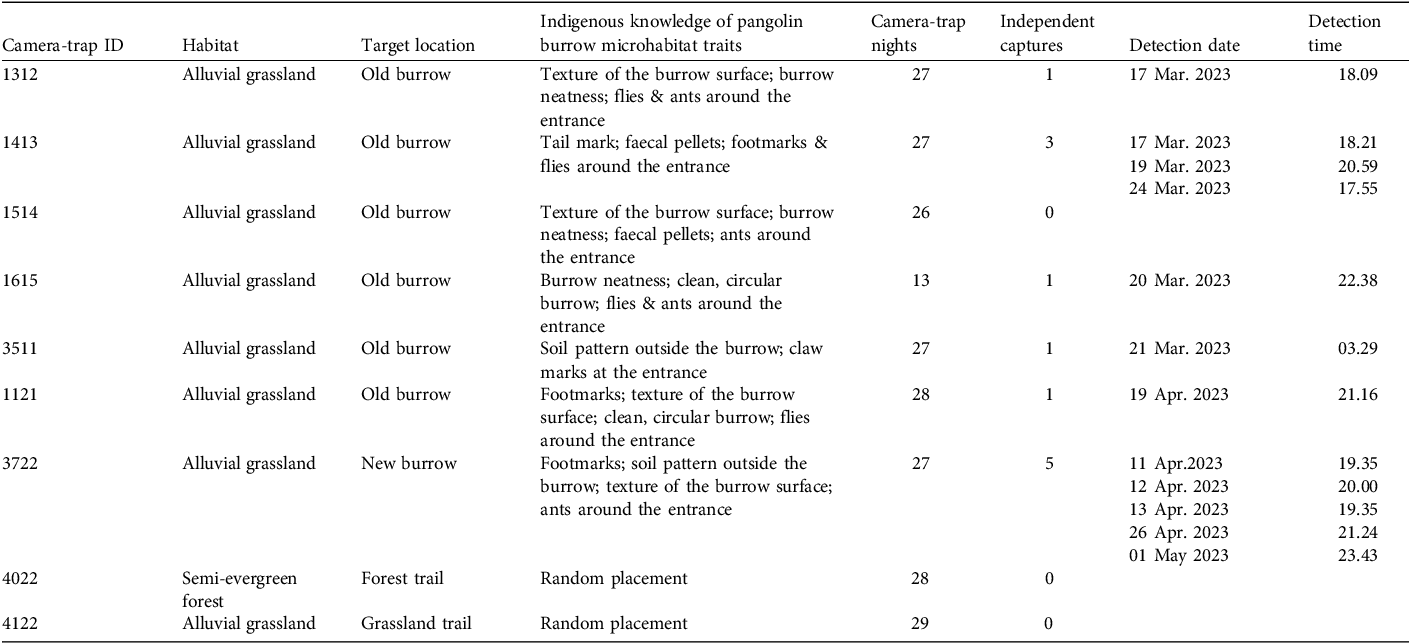
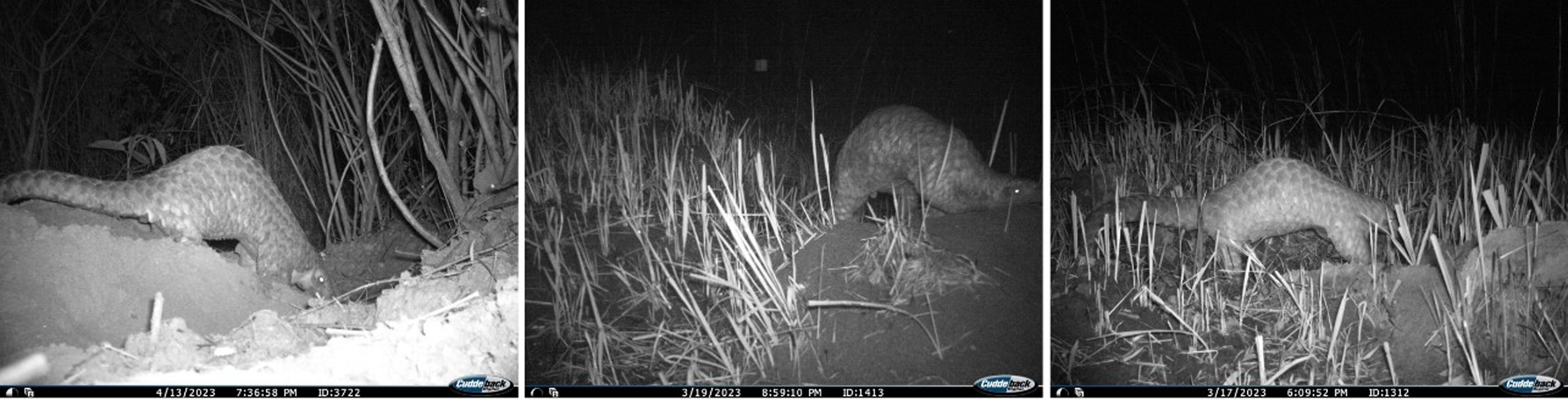
Pangolins were only detected by cameras positioned according to Adi local knowledge (n=6, Table 1). Notably, the first photographic event was recorded within 1 day of deploying the camera by an active burrow (CamID3722). During 232 operational camera-trap nights, we captured 41 pangolin photographs from 12 independent events (Table 1, Plate 1). This translates to an overall capture rate of 5.1 per 100 trap nights (capture rate=total independent captures/total camera-trap nights×100), or a mean of 19 trap nights to obtain a pangolin photograph. Our results confirmed the presence of a significant pangolin population in Daying Ering Wildlife Sanctuary based on the numerous signs of pangolin activity recorded during our walking and camera-trap surveys.
Presence of Chinese pangolins Manis pentadactyla in the Daying Ering Wildlife Sanctuary, Arunachal Pradesh, north-east India. Camera-trap deployment at pangolin burrows was guided by Indigenous knowledge of microhabitat traits used by the Adi People. During 232 operational camera-trap nights, we captured 41 pangolin photographs from 12 independent events.

Images of Chinese pangolins Manis pentadactyla captured by camera traps placed near burrows in Daying Ering Wildlife Sanctuary, Arunachal Pradesh, north-east India. The locations of burrows were identified by relying on local ecological knowledge of the Indigenous Adi People.

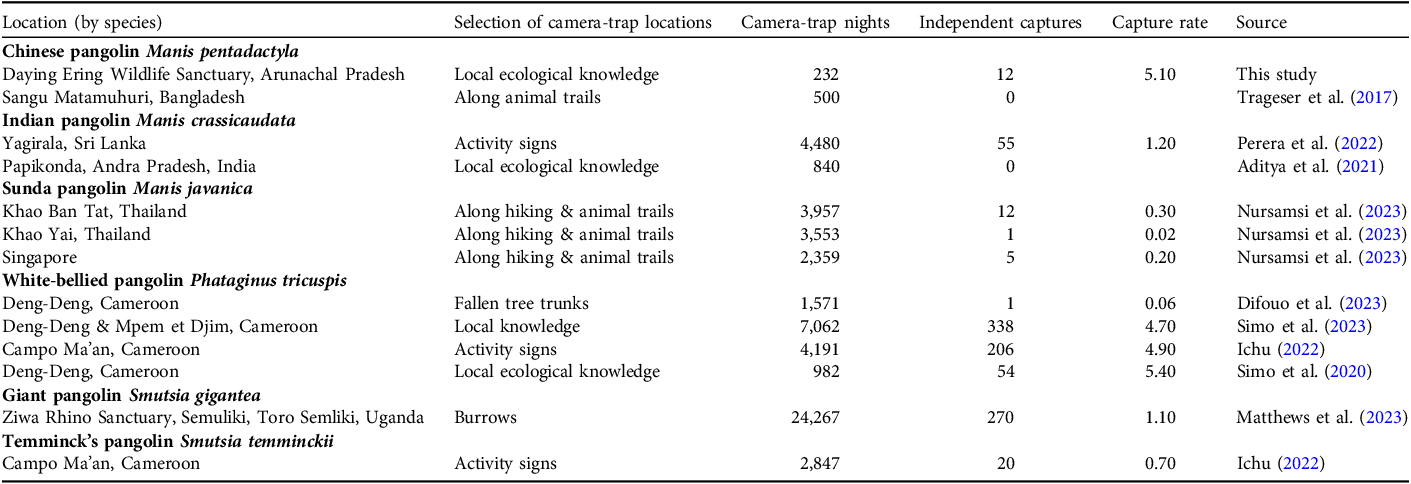
Several previous studies have used local ecological knowledge to guide the placement of camera traps to increase pangolin capture rates (Table 2). For example, local ecological knowledge significantly improved camera-trap capture rates for the white-bellied pangolin Phataginus tricuspis in Africa (Simo et al., Reference Simo, Difouo Fopa, Kekeunou, Ichu and Esong Ebong2020, Reference Simo, Difouo, Kekeunou, Ichu, Olson and Deere2023). However, in a study in south-eastern India, camera trapping based on local information resulted in no detections of the Indian pangolin Manis crassicaudata (Aditya et al., Reference Aditya, Komanduri, Subhedar and Ganesh2021). In general, camera-trap placement based on signs of activity and evidence of burrows has resulted in increased captures rates for ground-dwelling pangolins (Ichu, Reference Ichu2022; Matthews et al., Reference Matthews, Nixon, von Hardenberg, Isoke and Geary2023). Our study builds on this by relying on local ecological knowledge specifically to identify microhabitat features around pangolin burrows.
Pangolin presence assessed from camera-trapping studies in Asia and Africa using different methods to select camera-trap locations including local ecological knowledge. Capture rates represent independent captures per 100 camera-trap nights.

Although our findings are preliminary and based on a limited dataset, they support the premise that we can substantially increase the likelihood of pangolin detection if camera trapping is based on the local knowledge of Indigenous People, specifically about microhabitat features around pangolin burrows. This applies both to situations where pangolin burrows and signs are numerous but equipment is limited, and where pangolin signs are rare, making it difficult to determine the ideal locations for camera placement. Importantly, given the paucity of studies on the Chinese pangolin from the region, our findings confirm a substantial population in the study area. The Adi People interact with wildlife through their daily activities such as hunting, swidden farming, fishing and cattle rearing, which often lead to a deep understanding and detailed local ecological knowledge. This includes knowledge of pangolin behaviour, activity, habitat preference and burrow characteristics. For example, we know from the Adi elders that pangolins are found in red soil close to water sources and are often seen in swidden plots around decaying vegetation and termite colonies. One Adi person explained, ‘if pangolin footprints are going away from the burrow, it means the pangolin has recently entered the burrow. The opposite is also true. This is because their front legs have folded nails’. The Adi People also have cultural beliefs associated with the pangolin, such as affectionately referring to a hardworking individual as a pangolin, or considering a pangolin encounter during the day a bad omen that is thought to bring misfortune upon the observer or their family.
In summary, we suggest that a reliance on local ecological knowledge of pangolin habits and behaviour to direct research and conservation efforts can serve as a practical and cost-effective approach to monitoring these elusive species. The approach will be particularly valuable for nocturnal, hunted or burrowing species such as the Chinese pangolin as long as it is integrated in ethically responsible research protocols.
Author contributions
Study design: CP, SN, AD; data collection: CP, OR; data analysis: CP, SN; writing: CP, SN, AD.
Acknowledgements
We are grateful to Stop Poaching Fund and Cholamandalam Finance for providing funding; the Adi Ba:ne Kebang for granting consent to conduct research in Adi lands; and the Arunachal Pradesh Forest Department for permits to work in the Daying Ering Wildlife Sanctuary. We are deeply indebted to Adi community members, especially to Papum Ratan and his family, for sharing their knowledge and for providing a safe place for us to stay during our research.
Conflicts of interest
None.
Ethical standards
Our research abided by the Oryx guidelines on ethical standards and was approved by the Nature Conservation Foundation Ethics Committee (EC approval NCF-EC_30/08/2021-(63)).
Data availability
The data supporting the findings of the study are not available because of the sensitive and Critically Endangered status of the Chinese pangolin.

 Open access

