

1. Introduction
Vitamins are part of everyday life. From making sure our diet is balanced in fruit and vegetables to the number of advertisements for supplements, vitamins are everywhere. Scientifically, these molecules are classified and clustered in various ways thanks to their functionality, origin, and chemical composition. But is the category “vitamin” a natural kind? The most intuitive answer might be “yes,” as there are many generalizations and studies that can be done on them. However, vitamins are extremely heterogenous in terms of categories (vitamin A, vitamin C, vitamin D, etc.), in terms of functionality (from contributing to the immune systems to red blood cell renewal), and in terms of chemical compounds (from ascorbic acid to cyanocobalamin). This heterogeneity and the plurality characterizing vitamins might challenge their understanding as natural kinds.
In this article, I argue that “vitamin” and the groups of vitamin families (like vitamin Bs) should be considered investigative kinds in middle-range ontologies, as categories tracking features of the world in a way that shapes fields of research. I build on the notion of investigative kind suggested by Brigandt (Reference Brigandt2003) to argue that vitamins capture broad causal patterns, while still being a category subject to open-ended investigation. This tracking feature of vitamins as investigative kinds will be further supported using the notion of Magnus “middle-range ontology” (2023).
The results of this article will contribute to different debates. Firstly, it offers an analysis of the vitamin category, a case study underexplored in philosophy of science, but important in current physiology and nutrition studies. Secondly, it complements the literature on investigative kinds with an analysis of their ontology (rather than the epistemology proposed by Brigandt). This can also support the utility of the notion of investigative kinds for other instances of kinds in the sciences. Thirdly, this article combines insights from the history of science with an ontological and epistemic reflection on the role of kinds that are neither conventional nor natural and this can further invite cross-discipline analysis in philosophy of science.
The structure is the following. Section 2 illustrates briefly the history of vitamin discovery and research. This shows how the introduction of this category and subsequent scientific discoveries led to the identification of many different vitamins that were originally clustered in fewer kinds. Moreover, the vitamin category was introduced before actual instances of vitamins were found, thus guiding research. Section 3 explores whether vitamins can be considered natural or conventional kinds. It argues that both characterizations fail short to account for the heterogeneity of the kind and the role that vitamins play in current research. Section 4 argues that vitamins can be considered investigative kinds, as those that have to be clarified through empirical inquiry and can lead to further discoveries (Bridgant Reference Brigandt2003; Griffiths Reference Griffiths2004). Section 5 develops the ontological import of vitamins as investigative kinds, building on the notion of “middle-range ontology,” as suggested by Magnus (Reference Magnus2023). While the article argues that the category “vitamin” is an investigative kind, together with broad vitamin families, the argument will be exemplified by focusing on the vitamins of the B group. This case illustrates how the introduction of the category vitamin B has led to the discovery of specific natural kinds, such as vitamin B12 and vitamin B9, and how this makes the vitamin category a successful investigative kind.Footnote 1 Moreover, the category vitamin B plays a role in capturing the causal role that these vitamins have jointly in given physiological processes, such as neural renovation, placing the vitamin in a middle-range ontology. The same reasoning can be generalized to other vitamin families and to the category vitamin in general. Concluding, vitamins are investigative kinds in middle-range ontology, tracking features of the world while being subject of open-ended research and leading to novel discoveries.
2. Vitamin discovery and vitamin kinds
Vitamins are broadly defined as complex chemical compounds that play an essential role in human physiology, most are not synthetized directly by the organism and have to be introduced through nutrition. Moreover, we have a well-developed scientific knowledge of these molecules and vitamin classifications are based on chemical structure, the function they play, and origin. However, this was not the case when the category “vitamin” was introduced. This section will present briefly the history of vitamin discovery as an illustrative case that sheds light on some core features of vitamins as investigative kinds, which will be argued for in the next sections.Footnote 2
The awareness that some diseases were linked to given eating habits or food is documented in the history of medicine (Hayashi Reference Hayashi and Preedy2012). For instance, accounts of Chinese medicine of 2600 BC already described beriberi as linked to rice exclusive diets. In the seventeenth century James Lind (1716–94) in the English Royal Navy noticed a correlation between eating citruses and the prevention of scurvy and in the early nineteenth century Kanehiro Takagi (1849–1920) of Imperial Japanese Navy observed the lack of beriberi in officers that had access to varied and richer diets (so, not only rice based). However, knowledge of the exact cause of such diseases and, thus, the possibility to find accurate treatment and prevention was lacking.
At the beginning of the nineteenth century, nutrition science was growing and most of the macronutrients (carbohydrates, lipids, and proteins) were identified. This was accompanied with the hope to understand the diseases linked to nutritionFootnote 3 and the ideal goal of making good artificial food that could help for malnutrition (Semba Reference Semba2012; Hayashi Reference Hayashi and Preedy2012).Footnote 4 This latter research particularly focused on the production of meat extract, gluten extract, and infant formula/artificial milk. The search for this latter product is related according to some analysis to the first formulations of vitamin theory (Semba Reference Semba2012; Hayashi Reference Hayashi and Preedy2012).
The attempts at recreating breastmilk were grounded in the study of the chemical constituents of milk, developed since the eighteenth century as it was recognized as the only “chemically complete” food (Mepham Reference Mepham1993; Semba Reference Semba2012; Hayashi Reference Hayashi and Preedy2012; Lieffers Reference Lieffers2024). In the nineteenth century, formula became an increasing necessity for many women and families across social classes while its production turned into a concrete possibility thanks to more chemical knowledge. In the United Kingdom, urban poor mothers were, for example, asked to return to work nine days after birth, and most within a fortnight, and thus were not able to breastfeed, both from being overworked and not being able to stay with the infant (as per evidence given in the 1833 Factory Commission, Mepham Reference Mepham1993). Breastfeeding saw a decline also in women across wealthy social classes, possibly for reasons related to the idea of the role women should have in modern society (Mepham Reference Mepham1993). The research on infant formula was tested during the Siege of Paris in 1870, when many infants and toddlers were facing famine due to the poor health of mothers and the city being cut off from milk supply. This led chemists to manufacture and administrate artificial milk, however without significant results.Footnote 5 The chemist Jean Dumas (1800–84) concluded that there were some “unidentified substances” in breastmilk that were indispensable for life and not present in artificial milk (Semba Reference Semba2012; Hayashi Reference Hayashi and Preedy2012). According to scholars, this can be framed as one of the first proposals of vitamin theory (Semba Reference Semba2012, 311; Hayashi Reference Hayashi and Preedy2012).
Together with this, medical knowledge was aware of the possibility that diseases could be caused by microorganisms, such as bacteria. Diseases like beriberi were firstly explained either by supposing a lack of proteins (as white rice doesn’t contain many) or by the presence of specific bacteria in rice (the “beriberi bacteria”), as for instance suggested by Christiaan Eijkman in 1887 (1858–1930). Given the impact of nutritional diseases and the new discoveries regarding nutrients, the work of different scientists across the world focused on trying to find which molecular commonalities could be found and soon it became clear that these were not linked to the known macronutrients nor microorganisms (Semba Reference Semba2012; Lindblom Reference Lindblom2016). Specifically, it was observed that creating foods based on “synthetic” diets composed of carbohydrates, proteins, and lipids would lead the tested animals in laboratory environments to develop diseases and malnutrition rather than treating or preventing them (Semba Reference Semba2012).Footnote 6 This was taken as a sign of the absence of bacteria, as the synthetic diets were “controlled,” and of the need to find and isolate the missing substances.
In this regard, different parallel works are worth being mentioned. In Japan, Umetaro Suzuki (1874–1943) extracted an “anti-beriberi” factor, firstly called “aberic acid” and following further experiments “oryzanin,” from rice bran and presented his results in Japanese in 1911 and then in German in 1912. In Europe, the search for the missing nutrients was lively. The Polish scientist Casimir Funk (1884–1967) did similar experiments and suggested in 1911 that the substances preventing deficiency diseases should be called “vit-amines,” combining their being essential for life (vital) and presenting an amine group (amines). His works were crucial in pointing out the existence of vitamins, despite the lack of knowledge of precise structure and synthesis, and the core role that these play in nutritional sciences. He called for the need of developing a “vitamin theory,” inviting further investigation (Funk Reference Funk1912a, 1912b; Piro et al. Reference Piro, Tagarelli, Lagonia, Tagarelli and Quattrone2010).Footnote 7 In the United Kingdom, Frederick Gowland Hopkins (1861–1947) hypothesized in 1912 the existence of “accessory food factors” contained in food and different from the basic ingredients of synthetic diets (fats, proteins, and carbohydrates). More research was also carried out in the United States, where the research in nutrition done by Marguerite Davis (1887–1967) and Elmer McCollum (1879–Reference McCollum1967) lead to publish a crucial paper for the field in 1913, dividing the classification of these molecules into two broad families: fat-soluble A and water-soluble B (McCollum and Davis Reference McCollum and Davis1913). This research was based on testing different diets based on feeding mixes of known nutrients to young rats and observing their development accordingly. Similar results were also obtained by Benedict Lafayette Mendel (1872–1935) and Thomas Burr Osborne (1859–1929). Jack Drummond recommended then calling these two categories “vitamin A” and “vitamin B” until the “true nature” of these vitamins could be found (Rosenfeld Reference Rosenfeld1997; Hayashi Reference Hayashi and Preedy2012). The introduction of the “vitamin” category simply defined in terms of its function and few chemical properties (such as solubility) boosted the investigation on these molecules.
At the beginning of the twentieth century, vitamins were classified in terms of the contribution they could give to nutrition and prevention of given diseases, origin (as which food or source they come from) and chemical-physical properties, such as solubility. However, the actual molecular structures were still unknown when the category was introduced. This starting point and first experiments allowed them to be investigated further. Between 1933 and 1936, Vitamin B1 was first isolated and then and synthetized by Robert Williams and J. C. Cline, who identified a specific chemical structure with a thiazole ring, named thiamine (Williams and Cline, Reference Robert and Cline1936). Soon after, a different vitamin B was identified by studying antineuritic water-soluble but heat stable vitamins (B1 is heat-labile). The research of Richard Kuhn’s group and Paul Karrer’s group on these phenomena lead to the identification of vitamin B2, riboflavin. The discovery of this vitamin was also crucial to identify the role that vitamins play as coenzymes in different processes and the possibility to produce the vitamin by artificial means.
The discovery of vitamin B1 and B2 illustrates how the introduction of the category “vitamin” and the discovery of some of these instances boosted research. The discovery of B vitamins continued, and soon enough vitamin B3 (niacin-forms) was introduced as the factor that could prevent pellagra and B6 followed (pyridoxine-forms). Almost all the B vitamins were discovered between 1920s and 1940s (Hayashi Reference Hayashi and Preedy2012). The introduction of the category vitamin and then vitamin B influenced the search and discovery of the other vitamins. Regarding fat-soluble vitamins, vitamin A was discovered in retinol forms. Moreover, more types of vitamins were added to the two original groups, such as vitamin C, which is water soluble and correlated to the prevention of scurvy (introduced by Drummond in 1919), and vitamin D, which is fat soluble and correlated to preventing rickets (named by McCollum) (Jones Reference Jones2022). Nowadays vitamins are classified according to broad vitamin families, divided still in fat-soluble vitamins (vitamins A, D, E, K) and water-soluble vitamins (vitamin C and vitamin B). This is important as provides better understanding of sources and storage of vitamins. These share some of the properties that were originally presupposed when the term vitamin was introduced: They have specific chemic-physical properties; they have to be introduced by nutrition and display specific functions correlated to maintaining physiological processes and thus prevent given diseases.
The history of vitamin discovery illustrates the core role that the kind “vitamin” played in their discovery and identification. The introduction of one simple and broad category, “vitamin,” lead to discovering and researching specific ones in terms of chemical properties and prevention of diseases.
For the sake of the argument, the article will focus on vitamin B family as this presents the richest cluster of vitamin types (letter-and-number vitamins) and vitamers. As part for this family, many specific kinds of vitamins were discovered as vitamin B1 (thiamine), vitamin B2 (riboflavin), vitamin B6 (pyridoxine), and vitamin B12 (cobalamin) (and others). Each vitamin is also realized by clusters of vitamers, various compounds which present relevant structural similarities between each other and the same functional profile. For instance, vitamin B12 presents four vitamers: cyanocobalamin, methylcobalamin, hydroxycobalamin, and adenosylcobalamin. The “vitamin B” family is thus composed of a heterogeneous group of various macromolecules, which share some properties related to solubility, history of discovery and broad functionality in some processes, but they differ in terms of the structure and the specific coenzymatic or biochemical function they have. While the utility of the category could be evident, we can still inquire into whether this utility is grounded into the naturalness of the category vitamin and broad vitamin families, like vitamin B, and, if not, we can assess the kindhood of these molecules.
3. Vitamins as natural kinds and conventional kinds
The vitamin B family (or the category vitamin more in general) is composed by an heterogenous group of molecules and it displayed an important role in discovery and still clusters together vitamins that have a broad joint causal effect. Can the vitamin B family be considered a natural kind?
Upon philosophical standards of natural kinds, the answer might be a straightforward no: The differences in chemical structure might indicate the conventionality of the family vitamin B. This can be argued for in two ways. The first is that vitamins present a type of heterogeneity in structure that is in sharp contrast with forms of chemical structuralism generally applied to chemical kinds (Hendry Reference Hendry2023; Seifert Reference Seifert and Tuomas2023). The second is that the category “vitamin B family” does not respect some general criteria for natural kinds (as in Khalidi Reference Khalidi2023).
Vitamins can be seen as chemical macromolecules with special functions and thus can be assessed through accounts of chemical kindhood. While these kinds can also be seen as functional, they are mostly instantiated by specific compounds characterized by structure too. In philosophy of chemistry, the kind of a given substance is generally identified by microstructural properties, that is, features of the structure at the molecular scale (Hendry Reference Hendry2023). For instance, CO2 is a natural kind defined in terms of presenting a specific structure and composition, and all the instances of CO2 are classified in these terms.Footnote 8 The application of microstructuralism to the vitamin B family is challenging as vitamin B1 or thiamine presents a chemical structure different from the one of vitamin B2, riboflavin. Moreover, each vitamin-type presents some vitamers, that is variations of chemical structure all presenting the same functional profile and classified together. For instance, vitamin B1 or thiamine presents five vitamers: thiamine monophosphate (ThMP), thiamine pyrophosphate (TPP), thiamine triphosphate (ThTP), adenosine thiamine diphosphate (AThDP), and adenosine thiamine triphosphate (AThTP). These forms present some structural differences, being composed of thiamine and different groups. Similar considerations can be made for other vitamins of the vitamin B family, as mentioned in the preceding text. This underlines how chemical kindhood criteria are difficult to apply to vitamin cases. On the opposite, it seems that these molecules are clustered together because of contingent reasons related to their discovery and not based on principles of naturalness or “carving nature at the joints.” This can also show that chemical kinds are “messier” than it seems (as in Havstad Reference Havstad2018).
The other option is to consider a more general account of natural kinds (and not chemical kindhood only). While the literature on natural kinds is quite broad and it is difficult to find an overarching consensus, natural kinds generally present these features: (1) their instances share a cluster of relevant properties that are identifiable; (2) these properties allow the category to be predictively and explanatory successful in a projectible way; (3) they have a link with causation and causal structures; and (4) they should be robust enough across different generalizations (Khalidi Reference Khalidi2013, Reference Khalidi2023; Bird and Tobin Reference Bird, Tobin, Edward and Nodelman2024).
Firstly, while there are some functional properties that the vitamin B family shares (as for instance “contributing to food metabolism” or “neural renovation”), vitamins B are different chemical substances with different biochemical functions, challenging the identification of properties that are stable enough for kindhood. Secondly, given the heterogenous family of properties that vitamins share, it is difficult to consider them as stable enough to be predictively and explanatory successful in a projectible way. For instance, the properties that vitamin B1 displays and the functions it has are not projectible to instances of vitamin B12 in the attempt of explaining and predicting the behavior of the latter with the precision that would be needed for natural kind projectibility. While it is possible to generalize and say that the intake of enough “vitamin B” can contribute to neural renovation or to fight fatigue, the specific contribution of each vitamin remains self-standing. Thirdly, each vitamin B contribute to different processes and the specific roles that they causally play are different and varied. For instance, vitamin B1 plays a causal role in glucose metabolism, which is different from the one of vitamin B12 in the renovation of red blood cells. Moreover, the synthesis of vitamin B and their production presents different causal paths in nature, resulting in different etiologies and origins. Vitamin B1 is synthesized by most prokaryotes and by eukaryotes such as yeast and plants, having a broad production chain; on the opposite, vitamin B12 is synthetized by a group of bacteria and archea and then gets stored into animal tissue, having a narrower production chain in nature. This challenges the role that vitamin B as a kind can play in causal networks, both in terms of specific causal contribution and of causal history that brings these molecules together. Nevertheless, these vitamins can jointly play a causal role in broader processes of neural health and renovation. This indicates the possibility that there is some causal relevance the vitamin B group can play, as we will explore in sections 4 and 5 (Kennedy Reference Kennedy2016).
The alternative to the naturalness of the vitamin B category is to see it as a conventional category: These molecules are clustered together because of contingent reasons related to their discovery and not because of properties that allow them to be natural kinds. For instance, vitamins can be considered “patches kinds,” which avoid the commitment to naturalness, as suggested by Wilson (Reference Wilson2008). In this framework, “patches” are scientific categories that group together different phenomena for given purposes and that can form the conceptual structure of scientific theories (Wilson Reference Wilson2008). An instance of a “patch” is “hardness,” which clusters different phenomena across scientific theories from hardness as resistance to indentation to the hardness of water based on capacity to precipitate soap. The power of these clusters is in the fact that they group together different notions, whose actual applicability is dependent upon specification. For instance, the hardness of a material or of water can be measured upon specification of the properties that need to be measured and the relevant context. In this regard, the vitamin B family might be seen as a “patch” in the history of the discovery of vitamins and a conceptual tool in nutrition but not corresponding to a category in nature. However, we can ask whether the efficacy of the category vitamin B family depends strictly upon specific investigation. This relates to what Bursten calls the “methodological problem of natural kinds” (2018), which considers how they are used in science, what are the properties relevant to them, how they are measured, and how they can be controlled by what explains them (Bursten Reference Bursten2018). Answers to this problem have been framed in terms of different accounts. For instance, Millikan proposes the identification of kinds as those classificatory and useful groupings that allow for “an efficient transfer of information” (Reference Millikan2000). Another influential account is the theory of conceptual extension of Chang (Reference Chang2004) for which a category can be defined as an iterative process in which the extension of a kind changes thanks to new measurement technologies and new conceptual queries. What these accounts have in common is that kinds can be framed as the groupings of objects that exhibit shared trackable properties of interest to science.
Where does this leave us in relation to vitamins? The main concern is that the conventionality of the vitamin category combined with plurality of vitamins characterized by different properties can lead to a form of antirealism or elimination of the category in favor of maintaining only the individual instances. This can be argued on the base that generalizations on vitamin B1 (for example) are more successful than those based on the vitamin B category all together or on vitamins in general and thus maintaining a more specific notion can bring better theoretical success. However, the “power” of the vitamin B category seems to lie in its generality rather than in its specificity.Footnote 9 Differently from “patches” or kinds dependent upon measurement tools and specification, the vitamin B category (in contrast to B1 or B12 taken individually) has been able to allow generalizations across contexts in current medicine and nutrition. This invites considering a different option compared to the “standard” contrast between conventional kinds and natural kinds.
Specifically, the role of vitamins and the vitamin B family is complex and their lack or presence can affect different physiological processes at different scales. This makes them closer to kinds in Chang’s or Millikan’s frameworks. For instance, vitamins B contribute to specific physiological processes regarding overall neural health, which goes from the coenzymatic role in carbohydrate metabolism, needed for nerve fibers, to the overall maintenance of nerves that can allow for better sport and intellectual performances. General integration of vitamin B is often also recommended for neural pain. In these cases, the supplementation of vitamins of the B family can allow to contrast both specific issues at the neural level and more general ones regarding energy metabolism (again different from the specificity of “patches”). This underlines how the interest in the properties that make vitamins relevant is not arbitrarily designed and these properties can instead be robustly detected, measured, manipulated, and intervened upon. While these common properties might not be found at the level of specific chemical structure or biochemical functionality, they might be found in overall biological functionality in complex processes. In this sense, the vitamin B family was introduced as a detectable category characterized by a specific chemical-physical property (water-solubility) and by the role of contributing to nutrition to prevent given diseases related to neural health. These vitamins share the capacity of preventing some given diseases, and some of them can be found in similar food groups (like green-leaves vegetables or eggs). The understanding of their general contribution in the right phenomena has been refined, but it is still present.
More broadly, the argument can be extended to the category vitamin in terms of the contribution they make as micronutrients. The interest in vitamins is not arbitrarily designed and the research related to vitamins was followed by the discovery of something that could be detected, measured, and manipulated (such as specific compounds with related functionality). The results have been refined, but there is still an overall case to be made for vitamins. Further, following the suggestion of Chang, the way in which this has been possibly changed according to the instruments of measurements available. Even if vitamin kinds do not carve the world at the joints, these categories have been allowing the investigation of which of these joints are there. Funk (Reference Funk1912b) writes that “vitamins await investigation,” and in the generality of this category lies the power that allowed for further research: Vitamins seem to be kinds that are neither natural nor conventional but can be investigative.
4. In between natural and conventional: Investigative
The presence of categories that lie in between the natural and the conventional is not rare in science. In this respect, Brigandt (Reference Brigandt2003) and then Griffiths (Reference Griffiths2004) introduced the notion of “investigative kinds.” The main case study in Brigandt are species. Species are a kind whose “naturalness” has been debated extensively, including discussions on essentialism, historical identification, individuality and kindhood, and many more issues (see Ereshefsky Reference Ereshefsky2022 for an extensive analysis). Specifically, interpretations of species antirealism see the species concept pluralism and complexity as something that makes species theoretically useless, and thus to be eliminated in favor of more precise categories.Footnote 10 In this context, Brigandt introduces the notion of investigative kinds as a way to disentangle the discussion from the “natural versus conventional” tension. He argues that, instead of seeing species as a category that does not “carve nature at the joints” due to the plurality of the accounts used to characterize the notion, we should see species as an investigative kind. Investigative kinds are categories firstly introduced when noticing patterns regarding observed similarities. These patterns are seen as theoretically important, but the relevant mechanisms or underlying processes that generate them are yet unknown and accordingly the investigative kind allows for the search of their basis. The introduced kind is then maintained as it represents a model for natural kinds and it is subject to open-ended investigation, being clarified through empirical inquiry and allowing for further discoveries (Brigandt Reference Brigandt2003; Griffiths Reference Griffiths2004).Footnote 11 The investigative kind sets the general standards for what counts as a proper kind, while maintaining a level of generality that allows to pick up the many instances and the investigation of them.
These kinds are general and useful for investigation, while being subject to clarification and open-ended analysis. This process of classification and change regards the extension and the intension of category considered, following empirical enquiry and the change in technologies and theoretical tools (in line with Chang Reference Chang2004). Changes in extension involves changing which objects or patterns in the world are associated with the investigative kind, for instance given populations might be recognized as a distinct species or not through time. The change of extension ensures that the instances of the kind possess a rich cluster of properties allowing for the reliable inferences that motivated their introduction by including or excluding members of such kind. For example, untranscribed regulatory regions in the genome were not considered parts of the gene in the past, while in contemporary accounts are often considered as part of molecular genes (as in Waters Reference Waters1994; Bellazzi Reference Bellazzi2022). This is a case of change of extension of the category or possible investigative kind “molecular gene.” Investigative kinds change intension too. In this case, the natural kind concept behind the investigative kind might be altered to reflect the newest and most updated notions of natural kinds or contemporary standards. This signifies a change in the way kinds are identified in the first place. Species underwent a change of intension in their kindhood. For example, in Linnean biology, species were classified in terms of phenotypic properties and characteristics, using an account of natural kinds that favored a shared phenotypic essentialism. In contemporary biology, species are characterized by using an account of natural kinds favoring historical and phylogenetic properties as well, associating kinds to historical properties and/or etiological kinds (Brigandt Reference Brigandt2003; Khalidi Reference Khalidi2023). It is important to underline that changes in extension and intension often go together with the development of empirical investigation and the discovery of concrete new phenomena, and the constant clarification that the categories display in scientific theories. Species represent a good instance of investigative kinds, as they present enough heterogeneity not to be seen as natural kinds, but they are also useful in guiding research and used thoroughly in contemporary biology to further investigate given phenomena and issues.
Moving to the vitamins, they can also be subjected to the “pluralism critique” for which there is no general vitamin B category, but individual different molecules clustered together. Therefore, one might argue that the term should be eliminated and replaced by a plurality of more useful categories, such as vitamin B1, vitamin B2, and so on. However, similarly to the species category in Brigandt’s account, the vitamin B category still plays a core role in scientific research and application as it allows to capture, intervene, and manipulate different patterns or processes in living beings. Accordingly, I argue that the vitamin B category can be seen as an investigative kind, a model for natural kinds and subject to open-ended investigation and thus clarified through empirical inquiry. As discussed in section 2, the vitamin B category was introduced to identify those molecules that had some general functions in nutrition (especially in preventing forms of malnutrition leading to neurotic diseases) and the property of being water soluble. This has boosted research and allowed the birth of a new field of inquiry: vitamin discovery, vitamin identification, and synthesis. This also led to a better characterization and application of nutritional medicine, as reflected in current science.
Moreover, following the previously mentioned characterization of investigative kinds, the vitamin B family has changed extension and intension. In terms of extension, other vitamins have been found sharing the property of being water soluble and prevent malnutrition and tiredness, such as vitamin C. This has modified the extension of the vitamin B family, as now it excludes vitamins such as vitamin C, which maintains a kindhood on its own. This modification has been done by further inquiring and investigating into the relevant properties of the vitamin B family. Vitamins having a role in preventing neurotic diseases (vitamins B) have been distinguished from those that instead prevent scurvy (vitamin C), together with the identification and synthesis of the underlying chemical compounds. Moreover, the vitamin B changed in extension also because many vitamin Bs were found, compared to the hypothesized “one vitamin B substance.” The vitamin B family has seen some changes in intension too. In terms of intension, vitamins were introduced as kinds combining a structural with a functional characterization, by being specific chemical substances with given properties (being water soluble for vitamin Bs, for instance) and those that can prevent malnutrition or nutritional diseases. For vitamin B, this could generally be seen as the introduction of a special chemical natural kind, something that would carve nature at the joints and could be found. However, the heterogeneity of the instances of the vitamin B category (or vitamins in general) challenged the characterization of the kind as a chemical and as a natural kind. Indeed, the set of properties that vitamin Bs share is not stable, it is diversified and does not fit the standard criteria for chemical kinds. Instead, we could think of the vitamin B category as a category that allows investigation for its general power in capturing the efficacy of a group of molecules across different instances, calling for a different characterization of this category.
The investigative nature of the vitamin B family can also be seen in the fact that the category changes in line with empirical discoveries and by allowing such discoveries. Specifically, the introduction of the vitamin B family has allowed biochemistry and nutrition science to track different vitamins, which can be considered in themselves natural kinds, such as vitamin B1 (thiamine), vitamin B2 (riboflavin), vitamin B6 (pyridoxine), and vitamin B12 (cobalamin). These vitamins share functionality in food processing and energy storage, but they differ in others biochemical functions and in chemical structure. Accordingly, the vitamin B family does preserve an investigative nature while allowing for the discovery of kinds, which then can be considered natural in themselves by being specific chemical compounds with given functions. Similarly, the category “vitamin” allowed for the further characterizations and investigation of vitamin families.
5. Investigative kinds and middle-range ontology
The notion of investigative kind is introduced by Brigandt as an epistemic notion regarding the import of scientific categories and to argue against the epistemic elimination of those kinds that have a broad or pluralistic characterization. However, the effectiveness of a given epistemic investigative kind also has an ontological impact if this is related to empirical discoveries.Footnote 12 Specifically, a given investigative category can be useful to science because it allows the empirical discovery of new entities or patterns that are instances of the investigative kinds. This is in line with the history of vitamin discovery, in which the “vitamin ontology” is discovered from introducing the vitamin category (epistemically) and doing the relevant experiments allowing the identification and synthesis of each vitamin group. Moreover, the investigative category allows its application throughout different levels of physiological phenomena, from carbohydrates processing to neural regeneration and fatigue reduction, indicating actual effects that the vitamin molecules have.
This motivates the development of an ontology of vitamins as investigative kinds from an epistemology of vitamins as investigative kinds.Footnote 13 Vitamins are not straightforward chemical natural kinds and, as argued here, can be seen instead as investigative kinds that tracks some patterns that are independent from our interests and would still exist even without our classification systems. For instance, the molecules composing the vitamin B family would still exist even if we didn’t classify them and they would still have a biochemical function and physiological function in preventing some neurological diseases. Moreover, vitamins B are still associated to energy metabolism and neural regeneration and their severe lack can lead to malnutrition and, in severe cases, permanent brain damage. This happens independently of our classification systems. Similarly, severe lack of vitamin C can lead to scurvy and its presence in diet can prevent it. This also allows the vitamins to have a profile that is stable enough to be used in generalizations and scientific investigation.
In this regard, Magnus recently underlined that vitamins have enough scientific relevance and enough stability to be used in scientific investigation, while not fitting the criteria of a “deep ontology,” as they do not display fundamental essences, nor the metaphysical properties relevant for natural kindhood (2023). These criteria for natural kindhood can go beyond essentialism as they can include any parameters we want to take as metaphysically relevant for the identification of natural kinds.Footnote 14 Even if having an epistemic investigative profile might not be considered enough for the reality of the kind “vitamin B,” Magnus suggests that vitamins are part of a “middle-range ontology” (Reference Magnus2018; 2023). This “middle-range ontology” can be useful to develop an ontology of investigative kinds. Kinds in middle-range ontologies are kinds whose instances exist and present some general patterns of behavior that allows to track generalizations across domains that are ontologically similar. Middle-range ontology is then not defined as a matter of scale, but rather as being in between “shallow” and “deep” ontologies. It tracks patterns that go beyond categorizations that are helpful for scientific practice at a given point of inquiry (shallow ontologies) while tracking causes and functions without a “heavy-hitting metaphysical apparatus” (deep ontologies) (Magnus Reference Magnus2023, 1039).
For instance, the vitamin B family can be seen as a middle-range kind because the instances of vitamin B (vitamin B1, B2 and so on) exist and have a causal relevance in physiological and biochemical domains. Moreover, generalizations upon the category vitamin B can be done across contexts that are ontologically similar, such as different processes of neural renovation and maintenance. These kinds are not part of a deep ontology because they are heterogeneous and do not fit metaphysical criteria for natural kindhood (or those explored in section 3), while each individual vitamin (as vitamin B1) could be a natural kind. However, vitamins B still have an ontological profile by tracking and grouping kinds at a level which is general enough to capture specific causal contributions (such as contributing to energy metabolism) in a nonarbitrary way, thus being beyond shallow ontologies and conventionalism.Footnote 15 The kinds part of middle-range ontology have a level of reality that goes beyond practice as they seem to track stable patterns that have causal relevance.
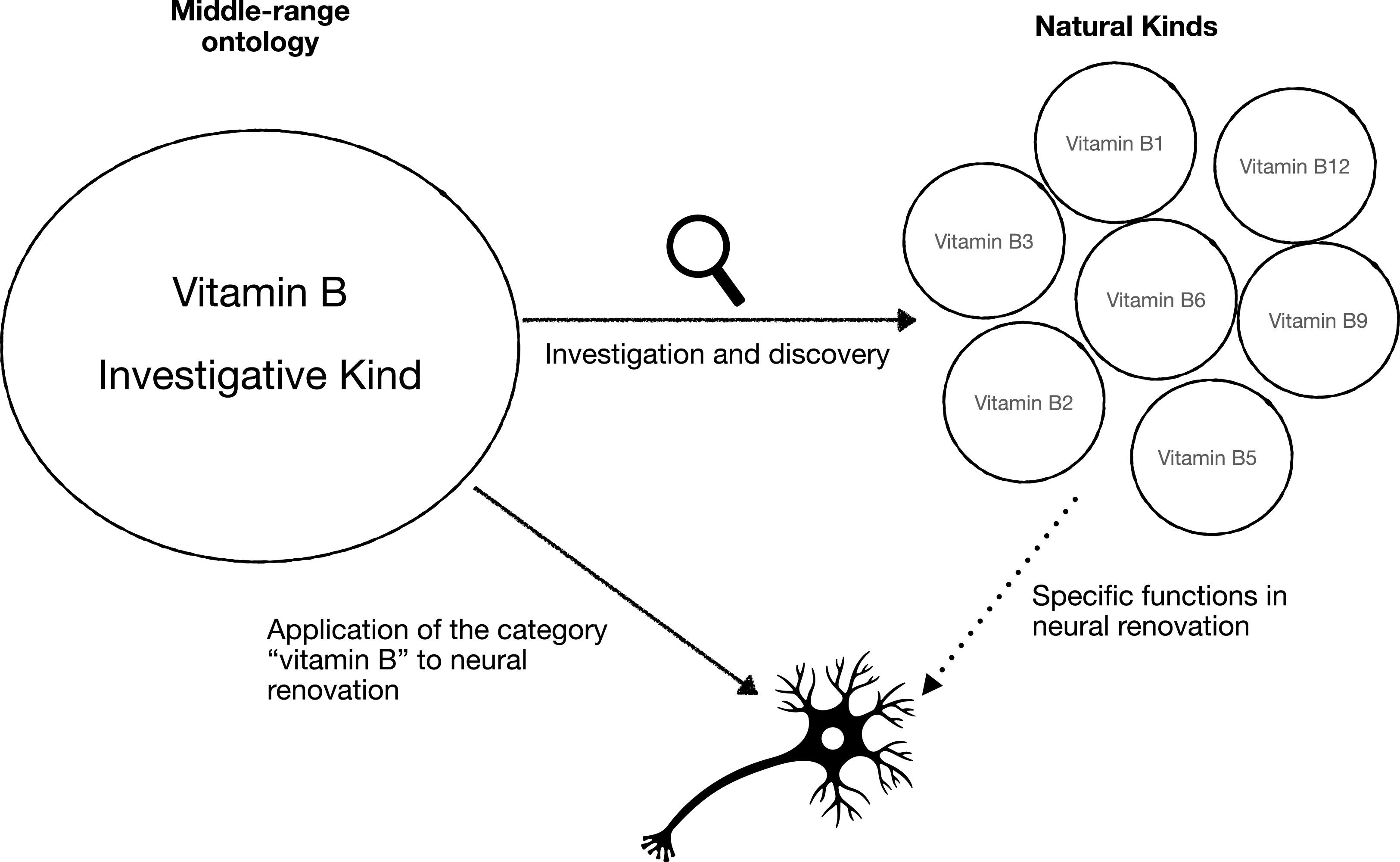
The ontology of investigative kinds like vitamins (and possibly species and emotions too) can be placed in the middle-range as they don’t only invite and support investigation but also track given features of reality by allowing discovery, prediction, and explanation of causal pathways. Specifically, they track the causal effects of natural kinds (which would be in a fundamental ontology) in a successful way. This “tracking” can be seen in the capacity of clustering together specific patterns of natural kinds that can have a joint causal role in given contexts (see Figure 1). This can then have an impact on investigation, discovery, and prediction and explanation of given causal pathways.Footnote 16 For instance, the vitamin B category allows for the successful investigation and discovery of specific kinds, the various forms of vitamin B. Moreover, vitamins B share some broad physiological functionality and origin that is used successfully in health sciences and nutrition, as in predicting and explaining general neural renovation and energy metabolism. This is supported by studies on the functions of B vitamins for optimal neurological functioning showing that the category has a successful role in itself (as Kennedy Reference Kennedy2016).Footnote 17 This offers a further ground to keep on grouping vitamins together under the vitamin B category for investigative epistemic reasons and ontological ones. Moreover, each vitamin B (as vitamin B1, vitamin B12, et al.) differs in properties but presents the features that would allow each individual one to be characterized as a natural kind, chemical or biochemical (Bellazzi Reference Bellazzi2025). For instance, all vitamin B12 will present a corrin-ring and will have a coenzymatic role in erythropoiesis, having some features that will allow them to be considered natural kinds.
The vitamin B as an investigative kind in a middle-range ontology tracking patterns of natural kinds contributing to neural renovation.

In a nutshell, investigative kinds can be middle-range ontology kinds because they track the causal effects of natural kinds in a successful way. The vitamin B family and the category vitamin in general fit the definition of investigative kinds, as they are categories that allow for investigation and can change in extension and intension, and of middle-range ontology. This is because vitamins have a level of reality that goes beyond practice as they track stable patterns that have causal relevance, allowing successful investigation and discovery. They can be detected, measured, manipulated, and intervened upon up to a given level of specificity, as can be noticed in nutrition science. There are forms of malnutrition or certain conditions that can be prevented or contrasted with generic vitamin B family supplements. However, for a more specific intervention and scientific research it is important to “unpack” the investigative category into its constituents to allow for even more precise scientific research. For instance, malfunctions in erythropoiesis (red blood cells renovation) might need specifically vitamin B12 while problems in nutrients and prevention of pellagra might require vitamin B1.
5.1. Advantages
The advantages of this account of vitamins build upon those that Brigandt and Magnus underline in their original proposals. Firstly, the pluralism characterizing vitamins and the heterogeneity of the category does not entail mere conventionalism nor eliminativism. Instead, thinking of vitamins as investigative kinds in middle-range ontology supports the successful usage that vitamin categories have in nutritional medicine and physiological studies, combining generality with the capacity to cluster together relevant natural kinds.
Secondly, this account allows to accept the contextuality or relationality of vitamins as kinds (as also in Magnus Reference Magnus2023). The ontological profile of vitamins depends on the context in which they manifest their action. The investigative power of the category is not only in tracking a cluster of different chemical compounds but also in allowing for the discovery of a group of molecules that can have a joint functionality in living systems. Following Magnus, a series of molecule with the same structures as cobalamin (vitamin B12) or thiamine (vitamin B1) on a lifeless star would not be a vitamin kind as the relevant physiological context is missing. Accordingly, grouping together different chemical compounds under the category “vitamin” and then the “vitamin B family” allows for the appropriate identification of properties in terms of their contribution to nutrition in contexts. This identifies a specific ontological aspect of reality, which is not conventional—while still not being “natural” nor “fundamental.” In the case of the vitamin B family, this specific aspect is the role that vitamin B family plays in neurological health and neural renovation. Moreover, the fact that vitamins pick up this specific set of causal interactions is supported further by the evolutionary history of these physiological processes that have been selected to interact with specific vitamins and not others (as in Bellazzi Reference Bellazzi2025). This makes the category vitamin B family a “relational kind” whose nature is evident in specific contexts and within specific interactions (again as in Magnus Reference Magnus2023). This contextuality or relationality, even if it might be considered problematic for “classic” instances of natural kinds, is not a problem for investigative kinds in middle-range ontologies, as they instead present more flexible features.
Thirdly, this view allows to consider together the chemical and the biological nature of kinds such as vitamins, going beyond a dual view of biochemical kinds (Bartol Reference Bartol2016). Vitamins can be seen as biochemical kinds, and their investigative nature keeps together the biological characterization of the vitamins and their chemical one. This is because the kind investigates given chemical compounds within biological contexts, and its investigative power and success in tracking such features of reality is based on keeping together these aspects. Moreover, considering vitamins as investigative kinds in middle-range ontology allows for a characterization that does not bind to either considering them chemical kinds in a structuralist model nor biological kinds in an evolutionary-functional way. This view is consistent with the history of vitamin discovery and with the usage of the category, which is always applied in specific contexts.
6. Conclusions
This article considers the discovery of vitamins to explore kinds that are in between the conventional and the natural categories. It argues in favor of vitamins as investigative kinds in middle-range ontologies, combining the account of Brigandt (Reference Brigandt2003) with the one recently proposed for vitamins by Magnus (Reference Magnus2023). The article exemplified the argument by focusing on the vitamin B family, but it can be generalized to other vitamin families and to the vitamin category in general. Vitamins are investigative in nutrition and cluster together specific micronutrients that have to be introduced in small quantities to maintain physiological processes, and each vitamin then tracks patterns of specific macromolecules. The article reaches this conclusion by combining the history of vitamin discovery with an epistemic and ontological account of vitamins. Section 2 discussed the history of the category “vitamin” in nutrition and the discovery of vitamins. This allowed to underline how the introduction of some categories can lead to discoveries of different kinds, such as the case of vitamin B family and the individual vitamins. After exploring whether vitamins can then be seen as natural or as conventional kinds, the article suggested that vitamins are investigative kinds, as those that have to be clarified through empirical inquiry and can lead to further discoveries (Bridgant Reference Brigandt2003; Griffiths Reference Griffiths2004). For instance, the vitamin B family has led to the discovery of natural kinds, such as vitamin B12 and vitamin B9, and this makes the vitamin category a successful investigative kind. This has been further developed by locating such categories in a “middle-range ontology,” following Magnus (Reference Magnus2023). This brings a form of ontological commitment based on the success of the vitamin category in clustering together patterns in reality. In conclusion, vitamins are investigative kinds in a middle-range ontology as they track patterns of natural kinds in a reliable way relative to specific physiological and biological processes.
Acknowledgments
This article was supported by the Leverhulme Trust Early Career Fellowship on the project “FunMo: functions at the molecular scale” and by the European Research Council Project “AssemblingLife,” grant no. 101089326. I would like to thank the AssemblingLife research group for their in-depth comments on this draft. My most sincere gratitude goes also to Charles Pierce for commenting on this article and the audience at the first Metaphysics of Chemistry Workshop (Louvain-la-Neuve, July 2024). I am also grateful to those at UCL STS seminars and the Philosophy of Science Association Conference 2024 with whom I have discussed earlier versions of this paper. Thanks to Emma Pewsey at Chemistry World for commenting the first ideas presented here. Thanks to Tom Rossetter for the insights on the research made on artificial food. I also thank editors and reviewers for their help in improving the article.
Funding Information
This research was funded by the Leverhulme Trust Early Career Fellowship on the project “FunMo: functions at the molecular scale” at Durham University (UK) and by the European Research Council Project AssemblingLife grant no. 101089326 at the University of Oslo (Norway).
Declarations
None to declare.

 Open access

