

Introduction
Universal Credit, a new means-tested benefit for working-aged people in the UK, was introduced to reorient the social security system around paid work (Department for Work and Pensions, (DWP) 2010b). Universal Credit aims to increase entry and progression in paid work, in part through intensifying and expanding welfare conditionality. Parents who have the primary responsibility for the care of dependent children (termed the ‘lead carer’) have been particular targets of the increased conditionality within Universal Credit policy (DWP, 2010b). Under the new conditionality regime, lead carers are subject to varying levels of work preparation and job search requirements depending on the age of the youngest child, and face sanctions for perceived failure to comply. Given the unequal gendered division in responsibility for unpaid care, mothers are disproportionately subject to the conditionality regime for lead carers within Universal Credit.
This article draws on a qualitative longitudinal research project to analyse the gendered impacts of the Universal Credit conditionality regime with particular respect to mothers’ unpaid caring roles and their position in the paid labour market. As the sample contained fairly even numbers of both middle class and working-class mothers, the intersection between gender and class is also explored. Previous research has shown that social class remains an important dimension to how women experience and view motherhood (for example, Gillies, Reference Gillies2007; Vincent et al., Reference Vincent, Ball and Braun2010; Holloway and Pimlott-Wilson, Reference Holloway and Pimlott-Wilson2016). This research highlights that working-class mothers often occupy a stigmatised position in society and that the current shift towards expectations of both intensive mothering and paid work can create particular dilemmas and difficulties for working-class women. Research also suggests that interactions with the social security system can be class-based. For example, de Vries et al. (Reference de Vries, Reeves and Geiger2022) found that decisions regarding sanctions in the UK social security system are affected by bias against claimants from stigmatised class backgrounds. Therefore, this article makes a new and relevant contribution by exploring variations in mothers’ experiences of the Universal Credit conditionality regime according to social class.
Changing expectations of mothers in the UK social security system
Over the past three decades, there has been an increase in the emphasis placed on paid work as the primary responsibility of citizenship (Patrick, Reference Patrick2012) which has led to changing expectations of mothers within the UK social security system. Historically there has been some recognition of mothers’ caring roles in the form of unconditional social assistance granted on the basis of their caring responsibilities (Daly, Reference Daly2011; Davies, Reference Davies, Harrison and Sanders2015); albeit at an inferior level to assistance for those engaged in paid work (Orloff, Reference Orloff1993; Lister, Reference Lister2003). Lewis (Reference Lewis2009) has argued that there has been a shift from the assumptions of a male breadwinner and a female carer prevalent in the 1940s to an assumption of an adult worker model wherein both women and men are expected to undertake paid work. While the male breadwinner model problematically entrenched mothers in traditional gender roles and contributed towards their economic dependence, it did provide some recognition of women’s caring responsibilities and the potential for these to limit women’s ability to participate in the paid labour market.
Although there have been some slight shifts in men’s engagement in unpaid care, and as such, some men are also subject to the devaluation of unpaid care, women remain disproportionately responsible for unpaid care (Jupp et al., Reference Jupp, Bowlby, Franklin and Hall2019). Problematically, the gendered imbalance in responsibility for unpaid care has not been adequately addressed in the shift to the adult worker model. Although there have been policies aimed at reconciling paid work and unpaid care, these have been focused on women rather than both men and women, and governments have assumed that in the adult worker model, unpaid care will move to the formal, paid sector (Lewis and Giullari, Reference Lewis and Giullari2005).
A key criticism of the increasing expectations of engagement in paid work placed on women is that their weaker labour market position has not been taken into account adequately (Conaghan, Reference Conaghan2009; Ingold and Etherington, Reference Ingold and Etherington2013; Holloway and Pimlott-Wilson, Reference Holloway and Pimlott-Wilson2016). While women have increasingly entered paid work from the 1970s onwards (Roantree and Vira, Reference Roantree and Vira2018), there are ongoing gender equalities in the paid labour market. In addition to the gender pay gap, women are over-represented in precarious jobs that do not confer social security rights (Jensen and Møberg, Reference Jensen and Møberg2017). Women are more likely to be in occupations that are associated with low pay, are under-represented in higher-level positions that pay more within occupations (Reis, Reference Reis2018), and are less likely to progress to higher paying work (D’Arcy and Finch, Reference D’Arcy and Finch2017). Additionally, women are increasingly undertaking self-employed work, which is often accompanied by low pay and a lack of social protection (De Henau et al., Reference De Henau, Harris and Stephenson2020). Mothers are particularly likely to hold a disadvantaged labour market position. As a result of women’s continued disproportionate responsibility for unpaid care, mothers are more likely to be economically inactive or to engage in part-time paid work (Bennett and Daly, Reference Bennett and Daly2014; Reis, Reference Reis2018). Problematically, part-time work in the UK tends to be low-paid, less secure, and segregated into gendered occupations (Matteazzi et al., Reference Matteazzi, Pailhé and Solaz2014). The gender pay gap increases rapidly for many women after they have children (Costa Dias et al., Reference Costa Dias, Joyce and Parodi2020).
Other demographic characteristics apart from motherhood, such as class, ethnicity, and disability, intersect with gender inequalities to produce different experiences among women. Of relevance to this article, whereas middle class women have tended to move into reasonably well-paid occupations and professions, working-class women have taken less well-paid, more precarious jobs (McDowell and Dyson, Reference McDowell and Dyson2011). Working-class women’s greater entry into some of the most disadvantaged positions in the paid labour market is linked to their constrained educational opportunities and lower qualifications (Warren, Reference Warren2000; Walters, Reference Walters2005). Therefore, while gender inequalities are experienced across the demographic spectrum, they take different forms and are more severe for some women than others due to their intersection with other structures of inequality (Neitzert, Reference Neitzert2020).
In addition to ignoring the difficulties mothers, and especially working-class mothers, face in trying to combine paid work with unpaid care, the shift to an adult worker model has also been criticised for failing to take into account the importance of care to society and many women’s identities (Ingold and Etherington, Reference Ingold and Etherington2013; Holloway and Pimlott-Wilson, Reference Holloway and Pimlott-Wilson2016). Unpaid care is highly valued by those who carry it out, to the extent that some carry it out at high personal cost (Lynch and Lyons, Reference Lynch, Lyons, Lynch, Baker and Lyons2009). Research suggests that working-class women particularly value their roles as informal carers (Gillies, Reference Gillies2007; Holloway and Pimlott-Wilson, Reference Holloway and Pimlott-Wilson2016). Holloway and Pimlott-Wilson (Reference Holloway and Pimlott-Wilson2016) found that working-class mothers particularly take pride in their roles as mothers and make a moral choice to be available for their children and help meet their physical, emotional, and educational needs. In short, the adult worker model fails to recognise the importance of informal care to many mothers’ identities and their commitment to it (McDowell, Reference McDowell2005), a commitment which is particularly strong amongst working-class mothers.
This re-positioning of mothers is evident in the increasing application of conditionality to main carers of children in the UK, most recently through the introduction of Universal Credit, which involves the most extensive implementation of conditionality to date (Dwyer and Wright, Reference Dwyer and Wright2014). Universal Credit replaces six previous in-work and out-of-work benefits into a single benefit and is therefore paid to people out of work and to those in low-paid work. The phased roll-out of Universal Credit began in 2013 and is expected to be complete by 2029. The introduction of Universal Credit entails a new conditionality regime for lead carers, outlined next.
The Universal Credit conditionality regime for responsible carers
The new conditionality regime for lead carers within Universal Credit subjects coupled main carers of dependent children to job-search requirements for the first time and considerably intensifies conditionality for lone parents. Under Universal Credit, coupled parents are required to nominate the member of the couple with the primary responsibility for looking after the children as the lead carer. Single parents are automatically designated the lead carer. If household earnings are under a specified level, lead carers are subject to varying levels of work-related requirements depending on the youngest child’s age, as set out in Table 1.
Work-related requirements for lead carers
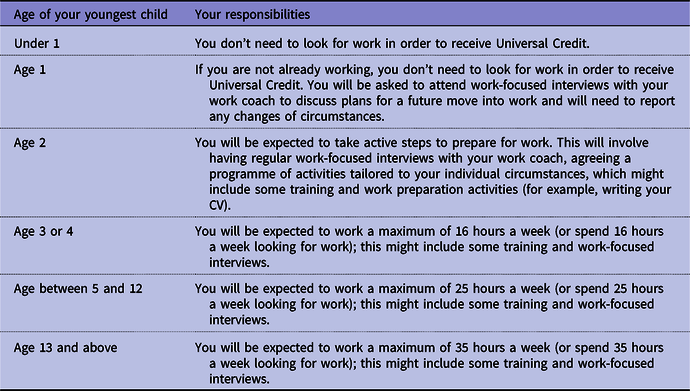
Source: DWP, 2020b.
The work-related requirements placed on claimants are stipulated in an individual Claimant Commitment drawn up by a JobCentre Plus (JCP) work coach. According to the government literature, the type and location of paid work, and the number of hours lead carers need to be available for paid work are tailored to their individual circumstances and caring responsibilities (DWP, 2015a, 2020b). The Claimant Commitment also sets out the benefit sanctions that can be issued if claimants are deemed to be failing to comply with their work-related requirements. Claimants have to agree to their Claimant Commitment in order to receive Universal Credit payments. In couples, both members have to agree before payments are made. If one member of the couple receives a sanction, the couple’s standard allowance is reduced by up to 50 per cent (DWP, 2020a).
The changes to conditionality for lone parents and the main carer in couples predominantly affect women. The government estimated that 73 per cent of partners affected by the changes in conditionality for coupled claimants would be female (DWP, 2011) and that 98 per cent of single parents affected by the 2017 implementation of the lower threshold at which job search requirements start would be female (DWP, 2015b).
Several criticisms have been made of the new Universal Credit conditionality regime from a gender perspective. These include the potential for the policy to devalue unpaid care (Deacon and Patrick, Reference Deacon, Patrick and Bochel2011; Cain, Reference Cain2016) and exacerbate women’s disadvantaged position in the paid labour market (MacLeavy, Reference MacLeavy2011). The significance of these criticisms warrants investigation into how mothers experience and view the new conditionality regime. Given the different positions of mothers in the labour market by class, and also the prior research suggesting working-class mothers particularly value their unpaid caring roles, it is also essential to explore whether working-class and middle-class mothers experience this new policy differently. Therefore, this article draws upon new empirical evidence to investigate mothers’ experiences of the conditionality regime within Universal Credit, and whether they vary according to social class. In doing so, this article builds on previous research investigating conditionality and lone parents (Graham and McQuaid, Reference Graham and McQuaid2014; Johnsen and Blenkinsopp, Reference Johnsen and Blenkinsopp2018), and the conditionality in Universal Credit specifically (Andersen, 2020, Reference Andersen2023; Griffiths et al., Reference Griffiths, Wood, Bennett and Millar2022), particularly by shedding new light on the impacts of the Universal Credit conditionality regime on unpaid care and paid work through exploring these from a class perspective.
Methodological approach
To investigate mothers’ experiences and views of the new conditionality regime within Universal Credit, a qualitative longitudinal study was carried out. A longitudinal approach was employed due to the usefulness of this method in exploring change – or the lack thereof – over time (Neale, Reference Neale, Worth and Hardill2015). This was particularly appropriate to the investigation of Universal Credit, given this new benefit aims to bring about change in behaviours and attitudes regarding paid work (DWP, 2017). Corden and Millar (Reference Corden and Millar2007) have demonstrated that the focus in qualitative longitudinal research on change is highly relevant to policies that attempt to change behaviour to achieve desired outcomes. Subsequently this approach has become increasingly established within academic social policy research (Patrick et al., Reference Patrick, Treanor and Wenham2021). The initial sample consisted of twenty-four mothers. The first round of interviews took place from September 2018 to March 2019. Twenty of the mothers were interviewed for a second time between June 2019 and November 2019. The location of the study was Yorkshire, England, and the majority of the participants were living in the city of York. Universal Credit was fully rolled out in York in July 2017, and therefore the city had a sufficient number of claimants to recruit from when the fieldwork started in September 2018. Locating the study in this city provided a contrast with other studies investigating similar themes (for example, Graham and McQuaid, Reference Graham and McQuaid2014; Patrick, Reference Patrick2017) as the city has a lower unemployment rate than the national average.
Given the historical and continuing devaluing of unpaid care alongside women’s weaker labour market position, and that women are disproportionately affected by this new policy, the research solely recruited mothers. The mothers were recruited through a variety of means. including through gatekeepers (at housing associations, a homeless hostel, and organisations that help get people into paid work), visits to community centres and an online advert on a website for mums. Purposive sampling was employed as this strategy is useful for obtaining in-depth understanding of individuals’ experiences (Neale, Reference Neale2019). To take part in the study, the participants had to be mothers in receipt of Universal Credit who were subject to work-related requirements (for example, work preparation, jobsearch, or building a self-employed business). Table 2 summarises the characteristics of the participants across the sample (drawing on information obtained at the first round of interviews).
Biographical information across the sample
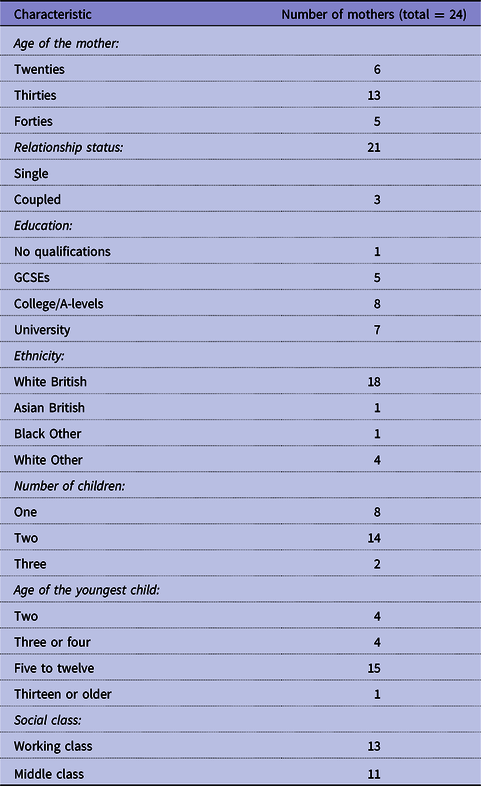
At the first round of interviews, three of the mothers were in a coupled relationship (and therefore had a joint Universal Credit claim), a further three of the mothers had previous experiences of a joint claim and one mother had experience of a joint claim between the two rounds of interviews. Therefore seven accounts of the joint claim were obtained. Perhaps owing to the variety of recruitment methods and the study’s location, a considerable proportion of the participants were middle class: of the twenty-four mothers interviewed at the first round of interviews, eleven were middle class. As there is no single indicator of social class and each of the indicators commonly used have the limitations (Galobardes et al., Reference Galobardes, Shaw, Lawlor, Lynch and Smith2006), a range of indicators were used to determine the class of the participants. Biographical information, such as qualification level, housing tenure and parents’ occupations, that is commonly used to determine class (Galobardes et al., Reference Galobardes, Shaw, Lawlor, Lynch and Smith2006; Goldthorpe, Reference Goldthorpe2016) was obtained at the interviews. For example, owner occupiers tend to be designated as middle class whereas social housing tenants are frequently categorised as working class. Subjective indicators, such as dress and accent, were also used as these have also been found to help accurately identify class (Kraus et al., Reference Kraus, Park and Tan2017). The biographical indicators and subjective indicators were examined in the round and a decision was made depending on the overall balance of indicators. For example, while some participants had higher levels of education, indicating middle-class status, other biographical information (such as housing tenure and parents’ occupations) along with the subjective indicators indicated working-class status, and thus they were categorised as such.
The interviews took place face-to-face at locations chosen by the participants. For both rounds of interviews, semi-structured interview guides were used. The first interview guide covered background information, experiences of claiming Universal Credit, the effects of the conditionality within Universal Credit on the participants’ employment prospects and caring responsibilities, the participants’ views on the conditionality within Universal Credit, and biographical information. The second interview guide was informed by the data collected in the first round of interviews. It continued to explore the impacts of the conditionality within Universal Credit on caring responsibilities and employment; however, this guide was tailored to each participant so that it followed up on the issues relevant to each participant.
The majority of the interviews were audio-recorded. One participant did not want to be recorded, so during both interviews, detailed notes were taken. Cross-sectional thematic analysis was carried out after each round of interviews. The first stage in this process entailed transcribing the interviews verbatim as required for thematic analysis. Familiarisation with the data was obtained through repeated readings of the transcripts (Braun and Clarke, Reference Braun, Clarke and Cooper2012). This helped to produce a coding framework that contained salient codes identified in the transcripts as well as codes that were derived from the research questions and the interview guide (Spencer et al., Reference Spencer, Ritchie, Ormston, O’Connor, Barnard, Ritchie, Lewis, McNaughton Nicholls and Ormston2014). Following this, the transcripts were coded and the coding framework was refined (Braun and Clarke, Reference Braun, Clarke and Cooper2012). The codes were then developed into themes (Braun and Clarke, Reference Braun, Clarke and Cooper2012). Once both rounds of interviews had been analysed cross-sectionally, the entire data set was analysed longitudinally. To aid this, a set of matrices was created. The data was interrogated for presence or absence of change in the mothers’ circumstances, and experiences of, and views on, the conditionality within Universal Credit. Additionally, the themes present in the data were investigated for connections between, and variations in, experiences and perspectives in relation to characteristics of the sample including social class. NVivo was used throughout the analysis.
Throughout the research careful attention was given to conducting the study in an ethical manner and the potential impact of the research on the participants was particularly considered. The research adhered to the British Sociological Association’s ethical guidelines and the study received approval from the University of York ethics committee. The ethical issues that were prioritised were informed consent, confidentiality and anonymity, prevention of harm, and reciprocity. Throughout this article, pseudonyms have been used to protect the confidentiality of the participants.
The impacts of the Universal Credit conditionality regime on unpaid care
The implementation of conditionality in the UK prioritises paid work as the primary duty of the responsible citizen, and this is evident in the Universal Credit literature (DWP, 2010a, 2010b). For example, the government explained that it wanted to “create a welfare system that provides people with the confidence and security to play a full part in society through a flexible labour market within a competitive modern economy” (2010b: 12). A key objection to the centrality of paid work within conditionality policies is that it devalues other socially valid and necessary contributions, including unpaid care (Dwyer and Ellison, Reference Dwyer, Ellison and Giugni2009; Friedli and Stearn, Reference Friedli and Stearn2015). The expectation that nearly everyone should be in paid work implies that those who are engaged in other essential societal activity, such as unpaid care, are not contributing to society (Barker and Lamble, Reference Barker and Lamble2009). This section presents analysis that shows how the new conditionality regime within Universal Credit devalues unpaid care, and demonstrates that many of the negative impacts were experienced across the sociodemographic sample but, at times, were exacerbated for the working-class mothers.
Across the sample, and regardless of class, the mothers reported that their caring responsibilities were not taken into account when the work-related requirements were set. Most of the mothers felt that there was a singular emphasis on paid work and a failure to recognise their caring responsibilities during meetings with their work coaches. Michelle reported:
All they want to know is are you earning this money and are you working.
They don’t ask about childcare or how I manage for anything…no they don’t take [caring responsibilities] into consideration, no. (Michelle, single mother, two children aged nine and seven, working class, round one)
Many of the participants said they were not asked by their work coaches about their caring responsibilities, which is highly problematic as this is a necessary precursor to tailoring work-related requirements. A key reason for the lack of personalisation may be that, under Universal Credit, work coaches are generalists who work with a range of claimants with different needs (SSAC, 2019). Since 2011, Lone Parent Advisers (introduced by the New Labour government of 1997–2010 to provide specialist support to lone parents) have been phased out at the JCP. This is problematic for claimants with caring responsibilities: previous research has shown that lone parents who had a Lone Parent Adviser had the most positive experiences of interactions with the JCP and that the phasing out of these specialist advisors has led to a loss of understanding of the issues lone parents face (Graham and McQuaid, Reference Graham and McQuaid2014). As work coaches within Universal Credit are generalists, they may not have an awareness of pertinent issues such as school drop off and pick up times, the challenges of trying to fulfil work-related requirements during school holidays or the relevance of the amount of contact time children have with their father to a mother’s ability to engage in paid work.
Given the extensiveness of the work-related requirements (and in particular the mandatory job-search hours), the lack of tailoring to caring responsibilities resulted in the participants being subject to work-related requirements that were incompatible with their caring responsibilities. This inevitably negatively impacted on the care the mothers were able to provide. The conditionality regime within Universal Credit reduced the mothers’ time and energy to carry out their caring responsibilities. Jennifer explained:
I have to be focused on that [the work-related requirements] rather than focused on them, that is like a direct impact cos I’ll do things like have them watch TV or something which I wouldn’t normally be doing cos that has to be a babysitter. (Jennifer, single mother, two children aged six and three, middle class, round one)
Jennifer, along with the vast majority of the mothers, prioritised carrying out her work-related requirements due to fear of sanction, as previous research has also found (Andersen, Reference Andersen2020). The mothers were particularly keen to avoid a sanction because they had either the sole or the vast majority of the responsibility for ensuring their children’s material needs were met: they were very concerned about the harm a sanction would inflict on their children. The stress and the worry of having to fulfil extensive work-related requirements under threat of sanction also negatively impacted the participants’ interactions with their children. Laura explained:
It affects your mood and I think it affects your motivation and it just makes you just feel a bit what’s the point sometimes and that affects how you are when you’re you know cos you don’t feel like being like, “Oh yeah, let’s do something fun,”…I think it affects your general mood and that affects general care. (Laura, single mother, one child aged two, middle class, round one)
While the negative impacts of the Universal Credit regime on the mothers’ time to carry out unpaid care and their interactions with their children arose regardless of class, the negative impacts on entry into paid work were more pronounced for the working-class mothers due to the type of work they entered. The working-class mothers mainly became employees whereas the middle-class mothers mainly entered self-employed work. Undertaking self-employed work afforded a degree of flexibility and control over engagement in paid work and unpaid care, whereas obtaining paid work as an employee resulted in more rigid schedules and therefore had a greater impact on the mothers’ caring responsibilities, as Kirsty’s experiences demonstrate. Kirsty, a working-class single mother with two children, left school when she was fourteen. At the first round of interviews, she explained that she did not want to enter just any job, but wanted to get more training so she could get higher earnings and a career. However, at the second round of interviews, she had started a zero-contract hours cleaning job at an events venue. On some days, her hours of work entailed both day and night shifts, which meant her children had to stay at her supervisor’s house under the care of her supervisor’s teenage daughter, as Kirsty explained:
So I’ll be doing school hours and then starting again at eleven [pm] cos there’s two gigs on that day so then I have to arrange childcare. Luckily my supervisor she’s one of the mums up at the school, she’s got an older daughter so they all have a sleepover…So instead of obviously waking them up at eleven o’clock, we all go there and we sleep there. So the kids’ll they’ll still be in bed by the time I go to work and then by the time I get back it’s getting them up for school and then taking them to school and then starting again. Yeah it’s hard work but it’s got to be done. (Kirsty, single mother, two children aged five and three, working class, round two)
In addition to the lack of time with her children at nighttime and the children having to sleep elsewhere, Kirsty also commented on the increased pace of life and rush they all experienced to get where they needed to be on time. This was tiring for the whole family, and could result in increased tension. The detrimental effects of paid work on working-class mothers’ caring roles may be particularly problematic given the context of increasing government and cultural expectations of an intensive mothering role, wherein mothers are expected to devote copious amounts of time and energy to childrearing and play an important role in their children’s education (Holloway and Pimlott-Wilson, Reference Holloway and Pimlott-Wilson2016; Vincent, Reference Vincent2017). The entry of working-class mothers into paid work through conditionality policies could increase their standing as ‘responsible citizens’ but at the same time, may subject them to be condemned as neglectful parents for failing to meet the contemporary requirements of being a ‘good mother’ (Braun et al., Reference Braun, Vincent and Ball2008).
There was also a disparity in experiences of the conditionality between the coupled mothers and the single mothers: the coupled mothers tended to have the responsibility for their partners’ work-related requirements, as well as their own. These mothers helped their partners with their work-related requirements, for example, by looking for jobs and reporting job search activity, or ensuring they fulfilled certain mandatory tasks:
I help him and do his cos he hasn’t really got time…so I have to do most of his for him and if there’s an appointment there for him, I will pre-warn him. (Kelly, coupled mum, two children aged four and two, working class, round one)
The mothers helped their partners with their commitments to avoid a sanction, as they knew that due to the single payment into one bank account, a sanction would affect the whole family. Research conducted by Griffiths et al. (Reference Griffiths, Wood, Bennett and Millar2022) has similarly found that female partners tend to take on more responsibility for managing the Universal Credit online claim. This further increases the gendered division of unpaid labour in coupled households.
This analysis shows that the conditionality for lead carers within Universal Credit negatively affects women’s roles and responsibilities regarding unpaid care. The main effects on the mothers’ caring responsibilities included limiting time to undertake caring responsibilities and increasing tensions in interactions with children. The analysis also shows that the negative impacts were often exacerbated by entry into paid work, particularly for working class mothers. The negative impacts on caring responsibilities were derived from the almost exclusive emphasis within the Universal Credit conditionality regime on paid work alongside a failure to recognise and take into account caring responsibilities throughout the participants’ Universal Credit claims. The conditionality regime also exacerbated the coupled mothers’ responsibility for unpaid labour. The emphasis on paid work within current social security policy fails to acknowledge the negative impacts of paid work evidenced in this study. As Whitworth and Griggs explain, the government’s argument that paid work enhances well-being regardless of its capacity to negatively impact mothers’ ability to provide unpaid care is ‘highly partial’ (Reference Whitworth and Griggs2013: 135). This research therefore further problematises the assumption of the primacy of paid work within Universal Credit policy by showing that paid work is not universally in claimants’ best interests. It also highlights that rather than help establish the value of unpaid care, primarily carried out by women, the conditionality within Universal Credit devalues it further.
The impact of the Universal Credit conditionality regime on employment trajectories
Conditionality policies may initially appear to improve women’s participation in the paid labour market. The government has stated that due to the new conditionality regime, Universal Credit ‘presents an opportunity to promote equality in work and narrow the employment gap’ (DWP, 2012: 42). However, under Universal Credit, the government is explicitly trying to move claimants into any type of work, including temporary and part-time jobs they may not have previously considered (DWP, 2017). Charities have highlighted that the emphasis in Universal Credit on moving people into paid work at the first opportunity – rather than focusing on helping claimants obtain high-quality, sustainable work – may be particularly problematic for women given their predominance in low-paid, insecure work (Fawcett Society, 2015; Gingerbread, 2015). This section explores the mothers’ employment trajectories since the beginning of their Universal Credit claims and looks at variation in employment outcomes by social class.
At the first round of interviews, three of the twenty-four participants had moved into paid jobs since the start of their Universal Credit claim, a further two had entered self-employment, and one had had a series of temporary jobs. There was little change in employment and earnings between the first and second round of interviews. A further two mothers had obtained jobs. All of the participants were still in receipt of Universal Credit. There was some variation in the sample in that the majority of the middle-class mothers were in paid work at the second round of interviews. As noted above, many of the middle-class mothers were self-employed, which suggests that the more educated mothers in receipt of Universal Credit can use their cultural and social capital (Bourdieu, Reference Bourdieu and Richardson1986) to become self-employed. This is congruent with the work of Ekinsmyth (2011, Reference Ekinsmyth2013) who argues that white, middle-class mothers in the UK are more likely to become ‘mumpreneurs’ due to their social, human, and economic capital. Becoming self-employed was not an option for many of the working-class mothers due to lack of the necessary qualifications and skills.
The findings also show that the Universal Credit conditionality regime puts limits on obtaining training and skills necessary for entering paid work, which is likely to have particularly negatively impacted the working-class mothers. The mothers who either wanted to undertake substantial training or who were already undertaking training encountered difficulties. For example, Jamila, a working-class mum, who had experienced domestic abuse and who had low qualifications and a lack of English explained that she wanted to study English at a local college before trying to get a job as this would improve her job prospects. When she was directed to apply for jobs by her work coach, she would explain that she needed to improve her English first. Instead of being helped to pursue this, she was told she would be sanctioned if she did not apply for the job:
Jamila: Sometime I tell them because that one I can’t do it because it’s hard for me. I don’t know how to do it because I need improve my English first.
Interviewer: I see. And do they say that’s okay?
Jamila: No, sometime they say I have to go trying…they told me two times three time I refused now, they told me that they’re going to sanction me. They told me now on they’re going to cut my money. (Jamila, single mother, two children aged seven and five, working class, round two)
Other research has also found that subjecting mothers to welfare conditionality limits their opportunities for training and education (Haux et al., Reference Haux, Salmon, Taylor, Deave, Cohen, Dewar and Samelius2012; Ingold and Etherington, Reference Ingold and Etherington2013). This is problematic given the importance of training and education to women’s ability to enter paid work (Dorsett et al., Reference Dorsett, Lui and Weale2011). The curtailment of undertaking training within the Universal Credit conditionality regime was particularly pertinent to the working-class mothers in the study as they tended to have lower qualifications than the middle-class mothers.
The vast majority of the participants also experienced a lack of employment-related support from their work coaches. Although the government claims that claimants receive tailored support, mainly delivered through work coaches (DWP, 2014), the majority of the mothers reported that they did not receive any support, advice, or training from their work coaches to help them find paid work. Many of the mothers explained that their meetings with their work coaches were mainly about with checking that they had fulfilled their mandatory requirements:
They don’t offer any help at all…when I have been to see my work coach as I say I feel like I’m almost an inconvenience to her cos she’s just running over the same spiel over and over again. ‘You must accept your work commitments, you must do this.’ (Natasha, single mother, one child aged fourteen, working class, round two)
While the lack of employment-related support was prevalent across the sample, this may have been particularly problematic for the working class mothers, such as Natasha quoted above who had limited qualifications and work experience. Natasha felt very frustrated about the lack of employment-related support she received. She commented of her work coach:
…if she just offered me help for some- you know like I say, is there any courses that you might want to do or but as I say they don’t offer any help at all…I found out through a friend on Facebook that they did erm like a CV course…they never even mentioned that when I first joined Universal Credit… you think that was one of the first things they would’ve offered you know if, you know ‘do you need a CV? We’ve got this workshop where they can come and help you and pinpoint everything’ but no, I had to find out third hand. (Natasha, single mother, one child aged fourteen, working class, round two)
As Natasha needed considerable support with entering paid work, the lack of employment-related support was of particular significance to her. Natasha remained unemployed throughout the course of the fieldwork, despite her willingness to enter paid work.
Although the middle-class mothers were more likely to be in paid work, there was very little difference in the types of jobs the mothers obtained. Regardless of social class, the vast majority of the participants who obtained paid work entered gendered, low-paid, insecure, part-time work such as cleaning, caring, hairdressing, and childminding. The research findings indicate that the movements into such jobs was due to the ‘work-first’ approach within Universal Credit. The work-first approach entails moving claimants into any type of work as quickly as possible. In this study, the requirement to take ‘any work’ was stipulated on the participants’ Claimant Commitments and was also reiterated by several of their work coaches. Nicola reported that her work coach had told her:
If a job comes up in [village] that they’re aware of, I should be taking it regardless of whether it’s anything to do with my past experience or anything. (Nicola, single mother, three children aged eighteen, sixteen and nine, working class, round one)
The research findings show that the work-first approach limited some of the mothers’ opportunities for long-term career planning. The overwhelming majority of the mothers had specific paid work aspirations. While the government states that work coaches have been trained to listen to claimants and help them to think through their paid work aspirations (DWP, 2014), the majority of the work coaches did not ask the mothers about their paid work aspirations. Anna explained:
I think the JobCentre’s not really interested in the long-term. I think they are quite short-term. So I’ve not really discussed it [work aspirations] at any length cos I think they’d rather you were just in any form of work rather than thinking about what career do you want in however long time. (Anna, single mother, one child aged four, middle class, round two)
Additionally, on occasions when the mothers were either directed towards or encouraged to enter particular jobs, they tended to be gendered, low-status, low-paid, insecure jobs such as paid care work, childminding, hairdressing, fast-food work, and retail work. Jennifer reported:
When I said that I was registering as a childminder they said that that was really good cos that was one of the things they were meant to steer people towards, was childminding cos there’s not enough childminders. So they were like, ‘Good, we can tick that box, there’s another childminder.’ (Jennifer, single mother, two children aged six and three, middle class, round two)
This participant had a master’s degree and therefore was being encouraged into work that she was overqualified for. The unequivocal support for pursuing self-employment demonstrated here was evident among other members of the sample. This is problematic given that the women’s entry into self-employed work is often accompanied by significant decreases in their incomes and social protection (De Henau et al., Reference De Henau, Harris and Stephenson2020) and that the design of Universal Credit exacerbates the material precarity of the self-employed (Caraher and Reuter, Reference Caraher and Reuter2019).
Overall, the research findings show that the conditionality within Universal Credit had limited positive impact on the employment trajectories of these mothers. A significant proportion of the participants did not enter paid work, there was a distinct lack of progression in the paid labour market, and those who did obtain paid work either did not sustain it or obtained jobs that were gendered, low-paid, and insecure. There was some variation in the sample by class. The working-class mothers were less likely to enter paid work. This may have been due to the lack of employment-related support they received and the limitations the Universal Credit conditionality regime placed on the mothers’ opportunities to undertake training. However, there was little variation in the types of jobs the mothers obtained according to social class. The work-first approach may explain why the middle-class mothers entered gendered, low-paid, insecure, part-time work that was below their qualification level. The work-first approach limited some of the mothers’ opportunities for long-term career planning, and resulted in some mothers taking the first job available regardless of compatibility with education, experience, and caring responsibilities. This study shows the gendered deficiencies with the work-first approach. As women occupy a disadvantaged position in the paid labour market, and mothers in particular are more likely to undertake low-paid work (Reis, Reference Reis2018), they especially need to be supported into long-term, sustainable, adequately paid work. However, as the work-first approach emphasises getting claimants into paid work at the first opportunity, it worsens, rather than improves, women’s disadvantaged position in the paid labour market. Consequently, these findings reflect concerns that conditionality can entrench gender inequalities in the paid labour market (Grabham and Smith, Reference Grabham and Smith2010; Letablier et al., Reference Letablier, Eydoux, Betzelt, Betzelt and Bothfeld2011; MacLeavy, Reference MacLeavy2011).
Conclusion
The intensification and expansion of conditionality within Universal Credit furthers a gendered shift in the UK social security system whereby mothers are increasingly expected to undertake paid work. This repositioning of mothers demands that they carry out paid work as their primary societal contribution. The Universal Credit conditionality regime results in a devaluation of unpaid care, as it prioritises paid work over unpaid care, to the detriment of mothers’ caring responsibilities. While policies that attempt to increase mothers’ participation in the paid labour market have the potential to benefit mothers by increasing their financial independence and access to social rights obtained through paid work, the Universal Credit conditionality regime is of very limited efficacy in helping mothers obtain these benefits. There are also indications that rather than improve women’s disadvantaged position in the paid labour market, this is exacerbated through the emphasis on getting claimants into any paid work quickly.
While the above findings regarding unpaid care and paid work were evident across the sample, there was some variation in the mothers’ experiences according to the social class of the participants. Chiefly, the middle-class mothers tended to opt for self-employed status within the Universal Credit system whereas the working class mothers were more likely to be job searching or employed. Consequently, the middle-class mothers were more able to fit their paid work around their caring responsibilities whereas the employed working class mothers did not have this flexibility. As a result, the caring responsibilities of the working-class mothers were more adversely affected by entry into paid work. This is problematic as it means the conditionality within Universal Credit disproportionately erodes the mothering identities of working-class women, who particularly value their caring roles. It may also result in working-class mothers being subject to further stigma given current expectations of intensive mothering. However, while the middle-class mothers were able to accrue some advantages on account of their social and cultural capital, the differences in employment outcomes for the middle-class and working-class mothers were not as stark as expected given class-based differences in employment in the wider population. Although the middle-class mothers were more likely to be in paid work at the second round of interviews, they generally entered gendered, low status, low-paid work, akin to the working class participants who entered paid work since claiming Universal Credit. The research suggests the work-first approach is detrimental to the employment prospects of mothers across the class spectrum. This finding also highlights the difficulties mothers face in reconciling unpaid care with paid work, and engaging in the gendered paid labour market, regardless of socioeconomic background, difficulties that are exacerbated by the Universal Credit conditionality regime.
While this is a small-scale study situated in York and the surrounding area, the findings regarding the devaluing of unpaid care and limited efficacy in increasing sustained moves into employment and stimulates progression in the paid labour market have commonalities to other studies researching similar themes in other locations in the UK (Patrick, Reference Patrick2017; Johnsen and Blenkinsopp, Reference Johnsen and Blenkinsopp2018; Dwyer, Reference Dwyer2018). Therefore, there are indications that these findings are also relevant outside of York (Wright and Patrick, Reference Wright and Patrick2019).
Policy recommendations for improving the Universal Credit conditionality regime include reducing the extensiveness of the work-related requirements and ensuring caring responsibilities are taken into account when the Claimant Commitment is developed and during ongoing interactions with work coaches. Additionally, substantive employment-related support is needed along with opportunities for undertaking adult education and training, particularly for mothers with lower qualifications, rather than the expectation of immediate entry into paid work. Re-instating specialist parent advisors (who have an in-depth understanding of caring responsibilities and of the barriers parents face in obtaining and sustaining paid work) is a key means of ensuring that work-related requirements are appropriate to caring responsibilities and that effective employment-related support is delivered.
Subsequent to the fieldwork reported in this article, there have been changes to the conditionality regime. Conditionality was suspended during the initial months of the coronavirus pandemic yet was reintroduced in July 2020, and plans have recently been announced to further intensify the conditionality regime for lead carers. This includes requiring lead carers with a youngest child aged three to twelve to jobsearch for up to thirty hours a week (DWP, 2023). These changes run counter to the policy recommendations arising from this research and raise serious concerns about the subsequent harm this could do to parents and their children.
More broadly, wider societal changes in gendered cultures and government policies and practices are required. These chiefly include establishing unpaid care as a valid societal contribution so that carrying out unpaid care accrues social rights and respect akin to paid employment (Cantillon and Lynch, Reference Cantillon and Lynch2017). Regarding the paid labour market, gender inequalities and women’s disproportionate responsibility for unpaid care need to be addressed so that there can be more parity between women and men in terms of participating in, and obtaining the rewards from, paid work. Such changes are imperative so that women across the sociodemographic spectrum see improvements in their disadvantaged position in society, the paid labour market and the social security system.


 Open access

