

Introduction
Women have been extensively found to be disadvantaged in the labour market due to family care duties (Budig and England, Reference Budig and England2001; Correll et al., Reference Correll, Benard and Paik2007; Budig and Hodges, Reference Budig and Hodges2010). To reconcile women’s work and family, state interventions, such as paid leave and funded childcare, are widely exploited in post-industrial societies. Based on that, a growing body of literature examines how these family policies shape female employment and draws divergent conclusions (Pettit and Hook, Reference Pettit and Hook2005; Mandel and Semyonov, Reference Mandel and Semyonov2006; Budig et al., Reference Budig, Misra and Boeckmann2012). This article aims to expand the knowledge by investigating this issue in China, where the fertility-oriented family policy reform, entrenched familism, and related social transitions make it a unique case.
In the last decade, the Chinese government embarked on a spate of reforms in family policy in order to boost fertility (Liu and Dai, Reference Liu and Dai2025). Due to the One-Child Policy, the total fertility rate in China has long been lower than the replacement level, leading to a dramatic demographic challenge. To tackle this issue, the One-Child Policy, which had been implemented for three decades in China, was abolished in 2015, and Chinese couples have been allowed to have multiple children since then. Subsequently, supportive initiatives were enacted to encourage fertility, such as the extension of paid leave and the promotion of funded childcare. This fertility-oriented reform makes the potential fertility motivated by the policy a critical concern of employers as well as a barrier to female employment (Wang and Chen, Reference Wang and Chen2023). Moreover, China’s childcare provision featured traditional familism combined with marginal state support after the 1990s, imposing heavy care burdens on Chinese parents, particularly on women (Wallace, Reference Wallace2020). Therefore, recent policy reform marks a shift in childcare organisation in contemporary China, and the enhanced state childcare provision may exert effects on China’s labour market by reshaping the distribution of care responsibility between the family and state. However, how these emerging family policy reforms influence women’s employment in China, which is undergoing great social transitions, remains unknown.
This article examines how China’s family policy affects women’s employment, with an additional focus on childless women. Since mothers are thought of as the primary target of family policy, central to related scholarship is the extent to which family policy may attenuate or aggravate the motherhood penalty (Aisenbrey et al., Reference Aisenbrey, Evertsson and Grunow2009; Gangl and Ziefle, Reference Gangl and Ziefle2009; Budig et al., Reference Budig, Misra and Boeckmann2012). Yet, it is ignored that the potential fertility and expected family duties can also trigger workplace discrimination against women (Becker et al., Reference Becker, Fernandes and Weichselbaumer2019; Peterson Gloor et al., Reference Peterson Gloor, Okimoto and King2022). More crucially, this effect could be conditioned on the presence of family policy which shapes the opportunity structure faced by employers and their expectations of female employees (Gangl and Ziefle, Reference Gangl and Ziefle2009; Mun and Jung, Reference Mun and Jung2018). As fertility-boosting is a critical driver of recent family policy expansion in China, the policy effect related to potential fertility is expected to be especially prominent.Footnote 1 Given that, our investigation regarding family policy effects is not restricted to mothers but expands the discussion to discrimination due to potential fertility, therefore uncovering how family policy shapes the general gender gap in the labour market.
Furthermore, we examine multi-dimensional employment outcomes. The majority of current literature documents how family policies affect women’s labour force participation and earnings (Pettit and Hook, Reference Pettit and Hook2005; Budig et al., Reference Budig, Misra and Boeckmann2016; Hook and Paek, Reference Hook and Paek2020), and a handful of studies pay attention to other employment outcomes, such as workplace tasks (Nivorozhkin and Romeu-Gordo, Reference Nivorozhkin and Romeu-Gordo2019), occupational sex segregation (Mandel and Semyonov, Reference Mandel and Semyonov2006; Hook et al., Reference Hook, Li, Paek and Cotter2023), and work commitment (Gangl and Ziefle, Reference Gangl and Ziefle2015). To further expand the discussion, this article not only explores the impacts of family policy on labour force participation and earnings but also analyses occupational socioeconomic status which refers to ‘the positions of occupations in the stratification system’ (Ganzeboom et al., Reference Ganzeboom, De Graaf and Treiman1992) and comprehensively reflects occupational prestige, career prospects, and social value of the job, therefore enriching related scholarship. Moreover, this research may expand existing knowledge mainly derived from Western societies by locating our investigation in a non-Western and developing country. Finally, our findings can also provide implications for gender equality and maternal employment in broad social contexts.
China’s context
Women’s disadvantage in the labour market
The gender gap in China’s labour market has been widening since the 1990s (He and Wu, Reference He and Wu2018; Shen, Reference Shen2022). Evidence manifests that Chinese women’s average earnings relative to men’s declined from 86.3 per cent in 1988 to 70.6 per cent in 2007 (Wu, Reference Wu2019), and the female labour force participation rate has diminished from 73 per cent in 1990 to 60 per cent in 2024 (World Bank, 2025). It is attributed to the marketisation reform after the 1980s (Shu and Bian, Reference Shu and Bian2003; He and Wu, Reference He and Wu2018). In the pre-reform era, the Chinese government provided urban women with paid leave, nursery schools, and other childcare services to integrate women into productive activities and advance gender equality in the public sphere (Shen, Reference Shen2022). Protected by this state socialist welfare system, Chinese women’s labour force participation rate had been more than 90 per cent, which was among the highest around the globe (Short et al., Reference Short, Chen, Entwisle and Fengying2002). Yet, the state childcare provision rapidly shrank as the planned economy collapsed in the post-reform era, accompanied by a resurgence of traditional familism and a rise of neo-liberalism that then dominated China’s childcare provision until recent years (Wallace, Reference Wallace2020). Given that, Chinese women were obliged to take major childcare responsibilities in the post-reform era, and motherhood was identified as a pivotal source of women’s disadvantage in China’s labour market (Zhang et al., Reference Zhang, Hannum and Wang2008; Shen, Reference Shen2022), which caused 15.8 per cent wage loss for mothers (Yu and Xie, Reference Yu and Xie2018).
Recent literature uncovers that Chinese mothers, although supported by the extended family, still suffer from work-family tensions due to the unequal childcare division, the popularity of intensive motherhood, and the absence of public childcare support (Shen, Reference Shen2022; Liu et al., Reference Liu, Qi and Xiong2022). The very fact that Chinese mothers usually spend much time on childcare even results in discrimination against women with potential birth-giving (He et al., Reference He, Li and Han2023; Du, Reference Du2023). For instance, Wang and Chen (Reference Wang and Chen2023) find that childless women at a fertile age are less preferred in hiring than women with children in China. In this way, the recent family policy reform is of great significance not only for mothers but for all working-age Chinese women.
Reform in family policy
Family policy in China, which had long been marginalised after the marketisation reform, has been highlighted again since the 2010s because of the government’s concern about fertility (Liu and Dai, Reference Liu and Dai2025). Specifically, paid leave entitlements have been remarkably expanded since 2015 when the One-Child policy was abolished. The most prominent reform is the extension of maternity leave in 2016 and 2021. Before 2016, Chinese employed mothers were eligible for 98 days of maternity leave, while it was extended to at least 128 days in 2016 and at least 158 days in 2021, varying by province (Table 1). Currently, most provinces grant 158 to 180 days of maternity leave, and it is up to one year in Tibet province. The replacement rate of maternity leave, legally, is 100%. Moreover, more generous benefits are conditionally provided in some provinces. For instance, the durations of maternity leave in Hebei province are 158 days for having the first and second child and 188 days for having the third child. Besides, the maternity leave could be extended to one year with approval from employers in Jilin province. Meanwhile, paternity leave has been introduced to promote father involvement, now ranging from ten to thirty days, with fifteen days as a general norm, and five to twenty days of annual parental leave for each parent has been implemented since 2021, mostly targeting children under three. Apart from the leave entitlements, tax deduction for childrearing was enacted after 2018; also, parents could claim a 3600 CNY (≈500 USD) family allowance per year for each child under three.Footnote 2
Duration of maternity leave in China (2010–2022)

Notes: An exception is Fujian, which provided 158–180 days of leave for mothers after 2016, and we thus do not include Fujian in current classifications. In the first wave of maternity leave reform, the duration of leave was extended in 2017 in Xinjiang and Tibet, while other provinces did so in 2016. The second wave of maternity leave reform was implemented at the end of 2021 and the beginning of 2022. Besides, there was only one province with 148 days of maternity leave (Guangxi from 2016 to 2021) and only one province with 365 days of maternity leave (Tibet after 2017).
Data source: Provincial Regulations on Population and Family Planning (Ren Kou Yu Ji Hua Sheng Yu Tiao Li).
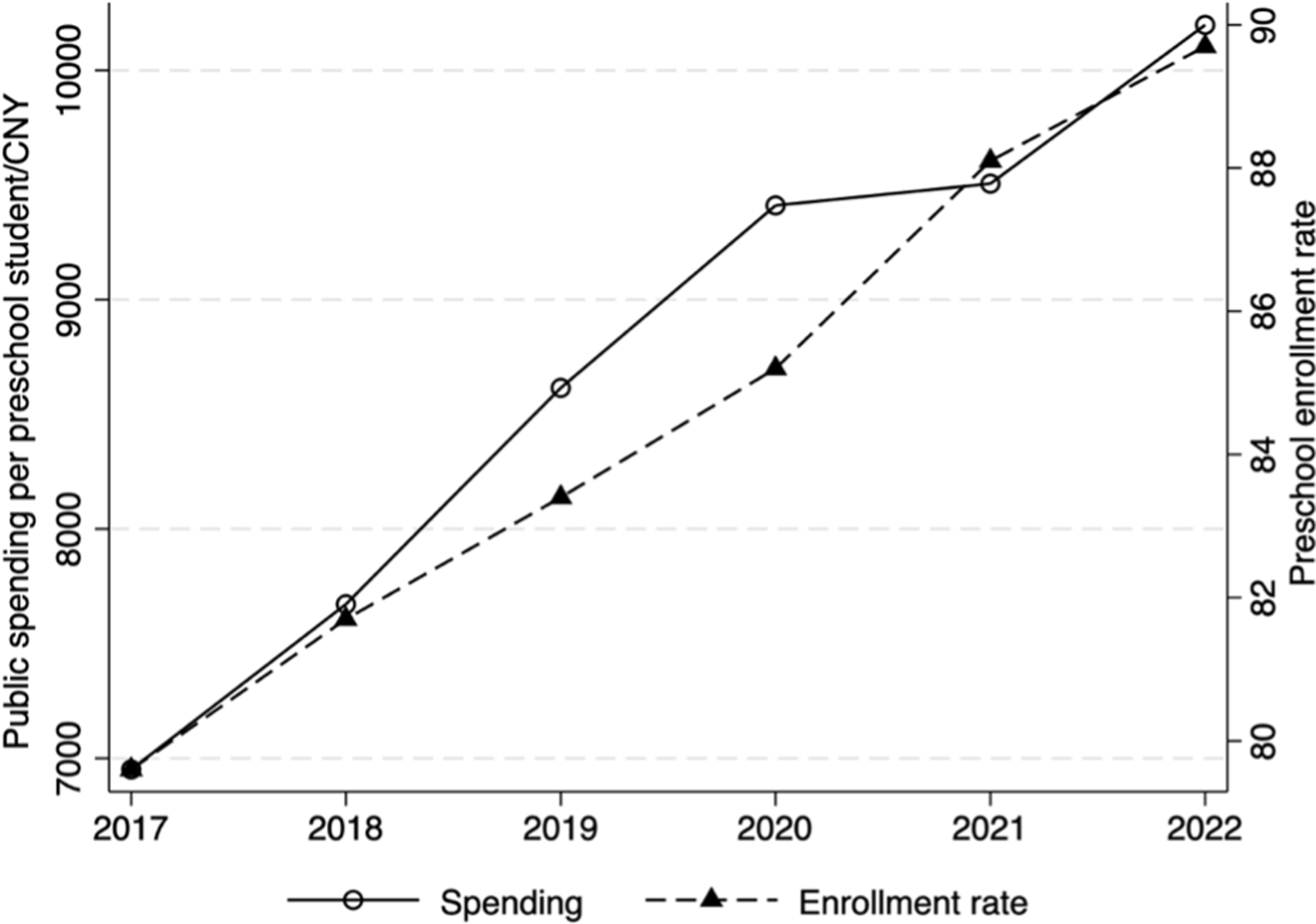
Furthermore, public provision in childcare services increased significantly. In the 2000s, private kindergartens accounted for more than half of kindergartens, and the accessibility, affordability, and quality of childcare services had long been unsatisfactory (Wallace, Reference Wallace2020). Given that, the Chinese government attempted to promote funded childcare during the 2010s. Figure 1 presents that the public spending per preschool children aged three to five increased by 46.71 per cent from 2017 to 2022. Furthermore, the enrolment rate of preschool increased from 56.6 per cent in 2010 to 89.7 per cent in 2022, and the proportion of subsidised and public kindergartens reached 84.96 per cent in 2022 (Ministry of Education, 2012, 2023). Recently, policy efforts have been made to enhance care services for children under three (State Council, 2019); for instance, childcare services provided by kindergartens could be available to children aged two. Yet, the current nursery service for children under three remains scarce.
Public spending per preschool student and preschool enrolment rate (%) in China (2017–2022).
Notes: It is noted that the preschool enrollment rate includes preschool children enrolled in private kindergartens as the enrollment rate in funded facilities is not available. However, the increase in the overall preschool enrollment rate in the last decade is largely attributed to the expansion of funded preschool education. Data source: Ministry of Education, PRC.

Despite these initiatives, public discourse in China is not sanguine regarding reforms in family policy. The public often complains that the heavy burden of childrearing can hardly be compensated for by limited childcare benefits. Further, it is concerning that the extension of paid leave, which imposes financial burdens on employers, could be poorly enforced and aggravate gender discrimination in the labour market. Dai (Reference Dai2025) uncovers that employers in China could exploit multiple strategies to circumvent paid leave policies and reduce personnel costs. As such, Jia and Yang (Reference Jia and Yang2019) show that using each day of paid maternity leave results in a 2 per cent wage loss. Wang and Chen (Reference Wang and Chen2023), using a field experiment, find that more generous maternity leave intensifies discrimination against childless female candidates in hiring, further indicating that maternity leave could signal potential motherhood in personnel decision-making. By contrast, the availability of public childcare is found to attenuate the motherhood penalty and boost women’s entrepreneurship (Wang and Lin, Reference Wang and Lin2019; Gao and Tian, Reference Gao and Tian2023), which is opposed to the effects of maternity leave in China.
This discussion provides insights into how family policies exert effects on women’s employment in China; however, it is insufficient due to the focus on local scenarios based on only a few provinces or cities and the use of individual- or community-level policy-related indicators instead of macro policy data. More crucially, it ignores that the fertility-oriented potential may affect childless women; though Wang and Chen (Reference Wang and Chen2023) consider this issue, they do not directly examine the policy effects in statistical analysis. Given that, this study, from a nation-wide perspective, combines macro-level family policies and micro-level employment outcomes to explore this issue, with an additional focus on childless women, thus expanding extant literature.
Family policies and women’s employment outcomes
The effects of family policies on women’s employment have been well-documented. Here, we focus on two primary family policies: paid maternity leave and funded childcare. Paid maternity leave generally aims to support family caregiving while maintaining employment continuity. A sizable literature tests the effects of maternity leave and obtains mixed results. On the one hand, it protects mothers from unemployment and strengthens their attachment to the labour market when they engage in family care (Budig et al., Reference Budig, Misra and Boeckmann2012; Mun and Jung, Reference Mun and Jung2018). Furthermore, when the leave is too short to satisfy childcare needs, women may opt to exit the labour market instead of returning to work (Budig et al., Reference Budig, Misra and Boeckmann2012). Hence, it is expected that generous maternity leave is positively associated with women’s employment outcomes (H1a).
On the other hand, maternity leave indicates work interruption, which can result in the loss of work experience and human capital depreciation, thus making mothers less productive than childless women (Aisenbrey et al., Reference Aisenbrey, Evertsson and Grunow2009). Besides, the use of leave benefits could trigger discrimination against mothers because employers might perceive mothers as less productive and less committed to work (Gangl and Ziefle, Reference Gangl and Ziefle2009; Cukrowska-Torzewska, Reference Cukrowska-Torzewska2017). Also, paid leave makes employing women costly for employers (Aisenbrey et al., Reference Aisenbrey, Evertsson and Grunow2009; Gangl and Ziefle, Reference Gangl and Ziefle2009). Equally importantly, the presence of maternity leave may fortify the gendered division of caregiving, because this entitlement implies that women should shoulder childcare duties (Pettit and Hook, Reference Pettit and Hook2005; Budig et al., Reference Budig, Misra and Boeckmann2016). As such, it is hypothesised that generous maternity leave is negatively associated with women’s employment outcomes (H1b).Footnote 3
Unlike paid leave, funded childcare services are generally found to enhance women’s employment rate and working hours, reduce motherhood earning penalties, and even improve mothers’ wages (Pettit and Hook, Reference Pettit and Hook2005; Budig et al., Reference Budig, Misra and Boeckmann2016; Hook and Paek, Reference Hook and Paek2020). It could substantially unburden women’s care duties, promoting mothers’ employment continuity and shortening work interruption caused by childrearing (Pettit and Hook, Reference Pettit and Hook2005; Boeckmann et al., Reference Boeckmann, Misra and Budig2015; Cukrowska-Torzewska, Reference Cukrowska-Torzewska2017). Hence, funded childcare can maintain mothers’ productivity and buffer the negative effects of motherhood (Gangl and Ziefle, Reference Gangl and Ziefle2009). Further, it can attenuate workplace discrimination against mothers by shifting caregiving responsibilities from the family to the state and disentangling women’s role as primary caregivers (Hook and Paek, Reference Hook and Paek2020). Therefore, we predict that the funded childcare is positively related to women’s employment outcomes (H2).
We further consider the policy effects related to potential fertility. A body of literature reveals workplace discrimination against expected family responsibilities (Becker et al., Reference Becker, Fernandes and Weichselbaumer2019; Peterson Gloor et al., Reference Peterson Gloor, Okimoto and King2022; He et al., Reference He, Li and Han2023). For example, Becker and colleagues (Reference Becker, Fernandes and Weichselbaumer2019) find that, compared to women with very young kids, women with older kids are more advantaged in the workplace since they have completed the childbearing cycle and have more predictable care duties; furthermore, married but childless women are less preferred than single but childless women in hiring as the former are more likely to become pregnant. Evidence from China also shows that childfree women have a lower likelihood of receiving callbacks from employers in the job application, which is less prominent when women’s reproductive age increases (Wang and Chen, Reference Wang and Chen2023; He et al., Reference He, Li and Han2023). Additionally, the presence of family policy, especially paid leave, could signal the potential fertility of women and remind employers of the expected costs generated by employing females. Therefore, the family policy may exert effects on all fertile-age women, instead of only mothers. Furthermore, the policy effects related to potential fertility are more pronounced among childless women. Hence, we hypothesise that the association between family policy and employment outcomes for childless women might be no less (and even more) prominent than for mothers (H3).
Methods
Data and statistical strategy
Combined datasets are employed in this research. At the individual level, we employ seven waves of panel data from the China Family Panel Survey (CFPS). Using a multi-stage, implicit stratification, and a proportion-to-population-size sampling strategy, the CFPS biannually collected individual and household information from 2010 to 2022, covering thirty-one mainland provinces in China.
At the macro level, we extract policy data from policy documents and official websites of the Chinese government. Given the unit of policy implementation and data availability, our analysis focuses on provincial family policies, including maternity leave and funded childcare. Firstly, we obtain data regarding leave entitlements from 2010 to 2022 from the provincial regulation on population and family planning (Ren Kou Yu Ji Hua Sheng Yu Tiao Li). Secondly, we collect the public spending in preschool education from official websites of the Ministry of Education, PRC. It is noted that funded childcare often involves nursery services for children under three and preschool education for children aged three to five; however, the Chinese government mainly provides public or subsidised preschool education to children aged three to five, while nursery services for children under three remain scarce in China, and provincial data for the latter are unavailable. Thus, we utilise public spending in preschool education, as a critical dimension of funded childcare, to capture the childcare service provision in China. Also, it can serve as a proxy for nursery service for children under three since one of the substantive initiatives of recent nursery service expansion in China is that kindergartens may offer childcare service to children aged two. Further, only data of public spending in preschool education after 2017 are available, and this set of provincial policy data in 2018, 2020, and 2022 is merged with the CFPS data. Additionally, provincial socioeconomic indicators drawn from the China Statistic Yearbook in corresponding years are incorporated into the analysis.
The focus of our analysis is on female respondents aged sixteen to forty-five. It is noted that self-employed women are not considered when analysing employed women in this research. On the one hand, self-employed women in China, to a large extent, are not eligible for childcare benefits, particularly for paid leave. On the other hand, the self-employed women only reported household income in the CFPS, and we cannot identify their individual income accurately. Finally, our analysis includes 23,409 women who were employed, and 32,563 women who were self-employed or unemployed.Footnote 4
The two-way fixed effect model is exploited to assess the policy effects, which is commonly exploited in the longitudinal study since it can correct for bias generated by unobserved time-invariant factors and provide valid estimations. We first quantify the effects of family policies on women’s employment outcomes and then add interaction items of policy and motherhood in regression models to test how the policy effects vary by motherhood. When examining the policy effects on wage and occupational socioeconomic status, which are measured as continuous variables, linear regressions are utilised; logistic regressions are used when the outcome variable is labour force participation, which is captured by a dichotomous variable.
Variables
Outcome variables
Three outcome variables are of interest. One is a binary variable reflecting whether the respondent was employed by an institution at the survey time (self-employed or unemployed = 0; employed = 1). The second is the logged hourly wage of employed women, which is commonly used in related research.Footnote 5 Considering the inflation, the original wage collected in different years is inflation-adjusted to the 2022 level and then transferred to the natural logarithm. The third is the occupational socioeconomic status measured by the International Socio-Economic Index of Occupational Status (ISEI) (Ganzeboom et al., Reference Ganzeboom, De Graaf and Treiman1992), which is a continuous variable ranging from 19 to 88.Footnote 6
Explanatory variables
Firstly, we take the duration of maternity leave as an explanatory variable, which captures the generosity of leave benefits.Footnote 7 In China, the duration of maternity leave was 98 days before 2016, with no subnational variation. All mainland provinces extended maternity leave in 2016 and 2021, respectively. Given the distribution of leave duration (Table 1), we measure maternity leave as a categorical variable rather than a continuous one. Specifically, the length of maternity leave is valued as 1 if it was equal to 98 days (i.e., before the leave extension), 2 if it was 128 days, 3 if it was 148 days or 158 days, and 4 if it was no less than 178 days.Footnote 8 Besides, funded childcare is presented by the logged annual public spending per preschool student, which is inflation-adjusted to the 2022 level. We also consider the effect of parental status and its interactions with family policies, and the parental status is denoted as 1 if the respondent had no children at the survey time, 2 if having 1 child, and 3 if having multiple children.
Control variables
A range of demographic factors is considered, including age and its square, education (1 = no formal education; 2 = primary school; 3 = junior high school; 4=senior high school; 5 = college and above), marital status (0 = unmarried, separated, divorced, or widowed; 1 = married), and residential status (0 = rural; 1 = urban). We also incorporate household financial status, captured by the logged household income after subtracting the respondent’s wage (inflation-adjusted to the 2022 level), into the analysis. When regressing wages, a set of occupational characteristics is added, including weekly working hours, whether having a full-time job, whether having a managerial position, whether working in the public sector, and whether participating in any social insurance schemes for employees. Moreover, we further include three provincial socioeconomic factors in all regression models: inflation-adjusted and logged gross domestic product per capita (GDP pc), urbanisation rate, and fertility. Finally, we control for dummy variables of each survey wave.
Results
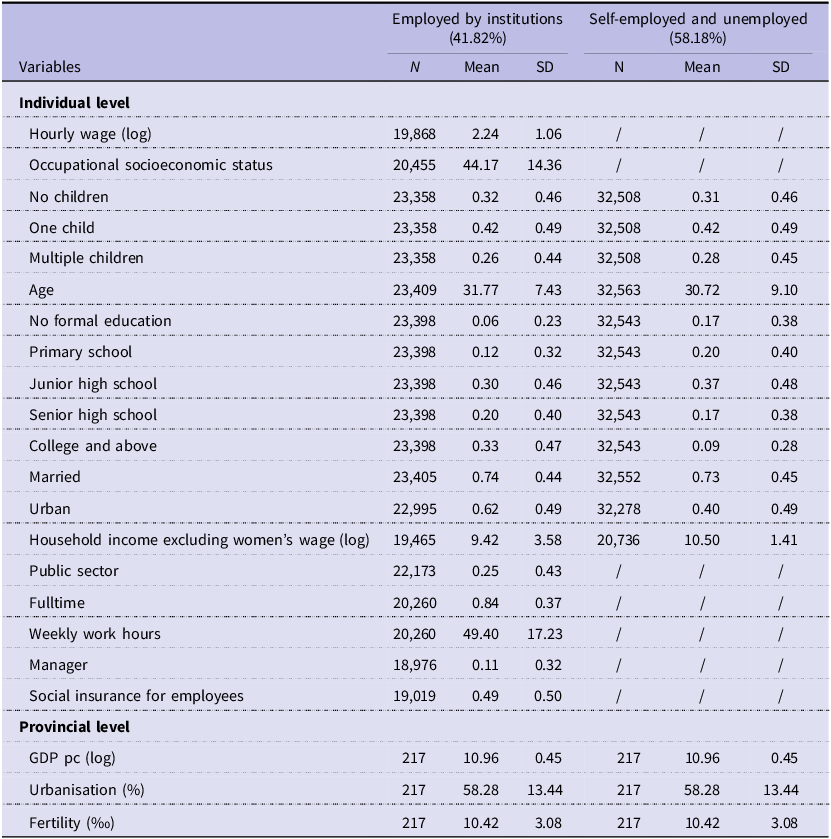
Table 2 presents the results of the descriptive analysis. In our data, 41.82 per cent of females are employed, while 58.18 per cent of females are self-employed or unemployed. For employed women, the mean logged hourly wage and the average score of occupational socioeconomic status are 2.24 and 44.17, respectively. The percentages of childless women are 32 and 31 among employed women and self-employed as well as unemployed women, respectively. Besides, the percentages of having one child and multiple children among employed women are 42 and 26, while those among self-employed and unemployed women are 42 and 28. Compared to self-employed and unemployed women, employed women are better educated and more likely to live in urban China. For employed women, 25 per cent work in the public sector, 11 per cent hold a managerial position, and 49 per cent are enrolled in social insurance. With an average of 49.4 weekly working hours, 84 per cent hold a full-time job.
Summary statistics (person-/province-years)
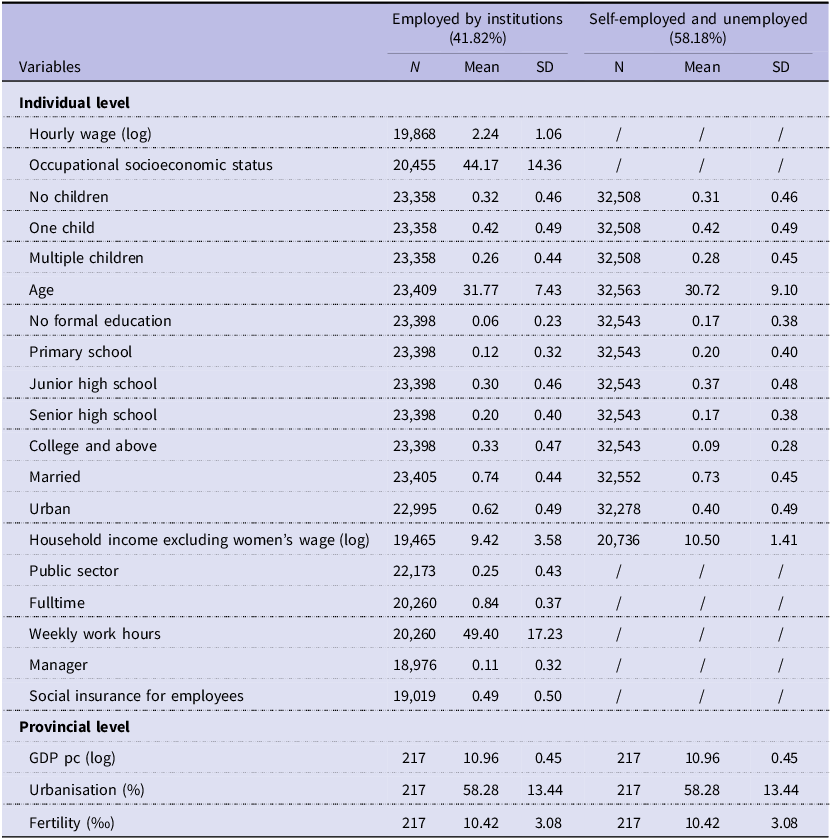
Notes: Since self-employed women are not considered when analysing employed women, we do not present occupation-related indicators for them (also mostly not reported in the CFPS).
As the proportion of females with no formal education is under 10 per cent among those employed by institutions, we merge females with no formal education and those with primary school education as ‘primary school and below’ when only females employed by institutions are included in the regression model.
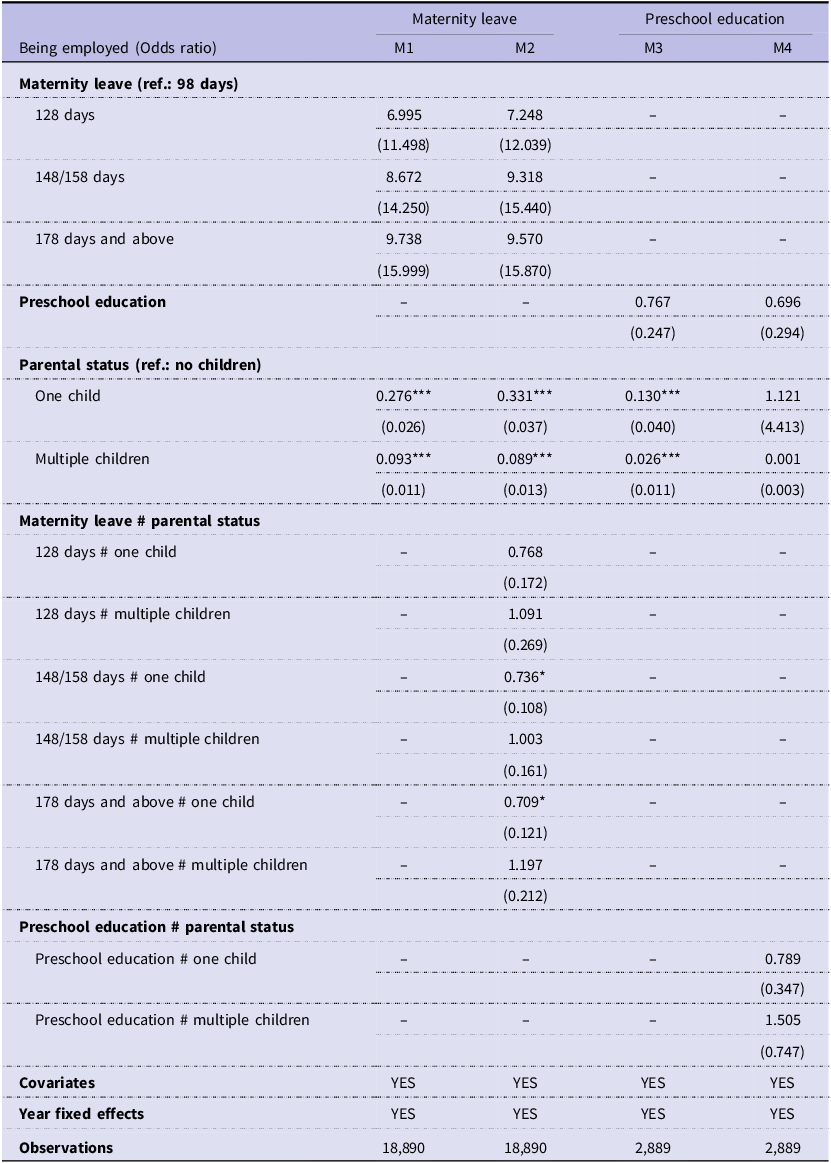
The effects of family policies on the likelihood of being employed are shown in Table 3. Results demonstrate that extended maternity leave has no direct impact on the likelihood of being employed. However, after controlling for confounding factors, the likelihood of being employed for mothers with one child and multiple children is 72.4 per cent and 90.7 per cent less than that for childless women (Model 1), and this negative association is more prominent among women with one child in provinces with 148/158 or 178 days of maternity leave (Model 2). Hence, the extended maternity leave, to some extent, intensifies the motherhood penalty in terms of labour force participation. This negative effect disappears among mothers with multiple children. This might be explained by the fact that the likelihood of being employed for women has been largely reduced by having multiple children, for which the additional negative effect of the policy is marginal. Moreover, we do not find this negative effect among childless women, suggesting that extended maternity leave may not crowd childless women out of being employed. Besides, Model 3 and Model 4 show that neither preschool spending nor its interaction with motherhood has a remarkable impact on the likelihood of being employed.Footnote 9
Effects of family policies on women’s labour force participation

Robust standard errors in parentheses.
***p < 0.001, **p < 0.01, *p < 0.05.
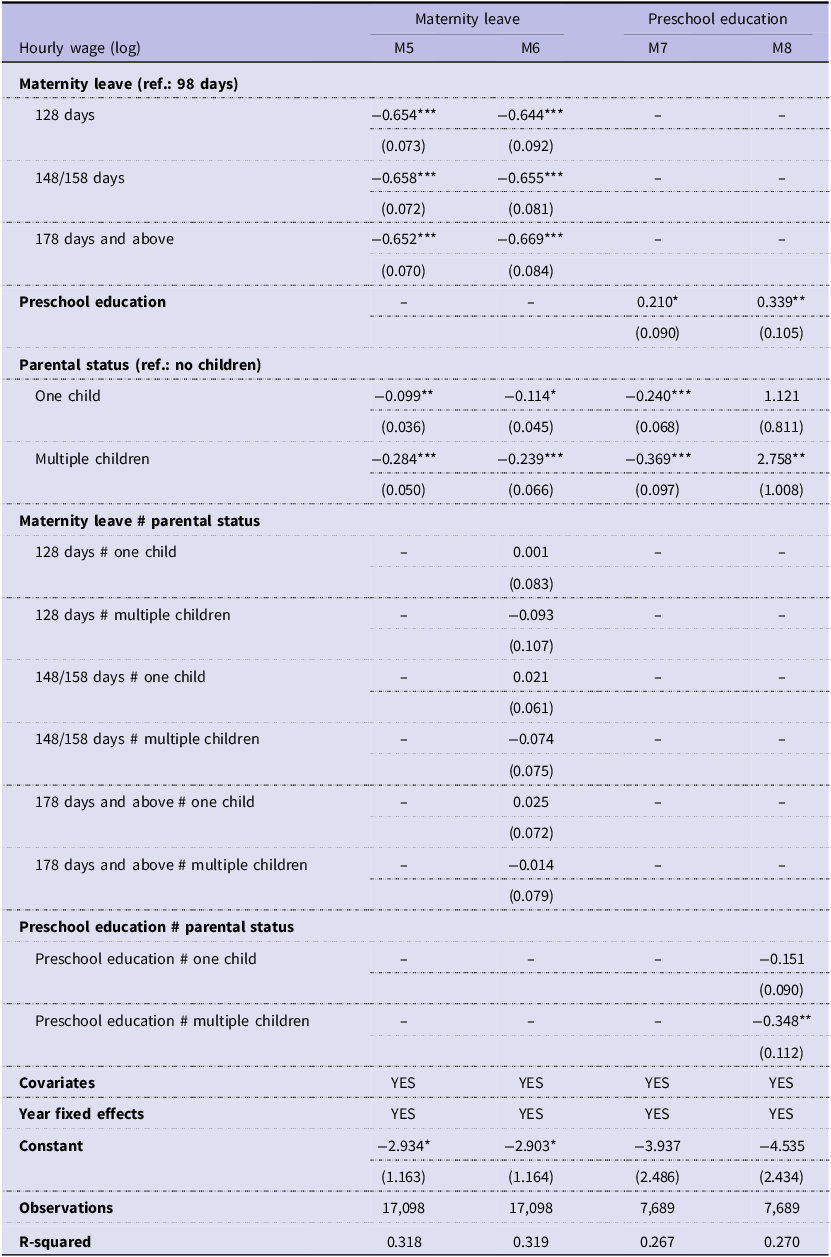
Table 4 manifests the effects of family policies on women’s wages. After controlling for confounding factors, extended maternity leave is associated with a salient wage loss, reaching approximately 65 per cent (Model 5). Parental status also has a negative effect on women’s wages. That is, having one child and multiple children significantly lead to 9.8 per cent and 28.4 per cent wage penalties, respectively. Model 6 examines the interactive effect of maternity leave and motherhood. Compared to a 98-day maternity leave, a longer maternity leave is related to an additional wage penalty, but it is statistically insignificant. We further consider this interactive effect from the perspective of the policy effect. That is, the negative effect of extended maternity leave on women’s wages does not vary by motherhood in all provinces. In this way, the extension of maternity leave could not only damage mothers’ wages but also induce wage loss among childless women, and the latter is even no less prominent than the former.
Effects of family policies on women’s wages

Robust standard errors in parentheses.
***p < 0.001, **p < 0.01, *p < 0.05.
Model 7 and Model 8 estimate the impact of public spending in preschool education on women’s wages. After controlling for confounding factors, every 1 per cent increase in preschool spending is associated with a 21 per cent wage increase. Additionally, this effect of preschool spending on wages, like that of paid leave, is remarkable among all women. However, this protective effect wanes among mothers with multiple children, suggesting that the loss in the workplace resulting from having multiple children is less likely to be offset by the generous preschool education provision in China.
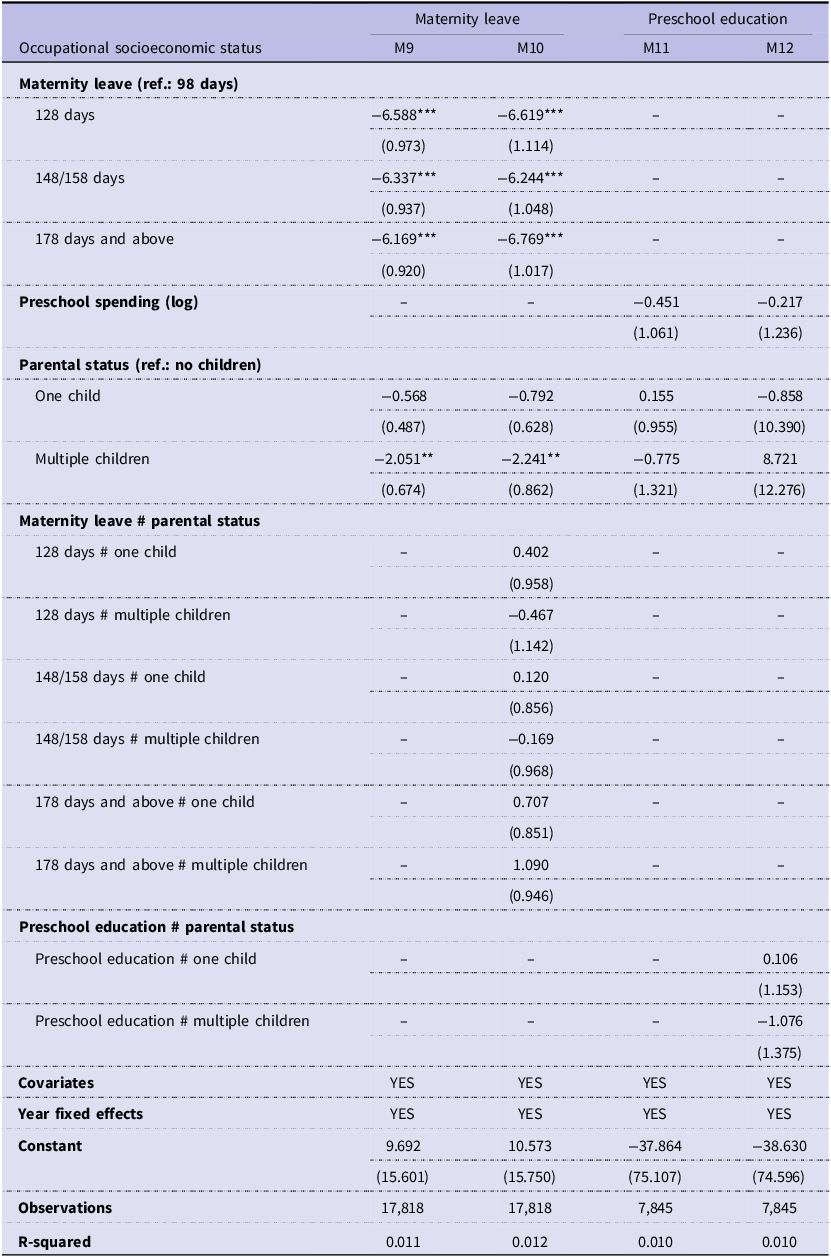
The effects of family policies on women’s occupational socioeconomic status are presented in Table 5. Results demonstrate that the extension of maternity leave is negatively related to women’s occupational socioeconomic status (Model 9). Compared to that in provinces with 98 days of maternity leave, the score of occupational socioeconomic status significantly decreases by 6.588, 6.337, and 6.169 for women working in provinces with 128-day, 148/158-day, and 178-day and above maternity leave, respectively. Besides, having one child has no salient impact on women’s occupational socioeconomic status, while having multiple children remarkably reduces it. Model 10 tests the interactive effect of maternity leave and motherhood and shows that maternity leave negatively affects women’s occupational socioeconomic status, with no significant difference across parental status, which largely coincides with the effects of maternity leave on wages. Furthermore, Model 11 and Model 12 indicate that the effect of preschool spending on women’s occupational socioeconomic status is trivial. Also, the effect of parental status on women’s occupational socioeconomic status is insignificant in Model 11, which is inconsistent with the estimates provided in Model 9. This is probably because the sample size and period of observation are different between the two models.
Effects of family policies on women’s occupational socioeconomic status

Robust standard errors in parentheses.
***p < 0.001, **p < 0.01, *p < 0.05.
Considering that women with children under six are the de facto users of paid leave and funded childcare, we exploit the age of children as an alternative specification of parental status in additional analysis (see Supplementary Tables 4–6). The main results are consistent with those discussed above. Specifically, the negative effects of maternity leave on women’s wages and occupational socioeconomic status prevail among childless women, women who have any children under six, and women who only have children above six, with no remarkable differences across the three groups. This further illustrates that the influence of paid leave is not restricted to those who directly utilise it but exists among all working-age Chinese women. Moreover, preschool spending has a positive impact on women’s wages, and this impact is less pronounced among women who only have children above six as they are less likely to use the public childcare service. The additional analysis also manifests that extended maternity leave reduces the likelihood of being employed for mothers, irrespective of the age of their children. For our hypotheses, therefore, H1a is rejected, while H1b, H2, and H3 are partially endorsed.
Conclusion and discussion
This article analyses how family policies affect women’s employment in China. Different from previous studies that focus on mothers’ employment, we consider the policy effects on all working-age women. Findings show that extended maternity leave does not mitigate the motherhood penalty; instead, it exerts negative effects on women’s wages and occupational socioeconomic status among all working-age Chinese women, irrespective of motherhood. By contrast, we find that public spending in preschool education has a protective effect on women’s employment, although quite limited.
Our findings are consistent with existing scholarship regarding the effects of national family policy on women’s employment (Ferragina, Reference Ferragina2019). More importantly, our research expands the theoretical discussion that solely focuses on mothers when analysing family policy. We find that paid leave not only influences mothers’ employment but also signals potential fertility and triggers fertility-based discrimination against childless women. It could be explained by employers’ consideration regarding personnel costs caused by paid leave, as revealed by Dai (Reference Dai2025). Furthermore, it suggests the normative effect of family policy, which strengthens childless women’s expected role as mothers. We thus contextualise related scholarship by highlighting that the family policy effects on childless women should be carefully considered in societies where pronatalist state rhetoric and traditional familism co-exist to encourage fertility and underscore traditional gender roles. As such, we argue that the analysis of family policy and women’s employment should be discussed in a general gender framework. Additionally, our findings contribute to theorising the discrimination against potential fertility and expected family duties (Becker et al., Reference Becker, Fernandes and Weichselbaumer2019; Peterson Gloor et al., Reference Peterson Gloor, Okimoto and King2022; He et al., Reference He, Li and Han2023) by incorporating state policy into the analytical framework and emphasising the state-market-family relations. Moreover, our findings illuminate that social policy could exert unintended or undesirable effects, which are opposed to the policy goal and merit careful consideration in policy evaluation. Also, the analysis of policy effects should not be limited to the primary target group; instead, the policy may have a spill-over effect on broader groups, thus highlighting the holistic perspective in social policy studies.
We further compare the policy effects on three dimensions of women’s employment examined in this research. Generally, our findings show that the effects of family policies are more prominent on wage and occupational socioeconomic status than on labour force participation in China. It is likely that paid leave, to some extent, maintains the employment continuity of mothers during the protection period. Moreover, our findings suggest that, compared to excluding women from the labour market, discrimination triggered by paid leave is more likely to contribute to a segregated labour market and crowd women into mother-friendly but low-paying and less prestigious occupations, which implies that the welfare provision in China may mitigate gender inequality in some dimensions but intensify it in others, as the welfare paradox theory presents (Mandel and Semyonov, Reference Mandel and Semyonov2006). Our analysis of multiple employment outcomes thus clarifies the nuanced mechanism of the reproduction of gender inequality in China’s labour market. More broadly, this research underscores that the social policy analysis should not only focus on a single outcome dimension; rather, delving into the multi-dimensionality of policy effects may contribute to a complicated understanding regarding how policy affects individuals structurally.
This research also echoes previous findings that pronatalist family policies in post-socialist Eastern Europe had little impact on fertility (Cook et al., Reference Cook, Iarskaia-Smirnova and Kozlov2023). In response to the demographic shift, the Chinese government expanded childcare benefits to boost fertility and protect women’s employment in the last decade. However, these emerging initiatives seem counterproductive. The fertility-oriented leave policy makes potential fertility salient in personnel decisions and raises the concern of employers regarding the cost of hiring women and productivity decline due to a longer maternity leave, thus disadvantaging working women and demotivating them to have (additional) children. Consequently, even though Chinese couples have been allowed to have two children since 2015, the total fertility rate was only 1.3 in 2020 (National Bureau of Statistics, 2022). More crucially, the number of the first child is smaller than that of the second and above among the new-born in the last decade (National Bureau of Statistics, 2022), which means that childless women who are usually younger and more capable of fertility are less willing to have children than women who have had children.
Therefore, we argue that more policy efforts should be made to socialise the cost of childrearing instead of imposing the burden on individuals, especially on women, in order to advance gender equality in the public and private spheres. In this regard, we find that the increased spending in preschool education in China is positively related to women’s employment. Nonetheless, the magnitude of policy effects is marginal. This might be explained by the absence of childcare services for children under three in China. That is, it seems too late if only socialising childcare for children aged three to five since it cannot facilitate mothers to return to the labour market timely but could prolong their work interruption caused by childrearing. Given the verified and expected positive impacts of funded childcare, it is suggested that multiple policy tools should be strategically utilised in social policy design, while an inappropriate policy mix, such as the extended maternity leave and inadequate funded childcare in China, may fail to achieve the policy goal.
This research, therefore, sheds light on family policy, female employment, and gender equality, for China and other societies. First, we emphasise that policy attention should be paid to advancing public childcare services for all children under six, particularly for the earlier stage which is critical for women’s employment continuity. Furthermore, it makes sense to offer employers incentives to hire women, such as tax deductions. Apart from interventions in the public sphere, it is significant to substantially enhance father involvement and equalise the division of childcare between genders in the private sphere, which remains limited in China. As suggested by the stalled revolution arguments, gender justice cannot be reached without the advancement of males’ engagement in family affairs (England, Reference England2010).
This research has some limitations. Firstly, the measurement of maternity leave and funded childcare could be better. For instance, the enrolment rate of funded childcare facilities is often exploited to capture the social provision of childcare services; however, these indicators are not available at the provincial level in China. Besides, we did not incorporate the funded childcare for children under three into the analysis as it remains under-provided and lacks related data. Moreover, apart from the length of leave, there are some provincial variations in the policy design of maternity leave, which may have additional influences on women’s employment. Yet, we can hardly quantify these policy details. Secondly, also due to the data limitation, we found some results inconsistent across regression models that might be caused by the differences in the sample size and period of investigation. Future research may consider these details to garner a better understanding of family policy and women’s employment.
Supplementary material
The supplementary material for this article can be found at https://doi.org/10.1017/S1474746426101407.
Acknowledgements
This work was supported by the General Research Fund, Research Grants Council of Hong Kong [#14610220]. The authors appreciate useful suggestions and support from Dr. Kai Liu, Dr. Jing Guo, Dr. Shasha Xu, Dr. Chuanqi Que, and Ms. Lijian Zhao. An early version was presented at the 30th Annual Conference of the Society for Social Work and Research in January 2026, in Washington DC.
Competing interests
The authors declare none.



 Open access

