

1. Introduction
If I ask you whether the edge of the page is straight, then you can surely check that it is. But if I were to then hold up my wiggly cruler and ask you whether it is straight in that sense, then I suppose you would give a different answer. So, physical geometry depends to some extent on our conventions about straightness and distance, which Carnap ([Reference Carnap, Carus, Friedman, Kienzler, Richardson and Schlotter1922] 2019, sec. III) calls “straightness and metrical stipulation.”
To say only this is not to say much.Footnote 1 It certainly does not follow that the structure of spacetime is a social constructivist free-for-all. For example, in both straightness conventions of figure 1, spatial geometry changes as one moves from an empty region toward a gravitating body. You can play the semantic game of stipulating a new referent for the word Euclidean, if that is the sort of thing you are into. But this freedom is kind of trivial, in the sense that it is not unique to geometry alone. A more impressive observation about geometry is that whatever metrical stipulations we make, spacetime geometry is related in a law-like way to the distribution of matter and energy in the universe. Thus, physicists speak of “a geometrodynamical universe: a world whose properties are described by geometry, and a geometry whose curvature changes with time” (Wheeler Reference Wheeler, Nagel, Suppes and Tarski1962, 361). That is a deep idea that is unique to geometry. The idea that we can trivially change the meaning of our words, called “trivial semantic conventionalism” (Grünbaum Reference Grünbaum, Fidl and Maxwell1962, 420), is not.
Two different conventions of straightness.

Figure 1 Long description
The image features a white background with a vertical wavy line on the right side. The wavy line appears to be a continuous, smooth curve that deviates from a straight path, symbolizing a deviation or alternation from the conventional straight line on the left side.
On the other hand, the language of spacetime geometry is quite different from most ordinary language because it does not refer to anything directly observable.Footnote 2 The empiricist response to this is to deny that “unobservable geometry” refers to anything at all. Then one can freely adopt the convention of choosing any spacetime geometry that is convenient, so long as it is compatible with the laws and provides accurate predictions. The realist response is to insist there is a true spacetime geometry, whether or not it is observable. The realist should then explain how the conventionalist’s alternatives are inappropriate, for example, because they are mathematically or physically impossible.
I will argue that the conventionality of geometry is not mathematically or physically impossible; rather, it indicates the presence of incomplete science. Nontrivial conventionality can arise for the geometry of space, but it does so out of physical properties that are incompletely described, in the sense of being conceptually isolated from the rest of physics. Conventionality of this kind is rather hard to come by; to illustrate, I will prove two strengthenings of a theorem of Weatherall and Manchak (Reference Weatherall and Byron Manchak2014), which show that there is little conventionality available through the introduction of hidden “universal forces” in relativity theory. I will then consider an alternative form of conventionality of geometry that arises out of higher spatial dimensions and argue that Kaluza–Klein theory provides an indication of how this sort of conventionality actually amounts to incompleteness.
2. Conventionality and its discontents
The notion of trivial semantic conventionalism will play a central role in my discussion, as it did in the debate between Grünbaum (Reference Grünbaum, Fidl and Maxwell1962) and Putnam (Reference Putnam1963) when it was introduced. However, because this concept is rarely discussed in more recent discussions of geometric conventionality, I will begin by recalling its origin through a brief review of the modern conventionality debate. That debate began with the following influential example.
2.1. The Poincaré disc
A great awkwardness of spacetime is that it seems to have a geometry, which explains empirical measurements like spatial distance and temporal duration, but in most textbook accounts, it is not directly observable. We can, of course, use measuring devices like rulers and clocks to access spacetime geometry indirectly. But our conclusions are only as reliable as those rulers and clocks. If some hidden influence distorts our measuring devices, then our conclusions about spacetime geometry will be distorted too.
A classic illustration of this concern is the sphere of Poincaré (Reference Poincaré1905, 65–68), commonly described in two dimensions as a disc. Consider a Euclidean surface of radius $R$
that is hot at the center and cold at the edges, with temperature at radius
$R$
that is hot at the center and cold at the edges, with temperature at radius $r \in \left[ {0,R} \right)$
proportional to
$r \in \left[ {0,R} \right)$
proportional to ${R^2} - {r^2}$
. Suppose further that when rulers are placed on the surface, they expand and contract in proportion to the temperature so as to give the appearance of a non-Euclidean geometry. The rulers on this disc would not measure the shortest distance between two points
${R^2} - {r^2}$
. Suppose further that when rulers are placed on the surface, they expand and contract in proportion to the temperature so as to give the appearance of a non-Euclidean geometry. The rulers on this disc would not measure the shortest distance between two points $p$
and
$p$
and $q$
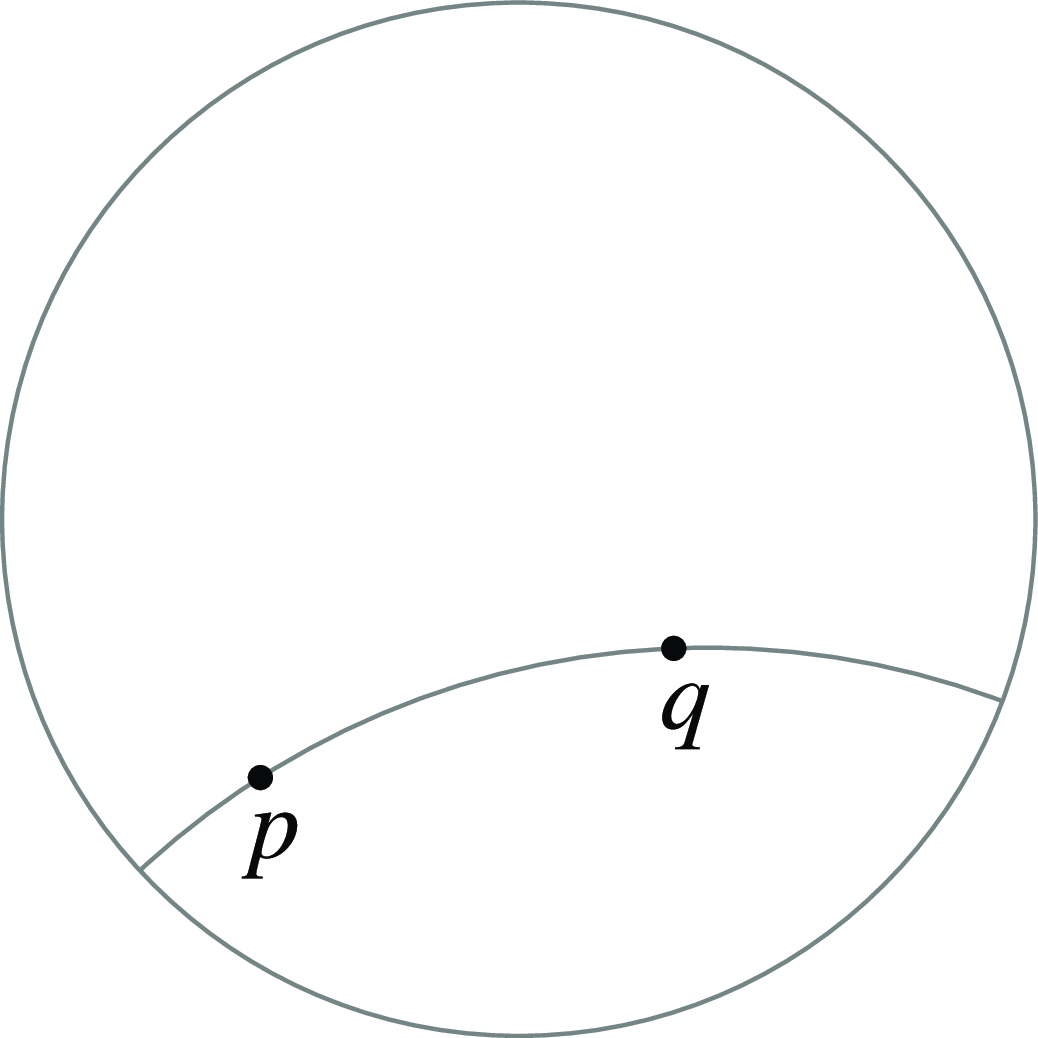
to be a straight Euclidean line but rather a geodesic of hyperbolic “Lobachevsky” geometry, illustrated in figure 2.
$q$
to be a straight Euclidean line but rather a geodesic of hyperbolic “Lobachevsky” geometry, illustrated in figure 2.
The shortest path between two points on Poincaré’s disc is a hyperbolic geodesic, as measured by rulers distorted by the disc’s heat gradient.
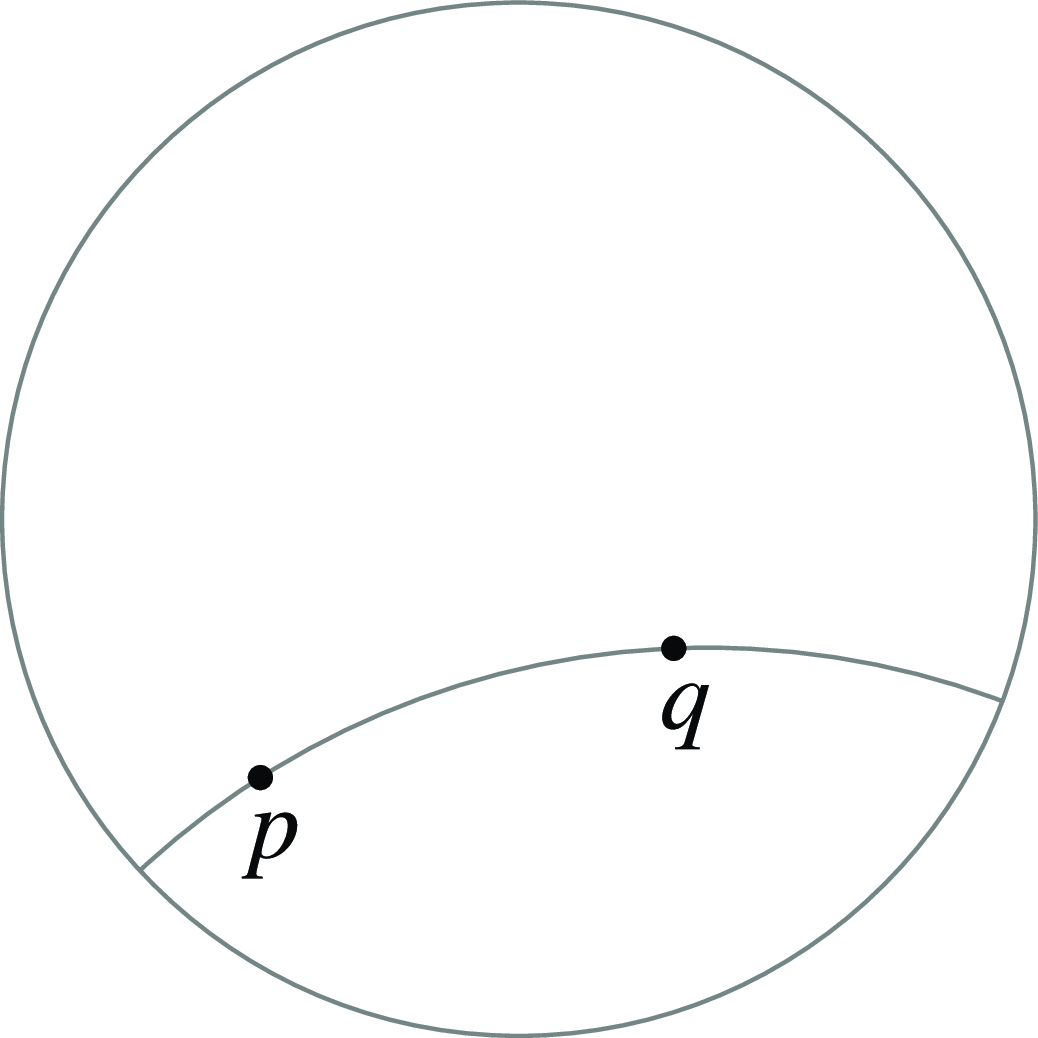
Figure 2 Long description
A diagram of Poincare's disc illustrating the shortest path between two points, p and q, as a hyperbolic geodesic. The disc represents a Euclidean surface with a heat gradient, where the center is hot and the edges are cold. The temperature at any radius r is proportional to R squared, affecting the measurement of distances.
Of course, it would be hard to miss that the disc is heated if you had your wits about you. Better yet, by using a thermally insulated ruler, one could avoid this distortion altogether. However, if unbeknownst to us there were some hidden “universal” force defined so as to distort all rulers in the same way, then the true physical geometry of the disc would seem completely inaccessible. This kind of thinkingFootnote 3 led many to propose that the choice of a disc geometry is a matter of convention, for example, as it was developed by Reichenbach ([Reference Reichenbach1928] 1958, 38–39).
2.2. Reactions and discontents
Many philosophers and scientists after Poincaré began to interpret the spatial metric as a conventional choice, analogous to a choice of measurement units like meters or yards. Euclidean geometry, viewed for centuries after Newton as the science of space, was dramatically demoted to a degree that some saw as “comparable in some respects to Kant’s Copernican revolution” (Ben-Menahem Reference Ben-Menahem2006, 5). In its place, a conventionalist philosophy of geometry was defended by empiricistsFootnote 4 like Poincaré (Reference Poincaré1905), Schlick (Reference Schlick1920, chap. V), Carnap ([Reference Carnap, Carus, Friedman, Kienzler, Richardson and Schlotter1922] 2019), and Reichenbach ([Reference Reichenbach1928] 1958, sec. 3) and developed in detail by Grünbaum (Reference Grünbaum, Fidl and Maxwell1962, Reference Grünbaum1963, Reference Grünbaum1969) as an “intrinsically metrically amorphous” interpretation of spacetime.Footnote 5 Even Einstein famously supported a similar conclusion:Footnote 6
Geometry (G) predicates nothing about the behavior of real things, but only geometry together with the totality (P) of physical laws can do so. Using symbols, we may say that only the sum of (G)+(P) is subject to experimental verification. Thus (G) may be chosen arbitrarily, and also parts of (P); all these laws are conventions…. Envisaged in this way, axiomatic geometry and the part of natural law which has been given a conventional status appear as epistemologically equivalent. (Einstein Reference Einstein1921, 236)
Despite these impressive early announcements, the conventionality of geometry soon fell into disrepute. Physics textbooks now generally agree that “the geometry of space is a new physical entity, with degrees of freedom and a dynamics of its own” (Misner et al. Reference Misner, Thorne and Archibald Wheeler1973, ix)—and that it is given, for example, by the Minkowski metric in weak gravitational regimes and by the Schwarzschild metric near a static and spherically symmetric black hole.
Philosophers have also given a variety of challenges to the conventionality of geometry. For example, Earman (Reference Earman1970) points out that each observer in a relativistic spacetime will define a unique induced spatial metric on the surface orthogonal to that observer’s worldline, apparently eliminating the possibility of alternative spatial geometries for Poincaré’s disc. Glymour (Reference Glymour1977) argues that an appropriate perspective on confirmation should lead us to accept the standard metric over Poincaré-style alternatives. Friedman (Reference Friedman1983, chap. VII) argues that Poincaré-style conventionality can be dismissed by a principle of parsimony that was an important part of the development of relativity theory.Footnote 7 Thus, Friedman writes, “There is no sense in which this metric is determined by arbitrary choice or convention” (Friedman Reference Friedman1983, 26).
However, a particularly influential critique of conventionality began with a series of papers by Putnam (Reference Putnam1963, Reference Putnam1974, Reference Putnam1979). Putnam’s basic thesis is that spacetime geometry is built into scientific theories in such a way that if we were to replace a given geometry with a conventionally chosen alternative, it would make an irreparable mess of other parts of the theory. He concludes that although such conventionalist alternatives may be logically consistent, they fail to provide a “usable” model of reality:
[A]s far as we know, the choice of any non-standard space-time metric would lead to infinite complications in the form of the laws of nature and to an unusable concept of space-time distance. Thus, as far as we know, the metric of space-time is not relative to anything. There is no interesting sense in which we can speak of a conventional “choice” of a metric for space-time in a general or special relativistic universe. (Putnam Reference Putnam1974, 34–35)
According to Putnam, the only sense in which we might say there are alternative geometries is by completely redefining other concepts in our theory. But this, he claims, collapses into Grünbaum’s “trivial semantic conventionalism,” akin to my wiggly ruler for measuring straightness and rendering the conventionality of geometry no different from standard conventions of ordinary language.
One of Putnam’s central examples is how Poincaré-style alternative geometries require us to redefine what a “force” means in physics. Taking the case of Hooke’s law, according to which the restoring force of a spring is proportional to its spatial distance out of equilibrium, Putnam writes,
If we decide by “distance” to mean distance according to some other metric, then in stating Hooke’s law we shall have to say that force depends not on length but on some quite complicated function of length; but that quite complicated function of length would be just what we ordinarily mean by “length.” (Putnam Reference Putnam1963, 220)
There may be room to disagree that this complicated function of length really is best interpreted as “just what we ordinarily mean” by length. However, I think there is an analogous concern about redefinition that is still correct, not just about redefining lengths but also about redefining forces. In particular, I will argue that a theorem of Weatherall and Manchak (Reference Weatherall and Byron Manchak2014) shows that the conventionalist does not have complete freedom to choose any spacetime metric whatsoever because the required universal forces cannot be defined, except in a semantically trivial sense.Footnote 8
3. Semantic triviality of universal forces
3.1. On the meaning of “force”
What is a force? Various authorsFootnote
9
have proposed that a force must at least be proportional to acceleration, as in Newton’s second law, $F = ma$
. However, since our concern is relativity theory, let me first motivate the relativistic version of Newton’s second law, for it is often suggested that Newtonian mechanics was falsified by Einstein’s theories. That is not quite right: Newton’s second law is carried over directly from Newtonian mechanics into general relativity, albeit in a slightly different language.
$F = ma$
. However, since our concern is relativity theory, let me first motivate the relativistic version of Newton’s second law, for it is often suggested that Newtonian mechanics was falsified by Einstein’s theories. That is not quite right: Newton’s second law is carried over directly from Newtonian mechanics into general relativity, albeit in a slightly different language.
Given the usual definitionFootnote
10
of a relativistic spacetime $\left( {M,{g_{ab}}} \right)$
, the metric
$\left( {M,{g_{ab}}} \right)$
, the metric ${g_{ab}}$
uniquely determines an affine connection (or covariant derivative operator)
${g_{ab}}$
uniquely determines an affine connection (or covariant derivative operator) ${\nabla _a}$
that allows one to define what it means to accelerate: If
${\nabla _a}$
that allows one to define what it means to accelerate: If ${\xi ^a}$
is the velocity vector field tangent to the worldline of a test particle, then the acceleration of the particle is given by
${\xi ^a}$
is the velocity vector field tangent to the worldline of a test particle, then the acceleration of the particle is given by ${\alpha ^a}: = {\xi ^b}{\nabla _b}{\xi ^a}$
. What it means to be the “force”
${\alpha ^a}: = {\xi ^b}{\nabla _b}{\xi ^a}$
. What it means to be the “force” ${F^a}$
on that curve can then be given by Newton’s second law, in that if the test particle has rest-mass
${F^a}$
on that curve can then be given by Newton’s second law, in that if the test particle has rest-mass $m$
, then,
$m$
, then,
 $${F^a} = m{\alpha ^a}.$$
Newton’s first law carries over as well, as the statement that in the absence of forces ( ${F^a} = 0$
), a test particle will follow a curve of zero acceleration (
${F^a} = 0$
), a test particle will follow a curve of zero acceleration ( ${\alpha ^a} = 0$
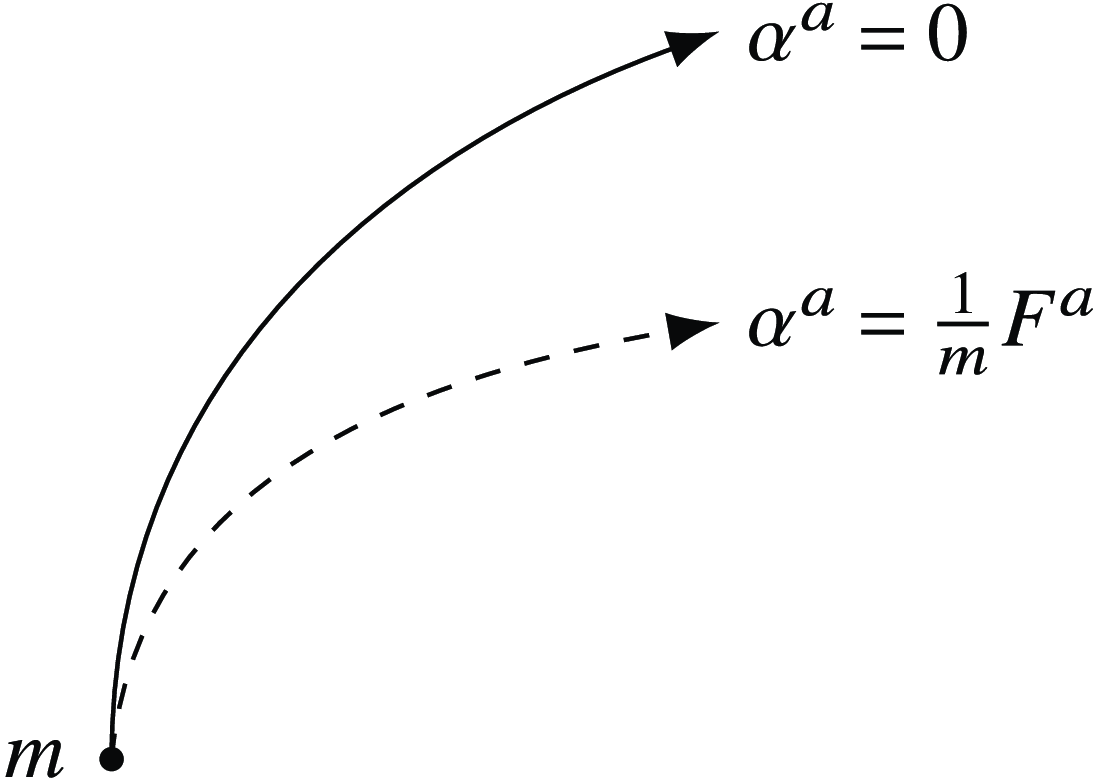
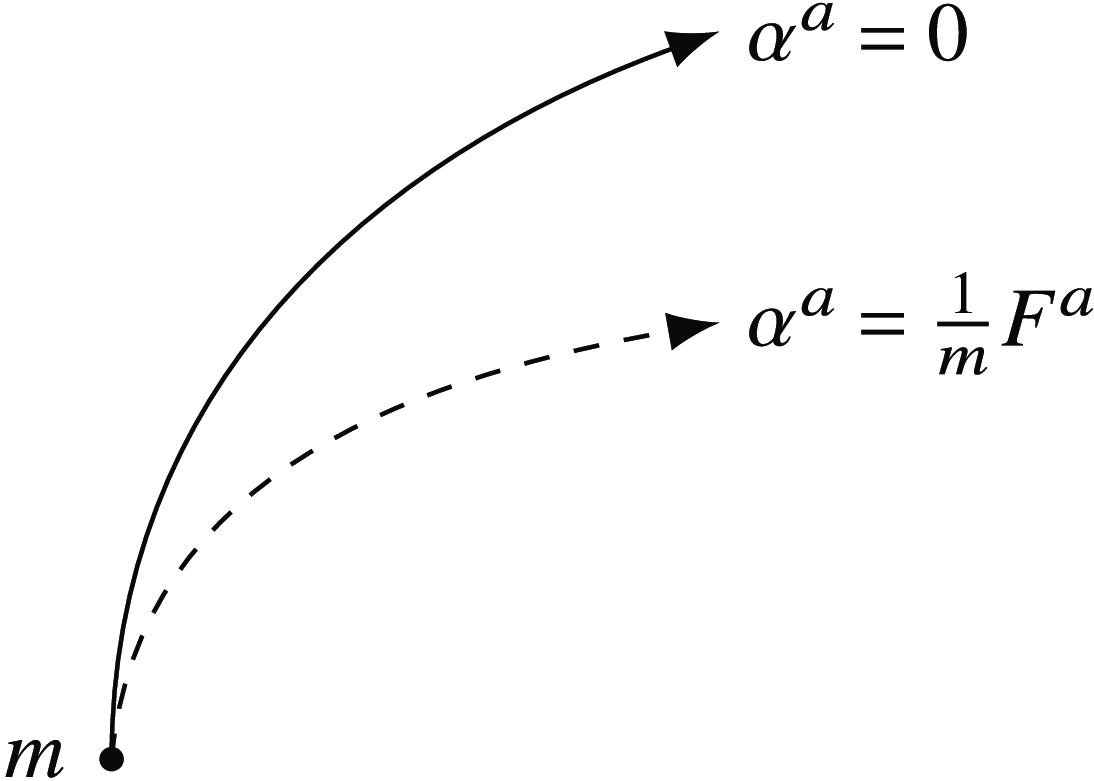
) called a geodesic (figure 3). These are the generalization of straight lines to geometries with curvature. Thus, Newton’s laws did not go extinct with relativity theory but live on in loftier form, like those dinosaurs that evolved into birds.
${\alpha ^a} = 0$
) called a geodesic (figure 3). These are the generalization of straight lines to geometries with curvature. Thus, Newton’s laws did not go extinct with relativity theory but live on in loftier form, like those dinosaurs that evolved into birds.
A massive test particle follows a geodesic (αa = 0) unless deflected by a force, in which case it accelerates according to Fa = mαa (dashed line).
This is not the only constraint that physical theory imposes on the meaning of forces. For example, a force is often taken to be a map ${F^a}_b$
from the velocity vector of a test particle to a force vector, which is asymmetric, as it is in mechanics and in electromagnetism. This is a crucial assumption in the theorem of Weatherall and Byron Manchak (Reference Weatherall and Byron Manchak2014), which I will discuss shortly, and Malament (Reference Malament2004, 303) calls it “a basic fact of electromagnetic life.” Although this assumption is rarely argued for, I would like to point out a sense in which the broader structure of modern physical theory requires it.
${F^a}_b$
from the velocity vector of a test particle to a force vector, which is asymmetric, as it is in mechanics and in electromagnetism. This is a crucial assumption in the theorem of Weatherall and Byron Manchak (Reference Weatherall and Byron Manchak2014), which I will discuss shortly, and Malament (Reference Malament2004, 303) calls it “a basic fact of electromagnetic life.” Although this assumption is rarely argued for, I would like to point out a sense in which the broader structure of modern physical theory requires it.
Forces in modern physics are described using a certain kind of descriptive redundancy called gauge. One typically begins by imagining these gauge interactions are “turned off.” Then, whenever energy is bounded from below—as it is observed to be in nature and as it must be if matter is to avoid catastrophic collapse—a result called Ostrogradsky’s theorem guarantees forces depend only on position and velocity and not on any higher derivatives.Footnote
11
As a result, one can view a force in the absence of gauge interactions as arising from a map ${F^a}_b$
that takes a test particle’s velocity
${F^a}_b$
that takes a test particle’s velocity ${\xi ^a}$
at each point to a force vector,
${\xi ^a}$
at each point to a force vector, ${\xi ^a} \mapsto {F^a}: = {F^a}_b{\xi ^b}$
. A short calculation then shows that Newton’s second law constrains this map to be antisymmetric.Footnote
12
The result of turning on local gauge interactions retains this structure: the acceleration of a test charge is given by a map
${\xi ^a} \mapsto {F^a}: = {F^a}_b{\xi ^b}$
. A short calculation then shows that Newton’s second law constrains this map to be antisymmetric.Footnote
12
The result of turning on local gauge interactions retains this structure: the acceleration of a test charge is given by a map ${F^a}_b$
that again takes the test charge’s velocity
${F^a}_b$
that again takes the test charge’s velocity ${\xi ^a}$
at each point to a force vector and is antisymmetric.Footnote
13
This aspect of what it means to be a “force” is thus built into the structure of modern physics at a rather deep level.
${\xi ^a}$
at each point to a force vector and is antisymmetric.Footnote
13
This aspect of what it means to be a “force” is thus built into the structure of modern physics at a rather deep level.
That said, it is not a priori that a force must have this form, and physical theories have been formulated without it, as Pitts (Reference Pitts2016) has pointed out. For example, Nordström’s early theory of gravityFootnote
14
made use of forces that were not of the form ${F^a}_b$
. However, adopting this kind of definition departs from the standard meaning of “force” in local minimally coupled gauge physics, so it is an example of the kind of search for new physics that I will discuss in section 5. In contrast, the standard meaning of “force” arises from a large and interconnected body of ideas and practices in physics, which all agree to use the word “force” to refer to whatever phenomenon is responsible for acceleration in space and time. Of course, nothing prevents you from choosing semantic conventions for these words, either by changing the meaning of “force” to something arbitrary, or by changing what it means to be “responsible for acceleration.” That is just the trivial semantic conventionalism that pervades all of ordinary language. But in order to understand whether there is any separate sense in which physical geometry is conventional, one must hold those meanings fixed.
${F^a}_b$
. However, adopting this kind of definition departs from the standard meaning of “force” in local minimally coupled gauge physics, so it is an example of the kind of search for new physics that I will discuss in section 5. In contrast, the standard meaning of “force” arises from a large and interconnected body of ideas and practices in physics, which all agree to use the word “force” to refer to whatever phenomenon is responsible for acceleration in space and time. Of course, nothing prevents you from choosing semantic conventions for these words, either by changing the meaning of “force” to something arbitrary, or by changing what it means to be “responsible for acceleration.” That is just the trivial semantic conventionalism that pervades all of ordinary language. But in order to understand whether there is any separate sense in which physical geometry is conventional, one must hold those meanings fixed.
3.2. Weatherall and Manchak’s no-go theorem
Weatherall and Manchak (Reference Weatherall and Byron Manchak2014) point out that this accepted meaning of the word “force” has immediate consequences for the conventionality of geometry. For instance, given a spacetime metric ${g_{ab}}$
and a “conventionally chosen alternative” metric
${g_{ab}}$
and a “conventionally chosen alternative” metric ${\tilde g_{ab}}$
, there is a tradition in the literature, following Reichenbach ([Reference Reichenbach1928] 1958, sec. 8) and Grünbaum (Reference Grünbaum1963, chap. 3A), to define the universal forces
${\tilde g_{ab}}$
, there is a tradition in the literature, following Reichenbach ([Reference Reichenbach1928] 1958, sec. 8) and Grünbaum (Reference Grünbaum1963, chap. 3A), to define the universal forces ${F_{ab}}$
by the relation
${F_{ab}}$
by the relation ${F_{ab}}: = {\tilde g_{ab}} - {g_{ab}}$
. But this is impossible for the kind of forces we have just discussed because
${F_{ab}}: = {\tilde g_{ab}} - {g_{ab}}$
. But this is impossible for the kind of forces we have just discussed because ${g_{ab}}$
and
${g_{ab}}$
and ${\tilde g_{ab}}$
are symmetric, whereas
${\tilde g_{ab}}$
are symmetric, whereas ${F_{ab}}$
is antisymmetric.
${F_{ab}}$
is antisymmetric.
So, if one wants to give a recipe for determining the universal force that will make any conventional choice of metric ${\tilde g_{ab}}$
equivalent to the apparent metric
${\tilde g_{ab}}$
equivalent to the apparent metric ${g_{ab}}$
, an alternative recipe is needed. Remarkably, Weatherall and Manchak show that no such general recipe exists. In particular, there are choices of an alternative metric
${g_{ab}}$
, an alternative recipe is needed. Remarkably, Weatherall and Manchak show that no such general recipe exists. In particular, there are choices of an alternative metric ${\tilde g_{ab}}$
for which no universal force will satisfy Newton’s law, whenever
${\tilde g_{ab}}$
for which no universal force will satisfy Newton’s law, whenever ${\tilde g_{ab}}$
is given by a nonconstant “rescaling” in the sense of a conformal transformation. Their theorem may be informally summarized as follows:Footnote
15
${\tilde g_{ab}}$
is given by a nonconstant “rescaling” in the sense of a conformal transformation. Their theorem may be informally summarized as follows:Footnote
15
If a conventionally chosen alternative metric is related to the original metric by a nonconstant conformal transformation, then there is no force that satisfies $F = ma$
in the alternative geometry on exactly the curves that are (zero-force) geodesics in the original geometry.
$F = ma$
in the alternative geometry on exactly the curves that are (zero-force) geodesics in the original geometry.
This result lends some much-needed precision to a worry of Nagel (Reference Nagel1961, 265): “It is by no means self-evident, however, that physical theories can in fact always be devised that have built-in provisions for such universal forces.” The conventionalist might have hoped to enjoy the complete freedom to choose any arbitrary replacement for the spacetime metric by conjecturing that there is a general prescription for devising a universal force that produces the same description of motion. Weatherall and Manchak have torpedoed that hope by proving that this conjecture is false.
As Weatherall and Manchak themselves point out, this result does not necessarily refute all forms of conventionalism, so long as one changes what it means to “freely choose a geometry by convention.” As an example, they consider a conventionalist who associates their arbitrary geometry ${\tilde g_{ab}}$
with a different kind of “force” map, which defines the force vector
${\tilde g_{ab}}$
with a different kind of “force” map, which defines the force vector ${F^a}$
using two vectors at a point rather than one,
${F^a}$
using two vectors at a point rather than one, ${\xi ^b},{\chi ^c} \mapsto {F^a}: = {F^a}_{bc}{\xi ^b}{\chi ^c}$
. Then one can always formally reproduce the geodesic motion of the original geometry as motion that follows from Newton’s second law.Footnote
16
This proposal was recently defended by Dürr and Read (Reference Dürr and Read2024, sec. 5.2.2). However, if those further vectors are in any way determined by the motion of the particle, then it would have to depend on higher derivatives in a way that is not possible because of the aforementioned considerations.
${\xi ^b},{\chi ^c} \mapsto {F^a}: = {F^a}_{bc}{\xi ^b}{\chi ^c}$
. Then one can always formally reproduce the geodesic motion of the original geometry as motion that follows from Newton’s second law.Footnote
16
This proposal was recently defended by Dürr and Read (Reference Dürr and Read2024, sec. 5.2.2). However, if those further vectors are in any way determined by the motion of the particle, then it would have to depend on higher derivatives in a way that is not possible because of the aforementioned considerations.
Duerr and Ben-Menahem (Reference Duerr and Ben-Menahem2022) and Dürr and Read (Reference Dürr and Read2024) defend a related response: For any given metric ${g_{ab}}$
, suppose we freely choose any alternative metric
${g_{ab}}$
, suppose we freely choose any alternative metric $g{{\rm{'}}_{ab}}$
as our preferred geometry and then define
$g{{\rm{'}}_{ab}}$
as our preferred geometry and then define ${G_{ab}}: = {g_{ab}} - g{{\rm{'}}_{ab}}$
. In their view, “Nothing compels us to interpret
${G_{ab}}: = {g_{ab}} - g{{\rm{'}}_{ab}}$
. In their view, “Nothing compels us to interpret ${G_{ab}}$
as a force: prima facie, we find nothing inherently absurd … in interpreting
${G_{ab}}$
as a force: prima facie, we find nothing inherently absurd … in interpreting ${G_{ab}}$
as a field, mediating a universal interaction” (Duerr and Ben-Menahem Reference Duerr and Ben-Menahem2022, 160). This proposal amounts to what is effectively the same thing, redefining what I have called “the phenomenon that determines the acceleration of a test particle” as an effect determined by two vectors at a point rather than one. However, conventionalists in search of conventional freedom that goes beyond the semantically trivial would not be satisfied: This kind of redefinition is not unique to the nature of geometry. Of course, one is also free to define one’s terms. But it is no more novel than my ability to label my wiggly ruler as “straight.”
${G_{ab}}$
as a field, mediating a universal interaction” (Duerr and Ben-Menahem Reference Duerr and Ben-Menahem2022, 160). This proposal amounts to what is effectively the same thing, redefining what I have called “the phenomenon that determines the acceleration of a test particle” as an effect determined by two vectors at a point rather than one. However, conventionalists in search of conventional freedom that goes beyond the semantically trivial would not be satisfied: This kind of redefinition is not unique to the nature of geometry. Of course, one is also free to define one’s terms. But it is no more novel than my ability to label my wiggly ruler as “straight.”
4. Stronger limitations on universal forces
Another line of response to Weatherall and Manchak’s proposal has been to expand what it means to “freely choose a geometry by convention” and argue that this freedom is independently motivated and so less susceptible to the charge of semantic triviality.Footnote 17 These proposals thus reveal a sense in which the conventionality of geometry sensitively depends on what it means to be an “alternative geometry.” Tasdan and Thébault (Reference Tasdan and Thébault2024) wisely focus on empirical underdetermination:
What is essential within our family of generalized notions of spacetime conventionalism is that in each and every case it is required that a basic structure of a spacetime theory is empirically underdetermined, and this underdetermination leads to the possibility for physical differences to arise between conventions regarding how to break the underdetermination. (Tasdan and Thébault Reference Tasdan and Thébault2024, 490)
I agree that this is essential. But in this section, I will argue that if these generalized notions of conventionalism involve forces of any kind, then they do little to improve the case for conventionality.
4.1. A strengthened no-go result
The Weatherall and Manchak (Reference Weatherall and Byron Manchak2014) no-go theorem by itself only establishes that the conventionalist cannot choose an alternative metric that is conformally related to the original.Footnote
18
Duerr and Ben-Menahem (Reference Duerr and Ben-Menahem2022, 158) argue that this “is too tight a constraint: it doesn’t give conventionalism as our authors themselves understand it, a proper chance.” This led both Ben-Menahem (Reference Duerr and Ben-Menahem2022) and Tasdan and Thébault (Reference Tasdan and Thébault2024) to propose that one might still replace the spacetime metric ${g_{ab}}$
with a conventionally chosen alternative, so long as they are not related by a conformal rescaling. Tasdan and Thébault (Reference Tasdan and Thébault2024, 492) call this Spacetime Conventionality 1, although they do not endorse it.
${g_{ab}}$
with a conventionally chosen alternative, so long as they are not related by a conformal rescaling. Tasdan and Thébault (Reference Tasdan and Thébault2024, 492) call this Spacetime Conventionality 1, although they do not endorse it.
As it turns out, such a conventionalist cannot be helped even with this “proper chance,” in that dropping the assumption of a conformal rescaling still does not allow for an empirically adequate universal force. A formal statement of this fact is the following, which I prove in the appendix.
Theorem 1
Let $\left( {M,{g_{ab}}} \right)$
and
$\left( {M,{g_{ab}}} \right)$
and $\left( {M,{{\tilde g}_{ab}}} \right)$
be spacetimes, with respective Levi–Civita connections
$\left( {M,{{\tilde g}_{ab}}} \right)$
be spacetimes, with respective Levi–Civita connections $\nabla $
and
$\nabla $
and $\tilde \nabla $
. Suppose there is a tensor field
$\tilde \nabla $
. Suppose there is a tensor field ${F^a}_b$
such that every unit timelike
${F^a}_b$
such that every unit timelike $\nabla $
-geodesic
$\nabla $
-geodesic ${\xi ^a}$
with
${\xi ^a}$
with ${F^a}: = {F^a}_b{\xi ^b}$
satisfies Newton’s equation with respect to
${F^a}: = {F^a}_b{\xi ^b}$
satisfies Newton’s equation with respect to $\tilde \nabla $
:
$\tilde \nabla $
:
 $${F^a} = m{\tilde \alpha ^a},$$
where ${\tilde \alpha ^a} = {\xi ^b}{\tilde \nabla _b}{\xi ^a}$
and
${\tilde \alpha ^a} = {\xi ^b}{\tilde \nabla _b}{\xi ^a}$
and $m \gt 0$
. Then
$m \gt 0$
. Then $\nabla = \tilde \nabla $
and
$\nabla = \tilde \nabla $
and ${F^a}_b = 0$
.
${F^a}_b = 0$
.
In other words, for a given spacetime metric, there is no alternative metric whatsoever that describes motion as arising from nonzero “universal” forces satisfying Newton’s law and in a way that matches the nonaccelerated motion for the original metric. The result is a logical strengthening of the Weatherall and Manchak (Reference Weatherall and Byron Manchak2014) theorem, which drops the assumption that the metrics are related by a nonconstant conformal rescaling. In my view, this leaves little hope for Spacetime Conventionality 1.
Let me make two further comments on this result, one on its premise and one on its conclusion. First, by restricting our premise to “unit timelike” vectors, we make this theorem stronger than it would be without such a restriction. In particular, the strategy is to prove a no-go result by assuming Newton’s equation is satisfied by some class of vector fields, so by narrowing that class and assuming it only of “unit” or “unit timelike” vectors, we obtain a logically weaker premise and a logically stronger result. Of course, one can strengthen the assumption by dropping the phrase “unit timelike” in the statement of the theorem. The point is that this stronger assumption simply isn’t needed: the same conclusion will automatically hold.
Duerr and Ben-Menahem (Reference Duerr and Ben-Menahem2022, 156) appear to claim that a similar restriction to unit vectors in the Weatherall and Manchak theorem is “unwarranted” and that the theorem can be circumvented if that restriction is dropped. However, the aforementioned observation applies in that case too: their same conclusion holds if the word “unit” is removed. But by restricting their assumptions to a narrower class of vectors, Weatherall and Manchak obtain a stronger result, just as we have done here.Footnote 19
Second, note that this theorem only establishes that the two spacetimes have the same connection; it does not follow from this alone that they have the same metric. Nevertheless, having equal connections is a relevant geometric equivalence because it implies that the Riemann curvature in these spacetimes is the same, as we shall see in the next section. Moreover, the theorem still shows what I have claimed at the outset, that the conventionality of geometry cannot arise out of any nontrivial “force” satisfying Newton’s equation. It is in this latter sense that the theorem provides a logical strengthening of Weatherall and Manchak’s result.
4.2. Tidal forces and geodesic deviation
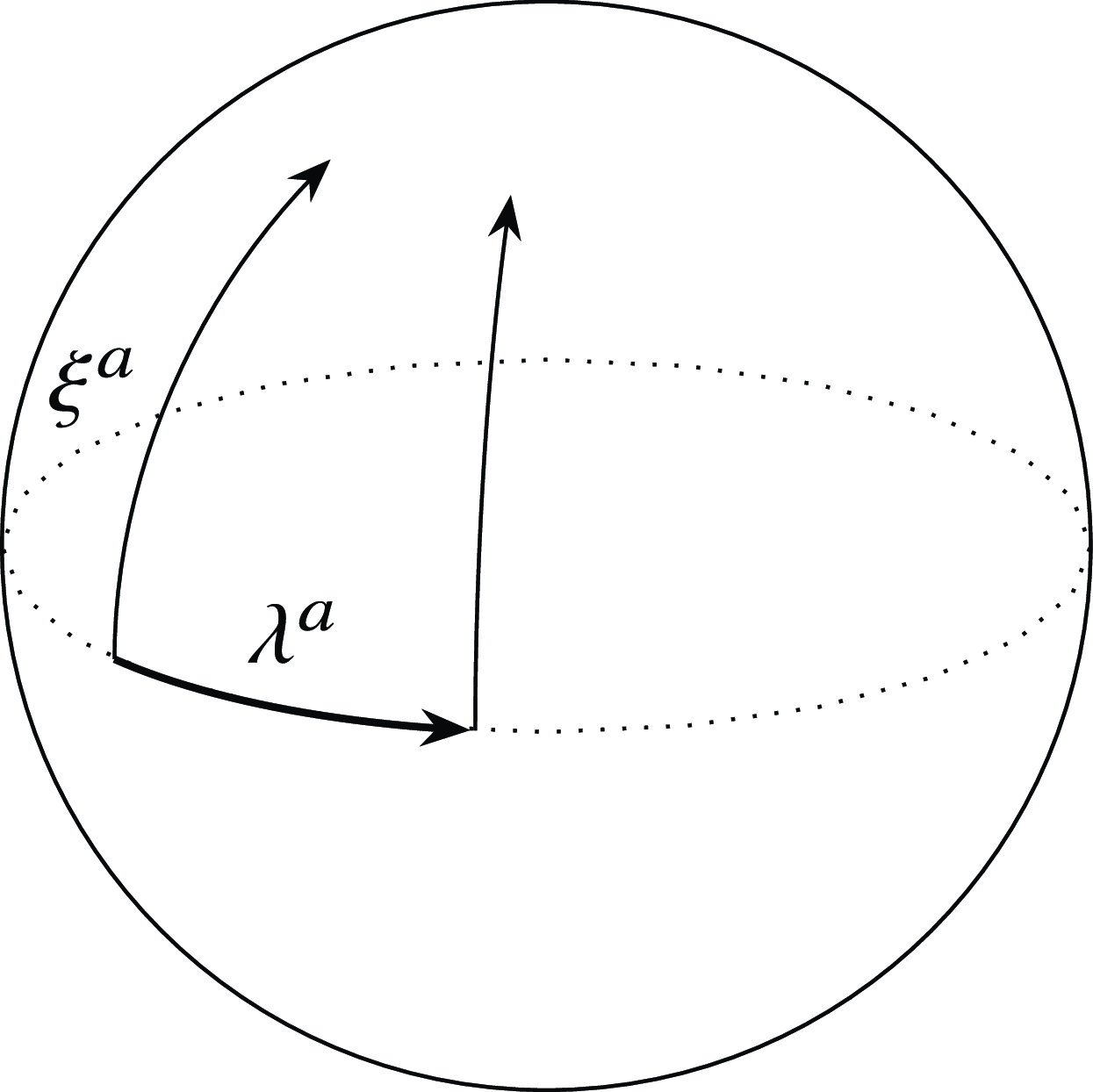
An alternative approach to a more restrictive kind of conventionality replaces “forces” with the deviation of curves. It is commonly noted that one does not measure the curvature of spacetime by observing a single geodesic but rather by “geodesic deviation.” Namely, by measuring the extent to which two nearby geodesics emerging from a perpendicular deviate from Euclidean behavior, one can measure the curvature of spacetime. For example, two geodesics emerging perpendicular to the equator on the surface of a sphere will reveal its positive curvature through their accelerated approach to one another instead of remaining equal distances apart (figure 4).
Deviation of a geodesic ξ ${^a}$
with respect to a nearby geodesic determined by the orthogonal vector λ
${^a}$
with respect to a nearby geodesic determined by the orthogonal vector λ ${^a}$
.
${^a}$
.
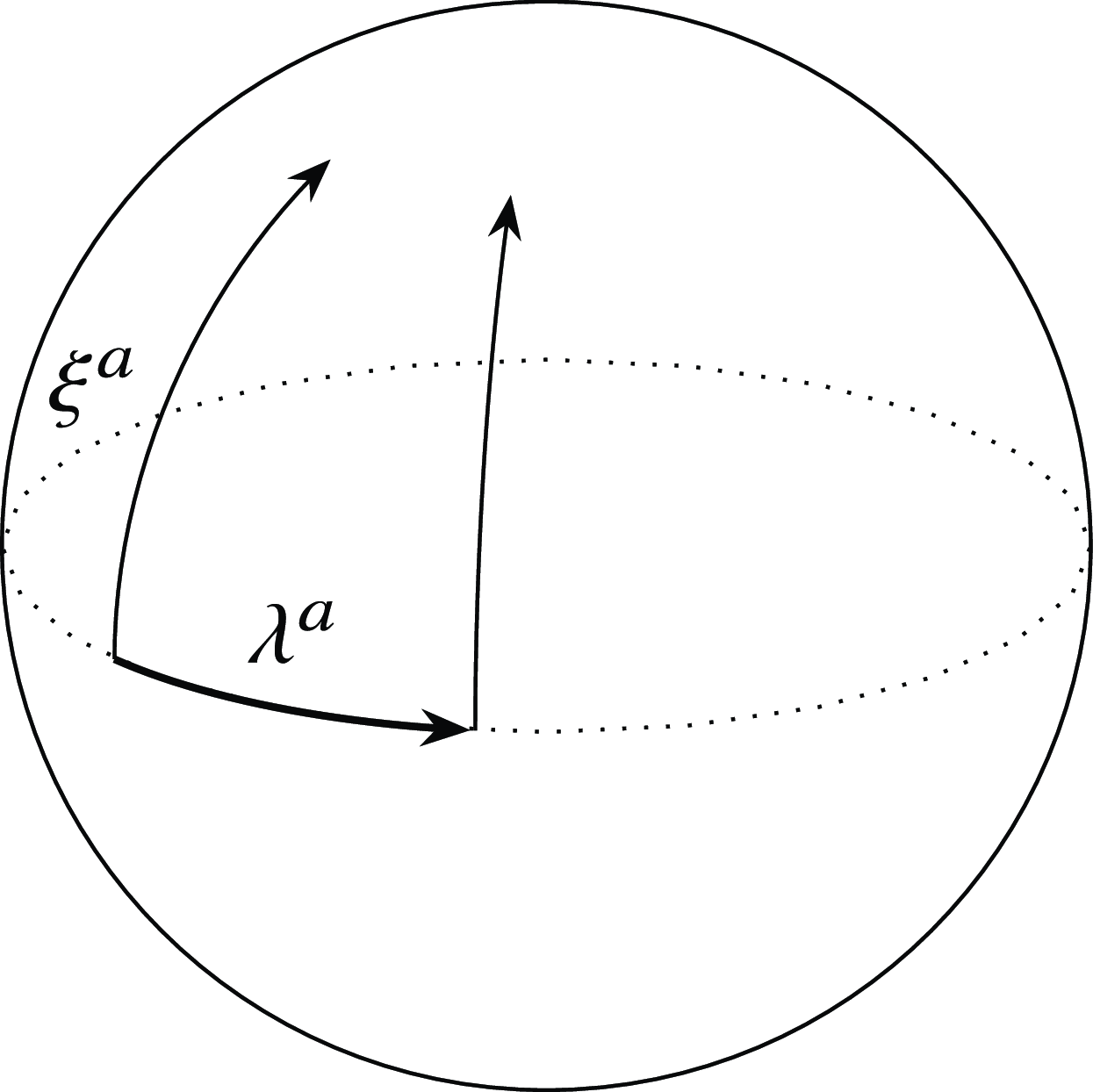
Figure 4 Long description
The diagram illustrates the deviation of a geodesic with respect to a nearby geodesic, determined by an orthogonal vector. The geodesic is represented by a curved line, and the orthogonal vector is shown as an arrow perpendicular to the geodesic. The diagram includes labels for the geodesic and the orthogonal vector, indicating their relationship and the direction of deviation.
By measuring the deviation associated with two nearby curves, is it possible to determine the curvature of spacetime? If one is able to tell when those particles are following geodesics, then the answer is clearly yes: All the possible motions of geodesics are known to uniquely determine the spacetime curvature. However, if there is some hidden contribution to acceleration, whether it is a force or a more general “effect” of the kind that Duerr and Ben-Menahem (Reference Duerr and Ben-Menahem2022) propose, then the deviation is described by a different equation, which includes the contribution of acceleration.
More formally, if we compare the motion of a test particle with tangent field ${\xi ^a}$
to that of a nearby curve determined by an orthogonal vector
${\xi ^a}$
to that of a nearby curve determined by an orthogonal vector ${\lambda ^a}$
, the deviation of this deflection is defined by
${\lambda ^a}$
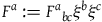
, the deviation of this deflection is defined by ${{\rm{\Delta }}^a}: = {\xi ^n}{\nabla _n}\left( {{\xi ^m}{\nabla _m}{\lambda ^a}} \right)$
. This quantity is provablyFootnote
20
related to the Riemann curvature
${{\rm{\Delta }}^a}: = {\xi ^n}{\nabla _n}\left( {{\xi ^m}{\nabla _m}{\lambda ^a}} \right)$
. This quantity is provablyFootnote
20
related to the Riemann curvature $R_{bcd}^a$
determined by the metric by what I will call the deviation equation,
$R_{bcd}^a$
determined by the metric by what I will call the deviation equation,
 $${{\rm{\Delta }}^a} = {\xi ^n}{\lambda ^m}{\xi ^b}\underbrace {{R^a}_{bmn}}_{{\rm{curvature}}} + {\lambda ^m}{\nabla _m}(\! {\underbrace {{\xi ^n}{\nabla _n}{\xi ^a}}_{{\rm{acceleration}}}}\!).$$
The deviation equation shows that if a test particle follows a geodesic and thus has vanishing acceleration, then its deviation from a nearby geodesic is given entirely by curvature. In contrast, if one cannot determine whether a test particle is accelerating, then the deviation is only determined by curvature up to the additional contribution of that acceleration.
This observation led Tasdan and Thébault (Reference Tasdan and Thébault2024) to suggest a reformulation of the conventionality of geometry, which they call Spacetime Conventionality 3. I will formulate it as the claim that one is free to choose whatever metrical geometry one wants, so long as that geometry produces the same geodesic deviation. The result will always be empirically adequate, insofar as our empirical evidence is associated with geodesic deviation rather than the motion of individual particles.
As it turns out, Tasdan and Thébault’s (Reference Tasdan and Thébault2024) proposal does not provide any more leeway for the conventionality of geometry either. One can show that having the same geodesic deviation uniquely determines the spacetime geometry, in a sense given by the following statement, proved in the appendix:
Theorem 2 Let $\left( {M,{g_{ab}}} \right)$
and
$\left( {M,{g_{ab}}} \right)$
and $\left( {M,{{\tilde g}_{ab}}} \right)$
be relativistic spacetimes with Levi–Civita connections
$\left( {M,{{\tilde g}_{ab}}} \right)$
be relativistic spacetimes with Levi–Civita connections $\nabla $
and
$\nabla $
and $\tilde \nabla $
. Suppose that all unit timelike geodesics
$\tilde \nabla $
. Suppose that all unit timelike geodesics ${\xi ^a}$
display equal deviation,
${\xi ^a}$
display equal deviation, ${{\rm{\Delta }}^a} = {{\rm{\tilde \Delta }}^a}$
, for all
${{\rm{\Delta }}^a} = {{\rm{\tilde \Delta }}^a}$
, for all ${\lambda ^a}$
such that
${\lambda ^a}$
such that $\left[ {\xi, \lambda } \right] = 0$
. Then
$\left[ {\xi, \lambda } \right] = 0$
. Then $\nabla = \tilde \nabla $
.
$\nabla = \tilde \nabla $
.
Note that as in the previous theorem, the restriction of this theorem’s premise to “unit timelike geodesics” makes for a weaker set of assumptions and thus a stronger result. Taken together, these two theorems show that there is no nontrivial conventionality of geometry arising from the acceleration of a particle by a hidden force, nor from the acceleration of geodesic deviation. I take this as an indication that there is little hope in seeking the conventionality of geometry through universal forces, either Newtonian or tidal.
5. Conventionality as merely incomplete
We have seen serious challenges to the claim that physical geometry is conventional. In this section, I will introduce what I find to be an interesting alternative convention about physical geometry, which arises from the choice of how many spatial dimensions there are. After presenting this sense of conventionality, I will argue that it is neither mathematically nor physically impossible but rather scientifically incomplete. I will then discuss how such frameworks might be completed using the example of Kaluza–Klein theory, finding that they appear to succeed only insofar as they eliminate the conventionalist alternatives.
5.1. Conventionality in higher dimensions
A tiny and very flat being constrained to a two-dimensional spatial surface might struggle to perceive geometric facts originating in a third dimension. Similarly, human beings constrained to three dimensions of space might struggle to infer the existence of yet higher spatial dimensions. Mathematicians since Riemann (Reference Riemann1873) have developed detailed studies of metrics in such higher-dimensional spaces. These have now come to play a central role in modern string theory, which generally postulates at least nine dimensions of space and one of time. I would like to point out that they also introduce an interesting new sense in which physical geometry is conventional.
The Nash (Reference Nash1954) embedding theorem says that every Riemannian manifold, no matter how curved, can be smoothly embedded in a metric-preserving (isometric) way into an ordinary Euclidean manifold with some higher number of dimensions. To see why this is so surprising, consider the flat torus, defined by taking a unit square of the Euclidean plane and identifying its opposite sides. Thus, two lines that cross at the center of the square are in fact a pair of intersecting “circles” of the same length. But these two lines have different lengths under the standard embedding of the torus into three-dimensional Euclidean space because one of the lines will be mapped to a circle of larger radius than the other (figure 5). It is not an isometry.
Crossing lines of equal length on a flat torus (left) no longer have equal length in the standard Euclidean embedding (right).
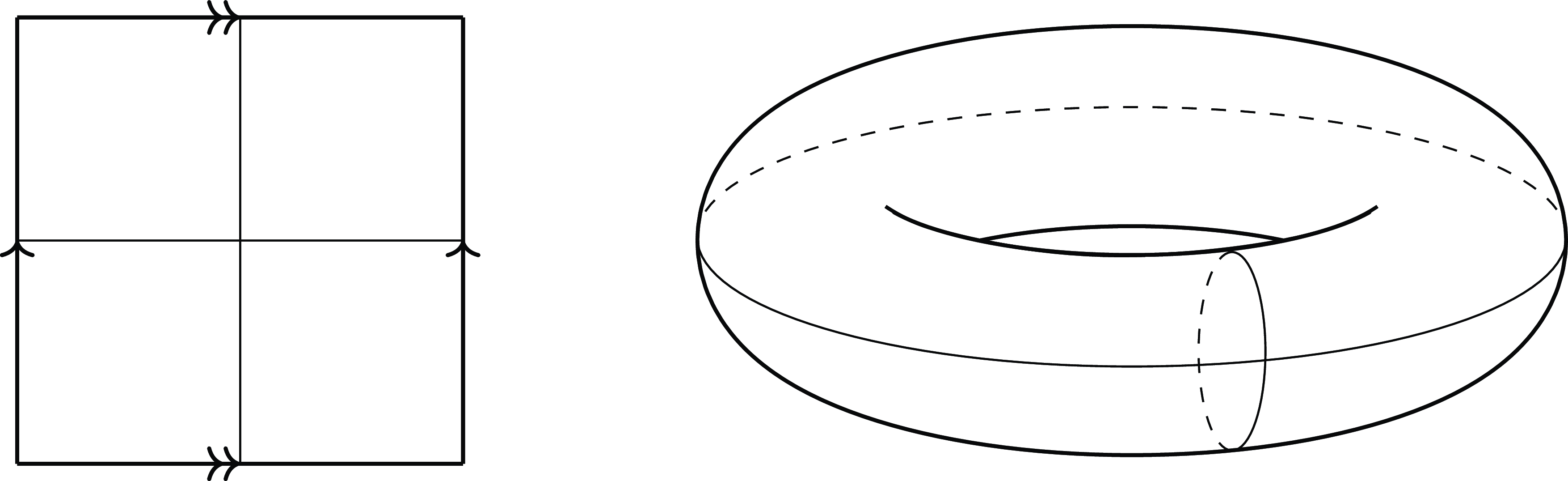
To achieve an isometric embedding, Nash (Reference Nash1954) had to supply a much more creative map. In this example, it may be thought of as beginning with the standard Euclidean embedding of the flat torus and then iteratively modifying it. Each iteration introduces rippling “corrugations” that flow across the torus in such a way that the small meridian circles become larger but the large circles do not, bringing the embedding ever closer to the desired metric. In the infinite limit, this sequence of modified metrics results in an isometry.Footnote 21 Nash showed that if the dimension of the Euclidean embedding space is large enough, sometimes very large, then this same technique can be used to embed any Riemannian manifold. His original isometry was only guaranteed to be once-differentiable, but he later developed a method for making it infinitely differentiable using yet higher-dimensional embedding spaces (Nash Reference Nash1956).
Thus, whatever Riemannian metric we encounter in three-dimensional space, we are free to adopt the convention of using the Euclidean metric in some higher-dimensional space instead, and all the same geometrical facts will still be recovered on a submanifold given by the Nash embedding. A similar technique can be adapted to the Lorentzian metrics of general relativity as well: Greene (Reference Greene1970) and Clarke (Reference Clarke1970) independently showed that a globally hyperbolic Lorentzian manifold can always be isometrically embedded into Minkowski spacetime with a sufficiently high number of dimensions.Footnote 22 Of course, this by itself does not give one the complete freedom to choose any geometry that one wants. That would require an extension of Nash’s theorem to embeddings into an arbitrary Riemannian manifold, which is not necessarily Euclidean. However, nothing about the basic iteration technique appears to prevent its use in approximating an arbitrary Riemannian metric, not just the Euclidean one. Thus, the following proposition appears to be of interest, at least from a philosophical perspective:
Conjecture. Every Riemannian manifold of dimension $n$
can be isometrically embedded into every Riemannian manifold of dimension
$n$
can be isometrically embedded into every Riemannian manifold of dimension $m$
for some integer
$m$
for some integer $m = f\left( n \right)$
.
$m = f\left( n \right)$
.
A similar conjecture can be formulated for globally hyperbolic Lorentzian manifolds. At the moment, both of these statements appear to be open mathematical problems.
5.2. Incompleteness and the fine-tuning problem
A conventionalist who describes the curvature of spacetime as arising from its embedding in higher-dimensional Euclidean space has a lot of explaining to do. As a representation of physical space, at least three important features of this convention have been left unexplained:
-
The higher dimensions are hidden. The observable world appears to consist of only three dimensions of space and one dimension of time. Why are the extra dimensions of space hidden from view?
-
A specific embedding is needed. The observable world is recovered as a very special surface in this higher-dimensional spacetime, which might in general be quite complicated to specify. Why is this particular embedding the relevant one?
-
The laws of nature are unspecified. The observable laws of nature are regularities of four-dimensional spacetime, which is only a partial (submanifold) description in the higher-dimensional spacetime. What are the general laws of nature in higher-dimensional spacetime, and how are they motivated?
Of course, not every structure in science requires explanation: One might well hit “bedrock” and arrive at fundamental concepts for which no further explanation is possible or needed. However, the unexplained concepts in a conventionalist philosophy of geometry are not of this kind: I will argue that they represent an incompleteness in the model of physics. That incompleteness may yet be useful for the purposes of exploring new theories of physics. But it is quite different from the conventionality of geometry as it was originally envisaged by empiricists.
One way to spot incompleteness in science is through the presence of a fine-tuning problem.Footnote 23 For example, in the conventional choice of a flat geometry described previously, one must make a number of finely-tuned choices: The higher-dimensional space, the embedded surface, and the higher-dimensional laws of nature must all be chosen in exactly the right way, or else the description of four-dimensional spacetime will not match observations, and the theory will be empirically inadequate. This is a generic problem for the conventionality of geometry: Whether it arises through universal forces, a connection with torsion, or an embedding into a higher-dimensional space, conventionality requires introducing a remarkable coincidence, that our world just happens to arise in just the right kind of way to produce the appearance of the standard curved geometry.
Fine-tuning is a different kind of problem than the charge of trivial semantic conventionality discussed in previous sections. The problem is not the introduction of trivial new definitions for terms that already have meaning, like “force” or “phenomenon that determines acceleration.” Rather, fine-tuning requires the introduction of new concepts that can be adjusted and changed in complete isolation from the other properties of a physical system.
By introducing an abstract higher-dimensional spacetime, or universal forces, or any other structure that makes geometry conventional, it appears that one must keep certain concepts isolated and independent from any other physical quantities. By its very nature, the freedom to choose one’s conventions about a concept requires isolating that concept from the rest of physical theory. That isolation indicates that a theory is incomplete. In contrast, more complete physical theories satisfy a much greater degree of semantic holism: They are highly structured objects, with models that interlink a variety of concepts in a coherent fashion and with few free parameters.Footnote 24 Free parameters are not a problem in general, and they are inevitable to some extent in physics. But they are usually a sign that a physical theory is incomplete because it is otherwise too easy to use free parameters to invent spurious but empirically adequate models. As John von Neumann is rumored to have remarked:Footnote 25 “With four parameters I can fit an elephant, and with five I can make him wiggle his trunk.”
Let me give a simple little example of this before turning to a more interesting one. Consider the harmonic oscillator, one of the most ubiquitous forces in physics. It is defined abstractly as a force proportional to distance from a preferred point in space, $F = - kx$
. At this level of description, we can conventionally choose any value that we want for the constant
$F = - kx$
. At this level of description, we can conventionally choose any value that we want for the constant $k$
, even after a choice of units, because by multiplying both
$k$
, even after a choice of units, because by multiplying both $k$
and
$k$
and $m$
by the same factor, we get the same solutions to Newton’s equation,
$m$
by the same factor, we get the same solutions to Newton’s equation, $F = ma$
.
$F = ma$
.
However, that conventional freedom is eliminated when the description is “completed” with a more detailed account of the origin of the force, which generally determines values for both $k$
and
$k$
and $m$
. The former may be given by the elasticity of a rubber band, by the length of a pendulum in a gravity field, or by the wave properties of a sound wave in water, among countless other things. The abstract harmonic oscillator is ubiquitous in physics precisely because it approximates every locally defined force field.Footnote
26
So, it is no mystery that it can be associated with many different conventional choices of constants: The abstract harmonic oscillator contains great conventional freedom because it has been left radically incomplete. Once the description is completed, those conventionalist alternatives are eliminated. In the next section, I will argue that the conventionality associated with higher spatial dimensions has exactly the same character.
$m$
. The former may be given by the elasticity of a rubber band, by the length of a pendulum in a gravity field, or by the wave properties of a sound wave in water, among countless other things. The abstract harmonic oscillator is ubiquitous in physics precisely because it approximates every locally defined force field.Footnote
26
So, it is no mystery that it can be associated with many different conventional choices of constants: The abstract harmonic oscillator contains great conventional freedom because it has been left radically incomplete. Once the description is completed, those conventionalist alternatives are eliminated. In the next section, I will argue that the conventionality associated with higher spatial dimensions has exactly the same character.
5.3. The Kaluza–Klein miracle
What would it mean for the conventionalist to provide a completion of a framework for alternative geometries like the one I have described? It is not so easy to answer this kind of question because it invariably requires some insight into new laws of nature. But the example of Kaluza–Klein theory helps to illustrate the kind of thing that would be needed.
To introduce Kaluza–Klein theory, let me first recall Reichenbach’s alternative proposal on how to “geometrize” electromagnetic forces through a conventional choice of metric not unlike the ones discussed earlier, which he communicated in a letter to Einstein.Footnote 27 I think it is fair to say that Einstein did not like the idea, writing:
So, you have come among theoretical physicists, and chosen a bad area, at that…. [Your] theory is not a connection between electricity and gravitation insofar as there is no mathematically unified field equation that simultaneously provides the field law of gravitation and that of electromagnetism; it does not provide a connection between electricity and gravitation either in the sense that it would tell us from which electromagnetic quantities the gravitational field arises.—I would not publish this; otherwise the same will happen to you as to me, who must disown his own children. (Einstein Reference Einstein, Diana, József Illy, Lehmkuhl, Rosenkranz and Jennifer1926, 274)
As Einstein points out, Reichenbach’s model—like the conventional geometry arising from an arbitrary higher-dimensional embedding—does not provide a law of nature explaining how gravitation and electromagnetism depend on one another. That is, there is a sense in which Reichenbach’s proposal is dramatically incomplete as a physical model because the choice of geometry and forces is made without describing any law characterizing their dependence on one another or on other fields.
Now, compare this to Einstein’s reaction to Kaluza’s geometrization of electromagnetism just a few years earlier. In his own letter to Einstein, Kaluza proposed what might be considered a kind of conventionality of geometry, which arises by viewing spacetime as a four-dimensional submanifold embedded in a five-dimensional manifold. This construction is an example of the very higher-dimensional embedding that I have described earlier. Einstein responded:
I see that you have also thought about this matter quite thoroughly. I have great respect for the beauty and boldness of your idea. (Einstein Reference Einstein, Diana, József Illy, Lehmkuhl, Rosenkranz and Jennifer1919)
After encouraging Kaluza to develop the idea further, Einstein communicated Kaluza’s revised theory to the Prussian Academy of Sciences himself, and it captivated Einstein for the remainder of his career.Footnote 28 So, it is worth examining what made this form of conventionality more acceptable to Einstein. The key difference, I claim, is the complete description of the laws of electromagnetism that Kaluza proposed.
To see this, it will be helpful to review the Kaluza (Reference Kaluza1921) proposal in a little more detail. The idea is that our universe, viewed as a four-dimensional curved spacetime filled with electromagnetic fields, can be viewed as arising from a five-dimensional flat spacetime that is devoid of matter-energy at every point. Kaluza also introduced a law of nature for this higher-dimensional spacetime, which is nothing more than the Einstein equation of general relativity, together with $U\left( 1 \right)$
gauge symmetry. A short calculationFootnote
29
then shows that the empty five-dimensional spacetime with these laws has a four-dimensional submanifold living inside it, subject to the Einstein equations for a non-empty universe filled with electromagnetic fields. Writing
$U\left( 1 \right)$
gauge symmetry. A short calculationFootnote
29
then shows that the empty five-dimensional spacetime with these laws has a four-dimensional submanifold living inside it, subject to the Einstein equations for a non-empty universe filled with electromagnetic fields. Writing ${G_{AB}}$
with capital-letter indices for the five-dimensional Einstein tensor, and
${G_{AB}}$
with capital-letter indices for the five-dimensional Einstein tensor, and ${G_{ab}}$
for the four-dimensional one on a subspace, this is to say that by assuming
${G_{ab}}$
for the four-dimensional one on a subspace, this is to say that by assuming ${G_{AB}} = 0$
together with a symmetry condition, we recover the vacuum Maxwell equation
${G_{AB}} = 0$
together with a symmetry condition, we recover the vacuum Maxwell equation ${\nabla _a}{F^{ab}} = 0$
, together with the Einstein equation
${\nabla _a}{F^{ab}} = 0$
, together with the Einstein equation ${G_{ab}} = \kappa {T_{ab}}$
for gravitation, where
${G_{ab}} = \kappa {T_{ab}}$
for gravitation, where ${T_{ab}}$
is the ordinary energy-momentum tensor for electromagnetic fields. One of the developers of modern gauge physics, Abdus Salam ([Reference Salam and Lundqvist1979] 1982), referred to this surprising result as “the Kaluza-Klein Miracle.”Footnote
30
As Klein (Reference Klein1926) later pointed out, the invisibility of the extra spatial dimension can be explained in this framework by viewing it as rolled up or “compactified” into a tiny tube.
${T_{ab}}$
is the ordinary energy-momentum tensor for electromagnetic fields. One of the developers of modern gauge physics, Abdus Salam ([Reference Salam and Lundqvist1979] 1982), referred to this surprising result as “the Kaluza-Klein Miracle.”Footnote
30
As Klein (Reference Klein1926) later pointed out, the invisibility of the extra spatial dimension can be explained in this framework by viewing it as rolled up or “compactified” into a tiny tube.
Thus, all three unexplained features of higher-dimensional conventionality of geometry identified in section 5.2 are explained in Kaluza–Klein theory. There are simple laws of nature for the five-dimensional spacetime. Indeed, they are the very same laws that we observe in our four-dimensional experience of the world: Einstein’s equation for gravity, together with a group of symmetries known to hold for electromagnetism. The “hidden” nature of the extra dimension of space is explained by Klein’s now-famous notion of compactification. And the specific four-dimensional embedding describing our experience of the world arises from our ignorance of this small extra dimension. This is not to say that Kaluza–Klein theory does not have its own challenges as a physical theory—of course it does, and a number of open problems remain (cf. Wesson Reference Wesson1999). But developments in Kaluza–Klein theory in the last 40 years have also shown that it provides a fruitful gauge theory in its own right, especially as a mechanism for recovering the emergence of the observable world in the low-energy limit of supergravity (Duff et al. Reference Duff, Nilsson and Pope1986, Reference Duff, Nilsson and Pope2025).
Sexl (Reference Sexl1970, 177) suggested Kaluza–Klein is a replacement for the “standard convention” of using measuring devices that are not sensitive enough to capture information about matter and energy in the compactified fifth dimension.Footnote 31 However, as a philosophy of geometry, this is a conventionality of a completely different kind. Kaluza–Klein theory is not just an arbitrary conventional choice of metric but a proposal for how to construct new physical theories that unify gravity and gauge physics. For the moment, some might view this as a conventional choice that provides a productive framework for the endeavor of seeking better theories.Footnote 32 But insofar as that endeavor succeeds, the result is not an alternative convention for the geometry of general relativity but a replacement for it.
Other creative proposals for conventionalist philosophies seem to confront the same issue. For example, Glymour (Reference Glymour1977, 241) pointed out that a flat Newtonian law of gravity in flat Newtonian spacetime might be viewed as a conventional choice, as compared to a curved spacetime formulation of Newtonian gravity with no forces.Footnote
33
There is an analogue of this curious alternative in general relativity as well, through the so-called teleparallel gravity formulation of relativity theory on flat spacetime. In this theory, gravitational phenomena are obtained through the use of a connection $\nabla $
that “twists” in the sense of admitting torsion. Philosophers have recently argued that this choice, too, is an example of the conventionality of geometry.Footnote
34
However, what makes this kind of conventionality fruitful is that it may provide a framework for seeking alternative theories that might eventually succeed general relativity as the appropriate description of reality. I take this to be what Dürr and Read (Reference Dürr and Read2024) have in mind when they suggest that teleparallel gravity is a “conventionalist alternative” to general relativity that provides a fruitful framework for exploring new physics:
$\nabla $
that “twists” in the sense of admitting torsion. Philosophers have recently argued that this choice, too, is an example of the conventionality of geometry.Footnote
34
However, what makes this kind of conventionality fruitful is that it may provide a framework for seeking alternative theories that might eventually succeed general relativity as the appropriate description of reality. I take this to be what Dürr and Read (Reference Dürr and Read2024) have in mind when they suggest that teleparallel gravity is a “conventionalist alternative” to general relativity that provides a fruitful framework for exploring new physics:
Empirically equivalent theories can differ in terms of their heuristic power: they needn’t exhibit the same fertility and potential to suggest novel applications and natural extensions (which, if empirically borne out, might advance gravitational research). (Dürr and Read Reference Dürr and Read2024, 37)
I would only add that insofar as these advances succeed, they would eliminate the choice of general relativity as an alternative convention.
6. Conclusion
Norton (Reference Norton, Maier and Schmidt1994) has given a colorful appraisal of Poincaré-style conventionalism, but which does not instill one with optimism:
[W]e should just ignore [universal forces] and for exactly the sorts of reasons that motivated the logical positivists in introducing verificationism. Universal forces seem to me exactly like the fairies at the bottom of my garden. We can never see these fairies when we look for them because they always hide on the other side of the tree. I do not take them seriously exactly because their properties so conveniently conspire to make the fairies undetectable in principle. Similarly I cannot take the genuine physical existence of universal forces seriously. Thus to say that the values of the universal force field must be set by definition has about as much relevance to geometry as saying the colors of the wings of these fairies must be set by definition has to the ecology of my garden. (Norton Reference Norton, Maier and Schmidt1994, 165)
I agree, although my perspective is somewhat more optimistic.
I do not think one needs to ascend to such austere principles as the verifiability criterion of meaning to dismiss universal forces. That would prove awkward for any interpreter of spacetime who treats geometry as unobservable. There is a more elementary reason to be unconvinced by fairies at the bottom of Norton’s garden, which is that they are effectively forbidden by any reasonable definition of a “force” that avoids trivial semantic conventionalism. And when alternative structures can be used to describe conventionalist alternative geometry, the very features that secure the conventionalist alternatives appear to also make them incomplete as physical theories. It is in this sense that I find conventionalist philosophies unconvincing: without an account of how they depend on other physical properties, the conventionalist alternatives are radically incomplete, and insofar as they are successfully completed, they eliminate the other conventionalist alternatives.
In the case of higher-dimensional spacetime theories, it is a matter of open scientific investigation whether these conventionalist alternatives can be completed in a physically plausible way. Kaluza–Klein theory does suggest a sense in which the geometry of spacetime may be replaced with a conventionalist alternative in higher dimensions. But if it also turns out to be a successful and complete physical theory, it would replace the alternative conventions entirely.
Acknowledgments
Thanks to Henrique Gomes, JB Manchak, John D. Norton, James Read, Ufuk Tasdan, Karim Thébault, Jim Weatherall, and two anonymous referees for comments that improved this work. This research was funded by the European Research Council (ERC) Philosophical Foundations of the Edge of the Universe project, Consolidator Grant 101171014-EDGE, https://edgeoftheuniverse.org/.
Appendix
Theorem 1
Let $\left( {M,{g_{ab}}} \right)$
and
$\left( {M,{g_{ab}}} \right)$
and $\left( {M,{{\tilde g}_{ab}}} \right)$
be spacetimes, with respective Levi–Civita connections
$\left( {M,{{\tilde g}_{ab}}} \right)$
be spacetimes, with respective Levi–Civita connections $\nabla $
and
$\nabla $
and $\tilde \nabla $
. Suppose there is a tensor field
$\tilde \nabla $
. Suppose there is a tensor field ${F^a}_b$
such that every unit timelike
${F^a}_b$
such that every unit timelike $\nabla $
-geodesic
$\nabla $
-geodesic ${\xi ^a}$
with
${\xi ^a}$
with ${F^a}: = {F^a}_b{\xi ^b}$
satisfies Newton’s equation with respect to
${F^a}: = {F^a}_b{\xi ^b}$
satisfies Newton’s equation with respect to $\tilde \nabla $
:
$\tilde \nabla $
:
 $${F^a} = m{\tilde \alpha ^a},$$
where ${\tilde \alpha ^a} = {\xi ^b}{\tilde \nabla _b}{\xi ^a}$
and
${\tilde \alpha ^a} = {\xi ^b}{\tilde \nabla _b}{\xi ^a}$
and $m \gt 0$
. Then
$m \gt 0$
. Then $\nabla = \tilde \nabla $
and
$\nabla = \tilde \nabla $
and ${F^a}_b = 0$
.
${F^a}_b = 0$
.
Proof. For any such pair of connections $\nabla $
and
$\nabla $
and $\tilde \nabla $
, there is a smooth tensor field
$\tilde \nabla $
, there is a smooth tensor field $C_{bc}^a$
, symmetric in its lower indices, such that for any
$C_{bc}^a$
, symmetric in its lower indices, such that for any ${\xi ^a}$
,
${\xi ^a}$
,
 $${\xi ^b}{\tilde \nabla _b}{\xi ^a} = {\xi ^b}{\nabla _b}{\xi ^a} + {C^a}_{bc}{\xi ^b}{\xi ^c}$$
(Malament Reference Malament2012, proposition 1.7.3). So, for any $\nabla $
-geodesic
$\nabla $
-geodesic ${\xi ^a}$
, our assumptions imply,
${\xi ^a}$
, our assumptions imply,
 $${F^a}_b{\xi ^b} = m{C^a}_{bc}{\xi ^b}{\xi ^c}.$$
Now, consider three timelike $\nabla $
-geodesic vector fields given by
$\nabla $
-geodesic vector fields given by ${\xi ^a}$
,
${\xi ^a}$
, ${\psi ^a}$
, and
${\psi ^a}$
, and ${\xi ^a} + {\psi ^a} \ne 0$
at
${\xi ^a} + {\psi ^a} \ne 0$
at $p$
. Because each of them will satisfy equation (5) at
$p$
. Because each of them will satisfy equation (5) at $p$
,
$p$
,
 $$\eqalign{ & {m{C^a}_{bc}{\xi ^b}{\xi ^c} + m{C^a}_{bc}{\psi ^b}{\psi ^c}} = {F^a}_b{\xi ^b} + {F^a}_b{\psi ^b} = {F^a}_b\left( {{\xi ^b} + {\psi ^b}} \right) \cr & \quad\quad\quad\quad\quad\quad\quad\;\;\,\quad = m{C^a}_{bc}\left( {{\xi ^b} + {\psi ^b}} \right)\left( {{\xi ^c} + {\psi ^c}} \right) \cr & \quad\quad\quad\quad\quad\quad\quad\;\;\,\quad = m\left( {{C^a}_{bc}{\xi ^b}{\xi ^c} + {C^a}_{bc}{\xi ^b}{\psi ^c} + {C^a}_{bc}{\psi ^b}{\xi ^c} + {C^a}_{bc}{\psi ^b}{\psi ^c}} \right).}$$
Collecting terms, this implies that ${C^a}_{bc}{\xi ^b}{\psi ^c} + {C^a}_{bc}{\psi ^b}{\xi ^c} = 0$
. But because
${C^a}_{bc}{\xi ^b}{\psi ^c} + {C^a}_{bc}{\psi ^b}{\xi ^c} = 0$
. But because ${C^a}_{bc}$
is symmetric in the lower indices and
${C^a}_{bc}$
is symmetric in the lower indices and ${\xi ^b}$
and
${\xi ^b}$
and ${\psi ^c}$
were arbitrary timelike vectors, it follows that
${\psi ^c}$
were arbitrary timelike vectors, it follows that ${C^a}_{bc} = 0$
. From the definition of
${C^a}_{bc} = 0$
. From the definition of ${C^a}_{bc}$
, it immediately follows that
${C^a}_{bc}$
, it immediately follows that $\nabla = \tilde \nabla $
and
$\nabla = \tilde \nabla $
and ${F_{ab}} = 0$
. □
${F_{ab}} = 0$
. □
Theorem 2
Let $\left( {M,{g_{ab}}} \right)$
and
$\left( {M,{g_{ab}}} \right)$
and $\left( {M,{{\tilde g}_{ab}}} \right)$
be relativistic spacetimes with Levi–Civita connections
$\left( {M,{{\tilde g}_{ab}}} \right)$
be relativistic spacetimes with Levi–Civita connections $\nabla $
and
$\nabla $
and $\tilde \nabla $
. Suppose that all unit timelike geodesics
$\tilde \nabla $
. Suppose that all unit timelike geodesics ${\xi ^a}$
display equal deviation,
${\xi ^a}$
display equal deviation, ${{\rm{\Delta }}^a} = {{\rm{\tilde \Delta }}^a}$
, for all
${{\rm{\Delta }}^a} = {{\rm{\tilde \Delta }}^a}$
, for all ${\lambda ^a}$
such that
${\lambda ^a}$
such that $\left[ {\xi, \lambda } \right] = 0$
. Then
$\left[ {\xi, \lambda } \right] = 0$
. Then $\nabla = \tilde \nabla $
.
$\nabla = \tilde \nabla $
.
Proof. Let ${C^a}_{bc}$
be as in Malament (2012, proposition 1.7.3), so
${C^a}_{bc}$
be as in Malament (2012, proposition 1.7.3), so ${\xi ^n}{\tilde \nabla _n}{\lambda ^a} = {\xi ^n}{\nabla _n}{\lambda ^a} + {\xi ^n}{\lambda ^b}{C^a}_{bn}$
. Applying this same definition to
${\xi ^n}{\tilde \nabla _n}{\lambda ^a} = {\xi ^n}{\nabla _n}{\lambda ^a} + {\xi ^n}{\lambda ^b}{C^a}_{bn}$
. Applying this same definition to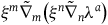 ${\xi ^m}{\tilde \nabla _m}\left( {{\xi ^n}{{\tilde \nabla }_n}{\lambda ^a}} \right)$
and substituting then gives
${\xi ^m}{\tilde \nabla _m}\left( {{\xi ^n}{{\tilde \nabla }_n}{\lambda ^a}} \right)$
and substituting then gives
 $$\matrix{ {\underbrace {{\xi ^m}{{\tilde \nabla }_m}\left( {{\xi ^n}{{\tilde \nabla }_n}{\lambda ^a}} \right)}_{{{\tilde \Delta }^a}}} \hfill & { \!\!\!= \underbrace {{\xi ^m}{\nabla _m}\left( {{\xi ^n}{\nabla _n}{\lambda ^a}} \right)}_{{{\rm{\Delta }}^a}} + {\xi ^m}{\xi ^n}\left( {{\nabla _n}{\lambda ^b}} \right){C^a}_{bm}} \hfill \cr {} \hfill & {{\rm{\;\;\;}} + {\xi ^m}{\nabla _m}\left( {{\xi ^n}{\lambda ^b}{C^a}_{bn}} \right) + {\xi ^m}{\xi ^n}{\lambda ^b}{C^c}_{bn}{C^a}_{cm}.} \hfill \cr } $$
Thus, equal deviation ${\rm{\Delta }} = {\rm{\tilde \Delta }}$
holds if and only if, for all
${\rm{\Delta }} = {\rm{\tilde \Delta }}$
holds if and only if, for all ${\xi ^a}$
and
${\xi ^a}$
and ${\lambda ^a}$
such that
${\lambda ^a}$
such that $\left[ {\xi, \lambda } \right] = 0$
,
$\left[ {\xi, \lambda } \right] = 0$
,
 $${\xi ^m}{\xi ^n}\left( {{\nabla _n}{\lambda ^b}} \right){C^a}_{bm} + {\xi ^m}{\nabla _m}\left( {{\xi ^n}{\lambda ^b}{C^a}_{bn}} \right) + {\xi ^m}{\xi ^n}{\lambda ^b}{C^c}_{bn}{C^a}_{cm} = 0.$$
Because ${\xi ^a}$
is a
${\xi ^a}$
is a $\nabla $
-geodesic,
$\nabla $
-geodesic, ${\xi ^m}{\nabla _m}\left( {{\xi ^n}{\lambda ^b}{C^a}_{bn}} \right) = {\xi ^m}{\xi ^n}\left( {{\nabla _m}{\lambda ^b}} \right){C^a}_{bn} + {\xi ^m}{\xi ^n}{\lambda ^b}{\nabla _m}{C^a}_{bn}$
by the Leibniz rule, so equation (8) may be rewritten as
${\xi ^m}{\nabla _m}\left( {{\xi ^n}{\lambda ^b}{C^a}_{bn}} \right) = {\xi ^m}{\xi ^n}\left( {{\nabla _m}{\lambda ^b}} \right){C^a}_{bn} + {\xi ^m}{\xi ^n}{\lambda ^b}{\nabla _m}{C^a}_{bn}$
by the Leibniz rule, so equation (8) may be rewritten as
 $${\xi ^m}{\xi ^n}\left( {\left( {{\nabla _n}{\lambda ^b}} \right){C^a}_{bm} + \left( {{\nabla _m}^b} \right){C^a}_{bn} + {\lambda ^b}{\nabla _m}{C^a}_{bn} + {\lambda ^b}{C^c}_{bn}{C^a}_{cm}} \right) = 0.$$
Now, choose a vector field ${\lambda ^a}$
with
${\lambda ^a}$
with $\left[ {\lambda, \xi } \right] = 0$
and such that
$\left[ {\lambda, \xi } \right] = 0$
and such that ${\lambda ^a} = 0$
and
${\lambda ^a} = 0$
and ${\nabla _a}{\lambda ^b} = {\delta ^b}_a$
at some point
${\nabla _a}{\lambda ^b} = {\delta ^b}_a$
at some point $p$
. The last two terms of equation (9) vanish because
$p$
. The last two terms of equation (9) vanish because ${\lambda ^a} = 0$
, and the first two terms may be reduced using
${\lambda ^a} = 0$
, and the first two terms may be reduced using ${\nabla _a}{\lambda ^b} = {\delta ^b}_a$
to
${\nabla _a}{\lambda ^b} = {\delta ^b}_a$
to
 $$\left( {{\nabla _n}{\lambda ^b}} \right){C^a}_{bm} + \left( {{\nabla _m}{\lambda ^b}} \right){C^a}_{bn} = {C^a}_{nm} + {C^a}_{mn} = 2{C^a}_{nm},$$
where the last equality uses the fact that ${C^a}_{bc}$
is symmetric in the lower indices. Thus, with this choice of
${C^a}_{bc}$
is symmetric in the lower indices. Thus, with this choice of ${\lambda ^b}$
, equation (9) reduces to
${\lambda ^b}$
, equation (9) reduces to $2{\xi ^m}{\xi ^n}{C^a}_{nm} = 0$
. Because
$2{\xi ^m}{\xi ^n}{C^a}_{nm} = 0$
. Because ${\xi ^m}$
was an arbitrary timelike geodesic, this implies that
${\xi ^m}$
was an arbitrary timelike geodesic, this implies that ${C^a}_{nm} = 0$
. Therefore,
${C^a}_{nm} = 0$
. Therefore, $\nabla = {\rm{\tilde \nabla }} $
. □
$\nabla = {\rm{\tilde \nabla }} $
. □


















 a
a a
a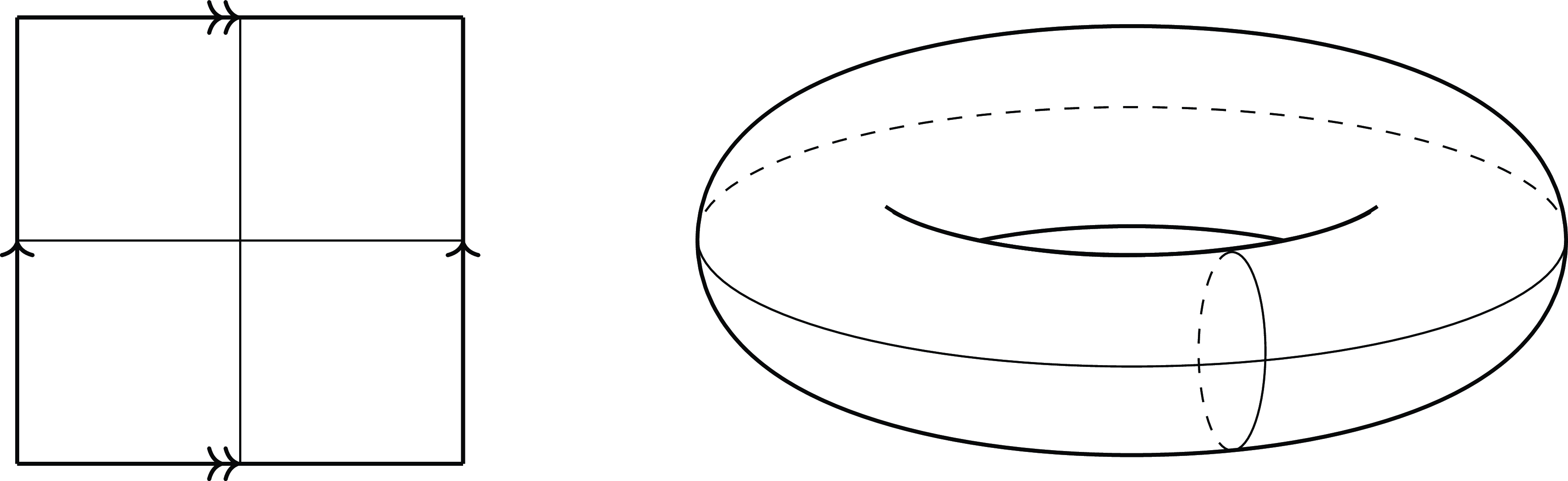

 Open access

