


The origin of malnutrition may be found in diseases that increase nutritional needs or an insufficient supply of nutriments due to social isolation and mental or physical impairment, such as tooth loss(Reference Dion, Cotart and Rabilloud1). The ability to chew a wide variety of foods of different textures and nutritional values is the principal benefit provided by the teeth(Reference Hutton, Feine and Morais2). In partially or totally edentulous patients, prosthetic therapy is important to maintain or restore masticatory function(Reference Budtz-Jorgensen3). Edentulism is a chronic condition, and we cannot replace all lost teeth or bring patients' oral health back as it was before tooth loss(Reference Feine and Lund4). Earlier studies have demonstrated a deficiency in masticatory function for those totally edentulous patients rehabilitated with complete dentures (‘false teeth’)(Reference Manly and Braley5–Reference Fontijn-Tekamp, Slagter and van Der Bilt7).
People with masticatory function deficiency swallow large pieces of food or alter their diet, avoiding masticating the most difficult food(Reference Manly and Braley5, Reference Laurin, Brodeur and Bourdages8). As a consequence, they can have a reduction in nutrient absorption. It can also induce an imbalanced ingestion of food through the preferred consumption of softer food and those easier to masticate, such as processed foods, to the detriment of those rich in fibres and nutrients, such as raw vegetables, fresh fruit and meat. The chemical–physical phenomenon of the digestive sequence starts in the oral cavity. A more efficient mastication leads to better absorption of nutrients in the further steps following the complete mastication of food. In this situation, an impaired diet can increase the risks of gastrointestinal disturbances, illnesses related to the lack of nutrients and obesity(Reference Hutton, Feine and Morais2, Reference Laurin, Brodeur and Bourdages8–Reference Hilgert, Hugo and de Sousa Mda12).
Dental implants offer possibilities of stability to dentures, which may overcome some of the limitations of conventional complete dentures(Reference Allen13). Oral rehabilitation with mandibular implant overdentures appears to offer a solution to the difficulty of the intaking of healthy, hard-to-chew food by conventional complete denture wearers(Reference Hutton, Feine and Morais2). In this context, the present study aims to compare masticatory performance and the nutritional condition of conventional complete denture wearers before and after conversion of the lower prosthesis into an implant-retained overdenture with immediate loading, as well as the association between masticatory performance and nutritional condition.
Materials and methods
Sample size was determined using a statistical test based on a previous pilot experiment and was set as fifteen participants. Initially, twenty patients were enrolled and four patients dropped out because they moved to another city during the study. The participants in the present study were sixteen conventional complete denture wearers, aged 30–76 years (average 59·2 years). The present study was conducted according to the guidelines laid down by the Declaration of Helsinki, and all procedures involving human subjects/patients were approved by the Institutional Review Board of the Uberlândia Federal University (Uberlândia, Brazil), 178/06. Written informed consent was obtained from all subjects/patients.
The study was divided into three stages. At baseline, conventional complete denture wearers were evaluated in relation to their masticatory performance and nutritional condition. Following that, all subjects were subjected to a surgical procedure to install two osseointegrated dental implants (Conexão Prosthesis System Limited, São Paulo, SP, Brazil) in the lower jawbone in a one-stage protocol for immediate loading. Within a maximum period of 24 h, a circular metallic bar was connected to the two implants. A plastic clip (Conexão Prosthesis System Limited) was then connected to the lower conventional complete denture, converting it into an implant-retained overdenture. The same masticatory performance and nutritional condition tests were carried out 3 and 6 months after conversion of the prostheses. The same subjects and prostheses were evaluated throughout all the stages of the present study.
Masticatory performance test
Masticatory performance was assessed by the determination of the subjects' capacity of fragmentation of an artificial test food called ‘Optocal’ and advocated by Slagter et al. (Reference Slagter, Olthoff and Steen14). In the present study, the masticatory performance tests evaluated the patients' food-chewing potential using the artificial test food ‘Optocal’, being considered by the participants in the present study to be similar to meat, in comparison with the swallowing capacity tests, which can only be carried out with natural foods. Portions of seventeen cubes of Optocal were masticated with forty continuous chewing strokes. The materials were separated by a mechanical sieving process (eight sieves with apertures decreasing from 5·6 to 0·5 mm)(Reference Mendonça, Prado and Mendes15).
Masticatory performance was calculated as the initial particle size (6660 μm) minus median particle size (obtained from each sieve) after forty chewing cycles, normalised to the initial particle size, and then converted to a percentage. This method has been fully described elsewhere(Reference Mendonça, Prado and Mendes15, Reference Spiegel16).
Test of nutritional condition
On the same day of the masticatory performance test, a full version of the Mini Nutritional Assessment was applied. The Mini Nutritional Assessment is a screening and assessment tool with a reliable scale and clearly defined thresholds, usable by health care professionals(Reference Guigoz17). The most important aspect of the Mini Nutritional Assessment scale is its ability to identify elderly at risk for malnutrition, before severe changes in weight or albumin levels occur(Reference Vellas, Guigoz and Garry18).
The full Mini Nutritional Assessment is an eighteen-item questionnaire comprising anthropometric measurements, a dietary intake evaluation, a global assessment and a self-assessment(Reference Vellas, Guigoz and Garry18). After all the measures were carried out and the Mini Nutritional Assessment was filled in, a maximum of thirty points could be obtained. In this way, the subjects were classified as nourished ( ≥ 24 points), at risk of malnutrition (17–23·5 points) and malnourished ( < 17 points).
Statistical analysis
For the masticatory performance, the baseline, 3 and 6 months data were compared by the paired-samples t test. Using the nominal scale of nutritional condition, the Cochran test was applied for comparison among the baseline, 3 and 6 months values, followed by the Wilcoxon test. The independent-samples t test was used to compare the masticatory performance of nourished subjects and those at risk of malnutrition as classified by the Mini Nutritional Assessment at baseline. The statistical significance level was set at 5 % (P < 0·05) for all statistical analyses.
Results
Masticatory performance potential
The ability (masticatory performance) of the subjects to break down the artificial test food (Optocal) improved significantly 3 months after the conversion from conventional complete dentures to implant-retained overdentures with immediate loading. This improvement was maintained at the 6-month evaluation (Table 1).
(Mean values and standard deviations)

* Mean values with unlike letters were statistically different through the paired-samples t test (P < 0·05).
† The number of subjects in accordance with their Mini Nutritional Assessment classification, statistical category‡ and probability§ at baseline, 3- and 6-month stages.
‡ Values with unlike letters were statistically different with the Wilcoxon test.
§ Statistically significant difference with the Cochran Q test for P < 0·05.
Nutritional condition
The nutritional condition as assessed by the Mini Nutritional Assessment demonstrated a significant improvement after 6 months from conversion and the number of patients at risk of malnutrition decreased during this period (Table 1).
Association of masticatory performance and nutritional condition
At baseline, the best masticatory performance was observed in those subjects classified as nourished. At 6 months after the conversion from a conventional complete denture to an implant-retained overdenture, the group of participants classified before the conversion as at risk of malnutrition did not present a significant difference in masticatory performance compared with those considered nourished (Table 2).
(Mean values and standard deviations)
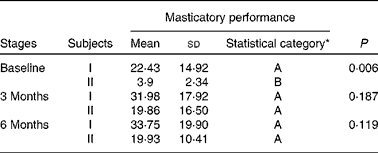
* Mean values with unlike letters were statistically different through the independent-samples t test (P < 0·05) at each evaluation period.
Discussion
Complete denture wearers have a reduced masticatory function(Reference Manly and Braley5–Reference Fontijn-Tekamp, Slagter and van Der Bilt7). Most of the time, the problem is the retention and stability of the lower denture that causes greater discomfort and functional limitation in those patients. Converting the lower conventional complete denture to an implant-retained overdenture offers better retention and stability, thus increasing the masticatory function(Reference van Kampen, van der Bilt and Cune19, Reference Stellingsma, Slagter and Stegenga20). In the present study, all the participating subjects presented a better masticatory performance after the conversion of the lower denture. On the other hand, Garrett et al. (Reference Garrett, Kapur and Hamada21), working with a group of independent samples, did not observe a significant advantage between these two modalities of oral rehabilitation in relation to the capacity to break down food. Another study found out that there were more advantages in treatment with an implant-retained overdenture compared with the conventional complete denture only in persons with resorbed alveolar ridges(Reference Kimoto and Garrett22). According to Allen(Reference Allen13), conventional complete denture wearers still had a moderate risk of poor nutritional status.
The effects of treatment with the conventional complete denture and implant-retained overdenture have been studied by several authors, evaluating food selection, nutritional intake (micro- and macro-nutrients), anthropometric parameters and the Mini Nutritional Assessment(Reference Sandström and Lindquist23–Reference Muller, Morais and Feine29). In most of these studies, the spontaneous changes in dietary habits were considered insignificant, not being easily modified or influenced by the type of denture used by edentulous patients(Reference Sandström and Lindquist23–Reference Allen and McMillan26, Reference Muller, Morais and Feine29). These habits were probably developed over a longer period of time, as part of a more complicated process influenced by a variety of socioeconomic, cultural, behavioural, sensorial and demographic factors, besides the oral health condition(Reference Hamada, Garrett and Roumanas25, Reference Sheiham, Steele and Marcenes30, Reference Bradbury, Thomason and Jepson31). There appears to be a lack of knowledge in relation to nutritional value of foods consumed by elderly adult groups, and taste may be a critical factor in food choices made by edentulous older adults(Reference Allen13). As these studies have evaluated food selection and/or nutritional intake, these factors could have had an influence in the non-significant difference between the lower conventional complete denture and implant-retained overdenture wearers.
In the present study, conventional complete denture wearers had values of masticatory performance that varied between 0·99 and 40 % at baseline. The efficiency and masticatory performance depend upon the relationship between the elevator muscles of the mandible, the resultant bite strength, the texture of the food and quantity of food for each masticatory cycle(Reference Slagter, Bosman and Van der Glas32). These data suggest that the comparison with the independent-samples t test could be invalid or a large number of samples would be necessary. At 6 months after the conversion from the conventional complete denture to an implant-retained overdenture, the values varied from 3·28 to 53·75 %. The subjects that presented a below the mean masticatory performance achieved an average of 4·07, 10·58 and 12·28 % at baseline, 3 and 6 months, respectively. This represented ten patients, in which seven were classified as at risk of malnutrition and three as nourished. On the other hand, subjects that presented an above the mean masticatory performance achieved an average of 31·42, 42·78 and 43·13 % at baseline, 3 and 6 months, respectively. This represented six patients; all of them were classified as nourished. Based on this fact, dentists should not underestimate the masticatory performance of conventional complete denture wearers and should not overestimate the association of the upper conventional complete denture and lower implant-retained overdenture wearers, which in some cases can have a worse potential masticatory performance than the conventional complete dentures alone.
The nutritional evaluation is extremely complex. The attempt to evaluate the influence of dental condition upon nutritional status is made more difficult within the wide range of factors that can interfere with nutrition. Using the same group of subjects with the same type of prosthesis made it easier for the present study to be carried out in the different stages, varying only the means of retention for the lower prosthesis. The main difference of the present study was the evaluation of masticatory performance and nutritional conditions before and after conversion of conventional complete dentures to implant-retained overdentures with immediately loaded implants. Even though the study included patients below 60 years of age, 62·5 % of the subjects were elderly.
The Mini Nutritional Assessment(Reference Guigoz, Vellas and Garry33) represents an important advancement in the development of geriatric assessment, since it was the first validated nutritional assessment instrument. In that study, the authors gathered, selected and attributed scores to indicators (anthropometric, clinical, dietary and self-assessment) in order to obtain greater efficiency in protein–energy malnutrition diagnosis and nutritional risk in the elderly population(Reference Oliveira, Borges, Mendes and Vesler34).
In the present study, and in Oliveira & Frigerio(Reference Oliveira and Frigerio28), the Mini Nutritional Assessment was used as an instrument for nutritional evaluation. They found that statistically significant differences were found among the subjects tested in terms of nutritional status, with the risk of malnutrition being higher for individuals with conventional complete dentures.
One possible limitation in the present study could include the sample size. However, having the same prostheses and the same patients in a long-term study could eliminate some drawbacks in this type of study, which would be the necessity of having two separate groups of patients. Despite that, these results should be interpreted with caution because of the reduced number of patients.
The rehabilitation of totally edentulous patients with the lower implant-retained overdenture improves the masticatory performance and self-esteem of those patients. They again find it a pleasure to eat and smile. However, changing eating habits becomes complex when some patients have lived with conventional complete dentures and incorrect food selection for several years. Nutritional guidance after oral rehabilitation treatment with implant-retained overdentures for correct food selection would reduce the risk of the patient not taking advantage of the masticatory performance potential obtained by this type of treatment(Reference Oliveira, Borges, Mendes and Vesler34).
Acknowledgements
The authors are thankful to the oral surgeons and prosthodontists who helped in the surgery and prostheses delivery: Vanderlei Luiz Gomes, PhD; Ricardo Passos Formoso de Moraes; Leandro Prudente de Freitas; Lawrence Pereira de Albuquerque; Marlete Ribeiro da Silva, PhD; Lia Dietrich, MSc; Clébio Domingues da Silveira, MSc; Denise Guimarães; Letícia Resende Davi, PhD; Paulo Cezar Simamoto Júnior, PhD and Marco Aurélio Dias Galbiatti, MDT for their assistance in the patients' oral rehabilitation. The authors would also like to thank Daniela Baccelli Silveira Mendonça, PhD and Gustavo Mendonça, PhD for reviewing the manuscript. F. D. d. N. and C. J. d. P. designed and conducted the research. F. A. M. and T. R. C. d. O. analysed the data and participated in the interpretation of the results. T. d. F. B. wrote the manuscript and had the primary responsibility for the final content. All authors read and approved the final manuscript. There was no conflict of interest or sources of funding.



