




1 Introduction
In this paper, we study maximal subgroups of the ample groups (the latter are better known as the topological full groups (TFGs)). Let us begin with an overview of maximal and related to them weakly maximal subgroups.
A proper subgroup H of a group G is maximal if there is no group placed between H and G in the lattice of subgroups of G. Maximal subgroups play a very important role in group theory. The task of describing all maximal subgroups of a group G is equivalent to the task of classifying all primitive actions of G (an action of the group on a set X is primitive if it preserves no non-trivial equivalence relations on X). Indeed, if H is a maximal subgroup of G, then the natural action of G on the cosets of H is primitive. Conversely, if
$\alpha :G\curvearrowright X$
 is a primitive action on a set X that is not a singleton, then the point stabilizers
${\mathrm {St}}_\alpha (x)$
is a primitive action on a set X that is not a singleton, then the point stabilizers
${\mathrm {St}}_\alpha (x)$
 ,
$x\in X$
,
$x\in X$
 are maximal subgroups of the group G. Maximal subgroups can also arise as the stabilizers of sets or collections of sets (e.g., partitions).
The problem of describing all maximal subgroups of a given group attracted much attention. Among the most remarkable results here is the complete solution of this problem for finite symmetric groups (based on the O’Nan–Scott theorem), which was obtained in the 1980s as one of the first applications of the classification of finite simple groups (see, e.g., the book [Reference Dixon and Mortimer15, §8.5]). There is also an understanding on how to approach this problem for general finite groups (as outlined by Aschbacher and Scott [Reference Aschbacher and Scott3]). Much less is known about maximal subgroups of infinite groups. One may be interested in whether such a group has a maximal subgroup of infinite index. For countable groups, this question is closely related to the question about primitivity of the group, that is, the existence of a faithful primitive action. Another question is to determine how many maximal subgroups are there, say, whether a given countable group has a continuum (that is, an uncountable set of cardinality
$2^{\aleph _0}$
 ) of maximal subgroups. If an infinite group does not have many maximal subgroups, it makes sense to look for weakly maximal subgroups, which are subgroups of infinite index maximal with respect to this property. Note that in the case a countable group G is finitely generated, any subgroup of finite index in G is finitely generated as well, which implies that there are at most countably many such subgroups. More importantly, it follows that any proper subgroup of G is contained in a maximal subgroup, while any subgroup of infinite index is contained in a weakly maximal subgroup.
A substantial progress in the late 1970s was achieved by Margulis and Soifer [Reference Margulis and Soĭfer41–Reference Margulis and Soĭfer43]. Answering a question of Platonov, they obtained fundamental results on maximal subgroups of finitely generated linear groups. The first of their results is that any such group admits a maximal subgroup of infinite index if and only if it is not virtually solvable. Another result is that the free non-abelian group
$F_n$
 on
$n\ge 2$
on
$n\ge 2$
 generators has a continuum of maximal subgroups. These results were extended by Gelander and Glasner [Reference Gelander and Glasner20] to general countable linear groups. Later, Gelander and Meiri [Reference Gelander and Meiri22] showed that each of the groups
$SL_n(\mathbb {Z})$
generators has a continuum of maximal subgroups. These results were extended by Gelander and Glasner [Reference Gelander and Glasner20] to general countable linear groups. Later, Gelander and Meiri [Reference Gelander and Meiri22] showed that each of the groups
$SL_n(\mathbb {Z})$
 ,
$n\ge 3$
,
$n\ge 3$
 has a continuum of maximal subgroups. For more on these and related topics, see the survey [Reference Gelander, Glasner and Soifer21].
A completely different story is told by the groups of branch type. The class of the branch groups was introduced in [Reference Grigorchuk32] in relation to the study of just infinite groups (these are infinite groups in which every proper quotient is finite) and as an abstract model behind the family of groups
$\mathcal {X}=\{G_\omega \}$
 ,
$\omega \in \{0,1,2\}^{\mathbb {N}}$
,
$\omega \in \{0,1,2\}^{\mathbb {N}}$
 constructed in [Reference Grigorchuk30]. This family mostly consists of groups of intermediate growth (faster than polynomial, but slower than exponential). Two notable representatives of the family are the groups
$\mathcal {G}_{(012)^{\infty }}$
constructed in [Reference Grigorchuk30]. This family mostly consists of groups of intermediate growth (faster than polynomial, but slower than exponential). Two notable representatives of the family are the groups
$\mathcal {G}_{(012)^{\infty }}$
 (the ‘first’ Grigorchuk group) and
$\mathcal {G}_{(01)^{\infty }}$
(the ‘first’ Grigorchuk group) and
$\mathcal {G}_{(01)^{\infty }}$
 (the Grigorchuk–Erschler group) given by periodic sequences
$(012)^{\infty }=012012\ldots $
(the Grigorchuk–Erschler group) given by periodic sequences
$(012)^{\infty }=012012\ldots $
 and
$(01)^{\infty }=0101\ldots. $
and
$(01)^{\infty }=0101\ldots. $
 These two groups were also at the root of studies of the class of self-similar groups (see the book [Reference Nekrashevych49]). Among recent discoveries is the fact that they are related to substitution subshifts generated by primitive substitutions, in particular, the period doubling and Morse subshifts (see [Reference Grigorchuk, Lenz and Nagnibeda28, Reference Grigorchuk and Vorobets29, Reference Matte Bon44]). These subshifts are important representatives of the Cantor minimal systems (the latter are important in our study).
The question of Hartly from 1993 about the existence of maximal subgroups of infinite index in the group
$\mathcal {G}_{(012)^{\infty }}$
 was answered in the negative by Pervova [Reference Pervova52]. This result had a big impact on the study of
$\mathcal {G}_{(012)^{\infty }}$
was answered in the negative by Pervova [Reference Pervova52]. This result had a big impact on the study of
$\mathcal {G}_{(012)^{\infty }}$
 and led to establishing such properties as subgroup separability (also called the LERF property) and decidability of the generalized word problem (see [Reference Grigorchuk and Wilson34]). In [Reference Pervova53], Pervova extended her result to some branch groups in a family that was named the GGS (Grigorchuk–Gupta–Sidki) groups in the book [Reference Baumslag9]. The groups considered by Pervova are torsion groups (that is, all elements are of finite order) and, presently, there are no known examples of finitely generated torsion branch groups admitting a maximal subgroup of infinite index. Recently, Francoeur and Thillaisundaram [Reference Francoeur and Thillaisundaram19] extended Pervova’s result to all GGS groups, including non-torsion groups. However, Bondarenko [Reference Bondarenko13] constructed an example of a non-torsion branch group with a maximal subgroup of infinite index. Later, Francoeur and Garrido [Reference Francoeur and Garrido18] discovered that, in fact, the group
$\mathcal {G}_{(01)^{\infty }}$
and led to establishing such properties as subgroup separability (also called the LERF property) and decidability of the generalized word problem (see [Reference Grigorchuk and Wilson34]). In [Reference Pervova53], Pervova extended her result to some branch groups in a family that was named the GGS (Grigorchuk–Gupta–Sidki) groups in the book [Reference Baumslag9]. The groups considered by Pervova are torsion groups (that is, all elements are of finite order) and, presently, there are no known examples of finitely generated torsion branch groups admitting a maximal subgroup of infinite index. Recently, Francoeur and Thillaisundaram [Reference Francoeur and Thillaisundaram19] extended Pervova’s result to all GGS groups, including non-torsion groups. However, Bondarenko [Reference Bondarenko13] constructed an example of a non-torsion branch group with a maximal subgroup of infinite index. Later, Francoeur and Garrido [Reference Francoeur and Garrido18] discovered that, in fact, the group
$\mathcal {G}_{(01)^{\infty }}$
 has maximal subgroups of infinite index. There are only countably many of those and they are all described. Also, it was shown that the non-torsion iterated monodromy groups of the tent map (a special case of some groups first introduced by Šunić in [Reference Šunić57] as ‘siblings of the Grigorchuk group’) have exactly countably many maximal subgroups of infinite index (those are described up to conjugacy). Presently, there are no known examples of finitely generated branch groups with uncountably many maximal subgroups. Another relevant fact is that the branch groups cannot act quasi-2-transitively on infinite sets (see [Reference Francoeur17]).
The weakly branch groups are a far going generalization of the class of branch groups. Their introduction was initiated by the studies around the Basilica group
$\mathcal {B}$
 invented in [Reference Grigorchuk and Żuk35] as a group generated by a
$3$
invented in [Reference Grigorchuk and Żuk35] as a group generated by a
$3$
 -state automaton over the binary alphabet. Bartholdi and Virag [Reference Bartholdi and Virág8] proved amenability of
$\mathcal {B}$
-state automaton over the binary alphabet. Bartholdi and Virag [Reference Bartholdi and Virág8] proved amenability of
$\mathcal {B}$
 , which produced the first example of an amenable but not subexponentially amenable group (answering the question from [Reference Grigorchuk31] about existence of such groups). Later, it was discovered that
$\mathcal {B}$
, which produced the first example of an amenable but not subexponentially amenable group (answering the question from [Reference Grigorchuk31] about existence of such groups). Later, it was discovered that
$\mathcal {B}$
 is isomorphic to the iterated monodromy group of the polynomial
$z^2-1$
is isomorphic to the iterated monodromy group of the polynomial
$z^2-1$
 [Reference Bartholdi, Grigorchuk and Nekrashevych5, Reference Nekrashevych49]. In the paper [Reference Francoeur16], Francoeur extended techniques of Pervova to a large class of weakly branch groups, which allowed him not only to prove that any maximal subgroup in a branch group is itself branch, but also to prove that the Basilica group has maximal subgroups of infinite index and hence is primitive (as each proper quotient of
$\mathcal {B}$
[Reference Bartholdi, Grigorchuk and Nekrashevych5, Reference Nekrashevych49]. In the paper [Reference Francoeur16], Francoeur extended techniques of Pervova to a large class of weakly branch groups, which allowed him not only to prove that any maximal subgroup in a branch group is itself branch, but also to prove that the Basilica group has maximal subgroups of infinite index and hence is primitive (as each proper quotient of
$\mathcal {B}$
 is virtually nilpotent).
The next class of infinite groups whose maximal subgroups attracted the attention of researchers are the Higman–Thompson-type groups. Savchuk [Reference Savchuk55, Reference Savchuk56] showed that all orbits of the action of Thompson’s group F on the interval
$(0,1)$
 are primitive, which implies that the point stabilizers
${\mathrm {St}}_F(x)$
are primitive, which implies that the point stabilizers
${\mathrm {St}}_F(x)$
 ,
$x\in (0,1)$
,
$x\in (0,1)$
 are maximal subgroups of infinite index. The associated Schreier coset graphs are quasi-isometric to a tree. It was also shown that
${\mathrm {St}}_F(x)$
are maximal subgroups of infinite index. The associated Schreier coset graphs are quasi-isometric to a tree. It was also shown that
${\mathrm {St}}_F(x)$
 is not finitely generated if x is irrational while being finitely generated for
$x\in \mathbb {Z}[1/2]$
is not finitely generated if x is irrational while being finitely generated for
$x\in \mathbb {Z}[1/2]$
 . This study was extended by Golan and Sapir [Reference Golan and Sapir25–Reference Golan and Sapir27], Aiello and Nagnibeda [Reference Aiello and Nagnibeda1, Reference Aiello and Nagnibeda2], and others. Among other results, Golan and Sapir produced the first example of a maximal subgroup of F that does not arise as the stabilizer of a point. Another Thompson’s group V is considered by Belk et al in [Reference Belk, Bleak, Quick and Skipper11] where an uncountable family of maximal subgroups of V is produced. Moreover, it is shown that there are uncountably many pairwise non-isomorphic maximal subgroups of V. In [Reference Belk, Bleak, Quick and Skipper10], the same four authors proved that Thompson’s group T is yet another maximal subgroup of the group V.
Weakly maximal subgroups of finitely generated infinite groups can often play a role similar to that of maximal subgroups of infinite index. For instance, they are useful in the study of profinite groups [Reference Barnea and Shalev4]. As was observed in [Reference Bartholdi and Grigorchuk6, Reference Bartholdi and Grigorchuk7], stabilizers of points on the boundary of the rooted tree on which a weakly branch group acts are weakly maximal subgroups. In the case of branch groups from the family
$\mathcal {X}$
 , the associated Schreier coset graphs have surprisingly simple, linear geometric structure. Almost all of them are quasi-isometric to the Cayley graph of
$\mathbb {Z}$
, the associated Schreier coset graphs have surprisingly simple, linear geometric structure. Almost all of them are quasi-isometric to the Cayley graph of
$\mathbb {Z}$
 . When taking into account edge labels, the structure becomes more complicated, but still controlled. For the group
$\mathcal {G}_{(012)^{\infty }}$
. When taking into account edge labels, the structure becomes more complicated, but still controlled. For the group
$\mathcal {G}_{(012)^{\infty }}$
 , for example, the graphs represent the so-called aperiodic order (see [Reference Grigorchuk, Lenz and Nagnibeda28]).
Branch groups, weakly branch groups, and groups of Higman–Thompson type are subclasses of the class of micro-supported groups. Elements of this class are groups G acting faithfully on a topological space X in such a way that for any non-empty open subset
$U\subset X$
 , the rigid stabilizer
${\mathrm {RiSt}}_G(U)$
, the rigid stabilizer
${\mathrm {RiSt}}_G(U)$
 (also referred to as the local subgroup and denoted
$G_U$
(also referred to as the local subgroup and denoted
$G_U$
 ), which consists of elements acting trivially on
$X\setminus U$
), which consists of elements acting trivially on
$X\setminus U$
 , is non-trivial. Also, all these groups represent an even wider class of dynamically defined groups, the object of a fast developing new area on the border between theory of dynamical systems and group theory. A recent book by Nekrashevych [Reference Nekrashevych51] is an excellent source of information on methods and results of this direction of mathematics.
A rich source of dynamically defined groups are groups that will be called in this paper the ample groups. The idea of amplification (or saturation) in dynamics and group theory is quite simple. Given a topological space X and a group G of its homeomorphisms, one can enlarge G to a group
$\mathsf {F}(G)$
 by adding those homeomorphisms of X that act locally as elements of G. We call the group
$\mathsf {F}(G)$
by adding those homeomorphisms of X that act locally as elements of G. We call the group
$\mathsf {F}(G)$
 the full amplification of G. The group G is called ample if
$\mathsf {F}(G)=G$
the full amplification of G. The group G is called ample if
$\mathsf {F}(G)=G$
 . Note that
$\mathsf {F}(\mathsf {F}(G))=\mathsf {F}(G)$
. Note that
$\mathsf {F}(\mathsf {F}(G))=\mathsf {F}(G)$
 so that the group
$\mathsf {F}(G)$
so that the group
$\mathsf {F}(G)$
 is always ample. This idea works best when X is a Cantor set or, more generally, a totally disconnected compact metrizable space. This is because the topology on such a space is generated by clopen (that is, both closed and open) sets. Clopen sets allow the cutting of all homeomorphisms in G into pieces, then new homeomorphisms can be constructed, as a jigsaw puzzle, out of those pieces.
In what follows, all topological spaces are assumed to be totally disconnected, compact, and metrizable. There are many situations when continuous group actions on such spaces arise so that the above construction can be used. For example, any countable group G acts naturally by permutations on the space
$A^G$
 , where A is a finite set with more than one element. The actions of G on closed invariant subsets of
$A^G$
, where A is a finite set with more than one element. The actions of G on closed invariant subsets of
$A^G$
 are now a popular area of study. The group of automorphisms of an infinite, locally finite tree acts naturally on the boundary of the tree. Any countable group G acts by conjugation on the space
$\mathrm {Sub}(G)$
are now a popular area of study. The group of automorphisms of an infinite, locally finite tree acts naturally on the boundary of the tree. Any countable group G acts by conjugation on the space
$\mathrm {Sub}(G)$
 of its subgroups, where the topology on
$\mathrm {Sub}(G)$
of its subgroups, where the topology on
$\mathrm {Sub}(G)$
 is induced by the product topology on
$2^G$
is induced by the product topology on
$2^G$
 . This list can go on.
The notion of an ample group was introduced by Krieger in [Reference Krieger40]. The groups considered in [Reference Krieger40] are locally finite (that is, every finitely generated subgroup is finite) and so this notion has seen limited use being applied only to locally finite groups. We would like to extend it to arbitrary groups of homeomorphisms replacing the common notion of a TFG. The latter originated in the theory of Cantor minimal systems. A Cantor minimal system
$(X,f)$
 consists of a Cantor set X and a minimal homeomorphism
$f:X\to X$
consists of a Cantor set X and a minimal homeomorphism
$f:X\to X$
 . In the paper [Reference Glasner and Weiss24], Glasner and Weiss associated to
$(X,f)$
. In the paper [Reference Glasner and Weiss24], Glasner and Weiss associated to
$(X,f)$
 two groups, the full group
$[f]$
two groups, the full group
$[f]$
 and the finite full group
$[[f]]$
and the finite full group
$[[f]]$
 (notation is from [Reference Giordano, Putnam and Skau23, Reference Matui45], respectively). The full group
$[f]$
(notation is from [Reference Giordano, Putnam and Skau23, Reference Matui45], respectively). The full group
$[f]$
 consists of all homeomorphisms of X that leave invariant every orbit of f. It is relevant to the study of orbit equivalence. Any map
$g\in [f]$
consists of all homeomorphisms of X that leave invariant every orbit of f. It is relevant to the study of orbit equivalence. Any map
$g\in [f]$
 can be given by a formula
$g(x)=f^{n(x)}(x)$
can be given by a formula
$g(x)=f^{n(x)}(x)$
 ,
$x\in X$
,
$x\in X$
 for some function
$n:X\to \mathbb {Z}$
for some function
$n:X\to \mathbb {Z}$
 . Since the minimal homeomorphism f has no periodic points, it follows that the function n is unique and its level sets are closed. The finite full group
$[[f]]$
. Since the minimal homeomorphism f has no periodic points, it follows that the function n is unique and its level sets are closed. The finite full group
$[[f]]$
 consists of those
$g\in [f]$
consists of those
$g\in [f]$
 for which the function n is continuous or, equivalently, takes only finitely many values. In that case, all level sets of n are clopen. Informally, elements of
$[f]$
for which the function n is continuous or, equivalently, takes only finitely many values. In that case, all level sets of n are clopen. Informally, elements of
$[f]$
 are ‘pointwise’ elements of the cyclic group
$\langle f\rangle $
are ‘pointwise’ elements of the cyclic group
$\langle f\rangle $
 , while elements of
$[[f]]$
, while elements of
$[[f]]$
 are ‘piecewise’ elements of
$\langle f\rangle $
are ‘piecewise’ elements of
$\langle f\rangle $
 . It is easy to observe that
$[[f]]=\mathsf {F}(\langle f\rangle )$
. It is easy to observe that
$[[f]]=\mathsf {F}(\langle f\rangle )$
 , the full amplification of the cyclic group generated by f. The group
$[[f]]$
, the full amplification of the cyclic group generated by f. The group
$[[f]]$
 was renamed the TFG in [Reference Giordano, Putnam and Skau23]. An important property of amplification is that the ample group
$\mathsf {F}(G)$
was renamed the TFG in [Reference Giordano, Putnam and Skau23]. An important property of amplification is that the ample group
$\mathsf {F}(G)$
 is countable whenever G is countable. In particular, the TFG
$[[f]]$
is countable whenever G is countable. In particular, the TFG
$[[f]]$
 is always countable whereas the full group
$[f]$
is always countable whereas the full group
$[f]$
 is not.
The remarkable result proved by Giordano, Putnam, and Skau [Reference Giordano, Putnam and Skau23] is that the (isomorphism class of) TFG
$[[f]]$
 is an almost complete invariant of dynamics of a Cantor minimal system
$(X,f)$
is an almost complete invariant of dynamics of a Cantor minimal system
$(X,f)$
 . To be precise, if
$(X,f)$
. To be precise, if
$(X,f)$
 and
$(Y,g)$
and
$(Y,g)$
 are two Cantor minimal systems such that the groups
$[[f]]$
are two Cantor minimal systems such that the groups
$[[f]]$
 and
$[[g]]$
and
$[[g]]$
 are isomorphic, then the systems are flip conjugate, which means that for some homeomorphism
$\phi :X\to Y$
are isomorphic, then the systems are flip conjugate, which means that for some homeomorphism
$\phi :X\to Y$
 , we have
$\phi f\phi ^{-1}=g$
, we have
$\phi f\phi ^{-1}=g$
 or
$g^{-1}$
or
$g^{-1}$
 . As there is a continuum of pairwise non-flip-conjugate Cantor minimal systems (e.g., systems with different entropies), one gets a continuum of pairwise non-isomorphic TFGs. The result is based on two fundamental facts about TFGs. For simplicity, let us assume that
$X=Y$
. As there is a continuum of pairwise non-flip-conjugate Cantor minimal systems (e.g., systems with different entropies), one gets a continuum of pairwise non-isomorphic TFGs. The result is based on two fundamental facts about TFGs. For simplicity, let us assume that
$X=Y$
 . The first fact, established in [Reference Giordano, Putnam and Skau23], is that if the TFGs
$[[f]]$
. The first fact, established in [Reference Giordano, Putnam and Skau23], is that if the TFGs
$[[f]]$
 and
$[[g]]$
and
$[[g]]$
 are isomorphic, then any isomorphism between them is implemented by a conjugation in the group
${\mathrm {Homeo}}(X)$
are isomorphic, then any isomorphism between them is implemented by a conjugation in the group
${\mathrm {Homeo}}(X)$
 of all homeomorphisms of X. This property of TFGs seems to be characteristic for various kinds of micro-supported groups (see the book [Reference Nekrashevych51, §2.2]). The second fact, derived from an older result of Boyle, is that if the ample groups
$[[f]]$
of all homeomorphisms of X. This property of TFGs seems to be characteristic for various kinds of micro-supported groups (see the book [Reference Nekrashevych51, §2.2]). The second fact, derived from an older result of Boyle, is that if the ample groups
$[[f]]$
 and
$[[g]]$
and
$[[g]]$
 are the same, then the cyclic groups
$\langle f\rangle $
are the same, then the cyclic groups
$\langle f\rangle $
 and
$\langle g\rangle $
and
$\langle g\rangle $
 are conjugate in the group
$[[f]]=[[g]]$
are conjugate in the group
$[[f]]=[[g]]$
 .
.
The systematic study of group-theoretic properties of the TFG
$[[f]]$
 associated with a Cantor minimal system
$(X,f)$
associated with a Cantor minimal system
$(X,f)$
 was initiated by Matui [Reference Matui45]. He showed that the commutator subgroup of
$[[f]]$
was initiated by Matui [Reference Matui45]. He showed that the commutator subgroup of
$[[f]]$
 is simple. In the case where f is a minimal subshift over a finite alphabet, the commutator subgroup is finitely generated (but not finitely presented). The group
$[[f]]$
is simple. In the case where f is a minimal subshift over a finite alphabet, the commutator subgroup is finitely generated (but not finitely presented). The group
$[[f]]$
 admits a non-trivial homomorphism onto
$\mathbb {Z}$
admits a non-trivial homomorphism onto
$\mathbb {Z}$
 and the kernel of that homomorphism is a product of two locally finite subgroups (the so-called factorization property). Further, the group
$[[f]]$
and the kernel of that homomorphism is a product of two locally finite subgroups (the so-called factorization property). Further, the group
$[[f]]$
 has the property LEF (local embeddability into finite groups), see [Reference Grigorchuk and Medynets33]. Any finite group and the free abelian group of infinite rank embed into
$[[f]]$
has the property LEF (local embeddability into finite groups), see [Reference Grigorchuk and Medynets33]. Any finite group and the free abelian group of infinite rank embed into
$[[f]]$
 . Every branch group from the family
$\mathcal {X}$
. Every branch group from the family
$\mathcal {X}$
 mentioned before embeds into some TFG [Reference Matte Bon44]. The remarkable result obtained by Juschenko and Monod [Reference Juschenko and Monod37] (confirming a conjecture of Grigorchuk and Medynets [Reference Grigorchuk and Medynets33]) states that any TFG associated with a Cantor minimal system is amenable. Note that these groups are not elementary amenable, which means that they cannot be obtained from finite and abelian groups using certain natural operations that preserve amenability. This is the second known type of amenable but not elementary amenable groups, the first type being the groups of intermediate growth.
The goal of this paper is to initiate the systematic study of maximal subgroups of general ample groups. Our results are mostly reminiscent of the classification of maximal subgroups in finite symmetric groups. Let us recall that all subgroups of a finite symmetric group are split into three classes: (i) intransitive subgroups (those that leave invariant a non-trivial subset); (ii) imprimitive subgroups (transitive subgroups that leave invariant a non-trivial partition); and (iii) primitive subgroups (the remaining ones). Maximal subgroups in the first two classes are easy to describe. Namely, intransitive maximal subgroups are stabilizers of certain subsets, while imprimitive maximal subgroups are stabilizers of certain partitions. Primitive maximal subgroups form a number of subclasses described by the O’Nan–Scott theorem.
When dealing with the ample groups, arbitrary subsets and partitions should be replaced by closed subsets and partitions into closed subsets. Similarly, transitivity is replaced with minimality (which is the absence of non-trivial closed invariant subsets). An ample group
$\mathcal {G}\subset {\mathrm {Homeo}}(X)$
 acting minimally on the topological space X is an analog of a finite symmetric group (in the case where X is finite,
$\mathcal {G}$
acting minimally on the topological space X is an analog of a finite symmetric group (in the case where X is finite,
$\mathcal {G}$
 is exactly the symmetric group). So, we split all subgroups of the group
$\mathcal {G}$
is exactly the symmetric group). So, we split all subgroups of the group
$\mathcal {G}$
 into three classes: (I) subgroups leaving invariant a nontrivial closed set; (II) subgroups acting minimally on X, but leaving invariant a non-trivial partition into closed sets; and (III) topologically primitive subgroups (the remaining ones). Furthermore, we distinguish three subclasses in the first class: (I
$_1$
into three classes: (I) subgroups leaving invariant a nontrivial closed set; (II) subgroups acting minimally on X, but leaving invariant a non-trivial partition into closed sets; and (III) topologically primitive subgroups (the remaining ones). Furthermore, we distinguish three subclasses in the first class: (I
$_1$
 ) subgroups leaving invariant a non-empty finite set; (I
$_2$
) subgroups leaving invariant a non-empty finite set; (I
$_2$
 ) subgroups leaving invariant an infinite, nowhere dense closed set; and (I
$_3$
) subgroups leaving invariant an infinite, nowhere dense closed set; and (I
$_3$
 ) subgroups leaving invariant a non-trivial clopen set. For general subgroups, these subclasses need not be disjoint or cover the entire class (I), but as far as the maximal subgroups are concerned, the subclasses (I
$_1$
) subgroups leaving invariant a non-trivial clopen set. For general subgroups, these subclasses need not be disjoint or cover the entire class (I), but as far as the maximal subgroups are concerned, the subclasses (I
$_1$
 ), (I
$_2$
), (I
$_2$
 ), and (I
$_3$
), and (I
$_3$
 ) form a partition of the class (I). In class (II), we distinguish one subclass (II
$_0$
) form a partition of the class (I). In class (II), we distinguish one subclass (II
$_0$
 ) consisting of subgroups leaving invariant a non-trivial partition into clopen sets (or, equivalently, a finite partition into closed sets).
We proceed to the description of our main results. The first of them provides a characterization of those maximal subgroups of ample groups that are stabilizers of closed sets. Namely, they are exactly maximal subgroups in the class (I).
Theorem 1.1. Let
$\mathcal {G}\subset {\mathrm {Homeo}}(X)$
 be an ample group that acts minimally on X. Suppose H is a maximal subgroup of
$\mathcal {G}$
be an ample group that acts minimally on X. Suppose H is a maximal subgroup of
$\mathcal {G}$
 that does not act minimally on X. Then,
$H={\mathrm {St}}_{\mathcal {G}}(Y)$
that does not act minimally on X. Then,
$H={\mathrm {St}}_{\mathcal {G}}(Y)$
 , the stabilizer of some closed set
$Y\subset X$
, the stabilizer of some closed set
$Y\subset X$
 different from the empty set and X. Moreover, the induced action of
${\mathrm {St}}_{\mathcal {G}}(Y)$
different from the empty set and X. Moreover, the induced action of
${\mathrm {St}}_{\mathcal {G}}(Y)$
 on Y is minimal.
The next theorem already gives a continuum of maximal subgroups in any ample group acting without finite orbits on a Cantor set. All those subgroups belong to the subclass (I
$_1$
 ) of the above classification.
Theorem 1.2. Let
$\mathcal {G}\subset {\mathrm {Homeo}}(X)$
 be an ample group that has no finite orbits. Suppose Y is a finite non-empty subset of X. Then, the stabilizer
${\mathrm {St}}_{\mathcal {G}}(Y)$
be an ample group that has no finite orbits. Suppose Y is a finite non-empty subset of X. Then, the stabilizer
${\mathrm {St}}_{\mathcal {G}}(Y)$
 is a maximal subgroup of
$\mathcal {G}$
is a maximal subgroup of
$\mathcal {G}$
 if and only if Y is contained in a single orbit of
$\mathcal {G}$
if and only if Y is contained in a single orbit of
$\mathcal {G}$
 .
.
For a more general and more detailed result on the stabilizers of finite sets, see Theorem 6.11 below. Theorem 1.2 imposes very modest conditions on the ample group
$\mathcal {G}$
 (Theorem 6.11 imposes no conditions at all). To treat the stabilizers of infinite closed sets, we need stronger assumptions. Namely,
$\mathcal {G}$
(Theorem 6.11 imposes no conditions at all). To treat the stabilizers of infinite closed sets, we need stronger assumptions. Namely,
$\mathcal {G}$
 has to act minimally on X and to possess another property that we call Property E
(entanglement): for any clopen sets
$U_1,U_2\subset X$
has to act minimally on X and to possess another property that we call Property E
(entanglement): for any clopen sets
$U_1,U_2\subset X$
 that overlap, the local subgroup (that is, rigid stabilizer)
$\mathcal {G}_{U_1\cup U_2}$
that overlap, the local subgroup (that is, rigid stabilizer)
$\mathcal {G}_{U_1\cup U_2}$
 is generated by its subgroups
$\mathcal {G}_{U_1}$
is generated by its subgroups
$\mathcal {G}_{U_1}$
 and
$\mathcal {G}_{U_2}$
and
$\mathcal {G}_{U_2}$
 .
.
Theorem 1.3. Let
$\mathcal {G}\subset {\mathrm {Homeo}}(X)$
 be an ample group that acts minimally on a Cantor set X and has Property E. Suppose
$Y\subset X$
be an ample group that acts minimally on a Cantor set X and has Property E. Suppose
$Y\subset X$
 is an infinite closed set that is nowhere dense in X. Then, the stabilizer
${\mathrm {St}}_{\mathcal {G}}(Y)$
is an infinite closed set that is nowhere dense in X. Then, the stabilizer
${\mathrm {St}}_{\mathcal {G}}(Y)$
 is a maximal subgroup of
$\mathcal {G}$
is a maximal subgroup of
$\mathcal {G}$
 if and only if it acts minimally when restricted to Y.
Proposition 7.2 below shows that Theorem 1.3 provides uncountably many examples of maximal subgroups of the ample group
$\mathcal {G}$
 (different from the stabilizers of finite sets).
If an ample group
$\mathcal {G}$
 acts minimally on a Cantor set X and the stabilizer
${\mathrm {St}}_{\mathcal {G}}(Y)$
acts minimally on a Cantor set X and the stabilizer
${\mathrm {St}}_{\mathcal {G}}(Y)$
 of a closed set Y is a maximal subgroup of
$\mathcal {G}$
of a closed set Y is a maximal subgroup of
$\mathcal {G}$
 , then
${\mathrm {St}}_{\mathcal {G}}(Y)$
, then
${\mathrm {St}}_{\mathcal {G}}(Y)$
 acts minimally on Y. This implies that the set Y is either finite, or infinite and nowhere dense, or clopen. The first two cases are covered by Theorems 1.2 and 1.3. It remains to consider the stabilizers of clopen sets.
Theorem 1.4. Let
$\mathcal {G}\subset {\mathrm {Homeo}}(X)$
 be an ample group that acts minimally on a Cantor set X and has Property E. Suppose U is a clopen set different from the empty set and X. Then,
${\mathrm {St}}_{\mathcal {G}}(U,X\setminus U)$
be an ample group that acts minimally on a Cantor set X and has Property E. Suppose U is a clopen set different from the empty set and X. Then,
${\mathrm {St}}_{\mathcal {G}}(U,X\setminus U)$
 , the stabilizer of the partition
$X=U\sqcup (X\setminus U)$
, the stabilizer of the partition
$X=U\sqcup (X\setminus U)$
 , is a maximal subgroup of
$\mathcal {G}$
, is a maximal subgroup of
$\mathcal {G}$
 . If U cannot be mapped onto
$X\setminus U$
. If U cannot be mapped onto
$X\setminus U$
 by an element of
$\mathcal {G}$
by an element of
$\mathcal {G}$
 , then
${\mathrm {St}}_{\mathcal {G}}(U)={\mathrm {St}}_{\mathcal {G}}(U,X\setminus U)$
, then
${\mathrm {St}}_{\mathcal {G}}(U)={\mathrm {St}}_{\mathcal {G}}(U,X\setminus U)$
 ; otherwise,
${\mathrm {St}}_{\mathcal {G}}(U)$
; otherwise,
${\mathrm {St}}_{\mathcal {G}}(U)$
 is a subgroup of index
$2$
is a subgroup of index
$2$
 in
${\mathrm {St}}_{\mathcal {G}}(U,X\setminus U)$
in
${\mathrm {St}}_{\mathcal {G}}(U,X\setminus U)$
 .
.
In the case where the clopen set U can be mapped onto
$X\setminus U$
 , the stabilizer
${\mathrm {St}}_{\mathcal {G}}(U)$
, the stabilizer
${\mathrm {St}}_{\mathcal {G}}(U)$
 is not a maximal subgroup of
$\mathcal {G}$
is not a maximal subgroup of
$\mathcal {G}$
 . However,
${\mathrm {St}}_{\mathcal {G}}(U,X\setminus U)$
. However,
${\mathrm {St}}_{\mathcal {G}}(U,X\setminus U)$
 is the only group placed between
${\mathrm {St}}_{\mathcal {G}}(U)$
is the only group placed between
${\mathrm {St}}_{\mathcal {G}}(U)$
 and
$\mathcal {G}$
and
$\mathcal {G}$
 in the lattice of subgroups of
$\mathcal {G}$
in the lattice of subgroups of
$\mathcal {G}$
 .
.
In addition to the stabilizers of clopen sets, Theorem 1.4 also treats the stabilizers of partitions into two clopen sets. Our next result covers the stabilizers of partitions into three or more clopen sets.
Theorem 1.5. Let
$\mathcal {G}\subset {\mathrm {Homeo}}(X)$
 be an ample group that acts minimally on a Cantor set X and has Property E. Suppose
$X=U_1\sqcup U_2\sqcup \cdots \sqcup U_k$
be an ample group that acts minimally on a Cantor set X and has Property E. Suppose
$X=U_1\sqcup U_2\sqcup \cdots \sqcup U_k$
 is a partition of X into at least three non-empty clopen sets. Then, the stabilizer
${\mathrm {St}}_{\mathcal {G}}(U_1,U_2,\ldots ,U_k)$
is a partition of X into at least three non-empty clopen sets. Then, the stabilizer
${\mathrm {St}}_{\mathcal {G}}(U_1,U_2,\ldots ,U_k)$
 of the partition is a maximal subgroup of
$\mathcal {G}$
of the partition is a maximal subgroup of
$\mathcal {G}$
 if and only if its induced action on the set
$\{U_1,U_2,\ldots ,U_k\}$
if and only if its induced action on the set
$\{U_1,U_2,\ldots ,U_k\}$
 is transitive.
Our last result on maximal subgroups provides a characterization of those maximal subgroups of ample groups that are the stabilizers of partitions into clopen sets.
Theorem 1.6. Let X be a Cantor set and
$\mathcal {G}\subset {\mathrm {Homeo}}(X)$
 be an ample group with Property E. Suppose H is a maximal subgroup of
$\mathcal {G}$
be an ample group with Property E. Suppose H is a maximal subgroup of
$\mathcal {G}$
 that acts minimally on X and contains a local subgroup
$\mathcal {G}_U$
that acts minimally on X and contains a local subgroup
$\mathcal {G}_U$
 for some non-empty clopen set U. Then,
$H={\mathrm {St}}_{\mathcal {G}}(U_1,U_2,\ldots ,U_k)$
for some non-empty clopen set U. Then,
$H={\mathrm {St}}_{\mathcal {G}}(U_1,U_2,\ldots ,U_k)$
 for some partition
$X=U_1\sqcup U_2\sqcup \cdots \sqcup U_k$
for some partition
$X=U_1\sqcup U_2\sqcup \cdots \sqcup U_k$
 into non-empty clopen sets. Moreover, the partition is unique, it consists of at least two sets, and the induced action of H on the set
$\{U_1,U_2,\ldots ,U_k\}$
into non-empty clopen sets. Moreover, the partition is unique, it consists of at least two sets, and the induced action of H on the set
$\{U_1,U_2,\ldots ,U_k\}$
 is transitive.
Theorems 1.3, 1.4, 1.5, and 1.6 require the ample group to have Property E. One class of ample groups with this property is the TFGs associated with Cantor minimal systems.
Theorem 1.7. For any minimal homeomorphism f of a Cantor set, the ample group
$\mathsf {F}(\langle f\rangle )$
 has Property E.
The TFGs of Cantor minimal systems are part of a larger class of ample groups with Property E. For example, the cyclic group
$\langle f\rangle $
 in Theorem 1.7 can be replaced by any countable elementary amenable group acting minimally and freely on the Cantor set. Another quite different example of an ample group with Property E is Thompson’s group V as well as its various generalizations, for example, the Higman–Thompson groups
$V_{n,r}$
in Theorem 1.7 can be replaced by any countable elementary amenable group acting minimally and freely on the Cantor set. Another quite different example of an ample group with Property E is Thompson’s group V as well as its various generalizations, for example, the Higman–Thompson groups
$V_{n,r}$
 (see, e.g., [Reference Bleak, Cameron, Maissel, Navas and Olukoya12]) and the Brin–Thompson groups
$nV$
(see, e.g., [Reference Bleak, Cameron, Maissel, Navas and Olukoya12]) and the Brin–Thompson groups
$nV$
 (see [Reference Brin14]). Yet another class of ample groups with Property E is the (topological) full groups of minimal, purely infinite étale groupoids considered by Matui in [Reference Matui47, Reference Matui48]. See §8 for more details.
It would be interesting to find more examples of the ample groups with Property E. More generally, it would be interesting to find out which of our results extend to other classes of micro-supported groups (in particular, the classes mentioned above).
For the ample groups acting minimally on a Cantor set and having Property E, our results describe all maximal subgroups in the subclasses (I
$_1$
 ), (I
$_2$
), (I
$_2$
 ), (I
$_3$
), (I
$_3$
 ), and (II
$_0$
), and (II
$_0$
 ). Presumably, the other maximal subgroups in the class (II) are also stabilizers of partitions into closed sets. In the case of finite symmetric groups, there is a large variety of primitive maximal subgroups. Maximal subgroups of Thompson’s group V found in [Reference Belk, Bleak, Quick and Skipper11] include a continuum of topologically primitive subgroups. As for the ample groups associated with Cantor minimal systems (or, more generally, obtained by amplifying countable amenable groups acting minimally on the Cantor set), no interesting examples of such subgroups are found so far. This leads us to formulate the following bold conjecture.
Conjecture 1.8. Let f be a minimal homeomorphisms of a Cantor set X. Suppose H is a maximal subgroup of the ample group
$\mathcal {G}=\mathsf {F}(\langle f\rangle )$
 . Then, exactly one of the following statements holds true.
-
(i) The subgroup H is the stabilizer of a closed set $Y\subset X$
 different from X and the empty set. Moreover, the induced action of H on Y is minimal. Furthermore, the set Y cannot be mapped onto
$X\setminus Y$
by elements of the group
$\mathcal {G}$
.
different from X and the empty set. Moreover, the induced action of H on Y is minimal. Furthermore, the set Y cannot be mapped onto
$X\setminus Y$
by elements of the group
$\mathcal {G}$
. -
(ii) The subgroup H is the stabilizer of a partition $\mathcal {P}=\{Y_\alpha \}_{\alpha \in \mathcal {A}}$
of X into closed sets different from the partition into points and the trivial partition
$\{X\}$
. Moreover, the partition
$\mathcal {P}$
is unique and the induced action of H on the factor space
$X/\mathcal {P}$
is minimal. -
(iii) The subgroup H is a normal subgroup of finite prime index in $\mathcal {G}$
. Moreover, H contains the commutator subgroup of
$\mathcal {G}$
.





The paper is organized as follows. In §2, we describe the concept of amplification and define the ample groups. In §3, we define various stabilizers associated to a group of homeomorphisms, including the local subgroups of ample groups. In §4, we introduce generalized permutations and, in particular, generalized
$2$
 -cycles. The generalized
$2$
-cycles. The generalized
$2$
 -cycles are used in most constructions in our paper. In §5, we introduce a number of useful properties that groups of homeomorphisms can have, including Property E. Section 6 is devoted to the study of maximal subgroups of ample groups. In that section, we prove slightly generalized versions of Theorems 1.1, 1.2, 1.3, 1.4, 1.5, and 1.6 (respectively Theorems 6.6, 6.13, 6.18, 6.19, 6.20, and 6.21). In §7, we describe a construction of closed, nowhere dense sets and groups of homeomorphisms acting on them that allows provision of a wealth of examples for Theorem 1.3. In §8, we first discuss Property E in detail, then present examples of ample groups with that property. In particular, we prove Theorem 1.7 (Theorem 8.8).
2 Amplification
Let X be a topological space. We denote by
$C(X,X)$
 the set of all continuous maps
$f:X\to X$
the set of all continuous maps
$f:X\to X$
 . This set is a semigroup (and a monoid) with respect to the composition of maps. The identity function
$\mathrm {id}_X:X\to X$
. This set is a semigroup (and a monoid) with respect to the composition of maps. The identity function
$\mathrm {id}_X:X\to X$
 is the identity element. Homeomorphisms of X are invertible elements of
$C(X,X)$
is the identity element. Homeomorphisms of X are invertible elements of
$C(X,X)$
 . The set
${\mathrm {Homeo}}(X)$
. The set
${\mathrm {Homeo}}(X)$
 of all homeomorphisms is a group.
We assume that the topological space X is compact, metrizable, and totally disconnected. These conditions imply that the topology is generated by clopen (that is, both closed and open) sets. The main example is a Cantor set, but a finite set with the discrete topology is an example as well. If Y is a non-empty closed subset of X, then Y as the topological space with the induced topology also satisfies those conditions.
Several properties of the topological space X are used repeatedly throughout the paper. First of all, any open neighborhood of a point
$x\in X$
 contains a clopen neighborhood of the same point x. Second, for any distinct points
$x,y\in X$
contains a clopen neighborhood of the same point x. Second, for any distinct points
$x,y\in X$
 , there exists a clopen neighborhood of x that does not contain y. It easily follows by induction that for any finite number of distinct points in X, we can choose pairwise disjoint clopen neighborhoods.
Proposition 2.1. Given a subset
$S\subset C(X,X)$
 and an element
$f\in C(X,X)$
and an element
$f\in C(X,X)$
 , the following conditions are equivalent:
-
(i) f is locally an element of S, which means that for any point $x\in X$
, there exists an open neighborhood
$U_x$
of x and an element
$g_x\in S$
such that f coincides with
$g_x$
on
$U_x$
:
$f|_{U_x}=g_x|_{U_x}$
; -
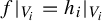
(ii) f is piecewise an element of S, which means that there exist clopen sets $V_1,\ldots ,V_k$
forming a partition of X and elements
$h_1,h_2,\ldots ,h_k\in S$
such that
$f|_{V_i}=h_i|_{V_i}$
for
$1\le i\le k$
.






Proof. The implication (ii)
$\implies $
 (i) is trivial. Let us prove that (i)
$\implies $
(i) is trivial. Let us prove that (i)
$\implies $
 (ii). Assume condition (i) holds. Without loss of generality, we may further assume that the neighborhoods
$U_x$
(ii). Assume condition (i) holds. Without loss of generality, we may further assume that the neighborhoods
$U_x$
 ,
$x\in X$
,
$x\in X$
 are clopen. The sets
$U_x$
are clopen. The sets
$U_x$
 form an open cover of the compact space X. Hence, there are finitely many points
$x_1,x_2,\ldots ,x_k\in X$
form an open cover of the compact space X. Hence, there are finitely many points
$x_1,x_2,\ldots ,x_k\in X$
 such that the sets
$U_{x_i}$
such that the sets
$U_{x_i}$
 ,
$1\le i\le k$
,
$1\le i\le k$
 form a subcover. Now, let
$V_1=U_{x_1}$
form a subcover. Now, let
$V_1=U_{x_1}$
 and
$V_i=U_{x_i}\setminus (U_{x_1}\cup \cdots \cup U_{x_{i-1}})$
and
$V_i=U_{x_i}\setminus (U_{x_1}\cup \cdots \cup U_{x_{i-1}})$
 for
$i=2,3,\ldots ,k$
for
$i=2,3,\ldots ,k$
 . Then, the sets
$V_1,V_2,\ldots ,V_k$
. Then, the sets
$V_1,V_2,\ldots ,V_k$
 form a partition of X. Since each
$U_{x_i}$
form a partition of X. Since each
$U_{x_i}$
 ,
$1\le i\le k$
,
$1\le i\le k$
 is clopen, it follows that the sets
$V_i$
is clopen, it follows that the sets
$V_i$
 ,
$1\le i\le k$
,
$1\le i\le k$
 are clopen as well. Let
$h_i=g_{x_i}$
are clopen as well. Let
$h_i=g_{x_i}$
 for
$1\le i\le k$
for
$1\le i\le k$
 . Clearly, f coincides with
$h_i$
. Clearly, f coincides with
$h_i$
 on
$V_i$
on
$V_i$
 for
$1\le i\le k$
for
$1\le i\le k$
 . Thus, condition (ii) holds.
Definition 2.2. Given a set
$S\subset C(X,X)$
 , let
$\widehat {\mathsf {F}}(S)$
, let
$\widehat {\mathsf {F}}(S)$
 denote the set of all continuous maps in
$C(X,X)$
denote the set of all continuous maps in
$C(X,X)$
 that are locally elements of S (that is, satisfy the two conditions in Proposition 2.1). Given a set
$S\subset {\mathrm {Homeo}}(X)$
that are locally elements of S (that is, satisfy the two conditions in Proposition 2.1). Given a set
$S\subset {\mathrm {Homeo}}(X)$
 , let
$\mathsf {F}(S)=\widehat {\mathsf {F}}(S)\cap {\mathrm {Homeo}}(X)$
, let
$\mathsf {F}(S)=\widehat {\mathsf {F}}(S)\cap {\mathrm {Homeo}}(X)$
 .
.
Clearly,
$S\subset \widehat {\mathsf {F}}(S)$
 for any
$S\subset C(X,X)$
for any
$S\subset C(X,X)$
 . If
$S\subset {\mathrm {Homeo}}(X)$
. If
$S\subset {\mathrm {Homeo}}(X)$
 , then
$S\subset \mathsf {F}(S)\subset \widehat {\mathsf {F}}(S)$
, then
$S\subset \mathsf {F}(S)\subset \widehat {\mathsf {F}}(S)$
 .
.
Lemma 2.3. We have
$\widehat {\mathsf {F}}(\widehat {\mathsf {F}}(S))=\widehat {\mathsf {F}}(S)$
 for any
$S\subset C(X,X)$
for any
$S\subset C(X,X)$
 and
$\mathsf {F}(\mathsf {F}(S))=\mathsf {F}(S)$
and
$\mathsf {F}(\mathsf {F}(S))=\mathsf {F}(S)$
 for any
$S\subset {\mathrm {Homeo}}(X)$
for any
$S\subset {\mathrm {Homeo}}(X)$
 .
.
Proof. As the inclusion
$\widehat {\mathsf {F}}(S)\subset \widehat {\mathsf {F}}(\widehat {\mathsf {F}}(S))$
 is obvious, we need to prove that
$\widehat {\mathsf {F}}(\widehat {\mathsf {F}}(S))\subset \widehat {\mathsf {F}}(S)$
is obvious, we need to prove that
$\widehat {\mathsf {F}}(\widehat {\mathsf {F}}(S))\subset \widehat {\mathsf {F}}(S)$
 . Suppose
$f\in \widehat {\mathsf {F}}(\widehat {\mathsf {F}}(S))$
. Suppose
$f\in \widehat {\mathsf {F}}(\widehat {\mathsf {F}}(S))$
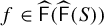 and consider an arbitrary point
$x\in X$
and consider an arbitrary point
$x\in X$
 . Since f is locally an element of
$\widehat {\mathsf {F}}(S)$
. Since f is locally an element of
$\widehat {\mathsf {F}}(S)$
 , there exists an open neighborhood U of x and a map
$g\in \widehat {\mathsf {F}}(S)$
, there exists an open neighborhood U of x and a map
$g\in \widehat {\mathsf {F}}(S)$
 such that
$f|_U=g|_U$
such that
$f|_U=g|_U$
 . Since g is locally an element of S, there exists an open neighborhood W of x and a map
$h\in S$
. Since g is locally an element of S, there exists an open neighborhood W of x and a map
$h\in S$
 such that
$g|_W=h|_W$
such that
$g|_W=h|_W$
 . Then, f coincides with h on
$U\cap W$
. Then, f coincides with h on
$U\cap W$
 , which is an open neighborhood of x. We conclude that f is locally an element of S.
In the case
$S\subset {\mathrm {Homeo}}(X)$
 , the inclusion
$\mathsf {F}(S)\subset \mathsf {F}(\mathsf {F}(S))$
, the inclusion
$\mathsf {F}(S)\subset \mathsf {F}(\mathsf {F}(S))$
 is obvious. Since
$\mathsf {F}(S)\subset \widehat {\mathsf {F}}(S)$
is obvious. Since
$\mathsf {F}(S)\subset \widehat {\mathsf {F}}(S)$
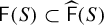 , it follows that
$\widehat {\mathsf {F}}(\mathsf {F}(S))\subset \widehat {\mathsf {F}}(\widehat {\mathsf {F}}(S))$
, it follows that
$\widehat {\mathsf {F}}(\mathsf {F}(S))\subset \widehat {\mathsf {F}}(\widehat {\mathsf {F}}(S))$
 . By the above,
$\widehat {\mathsf {F}}(\widehat {\mathsf {F}}(S))=\widehat {\mathsf {F}}(S)$
. By the above,
$\widehat {\mathsf {F}}(\widehat {\mathsf {F}}(S))=\widehat {\mathsf {F}}(S)$
 . Therefore,
$\mathsf {F}(\mathsf {F}(S))=\widehat {\mathsf {F}}(\mathsf {F}(S))\cap {\mathrm {Homeo}}(X)\subset \widehat {\mathsf {F}}(S)\cap {\mathrm {Homeo}}(X) =\mathsf {F}(S)$
. Therefore,
$\mathsf {F}(\mathsf {F}(S))=\widehat {\mathsf {F}}(\mathsf {F}(S))\cap {\mathrm {Homeo}}(X)\subset \widehat {\mathsf {F}}(S)\cap {\mathrm {Homeo}}(X) =\mathsf {F}(S)$
 . Thus,
$\mathsf {F}(\mathsf {F}(S))=\mathsf {F}(S)$
. Thus,
$\mathsf {F}(\mathsf {F}(S))=\mathsf {F}(S)$
 .
.
Lemma 2.4. If
$S\subset C(X,X)$
 is a semigroup, then
$\widehat {\mathsf {F}}(S)$
is a semigroup, then
$\widehat {\mathsf {F}}(S)$
 is also a semigroup. If
$S\subset {\mathrm {Homeo}}(X)$
is also a semigroup. If
$S\subset {\mathrm {Homeo}}(X)$
 is a group, then
$\mathsf {F}(S)$
is a group, then
$\mathsf {F}(S)$
 is also a group.
Proof. Suppose
$S\subset C(X,X)$
 is a semigroup and consider any two maps
$f,g\in \widehat {\mathsf {F}}(S)$
is a semigroup and consider any two maps
$f,g\in \widehat {\mathsf {F}}(S)$
 . Given a point
$x\in X$
. Given a point
$x\in X$
 , there exists an open neighborhood U of x and a map
$\tilde g\in S$
, there exists an open neighborhood U of x and a map
$\tilde g\in S$
 such that
$g|_U=\tilde g|_U$
such that
$g|_U=\tilde g|_U$
 . Further, there exists an open neighborhood W of the point
$g(x)$
. Further, there exists an open neighborhood W of the point
$g(x)$
 and a map
$\tilde f\in S$
and a map
$\tilde f\in S$
 such that
$f|_W=\tilde f|_W$
such that
$f|_W=\tilde f|_W$
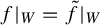 . Then, the composition
$fg$
. Then, the composition
$fg$
 coincides with
$\tilde f\tilde g$
coincides with
$\tilde f\tilde g$
 , which belongs to S, on
$g^{-1}(W)\cap U$
, which belongs to S, on
$g^{-1}(W)\cap U$
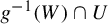 , which is an open neighborhood of x. Hence,
$fg$
, which is an open neighborhood of x. Hence,
$fg$
 is locally an element of S. Thus,
$\widehat {\mathsf {F}}(S)$
is locally an element of S. Thus,
$\widehat {\mathsf {F}}(S)$
 is a semigroup.
Now, assume
$S\subset {\mathrm {Homeo}}(X)$
 is a group. By the above,
$\widehat {\mathsf {F}}(S)$
is a group. By the above,
$\widehat {\mathsf {F}}(S)$
 is a semigroup. Then,
$\mathsf {F}(S)$
is a semigroup. Then,
$\mathsf {F}(S)$
 is also a semigroup as it is the intersection of two semigroups
$\widehat {\mathsf {F}}(S)$
is also a semigroup as it is the intersection of two semigroups
$\widehat {\mathsf {F}}(S)$
 and
${\mathrm {Homeo}}(X)$
and
${\mathrm {Homeo}}(X)$
 . It remains to show that for any homeomorphism
$f\in \mathsf {F}(S)$
. It remains to show that for any homeomorphism
$f\in \mathsf {F}(S)$
 , the inverse
$f^{-1}$
, the inverse
$f^{-1}$
 is also in
$\mathsf {F}(S)$
is also in
$\mathsf {F}(S)$
 . Take an arbitrary point
$x\in X$
. Take an arbitrary point
$x\in X$
 . Since f is locally an element of S, there exists an open neighborhood U of the point
$f^{-1}(x)$
. Since f is locally an element of S, there exists an open neighborhood U of the point
$f^{-1}(x)$
 and a map
$g\in S$
and a map
$g\in S$
 such that
$f|_U=g|_U$
such that
$f|_U=g|_U$
 . Then,
$f^{-1}$
. Then,
$f^{-1}$
 coincides with
$g^{-1}$
coincides with
$g^{-1}$
 , which belongs to S, on
$f(U)$
, which belongs to S, on
$f(U)$
 , which is an open neighborhood of x. Thus,
$f^{-1}$
, which is an open neighborhood of x. Thus,
$f^{-1}$
 is locally an element of S.
Definition 2.5. Given subgroups G and
$\widetilde G$
 of
${\mathrm {Homeo}}(X)$
of
${\mathrm {Homeo}}(X)$
 , we say that
$\widetilde G$
, we say that
$\widetilde G$
 amplifies G if
$G\subset \widetilde G\subset \mathsf {F}(G)$
amplifies G if
$G\subset \widetilde G\subset \mathsf {F}(G)$
 . The group
$\mathsf {F}(G)$
. The group
$\mathsf {F}(G)$
 is called the full amplification of G. In the case
$\mathsf {F}(G)=G$
is called the full amplification of G. In the case
$\mathsf {F}(G)=G$
 , the group G is called ample or fully amplified.
For any group
$G\subset {\mathrm {Homeo}}(X)$
 , it follows from Lemmas 2.3 and 2.4 that
$\mathsf {F}(G)$
, it follows from Lemmas 2.3 and 2.4 that
$\mathsf {F}(G)$
 is an ample group.
Definition 2.6. Given a group
$G\subset {\mathrm {Homeo}}(X)$
 , for any
$x\in X$
, for any
$x\in X$
 , we denote by
${\mathrm {Orb}}_G(x)$
, we denote by
${\mathrm {Orb}}_G(x)$
 the orbit of the point x under the natural action of the group:
${\mathrm {Orb}}_G(x)=\{g(x)\mid g\in G\}$
the orbit of the point x under the natural action of the group:
${\mathrm {Orb}}_G(x)=\{g(x)\mid g\in G\}$
 . We refer to any set of the form
${\mathrm {Orb}}_G(x)$
. We refer to any set of the form
${\mathrm {Orb}}_G(x)$
 as an orbit of the group G.
An important property of the amplification is that this procedure enlarges a group while not enlarging orbits of the natural action. In particular, the ample group
$\mathsf {F}(G)$
 has the same orbits as the group G.
3 Stabilizers and local subgroups
Any group
$G\subset {\mathrm {Homeo}}(X)$
 acts naturally on the topological space X. This action induces several other actions. In this section, we define various stabilizers related to those actions. Note that the stabilizers of any group action on any set are subgroups of the acting group.
Definition 3.1. The stabilizer
${\mathrm {St}}_G(x)$
 of a point
$x\in X$
of a point
$x\in X$
 under the action of the group G consists of those elements of G that fix x:
${\mathrm {St}}_G(x)=\{g\in G\mid g(x)=x\}$
under the action of the group G consists of those elements of G that fix x:
${\mathrm {St}}_G(x)=\{g\in G\mid g(x)=x\}$
 .
.
The action of the group G on the set X induces an action on subsets of X.
Definition 3.2. The (set) stabilizer
${\mathrm {St}}_G(Y)$
 of a set
$Y\subset X$
of a set
$Y\subset X$
 under the action of the group G consists of those elements of G that map Y onto itself. The pointwise stabilizer
${\mathrm {St}}^\star _G(Y)$
under the action of the group G consists of those elements of G that map Y onto itself. The pointwise stabilizer
${\mathrm {St}}^\star _G(Y)$
 of Y consists of those elements of
${\mathrm {St}}_G(Y)$
of Y consists of those elements of
${\mathrm {St}}_G(Y)$
 that fix every point of the set Y. The rigid stabilizer
${\mathrm {RiSt}}_G(Y)$
that fix every point of the set Y. The rigid stabilizer
${\mathrm {RiSt}}_G(Y)$
 of Y consists of those elements of
${\mathrm {St}}_G(Y)$
of Y consists of those elements of
${\mathrm {St}}_G(Y)$
 that fix every point not in Y.
Clearly, the stabilizer
${\mathrm {St}}_G(x)$
 of a point
$x\in X$
of a point
$x\in X$
 coincides with the stabilizer
${\mathrm {St}}_G(\{x\})$
coincides with the stabilizer
${\mathrm {St}}_G(\{x\})$
 of the one-point set
$\{x\}$
of the one-point set
$\{x\}$
 as well as with
${\mathrm {St}}^\star _G(\{x\})$
as well as with
${\mathrm {St}}^\star _G(\{x\})$
 . For any subset
$Y\subset X$
. For any subset
$Y\subset X$
 , the individual stabilizer
${\mathrm {St}}^\star _G(Y)$
, the individual stabilizer
${\mathrm {St}}^\star _G(Y)$
 is the intersection of all point stabilizers
${\mathrm {St}}_G(y)$
is the intersection of all point stabilizers
${\mathrm {St}}_G(y)$
 ,
$y\in Y$
,
$y\in Y$
 .
.
The pointwise stabilizer can be interpreted as the usual stabilizer of an induced action of G on ordered subsets of X. Consider the set of all pairs
$(Y,\prec )$
 , where
$Y\subset X$
, where
$Y\subset X$
 and
$\prec $
and
$\prec $
 is an order on Y. The group G acts naturally on this set. Clearly, the stabilizer of a pair
$(Y,\prec )$
is an order on Y. The group G acts naturally on this set. Clearly, the stabilizer of a pair
$(Y,\prec )$
 always contains
${\mathrm {St}}^\star _G(Y)$
always contains
${\mathrm {St}}^\star _G(Y)$
 . In the case
$\prec $
. In the case
$\prec $
 is a well ordering on the subset Y, it is easy to observe that the stabilizer of
$(Y,\prec )$
is a well ordering on the subset Y, it is easy to observe that the stabilizer of
$(Y,\prec )$
 is exactly
${\mathrm {St}}^\star _G(Y)$
is exactly
${\mathrm {St}}^\star _G(Y)$
 .
.
For any invertible map
$f:X\to X$
 , we have
$f(Y)=Y$
, we have
$f(Y)=Y$
 if and only if
$f(X\setminus Y)= X\setminus Y$
if and only if
$f(X\setminus Y)= X\setminus Y$
 . Hence,
${\mathrm {St}}_G(Y)={\mathrm {St}}_G(X\setminus Y)$
. Hence,
${\mathrm {St}}_G(Y)={\mathrm {St}}_G(X\setminus Y)$
 . It follows that
${\mathrm {RiSt}}_G(Y)={\mathrm {St}}^\star _G(X\setminus Y)$
. It follows that
${\mathrm {RiSt}}_G(Y)={\mathrm {St}}^\star _G(X\setminus Y)$
 .
.
The set stabilizer
${\mathrm {St}}_G(Y)$
 acts naturally on the set Y. The pointwise stabilizer
${\mathrm {St}}^\star _G(Y)$
acts naturally on the set Y. The pointwise stabilizer
${\mathrm {St}}^\star _G(Y)$
 is the kernel of that action. Therefore, it is a normal subgroup of
${\mathrm {St}}_G(Y)$
is the kernel of that action. Therefore, it is a normal subgroup of
${\mathrm {St}}_G(Y)$
 . Similarly,
${\mathrm {RiSt}}_G(Y)$
. Similarly,
${\mathrm {RiSt}}_G(Y)$
 is a normal subgroup of
${\mathrm {St}}_G(X\setminus Y)={\mathrm {St}}_G(Y)$
is a normal subgroup of
${\mathrm {St}}_G(X\setminus Y)={\mathrm {St}}_G(Y)$
 .
.
Lemma 3.3. Suppose
$G\subset {\mathrm {Homeo}}(X)$
 is an ample group. Then, for any subset
$Y\subset X$
is an ample group. Then, for any subset
$Y\subset X$
 , the stabilizers
${\mathrm {St}}_G(Y)$
, the stabilizers
${\mathrm {St}}_G(Y)$
 ,
${\mathrm {St}}^\star _G(Y)$
,
${\mathrm {St}}^\star _G(Y)$
 , and
${\mathrm {RiSt}}_G(Y)$
, and
${\mathrm {RiSt}}_G(Y)$
 are also ample groups.
Proof. Since the set stabilizer
${\mathrm {St}}_G(Y)$
 is a subgroup of G, its full amplification
$\mathsf {F}({\mathrm {St}}_G(Y))$
is a subgroup of G, its full amplification
$\mathsf {F}({\mathrm {St}}_G(Y))$
 is a subgroup of
$\mathsf {F}(G)=G$
is a subgroup of
$\mathsf {F}(G)=G$
 . Take any map
$f\in \mathsf {F}({\mathrm {St}}_G(Y))$
. Take any map
$f\in \mathsf {F}({\mathrm {St}}_G(Y))$
 . Then, f is piecewise an element of
${\mathrm {St}}_G(Y)$
. Then, f is piecewise an element of
${\mathrm {St}}_G(Y)$
 , which implies that
$f(Y)\subset Y$
, which implies that
$f(Y)\subset Y$
 . Since
${\mathrm {St}}_G(Y)={\mathrm {St}}_G(X\setminus Y)$
. Since
${\mathrm {St}}_G(Y)={\mathrm {St}}_G(X\setminus Y)$
 , it also follows that
$f(X\setminus Y)\subset X\setminus Y$
, it also follows that
$f(X\setminus Y)\subset X\setminus Y$
 . As f is invertible, we obtain
$f(Y)=Y$
. As f is invertible, we obtain
$f(Y)=Y$
 so that
$f\in {\mathrm {St}}_G(Y)$
so that
$f\in {\mathrm {St}}_G(Y)$
 . Thus, the group
${\mathrm {St}}_G(Y)$
. Thus, the group
${\mathrm {St}}_G(Y)$
 is ample.
If Y is the empty set or X, then one of the groups
${\mathrm {St}}^\star _G(Y)$
 and
${\mathrm {RiSt}}_G(Y)$
and
${\mathrm {RiSt}}_G(Y)$
 is trivial while the other coincides with G, and both are ample. Now, assume Y is different from
$\emptyset $
is trivial while the other coincides with G, and both are ample. Now, assume Y is different from
$\emptyset $
 and X. By the above, for any point
$x\in X$
and X. By the above, for any point
$x\in X$
 , the stabilizer
${\mathrm {St}}_G(x)={\mathrm {St}}_G(\{x\})$
, the stabilizer
${\mathrm {St}}_G(x)={\mathrm {St}}_G(\{x\})$
 is an ample group. Therefore, the point stabilizer
${\mathrm {St}}^\star _G(Y)$
is an ample group. Therefore, the point stabilizer
${\mathrm {St}}^\star _G(Y)$
 is the intersection of ample groups
${\mathrm {St}}_G(x)$
is the intersection of ample groups
${\mathrm {St}}_G(x)$
 ,
$x\in Y$
,
$x\in Y$
 , while the rigid stabilizer
${\mathrm {RiSt}}_G(Y)$
, while the rigid stabilizer
${\mathrm {RiSt}}_G(Y)$
 is the intersection of ample groups
${\mathrm {St}}_G(x)$
is the intersection of ample groups
${\mathrm {St}}_G(x)$
 ,
$x\notin Y$
,
$x\notin Y$
 . It is easy to observe that for any collection of ample subgroups of
${\mathrm {Homeo}}(X)$
. It is easy to observe that for any collection of ample subgroups of
${\mathrm {Homeo}}(X)$
 , their intersection is ample as well.
The action of the group G on subsets of X induces an action on collections of such subsets (that is, on the set of subsets of the set of subsets of X).
Definition 3.4. The (collective) stabilizer
${\mathrm {St}}_G(Y_1,Y_2,\ldots ,Y_k)$
 of a collection of distinct sets
$Y_i\subset X$
of a collection of distinct sets
$Y_i\subset X$
 ,
$1\le i\le k$
,
$1\le i\le k$
 under the action of the group G consists of those elements of G that map each set in the collection onto (the same or another) set in the collection. The individual stabilizer
${\mathrm {St}}^\bullet _G(Y_1,Y_2,\ldots ,Y_k)$
under the action of the group G consists of those elements of G that map each set in the collection onto (the same or another) set in the collection. The individual stabilizer
${\mathrm {St}}^\bullet _G(Y_1,Y_2,\ldots ,Y_k)$
 of the collection consists of those elements of
${\mathrm {St}}_G(Y_1,Y_2,\ldots ,Y_k)$
of the collection consists of those elements of
${\mathrm {St}}_G(Y_1,Y_2,\ldots ,Y_k)$
 that map each set
$Y_i$
that map each set
$Y_i$
 ,
$1\le i\le k$
,
$1\le i\le k$
 onto itself.
Clearly, the individual stabilizer
${\mathrm {St}}^\bullet _G(Y_1,Y_2,\ldots ,Y_k)$
 is the intersection of the set stabilizers
${\mathrm {St}}_G(Y_i)$
is the intersection of the set stabilizers
${\mathrm {St}}_G(Y_i)$
 ,
$1\le i\le k$
,
$1\le i\le k$
 . In the case where the collection consists of a single set Y, the notation
${\mathrm {St}}_G(Y)$
. In the case where the collection consists of a single set Y, the notation
${\mathrm {St}}_G(Y)$
 is not ambiguous since the collective stabilizer of the collection
$\{Y\}$
is not ambiguous since the collective stabilizer of the collection
$\{Y\}$
 coincides with the set stabilizer of the set Y.
The collective stabilizer
${\mathrm {St}}_G(Y_1,Y_2,\ldots ,Y_k)$
 acts naturally on the set
$\{Y_1,Y_2,\ldots ,Y_k\}$
acts naturally on the set
$\{Y_1,Y_2,\ldots ,Y_k\}$
 . The individual stabilizer
${\mathrm {St}}^\bullet _G(Y_1,Y_2,\ldots ,Y_k)$
. The individual stabilizer
${\mathrm {St}}^\bullet _G(Y_1,Y_2,\ldots ,Y_k)$
 is the kernel of that action. Therefore, it is a normal subgroup of
${\mathrm {St}}_G(Y_1,Y_2,\ldots ,Y_k)$
is the kernel of that action. Therefore, it is a normal subgroup of
${\mathrm {St}}_G(Y_1,Y_2,\ldots ,Y_k)$
 .
.
Definition 3.5. Let
$f\in {\mathrm {Homeo}}(X)$
 . A point
$x\in X$
. A point
$x\in X$
 is called a fixed point of f if
$f(x)=x$
is called a fixed point of f if
$f(x)=x$
 . The set of all fixed points of f is denoted
${\mathrm {Fix}}(f)$
. The set of all fixed points of f is denoted
${\mathrm {Fix}}(f)$
 . Further, a point
$x\in X$
. Further, a point
$x\in X$
 is called a support point of f if the homeomorphism f does not coincide with the identity map in any neighborhood of x. The set of all support points of f is called the support of f and denoted
${\mathrm {supp}}(f)$
is called a support point of f if the homeomorphism f does not coincide with the identity map in any neighborhood of x. The set of all support points of f is called the support of f and denoted
${\mathrm {supp}}(f)$
 .
.
By definition, the support of f is the complement of the interior of
${\mathrm {Fix}}(f)$
 . Equivalently,
${\mathrm {supp}}(f)=\overline {X\setminus {\mathrm {Fix}}(f)}$
. Equivalently,
${\mathrm {supp}}(f)=\overline {X\setminus {\mathrm {Fix}}(f)}$
 , the closure of the complement of
${\mathrm {Fix}}(f)$
, the closure of the complement of
${\mathrm {Fix}}(f)$
 .
.
If two homeomorphisms f and g have disjoint supports then, clearly, they commute:
$fg=gf$
 . In fact, f and g commute whenever
${\mathrm {supp}}(f)$
. In fact, f and g commute whenever
${\mathrm {supp}}(f)$
 and
${\mathrm {supp}}(g)$
and
${\mathrm {supp}}(g)$
 share no interior point.
Definition 3.6. Let G be a subgroup of
${\mathrm {Homeo}}(X)$
 and U be a clopen subset of X. The local subgroup of the ample group
$\mathsf {F}(G)$
and U be a clopen subset of X. The local subgroup of the ample group
$\mathsf {F}(G)$
 associated to U, denoted
$\mathsf {F}_U(G)$
associated to U, denoted
$\mathsf {F}_U(G)$
 , consists of all maps
$f\in \mathsf {F}(G)$
, consists of all maps
$f\in \mathsf {F}(G)$
 such that
${\mathrm {supp}}(f)\subset U$
such that
${\mathrm {supp}}(f)\subset U$
 . In the case where the group G is already ample, we may use alternative notation
$G_U$
. In the case where the group G is already ample, we may use alternative notation
$G_U$
 .
.
For any clopen set
$U\subset X$
 and homeomorphism
$f:X\to X$
and homeomorphism
$f:X\to X$
 , the condition
${\mathrm {supp}}(f)\subset U$
, the condition
${\mathrm {supp}}(f)\subset U$
 is equivalent to the condition
$f(x)=x$
is equivalent to the condition
$f(x)=x$
 for all
$x\notin U$
for all
$x\notin U$
 . Hence, the local subgroup
$\mathsf {F}_U(G)$
. Hence, the local subgroup
$\mathsf {F}_U(G)$
 coincides with the rigid stabilizer
${\mathrm {RiSt}}_{\mathsf {F}(G)}(U)$
coincides with the rigid stabilizer
${\mathrm {RiSt}}_{\mathsf {F}(G)}(U)$
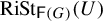 . By Lemma 3.3,
$\mathsf {F}_U(G)$
. By Lemma 3.3,
$\mathsf {F}_U(G)$
 is an ample group.
4 Generalized permutations
For any integer
$n\ge 1$
 , let
$\mathsf {S}_n$
, let
$\mathsf {S}_n$
 denote the symmetric group of all permutations on the set
$\{1,2,\ldots ,n\}$
denote the symmetric group of all permutations on the set
$\{1,2,\ldots ,n\}$
 .
.
Definition 4.1. Let U be a clopen subset of a topological space X. Suppose
$f_1,f_2,\ldots ,f_n$
 are homeomorphisms of X such that the images
$f_1(U),f_2(U),\ldots ,f_n(U)$
are homeomorphisms of X such that the images
$f_1(U),f_2(U),\ldots ,f_n(U)$
 are disjoint. Then, for any permutation
$\pi \in \mathsf {S}_n$
are disjoint. Then, for any permutation
$\pi \in \mathsf {S}_n$
 , we define a generalized permutation
$\mu [U;f_1,f_2,\ldots ,f_n;\pi ]:X\to X$
, we define a generalized permutation
$\mu [U;f_1,f_2,\ldots ,f_n;\pi ]:X\to X$
 by
by

The generalized permutation
$\mu [U;f_1,f_2,\ldots ,f_n;\pi ]$
 is a homeomorphism of X that permutes disjoint clopen sets
$f_1(U),f_2(U),\ldots ,f_n(U)$
is a homeomorphism of X that permutes disjoint clopen sets
$f_1(U),f_2(U),\ldots ,f_n(U)$
 while fixing the rest of the space. For any
$x\in U$
while fixing the rest of the space. For any
$x\in U$
 and
$i\in \{1,2,\ldots ,n\}$
and
$i\in \{1,2,\ldots ,n\}$
 , the point
$f_i(x)$
, the point
$f_i(x)$
 is mapped to
$f_{\pi (i)}(x)$
is mapped to
$f_{\pi (i)}(x)$
 . The generalized permutation has finite order in the group
${\mathrm {Homeo}}(X)$
. The generalized permutation has finite order in the group
${\mathrm {Homeo}}(X)$
 , which is the same as the order of the permutation
$\pi $
, which is the same as the order of the permutation
$\pi $
 . If the sets
$f_1(U),f_2(U),\ldots ,f_n(U)$
. If the sets
$f_1(U),f_2(U),\ldots ,f_n(U)$
 are not disjoint, then
$\mu [U;f_1,f_2,\ldots ,f_n;\pi ]$
are not disjoint, then
$\mu [U;f_1,f_2,\ldots ,f_n;\pi ]$
 is not defined.
Lemma 4.2. Suppose
$U\subset X$
 is a clopen set and
$f_1,f_2,\ldots ,f_n$
is a clopen set and
$f_1,f_2,\ldots ,f_n$
 are homeomorphisms of X such that the images
$f_1(U),f_2(U),\ldots ,f_n(U)$
are homeomorphisms of X such that the images
$f_1(U),f_2(U),\ldots ,f_n(U)$
 are disjoint. Then, the map
$\Phi :\mathsf {S}_n\to {\mathrm {Homeo}}(X)$
are disjoint. Then, the map
$\Phi :\mathsf {S}_n\to {\mathrm {Homeo}}(X)$
 given by
$\Phi (\pi )=\mu [U;f_1,f_2,\ldots ,f_n;\pi ]$
given by
$\Phi (\pi )=\mu [U;f_1,f_2,\ldots ,f_n;\pi ]$
 is a group homomorphism.
The proof of Lemma 4.2 is straightforward and we omit it.
Let G be a subgroup of
${\mathrm {Homeo}}(X)$
 and
$\mathsf {F}(G)$
and
$\mathsf {F}(G)$
 be its full amplification. If homeomorphisms
$f_1,f_2,\ldots ,f_n$
be its full amplification. If homeomorphisms
$f_1,f_2,\ldots ,f_n$
 belong to the group G, then any generalized permutation of the form
$\mu [U;f_1,f_2,\ldots ,f_n;\pi ]$
belong to the group G, then any generalized permutation of the form
$\mu [U;f_1,f_2,\ldots ,f_n;\pi ]$
 belongs to
$\mathsf {F}(G)$
belongs to
$\mathsf {F}(G)$
 .
.
Definition 4.3. The generalized symmetric group
$\mathsf {S}(G)$
 over G is the subgroup of
$\mathsf {F}(G)$
over G is the subgroup of
$\mathsf {F}(G)$
 generated by all generalized permutations in
$\mathsf {F}(G)$
generated by all generalized permutations in
$\mathsf {F}(G)$
 .
.
The group
$\mathsf {S}(G)$
 was introduced (in a more general context of étale groupoids) by Nekrashevych [Reference Nekrashevych50].
Lemma 4.4. The generalized symmetric group
$\mathsf {S}(G)$
 is a normal subgroup of the group
$\mathsf {F}(G)$
is a normal subgroup of the group
$\mathsf {F}(G)$
 .
.
Proof. It is enough to show that any conjugate of a generalized permutation in the group
${\mathrm {Homeo}}(X)$
 is itself a generalized permutation. After that, the proof of the lemma is straightforward. Suppose a generalized permutation
$g=\mu [U;f_1,f_2,\ldots ,f_n;\pi ]$
is itself a generalized permutation. After that, the proof of the lemma is straightforward. Suppose a generalized permutation
$g=\mu [U;f_1,f_2,\ldots ,f_n;\pi ]$
 is defined. Then,
$f_1(U),f_2(U),\ldots ,f_n(U)$
is defined. Then,
$f_1(U),f_2(U),\ldots ,f_n(U)$
 are disjoint clopen sets. The support of g is the union of those
$f_i(U)$
are disjoint clopen sets. The support of g is the union of those
$f_i(U)$
 for which
$\pi (i)\ne i$
for which
$\pi (i)\ne i$
 . For any
$x\in U$
. For any
$x\in U$
 and
$i\in \{1,2,\ldots ,n\}$
and
$i\in \{1,2,\ldots ,n\}$
 , we have
$g(f_i(x))=f_{\pi (i)}(x)$
, we have
$g(f_i(x))=f_{\pi (i)}(x)$
 . Now, consider an arbitrary homeomorphism
$h\in {\mathrm {Homeo}}(X)$
. Now, consider an arbitrary homeomorphism
$h\in {\mathrm {Homeo}}(X)$
 . It is easy to observe that
${\mathrm {supp}}(hgh^{-1})=h({\mathrm {supp}}(g))$
. It is easy to observe that
${\mathrm {supp}}(hgh^{-1})=h({\mathrm {supp}}(g))$
 . Hence, the support of
$hgh^{-1}$
. Hence, the support of
$hgh^{-1}$
 is contained in the union of sets
$hf_1(U),hf_2(U),\ldots ,hf_n(U)$
is contained in the union of sets
$hf_1(U),hf_2(U),\ldots ,hf_n(U)$
 , which are disjoint clopen sets. Furthermore, for any
$x\in U$
, which are disjoint clopen sets. Furthermore, for any
$x\in U$
 and
$i\in \{1,2,\ldots ,n\}$
and
$i\in \{1,2,\ldots ,n\}$
 , we have
$hgh^{-1}(hf_i(x))=hg(f_i(x))=hf_{\pi (i)}(x)$
, we have
$hgh^{-1}(hf_i(x))=hg(f_i(x))=hf_{\pi (i)}(x)$
 . It follows that
$hgh^{-1}=\mu [U;hf_1,hf_2,\ldots ,hf_n;\pi ]$
. It follows that
$hgh^{-1}=\mu [U;hf_1,hf_2,\ldots ,hf_n;\pi ]$
 . Thus,
$hgh^{-1}$
. Thus,
$hgh^{-1}$
 is a generalized permutation.
Lemma 4.5. For any group
$G\subset {\mathrm {Homeo}}(X)$
 , the generalized symmetric group
$\mathsf {S}(G)$
, the generalized symmetric group
$\mathsf {S}(G)$
 is generated by all maps of the form
$\mu [U;f_1,f_2,\ldots ,f_n;\pi ]$
is generated by all maps of the form
$\mu [U;f_1,f_2,\ldots ,f_n;\pi ]$
 , where
$f_1,f_2,\ldots ,f_n\in \mathsf {F}(G)$
, where
$f_1,f_2,\ldots ,f_n\in \mathsf {F}(G)$
 .
.
Proof. Let P be the set of all generalized permutations of the form
$\mu [U;f_1,f_2,\ldots , f_n;\pi ]$
 , where
$f_1,f_2,\ldots ,f_n\in \mathsf {F}(G)$
, where
$f_1,f_2,\ldots ,f_n\in \mathsf {F}(G)$
 . It follows from the definition that any element of P is piecewise an element of the group
$\mathsf {F}(G)$
. It follows from the definition that any element of P is piecewise an element of the group
$\mathsf {F}(G)$
 . Therefore, P is contained in the group
$\mathsf {F}(\mathsf {F}(G))$
. Therefore, P is contained in the group
$\mathsf {F}(\mathsf {F}(G))$
 , which coincides with
$\mathsf {F}(G)$
, which coincides with
$\mathsf {F}(G)$
 due to Lemma 2.3.
To prove the lemma, it is enough to show that any generalized permutation
$g\in \mathsf {F}(G)$
 is a product of elements of the set P. The map g is represented as
$\mu [U;f_1,f_2,\ldots ,f_n;\pi ]$
is a product of elements of the set P. The map g is represented as
$\mu [U;f_1,f_2,\ldots ,f_n;\pi ]$
 , where maps
$f_1,f_2,\ldots ,f_n$
, where maps
$f_1,f_2,\ldots ,f_n$
 need not be in
$\mathsf {F}(G)$
need not be in
$\mathsf {F}(G)$
 . Let
$\pi =\sigma _1\sigma _2\cdots \sigma _k$
. Let
$\pi =\sigma _1\sigma _2\cdots \sigma _k$
 be the decomposition of the permutation
$\pi $
be the decomposition of the permutation
$\pi $
 as a product of disjoint cycles. Lemma 4.2 implies that
$g=g_1g_2\cdots g_k$
as a product of disjoint cycles. Lemma 4.2 implies that
$g=g_1g_2\cdots g_k$
 , where
$g_j=\mu [U;f_1,f_2,\ldots ,f_n;\sigma _j]$
, where
$g_j=\mu [U;f_1,f_2,\ldots ,f_n;\sigma _j]$
 ,
$1\le j\le k$
,
$1\le j\le k$
 . We are going to show that each
$g_j$
. We are going to show that each
$g_j$
 belongs to P.
First, let us show that
$g_j\in \mathsf {F}(G)$
 . For any
$i\in \{1,2,\ldots ,n\}$
. For any
$i\in \{1,2,\ldots ,n\}$
 , we have either
$\sigma _j(i)=\pi (i)$
, we have either
$\sigma _j(i)=\pi (i)$
 or
$\sigma _j(i)=i$
or
$\sigma _j(i)=i$
 . In the former case,
$g_j$
. In the former case,
$g_j$
 coincides with g on the clopen set
$f_i(U)$
coincides with g on the clopen set
$f_i(U)$
 . In the latter case,
$g_j$
. In the latter case,
$g_j$
 coincides with the identity map on
$f_i(U)$
coincides with the identity map on
$f_i(U)$
 . On the complement of the union of sets
$f_i(U)$
. On the complement of the union of sets
$f_i(U)$
 ,
$1\le i\le n$
,
$1\le i\le n$
 , both g and
$g_j$
, both g and
$g_j$
 coincide with the identity map. Hence,
$g_j$
coincide with the identity map. Hence,
$g_j$
 is piecewise an element of the set
$\{\mathrm {id}_X,g\}$
is piecewise an element of the set
$\{\mathrm {id}_X,g\}$
 . Since
$g\in \mathsf {F}(G)$
. Since
$g\in \mathsf {F}(G)$
 , it follows that
$g_j\in \mathsf {F}(\mathsf {F}(G))=\mathsf {F}(G)$
, it follows that
$g_j\in \mathsf {F}(\mathsf {F}(G))=\mathsf {F}(G)$
 .
.
Recall that the permutation
$\sigma _j$
 is a cycle:
$\sigma _j=(i_1\,i_2\ldots i_m)$
is a cycle:
$\sigma _j=(i_1\,i_2\ldots i_m)$
 , where
$i_1,i_2,\ldots ,i_m$
, where
$i_1,i_2,\ldots ,i_m$
 are distinct elements of
$\{1,2,\ldots ,n\}$
are distinct elements of
$\{1,2,\ldots ,n\}$
 . Let
$W_s=f_{i_s}(U)$
. Let
$W_s=f_{i_s}(U)$
 ,
$1\le s\le m$
,
$1\le s\le m$
 . Then,
$W_1,W_2,\ldots ,W_m$
. Then,
$W_1,W_2,\ldots ,W_m$
 are disjoint clopen sets and
$g_j$
are disjoint clopen sets and
$g_j$
 coincides with the identity map away from them. We have
$g_j(W_s)=W_{s+1}$
coincides with the identity map away from them. We have
$g_j(W_s)=W_{s+1}$
 for
$1\le s\le m-1$
for
$1\le s\le m-1$
 and
$g_j(W_m)=W_1$
and
$g_j(W_m)=W_1$
 . It follows by induction that
$W_s=g_j^{s-1}(W_1)$
. It follows by induction that
$W_s=g_j^{s-1}(W_1)$
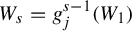 for
$1\le s\le m$
for
$1\le s\le m$
 . Since the cycle
$\sigma _j$
. Since the cycle
$\sigma _j$
 has order m in the group
$\mathsf {S}_n$
has order m in the group
$\mathsf {S}_n$
 , Lemma 4.2 implies that
$g_j^m=\mathrm {id}_X$
, Lemma 4.2 implies that
$g_j^m=\mathrm {id}_X$
 . As a consequence,
$(g_j^{m-1})^{-1}$
. As a consequence,
$(g_j^{m-1})^{-1}$
 coincides with
$g_j$
coincides with
$g_j$
 on
$W_m$
on
$W_m$
 (as well as anywhere else on X). All this leads to an alternative representation of
$g_j$
(as well as anywhere else on X). All this leads to an alternative representation of
$g_j$
 as a generalized permutation:

Since
$g_j$
 and all its powers belong to the group
$\mathsf {F}(G)$
and all its powers belong to the group
$\mathsf {F}(G)$
 , we conclude that
$g_j\in P$
, we conclude that
$g_j\in P$
 .
.
Definition 4.6. Let U be a clopen subset of X. For any homeomorphism
$f:X\to X$
 such that the image
$f(U)$
such that the image
$f(U)$
 is disjoint from U, we define a generalized 2-cycle
$\delta _{U;f}:X\to X$
is disjoint from U, we define a generalized 2-cycle
$\delta _{U;f}:X\to X$
 by
by
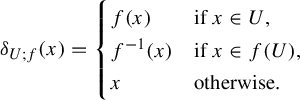
The generalized
$2$
 -cycles are a special case of the generalized permutations. Indeed,
$\delta _{U;f}=\mu [U;\mathrm {id}_X,f;(1\,2)]$
-cycles are a special case of the generalized permutations. Indeed,
$\delta _{U;f}=\mu [U;\mathrm {id}_X,f;(1\,2)]$
 . As a consequence,
$\delta _{U;f}\in \mathsf {S}(G)$
. As a consequence,
$\delta _{U;f}\in \mathsf {S}(G)$
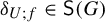 whenever
$f\in G$
whenever
$f\in G$
 .
.
Recall that the symmetric group
$\mathsf {S}_n$
 is generated by all
$2$
is generated by all
$2$
 -cycles
$(i\,j)$
-cycles
$(i\,j)$
 in
$\mathsf {S}_n$
in
$\mathsf {S}_n$
 .
.
Lemma 4.7. For any group
$G\subset {\mathrm {Homeo}}(X)$
 , a generalized
$2$
, a generalized
$2$
 -cycle belongs to
$\mathsf {F}(G)$
-cycle belongs to
$\mathsf {F}(G)$
 if and only if it is of the form
$\delta _{U;f}$
if and only if it is of the form
$\delta _{U;f}$
 , where
$f\in \mathsf {F}(G)$
, where
$f\in \mathsf {F}(G)$
 . The generalized symmetric group
$\mathsf {S}(G)$
. The generalized symmetric group
$\mathsf {S}(G)$
 is generated by all generalized
$2$
is generated by all generalized
$2$
 -cycles in
$\mathsf {F}(G)$
-cycles in
$\mathsf {F}(G)$
 .
.
Proof. If a generalized
$2$
 -cycle
$g=\delta _{U;f}$
-cycle
$g=\delta _{U;f}$
 is defined and
$f\in \mathsf {F}(G)$
is defined and
$f\in \mathsf {F}(G)$
 , then g is piecewise an element of the group
$\mathsf {F}(G)$
, then g is piecewise an element of the group
$\mathsf {F}(G)$
 . Hence, it belongs to the group
$\mathsf {F}(\mathsf {F}(G))$
. Hence, it belongs to the group
$\mathsf {F}(\mathsf {F}(G))$
 , which coincides with
$\mathsf {F}(G)$
, which coincides with
$\mathsf {F}(G)$
 due to Lemma 2.3. Conversely, if
$g=\delta _{U;f}$
due to Lemma 2.3. Conversely, if
$g=\delta _{U;f}$
 is defined and
$g\in \mathsf {F}(G)$
is defined and
$g\in \mathsf {F}(G)$
 , we observe that the generalized
$2$
, we observe that the generalized
$2$
 -cycle
$\delta _{U;g}$
-cycle
$\delta _{U;g}$
 is also defined and
$g=\delta _{U;g}$
is also defined and
$g=\delta _{U;g}$
 .
.
By Lemma 4.5, the group
$\mathsf {S}(G)$
 is generated by generalized permutations of the form
$\mu [U;f_1,f_2,\ldots ,f_n;\pi ]$
is generated by generalized permutations of the form
$\mu [U;f_1,f_2,\ldots ,f_n;\pi ]$
 , where
$f_1,f_2,\ldots ,f_n\in \mathsf {F}(G)$
, where
$f_1,f_2,\ldots ,f_n\in \mathsf {F}(G)$
 . Those include all maps of the form
$\delta _{U;f}$
. Those include all maps of the form
$\delta _{U;f}$
 ,
$f\in \mathsf {F}(G)$
,
$f\in \mathsf {F}(G)$
 . Whenever
$\mu [U;f_1,f_2,\ldots ,f_n;\pi ]$
. Whenever
$\mu [U;f_1,f_2,\ldots ,f_n;\pi ]$
 is defined, all maps
$\mu [U;f_1,f_2,\ldots ,f_n;\sigma ]$
is defined, all maps
$\mu [U;f_1,f_2,\ldots ,f_n;\sigma ]$
 ,
$\sigma \in \mathsf {S}_n$
,
$\sigma \in \mathsf {S}_n$
 are defined as well. Assuming
$f_1,f_2,\ldots ,f_n\in \mathsf {F}(G)$
are defined as well. Assuming
$f_1,f_2,\ldots ,f_n\in \mathsf {F}(G)$
 , they all belong to the group
$\mathsf {F}(\mathsf {F}(G))=\mathsf {F}(G)$
, they all belong to the group
$\mathsf {F}(\mathsf {F}(G))=\mathsf {F}(G)$
 . Moreover,
$\mathsf {S}_n\ni \sigma \mapsto \mu [U;f_1,f_2,\ldots , f_n;\sigma ]$
. Moreover,
$\mathsf {S}_n\ni \sigma \mapsto \mu [U;f_1,f_2,\ldots , f_n;\sigma ]$
 is a homomorphism of the group
$\mathsf {S}_n$
is a homomorphism of the group
$\mathsf {S}_n$
 to
$\mathsf {F}(G)$
to
$\mathsf {F}(G)$
 due to Lemma 4.2. Since the group
$\mathsf {S}_n$
due to Lemma 4.2. Since the group
$\mathsf {S}_n$
 is generated by
$2$
is generated by
$2$
 -cycles
$(i\,j)$
-cycles
$(i\,j)$
 , it follows that the group
$\mathsf {S}(G)$
, it follows that the group
$\mathsf {S}(G)$
 is generated by generalized permutations of the form
$\mu [U;f_1,f_2,\ldots ,f_n;(i\,j)]$
is generated by generalized permutations of the form
$\mu [U;f_1,f_2,\ldots ,f_n;(i\,j)]$
 . It remains to show that each
$\mu [U;f_1,f_2,\ldots ,f_n;(i\,j)]$
. It remains to show that each
$\mu [U;f_1,f_2,\ldots ,f_n;(i\,j)]$
 is a generalized
$2$
is a generalized
$2$
 -cycle of prescribed form. First, we observe that
$\mu [U;f_1,f_2,\ldots ,f_n;(i\,j)]=\mu [U;f_i,f_j;(1\,2)]$
-cycle of prescribed form. First, we observe that
$\mu [U;f_1,f_2,\ldots ,f_n;(i\,j)]=\mu [U;f_i,f_j;(1\,2)]$
 . Then, we observe that
$\mu [U;f_i,f_j;(1\,2)]=\delta _{f_i(U);f_jf_i^{-1}}$
. Then, we observe that
$\mu [U;f_i,f_j;(1\,2)]=\delta _{f_i(U);f_jf_i^{-1}}$
 . Finally, we note that
$f_jf_i^{-1}\in \mathsf {F}(G)$
. Finally, we note that
$f_jf_i^{-1}\in \mathsf {F}(G)$
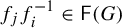 .
.
5 Regularity properties
In this section, we formulate several useful properties that a subgroup G of
${\mathrm {Homeo}}(X)$
 may or may not have, and establish relations between them. When proving statements on the ample group
$\mathsf {F}(G)$
may or may not have, and establish relations between them. When proving statements on the ample group
$\mathsf {F}(G)$
 , we will usually need some of those properties. Let us begin with a very well-known property that will be required most of the time.
Definition 5.1. We say that a group
$G\subset {\mathrm {Homeo}}(X)$
 acts minimally on X (or that the natural action of G on X is minimal) if there are no closed sets invariant under the action other than the empty set and X itself.
A set
$Y\subset X$
 is invariant under a homeomorphism
$f:X\to X$
is invariant under a homeomorphism
$f:X\to X$
 if
$f(Y)\subset Y$
if
$f(Y)\subset Y$
 . It is invariant under the natural action of a group
$G\subset {\mathrm {Homeo}}(X)$
. It is invariant under the natural action of a group
$G\subset {\mathrm {Homeo}}(X)$
 if
$g(Y)\subset Y$
if
$g(Y)\subset Y$
 for all
$g\in G$
for all
$g\in G$
 . For any
$g\in G$
. For any
$g\in G$
 , the inverse map
$g^{-1}$
, the inverse map
$g^{-1}$
 is in G as well. Assuming invariance of the set Y, we have
$g(Y)\subset Y$
is in G as well. Assuming invariance of the set Y, we have
$g(Y)\subset Y$
 and
$g^{-1}(Y)\subset Y$
and
$g^{-1}(Y)\subset Y$
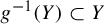 , which implies that, in fact,
$g(Y)=Y$
, which implies that, in fact,
$g(Y)=Y$
 for all
$g\in G$
for all
$g\in G$
 .
.
For any point
$x\in X$
 , the closure
$\overline {{\mathrm {Orb}}_G(x)}$
, the closure
$\overline {{\mathrm {Orb}}_G(x)}$
 of its orbit is a closed set invariant under the action of the group G. It easily follows that the action is minimal if and only if every orbit is dense in X.
Lemma 5.2. Suppose a topological space X is totally disconnected, compact, and metrizable. If there is a group
$G\subset {\mathrm {Homeo}}(X)$
 that acts minimally on X, then X is either finite or a Cantor set.
Proof. If a point
$x\in X$
 is isolated, then the set
$\{x\}$
is isolated, then the set
$\{x\}$
 is clopen. It follows that the set Y of all non-isolated points of X is closed. Any homeomorphism of X maps an isolated point to an isolated point. Hence, the set Y is invariant under the action of any group
$G\subset {\mathrm {Homeo}}(X)$
is clopen. It follows that the set Y of all non-isolated points of X is closed. Any homeomorphism of X maps an isolated point to an isolated point. Hence, the set Y is invariant under the action of any group
$G\subset {\mathrm {Homeo}}(X)$
 . If the action is minimal, then either Y is empty or
$Y=X$
. If the action is minimal, then either Y is empty or
$Y=X$
 . In the case
$Y=X$
. In the case
$Y=X$
 , there are no isolated points. Then, X is a Cantor set due to Brouwer’s characterization of Cantor sets. In the case where Y is empty, every point of X is isolated. Hence, the partition of X into points is a partition into clopen sets. Then, compactness of X implies that it is finite.
The following technical statement is used several times in our paper.
Lemma 5.3. Let
$U,U'\subset X$
 be non-empty clopen sets. If a group
$G\subset {\mathrm {Homeo}}(X)$
be non-empty clopen sets. If a group
$G\subset {\mathrm {Homeo}}(X)$
 acts minimally on X, then for some
$k\ge 1$
acts minimally on X, then for some
$k\ge 1$
 , there exist disjoint clopen sets
$V_1,V_2,\ldots ,V_k$
, there exist disjoint clopen sets
$V_1,V_2,\ldots ,V_k$
 and maps
$g_1,g_2,\ldots ,g_k\in G$
and maps
$g_1,g_2,\ldots ,g_k\in G$
 such that
$U=V_1\sqcup V_2\sqcup \cdots \sqcup V_k$
such that
$U=V_1\sqcup V_2\sqcup \cdots \sqcup V_k$
 and
$g_i(V_i)\subset U'$
and
$g_i(V_i)\subset U'$
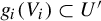 for all i.
Proof. Since the group G acts minimally, the orbit of any point
$x\in U$
 is dense in X. In particular, the orbit has a point in the non-empty clopen set
$U'$
is dense in X. In particular, the orbit has a point in the non-empty clopen set
$U'$
 . Hence,
$g_x(x)\in U'$
. Hence,
$g_x(x)\in U'$
 for some map
$g_x\in G$
for some map
$g_x\in G$
 . Let
$U_x=U\cap g_x^{-1}(U')$
. Let
$U_x=U\cap g_x^{-1}(U')$
 . Then,
$U_x$
. Then,
$U_x$
 is a clopen subset of U containing the point x, and
$g_x(U_x)\subset U'$
is a clopen subset of U containing the point x, and
$g_x(U_x)\subset U'$
 . The clopen sets
$U_x$
. The clopen sets
$U_x$
 ,
$x\in U$
,
$x\in U$
 cover U. Since U is compact, there are finitely many points
$x_1,x_2,\ldots ,x_k\in U$
cover U. Since U is compact, there are finitely many points
$x_1,x_2,\ldots ,x_k\in U$
 such that the sets
$U_{x_i}$
such that the sets
$U_{x_i}$
 ,
$1\le i\le k$
,
$1\le i\le k$
 form a subcover. Let
$V_1=U_{x_1}$
form a subcover. Let
$V_1=U_{x_1}$
 and
$V_i=U_{x_i}\setminus (U_{x_1}\cup \cdots \cup U_{x_{i-1}})$
and
$V_i=U_{x_i}\setminus (U_{x_1}\cup \cdots \cup U_{x_{i-1}})$
 for
$i=2,3,\ldots ,k$
for
$i=2,3,\ldots ,k$
 . Then,
$V_1,V_2,\ldots ,V_k$
. Then,
$V_1,V_2,\ldots ,V_k$
 are clopen sets that partition U. By construction,
$g_{x_i}(V_i)\subset g_{x_i}(U_{x_i})\subset U'$
are clopen sets that partition U. By construction,
$g_{x_i}(V_i)\subset g_{x_i}(U_{x_i})\subset U'$
 for all i.
The other properties formulated in this section are less (if at all) known, and we will introduce an initialism for each of them.
Property UR. (Universal recurrence)
For any open set
$U\subset X$
 , any point
$x\in U$
, any point
$x\in U$
 , and any element
$g\in G$
, and any element
$g\in G$
 , there exists an integer
$k\ge 1$
, there exists an integer
$k\ge 1$
 such that
$g^k(x)\in U$
such that
$g^k(x)\in U$
 .
.
A point
$x\in X$
 is called recurrent relative to a homeomorphism
$f:X\to X$
is called recurrent relative to a homeomorphism
$f:X\to X$
 if the sequence
$f(x),f^2(x),f^3(x),\ldots $
if the sequence
$f(x),f^2(x),f^3(x),\ldots $
 visits every neighborhood of x. Property UR means that every point of X is recurrent relative to every element of the group G.
Property NC. (No contraction)
If
$g(U)\subset U$
 for some element
$g\in G$
for some element
$g\in G$
 and open set
$U\subset X$
and open set
$U\subset X$
 , then, in fact,
$g(U)=U$
, then, in fact,
$g(U)=U$
 .
.
Open sets could be replaced by closed sets in the formulation of Property NC. Indeed, a homeomorphism
$f\in {\mathrm {Homeo}}(X)$
 contracts an open set
$U\subset X$
contracts an open set
$U\subset X$
 (that is, maps it onto a proper subset of U) if and only if the inverse map
$f^{-1}$
(that is, maps it onto a proper subset of U) if and only if the inverse map
$f^{-1}$
 contracts the closed set
$f(X\setminus U)$
contracts the closed set
$f(X\setminus U)$
 .
.
Let us mention two obvious cases in which no contraction of any sets, open or not, is possible. The first case is when the topological space X is finite. The second case is when every element of the group G has finite order (this actually includes the first case).
Proof. Assume that the group
$G\subset {\mathrm {Homeo}}(X)$
 has Property NC. Take any open set
$U\subset X$
has Property NC. Take any open set
$U\subset X$
 and element
$g\in G$
and element
$g\in G$
 . Since g is a homeomorphism, the sets
$g^{-1}(U),g^{-2}(U),\ldots $
. Since g is a homeomorphism, the sets
$g^{-1}(U),g^{-2}(U),\ldots $
 are open as well and so is the union
$W=U\cup g^{-1}(U)\cup g^{-2}(U)\cup \cdots $
are open as well and so is the union
$W=U\cup g^{-1}(U)\cup g^{-2}(U)\cup \cdots $
 . Note that
$g^{-1}(W)=g^{-1}(U)\cup g^{-2}(U)\cup g^{-3}(U)\cup \cdots $
. Note that
$g^{-1}(W)=g^{-1}(U)\cup g^{-2}(U)\cup g^{-3}(U)\cup \cdots $
 , which implies that
$g^{-1}(W)\subset W$
, which implies that
$g^{-1}(W)\subset W$
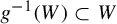 . Since
$g^{-1}\in G$
. Since
$g^{-1}\in G$
 and the group G has Property NC, we have
$g^{-1}(W)=W$
and the group G has Property NC, we have
$g^{-1}(W)=W$
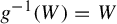 . As a consequence, any point
$x\in U$
. As a consequence, any point
$x\in U$
 belongs to
$g^{-k}(U)$
belongs to
$g^{-k}(U)$
 for some
$k\ge 1$
for some
$k\ge 1$
 . Then,
$g^k(x)\in U$
. Then,
$g^k(x)\in U$
 . Thus, G has Property UR.
Conversely, assume that the group G does not have Property NC. Then, there exist an open set
$U\subset X$
 and an element
$g\in G$
and an element
$g\in G$
 such that
$g(U)$
such that
$g(U)$
 is a proper subset of U. The inverse map
$h=g^{-1}$
is a proper subset of U. The inverse map
$h=g^{-1}$
 is also an element of G. Take any point
$x\in U$
is also an element of G. Take any point
$x\in U$
 not in
$g(U)$
not in
$g(U)$
 . The condition
$g(U)\subset U$
. The condition
$g(U)\subset U$
 implies that
$h(X\setminus g(U))\subset X\setminus U$
implies that
$h(X\setminus g(U))\subset X\setminus U$
 and
$h(X\setminus U)\subset X\setminus U$
and
$h(X\setminus U)\subset X\setminus U$
 . It follows that the sequence
$h(x),h^2(x),h^3(x),\ldots $
. It follows that the sequence
$h(x),h^2(x),h^3(x),\ldots $
 never visits U. We conclude that the group G does not have Property UR.
Lemma 5.5. Suppose that the group G does not have Property NC. Then, there exist an open set
$U\subset X$
 and an element
$g\in G$
and an element
$g\in G$
 such that
$g(U)\subset U$
such that
$g(U)\subset U$
 and the set difference
$U\setminus g(U)$
and the set difference
$U\setminus g(U)$
 consists of a single point.
Proof. Lemma 5.4 implies that the group G does not have Property UR. Hence, there exist an open set
$W\subset X$
 , a point
$x\in W$
, a point
$x\in W$
 , and a map
$h\in G$
, and a map
$h\in G$
 such that the sequence
$h(x),h^2(x),h^3(x),\ldots $
such that the sequence
$h(x),h^2(x),h^3(x),\ldots $
 never visits W. The inverse map
$g=h^{-1}$
never visits W. The inverse map
$g=h^{-1}$
 is also an element of G. Let
$S=\{h^k(x)\mid k\ge 1\}$
is also an element of G. Let
$S=\{h^k(x)\mid k\ge 1\}$
 and
$U=X\setminus \overline {S}$
and
$U=X\setminus \overline {S}$
 , the complement of the closure of S. Since g is a homeomorphism, it follows that
$g(\overline {S})=\overline {g(S)}$
, the complement of the closure of S. Since g is a homeomorphism, it follows that
$g(\overline {S})=\overline {g(S)}$
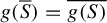 . It is easy to see that
$g(S)=S\cup \{x\}$
. It is easy to see that
$g(S)=S\cup \{x\}$
 . Hence,
$\overline {g(S)}=\overline {S}\cup \{x\}$
. Hence,
$\overline {g(S)}=\overline {S}\cup \{x\}$
 . Consequently,
$g(U)=X\setminus g(\overline {S})=X\setminus (\overline {S}\cup \{x\}) =U\setminus \{x\}$
. Consequently,
$g(U)=X\setminus g(\overline {S})=X\setminus (\overline {S}\cup \{x\}) =U\setminus \{x\}$
 . By construction, U is an open set. In addition,
$W\subset U$
. By construction, U is an open set. In addition,
$W\subset U$
 since W is an open set disjoint from S. In particular,
$x\in U$
since W is an open set disjoint from S. In particular,
$x\in U$
 . Thus,
$g(U)\subset U$
. Thus,
$g(U)\subset U$
 and
$U\setminus g(U)$
and
$U\setminus g(U)$
 consists of a single point.
Note that by replacing open sets with clopen sets in the formulation of Property UR, we obtain an equivalent property. However, Lemma 5.5 suggests that having no contraction of clopen sets may not be enough to have Property NC.
Property SC. (Strong contraction)
For any clopen set
$U\subset X$
 different from the empty set and X, there exist maps
$f_1,f_2\in G$
different from the empty set and X, there exist maps
$f_1,f_2\in G$
 such that the images
$f_1(U)$
such that the images
$f_1(U)$
 and
$f_2(U)$
and
$f_2(U)$
 are disjoint subsets of U.
In the case where the group G is ample, Property SC coincides with a property introduced by Matui [Reference Matui47] in a more general context of étale groupoids. Matui calls groupoids with this property purely infinite (see [Reference Matui47, Definition 4.9]). Just like in [Reference Matui47], we introduce another, closely related property.
Property UC. (Universal contraction)
For any clopen sets
$A,B\subset X$
 different from the empty set and X, there exists a map
$f\in G$
different from the empty set and X, there exists a map
$f\in G$
 such that
$f(A)\subset B$
such that
$f(A)\subset B$
 .
.
Properties SC and UC vacuously hold if the topological space X consists of a single point. Property UC also holds if X consists of two points and the group G is not trivial. Otherwise, either of the two properties implies the absence of isolated points in X, which requires X to be a Cantor set.
Lemma 5.6. Suppose X is a Cantor set. Then, for any group
$G\subset {\mathrm {Homeo}}(X)$
 , Property UC implies minimality and Property SC. If the group G is ample, then conversely, minimality and Property SC imply Property UC.
Proof. Assume a group
$G\subset {\mathrm {Homeo}}(X)$
 has Property UC. Since the topology on X is generated by clopen sets, Property UC clearly implies that every orbit of the group G is dense. Hence, G acts minimally on X. Since X is a Cantor set, any clopen set
$U\subset X$
has Property UC. Since the topology on X is generated by clopen sets, Property UC clearly implies that every orbit of the group G is dense. Hence, G acts minimally on X. Since X is a Cantor set, any clopen set
$U\subset X$
 different from
$\emptyset $
different from
$\emptyset $
 and X consists of more than one point. Therefore, it can be represented as a disjoint union of two non-empty clopen sets
$U_1$
and X consists of more than one point. Therefore, it can be represented as a disjoint union of two non-empty clopen sets
$U_1$
 and
$U_2$
and
$U_2$
 . Property UC implies that
$f_1(U)\subset U_1$
. Property UC implies that
$f_1(U)\subset U_1$
 and
$f_2(U)\subset U_2$
and
$f_2(U)\subset U_2$
 for some maps
$f_1,f_2\in G$
for some maps
$f_1,f_2\in G$
 . Then,
$f_1(U)$
. Then,
$f_1(U)$
 and
$f_2(U)$
and
$f_2(U)$
 are disjoint subsets of U. Thus, the group G has Property SC.
Conversely, assume the group G is ample, acts minimally on X, and has Property SC. For any clopen set
$W\subset X$
 different from
$\emptyset $
different from
$\emptyset $
 and X, there exist maps
$f_1,f_2\in G$
and X, there exist maps
$f_1,f_2\in G$
 such that the images
$f_1(W)$
such that the images
$f_1(W)$
 and
$f_2(W)$
and
$f_2(W)$
 are disjoint subsets of W. Then,
$f_1(W)$
are disjoint subsets of W. Then,
$f_1(W)$
 is a proper subset of W. It follows that
$f_1^{j+1}(W)$
is a proper subset of W. It follows that
$f_1^{j+1}(W)$
 is a proper subset of
$f_1^j(W)$
is a proper subset of
$f_1^j(W)$
 for all
$j\ge 0$
for all
$j\ge 0$
 . Let
$D=W\setminus f_1(W)$
. Let
$D=W\setminus f_1(W)$
 . Then,
$f_1^j(D)=f_1^j(W)\setminus f_1^{j+1}(W)$
. Then,
$f_1^j(D)=f_1^j(W)\setminus f_1^{j+1}(W)$
 for all
$j\ge 0$
for all
$j\ge 0$
 , which implies that
$D,f_1(D),f_1^2(D),\ldots $
, which implies that
$D,f_1(D),f_1^2(D),\ldots $
 are disjoint subsets of W.
Let us show that any clopen set
$U\subset X$
 different from
$\emptyset $
different from
$\emptyset $
 and X can be mapped to its complement by an element of G. By the above, there exist a non-empty clopen set D and a map
$f\in G$
and X can be mapped to its complement by an element of G. By the above, there exist a non-empty clopen set D and a map
$f\in G$
 such that
$D,f(D),f^2(D),\ldots $
such that
$D,f(D),f^2(D),\ldots $
 are disjoint subsets of
$X\setminus U$
are disjoint subsets of
$X\setminus U$
 . By Lemma 5.3, for some
$k\ge 1$
. By Lemma 5.3, for some
$k\ge 1$
 , there exist disjoint clopen sets
$V_1,V_2,\ldots ,V_k$
, there exist disjoint clopen sets
$V_1,V_2,\ldots ,V_k$
 and maps
$g_1,g_2,\ldots ,g_k\in G$
and maps
$g_1,g_2,\ldots ,g_k\in G$
 such that
$U=V_1\sqcup V_2\sqcup \cdots \sqcup V_k$
such that
$U=V_1\sqcup V_2\sqcup \cdots \sqcup V_k$
 and
$g_i(V_i)\subset D$
and
$g_i(V_i)\subset D$
 for all i. For any i,
$1\le i\le k$
for all i. For any i,
$1\le i\le k$
 , let
$h_i=f^{i-1}g_i$
, let
$h_i=f^{i-1}g_i$
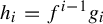 . Then,
$h_i\in G$
. Then,
$h_i\in G$
 and
$h_i(V_i)\subset f^{i-1}(D)$
and
$h_i(V_i)\subset f^{i-1}(D)$
 . Therefore,
$h_1(V_1),h_2(V_2),\ldots ,h_k(V_k)$
. Therefore,
$h_1(V_1),h_2(V_2),\ldots ,h_k(V_k)$
 are disjoint subsets of
$X\setminus U$
are disjoint subsets of
$X\setminus U$
 . Note that the generalized
$2$
. Note that the generalized
$2$
 -cycles
$\delta _{V_i;h_i}$
-cycles
$\delta _{V_i;h_i}$
 ,
$1\le i\le k$
,
$1\le i\le k$
 are well defined. Since the group G is ample, it contains all of them as well as their product
$h=\delta _{V_1;h_1}\delta _{V_2;h_2}\cdots \delta _{V_k;h_k}$
are well defined. Since the group G is ample, it contains all of them as well as their product
$h=\delta _{V_1;h_1}\delta _{V_2;h_2}\cdots \delta _{V_k;h_k}$
 . As the sets
$V_1,V_2,\ldots ,V_k$
. As the sets
$V_1,V_2,\ldots ,V_k$
 and
$h_1(V_1),h_2(V_2),\ldots ,h_k(V_k)$
and
$h_1(V_1),h_2(V_2),\ldots ,h_k(V_k)$
 are disjoint from one another,
$h(V_i)=\delta _{V_i;h_i}(V_i)=h_i(V_i)$
are disjoint from one another,
$h(V_i)=\delta _{V_i;h_i}(V_i)=h_i(V_i)$
 for all i so that
$h(V_i)\subset X\setminus U$
for all i so that
$h(V_i)\subset X\setminus U$
 for all i. Then,
$h(U)\subset X\setminus U$
for all i. Then,
$h(U)\subset X\setminus U$
 as well.
Now, we can establish Property UC. Take any clopen sets
$A,B\subset X$
 different from the empty set and X. We need to show that A can be mapped to B by an element of the group G. First, consider the case where
$A\cup B\ne X$
different from the empty set and X. We need to show that A can be mapped to B by an element of the group G. First, consider the case where
$A\cup B\ne X$
 . Then,
$C=X\setminus (A\cup B)$
. Then,
$C=X\setminus (A\cup B)$
 is a non-empty clopen set. By the above,
$h_1(A\cup B)\subset C$
is a non-empty clopen set. By the above,
$h_1(A\cup B)\subset C$
 and
$h_2(X\setminus B)\subset B$
and
$h_2(X\setminus B)\subset B$
 for some maps
$h_1,h_2\in G$
for some maps
$h_1,h_2\in G$
 . Since
$C\subset X\setminus B$
. Since
$C\subset X\setminus B$
 , we obtain that
$h_2h_1(A)\subset h_2h_1(A\cup B)\subset h_2(C)\subset h_2(X\setminus B)\subset B$
, we obtain that
$h_2h_1(A)\subset h_2h_1(A\cup B)\subset h_2(C)\subset h_2(X\setminus B)\subset B$
 . As for the case where
$A\cup B=X$
. As for the case where
$A\cup B=X$
 , we have
$h(A)\subset X\setminus A$
, we have
$h(A)\subset X\setminus A$
 for some
$h\in G$
for some
$h\in G$
 . If
$A\cup B=X$
. If
$A\cup B=X$
 , then the complement
$X\setminus A$
, then the complement
$X\setminus A$
 is contained in B.
Property CI. (Cancellation of intersection)
For any non-empty clopen sets
$A,B,C\subset X$
 such that C is disjoint from
$A\cup B$
such that C is disjoint from
$A\cup B$
 , and the unions
$A\cup C$
, and the unions
$A\cup C$
 and
$B\cup C$
and
$B\cup C$
 are different from X, we have
$f(A\cup C)=B\cup C$
are different from X, we have
$f(A\cup C)=B\cup C$
 for some
$f\in G$
for some
$f\in G$
 if and only if
$h(A)=B$
if and only if
$h(A)=B$
 for some
$h\in G$
for some
$h\in G$
 .
.
Definition 5.7. Given non-empty clopen sets
$D,E\subset X$
 , we say that D can be absorbed by E under the action of a group
$G\subset {\mathrm {Homeo}}(X)$
, we say that D can be absorbed by E under the action of a group
$G\subset {\mathrm {Homeo}}(X)$
 if E is disjoint from D and
$g(D\cup E)=E$
if E is disjoint from D and
$g(D\cup E)=E$
 for some
$g\in G$
for some
$g\in G$
 . Further, a non-empty clopen set is called absorbable under the action of G if it can be absorbed by another clopen set.
Lemma 5.8. Suppose a non-empty clopen set
$D\subset X$
 is absorbable under the action of a group
$G\subset {\mathrm {Homeo}}(X)$
is absorbable under the action of a group
$G\subset {\mathrm {Homeo}}(X)$
 that has Property CI. Then, D can be absorbed by any clopen set
$E\subset X\setminus D$
that has Property CI. Then, D can be absorbed by any clopen set
$E\subset X\setminus D$
 different from the empty set and
$X\setminus D$
different from the empty set and
$X\setminus D$
 .
.
Proof. Since the set D is absorbable under the action of the group G, we have
${f(D\cup E_0)=E_0}$
 for some
$f\in G$
for some
$f\in G$
 and clopen set
$E_0$
and clopen set
$E_0$
 disjoint from D. Note that
$E_0$
disjoint from D. Note that
$E_0$
 is different from
$\emptyset $
is different from
$\emptyset $
 and
$X\setminus D$
and
$X\setminus D$
 . Consider an arbitrary clopen set
$E\subset X\setminus D$
. Consider an arbitrary clopen set
$E\subset X\setminus D$
 different from
$\emptyset $
different from
$\emptyset $
 and
$X\setminus D$
and
$X\setminus D$
 . In the case where
$E\cap E_0\ne \emptyset $
. In the case where
$E\cap E_0\ne \emptyset $
 , Property CI first implies that
${g(D\cup (E\cap E_0))=E\cap E_0}$
, Property CI first implies that
${g(D\cup (E\cap E_0))=E\cap E_0}$
 for some
$g\in G$
for some
$g\in G$
 , then implies that
$h(D\cup E)=E$
, then implies that
$h(D\cup E)=E$
 for some
$h\in G$
for some
$h\in G$
 . Similarly, in the case where
$E\cup E_0\ne X\setminus D$
. Similarly, in the case where
$E\cup E_0\ne X\setminus D$
 , Property CI first implies that
$g(D\cup (E\cup E_0))=E\cup E_0$
, Property CI first implies that
$g(D\cup (E\cup E_0))=E\cup E_0$
 for some
${g\in G}$
for some
${g\in G}$
 , then implies that
$h(D\cup E)=E$
, then implies that
$h(D\cup E)=E$
 for some
$h\in G$
for some
$h\in G$
 . Finally, in the case where
$E\cap E_0=\emptyset $
. Finally, in the case where
$E\cap E_0=\emptyset $
 and
$E\cup E_0=X\setminus D$
and
$E\cup E_0=X\setminus D$
 , we have
$f(E)=D\cup E$
, we have
$f(E)=D\cup E$
 so that
${f^{-1}(D\cup E)=E}$
so that
${f^{-1}(D\cup E)=E}$
 . Thus, D can be absorbed by E.
Lemma 5.9. Any group
$G\subset {\mathrm {Homeo}}(X)$
 with Property CI satisfies the following two conditions.
-
(CI-1) For any disjoint nonempty clopen sets $A,B,C\subset X$
, if
$f(A\cup C)= B\cup C$
for some
$f\in G$
, then
$h(A)=B$
for some
$h\in G$
. -
(CI-2) For any disjoint non-empty clopen sets $D,E_0,E\subset X$
, if
$f(D\cup E_0)= E_0$
for some
$f\in G$
, then
$h(D\cup E)=E$
for some
$h\in G$
.









If the group G is ample, then conversely, conditions (CI-1) and (CI-2) imply Property CI.
Proof. Suppose a group
$G\subset {\mathrm {Homeo}}(X)$
 has Property CI. For any disjoint non-empty sets
$A,B,C\subset X$
has Property CI. For any disjoint non-empty sets
$A,B,C\subset X$
 , the unions
$A\cup C$
, the unions
$A\cup C$
 and
$B\cup C$
and
$B\cup C$
 are both different from X. Hence, condition (CI-1) follows directly from Property CI. As for condition (CI-2), it easily follows from Lemma 5.8.
Now, let us prove that any ample group
$G\subset {\mathrm {Homeo}}(X)$
 satisfying conditions (CI-1) and (CI-2) has Property CI. Given non-empty clopen sets
$A,B,C\subset X$
satisfying conditions (CI-1) and (CI-2) has Property CI. Given non-empty clopen sets
$A,B,C\subset X$
 , where C is disjoint from both A and B,
$A\cup C\ne X$
, where C is disjoint from both A and B,
$A\cup C\ne X$
 and
$B\cup C\ne X$
and
$B\cup C\ne X$
 , we need to show that the set
$A\cup C$
, we need to show that the set
$A\cup C$
 can be mapped onto
$B\cup C$
can be mapped onto
$B\cup C$
 under the action of G if and only if the set A can be mapped onto B. This is trivial when
$A=B$
under the action of G if and only if the set A can be mapped onto B. This is trivial when
$A=B$
 . Consider the case where both
$A\setminus B$
. Consider the case where both
$A\setminus B$
 and
$B\setminus A$
and
$B\setminus A$
 are non-empty sets. If
$f(A\cup C)=B\cup C$
are non-empty sets. If
$f(A\cup C)=B\cup C$
 or
$f(A)=B$
or
$f(A)=B$
 for some
$f\in G$
for some
$f\in G$
 , condition (CI-1) implies that
$g(A\setminus B)=B\setminus A$
, condition (CI-1) implies that
$g(A\setminus B)=B\setminus A$
 for some
$g\in G$
for some
$g\in G$
 . Since the clopen sets
$A\setminus B$
. Since the clopen sets
$A\setminus B$
 and
$B\setminus A$
and
$B\setminus A$
 are disjoint, a generalized
$2$
are disjoint, a generalized
$2$
 -cycle
$h=\delta _{A\setminus B;g}$
-cycle
$h=\delta _{A\setminus B;g}$
 is well defined. It belongs to the group G as G is ample. Since h coincides with the identity map on
$A\cap B$
is well defined. It belongs to the group G as G is ample. Since h coincides with the identity map on
$A\cap B$
 and on C, we obtain that
$h(A)=B$
and on C, we obtain that
$h(A)=B$
 and
$h(A\cup C)=B\cup C$
and
$h(A\cup C)=B\cup C$
 .
.
It remains to consider the case where one of the sets A and B is a proper subset of the other. Without loss of generality, we may assume that B is a proper subset of A. Note that the set
$B\cup C$
 is disjoint from
$A\setminus B$
is disjoint from
$A\setminus B$
 and
$(A\setminus B)\cup (B\cup C)=A\cup C\ne X$
and
$(A\setminus B)\cup (B\cup C)=A\cup C\ne X$
 . Hence, X is a disjoint union of four non-empty clopen sets
$A\setminus B$
. Hence, X is a disjoint union of four non-empty clopen sets
$A\setminus B$
 , B, C, and
$X\setminus (A\cup C)$
, B, C, and
$X\setminus (A\cup C)$
 . Condition (CI-2) first implies that the set
$A\setminus B$
. Condition (CI-2) first implies that the set
$A\setminus B$
 can be absorbed by
$B\cup C$
can be absorbed by
$B\cup C$
 if and only if it can be absorbed by
$X\setminus (A\cup C)$
if and only if it can be absorbed by
$X\setminus (A\cup C)$
 , then implies that
$A\setminus B$
, then implies that
$A\setminus B$
 can be absorbed by
$X\setminus (A\cup C)$
can be absorbed by
$X\setminus (A\cup C)$
 if and only if it can be absorbed by B. Consequently,
$f(A\cup C)=B\cup C$
if and only if it can be absorbed by B. Consequently,
$f(A\cup C)=B\cup C$
 for some
$f\in G$
for some
$f\in G$
 if and only if
$h(A)=B$
if and only if
$h(A)=B$
 for some
$h\in G$
for some
$h\in G$
 .
.
Proof. Suppose a group
$G\subset {\mathrm {Homeo}}(X)$
 is ample and has Property NC. To establish Property CI, we are going to show that G satisfies conditions (CI-1) and (CI-2) in Lemma 5.9. Since the group G allows no contraction of open sets, it also allows no absorbable sets. Hence, condition (CI-2) holds vacuously. Let us verify condition (CI-1). Consider any disjoint non-empty clopen sets
$A,B,C\subset X$
is ample and has Property NC. To establish Property CI, we are going to show that G satisfies conditions (CI-1) and (CI-2) in Lemma 5.9. Since the group G allows no contraction of open sets, it also allows no absorbable sets. Hence, condition (CI-2) holds vacuously. Let us verify condition (CI-1). Consider any disjoint non-empty clopen sets
$A,B,C\subset X$
 such that
$f(A\cup C)=B\cup C$
such that
$f(A\cup C)=B\cup C$
 for some
$f\in G$
for some
$f\in G$
 . We need to find an element of G that maps A onto B. By Lemma 5.4, Property NC is equivalent to Property UR. Therefore, the group G has Property UR. As a consequence, for any point
$x\in A$
. We need to find an element of G that maps A onto B. By Lemma 5.4, Property NC is equivalent to Property UR. Therefore, the group G has Property UR. As a consequence, for any point
$x\in A$
 , the sequence
$f(x),f^2(x),f^3(x),\ldots $
, the sequence
$f(x),f^2(x),f^3(x),\ldots $
 visits the set A. In particular, this sequence is not contained in C. Let
$p(x)$
visits the set A. In particular, this sequence is not contained in C. Let
$p(x)$
 denote the least positive integer k such that
$f^k(x)\notin C$
denote the least positive integer k such that
$f^k(x)\notin C$
 . Since
$f(A\cup C)=B\cup C$
. Since
$f(A\cup C)=B\cup C$
 , it follows that
$f^{p(x)}(x)\in B$
, it follows that
$f^{p(x)}(x)\in B$
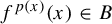 . Likewise, Property UR implies that for any point
$y\in B$
. Likewise, Property UR implies that for any point
$y\in B$
 , the sequence
$f^{-1}(y),f^{-2}(y),f^{-3}(y),\ldots $
, the sequence
$f^{-1}(y),f^{-2}(y),f^{-3}(y),\ldots $
 visits B and, hence, is not confined to C. Let
$m(y)$
visits B and, hence, is not confined to C. Let
$m(y)$
 denote the least positive integer k such that
$f^{-k}(y)\notin C$
denote the least positive integer k such that
$f^{-k}(y)\notin C$
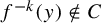 . Then,
$f^{-m(y)}(y)\in A$
. Then,
$f^{-m(y)}(y)\in A$
 . For any integer
$k\ge 1$
. For any integer
$k\ge 1$
 , let
$A_k=\{x\in A\mid p(x)=k\}$
, let
$A_k=\{x\in A\mid p(x)=k\}$
 and
$B_k=\{y\in B\mid m(y)=k\}$
and
$B_k=\{y\in B\mid m(y)=k\}$
 . The sets
$A_1,A_2,A_3,\ldots $
. The sets
$A_1,A_2,A_3,\ldots $
 form a partition of A, while the sets
$B_1,B_2,B_3,\ldots $
form a partition of A, while the sets
$B_1,B_2,B_3,\ldots $
 form a partition of B. By construction,
$f^k(A_k)\subset B_k$
form a partition of B. By construction,
$f^k(A_k)\subset B_k$
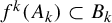 and
$f^{-k}(B_k)\subset A_k$
and
$f^{-k}(B_k)\subset A_k$
 for all k, which implies that
$f^k(A_k)=B_k$
for all k, which implies that
$f^k(A_k)=B_k$
 for all k.
Now, we define a map
$h:X\to X$
 by
$h(x)=f^{p(x)}(x)$
by
$h(x)=f^{p(x)}(x)$
 if
$x\in A$
if
$x\in A$
 ,
$h(x)=f^{-m(x)}(x)$
,
$h(x)=f^{-m(x)}(x)$
 if
$x\in B$
if
$x\in B$
 , and
$h(x)=x$
, and
$h(x)=x$
 otherwise. For any
$k\ge 1$
otherwise. For any
$k\ge 1$
 , the map h coincides with
$f^k$
, the map h coincides with
$f^k$
 on
$A_k$
on
$A_k$
 and with
$f^{-k}$
and with
$f^{-k}$
 on
$B_k$
on
$B_k$
 . Since
$f^k(A_k)=B_k$
. Since
$f^k(A_k)=B_k$
 for all k, it follows that h is an involution. In addition,
$h(A)=B$
for all k, it follows that h is an involution. In addition,
$h(A)=B$
 .
.
Notice that all sets of the form
$A_k$
 and
$B_k$
and
$B_k$
 are clopen. Indeed,
$A_k$
are clopen. Indeed,
$A_k$
 is the intersection of clopen sets A,
$f^{-k}(B)$
is the intersection of clopen sets A,
$f^{-k}(B)$
 and
$f^{-i}(C)$
and
$f^{-i}(C)$
 ,
$1\le i\le k-1$
,
$1\le i\le k-1$
 . Likewise,
$B_k$
. Likewise,
$B_k$
 is the intersection of clopen sets B,
$f^k(A)$
is the intersection of clopen sets B,
$f^k(A)$
 and
$f^i(C)$
and
$f^i(C)$
 ,
$1\le i\le k-1$
,
$1\le i\le k-1$
 . Since the set A, which is compact, is the disjoint union of clopen sets
$A_1,A_2,A_3,\ldots, $
. Since the set A, which is compact, is the disjoint union of clopen sets
$A_1,A_2,A_3,\ldots, $
 all but finitely many of those sets have to be empty. Likewise, all but finitely many of the sets
$B_1,B_2,B_3,\ldots $
all but finitely many of those sets have to be empty. Likewise, all but finitely many of the sets
$B_1,B_2,B_3,\ldots $
 are empty. As a consequence, the map h is piecewise an element of the group G. Since h is invertible, we conclude that h belongs to the group
$\mathsf {F}(G)$
are empty. As a consequence, the map h is piecewise an element of the group G. Since h is invertible, we conclude that h belongs to the group
$\mathsf {F}(G)$
 , which coincides with G as G is ample.
Proof. Suppose a group
$G\subset {\mathrm {Homeo}}(X)$
 is ample and has Property UC. To establish Property CI, we are going to show that the group G satisfies conditions (CI-1) and (CI-2) in Lemma 5.9. We begin with condition (CI-1). Take any disjoint non-empty clopen sets
$A,B,C\subset X$
is ample and has Property UC. To establish Property CI, we are going to show that the group G satisfies conditions (CI-1) and (CI-2) in Lemma 5.9. We begin with condition (CI-1). Take any disjoint non-empty clopen sets
$A,B,C\subset X$
 such that
$f(A\cup C)=B\cup C$
such that
$f(A\cup C)=B\cup C$
 for some
$f\in G$
for some
$f\in G$
 . First, consider the case where the image
$f(A)$
. First, consider the case where the image
$f(A)$
 intersects B. Then,
$A\cap f^{-1}(B)$
intersects B. Then,
$A\cap f^{-1}(B)$
 is a non-empty clopen set. Property UC implies that
$g(C)\subset A\cap f^{-1}(B)$
is a non-empty clopen set. Property UC implies that
$g(C)\subset A\cap f^{-1}(B)$
 for some
$g\in G$
for some
$g\in G$
 . Let
$O_1=g(C)$
. Let
$O_1=g(C)$
 and
$O_2=f(O_1)$
and
$O_2=f(O_1)$
 . Then,
$O_1$
. Then,
$O_1$
 and
$O_2$
and
$O_2$
 are non-empty clopen subsets of respectively A and B. In particular,
$O_1$
are non-empty clopen subsets of respectively A and B. In particular,
$O_1$
 and
$O_2$
and
$O_2$
 are both disjoint from C. Therefore, the generalized
$2$
are both disjoint from C. Therefore, the generalized
$2$
 -cycles
$\delta _{C;g}$
-cycles
$\delta _{C;g}$
 and
$\delta _{C;fg}$
and
$\delta _{C;fg}$
 are well defined. Since the group G is ample, it contains
$\delta _{C;g}$
are well defined. Since the group G is ample, it contains
$\delta _{C;g}$
 and
$\delta _{C;fg}$
and
$\delta _{C;fg}$
 as well as the map
$h=\delta _{C;fg}f\delta _{C;g}$
as well as the map
$h=\delta _{C;fg}f\delta _{C;g}$
 . Let us find
$h(A)$
. Let us find
$h(A)$
 . The map
$\delta _{C;g}$
. The map
$\delta _{C;g}$
 fixes all points in
$A\setminus O_1$
fixes all points in
$A\setminus O_1$
 while
$O_1$
while
$O_1$
 is mapped onto C. Hence,
$\delta _{C;g}$
is mapped onto C. Hence,
$\delta _{C;g}$
 maps A onto
$(A\setminus O_1)\cup C=(A\cup C)\setminus O_1$
maps A onto
$(A\setminus O_1)\cup C=(A\cup C)\setminus O_1$
 . Further, f maps
$(A\cup C)\setminus O_1$
. Further, f maps
$(A\cup C)\setminus O_1$
 onto
$(B\cup C)\setminus O_2$
onto
$(B\cup C)\setminus O_2$
 . Finally,
$\delta _{C;fg}$
. Finally,
$\delta _{C;fg}$
 coincides with the identity map on
$B\setminus O_2$
coincides with the identity map on
$B\setminus O_2$
 while mapping C onto
$O_2$
while mapping C onto
$O_2$
 . We conclude that
$h(A)=B$
. We conclude that
$h(A)=B$
 .
.
Now, consider the case where
$f(A)$
 is disjoint from B. In this case,
$f(A)\subset C$
is disjoint from B. In this case,
$f(A)\subset C$
 and also
$f^{-1}(B)\subset C$
and also
$f^{-1}(B)\subset C$
 . Property UC implies that
$g_1(C)\subset A$
. Property UC implies that
$g_1(C)\subset A$
 and
$g_2(A)\subset B$
and
$g_2(A)\subset B$
 for some maps
$g_1,g_2\in G$
for some maps
$g_1,g_2\in G$
 . Let
$O_1=g_1(C)$
. Let
$O_1=g_1(C)$
 ,
$O_2=g_2(O_1)$
,
$O_2=g_2(O_1)$
 , and
$O_3=f^{-1}(O_2)$
, and
$O_3=f^{-1}(O_2)$
 . Then,
$O_1$
. Then,
$O_1$
 ,
$O_2$
,
$O_2$
 , and
$O_3$
, and
$O_3$
 are non-empty clopen subsets of A, B, and C, respectively. In particular,
$O_1$
are non-empty clopen subsets of A, B, and C, respectively. In particular,
$O_1$
 and
$O_2$
and
$O_2$
 are both disjoint from C and
$O_3$
are both disjoint from C and
$O_3$
 . Therefore, the generalized
$2$
. Therefore, the generalized
$2$
 -cycles
$\delta _{C;g_1}$
-cycles
$\delta _{C;g_1}$
 ,
$\delta _{C;g_2g_1}$
,
$\delta _{C;g_2g_1}$
 , and
$\delta _{O_1;f^{-1}g_2}$
, and
$\delta _{O_1;f^{-1}g_2}$
 are well defined. The ample group G contains all these generalized
$2$
are well defined. The ample group G contains all these generalized
$2$
 -cycles as well as the map
$h=\delta _{C;g_2g_1}f\delta _{O_1;f^{-1}g_2}\delta _{C;g_1}$
-cycles as well as the map
$h=\delta _{C;g_2g_1}f\delta _{O_1;f^{-1}g_2}\delta _{C;g_1}$
 . Let us find
$h(A)$
. Let us find
$h(A)$
 . The map
$\delta _{C;g_1}$
. The map
$\delta _{C;g_1}$
 fixes all points in
$A\setminus O_1$
fixes all points in
$A\setminus O_1$
 while
$O_1$
while
$O_1$
 is mapped onto C. Hence,
$\delta _{C;g_1}$
is mapped onto C. Hence,
$\delta _{C;g_1}$
 maps A onto
$(A\cup C)\setminus O_1$
maps A onto
$(A\cup C)\setminus O_1$
 . Then,
$\delta _{O_1;f^{-1}g_2}$
. Then,
$\delta _{O_1;f^{-1}g_2}$
 maps
$(A\cup C)\setminus O_1$
maps
$(A\cup C)\setminus O_1$
 onto
$(A\cup C)\setminus O_3$
onto
$(A\cup C)\setminus O_3$
 . Further, f maps
$(A\cup C)\setminus O_3$
. Further, f maps
$(A\cup C)\setminus O_3$
 onto
$(B\cup C)\setminus O_2$
onto
$(B\cup C)\setminus O_2$
 . Finally,
$\delta _{C;g_2g_1}$
. Finally,
$\delta _{C;g_2g_1}$
 coincides with the identity map on
$B\setminus O_2$
coincides with the identity map on
$B\setminus O_2$
 while mapping C onto
$O_2$
while mapping C onto
$O_2$
 . Thus,
$h(A)=B$
. Thus,
$h(A)=B$
 .
.
We proceed to verification of condition (CI-2). Consider any disjoint non-empty clopen sets
$D,E_0,E\subset X$
 such that
$f(D\cup E_0)=E_0$
such that
$f(D\cup E_0)=E_0$
 for some
$f\in G$
for some
$f\in G$
 . Let
$E_1=f(D)$
. Let
$E_1=f(D)$
 and
$E_2=f(E_0)$
and
$E_2=f(E_0)$
 . Then,
$E_1$
. Then,
$E_1$
 and
$E_2$
and
$E_2$
 are non-empty clopen sets that partition
$E_0$
are non-empty clopen sets that partition
$E_0$
 . Property UC implies that
$g(E_0)\subset E$
. Property UC implies that
$g(E_0)\subset E$
 for some
$g\in G$
for some
$g\in G$
 . Let
$U=g(E_0)$
. Let
$U=g(E_0)$
 ,
$U_1=g(E_1)$
,
$U_1=g(E_1)$
 , and
$U_2=g(E_2)$
, and
$U_2=g(E_2)$
 . Then,
$U_1$
. Then,
$U_1$
 and
$U_2$
and
$U_2$
 are non-empty clopen sets that partition U. Now, we define a continuous map
$h:X\to X$
are non-empty clopen sets that partition U. Now, we define a continuous map
$h:X\to X$
 that is piecewise an element of the group G. The map h coincides with
$gf$
that is piecewise an element of the group G. The map h coincides with
$gf$
 on D, with
$f^{-1}$
on D, with
$f^{-1}$
 on
$E_0$
on
$E_0$
 , with
$gfg^{-1}$
, with
$gfg^{-1}$
 on U, and with the identity map everywhere else. We have
$h(D)=g(E_1)=U_1$
on U, and with the identity map everywhere else. We have
$h(D)=g(E_1)=U_1$
 ,
$h(E_0)=D\cup E_0$
,
$h(E_0)=D\cup E_0$
 and
$h(U)=gf(E_0)=g(E_2)=U_2$
and
$h(U)=gf(E_0)=g(E_2)=U_2$
 . Since the sets
$h(D)$
. Since the sets
$h(D)$
 ,
$h(E_0)$
,
$h(E_0)$
 , and
$h(U)$
, and
$h(U)$
 form a partition of
$D\cup E_0\cup U$
form a partition of
$D\cup E_0\cup U$
 , it follows that the map h is invertible and, hence, a homeomorphism. By construction, h belongs to the group
$\mathsf {F}(G)$
, it follows that the map h is invertible and, hence, a homeomorphism. By construction, h belongs to the group
$\mathsf {F}(G)$
 , which coincides with G as G is ample. Note that
$h(D\cup U)=U_1\cup U_2=U$
, which coincides with G as G is ample. Note that
$h(D\cup U)=U_1\cup U_2=U$
 . In addition,
$U\subset E$
. In addition,
$U\subset E$
 and h fixes every point in
$E\setminus U$
and h fixes every point in
$E\setminus U$
 . Therefore,
$h(D\cup E)=E$
. Therefore,
$h(D\cup E)=E$
 . Thus, the set D can be absorbed by E.
Lemma 5.12. If a non-empty clopen set
$U\subset X$
 is absorbable under the action of a group
$G\subset {\mathrm {Homeo}}(X)$
is absorbable under the action of a group
$G\subset {\mathrm {Homeo}}(X)$
 , then for any
$g\in G$
, then for any
$g\in G$
 , the set
$g(U)$
, the set
$g(U)$
 is absorbable as well. If the group G has Property CI then, conversely, any two absorbable sets can be mapped onto each other by elements of G.
Proof. If a clopen set U can be absorbed by a clopen set E under the action of a group
$G\subset {\mathrm {Homeo}}(X)$
 , then for any
$g\in G$
, then for any
$g\in G$
 , the set
$g(U)$
, the set
$g(U)$
 can be absorbed by
$g(E)$
can be absorbed by
$g(E)$
 . Indeed, E is disjoint from U and
$f(U\cup E)=E$
. Indeed, E is disjoint from U and
$f(U\cup E)=E$
 for some
$f\in G$
for some
$f\in G$
 . Then, for any
$g\in G$
. Then, for any
$g\in G$
 , the clopen set
$g(E)$
, the clopen set
$g(E)$
 is disjoint from
$g(U)$
is disjoint from
$g(U)$
 , the map
$h=gfg^{-1}$
, the map
$h=gfg^{-1}$
 belongs to G, and
$h(g(U)\cup g(E))=hg(U\cup E)=gf(U\cup E)=g(E)$
belongs to G, and
$h(g(U)\cup g(E))=hg(U\cup E)=gf(U\cup E)=g(E)$
 .
.
Now, suppose the group G has Property CI and
$U_1,U_2\subset X$
 are two absorbable sets. We need to show that
$h(U_1)=U_2$
are two absorbable sets. We need to show that
$h(U_1)=U_2$
 for some
$h\in G$
for some
$h\in G$
 . First, consider the case where both
$U_1$
. First, consider the case where both
$U_1$
 and
$U_2$
and
$U_2$
 can be absorbed by the same clopen set E. In this case,
$f_1(U_1\cup E)=E$
can be absorbed by the same clopen set E. In this case,
$f_1(U_1\cup E)=E$
 and
$f_2(U_2\cup E)=E$
and
$f_2(U_2\cup E)=E$
 for some
$f_1,f_2\in G$
for some
$f_1,f_2\in G$
 . Then,
$f_2^{-1}f_1\in G$
. Then,
$f_2^{-1}f_1\in G$
 and
$f_2^{-1}f_1(U_1\cup E)=U_2\cup E$
and
$f_2^{-1}f_1(U_1\cup E)=U_2\cup E$
 . Since E is disjoint from both
$U_1$
. Since E is disjoint from both
$U_1$
 and
$U_2$
and
$U_2$
 , Property CI implies that
$h(U_1)=U_2$
, Property CI implies that
$h(U_1)=U_2$
 for some
$h\in G$
for some
$h\in G$
 .
.
If one of the sets
$U_1$
 and
$U_2$
and
$U_2$
 contains the other, it follows from Lemma 5.8 that the smaller set can be absorbed by any clopen set that can absorb the larger one. Next, consider the case where neither of the sets
$U_1$
contains the other, it follows from Lemma 5.8 that the smaller set can be absorbed by any clopen set that can absorb the larger one. Next, consider the case where neither of the sets
$U_1$
 and
$U_2$
and
$U_2$
 contains the other, and also
$U_1\cup U_2\ne X$
contains the other, and also
$U_1\cup U_2\ne X$
 . Then, the clopen set
$E=X\setminus (U_1\cup U_2)$
. Then, the clopen set
$E=X\setminus (U_1\cup U_2)$
 is non-empty, and the unions
$U_1\cup E$
is non-empty, and the unions
$U_1\cup E$
 and
$U_2\cup E$
and
$U_2\cup E$
 are both different from X. By Lemma 5.8, both
$U_1$
are both different from X. By Lemma 5.8, both
$U_1$
 and
$U_2$
and
$U_2$
 can be absorbed by E.
It remains to consider the case where
$U_1\cup U_2=X$
 . Take any clopen set E that can absorb
$U_1$
. Take any clopen set E that can absorb
$U_1$
 . Then, E is disjoint from
$U_1$
. Then, E is disjoint from
$U_1$
 and
$f(U_1\cup E)=E$
and
$f(U_1\cup E)=E$
 for some
$f\in G$
for some
$f\in G$
 . The set
$U=f(U_1)$
. The set
$U=f(U_1)$
 is also absorbable. Indeed,
$f(U\cup (E\setminus U))=f(E)=E\setminus U$
is also absorbable. Indeed,
$f(U\cup (E\setminus U))=f(E)=E\setminus U$
 so that U can be absorbed by
$E\setminus U$
so that U can be absorbed by
$E\setminus U$
 . Since U is disjoint from
$U_1$
. Since U is disjoint from
$U_1$
 and
$U_1\cup U_2=X$
and
$U_1\cup U_2=X$
 , the set
$U_2$
, the set
$U_2$
 contains U. By the above,
$h(U)=U_2$
contains U. By the above,
$h(U)=U_2$
 for some
$h\in G$
for some
$h\in G$
 . Then,
$hf\in G$
. Then,
$hf\in G$
 and
$hf(U_1)=U_2$
and
$hf(U_1)=U_2$
 .
.
Lemma 5.13. For any ample group that acts minimally and admits an absorbable set, Property CI implies Property UC.
Proof. Suppose
$G\in {\mathrm {Homeo}}(X)$
 is an ample group that acts minimally on X, admits an absorbable set, and has Property CI. We are going to show that the group G has the following property, which is a weakened form of Property SC: for any non-empty clopen set
$W\subset X$
is an ample group that acts minimally on X, admits an absorbable set, and has Property CI. We are going to show that the group G has the following property, which is a weakened form of Property SC: for any non-empty clopen set
$W\subset X$
 , there exist a clopen set
$W_0\subset W$
, there exist a clopen set
$W_0\subset W$
 and a map
$f\in G$
and a map
$f\in G$
 such that
$f(W_0)$
such that
$f(W_0)$
 is a proper subset of
$W_0$
is a proper subset of
$W_0$
 . After that, Property UC can be established in the same way as it was done in the proof of Lemma 5.6.
Take any non-empty clopen set
$D\subset X$
 absorbable under the action of the group G. Let E be any clopen set that can absorb D. Then, E is disjoint from D and
$g(D\cup E)=E$
absorbable under the action of the group G. Let E be any clopen set that can absorb D. Then, E is disjoint from D and
$g(D\cup E)=E$
 for some
$g\in G$
for some
$g\in G$
 . The set
$D_1=g(D)$
. The set
$D_1=g(D)$
 , which is a proper subset of E, is absorbable due to Lemma 5.12. Since the group G has Property CI, it follows from Lemma 5.8 that every non-empty clopen subset of D can absorb
$D_1$
, which is a proper subset of E, is absorbable due to Lemma 5.12. Since the group G has Property CI, it follows from Lemma 5.8 that every non-empty clopen subset of D can absorb
$D_1$
 , every non-empty clopen subset of
$D_1$
, every non-empty clopen subset of
$D_1$
 can absorb D, and every non-empty clopen subset of
$X\setminus (D\cup D_1)$
can absorb D, and every non-empty clopen subset of
$X\setminus (D\cup D_1)$
 can absorb both D and
$D_1$
can absorb both D and
$D_1$
 . Any non-empty clopen set
$W\subset X$
. Any non-empty clopen set
$W\subset X$
 intersects at least one of the sets D,
$D_1$
intersects at least one of the sets D,
$D_1$
 , and
$X\setminus (D\cup D_1)$
, and
$X\setminus (D\cup D_1)$
 . Hence, W has a clopen subset
$W_0$
. Hence, W has a clopen subset
$W_0$
 that can absorb an absorbable set
$D_0$
that can absorb an absorbable set
$D_0$
 , where
$D_0=D$
, where
$D_0=D$
 or
$D_1$
or
$D_1$
 . Then,
$W_0$
. Then,
$W_0$
 is disjoint from
$D_0$
is disjoint from
$D_0$
 and
$f(D_0\cup W_0)=W_0$
and
$f(D_0\cup W_0)=W_0$
 for some
$f\in G$
for some
$f\in G$
 . Since
$W_0$
. Since
$W_0$
 is a proper subset of
$D_0\cup W_0$
is a proper subset of
$D_0\cup W_0$
 , it follows that
$f(W_0)$
, it follows that
$f(W_0)$
 is a proper subset of
$W_0$
is a proper subset of
$W_0$
 .
.
Combining Lemmas 5.11 and 5.13, we obtain that an ample group has Property UC if and only if it acts minimally, admits an absorbable set (or, equivalently, admits contraction of a clopen set), and has Property CI.
Question 5.14. Let G be an ample group that acts minimally on a Cantor set.
Let
$C(X,\mathbb {Z})$
 denote the set of all continuous functions
$\phi :X\to \mathbb {Z}$
denote the set of all continuous functions
$\phi :X\to \mathbb {Z}$
 . We regard
$C(X,\mathbb {Z})$
. We regard
$C(X,\mathbb {Z})$
 as an additive group. For any clopen set
$U\subset X$
as an additive group. For any clopen set
$U\subset X$
 , the characteristic function
$\chi _U$
, the characteristic function
$\chi _U$
 , defined by
$\chi _U(x)=1$
, defined by
$\chi _U(x)=1$
 if
$x\in U$
if
$x\in U$
 and
$\chi _U(x)=0$
and
$\chi _U(x)=0$
 if
$x\in X\setminus U$
if
$x\in X\setminus U$
 , belongs to
$C(X,\mathbb {Z})$
, belongs to
$C(X,\mathbb {Z})$
 . Any function
$\phi \in C(X,\mathbb {Z})$
. Any function
$\phi \in C(X,\mathbb {Z})$
 takes only finitely many values and non-empty level sets of
$\phi $
takes only finitely many values and non-empty level sets of
$\phi $
 form a partition of X into clopen sets. It follows that the group
$C(X,\mathbb {Z})$
form a partition of X into clopen sets. It follows that the group
$C(X,\mathbb {Z})$
 is generated by characteristic functions of clopen sets.
Definition 5.15. Given a group
$G\subset {\mathrm {Homeo}}(X)$
 , let
$K_G$
, let
$K_G$
 denote the subgroup of
$C(X,\mathbb {Z})$
denote the subgroup of
$C(X,\mathbb {Z})$
 generated by all functions of the form
$\phi -\phi \circ g$
generated by all functions of the form
$\phi -\phi \circ g$
 , where
$\phi \in C(X,\mathbb {Z})$
, where
$\phi \in C(X,\mathbb {Z})$
 and
$g\in G$
and
$g\in G$
 . The factor group
$C(X,\mathbb {Z})/K_G$
. The factor group
$C(X,\mathbb {Z})/K_G$
 is denoted
$H_0(G)$
is denoted
$H_0(G)$
 and called the zeroth homology group of G.
It is not hard to show that the homology group
$H_0(G)$
 is preserved when the group G is amplified. In particular, the homology group
$H_0(\mathsf {F}(G))$
is preserved when the group G is amplified. In particular, the homology group
$H_0(\mathsf {F}(G))$
 of the ample group
$\mathsf {F}(G)$
of the ample group
$\mathsf {F}(G)$
 is the same as
$H_0(G)$
is the same as
$H_0(G)$
 .
.
Property HS. (Homologous sets can be mapped onto each other)
Whenever the characteristic functions of two clopen sets
$A,B\subset X$
 different from the empty set and X represent the same homology class in
$H_0(G)$
different from the empty set and X represent the same homology class in
$H_0(G)$
 , we have
$g(A)=B$
, we have
$g(A)=B$
 for some
$g\in G$
for some
$g\in G$
 .
.
If
$g(A)=B$
 for some clopen sets
$A,B\subset X$
for some clopen sets
$A,B\subset X$
 and
$g\in G$
and
$g\in G$
 , then we have
$\chi _A-\chi _B= \chi _A-\chi _A\circ g^{-1}\in K_G$
, then we have
$\chi _A-\chi _B= \chi _A-\chi _A\circ g^{-1}\in K_G$
 so that
$\chi _A$
so that
$\chi _A$
 and
$\chi _B$
and
$\chi _B$
 represent the same homology class in
$H_0(G)$
represent the same homology class in
$H_0(G)$
 . Property HS means that the action of the group G on clopen subsets of X has as much transitivity as the homology group
$H_0(G)$
. Property HS means that the action of the group G on clopen subsets of X has as much transitivity as the homology group
$H_0(G)$
 allows.
An analog of Property HS was established by Matui for two classes of étale groupoids, for almost finite groupoids in [Reference Matui46] and for purely infinite groupoids in [Reference Matui48]. The authors are grateful to the anonymous referee for drawing our attention to these results. In [Reference Matui48], this property is called cancellation (see [Reference Matui48, Definition 2.11]). Our naming of Property CI is a tribute to that.
Proof. If A, B, and C are clopen subsets of X such that C is disjoint from both A and B, then
$\chi _{A\cup C}-\chi _{B\cup C}=\chi _A-\chi _B$
 . Hence, for any group
$G\subset {\mathrm {Homeo}}(X)$
. Hence, for any group
$G\subset {\mathrm {Homeo}}(X)$
 , the characteristic functions
$\chi _{A\cup C}$
, the characteristic functions
$\chi _{A\cup C}$
 and
$\chi _{B\cup C}$
and
$\chi _{B\cup C}$
 represent the same homology class in
$H_0(G)$
represent the same homology class in
$H_0(G)$
 if and only if the characteristic functions
$\chi _A$
if and only if the characteristic functions
$\chi _A$
 and
$\chi _B$
and
$\chi _B$
 represent the same homology class in
$H_0(G)$
represent the same homology class in
$H_0(G)$
 . It follows that Property HS implies Property CI.
It seems plausible that for an ample group, Properties CI and HS are equivalent. However, the authors are not able to prove this yet.
Property E. (Entanglement)
Whenever clopen sets
$U_1$
 and
$U_2$
and
$U_2$
 intersect, the local subgroup
$\mathsf {F}_{U_1\cup U_2}(G)$
intersect, the local subgroup
$\mathsf {F}_{U_1\cup U_2}(G)$
 is generated by the union of local subgroups
$\mathsf {F}_{U_1}(G)\cup \mathsf {F}_{U_2}(G)$
is generated by the union of local subgroups
$\mathsf {F}_{U_1}(G)\cup \mathsf {F}_{U_2}(G)$
 .
.
Along with minimality, Property E will be very important for us in §6. The other properties introduced in this section are relevant only because they can help to establish Property E. We defer a detailed discussion of Property E to §8.
6 Maximal subgroups of ample groups
In this section, we study maximal subgroups of an ample group
$\mathcal {G}\subset {\mathrm {Homeo}}(X)$
 , where the topological space X is compact, metrizable, and totally disconnected. We give examples of such subgroups and obtain some partial results on their classification. Most of the time, we require the group
$\mathcal {G}$
, where the topological space X is compact, metrizable, and totally disconnected. We give examples of such subgroups and obtain some partial results on their classification. Most of the time, we require the group
$\mathcal {G}$
 to act minimally on X. Many results also require Property E (see §5).
Definition 6.1. A subgroup H of a group G is called maximal if
$H\ne G$
 and there is no subgroup K such that
$H\subset K\subset G$
and there is no subgroup K such that
$H\subset K\subset G$
 , while
$K\ne H$
, while
$K\ne H$
 and
$K\ne G$
and
$K\ne G$
 .
.
The first class of subgroups to look for maximal subgroups are the stabilizers of closed sets (see Definition 3.2). Since
${\mathrm {St}}_{\mathcal {G}}(Y)={\mathrm {St}}_{\mathcal {G}}(X\setminus Y)$
 for any set
$Y\subset X$
for any set
$Y\subset X$
 , they are also the stabilizers of open sets.
Lemma 6.2. Let
$\mathcal {G}\subset {\mathrm {Homeo}}(X)$
 be an ample group that acts minimally on X. Suppose Y is a closed subset of X. Then,
${\mathrm {St}}_{\mathcal {G}}(Y)\ne \mathcal {G}$
be an ample group that acts minimally on X. Suppose Y is a closed subset of X. Then,
${\mathrm {St}}_{\mathcal {G}}(Y)\ne \mathcal {G}$
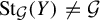 unless Y is the empty set or
$Y=X$
unless Y is the empty set or
$Y=X$
 .
.
Proof. Clearly, the entire group
$\mathcal {G}$
 is the stabilizer of X and of the empty set. If Y is not empty, we can find a point
$x\in Y$
is the stabilizer of X and of the empty set. If Y is not empty, we can find a point
$x\in Y$
 . Since the group
$\mathcal {G}$
. Since the group
$\mathcal {G}$
 acts minimally on X, the orbit
${\mathrm {Orb}}_{\mathcal {G}}(x)$
acts minimally on X, the orbit
${\mathrm {Orb}}_{\mathcal {G}}(x)$
 is dense in X. If
$Y\ne X$
is dense in X. If
$Y\ne X$
 , then the open set
$X\setminus Y$
, then the open set
$X\setminus Y$
 is not empty. Hence,
${\mathrm {Orb}}_{\mathcal {G}}(x)$
is not empty. Hence,
${\mathrm {Orb}}_{\mathcal {G}}(x)$
 has a point in
$X\setminus Y$
has a point in
$X\setminus Y$
 . This means that
$g(x)\notin Y$
. This means that
$g(x)\notin Y$
 for some
$g\in \mathcal {G}$
for some
$g\in \mathcal {G}$
 . Then,
$g\notin {\mathrm {St}}_{\mathcal {G}}(Y)$
. Then,
$g\notin {\mathrm {St}}_{\mathcal {G}}(Y)$
 so that
${\mathrm {St}}_{\mathcal {G}}(Y)\ne \mathcal {G}$
so that
${\mathrm {St}}_{\mathcal {G}}(Y)\ne \mathcal {G}$
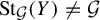 .
.
The following lemma and its proof describe a general construction that will be used repeatedly throughout this section.
Lemma 6.3. Let
$\mathcal {G}\subset {\mathrm {Homeo}}(X)$
 be an ample group. Suppose x and y are two different points in the same orbit of
$\mathcal {G}$
be an ample group. Suppose x and y are two different points in the same orbit of
$\mathcal {G}$
 , and
$Z\subset X$
, and
$Z\subset X$
 is a closed set that contains neither x nor y. Then, there exists a map
$f\in \mathcal {G}$
is a closed set that contains neither x nor y. Then, there exists a map
$f\in \mathcal {G}$
 such that
$f(x)=y$
such that
$f(x)=y$
 ,
$f(y)=x$
,
$f(y)=x$
 , and
$f(z)=z$
, and
$f(z)=z$
 for all
$z\in Z$
for all
$z\in Z$
 .
.
Proof. For any point
$z\in Z$
 , we can find a clopen neighborhood
$U_z$
, we can find a clopen neighborhood
$U_z$
 that contains neither x nor y. Since the set Z is closed and hence compact, it can be covered by finitely many clopen sets of the form
$U_z$
that contains neither x nor y. Since the set Z is closed and hence compact, it can be covered by finitely many clopen sets of the form
$U_z$
 ,
$z\in Z$
,
$z\in Z$
 . Taking the union of all sets in that finite cover, we obtain a clopen set U containing Z and disjoint from
$\{x,y\}$
. Taking the union of all sets in that finite cover, we obtain a clopen set U containing Z and disjoint from
$\{x,y\}$
 . Next, we can find disjoint clopen sets
$V_x,V_y\subset X\setminus U$
. Next, we can find disjoint clopen sets
$V_x,V_y\subset X\setminus U$
 such that
$x\in V_x$
such that
$x\in V_x$
 and
$y\in V_y$
and
$y\in V_y$
 . Since the points x and y are in the same orbit of the group
$\mathcal {G}$
. Since the points x and y are in the same orbit of the group
$\mathcal {G}$
 , we have
$y=g(x)$
, we have
$y=g(x)$
 for some
$g\in \mathcal {G}$
for some
$g\in \mathcal {G}$
 . Then,
$W=V_x\cap g^{-1}(V_y)$
. Then,
$W=V_x\cap g^{-1}(V_y)$
 is a clopen neighborhood of x. The set W is disjoint from
$g(W)$
is a clopen neighborhood of x. The set W is disjoint from
$g(W)$
 as
$W\subset V_x$
as
$W\subset V_x$
 , while
$g(W)\subset V_y$
, while
$g(W)\subset V_y$
 . Therefore, the generalized
$2$
. Therefore, the generalized
$2$
 -cycle
$f=\delta _{W;g}$
-cycle
$f=\delta _{W;g}$
 is defined. Since
$g\in \mathcal {G}$
is defined. Since
$g\in \mathcal {G}$
 , the map f belongs to the group
$\mathsf {F}(\mathcal {G})=\mathcal {G}$
, the map f belongs to the group
$\mathsf {F}(\mathcal {G})=\mathcal {G}$
 . By construction,
$f(x)=g(x)=y$
. By construction,
$f(x)=g(x)=y$
 and
$f(y)=g^{-1}(y)=x$
and
$f(y)=g^{-1}(y)=x$
 . All points in the complement of the set
$W\cup g(W)$
. All points in the complement of the set
$W\cup g(W)$
 are fixed by f. Since
$W\cup g(W)\subset V_x\cup V_y\subset X\setminus U$
are fixed by f. Since
$W\cup g(W)\subset V_x\cup V_y\subset X\setminus U$
 and
$Z\subset U$
and
$Z\subset U$
 , it follows that
$f(z)=z$
, it follows that
$f(z)=z$
 for all
$z\in Z$
for all
$z\in Z$
 .
.
Lemma 6.4. Let
$\mathcal {G}\subset {\mathrm {Homeo}}(X)$
 be an ample group that acts minimally on X. Suppose
$Y_1$
be an ample group that acts minimally on X. Suppose
$Y_1$
 and
$Y_2$
and
$Y_2$
 are distinct closed subsets of X. Then,
${\mathrm {St}}_{\mathcal {G}}(Y_1)={\mathrm {St}}_{\mathcal {G}}(Y_2)$
are distinct closed subsets of X. Then,
${\mathrm {St}}_{\mathcal {G}}(Y_1)={\mathrm {St}}_{\mathcal {G}}(Y_2)$
 if and only if
$Y_1\cup Y_2=X$
if and only if
$Y_1\cup Y_2=X$
 and
$Y_1\cap Y_2=\partial Y_1\cap \partial Y_2$
and
$Y_1\cap Y_2=\partial Y_1\cap \partial Y_2$
 . Equivalent conditions are that
$Y_1=\overline {X\setminus Y_2}$
. Equivalent conditions are that
$Y_1=\overline {X\setminus Y_2}$
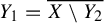 and
$Y_2=\overline {X\setminus Y_1}$
and
$Y_2=\overline {X\setminus Y_1}$
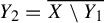 .
.
Proof. Recall that
${\mathrm {St}}_{\mathcal {G}}(X\setminus E)={\mathrm {St}}_{\mathcal {G}}(E)$
 for any set
$E\subset X$
for any set
$E\subset X$
 . If
$f:X\to X$
. If
$f:X\to X$
 is a homeomorphism, then
$f(\overline {E})=\overline {f(E)}$
is a homeomorphism, then
$f(\overline {E})=\overline {f(E)}$
 . Hence,
$f(\overline {E})=\overline {E}$
. Hence,
$f(\overline {E})=\overline {E}$
 whenever
$f(E)=E$
whenever
$f(E)=E$
 . As a consequence,
${\mathrm {St}}_{\mathcal {G}}(E)\subset {\mathrm {St}}_{\mathcal {G}}(\overline {E})$
. As a consequence,
${\mathrm {St}}_{\mathcal {G}}(E)\subset {\mathrm {St}}_{\mathcal {G}}(\overline {E})$
 .
.
Assume that sets
$Y_1,Y_2\subset X$
 satisfy conditions
$Y_1=\overline {X\setminus Y_2}$
satisfy conditions
$Y_1=\overline {X\setminus Y_2}$
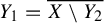 and
$Y_2=\overline {X\setminus Y_1}$
and
$Y_2=\overline {X\setminus Y_1}$
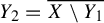 . By the above,
${\mathrm {St}}_{\mathcal {G}}(Y_2)={\mathrm {St}}_{\mathcal {G}}(X\setminus Y_2)\subset {\mathrm {St}}_{\mathcal {G}}(\overline {X\setminus Y_2})={\mathrm {St}}_{\mathcal {G}}(Y_1)$
. By the above,
${\mathrm {St}}_{\mathcal {G}}(Y_2)={\mathrm {St}}_{\mathcal {G}}(X\setminus Y_2)\subset {\mathrm {St}}_{\mathcal {G}}(\overline {X\setminus Y_2})={\mathrm {St}}_{\mathcal {G}}(Y_1)$
 . Likewise,
${\mathrm {St}}_{\mathcal {G}}(Y_1)\subset {\mathrm {St}}_{\mathcal {G}}(Y_2)$
. Likewise,
${\mathrm {St}}_{\mathcal {G}}(Y_1)\subset {\mathrm {St}}_{\mathcal {G}}(Y_2)$
 . Hence,
${\mathrm {St}}_{\mathcal {G}}(Y_1)={\mathrm {St}}_{\mathcal {G}}(Y_2)$
. Hence,
${\mathrm {St}}_{\mathcal {G}}(Y_1)={\mathrm {St}}_{\mathcal {G}}(Y_2)$
 . Further, either of the two assumed conditions implies that
$Y_1\cup Y_2=X$
. Further, either of the two assumed conditions implies that
$Y_1\cup Y_2=X$
 . The first condition also implies that no interior point of
$Y_2$
. The first condition also implies that no interior point of
$Y_2$
 belongs to
$Y_1$
belongs to
$Y_1$
 . Likewise, the second of the two implies that no interior point of
$Y_1$
. Likewise, the second of the two implies that no interior point of
$Y_1$
 belongs to
$Y_2$
belongs to
$Y_2$
 . Therefore, any common point of
$Y_1$
. Therefore, any common point of
$Y_1$
 and
$Y_2$
and
$Y_2$
 is their common boundary point:
$Y_1\cap Y_2\subset \partial Y_1\cap \partial Y_2$
is their common boundary point:
$Y_1\cap Y_2\subset \partial Y_1\cap \partial Y_2$
 . Since the sets
$Y_1$
. Since the sets
$Y_1$
 and
$Y_2$
and
$Y_2$
 are clearly closed, they contain their own boundaries so that
$Y_1\cap Y_2=\partial Y_1\cap \partial Y_2$
are clearly closed, they contain their own boundaries so that
$Y_1\cap Y_2=\partial Y_1\cap \partial Y_2$
 . Conversely, assume
$Y_1,Y_2\subset X$
. Conversely, assume
$Y_1,Y_2\subset X$
 are closed sets such that
$Y_1\cup Y_2=X$
are closed sets such that
$Y_1\cup Y_2=X$
 and
$Y_1\cap Y_2=\partial Y_1\cap \partial Y_2$
and
$Y_1\cap Y_2=\partial Y_1\cap \partial Y_2$
 . Then, X is a disjoint union of three sets
$Y_1\setminus Y_2$
. Then, X is a disjoint union of three sets
$Y_1\setminus Y_2$
 ,
$Y_2\setminus Y_1$
,
$Y_2\setminus Y_1$
 , and
$Y_1\cap Y_2$
, and
$Y_1\cap Y_2$
 . Moreover, the sets
$Y_1\setminus Y_2=X\setminus Y_2$
. Moreover, the sets
$Y_1\setminus Y_2=X\setminus Y_2$
 and
$Y_2\setminus Y_1= X\setminus Y_1$
and
$Y_2\setminus Y_1= X\setminus Y_1$
 are open. It follows that
$Y_1\setminus Y_2$
are open. It follows that
$Y_1\setminus Y_2$
 and
$Y_2\setminus Y_1$
and
$Y_2\setminus Y_1$
 are disjoint from both
$\partial Y_1$
are disjoint from both
$\partial Y_1$
 and
$\partial Y_2$
and
$\partial Y_2$
 . Hence,
$\partial Y_1\cup \partial Y_2\subset Y_1\cap Y_2$
. Hence,
$\partial Y_1\cup \partial Y_2\subset Y_1\cap Y_2$
 , which implies that
$\partial Y_1=\partial Y_2=Y_1\cap Y_2$
, which implies that
$\partial Y_1=\partial Y_2=Y_1\cap Y_2$
 . Since
$\partial Y_1=\partial (X\setminus Y_1)=\partial (Y_2\setminus Y_1)$
. Since
$\partial Y_1=\partial (X\setminus Y_1)=\partial (Y_2\setminus Y_1)$
 , we obtain that
$\overline {X\setminus Y_1}=\overline {Y_2\setminus Y_1}=(Y_2\setminus Y_1)\cup \partial (Y_2\setminus Y_1)=(Y_2\setminus Y_1)\cup (Y_1\cap Y_2)=Y_2$
, we obtain that
$\overline {X\setminus Y_1}=\overline {Y_2\setminus Y_1}=(Y_2\setminus Y_1)\cup \partial (Y_2\setminus Y_1)=(Y_2\setminus Y_1)\cup (Y_1\cap Y_2)=Y_2$
 . Likewise,
$\overline {X\setminus Y_2}=Y_1$
. Likewise,
$\overline {X\setminus Y_2}=Y_1$
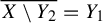 .
.
It remains to show that
${\mathrm {St}}_{\mathcal {G}}(Y_1)\ne {\mathrm {St}}_{\mathcal {G}}(Y_2)$
 for any distinct closed sets
$Y_1,Y_2\subset X$
for any distinct closed sets
$Y_1,Y_2\subset X$
 that do not satisfy at least one of the conditions
$Y_1\cup Y_2=X$
that do not satisfy at least one of the conditions
$Y_1\cup Y_2=X$
 and
$Y_1\cap Y_2=\partial Y_1\cap \partial Y_2$
and
$Y_1\cap Y_2=\partial Y_1\cap \partial Y_2$
 . First, we consider the case where
$Y_1\cup Y_2\ne X$
. First, we consider the case where
$Y_1\cup Y_2\ne X$
 . Then,
$U=X\setminus (Y_1\cup Y_2)$
. Then,
$U=X\setminus (Y_1\cup Y_2)$
 is a non-empty open set. Since
$Y_1\ne Y_2$
is a non-empty open set. Since
$Y_1\ne Y_2$
 , there is a point
$x\in X$
, there is a point
$x\in X$
 that belongs to one of these sets but not to the other. We may assume without loss of generality that
$x\in Y_1$
that belongs to one of these sets but not to the other. We may assume without loss of generality that
$x\in Y_1$
 and
$x\notin Y_2$
and
$x\notin Y_2$
 . Since the group
$\mathcal {G}$
. Since the group
$\mathcal {G}$
 acts minimally on X, the orbit
${\mathrm {Orb}}_{\mathcal {G}}(x)$
acts minimally on X, the orbit
${\mathrm {Orb}}_{\mathcal {G}}(x)$
 is dense in X. In particular, it has a point y in U. Clearly,
$y\notin Y_1$
is dense in X. In particular, it has a point y in U. Clearly,
$y\notin Y_1$
 and
$y\notin Y_2$
and
$y\notin Y_2$
 . By Lemma 6.3, there exists a map
$f\in \mathcal {G}$
. By Lemma 6.3, there exists a map
$f\in \mathcal {G}$
 such that
$f(x)=y$
such that
$f(x)=y$
 and
$f(z)=z$
and
$f(z)=z$
 for all
$z\in Y_2$
for all
$z\in Y_2$
 . Then,
$f\in {\mathrm {St}}^\star _{\mathcal {G}}(Y_2)\subset {\mathrm {St}}_{\mathcal {G}}(Y_2)$
. Then,
$f\in {\mathrm {St}}^\star _{\mathcal {G}}(Y_2)\subset {\mathrm {St}}_{\mathcal {G}}(Y_2)$
 . However,
$f\notin {\mathrm {St}}_{\mathcal {G}}(Y_1)$
. However,
$f\notin {\mathrm {St}}_{\mathcal {G}}(Y_1)$
 as
$x\in Y_1$
as
$x\in Y_1$
 , while
$y\notin Y_1$
, while
$y\notin Y_1$
 . Therefore,
${\mathrm {St}}_{\mathcal {G}}(Y_1)\ne {\mathrm {St}}_{\mathcal {G}}(Y_2)$
. Therefore,
${\mathrm {St}}_{\mathcal {G}}(Y_1)\ne {\mathrm {St}}_{\mathcal {G}}(Y_2)$
 .
.
Now, consider the case where
$Y_1\cup Y_2=X$
 , but there exists a point
$x\in Y_1\cap Y_2$
, but there exists a point
$x\in Y_1\cap Y_2$
 that is not a boundary point for at least one of the sets
$Y_1$
that is not a boundary point for at least one of the sets
$Y_1$
 and
$Y_2$
and
$Y_2$
 . We may assume without loss of generality that x is an interior point of
$Y_2$
. We may assume without loss of generality that x is an interior point of
$Y_2$
 . Furthermore, we may assume that
$Y_1\ne X$
. Furthermore, we may assume that
$Y_1\ne X$
 as otherwise,
${\mathrm {St}}_{\mathcal {G}}(Y_2)\ne \mathcal {G}={\mathrm {St}}_{\mathcal {G}}(Y_1)$
as otherwise,
${\mathrm {St}}_{\mathcal {G}}(Y_2)\ne \mathcal {G}={\mathrm {St}}_{\mathcal {G}}(Y_1)$
 due to Lemma 6.2. Then,
$X\setminus Y_1$
due to Lemma 6.2. Then,
$X\setminus Y_1$
 is a non-empty open set. Just as above, minimality of the action of the group
$\mathcal {G}$
is a non-empty open set. Just as above, minimality of the action of the group
$\mathcal {G}$
 on X implies that the orbit
${\mathrm {Orb}}_{\mathcal {G}}(x)$
on X implies that the orbit
${\mathrm {Orb}}_{\mathcal {G}}(x)$
 has a point y in
$X\setminus Y_1$
has a point y in
$X\setminus Y_1$
 . Note that
$X\setminus Y_1\subset Y_2$
. Note that
$X\setminus Y_1\subset Y_2$
 since
$Y_1\cup Y_2=X$
since
$Y_1\cup Y_2=X$
 . Therefore, every point of
$X\setminus Y_1$
. Therefore, every point of
$X\setminus Y_1$
 (including y) is an interior point of
$Y_2$
(including y) is an interior point of
$Y_2$
 . Hence, the closed set
$\overline {X\setminus Y_2}$
. Hence, the closed set
$\overline {X\setminus Y_2}$
 contains neither x nor y. By Lemma 6.3, there exists a map
$f\in \mathcal {G}$
contains neither x nor y. By Lemma 6.3, there exists a map
$f\in \mathcal {G}$
 such that
$f(x)=y$
such that
$f(x)=y$
 and
$f(z)=z$
and
$f(z)=z$
 for all
$z\in \overline {X\setminus Y_2}$
for all
$z\in \overline {X\setminus Y_2}$
 . Then,
$f\in {\mathrm {St}}_{\mathcal {G}}(X\setminus Y_2)={\mathrm {St}}_{\mathcal {G}}(Y_2)$
. Then,
$f\in {\mathrm {St}}_{\mathcal {G}}(X\setminus Y_2)={\mathrm {St}}_{\mathcal {G}}(Y_2)$
 . However,
$f\notin {\mathrm {St}}_{\mathcal {G}}(Y_1)$
. However,
$f\notin {\mathrm {St}}_{\mathcal {G}}(Y_1)$
 as
$x\in Y_1$
as
$x\in Y_1$
 , while
$y\notin Y_1$
, while
$y\notin Y_1$
 . Thus,
${\mathrm {St}}_{\mathcal {G}}(Y_1)\ne {\mathrm {St}}_{\mathcal {G}}(Y_2)$
. Thus,
${\mathrm {St}}_{\mathcal {G}}(Y_1)\ne {\mathrm {St}}_{\mathcal {G}}(Y_2)$
 .
.
Lemma 6.5. Let
$\mathcal {G}\subset {\mathrm {Homeo}}(X)$
 be an ample group that acts minimally on X. Suppose
$Y_1$
be an ample group that acts minimally on X. Suppose
$Y_1$
 and
$Y_2$
and
$Y_2$
 are non-empty closed subsets of X such that
$Y_1\subset Y_2$
are non-empty closed subsets of X such that
$Y_1\subset Y_2$
 and
$Y_1\ne Y_2$
and
$Y_1\ne Y_2$
 . Then,
${\mathrm {St}}_{\mathcal {G}}(Y_1)\ne {\mathrm {St}}_{\mathcal {G}}(Y_2)$
. Then,
${\mathrm {St}}_{\mathcal {G}}(Y_1)\ne {\mathrm {St}}_{\mathcal {G}}(Y_2)$
 .
.
Proof. If
$Y_2=X$
 , then
${\mathrm {St}}_{\mathcal {G}}(Y_1)\ne \mathcal {G}={\mathrm {St}}_{\mathcal {G}}(Y_2)$
, then
${\mathrm {St}}_{\mathcal {G}}(Y_1)\ne \mathcal {G}={\mathrm {St}}_{\mathcal {G}}(Y_2)$
 due to Lemma 6.2. Otherwise,
$Y_1\cup Y_2=Y_2\ne X$
due to Lemma 6.2. Otherwise,
$Y_1\cup Y_2=Y_2\ne X$
 . Then,
${\mathrm {St}}_{\mathcal {G}}(Y_1)\ne {\mathrm {St}}_{\mathcal {G}}(Y_2)$
. Then,
${\mathrm {St}}_{\mathcal {G}}(Y_1)\ne {\mathrm {St}}_{\mathcal {G}}(Y_2)$
 due to Lemma 6.4.
Now, we are ready to establish our first result on the classification of maximal subgroups of ample groups.
Theorem 6.6. Let
$\mathcal {G}\subset {\mathrm {Homeo}}(X)$
 be an ample group that acts minimally on X. Suppose H is a maximal subgroup of
$\mathcal {G}$
be an ample group that acts minimally on X. Suppose H is a maximal subgroup of
$\mathcal {G}$
 that does not act minimally on X. Then,
$H={\mathrm {St}}_{\mathcal {G}}(Y)$
that does not act minimally on X. Then,
$H={\mathrm {St}}_{\mathcal {G}}(Y)$
 for some closed set
$Y\subset X$
for some closed set
$Y\subset X$
 different from the empty set and X. Furthermore, if the stabilizer
${\mathrm {St}}_{\mathcal {G}}(Y)$
different from the empty set and X. Furthermore, if the stabilizer
${\mathrm {St}}_{\mathcal {G}}(Y)$
 of a closed set
$Y\subset X$
of a closed set
$Y\subset X$
 is indeed a maximal subgroup of
$\mathcal {G}$
is indeed a maximal subgroup of
$\mathcal {G}$
 , then the induced action of
${\mathrm {St}}_{\mathcal {G}}(Y)$
, then the induced action of
${\mathrm {St}}_{\mathcal {G}}(Y)$
 on Y is minimal.
Proof. Since the group H does not act minimally on X, it admits a closed invariant set Y different from the empty set and X. We have
$h(Y)=Y$
 for any
$h\in H$
for any
$h\in H$
 . Hence,
$H\subset {\mathrm {St}}_{\mathcal {G}}(Y)$
. Hence,
$H\subset {\mathrm {St}}_{\mathcal {G}}(Y)$
 . Lemma 6.2 implies that
${\mathrm {St}}_{\mathcal {G}}(Y)\ne \mathcal {G}$
. Lemma 6.2 implies that
${\mathrm {St}}_{\mathcal {G}}(Y)\ne \mathcal {G}$
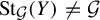 . As H is a maximal subgroup of
$\mathcal {G}$
. As H is a maximal subgroup of
$\mathcal {G}$
 , it follows that
$H={\mathrm {St}}_{\mathcal {G}}(Y)$
, it follows that
$H={\mathrm {St}}_{\mathcal {G}}(Y)$
 .
.
Now, assume that a group
$H={\mathrm {St}}_{\mathcal {G}}(Y)$
 , where Y is a closed subset of X, is indeed a maximal subgroup of
$\mathcal {G}$
, where Y is a closed subset of X, is indeed a maximal subgroup of
$\mathcal {G}$
 . To prove that the induced action of H on Y is minimal, we need to show that any closed set
$Y_0\subset Y$
. To prove that the induced action of H on Y is minimal, we need to show that any closed set
$Y_0\subset Y$
 invariant under it coincides with the empty set or Y. We have
$h(Y_0)=Y_0$
invariant under it coincides with the empty set or Y. We have
$h(Y_0)=Y_0$
 for any
$h\in H$
for any
$h\in H$
 . Hence,
$H\subset {\mathrm {St}}_{\mathcal {G}}(Y_0)$
. Hence,
$H\subset {\mathrm {St}}_{\mathcal {G}}(Y_0)$
 . Note that
$Y\ne X$
. Note that
$Y\ne X$
 since
$H\ne \mathcal {G}$
since
$H\ne \mathcal {G}$
 . Then,
$Y_0\ne X$
. Then,
$Y_0\ne X$
 as well. Assume that
$Y_0\ne \emptyset $
as well. Assume that
$Y_0\ne \emptyset $
 . Just as above, Lemma 6.2 implies that
${\mathrm {St}}_{\mathcal {G}}(Y_0)\ne \mathcal {G}$
. Just as above, Lemma 6.2 implies that
${\mathrm {St}}_{\mathcal {G}}(Y_0)\ne \mathcal {G}$
 and then maximality of H implies that
$H={\mathrm {St}}_{\mathcal {G}}(Y_0)$
and then maximality of H implies that
$H={\mathrm {St}}_{\mathcal {G}}(Y_0)$
 . Since
${\mathrm {St}}_{\mathcal {G}}(Y_0)={\mathrm {St}}_{\mathcal {G}}(Y)$
. Since
${\mathrm {St}}_{\mathcal {G}}(Y_0)={\mathrm {St}}_{\mathcal {G}}(Y)$
 and
$Y_0\subset Y$
and
$Y_0\subset Y$
 , it follows from Lemma 6.5 that
$Y_0=Y$
, it follows from Lemma 6.5 that
$Y_0=Y$
 .
.
The assumption that the stabilizer
${\mathrm {St}}_{\mathcal {G}}(Y)$
 of a closed set Y acts minimally when restricted to Y has implications for the set Y and for the group
${\mathrm {St}}_{\mathcal {G}}(Y)$
of a closed set Y acts minimally when restricted to Y has implications for the set Y and for the group
${\mathrm {St}}_{\mathcal {G}}(Y)$
 .
.
Lemma 6.7. Let G be a subgroup of
${\mathrm {Homeo}}(X)$
 . Suppose Y is a closed subset of X such that the stabilizer
${\mathrm {St}}_G(Y)$
. Suppose Y is a closed subset of X such that the stabilizer
${\mathrm {St}}_G(Y)$
 acts minimally when restricted to Y. Then, the set Y is either clopen or nowhere dense in X.
Proof. We have
$h(Y)=Y$
 for any
$h\in {\mathrm {St}}_G(Y)$
for any
$h\in {\mathrm {St}}_G(Y)$
 . Since h is a homeomorphism of the ambient space X, it maps interior points of the set Y to its interior points, and boundary points of Y to its boundary points. Therefore, the boundary
$\partial Y$
. Since h is a homeomorphism of the ambient space X, it maps interior points of the set Y to its interior points, and boundary points of Y to its boundary points. Therefore, the boundary
$\partial Y$
 , which is a closed subset of Y, is invariant under the induced action of the group
${\mathrm {St}}_G(Y)$
, which is a closed subset of Y, is invariant under the induced action of the group
${\mathrm {St}}_G(Y)$
 on Y. As the latter action is minimal, the boundary
$\partial Y$
on Y. As the latter action is minimal, the boundary
$\partial Y$
 has to coincide with the empty set or Y. If
$\partial Y=\emptyset $
has to coincide with the empty set or Y. If
$\partial Y=\emptyset $
 , then the set Y is clopen. If
$\partial Y=Y$
, then the set Y is clopen. If
$\partial Y=Y$
 , then Y is nowhere dense in X.
Lemma 6.8. Let
$\mathcal {G}\subset {\mathrm {Homeo}}(X)$
 be an ample group. Suppose U is a non-empty clopen subset of X. Then, any orbit of the induced action of the stabilizer
${\mathrm {St}}_{\mathcal {G}}(U)$
be an ample group. Suppose U is a non-empty clopen subset of X. Then, any orbit of the induced action of the stabilizer
${\mathrm {St}}_{\mathcal {G}}(U)$
 on U is the intersection of an orbit of
$\mathcal {G}$
on U is the intersection of an orbit of
$\mathcal {G}$
 with U. As a consequence,
${\mathrm {St}}_{\mathcal {G}}(U)$
with U. As a consequence,
${\mathrm {St}}_{\mathcal {G}}(U)$
 acts minimally on U whenever
$\mathcal {G}$
acts minimally on U whenever
$\mathcal {G}$
 acts minimally on X.
Proof. The induced action of the group
$H={\mathrm {St}}_{\mathcal {G}}(U)$
 on U is the restriction of its action on X. Therefore, every orbit of the induced action is of the form
${\mathrm {Orb}}_H(x)$
on U is the restriction of its action on X. Therefore, every orbit of the induced action is of the form
${\mathrm {Orb}}_H(x)$
 , where
$x\in U$
, where
$x\in U$
 . We need to show that
${\mathrm {Orb}}_H(x)={\mathrm {Orb}}_{\mathcal {G}}(x)\cap U$
. We need to show that
${\mathrm {Orb}}_H(x)={\mathrm {Orb}}_{\mathcal {G}}(x)\cap U$
 . The inclusion
${\mathrm {Orb}}_H(x)\subset {\mathrm {Orb}}_{\mathcal {G}}(x)\cap U$
. The inclusion
${\mathrm {Orb}}_H(x)\subset {\mathrm {Orb}}_{\mathcal {G}}(x)\cap U$
 is obvious. Conversely, take any point
$y\in {\mathrm {Orb}}_{\mathcal {G}}(x)\cap U$
is obvious. Conversely, take any point
$y\in {\mathrm {Orb}}_{\mathcal {G}}(x)\cap U$
 different from x. By Lemma 6.3, there exists a map
$f\in \mathcal {G}$
different from x. By Lemma 6.3, there exists a map
$f\in \mathcal {G}$
 such that
$f(x)=y$
such that
$f(x)=y$
 and f coincides with the identity map on the clopen set
$X\setminus U$
and f coincides with the identity map on the clopen set
$X\setminus U$
 . Then,
$f\in {\mathrm {RiSt}}_{\mathcal {G}}(U)\subset H$
. Then,
$f\in {\mathrm {RiSt}}_{\mathcal {G}}(U)\subset H$
 . Thus,
$y\in {\mathrm {Orb}}_H(x)$
. Thus,
$y\in {\mathrm {Orb}}_H(x)$
 .
.
Assuming the group
$\mathcal {G}$
 acts minimally on X, every orbit of
$\mathcal {G}$
acts minimally on X, every orbit of
$\mathcal {G}$
 is dense in X. Since U is a clopen set, it follows that the intersection of any orbit of
$\mathcal {G}$
is dense in X. Since U is a clopen set, it follows that the intersection of any orbit of
$\mathcal {G}$
 with U is dense in U. By the above, this means that every orbit of the induced action of the group H on U is dense in U. Hence, the latter action is minimal.
Lemma 6.9. Let
$\mathcal {G}\subset {\mathrm {Homeo}}(X)$
 be an ample group. Suppose Y is a closed subset of X such that the stabilizer
${\mathrm {St}}_{\mathcal {G}}(Y)$
be an ample group. Suppose Y is a closed subset of X such that the stabilizer
${\mathrm {St}}_{\mathcal {G}}(Y)$
 acts minimally when restricted to Y. Then, for any
$g\in \mathcal {G}\setminus {\mathrm {St}}_{\mathcal {G}}(Y)$
acts minimally when restricted to Y. Then, for any
$g\in \mathcal {G}\setminus {\mathrm {St}}_{\mathcal {G}}(Y)$
 , the group
$\langle {\mathrm {St}}_{\mathcal {G}}(Y)\cup \{g\}\rangle $
, the group
$\langle {\mathrm {St}}_{\mathcal {G}}(Y)\cup \{g\}\rangle $
 generated by
${\mathrm {St}}_{\mathcal {G}}(Y)$
generated by
${\mathrm {St}}_{\mathcal {G}}(Y)$
 and g has the same orbits as
$\mathcal {G}$
and g has the same orbits as
$\mathcal {G}$
 .
.
Proof. Let
$H={\mathrm {St}}_{\mathcal {G}}(Y)$
 . For any
$g\in \mathcal {G}\setminus {\mathrm {St}}_{\mathcal {G}}(Y)$
. For any
$g\in \mathcal {G}\setminus {\mathrm {St}}_{\mathcal {G}}(Y)$
 , let
$H_g=\langle {\mathrm {St}}_{\mathcal {G}}(Y)\cup \{g\}\rangle $
, let
$H_g=\langle {\mathrm {St}}_{\mathcal {G}}(Y)\cup \{g\}\rangle $
 . First, let us show that no orbit of the group
$H_g$
. First, let us show that no orbit of the group
$H_g$
 is contained in Y. Since g does not map the set Y onto itself, there exists a point
$x_0\in Y$
is contained in Y. Since g does not map the set Y onto itself, there exists a point
$x_0\in Y$
 such that
$g(x_0)\notin Y$
such that
$g(x_0)\notin Y$
 or
$g^{-1}(x_0)\notin Y$
or
$g^{-1}(x_0)\notin Y$
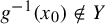 . In either case, we have an element
$g_0\in H_g$
. In either case, we have an element
$g_0\in H_g$
 such that
$g_0(x_0)\notin Y$
such that
$g_0(x_0)\notin Y$
 . Note that
$X\setminus Y$
. Note that
$X\setminus Y$
 is an open neighborhood of the point
$g_0(x_0)$
is an open neighborhood of the point
$g_0(x_0)$
 . Hence, the set
$U=g_0^{-1}(X\setminus Y)$
. Hence, the set
$U=g_0^{-1}(X\setminus Y)$
 is an open neighborhood of
$x_0$
is an open neighborhood of
$x_0$
 . Take any
$x\in Y$
. Take any
$x\in Y$
 . Since the group H acts minimally when restricted to Y, the orbit
${\mathrm {Orb}}_H(x)$
. Since the group H acts minimally when restricted to Y, the orbit
${\mathrm {Orb}}_H(x)$
 is dense in Y. In particular, it has a point in
$U\cap Y$
is dense in Y. In particular, it has a point in
$U\cap Y$
 . That is,
$h(x)\in U$
. That is,
$h(x)\in U$
 for some
$h\in H$
for some
$h\in H$
 . Then,
$g_0h\in H_g$
. Then,
$g_0h\in H_g$
 and
$g_0h(x)\in g_0(U)=X\setminus Y$
and
$g_0h(x)\in g_0(U)=X\setminus Y$
 . Therefore, the orbit
${\mathrm {Orb}}_{H_g}(x)$
. Therefore, the orbit
${\mathrm {Orb}}_{H_g}(x)$
 has a point outside Y.
Since
$H_g$
 is a subgroup of
$\mathcal {G}$
is a subgroup of
$\mathcal {G}$
 , for any
$x\in X$
, for any
$x\in X$
 , the orbit
${\mathrm {Orb}}_{H_g}(x)$
, the orbit
${\mathrm {Orb}}_{H_g}(x)$
 is contained in
${\mathrm {Orb}}_{\mathcal {G}}(x)$
is contained in
${\mathrm {Orb}}_{\mathcal {G}}(x)$
 . We need to show that, conversely,
${\mathrm {Orb}}_{\mathcal {G}}(x)\subset {\mathrm {Orb}}_{H_g}(x)$
. We need to show that, conversely,
${\mathrm {Orb}}_{\mathcal {G}}(x)\subset {\mathrm {Orb}}_{H_g}(x)$
 . Take any point
$y\in {\mathrm {Orb}}_{\mathcal {G}}(x)$
. Take any point
$y\in {\mathrm {Orb}}_{\mathcal {G}}(x)$
 . By the above, the orbits of the points x and y under the action of the group
$H_g$
. By the above, the orbits of the points x and y under the action of the group
$H_g$
 are not contained in Y. Hence, there exist
$h_1,h_2\in H_g$
are not contained in Y. Hence, there exist
$h_1,h_2\in H_g$
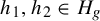 such that the points
$x_1=h_1(x)$
such that the points
$x_1=h_1(x)$
 and
$y_1=h_2(y)$
and
$y_1=h_2(y)$
 are outside the set Y. If
$x_1=y_1$
are outside the set Y. If
$x_1=y_1$
 , then
$y=h_2^{-1}h_1(x)$
, then
$y=h_2^{-1}h_1(x)$
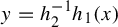 so that
$y\in {\mathrm {Orb}}_{H_g}(x)$
so that
$y\in {\mathrm {Orb}}_{H_g}(x)$
 . Now, assume
$x_1\ne y_1$
. Now, assume
$x_1\ne y_1$
 . Both
$x_1$
. Both
$x_1$
 and
$y_1$
and
$y_1$
 do belong to
${\mathrm {Orb}}_{\mathcal {G}}(x)$
do belong to
${\mathrm {Orb}}_{\mathcal {G}}(x)$
 . By Lemma 6.3, there exists a map
$f\in \mathcal {G}$
. By Lemma 6.3, there exists a map
$f\in \mathcal {G}$
 such that
$f(x_1)=y_1$
such that
$f(x_1)=y_1$
 and
$f(z)=z$
and
$f(z)=z$
 for all
$z\in Y$
for all
$z\in Y$
 . Then,
$h_2^{-1}fh_1(x)=y$
. Then,
$h_2^{-1}fh_1(x)=y$
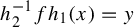 . Note that
$f\in {\mathrm {St}}^\star _{\mathcal {G}}(Y)\subset H$
. Note that
$f\in {\mathrm {St}}^\star _{\mathcal {G}}(Y)\subset H$
 , which implies that
$h_2^{-1}fh_1\in H_g$
, which implies that
$h_2^{-1}fh_1\in H_g$
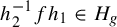 . Thus,
$y\in {\mathrm {Orb}}_{H_g}(x)$
. Thus,
$y\in {\mathrm {Orb}}_{H_g}(x)$
 .
.
The simplest example of a closed subset of X is a finite set. To treat the stabilizers of finite sets, we do not even need to assume that the ample group acts minimally on X.
Lemma 6.10. Let
$\mathcal {G}\subset {\mathrm {Homeo}}(X)$
 be an ample group. Suppose
$Y\subset X$
be an ample group. Suppose
$Y\subset X$
 is a finite set contained in a single orbit of
$\mathcal {G}$
is a finite set contained in a single orbit of
$\mathcal {G}$
 and
$Z\subset X$
and
$Z\subset X$
 is a closed (e.g., finite) set disjoint from Y. Then, for any permutation
$\pi :Y\to Y$
is a closed (e.g., finite) set disjoint from Y. Then, for any permutation
$\pi :Y\to Y$
 , there exists a map
$f\in \mathcal {G}$
, there exists a map
$f\in \mathcal {G}$
 such that
$f(x)=\pi (x)$
such that
$f(x)=\pi (x)$
 for all
$x\in Y$
for all
$x\in Y$
 and
$f(x)=x$
and
$f(x)=x$
 for all
$x\in Z$
for all
$x\in Z$
 .
.
Proof. First, we consider a particular case where the permutation
$\pi $
 is a transposition. That is,
$\pi =(x\,y)$
is a transposition. That is,
$\pi =(x\,y)$
 , where x and y are distinct elements of Y. Let
$Z_+=(Y\cup Z)\setminus \{x,y\}$
, where x and y are distinct elements of Y. Let
$Z_+=(Y\cup Z)\setminus \{x,y\}$
 . Then,
$Z_+$
. Then,
$Z_+$
 is a closed set containing neither x nor y. By Lemma 6.3, there exists a map
$f\in \mathcal {G}$
is a closed set containing neither x nor y. By Lemma 6.3, there exists a map
$f\in \mathcal {G}$
 such that
$f(x)=y$
such that
$f(x)=y$
 ,
$f(y)=x$
,
$f(y)=x$
 , and
$f(z)=z$
, and
$f(z)=z$
 for all
$z\in Z_+$
for all
$z\in Z_+$
 . The map f coincides with
$\pi $
. The map f coincides with
$\pi $
 on the set Y and with the identity map on the set Z.
Now, consider the general case. If
$\pi $
 is the identity map, we can take
$f=\mathrm {id}_X$
is the identity map, we can take
$f=\mathrm {id}_X$
 , which belongs to
$\mathcal {G}$
, which belongs to
$\mathcal {G}$
 . Otherwise, the permutation
$\pi $
. Otherwise, the permutation
$\pi $
 can be decomposed as a product,
$\pi =\pi _1\pi _2\cdots \pi _k$
can be decomposed as a product,
$\pi =\pi _1\pi _2\cdots \pi _k$
 , where each
$\pi _i$
, where each
$\pi _i$
 is a transposition exchanging two elements of Y. By the above, for any i,
$1\le i\le k$
is a transposition exchanging two elements of Y. By the above, for any i,
$1\le i\le k$
 , there exists a map
$f_i\in \mathcal {G}$
, there exists a map
$f_i\in \mathcal {G}$
 that coincides with
$\pi _i$
that coincides with
$\pi _i$
 on the set Y and fixes all points of the set Z. Then,
$f=f_1f_2\cdots f_k$
on the set Y and fixes all points of the set Z. Then,
$f=f_1f_2\cdots f_k$
 is an element of
$\mathcal {G}$
is an element of
$\mathcal {G}$
 that coincides with the permutation
$\pi _1\pi _2\cdots \pi _k=\pi $
that coincides with the permutation
$\pi _1\pi _2\cdots \pi _k=\pi $
 on Y and fixes all points of Z.
The next theorem is our main result on the stabilizers of finite sets.
Theorem 6.11. Let
$\mathcal {G}\subset {\mathrm {Homeo}}(X)$
 be an ample group. Suppose Y is a finite non-empty subset of X. Then, the following statements hold true.
-
(i) If Y is a proper subset of a single orbit of $\mathcal {G}$
and, moreover, Y does not contain exactly half of the points in the orbit, then the stabilizer
${\mathrm {St}}_{\mathcal {G}}(Y)$
is a maximal subgroup of
$\mathcal {G}$
. -
(ii) If Y is a subset of an orbit ${\mathrm {Orb}}_{\mathcal {G}}(x)$
that contains exactly half of its points, then
${\mathrm {St}}_{\mathcal {G}}(Y)$
is a subgroup of index
$2$
in the group
${\mathrm {St}}_{\mathcal {G}}(Y,{\mathrm {Orb}}_{\mathcal {G}}(x)\setminus Y)$
. The latter is a maximal subgroup of
$\mathcal {G}$
unless Y consists of a single point, in which case,
${\mathrm {St}}_{\mathcal {G}}(Y,{\mathrm {Orb}}_{\mathcal {G}}(x)\setminus Y)=\mathcal {G}$
. -
(iii) If there are at least two orbits of $\mathcal {G}$
that intersect Y but are not contained in Y, then
${\mathrm {St}}_{\mathcal {G}}(Y)$
is a proper subgroup of
$\mathcal {G}$
that is not maximal. -
(iv) If Y is a union of orbits of $\mathcal {G}$
, then
${\mathrm {St}}_{\mathcal {G}}(Y)=\mathcal {G}$
. -
(v) If $Y=Y_1\sqcup Y_2$
, where
$Y_2$
is a union of orbits of
$\mathcal {G}$
, then
${\mathrm {St}}_{\mathcal {G}}(Y)={\mathrm {St}}_{\mathcal {G}}(Y_1)$
.











Proof. Since
$g(h(x))=(gh)(x)$
 for all maps
$g,h\in \mathcal {G}$
for all maps
$g,h\in \mathcal {G}$
 and points
$x\in X$
and points
$x\in X$
 , it follows that
$g({\mathrm {Orb}}_{\mathcal {G}}(x))\subset {\mathrm {Orb}}_{\mathcal {G}}(x)$
, it follows that
$g({\mathrm {Orb}}_{\mathcal {G}}(x))\subset {\mathrm {Orb}}_{\mathcal {G}}(x)$
 . For any
$g\in \mathcal {G}$
. For any
$g\in \mathcal {G}$
 , the inverse map
$g^{-1}$
, the inverse map
$g^{-1}$
 is also in
$\mathcal {G}$
is also in
$\mathcal {G}$
 . Hence, we also have
$g^{-1}({\mathrm {Orb}}_{\mathcal {G}}(x))\subset {\mathrm {Orb}}_{\mathcal {G}}(x)$
. Hence, we also have
$g^{-1}({\mathrm {Orb}}_{\mathcal {G}}(x))\subset {\mathrm {Orb}}_{\mathcal {G}}(x)$
 , which implies that, in fact,
$g({\mathrm {Orb}}_{\mathcal {G}}(x))={\mathrm {Orb}}_{\mathcal {G}}(x)$
, which implies that, in fact,
$g({\mathrm {Orb}}_{\mathcal {G}}(x))={\mathrm {Orb}}_{\mathcal {G}}(x)$
 . It further follows that
$g(Y)=Y$
. It further follows that
$g(Y)=Y$
 for any set
$Y\subset X$
for any set
$Y\subset X$
 that is a union of orbits of the group
$\mathcal {G}$
that is a union of orbits of the group
$\mathcal {G}$
 . Consequently,
${\mathrm {St}}_{\mathcal {G}}(Y)=\mathcal {G}$
. Consequently,
${\mathrm {St}}_{\mathcal {G}}(Y)=\mathcal {G}$
 for any such set Y, finite or not. Further, if a set
$Y\subset X$
for any such set Y, finite or not. Further, if a set
$Y\subset X$
 is represented as a disjoint union of two sets,
$Y=Y_1\sqcup Y_2$
is represented as a disjoint union of two sets,
$Y=Y_1\sqcup Y_2$
 , then
$g(Y)=g(Y_1)\sqcup g(Y_2)$
, then
$g(Y)=g(Y_1)\sqcup g(Y_2)$
 for any
$g\in \mathcal {G}$
for any
$g\in \mathcal {G}$
 . Assuming
$Y_2$
. Assuming
$Y_2$
 is a union of orbits of
$\mathcal {G}$
is a union of orbits of
$\mathcal {G}$
 , we have
$g(Y_2)=Y_2$
, we have
$g(Y_2)=Y_2$
 . Hence,
$g(Y)=Y$
. Hence,
$g(Y)=Y$
 if and only if
$g(Y_1)=Y_1$
if and only if
$g(Y_1)=Y_1$
 . As a result,
${\mathrm {St}}_{\mathcal {G}}(Y)={\mathrm {St}}_{\mathcal {G}}(Y_1)$
. As a result,
${\mathrm {St}}_{\mathcal {G}}(Y)={\mathrm {St}}_{\mathcal {G}}(Y_1)$
 .
.
We have proved statements (iv) and (v). Next, we prove statement (iii). Suppose
${\mathrm {Orb}}_{\mathcal {G}}(x)$
 and
${\mathrm {Orb}}_{\mathcal {G}}(y)$
and
${\mathrm {Orb}}_{\mathcal {G}}(y)$
 are two distinct orbits of
$\mathcal {G}$
are two distinct orbits of
$\mathcal {G}$
 that intersect a finite set
$Y\subset X$
that intersect a finite set
$Y\subset X$
 , but are not contained in Y. Then, there exist points
$x_1,x_2\in {\mathrm {Orb}}_{\mathcal {G}}(x)$
, but are not contained in Y. Then, there exist points
$x_1,x_2\in {\mathrm {Orb}}_{\mathcal {G}}(x)$
 and
$y_1,y_2\in {\mathrm {Orb}}_{\mathcal {G}}(y)$
and
$y_1,y_2\in {\mathrm {Orb}}_{\mathcal {G}}(y)$
 such that
$x_1$
such that
$x_1$
 and
$y_1$
and
$y_1$
 belong to Y, while
$x_2$
belong to Y, while
$x_2$
 and
$y_2$
and
$y_2$
 do not. By Lemma 6.10, the group
$\mathcal {G}$
do not. By Lemma 6.10, the group
$\mathcal {G}$
 contains a map f that interchanges
$y_1$
contains a map f that interchanges
$y_1$
 and
$y_2$
and
$y_2$
 while fixing all points of Y different from
$y_1$
while fixing all points of Y different from
$y_1$
 . Note that
$f(Y\cap {\mathrm {Orb}}_{\mathcal {G}}(x))=Y\cap {\mathrm {Orb}}_{\mathcal {G}}(x)$
. Note that
$f(Y\cap {\mathrm {Orb}}_{\mathcal {G}}(x))=Y\cap {\mathrm {Orb}}_{\mathcal {G}}(x)$
 , while
$f(Y\cap {\mathrm {Orb}}_{\mathcal {G}}(y))\ne Y\cap {\mathrm {Orb}}_{\mathcal {G}}(y)$
, while
$f(Y\cap {\mathrm {Orb}}_{\mathcal {G}}(y))\ne Y\cap {\mathrm {Orb}}_{\mathcal {G}}(y)$
 . Likewise, there exists
$h\in \mathcal {G}$
. Likewise, there exists
$h\in \mathcal {G}$
 that interchanges
$x_1$
that interchanges
$x_1$
 and
$x_2$
and
$x_2$
 , while fixing all points of Y different from
$x_1$
, while fixing all points of Y different from
$x_1$
 . Then,
$h(Y\cap {\mathrm {Orb}}_{\mathcal {G}}(y))=Y\cap {\mathrm {Orb}}_{\mathcal {G}}(y)$
. Then,
$h(Y\cap {\mathrm {Orb}}_{\mathcal {G}}(y))=Y\cap {\mathrm {Orb}}_{\mathcal {G}}(y)$
 , while
$h(Y\cap {\mathrm {Orb}}_{\mathcal {G}}(x))\ne Y\cap {\mathrm {Orb}}_{\mathcal {G}}(x)$
, while
$h(Y\cap {\mathrm {Orb}}_{\mathcal {G}}(x))\ne Y\cap {\mathrm {Orb}}_{\mathcal {G}}(x)$
 . It follows that neither of the stabilizers
${\mathrm {St}}_{\mathcal {G}}(Y\cap {\mathrm {Orb}}_{\mathcal {G}}(x))$
. It follows that neither of the stabilizers
${\mathrm {St}}_{\mathcal {G}}(Y\cap {\mathrm {Orb}}_{\mathcal {G}}(x))$
 and
${\mathrm {St}}_{\mathcal {G}}(Y\cap {\mathrm {Orb}}_{\mathcal {G}}(y))$
and
${\mathrm {St}}_{\mathcal {G}}(Y\cap {\mathrm {Orb}}_{\mathcal {G}}(y))$
 contains the other. Therefore, both stabilizers are proper subgroups of
$\mathcal {G}$
contains the other. Therefore, both stabilizers are proper subgroups of
$\mathcal {G}$
 and their intersection is a proper subgroup of both of them. It remains to observe that the said intersection contains
${\mathrm {St}}_{\mathcal {G}}(Y)$
and their intersection is a proper subgroup of both of them. It remains to observe that the said intersection contains
${\mathrm {St}}_{\mathcal {G}}(Y)$
 . Indeed, any
$g\in \mathcal {G}$
. Indeed, any
$g\in \mathcal {G}$
 maps each orbit of
$\mathcal {G}$
maps each orbit of
$\mathcal {G}$
 onto itself. Hence,
$g(Y\cap {\mathrm {Orb}}_{\mathcal {G}}(x))= g(Y)\cap {\mathrm {Orb}}_{\mathcal {G}}(x)$
onto itself. Hence,
$g(Y\cap {\mathrm {Orb}}_{\mathcal {G}}(x))= g(Y)\cap {\mathrm {Orb}}_{\mathcal {G}}(x)$
 and
$g(Y\cap {\mathrm {Orb}}_{\mathcal {G}}(y))=g(Y)\cap {\mathrm {Orb}}_{\mathcal {G}}(y)$
and
$g(Y\cap {\mathrm {Orb}}_{\mathcal {G}}(y))=g(Y)\cap {\mathrm {Orb}}_{\mathcal {G}}(y)$
 . Consequently, the equality
$g(Y)=Y$
. Consequently, the equality
$g(Y)=Y$
 implies that
$g(Y\cap {\mathrm {Orb}}_{\mathcal {G}}(x))=Y\cap {\mathrm {Orb}}_{\mathcal {G}}(x)$
implies that
$g(Y\cap {\mathrm {Orb}}_{\mathcal {G}}(x))=Y\cap {\mathrm {Orb}}_{\mathcal {G}}(x)$
 and
$g(Y\cap {\mathrm {Orb}}_{\mathcal {G}}(y))=Y\cap {\mathrm {Orb}}_{\mathcal {G}}(y)$
and
$g(Y\cap {\mathrm {Orb}}_{\mathcal {G}}(y))=Y\cap {\mathrm {Orb}}_{\mathcal {G}}(y)$
 .
.
We proceed to the main part of the theorem, namely, statements (i) and (ii). Suppose that a finite non-empty set Y is a proper subset of a single orbit
${\mathrm {Orb}}_{\mathcal {G}}(x)$
 . Since
$g({\mathrm {Orb}}_{\mathcal {G}}(x))={\mathrm {Orb}}_{\mathcal {G}}(x)$
. Since
$g({\mathrm {Orb}}_{\mathcal {G}}(x))={\mathrm {Orb}}_{\mathcal {G}}(x)$
 for any
$g\in \mathcal {G}$
for any
$g\in \mathcal {G}$
 , we have
$g(Y)=Y$
, we have
$g(Y)=Y$
 if and only if
$g({\mathrm {Orb}}_{\mathcal {G}}(x)\setminus Y)={\mathrm {Orb}}_{\mathcal {G}}(x)\setminus Y$
if and only if
$g({\mathrm {Orb}}_{\mathcal {G}}(x)\setminus Y)={\mathrm {Orb}}_{\mathcal {G}}(x)\setminus Y$
 . It follows that
${\mathrm {St}}_{\mathcal {G}}(Y)$
. It follows that
${\mathrm {St}}_{\mathcal {G}}(Y)$
 coincides with another set stabilizer
${\mathrm {St}}_{\mathcal {G}}({\mathrm {Orb}}_{\mathcal {G}}(x)\setminus Y)$
coincides with another set stabilizer
${\mathrm {St}}_{\mathcal {G}}({\mathrm {Orb}}_{\mathcal {G}}(x)\setminus Y)$
 as well as with the individual stabilizer
${\mathrm {St}}^\bullet _{\mathcal {G}}(Y,{\mathrm {Orb}}_{\mathcal {G}}(x)\setminus Y)$
as well as with the individual stabilizer
${\mathrm {St}}^\bullet _{\mathcal {G}}(Y,{\mathrm {Orb}}_{\mathcal {G}}(x)\setminus Y)$
 . The collective stabilizer
${\mathrm {St}}_{\mathcal {G}}(Y,{\mathrm {Orb}}_{\mathcal {G}}(x)\setminus Y)$
. The collective stabilizer
${\mathrm {St}}_{\mathcal {G}}(Y,{\mathrm {Orb}}_{\mathcal {G}}(x)\setminus Y)$
 acts on the set
$\{Y,{\mathrm {Orb}}_{\mathcal {G}}(x)\setminus Y\}$
acts on the set
$\{Y,{\mathrm {Orb}}_{\mathcal {G}}(x)\setminus Y\}$
 and
${\mathrm {St}}^\bullet _{\mathcal {G}}(Y,{\mathrm {Orb}}_{\mathcal {G}}(x)\setminus Y)$
and
${\mathrm {St}}^\bullet _{\mathcal {G}}(Y,{\mathrm {Orb}}_{\mathcal {G}}(x)\setminus Y)$
 is the kernel of this action. If the set Y does not contain exactly half of the points in
${\mathrm {Orb}}_{\mathcal {G}}(x)$
is the kernel of this action. If the set Y does not contain exactly half of the points in
${\mathrm {Orb}}_{\mathcal {G}}(x)$
 , it cannot be mapped onto
${\mathrm {Orb}}_{\mathcal {G}}(x)\setminus Y$
, it cannot be mapped onto
${\mathrm {Orb}}_{\mathcal {G}}(x)\setminus Y$
 by any invertible transformation of X. Then, the action is trivial so that
${\mathrm {St}}_{\mathcal {G}}(Y,{\mathrm {Orb}}_{\mathcal {G}}(x)\setminus Y)= {\mathrm {St}}^\bullet _{\mathcal {G}}(Y,{\mathrm {Orb}}_{\mathcal {G}}(x)\setminus Y)={\mathrm {St}}_{\mathcal {G}}(Y)$
by any invertible transformation of X. Then, the action is trivial so that
${\mathrm {St}}_{\mathcal {G}}(Y,{\mathrm {Orb}}_{\mathcal {G}}(x)\setminus Y)= {\mathrm {St}}^\bullet _{\mathcal {G}}(Y,{\mathrm {Orb}}_{\mathcal {G}}(x)\setminus Y)={\mathrm {St}}_{\mathcal {G}}(Y)$
 . In the case where Y contains exactly half of the points in
${\mathrm {Orb}}_{\mathcal {G}}(x)$
. In the case where Y contains exactly half of the points in
${\mathrm {Orb}}_{\mathcal {G}}(x)$
 , the orbit is finite and the set
${\mathrm {Orb}}_{\mathcal {G}}(x)\setminus Y$
, the orbit is finite and the set
${\mathrm {Orb}}_{\mathcal {G}}(x)\setminus Y$
 contains the same number of points as Y. Then, there exists a permutation
$\pi $
contains the same number of points as Y. Then, there exists a permutation
$\pi $
 on
${\mathrm {Orb}}_{\mathcal {G}}(x)$
on
${\mathrm {Orb}}_{\mathcal {G}}(x)$
 such that
$\pi (Y)={\mathrm {Orb}}_{\mathcal {G}}(x)\setminus Y$
such that
$\pi (Y)={\mathrm {Orb}}_{\mathcal {G}}(x)\setminus Y$
 and
$\pi ({\mathrm {Orb}}_{\mathcal {G}}(x)\setminus Y)=Y$
and
$\pi ({\mathrm {Orb}}_{\mathcal {G}}(x)\setminus Y)=Y$
 . Lemma 6.10 implies that there is also a homeomorphism
$f\in \mathcal {G}$
. Lemma 6.10 implies that there is also a homeomorphism
$f\in \mathcal {G}$
 such that
$f(Y)={\mathrm {Orb}}_{\mathcal {G}}(x)\setminus Y$
such that
$f(Y)={\mathrm {Orb}}_{\mathcal {G}}(x)\setminus Y$
 and
$f({\mathrm {Orb}}_{\mathcal {G}}(x)\setminus Y)=Y$
and
$f({\mathrm {Orb}}_{\mathcal {G}}(x)\setminus Y)=Y$
 . Hence, the action of the group
${\mathrm {St}}_{\mathcal {G}}(Y,{\mathrm {Orb}}_{\mathcal {G}}(x)\setminus Y)$
. Hence, the action of the group
${\mathrm {St}}_{\mathcal {G}}(Y,{\mathrm {Orb}}_{\mathcal {G}}(x)\setminus Y)$
 on the set
$\{Y,{\mathrm {Orb}}_{\mathcal {G}}(x)\setminus Y\}$
on the set
$\{Y,{\mathrm {Orb}}_{\mathcal {G}}(x)\setminus Y\}$
 is non-trivial, which implies that
${\mathrm {St}}_{\mathcal {G}}(Y)={\mathrm {St}}^\bullet _{\mathcal {G}}(Y,{\mathrm {Orb}}_{\mathcal {G}}(x)\setminus Y)$
is non-trivial, which implies that
${\mathrm {St}}_{\mathcal {G}}(Y)={\mathrm {St}}^\bullet _{\mathcal {G}}(Y,{\mathrm {Orb}}_{\mathcal {G}}(x)\setminus Y)$
 is a subgroup of index
$2$
is a subgroup of index
$2$
 in
${\mathrm {St}}_{\mathcal {G}}(Y,{\mathrm {Orb}}_{\mathcal {G}}(x)\setminus Y)$
in
${\mathrm {St}}_{\mathcal {G}}(Y,{\mathrm {Orb}}_{\mathcal {G}}(x)\setminus Y)$
 .
.
Both Y and
${\mathrm {Orb}}_{\mathcal {G}}(x)\setminus Y$
 are non-empty sets. If each of them consists of a single point, then
${\mathrm {St}}_{\mathcal {G}}(Y,{\mathrm {Orb}}_{\mathcal {G}}(x)\setminus Y)= {\mathrm {St}}_{\mathcal {G}}({\mathrm {Orb}}_{\mathcal {G}}(x))=\mathcal {G}$
are non-empty sets. If each of them consists of a single point, then
${\mathrm {St}}_{\mathcal {G}}(Y,{\mathrm {Orb}}_{\mathcal {G}}(x)\setminus Y)= {\mathrm {St}}_{\mathcal {G}}({\mathrm {Orb}}_{\mathcal {G}}(x))=\mathcal {G}$
 . Otherwise, we can choose two distinct points
$x_1$
. Otherwise, we can choose two distinct points
$x_1$
 and
$x_2$
and
$x_2$
 in one of the two sets and another point
$x_3$
in one of the two sets and another point
$x_3$
 in the other set. By Lemma 6.10, the ample group
$\mathcal {G}$
in the other set. By Lemma 6.10, the ample group
$\mathcal {G}$
 contains a map f such that
$f(x_1)=x_1$
contains a map f such that
$f(x_1)=x_1$
 ,
$f(x_2)=x_3$
,
$f(x_2)=x_3$
 , and
$f(x_3)=x_2$
, and
$f(x_3)=x_2$
 . Then, one of the points
$f(x_1)$
. Then, one of the points
$f(x_1)$
 and
$f(x_2)$
and
$f(x_2)$
 is in Y, while the other one is in
${\mathrm {Orb}}_{\mathcal {G}}(x)\setminus Y$
is in Y, while the other one is in
${\mathrm {Orb}}_{\mathcal {G}}(x)\setminus Y$
 . It follows that
$f\notin {\mathrm {St}}_{\mathcal {G}}(Y,{\mathrm {Orb}}_{\mathcal {G}}(x)\setminus Y)$
. It follows that
$f\notin {\mathrm {St}}_{\mathcal {G}}(Y,{\mathrm {Orb}}_{\mathcal {G}}(x)\setminus Y)$
 . Hence,
${\mathrm {St}}_{\mathcal {G}}(Y,{\mathrm {Orb}}_{\mathcal {G}}(x)\setminus Y)\ne \mathcal {G}$
. Hence,
${\mathrm {St}}_{\mathcal {G}}(Y,{\mathrm {Orb}}_{\mathcal {G}}(x)\setminus Y)\ne \mathcal {G}$
 .
.
It remains to prove that the stabilizer
${\mathrm {St}}_{\mathcal {G}}(Y,{\mathrm {Orb}}_{\mathcal {G}}(x)\setminus Y)$
 is a maximal subgroup of
$\mathcal {G}$
is a maximal subgroup of
$\mathcal {G}$
 provided that at least one of the sets Y and
${\mathrm {Orb}}_{\mathcal {G}}(x)\setminus Y$
provided that at least one of the sets Y and
${\mathrm {Orb}}_{\mathcal {G}}(x)\setminus Y$
 consists of more than one point. We have already shown that under this condition,
${\mathrm {St}}_{\mathcal {G}}(Y,{\mathrm {Orb}}_{\mathcal {G}}(x)\setminus Y)$
consists of more than one point. We have already shown that under this condition,
${\mathrm {St}}_{\mathcal {G}}(Y,{\mathrm {Orb}}_{\mathcal {G}}(x)\setminus Y)$
 is a proper subgroup of
$\mathcal {G}$
is a proper subgroup of
$\mathcal {G}$
 . For convenience, let us assume that the number of points in Y is less than or equal to the number of points in
${\mathrm {Orb}}_{\mathcal {G}}(x)\setminus Y$
. For convenience, let us assume that the number of points in Y is less than or equal to the number of points in
${\mathrm {Orb}}_{\mathcal {G}}(x)\setminus Y$
 (note that the latter can be infinite). There is no loss of generality here as otherwise, we could replace Y by
${\mathrm {Orb}}_{\mathcal {G}}(x)\setminus Y$
(note that the latter can be infinite). There is no loss of generality here as otherwise, we could replace Y by
${\mathrm {Orb}}_{\mathcal {G}}(x)\setminus Y$
 . Given a map
$g\in \mathcal {G}$
. Given a map
$g\in \mathcal {G}$
 that does not belong to
${\mathrm {St}}_{\mathcal {G}}(Y,{\mathrm {Orb}}_{\mathcal {G}}(x)\setminus Y)$
that does not belong to
${\mathrm {St}}_{\mathcal {G}}(Y,{\mathrm {Orb}}_{\mathcal {G}}(x)\setminus Y)$
 , let
$H_g$
, let
$H_g$
 denote the subgroup of
$\mathcal {G}$
denote the subgroup of
$\mathcal {G}$
 generated by
${\mathrm {St}}_{\mathcal {G}}(Y,{\mathrm {Orb}}_{\mathcal {G}}(x)\setminus Y)$
generated by
${\mathrm {St}}_{\mathcal {G}}(Y,{\mathrm {Orb}}_{\mathcal {G}}(x)\setminus Y)$
 and g. We need to show that
$H_g=\mathcal {G}$
and g. We need to show that
$H_g=\mathcal {G}$
 . This requires some preparation.
Since
$g({\mathrm {Orb}}_{\mathcal {G}}(x))={\mathrm {Orb}}_{\mathcal {G}}(x)$
 , the condition
$g\notin {\mathrm {St}}_{\mathcal {G}}(Y,{\mathrm {Orb}}_{\mathcal {G}}(x)\setminus Y)$
, the condition
$g\notin {\mathrm {St}}_{\mathcal {G}}(Y,{\mathrm {Orb}}_{\mathcal {G}}(x)\setminus Y)$
 is equivalent to a pair of conditions
$g({\mathrm {Orb}}_{\mathcal {G}}(x)\setminus Y)\ne Y$
is equivalent to a pair of conditions
$g({\mathrm {Orb}}_{\mathcal {G}}(x)\setminus Y)\ne Y$
 and
$g({\mathrm {Orb}}_{\mathcal {G}}(x)\setminus Y)\ne {\mathrm {Orb}}_{\mathcal {G}}(x)\setminus Y$
and
$g({\mathrm {Orb}}_{\mathcal {G}}(x)\setminus Y)\ne {\mathrm {Orb}}_{\mathcal {G}}(x)\setminus Y$
 . Note that the image
$g({\mathrm {Orb}}_{\mathcal {G}}(x)\setminus Y)$
. Note that the image
$g({\mathrm {Orb}}_{\mathcal {G}}(x)\setminus Y)$
 cannot be a proper subset of Y as any proper subset of Y has strictly fewer points than
${\mathrm {Orb}}_{\mathcal {G}}(x)\setminus Y$
cannot be a proper subset of Y as any proper subset of Y has strictly fewer points than
${\mathrm {Orb}}_{\mathcal {G}}(x)\setminus Y$
 . In addition,
$g({\mathrm {Orb}}_{\mathcal {G}}(x)\setminus Y)$
. In addition,
$g({\mathrm {Orb}}_{\mathcal {G}}(x)\setminus Y)$
 cannot be a proper subset of
${\mathrm {Orb}}_{\mathcal {G}}(x)\setminus Y$
cannot be a proper subset of
${\mathrm {Orb}}_{\mathcal {G}}(x)\setminus Y$
 as that would imply that Y is a proper subset of
$g(Y)$
as that would imply that Y is a proper subset of
$g(Y)$
 , which would contradict the fact that the set Y is finite. We conclude that
$g({\mathrm {Orb}}_{\mathcal {G}}(x)\setminus Y)$
, which would contradict the fact that the set Y is finite. We conclude that
$g({\mathrm {Orb}}_{\mathcal {G}}(x)\setminus Y)$
 intersects both Y and
${\mathrm {Orb}}_{\mathcal {G}}(x)\setminus Y$
intersects both Y and
${\mathrm {Orb}}_{\mathcal {G}}(x)\setminus Y$
 . Hence, we can choose points
$x_+,x_-\in {\mathrm {Orb}}_{\mathcal {G}}(x)\setminus Y$
. Hence, we can choose points
$x_+,x_-\in {\mathrm {Orb}}_{\mathcal {G}}(x)\setminus Y$
 such that
$g(x_+)\in Y$
such that
$g(x_+)\in Y$
 , while
$g(x_-)\in {\mathrm {Orb}}_{\mathcal {G}}(x)\setminus Y$
, while
$g(x_-)\in {\mathrm {Orb}}_{\mathcal {G}}(x)\setminus Y$
 . By Lemma 6.10, there exists a map
$h\in \mathcal {G}$
. By Lemma 6.10, there exists a map
$h\in \mathcal {G}$
 such that the restriction of h to the set
$Z=Y\cup g^{-1}(Y) \cup \{x_+,x_-\}$
such that the restriction of h to the set
$Z=Y\cup g^{-1}(Y) \cup \{x_+,x_-\}$
 coincides with the transposition
$(x_+\,\,x_-)$
coincides with the transposition
$(x_+\,\,x_-)$
 . Then, the restriction of the map
$\tilde g=ghg^{-1}$
. Then, the restriction of the map
$\tilde g=ghg^{-1}$
 to the set
$g(Z)=Y\cup g(Y)\cup \{g(x_+),g(x_-)\}$
to the set
$g(Z)=Y\cup g(Y)\cup \{g(x_+),g(x_-)\}$
 coincides with the transposition
$(g(x_+)\,g(x_-))$
coincides with the transposition
$(g(x_+)\,g(x_-))$
 . Since the map h fixes all points in Y, we have
$h\in {\mathrm {St}}_{\mathcal {G}}(Y)\subset {\mathrm {St}}_{\mathcal {G}}(Y,{\mathrm {Orb}}_{\mathcal {G}}(x)\setminus Y)$
. Since the map h fixes all points in Y, we have
$h\in {\mathrm {St}}_{\mathcal {G}}(Y)\subset {\mathrm {St}}_{\mathcal {G}}(Y,{\mathrm {Orb}}_{\mathcal {G}}(x)\setminus Y)$
 . It follows that
$\tilde g\in H_g$
. It follows that
$\tilde g\in H_g$
 . Let
$y_+=g(x_+)$
. Let
$y_+=g(x_+)$
 and
$y_-=g(x_-)$
and
$y_-=g(x_-)$
 . By construction,
$y_+\in Y$
. By construction,
$y_+\in Y$
 ,
$y_-\in {\mathrm {Orb}}_{\mathcal {G}}(x)\setminus Y$
,
$y_-\in {\mathrm {Orb}}_{\mathcal {G}}(x)\setminus Y$
 ,
$\tilde g(y_+)=y_-$
,
$\tilde g(y_+)=y_-$
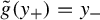 ,
$\tilde g(y_-)=y_+$
,
$\tilde g(y_-)=y_+$
 , and
$\tilde g(y)=y$
, and
$\tilde g(y)=y$
 for all points
$y\in Y$
for all points
$y\in Y$
 different from
$y_+$
different from
$y_+$
 .
.
Next, we prove that for any finite set
$S\subset {\mathrm {Orb}}_{\mathcal {G}}(x)\setminus Y$
 containing the point
$y_-$
containing the point
$y_-$
 , there exists a map
$h_S\in H_g$
, there exists a map
$h_S\in H_g$
 such that the restriction of
$h_S$
such that the restriction of
$h_S$
 to
$Y\cup S$
to
$Y\cup S$
 coincides with the transposition
$(y_+\,\,y_-)$
coincides with the transposition
$(y_+\,\,y_-)$
 . The proof is by induction on the number n of points in S. If
$n=1$
. The proof is by induction on the number n of points in S. If
$n=1$
 , then
$S=\{y_-\}$
, then
$S=\{y_-\}$
 and we can let
$h_S=\tilde g$
and we can let
$h_S=\tilde g$
 . In the case
$n\ge 2$
. In the case
$n\ge 2$
 , we assume the claim holds for all sets of
$n-1$
, we assume the claim holds for all sets of
$n-1$
 points. Take any point
$z_0\in S$
points. Take any point
$z_0\in S$
 different from
$y_-$
different from
$y_-$
 . Then, the set
$S_0=S\setminus \{z_0\}$
. Then, the set
$S_0=S\setminus \{z_0\}$
 consists of
$n-1$
consists of
$n-1$
 points including
$y_-$
points including
$y_-$
 . By the inductive assumption, there exists a map
$h_{S_0}\in H_g$
. By the inductive assumption, there exists a map
$h_{S_0}\in H_g$
 such that the restriction of
$h_{S_0}$
such that the restriction of
$h_{S_0}$
 to the set
$Y\cup S_0$
to the set
$Y\cup S_0$
 coincides with the transposition
$(y_+\,\,y_-)$
coincides with the transposition
$(y_+\,\,y_-)$
 . If the point
$\tilde {z}_0=h_{S_0}(z_0)$
. If the point
$\tilde {z}_0=h_{S_0}(z_0)$
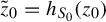 coincides with
$z_0$
coincides with
$z_0$
 , then we can clearly let
$h_S=h_{S_0}$
, then we can clearly let
$h_S=h_{S_0}$
 . Otherwise, Lemma 6.10 implies the existence of a map
$\phi \in \mathcal {G}$
. Otherwise, Lemma 6.10 implies the existence of a map
$\phi \in \mathcal {G}$
 such that its restriction to the set
$Y\cup S\cup \{\tilde {z}_0\}$
such that its restriction to the set
$Y\cup S\cup \{\tilde {z}_0\}$
 coincides with the transposition
$(z_0\,\tilde {z}_0)$
coincides with the transposition
$(z_0\,\tilde {z}_0)$
 . Since
$\phi $
. Since
$\phi $
 fixes all points in Y, it belongs to the stabilizer
${\mathrm {St}}_{\mathcal {G}}(Y)$
fixes all points in Y, it belongs to the stabilizer
${\mathrm {St}}_{\mathcal {G}}(Y)$
 , which is contained in
$H_g$
, which is contained in
$H_g$
 . Then, the map
$\phi h_{S_0}$
. Then, the map
$\phi h_{S_0}$
 is in
$H_g$
is in
$H_g$
 as well. By construction,
$\phi h_{S_0}(z_0)=z_0$
as well. By construction,
$\phi h_{S_0}(z_0)=z_0$
 . Note that
$\tilde {z}_0\notin Y\cup S_0$
. Note that
$\tilde {z}_0\notin Y\cup S_0$
 as
$Y\cup S_0= h_{S_0}(Y\cup S_0)$
as
$Y\cup S_0= h_{S_0}(Y\cup S_0)$
 . Hence,
$\phi h_{S_0}$
. Hence,
$\phi h_{S_0}$
 coincides with
$h_{S_0}$
coincides with
$h_{S_0}$
 on
$Y\cup S_0$
on
$Y\cup S_0$
 . Therefore, we can let
$h_S=\phi h_{S_0}$
. Therefore, we can let
$h_S=\phi h_{S_0}$
 and complete the inductive step.
Next, we prove that for any pair of sets
$S'\subset Y$
 and
$S"\subset {\mathrm {Orb}}_{\mathcal {G}}(x)\setminus Y$
and
$S"\subset {\mathrm {Orb}}_{\mathcal {G}}(x)\setminus Y$
 of the same cardinality, there exists a map
$h_{S',S"}\in H_g$
of the same cardinality, there exists a map
$h_{S',S"}\in H_g$
 such that
$h_{S',S"}(S')=S"$
such that
$h_{S',S"}(S')=S"$
 ,
$h_{S',S"}^2(y)=y$
,
$h_{S',S"}^2(y)=y$
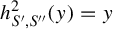 for all
$y\in S'$
for all
$y\in S'$
 , and
$h_{S',S"}(y)=y$
, and
$h_{S',S"}(y)=y$
 for all
$y\in Y\setminus S'$
for all
$y\in Y\setminus S'$
 . The proof is by induction on the number n of points in
$S'$
. The proof is by induction on the number n of points in
$S'$
 . If
$n=0$
. If
$n=0$
 , then both sets are empty and we can let
$h_{S',S"}=\mathrm {id}_X$
, then both sets are empty and we can let
$h_{S',S"}=\mathrm {id}_X$
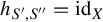 . In the case
$n\ge 1$
. In the case
$n\ge 1$
 , we assume the claim holds whenever the sets consist of
$n-1$
, we assume the claim holds whenever the sets consist of
$n-1$
 points. Take any points
$y_0\in S'$
points. Take any points
$y_0\in S'$
 and
$z_0\in S"$
and
$z_0\in S"$
 . Then, the sets
$S^{\prime }_0=S'\setminus \{y_0\}$
. Then, the sets
$S^{\prime }_0=S'\setminus \{y_0\}$
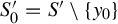 and
$S^{\prime \prime }_0=S"\setminus \{z_0\}$
and
$S^{\prime \prime }_0=S"\setminus \{z_0\}$
 contain
$n-1$
contain
$n-1$
 points each. By the inductive assumption, there exists a map
$h_{S^{\prime }_0,S^{\prime \prime }_0}\in H_g$
points each. By the inductive assumption, there exists a map
$h_{S^{\prime }_0,S^{\prime \prime }_0}\in H_g$
 such that
$h_{S^{\prime }_0,S^{\prime \prime }_0}(S^{\prime }_0)=S^{\prime \prime }_0$
such that
$h_{S^{\prime }_0,S^{\prime \prime }_0}(S^{\prime }_0)=S^{\prime \prime }_0$
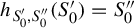 ,
$h_{S^{\prime }_0,S^{\prime \prime }_0}^2(y)=y$
,
$h_{S^{\prime }_0,S^{\prime \prime }_0}^2(y)=y$
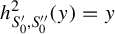 for all
$y\in S^{\prime }_0$
for all
$y\in S^{\prime }_0$
 , and
$h_{S^{\prime }_0,S^{\prime \prime }_0}(y)=y$
, and
$h_{S^{\prime }_0,S^{\prime \prime }_0}(y)=y$
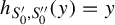 for all
$y\in Y\setminus S^{\prime }_0$
for all
$y\in Y\setminus S^{\prime }_0$
 . Note that
$h_{S^{\prime }_0,S^{\prime \prime }_0}(S^{\prime \prime }_0)=S^{\prime }_0$
. Note that
$h_{S^{\prime }_0,S^{\prime \prime }_0}(S^{\prime \prime }_0)=S^{\prime }_0$
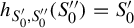 and hence,
$h_{S^{\prime }_0,S^{\prime \prime }_0}(Y\cup S^{\prime \prime }_0)=Y\cup S^{\prime \prime }_0$
and hence,
$h_{S^{\prime }_0,S^{\prime \prime }_0}(Y\cup S^{\prime \prime }_0)=Y\cup S^{\prime \prime }_0$
 . As a consequence, the point
$\tilde {z}_0=h_{S^{\prime }_0,S^{\prime \prime }_0}(z_0)$
. As a consequence, the point
$\tilde {z}_0=h_{S^{\prime }_0,S^{\prime \prime }_0}(z_0)$
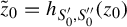 is in
${\mathrm {Orb}}_{\mathcal {G}}(x)\setminus Y$
is in
${\mathrm {Orb}}_{\mathcal {G}}(x)\setminus Y$
 , but not in
$S^{\prime \prime }_0$
, but not in
$S^{\prime \prime }_0$
 . Consider a set
$Z=S^{\prime \prime }_0\cup \{y_-\}\cup \{z_0\}\cup \{\tilde {z}_0\}$
. Consider a set
$Z=S^{\prime \prime }_0\cup \{y_-\}\cup \{z_0\}\cup \{\tilde {z}_0\}$
 , which is a finite subset of
${\mathrm {Orb}}_{\mathcal {G}}(x)\setminus Y$
, which is a finite subset of
${\mathrm {Orb}}_{\mathcal {G}}(x)\setminus Y$
 . By the above, there exists a map
$h_Z\in H_g$
. By the above, there exists a map
$h_Z\in H_g$
 such that its restriction to
$Y\cup Z$
such that its restriction to
$Y\cup Z$
 coincides with the transposition
$(y_+\,\,y_-)$
coincides with the transposition
$(y_+\,\,y_-)$
 . Next, by Lemma 6.10, for any permutation on the set
$Y\cup Z$
. Next, by Lemma 6.10, for any permutation on the set
$Y\cup Z$
 , there exists an element of the group
$\mathcal {G}$
, there exists an element of the group
$\mathcal {G}$
 that coincides with this permutation on
$Y\cup Z$
that coincides with this permutation on
$Y\cup Z$
 . In particular, there exists a map
$\phi \in \mathcal {G}$
. In particular, there exists a map
$\phi \in \mathcal {G}$
 such that
$\phi (z_0)=\tilde {z}_0$
such that
$\phi (z_0)=\tilde {z}_0$
 ,
$\phi (\tilde {z}_0)=z_0$
,
$\phi (\tilde {z}_0)=z_0$
 , and
$\phi (y)=y$
, and
$\phi (y)=y$
 for all other points
$y\in Y\cup Z$
for all other points
$y\in Y\cup Z$
 . The restriction of
$\phi $
. The restriction of
$\phi $
 to
$Y\cup Z$
to
$Y\cup Z$
 coincides with the transposition
$(z_0\,\tilde {z}_0)$
coincides with the transposition
$(z_0\,\tilde {z}_0)$
 if
$z_0\ne \tilde {z}_0$
if
$z_0\ne \tilde {z}_0$
 , and with the identity map if
$z_0=\tilde {z}_0$
, and with the identity map if
$z_0=\tilde {z}_0$
 . Furthermore, there exists a map
$\psi \in \mathcal {G}$
. Furthermore, there exists a map
$\psi \in \mathcal {G}$
 such that
$\psi (y_+)=y_0$
such that
$\psi (y_+)=y_0$
 ,
$\psi (y_0)=y_+$
,
$\psi (y_0)=y_+$
 ,
$\psi (y_-)=z_0$
,
$\psi (y_-)=z_0$
 ,
$\psi (z_0)=y_-$
,
$\psi (z_0)=y_-$
 , and
$\psi (y)=y$
, and
$\psi (y)=y$
 for all other points
$y\in Y\cup Z$
for all other points
$y\in Y\cup Z$
 . The restriction of
$\psi $
. The restriction of
$\psi $
 to the set
$Y\cup Z$
to the set
$Y\cup Z$
 coincides with the permutation
$(y_+\,y_0)(y_-\,z_0)$
coincides with the permutation
$(y_+\,y_0)(y_-\,z_0)$
 if
$y_+\ne y_0$
if
$y_+\ne y_0$
 and
$y_-\ne z_0$
and
$y_-\ne z_0$
 , with the transposition
$(y_+\,y_0)$
, with the transposition
$(y_+\,y_0)$
 if
$y_+\ne y_0$
if
$y_+\ne y_0$
 and
$y_-=z_0$
and
$y_-=z_0$
 , with the transposition
$(y_-\,z_0)$
, with the transposition
$(y_-\,z_0)$
 if
$y_+=y_0$
if
$y_+=y_0$
 and
$y_-\ne z_0$
and
$y_-\ne z_0$
 , and with the identity map if
$y_+=y_0$
, and with the identity map if
$y_+=y_0$
 and
$y_-=z_0$
and
$y_-=z_0$
 . It follows that the restriction of the map
$\psi h_Z\psi ^{-1}$
. It follows that the restriction of the map
$\psi h_Z\psi ^{-1}$
 to
$Y\cup Z$
to
$Y\cup Z$
 coincides with the transposition
$(\psi (y_-)\,\psi (y_+))=(y_0\,z_0)$
coincides with the transposition
$(\psi (y_-)\,\psi (y_+))=(y_0\,z_0)$
 . Finally, let
$h_{S',S"}=\psi h_Z\psi ^{-1}\phi h_{S^{\prime }_0,S^{\prime \prime }_0}$
. Finally, let
$h_{S',S"}=\psi h_Z\psi ^{-1}\phi h_{S^{\prime }_0,S^{\prime \prime }_0}$
 . By construction,
$\phi (Y)=\psi (Y)=Y$
. By construction,
$\phi (Y)=\psi (Y)=Y$
 so that
$\phi ,\psi \in {\mathrm {St}}_{\mathcal {G}}(Y)\subset H_g$
so that
$\phi ,\psi \in {\mathrm {St}}_{\mathcal {G}}(Y)\subset H_g$
 . Then,
$h_{S',S"}\in H_g$
. Then,
$h_{S',S"}\in H_g$
 as well. The map
$h_{S',S"}$
as well. The map
$h_{S',S"}$
 coincides with
$h_{S^{\prime }_0,S^{\prime \prime }_0}$
coincides with
$h_{S^{\prime }_0,S^{\prime \prime }_0}$
 on the set
$(Y\setminus \{y_0\})\cup S^{\prime \prime }_0$
on the set
$(Y\setminus \{y_0\})\cup S^{\prime \prime }_0$
 . In addition,
$h_{S',S"}(y_0)=\psi h_Z\psi ^{-1}\phi (y_0)=\psi h_Z\psi ^{-1}(y_0)=z_0$
. In addition,
$h_{S',S"}(y_0)=\psi h_Z\psi ^{-1}\phi (y_0)=\psi h_Z\psi ^{-1}(y_0)=z_0$
 and
$h_{S',S"}(z_0)=\psi h_Z\psi ^{-1}\phi (\tilde {z}_0)=\psi h_Z\psi ^{-1}(z_0)=y_0$
and
$h_{S',S"}(z_0)=\psi h_Z\psi ^{-1}\phi (\tilde {z}_0)=\psi h_Z\psi ^{-1}(z_0)=y_0$
 . The inductive step is complete.
Now, we are ready to show that
$H_g=\mathcal {G}$
 . Take any map
$f\in \mathcal {G}$
. Take any map
$f\in \mathcal {G}$
 . We define three sets
$S_{++}=Y\cap f^{-1}(Y)$
. We define three sets
$S_{++}=Y\cap f^{-1}(Y)$
 ,
$S_{+-}=Y\cap f^{-1}({\mathrm {Orb}}_{\mathcal {G}}(x)\setminus Y)$
,
$S_{+-}=Y\cap f^{-1}({\mathrm {Orb}}_{\mathcal {G}}(x)\setminus Y)$
 , and
$S_{-+}=({\mathrm {Orb}}_{\mathcal {G}}(x)\setminus Y)\cap f^{-1}(Y)$
, and
$S_{-+}=({\mathrm {Orb}}_{\mathcal {G}}(x)\setminus Y)\cap f^{-1}(Y)$
 . Since
$f({\mathrm {Orb}}_{\mathcal {G}}(x))={\mathrm {Orb}}_{\mathcal {G}}(x)$
. Since
$f({\mathrm {Orb}}_{\mathcal {G}}(x))={\mathrm {Orb}}_{\mathcal {G}}(x)$
 , it follows that
$Y=S_{++}\sqcup S_{+-}=f(S_{++})\sqcup f(S_{-+})$
, it follows that
$Y=S_{++}\sqcup S_{+-}=f(S_{++})\sqcup f(S_{-+})$
 . Since f is a one-to-one map, the set
$f(S_{++})$
. Since f is a one-to-one map, the set
$f(S_{++})$
 is of the same cardinality as
$S_{++}$
is of the same cardinality as
$S_{++}$
 , while the set
$f(S_{-+})$
, while the set
$f(S_{-+})$
 is of the same cardinality as
$S_{-+}$
is of the same cardinality as
$S_{-+}$
 . Since the set Y is finite, it follows that
$S_{-+}$
. Since the set Y is finite, it follows that
$S_{-+}$
 is of the same cardinality as
$S_{+-}$
is of the same cardinality as
$S_{+-}$
 . By the above, there exists a map
$h_f\in H_g$
. By the above, there exists a map
$h_f\in H_g$
 such that
$h_f(S_{+-})=S_{-+}$
such that
$h_f(S_{+-})=S_{-+}$
 and
$h_f(y)=y$
and
$h_f(y)=y$
 for all
$y\in Y\setminus S_{+-}=S_{++}$
for all
$y\in Y\setminus S_{+-}=S_{++}$
 . We obtain that
$fh_f(S_{+-})=f(h_f(S_{+-}))=f(S_{-+})$
. We obtain that
$fh_f(S_{+-})=f(h_f(S_{+-}))=f(S_{-+})$
 and
$fh_f(S_{++})=f(h_f(S_{++}))=f(S_{++})$
and
$fh_f(S_{++})=f(h_f(S_{++}))=f(S_{++})$
 , which implies that
$fh_f(Y)=Y$
, which implies that
$fh_f(Y)=Y$
 . Hence, the map
$fh_f$
. Hence, the map
$fh_f$
 belongs to the stabilizer
${\mathrm {St}}_{\mathcal {G}}(Y)$
belongs to the stabilizer
${\mathrm {St}}_{\mathcal {G}}(Y)$
 , which is contained in
$H_g$
, which is contained in
$H_g$
 . Then,
$f=(fh_f)h_f^{-1}$
. Then,
$f=(fh_f)h_f^{-1}$
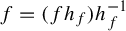 is in
$H_g$
is in
$H_g$
 as well. Thus,
$H_g=\mathcal {G}$
as well. Thus,
$H_g=\mathcal {G}$
 .
.
Remark 6.12. Theorem 6.11 allows the determination, for any ample group
$\mathcal {G}\subset {\mathrm {Homeo}}(X)$
 and any finite set
$Y\subset X$
and any finite set
$Y\subset X$
 , whether the stabilizer
${\mathrm {St}}_{\mathcal {G}}(Y)$
, whether the stabilizer
${\mathrm {St}}_{\mathcal {G}}(Y)$
 is a maximal subgroup of
$\mathcal {G}$
is a maximal subgroup of
$\mathcal {G}$
 and whether
${\mathrm {St}}_{\mathcal {G}}(Y)=\mathcal {G}$
and whether
${\mathrm {St}}_{\mathcal {G}}(Y)=\mathcal {G}$
 . Namely,
${\mathrm {St}}_{\mathcal {G}}(Y)=\mathcal {G}$
. Namely,
${\mathrm {St}}_{\mathcal {G}}(Y)=\mathcal {G}$
 if and only if Y is a union of orbits of
$\mathcal {G}$
if and only if Y is a union of orbits of
$\mathcal {G}$
 (since the set Y is finite, this means the union of a finite number of finite orbits). The stabilizer
${\mathrm {St}}_{\mathcal {G}}(Y)$
(since the set Y is finite, this means the union of a finite number of finite orbits). The stabilizer
${\mathrm {St}}_{\mathcal {G}}(Y)$
 is a maximal subgroup of
$\mathcal {G}$
is a maximal subgroup of
$\mathcal {G}$
 if and only if
$Y=Y_1\sqcup Y_2$
if and only if
$Y=Y_1\sqcup Y_2$
 , where
$Y_2$
, where
$Y_2$
 is a union of orbits of
$\mathcal {G}$
is a union of orbits of
$\mathcal {G}$
 (it may be empty) and
$Y_1$
(it may be empty) and
$Y_1$
 is a proper non-empty subset of a single orbit such that either Y does not contain exactly half of the points in the orbit or else Y is a one-point subset of a two-point orbit.
The following concise corollary of Theorem 6.11 is much less general, but it will be enough, e.g., when the topological space X is a Cantor set and the ample group
$\mathcal {G}$
 acts minimally on X.
Theorem 6.13. Let
$\mathcal {G}\subset {\mathrm {Homeo}}(X)$
 be an ample group that has no finite orbits. Suppose Y is a finite non-empty subset of X. Then, the stabilizer
${\mathrm {St}}_{\mathcal {G}}(Y)$
be an ample group that has no finite orbits. Suppose Y is a finite non-empty subset of X. Then, the stabilizer
${\mathrm {St}}_{\mathcal {G}}(Y)$
 is a maximal subgroup of
$\mathcal {G}$
is a maximal subgroup of
$\mathcal {G}$
 if and only if Y is contained in a single orbit of
$\mathcal {G}$
if and only if Y is contained in a single orbit of
$\mathcal {G}$
 .
.
Proof. Since all orbits of the group
$\mathcal {G}$
 are infinite, the finite set Y cannot contain an entire orbit of
$\mathcal {G}$
are infinite, the finite set Y cannot contain an entire orbit of
$\mathcal {G}$
 or exactly half of the elements in an orbit. If Y intersects at least two different orbits of
$\mathcal {G}$
or exactly half of the elements in an orbit. If Y intersects at least two different orbits of
$\mathcal {G}$
 , then the stabilizer
${\mathrm {St}}_{\mathcal {G}}(Y)$
, then the stabilizer
${\mathrm {St}}_{\mathcal {G}}(Y)$
 is not a maximal subgroup of
$\mathcal {G}$
is not a maximal subgroup of
$\mathcal {G}$
 due to statement (iii) of Theorem 6.11. Otherwise, Y is contained in a single orbit of
$\mathcal {G}$
due to statement (iii) of Theorem 6.11. Otherwise, Y is contained in a single orbit of
$\mathcal {G}$
 . Then,
${\mathrm {St}}_{\mathcal {G}}(Y)$
. Then,
${\mathrm {St}}_{\mathcal {G}}(Y)$
 is a maximal subgroup of the group
$\mathcal {G}$
is a maximal subgroup of the group
$\mathcal {G}$
 due to statement (i) of Theorem 6.11.
To treat the stabilizers of infinite closed sets, we need to develop a different approach. This approach will also apply to another class of subgroups that contains many maximal subgroups, namely, the stabilizers of partitions of X into clopen sets (see Definition 3.4).
Lemma 6.14. Suppose
$X=U_1\sqcup U_2\sqcup \cdots \sqcup U_k$
 is a partition of X into clopen sets. Then, for any ample group
$\mathcal {G}\subset {\mathrm {Homeo}}(X)$
is a partition of X into clopen sets. Then, for any ample group
$\mathcal {G}\subset {\mathrm {Homeo}}(X)$
 , the individual stabilizer
${\mathrm {St}}^\bullet _{\mathcal {G}}(U_1,U_2,\ldots ,U_k)$
, the individual stabilizer
${\mathrm {St}}^\bullet _{\mathcal {G}}(U_1,U_2,\ldots ,U_k)$
 is the internal direct product of the local subgroups
$\mathcal {G}_{U_i}$
is the internal direct product of the local subgroups
$\mathcal {G}_{U_i}$
 ,
$1\le i\le k$
,
$1\le i\le k$
 .
.
Proof. The group
$H={\mathrm {St}}^\bullet _{\mathcal {G}}(U_1,U_2,\ldots ,U_k)$
 is the intersection of the set stabilizers
${\mathrm {St}}_{\mathcal {G}}(U_i)$
is the intersection of the set stabilizers
${\mathrm {St}}_{\mathcal {G}}(U_i)$
 ,
$1\le i\le k$
,
$1\le i\le k$
 . For any i, the local subgroup
$\mathcal {G}_{U_i}={\mathrm {RiSt}}_{\mathcal {G}}(U_i)$
. For any i, the local subgroup
$\mathcal {G}_{U_i}={\mathrm {RiSt}}_{\mathcal {G}}(U_i)$
 is a subgroup of
${\mathrm {St}}_{\mathcal {G}}(U_i)$
is a subgroup of
${\mathrm {St}}_{\mathcal {G}}(U_i)$
 . In addition,
$\mathcal {G}_{U_i}\subset {\mathrm {St}}^\star _{\mathcal {G}}(U_j)\subset {\mathrm {St}}_{\mathcal {G}}(U_j)$
. In addition,
$\mathcal {G}_{U_i}\subset {\mathrm {St}}^\star _{\mathcal {G}}(U_j)\subset {\mathrm {St}}_{\mathcal {G}}(U_j)$
 whenever
$i\ne j$
whenever
$i\ne j$
 as then,
$U_i\cap U_j=\emptyset $
as then,
$U_i\cap U_j=\emptyset $
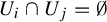 . Hence,
$\mathcal {G}_{U_i}\subset H$
. Hence,
$\mathcal {G}_{U_i}\subset H$
 for all i.
For each i,
$1\le i\le k$
 , choose a map
$f_i\in \mathcal {G}_{U_i}$
, choose a map
$f_i\in \mathcal {G}_{U_i}$
 . Then, the maps
$f_1,f_2,\ldots ,f_k$
. Then, the maps
$f_1,f_2,\ldots ,f_k$
 commute with one another as they have disjoint supports. In addition, the product
$f_1f_2\cdots f_k$
commute with one another as they have disjoint supports. In addition, the product
$f_1f_2\cdots f_k$
 coincides with
$f_i$
coincides with
$f_i$
 on
$U_i$
on
$U_i$
 for all i, which implies that
$f_1f_2\cdots f_k=\mathrm {id}_X$
for all i, which implies that
$f_1f_2\cdots f_k=\mathrm {id}_X$
 if and only if each
$f_i$
if and only if each
$f_i$
 is the identity map. It follows that the local subgroups
$\mathcal {G}_{U_i}$
is the identity map. It follows that the local subgroups
$\mathcal {G}_{U_i}$
 ,
$1\le i\le k$
,
$1\le i\le k$
 , form an internal direct product in H.
Now, take any
$f\in H$
 . For each i,
$1\le i\le k$
. For each i,
$1\le i\le k$
 , consider a map
$f_i:X\to X$
, consider a map
$f_i:X\to X$
 that coincides with f on
$U_i$
that coincides with f on
$U_i$
 and with the identity map on
$X\setminus U_i$
and with the identity map on
$X\setminus U_i$
 . Since f is invertible and
$f(U_i)=U_i$
. Since f is invertible and
$f(U_i)=U_i$
 , it follows that the map
$f_i$
, it follows that the map
$f_i$
 is invertible as well. By construction,
$f_i$
is invertible as well. By construction,
$f_i$
 is piecewise an element of the ample group
$\mathcal {G}$
is piecewise an element of the ample group
$\mathcal {G}$
 and
${\mathrm {supp}}(f_i)\subset U_i$
and
${\mathrm {supp}}(f_i)\subset U_i$
 . Hence,
$f_i\in \mathcal {G}_{U_i}$
. Hence,
$f_i\in \mathcal {G}_{U_i}$
 . Also, by construction,
$f=f_1f_2\cdots f_k$
. Also, by construction,
$f=f_1f_2\cdots f_k$
 . We conclude that the product of the local subgroups
$\mathcal {G}_{U_1},\mathcal {G}_{U_2},\ldots ,\mathcal {G}_{U_k}$
. We conclude that the product of the local subgroups
$\mathcal {G}_{U_1},\mathcal {G}_{U_2},\ldots ,\mathcal {G}_{U_k}$
 equals H.
Lemma 6.15. Let
$X=U_1\sqcup U_2\sqcup \cdots \sqcup U_k$
 be a partition of X into clopen sets at most one of which consists of a single point. Let
$\mathcal {G}\subset {\mathrm {Homeo}}(X)$
be a partition of X into clopen sets at most one of which consists of a single point. Let
$\mathcal {G}\subset {\mathrm {Homeo}}(X)$
 be an ample group that acts minimally on X. Suppose H is a subgroup of
$\mathcal {G}$
be an ample group that acts minimally on X. Suppose H is a subgroup of
$\mathcal {G}$
 such that
${\mathrm {St}}^\bullet _{\mathcal {G}}(U_1,U_2,\ldots ,U_k)\subset H\subset {\mathrm {St}}_{\mathcal {G}}(U_1,U_2,\ldots ,U_k)$
such that
${\mathrm {St}}^\bullet _{\mathcal {G}}(U_1,U_2,\ldots ,U_k)\subset H\subset {\mathrm {St}}_{\mathcal {G}}(U_1,U_2,\ldots ,U_k)$
 . Then, H contains a local subgroup
$\mathcal {G}_U$
. Then, H contains a local subgroup
$\mathcal {G}_U$
 if and only if
$U\subset U_i$
if and only if
$U\subset U_i$
 for some i,
$1\le i\le k$
for some i,
$1\le i\le k$
 .
.
Proof. Lemma 6.14 implies that the individual stabilizer
${\mathrm {St}}^\bullet _{\mathcal {G}}(U_1,U_2,\ldots ,U_k)$
 contains local subgroups
$\mathcal {G}_{U_1},\mathcal {G}_{U_2},\ldots ,\mathcal {G}_{U_k}$
contains local subgroups
$\mathcal {G}_{U_1},\mathcal {G}_{U_2},\ldots ,\mathcal {G}_{U_k}$
 . If a clopen set U is contained in
$U_i$
. If a clopen set U is contained in
$U_i$
 for some i,
$1\le i\le k$
for some i,
$1\le i\le k$
 , then clearly,
$\mathcal {G}_U\subset \mathcal {G}_{U_i}$
, then clearly,
$\mathcal {G}_U\subset \mathcal {G}_{U_i}$
 . Consequently,
$\mathcal {G}_U\subset H$
. Consequently,
$\mathcal {G}_U\subset H$
 . Now, assume that a clopen set U is not contained in a single element of the partition
$X=U_1\sqcup U_2\sqcup \cdots \sqcup U_k$
. Now, assume that a clopen set U is not contained in a single element of the partition
$X=U_1\sqcup U_2\sqcup \cdots \sqcup U_k$
 . Then, there are two different elements
$V_1$
. Then, there are two different elements
$V_1$
 and
$V_2$
and
$V_2$
 of the partition such that the intersections
$U\cap V_1$
of the partition such that the intersections
$U\cap V_1$
 and
$U\cap V_2$
and
$U\cap V_2$
 are not empty. By the assumption of the lemma, at least one of the sets
$V_1$
are not empty. By the assumption of the lemma, at least one of the sets
$V_1$
 and
$V_2$
and
$V_2$
 contains more than one point. We may assume without loss of generality that
$V_1$
contains more than one point. We may assume without loss of generality that
$V_1$
 contains more than one point. Take any point
$x\in U\cap V_1$
contains more than one point. Take any point
$x\in U\cap V_1$
 and let z be any point of
$V_1$
and let z be any point of
$V_1$
 different from x. Since the group
$\mathcal {G}$
different from x. Since the group
$\mathcal {G}$
 acts minimally on X, the orbit
${\mathrm {Orb}}_{\mathcal {G}}(x)$
acts minimally on X, the orbit
${\mathrm {Orb}}_{\mathcal {G}}(x)$
 is dense in X. In particular, this orbit has a point y in the non-empty clopen set
$U\cap V_2$
is dense in X. In particular, this orbit has a point y in the non-empty clopen set
$U\cap V_2$
 . By Lemma 6.3, there exists a map
$f\in \mathcal {G}$
. By Lemma 6.3, there exists a map
$f\in \mathcal {G}$
 such that
$f(x)=y$
such that
$f(x)=y$
 and f coincides with the identity map on the closed set
$(X\setminus U)\cup \{z\}$
and f coincides with the identity map on the closed set
$(X\setminus U)\cup \{z\}$
 . Then,
$f\in \mathcal {G}_U$
. Then,
$f\in \mathcal {G}_U$
 . Since
$f(x)=y$
. Since
$f(x)=y$
 and
$f(z)=z$
and
$f(z)=z$
 , the image
$f(V_1)$
, the image
$f(V_1)$
 intersects both
$V_1$
intersects both
$V_1$
 and
$V_2$
and
$V_2$
 so that it cannot be an element of the partition
$X=U_1\sqcup U_2\sqcup \cdots \sqcup U_k$
so that it cannot be an element of the partition
$X=U_1\sqcup U_2\sqcup \cdots \sqcup U_k$
 . As a consequence, f does not belong to the collective stabilizer
${\mathrm {St}}_{\mathcal {G}}(U_1,U_2,\ldots ,U_k)$
. As a consequence, f does not belong to the collective stabilizer
${\mathrm {St}}_{\mathcal {G}}(U_1,U_2,\ldots ,U_k)$
 . In particular,
$f\notin H$
. In particular,
$f\notin H$
 . Thus, the local subgroup
$\mathcal {G}_U$
. Thus, the local subgroup
$\mathcal {G}_U$
 is not contained in H.
Notice that the assumption of Lemma 6.15 that at most one element of the partition of X consists of a single point is essential. A one-point set
$\{x\}$
 is clopen if x is an isolated point of X. If
$\{x\}$
is clopen if x is an isolated point of X. If
$\{x\}$
 and
$\{y\}$
and
$\{y\}$
 are two distinct elements of the partition, then the local subgroup
$\mathcal {G}_{\{x,y\}}$
are two distinct elements of the partition, then the local subgroup
$\mathcal {G}_{\{x,y\}}$
 is contained in the stabilizer of the partition.
Lemma 6.16. Let
$\mathcal {G}\subset {\mathrm {Homeo}}(X)$
 be an ample group that acts minimally on X. Suppose that
$X=U_1\sqcup U_2\sqcup \cdots \sqcup U_k$
be an ample group that acts minimally on X. Suppose that
$X=U_1\sqcup U_2\sqcup \cdots \sqcup U_k$
 is a partition of X into non-empty clopen sets. Then,
${\mathrm {St}}_{\mathcal {G}}(U_1,U_2,\ldots ,U_k)\ne \mathcal {G}$
is a partition of X into non-empty clopen sets. Then,
${\mathrm {St}}_{\mathcal {G}}(U_1,U_2,\ldots ,U_k)\ne \mathcal {G}$
 , unless this is the partition into points or the trivial partition consisting of only one set.
Proof. The partition of X into points and the trivial partition are preserved by any invertible transformation of X. In particular, they are preserved by all elements of the group
$\mathcal {G}$
 . Conversely, assume that
${\mathrm {St}}_{\mathcal {G}}(U_1,U_2,\ldots ,U_k)=\mathcal {G}$
. Conversely, assume that
${\mathrm {St}}_{\mathcal {G}}(U_1,U_2,\ldots ,U_k)=\mathcal {G}$
 . Then, the group
$\mathcal {G}$
. Then, the group
$\mathcal {G}$
 acts on the set
$\{U_1,U_2,\ldots ,U_k\}$
acts on the set
$\{U_1,U_2,\ldots ,U_k\}$
 . That action is transitive since the action of
$\mathcal {G}$
. That action is transitive since the action of
$\mathcal {G}$
 on X is minimal. As a consequence, all elements of the partition are of the same cardinality. Hence, this is either the partition into points, or else a partition in which every element consists of more than one point. In the latter case, Lemma 6.15 implies that any local subgroup
$\mathcal {G}_U$
on X is minimal. As a consequence, all elements of the partition are of the same cardinality. Hence, this is either the partition into points, or else a partition in which every element consists of more than one point. In the latter case, Lemma 6.15 implies that any local subgroup
$\mathcal {G}_U$
 is contained in the stabilizer
${\mathrm {St}}_{\mathcal {G}}(U_1,U_2,\ldots ,U_k)$
is contained in the stabilizer
${\mathrm {St}}_{\mathcal {G}}(U_1,U_2,\ldots ,U_k)$
 if and only if the clopen set U is contained in a single element of the partition. Since
$\mathcal {G}$
if and only if the clopen set U is contained in a single element of the partition. Since
$\mathcal {G}$
 can be represented as the local subgroup
$\mathcal {G}_X$
can be represented as the local subgroup
$\mathcal {G}_X$
 , it follows that X is an element of the partition. As all elements of the partition are non-empty sets, we obtain that X is the only element so that the partition is trivial.
Proposition 6.17. Let
$\mathcal {G}\subset {\mathrm {Homeo}}(X)$
 be an ample group with Property E. Suppose H is a subgroup of
$\mathcal {G}$
be an ample group with Property E. Suppose H is a subgroup of
$\mathcal {G}$
 that acts minimally on X and contains a local subgroup
$\mathcal {G}_U$
that acts minimally on X and contains a local subgroup
$\mathcal {G}_U$
 for some clopen set U consisting of more than one point. Then, there exists a partition of X into clopen sets,
$X=U_1\sqcup U_2\sqcup \cdots \sqcup U_k$
for some clopen set U consisting of more than one point. Then, there exists a partition of X into clopen sets,
$X=U_1\sqcup U_2\sqcup \cdots \sqcup U_k$
 , such that each
$U_i$
, such that each
$U_i$
 consists of more than one point and
${\mathrm {St}}^\bullet _{\mathcal {G}}(U_1,U_2,\ldots ,U_k)\subset H\subset {\mathrm {St}}_{\mathcal {G}}(U_1,U_2,\ldots ,U_k)$
consists of more than one point and
${\mathrm {St}}^\bullet _{\mathcal {G}}(U_1,U_2,\ldots ,U_k)\subset H\subset {\mathrm {St}}_{\mathcal {G}}(U_1,U_2,\ldots ,U_k)$
 . Moreover, the partition is unique and the induced action of H on the set
$\{U_1,U_2,\ldots ,U_k\}$
. Moreover, the partition is unique and the induced action of H on the set
$\{U_1,U_2,\ldots ,U_k\}$
 is transitive.
Proof. Let
$\mathcal {L}_H$
 be the set of all clopen sets
$V\subset X$
be the set of all clopen sets
$V\subset X$
 such that the subgroup H contains the local subgroup
$\mathcal {G}_V$
such that the subgroup H contains the local subgroup
$\mathcal {G}_V$
 . Note that
$\mathcal {G}_{V_1}\subset \mathcal {G}_{V_2}$
. Note that
$\mathcal {G}_{V_1}\subset \mathcal {G}_{V_2}$
 whenever
$V_1\subset V_2$
whenever
$V_1\subset V_2$
 . Hence, any clopen set contained in an element of
$\mathcal {L}_H$
. Hence, any clopen set contained in an element of
$\mathcal {L}_H$
 is itself an element of
$\mathcal {L}_H$
is itself an element of
$\mathcal {L}_H$
 . Since the group
$\mathcal {G}$
. Since the group
$\mathcal {G}$
 has Property E, for any intersecting clopen sets
$V_1$
has Property E, for any intersecting clopen sets
$V_1$
 and
$V_2$
and
$V_2$
 , the local subgroup
$\mathcal {G}_{V_1\cup V_2}$
, the local subgroup
$\mathcal {G}_{V_1\cup V_2}$
 is generated by the union of
$\mathcal {G}_{V_1}$
is generated by the union of
$\mathcal {G}_{V_1}$
 and
$\mathcal {G}_{V_2}$
and
$\mathcal {G}_{V_2}$
 . Therefore,
$V_1\cup V_2\in \mathcal {L}_H$
. Therefore,
$V_1\cup V_2\in \mathcal {L}_H$
 whenever
$V_1,V_2\in \mathcal {L}_H$
whenever
$V_1,V_2\in \mathcal {L}_H$
 and
$V_1\cap V_2\ne \emptyset $
and
$V_1\cap V_2\ne \emptyset $
 . Furthermore,
$\mathcal {G}_{g(V)}=g\mathcal {G}_Vg^{-1}$
. Furthermore,
$\mathcal {G}_{g(V)}=g\mathcal {G}_Vg^{-1}$
 for any clopen set V and any
$g\in \mathcal {G}$
for any clopen set V and any
$g\in \mathcal {G}$
 . This follows from the fact that
${\mathrm {supp}}(gfg^{-1})=g({\mathrm {supp}}(f))$
. This follows from the fact that
${\mathrm {supp}}(gfg^{-1})=g({\mathrm {supp}}(f))$
 for any homeomorphism
$f\in {\mathrm {Homeo}}(X)$
for any homeomorphism
$f\in {\mathrm {Homeo}}(X)$
 . As a consequence,
$h(V)\in \mathcal {L}_H$
. As a consequence,
$h(V)\in \mathcal {L}_H$
 for all
$h\in H$
for all
$h\in H$
 whenever
$V\in \mathcal {L}_H$
whenever
$V\in \mathcal {L}_H$
 .
.
By assumption, some clopen set U consisting of more than one point is an element of
$\mathcal {L}_H$
 . Minimality of the action of the group H on X implies that any orbit
${\mathrm {Orb}}_H(x)$
. Minimality of the action of the group H on X implies that any orbit
${\mathrm {Orb}}_H(x)$
 of H is dense in X. In particular, it has a point in U. That is,
$h(x)\in U$
of H is dense in X. In particular, it has a point in U. That is,
$h(x)\in U$
 for some
$h\in H$
for some
$h\in H$
 . Then,
$h^{-1}(U)$
. Then,
$h^{-1}(U)$
 is an element of
$\mathcal {L}_H$
is an element of
$\mathcal {L}_H$
 containing the point x. We conclude that elements of
$\mathcal {L}_H$
containing the point x. We conclude that elements of
$\mathcal {L}_H$
 cover X. Since the topological space X is compact, there is a finite subcover. Let
$\{U_1,U_2,\ldots ,U_k\}$
cover X. Since the topological space X is compact, there is a finite subcover. Let
$\{U_1,U_2,\ldots ,U_k\}$
 be a finite subcover with the least possible number of elements. This choice implies that all elements of the subcover are non-empty sets and the union of any two or more of them is not an element of
$\mathcal {L}_H$
be a finite subcover with the least possible number of elements. This choice implies that all elements of the subcover are non-empty sets and the union of any two or more of them is not an element of
$\mathcal {L}_H$
 . Then, it follows from the above that any two elements of the subcover are disjoint. Hence, our subcover is actually a partition:
$X=U_1\sqcup U_2\sqcup \cdots \sqcup U_k$
. Then, it follows from the above that any two elements of the subcover are disjoint. Hence, our subcover is actually a partition:
$X=U_1\sqcup U_2\sqcup \cdots \sqcup U_k$
 . Observe that this is not the partition into points as otherwise, U would be the union of two or more elements of the partition. We claim that any set
$V\in \mathcal {L}_H$
. Observe that this is not the partition into points as otherwise, U would be the union of two or more elements of the partition. We claim that any set
$V\in \mathcal {L}_H$
 is contained in a single element of the partition. Assume the contrary, that is, V intersects
$U_i$
is contained in a single element of the partition. Assume the contrary, that is, V intersects
$U_i$
 and
$U_j$
and
$U_j$
 , where
$i\ne j$
, where
$i\ne j$
 . Then, the unions
$V\cup U_i$
. Then, the unions
$V\cup U_i$
 and
$V\cup U_j$
and
$V\cup U_j$
 are elements of
$\mathcal {L}_H$
are elements of
$\mathcal {L}_H$
 . These unions are not disjoint as they both contain V. Therefore, their union
$V\cup U_i\cup U_j$
. These unions are not disjoint as they both contain V. Therefore, their union
$V\cup U_i\cup U_j$
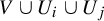 belongs to
$\mathcal {L}_H$
belongs to
$\mathcal {L}_H$
 as well. Since
$U_i\cup U_j$
as well. Since
$U_i\cup U_j$
 is a clopen subset of
$V\cup U_i\cup U_j$
is a clopen subset of
$V\cup U_i\cup U_j$
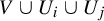 , we obtain that
$U_i\cup U_j\in \mathcal {L}_H$
, we obtain that
$U_i\cup U_j\in \mathcal {L}_H$
 , which yields a contradiction.
Take any
$h\in H$
 . By the above, the sets
$h(U_1),h(U_2),\ldots ,h(U_k)$
. By the above, the sets
$h(U_1),h(U_2),\ldots ,h(U_k)$
 belong to
$\mathcal {L}_H$
belong to
$\mathcal {L}_H$
 . Therefore, each of them is contained in a single element of the partition
$\{U_1,U_2,\ldots ,U_k\}$
. Therefore, each of them is contained in a single element of the partition
$\{U_1,U_2,\ldots ,U_k\}$
 . Since h is an invertible map, the sets
$h(U_1),h(U_2),\ldots ,h(U_k)$
. Since h is an invertible map, the sets
$h(U_1),h(U_2),\ldots ,h(U_k)$
 themselves form a partition of X. Hence, we have a finite partition of X into non-empty sets, each element of which is contained in a single element of another partition of X into non-empty sets. Since both partitions consist of the same number of sets, this is possible only if both partitions are the same. In other words, h maps the sets
$U_1,U_2,\ldots ,U_k$
themselves form a partition of X. Hence, we have a finite partition of X into non-empty sets, each element of which is contained in a single element of another partition of X into non-empty sets. Since both partitions consist of the same number of sets, this is possible only if both partitions are the same. In other words, h maps the sets
$U_1,U_2,\ldots ,U_k$
 onto one another. We conclude that the subgroup H is contained in
${\mathrm {St}}_{\mathcal {G}}(U_1,U_2,\ldots ,U_k)$
onto one another. We conclude that the subgroup H is contained in
${\mathrm {St}}_{\mathcal {G}}(U_1,U_2,\ldots ,U_k)$
 , the stabilizer of the partition. In addition, H contains the individual stabilizer
${\mathrm {St}}^\bullet _{\mathcal {G}}(U_1,U_2,\ldots ,U_k)$
, the stabilizer of the partition. In addition, H contains the individual stabilizer
${\mathrm {St}}^\bullet _{\mathcal {G}}(U_1,U_2,\ldots ,U_k)$
 . Indeed, it follows from Lemma 6.14 that
${\mathrm {St}}^\bullet _{\mathcal {G}}(U_1,U_2,\ldots ,U_k)$
. Indeed, it follows from Lemma 6.14 that
${\mathrm {St}}^\bullet _{\mathcal {G}}(U_1,U_2,\ldots ,U_k)$
 is generated by the local subgroups
$\mathcal {G}_{U_i}$
is generated by the local subgroups
$\mathcal {G}_{U_i}$
 ,
$1\le i\le k$
,
$1\le i\le k$
 , which are contained in H.
Since
$H\subset {\mathrm {St}}_{\mathcal {G}}(U_1,U_2,\ldots ,U_k)$
 , the group H acts on the set
$\{U_1,U_2,\ldots ,U_k\}$
, the group H acts on the set
$\{U_1,U_2,\ldots ,U_k\}$
 . Take any orbit
$\mathcal {O}$
. Take any orbit
$\mathcal {O}$
 of this action. Then, the union of all sets in
$\mathcal {O}$
of this action. Then, the union of all sets in
$\mathcal {O}$
 is invariant under the action of H on X. Note that this union is a non-empty clopen set. Minimality of the latter action implies that the union coincides with X. Hence,
$\mathcal {O}=\{U_1,U_2,\ldots ,U_k\}$
is invariant under the action of H on X. Note that this union is a non-empty clopen set. Minimality of the latter action implies that the union coincides with X. Hence,
$\mathcal {O}=\{U_1,U_2,\ldots ,U_k\}$
 so that the action of H on
$\{U_1,U_2,\ldots ,U_k\}$
so that the action of H on
$\{U_1,U_2,\ldots ,U_k\}$
 is transitive. In other words, all elements of the partition can be mapped onto one another by elements of H. As a consequence, all elements of the partition are of the same cardinality. Since
$\{U_1,U_2,\ldots ,U_k\}$
is transitive. In other words, all elements of the partition can be mapped onto one another by elements of H. As a consequence, all elements of the partition are of the same cardinality. Since
$\{U_1,U_2,\ldots ,U_k\}$
 is not the partition into points, it follows that each
$U_i$
is not the partition into points, it follows that each
$U_i$
 consists of more than one point.
Let
$\{V_1,V_2,\ldots ,V_\ell \}$
 be an arbitrary partition of X into clopen sets such that each
$V_j$
be an arbitrary partition of X into clopen sets such that each
$V_j$
 consists of more than one point and
${\mathrm {St}}^\bullet _{\mathcal {G}}(V_1,V_2,\ldots ,V_\ell )\subset H\subset {\mathrm {St}}_{\mathcal {G}}(V_1,V_2,\ldots ,V_\ell )$
consists of more than one point and
${\mathrm {St}}^\bullet _{\mathcal {G}}(V_1,V_2,\ldots ,V_\ell )\subset H\subset {\mathrm {St}}_{\mathcal {G}}(V_1,V_2,\ldots ,V_\ell )$
 . Lemma 6.14 implies that the sets
$V_1,V_2,\ldots ,V_\ell $
. Lemma 6.14 implies that the sets
$V_1,V_2,\ldots ,V_\ell $
 belong to
$\mathcal {L}_H$
belong to
$\mathcal {L}_H$
 , just as the sets
$U_1,U_2,\ldots ,U_k$
, just as the sets
$U_1,U_2,\ldots ,U_k$
 do. Note that the group
$\mathcal {G}$
do. Note that the group
$\mathcal {G}$
 acts minimally on X since its subgroup H acts minimally. Hence, we can apply Lemma 6.15. It follows from the lemma that each element of either of the partitions
$\{U_1,U_2,\ldots ,U_k\}$
acts minimally on X since its subgroup H acts minimally. Hence, we can apply Lemma 6.15. It follows from the lemma that each element of either of the partitions
$\{U_1,U_2,\ldots ,U_k\}$
 and
$\{V_1,V_2,\ldots ,V_\ell \}$
and
$\{V_1,V_2,\ldots ,V_\ell \}$
 is contained in a single element of the other partition. Since both partitions consist of non-empty sets, this is possible only if both partitions are the same.
Let us discuss the formulation of Proposition 6.17, specifically, why all clopen sets involved should consist of more than one point. If x is an isolated point of the topological space X, then
$\{x\}$
 is a non-empty clopen set, but the associated local subgroup
$\mathcal {G}_{\{x\}}$
is a non-empty clopen set, but the associated local subgroup
$\mathcal {G}_{\{x\}}$
 is trivial. Hence, the condition that a clopen set U contains more than one point is necessary for the local subgroup
$\mathcal {G}_U$
is trivial. Hence, the condition that a clopen set U contains more than one point is necessary for the local subgroup
$\mathcal {G}_U$
 to be non-trivial. In the case where the ample group
$\mathcal {G}$
to be non-trivial. In the case where the ample group
$\mathcal {G}$
 acts minimally on X, one can show that this condition is also sufficient. Further, if X is a finite set and
$X=U_1\sqcup U_2\sqcup \cdots \sqcup U_k$
acts minimally on X, one can show that this condition is also sufficient. Further, if X is a finite set and
$X=U_1\sqcup U_2\sqcup \cdots \sqcup U_k$
 is the partition into points, then
${\mathrm {St}}^\bullet _{\mathcal {G}}(U_1,U_2,\ldots ,U_k)$
is the partition into points, then
${\mathrm {St}}^\bullet _{\mathcal {G}}(U_1,U_2,\ldots ,U_k)$
 is a trivial group, while
${\mathrm {St}}_{\mathcal {G}}(U_1,U_2,\ldots ,U_k)=\mathcal {G}$
is a trivial group, while
${\mathrm {St}}_{\mathcal {G}}(U_1,U_2,\ldots ,U_k)=\mathcal {G}$
 . The requirement that each
$U_i$
. The requirement that each
$U_i$
 consists of more than one point rules out this degenerate case. Without it, we would not be able to show uniqueness of the partition. In addition, the requirement allows the use of Proposition 6.17 in conjunction with Lemma 6.15.
Proposition 6.17 is going to be crucial for the proofs of all subsequent results on maximal subgroups. The downside of this is that all those results will require the ample group to have Property E. We discuss this property and provide examples of ample groups with it in §8.
Our next result concerns the stabilizers of closed sets that are not open.
Theorem 6.18. Let
$\mathcal {G}\subset {\mathrm {Homeo}}(X)$
 be an ample group that acts minimally on X and has Property E. Suppose
$Y\subset X$
be an ample group that acts minimally on X and has Property E. Suppose
$Y\subset X$
 is a closed set that is not open. Then, the stabilizer
${\mathrm {St}}_{\mathcal {G}}(Y)$
is a closed set that is not open. Then, the stabilizer
${\mathrm {St}}_{\mathcal {G}}(Y)$
 is a maximal subgroup of
$\mathcal {G}$
is a maximal subgroup of
$\mathcal {G}$
 if and only if it acts minimally when restricted to Y, in which case, Y is necessarily nowhere dense in X.
Proof. If the stabilizer
${\mathrm {St}}_{\mathcal {G}}(Y)$
 is a maximal subgroup of
$\mathcal {G}$
is a maximal subgroup of
$\mathcal {G}$
 , then the induced action of
${\mathrm {St}}_{\mathcal {G}}(Y)$
, then the induced action of
${\mathrm {St}}_{\mathcal {G}}(Y)$
 on Y is minimal due to Theorem 6.6. Since the set Y is not clopen, Lemma 6.7 implies that it is nowhere dense in X.
Now, assume that
${\mathrm {St}}_{\mathcal {G}}(Y)$
 acts minimally when restricted to Y. Just as above, this implies that Y is nowhere dense in X. Also, since the closed set Y is not open, it is different from the empty set and X. Then,
${\mathrm {St}}_{\mathcal {G}}(Y)\ne \mathcal {G}$
acts minimally when restricted to Y. Just as above, this implies that Y is nowhere dense in X. Also, since the closed set Y is not open, it is different from the empty set and X. Then,
${\mathrm {St}}_{\mathcal {G}}(Y)\ne \mathcal {G}$
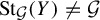 due to Lemma 6.2. To prove that the stabilizer
${\mathrm {St}}_{\mathcal {G}}(Y)$
due to Lemma 6.2. To prove that the stabilizer
${\mathrm {St}}_{\mathcal {G}}(Y)$
 is a maximal subgroup of
$\mathcal {G}$
is a maximal subgroup of
$\mathcal {G}$
 , we are going to show that for any
$g\in \mathcal {G}\setminus {\mathrm {St}}_{\mathcal {G}}(Y)$
, we are going to show that for any
$g\in \mathcal {G}\setminus {\mathrm {St}}_{\mathcal {G}}(Y)$
 , the group
$H_g=\langle {\mathrm {St}}_{\mathcal {G}}(Y)\cup \{g\}\rangle $
, the group
$H_g=\langle {\mathrm {St}}_{\mathcal {G}}(Y)\cup \{g\}\rangle $
 generated by
${\mathrm {St}}_{\mathcal {G}}(Y)$
generated by
${\mathrm {St}}_{\mathcal {G}}(Y)$
 and g coincides with
$\mathcal {G}$
and g coincides with
$\mathcal {G}$
 . By Lemma 6.9, the group
$H_g$
. By Lemma 6.9, the group
$H_g$
 has the same orbits as
$\mathcal {G}$
has the same orbits as
$\mathcal {G}$
 . As a consequence,
$H_g$
. As a consequence,
$H_g$
 acts minimally on X. To apply Proposition 6.17 to the group
$H_g$
acts minimally on X. To apply Proposition 6.17 to the group
$H_g$
 , we need it to contain a local subgroup
$\mathcal {G}_U$
, we need it to contain a local subgroup
$\mathcal {G}_U$
 for some clopen set U containing more than one point. If
$U\subset X\setminus Y$
for some clopen set U containing more than one point. If
$U\subset X\setminus Y$
 , then any map in
$\mathcal {G}_U$
, then any map in
$\mathcal {G}_U$
 fixes all points of Y so that
$\mathcal {G}_U\subset {\mathrm {St}}^\star _{\mathcal {G}}(Y)\subset {\mathrm {St}}_{\mathcal {G}}(Y) \subset H_g$
fixes all points of Y so that
$\mathcal {G}_U\subset {\mathrm {St}}^\star _{\mathcal {G}}(Y)\subset {\mathrm {St}}_{\mathcal {G}}(Y) \subset H_g$
 . Note that the set
$X\setminus Y$
. Note that the set
$X\setminus Y$
 is open, but not closed. Therefore, it is infinite. Any point
$x\in X\setminus Y$
is open, but not closed. Therefore, it is infinite. Any point
$x\in X\setminus Y$
 has a clopen neighborhood
$V_x\subset X\setminus Y$
has a clopen neighborhood
$V_x\subset X\setminus Y$
 . Take any distinct points
$x,y\in X\setminus Y$
. Take any distinct points
$x,y\in X\setminus Y$
 . Then,
$V_x\cup V_y$
. Then,
$V_x\cup V_y$
 is a clopen set consisting of more than one point. In addition,
$V_x\cup V_y\subset X\setminus Y$
is a clopen set consisting of more than one point. In addition,
$V_x\cup V_y\subset X\setminus Y$
 so that
$\mathcal {G}_{V_x\cup V_y}\subset H_g$
so that
$\mathcal {G}_{V_x\cup V_y}\subset H_g$
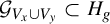 . Now, Proposition 6.17 implies that
${\mathrm {St}}^\bullet _{\mathcal {G}}(U_1,U_2,\ldots ,U_k)\subset H_g\subset {\mathrm {St}}_{\mathcal {G}}(U_1,U_2,\ldots ,U_k)$
. Now, Proposition 6.17 implies that
${\mathrm {St}}^\bullet _{\mathcal {G}}(U_1,U_2,\ldots ,U_k)\subset H_g\subset {\mathrm {St}}_{\mathcal {G}}(U_1,U_2,\ldots ,U_k)$
 , where
$\mathcal {P}=\{U_1,U_2,\ldots ,U_k\}$
, where
$\mathcal {P}=\{U_1,U_2,\ldots ,U_k\}$
 is a partition of X into clopen sets, each consisting of more than one point. Since the set Y is nowhere dense in X, its complement intersects any non-empty open set. In particular, for any i,
$1\le i\le k$
is a partition of X into clopen sets, each consisting of more than one point. Since the set Y is nowhere dense in X, its complement intersects any non-empty open set. In particular, for any i,
$1\le i\le k$
 , we can find a point
$x_i\in U_i$
, we can find a point
$x_i\in U_i$
 that does not belong to Y. Let
$V=V_{x_1}\cup V_{x_2}\cup \cdots \cup V_{x_k}$
that does not belong to Y. Let
$V=V_{x_1}\cup V_{x_2}\cup \cdots \cup V_{x_k}$
 . Then, V is a clopen subset of
$X\setminus Y$
. Then, V is a clopen subset of
$X\setminus Y$
 , which implies that
$\mathcal {G}_V\subset H_g$
, which implies that
$\mathcal {G}_V\subset H_g$
 . Lemma 6.15 further implies that V is contained in a single element of the partition
$\mathcal {P}$
. Lemma 6.15 further implies that V is contained in a single element of the partition
$\mathcal {P}$
 . However, V was constructed so as to intersect every element of
$\mathcal {P}$
. However, V was constructed so as to intersect every element of
$\mathcal {P}$
 . We conclude that
$\mathcal {P}$
. We conclude that
$\mathcal {P}$
 consists of a single element,
$\mathcal {P}=\{X\}$
consists of a single element,
$\mathcal {P}=\{X\}$
 . Since
${\mathrm {St}}^\bullet _{\mathcal {G}}(X)={\mathrm {St}}_{\mathcal {G}}(X)=\mathcal {G}$
. Since
${\mathrm {St}}^\bullet _{\mathcal {G}}(X)={\mathrm {St}}_{\mathcal {G}}(X)=\mathcal {G}$
 , we obtain that
$H_g=\mathcal {G}$
, we obtain that
$H_g=\mathcal {G}$
 .
.
If a closed set
$Y\subset X$
 is clopen, then for any ample group
$\mathcal {G}\subset {\mathrm {Homeo}}(X)$
is clopen, then for any ample group
$\mathcal {G}\subset {\mathrm {Homeo}}(X)$
 that acts minimally on X, the stabilizer
${\mathrm {St}}_{\mathcal {G}}(Y)$
that acts minimally on X, the stabilizer
${\mathrm {St}}_{\mathcal {G}}(Y)$
 acts minimally when restricted to Y (due to Lemma 6.8). If Y is finite, then
${\mathrm {St}}_{\mathcal {G}}(Y)$
acts minimally when restricted to Y (due to Lemma 6.8). If Y is finite, then
${\mathrm {St}}_{\mathcal {G}}(Y)$
 acts minimally on it if and only if Y is contained in a single orbit of
$\mathcal {G}$
acts minimally on it if and only if Y is contained in a single orbit of
$\mathcal {G}$
 . If the closed set Y is neither clopen nor finite, it is not clear whether minimality of the action of
${\mathrm {St}}_{\mathcal {G}}(Y)$
. If the closed set Y is neither clopen nor finite, it is not clear whether minimality of the action of
${\mathrm {St}}_{\mathcal {G}}(Y)$
 on Y is at all possible. In other words, it is not clear whether Theorem 6.18 yields any new examples of maximal subgroups compared with Theorem 6.11. We address this question in §7. In view of Lemma 5.2, the assumptions of Theorem 6.18 can be satisfied only in the case where X is a Cantor set. As it turns out, there are plenty of new examples in that case (see Proposition 7.2).
The next three theorems contain our main results on the stabilizers of partitions of X into clopen sets. Theorems 6.19 and 6.20 tell when such stabilizers are maximal subgroups of the corresponding ample groups (Theorem 6.19 for partitions into two sets, Theorem 6.20 for partitions into three or more sets). Theorem 6.21 provides a characterization of those maximal subgroups of ample groups that are the stabilizers of partitions into clopen sets (just as Theorem 6.6 provides a characterization of those maximal subgroups that are the stabilizers of closed sets). Theorem 6.19 also treats the stabilizers of clopen sets.
Theorem 6.19. Let
$\mathcal {G}\subset {\mathrm {Homeo}}(X)$
 be an ample group that acts minimally on X and has Property E. Suppose U is a clopen set different from the empty set and X. Then,
${\mathrm {St}}_{\mathcal {G}}(U,X\setminus U)$
be an ample group that acts minimally on X and has Property E. Suppose U is a clopen set different from the empty set and X. Then,
${\mathrm {St}}_{\mathcal {G}}(U,X\setminus U)$
 is a maximal subgroup of
$\mathcal {G}$
is a maximal subgroup of
$\mathcal {G}$
 unless both U and
$X\setminus U$
unless both U and
$X\setminus U$
 consist of a single point, in which case,
${\mathrm {St}}_{\mathcal {G}}(U,X\setminus U)=\mathcal {G}$
consist of a single point, in which case,
${\mathrm {St}}_{\mathcal {G}}(U,X\setminus U)=\mathcal {G}$
 . If U cannot be mapped onto
$X\setminus U$
. If U cannot be mapped onto
$X\setminus U$
 by an element of
$\mathcal {G}$
by an element of
$\mathcal {G}$
 , then
${\mathrm {St}}_{\mathcal {G}}(U)={\mathrm {St}}_{\mathcal {G}}(U,X\setminus U)$
, then
${\mathrm {St}}_{\mathcal {G}}(U)={\mathrm {St}}_{\mathcal {G}}(U,X\setminus U)$
 ; otherwise,
${\mathrm {St}}_{\mathcal {G}}(U)$
; otherwise,
${\mathrm {St}}_{\mathcal {G}}(U)$
 is a subgroup of index
$2$
is a subgroup of index
$2$
 in
${\mathrm {St}}_{\mathcal {G}}(U,X\setminus U)$
in
${\mathrm {St}}_{\mathcal {G}}(U,X\setminus U)$
 .
.
Proof. For any invertible map
$f:X\to X$
 , we have
$f(U)=U$
, we have
$f(U)=U$
 if and only if
$f(X\setminus U)=X\setminus U$
if and only if
$f(X\setminus U)=X\setminus U$
 . It follows that
${\mathrm {St}}_{\mathcal {G}}(U)$
. It follows that
${\mathrm {St}}_{\mathcal {G}}(U)$
 coincides with another set stabilizer
${\mathrm {St}}_{\mathcal {G}}(X\setminus U)$
coincides with another set stabilizer
${\mathrm {St}}_{\mathcal {G}}(X\setminus U)$
 as well as with the individual stabilizer
${\mathrm {St}}^\bullet _{\mathcal {G}}(U,X\setminus U)$
as well as with the individual stabilizer
${\mathrm {St}}^\bullet _{\mathcal {G}}(U,X\setminus U)$
 . The stabilizer
${\mathrm {St}}_{\mathcal {G}}(U,X\setminus U)$
. The stabilizer
${\mathrm {St}}_{\mathcal {G}}(U,X\setminus U)$
 of the partition
$X=U\sqcup (X\setminus U)$
of the partition
$X=U\sqcup (X\setminus U)$
 acts on the set
$\{U,X\setminus U\}$
acts on the set
$\{U,X\setminus U\}$
 and
${\mathrm {St}}^\bullet _{\mathcal {G}}(U,X\setminus U)$
and
${\mathrm {St}}^\bullet _{\mathcal {G}}(U,X\setminus U)$
 is the kernel of this action. If U cannot be mapped onto
$X\setminus U$
is the kernel of this action. If U cannot be mapped onto
$X\setminus U$
 by an element of
$\mathcal {G}$
by an element of
$\mathcal {G}$
 , then the action is trivial so that
${\mathrm {St}}_{\mathcal {G}}(U,X\setminus U)={\mathrm {St}}^\bullet _{\mathcal {G}}(U,X\setminus U)={\mathrm {St}}_{\mathcal {G}}(U)$
, then the action is trivial so that
${\mathrm {St}}_{\mathcal {G}}(U,X\setminus U)={\mathrm {St}}^\bullet _{\mathcal {G}}(U,X\setminus U)={\mathrm {St}}_{\mathcal {G}}(U)$
 . Otherwise,
$f(U)=X\setminus U$
. Otherwise,
$f(U)=X\setminus U$
 for some
$f\in \mathcal {G}$
for some
$f\in \mathcal {G}$
 . Then, also
$f(X\setminus U)=X\setminus f(U)=U$
. Then, also
$f(X\setminus U)=X\setminus f(U)=U$
 so that
$f\in {\mathrm {St}}_{\mathcal {G}}(U,X\setminus U)$
so that
$f\in {\mathrm {St}}_{\mathcal {G}}(U,X\setminus U)$
 . Hence, the action of the group
${\mathrm {St}}_{\mathcal {G}}(U,X\setminus U)$
. Hence, the action of the group
${\mathrm {St}}_{\mathcal {G}}(U,X\setminus U)$
 on
$\{U,X\setminus U\}$
on
$\{U,X\setminus U\}$
 is non-trivial, which implies that
${\mathrm {St}}_{\mathcal {G}}(U)={\mathrm {St}}^\bullet _{\mathcal {G}}(U,X\setminus U)$
is non-trivial, which implies that
${\mathrm {St}}_{\mathcal {G}}(U)={\mathrm {St}}^\bullet _{\mathcal {G}}(U,X\setminus U)$
 is a subgroup of index
$2$
is a subgroup of index
$2$
 in
${\mathrm {St}}_{\mathcal {G}}(U,X\setminus U)$
in
${\mathrm {St}}_{\mathcal {G}}(U,X\setminus U)$
 .
.
If both U and
$X\setminus U$
 consist of a single point, then
$X=U\sqcup (X\setminus U)$
consist of a single point, then
$X=U\sqcup (X\setminus U)$
 is the partition into points, which implies that
${\mathrm {St}}_{\mathcal {G}}(U,X\setminus U)=\mathcal {G}$
is the partition into points, which implies that
${\mathrm {St}}_{\mathcal {G}}(U,X\setminus U)=\mathcal {G}$
 . Otherwise,
${\mathrm {St}}_{\mathcal {G}}(U,X\setminus U)\ne \mathcal {G}$
. Otherwise,
${\mathrm {St}}_{\mathcal {G}}(U,X\setminus U)\ne \mathcal {G}$
 due to Lemma 6.16. To prove that
${\mathrm {St}}_{\mathcal {G}}(U,X\setminus U)$
due to Lemma 6.16. To prove that
${\mathrm {St}}_{\mathcal {G}}(U,X\setminus U)$
 is a maximal subgroup of
$\mathcal {G}$
is a maximal subgroup of
$\mathcal {G}$
 in the latter case, we are going to show that for any
$g\in \mathcal {G}\setminus {\mathrm {St}}_{\mathcal {G}}(U,X\setminus U)$
in the latter case, we are going to show that for any
$g\in \mathcal {G}\setminus {\mathrm {St}}_{\mathcal {G}}(U,X\setminus U)$
 , the group
$H_g=\langle {\mathrm {St}}_{\mathcal {G}}(U,X\setminus U)\cup \{g\}\rangle $
, the group
$H_g=\langle {\mathrm {St}}_{\mathcal {G}}(U,X\setminus U)\cup \{g\}\rangle $
 generated by
${\mathrm {St}}_{\mathcal {G}}(U,X\setminus U)$
generated by
${\mathrm {St}}_{\mathcal {G}}(U,X\setminus U)$
 and g coincides with
$\mathcal {G}$
and g coincides with
$\mathcal {G}$
 . Since the group
$\mathcal {G}$
. Since the group
$\mathcal {G}$
 acts minimally on X, it follows from Lemma 6.8 that the stabilizer
${\mathrm {St}}_{\mathcal {G}}(U)$
acts minimally on X, it follows from Lemma 6.8 that the stabilizer
${\mathrm {St}}_{\mathcal {G}}(U)$
 acts minimally when restricted to U. Then, Lemma 6.9 implies that the group
$\langle {\mathrm {St}}_{\mathcal {G}}(U)\cup \{g\}\rangle $
acts minimally when restricted to U. Then, Lemma 6.9 implies that the group
$\langle {\mathrm {St}}_{\mathcal {G}}(U)\cup \{g\}\rangle $
 generated by
${\mathrm {St}}_{\mathcal {G}}(U)$
generated by
${\mathrm {St}}_{\mathcal {G}}(U)$
 and g has the same orbits as
$\mathcal {G}$
and g has the same orbits as
$\mathcal {G}$
 . Since the group
$H_g$
. Since the group
$H_g$
 contains
$\langle {\mathrm {St}}_{\mathcal {G}}(U)\cup \{g\}\rangle $
contains
$\langle {\mathrm {St}}_{\mathcal {G}}(U)\cup \{g\}\rangle $
 , it also has the same orbits as
$\mathcal {G}$
, it also has the same orbits as
$\mathcal {G}$
 . As a consequence,
$H_g$
. As a consequence,
$H_g$
 acts minimally on X. Further, Lemma 6.14 implies that the stabilizer
${\mathrm {St}}_{\mathcal {G}}(U,X\setminus U)$
acts minimally on X. Further, Lemma 6.14 implies that the stabilizer
${\mathrm {St}}_{\mathcal {G}}(U,X\setminus U)$
 contains the local subgroups
$\mathcal {G}_U$
contains the local subgroups
$\mathcal {G}_U$
 and
$\mathcal {G}_{X\setminus U}$
and
$\mathcal {G}_{X\setminus U}$
 . Hence,
$H_g$
. Hence,
$H_g$
 contains them as well. Recall that we consider the case where at least one of the sets U and
$X\setminus U$
contains them as well. Recall that we consider the case where at least one of the sets U and
$X\setminus U$
 consists of more than one point. Now, Proposition 6.17 implies that
${\mathrm {St}}^\bullet _{\mathcal {G}}(U_1,U_2,\ldots ,U_k)\subset H_g\subset {\mathrm {St}}_{\mathcal {G}}(U_1,U_2,\ldots ,U_k)$
consists of more than one point. Now, Proposition 6.17 implies that
${\mathrm {St}}^\bullet _{\mathcal {G}}(U_1,U_2,\ldots ,U_k)\subset H_g\subset {\mathrm {St}}_{\mathcal {G}}(U_1,U_2,\ldots ,U_k)$
 , where
$\mathcal {P}=\{U_1,U_2,\ldots ,U_k\}$
, where
$\mathcal {P}=\{U_1,U_2,\ldots ,U_k\}$
 is a partition of X into clopen sets, each consisting of more than one point. By Lemma 6.15, any local subgroup
$\mathcal {G}_V$
is a partition of X into clopen sets, each consisting of more than one point. By Lemma 6.15, any local subgroup
$\mathcal {G}_V$
 is a subgroup of
$H_g$
is a subgroup of
$H_g$
 if and only if
$V\subset U_i$
if and only if
$V\subset U_i$
 for some i,
$1\le i\le k$
for some i,
$1\le i\le k$
 . In particular, each of the sets U and
$X\setminus U$
. In particular, each of the sets U and
$X\setminus U$
 is contained in a single element of the partition
$\mathcal {P}$
is contained in a single element of the partition
$\mathcal {P}$
 . This leaves only two possibilities,
$\mathcal {P}=\{U,X\setminus U\}$
. This leaves only two possibilities,
$\mathcal {P}=\{U,X\setminus U\}$
 or
$\mathcal {P}=\{X\}$
or
$\mathcal {P}=\{X\}$
 . Since
$H_g$
. Since
$H_g$
 is not contained in
${\mathrm {St}}_{\mathcal {G}}(U,X\setminus U)$
is not contained in
${\mathrm {St}}_{\mathcal {G}}(U,X\setminus U)$
 , we conclude that
$\mathcal {P}=\{X\}$
, we conclude that
$\mathcal {P}=\{X\}$
 . As
${\mathrm {St}}^\bullet _{\mathcal {G}}(X)={\mathrm {St}}_{\mathcal {G}}(X)=\mathcal {G}$
. As
${\mathrm {St}}^\bullet _{\mathcal {G}}(X)={\mathrm {St}}_{\mathcal {G}}(X)=\mathcal {G}$
 , we obtain that
$H_g=\mathcal {G}$
, we obtain that
$H_g=\mathcal {G}$
 .
.
Theorem 6.20. Let
$\mathcal {G}\subset {\mathrm {Homeo}}(X)$
 be an ample group that acts minimally on X and has Property E. Suppose
$X=U_1\sqcup U_2\sqcup \cdots \sqcup U_k$
be an ample group that acts minimally on X and has Property E. Suppose
$X=U_1\sqcup U_2\sqcup \cdots \sqcup U_k$
 is a partition of X into at least three clopen sets, each consisting of more than one point. Then,
${\mathrm {St}}_{\mathcal {G}}(U_1,U_2,\ldots ,U_k)$
is a partition of X into at least three clopen sets, each consisting of more than one point. Then,
${\mathrm {St}}_{\mathcal {G}}(U_1,U_2,\ldots ,U_k)$
 , the stabilizer of the partition, is a maximal subgroup of
$\mathcal {G}$
, the stabilizer of the partition, is a maximal subgroup of
$\mathcal {G}$
 if and only if its induced action on the set
$\{U_1,U_2,\ldots ,U_k\}$
if and only if its induced action on the set
$\{U_1,U_2,\ldots ,U_k\}$
 is transitive.
Proof. Let
$H={\mathrm {St}}_{\mathcal {G}}(U_1,U_2,\ldots ,U_k)$
 . Since the partition
$\mathcal {P}=\{U_1,U_2,\ldots ,U_k\}$
. Since the partition
$\mathcal {P}=\{U_1,U_2,\ldots ,U_k\}$
 is neither trivial nor the partition into points, Lemma 6.16 implies that
$H\ne \mathcal {G}$
is neither trivial nor the partition into points, Lemma 6.16 implies that
$H\ne \mathcal {G}$
 . First, we consider the case where the induced action of the group H on
$\mathcal {P}$
. First, we consider the case where the induced action of the group H on
$\mathcal {P}$
 is not transitive. Take any orbit
$\mathcal {O}$
is not transitive. Take any orbit
$\mathcal {O}$
 of this action and let U be the union of all sets in
$\mathcal {O}$
of this action and let U be the union of all sets in
$\mathcal {O}$
 . Then, U is a clopen set invariant under the action of H on X. It follows that
$H\subset {\mathrm {St}}_{\mathcal {G}}(U)$
. Then, U is a clopen set invariant under the action of H on X. It follows that
$H\subset {\mathrm {St}}_{\mathcal {G}}(U)$
 . Note that the orbit
$\mathcal {O}$
. Note that the orbit
$\mathcal {O}$
 is different from the empty set and
$\mathcal {P}$
is different from the empty set and
$\mathcal {P}$
 . Therefore, U is different from the empty set and X. Then,
${\mathrm {St}}_{\mathcal {G}}(U)\ne \mathcal {G}$
. Therefore, U is different from the empty set and X. Then,
${\mathrm {St}}_{\mathcal {G}}(U)\ne \mathcal {G}$
 due to Lemma 6.2. Recall that the pointwise stabilizer
${\mathrm {St}}^\star _{\mathcal {G}}(U)$
due to Lemma 6.2. Recall that the pointwise stabilizer
${\mathrm {St}}^\star _{\mathcal {G}}(U)$
 and the rigid stabilizer
${\mathrm {RiSt}}_{\mathcal {G}}(U)$
and the rigid stabilizer
${\mathrm {RiSt}}_{\mathcal {G}}(U)$
 are subgroups of
${\mathrm {St}}_{\mathcal {G}}(U)$
are subgroups of
${\mathrm {St}}_{\mathcal {G}}(U)$
 . It is easy to see that
${\mathrm {St}}^\star _{\mathcal {G}}(U)=\mathcal {G}_{X\setminus U}$
. It is easy to see that
${\mathrm {St}}^\star _{\mathcal {G}}(U)=\mathcal {G}_{X\setminus U}$
 and
${\mathrm {RiSt}}_{\mathcal {G}}(U)=\mathcal {G}_U$
and
${\mathrm {RiSt}}_{\mathcal {G}}(U)=\mathcal {G}_U$
 . However, the local subgroups
$\mathcal {G}_U$
. However, the local subgroups
$\mathcal {G}_U$
 and
$\mathcal {G}_{X\setminus U}$
and
$\mathcal {G}_{X\setminus U}$
 cannot both be subgroups of H. Indeed otherwise, it would follow from Lemma 6.15 that each of the sets U and
$X\setminus U$
cannot both be subgroups of H. Indeed otherwise, it would follow from Lemma 6.15 that each of the sets U and
$X\setminus U$
 is contained in a single element of the partition
$\mathcal {P}$
is contained in a single element of the partition
$\mathcal {P}$
 , which is not possible as
$k\ge 3$
, which is not possible as
$k\ge 3$
 . We conclude that
$H\ne {\mathrm {St}}_{\mathcal {G}}(U)$
. We conclude that
$H\ne {\mathrm {St}}_{\mathcal {G}}(U)$
 . Hence, H is not a maximal subgroup of
$\mathcal {G}$
. Hence, H is not a maximal subgroup of
$\mathcal {G}$
 .
.
Now, consider the case where the induced action of H on the partition
$\mathcal {P}$
 is transitive. Let us show that in this case, the group H has the same orbits as
$\mathcal {G}$
is transitive. Let us show that in this case, the group H has the same orbits as
$\mathcal {G}$
 . Any orbit of H has a point in every element of
$\mathcal {P}$
. Any orbit of H has a point in every element of
$\mathcal {P}$
 . Given
$x\in X$
. Given
$x\in X$
 , for any i,
$1\le i\le k$
, for any i,
$1\le i\le k$
 , choose a point
$y_i\in {\mathrm {Orb}}_H(x)\cap U_i$
, choose a point
$y_i\in {\mathrm {Orb}}_H(x)\cap U_i$
 . By Lemma 6.8, the intersection of the orbit
${\mathrm {Orb}}_{\mathcal {G}}(y_i)={\mathrm {Orb}}_{\mathcal {G}}(x)$
. By Lemma 6.8, the intersection of the orbit
${\mathrm {Orb}}_{\mathcal {G}}(y_i)={\mathrm {Orb}}_{\mathcal {G}}(x)$
 with
$U_i$
with
$U_i$
 coincides with the orbit of
$y_i$
coincides with the orbit of
$y_i$
 under the action of the stabilizer
${\mathrm {St}}_{\mathcal {G}}(U_i)$
under the action of the stabilizer
${\mathrm {St}}_{\mathcal {G}}(U_i)$
 . Note that
${\mathrm {St}}_{\mathcal {G}}(U_i)={\mathrm {St}}_{\mathcal {G}}(X\setminus U_i)={\mathrm {St}}^\bullet _{\mathcal {G}}(U_i,X\setminus U_i)$
. Note that
${\mathrm {St}}_{\mathcal {G}}(U_i)={\mathrm {St}}_{\mathcal {G}}(X\setminus U_i)={\mathrm {St}}^\bullet _{\mathcal {G}}(U_i,X\setminus U_i)$
 . By Lemma 6.14, the group
${\mathrm {St}}^\bullet _{\mathcal {G}}(U_i,X\setminus U_i)$
. By Lemma 6.14, the group
${\mathrm {St}}^\bullet _{\mathcal {G}}(U_i,X\setminus U_i)$
 is the internal direct product of local subgroups
$\mathcal {G}_{U_i}$
is the internal direct product of local subgroups
$\mathcal {G}_{U_i}$
 and
$\mathcal {G}_{X\setminus U_i}$
and
$\mathcal {G}_{X\setminus U_i}$
 . Since
$\mathcal {G}_{X\setminus U_i}$
. Since
$\mathcal {G}_{X\setminus U_i}$
 acts trivially on
$U_i$
acts trivially on
$U_i$
 , it follows that the orbit of the point
$y_i$
, it follows that the orbit of the point
$y_i$
 under the action of
${\mathrm {St}}_{\mathcal {G}}(U_i)$
under the action of
${\mathrm {St}}_{\mathcal {G}}(U_i)$
 coincides with its orbit under the action of
$\mathcal {G}_{U_i}$
coincides with its orbit under the action of
$\mathcal {G}_{U_i}$
 . As each
$\mathcal {G}_{U_i}$
. As each
$\mathcal {G}_{U_i}$
 is obviously contained in H, we obtain that
${\mathrm {Orb}}_{\mathcal {G}}(x)\cap U_i\subset {\mathrm {Orb}}_H(y_i)={\mathrm {Orb}}_H(x)$
is obviously contained in H, we obtain that
${\mathrm {Orb}}_{\mathcal {G}}(x)\cap U_i\subset {\mathrm {Orb}}_H(y_i)={\mathrm {Orb}}_H(x)$
 for all i, which implies that
${\mathrm {Orb}}_H(x)={\mathrm {Orb}}_{\mathcal {G}}(x)$
for all i, which implies that
${\mathrm {Orb}}_H(x)={\mathrm {Orb}}_{\mathcal {G}}(x)$
 .
.
To prove that H is a maximal subgroup of
$\mathcal {G}$
 , we need to show that for any
$g\in \mathcal {G}\setminus H$
, we need to show that for any
$g\in \mathcal {G}\setminus H$
 , the group
$H_g=\langle H\cup \{g\}\rangle $
, the group
$H_g=\langle H\cup \{g\}\rangle $
 generated by H and g coincides with
$\mathcal {G}$
generated by H and g coincides with
$\mathcal {G}$
 . Since the group H has the same orbits as
$\mathcal {G}$
. Since the group H has the same orbits as
$\mathcal {G}$
 , the same is true for
$H_g$
, the same is true for
$H_g$
 . As a consequence,
$H_g$
. As a consequence,
$H_g$
 acts minimally on X. Since the group H contains the local subgroups
$\mathcal {G}_{U_i}$
acts minimally on X. Since the group H contains the local subgroups
$\mathcal {G}_{U_i}$
 ,
$1\le i\le k$
,
$1\le i\le k$
 , so does
$H_g$
, so does
$H_g$
 . Now, Proposition 6.17 implies that
${\mathrm {St}}^\bullet _{\mathcal {G}}(V_1,V_2,\ldots ,V_\ell )\subset H_g\subset {\mathrm {St}}_{\mathcal {G}}(V_1,V_2,\ldots ,V_\ell )$
. Now, Proposition 6.17 implies that
${\mathrm {St}}^\bullet _{\mathcal {G}}(V_1,V_2,\ldots ,V_\ell )\subset H_g\subset {\mathrm {St}}_{\mathcal {G}}(V_1,V_2,\ldots ,V_\ell )$
 , where
$\mathcal {P}_g=\{V_1,V_2,\ldots ,V_\ell \}$
, where
$\mathcal {P}_g=\{V_1,V_2,\ldots ,V_\ell \}$
 is a partition of X into clopen sets, each consisting of more than one point. By Lemma 6.15, any local subgroup
$\mathcal {G}_U$
is a partition of X into clopen sets, each consisting of more than one point. By Lemma 6.15, any local subgroup
$\mathcal {G}_U$
 is contained in
$H_g$
is contained in
$H_g$
 if and only if
$U\subset V_j$
if and only if
$U\subset V_j$
 for some j,
$1\le j\le \ell $
for some j,
$1\le j\le \ell $
 . In particular, each element of the partition
$\mathcal {P}$
. In particular, each element of the partition
$\mathcal {P}$
 is contained in a single element of the partition
$\mathcal {P}_g$
is contained in a single element of the partition
$\mathcal {P}_g$
 . It follows that each element of
$\mathcal {P}_g$
. It follows that each element of
$\mathcal {P}_g$
 is the union of one or more elements of
$\mathcal {P}$
is the union of one or more elements of
$\mathcal {P}$
 . Note that
$\mathcal {P}_g\ne \mathcal {P}$
. Note that
$\mathcal {P}_g\ne \mathcal {P}$
 since the group
$H_g$
since the group
$H_g$
 is not contained in H. Hence, there exists j,
$1\le j\le \ell $
is not contained in H. Hence, there exists j,
$1\le j\le \ell $
 , such that the set
$V_j$
, such that the set
$V_j$
 contains sets
$U_{i_1}$
contains sets
$U_{i_1}$
 and
$U_{i_2}$
and
$U_{i_2}$
 , where
$i_1\ne i_2$
, where
$i_1\ne i_2$
 . Take any i,
$1\le i\le k$
. Take any i,
$1\le i\le k$
 , different from
$i_1$
, different from
$i_1$
 and
$i_2$
and
$i_2$
 (as
$k\ge 3$
(as
$k\ge 3$
 , at least one such i exists). Since the group H acts transitively on
$\mathcal {P}$
, at least one such i exists). Since the group H acts transitively on
$\mathcal {P}$
 , we have
$h(U_{i_2})=U_i$
, we have
$h(U_{i_2})=U_i$
 for some
$h\in H$
for some
$h\in H$
 . Note that
$U_{i_2}$
. Note that
$U_{i_2}$
 and
$U_i$
and
$U_i$
 are disjoint clopen sets. Hence, the generalized
$2$
are disjoint clopen sets. Hence, the generalized
$2$
 -cycle
$f=\delta _{U_{i_2};h}$
-cycle
$f=\delta _{U_{i_2};h}$
 is defined. Since
$h\in \mathcal {G}$
is defined. Since
$h\in \mathcal {G}$
 , it follows that
$f\in \mathsf {F}(\mathcal {G})=\mathcal {G}$
, it follows that
$f\in \mathsf {F}(\mathcal {G})=\mathcal {G}$
 . We have
$f(U_{i_2})=U_i$
. We have
$f(U_{i_2})=U_i$
 ,
$f(U_i)=U_{i_2}$
,
$f(U_i)=U_{i_2}$
 , and
$f(x)=x$
, and
$f(x)=x$
 for any x not in
$U_{i_2}$
for any x not in
$U_{i_2}$
 or
$U_i$
or
$U_i$
 . Therefore, f preserves the partition
$\mathcal {P}$
. Therefore, f preserves the partition
$\mathcal {P}$
 so that
$f\in H$
so that
$f\in H$
 . Then,
$f\in H_g$
. Then,
$f\in H_g$
 so that f preserves the partition
$\mathcal {P}_g$
so that f preserves the partition
$\mathcal {P}_g$
 as well. In particular,
$f(V_j)\in \mathcal {P}_g$
as well. In particular,
$f(V_j)\in \mathcal {P}_g$
 . Since
$f(U_{i_1})=U_{i_1}$
. Since
$f(U_{i_1})=U_{i_1}$
 and
$f(U_{i_2})=U_i$
and
$f(U_{i_2})=U_i$
 , it follows that
$f(V_j)=V_j$
, it follows that
$f(V_j)=V_j$
 and
$U_i\subset V_j$
and
$U_i\subset V_j$
 . As i was chosen arbitrarily, we conclude that
$V_j=X$
. As i was chosen arbitrarily, we conclude that
$V_j=X$
 . Thus, the partition
$\mathcal {P}_g$
. Thus, the partition
$\mathcal {P}_g$
 is trivial,
$\mathcal {P}_g=\{X\}$
is trivial,
$\mathcal {P}_g=\{X\}$
 . Since
${\mathrm {St}}^\bullet _{\mathcal {G}}(X)={\mathrm {St}}_{\mathcal {G}}(X)=\mathcal {G}$
. Since
${\mathrm {St}}^\bullet _{\mathcal {G}}(X)={\mathrm {St}}_{\mathcal {G}}(X)=\mathcal {G}$
 , we obtain that
$H_g=\mathcal {G}$
, we obtain that
$H_g=\mathcal {G}$
 .
.
Theorem 6.21. Let
$\mathcal {G}\subset {\mathrm {Homeo}}(X)$
 be an ample group with Property E. Suppose H is a maximal subgroup of
$\mathcal {G}$
be an ample group with Property E. Suppose H is a maximal subgroup of
$\mathcal {G}$
 that acts minimally on X and contains a local subgroup
$\mathcal {G}_U$
that acts minimally on X and contains a local subgroup
$\mathcal {G}_U$
 for some clopen set U containing more than one point. Then,
$H={\mathrm {St}}_{\mathcal {G}}(U_1,U_2,\ldots ,U_k)$
for some clopen set U containing more than one point. Then,
$H={\mathrm {St}}_{\mathcal {G}}(U_1,U_2,\ldots ,U_k)$
 , where
$X=U_1\sqcup U_2\sqcup \cdots \sqcup U_k$
, where
$X=U_1\sqcup U_2\sqcup \cdots \sqcup U_k$
 is a partition of X into clopen sets, each containing more than one point. Moreover, the partition is unique, it consists of at least two sets, and the induced action of H on the set
$\{U_1,U_2,\ldots ,U_k\}$
is a partition of X into clopen sets, each containing more than one point. Moreover, the partition is unique, it consists of at least two sets, and the induced action of H on the set
$\{U_1,U_2,\ldots ,U_k\}$
 is transitive.
Proof. By Proposition 6.17, there exists a partition
$X=U_1\sqcup U_2\sqcup \cdots \sqcup U_k$
 such that each
$U_i$
such that each
$U_i$
 is a clopen set consisting of more than one point and
${\mathrm {St}}^\bullet _{\mathcal {G}}(U_1,U_2,\ldots ,U_k)\subset H\subset {\mathrm {St}}_{\mathcal {G}}(U_1,U_2,\ldots ,U_k)$
is a clopen set consisting of more than one point and
${\mathrm {St}}^\bullet _{\mathcal {G}}(U_1,U_2,\ldots ,U_k)\subset H\subset {\mathrm {St}}_{\mathcal {G}}(U_1,U_2,\ldots ,U_k)$
 . Moreover, the partition is unique and the induced action of H on the set
$\{U_1,U_2,\ldots ,U_k\}$
. Moreover, the partition is unique and the induced action of H on the set
$\{U_1,U_2,\ldots ,U_k\}$
 is transitive. The partition cannot be trivial (with
$k=1$
is transitive. The partition cannot be trivial (with
$k=1$
 and
$U_1=X$
and
$U_1=X$
 ) as
${\mathrm {St}}^\bullet _{\mathcal {G}}(X)={\mathrm {St}}_{\mathcal {G}}(X)=\mathcal {G}$
) as
${\mathrm {St}}^\bullet _{\mathcal {G}}(X)={\mathrm {St}}_{\mathcal {G}}(X)=\mathcal {G}$
 , while
$H\ne \mathcal {G}$
, while
$H\ne \mathcal {G}$
 . Hence,
$k\ge 2$
. Hence,
$k\ge 2$
 . In addition, this is clearly not the partition into points. Then,
${\mathrm {St}}_{\mathcal {G}}(U_1,U_2,\ldots ,U_k)\ne \mathcal {G}$
. In addition, this is clearly not the partition into points. Then,
${\mathrm {St}}_{\mathcal {G}}(U_1,U_2,\ldots ,U_k)\ne \mathcal {G}$
 due to Lemma 6.16. Since
$H\subset {\mathrm {St}}_{\mathcal {G}}(U_1,U_2,\ldots ,U_k)$
due to Lemma 6.16. Since
$H\subset {\mathrm {St}}_{\mathcal {G}}(U_1,U_2,\ldots ,U_k)$
 and H is a maximal subgroup of
$\mathcal {G}$
and H is a maximal subgroup of
$\mathcal {G}$
 , it follows that
$H={\mathrm {St}}_{\mathcal {G}}(U_1,U_2,\ldots ,U_k)$
, it follows that
$H={\mathrm {St}}_{\mathcal {G}}(U_1,U_2,\ldots ,U_k)$
 .
.
7 Nowhere dense closed sets
In this section, we present a construction of a closed, nowhere dense subset Y of a topological space X and a group H of homeomorphisms of X that leave Y invariant. The closed set Y is a Cantor set and the group H acts minimally when restricted to Y. In the case where X is a Cantor set, the construction helps, given an ample group
$\mathcal {G}\subset {\mathrm {Homeo}}(X)$
 that acts minimally on X, to produce uncountably many infinite, nowhere dense closed sets Y such that the stabilizer
${\mathrm {St}}_{\mathcal {G}}(Y)$
that acts minimally on X, to produce uncountably many infinite, nowhere dense closed sets Y such that the stabilizer
${\mathrm {St}}_{\mathcal {G}}(Y)$
 acts minimally on Y. By Theorem 6.18, all those stabilizers are maximal subgroups of
$\mathcal {G}$
acts minimally on Y. By Theorem 6.18, all those stabilizers are maximal subgroups of
$\mathcal {G}$
 provided that the group
$\mathcal {G}$
provided that the group
$\mathcal {G}$
 has Property E. In addition, it follows from Lemma 6.4 that all those stabilizers are different from one another and from the stabilizers of other closed sets.
The construction is general and we do not assume the topological space X to be a Cantor set. Suppose
$U_0\supset U_1\supset U_2\supset \cdots $
 is a nested sequence of non-empty clopen subsets of X and
$x_0$
is a nested sequence of non-empty clopen subsets of X and
$x_0$
 is a common point of all these sets. Further, suppose that for any
$n\ge 1$
is a common point of all these sets. Further, suppose that for any
$n\ge 1$
 , we have a homeomorphism
$g_n:X\to X$
, we have a homeomorphism
$g_n:X\to X$
 such that the set
$g_n(U_n)$
such that the set
$g_n(U_n)$
 is disjoint from
$U_n$
is disjoint from
$U_n$
 and, moreover, the union
$U_n\cup g_n(U_n)$
and, moreover, the union
$U_n\cup g_n(U_n)$
 is a proper subset of
$U_{n-1}$
is a proper subset of
$U_{n-1}$
 . Let H be a subgroup of
${\mathrm {Homeo}}(X)$
. Let H be a subgroup of
${\mathrm {Homeo}}(X)$
 generated by the generalized
$2$
generated by the generalized
$2$
 -cycles
$\delta _{U_n;g_n}$
-cycles
$\delta _{U_n;g_n}$
 ,
$n=1,2,\ldots. $
,
$n=1,2,\ldots. $
 Let
$Y=\overline {{\mathrm {Orb}}_H(x_0)}$
Let
$Y=\overline {{\mathrm {Orb}}_H(x_0)}$
 , the closure of the orbit of the point
$x_0$
, the closure of the orbit of the point
$x_0$
 under the natural action of the group H on X. Then, Y is a closed set invariant under the action of H. Assuming all maps
$g_n$
under the natural action of the group H on X. Then, Y is a closed set invariant under the action of H. Assuming all maps
$g_n$
 ,
$n\ge 1$
,
$n\ge 1$
 , are taken from a group
$G\subset {\mathrm {Homeo}}(X)$
, are taken from a group
$G\subset {\mathrm {Homeo}}(X)$
 , the group H is a subgroup of the ample group
$\mathcal {G}=\mathsf {F}(G)$
, the group H is a subgroup of the ample group
$\mathcal {G}=\mathsf {F}(G)$
 so that
$H\subset {\mathrm {St}}_{\mathcal {G}}(Y)$
so that
$H\subset {\mathrm {St}}_{\mathcal {G}}(Y)$
 . For any
$n\ge 1$
. For any
$n\ge 1$
 , we let
$f^{(0)}_n=\mathrm {id}_X$
, we let
$f^{(0)}_n=\mathrm {id}_X$
 and
$f^{(1)}_n=\delta _{U_n;g_n}$
and
$f^{(1)}_n=\delta _{U_n;g_n}$
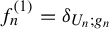 . Note that
$f^{(0)}_n(U_n)=U_n$
. Note that
$f^{(0)}_n(U_n)=U_n$
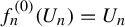 and
$f^{(1)}_n(U_n)=g_n(U_n)$
and
$f^{(1)}_n(U_n)=g_n(U_n)$
 are subsets of
$U_{n-1}$
are subsets of
$U_{n-1}$
 . Hence, for any infinite string
$\xi _1\xi _2\xi _3\cdots $
. Hence, for any infinite string
$\xi _1\xi _2\xi _3\cdots $
 of 0s and 1s, we have a nested sequence of clopen sets
$U_0\supset f^{(\xi _1)}_1(U_1)\supset f^{(\xi _1)}_1f^{(\xi _2)}_2(U_2) \supset \cdots $
of 0s and 1s, we have a nested sequence of clopen sets
$U_0\supset f^{(\xi _1)}_1(U_1)\supset f^{(\xi _1)}_1f^{(\xi _2)}_2(U_2) \supset \cdots $
 . The intersection of these sets is non-empty.
Lemma 7.1. In terms of the above construction, suppose that for any infinite string
$\xi _1\xi _2\xi _3\cdots $
 of 0s and 1s, the intersection of the nested sets
$U_0\supset f^{(\xi _1)}_1(U_1)\supset f^{(\xi _1)}_1f^{(\xi _2)}_2(U_2) \supset \cdots $
of 0s and 1s, the intersection of the nested sets
$U_0\supset f^{(\xi _1)}_1(U_1)\supset f^{(\xi _1)}_1f^{(\xi _2)}_2(U_2) \supset \cdots $
 consists of a single point. Then, Y is a Cantor set that is nowhere dense in X and the group H acts minimally when restricted to Y.
Proof. We keep the same notation as used in the construction. First, let us describe an abstract model behind the construction. Let
$\Xi =\{0,1\}^{\mathbb {N}}$
 . We regard any element
$\xi \in \Xi $
. We regard any element
$\xi \in \Xi $
 as an infinite string
$\xi =\xi _1\xi _2\xi _3\cdots $
as an infinite string
$\xi =\xi _1\xi _2\xi _3\cdots $
 , where each
$\xi _i\in \{0,1\}$
, where each
$\xi _i\in \{0,1\}$
 . We endow
$\Xi $
. We endow
$\Xi $
 with the product topology (assuming the discrete topology on
$\{0,1\}$
with the product topology (assuming the discrete topology on
$\{0,1\}$
 ). Then,
$\Xi $
). Then,
$\Xi $
 is a Cantor set. Let
$\{0,1\}^*$
is a Cantor set. Let
$\{0,1\}^*$
 be the set of all finite strings of 0s and 1s (including the empty string
$\varnothing $
be the set of all finite strings of 0s and 1s (including the empty string
$\varnothing $
 ). For any
$w\in \{0,1\}^*$
). For any
$w\in \{0,1\}^*$
 , we denote by
$C_w$
, we denote by
$C_w$
 the set of all infinite strings in
$\Xi $
the set of all infinite strings in
$\Xi $
 that begin with w. Sets of the form
$C_w$
that begin with w. Sets of the form
$C_w$
 are called cylinders, they are clopen, and form a base of the topology on
$\Xi $
are called cylinders, they are clopen, and form a base of the topology on
$\Xi $
 .
.
For any
$n\ge 1$
 , let
$\gamma _n$
, let
$\gamma _n$
 be a transformation of
$\Xi $
be a transformation of
$\Xi $
 that changes only the nth character in any infinite string that begins with (at least)
$n-1$
that changes only the nth character in any infinite string that begins with (at least)
$n-1$
 consecutive zeros and fixes all the other elements of
$\Xi $
consecutive zeros and fixes all the other elements of
$\Xi $
 . The transformation
$\gamma _n$
. The transformation
$\gamma _n$
 is clearly an involution. In addition, it is continuous. Hence,
$\gamma _n\in {\mathrm {Homeo}}(\Xi )$
is clearly an involution. In addition, it is continuous. Hence,
$\gamma _n\in {\mathrm {Homeo}}(\Xi )$
 . Let
$\Gamma $
. Let
$\Gamma $
 be the subgroup of
${\mathrm {Homeo}}(\Xi )$
be the subgroup of
${\mathrm {Homeo}}(\Xi )$
 generated by
$\gamma _1,\gamma _2,\gamma _3,\ldots .$
generated by
$\gamma _1,\gamma _2,\gamma _3,\ldots .$

For any
$\xi =\xi _1\xi _2\xi _3\cdots \in \Xi $
 and integer
$n\ge 0$
and integer
$n\ge 0$
 , let
$Z(\xi ,n)$
, let
$Z(\xi ,n)$
 denote a string
$\zeta =\zeta _1\zeta _2\zeta _3\cdots $
denote a string
$\zeta =\zeta _1\zeta _2\zeta _3\cdots $
 that begins with n zeros and coincides with the string
$\xi $
that begins with n zeros and coincides with the string
$\xi $
 afterwards:
$\zeta _k=0$
afterwards:
$\zeta _k=0$
 if
$k\le n$
if
$k\le n$
 and
$\zeta _k=\xi _k$
and
$\zeta _k=\xi _k$
 if
$k>n$
if
$k>n$
 . Clearly,
$Z(\xi ,0)=\xi $
. Clearly,
$Z(\xi ,0)=\xi $
 . For any
$n\ge 1$
. For any
$n\ge 1$
 , we have
$Z(\xi ,n)=Z(\xi ,n-1)$
, we have
$Z(\xi ,n)=Z(\xi ,n-1)$
 if
$\xi _n=0$
if
$\xi _n=0$
 and
$Z(\xi ,n)=\gamma _n(Z(\xi ,n-1))$
and
$Z(\xi ,n)=\gamma _n(Z(\xi ,n-1))$
 if
$\xi _n=1$
if
$\xi _n=1$
 . It follows that the strings
$Z(\xi ,0),Z(\xi ,1),Z(\xi ,2),\ldots $
. It follows that the strings
$Z(\xi ,0),Z(\xi ,1),Z(\xi ,2),\ldots $
 all belong to the orbit
${\mathrm {Orb}}_\Gamma (\xi )$
all belong to the orbit
${\mathrm {Orb}}_\Gamma (\xi )$
 . If two strings
$\xi ,\xi '\in \Xi $
. If two strings
$\xi ,\xi '\in \Xi $
 coincide up to finitely many characters, then
$Z(\xi ,n)=Z(\xi ',n)$
coincide up to finitely many characters, then
$Z(\xi ,n)=Z(\xi ',n)$
 for all sufficiently large n, which implies that
$\xi $
for all sufficiently large n, which implies that
$\xi $
 and
$\xi '$
and
$\xi '$
 are in the same orbit of the group
$\Gamma $
are in the same orbit of the group
$\Gamma $
 . We conclude that any orbit of
$\Gamma $
. We conclude that any orbit of
$\Gamma $
 has an element in every cylinder
$C_w$
has an element in every cylinder
$C_w$
 ,
$w\in \{0,1\}^*$
,
$w\in \{0,1\}^*$
 . As a consequence, any orbit of
$\Gamma $
. As a consequence, any orbit of
$\Gamma $
 is dense in
$\Xi $
is dense in
$\Xi $
 . Therefore, the group
$\Gamma $
. Therefore, the group
$\Gamma $
 acts minimally on
$\Xi $
acts minimally on
$\Xi $
 .
.
Now, we are going to show that the actual construction of the set Y and the group H agrees with our abstract model (respectively
$\Xi $
 and
$\Gamma $
and
$\Gamma $
 ). First, we define a map
$\alpha :\Xi \to Y$
). First, we define a map
$\alpha :\Xi \to Y$
 . For any finite string
$w=\xi _1\xi _2\cdots \xi _k$
. For any finite string
$w=\xi _1\xi _2\cdots \xi _k$
 of 0s and 1s consisting of
$k\ge 1$
of 0s and 1s consisting of
$k\ge 1$
 characters, let
$f^{(w)}=f^{(\xi _1)}_1f^{(\xi _2)}_2\cdots f^{(\xi _k)}_k$
characters, let
$f^{(w)}=f^{(\xi _1)}_1f^{(\xi _2)}_2\cdots f^{(\xi _k)}_k$
 and
$V^{(w)}=f^{(w)}(U_k)$
and
$V^{(w)}=f^{(w)}(U_k)$
 . Also, we let
$f^{(\varnothing )}=\mathrm {id}_X$
. Also, we let
$f^{(\varnothing )}=\mathrm {id}_X$
 and
$V^{(\varnothing )}=U_0$
and
$V^{(\varnothing )}=U_0$
 . Given an infinite string
$\xi =\xi _1\xi _2\xi _3\cdots \in \Xi $
. Given an infinite string
$\xi =\xi _1\xi _2\xi _3\cdots \in \Xi $
 , consider a nested sequence of clopen sets
$V^{\varnothing }\supset V^{(\xi _1)}\supset V^{(\xi _1\xi _2)}\supset \cdots $
, consider a nested sequence of clopen sets
$V^{\varnothing }\supset V^{(\xi _1)}\supset V^{(\xi _1\xi _2)}\supset \cdots $
 . By assumption, the intersection of all these sets consists of a single point and we define
$\alpha (\xi )$
. By assumption, the intersection of all these sets consists of a single point and we define
$\alpha (\xi )$
 to be that point. Let us show that
$\alpha (\xi )\in Y$
to be that point. Let us show that
$\alpha (\xi )\in Y$
 . Since the point
$x_0$
. Since the point
$x_0$
 belongs to each of the sets
$U_0,U_1,U_2,\ldots, $
belongs to each of the sets
$U_0,U_1,U_2,\ldots, $
 it follows that
$f^{(\xi _1\xi _2\cdots \xi _k)}(x_0)\in V^{(\xi _1\xi _2\cdots \xi _k)}$
it follows that
$f^{(\xi _1\xi _2\cdots \xi _k)}(x_0)\in V^{(\xi _1\xi _2\cdots \xi _k)}$
 for
$k=1,2,\ldots .$
for
$k=1,2,\ldots .$
 This implies that every limit point of the sequence
$x_0,f^{(\xi _1)}_1(x_0),f^{(\xi _1\xi _2)}_2(x_0),\ldots $
This implies that every limit point of the sequence
$x_0,f^{(\xi _1)}_1(x_0),f^{(\xi _1\xi _2)}_2(x_0),\ldots $
 belongs to the intersection of the nested clopen sets
$V^{\varnothing },V^{(\xi _1)},V^{(\xi _1\xi _2)},\ldots. $
belongs to the intersection of the nested clopen sets
$V^{\varnothing },V^{(\xi _1)},V^{(\xi _1\xi _2)},\ldots. $
 As
$\alpha (\xi )$
As
$\alpha (\xi )$
 is the only point in the intersection, we conclude that the sequence converges to
$\alpha (\xi )$
is the only point in the intersection, we conclude that the sequence converges to
$\alpha (\xi )$
 . Since all points in the sequence belong to the orbit
${\mathrm {Orb}}_H(x_0)$
. Since all points in the sequence belong to the orbit
${\mathrm {Orb}}_H(x_0)$
 , we obtain that
$\alpha (\xi )\in \overline {{\mathrm {Orb}}_H(x_0)}=Y$
, we obtain that
$\alpha (\xi )\in \overline {{\mathrm {Orb}}_H(x_0)}=Y$
 .
.
By construction,
$\alpha (C_w)\subset V^{(w)}$
 for all
$w\in \{0,1\}^*$
for all
$w\in \{0,1\}^*$
 . For any strings
$w,u\in \{0,1\}^*$
. For any strings
$w,u\in \{0,1\}^*$
 , let
$wu$
, let
$wu$
 denote their concatenation. Notice that
$C_{wu}\subset C_w$
denote their concatenation. Notice that
$C_{wu}\subset C_w$
 and
$V^{(wu)}\subset V^{(w)}$
and
$V^{(wu)}\subset V^{(w)}$
 . Let k be the number of characters in the string w. Then,
$V^{(w)}=f^{(w)}(U_k)$
. Let k be the number of characters in the string w. Then,
$V^{(w)}=f^{(w)}(U_k)$
 ,
$V^{(w0)}=f^{(w)}(U_{k+1})$
,
$V^{(w0)}=f^{(w)}(U_{k+1})$
 , and
$V^{(w1)}=f^{(w)}(f^{(1)}_{k+1}(U_{n+1}))$
, and
$V^{(w1)}=f^{(w)}(f^{(1)}_{k+1}(U_{n+1}))$
 . By construction,
$U_{k+1}$
. By construction,
$U_{k+1}$
 and
$f^{(1)}_{k+1}(U_{k+1})$
and
$f^{(1)}_{k+1}(U_{k+1})$
 are disjoint subsets of
$U_k$
are disjoint subsets of
$U_k$
 and their union is different from
$U_k$
and their union is different from
$U_k$
 . It follows that
$V^{(w)}$
. It follows that
$V^{(w)}$
 is the disjoint union of three non-empty clopen sets
$V^{(w0)}$
is the disjoint union of three non-empty clopen sets
$V^{(w0)}$
 ,
$V^{(w1)}$
,
$V^{(w1)}$
 and
$V^{(w)}\setminus (V^{(w0)}\cup V^{(w1)})$
and
$V^{(w)}\setminus (V^{(w0)}\cup V^{(w1)})$
 . Note that any two strings in
$\{0,1\}^*$
. Note that any two strings in
$\{0,1\}^*$
 , neither of which is a beginning of the other, can be written as
$w0u$
, neither of which is a beginning of the other, can be written as
$w0u$
 and
$w1u'$
and
$w1u'$
 , where
$w,u,u'\in \{0,1\}^*$
, where
$w,u,u'\in \{0,1\}^*$
 . Since
$V^{(w0u)}\subset V^{(w0)}$
. Since
$V^{(w0u)}\subset V^{(w0)}$
 and
$V^{(w1u')}\subset V^{(w1)}$
and
$V^{(w1u')}\subset V^{(w1)}$
 , we obtain that the set
$V^{(w0u)}$
, we obtain that the set
$V^{(w0u)}$
 is disjoint from
$V^{(w1u')}$
is disjoint from
$V^{(w1u')}$
 . In particular, the sets
$V^{(w)}$
. In particular, the sets
$V^{(w)}$
 and
$V^{(w')}$
and
$V^{(w')}$
 are disjoint if w and
$w'$
are disjoint if w and
$w'$
 are two different strings with the same number of characters.
Next, we prove that the map
$\alpha $
 is one-to-one. Given two infinite strings
$\xi ,\xi '\in \Xi $
is one-to-one. Given two infinite strings
$\xi ,\xi '\in \Xi $
 , let w be their longest common beginning. If
$\xi \ne \xi '$
, let w be their longest common beginning. If
$\xi \ne \xi '$
 , then w is a finite string. Moreover, one of the strings
$\xi $
, then w is a finite string. Moreover, one of the strings
$\xi $
 and
$\xi '$
and
$\xi '$
 belongs to
$C_{w0}$
belongs to
$C_{w0}$
 , while the other is in
$C_{w1}$
, while the other is in
$C_{w1}$
 . Hence, one of the points
$\alpha (\xi )$
. Hence, one of the points
$\alpha (\xi )$
 and
$\alpha (\xi ')$
and
$\alpha (\xi ')$
 belongs to
$V^{(w0)}$
belongs to
$V^{(w0)}$
 , while the other is in
$V^{(w1)}$
, while the other is in
$V^{(w1)}$
 . By the above, the sets
$V^{(w0)}$
. By the above, the sets
$V^{(w0)}$
 and
$V^{(w1)}$
and
$V^{(w1)}$
 are disjoint. As a consequence,
$\alpha (\xi )\ne \alpha (\xi ')$
are disjoint. As a consequence,
$\alpha (\xi )\ne \alpha (\xi ')$
 .
.
Given
$\xi =\xi _1\xi _2\xi _3\cdots \in \Xi $
 , let us show that every open neighborhood of the point
$\alpha (\xi )$
, let us show that every open neighborhood of the point
$\alpha (\xi )$
 contains a clopen set of the form
$V^{(w)}$
contains a clopen set of the form
$V^{(w)}$
 , where the finite string
$w\in \{0,1\}^*$
, where the finite string
$w\in \{0,1\}^*$
 is a beginning of
$\xi $
is a beginning of
$\xi $
 . By construction,
$V^{(\xi _1)}\supset V^{(\xi _1\xi _2)}\supset V^{(\xi _1\xi _2\xi _3)}\supset \cdots $
. By construction,
$V^{(\xi _1)}\supset V^{(\xi _1\xi _2)}\supset V^{(\xi _1\xi _2\xi _3)}\supset \cdots $
 and the intersection of these clopen sets is
$\{\alpha (\xi )\}$
and the intersection of these clopen sets is
$\{\alpha (\xi )\}$
 . Hence,
$X\setminus V^{(\xi _1)}\subset X\setminus V^{(\xi _1\xi _2)}\subset X\setminus V^{(\xi _1\xi _2\xi _3)}\subset \cdots $
. Hence,
$X\setminus V^{(\xi _1)}\subset X\setminus V^{(\xi _1\xi _2)}\subset X\setminus V^{(\xi _1\xi _2\xi _3)}\subset \cdots $
 and the union of these complements is
$X\setminus \{\alpha (\xi )\}$
and the union of these complements is
$X\setminus \{\alpha (\xi )\}$
 . Adding an arbitrary open neighborhood U of
$\alpha (\xi )$
. Adding an arbitrary open neighborhood U of
$\alpha (\xi )$
 to the complements, we obtain an open cover of X. Since X is compact, there is a finite subcover. It further follows that X is covered by two sets U and
$X\setminus V^{(\xi _1\xi _2\cdots \xi _n)}$
to the complements, we obtain an open cover of X. Since X is compact, there is a finite subcover. It further follows that X is covered by two sets U and
$X\setminus V^{(\xi _1\xi _2\cdots \xi _n)}$
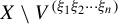 provided that n is large enough. Equivalently,
$V^{(\xi _1\xi _2\cdots \xi _n)}\subset U$
provided that n is large enough. Equivalently,
$V^{(\xi _1\xi _2\cdots \xi _n)}\subset U$
 if n is large enough.
Next, we prove that the map
$\alpha $
 is continuous. Let
$\xi \in \Xi $
is continuous. Let
$\xi \in \Xi $
 and U be an open neighborhood of the point
$\alpha (\xi )$
and U be an open neighborhood of the point
$\alpha (\xi )$
 . We need to show that the preimage
$\alpha ^{-1}(U)$
. We need to show that the preimage
$\alpha ^{-1}(U)$
 contains an open neighborhood of
$\xi $
contains an open neighborhood of
$\xi $
 . By the above, U contains a set
$V^{(w)}$
. By the above, U contains a set
$V^{(w)}$
 for some string w with which
$\xi $
for some string w with which
$\xi $
 begins. Then, the cylinder
$C_w$
begins. Then, the cylinder
$C_w$
 is a clopen neighborhood of
$\xi $
is a clopen neighborhood of
$\xi $
 . It is contained in
$\alpha ^{-1}(U)$
. It is contained in
$\alpha ^{-1}(U)$
 since
$\alpha (C_w)\subset V^{(w)}$
since
$\alpha (C_w)\subset V^{(w)}$
 .
.
Next, we prove that
$f^{(1)}_n\alpha =\alpha \gamma _n$
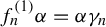 on
$\Xi $
on
$\Xi $
 for all
$n\ge 1$
for all
$n\ge 1$
 . Take any
$\xi =\xi _1\xi _2\xi _3\cdots \in \Xi $
. Take any
$\xi =\xi _1\xi _2\xi _3\cdots \in \Xi $
 and let
$\gamma _n(\xi )=\eta _1\eta _2\eta _3\cdots $
and let
$\gamma _n(\xi )=\eta _1\eta _2\eta _3\cdots $
 . By the above,
$f^{(\xi _1\xi _2\cdots \xi _k)}(x_0)\to \alpha (\xi )$
. By the above,
$f^{(\xi _1\xi _2\cdots \xi _k)}(x_0)\to \alpha (\xi )$
 and
$f^{(\eta _1\eta _2\cdots \eta _k)}(x_0)\to \alpha (\gamma _n(\xi ))$
and
$f^{(\eta _1\eta _2\cdots \eta _k)}(x_0)\to \alpha (\gamma _n(\xi ))$
 as
$k\to \infty $
as
$k\to \infty $
 . Then,
$f^{(1)}_nf^{(\xi _1\xi _2\cdots \xi _k)}(x_0)\to f^{(1)}_n(\alpha (\xi ))$
. Then,
$f^{(1)}_nf^{(\xi _1\xi _2\cdots \xi _k)}(x_0)\to f^{(1)}_n(\alpha (\xi ))$
 as
$k\to \infty $
as
$k\to \infty $
 . We are going to show that
$f^{(1)}_nf^{(\xi _1\xi _2\cdots \xi _k)}(x_0)= f^{(\eta _1\eta _2\cdots \eta _k)}(x_0)$
. We are going to show that
$f^{(1)}_nf^{(\xi _1\xi _2\cdots \xi _k)}(x_0)= f^{(\eta _1\eta _2\cdots \eta _k)}(x_0)$
 for
$k\ge n$
for
$k\ge n$
 . This will imply that
$f^{(1)}_n(\alpha (\xi ))=\alpha (\gamma _n(\xi ))$
. This will imply that
$f^{(1)}_n(\alpha (\xi ))=\alpha (\gamma _n(\xi ))$
 . First, consider the case where
$\xi _i=0$
. First, consider the case where
$\xi _i=0$
 for all
$i<n$
for all
$i<n$
 . Then,
$\eta _n\ne \xi _n$
. Then,
$\eta _n\ne \xi _n$
 and
$\eta _i=\xi _i$
and
$\eta _i=\xi _i$
 for all
$i\ne n$
for all
$i\ne n$
 . Since
$f^{(1)}_n$
. Since
$f^{(1)}_n$
 is an involution and
$f^{(0)}_n=\mathrm {id}_X$
is an involution and
$f^{(0)}_n=\mathrm {id}_X$
 , we obtain that
$f^{(1)}_nf^{(\xi _n)}_n=f^{(\eta _n)}_n$
, we obtain that
$f^{(1)}_nf^{(\xi _n)}_n=f^{(\eta _n)}_n$
 . As
$f^{(\xi _i)}_i=\mathrm {id}_X$
. As
$f^{(\xi _i)}_i=\mathrm {id}_X$
 for
$i<n$
for
$i<n$
 , it follows that
$f^{(1)}_nf^{(\xi _1\xi _2\cdots \xi _k)}=f^{(\eta _1\eta _2\cdots \eta _k)}$
, it follows that
$f^{(1)}_nf^{(\xi _1\xi _2\cdots \xi _k)}=f^{(\eta _1\eta _2\cdots \eta _k)}$
 for all
$k\ge n$
for all
$k\ge n$
 . Now, consider the case where
$\xi _i=1$
. Now, consider the case where
$\xi _i=1$
 for some
$i<n$
for some
$i<n$
 . In this case,
$\gamma _n(\xi )=\xi $
. In this case,
$\gamma _n(\xi )=\xi $
 . Since
$x_0\in U_k$
. Since
$x_0\in U_k$
 for any
$k\ge n$
for any
$k\ge n$
 , it follows that the point
$y=f^{(\xi _{i+1})}_{i+1}f^{(\xi _{i+2})}_{i+2}\cdots f^{(\xi _k)}_k(x_0)$
, it follows that the point
$y=f^{(\xi _{i+1})}_{i+1}f^{(\xi _{i+2})}_{i+2}\cdots f^{(\xi _k)}_k(x_0)$
 belongs to
$U_i$
belongs to
$U_i$
 . Then, the point
$f^{(1)}_i(y)$
. Then, the point
$f^{(1)}_i(y)$
 does not belong to
$U_i$
does not belong to
$U_i$
 and neither does
$f^{(\xi _1\xi _2\cdots \xi _k)}(x_0)$
and neither does
$f^{(\xi _1\xi _2\cdots \xi _k)}(x_0)$
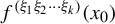 . Since
${\mathrm {supp}}(f^{(1)}_n)\subset U_{n-1}\subset U_i$
. Since
${\mathrm {supp}}(f^{(1)}_n)\subset U_{n-1}\subset U_i$
 , we conclude that
$f^{(1)}_nf^{(\xi _1\xi _2\cdots \xi _k)}(x_0)= f^{(\xi _1\xi _2\cdots \xi _k)}(x_0)= f^{(\eta _1\eta _2\cdots \eta _k)}(x_0)$
, we conclude that
$f^{(1)}_nf^{(\xi _1\xi _2\cdots \xi _k)}(x_0)= f^{(\xi _1\xi _2\cdots \xi _k)}(x_0)= f^{(\eta _1\eta _2\cdots \eta _k)}(x_0)$
 .
.
Next, we prove that the map
$\alpha $
 is onto. For any
$n\ge 1$
is onto. For any
$n\ge 1$
 , the equality
$f^{(1)}_n\alpha =\alpha \gamma _n$
, the equality
$f^{(1)}_n\alpha =\alpha \gamma _n$
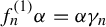 implies that
$f^{(1)}_n(\alpha (\Xi ))= \alpha (\gamma _n(\Xi ))=\alpha (\Xi )$
implies that
$f^{(1)}_n(\alpha (\Xi ))= \alpha (\gamma _n(\Xi ))=\alpha (\Xi )$
 . Since the group H is generated by the maps
$f^{(1)}_1,f^{(1)}_2,f^{(1)}_3,\ldots, $
. Since the group H is generated by the maps
$f^{(1)}_1,f^{(1)}_2,f^{(1)}_3,\ldots, $
 it follows that
$h(\alpha (\Xi ))=\alpha (\Xi )$
it follows that
$h(\alpha (\Xi ))=\alpha (\Xi )$
 for all
$h\in H$
for all
$h\in H$
 . Notice that
$x_0\in \alpha (\Xi )$
. Notice that
$x_0\in \alpha (\Xi )$
 , namely,
$x_0$
, namely,
$x_0$
 is the image of the infinite string of all 0s. Since the set
$\alpha (\Xi )$
is the image of the infinite string of all 0s. Since the set
$\alpha (\Xi )$
 is invariant under the action of the group H, we obtain that
${\mathrm {Orb}}_H(x_0)\subset \alpha (\Xi )$
is invariant under the action of the group H, we obtain that
${\mathrm {Orb}}_H(x_0)\subset \alpha (\Xi )$
 . Further, the set
$\alpha (\Xi )$
. Further, the set
$\alpha (\Xi )$
 is compact as
$\Xi $
is compact as
$\Xi $
 is compact and the map
$\alpha $
is compact and the map
$\alpha $
 is continuous. As a consequence,
$\alpha (\Xi )$
is continuous. As a consequence,
$\alpha (\Xi )$
 is a closed subset of X. Since
${\mathrm {Orb}}_H(x_0)\subset \alpha (\Xi )\subset Y$
is a closed subset of X. Since
${\mathrm {Orb}}_H(x_0)\subset \alpha (\Xi )\subset Y$
 and
$Y=\overline {{\mathrm {Orb}}_H(x_0)}$
and
$Y=\overline {{\mathrm {Orb}}_H(x_0)}$
 , we conclude that
$\alpha (\Xi )=Y$
, we conclude that
$\alpha (\Xi )=Y$
 .
.
Since the map
$\alpha $
 is one-to-one and onto, it is invertible. The inverse map
$\alpha ^{-1}:Y\to \Xi $
is one-to-one and onto, it is invertible. The inverse map
$\alpha ^{-1}:Y\to \Xi $
 is continuous since
$\alpha $
is continuous since
$\alpha $
 is continuous and
$\Xi $
is continuous and
$\Xi $
 is compact. Hence,
$\alpha $
is compact. Hence,
$\alpha $
 is a homeomorphism. As a consequence, Y is a Cantor set.
Now, we derive minimality of the action of the group H on Y from minimality of the action of the group
$\Gamma $
 on
$\Xi $
on
$\Xi $
 . For any closed set
$Y_0\subset Y$
. For any closed set
$Y_0\subset Y$
 , the set
$\alpha ^{-1}(Y_0)$
, the set
$\alpha ^{-1}(Y_0)$
 is a closed subset of
$\Xi $
is a closed subset of
$\Xi $
 . Assuming
$Y_0$
. Assuming
$Y_0$
 is invariant under the action of H, we have
$f^{(1)}_n(Y_0)=Y_0$
is invariant under the action of H, we have
$f^{(1)}_n(Y_0)=Y_0$
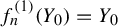 for all
$n\ge 1$
for all
$n\ge 1$
 . By the above,
$f^{(1)}_n\alpha =\alpha \gamma _n$
. By the above,
$f^{(1)}_n\alpha =\alpha \gamma _n$
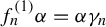 on
$\Xi $
on
$\Xi $
 . Therefore,
$\gamma _n=\alpha ^{-1}f^{(1)}_n\alpha $
. Therefore,
$\gamma _n=\alpha ^{-1}f^{(1)}_n\alpha $
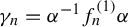 on
$\Xi $
on
$\Xi $
 . Then,
$\gamma _n(\alpha ^{-1}(Y_0))=\alpha ^{-1}f^{(1)}_n(Y_0)=\alpha ^{-1}(Y_0)$
. Then,
$\gamma _n(\alpha ^{-1}(Y_0))=\alpha ^{-1}f^{(1)}_n(Y_0)=\alpha ^{-1}(Y_0)$
 . Since the group
$\Gamma $
. Since the group
$\Gamma $
 is generated by maps
$\gamma _1,\gamma _2,\gamma _3,\ldots, $
is generated by maps
$\gamma _1,\gamma _2,\gamma _3,\ldots, $
 it follows that
$\gamma (\alpha ^{-1}(Y_0))=\alpha ^{-1}(Y_0)$
it follows that
$\gamma (\alpha ^{-1}(Y_0))=\alpha ^{-1}(Y_0)$
 for all
$\gamma \in \Gamma $
for all
$\gamma \in \Gamma $
 , that is, the set
$\alpha ^{-1}(Y_0)$
, that is, the set
$\alpha ^{-1}(Y_0)$
 is invariant under the action of the group
$\Gamma $
is invariant under the action of the group
$\Gamma $
 on
$\Xi $
on
$\Xi $
 . Minimality of the latter action implies that
$\alpha ^{-1}(Y_0)$
. Minimality of the latter action implies that
$\alpha ^{-1}(Y_0)$
 is either
$\Xi $
is either
$\Xi $
 or the empty set. Then,
$Y_0$
or the empty set. Then,
$Y_0$
 is either Y or the empty set.
It remains to prove that the set Y is nowhere dense in X. Since Y is closed, it is enough to show that it has no interior points. Let
$y\in Y$
 and U be an open neighborhood of the point y. We have
$y=\alpha (\xi )$
and U be an open neighborhood of the point y. We have
$y=\alpha (\xi )$
 for some
$\xi \in \Xi $
for some
$\xi \in \Xi $
 . By the above, U contains a set
$V^{(w)}$
. By the above, U contains a set
$V^{(w)}$
 for some string
$w\in \{0,1\}^*$
for some string
$w\in \{0,1\}^*$
 with which
$\xi $
with which
$\xi $
 begins. In addition, by the above,
$V^{(w)}$
begins. In addition, by the above,
$V^{(w)}$
 is the disjoint union of three non-empty clopen sets
$V^{(w0)}$
is the disjoint union of three non-empty clopen sets
$V^{(w0)}$
 ,
$V^{(w1)}$
,
$V^{(w1)}$
 , and
$V^{(w)}\setminus (V^{(w0)}\cup V^{(w1)})$
, and
$V^{(w)}\setminus (V^{(w0)}\cup V^{(w1)})$
 . Take any string
$\xi '\in \Xi $
. Take any string
$\xi '\in \Xi $
 and let
$w'$
and let
$w'$
 be the beginning of
$\xi '$
be the beginning of
$\xi '$
 that has the same number of characters as w. If
$w'\ne w$
that has the same number of characters as w. If
$w'\ne w$
 , then the set
$V^{(w')}$
, then the set
$V^{(w')}$
 , which contains the point
$\alpha (\xi ')$
, which contains the point
$\alpha (\xi ')$
 , is disjoint from
$V^{(w)}$
, is disjoint from
$V^{(w)}$
 so that
$\alpha (\xi ')\notin V^{(w)}$
so that
$\alpha (\xi ')\notin V^{(w)}$
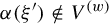 . If
$w'=w$
. If
$w'=w$
 , then
$\alpha (\xi ')\in V^{(w0)}\cup V^{(w1)}$
, then
$\alpha (\xi ')\in V^{(w0)}\cup V^{(w1)}$
 . We conclude that the non-empty set
$V^{(w)}\setminus (V^{(w0)}\cup V^{(w1)})$
. We conclude that the non-empty set
$V^{(w)}\setminus (V^{(w0)}\cup V^{(w1)})$
 is disjoint from
$\alpha (\Xi )=Y$
is disjoint from
$\alpha (\Xi )=Y$
 . Therefore, the open set U is not fully contained in Y.
One can show that the group H considered in Lemma 7.1 is locally finite, that is, any finitely generated subgroup of H is finite.
Proposition 7.2. Suppose X is a Cantor set and
$\mathcal {G}\subset {\mathrm {Homeo}}(X)$
 is an ample group that acts minimally on X. Then, there are uncountably many infinite, nowhere dense closed sets
$Y\subset X$
is an ample group that acts minimally on X. Then, there are uncountably many infinite, nowhere dense closed sets
$Y\subset X$
 such that the stabilizer
${\mathrm {St}}_{\mathcal {G}}(Y)$
such that the stabilizer
${\mathrm {St}}_{\mathcal {G}}(Y)$
 acts minimally when restricted to Y.
Proof. Let
$\rho :X\times X\to \mathbb {R}$
 be any distance function on the Cantor set X compatible with its topology. For any
$x\in X$
be any distance function on the Cantor set X compatible with its topology. For any
$x\in X$
 and
$r>0$
and
$r>0$
 , denote by
$B(x,r)$
, denote by
$B(x,r)$
 the ball of radius r centered at the point x:
$B(x,r)=\{y\in X\mid \rho (y,x)<r\}$
the ball of radius r centered at the point x:
$B(x,r)=\{y\in X\mid \rho (y,x)<r\}$
 . The ball
$B(x,r)$
. The ball
$B(x,r)$
 is an open neighborhood of x of diameter at most
$2r$
is an open neighborhood of x of diameter at most
$2r$
 .
.
We are going to construct a nested sequence
$U_0\supset U_1\supset U_2\supset \cdots $
 of non-empty clopen subsets of X and two sequences,
$g_1,g_2,g_3,\ldots $
of non-empty clopen subsets of X and two sequences,
$g_1,g_2,g_3,\ldots $
 and
$h_1,h_2,h_3,\ldots, $
and
$h_1,h_2,h_3,\ldots, $
 of elements of the group
$\mathcal {G}$
of elements of the group
$\mathcal {G}$
 . The elements of
$\mathcal {G}$
. The elements of
$\mathcal {G}$
 will be chosen so that for any
$n\ge 1$
will be chosen so that for any
$n\ge 1$
 , the sets
$U_n$
, the sets
$U_n$
 ,
$g_n(U_n)$
,
$g_n(U_n)$
 , and
$h_n(U_n)$
, and
$h_n(U_n)$
 are disjoint subsets of
$U_{n-1}$
are disjoint subsets of
$U_{n-1}$
 . Assuming this, generalized
$2$
. Assuming this, generalized
$2$
 -cycles
$f^{(1)}_n=\delta _{U_n;g_n}$
-cycles
$f^{(1)}_n=\delta _{U_n;g_n}$
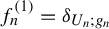 and
$f^{(2)}_n=\delta _{U_n;h_n}$
and
$f^{(2)}_n=\delta _{U_n;h_n}$
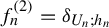 are defined. Since
$g_n,h_n\in \mathcal {G}$
are defined. Since
$g_n,h_n\in \mathcal {G}$
 , the maps
$f^{(1)}_n$
, the maps
$f^{(1)}_n$
 and
$f^{(2)}_n$
and
$f^{(2)}_n$
 belong to the group
$\mathsf {F}(\mathcal {G})=\mathcal {G}$
belong to the group
$\mathsf {F}(\mathcal {G})=\mathcal {G}$
 . We also let
$f^{(0)}_n=\mathrm {id}_X$
. We also let
$f^{(0)}_n=\mathrm {id}_X$
 . The clopen sets
$U_0,U_1,U_2,\ldots $
. The clopen sets
$U_0,U_1,U_2,\ldots $
 will be chosen so that for any string
$\xi _1\xi _2\cdots \xi _n$
will be chosen so that for any string
$\xi _1\xi _2\cdots \xi _n$
 of 0s, 1s, and 2s, the set
$f^{(\xi _1)}_1f^{(\xi _2)}_2\cdots f^{(\xi _n)}_n(U_n)$
of 0s, 1s, and 2s, the set
$f^{(\xi _1)}_1f^{(\xi _2)}_2\cdots f^{(\xi _n)}_n(U_n)$
 is of diameter at most
$2^{-n}$
is of diameter at most
$2^{-n}$
 .
.
The construction is done inductively. First, we let
$U_0=X$
 . Now, assume that for some
$n\ge 1$
. Now, assume that for some
$n\ge 1$
 , the set
$U_{n-1}$
, the set
$U_{n-1}$
 is already chosen, and so are the maps
$g_k$
is already chosen, and so are the maps
$g_k$
 and
$h_k$
and
$h_k$
 ,
$1\le k\le n-1$
,
$1\le k\le n-1$
 . Since X is a Cantor set, the non-empty clopen set
$U_{n-1}$
. Since X is a Cantor set, the non-empty clopen set
$U_{n-1}$
 is infinite. Therefore, we can find three disjoint non-empty clopen sets
$V,V',V"\subset U_{n-1}$
is infinite. Therefore, we can find three disjoint non-empty clopen sets
$V,V',V"\subset U_{n-1}$
 . Take any point
$y\in V$
. Take any point
$y\in V$
 . Since the group
$\mathcal {G}$
. Since the group
$\mathcal {G}$
 acts minimally on X, the orbit
${\mathrm {Orb}}_{\mathcal {G}}(y)$
acts minimally on X, the orbit
${\mathrm {Orb}}_{\mathcal {G}}(y)$
 is dense in X. In particular, this orbit has a point in
$V'$
is dense in X. In particular, this orbit has a point in
$V'$
 and in
$V"$
and in
$V"$
 . Hence, we can choose
$g_n,h_n\in \mathcal {G}$
. Hence, we can choose
$g_n,h_n\in \mathcal {G}$
 such that
$g_n(y)\in V'$
such that
$g_n(y)\in V'$
 and
$h_n(y)\in V"$
and
$h_n(y)\in V"$
 . Then,
$W=V\cap g_n^{-1}(V')\cap h_n^{-1}(V")$
. Then,
$W=V\cap g_n^{-1}(V')\cap h_n^{-1}(V")$
 is a clopen neighborhood of the point y. By construction,
$W\subset V$
is a clopen neighborhood of the point y. By construction,
$W\subset V$
 ,
$g_n(W)\subset V'$
,
$g_n(W)\subset V'$
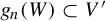 , and
$h_n(W)\subset V"$
, and
$h_n(W)\subset V"$
 , which implies that W,
$g_n(W)$
, which implies that W,
$g_n(W)$
 , and
$h_n(W)$
, and
$h_n(W)$
 are disjoint subsets of
$U_{n-1}$
are disjoint subsets of
$U_{n-1}$
 . Now that the maps
$g_k$
. Now that the maps
$g_k$
 and
$h_k$
and
$h_k$
 are chosen for any k,
$1\le k\le n$
are chosen for any k,
$1\le k\le n$
 , we can define the maps
$f^{(i)}_k$
, we can define the maps
$f^{(i)}_k$
 ,
$i\in \{0,1,2\}$
,
$i\in \{0,1,2\}$
 ,
$1\le k\le n$
,
$1\le k\le n$
 , as described above. For any string
$w=\xi _1\xi _2\cdots \xi _n$
, as described above. For any string
$w=\xi _1\xi _2\cdots \xi _n$
 of 0s, 1s, and 2s that has exactly n characters, we let
$f^{(w)}=f^{(\xi _1)}_1f^{(\xi _2)}_2\cdots f^{(\xi _n)}_n$
of 0s, 1s, and 2s that has exactly n characters, we let
$f^{(w)}=f^{(\xi _1)}_1f^{(\xi _2)}_2\cdots f^{(\xi _n)}_n$
 and
$y_w=f^{(w)}(y)$
and
$y_w=f^{(w)}(y)$
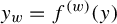 . Further, let
$\widetilde {W}$
. Further, let
$\widetilde {W}$
 be the intersection of W and all sets of the form
$(f^{(w)})^{-1}(B(y_w,2^{-n-1}))$
be the intersection of W and all sets of the form
$(f^{(w)})^{-1}(B(y_w,2^{-n-1}))$
 . Then,
$\widetilde {W}$
. Then,
$\widetilde {W}$
 is an open neighborhood of the point y. As X is a Cantor set, the set
$\widetilde {W}$
is an open neighborhood of the point y. As X is a Cantor set, the set
$\widetilde {W}$
 contains a clopen neighborhood of y. We choose the latter as
$U_n$
contains a clopen neighborhood of y. We choose the latter as
$U_n$
 . The clopen set
$U_n$
. The clopen set
$U_n$
 is not empty since
$y\in U_n$
is not empty since
$y\in U_n$
 . Since
$U_n\subset \widetilde {W}\subset W$
. Since
$U_n\subset \widetilde {W}\subset W$
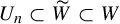 , the sets
$U_n$
, the sets
$U_n$
 ,
$g_n(U_n)$
,
$g_n(U_n)$
 , and
$h_n(U_n)$
, and
$h_n(U_n)$
 are disjoint subsets of
$U_{n-1}$
are disjoint subsets of
$U_{n-1}$
 . By construction,
$f^{(w)}(U_n)\subset B(y_w,2^{-n-1})$
. By construction,
$f^{(w)}(U_n)\subset B(y_w,2^{-n-1})$
 for any string
$w=\xi _1\xi _2\cdots \xi _n$
for any string
$w=\xi _1\xi _2\cdots \xi _n$
 of 0s, 1s, and 2s, which implies that the diameter of the set
$f^{(w)}(U_n)$
of 0s, 1s, and 2s, which implies that the diameter of the set
$f^{(w)}(U_n)$
 is at most
$2^{-n}$
is at most
$2^{-n}$
 . The inductive step of the construction is complete.
Let
$\Xi =\{0,1,2\}^{\mathbb {N}}$
 . We regard any element
$\xi \in \Xi $
. We regard any element
$\xi \in \Xi $
 as an infinite string
$\xi =\xi _1\xi _2\xi _3\cdots $
as an infinite string
$\xi =\xi _1\xi _2\xi _3\cdots $
 , where each
$\xi _i\in \{0,1,2\}$
, where each
$\xi _i\in \{0,1,2\}$
 . Note that for any
$n\ge 1$
. Note that for any
$n\ge 1$
 , the sets
$f^{(0)}_n(U_n)=U_n$
, the sets
$f^{(0)}_n(U_n)=U_n$
 ,
$f^{(1)}_n(U_n)=g_n(U_n)$
,
$f^{(1)}_n(U_n)=g_n(U_n)$
 , and
$f^{(2)}_n(U_n)=h_n(U_n)$
, and
$f^{(2)}_n(U_n)=h_n(U_n)$
 are subsets of
$U_{n-1}$
are subsets of
$U_{n-1}$
 . Therefore, for any infinite string
$\xi =\xi _1\xi _2\xi _3\cdots $
. Therefore, for any infinite string
$\xi =\xi _1\xi _2\xi _3\cdots $
 of 0s, 1s, and 2s, we have a nested sequence of clopen sets
$U_0\supset f^{(\xi _1)}_1(U_1)\supset f^{(\xi _1)}_1f^{(\xi _2)}_2(U_2)\supset \cdots $
of 0s, 1s, and 2s, we have a nested sequence of clopen sets
$U_0\supset f^{(\xi _1)}_1(U_1)\supset f^{(\xi _1)}_1f^{(\xi _2)}_2(U_2)\supset \cdots $
 . By construction, the diameters of those sets tend to
$0$
. By construction, the diameters of those sets tend to
$0$
 . Hence, their intersection consists of a single point, which we denote
$\beta (\xi )$
. Hence, their intersection consists of a single point, which we denote
$\beta (\xi )$
 . Now, we have a map
$\beta :\Xi \to ~X$
. Now, we have a map
$\beta :\Xi \to ~X$
 . Let
$x_0=\beta (000\cdots )$
. Let
$x_0=\beta (000\cdots )$
 . The point
$x_0$
. The point
$x_0$
 is in the intersection of sets
$U_0,U_1,U_2,\ldots .$
is in the intersection of sets
$U_0,U_1,U_2,\ldots .$

Consider the set
$\Omega =\{1,2\}^{\mathbb {N}}$
 , which is a subset of
$\Xi $
, which is a subset of
$\Xi $
 . For any infinite string
$\omega =\omega _1\omega _2\omega _3\cdots \in \Omega $
. For any infinite string
$\omega =\omega _1\omega _2\omega _3\cdots \in \Omega $
 , let
$H_\omega $
, let
$H_\omega $
 denote a subgroup of
$\mathcal {G}$
denote a subgroup of
$\mathcal {G}$
 generated by elements
$f^{(\omega _n)}_n$
generated by elements
$f^{(\omega _n)}_n$
 ,
$n\ge 1$
,
$n\ge 1$
 . Further, let
$Y_\omega =\overline {{\mathrm {Orb}}_{H_\omega }(x_0)}$
. Further, let
$Y_\omega =\overline {{\mathrm {Orb}}_{H_\omega }(x_0)}$
 . Then,
$Y_\omega $
. Then,
$Y_\omega $
 is a closed subset of X invariant under the action of the group
$H_\omega $
is a closed subset of X invariant under the action of the group
$H_\omega $
 . Since for any
$n\ge 1$
. Since for any
$n\ge 1$
 , the sets
$U_n$
, the sets
$U_n$
 ,
$g_n(U_n)$
,
$g_n(U_n)$
 , and
$h_n(U_n)$
, and
$h_n(U_n)$
 are disjoint subsets of
$U_{n-1}$
are disjoint subsets of
$U_{n-1}$
 , it follows that the union of
$U_n$
, it follows that the union of
$U_n$
 and
$f^{(\omega _n)}_n(U_n)$
and
$f^{(\omega _n)}_n(U_n)$
 is a proper subset of
$U_{n-1}$
is a proper subset of
$U_{n-1}$
 . Now, Lemma 7.1 implies that
$Y_\omega $
. Now, Lemma 7.1 implies that
$Y_\omega $
 is a Cantor set which is nowhere dense in X, and the group
$H_\omega $
is a Cantor set which is nowhere dense in X, and the group
$H_\omega $
 acts minimally when restricted to
$Y_\omega $
acts minimally when restricted to
$Y_\omega $
 . Since
$H_\omega \subset {\mathrm {St}}_{\mathcal {G}}(Y_\omega )$
. Since
$H_\omega \subset {\mathrm {St}}_{\mathcal {G}}(Y_\omega )$
 , the stabilizer
${\mathrm {St}}_{\mathcal {G}}(Y_\omega )$
, the stabilizer
${\mathrm {St}}_{\mathcal {G}}(Y_\omega )$
 also acts minimally when restricted to
$Y_\omega $
also acts minimally when restricted to
$Y_\omega $
 .
.
As the set
$\Omega $
 is uncountable, it remains to demonstrate that
$Y_\omega \ne Y_{\omega '}$
is uncountable, it remains to demonstrate that
$Y_\omega \ne Y_{\omega '}$
 whenever
$\omega $
whenever
$\omega $
 and
$\omega '$
and
$\omega '$
 are different elements of
$\Omega $
are different elements of
$\Omega $
 . Just as in the proof of Lemma 7.1 we showed that the map
$\alpha $
. Just as in the proof of Lemma 7.1 we showed that the map
$\alpha $
 is one-to-one, we can show that the map
$\beta $
is one-to-one, we can show that the map
$\beta $
 is one-to-one. Just as in the proof of Lemma 7.1 we showed that the map
$\alpha $
is one-to-one. Just as in the proof of Lemma 7.1 we showed that the map
$\alpha $
 is onto, we can show that for any
$\omega =\omega _1\omega _2\omega _3\cdots \in \Omega $
is onto, we can show that for any
$\omega =\omega _1\omega _2\omega _3\cdots \in \Omega $
 , the set
$Y_\omega $
, the set
$Y_\omega $
 consists of all points of the form
$\beta (\xi _1\xi _2\xi _3\cdots )$
consists of all points of the form
$\beta (\xi _1\xi _2\xi _3\cdots )$
 , where
$\xi _n\in \{0,\omega _n\}$
, where
$\xi _n\in \{0,\omega _n\}$
 for each
$n\ge 1$
for each
$n\ge 1$
 . Since the map
$\beta $
. Since the map
$\beta $
 is one-to-one, it follows that
$Y_\omega \cap \beta (\Omega )=\{\beta (\omega )\}$
is one-to-one, it follows that
$Y_\omega \cap \beta (\Omega )=\{\beta (\omega )\}$
 . As a consequence,
$Y_\omega \ne Y_{\omega '}$
. As a consequence,
$Y_\omega \ne Y_{\omega '}$
 whenever
$\omega \ne \omega '$
whenever
$\omega \ne \omega '$
 .
.
8 Property E
The majority of our results on maximal subgroups of ample groups obtained in §6 require that the ample group has Property E (to be precise, these are Theorems 6.18, 6.19, 6.20, and 6.21). Hence, they have no value until we provide examples of ample groups with this property. We should note that Property E is complex and its verification is not going to be easy. We begin with establishing a weakened version of Property E that involves the generalized symmetric groups.
Proposition 8.1. Suppose a group
$G\subset {\mathrm {Homeo}}(X)$
 acts minimally on X. Then, for any clopen sets
$U_1$
acts minimally on X. Then, for any clopen sets
$U_1$
 and
$U_2$
and
$U_2$
 that intersect, the generalized symmetric group over the local subgroup
$\mathsf {F}_{U_1\cup U_2}(G)$
that intersect, the generalized symmetric group over the local subgroup
$\mathsf {F}_{U_1\cup U_2}(G)$
 is generated by the union of generalized symmetric groups over
$\mathsf {F}_{U_1}(G)$
is generated by the union of generalized symmetric groups over
$\mathsf {F}_{U_1}(G)$
 and
$\mathsf {F}_{U_2}(G)$
and
$\mathsf {F}_{U_2}(G)$
 :
$\mathsf {S}(\mathsf {F}_{U_1\cup U_2}(G))=\langle \mathsf {S}(\mathsf {F}_{U_1}(G))\cup \mathsf {S}(\mathsf {F}_{U_2}(G))\rangle $
:
$\mathsf {S}(\mathsf {F}_{U_1\cup U_2}(G))=\langle \mathsf {S}(\mathsf {F}_{U_1}(G))\cup \mathsf {S}(\mathsf {F}_{U_2}(G))\rangle $
 .
.
Proof. For any clopen set
$W\subset X$
 , let
$D_W$
, let
$D_W$
 denote the set of all generalized
$2$
denote the set of all generalized
$2$
 -cycles in the local subgroup
$\mathsf {F}_W(G)$
-cycles in the local subgroup
$\mathsf {F}_W(G)$
 . Since the group
$\mathsf {F}_W(G)$
. Since the group
$\mathsf {F}_W(G)$
 is ample, it follows from Lemma 4.7 that the generalized symmetric group
$\mathsf {S}(\mathsf {F}_W(G))$
is ample, it follows from Lemma 4.7 that the generalized symmetric group
$\mathsf {S}(\mathsf {F}_W(G))$
 is generated by
$D_W$
is generated by
$D_W$
 . As a consequence, for any clopen sets
$U_1,U_2\subset X$
. As a consequence, for any clopen sets
$U_1,U_2\subset X$
 , the group
$\mathsf {S}(\mathsf {F}_{U_1\cup U_2}(G))$
, the group
$\mathsf {S}(\mathsf {F}_{U_1\cup U_2}(G))$
 is generated by
$D_{U_1\cup U_2}$
is generated by
$D_{U_1\cup U_2}$
 , while the group
$\langle \mathsf {S}(\mathsf {F}_{U_1}(G))\cup \mathsf {S}(\mathsf {F}_{U_2}(G))\rangle $
, while the group
$\langle \mathsf {S}(\mathsf {F}_{U_1}(G))\cup \mathsf {S}(\mathsf {F}_{U_2}(G))\rangle $
 is generated by
$D_{U_1}\cup D_{U_2}$
is generated by
$D_{U_1}\cup D_{U_2}$
 . Note that the sets
$D_{U_1}$
. Note that the sets
$D_{U_1}$
 and
$D_{U_2}$
and
$D_{U_2}$
 are contained in
$D_{U_1\cup U_2}$
are contained in
$D_{U_1\cup U_2}$
 since the local subgroups
$\mathsf {F}_{U_1}(G)$
since the local subgroups
$\mathsf {F}_{U_1}(G)$
 and
$\mathsf {F}_{U_2}(G)$
and
$\mathsf {F}_{U_2}(G)$
 are contained in
$\mathsf {F}_{U_1\cup U_2}(G)$
are contained in
$\mathsf {F}_{U_1\cup U_2}(G)$
 . To prove the proposition, it is enough to show that, assuming the intersection
$U_1\cap U_2$
. To prove the proposition, it is enough to show that, assuming the intersection
$U_1\cap U_2$
 is non-empty, every element of
$D_{U_1\cup U_2}$
is non-empty, every element of
$D_{U_1\cup U_2}$
 belongs to the group
$\langle D_{U_1}\cup D_{U_2}\rangle $
belongs to the group
$\langle D_{U_1}\cup D_{U_2}\rangle $
 . This is trivial when one of the sets
$U_1$
. This is trivial when one of the sets
$U_1$
 and
$U_2$
and
$U_2$
 contains the other. Hence, we may further assume that each of the sets
$P_1=U_1\setminus U_2$
contains the other. Hence, we may further assume that each of the sets
$P_1=U_1\setminus U_2$
 ,
$P_2=U_2\setminus U_1$
,
$P_2=U_2\setminus U_1$
 , and
$P_3=U_1\cap U_2$
, and
$P_3=U_1\cap U_2$
 is non-empty.
Given
$f\in D_{U_1\cup U_2}$
 , we have
$f=\delta _{U;f'}$
, we have
$f=\delta _{U;f'}$
 for some clopen set
$U\subset X$
for some clopen set
$U\subset X$
 and homeomorphism
$f':X\to X$
and homeomorphism
$f':X\to X$
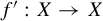 . Observe that the generalized
$2$
. Observe that the generalized
$2$
 -cycle
$\delta _{U;f}$
-cycle
$\delta _{U;f}$
 is defined and
$f=\delta _{U;f}$
is defined and
$f=\delta _{U;f}$
 . First, we consider a special case where one of the sets U and
$f(U)$
. First, we consider a special case where one of the sets U and
$f(U)$
 is contained in
$P_1$
is contained in
$P_1$
 and the other is contained in
$P_2$
and the other is contained in
$P_2$
 . Note that
$f^{-1}=f$
. Note that
$f^{-1}=f$
 . Therefore, the generalized
$2$
. Therefore, the generalized
$2$
 -cycle
$\delta _{f(U);f}$
-cycle
$\delta _{f(U);f}$
 is defined and
$\delta _{f(U);f}=\delta _{U;f}=f$
is defined and
$\delta _{f(U);f}=\delta _{U;f}=f$
 . Hence, we may assume without loss of generality that
$U\subset P_1$
. Hence, we may assume without loss of generality that
$U\subset P_1$
 and
$f(U)\subset P_2$
and
$f(U)\subset P_2$
 . Since the group G acts minimally on X, Lemma 5.3 implies that for some
$k\ge 1$
. Since the group G acts minimally on X, Lemma 5.3 implies that for some
$k\ge 1$
 , there exist disjoint clopen sets
$V_1,V_2,\ldots ,V_k$
, there exist disjoint clopen sets
$V_1,V_2,\ldots ,V_k$
 , and maps
$g_1,g_2,\ldots ,g_k\in G$
, and maps
$g_1,g_2,\ldots ,g_k\in G$
 such that
$U=V_1\sqcup V_2\sqcup \cdots \sqcup V_k$
such that
$U=V_1\sqcup V_2\sqcup \cdots \sqcup V_k$
 and
$g_i(V_i)\subset P_3$
and
$g_i(V_i)\subset P_3$
 for all i. As the set
$f(U)$
for all i. As the set
$f(U)$
 is disjoint from U, it follows that the sets
$V_1,V_2,\ldots ,V_k,f(V_1),f(V_2),\ldots ,f(V_k)$
is disjoint from U, it follows that the sets
$V_1,V_2,\ldots ,V_k,f(V_1),f(V_2),\ldots ,f(V_k)$
 are disjoint from one another. In particular, the generalized
$2$
are disjoint from one another. In particular, the generalized
$2$
 -cycle
$\delta _{V_i;f}$
-cycle
$\delta _{V_i;f}$
 is defined for each i,
$1\le i\le k$
is defined for each i,
$1\le i\le k$
 . Since the map f belongs to the ample group
$\mathsf {F}(G)$
. Since the map f belongs to the ample group
$\mathsf {F}(G)$
 , so does
$\delta _{V_i;f}$
, so does
$\delta _{V_i;f}$
 . Since
${\mathrm {supp}}(\delta _{V_i;f})=V_i\cup f(V_i)$
. Since
${\mathrm {supp}}(\delta _{V_i;f})=V_i\cup f(V_i)$
 , the maps
$\delta _{V_1;f},\delta _{V_2;f},\ldots ,\delta _{V_k;f}$
, the maps
$\delta _{V_1;f},\delta _{V_2;f},\ldots ,\delta _{V_k;f}$
 have pairwise disjoint supports. Therefore, these maps commute with one another. Each
$\delta _{V_i;f}$
have pairwise disjoint supports. Therefore, these maps commute with one another. Each
$\delta _{V_i;f}$
 coincides with
$\delta _{U;f}$
coincides with
$\delta _{U;f}$
 on
$V_i\cup f(V_i)$
on
$V_i\cup f(V_i)$
 and with the identity map everywhere else. Since sets
$V_i\cup f(V_i)$
and with the identity map everywhere else. Since sets
$V_i\cup f(V_i)$
 ,
$1\le i\le k$
,
$1\le i\le k$
 form a partition of the set
$U\cup f(U)$
form a partition of the set
$U\cup f(U)$
 , it follows that
$f=\delta _{V_1;f}\,\delta _{V_2;f}\cdots \delta _{V_k;f}$
, it follows that
$f=\delta _{V_1;f}\,\delta _{V_2;f}\cdots \delta _{V_k;f}$
 . We are going to show that each
$\delta _{V_i;f}$
. We are going to show that each
$\delta _{V_i;f}$
 belongs to the group
$\langle D_{U_1}\cup D_{U_2}\rangle $
belongs to the group
$\langle D_{U_1}\cup D_{U_2}\rangle $
 . Then,
$f\in \langle D_{U_1}\cup D_{U_2}\rangle $
. Then,
$f\in \langle D_{U_1}\cup D_{U_2}\rangle $
 as well.
For any i,
$1\le i\le k$
 , the sets
$V_i$
, the sets
$V_i$
 ,
$f(V_i)$
,
$f(V_i)$
 , and
$g_i(V_i)$
, and
$g_i(V_i)$
 are disjoint since
$V_1\subset P_1$
are disjoint since
$V_1\subset P_1$
 ,
$f(V_i)\subset P_2$
,
$f(V_i)\subset P_2$
 , and
$g_i(V_i)\subset P_3$
, and
$g_i(V_i)\subset P_3$
 . Therefore, the generalized permutation
$h_\pi =\mu [V_i;\mathrm {id}_X,f, g_i;\pi ]$
. Therefore, the generalized permutation
$h_\pi =\mu [V_i;\mathrm {id}_X,f, g_i;\pi ]$
 is defined for any permutation
$\pi \in \mathsf {S}_3$
is defined for any permutation
$\pi \in \mathsf {S}_3$
 . Moreover,
$h_\pi \in \mathsf {F}(G)$
. Moreover,
$h_\pi \in \mathsf {F}(G)$
 . Since
$(1\,2)=(1\,3)(2\,3)(1\,3)$
. Since
$(1\,2)=(1\,3)(2\,3)(1\,3)$
 , it follows from Lemma 4.2 that
$h_{(1\,2)}=h_{(1\,3)}h_{(2\,3)}h_{(1\,3)}$
, it follows from Lemma 4.2 that
$h_{(1\,2)}=h_{(1\,3)}h_{(2\,3)}h_{(1\,3)}$
 . Observe that
$h_{(1\,2)}=\delta _{V_i;f}$
. Observe that
$h_{(1\,2)}=\delta _{V_i;f}$
 ,
$h_{(1\,3)}=\delta _{V_i;g_i}$
,
$h_{(1\,3)}=\delta _{V_i;g_i}$
 and
$h_{(2\,3)}=\delta _{f(V_i);g_if}$
and
$h_{(2\,3)}=\delta _{f(V_i);g_if}$
 . Then,
${\mathrm {supp}}(h_{(1\,3)})=V_i\cup g_i(V_i)\subset U_1$
. Then,
${\mathrm {supp}}(h_{(1\,3)})=V_i\cup g_i(V_i)\subset U_1$
 and
${\mathrm {supp}}(h_{(2\,3)})=f(V_i)\cup g_i(V_i)\subset U_2$
and
${\mathrm {supp}}(h_{(2\,3)})=f(V_i)\cup g_i(V_i)\subset U_2$
 , which means that
$h_{(1\,3)}\in \mathsf {F}_{U_1}(G)$
, which means that
$h_{(1\,3)}\in \mathsf {F}_{U_1}(G)$
 and
$h_{(2\,3)}\in \mathsf {F}_{U_2}(G)$
and
$h_{(2\,3)}\in \mathsf {F}_{U_2}(G)$
 . Hence,
$h_{(1\,3)}\in D_{U_1}$
. Hence,
$h_{(1\,3)}\in D_{U_1}$
 and
$h_{(2\,3)}\in D_{U_2}$
and
$h_{(2\,3)}\in D_{U_2}$
 . Consequently, the map
$\delta _{V_i;f}=h_{(1\,3)}h_{(2\,3)}h_{(1\,3)}$
. Consequently, the map
$\delta _{V_i;f}=h_{(1\,3)}h_{(2\,3)}h_{(1\,3)}$
 belongs to the group
$\langle D_{U_1}\cup D_{U_2}\rangle $
belongs to the group
$\langle D_{U_1}\cup D_{U_2}\rangle $
 .
.
Now, consider an arbitrary generalized
$2$
 -cycle
$f=\delta _{U;f}$
-cycle
$f=\delta _{U;f}$
 in
$D_{U_1\cup U_2}$
in
$D_{U_1\cup U_2}$
 . Note that the support
${\mathrm {supp}}(f)=U\cup f(U)$
. Note that the support
${\mathrm {supp}}(f)=U\cup f(U)$
 is contained in
$U_1\cup U_2$
is contained in
$U_1\cup U_2$
 . For any
$i,j\in \{1,2,3\}$
. For any
$i,j\in \{1,2,3\}$
 , let
$Q_{ij}=P_i\cap f(P_j)$
, let
$Q_{ij}=P_i\cap f(P_j)$
 . Since
$U_1\cup U_2=P_1\sqcup P_2\sqcup P_3$
. Since
$U_1\cup U_2=P_1\sqcup P_2\sqcup P_3$
 ,
$f(U_1\cup U_2)=U_1\cup U_2$
,
$f(U_1\cup U_2)=U_1\cup U_2$
 , and
$f^{-1}=f$
, and
$f^{-1}=f$
 , it follows that
$U_1\cup U_2$
, it follows that
$U_1\cup U_2$
 is the disjoint union of
$9$
is the disjoint union of
$9$
 clopen sets
$Q_{ij}$
clopen sets
$Q_{ij}$
 ,
$i,j\in \{1,2,3\}$
,
$i,j\in \{1,2,3\}$
 . Consequently, U is the disjoint union of
$9$
. Consequently, U is the disjoint union of
$9$
 clopen sets
$U\cap Q_{ij}$
clopen sets
$U\cap Q_{ij}$
 ,
$i,j\in \{1,2,3\}$
,
$i,j\in \{1,2,3\}$
 . Just as above, we obtain that generalized
$2$
. Just as above, we obtain that generalized
$2$
 -cycles
$f_{ij}=\delta _{U\cap Q_{ij};f}$
-cycles
$f_{ij}=\delta _{U\cap Q_{ij};f}$
 ,
$i,j\in \{1,2,3\}$
,
$i,j\in \{1,2,3\}$
 are defined, they commute with one another, and f is their product. All
$9$
are defined, they commute with one another, and f is their product. All
$9$
 maps belong to
$D_{U_1\cup U_2}$
maps belong to
$D_{U_1\cup U_2}$
 . By construction,
$U\cap Q_{ij}\subset P_i$
. By construction,
$U\cap Q_{ij}\subset P_i$
 and
$f_{ij}(U\cap Q_{ij})=f(U\cap Q_{ij})\subset P_j$
and
$f_{ij}(U\cap Q_{ij})=f(U\cap Q_{ij})\subset P_j$
 . Hence, the maps
$f_{12}$
. Hence, the maps
$f_{12}$
 and
$f_{21}$
and
$f_{21}$
 have been covered by the special case. By the above, both maps belong to
$\langle D_{U_1}\cup D_{U_2}\rangle $
have been covered by the special case. By the above, both maps belong to
$\langle D_{U_1}\cup D_{U_2}\rangle $
 . As for the other
$7$
. As for the other
$7$
 maps, the supports of
$f_{11}$
maps, the supports of
$f_{11}$
 ,
$f_{13}$
,
$f_{13}$
 ,
$f_{31}$
,
$f_{31}$
 , and
$f_{33}$
, and
$f_{33}$
 are contained in
$U_1$
are contained in
$U_1$
 , while the supports of
$f_{22}$
, while the supports of
$f_{22}$
 ,
$f_{23}$
,
$f_{23}$
 , and
$f_{32}$
, and
$f_{32}$
 are contained in
$U_2$
are contained in
$U_2$
 . Hence,
$f_{11},f_{13},f_{31},f_{33}\in D_{U_1}$
. Hence,
$f_{11},f_{13},f_{31},f_{33}\in D_{U_1}$
 and
$f_{22},f_{23},f_{32}\in D_{U_2}$
and
$f_{22},f_{23},f_{32}\in D_{U_2}$
 . We conclude that all
$9$
. We conclude that all
$9$
 maps
$f_{ij}$
maps
$f_{ij}$
 ,
$i,j\in \{1,2,3\}$
,
$i,j\in \{1,2,3\}$
 belong to the group
$\langle D_{U_1}\cup D_{U_2}\rangle $
belong to the group
$\langle D_{U_1}\cup D_{U_2}\rangle $
 . Then,
$f\in \langle D_{U_1}\cup D_{U_2}\rangle $
. Then,
$f\in \langle D_{U_1}\cup D_{U_2}\rangle $
 as well.
Remark 8.2. If X is a finite set with the discrete topology, then all subsets of X are clopen. Hence, the group
${\mathrm {Homeo}}(X)$
 coincides with the symmetric group
$\mathsf {S}_X$
coincides with the symmetric group
$\mathsf {S}_X$
 of all permutations on X. Any permutation on X is also a generalized permutation (in the sense of Definition 4.1). Therefore, for any group
$G\subset \mathsf {S}_X$
of all permutations on X. Any permutation on X is also a generalized permutation (in the sense of Definition 4.1). Therefore, for any group
$G\subset \mathsf {S}_X$
 , the ample group
$\mathsf {F}(G)$
, the ample group
$\mathsf {F}(G)$
 coincides with the generalized symmetric group
$\mathsf {S}(G)$
coincides with the generalized symmetric group
$\mathsf {S}(G)$
 . Moreover, for any subset
$U\subset X$
. Moreover, for any subset
$U\subset X$
 , the local subgroup
$\mathsf {F}_U(G)$
, the local subgroup
$\mathsf {F}_U(G)$
 coincides with
$\mathsf {S}(\mathsf {F}_U(G))$
coincides with
$\mathsf {S}(\mathsf {F}_U(G))$
 . In this case, the conclusion of Proposition 8.1 means that the group G has Property E. The hypothesis of Proposition 8.1 is that G acts minimally on X. For a finite X, this means transitivity, that is, the entire set X forms a single orbit. Then, every permutation on X is pointwise (and hence piecewise) an element of G, which implies that
$\mathsf {F}(G)=\mathsf {S}_X$
. In this case, the conclusion of Proposition 8.1 means that the group G has Property E. The hypothesis of Proposition 8.1 is that G acts minimally on X. For a finite X, this means transitivity, that is, the entire set X forms a single orbit. Then, every permutation on X is pointwise (and hence piecewise) an element of G, which implies that
$\mathsf {F}(G)=\mathsf {S}_X$
 . Hence, Theorems 6.19, 6.20, and 6.21 apply to the symmetric group
$\mathsf {S}_X$
. Hence, Theorems 6.19, 6.20, and 6.21 apply to the symmetric group
$\mathsf {S}_X$
 (Theorem 6.18 is vacuous if X is finite). One of the hypotheses of Theorem 6.21 is that the subgroup H of the ample group
$\mathcal {G}$
(Theorem 6.18 is vacuous if X is finite). One of the hypotheses of Theorem 6.21 is that the subgroup H of the ample group
$\mathcal {G}$
 contains a local subgroup
$\mathcal {G}_U$
contains a local subgroup
$\mathcal {G}_U$
 for some clopen set U containing more than one point. In the case where
$\mathcal {G}=\mathsf {S}_X$
for some clopen set U containing more than one point. In the case where
$\mathcal {G}=\mathsf {S}_X$
 , this is equivalent to the condition that H contains a transposition. Thus, as a byproduct of our proceedings, we obtain the following classical result.
Proposition 8.3. (Jordan [Reference Jordan36])
Any proper primitive subgroup of a finite symmetric group
$\mathsf {S}_n$
 contains no transposition.
Proposition 8.3 is a direct corollary of the statement proved in the book [Reference Jordan36, Note C] (for an explicit formulation, see [Reference Dixon and Mortimer15, Theorem 3.3A]).
Proof of Proposition 8.3.
Suppose H is a maximal subgroup of
$\mathsf {S}_n$
 that contains a transposition
$(x\,y)$
that contains a transposition
$(x\,y)$
 . Then, H contains the local subgroup
$\mathsf {F}_{\{x,y\}}(\mathsf {S}_n)=\{\mathrm {id}_X,(x\,y)\}$
. Then, H contains the local subgroup
$\mathsf {F}_{\{x,y\}}(\mathsf {S}_n)=\{\mathrm {id}_X,(x\,y)\}$
 . The symmetric group
$\mathsf {S}_n$
. The symmetric group
$\mathsf {S}_n$
 has Property E (as explained in Remark 8.2). In the case where the subgroup H acts transitively on the set X, it follows from Theorem 6.21 that H is the stabilizer of a partition of X into at least two sets, each consisting of at least two points. Hence, H is not primitive. In the case where the action of H on X is not transitive, it is not primitive either.
Now, assume
$H_0$
 is a proper primitive subgroup of
$\mathsf {S}_n$
is a proper primitive subgroup of
$\mathsf {S}_n$
 . The subgroup
$H_0$
. The subgroup
$H_0$
 can be extended to a maximal subgroup H. Since
$H_0$
can be extended to a maximal subgroup H. Since
$H_0$
 is primitive, so is H. Then, it follows from the above that the group H contains no transposition. The same is true for its subgroup
$H_0$
is primitive, so is H. Then, it follows from the above that the group H contains no transposition. The same is true for its subgroup
$H_0$
 .
.
Remark 8.4. Another case where
$\mathsf {F}_U(G)=\mathsf {S}(\mathsf {F}_U(G))$
 for any clopen set
$U\subset X$
for any clopen set
$U\subset X$
 so that Proposition 8.1 yields Property E is when every non-trivial local subgroup
$\mathsf {F}_U(G)$
so that Proposition 8.1 yields Property E is when every non-trivial local subgroup
$\mathsf {F}_U(G)$
 is simple. Indeed,
$\mathsf {S}(\mathsf {F}_U(G))$
is simple. Indeed,
$\mathsf {S}(\mathsf {F}_U(G))$
 is always a normal subgroup of
$\mathsf {F}_U(G)$
is always a normal subgroup of
$\mathsf {F}_U(G)$
 (due to Lemma 4.4). One example of such a group is Thompson’s group V. The group V, which is simple, can be represented as an ample group acting minimally on the Cantor set
$\{0,1\}^{\mathbb {N}}$
(due to Lemma 4.4). One example of such a group is Thompson’s group V. The group V, which is simple, can be represented as an ample group acting minimally on the Cantor set
$\{0,1\}^{\mathbb {N}}$
 (see, e.g., [Reference Nekrashevych51, Example 2.3.2.1] or [Reference Belk, Bleak, Quick and Skipper11, Definition 1.1]). It is not hard to show that for every non-empty clopen set
$U\subset \{0,1\}^{\mathbb {N}}$
(see, e.g., [Reference Nekrashevych51, Example 2.3.2.1] or [Reference Belk, Bleak, Quick and Skipper11, Definition 1.1]). It is not hard to show that for every non-empty clopen set
$U\subset \{0,1\}^{\mathbb {N}}$
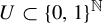 , there exists a homeomorphism
$\phi :\{0,1\}^{\mathbb {N}}\to U$
, there exists a homeomorphism
$\phi :\{0,1\}^{\mathbb {N}}\to U$
 that is piecewise an element of the group V. This homeomorphism conjugates the ample group V with its local subgroup
$V_U$
that is piecewise an element of the group V. This homeomorphism conjugates the ample group V with its local subgroup
$V_U$
 . Hence, the subgroup
$V_U$
. Hence, the subgroup
$V_U$
 is isomorphic to the entire group V. In particular,
$V_U$
is isomorphic to the entire group V. In particular,
$V_U$
 is simple.
In general, Proposition 8.1 does not yield Property E, but it helps in deriving this property from simpler properties introduced in §5.
Proof. Suppose
$\mathcal {G}\subset {\mathrm {Homeo}}(X)$
 is an ample group that acts minimally on X and has Property CI. For any clopen sets
$U_1,U_2\subset X$
is an ample group that acts minimally on X and has Property CI. For any clopen sets
$U_1,U_2\subset X$
 , the local subgroups
$\mathcal {G}_{U_1}$
, the local subgroups
$\mathcal {G}_{U_1}$
 and
$\mathcal {G}_{U_2}$
and
$\mathcal {G}_{U_2}$
 are contained in the local subgroup
$\mathcal {G}_{U_1\cup U_2}$
are contained in the local subgroup
$\mathcal {G}_{U_1\cup U_2}$
 . Assuming the intersection
$U_1\cap U_2$
. Assuming the intersection
$U_1\cap U_2$
 is non-empty, we need to show that, conversely, every map
$f\in \mathcal {G}_{U_1\cup U_2}$
is non-empty, we need to show that, conversely, every map
$f\in \mathcal {G}_{U_1\cup U_2}$
 belongs to the group
$\langle \mathcal {G}_{U_1}\cup \mathcal {G}_{U_2}\rangle $
belongs to the group
$\langle \mathcal {G}_{U_1}\cup \mathcal {G}_{U_2}\rangle $
 . This is trivial when one of the sets
$U_1$
. This is trivial when one of the sets
$U_1$
 and
$U_2$
and
$U_2$
 contains the other. Hence, we may further assume that each of the sets
$U_1\setminus U_2$
contains the other. Hence, we may further assume that each of the sets
$U_1\setminus U_2$
 ,
$U_2\setminus U_1$
,
$U_2\setminus U_1$
 , and
$U_1\cap U_2$
, and
$U_1\cap U_2$
 is non-empty.
Since the group
$\mathcal {G}$
 acts minimally and
$U_1\cap U_2\ne \emptyset $
acts minimally and
$U_1\cap U_2\ne \emptyset $
 , Proposition 8.1 implies that the generalized symmetric group
$\mathsf {S}(\mathcal {G}_{U_1\cup U_2})$
, Proposition 8.1 implies that the generalized symmetric group
$\mathsf {S}(\mathcal {G}_{U_1\cup U_2})$
 is generated by its subgroups
$\mathsf {S}(\mathcal {G}_{U_1})$
is generated by its subgroups
$\mathsf {S}(\mathcal {G}_{U_1})$
 and
$\mathsf {S}(\mathcal {G}_{U_2})$
and
$\mathsf {S}(\mathcal {G}_{U_2})$
 . Since
$\mathsf {S}(\mathcal {G}_{U_1})\subset \mathcal {G}_{U_1}$
. Since
$\mathsf {S}(\mathcal {G}_{U_1})\subset \mathcal {G}_{U_1}$
 and
$\mathsf {S}(\mathcal {G}_{U_2})\subset \mathcal {G}_{U_2}$
and
$\mathsf {S}(\mathcal {G}_{U_2})\subset \mathcal {G}_{U_2}$
 , we conclude that
$\mathsf {S}(\mathcal {G}_{U_1\cup U_2})\subset \langle \mathcal {G}_{U_1}\cup \mathcal {G}_{U_2}\rangle $
, we conclude that
$\mathsf {S}(\mathcal {G}_{U_1\cup U_2})\subset \langle \mathcal {G}_{U_1}\cup \mathcal {G}_{U_2}\rangle $
 .
.
Given a map
$f\in \mathcal {G}_{U_1\cup U_2}$
 , let
$V_+=\{x\in U_1\mid f(x)\notin U_1\}$
, let
$V_+=\{x\in U_1\mid f(x)\notin U_1\}$
 and
$V_-=\{x\in U_1\mid f^{-1}(x)\notin U_1\}$
and
$V_-=\{x\in U_1\mid f^{-1}(x)\notin U_1\}$
 . The sets
$V_+$
. The sets
$V_+$
 and
$V_-$
and
$V_-$
 are clopen as
$V_+=U_1\cap f^{-1}(X\setminus U_1)$
are clopen as
$V_+=U_1\cap f^{-1}(X\setminus U_1)$
 and
$V_-=U_1\cap f(X\setminus U_1)$
and
$V_-=U_1\cap f(X\setminus U_1)$
 . First, we consider an easy case where
$V_+=V_-=\emptyset $
. First, we consider an easy case where
$V_+=V_-=\emptyset $
 . An equivalent condition is that
$f(U_1)=U_1$
. An equivalent condition is that
$f(U_1)=U_1$
 . Since
${\mathrm {supp}}(f)\subset U_1\cup U_2$
. Since
${\mathrm {supp}}(f)\subset U_1\cup U_2$
 , we also have
$f(U_2\setminus U_1)=U_2\setminus U_1$
, we also have
$f(U_2\setminus U_1)=U_2\setminus U_1$
 . Let
$f_1$
. Let
$f_1$
 be a map on X that coincides with f on
$U_1$
be a map on X that coincides with f on
$U_1$
 and with the identity map everywhere else. Let
$f_2$
and with the identity map everywhere else. Let
$f_2$
 be another map on X that coincides with f on
$U_2\setminus U_1$
be another map on X that coincides with f on
$U_2\setminus U_1$
 and with the identity map everywhere else. Since
$f(U_1)=U_1$
and with the identity map everywhere else. Since
$f(U_1)=U_1$
 and
$f(U_2\setminus U_1)=U_2\setminus U_1$
and
$f(U_2\setminus U_1)=U_2\setminus U_1$
 , it follows that
$f_1$
, it follows that
$f_1$
 and
$f_2$
and
$f_2$
 are homeomorphisms. By construction, both
$f_1$
are homeomorphisms. By construction, both
$f_1$
 and
$f_2$
and
$f_2$
 are piecewise elements of the group
$\mathcal {G}$
are piecewise elements of the group
$\mathcal {G}$
 . Since
$\mathcal {G}$
. Since
$\mathcal {G}$
 is ample, it contains them. Also, by construction,
${\mathrm {supp}}(f_1)\subset U_1$
is ample, it contains them. Also, by construction,
${\mathrm {supp}}(f_1)\subset U_1$
 ,
${\mathrm {supp}}(f_2)\subset U_2\setminus U_1$
,
${\mathrm {supp}}(f_2)\subset U_2\setminus U_1$
 and
$f=f_1f_2$
and
$f=f_1f_2$
 . Therefore,
$f_1\in \mathcal {G}_{U_1}$
. Therefore,
$f_1\in \mathcal {G}_{U_1}$
 ,
$f_2\in \mathcal {G}_{U_2}$
,
$f_2\in \mathcal {G}_{U_2}$
 and
$f\in \langle \mathcal {G}_{U_1}\cup \mathcal {G}_{U_2}\rangle $
and
$f\in \langle \mathcal {G}_{U_1}\cup \mathcal {G}_{U_2}\rangle $
 .
.
Next, consider the case where one of the sets
$V_+$
 and
$V_-$
and
$V_-$
 coincides with
$U_1$
coincides with
$U_1$
 . Then, the other set coincides with
$U_1$
. Then, the other set coincides with
$U_1$
 as well. In this case, the image
$f(U_1)$
as well. In this case, the image
$f(U_1)$
 is disjoint from
$U_1$
is disjoint from
$U_1$
 . Hence, the generalized
$2$
. Hence, the generalized
$2$
 -cycle
$g=\delta _{U_1;f}$
-cycle
$g=\delta _{U_1;f}$
 is defined. Moreover,
$g\in \mathsf {F}(\mathcal {G})=\mathcal {G}$
is defined. Moreover,
$g\in \mathsf {F}(\mathcal {G})=\mathcal {G}$
 . Note that
${\mathrm {supp}}(g)\subset {\mathrm {supp}}(f)\subset U_1\cup U_2$
. Note that
${\mathrm {supp}}(g)\subset {\mathrm {supp}}(f)\subset U_1\cup U_2$
 . Therefore,
$g\in \mathcal {G}_{U_1\cup U_2}$
. Therefore,
$g\in \mathcal {G}_{U_1\cup U_2}$
 . Then, the map
$h=gf$
. Then, the map
$h=gf$
 is also in
$\mathcal {G}_{U_1\cup U_2}$
is also in
$\mathcal {G}_{U_1\cup U_2}$
 . Since g coincides with
$f^{-1}$
. Since g coincides with
$f^{-1}$
 on the set
$f(U_1)$
on the set
$f(U_1)$
 , we obtain that h coincides with the identity map on
$U_1$
, we obtain that h coincides with the identity map on
$U_1$
 . It follows that
$h\in \mathcal {G}_{U_2\setminus U_1}\subset \mathcal {G}_{U_2}$
. It follows that
$h\in \mathcal {G}_{U_2\setminus U_1}\subset \mathcal {G}_{U_2}$
 . In addition,
$g\in \mathsf {S}(\mathcal {G}_{U_1\cup U_2})\subset \langle \mathcal {G}_{U_1}\cup \mathcal {G}_{U_2}\rangle $
. In addition,
$g\in \mathsf {S}(\mathcal {G}_{U_1\cup U_2})\subset \langle \mathcal {G}_{U_1}\cup \mathcal {G}_{U_2}\rangle $
 . As a consequence, the map
$f=g^{-1}h$
. As a consequence, the map
$f=g^{-1}h$
 belongs to
$\langle \mathcal {G}_{U_1}\cup \mathcal {G}_{U_2}\rangle $
belongs to
$\langle \mathcal {G}_{U_1}\cup \mathcal {G}_{U_2}\rangle $
 .
.
Now, consider the case where
$V_+$
 and
$V_-$
and
$V_-$
 are both different from the empty set and
$U_1$
are both different from the empty set and
$U_1$
 . In this case, the unions
$V_+\cup (X\setminus U_1)$
. In this case, the unions
$V_+\cup (X\setminus U_1)$
 and
$V_-\cup (X\setminus U_1)$
and
$V_-\cup (X\setminus U_1)$
 are both different from X. It is easy to see that f maps the first of these unions onto the second. Since the set
$X\setminus U_1$
are both different from X. It is easy to see that f maps the first of these unions onto the second. Since the set
$X\setminus U_1$
 is disjoint from
$V_+$
is disjoint from
$V_+$
 and
$V_-$
and
$V_-$
 , Property CI of the group
$\mathcal {G}$
, Property CI of the group
$\mathcal {G}$
 implies that
$f_0(V_+)=V_-$
implies that
$f_0(V_+)=V_-$
 for some
$f_0\in \mathcal {G}$
for some
$f_0\in \mathcal {G}$
 . Note that the set
$f^{-1}(V_-)$
. Note that the set
$f^{-1}(V_-)$
 is disjoint from
$U_1$
is disjoint from
$U_1$
 . It follows that the generalized
$2$
. It follows that the generalized
$2$
 -cycle
$g=\delta _{V_+;f^{-1}f_0}$
-cycle
$g=\delta _{V_+;f^{-1}f_0}$
 is defined and belongs to
$\mathsf {F}(\mathcal {G})=\mathcal {G}$
is defined and belongs to
$\mathsf {F}(\mathcal {G})=\mathcal {G}$
 . Since
${\mathrm {supp}}(f)\subset U_1\cup U_2$
. Since
${\mathrm {supp}}(f)\subset U_1\cup U_2$
 , we obtain that
$f^{-1}(V_-)\subset U_2\setminus U_1$
, we obtain that
$f^{-1}(V_-)\subset U_2\setminus U_1$
 . Then, the support
${\mathrm {supp}}(g)=V_+\cup f^{-1}(V_-)$
. Then, the support
${\mathrm {supp}}(g)=V_+\cup f^{-1}(V_-)$
 is contained in
$U_1\cup U_2$
is contained in
$U_1\cup U_2$
 as well. Therefore, the map g belongs to
$\mathcal {G}_{U_1\cup U_2}$
as well. Therefore, the map g belongs to
$\mathcal {G}_{U_1\cup U_2}$
 and so does the map
$h=fg$
and so does the map
$h=fg$
 . By construction,
$h(V_+)=V_-$
. By construction,
$h(V_+)=V_-$
 and
$h(U_1\setminus V_+)=f(U_1\setminus V_+)$
and
$h(U_1\setminus V_+)=f(U_1\setminus V_+)$
 , which implies that
$h(U_1)=U_1$
, which implies that
$h(U_1)=U_1$
 . Hence, the map h has been covered by the first case. By the above,
$h\in \langle \mathcal {G}_{U_1}\cup \mathcal {G}_{U_2}\rangle $
. Hence, the map h has been covered by the first case. By the above,
$h\in \langle \mathcal {G}_{U_1}\cup \mathcal {G}_{U_2}\rangle $
 . Since
$g\in \mathsf {S}(\mathcal {G}_{U_1\cup U_2})$
. Since
$g\in \mathsf {S}(\mathcal {G}_{U_1\cup U_2})$
 , we conclude that the map
$f=hg^{-1}$
, we conclude that the map
$f=hg^{-1}$
 belongs to
$\langle \mathcal {G}_{U_1}\cup \mathcal {G}_{U_2}\rangle $
belongs to
$\langle \mathcal {G}_{U_1}\cup \mathcal {G}_{U_2}\rangle $
 as well.
It remains to consider the case where one of the sets
$V_+$
 and
$V_-$
and
$V_-$
 is empty while the other is not. This case will be reduced to the previous one. Without loss of generality, we may assume that
$V_+=\emptyset $
is empty while the other is not. This case will be reduced to the previous one. Without loss of generality, we may assume that
$V_+=\emptyset $
 and
$V_-\ne \emptyset $
and
$V_-\ne \emptyset $
 (otherwise, we could replace f with
$f^{-1}$
(otherwise, we could replace f with
$f^{-1}$
 ). Then,
$f(U_1)$
). Then,
$f(U_1)$
 is a proper subset of
$U_1$
is a proper subset of
$U_1$
 . It follows that for any
$j\in \mathbb {Z}$
. It follows that for any
$j\in \mathbb {Z}$
 , the set
$f^{j+1}(U_1)$
, the set
$f^{j+1}(U_1)$
 is a proper subset of
$f^j(U_1)$
is a proper subset of
$f^j(U_1)$
 . Note that
$V_-=U_1\setminus f(U_1)$
. Note that
$V_-=U_1\setminus f(U_1)$
 . Since
$f^j(V_-)=f^j(U_1)\setminus f^{j+1}(U_1)$
. Since
$f^j(V_-)=f^j(U_1)\setminus f^{j+1}(U_1)$
 for all
$j\in \mathbb {Z}$
for all
$j\in \mathbb {Z}$
 , we obtain that the sets
$f^j(V_-)$
, we obtain that the sets
$f^j(V_-)$
 ,
$j\in \mathbb {Z}$
,
$j\in \mathbb {Z}$
 are disjoint from one another. The set
$f^j(V_-)$
are disjoint from one another. The set
$f^j(V_-)$
 is contained in
$U_1$
is contained in
$U_1$
 for
$j\ge 0$
for
$j\ge 0$
 and disjoint from
$U_1$
and disjoint from
$U_1$
 for
$j<0$
for
$j<0$
 . Since
${\mathrm {supp}}(f)\in U_1\cup U_2$
. Since
${\mathrm {supp}}(f)\in U_1\cup U_2$
 , we have
$f^j(V_-)\subset U_2\setminus U_1$
, we have
$f^j(V_-)\subset U_2\setminus U_1$
 for
$j<0$
for
$j<0$
 . Consider a generalized
$2$
. Consider a generalized
$2$
 -cycle
$g=\delta _{f(V_-);f^{-2}}=\mu [V_-;f,f^{-1};(1\,2)]$
-cycle
$g=\delta _{f(V_-);f^{-2}}=\mu [V_-;f,f^{-1};(1\,2)]$
 . The map g is well defined and belongs to the ample group
$\mathcal {G}$
. The map g is well defined and belongs to the ample group
$\mathcal {G}$
 . Since
${\mathrm {supp}}(g)=f(V_-)\cup f^{-1}(V_-)$
. Since
${\mathrm {supp}}(g)=f(V_-)\cup f^{-1}(V_-)$
 , this map is in
$\mathcal {G}_{U_1\cup U_2}$
, this map is in
$\mathcal {G}_{U_1\cup U_2}$
 and so is the map
$h=gf$
and so is the map
$h=gf$
 . By construction,
$h(V_-)=f^{-1}(V_-)$
. By construction,
$h(V_-)=f^{-1}(V_-)$
 and
$h=f$
and
$h=f$
 on the set
$U_1\setminus V_-$
on the set
$U_1\setminus V_-$
 . Furthermore,
$h^{-1}(f(V_-))=f^{-2}(V_-)$
. Furthermore,
$h^{-1}(f(V_-))=f^{-2}(V_-)$
 and
$h^{-1}=f^{-1}$
and
$h^{-1}=f^{-1}$
 on
$U_1\setminus f(V_-)$
on
$U_1\setminus f(V_-)$
 . It follows that
$\{x\in U_1\mid h(x)\notin U_1\}=V_-$
. It follows that
$\{x\in U_1\mid h(x)\notin U_1\}=V_-$
 and
$\{x\in U_1\mid h^{-1}(x)\notin U_1\}=V_-\cup f(V_-)$
and
$\{x\in U_1\mid h^{-1}(x)\notin U_1\}=V_-\cup f(V_-)$
 . Observe that both of the latter sets are different from
$\emptyset $
. Observe that both of the latter sets are different from
$\emptyset $
 and
$U_1$
and
$U_1$
 . Therefore, the map h has been covered by the previous case. By the above,
$h\in \langle \mathcal {G}_{U_1}\cup \mathcal {G}_{U_2}\rangle $
. Therefore, the map h has been covered by the previous case. By the above,
$h\in \langle \mathcal {G}_{U_1}\cup \mathcal {G}_{U_2}\rangle $
 . Since
$g\in \mathsf {S}(\mathcal {G}_{U_1\cup U_2})$
. Since
$g\in \mathsf {S}(\mathcal {G}_{U_1\cup U_2})$
 , we obtain that the map
$f=g^{-1}h$
, we obtain that the map
$f=g^{-1}h$
 belongs to
$\langle \mathcal {G}_{U_1}\cup \mathcal {G}_{U_2}\rangle $
belongs to
$\langle \mathcal {G}_{U_1}\cup \mathcal {G}_{U_2}\rangle $
 as well.
Proposition 8.6. For an ample group acting minimally on a Cantor set, any of Properties UR, NC, SC, UC, CI, and HS implies Property E.
Proof. By Lemma 5.4, Property UR is equivalent to Property NC. It follows from Lemma 5.6 that for an ample group acting minimally on a Cantor set, Property SC is equivalent to Property UC. For an ample group, either of Properties NC and UC implies Property CI due to Lemmas 5.10 and 5.11. By Lemma 5.16, Property HS implies Property CI as well. Finally, by Lemma 8.5, Property CI implies Property E for any ample group acting minimally.
Now, equipped with Proposition 8.6, we are going to provide more examples of ample groups with Property E.
Definition 8.7. A homeomorphism
$f:X\to X$
 of a Cantor set X is called minimal if there is no closed set
$Y\subset X$
of a Cantor set X is called minimal if there is no closed set
$Y\subset X$
 different from the empty set and X that is invariant under f:
$f(Y)\subset Y$
different from the empty set and X that is invariant under f:
$f(Y)\subset Y$
 .
.
An equivalent condition is that for any point
$x\in X$
 , the forward orbit
$x,f(x), f^2(x),\ldots $
, the forward orbit
$x,f(x), f^2(x),\ldots $
 is dense in X. It is easy to show that the homeomorphism f is minimal if and only if the cyclic group
$\langle f\rangle $
is dense in X. It is easy to show that the homeomorphism f is minimal if and only if the cyclic group
$\langle f\rangle $
 generated by f acts minimally on X (in the sense of Definition 5.1).
There are many known examples of minimal homeomorphisms of Cantor sets (they are referred to as Cantor minimal systems).
Theorem 8.8. For any minimal homeomorphism f of a Cantor set, the ample group
$\mathsf {F}(\langle f\rangle )$
 has Property E.
It is not hard to show that the cyclic group
$\langle f\rangle $
 has Property UR (and the equivalent Property NC). However, it is not clear whether the ample group
$\mathsf {F}(\langle f\rangle )$
has Property UR (and the equivalent Property NC). However, it is not clear whether the ample group
$\mathsf {F}(\langle f\rangle )$
 has these properties. In general, it is not clear whether Property NC survives when the group is amplified.
To prove Theorem 8.8, we are going to use some advanced results of Matui. In [Reference Matui46], Matui introduced the notion of an almost finite groupoid (see [Reference Matui46, Definition 6.2]). Later, Kerr [Reference Kerr38] defined almost finiteness for group actions (see [Reference Kerr38, Definition 8.2]). Any continuous action of a countable group on a Cantor set gives rise to a groupoid. In this particular case, both notions are equivalent (see [Reference Kerr38, Example 8.5]).
Theorem 8.9. (Matui [Reference Matui46])
Let G be a group of homeomorphisms of a Cantor set X. If the natural action of the group G on X is minimal and almost finite, then the ample group
$\mathsf {F}(G)$
 has Property HS.
Note that Matui’s result [Reference Matui46, Theorem 6.12] is formulated in terms of groupoids. Theorem 8.9 is a reformulation of it in a particular case where the groupoid is associated to a group action.
Proposition 8.10. (Matui [Reference Matui46])
Any free action of the group
$\mathbb {Z}^n$
 on a Cantor set is almost finite.
Proposition 8.10 is a less general version of [Reference Matui46, Lemma 6.3].
Proof of Theorem 8.8.
Suppose f is a minimal homeomorphism of a Cantor set X. Minimality implies that f has no periodic points. Hence, the natural action of the cyclic group
$\langle f\rangle $
 on X is free. Since
$\langle f\rangle $
on X is free. Since
$\langle f\rangle $
 is isomorphic to
$\mathbb {Z}$
is isomorphic to
$\mathbb {Z}$
 , that action is almost finite due to Proposition 8.10. In addition, the action of
$\langle f\rangle $
, that action is almost finite due to Proposition 8.10. In addition, the action of
$\langle f\rangle $
 is minimal. Then, it follows from Theorem 8.9 that the ample group
$\mathsf {F}(\langle f\rangle )$
is minimal. Then, it follows from Theorem 8.9 that the ample group
$\mathsf {F}(\langle f\rangle )$
 has Property HS. Since the group
$\langle f\rangle $
has Property HS. Since the group
$\langle f\rangle $
 acts minimally on X, so does its amplification. It remains to apply Proposition 8.6.
The notion of almost finiteness has been extensively studied. It is expected that any free minimal action of a countable amenable group on the Cantor set is almost finite (see [Reference Kerr38, Problem 8.9]). Let us mention a recent result of Kerr and Naryshkin [Reference Kerr and Naryshkin39] in that direction.
Theorem 8.11. (Kerr, Naryshkin [Reference Kerr and Naryshkin39])
Every free continuous action of a countable elementary amenable group on a finite-dimensional compact metrizable space is almost finite.
In view of Theorem 8.11 [Reference Kerr and Naryshkin39, Theorem A], the cyclic group
$\langle f\rangle $
 in Theorem 8.8 can be replaced by any countable elementary amenable group
$G\subset {\mathrm {Homeo}}(X)$
in Theorem 8.8 can be replaced by any countable elementary amenable group
$G\subset {\mathrm {Homeo}}(X)$
 such that the natural action of G on the Cantor set X is minimal and free.
There is an alternative way to prove Theorem 8.8 using more elementary means. Let us outline it. Suppose f is a minimal homeomorphism of a Cantor set X. For any point
$x\in X$
 , consider its forward orbit
$\{f^k(x)\mid k\ge 0\}$
, consider its forward orbit
$\{f^k(x)\mid k\ge 0\}$
 with respect to f and the stabilizer of this orbit under the natural action of the ample group
$\mathcal {G}=\mathsf {F}(\langle f\rangle )$
with respect to f and the stabilizer of this orbit under the natural action of the ample group
$\mathcal {G}=\mathsf {F}(\langle f\rangle )$
 . By Lemma 3.3, the stabilizer
${\mathrm {St}}_{\mathcal {G}}(\{f^k(x)\mid k\ge 0\})$
. By Lemma 3.3, the stabilizer
${\mathrm {St}}_{\mathcal {G}}(\{f^k(x)\mid k\ge 0\})$
 is also an ample group.
Proposition 8.12. (Putnam [Reference Putnam54])
The stabilizer
${\mathrm {St}}_{\mathcal {G}}(\{f^k(x)\mid k\ge 0\})$
 is a locally finite group.
Proposition 8.12 can be extracted from the results of [Reference Putnam54, §5] (as asserted in [Reference Giordano, Putnam and Skau23]). Note that the group
$\mathsf {F}(\langle f\rangle )$
 appears only implicitly in [Reference Putnam54] as everything is formulated in terms of a
$C^*$
appears only implicitly in [Reference Putnam54] as everything is formulated in terms of a
$C^*$
 -algebra associated with the minimal homeomorphism f. A more general fact is explicitly formulated and proved by Juschenko and Monod (see [Reference Juschenko and Monod37, Lemmas 4.1 and 4.2]).
Proposition 8.13. The action of the subgroup
${\mathrm {St}}_{\mathcal {G}}(\{f^k(x)\mid k\ge 0\})$
 on clopen subsets of the Cantor set X has the same orbits as the action of the entire group
$\mathcal {G}$
on clopen subsets of the Cantor set X has the same orbits as the action of the entire group
$\mathcal {G}$
 .
.
Assuming Proposition 8.13 is proved, the proof of Theorem 8.8 goes as follows. Since the stabilizer
${\mathrm {St}}_{\mathcal {G}}(\{f^k(x)\mid k\ge 0\})$
 is locally finite, every element has finite order. Hence, this group obviously has Property UR. Also, it has Property NC (this is easy to check directly or we can use Lemma 5.4). As the stabilizer is an ample group, Lemma 5.10 implies that it has Property CI. Then, it follows from Proposition 8.13 that the group
$\mathcal {G}$
is locally finite, every element has finite order. Hence, this group obviously has Property UR. Also, it has Property NC (this is easy to check directly or we can use Lemma 5.4). As the stabilizer is an ample group, Lemma 5.10 implies that it has Property CI. Then, it follows from Proposition 8.13 that the group
$\mathcal {G}$
 has Property CI as well. It remains to apply Proposition 8.6.
We do not include the proof of Proposition 8.13 as it is quite lengthy. It will be published elsewhere.
There are also completely different kinds of ample groups with Property E where that property holds since the groups allow strong contraction of clopen sets (Property SC). First of all, let us mention Thompson’s group V (already considered above) as well as its various generalizations including the Higman–Thompson groups
$V_{n,r}$
 , also denoted
$G_{n,r}$
, also denoted
$G_{n,r}$
 (see, e.g., [Reference Bleak, Cameron, Maissel, Navas and Olukoya12]), the Brin–Thompson groups
$nV$
(see, e.g., [Reference Bleak, Cameron, Maissel, Navas and Olukoya12]), the Brin–Thompson groups
$nV$
 (see [Reference Brin14]), and others. Each of those groups can be realized as a group of homeomorphisms of a Cantor set that is easily shown to be ample. Some of the groups are not simple so that the argument in Remark 8.4 may not apply to them. However, it is not hard to prove that any of the groups
$V_{n,r}$
(see [Reference Brin14]), and others. Each of those groups can be realized as a group of homeomorphisms of a Cantor set that is easily shown to be ample. Some of the groups are not simple so that the argument in Remark 8.4 may not apply to them. However, it is not hard to prove that any of the groups
$V_{n,r}$
 and
$nV$
and
$nV$
 acts transitively on the set of all non-trivial clopen subsets of the respective Cantor set. This immediately implies minimality and Properties SC, UC, CI, and HS.
Another class of ample groups with Property E is the (topological) full groups of minimal, purely infinite étale groupoids considered by Matui in [Reference Matui47, Reference Matui48]. The full group is ample by construction. Minimality of the groupoid translates into minimality of the natural action of the group, while pure infiniteness translates into Property SC. For example, a purely infinite groupoid can be associated to any one-sided subshift of finite type over a finite alphabet (see [Reference Matui47, §6]). Note that the ample group obtained from the groupoid associated to the full shift on n symbols is isomorphic to the Higman–Thompson group
$V_{n,1}$
 .
.
Acknowledgements
The authors are grateful to the anonymous referee whose numerous comments and suggestions helped to improve the exposition and sharpen the results of the paper substantially.
The first author is supported by the Humboldt Foundation and expresses his gratitude to the University of Bielefeld. Also, he is supported by the Travel Support for Mathematicians grant MP-TSM-00002045 from the Simons Foundation.


 Open access

