





1. Introduction
Vocabulary knowledge is regarded as an essential building block for second language (L2) learning and is often an overall indicator of successful L2 development (Chen, Liu & Huang, Reference Chen, Liu and Huang2019; Hu & Nassaji, Reference Hu and Nassaji2016; Nation, Reference Nation2001). However, due to limited exposure and a lack of practice, L2 vocabulary learning is often slow, particularly for EFL learners, who cannot naturally acquire and practice vocabulary in their environment (Solati-Dehkordi & Salehi, Reference Solati-Dehkordi and Salehi2016; Teng, Reference Teng2022; Tsai & Tsai, Reference Tsai and Tsai2018). Moreover, many traditional teaching methods, such as memorization, repetition, and regurgitation, are still widely used in many L2 classrooms (Chen, Tseng & Hsiao, Reference Chen, Tseng and Hsiao2018; Teng, Reference Teng2022). This makes learners passive, bored, or indifferent to vocabulary learning, and as a result, despite the great amount of effort and time spent on vocabulary learning, learning outcomes are often disappointing (Teng, Reference Teng2022).
However, the advancement of technology and digital media has opened a promising new arena for L2 learning (Sundqvist & Sylvén, Reference Sundqvist and Sylvén2016). In particular, the benefits of using digital games have been reported for L2 learning from diverse aspects. From the affective aspect, the use of digital games increases learners’ intrinsic motivation, interest, and curiosity (Dickey, Reference Dickey2011; Lee, Reference Lee2019; Malone, Reference Malone2018). It encourages active participation, self-directed learning, and discovery learning (Cornillie, Jacques, De Wannemacker, Paulussen & Desmet, Reference Cornillie, Jacques, De Wannemacker, Paulussen, Desmet, De Wannemacker, Clarebout and De Causmaecker2011; Lee, Reference Lee2019). Digital games also promote incidental vocabulary learning by providing rich language input and an interesting learning environment (Chen et al., Reference Chen, Liu and Huang2019; Sundqvist, Reference Sundqvist2019; Sykes & Reinhart, Reference Sykes and Reinhardt2013). With the widespread use of digital media, incidental learning has also gained more attention in L2 vocabulary learning, and a significant number of studies have reported its pedagogical benefits (Calvo-Ferrer & Belda-Medina, Reference Calvo-Ferrer and Belda-Medina2021; Lai & Chen, Reference Lai and Chen2021; Sundqvist, Reference Sundqvist2019; Zou, Huang & Xie, Reference Zou, Huang and Xie2021).
While numerous studies have investigated the effectiveness of digital games on incidental L2 vocabulary learning, few studies have investigated factors affecting students’ vocabulary acquisition and retention while playing digital games (Sundqvist, Reference Sundqvist2019). In addition, while learner factors, particularly learners’ affective factors, such as motivation and interest, were often examined in digital game-based vocabulary learning (e.g. Endo, Reference Endo2010; Lee, Reference Lee2019), other learner factors, including attention, awareness, and linguistic or vocabulary-related factors, such as level and frequency, have been rarely investigated in this area. As studies showed that these factors play a critical role in vocabulary learning (e.g. for attention, see Boers, Warren, He & Deconinck, Reference Boers, Warren, He and Deconinck2017; Ender, Reference Ender2016; Teng, Reference Teng2022; for awareness, see Nation, Reference Nation2001; Schmidt, Reference Schmidt1990; Schmitt, Reference Schmitt2008; for level, see Chen et al., Reference Chen, Liu and Huang2019; Pattemore & Muñoz, Reference Pattemore and Muñoz2020; Teng, Reference Teng2019, Reference Teng2022; for frequency, see Heidari-Shahreza, Moinzadeh & Barati, Reference Heidari-Shahreza, Moinzadeh and Barati2014; Peters & Webb, Reference Peters and Webb2018; Xiaoning & Feng, Reference Xiaoning and Feng2017), this constituted a serious research gap. Therefore, to fill the gap, the current study examined the effectiveness of incidental vocabulary learning in a game-enhanced learning environment and the factors influencing students’ vocabulary learning outcomes.
2. Literature review
2.1 Incidental L2 vocabulary acquisition
As more students access digital media and games, informal and incidental L2 vocabulary learning has also gained more attention from researchers and practitioners (Sundqvist & Sylvén, Reference Sundqvist and Sylvén2016; Teng, Reference Teng2022). Incidental vocabulary learning occurs when learners focus on something other than vocabulary learning, such as reading and watching movies, and studies have shown that vocabulary can be learned incidentally and effectively through reading (Lee & Pulido, Reference Lee and Pulido2017; Xiaoning & Feng, Reference Xiaoning and Feng2017; Zhao, Guo, Biales & Olszewski, Reference Zhao, Guo, Biales and Olszewski2016), watching videos (Peters & Webb, Reference Peters and Webb2018; Teng, Reference Teng2022) and playing games (Chen et al., Reference Chen, Liu and Huang2019; Sundqvist, Reference Sundqvist2019; Sundqvist & Sylvén, Reference Sundqvist, Sylvén and Reinders2012; Zheng, Bischeoff & Gilliland, Reference Zheng, Bischeoff and Gilliland2015). Compared to other language areas, such as grammar, vocabulary learning is a particularly effective domain for incidental learning, since discovering the form–meaning connection can occur more frequently without intentional learning (Örsdemir, Reference Örsdemir2017). In incidental learning, learners acquire vocabulary more naturally from the context or through interaction with others (Franciosi, Yagi, Tomoshige & Ye, Reference Franciosi, Yagi, Tomoshige and Ye2016; Zheng et al., Reference Zheng, Bischeoff and Gilliland2015), which, in turn, makes vocabulary learning more motivating and interesting (Sundqvist & Sylvén, Reference Sundqvist and Sylvén2016).
While studies have shown that intentional and explicit learning yield better results than incidental learning (Solati-Dehkordi & Salehi, Reference Solati-Dehkordi and Salehi2016; Sonbul & Schmitt, Reference Sonbul and Schmitt2013; Teng, Reference Teng2015), the amount of vocabulary intentionally learned is often very limited, and more words can be learned incidentally; moreover, intentionally learned vocabulary often suffers from large attrition (Teng, Reference Teng2020, Teng & Zhang, Reference Teng and Zhang2021). Additionally, students tend to find intentional vocabulary learning boring (Ranalli, Reference Ranalli2008). Other studies, however, reported weaknesses of incidental vocabulary learning, such as longer time for acquisition (Yamamoto, Reference Yamamoto2014) and a higher attrition rate (Waring & Takaki, Reference Waring and Takaki2003), therefore making it less effective (Elgort, Reference Elgort2011; Schmitt, Reference Schmitt2008) compared to intentional vocabulary learning.
Although there is a large overlap between the concepts of incidental learning and unintentional learning, incidental learning does not mean learning something unconsciously. Ender (Reference Ender2016) maintained that in the dichotomies of implicit and explicit and incidental and intentional learning, incidental vocabulary acquisition can occur both explicitly and implicitly; however, when incidental vocabulary acquisition occurs through an explicit cognitive learning process, such as direct attention to vocabulary items and a conscious effort to learn, the effect becomes greater. In other words, he emphasized the role of attention and explicit learning during incidental learning. Schmitt (Reference Schmitt2008) also highlighted the importance of attention/awareness during learning and stated that “perhaps the most effective way of improving incidental learning is by reinforcing it afterwards with intentional learning tasks” (p. 352). The role of attention in vocabulary acquisition will be further discussed in the following section.
2.2 Variables in L2 vocabulary acquisition
Previous studies explored diverse variables that influenced L2 vocabulary acquisition and retention, and the most frequently examined variables were vocabulary-related and learner-related variables (Puimège & Peters, Reference Puimège and Peters2019; Teng, Reference Teng2022). In terms of vocabulary-related variables, researchers often reported exposure frequency as the most influential factor on vocabulary acquisition and retention (Malone, Reference Malone2018; Solati-Dehkordi & Salehi, Reference Solati-Dehkordi and Salehi2016; Teng, Reference Teng2020, Reference Teng2022; Xiaoning & Feng, Reference Xiaoning and Feng2017). Their view was that frequent exposure to new vocabulary is essential for vocabulary learning, and increasing the number of exposures reinforces long-term retention. Especially in the EFL environment, given a lack of exposure to L2 in the surroundings and the limited amount of classroom time, extensive and recurrent exposure to L2 vocabulary has been considered necessary and effective (Heidari-Shahreza et al., Reference Heidari-Shahreza, Moinzadeh and Barati2014; Heidari-Shahreza & Tavakoli, Reference Heidari-Shahreza and Tavakoli2016; Peters & Webb, Reference Peters and Webb2018; Xiaoning & Feng, Reference Xiaoning and Feng2017). Although studies generally agree that learners’ vocabulary gains are affected by the number of exposures to vocabulary items, they presented varied results about the optimal or minimum number of required exposures for effective vocabulary acquisition and retention. For instance, while Waring and Takaki (Reference Waring and Takaki2003), Teng (Reference Teng2014, Reference Teng2019), Webb (Reference Webb2007), and Rott (Reference Rott1999) claimed that learners need up to 18, 14, 10, and six encounters, respectively, with a target word to achieve substantial acquisition in incidental vocabulary leaning, Hulstijn, Hollander and Greidanus (Reference Hulstijn, Hollander and Greidanus1996) found that there was no difference between one to three encounters. In addition, the effect of exposure varies depending on the input mode (i.e. reading or listening) or aspects of vocabulary knowledge (i.e. form–meaning, grammatical aspect) (Peters & Webb, Reference Peters and Webb2018; Webb, Reference Webb, Nunan and Richards2015). Thus, some studies claimed that exposure has only a limited effect, but other vocabulary-related variables, such as cognates, relevance, length, and input mode, have more significant effects or covary with exposure (Malone, Reference Malone2018; Willis & Ohashi, Reference Willis and Ohashi2012; Xiaoning & Feng, Reference Xiaoning and Feng2017).
On the other hand, other studies paid more attention to learner-related variables in vocabulary learning. For instance, Boers et al. (Reference Boers, Warren, He and Deconinck2017), Mohamed (2018), and Solati-Dehkordi and Salehi (Reference Solati-Dehkordi and Salehi2016) considered the amount of attention to be a stronger predictor for vocabulary learning than the number of encounters. Laufer and Hulstijn (Reference Laufer and Hulstijn2001) pointed out that students’ attention and involvement significantly affected vocabulary acquisition. According to them, the effectiveness of incidental vocabulary learning varies depending on the degree of learners’ involvement in a task and desire to accomplish a task, which is, in turn, determined by the task type. Thus, the greater the task-induced involvement load is, the more vocabulary students gain. Similarly, Schmidt (Reference Schmidt1990) emphasized that noticing and conscious attention/awareness are necessary conditions in L2 learning. Nation (Reference Nation2001) further elaborated that explicit vocabulary instruction directs L2 learners’ conscious attention to novel vocabulary items, creates word awareness (noticing), and enhances acquisition. When a new word is noticed by the learner, it can become a candidate for intake; therefore, a certain amount of attention is necessary for vocabulary learning. Schmitt (Reference Schmitt2008) also considered learners’ attention as an essence in vocabulary acquisition that leads to quicker and better vocabulary acquisition and greater retention.
The amount of attention, in turn, varies according to learners’ interest in the topic and learning materials. Endo (Reference Endo2010) and Erçetin (Reference Erçetin2010) showed that students recalled significantly more vocabulary from a high-interest reading passage than from a low-interest reading passage. In addition, researchers have also discovered that other learner-related variables, such as language proficiency levels, aptitude, and perceptions, have positive relationships with vocabulary acquisition (Chen et al., Reference Chen, Liu and Huang2019; Pattemore & Muñoz, Reference Pattemore and Muñoz2020; Zhao et al., Reference Zhao, Guo, Biales and Olszewski2016). Peters and Webb (Reference Peters and Webb2018) and Teng (Reference Teng2022) also revealed that learners’ behaviors, such as viewing time and viewing captions while watching videos, were positively correlated with vocabulary learning outcomes.
2.3 Digital games and L2 vocabulary learning
The ideal conditions for effective vocabulary learning, such as multiple exposures to vocabulary, naturalistic learning opportunities and contextualized learning, are seldom available in the EFL environment (Lee & Park, Reference Lee and Park2020; Teng, Reference Teng2022; Zheng et al., Reference Zheng, Bischeoff and Gilliland2015). In recent years, however, digital games have become an effective venue for L2 vocabulary learning. Meta-analysis studies confirmed that digital games are more effective in vocabulary learning than traditional methods by a large effect size (Chen et al., Reference Chen, Tseng and Hsiao2018; Tsai & Tsai, Reference Tsai and Tsai2018; Zou et al., Reference Zou, Huang and Xie2021). Most importantly, digital games offer a new, interesting, and immersive learning environment for L2 learning (Chen et al., Reference Chen, Liu and Huang2019; Cornillie et al., Reference Cornillie, Jacques, De Wannemacker, Paulussen, Desmet, De Wannemacker, Clarebout and De Causmaecker2011). Given that language is inseparable from the context, learning vocabulary within the context of a digital game can bring multiple benefits (Brown, Collins & Duguid, Reference Brown, Collins and Duguid1989; Lee & Park, Reference Lee and Park2020). When a learner finds a new vocabulary item in a context, they can acquire it more easily than one without a context because informative context can provide cues for its meaning and function and facilitate word comprehension (van den Broek, Takashima, Segers & Verhoeven, Reference van den Broek, Takashima, Segers and Verhoeven2018). Contextualized vocabulary acquisition and repeated exposures in different contexts can reinforce retention by triggering memory retrieval (Mohamed, 2018; Webb, Reference Webb2007). In sum, context cultivates vocabulary learning and retention by elaborating and deepening learners’ information processing (Ender, Reference Ender2016; Hu & Nassaji, Reference Hu and Nassaji2016).
More specifically, narrative-based digital games often function as a context themselves by providing a “narrative context for situating and contextualizing learning” (Dondlinger, Reference Dondlinger2007: 23). The game narrative provides a meaningful context for vocabulary and helps learners create more complex linguistic memory networks within it, and as a result, learned words are less susceptible to memory decay (Franciosi et al., Reference Franciosi, Yagi, Tomoshige and Ye2016). The game narrative also has a great impact on learners’ intrinsic motivation and engagement in learning by promoting a sense of challenge, fantasy, and curiosity in them (Dickey, Reference Dickey2011; Kao, Reference Kao2014; Lee, Reference Lee2019; Przybylski, Rigby & Ryan, Reference Przybylski, Rigby and Ryan2010). Increased intrinsic motivation, in turn, raises and sustains learners’ attention to content, which is essential to vocabulary acquisition (Chen et al., Reference Chen, Liu and Huang2019).
In addition, a game environment presents vocabulary items in multimodal channels (e.g. auditive, visual, and textual) and allows learners to activate mental schemata about new vocabulary items and have better vocabulary retention (Cornillie et al., Reference Cornillie, Jacques, De Wannemacker, Paulussen, Desmet, De Wannemacker, Clarebout and De Causmaecker2011; Hitosugi, Schmidt & Hayashi, Reference Hitosugi, Schmidt and Hayashi2014). According to dual coding theory (Paivio, Reference Paivio2007), the simultaneous use of two or more modes, particularly the combination of visual and verbal modes, helps learners build a meaningful form–meaning connection and a mental representation of the word, thereby better facilitating vocabulary learning and retention (Khezrlou, Ellis & Sadeghi, Reference Khezrlou, Ellis and Sadeghi2017; Ramezanali & Faez, Reference Ramezanali and Faez2019). Using diverse modes, such as videos with captions, in digital games, also facilitates vocabulary acquisition by directing learners’ attention to the content and associating meaning with visual and aural representations (Teng, Reference Teng2022; Teng & Zhang, Reference Teng and Zhang2021).
Despite a significant number of publications on vocabulary acquisition in the game-based learning environment (using educational or serious games), there is a serious research gap. First, studies that have investigated the impact of diverse variables on incidental vocabulary learning, particularly in game-enhanced learning environments, which use noneducational, off-the-shelf vernacular games, are still scarce (Sundqvist, Reference Sundqvist2019; Zou et al., Reference Zou, Huang and Xie2021). Second, even when using vernacular games, the focus of the studies has been mostly on learning vocabulary or L2 through interaction between users, namely language use around and about games (e.g. Sundqvist, Reference Sundqvist2019; Thorne, Hellermann & Jakonen, Reference Thorne, Hellermann and Jakonen2021; Zheng et al., Reference Zheng, Bischeoff and Gilliland2015), and studying the effect of learning vocabulary directly from the contents of vernacular games has seldom been explored. Last, regarding the effect of variables on vocabulary learning, previous studies reported incongruent results. These varying results may be because studies did not take learner-related variables into consideration (Teng, Reference Teng2022), or they did not consider multiple variables simultaneously. Given the assumed significant role of vocabulary-related and learner-related variables in L2 vocabulary learning, the current study fills this gap by addressing the following questions:
-
1. To what extent did the use of a vernacular game promote EFL students’ incidental vocabulary acquisition and retention?
-
2. Which of the vocabulary-related variables, word level, exposure frequency, and salience, affected the students’ L2 vocabulary acquisition and retention in the game-enhanced learning environment?
-
3. Which of the learner-related variables, language proficiency, interest, and viewing captions, affected the students’ L2 vocabulary acquisition and retention in the game-enhanced learning environment?
3. Method
3.1 Task description and participants
The present study used Her Story, a vernacular murder mystery game. The goal of the game is to discover what happened to the characters around a murder. The game contains an archive of 271 short English video clips of interrogating interviews with the female protagonist (a prime suspect in her husband’s murder). Players searched and watched the videos by utilizing a keyword search (i.e. videos that they had previously watched provided cues for the next keywords; Figure 1), until they finally discovered the truth about the crime. The total running time of the videos was approximately 4 hours and 30 minutes, but the actual playing time was a lot longer and varied depending on the player. English captions were provided as an option so that the students could view the captions while playing the game (Figure 2).
Screenshot: keyword search

Screenshot: subtitle

The game was chosen for two reasons. First, the interesting and intriguing narrative of the game could easily attract players and immerse them in the story. It was expected that the mysterious, implausible, well-structured narrative of Her Story, combined with the playing method of keyword searching, could increase players’ enjoyment and engagement. Although it is often difficult to maintain students’ motivation while playing educational games over the long term, good commercial games can better motivate students by presenting good quality narratives, graphics and game interfaces (Hitosugi et al., Reference Hitosugi, Schmidt and Hayashi2014; Lee, Reference Lee2019), and Her Story was a strong candidate to motivate and satisfy users. Second, the game provided rich language input because players needed to watch videos and understand the contents to continue the game. It is also noteworthy that the current study started with the instructor’s accidental finding that in the previous year, the students had used vocabulary beyond their current level in their writing after playing the game.
The cohort of 59 students who participated in the current research majored in English at a university in Korea. Their English proficiencies ranged mostly between 70 and 90 on the iBT TOEFL (intermediate level). Their native language was Korean. None of them had played Her Story prior to the class. The students were given a period of three weeks to play the game. The students individually played the game on their mobile phones during the class periods (twice a week, 75 minutes per class) and outside the classroom.
3.2 Data collection
The current study employed a quantitative research method. To evaluate the effectiveness of using the game on vocabulary acquisition and retention, the students’ pretest and immediate and delayed vocabulary posttests were conducted. The pretest, an English-Korean translation test (meaning recognition test), was conducted prior to playing the game. The immediate translation posttest (meaning recognition test) was executed immediately after finishing the game, and a delayed translation posttest (meaning recognition recall test) was conducted four weeks later. The students were not notified about the posttests in advance. As vocabulary is defined as a lexical unit, including both single items and chunks of several words (Chen et al., Reference Chen, Liu and Huang2019), the current study also included both in the tests. A total of 26 items (20 words, two compound words, and four phrases) were selected from the game (Table 2), considering the three vocabulary-related variables (level, frequency, salience) of each word. Level was the primary criterion for selection, and higher-level words were selected that the students would not be familiar with prior to playing the game. Frequency and salience were then considered for even distributions of words. The same set of items was used in all three tests.
Vocabulary-related variables, word level, exposure frequency, and salience, were measured as follows. First, the target words were labelled depending on their word level. As various classifications are used to measure the word level, to increase the reliability of the analysis, two classification frames were employed in this study: the Common European Framework of Reference for Languages (CEFR), which organized vocabulary into six levels from A1 to C2 (i.e. those beyond C2 were labelled unlisted), and Nation’s (Reference Nation, Bogaards and Laufer2004) vocabulary list, which categorized vocabulary into 10 levels based on frequency. Second, exposure frequencies were measured based on the number of occurrences of each word in the game. Finally, the salience of each target word was evaluated on a 3-point Likert scale by two raters according to the impact of the word on the story. The interrater reliability was .92.
Learner-related variables were examined in terms of the students’ language proficiency, interest, and viewing captions. The students’ language proficiencies were labelled into three levels based on their TOEFL scores (1: under 74; 2: 75–84; 3: above 85). Upon completion of the game play, the students were asked to complete a survey inquiring about their interest in the game on a 5-point Likert scale: (1) The game was interesting, (2) I was curious about the story and the ending, and (3) I was concentrated during the game play. They were also asked about the proportions of videos that they watched with captions.
A multilevel data analysis was employed in the current study. First, descriptive statistics were utilized for the test scores and the variables of each target word. Next, the reliability of the survey items for the students’ interest was tested, and the result confirmed adequate reliability (Cronbach’s alpha = .779). Finally, inferential statistics were employed. Repeated measures ANOVA was conducted to compare the pre- and posttest results, and multiple linear regression was conducted to examine the influence of each variable on vocabulary gain and retention.
4. Results
4.1 Results of the pretest and posttests
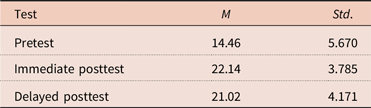
The present study examined whether the game facilitated the students’ vocabulary learning. The results showed that the scores of the immediate translation posttest and the delayed posttest significantly increased compared to those of the pretest (Table 1). The increase rate (vocabulary gain) was 53.1% and the attrition rate (the difference between the immediate and delayed posttests) was 5.0%. In terms of vocabulary items, while 33 students (56.0%) out of 59 marked correct answers for each item on average in the pretest, 49 students (83.0%) and 48 students (81.3%) did so in the immediate posttest and delayed posttest, respectively. Repeated measures ANOVA results indicated that the differences between the pretest and the posttests were significant (F = 212.120, mean square = 979.768, p < .001). Partial η was also considerably high (.785), which indicated that the effect size of playing the game was large.
The results of the pretest and posttests
Note. N = 59.
4.2 Results of vocabulary-related variables
In terms of vocabulary-related variables, the current study examined the word level, exposure frequency, and salience of the target items in the game. Concerning the word level, the results revealed that half of the target items were beyond the CEFR and Nation’s (Reference Nation, Bogaards and Laufer2004) lists (Table 2). These words, along with the phrases, were categorized into Levels 7 and 11, respectively. The frequencies of the target items ranged from one to 14 occurrences in the game. The salience of the word was assessed on a 3-point scale in the current study: 1 = “Not salient,” 2 = “Moderately salient,” 3 = “Very salient.” For instance, although “cremation” appeared only twice in the game, the situation in which the word was used was a significant scene in the story. “Midwife” also had a great impact on the story because the mystery of the story began with the midwife’s deception. Therefore, these words were categorized into 3 (Very salient). Table 2 shows the level, frequency, and salience of each target item and the results of the pretest and posttests.
The conditions of the target words and the test results
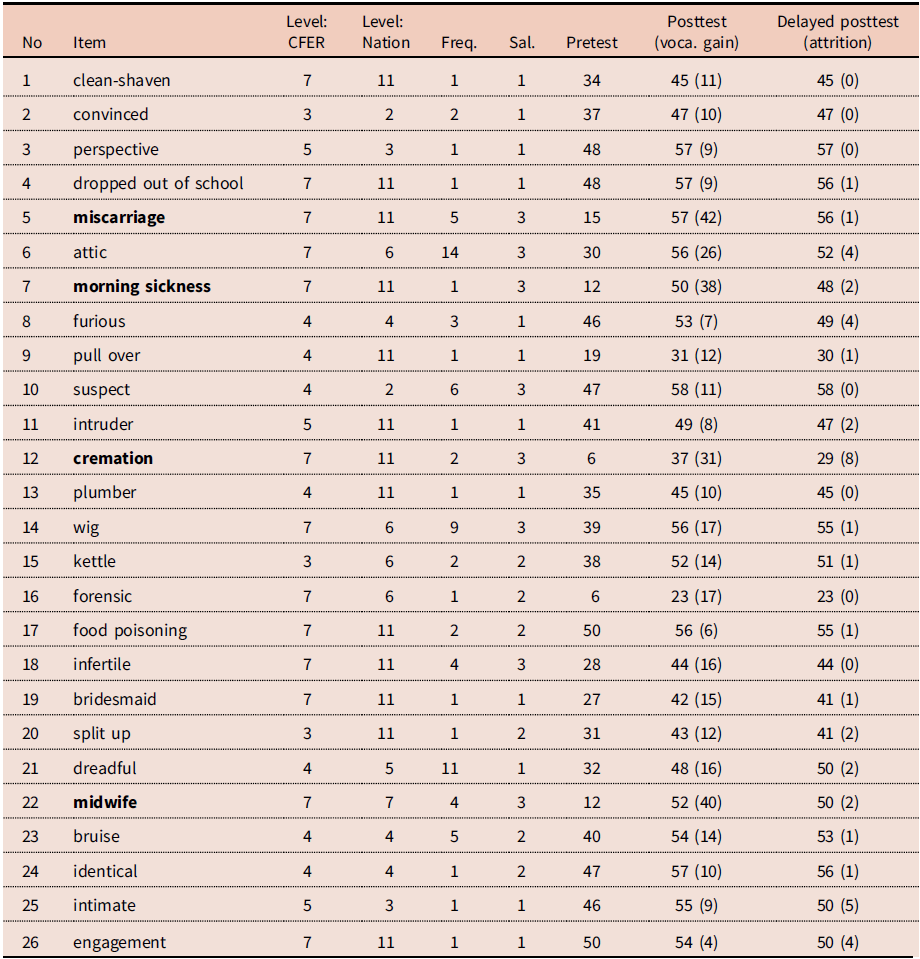
Note. N = 59. Freq. = frequency; Sal. = salience; Pretest, Posttest, Delayed posttest = number of correct answers; Voca. gain = vocabulary gain, difference between the pretest and the immediate posttest scores; Attrition = difference between the immediate and delayed posttest scores.
The regression results showed that word level did not affect the students’ vocabulary gain (immediate test scores) or retention (delayed test scores) based on both CEFR and Nation frameworks. Exposure frequency also did not have a significant influence on the learning outcomes. On the other hand, salience had a statistically meaningful relationship with vocabulary gain and retention. That is, the more salient the word was, the higher the vocabulary gain and retention the students had. Tables 3 and 4 summarize the results of the effect of vocabulary-related variables on vocabulary gain and retention.
The influence of vocabulary-related variables on vocabulary gain
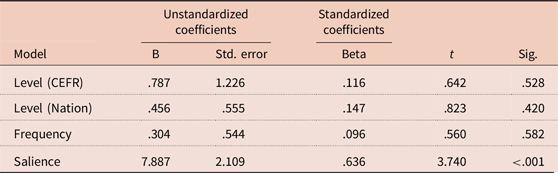
Note. Dependent variable: vocabulary gain.
The influence of vocabulary-related variables on vocabulary retention
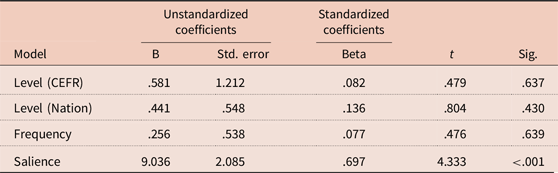
Note. Dependent variable: vocabulary retention.
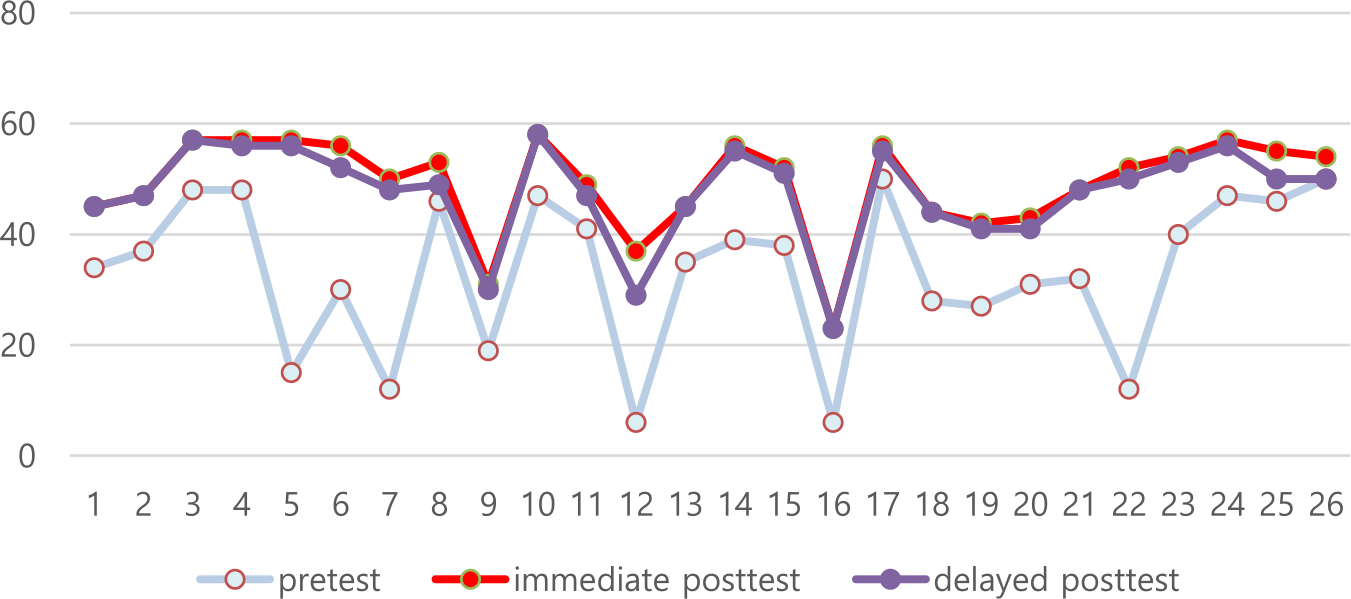
Figure 3 shows the impact of salience of individual target items on vocabulary gain and retention in more detail. This indicates that the students’ vocabulary gain and retention significantly varied according to the salience of the word. For example, the four words with the largest gain were miscarriage (no. 5), midwife (no. 7), cremation (no. 12), and morning sickness (no. 22) (Table 2 and Figure 3). These words, although they did not appear frequently, were the keywords to provide important cues about the murder case or important life events of the protagonist and hence were highly salient in the story.
Pretest and immediate and delayed posttest results for each word
Note. x-axis = vocabulary ID no. (refer to Table 2); y-axis = number of correct answers.
4.3 Results of learner-related variables
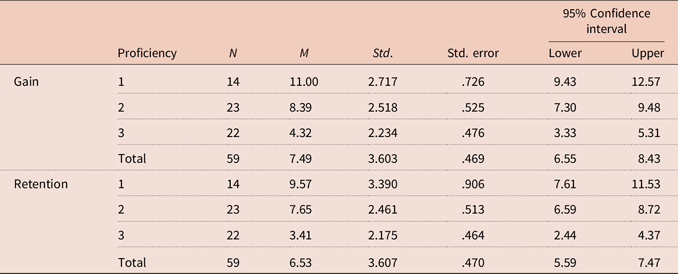
The current study investigated three learner-related variables: language proficiency, interest, and viewing captions. In terms of language proficiency, among 59 students, 14 were categorized into Level 1 (low-intermediate), 23 into Level 2 (intermediate), and 22 into Level 3 (high-intermediate). Table 5 shows that the students’ vocabulary gain (F = 33.945, p < .000) and retention (F = 27.324, p < .000) significantly varied according to their language proficiency. Regarding interest, the survey results showed that the students’ interest was high. The results particularly revealed that the students were greatly curious about the story and the ending, and none of the survey items received any response under Point Three (Table 6). Regarding captions, the majority of the students viewed captions during game play: never = 4 (6.8%), under 50% = 10 (16.9%), 50–80% = 25 (42.4%), 80–100% = 20 (33.9%).
The students’ language proficiency and vocabulary gain and retention
Student interest during game play (survey results)
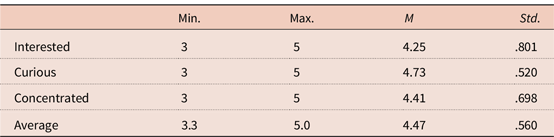
Note. N = 59.
The results of the regression confirmed that all three variables affected students’ vocabulary gain and retention. While interest and viewing captions had positive relationships with vocabulary gain and retention, language proficiency was negatively correlated; that is, the higher the students’ proficiency was, the less vocabulary gain and retention they had (Tables 7 and 8). There was also a negative correlation between the students’ language proficiency and viewing captions, which indicated that the less proficient students viewed captions more frequently (Pearson’s correlation = −.381, p < .01).
The influence of learner-related variables on vocabulary gain
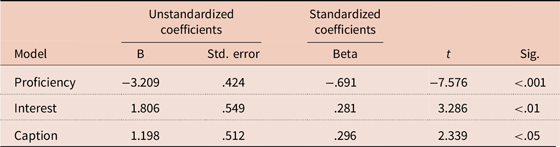
Note. Dependent variable: vocabulary gain.
The influence of learner-related variables on vocabulary retention
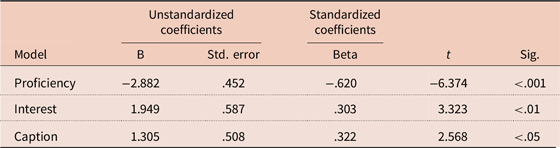
Note. Dependent variable: vocabulary retention.
5. Discussion
The current study showed that playing a vernacular murder mystery game greatly helped the students acquire new vocabulary. The effectiveness of incidental vocabulary learning through the game was largely ascribed to its interesting story. This was confirmed by investigating variables affecting the students’ vocabulary gain and retention. In terms of vocabulary-related variables, the current study found that the salience of the word positively affected the students’ vocabulary acquisition and retention. This means that the students better learned and remembered the words strongly associated with the story of the game because they paid more attention to those words. Moreover, the unique interface design of the game – the students could only continue the game by understanding the videos and putting the correct keyword – made some words even more salient. At the same time, it increased the involvement load for the students, along with their desire to accomplish the task, thereby their attention to vocabulary.
The game narrative also resulted in better retention because it provided richness of context wherein vocabulary was encoded and demanded more attention and conscious involvement from the students, which is central to learning (Ender, Reference Ender2016; Franciosi et al., Reference Franciosi, Yagi, Tomoshige and Ye2016). In Ender’s (2016) study, students tended to ignore the words when they judged them as inessential for understanding the text. In contrast, they better remembered the words that they considered important for comprehending the overall meaning of the text. Similarly, the students in the current study seemed to pay more conscious attention to the words when they were more salient and essential to understanding the story of the game. The complex interconnectedness of the word with the story made the memory more robust and facilitated vocabulary retention and retrieval. From this aspect, the students’ interest was intertwined and covaried with the salience of the word in vocabulary learning because both students’ interest and the salience of the word were rooted in the power of the narrative of the game. Hence, consistent with Cornillie et al.’s study (2011), the words that were crucial for task completion were better acquired and retained than words that were less salient in this study.
On the other hand, word level and exposure frequency did not affect the students’ vocabulary learning. This result was inconsistent with previous studies that found significant relationships between those variables and students’ vocabulary learning (Lee & Pulido, Reference Lee and Pulido2017; Malone, Reference Malone2018; Teng, Reference Teng2022; Xiaoning & Feng, Reference Xiaoning and Feng2017). A couple of interpretations are possible for this inconsistency. First, as previous studies mentioned, when there are multiple variables included in the investigation, the variables covary and result in different dynamics among them (Peters & Webb, Reference Peters and Webb2018; Teng, Reference Teng2022). Similarly, salience, which had not been examined in previous studies, was such a strong factor affecting the students’ vocabulary learning and may weaken the influence of the other variables in the current study. In other words, in this study, the impact of level or frequency appeared to decrease to insignificance with words that were particularly salient. Alternatively, the effect of exposure and salience may even be combined to a certain degree to produce the outcomes. Second, concerning frequency, although there is no consensus on the optimal number for exposure of the target word in the previous studies, the numbers of exposures might not be sufficient to reach a significant result in this study. Last, regarding the word level, high-level words usually mean less frequently used words in daily life (Nation, Reference Nation, Bogaards and Laufer2004), but this may not have a strong influence on intermediate-level students living in the EFL environment.
Regarding learner-related variables, the study found that all three variables influenced vocabulary learning. In particular, the students showed a high level of interest and curiosity towards the game, and their heightened interest and curiosity positively affected vocabulary acquisition and retention. In this study, it was evident that the intriguing narrative contributed to the students’ vocabulary acquisition. Because the students were curious about the story (what truly happened and who killed the husband) and found the game interesting, they remained intrinsically motivated and self-imposed to actively play the game and paid more attention to vocabulary in the course of finding the killer and solving the mystery. Studies have claimed that the elaboration of the word process (i.e. depth of processing) ensures better vocabulary acquisition and retention (Eckerth & Tavakoli, Reference Eckerth and Tavakoli2012; Ender, Reference Ender2016) because it directs students’ conscious attention to the novel word and arouses students’ word awareness (Nation, Reference Nation, Bogaards and Laufer2004). In the present study, the game interface, by pushing the students to understand the contents and search keywords, directed the students’ attention to vocabulary, elaborated the vocabulary learning process, and ultimately led to better vocabulary learning.
The study also found positive relationships between viewing captions and vocabulary learning outcomes. Viewing captions increased the students’ attention to vocabulary while playing the game. As Teng (Reference Teng2022) argued that “captions function as attention-directing cues, which can aid learners in recognizing and recalling unknown words’ form and meaning” (p. 9), captions helped the students encode the form–meaning link of the novel word by enhancing the word salience in this study. Dual coding theory (Paivio, Reference Paivio2007) also supports the idea that students benefit from viewing captions because students’ perceptual association of visuals and audio with text reinforces the semantic network of the word. In addition, captions seemed to offer extra benefit to lower-level students. The lower-level students viewed captions more frequently in this study, which might further help them by complementing their lower-level L2 proficiencies and lack of previous knowledge of L2 vocabulary.
The current study, however, did not corroborate previous studies, which reported learners’ L2 proficiency level or previous knowledge of vocabulary as a predictor of successful vocabulary learning (Chen et al., Reference Chen, Liu and Huang2019; Pattemore & Muñoz, Reference Pattemore and Muñoz2020; Zhao et al., Reference Zhao, Guo, Biales and Olszewski2016). In contrast, in this study, language proficiency and vocabulary learning outcomes had a negative relationship. Two explanations are possible. First, the higher-level students already scored high on the pretest, leaving less room for improvement on the posttests, whereas the lower-level students had more room for improvement. Second, the results implied that even lower-level students could benefit from incidental vocabulary learning through the game. Prior studies argued that lower-level students benefited less from playing a game in vocabulary acquisition due to diverse reasons, such as a high level of vocabulary used in the game (Cornillie et al., Reference Cornillie, Jacques, De Wannemacker, Paulussen, Desmet, De Wannemacker, Clarebout and De Causmaecker2011) or lower aptitude towards L2 learning (Teng, Reference Teng2022). Compared to those studies, this study presented a more encouraging result for lower-level students. The study showed that when the lower-level students were provided with an interesting and stimulating task, they became intrinsically motivated and were able to learn vocabulary no less than the higher-level students. As mentioned earlier, viewing captions also reduced the gap between the higher-level and lower-level students by providing extra help to the lower-level students.
During the game, the students’ primary intention was not learning vocabulary but playing the game, so the students’ vocabulary acquisition was incidental and unintentional. From this perspective, the results showed that the students’ attention to the game did not diminish their attention to vocabulary but enforced and reinforced vocabulary learning by creating a strong link in their memory. Therefore, as contended by Ender (Reference Ender2016), although the students did not have a conscious intention to acquire vocabulary, the contentual salience of words and the necessity to understand them enabled the students to consciously attend to the meaning of the word during game play. Therefore, salience of the word (the vocabulary-related variable) and the students’ interest (the learner-related variable), influenced by and interacted with each other, promoted vocabulary learning.
The results of the present study imply several pedagogical implications for incidental vocabulary learning through digital games. First, instructors should consider multiple factors in game-based/enhanced language learning to benefit student L2 vocabulary learning. Most importantly, they need to carefully select a game according to students’ needs, interests, and proficiency levels. In particular, as students’ interests and curiosity about the game significantly influence their attention and motivation towards vocabulary learning, a game that has an interesting narrative, rather than one that merely exposes students to words, will be more effective. Second, implementing extra tasks in addition to playing a game will also be beneficial by increasing students’ involvement and motivation. More specifically, a task with a higher load, which demands need, search, and evaluation, will bring better vocabulary gain (Laufer & Hulstijn, Reference Laufer and Hulstijn2001).
Last, as the results of this study indicated a positive relationship between learners’ attention and vocabulary acquisition, explicit vocabulary instruction can also be helpful. As Ender (Reference Ender2016) highlighted the important role of attention and explicit learning in incidental vocabulary learning, incidental learning and explicit learning are not mutually exclusive. Likewise, game-enhanced incidental L2 learning does not mean merely letting students play the game and expecting them to unconsciously glean vocabulary. As shown in this study, vocabulary acquisition and retention are affected by diverse factors and processed by complex dynamics among factors; therefore, incidental vocabulary learning also requires a careful pedagogical design to increase students’ attention to the target word and their intake of it.
6. Conclusion
Vocabulary is central to L2 language learning (Nation, Reference Nation, Bogaards and Laufer2004; Sundqvist & Sylvén, Reference Sundqvist, Sylvén and Reinders2012; Teng, Reference Teng2022). However, it is often regarded as a tedious and unfruitful area, which demands a tremendous amount of time and effort from EFL students (Chen et al., Reference Chen, Tseng and Hsiao2018; Chen et al., Reference Chen, Liu and Huang2019). The current study showed that game-enhanced learning can be an effective alternative to traditional teaching methods for vocabulary learning. The study examined the vocabulary-related and learner-related variables affecting vocabulary learning and found that the positive learning outcomes were greatly attributed to the students’ interest and attention to the game content and subsequently to vocabulary. This was consistent with the result that the word with a greater salience had a larger impact on vocabulary acquisition and retention. This study, by showing the significant role of explicit attention to vocabulary in incidental learning, provided another pedagogical perspective to language instructors.
The present study has a few limitations. The intriguing story and unique interface of the game used in this study were the core components to heighten the students’ interest and attention; however, such games are quite limited in number and may not be available or adequate for certain groups of learners. Additionally, as learner-related variables are strongly associated with L2 vocabulary acquisition, more diverse variables, particularly learners’ behavioral and affective variables, should be further investigated in future studies. To this end, qualitative research will be fruitful to explore learners’ emotional states and behavioral patterns. From the classroom practice perspective, as informal, extramural L2 learning gains more popularity among learners (Sundqvist, Reference Sundqvist2019), instructors need to seek effective ways to incorporate diverse informal learning opportunities into L2 classrooms, and then carefully take diverse factors affecting vocabulary learning into consideration in their pedagogical design. This way, we can increase students’ motivation and enhance learning outcomes.
Acknowledgements
I would like to thank Sam Barlow, the creator of the game, Margaret Park for introducing the game to me, and the participants of the study.
Ethical statement and competing interests
There are no conflicts of interest in this paper. All participation in the study was voluntary, and informed consent was provided prior to commencement of the assignment. The anonymity of the participants was maintained throughout the study.
About the author
Sangmin-Michelle Lee is a professor of Global Communication at Kyung Hee University in the Republic of Korea. She earned her PhD from the Pennsylvania State University in language education. She has published papers on language learning in a technology-enhanced learning environment, machine translation, L2 writing, game-based learning, and digital creativity.
Author ORCIDs
Sangmin-Michelle Lee, https://orcid.org/0000-0002-7686-3537


 Open access

