



Unhealthy diet is a modifiable risk factor for chronic conditions such as diabetes( Reference Hu, Manson and Stampfer 1 ), cancer( Reference Key, Allen and Spencer 2 ) and CVD( Reference Hung, Joshipura and Jiang 3 ), and has been highlighted as a major public health problem( 4 , Reference Story, Kaphingst and Robinson-O’Brien 5 ). Although widespread across the USA, an unhealthy diet is more common among low-income populations( Reference Zenk, Schulz and Hollis-Neely 6 ), particularly those who reside in low-income neighbourhoods in which access to healthy, affordable foods is lacking, i.e. ‘food deserts’( Reference Beaulac, Kristjansson and Cummins 7 ).
Guided by the assumption that geographic access is a major factor underlying a poor diet( Reference Beaulac, Kristjansson and Cummins 7 ), recent policy initiatives have invested hundreds of millions of dollars into food deserts to increase access to healthy foods( Reference Couzin-Frankel 8 ). Understanding household food purchasing behaviour, i.e. the purchase of foods from a variety of sources, including but not limited to grocery stores, neighbourhood and convenience stores, and restaurants( Reference French, Shimotsu and Wall 9 , Reference French, Wall and Mitchell 10 ), could illuminate the role of geographic access in actual dietary intake. Specifically, analysis of where residents purchase healthier (i.e. fruits and vegetables) and less healthy (i.e. high in sugar, salt or energy) foods can provide a more complete understanding of whether and how the neighbourhood food environment might best be modified to improve food purchasing behaviour. For example, policies may need to be modified to facilitate purchase of healthy foods in retail outlets where healthy foods are under-represented and/or stymie purchase of unhealthy foods in outlets where unhealthy foods are over-represented.
Of the various methods for assessing household food purchasing behaviour, including food shopping receipts, home food inventories, Universal Product Code (UPC) bar scanning and self-reported shopping behaviour in surveys, food receipts have some key advantages( Reference French, Shimotsu and Wall 9 ). Food receipts capture foods from a wider variety of sources, including both stores and restaurants, whereas home food inventories and UPC bar scanning capture only foods purchased in stores and/or eaten at home. In addition, food receipts are better suited for assessment of food purchasing behaviour over a greater period of time, thereby affording more stable estimates of food purchasing behaviour. Food receipts are also advantageous over self-reported shopping behaviour in that they do not depend on the accuracy of participants’ recall. Recent empirical research affirms the viability and validity of food receipts as a source of data on household food purchasing behaviours across a variety of food sources( Reference French, Shimotsu and Wall 9 ).
The collection of food receipts to study household food purchasing behaviour is a relatively recent development. One of the main recent sources of data on household food purchasing behaviour, the 2010 Nielsen Homescan Panel Survey data, suggests that residents of lower-income neighbourhoods purchase less healthy foods than their higher-income counterparts( Reference Rahkovsky and Snyder 11 ). However, data for that study were collected using the UPC scanning method and supplemented by self-report data. That study has the notable strengths of a large consumer panel and detailed data on food purchases, but the data do not include food purchases from sources other than stores (e.g. restaurants) and under-represent poor consumers. Other research has analysed receipts data, but, to our knowledge, none have focused on residents of an urban food desert( Reference French, Wall and Mitchell 10 , Reference Cullen, Baranowski and Watson 12 ).
We sought to fill these gaps by collecting food receipts data to examine household food purchasing behaviour of low-income African Americans residing in a food desert. We present a detailed description of food purchasing patterns in this population, focusing on the types of food retail outlets (e.g. full-service grocery store, convenience store) residents patronized and the kinds of foods and beverages purchased (e.g. fruits, vegetables, sweets, salty snacks) from these venues.
Methods
Design and sample
The food receipts data analysed for the present study were collected as part of the Pittsburgh Hill/Homewood Research on Eating, Shopping, and Health (PHRESH), a 5-year study of residents and their neighbourhood environment in two predominantly African-American, low-income ‘food deserts’ in Pittsburgh, PA, USA. The study sought to understand the effect on residents of eliminating a food desert: in one of the neighbourhoods, a new full-service supermarket was slated to open. PHRESH study participants were recruited from a random sample of households drawn from a complete list of residential addresses generated by the Pittsburgh Neighborhood and Community Information System (a detailed description of sampling procedures is provided elsewhere( Reference Dubowitz, Ghosh-Dastidar and Cohen 13 )). The final sample consisted of 1372 households where the primary food shopper in each household was interviewed and administered an in-person baseline questionnaire in their home between May and December 2011. The study protocol was approved by the Institutional Review Board of the institution where the study was conducted.
Approximately two years after completion of the PHRESH baseline interview, data collectors returned to the same households to conduct a different household interview with the same primary household shopper for a separate but related study of physical activity (PHRESH Plus, or the Pittsburgh Hill/Homewood Research on Neighborhoods, Exercise and Health). At the same time this interview was administered, data collectors asked participants to collect their food shopping receipts from all household food purchases, including those in stores and restaurants, and wear an accelerometer to record their physical activity over the course of one week. At the end of the week, data collectors returned to collect the food shopping receipts and accelerometer; participants were compensated an additional $US 25 (above and beyond $US 15 compensation for completing the household interview) for participating in this component of the study. These data, including the food receipts, were collected prior to the opening of the new supermarket whose influence was evaluated in the PHRESH study.
Of 1372 primary household food shoppers who completed the PHRESH baseline interview, 982 (71·6 %) also participated in PHRESH Plus, and 644 of these participants returned household food shopping receipts.Footnote * Due to the labour-intensive nature of entering food receipts data and constrained resources, we randomly selected 300 participants from the sampling frame of 644 participants. Of the 300 participants, seven were excluded due to incomplete information on the receipts (i.e. food items were undiscernible), resulting in a final analytic sample size of 293 participants in the food receipts data analysis.
Household interviews
Household interviews included questions on participants’ sociodemographic characteristics (e.g. age, gender, race/ethnicity, marital status, educational attainment) and objective measurements of height and weight. Missing values on income were imputed with the software IVEWare in SAS macros version 0.2 (2009; Software Survey Methodology Program at the University of Michigan’s Survey Research Center, Institute for Social Research, Ann Arbor, MI, USA). Adjusted income was computed as a ratio of household income and size.
Food receipts
Key receipt data elements, including the names and locations of stores and restaurants for which receipts were returned and the names, quantities and pre-tax costs of food and beverage items purchased, were manually entered by research assistants. To ensure reliable extraction of receipt characteristics, a coding protocol with standard definitions for data elements was created and all research assistants were trained to follow it. Research assistants were initially required to demonstrate fidelity to the protocol by coding five receipts correctly according to the independent coding done by a researcher or senior research assistant who had already demonstrated fidelity to the protocol. After this initial training period, fidelity to the coding protocol was ensured by having a senior coder check a random sample of 10 % of receipts entered by each assistant.
Because of wide variability in the types of foods and beverages purchased and the level of detail reported on receipts across food retail outlets, one food or beverage ‘item’ was generally defined as the smallest packaged unit for purchase. For example, all of the following would have been counted as a single item: a carton of eggs, a bag of potato chips and an eight-pack of Pepsi cans. Thus, the actual quantity in a single item varies tremendously across different foods and beverages. For the vast majority (80 %) of items, specific quantities in a single unit were not listed on the receipt and are thus unknown. In lieu of data on the quantity of food and beverage items, the cost of food and beverage items serves as a rough proxy of the quantity of item(s) purchased.
After raw receipt data elements were recorded, all types of food items purchased in stores were classified into one of several mutually exclusive categories. Because some food items consisted of multiple types of food, items were assigned to a single category according to the following hierarchy: prepackaged or takeaway/eating-out entrée; sweetened baked goods; ice cream or gelato; candy; condiments, dips and gravy; sweets; salty snacks; potatoes; meat; eggs; cheese; yoghurt; butter, margarine or spread; whole grains; other type of grain (refined or not specified); nuts and seeds; fruit; beans and peas; vegetables; and other. These categories were later aggregated to form larger categories for analysis: empty calories (sweets, salty snacks, butter, margarine, shortening, condiments, dips and gravy); protein (meat, eggs, nuts and seeds, beans and peas); grains (whole, refined or not specified); vegetables (including potatoes); fruits; dairy (cheese, yoghurt); prepackaged and takeaway/eating-out entrées; and other. A similar process was followed for beverages using the following categories: sugar-sweetened beverages; milk; fruit/vegetable juice; water; artificially sweetened or low-calorie beverages; coffee and tea; condiments (e.g. creamer); alcohol; and specialty drinks (e.g. latté, smoothie). Food and beverage items purchased in restaurants were not listed in sufficient detail to permit classification into finer-grained categories.
We initially classified stores into one of eleven categories. Classifications were based on definitions from the Food Marketing Institute and the North American Industry Classification System and confirmed with our Community Advisory Boards, comprised of key resident stakeholders within each neighbourhood. To simplify, we reduced these categories to the following four categories of stores: (i) full-service supermarkets, which include grocery stores run by nationally or regionally recognized chains; (ii) mass merchandising and discount grocery stores, which include supercentres (e.g. Walmart, Target), wholesale clubs (e.g. Sam’s Club, Costco) and discount grocery stores, which offer a large assortment of low-priced food items (e.g. Save A Lot); (iii) convenience stores, which include small chain stores such as those at gas stations (e.g. Get Go, AM/PM), neighbourhood stores (i.e. small individual/family-owned stores), drug stores and dollar stores, which offer a limited assortment of low-priced and perishable items (e.g. Family Dollar); and (iv) other stores, such as meat or seafood markets and specialty grocery stores (e.g. Whole Foods). Restaurants were also classified into one of the following mutually exclusive categories: (i) fast-food restaurant; (ii) restaurant with table service; (iii) buffet or cafeteria; (iv) bar, tavern or lounge; (v) coffee shop; and (vi) other.
Statistical analyses
Given the paper’s descriptive purpose, we report univariate descriptive statistics to characterize the sociodemographic and other characteristics of the primary household food shoppers who returned receipts. We then present univariate descriptive statistics for food purchases to characterize where participants did their food shopping, what types of foods and beverages they purchased, and, finally, where they purchased different types of foods and beverages. We did not conduct any tests of significance for two main reasons: (i) we had no particular hypotheses for this descriptive paper; and (ii) where we do compare two or more groups descriptively (e.g. amount of household food expenditures on a particular food type in different store types), unbalanced, small sample sizes limited our power to detect statistically significant differences between groups. Analyses were conducted in the statistical software package SAS version 9.4 of the SAS System for Windows.
Results
Participant characteristics
As shown in Table 1, most participants in the receipts sample were female (77·8 %) and non-Hispanic black (91·1 %); on average, participants were 55·06 (sd 15·17) years old. Roughly half of the sample had a high-school education or less (50·5 %). Slightly less than half of the sample reported that a recipient of the Supplemental Nutrition Assistance Program (SNAP) resided in the household (46·1 %) and slightly more than half of the sample reported access to a vehicle when needed (55·0 %); on average, per capita annual household income was $US 13 913·20 (sd $US 11 879·80). Most participants were single, divorced, separated or widowed (81·3 %) and reported no children residing in the household (75·1 %). On average, participants reported having made roughly three visits to the main food store at which they had done their major food shopping in the past month (mean 2·93 (sd 0·83)) and having made roughly two visits to other stores (besides the main store) for major food shopping in the past month (mean 1·90 (sd 1·13)). Roughly three-quarters (78·8 %) of participants were considered to be overweight or obese based on BMI.
Characteristics of primary household food shoppers in the receipts study and the parent study, Pittsburgh, PA, USA, 2013

SNAP, Supplemental Nutrition Assistance Program; PHRESH, Pittsburgh Hill/Homewood Research on Eating, Shopping, and Health; PHRESH Plus, Pittsburgh Hill/Homewood Research on Neighborhoods, Exercise and Health.
* Participants in the receipts sample are primary household food shoppers whose household food shopping receipts were included in the final analytic sample for the present paper. They are a subset of parent study participants, who completed the baseline interviews for both PHRESH and PHRESH Plus and were invited to return food shopping receipts.
To assess response bias, we compared the 293 participants in the final analytic receipts sample with the total sample of 982 participants in the parent study who were eligible for inclusion in the receipts analysis (i.e. had the opportunity to return their food shopping receipts and completed both the PHRESH and PHRESH Plus baseline interviews). As shown in Table 1, the receipts sample very closely resembled the parent study sample on most characteristics. Exceptions were residence of a recipient of SNAP benefits in the household and per capita annual household income: having a SNAP benefits recipient residing in the household was slightly less common in the receipts sample (46·1 %) than in the parent sample (52·1 %) and participants in the receipts sample appeared to have slightly higher per capita annual household income (mean $US 13 913·20 (sd $US 11 879·80)) than those in the parent sample (mean $US 12 790·52 (sd $US 12 919·44)). In addition, the samples appeared to differ slightly on marital status, such that those in the receipts sample were slightly more likely to have been widowed, divorced or separated (45·1 %) and slightly less likely never to have been married (36·2 %) than those in the parent sample (widowed, divorced or separated, 40·7 %; single, never married, 41·8 %); however, the samples had very similar proportions of participants who were currently married or living with their partner (receipts sample, 18·8 %; parent sample, 17·5 %).
Food retail outlets where household food purchases were made
Across the 293 households, 879 receipts were returned. On average, each household returned three receipts (sd 2·51). As shown in Fig. 1, a greater proportion of households returned receipts from stores (93·2 %) than restaurants (27·0 %). Similarly, at the aggregate level, stores accounted for a much larger proportion of total food and beverage expenditures (92·6 %) than restaurants (7·4 %).
The percentage of households that returned receipts from stores and restaurants ( ) and the percentage of total food expenditures by store and restaurant type (
 ) among households in a food desert in Pittsburgh, PA, USA, 2013. The ‘full-service supermarkets’ category includes only full-service supermarkets; ‘mass merchandising/discount grocery stores’ include supercentres, wholesale clubs and discount grocery stores; ‘convenience stores’ include dollar stores, drug stores, convenience stores and neighbourhood stores; ‘other’ stores include meat or seafood markets, specialty grocery stores and all other types of food stores. The ‘other restaurants’ category includes buffet or cafeteria; bar, tavern or lounge; coffee shop; and other type of restaurant. Percentages of households that returned at least one receipt from each type of store and restaurant were calculated with the total number of households as the denominator (N 293). Percentages of total expenditures by store and restaurant type were calculated with the total food and beverage expenditures in all food retail outlets (stores and restaurants) across all households in the sample as the denominator ($US 18 398·10)

Among stores, full-service supermarkets were by far the most common store type from which households returned food receipts (65·5 %) and accounted for a much larger proportion of food and beverage expenditures (57·4 %) than any other food retail channel. After full-service supermarkets, receipts were most commonly returned from convenience stores (42·7 %), followed by mass merchandising/discount grocery stores (31·7 %) and other store types (10·2 %). After full-service supermarkets, the greatest proportion of total food and beverage expenditures was accounted for by mass merchandising/discount grocery stores (21·6 %), followed by other store types (7·1 %) and convenience stores (6·6 %).
Among restaurants, more households returned receipts from fast-food restaurants (18·1 %), followed by restaurants with table service (8·9 %) and buffets or cafeterias (5·8 %). Paralleling these trends, fast-food restaurants accounted for a greater proportion of food and beverage expenditures (3·4 %) than restaurants with table service (2·4 %) and other types of restaurants (1·6 %).
Types of foods and beverages purchased in stores
We also examined the types of foods and beverages purchased in stores (see Table 2). The great majority of expenditures in stores were for foods (87·9 %) rather than beverages (12·1 %). More than one-third of household food expenditures were for foods high in protein (e.g. meats; 38·0 %). Foods that consist primarily of empty calories (e.g. sweets, salty snacks) collectively accounted for the second largest proportion of household food expenditures (22·5 %). All other categories represented less than 10 % of household food expenditures. We saw a similar pattern when we examined food expenditures on a household level. We observed extensive variability in food expenditures across households.
In-store food and beverage expenditures of households in a food desert in Pittsburgh, PA, USA, 2013

* Percentages for both of the overarching food and beverage categories of expenditures were calculated with the total food and beverage expenditures ($US 17 015·48) as the denominator. Percentages for sub-categories of food and beverage expenditures were calculated with the total food ($US 14 962·71) and beverage ($US 2052·77) expenditures, respectively, as the denominators.
† The numbers in the ‘average expenditures, all households’ columns are the average (mean) amount of money spent on each type of food or beverage across all households during the 7 d period of data collection (N 293) and the sd.
‡ The numbers in the ‘average expenditures of households with at least one food or beverage item purchase’ columns are the average (mean) amount of money spent on each type of food or beverage by households that purchased at least one food or beverage item in the corresponding category and the sd; for example, the average shown for protein is the average amount of money spent on protein by households that bought at least one protein item during the 7 d period of data collection and the sd. The number and percentage of households that purchased at least one food or beverage item in the corresponding category are also shown.
§ Other empty calories include butter, margarine, shortening, condiments, dips and gravy.
In the full sample, sugar-sweetened beverages accounted for the greatest share of household beverage expenditures in stores (40·2 %), followed by milk (16·8 %) and fruit/vegetable juice (11·1 %). All other beverage types represented less than 10 % of beverage expenditures. The average household beverage expenditures followed a similar trend and, like food, the standard deviation for each beverage category indicated substantial variability across households in beverage expenditures.
Store types where healthy and unhealthy foods were purchased
To determine where purchases of unhealthy and healthy foods were made, we conducted a more granular analysis of expenditures for specific types of unhealthy and healthy foods and beverages in different types of stores (see Table 3). For unhealthy foods, we focused on salty snacks, sweets and sugar-sweetened beverages, all of which consist primarily of empty calories; for healthy foods, we focused on fruits and vegetables.
Average household expenditures ($US) on each type of food and sugar-sweetened beverages (SSB) by store type among the subset of households that made at least one purchase of the particular type of food or SSB in each type of store, Pittsburgh, PA, USA, 2013
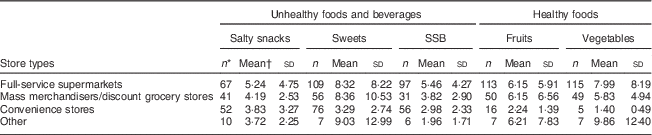
* The numbers shown in all of the ‘n’ columns are the number of households that made at least one purchase of the corresponding type of food or SSB in the store type. For example, n 67 for purchases of salty snacks in full-service supermarkets indicates that sixty-seven households returned receipts showing a purchase of salty snacks in a full-service supermarket.
† The numbers shown in all of the ‘Mean’ columns are the average amount of money spent on the corresponding type of food or SSB in the store type across households among the subset of households that made at least one purchase of the food type or SSB in the store type. For example, the mean of $US 5·24 shown in the cell corresponding to salty snacks and full-service supermarkets indicates that, on average, the sixty-seven households that purchased salty snacks in full-service supermarkets spent $US 5·24 on salty snacks in full-service supermarkets.
In general, purchases of both unhealthy and healthy foods were more common in full-service supermarkets than in other stores. For example, 109 households had purchased sweets in full-service supermarkets, whereas purchases of sweets in convenience stores were made by roughly two-thirds as many households (n 76) and purchases of sweets in mass merchandisers/discount grocery stores were made by roughly half as many households (n 56); very few households purchased sweets in other stores (n 7). Similarly, 115 households had purchased vegetables in full-service supermarkets, whereas less than half as many households had purchased vegetables in mass merchandisers/discount grocery stores (n 49); purchases of vegetables were very rare in other stores (n 7) and convenience stores (n 5). Convenience stores were the second most common site of unhealthy food purchases. For example, salty snacks were purchased in full-service supermarkets, convenience stores and mass merchandisers/discount grocery stores by sixty-seven, fifty-two and forty-one households, respectively. Mass merchandisers/discount grocery stores were also the second most common purveyor of healthy food purchases after full-service supermarkets, with 113 and 115 households purchasing fruits and vegetables, respectively, in full-service supermarkets, and less than half as many households purchasing fruits (n 50) and vegetables (n 49), respectively, in mass merchandisers/discount grocery stores. Convenience stores and other stores were rarely the site of purchases of fruits (convenience stores, n 16; other stores, n 7) and vegetables (convenience stores, n 5; other stores, n 7).
Average household food expenditures on both unhealthy and healthy foods were also generally higher in full-service supermarkets. For example, on average, household food shoppers spent more money on salty snacks and vegetables in full-service supermarkets than in mass merchandisers/discount grocery stores (salty snacks: full-service supermarkets, mean $US 5·24 (sd $US 4·75); mass merchandisers/discount grocery stores, mean $US 4·19 (sd $US 2·53); vegetables: full-service supermarkets, mean $US 7·99 (sd $US 8·19); mass merchandisers/discount grocery stores, mean $US 5·83 (sd $US 4·94)). However, among the subgroups of food shoppers who purchased unhealthy foods in convenience stores and mass merchandiser/discount grocery stores, average household expenditures on unhealthy food types were generally higher among those who made their purchases in mass merchandisers/discount grocery stores than in convenience stores. For example, the average (mean) amount of money spent on sweets was $US 8·36 (sd $US 10·53) in mass merchandisers/discount grocery stores and $US 3·29 (sd $US 2·74) in convenience stores.
Discussion
The current study dovetails with previous research indicating that residents of food deserts, in spite of not living near full-service supermarkets (by definition), purchase most foods from full-service supermarkets( Reference Rahkovsky and Snyder 11 ). This finding is perhaps not surprising in light of other research showing that the majority of people rarely shop at the supermarket closest to their home( Reference Drewnowski, Aggarwal and Hurvitz 14 – Reference Dubowitz, Zenk and Ghosh-Dastidar 16 ). Our analysis also documents the high demand among this cohort for unhealthy foods such as sweets relative to healthy foods such as fruits and vegetables. Households made most of their food purchases, both healthy and unhealthy, from full-service supermarkets. This is an important point, as research and nutrition policy initiatives emphasize the importance of access to a full-service supermarket in having a healthy diet. Although access to a full-service supermarket is important for facilitating purchases of healthy foods, supermarkets may also facilitate purchases of junk foods. Indeed, as Elbel and colleagues noted, in addition to stocking healthy foods, supermarkets stock vast quantities of unhealthy foods( Reference Elbel, Moran and Dixon 17 ). This may help to explain why recent studies of the effects of opening a supermarket in a low-income neighbourhood to increase residents’ proximity and access to a supermarket did not find the broad, positive effects on dietary intake that were expected( Reference Dubowitz, Ghosh-Dastidar and Cohen 13 , Reference Elbel, Moran and Dixon 17 – Reference Elbel, Mijanovich and Kiszko 19 ). Thus, in the absence of policies and practices that curb junk food purchases in full-service supermarkets, the benefits of providing access to a full-service supermarket are unlikely to be fully realized.
Our findings have policy implications for the types of food retail outlets to target and the availability and marketing of unhealthy foods in full-service supermarkets. First, nutrition policies will be more impactful to the extent that they focus on the primary site of food shopping among residents, i.e. full-service supermarkets. Policies that overlook this and focus instead on reducing access to other types of food retail outlets that account for a relatively small share of food purchases (e.g. the ban on fast-food restaurants in south Los Angeles) are unlikely to have a strong impact on diet. Second, instead of merely subsidizing the opening of full-service supermarkets in low-income or food desert areas, policies should aim to reduce the convenience and salience of low-nutrient foods in full-service supermarkets. For example, in-store marketing practices could be modified to de-emphasize unhealthy food options and emphasize healthy food options.
In addition to underscoring the need for food policy to target full-service supermarkets, the current findings suggest that food policy should also target other types of food retail outlets that predominantly feature unhealthy foods. Convenience stores, which encompassed neighbourhood stores, dollar stores and convenience stores, collectively accounted for only 7 % of total food expenditures but were the site of unhealthy food and beverage purchases for roughly 20–25 % of households. By contrast, less than 6 % of households purchased fruits or vegetables in convenience stores. These findings converge with past research suggesting that convenience stores are notable purveyors of junk foods( Reference Cavanaugh, Mallya and Brensinger 20 ). Some communities in Philadelphia, PA and Minneapolis, MN are trying to address this imbalance by increasing the selection of healthy foods in corner stores. Initial evaluations of these initiatives suggest that increasing the availability of fruits and vegetables in these stores has been followed by increased sales of fruits and vegetables( Reference Almaguer Sandoval, Law and Young 21 , 22 ). However, as with full-service supermarkets, simply facilitating access to healthy food in convenience stores is unlikely to be enough to improve diet. Implementing policies that curb unhealthy food purchases is critical to producing meaningful improvements in diet.
Study limitations
One limitation of the present research is that we do not know the extent to which the receipts returned represent a complete census of all household food shopping receipts. Thus, our estimates of food purchases might underestimate food purchases over the preceding week. However, our estimate of the average total weekly expenditures in stores very closely resembles that obtained in a recent analysis of national panel data on household food purchasing behaviour (i.e. the 2010 Nielsen Homescan Panel Survey) in residents of low-income, low-access areas: their analysis indicated that an average of $US 697·50 was spent per quarter (i.e. 12-week period)( Reference Rahkovsky and Snyder 11 ) and our analysis indicated an average of $US 58·14 spent per week, which translates to $US 697·68 per quarter (when multiplied by 12). Similarly, the average expenditures on fruits and vegetables in our sample closely resembled their estimates. They reported an average (mean) of $US 47·4 (sd $US 48·2) and $US 49·3 (sd $US 41·5) for expenditures on fruits and vegetables, respectively, over a quarter (i.e. roughly 12 weeks); in comparison, after adjusting for differences in the time periods by multiplying our average expenditures over a week by 12, we obtain average expenditures of $US 44·28 and $US 52·44 for fruits and vegetables, respectively. The similarity in these estimates increases confidence that our estimates of total weekly food expenditures reasonably represented actual expenditures.
Another limitation of the present study concerns the generalizability of its findings. Although the receipts sample very closely resembled the parent study sample on most sociodemographic characteristics, the receipts sample appeared to be slightly less socio-economically disadvantaged than the parent study sample: recipients of SNAP benefits were less commonly residents of households in the receipts sample (46·1 %) than the parent study sample (52·1 %) and per capita annual household income was slightly higher in the receipts sample (mean $US 13 913·20 (sd $US 11 879·80)) than in the parent study sample (mean $US 12 790·52 (sd $US 12 919·44)). Similarly, the receipts sample had a slightly lower proportion of single, never married participants (36·2 %) and a slightly higher proportion of widowed, divorced or separated participants (45·1 %) relative to the parent sample (single, never married, 41·8 %; widowed, divorced or separated, 40·7 %). While these differences were of modest magnitude, they might nevertheless indicate limited generalizability of the current findings to households that have greater financial need and in which the primary household food shopping is done by single, never married individuals.
Another limitation of the current research is the lack of annotated receipts data which indicate precise quantities purchased. Cost was used as a rough proxy of quantity, but this likely leads to underestimation of the quantities of types of foods that have a lower price per unit (e.g. foods in the empty calories category such as salty snacks and candy) and potentially overestimation of the quantities of types of foods that have a higher price per unit (e.g. meats). The lack of annotated receipts also precluded our ability to examine food purchases in restaurants in detail, which is one of the major gaps in this literature. We were able to determine that restaurant food purchases represent a minority of food purchases and that fast-food restaurants are the most common type of restaurant at which food purchases were made; however, we lack detailed data on the types of foods and beverages purchased in restaurants. Future research would benefit from having participants annotate receipts using a standardized protocol to permit a more detailed examination of food purchases in both stores and restaurants.
Another limitation concerns the one-week time frame of data collection. Previous validation research suggests a minimum of two weeks to obtain stable estimates of household food purchases( Reference French, Wall and Mitchell 10 ). Thus, our estimates of household food purchasing behaviour might be unstable. However, the similarity between our findings on average weekly household food expenditures and another study’s findings on household food purchases over a three-month period( Reference Rahkovsky and Snyder 11 ) increases confidence in the stability of our estimates.
Conclusions
In sum, these findings reinforce previous calls to implement policies that increase healthy food purchases and decrease junk food purchases( 4 , Reference Story, Kaphingst and Robinson-O’Brien 5 ). In particular, policies should focus on mitigating the convenience and salience of unhealthy food options sold in full-service supermarkets and convenience stores and increasing the convenience and salience of healthy food options in convenience stores.
Acknowledgements
Acknowledgements: The authors express sincere appreciation and gratitude to La’Vette Wagner, field coordinator of the PHRESH study; Elizabeth Steiner, the project coordinator; and Reema Singh, Leslie Mullins, Rachel Ross and Jacqueline Mauro, who entered data. Financial support: Funding for this study was provided by the National Cancer Institute (T.D., Principal Investigator; grant number R01CA149105). The National Cancer Institute had no role in the design, analysis or writing of this article. Conflict of interest: None. Authorship: C.A.V. took primary responsibility for designing the study, developing the data extraction protocol, overseeing data entry and analysis, and writing the paper. D.A.C., M.G.-D. and T.D. contributed to the study development and design and to the writing of the paper. G.P.H. contributed to the study development and design and analysed the data. Ethics of human subject participation: The study protocol was approved by the RAND Human Subjects Protection Committee (HSPC).



