

1. Introduction
Philosophers of science are increasingly working across disciplinary boundaries, engaging directly with scientific and societal challenges (Plaisance, Michaud, and McLevey Reference Plaisance, Michaud and McLevey2021; Plaisance, Graham, et al. Reference Plaisance, Graham, McLevey and Michaud2021; Pradeu et al. Reference Pradeu, Lemoine, Khelfaoui and Gingras2024). This renewed interest in social and scientific engagement builds on a longer tradition within feminist philosophy of science, which emphasized philosophical engagement with scientific practices and socially relevant problems beyond the traditional scope of philosophy of science (S. S. Richardson Reference Richardson2010; Kourany Reference Kourany2010). These forms of philosophical practice have recently been grouped under the label Broadly Engaged Philosophy of Science (BEPoS), characterized by the formation of connections between philosophy of science and actors, institutions, or ideas outside the discipline (Plaisance and Elliott Reference Plaisance and Elliott2021).
Recent scholarship has documented the growing visibility and influence of engaged work, often proposing reforms to enhance its impact (Khelfaoui et al. Reference Khelfaoui, Gingras, Lemoine and Pradeu2021; Plaisance, Graham, et al. Reference Plaisance, Michaud and McLevey2021; Conix, Lemeire, and Chi Reference Conix, Lemeire and Chi2022; Potochnik and Jacquart Reference Potochnik and Jacquart2025). Among this metaphilosophical work, Plaisance and Elliott (Reference Plaisance and Elliott2021) provided a framework for characterizing different forms of engagement along two dimensions: social interaction and epistemic integration. Their framework offers a valuable typology for mapping the diversity of engaged work. Because it characterizes how engagement is organized across different forms of practice, it opens a further methodological question: how engaged inquiry itself is structured in practice.
Understanding engaged work and being able to conduct it requires grasping the methodological decisions that philosophers of science use to structure engaged inquiry. How do philosophers decide which problems to pursue? What strategies shape how they integrate evidence, address audiences, and navigate normative complexity? These questions about the internal logic of engaged practice have received limited attention, despite their direct implications for how such work is understood, evaluated, and taught.
Making this methodological logic explicit matters because the reasoning that guides engaged inquiry often remains implicit in the published research itself. Where methodological reflection does occur, it tends to emerge within specific engaged traditions proposing particular forms of engagement (Fehr and Plaisance Reference Fehr and Plaisance2010; Frodeman and Briggle Reference Frodeman and Briggle2016; Pradeu et al. Reference Pradeu, Lemoine, Khelfaoui and Gingras2024). What remains underexplored is whether engaged inquiry exhibits recurring methodological strategies across these different forms of practice. This methodological gap leaves newcomers without a clear sense of how engaged research is actually structured. Articulating this reasoning makes it teachable and open to scrutiny rather than something philosophers must acquire by trial and error. Moreover, engaged work is frequently evaluated against criteria derived from more traditional philosophy of science. Those criteria may not capture what engaged research is doing on its own methodological terms. Identifying the strategies that structure engaged practice therefore provides a basis for evaluating such work according to its own internal logic.
To examine the methodological logic of engaged practice, this paper identifies its research heuristics, understood as context-sensitive strategies that guide methodological decision-making, through a deductive qualitative content analysis of 40 peer-reviewed publications from three approaches: Socially Relevant/Socially Engaged Philosophy of Science (SRPoS/SEPoS), Field Philosophy, and Philosophy in Science. Drawing on prior work on normativity (Kaiser Reference Kaiser2019) and engagement (Plaisance and Elliott Reference Plaisance and Elliott2021) in philosophy of science, I devised a coding framework to examine decision-making patterns in published engaged work. The analysis identifies five recurring heuristics: problem-oriented framing, audience-tailored framing, context-sensitive integration, methodological modulation, and normative structuring. Together, these heuristics make visible the higher-order methodological decisions that characterize engaged philosophy of science as a distinctive way of structuring philosophical inquiry.
The paper proceeds as follows. Section 2 introduces research heuristics as the analytical lens for examining engaged practice and distinguishes them from reasoning heuristics. Section 3 outlines the methodology used in the deductive qualitative content analysis. Section 4 presents the five heuristics with illustrative examples. Section 5 explores implications for disciplinary identity, academic recognition, and graduate training. The conclusion summarizes the findings and limitations.
2. Research Heuristics as a Methodological Lens
Philosophy of science has occupied changing positions regarding social and scientific engagement. Many early logical empiricists and pragmatists understood philosophy of science as closely connected to broader social and political concerns, seeing scientific inquiry as embedded in projects of social reform, democratic culture, and public rationality (Howard Reference Howard, Alan and Gary2003, Reference Howard2009). However, during the postwar institutionalization of the field, explicit engagement with social and political problems progressively receded, contributing to a more technically specialized and socially disengaged conception of philosophy of science (Reisch Reference Reisch2005; Howard Reference Howard2009). Renewed interest in engagement with scientific practice and socially relevant problems emerged prominently through feminist philosophy of science in the 1980s and 1990s, particularly through its attention to scientific practice, values, and the social dimensions of knowledge production (S. S. Richardson Reference Richardson2010; Kourany Reference Kourany2010). Building on this trajectory, the past two decades have seen the emergence of several explicitly engaged approaches in philosophy of science, including SRPoS/SEPoS (Fehr and Plaisance Reference Fehr and Plaisance2010; Cartieri and Potochnik Reference Cartieri and Potochnik2014), Field Philosophy (Frodeman and Briggle Reference Frodeman and Briggle2016; Brister and Frodeman Reference Brister and Frodeman2020), and Philosophy in Science (Pradeu et al. Reference Pradeu, Lemoine, Khelfaoui and Gingras2024).
Plaisance and Elliott (Reference Plaisance and Elliott2021) have proposed Broadly Engaged Philosophy of Science (BEPoS) as an umbrella term that captures what these approaches share: the formation of connections between philosophy of science and actors, institutions, or ideas outside the discipline. Such engagement involves varying degrees of social interaction and epistemic integration. The present paper adopts this pluralistic characterization. It is consistent with related definitions in the literature, though it differs in scope from more normatively oriented accounts that tie engagement specifically to the improvement of public welfare or the science-public relationship (Cartieri and Potochnik Reference Cartieri and Potochnik2014; Potochnik and Jacquart Reference Potochnik and Jacquart2025).
Previous work has mapped the forms of engagement and discussed how engaged philosophy should proceed (Fehr and Plaisance Reference Fehr and Plaisance2010; Buchanan, Bastian, and Chrulew Reference Buchanan, Bastian and Chrulew2018; Plaisance and Elliott Reference Plaisance and Elliott2021). This paper investigates how engaged practice is methodologically structured. This methodological focus requires a distinction between methodology and methods (Hooker Reference Hooker, Robert and Hintikka1977). Methods, such as conceptual analysis or the critique of scientific claims, are problem-specific tools often grounded in broader frameworks like Analytic Philosophy or Feminist Theory (Baggini and Fosl Reference Baggini and Fosl2010). Methodology concerns the logic of inquiry itself: which problems are worth pursuing, which methods are appropriate for the task at hand, and how arguments should be structured and communicated. Research heuristics operate at this methodological level.
Drawing on work by Wimsatt (Reference Wimsatt1997, Reference Wimsatt2006), Hey (Reference Hey2016), and others (Bechtel and Richardson Reference Bechtel and Richardson1993/2010; Nickles Reference Nickles, Joseph and Pera1987; Grüne-Yanoff Reference Grüne-Yanoff2014), I understand research heuristics as pragmatic tools for navigating the inquiry process under conditions of uncertainty and complexity. Heuristics, in this sense, are bounded rational simplifications for research purposes, facilitating decision-making when exhaustive analysis is unfeasible. Because of that, they shape the design of research itself, not merely the communication or argumentation of its results. Unlike reasoning heuristics, which are intuitive patterns employed in argumentation or thought experiments (Fischer Reference Fischer2014; Hájek Reference Hájek, Cappelen, Gendler and Hawthorne2016; Williamson Reference Williamson2024), research heuristics guide how inquiry is structured by helping philosophers select problems to analyze, methods to use, and how to calibrate engagement with external audiences and literatures.
Previous work tends to focus on the value and forms of engagement (Fehr and Plaisance Reference Fehr and Plaisance2010; Cartieri and Potochnik Reference Cartieri and Potochnik2014; Plaisance and Elliott Reference Plaisance and Elliott2021), its extension within current philosophy of science (Khelfaoui et al. Reference Khelfaoui, Gingras, Lemoine and Pradeu2021; Plaisance, Michaud, and McLevey Reference Plaisance, Michaud and McLevey2021; Pradeu et al. Reference Pradeu, Lemoine, Khelfaoui and Gingras2024), and its challenges (Brister and Frodeman Reference Brister and Frodeman2020; Plaisance, Graham, et al. Reference Plaisance, Michaud and McLevey2021; Potochnik and Jacquart Reference Potochnik and Jacquart2025), often leaving implicit the practical decision-making that structures inquiry. Yet such decision-making is central to how engaged work unfolds. The following sections reconstruct this heuristic repertoire through qualitative content analysis of published engaged work. The aim is to make visible the methodological patterns that structure engaged practice.
3. Methodology
I employed deductive qualitative content analysis (DQCA) to examine how broadly engaged philosophers of science structure their research in practice. DQCA is a systematic method for text analysis in which coding categories are derived in advance from conceptual frameworks rather than emerging inductively from the data (Hsieh and Shannon Reference Hsieh and Shannon2005; Elo and Kyngäs Reference Elo and Kyngäs2008; Zhang and Wildemuth Reference Zhang, Wildemuth and Barbara2016). This approach is appropriate here because the goal is not to generate new theoretical categories but to identify instances of methodological patterns in engaged work through a framework derived from prior work on normativity (Kaiser Reference Kaiser2019) and engagement (Plaisance and Elliott Reference Plaisance and Elliott2021) in philosophy of science. Because research heuristics often remain implicit in published work (Bechtel and Richardson Reference Bechtel and Richardson1993/2010), close textual analysis of how philosophers frame problems, select methods, and structure arguments offers the most direct access to the practical reasoning that underlies engaged inquiry without requiring direct contact with authors or observation of their research process. The remainder of this section details the selection criteria (3.1), sampling strategy (3.2), sample composition (3.3), limitations (3.4), coding framework (3.5), and the heuristic abstraction process (3.6). The full coding framework and results are provided in a supplementary Excel file deposited in Open Science Framework (OSF), accessible at https://doi.org/10.17605/OSF.IO/GRF8X. Appendix A describes the rationale for the coding framework and the organization of the supplementary materials.
3.1. Selection Criteria
For the analysis, I included publications meeting three criteria. First, alignment with one of three engaged approaches present in the literature: Socially Relevant or Socially Engaged Philosophy of Science, Field Philosophy, or Philosophy in Science.Footnote 1 Second, the paper either practiced engaged philosophy, addressing scientific, policy, or societal problems, or offered methodological reflection on such engaged work. Third, citation by papers outside philosophy, verified through bibliometric databases (Web of Science, Crossref). This criterion was introduced to account for a recurring theme in the literature on engaged work, namely that such work tends to increase relevance beyond disciplinary boundaries (Fehr and Plaisance Reference Fehr and Plaisance2010; Cartieri and Potochnik Reference Cartieri and Potochnik2014; Brister and Frodeman Reference Brister and Frodeman2020).
3.2. Sampling Strategy
Although I did not explicitly apply Plaisance and Elliott’s (Reference Plaisance and Elliott2021) dimensions of social interaction and epistemic integration as initial selection criteria, the sampling strategy ensured that the papers selected exhibited these dimensions. I adopted this approach because it avoided the practical challenge of assessing integration levels prior to close reading, since Plaisance and Elliott’s framework requires detailed analysis in order to be applied accurately. Moreover, it favors grounding the sampling in community recognition by selecting approaches that philosophers themselves identify as engaged work. For instance, Plaisance and Elliott (Reference Plaisance and Elliott2021) analyzed some of the SRPoS/SEPoS and Field Philosophy work included in my sample, approaches that explicitly present themselves as engaged. Philosophy in Science, although not included in Plaisance and Elliott’s analysis, is likewise presented as a form of engagement in which philosophers address scientific problems and contribute directly to knowledge production. Philosophy in Science, systematized by Pradeu et al. (Reference Pradeu, Lemoine, Khelfaoui and Gingras2024), draws on a longer tradition in areas like philosophy of neuroscience and cognitive science where philosophers have contributed directly to scientific issues (Churchland and Sejnowski Reference Churchland and Sejnowski1988; Brook and Akins Reference Brook and Akins2005).
Publications were identified through multiple complementary strategies to ensure systematic coverage across the three engaged approaches. For Socially Relevant and Engaged Philosophy of Science (SRPoS/SEPoS), I included all 14 papers from two dedicated special issues: Synthese (2010, ed. Fehr and Plaisance) and Erkenntnis (2014, ed. Cartieri and Potochnik). Although these special issues use slightly different terminology, they share a common emphasis on engagement and relevance, promoting philosophical work oriented toward problems and audiences beyond traditional disciplinary boundaries. I, therefore, for simplification purposes, treat them as expressions of a single broad approach because both issues included work exemplifying, theorizing, or reflecting on socially relevant and engaged practice. This corpus was supplemented with 3 additional papers drawn from Plaisance and Elliott’s (Reference Plaisance and Elliott2021) analysis and from targeted searches for authors discussed in Richardson’s (Reference Richardson2010) historical review of Feminist Philosophy of Science, widely regarded as a key antecedent to contemporary engaged approaches. These searches yielded influential examples such as Lloyd (Reference Lloyd1993), Parker (Reference Parker2006), and Shrader-Frechette (Reference Shrader-Frechette2008).
For Field Philosophy, I combined several sources. I began with papers cited or analyzed in Plaisance and Elliott (Reference Plaisance and Elliott2021), then identified additional authors through edited volumes dedicated to Field Philosophy (Brister and Frodeman Reference Brister and Frodeman2020; Buchanan, Chrulew, and Bastian Reference Buchanan, Chrulew and Bastian2021; Frodeman and Briggle Reference Frodeman and Briggle2024) and through references in discussions of field-based philosophical practice (Wylie Reference Wylie2023). I subsequently examined their research profiles using Google Scholar to identify highly cited works that exemplified Field Philosophy practices of collaborative, problem-driven work that received citations from papers outside philosophy. This strategy yielded 10 publications (9 papers and 1 book chapter) spanning topics such as environmental policy, climate science, conservation biology, and public health.
For Philosophy in Science, I drew upon the curated list provided by Pradeu et al. (Reference Pradeu, Lemoine, Khelfaoui and Gingras2024), which systematically identified philosophers contributing directly to the resolution of scientific problems. From this pool, I selected 13 papers representing diverse domains (biology, neuroscience, and medicine) that were also sufficiently accessible for close textual analysis. Because Philosophy in Science is characterized by deep embedding within scientific problems and literature, it was essential to comprehend the relevant technical content in order to code the philosophical strategies accurately. I therefore prioritized papers where I could reasonably comprehend both the scientific context and the philosophical reasoning.
All selected publications were cross-verified in bibliometric databases (Web of Science, Crossref) to confirm citation by papers outside philosophy.
3.3. Sample Composition
The sample comprises 40 peer-reviewed academic publications: SRPoS/SEPoS (17 papers), Field Philosophy (9 papers and 1 book chapter), and Philosophy in Science (13 papers). The resulting corpus exhibits variation along Plaisance and Elliott’s (Reference Plaisance and Elliott2021) dimensions, ranging from individually-authored conceptual interventions to highly collaborative fieldwork, and from critical engagement with scientific assumptions to deep co-development of scientific concepts. This variation ensures that the heuristics identified reflect patterns across different modes of engaged practice.
As a consequence of the selection criteria, the corpus captures both cases of engaged practice and methodological or metaphilosophical reflections on it. Papers theorizing or promoting engagement often draw on authors’ own engaged experiences or synthesize patterns across engaged scholarship, making them valuable for reconstructing the implicit heuristics that structure such inquiry. The sample includes philosophers embedded in scientific research or policy contexts (e.g., Tuana et al. Reference Tuana, Sriver, Svoboda, Olson, Irvine, Haqq-Misra and Keller2012; Tschakert et al. Reference Tschakert, Barnett, Ellis, Lawrence, Tuana, New, Elrick-Barr, Pandit and Pannell2017) as well as methodological reflections by engaged scholars (e.g., Douglas Reference Douglas2010; Maienschein Reference Maienschein2014). While these differ in engagement with audiences or issues, both help reveal the methodological strategies characteristic of engaged work. The full corpus with publication details, venue information, and philosophical orientation is provided in the supplementary Excel file (Sheet 2: Corpus).
3.4. Limitations
This analysis focuses on peer-reviewed publications rather than books or monographs, which may exhibit different methodological patterns given their longer form and potentially different review processes. The corpus is weighted toward SRPoS/SEPoS (17 papers) compared to Philosophy in Science (13 papers) and Field Philosophy (9 papers and 1 book chapter) due to the availability of dedicated special issues, potentially affecting the relative visibility of different heuristics in the analysis. This imbalance does not undermine the analysis, as the aim is to identify recurring patterns across BEPoS approaches rather than to quantify their relative frequency. Moreover, because the analysis examines published texts rather than the full research process, some methodological decisions may not be visible in final outputs.
The sampling strategy focused on three explicitly recognized approaches with identifiable communities rather than attempting exhaustive coverage of engaged work across all venues. Journals such as Philosophy of Science and British Journal for the Philosophy of Science also publish work that could be characterized as engaged. However, sampling from general venues would require independent criteria for identifying engaged work prior to analysis. As a first exploratory study aimed at identifying methodological patterns rather than mapping their distribution, focusing on self-identified engaged communities provides a more tractable starting point. The heuristics identified here could inform future sampling criteria for broader analyses. Future research could extend this analysis to engaged work appearing in general philosophy of science journals, enabling comparison of whether heuristics vary across publication venues, as well as to book-length works or longitudinal studies tracking how heuristics evolve over time.
3.5. Coding Framework
The coding framework was developed deductively from two frameworks in philosophy of science: Kaiser’s (Reference Kaiser2019) taxonomy of normative dimensions and Plaisance and Elliott’s (Reference Plaisance and Elliott2021) framework for analyzing engagement. The rationale for focusing on normativity as a lens for identifying research heuristics is detailed in Appendix A. In brief, normative commitments about how philosophical analysis should be conducted shape methodological choices, influencing how philosophers decide to frame problems, which methods to use, or which audiences to address. These decisions reflect underlying methodological reasoning. By coding for normative dimensions across these areas, I could track the often-implicit patterns that structure engaged inquiry, treating normative commitments as observable signals of underlying heuristic strategies.
The coding scheme includes three top-level categories following Kaiser (Reference Kaiser2019), each capturing a distinct normative dimension. Subcategories within each were developed by supplementing Kaiser’s framework with insights from work on engagement (Fehr and Plaisance Reference Fehr and Plaisance2010; Buchanan, Bastian, and Chrulew Reference Buchanan, Bastian and Chrulew2018; Plaisance and Elliott Reference Plaisance and Elliott2021; Pradeu et al. Reference Pradeu, Lemoine, Khelfaoui and Gingras2024):
-
1) Metanormativity captures whether and how authors make normative claims in their philosophical work. It is operationalized through two subcategories: type of claim (descriptive, prescriptive, advisory, or hybrid), which captures the normative force and function of philosophical assertions, and intended audience (e.g., philosophers, scientists, policymakers), which reveals whom philosophical reasoning is directed toward. This category helps us understand how philosophers articulate their normative stance and whether their work targets audiences beyond disciplinary boundaries.
-
2) Methodological normativity captures commitments embedded in research decisions about evidence, methods, collaboration, and publication. It includes six subcategories: types of evidence used (scientific, philosophical, or both), philosophical methods employed (e.g., conceptual analysis, risk analysis), function of philosophical ideas (applied, developed, or presented), collaboration patterns (individual or co-authored, with philosophers or non-philosophers), degree of epistemic integration, and publication venue type (scientific, philosophical, or cross-domain). Together, they reconstruct how philosophical methods are employed in engaged research.
-
3) Object normativity captures how philosophers address normative dimensions within science itself, whether epistemic norms (e.g., robustness, explanation) or social norms (e.g., justice, policy). Subcategories track whether authors describe, theorize, or posit norms, relate normative dimensions to one another, and identify practical or policy implications. This category shows how engaged philosophers navigate the presence of values in science and whether they intervene normatively or remain descriptive.
These three categories are closely interrelated in philosophical practice. The ways in which philosophers frame normative claims often reflect their methodological choices and the normative dimensions of science with which they engage. Operational definitions, coding options, and illustrative examples for all categories and subcategories are provided in the supplementary Excel file.
The integration subcategory within methodological normativity was adapted from Plaisance and Elliott’s (Reference Plaisance and Elliott2021) two-dimensional framework of social interaction and epistemic integration. I separated their two dimensions into distinct coding categories. Collaboration captured whether a paper was co-authored, while integration examined the depth of epistemic integration between philosophical and scientific ideas, coded on a three-level scale of low, medium, and high. This adaptation was necessary because published papers do not disclose the depth of social interaction without direct communication with the authors. Plaisance and Elliott’s original application relied in part on information obtained through personal communication with authors of the case studies they analyze, which was beyond the scope of the present study. Whereas their framework distinguishes multiple levels of social interaction, textual analysis can reliably identify only co-authorship. By contrast, epistemic integration can be assessed through close reading based on engagement with scientific literature, the degree of conceptual co-development, and the extent to which work transforms or critiques scientific frameworks.
Plaisance and Elliott (Reference Plaisance and Elliott2021) characterize cases of integration along a low/medium/high scale in their analyses, though without providing explicit operational criteria for systematic coding. Building on their scale, I operationalized integration levels as follows. Low integration characterizes work in which philosophical reasoning is applied primarily through analysis, critique, or clarification, without substantive co-development of scientific ideas. In such cases, philosophical analysis addresses science from an external perspective, typically focusing on normative assessment of assumptions or conceptual critique. Medium integration involves meaningful reciprocal influence between philosophical and scientific ideas, where philosophical analyses are shaped by sustained engagement with scientific and philosophical literature. However, the primary locus of conceptual development remains within philosophical discourse, as philosophers bring philosophical tools to bear on scientific problems, adapting existing frameworks or developing new ones in order to illuminate scientific issues. High integration reflects deep co-development in which philosophical and scientific reasoning become mutually constitutive. Philosophical or scientific concepts are developed through sustained interaction with scientific problems and communities, so that the resulting work is recognized as contributing directly to scientific knowledge or practice. Here the philosophical contribution becomes part of scientific work; philosophical and scientific voices merge, with concepts emerging from joint inquiry rather than being transferred from one domain to another.
I coded these levels through careful reading of the selected texts, attending to the depth of engagement with scientific literature, whether concepts were merely applied or genuinely co-developed, and whether the work transformed scientific frameworks or offered critique. To ensure consistency with previous work, I used Plaisance and Elliott’s (Reference Plaisance and Elliott2021) characterizations of authors whose work also appears in this corpus as reference points when coding each paper individually. The resulting analysis was conceptually coherent, as no individually authored papers displayed high integration, and no collaborative papers displayed low integration. This pattern indicates that the adapted framework captured meaningful variation in how philosophers engage with scientific work.
3.6. From Coding Patterns to Heuristics
The five methodological heuristics were abstracted from recurring patterns observed across the coding categories. After coding all papers systematically, I examined which features appeared across multiple papers and whether they reflected broader strategic choices about how to conduct engaged research. Each heuristic emerged from patterns across one or more coding categories. (1) Problem-Oriented Framing was derived from patterns in metanormativity (audience directed toward scientists or policymakers) and object normativity (scientific elements analyzed, practical implications identified). (2) Audience-Tailored Framing emerged from the intersection of intended audience and publication venue. (3) Context-Sensitive Integration mapped directly onto the integration subcategory within methodological normativity. (4) Methodological Modulation captured variation in philosophical methods and use of ideas across different problem contexts. (5) Normative Structuring emerged from papers that theorized, posited, or described norms in relation to scientific elements, using normative considerations to structure their analysis rather than treating values as external to the inquiry. These heuristics are analytical constructs derived from textual patterns rather than explicit formulations by the authors themselves. The full mapping between coding patterns and heuristics is provided in the supplementary Excel file (Sheet 3: Heuristics Abstraction).
4. Research Heuristics in Broadly Engaged Philosophy of Science
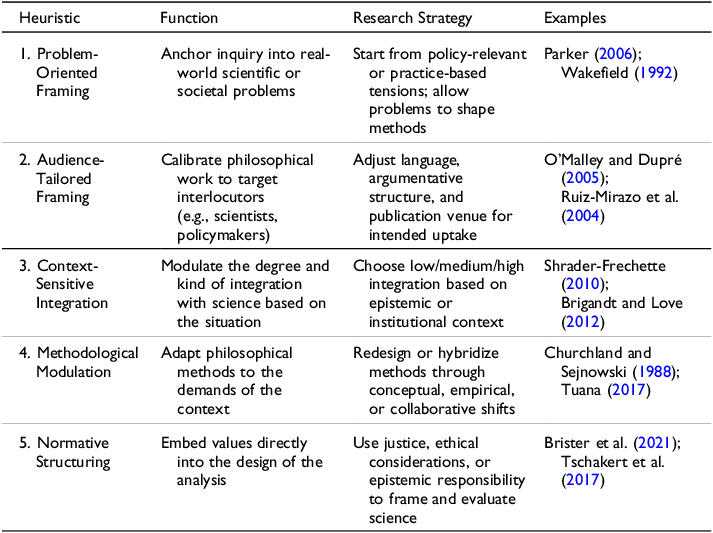
This section presents five methodological heuristics identified through content analysis of 40 peer-reviewed works in broadly engaged philosophy of science: (1) Problem-Oriented Framing, (2) Audience-Tailored Framing, (3) Context-Sensitive Integration, (4) Methodological Modulation, and (5) Normative Structuring. These heuristics are not mutually exclusive; most papers deploy multiple heuristics in combination, with specific emphasis shaped by the problem’s structure, engagement context, and institutional constraints. Together, they form a methodological repertoire for navigating the epistemic, practical, and normative aspects of engaged work. Section 4.6 examines how heuristics operate together and when they may be more or less prominent. Table 1 summarizes the five heuristics, their core functions, research strategies, and representative examples from the corpus.
Summary of methodological heuristics in broadly engaged philosophy of science

4.1. Problem-Oriented Framing
A characteristic feature of Broadly Engaged Philosophy of Science is that research starts from scientific or social problems rather than from questions internal to the field. Problem-oriented framing means that inquiry begins by engaging a real-world problem, letting its characteristics shape the research process (Douglas Reference Douglas2010; Buchanan, Bastian, and Chrulew Reference Buchanan, Bastian and Chrulew2018). Methods are then selected and adapted to meet the demands of the problem and to enable adequate intervention (Pradeu et al. Reference Pradeu, Lemoine, Khelfaoui and Gingras2024). This heuristic imposes key methodological constraints. First, it directs the attention of philosophical analysis to epistemic or normative tensions as they arise in the field of interest. Second, it orients philosophical work toward clarifying, reframing, or resolving those tensions. Lastly, it requires that methods be adjusted to the structure of the problem.
These constraints are visible across the corpus. For instance, Parker (Reference Parker2006) begins her analysis of models in climate science with a practical tension: scientists use multiple, internally inconsistent models to make projections about future climate. Then, she grounds her defense of model pluralism in the concrete epistemic challenges climate scientists confront. Publishing in Foundations of Science for both philosophers and climate scientists, her work shows why pluralism is justified given climate modeling’s irreducible uncertainties, reframing what scientists themselves had identified as a methodological dilemma into a defensible epistemic strategy.
Similarly, Wakefield (Reference Wakefield1992) addresses the challenge of defining mental disorder in psychiatry, a problem with direct implications for clinical classification, research validity, and patient care. His harmful dysfunction account emerges from ongoing debates within psychiatry about how to distinguish genuine pathology from normal variation. By addressing clinical psychologists and psychiatrists, his work provides a theoretical framework to address what practitioners themselves recognized as an urgent conceptual crisis, one that created both confusion in research and obstacles in clinical decision-making.
In both examples, scientists were already grappling with these challenges (Kendell Reference Kendell, Alfred, Brotman, Silverman and Hutson1986; Houghton et al. Reference Houghton, Ding, Griggs, Noguer, van der Linden, Dai, Maskell and Johnson2001). Treating such problems as starting points, whether recognized by scientists or newly identified by philosophers, transforms philosophy of science from a detached, second-order reflection on science to a mode of reasoning embedded within the problems it seeks to clarify (Tuana Reference Tuana2013; Pradeu et al. Reference Pradeu, Lemoine, Khelfaoui and Gingras2024). This methodological contrast can be emphasized by comparing it with influential work in philosophy of science, such as Mitchell’s (Reference Mitchell2003) proposal of integrative pluralism. While Mitchell addresses scientific practice, examining how explanatory models are insufficient for capturing biological complexity, her primary aim is to resolve philosophical questions about reduction, explanation, and the unity of science—questions that arose within philosophy of science rather than from scientific practice. She starts her analysis by addressing the philosophical inadequacy of classical reductionist models and uses scientific knowledge to illuminate this inadequacy. Parker (Reference Parker2006), by contrast, starts from climate scientists’ practical struggle with model pluralism and develops philosophical resources to address their problem. The difference is methodological. Mitchell’s work advances philosophical understanding of scientific practice, while Parker’s work aims to reshape how scientists and policymakers think about model use.
4.2. Audience-Tailored Framing
A recurring heuristic in engaged work is the strategic calibration of how philosophical work is communicated to its intended audience (Fehr and Plaisance Reference Fehr and Plaisance2010; Plaisance Reference Plaisance2020). Audience-tailored framing refers to adjusting language, argument structure, and publication strategy to match the interests, concerns, and linguistic expectations of the target community, whether those are scientists, policymakers, or broader publics. Consequently, engaged philosophers modulate conceptual density, framing, and venue to reach beyond disciplinary peers. These adjustments are methodological decisions that shape how problems are formulated and how arguments are developed.
Two cases from the corpus illustrate this heuristic. First, O’Malley and Dupré (Reference O’Malley and Dupré2005) analyze emerging tensions in systems biology by distinguishing two coexisting approaches: pragmatic systems biology, which emphasizes large-scale molecular interactions, and systems-theoretic biology, which favors systems theory principles. Published in BioEssays, a journal for experimental biologists, they frame their philosophical analysis by synthesizing how systems biologists themselves were characterizing these approaches. In doing so, they engaged directly with methodological tensions scientists were navigating, including disagreements about modeling strategies, the definition of biological systems, and how causality operates across levels of organization. Their conceptual analysis draws on scientists’ own statements and ongoing discourse within the field, making the philosophical intervention accessible and relevant to the practitioners facing these tensions.
Reiss (Reference Reiss2010) illustrates that audience tailoring does not require abandoning philosophical venues. Publishing in Synthese, he addresses both philosophers and scientists by integrating philosophical reasoning with bioethics, science policy, and institutional critique. Reiss opens with an argument that philosophers should engage with scientific practices that affect society, then develops a detailed reform proposal for U.S. biomedical research, addressing funding structures, clinical trial design, and intellectual property regimes. Though presented as a philosophical argument, the sustained focus on actionable institutional reforms and detailed engagement with biomedical literature suggests anticipation of uptake beyond philosophy of science. This shows that audience orientation depends not only on publication venue but also on argumentative structure, problem selection, and intervention goals.
In the selected papers, audience-tailored framing manifests differently across the three approaches. It is most prominent when philosophers publish in scientific or cross-domain journals, such as Science (Churchland and Sejnowski Reference Churchland and Sejnowski1988), Ecological Economics (Fry, Briggle, and Kincaid Reference Fry, Briggle and Kincaid2015), or Ethics, Policy and Environment (Tuana et al. Reference Tuana, Sriver, Svoboda, Olson, Irvine, Haqq-Misra and Keller2012), often co-authoring with scientists and adopting field-specific terminology. Audience orientation remains present, but often less explicit, when philosophers publish in philosophical venues while designing arguments for both philosophers and scientists, as with Reiss’s (Reference Reiss2010) biomedical reform proposal in Synthese or Griffiths et al.’s (Reference Griffiths, Pocheville, Calcott, Stotz, Kim and Knight2015) analysis of causal specificity published in Philosophy of Science.
This variability raises an important tension for engaged practice. Philosophers may aim to influence scientific practice yet publish primarily where scientists rarely read, creating a venue-audience mismatch that limits impact. Field philosophers tend to avoid this mismatch by publishing in policy and cross-domain journals, co-authoring with scientists and framing work for non-academic stakeholders (Tschakert et al. Reference Tschakert, Barnett, Ellis, Lawrence, Tuana, New, Elrick-Barr, Pandit and Pannell2017). Nonetheless, philosophers doing SRPoS/SEPoS often navigate both philosophical and scientific venues, depending on whether the primary goal is conceptual critique within philosophy or intervention in scientific practice (Lloyd Reference Lloyd1993; Reiss Reference Reiss2010). The heuristic is least visible in work aimed primarily at reforming philosophical practice itself, though such work often exhibits some audience tailoring when seeking to persuade philosophers to adopt new standards of practice and relevance (e.g., Douglas Reference Douglas2010).
4.3. Context-Sensitive Integration
Context-sensitive integration concerns the degree to which philosophical and scientific ideas are mutually constitutive within a given research inquiry. Rather than prescribing a fixed model of epistemic integration, engaged philosophers of science rely on this heuristic to adjust the depth of integration. This adjustment can go from philosophical critique that draws on scientific content to co-development of frameworks that transform both domains, depending on what the problem requires. Using this research strategy demands methodological judgment about what kind of philosophical contribution is needed and what depth of engagement with scientific ideas is appropriate. Following Plaisance and Elliott (Reference Plaisance and Elliott2021), this analysis distinguishes three modes of integration (low, medium, and high), here operationalized through the textual indicators described in Section 3.5. These modes are not arranged hierarchically but represent diverse ways of situating philosophy in engaged contexts. This means that integration level alone does not determine whether work counts as broadly engaged. Low-integration work, such as conceptual critique that maintains analytical distance from scientific practice, qualifies as engaged when it addresses challenges outside philosophy, aiming to influence scientific or policy debates.
Low integration characterizes work where philosophical reasoning is applied primarily through critique or clarification, without deep co-development of frameworks. Shrader-Frechette (Reference Shrader-Frechette2008) exemplifies this approach in her analysis of hormesis in toxicology. Addressing scientific and policy debates about radiation exposure standards, she identifies conceptual errors and inferential inconsistencies in how hormesis was being used to justify relaxed safety regulations. Her analysis draws on toxicological literature but maintains analytical distance from it, exposing flaws in reasoning rather than co-developing scientific frameworks. Published in Human and Experimental Toxicology, the work targets toxicologists and policymakers. The philosophical contribution is primarily an external critique rather than co-construction of scientific understanding.
Medium integration involves a meaningful and reciprocal influence between philosophical and scientific ideas, in which philosophical perspectives are shaped by scientific literature, with or without direct collaboration, while the primary locus of conceptual development remains within philosophical discourse. Gannett’s (Reference Gannett2010) analysis of race in population genetics shows this medium degree of integration. Writing in Synthese’s special issue on Socially Relevant Philosophy of Science, she argues that philosophers should shift focus from whether racial categories are “really real” natural kinds to how they function in scientific practice. While the argument draws extensively on population genetics research, analyzing how geneticists employ racial categories, the conceptual development aims to reshape philosophical approaches to the problem.
High integration reflects deep co-development where both philosophical and scientific ideas are substantively shaped through sustained interaction. Griffiths et al. (Reference Griffiths, Pocheville, Calcott, Stotz, Kim and Knight2015), in a collaborative analysis published in Philosophy of Science, bring together philosophers and biologists to develop an information-theoretic measure of causal specificity that clarifies long-standing philosophical debates while also reanalyzing empirical cases in molecular biology. Biological case studies shape the design and application of the measurement, while the philosophical framework reframes how causal contributions are evaluated in genetics and genomics. The result is a methodological tool that both advances philosophical theories of causation and provides biologists with resources for empirical analysis.
Similarly, Svoboda and Irvine (Reference Svoboda and Irvine2014) analyze compensation for harms from solar radiation management geoengineering in a philosopher-scientist collaboration published in Ethics, Policy and Environment. The collaboration interweaves ethical principles of justice with technical challenges in climate detection and attribution. Scientific modeling results concerning precipitation shifts and regional climate disparities inform ethical assessments of responsibility, while ethical questions about fairness reframe how technical uncertainties are evaluated.
In both cases of high integration, the work produces frameworks neither discipline could achieve in isolation, demonstrating that high integration can occur both within philosophy journals and in cross-domain venues. However, high integration is not inherently superior. The appropriate level depends on the problem’s epistemic demands and the contribution philosophers aim to make, with each level offering different methodological virtues. For instance, Shrader-Frechette’s (Reference Shrader-Frechette2008) analytical distance favors systemic logical critique that targets specific policy applications. Gannett’s (Reference Gannett2010) medium integration allows for a meta-philosophical argument informed by genetics, arguing that philosophical analysis should adapt to the realities of genetic research programs. Meanwhile, Griffiths et al.’s (Reference Griffiths, Pocheville, Calcott, Stotz, Kim and Knight2015) high integration facilitates the co-production of philosophical insights that reshape both philosophical understanding and biological inquiry. Each approach is methodologically appropriate for its context, depending on the problem identified and the specific philosophical aim. This heuristic aligns with work emphasizing the situated and flexible nature of engaged philosophy (Douglas Reference Douglas2010; Tuana Reference Tuana2013; Plaisance and Elliott Reference Plaisance and Elliott2021), supporting a pluralist stance on the roles philosophers can play.
4.4. Methodological Modulation
A fourth methodological heuristic concerns how philosophical methods are adapted to the specific features of the case under study. Methodological modulation is the strategic adjustment of philosophical tools (conceptual analysis, assumption critique, or epistemological analysis) to fit the demands of a given problem, audience, and disciplinary context. In engaged practice, methods are chosen not because they are traditionally aligned with a certain issue, but because they suit the specific demands of the case (Pradeu et al. Reference Pradeu, Lemoine, Khelfaoui and Gingras2024).
Several cases can serve to illustrate this heuristic in action. Churchland and Sejnowski (Reference Churchland and Sejnowski1988) examine the relation between computational models of cognition and neurobiological mechanisms through conceptual analysis explicitly connected to scientific practice. In their approach, philosophical ideas about levels of analysis are revised in light of neuroscientific findings, revealing both the limitations and the utility of existing frameworks for understanding the relationship between psychology and neuroscience. As a result, they challenge strong philosophical separations between levels, such as Marr’s framework, and argue that conceptual and scientific work must be jointly developed.
Worrall (Reference Worrall2002) investigates Evidence-Based Medicine’s (EBM) hierarchy of evidence, asking why Randomized Controlled Trials (RCTs) are treated as epistemically superior and whether this status is justified. He clarifies the key concepts used in EBM, examines the logical and statistical arguments offered for privileging RCTs, and tests these arguments against actual scientific and medical data. In doing so, he exposes assumptions, inconsistencies, and oversimplifications in the standard hierarchy. Published in Philosophy of Science, his conceptual clarification engages with a practical debate in medical epistemology, adapting philosophical analysis to assess methodological principles that shape evidence evaluation.
In collaborative contexts, modulation can involve co-developing methods with scientists. Tuana et al. (Reference Tuana, Sriver, Svoboda, Olson, Irvine, Haqq-Misra and Keller2012), working within the Sustainable Climate Risk Management (SCRiM) network, develop an integrated ethical-scientific method in which ethical analysis is conducted within the scientific modeling process. Their approach identifies ethically loaded points in climate-model design (choices of parameters, metrics, and scenarios) and analyzes how normative assumptions shape decisions. Their approach proceeds through iterative collaboration by adjusting ethical analysis to modeling constraints and then revising the scientific modeling to incorporate ethical considerations. This exemplifies a philosophical method developed in collaboration with scientists to embed ethical reasoning into scientific practice.
These cases show how methodological modulation extends the logic of context-sensitive integration. While integration concerns who philosophers engage with and which literature they draw on, modulation focuses on how philosophical methods are adapted to epistemic and practical demands. Churchland and Sejnowski (Reference Churchland and Sejnowski1988) modulate conceptual analysis to enable co-development with neuroscience (high integration). Worrall (Reference Worrall2002) tailors conceptual clarification to engage EBM debates while maintaining philosophical distance (medium integration). Tuana et al. (Reference Tuana, Sriver, Svoboda, Olson, Irvine, Haqq-Misra and Keller2012) adjust ethical analysis to enable collaborative modeling (high integration). In each case, the method is shaped by the problem’s structure, the intended contribution, and the mode of integration.
4.5. Normative Structuring
Engaged philosophers of science consider values (justice, responsibility, empirical adequacy) as elements guiding their philosophical analysis. Normative structuring refers to the methodological consideration of values as part of how problems are framed, evidence is interpreted, and conclusions or implications are drawn. However, the problem itself need not be normative for values to guide the analysis. Instead, engaged philosophers use normative concerns as principles orienting the philosophical analysis, shaping how assumptions are scrutinized, which evaluative criteria are applied, and which outcomes are pursued. The cases below illustrate how this heuristic is used across the corpus.
Parker (Reference Parker2010) addresses uncertainty management in ensemble climate modeling, a primarily epistemic issue. Her analysis is structured by scientists’ responsibility when forecasts inform policy. She examines how ensemble results should be interpreted and communicated, noting that inductive arguments justifying probabilistic weather forecasts do not transfer to long-term climate predictions. Although she does not explicitly use the term “epistemic responsibility,” the principle underlies her analysis: modelers must consider what counts as trustworthy communication when policymakers act on their findings. This norm governs how she evaluates options for conveying predictive uncertainty to decision-makers.
Normative structuring also operates when values like justice and recognition frame empirical inquiry. Tschakert et al. (Reference Tschakert, Barnett, Ellis, Lawrence, Tuana, New, Elrick-Barr, Pandit and Pannell2017) investigate climate-related loss and damage in vulnerable communities. Authored by a team of geographers, philosophers, and climate scientists, the work synthesizes empirical research through the lens of distributive justice and recognition, including interviews, participatory mapping, and community studies. These values shape how epistemic authority is attributed, how institutional dynamics are questioned, and how policy implications are framed. In this sense, ideas such as justice and recognition organize which problems are identified, which evidence is prioritized, and which solutions are judged acceptable.
In the analysis of clinical phenomena, normative considerations can shape how empirical findings are translated into practical recommendations. Colloca and Miller (Reference Colloca and Miller2011) review the nocebo effect, examining how negative expectations can cause genuine harm, and synthesize mechanistic, clinical, and psychosocial evidence. While the analysis itself is primarily empirical, the ethical tension between truthful disclosure and the risk of causing harm through disclosure informs how they derive clinical implications. Physicians must balance respect for autonomy with beneficence and non-maleficence, and these normative commitments influence the communication strategies the authors discuss.
Beyond these individual cases, the corpus reveals that normative structuring plays several recurring methodological roles. It shapes epistemic criteria, determining how models, categories, and concepts are assessed (Wakefield Reference Wakefield1992; Shrader-Frechette Reference Shrader-Frechette2008; Parker Reference Parker2010). It provides interpretive lenses, drawing attention to overlooked or misrecognized epistemic agents and structures (Grasswick Reference Grasswick2010; Tschakert et al. Reference Tschakert, Barnett, Ellis, Lawrence, Tuana, New, Elrick-Barr, Pandit and Pannell2017). It serves as a tool of institutional critique, revealing how scientific practices and policies intersect with ethical issues (Tuana Reference Tuana2010; Douglas Reference Douglas2014; Elliott Reference Elliott2014). Lastly, it functions as a pragmatic constraint, shaping how philosophy engages with real-world policy and decision-making (Goes, Tuana, and Keller Reference Goes, Tuana and Keller2011; Svoboda and Irvine Reference Svoboda and Irvine2014).
While incorporating normative considerations is discussed in SRPoS/SEPoS metaphilosophical work (Kourany Reference Kourany2010; S. S. Richardson Reference Richardson2010), normative structuring is also found in papers from other engaged approaches (e.g., Wakefield Reference Wakefield1992; Tschakert et al. Reference Tschakert, Barnett, Ellis, Lawrence, Tuana, New, Elrick-Barr, Pandit and Pannell2017). The heuristic is most visible when philosophers explicitly justify their normative commitments and make them central to argumentative structure (e.g., Tuana Reference Tuana2010; Douglas Reference Douglas2014), but it operates equally in work where values guide problem selection or evaluation criteria without being explicitly labeled as normative (e.g., Colloca and Miller Reference Colloca and Miller2011; Goes, Tuana, and Keller Reference Goes, Tuana and Keller2011).
4.6. Heuristics in Practice: Joint Deployment and Variation
The five heuristics form a flexible methodological toolkit that engaged philosophers deploy according to the problem, the audience, available partners, institutional constraints, and research goals. Most papers in the corpus use multiple heuristics in combination, though with varying emphasis. This section illustrates how heuristics operate together and offers preliminary observations on how their emphasis may differ across engaged approaches. Two examples from the corpus show how multiple heuristics combine in practice.
Weiskopf et al. (Reference Weiskopf, Rubenstein, Crozier, Gaichas, Griffis, Halofsky and Hyde2020) address climate change effects on biodiversity and natural resource management. The paper begins by surveying urgent ecological and resource management challenges, grounding its synthesis in the needs of biodiversity conservation and adaptation planning. Published in Science of the Total Environment and co-authored by ecologists, resource managers, and Indigenous philosopher Kyle Powys Whyte, the paper explicitly addresses both scientists and natural resource management practitioners. Although presented as an ecological synthesis, the work reflects deep collaboration and high integration of philosophical and scientific ideas. Philosophical ideas about justice, recognition, and epistemic responsibility structure the framing of vulnerability, the selection of evidence, and the articulation of adaptation strategies without appearing as explicit formalisms. As a consequence, the analysis integrates ecological risk and governance frameworks with Indigenous perspectives, adapting them into management practice and policy proposals.
Lloyd (Reference Lloyd1993) is an example of how heuristics reinforce one another even at medium integration. Her critique of evolutionary explanations of female sexuality engages directly with contested biological assumptions. Published in Philosophical Studies, she employs feminist analysis to examine how social and scientific assumptions shape evolutionary research, using gender bias as an analytical lens. In her paper, several heuristics interact: problem-orientation guides the selection of the issue, audience-tailoring shapes how the argument is framed for philosophers engaging with biological research, and methodological modulation is reflected in the application of feminist analytical tools to evolutionary explanations. Together, these influence the depth of integration and the overall methodological choices.
Papers vary in which heuristics they emphasize. Some philosophical work on engagement, like Richardson (Reference Richardson2010) and Douglas (Reference Douglas2010), begins from philosophical questions about how engagement should proceed rather than from external scientific problems, showing less problem-orientation but strong audience awareness directed toward reforming philosophical practice. Conceptual critiques like Shrader-Frechette (Reference Shrader-Frechette2008) and Worrall (Reference Worrall2002) combine problem-orientation and audience-tailoring with lower integration, offering a philosophical intervention through critical analysis without requiring collaboration. Highly technical Philosophy in Science contributions like Griffiths et al. (Reference Griffiths, Pocheville, Calcott, Stotz, Kim and Knight2015) and Suppes and Zanotti (Reference Suppes and Zanotti1981) show high integration and methodological modulation but less explicit normative structuring beyond epistemic values, like explanatory adequacy or causal specificity.
Although the corpus is limited, it offers some preliminary insight into how this variation may correlate with engaged approaches. Philosophy in Science papers may typically combine strong audience-tailoring and high integration but less explicit normative structuring regarding non-epistemic values, as Churchland and Sejnowski (Reference Churchland and Sejnowski1988) or O’Malley and Dupré (Reference O’Malley and Dupré2005) illustrate. They nevertheless raise normative implications concerning scientific practice or ethical concerns. Field Philosophy papers frequently combine all five heuristics, especially problem-orientation, high integration through collaboration, and normative structuring around justice or policy, as Weiskopf et al. (Reference Weiskopf, Rubenstein, Crozier, Gaichas, Griffis, Halofsky and Hyde2020) and Tschakert et al. (Reference Tschakert, Barnett, Ellis, Lawrence, Tuana, New, Elrick-Barr, Pandit and Pannell2017) show. Socially Relevant or Engaged Philosophy of Science papers vary widely. Some combine strong normative structuring with medium integration, like Lloyd (Reference Lloyd1993) and Gannett (Reference Gannett2010), while others focus on institutional critique with low integration, like Shrader-Frechette (Reference Shrader-Frechette2008) and Elliott (Reference Elliott2014).
5. Methodological and Epistemic Implications
The methodological heuristics identified in this analysis guide broadly engaged practice and raise questions about the identity and boundaries of philosophy of science. These strategies challenge assumptions about what philosophy of science is and how its work should be evaluated and taught. This section explores three implications: what the heuristic repertoire suggests about shifts in the field’s identity (5.1), how institutional norms shape and constrain recognition of engaged work (5.2), and what the heuristics suggest about training philosophers for engaged practice (5.3).
5.1. Engaged Philosophy and Disciplinary Identity
The heuristic repertoire identified in this paper reveals how the practice of Broadly Engaged Philosophy of Science reconfigures the boundaries of the field. Engaged philosophy involves the formation of connections with scientific, societal, or institutional contexts, treating these not merely as objects of analysis but as sites of philosophical engagement. Engaged philosophers contribute in varied ways, from proposing conceptual frameworks (Wakefield Reference Wakefield1992; Ruiz-Mirazo, Peretó, and Moreno Reference Ruiz-Mirazo, Peretó and Moreno2004), evaluating claims (Shrader-Frechette Reference Shrader-Frechette2010; Churchland and Winkielman Reference Churchland and Winkielman2012), developing policy recommendations (Fry, Briggle, and Kincaid Reference Fry, Briggle and Kincaid2015; Chisholm Hatfield et al. Reference Hatfield, Samantha, Whyte, Dello and Mote2018; Brister, Holbrook, and Palmer Reference Brister, Holbrook and Palmer2021), conducting risk assessments (Goes, Tuana, and Keller Reference Goes, Tuana and Keller2011), or interrogating normative assumptions embedded in research (Lloyd Reference Lloyd1993). What distinguishes this work from traditional philosophy of science is not the methods used but its methodology. Engaged philosophers employ conceptual analysis, assumption critique, and other tools common across philosophy of science. The difference lies in the higher-order decisions about which problems to pursue, which audiences to address, and how to structure inquiry for external relevance.
Traditional philosophy of science is typically characterized by a focus on questions internal to philosophy, addresses primarily philosophical audiences, and contributes to philosophical debates (Kourany Reference Kourany2010; Ankeny et al. Reference Ankeny, Chang, Boumans and Boon2011; Frodeman and Briggle Reference Frodeman and Briggle2016). This work is relevant for science insofar as it provides philosophical foundations or illuminates the philosophical implications of scientific practice. Mitchell’s (Reference Mitchell2003) work, discussed earlier, illustrates this focus on internal philosophical debates. Although it addresses scientific practice to substantiate philosophical positions, its primary aim is to resolve philosophical questions about reduction and explanation. Rosenberg’s (Reference Rosenberg1985) work on biological laws provides another example. He draws extensively on biology, asking whether biology has laws or whether molecular biology can be reduced to physics and chemistry. But the inquiry is structured around philosophical categories and aims to advance philosophical understanding, not to resolve biologists’ problems.
Broadly Engaged Philosophy of Science differs from traditional work in its methodological orientation. Rather than beginning from philosophical debates, it starts from scientific or societal problems and aims to contribute to their resolution. This outward-looking approach requires what Plaisance (Reference Plaisance2020) calls interactional expertise: the capacity to communicate fluently across disciplinary boundaries without direct technical participation (Collins Reference Collins2004; Collins and Evans Reference Collins and Evans2015). The methodological heuristics identified in this paper, particularly audience-tailored framing and context-sensitive integration, represent this capacity in practice, structuring how philosophers calibrate their work for non-philosophical audiences and contexts without necessarily making these methodological strategies explicit (Buchanan, Bastian, and Chrulew Reference Buchanan, Bastian and Chrulew2018; Pradeu et al. Reference Pradeu, Lemoine, Khelfaoui and Gingras2024).
This shift toward addressing problems beyond philosophy neither negates the value of traditional philosophy of science nor implies departure from core questions about science. As Douglas (Reference Douglas2010) and Kourany (Reference Kourany2010) argue, engaged philosophy expands the field’s scope by showing how values, social contexts, and epistemic aims intertwine in scientific inquiry. By highlighting neglected aspects of scientific practice, it enables the refinement of foundational debates about explanation, prediction, or natural kinds (Douglas Reference Douglas2009; Gannett Reference Gannett2010).
The heuristics identified in this paper help situate engaged philosophy among other developments that also challenge traditional boundaries of philosophy of science. Feminist philosophy of science, particularly through work developed in the 1980s and 1990s, was an early and influential precursor that opened the field to questions of social relevance, scientific values, and engagement with scientific practices (S. S. Richardson Reference Richardson2010; Kourany Reference Kourany2010). More recent approaches have continued to challenge traditional boundaries from different angles, including the Philosophy of Science in Practice movement (Ankeny et al. Reference Ankeny, Chang, Boumans and Boon2011; Boumans and Leonelli Reference Boumans and Leonelli2013), philosophers employing scientific methods themselves (Ventura Reference Ventura2024), and philosophers engaging differently with scientific literature (Rehren and Armbruster Reference Rehren and Armbruster2025). These works share an interest in philosophical practice that engages closely with scientific and societal issues. What distinguishes engaged philosophy within this plural landscape is that methodological decisions are guided by the aim of reaching non-philosophical audiences and addressing problems beyond the discipline.
5.2. Institutional Norms and the Recognition of Engaged Work
Despite increasing interest in engaged philosophy of science, institutional recognition remains uneven. Hiring, tenure, and publication practices still privilege traditional forms of inquiry, leaving collaborative or outward-facing work vulnerable to undervaluation (Plaisance, Graham, et al. Reference Plaisance, Michaud and McLevey2021; Conix, Lemeire, and Chi Reference Conix, Lemeire and Chi2022). Recent work on public engagement with science highlights the structural and institutional changes required to support outward-facing and socially responsive forms of scholarship (Potochnik and Jacquart Reference Potochnik and Jacquart2025). When value is measured primarily by contributions to internal debates and publication in philosophy-specific venues, engaged work may be seen as too philosophical for science and too practical for philosophy. This poses challenges for early-career researchers in particular, who must balance innovative forms of engagement with conventional expectations (Kaiser, Kronfeldner, and Meunier Reference Kaiser, Kronfeldner and Meunier2016).
What is at stake is not only professional recognition but also a broader concern with epistemic justice, because norms of evaluation determine what is understood as philosophical work in the first place. In this context, as Dotson (Reference Dotson2012) argues, dominant cultures of justification can marginalize philosophical work that departs from canonical norms, producing forms of epistemic exclusion. Although Dotson’s analysis emerges from debates on diversity within philosophy, her diagnosis of how disciplinary evaluation marginalizes non-traditional work applies directly to Broadly Engaged Philosophy of Science. Cultures of justification privilege established standards of evidence, argumentation, and relevance, treating departures from these standards as failures to produce “philosophical work” rather than innovations within it. Engaged philosophy, by contrast, can be understood as aligning with what Dotson calls a culture of praxis, where philosophical value stems from addressing concrete problems and engaging with concerns beyond disciplinary limits. The heuristics identified in this paper reflect this praxis orientation, making visible methodological dimensions of engaged work that current evaluation criteria may overlook.
Detailed proposals for institutional reform already exist in the literature, including arguments for recognizing non-traditional outputs, valuing cross-domain publications, and crediting collaborative contributions (Fehr and Plaisance Reference Fehr and Plaisance2010; Cartieri and Potochnik Reference Cartieri and Potochnik2014; Plaisance, Graham, et al. Reference Plaisance, Michaud and McLevey2021; Conix, Lemeire, and Chi Reference Conix, Lemeire and Chi2022; Frodeman and Briggle Reference Frodeman and Briggle2024; Potochnik and Jacquart Reference Potochnik and Jacquart2025). The present analysis provides empirical grounding for these proposals by showing that engaged work is structured by distinctive methodological heuristics that current evaluation criteria do not capture. If engaged work is evaluated by criteria that privilege sole authorship, publication in core philosophy journals, and contribution to internal debates, then the methodological dimensions identified here (problem-oriented framing, audience-tailored framing, context-sensitive integration, methodological modulation, and normative structuring) will remain invisible. The result is a systematic mismatch between how engaged philosophy operates and how it is assessed.
5.3. Training for Engaged Practice
Current graduate education in philosophy of science remains focused on formal reasoning, canonical texts, and internal debates (Frodeman and Briggle Reference Frodeman and Briggle2016). While such skills are valuable, they offer limited preparation for the collaborative and problem-driven demands of engaged research (Kaiser, Kronfeldner, and Meunier Reference Kaiser, Kronfeldner and Meunier2016). Existing work on pedagogy in philosophy of science has often focused on how the field can support the education of scientists (Grüne-Yanoff Reference Grüne-Yanoff2014; Green et al. Reference Green, Andersen, Danielsen, Emmeche, Joas, Johansen, Nagayoshi, Witteveen and Kragh Sørensen2021), with less attention to preparing philosophers themselves for engaged practice.
If philosophy of science is to prepare students for engaged work, training must go beyond traditional skills. The heuristics identified in this paper contribute to that goal by making explicit the methodological reasoning that characterizes engaged work, from identifying problems outside philosophy to calibrating arguments for non-philosophical audiences. By articulating these patterns, the heuristics provide a starting point for pedagogical reflection. Strategies for cultivating this methodological reasoning might include methodology seminars examining philosophers’ roles in engaged settings, writing exercises aimed at non-philosophical audiences, or case-based teaching using real engaged projects (see also Plaisance, Michaud, and McLevey Reference Plaisance, Michaud and McLevey2021). Developing detailed pedagogical programs remains a task for future work. However, the present analysis reveals a gap between current training and engaged practice. If the heuristics identified here characterize how engaged work is structured, and if these heuristics are not explicitly taught, then graduate education leaves aspiring engaged philosophers to acquire essential methodological competences informally or not at all.
Conclusion
Plaisance and Elliott (Reference Plaisance and Elliott2021) provided a valuable framework for mapping forms of engagement in philosophy of science along dimensions of social interaction and epistemic integration. This paper has extended their work by examining the methodological decisions that structure engaged inquiry. Through qualitative content analysis of 40 peer-reviewed works from three engaged approaches, the analysis identified five methodological heuristics: problem-oriented framing, audience-tailored framing, context-sensitive integration, methodological modulation, and normative structuring. These heuristics make explicit the higher-order methodological decisions that characterize engaged work in practice, with implications for how such work is understood as philosophy of science, currently evaluated, and taught.
The analysis has limitations. It focused on journal articles rather than books, and the corpus was weighted toward SRPoS/SEPoS relative to other approaches. Moreover, because the analysis examined published work, some methodological decisions may not be visible in final outputs. Future research could extend the analysis to book-length works and ongoing research projects. Particularly valuable would be cases involving close collaboration with scientists or fieldwork alongside communities outside philosophy of science, as these may employ heuristics that are not fully visible in published work. Building on Kaiser’s (Reference Kaiser2019) analysis of normativity in philosophy of science and the present findings, future research could also examine whether traditional philosophy of science, philosophy of science in practice, and Broadly Engaged Philosophy of Science differ systematically in the heuristics they employ. Despite these limitations, the paper contributes to philosophy of science’s self-understanding by making visible the methodological reasoning that structures engaged practice.
Supplementary material
To view supplementary material for this article, please visit https://doi.org/10.1017/psa.2026.10227
Acknowledgements
My sincere thanks to my supervisors Leonardo Bich and Cristian Saborido for their comments throughout the development of this work. I am especially grateful to Jan Baedke, whose supervision and feedback during my research stay at the Ruhr-Universität Bochum significantly improved early drafts. The members of the ROTO Group offered valuable insights during my stay, particularly Alejandro Fábregas-Tejeda and Fátima Ávila-Cascajares, whose discussions helped clarify the presentation of this work. Florian Riemer raised a question about how engaged work is perceived as philosophical work, which proved valuable for the analysis. I also thank two anonymous reviewers for their helpful comments on previous drafts of this manuscript.
Funding statement
This work was supported by the predoctoral grant PRE_2022_2_0148 from the “Programa Predoctoral de Formación de Personal Investigador No Doctor” and by the mobility grant EP_2024_1_0041 within the same program. Additional research support was provided through the author’s participation in the IAS-Research group project (IT1668-22, Basque Government); “Outonomy” (PID2019-104576GB-I00); “Outagencies” (Grant PID2023-147251NB-I00 funded by MICIU/AEI/10.13039/501100011033 and by ERDF/EU); and “NORMABioMed” (PID2021-128835NB-I00).
Declarations
None to declare.


 Open access

