


Dietary supplements are defined as concentrated sources of nutrients or other substances with a physiological or nutritional effect to complement the diet(1). The use of these products is common in the general population as well as among athletes. Data of the third National Health and Nutrition Examination Survey have shown an overall prevalence of 40 % for dietary supplement use(Reference Rock2). In Germany, 47 % of women and 41 % of men use dietary supplements regularly(Reference Reinert, Rohrmann and Becker3). Vitamins, minerals and their combinations (multivitamin–multiminerals) have been identified as the predominant nutritional supplements in the general population(Reference Skeie, Braaten and Hjartaker4). Dietary supplements are taken for different reasons, mostly to compensate for poor dietary behaviour or to promote optimal health(Reference Mason5). However, for most micronutrients, a dose–response curve with adverse health effects at both low and high levels of intake exists. As fortification of food as well as supplementation has become increasingly common, risk assessment of excess nutrient intake has been performed by different organisations, and tolerable upper limits (UL) of intake have been recommended(Reference Walter6). UL are defined as maximum habitual intake from all food sources (i.e. from food and beverages, fortified food and beverages and dietary supplements) unlikely to be related to health risks(Reference Mulholland and Benford7). If the intake of a micronutrient chronically exceeds the UL, the risk of adverse health effects increases(Reference Walter6, Reference Mulholland and Benford7). Thus, even if a supplement supplies a dosage near to the recommended daily allowance (RDA), the use of multiple supplements may result in excess intake of one or more nutrients with a higher risk of adverse reactions. Physically active persons seem to be at higher risk, as this population is more likely to use supplements compared with the overall prevalence in the general population(Reference Rock2).
In 3887 highly trained athletes, supplement use was analysed by means of doping control forms where supplements need to be declared. Prevalence was found to be as high as 67 %, with an average of 1·78 (95 % CI 1·72, 1·84) supplements used per athlete(Reference Tscholl, Alonso and Dolle8). In the same study, 30 % of athletes were reported to use more than two supplements(Reference Tscholl, Alonso and Dolle8). However, reasons for supplementation are different in athletes compared with the general population. Another study has reported that 65 % of elite athletes believe that nutritional supplements may enhance performance, and that intensive training increases supplement requirements(Reference Dascombe, Karunaratna and Cartoon9). Among elite athletes aged 12–21 years, average supplement use was even higher than observed in adult athletes, with on average 2·96 products used. Here, supplements were believed to maintain strength, avoid sickness, enhance endurance performance and to improve the ability to train longer(Reference Petroczi, Naughton and Pearce10).
Besides the risk of adverse health effects due to long-term excess intake(Reference Walter6), the risk of a product's contamination with banned substances according to the World Anti-Doping Association needs to be recognised. Therefore, two problems need to be considered when counselling elite athletes: first, the risk of adverse health effects due to excess micronutrient intake and, second, the risk of a positive doping test caused by contamination of sports supplements. Thus, the purpose of the present study is to discuss the necessity and risks of multiple supplement use based on a case report of an elite athlete.
Materials and methods
History
A 19-year-old male swimmer (1·89 m, 72·8 kg, 11·3 % body fat) competing at international level was examined during annual pre-participation examination and health evaluation. The athlete did not report on complaints except for a subjectively high susceptibility to respiratory tract infections. All biochemical parameters (blood count as well as serum electrolytes, ferritin, Mg, creatinine and high-sensitivity C-reactive protein) were within reference values. As suggested by the International Olympic Committee, a brief nutritional anamnesis including query of supplementation was performed by a physician(Reference Ljungqvist, Jenoure and Engebretsen11). As the healthy athlete reported the use of ten different supplements, further nutritional assessment was conducted by a nutritionist and contained the analysis of habitual food intake by a dietary protocol, detailed anamnesis of supplement use and dosage, and the calculation of total nutrient intake from food and supplements. To evaluate nutrient adequacy, a 3 d dietary protocol with estimated portion sizes was applied. Although such a short recording period estimates nutrient intake by approximation only, it is considered reasonably accurate for athletes as long as it comprises one weekend day to account for differences between weekdays and weekend days(Reference Magkos and Yannakoulia12). Plausibility of the dietary record was checked using the Goldberg cut-off value(Reference Goldberg, Black and Jebb13). Macro- and micronutrient intake was analysed based on the German food database BLS II.3 using PRODI expert software (PRODI NutriScience, Freiburg, Germany). Written consent was obtained from the athlete and all procedures were conducted according to the guidelines laid down in the Declaration of Helsinki.
Dietary supplements
Application of supplements was checked during nutritional anamnesis and verified by a checklist provided by the athlete at the following consultation. Self-reported reasons for supplementation were the aspired gain of muscle mass and the covering of micronutrient requirements, which the athlete believed to be elevated due to high-performance training. Quantity of nutrients supplied by supplements was determined by considering dosages given at instruction leaflets (where available) and the frequency of intake reported by the athlete. In addition, all supplements were checked for their registration on the Cologne List (www.colognelist.com), a German database which lists ‘low-risk supplements’ to minimise the risk of being tested positive for a banned substance due to supplement use(Reference Geyer, Parr and Koehler14).
Evaluation of total nutrient intake
Total nutrient intake was calculated as the sum of intake from food and from supplements. RDA(15) and tolerable UL of intake(16), as presented by the European Scientific Committee on Food, served as reference data to evaluate total nutrient intake of the athlete and are detailed in Table 1. In addition, maximum permitted levels in supplements according to the German Institute of Risk Assessment are provided(Reference Domke, Großklaus and Niemann17, Reference Domke, Großklaus and Niemann18).
Recommended daily allowance (RDA), maximum permitted levels in supplements (MPL) and tolerable upper levels of intake (UL)*
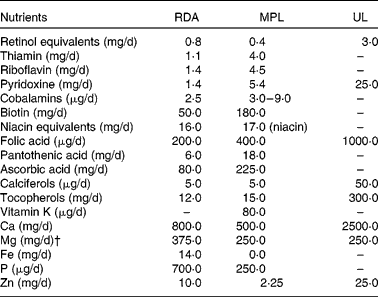
* Data according to the European Scientific Committee on Food for RDA(15) and UL(16) and according to the German Institute of Risk Assessment for MPL(Reference Domke, Großklaus and Niemann17, Reference Domke, Großklaus and Niemann18).
† The UL does not include Mg normally present in foods and beverages.
Results
Habitual diet
The athlete's diet consisted of three main meals (18 200 kJ/d) with 52 % of energy from carbohydrates, 14 % from protein and 34 % from fat. Intake of vitamins and minerals with food was substantially higher than recommended for most micronutrients except for vitamin D, where habitual intake was below RDA. Nutritional data from the habitual diet are detailed in Table 2.
Athlete's dietary intake from food and total dietary intake from food and supplements compared with recommended daily allowance (RDA) and upper limit (UL)

* Excess intake above UL.
† Supplement dosages above recommended maximum permitted levels in supplements according to the German Institute of Risk Assessment(Reference Domke, Großklaus and Niemann17, Reference Domke, Großklaus and Niemann18).
Nutritional supplement use
The athlete reported a frequent and regular supplementation throughout the year, with simultaneous use of ten different products. Daily dosage of B-vitamins was 300 mg/d for biotin, 50 mg/d for pantothenic acid, 30 mg/d each for thiamin, riboflavin and niacin equivalents, 20 mg/d for pyridoxine and cobalamins, and 910 μg/d for folic acid. These dosages were achieved by the application of a product containing B-vitamins twice a day. In addition, the diet was enriched with 670 mg of vitamin E/d. For minerals, daily supplementation with Ca (165 mg/d), Fe (100 mg/d), Mg (100 mg/d) and Zn (25 mg/d) was documented. For thiamin, riboflavin, pyridoxine, cobalamins, biotin, folic acid, vitamin E, Fe and Zn, supplemental intake was higher than dosages suggested as maximum permitted levels in supplements by the German Institute of Risk Assessment (Table 1).
Creatine was ingested three times a day (750 mg for each portion) without reported supplement cessation during different training periods. Furthermore, a product containing coenzyme Q and another with yeast extracts and added antioxidants were used. Detailed dosage information of the active components of these products was not available. In addition, amino acid mixtures and a soya protein formula were used irregularly several times a week.
Total nutrient intake
Total vitamin intake was remarkably above RDA except for vitamin D, where intake was approximately 50 % of the recommended amount. For all minerals analysed in the study, total intake was well above RDA. Total intake of folic acid, vitamin E and Zn exceeded tolerable UL, with intake levels of 113, 228 and 186 % above UL (Table 2).
Checking for ‘low-risk supplements’
Of the mentioned supplements, three (complex vitamin B product, Fe supplement and Zn product) are pharmaceutical products. Here, the risk of contamination with banned substances is reduced, as strict quality controls need to be provided by pharmaceutical companies. The yeast extract with antioxidants as well as the soya protein–carbohydrate mixture are listed on the Cologne List. In contrast, little information about the creatine product, the coenzyme Q capsules and the vitamin E capsules was available. These products were not registered on the Cologne List and were usually purchased via the Internet by the athlete.
Discussion
Habitual diet of the athlete was well balanced with adequate intake of both macro- and micronutrients except vitamin D. The low dietary intake of vitamin D might be of minor health concern, as endogenous vitamin D synthesis due to UV irradiation is the major source of vitamin D in humans(Reference Hollis19).
However, the pronounced application of nutritional supplements gives reason for concern. As both fortification of food and supplementation increases, total consumption of vitamins and minerals may easily exceed RDA for the individual and even may reach toxic levels(Reference Walter6). Toxic effects may include short-term reversible gastrointestinal complaints and long-term effects such as the progression of cancer.
Although no discomfort was reported by the 19-year-old swimmer, gastrointestinal complaints such as osmotic diarrhoea, abdominal cramping and/or nausea caused by Mg supplements may not generally be ruled out(Reference Domke, Großklaus and Niemann17, Reference Roffe, Sills and Crome20). While these gastrointestinal symptoms may adversely affect performance when occurring during competition, supposed performance improvements due to Mg supplementation need to be questioned(Reference Bohl and Volpe21). As the athlete's habitual diet provides more Mg than recommended, additional enrichment is neither required nor recommended. Side effects of dietary supplements other than gastrointestinal complaints may include muscle cramping and adverse effects on liver and kidney function, as has been anecdotally reported following creatine supplementation(Reference Poortmans and Francaux22, Reference Bizzarini and De Angelis23).
What is more, a high-dose supplementation with Zn and folate may increase cancer risk. Folate supplementation has been discussed to be involved in the development and progression of colorectal cancer, and Zn intake of 100 mg/d and more may increase the relative risk of prostate cancer(Reference Leitzmann, Stampfer and Wu24, Reference Kim25). If Zn supplementation occurs over several years, even lower dosages are associated with elevated prostate cancer risk(Reference Leitzmann, Stampfer and Wu24). Moreover, high Zn intake interferes with absorption and blood homeostasis of Cu, Fe and Ca(Reference Domke, Großklaus and Niemann17). Long-term dosages of 50–300 mg/d have been associated with modified haemograms including leucopenia, hypocupraemia or anaemia(Reference Domke, Großklaus and Niemann17).
Besides direct adverse effects of a particular nutrient, the athlete may suffer from indirect consequences of multiple supplement intake, as interdependencies between vitamins and minerals may occur. For example, vitamin E supplements may interfere with vitamin C, reducing its plasma levels(Reference Brown, Morrice and Duthie26). Due to his high-dose vitamin E ingestion, the athlete is additionally at risk of impaired blood coagulation. Diet enrichment with vitamin E at dosages of 50 mg/d has been shown to inhibit platelet aggregation, which is amplified in patients using acetylsalicylic acid(Reference Liede, Haukka and Saxen27). As a high prevalence of non-steroidal anti-inflammatory drug use among athletes has previously been reported(Reference Tscholl, Alonso and Dolle8), the combined effect of vitamin E and acetylsalicylic acid on blood coagulation should be considered during nutritional counselling and annual health evaluation of athletes.
In summary, whether or not supplements are associated with a higher risk of deleterious health effects depends on the total amount taken(Reference Mulholland and Benford7). The severity of adverse health effects depends on the dose–response relationship and whether the nutrient is consumed as a concentrate or within a food matrix spread over several meals(Reference Mulholland and Benford7). Therefore, athletes should be encouraged to balance their diet instead of using supplements. In addition, educating athletes in healthy nutrition and depicting possible adverse health effects as well as risks of a positive doping test due to supplement use are needed. Many athletes decide for certain supplements on their own and are often unaware of effects and side effects including the recommended supplement dosages or the risk of being tested positive(Reference Dascombe, Karunaratna and Cartoon9, Reference Petroczi, Naughton and Pearce10, Reference Maughan, Depiesse and Geyer28).
In conclusion, to identify athletes at risk for excess nutrient intake and thus elevated risk of adverse health effects, both dietary analysis and the anamnesis of supplement dosage might be recommended during pre-participation examination and periodic health evaluation of athletes. Educating athletes to balance their diets instead of taking vitamin or mineral supplements might be prudent to prevent health risks that may occur with long-term excess nutrient intake.
Acknowledgements
The authors declare no conflicts of interest. No funding was obtained. The authors' contribution is as follows: A. C. performed the dietary analysis, calculation and evaluation of total nutrient intake and was involved in the manuscript writing. M. C. was involved in the annual health examination and evaluation of supplements by checking the Cologne List, in the literature study and manuscript writing. K. L. was involved in the annual health examination and was responsible for the anamnesis including query of supplement use. He supported in the literature study and manuscript writing. F. M. is responsible for annual health examinations and any additional examinations, e.g. further diagnostics/dietary assessment as demonstrated in the present study. He was involved in the manuscript writing.



