Contents
Research Article
On the representation of functions by the Hankel and some related transformations
-
- Published online by Cambridge University Press:
- 14 November 2011, pp. 449-463
-
- Article
- Export citation
-
A representation theory for the Hankel transformation Hv, defined for suitable f and for v > −1, by
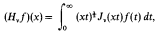
on the spaces ℒμ, p defined by the norm

is developed. Using this, representation theories are developed for some related transformations.
A symplectic fixed-point theorem for T2k × CPn × CPm
-
- Published online by Cambridge University Press:
- 14 November 2011, pp. 465-492
-
- Article
- Export citation
The M-ideal structure of some algebras of bounded linear operators
-
- Published online by Cambridge University Press:
- 14 November 2011, pp. 493-500
-
- Article
- Export citation
-
Let 1 < p, q < ∞. It is shown for complex scalars that there are no nontrivial M-ideals in ℒ(Lp[0, 1]) if p ≠ 2, and
 is the only nontrivial M-ideal in
  .
.
 is the only nontrivial M-ideal in
  .
.Instability of quasiperiodic solutions of the Ginzburg–Landau equation
-
- Published online by Cambridge University Press:
- 14 November 2011, pp. 501-517
-
- Article
- Export citation
Unavoidable regularities and factor permutations of words
-
- Published online by Cambridge University Press:
- 14 November 2011, pp. 519-524
-
- Article
- Export citation
Existence of the free boundary in a multi-dimensional combustion problem*
-
- Published online by Cambridge University Press:
- 14 November 2011, pp. 525-544
-
- Article
- Export citation
Optimal control of quasilinear parabolic equations*
-
- Published online by Cambridge University Press:
- 14 November 2011, pp. 545-565
-
- Article
- Export citation
Completely integrable holonomic systems of first-order differential equations
-
- Published online by Cambridge University Press:
- 14 November 2011, pp. 567-586
-
- Article
- Export citation
A tangent space characterisation of the equivalence of germs for geometric subgroups of
 and
and 
-
- Published online by Cambridge University Press:
- 14 November 2011, pp. 587-593
-
- Article
- Export citation
-
It is shown that under the action of a geometric subgroup
 of
of  and
and  , for a germ f satisfying a certain finiteness condition, given a germ p, if the tangent spaces of f and f + p are equal for all t ∈ [0, 1], then f and f + p are -equivalent.
 and
and 
 of
of  and
and  , for a germ f satisfying a certain finiteness condition, given a germ p, if the tangent spaces of f and f + p are equal for all t ∈ [0, 1], then f and f + p are
 Proximate topology and shape theory
-
- Published online by Cambridge University Press:
- 14 November 2011, pp. 595-615
-
- Article
- Export citation
-
Most of the development of shape theory was in the so-called outer shape theory, where the shape of spaces is described with the help of some outside objects.
This paper belongs to the so-called inner shape theory, in which the shape of spaces is described intrinsically without the use of any outside gadgets. We give a description of shape theory that does not need absolute neighbourhood retracts. We prove that the category ℋN whose objects are topological spaces and whose morphisms are proximate homotopy classes of proximate nets is naturally equivalent to the shape category
 h. The description of the category ℋN for compact metric spaces was given earlier by José M. R. Sanjurjo. We also give three applications of this new approach to shape theory.
 h. The description of the category ℋN for compact metric spaces was given earlier by José M. R. Sanjurjo. We also give three applications of this new approach to shape theory.
On the unitarity of the wave operators for AC-Stark Hamiltonians
-
- Published online by Cambridge University Press:
- 14 November 2011, pp. 617-624
-
- Article
- Export citation
Correspondences of completely regular semigroups and
 -isomorphisms of semigroups
-
- Published online by Cambridge University Press:
- 14 November 2011, pp. 625-637
-
- Article
- Export citation
-
A correspondence of a semigroup S is any subsemigroup of S × S, and the set of all correspondences of S, with the operations of composition and involution and the relation of set-theoretic inclusion, forms the bundle of correspondences of S, denoted by
 (S). For semigroups S and T, any isomorphism of (S) onto (T) is called a -isomorphism of S upon T. Similar notion can be introduced for other types of algebras and in the general frame of category theory. The principal goal of this paper is to study -isomorphisms of completely regular semigroups (that is, unions of groups) and of one other interesting class of semigroups.
 -isomorphisms of semigroups
 (S). For semigroups S and T, any isomorphism of
 Singularities of general one-dimensional motions of the plane and space
-
- Published online by Cambridge University Press:
- 14 November 2011, pp. 639-656
-
- Article
- Export citation
Front matter
PRM volume 125 issue 3 Cover and Front matter
-
- Published online by Cambridge University Press:
- 14 November 2011, pp. f1-f2
-
- Article
-
- You have access
- Export citation
Back matter
PRM volume 125 issue 3 Cover and Back matter
-
- Published online by Cambridge University Press:
- 14 November 2011, pp. b1-b2
-
- Article
-
- You have access
- Export citation