

Some of the most renowned examples of Indigenous equestrian cultures in the Americas gained fame for their opposition to colonial society. The Mapuche, who engaged in a century-long war against the Spanish in southern Chile, adopted horses in the sixteenth century as a central and formative cultural development. In North America, the Apache and then the Comanche adopted horses in the seventeenth century, as the migration of culture groups spurred the development of new economies and political structures based on livestock raiding and trading. Lying at the margins of Spain’s claims to territory, these are examples of how the horse spread across the American continents not only as a symbol of conquest but also as a tool of resistance.Footnote 1
Developing an “equestrian complex” or “horse culture” is a remarkable and transformative cultural adaptation. Native cultures with no prior contact with horses incorporated the animal into social, political, and economic facets of life, a process requiring the core ability to conceive of these new relations and, ultimately, to produce their own knowledge about them. To take as an example a romantic legend of resistance to Spanish conquest from the area of Michoacán, immortalized in a famous mural: A Tarascan princess, Eréndira, was credited with stealing a white Spanish horse, taming it, then riding it to lead her warriors against invading Spanish forces.Footnote 2 This tale requires great facility with a new interspecies relationship that would be difficult for any individual actor; just imagine what would be required to transform an entire cultural group’s way of life. The early details of such transformations often escape close scrutiny, as data only exists in a fragmented and incomplete form, and primarily from the perspective of a Spanish scribe.
Indeed, in evidence of the scale of this challenge, Indigenous opponents appeared to slowly develop an interest in horses. Early accounts from both New Spain and Peru show a marked preference for killing horses over capturing them, and when horse theft was used to neutralize the Spanish, the animals were more often killed or maimed than put to use.Footnote 3 In the northern borderlands of Mexico and the southern terrain of Chile, Indigenous people resisting resettlement and “pacification” by Spanish missionaries and colonizers used the tactics of horse theft and eventually raids on horseback. However, considering all the diverse native groups that were exposed to horses through conflict with Spanish colonizers, only a few adopted the horse as an integral part of their culture or effectively used horses as a means to resist.
Why would some Indigenous communities adopt horses, but not others? Domesticated animals were not new to the Americas, and many Indigenous groups relied on domesticated crops and animals bred in captivity, together with a whole range of important interspecies partnerships ranging from intimate companions to displays of wealth to useful technology. According to ethnologists and, particularly, to new multispecies ethnographies, perceptions of interspecies relations and other relational “intimacies” with animals are shaped by cultural orientations that recognize humans and other “selves.”Footnote 4 Ethnographer Philippe Descola, for example, has posited that the ontology of a given culture shapes how members perceive possibilities for relating to other animals. He distinguishes a European “naturalist” orientation towards animals from the “animism” that characterizes Amazonian cultures, and demonstrates that these cultural-ontological differences would also shape how these groups conceived of relations with individual animals. From a historical perspective, Marcy Norton has theorized that cultural “modes of interaction” govern relations between human and nonhuman animals, and has used postconquest encounters to show dramatically differing assumptions about these relations in hunting, animal husbandry, and pet-keeping across Spanish, Indigenous, and colonial contexts.Footnote 5 These ethnohistorical approaches enrich colonial explanations of difference: European colonizers, for example, may have seen the role of animals as chattel property as a civilized and civilizing influence, whereas Indigenous observers may have viewed this relation as a strange form of servitude.Footnote 6 At stake in these questions is how previous experiences with animals shaped interactions with new species, and answering them requires decoding interspecies relations, as they were both projected and understood within European and Indigenous ways of life.
Moving from theory to comparative studies of material cultures, archaeologist Peter Mitchell surveyed extant artifacts and historical evidence for forty distinct Indigenous cultures and relations with horses post-1492. He found that cultural groups within the same regional ecology had different responses to horses, and concluded that internal cultural dynamics shaped both the choice to use horses and the degree to which horses were incorporated: Some developed equestrian nomadism using horses for hunting big game; other pastoralist groups adopted horses for agricultural purposes; some found incentives in using them for raiding or trading (the Comanche, for example); and some sedentary groups (the Mapuche, for example) adopted horses for cultural rather than economic reasons. In other words, the adoption of horses in Indigenous cultures was a transformative moment, but one not easily explained by proximity to conflict, physical access to horses, or regional ecologies. More importantly, developing forms of Indigenous equestrianism required a cultural frame of reference capable of producing and organizing knowledge gained by this relational mode of “becoming with” horses.
This chapter collects early Spanish colonial archival evidence for Indigenous relations with horses, an approach that makes visible larger patterns in Indigenous relations with horses in the process of colonization across New Spain and Peru. These cases surface motivations to adopt new interspecies relationships within areas of Spanish influence and contribute insights into Indigenous people’s use of horses in areas outside of Spanish influence. This work captures important stages in this transition: first, a period in which horses could be considered “commensal” animals, living in and around Indigenous settlements, followed by more active use and even breeding. Unlike other forms of animal husbandry or cultivation that Indigenous people would have been familiar with, the action of riding a horse would have been novel – the llama, the most comparable animal in terms of its breeding, management, and labor, was not large enough to support the weight of a full-grown human. Most prominently, horse riding played a dual role in Spanish governance, as both a symbol of exclusion and a means of social mobility. This duality informed emerging forms of Indigenous equestrianism, as Spanish colonizers rewarded allied indios for military service on horseback, and licenses to ride and own horses acquired throughout Spanish territories informed the social privileges of Indigenous leaders. Exposure to horses did not come solely at the fringes of the empire; rather, as horses were introduced as livestock and familiarity with them grew, so too did particular reasons for owning, riding, or raising them.
Far from proposing a direct transfer of knowledge about horses from Spanish experts to Indigenous recipients, the cases that follow demonstrate new processes for producing knowledge about horses. Indigenous uses of horses varied enormously. This range of observed choices and behaviors constitute, in effect, a form of boundary work: coproducing knowledge about horses, shaping ongoing relations with them, and mediating Indigenous status through interactions with horses.Footnote 7 Indigenous knowledge encompassed ecological and intellectual responses to new species, and allowed opportunities to develop new frameworks (an “emergent autochthony”) for relating to them.Footnote 8 Although these individual examples do not arrive at root causes, they do highlight a core tension in colonial interests between prohibiting and encouraging access to horses. This tension created opportunities for Indigenous people to act and question the notion of the horse as a one-dimensional agent of conquest.
4.1 A “New World” Frontier Model
The Spanish zealously protected the advantages the horse brought to their military might and political status, dictating who was permitted to own and to ride horses. As a symbol of power for colonial officials, the horse served an important biopolitical function by defining social hierarchies. Just as the Spanish kings had prohibited Muslim subjects in conquered lands from riding horses, so too the kings issued a blanket prohibition against indios riding horses in claims to territory in the Americas.Footnote 9 By order of the First Audiencia in New Spain in 1528, the decree prohibited indios from riding horses under saddle or carrying arms, reinforcing the symbolic importance of the horse in the new regime and echoing the example of the Iberian frontier. It also prohibited Indigenous people from taking care of horses or learning how to ride them, and issued penalties for theft.Footnote 10 Once issued, this prohibition against indios riding horses would not be formally lifted until 1653.
But the horse’s imprint in Spanish governance also contributed to a powerful and competing dynamic, wherein access to horses served as a reward for taking new frontier territory. The Iberian Peninsula’s long tradition of recognizing service with the benefits of horse ownership had already established the path for increasing status from caballero to hidalgo, and in the Americas it was extended to the conquistador-turned-encomendero. Whether by mutual interest or coercion, conquistadors acquired allies from among local Indigenous communities, and they used tens of thousands of these warriors and other skilled laborers, such as guides and translators, on military campaigns. Some of these relationships continued in subsequent campaigns and with incentives to colonize and settle new areas. Access to horses became a standard reward for service and assisting Spanish forces.
Despite formal prohibitions, Spanish officials facilitated access to horses through other channels. Individual cases or probanzas de méritos (Proof of Merit) submitted by or on behalf of Indigenous allies (also called indios amigos and indios auxiliares) emerge anecdotally. Some of these episodes appear retroactively in petitions that were submitted after campaigns that protested the retraction of rewards under changing colonial policies or by later generations. Viceroys also granted specific licenses to indios to ride horses for their service, in addition to other privileges around land and tribute. These permissions were distributed in areas that follow the cooperation of Indigenous groups with Spanish colonizers among the rich variety of regional civilizations and ethnicities encountered in the fabric of New Spain and Peru.
One of the earliest documented examples of a permission to ride horses comes from a lawsuit in the town of Huejotzingo, whose cacique, Don Tomé, had led a contingent of warriors on Nuño de Guzmán’s ill-fated campaign to Nueva Galicia in 1530. Previously, warriors from Huejotzingo had served as allies to Cortés in numerous campaigns. According to testimony from an indio named Tamavaltetle, “a Christian Spaniard, who was at the time overseer in the said town of Huexotzingo, asked the lord and leading men of the town to give him gold to buy a horse so that Don Tomé, the lord of the said town, could go to the war on horseback.”Footnote 11 Later, in Chiametla, Don Tomé fell ill and went to see Guzmán. The record states that he was carried on the back of another man, who led Don Tomé’s horse by the hand. Guzmán apparently took the horse and did not let the sick man return home, and he died shortly after. In this suit, permission for Don Tomé to own the horse was implied in his military service and unfairly revoked by Guzmán. It is also clear that the cacique did not see the need to ride the horse, even as a physical support when ill; rather than personal use, its purpose was essentially to mark status.Footnote 12
In the first book of Mercedes, or grants from the viceroy, kept by the viceroy of New Spain, the first license to ride horses was recorded in 1542 and given to a man identified only as “Francisco, cacique of Tlalmanalco,” for assistance in the Guerra de Jalisco. This indicates it is a reward for military service to the Spanish in the violent uprisings that followed Guzmán’s rapacious treatment of territory north of Guadalajara.Footnote 13 Although the license itself gives no more detail, this cacique wrote an account of his service in a manuscript later translated and titled Conquista y Pacificación de los Indios Chichimecas, under the name Francisco de Sandoval Acacitli. He had accompanied Viceroy Mendoza in his 1541 campaign to relieve the remaining settlers left in Guadalajara. In his account, he described the splendid outfit that he wore and his use of a horse, both marks of status for an indio ally. He also noted his loyal service by mentioning the hardships of this campaign, such as when there was nothing to eat and his horse refused to eat the maize offered to it by the people of Tlalotlacan.Footnote 14 Sandoval’s town of Tlalmanalco was located southeast of Mexico City, near Chalco, a region where Cortés had found a favorable reception in Bernal Díaz’s account of his campaigns, and this location indicates the early roots of an alliance with the Spanish, similar to that of Huejotzingo.
Early correlations between indio allies and access to horses also appear in the Viceroyalty of Peru. Pizarro, for example, brought with him in 1528 an Indigenous ally, Don Martin, who was given a share in the treasure of Cajamarca and an encomienda. Don Martin not only converted to Christianity but also later went to Spain, where he fought mounted as a cavalryman.Footnote 15 In Peru, the Spanish also took advantage of earlier Incan conflicts to gain allies. Manco Inca was one of several princes who had supported competing claims to the incumbent Atahualpa and, like others, saw the Spaniards as potential strategic allies. Manco fought alongside the Spanish against rebellious Cañari natives (Quito, Ecuador), and he was considered a Spanish protégé. Both Manco Inca and his son, Titu Cusi, were taught how to ride and deal with horses under the tutelage of Pedro Oñate, while they were royal captives of the Spanish. Manco served one year in power under Pizarro and remained another year as a royal captive.
However, after this brief time as an ally and puppet ruler for the Spanish, Manco used his insights into horses and Spanish cavalry maneuvers for his own purposes.Footnote 16 In the 1535 siege of Cuzco and in his last battle against Diego Almagro at Ollantaytambo (1537), Manco Inca used tactics against horses such as seizing higher ground to prevent cavalry charges, digging pits to break horses’ legs, and even flooding entire fields by redirecting river and irrigation to make them impassable for men on horseback.Footnote 17 Andean bolas (weighted leather straps) were used to target the horse’s weakest point, its legs. Manco himself appeared on horseback to guide his own party, before retreating to the isolation of Vilcabamba. In the following battle over Lima, the Incan forces stayed up on the hill so that Spanish cavalry could not dislodge the siege until they exerted their forces to the max in a concentrated, seventy-horse charge, demonstrating the Incan command of counter-cavalry tactics.Footnote 18 When Pizarro’s partisans were forced to retreat in 1541, Manco took in seven men who stayed at the Inca camp in Vilcabamba, and they taught Manco Inca how to use Spanish weapons, race on horses, and shoot guns.Footnote 19 Ironically, however, they also assassinated Manco Inca in their bid to flee, ending his attempt to train his men in the use of European weapons and horses.
4.1.1 License to Ride in New Spain
Rewarding indio allies could take many forms, including land grants, appointments to positions of high status, and exemption from tribute, together with more concrete privileges demarcating status, including the use of Spanish clothing, arms, and horses. According to colonial records, exemption from tribute as a proof of status among Indigenous elites was among the most sought-after privileges, and it is not always clear whether permission to ride a horse, dress in Spanish clothing, and carry arms was included.Footnote 20 Sometimes these privileges were granted wholesale or in a cluster, such as in a 1537 petition from Don Juan de Santiago of Tlatelolco stating that he and his heirs had been granted an estancia and the freedom to ride horses and bear arms.Footnote 21
Beginning in 1542, licenses to own or ride horses were documented with regularity in the volumes of Mercedes in New Spain. Between 1542 and 1544, Viceroy Mendoza granted twenty-three licenses to indios from central Mexican Indigenous towns. For the most part, the details or rationale for granting the license go unmentioned, but one of these initial licenses rewarded a translator for his services, and several indios principales (leaders or officials of local community) were awarded for support in campaigns in Nueva Galicia and Jalisco. In the vein of service, Spanish viceroys began recording permission to ride horses for Indigenous allies in central Mexico while their territorial ambitions moved northwards.
These licenses followed a simple but standard form, first identifying the recipient by name and region, and then indicating that he could go about freely on a haca (a horse used for travel) with bridle and saddle, without being disturbed by justices (royal corregidores or locally appointed justicias) of the region. There were also distinctions between permissions to ride a horse under saddle, and permissions to mount a horse as a guard for livestock or for its use as an animal transporting cargo. Sometimes, licenses were explicitly limited to the governor’s term of service, and they were always qualified as being valid only as long as it was the viceroy’s pleasure. Extremely brief and highly formulaic in nature, these records do not consistently give the rationale for granting the license nor provide important information about the individual. Yet, each license documents a claim for services rendered that justified permission to ride a horse.
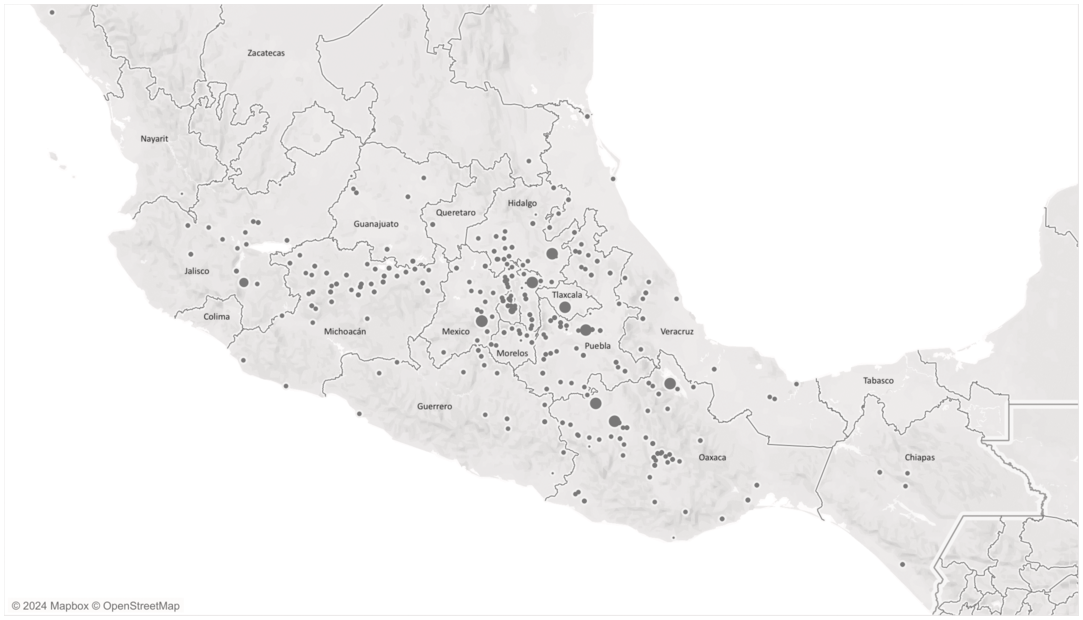
Over 1,100 individual permissions to ride, own, or use a horse appear in archival records of New Spain between the years 1542 and 1600 (Table 4.1). This set of licenses is incomplete, however, with at least twenty-five years’ worth of gaps in these records.Footnote 22 Although the licenses are brief and formulaic, when considered together, interesting patterns emerge. The highest concentrations of licenses are centered in regions characterized by historic alliances and active frontier conflict, and these concentrations move from central Mexico to the northern frontier in Michoacán, and finally south to Oaxaca.Footnote 23 The highest frequency of such licenses cluster around the years 1550–1555 (294 licenses) and 1590–1592 (415 licenses).
| Towns grouped by current-day provinces of Mexico | 1537–1620 | 1550–1555 | 1590–1592 |
|---|---|---|---|
| Eastern and Southern regions (Veracruz, Tabasco, Chiapas, Yucatan, El Salvador, Guatemala) | 44 | 17 | 20 |
| Puebla/Tlaxcala | 187 | 47 | 91 |
| Oaxaca | 179 | 46 | 82 |
| Mexico | 170 | 49 | 65 |
| Hidalgo | 48 | 9 | 31 |
| Guerrero and Morelos | 45 | 7 | 25 |
| Michoacan | 160 | 90 | 45 |
| Northern and Western regions (Aguascalientes, Coahuila, Colima, Durango, Guanajuato, Jalisco, Nayarit, Queretaro, San Luis Potosi, Sinaloa, Tamaulipas, Zacatecas) | 95 | 35 | 29 |
| Unidentified provinces | 143 | 77 | 30 |
| Total | 1,071 | 377 | 418 |
| Region | Towns |
|---|---|
| Michoacán | Apatzingan, Aranza, Capacuaro, Capula, Charan, Chilchota, Chucandiro, Ciudad Hidalgo, Condembaro, Cuitzeo, Erongaricuaro, Guayameo, Indaparapeo, Irimbo, Jacona, Jiquilpan, Ucareo, Marvatio, Matalcingo, Michoacan, Morelia, Nexpa, Ostula, Paracho, Pamacuaran, Patzcuaro, Periban, San Miguel (Huango el Viejo), Santa Fe, Tancitaro, Tarimbaro, Tezazalca, Tiripetio, Tuxpan, Tuzantla, Tzintzuntzan, Ucareo, Uruapan, Zacapu, Zinapecuaro, Zirandaro, Zirosto |
| Oaxaca | Achiutla, Apaxco, Antequera, Ayoquezco, Calihuala, Coatlán, Coyotepeque, Cuilapan, Etla, Huamelula, Huazolotitlán, Huajolotitlan, Ixcatlán, Ixtepec, Jicayan, Juxtlahuaca, Miahuatlan, Mitla, Mitlatengo, Mixtepec, Nochixtlan, Oaxaca, Ozolotepec, Pochutla, San Andrés Chicahuaxtla, San Lucas Ojitlán, San Pedro Sayultepec, San Sebastian tutla, Santiago Juxtlahuaca, Silacayoapan, Teutila, Tehuacan, Tehuantepec, Telixtlahuaca, Teocuatlán, Teotitlan, Tepetotutla, Teposcolula, Tenexpan, Teticpac, Teutila, Tilantongo, Titiquipa, Tlacamama, Tlapalcatepec, Tlacolula, Tlacochahuaya, Tlaxiaco, Tlalixtac, Totontepec, Tutepetongo, Tutla, Tututepec, Tuxtepec, Yanhuitlán, Zaachila, Zimatlan |
| Puebla / Tlaxcala | Atrisco, Cholula, Huauchinango, Huatlatlauca, Huejotzingo, Izucar de Matamoros, Nauzontla, Puebla, Tecamachalco, Tehuacan, Tetela de Ocampo, Tepeaca, Tilapa, Tlaxcala, Topoyang, Tzontecomatlan, San Miguel Tulapa, San Nicolas, Xaltepec, Xaltocan, Xicotlan, Xonotla |
| Veracruz | Atlihuayan, Altotonga, Chicontepec, Chila, Coatepec, Coatzacoalcos, Cosamaloapan, Huatusco, Huayacocotla, Jalapa, Panuco, Tamiahua, Tantoyucan, Teotzacoalco, Tilapa, Texistepec, Xochiapa, Xonotlan, Zempoala, Zongolica |
| Northern and Western regions (Aguascalientes, Coahuila, Colima, Durango, Guanajuato, Jalisco, Nayarit, Queretaro, San Luis Potosi, Sinaloa, Tamaulipas, Zacatecas) | Acambaro, Ameca, Atotonilco, Atoyac, Ayutla, Cocula, Colima, Coyotitlan, Huauchinango, Jilotepec, Jocotepec, León, Nochistlán, Nombre de Dios, Ocotlan, Olutla, Queretaro, Saltillo, San Luis de la Paz, Sayula, Talistaca, Tamazula, Tampamolon, Tampayacal, Tanchinoltipac, Tanpico, Tepuxtla, Tlantengo, Tlaquepaque, Tlatlayan, Tonala, Yuriria, Zapotlan, Zimapan |
| Central regions (Guerrero, Hidalgo, Mexico, Morelos) | Acatlan, Acatempan, Acatepec, Acayuca, Ahuacatlan, Amecameca, Atitalaquia, Atotonilco, Chicontepec, Chilapa, Chiautla, Chilconautla, Coatlinchan, Coyoacan, Cuernavaca, Cuitlavaca, Cuautitlán |
| Huechapa, Huehuetla, Huejutla, Huatepec, Huamuxtitlán, Huitzuco, Iguala, Ixmiquilpan, Iztapalapa, Ixtlahuaca, Iztapa, Jilotzingo, Jocotitlán, Malinalco, Mazatepec, Metepec, Metztitlán, Mexicaltzingo, Mexcaltepec, Mitlatongo, Mixquiahuala, Oaxtepeque, Ocoyoacac, Otumba, Oxtotipac, San Juan Acazuchitlán, San Sebastián Atzacoalco, Santa Maria Navitas, Taxco, Tecamachalco, Temascalcingo, Temoac, Tenango, Teotenango, Teotihuacan, Tepecoacuilco, Tepatepec, Tepetitlán, Tepotzotlán, Tequixquiac, Tetepango, Tetipac, Texcaltitlán, Texcoco, Tlacotlapilco, Tlacolula, Tláhuac, Tlalchichilpa, Tlalmanalco, Tlalnepantla, Tlapa, Tlapanaloya, Tlatelolco, Tlayacapan, Toluca, Tonatico, Tula, Tulancingo, Tultitlán, Tultengo, Tuxpan, Xalatlaco, Xipacoya, Xochimilco, Yecapixtla, Yoloxochitlan, Zinacatepec, Zumpango del Rio | |
| Southern Regions (Chiapas, Veracruz, El Salvador, Guatemala, Tabasco, Yucatan) | Aztapa, Coatepeque, Cuzcatlan, Ixtapa, Petlalcingo, Pueblo de Maya, Pueblo de Yucatán, San Cristóbal de las Casas, Soconusco, Teapa, Tepetitlan, Totolapa, Tuxtla |
| Other | Transcription of town name unidentifiable |
Licenses to own or ride horses granted to specific individuals or community leaders within Spanish military-legal codes replicated an element of social mobility from the Iberian frontier. Permission to ride horses was given to members of allied communities who provided manpower in the conquest’s push to expand the frontier. In these examples, a frontier social logic applied to Indigenous allies, even down to the commonly repeated phrase that their service was undertaken “at their own cost” to justify recognition of their service.
4.1.2 Indios Conquistadores
Who were the recipients of these licenses? The towns named for each indio petitioner represent a broad range of ethnic and linguistic subdivisions from central Mexico: Nahua, Zapoteca, Mixteca, Tlaxcala, Cholula, Coyoacan, Oaxaca, Quauhquechollan, Tenochca, Texcoca, Otomí, and so on (Map 4.1). Using this geography as a guide, the licenses to ride and own horses closely align with the ethnicities of allies from the conquest of central Mexico. In their indication of service in military campaigns and their general chronology, these licenses also correspond closely to periods and places of conflict as Spain’s territorial ambitions expanded further north and south. In this sense, indios riding horses in these early years represent both Indigenous alliances and the concept of the indio conquistador.Footnote 24
Licenses to ride horses in New Spain, 1537–1620Footnote 25
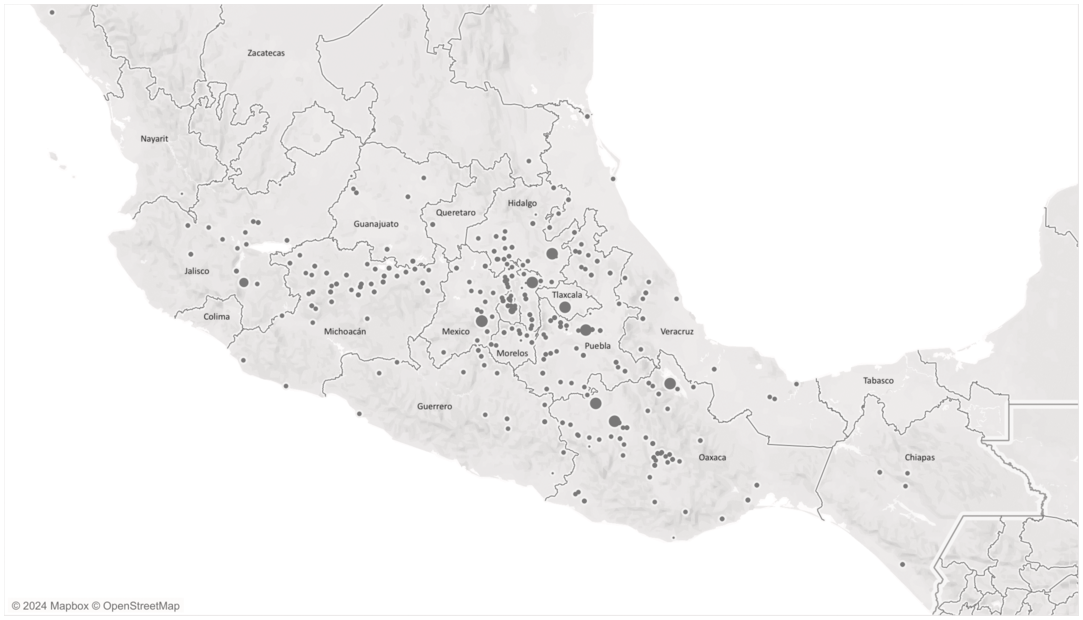
Early licenses mention uprisings in the states of Colima, Jalisco, and Zacatecas, which began in 1537 and were still ongoing in 1542.Footnote 26 Three licenses were granted for assistance in the “pacification” of Nueva Galicia, referring to violent resistance from the Caxanes and Zacatecos after Nuño Beltrán de Guzmán had terrorized the areas surrounding present-day Guadalajara. In the Mixtón War that followed, Spanish forces under Pedro de Alvarado and later Viceroy Mendoza employed Tlaxcalan, Mexica, Tarasca, Huejotzinca, and Chalca Indigenous allies to recapture the stronghold of Mixtón, in Zacatecas, in 1542. These licenses were granted to Alonso, cacique of Cuitlavaca; Juan of Coyoacán (who, it was mentioned, had also served Cortés as the Marques de Valle); and Francisco, gobernador of Suchimilco and Olaque.Footnote 27 Additional licenses given in 1542–1544 do not mention service directly, but also were given to individuals from towns near Mexico City (Malinalco and Toluca) and further north in Michoacán (Ucareo and Jacona) and Jalisco (Tlaquepaque).
Service on exploratory conquest expeditions also resulted in licenses to ride horses. Two licenses indicated service in the “Tierra Nueva” (mainland North America) on the expedition of Francisco Vázquez de Coronado. Luis de León, who served as an interpreter, was given the privilege to both ride a horse and carry arms.Footnote 28 The other license was granted to Damián, indio principal of the city of Mexico, barrio (English translation needed) de San Sebastián, and mentioned his service on the same expedition.Footnote 29
The outbreak of the Chichimeca War in the 1550s is evident in a surge of licenses granting permission to ride horses in areas bordering this conflict, which pitted the Zacatecos against their former allies, the Caxcan, who had recently allied with the Spanish. Frontier military action also drew on Mexica, Tlaxcalan, Tarascan, and Otomí forces.Footnote 30 On the active border with the Chichimeca, the Spanish made use of the intact Purépecha/Tarascan army as well as minority Otomí groups in the Toluca Valley between Mexico and Michoacán.Footnote 31 Of the almost three hundred permissions granted between the first years of this Chichimeca War (1550–1555), the majority (at least ninety) came from the region of Michoacán.
To support Spanish interests in settling the Chichimeca War, claims to land were also offered to allies from Tlaxcala and Oaxaca. Not surprisingly, a significant portion of licenses in the 1550s came from Puebla/Tlaxcala (about thirty from Puebla), and another twenty-five from the areas surrounding Mexico City. These allies were brought north as part of a colonization effort to protect the Zacatecas mines and set an example for the nomadic groups in those areas, establishing claims as indios conquistadores. In fact, in 1557, a cacique of Tula was also proclaimed a hidalgo for having captured the Chichimeca leader, Maxorro.Footnote 32
The Tlaxcalans were the most famous of the initial Spanish allies, both on campaigns to the south to Oaxaca, Chiapas, and Guatemala, as well as to the north to Michoacán. They are well represented among licenses for riding horses. In 1542, three licenses were granted to the governor and indios principales of Tlaxcala (Don Valeriano de Castañeda, Sebastian, and Lucas Gracales).Footnote 33 Altogether, sixty-two indios in Tlaxcalan towns from the region surrounding Puebla had received licenses by 1555. In the Obispado de Tlaxcala, multiple licenses were granted to indios in the towns of Tlaxcala, Huejotzingo, Cholula, Tetela, Tecamachalco, and Tepeaca. A license also was granted in Totolapa, in the Grijalva River valley of the Chiapas region, and a native language land dispute indicates the presence of such indios conquistadores further south, as well.Footnote 34
The regional distribution of licenses reflects areas that had developed associations with Spanish interests, and in some cases, a concentration of licenses indicates that an indigenous center or important crossroad held particular strategic value. This is notable in the states of Oaxaca and Michoacán. William Taylor has already documented the important role of Oaxacan Indigenous nobility in colonial administration, such as the repeated military service of Don Luis Cortés, governor of Cuilapan, in 1525, 1547, and 1549, “at his own cost.”Footnote 35 Towns in Oaxaca that received numerous licenses include Tlalixtac, Yanhuitlán, Teposcolula, Zimatlán, Huazolotitlán, and Tehuantepeque, and by 1555, a total of sixty-nine licenses had been granted in Oaxaca. In Michoacán, closest to the ongoing conflicts with territory further north, numerous acts of service were recorded in licenses issued to ride horses. In the single year 1555, this added up to fifty-five licenses for the Ciudad de Michoacán and surrounding Indigenous towns.
During this ongoing conflict, rewarding indio leaders with permissions to ride horses helped the Spanish to develop auxiliary forces, a policy actively deployed by Viceroy Luís Velasco. In 1553, Velasco issued an order for all the encomenderos and corregidores to supply Juan Torres with armed indios to fight against the Chichimecas and Guachichiles.Footnote 36 Velasco distributed horses and other rewards to caciques to garner support, including a remarkable gift of 1,000 horses to Don Nicolás de San Luis, descendent of the “Reyes de Tula y Xilotepeque,” and similar gifts to the caciques of Tacubaya, Coyoacán, and Michoacán.Footnote 37 Two Naguatato indios from the town of Metztitlán in Hidalgo were rewarded for their loyal service against the Zapotecas, Migas, and Chontales (“con toda fidelidad como fue vasallo de su magestad,” or with loyalty as if he were a vassal of the king) with perpetual rights for them and their descendants to be free from tributes and taxes, together with licenses to ride a horse and carry a sword, a piece of land, and appointment to the position of alcalde mayor.Footnote 38
In Peru, the list of viceregal Mercedes does not contain parallel amounts of rewards due to intense upheaval and rapid turnover in leadership prior to the arrival of Viceroy Toledo in 1568. Yet, acting as allies also granted Indigenous people access to horses there. Much as they had exploited competing local powers in New Spain (e.g., the Tlaxcalans against the Mexica), in Peru the Spanish made use of groups that had maintained their distance from Incan rulers. The Chachapoyans, who lived in the Amazon region inland from Cajamarca, were known for being skilled with the lance and had earned a warlike reputation as a result of staging earlier rebellions against the Inca in Cajamarquilla, Pomacocha, and Pacllas; Chachapoyas cacique Guaman, an Incan official in Cochabamba under Atahualpa, became an important Spanish ally.Footnote 39 Chachapoyans who served with the Spanish and later settled in Cusco did not pay tribute up to the time of Viceroy Toledo, while those remaining in Chachapoyas raised horses.Footnote 40 Allies also came from the Cañari, on the northern border with Ecuador. According to Titu Cusi’s chronicle, both Cañari indios and the Chachapoyans served the Spanish during the rebellion of the Spanish-installed ruler, Manco Inca, in the 1530s.Footnote 41
As the Spanish conquistadors arrived in Peru, they also received support from yanaconas, a category of servant for Incan nobles outside of the ayllus (kinship-based political, social, and agricultural units) that organized tributary subjects of the Inca. Although the term yanaconas was used in a specific economic context precontact, it also later applied to a wide range of Indigenous allies, servants, and slaves who were brought by incoming would-be conquistadors and auxiliary indio forces. With time, the potential yanacona population of Indigenous allies expanded, as some Indigenous individuals preferred this status as a direct servant to the labor obligations imposed by the distribution of former Inca ayllus to encomenderos. In campaigns driving south into Chile, for example, the Spanish brought indios amigos and indios de servicio drawn from Picunches, Promacuaes, and Moluches in northern Chile, as well as yanaconas from Peru.
Services were rendered in a variety of ways and in a variety of places in these first fifty years of colonization, and, with some frequency, permission to ride a horse was offered as a reward. The sparse documentation available does not fill in whether or how this familiarity with horses continued, nor in what fashion the horses were used. However, it does become clear that these permissions had significance not only for the Spanish in their attempts to generate alliances, but also for the individuals who were seeking confirmation of their reward in a recorded license, and the granting of repeated licenses in some regions suggests a more active use and identification of status with the horse.
4.2 Expanding Uses of the Horse
Besides constituting a recognizable facet of military service, the horse was a potent symbol of other kinds of political and social mastery. In their sparse documentation, recorded licenses do not specify Indigenous uses of horses, but they do clearly demonstrate recognition of the horse’s social and symbolic importance among caciques and governors, who were considered by the Spanish to be representatives of Indigenous nobility. The motivation to be recognized by riding a horse spread beyond the inner circle of caciques to other Indigenous officials and forms of service.
Gaining a license to ride a horse required active participation on the part of the Indigenous individual, as would developing the set of skills to care for or ride a horse, once granted. Very often, these licenses were given in a location outside of the indio’s town, meaning the recipient had also traveled to address the viceroy’s court in Mexico City or while its representative was traveling on official business. Additionally, some requests to receive written licenses indicated the desire to be free of harassment for using a horse. In this context, a recorded license could represent the granting of a new request or reconfirm a prior permission to ride horses. Practically speaking, just a few months would have been ample time to observe the basic elements of horse behavior and acquire the skills needed for riding, so the leap from securing a license to actually using a horse depended greatly on the individual recipient. The timeline over which licenses were issued also suggests a sustained interest among Indigenous elites and officials to acquire permission to ride a horse.
Under Spanish colonial governance, local Indigenous notables were elected to serve in indio cabildos, bodies well represented in permits to ride horses. Known as principales, their role mirrored that of the regidores in Spanish municipal government.Footnote 42 Many individuals seeking licenses were identified by the honorific Don, while others were identified only by name and office, as governor, cacique, principal, or simply natural. Moreover, in some instances, licenses were given in multiples to the principales of a town’s local government, supporting access to horses as a feature of their select status. The association of permission to ride horses with municipal offices reached further in some places. In the City of Michoacán (Valladolid, and later Morelia), for example, licenses were given to principales as well as a variety of other administrative offices held by indios (including sacristán de la iglesia, or church sacristan, escribano de la comunidad, or notary, and principal de los pintores, or master of painters). On occasion, other special occupations also applied, such as an indio blacksmith (indio herrador lengua mexica in Matalcingo, Michoacán).Footnote 43 These permissions primarily conferred status, and this status was not only understood with respect to Spanish hierarchies but also incorporated into Indigenous ones: One license, for example, specifies that the governor of Ucareo (Michoacán) should receive this license to ride because his father, the previous governor, had received the same privilege.Footnote 44
Permission to ride a horse sustained the dignity of office for Indigenous leaders, and some licenses were granted to accommodate caciques of advanced age and poor physical condition. Early in 1539, Don Hernando of Tepeaca submitted a petition to the viceroy of New Spain to ride a horse due to his age: “es hombre viejo y por esta causa querría andar cabalgando y suplica que pues esa buen cristiano se le diese licencia para andar a caballo” (he is an old man and for this reason would like to go on horseback, and asks that because he is a good Christian he be given a license to ride a horse).Footnote 45 The judgment of the viceroy was indifferent: “it seems no inconvenience will follow to grant this license.” In 1542, two additional licenses were granted for similar reasons, one to Alonso, gobernador of Tuxchupa (near Tetela de Ocampo) and the other to Francisco, cacique of Gamelula. In both cases, it was noted that the permissions were granted because these caciques were “viejo y gordo” (old and fat) but still acting in their official capacity. To continue to be able to oversee their affairs, they were permitted to ride a mare.Footnote 46
The licenses show that horses came to demarcate higher social status within Indigenous communities, and often, when granted by Spanish officials, these licenses recognized de facto access to horses within these same communities. Domesticated livestock, including horses, ranged with little supervision over large swathes of land, and their dispersal required new guards to keep livestock from crowding the main roadways and harming agricultural lands. Additionally, mesta regulations gave Indigenous towns permission to capture and keep roaming horses in small quantities, usually about a dozen. A license granted in 1541 in Teotitlán (Oaxaca) referred to the town’s location on a well-used route that supplied tamanes (local cargo carriers), and the license confirmed existing use of ten to twelve horses for cargo (not under saddle and bridle) against harassment. Thus, while fewer licenses issued in the 1560s referred to principales or caciques riding horses, forty-three issued in 1565 permitted the use of horses to carry cargo (licenses for bestia de cargo) or sell on horseback (vender a caballo) along the network of the Camino Real, or to be ridden while guarding livestock (licenses for indios de servicio).Footnote 47
4.2.1 Growing Tensions
The complex reality of colonial New Spain challenged simple expectations that the horse would serve merely as a symbol of Spanish authority, as horses were also used in Indigenous communities, whether for practical purposes or to claim higher status. The growing importance of the horse within Indigenous communities followed the frontier model of Spanish governance, but this did not limit Indigenous use of horses to Spanish methods alone.
Early on, European-style husbandry and settlements were proposed to “civilize” Indigenous subjects. As early as 1525, Rodrigo de Albornoz, accountant of New Spain, wrote to Charles V advertising that his new subjects demonstrated a natural propensity for raising fowl and cattle (“being as much given to it as are the farmers of Spain, and being much more subtle and quick”) and, moreover, that this affinity for domesticated husbandry was itself a promising sign for potential conversion.Footnote 48 Instructions sent in 1536 from the king to Viceroy Mendoza encouraged the raising of ganados menores (goats, sheep, and pigs) among indio populations.Footnote 49 In this instance, the civilizing benefits of domesticated animal husbandry were limited to small livestock, rather than large animals like horses and cattle, which were both material and symbolic indicators of wealth and prestige. Livestock husbandry was not an integral complement to existing native agricultural practices, yet with the growth of the mesta and requirements for guards for livestock, indios and other enslaved people also frequently interacted with livestock as part of their tribute or service, learning how to handle and even manage their own herds of livestock. Between 1550 and 1555, when viceroy of New Spain Luís Velasco issued almost three hundred licenses to ride horses, he also issued new regulations to supplement the mesta, including instituting the requirement that estancias be issued at least one league away from existing settlements. Moreover, Velasco personally gave horses as gifts to caciques, confirming that the role of an Indigenous elite within Spanish colonial society was represented by access to horses.
But others strenuously objected to Indigenous people’s growing familiarity with domesticated animals. Also in 1555, the Franciscan Motolinía wrote to King Carlos V to object to how many indios were already riding horses. He recommended that future licenses be given only to those of highest status. Motolinía based his reasoning on preserving the social symbolism of the horse for the Spanish, “because if the Indios learn to deal with horses, many will become riders wanting to be equal for a time with the Spanish.”Footnote 50 This same complaint about the number of indios riding horses was echoed in Puebla in 1556.Footnote 51 In these examples, the distribution and availability of horses by the 1550s challenged the version of political and social order symbolized by the horse.
Horse theft also posed a great threat in the mid-sixteenth century. Horse theft had sustained the rebellion in the Chichimec territory against the Spanish encroachments of mining and punitive slaving practices. Between the 1550s and 1600, horse theft and later trade would bring horses north from central Mexico into the North American plains, and somewhat more slowly into the western Sonora region.Footnote 52 A few cases documenting horse theft appear in the local archives of Michoacán in the 1560s, and demonstrate that Indigenous agents had thorough knowledge of horses. One case records an indio from Queneo complaining that another indio, Pedro Cuini [Quiniz?] of Tzintzuntzan (from the “barrio curandero” or the neighborhood of healers) had stolen his horse.Footnote 53 In another case, an indio from Pátzcuaro complained that he had bought a horse in Uruapan, but it was taken from him by a Spaniard who claimed it was a stolen horse; this indio then stole the horse back, and ultimately was fined four pesos, equal to the value of the horse in question.Footnote 54
Between the 1550s and the 1580s, indios in the region between Zacatecas and Saltillo acquired horses, mules, and cattle and learned to ride.Footnote 55 The sixteenth-century chronicler Juan Suárez Peralta commented on the large number of horses wandering the northern country of New Spain and also recorded that the Chichimeca had developed their own form of horse breeding in rancherías (temporary corrals).Footnote 56 The unsettled nature of this northern frontier, known as the “tierras de guerra” because of its ongoing conflicts, and the roads through it that led to the Zacatecas mines also generated a need for continued permissions for indio governors within Spanish territory to use horses in order to be able to collect tribute.
In Peru, a state of civil unrest highlighted the potentially destabilizing role of horses. In 1565, García de Castro introduced the new office of the corregidor de los indios, a royal representative for collecting tribute and taxes, to gain greater oversight of Indigenous communities. His request followed the rise of Taqui Ongo, an anti-Christian millenarian sect that was supported by the rump Inca state in Vilcabamba, now under the rule of Titu Cusi (1560–1571), and another presumably narrowly avoided Indigenous uprising in Jauja. In 1566, Governor García de Castro complained to the king of the great carelessness in allowing indios to have horses in Peru. He proposed that all horses be confiscated from indios, although he also suggested paying damages for this reversal, and assigned this task to his new corregidores.Footnote 57
Further south, the Spanish faced serious and deep-seated struggles controlling strategic territory around the Strait of Magellan against the coalesced forces of the Mapuche-speaking groups (and English pirates). A new leader, Lautaro (also known by the Spanish name Alonso), used his familiarity with horses in ways parallel to Manco Inca, and his leadership contributed to the development of a large Indigenous cavalry force by the 1560s. The chronicle of Ocaña indicates that Lautaro was from the Arauco valley, where he was likely taken for service during Pedro de Valdivia’s push south in 1550–1551. A ladino (Spanish-speaking indio), Lautaro served as a stable groom for Valdivia, the leader of the Spanish campaigns in Chile.Footnote 58 On December 25, 1553, at the age of twenty, Lautaro joined Mapuche forces to lead the Battle of Tucapel, which left for dead the entire Spanish force of 55 Spaniards and 2,000 yanaconas. Using his insider knowledge, Lautaro continued the Mapuche offensive in the 1554 Battle of Marigarenu, where he fielded a force of 8,000 men that drove the Spanish cavalry off a cliff in a complete rout. While celebrating another victory at the Battle of Mataquito in 1557, Lautaro was ambushed and killed. Despite this loss, the Mapuche were already able to field their own cavalry by the 1560s. Chronicler Marmolejo reported on the Mapuche’s alarming facility with horses during an attack in 1566 at the fort of Reinogüelen, where a Mapuche warrior took down Cristóbal de Buiza and then mounted his horse and proceeded to ride it as well as the best in Andalusia: “El caballo tomó un indio, y en presencia de los cristianos subió en él, y lo comenzó a manejar como si fuera jinete andaluz” (The indio took a horse, and in the presence of the Spanish mounted it, and began to manage it as if he were a horseman from Andalusia).Footnote 59 These threatening instances of indios riding horses with great mastery accumulated in the 1560s and generated concern among the Spanish.
Indigenous interactions with horses ranged widely: They slaughtered them, stole them from Spaniards, rode them in military service, took care of them, traded them, and used them for political posturing. Although Spanish colonizers thought of themselves as gatekeepers for the privilege of using horses, Indigenous actors also had their own interests in mind as they became more familiar with the growing presence of horses across military, political, and economic aspects of life. Although Indigenous people participated in colonial systems for frontier rewards to gain social status and political office, their knowledge and use of horses was not limited to only conforming to colonial expectations.
4.2.2 Sharpening Divisions
The Spanish crown renewed its blanket prohibition against indios riding horses in 1568, the same year in which two new viceroys arrived to govern New Spain (Martín Enríque Almanza) and Peru (Antonio Toledo). The renewed prohibition against riding, coupled with the installation of corregidores to provide oversight of indio gobernadores and caciques, sharpened divisions between indio and Spanish communities. These divisions also elevated the importance of horses in colonial conflicts and in claims to social status.
Individual towns were governed by local notables who were elected or appointed to the city council, but the regional authority of the corregidor provided an increasingly strong corrective and representation of Spanish royal power to both municipalities and individual landholders – a long-term strategy that had begun to be instituted as early as the 1530s in New Spain but not effectively until the 1560s in Peru.Footnote 60 In the second half of the sixteenth century, the Crown flexed this muscle on the renewed prohibition against indios riding horses, and corregidores increasingly confiscated horses, even from indios principales with licenses in hand. In 1567, a vecino in Pátzcuaro accused two indios (Felipe and Pedro) of taking his horses, but because the indios were caballeros, he complained, they had refused to turn over their horses without legal process.Footnote 61 This refusal is a wonderful example of the strength of the equestrian frontier tradition tying horses to social status that had developed through rewards for service and other licenses, even while provoked by an attempt to rescind or police such privileges. In 1568, Francisco Gómez, an indio from Puebla, had his horse confiscated from him by the alguacil (constable) while he was riding in public on business in Mexico City. He protested to the viceroy that he did not know there was any law against indios riding horses, and was held in jail until he paid his fine.Footnote 62 Even as late as 1573, when the indio Juan Augustín from Tzintzuntzan had the horse he used to bring wood from the montes confiscated, he protested that he had not known there was a law to this effect; it was read out loud to him, and he was fined twelve pesos, or the value of the animal.Footnote 63 These examples show the lax prior state of enforcing a prohibition on indios riding horses and the effort to have it more stringently enforced surfaces existing assumptions and uses of horses.
While the confiscation of indio equine mounts increased in the 1560s, so too did requests for indios to continue to ride horses, especially for work related to livestock, cargo, or trade. This may account for the sudden appearance of over forty licenses issued in the year 1565 for bestia de cargo. Well into the 1580s and 1590s, Spanish landowners also began to facilitate requests to permit their indios de servicio to go mounted and armed, to protect their livestock and maintain the necessary guards to keep herds from entering protected areas of other towns, and likely to avoid the inconvenience of having these horses confiscated. In 1596, the town of Puebla, a major crossroads for the long-distance movement of animals, tried to prohibit vaqueros, and especially indio, mestizo, and mulatto ones, from entering the city at all for fear of theft and general disruption.Footnote 64
For the elite indio cacique or governor, confiscation of a horse was a grave blow against their presumed status, and in turn required requesting a new license from the viceroy and restitution of their horse. In 1573, for example, the regidor Gaspar Montiel applied for a “licencia para continuar andando en caballo” (a license to be able to continue riding). According to his petition, the corregidor had forced him to stop riding on a mule. In reply, Gaspar claims that he had always had the freedom to ride a horse, and currently as regidor, he used his mule for business. His request was approved, and he was also granted a license to ride a mule as well.Footnote 65 Despite legal permissions, stricter enforcement and justifications appeared more frequently in the 1570s and 1580s. Even for indios who were granted permission to ride horses based on their status as principal, licenses were needed to travel outside of a known area.
The effects of the renewed ban on Indigenous horse riding are even more apparent in Peru. A 1573 residencia (judicial review of official acts in office) into the tenure of Gregorio González de Cuenca, an oidor de la Audiencia de Lima (a judge in the high court of Lima), investigated whether he had issued and revoked licenses to ride horses under questionable circumstances. As visitador general (royally appointed official reporting to the Council of the Indies) between 1563 and1566, Cuenca had made rounds in northern Peru, where he had ostensibly traveled to announce that indios were not permitted to ride horses, unless they purchased a license from him, and he simultaneously proceeded to threaten such privileges in order to collect penalties and fees from a large number of Indigenous communities. His additional abuses included demanding excessive amounts of supplies to sustain his entire entourage and physical abuse and public ridicule of Indigenous leaders.
According to the testimony collected, Cuenca made his announcement – that it was not permitted for any indio to ride horses, unless they purchased a license from him – in Indigenous villages in the native language. He then sold licenses for one or two pesos each. It is recorded that he issued at least two hundred individual licenses to ride horses in twenty-nine towns, including San Miguel Piura, Chachapoyas, Guánuco, Trujillo, Lambayeque, and Cajamarca. Indios in Trujillo alone were granted sixty-eight licenses in this short period of time, of which the majority (more than twenty each) were issued in Huamachuco and Chicama. The Lambayeque area likewise received sixty-eight licenses, divided more equally among the towns in the valley, including Jayanca, Illimo, Chuspo, Túcume, and Zaña. Cajamarca received twenty-seven, and Chachapoyas, located further inland, received four. On average, a town would receive four to eight licenses, while larger towns received up to ten licenses. The licenses themselves are also telling of existing Indigenous use of horses. Given the circumstances in which Cuenca threatened to confiscate horses and subsequently collected payments for new licenses, they confirm existing access to horses in these areas was thriving.
4.2.3 Status and Lineage Mediated by Horses
Although 1568 marked a downturn in access to horses and reinforced prohibitions and concerns about the distinctions of social status, this trend also vacillated over time. On the one hand, the horse served as a symbol of power and dominance over opposing forces, and, on the other hand, as a tool of social mobility. This duality suggests the spread of a particular frontier model for thinking about the link between horse and status, which, to a significant extent, depended on the claims made by the indios interested in such privileges and status. Over time, the indio “nobility” also began to assert claims to ride horses as a natural matter of status and lineage.
Following a period of relatively low activity in the 1570s–1580s, a veritable explosion of requests for licenses appears from 1589 to 1592. These coincide with the official end of the Chichimeca War and the arrival of a new viceroy in New Spain, Luís Velasco II. While the earliest licenses focused on military service, already by the 1550s they had begun to mention the lineages of caciques, gobernadores, and principales in the rationale for permission to ride horses under saddle. At the end of the hostilities in the 1590s, the terms of these licenses primarily aimed to confirm status. Applicants increasingly referred to former generations’ access to horses to solidify their claims to status. Finally, instead of being limited to their time in office, these licenses confirmed an existing privilege that could be passed on to the next generation.
In the last years of the Chichimeca conflict in northern New Spain, the earlier model of using indios conquistadores became official policy. The Crown had diverged from their “war of fire and blood” following a Bishop’s Council in 1580 and the intervention of a mestizo, Miguel Caldera, to follow a more conciliatory policy. Under Viceroy Villamanrique (1585), this new policy aimed to domesticate the nomadic groups and used Tlaxcalans to establish model settlements. In 1591, 400 hundred Tlaxcalan families earned the status of hidalgos and rights to estancias de ganados (grazing rights to land), as well as rights to ride horses and carry arms for thirty years.Footnote 66 Near the Chichimec border, just over 100 licenses to use horses were issued in approximately sixty different towns between the years 1589 and 1592.
This late sixteenth-century set of permissions prioritizes status over mention of service. In addition to those near the northern border, a few hundred licenses were granted in areas that had not been part of this long-standing conflict. Distributed around major population centers, the bulk of these licenses were granted to residents in the Oaxaca Valley. Many of these, moreover, explicitly make the connection between being a son of a principal, cacique, or governor, and the new license as an extension of status for that lineage. One issued in the town of Huajolotitlán (Oaxaca), for example, refers to Don Luis Garçes as the “legitimate” son of Don Paolo Garçes in order to confirm that the license issued to the father to ride horses remained valid for the son. This series of licenses between the 1540s and the 1590s shows a clear transition from the granting of permissions to ride horses due to military service to granting them as a matter of lineage.Footnote 67 Even though these licenses were perfunctory documents and the categorization of the individual receiving the permission was often imprecise, it seems that horse riding emerged as a natural expectation for Indigenous elites seeking to maintain their social status. In fact, facing challenges to or possible loss of Indigenous influence, these licenses served as a means to claim elite lineage in a manner similar to that of the hidalgo – originating with military service, qualified by political office, and then confirming the generational transfer of social status and customary privileges.Footnote 68
Although the body of licenses documenting this transformation only refer to New Spain, a similar trajectory for indio allies gaining access to horses and claiming the inheritance of status can be found in Peru.Footnote 69 When Viceroy Toledo arrived in Peru in 1568, he decided to take concrete action against the Incan rump state and called on some traditional Indigenous allies. The caciques of Chachapoyas, following the capture of Túpac Amaru in 1572, made a collective request from Toledo for liberty from tribute in return for their aid in retrieving the rebellious leader from Vilcabamba.Footnote 70 The Chachapoyans also gained recognition in a colony further south, in the Villa de Oropesa (Valley of Cochabamba), after aiding Toledo in suppressing a group of Guaraní-speaking people in the Chaco region (southeastern Bolivia), collectively known by the pejorative Chiriguanos, in 1574.Footnote 71 Diverse Indigenous groups in New Spain and Peru made similar efforts to claim privileges from military service and then maintain it through defined lineages.
More specifically, descendants of Incan elites pursued titles of nobility, aiming for the Spanish hidalgo’s full constellation of privileges, including exemption from tribute, permission to dress in Spanish clothes, carry arms, and ride a horse.Footnote 72 Already in 1545, descendants of the preconquest Inca (Túpac Inca Yupanqui, c.1441–1493) had received an escudo nobiliario (noble coat of arms) from Charles V, and other descendants received analogous treatment based on their lineage. For example, Don Carlos Inca (the nephew of Manco Inca and son of his successor, Paullu Inca) learned to ride, was educated with other mestizos, and became a regidor of Cuzco.Footnote 73 His son, Melchor Carlos Inca, inherited the family’s encomienda in the 1580s.Footnote 74 In later eighteenth-century documents, numerous Andean families solicited recognition of noble origins and corresponding privileges from the crown.Footnote 75
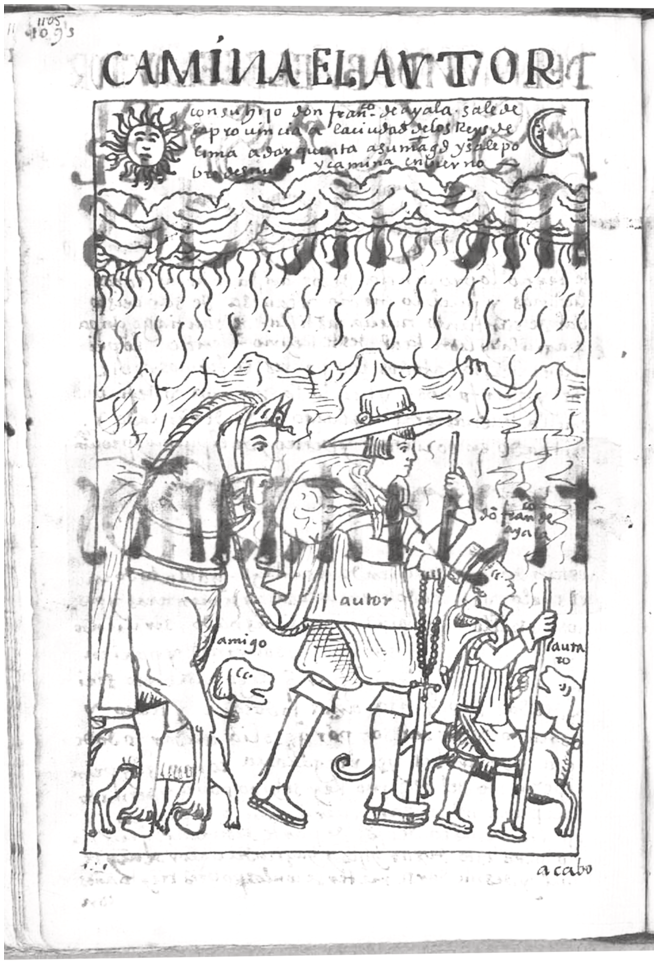
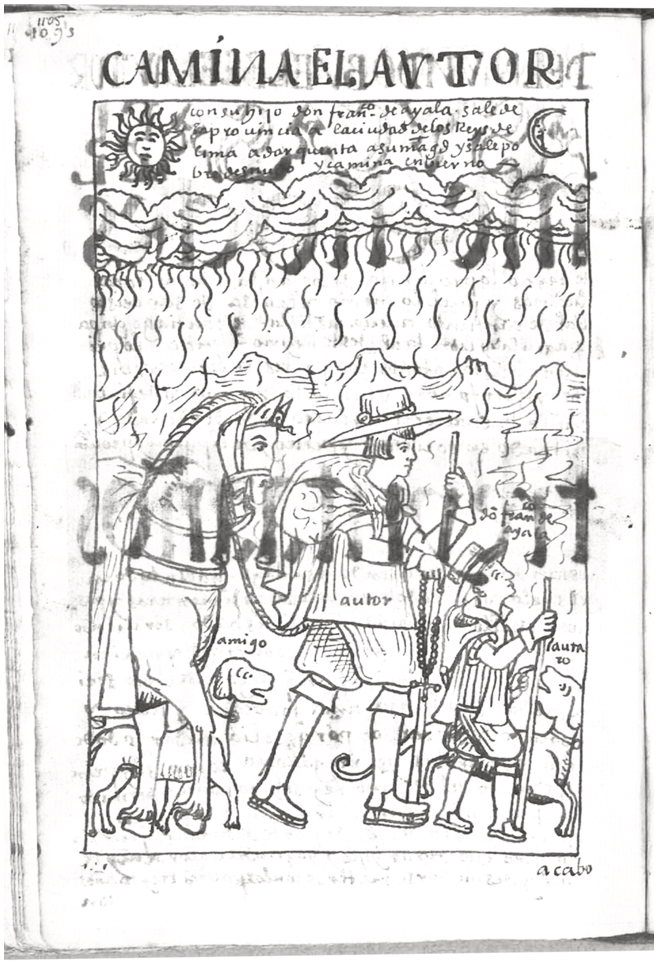
Possession of the horse was a material sign of status, but in the context of these claims to noble lineage, mastery of the horse itself also became a shared indicator of noble origins. Spaniard Luis Morales, vicar-general in Cuzco, described Inca nobility as natural riders whose talents were squandered on just herding horses, a sentiment echoed by others.Footnote 76 In 1582, the Aymara principales of Charcas sent a letter to Philip II asking him to recognize their noble status, claiming that their participation in the uniquely Spanish tradition of horsemanship known as the “game of canes” should be a sign of natural nobility.Footnote 77 Drawing on a similar logic, the Indigenous chronicler Guaman Poma drew connections between generations of service and access to horses. His father had been christened with a Spanish name, Don Martín de Ayala, by the Spanish conquistador, Luis Ávalos de Ayala, in recognition of his service, which included saving his life during La Gasca’s defeat of Gonzalo Pizarro, and Guaman Poma depicts himself walking with a horse as a sign of this prestigious origin and its future potential in his own son (see Figure 4.1).
Archival evidence suggests that indios raising horses and interacting with them on a daily basis continued to grow in the second half of the sixteenth century. In a prosaic fashion, many forms of interactions with horses were recorded in the colonial Relaciones geográficas, conducted in 1577–1584. These reports on the resources and livelihoods of towns throughout the Spanish colonies provide ample evidence of the normalcy of seeing indios a caballo and Indigenous communities that maintained horse populations despite this practice’s perceived threat to established order. City notarial records offer numerous examples of horses raised by indios principales and of the regular trade and sale of horses between Indigenous parties.Footnote 78 The last will and testament of cacique Don Juan Guaman of Chachapoyas listed the seventy horses he owned in the late 1590s.Footnote 79 Many lawsuits and other petitions demonstrate active participation in owning and breeding horses, far beyond the limited permission to ride them.Footnote 80 Such cases deserve a more thorough examination, but as a survey, they demonstrate an active and developing engagement with horses from varied Indigenous perspectives.
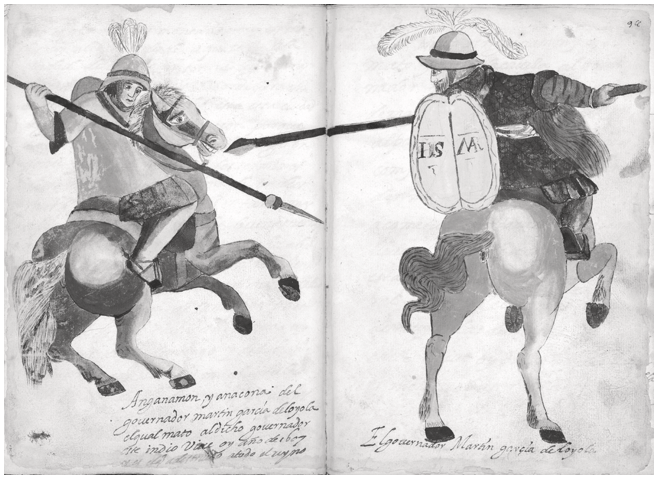
Visual evidence of indios on horseback is far more rare. The Mercedarian friar Diego de Ocaña documented his travels through Peru and Chile, including an account of the ongoing Spanish conflicts with the Mapuche, which drained enormous resources into the creation of one of the first European standing armies. He included a portrait of Anganamón, the leader of a new uprising in 1598, on horseback (see Figure 4.2).
(a) Anganamón and (b) Martín García Oñez de Loyola from Diego de Ocaña’s Viaje a Chile (1608). Anganamón and Martín García Oñez de Loyola (“Anganamón, yanacona del gobernador Martín García de Loyola, el cual mató al dicho gobernador. Este indio vive hoy, año de 1607, y es el que ha destruido todo el reyno.”) from Diego de Ocaña’s Viaje a Chile (1608), University of Oviedo Fondo Antiguo 195.
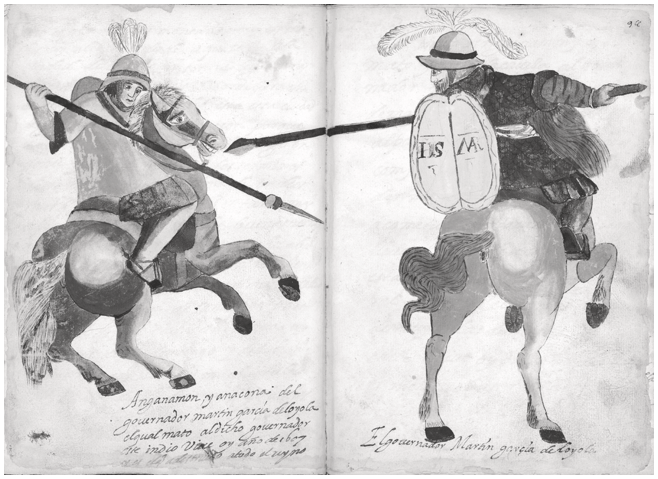
Like others before, Anganamón had served as the yanacona of Captain Loyola, before he led Mapuche forces that killed Loyola and then wreaked further havoc. Anganamón reportedly had mounted his infantry; such was the abundance of horses in Mapuche forces at this stage. In the 1598 “Desastre de Curalaba,” another leader, Pelantaro, led five hundred Mapuche and Huilliches against fifty Spanish and their three hundred yanacona allies, causing the Spanish to lose four hundred horses and as many saddles and bridles, as well as gold, clothing, and yanaconas to the Mapuche forces. On the following March 20, 1598, four hundred mounted indios de a caballo took another two hundred fifty horses from the Spanish in Argol. Just a week later, on April 8, a massive force of one thousand mounted indios de a caballo emptied the whole countryside of all kinds of livestock, so that the town had no more than twelve horses left.Footnote 81 In all, the Spanish lost thousands of horses to a remarkably large Mapuche cavalry.
4.3 Becoming Equestrian
When seen through the records left by Spanish conquistadors like Cortéz or Bernal Díaz, horses played a major role in the conquest by surprising the native inhabitants, who purportedly viewed them as invincible. More accurately, however, conquest victories were supported by thousands of Indigenous allies, and, in fact, many of these allies gained access to horses according to Spanish customs that rewarded service to the crown on the frontier – a population of indios conquistadores. A growing familiarity with horses was at times facilitated by Spanish colonial governance in the form of licenses to ride, raise, or use horses, even if at other times it was threatened by efforts to control or revoke this access. Starting from within Spanish territorial claims, permission to own and ride horses was regularly extended to Indigenous allies, and this impulse was aided by the growing abundance of horses. Some data suggests a de facto access to horses, later acknowledged formally. Within Indigenous communities, knowledge about horses could be mobilized for resistance, used to claim status, or utilized in other ways to respond to internal motivations or external pressures.
Spanish, creole, mixed, and Indigenous populations all made social claims through their access to horses. A Spanish backlash to the growing access to and adoption of horses, which they perceived as a threat to social order in terms of theft, rebellion, and social distinction, intensified in the mid-sixteenth century. An effort to clamp down on indios riding in 1568 both acknowledged contemporary access to horses and a strong desire to enforce social difference. But Spanish colonial power was also fractured by conflicting policies enacted by viceroys, audiencias, religious orders, encomenderos, and indios. In the Americas, as in Spain, mobility was crystallizing into hierarchies based on lineage by the end of the sixteenth century, requiring documentation and proof of bloodlines. Horse privileges became a part of this trend, with a license to ride horses becoming one possible way to challenge the loss of status and claim an elite lineage.
The development of Indigenous equestrianism in the Americas is a complex phenomenon, and the initial motivation to engage with or adopt horses into existing ways of life is not self-evident for any given people. By tracing early stages of exposure to horses within areas of Spanish control, these archival examples of familiarization offer insight into the process of adopting a new set of interspecies relations. Remarkably, Spanish attempts to regulate the use of horses did not intend to help indios acquire knowledge about horses. Yet, as petitions to ride and own horses and success in breeding and using horses for daily labor demonstrate, engaging with horses also offered a means to challenge and redefine the boundaries of what was “Spanish.” Opposition to Spanish domination through horse theft and the use of Indigenous cavalry forces are the most obvious examples, but claims to Indigenous nobility through horses served a similar function.
From a broader perspective, particular historical forms of Indigenous equestrianism were not adopted wholesale, but developed within specific cultural frameworks. These adaptations to the horse differed by cultural groups, perhaps shaped by previous types of interspecies relationships. Motivations could be internal or external to the culture, in response to Spanish pressures or the adoption of a colonial hybridity. Horse populations certainly expanded both within and outside of Spanish-controlled territory, particularly aided by the Pueblo Revolt of 1680 in New Mexico, which released large herds into lands northwest of Spanish presence. The subsequent developments of Indigenous communities, ranging across multiple regional environments and ecosystems, suggest the importance of framing this adoption in terms of negotiating a new equine political ecology.

 Open access