

1. Introduction
Are judicial decision-making processes affected by confrontational trade unions? Concerning French employment courts – the Conseil de prud'hommes (CPH) – the answer to this vexed question is positive. Nevertheless, whether trade unions hamper courts' regular functionality is a speculation that is not substantiated.
The unionization of judges forms an integral part of the court. The reconciliation of opposite worldviews involves judges being representatives of employees and employers and, simultaneously, norms' interpreters. The proactive reconciliation of conflicting interests stimulated a conciliatory ambition, therefore escaping the Council to be defined tribunal or court (Mouriaux, Reference Mouriaux1982).
The CPH is notorious for bringing litigation before a jury of peers, on a ground-floor equity principle, particularly sensitive and aware of each sector's specific labor issues (Essenberg, Reference Essenberg1986). The Council is a bicentenary institution and a child of the First Napoleonic Empire, built after a notable insurrection in Lyon to guarantee ‘social peace’ (Royer et al., Reference Royer, Derasse, Allinne, Durand and Jean2016). Hence, the so-called ‘prud'hommes’ are righteous individuals of high morality, intended to be ‘professional judges and not judges by profession’ (Mazeaud, Reference Mazeaud2016).
Today, the representation of trade unions among judicial members varies across space, and the majority of judges are appointed among trade unions that are accustomed to refuse social dialog (Andolfatto and Labbé, Reference Andolfatto and Labbé2006). The clear mandate of CPH is to protect the interest of those bound by an employment contract (Langé and Roulet, Reference Langé and Roulet2012), promoting the reconciliation of both social partners' sides. Nevertheless, the average number of conciliations is 6% of cases only.
The reversal of the core principle of conciliation has been analyzed by the economic literature (Desrieux and Espinosa, Reference Desrieux and Espinosa2015, Reference Desrieux and Espinosa2017, Reference Desrieux and Espinosa2019), suggesting that an increase in judges' membership to adversarial unions affects the settlement and withdrawal of labor cases. According to previous findings, the more the judges' panel is polarized by hostile unions, the higher are the stalemates and the referrals of the case to a professional judge.
Hence, the contribution of this paper to the literature is twofold. In the first place, it provides an instrument to tackle the potential endogeneity bias, overlooked by previous studies. Using a tiny vineyards' parasite – daktulosphaira vitifoliae, known as phylloxéra – we measure the institutional persistence of localized preferences for adversarial unionism. The insect produced the abrupt increase of obstinate conflict and mass protests at the end of the 19th century, when trade unions rose from the ashes of a devastating crisis.
We show that territories continue to reflect the dominance of structured confrontational unionism. The professional elections capture and measure the power and mobilization capacity of unions. Their encouragement of adversarial class struggle shows the structuring influence of choices made and practices adopted in the past on present/day decisions (Dormois et al., Reference Dormois, Pinson and Reignier2005).
In particular, the paper argues that the archetypal confrontational opposition to social counterparts can be traced in the obstinate beliefs and deep-rooted values superimposed by the historical opposition to the phylloxérian plague. The long-lasting effects of the phylloxérian calamity were a radical change of affected regions, in which social life was routed into angrier and more structured channels (Judt, Reference Judt2011). In effect, peasants and landowners built the legal and political strength necessary to fight the agricultural crisis led by phylloxéra.
The political force necessary to protect collective and diffuse interests was entrusted to the ‘syndicalisme de lutte’, in clear opposition to gubernatorial immobilism. Despite the prohibition of gatherings and the governmental discouragement of permanent structures for mobilizing political support (Scarrow, Reference Scarrow, Katz and Crotty2006), the movement obtained the implementation of a legal tool to defend the wine's pureness. Empirical results confirm a correlation between the phylloxérian plague and the deep-rooted attachment of conflictual unions to the same geographic areas.
Ultimately, using phylloxéra as an instrumental variable, we show that labor courts' functioning is not obstructed in courts where adversarial unions have power. The paper replicates and extends prior studies, testing whether lawsuits assigned to polarized judicial panels force lawsuits' settlement, abandonment, and professional judges' intervention from higher or appellate courts.
The estimations refute previous findings, suggesting the opposite. Using a dataset between 2012 and 2016, the paper shows that an increase of adversarial unionism among judges denotes higher settlement and fewer abandoned lawsuits. This verdict may sound negative, but it shows that confrontational unions promote the core mission of the Council, which is to foster conciliation along with all the judicial pursuit of justice.
The remainder of the paper is organized as follows. Section 2 describes the Council and the intricate procedure that governs its proceedings. Section 3 reports the research question, whereas the instrumental variable is described in section 4. The data, empirical strategy, and checks for the instrument's validity are outlined in sections 5 and 6. Section 7 outlines the results, whereas section 8 is dedicated to discussing the empirical analysis results. Conclusions are then drawn in section 9.
2. Physiology of the court and procedural oddities
The Conseil is a curious institution that approaches social protection governance with field actors (Damon, Reference Damon2017), aware of the realities of the business they face. The principle of ‘paritarianism’ – which balances employers and employees' representatives among judges – originates in the 13th century, when craftsmen conflicts were solved by ‘preux hommes’, i.e. brave counsel men (Bah, Reference Bah2010). The Napoleonic court was then marked by field actors characterized by wisdom, experience, foresight, fairness (Hess-Fallon et al., Reference Hess-Fallon, Maillard-Pinon and Simon2015), and notorious for their prudence and useful advice. Judges were expected to grant ‘social peace’ and improve the management of changing labor demands (Royer et al., Reference Royer, Derasse, Allinne, Durand and Jean2016).
During the years, the counseling role of prud'hommes has consolidated a particular ‘labor language’ (Tucker, Reference Tucker2005) that advocates for social partners' direct action to promote social issues in court. From that standpoint, one of the most relevant aspects of this ‘counseling roots’ sinks in the intention to give guidance and go straight to the heart of the relations between employers and employees. The original mission and nowadays primary assignment of CPH is to foster the conciliation of distant social partners. Hence, the ‘meeting of the patronal and militant humanism’ (Cam, Reference Cam1981) attaches prime importance to human relations and fundamental needs.
The Council should promote the settlement of individual disputes arising between all kinds of employees and their employers throughout the employment relationship (Subileau, Reference Subileau1999). A judgment should only be considered if the conciliatory initiative fails. Therefore, the CPH's declared objective is to balance both social partners' requests. Accordingly, the conciliation of lawsuits is a crucial aspect, even in the case of legitimate or unlawful terminations of contracts.
The jurisdiction concerns solely the private labor sector, involving parties from the commercial, industrial, agricultural, civil, or liberal sectors (Favennec-Héry and Verkindt, Reference Favennec-Héry and Verkindt2016), bounded by an employment relationship. Hence, all officers that work in the public service must bring their dispute before the Administrative Court. Finally, it suffices to say that the ‘paritarian’ nature forces a dialog between social partners (Mazeaud, op. cit.). Judicial panels are composed of pairwise lay assessors, balancing the composition of the court's formation in respect of the equality between the judges elected among social partners' associations (Siau, Reference Siau2016).
The professional elections were held, until 2018, every 5 years to measure the power and the mobilization capacity of employees' associations and employers' trade unions. A professional judge's intervention is only eventual and restricted to specific situations of an impasse between the counselors in reaching a verdict.
The legal procedure is the following. A preliminary and mandatory phase involves an attempt at conciliation between the parties before a conciliatory panel, the ‘bureau de conciliation’ (BC). The BC is the expression of the legislator's aim to favor in-court amicable resolution of disputes. The BC is composed of an equal number of counselors – one employee and one employer representative – and is responsible for informing the parties of their rights and duties and taking a proactive behavior in seeking settlement (Auzero et al., Reference Auzero, Baugard and Dockés2017).
The transition before the BC develops with a non-public hearing, in which each party provides explanations and can be heard in confidentiality. In case of arrangement between litigants, the dispute ends with a minute of agreement. In case of disagreement, the case is sent to a different judgment office (JO), composed of four members, balanced between employers and employees in the same manner as the BC (Peskine and Wolmark, Reference Peskine and Wolmark2016). If the parties do not appear before the JO, the suit is abandoned by default. The JO should have the final say in the fate of the labor lawsuit.
In the event of a stalemate in reaching a shared verdict, the case is referred to a professional magistrate of the District Court's equivalent (Tribunal d'Instance), who has the casting vote. This procedure of tiebreak is called départage (DP). A schematic representation of the legal steps described above is given in Figure 1 to facilitate the general understanding of the prud'homal procedure.
A schematic description of all judicial phases before the Conseil de prud'hommes.

Disputes' settlement is not only the principal aim of prud'hommes but also a legal ‘substantial formality’ (Bataille, Reference Bataille2017). Hence, the omission of conciliatory attempt invalidates the entire procedure. In this sense, conciliation acts as the guarantee of a compromise, tested and discussed locally by social partners in the appropriate forum (Cottereau, Reference Cottereau2002). However, the French characteristic is a low rate of settlements, constantly decreasing (Barthélemy and Cette, Reference Barthélémy and Cette2015).
Ultimately, the so-called ‘paritarianism’ is only illusory (Tillie, Reference Tillie2015). The reality shows a disequilibrium inside the institution, directed by the employees' counselors (Willemez, Reference Willemez2012). On the one hand, unionists become judges only after an experienced militant career as employees' defenders (Tomás et al., Reference Tomás, Kloetzer and Clot2014). They are the judicial mouthpieces of the union responsible for electing them (Kessler, Reference Kessler2010), with a clear mandate to operate accordingly. On the other hand, many judges are not affiliated to a professional organization within the employing college, thus having difficulties identifying employers' collective interests and behaving actively in the courtroom (Michel and Willemez, Reference Michel and Willemez2009). Following the absence of a specific mandate and the lack of specific legal skills, the result is that employers' dossiers are undefended (Rabier, Reference Rabier2016).
3. Research question
The paper intends to test whether litigants adapt their decision-making processes before courts marked by the most confrontational trade unions' presence.
The literature has proposed a confrontation propensity measure of unions, suggesting that Confédération Générale du Travail (CGT) and Force Ouvrière (FO) are the most adversarial syndicates. Lawsuits assigned to judges with such ideological predispositions are more likely to be withdrawn and referred to départage (Desrieux and Espinosa, Reference Desrieux and Espinosa2019).
The same scholars suggest that these unions, which they label as ‘non-reformist’, would be characterized by more decisive confrontations with the employers' federations than the ‘reformist’ trade unions (Desrieux and Espinosa, Reference Desrieux and Espinosa2017). The literature alludes that such unions favor the conciliation of ‘poor quality lawsuits’ that would be otherwise detrimental to the employee (Desrieux and Espinoza, Reference Desrieux and Espinosa2015).
Nonetheless, even though these studies acknowledge that the population's preferences affect both judicial and electoral strategies, none of them find a suitable solution to endogeneity. The proportion of confrontational unions in the prud'homal judiciary is the result of an election, which is known to be dependent on a heterogeneous list of driving circumstances (Kelley, Reference Kelley2016), such as prospective time horizons (Evans and Andersen, Reference Evans and Andersen2006) and political factors, with clear endogenous consequences (Wlezien et al., Reference Wlezien, Franklin and Twiggs1997).
We propose a suitable instrument, identified in the diffusion of the inexplicable and terrible phylloxérian disease (Gale, Reference Gale2011), circulated in France at the end of the 19th century. Hence, we intend to test whether speculations on polarized prud'homal justice are grounded.
Two main questions are proposed here. First, we test whether previous speculations on CGT and FO's role in the conciliation and withdrawal of lawsuits operate with a different empirical strategy. Prud'hommes are essentially unionists. Hence, we should expect that polarized courts promote applicants' rights in court, not vice versa. An increase in confrontational unions among courts should foster conciliation and reduce dropped lawsuits.
Second, we test whether polarized courts are characterized by verdicts deemed ‘unfair’ by the parties or other judges. On some occasions, councilors are said to use ‘fertile imagination’ and ‘creativity’, imposing obstacles to the balanced examination of the claims made by employees (Derouvroy, Reference Derouvroy2004). Consequently, we should expect an increase of départage and appealed lawsuits in situations of more significant conflict and, therefore, an appreciably lower consensus on the application and interpretation of labor standards.
That being the questions to be answered, it is now necessary to briefly address our instrumental variable's historical background.
4. Phylloxérian IV: a sudden shock inflaming French society
To tackle the previously mentioned endogeneity issues, we instrument the confrontational level among courts with the degree of infection of phylloxéra in 1882. The phylloxérian ‘black evil’ (Bazin, Reference Bazin2004) was originated from the transfer from the USA to France of alien vineyards (Planchon, Reference Planchon1874), disseminating silently like wildfire (Carton et al., Reference Carton, Sorensen, Smith and Smith2007).
A single parasite can produce alone up to several hundred eggs (Powell, Reference Powell, Bostanian, Vincent and Isaacs2012) and, unlike aphids, phylloxéra produces no externally excreted waste products (Granett et al., Reference Granett, Walker, Kocsis and Omer2001), with unexpected and inexplicable death of vineyards. At the 19th century's end, the plague was described as a ‘spot of oil upon a paper’ (Amerine, Reference Amerine1991; Jemina, 1887) and an unsolvable calamity asking for a miracle to stop (Riley, Reference Riley1883).
France was the first worldwide producer of wine. The wine sector was the second greatest agricultural asset (Zolla, Reference Zolla1903) and principal French export (Bittner, Reference Bittner2015). The economic and social consequences were grave, exceeding the French–Prussian war debt (Pouget, Reference Pouget2019).
The infection triggered a significant drop in wine production, from almost 57 to 29 million hectoliters (cf. Bateman, Reference Bateman1883; Stevenson, Reference Stevenson1980), and a notable decline in average prices (Gide, Reference Gide1907). The ‘pure juice’ (Beaulieu, Reference Beaulieu1885), once renowned throughout Europe, was challenged by the rising supply of lower-quality and counterfeited wine – with the addition of alcohol, sugar, and raisins from Greece and Asia Minor – collapsing the market of the principal French excellence at the time (Nye, Reference Nye2018).
However, society did not sit on its hands. Winegrowers considered themselves isolated materially and morally (Lhomme, Reference Lhomme1970), and the vineyard's rapid destruction caused a general tumult. The society was dominated by small cultivators and farmers (Carpentier and Lebrun, Reference Carpentier and Lebrun2004), with independent and middle-class winegrowers who were outspoken supporters of a societal revolution.
Despite restrictions to the right to unionize and strike, the entire society clamored for a turnaround in the law against fraud and adulteration (Frader, Reference Frader1991). The perceived absence of the State – that was supposed to protect the market face to fraud (Stanziani, Reference Stanziani2003) – pushed toward the radicalization of the militancy and the cooperative approaches' refusal to gubernatorial immobilism.
Although reformism admitted that ‘capitalism could be corrected from within’, without confrontational action (Nordmann, Reference Nordmann2018), newborn movements promoted direct actions, massive demonstrations, and a great distrust of any theoretical and political drive (Vedel, Reference Vedel2002). The phylloxérian crisis eroded adults and children's living conditions (Banerjee et al., Reference Banerjee, Duflo, Postel-Vinay and Watts2010) and fostered social forces' mobilization via political associations (Cirone, Reference Cirone2018).
The emergence of an intensive class struggle was intended to promote legalism through new market forces (Conklin et al., Reference Conklin, Fishman and Zaretsky2015). The destruction led by the insect paved the way for structured movements, with clear strategies, professionalized activists, and institutionalized networks (Dufour, Reference Dufour2013). In particular, massive demonstrations were held as a ‘natural instrument of class struggle’ (Gervasoni, Reference Gervasoni2006) to raise consciousness on the existing ‘precariousness of existence’ (Ferré, Reference Ferré1997).
The phylloxérian revolt was the biggest massive popular uprising experienced by France after the Revolution (Pech, Reference Pech2007). The autonomous action of vinedressers became steeped in revolutionary ideologies (Friedman, Reference Friedman1988), encouraged by sentiments of fraternity and national solidarity from the high-middle class, lawyers (Ferran, Reference Ferran2007), deputies, prefects, and even mayors (Pech, Reference Pech, Pigenet and Tartakowsky2014).
The requests of wine-makers had a broader goal to obtain political insurance to have the market run smoothly and efficiently (Gavignaud-Fontaine et al., Reference Gavignaud-Fontaine, Garrigues, Alliés, Nicolas and Lacombrade2009). The echoes of the confrontational opposition to the government and the army's mutiny, hesitating in overturning the protests (Le Bras, Reference Le Bras, Bourdin and Le Bras2018), reached the Parisian parliament (Lemarchand et al., Reference Lemarchand, Le Roy Ladurie and Rance2008).
Eventually, the movement's success was enacting the registered designation of origin and protected geographical indication, still in use today. The newly introduced anti-fraud mechanism resulted from the confrontational class struggle developed locally in more than 30 years of empowerment and fusion between social classes (Verdejo, Reference Verdejo2007).
The rise of trade unions was shaped by prominent personalities having experienced fierce opposition to the central government's inactivity. Two examples are engraved in stone. Paul Ader, a vinedresser who fell on hard times during the plague (Smith, Reference Smith1978), was one the prominent signatory of CGT's Charter of Amiens. The Charter was the manifesto and principal theoretical reference of revolutionary syndicalism in response to the ‘schizophrenic situation’ (Julliard, Reference Julliard2006) of post-phylloxérian society. Following the wartime parenthesis, CGT registered a schism between socialist and non-partisan members, ostensibly financed by the overseas intelligence to strengthen the power of ‘non-bolshevik’ unions (Lacroix-Riz, Reference Lacroix-Riz1990) and foster antagonism among syndicates (Hanley et al., Reference Hanley, Kerr and Waites2005).
Despite the sudden fragmentation of confrontational syndical representativity, FO is a ‘historical construction’ (Béroud et al., Reference Béroud, Giraud and Yon2018), and its origins are engraved in the Amien's idea of class struggle as a tool ‘for a global transformation of society’. Even the secretary and founder of the union, Robert Bothereau, former leader of CGT since 1909 and descendant of a quadricentennial vinedresser family (Pennetier, Reference Pennetier, Dreyfus, Gautron and Robert2003), acknowledged that CGT-FO was the ‘continuation of the CGT of the Charter of Amiens’ (Da Silva, Reference Da Silva2017).
Consequently, even with significant differences in the role of socialism in the class-warfare, both trade unions capitalize their consensus on strike and stiff methods of opposition to the government and the masters. The adversarial methods of class struggle are the fruit of prolonged sedimentation of social behavior. As suggested by the literature, psychological mechanisms and local culture can be driven by the incidence of disease-causing pathogens (Fincher et al., Reference Fincher, Thornhill, Murray and Schaller2008).
Hence, this paper supports the existence of a robust connection between the phylloxérian plague and the confrontational stiff of trade unions. Path dependency mechanisms rely on a set of forces that encouraged the previous choice to be sustained, given the creation of positive externalities and benefits when such choices are repeated in time (Page, Reference Page2006). It has already been said that French heat is dependent upon the position of legal and political strength built up by peasants in the course of eras of successful resistance against their exploitation (O'Brien, Reference O'Brien1996: 23).
It seems that local consolidation of confrontational syndical methods was the answer to the detention of vinedressers' representatives and the repression of dissenting voices (Geslin, Reference Geslin1990). Indeed, the French antagonistic universe supported a cause connected with everyday life by putting pressure on the institutions and the power in place (Sirot, Reference Sirot2002).
If this intuition holds, we might record a correlation between the degree of phylloxérian infection and nowadays manifestation of confrontational syndical heat through professional elections. In the next sections, the empirical strategy necessary to reach such a verdict will be detailed.
5. Data and methodology
The investigation is based on a balanced panel dataset of 201 annual observations between 2012 and 2016. Descriptive statistics are provided in Table 1.
Descriptive statistics

Note: The table provides the descriptive statistics of the balanced panel dataset on which this paper is based. The dataset includes detailed observations of 201 labor courts during the period 2012–2016. The data concerning judicial figures are publicly available from the Ministry of Justice's institutional website, whereas the results of professional elections among prud'hommes are retrieved from the Ministry of Labor. The data of socio-economic controls, at NUTS3 level, come from EUROSTAT and INSEE.
The data were collected from the National Institute of Statistics and Economic Studies (INSEE), the Statistical Office of the European Union (EUROSTAT), the Ministry of Labor, Employment and Integration, and the Ministry of Justice. The instrumental variable and its alternative vineyard IV are implemented according to a Ministerial Decree dated 26/02/1882 and two original maps from the French National Archives. The sample is restricted to Metropolitan France, excluding overseas territories due to their unique legal status and autonomy level.
Furthermore, the Councils of Carcassone and Créteil are excluded due to the lack of information regarding lawsuits' duration and courts' backlog. That reduces the sample from 1,015 observation to 1,005. The merges and suppressions that happened to local urban agglomerations across the years are taken into duly consideration and territorial adjustments to the active population's concentration per territory. Hence, combining the data from official sources, this paper relies on an innovative dataset, composed of aggregate observations at the court level, concerning almost the totality of the so-called French Hexagon's labor jurisdictions. Lamentably, the rate of rural towns and long-term jobseekers were available only at the departmental level.
Ultimately, the variance within the single judicial panels is not visible since the data were publicly available only at the court level. The pitfall of data-aggregation is that we cannot analyze whether non-polarized courts attract specific lawsuits or measure the potential effect of the public opinion on the judges.
6. Empirical strategy and econometric model
The empirical line is to estimate the potential effect of confrontational judicial polarization on legal decision-making processes. To this end, this contribution uses the following linear model:

The dependent variable Y represents four outcome variables that measure litigants' decision-making processes: the rate of conciliated cases, abandoned cases, départage, and appealed lawsuits, registered for each Council c, and every year of observation t.
The main explanatory variable is couns, representing the proportion of judicial seats distributed within the most belligerent trade unions across CPH, which has not changed since the last polls in 2008. The variable is instrumented as described in detail below.
To reduce the effect of confounding variables, X defines a vector of control variables, including judicial-related factors: the rate of judgments unfavorable to the plaintiff (losing rate); the clearance rate, constructed as the proportion between judgments and incoming cases; the rate of backlogged instances; the monthly duration of lawsuits. All variables are registered annually among each jurisdiction.
The vector also includes some socio-economic controls represented by the rate of farmers, workmen, and employees among the active population; the rate of unemployment; the rate of inactive individuals, defined by the INSEE as individuals not working and not actively looking for a job or not quickly available to occupy one. These variables are constructed as a proportion of the population existing in the catchment area of every single CPH for each year of observation. Finally, the controls include the yearly rate of long-term jobseekers and the rural towns' rate among departments.
Hence, since we are dealing with a balanced panel dataset, the regression model includes year-fixed dummies (α t), to capture the potential influence of aggregate (time-series) trends. Courts fixed effects are excluded because the primary explanatory variable – represented by the proportion of judges elected, at the last professional elections, among CGT and FO – is time-invariant.
Being aware that multiway clustering might have a tremendous impact on the estimated standard errors and associated p-values (Cameron et al., Reference Cameron, Gelbach and Miller2011), we proceed by making a simultaneous adjustment of standard errors to the serial double-correlation of residuals at the temporal and judicial council levels.
Eventually, the model also includes unobserved random terms that are represented by ε.
6.1 Design of the instrument and weakness check
To test the institutional persistence of confrontational preferences among territories with a strong tradition of struggle, we rely on an 1882 Ministerial Decree. The Decree imposed limitations on introducing foreign vineyards and vines from phylloxérian affected cantons, which might be assimilated to the USA's districts.
Following a map shown in Girard (Reference Girard1883), we can superimpose the zones gravely attacked by phylloxéra at the peak of the infection with the existing labor jurisdictions. According to epidemiological insight, we assign values to our IV, fitting the level of infection registered by the legislator.
The instrument takes a value of 0 if no local infection was discovered, and it takes a value of 1 if phylloxéra is only ‘spotted’ in few vineyards. The instrument is set with a value of 2 for the zone of ‘outbreak’ of the disease, being the term synonymous with a localized epidemic exceeding what would usually be expected in a given area (Aschengrau and Seage, Reference Aschengrau and Seage2020). Finally, the instrument takes a value of 3 where the disease is ‘hyperendemic’, namely present at a high incidence (Kadri, Reference Kadri2019).
For the sake of completeness and to perform a validity check of exclusion restrictions, we substitute the IV with a wine-growing instrument. The dummy instrument takes a value of 1 in the presence of vineyards and 0 otherwise. The first stage regression between vineyards and CGT/FO is reported in the Appendix (Table A2).
The visual representation of the phylloxérian and wine-growing IV is compared with current judicial districts in Figure 2 (see Table A1 for the values assigned to each CPH).
To the left, a crop of the map showing the diffusion of phylloxéra among cantons in 1882. In the middle, the distribution of wine-producing zones in 1863. On the right, the judicial geography of CPH nowadays. Sources: Girard (Reference Girard1883), Bibliothèque Nationale de France, and Qgis/Ministry of Justice.
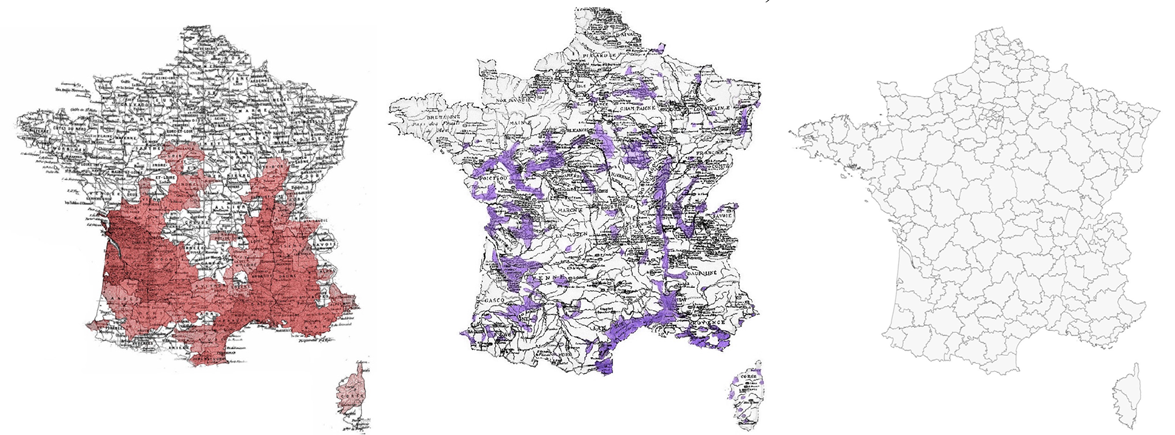
The statistically non-significant results between vineyards and judicial unions demonstrate that the most confrontational syndicates capitalize on their consensus where – at the peak of the crisis and before acknowledging potential solutions – the plague was overwhelming the community with the unexpected crisis.
6.2 Testing instrument strength and over-identifying restrictions
The empirical results of the first stage, and the cluster-robust test statistics, are reported in Table 2.
Estimation results of the first-stage regressions and relative tests

Double-clustered standard errors in parentheses.
***p < 0.01, **p < 0.05, *p < 0.1.
Note: The table shows the estimation results of the first stage of 2SLS, between the rate of judges appointed among non-reformist trade unions (CGT/FO) across CPHs and the dummy variable representing the phylloxérian infection. The table also presents the first stage identification statistics, reporting the results of the test performed on redundancy, under-identification, and weak identification with F-distribution at 1%. The Stock–Yogo weakness threshold (†) is set, for one instrument and 10% maximal IV size, at 16.38.
The distribution of the F-statistics is at 1% threshold. The rule of thumb for the IV's validity is an F statistic of 10 (Staiger and Stock, Reference Staiger and Stock1997). On the other hand, regarding under-identification and weakness, the literature advises considering the instrument weak if tests' values are below the critical threshold of 16.38, at 10% maximal IV size (Stock and Yogo, Reference Stock, Yogo, Andrews and Stock2005).
All reported statistics are considerably above such a critical threshold. As anticipated above, the phylloxérian shock still impacts radicalized unions' designation among prud'hommes, confirming that labor judges' alleged belligerency has important roots in history.
According to the estimations, the average increase in adversarial trade unions' professional electoral polls is around 2.4% of the votes' share. This result suggests that territories where the plague triggered revolts and social struggles are still characterized by strong revolutionary syndicalism, which devotes most of the share of votes to CGT and FO.
Concerning exclusion restrictions, the phylloxérian infection should affect the outcome variables only through the proportion of confrontational trade unions, even though the assumption is not verifiable (Labrecque and Swanson, Reference Labrecque and Swanson2018).
In this regard, it should suffice to mention that lawsuits are heavily dependent on parties' circumstances (e.g. dismissal, discriminations, mobbing, and failed payment of wage), and laws and regulations are independent from the viticultural disease that happened two centuries ago. On the contrary, French unions' passionate attachment to society is deeply attached to historical reasons. French unions were able to confront even the most terrible chimeras (Sirot, Reference Sirot2011), and the phylloxérian crisis represents one of the most striking examples.
7. Estimation results
The empirical results of the 2SLS estimations are summarized in Table 3.
Two-stage least squared estimation results

Double-clustered standard errors, at court and year level, in parentheses.
***p < 0.01, **p < 0.05, *p < 0.1.
Note: The table shows the 2SLS estimates on a panel of 201 yearly observations of French labor courts, between 2012 and 2016. The dependent variables are the rate of cases settled in court, the rate of lawsuits dropped, the rate of cases appealed, and sent to départage. The variable polarized is the rate of judges elected among the most confrontational trade unions. The sources of data for labor litigation and socio-economic controls are the Ministry of Justice and EUROSTAT/INSEE, respectively. All other variables are defined in section 5. Year fixed-effects are included in all specifications.
Before proceeding further with quantile regressions, prudence should suggest at least to test for endogeneity. The Durbin–Wu–Hausman test is not valid with clustered covariance estimators, so we test endogeneity with the difference-in-Sargan statistic tests. The C-test suggests that the dependent variable does not appear as exogenous and shall be treated as endogenous, confirming that professional elections have to be instrumented. The two-stage least squared coefficients should be unbiased and efficient (Angrist et al., Reference Angrist, Imbens and Rubin1996). Nonetheless, since every serious estimate should be supplemented with a reliable assessment of precision (Koenker and Hallock, Reference Koenker and Hallock2001), we report quantile empirical results to check our parameter of interest's sensitivity to the sample structure.
7.1 Quantile regressions
The coefficients of the second stage of least trimmed quantile regressions are reported in Table 4.
Least trimmed instrumental quantile regression's estimation results

Double-clustered standard errors, at court and year level, in parentheses.
***p < 0.01, **p < 0.05, *p < 0.1.
Note: The table shows the results of the first and second stage of the lest trimmed quantile regression estimates, on a panel of yearly observations for 201 French labor courts, during the period 2012–2016. The trimming proportion is set within the variable confrontation unions, the of the most confrontational trade unions among judges. All other variables are defined in section 5. The distribution of the F-statistics of the first-level is set at 1% threshold.
The least trimmed instrumental quantile regression is a robustness check capable of reducing the outliers' influence on the explanatory variable (Neykov et al., Reference Neykov, Čížek, Filzmoser and Neytchev2012) and removing dirty estimators and inefficient statistics. The idea is to use a α-trimmed mean of the sample after the proportion of largest and smallest observations are removed from the dataset (Koenker and Bassett, Reference Koenker and Bassett1978). The literature considers optimal a trimming proportion between 5 and 10%, and both suitable arrangements of the dataset are reported in Table 4.
8. Discussion
The coefficients of the quantitative estimations reported above suggest several conclusions. First and foremost, the results are robust to variations of the sample. The strength and validity of the instrument are undiminished by the elimination of the outliers. Even after the trim, the first-stage F statistics' values, at the 1% threshold, remain abundantly above any critical value. In the second place, the empirical evidence suggests no statistically significant impact of judges on the rate of appeals and départage.
Consequently, it appears that courts deemed to be ‘polarized’ by confrontational unions are not characterized by a dissatisfaction with the verdict, both from the judicial and litigants' point of view. On the contrary, belligerent unions play a significant role in reducing cases withdrawn and a constructive influence on conciliation. As a remark, the statistical significance and magnitude of confrontational unions' effect on conciliation and abandonment of lawsuits increase with the progressive elimination of outliers from the dataset.
Hence, the results confirm that unionism has a significant role in the functioning of alternative dispute resolution mechanisms, where judges consider themselves as arbiters of the ultimate fairness of labor rules (Yeazell, Reference Yeazell1998). Conciliation is the fundamental procedural principle and the keystone of CPH. Thus, it was critical to examine its determinants.
Nevertheless, these results should not come as a surprise. Courts deemed to be ‘polarized’ follow the archetype of a ‘unionist judge’ that suggests to the parties to assert their rights, even if doing so is costly and time-consuming. If courts are effectively headed by employees' counselors (Willemez, Reference Willemez2012) and ‘paritarianism’ is fictional (Tillie, Reference Tillie2015), these results are quite important.
They show that confrontational unionism does not deter the litigation process, inducing parties, with potential ‘moral suasion’ mechanisms, to address their labor grievances to the very end. The evidence seems to confirm the speculations that prud'hommes use a paternalistic logic of conciliation and fairness, fostering an ideology of concord that avoid the transformation of disputes into litigation and possibly into conflicts (Willemez, Reference Willemez2015).
If we concentrate our attention on excessive backlog and duration of legal cases, we can explain the partial drainage of judicial responsibilities in favor of a professional judge. A unitary increase in the monthly duration of lawsuits reduces the number of conciliated lawsuits, increases the rate of départage, and decreases the number of appeals. The more time-consuming is the procedure, the more the litigation pace and judicial endurance are intense. The same pernicious effect might be found regarding a raise in the backlogs' rate: for one unitary increase of judicial caseload, lawsuits are more easily appealed.
Interestingly, the same perverse effects can be considered under the impact of the clearance rate, which captures the court's caseload that is not considered overdue (otherwise, it is intended by the Ministry of Justice as a ‘backlog’). Intuitively, a rise in the ratio between incoming and adjudicated cases involves fewer lawsuits settled or abandoned (having already reached the trial stage). Simultaneously, the implication of additional judgments is an increase of appeals and a rise in départage, probably to reduce the caseload that weighs the judiciary.
All these results, combined, confirm that procedural flaws are attached to the chronic under-endowment of this jurisdiction, which results in justice contrary to reasonable time principles (cf. Tournaux, Reference Tournaux2016, and Tribunal de Grande Instance de Paris judgment 11/02506). Note that the conciliation rate negatively affects the number of appeals, probably because of a reduction of verdicts issued by the court: the more conciliations, the fewer judgments rendered.
Nonetheless, even though this evidence might appear trivial and intuitive, the underlying reasons for this phenomenon should be investigated further since filing an appeal does not necessarily imply pursuing it to its natural conclusion (Eisenberg, Reference Eisenberg2004). Future case-by-case analyses might concentrate their attention on this particular aspect.
Finally, it is interesting to notice that the least trimmed instrumental quantile estimation coefficients show that the increase in plaintiffs' losing rate entails a decrease in conciliation. Courts that tend to refute plaintiffs' arguments increase the litigiousness inherent in the court, with the possible result that settlement is less accessible from both litigants and judges' point of view.
Economic controls reveal some statistically significant impacts. Inactive individuals' rate seems to impact the number of appeals substantially, whereas a raise in the local unemployment rate implicates a reduction of settlement and dropped lawsuits. The health of the employment state is somewhat delicate. The situation of less favorable working conditions waters down judicial agreements between the parties and promotes uncompromising litigation.
These outcomes might be more intuitive than expected. In effect, the literature has suggested that labor market contingencies are likely to influence decisions, inducing judges to be more favorable to workers (Ichino et al., Reference Ichino, Polo and Rettore2003).
Hence, it is easily comprehensible why local economic factors influence conciliations, abandon, and appeals. On the same floor, the different economic sectors' available measures significantly impact the settlement ratio. An increase in farmers and employees' rates reduces settlement possibilities, whereas the opposite happens if laborers among the active population expand. Instead, a unitary rise in the ratio between urban and rural towns increases the rate of appealed lawsuits.
The possible explanations for these results reside in the different sectors' capacity to genuinely articulate the workers' class feeling in a more comprehensive and conflictual battle. The manufacturing sector is the most coordinated workers' group in France (Despax et al., Reference Despax, Laborde and Rojot2017). Therefore, their demands are more structured and organized, probably inducing employers to settle more lawsuits to escape uncontrollable litigation and hostility. More dispersed sectors, like the agricultural or clerical services, have a lower corporate spirit and negotiating power.
The possible explanation for lawsuits conducted until the very end is again that judges intervene to suggest the weaker party his rights and duties, explaining the negative impact of an increase in the departmental rurality rate on the rate of appealed lawsuits. These speculations, however, could only be corroborated by a case-by-case analysis.
9. Conclusion
The legitimacy of the immeasurable power of prud'homal justices has been under discussion for years (Desbarats, Reference Desbarats, Krynen and Raibaut2004). In particular, the economic literature has argued, on several occasions, that prud'homal judges, pertaining to the most belligerent trade unions, foster confrontation in court. This paper intended to test whether these speculations were grounded.
Using a panel dataset of yearly observations for 201 French labor courts during the period 2012–2016, we show that prud'homal authority is only affected positively by confrontational trade unions. The general perception is that labor courts are polarized and guided by contradictions, being composed of ‘judges of bias by nature’ (Lacabarats, Reference Lacabarats2014), excessively prone to employees seeking to obtain the recognition of symbolic reparation of the harm suffered from the patronal relationship (Trémeau, Reference Trémeau2017).
Nevertheless, the potential concerns about adversarial unions' concerns hampering justice and introducing insecurity in labor law (Lokiec, Reference Lokiec, Araku and Ouchi2004) are not substantiated. On the contrary, an increase of antagonistic unionism fosters the active research of compromising solutions, concessions, and equitable decisions. This conclusion is hardly surprising, considering that prud'homal litigation is based on substantial and procedural norms that follow the rule of law to analyze – from the judicial point of view – daily working relationships, where the scope of legislative and negotiated rules are played out in real life (Didry, Reference Didry2009).
In this regard, the Council's purpose has always been to maintain social peace and harmony between employers and employees. Consequently, contrary to what could legitimately be expected from combative syndicalism, the most belligerent trade unions restrict themselves to their most important assignment: conciliate lawsuits and, if and only if settlement fails, find a compromising verdict in the name of the French people.
Appendix
Values assigned according to phylloxérian infection and vineyards

First-stage regressions using vineyards’ instrumental variable


 Open access

