Polycystic ovary syndrome (PCOS) is a common condition affecting between 5 and 18 % of reproductive-aged women(Reference March, Moore and Willson1,Reference Azziz, Woods and Reyna2) . It is characterised by clinical or biochemical hyperandrogenism, oligo-ovulation, anovulation and polycystic ovaries(Reference Fauser, Tarlatzis and Rebar3). PCOS is associated with higher rates of infertility(Reference Teede, Deeks and Moran4), pregnancy complications, type 2 diabetes(Reference Moran, Misso and Wild5), CVD(Reference Zhao, Zhu and Lou6) and psychological disorders such as depression and anxiety(Reference Deeks, Gibson-Helm and Teede7). Insulin resistance is a key pathophysiological feature of PCOS. It is present in a form that is mechanistically distinct from obesity-associated insulin resistance(Reference Diamanti-Kandarakis and Dunaif8) in the majority of women with PCOS, regardless of BMI(Reference Stepto, Cassar and Joham9), and worsens the clinical presentation of the syndrome. Excess weight will also worsen both insulin resistance and the adverse features associated with the syndrome(Reference Lim, Norman and Davies10). In keeping with this, lifestyle (diet, exercise and/or behavioural) interventions for weight management (prevention of weight gain, modest weight loss or weight loss maintenance) are recommended as first-line treatment in PCOS(Reference Teede, Misso and Costello11).
Women with PCOS have greater longitudinal weight gain, higher BMI and obesity prevalence than women without PCOS(Reference Teede, Joham and Paul12). The reason for this is unclear. It is possible that the predisposition to weight gain in PCOS may be related to adverse lifestyle habits. The limited literature to date has reported both poorer lifestyle habits such as increased sedentary time(Reference Moran, Ranasinha and Zoungas13), reduced physical activity(Reference Eleftheriadou, Michala and Stefanidis14) and higher energy intake(Reference Moran, Ranasinha and Zoungas13) and positive lifestyle habits such as higher diet quality(Reference Moran, Grieger and Mishra15) and lower glycaemic index(Reference Moran, Ranasinha and Zoungas13) in women with PCOS, compared with those without PCOS. Positive changes in lifestyle habits in women with PCOS may be a response to advice on improving lifestyle following diagnosis, consistent with International Evidence-Based Guidelines(Reference Teede, Misso and Costello11). Conversely, prior to diagnosis adverse lifestyle habits in PCOS may reflect the contribution of poor diet, limited physical activity or sedentary behaviour to worsening weight and insulin resistance and making the features of PCOS more severe(Reference Lim, Norman and Davies10) and a diagnosis of PCOS more likely(Reference Teede, Joham and Paul12).
Women with PCOS also have a higher prevalence of sleep disturbances(Reference Fernandez, Moore and Van Ryswyk16), including difficulty initiating sleep(Reference Fernandez, Moore and Van Ryswyk16), restless sleep(Reference Mo, Mansfield and Joham17), severe daytime tiredness(Reference Mo, Mansfield and Joham17) and clinical sleep disorders such as obstructive sleep apnoea(Reference Thannickal, Brutocao and Alsawas18) and insomnia(Reference Fernandez, Moore and Van Ryswyk16). Epidemiological evidence in men and women suggests that reduced sleep duration and quality are associated with metabolic conditions such as obesity(Reference Cappuccio, Taggart and Kandala19), diabetes(Reference Cappuccio, D’elia and Strazzullo20) and CVD(Reference Cappuccio, Cooper and D’elia21). The mechanisms supporting these associations are not fully elucidated. However, previous research suggests short or disturbed sleep may increase hunger(Reference Chaput22), decrease satiety(Reference Chaput22), increase propensity to select foods high in carbohydrate(Reference Markwald, Melanson and Smith23) and fat(Reference Spaeth, Dinges and Goel24) and reduce diet quality(Reference Haghighatdoost, Karimi and Esmaillzadeh25). Furthermore, sleep disturbance is also associated with sedentary behaviour(Reference Yang, Shin and Li26) and lower levels of physical activity(Reference Soltani, Haytabakhsh and Najman27). Sleep disturbances in women with PCOS may therefore further exacerbate insulin resistance, worsen energy balance and worsen both the presentation of PCOS and metabolic consequences(Reference Tasali, Van Cauter and Hoffman28). In the general population, interventions aimed at improving sleep have been shown to improve the success of weight loss in women(Reference Thomson, Morrow and Flatt29) and improve the body’s ability to reduce adipose stores(Reference Nedeltcheva, Kilkus and Imperial30). Optimising sleep may, therefore, be important for women with PCOS to support and sustain healthy lifestyle changes. We have previously reported both positive (better diet quality) and negative (poorer sleep behaviours, higher energy intake and sedentary time) associations with lifestyle behaviours in women with PCOS, compared with those without PCOS(Reference Moran, Ranasinha and Zoungas13,Reference Mo, Mansfield and Joham17) . However, whether sleep disturbances modify the association between PCOS and lifestyle is not currently known.
The aim of this study is to investigate whether sleep disturbance confounds or modifies the association between lifestyle factors and PCOS. The hypothesis was that in women with PCOS sleep would modify the association between PCOS and lifestyle behaviours.
Subjects and methods
Study population
This analysis used data from the Australian Longitudinal Study on Women’s Health (ALSWH). The ALSWH is a national Australian study of women’s social, mental and physical health. Initially, three age-based cohorts 18–23 years (born 1973–1978), 45–50 years (born 1946–1951) and 70–75 years (born 1921–1926) were recruited from the Medicare database in 1996. Women from rural areas were oversampled to allow comparison. The ALSWH cohorts have been followed up every 3–4 years since this time. This study is a cross-sectional analysis of the 1973–1978 cohort (survey 5) conducted in 2009. This survey was chosen because it contained both sleep and dietary information for women of reproductive age. Ethics approval was obtained from relevant Human Research Ethics Committees at the University of Newcastle and the University of Queensland. Details of the ALSWH have been published elsewhere(Reference Lee, Dobson and Brown31,Reference Brown, Bryson and Byles32) .
Initially, the 1973–1978 cohort contained 14 247 women. In 2009, when survey 5 was conducted 13 223 women were still considered eligible for the survey with a response rate of 62·0 % (n 8200). Details of this sample are published elsewhere(Reference Dobson, Hockey and Brown33). Participants were excluded from the analysis if (i) self-reported sleep data were biologically implausible (<3 h or >12 h), (ii) they had missing sleep data, (iii) dietary data indicated energy intake >14 700 kJ/d or <2100 kJ/d or there was incomplete FFQ data (>10 % of items with missing responses), leaving 6067 women included in the analysis. PCOS diagnosis was identified by the question ‘In the last 3 years have you been diagnosed with or treated for PCOS?’. PCOS status was thereby identified by self-report of physician-diagnosed PCOS and has been validated against menstrual cycle irregularity, a key feature and diagnostic criterion for PCOS in previous published ALSWH studies(Reference Teede, Joham and Paul12).
Demographic variables
A range of demographic data were self-reported. Level of education was obtained through the question ‘what is the highest qualification you have completed’ with answers grouped into the following categories for analysis: no formal qualification/high school certificate, trade/diploma or degree. Income was obtained through the question ‘What is the average gross (before tax) income that you receive each week, including pensions, allowances and financial support from your parents?’ response categories were categorised into the following for analysis: ‘no income’, ‘low income’ ($AU1–36 399), ‘medium income’ ($AU36,400–77 999) and ‘high income’ (≥$AU78,000). Occupation was obtained by asking participants to mark a box which listed ten career categories including ‘no paid work’. Responses were grouped into the following categories for analysis: professional (scientist, doctor, nurse, teacher, etc.), associated professional (technician, youth worker, police officer, etc.), clerical/trade (hairdresser, secretary, personal assistant, cleaner, sales assistant, etc.) and no paid work. Marital status was obtained through the question ‘what is your current marital status’, with the following responses available: married, de facto, separated/divorced, widowed and never married. Depression status was obtained through the Centre for Epidemiological Studies – Depression (CES-D 10) questionnaire(Reference France, Lee and Powers34). A score ≥10 was used as the cut-off for depression(Reference Andresen, Malmgren and Carter35). Smoking status was determined with the question: ‘How often do you currently smoke cigarettes or any tobacco products?’, with possible answers being ‘Daily’, ‘At least weekly’, ‘Less often than weekly’ and ‘Not at all’. Current non-smoking participants were asked if they had smoked more than 100 cigarettes in their lifetime, with those who did being considered as ex-smokers. Participants were asked if they had previously given birth or were currently pregnant. Country of birth data was utilised from survey 1 in 1996; this question asked participants to choose one of the following options: Australia, UK, Italy, Greece, New Zealand, Vietnam or other (please specify).
Height, weight and waist circumference were self-reported. Height and weight were used to calculate BMI. The WHO BMI guidelines(36) were used to categorise BMI as underweight (BMI < 18·5 kg/m2), healthy weight (BMI 18·5–24·9 kg/m2), overweight (BMI 25–29·9 kg/m2) or obese (≥30·0 kg/m2). Waist circumference was also self-reported with instructions on how to measure including ‘Find your navel (belly button) and measure at that level. Be careful not to have the tape too tight. You should be able to slip your little finger under it comfortably’. Self-reported measures of height, weight and waist circumference have been shown to be a valid and reliable method of measurement(Reference Tuomela, Kaprio and Sipilä37).
Lifestyle variables
Four areas of lifestyle were included in this analysis: diet, physical activity, sedentary time and sleep. Dietary intake was assessed using a 74-item validated FFQ, the Dietary Questionnaire for Epidemiological studies. This FFQ uses serving size information and frequency of consumption to capture the previous 12 months intake. Nutrient intakes were calculated using Australian Food Composition data(Reference Lewis and Milligan38). This FFQ has been validated against a weighed food record in Australian young women(Reference Hodge, Patterson and Brown39). Diet quality was measured using the dietary guidelines index (DGI)(Reference Haines, Siega-Riz and Popkin40). The DGI reflects compliance with the Dietary Guidelines for Australian adults and the Australian Guide to Healthy Eating and comprises dietary indicators for the consumption of five core food groups (vegetables, fruit, cereal, meat and alternatives and dairy). An additional category is calculated that is not part of the core food groups, entitled ‘extras’, which includes discretionary foods high in energy, added sugars, added salt, saturated fat or alcohol. Each component was scored on a scale of 0–10, with 10 indicating an optimal intake. The total score was the sum of thirteen3 indicators, with the DGI having a possible range of 0–130 and a higher score indicating greater compliance with the dietary guidelines. Details on the development of the DGI have been previously described(Reference McNaughton, Dunstan and Ball41).
Physical activity (planned and incidental) and sedentary time were self-reported via a validated modified version of the Active Australia Physical Activity survey(Reference Brown, Burton and Marshall42). Participants were asked to report the duration and frequency of the following leisure-time and transport activities in the last 7 d including walking briskly, moderate-intensity leisure activity and vigorous-intensity leisure activity lasting 10 min or longer. Metabolic equivalent values (MET) were assigned to each category (3·0, 4·0 and 7·5 MET, respectively). Total MET were calculated as minutes × respective MET scores (i.e. minutes walking × 3·0 + minutes vigorous activity × 7·5). Outliers were truncated at 28 h/week for total physical activity. Sedentary activity was reported on a weekday and usual weekend ‘how many hours and minutes in total do you typically spend sitting down while doing things like visiting friends, driving, reading, watching television, or working at a desk or computer?’. Participants with data for total sitting time of greater than 16 h/d were not included in the analyses.
Sleep data were self-reported. Sleep quantity was ascertained by asking for sleep duration in hours and minutes on a workday and non-workday. Sleep quality was assessed with the following questions: (1) How often during the last week did you feel ‘My sleep was restless’ on a frequency scale: rarely or none of the time (<1 d), some or little of the time (1–2 d), occasionally or moderate amount of the time (3–4 d) or most or all of the time (5–7 d); (2) In the past month, ‘Have you had difficulty falling asleep?’, yes or no; (3) In the last 12 months have you had any of the following, ‘Severe tiredness’ or (4) ‘Difficulty sleeping’ on a frequency scale: never, rarely, sometimes or often. These were also classified into binary variables of ‘rarely or none of the time/some or little of the time’ v. ‘occasionally or moderate amount of the time/most or all of the time’ for ‘my sleep was restless’; ‘never/rarely’ v. ‘sometimes/often’ for ‘have you had difficulty sleeping’ and ‘severe tiredness’. As previously described for our cohort(Reference Mo, Mansfield and Joham17,Reference Bennett, Truby and Zia43) , the latent class (LC) analysis identified three mutually exclusive groups: (1) average sleep duration (mean values and standard deviation) (sleep duration of 456·0 (sd 53·8) min/d and 489·6 (sd 60)·1 min/d on a workday and non-workday, respectively), with little or no sleep disturbances, (2) average sleep duration (452·5 (sd 55·92) min/d and 504·0 (sd 64·44) min/d sleep on a workday and non-workday, respectively) and sometimes/often experiencing sleep disturbances including severe tiredness, difficulty falling asleep, restless sleep, difficulty falling asleep and (3) short sleep duration (342·2 (sd 51·5) min/d and 374·1 (sd 60·2) min/d sleep on a workday and non-workday, respectively) and sometimes/often experiencing sleep disturbances including severe tiredness, difficulty falling asleep, restless sleep and difficulty falling asleep. Women were classified into these classes according to their highest probability of class membership.
Statistical analysis
PCOS status was the exposure variable. The primary outcome measures were lifestyle behaviours including daily dietary intake energy (kJ), percentage energy: protein, carbohydrate, fat, saturated fat, monounsaturated fat, polyunsaturated fat, fibre (g), DGI, glycaemic index, glycaemic load and alcohol (g), daily physical activity (MET/mins) and sitting time (h/d) and daily sleep (quantity and adverse sleep-associated symptoms). The aim of the analyses was to assess whether sleep confounds or modifies the association between lifestyle factors and PCOS. The difference in lifestyle behaviours between women with and without PCOS was assessed via unpaired two-sided t test for continuous measures and χ 2 for categorical measures. The relationship between lifestyle behaviours and PCOS status was assessed using univariable and multivariable regression analyses. Univariable analysis included the lifestyle behaviours as the outcome and PCOS as the predictor (model 1). To investigate the potential role of sleep disturbance in these associations, multivariable analyses were conducted for lifestyle behaviours adjusting for sleeping behaviour LC (model 2) and sleep behaviour, plus BMI, age, education level, income, occupation, marital status, parity, pregnancy, depression, smoking and country of birth (model 3). Confounders were selected on the basis of correlation (P < 0·2) with PCOS and DGI, and on hypothesis testing based on postulated associations with lifestyle factors. Models were constructed to avoid collinearity and assessed for standard assumptions. Likelihood ratio tests were used for model evaluation and selection. The interactions between PCOS status and sleep behaviour LC were assessed in all the final models. Multivariable regression analyses were performed assessing the association between lifestyle behaviours as the dependent variable and PCOS status as the independent variable stratified for each of the sleeping behaviour LC. Significance for demographics, dietary and sleep outcomes was subject to a Bonferroni correction which were <0·004, <0·004 and <0·007, respectively. All other data were subject to a significance of <0·05. Sensitivity analyses were conducted in the DGI regression which adjusted for energy intake. However, the results of these analyses did not change the directionality or significance of the relationship and therefore the original regression is reported, in line with the other diet variables. Data analysis was performed in Stata V14 (Stata Corp).
Results
Demographics
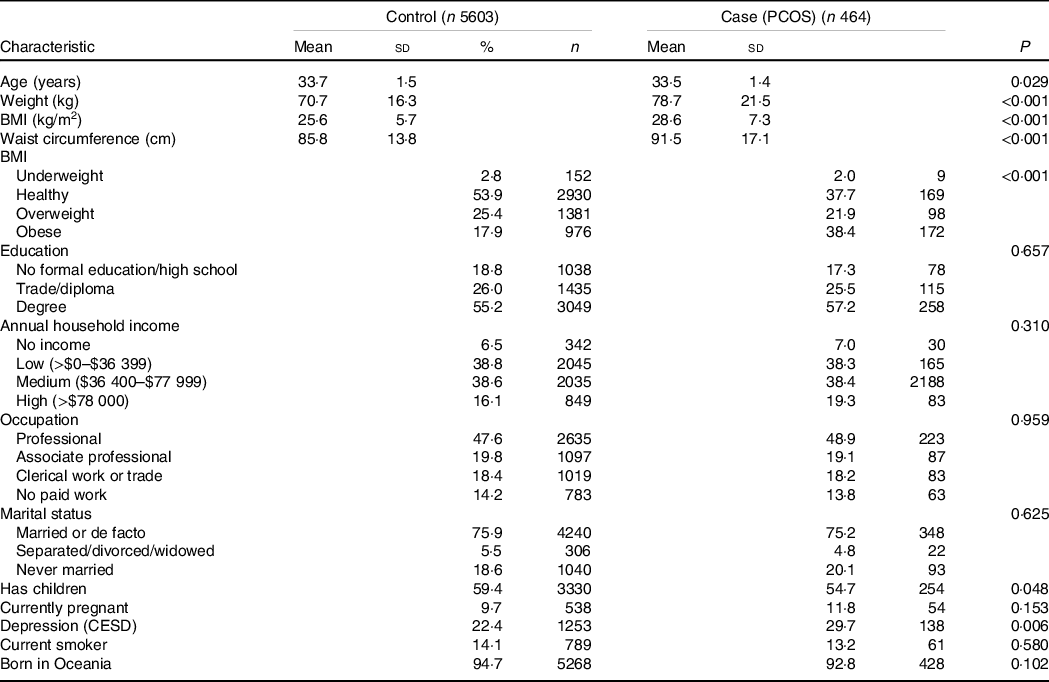
The demographic characteristics of women with and without PCOS are reported in Table 1. Women with PCOS were slightly younger and on average had higher BMI, weight, waist circumference and depression as per the Centre for Epidemiological Studies – Depression and a lower proportion of women with PCOS had children. There were no differences in education level, household income, occupation, country of birth, pregnancy status, marital status or smoking status.
Demographic characteristics of women with and without PCOS*
(Numbers and percentages; mean values and standard deviations)

PCOS, polycystic ovary syndrome; CESD, Centre for Epidemiologic Studies Depression scale.
* Data were analysed using unpaired two-sided t test for continuous measures and χ 2 for categorical measures. Data are presented as mean and standard deviation for continuous and percentage and number (n) for categorical data.
Lifestyle behaviours
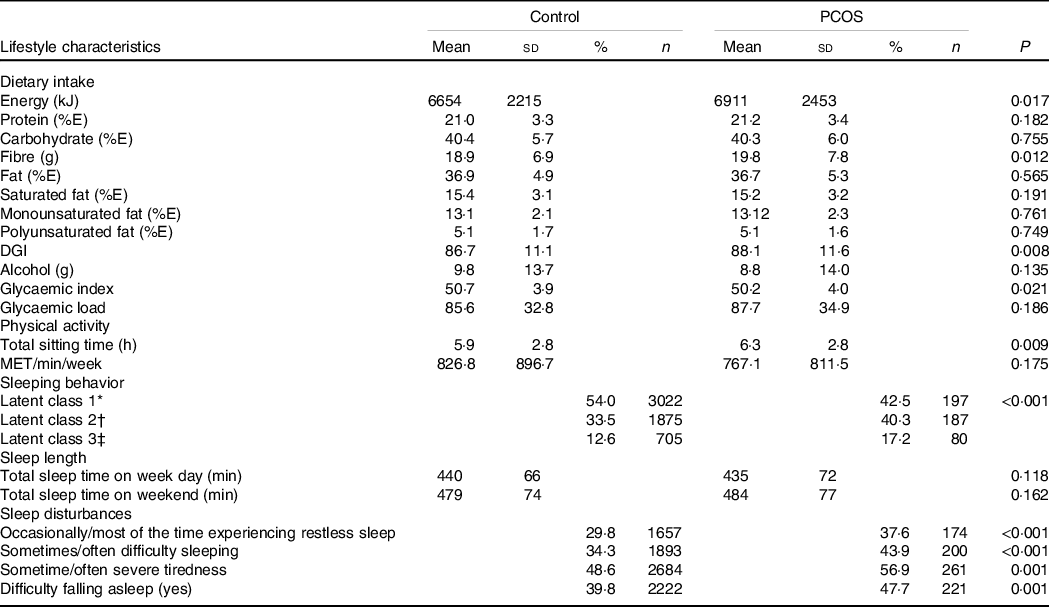
The descriptive statistics for lifestyle behaviours of controls and women with PCOS are reported in Table 2. Women with PCOS had higher daily intake of energy, fibre, higher diet quality, lower glycaemic index and spent more time being sedentary (all P-values ≤ 0·021). As previously reported using this dataset, there were significant differences in the sleep behaviour categories for women with and without PCOS, with those with PCOS having a lower proportion of women in LC 1 (∼8 h sleep/no adverse sleep-associated symptoms) and a higher proportion of women in LC2 (∼8 h sleep/adverse sleep-associated symptoms) and LC3 (∼6 h sleep/adverse sleep-associated symptoms) (P < 0·001) This is supported by the individual sleep disturbance variables(Reference Mo, Mansfield and Joham17). There was no difference between women with and without PCOS in the duration of sleep reported. However, a significantly higher proportion of women with PCOS reported adverse sleep symptoms (restless sleep (P < 0·001), difficulty sleeping (P < 0·001), severe tiredness (P = 0·001)) and difficulty falling asleep (P = 0·001)).
Lifestyle characteristics in women with and without PCOS
(Numbers and percentages; mean values and standard deviations)

DGI, dietary guidelines index; PCOS, polycystic ovary syndrome.
Data were analysed using unpaired two-sided t test for continuous measures and χ 2 for categorical measures. Data are presented as mean and standard deviation for continuous and percentage and number (n) for categorical data.
Latent class analysis: *Class membership defined by: average sleep (˜8 h/d) with no adverse sleep-related symptoms, †Class membership defined by: average sleep (˜8 h/d) and sometimes/often experiencing sleep disturbances, ‡Class membership defined by: short sleep (˜6 h/d) with sometimes/often experiencing sleep disturbances.
Regression analysis
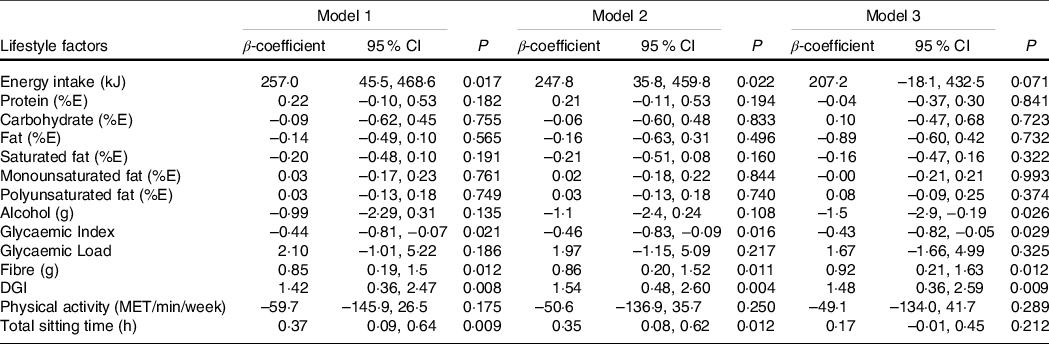
Results of the multivariable regression analysis of lifestyle behaviours are reported in Table 3. When controlling for sleeping behaviour (LC) in isolation, all associations between PCOS status and lifestyle variables were maintained. When controlling for other potential confounders (BMI, age, education level, income, occupation, marital status, parity, pregnancy, depression, smoking and country of birth), the significant associations between PCOS status and energy intake and sedentary behaviour were attenuated and PCOS status was associated with alcohol intake (Table 3).
Multivariable linear regression of lifestyle behaviours and PCOS status
(β-coefficients and 95 % confidence intervals)

DGI, dietary guidelines index; PCOS, polycystic ovary syndrome.
The relationship between lifestyle behaviours and PCOS status (0 = control and 1 = PCOS) was assessed using univariable and multivariable regression analyses. β-coefficient = the difference in the absolute value of the parameter between those with and without PCOS.
Univariable analysis included the lifestyle behaviours as the outcome and PCOS as the predictor (crude model/model).
Multivariable analyses were conducted for lifestyle behaviours and model (1) crude unadjusted, model, (2) sleeping behaviour (latent class) and model (3) sleeping behavior (latent class), BMI, age, education level, income, occupation, marital status, parity, pregnancy, depression, smoking and country of birth.
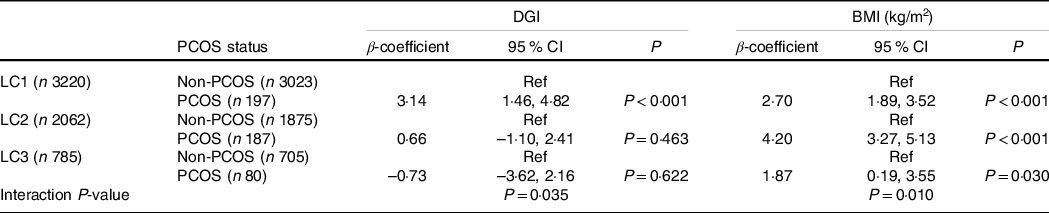
In the BMI and DGI models, there were significant interactions between PCOS and sleeping behaviour (Table 4). In stratified analysis, PCOS was associated with a higher BMI in all sleeping behaviour categories (P < 0·05). The DGI analyses showed that only for women in LC1 (∼8 h sleep/no adverse sleep symptoms) was PCOS associated with a higher DGI. There were no differences in diet quality between women with and without PCOS for those with poorer sleep (LC2 (∼8 h sleep/adverse sleep-associated symptoms) and LC3 (∼6 h sleep/adverse sleep-associated symptoms)).
Interaction analysis stratified by sleeping behaviour class
(β-coefficients and 95 % confidence intervals)

DGI, dietary guidelines index; LC, latent class; PCOS, polycystic ovary syndrome.
LC1: average sleep (˜8 h/d) with no adverse sleep-related symptoms, LC2: average sleep (˜8 h/d) and sometimes/often experiencing sleep disturbance, LC3: short sleep (˜6 h/d) with sometimes/often experiencing sleep disturbance. β-coefficient = the difference in the absolute value of the parameter between those with and without PCOS.
Discussion
In this study, PCOS was associated with healthier (higher diet quality, fibre and lower GI and alcohol consumption) and negative (higher energy intake and sitting time) behaviours. This has been previously shown with the ALSWH cohort(Reference Moran, Ranasinha and Zoungas13). Further as previously shown, women with PCOS also had a higher BMI and higher prevalence of both obesity and poor sleeping behaviours including adverse sleep-associated symptoms (severe tiredness, difficulty sleeping, restless sleep and difficulty falling asleep)(Reference Mo, Mansfield and Joham17,Reference Tasali, Van Cauter and Ehrmann44,Reference Moran, March and Whitrow45) . While these results have previously been presented, this study was able to examine the role of sleeping behaviour in supporting these relationships. The associations between energy intake, sedentary behaviour and PCOS were no longer present after adjustment for sleeping behaviour and other confounding variables. However, the positive association between PCOS and higher diet quality was only present in women with little to no sleep disturbances. The association between PCOS and BMI was also generally stronger when more severe sleep disturbances were present.
Our findings here build on our prior work reporting that women with a diagnosis of PCOS self-select marginally higher quality diets(Reference Lim, Norman and Davies10). This may be a result of receiving information on optimising lifestyle following a diagnosis of PCOS, consistent with international evidence-based guidelines(Reference Teede, Misso and Costello11). In addition, we showed that this positive association is strengthened on consideration of sleeping behaviour. Specifically, while women with PCOS had a 1·4-unit higher DGI when sleeping behaviour and other confounders were not controlled for, in women with no sleep disturbances the difference in DGI between women with PCOS and those without doubled to 3·1-units, with no difference observed in women with sleep disturbances. Of note, previous studies have shown a 10-unit greater DGI is associated with improved cardiometabolic risk factors(Reference Haines, Siega-Riz and Popkin40). Studies using similar indexes to the DGI have reported that changes in as little as one point are associated with a 1·4 % decrease in the risk of abdominal obesity or a decrease in 0·053–0·095 kg/m2 BMI(Reference Asghari, Mirmiran and Yuzbashian46). However, increased diet quality has been reported to be a significant predictor of weight status and BMI and therefore while it is a small difference, it may have significant clinical implications for women with PCOS(Reference Asghari, Mirmiran and Yuzbashian46).
It is unclear whether the 3-unit increment in DGI observed here is clinically significant. Previous research in the general population reported that reduced sleep quantity and quality are risk factors for lower quality diets (higher carbohydrate and fat diets)(Reference Chaput22). Experimental evidence suggests that after healthy sleep patterns have been restored, energy intake is decreased, particularly from carbohydrates and fat, which results in modest weight loss(Reference Markwald, Melanson and Smith23). Short sleep duration and poor quality sleep may impact dietary intake in three ways (i) environmentally(Reference Chaput22), (ii) endocrinologically and (iii) hedonically(Reference Blumfield, Bei and Zimberg47). Environmentally, if a person is awake longer, there are more opportunities to eat. Endocrinologically, short sleep may increase ghrelin and decrease leptin, increasing hunger and decreasing signals for satiety(Reference Chaput22). Finally, hedonically, lack of sleep decreases dietary restraint and increases the drive for foods that are high in fat(Reference Spaeth, Dinges and Goel24) and carbohydrates(Reference Markwald, Melanson and Smith23). These potential mechanisms associated with reduced sleep duration and/or quality may reduce the ability of a woman with PCOS to make or sustain positive dietary change in her diet. Overall, this would increase the risk of positive energy balance and therefore weight gain which can then significantly worsen the severity of the features of PCOS(Reference Lim, Norman and Davies10). In keeping with this, we also report here that the higher BMI for women with PCOS compared with those without PCOS was greater for those with poorer sleep (8 h sleep and disturbances). While we did not observe this for the most severe category of sleep disturbances (6 h sleep and sleep disturbances), this may be related to the smaller sample size and reduced power in this group.
We also confirm prior reports that women with PCOS had higher energy intake and sitting time compared with women without PCOS(Reference Moran, Ranasinha and Zoungas13). However, the relationship between these outcomes was removed when controlling for both sleeping behaviour and other demographic factors. This suggests that the effect of adverse sleeping behaviour in isolation is unlikely to alter these behaviours in PCOS and is not an important confounder. This is in contrast to findings in the general population, suggesting that higher energy intake(Reference Markwald, Melanson and Smith23) and lower physical activity(Reference Kredlow, Capozzoli and Hearon48) are associated with reduced sleep quality and quantity. Sedentary behaviour is proposed to have two mechanisms that influence sleep in the non-PCOS population. Firstly, sedentary behaviour is often associated with screen time(Reference Pearson and Biddle49). Screen time increases blue-light exposure, which influences sleep quantity and quality(Reference Christensen, Bettencourt and Kaye50). Secondly, poor sleep increases factors such as fatigue, low mood and poor vigilance, decreasing the likelihood of physical activity and increasing the likelihood of sedentary behaviour(Reference Chennaoui, Arnal and Sauvet51). From our analysis, these relationships do not seem to be present in women with PCOS and future studies are needed to confirm and elucidate why these relationships may not exist in PCOS.
Multidisciplinary (diet, physical activity and behavioural therapy) lifestyle interventions for weight management (weight gain prevention, modest weight loss and weight loss maintenance) are recommended in international evidence-based guidelines for PCOS(Reference Teede, Misso and Costello11). Our results support that further research is needed assessing if the screening and management of short sleep duration or poor sleep quality sleep can improve lifestyle intervention success in women with PCOS. In individuals without PCOS, adequate sleep has been shown to assist in making positive lifestyle changes. Specifically, in a cohort of women participating in a weight loss trial, adequate sleep quality and longer sleep duration (> 7 h per night) increased the likelihood of intervention success by 33 %(Reference Thomson, Morrow and Flatt29). Reduced sleep (<5·5 h) has also been reported to reduce the effectiveness of weight loss interventions through physiologically decreasing the ability of the body to reduce adipose stores(Reference Nedeltcheva, Kilkus and Imperial30). The mechanisms behind this relationship are not well understood, but are believed to be related to the alteration in leptin and ghrelin secretion(Reference Nedeltcheva, Kilkus and Imperial30). Ensuring women with PCOS are obtaining adequate sleep may be an important factor in supporting positive lifestyle change with important impacts on weight management and severity of symptoms experienced.
Due to the cross-sectional nature of this study, causality cannot be inferred. However, this study is strengthened by the large and representative population-based cohort. The prevalence of PCOS in this sample is similar to that reported in the wider Australian population (8 % v. 5–18 %)(Reference March, Moore and Willson1,Reference Azziz, Woods and Reyna2) . A limitation of this study is the self-report of physician-diagnosed PCOS, with no information on the diagnostic criteria used or PCOS phenotype. However, self-reported PCOS has been validated in this cohort against menstrual irregularity, which is a key feature and diagnostic criteria for PCOS(Reference Ezeh, Yildiz and Azziz52,Reference Joham, Teede and Ranasinha53) . Indeed, genome-wide association studies in PCOS seeking to identify candidate genes in PCOS have found that despite the diagnostic criterion used for PCOS, whether it is Rotterdam, NIH and also self-reported, women with PCOS share a similar genetic architecture(Reference Day, Karaderi and Jones54). Further, women with PCOS from clinical populations have a higher prevalence of obesity than those from unselected populations(Reference Ezeh, Yildiz and Azziz52), this allows for the inclusion of varying degrees of obesity and increases the representativeness of the data. We note the self-reported nature of the data as a limitation. However, given the sample size, it would have been impractical to collect objective sleep and activity data from these participants. Furthermore, although the sleep questions were not validated, the food frequency and physical activity questionnaires have been validated in a sample of young women(Reference Hodge, Patterson and Brown39,Reference Brown, Burton and Marshall42) . Due to the self-reported nature, true PCOS prevalence in the sample may have been under-estimated. However, previous literature reports that in this cohort self-reported PCOS correlates strongly with menstrual irregularity as a diagnostic marker of PCOS status(Reference Teede, Joham and Paul12). Furthermore, the measures stated in the PCOS international recommendations would not have been feasible given this study sample a total of 14 247 women for this cohort from across Australia, including rural and remote locations(Reference Teede, Misso and Costello11).
Conclusion
The results of this study suggest that the association between PCOS and improved diet quality may only be maintained if the women are getting adequate quantity and minimal adverse sleep-related symptoms. Therefore, while women with PCOS may be able to self-select a higher quality diet following diagnosis, which could potentially improve their condition consistent with evidence-based guidelines, their ability to do this may be reduced without adequate sleep quality and quantity.
Acknowledgements
The research on which this paper is based was conducted as part of the Australian Longitudinal Study on Women’s Health by the University of Queensland and the University of Newcastle. We are grateful to the Australian Government Department of Health for funding and to the women who provided the survey data. The authors thank Professor Graham Giles of the Cancer Epidemiology Centre of Cancer Council Victoria, for permission to use the Dietary Questionnaire for Epidemiological Studies (Version 2), Melbourne: Cancer Council Victoria, 1996.
Lisa Moran is supported by a National Heart Foundation Future Leader Fellowship. Anju Joham is supported by a NHMRC fellowship.
C. B. and L. M. designed the research project. L. M. and M. B. analysed the data. C. B. and L. M. wrote the paper. All other authors reviewed and contributed to manuscript amendments.
The authors have no conflicts of interest to declare.