


The 4.2 kya event in northern Mesopotamia
Among the eight identified North Atlantic ice-rafting events that are interpreted as periods of aridification in the Northern Hemisphere, the event that started around 4200 years BP and known as the Bond event 3 (Bond et al. Reference Bond2001) is considered to have been the most severe (Walker et al. Reference Walker2018). Recently, the Near Eastern chronology for this event has been assessed more precisely using Mg/Ca and δ18O proxies from a speleothem at Gol-e-Zard cave in Iran to 4.26–3.97 kya. The same method has also detected a less significant period of increased aridity between 4.51–4.40 kya (Carolin et al. Reference Carolin2019).
The Bond event 3 roughly coincided with the fall of the Near Eastern Akkadian Empire and with the decline of the Old Kingdom in Egypt (Foster Reference Foster2016; Dee Reference Dee and Höflmayer2017). Some archaeological sites in northern Mesopotamia were completely abandoned at this time, including Tell Leilan in the Khabur Basin (Figure 1). Here, archaeological evidence led Harvey Weiss, the excavator of the site, to argue that rapid aridification made both herding and plant cultivation unreliable, resulting in the abandonment of the entire region for a few centuries (Weiss et al. Reference Weiss1993). Although his opinion about the cause of this disaster has since evolved (cf. Staubwasser & Weiss Reference Staubwasser and Weiss2006), Weiss (Reference Weiss2016) still claims that the 4.2 kya event resulted in a megadrought that decreased average annual precipitation by 30–50 per cent and forced local populations to migrate to other regions, mainly to southern Mesopotamia.
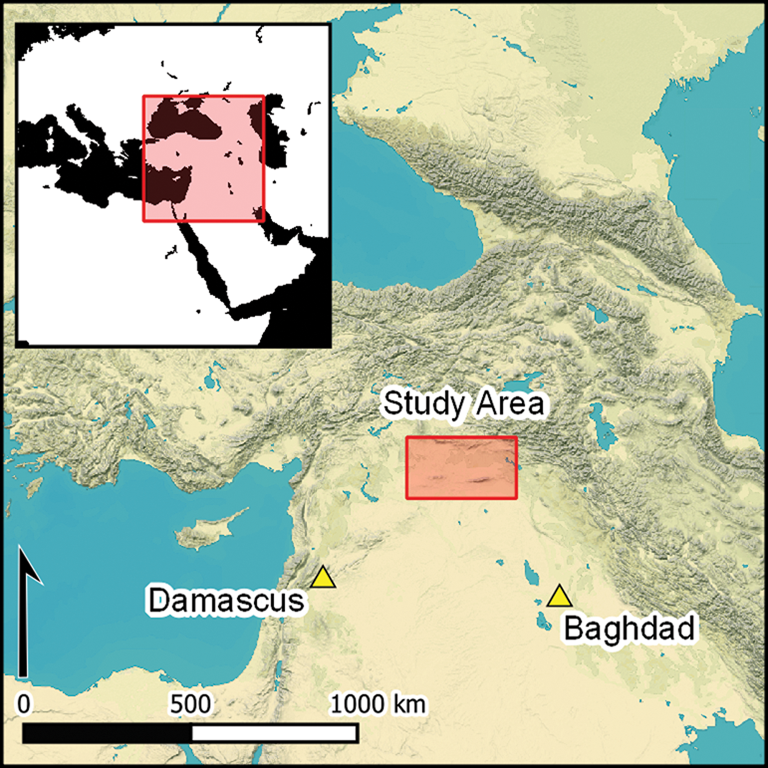
Map showing the location of the sites discussed. Base map from OpenStreetMap (openstreetmap.org; figure by A. Sołtysiak).

The scenario of a sudden, region-wide catastrophe that caused a massive depopulation of northern Mesopotamia has not been widely accepted by other archaeologists, who have raised a series of convincing counterarguments, starting with the mismatch between archaeological and palaeoclimatic chronological frameworks (Butzer & Endfield Reference Butzer and Endfield2012). Refinements in the pottery typology used for dating surveyed sites (see Pfälzner Reference Pfälzner and Höflmayer2017) have established that there was indeed a hiatus at some sites following the Akkadian period (for a regional chronology, see Table 1). At more than 20 archaeological sites in northern Mesopotamia, however, there is no evidence for such population discontinuity (Koliński Reference Koliński2011). Furthermore, even in cases where the population decreased and settlement patterns changed (e.g. Ur Reference Ur2010; Lawrence et al. Reference Lawrence2016), not all major regional urban centres followed the same trajectory. Tell Brak, for example, was reduced in size, and Tell Leilan was completely abandoned (Emberling et al. Reference Emberling, McDonald, Weber, Wright and Weiss2012), while Tell Hamoukar continued to flourish during the period of the purported drought (Ur Reference Ur, Kerner, Dann and Bangsgaard2015).
Chronology of northern Mesopotamia and definition of the four periods used in this article. Periodisation based on Oates et al. (Reference Oates, Oates and McDonald2001) and Pfälzner (Reference Pfälzner, Laneri, Pfälzner and Valentini2012). EBA = Early Bronze Age, MBA = Middle Bronze Age.

Although some local climatic deterioration during the 4.2 kya event is not contested, several authors have proposed more nuanced scenarios for the period following the fall of the Akkadian Empire. Wilkinson (Reference Wilkinson, Dalfes, Kukla and Weiss1997) argued that it was not the drought itself, but rather the exploitation of resources close to the limits of sustainability that made some local populations more vulnerable. In locations where agricultural output may have increased through the expansion of arable fields or by more intensive manuring, drought events had limited effects on population densities (Ur Reference Ur, Kerner, Dann and Bangsgaard2015; Cookson et al. Reference Cookson, Hill and Lawrence2019). Instead, they triggered a transformation in local forms of social organisation, resulting in adaptations to the new environmental conditions (Pfälzner Reference Pfälzner, Laneri, Pfälzner and Valentini2012, Reference Pfälzner and Höflmayer2017).
The zooarchaeological and archaeobotanical data provide no evidence for a catastrophic shift in local economies. Proportions of taxa in animal bone assemblages do not change significantly over time, except in rural settlements located in areas with annual precipitation lower than 300mm. In these latter areas, some moderate increase in ovicaprids at the expense of suids—suggesting drier conditions—has been observed. Most sites, however, show a clear continuity in animal husbandry patterns (Gaastra et al. Reference Gaastra, Greenfield and Greenfield2019), as illustrated by the assemblages at Tell Arbid, where a relatively high proportion of pig is documented throughout the third millennium BC (Piątkowska-Małecka & Smogorzewska Reference Piątkowska-Małecka and Smogorzewska2010), that is, both before and during the 4.2 kya event. The interpretation of the evidence at Tell Brak is less clear. One study suggests an increase in pig consumption during the Akkadian and post-Akkadian periods (Dobney et al. Reference Dobney, Jaques, van Neer and Matthews2003), while another indicates a relatively low proportion of pig during the same period (Clutton-Brock et al. Reference Clutton-Brock, Oates, Oates and McDonald2001)—a discrepancy that may merely reflect variability in dietary preferences between different social groups at this large site.
Nor does the megadrought hypothesis find support in studies of plant remains. At Tell Mozan there was a dramatic shift in the proportion of crops during the post-Akkadian period, when drought-resistant, two-row barley and emmer were replaced by less drought-resistant, free-threshing wheat, suggesting more humid conditions during that period (Riehl Reference Riehl, Deckers, Doll, Pfälzner and Riehl2010). Moreover, there is no archaeobotanical evidence of increased aridity before the beginning of the second millennium BC, when drought-resistant cereals again became more popular. Carbon stable isotope analysis of plant remains also indicates relatively humid regional conditions until the end of the third millennium BC (Riehl Reference Riehl and Höflmayer2017). Aggregated data on crop proportions suggest that relatively drier conditions prevailed only between c. 2150 and 2100 BC, and that the overall climate conditions for the last quarter of the third millennium BC were favourable to plant cultivation (Dornauer Reference Dornauer and Höflmayer2017).
Assuming that a megadrought event did not take place at the time of the fall of the Akkadian Empire and during the so-called ‘dark age’ in the twenty-second century BC, it is nonetheless clear from the available data that there was a population decrease in northern Mesopotamia (Lawrence et al. Reference Lawrence2016). The zooarchaeological and archaeobotanical evidence, however, does not reveal an economic crisis or changes in subsistence strategies typically associated with aridification. A higher proportion of drought-resistant crops (Riehl et al. Reference Riehl, Bryson and Pustovoytov2008), or an increased frequency of ovicaprids combined with a decline in pig breeding (Piątkowska-Małecka & Koliński Reference Piątkowska-Małecka and Koliński2006), is only observed at the beginning of the second millennium BC. Therefore, the pattern of human adaptation to political and social changes in northern Mesopotamia following the fall of the Akkadian Empire remains ambiguous.
To address this question, analyses of stable carbon (δ13C) and nitrogen (δ15N) isotopes in human collagen can be used to reconstruct past subsistence strategies. These isotopic proxies are particularly useful in assessing the contributions of different sources of dietary protein, such as cultivated crops or domesticated animals (Ben-David & Flaherty Reference Ben-David and Flaherty2012). Human isotopic shifts may also arise from changes in the isotopic signatures of consumed foods, which are in turn influenced by climatic or environmental factors (e.g. levels of aridity) and human, animal- and crop-management practices, such as manuring and irrigation.
In this article, we assess the degree of subsistence continuity or change in northern Mesopotamia before, during and after the 4.2 kya event, using carbon and nitrogen stable isotope measurements on human collagen extracted from 75 individuals buried at three archaeological sites located relatively close to each other in the central part of the Khabur Basin, between the modern Syrian cities of Al-Hasakah and Qamishli. The sites represent first- and second-rank Bronze Age urban centres (i.e. local kingdom capital cities and towns controlling smaller units within these kingdoms; cf. Smogorzewska Reference Smogorzewska2018), with long-term occupation and well-established archaeological stratigraphies. Our aim is to investigate whether any change observed in isotopic signatures relates to the chronology, location or rank of these sites.
Reconstructing subsistence using bone and tooth collagen δ13C and δ15N values
In the context of this study, it is particularly important to consider the distinction between C3 and C4 plant types, which have well-differentiated δ13C values resulting from major differences in their photosynthetic pathways (Cerling et al. Reference Cerling1997). C3 plants include the types of cereals and legumes cultivated in northern Mesopotamia during the Bronze Age. Animals feeding on such plants are also classified as C3, and humans consuming exclusively these food sources are expected to have bone collagen δ13C values of approximately −21 to −20‰ (van der Merwe Reference van der Merwe1982). While there is no evidence of direct human consumption of C4 plants, humans may have consumed dairy products and meat from animals grazed in the dry steppe, where some wild C4 taxa are relatively abundant in comparison to cultivated fields (Sołtysiak Reference Sołtysiak, Borrelli and Scazzosi2020). A full reliance on C4 food sources would produce human bone collagen δ13C values of approximately −7 to −6‰ (van der Merwe Reference van der Merwe1982). We do not consider potential marine protein contributions here, given the long distances between the investigated sites and the nearest coastlines.
The δ15N values of food sources vary according to their position within a food chain, with an approximately 3.5‰ increase along each trophic level (Hedges & Reynard Reference Hedges and Reynard2007). This serves as the basis for distinguishing between the protein contributions from terrestrial plant and animal food sources (Ben-David & Flaherty Reference Ben-David and Flaherty2012). We consider the consumption of freshwater fish unlikely here, given that the rivers in the Khabur Basin are mainly seasonal. Plant δ15N values, however, are also influenced by manuring practices and local precipitation levels. The latter has been shown to increase the δ15N value of herbivore bone collagen by approximately 1‰ for a reduction of ~50mm in mean annual precipitation (Shishlina et al. Reference Shishlina, Zazovskaya, van der Plicht and Sevastyanov2012), whereas manuring—depending on its intensity—may shift plant δ15N by several ‰ (Bogaard et al. Reference Bogaard2013). Therefore, variability in manuring intensity is the most likely factor contributing to the range of δ15N values observed in humans living in northern Mesopotamia (Styring et al. Reference Styring2017).
As the photosynthetic pathways of C4 plants are better adapted to low precipitation conditions, aridisation also leads to an increase of C4 plants among wild vegetation cover (Ben-David & Flaherty Reference Ben-David and Flaherty2012). Thus, a roughly positive correlation is expected between the δ13C and δ15N values of animals feeding on wild vegetation. Under a subsistence shift from plant cultivation to mobile pastoralism on Near Eastern steppes, an increase in human bone collagen δ13C and δ15N values is to be expected. If a prolonged megadrought took place during the 4.2 kya event, human δ15N and δ13C bone collagen values from sites in northern Mesopotamia would be expected to be significantly different from those of previous or subsequent periods.
Materials and methods
Stable isotope analysis was undertaken on skeletal assemblages from the sites of Tell Brak, Tell Barri and Tell Arbid, dating to the Early and Middle Bronze Ages in the Khabur Basin (Figure 1 & Table 1). At this time, Tell Brak was the capital city of the regional kingdom of Nagar. Among several hundred skeletons unearthed there (Sołtysiak Reference Sołtysiak2009), a sample of 35 has yielded sufficient collagen for analysis. Unfortunately, the analysis of Tell Brak is limited to the Early Bronze Age individuals because no Middle Bronze skeletons are present in this sample. Although considerably fewer skeletons have been excavated at Tell Barri (ancient Kahat, a second-rank urban centre located approximately 12km north of Tell Brak; Sołtysiak Reference Sołtysiak2010a), these are relatively better preserved, and 21 Early/Middle Bronze Age individuals are available for analysis. Tell Arbid, around 22km to the north of Tell Brak, was an Early to Middle Bronze Age provincial town, with excavation yielding more than 200 skeletons (Sołtysiak Reference Sołtysiak2010b). Poor preservation, however, means that only 19 samples are available for stable isotope analysis. The full dataset for Tell Arbid is included in the online supplementary materials (OSM; see also Sołtysiak Reference Sołtysiak, Pieńkowska, Szeląg and Zych2019). This dataset is compared with previously published data from Tell Brak (Styring et al. Reference Styring2017) and Tell Barri (Sołtysiak & Schutkowski Reference Sołtysiak and Schutkowski2015), according to the periodisation we have defined for these sites (periods A–D in Table 1).
After mechanically cleaning the bone or dentine samples, collagen was extracted using a modified Longin method (Brown et al. Reference Brown, Nelson and Southon1988). The filtered products were lyophilised, and a subsample of 0.4±0.1mg was combusted and analysed by Isotope Ratio Mass Spectrometry (Finnigan Delta Plus XL) in the School of Archaeological Sciences, University of Bradford, with an analytical precision of ±0.2‰ for nitrogen and ±0.05‰ for carbon isotopes. The accuracy and precision of the analytical methods were assessed using methionine as a standard reference material (Elemental Microanalysis, Devon, UK). Collagen yields of one per cent and more (van Klinken Reference van Klinken1999), as well as the C/N atomic ratio range between 2.9 and 3.6 (Ambrose Reference Ambrose and Sandford1993), were taken as quality references to assess bone and dentine collagen preservation. Measurements of carbon and nitrogen isotopic ratios are reported relative to the VPDB and AIR standards using the delta notation (δ13C and δ15N).
To determine whether differences in isotopic values in each subset (site and period) were significant, we employed the open-source R statistical software to perform a Kruskal-Wallis rank-sum test, followed by pairwise comparisons using a Wilcoxon rank-sum test, with multiple test correction using the Benjamini-Hochberg procedure (R Core Team 2013).
We also employed the Bayesian software ResSources, developed within the Pandora and IsoMemo initiatives (https://isomemoapp.com), to estimate the caloric contributions from C3 plants vs terrestrial animal products for the Tell Brak samples during periods A–C. For these periods we relied on previously published isotopic data from archaeological plant remains corrected for charring effects (n = 221, δ13C = −23.6±0.7‰, δ15N = 5.2±1.8‰) and from animal bone collagen (n = 5, δ13C = −19.2±1‰, δ15N = 7.4±1.6‰) (Styring et al. Reference Styring2017). The defined Bayesian model is equivalent to previous applications of the FRUITS Bayesian mixing model, and includes a description of dietary routing mechanisms and diet-to-consumer isotopic offsets, food macronutrient concentrations, and corrections for isotopic differences between edible macronutrients and measured isotopic values in food remains (Fernandes et al. Reference Fernandes, Nadeau and Grootes2012, Reference Fernandes2014, Reference Fernandes, Grootes, Nadeau and Nehlich2015). The model also includes the prior assumption that the caloric contribution from plant foods at Tell Brak was larger than that from animal foods (Styring et al. Reference Styring2017). The plant and animal data from Tell Arbid and Tell Barri, however, were insufficient for such analysis.
Results
The range in human δ13C values for all subsets across the different sites is relatively narrow, with most individuals falling between −20‰ and −18.5‰, indicating a diet based predominantly on C3 sources. Variability in δ15N values was higher, ranging from 7–11‰ for most individuals (Table 2 & Figure 2).
Average δ13C and δ15N human bone and tooth collagen values for the chronological periods at the three archaeological sites.

Distribution of human bone and tooth collagen δ13C and δ15N values at Tell Arbid, Tell Barri and Tell Brak. The ellipses represent 95 per cent confidence intervals for each subset. Also shown are the correlations between δ13C and δ15N values for each subset (figure by R. Fernandes).

Significant correlations between δ13C and δ15N values were observed for Tell Barri during period A and Tell Brak during period C (Figure 2). For the latter, however, the correlation results from the presence of an outlier with comparatively high δ15N and low δ13C values, whereas the data points for the remaining subset cluster closer together (the possible presence of a bimodal distribution is discussed below). Without the inclusion of the major outlier at Tell Brak during period C, no statistically significant correlation is observed (r = 0, p-value = 0.99). For Tell Barri during period A, the strong correlation suggests that the analysed individuals consumed a mix of C3 plants, with a variable share of products from animals that had a relatively uniform diet. A lack of correlation for the remaining subsets suggests that the observed isotopic variability is more likely to have resulted from the consumption of C3 plants subjected to varying levels of manuring (and thus with varying δ15N values) and from eating different amounts of products from animals whose diets were less uniform in the proportion of C3 vs C4 vegetation.
There were statistically significant differences for δ13C values across the various subsets (Kruskal-Wallis chi-squared = 22.6, df = 10, p-value = 0.012). Pairwise significant differences were observed between Tell Barri during period A and Tell Brak during period C (p-value = 0.03), and between Tell Barri during period A and Tell Arbid during period D (p-value = 0.03). For these pairwise comparisons, the average δ13C values were slightly lower at Tell Barri (Table 2). No other statistically significant pairwise differences were observed (Figure 3). As for the δ15N values, there are no statistically significant differences (Kruskal-Wallis chi-squared = 13.5, df = 10, p-value = 0.195) (Figure 3).
Box plots for human bone and tooth collagen carbon and nitrogen stable isotope values, according to chronological subsets. Boxes represent the interquartile range, whereas whiskers represent a distance corresponding to 1.5× of the interquartile range. The horizontal line represents the median, whereas the circles are the measurement values (figure by R. Fernandes).

The isotopic data for Tell Brak during period C suggest the presence of two possible distinct groups for δ15N values (bimodal distribution), given the presence of three individuals at the higher extreme of the 1.5× of the interquartile range plus one major outlier (Figure 3). Separate Bayesian dietary estimates were generated for low (δ15N = 7.7±0.6‰, δ13C = −19.1±0.3‰) and high (δ15N = 10.0±0.1‰, δ13C = −19.1±0.3‰, major outlier excluded) modes. Figure 4 shows the Bayesian estimates for the caloric contributions from C3 plants and terrestrial animal products during periods A–C at Tell Brak. Period C is further subdivided into estimates for low (I) and high (II) modes of the potential bimodal distribution. All estimates show a clear predominance of plant caloric contributions, although the 95 per cent credible intervals for the estimates have a wide range, reflecting the uncertainty in food values resulting from varying environmental and human effects (e.g. varying intensities of manuring). Plant caloric intakes were approximately above 65 per cent for the lower end of the 95 per cent credible interval for Tell Brak B and Tell Brak C II, but above ~80 per cent for Tell Brak A and Tell Brak C I. In all cases, the upper end of the 95 per cent confidence intervals for estimates of plant caloric intakes reaches or nearly reaches 100 per cent.
Bayesian caloric estimates for Tell Brak during periods A–C. Period C is divided into estimates for low (I) and high modes (II) of a possible bimodal distribution for human collagen δ15N values. Boxes represent a 68 per cent credible interval, while whiskers represent a 95 per cent credible interval. The horizontal lines represent the mean estimate, whereas the dotted horizontal lines represent the median estimates (figure by R. Fernandes).

In summary, period C, which corresponds to the 4.2 kya event, does not differ significantly from previous or subsequent periods at any of the sites. Diets were dominated by caloric contributions from C3 plants, although uncertainties in food isotopic values preclude precise estimates.
Discussion
Although the sample sizes are small for most subsets, and isotopic measurements in contemporaneous animal bones or cereal grains are only available for Tell Brak, the isotopic evidence is sufficient to show that no dramatic shifts in subsistence occurred in the Khabur Basin during the 4.2 kya event. There is no evidence for a megadrought, as suggested by Weiss (Reference Weiss2016), nor for any major re-orientation of the local economy following the fall of the Akkadian Empire. The comparison of Tell Brak during period C with Tell Barri during period A provides the only indication of a slight (but significant) difference in δ13C values that may have been a consequence of a wider exploitation of dry steppes for pasturing at Tell Brak.
A shift towards higher δ13C values has been observed in modern Bedouins living around the Middle Euphrates Valley (Sołtysiak & Schutkowski Reference Sołtysiak and Schutkowski2018), but also during the transition from the Middle to the Late Bronze Age at Tell Barri (Sołtysiak & Schutkowski Reference Sołtysiak and Schutkowski2015), suggesting that mobile pastoralism became more important for the local economy. This should not, however, be considered as a necessary consequence of drier climatic conditions, as the comparison is made between sites of different status and no significant difference was observed for δ15N values. Lower precipitation may, however, be one of the factors pushing herders beyond the close vicinity of cultivated fields.
Only at Tell Barri during period A is a strong correlation between human collagen δ13C and δ15N values observed. It therefore seems that subsistence at Tell Barri during period A was characterised by dietary caloric contributions from two well-defined isotopic end members: plant-derived products with comparatively lower δ13C and δ15N values and animal-derived products with comparatively higher δ13C and δ15N values. By contrast, the relatively high variability in δ15N values observed at other sites—with no significant correlation with δ13C values, nor with clear temporal differences that could suggest a climatic change—probably reflects the effects of variable manuring intensity, combined with varying dietary contributions from plant and animal products. Other than Tell Brak during period C, only Tell Arbid during period D showed a significant difference in δ13C values when compared with Tell Barri during period A. Acknowledging the small sample size, this may reflect a gradual shift from a practice of stationary animal husbandry to a more mobile form of pastoralism specifically at Tell Arbid that exploited steppe areas. In this respect, the archaeological and archaeobotanical evidence at this site shows a gradual decrease in settlement size and an increase in the use of drought-resistant barley at the expense of wheat (Smogorzewska Reference Smogorzewska2018); barley has slightly higher average δ13C values than wheat (Lightfoot & Stevens Reference Lightfoot and Stevens2012). Thus, the combined evidence from Tell Arbid suggests a gradual transition towards a broader economy accompanied by a decrease in population size. This process, however, started centuries before the 4.2 kya event.
Finally, at Tell Brak, Bayesian estimates show the clear predominance of caloric contributions from plant foods during periods A–C (Figure 4). The credible intervals for caloric estimates are wide due to broad uncertainties for food values caused, for instance, by variability in crop manuring. A possible bimodal distribution for δ15N values in the period C subset does allow for lower caloric contributions from plants and higher contributions from animal products for a small number of individuals with elevated δ15N values. There is, however, considerable overlap in Bayesian dietary estimates for lower and higher δ15N individuals. Thus, it is also possible that individuals with higher δ15N values were consuming larger quantities of plants that had been manured more intensively. While lower precipitation may also elevate plant δ15N values, we should note that the majority of the individuals from Tell Brak period C had comparatively low δ15N values. Furthermore, the skeletal remains of most of these individuals were retrieved from a large pit containing mixed, disarticulated human and animal remains and some pottery sherds (Sołtysiak Reference Sołtysiak2009). It is therefore possible that the skeletons may represent a mix of populations, which may include non-locals or people buried in an earlier period, and potentially subject to different precipitation conditions and practising different levels of manuring. Period C at Tell Brak witnessed a decrease in population. This could be paralleled by a hypothetical decrease in manuring intensity, which would explain the lower δ15N values observed for most individuals; individuals with higher δ15N values may have migrated to the site. Future research should test this hypothesis by sampling more individuals and by including other isotopic proxies to investigate human mobility patterns.
Conclusions
Our isotopic analysis of human collagen from three sites in the Khabur Basin shows no evidence to support the hypothesis of a megadrought during the 4.2 kya event, nor of any major and widespread transformations in subsistence strategies during the late third and early second millennia BC. A few lesser temporal differences are apparent in the δ13C values, the only specific effect being a possible bimodal distribution of the δ15N values at Tell Brak during period C. Overall, our dataset shows a lack of significant isotopic differences between the periods defined at Tell Arbid, Tell Barri and Tell Brak. It therefore seems that, even if a political crisis followed the fall of the Akkadian Empire, the local populations in northern Mesopotamia found ways of coping with its economic consequences, largely retaining their previous subsistence strategies.
Our research indicates that people living in a region where high precipitation variability increased the instability of agriculture were capable of adaptations that made them resilient even to a major climatic shift during the Holocene, to such an extent that no traces of change in subsistence is recorded in their stable carbon and nitrogen isotopes. While we detected some indications of drier climatic conditions, the absence of evidence of a megadrought during the 4.2 kya event suggests that dry farming agriculture in ancient northern Mesopotamia was a sustainable subsistence strategy. Such resilience, be it following a political crisis or in changing climatic conditions, may inspire those engaged in sustainable agriculture in arid conditions today.
Acknowledgements
Many thanks are due to Raffaella Pierobon-Benoit (the excavator of Tell Barri), to Joan Oates, Augusta McMahon and Geoff Emberling (the excavators of Tell Brak), and to Piotr Bieliński and Rafał Koliński (the excavators of Tell Arbid), for their support of the bioarchaeological research at these sites. We also gratefully acknowledge Andy Gledhill for the isotope measurements.
Funding statement
The research has been financed by the Polish National Science Centre (Narodowe Centrum Nauki; grant 2012/06/M/HS3/00272).
Supplementary material
To view supplementary material for this article, please visit https://doi.org/10.15184/aqy.2021.117


 Open access

