

Introduction
On May 17, 2022, Georgia Representative, Marjorie Taylor Greene, posted a video of herself giving a speech on the social media platform, Twitter (rebranded as X in 2023). Along with the video, in which Greene speaks about abortion laws, she wrote, “The greatest choice a woman can make is becoming a mother” (Greene Reference Greene2022). In reference to classroom discussions around sexuality, Colorado Representative, Lauren Boebert, wrote, “I’m a mother of four boys. The Far Left seriously needs to cut this grooming bullcrap out because us parents have SERIOUSLY had enough!” (Boebert Reference Boebert2022). As the most vocal and visible women in the United States Congress who espouse QAnon beliefs, both Greene and Boebert also illustrate a common tool of far-right groups for recruiting women: motherhood.
Typically, it is thought — or simply assumed — that men participate in far-right organizations and engage in conspiracism at much higher rates than women (Harteveld and Ivarsflaten Reference Harteveld and Ivarsflaten2018). Recent research gives us cause to rethink this assumption, showing that women frequently and intentionally participate in far-right political movements. Further, they can act within traditional gendered roles or become leaders within far-right movements despite gendered norms against such leadership (Belew Reference Belew2019; McRae Reference McRae2018). QAnon is no exception to this rule.
Since its inception in 2017, QAnon has enjoyed increasing number of women agreeing with QAnon rhetoric and identifying as active members. Not as formally structured as an NGO or nationally active social movement, QAnon combines conspiracy theory and an emphasis on local, individual participation to create a de-centralized movement with adherents to its ideology and activists across all levels (Rothschild Reference Rothschild2021). Recent research suggests that the rhetoric chosen by QAnon supporters around children matters a great deal to whether women identify with the conspiracy group, as some women joined to address child trafficking, not necessarily far-right radicalism (Moskalenko et al. Reference Moskalenko, Pavlović and Burton2024). We explore this phenomenon by examining the motherhood rhetoric of QAnon in its #SaveTheChildren campaign and argue that the conspiracy group deliberately employs “motherhood frames” in its anti-trafficking materials to recruit more women to the group. Furthermore, the group couples these frames with the serious issue of global child trafficking to directly tie motherhood to children in imminent danger and thus increase the sense of urgency for members to become involved.
We use an original survey experiment to test our arguments and find some interesting mixed results. We do not find that women are more likely to be susceptible to QAnon motherhood rhetoric, or that these narratives are more effective at recruiting people than NGO narratives overall. However, we do find that people in the United States are drawn to QAnon anti-trafficking materials at least as much as those from Polaris, the top anti-trafficking group in the US, and much of this could be due to the appropriation of child trafficking as a recruiting tactic. We also show that QAnon’s appropriation of the child trafficking cause as a tool for recruiting members has a deleterious effect on legitimate anti-trafficking efforts and serves as a kind of “bait and switch” for bringing members into the conspiracy group, even though the group does not actively participate in any anti-trafficking efforts beyond spreading misinformation via these materials (Polaris 202).
Ultimately, these anti-child trafficking campaigns from QAnon are effective enough that the public sees QAnon information as equivalent to information from legitimate anti-trafficking organizations. While we focus this project on the United States, given that it is the origin country of the QAnon movement and where the group is most prolific, we believe further examination of these empirical connections is warranted beyond the US QAnon is becoming a widespread movement in other parts of the word, including Germany, Japan, Australia, Canada, and parts of Western Europe. This is particularly true among people who support similar far-right conspiracy groups in these countries and highlights the powerful nature of these messages (Farivar Reference Farivar2020). We hope that further research in this area will continue to explore the complexities of gendered rhetoric and populist movements beyond the United States.
We begin our paper by exploring the literature around gender/sex issues and far-right ideologies, noting the critical yet often overlooked role of women in these commonly conservative movements. We then discuss the creation and implementation of the “motherhood trope” in the QAnon movement and its relationship to the efforts of the non-profit organization, Save the Children, to combat child trafficking around the world, tying together the previous work on this issue and our theoretical expectations for our study. Next, we describe our research design in detail and provide preliminary statistics on our original survey experiment. We then describe our findings and finally discuss our mixed results and our conclusions for this project.
Ultimately, we conclude that while the direct effects of the “motherhood trope” on QAnon believers are difficult to discern, the general impact of QAnon messaging on average Americans is quite strong. Given the current political environment around disinformation and violence, we believe our findings provide a preliminary foundation for further research into the effectiveness of QAnon messaging and hope we encourage academics and practitioners to develop similar unique survey instruments to continue to identify the linkages between identity and belief that fuel groups like QAnon.
Women of the Far Right
Women have played an important role in far-right movements for decades. While the term “far right” is sometimes differentiated from the term “alt-right,” we agree with Blee (Reference Blee2021) that the two terms are under the same ideological umbrella and are therefore interchangeable. As Jeansonne (Reference Jeansonne1996) notes, women of the far right played a pivotal role in the “Mother’s Movement” during World War II. This loose contingent of women in the United States vehemently opposed the Roosevelt administration’s social spending including the New Deal program. Darby (Reference Darby2020) charts the role of women in various white nationalist groups on the far right, noting that white nationalist groups rewarded women for becoming mothers. The Aryan Women’s League (AWL), the Nazi Party, the Ku Klux Klan (KKK), and others handed out monetary and physical awards, medals, government recognition, and other benefits throughout history to women who gave birth to white children or led the movement in ways that impacted children through schoolbooks, marches at schools, and involvement in school boards.
Women’s roles in the far-right are shaped by the gendered structure of far-right groups. Men are the strong majority in such groups in the United States and around the world. While women certainly join the far right, their roles are purposefully constructed to be below those of men in hierarchical structures. Some of this hierarchy comes from the embedding of Christianity into many far-right groups. The Mother’s Movement was certainly a Christian group, and the KKK, the AWL, the Nazi Party, and QAnon have all placed Christianity at the center of their group ideologies (Jeansonne Reference Jeansonne1996).
Christianity is hierarchical via gender order as men are placed above women in all areas of public and private life. Furthermore, “Christianity played a prominent role in shaping the mothers’ commitment to capitalism, country, and traditional families…they were charged with passing their religious faith on to successive generations. They believed Christianity defined Americanism and was essential to the nation’s destiny” (Jeansonne Reference Jeansonne1996, 8). Yet another aspect of far-right groups that is appealing to women is the decentralized nature of such groups. Women are drawn to decentralized organizations because they allow women to be involved without sacrificing time away from home and family, something critical to women who align with the beliefs of far-right groups (Blee Reference Blee2021).
Restriction from the highest levels of the far-right hierarchy has not precluded women from having a powerful role in these organizations, particularly in the areas of ground-level mobilization, creation of mobilizing narratives, and ideological innovation. Further, many far-right female leaders have criticized male-dominated political hierarchies from the right. In the case of organizing opposition to racial desegregation in the United States, McRae (Reference McRae2018) found that white women frequently avoided involvement in mainstream right-wing party politics, as these women believed that male political leaders were insufficiently committed to protecting white women and children and were more interested in national political posturing than the ground-level work of maintaining white supremacy.
Moreover, as religious extremism movements retrench social norms, or further their efforts at “retraditionalization,” women in traditional roles, such as mothers, can play a role in far-right extremist movements which “have little room for consideration of LGBTQ equality” (Perry Reference Perry2021, 170). While much ink has been spilled in an effort to model, understand, and mitigate men’s interest in joining extremist and terrorist groups, it is imperative to counter-radicalization to also understand that women’s interests in joining these groups diverge. As Windsor (Reference Windsor2018, 8) notes:
Men and women face different motivations for participating in high-risk behavior, and women’s involvement stems from intimate and closely held reasons. Women’s participation as active combatants generally takes place when they have experienced personal losses that invalidate their primary roles in society as caregivers, like losing husbands or other family members. Under these circumstances they can approach the battleground’s front lines.
In other words, traditional roles impact the radicalization of women, whether because of them or due to losing them. It is no wonder, then, that women were often radicalized into QAnon due to fears tied directly to motherhood and losing or protecting children.
Furthermore, the role of women as recruiters of other women into right-wing extremist groups is a subject that is understudied. As noted elsewhere in this work, women typically are (mis)understood to be passive, often reluctant participants in extremist rhetoric or violence. Rather, emerging scholarship illustrates that women are often key recruiters of other women into these movements (see Mattheis Reference Mattheis2018). Mattheis, in focusing her study primarily on Lana Lokteff, an influential woman in the European and US alt-right movement, notes that rhetoric is tied specifically to the traditional roles that women play. Lokteff, for example, in a popular YouTube video, extols the power and duty of women, who “…honor family and home but occasionally … have to pick up a sword and fight in emergency situations” (Lokteff, as quoted in Mattheis Reference Mattheis2018, 140; emphasis in Mattheis).
Indeed, Lokteff’s call to women to “pick up a sword” illustrates that the primary purpose of terrorism does not differ much, regardless of gender roles. As Hoffman (Reference Hoffman2017) notes, “…the terrorist is not pursuing purely egocentric goals.” Instead, “the terrorist is fundamentally an altruist, … serving a ‘good’ cause designed to achieve a greater good for a wider constituency” (39; emphasis in original). Women, then, may be internally compelled to “pick up a sword” and fight — especially when the cause (such as an assumed global cabal of pedophiles in the case of QAnon) preys upon those they must protect. As Rothschild argues, QAnon is based on “messianic violence” (Rothschild Reference Rothschild2021; Reference Rothschild2022). This vision of a battle of good versus evil is especially dynamic in Christian-based extremist movements. Hoffman (Reference Hoffman2017) strikes a clear chord in suggesting that “…the lunatic and far-fetched Millerarian views of American Christian white supremacists appear to be profoundly theological treatises” (250).
Though strict gendered roles in far-right groups can cause conflict at times, with women as a whole less likely to support conservative social agendas that openly espouse prejudice than men (Harteveld and Ivarsflaten Reference Harteveld and Ivarsflaten2018), such specific, binary categorizing of men and women is appealing to many conservative women. Traditional gendered ideas about women as homemakers, compassionate healers, mothers, and wives encourage women to join such groups based on the perception that such traditional roles are under “attack” by those on the left and must be “protected” by women on the right. Not only do women on the right feel the need to protect such roles, but they tend to embrace those traditions as a point of pride or a badge of honor as they interact with others in and around their conservative communities (Schreiber Reference Schreiber2016). Mattheis has dubbed the term “alt-maternalism” to highlight the manner in which traditional roles have been co-opted and utilized to further pair far-right views of maternalism “with anti-multiculturalism, white ethno-nationalism, and hate frameworks” (Mattheis Reference Mattheis2018, 143).
While other traditional gendered roles matter to women joining far-right groups, as noted above, perhaps the most critical role to women in such groups is that of the mother. In her seminal work on the women of the Tea Party, Deckman (Reference Deckman2016) develops the “motherhood frame” to conceptualize the motivations and behaviors of women on the far right. She identifies three frames commonly used by women of the Tea Party, but which can easily be applied to women of other similar groups. The first frame of motherhood is that of the “kitchen table conservative” in which the mother is expected to balance both the family budget and the budget of the nation. She is encouraged to enter politics as a sound voice of reason who quietly but firmly puts the family and the country “back on track” to fiscal conservative values.
The second frame is that of the mother who works to reduce the debt burden for the nation and future generations. The mother is encouraged to become a political voice for protecting children from the kind of government spending that former governor of Alaska and vocal Tea Party member, Sarah Palin, referred to as “generational theft.” The final frame is that of the mother who fights for reduced power in the government and lower taxes to ensure that the family remains the primary decision-maker and provider for the children (Deckman Reference Deckman2016). Each of these motherhood frames is critical to understanding the strong mothering rhetoric around far-right groups and the political positions taken by women within such groups.
Our focus here on the far right and white supremacy does not imply that motherhood narratives are only present on the far right. There is a long and rich literature on these same narratives being used in movements for Black liberation. Black women have relied on these narratives to oppose white supremacist conceptions of motherhood and its long-running portrayal of Black women as unfit mothers (Collins Reference Collins2000; Story 2014). These narratives use motherhood, but their content is distinctly different.
For example, the moral authority of motherhood is used to add legitimacy to anti-racist social justice claims and to push back against narratives that frame Black children as criminals (Ayee et al. Reference Ayee, Johnson Carew, Means, Reyes-Barrientez and Sedige2019). These are important distinctions that further highlight that the version of white motherhood currently used by QAnon and other far-right movements have their relatively recent roots in backlash to the New Deal and Civil Rights eras (Darby Reference Darby2020; McRae Reference McRae2018). As recently argued by Bracewell and Daily (Reference Bracewell and Daily2024), there is nothing monolithically conservative about motherhood or the use of motherhood narratives in political advocacy. We simply focus on these narratives as used by QAnon.
The “Motherhood Frame” and QAnon’s #SavetheChildren
These motherhood frames can be applied to each and every far-right group already mentioned but are particularly salient for understanding the women of QAnon. QAnon is a far-right organization of individuals who fundamentally believe that a secret cabal of pedophile Democrats is abusing and trafficking children around the world. The group came about on obscure internet websites dedicated to far-right rhetoric such as 4-chan and 8-chan in the fall of 2017.
An anonymous user known as “Q Clearance Patriot” began posting cryptic messages about the “Calm Before the Storm,” claiming to have top US government security clearance that allowed them access to deep secrets unknown to the wider population. The user continued to make random posts or “Q drops” as the followers increased. “These beginnings laid the groundwork for the role that online influencers would play in the QAnon community, with a litany of blog posts, YouTube videos, and podcasts released that provided explainers of ‘Q drops’” (Thompson and Thomander Reference Thompson and Thomander2021).
Although QAnon beliefs are highly syncretic, adopting and adapting any mildly popular conspiratorial idea, the core issue for Q followers has been the possible secret cabal of pedophiles harming children. This is influenced by the long history of anti-Semitic “blood libel” conspiracism in the US and European politics (Rothschild Reference Rothschild2021). QAnon’s modern iteration of the blood libel began with the “Pizzagate” conspiracy in which the group connected Hillary Clinton to a pizza parlor in Washington, D.C., and alleged that Clinton and her cabal were keeping children in a non-existent basement under the restaurant. QAnon found that its posts became most interesting to followers when the threat of harm to children was elevated (Greenspan Reference Greenspan2020; North Reference North2020; Jipson Reference Jipson2025). Soon, the group began to believe that Wayfair, an online furniture retailer, was selling children online and shipping them inside expensive cabinets to places around the world. The conspiracy theory went viral on the internet and resulted in financial losses as well as countless threats to Wayfair and its employees. After Wayfair, the group moved on to appropriation of the group, Save the Children.
Save the Children is a long-time, legitimate non-governmental organization (NGO) with the goal of returning home lost children around the world. The organization has been operating for decades and maintains an online presence, as most other major organizations do. The appropriation of Save the Children by QAnon began in August of 2020, when suddenly the hashtag #SavetheChildren gained a sixtyfold increase in weekly online engagement. “QAnon followers hijacked hashtags such as #SaveTheChildren and #EndHumanTrafficking, and non-followers who had their interest in the issue piqued by the Wayfair story began using those same hashtags and so, inadvertently, became connected with QAnon…community leaders struggled in the summer of 2020 with members of their communities growing obsessed with child sex trafficking conspiracies and rapidly becoming QAnon followers” (Polaris 2021, 8).
Because of its connection to issues around pedophilia and at-risk children, QAnon easily appropriated the anti-trafficking campaign of Save the Children and even began to accuse the group of trafficking in children themselves. Soon, Q drops were consistently filled with accusations against several anti-trafficking groups and claims that only QAnon followers held the true information about trafficking that could set children free. This kind of malevolent misinformation campaign has had real consequences for legitimate anti-trafficking efforts. A study by Polaris, the largest and most respected anti-trafficking group in the United States, found that the group lost countless hours and massive resources trying to address the baseless attacks by QAnon on Wayfair. Polaris estimated that the time and effort spent trying to debunk the misinformation peddled online by QAnon cost Polaris resources that might have been spent on at least 42 real trafficking cases (Polaris 2021).
The combined hyper-awareness of #SavetheChildren coupled with the insidious, malignant recruitment efforts of QAnon had the impact of frequently leading to notably rapid radicalization, especially of women. One such example is Jessica Prim, a 37-year-old dancer from Peoria, Illinois. Prim was arrested attempting to approach the USNS Comfort, a naval hospital sent to New York City to provide care in the early COVID-19 pandemic. Despite its mission, “QAnon followers thought the USNS Comfort was being used to rescue children from the ‘cabal.’ According to her social media posts and video livestreams as she headed to New York City, Prim alternated between believing this and that the children may be being held hostage on the ship” (Amarasingam and Argentino Reference Amarasingam and Argentino2020, 41).
An especially noteworthy aspect of this instance is that Prim appeared to find QAnon online and drove to New York to “rescue” the children on the Comfort less than three weeks apart. To be sure, Prim had a history of concern about sex trafficking conspiracy theories. However, upon finding QAnon, she shared a documentary focusing “…on QAnon claims about a global child sex trafficking ring…and posted about a wide range of related conspiracy theories regarding sex trafficking rings” (Amarasingam and Argentino Reference Amarasingam and Argentino2020).
Following observations of the role of women and motherhood narratives in past far-right movements, similar narratives appearing in the #SavetheChildren conspiracy, and the prevalence of women in QAnon, we develop several hypotheses to test how motherhood narratives function to attract women to the group.
The use of motherhood narratives is expected to increase interest in general because these narratives activate respondents’ concerns about protecting children and highlight the inherent vulnerability of children. Respondent interest in addressing human trafficking should also increase when motherhood narratives are used because the patriarchal construction of American culture grants expertise and weight to issues of child-rearing to women and mothers. By linking motherhood and mothers with QAnon conspiracism about child-trafficking, the group can borrow the “legitimacy” associated with mothers and motherhood around issues of child protection.
Hypothesis 1: Respondents who are exposed to QAnon messaging around motherhood and children will be more likely to show an increase in level of interest in addressing human trafficking than those who are not.
Additionally, we expect female respondents to be more likely to support anti-trafficking messages that reference motherhood because these individuals are those most expected to be mothers who have internalized the expectations and norms of that role. As Uscinski and Parent (Reference Uscinski and Parent2014) observe, those who have a personal identification with or stake in the narrative of a conspiracy are most vulnerable to and most likely to commit to that conspiracy, so we expect this link to be especially potent.
Hypothesis 2: Female survey respondents will be more likely to support anti-trafficking messages that contain references to motherhood and children, like those made by QAnon, than NGO anti-trafficking messages that do not.
Research Design
To test our hypotheses, we developed a unique experiment using anti-trafficking messages from the anti-trafficking group Polaris and the far-right conspiracy group QAnon to gauge respondent support for messages that use motherhood framing over those that do not. We adopt the “experimental investigations” model of Iyengar et al. (Reference Iyengar, Peters and Kinder1982) to test our hypothesis that women respondents will be particularly responsive to messaging involving motherhood and children. This experimental method provides an opportunity to establish cause-and-effect relationships in social science research, and we built our survey design with this goal in mind (Druckman et al. Reference Druckman, Green, Kuklinski and Lupia2006).
Survey Design
We designed a unique online survey experiment with a population of randomly selected individuals who were United States citizens and at least 18 years of age at the time of the survey. The survey was approved by the Institutional Review Board (IRB) through IRB#H23127. The survey was created using Qualtrics software and all information including respondent identifiers was stored using a secure server to protect the anonymity of respondents. The sample was generated using Amazon’s Mechanical TurkFootnote 1 software which randomly selects individuals within the above guidelines via a pool of available Human Intelligence Tasks (HITs) open to internet users. 1,119 total respondents opened the survey between April 6 and April 9, 2023. The 986 respondents who fully completed the survey make up our sample.
The survey included a set of pre-prompt questions used to establish a baseline of knowledge about QAnon and gendered and political identities and beliefs. Each respondent was then randomly assigned to a control prompt or one of three experimental prompts. Many of our questions ask respondents to record how they feel about certain statements, such as “How confident are you that anti-child trafficking advocacy and support groups, such as Polaris, are interested and effective at preventing child trafficking and punishing child traffickers?” on a zero-to-ten Likert scale. Each of these questions informs respondents that a zero indicates “no confidence” or “no knowledge” and a ten indicates “strong confidence” or “strong knowledge.” All survey questions and their associated directions and scales can be found in the appendix.
Our control prompt contains excerpts from a blog post made by the NGO Polaris. It provides basic introductory information on the issue of child sex trafficking and contains several simple ways individuals can assist. Full text of the prompt and a link to the full blog post are in Figure 2 of the Appendix; 243 respondents were randomly assigned this prompt before proceeding to the post-prompt portion of the survey.
We develop three different experimental prompts, replicating different styles of QAnon rhetoric, and compare these responses to those of the control prompt from Polaris. Experimental Prompt One provides direct social media postings from QAnon, otherwise known as “Q-drops,” that address child trafficking and use common motherhood frames. This represents what a person was likely to encounter if they were active on 4-chan or 8-chan (the sites where “Q” first appeared) directly involved in following the day-to-day developments of QAnon. While cryptic and obtuse, the work of interpreting these drops led to the construction of later QAnon narrative and allowed readers to build their own narratives as they interpret the posts (Rothschild Reference Rothschild2021). The full text for this prompt is in Figure 3 of the Appendix; 257 respondents were randomly assigned this prompt.
The second experimental prompt contains quotes from the Wayfair furniture company conspiracy that originated from QAnon followers and primarily spread via Reddit and Twitter posts. This particular conspiracy narrative spread in different online communities and reached a different audience than the Q-drops. It also employs more direct narratives of child protection than the Q-drops and therefore may have a different effect than the more ambiguous Q-drops (Save the Children post 2020). The full text for this prompt is in Figure 4 of the Appendix; 239 respondents were randomly assigned this prompt.
Our final experimental prompt contains text from an Instagram post made by a QAnon supporter that utilizes the “#savethechildren” hashtag appropriated from legitimate anti-trafficking NGOs (Instagram Post 2020). This post and prompt are the least overtly conspiratorial in their narrative and most closely mimic the advocacy of legitimate NGOs. It is framed as a list of simple (but false) facts about the extent of child trafficking in the United States with a call to action for individuals. The full text of the prompt is in Figure 5 of the Appendix; 247 respondents were randomly assigned this prompt.
After each respondent read their randomly assigned prompt, they completed a set of post-prompt questions to allow us to measure potential changes in respondent feeling and desire for action. It also allows us to compare how the different styles succeed or fail to mobilize more support than statements by legitimate anti-trafficking NGOs.
As part of the pre-prompt survey, we asked respondents several questions related to our hypotheses. First, we asked for their assigned sex at birth and current gender self-identification. As a result, when we refer to men or women in our results, we are referring only to those cisgender men and women whose assigned gender at birth matches their self-expressed gender identity. Second, we ask respondents whether they are parents or guardians to any children under 18 because the reality of parenthood may affect receptiveness to QAnon motherhood and child protection narratives, although we do not directly examine this reality in this paper. We also ask respondents about their political party identification (e.g. Democrat vs. Republican) and, to get more detail on a respondent’s beliefs, their identity along a left-right political spectrum.
To measure how familiar our respondents are with QAnon we ask two questions. First, we ask a simple “yes, no, unsure” question about whether the respondent has simply heard of QAnon in any way. We also ask respondents to self-identify how much they believe they know about QAnon on a ten-point scale, where 0 refers to having no knowledge and 10 refers to those who consider themselves to have extensive knowledge or actively follow QAnon.
Later in the pre-prompt survey we collect information about adverse life experiences. While it is far from a guarantee, recent research on conspiracism and willingness to engage in violent political activity has found links with adverse life experiences such as physical abuse, social isolation, or sudden unemployment. Such experiences may make someone react strongly to the dramatic narratives found in QAnon and those with these experiences may be more vulnerable to conspiracist thinking and undertaking extreme actions inspired by those conspiracist narratives (Clemmow et. al. Reference Clemmow, Gill, Bouhana, Silver and Horgan2020; Hamm and Spaaij Reference Hamm and Spaaij2017; Silver, Karakurt, and Boysen Reference Sliver, Karakurt and Boysen2015; Uscinski and Parent Reference Uscinski and Parent2014). The full list of adverse experiences can be found in Questions 21 and 24 of Figure 1 of the Appendix.
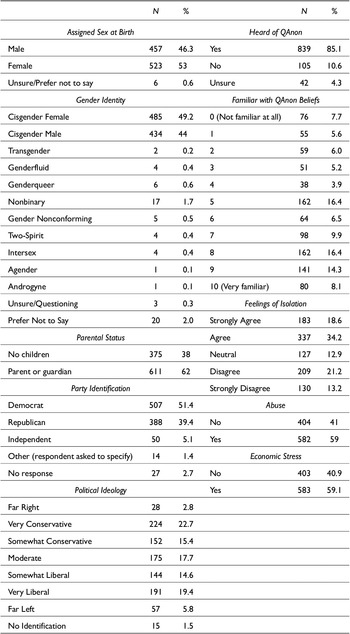
Table 1 contains the summarized background information for our respondents. Our respondent sample skews slightly more female than male, with a majority (62%) being parents. Ideologically, while 51% of our sample identifies as Democrat, identification as liberal or conservative is roughly even. Unsurprisingly, given its wide coverage in the media, 85% of our respondents have at least heard of QAnon, while 55% considered themselves familiar with QAnon (those who rated their level of familiarity above a 5 out of 10). Approximately 52% of our respondents considered themselves more isolated than the rest of the population, while 59% reported experiencing abuse or economic stress.
Respondent identities (N = 986)
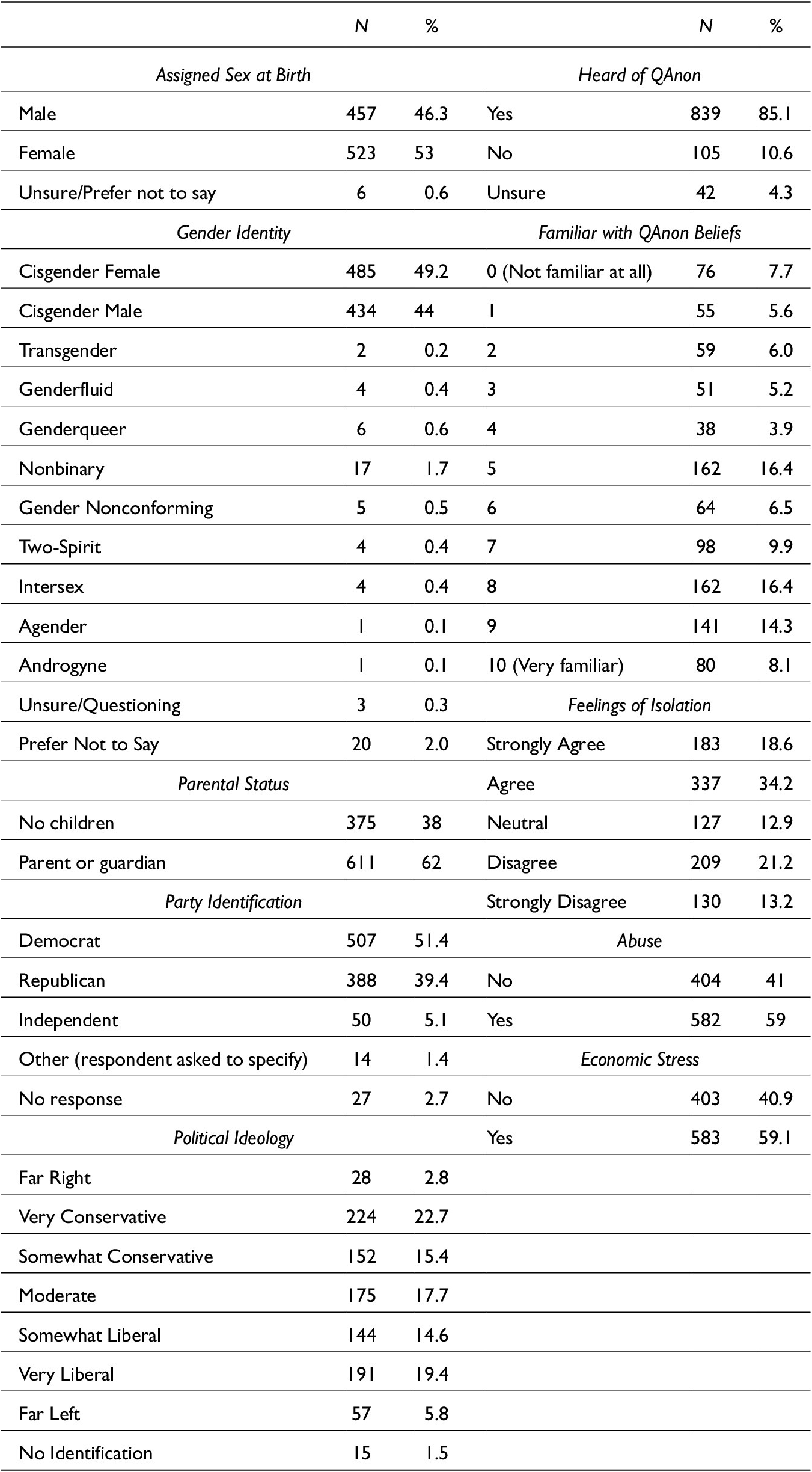
Table 1. Long description
Starting from the top, the table is divided into paired columns for each variable. The first section, Assigned Sex at Birth, lists Male 457 (46.3 percent), Female 523 (53 percent), Unsure/Prefer not to say 6 (0.6 percent). Heard of QAnon: Yes 839 (85.1 percent), No 105 (10.6 percent), Unsure 42 (4.3 percent). Next, Gender Identity: Cisgender Female 485 (49.2 percent), Cisgender Male 434 (44 percent), Transgender 2 (0.2 percent), Genderfluid 4 (0.4 percent), Genderqueer 6 (0.6 percent), Nonbinary 17 (1.7 percent), Gender Nonconforming 5 (0.5 percent), Two-Spirit 4 (0.4 percent), Intersex 4 (0.4 percent), Agender 1 (0.1 percent), Androgyne 1 (0.1 percent), Unsure/Questioning 3 (0.3 percent), Prefer Not to Say 20 (2 percent). Familiar with QAnon Beliefs: 0 (Not familiar at all) 76 (7.7 percent), 1 55 (5.6 percent), 2 59 (6 percent), 3 51 (5.2 percent), 4 38 (3.9 percent), 5 162 (16.4 percent), 6 64 (6.5 percent), 7 98 (9.9 percent), 8 162 (16.4 percent), 9 141 (14.3 percent), 10 (Very familiar) 80 (8.1 percent). Parental Status: No children 375 (38 percent), Parent or guardian 611 (62 percent). Feelings of Isolation: Strongly Agree 183 (18.6 percent), Agree 337 (34.2 percent), Neutral 127 (12.9 percent), Disagree 209 (21.2 percent), Strongly Disagree 130 (13.2 percent). Party Identification: Democrat 507 (51.4 percent), Republican 388 (39.4 percent), Independent 50 (5.1 percent), Other 14 (1.4 percent), No response 27 (2.7 percent). Abuse: No 404 (41 percent), Yes 582 (59 percent). Economic Stress: No 403 (40.9 percent), Yes 583 (59.1 percent). Political Ideology: Far Right 28 (2.8 percent), Very Conservative 224 (22.7 percent), Somewhat Conservative 152 (15.4 percent), Moderate 175 (17.7 percent), Somewhat Liberal 144 (14.6 percent), Very Liberal 191 (19.4 percent), Far Left 57 (5.8 percent), No Identification 15 (1.5 percent). Each section is separated by a bolded or underlined header, with all values presented as both counts and percentages.
To test Hypothesis 1, we performed several basic two-tailed t-tests for differences in mean response given our control and QAnon prompts. We expect the motherhood messaging typical of QAnon to attract more attention and mobilize an individual’s desire to do something than messaging by NGOs like Polaris. We use a number of survey questions to examine this relationship.
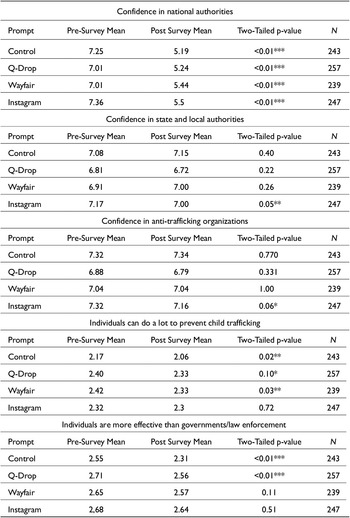
First, we take the differences in pre- and post-prompt responses regarding respondent feelings of confidence in the effectiveness of national authorities, state/local authorities, and NGOs like Polaris to prevent child trafficking and punish child traffickers (Pre-prompt Questions 9, 10, 11 in Figure 1 and Post-prompt Questions 2, 3, 4 in Figure 6 of the Appendix) to measure whether QAnon narratives change respondent feelings more than an NGO statement. Second, we take the difference in level of agreement between the pre- and post-prompt to questions about whether the respondent agrees that individuals can and should do a lot to prevent child trafficking (Pre-Prompt Question 12 in Figure 1 of the Appendix and Post-Prompt Question 5 in Figure 6 of the Appendix). Third, a respondent’s pre- and post-prompt belief that individuals are more effective than governments and NGOs in combating trafficking is constructed from Question 13 of the pre-prompt (Figure 1 of the Appendix) and Question 6 of the post-prompt survey (Figure 6 of the Appendix). Table 2 illustrates the results of this test in our Analysis and Results section below.
Pre- and post-survey differences in respondent beliefs
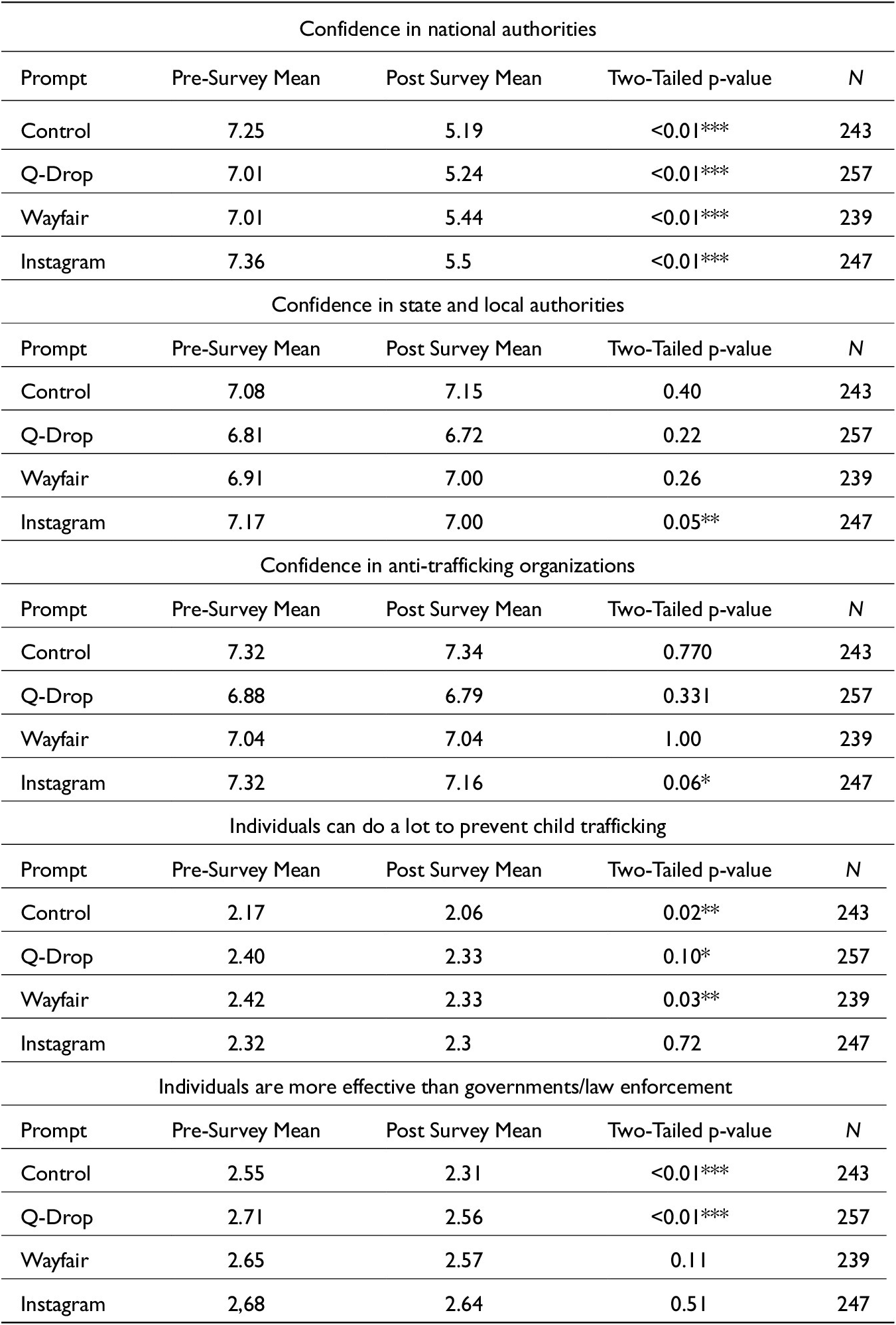
Table 2. Long description
The table is divided into five sections, each with rows for Control, Q-Drop, Wayfair, and Instagram prompts. Columns are Prompt, Pre-Survey Mean, Post Survey Mean, Two-Tailed p-value, and N.
First section, Confidence in national authorities: Control shows pre-survey mean 7.25, post-survey mean 5.19, p-value less than 0.01 triple asterisk, N equals 243. Q-Drop: 7.01 to 5.24, p less than 0.01 triple asterisk, N 257. Wayfair: 7.01 to 5.44, p less than 0.01 triple asterisk, N 239. Instagram: 7.36 to 5.5, p less than 0.01 triple asterisk, N 247. All show significant decreases.
Second section, Confidence in state and local authorities: Control 7.08 to 7.15, p 0.40, N 243. Q-Drop 6.81 to 6.72, p 0.22, N 257. Wayfair 6.91 to 7.00, p 0.26, N 239. Instagram 7.17 to 7.00, p 0.05 double asterisk, N 247. Only Instagram shows marginal significance.
Third section, Confidence in anti-trafficking organizations: Control 7.32 to 7.34, p 0.770, N 243. Q-Drop 6.88 to 6.79, p 0.331, N 257. Wayfair 7.04 to 7.04, p 1.00, N 239. Instagram 7.32 to 7.16, p 0.06 single asterisk, N 247. No significant changes.
Fourth section, Individuals can do a lot to prevent child trafficking: Control 2.17 to 2.06, p 0.02 double asterisk, N 243. Q-Drop 2.40 to 2.33, p 0.10 single asterisk, N 257. Wayfair 2.42 to 2.33, p 0.03 double asterisk, N 239. Instagram 2.32 to 2.3, p 0.72, N 247. Control and Wayfair show significant decreases.
Fifth section, Individuals are more effective than governments or law enforcement: Control 2.55 to 2.31, p less than 0.01 triple asterisk, N 243. Q-Drop 2.71 to 2.56, p less than 0.01 triple asterisk, N 257. Wayfair 2.65 to 2.57, p 0.11, N 239. Instagram 2.68 to 2.64, p 0.51, N 247. Only Control and Q-Drop show significant decreases.
Asterisks indicate significance: triple for p less than 0.01, double for p less than 0.05, single for p less than 0.1.
***p <0.01, **p <0.05, *p <0.1
Hypothesis 2 expects women exposed to QAnon messaging to be more responsive than men. To test this, we constructed a series of basic multinomial logit models for each group of respondents: one for each of the three groups that received a QAnon prompt and one model for the control group that received the Polaris prompt. Our dependent variable is the level of agreement a respondent feels with the post-prompt statement that QAnon gives individuals a place in the fight against child trafficking (Question 10 in Figure 6 of the Appendix). To ease comparison, we aggregate the five potential responses (strongly agree to strongly disagree) into three categories (agree, neutral/no opinion, and disagree). Because we are interested in the effects QAnon narratives have on (de)mobilizing individuals, we set “no opinion” as the category of comparison when estimating the multinomial logit model. Therefore, all results are interpreted as the likelihood of a respondent being in the “disagree” or “agree” category compared to having no opinion.
Our independent variable is a binary indicator that takes a value of one if the respondent is a cisgender woman (a respondent who identifies as female and was assigned female at birth). We believe that sex and gender might impact respondent attitudes toward human trafficking, as this is a highly gendered phenomenon with nearly 76% of victims identifying as girls and women (US State Department 2021), and political decision-making around human trafficking is often spearheaded by women politicians (Perry and Burns Reference Perry and Burns2023).
Because responses to QAnon narratives may also vary depending on respondents’ identities and experiences we construct several control variables. Republican Respondent is a dichotomous variable that indicates whether a respondent identifies as a supporter of the Republican Party. Parent indicates whether they have a role as primary caretaker of a child under eighteen. The variables Women More Effective, Women Better Parents, No Limits Belief measure the extent of respondent agreement with statements that women are more effective than men at stopping trafficking, women are better parents than men, and that parents have no limits when it comes to protecting children (Questions 15, 16, and 18, respectively, in Figure 1 of the Appendix). As with our dependent variable, the five potential levels of agreement are condensed into “agree,” “no opinion,” and “disagree.” Abuse is a binary variable that indicates whether a respondent reported experiencing physical, sexual, or emotional abuse (Question 24 in Figure 1 of the Appendix). Economic Stress is an indicator variable that marks whether the respondent reported imprisonment, divorce, unemployment, homelessness, or poverty (Question 24 in Figure 1 of the Appendix). Isolated respondents are those who agreed that they led lives more isolated than other Americans. Results of these models are presented in Table 3.
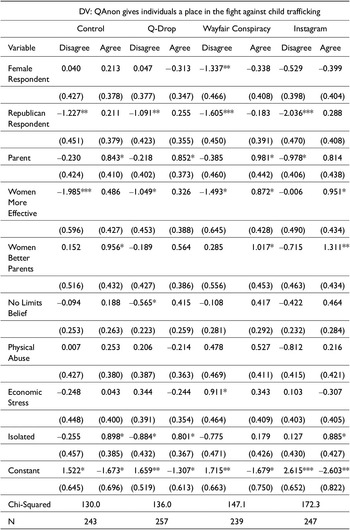
Multinomial logit models of identity and parenting and responses to QAnon narratives
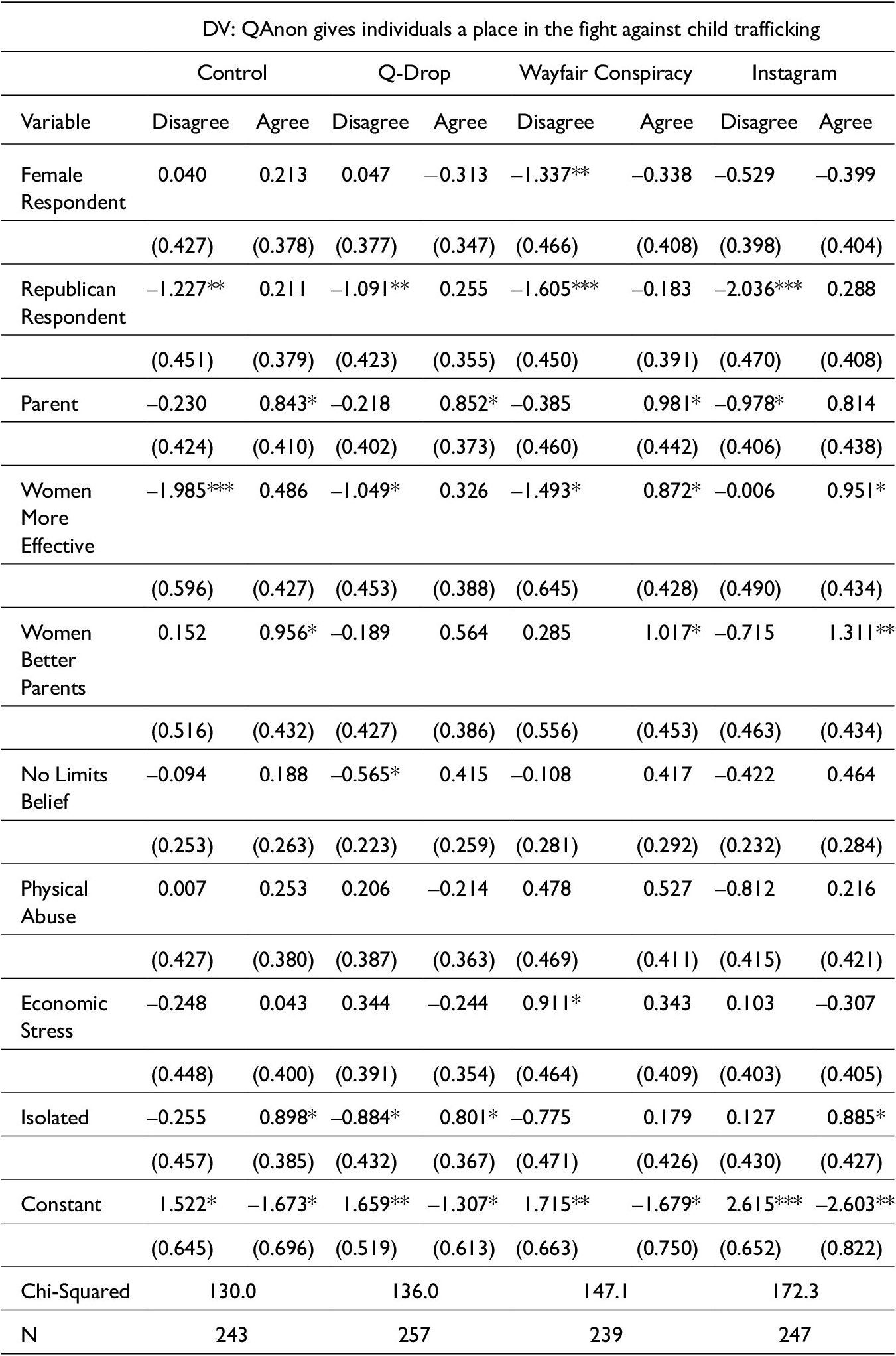
Table 3. Long description
The table is organized with the dependent variable stated at the top: ‘QAnon gives individuals a place in the fight against child trafficking.’ The next row divides columns into four experimental conditions: Control, Q-Drop, Wayfair Conspiracy, and Instagram, each with Disagree and Agree subcolumns. The leftmost column lists independent variables: Female Respondent, Republican Respondent, Parent, Women More Effective, Women Better Parents, No Limits Belief, Physical Abuse, Economic Stress, Isolated, and Constant. For each variable, the table provides multinomial logit coefficients for Disagree and Agree responses under each condition, with standard errors in parentheses directly below each coefficient. Significant coefficients are marked with asterisks: one for p less than 0.05, two for p less than 0.01, three for p less than 0.001. For example, under Wayfair Conspiracy, the coefficient for Republican Respondent Disagree is minus 1.605 with three asterisks, standard error 0.450. At the bottom, summary statistics include Chi-Squared values for each condition (130.0 for Control, 136.0 for Q-Drop, 147.1 for Wayfair Conspiracy, 172.3 for Instagram) and sample sizes (N) for each (243, 257, 239, 247 respectively). The table footnote explains the asterisk significance levels.
*p <0.05;**p <0.01; ***p <0.001
Control Variables
Our control variables include sex/gender, parenthood status, political party affiliation, political ideology, knowledge of QAnon, attitudes toward national, state, and local authorities, attitudes toward effectiveness of anti-trafficking organizations, level of social isolation, attitudes toward political groups, and experience with trauma. We measure our control variables using our pre-prompt survey questions as provided in Figure 1 in the Appendix.
We measure parenthood status by asking respondents to identify whether they are a parent or guardian to children under the age of 18 in Question 3 of Figure 1. Given that we are interested here in understanding the power of the motherhood frame used by QAnon, we need to control for whether or not a respondent already has parenthood status. We control for political party identity and political ideology with Questions 4 and 5 in Figure 1, respectively. As QAnon brands itself as a far-right group, we would expect that individuals who identify as “Republican” “Other” “Far right” or “Very Conservative” to be more likely to already know about and perhaps support QAnon than individuals who identify as “Democrat” “Far Left” or “Very Liberal.”
Previous knowledge of QAnon may make respondents more likely to support QAnon messages so we control for this with Question 6 in Figure 1 of the Appendix which simply asks for any knowledge of the group, and Question 7 in Figure 1 which asks for a range of knowledge about QAnon ideas and beliefs on a Likert scale from 0 to 10. Attitudes toward national, state, and local authorities are captured in Questions 8 and 9 in Figure 1 because QAnon followers often state a distrust of formal authority figures and those with similar ideas may be more likely to support QAnon messaging (Moskalenko and McCauley Reference Moskalenko and McCauley2021). Attitudes toward effectiveness of anti-trafficking groups are captured by Question 10 in Figure 1. We measure this to understand whether respondents have a pre-existing belief in the effectiveness of these groups in combating human trafficking because theoretically, belief in mainstream anti-trafficking groups as effective could mean a lower likelihood of belief in conspiracy groups like QAnon.
Along similar reasoning as our control for political identity and ideology, we also control for level of social isolation and previous attitudes toward specific political groups. For social isolation, we use Question 20 in Figure 1 because the typical supporter of fringe groups and conspiracy theories identifies as socially isolated compared to typical Americans (Uscinski and Parent Reference Uscinski and Parent2014). Given this, we built this question to help us better identify such supporters even if they do not self-identify as followers of the group QAnon. Supporters of QAnon and other far-right groups are also more likely to see far-left groups or liberal groups as threats to the country and those they love and we measure these attitudes with Questions 21 and 22 in Figure 1 of the Appendix, respectively (Thompson and Thomander Reference Thompson and Thomander2021).
Analysis and Results
Table 2 presents the results of our two-tailed t-tests for pre- and post- prompt differences across our four groups. For all groups, post-prompt respondent confidence in national authorities’ ability to stop child trafficking dropped. While this implies effectiveness of NGO advocacy for the control group, the differences were just as present for all styles of QAnon messaging. For state and local authorities only the Instagram prompt lowered respondent confidence, although it is a less significant difference. Confidence in legitimate anti-trafficking organizations remains unchanged, other than a borderline statistically significant decrease for respondents exposed to the Instagram-style prompt. Senses of self-efficacy — individuals feeling like they can do a lot to stop child trafficking and are better at combating trafficking compared to governments — are also lower after exposure to our control and QAnon prompts. Other questions measuring confidence in anti-trafficking NGOs, individual need to act to stop child trafficking to replace government inaction, and feeling of QAnon familiarity showed no significant differences in mean responses.
The results of our multivariate model, presented in Table 3, indicate that women respondents have no change in their perception of whether QAnon gives people a place in fighting trafficking. The Instagram prompt is linked to women being less likely to disagree with that statement, but they are not more likely to agree. Parenthood does have a slightly statistically significant relationship with agreement in individual roles in fighting trafficking. The same is true for a respondent’s belief that women are more effective at stopping trafficking, although this is only the case for the Wayfair conspiracy and Instagram prompts. Respondents who believe women are better parents also have a slightly statistically significant increase in their likelihood of agreeing, but this also exists for the control prompt from a legitimate anti-trafficking NGO.
Limitations
We initially expected that some of these relationships may only exist conditionally. For example, a woman identifying as a Republican may be more likely to be mobilized by QAnon narratives than a woman identifying as a Democrat since many of those narratives already match aspects of Republican political identity. Preserving the variables tested in Table 2, we then retested them with interaction terms for gender and political ideology, gender identity and beliefs that women are better at combatting trafficking, gender identity and beliefs that there are no limits to protecting children, and parental status and beliefs about women being better parents. We only added one interaction term at a time and included the components of the interaction term in the models. None of these variables approached statistical significance.
One potential limitation in our approach is that the recent public popularity and attention given to QAnon in recent years will affect whether the narratives “work” to mobilize people to stop human trafficking. We see this in the fact that 85% of our respondents reported at least having heard of QAnon. Previous polls have indicated that around 15–20% of Americans believe in at least one QAnon conspiracy, and studies have identified that exposure to QAnon narratives increase intention to act, but only for those who already believed in those conspiracies (Understanding QAnon’s Connection to American Politics, Religion, and Media Consumption 2021).
We did not survey our respondents on how much they believed in each of the conspiracies encompassed within QAnon, although that would be a fruitful direction for future work, and therefore cannot control for this level of belief directly. We did ask respondents to identify on a zero-to-ten scale how much they believed they knew about QAnon (zero referring to no knowledge and ten referring to strong knowledge). From this question we created two dichotomous variables for familiarity, one that labels respondents reporting a five or higher on our scale as “familiar with QAnon” and another that does the same for respondents reporting above eight. We re-tested our model from Table 3 with these terms, but they did not alter our results (see Tables A2 and A3 of the Appendix).
While we cannot say that our results imply an increase in QAnon belief, or the willingness to admit QAnon belief, this is something worth investigating in future research, especially given the recent mainstreaming of such beliefs by elected officials.
Discussion and Conclusions
In sum, we have mixed results which reflect the disorganized and syncretic nature of QAnon. In the case of the Wayfair and Instagram style prompt — which makes the heaviest use of motherhood and child protection narratives — those who have gendered beliefs about parenting and stopping child trafficking do appear more responsive to QAnon narratives. This finding supports Hypothesis 1. However, it does not appear that women are more likely than men to be mobilized by QAnon and so we do not find support for Hypothesis 2. While we do not directly test what mechanism may be driving men in the same way as women, we suspect that there may be some element of protectionism here for men, in that men are often conditioned by society to “protect” women and children across the board and messages about children in danger may be particularly salient to men along those lines. Again, we do not test for this directly and so we hesitate to make conjectures about why the men in our sample were at least as likely as women to be mobilized by these messages. We believe that this particular question is an excellent place to start in exploring this connection further.
Interestingly, we also find that QAnon narratives appear to be at least as good at mobilizing people around anti-trafficking as NGO narratives and do so for the same groups of respondents. This aspect is just as troubling as it implies that QAnon can compete with NGOs, crowd out legitimate actors, and pull attention or efforts away from productive activity and into conspiracism by deliberately sharing disinformation with the public. Efforts to further explore the direct links between respondents accepting the legitimacy of deliberate QAnon disinformation and their comparable perceived loss of legitimacy of NGO information are beyond the scope of this paper but would be an excellent way to further this research.
Our research represents a beginning examination of the power of the QAnon conspiracy group to influence everyday people. Our findings may be of interest to academics in political science, psychology, sociology, and other areas of social science, given that we engage with core ideas familiar to these academic disciplines. How people respond to tools of disinformation, particularly in relation to their identities, may allow researchers to better understand the use of psychological framing to support political positions in the modern age of the internet and social media. Furthermore, our findings on the power of these messages alongside those provided by legitimate, fact-based organizations suggest that message framing may be a more powerful tool than organizational branding. And this possibility should also raise some interest among practitioners looking to develop informative messaging in support of human rights goals that can compete in the online marketplace with groups like QAnon.
As the group is still relatively new and the American population has changed over time, it would be worthwhile for other researchers to elaborate on this work to better understand the specific mechanisms that are effective in persuading people to respond to the ideas of QAnon. Here, we have examined one specific mechanism, the “motherhood trope,” and found mixed support for its effects, but there are many other mechanisms worth examining as well. Future work might examine the use of masculine identity tropes, given that QAnon is primarily attractive to many conservative men and such men overwhelmingly prize traditional forms of masculinity. Other work might explore the intersectional elements of respondent reactions to QAnon, ones that trace the racial, ethnic, religious, gendered, and income-based elements of individual identity and their connections to support for groups like QAnon. As people continue to access social groups through the internet and form political and social positions based in part on those groups, continued research into both group tactics and respondent behavior will be critical.
This may be particularly true for locations outside of the United States. We focused on the United States for our study, as the QAnon conspiracy group originated in the United States and is still most popular in this country. However, as noted earlier, the movement spread quite rapidly to other countries, especially other wealthy democracies grappling with the rise of similar far-right conspiracy theories (Farivar Reference Farivar2020). Its popularity is particularly acute in Germany, where a long history of far-right ideology coupled with twenty-first-century iterations of anti-immigrant sentiment has increased the appeal of this online group (Barker Reference Barker2020). Our results cannot tell us whether this specific trope, one of motherhood and security, is significant to followers outside of the United States, but we encourage researchers to expand on our analysis to explore the utility of this trope beyond American believers.
In the area of human trafficking, much is still left to be done to understand which forms of anti-trafficking information are most effective. QAnon adopted “#savethechildren” and the anti-trafficking cause because it strikes a chord with many people in the US. People often care about trafficking issues but can easily become entrenched in conspiracy theories and misinformation with the use of the internet. Scholars dedicated to finding ways to effectively and accurately inform the public about trafficking issues must look more closely at groups like QAnon and other popular online social networking sites to stay ahead of those who use such sites as places of disinformation and division and to gain knowledge that could significantly further the fight against human trafficking. We hope our work here offers them a helpful place to start.
Supplementary material
The supplementary material for this article can be found at http://doi.org/10.1017/S1743923X26100737.
Data availability statement
Data from this project will be available through the Harvard Dataverse platform upon final publication.
Funding statement
The authors did not receive funding for this project.
Competing interests
The authors report there are no competing interests to declare.


 Open access

