




Interviewed in 1909 about the decline in the trade in wild animals, East End animal dealer Albert Edward Jamrach (1845–1916) reminisced about his business dealings with naturalist, museum proprietor and private zoo owner Lionel Walter Rothschild (1868–1937), whose appetite for ‘new’ beasts was legendary:
If I received something strange or rare I used to take it at once, unless it was too big, down to the bank in St. Swithin’s Lane, to the great amusement of everyone in the place. But finally, Lord Rothschild put his foot down and stopped my taking my wild beasts into the bank.
Smiling, Jamrach recalled, ‘I supposed it did not look very business[like] for a man to stroll into a banking house with a monkey under his arm’.Footnote 1
It was, after all, the world of business that Rothschild was expected to commit himself too. As the eldest son of Nathaniel Mayer Rothschild, 1st Baron Rothschild (1840–1915), it was anticipated that he would take a leading role in the family’s investment banking firm N.M. Rothschild & Sons, based at New Court in the City of London. However, Rothschild showed no aptitude for, nor inclination towards, banking, and instead spent the majority of his life establishing his own zoological enterprise. This enterprise included a museum (now the Natural History Museum, Tring) that contained a research collection, which at its peak contained some two million set Lepidoptera and 300,000 bird skins, as well as a public collection which opened to the public in 1892 and would eventually contain some two thousand mounted mammals, 2,400 mounted birds, 680 mounted reptiles and amphibians, 914 fishes and a representative collection of invertebrates. The development of these collections was informed by Rothschild’s dedication to taxonomic work and investigation of geographical variation, together with his desire to showcase nature to museum visitors. However, as Jamrach’s anecdote suggests, Rothschild’s interests were not confined to dead study specimens destined for his museum’s many cabinets or display cases. He was as eager to obtain living animals as dead ones and formed a collection dubbed by the press his ‘private zoo’, which resided on the family estate, Tring Park, and in the Zoological Gardens in Regent’s Park, London.Footnote 2 The development of these three distinct but overlapping collections required an extensive network of suppliers, and for this reason Rothschild offers a valuable case study for exploring the trade in natural-history specimens and live animals at the turn of the century.
The first of this paper’s two aims is to reveal the influence of the ‘fancy of the private collector’ upon the animal trade.Footnote 3 Rothschild was one of a number of private collectors – individuals of independent financial means who created collections for their own purposes – to establish his own collection of animals during this period. Other examples include the Earl of Derby (1775–1851), the Duke of Bedford (1858–1940), Sir Anthony H. Wingfield (1857–1952), James John Joicey (1871–1932) and Christopher J. Leyland (1849–1926), although they are beyond the scope of this paper. Due to their resources and ambitions they were important customers for the animal dealer and yet the existing scholarship has paid private collectors, and customers in general, little attention. The exceptions perhaps are national and regional natural-history museums, many of which have been the subject of in-depth historical studies that include exploration of their methods of acquisition.Footnote 4 However, these studies often survey each of the routes of acquisition used by museums – gift, purchase, fieldwork, exchange and loan – and, recognizing that many of these public institutions had limited funding, tend to focus on gifting and donor interactions.Footnote 5 The purchase of specimens made up a much smaller percentage of specimen acquisition in public institutions compared with those of private collectors like Rothschild, and as such existing scholarship has been able to shed limited light on the role of customers within the specimen/animal trade.
Historians of the animal trade, meanwhile, have tended to focus on its connection and entanglements with empire. Harriet Ritvo was the first to articulate this argument, stating that the animal trade ‘offered an especially vivid rhetorical means of re-enacting and extending the work of empire’.Footnote 6 Subsequent historians have continued to explore this area, in particular how technological advancement and imperial infrastructure contributed to the greater movement of animals and specimens.Footnote 7 More recent scholarship has taken this a step further and considered the unique logistical challenges posed by the handling of live animals and specimens, shifting our focus onto their materiality.Footnote 8 There is now greater understanding of how the trade succeeded in the face of the substantial challenges and obstacles imposed by what Vanessa Finney, Jarrod Hore and Simon Ville describe as ‘the unique logistical vulnerabilities of flesh and feathers’ and of the labour involved in this transnational trade.Footnote 9 As Helen Cowie argues, the trade in exotic animals (and specimens) was a ‘complex network of interactions and exchanges’, and studies of individual field collectors, salaried collectors and specimen dealers have begun to highlight the importance of these individuals to the science of natural history, both as suppliers of material and as producers of knowledge about animals.Footnote 10
However, within this existing scholarship the customer is often portrayed as taking a passive role due to the logistics and high risks involved in animal trading. In the case of live animals, Nigel Rothfels has noted that it was not uncommon for ‘a third, half, or even two thirds’ of animals to die en route and before a sale was secured.Footnote 11 This precarity meant that customers often had to choose from what the dealer managed to successfully obtain, rather than be in a position where they could demand what was stocked. This led Cowie to describe live-animal dealerships as ‘clearing houses’ for animals ‘without any pre-arranged recipient’.Footnote 12 Zoos and menageries, for example, often had wish lists but were forced to rely on animal dealers and their networks of contacts to realize these ambitions, many of which could go years without being fulfilled.Footnote 13 By taking a private collector as its case study, this paper will offer new insights into supplier–consumer relations within the animal trade and demonstrate how, in contrast, private collectors exerted considerable influence over the animal market, even contributing to what one reporter termed ‘booms in beasts’.Footnote 14 Through examination of Rothschild’s animal procurement network and interactions with natural-history dealers, taxidermists and live-animal dealers, this paper will explore how Rothschild’s scientific predilections combined with his purchasing power, with the result that he wielded significant influence over the business practices of his suppliers.
Now the assumption might be that this was due to money – private collectors like Rothschild simply had lots of it and so animal dealers prioritized their custom and acquiesced to their demands. But just because someone had money that did not mean that the difficulties in the practicalities of capturing, transporting, shipping and caring for animals were immediately overcome. The second aim of this paper, therefore, is to push beyond the transactional nature of these business dealings to consider the inner workings of the relationships that sustained the animal trade. By taking a more nuanced and holistic approach to these networks, this paper demonstrates the importance of collaboration, both for the acquisition of material and for building relationships which furthered the ambitions of both suppliers and consumers. As will be shown, many suppliers were deeply embedded within the zoological community they served, were implicated in the expansion of knowledge, and, in the case of Rothschild, contributed to the overall success of his zoological enterprise. The practices of both suppliers and consumers became entwined as they each strove to build their own professional reputations.
In focusing on the relationships between private collectors and their suppliers of animal material, this paper takes inspiration from Beattie, Meillo and O’Gorman’s work on imperial resource extraction and the need to look at the ‘relational aspects of networks’, which they argue ‘open[s] up questions of how power operated within nested sets of relationships and through institutional intersections’.Footnote 15 This article will ask the questions Beattie, Meillo and O’Gorman encourage: who formed relationships with whom and with what consequences? And how were these relationships negotiated and contested?Footnote 16 By applying this methodology to this particular case study, it becomes clear that the buying and selling of animals was more than a financial transaction and that relationships which were forged between buyers and sellers were more dynamic, multifaceted and collaborative than previously considered.
The remainder of the article begins with an examination of monetary transactions which are used to re-create Rothschild’s global animal procurement network, highlighting the range of different actors involved in the supply of zoological material at the turn of the century. It then takes in turn examples of natural-history dealers, taxidermists and live-animal dealers to explore the influence Rothschild exerted over their business operations as a result of his scientific interests. Discussion of the varied contributions these individuals made to Rothschild’s zoological enterprise draws out examples of the often dynamic and collaborative nature of these relationships. I argue that it is Rothschild’s motivations behind forming and sustaining these relationships that shaped the market and business practices of animal dealers, and which ultimately enabled the ‘fancy’ of private collectors to exert influence over the animal trade.
Rothschild’s global animal procurement network
The late nineteenth century presented customers with a thriving marketplace in which to obtain their desired animal or specimen. The animal trade expanded rapidly throughout the nineteenth century and animals became a core commodity of trade in both the domestic and international markets during this period.Footnote 17 What began as a sporadic and opportune trade, dependent on the initiative of enterprising travellers and sea captains, soon became a systematic and commercial operation which gave rise to a number of specialist dealers, who operated within an extensive and complex global trading network.Footnote 18 There was a degree of overlap in the trades in living and dead animals, due, as Jane Hamlett and Julie-Marie Strange have stated, to both ‘the popularity of natural sciences … and, somewhat more gloomily, the high mortality rate of imported birds and animals’.Footnote 19 It was not unusual for living animals destined for display in zoological collections to die en route and for their body to be repurposed for scientific study, taxidermy, millinery or household furnishings.Footnote 20
Typically based in port cities such as Liverpool, London and Hamburg, these new specialist animal dealers were aided in the expansion of their businesses by the rapid expansion of museums, zoological gardens and travelling menageries. As Christine Brandon-Jones argues, the ‘establishment of natural history museums and the popularity of zoological gardens gave a veneer of scientific legitimacy to a trade in live and preserved exotic animals’.Footnote 21 Consequently, the number of animal dealers in London, for example, rose from fourteen in 1841 to 118 in 1895.Footnote 22
Rothschild took full advantage of this marketplace and utilized it in its entirety to populate his research, public and live-animal collections. Taking 1895 as an example, 56 per cent of the (traceable) museum’s annual expenditure, over £6,000, was spent on specimens. These were sourced from a huge range of sellers – collectors, museums, societies, feather merchants, dealers in game and natural-history dealers.Footnote 23
The surviving records provide a fairly complete record of who these individuals were and feature some of the most prominent names in animal and natural-history trading of the period. Rothschild’s live animals mainly came via Albert Jamrach, son of renowned animal dealer Charles Jamrach (1815–91), who operated from premises based on the Ratcliffe Highway near the London docks, together with Carl Hagenbeck (1844–1913) of Hamburg, Germany, one of the leading animal dealers in the global market. For his research collections, Rothschild typically turned to his extensive network of field collectors, which included the likes of William Doherty (1857–1901), based in East Africa, and Albert Stewart Meek (1871–1943), who first collected for Rothschild in Australia and then in the Pacific region. Mounts for the museum’s public galleries, meanwhile, were supplied by taxidermists, including Camden-based Edward Gerrard (1810–1910) and Rowland Ward (1848–1912) of ‘the jungle’, Piccadilly.
There are also examples of suppliers who likely provided specimens for both the research and the public collections. These include entomological dealers Watkins and Doncaster based at 36 the Strand, London, and natural-history dealers such as Oliver Janson (1850–1926) of 44 Great Russell Street and his neighbour Miss E. Cutter of 36 Great Russell Street, London. It is notable that Rothchild did much business with natural-history dealers on the Continent, too, particularly in France and Germany. Records show dealings with Henri Donckier of Paris (1854–1926), Otto Staudinger of Dresden (1830–1900), Herman Rolle of Berlin (1864–1929) and Ernst Heyne of Leipzig (1833–1905), amongst others.Footnote 24 A number of specimens were also purchased from other museum collections, as represented by dealings with Alfred Noakes, the curator of the Hill Museum in Surrey, owned by private collector James John Joicey, and also from less conventional sources such as G.K. Dunstall, an ostrich and fancy-feather merchant of 39 Red Cross Street, London, from whom Rothschild bought hummingbirds, bird skins and Coleoptera.
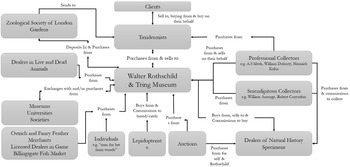
Building a collection on the scale that Rothschild achieved, and engaging such a wide range of suppliers to do so, was a huge undertaking and shows not just the scale of Rothschild’s zoological enterprise but also the extensive network of retail opportunities open to private collectors of both living and dead animals in this period. An attempt to reconstruct this network, as centred on the Tring Museum, is shown in Figure 1.
A diagram documenting the interactions between those involved in specimen acquisition, centring around Rothschild and the Tring Museum. © Eleanor Larsson.

Figure 1 Long description
The diagram illustrates the network of interactions involved in specimen acquisition centered around Walter Rothschild and the Tring Museum. At the center is Walter Rothschild and Tring Museum, which purchases from various sources. This includes taxidermists, professional collectors, serendipitous collectors, dealers of natural history specimens, auction houses, lepidopterists, the Zoological Society of London, dealers in live and dead animals, ostrich and fancy feather merchants, licensed dealers in game, Billingsgate Fish Market and other individuals. The diagram highlights the extensive network and interactions in the acquisition and distribution of specimens that are not just defined by acts of purchase but also sales, exchanges and deposits.
Significantly, the surviving records for the Tring Museum and Rothschild’s correspondence with his suppliers document not just the financial transactions which reflect the buying and selling of goods, but also that these consumer–supplier relationships were much more dynamic, interwoven and multifaceted. Many of these traders were deeply embedded within the scientific community and were themselves implicated in the expansion of zoological and taxonomic knowledge. To illustrate this, the following section will examine Rothschild’s relationship with particular suppliers, beginning with examples of natural-history dealers.
Natural-history dealers
Natural-history dealers were an integral part of the thriving commercialized industry which emerged to support metropolitan demand for natural-history specimens during the nineteenth century. They styled themselves under a variety of terms, including ‘naturalist’, ‘plummassier’, ‘furrier’, ‘bird stuffer’ and ‘natural history agent’.Footnote 25 In the early 1890s, Rothschild spent large sums of money in dealer’s establishments. In November 1890, for example, he spent £296 18s. with ‘naturalists’ Pratt & Sons of Brighton, while receipts for London-based ‘naturalist and plumassier’ E.G. Meek record fortnightly purchases of between two pounds and £184 between 1889 and 1891.Footnote 26
Rothschild was motivated in this rapid accumulation of material by the scientific rationale which guided his museum’s operations. He believed that the facilitation of taxonomic research, particularly studies of geographical variation, were best served by the study of long series – multiple specimens of the same species. Reflecting on his career in 1937, Rothschild declared his belief: ‘My long connexion with Zoology has convinced me that the methods of research in systematics – the ultimate object of which is the elucidation of relationship and evolution – require amplification.’Footnote 27 In practical terms, this meant that ‘to ascertain the extent of variation of the chief classificatory unit, the species, the material is never too extensive’.Footnote 28 Thus within Rothschild’s research collections one would find ‘a series of from a dozen to twenty or more of the same bird, but all of them showing the varieties of plumage which a single species may exhibit in different parts of the world’.Footnote 29 This approach to collecting was somewhat unusual for zoologists and collectors in Great Britain at this time, where the general view was that ‘two or three specimens were considered adequate material on which to base a “species”’.Footnote 30 Rothschild and his curators, in contrast, followed the example of colleagues in Germany and the United States, where interest in geographical variation had led to the collection of long series of specimens and adoption of trinomial nomenclature. Rothschild and his curators embedded these approaches in their own practice at the Tring Museum and campaigned for their adoption by zoologists across Great Britain.Footnote 31
In the early days of the Tring Museum, natural-history dealers offered Rothschild an effective way of rapidly growing the collections of his fledgling museum. However, as the museum’s scientific approach gained traction and began to more rigorously inform the acquisition process, the museum’s network of field collectors became more important. Subsequently the role of natural-history dealers changed from providing the bulk of the collection to enhancing the network of supply and making up for deficiencies in field collecting. To remain competitive and to secure Rothschild’s ongoing custom, natural-history dealers adapted their business practices to ensure that the specimens they obtained met the renewed criteria imposed by the Tring Museum’s scientific approach and focus on geographical variation.
There were two key criteria which a specimen had to meet if it were to be considered for purchase by Rothschild or his curators, and these are best outlined in the collecting agreements that Rothschild made with field collectors. These stated that ‘all these prices are understood for specimens 1) in fair condition [and] 2) with exact localities and dates’.Footnote 32 It was important that specimens arrive at the museum in ‘fair condition’ as damage or decay would likely prevent the accurate identification and classification of a specimen, whilst provision of information on the lineage and locality of a specimen was fundamental if it were to have scientific value and contribute to Rothschild and his curators’ studies of geographical variation. Catarina Madruga has described how this process was ‘a method of assuring “authentic provenance”’, which necessarily entangled ‘physical specimens, individual suppliers, dates of collection, and concrete geographical localities’.Footnote 33
These selection criteria also applied to the specimens which arrived via the natural-history dealer, and this required dealers to renegotiate their trading practices and relationships with their own collectors. For example, writing to Rothschild’s museum director and ornithological curator, Ernst Hartert, dealer William Rosenberg concluded that Hoffmans’s skins were ‘frightful & most of them worthless’, and described how one particular shipment had arrived ‘in a sealed tin in a fermenting condition & had to be thrown away’.Footnote 34 Rosenberg deliberated whether to sever all ties with Hoffmans or whether he might be educated in the ways of making better specimens, and sought Hartert’s advice. Meanwhile, in 1907, Zensaku Katsumata, based in Hainan and a collector for merchant Alan Owston (1853–1915), willingly agreed to use the specimen label template recommended by the Tring Museum for future collecting attempts, to ensure that the information the museum required was recorded for his specimens.Footnote 35 Evidently, the reach of the Tring Museum extended beyond its immediate trading network.
Further evidence of the scientific interests of Rothschild and his museum influencing the business decisions taken by dealers can be found in correspondence where dealers sought to determine the museum’s current scientific interests and the particular localities from where they wanted specimens. In 1904, Rosenberg sought the advice of Rothschild’s curator of invertebrates, Karl Jordan (1861–1959), as to whether there was commercial and scientific value in sending a collector to South America, and, if so, the particular localities that would be best to visit. Rosenberg proposed Nicaragua, but sought assurance from the museum: ‘Could you take collections from there?’ Rosenberg stated that he would take ‘financial responsibility’ for the expedition and expressed willingness ‘to come to Tring and talk it over if you think it advisable’.Footnote 36 Dealers were clearly attuned to the museum’s scientific agenda, and that agenda combined with Rothschild’s purchasing power clearly held significant influence over the decision making of natural-history dealers.
Interestingly, this influence also extended to the approaches taken by field collectors, not just through their adoption of the label template, as in the case of Katsumata, but in many cases where they were challenged to act against their natural instincts when selecting which animals to capture in the field. Writing to Frederick Cotton in 1894, Hartert complimented Cotton for the collection of butterflies and moths he supplied, which contained ‘some novelties’, but also reprimanded him for the fact that the bird collection did ‘not contain anything new to our museum and nothing new to science’. Hartert attributed this to the fact that Cotton collected ‘the big and beautiful birds only’ and advised him, ‘Had you got a hundred small and sombre coloured birds, which are easy to get and fly about anywhere, instead of the several dozen or so of the Cicinnurus Regius [king bird of paradise], there might have been new species among them, but your collections contained not one small bird’. Cotton replied to thank Hartert for the advice and confirmed that he had taken the advice on board.Footnote 37
Cotton’s willingness to change his field practice based on the feedback of one museum who issued instructions in order to secure specimens which advanced their own particular scientific agenda reveals the significant influence Rothschild and his museums held over the market. However, collectors were taking a risk in following this guidance. There was no guarantee that Rothschild would purchase those specimens, and, if Rothschild did not purchase them, that there would be another customer who desired those particular specimens prepared in line with Rothschild’s museum’s guidance. Adopting these practices was therefore a gamble, particularly for collectors who depended upon the sale of specimens as their main source of income.
Rothschild and his curators were not shy about enforcing compliance with these criteria. In 1894 Hartert criticized natural-history dealer H.W. Marsden for ‘shamefully’ scratching off a collector’s name from the labels of four eagle specimens, concluding,
Mr Rothschild is not willing to take specimens from you any more, if you are given to … destroying the history of specimens by making the name of the collection or person whence the specimens came [unknown]. Mr Rothschild’s collection is now so large, that only specimens with a history, original labels and dates have any value for him.Footnote 38
Reputation mattered in the specimen trade and a few words from someone with Rothschild’s influence could be irreparably damaging. Furthermore, this was power that Rothschild was aware of possessing. In 1887, when discussing with Hartert the price quoted for some bird skins sent by Rosenberg, Rothschild remarked, ‘You can tell Rosenberg from me that if he does not put more reasonable prices on his things, I not only will not deal with him but I shall warn everyone not to go to him as his charges [a]re outrageous’.Footnote 39 Dealers often responded to these confrontations by lowering prices. Acquiescing to the demands of one of their most loyal patrons made good business sense, after all, but significantly Rothschild’s purchases were informed by the scientific rationale of his museum, and this therefore had a direct influence on the business operations of natural-history dealers.
Frequent negotiations over the acquisition of material led Rothschild to cultivate successful relationships with a number of natural-history dealers where their interactions extended beyond the transactional buying and selling of goods and became more dynamic and multifaceted. For example, Rothschild relied on certain natural-history dealers to act as his intermediaries when negotiating the procurement of specimens. He would, for instance, regularly ask Oliver Janson to attend auctions and act as his representative in order to avoid prices being driven up, as was often the case when Rothschild or one of his curators attended themselves.Footnote 40 In February 1920, ahead of the auction of Sydney Webb’s British Lepidoptera collection at Steven’s auction rooms, Rothschild instructed Janson: ‘I want lots 153, 154, 273, 342, 343 & 323. Then I want either 321 or 322. I also want you to bid for lot 267 up to £10, for lot 304 up to £7, & for lot 344 up to £12 & for lot 346 up to £9’.Footnote 41
As the application of underlining suggests, these would often have been lots that Rothschild really wanted for his collection, and by delegating this responsibility to Janson, Rothschild displayed his confidence and trust in him. As Simon Ville has explored, ‘there were many uncertainties arising from natural history trading such as the variable quality of specimens, their complex value, and the degradation and damage experienced over long ocean voyages and while passing through different hands’.Footnote 42 Delegating to Janson in this manner, and trusting him to act on his behalf, demonstrates the trust that had been cultivated through regular transacting and the dialogue that accompanied that. In taking on these roles, dealers like Janson became a part of the network which sustained Rothschild’s enterprise, not just as direct suppliers of goods but as Rothschild’s collaborators, ensuring the further acquisition of scientific material for Rothschild’s ever-growing collections, which in turn underpinned the scientific work that emanated from the Tring Museum.
Taxidermists
Similar dynamic interactions can be found in Rothschild’s correspondence with taxidermists. Preparing vertebrates for public display was a specialized business but Rothschild had plenty of taxidermists to choose from in the late nineteenth century. Pat Morris has shown that the number of taxidermy businesses in Britain gradually increased throughout this period, with London having more than 150 different taxidermists listed in local directories between 1840 and 1960.Footnote 43 Rothschild, however, developed long-standing relationships with a mere handful of these, such as Edward Gerrard and Rowland Ward, both based in London, as well as Brazenor Bros in Brighton and Sheals in Belfast. Rothschild favoured particular taxidermists for different types of animal and was prepared to send material significant distances in order to engage their services. For example, in 1904 Rothschild issued instructions to R.I. Pocock (1863–1947), superintendent of London Zoo, of where to send the animals he had ‘on deposit’ in the zoo when they died. All birds, except cassowaries, were to be sent to Joseph Cullingford (1841–1920) of Durham; lizards and snakes to Brazenor Bros of Brighton; and mammals, tortoises, frogs and newts to Edward Gerrard (1810–1910) in Camden Town.Footnote 44
Rothschild’s engagement of taxidermists was motivated by his desire to secure mounts that would display as much of nature as possible to his museum’s visitors and show nature at its best. In 1898, Country Life reported that Rothschild’s collection, ‘instead of being merely representative of the different families … [was] often quite complete, including every species of a certain class’. The result was that specimens were ‘crowded on the shelves, but it [was] a crowd of beautiful objects set together, delighting both the eye by their symmetry, colour, and form, and the intelligence by these varied images of the infinite variety of Nature’. The article further commented, ‘All those shown are perfect specimens, in as brilliant plumage and as life-like as it is possible for the skilled artists in taxidermy to make them’.Footnote 45 Evidently, the skill of these taxidermists contributed to the successful reputation of the Tring Museum and therefore implicated them in the success of Rothschild’s zoological enterprise.
However, correspondence between Rothschild, his curators and the taxidermists suggests collaborative practice that extended beyond the supply of mounted specimens for an agreed price. Some taxidermists acted as intermediaries and facilitated the procurement of specimens for Rothschild via their own networks. In December 1911, Edward Gerrard asked if Rothschild would like him to make an offer for an African shoebill egg he had been offered by a ‘correspondent’ in Sudan: ‘Do you care me to make an offer for it?’Footnote 46 Hartert replied confirming that Rothschild was willing to pay ten pounds for the egg provided it was ‘in good condition and that we are satisfied with its identification [in pencil], and get its history’. Gerrard duly provided this in his reply sometime later, together with a photograph of the nest from which the collector Captain Dickinson had taken the egg.Footnote 47 Meanwhile, the Tring Museum also supplied surplus specimens to taxidermists. On 23 February 1905, Rowland Ward wrote to ask Hartert if he would send ‘on approval a selection of Birds of Paradise skins, some of which no doubt we shall be able to keep. Our client for whom we want them, is not much interested in “rarities” but requires “showy” birds’.Footnote 48 Both these examples demonstrate that taxidermists played a valuable role in the wider circulation of specimens, both into and out of the Tring Museum’s collections.
In many ways these examples are an extension of the typical business model within which taxidermists operated – the buying and selling of goods. However, Rothschild’s relationship with Cambridge-based taxidermist Frederick Doggett throws a different light on the collaborative relations between Rothschild and his taxidermists. Doggett was favoured by Rothschild for his skill at mounting cassowaries but surviving invoices show that he was also paid a daily rate for the ‘keep’ of live birds. This included Fiji lories, storks, Chatham Island shags and kiwi.Footnote 49 There were several reasons for this arrangement. In most cases, it was to ensure that the best skin could be made from the animal. Close proximity between the animal and the taxidermist meant that it could be skinned quickly, which reduced the risk of decomposition. It also ensured that a good-quality skin could be made. The taxidermist had control over when to kill the animal and could therefore ensure that a bird, for example, was fully moulted or in good plume.Footnote 50
However, this arrangement also seems to have been part of a conscious decision by Rothschild to enlist Doggett’s help in obtaining zoological knowledge. In 1896, for example, Doggett was tasked with monitoring a breeding pair of kiwis, documenting his observations and reporting back to both Rothschild and Hartert. Doggett described observing the female lay an egg and how she ‘seemed not a bit distressed’, but that ‘the theory of it being laid long and then contracting is wrong’. He further reported that despite the pair being ‘in excellent health’ they were ‘not at all broody’, and conferred with Hartert about the possibility of artificially incubating the egg. Sadly, the decision came too late and it was destroyed by the parents. However, in documenting this process Doggett actively contributed first-hand knowledge of the birds in his care, knowledge which Rothschild then used to inform his scientific work.Footnote 51 For instance, in 1893 Rothschild published an article titled ‘Notes on the genus Apteryx’, where he commented on observations he had made about species variation in kiwis, emphasizing the fact that he possessed ‘examples of no less than five species in a living state’ upon which he had based his conclusions.Footnote 52 Thus, again we see a supplier not just involved in the buying and selling of animals but on this occasion taking an active role in research by passing on first-hand observations which were then drawn on in scientific publications by Rothschild.
Live-animal dealers
As a zoologist, Rothschild clearly exerted influence over the business operations of both natural-history dealers and taxidermists. But in both instances these negotiations and diversions came at relatively low risk to their core business. In fact, arguably they were advantageous to it, resulting in a diversification of the business model and revenue stream, ensuring the scientific value of their goods and building the status of their businesses as reputable dealers of natural-history material. However, for live-animal dealers, their relationship with Rothschild required a fundamental change to their business model. They were no longer serving as ‘clearing houses’ for animals for whom they needed to find buyers.Footnote 53 Instead they were being commissioned to find a specific species without particular regard for the logistical and financial implications of that request.
Live animals were a central part of Rothschild’s zoological enterprise and were kept both at Tring Park and at London Zoo. In 1903 C.J. Cornish described Rothschild as one of the ‘chief’ benefactors of the zoo:
When a particularly fine specimen, or rare animal is brought to England it is usually offered to him by the owners, as a matter of business. If he thinks it good enough for his museum at Tring he often purchases it, and leaves it at the Zoo ‘on deposit’ till it dies, when the skin or skeleton go to Tring.Footnote 54
The press designated Rothschild’s live-animal collection a ‘private zoo’, the acquisition of which was driven by Rothschild’s interest in the life, health and behaviours of animals in captivity, not just their taxonomy, and detailed how he spent huge sums in building suitable accommodation for them and in feeding and keeping them in the best possible conditions.Footnote 55 It was an extensive and varied collection, and while Rothschild rarely published expressly on his live animals, his observations can be found regularly in his correspondence and in the minutes of meetings of the various learned societies he belonged too.
By the very nature of their being alive, live animals made for a different prospect to specimens and taxidermy mounts, and naturally Rothschild turned to those who had made the live-animal trade their specialist business. As discussed above, this primarily included Charles and Albert Jamrach and Carl Hagenbeck, who were among the leading importers of animals in the nineteenth century. Writing in 1901, the Inverness Courier described how ‘[n]ot a week passes without letters and telegrams between [Rothschild] and Jamrach’.Footnote 56
As with his relationships with other suppliers, Rothschild’s relationships with live-animal dealers were not one-dimensional. As Rothschild’s museum and reputation grew, these relationships evolved from live-animal dealers propositioning Rothschild as they looked for a buyer for their latest acquisition, to Rothschild charging them with procuring particular species which he needed for his taxonomic work, and the dealers fulfilling those requests quickly and with intent. However, unlike the field collectors Rothschild engaged to secure specimens directly for his research collections, live-animal dealers did not receive upfront payments and there were no contracts which gave a financial guarantee for the purchase of at least some of what returned ‘at an agreed fair price’.Footnote 57 Moreover, there was no guarantee that, if Rothschild did not buy that animal, there would be a ready market for it elsewhere. This raises an interesting question. Why were live-animal dealers willing to become accountable to someone else and to undertake what were often high-risk searches, when their businesses already involved such a high degree of day-to-day risk?
As the Nottingham Journal reported in 1886, ‘deaths occur every day’ amongst an animal dealers’ stock and Jamrach’s losses for May to October amounted to some £647 – a figure which represented ‘only the amount in money paid for the specimens, and not the price they would have fetched in the market’.Footnote 58 As Cowie details, catching and transporting animals was
a formidable logistical challenge. Rare animals, whose dietary requirements were not always precisely known, had to be fed and watered to keep them alive. Some species were ferocious, requiring special accommodation. Others would need to be kept warm or wet in climates different from their native habitats. None of this was cheap or easy to do, and many zoological specimens died before they reached their destination. The successful conveyance of exotic animals was a risky and often brutal process that required careful planning, perseverance and a considerable dose of luck.Footnote 59
Therefore, if experience was a valuable asset in live-animal dealing, why take the risk of venturing to new areas, in search of unfamiliar species, at the request of someone else? The answer to this question can only be uncovered by once again taking a more holistic approach to these relationships and interactions.Footnote 60
A species which provides a particularly good example for exploring these questions is the cassowary. In the late 1880s Rothschild began work on a monograph on the genus Casuarius. To aid this work he sought to acquire as complete a collection of living birds as possible, for he believed that previous work to classify species and subspecies of cassowary had been hampered by taxonomists’ predominant study of dead specimens, which lose their head and neck coloration after death. It was this coloration which Rothschild believed was the key to understanding the variation in species of cassowary.Footnote 61 The monograph was eventually published in 1900 but Rothschild continued to study and publish on cassowaries until his death and persisted in his use of live animals throughout that time.Footnote 62
The press used Rothschild’s acquisition of cassowaries to exemplify the ‘booms in the animal trade’ caused by what they called ‘the fancy of the private collector’, one reporter writing that Rothschild
practically regulated the demand and supply of late years … When he decides that a certain animal is wanted, the price of that animal goes up accordingly, and all other fanciers have to pay it. The latest boom caused by this enthusiast is in cassowaries, of which twenty new specimens, and two hundred animals have lately been imported.Footnote 63
One reading of this is that live-animal dealers saw an opportunity to profit from Rothschild’s scientific interests, and I would argue that this is likely true to some degree, especially when it is considered that some specimens of cassowary could reportedly fetch £150 each, which undoubtedly helped to mitigate the cost of a dealer’s monthly losses.Footnote 64 But these commissions were not always financially profitable for the live-animal dealer. Recalling his involvement in the importation of Mongolian pheasants, initially instigated by the Duke of Bedford and Rothschild for breeding purposes (hybrids of these crossed with English species were apparently 30 per cent heavier in weight and therefore good for pheasant shooting), Carl Hagenbeck reflected,
I myself have gained little advantage from the importation of these birds, for they have to be brought from very distant and inaccessible countries at great expense and with many risks to be run by the way. If only 30 or 40 per cent, of the birds that are caught ultimately arrive at Hamburg I am fully satisfied.Footnote 65
Limiting our analysis to an interpretation centred only on the perceived financial benefits of these arrangements prevents consideration of the other underlying factors which influenced animal dealers to undertake these commissions. As will be shown, dealers were willingly implicated in Rothschild’s cassowary project for reasons relating to both building status and the expansion of taxonomic knowledge.Footnote 66
Reporting on Rothschild’s prolific work on cassowaries, contemporary commentators frequently highlighted the substantial resources Rothschild had invested in his search for cassowaries and how it had ‘involved an enormous outlay which no man of science could have borne’.Footnote 67 Colleagues, meanwhile, praised him for his achievements in advancing the taxonomic knowledge of cassowaries. In 1912, for example, R.I. Pocock described Rothschild as ‘the greatest living authority on the cassowary’.Footnote 68 However, Rothschild’s name was not the only one associated with this great feat. It was widely recognized by commentators that Rothschild could not have achieved what he did without Jamrach:
Previous students of the cassowary had to content themselves with the study of the mere skins, and could command only such skins as good luck might place in their way. Walter Rothschild, on the other hand, was able, through Jamrach, to institute a systematic search for cassowaries; and the officers of every ship that sailed for New Guinea and other haunts of the bird knew that good prices awaited them for every specimen they found.Footnote 69
The direct implication of Jamrach in the success of this endeavour was hugely beneficial for Jamrach’s reputation at a time when the animal trade was becoming increasingly competitive. This was particularly the case for dealers in Britain who had seen a decline in the wild animal trade as a result of the rise of German competition, following the opening of the Suez Canal (which saw ships reach German ports ahead of British ones) and expansion of the German empire, together with tighter regulation of the British steamship lines.Footnote 70 As Coote et al. argue, building reputation was important in an industry where distance and time made it more difficult to cultivate the social capital generated by the regular personal interaction upon which trading could depend. As such, ‘cultivating a positive reputation could be an effective way of communicating trustworthiness both among elites and, as a form of branding, to a wider audience of collectors’.Footnote 71
Even where a positive outcome was not guaranteed, association with hazardous expeditions could be beneficial for the animal dealer’s reputation. The following example does not directly relate to Rothschild, but it serves as a useful one for evidencing these trends beyond the interactions between Rothschild and his suppliers. As Nigel Rothfels has shown, Carl Hagenbeck’s trickier expeditions were ‘turned to the advantage of the firm as word spread that Hagenbeck would be willing to go after anything … and that he was “always ready to try the untried, and attempt the impossible”’.Footnote 72 Such was the case when at the request of the 11th Duke of Bedford, Herbrand Arthur Russell (1858–1940), Hagenbeck mounted an expedition to Mongolia in search of Przewalski’s wild horse, despite previous expeditions having been largely unsuccessful.Footnote 73 The Duke of Bedford was motivated by an interest in acclimatization and intended to establish the first herd of Przewalski’s wild horse to be seen in Europe at his estate Woburn Park.Footnote 74
Hagenbeck tasked Wilhelm Grieger with leading the expedition to Mongolia and supplied him with money and letters of introduction to facilitate it.Footnote 75 Despite this, it proved a difficult venture and one Hagenbeck described as ‘the most arduous as well as the most expensive’ of his career.Footnote 76 Grieger eventually succeeded in capturing fifty-two animals, of which only twenty-eight reached Hamburg alive in October 1901. Of these, twelve were sent to the Duke of Bedford’s Woburn estate.Footnote 77 Both the Duke of Bedford and Hagenbeck were celebrated for bringing the animals to Britain and for giving British naturalists live material to study. The herd was used by naturalist Richard Lyddeker (1849–1915) to describe the species and support his claim that they represented a distinct species, a conclusion widely reported in the press.Footnote 78 As with Rothschild, Jamrach and the cassowaries, collaboration between Grieger, Hagenbeck and the Duke of Bedford had contributed to an advancement in zoological knowledge about this particular species. Despite being a high-risk and costly expedition, it proved reputationally rewarding for both Hagenbeck and the Duke of Bedford.
In some instances, the importance of the results of these collaborations was formally recognized through the practice of species naming, as in the case of Rothschild and his work on his cassowaries. Jamrach, Hagenbeck and Doggett all had supposedly ‘new’ species of cassowary named after them by Rothschild.Footnote 79 Such a practice likely incentivized dealers to continue their searches for ‘new’ animals for Rothschild to study, but species naming was an act of social capital and this public acknowledgement of the collaborative work that went into the procurement and description of the cassowaries is not insignificant.Footnote 80 That Rothschild felt this was necessary, having paid the considerable sum for the procurement of the birds, is, I would suggest, indicative of a more multifaceted relationship than one characterized purely by the labels of consumer and supplier and the exchange of money. Just as with natural-history dealers being trusted to act on Rothschild’s behalf at auctions, this act symbolized mutual respect built through the exchanges that happened alongside the regular and repeated transactions involved in the buying and selling of animals.
Such recognition helped animal dealers build their reputations as suppliers of material of scientific value and to stand out within a market saturated with competition. Meanwhile, Rothschild was supplied with a continuous stream of specimens which helped him to establish and sustain his credentials as an expert on cassowaries. This provides an example of what Coote et al. describe as the ‘mutuality of needs’ that was required in addition to trust for these trading networks to thrive:
scientists needed the organization and evidence provided by the trade to pursue their work in a rapidly evolving zoological environment. Traders sought scientific knowledge to transact their business effectively and profitably. Collectors relied on scientists to extend their understanding, and on business to build their collections. In turn, many collectors connected business with science.Footnote 81
Zoological research and the commercial animal trade were inextricably entwined. Private collectors exerted considerable influence over animal dealers and their business operations not just because of their wealth, but because of the scientific predilections which informed their purchasing decisions. They each needed the other if they were to be successful in their pursuits.
Conclusion
By examining Rothschild’s methods of acquisition, this paper has documented the wide range of retail opportunities that private collectors could avail themselves of in this period. More crucially, however, it has demonstrated that the retail of animals was not just about the selling and distribution of goods. Natural-history dealers, taxidermists and live-animal dealers all supplied animals for Rothschild’s zoological enterprise, but they also contributed to its success in ways beyond the direct supply of material.
Natural-history dealers routinely acted as intermediaries at auctions, taxidermists used their own contacts to enhance the museum’s own network of supply, and others cared for the live specimens of their patron. These varied roles came at relatively low risk and in fact were likely to be advantageous – diversifying the supplier’s revenue stream and contributing to their businesses’ standings as reputable and trusted dealers in animals. For live-animal dealers the stakes were somewhat higher. Commissions to collect particular species required a fundamental change to their business model. However, despite the hazardous and often costly nature of these expeditions, the likes of Jamrach and Hagenbeck were willing to carry out these commissions for the financial but also reputational gains that a successful expedition could yield – a benefit facilitated by the act of species naming. In naming a ‘new’ species after a dealer, Rothschild not only marked his credentials as a zoologist, but publicly acknowledged the role of the dealer in its acquisition, which in turn helped to improve their professional reputation.
In taking on these varied roles, suppliers therefore became a part of the network which sustained Rothschild’s zoological enterprise and contributed to its distinguished reputation. The skill of the taxidermists contributed to the success of the Tring Museum’s public galleries, while the material sent by field collectors and natural-history dealers for the research collections underpinned the scientific work that emanated from the Tring Museum, work which Rothschild and his curators were building their professional reputations upon. These suppliers were deeply embedded within the scientific community and were themselves implicated in the expansion of zoological and taxonomic knowledge.
That said, private collectors could wield considerable influence over the business operations of their suppliers of animal material – both dead and alive. Seeking to ensure that the material they had for sale met with Tring Museum’s acquisition criteria, natural-history dealers liaised with their own collectors about the quality of specimens and the information which accompanied them, and sought the advice of Rothschild and his curators as to where to send expeditions to ensure that their hauls would be marketable. Field collectors, meanwhile, were advised to go against their instincts and capture the recommendations of the museum, while live-animal dealers were tasked with obtaining particular species from particular regions.
Collaboration was a central characteristic of the animal trade and of the relationships which formed and sustained it in this period – whether that was channelled into the further procurement of material, the construction of zoological knowledge, or building reputation. Private collectors were not passive consumers simply reliant on the capabilities of the dealers and suppliers, but neither did the ‘fancy of the private collector’ dominate the trade. These were complex and multifaceted relationships guided by a number of motivations that are only revealed when a nuanced and holistic approach that looks beyond the transactional nature of trading is taken.
Acknowledgements
I would like to offer my thanks to Oliver Hochadel for inviting me to be a part of this exciting special issue and to my fellow contributors, who have been incredibly generous with their time, guidance and feedback on earlier drafts of the article. I would also like to thank the peer reviewers and the editor, Amanda Rees, for their constructive and insightful comments.

 Open access

