

Introduction
When most of the world’s parliaments were created, women were not permitted to vote or be elected. As a result, parliaments’ physical infrastructure, procedural rules, and performance standards for parliamentarians (MPs) reflected the preferences and experiences of men from their countries’ dominant class and racial-ethnic groups. MPs could travel extensively, deliberate in the chamber late into the night, and work long hours because they were assumed to be free of caretaking responsibilities (Childs Reference Childs2016). Even when women began entering parliaments in greater numbers, few parliaments reformed their procedures to accommodate members with caretaking obligations (Campbell and Childs Reference Campbell and Sarah2014; Johnstone Reference Johnstone2024; Palmieri and Baker Reference Palmieri and Baker2022). Even today, at the end of the first quarter of the 21st century, mechanisms like parental leave for politicians, proxy or remote voting, and flexible on-site childcare remain relatively rare among parliaments.Footnote 1
Advocating reforms to accommodate parenthood is part of larger efforts by scholars and practitioners to make parliaments gender and diversity sensitive (Childs Reference Childs2016; Erikson and Joseffson Reference Erikson and Josefsson2019; Palmieri Reference Palmieri2018; Palmieri Reference Palmieri2022). Much of the research on the need for gender and diversity-sensitive parliamentary reform is grounded in feminist institutionalist (FI) theories, which posit that the rules, practices, and norms structuring political institutions reproduce gendered hierarchies. Many of the policy recommendations emerging from this research address the incompatibilities of combining politics with parenting, particularly when children are young. To date, we have several empirical studies showing that parliaments are decidedly not gender or diversity sensitive (Childs Reference Childs2016; Erikson and Joseffson Reference Erikson and Josefsson2019; Frech and Kopsch Reference Frech and Kopsch2024; Thomas and Bittner Reference Thomas and Bittner2017) with fewer studies explaining how and when gender-sensitive reform occurs and whether such reform is resisted or embraced by MPs (see discussion in Ahrens, Erzeel, and Fieremans Reference Ahrens, Erzeel and Fieremans2024; and see Palmieri and Baker Reference Palmieri and Baker2022 for an exception).
In this paper, we draw on original survey data of federal and state politicians in the Federal Republic of Germany (FRG) to explore whether MPs, or specific subgroups of MPs, support or oppose reforms that would make parliament more family-friendly. Importantly, our survey data show that while being a parent does not necessarily correspond with a legislator’s perceptions of the difficulty of combining a political career with parenthood, being a woman does. When it comes to parliamentary reforms that accommodate parenthood, however, we see support distributed along ideological rather than strictly gendered lines. Among both women and men, membership in a more socially traditionalist party signals lower support for a range of policies that would make the parliamentary workplace family-friendlier. This finding indicates that gendered experiences do not neatly or automatically predict shared policy preferences among women.
Our study is grounded in feminist institutionalist scholarship as well as practical efforts to make parliaments more gender and diversity sensitive. Following FI scholars, we believe that rules and practices that appear gender neutral, like requirements to participate in person, not setting limits to sitting times, and restricting who can enter parliamentary chambers, have gendered effects that disadvantage women (see Lowndes Reference Lowndes2020). Our starting point in designing this study is that parliamentary rules, norms, and operating procedures assume that elected politicians are widely available during the day, evenings, and perhaps even weekends, and that, without the provision of supports and accommodations, such rules disadvantage those with caring responsibilities. Since gender and parenthood norms put greater responsibility on women to perform caring tasks, women politicians are more negatively affected than men by parliamentary rules and practices.
The next section of the paper situates our case study of Germany in the growing comparative literature on gender, parenthood, and political institutions, focusing specifically on parliaments. We then outline our case study, data collection strategy, methods, and key findings. We believe Germany is an ideal case for our purposes. It is an advanced industrial democracy that has, since the early 2000s, sought to improve parental supports for the general population, although levels of support still lag behind the more parent-friendly policy regimes in the Nordic countries.Footnote 2 Public policies support mothers’ participation in the workforce, with reforms to parental leave policy in 2007 that encourage new mothers to return to work sooner (Zoch and Schober Reference Zoch and Pia S.2018). Since 2013, parents have enjoyed a statutory entitlement to publicly funded childcare, but the provision of spaces remains uneven across the country (Mätzke 2018). Further, cultural change and take-up rates for these supports have been slow. Because Germany’s commitment to a dual-earner model for family policy only dates to 2007, the more traditional norms that supported Germany’s previous male breadwinner model have not been eliminated (Morgan Reference Morgan2013) and vast differences remain between the East and West (Mätzke 2018). Post-communist legacies in the East, where all citizens were expected to work, created greater childcare infrastructure and fewer negative stereotypes about working mothers. In the West, by contrast, norms that cast working mothers as selfish are stubbornly persistent (Poelchau Reference Poelchau2010; Schlieben Reference Schlieben2012). Gains in Germany are, therefore, a mixed bag. This variegated situation, along with the ideological diversity of parties in German assemblies, makes it a useful case for examining whether and how support for accommodating parents who are also elected office holders differs by gender and party.
Gender, Parenthood, and Parliamentary Institutions
Calls to make parliaments gender sensitive or diversity sensitive emerged over two decades ago, when the Commonwealth Parliamentary Association (CPA) initiated a study of how various features of parliaments’ organization and rules affected elected women (Childs and Palmieri Reference Childs, Palmieri, Sawer, Banaszak, True and Kantola2023). Over time, aiming for gender sensitive parliaments, defined as those where barriers to women’s participation have been removed, has “become an international norm” (Palmieri Reference Palmieri2022). International organizations, and particularly the International Parliamentary Union (IPU), have been at the forefront of these efforts (Childs and Palmieri Reference Childs, Palmieri, Sawer, Banaszak, True and Kantola2023), with many national parliaments responding by examining whether their policies and procedures served as barriers to women.
Parliamentary workplaces pose several challenges to parents, particularly those caring for small children. Most parliaments require in-person participation during sitting periods, yet do not offer parental leave in the traditional sense or permit members to bring their children into the chamber. News reporting has called attention to instances all around the world of women MPs being barred from entering their assemblies with their infants due to prohibitions on “strangers” or “visitors” in the assembly’s standing orders.Footnote 3 Another difficulty for MPs with young children is the heavy workload combined with travel required for the job. Sitting schedules vary considerably across assemblies, but it is not uncommon for sitting days to be excessively long, with debates and votes happening in the evening and sometimes lasting well into the night (Frech, Bailer, and Bütikofer Reference Frech, Bailer and Bütikofer2024; Frech and Kopsch Reference Frech and Kopsch2024). Members who don’t reside in the capital city must travel to the assembly during sitting weeks and then travel back to their districts for weekends and other non-sitting days to attend to constituency demands (Franceschet and Rayment Reference Franceschet and Rayment2025).
As women entered politics in greater numbers, calls for reform emerged, and some parliaments responded with mechanisms to accommodate parents. In 2016, the lower house of Australia’s parliament changed its standing orders to permit “infants being cared for by a Member” into the chamber (House of Representatives, Standing Orders). In 2019, British MPs voted in favor of a change to their parliament’s standing orders, permitting MPs on parental leave to vote by proxy.Footnote 4 That same year, Canada’s House of Commons voted to allow MPs to take 12 months of parental leave, during which time MPs would not be penalized for missing parliamentary sessions (Ryckewaert Reference Ryckewaert2019). In most elected assemblies, however, including in Germany, the infrastructure, standing orders, and parliamentary norms have not yet changed in response to women’s greater presence and the challenges experienced by those caring for small children.
Accommodating parents through changes to parliamentary procedures is certainly possible. Parliamentarians do have agency. They could introduce remote voting for MPs with a sick child home from school for the week. Indeed, legislatures around the world regularly adjust their procedural rules. In a three-country analysis of these rule changes from 1945 to 2010, Sieberer, Müller, and Heller (Reference Sieberer, Müller and Heller2011) show that “parliamentary actors constantly decide whether to conduct business in line with existing rules or to change them” (949, emphasis added). Loewenberg (Reference Loewenberg2003), Sieberer, Müller, and Heller (Reference Sieberer, Müller and Heller2011), and others converge upon the assessment that rule changes are endogenous to existing interests within these legislative settings. That said, for the purposes of our study of family-friendlier parliamentary workplaces, not all MPs share the same influence over rule changes. As Heller (Reference Heller2001) asserts, “The government gets what it wants in multiparty parliaments,” both by virtue of coalition agreements and because coalition members value maintaining the government (781). Thus, for parliaments to make their procedures family friendlier, enough MPs must favor it. Further, these MPs probably need to be in the government coalition, and they must view achieving these procedural changes as either a coalition goal or worth the costs of defection.
Feminist institutionalist approaches to studying parliaments offer several important insights into why substantive reforms to parliamentary institutions are entirely possible yet variable (Chappell and Waylen Reference Chappell and Waylen2013; Erikson and Verge Reference Erikson and Verge2022; Krook and Mackay Reference Krook and Mackay2011). The first insight is that institutions reflect the power relations that existed at the time of their creation, thereby reproducing those relations through institutional rules and practices (Franceschet Reference Franceschet, Mackay and Krook2011; Lowndes Reference Lowndes2020; Waylen Reference Waylen2017). Institutions persist precisely because they prescribe regularized and rule-abiding behavior and proscribe behavior that deviates from those rules (Ostrom Reference Ostrom1986). Particularly when it comes to core parliamentary operations, such as deliberating and voting on legislation, the tradition of doing so face-to-face is deeply entrenched and perceived as integral to how deliberative bodies ought to operate. The unwillingness of most parliaments to permit members to vote remotely even at the height of the COVID-19 pandemic shows how physical presence during voting is considered a non-negotiable pillar of parliamentary practice.Footnote 5
Second, many of the rules through which the status quo is reproduced are not codified in laws, policies, or standing orders but are communicated informally. Such informal rules are “sticky” in large part because they cannot be reformed via statute but only change when political actors repeatedly disregard them without sanction, leading certain rules to gradually lose force (see Mackay Reference Mackay2014; Waylen Reference Waylen2017). Norms around “presentism,” and always being available to parties and constituents, and for parliamentary work more generally, are reinforced by signals of disapproval that members perceive if they opt out of political work to fulfill caretaking roles (Erikson and Joseffson Reference Erikson and Josefsson2019). Structurally, institutional change to make parliaments family-friendly is difficult because it requires changes to parliamentary cultures that members perceive as integral to their roles.
Based upon these simultaneous facts — institutional change is entirely possible yet nonetheless may be challenging to achieve — it is worthwhile to explore how elected politicians themselves think about parental accommodations. To date, few studies have examined MPs’ experiences of tensions between their parenthood and political roles, or whether MPs support policies to relieve these tensions. Three exceptions with direct relevance for our study require discussion here. In one, Allen, Cutts, and Winn (Reference Allen, Cutts and Winn2016) surveyed and interviewed MPs in the Scottish and Welsh assemblies, bodies that were designed to be gender-sensitive and family-friendly. Notably, the authors found women to be more dissatisfied than men with the effectiveness of such measures (Allen, Cutts, and Winn Reference Allen, Cutts and Winn2016, 563). Although their survey did not ask politicians whether they would support more robust family-friendly mechanisms, the fact that women report less satisfaction with the limited measures that do exist, like reduced sitting hours and the provision of childcare, can be interpreted as women still struggling to combine politics and caring responsibilities.
Similarly surveying MPs, this time in the case of Canada’s House of Commons, Franceschet and Rayment (Reference Franceschet and Rayment2025) find that party membership has a stronger correlation than gender with MPs’ support for family-friendly policies for their workplace. In Canada’s multiparty system, Conservative Party membership, in particular, signaled lower support for parental accommodations, while membership in more progressive parties, like the New Democratic and Liberal parties, signaled higher support. Third, a study by Frech and Kopsch (Reference Frech and Kopsch2024) also directly asked politicians, this time members of the European Parliament (MEPs), about their experiences combining parenthood roles with parliamentary work. Interviews with women and men MEPs with children reveal that fathers report fewer difficulties than mothers when it comes to balancing work and family, “leading them to perceive reforms as less urgent” (Frech and Kopsch Reference Frech and Kopsch2024, 7). The findings in all three of these studies directly inform how we theorize potential opposition to parliamentary rule changes in our case study of German parliaments.
We start by considering which specific voices, in specific structural positions within assemblies, are likely to oppose extending family care considerations for MPs. As in Loewenberg (Reference Loewenberg2003) and Sieberer, Müller, and Heller (Reference Sieberer, Müller and Heller2011), we theorize that opposition to parenthood accommodations may be part and parcel of those existing power arrangements that advantage some parliamentarians more than others. Men, less burdened by gendered expectations about how much time they spend with their children, may be less supportive of changes to a status quo that works very well for them, as evidenced by their continued numerical dominance in electoral politics in Germany and in appointments to cabinets.Footnote 6 Women, on the other hand, are disadvantaged by the status quo so long as societal gender norms continue to disproportionately burden mothers with childrearing and caretaking roles. In fact, because the status quo is reinforced not merely by formal rules but also reproduced through a parliamentary culture that prioritizes physical presence and availability, men in politics need not actively oppose reforms to current parliamentary procedures. Instead, men who do not support change “can draw on the institutional context for power resources and tools that enable them to protect the status quo” (Josefsson Reference Josefsson2024, 29). Politicians can resist changes that would benefit women simply by expressing their support for parliamentary traditions like face-to-face deliberations and framing such support as upholding the core function of parliaments.
Another possible source of opposition lies with political parties who stake ideological claims on whether and how the state interacts with families and domestic life. The two most socially conservative parties at the national level in Germany are the Christian Social Union (CSU; this is the Bavaria-based sister party of the Christian Democratic Union, CDU) and the far-right party, the Alternative for Germany (AfD, established 2013), which valorizes the traditional family as part of its focus on “protecting” German society against cultural change (Arzheimer Reference Arzheimer2015; Franceschet, Och, and Xydias Reference Franceschet, Och and Xydias2025; Xydias Reference Xydias2020; Xydias Reference Xydias2024). At the center-right, the CDU under Angela Merkel’s chancellorship pursued policies to encourage women’s labor force participation by expanding the availability of childcare; the party is less traditionalist than the CSU, but still more traditionalist than parties generally viewed as left-leaning. This traditionalism is still clearly in evidence in the party’s family policies, even over the course of changing preferences (von Wahl Reference Wahl2008).
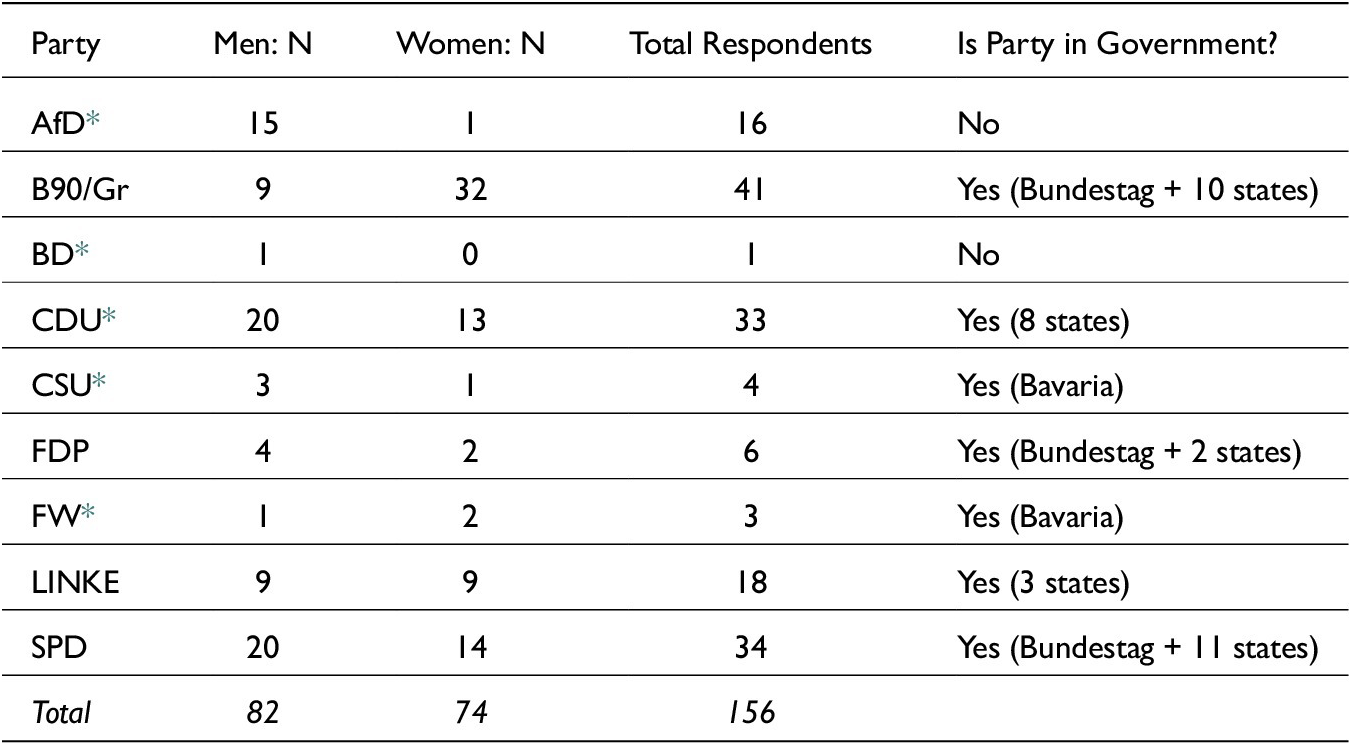
The other nationally successful parties, including the Social Democrats (SPD), Free Democrats (FDP), Greens, and the Left, are all relatively progressive on gender and family-related issues, although the FDP, as a libertarian party, does not support an interventionist state (Xydias Reference Xydias2024). These inter-party differences mean that members of socially traditionalist parties may be less likely to support parental accommodations, and they may express support for a stay-at-home parent (in practice, a stay-at-home mother) as their rationale. These parties include, at the national level, the CDU, CSU, and AfD. Sub-national legislatures in Fall 2023 included several other small parties that are categorized as socially traditionalist (identified in Table 1, below). Members of the FDP may express concern about the challenges of balancing parenthood with a political career, but they may, ideologically, be opposed to extensive infrastructure (e.g., state-led expansion of childcare availability) as the solution. In keeping with their libertarian principles, FDP members are likely to consider balancing family and politics as an individual rather than institutional problem.
Survey respondents’ party affiliation
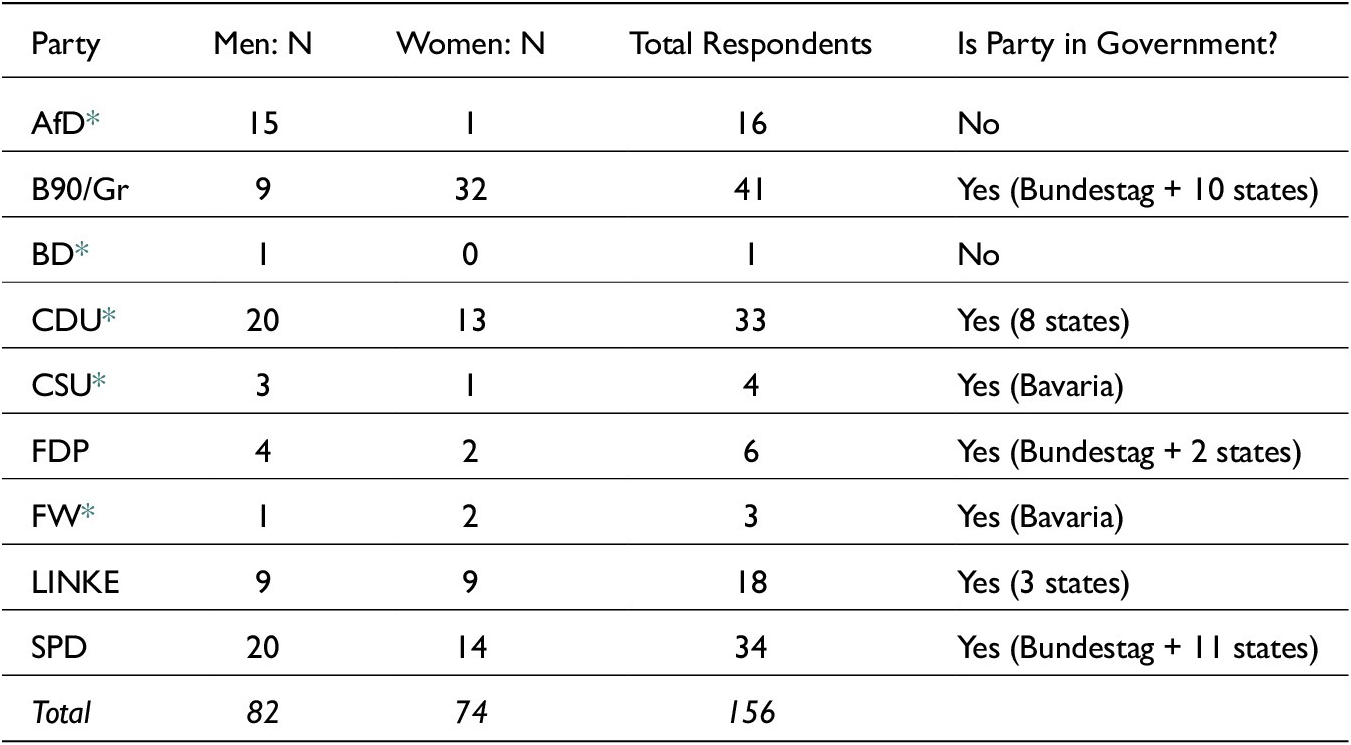
Table 1. Long description
The table has five columns: Party, Men N, Women N, Total Respondents, and Is Party in Government. From top to bottom, the rows are: Af D with 15 men, 1 woman, 16 total, not in government; B 90 slash Gr with 9 men, 32 women, 41 total, in government at Bundestag and 10 states; B D with 1 man, 0 women, 1 total, not in government; C D U with 20 men, 13 women, 33 total, in government in 8 states; C S U with 3 men, 1 woman, 4 total, in government in Bavaria; F D P with 4 men, 2 women, 6 total, in government at Bundestag and 2 states; F W with 1 man, 2 women, 3 total, in government in Bavaria; L I N K E with 9 men, 9 women, 18 total, in government in 3 states; S P D with 20 men, 14 women, 34 total, in government at Bundestag and 11 states. The final row totals are 82 men, 74 women, 156 respondents. Notes clarify that B D and F W are center-right parties active only at the state level, and parties marked with an asterisk are socially traditionalist.
Notes: BD (Bündnis Deutschland) is a center-right party that formed in late 2022. FW (Freie Wähler) is a center-right party, formally active since 2009. Both BD and FW currently only hold office at the state level.
* These parties are broadly socially traditionalist, in terms of their support for traditionally gendered family models (see Xydias Reference Xydias2024).
Finally, as noted above, not all parties have the same potential leverage on procedural changes. If voices expressing lower urgency about (or even outright resistance to) family-friendlier policies are concentrated within parties with greater procedural control, then this, too, would help explain policy inaction. Alternatively, voices in favor of adopting parental accommodations could be concentrated within parties with lesser control. Thus, the discussion of our findings will also consider parties’ procedural leverage in terms of their inclusion in governing coalitions.
In sum, a large body of scholarship, especially work studying parliaments through a feminist institutionalist lens, has revealed not only how women’s inequality is maintained despite improved access to electoral politics but also why parliamentary workplaces are relatively immune to change that would benefit women (and men with caretaking responsibilities). Our study contributes to this growing literature. We ask German politicians about their (1) experiences of parenting while pursuing a political career and (2) levels of support for six concrete types of parental accommodations. Doing so allows us to develop a profile of MPs’ attitudes toward this issue and to see which MPs support family-friendly policies and which ones might be a barrier to reform.
Based on the scholarly literature on gender, parliamentary workplaces, and political parties, we expect that women survey respondents will report greater difficulty reconciling parenthood and politics and also be more supportive than men of policies that accommodate parenthood. We also expect that parents of dependent children (18 and under) will be more supportive of parenthood accommodations, as will parents with longer commutes, because these two factors make having a career objectively more difficult (McQuaid and Chen Reference McQuaid and Chen2012; Sperandio and Devdas Reference Sperandio and Devdas2014). Based upon extensive evidence of persistent East-West differences in how Germans manage the simultaneous challenges of working outside the home and parenting (see Barth et al, Reference Barth, Jessen, Spieß and Wrohlich2020; and Mätzke Reference Mätzke2019, 58), we expect respondents who grew up in the former GDR to be more open to policies for making political work family-friendlier than their Western counterparts. Mätzke (Reference Mätzke2019) refers to these persistent East-West differences in terms of “behavioral legacies [and] gender and family norms” (60). Finally, we expect members of socially traditionalist parties to express lower levels of support for parenthood accommodations.
Gender Norms and Women’s Representation in German Politics
Germany makes a particularly interesting case for our study. Despite increases in the proportion of women in elected office and the adoption of policies to facilitate women’s participation in the workforce, procedures and norms in German parliaments have not changed to accommodate members with caring responsibilities. After the 1994 elections, women held 26 percent of seats in the Bundestag (lower house of parliament), which was markedly above the global average in that year of 11.8% (IPU Parline, Women in Parliaments Dataset, accessed October 2024). The proportion has fluctuated over the last 30 years but has increased overall, peaking in the 2013 federal election (36.3%) and hitting 35.3% in the 2021 election (IPU, 2024). Eder, Fortin-Rittberger, and Kroeber (Reference Eder, Fortin-Rittberger and Kroeber2016, 376) show that women’s presence across German state parliaments is similar in the aggregate, although they note considerable sub-national variation. Although Germany lacks legislated gender quotas, several individual parties have adopted them for candidate lists at all levels of representation (i.e., all elected bodies from which we invited respondents). The national parties with quotas include the Greens, the Left, and the SPD.Footnote 7 Institutional differences between these parties’ quotas produce further variation in women’s rates of election; for example, the Greens’ bylaws stipulate that a woman candidate be placed at the top of each electoral list, which yields women’s election rates above 50% (see discussion in Xydias Reference Xydias2024, 86–92). These formal differences between parties largely reflect the extent to which these organizations acknowledge women’s underrepresentation as an issue that requires action (Xydias Reference Xydias2024, 69–76).
In turn, candidate nomination processes in Germany include many informal elements that disadvantage aspirants who have family-care responsibilities. Although German political parties and their internal processes are highly regulated both by the Federal Parties Act (1967) and by the Basic Law itself, inequities persist in aspirants’ opportunities to be seen, appreciated by the party, and consequently nominated. More generally, in Germany and beyond, political careers are highly demanding for both men and women. Ascending upward into state and, especially, federal politics informally involves the Ochsentour (ox tour, meaning “slog”). In German hiking culture, an Ochsentour refers to a long-distance covering of challenging terrain. Analogously, German political culture largely demands that politicians begin working in local politics and rise through the ranks gradually, demonstrating their loyalty and willingness to work for their party at every step (Davidson-Schmich Reference Davidson-Schmich2016; Höhne Reference Höhne2020). Especially at earlier stages of this process, social events and engagement outside regular working hours are extensive and pose challenges to aspirants with family obligations (Kolinsky Reference Kolinsky1991; Krook Reference Krook, LeDuc, Niemi and Norris2014).
Once elected to the federal parliament, in particular, members with small children have few policies to accommodate them. Salaries and benefits for members of the Bundestag are governed by the Members of the Bundestag Act, which does not explicitly offer parental leave to members. Instead, the financial penalties normally applied to members who miss plenary sittings are not applied in cases of maternity or in cases where a member has a dependent child (under 14) who is ill (Deutscher Bundestag 2021). Entry to the plenary chamber is governed by the Bundestag’s Rules of Procedure, which restrict entry to Members of the Bundestag or Bundesrat, members of the cabinet (not all of whom are sitting members of the Bundestag), and staff who are specifically authorized to be there. Such rules can be invoked to stop members from entering the chamber with their infants or to nurse their infants during a sitting. Although a comprehensive and current dataset of Germany’s state legislative rules does not exist, restrictions on infants appear to exist across the sub-national level.
A recent event in the Bundestag illustrates the potential for change, and yet also the inadequacy of informal provisions. Hanna Steinmüller, MP with Germany’s B90/Greens, made history on 23 September 2025 when she delivered a speech to the Bundestag plenary session holding her 10-month-old infant.Footnote 8 Julia Klöckner (CDU), president of the Bundestag since March 2025, described Steinmüller’s actions as “masterful” ( bravourös ), writing that an infant in the plenum is now allowable under specific circumstances. The baby slept through the historic event. While Bundestag President Klöckner’s informal support of MP Steinmüller’s actions is a positive sign, allowing infants in the chamber would still need to be integrated into the official Rules of Procedure to be a reliable accommodation for parents.
Further, the broader social and cultural context for motherhood in Germany remains challenging, in spite of advances in the 21st century. In global comparison, contemporary supports for parents upon the birth or adoption of a child in Germany are relatively sound. As von Wahl argues, the CDU/CSU and SPD grand coalition elected in 2005 significantly expanded parental supports in a move that signaled “a new consensus…pulling towards a new middle ground where compensation for lost salary for women, fathers’ involvement, and a stronger reliance on public childcare for the young reflects current needs and expectations rather than images of compulsory stay-at-home mothers and emotionally removed working fathers” (2008, 44). Publicly funded childcare infrastructure has expanded significantly since the late 1990s, with particular focus on facilities appropriate for pre-Kindergarten-age children under three (see Mätzke Reference Mätzke2019). At the same time, significant regional differences persist between East and West. As Mätzke (Reference Mätzke2019) writes, “Eastern German regions have all coverage rates of more than 50 per cent, which none of the western German regions has, and … the gap between the eastern and the western part of the county is greater (23.7 percentage points) than any inter-regional variation within eastern or western Germany” (50). Next to highly regionalized childcare availability, which is inadequate to meet demand,Footnote 9 parenting while working outside the home remains difficult in Germany in several additional ways. Structurally, school schedules in many parts of the country remain incompatible with a full workday for parents/guardians.Footnote 10 Culturally, childcare labor continues to fall disproportionately to women.Footnote 11 The combination of these latter forces produces distinctly gendered challenges for mothers wishing to pursue a career.
Primary school children’s school day, for example, traditionally ends midday, requiring a caregiver’s availability during regular working hours. Schools have expanded all-day programming since the turn of the century, such that 42% were all-day schools by 2011 (Stecher Reference Stecher2011). Yet this leaves many families without clear options, especially in those regions with especially acute childcare availability. Studies of German education systems indicate that social class, too, corresponds both with children’s educational achievement and with gendered occupational patterns (Betthäuser, Trinh, and Fasang Reference Betthäuser, Trinh and Fasang2023).
In addition, norms about motherhood continue to favor the stay-at-home caretaker as the ideal mother, even while this family arrangement is less affordable for lower-income families. Studies show that this norm has actually grown more forceful in the former GDR since Germany’s reunification in 1990, such that younger (East) German women are more critical of mothers who work outside the home than older generations of women socialized during an era of full employment (Barth et al. Reference Barth, Jessen, Spieß and Wrohlich2020). The term Rabenmutter (raven mother) captures the trope that women who return to work when their children are young are bad mothers (Franceschet, Och, and Xydias Reference Franceschet, Och and Xydias2025; Heidenfelder and Aufmkolk Reference Heidenfelder and Aufmkolk2020). Cultural ideas about motherhood are reflected in gender gaps in employment. According to data from 2019, 93.1% of fathers with children under six work full-time, compared to just 27.4 percent of women with children under six (D-Statis n.d.). Mothers who participate in the workforce often work part-time.
These realities of, and norms around, parenthood in Germany lead us to expect that women parliamentarians will be much more attentive to the challenges of “reconciling” their political careers with family responsibilities than their male counterparts. That said, and even while the Rabenmutter trope is nationwide, German political parties vary in the degree to which they valorize traditional gender roles. As discussed in the preceding section, three of Germany’s national parties, the CDU, CSU, and AfD, have maintained commitments to upholding the “traditional family,” in particular when children are young, with a stay-at-home mother and working father.
Data and Methods
Our data collection consisted of a survey directed to all sitting national and state-level legislators in Germany. Surveys and in-person interviews are the most direct tools for learning about officeholders’ attitudes, with surveys permitting the widest range of subjects. Yet elite surveys present trade-offs for researchers, including declining response rates for a variety of reasons. Kertzer and Renshon (Reference Kertzer and Renshon2022) document the increase in prevalence of political elite surveys, making more demands on elites’ time, and Campbell and Bolet (Reference Campbell and Bolet2022) document the kind of pushback that audits and similar studies can elicit. Indeed, we received (13 December 2023) an email from someone invited to take our survey who stated that they no longer participate in research, explaining that they had recently been included in an audit study that involved deception (a “FakeUmfrage”), which they viewed as ethically unacceptable. They stated sarcastically that we can thank political scientists at [University] for their unwillingness to participate in our study.
Declining response rates to elite surveys led us to look beyond national representatives to increase our subject pool. We distributed our survey about attitudes toward family-friendly practices to both state and national legislators in Germany in the summer and fall of 2023. This population consisted of 2648 invited subjects.Footnote 12 Two states (Bavaria and Hesse) held elections October 2023; members of those bodies were contacted after the new legislative term began. We received 156 completed and usable responses, a 5.9% response rate.Footnote 13 Despite a relatively low response rate, the sample is sufficiently representative to learn what German politicians think about parenthood accommodations and whether their attitudes vary by gender and their party’s ideology (see Table 1).
Women politicians made up 47.4% of responses and state legislators made up 80.8%, an over-representation of both women (who comprised 34.1% of our invitees) and state legislators (who comprised 71.7% of our invitees). The proportion of parents in our sample closely mirrors that of the German population: 79.2% of respondents (75.4% of women and 82.5% of men) reported having children, similar to data reported by the German Federal Statistical Office (Destatis). According to Destatis’s 2022 micro-census data, 20% of women between 45 and 49 do not have children, a figure that has remained stable since 2012.Footnote 14 Women with a high level of education, a category that elected officials are more likely to be in, are less likely to have children, even more similar to our survey: 23%.
Both our survey results and Destatis micro-census data are higher than some other datasets. For example, Franceschet, Och, and Xydias’s (Reference Franceschet, Och and Xydias2025) analyses of Bundestag members’ reported rates of parenthood found that 66.6% of women and 72.7% of men state that they are parents in their online Bundestag biographical sketches. These differences in reported rates of parenthood could be a result of selection bias in our survey sample. Our invitation message for recruiting subjects indicated that we were interested in hearing from both parents and non-parents, stating, “We encourage your participation whether or not you have children” (please see Appendix B for the text of our recruitment email). In spite of this direct encouragement, some non-parents may have self-selected out of the survey believing the survey less relevant to them, but the low response rate could also be due to a reticence about sharing personal information. As we discuss in our results section, those who took the survey provided diverse responses, indicating that the sample is not systematically skewed towards those holding particular views.
Beyond the practicality of expanding our pool of invitees, including both state and national legislatures in this study is justified for several reasons. They are similar enough workplaces, situated within the same broader cultural context, to produce meaningful insights into our research question about managing family care responsibilities while pursuing a political career in Germany. At the same time, some differences between these two levels of government add important nuance to our findings, in particular regarding the role that the political party plays in legislators’ experiences of balancing their family and career.
In Germany’s federal system, the 16 state parliaments vary in their number of seats (ranging from 51 in Saarland to 205 in Bavaria) and finer-grained institutional features, but, otherwise, they share significant similarities. All German state parliaments are unicameral, elected via broadly proportional rules. Most state parliaments use mixed-member proportional rules that are very similar to Bundestag elections. In terms of the work these legislatures do, Gunlicks (2003) characterizes state-level legislatures as more engaged in administration and constituency service work than the Bundestag (221–229). We have reasoned that more extensive constituency labor could place more time pressure on state legislators than their national counterparts. However, this pressure may be offset by a shorter commute.
Even very small parties regularly field Bundestag candidates. However, in terms of seat share, multipartism is more extensive sub-nationally. In the 20th Bundestag (2021–2025), eight different parties held one or more seats in the Bundestag (AfD, B90/Greens, CDU, CSU, FDP, LINKE, SPD, SSW), while many more parties are represented sub-nationally. In 2023, the federal governing coalition included the SPD (with Olaf Scholz as chancellor), the B90/Greens, and the FDP. (See Appendix A for state governments’ composition at the time of our survey.) Thus, pooling state and national legislators together also adds more diverse observations of ideology and party.
The questionnaire posed a series of questions about subjects’ family status (do they have children? Did they have children when first elected to political office?) as well as their attitudes toward (a) balancing a political career and family life, and (b) a series of possible policies for making parliamentary workplaces family-friendlier. Subjects were also asked about the duration of their commute between home and their legislative workplaces. This latter variable addresses the additional challenges of a longer commute for attending to family responsibilities. Several open-ended questions prompted subjects to elaborate on these experiences and attitudes, and to comment on family/workplace policies that they would support. (See Appendix B for the full questionnaire.)
Since our research questions in this paper concern variation in support for and resistance against these policies, we constructed two dependent variables. First, we have a DV for respondents’ perception of the difficulty of parenting while pursuing a political career. For this DV, we have added together respondents’ answers to two questions: whether they think it is difficult to be successful as a politician and as a parent (where 5 = very difficult and 1 = generally not problematic), and their agreement with the statement that it is easy to combine a political career with family life (where 5 = absolutely disagree and 1 = fully agree). Thus, this DV’s values range from 2 to 10. The Cronbach’s alpha coefficient for these two items is 0.856, which is a high level of correspondence and affirms combining them together meaningfully. Our second DV is also a composite variable, and it sums six survey questions that address respondents’ attitudes towards numerous commonly adopted policies to make parliamentary workplaces family-friendlier. The range in values for this second constructed DV was 6–30 (i.e., a max of 30 if a subject indicated a “5” for all six questions). The distribution of this DV is left-skewed, with a mean of 20.74 and a standard deviation of 6.20. However, there is sufficient variation to model statistically. Further diagnostics show that these eight component variables are also highly correlated with one another, with an alpha coefficient of 0.758. This Cronbach’s alpha affirms this composite DV, as well.
Finally, these survey responses were merged with biographical data recorded from these legislators’ official parliamentary biographical sketches (e.g., Friedrich Merz’s bio: https://www.bundestag.de/abgeordnete/biografien/M/merz_friedrich-1046080). We report no names or identifying personal details in our results. However, merging survey responses with publicly reported data permits us to include legislators’ party affiliation and whether they were born and socialized in the former GDR, without needing to ask subjects to take the time to answer.
In our discussion of results in the sections that follow, we include descriptive statistics of key variables, several OLS models of variation in subjects’ attitudes toward balancing a political career and family life, and a sampling of illustrative open-ended answers. We also pursued an alternative modeling strategy that addresses heteroscedasticity in the OLS models: fractional regression, where the dependent variables take a proportional form. These models produce substantively identical results as the OLS models. For greater ease of interpretation, we report OLS results here.
Results
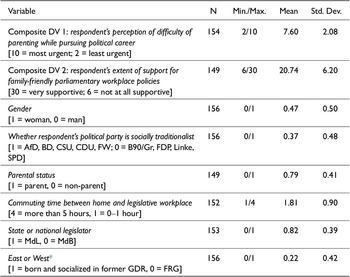
In this section we begin by providing descriptive statistics for key variables (see Table 2), followed by results of bivariate and OLS analyses and a discussion of respondents’ answers to the open-ended questions included in the survey. Bivariate analyses clearly show gendered differences in respondents’ attitudes both toward family-friendlier workplace policies and the difficulties of balancing parenting with their jobs as officeholders, in the first place (see Table 3). Women respondents described parenting as more challenging and they supported an array of parental accommodations, ranging from allowing parental leave to permitting remote voting, at higher rates than men, to a statistically significant degree.
Descriptive statistics of illustrative variables
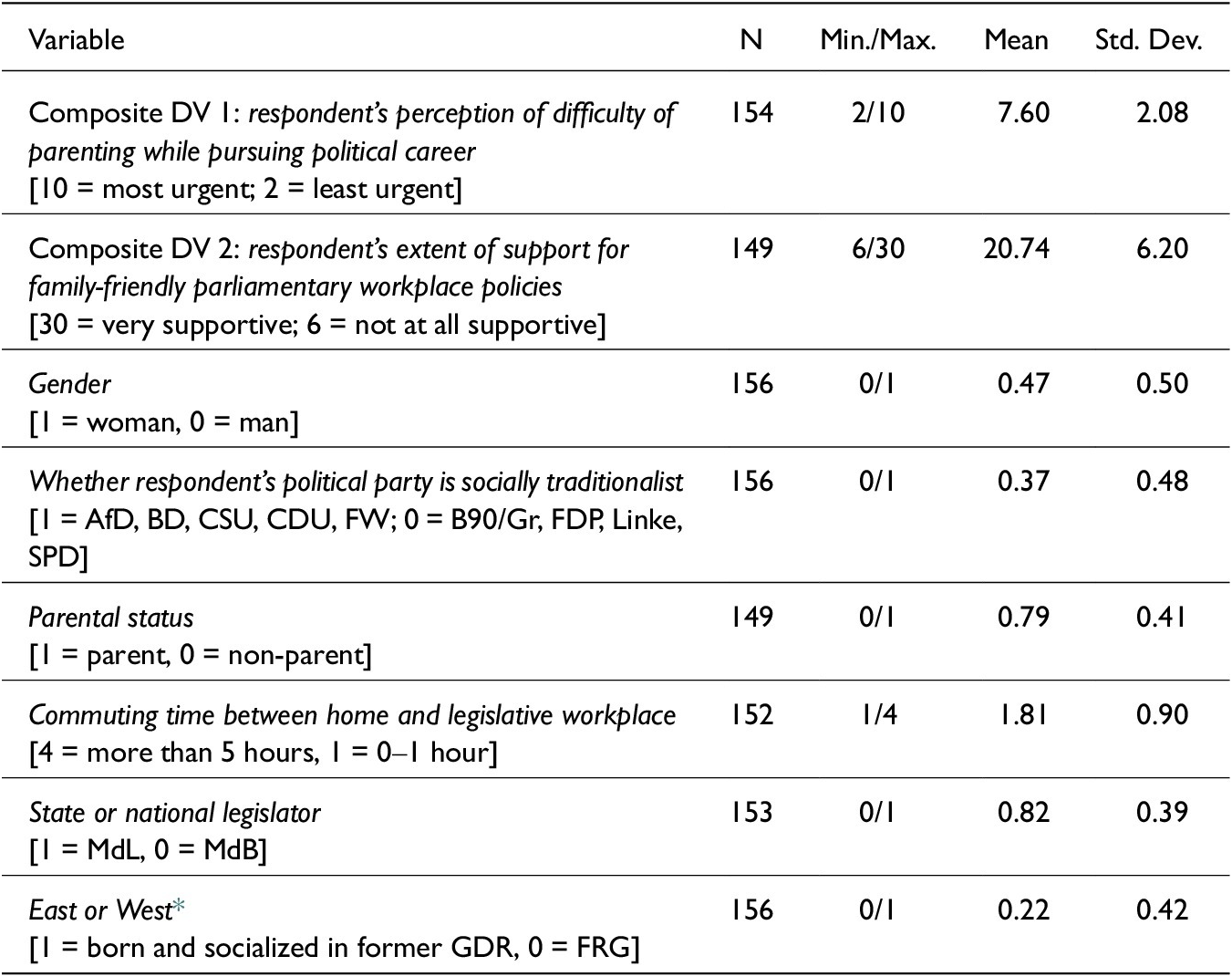
Table 2. Long description
The table contains seven rows, each representing a variable. The columns, from left to right, are Variable, N, Min./Max., Mean, and Standard Deviation. Row 1: Composite DV 1, respondent’s perception of difficulty of parenting while pursuing a political career, scale 2 to 10, N equals 154, Min./Max. is 2/10, Mean is 7.60, Standard Deviation is 2.08. Row 2: Composite DV 2, respondent’s extent of support for family-friendly parliamentary workplace policies, scale 6 to 30, N equals 149, Min./Max. is 6/30, Mean is 20.74, Standard Deviation is 6.20. Row 3: Gender, coded 1 for woman and 0 for man, N equals 156, Min./Max. is 0/1, Mean is 0.47, Standard Deviation is 0.50. Row 4: Whether respondent’s political party is socially traditionalist, coded 1 for AfD, BD, C S U, C D U, F W and 0 for B 90 forward slash Gr, F D P, Linke, S P D, N equals 156, Min./Max. is 0/1, Mean is 0.37, Standard Deviation is 0.48. Row 5: Parental status, coded 1 for parent and 0 for non-parent, N equals 149, Min./Max. is 0/1, Mean is 0.79, Standard Deviation is 0.41. Row 6: Commuting time between home and legislative workplace, scale 1 to 4, N equals 152, Min./Max. is 1/4, Mean is 1.81, Standard Deviation is 0.90. Row 7: State or national legislator, coded 1 for M d L and 0 for M d B, N equals 153, Min./Max. is 0/1, Mean is 0.82, Standard Deviation is 0.39. Row 8: East or West, coded 1 for born and socialized in former G D R, 0 for F R G, N equals 156, Min./Max. is 0/1, Mean is 0.22, Standard Deviation is 0.42. A note below the table clarifies that respondents born after reunification or who completed high school in the F R G are coded as West German.
Note: Appendix C displays descriptive statistics for each component variable of these composite DVs.
* Respondents born after Germany’s reunification in 1990, and those born in the GDR but who completed high school in the FRG, are coded as West German, based upon the widely accepted view that key elements of political socialization occur around the age of 15 years.
Gender, parties’ social traditionalism, and attitudes
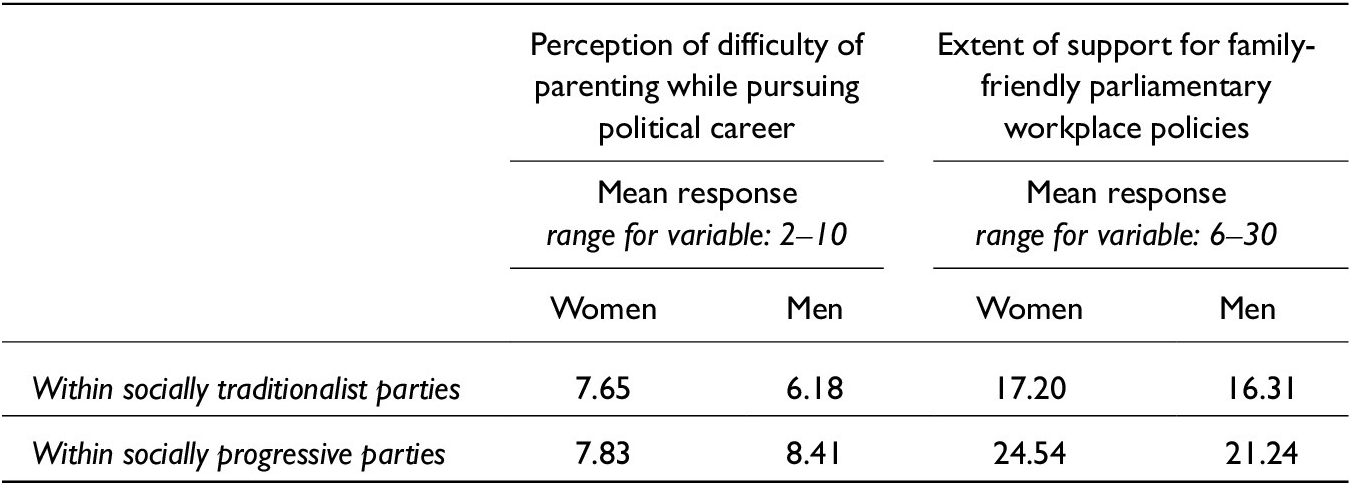
Table 3. Long description
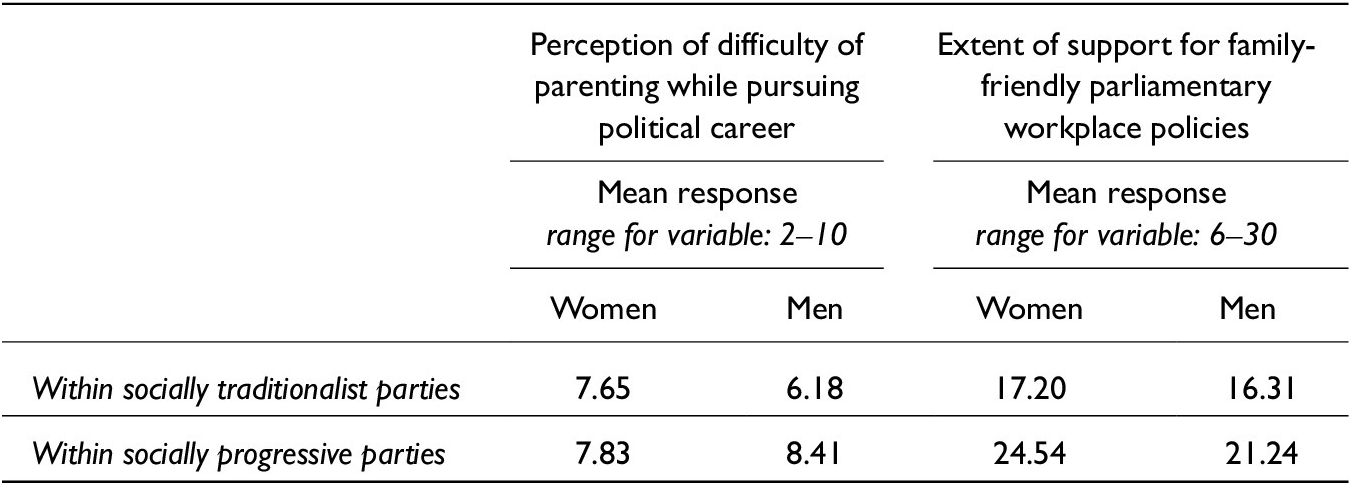
Column headers group variables into two sections. The first section is Perception of Difficulty of Parenting while Pursuing Political Career, with a mean response range of 2 to 10. The second section is Extent of Support for Family-friendly Parliamentary Workplace Policies, with a mean response range of 6 to 30. Each section has columns for women and men. The first row is Within Socially Traditionalist Parties. Women report a mean of 7.65 for perceived difficulty, men 6.18. For policy support, women report 17.20, men 16.31. The second row is Within Socially Progressive Parties. Women report 7.83 for perceived difficulty, men 8.41. For policy support, women report 24.54, men 21.24. Notes below the table state that gender differences within socially traditionalist parties are statistically significant for perceptions of difficulty but not for policy support. In socially progressive parties, gender differences are statistically significant for both perceptions of difficulty and policy support.
Notes: Gendered differences between women and men within socially traditionalist parties are statistically significant for perceptions of difficulty (2-tailed t-test, Pr(T < t) = 0.0171). Gendered differences between women and men within socially traditionalist parties are not significant for policy support (2-tailed t-test, Pr(T < t) = 0.311).
Gendered differences between women and men within socially progressive parties are statistically significant for perceptions of difficulty (2-tailed t-test, Pr(T < t) = 0.042). Gendered differences between women and men within socially progressive parties are also statistically significant for policy support (2-tailed t-test, Pr(T < t) = 0.001).
We also theorized that parties’ social traditionalism would be operative. Thus Table 3 displays a series of statistical tests of the relationships between respondents’ gender, their party’s social traditionalism, and their attitudes, which largely affirm these expectations.Footnote 15 Within socially traditionalist parties, the difference in perceptions of the difficulties of parenting while pursuing a political career between women and men is statistically significant: a mean attitude of 6.18 for men and 7.65 for women (2-tailed t-test, Pr(T < t) = 0.017). Among women, their parties’ social traditionalism does not significantly correlate with their perceptions of the challenges of parenting while pursuing a political career. Women across parties view this as difficult. By contrast, among men, perceptions of challenges are significantly lower among those in socially traditionalist parties.
The results in Table 3 further show that, when it comes to supporting policies to accommodate parents, party ideology emerges as a key predictor. Within socially traditionalist parties, men’s mean attitude of 16.31 is not statistically different from women’s 17.20 (2-tailed t-test, Pr(T < t) = 0.311). Women and men in these ideologically aligned parties are similarly opposed to accommodations for parents, and men in socially progressive parties are more supportive than women in socially traditionalist parties. Among both women and men, social traditionalism signals significantly lower support for family-friendly workplace policies. In other words, while women MPs in socially traditionalist parties perceive parenting as more difficult than ideologically similar male counterparts, these MPs nonetheless share a dislike for policies to address these challenges.
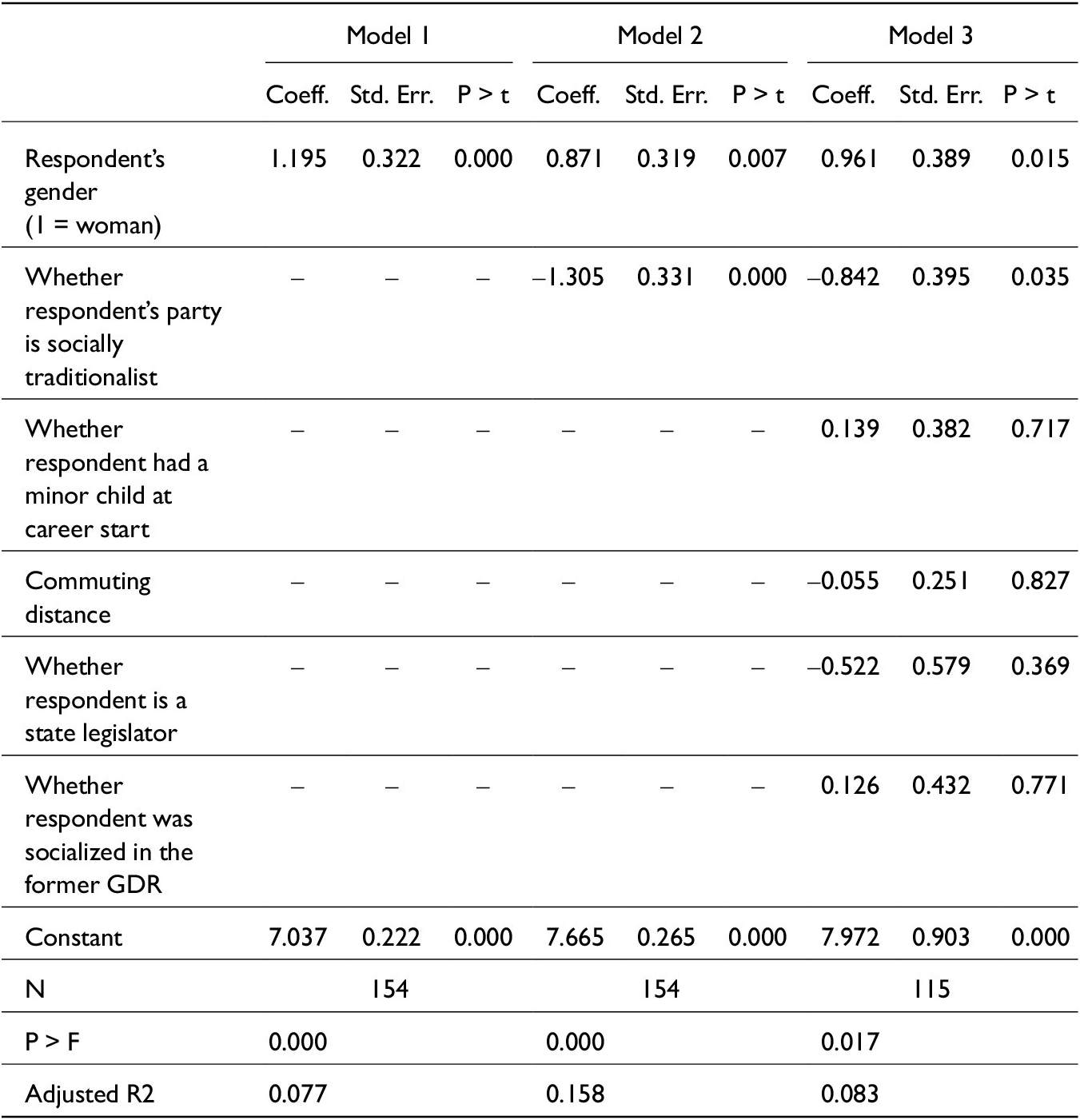
Finally, OLS models of respondents’ attitudes further substantiate the role that gender and party ideology — more so than parental status — play. The DV for the three models in Table 4 is a composite variable of respondents’ perception of how difficult it is to be a parent while pursuing a political career. Model 1 is minimalist, displaying just the relationship between gender and respondents’ perception of difficulty. Model 2 includes whether the respondent’s political party is socially traditionalist. Model 3 adds several control variables, including whether the respondent had a child 18 years of age or younger when they first entered political office, the duration of their commute to their parliamentary workplace, whether they are a state (versus federal) representative, and whether they were born and socialized in the former East or West Germany.
OLS models of perceptions of difficulty combining parenting with politics
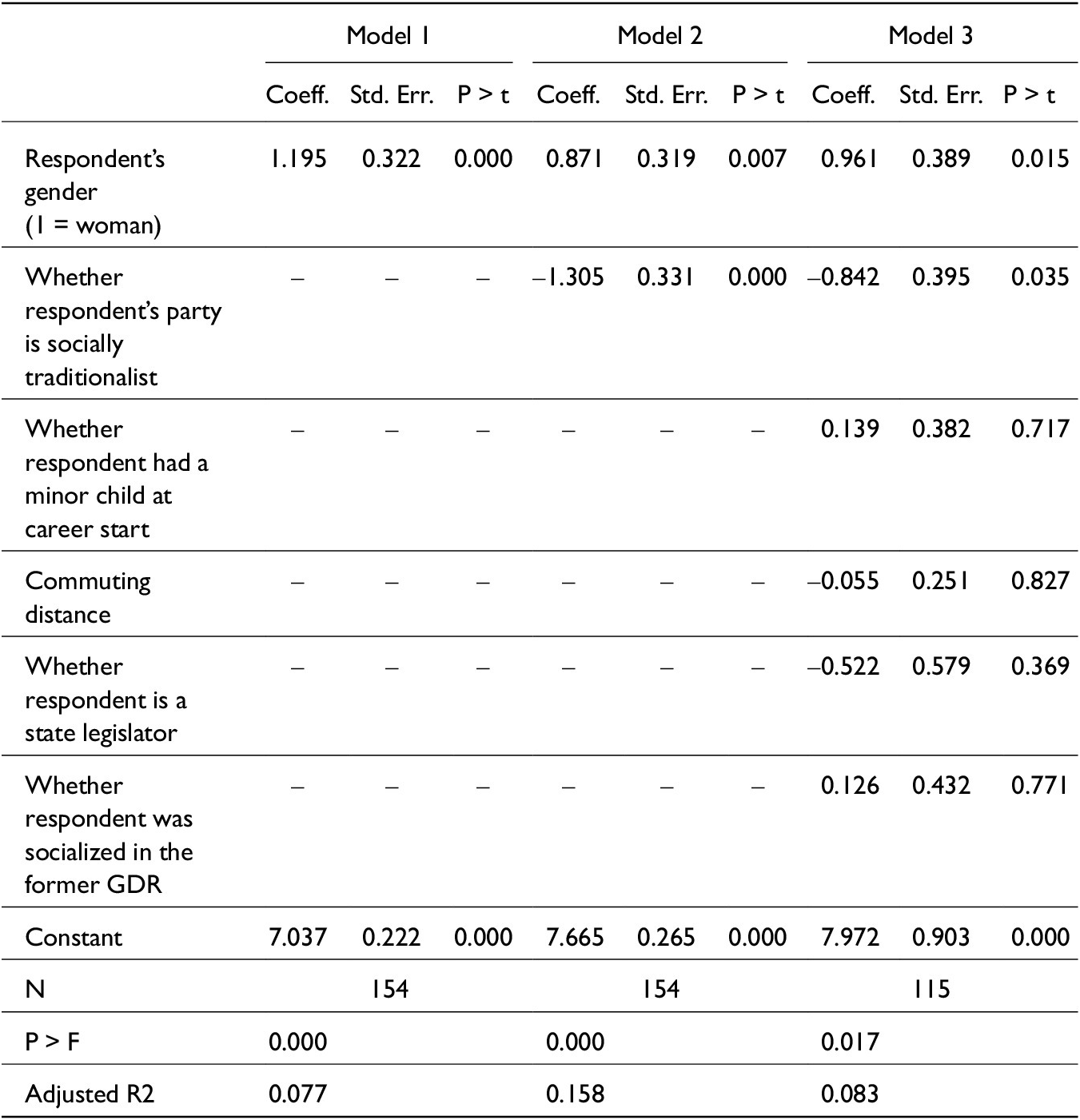
Table 4. Long description
The table presents three O L S models with columns for Model 1, Model 2, and Model 3. Each model includes columns for coefficient, standard error, and p-value. From top to bottom, the predictors are: Respondent’s gender (1 equals woman), whether respondent’s party is socially traditionalist, whether respondent had a minor child at career start, commuting distance, whether respondent is a state legislator, whether respondent was socialized in the former G D R, and the constant. For Model 1: gender coefficient is 1.195, standard error 0.322, p-value 0.000; constant is 7.037, standard error 0.222, p-value 0.000. For Model 2: gender coefficient 0.871, standard error 0.319, p-value 0.007; party traditionalist coefficient negative 1.305, standard error 0.331, p-value 0.000; constant 7.665, standard error 0.265, p-value 0.000. For Model 3: gender coefficient 0.961, standard error 0.389, p-value 0.015; party traditionalist coefficient negative 0.842, standard error 0.395, p-value 0.035; minor child at career start coefficient 0.139, standard error 0.382, p-value 0.717; commuting distance coefficient negative 0.055, standard error 0.251, p-value 0.827; state legislator coefficient negative 0.522, standard error 0.579, p-value 0.369; socialized in former G D R coefficient 0.126, standard error 0.432, p-value 0.771; constant 7.972, standard error 0.903, p-value 0.000. Sample sizes are 154 for Models 1 and 2, 115 for Model 3. P greater than F values are 0.000 for Models 1 and 2, 0.017 for Model 3. Adjusted R squared values are 0.077 for Model 1, 0.158 for Model 2, and 0.083 for Model 3. Notes indicate the dependent variable combines two survey questions on perceived difficulty of combining political careers with parenting, with a theoretical range of 2 to 10. Coefficients are unstandardized. Diagnostics for all models indicate some concern regarding heteroskedasticity based on Breusch–Pagan/Cook–Weisberg tests, with p-values of 0.023 for Model 1, 0.001 for Model 2, and 0.027 for Model 3. Variance Inflation Factors are 1.07 for Model 2, and between 1.05 and 1.52 (mean 1.22) for Model 3.
Notes: This dependent variable combines together two survey questions about respondents’ perceptions of the difficulty of combining political careers with parenting. It is a DV with a theoretical range of 2–10.
Coefficients are unstandardized.
Model 1 diagnostics: A Breusch–Pagan/Cook–Weisberg test indicates some concern regarding heteroskedasticity (p > χ 2 = 0. 023).
Model 2 diagnostics: A Breusch–Pagan/Cook–Weisberg test indicates some concern regarding heteroskedasticity (p > χ 2 = 0. 001). Variance Inflation Factors (VIFs) are 1.07.
Model 3 diagnostics: A Breusch–Pagan/Cook–Weisberg test indicates some concern regarding heteroskedasticity (p > χ 2 = 0. 027). Variance Inflation Factors (VIFs) are between 1.05 and 1.52 (mean 1.22).
The OLS results in Table 4 show evidence of a statistically significant and substantively meaningful correspondence between perceived level of difficulty combining a political career with parenting and gender and social traditionalism, respectively. Women respondents were more likely to perceive greater difficulty, and socially traditionalist party members perceived combining politics and parenthood as less difficult. And these effects are consequential: on a scale of 2–10, women respondents’ perceived difficulty is approximately 1 point greater than men’s, while members of socially traditionalist parties perceive nearly a full point less difficulty, even after controlling for a range of other variables (Model 3). Our theoretical expectations about factors that might correspond with greater difficulty for parents, such as commuting distance, are not confirmed.
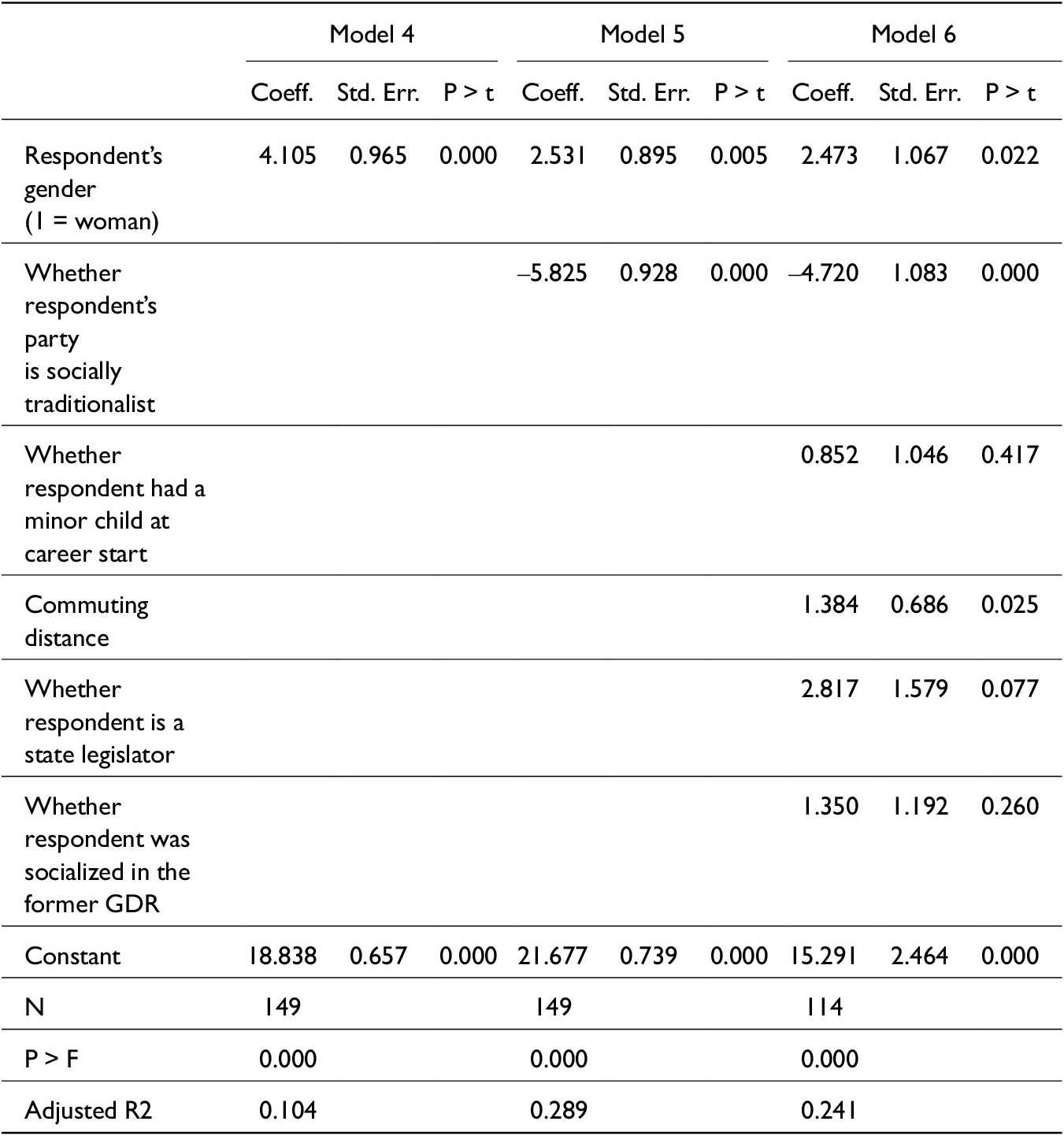
Table 5 displays the results of OLS models of our second DV, which captures respondents’ support for policies that would make their parliamentary workplaces family-friendlier. Very similarly to Models 1-3 (modeling perceptions of difficulty), Models 4–6 show that variation in respondents’ attitudes towards these workplace policies is largely correlated with their gender and the social traditionalism of their political party. All else being equal, being a woman is associated with an increase of more than 2.5 points on a scale ranging from 6 to 30. Being a member of a socially traditionalist party has an even larger effect, reducing support by more than 5 points on the same scale. These correlations persist across several specifications, and diagnostics indicate that the model is robust. As in the previous table’s models, contrary to expectations, having had a young child at their career start does not appear to be related to respondents’ level of support. Unlike Model 3, here both commute time and being a state (rather than national-level) legislator are associated with these attitudes. These distinctive correlates could be because they raise all legislators’ awareness of the benefits of flexibility. Both longer commute time and state legislatures’ emphasis on constituency work could motivate support for remote voting, for example, separately from a respondent’s parental status, and separately from their views on the difficulty of combining parenthood with a political career. Taken together, these statistical results unambiguously show gendered and ideological patterns in German legislators’ attitudes toward balancing labor as parents with a political career. Indeed, gender and social traditionalism are more predictive of attitudes than parental status.
OLS model of support for family-friendly policies
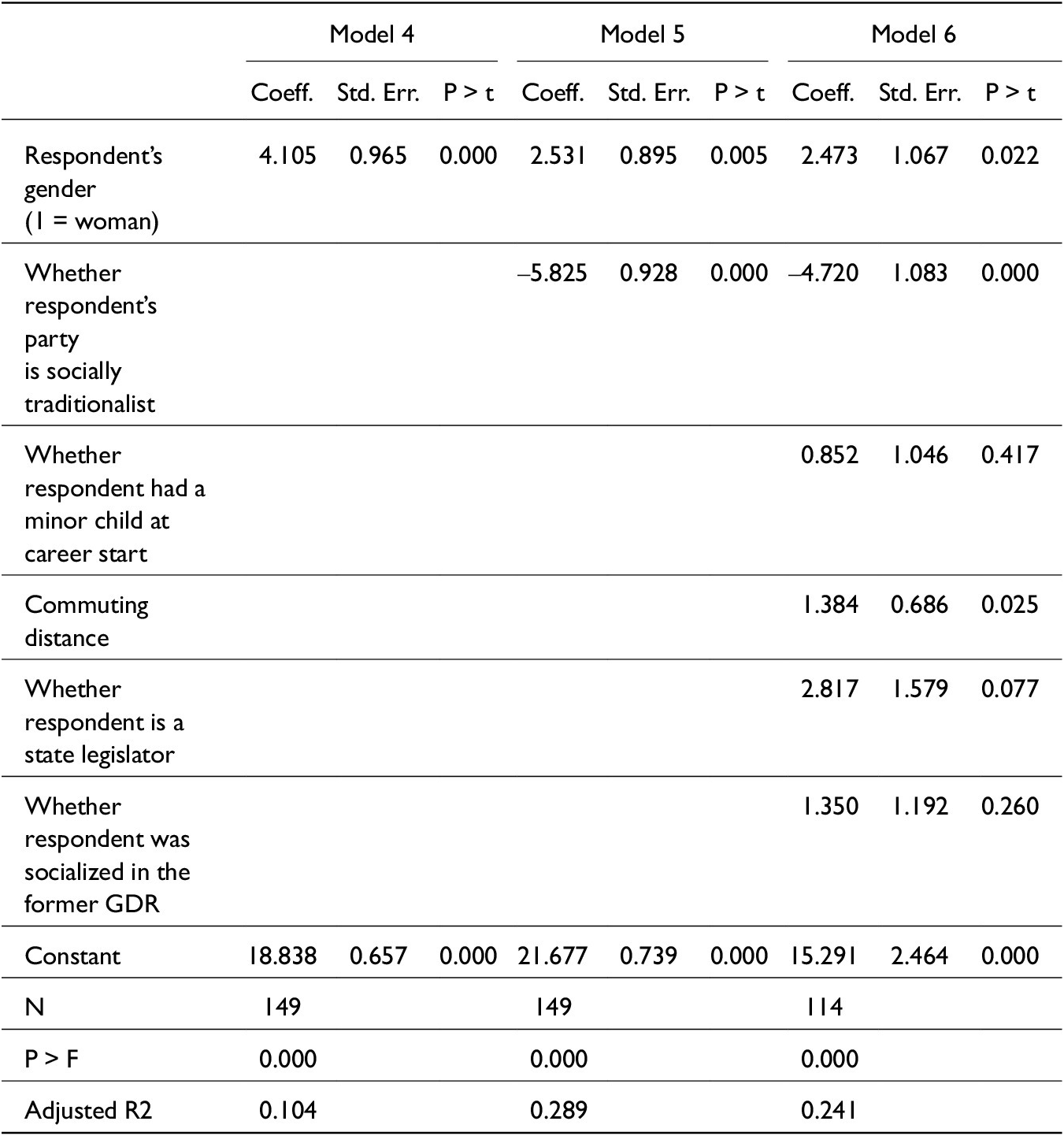
Table 5. Long description
The table presents O L S regression results for support of family-friendly policies, with variables listed in the first column and results for Models 4, 5, and 6 in subsequent columns. For respondent’s gender (1 equals woman), coefficients are 4.105, 2.531, and 2.473 with standard errors 0.965, 0.895, and 1.067, and p-values 0.000, 0.005, and 0.022, respectively. For whether respondent’s party is socially traditionalist, coefficients are negative in Models 5 and 6, at minus 5.825 and minus 4.720, with standard errors 0.928 and 1.083, and both p-values 0.000. Whether respondent had a minor child at career start is only included in Model 6, with coefficient 0.852, standard error 1.046, and p-value 0.417. Commuting distance appears in Model 6, coefficient 1.384, standard error 0.686, p-value 0.025. Whether respondent is a state legislator is in Model 6, coefficient 2.817, standard error 1.579, p-value 0.077. Whether respondent was socialized in the former G D R is in Model 6, coefficient 1.350, standard error 1.192, p-value 0.260. The constant terms are 18.838, 21.677, and 15.291 for Models 4, 5, and 6, with standard errors 0.657, 0.739, and 2.464, all p-values 0.000. Sample sizes are 149 for Models 4 and 5, and 114 for Model 6. P greater than F is 0.000 for all models. Adjusted R squared values are 0.104, 0.289, and 0.241 for Models 4, 5, and 6. Notes indicate the dependent variable is a composite of six survey questions, range 6 to 30, and coefficients are unstandardized. Model diagnostics report no heteroskedasticity concern for Models 4 and 6, some concern for Model 5, and variance inflation factors are low across models.
Notes: This dependent variable combines together six survey questions about respondents’ attitudes toward family-friendly workplace policies for parliaments. It is a DV with a theoretical range of 6–30.
Coefficients are unstandardized.
Model 4 diagnostics: A Breusch–Pagan/Cook–Weisberg test does not indicate concern regarding heteroskedasticity (p > χ 2 = 0. 834).
Model 5 diagnostics: A Breusch–Pagan/Cook–Weisberg test indicates some concern regarding heteroskedasticity (p > χ 2 = 0.071). Variance Inflation Factors (VIFs) are 1.09.
Model 6 diagnostics: A Breusch–Pagan/Cook–Weisberg test does not indicate concern regarding heteroskedasticity (p > χ 2 = 0. 285). Variance Inflation Factors (VIFs) are between 1.05 and 1.51 (mean 1.23).
We also offered survey respondents the opportunity to express themselves at greater length by answering several optional open-ended questions. Many politicians did so: 61 (39.1% of respondents) chose to comment upon initiatives that could make their parliamentary workplace family-friendlier, and 36 (23.1%) chose to elaborate on their thinking about parenting and politics. Below, we discuss the kinds of rationale MPs give for their attitudes, when offered the chance to voice them.
In general, the answers to the open-ended questions reinforce the broad finding that combining parenthood and politics is difficult and that women perceive it to be more challenging than men. The survey offered respondents the opportunity to elaborate on the challenges of reconciling parenting and politics and outline any specific institutional reforms that would facilitate reconciliation. The answers we received add further nuance to our findings and highlight some of the deeper motivations for reform and the underlying sources of resistance. They also illustrate the ways in which political parties’ varying orientations towards family, the state, and childcare infrastructure may shape individual respondents’ attitudes. Respondents in socially progressive parties, and especially women in those parties, provide some of the most pointed critiques of the status quo and how it disadvantages women’s representation. Respondents in socially traditionalist parties, on the other hand, frame work-life balance as an individual rather than institutional problem or note that politicians are privileged and not justified in complaining.
A disproportionate share of additional statements of concern came from women in socially progressive parties, illustrating that both gender and party ideology are correlated with legislators’ experiences and attitudes about parenting and politics. Two women from socially progressive parties acknowledged the double bind that women confront. One of them explained, “if they concentrate heavily on political work, they are said to be bad mothers. If they make compromises in their jobs in order to be there more for their children, they are said to be bad or lazy politicians.” Another noted that meeting times, particularly for party meetings, are a problem for women with caring responsibilities: “If, for example, you don’t attend informal meetings in the evenings, you may miss important power-political agreements that are only unofficial but that’s exactly why they are so important. Politics is a man’s business and is organized very much according to male stereotypes. Even if there are women, they are either in the game or out.” The demands of physical presence were likewise mentioned by another woman state legislator in a socially progressive party, who explained that “the problem is not the parliamentary organization, but rather the high level of presence required to be (re)elected and the high level of presence at all kinds of events in order to make political projects a success.” She went on to say, “As a mother of three children, I have no solution for this.”
Finally, a woman state legislator (socially progressive party) expressed frustration at just how little things had changed over time. She noted, “the public derogatory opinions or negative statements from many clubs, associations or parties are what make it difficult for women to be successful as mothers and representatives,” adding that, “I’m now a grandmother and I still hear a lot of negative reviews that I heard back in the late 1980s and early 1990s, when my children were born.”
In designing a sparse questionnaire, we did not ask questions about a wider range of care labor, which would theoretically fit within the universe of circumstances benefiting from family-friendlier policies. The open-ended answers explicitly identify this wider universe. For example, several respondents pointed out that parenting younger children is not the only challenge for politicians. One woman from a socially progressive party, a member of the Bundestag, wrote, “Please be sure to also talk about parenting with older children. It’s not just difficult with parental leave and maternity leave – also with older children.” Another woman state legislator from the same party noted that family members at many stages of their lives need care: “Family is more than being a parent; it is also about, for example, caring for one’s own elderly parents and caring for disabled or chronically ill relatives for whom a solution must be found outside of regular daytime working hours.”
That party ideology affects attitudes towards parenthood and politics is evident in the contrasting perspectives offered by some of the men and women respondents in socially traditionalist parties, some of whom implied that politicians make choices, and perhaps they ought to make different ones. According to one man state legislator, “Parenting and political involvement are both by choice.” Another man state legislator in a socially traditionalist party asserted that “every member of parliament is so well off financially that most necessities can be easily organized on their own.” The claim that legislators have adequate financial resources was echoed by another man state legislator in a socially traditionalist party, who asserted, “I think that with the lavish allowances, everyone can take care of their own children.” Framing work-life balance as an individual rather than institutional problem is evident in the response from another man, also a state legislator from a socially traditionalist party: “It would be best for the children if their parents only went into politics after they had reached puberty. Then the children also have enough time with their parents.” Of course, if parents were to follow his guidance, then politicians would either have to forego children altogether or not enter politics until their 40s (approximately). It’s unclear whether the legislator sincerely believed his recommendation to apply to all politicians, or to women in particular.
These attitudes correspond with the respondents’ parties’ orientations towards family, and they correspond with parties’ views of whether the government has an obligation, let alone a right, to enact family-friendlier policies for parliamentary workplaces. In fact, two additional comments reveal skepticism about whether changes to accommodate parents should be contemplated at all, with a man state legislator from a socially traditionalist party expressing that “the citizens whose interest we represent are more important. The parliamentarian has to stand at the back.” A woman from a socially traditionalist party wrote that breastfeeding or having infants on the parliamentary floor should be the exception rather than widely permitted “in order to ensure the seriousness of parliament.”
Alternative Explanations
Although both the quantitative and qualitative results of our survey show variation in attitudes towards adopting family-friendlier policies in German legislative assemblies, most respondents were broadly supportive of reforms. This leaves the persistent puzzle of policy inaction. This section elaborates upon these findings to discuss their implications for policy change.
We have offered evidence that gender corresponds with German parliamentarians’ attitudes towards the challenges of balancing parenthood with their political careers, and that party ideology especially corresponds with the kind of workplace supports that they believe are reasonable. We have argued that these attitudinal patterns point toward an explanation for why these parliamentary workplaces have not become family-friendlier. Men, who remain a numerical majority among legislators, continue to perceive parenting as less challenging. Feminist institutionalist theories emphasize that the norms and working practices in parliaments are difficult to change precisely because of their take-for-granted nature (Chappell and Waylen Reference Chappell and Waylen2013; Erikson and Joseffson Reference Erikson and Josefsson2019). Those who benefit from the status quo do not even need to openly oppose change; their resistance can take the form of simply supporting “the way things are done around here” (see Lowndes Reference Lowndes2020). We believe our findings further contribute to feminist institutionalism’s emphasis on the role that gendered norms play in sustaining a status quo that disadvantages women politicians.
The finding that political party ideology corresponds with parliamentarians’ support for the extent and type of procedural changes adds to this explanation for policy inaction. When given the opportunity to explain their positions in open-ended comments, respondents offer reasons that resonate with their parties’ broader social positions. Based upon these findings, it is possible that assemblies dominated by socially traditionalist parties are less likely to adopt family-friendly procedural changes, because MPs in these parties do not sufficiently support them.
However, not all assemblies are dominated by socially traditionalist parties, and Germany’s 21st-century state legislatures show considerable ideological diversity. At the time when we distributed our survey in 2023, five state legislatures were governed by coalitions that included both the CDU and the B90/Greens. Four were governed by “grand coalitions” including both the CDU and SPD. Six state legislatures were fully left-leaning, featuring combinations of the SPD, B90/Greens, and the LINKE. (See Appendix A) Even as members of the governing coalition (or, in the case of Saarland, governing alone), socially progressive parties have not produced family-friendlier parliamentary rules.
Thus, we next consider an alternative explanation for policy inaction that lies with public opinion. Although Germany has developed more extensive family supports for society more broadly, these do not generally apply to MPs. It remains the fact that MPs (as workers) have fewer workplace supports for family labor than their constituents. However, the public might not favor these accommodations for elected representatives. A Deutschland-Monitor survey from 2023, the year we queried German MPs, speaks in part to this alternative possibility. This surveyFootnote 16 shows evidence of rather divided sentiments among the German public on two key issues: 1) whether respondents, themselves, view available family-friendly infrastructure as adequate, and 2) their trust in the Bundestag and in their state legislatures.
First, 52.1% of respondents to this nationally representative survey described themselves as very satisfied or satisfied with the availability of childcare options, and just 14.0% described themselves as dissatisfied or very dissatisfied. Although the inadequacy of childcare infrastructure to meet demand in Germany is well known, these response patterns do not indicate a flashpoint on this issue. Second, Deutschland-Monitor ’23 respondents are not deeply negative about their representative assemblies, although there are differences between levels of government. Respondents express greater trust in regional compared to national government, with 50.7% of respondents stating they “trust completely” or “rather trust” their state governments, compared to 38.7% trusting the federal government. Correspondingly, just 14.6% of respondents “rather do not trust” or “trust not at all” their regional governments, compared to 26.1% distrusting the federal government.
While the Deutschland-Monitor ’23 survey did not address all ways in which public opinion might potentially motivate political parties to resist adopting family-friendlier policies, its insights do not clearly explain policy inaction at both the state and federal levels. It seems unlikely that MPs or governing coalitions, at both levels, would be concerned about blowback if they were to take action to accommodate parents in politics.
Taken together, having considered a variety of ideological, structural, and even electoral factors, we return to the finding that MPs in socially traditionalist parties are simply less supportive of parental accommodations than their colleagues in more progressive parties. Although women across parties find parenting and politics more difficult than men, women in the more socially traditionalist parties join their male counterparts in expressing less support for reforming parliamentary practices to accommodate parents. Even a variety of other pressures in favor of family-friendlier parliamentary workplaces have not overcome these ideological positions.
Conclusion
Who thinks parliamentary workplaces should be more supportive of parents? Measures of these attitudes skew in favor of more supportive policies (see Table 2), yet the greatest urgency favoring their adoption is expressed along the lines of gender and party ideology. Women respondents find balancing the two responsibilities of family and parliamentary work to be considerably more challenging than men respondents, whether they are in progressive or socially traditionalist parties. Yet women’s support of family-friendly workplace policies does not follow neatly or automatically from their perceptions of how hard it is to reconcile politics and parenthood. Instead, political party ideology is a highly salient signal to respondents’ support for a range of parenthood accommodations. Even though women in socially traditionalist parties find it more difficult than men in their own parties to reconcile parenting and politics, they are less likely than women and men in progressive parties to think that parliaments should change how they do their work in order to accommodate them. The write-in comments that many respondents offered highlight these dynamics in colorful, if sometimes dispiriting, ways.
We think our findings about legislator attitudes toward parenthood and politics in Germany contribute more broadly to knowledge about how gender and ideology interact to shape political outcomes. Strikingly, our survey indicates that shared gendered experiences do not produce shared policy preferences. Among our survey respondents, being a woman is associated with the common perception that combining politics and parenthood is difficult. This perception holds regardless of party ideology. But when it comes to improving the situation, party ideology becomes influential. Notably, we still see a gender gap, with women more supportive of accommodations than men, but here we also see a gap between women in progressive versus traditionalist parties. Indeed, men in progressive parties are more supportive of policies to accommodate parents than are women in traditionalist parties. Thus, a key contribution of our study is to identify where party ideology matters less, that is, in how women perceive and experience politics and parenthood, and where it matters more, that is, in supporting reforms that would benefit women.
These results resonate with other studies’ findings (Allen, Cutts, and Winn Reference Allen, Cutts and Winn2016; Fiva and King Reference Fiva and King2024; Frech and Kopsch Reference Frech and Kopsch2024), and they underscore the urgency of these issues in various ways. For practitioners, including parliamentary leaders, who may be contemplating procedural changes but are concerned about their viability, our findings indicate that a slate of family-friendlier policies would find ready support from many MPs. As we have noted, mean and modal responses to our survey questions clearly skew in favor of such policies. These practitioners could need a strategy specifically for members of socially traditionalist parties, who our findings show are the most likely opponents to policy changes to create family-friendlier workplace policies. However, in the many state assemblies where more supportive parties lead the government and correspondingly hold significant seat shares, this is not strictly necessary, given extensive support from MPs across other parties.
In terms of scholarly implications, we believe that our findings motivate attention to the consequences of the attitudes that we document here. Future research would do well to examine closely the process by which efforts at family-friendlier procedural changes have been attempted and either failed or succeeded. We should also examine the extent to which challenges for parents affect individual decision-making and candidate recruitment considerably earlier in the process. When women perceive parenting to be especially difficult, does this lead mothers to opt out of politics or to forego professional advancement? To what extent do socially traditionalist parties’ views of parenting shape potential women candidates’ choices?
Supplementary material
The supplementary material for this article can be found at http://doi.org/10.1017/S1743923X26100786.


 Open access

