

Hostname: page-component-77f85d65b8-8v9h9 Total loading time: 0 Render date: 2026-03-28T11:10:59.285Z Has data issue: false hasContentIssue false

Saturated Subgraphs of the Hypercube

Published online by Cambridge University Press:  19 September 2016

J. ROBERT JOHNSON
Affiliation:
School of Mathematical Sciences, Queen Mary University of London, London E1 4NS, UK (e-mail: r.johnson@qmul.ac.uk)
TREVOR PINTO
Affiliation:
School of Mathematical Sciences, Queen Mary University of London, London E1 4NS, UK (e-mail: r.johnson@qmul.ac.uk)

Abstract

We say a graph is (Q n ,Q m )-saturated if it is a maximal Q m -free subgraph of the n-dimensional hypercube Q n . A graph is said to be (Q n ,Q m )-semi-saturated if it is a subgraph of Q n and adding any edge forms a new copy of Q m . The minimum number of edges a (Q n ,Q m )-saturated graph (respectively (Q n ,Q m )-semi-saturated graph) can have is denoted by sat(Q n ,Q m ) (respectively s-sat(Q n ,Q m )). We prove that

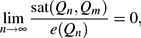
$$\begin{linenomath}\lim_{n\to\infty}\ffrac{\sat(Q_n,Q_m)}{e(Q_n)}=0,\end{linenomath}$$
for fixed m, disproving a conjecture of Santolupo that, when m=2, this limit is 1/4. Further, we show by a different method that sat(Q n , Q 2)=O(2n ), and that s-sat(Q n , Q m )=O(2n ), for fixed m. We also prove the lower bound
$$\begin{linenomath}\ssat(Q_n,Q_m)\geq \ffrac{m+1}{2}\cdot 2^n,\end{linenomath}$$
thus determining sat(Q n ,Q 2) to within a constant factor, and discuss some further questions.

MSC classification

Information

Type
Paper
Copyright
Copyright © Cambridge University Press 2016 

Access options

Get access to the full version of this content by using one of the access options below. (Log in options will check for institutional or personal access. Content may require purchase if you do not have access.)

Article purchase

Temporarily unavailable