




Introduction
During Jurassic times, gastropods were generally only subordinate components of benthic communities, which usually were dominated by bivalves (e.g., Fürsich, Reference Fürsich1977; Aberhan, Reference Aberhan1992; Holzapfel, Reference Holzapfel1998; Fürsich et al., Reference Fürsich, Oschmann, Pandey, Jaitly, Singh and Liu2004). There are notable exceptions, for example, the Pliensbachian Buttenheim Formation in southern Germany where gastropods commonly occupy the first two positions in rank abundance of any quantitatively collected sample (Karapunar et al., Reference Karapunar, Werner, Fürsich and Nützel2020, table 3). In Lower Jurassic offshore carbonates in South Wales gastropods constitute 30% of the total fauna and are much more diverse when silicified, whereas their diversity and abundance are much lower (1%) where no silicification occurred (Wright et al., Reference Wright, Cherns and Hodges2003). The latter authors argued that the diversity and abundance of Jurassic aragonitic molluscs such as gastropods are grossly underestimated due to early diagenetic dissolution of their aragonitic shells. This view is also shared by studies of other geological time intervals (e.g., Seuss et al., Reference Seuss, Nützel, Mapes and Yancey2009; Foot et al., Reference Foot, Crampton, Beu and Nelson2015; Roden et al., Reference Roden, Hausmann, Nützel, Seuss, Reich, Urlichs, Hagdorn and Kiessling2020), even though the reason for the bias appears to be more complex.
The documentation of a rich gastropod fauna from Oxfordian strata of the Kachchh Basin of western India, which is dominated by turritellids (Mitra and Ghosh, Reference Mitra and Ghosh1979; Das et al., Reference Das, Saha, Bardhan, Mallick and Allmon2018) and comprising more than 20 species (Saha et al., Reference Saha, Das, Mondal, Banerjee and Sarkar2021), seems to underpin the point made by Wright et al. (Reference Wright, Cherns and Hodges2003) and Cherns and Wright (Reference Cherns and Wright2000, Reference Cherns and Wright2009) that the Phanerozoic record of macrobenthic communities is generally strongly skewed. However, as we demonstrate in the following, the age of the assemblage from Kachchh has been wrongly determined: it is Miocene and not Late Jurassic. This is important, because far-reaching conclusions concerning the taxonomy of gastropods, paleoecology, biostratigraphy, and evolutionary lineages have been drawn from the assemblage based on its “Jurassic” age.
History of research
The Kachchh Basin is a Jurassic rift basin situated at the western margin of the Indian craton (e.g., Biswas, Reference Biswas and Thakkar2016) that contains a predominantly shallow marine succession, parts of which are highly fossiliferous. The micro- and macrofauna of the strata have been documented in numerous papers, starting with J. de C. Sowerby (Reference Sowerby1840). The discovery and documentation of a locality rich in fossils close to the Jhura Dome on the so-called Kachchh Mainland (see Fürsich et al., Reference Fürsich, Pandey, Alberti, Mukherjee and Chauhan2020, for a geological sketch map of Kachchh) by Mitra and Ghosh in 1979 was therefore not unexpected. The authors failed to provide precise locality information, but determined the age of the strata, which they identified as ‘Dhosa Member,’ as Oxfordian based on the ammonites Peltoceras kumagunense Spath, 1931, and Paryphoceras rugosum Spath, 1928, which had been collected earlier from the locality by Mitra and Ghosh (Reference Mitra and Ghosh1964). From their locality they recorded abundant turritellid gastropods and described two new species, Turritella jadavpuriensis and T. jhuraensis. Several years ago, a group of paleontologists from Kolkata revisited the area and found abundant turritellid gastropods in a small pond section southeast of the village of Jhura (Das et al., Reference Das, Saha, Bardhan, Mallick and Allmon2018, fig. 1; the co-ordinates given do not match the locality sketch map). They bulk-sampled several horizons with turritellids between 2012 and 2016 and obtained more than 13,000 specimens of turritellids (which represented 85% of the total assemblage), as well as other gastropods and bivalves.
Das et al. (Reference Das, Saha, Bardhan, Mallick and Allmon2018) described four turritellinid species, Turritella jadavpuriensis Mitra and Ghosh, Reference Mitra and Ghosh1979, T. jhuraensis Mitra and Ghosh, Reference Mitra and Ghosh1979, T. amitava n. sp., and T. dhosaensis Das et al., Reference Das, Saha, Bardhan, Mallick and Allmon2018, and declared them as the oldest members (by 30 million years) of the family Turritellidae. They accepted the lithostratigraphic position of the beds they investigated as part of the Dhosa Oolite Member and found a single belemnite specimen, Belemnopsis langanensis (Futterer, Reference Futterer1894) in their section. Based on the ammonite evidence obtained by Mitra and Ghosh (Reference Mitra and Ghosh1979) as well as subsequent biostratigraphic studies on the Dhosa Oolite Member and lithological considerations, they placed the Turritella-bearing horizons in the upper part of the lower Oxfordian.
Das et al. (Reference Das, Mondal, Saha, Bardhan and Saha2019) published a paper describing two naticid gastropods from the same locality, Euspira jhuraensis n. sp. and Gyrodes mahalanobisi n. sp., thus pushing back the time of origin of the family Naticidae by 30 million years. A third species, Euspira lakhaparaensis Das et al., Reference Das, Mondal, Saha, Bardhan and Saha2019, is represented by a single specimen and allegedly comes from upper Tithonian rocks in the western part of the basin.
Saha et al. (Reference Saha, Das, Mondal, Banerjee and Sarkar2021), in an attempt to erect a biostratigraphic scheme of the Jurassic sedimentary successions of the Kachchh and Jaisalmer basins, recognized the Turritella Zone for the upper Oxfordian strata of the Kachchh Rift Basin and correlated it with the Bifurcatus Ammonite Zone.
Finally, Bardhan et al. (Reference Bardhan, Saha, Das and Saha2021) published an elaborate ecological study on naticid-molluscan prey interaction during the Late Jurassic based on the bulk samples obtained from the pond locality. Gastropods account for ~90% and bivalves for 9% of the molluscan assemblage. The authors recognized a gastropod community with 19 species, in which turritellinids account for 98% of the individuals. The less abundant bivalves also are represented by 19 species and dominated by nuculids and corbulids. Bardhan et al. (Reference Bardhan, Saha, Das and Saha2021) suggested that turritellines and naticids both evolved during the Jurassic and that a predator-prey relationship became established soon thereafter.
Locality information
According to the coordinates given by Das et al. (Reference Das, Saha, Bardhan, Mallick and Allmon2018, Reference Das, Mondal, Saha, Bardhan and Saha2019), the locality with the pond section is in the upper part of the Callovian Jumara Formation, being composed of shales and subordinate sandstones. This area, visited by us repeatedly during the last 30 years, has not yielded a single turritellid gastropod, nor are there any ponds. The position of the pond section given by Das et al. (Reference Das, Saha, Bardhan, Mallick and Allmon2018, fig. 1) in their locality sketch is correct. Investigation of the area by one of us (S.B.) in February 2022 showed the presence of several small ponds, which yielded abundant turritellids in situ and in dumps of rocks that had been excavated during construction of the ponds. The section shown by Das et al. (Reference Das, Saha, Bardhan, Mallick and Allmon2018, fig. 3) could not be verified.
Miocene rocks in the vicinity of the Jhura Dome
The Lower Miocene Chhasra Formation of the Kachchh Basin indicates peak transgression (Biswas, Reference Biswas1993), during which the sea reached distant low-lying areas and the periphery of uplifted highlands. Remains of these sediments are seen between the northern limb of the Jhura (Jhurio) Dome of Kachchh Mainland and the Banni Plain (Fig. 1) (Biswas, Reference Biswas1993, p. 225). One of these outcrops lies 1 km south-southeast of the village Jhura in an artificially constructed small pond (23°25'32.9"N, 69°37'04.2"E).
Simplified geological map of the Jhura Dome indicating the turritellid locality (pond section) and the erroneous co-ordinates given by Das et al. (Reference Das, Saha, Bardhan, Mallick and Allmon2018) (modified after Biswas and Deshpande, Reference Biswas and Deshpande1970). The inset map shows the position of the Kachch Basin in India. Baj. = Bajocian; Bath. = Bathonian; Call. = Callovian; Oxf. = Oxfordian; Kim. = Kimmeridgian; Tith. = Tithonian; Cret. = Cretaceous.

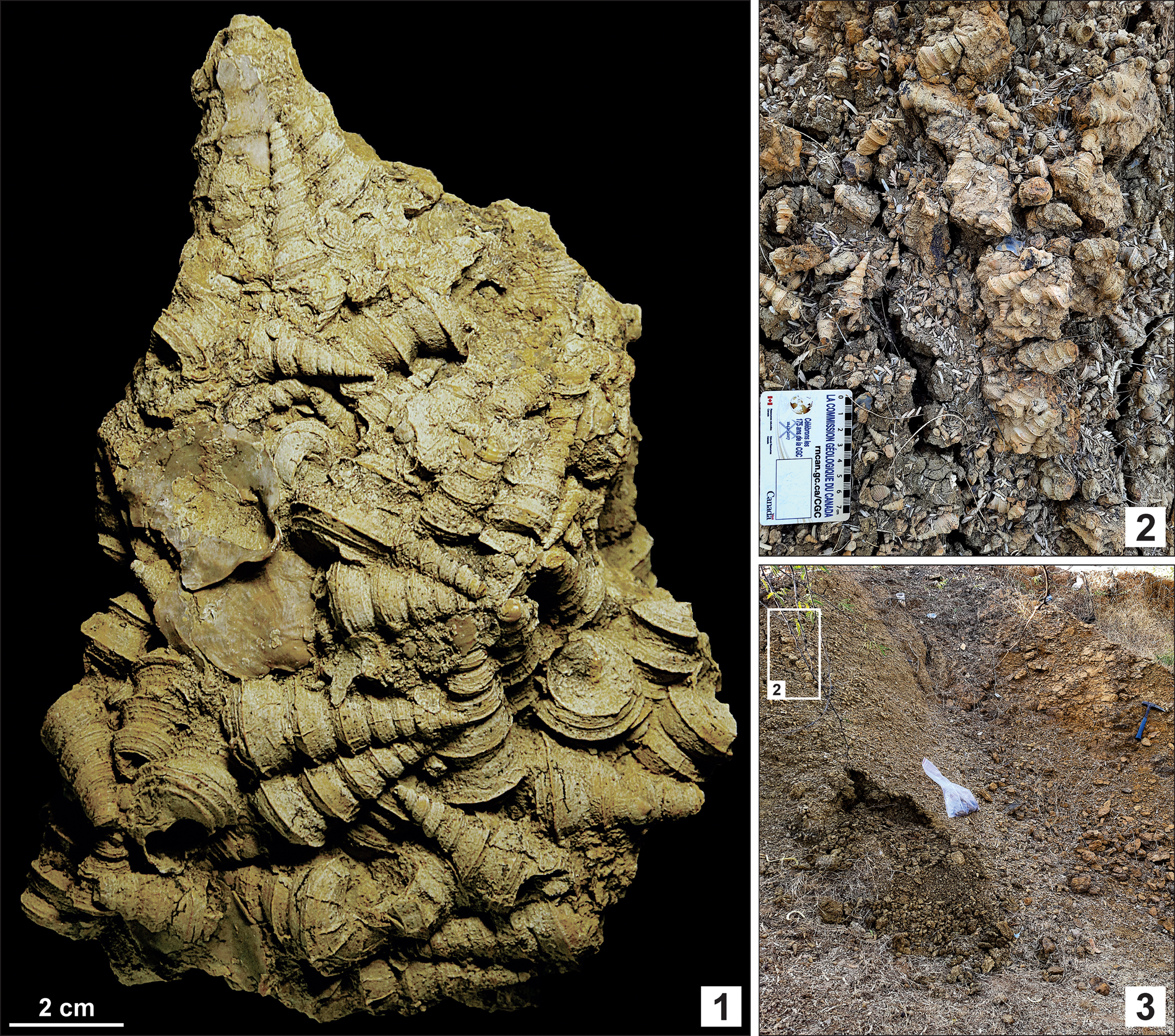
The beds of the Chhasra Formation at this locality are deformed and tilted at 65–85° towards the north. Miocene strata occur in close vicinity to the Tithonian/Lower Cretaceous Bhuj Formation. The contact between the two stratigraphic units is covered by Quaternary alluvial sediments, which occasionally contain fragments of ammonites and belemnites transported from nearby outcrops of Jurassic strata that form the Jhura Dome. The Miocene lithology is characterized by argillaceous sediments. Six meters above the base, fossiliferous bands with abundant gastropods, bivalves, and echinoid spines occur in thin (up to 4-cm-thick) bioclastic marl bands and argillaceous-silty layers (Figs. 2, 3).
Litholog of the locality SSE of the village Jhura, towards the northern flank of the Jhura Dome. The base of the section is the Upper Jurassic/Lower Cretaceous Bhuj Formation, overlain by the Lower Miocene Chhasra Formation, yielding a rich molluscan assemblage dominated by turritellid gastropods. cl, clay; si, silt; f, fine-grained sand; m, medium-grained sand; c, coarse-grained sand.

(1, 2) Molluscan concentration dominated by turritellid gastropods 6 m above the base of the Chhasra Formation at the pond section; specimen shown in (1) reposited in the collections of Kachchh University, Bhuj; repository number KSKV2022/Jhura 1. (3) Field photograph of partly indurated, strongly bioclastic argillaceous-marly strata. White rectangle denotes position of (2).
Discussion
Available evidence strongly indicates that the turritellid-dominated molluscan assemblage is Miocene and not Late Jurassic in age.
Ammonite evidence
The origin of the ammonites recorded by Mitra and Ghosh (Reference Mitra and Ghosh1979) clearly is the Oxfordian Dhosa Oolite Member, which seems to contradict the statement made above. Their occurrence at the pond locality can be explained in two ways. (1) They either are allochthonous, derived from the ridge exposing the Dhosa Oolite Member ~1.6–2.1 km away, having been transported during flash floods to the pond area in recent times. Mitra and Ghosh (Reference Mitra and Ghosh1979) did not provide any information whether the ammonites were collected from the section or from scree. (2) Alternatively, if the ammonites were collected from the section, they could have been reworked, transported, and become incorporated in younger sediments during deposition of the turritellid-dominated molluscan assemblage. The presence of the single belemnite recorded by Das et al. (Reference Das, Saha, Bardhan, Mallick and Allmon2018) can be explained in the same way.
Presence of nearby Miocene strata
The pond area has been mapped by Biswas and Deshpande (Reference Biswas and Deshpande1970). The geological map (Fig. 1) shows outcrops of Miocene strata in the pond area. Lower Miocene rocks (Khari Nadi and Chhasra formations) that occur in the Kachchh area contain rich molluscan assemblages, strongly dominated by turritellids (e.g., Goswami et al., Reference Goswami, Das, Bardhan and Paul2020). It is logical to conclude that the pond section contains Miocene sediments that filled topographic depressions in underlying Jurassic rocks. These rocks most likely belong to the Tithonian/Lower Cretaceous Bhuj Formation, which crops out in the vicinity of the pond section.
Characteristic features of the Dhosa Oolite Member
In the southern Jhura Dome, the Dhosa Oolite Member is a 5.5-m-thick unit composed of brownish thick-bedded, strongly bioturbated, Fe-oolitic, argillaceous-silty and fine-sandy bio-wacke- and bio-packstones with large sandstone slabs floating in the top part (Alberti et al., Reference Alberti, Fürsich and Pandey2013a). The unit contains abundant bivalves, brachiopods, ammonites, and wood fragments. Gastropods are rare and mainly represented by pleurotomariids (Alberti et al., Reference Alberti, Nützel, Fürsich and Pandey2013b). Not a single turritellid gastropod occurs. The fact that at the pond section abundant turritellids occur, but not a single specimen in the Dhosa Oolite Member situated <3 km away, nor anywhere else in the Callovian–Oxfordian rocks of the Kachchh Basin, speaks against a Jurassic age of the molluscan assemblage of the pond section.
Cenozoic character of the associated gastropods and bivalves
Bardhan et al. (Reference Bardhan, Saha, Das and Saha2021) discussed the composition of the molluscan assemblage in some detail and, in their supplementary table 1, provided a comprehensive faunal list with the number of specimens of each taxon and the number of drilled specimens. Apart from the turritellinids and naticids, the remaining gastropod genera listed (e.g., Murex, Scala, Cypraeorbis, Volutilithes, and Pachycymbiola) are clearly Cenozoic and have not been recorded from the Jurassic anywhere. The list of bivalves contains several Jurassic taxa, but these are apparently misidentifications. For example, the abundant Indocorbula sp. (Bardhan et al., Reference Bardhan, Saha, Das and Saha2021, figs. 1–9) is a corbulid but not Indocorbula. The two species of Indocorbula documented from the Kachchh Basin, Indocorbula lyrata (J. de C. Sowerby, Reference Sowerby1840) and I. basseae (Singh and Rai, Reference Singh and Rai1980), differ distinctly in shape and ornamentation (Fürsich et al., Reference Fürsich, Heinze and Jaitly2000). Similarly, no Jurassic nuculid occurring in the basin resembles the specimen figured as Palaeonucula sp. by Bardhan et al. (Reference Bardhan, Saha, Das and Saha2021, figs. 1–9) (see Jaitly et al., Reference Jaitly, Fürsich and Heinze1995), and genera such as Tellina, Macrocallista, and Anadara are widespread in the Cenozoic but do not occur in the Jurassic. This casts doubt on the identification of taxa that are characteristic of the Jurassic, such as Chlamys textoria (Schlotheim, Reference Schlotheim1820), Nuculana (Praesaccella) juriana Cox, Reference Cox1940, and Tancredia. The dominance of gastropods in the assemblage also points to a much younger age of the fauna than Late Jurassic.
Cenozoic character of the microfauna
Two samples from the turritellid assemblage have been processed with diluted hydrochloric acid and sieved for microfossils. They contained a well-preserved, moderately diverse foraminifera and ostracode assemblage, composed of taxa such as Quinqueloculina, Cibicides, Astacolus, Ammonia, and Bolivina or Brizalina. This fauna is not Jurassic, but Cenozoic in age—most likely Miocene (P.K. Saraswati, personal communication, 2022).
Conclusions
Based on the arguments and evidence presented herein, the turritellid-dominated molluscan assemblage occurring south-southeast of the village of Jhura cannot be Jurassic in age, but is Cenozoic, most likely Miocene, in age. The new species of turritellinid and naticid gastropods erected on the material need to be re-evaluated within the framework of contemporaneous Miocene faunas. The Jurassic gastropod biozonation proposed by Saha et al. (Reference Saha, Das, Mondal, Banerjee and Sarkar2021) contains flaws; there is no foundation for the late Oxfordian Turritella Zone. The analysis of gastropod predator-prey interaction based on this material, although correct, does not justify any conclusions about the evolution of such interaction during the Jurassic period. Identification of the molluscan assemblage is partly erroneous. The authors of the studies criticized above made the mistake in accepting the biostratigraphic conclusions of Mitra and Ghosh (Reference Mitra and Ghosh1979) without scrutinizing the evidence produced by these authors. As a sideline, the molluscan assemblage does not underpin that Paleozoic and Mesozoic benthic communities are generally skewed with respect to preservation of aragonitic taxa.
In conclusion, the most sophisticated data analysis is bound to fail, if primary data such as stratigraphic position and the autochthony or allochthony of the fossil components are not investigated with the necessary accuracy, and if sampling is not confined to in-situ material. This is particularly important, if the results have far-reaching implications, as in the present case, with respect to paleoecology, taxonomy, and evolution.
Acknowledgments
SB acknowledges C. Jani, Bhuj, for assistance in the field and S. Prajapati, Bhuj, for preparation of the samples. P. Saraswati, IIT Bombay, kindly identified the foraminifera. MA acknowledges financial support by the Strategic Priority Research Program of the Chinese Academy of Sciences (Grant No. XDB26000000) and the Second Tibetan Plateau Scientific Expedition and Research of the Ministry of Science and Technology of China (2019 QZKK0706). We thank S. Schneider, Cambridge, and an anonymous reviewer for their constructive comments.
Declaration of competing interests
The authors declare none.


 Open access


Target article
Miocene instead of Jurassic: the importance of sound fieldwork for paleontological data analysis
Author response
Miocene instead of Jurassic: the importance of sound fieldwork for paleontological data analysis—a reply