





1 Introduction
Consider a planar domain W and run a planar Brownian motion $(Z_{t})_{t\geq 0}$
in W from some starting point z. Denote by
$(Z_{t})_{t\geq 0}$
in W from some starting point z. Denote by $\tau _{W}$
the exit time of
$\tau _{W}$
the exit time of $(Z_{t})_{t\geq 0}$
from W, that is,
$(Z_{t})_{t\geq 0}$
from W, that is,
 $$ \begin{align*} \tau_{W}=\inf\{t>0 \mid Z_{t}\notin W\}. \end{align*} $$
Recall that $\tau _{W}$
is a stopping time with respect to the natural filtration generated by the Brownian path
$\tau _{W}$
is a stopping time with respect to the natural filtration generated by the Brownian path $(Z_{t})_{t\geq 0}$
. For the sake of brevity, we shall remove the subscript W in
$(Z_{t})_{t\geq 0}$
. For the sake of brevity, we shall remove the subscript W in $\tau _{W}$
when the domain is clear from the context. Let
$\tau _{W}$
when the domain is clear from the context. Let $Z^{*}_{\tau _{W}}$
be the maximal process of
$Z^{*}_{\tau _{W}}$
be the maximal process of $(Z_{t})_{t\geq 0}$
up to
$(Z_{t})_{t\geq 0}$
up to $\tau _{W}$
, that is,
$\tau _{W}$
, that is,
 $$ \begin{align*} Z^{*}_{\tau_{W}}=\sup_{0\leq t\leq\tau_{W}}|Z_{t}|. \end{align*} $$
In 1977, in his seminal work [Reference Burkholder2], Burkholder proved that the two quantities $\mathbf {E}(\tau ^{{p}/{2}}_{W})$
and
$\mathbf {E}(\tau ^{{p}/{2}}_{W})$
and $\mathbf {E}({Z^{*\, p}_{\tau _{W}}})$
share the same state of finiteness for any positive exponent p. In other words,
$\mathbf {E}({Z^{*\, p}_{\tau _{W}}})$
share the same state of finiteness for any positive exponent p. In other words,
 $$ \begin{align*} \mathbf{E}(\tau^{{p}/{2}}_{W})<+\infty\Longleftrightarrow\mathbf{E}(Z^{*\, p}_{\tau_{W}})<+\infty. \end{align*} $$
Keep in mind that the values of these expectations depend implicitly on the starting point z, which we suppress unless it needs to be specified. In fact, Burkholder showed that the choice of starting point does not effect whether the pth moment of the exit time is finite or not [Reference Burkholder2, (3.13)]. Dealing with the killed planar Brownian motion $Z_{\tau _{W}}$
is often much simpler than the maximum process
$Z_{\tau _{W}}$
is often much simpler than the maximum process $Z^{*}_{\tau _{W}}$
. However, the finiteness of the expectations of
$Z^{*}_{\tau _{W}}$
. However, the finiteness of the expectations of $|Z_{\tau _{W}}|^{p}$
and
$|Z_{\tau _{W}}|^{p}$
and $Z^{*\,p}_{\tau _{W}}$
are not equivalent. Obviously,
$Z^{*\,p}_{\tau _{W}}$
are not equivalent. Obviously,
 $$ \begin{align*} \mathbf{E}(Z^{*\,p}_{\tau_{W}})<+\infty\Longrightarrow\mathbf{E}(|Z_{\tau_{W}}|^{p})<+\infty. \end{align*} $$
To make the converse implication hold, Burkholder added a constraint on $\tau _{W}$
, namely
$\tau _{W}$
, namely $\mathbf {E}(\log \tau _{W})<+\infty $
. Such a condition is generally hard to check. Boudabra discusses this constraint in [Reference Boudabra1, pages 21–23]. In particular, the condition can be replaced by the slightly weaker requirement
$\mathbf {E}(\log \tau _{W})<+\infty $
. Such a condition is generally hard to check. Boudabra discusses this constraint in [Reference Boudabra1, pages 21–23]. In particular, the condition can be replaced by the slightly weaker requirement $\mathbf {E}(\log (1+\tau _{W}))<+\infty $
. More interestingly, it was shown that
$\mathbf {E}(\log (1+\tau _{W}))<+\infty $
. More interestingly, it was shown that $\mathbf {E}(\log (1+\tau _{W}))<+\infty $
holds for any simply connected domain
$\mathbf {E}(\log (1+\tau _{W}))<+\infty $
holds for any simply connected domain $W\neq \mathbb {C}$
[Reference Boudabra1, Ch. 1]. Therefore, if W is simply connected,
$W\neq \mathbb {C}$
[Reference Boudabra1, Ch. 1]. Therefore, if W is simply connected,
 $$ \begin{align} \mathbf{E}(\tau^{{p}/{2}}_{W})<+\infty\iff\mathbf{E}(Z^{*\,p}_{\tau_{W}})<+\infty\iff\mathbf{E}(|Z_{\tau_{W}}|^{p})<+\infty. \end{align} $$
Reference [Reference Boudabra1, Proposition 31] provides an example where $\mathbf {E}(|Z_{\tau _{W}}|^{p})<+\infty $
, but both quantities
$\mathbf {E}(|Z_{\tau _{W}}|^{p})<+\infty $
, but both quantities $\mathbf {E}(\tau ^{{p}/{2}}_{W})$
and
$\mathbf {E}(\tau ^{{p}/{2}}_{W})$
and $\mathbf {E}(Z^{*\,p}_{\tau _{W}})$
are infinite. Let
$\mathbf {E}(Z^{*\,p}_{\tau _{W}})$
are infinite. Let $W=\mathbb {C}-\overline {\mathbb {D}}$
and run
$W=\mathbb {C}-\overline {\mathbb {D}}$
and run $(Z_{t})_{t\geq 0}$
inside W with
$(Z_{t})_{t\geq 0}$
inside W with $Z_{0}=e$
for example. Then,
$Z_{0}=e$
for example. Then,
 $$ \begin{align*} \mathbf{E}(|Z_{\tau_{W}}|^{p})=1\quad\mbox{for all } p>0. \end{align*} $$
The domain W contains the half-plane $H=\{z \mid \Re (z)>2\}$
. In particular,
$H=\{z \mid \Re (z)>2\}$
. In particular,
 $$ \begin{align*} \tau_{H}\leq\tau_{W}. \end{align*} $$
The exit time $\tau _{H}$
has no finite pth moment for
$\tau _{H}$
has no finite pth moment for $p\geq \tfrac 12$
[Reference Klebaner6]. Therefore,
$p\geq \tfrac 12$
[Reference Klebaner6]. Therefore, $\mathbf {E}(\tau ^{{p}/{2}}_{W})$
and
$\mathbf {E}(\tau ^{{p}/{2}}_{W})$
and $\mathbf {E}(Z^{*\, p}_{\tau _{W}})$
are infinite for
$\mathbf {E}(Z^{*\, p}_{\tau _{W}})$
are infinite for $p\geq \tfrac 12$
, and hence,
$p\geq \tfrac 12$
, and hence, $\mathbf {E}(\log (1+\tau _{W}))=+\infty $
.
$\mathbf {E}(\log (1+\tau _{W}))=+\infty $
.
Before delving into the results of this manuscript, we recall some definitions.
-
• A univalent function is a one-to-one analytic function.
-
• An analytic function is called proper if the preimage of every compact set is compact.
-
• $\mathbb {D}$
is the open unit disc.
$\mathbb {D}$
is the open unit disc.

Note that every univalent function is proper, but a proper function is not necessarily univalent. For example, the map
 $$ \begin{align*} { z\in\mathbb{D}\mapsto\exp\bigg(\frac{1+z}{1-z}\bigg)} \end{align*} $$
is proper but not univalent.
Motivated by an observation in [Reference Boudabra1, page 22] that, without the integrability condition $\mathbf {E}(\log (1+\tau _{W}))<+\infty $
, it is unclear whether
$\mathbf {E}(\log (1+\tau _{W}))<+\infty $
, it is unclear whether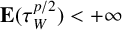 $\mathbf {E}(\tau ^{{p}/{2}}_{W})<+\infty $
implies
$\mathbf {E}(\tau ^{{p}/{2}}_{W})<+\infty $
implies $\mathbf {E}(|Z_{\tau _{W}}|^{p})<+\infty $
for an arbitrary domain W, we develop an analytic approach to Burkholder’s condition for exit times of planar Brownian motion from planar domains via the proper map from the unit disc onto the domain. We derive a necessary analytic regularity condition (membership in the Smirnov class) and a sufficient logarithmic Hardy-type growth condition ensuring that Burkholder’s condition holds.
$\mathbf {E}(|Z_{\tau _{W}}|^{p})<+\infty $
for an arbitrary domain W, we develop an analytic approach to Burkholder’s condition for exit times of planar Brownian motion from planar domains via the proper map from the unit disc onto the domain. We derive a necessary analytic regularity condition (membership in the Smirnov class) and a sufficient logarithmic Hardy-type growth condition ensuring that Burkholder’s condition holds.
Definition 1.1. We shall say that a planar domain W is of Burkholder’s type, in short, a $\mathfrak {B}$
-domain, if
$\mathfrak {B}$
-domain, if $\mathbf {E}(\log (1+\tau _{W}))$
is finite. In particular, if W is a
$\mathbf {E}(\log (1+\tau _{W}))$
is finite. In particular, if W is a $\mathfrak {B}$
-domain, then (1.1) holds.
$\mathfrak {B}$
-domain, then (1.1) holds.
Definition 1.1 applies to any planar domain, but we will confine our study exclusively to domains which are ranges of proper maps acting on the unit disc. By abuse of language, if $f:\mathbb {D}\rightarrow \mathbb {C}$
is proper and
$f:\mathbb {D}\rightarrow \mathbb {C}$
is proper and $f(\mathbb {D})$
is a
$f(\mathbb {D})$
is a $\mathfrak {B}$
-domain, then we say that f is of Burkholder’s type, in short, a
$\mathfrak {B}$
-domain, then we say that f is of Burkholder’s type, in short, a $\mathfrak {B}$
-function. The main results of the manuscript are as follows.
$\mathfrak {B}$
-function. The main results of the manuscript are as follows.
Theorem 1.2. If f is a $\mathfrak {B}$
-function, then f is in the Smirnov class.
$\mathfrak {B}$
-function, then f is in the Smirnov class.
In other words, Burkholder’s exit-time condition is not merely probabilistic: it forces strong boundary regularity of the associated proper map, namely Smirnov-type behaviour.
Theorem 1.3. If f is proper and belongs to the Hardy–Orlicz space $(\mathrm {Log}^{+}H)^{2}$
, then f is a
$(\mathrm {Log}^{+}H)^{2}$
, then f is a $\mathfrak {B}$
-function.
$\mathfrak {B}$
-function.
Conversely, a purely analytic logarithmic growth control provides a concrete, checkable sufficient criterion for $\mathbf {E}(\log (1+\tau _{f(\mathbb {D})}))<+\infty $
, avoiding direct exit-time estimates.
$\mathbf {E}(\log (1+\tau _{f(\mathbb {D})}))<+\infty $
, avoiding direct exit-time estimates.
Further, we present a concrete application of the notion of $\mathfrak {\mathfrak {B}}$
-domain to establish the boundedness of certain analytic functions. As widely known, the classical Phragmén–Lindelöf principle extends the maximum modulus principle to unbounded domains, showing that an analytic function bounded on the boundary and satisfying suitable growth conditions inside the domain must remain bounded throughout. In this context, we establish the following result, which adapts the principle to
$\mathfrak {\mathfrak {B}}$
-domain to establish the boundedness of certain analytic functions. As widely known, the classical Phragmén–Lindelöf principle extends the maximum modulus principle to unbounded domains, showing that an analytic function bounded on the boundary and satisfying suitable growth conditions inside the domain must remain bounded throughout. In this context, we establish the following result, which adapts the principle to $\mathfrak {B}$
-domains along with a certain growth controlled by a logarithmic envelope. Similar results can be found in [Reference Markowsky8], but subject to polynomial growth.
$\mathfrak {B}$
-domains along with a certain growth controlled by a logarithmic envelope. Similar results can be found in [Reference Markowsky8], but subject to polynomial growth.
Proposition 1.4. Let f be an analytic function defined in some domain W that extends continuously to $\partial W$
. Assume that:
$\partial W$
. Assume that:
-
• W is a
$\mathfrak {\mathfrak {B}}$
-domain; -
•
$\sup _{z\in \partial W}|f(z)\vert \leq \kappa $
for some nonnegative
$\kappa $
; -
•
$|f(z)|\leq \delta \log (1+|z|)$
in W for some positive
$\delta $
.





Then, $|f(z)|\leq \kappa $
holds for all
$|f(z)|\leq \kappa $
holds for all $z\in W$
.
$z\in W$
.
2 Tools and proofs
In this section, we provide the necessary ingredients to prove Theorems 1.2 and 1.3. A core result in the study of planar Brownian motion is the following theorem.
Theorem 2.1 (Lévy’s theorem)
Let $f:\mathbb {D}\rightarrow \mathbb {C}$
be a nonconstant analytic function and
$f:\mathbb {D}\rightarrow \mathbb {C}$
be a nonconstant analytic function and $(B_{t})_{t\geq 0}$
be a planar Brownian motion running inside
$(B_{t})_{t\geq 0}$
be a planar Brownian motion running inside $\mathbb {D}$
. Then, there is a planar Brownian motion
$\mathbb {D}$
. Then, there is a planar Brownian motion $(Z_{t})_{t\geq 0}$
such that
$(Z_{t})_{t\geq 0}$
such that $f(B_{t})=Z_{\sigma (t)}$
with
$f(B_{t})=Z_{\sigma (t)}$
with
 $$ \begin{align*} \sigma(t)=\int^{t}_{0}\vert f'(B_{s})\vert^{2}\,ds \quad\mbox{for } t\in[0,\tau_{\mathbb{D}}). \end{align*} $$
The proof of Theorem 2.1 can be found in [Reference Mörters and Peres11, Section 7.2]. Theorem 2.1 is commonly known as the conformal invariance principle of planar Brownian motion. The time change $\sigma $
projects
$\sigma $
projects $\tau _{\mathbb {D}}$
onto a stopping time
$\tau _{\mathbb {D}}$
onto a stopping time $\sigma (\tau _{\mathbb {D}})$
. The value of
$\sigma (\tau _{\mathbb {D}})$
. The value of $\sigma $
at
$\sigma $
at $\tau _{\mathbb {D}}$
is defined as
$\tau _{\mathbb {D}}$
is defined as
 $$ \begin{align*} \sigma(\tau_{\mathbb{D}})=\lim_{r\nearrow1}\sigma(\tau_{r}) \end{align*} $$
with
 $$ \begin{align*} \tau_{r}:=\inf\{t\mid|Z_{t}|=r\},\quad r\in(0,1). \end{align*} $$
Keep in mind that $\sigma (\tau _{\mathbb {D}})$
is not always the exit time from
$\sigma (\tau _{\mathbb {D}})$
is not always the exit time from $f(\mathbb {D})$
. We have instead the inequality
$f(\mathbb {D})$
. We have instead the inequality
 $$ \begin{align*} \sigma(\tau^{-}_{\mathbb{D}})\leq\tau_{f(\mathbb{D})}. \end{align*} $$
However, this inequality turns into an equality when f is proper. This happens typically when f is univalent.
Definition 2.2. The Hardy space (of exponent $p>0$
), denoted by
$p>0$
), denoted by $\mathbf {H}^{p}(\mathbb {D})$
, is the set of analytic functions acting on the unit disc and satisfying
$\mathbf {H}^{p}(\mathbb {D})$
, is the set of analytic functions acting on the unit disc and satisfying
 $$ \begin{align*} \Vert f\Vert^p_{\mathbf{H}^{p}(\mathbb{D})}:=\sup_{0\leq r<1}\frac{1}{2\pi}\int^{2\pi}_{0}|f(re^{i\theta})|^{p}\,d\theta<+\infty. \end{align*} $$
For the theory of Hardy spaces, see [Reference Duren3]. Burkholder [Reference Burkholder2] established a tight connection between Hardy spaces and planar Brownian motion. More precisely, if $f:\mathbb {D}\to \mathbb {C}$
is proper with
$f:\mathbb {D}\to \mathbb {C}$
is proper with $W=f(\mathbb {D})$
, then
$W=f(\mathbb {D})$
, then
 $$ \begin{align} { f\in H^{p}(\mathbb{D})\iff\mathbf{E}(\tau^{{p}/{2}}_{W})<+\infty\iff\mathbf{E}(Z^{*\,p}_{\tau_{W}})<+\infty}. \end{align} $$
A much more general framework for (2.1) is provided in the next theorem.
Theorem 2.3 [Reference Burkholder2]
Let $\Phi $
be a continuous nondecreasing function from
$\Phi $
be a continuous nondecreasing function from $[0,\infty ]$
to
$[0,\infty ]$
to $[0,\infty ]$
with
$[0,\infty ]$
with $\Phi (0)=0$
and for which there exists
$\Phi (0)=0$
and for which there exists $c>0$
such that
$c>0$
such that
 $$ \begin{align*} \Phi(2\lambda)\leq c\Phi(\lambda) \quad\mbox{for all } \lambda\geq0. \end{align*} $$
Then,
 $$ \begin{align} \kappa\mathbf{E}_{0}(\Phi(\sqrt{2\tau_{W}}))\leq\mathbf{E}_{0}(\Phi(Z^{*}_{\tau_{W}}))\leq\gamma\mathbf{E}_{0}(\Phi(\sqrt{2\tau_{W}})) \end{align} $$
for some positive constants $\kappa ,\gamma $
.
$\kappa ,\gamma $
.
Example 2.4. The functions $\log ^{\alpha }(1+x)$
and
$\log ^{\alpha }(1+x)$
and $x^{\alpha }$
are typical examples of
$x^{\alpha }$
are typical examples of $\Phi $
(
$\Phi $
( $\alpha>0$
).
$\alpha>0$
).
Definition 2.5. The Nevanlinna class, denoted by $\mathcal {N}$
, is the space of all analytic functions in the unit disc
$\mathcal {N}$
, is the space of all analytic functions in the unit disc $\mathbb {D}$
satisfying the condition
$\mathbb {D}$
satisfying the condition
 $$ \begin{align} { \Vert f\Vert:=\sup_{0<r<1}\frac{1}{2\pi}\int^{2\pi}_{0}\log(1+|f(re^{i\theta})|)\,d\theta<\infty.} \end{align} $$
The Nevanlinna class contains all Hardy spaces. An interesting property is that if $f\in \mathcal {N}$
, then f admits a radial limit almost everywhere (a.e.), that is,
$f\in \mathcal {N}$
, then f admits a radial limit almost everywhere (a.e.), that is,
 $$ \begin{align*} { f(e^{i\theta})=\lim_{r\to1^{-}}f(re^{i\theta}) \quad \mbox{ a.e.}} \end{align*} $$
In particular, Fatou’s lemma implies that $\log (1+|f(e^{i\theta })|)\in L^{1}(0,2\pi )$
[Reference Shapiro and Shields12]. In the same context, a subclass of the Nevanlinna class is the Smirnov class. The Smirnov class is defined by
$\log (1+|f(e^{i\theta })|)\in L^{1}(0,2\pi )$
[Reference Shapiro and Shields12]. In the same context, a subclass of the Nevanlinna class is the Smirnov class. The Smirnov class is defined by
 $$ \begin{align*} { \mathcal{S}:=\bigg\{ f\in\mathcal{N} \mid \Vert f\Vert=\frac{1}{2\pi}\int^{2\pi}_{0}\log(1+|f(e^{i\theta})|)\,d\theta\bigg\} .} \end{align*} $$
Since
 $$ \begin{align*} \Vert f\Vert\leq\frac{1}{2\pi}\int^{2\pi}_{0}\log(1+|f(re^{i\theta})|)\,d\theta, \end{align*} $$
one can think of the Smirnov class as functions for which the limit and the integral in (2.3) can be interchanged. A handy criterion to check whether a Nevanlinna function f is in $\mathcal {S}$
or not is the following proposition.
$\mathcal {S}$
or not is the following proposition.
Proposition 2.6 [Reference Shapiro and Shields12, Proposition 1.2 and Theorem 3.1]
Let $f\in \mathcal {N}$
. Then,
$f\in \mathcal {N}$
. Then, $f\in \mathcal {S}$
if and only if
$f\in \mathcal {S}$
if and only if $\Vert af\Vert \to 0$
as
$\Vert af\Vert \to 0$
as $a\to 0$
Obviously, all Hardy spaces are in the Smirnov class. That is, $H^{p}\subseteq \mathcal {S}\subseteq \mathcal {N}$
. The inclusions are strict. One can check that the function
$H^{p}\subseteq \mathcal {S}\subseteq \mathcal {N}$
. The inclusions are strict. One can check that the function
 $$ \begin{align*}{ z\mapsto\exp\bigg(\frac{1+z}{1-z}\bigg)}\end{align*} $$
is an element of $\mathcal {N}$
, but not in the Smirnov class. The function
$\mathcal {N}$
, but not in the Smirnov class. The function
 $$ \begin{align*} { g(z)=\exp\bigg(\!\int^{2\pi}_{0}\frac{e^{it}+z}{e^{it}-z}\log^{2}(t)\,\frac{dt}{2\pi}\bigg)} \end{align*} $$
is in $\mathcal {S}$
, but not in
$\mathcal {S}$
, but not in $H^{p}$
for all
$H^{p}$
for all $p>0$
(the radial limit
$p>0$
(the radial limit ${ |g(e^{i\theta })|=e^{\log ^{2}(\theta )}\notin L^{p}(0,2\pi )}$
). We point out that we do not know whether g is proper or not.
${ |g(e^{i\theta })|=e^{\log ^{2}(\theta )}\notin L^{p}(0,2\pi )}$
). We point out that we do not know whether g is proper or not.
Definition 2.7 [Reference Stoll13, Section 4]
Let $\alpha>1$
. The Hardy–Orlicz space
$\alpha>1$
. The Hardy–Orlicz space $(\mathrm {Log}^{+}H)^{\alpha }$
(of exponent
$(\mathrm {Log}^{+}H)^{\alpha }$
(of exponent $\alpha $
) is the space of analytic functions f such that
$\alpha $
) is the space of analytic functions f such that
 $$ \begin{align*} N_{\alpha}(f):=\sup_{0<r<1}\frac{1}{2\pi}\int^{2\pi}_{0}\log^{\alpha}(1+|f(re^{i\theta})|)\,d\theta<\infty. \end{align*} $$
We recall some features of Hardy–Orlicz spaces.
Theorem 2.8 [Reference Stoll13, Section 4]
For any $\alpha ,\beta $
with
$\alpha ,\beta $
with $1<\alpha <\beta <\infty $
and for all
$1<\alpha <\beta <\infty $
and for all $p>0$
,
$p>0$
,
 $$ \begin{align*} H^{p}\subsetneq(\mathrm{Log}^{+}H)^{\beta}\subsetneq(\mathrm{Log}^{+}H)^{\alpha}\subsetneq\mathcal{S}. \end{align*} $$
Proposition 2.9 [Reference Stoll13, Section 4]
Let $\alpha>1$
and
$\alpha>1$
and $f\in \mathcal {S}$
. Then,
$f\in \mathcal {S}$
. Then,
 $$ \begin{align*} f\in(\log^{+}H)^{\alpha}~\Longleftrightarrow\log(1+|f(e^{i\theta})|)\in L^{\alpha}(0,2\pi). \end{align*} $$
The next lemma is elementary, so we omit its proof.
Lemma 2.10. Let $\alpha $
be a positive number. If
$\alpha $
be a positive number. If $\xi $
is a nonnegative random variable, then the three quantities
$\xi $
is a nonnegative random variable, then the three quantities $\mathbf {E}(\log ^{\alpha }(1+\xi )),\mathbf {E}(\log ^{\alpha }(1+\sqrt {\xi }))$
and
$\mathbf {E}(\log ^{\alpha }(1+\xi )),\mathbf {E}(\log ^{\alpha }(1+\sqrt {\xi }))$
and $\mathbf {E}(\log ^{\alpha }(1+\sqrt {2\xi }))$
are either all finite or all infinite; that is, they share the same finiteness behaviour.
$\mathbf {E}(\log ^{\alpha }(1+\sqrt {2\xi }))$
are either all finite or all infinite; that is, they share the same finiteness behaviour.
Proof of Theorem 1.2
Run a planar Brownian motion $(Z_{t})_{t\geq 0}$
inside the unit disc and set
$(Z_{t})_{t\geq 0}$
inside the unit disc and set $\tau _{r}$
as its exit time from
$\tau _{r}$
as its exit time from $r\mathbb {D}$
. Denote by
$r\mathbb {D}$
. Denote by $(\widetilde {Z}_{t})_{t\geq 0}$
the projected planar Brownian motion of
$(\widetilde {Z}_{t})_{t\geq 0}$
the projected planar Brownian motion of $(Z_{t})_{t\geq 0}$
under the action of f. As f is proper,
$(Z_{t})_{t\geq 0}$
under the action of f. As f is proper, $\sigma (\tau _{\mathbb {D}})=\tau _{W}$
with
$\sigma (\tau _{\mathbb {D}})=\tau _{W}$
with $W=f(\mathbb {D})$
and
$W=f(\mathbb {D})$
and $\sigma $
is the time change. The random variable
$\sigma $
is the time change. The random variable $Z_{\tau _{r}}$
is uniformly distributed on the unit circle of radius r. Hence,
$Z_{\tau _{r}}$
is uniformly distributed on the unit circle of radius r. Hence,
 $$ \begin{align*} \begin{aligned} \frac{1}{2\pi}\int^{2\pi}_{0}\log(1+|f(re^{i\theta})|)\,d\theta & =\mathbf{E}(\log(1+|f(Z_{\tau_{r}})|))\\ & \leq\mathbf{E}(\log(1+\widetilde{Z}^{*}_{\tau_{W}}))\\ & \leq \gamma\mathbf{E}(\log(1+\tau_{W})) \quad \mbox{(by }(2.2)) \\ &<+\infty. \end{aligned} \end{align*} $$
Therefore,
 $$ \begin{align*} \sup_{0<r<1}\frac{1}{2\pi}\int^{2\pi}_{0}\log(1+|f(re^{i\theta})|)\,d\theta<+\infty, \end{align*} $$
and hence, $f\in \mathcal {N}$
.
$f\in \mathcal {N}$
.
It remains now to show that f is in the Smirnov class. Let $a\in (0,1)$
. Then,
$a\in (0,1)$
. Then,
 $$ \begin{align} \log\Big(1+a\sup_{0<r<1}|f(Z_{\tau_{r}})|\Big)\overset{\mathrm{a.e.}}{\leq}{ \log\Big(1+\sup_{0\leq t\leq\tau_{\mathbb{D}}}|f(Z_{t})|\Big)=\log(1+\widetilde{Z}^{*}_{\tau_{W}}).} \end{align} $$
The left-hand side of (2.4) serves as the dominating term. By Theorem 2.3, the random variable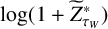 ${ \log (1+\widetilde {Z}^{*}_{\tau _{W}})}$
has a finite first moment, that is,
${ \log (1+\widetilde {Z}^{*}_{\tau _{W}})}$
has a finite first moment, that is, $\mathbf {E}({ \log (1+\widetilde {Z}^{*}_{\tau _{W}}))<+\infty }$
. Hence, the dominated convergence theorem implies that
$\mathbf {E}({ \log (1+\widetilde {Z}^{*}_{\tau _{W}}))<+\infty }$
. Hence, the dominated convergence theorem implies that $\|af\|\to 0$
as
$\|af\|\to 0$
as $a\to 0$
. From Proposition 2.6,
$a\to 0$
. From Proposition 2.6, $f\in \mathcal {S}$
.
$f\in \mathcal {S}$
.
Remark 2.11. Recall that in the example $W=\mathbb {C}-\mathbb {D}$
(mentioned in the first section), we found that W is not a
$W=\mathbb {C}-\mathbb {D}$
(mentioned in the first section), we found that W is not a $\mathfrak {B}$
-domain since
$\mathfrak {B}$
-domain since $\mathbf {E}(\log (1+\tau _{W}))=+\infty $
. In the light of Theorem 1.2, we recover the conclusion that W is not a
$\mathbf {E}(\log (1+\tau _{W}))=+\infty $
. In the light of Theorem 1.2, we recover the conclusion that W is not a $\mathfrak {B}$
-domain. In fact, W is the image of the proper map
$\mathfrak {B}$
-domain. In fact, W is the image of the proper map
 $$ \begin{align*} f:{ z\in\mathbb{D}\mapsto\exp\bigg(\frac{1+z}{1-z}\bigg)} \end{align*} $$
which is not in the Smirnov class. Therefore, necessarily, $\mathbf {E}(\log (1+\tau _{W}))=+\infty $
. By a monotonicity argument, if W is the whole plane minus a finite number of discs, then the same phenomenon occurs, that is,
$\mathbf {E}(\log (1+\tau _{W}))=+\infty $
. By a monotonicity argument, if W is the whole plane minus a finite number of discs, then the same phenomenon occurs, that is, $\mathbf {E}(\log (1+\tau _{W}))=+\infty .$
Proof of Theorem 1.3
As in the proof of Theorem 1.2, we run a planar Brownian motion $(Z_{t})_{t\geq 0}$
inside the unit disc, keeping the same underlying quantities
$(Z_{t})_{t\geq 0}$
inside the unit disc, keeping the same underlying quantities $\tau _{r}$
and
$\tau _{r}$
and $\tau _{W}$
. The function
$\tau _{W}$
. The function $\log (1+|f|)$
is sub-harmonic on
$\log (1+|f|)$
is sub-harmonic on $r\mathbb {D}$
and the process
$r\mathbb {D}$
and the process $(\log (1+|f(B_{t\land \tau _{r}})|))_{t\geq 0}$
is a uniformly bounded sub-martingale with limit
$(\log (1+|f(B_{t\land \tau _{r}})|))_{t\geq 0}$
is a uniformly bounded sub-martingale with limit $\log (1+|f(B_{\tau _{r}})|)$
as
$\log (1+|f(B_{\tau _{r}})|)$
as $t\to +\infty $
. Doob’s celebrated
$t\to +\infty $
. Doob’s celebrated $L^{2}$
-maximal inequality (see [Reference Graversen and Peškir4]) implies that
$L^{2}$
-maximal inequality (see [Reference Graversen and Peškir4]) implies that
 $$ \begin{align*} \begin{aligned} \mathbf{E}\Big(\log^{2}(1+\sup_{0\leq t\leq\tau_{\mathbb{D}}}|f(B_{t})|)\Big) & =\mathbf{E}\Big(\sup_{0\leq t\leq\tau_{\mathbb{D}}}\log^{2}(1+|f(B_{t})|)\Big)\\ & =\sup_{0<r<1}\mathbf{E}\Big(\sup_{0\leq t\leq\tau_{r}}\log^{2}(1+|f(B_{t})|)\Big)\\ & =\sup_{0<r<1}\mathbf{E}\Big(\sup_{0\leq t\leq+\infty}\log^{2}(1+|f(B_{t\land\tau_{r}})|)\Big)\\ & \leq4\sup_{0<r<1}\mathbf{E}(\log^{2}(1+|f(B_{\tau_{r}})|)) =4N_{2}(f) <+\infty. \end{aligned} \end{align*} $$
In particular, the expectation $\mathbf {E}(\log ^{2}(1+\sqrt {2\tau _{W}}))$
is finite (by Burkholder’s inequality (2.2)). Thus, the quantity
$\mathbf {E}(\log ^{2}(1+\sqrt {2\tau _{W}}))$
is finite (by Burkholder’s inequality (2.2)). Thus, the quantity $\mathbf {E}(\log ^{2}(1+\tau _{W}))$
is finite by Lemma 2.10 (for
$\mathbf {E}(\log ^{2}(1+\tau _{W}))$
is finite by Lemma 2.10 (for $\xi =\tau _{W}$
). Finally, since
$\xi =\tau _{W}$
). Finally, since $\mathbf {E}(\log (1+\tau _{W}))\leq \mathbf {E}(\log ^{2}(1+\tau _{W}))$
, the quantity
$\mathbf {E}(\log (1+\tau _{W}))\leq \mathbf {E}(\log ^{2}(1+\tau _{W}))$
, the quantity $\mathbf {E}(\log (1+\tau _{W}))$
is finite.
$\mathbf {E}(\log (1+\tau _{W}))$
is finite.
Proof of Proposition 1.4
We fix a starting point $a\in W$
and run a planar Brownian motion
$a\in W$
and run a planar Brownian motion $(Z_{t})_{t\geq 0}$
inside W. Using an exhaustive sequence of bounded domains expanding to W, we can find an increasing sequence of exit times
$(Z_{t})_{t\geq 0}$
inside W. Using an exhaustive sequence of bounded domains expanding to W, we can find an increasing sequence of exit times $\tau _{n}$
which converges to
$\tau _{n}$
which converges to $\tau _{W}$
. Since
$\tau _{W}$
. Since $|f|$
is subharmonic in W, then
$|f|$
is subharmonic in W, then $(|f(Z_{t})|)_{t \geq 0}$
is a submartingale. In particular,
$(|f(Z_{t})|)_{t \geq 0}$
is a submartingale. In particular,
 $$ \begin{align*} |f(a)|\leq\mathbf{E}_{a}(|f(Z_{\tau_{n}})|). \end{align*} $$
However,
 $$ \begin{align*} |f(Z_{\tau_{n}})| \leq\delta\log(1+|Z_{\tau_{n}}|) \leq\delta\log(1+Z^{*}_{\tau_{W}}). \end{align*} $$
Hence, by the dominated convergence theorem,
 $$ \begin{align*} |f(a)|\leq\mathbf{E}\Big(\lim_{n\rightarrow+\infty}|f(Z_{\tau_{n}})|\Big)=\mathbf{E}(|f(Z_{\tau_{W}})|)\leq\kappa. \end{align*} $$
This completes the proof.
3 Further directions
To enlarge the framework of Burkholder’s work, we introduce a generalised function space. Let $\phi \colon [0,+\infty )\to [0,+\infty )$
be a nonnegative, increasing and strictly convex function such that
$\phi \colon [0,+\infty )\to [0,+\infty )$
be a nonnegative, increasing and strictly convex function such that $\phi (0)=0$
. We define the space
$\phi (0)=0$
. We define the space $\Gamma _{\phi }$
as the set of all analytic functions f in the unit disc
$\Gamma _{\phi }$
as the set of all analytic functions f in the unit disc $\mathbb {D}$
such that
$\mathbb {D}$
such that
 $$ \begin{align*} N_{\phi}(f):=\sup_{0<r<1}\frac{1}{2\pi}\int^{2\pi}_{0}\phi(\log(1+|f(re^{it})|))\,dt<+\infty. \end{align*} $$
If $\phi $
enjoys the property
$\phi $
enjoys the property
 $$ \begin{align*} \frac{\phi(t)}{t}\to +\infty\quad \mbox{as }t\to +\infty, \end{align*} $$
then it is called strongly convex. In [Reference Stoll13], it was shown that
 $$ \begin{align*} \mathcal{S}=\bigcup_{\phi:\text{ strongly convex}}\Gamma_{\phi}. \end{align*} $$
Theorem 3.1. Let f be a proper function in the unit disc and $\phi $
as in the previous paragraph. Assume
$\phi $
as in the previous paragraph. Assume $\phi $
satisfies the two properties:
$\phi $
satisfies the two properties:
-
•
$\phi (\log (1+2x))\leq \eta \phi (\log (1+x))$
for some positive
$\eta $
; -
•
$\sqrt {\phi }$
is convex.


Then,
 $$ \begin{align*} \sup_{0<r<1}\frac{1}{2\pi}\int^{2\pi}_{0}\phi(\log(1+|f(re^{ti})|))\,dt<+\infty\iff\mathbf{E}(\phi(\log(1+\sqrt{2\tau_{W}})))<+\infty, \end{align*} $$
where $W=f(\mathbb {D})$
.
$W=f(\mathbb {D})$
.
The proof of Theorem 3.1 is similar to the proof of Theorem 1.3. The function $\sqrt {\phi (\log (1+|f|))}$
is subharmonic. Thus, we obtain
$\sqrt {\phi (\log (1+|f|))}$
is subharmonic. Thus, we obtain
 $$ \begin{align*} \mathbf{E}\Big(\phi\Big(\log\Big(1+\sup_{0\leq t\leq\tau_{\mathbb{D}}}|f(Z_{t})|\Big)\Big)\Big)\leq4N_{\phi}(f). \end{align*} $$
One can see that Hardy spaces correspond to the choice $\phi (t)=(e^{t}-1)^{p}$
(
$\phi (t)=(e^{t}-1)^{p}$
( $p>0$
). Similarly, with the choice
$p>0$
). Similarly, with the choice $\phi (t)=t^{\alpha }$
(
$\phi (t)=t^{\alpha }$
( $\alpha \geq 2$
), we recover
$\alpha \geq 2$
), we recover
 $$ \begin{align*} f\in(\mathrm{Log}^{+}H)^{\alpha}\iff\mathbf{E}(\log^{\alpha}(1+\sqrt{2\tau_{W}}))<+\infty\Rightarrow\mathbf{E}(\log(1+\tau_{W}))<+\infty. \end{align*} $$
In view of this, we define a category of planar domains as follows.
Definition 3.2. A domain W is called a $\mathfrak {B}_{\phi }$
-domain if it satisfies the condition
$\mathfrak {B}_{\phi }$
-domain if it satisfies the condition
 $$ \begin{align*} \mathbf{E}(\phi(\log(1+\sqrt{2\tau_{W}})))<+\infty. \end{align*} $$
Proposition 3.3. Let u be a nonnegative function defined in a $\mathfrak {B}_{\phi }$
-domain W satisfying
$\mathfrak {B}_{\phi }$
-domain W satisfying
 $$ \begin{align} \begin{array}{r@{\ }ll} \Delta u(z) &=-1, & z\in W, \\ u(z) &=0, & z\in\partial W, \\ u(z) &\leq\kappa\phi(\log(1+|z|)), & z\in\overline{W}, \end{array} \end{align} $$
with $\kappa>0$
. Then,
$\kappa>0$
. Then, $\mathbf {E}_{z}(\tau _{W})$
is finite. Moreover,
$\mathbf {E}_{z}(\tau _{W})$
is finite. Moreover,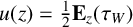 $u(z)=\tfrac 12\mathbf {E}_{z}(\tau _{W})$
for all
$u(z)=\tfrac 12\mathbf {E}_{z}(\tau _{W})$
for all $z\in W$
.
$z\in W$
.
Before proving Proposition 3.3, we note that the partial differential equation (3.1) is a controlled version of the well-known torsion problem, that is, the Dirichlet problem $\Delta u(z)=-1,u_{\vert \partial W}=0.$
The solution of the torsion problem has been investigated in several geometries of the underlying domain, notably convex and bounded regions [Reference Keady and McNabb5, Reference Makar-Limanov7]. Our contribution is to show that, for
$\Delta u(z)=-1,u_{\vert \partial W}=0.$
The solution of the torsion problem has been investigated in several geometries of the underlying domain, notably convex and bounded regions [Reference Keady and McNabb5, Reference Makar-Limanov7]. Our contribution is to show that, for $\mathfrak {B}_{\phi }$
-domains, the controlled partial differential equation (3.1) admits solutions that agree with the classical torsion function in the standard settings (for example, bounded or convex domains), and this can be done without imposing any explicit growth condition on the solution. The trade-off is that we restrict attention to those geometries of domains falling within the
$\mathfrak {B}_{\phi }$
-domains, the controlled partial differential equation (3.1) admits solutions that agree with the classical torsion function in the standard settings (for example, bounded or convex domains), and this can be done without imposing any explicit growth condition on the solution. The trade-off is that we restrict attention to those geometries of domains falling within the $\mathfrak {B}_{\phi }$
-domain framework.
$\mathfrak {B}_{\phi }$
-domain framework.
Proof. Let $N>0$
. Using Dynkin’s formula (see, for example, [Reference Boudabra1, Reference Markowsky9]),
$N>0$
. Using Dynkin’s formula (see, for example, [Reference Boudabra1, Reference Markowsky9]),
 $$ \begin{align*} \tfrac{1}{2}\mathbf{E}_{z}(\tau_{W}\land N)=u(z)-\mathbf{E}_{z}(u(Z_{\tau_{W}\land N}))\leq u(z). \end{align*} $$
Hence, taking the limit yields the finiteness of $\mathbf {E}_{z}(\tau _{W})$
. However, Burkholder’s theorem yields
$\mathbf {E}_{z}(\tau _{W})$
. However, Burkholder’s theorem yields
 $$ \begin{align*} u(Z_{\tau_{W}\land N})\leq\kappa\phi(\log(1+|Z_{\tau_{W}\land N}|))\leq\kappa\phi(\log(1+|Z^{*}_{\tau_{W}}|)) \end{align*} $$
and applying the dominated convergence theorem yields $u(z)=\tfrac 12\mathbf {E}_{z}(\tau _{W}).$
The function $\phi (x)=(e^{x}-1)^{2}+1$
corresponds to the quadratic growth condition in [Reference Burkholder2]. In [Reference Markowsky and McDonald10], the authors gave a way of constructing a domain with determined Brownian–Hardy number, a quantity defined therein. In particular, they showed that the quadratic growth condition is not necessary.
$\phi (x)=(e^{x}-1)^{2}+1$
corresponds to the quadratic growth condition in [Reference Burkholder2]. In [Reference Markowsky and McDonald10], the authors gave a way of constructing a domain with determined Brownian–Hardy number, a quantity defined therein. In particular, they showed that the quadratic growth condition is not necessary.
Acknowledgement
We would like to express our sincere gratitude to Dr. Maher Boudabra for suggesting the problem and for his insightful guidance throughout this work.


 Open access

