


Introduction
Morocco’s sociolinguistic landscape reflects a long history of cultural contact, political shifts, and evolving national identity. Characterized by multilingualism, the country’s language ecology includes classical and colloquial Arabic, Amazigh with its official status, Spanish, and French, whose presence remains deeply rooted in education, administration, and commerce as a legacy of colonial rule. In recent years, however, English has emerged as a significant force, gaining visibility in schools, universities, and public discourse.
This linguistic shift has sparked both governmental action and public controversy. In 2023, Said Amzazi, then Minister of National Education, Vocational Training, Higher Education and Scientific Research, publicly acknowledged the growing importance of English in scientific publishing and international communication. However, he maintained that replacing French would take at least a decade, citing the lack of adequately trained English-language teachers as a key barrier. His remarks, though reasonable, drew criticism from segments of the public who felt that the government was not moving fast enough to bring Morocco’s education system in step with global linguistic trends.
His successor, Abdellatif Miraoui, Minister of Higher Education, Scientific Research and Innovation., took a more assertive stance. He unveiled a series of initiatives aimed at expanding English instruction in universities and equipping graduates with the skills needed for global engagement. For Miraoui, English was a tool of global engagement as well as a strategic asset to boost Morocco’s scientific output and educational competitiveness.
The broader debate has been amplified by media headlines and widespread speculation. Leading local and regional news platforms – Hespress, Al–Alam, and Al Jazeera – ran bold headlines such as ‘Replacing French with English: A Demand Revived as the New School Year Begins,’ ‘A Moroccan Plan to Adopt English in Education: Will It Oust French?’ and ‘The Language War in Morocco Will Be Settled in Favor of English Within 10 Years.’ These stories triggered a wave of commentary, especially on social media, where a fabricated government communiqué circulated, claiming that the Ministry of Education would begin replacing French with English in primary education. The Ministry swiftly denied these claims in an official statement, clarifying that no such decision had been made and reiterating that only announcements published on its formal platforms are to be trusted.
This media frenzy and institutional pushback highlight a growing tension in Morocco’s language policy. As English becomes increasingly associated with global economic ambitions, technological integration, and educational innovation, particularly in the context of Morocco’s Strategic Vision for Education 2015–2030 (Higher Council for Education, Training and Scientific Research 2015), a long-term national framework aimed at reforming the education system by promoting equity, quality, and multilingualism while strengthening English instruction to enhance global competitiveness, a key question arises: Is English becoming the new French in Morocco, displacing its traditional dominance, or is it assuming a new, complementary role within the country’s multilingual reality?
Notably, this question is not new. As early as 2004, Marley found that many Moroccan students believed English would surpass French in importance, even while acknowledging French’s continued short-term presence. Two decades later, that prediction seems to be materializing amid shifting language policies, institutional reforms, and public demand. The association of English with prestige, upward mobility, and international opportunity has only grown stronger and now reinforces the perception that Morocco’s multilingual order is undergoing reconfiguration – not by decree alone, but through social, educational, and economic momentum from both the top and the grassroots.
From French to English: Historical and policy context
French became deeply entrenched in Morocco’s institutions during the French Protectorate (1912–1956) and maintained a privileged status post-independence, particularly in higher education, science, and administration (Ennaji Reference Ennaji2005). Despite several waves of Arabization policies, French persisted as the language of prestige and socioeconomic mobility. It remained ‘the de facto official language of vital domains, such as business, science, telecommunications, engineering, and medicine…French indexes success, modernization, prestige, and social status’ (Belhiah Reference Belhiah, Belhiah, Zeddari, Amrous, Bahmad and Bejjit2020, 38).
From the late 1990s onward, English began to acquire both symbolic and practical value in Morocco, initially through cultural exchanges, international cooperation, and the growing influence of global media. While previously regarded as a marginal foreign language, English gradually came to be associated with modernity, global communication and youth culture. The 21st century has marked a clear turning point, as national priorities have shifted toward international competitiveness, scientific research, and technological innovation – sectors in which English is the dominant global medium. As a result, English has increasingly been repositioned from a school subject to a tool of strategic national relevance.
This shift has been actively supported by governmental policy initiatives. Beginning in the 2023–2024 academic year, the Ministry of National Education launched a phased plan to introduce English across public secondary schools, with full implementation targeted by 2025–2026. The reform includes structured teacher training, curriculum development, and digital platforms aimed at mainstreaming English instruction. At the tertiary level, the Ministry of Higher Education has encouraged English-medium instruction in science, engineering and medicine, and has signed agreements with international universities to strengthen Morocco’s global academic ties. These measures, consistent with the Strategic Vision for Education 2015–2030, reflect a broader effort to elevate English as a language of opportunity and upward mobility in a rapidly globalizing world.
English in higher education and emerging EMI programs
English-medium instruction (EMI) has expanded rapidly in Morocco’s elite universities. Institutions such as Al Akhawayn University in Ifrane, which has adopted an American liberal arts model since its inauguration in 1995, have long embraced English as the language of instruction. More recently, universities like Mohammed VI Polytechnic (UM6P) and the International University of Rabat have launched English-based programs in engineering, business, and applied sciences, which reflects a deliberate shift in educational language policy (Belhiah and Abdelatif Reference Belhiah and Abdelatif2016). These institutions not only serve local students but also attract international partnerships and exchange programs, thereby positioning Morocco as a regional hub for Anglophone education.
The language of instruction is increasingly seen as a key determinant of academic programs’ quality and global relevance, which in turn contributes to a growing demand for EMI degrees. As R’boul (Reference R’boul2024, 2778) notes, ‘students expressed that since English is the world’s academic lingua franca, it would enable Moroccan research to be more recognized and included in global knowledge. They perceived EMI as an opportunity to keep abreast of scientific advancements.’ Similarly, Belhiah (Reference Belhiah, Curle, Ali, Alhassan and Scatolini2022, 164) emphasizes that ‘EMI avails students of the opportunity to improve their English proficiency, pursue studies overseas, enhance employment prospects and facilitate cross-cultural competence.’
Despite these benefits, the expansion of EMI remains uneven. Public universities lag in implementation due to limited faculty proficiency, a lack of adequate instructional materials, and infrastructural constraints (Ben Hammou and Kesbi Reference Ben Hammou and Kesbi2023; Nadri and Haoucha Reference Nadri, Haoucha, Belhiah, Zeddari, Amrous, Bahmad and Bejjit2020). Students also face significant linguistic and pedagogical challenges, especially when transitioning from French or Arabic instruction to English in STEM fields. As Boudihaj and Sahli (Reference Boudihaj, Sahli, Raza, Coombe and Reynolds2021, 72) argue, ‘the future of English as a medium of instruction in the Moroccan schooling system is still blurry.’ This uncertainty underscores the need for a more coherent national strategy that addresses institutional disparities and ensures equitable access to EMI across all regions and disciplines.
English in the private sector and professional life
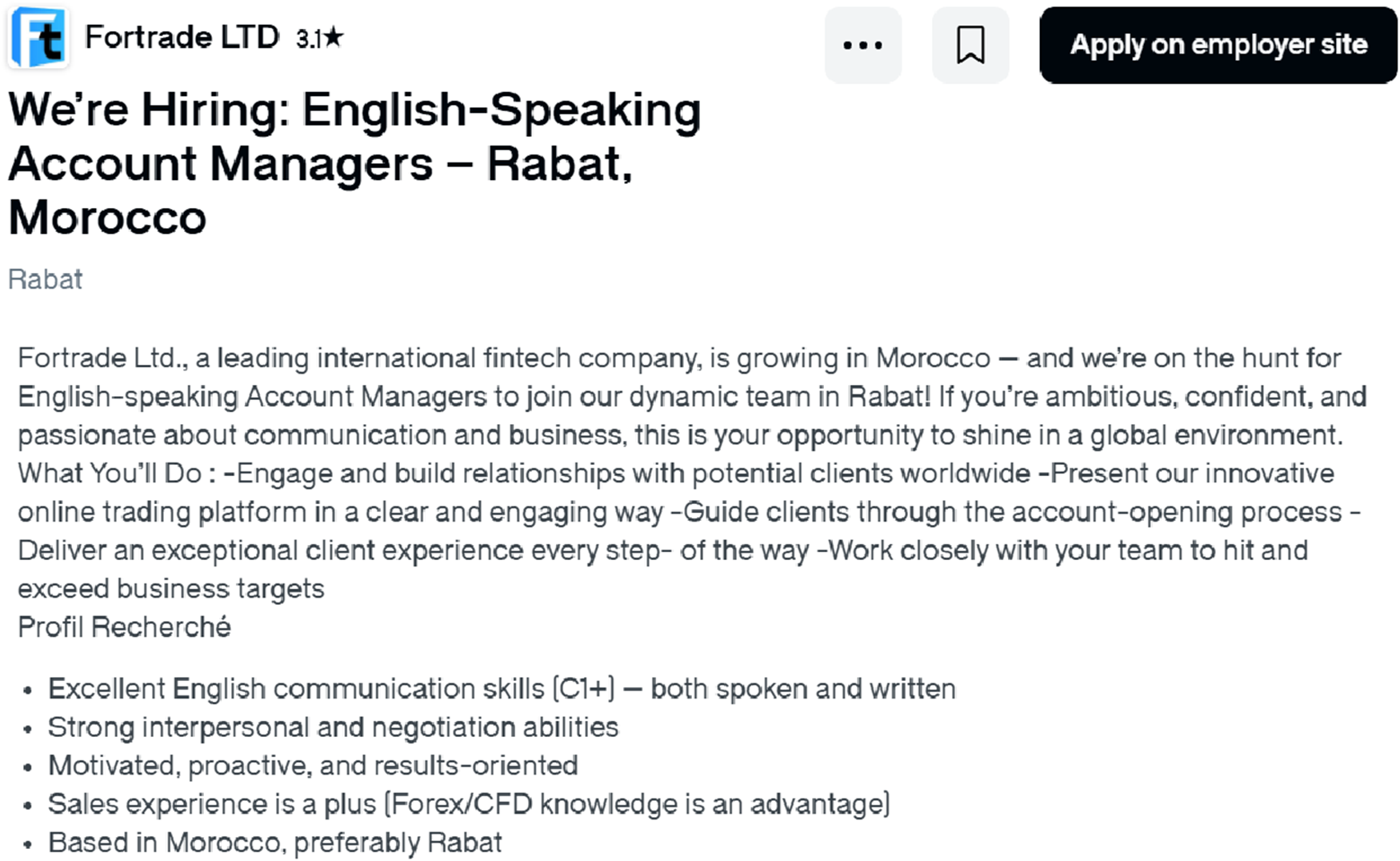
English is increasingly viewed as essential for employability, particularly in international firms and NGOs. Companies operating in sectors like finance, renewable energy and digital services often list English proficiency as a core requirement. For example, job listings on Glassdoor for Morocco include roles like ‘English-Speaking Call Agent’ in Casablanca and ‘English-Speaking Account Managers’ in Rabat (see figures 1 and 2) (Glassdoor n.d.)
Job listing for an ‘English-Speaking Call Agent’ in Casablanca (Glassdoor n.d.).

Job listing for ‘English-Speaking Account Managers’ in Rabat (Glassdoor n.d.).
Other postings include ‘Team Leader Sales Operation Associate (English Speaker)’ for Arrow Electronics and ‘Customer Service Representative – English’ in Rabat. Recruiters note that job candidates with strong English skills enjoy broader access to international opportunities and faster career advancement. This has contributed to a rise in demand for private English courses, corporate training, and TOEFL/IELTS preparation centers in cities like Casablanca, Rabat, and Tangier.
Besides, English plays a growing role in Morocco’s startup ecosystem and innovation hubs, such as Technopark and the Casablanca Finance City, where entrepreneurs collaborate with global partners and pitch ideas in English. Technopark Morocco actively fosters international partnerships and helps startups access global markets: over 35% of its resident startups export services across four continents. This reflects their readiness to pitch and collaborate internationally. In parallel, conferences and international forums held in Morocco increasingly use English as the working language, which reinforces its status as a tool for global engagement.
The service and tourism industries also reflect this trend. Many hotels, travel agencies and tour operators prioritize English when hiring staff. This linguistic shift can be seen as both a reflection of market needs and an incentive for Moroccans to pursue English as a professional asset. Over time, English is likely to solidify its position in Morocco as it increasingly becomes associated with prestige, upward social mobility, and globalization (Boukous Reference Boukous, Vigouroux and Mufwene2009; Buckner Reference Buckner, Al–Issa and Dahan2011; Errihani Reference Errihani and Kirkpatrick2017).
Youth attitudes and cultural imaginaries
English is increasingly perceived by Moroccan youth as a language of modernity, opportunity and global connectivity (Bouziane Reference Bouziane2020; Chakrani Reference Chakrani2013). Its visibility across social media platforms, streaming services and international job markets contributes to its image as both aspirational and ideologically neutral – qualities that distinguish it from French, which continues to carry colonial associations and perceptions of elite privilege. Nifaoui (Reference Nifaoui2021) documents generally favorable attitudes toward English compared to French, which reinforces both its symbolic appeal and growing practical utility in Morocco.
This shift is also evident in youth culture and everyday practices. Moroccan content creators on platforms like YouTube and Instagram frequently incorporate English into their posts. A notable example is Youssef Ksiyer, a comedian, content creator and multimedia host from Casablanca who produces content in Arabic, French and English, which shows his multilingual appeal and versatility (Ksiyer Reference Ksiyern.d.). Similarly, prominent rapper El Grande Toto blends English phrases with Darija, French and Spanish in his lyrics (ElGrandeToto n.d.). On Instagram, artists like 7liwa mix English with colloquial Arabic in captions and short videos, and this approach helps them connect with diverse audiences (7liwa n.d.).
This fosters a form of linguistic hybridity that reshapes online discourse and audience expectations. Among urban youth, the use of English expressions in daily speech, fashion and entertainment signals an orientation toward a global generation. While such usage may not always reflect full linguistic proficiency, it highlights the symbolic role of English as a marker of cosmopolitan identity. As R’boul (Reference R’boul2022, 75) notes, Moroccans’ perspectives on English and Anglophone culture ‘were accompanied by an idealization of the Western culture and lifestyle’, which suggests that the appeal of English is deeply intertwined with broader cultural imaginaries shaped by globalization.
The prominence of English extends into academic and extracurricular domains as well. Student clubs, university publications, and debate societies increasingly adopt English as their working language, henceforth embedding it in the intellectual and social routines of university life. For instance, the Morocco Debate Association (MDA), which organizes the Moroccan Open Debate Tournament and national youth debate camps, operates entirely in English, by positioning the language at the core of elite academic skill-building and public speaking (Morocco Debate n.d.) At the Mohammadia School of Engineering (EMI) in Rabat, academic life also features outstanding English-medium student initiatives, such as the EMI–The Great Debaters conference series (The Great Debaters MI n.d.), the EMInov technology innovation competition (eM Innovation Club n.d.), and the student-run magazine EMInence, which demonstrates how English permeates intellectual engagement and professional preparation
Beyond campus clubs and publications, English-language digital media play a growing role in youth discourse. For example, platforms such as Morocco World News, which publishes daily news and cultural commentary in English, enable Moroccan youth to connect with global narratives (Morocco World News n.d.). These developments show that English serves not only as academic discipline but as a medium of intellectual and cultural participation in both university settings and wider social spheres. This growing integration of English into youth media and social spaces reflects evolving attitudes toward the English language. As Belhiah et al. (Reference Belhiah, Belhiah, Zeddari, Amrous, Bahmad and Bejjit2020, v) observe, ‘social attitudes were generally positive, and English had friendly connotations; it was not the language of the colonizers.’ This perception helps position English as a forward-looking and inclusive language – unburdened by the colonial legacy associated with French and increasingly resonant with youth aspirations for mobility, innovation and global belonging.
Policy challenges and prospects for sustainable multilingualism
As English continues to expand, its integration into Morocco’s education system raises several complex policy challenges that require careful planning and sustained investment. At the forefront is the urgent need for a coherent national strategy on English-medium instruction (EMI) that not only promotes innovation and global competitiveness but also safeguards linguistic justice and inclusivity. Without clear policy direction, the rapid adoption of English risks creating fragmented practices across institutions and exacerbating existing educational disparities.
A central concern is teacher preparedness, particularly in public universities. Many faculty members, while proficient in their subject areas, lack adequate training in using English as a medium of instruction (Elimadi Reference Elimadi2024). This gap hinders effective content delivery and negatively affects student comprehension and participation. Professional development programs focused on EMI pedagogy, academic English, and intercultural communication are essential to support instructors in adapting to this shift.
In addition to teacher training, curriculum development in English remains uneven across the higher education sector. Contrary to private institutions, which often benefit from access to up-to-date textbooks, international partnerships and digital learning tools; public institutions are frequently constrained by outdated materials, bureaucratic procurement processes and limited funding. These disparities result in unequal learning experiences and restrict the potential of students from underprivileged backgrounds to benefit from the global opportunities associated with English.
Expanding curriculum, teacher capacity and access
One critical factor driving (or hindering) the expansion of English in Morocco is the readiness of curricula and educators to meet the rising demand. Public education, particularly at the secondary level, often suffers from outdated teaching materials, limited interactivity and weak integration with 21st-century skills. Unlike private institutions that may follow UK or US educational frameworks, public schools are more constrained by nationally centralized guidelines and a lack of specialized training. These conditions affect not just the quality of English instruction, but also student motivation and outcomes.
The Ministry of Education has introduced several initiatives to promote English instruction earlier in the school cycle, but implementation remains uneven. Research indicates that private high schools in Morocco tend to outperform public institutions in English instruction, largely due to access to international textbooks, better technological infrastructure, and early exposure to English (Errihani Reference Errihani and Kirkpatrick2017). In response to these disparities, university-affiliated language centers, particularly in major cities like Rabat and Casablanca, have begun offering extracurricular English programs and certification opportunities. However, these services remain concentrated in urban areas and are less accessible to students in rural or underserved regions.
Teacher capacity is equally vital. Many English teachers in Morocco are trained primarily in literature or general language pedagogy, with limited exposure to Content and Language Integrated Learning (CLIL) methodologies or EMI frameworks. While some EMI training has begun in universities with external funding (e.g., from the British Council), such efforts are not yet institutionalized. In the long run, Morocco will need to develop a national framework for EMI certification and provide incentives for continuous teacher development.
Digital literacy and entrepreneurial English
Another vector of English language growth lies in Morocco’s dynamic digital and entrepreneurial sectors. With rising internet penetration and widespread smartphone usage, young Moroccans are engaging in transnational economies – from freelance design and translation to online teaching and affiliate marketing. English is often the primary language of these platforms. Success on Upwork, Fiverr, Amazon KDP, and YouTube, for instance, often hinges on the ability to read and analyze English-language content, pitch ideas and build relationships with international clients.
Public and private actors are beginning to recognize this shift. Morocco’s digital economy strategy (2023–2027) includes a focus on English-based digital skills training, especially in fields like coding, SEO, e-commerce, and digital marketing. Universities and technical institutes are increasingly incorporating English-language modules into ICT and business programs, in response to student demand for career-relevant instruction. These efforts reinforce the status of English as an economic asset, especially among middle- and upper-middle-class youth.
Civic and informal language networks
Beyond formal institutions, community-led initiatives are playing a pivotal role in shaping Morocco’s English ecology. Conversation cafés, storytelling nights, English book clubs and peer-taught language exchanges are growing in popularity in cities like Fez, Meknes, and Oujda. NGOs and youth associations, such as the Moroccan Youth Initiative and Education For All Morocco (EFAM), run English programs targeting rural girls, displaced students, and first-generation college attendees.
These efforts also intersect with civic education. English is often framed as a gateway to global values such as volunteerism, intercultural dialogue and leadership. This is particularly evident in the Model United Nations (MUN) programs that have flourished across Moroccan universities, where students learn diplomatic discourse, negotiation and public speaking in English. In doing so, they develop what some researchers term ‘global literacy’, the capacity to function effectively across linguistic, cultural and ideological boundaries.
English and the Moroccan diaspora
The Moroccan diaspora, particularly those settled in English-speaking countries such as the UK, Canada, and the US, plays a significant yet often under-recognized role in promoting the spread of English within Moroccan society. According to United Nations estimates, by 2019, roughly 3.1 million people born in Morocco were living outside the country. This places Morocco among the top 25 countries of origin for emigrants globally and makes it the second-largest source of emigrants in the MENA region, following Egypt (European Training Foundation, 2021).
Transnational families frequently raise children in bilingual or trilingual environments and return visits during holidays serve as informal channels of cultural and linguistic exchange. In cities like Tangier and Agadir, anecdotal evidence suggests that English-speaking relatives shape language aspirations among local youth, who increasingly associate English with upward mobility, global mobility and access to international lifestyles. Ethnographic work with Tangier youth notes that ‘the young people of Tangier show a strong attachment to their family . . . which continues to be their emotional and social point of reference’.
This underscores the role of relatives in orienting aspirations (Feixa et al. Reference Feixa, Sánchez–García, Premat and Hansen2022, 7). Building on this, migrants transmit ‘social remittances’, that is ‘the ideas, behaviors, identities and social capital that flow from receiving- to sending-country communities’, which can include language goals modeled by English-speaking relatives (Levitt Reference Levitt1998, 927). Consistent with these mechanisms, Moroccan youth themselves say ‘English is the language of the future’ and that ‘most fields need the English language as a basic thing’, linking English to education, work and mobility (British Council Morocco 2021, 10). These findings resonate with the idea that familial and social networks, especially those connected to English-speaking environments, play a role in shaping aspirations toward English as a bridge to opportunity and global mobility.
In addition to these interpersonal influences, diasporic Moroccans are also investing in local initiatives that promote English-language learning. Alumni of British or American universities have established tutoring platforms, after-school learning centers and mobile applications aimed at improving English proficiency, particularly in underserved areas. The Moroccan-British Educational and Cultural Exchange Association, founded in 2021, runs English-language workshops and UK immersion activities for Moroccan youth, explicitly aimed at strengthening English and cultural exchange (The Moroccan-British Educational and Cultural Exchange Association n.d.). The UK-registered British Moroccan Society (BMS) funds rural education projects and, in February 2025, launched construction of a new learning center in Talatast (High Atlas), which adding to its long-running education support in the region (British Moroccan Society n.d.). Finally, Morocco-based edtech platforms such as Smartprof connects learners to private tutors (including English) via an on-demand platform, which expands access beyond major cities (EdTech.ma n.d.).
These grassroots efforts not only respond to educational policy gaps but also help reshape the ideological discourse around English in Morocco. Rather than being viewed through the lens of colonial heritage, English is framed as a pragmatic and empowering tool for academic and socioeconomic advancement. As R’boul and Belhiah (Reference R’boul and Belhiah2023, 20) observe, ‘the nationalist rhetoric in Morocco is still focused on the ex-colonial code (French) while English represents academic and social capitals that do not visibly entail colonial dynamics.’ This distinction allows English to function as a symbol of future-oriented development and transnational belonging, rather than a reminder of colonial subjugation as is the case with French.
Conclusion: English as complement, not replacement
The growing presence of English in Morocco is reshaping the linguistic landscape, but it is by no means replacing French. Instead, it is reconfiguring the country’s multilingual structure by introducing another pole of influence. English now serves specific strategic functions in education, diplomacy, and the global economy. Its growing role reflects a broader sociolinguistic transformation, but its displacement of French – or rather long-term success – will depend on inclusive language planning, sustained investment in teacher training, and meaningful curricular reform.
The core issue is not whether English will displace French, but how Morocco will manage its evolving multilingualism in ways that promote access, equity and cultural sustainability in an increasingly globalized world. As the country continues to modernize and deepen its international partnerships, the rise of English should be framed as an opportunity to enrich Morocco’s linguistic resources – provided it is supported by thoughtful, forward-looking policies that prioritize both inclusion and diversity.
English is neither a colonizing replacement for French nor a fleeting policy trend. Rather, it is emerging as a transformative layer within Morocco’s complex linguistic identity – one shaped by the interplay of national ambition, regional inequality, generational shifts and global interconnectedness. Whether in universities or WhatsApp groups, in policy documents or YouTube channels, English is reshaping Moroccans’ communication patterns in addition to how they imagine their future.
Yet the way English is introduced and distributed remains critical. If confined to elite institutions and affluent urban regions – as has been the case with French – it risks reproducing old hierarchies under the guise of modernity. As R’boul et al. (Reference R’boul, Belhiah and Elhaffari2024a, 14) caution, ‘the upper classes’ access to both English and French in Morocco may sustain elite bilingualism.’ In such a scenario, English, similar to French, would become another marker of privilege that exacerbates social divides instead of bridging them.
However, if paired with equitable curriculum reforms, adequate teacher training programs and expanded digital access, English could help foster a more inclusive and globally connected society – one where linguistic capital is not reserved for the few, but distributed more widely. In this sense, English need not replace French; it can instead reposition it, and allow Morocco to cultivate a functional and additive form of multilingualism. This includes Amazigh, Arabic, French, Spanish and English – not as competing forces, but as complementary assets contributing to Morocco’s linguistic and cultural richness.
A growing conversation around ‘Moroccan English’ further reflects this evolving landscape. As R’boul et al. (Reference R’boul, Belhiah, Guamguami, Lamjahdi and Tupas2024b, 174) argue, ‘when conceiving of a Moroccan variety, this entails that this variety will not be viewed as a variation of American or British English … but as an entity that draws from language practices associated with Arabic, Moroccan Darija, Amazigh or even French and Spanish.’ Everyday speech and online interactions illustrate this hybridity. Moroccan youth frequently insert Darija items into English sentences, as in: ‘That exam was bzaaf [very] hard’ or ‘Come a shwiya [bit] earlier’, a pattern consistent with recent surveys finding that Moroccan high-schoolers frequently switch between English and Darija in the same interaction. (Slimani and Iguider Reference Slimani and Iguider2024). Across social media, English captions frequently integrate MSA or religious formulae, such as ‘inshallah’ or ‘alhamdulillah,’ a mixing practice facilitated by ‘Arabizi’ writing styles (Hajbi et al. Reference Hajbi, Amezian, Ziyad, Kaime, Korchiyne and Chihab2023). These examples highlight how Moroccan English, if materialized, can reflect a localized, hybrid linguistic identity, one that blends global engagement with national authenticity.
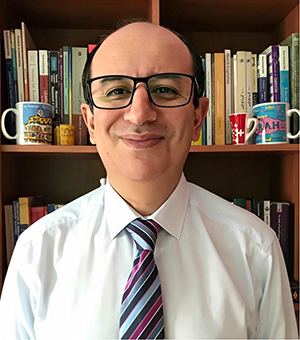 HASSAN BELHIAH holds a PhD (2005) and an MA (1998) in English from the University of Wisconsin–Madison. He is Professor of English and Linguistics at Mohammed V University in Rabat and serves as an Adjunct Professor of North African Studies with the Middlebury C. V. Starr Schools Abroad program. Dr. Belhiah previously served as Chair of the Department of English Language and Literature at Mohammed V University (2016–2018), and as Coordinator of the MA program in Teaching Arabic as a Foreign Language (2019–2021). He has presented his research at international conferences in the UK, Spain, Switzerland, Germany, Turkey, Morocco, the UAE and the United States. His scholarly work has appeared in leading journals including Classroom Discourse, Journal of Pragmatics, The Modern Language Journal, Language Policy, Applied Linguistics and TESOL Quarterly. He is the co-editor of the volume English Language Teaching in Moroccan Higher Education (Springer 2020).