Contents
Research Article
Weyl Images of Kantor Pairs
-
- Published online by Cambridge University Press:
- 20 November 2018, pp. 721-766
-
- Article
-
- You have access
- Export citation
-
Kantor pairs arise naturally in the study of 5-graded Lie algebras. In this article, we introduce and study Kantor pairs with short Peirce gradings and relate themto Lie algebras graded by the root system of type $\text{B}{{\text{C}}_{2}}$ . This relationship allows us to define so-called Weyl images of short Peirce graded Kantor pairs. We use Weyl images to construct new examples of Kantor pairs, including a class of infinite dimensional central simple Kantor pairs over a field of characteristic $\ne$ 2 or 3, as well as a family of forms of a split Kantor pair of type ${{\text{E}}_{6}}$ .


Wedge Operations and Torus Symmetries II
-
- Published online by Cambridge University Press:
- 20 November 2018, pp. 767-789
-
- Article
-
- You have access
- Export citation
-
A fundamental idea in toric topology is that classes of manifolds with well-behaved torus actions (simply, toric spaces) are classified by pairs of simplicial complexes and (non-singular) characteristic maps. In a previous paper, the authors provided a new way to find all characteristic maps on a simplicial complex $K(J)$ obtainable by a sequence of wedgings from $K$ .The main idea was that characteristic maps on $K$ theoretically determine all possible characteristic maps on a wedge of $K$ .
We further develop our previous work for classification of toric spaces. For a star-shaped simplicial sphere
$K$ of dimension  $n-1$ with $m$ vertices, the Picard number Pic $(K)$ of $K$ is $m-n$ . We call $K$ a seed if $K$ cannot be obtained by wedgings. First, we show that for a fixed positive integer $\ell $ , there are at most finitely many seeds of Picard number $\ell $ supporting characteristic maps. As a corollary, the conjecture proposed by V. V. Batyrev inis solved affirmatively.
Secondly, we investigate a systematicmethod to find all characteristic maps on
$K(J)$ using combinatorial objects called (realizable) puzzles that only depend on a seed $K$ . These two facts lead to a practical way to classify the toric spaces of fixed Picard number.


The Classical N-body Problem in the Context of Curved Space
-
- Published online by Cambridge University Press:
- 20 November 2018, pp. 790-806
-
- Article
-
- You have access
- Export citation
-
We provide the differential equations that generalize the Newtonian $N$ -body problem of celestial mechanics to spaces of constant Gaussian curvature $\kappa $ , for all $\kappa \in \mathbb{R}$ . In previous studies, the equations of motion made sense only for $\kappa \ne 0$ . The system derived here does more than just include the Euclidean case in the limit $\kappa \to 0;$ it recovers the classical equations for $\kappa =0$ . This new expression of the laws of motion allows the study of the $N$ -body problem in the context of constant curvature spaces and thus oòers a natural generalization of the Newtonian equations that includes the classical case. We end the paper with remarks about the bifurcations of the first integrals.


Lq Norms of Fekete and Related Polynomials
-
- Published online by Cambridge University Press:
- 20 November 2018, pp. 807-825
-
- Article
-
- You have access
- Export citation
-
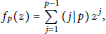
A Littlewood polynomial is a polynomial in $\mathbb{C}\left[ z \right]$ having all of its coefficients in $\{-1,1\}$ . There are various old unsolved problems, mostly due to Littlewood and Erdős, that ask for Littlewood polynomials that provide a good approximation to a function that is constant on the complex unit circle, and in particular have small ${{L}^{q}}$ normon the complex unit circle. We consider the Fekete polynomials,
 $${{f}_{p}}(z)=\sum\limits_{j=1}^{p-1}{(j|p){{z}^{j}}},$$
where $p$ is an odd prime and $(.|p)$ is the Legendre symbol (so that ${{z}^{-1}}{{f}_{p}}(z)$ is a Littlewood polynomial). We give explicit and recursive formulas for the limit of the ratio of ${{L}^{q}}$ and ${{L}^{2}}$ norm of ${{f}_{p}}$ when $q$ is an even positive integer and $p\to \infty $ . To our knowledge, these are the first results that give these limiting values for specific sequences of nontrivial Littlewood polynomials and infinitely many $q$ . Similar results are given for polynomials obtained by cyclically permuting the coefficients of Fekete polynomials and for Littlewood polynomials whose coefficients are obtained from additive characters of finite fields. These results vastly generalise earlier results on the ${{L}^{4}}$ norm of these polynomials.


On the Asymptotic Growth ofBloch–Kato–Shafarevich–Tate Groups ofModular Forms Over CyclotomicExtensions
-
- Published online by Cambridge University Press:
- 20 November 2018, pp. 826-850
-
- Article
-
- You have access
- Export citation
-
We study the asymptotic behaviour of the Bloch–Kato–Shafarevich–Tate group of a modular form $f$ over the cyclotomic ${{\mathbb{Z}}_{p}}$ -extension of $\mathbb{Q}$ under the assumption that $f$ is non-ordinary at $p$ . In particular, we give upper bounds of these groups in terms of Iwasawa invariants of Selmer groups defined using $p$ -adic Hodge Theory. These bounds have the same form as the formulae of Kobayashi, Kurihara, and Sprung for supersingular elliptic curves.


Correction
Erratum: Translation Groupoids and Orbifold Cohomology
-
- Published online by Cambridge University Press:
- 20 November 2018, pp. 851-853
-
- Article
-
- You have access
- Export citation
Research Article
Global and non Global Solutions for Some Fractional Heat Equations With Pure Power Nonlinearity
-
- Published online by Cambridge University Press:
- 20 November 2018, pp. 854-872
-
- Article
-
- You have access
- Export citation
Anisotropic Sobolev Capacity withFractional Order
-
- Published online by Cambridge University Press:
- 20 November 2018, pp. 873-889
-
- Article
-
- You have access
- Export citation
-
In this paper, we introduce the anisotropic Sobolev capacity with fractional order and develop some basic properties for this new object. Applications to the theory of anisotropic fractional Sobolev spaces are provided. In particular, we give geometric characterizations for a nonnegative Radon measure $\mu $ that naturally induces an embedding of the anisotropic fractional Sobolev class $\dot{\Lambda }_{\alpha ,K}^{1,1}$ into the $\mu $ -based-Lebesgue-space $L_{\mu }^{n/\beta }\,\text{with}\,0<\beta \le n$ . Also, we investigate the anisotropic fractional $\alpha $ -perimeter. Such a geometric quantity can be used to approximate the anisotropic Sobolev capacity with fractional order. Estimation on the constant in the related Minkowski inequality, which is asymptotically optimal as $\alpha \to {{0}^{+}}$ , will be provided.


On Mœglin's Parametrization of Arthur Packets for p-adic Quasisplit Sp (N) and SO(N)
-
- Published online by Cambridge University Press:
- 20 November 2018, pp. 890-960
-
- Article
-
- You have access
- Export citation
-
We give a survey on Mœglin's construction of representations in the Arthur packets for $p$ -adic quasisplit symplectic and orthogonal groups. The emphasis is on comparing Mœglin's parametrization of elements in the Arthur packets with that of Arthur.
