


It is well recognised that the family environment, and specifically parents, play a key role in the development of children's eating behaviours and food consumption( Reference Dietz and Gortmaker 1 – Reference Fulkerson, Story and Neumark-Sztainer 4 ). Proposed mechanisms for parental influences on children's diet include modelling of food consumed( Reference Longbottom, Wrieden and Pine 5 , Reference Wind, de Bourdeaudhuij and te Velde 6 ), the food made available in the home by parents( Reference Campbell, Crawford and Salmon 7 – Reference Grimm, Harnack and Story 9 ), parental encouragement to eat or parental restriction of certain foods( Reference Wind, de Bourdeaudhuij and te Velde 6 , Reference Campbell, Andrianopoulos and Hesketh 10 , Reference Fisher and Birch 11 ), and meal-time eating rules and practices( Reference Pearson, Atkin and Biddle 12 ). There is also some evidence that mothers’ nutrition knowledge directly impacts both their children's and their own diet( Reference Gibson, Wardle and Watts 13 – Reference Wardle, Parmenter and Waller 18 ). Lower maternal nutrition knowledge and less healthy eating habits have been found to be more prevalent among socio-economically disadvantaged women( Reference Beydoun and Wang 19 – Reference Turrell and Kavanagh 22 ). Maternal nutrition knowledge has therefore been identified as an important target for nutrition promotion interventions( Reference Worsley 23 ), particularly among women experiencing socio-economic disadvantage.
For children of primary school age (i.e. children aged 5–12 years), it is plausible that mothers’ nutrition knowledge would influence their children's diet more than their own. At this age, mothers’ ability to exercise control of the school (e.g. provision of food in school lunch boxes) and family (e.g. by providing and preparing healthy food and modelling consumption of healthy food) food environments may limit opportunities for their children to eat poorly. Mothers’ roles and responsibilities as nurturer may also mean that they place value and importance on providing a nutritious diet for their children. For instance, research has shown that among low-income families presented with limited availability of nutritious food, mothers focus on feeding their children first and in doing so may sacrifice their own nutrient needs( Reference Matheson, Varady and Varady 24 ). However, high maternal nutrition knowledge may not always be protective against consumption of less healthy foods, because mothers may place less emphasis on the quality of their own diet compared with that of their children. While young children's food consumption is largely dependent on foods provided by the mother( Reference Hannon, Bowen and Moinpour 25 ), mothers potentially have more opportunities to deviate from diets they know and consider to be healthy (e.g. after the children go to bed or through access to less healthy food options in the workplace or elsewhere outside the home).
Although the relationship between maternal nutrition knowledge and diet quality of mothers and their children has been reported in the literature( Reference Variyam, Blaylock and Biing-Hwan 26 ), few studies have simultaneously examined the association of nutrition knowledge with the diets of mothers and children. Furthermore, no study has investigated whether maternal nutrition knowledge is more strongly associated with the mother's own diet or the diet of her child. Enhancing our understanding of the relationship between maternal nutrition knowledge and the diet of mothers and their children is important to inform how to best intervene to support healthy diets in families. If the relationship between maternal nutrition knowledge and mother's and child's diet is equally positive, this result will further underscore the potential role and translational benefits nutrition knowledge has in improving the eating behaviours of mothers and children residing in socio-economically disadvantaged areas. However, by comparing the strength of these relationships, it may be possible to determine whether differences in transference of maternal nutrition knowledge in supporting a healthy diet exist for mothers and their children. As poor nutrition knowledge and dietary habits are more prevalent among socio-economically disadvantaged women( Reference Irala-Estévez, Groth and Johansson 27 , Reference Hendrie, Coveney and Cox 28 ), focusing on the role of nutrition knowledge and diet in populations that are all disadvantaged, in terms of neighbourhood characteristics, will assist with nutrition promotion efforts for groups at risk of poor nutrition. Focusing specifically on mothers and children from socio-economically disadvantaged neighbourhoods, the aim of the present paper was to examine whether maternal nutrition knowledge is more strongly associated with mothers’ diets or the diets of their children.
Methods
Participants
Participants were drawn from a larger study of women who participated in the Resilience for Eating and Physical Activity Despite Inequality (READI) study (2007–2008). The READI study incorporates a longitudinal cohort study examining resilience to obesity among women and children residing in socio-economically disadvantaged rural and urban areas of Victoria, Australia. Full details of this study are provided elsewhere( Reference Cleland, Ball and Hume 29 – Reference Macfarlane, Abbott and Crawford 31 ). A total of 4349 women returned a survey with complete data, of whom 1457 reported that they had at least one child aged 5–12 years. Women with children in this age range were invited to complete a second survey that assessed factors that may influence their child's diet, physical activity and obesity risk. A total of 685 women completed both (mother and child) surveys. Only participants with complete data on all variables of interest were included in the study, which resulted in 162 participants excluded from analyses. Missing data for each variable ranged from 1 % to 10 %. Those who were excluded from analyses did not differ significantly on key socio-demographic variables (age, education or child age) from those included in analyses. The final sample included in analyses was 523 mother/child pairs.
Procedure
The study was approved by the Deakin University Human Research Ethics Committee. Disadvantaged areas were defined as those within the bottom third of the Victorian Socio-Economic Index for Areas (SEIFA) distribution( 32 ). Within each of the eighty disadvantaged rural and urban areas selected, 150 women aged 18–45 years were randomly selected from the Australian electoral roll (the electoral role is compulsory for Australian citizens). Selected women were mailed an invitation, a survey, a consent form and a $AU 1 lottery ticket as a small compensation for their time.
Measures
Sociodemographics
Women were asked to provide details of their age and their child's age as well as their highest level of education achieved, categorised as: low (up to Year 10 or equivalent (∼15 years of age at completion)); medium (Year 12 (∼18 years of age at completion) and/or a technical or trade certificate/apprenticeship); or high (university/higher university degree).
Dietary outcomes
Seven dietary outcomes were selected to assess a range of eating behaviours known to be associated with overall diet quality( Reference Frary, Johnson and Wang 33 , Reference Northstone and Emmett 34 ). To measure fruit and vegetable consumption, women were asked (in separate items for fruit and vegetables and for mother and child): ‘How many servings of fruit/vegetables do you [does your child] usually consume each day? (Excluding potatoes, hot chips, fried potato and fruit juice)’. Response options ranged from ‘do not eat fruit/vegetables’ to ‘6 or more servings/d’. To measure water and soft drink consumption, participants were asked (in separate items for water and soft drinks and for mother and child): ‘How much water/soft drinks (soda) (excluding diet soft drinks and fruit juice but including fruit flavoured drinks and sports drinks) do you [does your child] usually drink each day?’ Response options ranged from ‘do not drink water/soft drinks’ to ‘10 or more servings/d’. Examples of one serving prefaced questions regarding fruit, vegetable, water and soft drink consumption (e.g. 1 serving = 125 ml). Participants were also asked: ‘In the past month, about how often have you [has your child] had the following?’ Several food categories were included in the survey from which the following three were selected for the current paper: ‘chocolate/lollies’ (‘lolly’ is an Australian term for candy or sweets), ‘fast foods’ (e.g. McDonalds, KFC) and ‘potato chips/crisps/salty snack foods’. Response options ranged from ‘never or less than once/month’ to ‘6 or more times/d’. These questions (for both mother and child) were adapted from the Australian National Nutrition Survey( 32 ). Data from a subsample of eighty mother and child participants revealed adequate test–retest reliability for dietary outcomes. Consumption of frequency responses for all intake items were subsequently converted into daily equivalent scores (e.g. ‘never or less than once/month’ = 0 p/d, ‘1–3 times/month’ = 0·07 p/d, ‘once/week’ = 0·14 p/d, etc.).
Nutrition knowledge
Nutrition knowledge was assessed by eight questions where participants were required to select from several foods/meals the best choice to satisfy a given nutritional goal. These items measured one aspect of nutrition knowledge concerning food choice and were adapted from an existing scale( Reference Parmenter and Wardle 35 ) that has been validated in an Australian sample( Reference Hendrie, Cox and Coveney 36 ) (see Table 1 for full description of items). Each participant's nutrition knowledge score was calculated as the number of these items she answered correctly (range 0–8).
Items used to measure nutrition knowledge

Statistical analysis
Analyses were conducted using the SPSS statistical software package version 17·0 (SPSS Inc., Chicago, IL, USA). Data transformations were conducted for potato chips/crisps/salty snack foods and chocolate/lollies consumption (log transformation) and soft drink and fast-food consumption (inverse transformation). The relationships between maternal nutrition knowledge and (i) maternal diet outcomes and (ii) child diet outcomes were assessed using multiple linear regression models. In adjusted models, maternal education, child's age and child's number of siblings were entered as covariates. To test the difference in associations between mother and child intakes and nutrition knowledge, separate regression analyses (for each dietary intake outcome) were conducted using an interaction command that is the product of a mother/child dummy variable and nutrition knowledge scores.
Results
Participants were 523 women and children residing in socio-economically disadvantaged neighbourhoods. Descriptive data for the sample are provided in Table 2. An examination of the associations between maternal nutrition knowledge and maternal diet showed that maternal nutrition knowledge was associated with higher maternal vegetable, water and chocolate/lollies consumption, and lower soft drink consumption (Table 3). Maternal water consumption was no longer significantly associated with nutrition knowledge after adjusting for covariates. An examination of the associations between maternal nutrition knowledge and child diet showed that maternal nutrition knowledge was associated with higher child vegetable consumption (Table 3); however, this association was no longer significant after adjusting for covariates. No differences in the strength of associations between maternal nutrition knowledge and maternal diet, and between maternal nutrition knowledge and child diet, were observed.
Descriptive data for study sample: mothers and their children of primary-school age (n 523) from socio-economically disadvantaged neighbourhoods in Victoria, Australia, 2009
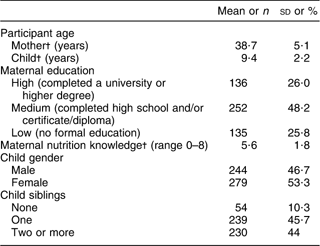
†Values are presented as mean and standard deviation.
Associations between mothers’ nutrition knowledge and mother and child dietary intake: mothers and their children of primary-school age (n 521) from socio-economically disadvantaged neighbourhoods in Victoria, Australia, 2009

*P < 0·05, **P < 0·01, ***P < 0·001.
†Associations between maternal nutrition knowledge scores (predictor) and mother/child dietary intake (outcomes).
‡P value for the difference in strength of associations between mother/child dietary intake and maternal nutrition knowledge.
§Associations between maternal nutrition knowledge scores (predictor) and mother/child dietary intake (outcomes), controlling for maternal education, child's age and child's number of siblings.
Discussion
The purpose of the present study was to examine whether maternal nutrition knowledge among women from socio-economically disadvantaged neighbourhoods was more strongly associated with their children's or their own diet. In three out of seven dietary outcomes there was a significant (although weak) correlation between maternal nutrition knowledge and maternal diet, whereas for the children's diets no dietary outcomes were associated with maternal nutrition knowledge. However, contrary to our expectations, there were no differences in the associations between maternal nutrition knowledge and children's diets, and between maternal nutrition knowledge and mothers’ diets.
Based on the independent correlations alone, it appears that factors other than maternal nutrition knowledge may play a more important role in influencing children's diets. This finding is at odds with previous research that has found maternal nutrition knowledge to act as an important determinant of children's diets( Reference Vereecken and Maes 15 , Reference Blanchette and Brug 17 , Reference Variyam, Blaylock and Biing-Hwan 26 ). Many of these findings, however, have occurred predominantly for young children (aged less than 5 years) rather than primary-school children (aged 6 years and above)( Reference Variyam, Blaylock and Biing-Hwan 26 ). In the child's younger years, there may be more opportunities for parental control of foods, particularly those consumed in the family home. For older children, broader social and environmental influences (such as food distributed by school and after-school care staff) as well as more pronounced individual preferences may be more important than the individual-level characteristics of the mother( Reference Stokols 37 ). For instance, in the current study, the relationship (unadjusted) between maternal nutrition knowledge and child vegetable consumption could suggest greater maternal influence on food options usually consumed at home, compared with foods consumed outside the home (e.g. fruit at school). The absence of this relationship in the adjusted analyses highlights that even for foods consumed within the family home environment, factors such as presence of siblings and child age appear to be stronger independent predictors than maternal nutrition knowledge.
It is also possible that mothers residing in socio-economically disadvantaged areas have limited resources to translate their own nutrition knowledge into healthy eating behaviours for their child. For instance, for mothers residing in disadvantaged neighbourhoods, limited resources may influence preferences for food choices that are cheaper and palatable, and therefore more readily consumed by children, consequently reducing the ability for translation of nutrition knowledge to child eating behaviours.
Further analyses that assessed the statistical difference between each mother–child correlation showed that associations of nutrition knowledge with mother's and child's diet were not significant. These results temper the findings from the independent correlations. The present study is the first known to statistically compare relationships between maternal nutrition knowledge and mother and child diet. As we found a counterintuitive positive relationship between maternal nutrition knowledge and maternal consumption of chocolate/lollies, further research is needed to examine relationships between maternal nutrition knowledge and increased consumption of unhealthy options among women residing in disadvantaged areas. Plausibly, increased maternal nutrition knowledge may be diluted outside the home environment where availability and consumption of more energy-dense foods is possible. It is also possible that chocolate and lollies may be perceived as a higher-status unhealthy food source than fast foods and salty snack foods, and therefore the unhealthy snack of choice for those with high nutrition knowledge.
There are some limitations of the study. Our measure of nutrition knowledge may not capture the aspects of nutrition knowledge that might influence a mother's concern for child diet. Previous research has found that different aspects of nutrition knowledge predicted different aspects of child diet( Reference Gibson, Wardle and Watts 13 ), and therefore a more comprehensive measure of nutrition knowledge is needed for future research.
Conclusions
Our results support that the relationship between maternal nutrition knowledge and maternal diet is generally not different from the relationship between maternal nutrition knowledge and child diet. These findings support the argument that effective strategies to improve diet quality for both mother and child should include mechanisms to increase and translate nutrition knowledge among families residing in socio-economically disadvantaged neighbourhoods.
Acknowledgements
This work was supported by the National Health and Medical Research Council (L.W. and K.B.) and the Victorian Health Promotion Foundation research fellowship (K.C. and D.C.). The authors declare there are no conflicts of interest. L.W. wrote the manuscript; K.C., G.A., D.C. and K.B. assisted with writing the manuscript; G.A. and L.W. conducted the statistical analyses; D.C. and K.B. designed the study.



