

Introduction
Welfare provision in rentier states poses a distinctive analytical puzzle for social policy research. Where state revenue flows from hydrocarbon extraction rather than from taxation, the relationship between welfare and citizenship typically takes a shape quite different to that assumed in the mainstream welfare regime literature (cf. Esping-Andersen, Reference Esping-Andersen1990; Gough, Reference Gough2013). Welfare in such polities does not address labour market risks; nor does it decommodify labour in the way Esping-Andersen described. It operates, rather, as a distributive tool through which the state secures political stability and underwrites its own legitimacy (cf. Beblawi and Luciani, Reference Beblawi and Luciani1987; Hertog, Reference Hertog2010). This paper shows how welfare is governed in the rentier state, through what mechanisms, discourses, and techniques.
This paper presents a case study of welfare governance in Qatar, a rentier state whose hydrocarbon-funded welfare architecture makes it a useful site for examining the dynamics described above. Hydrocarbon revenues have, since the 1970s, funded universal healthcare, public education, subsidised housing, and the well-paid public sector positions that typically absorb the Qatari national workforce. This architecture ties citizens to political authority through material benefit, rather than through the mechanisms of taxation or political representation familiar from the welfare state literature (Brik, Reference Brik2025a). Qatar National Vision 2030 frames the arrangement as at once a developmental duty and a moral one, the moral component being grounded in Islamic principles of communal care (Zargar, Reference Zargar2023); in this discourse the state figures as guardian rather than service provider. Less often acknowledged is the gradual movement of Qatari policy, in stages, towards a selective form of modernisation. For instance, the kafala system has been partly reformed (see Aboueldahab, Reference Aboueldahab2021); a statutory minimum wage has been introduced; permanent residency, on narrow conditions, has been opened to a small group of non-citizens. On the surface, as such, each reform reads as alignment with international norms. However, and as the analysis will show, the reforms leave the underlying distribution of authority untouched.
The dual character of rentier welfare, its function as social provision and its function as a political instrument, remains inadequately addressed in the existing literature. Classical rentier state theory accounts for the distributive logic (Mahdavy, Reference Mahdavy and Cook1970; Beblawi and Luciani, Reference Beblawi and Luciani1987); it tends, however, to treat governance as static, as patronage held in place, such that the adaptive strategies through which rentier states absorb modernisation pressure typically fall out of view. Esping-Andersen’s (Reference Esping-Andersen1990) typology, for its part, rests on conditions that rentier states polities do not have; his organising categories, decommodification, and the state-market-family triad presuppose a tax-welfare link, an independent civil society, and market-mediated social risk, none of which hold in this setting. Gough (Reference Gough2013) has taken the argument further. His informal security regimes concept attends to the non-Western form of such arrangements, though the governance mechanisms involved remain underspecified; for Gough, welfare is what fills the space left by weak state provision, rather than what the state itself actively produces. Powell and Barrientos (Reference Powell and Barrientos2004), as such, come closer to the rentier case. Their account of productivist welfare in developing states traces the subordination of social policy to economic growth. One important dimension remains absent from the literature. In the rentier case, as this paper shows, the subordination runs in a different direction: social policy serves regime stability rather than economic growth, and the difference calls for a distinct theoretical treatment of rentier welfare.
The analysis below addresses these gaps. Welfare governance in Qatar is read through the Policy Arrangement Approach (PAA), which treats a policy field as the product of four interacting dimensions: discourse, actors, resources, and rules (Arts and Leroy, Reference Arts and Leroy2006; Liefferink, Reference Liefferink, Arts and Leroy2006). Two further theoretical resources round out the framework. Assemblage thinking, drawn from Deleuze and Guattari (Reference Deleuze and Guattari1987), treats welfare governance as a contingent configuration rather than a fixed institutional settlement; it foregrounds the ongoing processes through which arrangements are put together and reassembled. Foucauldian governmentality, as such, supplies the vocabulary for conduct, rationalities, and the shaping of populations that operate below the level of formal institutions (cf. Foucault, Reference Foucault, Burchell, Gordon and Miller1991; Dean, Reference Dean2010). Neither is treated as a rival framework. Both serve as supplementary lenses. They deepen the PAA analysis and reveal dimensions of power that formal institutional analysis tends to overlook.
Three research questions guide the analysis. One concerns institutional resilience: how does centralised welfare control hold up under modernisation pressure? Another concerns governance mechanism: through what techniques has the state reconfigured welfare provision without devolving central authority? A structural question closes the set: how do the four PAA dimensions, namely discourse, actors, resources, and rules, interact in practice to produce the welfare governance found in a rentier polity? Four hypotheses are generated by the framework. H1 posits that centralised resource control generates power asymmetries that favour state actors over non-state providers. Under H2, selective integration draws service-oriented civil society organisations into delivery roles while redirecting advocacy towards state-sanctioned priorities. H3 proposes that governance techniques, such as modernisation narratives, data-driven monitoring, and performance review, operate on the tension between reform and control without any meaningful devolution of authority. H4, finally, expects the four PAA dimensions to interact such that the welfare arrangement accommodates external pressure while keeping central control in place. The hypotheses are tested against 143 policy documents covering the period from 1971 to 2024. The time span supports a three-phase analysis. Post-independence consolidation runs from 1971 to 2009. The strategic modernisation period, tied to QNV 2030 and to the growth in international engagement, runs from 2010 to 2020. Post-2020 consolidation follows preparations for the 2022 FIFA World Cup.
The argument carries several implications for the literature. For social policy scholarship, it specifies how welfare in a rentier polity operates as a governance technology, and it demonstrates, through the evidence, that the criteria by which welfare regimes are conventionally classified, decommodification (Esping-Andersen, Reference Esping-Andersen1990), social investment (Hemerijck, Reference Hemerijck2013), informal security (Gough, Reference Gough2013), do not extend to a configuration organised around structured membership differentiation and institutional continuity. For comparative welfare regime analysis, the Qatari case is instructive precisely because it diverges from the inherited typologies: social equity is subordinated, in this configuration, to the preservation of governance. The analysis also offers, drawn from the policy record, an empirically grounded account of how rentier states balance centralised authority against the demand to modernise selectively, joining a growing body of scholarship on welfare beyond the West (Wood and Gough, Reference Wood and Gough2006; Seekings, Reference Seekings, Shapiro, Swenson and Panayides2008; Cammett, Reference Cammett2018).
Analytical framework
Welfare governance in rentier states: situating the debate
That welfare configurations vary with political-economic context is well established in the literature. Esping-Andersen (Reference Esping-Andersen1990) gave the literature its founding typology, liberal, conservative, social-democratic, and decommodification its central analytical status. Later work extended the framework in various directions: productivist welfare in East Asia (Holliday, Reference Holliday2000), gendered welfare regimes (Lewis, Reference Lewis1992), informal security regimes in the Global South (Wood and Gough, Reference Wood and Gough2006; Gough, Reference Gough2013). Rentier states, however, do not fit comfortably into any of these categories. Their welfare is funded out of resource rents rather than out of taxation; their citizens are, for the most part, insulated from market risk in the usual sense; and the relationship running from welfare to political participation is, if anything, inverted, such that benefits reach citizens through a social contract that sustains political stability, rather than through mobilisation that forces the state’s hand (Herb, Reference Herb2005; Schwarz, Reference Schwarz2008).
Social investment scholarship, much of it produced in or about the European context, typically emphasises human capital formation and labour market activation as the principal levers of economic resilience and social inclusion (cf. Hemerijck, Reference Hemerijck and Magone2014; Ronchi, Reference Ronchi2018; Hemerijck et al., Reference Hemerijck, Ronchi and Plavgo2023). Rentier welfare operates, as such, on the opposite logic. It does not prepare citizens for the labour market; rather, it insulates them from it, and in doing so secures their reliance on state provision (Jessop, Reference Jessop2019). The scale of public sector employment in Qatar is instructive. It places well-paid positions in the hands of Qatari nationals regardless of what the private labour market happens to be demanding, and welfare operates as an instrument of political incorporation rather than as economic activation. Echoes of Powell and Barrientos (Reference Powell and Barrientos2004) are present on state-led welfare in developing contexts, where provision substitutes for the absent capacities of market and civil society. What separates the rentier variant from that earlier account is a further element absent from the productivist literature, which might be labelled structured social incorporation; it is a feature of the rentier architecture specifically and finds no direct analogue in developing-state welfare as Powell and Barrientos describe it.
The gender pattern warrants separate treatment. The male breadwinner model traced by Lewis (Reference Lewis1992) retains recognisable purchase in Gulf welfare architectures, though for reasons unlike those in the European cases that Lewis primarily examined. Citizenship-linked entitlements privilege male nationals; family-routed welfare reinforces patriarchal lines of authority (Cammett, Reference Cammett2018). Layered onto this is the question of migrant labour. Gardner and colleagues (Reference Gardner, Pessoa, Diop, Al-Ghanim, Le Trung and Harkness2013) put the migrant share of Qatar’s resident population at over 90 per cent, and migrants are categorically excluded from welfare entitlement. Citizenship operates as the gate of access; non-citizens are incorporated through employer sponsorship rather than through direct state provision, under an older institutional logic that predates the welfare architecture proper.
The policy arrangement approach and supplementary lenses
This study draws on the PAA developed by Arts and Leroy (Reference Arts and Leroy2006; cf. Arts et al., Reference Arts, Leroy and Van Tatenhove2006). On this approach, welfare governance focuses on four dimensions in continuous interaction, three of which are: discourse (the ideas and narratives that legitimate a policy settlement), actors (whoever shapes delivery, and however they do so), and resources (the financial and institutional means by which provision is sustained). Rules, meanwhile, comprise both formal regulation and the informal norms that give the policy field its shape. For the rentier case, the framework possesses a distinctive analytical advantage. Competing approaches typically separate the internal dynamics of institutions from the relations between them, whereas the PAA holds both within a single analytical plane. What becomes legible on this approach is precisely what a simple service-delivery analysis misses: the Qatari state is engaged in two operations simultaneously – the administration of welfare on the one hand, and the configuration of the welfare field itself as a domain of political authority on the other.
Assemblage thinking (Deleuze and Guattari, Reference Deleuze and Guattari1987) brings a temporal dimension into the analysis. The PAA maps architecture; assemblage vocabulary tracks what happens inside it as the field moves through time. Three processes are relevant. Territorialisation refers to the consolidation of a configuration into stable form. Deterritorialisation refers to the unsettling of that configuration under pressure. Reterritorialisation names the reassembly that follows, in which disruptive demands are absorbed and the configuration takes on a modified form. The Qatari trajectory shows each of these processes at work. The 2008 consolidation of welfare functions under the Ministry of Social Development and Family (MSDF), drawing previously scattered administrative competences into a single ministerial site, is a clear instance of territorialisation. External pressure from international labour-rights monitoring, at its most intense in the preparations for the 2022 World Cup, produced deterritorialisation. The kafala reforms belong to reterritorialisation: surface arrangements were modified, disruptive demands were accommodated, but the governance substructure that the pressure had been directed at emerged from the process substantively preserved.
Governmentality supplies the vocabulary for questions that the other two frameworks reach only partially. How, precisely, is welfare governed? Not through laws and institutions alone, the Foucauldian literature insists, but through management techniques such as resource allocation, licensing, and regulatory oversight; through the rationalities by which welfare is framed as state benevolence rather than as citizen entitlement; and, in the end, through the ways in which expectations and conduct are shaped for recipients and providers alike (cf. Foucault, Reference Foucault, Burchell, Gordon and Miller1991; Rose, Reference Rose1999; Dean, Reference Dean2010). The Islamic framing of welfare as moral duty, grounded in communal justice, functions as a rationality of precisely this kind. It positions provision within a vocabulary of religious obligation and communal care, rather than within the vocabulary of individual rights that organises Western welfare discourse (Cammett, Reference Cammett2018; Zargar, Reference Zargar2023).
The three lenses address different analytical levels. The PAA identifies the structural categories of the policy field as discourse, actors, resources, and rules. Assemblage vocabulary traces how those categories cohere, come under pressure, and are reconstituted. Governmentality attends to the rationalities and techniques by which governance is exercised in administrative practice. None of the three displaces the others; each is drawn on below to address a distinct class of questions raised by the evidence.
Four hypotheses follow from the framework. H1 holds that centralised resource control generates power asymmetries, privileging state providers over non-state alternatives. H2 proposes that selective integration channels service-oriented civil society into delivery while steering advocacy towards state-sanctioned priorities. H3 treats governance techniques, the modernisation narratives, and performance-monitoring instruments of the past two decades, as the mechanisms reconciling reform with control. H4 concerns interaction: the four PAA dimensions combine so that the welfare arrangement absorbs modernisation pressure while keeping central control intact.
Welfare, civil society, and governance in the Gulf
Rentier state theory emphasises how resource wealth enables states to monopolise social and economic provisioning, limiting in the process the development of independent civic associations (Luciani, Reference Luciani, Beblawi and Luciani1987; Beblawi and Luciani, Reference Beblawi and Luciani1987). Scholarship has refined that account. Gray (Reference Gray2011) advances the notion of late rentierism to capture the adaptive strategies through which Gulf states have responded to globalisation. Hertog (Reference Hertog2010) shows that bureaucratic configurations and patronage networks mediate the relationship between rents and governance. Moritz (Reference Moritz2020) challenges the assumption that civil society in rentier states is uniformly managed, identifying adaptive civic practices that operate within, rather than against, state-defined boundaries.
Civil society in Qatar is a managed domain rather than an autonomous sphere in any conventional sense. The Qatar Social Work Foundation, together with a range of religious charities and community-based bodies, delivers welfare services; delivery, however, proceeds under state supervision (Brik, Reference Brik2025a). Toepler and colleagues (Reference Toepler, Zimmer, Fröhlich and Obuch2020) have a useful formulation for the result – what they call a dual policy posture, in which compliant organisations are brought inside the system, and advocacy-oriented organisations are kept outside it. The 2021 Emiri Resolution No. 75 codifies that division in law. All non-governmental organisation (NGO) activity falls under government oversight, and civic engagement is tied, explicitly, to national governance objectives. Smaller and more independent organisations have next to no traction on the welfare framework; in practice they are pushed to the edges of the system, where their influence is lowest (on which see Alshawi, Reference Alshawi and Sadik2020).
Islamic charitable practice offers a clearer case. Zakat is the obligatory almsgiving of Islamic law. Waqf is the religious endowment. Both have long histories as decentralised redistribution. Kin networks, mosque communities, and local institutions handled the work, mostly outside the administrative reach of central authority (Kuran, Reference Kuran2001; Atia, Reference Atia2013). Qatar has departed from this pattern. The National Zakat Fund was established under Law No. 13 of 2014. The state-administered waqf authorities sit alongside it. Together they have absorbed formerly local mechanisms into central frameworks. Charitable redistribution now runs through state coordination, not around it (Benthall, Reference Benthall1999; Petersen, Reference Petersen2015). Policy rhetoric still casts the arrangement in the language of Islamic value. Whether intended or not, the rhetoric obscures the institutional change. The classical charitable tradition rests on a participatory ethos. The state-run form that has replaced it is hierarchical. The two sit in tension.
The exclusion of migrant workers from welfare entitlement adds another governance dimension. Benefits reserved for citizens alone, subsidised housing, healthcare, and pensions generate a bifurcated system. Nationals are incorporated through provision. Migrants, whose numbers dwarf those of citizens, are not (Gardner et al., Reference Gardner, Pessoa, Diop, Al-Ghanim, Le Trung and Harkness2013; Babar, Reference Babar2015). The kafala system, though formally reformed in 2020, institutionalised the exclusion by binding worker residency to employer sponsorship and thereby relieving the state of direct welfare obligation toward non-citizens (Aboueldahab, Reference Aboueldahab2021). This arrangement treats citizenship, in effect, as a privileged status tied to civic membership; the irony is that migrant labour continues to sustain the very economic foundations on which citizen welfare rests.
The deserving/undeserving distinction that runs through much of social policy scholarship (Cavaillé, Reference Cavaillé2015; Watkins-Hayes and Kovalsky, Reference Watkins-Hayes, Kovalsky, Brady and Burton2017; Tarkiainen, Reference Tarkiainen2022) takes a distinctive form in the rentier context. The Qatari welfare system does not, primarily, distinguish between categories of need or of moral worth at all. The primary line it draws is the line of citizenship itself. Nationals are deserving by birth; non-citizens, whatever they have contributed, however long they have lived in the country, whatever need they might have, are excluded from the core architecture. And then, within that, comes further stratification. Citizens in public sector employment receive generous entitlements. Naturalised citizens face different rules. The children of Qatari women married to non-nationals face a further set again. Molander and Torsvik (Reference Molander and Torsvik2022) and their work on welfare conditionality provide an instructive parallel, even if the substance differs: in Qatar, the condition on welfare receipt is not behaviour or need but civic membership and, in the end, descent.
These dynamics are well documented. Their theorisation within social policy scholarship, however, remains inadequate. Existing work treats rentier welfare either as an epiphenomenon of resource wealth or, more often, as patronage in a new guise; rarely does it pause over the specific mechanisms through which welfare provision comes to be structured, legitimised, and adapted. Walker (Reference Walker2023) puts the point sharply. Rentier state theory is now over fifty years old, and, on his reading, needs substantial renovation if it is to capture the institutional complexity of contemporary Gulf governance.
Comparative welfare scholarship on non-Western contexts (Wood and Gough, Reference Wood and Gough2006; Cammett, Reference Cammett2018; Seekings, Reference Seekings, Shapiro, Swenson and Panayides2008) has opened space for precisely such renovation. But detailed empirical work on welfare governance within particular rentier polities is still scarce. The analysis below addresses this gap. It applies the PAA, supplemented by the assemblage and governmentality perspectives outlined earlier, to the documentary record of Qatari welfare policy.
Methods
Research design and data
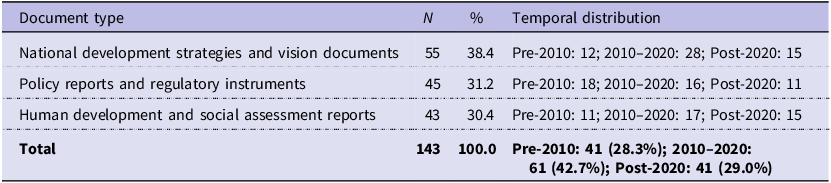
A mixed-methods research design combines quantitative content analysis with the reflexive thematic analysis of Braun and Clarke (Reference Braun and Clarke2006, Reference Braun and Clarke2019). The documentary corpus comprises 143 items dated between 1971 and 2024. Most of the material has been drawn from official Qatari state archives (principally the MSDF archive, the Al Meezan legal database, and the holdings of the Planning and Statistics Authority); the remainder comes from international organisations, NGO reports, and the scholarly literature. Purposive sampling was applied, with selection guided by three criteria: centrality to welfare governance, relevance to civil society regulation and pertinence to social protection policy narrowly conceived. Temporal coverage across the three analytical periods is broadly balanced. Documents pre-dating 2010 account for 28.3 per cent of the corpus; the 2010–2020 period accounts for a further 42.7 per cent; post-2020 documents for the remaining 29.0 per cent. By document type, national development strategies and vision documents account for 38.4 per cent of the corpus, regulatory instruments and policy reports for 31.2 per cent, and human development and social assessment reports for the remaining 30.4 per cent. Table 1 reports the detailed composition.
Composition of the documentary corpus

Note. Purposive sampling was applied; sources comprise official Qatari government repositories, together with international organisations and the scholarly literature. N = number of documents.
Data analysis
MAXQDA 2023 was used for the coding process. The codebook was deductive in orientation, organised around the four hypotheses and the PAA dimensions. An initial set of thirty-two codes derived from the theoretical framework was expanded to forty-eight following pilot coding on twenty documents, which brought additional thematic categories into view. Coding was performed by two researchers working independently. Inter-coder reliability reached a Cohen’s κ of 0.87 (95 per cent CI [0.84, 0.90]), a value within the almost-perfect agreement range (Landis and Koch, Reference Landis and Koch1977). Three quantitative procedures complemented the thematic analysis. Code-to-code relations were examined through co-occurrence matrices. Relative prominence of welfare governance terminology across document types was assessed through TF-IDF weighting. Chi-square tests examined the statistical significance of code distributions within each hypothesis. On the qualitative side, the reflexive protocol of Braun and Clarke was followed through the successive phases of familiarisation, open coding, and thematic refinement. The coding process yielded 42,919 segments across the four hypotheses. Full coding frameworks, statistical workflow, and reliability metrics are documented in Supplementary Material S1.
Results
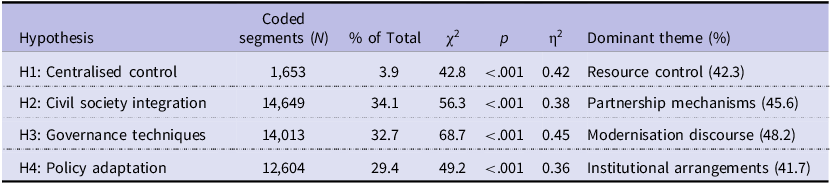
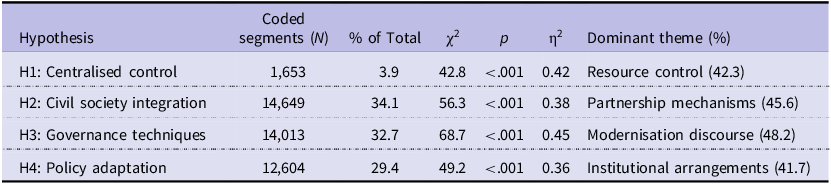
Coding across the 143-document corpus returned 42,919 segments distributed across the four hypotheses, each of which attracted statistically significant support. Chi-square tests yielded p < 0.001 throughout, with eta-squared effect sizes ranging from 0.36 to 0.45. The distribution of segments is uneven. H2 (civil society integration) accounts for the largest share at 34.1 per cent, followed by H3 (governance techniques) at 32.7 per cent and H4 (policy adaptation) at 29.4 per cent. H1 (centralised control) attracted only 3.9 per cent of coded segments, a notably smaller share in absolute terms, yet the eta-squared statistic for H1 stands at 0.42, comparable to those recorded for the more frequently coded themes. Read together, the low frequency and the high effect size indicate that where centralised resource control does register in the documentary record, its association with power asymmetry is pronounced. Table 2 presents the quantitative findings.
Summary of hypothesis testing results
Note. All chi-square tests significant at p < .001; df = 1 for all tests. η2 = eta squared (effect size).
Centralised control and power asymmetries (H1)
For H1, the coding produced 1,653 segments (3.9 per cent of total; χ2(1, N = 1,653) = 42.8, p < 0.001, η2 = 0.42). These are divided among resource control (42.3 per cent), institutional centralisation (38.7 per cent), and spatial management (19.0 per cent). The term state co-occurs tightly with directive verbs such as shall and implement (r = 0.82, p < 0.001). What this points to is a regulatory discourse in which the state casts itself as the sole agent of welfare provision.
The documentary record bears all of this out in concrete detail. Policy design for welfare sits with the MSDF, which operates under the Council of Ministers, and the MSDF is also the body responsible for coordinating implementation across the agencies involved. Article 10 of Emiri Resolution No. 75 of 2021 leaves little room for alternative interpretation: ‘the Ministry shall supervise and oversee all social welfare activities, programmes, and organisations operating within the State’. Governmental approval attaches to activities, budgets, and governance structures, the three together. The Qatar Social Work Foundation (QSWF) delivers services on the ground and does so through a range of specialised centres; these include the Aman centre (protection from domestic violence), the Shafallah centre (children with disabilities), and several facilities for elderly care (Brik, Reference Brik2025a).
Public employment is, accordingly, the dominant route by which citizens secure their material position. QNV 2030 presents the entire arrangement as a developmental one, asserting that ‘the State bears responsibility for the full welfare of its citizens’ (Brik, Reference Brik2025a). The formulation does substantial discursive work, conferring legitimacy on a system that is, at its core, centralised provision.
Civil society integration and managed incorporation (H2)
H2 produced 14,649 coded segments, 34.1 per cent of the total (χ2(1, N = 14,649) = 56.3, p < 0.001, η2 = 0.38). Partnership mechanisms dominate the distribution at 45.6 per cent. Service delivery accounts for 32.8 per cent. Civil society integration accounts for 21.6 per cent. The term ‘partnerships’ co-occurs with ‘public-private’ at r = 0.88 (p < 0.001). State-managed collaboration runs across the welfare field.
What emerges is a pattern of selective incorporation, legible in the documentary language itself. Policy documents invoke the language of partnership and collaboration with remarkable regularity. Partnership alone appears in 87 per cent of post-2010 welfare documents. The substance of these relationships, though, is consistently hierarchical. The QSWF runs social centres for the elderly, for persons with disabilities, and for at-risk families. The MSDF determines the mandate, the staffing, and the operational parameters. The 2019 National Social Protection Strategy puts the point directly: ‘all service delivery partnerships shall operate within the framework established by the Ministry and in accordance with national priorities’ (Brik, Reference Brik2025a). There is, plainly, no space for partner-initiated programming. Private-sector actors have taken on a growing role in healthcare and education; the Public-Private Partnership framework under Law No. 18 of 2020, for instance, permits private delivery of healthcare services, but regulatory arrangements ensure their participation remains subject to state direction on service standards, pricing, and beneficiary eligibility.
Partnership discourse runs within a governance relation in which the state keeps primary authority. Non-state actors come into welfare delivery on terms the state sets. Religious organisations follow the same pattern. Qatar Charity and the Qatar Red Crescent Society work in welfare-adjacent fields, emergency relief, community development, and family support. Their domestic programming, however, runs through the MSDF. National welfare priorities shape what they can do. Zakat collection follows a parallel logic. Law No. 13 of 2014 established the National Zakat Fund. What was once a decentralised religious obligation is now administered by the state as a redistribution mechanism.
Organisations pushing genuinely independent advocacy, on labour rights, on political reform, on migrant welfare, are absent from the governance networks the corpus records. The absence is structural. Not a single policy document in the dataset references consultation with independent human rights organisations or labour advocacy groups on welfare policy formulation. The National Human Rights Committee, set up in 2022, is a measured institutional concession to rights-based discourse, though its terms of reference are drawn up by the Council of Ministers, so the governance hierarchy reproduces itself at the level of the Committee’s own constitution. Selective integration of this kind sustains a governance model in which civic participation runs through state-defined welfare priorities, not through independent policy agendas.
Governance techniques and modernisation (H3)
H3 produced 14,013 coded segments, 32.7 per cent of the total (χ2(1, N = 14,013) = 68.7, p < 0.001, η2 = 0.45). Within H3, modernisation discourse accounts for 48.2 per cent of segments, technical rationality for 31.5 per cent, and population management for 20.3 per cent. The η2 of 0.45 is the largest across the four hypotheses. The size of the effect is not incidental. It registers the depth to which modernisation narratives run through welfare governance in Qatar.
The documents show a governance strategy resting on a particular rhetorical substrate. The vocabulary of development, progress, and technical rationality does the legitimating work that rights discourse might elsewhere be expected to perform. QNV 2030 is the obvious case in point, presenting social welfare as developmental priority on one page and as moral duty rooted in Islamic principle on the next. The document itself is explicit: ‘social development is the cornerstone of a prosperous and just society, guided by the values of Islam and the traditions of the Qatari people’. The narrative itself carries analytical weight in this context. Prior to the oil-driven modernisation that reshaped Qatari society from the 1940s and 1950s, care provision, such as it was, depended on tribal kinship networks, extended family structures, and the religious institutions that linked them. The move from that earlier configuration to formalised, state-led social services is narrated in the policy record as progressive development, a story of modernisation arriving. The 2008 creation of the MSDF, which consolidated competences that had been distributed across several agencies, fits the narrative: it is emblematic of the centralisation the modernisation story has underwritten.
Data-driven governance is deployed to give centralised decision-making the appearance of technical neutrality. The initial National Development Strategy (NDS-1, covering 2011–2016) introduced performance indicators and outcome benchmarks for social services, and in doing so framed technical monitoring as a mark of modern governance. NDS-2 (2018–2022) extended the approach further, introducing outcome-based budgeting for social programmes and putting in place a monitoring framework aligned with the United Nations Sustainable Development Goals. In practice, the metrics are designed, and the results interpreted, entirely from inside state institutions. There is no independent evaluation body for this purpose. No civil society watchdog takes part in assessment. The technical apparatus of monitoring and evaluation, central to contemporary public administration rhetoric, operates not as a mechanism of accountability but as a further instrument of centralised governance, reinforcing, in the process, state epistemic authority over welfare outcomes (Brik, Reference Brik and Brik2025b). Reform discourse serves a parallel function. The minimum wage introduced in 2020, the partial dismantling of the kafala system, and the pension extensions under Law No. 24 of 2022 all made it possible for Qatar to address the international scrutiny attending the 2022 FIFA World Cup preparations, and to do so without altering the underlying distribution of authority in any fundamental way. Welfare reforms of this kind are, then, themselves techniques of governance. They respond to external pressure whilst reconsolidating authority through institutional arrangements that are modified in form but unchanged in substance.
Policy adaptation (H4)
H4 accounts for 12,604 coded segments, 29.4 per cent of the total (χ2(1, N = 12,604) = 49.2, p < 0.001, η2 = 0.36), distributed across institutional arrangements (41.7 per cent), resource allocation (35.4 per cent), and implementation mechanisms (22.9 per cent). The four PAA dimensions interact in the manner the framework anticipates, though the direction of interaction in the Qatari case is strikingly consistent. Discourse supplies the legitimating frame for centralised provision; actors are hierarchically configured within that frame; resources flow through state-controlled channels; and rules, both formal regulation and informal norm, are structured to preserve state authority. Consistency on this scale is not the product of accident.
Temporal analysis reveals instructive shifts across the three periods. 28.3 per cent of coded segments derive from documents dated before 2010, in which the vocabulary is typically dominated by state responsibility and direct provision. This is the characteristic idiom of the post-independence phase, reflecting the consolidation of welfare under state authority through those decades. The 2008 establishment of the MSDF, which merged functions previously dispersed across the Ministry of Civil Service Affairs and Housing, the Supreme Council for Family Affairs, and other bodies, marks the institutional high point of this centralisation. The 2010–2020 period, which accounts for 42.7 per cent of coded segments, coincides with QNV 2030 and the lead-up to the 2022 FIFA World Cup; partnership language and reform narratives, as a result, begin to feature prominently. NDS-1 (2011–2016) introduces the vocabulary of stakeholder engagement and cross-sector collaboration into welfare planning, though the same document reserves all decision-making authority to the MSDF and the Council of Ministers. The Wage Protection System, introduced in 2015 to mandate electronic salary payment for migrant workers, offers a case in point: by addressing international criticism of labour conditions while centralising oversight within state regulatory bodies rather than empowering workers or independent monitors, it managed simultaneously to satisfy external pressure and to reconsolidate state authority.
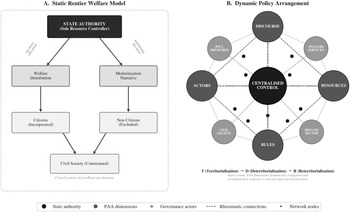
Post-2020 documents, which account for 29.0 per cent of coded segments, consolidate the adaptive pattern established in the preceding phase. Law No. 24 of 2022 broadened pension coverage categories; amendments to the Labour Law removed the exit permit requirement, thereby absorbing one of the standing demands of international advocacy bodies. The permanent residency regime introduced by Law No. 10 of 2018 is a telling instance from the period. A small cohort of non-citizens is granted access to healthcare and education. The welfare boundary extends in their direction. The underlying distinction between citizen and non-citizen, however, is carefully preserved. In 2019 the National Social Protection Strategy codified the approach in a tiered framework of entitlements. Citizens at the apex. Permanent residents on an intermediate tier. Temporary workers at the periphery. What the reforms changed was delivery, namely the modalities by which welfare reaches its recipients. What they left untouched was the authority to decide who receives what, on what conditions, on whose terms. Across the three periods examined, the underlying governance architecture has stayed in place. Figure 1 illustrates the dynamic interaction of the PAA dimensions across the phases, showing the processes by which discourse, actors, resources, and rules are configured and reconfigured under internal and external pressure.
From static rentier welfare to dynamic policy arrangement.

Cross-hypothesis patterns
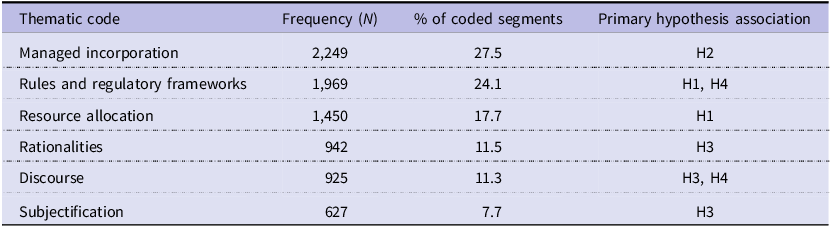
The four hypotheses are interconnected in analytically instructive ways. Code overlaps (H2–H3, r = 0.72; H3–H4, r = 0.68; H1–H4, r = 0.64; all p < 0.001) suggest that managed incorporation, governance techniques, and policy adaptation function not as discrete phenomena but as mutually reinforcing dimensions of a single governance logic. The strongest correlation appears between H2 (civil society integration) and H3 (governance techniques), confirming a finding of considerable analytical importance: the incorporation of civil society actors into welfare delivery is itself a governance technique. The managed integration of service providers extends welfare capacity while simultaneously foreclosing the emergence of autonomous civic power. Table 3 presents the distribution of thematic codes across the corpus.
Cross-hypothesis thematic code distribution

Note. Codes are not mutually exclusive; segments may be assigned multiple codes.
The convergence of these thematic frequencies across document types, 38.4 per cent in development strategies, 31.2 per cent in policy reports, and 30.4 per cent in human development reports, confirms the consistency of the pattern across the corpus. The stability of these distributions across the three temporal periods carries an important analytical implication: although the content and emphasis of welfare governance have typically shifted in response to external pressures, the underlying structural logic has remained strikingly consistent since the post-independence consolidation of state authority.
Discussion
All four hypotheses find empirical support, and each of the three research questions admits of a definite answer. The question of institutional resilience resolves as follows. Centralised welfare control is sustained through three connected operations: the monopolisation of resource allocation, regulatory oversight over all welfare-related activity, and the deployment of public sector employment as a de facto welfare mechanism.
On the mechanism question, the state reconfigures welfare provision through selective civil-society integration into delivery and through governance techniques that absorb modernisation pressure without decentralising authority. On the structural question, the four PAA dimensions interact dynamically across temporal phases: discourse legitimises centralised provision; actors are arranged in hierarchical networks; resources run through state-controlled channels; and rules, formal and informal alike, are structured to preserve state authority. Welfare governance in Qatar works as an adaptive system, then, one in which reform and continuity are not opposed forces but the mutually constitutive elements of a single governance logic.
These findings engage directly with ongoing debates in social policy scholarship. Classical welfare regime theory, from Esping-Andersen (Reference Esping-Andersen1990) onwards, has sought to identify the institutional logics that distinguish welfare configurations across different political contexts. The analysis demonstrates that welfare governance in a rentier state typically constitutes a distinctive configuration, one that resists assimilation to the existing typologies without substantial analytical distortion. Liberal regimes tend to mediate welfare access through the market; social-democratic regimes rest universal provision on collective political mobilisation; welfare in Qatar, by contrast, is administered as an instrument of state authority, channelling citizen engagement through material provision rather than through participatory mechanisms.
The finding contributes analytically to the literature. The mechanisms through which welfare and political compliance are linked in rentier settings can, as such, be specified with some precision. Classical rentier state theory typically locates this linkage in the distribution of benefits. The preceding analysis suggests a more complex configuration. The linkage runs through a governance apparatus that integrates discourse (framing welfare as a moral obligation), actors (bringing service providers inside whilst redirecting advocacy towards welfare priorities), resources (centralising fiscal control), and rules (legislating state oversight over all welfare-related activity). And this apparatus is adaptive. External pressures are absorbed through selective reforms that modify delivery modalities without conceding governance authority itself, a process that assemblage thinking, usefully, captures as reterritorialisation: the reconsolidation of state power through, and not despite, reform.
The analysis also challenges Gough’s (Reference Gough2013) concept of ‘informal security regimes’, at least in its original formulation. Rentier states share with Gough’s informal security regimes one central feature: welfare provision organised outside the taxation-representation nexus. They differ, however, in the degree of deliberate institutional design involved. Welfare governance in Qatar cannot reasonably be described as informal. It is extensively legislated, bureaucratically administered, and legitimized through Islamic and developmental discourses drawn on in roughly equal measure. The departure from the Western welfare state tradition lies, as such, less at the level of institutional form than at the level of institutional purpose. Mitigating market risk is not the aim, nor is the promotion of social citizenship. The institutional apparatus serves, rather, to consolidate governance through the structured character of provision.
An equally instructive contrast emerges from comparison with the social investment literature (cf. Ellison and Fenger, Reference Ellison and Fenger2013; Hemerijck, Reference Hemerijck and Magone2014; Hemerijck et al., Reference Hemerijck, Ronchi and Plavgo2023). Social investment scholarship typically charges welfare with the task of developing citizens’ capacities for market participation. Rentier welfare operates on what is, in effect, the opposite logic. Citizens are insulated from market pressure, and the system cultivates reliance on state provision rather than capacity for market engagement. Public sector employment, free healthcare, free education, and housing subsidies do not, as such, activate citizens economically in the sense that the social investment literature intends; they incorporate citizens politically. The consequences for social cohesion diverge from the solidarity-through-shared-risk to which Western welfare traditions have typically aspired, whatever the gap between principle and practice. Rentier welfare draws its entitlement lines along citizenship. Citizens are separated from non-citizens. Nationals are separated from migrants. Service-oriented civic organisations are separated from those doing independent advocacy. Gender cuts through the scheme in its own way. The welfare architecture rests on a family-centred model. Male citizens are the primary channels of entitlement; female nationals reach entitlement mostly through family ties. Take housing allocations. The MSDF housing programme allocates through male household heads. The pattern resembles Lewis’s (Reference Lewis1992) male breadwinner model, but with one institutional difference. In the European case, the breadwinner role runs through the labour market. In Qatar, it runs through state allocation, not through wage work.
From a governmentality lens, welfare in Qatar is not reducible to a set of programmes. It is a mode of governing. Its operation typically extends well beyond programme delivery, shaping conduct, configuring expectations, and ordering the relation of the individual to the state. The Islamic framing positions welfare as benevolence rather than as entitlement; the regulatory oversight of civil society reinforces that framing from its institutional side. Welfare is, as such, received as an expression of state guardianship and Islamic principle, rather than as an entitlement anchored in individual rights. On this reading, an assumption that runs through much social policy scholarship, namely that welfare expansion is typically coupled to greater inclusivity, to decommodification and to universalism, comes under pressure. The Qatari case indicates otherwise. Rentier welfare can develop in the direction of institutional complexity and adaptive capacity without generating the outcomes which existing typologies treat as indicators of welfare maturity.
These findings engage directly with the analytical foundations of social policy scholarship. The dominant frameworks in the discipline, whether organised around decommodification (Esping-Andersen, Reference Esping-Andersen1990), social investment (Hemerijck, Reference Hemerijck and Magone2014), or social cohesion (Lloyd and Hannikainen, Reference Lloyd and Hannikainen2022), classify welfare systems according to criteria drawn typically from the Western experience: the reduction of market dependence; the activation of human capital; the capacity to generate solidarity. The Qatari case, as such, exposes the limits of all three criteria. Welfare expansion in the Qatari context consolidates citizen reliance on state provision, differentiates entitlements along citizenship and residency lines, and concentrates governance authority at the centre. It constitutes, as such, the defining feature of a welfare configuration distinct from those benchmarks, one requiring an analytical vocabulary of its own. This configuration can be described as ‘welfare-as-governance’: social policy operates as a site on which the state actively shapes the boundaries and terms of political membership rather than as a rights domain. Carmel and Sojka (Reference Carmel and Sojka2021) on rationales of belonging offer a useful parallel.
Limitations and future research directions
The analysis carries several limitations, methodological as well as empirical. The documentary corpus is drawn from officially published material and may therefore miss the informal or unpublished policy deliberation that takes place outside the public record. The formal architecture of welfare governance comes into view, while informal practices, off-record negotiations, and unobtrusive forms of resistance remain largely beyond its reach. Working from English-language and translated sources introduces a further risk. Nuances in the Arabic originals, particularly those carrying religious or culturally specific connotations in welfare terminology, can be softened or lost in the process of translation. Scope is a further concern. The findings are case-specific, concerning Qatar examined on its own terms, and extending them to other resource-rich polities would require systematic comparative investigation beyond what a single case can sustain. A documentary corpus captures institutional structures effectively but reaches less easily to the lived experiences of welfare recipients, to informal negotiations between officials and citizens, and to the distinctive perspectives of marginalised groups such as migrant workers. Despite these qualifications, the documentary corpus provides a substantial empirical foundation for analysing the governance logic of rentier welfare, and the mixed-methods design combines statistical rigour with interpretive depth.
The findings point, as such, in several directions for further inquiry. An ethnographic extension would serve as a natural complement to the documentary analysis, examining how welfare recipients engage with the governance structures traced above and opening up the subjective dimensions of ‘welfare-as-governance’ that a policy record typically leaves outside its frame. Gendered dimensions of welfare provision, namely the privileging of male nationals, the positioning of women within family-routed arrangements and the distinctive situation of female migrant domestic workers, surface in the documentary record, but tracing these dimensions into everyday practice would require sustained qualitative fieldwork that documentary analysis cannot by itself substitute for. Comparative research across the Gulf Cooperation Council states is a further pressing need. Longitudinal analysis, spanning several decades of policy evolution and combining documentary with interview-based evidence, would allow a further question to be posed: whether the adaptive governance model set out above represents a stable institutional equilibrium or a more transitional configuration. Finally, incorporating informal and grassroots perspectives, the voices of naturalised citizens, of stateless bidoon populations, of migrant community organisations, would deepen understanding of how welfare governance operates below the official record, and would provide a useful corrective to the state-centric orientation characterising much of the existing literature.
Conclusion
Welfare governance in Qatar, on the account developed above, typically operates as an adaptive system. Centralised state control, selective civil society integration, modernisation narratives, and flexible policy arrangements converge on a single objective: the preservation of governance stability. The mixed-methods analysis of 143 documents supports all four hypotheses. Centralised resource control entrenches power asymmetries; selective integration draws service-oriented organisations into delivery while redirecting advocacy towards state-sanctioned welfare priorities; governance techniques mediate modernisation pressures without devolving authority; and policy arrangements adapt to external pressure while preserving the core of state authority intact.
The contribution to social policy scholarship is analytically substantive. The typological criteria on which comparative welfare scholarship has long relied – decommodification, social investment, and informal security – prove insufficient for classifying welfare configurations in resource-rich settings. Rentier welfare does not mitigate market risk, activate human capital, or compensate for weak institutional capacity. Its actual function is to organise political membership through the administration of differentiated entitlements. Welfare-as-governance articulates this logic and supplies social policy scholarship with an additional analytical category. Where Esping-Andersen (Reference Esping-Andersen1990) identifies decommodification as the defining variable, and Gough (Reference Gough2013) with Wood and Gough (Reference Wood and Gough2006) extends the analysis to non-Western security regimes, the rentier case adds a further dimension: the organisation of welfare around structured membership differentiation, with the state calibrating provision to define who belongs, on what terms, and with what entitlements, rather than to mitigate risks or promote solidarity.
The analysis has broader implications for comparative welfare scholarship. Welfare-as-governance provides a framework for examining social policy in settings where provision is organised around membership differentiation and institutional continuity rather than around risk mitigation or social inclusion. The concept extends the analytical vocabulary available to comparative scholars and offers a necessary corrective to typological frameworks that take Western welfare trajectories as the reference point, which thereby fail to account for the distinct logics operating in resource-rich polities. Open questions remain. Whether the governance dynamics identified in the Qatari case, managed incorporation of civil society, discursive legitimisation of centralised provision, and selective absorption of international norms, obtain in other resource-rich polities is an empirical matter for further research, as is the question of how those dynamics interact with variation in population size, sectarian composition, and reform trajectory across the Gulf and beyond. Longitudinal analysis of policy evolution, qualitative investigation of citizen and migrant experience, and the incorporation of informal and grassroots perspectives would, in combination, deepen understanding of how welfare governance operates beyond the official record.
Supplementary material
The supplementary material for this article can be found at https://doi.org/10.1017/S147474642610150X