

Since 1971, international aid for agricultural research has been shaped by an unusual and ambitious partnership: an organization founded as an ad hoc consortium of national governments, foreign aid offices, philanthropies, United Nations agencies, and international financial institutions that is known today as CGIAR. At its founding, the Consultative Group on International Agricultural Research was tasked with fostering scientific research that would help “developing nations … increase and improve the quality of their agricultural output.”Footnote 1 Representative of an era of broad multilateral cooperation, and reliant on complex international funding networks, CGIAR assumed the profoundly localized mission of reshaping farmers and fields across diverse cultural, economic, and environmental contexts. The tensions arising as researchers and institutions navigated the demands and expectations of these distinct scales form the crux of CGIAR history. They have affected the changing disciplinary orientations of research centers, the ecologies prioritized in breeding, the expectations for intellectual property management, and even the words used to describe crops.
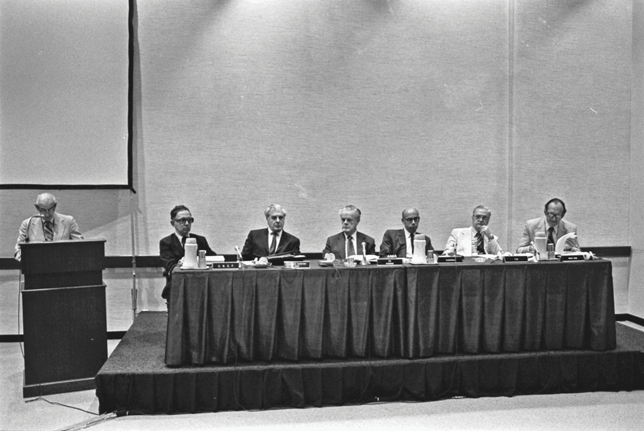
CGIAR was and remains a dynamic entity. Its organization, policies, and mission have morphed multiple times in response to changing international circumstances across its fifty-year history.Footnote 2 It took shape as the United Nations’ “development decade” of the 1960s transitioned to a period characterized by Cold War détente, aid multilateralism, and increasingly decentralized neoliberal restructuring of government agencies in host countries – and its original contours reflect the assumptions and priorities of that time. Its instigators included influential administrators at the Rockefeller and Ford Foundations and the World Bank, and it brought together representatives of donor nations and other organizations under the sponsorship of the World Bank, United Nations Food and Agriculture Organization (FAO), and the United Nations Development Programme (UNDP) (Figure 0.1). This group imagined replicating the bumper harvests of wheat and rice recently experienced in Mexico, India, and the Philippines – the products of the so-called Green Revolution – with new crops and new countries. And they placed international support for and coordination of research at the center of this vision, necessary to “reinforce national efforts” in agricultural science that they assessed as failing to address mounting needs in food production.Footnote 3
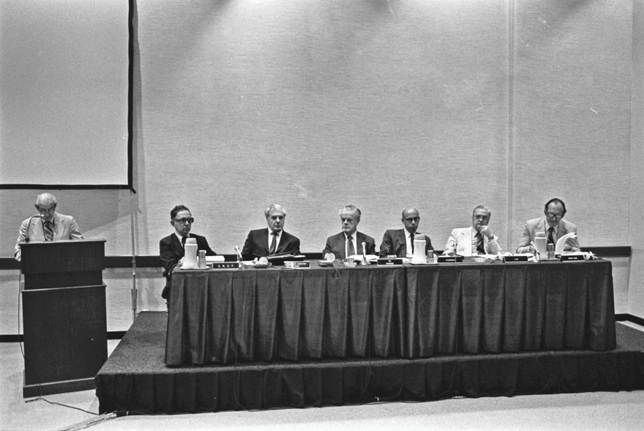
Representatives of leading agencies and CGIAR bodies preside over a July 1975 CGIAR meeting in Washington, DC. The individuals seated at the table from left to right are a UNDP representative, the CGIAR executive secretary, the TAC secretary, the chairman (perhaps of the panel, affiliation unclear), an FAO representative, and a World Bank representative.
The initial model adopted by CGIAR leadership in the pursuit of this goal prized two elements: expert oversight and institution building. A Technical Advisory Committee (TAC) – a select group of “distinguished international experts” – prioritized areas to be addressed with resources from CGIAR donors, as well as the best ways to carry out research on these “priority problems.”Footnote 4 Influenced especially by the recent history of wheat and rice research, which had been undertaken at international institutions that targeted these crops, the committee identified the creation of further international research centers with clear mandates as the go-to route for enhancing agricultural science in the name of development. Establishing these centers and organizing them as an interlinked system became the second key element of CGIAR strategy. Its network of research centers mushroomed from a founding four in 1971 to thirteen in 1983 and eighteen a decade later.Footnote 5
Much of CGIAR’s institutional growth took place in postcolonial spaces, locations enmeshed in the legacies of formal or informal empire. As Courtney Fullilove observes in her analysis of CGIAR’s move into the Middle East, its administrators and scientists operated in rural landscapes that were sometimes “the fields of empire, recast in the aftermath of World War II as buffers against communism.” In the transition to a post–Cold War world, CGIAR’s geography largely remained intact, but its globalizing ambitions turned away from geopolitical jostling and the so-called battle for hearts and minds. As development strategies pivoted towards market-based interventions, postcolonial states and other nations targeted for aid “became the grist for a globalized vision of market-led development, terrain imagined rather than realized in the winds of change” (see Fullilove, Chapter 1, this volume). The shift kept CGIAR in step with the United Nations’ unrolling of the Millennium (2000–15) and then Sustainable Development Goals (2015–present) as the twentieth century transitioned to the twenty-first.
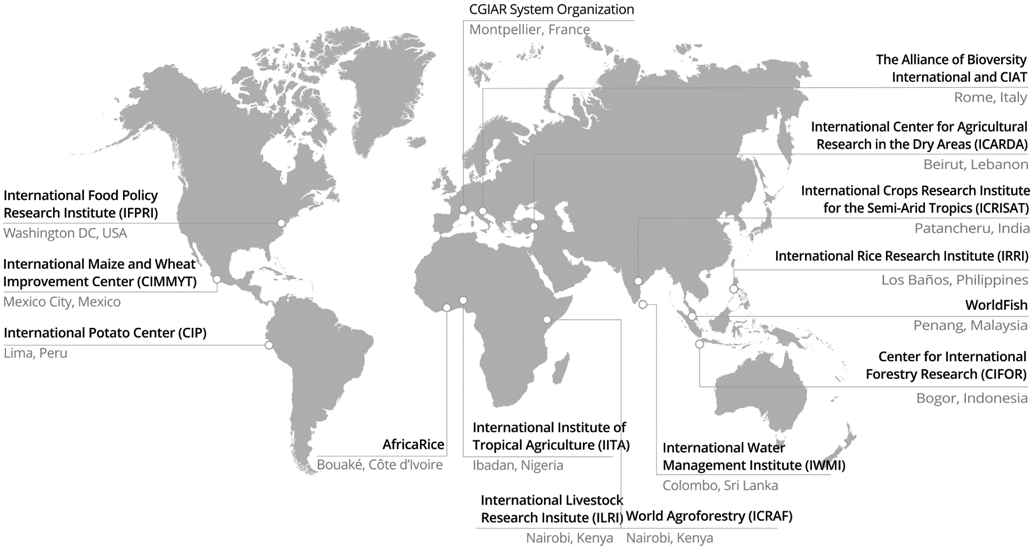
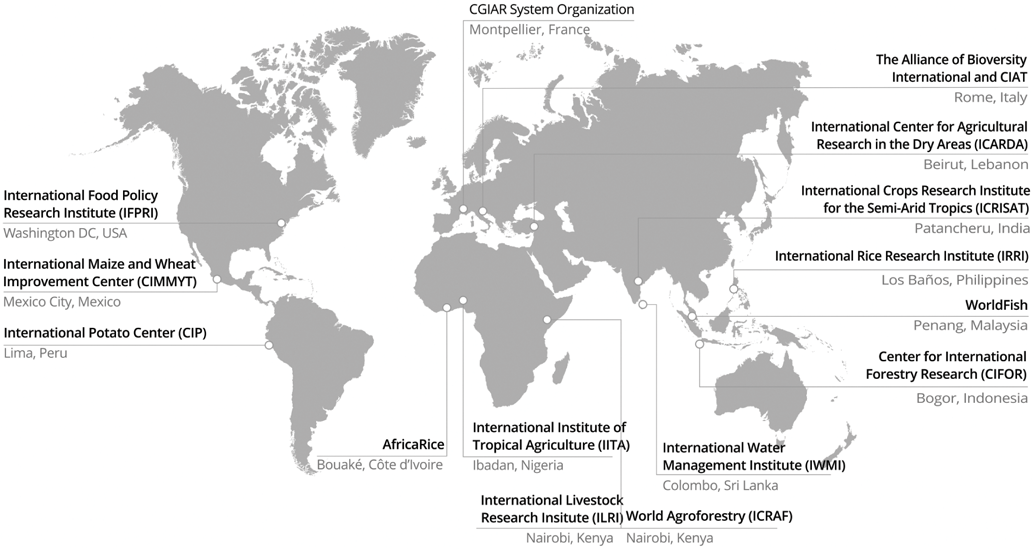
By 2023, there were fourteen CGIAR research centers, and their activities substantiate CGIAR’s claim to being “the world’s largest global agricultural innovation network”Footnote 6 (Figure 0.2). More than 9,000 scientists and staff sustain a program of research that has changed over the intervening decades, expanding from an early emphasis on growing ever-bigger piles of grain to incorporating such issues as agroforestry, water management, social inclusion, and climate change adaptation.Footnote 7 According to CGIAR accounts, the labor and knowledge of scientists employed at these centers have changed the lives of the world’s farmers for the better. Its list of “best scientific breakthroughs,” prepared for its fiftieth anniversary, features many discrete research products whose uptake beyond the research facility can be traced and quantified: a vaccine for East Coast cattle disease, the cassava variety KU50, and a digital tool for banana disease identification, among others. But it also points to outcomes far more diffuse, like “enhancing food safety at all levels of the value chain,” fostering a whole-landscape approach to natural resource management, and addressing inequality through “gender transformative research.”Footnote 8 Not surprisingly, these claims to impact – whether discrete or diffuse – have been, and continue to be, vigorously contested.Footnote 9 Studies of research for agricultural development routinely question the scalability of interventions, neglected equity implications, sidelining of local and national perspectives in international agenda setting, and more.Footnote 10
In 2021, the CGIAR system comprised fourteen international research centers. At the time of writing, the organization of CGIAR – including its constituent institutes – was taking new shape under One CGIAR. CGIAR, Harvesting Research and Innovation for Impact (Montpellier: CGIAR System Organization, 2022), p. 34.
More than fifty years on from its founding – and despite its influential and enduring role in shaping the agendas, infrastructure, and labor force of agricultural research, as well as the crops tended by farmers around the world – CGIAR remains an enigmatic historical presence. Histories of twentieth-century agriculture and international development make frequent reference to CGIAR research centers, especially the most prominent of these, and occasionally to CGIAR itself. Yet if one sets institutional accounts aside, there are surprisingly few historical treatments that take these institutions as their primary concern.Footnote 11 It is difficult for a student or scholar who encounters a mention of CGIAR – let alone its constituent centers past and present, such as the International Water Management Institute (IWMI) or the International Livestock Research Institute (ILRI) – to locate accounts attentive to colonial and postcolonial experiences, national and international political histories, or cultural histories of science and technology.
The exceptions to this pattern are two centers that predated the formation of CGIAR and were made famous by their role in disseminating the headline-generating wheat and rice varieties of the 1960s: the International Maize and Wheat Improvement Center (CIMMYT) in Mexico and the International Rice Research Institute (IRRI) in the Philippines. In examining these institutions, historians have developed persuasive accounts of the role of Cold War geopolitics in shaping an approach to development focused on containing unrest among rural people in Latin America and Asia through interventions consonant with the interests of transnational agribusiness.Footnote 12 Following critiques of the Green Revolution that have circulated since the 1970s, they have typically highlighted the shortcomings of a vision of agriculture limited to technical interventions, especially novel plant varieties, capital-intensive mechanization, and petrochemical inputs, and ill-suited to the circumstances of the most socially and economically marginalized farmers.Footnote 13
It is striking to note that even in the case of undeniably influential institutions like CIMMYT and IRRI, the years around 1970 tend to mark the endpoint in many existing accounts. From the perspective of the founding of CGIAR in 1971, the same period could be considered a starting point in which these went from singular institutions to fulfilling their promise as model operations for a globalized agricultural research infrastructure.
A number of recent accounts offer routes into facets of CGIAR influence beyond its association with “miracle” rice and wheat, and begin to explore its later history. Historians of Mexican science and politics have led the way in reinscribing Mexican ambitions in a history of global maize and wheat research at CIMMYT that has more typically ignored Mexican agronomists’ contributions.Footnote 14 New studies have revealed the routes by which CGIAR came to be centrally involved in the management of global crop diversity and managed to maintain this position through decades of controversy regarding the ownership of plant genetic materials.Footnote 15 Histories situated outside the traditional geographic frame of Green Revolution histories, such as in Colombia and South Korea, temper stories of global influence with far more complex narratives of local experiences.Footnote 16 Histories of agricultural research adjacent to the work of CGIAR – whether livestock breeding in revolutionary Cuba, crop science in Mao’s China, or Taiwanese development programs in Vietnam – decenter the dominant historiographic framework of a Western and capitalist Green Revolution and establish important boundaries to claims of CGIAR’s novelty and influence.Footnote 17 CGIAR’s reinvention of its goals for agricultural transformation and the objects of agricultural research have also come in for scrutiny, including its introduction of agendas for improving the nutritional profile of crops and addressing gender inequalities.Footnote 18 The emergent view of CGIAR’s history nonetheless remains fragmented and partial. Opportunities for further analyses and richer historical understanding abound.
The contributions to this volume seize on that opportunity. Here leading historians and sociologists of agricultural research and international development explore the influence of CGIAR and its network of research centers on agriculture, science, and policy since the 1970s. Seeking to extend beyond the early years of CGIAR, and beyond the two most prominent centers, these chapters ask whether and how science- and center-led development changed the practices of farmers, researchers, and policymakers in the years that followed. They traverse five continents and five decades of scientific research, agricultural aid, and political transformation. They pose – and begin to answer – questions about CGIAR informed by the critical historiographies of science, agriculture, and development.
By gathering new critical historical scholarship on CGIAR in a single work for the first time, we hope to make crucial cross-cutting themes visible and bring new research questions to the fore. CGIAR is a sprawling enterprise whose history encompasses five decades of significant transformations in food, agriculture, and industry over diverse geographies and cultures. We do not – and could not – critically address all facets of its story in a single volume. This volume includes case studies of several CGIAR centers but leaves out multiple past and present centers, such as the International Food Policy Research Institute (IFPRI), IWMI, and WorldFish, as well as the research domains in which they specialized. It gives only limited attention to some of the highest-profile centers, such as IRRI and the International Potato Center (CIP). Our focus on CGIAR institutes omits the record of comparable efforts at research for development emanating from the Soviet Union or China. This institutional frame also diverts attention from the effects of CGIAR activity on individual farmers and communities. Rather than see these lacunae as a barrier to presenting a history of CGIAR, we offer the necessarily incomplete view as an opportunity. Above all, we hope this volume takes stock of the existing scholarship and sets promising agendas for the future. The contributions collected here cluster around three big themes – the role of geopolitics, the pursuit of research as development strategy, and the coordination and centralization of research within a system – but highlight many further analytical possibilities.
Geopolitics
Existing critical assessments of CGIAR and the international research centers typically emphasize their geopolitical functions, highlighting their association with Cold War security imperatives and the desire to shape a capitalist world agro-economy. This emphasis is not misplaced. CGIAR emerged after a World Bank–financed Commission on International Development (the Pearson Commission) called in 1969 for greater coordination of food and agricultural research, in line with the perspectives of World Bank president Robert McNamara and commission members representing the United States, Canada, Western Europe, and Japan.Footnote 19 But it is possible to give far more nuance to this dominant account.
As the chapters by Prakash Kumar on India’s pursuit of the International Crops Research Institute for the Semi-Arid Tropics (ICRISAT) and Gabriela Soto Laveaga’s study of CIMMYT as a Mexican institution highlight especially well, national political aspirations and demands produced ostensibly international institutions that were also constitutive of nation-building projects. Consider Kumar’s description of ICRISAT in the age of Indira Gandhi: “It was partly because Gandhi could bring herself to see the international as opposed to the American face of ICRISAT, and because she could bring her constituents to believe in this international image as well, that ICRISAT was accepted even as popular anti-American sentiment in India was peaking.” Kumar emphasizes that Gandhi’s political balancing act between international and national objectives helped define ICRISAT in its early years. Other chapters in this section demonstrate similar processes for other institutes and regions.
Were, and are, CGIAR centers best understood, to paraphrase Kumar, as Indian (or Mexican, or Colombian, or Filipino, or Nigerian)? Or were they international? How did policymakers, scientists, and national politicians understand and communicate the purpose of institutions grounded in local soil yet always drawing funding and personnel from across the globe? As Timothy W. Lorek’s Colombian contextualization of the International Center for Tropical Agriculture (CIAT) shows, sometimes both national and international agendas could – and did – run roughshod over local realities. In other cases, politicians’ lofty aspirations for science-driven development to improve lives and livelihoods were beset by conflict, including armed conflict, as Courtney Fullilove explains in her account of the International Center for Agricultural Research in the Dry Areas (ICARDA) in Syria and Lebanon.
These chapters illustrate the tensions between international objectives or funding and local experiences at their most intense. Fullilove aptly characterizes “a globalized vision for agricultural development that made poverty alleviation into a single project and poverty itself into a uniform condition. While international research organizations have made increasing claims to operate at a global scale, on behalf of universal interests, the landscapes they traverse are more complex in agro-ecological and historical terms.” The imagination of ostensibly ecology- and geography-specific centers, including CIAT and the International Institute of Tropical Agriculture (IITA) in Nigeria, each mandated to improve agriculture in the global tropics, as well as ICRISAT and ICARDA, which respectively aimed to produce knowledge and solutions for the semi-arid tropics and arid regions, flattened the heterogeneity of small-scale farming. It overlooked microclimates, cultural expectations, and local political contexts. The long-term negotiation between internationally oriented institutions and highly subjective – and always changing – localized contexts is at the heart of our geopolitically oriented chapters and indicates an important topic for future research.
Research as Development Strategy
A key theme in the history of CGIAR is its prioritization of scientific research as an instrument of development. This has inevitably demanded that CGIAR leaders and staff formulate problems that can be considered “solvable” through research. Such problems have ranged from the very general “second-generation development problems” – namely, inequality and unemployment generated by agricultural intensification – highlighted by Lucas M. Mueller in his examination of the CGIAR founders’ formulation of early institutional missions. They have also encompassed more specific concerns, like the perceived “protein gap” in Latin America that drove bean research and extension programs at CIAT even as war and poverty generated more immediate threats to nutritional security, as Wilson Picado-Umaña documents. Regardless of the degree of specificity involved, the imagination of problems set boundaries around the expertise, tools, and labor considered relevant to CGIAR programs and development more broadly. Mueller’s analysis shows that solving “second-generation development problems” demanded the know-how of agricultural economists, individuals practiced in thinking about market-based interventions, much as it did the labor of breeders who, for example, could produce groundnut varieties for new export-oriented agricultural programs at ICRISAT.
In some cases the articulation of research objectives mapped poorly onto the real needs of farmers or rural communities. This might be a product of the mismatch between a realizable scientific aspiration and the nature of the “problem” to be addressed. Picado-Umaña describes how breeders’ efforts to produce a higher-yielding bean for Central American growers faltered in light of eaters’ regular consumption of a wide variety of different beans and the complicated agro-ecologies of the region’s bean fields. The quest to identify an “ideal type” on which to focus, in the interest of maximizing the impact of research, ran counter to local expectations for dietary diversity, not to mention strongly embedded socioeconomic inequalities and political conflict. The idealized rice “target environments” devised at the West Africa Rice Development Association (WARDA) and discussed by Harro Maat offer a different scenario, one in which research agendas remained mired in the political and economic objectives of old authorities, despite stated intentions of serving the needs of newly independent states and citizens. Locating the founding of WARDA within longer colonial histories, Maat shows that until the 1990s “WARDA continued to focus on the rice farming areas defined in the colonial period, addressing European commercial interests rather than the concerns of West African rice farmers.” Maat’s analysis offers a compelling reminder that understanding CGIAR-era research goals demands detailed knowledge of the projects on which they were built – and not just the national projects discussed by Soto Laveaga and Kumar, but in many cases colonial forerunners as well.
Perhaps the challenge for research as development has been deeper than simply the challenge of pinpointing a relevant problem, given the constraints imposed by disciplines, inherited assumptions, available resources, and other obstacles. In their study of ILRI and its predecessors, Rebekah Thompson and James Smith suggest that the challenge may lie in an unresolvable contradiction between doing science and pursuing development. They describe how a drive for “scientific excellence” in livestock research within CGIAR has created challenges for researchers caught between the often incommensurable imperatives of helping poor farmers and publishing peer-reviewed research. They urge scholars to remember that it “is important to recognize how institutions and funding bodies conceptualize excellence, as this shapes the way in which knowledge is produced and how research impact is ultimately perceived.” This, too, points towards a topic ripe for further study, both within CGIAR and its constituent institutions and across the larger landscape of development initiatives.
Coordination and Centralization
One of the most difficult elements of CGIAR history to tackle is the extent to which it has – or has not – functioned beyond individual research programs and centers. Is there, or was there ever, meaningful system-wide activity that warrants closer historical examination of CGIAR as the network it aspired to be? Our contributors offer several possibilities, from center-based projects that operated via institutional interdependencies, such as the international coordination of maize research by CIMMYT, detailed here by Derek Byerlee and Greg Edmeades, to explicitly multicenter structures, including the oversight of the conservation of plant genetic materials across CGIAR by Bioversity and its predecessors, as analyzed by Marianna Fenzi, to events constitutive of CGIAR as a singular entity, such as consolidation of legal services to facilitate intellectual property management, as noted by David Jefferson.
In these domains and others, the vision of a global network of institutions drove efforts for system-wide coordination of research tools, objectives, and administration – to mixed effect. Byerlee and Edmeades claim successes in CIMMYT’s international maize-breeding program, especially in its generating varieties suitable for drought-prone regions with low soil fertility in Africa. Yet they also chart a gradual decentralization of research, which allowed breeders in diverse contexts to produce lines suitable for their locales, and ever-growing interdependencies with private industry. These transformations belie the notion, in many ways foundational to CGIAR, of strong centralized research programs producing clear public goods. Fenzi’s account similarly charts the “success” of CGIAR in establishing oversight over the world’s major crop gene banks and expanding the extent of plant genetic resources conserved in these institutions. Her emphasis, however, is on the narrow worldview behind this approach to conservation, in which farmers’ varieties were only considered useful as the raw materials for professional breeders, and therefore highlights the limitations on whom CGIAR gene banks ultimately served.
Harmonizing activities across a system was predictably difficult. Not everyone within an organization diverse in culture, geography, and discipline agreed on how best to deliver “global public goods,” for example, as shown by Jefferson in his study of CGIAR’s evolving approach to intellectual property. Jefferson charts three broad positions taken by various CGIAR stakeholders in response to the expansion of intellectual property protections in agriculture since the 1980s and the ever-increasing demands on CGIAR research to align with norms in the private sector. He also charts the often acrimonious debates in which these positions were sketched out. That many stakeholders still do not agree on what the appropriate position of CGIAR on intellectual property should be, or the usefulness of such protections to local research objectives, is evidenced in the disparate pursuit of intellectual property claims across the centers.
Coordinating across CGIAR institutions, whether in the interest of reducing costs, aligning stated objectives, or creating explicitly “system-wide” capacities, also produced new knowledge and expertise. In some cases, this expertise could simply be recruited. As Jefferson indicates, a demand for legal expertise to help manage intellectual property concerns drove the development of new centralized advisory capacities in CGIAR – presumably staffed by legal experts possessing comparable experience gained elsewhere. In other cases, expert knowledge essential to system-wide coordination had to be created. The history of crop descriptors examined by Helen Anne Curry and Sabina Leonelli presents one such example. Tasked with overseeing CGIAR centers’ management of plant genetic materials, Bioversity and its predecessor institutes found themselves not only preparing lists of the agreed-upon attributes and terms to use in describing specific crops (ostensibly to facilitate the circulation of breeding materials), but also devising the rules that would govern the creation of such lists and overseeing their circulation and upkeep.
Crop descriptors are a research product in and of themselves and, like the many other CGIAR research products touched upon in this volume, must be viewed in light of the political and economic motivations that produced and perpetuated them. For Curry and Leonelli, this exercise leads back to the aspirations of CGIAR as axis. As they write, exerting oversight over crop descriptors “provided an opportunity for CGIAR to instantiate and consolidate its central position in a larger web of international agricultural research initiatives” and “served to advance CGIAR’s identity as an essential resource for globalized development.” Their observation points to yet another key research avenue opened up by this volume: identifying and understanding specific means by which CGIAR, as distinct from its constituent institutes, made itself a dominant actor in the crowded domain of international development.
Even as we categorized contributions as speaking to one of these themes – geopolitics, research as development, or coordination and centralization – we recognized other points of intersection and multiple avenues opening up for further inquiry. Clearly, attention is needed to address the role of transnational agribusiness in the history of CGIAR, the turn to farming systems and resource management research, and the incorporation (or lack) of attention to gender and other equity concerns. We hope that readers will identify many more issues ripe for attention in the chapters that follow.
In 2021, its fiftieth anniversary year, CGIAR transitioned to a new mode of organization: One CGIAR.Footnote 20 In a bid for the “integration of CGIAR’s capabilities, knowledge, assets, people, and global presence for a new era of interconnected partnership-driven research,” CGIAR shifted from a model of networked but independent institutions into an imagined program of far more centrally planned and coordinated activities. Many of the drivers of this shift are predictable: to cut costs, exert greater control over research, and maintain relevance amidst changing global priorities. The outcomes are, of course, not knowable at all. The shift to One CGIAR reflects another inflection point in the longer history captured in this volume, wherein CGIAR and its constituent parts fluctuated between centralized and decentralized coordination models, international and national (or regional and local) objectives and orientation, and public versus private power.
The completion of this volume therefore coincides with another turning point in the organization and strategy of the very institutions it aims to parse. It is a fitting moment for the analyses presented here. We hope the contributions to this volume will offer many scholars and students an opportunity to consider through the lens of CGIAR what it has meant, historically, to conduct research in the name of development – and to consider critically what this pursuit has meant for scientists, farmers, and citizens over the past fifty-plus years.

 Open access