


Introduction
The tiger Panthera tigris (subspecies Bengal tiger Panthera tigris tigris on the Indian subcontinent) is an apex predator that relies on adequate populations of large herbivores (> 20 kg) to survive. A high diversity and density of prey contributes to maintaining the tiger population (Ramakrishnan et al., Reference Ramakrishnan, Coss and Pelkey1999; Wibisono & Pusparini, Reference Wibisono and Pusparini2010; Linkie & Ridout, Reference Linkie and Ridout2011; Bhandari et al., Reference Bhandari, Chalise and Pokharel2017). Although deer and wild boar are preferred, tigers also prey on small and medium-sized mammals, birds, reptiles, amphibians and even fish. However, numbers of ungulates such as chital Axis axis, sambar Rusa unicolor, wild boar Sus scrofa and northern red muntjac Muntiacus vaginalis are decreasing, which is reducing prey availability for large predators such as the tiger and is a factor in their decline.
The tiger diet landscape refers to a comprehensive and dynamic ecological picture that encompasses the diverse prey species consumed by tigers across a specific geographical region. The concept involves understanding the intricate relationships between tiger populations and their prey species. Moreover, the tiger diet landscape emphasizes the significance of analysing the variations in the major prey species consumed by tigers at a landscape level. By transcending geographical boundaries, the tiger diet landscape concept aims to uncover patterns and relationships that not only shed light on the ecological dynamics of these regions but also identifies the most common or preferred prey species for tigers across ecosystems. By taking this targeted approach, stakeholders can prioritize the protection and management of key species to ensure the preservation of the primary sources of prey for tigers, contributing to the overall health and stability of the tiger population (Ramakrishnan et al., Reference Ramakrishnan, Coss and Pelkey1999; Xiaofeng et al., Reference Xiaofeng, Yi, Diqiang, Shirong, Xiulei, Bo and Chunquan2011).
Tigers prey upon a range of prey species up to c. 400 kg in weight (Bhandari et al., Reference Bhandari, Chalise and Pokharel2017) but they prefer prey with a body mass of 60–250 kg, similar to their own weight (Hayward et al., Reference Hayward, Jędrzejewski and Jedrzejewska2012). Much of their diet comprises large or medium-sized mammals, such as chital, sambar, wild boar and muntjac (Hayward et al., Reference Hayward, Jędrzejewski and Jedrzejewska2012; Bhandari et al., Reference Bhandari, Chalise and Pokharel2017), with the proportion of different species varying with the geographical location. Prey species are mostly restricted to protected areas but can survive in the surrounding landscape, where they play a vital role in sustaining tiger populations (Adhikari et al., Reference Adhikari, Baral, Bhandari, Kunwar and Subedi2022a; Bhandari et al., Reference Bhandari, Crego and Stabach2022). However, tiger populations have declined and are now confined to pockets of suitable habitat because of a lack of preferred prey species (Ramakrishnan et al., Reference Ramakrishnan, Coss and Pelkey1999; Bhandari et al., Reference Bhandari, Chalise and Pokharel2017).
The Bengal tiger population occurs across the Indian subcontinent, in India, Nepal, Bangladesh and Bhutan (Smith et al., Reference Smith, Ahearn and McDougal1998; Karanth, Reference Karanth2003; Mondol et al., Reference Mondol, Karanth and Ramakrishnan2009; Joshi et al., Reference Joshi, Dinerstein, Wikramanayake, Anderson, Olson and Jones2016; Bhandari et al., Reference Bhandari, Chalise and Pokharel2017), but populations are split into many small subpopulations within protected areas such as national parks and tiger reserves, and to a few forest patches outside protected areas (Smith et al., Reference Smith, Ahearn and McDougal1998; Joshi et al., Reference Joshi, Dinerstein, Wikramanayake, Anderson, Olson and Jones2016; Bhandari et al., Reference Bhandari, Shrestha and Aryal2019). Tigers inhabit a range of forest ecosystems with a tropical monsoon climate including moist tropical, dry tropical, montane temperate, montane subtropical and alpine forest (Smith et al., Reference Smith, Ahearn and McDougal1998; Kapfer et al., Reference Kapfer, Streby, Gurung, Simcharoen, McDougal and Smith2011; Mukul et al., Reference Mukul, Alamgir, Sohel, Pert, Herbohn and Turton2019).
There are many challenges to tiger conservation but major threats include deforestation, habitat fragmentation, poaching and human encroachment into tiger habitats (Kenney et al., Reference Kenney, Smith, Starfield and McDougal1995; Wikramanayake et al., Reference Wikramanayake, Dinerstein, Robinson, Karanth, Rabinowitz and Olson1998; Karanth & Stith, Reference Karanth, Stith, Seidensticker, Christie and Jackson1999; Chapron et al., Reference Chapron, Miquelle, Lambert, Goodrich, Legendre and Clobert2008; Joshi et al., Reference Joshi, Dinerstein, Wikramanayake, Anderson, Olson and Jones2016). Increasing infrastructure development on the Indian subcontinent, such as road and building construction, and the conversion of forest to agricultural land, mostly outside protected areas, have reduced the habitat available to tigers and their prey (Bhandari et al., Reference Bhandari, Crego and Stabach2022; Letro et al., Reference Letro, Fischer, Duba and Tandin2022). This is exacerbated by domestic livestock encroachment into protected areas leading to destruction of the natural forest and an increase in human–tiger conflict. Livestock compete directly with prey species for food and shelter, and pose a risk of disease transmission to wildlife. These threats affect the ecology and behaviour of wild species, and contribute to the decline in the number of tigers and their prey (Joshi et al., Reference Joshi, Dinerstein, Wikramanayake, Anderson, Olson and Jones2016; Bhandari et al., Reference Bhandari, Shrestha and Aryal2019, Reference Bhandari, Crego and Stabach2022; Joshi & Puri, Reference Joshi and Puri2019; Adhikari et al., Reference Adhikari, Baral, Bhandari, Kunwar and Subedi2022a,Reference Adhikari, Baral, Bhandari, Szydlowski, Kunwar and Panthib). This has resulted in many prey species falling into the threatened categories (Vulnerable and Endangered) on the IUCN Red List and can potentially limit the availability of prey to tigers (IUCN 2021).
Conservation strategies for tiger prey species are mostly restricted to protected areas but these species also survive in the wider landscape (Adhikari et al., Reference Adhikari, Baral, Bhandari, Kunwar and Subedi2022a; Bhandari et al., Reference Bhandari, Crego and Stabach2022). Information on the distribution of prey species both inside and outside protected areas across the Indian subcontinent is valuable for assessing their conservation status and their importance for tiger conservation. Vulnerable or Endangered prey species may require further conservation action so that they can contribute to the goal of an increasing tiger population. However, limited information is available on the tiger diet landscape. Therefore, we collated information from the published literature to determine which prey species make up the majority of the tiger’s diet and the status of those prey species on the Indian subcontinent. Our results will be useful in formulating policies for the protection and conservation management both of the tiger and its prey species.
Methods
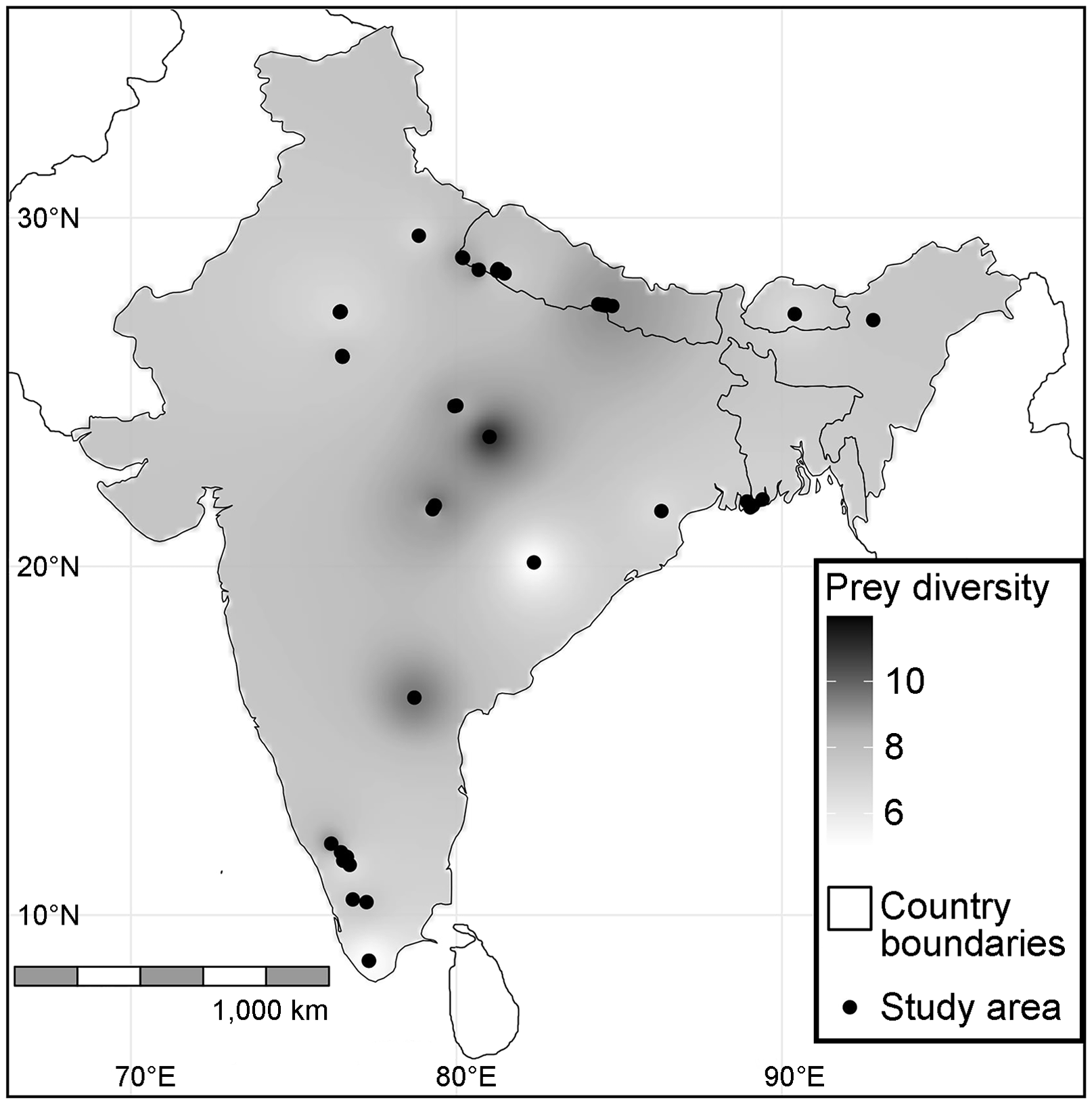
We surveyed the scientific literature in December 2022 and January 2023 using Google Scholar (Google, 2023b) and Web of Science (Clarivate, USA) databases with the keywords: Panthera tigris; Bengal tiger; Bengal tigers prey; tigers prey; tigers prey selection; tigers diet; tigers food behaviour; tiger prey predator; ungulates (Hayward et al., Reference Hayward, Jędrzejewski and Jedrzejewska2012; Guerisoli et al., Reference Guerisoli, Gallo, Martinez, Luengos Vidal and Lucherini2021). We restricted our search to studies conducted on the Indian subcontinent (Nepal, India, Bangladesh and Bhutan; Fig. 1). We cross-checked data obtained from different sources to avoid duplication. We focused on literature where the author(s) analysed faecal samples (scat analysis) to detect and identify prey species because it is one of the most robust methods of exploring diet composition (Johnsingh, Reference Johnsingh1992; Mukherjee et al., Reference Mukherjee, Goyal and Chellam1994; Karanth & Sunquist, Reference Karanth and Sunquist1995; Chakrabarti et al., Reference Chakrabarti, Jhala, Dutta, Qureshi, Kadivar and Rana2016; Bhandari et al., Reference Bhandari, Chalise and Pokharel2017). We did not consider studies using other methods such as camera traps and direct observation because these did not provide adequate information on food composition. We also included literature that provided information on the density of prey species. In addition, we searched the IUCN and CITES databases to review the global conservation status of tiger prey species and national legislation protecting these species on the Indian subcontinent.
Diversity heat map for prey species of the Bengal tiger Panthera tigris tigris across the Indian subcontinent (India, Nepal, Bangladesh and Bhutan). To create this heat map, we reviewed 48 studies analysing tiger scats in the study area (Supplementary Material 1), which were conducted in the locations indicated on the map. The shapefile of the country boundaries was obtained from USGS (2020). This map is depicted for research purposes only and does not imply any political position or recognition of territorial claims.

We extracted the following information from 48 studies that met our search criteria: (1) the identity of the prey species in the tiger diet, (2) the relative proportion of biomass consumed and (3) the density of the prey species. To report the mean relative proportion of biomass in tiger scat for each species, we extracted values from the literature, treating each prey species as an independent sample. We calculated the mean relative proportion of biomass consumed for each species and converted this to a percentage of the mean relative proportion of biomass consumed for all prey species.
We also noted the population density of different prey species from the literature and calculated the mean density for each species. We used the mean relative proportion of biomass consumed, calculated from the tiger scat analysis, and the mean density of different tiger prey species as a basis for our review.
We used QGIS 3.32 software (QGIS Development Team, 2023) and geographical coordinates based on study site locations provided in the literature to create a heat map of tiger prey species diversity across the Indian subcontinent. If coordinates were not reported for study sites, we generated them using Google Earth (Google, 2023a) based on the location information provided. We interpolated unsampled regions using the inverse distance weighting method (Al-Bakri et al., Reference Al-Bakri, Al-Eisawi, Damhoureyeh and Oran2011; Subedi et al., Reference Subedi, Sternberg, DeAngelis, Ross and Ogurcak2020; Kunwar et al., Reference Kunwar, Baral, Luintel, Uprety, Poudel and Adhikari2022). The inverse distance weighting interpolator assumes that points closer to known values exert more influence on estimated values than those farther away (Shepard, Reference Shepard1968), resulting in gradations of prey diversity that reflect proximity to the 48 sampled study sites. The study sites were represented as point features in QGIS, and the z field contained the associated prey diversity values from each reviewed study. The rate at which influence declines with distance was determined by the power parameter used in the interpolation, and the continuous surface output represents expected spatial variation in prey diversity based on both the values and distribution of input points. The interpolation process was performed using QGIS spatial analysis techniques (QGIS Development Team, 2023).
Results
We used nine keywords or phrases to identify 48 relevant publications from a 30-year period (1992–2022; Fig. 1, Supplementary Material 1). Our review showed that tigers prey upon a variety of wild animals as well as on domestic livestock (cattle, buffalo, sheep, yak and goat). In addition to c. 30 mammalian species in the tiger’s diet, there was evidence of birds (lesser adjutant Leptoptilos javanicus, Indian peafowl Pavo cristatus and francolin Ortygornis pondicerianus), reptiles (turtles and monitor lizards Varanus spp.), and various fish and crab species (Table 1)
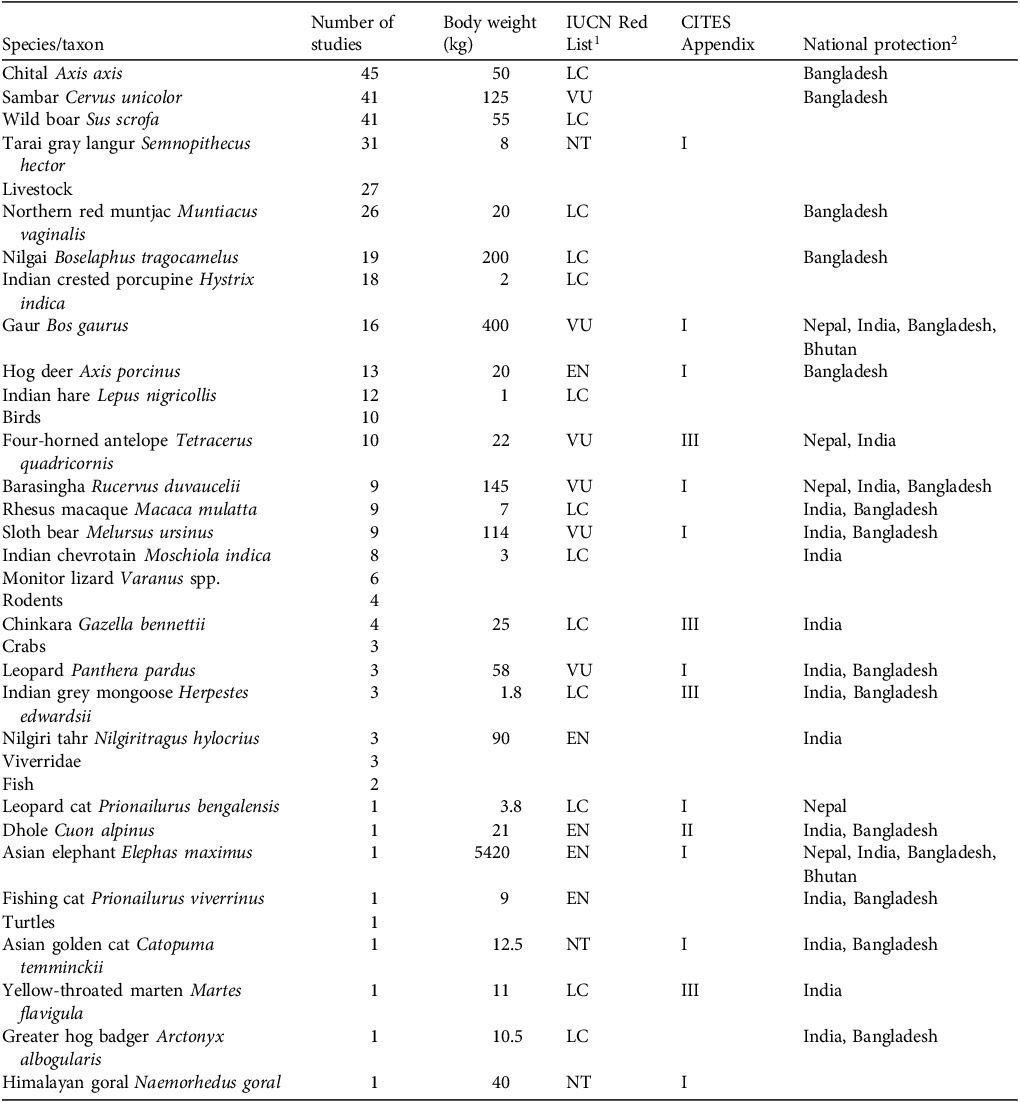
Prey species/taxa identified from Bengal tiger Panthera tigris tigris scat in 48 studies conducted across the Indian subcontinent. The table shows for each species/taxon the number of studies reporting it as tiger prey, and for each individual species its typical adult body weight (estimated), IUCN Red List status, any CITES Appendices on which it is listed and its national protection status.

1 LC, Least Concern; NT, Near Threatened; VU, Vulnerable; EN, Endangered.
2 Nepal: National Parks and Wildlife Conservation Act, 2029 (1973); India: Indian Wild Life (Protection) Act, 1972, schedule I and II; Bangladesh: Bangladesh Wild Life (Preservation) Order, 1973, schedule III; Bhutan: Forest and Nature Conservation Act (1995) of Bhutan, schedule I.
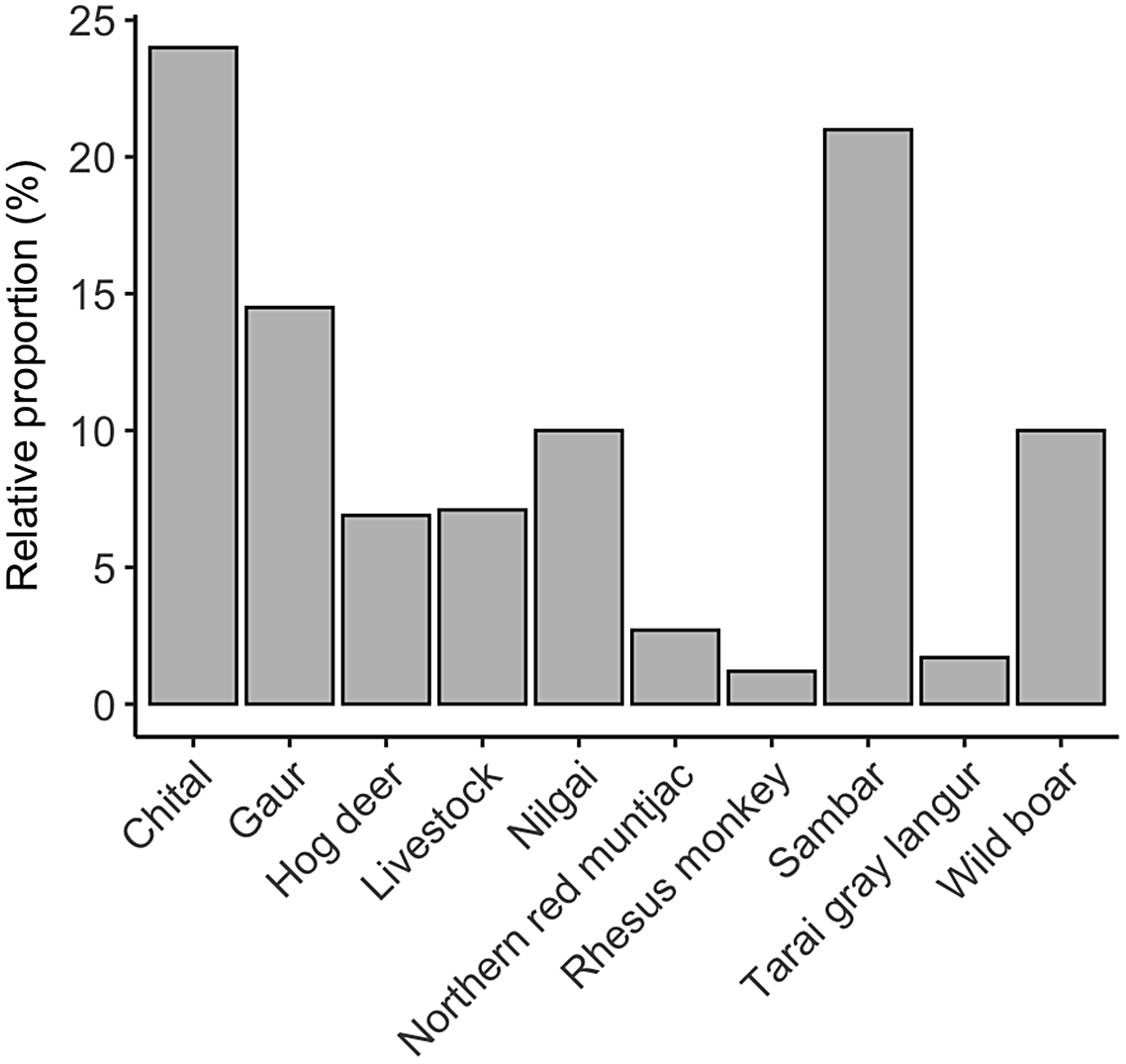
In the sample of 48 studies, the chital was recorded most frequently (n = 45 studies) followed by sambar and wild boar (n = 41), Tarai gray langur Semnopithecus hector (n = 31), livestock (n = 27), northern red muntjac (n = 26), and gaur Bos gaurus (n = 16), together contributing over 90% of the total relative proportion of biomass in the tiger’s diet (Fig. 2). Nilgai Boselaphus tragocamelus (n = 19) and Indian crested porcupine Hystrix indica (n = 18) were also relatively common prey species found in tiger scat. Nine prey species were recorded just once in the 48 studies: mainland leopard cat Prionailurus bengalensis, fishing cat Prionailurus viverrinus, Asian golden cat Catopuma temminckii, dhole Cuon alpinus, Asian elephant Elephas maximus, yellow-throated marten Martes flavigula, greater hog badger Arctonyx collaris, Himalayan goral Naemorhedus goral and an unidentified turtle species. An overview of all prey species and taxa is provided in Table 1.
Estimated average biomass contribution (%) of major prey species to the diet of the Bengal tiger based on 48 studies analysing tiger scats across the Indian subcontinent (Supplementary Material 1).

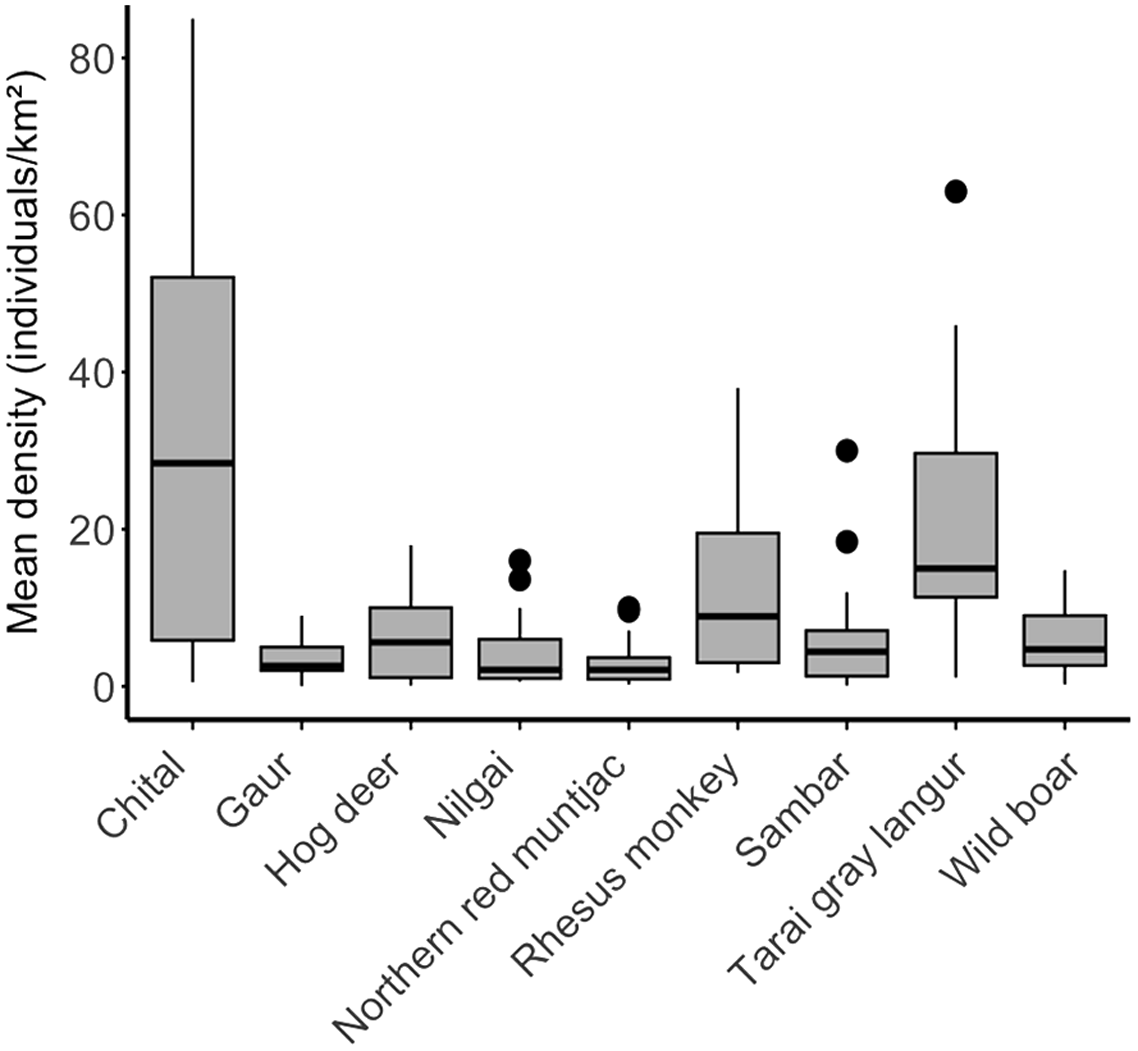
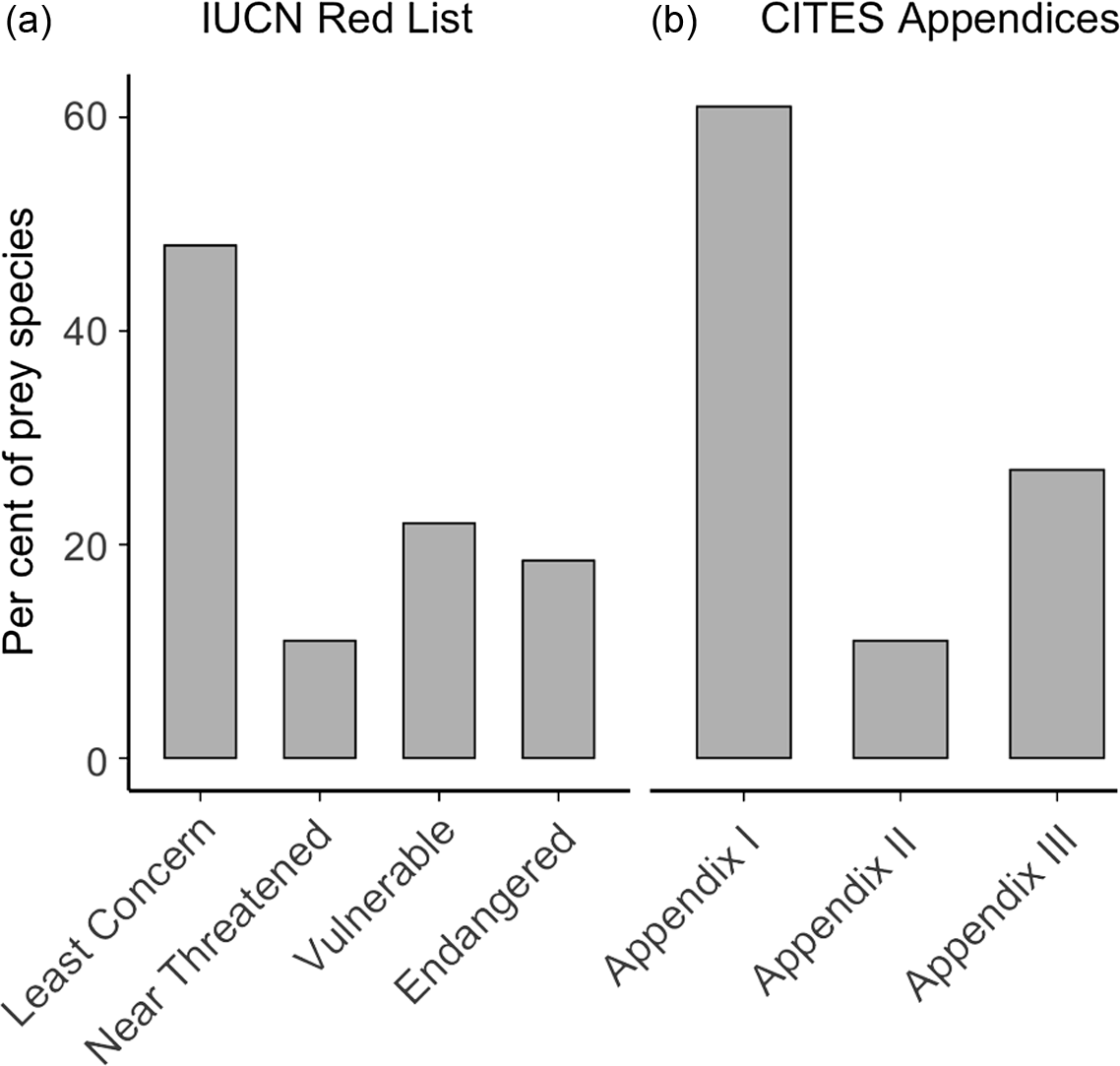
Our analysis of prey density reported in the literature revealed that the density of chital was highest (x̄ = 29.7 ± SD 5.6 individuals/km2), followed by Tarai gray langur (x̄ = 22.3 ± SD 4.9 individuals/km2), rhesus macaque Macaca mulatta (x̄ = 13.3 ± SD 4.3 individuals/km2) and wild boar (x̄ = 5.7 ± SD 2.9 individuals/km2; Fig. 3). Populations of sambar, northern red muntjac, gaur and Tarai gray langur are listed as decreasing on the IUCN Red List, whereas population trends of chital and wild boar are unknown (Supplementary Table 1; IUCN, 2021). Most prey species are categorized as Least Concern on the IUCN Red List (Fig. 4a; IUCN, 2021) but 11 species (67%) are listed on CITES Appendix I (Fig. 4b; CITES, 2021). Prey species such as chital, sambar, wild boar, Tarai gray langur, nilgai and northern red muntjac are not protected in Nepal under the National Parks and Wildlife Conservation Act, 2029 (1973) nor in India under the Indian Wild Life (Protection) Act, 1972. Prey diversity was higher in central regions of the Indian subcontinent compared to southern and eastern regions (Fig. 1).
Estimated mean density (individuals/km2) of the tiger’s major prey species across the Indian subcontinent based on 36 studies reporting prey density (Supplementary Material 2). These species contributed c. 90% of biomass of the tiger’s diet; the density of other species found less frequently in tiger scat is largely undetermined.

Conservation status of the tiger’s major mammalian prey species on the Indian subcontinent: (a) IUCN Red List category, (b) inclusion in CITES Appendices.

Discussion
This study provides crucial insights into the range of prey species consumed by tigers across the Indian subcontinent. Large and medium-sized mammals such as chital, sambar, wild boar, northern red muntjac, nilgai, gaur, Indian crested porcupine, hog deer, Indian hare, four-horned antelope, rhesus macaque and Tarai gray langur made a significant contribution to the tiger’s diet. Other prey species such as sloth bear Melursus ursinus, Indian chevrotain Moschiola indica, leopard Panthera pardus, dhole, Indian grey mongoose Urva edwardsii, leopard cat, fishing cat, Asian golden cat, yellow-throated marten and some species of Viverridae contributed a small proportion of prey biomass, indicating they were of limited importance to the tigers across the Indian subcontinent. Occasional reports of small mammals, birds and turtles in tiger scat suggest opportunistic predation.
Our findings align with previous studies indicating that large and medium-sized mammals constitute a substantial portion of the tiger’s diet (Ramakrishnan et al., Reference Ramakrishnan, Coss and Pelkey1999; Andheria et al., Reference Andheria, Karanth and Kumar2007; Wegge et al., Reference Wegge, Odden, Pokharel and Storaas2009; Bhandari et al., Reference Bhandari, Chalise and Pokharel2017). Chital, sambar, wild boar, northern red muntjac and domestic livestock are similar in size to tigers (60–250 kg; Wegge et al., Reference Wegge, Odden, Pokharel and Storaas2009; Hayward et al., Reference Hayward, Jędrzejewski and Jedrzejewska2012; Bhandari et al., Reference Bhandari, Chalise and Pokharel2017) but the smaller Tarai gray langur (8 kg) was also consumed frequently, particularly in Nepal, Bhutan and India, where this species is widely distributed (Wang & Macdonald, Reference Wang and Macdonald2009; Wegge et al., Reference Wegge, Odden, Pokharel and Storaas2009; Bhandari et al., Reference Bhandari, Chalise and Pokharel2017). Given the food requirements of tigers, smaller species such as the Tarai gray langur may not provide sufficient biomass on their own but chital, sambar, wild boar and northern red muntjac are well-suited to meeting the dietary needs of tiger populations, especially as they occur at relatively high densities and most live in groups (Raman, Reference Raman1997; Jathanna et al., Reference Jathanna, Karanth and Johnsingh2003; Pandey et al., Reference Pandey, Shaner and Sharma2016; Bhandari et al., Reference Bhandari, Crego and Stabach2022).
Domestic livestock are consumed by predators globally and are easy targets for tigers compared to wild prey (Reddy et al., Reference Reddy, Srinivasulu and Rao2004; Tumenta et al., Reference Tumenta, Visser, van Rijssel, Müller, de Iongh, Funston and de Haes2013; Miller et al., Reference Miller, Jhala, Jena and Schmitz2015; Bhandari et al., Reference Bhandari, Chalise and Pokharel2017; Beattie et al., Reference Beattie, Olson, Kissui, Kirschbaum and Kiffner2020; Guerisoli et al., Reference Guerisoli, Gallo, Martinez, Luengos Vidal and Lucherini2021). Injured or old tigers, in particular, may preferentially hunt livestock. Livestock was reported in the tiger diet across India, Nepal, Bangladesh and Bhutan, consistent with previous findings (Wang & Macdonald, Reference Wang and Macdonald2009; Rostro-García et al., Reference Rostro-García, Tharchen, Abade, Astaras, Cushman and Macdonald2016; Thinley et al., Reference Thinley, Rajaratnam, Lassoie, Morreale, Curtis and Vernes2018). This is a conservation concern as high levels of tiger predation on domestic livestock can intensify human–tiger conflicts, leading to retaliatory killings and a negative impact on tiger populations (Reddy et al., Reference Reddy, Srinivasulu and Rao2004; Inskip et al., Reference Inskip, Ridout, Fahad, Tully, Barlow and Barlow2013; Khorozyan et al., Reference Khorozyan, Ghoddousi, Soofi and Waltert2015; Singh et al., Reference Singh, Nigam, Qureshi, Sankar, Krausman, Goyal and Nicholoson2015).
In addition to common wild species and livestock, tigers prey upon rarer species such as nilgai, gaur and barasingha Rucervus duvaucelii. Populations of these species are declining as a result of their fragmented distribution and high anthropogenic pressure, particularly from agriculture (Sahoo & Das, Reference Sahoo and Das2010; Prasad et al., Reference Prasad, Singh and Choudhary2020; Bhandari et al., Reference Bhandari, Crego and Stabach2022). For instance, the nilgai was widely distributed in Nepal and India but is now restricted to isolated pockets of habitat, largely because of conflicts with farmers (Prasad et al., Reference Prasad, Singh and Choudhary2020; Bhandari et al., Reference Bhandari, Crego and Stabach2022). With its large body size (125 kg), this species could contribute a significant amount of biomass to the tiger’s diet but this is dependent on effective conservation strategies to protect the species and promote coexistence with farmers. Similarly, gaur (400 kg) and barasingha (125 kg) could also make a significant contribution to tiger conservation if they were distributed more widely, but their populations are confined to a few isolated protected areas in Nepal and India (Nandy et al., Reference Nandy, Kushwaha and Gaur2012; Ramesh et al., Reference Ramesh, Sankar, Qureshi and Kalle2012; Imam & Kushwaha, Reference Imam and Kushwaha2013; Paul et al., Reference Paul, Sarkar, Patil, Ghosh, Talukdar and Kumar2020).
We attribute the high density of chital recorded in the literature to the species’ ubiquity in protected areas and their vicinity. Surprisingly, the northern red muntjac had the lowest density but this solitary ungulate is widely distributed over a broad range of habitats extending from lowlands (< 1,000 m) to mid-range elevations (c. 2,500 m) in mountainous areas in Nepal and India (Bhandari et al., Reference Bhandari, Crego and Stabach2022). Its populations may be constrained by anthropogenic pressures as this species is shy and elusive, preferring bush and scrub environments where the probability of detection is low, particularly in human-dominated landscapes. The IUCN Red List gives the current population trend as decreasing and the species requires conservation attention even though it is widespread (IUCN, 2021).
We have identified several prey species that require additional conservation measures across the Indian subcontinent. For example, sambar and barasingha are categorized as Vulnerable on the IUCN Red List, both with a downward population trend (Datta et al., Reference Datta, Anand and Naniwadekar2008; Mohsanin et al., Reference Mohsanin, Barlow, Greenwood, Islam, Kabir, Rahman and Howlader2013; Wolf & Ripple, Reference Wolf and Ripple2016; IUCN, 2021; Bhandari et al., Reference Bhandari, Crego and Stabach2022). However, those species are crucial components of the tiger’s diet because of their large body size and extensive distribution across the Indian subcontinent. Similarly, the Endangered hog deer Axis porcinus featured in the tiger’s diet but has a restricted geographical range and a small population, which is a concern in the face of increasing numbers of tigers in Nepal and India. Hog deer populations could face local, regional and even global extinction without appropriate conservation measures. Moreover, the majority of tiger prey species are considered to be threatened with extinction and are listed under CITES Appendix I (restricting the import of specimens for any purpose other than non-commercial, such as scientific research; CITES, 2021).
We identified regional variations in tiger prey species across the Indian subcontinent. Lower prey diversity in the eastern, southern and western regions compared to central regions may be a consequence of frequent human disturbance, inadequate protected areas or ineffective management and conservation efforts (Ripple et al., Reference Ripple, Newsome, Wolf, Dirzo, Everatt and Galetti2015; Joshi et al., Reference Joshi, Dinerstein, Wikramanayake, Anderson, Olson and Jones2016). For example, Mundanthurai Tiger Reserve in southern India and Udanti Sitanadi Tiger Reserve in the east of India have lower prey diversity despite supporting significant tiger populations (Ramakrishnan et al., Reference Ramakrishnan, Coss and Pelkey1999; Basak et al., Reference Basak, Ahmed, Suraj, Reddy, Yadav and Mondal2020, Reference Basak, Suraj, Ahmed, Kumar and Bhattacharjee2023; Krishnakumar et al., Reference Krishnakumar, Nagarajan and Selvan2022).
We observed that some prey species, such as chital, sambar, wild boar, Tarai gray langur, northern red muntjac and domestic livestock, are common in both India and Nepal (Andheria et al., Reference Andheria, Karanth and Kumar2007; Bhandari et al., Reference Bhandari, Crego and Stabach2022), reflecting similar landscape and habitat types in these two countries. Moreover, India and Nepal had a higher diversity of tiger prey species compared to Bhutan and Bangladesh. Tiger populations are increasing in India and Nepal, suggesting that higher prey diversity is an important factor (Mallon & Kingswood, Reference Mallon and Kingswood2001; Wang, Reference Wang2010; Bhandari et al., Reference Bhandari, Crego and Stabach2022). Notably, there was no evidence of chital, nilgai, hog deer and rhesus macaque in the tiger’s diet in Bhutan, despite their presence in the country (Wang, Reference Wang2010; Thinley et al., Reference Thinley, Kamler, Wang, Lham, Stenkewitz and Macdonald2011). Similarly, sambar, hog deer and Tarai gray langur were absent from tiger scat collected in Bangladesh, despite these species occurring there (the nilgai no longer occurs in Bangladesh; Mallon & Kingswood, Reference Mallon and Kingswood2001). The absence of these species in the tiger’s diet in Bangladesh and Bhutan could be attributed to their low population density in those countries or to a loss of suitable habitat (Mallon & Kingswood, Reference Mallon and Kingswood2001; Wang, Reference Wang2010). Major prey species such as wild boar and northern red muntjac are widely distributed across the Indian subcontinent and contribute significantly to the tiger’s diet. They are notable for their high density in India and Nepal and their ability to adapt to anthropogenic pressures in human-dominated landscapes. Wild boar in particular, a species often in conflict with farmers, can survive in agricultural landscapes and patchy forests.
We suggest that a regional tiger conservation action plan should focus on the conservation of tiger prey species. Although some species are protected, others, including chital, sambar, wild boar, Tarai gray langur and nilgai, have low conservation priorities in Nepal, India, Bangladesh and Bhutan. Large populations of these species are confined to protected areas and conservation priority landscapes, yet outside of these areas they face multiple threats and challenges. Anthropogenic pressure may lead to the decline of important prey species in the future, for example nilgai and blackbuck Antilope cervicapra are no longer present in Bangladesh (Mallon & Kingswood, Reference Mallon and Kingswood2001). Similarly, unprotected sites in Nepal and India, such as small and patchy forests, areas of grassland and river beds, support many prey species such as nilgai and wild boar (Bhandari et al., Reference Bhandari, Crego and Stabach2022). Because of poor conservation awareness in rural villages in Nepal, India and Bangladesh, the conflict between people and wild herbivores is increasing, posing both direct and indirect threats to tigers (Inskip et al., Reference Inskip, Ridout, Fahad, Tully, Barlow and Barlow2013; Bhandari & Chalise, Reference Bhandari and Chalise2016; Chatterjee & Bhattacharyya, Reference Chatterjee and Bhattacharyya2021). Therefore, conservation actions must address the protection not only of tigers but also of important prey species.
Conclusion
We reviewed 48 studies of tiger diet and tiger prey density to map out the tiger diet landscape across the Indian subcontinent. We identified tiger prey species from reports published over a 30-year period (during 1992–2022) and investigated how prey availability affects tiger distribution and population sustainability. We conclude that tiger conservation efforts must focus on protecting their preferred prey species alongside actions to address other factors such as deforestation, habitat fragmentation, poaching and human encroachment into tiger habitats. We highlight the critical importance of protecting those prey species that constitute c. 90% of the total relative biomass consumed by tigers. Stakeholders should conduct regular assessments and monitoring of the population status of these major prey species. Conservation actions such as translocations, the designation of new conservation areas, the establishment of forest corridors and the protection of current habitats are essential to ensure the survival of Vulnerable and Endangered prey species. Declining populations of prey species outside protected areas are a particular concern, threatening tiger survival and potentially exacerbating human–tiger conflict. Therefore, conservation management of areas supporting low densities of prey species is crucial to safeguard tigers across the Indian subcontinent. In this review we provide useful insights for tiger conservation management but we also recommend that further studies are conducted to better understand the tiger’s dietary landscape across the region.
Author contributions
Study concept and design: SB; data collection: SB, KB, HPS; data analysis: SB, SCC, BA; writing and revision: all authors.
Acknowledgements
We thank anonymous reviewers for their helpful comments and suggestions. This research received no specific grant from any funding agency, commercial or not-for-profit organization.
Conflicts of interest
None.
Ethical standards
This research abided by the Oryx guidelines on ethical standards. The data used in this research were taken from published sources. No permission from any authorized body, such as a university, was required to prepare this article.
Data availability
Data were obtained from published sources and no new data were generated as part of this study. Additional reference lists used for the literature review are available from the corresponding author upon reasonable request.


 Open access

