

One of the properties that distinguishes human language from animal communication systems is the property of displacement, which is the ability to communicate things that are displaced in time and/or location from the time of the communication.Footnote 1 As Bertrand Russell famously said, “No matter how eloquently a dog may bark, he cannot tell you that his parents were poor but honest.” Nowhere is the property of displacement more salient than in written language. The development of writing allowed humans to communicate with others who were not present and also allowed communication with larger numbers of people (pre-dating, of course, audio recording and broadcasting).
It is the timelessness of written language which makes it so different from spoken language and which has imbued it (and those who had control over it) with power and even a degree of mysticism not associated with common spoken language. While all normal humans acquire language without much conscious effort, learning to write (and read) requires great effort and explicit instruction. Before the era of “universal” education and literacy, writing was the province of the elite: even half a millennium in the past, if a book such as the one you are holding had been written, an exceedingly small percentage of the population would have been able to read it. Sacred texts are considered sacred in part simply because they are texts, and the physical texts are often revered. In many religions, for example, the tradition of reading passages aloud to worshippers traces back to an age when none but the clergy could read. In many cultures, written words were thought to hold magical power. In Yiddish folklore, for example, the legend of the Golem involves the creation of a living being out of clay, who is brought to life by inserting into its mouth the name of God written on paper.
It is the relative permanence of written language and its link with the past that helps explain why written languages – and actually the standard languages on which they are based (see Chapter 4 regarding “standard languages”) – are often held up as the “standard” by which people’s spoken language is judged.
Given the centrality of written language to human communication, and given the elevated status accorded to it, it is important to examine the origin and role of orthography (that is, writing systems) in the world’s languages. Before embarking on a discussion of the origins of writing and a description of the major types of writing systems, it is important to emphasize the distinction between written and spoken forms. In Chapter 1, we took great pains to distinguish between sounds and letters, demonstrating that letters were simply graphic representations of sounds, rather than sounds themselves, and that they often (especially in English) bear inconsistent relations with the sounds that they are supposed to represent.
So it is with writing systems (to a degree). To the extent that selected orthographic systems have the symbols to represent the sounds appropriately, a language could be written using any of them. Take, for instance, the English word many (as in “not a few”). While translating the word into other languages would require knowledge of the target lexicon, transcribing the word many (or rather, the sounds that make it up) into other writing systems is much more straightforward:
| many | Latin | (used for English, French, etc.) |
| мени | Cyrillic | (used for Russian, Bulgarian, etc.) |
| マニ | Japanese Katakana | (used for Japanese) |
| μεηι | Greek | (used for Greek) |
| מאני | Hebrew | (used for Hebrew) |
Each of these forms is pronounced [mεni] in the named writing system (note the name of each writing system may or may not correspond to the language which uses it). This will be an important fact to remember when we consider, later in the chapter, that languages may change their writing systems without necessarily changing anything else and that the choice of writing system is often a political or sectarian, rather than linguistic, decision.
Broadly speaking, writing systems are based on one of two aspects of human language, either the lexical semantics of the language (the conceptual meaning of the morphemes and words) or its phonology (the sounds). The first type is generally referred to as a logographic or ideographic system, and is best exemplified by some of the Egyptian hieroglyphic and Chinese characters. The second type includes alphabetical writing, such as the Latin alphabet used for English and Spanish, and syllabaries, such as the “kana” of Japanese. Systems involving each of these two aspects played a role in the development of Western writing.
Given the time depth and distribution of writing systems and what is known about migration patterns, it seems clear that some writing systems were developed independently of one another, some were spread through migration and trade, and some evolved out of earlier systems (and underwent radical change in doing so).
Here, in what follows, we will first describe the major types of writing systems humans have developed over the past 5,000–8,000 years, as well as some theories regarding the genesis of Western alphabetic writing.
The Mesopotamian Genesis of Early Writing
The most plausible theory of the origins of one of the earliest writing systems is that it developed out of a system of accounting. It is argued that in Mesopotamia as early as 8000 BCE small clay tokens were used for keeping track of quantities of grain, livestock, and other goods. These tokens were plain and smooth and came in various circular and conical shapes. Scholars hypothesize that the different shapes and types of tokens each represented a particular quantity.
Over the next few thousand years, this system of accounting tokens evolved substantially. Some tokens were no longer smooth, but had markings on the surface. They also occurred in many more plentiful and more intricate shapes. At this stage, the tokens no longer were mere counting devices, since some had come to represent specific items. For example, in Figure 8.1, the circular token with crossed lines in the first row means ‘sheep’; the arced striped token in the fourth row means ‘metal’; the striped round token in the sixth row represents ‘garment’; and the double-sided conical token in the seventh row means ‘bracelet.’

Eventually, in order to dispense with the trouble of carrying clay tokens, people started to use them as a means of imprinting the image of a token into a wet clay tablet. In this way, the record of a single accounting could be preserved on one tablet (which avoided, among other things, the possible loss of tokens). In this way, the tokens themselves were transformed into ‘writing’ tools.
One of the difficulties encountered in the transition from using the tokens themselves to utilizing their impressions into clay was the fact that more complex and detailed tokens often did not leave a readable impression. This led to the use of a stylus to mark the form of the token into the tablet. In this way Sumerian writing came into being, a system in which the stylus-created symbols were more-or-less faithful representations of the tokens.
The Transition from Idea-Based to Sound-Based Writing
Many ancient writing systems, including the Sumerian system discussed above as well as the early Chinese symbolic writing system (approx. 3,000–3,500 years ago), used single symbols to represent either the image or idea of a word or morpheme. Writing systems that are made up of characters that represent entire words or morphemes are called logographic and a symbol in the system is called a logograph.
As we have seen, the most common Sumerian symbols were pictorial representations of what they referred to, or pictographs. As we see in several columns of Figure 8.1, Sumerian writing evolved from using pictographic clay tokens, to using the tokens as writing tools to impress their image into clay, to using a stylus with a triangular tip to draw the image into clay. In this process, the images became increasingly “stylized” and abstract. This method of writing with a stylus came to be known as cuneiform (from the Latin word cuneus, meaning ‘wedge’) on account of the wedge-shaped appearance of the stylus marks in the clay.
Chinese pictographs underwent similar transitions, as we see in Figure 8.2.Footnote 2 The earliest Chinese pictographic characters were intended to be pictures of what they represented, and were scratched (i.e. incised) into bones and tortoise shells. As writing tools, materials, and surfaces were developed (e.g. writing with a brush onto bamboo, pottery, or shells) the symbols evolved to become increasingly abstract.

Figure 8.2 Evolution of Chinese pictograms
Similar to, and alongside, pictographs were logographs
that were used to express ideas that are not readily pictured. These ideographs
can develop out of metaphorical extensions of pictograph. The Chinese
character for the word for ‘bright,’ for example, is a combination of the pictographs for sun and moon:

The same process was observed with Sumerian cuneiform logographs, where a single symbol could be used to represent more than one word. So, for example, a pictograph of a starry night …

was variously used to mean ‘black,’ ‘night,’ and ‘dark.’ Similarly, a pictograph of a foot …

was used to represent the concepts ‘go,’ ‘move,’ and ‘stand.’
With both Sumerian cuneiform and Chinese characters, the frequent ambiguity of symbols, the need to have symbols for words that were difficult or impossible to represent pictographically, and the sheer number of symbols needed for a comprehensive writing system all led to innovations in which the logographs were made to incorporate phonological information alongside the semantic information that they already presented.
In Sumeria
, scribes began to take advantage of phonetic similarities between words and began to use the rebus principle
, which is the term used to describe the reuse of a pictograph to represent a word that is pronounced with the same (or nearly the same) sound. Accordingly, a symbol for a word that is readily represented pictorially is used for a homophonous
word that does not lend itself as easily to a visual presentation. An example of the rebus principle is offered here below, where the picture of a can is used to symbolize the modal verb can and the picture of a well stands in for the adverb well:

To understand how this worked in Sumerian cuneiform
, we can use as an example the word for ‘arrow,’ pronounced [tiː], and reproduced here:

Now, it happened that the word for ‘life’ was also pronounced [tiː], and not having a pictograph for ‘life’ (it’s hard to imagine what such a pictograph would be) the scribes used the homophonous symbol for ‘arrow’ when they wished to write the word ‘life.’

Given that the context would normally signal when the symbol meant ‘arrow’ and when it meant ‘life,’ this did not present a major problem for understanding text (when used in moderation). It would be no different if we were to write the following sentence, using homophones for the intended words:
Eye Sea Ewe Knead Sum Gnu Close
Anyone reading the sentence carefully will instantly understand it to mean ‘I see you need some new clothes.’ The Sumerian scribes similarly utilized pictographs for other concrete things that were homophonous with abstract concepts; e.g. the pictograph for ‘water,’ pronounced [a], was used for the preposition ‘in,’ also pronounced [a], and so on.
Their efforts to avail themselves of the phonological
properties of symbols was developed further by application of the acrophonic principle
, in which a symbol that represents a word that begins with a certain sound or syllable comes to represent that single sound or syllable. In this way, for example, the pictograph for ‘arrow’ came to be used to represent the syllable [tiː] whenever it occurred in a word. The symbol, thus stripped of any meaning, changed in this use from a logograph
into a syllabograph
(i.e. a symbol for the syllable [tiː]).Footnote 3

In this fashion, Sumerian
script became a mixed system with both semantically based and phonically based elements.
Much like Sumerian, Chinese
underwent an evolution which involved rebus
-like innovations. In the beginning, the approaches were analogous. Chinese scribes, too, used the rebus principle to insert pictographs
into places in which a homophonous
abstract word might be wanted. For example, the pictograph for ‘wheat’ was the following character, pronounced [lai]:

Using the same homophonic principle
, the character was used for the verb ‘come’:Footnote 4

As with Sumerian, the rebus principle of using homophones could be carried only so far. The Chinese answer to this, however, was different. Chinese is a tone language in which a single monosyllabic sequence can mean a variety of things depending on the pitch with which it is uttered. Because of this there are a great many near-homophones in the language, and this was reflected in the early writing. Rather than apply the acrophonic principle and move in the direction of using the characters phonically, Chinese scholars during the Qin and Han dynasties (approx. 200 BCE – 200 CE) moved to standardize the writing system, which had previously varied across the many pre-dynastic kingdoms. The main principle of organization was the addition of a semantic element to the homophone – these semantic radicals would indicate whether you were dealing with a place name, a plant-type organism, or any of a couple of hundred other classes.
Take, for example, the pictograph for ‘horse,’ pronounced [ma]:Footnote 5

The word for ‘mother’ is also pronounced [ma] (with a slightly different tone) and written with the following character. The right side of the character has the familiar rebus
homophone, while the left side has a character that means ‘woman.’ Thus the character can be described as “the word which sounds like horse and is related to woman.”

A similar example is given here, where the meaning element on the left refers to ‘insect’ and the meaning of the logograph
is ‘ant’:

Approximately 90 percent of the several thousand Chinese characters contain a semantic “radical”
and a phonetic element.
Although the Chinese did not do so, the Japanese did apply the acrophonic principle to create a phonic writing system based on the (Japanese) pronunciations of certain Chinese characters. The table below illustrates three (of several dozen) Chinese characters that came to be used acrophonically to represent Japanese syllables.
The earliest recorded phonetic use of Chinese characters in Japanese was found on a burial mound sword, the Inariyama sword, dated around the end of the fifth century CE.Footnote 6 This iron sword, recovered from a warrior’s burial mound in 1968, had on it a 115-character inscription that was accidentally discovered in cleaning it for display in 1978. The inscription uses Chinese characters to record the names of the warrior, Wowake, and his many children.
It wasn’t until much later, though, that Japanese developed a full-fledged and regular phonetic writing system based on Chinese. In fact, Japanese has two such sets of symbols: the hiragana
which evolved out of abbreviated cursive forms of selected Chinese characters as used in the tenth and eleventh centuries by women of the imperial court, and the katakana
which was devised by Buddhist priests by using specific parts of certain characters.Footnote 7 Figure 8.3 shows the second of these systems. Each box in the table contains the katakana symbol on the left and the printed Chinese character, on which the symbol is based, to its right. The hiragana (not pictured) and parallel katakana symbol sets are syllabaries
– that is, symbols that stand for syllables (either a vowel alone or a consonant–vowel combination). Reading the topmost row beginning with:

the five symbols stand for: [a], [i], [u], [ε], [o]. The second row, beginning with:

reads: [ka], [ki], [ku], [kε], [ko]. The symbols in each subsequent row stand for a different consonant, followed by the same five vowels. There are no symbols to represent a consonant independently of the syllable that it occurs in.Footnote 8
Table 8.1 Chinese character: Japanese kana correspondences
| Chinese character | Japanese phonetic syllable | |
|---|---|---|
| Form |  |  |
| Pronunciation | [mao] | [mo] |
| Meaning | ‘hair’ | ------ |
| Form |  |  |
| Pronunciation | [tai] | [ta] |
| Meaning | “great” | ------ |
| Form |  |  |
| Pronunciation | [an] | [a] |
| Meaning | ‘peace’ | ------ |

Figure 8.3 Japanese katakana syllabary and its associated Chinese characters
The Birth of Western Alphabetic Writing
We turn now to the lineage of the Western writing systems, which, as we shall see, all share a common heritage. It is historically well documented that both Western and Middle Eastern alphabetic orthographies have their origin in an alphabet used by the Phoenicians, who lived in present-day Lebanon and coastal Syria but who traded throughout the Mediterranean from its eastern Levantine shores to the Straits of Gibraltar. Although the Phoenicians, like so many Middle Eastern societies from Persia to the Mediterranean, first used a cuneiform orthography that evolved from the Sumerian system of accounting, the alphabetic writing system that they ultimately developed had a far different genesis, one which can be traced back to Egyptian hieroglyphics.Footnote 9
Egyptian Hieroglyphics
Egyptian hieroglyphics (from the Greek hiero ‘sacred’ and glyph ‘writing’) were developed some 5,000 years ago, and are well known from the many Egyptian inscriptions found in the ancient tombs and monuments and as popularized in fiction and film. It bears pointing out that there are many popular misconceptions about the system. People often think of hieroglyphics merely as pictograms, with each symbol being a direct graphical representation of some concrete concept – a vulture being interpreted as a vulture, a crocodile as a crocodile, a queen as a queen, and so on. It is true that many symbols were originally pictograms, with the concept of the bird ‘swallow’ represented by a picture of a swallow, and ‘cat’ represented by a picture of a cat. However, the system as fully evolved was far more complex and sophisticated – at least as much so as Sumerian, using elements according to the rebus principle, the acrophonic principle, and even adding semantic elements in the manner of Chinese.Footnote 10
Figure 8.4 provides an example of a hieroglyphic word. The four elements combine to represent the name of the Egyptian goddess Aset (also known as Isis). The top left element is a pictograph of a throne, which is used here as a phonetic element to represent the consonants [s] and [t], indicating the word contains those two consonants. The top right element is a pictograph of a loaf of bread, but is also used here as a phonetic element to reinforce the fact the word contains (ends with?) [t] and also invokes the meaning ‘female.’ The oval element on the left below that is a pictograph of an egg, and is used as an ideograph indicating the referent of the word is ‘female.’ Below these is a pictograph of a goddess, also used here as a semantic element. The four elements of the first word combine to tell us that the word represents ‘the female goddess whose name contains the consonants [s] and [t], and ends with [t],’ i.e. Aset.

Figure 8.4 An example of hieroglyphic inscription with interpretation
The Proto-Sinaitic Alphabet
Although the Phoenician alphabet can be traced back to the Egyptian system, it was actually the Canaanites in the Sinai from whom they borrowed and developed a phonetic alphabet based on some of the Egyptian glyphs. In 1905, in the mountains of the southwestern Sinai Peninsula (not far from the Gulf of Suez) in an area known as Serabit el-Khadem, a set of inscriptions dating from the mid nineteenth century BCE were discovered. These inscriptions were written in what is referred to as the Proto-Sinaitic alphabet (or the Proto-Canaanite alphabet), which is hypothesized to have been invented by Canaanites involved in the mining and transport of turquoise.Footnote 11 The Canaanites living in this area borrowed some of the pictographic symbols found in Egyptian inscriptions, and adapted them to their purposes without reference to their Egyptian meanings. Rather, using the acrophonic principle, they utilized each of the symbols to represent the first sound of the Canaanite word represented by the pictograph.
For example, the Canaanite word for house was bêt and the Egyptian pictograph for ‘house’ was the following symbol, which the Canaanites appropriated for writing the sound [b]:

In the same way, their word for ‘ox’ being pronounced [ʔalp], with an initial glottal stop [ʔ], they used the Egyptian pictograph for ‘ox’ to represent the glottal stop consonant:

In this manner, the Canaanites of Serabit el-Khadem created graphemes
for each of the consonants in the phonemic inventory of their language. This first alphabet was technically referred to as an abjad
, a system that has symbols for each of the consonants in a language but does not represent the vowels. Figure 8.5 gives a list of these symbols and their correspondences.
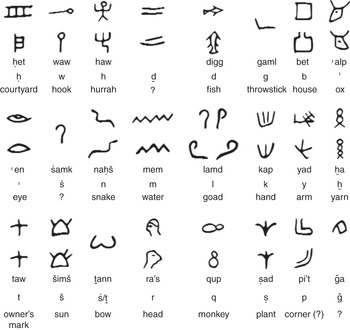
Figure 8.5 Canaanite Proto-Sinaitic symbols
The Phoenician Alphabet
The Phoenicians, most likely descendants of the earlier Canaanites who inhabited the area around present-day Lebanon
and coastal Syria
, provided the link between the Proto-Sinaitic alphabet and the modern Middle Eastern and Western alphabets in use today. While Phoenicians initially used a cuneiform
script, it is estimated that they began adapting the Proto-Sinaitic writing system for their own use in the fifteenth century BCE, with the first known inscriptions
dating from around 1000 BCE. The Phoenician alphabet consists of 22 consonantal graphemes
, most of which are cognate with their Proto-Sinaitic antecedents, but much more abstract in form. As evidence for the cognate relationship between the Phoenician and Proto-Sinaitic symbols, it is observed that the Phoenician symbol set has the same mnemonics (wherein the symbols correspond to the Egyptian
pictographic
meanings upon which they are based). So, just as in Proto-Sinaitic, the first consonant symbol in the Phoenician alphabet is

and is called ’āleph, which means ‘ox.’ The second symbol is

and is called bēth, meaning ‘house,’ and so on. Partly on account of this, it has been suggested that ‘Phoenician’ may actually just be part of a regional dialect
continuum, which also includes Proto-Sinaitic
Canaanite. Figure 8.6 illustrates some of the gradual stylization of the one of the characters, aleph or alpha or a, from its Egyptian origin through successive stages of Sinaitic, Phoenician, Greek
, and Roman.
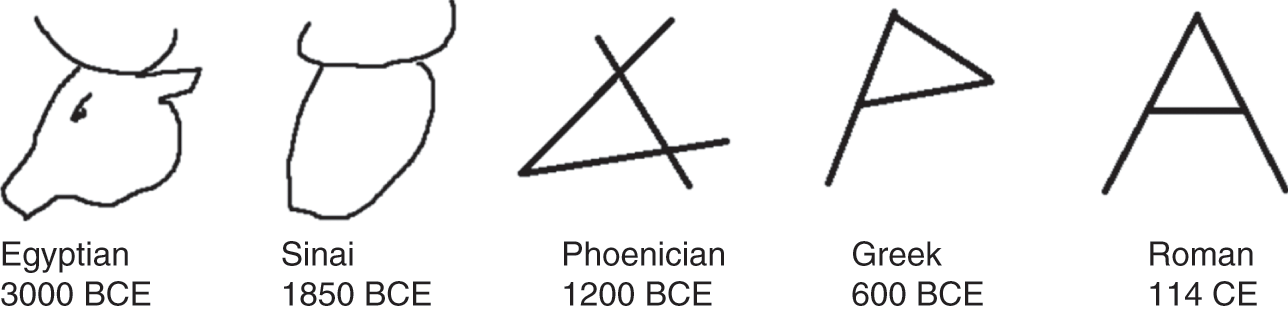
Figure 8.6 The development of “alpha” from Egyptian through Roman
As successful seafaring traders, the Phoenicians navigated throughout the Mediterranean for some thousand years beginning in the mid fifteenth century BCE. Their most enduring legacy was the spread of alphabetic writing in the Middle East, southern Europe and northern Africa. It is believed that most, if not all, alphabetic systems can be traced back to the Phoenicians. The Paleo-Hebrew script and the Aramaic script, both dating from around the tenth century BCE, were derived from and bore a strong resemblance to the Phoenician alphabet.
Modern Consonantal Writing Systems (Abjads)
As we saw above, the parts of Egyptian hieroglyphs used to represent sounds (i.e. phonograms) only represented the consonants. Recall in Figure 8.4, the hieroglyph used to represent the goddess Aset. The oval shape is an ideograph denoting ‘female,’ and the seated figure at the bottom is another semantic element meaning ‘goddess.’ The other two symbols are phonetic elements. The one on the top left is a pictograph of a throne, and used to indicate that the word contains the consonants [s] and [t], and the top right symbol is a pictograph of a loaf of bread used phonetically to indicate that the word ends in [t].
In taking their inspiration from Egyptian hieroglyphics, those writing systems directly descended from them shared the property of only having symbols for consonants. Such writing systems are termed, following Daniels, abjads.Footnote 12 The term is an acronym for the first four letters of the Arabic alphabet, which represent the sounds: [ʔ], [b], [g], and [d].
As it happens, the Semitic languages of the Canaanites, Phoenicians, Israelites, and other peoples of that region were quite amenable to a consonantal writing system. These languages, typified by modern Arabic and Hebrew, are characterized by a lexicon in which major word meanings are represented by consonantal roots. In this system, a series of consonants (usually three) forms the basis for groups of semantically related words. In Arabic, for example, the consonant group k-t-b means something like ‘write.’ By adding vowels and certain other consonants to these roots to form syllables, the language derives the specific lexical items in a very systematic way. The following illustrate:
| C1 a C2 a C3 a | kataba | ‘he wrote’ |
| C1 i C2 aa C3 | kitaab | ‘book’ |
| ma C1 C2 a C3 | maktab | ‘office’ |
Each vowel pattern can be used with a number of different roots, for a particular part of speech and inflection. Thus, the pattern C1-a-C2-a-C3-a is for a third-person past tense verb, and can be used with k-t-b ‘write,’ with w-j-d ‘find,’ or with k-s-b ‘earn, gain’:
| C1 a C2 a C3 a | kataba | ‘he wrote’ |
| C1 a C2 a C3 a | wajada | ‘he found’ |
| C1 a C2 a C3 a | kasaba | ‘he earned’ |
There are four abjads still in use today: Arabic, Hebrew, Samaritan, and Syriac. The first two are used rather widely in religious texts, and as modern languages. Samaritan is spoken in a small Israeli community of about 700, and Syriac is used only by the Syrian Orthodox Church.
The Arabic script evolved from the Nabataean Aramaic script. It has been used since the fourth century CE, but the earliest document, an inscription in Arabic, Syriac and Greek, dates from 512 CE. The Aramaic language has fewer consonants than Arabic, and during the seventh century CE new letters were created by adding diacritic dots to existing letters in order to avoid ambiguities. The system of writing that developed has consonants as individual letters – vowels go unrepresented much of the time, but diacritics placed above or below the consonant can be included, especially in teaching circumstances and to ensure the correct reading of the Quran (see Figure 8.7).

As it is closely associated with Islam, the Arabic script has been adapted for use with a great many non-Semitic languages with significant Islamic populations, including Bosnian, Farsi (Persian), Hausa, Kashmiri, Kurdish, Punjabi, and Urdu, to mention a few. To accommodate consonant sounds not found in Arabic and in some instances to represent vowels, new symbols have been added to the orthographies used for some of these non-Semitic languages.
The other major abjad in use today is that of Hebrew. Modern Hebrew script was developed in the fifth century BCE from the Imperial Aramaic script used in the Achaemenid Persian Empire, and was based on what was known as the Assyrian alphabet. It contains twenty-two basic consonant letters, plus diacritics and special forms of some final-position consonants (see Figure 8.8).

Alphabetic Writing
Modern European (and many other) languages are written in one of the major alphabetic writing systems, which are Greek, Latin, and Cyrillic. The first of these was Greek.
Long ago, Greek was written in a syllabic orthography
that looked nothing like the Greek alphabet
we are familiar with (from Ancient Greek writings and Modern Greek). But roughly 3,000 years ago, the Greeks started using an adaptation of the Phoenician
alphabet
. As Greek has only seventeen consonantal sounds, there were a number of unused symbols. The innovation of the Greeks was to use some of the unused symbols to represent vowels. Since Greek has no phonemic [ʔ] (glottal stop), it was easy to reassign the Phoenician letter

’ālp from [ʔ] to the vowel [a]. The name ’ālp (‘ox’) was retained and became alpha in Greek. Other Phoenician letters for consonants reassigned as vowels were:

Recall that the first two letters of the Phoenician writing system were the letters for [ʔ] and [b] ’ālp ‘ox’ and bēth ‘house,’ and the Greeks employed the same order of symbols. Thus, the term alphabet is derived from the names of the first two letters of the Greek writing system α and β, and ultimately comes from the Proto-Sinaitic/Phoenician writing systems.
Originally, Greek alphabetic writing was written as the Phoenician writing, right to left on the page. It then went through a stage of boustrophedan writing, in which the first line was written right-to-left, the next line from left-to-right, and so on. Boustrophedan means ‘as the ox turns,’ and the lines of script are reminiscent of the pattern made when plowing a field. Eventually, the left-to-right format was adopted. This evolution in the direction in which lines were read helps explain why some Greek letters (e.g. beta, gamma, and kappa) are reverse in orientation from the Phoenician originals.
The Latin (or Roman) alphabet evolved sometime in the sixth century BCE from a form of the Greek alphabet adopted by the Etruscans, who were trading partners of the Greeks living in modern-day Tuscany. The early Romans adopted the Etruscan writing system shortly thereafter and developed from this the Latin alphabet, which was spread throughout the Roman Empire with lasting effect in the western territories. Over time the Classical Latin alphabet was adapted for use with a wide variety of languages, which involved the addition of various diacritics and letters to accommodate sound systems that differed significantly from Latin.
The other major European alphabet is the Cyrillic alphabet. Named after St. Cyril, a Greek Byzantine missionary, it was invented in the First Bulgarian Empire (681–1018) sometime during the ninth or tenth century CE to write Old Church Slavonic, which had been adopted by St. Cyril and Greek missionaries as a liturgical language to convert the Slavs. The Cyrillic alphabet was derived from Greek capital letters along with another local alphabet (Glagolitic), and evolved into its current form by 1708 during the reign of Peter the Great. It is presently used in Russia, Central Asia, and Eastern Europe (see Figure 8.9).

Figure 8.9 The Cyrillic alphabet
Other Syllabaries
Earlier in the chapter, we examined the origin and form of the Japanese syllabary, a writing system that has separate symbols for each V (vowel-only) and CV (consonant-vowel) syllable. Japanese is perfectly suited to such a system, since its syllables are all comprised this way (excepting for those ending in [n], for which there is a separate symbol). As might be imagined, syllabaries are most suited for languages that have a limited range of possible syllables. English, for instance, would not be among them. English, and other languages like it, have a vast array of multiple consonant combinations that can begin a syllable, and having a separate symbol for each of these in combination with a vowel would rapidly become unwieldy. Taking just those combinations involving the sound [p], we know that English allows (in addition to p alone) [p] followed by [l] or [r], [p] preceded by [s], and [sp] followed by [l] or [r]. Allowing one symbol for each of these, followed by any one of five vowels (and English has many more than that), would require thirty symbols, one for each of the following:
| pa | pi | pe | po | pu |
| pra | pri | pre | pro | pru |
| pla | pli | ple | plo | plu |
| spa | spi | spe | spo | spu |
| spra | spri | spre | spro | spru |
| spla | spli | sple | splo | splu |
So, English is not (to put it mildly) a good candidate for using a syllabary.
There are, however, numbers of other languages that can get along quite well using a syllabary. In North America, two well-known syllabaries were developed for writing Native American languages, Cherokee and Cree. The latter is still in use, having been adapted for a number of other indigenous languages.
The Cherokee syllabary (see Figure 8.10), was reputedly invented by George Guess, a.k.a. “Chief Sequoyah of the Cherokee,” and was introduced in 1819. Sequoyah’s descendants claim that he was the last surviving member of his tribe’s scribe clan and that the Cherokee syllabary was invented by persons unknown at a much earlier date. By 1820, thousands of Cherokees had learned the syllabary, and by 1830, 90 percent were literate in their own language. Books, religious texts, almanacs and newspapers were all published using the syllabary, which was widely used for over 100 years.

Abugidas
Some syllabaries are somewhat more alphabetic in nature, having a single set of syllabic symbols, e.g. all of the consonants + a, rather than completely different symbols for each consonant–vowel combination. Although sometimes called a “syllabic alphabet,” technically speaking, this kind of writing system is referred to as an abugida. An abugida is a writing system in which consonant symbols are associated with one particular following vowel, usually a or ə. Diacritics are then employed to signal a different vowel quality, say i, e, or u. This makes it different from a syllabary in which the different symbols are completely independent of one another. Most known abugidas arose as what is generally taken to be an independent invention of writing in South Asia. Not surprisingly then, one system that works this way is the Devanagari writing system developed for Sanskrit and used today to write Hindi and a number of other languages of India. Figure 8.11 illustrates the Sanskrit consonants as they are written when followed by the vowel [a]. An interesting aspect of the system is that it is set up to aid learning as the consonantal signs are grouped into six groups (rows) of five (columns). The first five rows progress as velar, palatal, retroflex, dental, and labial, corresponding to utilizing or touching the tongue to progressively outer parts of the mouth when making the sound. Figure 8.12 illustrates the symbols for vowels in isolation (first row) along with those same vowels following the sound [p] (second row).


Figure 8.12 Sanskrit vowels (alone and in combination with [p])
Orthographies used for a number of languages spoken in Southeast Asia are demonstrably adaptations of the original Brahmi writing system developed in ancient India (from which Devanagari is also derived). Languages which currently use or traditionally used an abugida writing system include: Thai, Tibetan, Cambodian, Lao, and various writing systems of the languages of Indonesia, such as the Kawi system for writing Old Javanese, Batak, Buginese, Sundanese, and others.
Hangul (Korean)
Thus far, we have seen logographic writing systems in which a single symbol represents a word or morpheme, syllabaries in which a single symbol represents a syllable, abugida syllabaries with phonemic enhancements, and abjads and alphabets in which a symbol represents a single sound.
It is appropriate to close out this discussion with an examination of the writing system of Korea, Hangul, which incorporates some elements from each of these other types. In one sense, Hangul is alphabetic in that there are distinct symbols for each consonant and vowel. The way in which these symbols are arranged on a page, though, is syllabic; the initial consonant, vowel, and final consonant (if there is one) are arranged into a block to represent a syllable. Finally, there is a representational (semi-logographic) element to the writing system, in that the form of symbols has a direct (iconic) relationship to how they are pronounced, and similarly articulated sounds share graphic features. On account of its coherent logic and phonological transparency, linguists have deemed Hangul to be the best phonetic system of writing ever devised.
Created around 1444 by scholars at the order of King Sejong (the fourth king of the Joseon dynasty), the writing system was designed to replace the Chinese character-based writing system that had been in use for over 2,000 years. King Sejong’s central purpose in having the writing system created was for the education of his people. It was recognized then that the time and effort required to learn Chinese character-based writing ensured that all but the small aristocratic class would remain illiterate. The result of these efforts paid off in promoting literacy throughout the Korean kingdom.
Figures 8.13 and 8.14 illustrate the phonological organization of the symbols.

Figure 8.13 Hangul writing system: consonants

Figure 8.14 Hangul writing system: vowels
Notice, for instance, that alveolar consonants (those pronounced with the tip of the tongue touching behind the teeth: [n], [t], [d], [r], [l]) are formed with the same shape, which is the lower left corner of a box. The basic shape (the corner alone) is [n]. The symbol for [t] and [d] adds a horizontal stroke above it, and the symbol for [r] and [l] adds a top right box corner on top of that. What is more, that basic shape mimics the articulation in the mouth: the tip of the tongue touching behind the teeth. Similarly, the bilabial sounds share a shape. The basic shape for [m] is a box, and the symbol for [p] and [b] has vertical side strokes extended above the top horizontal. Again, the basic box shape is meant to mimic the shape of the lips in making a labial sound. Vowel symbols are also logically arranged. Unrounded front vowels [a] and [eo] share a basic vertical stroke, while rounded back vowels share a basic horizontal stroke. Each member of the pair is distinguished by a short stroke, to the left, to the right, upwards, or downwards. Vowel sounds that begin with [y] (i.e. [ya], [yeo], [yo], and [yu]) each have a second minor stroke in the same direction as the short distinguishing stroke. There are additional secondary strokes that consistently distinguish other pairs of sounds – e.g. [d] from [t], [p] from [b], and [j] from [ch]. All in all, the system is logical, easy to learn, and easy to use.
Hangul has been taken as a symbol of Korean nationalism and pride and may be the only alphabet to have its own holiday. Hangul Day was declared a legal holiday in 1945, removed from the holiday calendar in 1991, and restored to the Korean calendar once again in 2013.
The Role of Orthography in Language Conflict and Rights
Writing systems, as we noted at the outset, are vehicles for representing languages, and not the language themselves. We also saw that words and sentences of a given language can be represented by any number of writing systems (with the proviso that some adjustments may be necessary in order to accommodate the sounds of that language). It is for this reason that writing systems may be borrowed and adapted from a society that speaks a wholly unrelated language. Case in point, Canaanite tribes adapted and borrowed their writing system from the Egyptians, the Phoenicians borrowed and adapted from them, the Greeks took from the Phoenicians, and the Etruscans adjusted the Greek system for their own use.
All this leads to the inevitable conclusion that writing systems have a role in human society and language use that is parallel to, but independent of, language itself. Because of this, writing systems are an important vehicle for the assertion of national or religious identity, and can be used as such even when the citizens of the nation or adherents of the religion speak fundamentally different languages. It also goes without saying that writing is a primary means of transmitting linguistic information, whenever speech-dependent means are inconvenient or impossible (e.g. when the speakers are too distant or are dead). Given this, control over a writing system entails control over information and its transmission.
Religion and Writing Systems
Historically, the selection of a writing system for a given language has been most often determined by religious or sectarian considerations. In continental Europe, the Latin and Cyrillic alphabets (adapted for use by individual languages) are the two major writing systems in current use (Greek is also used, but only in Greece). The Latin alphabet is predominantly used in countries that are (or were) Roman Catholic, and Cyrillic is used in countries associated with the Eastern Orthodox Church. And while Cyrillic is commonly associated with Slavic languages (i.e. Russian, Bulgarian, Serbian, etc.), there are several Slavic-language-speaking countries which use the Latin alphabet on account of their being (or having been) Roman Catholic: e.g. the Czech Republic, Slovakia, Poland, and Croatia. The importance of these writing system-based distinctions can be seen from the fact that Serbian and Croatian are principally (some might say only) distinguished by their written forms, being otherwise virtually the same language (despite native speakers’ insistence otherwise).
Similarly, the Arabic writing system spread along with the Muslim faith, and was adapted and adopted for many languages that are quite unrelated to Arabic. The Persian language of Iran, for example, is more closely related to Hindi and other South Asian languages than it is to Arabic. However, since the ability to read the Quran was of primary importance, Arabic writing was given priority over any other system, and Persian came to be written in a modified Arabic script. Similar circumstances prevailed in the Turkic-language-speaking lands of Central Asia, from Turkestan (the modern Xinjiang Uyghur region of China) in the east to the Republic of Turkey in the West, leading to the use of Arabic script in these countries up until about 100 years ago.
Historically, Jews also adapted and applied the writing system they were most familiar with to the vernacular languages they learned to speak. Since literacy in Hebrew was of prime importance in Jewish communities, they tended to use the Hebrew alphabet to write the languages of the lands in which they settled. Often, their variety of the local language was infused with Hebrew words as well, but what typically made “Judeo-” languages stand out was their being written using Hebrew letters. This was the case for Yiddish (Judeo-German) and Ladino (Judeo-Spanish), as well as the lesser-known Judeo-Arabic, Judeo-Persian, and Judeo-Berber. It is for this reason that many people mistake Yiddish texts for Hebrew, even though (as does the Max Weinreich quote repeated from Chapter 4) it may not have any Hebrew words at all:
The same sentence rendered into German shows clearly that Yiddish is indeed German and not Hebrew: ‘Eine Sprache ist ein Dialekt mit einer Armee und Marine.’
Cultural, Political, and Economic Influences on Writing Systems
Cultural, economic, and political hegemony has played as important a role as religion in the spread of writing systems. We have already noted that the Phoenician alphabet was carried by them all across the Mediterranean Sea along their trading routes, and eventually adopted by Etruscan tribes in Italy. Likewise the Chinese writing system was spread to Vietnam, Korea, and Japan. Vietnam was introduced to Chinese writing quite early, when the nation was subjugated by the Chinese Han Empire in the second century CE. In the case of Korea and Japan, Chinese texts were carried by proselytizing Buddhist monks in the fourth and fifth centuries CE, respectively. The perseverance of Chinese (and Chinese-like) characters in these countries’ writing systems is quite remarkable. The Koreans, as we’ve discussed, invented their own Hangul system about 1,000 years after adopting Chinese writing, but continued to use some Chinese characters in their texts until rather recently. The Japanese, despite having their own syllabaries, continue to use some 2,000 Chinese characters in their written texts today. The Vietnamese, for their part, continued to use Chinese characters and Chinese-based characters long after they became independent from China in 939 CE, until they were colonized by the French in the nineteenth century and had a Latin alphabet imposed upon them.
The recent history of writing in Vietnam points to how the determination of a writing system for a language is often, and repeatedly, used as a political tool. French rule of Indochina (including the modern nations of Vietnam, Laos, and Cambodia) began in 1862 and reached its territorial zenith at the end of the nineteenth century. For the French, as for any colonizer, controlling information, literacy, and education was paramount. The forced adoption of a Latin alphabet for the writing of Vietnamese had several intended consequences: it made Vietnamese texts readable for the colonial authorities; it made it easier for Vietnamese to learn French and promoted Western-style literacy; it facilitated the spread of Christianity; and it weakened the links between Vietnamese culture and the Chinese cultural hegemon to the north.
This tale of authorities’ intentionally overturning an existing writing system can be retold in one country after another. The Ottoman Empire, the Islamic state that ruled the eastern Mediterranean from Constantinople/Istanbul from 1453 CE and the Arab Middle East and north Africa from the mid sixteenth century, adopted an Arabic script for official purposes, replacing any other writing systems used previously. This situation lasted for about 500 years, until the defeat and dissolution of the Ottoman Empire in World War I. Following this, with the establishment of the Republic of Turkey in 1923, things took a distinctively nationalist turn, with Mustafa Kemal Atatürk and his followers promoting an ethnically Turkish polity (in place of the old Islamic one). This was accompanied by the abandonment of the Arabic script in favor of a specifically Turkish version of the Latin alphabet. And by 1929, it was illegal to use Arabic script to write Turkish.
An interesting, and somewhat parallel, story of writing system changes can be had from the Turkic republics of the former Soviet Union (Kazakhstan, Kyrgyzstan, Tajikistan, Turkmenistan, and Uzbekistan). These, like Turkey, were Islamic states and used a Perso-Arabic script for their languages. In the case of Uzbekistan (i.e. the Khanate of Bukhara from 1500), Perso-Arabic script was used continuously for Persian and Uzbek until 1928 (after the creation of the Uzbek Soviet Socialist Republic in 1924). At that time, in an effort by the Soviets to promote ethnic nationalism and to separate the Turkic peoples from their Muslim influences, a Latinate alphabet, Yanalif, was adopted. This lasted only until 1940, when the Soviets under Stalin imposed Cyrillic, in order to bring the Turkic peoples more closely into the Russian sphere and away from Turkey (which was now an enemy of the USSR). In 1992, the break-up of the Soviet Union resulted in a return to a Latin script.
Just as writing systems can be imposed by religious authorities, secular rulers, or colonial powers, so too can writing systems play a role in the assertion of ethnic and linguistic identity. Hangul, for example, has long been a symbol of national pride and is associated almost exclusively with the Korean language (the exception being Cia-Cia, an indigenous language of Indonesia whose speakers recently adopted Hangul as the official orthographyFootnote 13). Other writing systems associated with individual languages include the Greek alphabet and the Cherokee syllabary. These orthographies themselves become symbols of cultural and sometimes national identities, and are a way for speakers to signal their identity with the language and their cultural group.
And, as might be expected, a writing system (just like a language) can be suppressed as a means of restricting the rights of a linguistic and ethnic group. A recent instance of this comes from northern Africa, where the linguistic rights of Berber (a.k.a. Tamazigh/Amazigh) peoples have been suppressed for centuries, since the Arab conquest of the Saharan regions. Berber tribes of southern Morocco, Algeria, and Libya and of northern Mali and Niger speak languages that are quite distinct from (though distantly related to) Arabic. It was only in 2001 and 2011, respectively, that Berber was given the status of an official language in Algeria and Morocco. In Morocco, today, one can find road signs in three languages, Arabic, French, and Tifinagh (the written form of Moroccan Berber). In Libya, by contrast, the situation until very recently was significantly worse. For forty years under the rule of Muammar al-Gaddafi (until 2011), it was forbidden to use Amazigh or even to acknowledge its existence.Footnote 14 Included in this prohibition was any use of their alphabet. It was thus notable that Tamazigh graffiti was prominent in Amazigh villages during the anti-Gaddafi uprising of 2011. During the revolution (and since), Amazigh rebels have been coordinating a major drive to revive Amazigh culture and the Tamazigh language following decades of official repression by the Arab regime of Muammar al-Gaddafi.


