





Non-technical Summary
For decades, paleontologists have often interpreted the discovery of stomach stones, or gastroliths, inside a dinosaur’s ribcage as a sign of a plant-based diet. However, because many modern carnivores also swallow stones, this assumption has been uncertain. This study reveals that the secret to understanding a dinosaur’s digestion lies not in the presence of stones, but in their shape. Analysis of a new, comprehensive dataset from modern birds and crocodiles shows that rounded stones are a clear indicator of a muscular stomach used to grind tough, fibrous plants. Angular stones, in contrast, point to a weaker stomach and reduced gastric processing. Applying this new lens to the fossil record reveals a major evolutionary divergence. Iconic herbivores like the distant relatives of Triceratops retained angular stones, consistent with limited gastric abrasion and reliance on chewing and other processing. Long-necked sauropods also retained angular stones, suggesting limited gastric abrasion. Their digestion likely relied more on retention time and fermentation rather than a powerful grinding stomach. In contrast, the lineage of meat-eating dinosaurs that led to birds evolved muscular gizzards early in their history. This key innovation allowed them to process tough foods without relying on heavy jaw musculature, paving the way for subsequent skull and feeding adaptations in the avian stem lineage.
Introduction
Birds mechanically process food in a muscular stomach (the gizzard), sometimes aided by retained gastroliths. In domestic geese (Anser anser), the gizzard serves as the primary site of mechanical food breakdown (Moore Reference Moore1998). This process is sometimes aided by ingested stones (gastroliths) retained in the gizzard (Wings Reference Wings2007). This combination of muscles and stones can achieve food processing efficiencies comparable to those of the highly complex teeth of herbivorous mammals (Fritz et al. Reference Fritz, Hummel, Kienzle, Wings, Streich and Clauss2011). Because gastroliths are especially common among herbivorous birds (Gionfriddo and Best Reference Gionfriddo, Best, Nolan, Ketterson and Thompson1999), their presence has been considered evidence of herbivory in some dinosaurs (Kobayashi et al. Reference Kobayashi, Lu, Dong, Barsbold, Azuma and Tomida1999; Zanno and Makovicky Reference Zanno and Makovicky2011), particularly if the animal hosts a large number of gastroliths, often found as a tight cluster within the abdominal region, that comprise more than 1% of body mass (Wings and Sander Reference Wings and Sander2007). This gastrolith–herbivory relationship is now widely used by vertebrate paleontologists to infer herbivory in several dinosaur lineages (Cerda Reference Cerda2008; Makovicky et al. Reference Makovicky, Kilbourne, Sadleir and Norell2011; Zanno and Makovicky Reference Zanno and Makovicky2011).
However, large numbers of gastroliths are also common in insectivorous (Barlow et al. Reference Barlow, Klaas and Lenz1963; Jenkinson and Mengel Reference Jenkinson and Mengel1970; Brown Reference Brown1976; Barrentine Reference Barrentine1980; Potter Reference Potter1983), piscivorous (Lambrecht Reference Lambrecht1933; McKeown Reference McKeown1934; Siegel-Causey Reference Siegel-Causey1990; Beaune et al. Reference Beaune, Le Bohec, Lucas, Gauthier-Clerc and Le Maho2009), and even carnivorous birds (Rörig Reference Rörig1907; Lambrecht Reference Lambrecht1933), raising doubts that the gastrolith–herbivory relationship is as straightforward as presumed. Indeed, Takasaki and Kobayashi (Reference Takasaki and Kobayashi2020b) demonstrated that the relationship between body mass and gastrolith mass in strictly carnivorous Crocodylia, the sister group of Dinosauria, is statistically indistinguishable from that of herbivorous birds. Additionally, a hypercarnivorous dinosaur, Tarbosaurus (MPC-D 552-1), also possessed abundant gastroliths (Fig. 1C). This ambiguity is also evident in Early Cretaceous birds: abdominal stone masses initially discussed as gastroliths in relation to herbivory or diet switching in Yanornis (Zhou et al. Reference Zhou, Clarke, Zhang and Wings2004) were later interpreted as likely representing sand impacted in the intestines (Zheng et al. Reference Zheng, O’Connor, Huchzermeyer, Wang, Wang, Zhang and Zhou2014). Similarly, structures initially described as a gastrolith mass in Bohaiornis (Li et al. Reference Li, Zhou, Wang and Clarke2014) were subsequently interpreted as postmortem mineral precipitation (Liu et al. Reference Liu, Li, Bailleul, Wang and O’Connor2021). In light of such taphonomic and interpretive uncertainties, the presence of gastrolith-like stone accumulations should be treated cautiously when inferring diet in stem birds (O’Connor Reference O’Connor2019) and recent multiproxy frameworks for fossil-bird diet reconstruction emphasize synthesizing independent evidence rather than relying on any single indicator (Miller and Pittman Reference Miller and Pittman2021).
Close-up views of dinosaur gastroliths (A–D). A, Haya griva (IGM 100/2015); B, Archaeorhynchus spathula (IVPP V17091); C, Tarbosaurus bataar (MPC-D 552-1); D, close-up of Tarbosaurus gastrolith mass showing the red boxed region of C. Red arrowheads are pointing to the major (not all) gastroliths in the abdominal cavity. E, The five categories used to characterize gastrolith shape, redrawn from Best and Gionfriddo (Reference Best and Gionfriddo1991). See Supplementary Figs. S1–S3 for the other specimens analyzed in this study.

Figure 1. Long description
The figure consists of five panels labeled A through E.
* Panel A: A photo of Haya griva (I G M 100 forward slash 2015) showing two clusters of smooth, dark stones near a large fossilized bone. A 2 cm scale bar is at the bottom left.
* Panel B: A close-up photo of Archaeorhynchus spathula (I V P P V 17091) showing a dense, circular mass of small, dark, polished stones embedded in a light-colored matrix. A 1 cm scale bar is at the bottom right.
* Panel C: A photo of the rib cage of Tarbosaurus bataar (M P C dash D 552 dash 1). A red rectangle outlines a section of the lower ribs. A 20 cm scale bar is at the bottom left.
* Panel D: A high-magnification view of the red boxed region from panel C. Multiple red arrowheads point to small, dark gastroliths lodged between the fossilized ribs.
* Panel E: A line drawing diagram showing five gray-shaded stone shapes categorized by their edge smoothness. From top-left to bottom-right, they are labeled: Angular (highly irregular edges), Sub-angular (slightly smoothed edges), Sub-rounded (mostly smooth with some flat faces), Rounded (smooth and curved), and Well-rounded (perfectly smooth oval).
These issues motivate evaluation of an alternative approach: rather than treating gastrolith occurrence as diagnostic, gastrolith shape may record the mechanical environment of the stomach and thereby provide an independent line of evidence for multiproxy dietary inference. Consistent with this possibility, Takasaki and Kobayashi (Reference Takasaki and Kobayashi2020a) experimentally demonstrated in domestic chicks (Gallus gallus domesticus) that dietary differences can generate significant differences in gastrolith shape: whereas plant feeders have rounded gastroliths, those of vertebrate feeders are rougher and more angular. This pattern is driven by gizzard muscularity, a plastic trait that develops in response to diet, because gastrolith shape differences stem from intragastric abrasions (Wings and Sander Reference Wings and Sander2007; Takasaki and Kobayashi Reference Takasaki and Kobayashi2020a), which in turn rely on mechanical action. Indeed, chicks with higher gizzard muscularity generally have more rounded gastroliths than those with lower gizzard muscularity (Takasaki and Kobayashi Reference Takasaki and Kobayashi2020a). Although Wings (Reference Wings2007) warned against using gastrolith morphology to predict function, the recent experiment (Takasaki and Kobayashi Reference Takasaki and Kobayashi2020a) demonstrated that gastrolith morphology reflects the degree of gastric mechanical digestion, at least in domestic chicks under experimental conditions, opening a window toward further investigations into whether the same trend can be observed among wild archosaurs, and furthermore, whether the method can be applied to extinct taxa.
Here we build a comprehensive dataset of gastrolith shape, stomach muscularity, and diet from a wide range of extant archosaurs (crocodylians and birds) to investigate whether the trends observed in domestic chicks—that gastrolith shape reflects diet and stomach muscularity—are broadly applicable across diverse, non-experimental archosaurian taxa. Using the empirical patterns validated in extant species, we analyze the shapes of the gastroliths of the extinct taxa to infer the relationships between gastrolith shape, diet, and stomach muscularity throughout the evolutionary history of Archosauria. This project sheds light on the evolutionary history of the archosaur gastrointestinal system, which is currently largely unknown due to the extremely limited fossil record (Dal Sasso and Maganuco Reference Dal Sasso and Maganuco2011; Wang et al. Reference Wang, Cau, Guo, Ma, Qing and Liu2022).
Materials and Methods
Specimens
To test the relationships between gastrolith shape, diet, and stomach muscularity, we examined 382 extant specimens, from 104 of which we could collect at least one gastrolith, representing 42 neornithine (90 individuals) and 4 crocodylian (14 individuals) taxa (Supplementary Data S1, S2, Supplementary Table S6). Of these, 56 individuals meeting the ≥35 gastrolith threshold (see “Results”) were used for model training and subsequent analyses. The majority of the neornithine specimens are accessioned at the Hokkaido University Museum (HoUMVC) or the Botanic Garden of Hokkaido University (HUNHM) collections and are publicly accessible. Two birds without official collection numbers (Bird 0001 and Bird 0002) are also deposited at the Hokkaido University Museum and are publicly available, but they are not associated with any skeletal materials. Four crocodylian specimens (Darwin 01–04) are housed at the Crocodylus Park, NT, Australia. The others (croc 01–10) were provided by Koike Wani Sohonpo Company (Shizuoka Prefecture, Japan) and Atagawa Tropical & Alligator Garden (Shizuoka Prefecture, Japan), and the gastroliths are deposited at the Hokkaido University Museum, but no skeletal elements are associated to them. All neornithines were assigned to dietary categories proposed in Wilman et al. (Reference Wilman, Belmaker, Simpson, de la Rosa, Rivadeneira and Jetz2014), which are assigned based on their summed scores of constituent individual diets: VertFishScav, PlantSeed, Invertebrate, and Omnivore. These broad, standardized categories provide consistent training labels across a wide extant taxonomic sample and are appropriate for a supervised model designed to be applied across Archosauria. All crocodylians were considered VertFishScav. Stomach muscularity was calculated as the ratio of stomach mass to body mass (Takasaki and Kobayashi Reference Takasaki and Kobayashi2020a).
Gastroliths of 29 extinct archosaur specimens were examined (Supplementary Data S3). All of the gastroliths subject to the analyses are strictly limited to the stones found in the abdominal regions of the host animal. Therefore, the present analyses have no a priori assumption based on morphology in identifying gastroliths, following the suggestion by Wings (Reference Wings2007). Note that this does not necessarily indicate that the stones were preserved within the stomach or “gizzard” in life.
Gastrolith Shape Evaluations
Gastrolith shapes in extant neornithines and crocodylians were evaluated quantitatively and qualitatively. The quantitative method follows the experiment performed by Takasaki and Kobayashi (Reference Takasaki and Kobayashi2020a): Circularity, Roundness, and Solidity of the extant archosaur gastroliths larger than 0.5 mm in minor axis are evaluated using ImageJ v. 1.8.0 (Schneider et al. Reference Schneider, Rasband and Eliceiri2012) (Supplementary Data S1). While the quantitative method relies completely on two-dimensional information, an experiment on domestic chickens demonstrated that the quantitative proxy successfully differentiates plant feeders from vertebrate feeders (Takasaki and Kobayashi Reference Takasaki and Kobayashi2020a). As for the qualitative evaluation, gastroliths were categorized following Best and Gionfriddo (Reference Best and Gionfriddo1991) into five categories: Angular, Sub-angular, Sub-rounded, Rounded, and Well-rounded (Fig. 1E, Supplementary Data S2). Following the original description by Best and Gionfriddo (Reference Best and Gionfriddo1991), the five categories are defined as follows: Angular, sharp and irregular corners; Sub-angular, corners slightly rounded and inlets sharp; Sub-rounded, corners rounded and inlets more or less smooth; Rounded, corners well-rounded and only a few inlets; and Well-rounded, smoothly rounded with no corners or inlets. While the qualitative proxy could potentially be subjective, qualitative stone shape evaluation has proven to be useful in field geology for nearly a century (Russell and Taylor Reference Russell and Taylor1937; Powers Reference Powers1953). Furthermore, the qualitative categories integrate corner sharpness and concavities (inlets) defined by Best and Gionfriddo (Reference Best and Gionfriddo1991), which were evaluated from multiple angles. In order to be consistent, R.T. evaluated the gastrolith shapes. The two proxies are thus expected to complement the weaknesses of each other.
Multiple mechanisms can contribute to a nonrandom distribution of pre-consumption gastrolith shapes, including shape-based selectivity by the host animal (Best and Gionfriddo Reference Best and Gionfriddo1991, Reference Best and Gionfriddo1994; Takasaki and Kobayashi Reference Takasaki and Kobayashi2020a) and the depositional environment of the source sediment (e.g., riverbanks, pebbly beaches, or weathered conglomerates). The relative contribution of these factors to the shape distribution at the moment of ingestion is intrinsically unknown for both the extant and fossil specimens examined here—for the extant birds, rearing or capture locality (Supplementary Table S6) does not necessarily indicate where the gastroliths were acquired. This study treats this as an unavoidable limitation of any gastrolith-based study and tests whether, despite such pre-consumption variation, gastrolith shape nonetheless tracks diet and stomach muscularity in our extant training set; the empirical adequacy of treating gastrolith shape as a proxy for these variables is evaluated in the “Discussion.”
Because dinosaur gastroliths often remained embedded within the matrix for conservation or exhibition purposes, the quantitative proxy could not be used, as the method requires gastroliths to be completely isolated (Takasaki and Kobayashi Reference Takasaki and Kobayashi2020a). Therefore, dinosaur gastrolith shapes were evaluated using only the qualitative proxy. Because not all gastroliths are exposed on the surface, only the exposed ones were evaluated. This sampling strategy is intended to represent the original gastrolith assemblage, but it relies on the working assumption that postmortem processes did not cause systematic shape-dependent sorting within the carcass. Generally, all gastroliths that are exposed and are larger than 0.5 mm in minor axis were evaluated, but in some cases, specimens contained far more than 1000 gastroliths, which made it impractical to evaluate every gastrolith. In those rare cases, approximately 1000 randomly selected gastroliths were evaluated. A sensitivity test indicated that the 95% interval of subsample means converges well below 1000 stones (n ≈ 100–150 for ±0.2 SD; n ≈ 500–520 for ±0.1 SD, where SD is the within-specimen variation), suggesting that scoring ~1000 stones is sufficient to represent the exposed population. Among the 29 specimens subject to the analyses, gastrolith shapes were evaluated based on direct observations (23 specimens) or high-resolution photographs (6 specimens) focused on the gastroliths (Supplementary Data S3). Published figures from the literature were, in most cases, insufficient for capturing subtleties of gastrolith shape that are critical for categorizing stone morphotype. Where published figures were insufficient, additional images were requested when feasible; specimens were excluded when adequate resolution could not be obtained, which likely reduces taxonomic coverage but minimizes misclassification risk.
Statistical Analyses
To test whether the quantitative gastrolith shape reflects avian diet as in domestic chicks (Takasaki and Kobayashi Reference Takasaki and Kobayashi2020a), discriminant analyses were conducted for both quantitative and qualitative proxies. Before the analyses, quantitative shape proxies (i.e., Circularity, Roundness, Solidity) were averaged per individual and the ratios of the qualitative gastrolith shape categories (i.e., Angular, Sub-angular, Sub-rounded, Rounded, Well-rounded) were arcsine-transformed. This transformation is commonly applied to proportion data bounded between 0 and 1 to reduce heteroscedasticity and improve approximate normality for methods (Zar Reference Zar2010). To test the sensitivity of the discriminant accuracy against gastrolith number, 1–50 gastroliths were subsampled from each individual and discriminant analyses were repeated 100 times. The minimal number of gastroliths to reach equilibrium in discriminant accuracy was inferred from this sensitivity test. Subsequent analyses were performed on a pruned dataset of specimens with more gastroliths than the point of equilibrium.
Principal component analyses (PCA) were performed on the pruned datasets to reduce the dimensionality of the quantitative and qualitative shape indices. Standard major axis (SMA) regression was then performed to test the relationship between gastrolith shape and stomach muscularity. Correlation between the first principal axes of the quantitative and the qualitative proxies was also tested using SMA to verify that the qualitative proxy adequately reflects the quantitative proxy. Following this validation, the diet prediction model was trained by performing linear discriminant analysis on the pruned qualitative dataset. Extinct archosaur diets were predicted by applying the prediction model. Note that predicted diets are necessarily expressed using the EltonTraits categories (Wilman et al. Reference Wilman, Belmaker, Simpson, de la Rosa, Rivadeneira and Jetz2014), because the classifier model is trained on those labels. The evolution of gastrolith shape, which reflects stomach muscularity (Takasaki and Kobayashi Reference Takasaki and Kobayashi2020a), was inferred from ancestral-state reconstruction. The ancestral-state reconstruction was performed based on a composite phylogenetic framework of Boyd (Reference Boyd2015), Sander et al. (Reference Sander, Christian, Clauss, Fechner, Gee, Griebeler and Gunga2011), Hendrickx et al. (Reference Hendrickx, Hartman and Mateus2015), and O’Connor (Reference O’Connor2019). The tree is used as a scaffold for trait mapping and exploratory ancestral-state reconstruction and is not intended as a new phylogenetic estimate with newly inferred support values. The composite topology was assembled to reflect widely used higher-level relationships among major archosaur clades based on the cited sources, and contentious nodes are not interpreted beyond their influence on broad-scale patterns. Because phylogenetic uncertainty is not explicitly modeled here, ancestral-state reconstructions are treated as exploratory and conditional on the adopted topology. The framework is provided as Supplementary Data S4. All analyses were performed on R v. 4.4.1 (R Core Team Reference Team2020), using R packages ape v. 5.8 (Paradis and Schliep Reference Paradis and Schliep2019), MASS v. 7.3-60.2 (Venables and Ripley Reference Venables and Ripley2013), geiger v. 2.0.11 (Pennell et al. Reference Pennell, Eastman, Slater, Brown, Uyeda, FitzJohn, Alfaro and Harmon2014), and smatr v. 3.4-8 (Warton et al. Reference Warton, Duursma, Falster and Taskinen2012).
Terminology
The stones considered in this study are, strictly speaking, “geo-gastroliths” (swallowed sediment particles of no caloric value retained in the digestive tract of an animal), following the classification by Wings (Reference Wings2007). However, for brevity and readability, the simpler term “gastrolith” is used consistently throughout this paper to refer to these objects. This general term is chosen over more specific ones like “stomach stone” or “gizzard stone” for two main reasons. First, while the gastroliths from extant specimens were collected directly from the stomach, the precise anatomical location of stone masses in fossils cannot be definitively determined. “Gastrolith” is therefore a more accurate term for fossil specimens and is used for all samples to maintain consistency. Second, and more importantly, terms like “gizzard stone” carry a strong functional presumption of mechanical grinding, although such function is often absent in carnivorous birds (Wings Reference Wings2007). Furthermore, the term “gizzard stone,” common in ornithology, presupposes the presence of an avian-like gizzard. However, because the fundic stomach of extant crocodylians (often regarded as a “gizzard”) is not homologous with the avian gizzard (Takasaki and Kobayashi Reference Takasaki and Kobayashi2020b), and thus the timing of true gizzard acquisition is unknown, using the term “gizzard stone” would be presumptive within an evolutionary context. The neutral term “gastrolith” avoids such locational, functional, and developmental presumptions.
For similar reasons, the index for stomach muscle development is termed “stomach muscularity” (defined as the ratio of ventriculus mass to body mass) rather than “gizzard muscularity,” which is the term used by Takasaki and Kobayashi (Reference Takasaki and Kobayashi2020a). This avoids assuming the presence of a true avian-like gizzard (muscular ventriculus), an organ homologous to the pyloric stomach of crocodylians (Takasaki and Kobayashi Reference Takasaki and Kobayashi2020b). Crocodylian stomach muscularity was calculated by the ratio of the fundic stomach mass to the body mass.
For readability, the following text labels are used for the EltonTraits diet categories (Wilman et al. Reference Wilman, Belmaker, Simpson, de la Rosa, Rivadeneira and Jetz2014): “VertFishScav” = Vertebrate Feeders (including fish and scavenging), “PlantSeed” = Plant and Seed Feeders, “Invertebrate” = Invertebrate Feeders, and “Omnivore” = Omnivores. Capitalized category labels (e.g., Vertebrate Feeders) refer specifically to these EltonTraits training labels and model outputs. For general comparisons and descriptions of extinct archosaur diets, lowercase dietary terms are used (e.g., herbivorous, granivorous, invertivorous, vertivorous) following the glossary compiled by Miller and Pittman (Reference Miller and Pittman2021), preferentially using inclusive terms unless narrower specializations are independently supported. Accordingly, this study interprets the EltonTraits categories as coarse equivalents for comparison with prior inferences: Plant and Seed Feeders to herbivory, Vertebrate Feeders to vertivory, Invertebrate Feeders to invertivory, and Omnivores to omnivory.
Institutional Abbreviations
AMNH: American Museum of Natural History, New York, NY, USA; DMNH, Denver Museum of Nature & Science, Denver, Colorado, USA; GSGM: Gansu Geological Museum, Lanzhou, Gansu, China; HUNHM: Hokkaido University Natural History Museum (Botanic Garden & Museum, Hokkaido University), Sapporo, Hokkaido, Japan; HoUM: Hokkaido University Museum, Sapporo, Hokkaido, Japan; IGM: Mongolian Institute of Geology, Ulaanbaatar, Mongolia; IVPP: Institute of Vertebrate Paleontology and Paleoanthropology, Chinese Academy of Sciences, Beijing, China; MPC-D: Mongolian Paleontological Center, Dinosaur Collection, Ulaanbaatar, Mongolia; NMMNH: New Mexico Museum of Natural History and Science, Albuquerque, New Mexico, USA; STM: Shandong Tianyu Museum of Nature, Pingyi, Shandong, China.
Results
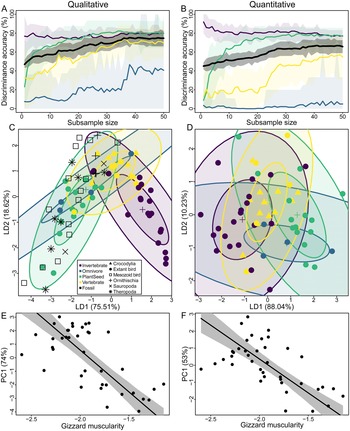
The sensitivity tests on minimal stomach stone counts indicate that the discriminant accuracies steadily improve with an increasing number of subsampled stomach stones for both qualitative and quantitative proxies (Fig. 2A,B). The discriminant accuracies reached an equilibrium at approximately 35 stomach stones in both proxies, at which point the overall accuracy is approximately 75% in the qualitative proxy and approximately 65% in the quantitative proxy. Considering this result, only individuals with at least 35 stomach stones were used for the subsequent analyses to maximize the discriminant accuracy. Applying the ≥35 stone threshold pruned 56% of Plant and Seed Feeders, 69% of Vertebrate Feeders, 17% of Invertebrate Feeders, and 39% of Omnivores, leaving 56 individuals for subsequent analyses (15 Plant and Seed Feeders, 17 Vertebrate Feeders, 20 Invertebrate Feeders, and 4 Omnivores).
Relationships among gastrolith shape, diet, and stomach muscularity. Transition of discriminant accuracy along increase in subsampling size in qualitative (A) and quantitative (B) proxies. Note that the overall accuracy (black) reaches the equilibrium at around n = 35. Bivariate plots of linear discriminant 1 (LD 1) and LD 2 scores obtained from the linear discriminant analyses in qualitative (C) and quantitative (D) proxies. Inner and outer ellipses represent 50% and 95% confidence for each diet category, respectively. Standard major axis (SMA) regression plot of gastrolith shape (principal component 1 [PC 1]) on stomach muscularity of extant archosaurs in qualitative (E) and quantitative (F) proxies. The gray region represents the 95% confidence interval.

Figure 2. Long description
A six-panel figure organized into two columns: Qualitative (left) and Quantitative (right).
* Panels A and B: Line graphs showing Discriminant accuracy (percent) on the y-axis from 0 to 100 versus Subsample size on the x-axis from 0 to 50. A thick black line representing overall accuracy shows an asymptotic increase, reaching equilibrium at approximately n equals 35. Colored lines (purple, green, yellow, blue) represent different diet categories with shaded confidence intervals.
* Panels C and D: Bivariate scatter plots of L D 1 versus L D 2. Panel C (Qualitative) shows L D 1 at 75.51 percent and L D 2 at 18.62 percent. Panel D (Quantitative) shows L D 1 at 88.04 percent and L D 2 at 10.23 percent. Data points are coded by shape (triangles, circles, squares, crosses, stars) and color (purple for Invertebrate, blue for Omnivore, green for Plant Seed, yellow for Vertebrate). Each group is enclosed by two concentric ellipses representing 50 percent and 95 percent confidence intervals.
* Panels E and F: S M A regression plots showing P C 1 on the y-axis versus Stomach muscularity on the x-axis. Both panels show a strong negative linear correlation. Black dots represent individual data points, a solid black line shows the regression trend, and a gray shaded region indicates the 95 percent confidence interval. Panel E (Qualitative) notes P C 1 at 74 percent, while Panel F (Quantitative) notes P C 1 at 53 percent.
The final discriminant analysis using the pruned training dataset resulted in an overall accuracy of 78.57% for qualitative proxy and 67.86% for the quantitative proxy (Supplementary Table S1). The discriminant accuracies varied considerably among dietary categories: Plant and Seed Feeders had the highest accuracy (qualitative: 86.67%, quantitative: 86.67%), followed by Invertebrate Feeders (qualitative: 85.00%, quantitative: 75.00%) and Vertebrate Feeders (qualitative: 76.47%, quantitative: 58.82%), and Omnivores had the lowest accuracy (qualitative: 25.00%, quantitative: 0.00%).
For the qualitative proxy, intergroup variance was best represented by the proportions of Angular and Well-rounded stomach stones (linear discriminant axis 1 [LD 1]: 75.51%; Supplementary Table S3), followed by Sub-angular and Rounded stomach stones (LD 2: 18.62%). Similarly, principal component analysis shows that the largest source of shape variation was the proportions of Angular, Rounded, and Well-rounded stomach stones (principal component 1 [PC 1]: 74.32%), followed by proportions of Sub-angular and Sub-rounded stomach stones (PC 2: 14.57%). For the quantitative proxy, LD 1 (88.04%) was primarily represented by Circularity and Solidity, while Roundness had a high loading on LD 2 (10.23%). The corresponding principal component analysis shows that PC 1 (53.02%) was driven by Circularity and Solidity, while PC 2 (32.73%) was driven by Roundness.
PC 1 values derived from the qualitative shape proxies correlated well with those from the quantitative proxy (p < 0.001, R 2 = 0.66). For both proxies, the PC 1 scores also correlated significantly with the stomach muscularity (p < 0.001, R 2 = 0.44 for qualitative and R 2 = 0.37 for quantitative proxy).
Building on the extant training set, Elton Trait diet categories of 29 dinosaur specimens (16 taxa) were predicted based on preserved stomach stones (Fig. 2C, Table 1; see Supplementary Text S1 for detailed descriptions of dinosaur stomach stones). Because dinosaur gastroliths are often embedded in the matrix, only the qualitative model was utilized for this analysis (see “Materials and Methods” and “Discussion” for validations). Note that although extant bird specimens with fewer than 35 stomach stones were pruned in the training dataset, fossil specimens with low stone counts were still analyzed. The specimens with low stomach stone count (Iteravis, IVPP V18958; and Jeholornis, STM 3-19; stomach stone n = 6 each) were recovered far from the morphospace occupied by all other specimens (Supplementary Table S5). The predicted dietary habits of dinosaurs with more than 35 stomach stones are generally concordant with the previous results (Table 1), with the notable exceptions of several ornithischians (Haya, Psittacosaurus), a sauropod (Cedarosaurus), and several Mesozoic birds (Bellulornis, Gansus, and Iteravis).
Predicted diets of extinct archosaurs based on gastrolith shapes. The italic predicted diet represents the predictions that differ from previous assumptions. Note that prediction accuracy is expected to be low on the specimens with fewer gastroliths, even if the posterior probabilities are high

Table 1. Long description
The table contains 10 columns: Taxa, I D, Clade, Predicted diet, Previous suggestion, Number of gastroliths, and Posterior probability percentages for Invertebrate, Omnivore, Plant plus Seed, and Vertebrate diets.
Key entries include:
* Archaeorhynchus spathula (I V P P V14287): Predicted Plant plus Seed (99.69 percent probability), 38 gastroliths.
* Archaeorhynchus spathula (I V P P V17075): Predicted Omnivore (74.34 percent probability), 64 gastroliths.
* Caudipteryx dongi (I V P P V12344): Predicted Plant plus Seed (91.3 percent probability), 196 gastroliths.
* Cedarosaurus weiskopfae (D M N H 39045): Predicted Vertebrate (88.04 percent probability), 96 gastroliths.
* Deinocheirus mirificus (M P C minus D 100/127): Predicted Plant plus Seed (99.83 percent probability), 959 gastroliths.
* Diplodocus hallorum (N M M N H 3690): Predicted Plant plus Seed (99.71 percent probability), 117 gastroliths.
* Iteravis huchzermeyeri (I V P P V18958): Predicted Invertebrate (98.1 percent probability), 6 gastroliths.
* Sinornithomimus dongi (uncatalogued): Predicted Plant plus Seed (95.61 percent probability), 1070 gastroliths.
* Tarbosaurus bataar (M P C minus D 552 minus 1): Predicted Vertebrate (83.36 percent probability), 682 gastroliths.
Clades represented include Avialae, Theropoda, Sauropoda, and Ornithischia. Predicted diets often align with previous suggestions of herbivory, though some specimens like Gansus yumenensis and Haya griva show shifts toward omnivore or vertebrate classifications.
The ancestral-state reconstruction of PC 1 stomach stone shape values yielded the following results for key nodes: ancestral Dinosauria was reconstructed with a value of −1.52, ancestral Saurischia with −1.65, ancestral Theropoda with −1.63, ancestral Maniraptoriformes with −2.48, and ancestral Avialae with −2.62 (Fig. 3).
Hypothetical evolutionary history of archosaur stomach muscularity, represented as a phylogenetic gradient map of the gastrolith shape proxy (principal component 1 [PC 1] value). Topology follows a composite phylogenetic framework assembled from published sources (see “Methods”; Supplementary Data S4) and is used as a scaffold for trait mapping. The circles next to the taxon names represent dentition status, and the absence of a circle represents a specimen without a known skull. Note that completely edentulous taxa generally have rounded gastroliths.

Figure 3. Long description
A phylogenetic tree where branch colors represent a gradient of gastrolith shape P C 1 values, ranging from green minus 3.847 to yellow minus 0.024.
At the top, a clade includes Haya griva with a white circle, Psittacosaurus mongoliensis and Psittacosaurus mazongshanensis with grey circles, and Diplodocus hallorum.
Below this, a branch leads to Cedarosaurus weiskopfae and Limusaurus inextricabilis, the latter marked with a black circle and a sauropod silhouette.
A large lower clade branches into:
* Tarbosaurus bataar with a white circle and a large theropod silhouette.
* Deinocheirus mirificus with a black circle and an ornithomimosaur silhouette.
* Sinornithomimus dongi with a black circle.
* A dense cluster of avian and paravian taxa including Caudipteryx, Jeholornis prima, Archaeorhynchus spathula, Bellulornis rectusunguis, Eogranivora edentulata, Iteravis huchzermeyeri, and Gansus yumenensis. This group is accompanied by a bird silhouette.
A legend in the bottom right defines the circles: white for Toothed, grey for Partially toothed, and black for Edentulous.
The bottom of the diagram features a geological timescale. The Jurassic period is divided into Middle and Upper stages in blue. The Cretaceous period follows, divided into Lower and Upper stages in green.
Discussion
The sensitivity analysis on the minimum stomach stone counts for predicting archosaur diet demonstrates the critical importance of sample size. The discriminant accuracy of our models improved substantially as the number of subsampled stones increased, stabilizing only after approximately 35 stones were included in the analysis (Fig. 2A,B). This finding highlights the necessity of averaging across a large population of stones to mitigate the inherent variability of individual stones. The shape of any single stomach stone is influenced by numerous factors, including its time since ingestion, its original shape, abrasion rate, and its lithological properties such as hardness (Wings Reference Wings2007). Analyzing a large population of stones from a single individual permits the effects of these confounding variables to be averaged out, revealing a more robust signal of the overall abrasive environment within the stomach.
However, setting this threshold involves a trade-off. While a higher minimum stone count improves the reliability of each data point, it also reduces the number of specimens available for the training dataset, which can, in turn, decrease the overall predictive power of the model. In the present case, applying the n = 35 threshold reduced our extant dataset from 104 to 56 individuals. Therefore, the optimal threshold must be a point that maximizes per-specimen reliability without excessively compromising the training dataset size. This study chose a minimum of 35 stones because this represents the point of equilibrium where discriminant accuracy plateaued for both our qualitative and quantitative proxies, while still retaining a sufficiently large dataset for robust model creation. The data pruning resulted in a relatively even distribution of sample sizes across diet categories, with the exception of omnivores (see “Results”).
Notably, the predictive accuracy of the model based on the qualitative proxy (78.57%) was higher than that of the quantitative proxy (67.86%). Although the two proxies capture similar features, as supported by the correlation between their respective PC 1 values (R 2 = 0.66), this difference in accuracy implies they are not identical in the information they retain. This discrepancy may highlight the importance of three-dimensional information. While the quantitative proxy relies solely on two-dimensional outlines from photographs, the qualitative proxy is based on human observation, which can incorporate three-dimensional shape information. The human eye is better at capturing subtle features, such as the small inlets characteristic of the Angular and Sub-angular categories, which may not always be resolved in the two-dimensional photographs used for quantitative analysis. Therefore, our results suggest that the qualitative proxy not only serves as a valid substitute for the quantitative method (Takasaki and Kobayashi Reference Takasaki and Kobayashi2020a) when dealing with embedded fossils, but may even outperform it in terms of predictive accuracy.
The results of our discriminant and principal component analyses are highly concordant with previous empirical experiments and inferred functions of wild bird stomach stones (Wings Reference Wings2007). Greater LD 1 values (i.e., a dominance of Angular stomach stones) in Invertebrate Feeders and Vertebrate Feeders compared with Plant and Seed Feeders align with experiments on domestic chicks, which demonstrated rougher, more angular stomach stones in carnivorous groups than in herbivorous groups (Takasaki and Kobayashi Reference Takasaki and Kobayashi2020a). Likewise, the dominance of rounded stomach stones in specimens with high stomach muscularity, demonstrated by the correlation between PC 1 and stomach muscularity (Fig. 2E,F), is consistent with these same experimentally derived results (Takasaki and Kobayashi Reference Takasaki and Kobayashi2020a).
This framework reveals that the shape-based analysis is not merely a diet proxy, but more fundamentally, a proxy for mechanical digestive function. The causal chain can be understood as follows: the diet of an animal influences the required stomach muscularity, which in turn dictates the mechanical function of the stomach (e.g., an active grinding mill). This function is what directly influences stomach stone shape through abrasion. Therefore, by observing stone shape, the most direct inference that can be made is about the mechanical function of the stomach. For instance, the prediction of angular stones in some carnivores including Buteo buteo, despite having a large number of gastroliths (Supplementary Data S2), suggests the absence of a grinding function, which is consistent with the use of stones for nonabrasive purposes like rangle or simply an accidental intake (Wings Reference Wings2007).
The misidentification of Omnivores appears to be informative. For instance, the herbivory-dominated Omnivore (Anas platyrhynchos) was misidentified as a Plant and Seed feeder, while the vertivory-dominated Omnivore (Calonectris leucomelas) was miscategorized as a Vertebrate Feeder. This implies that stomach stone shape does not just assign specimens to discrete categories, but rather captures the continuous nature of animal dietary and digestive ecology.
Even so, the models are not perfect, and several inherent factors likely contribute to mispredictions. One unavoidable factor is the unidirectional nature of stone abrasion; stomach stones only become more rounded over time, not rougher. Therefore, a stomach stone is expected to be rounded if it was rounded upon consumption, regardless of the diet or stomach muscularity of the host. This likely explains instances where some Vertebrate Feeders and Invertebrate Feeders were misclassified as Plant and Seed Feeders (Supplementary Table S1). Additionally, our models do not account for seasonal dietary shifts, which are common in many birds (Billerman et al. Reference Billerman, Keeney, Rodewald and Schulenberg2022). The use of discrete dietary categories herein is a necessary simplification of this complex biological reality. For consistency and objectivity, we assigned specimens to these categories following the comprehensive framework of Wilman et al. (Reference Wilman, Belmaker, Simpson, de la Rosa, Rivadeneira and Jetz2014). This necessary simplification, combined with the lack of precise collection dates for some specimens, means that some of the observed intraspecific variation in stone shape (Supplementary Table S1) could reflect these dietary variations, potentially lowering the overall prediction accuracy.
More broadly, the variation in gastrolith shape at the moment of ingestion—whether shaped by host animal selectivity, source environment lithology, or pre-ingestion transport history—is intrinsically unknown for both the extant and fossil specimens examined here, as rearing or capture locality (Supplementary Table S6) does not necessarily indicate where the gastroliths were acquired. However, if pre-consumption shape distribution were the primary driver of gastrolith roundness rather than intragastric abrasion, the diet–shape and muscularity–shape signals would not be expected to emerge with the clarity recovered here (78.57% diet accuracy; PC 1 vs. stomach muscularity R 2 = 0.44, p < 0.001) from such a heterogeneous extant sample. Pre-consumption variation therefore likely contributes to individual-level scatter—as invoked above for some misclassifications—but not to the broader diet–shape and muscularity–shape relationships reported here.
Despite these limitations and nuanced results, the models demonstrate predictive power far exceeding the 25% accuracy expected from random chance. The high accuracies achieved in our models strongly support the hypothesis that stomach stone shape contains a robust signal reflecting both archosaur diet and stomach muscularity. Therefore, while acknowledging its inherent uncertainties, this shape-based analysis serves as a potential new proxy for inferring archosaur dietary habits, to be used alongside classic methods such as osteology, stable isotopes, and gut content analysis. Such multiproxy approaches are increasingly advocated for robust paleodietary reconstruction in extinct taxa, and explicit frameworks developed for fossil birds provide a useful template for synthesizing independent lines of evidence (Miller and Pittman Reference Miller and Pittman2021; Miller et al. Reference Miller, Pittman, Wang, Zheng and Bright2022). The present gastrolith-shape analysis adds an independent proxy for gastrointestinal mechanical function (gastric abrasion capacity/stomach muscularity) that can be integrated alongside osteology, stable isotopes, and gut content evidence.
A practical road map for applying gastrolith shape information within a multiproxy framework begins with establishing the reliability of the stone assemblage as gastroliths. A conservative inclusion criterion is applied here, restricting scoring to stones preserved within, or immediately adjacent to, the abdominal region to minimize inclusion of non-ingested clasts. Gastrolith shape is then evaluated using standardized criteria proposed by Best and Gionfriddo (Reference Best and Gionfriddo1991). Analyses should preferentially focus on individuals with sufficient numbers of gastroliths (≥35 in the present dataset), although predictions based on smaller samples can also be reported, provided the associated uncertainty is explicitly acknowledged.
Once shape data are compiled, diet can be predicted using the trained classifier developed here, yielding coarse output categories expressed in the EltonTraits labels. These predictions are best treated as statistically-grounded hypotheses rather than definitive diet diagnoses, because the association between shape and diet is plausibly mediated by the mechanical environment of the stomach (details discussed later). Accordingly, interpretation should explicitly distinguish (1) the classifier’s dietary category prediction and (2) the mechanistic implication of the observed gastrolith morphotypes (e.g., whether stone rounding suggests sustained abrasion vs. limited abrasion), while recognizing that these two inferences are related but not identical. Finally, gastrolith-based predictions and mechanistic inferences should be evaluated alongside independent proxies (e.g., cranial and dental morphology, microwear, stable isotopes, gut contents). Concordance among independent lines of evidence strengthens dietary inference, whereas conflicts can be informative and should motivate targeted alternative hypotheses. In the following sections, gastrolith-shape-based predictions are compared with previous dietary interpretations derived from other proxies (primarily osteological evidence) to evaluate when this new proxy is most informative and what aspects of digestive function it most directly reflects.
Because fossil specimens preserving in situ stomach stones are rare, we report model outputs for all fossil individuals, including those with fewer than 35 stones, to maximize taxonomic coverage. However, predictions based on very small stone counts should be interpreted cautiously given our subsampling sensitivity analysis; consistent with this expectation, the two n = 6 specimens (Iteravis, IVPP V18958; and Jeholornis, STM 3-19) plot far outside the primary morphospace (Supplementary Table S5). In the specimens with at least 35 gastroliths, predicted diets are generally consistent with previous interpretations in non-avian theropods (Table 1). By contrast, conflicts arise in Mesozoic birds, ornithischians, and sauropods, requiring reconciliation and motivating new hypotheses about their dietary habits and gastrointestinal properties. The Mesozoic birds Bellulornis, Gansus, and Iteravis have often been suggested to be herbivorous based on the presence of stomach stones (Y.-M. Wang et al. Reference Wang, O’Connor, Li and You2015; M. Wang et al. Reference Wang, Zhou and Zhou2016), although more recently O’Connor (Reference O’Connor2019) inferred that Gansus and Iteravis are unlikely to be granivorous. O’Connor and Zhou (Reference O’Connor and Zhou2019) further inferred omnivory in Iteravis based on the presence of fractured bones and carbonaceous remains reported in association with the specimen, although these remains are preserved external to the body cavity. The model developed in this study predicts these taxa as Vertebrate Feeders, which supports the more recent inference (O’Connor and Zhou Reference O’Connor and Zhou2019). The prediction is based on their angular stomach stones, which imply that their stomachs were not muscular enough to severely abrade them. Such a weakly muscular stomach would likely have been insufficient to process fibrous plant materials. Iteravis also has reduced dentition (Ju et al. Reference Ju, Wang, Liu and Wang2020), which may indicate limited oral comminution. Therefore, the anatomical and stomach stone features of Iteravis and Gansus are consistent with a predominantly vertivorous lifestyle in these Mesozoic birds. In light of their high likelihood as Vertebrate Feeders (Table 1), the aquatic adaptations in the pelvis and hindlimbs of Iteravis and Gansus (You et al. Reference You, Lamanna, Harris, Chiappe, O’Connor, Ji and Lü2006; Zhou et al. Reference Zhou, O’Connor and Wang2014; Wang et al. Reference Wang, O’Connor, Li and You2015) may further imply piscivory, a hypothesis that could be confirmed with future discovery of stomach contents. Unfortunately, the prediction of Vertebrate Feeding in Bellulornis cannot be checked against anatomical features until cranial remains are reported from this taxon.
The conflicts in the sauropods and ornithischians are less straightforward to reconcile, because both clades are very likely herbivorous based on osteology, yet gastrolith shape signals are not always concordant with those expectations. Sauropods have long been hypothesized to have performed limited oral processing and to have relied on prolonged retention and fermentation (Hummel and Clauss Reference Hummel, Clauss, Klein, Remes, Gee and Sander2011). Consistent with this, a recently described Diamantinasaurus cololite provides direct evidence of herbivory and supports minimal oral processing, with digestion likely relying on fermentation and gut microflora (Poropat et al. Reference Poropat, Tosolini, Beeston, Enchelmaier, Pentland, Mannion and Upchurch2025). Notably, no gastroliths were reported from the gut contents of Diamantinasaurus, consistent with the absence of a gastric mill suggested for sauropods (Wings and Sander Reference Wings and Sander2007). Accordingly, where gastroliths are reported in sauropods, accidental ingestion during bulk feeding may remain a plausible explanation.
In contrast to sauropods, early-branching ornithischians generally have craniomandibular and dental specializations that indicate substantial oral processing. For example, the powerful adductor muscles and highly worn teeth of Psittacosaurus have been used to suggest their high-fiber diet (Sereno et al. Reference Sereno, Xijin and Lin2010). Similarly, the basal ornithischians Gasparinisaura and Haya also have highly worn teeth and well-developed coronoid processes of the dentaries (Coria and Salgado Reference Coria and Salgado1996; Barta and Norell Reference Barta and Norell2021), suggesting they also had a great deal of oral processing capability.
Taken together, these lines of evidence suggest that, at least in some herbivorous dinosaur clades, the stomach may not have been the primary site of mechanical breakdown. Accordingly, when gastroliths are present in basal ornithischians and sauropods, their shapes may not reflect sustained intragastric abrasion in the same way as in taxa with a strongly muscular stomach. Under this scenario, the stomachs of these two groups may have operated under a relatively low-abrasion regime (e.g., extant crocodylians, carnivorous extant birds), although it is emphasized that this is a functional comparison rather than an anatomical one. Therefore, sauropod and ornithischian stomach stones would be likely to retain their original shapes at the time of ingestion. As such, conflicts between stomach stone–based predictions and previously inferred diets in ornithischians and sauropods likely reflect the evolutionary history of dinosaur stomachs and compensation by other organ systems. This reveals a nuance of our approach: while stomach stone shape is robust in assessing stomach muscularity among archosaurs, special care must be taken in using stomach stone shape to infer diet where other compensating food processing mechanisms are present. In this light, stomach stone shape may most accurately reflect diet in theropods, including birds, which lack extensive oral processing ability.
Nevertheless, the analyses presented here do not preclude alternative, non-exclusive functions of gastroliths in herbivorous ornithischians (e.g., geophagy and mineral supplementation or other physiological roles with potential metabolic significance). Standardized shape scoring for ornithischians remains limited in the present dataset (Table 1), which precludes robust inference about function based on the scored sample alone. Even so, the dominance of angular morphotypes in the scored ornithischians is not consistent with sustained intragastric abrasion expected under a muscular stomach. Dense abdominal gastrolith clusters are nevertheless reported repeatedly in Psittacosaurus (Osborn Reference Osborn1924; Sereno et al. Reference Sereno, Xijin and Lin2010; Wang et al. Reference Wang, Li, Wen, Chen and Reisz2026). Gastroliths have also been reported in additional ornithischian lineages, including Haya (Makovicky et al. Reference Makovicky, Kilbourne, Sadleir and Norell2011), Changmiania (Yang et al. Reference Yang, Wu, Dieudonné and Godefroit2020), Gasparinisaura (Cerda Reference Cerda2008), Yinlong (Xu et al. Reference Xu, Forster, Clark and Mo2006), and Tenontosaurus (Nudds et al. Reference Nudds, Lomax and Tennant2022). The recent report of gastroliths in the early-branching pachycephalosaur Zavacephale (Chinzorig et al. Reference Chinzorig, Takasaki, Yoshida, Tucker, Buyantegsh, Mainbayar, Tsogtbaatar and Zanno2025) further indicates that gastrolith occurrence was widespread among early-branching ornithischians. Recurrent occurrence across multiple individuals and lineages may suggest functional significance that does not depend on strong gastric abrasion. Distinguishing among alternative hypotheses will require broader taxonomic sampling and integration of independent proxies.
The ancestral-state reconstructions support a scenario in which muscular stomachs evolved in Theropoda, although future evaluations of gastroliths in a broader taxonomic sample might reveal independent origins of muscular stomachs. Indeed, some data show that stomach muscularity is evolutionarily plastic (Takasaki and Kobayashi Reference Takasaki and Kobayashi2024), and previous work shows that crocodilian and neornithine “gizzards” are not homologous (Takasaki and Kobayashi Reference Takasaki and Kobayashi2020b). It is also worth noting that gastroliths have also been reported in pterosaurs (Codorniú et al. Reference Codorniú, Chiappe and Cid2013; Jiang et al. Reference Jiang, Zhang, Wu, Zheng, Kellner and Wang2025), indicating that lithophagy occurred outside Dinosauria. However, comparable shape data are not yet available for reported pterosaur gastrolith assemblages, so their implications for ancestral ornithodiran stomach function remain uncertain. Nevertheless, the presently available data indicate that the muscular stomach originated at least within ancestral Maniraptoriformes, if it was not already present further back in the theropod lineage. As a phylogenetically independent comparison, Limusaurus, a highly unusual ceratosaur outside Maniraptoriformes, provides an informative functional case study (Xu et al. Reference Xu, Clark, Mo, Choiniere, Forster, Erickson and Hone2009; Wang et al. Reference Wang, Stiegler, Amiot, Wang, Du, Clark and Xu2017). Through ontogeny, Limusaurus stopped replacing its teeth and became fully edentulous (Wang et al. Reference Wang, Stiegler, Amiot, Wang, Du, Clark and Xu2017), while also acquiring moderately rounded stomach stones as an adult (Wang et al. Reference Wang, Stiegler, Amiot, Wang, Du, Clark and Xu2017; Table 1). This suggests that, at least as adults, Limusaurus may have relied on a somewhat muscular, gastrolith-assisted stomach instead of teeth to break down plant material for digestion, but with less intensity than in extant herbivorous birds (which have more rounded gastroliths). Given its unusual ontogenetic trajectory, this association may be unique to Limusaurus and therefore should not be used to infer the ancestral state of theropod stomach condition. Instead, Limusaurus may serve as a fossil example showing that reduced oral processing (edentulism) can co-occur with gastrolith-assisted gastric processing.
An early origin of a muscular stomach within Maniraptoriformes (and possibly deeper within Theropoda) potentially has broader implications for theropod evolution. Edentulism in theropods has long been considered an indicator of herbivory (Barrett Reference Barrett2005; Zanno and Makovicky Reference Zanno and Makovicky2011), but few studies have tried to explain what mechanisms substituted for oral processing. Our findings demonstrate that, where preserved, edentulous theropod taxa have highly rounded gastroliths indicative of enhanced gastrointestinal processing capabilities (Fig. 3). This suggests that the muscular stomach took up the role of the intense mechanical food processing system that is mandatory for herbivory in animals with high metabolic rates (Hummel et al. Reference Hummel, Clauss, Südekum, Martin and Koenigswald2020). This is supported by the ontogenetic transition to edentulism and acquisition of moderately rounded stomach stones in Limusaurus, suggesting that, even within an individual lifetime, a muscularized stomach with gastroliths can effectively replace oral processing capabilities conferred by teeth. In this light, edentulism in theropods may not be an adaptation for herbivory itself, but a reflection of a transition to gastrointestinal food processing that released a selective constraint on the presence of teeth (Zheng et al. Reference Zheng, O’Connor, Huchzermeyer, Wang, Wang, Zhang and Zhou2014; O’Connor Reference O’Connor2019). Tooth loss may then have been advantageous in saving nutritional and energetic costs required for tooth replacement, which is estimated to have occurred every few months in dinosaurs (D’Emic et al. Reference D’Emic, Whitlock, Smith, Fisher and Wilson2013, Reference D’Emic, O’Connor, Pascucci, Gavras, Mardakhayava and Lund2019). Thus, acquisition of a muscular stomach was likely an evolutionary innovation that enabled tooth reduction in many maniraptoriform groups, including ornithomimosaurs, therizinosaurs, oviraptorosaurs, and ultimately birds.
Offloading food processing to the muscular stomach may have had strong effects on theropod cranial constraints beyond enabling edentulism. In vertebrates, intensive oral processing is often associated with enlarged jaw adductor musculature, which occupies substantial cranial space and can constrain braincase organization and brain–endocast disparity (Stedman et al. Reference Stedman, Kozyak, Nelson, Thesier, Su, Low, Bridges, Shrager, Minugh-Purvis and Mitchell2004; Penrose et al. Reference Penrose, Kemp and Jeffery2016; Challands et al. Reference Challands, Pardo and Clement2020). Reduced reliance on oral processing in some theropods (e.g., ornithomimosaurs), potentially accompanied by reductions in these muscle groups (Cuff and Rayfield Reference Cuff and RayfieLD2015), may therefore have relaxed the constraints and facilitated diversification of neurosensory systems along the avian stem lineage (Balanoff et al. Reference Balanoff, Bever, Rowe and Norell2013; Ksepka et al. Reference Ksepka, Balanoff, Smith, Bever, Bhullar, Bourdon, Braun and Burleigh2020; Choiniere et al. Reference Choiniere, Neenan, Schmitz, Ford, Chapelle, Balanoff and Sipla2021). Any implications for cognition remain speculative and are not directly tested here; cognitive performance in birds does not map simply onto absolute brain size, and neuronal packing densities and neuron numbers have been emphasized as additional correlates (e.g., Olkowicz et al. Reference Olkowicz, Kocourek, Lucan, Portes, Fitch, Herculano-Houzel and Nemec2016). Future comparative work integrating jaw muscle reconstructions, endocranial morphology, and sensory proxies across theropods will be necessary to evaluate whether shifts in gastrointestinal food processing contributed to patterns of avian cranial evolution.
Acknowledgments
The authors appreciate M. Eda (Hokkaido University Museum) and his volunteers for collecting and managing the specimens at the Hokkaido University Museum. F. Takaya (Botanic Garden, Hokkaido University) kindly allowed us to work on the specimens at the Botanic Garden, Hokkaido University. J. O’Connor kindly shared high-resolution photos of several Cretaceous bird gastroliths. We thank K. Chiba (Okayama University of Science), J. Yoshida (Fukushima Prefecture Museum), T. Tanaka (Hyogo Prefecture University), and M. Iijima (Institute of Vertebrate Paleontology) for their helpful comments on earlier versions of the article. R.T. is funded by JSPS (17J06410, 20J01696, 23K13207). G.F.F. is funded by NSERC and the Vanier-Banting Commission.
Author Contribution
R.T. conceived and designed the study, collected and curated the data, performed all statistical, and morphometric analyses, wrote the analytical code, prepared the figures, acquired funding, and wrote the original draft. Y.K. supervised the project. A.R.F., T.C., and G.F.F. contributed to the review and editing of the manuscript. All authors read and approved the final version.
Competing Interests
The authors declare no competing interests
Data and Code Availability Statement
All data are provided as Supplementary Data S1–S4 and deposited with the Supplementary Material (Supplementary Figs. S1–S3 and Supplementary Tables S1–S6) at Dryad: https://doi.org/10.5061/dryad.5mkkwh7k6. The scripts used for the analyses are provided as Supplementary Data S5 and S6.



 Open access

