




1. Introduction and selection protocol
As in the three previous reviews of dissertation research in Germany published in Language Teaching in 2011 (Behrent et al., Reference Behrent, Doff, Marx and Ziegler2011), 2016 (Doff et al., Reference Doff, Königs, Marx and Schädlich2016), and 2020 (Heine et al., Reference Heine, Marx, Schädlich and Wilden2020), we return to additional language acquisition (also referred to as second-/foreign-language acquisition; we use the established acronym SLA here) research in a language often overlooked by the international research community. Several factors contribute to this oversight. Most notably, the publication language most certainly plays a role; German is not widely read by scholars, despite being the most commonly spoken first language in Europe (Eurobarometer, 2023, p. 7), and German-language scholarship continues to dominate in this field (of the 79 dissertations identified for this review period, 68 [86%] were published in German and only 11 [14%] in English). Further, the publication format has consequences; while we observe more dissertations published online compared to previous reviews, many German dissertations continue to appear in book format rather than as open-access (online) publications. This makes them less accessible to overseas readers in today’s digital research environment, particularly given that dissertation publications often cost upwards of €100. Fortunately, many dissertations are summarized – some in English – in more readily accessible journal articles.
The selection process for German dissertations required special considerations due to the specific context of German SLA research. Structured Ph.D. programmes remain relatively rare in Germany, and SLA research typically does not occur within Applied Linguistics departments but rather within – or affiliated with – individual language departments (English, Romance Languages, German, etc.), making SLA discourse an interdisciplinary effort even within individual institutions. Moreover, because no mandatory national catalogue of dissertation research exists, some relevant dissertations may have been missed during the collection process. Finally, nomenclature may play a role: in German, the community often differentiates between SLA (Zweitspracherwerb and Deutsch als Zweitsprache [DaZ], which generally refer to persons of migration background in German educational institutions) and foreign-language learning (Fremdsprachenlernen, which refers to learning non-German languages in Germany or German in formal educational settings in ab initio contexts, i.e. Deutsch als Fremdsprache [DaF]), while these areas are more closely aligned or even treated as equivalent in English-language discourse (e.g. the use of English as an additional language, as opposed to English as a second language/English as a foreign language [EFL]). This may also have influenced the identification and inclusion of relevant dissertations, especially since the use of terminology referring to German-language learning is highly inconsistent.
Various measures were used to counteract difficulties in the selection process. First, the authoring team represents a wide range of methodological approaches, research foci, and target languages within the field. Second, since many SLA dissertations are included in the ProHabil research database of the DIPF (Leibniz Institute for Research and Information in Education), which aggregates subject-specific educational Ph.D. and postdoctoral theses in Germany, the database was included in the search. However, ProHabil relies on self-reporting and reporting dissertations is not compulsory; thus, we also perused catalogues of typical publishers of dissertation research for the time frame and displayed a prominent call for research reporting during the biennial DGFF (Deutsche Gesellschaft für Fremdsprachenforschung, ‘German Association for SLA Research’) congress in 2023. Finally, full-text retrieval was straightforward since all dissertations must be published before the doctoral degree is awarded.
Unlike the previous three reviews, this article includes research published in both German and English. The period 2019–2023 reflects increasing internationalization of the research community, and we therefore include the small but steadily growing number of dissertations published in English, even when conducted in Germany by German Ph.D. students working under German supervisors. We anticipate that this international trend towards English-language publication will continue to influence German publication strategies, particularly given that German dissertation research is making more visible contributions to international academic discourse in areas such as Content and language integrated learning (CLIL), multilingualism pedagogy, and digital media integration. For the purposes of this review, however, we chose to focus more on German-language dissertation research to make this scholarship more accessible to the international community.
We decided not to include the diverse body of work on DaZ (German as a second language), which tends to be situated in German research on German in majority-language contexts, in general education research, and/or in migration-related work, but generally not on formal learning contexts for German as a target language. For a methodological scoping review on research focusing specifically on target language development (SLA) of German with newly immigrated students, see Twente and Marx (Reference Twente and Marx2026).
This selection of dissertations thus continues from where the previous review (Heine et al., Reference Heine, Marx, Schädlich and Wilden2020) concluded, examining 79 dissertations published during the 5 years from 2019 to 2023. A comparison with the three earlier overview articles, which together cover a total of 218 dissertations from 2006 to 2018, complements our analysis. Of the dissertations covered, 70 were empirical studies, 5 were theoretical or historical in nature, and 4 consisted primarily of analyses of textbook or teaching materials. The thematic grouping revealed 18 categories, of which 8 were selected for more in-depth analysis. As with previous reviews, we selected several dissertations from each category for detailed presentation, focusing on publications deemed to meet sufficiently high academic standards and judged to be either especially representative of their category or particularly innovative.
A final note about nomenclature: In this article, we use the English term SLA to refer to Fremdsprachenlernen as being the term more widely used in international discourse. We also include the German terms in order to make this review more accessible to a German audience, who work within German-language frameworks.
2. Current methodological emphases, developments, and ongoing challenges
Although the authoring team focused primarily on content rather than methodological criteria, we include a brief overview of the research methods and paradigms that feature prominently in current German SLA dissertation research. Due to various historical developments in humanities research programmes in Germany (Lepper, Reference Lepper2016; Tietz, Reference Tietz and Strosetzki2022), doctoral research tends to be qualitative in nature – a pattern reflected consistently across all four review periods.
Building on the desiderata identified in the 2020 review (Heine et al., Reference Heine, Marx, Schädlich and Wilden2020) – which called for more quantitative studies, increased impact research (Wirkungsforschung), and more innovative, theory-building designs – the present cohort shows some encouraging developments. While established frameworks such as the Forschungsprogramm Subjektive Theorien (‘Research Programme for Subjective Theories’; Groeben et al., Reference Groeben, Wahl, Schlee and Scheele1988) continue to dominate, we observe increased use of previously rare approaches, including design-based research (DBR, five studies), the documentary method (Dokumentarische Methode, four studies), systematic intervention studies (ten studies, often overlapping with DBR), and historical research approaches (three studies). Qualitative approaches, in particular, appear to be in a process of further development and differentiation. For example, while qualitative content analysis (Mayring, Reference Mayring2022; Schreier, Reference Schreier2012) is still the predominant analytical procedure, it increasingly seems to be complemented or replaced by more strongly codified and methodologically ambitious qualitative approaches, such as conversation analysis (Kasper & Wagner, Reference Kasper and Wagner2014) or the documentary method (Bohnsack, Reference Bohnsack2021). The overall picture is one of explorative-interpretative inquiry aimed at analysing ‘rich data’ from relatively small numbers of participants, with data collection proceeding until ‘theoretical saturation’ is reached.
Many of the earlier desiderata, nonetheless, remain unfulfilled. Only 13 of the 79 dissertations employed quantitative approaches, 2 of which had sample sizes below 20 – raising concerns about statistical power and generalizability. Studies reporting mixed-methods designs frequently limited their quantitative component to questionnaire data, with little genuine integration across strands. More broadly, methodological choices often appear driven by disciplinary convention rather than by the specific requirements of the research question at hand. This tendency – evident in what one might call a ‘normed methodology arsenal’ within the community – sometimes leads to limited reflection on methodological fit and insufficient transparency about validity considerations. A concrete institutional example is the Dual Ph.D. programme in Education at the University of Bremen, whose first cohort (2016–2020) was required to use DBR and to choose research questions that could be answered with this methodology.
The strong qualitative and exploratory focus of German Ph.D. research and the under-representation of high-quality quantitative research is a pattern that has remained largely stable over the past 20 years, despite concerted efforts to improve statistical and methodological literacy among early career researchers, including introductory statistics classes at DGFF summer schools and the establishment of the online ‘DGFF-Kolleg’ programme (https://www.dgff.de/veranstaltungen/dgff-kolleg/). The persistence of this imbalance suggests that voluntary specialization is insufficient. Structural responses are needed: embedding empirical methodology into undergraduate philological study programmes – as is already standard in sociology, psychology, and some linguistics programmes – would build a broader foundation, one that is valuable not only for academic researchers but also for future teachers at a time when empirical literacy is increasingly important in public life. More structured Ph.D. programmes with explicit methodological training and specific support for quantitative and mixed-methods work would complement such efforts. Ultimately, the field would benefit from researchers willing to pursue methodologically ambitious projects that test innovative approaches, build theoretical models, and generate cumulative knowledge – with paradigm choice, data elicitation, and analysis deriving first and foremost from the research question, rather than from community trends. We return to these methodological challenges in the final sections of the review.
3. Target groups and focus languages
Before turning to topics of interest, it is interesting to consider which learners and which target languages are primarily a focus of dissertation research in Germany.
First, an analysis of the target languages (multiple mentions possible) shows a clear dominance of English, which was focussed in 42 dissertations (51% of all projects). It is followed by German with 18 dissertations (22%), French with 13 (16%), and Spanish with 7 (8%), while other languages play only a marginal role (3 dissertations, 4%). This distribution reflects both the prominent role of English in German school curricula and the continuing strong research tradition in DaF (German as a foreign language).
Regarding target learner groups, the focus on secondary education (Sekundarstufe I & II, encompassing grades 5–13 in Germany) becomes even clearer when looking at the overall distribution: 53 out of 79 dissertations (67%) address this level. Primary education (Primarstufe) accounts for ten studies (13%), all of which exclusively focus on English as the target language – highlighting the fact that English is typically the only foreign language taught at the primary level in Germany. Adult learners are considered in 13 dissertations (16%); within this group, most studies focus on German (5) and English (3).
Overall, then, the learning of languages other than English tends to be studied almost exclusively in the context of secondary education, where students generally have access to a broader range of language options. This has obvious implications for the external validity of this body of research.
4. Topics of special interest in the German SLA research community
The previous review identified a trend towards an expanding range of topics addressed in dissertation studies; this continues in the present 5-year cohort. Compared to earlier reviews, we identified notably more thematic areas (18), reflecting the increasing diversification of research interests in the field (see Table A1 in the Appendix for a summary of the thematic areas and the dissertations assigned to them). An important characteristic of current dissertation research is the intersectionality of topics – 79% of the dissertations span multiple thematic categories, with only 21% focusing on a single area. This reflects the increasing complexity and interconnectedness of additional language education dissertation research in Germany.
Among the 79 dissertations identified, the following 18 thematic categories emerged:
1. Evaluation of specific teaching approaches: 29 dissertations
2. Language skills: 24 dissertations
3. Individual variables (such as motivation, affect, beliefs): 16 dissertations
4. Special learner groups: 13 dissertations
5. Multilingualism pedagogies: 12 dissertations
6. Teacher education and teacher training: 11 dissertations
7. Teaching and learning with digital media: 10 dissertations
8. Primary education: 10 dissertations
9. Focus on the teacher: 9 dissertations
10. Content and language integrated learning (CLIL): 8 dissertations
11. Learner autonomy: 5 dissertations
12. Future directions in additional language education: 5 dissertations
13. Literature and film pedagogy: 4 dissertations
14. Analysis of learning and teaching materials: 4 dissertations
15. History of language teaching: 3 dissertations
16. Theoretical and conceptual work: 3 dissertations
17. Teaching projects: 3 dissertations
18. Assessment: 2 dissertations
Five further dissertations dealt with topics or approaches that could not be clearly identified.
For this review, we selected eight well-defined categories for detailed analysis based on several criteria: (1) representation by a sufficient number of dissertations in the corpus to allow for meaningful discussion, (2) relevance to current debates in the wider additional language education community, and (3) potential to illustrate both continuities and developments in German SLA research. The eight selected categories are (1) evaluation of specific teaching approaches, (2) (partial) language skills, (3) individual variables, (4) special learner groups, (5) multilingualism pedagogies, (6) teaching and learning with digital media, (7) literature and film pedagogy, and (8) assessment. Some categories with at least ten representatives (such as teacher education and teacher training) were not selected for detailed discussion, as we prioritized categories that represent substantive pedagogical and learning-focused research questions, thus aligning most closely with the international research discourse in SLA. We thus aimed to balance representation of major trends with in-depth analysis rather than attempting comprehensive coverage of all identified categories.
In the following sections, we present each of these focus categories in detail, examining representative dissertations and their contributions to the field. Rather than further grouping the research thematically, we simply report categories in order of the size of their representation.
4.1. Evaluation of specific teaching approaches (N = 29)
The largest category in our corpus is concerned with the evaluation of specific teaching approaches. This category encompasses 29 studies that investigate the effectiveness of specific teaching and learning approaches for skills development. The studies in this category thus share a common (applied) focus on examining whether and how specific pedagogical interventions, methods, or approaches contribute to measurable learning outcomes.
Regarding target groups, 6 studies were conducted in university contexts, typically within teacher education programs, while the remaining 23 examined school-based settings. A notable subset consists of practice-oriented projects that implement and evaluate innovative or specialized approaches to language teaching. Regarding target languages, the distribution largely mirrors that of the overall dissertation corpus, with English as the dominant focus language, followed by DaF, French, and Spanish.
All 29 dissertations in this category are empirically oriented, although they differ substantially in methodological approach. Ten studies employ intervention designs, four of which explicitly identify themselves as DBR, and thus move beyond purely observational or descriptive approaches to actively test the effects of pedagogical innovations. The remaining 19 studies rely on observation and/or surveys of participants, examining naturally occurring instruction rather than researcher-designed interventions. This methodological diversity reflects ongoing debates in the field about the balance between ecological validity (studying teaching as it naturally occurs) and experimental control (testing specific interventions under controlled conditions). The presence of ten intervention studies – representing approximately one-third of this category – suggests growing engagement with impact research, one of the methodological desiderata identified in the previous review (Heine et al., Reference Heine, Marx, Schädlich and Wilden2020). However, the fact that two-thirds of studies remain observational indicates that the field continues to prioritize naturalistic inquiry over experimental approaches.
Several studies within this category focus on the design and evaluation of instructional interventions in connection with current educational priorities such as multilingualism and inclusive teaching practices. Sandra Bellet (Reference Bellet2022), for example, examines a university-based intervention aimed at preparing primary-school English teacher trainees for linguistically diverse classrooms. Using a pretest/post-test design based on text vignettes, the study identifies both immediate and longer-term gains in participants’ knowledge related to multilingual classroom practices. Similarly, Sandra Bermejo Muñoz (Reference Bermejo Muñoz2019) develops and evaluates teaching materials for Spanish instruction that incorporate learners’ prior linguistic knowledge. Based on two iterative research cycles, the study draws on interviews with teachers to examine beliefs about multilingualism and to refine the instructional approach. Finally, working with newly arrived immigrant learners in English classrooms, Michaela Quast (Reference Quast2023) investigates the use of ‘Easy-to-Read’ texts as a differentiation tool. Employing a primarily qualitative design, the study analyses both linguistic and social dimensions of participation and develops guidelines for the implementation of adapted materials.
A line of research turning more to questions of acquisition and interlingual transfer examines third-language acquisition in school contexts. Lukas Eibensteiner’s (Reference Eibensteiner2021) dissertation investigates the acquisition of Spanish past tense forms in instructed settings and explores the extent to which prior linguistic knowledge shapes this process. Drawing on an empirical study with over 100 students, the findings indicate that knowledge of English and French facilitates acquisition, albeit in different semantic domains. The study thus highlights the differentiated role of previously acquired languages and argues for pedagogical approaches that explicitly connect learners’ linguistic repertoires in line with principles of multilingual education.
Across these studies, several commonalities can be observed. Many projects combine the development of instructional materials or interventions with iterative evaluation procedures, often involving teacher or learner perspectives. Furthermore, there is a recurring focus on heterogeneous learner populations, especially multilingual learners. At the same time, methodological approaches vary, ranging from controlled quasi-experimental designs to qualitative case studies, reflecting different ways of linking pedagogical innovation with its investigation.
4.2. Language skills (N = 24)
A total of 24 dissertations investigate learners’ emerging partial language competences or skills: of the four classical skills, speaking is most frequently investigated (seven dissertations), followed by reading and writing (3 dissertations each), while no dissertation focuses on listening comprehension at all, even though several use comprehension designs for testing subskills such as vocabulary. Specific dimensions such as mediation (two dissertations), pragmatic language competence, and rhetorical skills (represented by one dissertation each) are also included. Further, there is a strong focus on the specific linguistic skills of vocabulary (five dissertations) and grammar (three dissertations), with several dissertations focusing on both aspects. Most of these studies can also be grouped into other categories according to their primary research interests, such as primary school second language (L2) teaching or assessment. Interestingly, mediation was taken up as a research topic as soon as it was included as a dimension in the CEFR Companion Volume (Council of Europe, 2020) and resulted in two projects (Panzer for oral mediation of L2 Spanish in lower secondary school; Krombach for written mediation of L2 English in higher secondary tracks).
Of the studies that are primarily concerned with language skill learning, teaching, and assessment, all but one take an empirical approach. A total of 13 use a qualitative approach, 7 take a quantitative approach, 3 employ mixed methods, and 1 is a theoretical study.
On the quantitative end of the spectrum, Kathrin Schwandtke’s (Reference Schwandtke2021) study represents a rare methodological approach in German L2 dissertation research. Schwandtke used data from the large-scale BIG study (BIG-Kreis, 2015) and compiled a corpus of spoken interaction data comprising 26,552 words from 268 fourth-grade pairs of English learners. The study investigated active vocabulary and grammatical structures (chunks and productive grammar) in dialogic interactions at the end of primary school. It further questioned which topics their linguistic ability allowed them to converse about. Finally, it investigated the effect of starting English instruction in Grade 1 vs Grade 3. Descriptive statistical analysis of measures of vocabulary size, grammatical structures, and error analysis revealed that learners used only a very limited amount of vocabulary and grammar productively and relied mainly on fixed and re-occurring chunks in their dialogues. No effects of the grade at which instruction began were found.
Sebastian Miede’s (Reference Miede2019) study can serve to represent the qualitative end of the methodological spectrum. He used a reconstructive design with classroom videography and interviews to investigate which classroom activities were performed to promote L2 speaking. The documentary method and qualitative content analysis were employed to perform detailed analyses on individual cases. The data showed that speaking tasks, such as presentations and debates, are common task formats in the upper secondary L2 English classroom, but their learning potential was not always maximized. Specifically, Miede’s results corroborate that students’ engagement in speaking tasks did not lead to the development of speaking skills but needed to be supported by teacher guidance, feedback, and authentic interactions. Furthermore, the data provide a possible explanation for the lack of this skill development: these activities could be neglected in the classroom due to assessment preparation, which tends to focus on written, rather than oral, language skills.
Overall, this category highlights a strong research focus on speaking and vocabulary, alongside a predominance of qualitative approaches, while also indicating a gradual increase in the use of quantitative methods within the field.
4.3. Individual variables (N = 16)
A conceptually interesting subset of the dissertation corpus focuses on individual learner variables. This category comprises 16 studies, in which constructs such as motivation, affect, and learner beliefs are central to the research questions. Importantly, all dissertations assigned to this category were also coded under at least one additional category, indicating that individual variables are not investigated in isolation but rather in relation to other focal areas, such as instructional approaches or learning contexts. Studies in this category explicitly examine how learner-internal factors mediate the effectiveness of pedagogical interventions, participation in classroom interaction, or the development of communicative competence or examine how motivation, beliefs, and affect fluctuate over time and are co-constructed within specific learning environments.
With regard to target languages, the distribution is relatively balanced compared to other categories. Six studies each focus on English and German, while four dissertations investigate French, and one includes both Spanish and French. The choice of target language often intersects with specific research interests – for example, studies on learning German more frequently address issues of multilingualism and migration-related learner biographies, whereas those focusing on English tend to consider global or instrumental dimensions of motivation. Regarding age groups, as with the other categories, most studies are situated in secondary school contexts (ten studies); six studies examine adult learners in university settings. While adolescent learners in these studies are often studied in relation to classroom dynamics and identity formation, adult learners are more frequently investigated with respect to self-regulation, beliefs about language learning, and prior learning experiences.
Methodologically, the category is characterized by a strong qualitative orientation. Ten studies employ qualitative approaches, often aiming to explore learners’ subjective perspectives, experiences, and belief systems. Four studies report mixed-methods designs, while only two dissertations rely on quantitative methods. Qualitative studies draw on interviews, reflective journals, and classroom observations to reconstruct learners’ meaning-making processes, whereas the mixed-methods designs consider self-reported data in combination with performance measures or questionnaire results. Overall, this methodological distribution reflects the context-dependent nature of constructs, such as motivation and beliefs, which lend themselves particularly well to interpretive analyses.
Two dissertations not mentioned in other categories in this review are noteworthy. Kocher (Reference Kocher2019) investigates the development and transformation of learner beliefs about English-language learning in secondary school. Drawing on a qualitative longitudinal design, the dissertation examines how learners’ beliefs evolve over time and in response to specific instructional experiences. The study considers the interplay between individual cognition and contextual factors, showing that beliefs are not static but continuously reshaped through interaction, reflection, and pedagogical input. By combining interview data with classroom observations, Kocher provides an account of how beliefs influence, and are influenced by, learning processes.
Anne Wernicke’s (Reference Wernicke2020) dissertation, in contrast, places a stronger emphasis on affective and motivational dimensions of language learning. Focusing on learners of DaZ in adult educational settings, the study explores how emotional engagement and motivational orientations develop in relation to classroom practices and social dynamics. Using a qualitative approach complemented by selected quantitative measures, Wernicke demonstrates that affect and motivation are closely intertwined and impact learners’ participation and persistence. The findings highlight the importance of supportive learning environments and show how teacher practices can foster or hinder positive emotional and motivational trajectories.
Overall, this category demonstrates that research on individual learner variables in German SLA research is strongly qualitative and context-sensitive and shows how motivation, affect, and beliefs are shaped through interaction with instructional settings rather than operating as isolated factors.
4.4. Special learner groups (N = 13)
German university hiring policies of the past decades have enforced a focus in SLA on mainstream education in primary and secondary schools. This is mirrored in the target group focus of the majority of dissertations in the present cohort (the exception is DaZ, which, due to its specificity and interdisciplinary academic embeddedness, we decided not to include in this review unless it specifically referred to foreign-language learning in Germany, as explained above). However, several studies break from this tradition to investigate learners with specific characteristics. These range from dyslexia (Engelen, Reference Engelen2023), gender-specific aspects (Grein, Reference Grein2022), mature age (Neigert, Reference Neigert2019), multilingualism/heritage language competence (Bellet, Reference Bellet2022; Birsak de Jersey, Reference Birsak de Jersey2021; Wilken, Reference Wilken2020), DaF abroad (Czyzak, Reference Czyzak2023; Kannangara, Reference Kannangara2023; Kurevija, Reference Kurevija2019), newly immigrated adolescent learners with little competence in the language of schooling and the L2 (Quast, Reference Quast2023) to vocational language learning of adults (Svet, Reference Svet2019; Wernicke, Reference Wernicke2020). All studies in this category work empirically, but none operate within a quantitative paradigm. Two studies report employing a mixed-methods approach (Neigert, Reference Neigert2019; Quast, Reference Quast2023), but elicit quantitative data only as a rather minor supplement to their argumentation.
Anna Svet (Reference Svet2019) reacts to the lack of in-depth studies that investigate how the scenario method, in which learners work through realistic professional situations in a safe and low-risk environment, can be systematically applied in vocational language training to foster professional communicative competence. It asks to what extent the scenario method can develop linguistic and communication skills relevant to professional practice and how its practical implementation can be achieved. A qualitative, exploratory, and interpretive design was used, in which a company-based language training programme structured entirely around the scenario method was developed and implemented. Participant observation and document analysis were used to document learning processes, and expert interviews with practitioners and experts served to contextualize and validate findings. The study illustrates how scenarios can be designed and sequenced within the vocational training setting, but it also presents an interesting empirical approach by employing a broad range of research methods, from standardized language tests, performance ratings, interviews, and observations.
Contrary to the last review article, only one dissertation investigates learners with special needs: Sophie Engelen (Reference Engelen2023), who was awarded the DGFF dissertation award in 2023, contrasts the lack of research in dyslexia and L2 learning with the real-world impact of the condition. She uses classroom observation in L2 French lessons of lower and upper secondary school, analyses written learner texts according to content and language, and evaluates learner interviews to learn more about subjective perspectives, experiences, and strategy use. The results demonstrate that dyslexia is not merely an obstacle but can lead to the development of specific coping strategies and thus an expansion of strategic skills. Not only do the results reveal important insights for the L2 classroom, they also contribute to L2 theoretical models, especially concerning individual variables, strategies, potential orientation, and learner focus.
Finally, Matthias Grein’s (Reference Grein2022) study investigates how perceptions of gender association of the L2 subject French, which, in German school settings, is often stereotyped as a ‘girl’ subject, impact students’ language class choice when transitioning to upper secondary school. Student interviews are analysed using the documentary method. This produces a typology of learner types, which is useful for understanding patterns of subject choice. Interestingly, gender stereotypes only play a minor role in students’ decisions to continue or discontinue French, and they polarize students much less than was expected. Rather, students seem to discontinue French classes primarily because they perceive it as not particularly relevant to their interests or future goals and do not feel any strong connection to French-speaking cultures (cf. Fritz’s study, see Section 4.5) – a finding with central implications for French as a school subject.
As this shows, a rather large proportion of the German SLA research focuses on dimensions of diversity, so we can conclude that there is a broad awareness of this field in the academic discourse – however, only from a qualitative, in-depth perspective. Issues that require a quantitative approach are not represented in the community’s discourse so far.
4.5. Multilingualism pedagogies and further developments (N = 12)
Multilingualism pedagogies constitute a recurring area within the current dissertation corpus and are frequently linked to other thematic categories, such as multilingual literature (see Section 4.7), suggesting that multilingualism is increasingly treated as a cross-thematic perspective within SLA research in Germany.
All studies in this category are empirical, although several include theoretical and conceptual elements, particularly in the context of formative teaching projects (eight dissertations). Methodologically, data collection is often based on interviews and questionnaires (six dissertations), in some cases supplemented by audio- and video-based classroom data (three dissertations). A noticeable development is the increased use of reconstructive and in situ approaches. These include the documentary method (two dissertations), objective hermeneutics (one dissertation), and interactional or conversation-analytic approaches (three dissertations), which examine task-based language use. Individual studies also employ textbook analysis or qualitative content analysis focusing on attitudes and perceptions as secondary analysis approaches.
The focus on multilingualism is linked to overarching European educational frameworks that promote multilingual competence or even ‘European competence’ (e.g. Spaniel-Weise, Reference Spaniel-Weise2019) in line with European language policy. Earlier studies on multilingualism pedagogies have highlighted limited implementation in the classroom, a focus on receptive skills, and a lack of impact-oriented research. These aspects remain relevant in the present corpus (e.g. Bermejo Muñoz, Reference Bermejo Muñoz2019; Eibensteiner, Reference Eibensteiner2021) but are increasingly complemented by reconstructions of multilingual practice and questions regarding the professionalization of teachers (e.g. Schneider, Reference Schneider2020). Recent dissertations indicate a new shift from a focus on linguistic systems and language families towards the integration of learners’ multilingual repertoires in everyday contexts. This includes connections to DaZ research and a growing interest in productive skills within multilingual settings.
Several studies illustrate these developments. Sara Dietrich-Grappin (Reference Dietrich-Grappin2020), for example, examines productive multilingual competence in tertiary language learning, focusing on interlingual transfer in multilingual interaction and adopting a comparative German–French perspective. The data analysis is based on four case studies and combines in situ audio recordings of task-based interaction, retrospective group discussions, and questionnaire data, which are analysed in a triangulated, type-building design. Whilst this study examines the use and impact of innovative teaching materials, Sandra Schellack (Reference Schellack2019) focuses on everyday teaching practices to analyse classroom interaction in German–French contexts using videographic data and Objective Hermeneutics. It connects well to a further study by Anja Wilken (Reference Wilken2020), which turns to teachers’ perspectives on multilingualism and multilingual practices based on biographical interviews and professional episodes. The analysis, using the documentary method through a perspective of sociology of knowledge, indicates that institutional, curricular, and habitual classroom practices influence perception and implementation of plurilingual approaches.
Another line of research addresses the position of second and third foreign languages in the school system. Julia Fritz (Reference Fritz2019) situates this issue within a broader discourse on declining interest in and registration for language classes and analyses how French and Spanish, as typical foreign languages after English, are perceived in secondary education. Using the documentary method, the study reconstructs a predominance of routine-based language practice and limited engagement with content.
Overall, research in this area shows an increased use of reconstructive methods and a stronger focus on (multilingual) classroom practices. Further research could address the effects of multilingual pedagogies and include more diverse empirical designs, including mixed-methods approaches. This appears particularly relevant considering current developments in the school system, including the continued – and, indeed, increasing – prominence of English despite purported political support for multilingualism in the school curriculum.
4.6. Teaching and learning with digital media (N = 10)
It is important to note that the dissertations identified in the field of SLA with digital media were conducted prior to the onset of the COVID-19 pandemic. Digital media are thus a popular topic but most likely under-represented in comparison to Ph.D. research published after 2023. During the research phases of the reported dissertations, digitalization in German classrooms was still in its early stages, with only a limited number of, for example, interactive whiteboards having been introduced. It was common practice for many teachers to use their own private laptops and tablet computers, and devices such as these were not yet widely used by students. The pandemic has accelerated the introduction and use of digital technology and media in educational settings. However, the current state of digital technology implementation in classrooms varies not only between federal states but also within regional communities. In addition, the Ph.D. theses under discussion were published prior to the release of ChatGPT in 2022, which has since resulted in a further acceleration in the digitalization process in educational institutions.
As with much of the research in this field, the topics covered by these dissertations are diverse. Topics include the use of digital technology in teaching (e.g. smartboards compared to overhead projectors; Ade-Thurow, Reference Ade-Thurow2019); digital media, blended learning, and gamification (Kaliampos, Reference Kaliampos2022; Miera-Yacoub, Reference Miera-Yacoub2020; Nguyen, Reference Nguyen2020; Wolpers, Reference Wolpers2022); and more specific concepts such as mobile-assisted language learning (MALL; Falk, Reference Falk2019), learning with specific self-study applications (e.g. Duolingo; Bui Thi, Reference Bui Thi2022), and cooperative learning in virtual settings (Schneider, Reference Schneider2020). Additionally, two English-language dissertations have examined the use of video games in teaching and learning EFL (Blume, Reference Blume2019; Jones, Reference Jones2018). All the relevant studies are conducted using qualitative methods, and with the exception of one cumulative dissertation (Blume, Reference Blume2019), all dissertations were published as monographs.
Two dissertations will be discussed in more detail, as they serve as telling examples of how the situation in German schools has changed. Benjamin Ade-Thurow’s dissertation (Reference Ade-Thurow2019), which also has a focus on CLIL, looks at the then relatively new technology of interactive whiteboards in bilingual German-English science lessons at secondary schools. This experimental study compares the use of digital and analogue media. This topic was the subject of much debate at the time, and this study provides an overview of the specific aspects discussed. Interestingly, it is the only study to use participatory observation and videography. Simon Falk’s Ph.D. dissertation (Reference Falk2019) deals with another topic, which was much debated in the time before the COVID-19 pandemic: the use of digital mobile devices in additional language teaching. His empirical study focusses on the perceived added value and actual use of tablet computers by learners. At the time, this research was relatively forward-looking, as the use of these devices was quite rare in German schools. Falk examines the factors that determine their use and investigates the role of the foreign language in this regard. He explores whether students’ strategies for designing their personal learning environments can be identified. After a preliminary questionnaire study to gain insight into the expectations of pre- and in-service teachers and teacher educators regarding the use of digital devices, the main study consists of three phases of qualitative research. At the beginning of the intervention, he conducted a narrative teacher interview and collected student biographies reflecting on their media use. During an intervention, lesson observations, learner products, and retrospective interviews with the learners were documented. Results indicate that successful MALL is influenced by a multitude of factors, including affective-motivational, social, functional-technical, and cognitive-linguistic considerations.
In summary, the dissertations focus more on integrating practical and feasible technological advances, such as smart boards, tablet computers, Moodle platforms, or individual applications, into additional language education than on experimental, forward-thinking technologies, such as Extended Reality and Artificial Intelligence (AI). It is likely that the latter will feature more prominently in future dissertations.
4.7. Literature and film pedagogy (N = 4)
In contrast to earlier reviews (Doff et al., Reference Doff, Königs, Marx and Schädlich2016; Heine et al., Reference Heine, Marx, Schädlich and Wilden2020), only three Ph.D. studies explicitly examine learning through literature (Kreft, Reference Kreft2020; Mustroph, Reference Mustroph2022; Stamenković, Reference Stamenković2023). This is why this section also includes the related topic of learning with TV series as an integral part of film pedagogy (Finck von Finckenstein, Reference Finck von Finckenstein2022).
The data were collected using a variety of methods, including questionnaires (three dissertations), interviews with teachers (two dissertations), and/or students (three dissertations), as well as observation/research journals (two dissertations). Videography is used in two studies, one of which employed qualitative reconstructive research. The qualitative data from the other theses are analysed using qualitative content analysis.
All studies also contain conceptual elements and practical suggestions for language classrooms. A notable development is the shift away from emphasizing literary competence. Instead, the focus is varied, ranging from teachers’ perspectives to conditions that encourage openness and critical reflection among students. The literary texts selected are also interestingly diverse, including multimodal texts, fictions of migration, and Chicano/a literature.
Two dissertations take an especially innovative approach to literature pedagogy, offering valuable insights into its role in multilingual and cultural learning. Annika Kreft’s (Reference Kreft2020) qualitative, reconstructive study of the use of ‘fictions of migration’ in English-language teaching explores how far texts can promote empathy, perspective-taking, and respectful intercultural interaction. The data are based on videography of four different classrooms of the same school (middle and higher secondary level). Her research indicates that lessons primarily focused on language learning do not systematically develop transcultural competence. Teachers tend to provide guided, structured activities in such lessons, hindering valuable opportunities to develop empathy and cultural competence. In her analysis, Kreft highlights time constraints and the hierarchical roles of teachers and learners, both of which appear to limit opportunities for negotiation and reflection on meaning.
Nevena Stamenković’s Ph.D. thesis (Reference Stamenković2023) focuses on the link between multilingualism and literary learning, examining the use of Spanish and English in the context of learning Chicano/a texts. She considers what students learn from working with these novels, and which lesson designs can contribute to multilingual education. The sample and design are more complex than is generally seen in Ph.D. dissertations, with teaching units conducted in four different learning groups at two different schools, preceded by a questionnaire survey of the students and interviews with teachers. Stamenković’s data set consists of both videography and field notes, as well as retrospective interviews with students and teachers. Students, who had no prior knowledge of Spanish before the study, worked with multilingual texts with the goal of drawing on their linguistic, cultural, and literary knowledge. Results show that learners’ willingness to engage in multilingual instruction seems to depend primarily on the perceived status of English: if learners prioritized English and grammatical correctness over the value and relevance of multilingualism, this hindered the promotion of multilingualism. However, students’ attitudes changed once they recognized its importance in certain social contexts, showing that multilingualism pedagogy can also contribute to literature pedagogy by changing learner attitudes and approaches to (literary) text.
Overall, literature and film pedagogy remains an area of empirical research, albeit one with fewer dissertations. It will be interesting to see whether future dissertations also cover digital literature and related topics, such as literary competence in the context of AI.
4.8. Assessment (N = 2)
Even though only two dissertations in the present cohort focus on L2 assessment, this topic was selected for more thorough discussion. Most importantly, expertise in assessment, combined with valid L2 assessment instruments, is a vital foundation for many quantitative research projects that have been (and still are) under-represented. Furthermore, assessment is one of the ‘hot topics’ in the general pedagogical and educational studies discourse and provides much-needed information for educational policy and advisory boards (e.g. SWK (Ständige Wissenschaftliche Kommission), 2025). At the same time, teachers’ assessment literacy has frequently been shown to be insufficient, despite the fact that preparation, administration, and rating of learners’ skills are central to the language teaching profession (Harding & Kremmel, Reference Harding, Kremmel, Tsagari and Banerjee2016; Inbar-Lourie, Reference Inbar-Lourie2013).
Sibylle Seyferth’s (Reference Seyferth2020) study focuses on the assessment of L2 French-speaking proficiency. With a strong focus on practical applicability, she develops assessment rubrics derived from field explorations and document analysis, employing expert interviews with French teachers and analysis of existing assessment rubrics from comparable contexts. Two cycles of validation include critical feedback from practising teachers and lead to systematic revisions. The rubrics are then applied in a real classroom task to collect qualitative evaluation data, resulting in a criterion-based, validated assessment rubric focused specifically on oral French performance at the end of lower secondary education. Methodologically, the study represents typical traits of German Ph.D. studies in L2 research: a thorough, iterative design, reconstructive development of underlying constructs (in this case, assessment literacy), comparative document analysis, and identification of criteria, which give the study a solid theoretical grounding. Based on these elements, the study results in the development of a concrete tool for practical application, validated through several rounds of feedback and validation. Also typical is the collaborative nature of investigation, in which researchers and teachers act as research partners. Even though the term is not used in the dissertation, the methodology shows strong parallels to DBR approaches.
Hülya Yildirim’s (Reference Yildirim2022) study investigates written text production in the high-stakes L2 German-language test DSH (Deutsche Sprachprüfung für den Hochschulzugang), a test of academic language proficiency frequently taken by foreign university applicants for admission to German universities. The aim of the study is to show which distinctive features empirically differentiate the three DSH levels and, through this operationalization of diagnostic criteria of textuality, make the rating more reliable, transparent, and theoretically solid while maintaining a high degree of practicability. The study analyses aspects of test takers’ written texts and shows that the (text)linguistic features, grammatical correctness, amount of text-structural features, and syntactic complexity correspond with holistic ratings of passed/not passed for CEFR level C1. Interestingly, the use of substitutional expressions, pronouns, and adverbs was an indicator for advanced language competence, while the use of cohesive devices was not.
Taken together, the two studies illustrate a research area much needed in the German field of SLA, which considers how L2 assessment research can bridge theoretical concepts, policy constraints, and practical applicability by developing empirically grounded tools and criteria that enhance the validity, reliability, and transparency of language assessment practices.
5. Discussion and desiderata
The present cohort of dissertations reveals both continuities and meaningful shifts in German SLA research. Most importantly, thematic intersectionality has grown markedly: 79% of dissertations span multiple categories, reflecting an increasingly interconnected research landscape, in which multilingualism, digital media, individual learning variables, and further dimensions are rarely treated in isolation. This integrative tendency is, we feel, an indication that the field is moving beyond single-focus studies towards research that better reflects the complexity of language learning and teaching.
At the same time, certain areas remain persistently under-represented. Assessment research, despite its centrality to classroom practice and educational policy, attracted only two dissertations in this period. CLIL (eight dissertations) and game-based learning (three dissertations) – both well-established in the international literature – receive limited attention relative to their prominence elsewhere. Research focused on newly immigrated learners also continues to occupy a marginal position in the German dissertation landscape, despite the obvious societal relevance of this area.
Methodologically, the picture is one of cautious progress against a background of persistent imbalances. As discussed in Section 2, qualitative and explorative approaches continue to dominate, and the under-representation of rigorous quantitative and mixed-methods research has remained stable over the four review periods now covered by this series. This is not an argument against qualitative inquiry – much of the most interesting work in this corpus is qualitative – but rather a recognition that the field needs a broader methodological repertoire if it is to engage with questions of causality, generalizability, and impact. Large-scale (quantitative) L2 competence research in Germany continues to be conducted largely by educational scientists, sociologists, and psychologists, with limited participation from applied L2 researchers who bring the specialist knowledge of classroom processes and L2 acquisition theory that such research requires. The consequences – conceptual imprecision, limited ecological validity, and reduced transferability – are detrimental both to the quality of the research and to the standing of the field. If applied L2 research is to make a case for its relevance in third-party funding contexts and educational policy debates, it needs projects that generate generalizable, large-scale insights alongside the qualitative work it does well. This, in turn, requires researchers trained across the full empirical spectrum, and institutional structures – in Ph.D. programmes and teacher education in particular – that integrate such training into all phases of higher education.
6. Reflection and conclusions
Viewed across nearly two decades of doctoral research – from the first review period (2006–2010) to the present cohort (2019–2023) – the German L2 dissertation landscape presents a field that is broadening its thematic range and diversifying methodologically, while also exhibiting certain persistent tendencies that call for greater reflection within the field.
Among the strengths of the current cohort are the increasing integration of theoretical and empirical perspectives, the growing presence of practice-oriented and intervention-based designs, and a willingness to engage with socially and educationally relevant questions, from inclusive language learning to the role of digital technologies. Several dissertations in this cohort represent innovative contributions, both in their research questions and in their methodological ambitions.
Yet the review also reveals recurring weaknesses. Too many studies are characterized by cautious, low-risk research questions that yield findings of limited generalizability or transferability. The research process itself – from the framing of the question to the selection of methodology and the critical reflection on validity – is not always conducted with the rigour and depth the context requires. We also notice a tendency, particularly outside DBR and intervention-based work, towards conclusions that are critical of language teachers without sufficiently accounting for the structural and institutional constraints within which they operate. If the field is to maintain its credibility as a partner in educational practice, this tendency deserves attention.
A further structural concern relates to the visibility and sustainability of German L2 dissertation research. Research published primarily in German, in book formats, and without open-access dissemination faces barriers to uptake – nationally and internationally. The principles of FAIR research (findable, accessible, interoperable, reusable) are not merely a data management standard; they represent a genuine challenge for a field, in which the primary output format remains the (expansive and expensive) monograph. Future doctoral researchers and the programmes that train them should consider dissemination strategy as an integral part of the research design, not an afterthought.
Looking ahead, the next review period is likely to be shaped by several emerging global developments: the rapid integration of AI into language learning and teaching, growing attention to neurodiversity and inclusive pedagogies, questions of democracy and global citizenship in the language classroom, and the continued evolution of the digital learning environment. While these have been recognized and addressed as relevant emerging topics in the German L2 community (see, for example, in topical order the edited volumes: Burwitz-Melzer et al., Reference Burwitz-Melzer, Königs, Riemer and Schmelter2017, Reference Burwitz-Melzer, Riemer and Schmelter2019; Riemer et al., Reference Riemer, Schmelter and Vogt2025, Reference Riemer, Schmelter and Vogt2026), the topics have not (yet) been extensively researched in the context of Ph.D. dissertations.
This review series in Language Teaching – for the German context, now spanning close to two decades and a total of 297 dissertations – reflects a commitment both to making the expansive and in-depth research conducted within Ph.D. studies visible and to encouraging engagement with emerging, highly relevant topics. We hope that the present review serves not only as a record of what has been accomplished but as a stimulus for the ambitious, methodologically rigorous, and internationally engaged doctoral research the field needs.
Supplementary material
The supplementary material for this article can be found at https://doi.org/10.1017/S0261444826101323.
Competing interests
The authors have no competing interests to declare.
Author contribution statement
All authors listed on this paper agree that they would all be considered authors according to disciplinary norms. No one who would reasonably be considered an author has been excluded.
Appendix
Thematic categories and representative sources
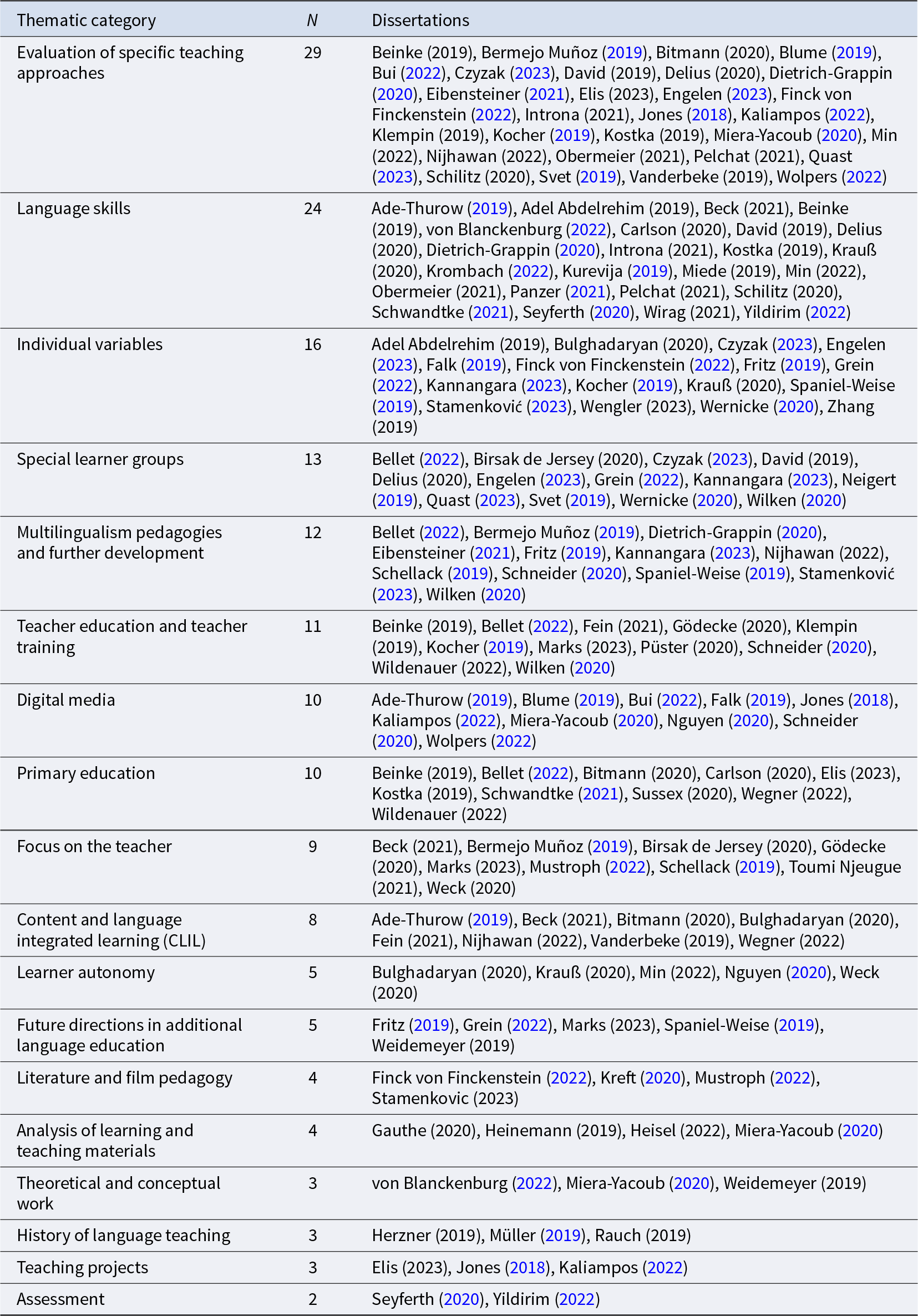
Table A1 Long description
The table categorizes dissertations into thematic areas, highlighting the number of dissertations and representative authors for each category. The evaluation of specific teaching approaches has the highest number of dissertations at 29, indicating a strong research interest in this area. Language skills follow with 24 dissertations, while individual variables and special learner groups have 16 and 13 dissertations, respectively. Categories like assessment, history of language teaching, and theoretical work have the fewest dissertations, suggesting less focus in these areas. The data suggests a trend towards practical and applied research in teaching methods and language skills, with less emphasis on theoretical and historical aspects.
Nicole Marx is Full Professor of German as a second language in the Department of German Language and Literature at the University of Cologne. Her research interests include multilingualism and plurilingualism pedagogy and majority language learning of heritage language speakers and of newly immigrated students.
Lena Heine is Full Professor of Academic Language Education and Multilingualism at Ruhr University Bochum. Her main research interests cover content and language integrated learning and teaching, linguistic norms, and language assessment.
Frauke Matz is Full Professor of English Language Education in the Department of English at the University of Münster. Her research interests include cultural and literary learning in foreign-language education, with a particular focus on digitality and children’s/human rights, as well as language learning aptitude.
Birgit Schädlich is Full Professor of Romance Language Education (French as a foreign language [FL]) in the Romance Language Department at the University of Göttingen. Her research interests include plurilingualism/pluriculturalism and intercultural learning, the work with literary texts in the FL classroom and FL teacher education.


 Open access

