





1. Introduction
1.1. The model and the main result
Hierarchical lattices were studied in the physics literature [Reference Berker and Ostlund5, Reference Derrida, De Seze and Itzykson7, Reference Griffiths and Kaufman13, Reference Tremblay and Southern24] as lattices tailored for real-space renormalization techniques to become exact; in the absence of disorder, they allow one to calculate exactly critical points and exponents, by analysing the neighbourhood of fixed points of some dynamical systems. In the disordered case, like in the problem of directed polymers or interfaces in a random medium [Reference Clark6, Reference Derrida and Griffiths8, Reference Giacomin, Lacoin and Toninelli11] as well as their simplified versions [Reference Derrida and Retaux9, Reference Hu, Mallein and Pain16], disordered spin models [Reference Pinho, Haddad and Salinas22], or percolation clusters [Reference Hambly and Kumagai15], the hierarchical structure allows one to formulate the problem as a recursion for a probability distribution. Despite this simple and elegant formulation, these recursions are often hard to analyse, especially near transition points. This is why most models with disorder on hierarchical lattices remain unsolved.
The series–parallel random graph, investigated by Hambly and Jordan [Reference Hambly and Jordan14], is an example of a hierarchical lattice with disorder. The original motivation was to view this graph as a random environment which can be studied as a dynamical system on probability measures; see the introduction in [Reference Hambly and Jordan14] for more details.
To define the series–parallel random graph, we fix a parameter $p\in [0, \, 1]$
, and consider two vertices denoted by
$p\in [0, \, 1]$
, and consider two vertices denoted by $\mathtt{a}$
and
$\mathtt{a}$
and $\mathtt{z}$
, respectively. The graph
$\mathtt{z}$
, respectively. The graph ${\mathtt{Graph}}_0(p)$
is simply composed of vertices
${\mathtt{Graph}}_0(p)$
is simply composed of vertices $\mathtt{a}$
and
$\mathtt{a}$
and $\mathtt{z}$
, as well as a (non-oriented) edge connecting
$\mathtt{z}$
, as well as a (non-oriented) edge connecting $\mathtt{a}$
and
$\mathtt{a}$
and $\mathtt{z}$
. We now define
$\mathtt{z}$
. We now define ${\mathtt{Graph}}_n(p)$
,
${\mathtt{Graph}}_n(p)$
, $n\in \mathbb N \;:\!=\; \{ 0, 1, 2, \ldots\}$
, recursively as follows:
$n\in \mathbb N \;:\!=\; \{ 0, 1, 2, \ldots\}$
, recursively as follows: ${\mathtt{Graph}}_{n+1}(p)$
is obtained by replacing independently each edge of
${\mathtt{Graph}}_{n+1}(p)$
is obtained by replacing independently each edge of ${\mathtt{Graph}}_n(p)$
, either by two edges in series with probability p, or by two parallel edges with probability
${\mathtt{Graph}}_n(p)$
, either by two edges in series with probability p, or by two parallel edges with probability $1 - p$
. See Figure 1.
$1 - p$
. See Figure 1.
At each step of the construction of the hierarchical lattice, each edge of the lattice is replaced by two edges in series with probability p or by two edges in parallel with probability $1 - p$
. The left shows graph
$1 - p$
. The left shows graph ${\mathtt{Graph}}_0(p)$
and the right shows the two possibilities for the graph
${\mathtt{Graph}}_0(p)$
and the right shows the two possibilities for the graph ${\mathtt{Graph}}_1(p)$
.
${\mathtt{Graph}}_1(p)$
.

The graph ${\mathtt{Graph}}_n(p)$
is called the series–parallel random graph of order n. See Figure 2 for an example.
${\mathtt{Graph}}_n(p)$
is called the series–parallel random graph of order n. See Figure 2 for an example.
An example of the first four graphs in the sequence $({\mathtt{Graph}}_n(p))_{n\geq 0}$
.
$({\mathtt{Graph}}_n(p))_{n\geq 0}$
.

Let $D_n(p)$
denote the graph distance between vertices
$D_n(p)$
denote the graph distance between vertices $\mathtt{a}$
and
$\mathtt{a}$
and $\mathtt{z}$
on
$\mathtt{z}$
on ${\mathtt{Graph}}_n(p)$
, i.e. the minimal number of edges necessary to connect
${\mathtt{Graph}}_n(p)$
, i.e. the minimal number of edges necessary to connect $\mathtt{a}$
and
$\mathtt{a}$
and $\mathtt{z}$
on
$\mathtt{z}$
on ${\mathtt{Graph}}_n(p)$
. Since
${\mathtt{Graph}}_n(p)$
. Since $n\mapsto D_n(p)$
is non-decreasing, we have
$n\mapsto D_n(p)$
is non-decreasing, we have $D_n(p) \uparrow D_\infty (p)\;:\!=\; \sup_{k\ge 1} D_k (p)$
(which may be infinite). It is known [Reference Hambly and Jordan14] that
$D_n(p) \uparrow D_\infty (p)\;:\!=\; \sup_{k\ge 1} D_k (p)$
(which may be infinite). It is known [Reference Hambly and Jordan14] that $D_\infty (p)<\infty$
almost surely (a.s.) for
$D_\infty (p)<\infty$
almost surely (a.s.) for $p\in [0, \, \frac12)$
, and
$p\in [0, \, \frac12)$
, and $D_\infty (p)=\infty$
a.s. for
$D_\infty (p)=\infty$
a.s. for $p\in [\frac12, \, 1]$
. As such, there is a phase transition for
$p\in [\frac12, \, 1]$
. As such, there is a phase transition for $D_n(p)$
at
$D_n(p)$
at $p= p_c \;:\!=\; \frac12$
. In this article we focus on the slightly supercritical case:
$p= p_c \;:\!=\; \frac12$
. In this article we focus on the slightly supercritical case: $p=p_c+\varepsilon$
when
$p=p_c+\varepsilon$
when $\varepsilon>0$
is sufficiently small.
$\varepsilon>0$
is sufficiently small.
Let us fix $p\in [0, \, 1]$
for the time being. There is a simple recursive formula for the law of
$p\in [0, \, 1]$
for the time being. There is a simple recursive formula for the law of $D_n(p)$
. In fact,
$D_n(p)$
. In fact, $D_0(p)=1$
; for
$D_0(p)=1$
; for $n\in \mathbb{N}$
, by considering the two edges of
$n\in \mathbb{N}$
, by considering the two edges of ${\mathtt{Graph}}_1(p)$
, we have
${\mathtt{Graph}}_1(p)$
, we have
 \begin{equation} D_{n+1}(p) \; {\buildrel \textrm{law} \over =} \; (D_n(p) + \widehat{D}_n(p)) \mathscr{E}_n + \min (D_n (p), \widehat{D}_n(p)) (1-\mathscr{E}_n), \end{equation}
where “ $\,{\buildrel \textrm{law} \over =}\,$
” denotes identity is distribution,
$\,{\buildrel \textrm{law} \over =}\,$
” denotes identity is distribution, $\widehat{D}_n(p)$
is an independent copy of
$\widehat{D}_n(p)$
is an independent copy of $D_n(p)$
,
$D_n(p)$
, $\mathscr{E}_n$
is a Bernoulli(p) random variable
$\mathscr{E}_n$
is a Bernoulli(p) random variable ${{\mathbb P}}(\mathscr{E}_n=1) = p = 1- {{\mathbb P}}(\mathscr{E}_n=0)$
, and
${{\mathbb P}}(\mathscr{E}_n=1) = p = 1- {{\mathbb P}}(\mathscr{E}_n=0)$
, and $D_n(p)$
,
$D_n(p)$
, $\widehat{D}_n(p)$
, and
$\widehat{D}_n(p)$
, and $\mathscr{E}_n$
are assumed to be independent. Equation (1.1) defines a random iterative system. There is an important literature on random iteration functions, see for example [Reference Goldstein12, Reference Jordan17, Reference Li and Rogers19, Reference Shneiberg23, Reference Wehr and Woo25]. Equation (1.1) is also an interesting addition to the list of recursive distributional equations analyzed in the seminal paper [Reference Aldous and Bandyopadhyay3].
$\mathscr{E}_n$
are assumed to be independent. Equation (1.1) defines a random iterative system. There is an important literature on random iteration functions, see for example [Reference Goldstein12, Reference Jordan17, Reference Li and Rogers19, Reference Shneiberg23, Reference Wehr and Woo25]. Equation (1.1) is also an interesting addition to the list of recursive distributional equations analyzed in the seminal paper [Reference Aldous and Bandyopadhyay3].
Let us briefly explain that the limit $\lim_{n\to \infty} \frac{1}{n} \log {{\mathbb{E}}} [D_n(p)]\;=\!:\;\alpha (p)$
exists. To this end, we fix
$\lim_{n\to \infty} \frac{1}{n} \log {{\mathbb{E}}} [D_n(p)]\;=\!:\;\alpha (p)$
exists. To this end, we fix $m,n\in \mathbb{N}$
. By definition, at step n, there exists a certain path
$m,n\in \mathbb{N}$
. By definition, at step n, there exists a certain path $\Gamma_n$
on
$\Gamma_n$
on ${\mathtt{Graph}}_n(p)$
of length
${\mathtt{Graph}}_n(p)$
of length $D_n(p)$
(i.e. number of edges) connecting vertices
$D_n(p)$
(i.e. number of edges) connecting vertices $\mathtt{a}$
and
$\mathtt{a}$
and $\mathtt{z}$
. After m additional steps, edges in
$\mathtt{z}$
. After m additional steps, edges in $\Gamma_n$
are transformed into independent copies of
$\Gamma_n$
are transformed into independent copies of ${\mathtt{Graph}}_m(p)$
. Accordingly,
${\mathtt{Graph}}_m(p)$
. Accordingly,
 $$D_{n+m} (p)\le \sum_{i=1}^{D_n} \Delta_i,$$
where, given $D_n(p)$
, the
$D_n(p)$
, the $\Delta_i$
are (conditionally) independent having the same law as
$\Delta_i$
are (conditionally) independent having the same law as $D_m(p)$
. Taking expectation, we get that
$D_m(p)$
. Taking expectation, we get that ${{\mathbb{E}}}[D_{n+m}(p)] \le {{\mathbb{E}}}[D_n(p)]\, {{\mathbb{E}}}[D_m(p)]$
. Since
${{\mathbb{E}}}[D_{n+m}(p)] \le {{\mathbb{E}}}[D_n(p)]\, {{\mathbb{E}}}[D_m(p)]$
. Since $D_n(p)\leq 2^n$
and by the Fekete lemma on subadditive sequences, we obtain that
$D_n(p)\leq 2^n$
and by the Fekete lemma on subadditive sequences, we obtain that
 \begin{equation} \alpha(p) \;:\!=\; \lim_{n\to \infty} \frac{1}{n}\log {{\mathbb{E}}} [D_n (p)] = \inf_{k\ge 1}\frac{1}{k}\log {{\mathbb{E}}} [D_k (p)] \in [0, \, \log 2], \end{equation}
exists. An easy coupling also implies that $p\mapsto \alpha(p)$
is non-decreasing on
$p\mapsto \alpha(p)$
is non-decreasing on $[0, \, 1]$
. The main result of the paper concerns the behaviour of the exponent
$[0, \, 1]$
. The main result of the paper concerns the behaviour of the exponent $\alpha(p_c + \varepsilon)$
, when
$\alpha(p_c + \varepsilon)$
, when $\varepsilon>0$
in the neighbourhood of 0. Let us mention here that the results stated in this article concern the law of the
$\varepsilon>0$
in the neighbourhood of 0. Let us mention here that the results stated in this article concern the law of the $D_n(p)$
only and that they hold true for any sequence of random variables satisfying the distributional equation (1.1).
$D_n(p)$
only and that they hold true for any sequence of random variables satisfying the distributional equation (1.1).
Theorem 1. Let $(D_n(p))_{n\in \mathbb N}$
satisfy (1.1) with
$(D_n(p))_{n\in \mathbb N}$
satisfy (1.1) with $D_0(p) = 1$
. Let
$D_0(p) = 1$
. Let $\alpha({\cdot})$
be as in (1.2). Then
$\alpha({\cdot})$
be as in (1.2). Then
 \begin{equation} \lim_{\varepsilon\to 0^+} \frac{\alpha\Big(\frac12 + \varepsilon\Big)}{\sqrt{\varepsilon}} = \frac{\pi}{\sqrt{6}}. \end{equation}
We have not been able to prove a convergence of $\frac{1}{n}\log D_n$
when
$\frac{1}{n}\log D_n$
when $p\in \left(\frac12, 1\right)$
, However, we prove the following theorem which provides a partial answer as
$p\in \left(\frac12, 1\right)$
, However, we prove the following theorem which provides a partial answer as $p\downarrow p_c = \frac12$
.
$p\downarrow p_c = \frac12$
.
Theorem 2. Let $(D_n(p))_{n\in \mathbb N}$
satisfy (1.1) with
$(D_n(p))_{n\in \mathbb N}$
satisfy (1.1) with $D_0(p) = 1$
. Then there exists a function
$D_0(p) = 1$
. Then there exists a function $\widetilde{\alpha}\,:\, [\frac{1}{2}, 1] \to [0, \log 2]$
such that
$\widetilde{\alpha}\,:\, [\frac{1}{2}, 1] \to [0, \log 2]$
such that $\lim_{{\varepsilon}\to 0^+} \widetilde{\alpha}(p_c + {\varepsilon}) / \sqrt{{\varepsilon}}= \pi / \sqrt{6}$
and
$\lim_{{\varepsilon}\to 0^+} \widetilde{\alpha}(p_c + {\varepsilon}) / \sqrt{{\varepsilon}}= \pi / \sqrt{6}$
and ${{\mathbb P}}$
-a.s.
${{\mathbb P}}$
-a.s.
 \begin{equation}\widetilde{\alpha}(p_c + {\varepsilon}) \leq \liminf_{n\to \infty} \frac{1}{n} \log D_n(p_c+ {\varepsilon}) \leq \limsup_{n\to \infty} \frac{1}{n} \log D_n(p_c+ {\varepsilon}) \leq \alpha(p_c + {\varepsilon}) .\end{equation}
Thus, ${{\mathbb P}}$
-a.s.
${{\mathbb P}}$
-a.s.
 \begin{equation}\lim_{{\varepsilon} \to 0^+} \frac{1}{\sqrt{{\varepsilon}}} \liminf_{n\to \infty} \frac{1}{n}\log D_n(p)= \lim_{{\varepsilon} \to 0^+} \frac{1}{\sqrt{{\varepsilon}}} \limsup_{n\to \infty}\frac{1}{n}\log D_n(p) = \frac{\pi}{\sqrt{6}}.\end{equation}
Proof. See Section 5.
1.2. Existing results and other problems
Considering ${\mathtt{Graph}}_n(p)$
as an electric network (as in [Reference Doyle and Snell10] or [Reference Lyons and Peres20]) and assigning a unit resistance to each edge, the effective resistance
${\mathtt{Graph}}_n(p)$
as an electric network (as in [Reference Doyle and Snell10] or [Reference Lyons and Peres20]) and assigning a unit resistance to each edge, the effective resistance $R_n(p)$
of
$R_n(p)$
of ${\mathtt{Graph}}_n(p)$
from
${\mathtt{Graph}}_n(p)$
from $\mathtt{a}$
to
$\mathtt{a}$
to $\mathtt{z}$
is such that
$\mathtt{z}$
is such that $R_0(p)=1$
and that for each
$R_0(p)=1$
and that for each $n\ge 0$
,
$n\ge 0$
,
 $${{\mathbb P}} ( R_{n+1} (p) = R_n (p)+ \widehat{R}_n(p)) = p = 1- {{\mathbb P}}\left(\frac{1}{R_{n+1}(p)} = \frac{1}{R_n(p)} + \frac{1}{\widehat{R}_n(p)}\right) ,$$
where $\widehat{R}_n(p)$
denotes an independent copy of
$\widehat{R}_n(p)$
denotes an independent copy of $R_n(p)$
. It is known [Reference Hambly and Jordan14] that
$R_n(p)$
. It is known [Reference Hambly and Jordan14] that ${{\mathbb{E}}} [R_n(p)] \to \infty$
for
${{\mathbb{E}}} [R_n(p)] \to \infty$
for $p>\frac12$
and
$p>\frac12$
and ${{\mathbb{E}}} [R_n(p)] \to 0$
for
${{\mathbb{E}}} [R_n(p)] \to 0$
for $p<\frac12$
. As such, the effective resistance has a phase transition at
$p<\frac12$
. As such, the effective resistance has a phase transition at $p=\frac12$
, as for the graph distance (Hambly and Jordan [Reference Hambly and Jordan14] proved that
$p=\frac12$
, as for the graph distance (Hambly and Jordan [Reference Hambly and Jordan14] proved that $p=\frac12$
is also critical for the Cheeger constant of
$p=\frac12$
is also critical for the Cheeger constant of ${\mathtt{Graph}}_n(p)$
, though we do not study the resistance nor the Cheeger constant in this article). On the other hand, it is a straightforward observation that at
${\mathtt{Graph}}_n(p)$
, though we do not study the resistance nor the Cheeger constant in this article). On the other hand, it is a straightforward observation that at $p=p_c$
,
$p=p_c$
, $R_n(p_c)$
has the same distribution as
$R_n(p_c)$
has the same distribution as $1/R_n(p_c)$
. Hambly and Jordan [Reference Hambly and Jordan14] predicted that for all
$1/R_n(p_c)$
. Hambly and Jordan [Reference Hambly and Jordan14] predicted that for all $y\ge x>0$
,
$y\ge x>0$
,
 \begin{equation} {{\mathbb P}} \big( R_n(p_c) \in [x, \, y] \big) \to 0, \quad n\to \infty . \end{equation}
Even though (1.6) looks quite plausible, no rigorous proof has been made available yet: it remains an open problem. Let us also mention that a more quantitative prediction has been made by Addario-Berry et al. [Reference Addario-Berry, Cairns, Devroye, Kerriou and Mitchell2] (see also [Reference Addario-Berry, Beckman and Lin1]): at $p= p_c$
,
$p= p_c$
, $\frac{|\log R_n(p_c)|}{c\, n^{1/3}}$
would converge weakly to a (shifted) beta distribution, with an appropriate but unknown constant
$\frac{|\log R_n(p_c)|}{c\, n^{1/3}}$
would converge weakly to a (shifted) beta distribution, with an appropriate but unknown constant $c\in (0, \, \infty)$
.
$c\in (0, \, \infty)$
.
For all $p\in [0, \, 1]$
, Hambly and Jordan [Reference Hambly and Jordan14] also conjectured the existence of a constant
$p\in [0, \, 1]$
, Hambly and Jordan [Reference Hambly and Jordan14] also conjectured the existence of a constant $\theta(p) \in \mathbb{R}$
such that
$\theta(p) \in \mathbb{R}$
such that $\frac{1}{n}\log R_n (p) \to \theta(p)$
in probability.
$\frac{1}{n}\log R_n (p) \to \theta(p)$
in probability.
Hambly and Jordan [Reference Hambly and Jordan14] also studied the first passage percolation problem on ${\mathtt{Graph}}_n(p)$
, which amounts to study the same recursion (1.1) as for the graph distance
${\mathtt{Graph}}_n(p)$
, which amounts to study the same recursion (1.1) as for the graph distance $D_n(p)$
, but with a more general initial distribution instead of
$D_n(p)$
, but with a more general initial distribution instead of $D_0(p)=1$
. As far as the distance
$D_0(p)=1$
. As far as the distance $D_n(p)$
is concerned, we mention that weak convergence for
$D_n(p)$
is concerned, we mention that weak convergence for $D_n(p)$
at criticality
$D_n(p)$
at criticality $p=p_c \;:\!=\;\frac12$
has been investigated by Auffinger and Cable [Reference Auffinger and Cable4]. Let us also mention that the hierarchical structure in
$p=p_c \;:\!=\;\frac12$
has been investigated by Auffinger and Cable [Reference Auffinger and Cable4]. Let us also mention that the hierarchical structure in ${\mathtt{Graph}}_n(p)$
turned out to be very convenient for study of the ‘ant problem’ for reinforcement [Reference Kious, Mailler and Schapira18].
${\mathtt{Graph}}_n(p)$
turned out to be very convenient for study of the ‘ant problem’ for reinforcement [Reference Kious, Mailler and Schapira18].
The rest of the article is structured as follows. In Section 2, we present some heuristics leading to Theorem 1, and give an outline of the proof. The lower and upper bounds in Theorem 1 are proved in Sections 3 and 4, respectively.
2. Heuristics and Description of the Approach
This aim of this short section is two-fold: the first part describes some heuristics about what led us to the conclusion in Theorem 1 and the second part provides an outline of the proof of Theorem 1.
2.1. Heuristics for Theorem 1
Let $p\in (0, \, 1)$
. Write
$p\in (0, \, 1)$
. Write
 $$a_n(k) \;:\!=\; {{\mathbb P}}(D_n =k), \quad n\ge 0, \ k\ge 1.$$
By (1.1), we get, for $k\ge 1$
,
$k\ge 1$
,
 \begin{equation} a_{n+1} (k)=p \sum_{1\leq i<k} a_n(i) a_n(k-i) + (1-p) \Bigg( 2a_n(k) \Bigg( 1-\sum_{1\leq i<k} a_n(i) \Bigg) - a_n(k)^2 \Bigg) . \end{equation}
Let $p=p_c+\varepsilon = \frac12 + \varepsilon$
and assume that for large n and for k such that
$p=p_c+\varepsilon = \frac12 + \varepsilon$
and assume that for large n and for k such that $\log k = \mathcal{O} (\sqrt{n})$
that
$\log k = \mathcal{O} (\sqrt{n})$
that $a_n(k)$
takes the following scaling form:
$a_n(k)$
takes the following scaling form:
 \begin{equation}a_n(k) = \frac{1}{k\sqrt{n}} f\bigg( n, \, \frac{\log k}{\sqrt{n}} \bigg),\end{equation}
with an appropriate bivariate function $(t, \, x) \mapsto f(t, \, x)$
. This scaling was already used by Auffinger and Cable [Reference Auffinger and Cable4] in the case
$(t, \, x) \mapsto f(t, \, x)$
. This scaling was already used by Auffinger and Cable [Reference Auffinger and Cable4] in the case $p=p_c$
. Using the fact that
$p=p_c$
. Using the fact that
 $$\frac{1}{i(k-i)}= \frac{1}{k} \left( \frac{1}{i} + \frac{1}{k-i}\right),$$
we show that (2.1) implies heuristically the following equation (the details of the derivation of (2.3) from (2.1) are given in Appendix A)
 \begin{equation} t \frac{\partial f}{\partial t} = \frac{x}{2} \frac{\partial f}{\partial x} + \frac{f}{2} - K f \frac{\partial f}{\partial x} + \varepsilon t \bigg( \! - 2f + 4f \int_0^x f(t, \, y) \, \textrm{d} y \bigg) , \end{equation}
where
 $$K \;:\!=\; \int_0^1 \frac{\log \left(\frac{1}{1-u}\right)}{u} \, \textrm{d} u = \frac{\pi^2}{6} .$$
For $\varepsilon=0$
one can solve (2.3) exactly for an arbitrary initial condition,
$\varepsilon=0$
one can solve (2.3) exactly for an arbitrary initial condition, $F_0(x) \equiv f(t_0,x)$
at time
$F_0(x) \equiv f(t_0,x)$
at time $t_0>0$
. It is in fact easy to write the solution in a parametric form at arbitrary time
$t_0>0$
. It is in fact easy to write the solution in a parametric form at arbitrary time $t \ge t_0$
:
$t \ge t_0$
:
 \begin{equation}f(t, \, x)= \sqrt{\frac{t}{t_0}} F_0 (y) ; \quad x= K \left( \sqrt{\frac{t}{t_0}} -\sqrt{\frac{t_0}{t}} \right) F_0(y) + y \sqrt{\frac{t_0}{t}} .\end{equation}
If one writes
 \begin{equation}\textrm{d} x = \Bigg[ K \Bigg(\sqrt{\frac{t}{t_0}} -\sqrt{\frac{t_0}{t}}\, \Bigg) F_0'(y) + \sqrt{\frac{t_0}{t}} \Bigg] \, \textrm{d} y ,\end{equation}
and if $F_0(y)$
vanishes at the boundaries, then one can see that
$F_0(y)$
vanishes at the boundaries, then one can see that
 \begin{equation}\int f(t,x) \, \textrm{d} x = \int F_0(y) \, \textrm{d} y ,\end{equation}
so that the normalization of $F_0$
is conserved. However, after a finite time
$F_0$
is conserved. However, after a finite time $t^*>t_0$
, given by the first time for which
$t^*>t_0$
, given by the first time for which ${\textrm{d} x}/{\textrm{d} y}$
as in (2.5) vanishes for some y i.e.
${\textrm{d} x}/{\textrm{d} y}$
as in (2.5) vanishes for some y i.e.
 $$t^*= t_0 \Bigg[ 1- \frac1K \max_y \frac{1}{F_0'(y)} \Bigg] ,$$
the solution F of (2.4) becomes multi-valued (see Figure 3 below). Then the solution is still given by (2.4) for some ranges of x with one of several shocks as on the right of Figure 3. In the example of Figure 3, if $f_a(t,x) > f_b(t,x) > f_c(t,x)$
are the three expressions of f(t, x) given by the parametric form (2.4) in the region
$f_a(t,x) > f_b(t,x) > f_c(t,x)$
are the three expressions of f(t, x) given by the parametric form (2.4) in the region $(x_1(t), \, x_2(t))$
where
$(x_1(t), \, x_2(t))$
where $f(t, \, x)$
is multi-valued, the true solution is
$f(t, \, x)$
is multi-valued, the true solution is
 $$ f(t,x) = \begin{cases}f_a(t,x) & \quad\text{for $x_1< x < x_*$,}\\[5pt] f_c(t,x) & \quad\text{for $x_* < x <x_2$,}\end{cases}$$
with $x_*(t)$
determined by
$x_*(t)$
determined by
 $$\int_{x_1(t)}^{x_*(t)}[ f_a(t,x)-f_b(t,x)] \, \textrm{d} x =\int_{x_*(t)}^{x_2(t)}[ f_b(t,x)-f_c(t,x)] \, \textrm{d} x .$$
With this choice of $x_*(t)$
the normalization (2.6) of f is preserved.
$x_*(t)$
the normalization (2.6) of f is preserved.
On the left, solution $F(t,\, x)$
using the parametric form (2.4) at times
$F(t,\, x)$
using the parametric form (2.4) at times $t_0$
,
$t_0$
, $3 t_0$
,
$3 t_0$
, $5 t_0$
, and
$5 t_0$
, and $7t_0$
for
$7t_0$
for $F_0(z)= z \, {\textrm{e}}^{-z}$
. The same with the shock on the right.
$F_0(z)= z \, {\textrm{e}}^{-z}$
. The same with the shock on the right.

In the long time limit, in that way from (2.4) one obtains that
 \begin{equation} f(t,x) = \begin{cases}\frac{x}{K} & \quad \text{for } 0 < x < x_*(\infty),\\[5pt] 0 & \quad \text{for } x \ge x_*(\infty),\end{cases} \quad \text{with} \ x_*(\infty) \;:\!=\; \sqrt{2 K}. \end{equation}
For $\varepsilon=0$
, this is in agreement with the description in [Reference Auffinger and Cable4].
$\varepsilon=0$
, this is in agreement with the description in [Reference Auffinger and Cable4].
For $\varepsilon \ne 0$
, we did not succeed in solving (2.3) for an arbitrary initial condition. However, if one starts at
$\varepsilon \ne 0$
, we did not succeed in solving (2.3) for an arbitrary initial condition. However, if one starts at $t=0$
with the
$t=0$
with the $\varepsilon=0$
solution (2.7), one can solve (2.3) explicitly:
$\varepsilon=0$
solution (2.7), one can solve (2.3) explicitly:
 \begin{equation} f(t, \, x) = \frac{1}{{\textrm{e}}^{2\varepsilon t}-1} \sqrt{\frac{\varepsilon t}{K}} \sinh \Bigg( 2x \sqrt{\frac{\varepsilon t}{K}} \, \Bigg) . \end{equation}
Since $\sum_{k=1}^\infty a_n(k)=1$
for all n, the function
$\sum_{k=1}^\infty a_n(k)=1$
for all n, the function $x\mapsto f(t, \, x)$
is a probability density function for all t. By analogy with the case
$x\mapsto f(t, \, x)$
is a probability density function for all t. By analogy with the case $\varepsilon=0$
, we assume that (2.8) is valid only for
$\varepsilon=0$
, we assume that (2.8) is valid only for $x\in [0, \, x_*(t)]$
, where
$x\in [0, \, x_*(t)]$
, where $x_*(t)$
is such that
$x_*(t)$
is such that
 $$\int_0^{x_*(t)} \frac{1}{{\textrm{e}}^{2\varepsilon t}-1} \sqrt{\frac{\varepsilon t}{K}} \sinh \Bigg( 2x \sqrt{\frac{\varepsilon t}{K}} \, \Bigg) \, \textrm{d} x = 1$$
and we take $f(t, \, x) =0$
for
$f(t, \, x) =0$
for $x> x_*(t)$
. When
$x> x_*(t)$
. When $t\to \infty$
, we have
$t\to \infty$
, we have
 $$x_*(t) \approx \sqrt{K \varepsilon t} .$$
This implies that for $n\to \infty$
,
$n\to \infty$
,
 $$\log {{\mathbb{E}}} [D_n (p_c+ {\varepsilon})]\approx\sqrt{K \varepsilon} n.$$
Consequently,
 $$\alpha(p_c+\varepsilon)\;:\!=\;\lim_{n\to \infty} \frac{1}{n} \log {{\mathbb{E}}} [D_n (p_c+\varepsilon)]\approx\sqrt{K \varepsilon} ,\quad\varepsilon\to 0^+ ,$$
which leads to the statement of Theorem 1.
2.2. Outline of the proof of Theorem 1
It does not seem obvious how to turn the heuristics described in Section 2.1 directly into a rigorous argument. Our proof goes along different lines, even though the ideas are guided by the heuristics.
To prove Theorem 1, we study the following dynamical system on the set $\mathcal{M}_1$
of all probability measures on
$\mathcal{M}_1$
of all probability measures on $\mathbb{R}_+^* \;:\!=\; (0, \, \infty)$
: we use the notation
$\mathbb{R}_+^* \;:\!=\; (0, \, \infty)$
: we use the notation $a\wedge b \;:\!=\; \min\{ a, \, b\}$
. Let
$a\wedge b \;:\!=\; \min\{ a, \, b\}$
. Let $p\in [0, \, 1]$
; for all
$p\in [0, \, 1]$
; for all $\mu \in \mathcal{M}_1$
, we define the probability measure
$\mu \in \mathcal{M}_1$
, we define the probability measure $\Psi_{ p}(\mu)$
as follows:
$\Psi_{ p}(\mu)$
as follows:
 \begin{equation}\Psi_{ p}(\mu)\ \textrm{is the law of} \ (X + \widehat{X}) \mathscr{E} + (X \wedge \widehat{X})(1 - \mathscr{E}) , \end{equation}
where X, $\widehat{X}$
, and
$\widehat{X}$
, and $\mathscr E$
are independent, X and
$\mathscr E$
are independent, X and $\widehat{X}$
have law
$\widehat{X}$
have law $\mu$
, and
$\mu$
, and $\mathscr E$
is a Bernoulli random variable with parameter p (all the random variables mentioned in this article are defined on the same probability space
$\mathscr E$
is a Bernoulli random variable with parameter p (all the random variables mentioned in this article are defined on the same probability space $(\Omega, \mathscr F, {{\mathbb P}})$
that is assumed to be sufficiently rich to carry as many independent random variables as needed). We observe that if
$(\Omega, \mathscr F, {{\mathbb P}})$
that is assumed to be sufficiently rich to carry as many independent random variables as needed). We observe that if $\mu_n$
stands for the law of
$\mu_n$
stands for the law of $D_n(p)$
, then
$D_n(p)$
, then $\mu_{n+1} = \Psi_{ p} (\mu_n) $
and
$\mu_{n+1} = \Psi_{ p} (\mu_n) $
and $\mu_0= \delta_1$
.
$\mu_0= \delta_1$
.
Let us briefly mention two basic properties of $\Psi_{ p}$
. First,
$\Psi_{ p}$
. First, $\Psi_{ p}$
is homogeneous; namely,
$\Psi_{ p}$
is homogeneous; namely,
 \begin{equation}\mbox{for all }\theta \in \mathbb{R}_+^*,\ \mbox{for all }\mu \in \mathcal{M}_1, \quad \Psi_{ p}(M_\theta (\mu))= M_\theta (\Psi_{ p} (\mu)), \end{equation}
where, for all $\theta\in \mathbb{R}_+^*$
and for any random variable X with law
$\theta\in \mathbb{R}_+^*$
and for any random variable X with law $\mu \in \mathcal{M}_1$
,
$\mu \in \mathcal{M}_1$
, $M_\theta (\mu)$
denotes the law of
$M_\theta (\mu)$
denotes the law of $\theta X$
.
$\theta X$
.
We next observe that $\Psi_{ p}$
preserves the stochastic order
$\Psi_{ p}$
preserves the stochastic order ${\buildrel {\textrm st} \over \le} $
on
${\buildrel {\textrm st} \over \le} $
on $\mathcal{M}_1$
that is defined as follows:
$\mathcal{M}_1$
that is defined as follows: $\mu {\buildrel {\textrm st} \over \le} \nu$
if
$\mu {\buildrel {\textrm st} \over \le} \nu$
if $\mu ((x, \infty)) \leq \nu ((x, \infty))$
for all
$\mu ((x, \infty)) \leq \nu ((x, \infty))$
for all $x\in \mathbb{R}_+^*$
(which is equivalent to the existence of two random variables X and Y whose laws are respectively
$x\in \mathbb{R}_+^*$
(which is equivalent to the existence of two random variables X and Y whose laws are respectively $\mu$
and
$\mu$
and $\nu$
and such that
$\nu$
and such that $X \leq Y$
,
$X \leq Y$
, ${{\mathbb P}}$
-a.s.). Indeed, for all
${{\mathbb P}}$
-a.s.). Indeed, for all $\mu, \nu \in \mathcal{M}_1$
,
$\mu, \nu \in \mathcal{M}_1$
,
 \begin{equation}\big( \mu \; {\buildrel {\textrm st} \over \le} \; \nu \big) \Longrightarrow \big( \Psi_{ p} (\mu)\; {\buildrel {\textrm st} \over \le}\; \Psi_{ p} (\nu) \big) . \end{equation}
In the rest of the article, it will sometimes be convenient to abuse slightly the notation by writing $X{\buildrel {\textrm st} \over \le}Y$
for any pair of random variables X and Y to mean that the law of X is stochastically less than that of Y.
$X{\buildrel {\textrm st} \over \le}Y$
for any pair of random variables X and Y to mean that the law of X is stochastically less than that of Y.
2.2.1. Strategy for the lower bound in Theorem 1
We fix $p=\frac12+\varepsilon$
and denote by
$p=\frac12+\varepsilon$
and denote by $\mu_n$
the law of
$\mu_n$
the law of $D_n(p)$
as defined in (1.1). As already mentioned,
$D_n(p)$
as defined in (1.1). As already mentioned, $\mu_{n+1}= \Psi_{ p} (\mu_n)$
for all integers
$\mu_{n+1}= \Psi_{ p} (\mu_n)$
for all integers $n\geq 0$
and
$n\geq 0$
and $\mu_0 = \delta_1$
. Let
$\mu_0 = \delta_1$
. Let $\theta$
,
$\theta$
, $\beta \in \mathbb{R}_+^*$
, and
$\beta \in \mathbb{R}_+^*$
, and $n_0\in \mathbb N^*$
. Suppose that we are able to find an
$n_0\in \mathbb N^*$
. Suppose that we are able to find an $\mathcal{M}_1$
-valued sequence
$\mathcal{M}_1$
-valued sequence $(\nu_n)_{n\geq n_0}$
such that for
$(\nu_n)_{n\geq n_0}$
such that for $n\ge n_0$
,
$n\ge n_0$
,
 \begin{equation}M_\theta (\nu_{n_0})\, {\buildrel {\textrm st} \over \le} \, \mu_{n_0} \quad \textrm{and} \quad M_\beta (\nu_{n+1})\, {\buildrel {\textrm st} \over \le} \, \Psi_{ p}(\nu_{n} ) .\end{equation}
We call the $\nu_n$
the lower bound laws. For all integers
$\nu_n$
the lower bound laws. For all integers $n\geq n_0$
, let
$n\geq n_0$
, let $Y_n$
and
$Y_n$
and $U_n$
be random variables with respective laws
$U_n$
be random variables with respective laws $\nu_n$
and
$\nu_n$
and $\Psi_{ p}(\nu_{n} )$
. Then (2.12) can be rewritten as
$\Psi_{ p}(\nu_{n} )$
. Then (2.12) can be rewritten as $\theta Y_{n_0} {\buildrel {\textrm st} \over \le} D_{n_0}(p)$
and
$\theta Y_{n_0} {\buildrel {\textrm st} \over \le} D_{n_0}(p)$
and $\beta Y_{n+1} {\buildrel {\textrm st} \over \le}U_n$
. By (2.10) and (2.11), for all
$\beta Y_{n+1} {\buildrel {\textrm st} \over \le}U_n$
. By (2.10) and (2.11), for all $n\ge n_0$
,
$n\ge n_0$
,
 $$M_{\theta \beta^{n-n_0}} (\nu_{n}) \, {\buildrel {\textrm st} \over \le} \, \mu_n ;$$
in other words, $\theta \beta^{n-n_0} Y_{n} \, {\buildrel {\textrm st} \over \le} \, D_n(p)$
, which, in turn, implies that
$\theta \beta^{n-n_0} Y_{n} \, {\buildrel {\textrm st} \over \le} \, D_n(p)$
, which, in turn, implies that
 \begin{equation} {{\mathbb{E}}} [D_n (p)] \ge \theta \beta^{n-n_0} {{\mathbb{E}}}[Y_n] ,\quad n\ge n_0. \end{equation}
Here, $\beta$
and
$\beta$
and ${{\mathbb{E}}} [Y_n]$
turn out to be sufficiently explicit in terms of n and
${{\mathbb{E}}} [Y_n]$
turn out to be sufficiently explicit in terms of n and $\varepsilon$
to provide a good lower bound for
$\varepsilon$
to provide a good lower bound for ${{\mathbb{E}}} [D_n(p)]$
and, thus, for
${{\mathbb{E}}} [D_n(p)]$
and, thus, for $\alpha(\tfrac12 + \varepsilon) \;:\!=\; \lim_{n\to \infty} \tfrac1n \log {{\mathbb{E}}} [D_n(p)]$
. To find appropriate lower bound laws
$\alpha(\tfrac12 + \varepsilon) \;:\!=\; \lim_{n\to \infty} \tfrac1n \log {{\mathbb{E}}} [D_n(p)]$
. To find appropriate lower bound laws $\nu_n$
(i.e. laws such that (2.12) holds), we are guided by the heuristics described in Section 2.1.
$\nu_n$
(i.e. laws such that (2.12) holds), we are guided by the heuristics described in Section 2.1.
Remark 1. In the proof of the lower bound in Theorem 1 in Section 3, we need to fix several parameters in (the law of) the random variable $Y_n$
introduced in the strategy in the previous paragraph. Even though we are guided by the heuristics in Section 2.1, the choice of these parameters is not obvious, and is in fact rather delicate, resulting from a painful procedure of adjustment. A similar remark applies to the proof of the upper bound in Theorem 1.
$Y_n$
introduced in the strategy in the previous paragraph. Even though we are guided by the heuristics in Section 2.1, the choice of these parameters is not obvious, and is in fact rather delicate, resulting from a painful procedure of adjustment. A similar remark applies to the proof of the upper bound in Theorem 1.
2.2.2. Strategy for the upper bound in Theorem 1
The strategy is identical, except that the values of the parameters $n_0$
,
$n_0$
, $\beta$
and
$\beta$
and $\theta$
, are different: suppose we are able to find an
$\theta$
, are different: suppose we are able to find an $\mathcal{M}_1$
-valued sequence
$\mathcal{M}_1$
-valued sequence $(\nu^\prime_n)_{n\geq n_0}$
such that for
$(\nu^\prime_n)_{n\geq n_0}$
such that for $n\ge n_0$
,
$n\ge n_0$
,
 \begin{equation}\mu_{n_0} \, {\buildrel {\textrm st} \over \le} \, M_\theta (\nu'_{n_0}) \quad \textrm{and} \quad \Psi_{ p}(\nu^\prime_{n} ) \, {\buildrel {\textrm st} \over \le} \, M_\beta (\nu^\prime_{n+1}) ;\end{equation}
we call $\nu'_n$
the upper bound laws. For all integer
$\nu'_n$
the upper bound laws. For all integer $n\geq n_0$
, let
$n\geq n_0$
, let $Z_n$
and
$Z_n$
and $V_n$
be random variables with respective laws
$V_n$
be random variables with respective laws $\nu^\prime_n$
and
$\nu^\prime_n$
and $\Psi_{ p}(\nu^\prime_{n} )$
. By (2.10) and (2.11), for all
$\Psi_{ p}(\nu^\prime_{n} )$
. By (2.10) and (2.11), for all $n\ge n_0$
,
$n\ge n_0$
,
 \begin{equation} \mu_n \, {\buildrel {\textrm st} \over \le} \, M_{\theta \beta^{n-n_0}} (\nu^\prime_{n}) ;\end{equation}
i.e. $D_n (p) \, {\buildrel {\textrm st} \over \le} \, \theta \beta^{n-n_0} Z_{n}$
, which, in turn, implies that
$D_n (p) \, {\buildrel {\textrm st} \over \le} \, \theta \beta^{n-n_0} Z_{n}$
, which, in turn, implies that
 $${{\mathbb{E}}} [D_n(p)] \le \theta \beta^{n-n_0} {{\mathbb{E}}}[Z_n] .$$
As in the lower bound, $\beta$
and
$\beta$
and ${{\mathbb{E}}} [Z_n]$
will be sufficiently explicit in terms of n and
${{\mathbb{E}}} [Z_n]$
will be sufficiently explicit in terms of n and $\varepsilon$
to provide an upper bound for
$\varepsilon$
to provide an upper bound for ${{\mathbb{E}}} [D_n(p)]$
and, thus, for
${{\mathbb{E}}} [D_n(p)]$
and, thus, for $\alpha(\frac12 + \varepsilon)$
. To find appropriate upper bound laws
$\alpha(\frac12 + \varepsilon)$
. To find appropriate upper bound laws $\nu^\prime_n$
(i.e. laws such that (2.14) holds), again we follow the heuristics described in Section 2.1.
$\nu^\prime_n$
(i.e. laws such that (2.14) holds), again we follow the heuristics described in Section 2.1.
3. Proof of Theorem 1: The Lower Bound
3.1 Definition of the lower bound laws
In this section we construct lower bound laws, i.e. an $\mathcal{M}_1$
-valued sequence
$\mathcal{M}_1$
-valued sequence $(\nu_n)_{n\geq 1}$
satisfying (2.12).
$(\nu_n)_{n\geq 1}$
satisfying (2.12).
First note that the polynomial function $P(\eta) = (1 - \eta)(1+\eta)^2$
is such that
$P(\eta) = (1 - \eta)(1+\eta)^2$
is such that $P(0) = 1$
and that
$P(0) = 1$
and that $P^\prime (0) = 1>0$
. Thus, there exists
$P^\prime (0) = 1>0$
. Thus, there exists $\eta_0\in (0, 1)$
such that
$\eta_0\in (0, 1)$
such that
 \begin{equation} \forall \eta\in (0, \eta_0), \quad (1-\eta)(1+\eta)^2 > 1, \quad \widetilde{\eta} \;:\!=\; \frac{12(1+\eta)^2 \eta}{\pi^2} <1. \end{equation}
We recall that
 $$\zeta(2) = \sum_{n\geq 1} \frac{1}{n^2} = \frac{\pi^2}{6}.$$
Let $\varepsilon\in (0, \, \tfrac12)$
. We set, for
$\varepsilon\in (0, \, \tfrac12)$
. We set, for $n\in \mathbb N$
,
$n\in \mathbb N$
,
 \begin{equation} \delta = \frac{2}{\sqrt{\zeta(2)}} (1+ \eta) \sqrt{\varepsilon} \quad \textrm{and} \quad a_n = \frac14\big( 1 - 2\varepsilon + \eta \delta^2\big)^n= \frac14\big( 1 - 2( 1 - \widetilde{\eta})\varepsilon\big)^n.\end{equation}
The following increasing function $\varphi_\delta\,: \, [1, \, \infty) \to \mathbb{R}_+$
plays a key role in the rest of the paper:
$\varphi_\delta\,: \, [1, \, \infty) \to \mathbb{R}_+$
plays a key role in the rest of the paper:
 \begin{equation} \varphi_\delta(x) \;:\!=\; \cosh(\delta \log x) - 1= \frac{1}{2} \big( x^{\delta}+ x^{-\delta}\big) -1, \quad x\in [1, \infty) . \end{equation}
In the following lemma, we introduce the laws $\nu_n$
and provide basic properties of these laws. They are shown to satisfy (2.12) in Lemma 2, the proof of which is the main technical step of the proof of the lower bound in Theorem 1. Let us mention that the notation
$\nu_n$
and provide basic properties of these laws. They are shown to satisfy (2.12) in Lemma 2, the proof of which is the main technical step of the proof of the lower bound in Theorem 1. Let us mention that the notation $\mathcal O_{ \eta, \varepsilon} (a_n)$
denotes an expression which, for fixed
$\mathcal O_{ \eta, \varepsilon} (a_n)$
denotes an expression which, for fixed $(\eta, \, \varepsilon)$
is
$(\eta, \, \varepsilon)$
is $\mathcal O (a_n)$
. The remark also applies to forthcoming expressions such as
$\mathcal O (a_n)$
. The remark also applies to forthcoming expressions such as $\mathcal O_{ \eta} ({\cdot})$
or
$\mathcal O_{ \eta} ({\cdot})$
or $\mathcal O_{ \delta} ({\cdot})$
.
$\mathcal O_{ \delta} ({\cdot})$
.
Lemma 1. Let $\eta\in (0, \, \eta_0)$
and let
$\eta\in (0, \, \eta_0)$
and let $\varepsilon\in \left(0, \, \frac12\right)$
. Let
$\varepsilon\in \left(0, \, \frac12\right)$
. Let $\delta$
and
$\delta$
and $(a_n)_{n\in \mathbb N}$
be defined in (3.2). Recall the function
$(a_n)_{n\in \mathbb N}$
be defined in (3.2). Recall the function $\varphi_\delta$
from (3.3). For all
$\varphi_\delta$
from (3.3). For all $n\in \mathbb N$
, let
$n\in \mathbb N$
, let $\lambda_n \in (1, \, \infty)$
be the unique real number such that
$\lambda_n \in (1, \, \infty)$
be the unique real number such that $2a_n \varphi_{\delta} (\lambda_n)= 1$
and let
$2a_n \varphi_{\delta} (\lambda_n)= 1$
and let $\nu_n = \nu_n(\eta, \, \varepsilon)$
be the unique element of
$\nu_n = \nu_n(\eta, \, \varepsilon)$
be the unique element of $\mathcal{M}_1$
such that
$\mathcal{M}_1$
such that
 \begin{equation} \nu_n ((0, 1])= 0 \quad \textrm{and} \quad \nu_n ((0, x])= 2a_n \varphi_\delta (x \wedge \lambda_n) , \quad x\in [1, \infty) .\end{equation}
Then the following hold.
-
(i) We have $\lambda_n = a_n^{-1/\delta} \big(1+ \mathcal O_{ \eta, \varepsilon} (a_n) \big)$
as
$n\to \infty$
.
$\lambda_n = a_n^{-1/\delta} \big(1+ \mathcal O_{ \eta, \varepsilon} (a_n) \big)$
as
$n\to \infty$
. -
(ii) We have
$\lim_{n\rightarrow \infty} 2a_n \varphi_{\delta} (\eta^{1/\delta} \lambda_n) = \eta$
. -
(iii) There exists
$\epsilon_1(\eta)\in \left(0, \, \frac12\right)$
such that for all
$\varepsilon \in (0, \epsilon_1(\eta))$
there is
$n_1 (\eta, \varepsilon)\in \mathbb N$
satisfying
$\lambda_{n+1} - \lambda_n + 1 \leq \delta \lambda_n$
for all
$n\geq n_1(\eta, \varepsilon)$
. -
(iv) Let
$Y_n$
be a random variable with law
$\nu_n$
. Then (3.5)
\begin{equation} {{\mathbb{E}}} [Y_n]= \delta a_n \left(\frac{\lambda_n^{1+\delta}-1}{1+\delta}-\frac{\lambda_n^{1-\delta}-1}{1-\delta} \right) .\end{equation}


Furthermore,
 \begin{equation}\frac{1}{\sqrt{\varepsilon} }\lim_{n\to \infty} \frac{1}{n} \log {{\mathbb{E}}} [Y_n] = \frac{-\log (1 - 2(1 - \widetilde{\eta}) \varepsilon)}{\delta\sqrt{\varepsilon}} \; \underset{\varepsilon \to 0^+}{-\!\!\! -\!\!\! -\!\!\!\longrightarrow} \; \sqrt{\zeta(2)\, } \, \frac{1 - \widetilde{\eta}}{1 + \eta}\; \underset{\eta \to 0^+}{-\!\!\! -\!\!\! -\!\!\!\longrightarrow} \; \sqrt{\zeta(2)} .\end{equation}
Proof. Recall that the inverse on $\mathbb{R}_+$
of
$\mathbb{R}_+$
of $\cosh$
is the function
$\cosh$
is the function $\textrm{arcosh} (y)= \log (y+ \sqrt{y^2 - 1} )$
,
$\textrm{arcosh} (y)= \log (y+ \sqrt{y^2 - 1} )$
, $y\in [1, \infty)$
and that
$y\in [1, \infty)$
and that $\textrm{arcosh} (\frac{y}{2})= \log y -y^{-2} + \mathcal O (y^{-4})$
as
$\textrm{arcosh} (\frac{y}{2})= \log y -y^{-2} + \mathcal O (y^{-4})$
as $y\to \infty$
. Thus, we get
$y\to \infty$
. Thus, we get
 \begin{align*} \delta \log \lambda_n &= \textrm{arcosh} \bigg( 1 + \frac{1}{2a_n}\bigg)= \log \bigg(\frac{1+2a_n}{a_n} \bigg) -\frac{a^2_n}{(1+2a_n)^2} + \mathcal O \bigg( \frac{a^4_n}{(1+2a_n)^4}\bigg)\\[5pt]&= \log \frac{1}{a_n} + \mathcal O_{ \eta, \varepsilon} (a_n) ,\end{align*}
which immediately implies (i). Since $\varphi_{\delta} (x) \sim_{x\to \infty} \frac{1}{2} x^{\delta}$
, we get
$\varphi_{\delta} (x) \sim_{x\to \infty} \frac{1}{2} x^{\delta}$
, we get $2a_n \varphi_{\delta} (\eta^{1/\delta} \lambda_n) \sim_{n\to \infty} \eta a_n \lambda_n^{\delta} $
which tends to
$2a_n \varphi_{\delta} (\eta^{1/\delta} \lambda_n) \sim_{n\to \infty} \eta a_n \lambda_n^{\delta} $
which tends to $\eta$
as
$\eta$
as $n\to \infty$
. This proves (ii).
$n\to \infty$
. This proves (ii).
Let us prove (iii). Recall here that $\eta\in (0, \eta_0)$
is fixed. To simply notation, we set
$\eta\in (0, \eta_0)$
is fixed. To simply notation, we set $\rho \,:\!=\, (1 - 2(1 - \widetilde{\eta}) \varepsilon)^{-1} > 1$
, so that
$\rho \,:\!=\, (1 - 2(1 - \widetilde{\eta}) \varepsilon)^{-1} > 1$
, so that $a_n = \frac{1}{4}\rho^{-n}$
. It follows from (i) that
$a_n = \frac{1}{4}\rho^{-n}$
. It follows from (i) that
 \begin{equation} \lambda_{n+1} - \lambda_n = (\rho^{1/ \delta} - 1) \lambda_n (1+ \mathcal O_{ \eta, \varepsilon} (a_n)) , \quad n\to \infty . \end{equation}
We also set $c = 2\zeta(2)^{-1/2}$
; thus,
$c = 2\zeta(2)^{-1/2}$
; thus, $\delta = c (1+ \eta) \sqrt{\varepsilon}$
. We observe that
$\delta = c (1+ \eta) \sqrt{\varepsilon}$
. We observe that
 \begin{equation}\frac{\log \rho}{\delta} = \frac{2(1 - \widetilde{\eta}) \varepsilon + \mathcal O_{ \eta} (\varepsilon^2)}{c (1+ \eta) \sqrt{\varepsilon}} =\frac{2(1 - \widetilde{\eta})}{c^2 (1+ \eta)^2 } \delta + \mathcal O_{ \eta} (\varepsilon^{3/2}) ,\quad\varepsilon \to 0^+.\end{equation}
Therefore,
 $$ \lim_{\varepsilon \to 0^+} \delta^{-1} ( \rho^{1/\delta} - 1 ) = \frac{2(1 - \widetilde{\eta})}{c^2 (1+ \eta)^2 } < \frac{2}{c^{2}}= \frac{\pi^2}{12} < 1$$
and there exists $\epsilon_1(\eta) \in (0, 1/2)$
such that for all
$\epsilon_1(\eta) \in (0, 1/2)$
such that for all $\varepsilon \in (0, \epsilon_1(\eta) (\eta))$
,
$\varepsilon \in (0, \epsilon_1(\eta) (\eta))$
, $\rho^{1/\delta} - 1 < \delta $
, which, combined with (3.7), yields (iii).
$\rho^{1/\delta} - 1 < \delta $
, which, combined with (3.7), yields (iii).
Let us prove (iv). Observe that
 \begin{eqnarray*}{{\mathbb{E}}} [Y_n] &\,=\,& \int_1^{\lambda_n} 2a_n \varphi^\prime_{\delta} (x) x\, \textrm{d} x= 2a_n \delta \int_1^{\lambda_n} \sinh (\delta \log x) \, \textrm{d} x \\[5pt] &\,=\,& 2a_n \delta \int_0^{\log \lambda_n } \sinh (\delta u) {\textrm{e}}^u \, \textrm{d} u = a_n \delta \int_0^{\log \lambda_n } \big( {\textrm{e}}^{u (1+ \delta) } - {\textrm{e}}^{u(1-\delta)} \big)\, \textrm{d} u ,\end{eqnarray*}
which implies (3.5). By (i), we thus get ${{\mathbb{E}}} [Y_n] \sim_{n\to \infty} (\delta/1+ \delta) a_n^{-1/\delta}$
. Since
${{\mathbb{E}}} [Y_n] \sim_{n\to \infty} (\delta/1+ \delta) a_n^{-1/\delta}$
. Since $a_n = \frac{1}{4}\rho^{-n}$
with
$a_n = \frac{1}{4}\rho^{-n}$
with $\rho = (1 - 2(1 - \widetilde{\eta}) \varepsilon)^{-1}$
, this implies that
$\rho = (1 - 2(1 - \widetilde{\eta}) \varepsilon)^{-1}$
, this implies that $\lim_{n\to \infty} n^{-1}\log {{\mathbb{E}}} [Y_n] = \delta^{-1}\log \rho$
, which readily yields (3.6) by means of (3.8).
$\lim_{n\to \infty} n^{-1}\log {{\mathbb{E}}} [Y_n] = \delta^{-1}\log \rho$
, which readily yields (3.6) by means of (3.8).
The following lemma asserts that the laws $\nu_n$
defined in Lemma 1 satisfy the right-hand side of (2.12) with
$\nu_n$
defined in Lemma 1 satisfy the right-hand side of (2.12) with $\beta= 1$
.
$\beta= 1$
.
Lemma 2. Let $\eta\in (0, \, \eta_0)$
and let
$\eta\in (0, \, \eta_0)$
and let $\varepsilon\in (0, \, \frac12)$
. Let
$\varepsilon\in (0, \, \frac12)$
. Let $\delta$
and
$\delta$
and $(a_n)_{n\in \mathbb N}$
be as in (3.2) and let
$(a_n)_{n\in \mathbb N}$
be as in (3.2) and let $\nu_n$
be defined by (3.4). For all
$\nu_n$
be defined by (3.4). For all $n\in \mathbb N$
, we denote by
$n\in \mathbb N$
, we denote by $Y_n$
and
$Y_n$
and $\widehat{Y}_n$
two independent random variables with common law
$\widehat{Y}_n$
two independent random variables with common law $\nu_n$
. Then there exists
$\nu_n$
. Then there exists $\varepsilon_{2}(\eta) \in (0, \, \frac12)$
such that for all
$\varepsilon_{2}(\eta) \in (0, \, \frac12)$
such that for all $\varepsilon\in (0, \, \varepsilon_{2}(\eta))$
, there is
$\varepsilon\in (0, \, \varepsilon_{2}(\eta))$
, there is $n_{2}(\eta, \, \varepsilon) \in \mathbb N$
such that for all integers
$n_{2}(\eta, \, \varepsilon) \in \mathbb N$
such that for all integers $n\geq n_{2} (\eta, \, \varepsilon)$
and all
$n\geq n_{2} (\eta, \, \varepsilon)$
and all $y\in \mathbb{R}_+^*$
,
$y\in \mathbb{R}_+^*$
,
 \begin{equation} \bigg(\frac{1}{2} + \varepsilon \bigg) \, {{\mathbb P}} \bigg(Y_n + \widehat{Y}_n > y \bigg) + \bigg(\frac{1}{2} - \varepsilon \bigg) \, {{\mathbb P}} \bigg(Y_n > y\bigg)^2 - 1+ {{\mathbb P}} \bigg(Y_{n+1} \le y \bigg) \ge 0. \end{equation}
Proof of the lower bound in Theorem 1. Let us admit Lemma 2 for the time being and prove that it implies the lower bound in Theorem 1.
Recall that $p = \frac12 + \varepsilon$
, so (3.9) implies for all
$p = \frac12 + \varepsilon$
, so (3.9) implies for all $n\geq n_{2} (\eta, \varepsilon)$
that
$n\geq n_{2} (\eta, \varepsilon)$
that $\nu_{n+1} ((y, \infty)) \leq \Psi_{ p} (\nu_n) ((y, \infty))$
for all
$\nu_{n+1} ((y, \infty)) \leq \Psi_{ p} (\nu_n) ((y, \infty))$
for all $y\in \mathbb{R}_+^*$
, i.e.
$y\in \mathbb{R}_+^*$
, i.e. $\nu_{n+1} {\buildrel {\textrm st} \over \le} \Psi_{ p}(\nu_{n} ) $
. On the other hand, we note that a.s.
$\nu_{n+1} {\buildrel {\textrm st} \over \le} \Psi_{ p}(\nu_{n} ) $
. On the other hand, we note that a.s. $Y_{n_2(\eta, \varepsilon)} \leq \lambda_{n_{2}(\eta, \varepsilon)}$
and
$Y_{n_2(\eta, \varepsilon)} \leq \lambda_{n_{2}(\eta, \varepsilon)}$
and $1\leq D_{n_{2}(\eta, \varepsilon)} (p)$
. Thus, a.s.
$1\leq D_{n_{2}(\eta, \varepsilon)} (p)$
. Thus, a.s. $Y_{n_{2}(\eta, \varepsilon)}/\lambda_{n_{2}(\eta, \varepsilon)} \leq D_{n_{2}(\eta, \varepsilon)}(p)$
, which implies
$Y_{n_{2}(\eta, \varepsilon)}/\lambda_{n_{2}(\eta, \varepsilon)} \leq D_{n_{2}(\eta, \varepsilon)}(p)$
, which implies
 $$M_{\theta} (\nu_{n_{2}(\eta, \varepsilon)}) {\buildrel {\textrm st} \over \le} \mu_{n_{2}(\eta, \varepsilon)},$$
where $\theta \;:\!=\; 1/\lambda_{n_{2}(\eta, \varepsilon)}$
(as before,
$\theta \;:\!=\; 1/\lambda_{n_{2}(\eta, \varepsilon)}$
(as before, $\mu_n$
stands for the law of
$\mu_n$
stands for the law of $D_n(p)$
). As such, the laws
$D_n(p)$
). As such, the laws $\nu_n$
satisfy (2.12) with
$\nu_n$
satisfy (2.12) with $n_0=n_{2}(\eta, \, \varepsilon)$
,
$n_0=n_{2}(\eta, \, \varepsilon)$
, $\theta = 1/\lambda_{n_{2}(\eta, \varepsilon)}$
and
$\theta = 1/\lambda_{n_{2}(\eta, \varepsilon)}$
and $\beta= 1$
. It follows from (2.13) that for all
$\beta= 1$
. It follows from (2.13) that for all $n\geq n_{2}(\eta, \varepsilon)$
,
$n\geq n_{2}(\eta, \varepsilon)$
, ${{\mathbb{E}}} [D_n(p)] \geq \theta\, {{\mathbb{E}}} [Y_n]$
, thus
${{\mathbb{E}}} [D_n(p)] \geq \theta\, {{\mathbb{E}}} [Y_n]$
, thus $\alpha \big(\tfrac{1}{2} + \varepsilon \big)=\lim_{n\to \infty} (1/n) \log {{\mathbb{E}}} [D_n(p)]\geq \lim_{n\to \infty} (1/n) \log {{\mathbb{E}}} [Y_n]$
and we get
$\alpha \big(\tfrac{1}{2} + \varepsilon \big)=\lim_{n\to \infty} (1/n) \log {{\mathbb{E}}} [D_n(p)]\geq \lim_{n\to \infty} (1/n) \log {{\mathbb{E}}} [Y_n]$
and we get $\liminf_{\varepsilon \to 0^+} \alpha \big(\frac{1}{2} + \varepsilon \big)/ \sqrt{\varepsilon} \ge \sqrt{\zeta(2)}$
by (3.6) in Lemma 1.
$\liminf_{\varepsilon \to 0^+} \alpha \big(\frac{1}{2} + \varepsilon \big)/ \sqrt{\varepsilon} \ge \sqrt{\zeta(2)}$
by (3.6) in Lemma 1.
3.2. Proof of Lemma 2
We fix $\eta\in (0, \, \eta_0)$
and
$\eta\in (0, \, \eta_0)$
and $\varepsilon \in (0, \, \frac12)$
. Writing
$\varepsilon \in (0, \, \frac12)$
. Writing $\textrm{LHS}_{(3.9)}$
for the expression on the left-hand side of (3.9), we need to check that
$\textrm{LHS}_{(3.9)}$
for the expression on the left-hand side of (3.9), we need to check that $\textrm{LHS}_{(3.9)} \ge 0$
for all large n, uniformly in
$\textrm{LHS}_{(3.9)} \ge 0$
for all large n, uniformly in $y\in [1, \, \lambda_{n+1}]$
because this inequality is obvious if
$y\in [1, \, \lambda_{n+1}]$
because this inequality is obvious if $y\in [0, 1)$
and
$y\in [0, 1)$
and $y\in (\lambda_{n+1} , \infty)$
. Let
$y\in (\lambda_{n+1} , \infty)$
. Let $ n_{3} (\eta, \varepsilon)$
be such that
$ n_{3} (\eta, \varepsilon)$
be such that $\eta^{1/\delta} \lambda_n \geq 2$
for all
$\eta^{1/\delta} \lambda_n \geq 2$
for all $n\geq n_{3}(\eta, \varepsilon)$
. Thus, to prove (3.9), we suppose that
$n\geq n_{3}(\eta, \varepsilon)$
. Thus, to prove (3.9), we suppose that $n\geq n_{3} (\eta, \varepsilon)$
and we consider three situations:
$n\geq n_{3} (\eta, \varepsilon)$
and we consider three situations:
 $$\textbf{Case 1:} \ y\in [1, \, \eta^{1/\delta} \lambda_n], \quad\textbf{Case 2:} \ y\in (\eta^{1/\delta} \lambda_n, \, \lambda_n], \quad \textrm{and} \quad\textbf{Case 3:} \ y\in (\lambda_n, \, \lambda_{n+1}].$$
For the sake of clarity, these situations are dealt with in three distinct parts.
Proof of Lemma 2: first case $y\in [1, \, \eta^{1/\delta} \lambda_n]$
. In this case, we first note that
$y\in [1, \, \eta^{1/\delta} \lambda_n]$
. In this case, we first note that
 $${{\mathbb P}} \big( Y_n + \widehat{Y}_n > y\big) \ge1 - {{\mathbb P}} \big(Y_n \le y ; \, \widehat{Y}_n \le y \big) =1 - {{\mathbb P}} \big(Y_n \le y \big)^2.$$
Therefore, writing $F_n(y) \;:\!=\; {{\mathbb P}}(Y_n\le y)$
, we obtain
$F_n(y) \;:\!=\; {{\mathbb P}}(Y_n\le y)$
, we obtain

For $y\in [1, \, \eta^{1/\delta} \lambda_n]$
, we have
$y\in [1, \, \eta^{1/\delta} \lambda_n]$
, we have $y\le \lambda_n < \lambda_{n+1}$
, thus
$y\le \lambda_n < \lambda_{n+1}$
, thus $F_n(y) = 2a_n \varphi_\delta (y\wedge \lambda_n) = 2a_n \varphi_\delta (y)$
, and
$F_n(y) = 2a_n \varphi_\delta (y\wedge \lambda_n) = 2a_n \varphi_\delta (y)$
, and $F_{n+1}(y) = 2a_{n+1} \varphi_\delta (y) = (1 - 2\varepsilon + \eta \delta^2) 2a_n \varphi_\delta (y)$
. Accordingly,
$F_{n+1}(y) = 2a_{n+1} \varphi_\delta (y) = (1 - 2\varepsilon + \eta \delta^2) 2a_n \varphi_\delta (y)$
. Accordingly,

Observe that $\delta^2/(2\varepsilon) = 12 (1+\eta)^2/ \pi^2 >1$
, thus
$\delta^2/(2\varepsilon) = 12 (1+\eta)^2/ \pi^2 >1$
, thus $\frac{\eta \delta^2}{2\varepsilon} > \eta$
, which equals
$\frac{\eta \delta^2}{2\varepsilon} > \eta$
, which equals $\lim_{n\rightarrow \infty} 2a_n \varphi_\delta (\eta^{1/\delta} \lambda_n)$
by Lemma 1(ii). Thus, there exists
$\lim_{n\rightarrow \infty} 2a_n \varphi_\delta (\eta^{1/\delta} \lambda_n)$
by Lemma 1(ii). Thus, there exists $n_{4}(\eta, \varepsilon)\geq n_{3} (\eta, \varepsilon)$
such that for all
$n_{4}(\eta, \varepsilon)\geq n_{3} (\eta, \varepsilon)$
such that for all $n\geq n_{4}(\eta, \varepsilon)$
and all
$n\geq n_{4}(\eta, \varepsilon)$
and all $y\in [1, \eta^{1/\delta} \lambda_n ]$
, we have
$y\in [1, \eta^{1/\delta} \lambda_n ]$
, we have
 $$2a_n \varphi_{\delta} (y) \leq \frac{\eta \delta^2}{2\varepsilon} ,$$
which implies that

as desired.
Proof of Lemma 2: second case $y\in [\eta^{1/\delta} \lambda_n, \, \lambda_n]$
. In this case and in the next case, the convolution term
$y\in [\eta^{1/\delta} \lambda_n, \, \lambda_n]$
. In this case and in the next case, the convolution term $Y_n+ \widehat{Y_n}$
matters more specifically; we use the following lemma to get estimates for the law of
$Y_n+ \widehat{Y_n}$
matters more specifically; we use the following lemma to get estimates for the law of $Y_n+ \widehat{Y_n}$
. This is a key lemma where the constant
$Y_n+ \widehat{Y_n}$
. This is a key lemma where the constant $\zeta(2)$
appears.
$\zeta(2)$
appears.
Lemma 3. We keep the previous notation and we recall, in particular, $\delta$
from (3.2). Let
$\delta$
from (3.2). Let $r\in (0, 1]$
. We define
$r\in (0, 1]$
. We define
 \begin{equation} \mathtt{cvl}_{\delta , r} (x) \;:\!=\; \int_1^{rx-1} \varphi_\delta'(t) \, \big( \varphi_\delta(x) - \varphi_\delta(x - t)\big)\, \textrm{d} t , \quad x \in \Big[\frac{2}{r} , \, \infty \Big) . \end{equation}
For $r \in (0, 1]$
, we also set
$r \in (0, 1]$
, we also set $\kappa(r) \;:\!=\; \sum_{k=1}^\infty \frac{r^k}{k^2} $
and for
$\kappa(r) \;:\!=\; \sum_{k=1}^\infty \frac{r^k}{k^2} $
and for $ x \in \big[\frac{2}{r} , \infty \big) $
,
$ x \in \big[\frac{2}{r} , \infty \big) $
,
 $$ \kappa_{\delta, r} (x) \;:\!=\; \kappa \bigg( r - \frac{1}{x} \bigg) - \frac{2}{x} -c_0 \, \delta \coth (\delta \log x), $$
with
 $$c_0 \;:\!=\; \int_0^1\,\bigg( \log \frac{1}{s(1-s)} \bigg) \bigg( \log \frac{1}{1-s}\bigg) \, \frac{\textrm{d} s}{s} \in (0, \, \infty).$$
Then, for $r \in (0, 1]$
and
$r \in (0, 1]$
and $x \in [{2}/{r} , \, \infty )$
,
$x \in [{2}/{r} , \, \infty )$
,
 \begin{equation}\kappa_{\delta, r} (x) \big(\delta \sinh(\delta \log x)\big)^2 \leq \mathtt{cvl}_{\delta, r} (x) \le \kappa(r) \, \big( \delta \sinh(\delta \log x)\big)^2 . \end{equation}
Proof. We first prove the upper bound in (3.11). Let $\widetilde{\varphi}_\delta(u) \;:\!=\; \varphi_\delta({\textrm{e}}^u) = \cosh(\delta u) - 1$
, for
$\widetilde{\varphi}_\delta(u) \;:\!=\; \varphi_\delta({\textrm{e}}^u) = \cosh(\delta u) - 1$
, for $u \in \mathbb{R}_+$
. We fix
$u \in \mathbb{R}_+$
. We fix $r\in (0, 1]$
and
$r\in (0, 1]$
and $ x \in [{2}/{r} , \infty ) $
. Since
$ x \in [{2}/{r} , \infty ) $
. Since $\widetilde{\varphi}_\delta$
is convex on
$\widetilde{\varphi}_\delta$
is convex on $\mathbb{R}_+$
, we get
$\mathbb{R}_+$
, we get $\widetilde{\varphi}_\delta( \log x) - \widetilde{\varphi}_\delta (\!\log (x - t)) \le (\!\log x - \log (x - t)) \widetilde{\varphi}_\delta'(\!\log x)$
for
$\widetilde{\varphi}_\delta( \log x) - \widetilde{\varphi}_\delta (\!\log (x - t)) \le (\!\log x - \log (x - t)) \widetilde{\varphi}_\delta'(\!\log x)$
for $t\ge 0$
and
$t\ge 0$
and $x\ge t+1$
. Thus,
$x\ge t+1$
. Thus,
 $$\mathtt{cvl}_{\delta, r} (x) =\int_1^{rx-1} \varphi_\delta'(t) \big( \widetilde{\varphi}_\delta( \log x) - \widetilde{\varphi}_\delta (\!\log (x - t)) \big) \, \textrm{d} t \leq\widetilde{\varphi}{\,} '_{ \delta}(\!\log x) \int_1^{rx-1} \varphi_\delta'(t) \log \frac{x}{x-t} \, \textrm{d} t .$$
By definition, $\widetilde{\varphi}{\,} '_{ \delta}(\!\log x) = \delta \sinh(\delta \log x)$
, and
$\widetilde{\varphi}{\,} '_{ \delta}(\!\log x) = \delta \sinh(\delta \log x)$
, and $\varphi_\delta'(t) = \frac{\delta}{t} \sinh(\delta\log t) \le \frac{\delta}{t} \sinh(\delta\log x)$
if
$\varphi_\delta'(t) = \frac{\delta}{t} \sinh(\delta\log t) \le \frac{\delta}{t} \sinh(\delta\log x)$
if $t \leq rx-1$
. Thus,
$t \leq rx-1$
. Thus,
 \begin{eqnarray*}\mathtt{cvl}_{\delta, r} (x) & \,\leq\, &\big( \delta \sinh(\delta \log x)\big)^2 \int_1^{rx-1} \frac{1 }{t} \log \frac{x}{x-t} \,\textrm{d} t\le \big( \delta \sinh(\delta \log x)\big)^2 \int_0^{rx} \frac{1 }{t} \log \frac{x}{x-t} \, \textrm{d} t \\[5pt] &\,=\,& \big( \delta \sinh(\delta \log x)\big)^2 \int_0^r \frac{\log \frac{1}{1 - u} }{u} \, \textrm{d} u.\end{eqnarray*}
By Fubini–Tonelli,
 \begin{equation} \int_0^r \frac{\log \frac{1}{1 - u} }{u} \, \textrm{d} u = \sum_{k\ge 1} \int_0^r \frac1u \frac{u^k}{k} \,\textrm{d} u = \kappa (r) , \end{equation}
which yields the upper bound in (3.11).
We turn to the proof of the lower bound in (3.11). Since on $\mathbb{R}_+$
, all the derivatives of
$\mathbb{R}_+$
, all the derivatives of $\widetilde{\varphi}_\delta$
are positive,
$\widetilde{\varphi}_\delta$
are positive, $\widetilde{\varphi}_\delta$
and
$\widetilde{\varphi}_\delta$
and $\widetilde{\varphi}_\delta'$
are convex which implies for all
$\widetilde{\varphi}_\delta'$
are convex which implies for all $b \geq a \geq 0$
that
$b \geq a \geq 0$
that
 $$\frac{\widetilde{\varphi}_\delta (b) - \widetilde{\varphi}_\delta (a) }{b-a} \geq \widetilde{\varphi}_\delta'(a) = \widetilde{\varphi}_\delta'(b) - (\widetilde{\varphi}_\delta'(b) - \widetilde{\varphi}_\delta'(a)) \geq \widetilde{\varphi}_\delta'(b) -(b - a) \widetilde{\varphi}_\delta''(b) .$$
We suppose that $1\leq t\leq rx-1$
. Taking
$1\leq t\leq rx-1$
. Taking $b = \log x$
and
$b = \log x$
and $a = \log (x - t)$
, we get that
$a = \log (x - t)$
, we get that

where we have set

We first look at $\textrm{RHS}^{(2)}_{(3.13)}$
. Since
$\textrm{RHS}^{(2)}_{(3.13)}$
. Since $\varphi'_\delta(t) = \frac{\delta}{t} \sinh(\delta\log t) \le \frac{\delta}{t} \sinh(\delta\log x)$
, we have
$\varphi'_\delta(t) = \frac{\delta}{t} \sinh(\delta\log t) \le \frac{\delta}{t} \sinh(\delta\log x)$
, we have
 $$\int_1^{rx-1} \varphi'_\delta(t) \bigg(\!\log \frac{x}{x-t} \bigg)^2 \, \textrm{d} t \le\delta \sinh(\delta\log x) \int_1^{rx-1} \frac1t \, \bigg(\!\log \frac{x}{x-t} \bigg)^2 \, \textrm{d} t .$$
We observe that
 $$\int_1^{rx-1} \frac1t \bigg(\!\log \frac{x}{x-t} \bigg)^2 \, \textrm{d} t\le\int_0^x \frac1t \bigg(\!\log \frac{x}{x-t} \bigg)^2 \, \textrm{d} t=\int_0^1 \frac1s \bigg(\!\log \frac{1}{1-s} \bigg)^2 \, \textrm{d} s\;=\!:\;c_1 .$$
Therefore,

We now turn to

and look for a lower bound. We still assume that $1\leq t\leq rx-1$
. Since the function
$1\leq t\leq rx-1$
. Since the function $\sinh$
is convex on
$\sinh$
is convex on $\mathbb{R}_+$
, we have
$\mathbb{R}_+$
, we have $ \sinh(\delta\log t) \ge \sinh(\delta\log x) - \delta(\!\log x - \log t) \cosh(\delta \log x)$
. Therefore,
$ \sinh(\delta\log t) \ge \sinh(\delta\log x) - \delta(\!\log x - \log t) \cosh(\delta \log x)$
. Therefore,
 \begin{eqnarray*} &&\int_1^{rx-1} \delta \sinh(\delta \log t) \frac{1}{t} \big(\!\log \frac{x}{x-t} \big) \, \textrm{d} t \\[5pt] &\,\ge\,& \delta\int_1^{rx-1} \big(\!\sinh(\delta\log x) - \delta \left(\!\log \frac{x}{t}\right) \cosh(\delta \log x) \big) \frac{1}{t} \Big(\!\log \frac{x}{x-t} \Big) \, \textrm{d} t \\[5pt] &\,=\,& \delta \sinh(\delta\log x) \int_1^{rx-1} \frac{\log \frac{x}{x-t}}{t} \, \textrm{d} t - \delta^2 \cosh(\delta \log x) \int_1^{rx-1} \frac{ \big(\!\log \frac{x}{t} \big) \log \frac{x}{x-t}}{t} \, \textrm{d} t .\end{eqnarray*}
Let us look at the two integrals on the right-hand side. The second integral is easy to deal with:
 $$\int_1^{rx-1} \frac{ \big(\!\log \frac{x}{t} \big) \log \frac{x}{x-t}}{t} \, \textrm{d} t\le\int_0^x \frac{ \big(\!\log \frac{x}{t} \big) \log \frac{x}{x-t}}{t} \, \textrm{d} t=\int_0^1 \frac{ \big(\!\log \frac{1}{s} \big) \log \frac{1}{1-s}}{s} \, \textrm{d} s\;=\!:\;c_2 \in (0, \, \infty) .$$
The first integral is handled as follows: let $r_1 \;:\!=\; r-\frac1x \in (0, \, r)$
. Then
$r_1 \;:\!=\; r-\frac1x \in (0, \, r)$
. Then $rx-1 = r_1x$
, so that
$rx-1 = r_1x$
, so that
 $$\int_1^{rx-1} \frac{\log \frac{x}{x-t}}{t} \, \textrm{d} t=\int_0^{r_1 x} \frac{\log \frac{x}{x-t}}{t} \, \textrm{d} t-\int_0^1 \frac{\log \frac{x}{x-t}}{t} \, \textrm{d} t=\kappa(r_1) - \kappa \left( \frac1x \right) ,$$
since $\int_0^r \frac1u \log (1 - u)^{-1} \, \textrm{d} u = \kappa (r)$
by (3.12). Consequently,
$\int_0^r \frac1u \log (1 - u)^{-1} \, \textrm{d} u = \kappa (r)$
by (3.12). Consequently,
 $$\int_1^{rx-1} \delta \sinh(\delta \log t) \, \frac{1}{t} \, \Big(\!\log \frac{x}{x-t}\Big) \, \textrm{d} t \ge\bigg(\kappa(r_1) - \kappa \bigg( \frac1x \bigg) \bigg)\delta \sinh(\delta\log x)-c_2 \delta^2 \cosh(\delta \log x) .$$
This implies that

Now observe that $ x\kappa \big(\frac1x \big) \leq \zeta(2) \leq 2$
. Together with (3.13) and (3.14), this yields the lower bound in (3.11) with
$ x\kappa \big(\frac1x \big) \leq \zeta(2) \leq 2$
. Together with (3.13) and (3.14), this yields the lower bound in (3.11) with $c_0 = c_1+ c_2$
, and completes the proof of Lemma 3.
$c_0 = c_1+ c_2$
, and completes the proof of Lemma 3.
Let us now proceed to the proof of (3.9) (i.e. Lemma 2) in the second case $y\in (\eta^{1/\delta} \lambda_n, \, \lambda_n]$
. We write
$y\in (\eta^{1/\delta} \lambda_n, \, \lambda_n]$
. We write

where we have set
 \begin{eqnarray*} \textrm{I}_n(y) & \;:\!=\; & F_n(y)^2 - {{\mathbb P}}(Y_n + \widehat{Y}_n \le y), \\[5pt] \textrm{I I}_n(y) & \;:\!=\; & F_{n+1}(y) - F_n(y) \; \, \textrm{(which is negative),} \\[5pt] \textrm{I I I}_n(y) & \;:\!=\; & 2F_n(y) -F_n(y)^2 - {{\mathbb P}}(Y_n + \widehat{Y}_n \le y) .\end{eqnarray*}
We first look for a lower bound for $\textrm{I}_n(y)$
. Note that
$\textrm{I}_n(y)$
. Note that $F_n(y)^2 \ge F_n(y)\, F_n(y-1) = F_n(y)\, \int_1^{y-1} F'_n(t) \, \textrm{d} t$
and that
$F_n(y)^2 \ge F_n(y)\, F_n(y-1) = F_n(y)\, \int_1^{y-1} F'_n(t) \, \textrm{d} t$
and that ${{\mathbb P}}(Y_n + \widehat{Y}_n \le y) = \int_1^{y-1} F'_n(t) F_n(y-t) \, \textrm{d} t$
. Therefore,
${{\mathbb P}}(Y_n + \widehat{Y}_n \le y) = \int_1^{y-1} F'_n(t) F_n(y-t) \, \textrm{d} t$
. Therefore,
 \begin{align*} \textrm{I}_n(y)& \ge\int_1^{y-1} F'_n(t) \big( F_n(y) - F_n(y - t)\big) \, \textrm{d} t\\& = 4a_n^2 \int_1^{y-1} \varphi_\delta^\prime (t)\big( \varphi_\delta(y) - \varphi_\delta (y - t) \big) \, \textrm{d} t = 4a_n^2 \mathtt{cvl}_{\delta, 1} (y) ,\end{align*}
where $\mathtt{cvl}_{\delta, 1} $
is defined in Lemma 3. By the first inequality in (3.11) of Lemma 3,
$\mathtt{cvl}_{\delta, 1} $
is defined in Lemma 3. By the first inequality in (3.11) of Lemma 3, $\mathtt{cvl}_{\delta, 1}(y) \geq \kappa_{\delta, 1} (y) (\delta \sinh (\delta \log y))^2$
for
$\mathtt{cvl}_{\delta, 1}(y) \geq \kappa_{\delta, 1} (y) (\delta \sinh (\delta \log y))^2$
for $y \in [2, \infty)$
. Since
$y \in [2, \infty)$
. Since
 \begin{equation}\mbox{for all } t \in \mathbb{R}_+, \quad \cosh (t) \geq \sinh (t) \geq \cosh (t)-1\geq 0,\end{equation}
we have $\mathtt{cvl}_{\delta, 1} (y) \geq \kappa_{\delta, 1} (y) \delta^2 \varphi_\delta (y)^2$
. Thus,
$\mathtt{cvl}_{\delta, 1} (y) \geq \kappa_{\delta, 1} (y) \delta^2 \varphi_\delta (y)^2$
. Thus, $\textrm{I}_n(y) \geq \kappa_{\delta, 1} (y) \delta^2 F_n (y)^2$
. Since the function
$\textrm{I}_n(y) \geq \kappa_{\delta, 1} (y) \delta^2 F_n (y)^2$
. Since the function $\coth$
decreases to 1 and since
$\coth$
decreases to 1 and since $ \kappa_{\delta, 1}$
is increasing on
$ \kappa_{\delta, 1}$
is increasing on $[2, \, \infty)$
, we get, for
$[2, \, \infty)$
, we get, for $y\in [\eta^{1/\delta} \lambda_n, \, \lambda_n]$
,
$y\in [\eta^{1/\delta} \lambda_n, \, \lambda_n]$
,
 \begin{align*} & \kappa_{\delta, 1}(y) \geq \kappa_{\delta, 1} (\eta^{1/\delta} \lambda_n)\\ &\quad = \kappa \bigg( 1 - \frac{1}{\eta^{1/\delta} \lambda_n} \bigg) -\frac{2}{\eta^{1/\delta} \lambda_n} -c_0 \delta \coth (\delta \log (\eta^{1/\delta} \lambda_n)) \underset{n\to \infty}{-\!\!\! -\!\!\! -\!\!\!\longrightarrow} \zeta(2) -c_0\delta ,\end{align*}
because $\kappa(1)=\zeta(2)$
. By definition,
$\kappa(1)=\zeta(2)$
. By definition, $\delta = 2\zeta(2)^{-1/2}(1+\eta)\sqrt{\varepsilon}$
, thus
$\delta = 2\zeta(2)^{-1/2}(1+\eta)\sqrt{\varepsilon}$
, thus
 $$\lim_{n\to \infty }\delta^2 \kappa_{\delta, 1} (\eta^{1/\delta} \lambda_n)= \delta^2 \zeta(2) -c_0 \delta^3= 4(1+\eta)^2\varepsilon - 8c_0\zeta(2)^{-3/2} (1+\eta)^3 \varepsilon^{3/2} .$$
Let $\varepsilon_{3} (\eta) \in (0,\, \frac12)$
be such that for
$\varepsilon_{3} (\eta) \in (0,\, \frac12)$
be such that for $\varepsilon \in (0, \,\varepsilon_{3} (\eta))$
,
$\varepsilon \in (0, \,\varepsilon_{3} (\eta))$
,
 $$4(1+\eta)^2\varepsilon - 8c_0\zeta(2)^{-3/2} (1+\eta)^3 \varepsilon^{3/2} >4\varepsilon.$$
Therefore, there exists an integer $n_{5} (\eta, \varepsilon) \geq n_{4} (\eta, \varepsilon) $
such that
$n_{5} (\eta, \varepsilon) \geq n_{4} (\eta, \varepsilon) $
such that
 \begin{equation} \mbox{for all }n \geq n_{5} (\eta, \varepsilon), \mbox{ for all } y\in [\eta^{1/\delta} \lambda_n, \, \lambda_n] , \quad \textrm{I}_n(y) \ge 4 \varepsilon F_n(y)^2 . \end{equation}
On the other hand, since $a_{n+1}/a_n = 1-2 {\varepsilon} (1-\widetilde{\eta} )$
, we get
$a_{n+1}/a_n = 1-2 {\varepsilon} (1-\widetilde{\eta} )$
, we get
 \begin{eqnarray*} \textrm{I I}_n(y) & \,=\, & 2(a_{n+1} - a_n) \varphi_{\delta} (y) = - 2(1 - \widetilde{\eta})\varepsilon F_n(y), \\[5pt] \textrm{I I I}_n(y) & \,=\, & 2(F_n(y) - F_n(y)^2) + \textrm{I}_n(y) \ge 2(F_n(y) - F_n(y)^2) .\end{eqnarray*}
Thus, for all $\varepsilon \in (0, \varepsilon_{3} (\eta))$
, all integers
$\varepsilon \in (0, \varepsilon_{3} (\eta))$
, all integers $n\geq n_{5}(\eta, \varepsilon) $
and all
$n\geq n_{5}(\eta, \varepsilon) $
and all $y\in [\eta^{1/\delta} \lambda_n, \, \lambda_n]$
,
$y\in [\eta^{1/\delta} \lambda_n, \, \lambda_n]$
,

This completes the proof of Lemma 2 in the second case $y\in [\eta^{1/\delta} \lambda_n, \, \lambda_n]$
.
$y\in [\eta^{1/\delta} \lambda_n, \, \lambda_n]$
.
Proof of Lemma 2: third and last case $y\in (\lambda_n, \, \lambda_{n+1}]$
. Here again the law of
$y\in (\lambda_n, \, \lambda_{n+1}]$
. Here again the law of $Y_n+ \widehat{Y}_n$
matters specifically and we use Lemma 3 to handle it. Let us fix
$Y_n+ \widehat{Y}_n$
matters specifically and we use Lemma 3 to handle it. Let us fix $\varepsilon \in (0, \varepsilon_{3} (\eta))$
and
$\varepsilon \in (0, \varepsilon_{3} (\eta))$
and $n \geq n_{5}(\eta, \varepsilon) $
. We first observe that
$n \geq n_{5}(\eta, \varepsilon) $
. We first observe that

Since $F_{n+1}(\lambda_n) =\big(1 - 2(1 - \widetilde{\eta})\varepsilon \big) F_n(\lambda_n) = 1 - 2(1 - \widetilde{\eta})\varepsilon$
, we get for all
$F_{n+1}(\lambda_n) =\big(1 - 2(1 - \widetilde{\eta})\varepsilon \big) F_n(\lambda_n) = 1 - 2(1 - \widetilde{\eta})\varepsilon$
, we get for all $y\in (\lambda_n, \, \lambda_{n+1}]$
that
$y\in (\lambda_n, \, \lambda_{n+1}]$
that

We now look for a lower bound for ${{\mathbb P}}(Y_n + \widehat{Y}_n > \lambda_{n+1})$
. By Lemma 1(iii), there is
${{\mathbb P}}(Y_n + \widehat{Y}_n > \lambda_{n+1})$
. By Lemma 1(iii), there is $\varepsilon_{4} (\eta) \in (0, \varepsilon_{3} (\eta))$
such that for
$\varepsilon_{4} (\eta) \in (0, \varepsilon_{3} (\eta))$
such that for $\varepsilon \in (0, \varepsilon_{4} (\eta))$
, there exists an integer
$\varepsilon \in (0, \varepsilon_{4} (\eta))$
, there exists an integer $n_{6} (\eta, \varepsilon) \geq n_{5} (\eta, \varepsilon)$
which satisfies
$n_{6} (\eta, \varepsilon) \geq n_{5} (\eta, \varepsilon)$
which satisfies $\lambda_{n+1} - \lambda_n+1\le \delta \lambda_n$
, for all
$\lambda_{n+1} - \lambda_n+1\le \delta \lambda_n$
, for all $n\geq n_{6}(\eta, \varepsilon)$
. We have
$n\geq n_{6}(\eta, \varepsilon)$
. We have
 \begin{eqnarray*} {{\mathbb P}} \big( Y_n + \widehat{Y}_n > \lambda_{n+1} \big) &\ge & {{\mathbb P}} \big( \lambda_n - 1 > Y_n > \lambda_{n+1} - \lambda_n ; \, Y_n + \widehat{Y}_n > \lambda_{n+1} \big) \\[5pt] &\,=\,& \int_{\lambda_{n+1}-\lambda_n}^{\lambda_n-1} F'_n(t) \big( 1 - F_n(\lambda_{n+1} - t)\big) \, \textrm{d} t .\end{eqnarray*}
Writing $1-F_n(\lambda_{n+1}-t) = F_n(\lambda_n) -F_n(\lambda_{n+1}-t)$
, this leads to
$1-F_n(\lambda_{n+1}-t) = F_n(\lambda_n) -F_n(\lambda_{n+1}-t)$
, this leads to

where:
-
•
; -
•
; -
•
.


We apply Lemma 3 to

to get that

Note that $\lim_{n\to \infty} \kappa_{\delta, 1} (\lambda_n)\delta^2 = 4(1+\eta)^2\varepsilon - 8c_0\zeta(2)^{-3/2} (1+\eta)^2 \varepsilon^{3/2}$
. Therefore there exists
$\lim_{n\to \infty} \kappa_{\delta, 1} (\lambda_n)\delta^2 = 4(1+\eta)^2\varepsilon - 8c_0\zeta(2)^{-3/2} (1+\eta)^2 \varepsilon^{3/2}$
. Therefore there exists $\varepsilon_{5} (\eta) \in (0, \varepsilon_{4} (\eta))$
such that for all
$\varepsilon_{5} (\eta) \in (0, \varepsilon_{4} (\eta))$
such that for all $\varepsilon \in (0, \varepsilon_{5} (\eta))$
there is an integer
$\varepsilon \in (0, \varepsilon_{5} (\eta))$
there is an integer $n_{7} (\eta, \varepsilon) \geq n_{6} (\eta, \varepsilon)$
satisfying
$n_{7} (\eta, \varepsilon) \geq n_{6} (\eta, \varepsilon)$
satisfying

Let us next provide an upper bound for

. For $n\geq n_{7} (\eta, \varepsilon)$
, we have
$n\geq n_{7} (\eta, \varepsilon)$
, we have $\lambda_{n+1} - \lambda_n+1\le \delta \lambda_n$
; thus
$\lambda_{n+1} - \lambda_n+1\le \delta \lambda_n$
; thus

Therefore, there exists $\varepsilon_{6} (\eta) \in (0, \varepsilon_{5} (\eta))$
such that for all
$\varepsilon_{6} (\eta) \in (0, \varepsilon_{5} (\eta))$
such that for all $\varepsilon \in (0, \varepsilon_{6} (\eta))$
, there is an integer
$\varepsilon \in (0, \varepsilon_{6} (\eta))$
, there is an integer $n_{8} (\eta, \varepsilon)\geq n_{7} (\eta, \varepsilon)$
satisfying
$n_{8} (\eta, \varepsilon)\geq n_{7} (\eta, \varepsilon)$
satisfying

We finally look for an upper bound for

. Since $\varphi'_\delta(t)=\frac{\delta}{t}\sinh(\delta \log t)$
, we have
$\varphi'_\delta(t)=\frac{\delta}{t}\sinh(\delta \log t)$
, we have

Since $\lambda_{n+1} - \lambda_n +1 \leq \delta \lambda_n$
, we get
$\lambda_{n+1} - \lambda_n +1 \leq \delta \lambda_n$
, we get $\lambda_{n+1} \leq (1+ \delta) \lambda_n $
, and thus
$\lambda_{n+1} \leq (1+ \delta) \lambda_n $
, and thus

Thus, there exists $\varepsilon_{7} (\eta) \in (0, \varepsilon_{6} (\eta))$
such that for all
$\varepsilon_{7} (\eta) \in (0, \varepsilon_{6} (\eta))$
such that for all $\varepsilon \in (0, \varepsilon_{7} (\eta))$
, there is an integer
$\varepsilon \in (0, \varepsilon_{7} (\eta))$
, there is an integer $n_{9} (\eta, \varepsilon)\geq n_{8} (\eta, \varepsilon)$
such that
$n_{9} (\eta, \varepsilon)\geq n_{8} (\eta, \varepsilon)$
such that

Combined with (3.20) and (3.21), it entails that

Returning to (3.18), we obtain $\textrm{LHS}_{(3.9)}\ge2\varepsilon - 2(1 - \widetilde{\eta})\varepsilon= 2\widetilde{\eta}\varepsilon> 0 ,$
which proves Lemma 2 in the third and last case
$\textrm{LHS}_{(3.9)}\ge2\varepsilon - 2(1 - \widetilde{\eta})\varepsilon= 2\widetilde{\eta}\varepsilon> 0 ,$
which proves Lemma 2 in the third and last case $y\in (\lambda_n, \, \lambda_{n+1}]$
.
$y\in (\lambda_n, \, \lambda_{n+1}]$
.
4. Proof of Theorem 1: The Upper Bound
Compared with the previous section, in the following proof, the numbering for the constants $n_i(\eta, \, \varepsilon)$
,
$n_i(\eta, \, \varepsilon)$
, $n_{i+1}(\eta, \, \varepsilon)$
,
$n_{i+1}(\eta, \, \varepsilon)$
, $\ldots$
and
$\ldots$
and $\varepsilon_i (\eta)$
,
$\varepsilon_i (\eta)$
, $\varepsilon_{i+1}(\eta)$
,
$\varepsilon_{i+1}(\eta)$
, $\ldots$
starts again from
$\ldots$
starts again from $i=1$
.
$i=1$
.
4.1. Definition of the upper bound laws
Recall from (3.3) that for all ${q}\in (0, \, 1)$
and all
${q}\in (0, \, 1)$
and all $x\in [1, \infty)$
, we have set
$x\in [1, \infty)$
, we have set $\varphi_{q}(x) \;:\!=\; \cosh({q} \log x) - 1$
. The following lemma gives a list of properties of the function
$\varphi_{q}(x) \;:\!=\; \cosh({q} \log x) - 1$
. The following lemma gives a list of properties of the function $\varphi_{q}$
that are used to define the forthcoming laws
$\varphi_{q}$
that are used to define the forthcoming laws $\nu_n^\prime$
. These laws are proved to satisfy (2.14); see Lemma 6 that is the key technical step in the proof of the upper bound in Theorem 1.
$\nu_n^\prime$
. These laws are proved to satisfy (2.14); see Lemma 6 that is the key technical step in the proof of the upper bound in Theorem 1.
Lemma 4. Let ${q} \in (0,\, 1)$
.
${q} \in (0,\, 1)$
.
-
(i) We have
$\varphi_{{q}}^\prime ([1, \infty))= [0, \, M_{q}]$
with
$M_{q} \;:\!=\; \sup_{y \in [1, \, \infty)} \varphi^\prime_{q} (y)$
, and is the unique
$$ x_{{q}} \;:\!=\; \bigg(\frac{1+{q}}{1-{q}} \bigg)^{1/(2{q})} $$
$x\in [1, \, \infty)$
such that
$\varphi_{{q}}^\prime (x)= M_{q}$
. Moreover,
$x_{q} \to {\textrm{e}}$
and
$M_{q}\sim {\textrm{e}}^{-1}{q}^2$
as
${q} \to 0^+$
.
-
(ii) The function
$\varphi_{{q}}^\prime\,:\, [1, x_{q}] \to [0, \, M_{q}]$
is a
$C^1$
increasing bijection whose inverse is denoted by
$\ell_{q}\,:\, [0, \, M_{q}] \to [1, \, x_{q}]$
and
$\varphi_{{q}}^\prime\,:\, [ x_{q}, \, \infty) \to (0, \, M_{q}]$
is a
$C^1$
decreasing bijection whose inverse is denoted by
$r_{q}\,:\, (0, \, M_{q}] \to [x_{q}, \, \infty)$
. As
$y \to 0^+$
, we get
$$\ell_{q} (y) = 1+ {q}^{-2} y (1+ \mathcal O_{q} (y))\quad \textrm{and} \quad r_{q} (y)\sim (2y/{q})^{-\frac{1}{1-{q}}}.$$
-
(iii) For all
$y\in (0, M_{q}]$
, we set
$\Phi_{q} (y) =\varphi_{q} (r_{q} (y)) - \varphi_{q} (\ell_{q} (y))$
. Then
$\Phi_{q}\,:\, (0, \, M_{q}] \to \mathbb{R}_+$
is a
$C^1$
decreasing bijection whose inverse is denoted by
$\Phi_{q}^{-1}\,:\, \mathbb{R}_+ \to (0, \, M_{q}]$
. As
$x \to \infty$
, we get
$ \Phi_{q}^{-1} (x) \sim ({q}/2) (2x)^{-\frac{1-{q}}{{q}}}$
,
$$r_{q} \big( \Phi_{q}^{-1} (x) \big) \sim (2x)^{\frac{1}{{q}}} \quad and \quad \ell_{q} \big( \Phi_{q}^{-1} (x)\big) = 1+ \frac{1}{2{q}} (2x)^{-\frac{1-{q}}{{q}}}\bigg(1+ \mathcal O_{q} \bigg( x^{-\frac{1-{q}}{{q}}} \bigg) \bigg). $$
-
(iv) Let
$a\in \mathbb{R}_+^*$
and for all
$x\in [1, \, \infty)$
set
$g(x)= \varphi_{{q}} (x+a) - \varphi_{{q}} (x)$
. Then,
$\lim_{x\to \infty} g(x)= 0$
. Moreover, suppose that there is
$x^*\in [1, \, \infty)$
such that
$g^\prime (x^*) = 0$
. Then, g is strictly decreasing on
$[x^*, \, \infty)$
.






Proof. See Appendix B.
We fix $\eta\in (0, \, 1)$
and
$\eta\in (0, \, 1)$
and ${\varepsilon} \in \big(0, \, \tfrac{1}{36}\big)$
, and write
${\varepsilon} \in \big(0, \, \tfrac{1}{36}\big)$
, and write
 \begin{equation}\gamma \;:\!=\; \frac{2}{\sqrt{\zeta(2)}} (1 - \eta)\sqrt{\varepsilon} < \frac{1}{3} \quad \textrm{and} \quad b_n \;:\!=\; \frac{1}{4} \big(1 - (2+\eta)\varepsilon \big)^n, \quad n\in \mathbb N.\end{equation}
We keep the notation in Lemma 4, and set
 \begin{equation}\sigma_n \;:\!=\; \ell_\gamma \bigg( \Phi^{-1}_\gamma \bigg(\frac{1}{2b_n} \bigg)\bigg) \quad \textrm{and} \quad \tau_n \;:\!=\; r_\gamma \bigg( \Phi^{-1}_\gamma \bigg(\frac{1}{2b_n} \bigg)\bigg)-\ell_\gamma \bigg( \Phi^{-1}_\gamma \bigg(\frac{1}{2b_n} \bigg)\bigg).\end{equation}
Then
 $$2b_n (\varphi_\gamma (\sigma_n+ \tau_n) - \varphi_\gamma (\sigma_n))= 1 \quad \textrm{and} \quad\varphi^\prime_{\gamma} (\sigma_n+ \tau_n)= \varphi^\prime_{\gamma} (\sigma_n),$$
and these two equations characterize $\sigma_n$
and
$\sigma_n$
and $\tau_n$
. By Lemma 4(ii) and (iii),
$\tau_n$
. By Lemma 4(ii) and (iii), $\sigma_n$
decreases to 1,
$\sigma_n$
decreases to 1, $\tau_n$
increases to
$\tau_n$
increases to $\infty$
, and
$\infty$
, and
 \begin{equation} \sigma_n = 1 + \frac{1}{2\gamma} b_n^{\frac{1-\gamma}{\gamma}}\bigg(1+ \mathcal O_{ \eta, \varepsilon} \bigg(b_n^{\frac{1-\gamma}{\gamma}} \bigg) \bigg)\quad \textrm{and} \quad \tau_n \sim b_n^{-\frac{1}{\gamma}} ,\quad n\to \infty .\end{equation}
By Lemma 4(iv), $x\in [\sigma_n ,\, \infty) \mapsto2b_n (\varphi_\gamma(x+ \tau_n) - \varphi_\gamma (x))$
decreases to 0. Therefore, there is a unique measure
$x\in [\sigma_n ,\, \infty) \mapsto2b_n (\varphi_\gamma(x+ \tau_n) - \varphi_\gamma (x))$
decreases to 0. Therefore, there is a unique measure $\nu^\prime_n\in \mathcal{M}_1$
such that
$\nu^\prime_n\in \mathcal{M}_1$
such that
 \begin{equation}\nu_n^\prime ((0, \sigma_n])= 0 \quad \textrm{and} \quad \nu_n^\prime ((x, \infty))=2b_n (\varphi_\gamma(x+ \tau_n) - \varphi_\gamma (x)), \quad x\in [\sigma_n, \infty) .\end{equation}
In the rest of this section, $Z_n$
denotes a random variable with law
$Z_n$
denotes a random variable with law $\nu^\prime_n$
, and
$\nu^\prime_n$
, and
 $$G_n(z) \;:\!=\; {{\mathbb P}}(Z_n \le z) = \nu^\prime_n((\!-\!\infty, \, z]),\quad z\in \mathbb{R}.$$
Lemma 5. We keep the previous notation. There exists $\varepsilon_{1} (\eta) \in \Big(0, \, \frac{1}{36}\Big)$
such that for all
$\varepsilon_{1} (\eta) \in \Big(0, \, \frac{1}{36}\Big)$
such that for all $\varepsilon \in (0, \, \varepsilon_{1} (\eta))$
, there exists
$\varepsilon \in (0, \, \varepsilon_{1} (\eta))$
, there exists $n_{1}(\eta, \, \varepsilon) \in \mathbb N$
satisfying
$n_{1}(\eta, \, \varepsilon) \in \mathbb N$
satisfying ${{\mathbb{E}}} [Z_n \wedge \widehat{Z}_n] \le 2\tau_n$
for all
${{\mathbb{E}}} [Z_n \wedge \widehat{Z}_n] \le 2\tau_n$
for all $n\ge n_{1}(\eta, \varepsilon)$
, where
$n\ge n_{1}(\eta, \varepsilon)$
, where $\widehat{Z}_n$
is an independent copy of
$\widehat{Z}_n$
is an independent copy of $Z_n$
.
$Z_n$
.
Proof. Observe that
 \begin{align*} {{\mathbb{E}}} \big[ Z_n \wedge \widehat{Z}_n \big] =\int_0^\infty {{\mathbb P}}(Z_n > x)^2 \, \textrm{d} x\leq\tau_n + \int_{\tau_n}^\infty {{\mathbb P}}(Z_n > x)^2 \, \textrm{d} x .\end{align*}
For all sufficiently large n, $\tau_n\geq \sigma_n$
, so that for
$\tau_n\geq \sigma_n$
, so that for $x\in [\tau_n , \, \infty)$
,
$x\in [\tau_n , \, \infty)$
,
 \begin{align*}{{\mathbb P}} (Z_n > x) &= 2b_n \big(\varphi_\gamma (x+ \tau_n) - \varphi_\gamma (x) \big) \leq b_n \big( (x + \tau_n)^{\gamma} - x^{\gamma}\big) \\[5pt]&= \gamma b_n \int_{x}^{x+\tau_n} y^{-(1- \gamma) } \, \textrm{d} y \leq \gamma b_n \tau_n x^{-(1- \gamma)}.\end{align*}
Since $\gamma \to 0$
as
$\gamma \to 0$
as $\varepsilon \to 0$
, we choose
$\varepsilon \to 0$
, we choose $\varepsilon_{1} (\eta) \in \Big(0, \, \tfrac{1}{36} \Big)$
such that for all
$\varepsilon_{1} (\eta) \in \Big(0, \, \tfrac{1}{36} \Big)$
such that for all ${\varepsilon} \in (0, \varepsilon_{1} (\eta))$
, we have
${\varepsilon} \in (0, \varepsilon_{1} (\eta))$
, we have $2 (1 - \gamma) > 1$
(i.e.
$2 (1 - \gamma) > 1$
(i.e. $1 - 2\gamma > 0$
) and that
$1 - 2\gamma > 0$
) and that $\gamma^2 / (1 - 2\gamma) < 1$
. Therefore,
$\gamma^2 / (1 - 2\gamma) < 1$
. Therefore,
 $$\int_{\tau_n}^\infty {{\mathbb P}}(Z_n > x)^2 \, \textrm{d} x\leq (\gamma b_n \tau_n)^2\int_{\tau_n}^\infty x^{-2(1-\gamma) } \, \textrm{d} x= \frac{\gamma^2}{1 - 2\gamma} (b_n\tau_n^\gamma)^2 \tau_n \, \sim_{n\to \infty} \, \frac{\gamma^2}{1 - 2\gamma} \tau_n ,$$
by (4.3). Thus, for all $\varepsilon \in (0, \varepsilon_{1} (\eta))$
, there is
$\varepsilon \in (0, \varepsilon_{1} (\eta))$
, there is $n_{1} (\eta, \varepsilon)\in \mathbb N$
such that
$n_{1} (\eta, \varepsilon)\in \mathbb N$
such that $ \int_{\tau_n}^\infty{{\mathbb P}}(Z_n >x)^2 \, \textrm{d} x < \tau_n$
for all
$ \int_{\tau_n}^\infty{{\mathbb P}}(Z_n >x)^2 \, \textrm{d} x < \tau_n$
for all $n\geq n_{1} (\eta, \varepsilon)$
, which entails the desired inequality.
$n\geq n_{1} (\eta, \varepsilon)$
, which entails the desired inequality.
The following lemma, which is the key point in the proof of the upper bound in Theorem 1, tells us that the laws $\nu^\prime_n$
satisfy (2.14). Its proof is postponed to Section 4.2. The proof of the upper bound in Theorem 1 relies on this lemma, as well as on the arguments in Section 2.2 and on Lemma 5.
$\nu^\prime_n$
satisfy (2.14). Its proof is postponed to Section 4.2. The proof of the upper bound in Theorem 1 relies on this lemma, as well as on the arguments in Section 2.2 and on Lemma 5.
Lemma 6. We keep the previous notation. There exists $\varepsilon_{2} (\eta) \in (0, \, \varepsilon_{1} (\eta))$
such that for all
$\varepsilon_{2} (\eta) \in (0, \, \varepsilon_{1} (\eta))$
such that for all $\varepsilon \in (0, \, \varepsilon_{2} (\eta))$
, there is an integer
$\varepsilon \in (0, \, \varepsilon_{2} (\eta))$
, there is an integer $n_{2} (\eta, \varepsilon) \geq n_{1} (\eta, \varepsilon) $
satisfying, for
$n_{2} (\eta, \varepsilon) \geq n_{1} (\eta, \varepsilon) $
satisfying, for $n\geq n_{2} (\eta, \varepsilon)$
and
$n\geq n_{2} (\eta, \varepsilon)$
and $z \in \big[(1 + \eta \gamma) \sigma_{n+1}, \, \infty \big)$
,
$z \in \big[(1 + \eta \gamma) \sigma_{n+1}, \, \infty \big)$
,
 \begin{equation} \bigg(\frac{1}{2} + \varepsilon \bigg) \, {{\mathbb P}} \big( Z_n + \widehat{Z}_n > z\big) + \bigg(\frac{1}{2} - \varepsilon \bigg) \, \big(1 - G_n(z)\big)^2 - 1+G_{n+1}\bigg(\frac{z}{{1 + \eta \gamma}} \bigg) \le 0, \end{equation}
where $\widehat{Z}_n$
is an independent copy of
$\widehat{Z}_n$
is an independent copy of $Z_n$
.
$Z_n$
.
Proof. See Section 4.2.
Proof of the upper bound in Theorem 1. We recall that $p=\tfrac{1}{2}+ {\varepsilon}$
. We admit Lemma 6 and prove that it implies the upper bound in Theorem 1. We keep the previous notation. Fix
$p=\tfrac{1}{2}+ {\varepsilon}$
. We admit Lemma 6 and prove that it implies the upper bound in Theorem 1. We keep the previous notation. Fix $\eta \in (0,\, 1)$
and
$\eta \in (0,\, 1)$
and $\varepsilon \in (0, \, \varepsilon_{2} (\eta) )$
. Note that a.s.
$\varepsilon \in (0, \, \varepsilon_{2} (\eta) )$
. Note that a.s. $D_{n_{2} (\eta, \varepsilon) } (p)\leq 2^{n_{2} (\eta, \varepsilon)} \leq 2^{n_{2} (\eta, \varepsilon)} Z_{n_{2} (\eta, \varepsilon)}$
because
$D_{n_{2} (\eta, \varepsilon) } (p)\leq 2^{n_{2} (\eta, \varepsilon)} \leq 2^{n_{2} (\eta, \varepsilon)} Z_{n_{2} (\eta, \varepsilon)}$
because $Z_n \geq \sigma_n \geq 1$
. Then
$Z_n \geq \sigma_n \geq 1$
. Then $\mu_{n_0} \, {\buildrel {\textrm st} \over \le} \, M_\theta (\nu^\prime_{n_0}) $
with
$\mu_{n_0} \, {\buildrel {\textrm st} \over \le} \, M_\theta (\nu^\prime_{n_0}) $
with $n_0= n_{2} (\eta, \varepsilon)$
and
$n_0= n_{2} (\eta, \varepsilon)$
and $\theta = 2^{n_{2} (\eta, \varepsilon)}$
.
$\theta = 2^{n_{2} (\eta, \varepsilon)}$
.
For $n\geq n_{2} (\eta, \, \varepsilon)$
and
$n\geq n_{2} (\eta, \, \varepsilon)$
and $z \in [0, \, (1 + \eta \gamma)\sigma_{n+1} )$
, we have
$z \in [0, \, (1 + \eta \gamma)\sigma_{n+1} )$
, we have
 $$[\Psi_p (\nu^\prime_{n})] ((z, \, \infty))\le 1={{\mathbb P}}\big( (1 + \eta \gamma)Z_{n+1} > z \big).$$
Combined with (4.5) that holds for $z \ge (1 + \eta \gamma) \sigma_{n+1}$
, this implies that
$z \ge (1 + \eta \gamma) \sigma_{n+1}$
, this implies that $\Psi_{p} (\nu^\prime_{n}) \, {\buildrel {\textrm st} \over \le}\, M_{1+ \eta \gamma} (\nu_{n+1}^\prime)$
. Thus, the laws
$\Psi_{p} (\nu^\prime_{n}) \, {\buildrel {\textrm st} \over \le}\, M_{1+ \eta \gamma} (\nu_{n+1}^\prime)$
. Thus, the laws $\nu_n^\prime$
satisfy (2.14) with
$\nu_n^\prime$
satisfy (2.14) with $\beta = 1+ \eta \gamma$
. By (2.15),
$\beta = 1+ \eta \gamma$
. By (2.15),
 \begin{equation} D_n (p) \, {\buildrel {\textrm st} \over \le} \, 2^{n_{2} (\eta, \varepsilon)} (1+\eta \gamma)^{n-n_{2} (\eta, \varepsilon)} Z_n, \quad n\ge n_{2} (\eta, \varepsilon) . \end{equation}
We denote by $\widehat{D}_n (p)$
(respectively,
$\widehat{D}_n (p)$
(respectively, $\widehat{Z}_n$
) an independent copy of
$\widehat{Z}_n$
) an independent copy of $D_n(p)$
(respectively, of
$D_n(p)$
(respectively, of $Z_n$
). Then for
$Z_n$
). Then for $n\ge n_{2} (\eta, \varepsilon)$
,
$n\ge n_{2} (\eta, \varepsilon)$
,

Iterating the inequality yields that for $n\ge n_0 \;:\!=\; n_{2} (\eta, \, \varepsilon)$
and using the fact that
$n\ge n_0 \;:\!=\; n_{2} (\eta, \, \varepsilon)$
and using the fact that $j\mapsto \tau_j$
is non-decreasing, we get
$j\mapsto \tau_j$
is non-decreasing, we get
 \begin{eqnarray*} {{\mathbb{E}}}[D_n(p)] &\,\le\,& (1+2\varepsilon)^{n-n_0} {{\mathbb{E}}}[D_{n_0} (p)] + \sum_{i=0}^{n-n_0-1} (1+2\varepsilon)^i 2^{n_0+1} (1+ \eta \gamma)^{n-i-1-n_0} \tau_{n-i-1} \\[5pt] &\,\le\,& (1+2\varepsilon)^{n-n_0} {{\mathbb{E}}} [D_{n_0} (p)] + n (1+2\varepsilon)^n + 2^{n_0+1} (1+ \eta \gamma)^n \tau_n .\end{eqnarray*}
By (4.3), for $\varepsilon \in (0, \, \varepsilon_{2} (\eta))$
,
$\varepsilon \in (0, \, \varepsilon_{2} (\eta))$
,
 \begin{eqnarray*} \alpha \bigg(\frac{1}{2} + \varepsilon \bigg) &\,=\, & \lim_{n\rightarrow \infty} n^{-1} \log {{\mathbb{E}}} [D_n(p)] \\[5pt] &\,\leq\, & \log (1 + 2\varepsilon)+ \log (1 + \eta \gamma)- \frac{1}{\gamma} \log \big(1 - (2 + \eta) \varepsilon \big) \\[5pt] &\,=\,& \Bigg( \frac{2 \eta (1-\eta)}{\sqrt{\zeta(2)}} +\frac{1 + \tfrac12 \eta}{1 - \eta} \sqrt{\zeta(2)} \, \Bigg) \sqrt{\varepsilon}+ {\mathcal O}_{ \eta} (\varepsilon),\end{eqnarray*}
which implies the upper bound in Theorem 1, as $\eta>0$
can be made as small as possible. Provided Lemma 6 holds true, it also completes the proof of Theorem 1.
$\eta>0$
can be made as small as possible. Provided Lemma 6 holds true, it also completes the proof of Theorem 1.
4.2. Proof of Lemma 6
This section is devoted to the proof of Lemma 6. We fix $\eta \in (0, \, 1)$
and
$\eta \in (0, \, 1)$
and $\varepsilon \in (0, \, \varepsilon_{1} (\eta))$
. Recall from (4.1) the definition of
$\varepsilon \in (0, \, \varepsilon_{1} (\eta))$
. Recall from (4.1) the definition of $\gamma$
and
$\gamma$
and $b_n$
and from (4.2) the definition of
$b_n$
and from (4.2) the definition of $\sigma_n$
and
$\sigma_n$
and $\tau_n$
. By (4.3),
$\tau_n$
. By (4.3), $\lim_{n\to \infty} \sigma_n = 1 < 1+ \eta \gamma = \lim_{n\to \infty} (1 + \eta \gamma ) \sigma_{n+1} < \lim_{n\to \infty} (\eta \varepsilon)^{1/\gamma} \tau_n = \infty$
. Therefore, there is an integer
$\lim_{n\to \infty} \sigma_n = 1 < 1+ \eta \gamma = \lim_{n\to \infty} (1 + \eta \gamma ) \sigma_{n+1} < \lim_{n\to \infty} (\eta \varepsilon)^{1/\gamma} \tau_n = \infty$
. Therefore, there is an integer $n_{3} (\eta, \, \varepsilon) \geq n_{1} (\eta,\, \varepsilon) $
such that
$n_{3} (\eta, \, \varepsilon) \geq n_{1} (\eta,\, \varepsilon) $
such that
 \begin{equation} 2\sigma_n < 2(1 + \eta \gamma) \sigma_{n+1} < (\eta \varepsilon)^{1/\gamma} \tau_n < \gamma^2\tau_n < {\textrm{e}}^{1/\sqrt{\gamma}} \tau_n , \quad n\geq n_{3} (\eta, \varepsilon) .\end{equation}
Writing $\textrm{LHS}_{(4.5)}$
for the expression on the left-hand side of (4.5), we need to check that
$\textrm{LHS}_{(4.5)}$
for the expression on the left-hand side of (4.5), we need to check that $\textrm{LHS}_{(4.5)} \le 0$
for all small enough
$\textrm{LHS}_{(4.5)} \le 0$
for all small enough $\varepsilon >0$
, all sufficiently large integer n and all
$\varepsilon >0$
, all sufficiently large integer n and all $z \ge (1+\eta \gamma) \sigma_{n+1}$
. This is done by distinguishing four cases:
$z \ge (1+\eta \gamma) \sigma_{n+1}$
. This is done by distinguishing four cases:
 \begin{eqnarray*}\textbf{Case 1:} \ (1+\eta \gamma) \sigma_{n+1} \leq z <(\eta \varepsilon)^{1/\gamma} \tau_n , & \quad & \textbf{Case 2:} \ (\eta \varepsilon)^{1/\gamma} \tau_n \leq z < \gamma^2 \tau_n, \\[5pt] \textbf{Case 3:} \ \gamma^2 \tau_n \le z < {\textrm{e}}^{1/\sqrt{\gamma}} \tau_n, & \quad\textrm{and}\quad & \textbf{Case 4:} \ z \geq {\textrm{e}}^{1/\sqrt{\gamma}} \tau_n. \end{eqnarray*}
Proof of Lemma 6: first case $(1+\eta \gamma) \sigma_{n+1} \le z < (\eta \varepsilon)^{1/\gamma} \tau_n$
. Here
$(1+\eta \gamma) \sigma_{n+1} \le z < (\eta \varepsilon)^{1/\gamma} \tau_n$
. Here $\varepsilon \in (0, \varepsilon_{1} (\eta))$
and
$\varepsilon \in (0, \varepsilon_{1} (\eta))$
and $n\geq n_{3} (\eta, \varepsilon)$
. We use the trivial fact
$n\geq n_{3} (\eta, \varepsilon)$
. We use the trivial fact ${{\mathbb P}} \big( Z_n+\widehat{Z}_n > z\big) \le 1$
, so that
${{\mathbb P}} \big( Z_n+\widehat{Z}_n > z\big) \le 1$
, so that

Recall the notation $G_n(z) \;:\!=\; {{\mathbb P}} (Z_n \leq z)$
. Then
$G_n(z) \;:\!=\; {{\mathbb P}} (Z_n \leq z)$
. Then

We have used the fact (by (4.7)) that $z\ge \sigma_n$
in the last inequality. Since
$z\ge \sigma_n$
in the last inequality. Since $\varphi_\gamma(z) \le \cosh (\gamma \log z)$
and
$\varphi_\gamma(z) \le \cosh (\gamma \log z)$
and $z < (\eta \varepsilon)^{1/\gamma} \tau_n$
, we get that
$z < (\eta \varepsilon)^{1/\gamma} \tau_n$
, we get that

Thus, there exists $n_{4} (\eta, \, \varepsilon) \geq n_{3} (\eta, \, \varepsilon)$
such that
$n_{4} (\eta, \, \varepsilon) \geq n_{3} (\eta, \, \varepsilon)$
such that $G_n (z) < 2\eta\varepsilon$
for all
$G_n (z) < 2\eta\varepsilon$
for all $n\geq n_{4} (\eta, \, \varepsilon)$
and for all
$n\geq n_{4} (\eta, \, \varepsilon)$
and for all $z\in [(1+\eta \gamma) \sigma_{n+1}, (\eta \varepsilon)^{1/\gamma} \tau_n]$
. Thus, we get
$z\in [(1+\eta \gamma) \sigma_{n+1}, (\eta \varepsilon)^{1/\gamma} \tau_n]$
. Thus, we get
 $$\frac12 G_n(z)^2 - (1- 2\varepsilon) G_n(z)\le- \big(1 - (2 + \eta)\varepsilon \big) G_n(z)=- 2b_{n+1} \frac{G_n(z)}{2b_n} .$$
By (4.8), this leads to

We claim for all sufficiently small $\varepsilon $
and large n, and all
$\varepsilon $
and large n, and all $z\in [(1+\eta \gamma) \sigma_{n+1}, (\eta \varepsilon)^{1/\gamma} \tau_n]$
, that
$z\in [(1+\eta \gamma) \sigma_{n+1}, (\eta \varepsilon)^{1/\gamma} \tau_n]$
, that
 \begin{align} \varphi_\gamma(z+\tau_n) - \varphi_\gamma(\sigma_n+\tau_n) &\leq \frac{1}{2}\bigg(\varphi_\gamma(z) - \varphi_\gamma\bigg( \frac{z}{1+\eta \gamma}\bigg) \bigg) \quad \textrm{and}\nonumber \\\varphi_\gamma(\sigma_n) & \leq \frac{1}{2}\bigg(\varphi_\gamma(z) - \varphi_\gamma\bigg( \frac{z}{1+\eta \gamma}\bigg) \bigg) ,\end{align}
which will readily imply Lemma 6 in the first case.
To check the second inequality in (4.10), we look for a suitable upper bound for $\varphi_\gamma (\sigma_n) \;:\!=\; \cosh(\gamma \log \sigma_n)-1$
. We note that
$\varphi_\gamma (\sigma_n) \;:\!=\; \cosh(\gamma \log \sigma_n)-1$
. We note that $\cosh (\lambda) -1 \leq 2 \lambda^2$
for
$\cosh (\lambda) -1 \leq 2 \lambda^2$
for $\lambda \in [0, \, 2]$
(indeed, since
$\lambda \in [0, \, 2]$
(indeed, since $\cosh (2) < 4$
, the second derivative of
$\cosh (2) < 4$
, the second derivative of $\lambda \in [0, \, 2] \mapsto \cosh (\lambda )-1 - 2 \lambda^2 $
is negative, so is the derivative, and the function itself is decreasing). Since
$\lambda \in [0, \, 2] \mapsto \cosh (\lambda )-1 - 2 \lambda^2 $
is negative, so is the derivative, and the function itself is decreasing). Since $\sigma_n \to 1^+$
as
$\sigma_n \to 1^+$
as $n \to \infty$
, there exists
$n \to \infty$
, there exists $n_{5} (\eta, \, \varepsilon) \geq n_{4}(\eta, \, \varepsilon)$
such that
$n_{5} (\eta, \, \varepsilon) \geq n_{4}(\eta, \, \varepsilon)$
such that $\gamma \log \sigma_n \in [0, \, 2]$
for
$\gamma \log \sigma_n \in [0, \, 2]$
for $n\geq n_{5} (\eta, \, \varepsilon)$
; accordingly,
$n\geq n_{5} (\eta, \, \varepsilon)$
; accordingly,
 \begin{equation} \varphi_\gamma(\sigma_n) \le 2 (\gamma \log \sigma_n)^2 \le 2\gamma^2 (\sigma_n - 1)^2 ,\end{equation}
since $\log x\leq x-1$
for
$\log x\leq x-1$
for $x\ge 1$
.
$x\ge 1$
.
We now look for lower bounds for $\varphi_\gamma(z) - \varphi_\gamma\left(\frac{z}{1+\eta \gamma}\right)$
. Using the formula
$\varphi_\gamma(z) - \varphi_\gamma\left(\frac{z}{1+\eta \gamma}\right)$
. Using the formula $\cosh (a) - \cosh (b) = 2 \sinh\left( \frac{a + b}{2}\right) \sinh \left(\frac{a - b}{2}\right)$
, we get that
$\cosh (a) - \cosh (b) = 2 \sinh\left( \frac{a + b}{2}\right) \sinh \left(\frac{a - b}{2}\right)$
, we get that
 $$\varphi_\gamma(z) - \varphi_\gamma \bigg( \frac{z}{1+\eta \gamma} \bigg) =2 \sinh \bigg( \frac{\gamma}{2}\log (1 + \eta \gamma) \bigg) \, \sinh \bigg( \gamma \log z - \frac{\gamma}{2}\log (1 + \eta \gamma) \bigg) .$$
Since $z\in [(1+\eta \gamma) \sigma_{n+1}, (\eta \varepsilon)^{1/\gamma} \tau_n]$
, observe that
$z\in [(1+\eta \gamma) \sigma_{n+1}, (\eta \varepsilon)^{1/\gamma} \tau_n]$
, observe that
 \begin{equation} \gamma \log z - \frac{\gamma}{2}\log (1 + \eta \gamma) \geq \gamma \log (1 + \eta \gamma) + \gamma \log \sigma_{n+1} - \frac{\gamma}{2}\log (1 + \eta \gamma) \geq 0.\end{equation}
Since $\sinh (x) \geq x$
(for
$\sinh (x) \geq x$
(for $x\in \mathbb{R}_+$
) and
$x\in \mathbb{R}_+$
) and $\log (1+ x)\geq \frac{1}{2} x$
(for
$\log (1+ x)\geq \frac{1}{2} x$
(for $x\in [0, \, 1]$
), we have
$x\in [0, \, 1]$
), we have
 \begin{eqnarray} \varphi_\gamma(z) - \varphi_\gamma \bigg( \frac{z}{1+\eta \gamma} \bigg) &\,\ge\,& \gamma \, [\!\log (1 + \eta \gamma)] \sinh \bigg( \gamma \log z - \frac{\gamma}{2}\log (1 + \eta \gamma) \bigg) \nonumber \\[5pt] &\,\ge\,& \frac{1}{2}\eta \gamma^2 \sinh \bigg( \gamma \log z - \frac{\gamma}{2}\log (1 + \eta \gamma) \bigg) \end{eqnarray}

Since $2\gamma^2 (\sigma_n - 1)^2 \to 0$
as
$2\gamma^2 (\sigma_n - 1)^2 \to 0$
as $n \to \infty$
, there exists
$n \to \infty$
, there exists $n_{6} (\eta, \, \varepsilon) \ge n_{5} (\eta,\, \varepsilon)$
such that
$n_{6} (\eta, \, \varepsilon) \ge n_{5} (\eta,\, \varepsilon)$
such that $2\gamma^2 (\sigma_n - 1)^2 < \frac{1}{8}\eta \gamma^3\log (1 + \eta \gamma)$
for
$2\gamma^2 (\sigma_n - 1)^2 < \frac{1}{8}\eta \gamma^3\log (1 + \eta \gamma)$
for $n \geq n_{6} (\eta, \, \varepsilon)$
; in view of (4.11), this implies the desired second inequality in (4.10):
$n \geq n_{6} (\eta, \, \varepsilon)$
; in view of (4.11), this implies the desired second inequality in (4.10):
 $$\varphi_\gamma(\sigma_n) \leq \frac{1}{2} \bigg(\varphi_\gamma(z) - \varphi_\gamma \bigg( \frac{z}{1+\eta \gamma} \bigg) \bigg) , \quad n\geq n_{6} (\eta, \varepsilon), \ z\in \big[ (1 + \eta \gamma)\sigma_{n+1} , (\eta \varepsilon)^{1/\gamma} \tau_n \big).$$
We now turn to the proof of the first inequality in (4.10). Observe that
 \begin{eqnarray}\varphi_\gamma(z+\tau_n) - \varphi_\gamma(\sigma_n+\tau_n) &\,=\,& \gamma \int_{\sigma_n+ \tau_n}^{z+ \tau_n} \sinh (\gamma \log x) \frac{\textrm{d} x}{x} \nonumber \\[5pt] &\,\leq\, &\frac{\gamma}{2} \int_{\sigma_n+ \tau_n}^{z+ \tau_n} \frac{\textrm{d} x}{x^{1-\gamma}} \leq \frac{\gamma (z- \sigma_n)}{2(\sigma_n+ \tau_n)^{1-\gamma}} \leq\frac{\gamma (z- 1)}{2\tau_n^{1-\gamma}}, \end{eqnarray}
since $\sigma_n \geq 1$
. Consequently, for
$\sigma_n \geq 1$
. Consequently, for $z\in \big[ (1 + \eta \gamma)\sigma_{n+1}, \, {\textrm{e}}^{2/\gamma} \big)$
,
$z\in \big[ (1 + \eta \gamma)\sigma_{n+1}, \, {\textrm{e}}^{2/\gamma} \big)$
,
 $$\varphi_\gamma(z+\tau_n) - \varphi_\gamma(\sigma_n+\tau_n)\leq \frac{\gamma ({\textrm{e}}^{2/\gamma} - 1)}{2\tau_n^{1-\gamma}} \underset{n\rightarrow \infty}{-\!\!\! -\!\!\! -\!\!\!\longrightarrow} 0 < \frac{1}{8}\eta \gamma^3\log (1 + \eta \gamma) .$$
Thus, by (4.14), there is $n_{7} (\eta,\, \varepsilon) \geq n_{6} (\eta,\, \varepsilon)$
such that for
$n_{7} (\eta,\, \varepsilon) \geq n_{6} (\eta,\, \varepsilon)$
such that for $n\geq n_{7} (\eta,\, \varepsilon)$
and
$n\geq n_{7} (\eta,\, \varepsilon)$
and $z\in \big[ (1 + \eta \gamma)\sigma_{n+1}, \, {\textrm{e}}^{2/\gamma} \big)$
,
$z\in \big[ (1 + \eta \gamma)\sigma_{n+1}, \, {\textrm{e}}^{2/\gamma} \big)$
,
 $$\varphi_\gamma(z+\tau_n) - \varphi_\gamma(\sigma_n+\tau_n)\leq \frac{1}{2}\bigg( \varphi_\gamma(z) - \varphi_\gamma \bigg( \frac{z}{1+\eta \gamma} \bigg)\bigg) .$$
To complete the proof of the first inequality in (4.10), we still need to consider $z\in [{\textrm{e}}^{2/\gamma}, \, (\eta\varepsilon)^{1/\gamma} \tau_n)$
(with
$z\in [{\textrm{e}}^{2/\gamma}, \, (\eta\varepsilon)^{1/\gamma} \tau_n)$
(with $n\geq n_{7}(\eta,\varepsilon )$
). Noting that
$n\geq n_{7}(\eta,\varepsilon )$
). Noting that $\frac{\gamma}{2}\log (1 + \eta \gamma) < 1$
, we have
$\frac{\gamma}{2}\log (1 + \eta \gamma) < 1$
, we have $\gamma \log z - \frac{\gamma}{2}\log (1 + \eta \gamma) > \gamma \log z - 1 \geq 1$
. By (4.13), and writing
$\gamma \log z - \frac{\gamma}{2}\log (1 + \eta \gamma) > \gamma \log z - 1 \geq 1$
. By (4.13), and writing $c_0 \;:\!=\; \inf_{x\in [2, \, \infty) } [{\textrm{e}}^{-x} \sinh(x-1)]$
,
$c_0 \;:\!=\; \inf_{x\in [2, \, \infty) } [{\textrm{e}}^{-x} \sinh(x-1)]$
,
 $$\varphi_\gamma(z) - \varphi_\gamma \bigg( \frac{z}{1+\eta \gamma} \bigg)\ge\frac{1}{2}\eta \gamma^2 \sinh ( \gamma \log z - 1)\ge\frac{1}{2} c_0\eta \gamma^2 {\textrm{e}}^{\gamma \log z} .$$
Since ${\textrm{e}}^{\gamma \log z} = \frac{z}{z^{1-\gamma}} \ge \frac{z-1}{((\eta\varepsilon)^{1/\gamma}\tau_n)^{1-\gamma}} = \frac{1}{\gamma (\eta\varepsilon)^{(1-\gamma)/\gamma}} \, \frac{\gamma (z-1)}{\tau_n^{1-\gamma}}$
, this implies that
${\textrm{e}}^{\gamma \log z} = \frac{z}{z^{1-\gamma}} \ge \frac{z-1}{((\eta\varepsilon)^{1/\gamma}\tau_n)^{1-\gamma}} = \frac{1}{\gamma (\eta\varepsilon)^{(1-\gamma)/\gamma}} \, \frac{\gamma (z-1)}{\tau_n^{1-\gamma}}$
, this implies that
 $$\varphi_\gamma(z) - \varphi_\gamma \bigg( \frac{z}{1+\eta \gamma} \bigg)\ge\frac{1}{2} c_0 \eta \gamma^2 \frac{z - 1}{((\eta\varepsilon)^{1/\gamma}\tau_n)^{1-\gamma}}=\frac{c_1 (1 - \eta)}{\eta^{\frac{1}{\gamma}-2} \, \varepsilon^{\frac{1}{\gamma} - \frac{3}{2}}} \, \frac{\gamma (z - 1)}{2\tau_n^{1-\gamma}} ,$$
with $c_1 \;:\!=\; \frac{2}{\sqrt{\zeta(2)}} c_0$
. Since
$c_1 \;:\!=\; \frac{2}{\sqrt{\zeta(2)}} c_0$
. Since $\frac{c_1 (1 - \eta)}{\eta^{\frac{1}{\gamma}-2} \, \varepsilon^{\frac{1}{\gamma} - \frac{3}{2}}} \to \infty$
as
$\frac{c_1 (1 - \eta)}{\eta^{\frac{1}{\gamma}-2} \, \varepsilon^{\frac{1}{\gamma} - \frac{3}{2}}} \to \infty$
as $\varepsilon \to 0^+$
, there exists
$\varepsilon \to 0^+$
, there exists $\varepsilon_{3} (\eta) \in (0, \varepsilon_{1} (\eta))$
such that
$\varepsilon_{3} (\eta) \in (0, \varepsilon_{1} (\eta))$
such that $\frac{c_1 (1 - \eta)}{\eta^{(1/\gamma)-2} \, \varepsilon^{1/\gamma - 3/2}} >2$
for
$\frac{c_1 (1 - \eta)}{\eta^{(1/\gamma)-2} \, \varepsilon^{1/\gamma - 3/2}} >2$
for $\varepsilon \in (0, \, \varepsilon_{3} (\eta))$
and there exists
$\varepsilon \in (0, \, \varepsilon_{3} (\eta))$
and there exists $n_{8} (\eta,\, \varepsilon)\geq n_{7} (\eta, \, \varepsilon)$
such that for
$n_{8} (\eta,\, \varepsilon)\geq n_{7} (\eta, \, \varepsilon)$
such that for $n \geq n_{8} (\eta, \, \varepsilon)$
and
$n \geq n_{8} (\eta, \, \varepsilon)$
and $z\in [{\textrm{e}}^{2/\gamma} , \, (\eta\varepsilon)^{1/\gamma} \tau_n)$
,
$z\in [{\textrm{e}}^{2/\gamma} , \, (\eta\varepsilon)^{1/\gamma} \tau_n)$
,

This yields (4.10) and, thus, implies Lemma 6 in the first case $(1+\eta \gamma) \sigma_{n+1} \le z < (\eta \varepsilon)^{1/\gamma} \tau_n$
.
$(1+\eta \gamma) \sigma_{n+1} \le z < (\eta \varepsilon)^{1/\gamma} \tau_n$
.
Proof of Lemma 6: second case $(\eta \varepsilon)^{1/\gamma} \tau_n \le z < \gamma^2 \tau_n$
. We first prove the following lemma.
$(\eta \varepsilon)^{1/\gamma} \tau_n \le z < \gamma^2 \tau_n$
. We first prove the following lemma.
Lemma 7. We keep the previous notation. For $0 < a < b < \infty$
, we have
$0 < a < b < \infty$
, we have
 \begin{equation} \limsup_{n\rightarrow \infty} \sup_{\theta \in [a, \, b]} | G_n (\theta \tau_n)\theta^{-\gamma}-1| = \frac{(1+ b)^{\gamma} -1}{b^\gamma} .\end{equation}
Proof. We remind the reader that $\lim_{n\to \infty} b_n\tau_n^\gamma=1$
and that
$\lim_{n\to \infty} b_n\tau_n^\gamma=1$
and that $\lim_{n\to \infty} b_n\tau_n^{-\gamma}=0$
. Then, for
$\lim_{n\to \infty} b_n\tau_n^{-\gamma}=0$
. Then, for $\theta \in [a, \, b]$
, we have
$\theta \in [a, \, b]$
, we have
 \begin{align*} G_n (\theta \tau_n) &= 2b_n \big( \varphi_\gamma(\tau_n \theta) - \varphi_\gamma(\sigma_n) - \varphi_\gamma(\tau_n (1+\theta)) + \varphi_\gamma(\sigma_n+\tau_n) \big) \\[5pt] & = b_n\tau_n^{\gamma} \theta^{\gamma} + b_n\tau_n^{-\gamma} \theta^{-\gamma} -2b_n -2b_n \varphi_{\gamma} (\sigma_n) + b_n\tau_n^{\gamma} \big( 1 - (1+ \theta)^{\gamma} \big)- b_n\tau_n^{-\gamma} (1+ \theta)^{-\gamma} \\[5pt] & \quad + b_n\tau_n^{\gamma} \big((1+ \sigma_n \tau_n^{-1})^{\gamma}-1 \big) + b_n\tau_n^{-\gamma} (1+ \sigma_n\tau^{-1}_n)^{-\gamma} \\[5pt] & = b_n\tau_n^{\gamma} \theta^{\gamma}+ b_n\tau_n^{\gamma} \big( 1 - (1+ \theta)^{\gamma} \big) + b_n\tau_n^{-\gamma} (\theta^{-\gamma} -(1+ \theta)^{-\gamma} ) + u_n (\eta, \varepsilon),\end{align*}
where $u_n (\eta, \, \varepsilon)$
does not depend on
$u_n (\eta, \, \varepsilon)$
does not depend on $\theta$
and satisfies
$\theta$
and satisfies $\lim_{n\to \infty} u_n (\eta, \varepsilon)= 0$
. Thus,
$\lim_{n\to \infty} u_n (\eta, \varepsilon)= 0$
. Thus,
 $$G_n (\theta \tau_n)\theta^{-\gamma} - 1 =-\frac{(1 + \theta)^{\gamma} - 1}{ \theta^{\gamma}} +R_n( \eta, \, \gamma, \, \theta) ,$$
where
 $$R_n( \eta, \, \gamma, \, \theta) \;:\!=\;(b_n\tau_n^{\gamma} - 1) \bigg( 1 - \frac{(1 + \theta)^{\gamma} - 1}{ \theta^{\gamma}} \bigg) +\frac{b_n\tau_n^{-\gamma} (\theta^{-\gamma} -(1+ \theta)^{-\gamma} ) + u_n (\eta, \varepsilon)}{\theta^{\gamma}} .$$
Since $\lim_{n\to \infty} b_n\tau_n^{\gamma} =1$
by (4.3), we have
$\lim_{n\to \infty} b_n\tau_n^{\gamma} =1$
by (4.3), we have $\lim_{n\to \infty}\sup_{\theta \in [a, \, b]}|R_n( \eta, \gamma, \theta) | = 0$
, which implies that
$\lim_{n\to \infty}\sup_{\theta \in [a, \, b]}|R_n( \eta, \gamma, \theta) | = 0$
, which implies that
 $$\limsup_{n\rightarrow \infty} \sup_{\theta \in [a,\, b]} | G_n (\theta \tau_n)\theta^{-\gamma}-1| = \sup_{\theta \in [a, \, b]} \frac{(1+ \theta)^{\gamma} -1}{\theta^\gamma} .$$
Note that $\frac{(1+ \theta)^{\gamma} -1}{\theta^\gamma} = \gamma \int_0^1 \frac{\textrm{d} v}{(\theta^{-1} +v)^{1-\gamma}}$
, which is increasing in
$\frac{(1+ \theta)^{\gamma} -1}{\theta^\gamma} = \gamma \int_0^1 \frac{\textrm{d} v}{(\theta^{-1} +v)^{1-\gamma}}$
, which is increasing in $\theta$
. This entails (4.16).
$\theta$
. This entails (4.16).
We now turn to the proof of Lemma 6 in the second case. Applying Lemma 7 to $a=\frac12(\eta \varepsilon)^{1/\gamma}$
and
$a=\frac12(\eta \varepsilon)^{1/\gamma}$
and $b=\gamma^2$
, and since
$b=\gamma^2$
, and since $\lim_{\varepsilon \to 0^+}\gamma^{-3} \gamma^{-2\gamma} ((1+ \gamma^2)^{\gamma} - 1)= 1$
, it follows that there exists
$\lim_{\varepsilon \to 0^+}\gamma^{-3} \gamma^{-2\gamma} ((1+ \gamma^2)^{\gamma} - 1)= 1$
, it follows that there exists $\varepsilon_{4}(\eta) \in (0, \, \varepsilon_{3} (\eta))$
such that for
$\varepsilon_{4}(\eta) \in (0, \, \varepsilon_{3} (\eta))$
such that for $\varepsilon \in (0,\, \varepsilon_{4} (\eta))$
there is an integer
$\varepsilon \in (0,\, \varepsilon_{4} (\eta))$
there is an integer $n_{9} (\eta, \, \varepsilon) \geq n_{8} (\eta, \, \varepsilon)$
such that for
$n_{9} (\eta, \, \varepsilon) \geq n_{8} (\eta, \, \varepsilon)$
such that for $n\geq n_{9} (\eta, \, \varepsilon)$
and
$n\geq n_{9} (\eta, \, \varepsilon)$
and $z\in \big( \frac12 (\eta \varepsilon)^{1/\gamma} \tau_n, \, \gamma^2 \tau_n \big)$
,
$z\in \big( \frac12 (\eta \varepsilon)^{1/\gamma} \tau_n, \, \gamma^2 \tau_n \big)$
,
 \begin{equation}(1 - 2 \gamma^3) \Big( \frac{z}{\tau_n}\Big)^{\gamma} \leq G_n (z) \leq (1 + 2 \gamma^3) \Big( \frac{z}{\tau_n}\Big)^{\gamma} .\end{equation}
We recall that $\textrm{LHS}_{(4.5)}$
stands for the expression on the left-hand side of (4.5). Then
$\textrm{LHS}_{(4.5)}$
stands for the expression on the left-hand side of (4.5). Then

where:
-
•
$\widetilde{\textrm{I}}_n(z) \;:\!=\; G_n(z)^2 - {{\mathbb P}}(Z_n + \widehat{Z}_n \le z)$
; -
•
$\widetilde{\textrm{I I}}_n(z) \;:\!=\; G_{n+1}\left(\frac{z}{1+\eta \gamma}\right) - G_n(z)$
; -
•
$\widetilde{\textrm{I I I}}_n(z) \;:\!=\; 2G_n(z) - G_n(z)^2 - {{\mathbb P}}(Z_n + \widehat{Z}_n \le z)=2G_n(z) - 2G_n(z)^2 + \widetilde{\textrm{I}}_n(z)$
.


We claim that there exists $\varepsilon_{5} (\eta) \in (0, \, \varepsilon_{4} (\eta))$
such that for
$\varepsilon_{5} (\eta) \in (0, \, \varepsilon_{4} (\eta))$
such that for $\varepsilon \in (0, \, \varepsilon_{5} (\eta))$
there is an integer
$\varepsilon \in (0, \, \varepsilon_{5} (\eta))$
there is an integer $n_{10} (\eta, \, \varepsilon)$
such that for
$n_{10} (\eta, \, \varepsilon)$
such that for $n\geq n_{10} (\eta, \, \varepsilon)$
,
$n\geq n_{10} (\eta, \, \varepsilon)$
,
 \begin{equation} \widetilde{\textrm{I}}_n(z) \le 4 (1 - \eta) \varepsilon \, G_n(z)^2, \quad z\in [(\eta \varepsilon)^{1/\gamma} \tau_n, \, \gamma^2 \tau_n). \end{equation}
To see why (4.18) is true, we recall that $G_n(z) = \int_{\sigma_n}^z G_n'(t) \, \textrm{d} t$
and that
$G_n(z) = \int_{\sigma_n}^z G_n'(t) \, \textrm{d} t$
and that ${{\mathbb P}}(Z_n + \widehat{Z}_n \le z) = \int_{\sigma_n}^{z-\sigma_n} G_n'(t) G_n(z-t) \, \textrm{d} t$
. Since
${{\mathbb P}}(Z_n + \widehat{Z}_n \le z) = \int_{\sigma_n}^{z-\sigma_n} G_n'(t) G_n(z-t) \, \textrm{d} t$
. Since $G_n(\sigma_n)= 0$
, by definition of
$G_n(\sigma_n)= 0$
, by definition of $G_n$
, we thus get
$G_n$
, we thus get
 $$\widetilde{\textrm{I}}_n (z)=G_n(z) \big( G_n(z) - G_n(z - \sigma_n) \big) +\, \int_{\sigma_n}^{z-\sigma_n} G_n'(t) \big( G_n(z) - G_n(z - t)\big) \, \textrm{d} t .$$
To get an upper bound for the first term on the right-hand side, we observe that
 $$G_n(z) - G_n(z - \sigma_n)=\int_{z-\sigma_n}^{z} G_n'(t) \, \textrm{d} t = \int_{z-\sigma_n}^{z} 2b_n \big(\varphi_\gamma'(t) - \varphi_\gamma'(t+\tau_n) \big) \, \textrm{d} t \leq \int_{z-\sigma_n}^{z} 2b_n \varphi_\gamma'(t) \, \textrm{d} t .$$
For $t\in (z-\sigma_n, \, z)$
, we have
$t\in (z-\sigma_n, \, z)$
, we have
 $$\varphi_\gamma'(t)=\frac{\gamma}{t} \sinh( \gamma \log t) \le\frac{\gamma}{z - \sigma_n} \sinh( \gamma \log z) \le\frac{\gamma}{2(z - \sigma_n)} z^\gamma ,$$
so that for $z\in [(\eta \varepsilon)^{1/\gamma} \tau_n, \, \gamma^2 \tau_n)$
,
$z\in [(\eta \varepsilon)^{1/\gamma} \tau_n, \, \gamma^2 \tau_n)$
,
 $$G_n(z) - G_n(z - \sigma_n)\le\frac{b_n \sigma_n \gamma z^\gamma}{z - \sigma_n}\le\frac{b_n \sigma_n \gamma z^\gamma}{(\eta \varepsilon)^{1/\gamma} \tau_n - \sigma_n}=\frac{\gamma}{\varepsilon \tau_n} \frac{b_n \tau_n^\gamma \sigma_n}{(\eta \varepsilon)^{1/\gamma} - \frac{\sigma_n}{\tau_n}} \varepsilon \Bigg( \frac{z}{\tau_n}\Bigg)^{ \gamma} .$$
By (4.17), this yields that
 $$G_n(z) - G_n(z - \sigma_n)\le\frac{\gamma}{(1 - 2\gamma^3) \varepsilon \tau_n} \, \frac{b_n \tau_n^\gamma \sigma_n}{(\eta \varepsilon)^{1/\gamma} - \frac{\sigma_n}{\tau_n}} \, \varepsilon G_n(z) .$$
Let $\varepsilon_{5} (\eta) \in (0, \, \varepsilon_{4} (\eta))$
be such that
$\varepsilon_{5} (\eta) \in (0, \, \varepsilon_{4} (\eta))$
be such that $6 \gamma^3 < \eta$
for
$6 \gamma^3 < \eta$
for $\varepsilon \in (0, \, \varepsilon_{5} (\eta))$
. Note that
$\varepsilon \in (0, \, \varepsilon_{5} (\eta))$
. Note that
 \begin{equation}4 (1 - \eta) \left(\eta - 6 \gamma^3\right) + \left(1+ 6\gamma^3\right) 4 (1 - \eta)^2 < 4 (1 - \eta) .\end{equation}
Let $\varepsilon \in (0, \, \varepsilon_{5} (\eta))$
. Since
$\varepsilon \in (0, \, \varepsilon_{5} (\eta))$
. Since
 $$\lim_{n\to \infty} \frac{1}{\varepsilon (1 - 2\gamma^3)\tau_n} = 0\quad \mbox{and} \quad \lim_{n\to \infty} \frac{b_n\tau^{\gamma}_n \gamma \sigma_n}{(\eta \varepsilon)^{1/\gamma} - \frac{\sigma_n}{\tau_n}} = \gamma (\eta \varepsilon)^{-\frac{1}{\gamma}}$$
by (4.3), whereas $4 (1 - \eta) (\eta - 6 \gamma^3) >0$
, there exists
$4 (1 - \eta) (\eta - 6 \gamma^3) >0$
, there exists $n_{11} (\eta, \, \varepsilon) \geq n_{9} (\eta, \, \varepsilon)$
such that for
$n_{11} (\eta, \, \varepsilon) \geq n_{9} (\eta, \, \varepsilon)$
such that for $n\ge n_{11} (\eta, \, \varepsilon)$
,
$n\ge n_{11} (\eta, \, \varepsilon)$
,
 \begin{equation}G_n(z) \big( G_n(z) - G_n(z - \sigma_n)\big) \leq 4 (1 - \eta) (\eta - 6\gamma^3) \, \varepsilon G_n(z)^2 , \quad z\in [(\eta \varepsilon)^{1/\gamma} \tau_n, \, \gamma^2 \tau_n) .\end{equation}
The specific choice of the factor in front of $ \varepsilon G_n(z)^2$
in the right-hand side member of the last inequality is justified further.
$ \varepsilon G_n(z)^2$
in the right-hand side member of the last inequality is justified further.
To deal with $\int_{\sigma_n}^{z-\sigma_n} G_n'(t) (G_n(z) - G_n(z - t)) \, \textrm{d} t$
, we recall that
$\int_{\sigma_n}^{z-\sigma_n} G_n'(t) (G_n(z) - G_n(z - t)) \, \textrm{d} t$
, we recall that $G'_n(t) \leq 2b_n \varphi_\gamma'(t)$
and we note that
$G'_n(t) \leq 2b_n \varphi_\gamma'(t)$
and we note that $G_n(z) - G_n(z-t) \le \int_{z-t}^z 2b_n \varphi_\gamma'(s)\, \textrm{d} s = 2b_n (\varphi_\gamma(z) - \varphi_\gamma (z - t))$
, so
$G_n(z) - G_n(z-t) \le \int_{z-t}^z 2b_n \varphi_\gamma'(s)\, \textrm{d} s = 2b_n (\varphi_\gamma(z) - \varphi_\gamma (z - t))$
, so
 \begin{eqnarray*} \int_{\sigma_n}^{z-\sigma_n} G_n'(t) \big( G_n(z) - G_n(z - t) \big) \, \textrm{d} t &\,\le\,& 4b_n^2 \int_{\sigma_n}^{z-\sigma_n} \varphi_\gamma'(t) \big( \varphi_\gamma(z) - \varphi_\gamma (z - t) \big) \, \textrm{d} t \\[5pt] &\,\le\,& 4b_n^2 \int_{1}^{z-1} \varphi_\gamma'(t) \big( \varphi_\gamma(z) - \varphi_\gamma (z - t) \big) \, \textrm{d} t .\end{eqnarray*}
(Indeed, (4.7) implies that if $z\geq (\eta \varepsilon)^{1/\gamma} \tau_n $
, then
$z\geq (\eta \varepsilon)^{1/\gamma} \tau_n $
, then $z> 2\sigma_n >2$
.) The integral on the right-hand side is
$z> 2\sigma_n >2$
.) The integral on the right-hand side is $\mathtt{cvl}_{\gamma, 1} (z)$
by our definition in (3.10). By Lemma 3, we get that
$\mathtt{cvl}_{\gamma, 1} (z)$
by our definition in (3.10). By Lemma 3, we get that
 $$\int_{\sigma_n}^{z-\sigma_n} G_n'(t) \big( G_n(z) - G_n(z - t) \big) \, \textrm{d} t\le4b_n^2 \zeta(2) \gamma^2 \big(\sinh(\gamma \log z) \big)^2 .$$
Observe that
 $$4 \big(\!\sinh(\gamma \log z) \big)^2 \le z^{2\gamma} = \tau_n^{2\gamma} \left(\frac{z}{\tau_n}\right)^{2\gamma},$$
which is bounded by $(\tau_n^{2\gamma}/(1-2\gamma^3)^2) G_n(z)^2$
(see (4.17)). Therefore,
$(\tau_n^{2\gamma}/(1-2\gamma^3)^2) G_n(z)^2$
(see (4.17)). Therefore,
 $$\int_{\sigma_n}^{z-\sigma_n}G_n'(t) \big( G_n(z) - G_n(z - t) \big) \, \textrm{d} t\le\zeta(2) \gamma^2 \, \frac{(b_n \tau_n^\gamma)^2}{(1-2\gamma^3 )^2} \, G_n(z)^2 .$$
Recall that $\zeta(2) \gamma^2 = 4(1 - \eta)^2 \varepsilon$
, and that
$\zeta(2) \gamma^2 = 4(1 - \eta)^2 \varepsilon$
, and that $\lim_{n\to \infty} b_n\tau_n^{\gamma}= 1$
(see (4.3)). Since
$\lim_{n\to \infty} b_n\tau_n^{\gamma}= 1$
(see (4.3)). Since ${1}/{(1-2\gamma^3)^2} < 1+ 6 \gamma^3$
(because
${1}/{(1-2\gamma^3)^2} < 1+ 6 \gamma^3$
(because $\gamma < \tfrac13$
), there exists
$\gamma < \tfrac13$
), there exists $n_{10} (\eta, \, \varepsilon) \geq n_{11} (\eta, \, \varepsilon) $
such that for
$n_{10} (\eta, \, \varepsilon) \geq n_{11} (\eta, \, \varepsilon) $
such that for $n\ge n_{10} (\eta, \, \varepsilon)$
, we have
$n\ge n_{10} (\eta, \, \varepsilon)$
, we have
 \begin{equation} \int_{\sigma_n}^{z-\sigma_n} G_n'(t) \big( G_n(z) - G_n(z - t) \big) \, \textrm{d} t \leq (1+ 6\gamma^3) 4 (1 - \eta)^2 \, \varepsilon G_n(z)^2 , \quad z\in [(\eta \varepsilon)^{1/\gamma} \tau_n, \, \gamma^2 \tau_n) .\end{equation}
We obtain (4.18) by (4.20), (4.21), and (4.19).
Let us consider $\widetilde{\textrm{I I}}_n(z)$
. Let
$\widetilde{\textrm{I I}}_n(z)$
. Let $\varepsilon \in (0, \, \varepsilon_{5} (\eta))$
,
$\varepsilon \in (0, \, \varepsilon_{5} (\eta))$
, $n\geq n_{10} (\eta, \, \varepsilon)$
, and
$n\geq n_{10} (\eta, \, \varepsilon)$
, and $z\in [(\eta \varepsilon)^{1/\gamma} \tau_n, \, \gamma^2 \tau_n)$
. We start with the trivial inequality
$z\in [(\eta \varepsilon)^{1/\gamma} \tau_n, \, \gamma^2 \tau_n)$
. We start with the trivial inequality $\widetilde{\textrm{I I}}_n(z) \le G_{n+1}(z) - G_n(z)$
, and look for an upper bound for
$\widetilde{\textrm{I I}}_n(z) \le G_{n+1}(z) - G_n(z)$
, and look for an upper bound for $G_{n+1}(z) - G_n(z)$
. Since
$G_{n+1}(z) - G_n(z)$
. Since $\lim_{\varepsilon \to 0^+} (1 - (2+\eta)\varepsilon)^{1/\gamma} = 1$
and
$\lim_{\varepsilon \to 0^+} (1 - (2+\eta)\varepsilon)^{1/\gamma} = 1$
and $\lim_{\varepsilon \to 0^+} (\gamma^3/\varepsilon) = 0$
, there exists
$\lim_{\varepsilon \to 0^+} (\gamma^3/\varepsilon) = 0$
, there exists $\varepsilon_{5} (\eta)\in (0, \, \min\{ \varepsilon_{5} (\eta), \, \eta/2\} )$
such that
$\varepsilon_{5} (\eta)\in (0, \, \min\{ \varepsilon_{5} (\eta), \, \eta/2\} )$
such that
 \begin{equation} \frac{1}{2} <(1 - (2+\eta)\varepsilon)^{1/\gamma}\quad \textrm{and} \quad 5\gamma^3 < \frac{1}{2}\eta \varepsilon, \quad \varepsilon \in (0, \, \varepsilon_{6} (\eta)).\end{equation}
We fix $\varepsilon \in (0, \, \varepsilon_{6} (\eta))$
. Since
$\varepsilon \in (0, \, \varepsilon_{6} (\eta))$
. Since $\lim_{n\to \infty} \frac{\tau_n}{\tau_{n+1}} = (1 - (2+\eta)\varepsilon)^{1/\gamma}$
(by (4.3)), there exists an integer
$\lim_{n\to \infty} \frac{\tau_n}{\tau_{n+1}} = (1 - (2+\eta)\varepsilon)^{1/\gamma}$
(by (4.3)), there exists an integer $\varepsilon_{6} (\eta, \, \varepsilon) \geq n_{11} (\eta, \,\varepsilon) $
such that
$\varepsilon_{6} (\eta, \, \varepsilon) \geq n_{11} (\eta, \,\varepsilon) $
such that
 $$\frac{\tau_n}{\tau_{n+1}} >\frac{1}{2}$$
for $n\geq n_{12} (\eta, \, \varepsilon)$
, which implies that
$n\geq n_{12} (\eta, \, \varepsilon)$
, which implies that $z\in \left(\frac{1}{2} (\eta \varepsilon)^{1/\gamma} \tau_{n+1}, \, \gamma^2 \tau_{n+1}\right)$
; so applying (4.17) twice leads to
$z\in \left(\frac{1}{2} (\eta \varepsilon)^{1/\gamma} \tau_{n+1}, \, \gamma^2 \tau_{n+1}\right)$
; so applying (4.17) twice leads to
 $$G_{n+1} (z)\le\big(1 + 2 \gamma^3\big) \left( \frac{z}{\tau_{n+1}}\right)^{\gamma}\le\frac{1 + 2 \gamma^3 }{1 - 2 \gamma^3 } \frac{\tau_n^\gamma}{\tau_{n+1}^\gamma} G_n (z) .$$
Note that
 $$\frac{1 + 2 \gamma^3 }{1 - 2 \gamma^3 } < 1 + 5 \gamma^3$$
(because $\gamma < \frac13$
), and that
$\gamma < \frac13$
), and that
 $$\lim_{n\to \infty} \frac{\tau_n^\gamma}{\tau_{n+1}^\gamma} = \lim_{n\to \infty} \frac{b_{n+1}}{b_n} = 1 - (2 + \eta) \varepsilon$$
(see (4.3)). Thus, there exists an integer $\varepsilon_{13} (\eta, \, \varepsilon) \geq n_{12} (\eta, \, \varepsilon)$
such that
$\varepsilon_{13} (\eta, \, \varepsilon) \geq n_{12} (\eta, \, \varepsilon)$
such that $G_{n+1} (z) \leq (1 + 5 \gamma^3 ) \big( 1 - (2 + \eta) \varepsilon\big) G_n (z)$
for
$G_{n+1} (z) \leq (1 + 5 \gamma^3 ) \big( 1 - (2 + \eta) \varepsilon\big) G_n (z)$
for $n\ge n_{13} (\eta, \, \varepsilon)$
and
$n\ge n_{13} (\eta, \, \varepsilon)$
and $z\in [(\eta \varepsilon)^{1/\gamma} \tau_n, \, \gamma^2 \tau_n)$
; consequently,
$z\in [(\eta \varepsilon)^{1/\gamma} \tau_n, \, \gamma^2 \tau_n)$
; consequently,
 $$\widetilde{\textrm{I I}}_n(z)\le G_{n+1} (z) - G_n (z)\le\big[ (1 + 5 \gamma^3 ) ( 1 - (2 + \eta) \varepsilon) -1 \big] G_n (z) .$$
Since $\big(1 + 5 \gamma^3 \big) ( 1 - (2 + \eta) \varepsilon) -1 = 5\gamma^3 - (2 + \eta) \varepsilon - 5\gamma^3 (2 + \eta)\varepsilon < 5\gamma^3 - (2 + \eta) \varepsilon$
, which is smaller than
$\big(1 + 5 \gamma^3 \big) ( 1 - (2 + \eta) \varepsilon) -1 = 5\gamma^3 - (2 + \eta) \varepsilon - 5\gamma^3 (2 + \eta)\varepsilon < 5\gamma^3 - (2 + \eta) \varepsilon$
, which is smaller than $-(2 + \tfrac12 \eta) \varepsilon$
(by (4.22)), we deduce that for
$-(2 + \tfrac12 \eta) \varepsilon$
(by (4.22)), we deduce that for $n\ge n_{13} (\eta, \, \varepsilon)$
and
$n\ge n_{13} (\eta, \, \varepsilon)$
and $z\in [(\eta \varepsilon)^{1/\gamma} \tau_n, \, \gamma^2 \tau_n)$
,
$z\in [(\eta \varepsilon)^{1/\gamma} \tau_n, \, \gamma^2 \tau_n)$
,
 \begin{equation} \widetilde{\textrm{I I}}_n(z) \le -\left(2 + \frac12\eta\right) \, \varepsilon G_n (z) . \end{equation}
Finally, we turn to $\widetilde{\textrm{I I I}}_n(z)$
, which is easy to estimate:
$\widetilde{\textrm{I I I}}_n(z)$
, which is easy to estimate:
 \begin{eqnarray} \widetilde{\textrm{I I I}}_n(z) &\,=\,& 2G_n(z) - 2G_n(z)^2 + \widetilde{\textrm{I}}_n(z) \nonumber \\[5pt] &\,\le\,& 2G_n(z) - 2G_n(z)^2 + 4 (1 - \eta)\varepsilon G_n(z)^2 \nonumber \\[5pt] &\,\le\,& 2G_n(z) - 2G_n(z)^2 + 4 \varepsilon G_n(z)^2 .\end{eqnarray}
Assembling (4.18), (4.23), and (4.24) yields that for $\varepsilon \in (0, \, \varepsilon_{6} (\eta))$
,
$\varepsilon \in (0, \, \varepsilon_{6} (\eta))$
, $n\geq n_{13} (\eta,\, \varepsilon) $
, and
$n\geq n_{13} (\eta,\, \varepsilon) $
, and $z\in [(\eta \varepsilon)^{1/\gamma} \tau_n, \, \gamma^2 \tau_n)$
,
$z\in [(\eta \varepsilon)^{1/\gamma} \tau_n, \, \gamma^2 \tau_n)$
,

which is non-positive since $\varepsilon< \varepsilon_{6} (\eta) < \frac{\eta}{2}$
. This completes the proof of Lemma 6 when
$\varepsilon< \varepsilon_{6} (\eta) < \frac{\eta}{2}$
. This completes the proof of Lemma 6 when $z\in [(\eta \varepsilon)^{1/\gamma} \tau_n, \, \gamma^2 \tau_n)$
(i.e. in the second case).
$z\in [(\eta \varepsilon)^{1/\gamma} \tau_n, \, \gamma^2 \tau_n)$
(i.e. in the second case).
Proof of Lemma 6: third case $\gamma^2 \tau_n \le z < {\textrm{e}}^{1/\sqrt{\gamma}} \tau_n$
. We easily check that there exists
$\gamma^2 \tau_n \le z < {\textrm{e}}^{1/\sqrt{\gamma}} \tau_n$
. We easily check that there exists ${q}_0 \in (0, \, \frac19)$
such that for all
${q}_0 \in (0, \, \frac19)$
such that for all ${q} \in (0, q_0)$
the following holds true.
${q} \in (0, q_0)$
the following holds true.
 \begin{eqnarray} &&\left({\textrm{e}}^{1/\sqrt{{q}}} + 1\right)^{2{q}}\leq 1 + 3 \sqrt{{q}} < 2, \end{eqnarray}
 \begin{eqnarray} && {q}^2 - {\textrm{e}}^{-4/\sqrt{{q}}} > {q}^3 > {\textrm{e}}^{-1/\sqrt{{q}}}, \end{eqnarray}
 \begin{eqnarray} && ( 1 - {q}) \bigg( \frac{{q}^3}{2} \bigg)^{q} > 1 - \sqrt{{q}}. \end{eqnarray}
For any ${q} \in (0, \, {q}_0]$
, we define the function
${q} \in (0, \, {q}_0]$
, we define the function
 \begin{equation} g_{q} (\theta) \;:\!=\; (\theta+1)^{q} - \theta^{q}, \quad \theta \in \mathbb{R}_+^* \;:\!=\; (0, \, \infty) . \end{equation}
Since $\lim_{\theta\to 0^+} g_{q} (\theta) = 1$
,
$\lim_{\theta\to 0^+} g_{q} (\theta) = 1$
, $\lim_{\theta\to \infty} g_{q} (\theta) = 0$
, and
$\lim_{\theta\to \infty} g_{q} (\theta) = 0$
, and $g^\prime_{q} (\theta) = {q} ((\theta+1)^{{q}-1} - \theta^{{q} -1} ) < 0$
for
$g^\prime_{q} (\theta) = {q} ((\theta+1)^{{q}-1} - \theta^{{q} -1} ) < 0$
for $\theta\in \mathbb{R}_+^*$
, it follows that
$\theta\in \mathbb{R}_+^*$
, it follows that $g_{q}$
is a decreasing bijection from
$g_{q}$
is a decreasing bijection from $\mathbb{R}_+^*$
onto
$\mathbb{R}_+^*$
onto $(0, \, 1)$
.
$(0, \, 1)$
.
We collect some elementary properties of $g_{q}$
.
$g_{q}$
.
Lemma 8. Let ${q} \in (0, \, {q}_0]$
. Then the following holds true.
${q} \in (0, \, {q}_0]$
. Then the following holds true.
-
(i) For
$a\in (0, \, {\textrm{e}}^{-1})$
and
$\theta \in [a, \, {\textrm{e}}^{1/\sqrt{{q}}}]$
, (4.29)
\begin{equation} g_{q} (\theta) \le \frac{6{q} \log \frac{1}{a}}{\theta + 1} .\end{equation}
-
(ii) For
$\theta \in [{q}^3, \, {\textrm{e}}^{1/\sqrt{{q}}})$
and
$r\in [1, \, 2]$
, (4.30)
\begin{equation} g_{q} \Big( \frac{\theta}{r} \Big) - g_{q} (\theta) \ge \frac{{q}(1 - \sqrt{{q}})(r -1) - {q} (r -1)^2}{\theta + 1}. \end{equation}
-
(iii) For
$\theta \in [0, \, {\textrm{e}}^{1/\sqrt{{q}}} ]$
, (4.31)
\begin{equation} \int_0^\theta |g_{q}' (t)| \, \big( g_{q} (\theta - t) - g_{q} (\theta) \big) \, \textrm{d} t \le (1 + 3\sqrt{{q}}) {q}^2 \frac{\zeta(2)}{\theta + 1} .\end{equation}


Proof. See Appendix B.
We proceed to the proof of Lemma 6 in the third case. Let ${q}_0\in (0, \, \frac19)$
be the small constant ensuring (4.25)–(4.27) hold. Fix
${q}_0\in (0, \, \frac19)$
be the small constant ensuring (4.25)–(4.27) hold. Fix $\eta \in (0, \, 1)$
. We set
$\eta \in (0, \, 1)$
. We set
 \begin{equation}c_* = c_* (\eta) \;:\!=\; \eta(5 -2\eta) + \frac{4\eta(1 -\eta)^2}{\zeta(2)} >0.\end{equation}
Let $\varepsilon\in (0, \, \varepsilon_{7}(\eta))$
, where
$\varepsilon\in (0, \, \varepsilon_{7}(\eta))$
, where $\varepsilon_{7}(\eta) \in (0, \, \min\{\varepsilon_{6}(\eta), \, \frac12\})$
is such that
$\varepsilon_{7}(\eta) \in (0, \, \min\{\varepsilon_{6}(\eta), \, \frac12\})$
is such that
 \begin{eqnarray} &&\gamma = \gamma(\varepsilon, \, \eta) \;:\!=\; \frac{2}{\sqrt{\zeta(2)}} (1 - \eta)\sqrt{\varepsilon} \in (0, \, {q}_0) , \quad (1 + \eta \gamma) \big( 1 - (2 + \eta) \varepsilon \big)^{ -\frac{1}{\gamma}} <2 , \end{eqnarray}
 \begin{eqnarray} &&\bigg(\frac{1}{2} + \varepsilon\bigg)\left(1 + 3\sqrt{\gamma}\,\right) \le \frac{1}{2} + 2 \sqrt{\gamma} , \end{eqnarray}
 \begin{eqnarray} &&c_* \varepsilon > \bigg(\eta \gamma + \frac{(2 + \eta) \varepsilon}{\gamma}\bigg) (\gamma^{3/2} + \eta \gamma^2 + (2+ \eta) \varepsilon) + 2 \gamma^{5/2} \zeta(2) + 12\varepsilon \gamma^{1/2} + 16{\textrm{e}}^{-1/\sqrt{\gamma}} .\nonumber \\[-2pt] && \end{eqnarray}
The seemingly complicated form of the right-hand member of (4.35) is justified in the following: it is the sum of several explicit inequalities. We could have used slightly simpler terms, but the price would have been an extra layer of numbered constants, which we wanted to avoid for the sake of clarity.
We want to check (4.5) in Lemma 6 when $z= \tau_n x$
, with
$z= \tau_n x$
, with $x\in [\gamma^2, \, {\textrm{e}}^{1/\sqrt{\gamma}})$
. To this end we first need to find a lower bound for
$x\in [\gamma^2, \, {\textrm{e}}^{1/\sqrt{\gamma}})$
. To this end we first need to find a lower bound for ${{\mathbb P}} (Z_{n+1}> x\tau_n /(1+ \eta \gamma) )$
. More precisely, in the third case (4.5) is equivalent to prove that there exists
${{\mathbb P}} (Z_{n+1}> x\tau_n /(1+ \eta \gamma) )$
. More precisely, in the third case (4.5) is equivalent to prove that there exists ${\varepsilon}'\in (0, \infty)$
(depending on
${\varepsilon}'\in (0, \infty)$
(depending on $\eta$
) such that for all
$\eta$
) such that for all ${\varepsilon}\in (0, {\varepsilon}')$
there is
${\varepsilon}\in (0, {\varepsilon}')$
there is $n({\varepsilon}')$
such that for all
$n({\varepsilon}')$
such that for all $n\geq n({\varepsilon}')$
and all
$n\geq n({\varepsilon}')$
and all $ x\in [\gamma^2, \, {\textrm{e}}^{1/\sqrt{\gamma}})$
:
$ x\in [\gamma^2, \, {\textrm{e}}^{1/\sqrt{\gamma}})$
:
 \begin{equation} [\Psi_{ \frac12 + \varepsilon}(\nu_n')] ((x \tau_n, \, \infty)) \le {{\mathbb P}} \left( Z_{n+1} > \frac{x \tau_n}{1+\eta \gamma} \right) . \end{equation}
where $\Psi_{ p}$
is the transformation in (2.9).
$\Psi_{ p}$
is the transformation in (2.9).
To this end, we first study the tail probability of $\frac{Z_n}{\tau_n}$
. Let
$\frac{Z_n}{\tau_n}$
. Let $a>0$
. By (4.4), for all sufficiently large n such that
$a>0$
. By (4.4), for all sufficiently large n such that $a \tau_n \ge \sigma_n$
, and all
$a \tau_n \ge \sigma_n$
, and all $\theta\ge a$
,
$\theta\ge a$
,
 \begin{eqnarray*} {{\mathbb P}} (Z_n > \theta \tau_n) &\,=\, & b_n\tau_n^{\gamma} \big( (\theta + 1)^\gamma - \theta^\gamma \big) - b_n\tau_n^{-\gamma} \big( \theta^{-\gamma} - (\theta + 1)^{-\gamma}\big) \\[5pt] &\,=\,& g_\gamma (\theta) \big( b_n\tau_n^{\gamma} - b_n\tau_n^{-\gamma} \theta^{-\gamma} (\theta+1)^{-\gamma} \big) ,\end{eqnarray*}
where $g_\gamma$
is the function in (4.28). Hence,
$g_\gamma$
is the function in (4.28). Hence,
 $$\sup_{\theta\in [a, \, \infty)}\big| g_\gamma (\theta)^{-1} {{\mathbb P}} (Z_n > \theta \tau_n) - 1\big|\le|b_n\tau_n^{\gamma} - 1| + b_n\tau_n^{-\gamma} a^{-\gamma} .$$
Since $\lim_{n\to \infty} b_n\tau_n^{\gamma} = 1$
and
$\lim_{n\to \infty} b_n\tau_n^{\gamma} = 1$
and $\lim_{n\to \infty} b_n\tau_n^{-\gamma} = 0$
(by (4.3)), this implies that
$\lim_{n\to \infty} b_n\tau_n^{-\gamma} = 0$
(by (4.3)), this implies that
 \begin{equation} \lim_{n\to \infty} \sup_{\theta \in [a, \, \infty )} \big| g_\gamma (\theta)^{-1} {{\mathbb P}} (Z_n > \theta \tau_n) - 1\big| = 0 . \end{equation}
Note that $\sup_{\theta \in [a, \, \infty )} g_\gamma (\theta) = g_\gamma (a) < \infty$
; thus, we also have
$\sup_{\theta \in [a, \, \infty )} g_\gamma (\theta) = g_\gamma (a) < \infty$
; thus, we also have $\lim_{n\to \infty} \sup_{\theta \in [a, \, \infty )} \big| {{\mathbb P}} (Z_n > \theta \tau_n) - g_\gamma (\theta)\big| = 0$
. Taking
$\lim_{n\to \infty} \sup_{\theta \in [a, \, \infty )} \big| {{\mathbb P}} (Z_n > \theta \tau_n) - g_\gamma (\theta)\big| = 0$
. Taking $a= \frac12 {\textrm{e}}^{-4/\sqrt{\gamma}}$
yields the existence of a positive integer
$a= \frac12 {\textrm{e}}^{-4/\sqrt{\gamma}}$
yields the existence of a positive integer $n_{14} (\eta, \, \varepsilon)$
such that for
$n_{14} (\eta, \, \varepsilon)$
such that for $n\ge n_{14}( \eta, \, \varepsilon)$
and
$n\ge n_{14}( \eta, \, \varepsilon)$
and $\theta \in [\frac12 {\textrm{e}}^{-4/\sqrt{\gamma}}, \, \infty)$
,
$\theta \in [\frac12 {\textrm{e}}^{-4/\sqrt{\gamma}}, \, \infty)$
,
 \begin{eqnarray} \big| g_\gamma (\theta)^{-1} {{\mathbb P}} (Z_n > \theta \tau_n) - 1\big| & \,\le\, &{\textrm{e}}^{-2/\sqrt{\gamma}}, \end{eqnarray}
 \begin{eqnarray} \big| {{\mathbb P}} (Z_n > \theta \tau_n) - g_\gamma (\theta) \big| & \,\le\, &{\textrm{e}}^{-2/\sqrt{\gamma}} . \end{eqnarray}
In order to deal with ${{\mathbb P}} ( Z_{n+1} > x \tau_n/({1+\eta \gamma}))$
on the right-hand side of (4.36), we write
${{\mathbb P}} ( Z_{n+1} > x \tau_n/({1+\eta \gamma}))$
on the right-hand side of (4.36), we write
 $$\varrho_n (\gamma) \;:\!=\;(1 + \eta \gamma) \, \frac{\tau_{n+1}}{\tau_n} .$$
By (4.3), $\lim_{n\to \infty} b_n \tau^\gamma_n =1$
, whereas by definition,
$\lim_{n\to \infty} b_n \tau^\gamma_n =1$
, whereas by definition, $\frac{b_{n+1}}{b_n} = 1-(2 + \eta) \varepsilon$
. By using the inequality
$\frac{b_{n+1}}{b_n} = 1-(2 + \eta) \varepsilon$
. By using the inequality $(1- y)^{-z} \ge 1+ yz$
for
$(1- y)^{-z} \ge 1+ yz$
for $y \in (0, \, 1)$
and
$y \in (0, \, 1)$
and $z \ge 0$
, we therefore get
$z \ge 0$
, we therefore get
 $$\lim_{n\to \infty} \rho_n (\gamma) =(1 + \eta \gamma) ( 1 - (2 + \eta) \varepsilon )^{ -\frac{1}{\gamma}} \ge(1 + \eta \gamma) \bigg( 1 + \frac{(2 + \eta) \varepsilon}{\gamma} \bigg) >1 + \eta \gamma + \frac{(2 + \eta) \varepsilon}{\gamma} .$$
In addition, by (4.33), $\lim_{n\to \infty} \rho_n (\gamma) < 2$
. Therefore, there exists an integer
$\lim_{n\to \infty} \rho_n (\gamma) < 2$
. Therefore, there exists an integer $n_{15} (\eta, \, \varepsilon) \geq n_{14} (\eta, \, \varepsilon)$
such that for
$n_{15} (\eta, \, \varepsilon) \geq n_{14} (\eta, \, \varepsilon)$
such that for $n\ge n_{15} (\eta, \, \varepsilon)$
,
$n\ge n_{15} (\eta, \, \varepsilon)$
,
 $$1 + \eta \gamma + \frac{(2 + \eta) \varepsilon}{\gamma} < \rho_n (\gamma) < 2 .$$
Let $x\in [\gamma^2, \, {\textrm{e}}^{1/\sqrt{\gamma}})$
. We have
$x\in [\gamma^2, \, {\textrm{e}}^{1/\sqrt{\gamma}})$
. We have
 $$\frac{x \tau_n}{1+\eta \gamma} = \frac{x\tau_{n+1}}{\rho_n (\gamma)},$$
and
 $$\frac{x}{\rho_n (\gamma)} > \frac{\gamma^2}{2} \ge \frac12 {\textrm{e}}^{-4/\sqrt{\gamma}}$$
(by the elementary inequality $z^2 \le {\textrm{e}}^{4\sqrt{z}}$
, for
$z^2 \le {\textrm{e}}^{4\sqrt{z}}$
, for $z \ge 1$
), so we are entitled to apply (4.39) to
$z \ge 1$
), so we are entitled to apply (4.39) to $\theta \;:\!=\; x/{\rho_n (\gamma)}$
to see that
$\theta \;:\!=\; x/{\rho_n (\gamma)}$
to see that
 \begin{equation} {{\mathbb P}} \bigg( Z_{n+1} > \frac{x \tau_n}{1 + \eta \gamma} \bigg) \ge g_\gamma \bigg( \frac{x}{\rho_n (\gamma)} \bigg) - {\textrm{e}}^{-2/\sqrt{\gamma}} \ge g_\gamma \bigg( \frac{x}{1+ \eta \gamma + \frac{(2 + \eta) \varepsilon}{\gamma}} \bigg) - {\textrm{e}}^{-2/\sqrt{\gamma}} . \end{equation}
To prove (4.36), we need to find an appropriate upper bound for $[\Psi_{ \frac12 + \varepsilon}(\nu_n')] ((x \tau_n, \, \infty))$
. Let
$[\Psi_{ \frac12 + \varepsilon}(\nu_n')] ((x \tau_n, \, \infty))$
. Let $Z_n^* \;:\!=\; \frac{Z_n}{\tau_n}$
, and let
$Z_n^* \;:\!=\; \frac{Z_n}{\tau_n}$
, and let $\widehat{Z}_n^*$
denote an independent copy of
$\widehat{Z}_n^*$
denote an independent copy of $Z_n^*$
. For
$Z_n^*$
. For $\theta \in \big(\gamma^3, \, {\textrm{e}}^{1/\sqrt{\gamma}}\big)$
, we define the event
$\theta \in \big(\gamma^3, \, {\textrm{e}}^{1/\sqrt{\gamma}}\big)$
, we define the event $B_n(\theta) \;:\!=\; \{ Z^*_n + \widehat{Z}_n^* \ge \theta \}$
, and note that
$B_n(\theta) \;:\!=\; \{ Z^*_n + \widehat{Z}_n^* \ge \theta \}$
, and note that
 \begin{eqnarray*} {{\mathbb P}} (B_n(\theta)) &\,\le\,& {{\mathbb P}} \big(Z^*_n \geq \theta \big) + {{\mathbb P}} \big( \widehat{Z}_n^* \geq \theta ; \, Z^*_n < \theta \big ) + {{\mathbb P}} \big( \widehat{Z}_n^* < \theta ; \, Z^*_n < \theta; \, B_n(\theta)\big) \\[5pt] & \,=\, & 2{{\mathbb P}} \big(Z^*_n \geq \theta \big) - [{{\mathbb P}} \big(Z^*_n \geq \theta\big)]^2 + {{\mathbb P}} \big( \widehat{Z}_n^* < \theta ; \, Z^*_n < \theta; \, B_n(\theta)\big) .\end{eqnarray*}
Therefore,
 \begin{eqnarray} \big[\Psi_{ \frac12 + \varepsilon}(\nu_n')\big] ((x \tau_n, \, \infty)) & \,=\, & \bigg(\frac{1}{2} + \varepsilon \bigg) {{\mathbb P}} (B_n(x)) + \bigg(\frac{1}{2} - \varepsilon \bigg)\, [{{\mathbb P}}( Z^*_n \ge x)]^2 \nonumber \\[5pt] &\,\le\,& (1 + 2\varepsilon) {{\mathbb P}} (Z^*_n \geq x) + \bigg(\frac{1}{2} + \varepsilon \bigg) {{\mathbb P}} ( \widehat{Z}_n^* < x ; \, Z^*_n < x; \, B_n(x)) .\end{eqnarray}
We first get an upper bound for the second term in the right-hand side member of (4.41). To this end, we write $x_1 \;:\!=\; x - {\textrm{e}}^{-4/\sqrt{\gamma}}$
, so by (4.26),
$x_1 \;:\!=\; x - {\textrm{e}}^{-4/\sqrt{\gamma}}$
, so by (4.26), $x_1 \ge \gamma^2 - {\textrm{e}}^{-4/\sqrt{\gamma}} > \gamma^3 > {\textrm{e}}^{-1/\sqrt{\gamma}}$
. We consider
$x_1 \ge \gamma^2 - {\textrm{e}}^{-4/\sqrt{\gamma}} > \gamma^3 > {\textrm{e}}^{-1/\sqrt{\gamma}}$
. We consider $\{ \widehat{Z}_n^* < x\}$
as the union of
$\{ \widehat{Z}_n^* < x\}$
as the union of $\{ \widehat{Z}_n^* < {\textrm{e}}^{-4/\sqrt{\gamma}} \}$
,
$\{ \widehat{Z}_n^* < {\textrm{e}}^{-4/\sqrt{\gamma}} \}$
, $\{ \widehat{Z}_n^* \in [{\textrm{e}}^{-4/\sqrt{\gamma}}, \, x_1]\}$
, and
$\{ \widehat{Z}_n^* \in [{\textrm{e}}^{-4/\sqrt{\gamma}}, \, x_1]\}$
, and $\{ \widehat{Z}_n^* \in (x_1, \, x)\}$
. On
$\{ \widehat{Z}_n^* \in (x_1, \, x)\}$
. On $\{ \widehat{Z}_n^* < {\textrm{e}}^{-4/\sqrt{\gamma}} \} \cap B_n(x)$
, we have
$\{ \widehat{Z}_n^* < {\textrm{e}}^{-4/\sqrt{\gamma}} \} \cap B_n(x)$
, we have $Z_n > x_1$
. This implies that
$Z_n > x_1$
. This implies that
 \begin{eqnarray} &&\big[\Psi_{ \frac12 + \varepsilon}(\nu_n')\big] ((x \tau_n, \, \infty)) \nonumber \\[5pt] & \,\le\, & (1 + 2\varepsilon) {{\mathbb P}} (Z^*_n \geq x) + (1 + 2\varepsilon) {{\mathbb P}} (Z^*_n \in (x_1, \, x) ) \nonumber \\[5pt] && +\, \bigg(\frac{1}{2} + \varepsilon \bigg) {{\mathbb P}} \big( \widehat{Z}_n^* \in \big[{\textrm{e}}^{-4/\sqrt{\gamma}}, \, x_1\big] ; \, Z^*_n \in \big(x - \widehat{Z}_n^*, \, x\big)\big) \nonumber \\[5pt] & \,=\, & (1 + 2\varepsilon) {{\mathbb P}} (Z^*_n > x_1) + \bigg(\frac{1}{2} + \varepsilon \bigg) {{\mathbb P}} \big( \widehat{Z}_n^* \in \big[{\textrm{e}}^{-4/\sqrt{\gamma}}, \, x_1\big] ; \, Z^*_n \in \big(x - \widehat{Z}_n^*, \, x\big)\big) . \end{eqnarray}
We then estimate the two probability expressions on the right-hand side. Since we have proved that $x_1 > e^{-1/\sqrt{\gamma}}$
, (4.39) applies with
$x_1 > e^{-1/\sqrt{\gamma}}$
, (4.39) applies with $\theta= x_1$
and we get
$\theta= x_1$
and we get ${{\mathbb P}} (Z^*_n \ge x_1) \le g_\gamma (x_1) + {\textrm{e}}^{-2/\sqrt{\gamma}}$
. By the mean-value theorem,
${{\mathbb P}} (Z^*_n \ge x_1) \le g_\gamma (x_1) + {\textrm{e}}^{-2/\sqrt{\gamma}}$
. By the mean-value theorem, $g_\gamma (x_1) - g_\gamma (x) = -(x - x_1)g_\gamma'(y) = - {\textrm{e}}^{-4/\sqrt{\gamma}}g_\gamma'(y)$
for some
$g_\gamma (x_1) - g_\gamma (x) = -(x - x_1)g_\gamma'(y) = - {\textrm{e}}^{-4/\sqrt{\gamma}}g_\gamma'(y)$
for some $y\in [x_1, \, x]$
. Since
$y\in [x_1, \, x]$
. Since $-g_\gamma'(y) = \gamma [y^{-(1-\gamma)} - (y + 1)^{-(1-\gamma)}] \le \gamma y^{-(1-\gamma)} \le \gamma (x_1)^{-(1-\gamma)} < \gamma^{1-3(1-\gamma)} \le \gamma^{-2}$
(we have used the fact that
$-g_\gamma'(y) = \gamma [y^{-(1-\gamma)} - (y + 1)^{-(1-\gamma)}] \le \gamma y^{-(1-\gamma)} \le \gamma (x_1)^{-(1-\gamma)} < \gamma^{1-3(1-\gamma)} \le \gamma^{-2}$
(we have used the fact that $x_1 > \gamma^3$
), we obtain that
$x_1 > \gamma^3$
), we obtain that
 \begin{equation} g_\gamma (x_1) - g_\gamma (x) \le \gamma^{-2}\, {\textrm{e}}^{-4/\sqrt{\gamma}} \le {\textrm{e}}^{-2/\sqrt{\gamma}} \, \end{equation}
(here, we have used also the elementary inequality $z^2 \le {\textrm{e}}^{2\sqrt{z}}$
for
$z^2 \le {\textrm{e}}^{2\sqrt{z}}$
for $z\ge 1$
). Therefore,
$z\ge 1$
). Therefore,
 $$ {{\mathbb P}} (Z^*_n > x_1) \le g_\gamma (x) + 2{\textrm{e}}^{-2/\sqrt{\gamma}}.$$
By (4.29) (applied to $a= {\textrm{e}}^{-1/\sqrt{\gamma}}$
and
$a= {\textrm{e}}^{-1/\sqrt{\gamma}}$
and ${q} = \gamma$
, which is possible since
${q} = \gamma$
, which is possible since $\gamma < {q}_0$
),
$\gamma < {q}_0$
), $g_\gamma (x) \le \frac{6 \gamma^{1/2}}{x+1}$
. Since
$g_\gamma (x) \le \frac{6 \gamma^{1/2}}{x+1}$
. Since $2(1 + 2\varepsilon) \le 3$
, this implies that
$2(1 + 2\varepsilon) \le 3$
, this implies that
 \begin{eqnarray} (1 + 2\varepsilon) {{\mathbb P}} (Z^*_n > x_1) &\,\le\, & g_\gamma (x)+ 2{\varepsilon} g_\gamma (x) + 2(1+2{\varepsilon}) {\textrm{e}}^{-2/\sqrt{\gamma}} \nonumber\\[5pt] & \,\leq\, & g_\gamma (x) + \frac{12 \varepsilon \gamma^{1/2}}{x + 1} + 3{\textrm{e}}^{-2/\sqrt{\gamma}} . \end{eqnarray}
We next prove an upper bound for ${{\mathbb P}} (\widehat{Z}_n^* \in [{\textrm{e}}^{-4/\sqrt{\gamma}}, \, x_1] ; \, Z^*_n \in (x - \widehat{Z}_n^*, \, x))$
thanks to (4.39). We fix
${{\mathbb P}} (\widehat{Z}_n^* \in [{\textrm{e}}^{-4/\sqrt{\gamma}}, \, x_1] ; \, Z^*_n \in (x - \widehat{Z}_n^*, \, x))$
thanks to (4.39). We fix $t\in (0, \, x_1)$
and we first observe that
$t\in (0, \, x_1)$
and we first observe that $x\geq x-t \geq x-x_1= e^{-4/\sqrt{\gamma}}$
. Then (4.39) applies with
$x\geq x-t \geq x-x_1= e^{-4/\sqrt{\gamma}}$
. Then (4.39) applies with $\theta$
equal to x and
$\theta$
equal to x and $x-t$
and we get
$x-t$
and we get
 $${{\mathbb P}}( Z^*_n \in (x - t, \, x))= {{\mathbb P}} ( Z^*_n > \; x-t) - {{\mathbb P}} (Z^*_n >x) \leq g_\gamma(x - t) - g_\gamma(x) + 2{\textrm{e}}^{-2/\sqrt{\gamma}} .$$
To simplify, we next denote by $f_{Z^*_n}({\cdot})$
the density of
$f_{Z^*_n}({\cdot})$
the density of $Z^*_n$
and we set
$Z^*_n$
and we set $\gamma_1 \;:\!=\; {\textrm{e}}^{-4/\sqrt{\gamma}} = x - x_1$
. Then
$\gamma_1 \;:\!=\; {\textrm{e}}^{-4/\sqrt{\gamma}} = x - x_1$
. Then
 \begin{align} {{\mathbb P}} ( \widehat{Z}_n^* \in [\gamma_1, \, x_1] ; \, Z^*_n \in (x - \widehat{Z}_n^*, \, x)) &= \int_{\mathbb R} f_{Z^*_n} (t) \textbf 1_{[\gamma_1 , x_1]} (t) {{\mathbb P}} \big( Z^*_n \in (x-t, x] \big) \, \textrm{d} t \nonumber \\[5pt] &\le \int_{\mathbb R}\textbf 1_{[\gamma_1 , x_1]} (t) f_{Z^*_n}(t) \big( g_\gamma(x - t) - g_\gamma(x) \big) \, \textrm{d} t + 2{\textrm{e}}^{-2/\sqrt{\gamma}}. \end{align}
Then, by Fubini, observe that
 \begin{align*} \int_{\mathbb R} \textbf 1_{[\gamma_1 , x_1]} (t) f_{Z^*_n}(t) \big( g_\gamma(x - t) - g_\gamma(x) \big) \, \textrm{d} t &= \int_{\mathbb R} \textrm{d} t \int_{\mathbb R} \textrm{d} s \, f_{Z^*_n} (t) \textbf 1_{[\gamma_1 , x_1]} (t) \textbf 1_{[0, t]} (x-s) \big( - g'_\gamma(s) \big)\\[5pt] & = \int_{0}^{x_1} \textrm{d} u \int_{\mathbb R} \textrm{d} t \, f_{Z^*_n} (t) \textbf 1_{[\gamma_1 , x_1]} (t) \textbf 1_{[u, \infty)} (t) \big|g'_\gamma(x-u) \big| \\[5pt] &= \int_{0}^{x_1} \big|g'_\gamma(x-u) \big| {{\mathbb P}} \big( Z^*_n \in [\gamma_1 \vee u, x_1]\big) \, \textrm{d} u. \end{align*}
Note that if $u\in [0, x_1]$
, then
$u\in [0, x_1]$
, then $x_1 \geq u\vee \gamma_1 \geq \gamma_1 > \frac12 {\textrm{e}}^{-4/\sqrt{\gamma}}$
. Thus, (4.39) applies and we get
$x_1 \geq u\vee \gamma_1 \geq \gamma_1 > \frac12 {\textrm{e}}^{-4/\sqrt{\gamma}}$
. Thus, (4.39) applies and we get
 \begin{align}& \int_{0}^{x_1} \big|g'_\gamma(x-u) \big| {{\mathbb P}} ( Z^*_n \in [\gamma_1 \vee u, x_1]) \textrm{d} u \leq \int_{0}^{x_1} \big|g'_\gamma(x - u) \big| ( g_\gamma (u \vee \gamma_1) - g_\gamma (x_1) + 2e^{-2/\sqrt{\gamma}}) \textrm{d} u\nonumber \\[5pt] &\leq \int_{0}^{x} \big|g'_\gamma(x- u) \big| \big( g_\gamma (u) - g_\gamma (x) \big) \, \textrm{d} u + 2e^{-2/\sqrt{\gamma}} \int_{0}^{x_1} \big|g'_\gamma(x- u) \big| \, \textrm{d} u ,\end{align}
since $g_\gamma$
is decreasing. Then
$g_\gamma$
is decreasing. Then
 \begin{eqnarray} \int_{0}^{x_1} \big|g'_\gamma(x-u) \big| {{\mathbb P}} \big( Z^*_n & \,\in\, & [\gamma_1 \vee u, x_1]\big) \textrm{d} u \nonumber \\[5pt] &\,\leq \, & \int_{0}^{x} \big|g'_\gamma(t) \big| \big( g_\gamma (x - t) - g_\gamma (x) \big) \textrm{d} t + 2e^{-2/\sqrt{\gamma}} \big( g_{\gamma} (\gamma_1) - g_\gamma (x_1) \big)\nonumber \\[5pt] &\,\leq \, & (1 + 3\sqrt{\gamma}\,) \gamma^2 \, \frac{\zeta(2)}{x + 1} + 2e^{-2/\sqrt{\gamma}}\end{eqnarray}
by (4.31), Lemma 8(iii) (with ${q}=\gamma< {q}_0$
and
${q}=\gamma< {q}_0$
and $ \theta= x < {\textrm{e}}^{1/\sqrt{\gamma}}$
), and since
$ \theta= x < {\textrm{e}}^{1/\sqrt{\gamma}}$
), and since $x - x_1= \gamma_1 $
and
$x - x_1= \gamma_1 $
and $ g_{\gamma} (\gamma_1) - g_\gamma (x_1)\leq g_{\gamma} (\gamma_1) < 1$
. By (4.45) and (4.47) we then get
$ g_{\gamma} (\gamma_1) - g_\gamma (x_1)\leq g_{\gamma} (\gamma_1) < 1$
. By (4.45) and (4.47) we then get
 $${{\mathbb P}} ( \widehat{Z}_n^* \in [\gamma_1, \, x_1] ; \, Z^*_n \in (x - \widehat{Z}_n^*, \, x))\le(1 + 3\sqrt{\gamma}\,) \gamma^2 \, \frac{\zeta(2)}{x + 1} +4{\textrm{e}}^{-2/\sqrt{\gamma}} .$$
Since $(\frac{1}{2} + \varepsilon)(1 + 3\sqrt{\gamma}\,) \le \frac{1}{2} + 2 \sqrt{\gamma}$
by (4.34) and
$(\frac{1}{2} + \varepsilon)(1 + 3\sqrt{\gamma}\,) \le \frac{1}{2} + 2 \sqrt{\gamma}$
by (4.34) and $\frac{1}{2} + \varepsilon \le 1$
, it follows that
$\frac{1}{2} + \varepsilon \le 1$
, it follows that
 $$\bigg(\frac{1}{2} + \varepsilon \bigg) {{\mathbb P}} ( \widehat{Z}_n^* \in [\gamma_1, \, x_1] ; \, Z^*_n \in (x - \widehat{Z}_n^*, \, x))\le\bigg(\frac{1}{2} + 2\sqrt{\gamma}\bigg) \gamma^2 \frac{\zeta(2)}{x + 1} +4{\textrm{e}}^{-2/\sqrt{\gamma}}.$$
Combined with (4.42) and (4.44), we obtain that
 \begin{align*} [\Psi_{ \frac12 + \varepsilon}(\nu_n')] ((x \tau_n, \, \infty)) & \le g_\gamma (x) + 3{\textrm{e}}^{-2/\sqrt{\gamma}} + \frac{12 \varepsilon \gamma^{1/2}}{x+1} + \bigg(\frac{1}{2} + 2\sqrt{\gamma}\bigg) \gamma^2 \frac{\zeta(2)}{x + 1} +4{\textrm{e}}^{-2/\sqrt{\gamma}} \\[5pt] & = g_\gamma (x) + \frac{12\varepsilon \gamma^{1/2} + \bigg(\frac{1}{2} + 2\sqrt{\gamma}\bigg) \gamma^2 \zeta(2)}{x + 1} + 7{\textrm{e}}^{-2/\sqrt{\gamma}}.\end{align*}
In view of (4.40), this yields that
 \begin{eqnarray*} && {{\mathbb P}} \bigg( Z_{n+1} > \frac{x \tau_n}{1+ \eta \gamma} \bigg) - [\Psi_{ \frac12 + \varepsilon}(\nu_n')] ((x \tau_n, \, \infty)) \\[5pt] &\,\ge\,& g_\gamma \bigg( \frac{x}{1 + \eta \gamma + \frac{(2+ \eta) \varepsilon}{\gamma}} \bigg) - g_\gamma (x) - {\textrm{e}}^{-2/\sqrt{\gamma}} - \frac{12\varepsilon \gamma^{1/2} + (\frac{1}{2} + 2\sqrt{\gamma}\,) \gamma^2 \zeta(2)}{x + 1} - 7{\textrm{e}}^{-2/\sqrt{\gamma}} \\[5pt] &\,=\,& g_\gamma \bigg( \frac{x}{1 + \eta \gamma + \frac{(2+ \eta) \varepsilon}{\gamma}} \bigg) - g_\gamma (x) - \frac{\frac{\zeta(2)}{2} \gamma^2 + (2 \gamma^{5/2} \zeta(2) + 12\varepsilon \gamma^{1/2})}{x + 1} - 8{\textrm{e}}^{-2/\sqrt{\gamma}} .\end{eqnarray*}
We easily check that we can apply (4.30) with ${q}= \gamma <{q}_0$
,
${q}= \gamma <{q}_0$
, $\theta = x \in [\gamma^3, {\textrm{e}}^{1/\sqrt{\gamma}} ]$
, and
$\theta = x \in [\gamma^3, {\textrm{e}}^{1/\sqrt{\gamma}} ]$
, and $r= 1 + \eta \gamma + \frac{(2 + \eta) \varepsilon}{\gamma} \in [1,2]$
. Then we get
$r= 1 + \eta \gamma + \frac{(2 + \eta) \varepsilon}{\gamma} \in [1,2]$
. Then we get
 \begin{eqnarray*} g_\gamma \bigg( \frac{x}{1 + \eta \gamma + \frac{(2 + \eta) \varepsilon}{\gamma}} \bigg) - g_\gamma (x) &\,\ge\,& \frac{\gamma(1 - \gamma^{1/2})\left(\eta \gamma + \frac{(2 + \eta) \varepsilon}{\gamma}\right) - \gamma \left(\eta \gamma + \frac{(2 + \eta) \varepsilon}{\gamma}\right)^2}{x + 1} \\[5pt] &\,=\,& \frac{\eta \gamma^2 + (2 + \eta) \varepsilon- \left(\eta \gamma + \frac{(2 + \eta) \varepsilon}{\gamma}\right) (\gamma^{3/2} + \eta \gamma^2 + (2+ \eta) \varepsilon)}{x + 1} .\end{eqnarray*}
As a consequence,
 $${{\mathbb P}} \left( Z_{n+1} > \frac{x \tau_n}{1+\eta \gamma} \right) -[\Psi_{ \frac12 + \varepsilon}(\nu_n')] ((x \tau_n, \, \infty))\ge\frac{\eta \gamma^2 + (2 + \eta) \varepsilon - \frac{\zeta(2)}{2} \gamma^2 - R_\varepsilon}{x + 1}-8 {\textrm{e}}^{-2/\sqrt{\gamma}},$$
where
 $$R_\varepsilon \;:\!=\; \left(\eta \gamma + \frac{(2 + \eta) \varepsilon}{\gamma}\right) (\gamma^{3/2} + \eta \gamma^2 + (2+ \eta) \varepsilon) + 2 \gamma^{5/2} \zeta(2) + 12\varepsilon \gamma^{1/2}.$$
Recall that $\eta\in (0, \, 1)$
is a constant and recall from (4.32), (4.33), (4.34), and (4.35) that
$\eta\in (0, \, 1)$
is a constant and recall from (4.32), (4.33), (4.34), and (4.35) that $\gamma = ({2}/{\sqrt{\zeta(2)}}) (1 - \eta)\sqrt{\varepsilon}$
. Thus,
$\gamma = ({2}/{\sqrt{\zeta(2)}}) (1 - \eta)\sqrt{\varepsilon}$
. Thus,
 $$\eta \gamma^2 + (2 + \eta) \varepsilon - \frac{\zeta(2)}{2} \gamma^2=c_* \, \varepsilon ,$$
where
 $$c_*= \eta(5 -2\eta) + \frac{4\eta(1 -\eta)^2}{\zeta(2)} > 0.$$
Since $8 (x +1) {\textrm{e}}^{-2/\sqrt{\gamma}} \le 8 ({\textrm{e}}^{1/\sqrt{\gamma}} + 1) {\textrm{e}}^{-2/\sqrt{\gamma}} \le 16 {\textrm{e}}^{-1/\sqrt{\gamma}}$
, it follows from (4.35) that
$8 (x +1) {\textrm{e}}^{-2/\sqrt{\gamma}} \le 8 ({\textrm{e}}^{1/\sqrt{\gamma}} + 1) {\textrm{e}}^{-2/\sqrt{\gamma}} \le 16 {\textrm{e}}^{-1/\sqrt{\gamma}}$
, it follows from (4.35) that
 $$\frac{\eta \gamma^2 + (2 + \eta) \varepsilon - \frac{\zeta(2)}{2} \gamma^2) - R_\varepsilon}{x + 1} - 8{\textrm{e}}^{-2/\sqrt{\gamma}} >0.$$
Therefore, we have found $\varepsilon_{7}(\eta) \in (0, 1)$
such that for all
$\varepsilon_{7}(\eta) \in (0, 1)$
such that for all $\varepsilon\in (0, \, \varepsilon_{7}(\eta))$
, there is
$\varepsilon\in (0, \, \varepsilon_{7}(\eta))$
, there is $ n_{15} (\eta, \, \varepsilon)$
such that (4.36) holds true for all
$ n_{15} (\eta, \, \varepsilon)$
such that (4.36) holds true for all $n\ge n_{15} (\eta, \, \varepsilon)$
and all
$n\ge n_{15} (\eta, \, \varepsilon)$
and all $x\in [\gamma^2 , {\textrm{e}}^{1/\sqrt{\gamma}} ]$
, which completes the proof of Lemma 6 in the third case
$x\in [\gamma^2 , {\textrm{e}}^{1/\sqrt{\gamma}} ]$
, which completes the proof of Lemma 6 in the third case $\gamma^2 \tau_n \leq z < {\textrm{e}}^{1/\sqrt{\gamma}} \tau_n$
.
$\gamma^2 \tau_n \leq z < {\textrm{e}}^{1/\sqrt{\gamma}} \tau_n$
.
Proof of Lemma 6: fourth (and last) case $z \ge {\textrm{e}}^{1/\sqrt{\gamma}} \tau_n$
. Let
$z \ge {\textrm{e}}^{1/\sqrt{\gamma}} \tau_n$
. Let $\eta, {\varepsilon} \in (0, \, 1)$
and recall the definition of
$\eta, {\varepsilon} \in (0, \, 1)$
and recall the definition of $\gamma$
from (4.1): namely,
$\gamma$
from (4.1): namely, $\gamma = \gamma(\varepsilon, \, \eta) \;:\!=\; 2\zeta(2)^{-1/2} (1 - \eta)\sqrt{\varepsilon}$
. We fix
$\gamma = \gamma(\varepsilon, \, \eta) \;:\!=\; 2\zeta(2)^{-1/2} (1 - \eta)\sqrt{\varepsilon}$
. We fix $\eta$
and we easily check that we can find
$\eta$
and we easily check that we can find $\varepsilon_{8}(\eta) \in (0, \, \varepsilon_{7}(\eta))$
such for all
$\varepsilon_{8}(\eta) \in (0, \, \varepsilon_{7}(\eta))$
such for all ${\varepsilon} \in (0, \varepsilon_{8}(\eta))$
, the following inequalities hold true:
${\varepsilon} \in (0, \varepsilon_{8}(\eta))$
, the following inequalities hold true:
 \begin{equation} \gamma\le \frac{1}{400}, \quad (1 + 2\varepsilon) \, \frac{\big(1 + 2{\textrm{e}}^{-1/(5\sqrt{\gamma})}\big)^4}{1 - 2{\textrm{e}}^{-1/(2\sqrt{\gamma})}} <\big( 1 - 2{\textrm{e}}^{-1/(2\sqrt{\gamma})}\big)^2 \, (1 - (2 + \eta)\varepsilon )^{-(1-\gamma) /\gamma} . \end{equation}
The following lemma gives an estimate of ${{\mathbb P}} (Z_n \ge \tau_n \theta)$
when
${{\mathbb P}} (Z_n \ge \tau_n \theta)$
when $\theta$
is sufficiently large.
$\theta$
is sufficiently large.
Lemma 9. Let $\eta \in (0, \, 1)$
. Let
$\eta \in (0, \, 1)$
. Let ${\varepsilon} \in (0, \, \varepsilon_{8} (\eta))$
and
${\varepsilon} \in (0, \, \varepsilon_{8} (\eta))$
and $n \geq n_{15} (\eta, \, {\varepsilon})$
. Then
$n \geq n_{15} (\eta, \, {\varepsilon})$
. Then
 \begin{equation} 1 - 2{\textrm{e}}^{-1/(2\sqrt{\gamma})} \le \frac{\theta^{1-\gamma}}{\gamma} \, {{\mathbb P}} (Z_n \geq \tau_n \theta) \le 1 + {\textrm{e}}^{-2/\sqrt{\gamma}}, \quad \theta \in [{\textrm{e}}^{1/(2\sqrt{\gamma})}, \, \infty) .\end{equation}
Furthermore,
 \begin{equation}{{\mathbb P}} (Z_n \geq {\textrm{e}}^{3/(4\sqrt{\gamma})} \tau_n) \le {\textrm{e}}^{-3/(4\sqrt{\gamma})} .\end{equation}
Proof. For $\theta \in \mathbb{R}^*_+$
, write as before
$\theta \in \mathbb{R}^*_+$
, write as before
 $$g_\gamma (\theta) \;:\!=\; (\theta +1)^\gamma - \theta^{\gamma}= \frac{\gamma}{\theta^{1-\gamma}} \int_0^1 \frac{\textrm{d} u}{( 1+ \frac{u}{\theta})^{1-\gamma}}.$$
Thus,
 $$\frac{\theta^{1-\gamma}}{\gamma} g_\gamma (\theta) \le 1.$$
On the other hand,
 $$\frac{\theta^{1-\gamma}}{\gamma} g_\gamma (\theta) \ge \int_0^1 \frac{\textrm{d} u}{1+ \frac{u}{\theta}} \ge \int_0^1 \frac{\textrm{d} u}{1+ \frac{1}{\theta}} = \frac{\theta}{1+\theta}.$$
Thus,
 $$\mbox{for all }\theta \in \mathbb{R}^*_+ ,\quad\frac{\theta}{1+\theta} \le \frac{\theta^{1-\gamma}}{\gamma} g_\gamma (\theta) \le 1 .$$
By (4.38), for $n\ge n_{15}( \eta, \, \varepsilon)$
and
$n\ge n_{15}( \eta, \, \varepsilon)$
and $\theta \in [\frac12 {\textrm{e}}^{-4/\sqrt{\gamma}}, \, \infty)$
, we get
$\theta \in [\frac12 {\textrm{e}}^{-4/\sqrt{\gamma}}, \, \infty)$
, we get
 \begin{equation} (1 - {\textrm{e}}^{-2/\sqrt{\gamma}})\frac{\theta}{1+\theta} \le \frac{\theta^{1-\gamma}}{\gamma} \, {{\mathbb P}} (Z_n \geq \tau_n \theta) \le 1 + {\textrm{e}}^{-2/\sqrt{\gamma}} . \end{equation}
If $\theta > {\textrm{e}}^{1/(2\sqrt{\gamma})}$
, then
$\theta > {\textrm{e}}^{1/(2\sqrt{\gamma})}$
, then $\frac{1}{1+\theta} \le \frac{1}{\theta} \le {\textrm{e}}^{-1/(2\sqrt{\gamma})}$
, so
$\frac{1}{1+\theta} \le \frac{1}{\theta} \le {\textrm{e}}^{-1/(2\sqrt{\gamma})}$
, so $(1 - {\textrm{e}}^{-2/\sqrt{\gamma}})\frac{\theta}{1+\theta} \ge 1 - \frac{1}{1+\theta} - {\textrm{e}}^{-2/\sqrt{\gamma}} \ge 1 - 2{\textrm{e}}^{-1/(2\sqrt{\gamma})}$
, and (4.49) follows.
$(1 - {\textrm{e}}^{-2/\sqrt{\gamma}})\frac{\theta}{1+\theta} \ge 1 - \frac{1}{1+\theta} - {\textrm{e}}^{-2/\sqrt{\gamma}} \ge 1 - 2{\textrm{e}}^{-1/(2\sqrt{\gamma})}$
, and (4.49) follows.
To get (4.50), it suffices to take $\theta \;:\!=\; {\textrm{e}}^{3/(4\sqrt{\gamma})}$
, and note that in this case,
$\theta \;:\!=\; {\textrm{e}}^{3/(4\sqrt{\gamma})}$
, and note that in this case,
 $$\frac{\gamma}{\theta^{1-\gamma}} = \frac{\gamma {\textrm{e}}^{3\sqrt{\gamma}\,/4}}{{\textrm{e}}^{3/(4\sqrt{\gamma})}} \le \frac{\gamma {\textrm{e}}}{{\textrm{e}}^{3/(4\sqrt{\gamma})}} \le \frac12 {\textrm{e}}^{-3/(4\sqrt{\gamma})},$$
whereas $1 + {\textrm{e}}^{-2/\sqrt{\gamma}} \le 2$
, so (4.50) follows from the second inequality in (4.51).
$1 + {\textrm{e}}^{-2/\sqrt{\gamma}} \le 2$
, so (4.50) follows from the second inequality in (4.51).
We proceed to the proof of Lemma 6 in the fourth case: $z \ge {\textrm{e}}^{1/\sqrt{\gamma}} \tau_n$
. Let
$z \ge {\textrm{e}}^{1/\sqrt{\gamma}} \tau_n$
. Let ${\varepsilon} \in (0, \, \varepsilon_{8} (\eta))$
,
${\varepsilon} \in (0, \, \varepsilon_{8} (\eta))$
, $n \geq n_{15} (\eta, \, {\varepsilon})$
, and
$n \geq n_{15} (\eta, \, {\varepsilon})$
, and $x \in [{\textrm{e}}^{1/\sqrt{\gamma}}, \, \infty)$
. We write as before
$x \in [{\textrm{e}}^{1/\sqrt{\gamma}}, \, \infty)$
. We write as before $Z_n^* \;:\!=\; \frac{Z_n}{\tau_n}$
where
$Z_n^* \;:\!=\; \frac{Z_n}{\tau_n}$
where $\widehat{Z}_n^*$
denotes an independent copy of
$\widehat{Z}_n^*$
denotes an independent copy of $Z_n^*$
. We have, for
$Z_n^*$
. We have, for $x' \in (0, \, x)$
,
$x' \in (0, \, x)$
,
 \begin{eqnarray*} {{\mathbb P}}\big(Z^*_n + \widehat{Z}^*_n > x\big) &\,\le\,& {{\mathbb P}}(Z^*_n > x') + {{\mathbb P}}(\widehat{Z}^*_n > x') + {{\mathbb P}}(\widehat{Z}^*_n > x - x', \, Z^*_n > x-x') \\[5pt] & \,=\, &2 {{\mathbb P}}(Z^*_n > x') + \big( {{\mathbb P}}(Z^*_n > x - x') \big)^2 .\end{eqnarray*}
We now take $x' \;:\!=\; (1 - {\textrm{e}}^{-1/(4\sqrt{\gamma}\,)})x$
, so
$x' \;:\!=\; (1 - {\textrm{e}}^{-1/(4\sqrt{\gamma}\,)})x$
, so $x' \in [{\textrm{e}}^{1/(2\sqrt{\gamma})}, \, \infty)$
(because
$x' \in [{\textrm{e}}^{1/(2\sqrt{\gamma})}, \, \infty)$
(because $1 - {\textrm{e}}^{-1/(4\sqrt{\gamma}\,)} > {\textrm{e}}^{-1/(2\sqrt{\gamma})}$
as
$1 - {\textrm{e}}^{-1/(4\sqrt{\gamma}\,)} > {\textrm{e}}^{-1/(2\sqrt{\gamma})}$
as $\sqrt{\gamma}\le \tfrac{1}{20}$
according to (4.48)) and
$\sqrt{\gamma}\le \tfrac{1}{20}$
according to (4.48)) and $x - x'\in [{\textrm{e}}^{3/(4\sqrt{\gamma})}, \, \infty)$
. By (4.50),
$x - x'\in [{\textrm{e}}^{3/(4\sqrt{\gamma})}, \, \infty)$
. By (4.50),
 \begin{equation} {{\mathbb P}}(Z^*_n > x - x') \le {{\mathbb P}}\big(Z^*_n > {\textrm{e}}^{3/(4\sqrt{\gamma})}\big) \le {\textrm{e}}^{-3/(4\sqrt{\gamma})} . \end{equation}
Hence,
 $${{\mathbb P}}\big(Z^*_n + \widehat{Z}^*_n > x\big)\le2 {{\mathbb P}}(Z^*_n > x') +{\textrm{e}}^{-3/(4\sqrt{\gamma})}\, {{\mathbb P}}(Z^*_n > x - x') .$$
We easily check that we can apply (4.49) to $\theta =x'$
and to
$\theta =x'$
and to $\theta= x - x'$
, which yields
$\theta= x - x'$
, which yields
 $${{\mathbb P}}\big(Z^*_n + \widehat{Z}^*_n > x\big)\le\left( 2\left(\frac{x}{x'}\right)^{1-\gamma} +{\textrm{e}}^{-3/(4\sqrt{\gamma})}\, \left(\frac{x}{x - x'}\right)^{1-\gamma} \right) \frac{1 + {\textrm{e}}^{-2/\sqrt{\gamma}}}{1 - 2{\textrm{e}}^{-1/(2\sqrt{\gamma})}} \, {{\mathbb P}}(Z^*_n > x) .$$
We have
 $$\Big(\frac{x}{x'}\Big)^{1-\gamma} \le \frac{x}{x'} = \frac{1}{1 - {\textrm{e}}^{-1/(4\sqrt{\gamma})}} < 1 + {\textrm{e}}^{-1/(5\sqrt{\gamma})}$$
(noting that $(1 + {\textrm{e}}^{-1/(5\sqrt{\gamma})})(1 - {\textrm{e}}^{-1/(4\sqrt{\gamma})}) > 1$
because
$(1 + {\textrm{e}}^{-1/(5\sqrt{\gamma})})(1 - {\textrm{e}}^{-1/(4\sqrt{\gamma})}) > 1$
because $\sqrt{\gamma} \le \tfrac{1}{20}$
by (4.48)),
$\sqrt{\gamma} \le \tfrac{1}{20}$
by (4.48)),
 $$\Big(\frac{x}{x - x'}\Big)^{1-\gamma} \le \frac{x}{x - x'} = {\textrm{e}}^{1/(4\sqrt{\gamma}\,)}.$$
Thus,
 $$2\Big(\frac{x}{x'}\Big)^{1-\gamma} +{\textrm{e}}^{-3/(4\sqrt{\gamma})}\, \Big(\frac{x}{x - x'}\Big)^{1-\gamma}\le2(1 + {\textrm{e}}^{-1/(5\sqrt{\gamma})}) +{\textrm{e}}^{-1/(2\sqrt{\gamma})}\le2\big(1 + 2{\textrm{e}}^{-1/(5\sqrt{\gamma})}\big) ,$$
which implies that
 \begin{eqnarray*} {{\mathbb P}}\big(Z^*_n + \widehat{Z}^*_n > x\big) & \,\le\, & 2\big(1 + 2{\textrm{e}}^{-1/(5\sqrt{\gamma})}\big)\, \frac{1 + {\textrm{e}}^{-2/\sqrt{\gamma}}}{1 - 2{\textrm{e}}^{-1/(2\sqrt{\gamma})}} \, {{\mathbb P}}(Z^*_n > x) \\[5pt] & \,\le\, & \frac{2\big(1 + 2{\textrm{e}}^{-1/(5\sqrt{\gamma})}\big)^2}{1 - 2{\textrm{e}}^{-1/(2\sqrt{\gamma})}}\, {{\mathbb P}}(Z^*_n > x) .\end{eqnarray*}
Let $V_n \;:\!=\; (Z_n + \widehat{Z}_n) \mathscr{E}_n + (Z_n \wedge \widehat{Z}_n) (1 - \mathscr{E}_n)$
, where
$V_n \;:\!=\; (Z_n + \widehat{Z}_n) \mathscr{E}_n + (Z_n \wedge \widehat{Z}_n) (1 - \mathscr{E}_n)$
, where $\mathscr{E}_n$
denotes a Bernoulli random variable that is independent of
$\mathscr{E}_n$
denotes a Bernoulli random variable that is independent of $(Z_n, \widehat{Z}_n)$
and such that
$(Z_n, \widehat{Z}_n)$
and such that ${{\mathbb P}}(\mathscr{E}_n = 1) = \frac{1}{2} + \varepsilon$
. Then
${{\mathbb P}}(\mathscr{E}_n = 1) = \frac{1}{2} + \varepsilon$
. Then
 $${{\mathbb P}} (V_n \geq x \tau_n)=\bigg( \frac12 + \varepsilon \bigg) \, {{\mathbb P}}(Z^*_n + \widehat{Z}^*_n > x)+\bigg( \frac12 - \varepsilon \bigg)\, \big( {{\mathbb P}}(Z^*_n > x)\big)^2 .$$
We use the trivial inequality $\frac12 - \varepsilon \le 1$
. By (4.52)
$\frac12 - \varepsilon \le 1$
. By (4.52) ${{\mathbb P}}(Z^*_n > x) \le {{\mathbb P}}(Z^*_n > x - x') \le {\textrm{e}}^{-3/(4\sqrt{\gamma})}$
. Therefore,
${{\mathbb P}}(Z^*_n > x) \le {{\mathbb P}}(Z^*_n > x - x') \le {\textrm{e}}^{-3/(4\sqrt{\gamma})}$
. Therefore,
 \begin{eqnarray*} {{\mathbb P}} (V_n \geq x \tau_n) & \,\le\, & (1 + 2\varepsilon) \, \frac{\big(1 + 2{\textrm{e}}^{-1/(5\sqrt{\gamma})}\big)^2}{1 - 2{\textrm{e}}^{-1/(2\sqrt{\gamma})}} \, {{\mathbb P}}(Z^*_n > x) +{\textrm{e}}^{-3/(4\sqrt{\gamma})} \, {{\mathbb P}}(Z^*_n > x) \\[5pt] & \,\le\, & (1 + 2\varepsilon) \, \frac{\big(1 + 2{\textrm{e}}^{-1/(5\sqrt{\gamma})}\big)^3}{1 - 2{\textrm{e}}^{-1/(2\sqrt{\gamma})}} \, {{\mathbb P}}(Z^*_n > x) .\end{eqnarray*}
To complete the proof of the lemma, we observe that

We can apply (4.49) to $x \geq {\textrm{e}}^{1/\sqrt{\gamma}} > {\textrm{e}}^{1/(2\sqrt{\gamma})}$
and we get
$x \geq {\textrm{e}}^{1/\sqrt{\gamma}} > {\textrm{e}}^{1/(2\sqrt{\gamma})}$
and we get ${{\mathbb P}}(Z^*_n > x) \le ({\gamma}/{x^{1-\gamma}}) (1 + {\textrm{e}}^{-2/\sqrt{\gamma}})$
, which is bounded by
${{\mathbb P}}(Z^*_n > x) \le ({\gamma}/{x^{1-\gamma}}) (1 + {\textrm{e}}^{-2/\sqrt{\gamma}})$
, which is bounded by $({\gamma}/{x^{1-\gamma}}) \big(1 + 2{\textrm{e}}^{-1/(5\sqrt{\gamma})}\big)$
. Thus,
$({\gamma}/{x^{1-\gamma}}) \big(1 + 2{\textrm{e}}^{-1/(5\sqrt{\gamma})}\big)$
. Thus,

We look for a lower bound for ${{\mathbb P}} ( Z^*_{n+1} > ({\tau_n}/{\tau_{n+1}}) x )$
. By definition,
${{\mathbb P}} ( Z^*_{n+1} > ({\tau_n}/{\tau_{n+1}}) x )$
. By definition, $\lim_{n\to \infty} \tau_{n}/\tau_{n+1}$ $=$
$=$ $(1 - (2 + \eta)\varepsilon)^{1/\gamma}$
and
$(1 - (2 + \eta)\varepsilon)^{1/\gamma}$
and $\lim_{{\varepsilon} \to 0^+} (1 - (2 + \eta)\varepsilon)^{1/\gamma} = 1$
. Therefore, there exists
$\lim_{{\varepsilon} \to 0^+} (1 - (2 + \eta)\varepsilon)^{1/\gamma} = 1$
. Therefore, there exists $\varepsilon_{9} (\eta) \in (0,\, \varepsilon_{8}(\eta))$
such that for
$\varepsilon_{9} (\eta) \in (0,\, \varepsilon_{8}(\eta))$
such that for ${\varepsilon} \in (0, \,\varepsilon_{9} (\eta))$
, there is an integer
${\varepsilon} \in (0, \,\varepsilon_{9} (\eta))$
, there is an integer $n_{7} (\eta, {\varepsilon}) \ge n_{15} (\eta, {\varepsilon})$
such that for all
$n_{7} (\eta, {\varepsilon}) \ge n_{15} (\eta, {\varepsilon})$
such that for all $n\geq n_{16} (\eta, \, {\varepsilon})$
,
$n\geq n_{16} (\eta, \, {\varepsilon})$
,
 $$ \frac{\tau_{n}}{\tau_{n+1}} \geq {\textrm{e}}^{-1/(2 \sqrt{\gamma}) } \quad \textrm{and} \quad \Big( \frac{ \tau_{n+1}}{\tau_{n}} \Big)^{1-\gamma} \ge \big( 1 - 2{\textrm{e}}^{-1/(2\sqrt{\gamma})}\big) (1 - (2 + \eta)\varepsilon )^{-(1-\gamma) /\gamma} .$$
Since $\frac{\tau_{n}}{\tau_{n+1}} x \ge {\textrm{e}}^{1/(2 \sqrt{\gamma}) }$
, (4.49) applies to
$\frac{\tau_{n}}{\tau_{n+1}} x \ge {\textrm{e}}^{1/(2 \sqrt{\gamma}) }$
, (4.49) applies to $\theta \;:\!=\; \frac{\tau_{n}}{\tau_{n+1}} x$
and for all
$\theta \;:\!=\; \frac{\tau_{n}}{\tau_{n+1}} x$
and for all ${\varepsilon} \in (0, \, \varepsilon_{9} (\eta))$
and all
${\varepsilon} \in (0, \, \varepsilon_{9} (\eta))$
and all $n\ge n_{16} (\eta, \, {\varepsilon})$
, we get
$n\ge n_{16} (\eta, \, {\varepsilon})$
, we get
 \begin{eqnarray*} {{\mathbb P}} \bigg( Z^*_{n+1} > \frac{\tau_n}{\tau_{n+1}} x \bigg) & \,\ge\, & \big( 1 - 2{\textrm{e}}^{-1/(2\sqrt{\gamma})}\big) \Big( \frac{ \tau_{n+1}}{\tau_{n}} \Big)^{1-\gamma} \frac{\gamma}{x^{1-\gamma}} \\[5pt] & \,\ge\, & \big( 1 - 2{\textrm{e}}^{-1/(2\sqrt{\gamma})}\big)^2 \, (1 - (2 + \eta)\varepsilon )^{-(1-\gamma) /\gamma} \frac{\gamma}{x^{1-\gamma}} .\end{eqnarray*}
Going back to (4.53), for all ${\varepsilon} \in (0, \, \varepsilon_{9} (\eta))$
, all
${\varepsilon} \in (0, \, \varepsilon_{9} (\eta))$
, all $n\ge n_{16} (\eta, {\varepsilon})$
, and all
$n\ge n_{16} (\eta, {\varepsilon})$
, and all $x \in [{\textrm{e}}^{1/\sqrt{\gamma}} , \, \infty)$
, we obtain
$x \in [{\textrm{e}}^{1/\sqrt{\gamma}} , \, \infty)$
, we obtain

which is negative according to (4.48). This implies Lemma 6 in the fourth case, and thus completes the proof of the lemma.
5. Proof of Theorem 2
Let $({\mathtt{Graph}}_n(p))_{n\in \mathbb N}$
be the sequence of graphs that are constructed as explained in the introduction, i.e.
$({\mathtt{Graph}}_n(p))_{n\in \mathbb N}$
be the sequence of graphs that are constructed as explained in the introduction, i.e. ${\mathtt{Graph}}_{n+1}(p)$
is obtained by replacing each edge of
${\mathtt{Graph}}_{n+1}(p)$
is obtained by replacing each edge of ${\mathtt{Graph}}_n(p)$
, either by two edges in series with probability
${\mathtt{Graph}}_n(p)$
, either by two edges in series with probability $p = \tfrac12 + {\varepsilon}$
, or by two parallel edges with probability
$p = \tfrac12 + {\varepsilon}$
, or by two parallel edges with probability $1-p= \tfrac12 - {\varepsilon}$
, whereas
$1-p= \tfrac12 - {\varepsilon}$
, whereas ${\mathtt{Graph}}_0(p)$
is the graph of two vertices connected by an edge.
${\mathtt{Graph}}_0(p)$
is the graph of two vertices connected by an edge.
Let m be a non-negative integer. We construct a Galton–Watson branching process $(Z^{_{(m)}}_k)_{k\in \mathbb N}$
whose offspring distribution is the law of
$(Z^{_{(m)}}_k)_{k\in \mathbb N}$
whose offspring distribution is the law of $D_m(p)$
, such that
$D_m(p)$
, such that $Z^{_{(m)}}_1 = D_m(p)$
and such that
$Z^{_{(m)}}_1 = D_m(p)$
and such that
 \begin{equation}\textrm{${{\mathbb P}}$-a.s.\;for all\ $k \in \mathbb N$,} \quad D_{km} (p) \leq Z^{(m)}_k.\end{equation}
Indeed, suppose that $D_{km}(p) \leq Z^{_{(m)}}_k$
. Then
$D_{km}(p) \leq Z^{_{(m)}}_k$
. Then ${\mathtt{Graph}}_{(k+1)m}(p)$
is obtained by replacing each edge of
${\mathtt{Graph}}_{(k+1)m}(p)$
is obtained by replacing each edge of ${\mathtt{Graph}}_{km}(p)$
by an independent copy of
${\mathtt{Graph}}_{km}(p)$
by an independent copy of ${\mathtt{Graph}}_m(p)$
. Choose a geodesic path in
${\mathtt{Graph}}_m(p)$
. Choose a geodesic path in ${\mathtt{Graph}}_{km}(p)$
and denote by
${\mathtt{Graph}}_{km}(p)$
and denote by $D_{m,j}(p)$
the distance joining the extreme vertices of the graph
$D_{m,j}(p)$
the distance joining the extreme vertices of the graph ${\mathtt{Graph}}_{m, j}(p)$
which replaces the jth edge of the specified geodesic path of
${\mathtt{Graph}}_{m, j}(p)$
which replaces the jth edge of the specified geodesic path of ${\mathtt{Graph}}_{km}(p)$
in the recursive construction of
${\mathtt{Graph}}_{km}(p)$
in the recursive construction of ${\mathtt{Graph}}_{(k+1)m}(p)$
from
${\mathtt{Graph}}_{(k+1)m}(p)$
from ${\mathtt{Graph}}_{km}(p)$
. Conditionally given
${\mathtt{Graph}}_{km}(p)$
. Conditionally given ${\mathtt{Graph}}_{km}(p)$
, the
${\mathtt{Graph}}_{km}(p)$
, the ${\mathtt{Graph}}_{m,j}(p)$
are independent and identically distributed (i.i.d.) with the same law as
${\mathtt{Graph}}_{m,j}(p)$
are independent and identically distributed (i.i.d.) with the same law as ${\mathtt{Graph}}_m(p)$
, as mentioned previously. It entails
${\mathtt{Graph}}_m(p)$
, as mentioned previously. It entails $D_{(k+1)m} (p) \leq \sum_{1\leq j \leq D_{km}(p) } D_{m,j}(p)$
. Let
$D_{(k+1)m} (p) \leq \sum_{1\leq j \leq D_{km}(p) } D_{m,j}(p)$
. Let $(\Delta (k,j))_{k,j\in \mathbb N}$
be an array of i.i.d. random variables with the same law as
$(\Delta (k,j))_{k,j\in \mathbb N}$
be an array of i.i.d. random variables with the same law as $D_m(p)$
. Assume, furthermore, that
$D_m(p)$
. Assume, furthermore, that $(\Delta (k,j))_{k,j\in \mathbb N}$
is independent of the graphs
$(\Delta (k,j))_{k,j\in \mathbb N}$
is independent of the graphs $({\mathtt{Graph}}_n(p))_{n\in \mathbb N}$
. Then, we set
$({\mathtt{Graph}}_n(p))_{n\in \mathbb N}$
. Then, we set $D_{m,j}(p)= \Delta (k,j - D_{km} (p))$
for all integers
$D_{m,j}(p)= \Delta (k,j - D_{km} (p))$
for all integers $j > D_{km}(p)$
and we set
$j > D_{km}(p)$
and we set $Z^{_{(m)}}_{k+1} = \sum_{1\leq j \leq Z^{(m)}_k} D_{m, j}(p)$
. Therefore,
$Z^{_{(m)}}_{k+1} = \sum_{1\leq j \leq Z^{(m)}_k} D_{m, j}(p)$
. Therefore, $ D_{(k+1)m} (p) \leq Z^{_{(m)}}_{k+1}$
and conditionally given
$ D_{(k+1)m} (p) \leq Z^{_{(m)}}_{k+1}$
and conditionally given $Z^{_{(m)}}_k$
,
$Z^{_{(m)}}_k$
, $Z^{_{(m)}}_{k+1} $
is distributed as the sum of
$Z^{_{(m)}}_{k+1} $
is distributed as the sum of $Z^{_{(m)}}_k$
i.i.d. random variables having the same law as
$Z^{_{(m)}}_k$
i.i.d. random variables having the same law as $D_m(p)$
. This completes the proof of (5.1).
$D_m(p)$
. This completes the proof of (5.1).
For all $k\in \mathbb N$
, we set
$k\in \mathbb N$
, we set $W^{_{(m)}}_k= Z^{_{(m)}}_k / {{\mathbb{E}}} [D_m(p)]^k$
. Then
$W^{_{(m)}}_k= Z^{_{(m)}}_k / {{\mathbb{E}}} [D_m(p)]^k$
. Then $(W^{_{(m)}}_k)_{k\in \mathbb N}$
is a martingale which is bounded in
$(W^{_{(m)}}_k)_{k\in \mathbb N}$
is a martingale which is bounded in $L^2$
(here the support of the law of
$L^2$
(here the support of the law of $D_m(p)$
is finite). Therefore,
$D_m(p)$
is finite). Therefore, ${{\mathbb P}}$
-a.s.
${{\mathbb P}}$
-a.s. $\lim_{k\to \infty}W^{_{(m)}}_k = W^{_{(m)}}_\infty >0$
(because there is no extinction since
$\lim_{k\to \infty}W^{_{(m)}}_k = W^{_{(m)}}_\infty >0$
(because there is no extinction since ${{\mathbb P}} (D_m(p) = 0) = 0$
). Since
${{\mathbb P}} (D_m(p) = 0) = 0$
). Since $(D_n(p))_{n\in \mathbb N}$
is a non-decreasing sequence of random variables, we
$(D_n(p))_{n\in \mathbb N}$
is a non-decreasing sequence of random variables, we ${{\mathbb P}}$
-a.s. get for all
${{\mathbb P}}$
-a.s. get for all $n\in \mathbb N$
that
$n\in \mathbb N$
that
 $$ D_n(p) \leq D_{k(n)m}(p) \leq W^{_{(m)}}_{k(n)} {{\mathbb{E}}}[D_m(p)]^{k(n)} \quad \textrm{where we have set $k(n) = \lfloor n/m \rfloor +1$.} $$
Therefore, for all $m\geq 2$
,
$m\geq 2$
,
 $$ \textrm{${{\mathbb P}}$-a.s.} \quad \limsup_{n\to \infty} \frac{1}{n}\log D_n (p) \leq \frac{1}{m} \log {{\mathbb{E}}}[D_m (p)] , $$
which implies the last inequality in (1.4) in Theorem 2.
Let us prove the first inequality in (1.4). To this end, let $Y_n$
be a random variable with law
$Y_n$
be a random variable with law $\nu_n$
as defined in Lemma 1. As already explained in the proof of the lower bound of Theorem 1, for all
$\nu_n$
as defined in Lemma 1. As already explained in the proof of the lower bound of Theorem 1, for all $\eta \in (0, \eta_0)$
, there exists
$\eta \in (0, \eta_0)$
, there exists $ {\varepsilon}_\eta \in (0, 1/2)$
such that for all
$ {\varepsilon}_\eta \in (0, 1/2)$
such that for all $\varepsilon\in (0, \, {\varepsilon}_\eta)$
, there is
$\varepsilon\in (0, \, {\varepsilon}_\eta)$
, there is $n_{\eta, {\varepsilon}} \in \mathbb N$
and
$n_{\eta, {\varepsilon}} \in \mathbb N$
and $\theta_{\eta, {\varepsilon}}$
that satisfy
$\theta_{\eta, {\varepsilon}}$
that satisfy $\theta_{\eta, {\varepsilon}} Y_n {\buildrel {\textrm st} \over \le} D_n $
for all
$\theta_{\eta, {\varepsilon}} Y_n {\buildrel {\textrm st} \over \le} D_n $
for all $n \geq n_{\eta, {\varepsilon}}$
and, thus,
$n \geq n_{\eta, {\varepsilon}}$
and, thus,
 $$ {{\mathbb P}} \big( D_n \leq \theta_{\eta, {\varepsilon}} n^{-2/\delta} \lambda_n\big) \leq {{\mathbb P}} \big(Y_n \leq n^{-2/\delta} \lambda_n \big) = 2a_n \varphi_\delta \big(n^{-2/\delta} \lambda_n\big) , $$
where we recall from (3.2) that $\varphi_\delta (x)= \tfrac{1}{2}(x^\delta + x^{-\delta})-1$
, that
$\varphi_\delta (x)= \tfrac{1}{2}(x^\delta + x^{-\delta})-1$
, that
 $$\delta = 2\zeta(2)^{-\frac{1}{2}} (1+ \eta) \sqrt{\varepsilon}, \quad \textrm{that} \ a_n = \frac{1}{4}\big( 1 - 2\varepsilon + \eta \delta^2\big)^n, \quad n\in \mathbb N. $$
and that $\lambda_n$
is such that
$\lambda_n$
is such that $2a_n \varphi_{\delta} (\lambda_n)= 1$
. Since
$2a_n \varphi_{\delta} (\lambda_n)= 1$
. Since $\lim_{n\to \infty} a_n \lambda_n^{\delta} = 1$
(by Lemma 1(i)) we get
$\lim_{n\to \infty} a_n \lambda_n^{\delta} = 1$
(by Lemma 1(i)) we get $2a_n \varphi_\delta (n^{-2/\delta} \lambda_n) \sim_{n\to \infty} n^{-2}$
and
$2a_n \varphi_\delta (n^{-2/\delta} \lambda_n) \sim_{n\to \infty} n^{-2}$
and $\sum_{n\geq 1} {{\mathbb P}} ( D_n \leq \theta_{\eta, {\varepsilon}} n^{-2/\delta} \lambda_n) <\infty$
, which implies by Borel–Cantelli that
$\sum_{n\geq 1} {{\mathbb P}} ( D_n \leq \theta_{\eta, {\varepsilon}} n^{-2/\delta} \lambda_n) <\infty$
, which implies by Borel–Cantelli that
 $$ \textrm{${{\mathbb P}}$-.a.s.\;for all sufficiently large \textit{n},} \quad D_n \geq \theta_{\eta, {\varepsilon}} n^{-2/\delta} \lambda_n .$$
Since $\lim_{n\to \infty} a_n \lambda_n^{\delta} = 1$
, it implies for all
$\lim_{n\to \infty} a_n \lambda_n^{\delta} = 1$
, it implies for all $\eta \in (0, \eta_0)$
and for all
$\eta \in (0, \eta_0)$
and for all $\varepsilon\in (0, \, {\varepsilon}_\eta)$
that
$\varepsilon\in (0, \, {\varepsilon}_\eta)$
that
 $$ \textrm{${{\mathbb P}}$-.a.s.} \quad \liminf_{n\to \infty}\frac{1}{n}\log D_n (p) \geq -\frac{1}{\delta} \log ( 1 - 2{\varepsilon} + \eta \delta^2) \;=\!:\; \psi_\eta ({\varepsilon}) .$$
Then observe that
 $$ \frac{\psi_\eta ({\varepsilon})}{\sqrt{{\varepsilon}}} \sim_{{\varepsilon} \to 0^+} \frac{\sqrt{\zeta (2) } }{1+ \eta} \bigg(1- \frac{2}{\zeta(2)} \eta (1+\eta)^2 \bigg) \underset{\eta \to 0^+}{-\!\!\! -\!\!\! -\!\!\!\longrightarrow} \sqrt{\zeta (2) } .$$
This easily entails the existence of a function $\widetilde{\alpha} ({\cdot})$
as in the statement of Theorem 2.
$\widetilde{\alpha} ({\cdot})$
as in the statement of Theorem 2.
Then we derive (1.4) from (1.5) by noticing that for all $p,p'\in [0, 1]$
such that
$p,p'\in [0, 1]$
such that $p<p'$
, we have
$p<p'$
, we have
 $$D_n(p) {\buildrel {\textrm st} \over \le} D_n(p'), $$
which is an easy consequence of the equation (1.1): we leave the details to the reader.
Appendix A. Heuristic derivation of (2.3) from (2.1) using the scaling form (2.2)
For $p=\frac{1}{2} + \varepsilon$
, we can rewrite (2.1) as
$p=\frac{1}{2} + \varepsilon$
, we can rewrite (2.1) as
 $$a_{n+1}(k) - a_n(k) = S_1 + \varepsilon S_2 + S_3 ,$$
where
 \begin{eqnarray*} S_1 &\;:\!=\;& \frac{1}{2} \sum_{1 \le i <k} a_n(i)\big(a_n(k-i) -2a_n(k)\big) , \\[5pt] S_2 &\;:\!=\; &-2 a_n(k) + \sum_{1 \le i <k} a_n(i)\big(a_n(k-i) +2a_n(k)\big) \quad \textrm{and} \quad S_3 \;:\!=\; -(1-p) a_n(k)^2 .\end{eqnarray*}
Using the scaling form (2.2)
 $$a_n(k) = \frac{1}{k\sqrt{n}} \, f \Big( n, \, \frac{\log k}{\sqrt{n}} \Big)$$
with f regular and bounded, and the fact that
 $$\frac{1}{i (k-i)} = \frac{1}{k i} + \frac{1}{k(k-i)} ,$$
we have
 $$\sum_{1\leq i<k} a_n (i)a_n(k-i)=\frac{2}{kn} \sum_{1\leq i<k} \frac{1}{i}f\Big(n, \frac{\log i}{\sqrt{n}}\Big)f\Big(n, \frac{\log (k-i)}{\sqrt{n}}\Big),$$
and, thus,
 $$S_1 = \frac{1}{kn} \sum_{1 \le i <k} \frac{f \Big( n, \, \frac{\log i}{\sqrt{n}}\Big)}{i} \left[ f\left( n, \, \frac{\log (k-i)}{\sqrt{n}} \right) - f\left( n, \, \frac{\log k}{\sqrt{n}} \right)\right] .$$
Writing $\log k= x \sqrt{n}$
, we get that
$\log k= x \sqrt{n}$
, we get that
 \begin{eqnarray*} &&f\left( n, \, \frac{\log i}{\sqrt{n}} \right) \left[ f\left( n, \, \frac{\log (k-i)}{\sqrt{n}} \right) -f\left( n, \, \frac{\log k}{\sqrt{n}} \right)\right] \\[5pt] &\,\approx\,& f\left( n, \, x+ \frac{\log \frac{i}{k}}{\sqrt{n}} \right) \left[ f\left( n, \, x+\frac{\log (1-\frac{i}{k})}{\sqrt{n}} \right) -f\big( n, \,x \big)\right] \\[5pt] &\,\approx\,& f\big( n, \, x ) \, \partial_x f\big( n, \, x ) \,\frac{\log (1-\frac{i}{k})}{\sqrt{n}} .\end{eqnarray*}
By taking $i=k u$
, we get that, for large n,
$i=k u$
, we get that, for large n,
 \begin{eqnarray*} S_1 &\,\approx\,& \frac{1}{k \, n \, \sqrt{n}} \, f\big( n, \, x ) \,\partial_x f\big( n, \, x ) \, \frac1k \sum_{1 \le i <k} \frac{\log (1-\frac{i}{k})}{i/k} \\[5pt] &\,\approx\,& \frac{1}{k \, n \, \sqrt{n}} \, f\big( n, \, x \big)\, \partial_x f\big( n, \, x \big) \, \int_0^1 \frac{\log(1-u)}{u} \, \textrm{d} u .\end{eqnarray*}
Similarly, we can show that
 $$S_2 \approx \frac{1}{k \, \sqrt{n}} \left[ -2f\big( n, \, x \big) + 4 f\big( n, \, x \big) \int_0^x f\big( n, \,y \big)\, \textrm{d} y \right] .$$
On the other hand,
 $$a_n(k)^2 = \frac1n \mathcal{O} \Bigg( \frac{1}{k^2}\Bigg) ,$$
and
 $$a_{n+1}(k) - a_n(k) \approx \frac{1}{k \sqrt{n}} \partial_n f(n,x) - \frac{1}{2 k n \sqrt{n} } f(n,x) - \frac{x}{2 k n \sqrt{n}} \partial_x f(n,x) .$$
By neglecting terms of order $\mathcal{O}(k^{-2})$
and of order
$\mathcal{O}(k^{-2})$
and of order $k^{-1} o\big(n^{- 3/2}\big)$
, we can rewrite (2.1) as
$k^{-1} o\big(n^{- 3/2}\big)$
, we can rewrite (2.1) as
 \begin{eqnarray*} &&\frac{1}{k \, n \, \sqrt{n}} \Bigg[ n \partial_n f(n, \, x) -\frac12 f(n,\, x) - \frac12 \partial_x f(n, \, x) \Bigg] \\[5pt] &\,=\,& \frac{1}{k \, n \, \sqrt{n}} \, f\big( n, \, x\big) \, \partial_x f\big( n, \, x\big) \, \int_0^1 \frac{\log(1-u)}{u} \, \textrm{d} u \\[5pt] && + \frac{\varepsilon}{k \, \sqrt{n}} \Bigg[ -2f\big( n, \, x \big) + 4 f\big( n, \, x \big) \int_0^x f\big( n, \, y \big) \, \textrm{d} y \Bigg] ,\end{eqnarray*}
and this leads to (2.3).
Appendix B. Proofs of Lemmas 4 and 8
Proof of Lemma 4
-
(i) Observe that
$\varphi^\prime_{q} (x)= ({{q}}/{x}) \sinh ({q} \log x)$
that is non-negative on
$[1, \infty)$
. Since
$\varphi^\prime_{q} (1)= 0= \lim_{x\to \infty} \varphi^\prime_{q}(x)$
, there exists
$x_{{q}}\in (1, \infty)$
such that
$\varphi_{q}^\prime (x_{q}) = \sup_{x\in [1, \infty)} \varphi^\prime_{q}(x) \;=\!:\; M_{q}$
. Then Thus,
$$\varphi^{\prime \prime}_{q}(x)= \frac{{q}}{x^2} \cosh ({q} \log x) \big({q} - \tanh ({q} \log x) \big)= \frac{{q}}{x^2} \cosh ({q} \log x) \Bigg(\, \frac{2}{x^{2{q}} + 1} - (1 - {q}) \Bigg) .$$
$x_{q} = \Big(\frac{1+{q}}{1-{q}}\Big)^{1/(2{q})}$
, and (i) follows immediately.
-
(ii) Note that
$\varphi^{\prime \prime}_{q}$
is positive on
$[1, x_{q})$
and negative on
$(x_{q}, \, \infty)$
, which implies the existence of the inverse functions
$\ell_{q}$
and
$r_{q}$
as in (ii). As
$y \to 0^+$
,
$\ell_{{q}} (y) \to 1$
and
$r_{q} (y) \to \infty$
. Set
$\lambda = \ell_{q} (y) -1$
and observe that which implies the estimate in (ii) for
$$y = \varphi^\prime_{q} (1+ \lambda)= \frac{{q} \big((1+\lambda)^{{q}} - (1 + \lambda)^{-{q}} \big)}{2(1 + \lambda) }= {q}^2 \lambda \big(1+ \mathcal O_{q} (\lambda) \big),$$
$\ell_{q} (y)$
as
$y \to 0^+$
. Similarly, observe that which implies the estimate in (ii) for
$$y= \varphi^\prime_{q} \big( r_{q} (y)\big) \sim_{y\to 0^+} \frac{{q}}{r_{q} (y)} \frac{1}{2}r_{q} (y)^{{q}} \sim_{y\to 0^+} \frac{{q}}{2} r_{q} (y)^{-(1-{q})} ,$$
$r_{q} (y)$
as
$y \to 0^+$
.
-
(iii) Observe that
$\ell_{{q}} (M_{q})= r_{q} (M_{q})= x_{q}$
and, thus,
$\Phi_{q} (M_{q})= 0$
. Note for all
$y\in (0, \, M_{q})$
that
$\Phi^\prime_{q} (y)= y \big(r^\prime_{q} (y) - \ell^\prime_{q} (y) \big) < 0$
. Since
$\Phi_{q} (y) \sim \tfrac{1}{2} r_{q} (y)^{{q}} \sim \frac{1}{2} (2y/{q})^{-\frac{{q}}{1-{q}}}$
as
$y \to 0^+$
, the function
$\Phi_{q}\,:\, (0, \, M_{q}] \to \mathbb{R}_+$
is a
$C^1$
decreasing bijection and the estimates for
$\Phi_{q}^{-1} (x)$
,
$\ell_{q} (\Phi_{q}^{-1} (x))$
, and
$r_{q} (\Phi_{q}^{-1} (x))$
as
$x \to \infty$
are immediate consequence of the previous equivalence and of (ii). -
(iv) First note that
Thus,
$$2g(x) = x^{{q}}\big( (1 + ax^{-1})^{{q}} - 1\big) + x^{-{q}}\big((1 + ax^{-1})^{-{q}} - 1\big) \sim_{x\to \infty} {q} a x^{-(1-{q}) } .$$
$g > 0$
and
$g(x) \to 0$
as
$x \to \infty$
. Suppose there exists
$x^*\in [1, \, \infty)$
such that
$g^\prime (x^*)= 0$
. Then with
$y^* \;:\!=\; \varphi^\prime_{q} (x^*)$
, we have
$x^*= \ell_{q} (y^*)$
and
$x^*+a =r_{q} (y^*)$
. Let us check that
$g' <0$
on
$(x^*, \, \infty)$
. Assume there exists
$x^\prime >x^*$
such that
$g^\prime (x^\prime) \geq 0$
. Since which would imply that
\begin{eqnarray*} \frac{2}{{q}}g^\prime (x) &\,=\,& x^{-(1-{q})}\big( (1 + ax^{-1})^{-(1-{q})} - 1\big) - x^{-(1+{q})}\big((1 + ax^{-1})^{-(1+{q})} - 1\big) \\[5pt] & & \sim_{x\to \infty} -(1 - {q}) a x^{-(2-{q}) },\end{eqnarray*}
$g^\prime (x)< 0$
for all sufficiently large x. Therefore, there would exist
$x^{\prime \prime} \in [x^\prime , \, \infty)$
such that
$g^\prime (x^{\prime \prime})= 0$
. This would imply that
$x^{\prime \prime}= \ell_{q} (y^{\prime \prime})$
and
$x^{\prime \prime}+a =r_{q} (y^{\prime \prime})$
, with
$y^{\prime \prime} \;:\!=\; \varphi^\prime_{q} (x^{\prime \prime})$
. But
$y\mapsto r_{q} (y) - \ell_{q} (y)$
being increasing, we would have
$y^{\prime \prime}= y^*$
and, thus,
$x^*=x^{\prime \prime}$
, which would be absurd. Consequently,
$g^\prime (x) < 0$
for all
$x\in (x^*, \, \infty)$
, which proves (iv).


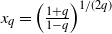





Proof of Lemma 8
Fix ${q}\in (0, \, {q}_0]$
. (i) Let
${q}\in (0, \, {q}_0]$
. (i) Let $a\in (0, \, {\textrm{e}}^{-1})$
and
$a\in (0, \, {\textrm{e}}^{-1})$
and $\theta \in [a, \, {\textrm{e}}^{1/\sqrt{{q}}}]$
. By definition,
$\theta \in [a, \, {\textrm{e}}^{1/\sqrt{{q}}}]$
. By definition, $g_{q} (\theta) = (\theta + 1)^{q}\, [ 1 - {\textrm{e}}^{-{q} \log (\frac{1}{\theta} +1)}]$
. Since
$g_{q} (\theta) = (\theta + 1)^{q}\, [ 1 - {\textrm{e}}^{-{q} \log (\frac{1}{\theta} +1)}]$
. Since $1 - {\textrm{e}}^{-x} \leq x$
(for
$1 - {\textrm{e}}^{-x} \leq x$
(for $x\in \mathbb{R}_+^*$
), this yields that
$x\in \mathbb{R}_+^*$
), this yields that $g_{q} (\theta) \le (\theta + 1)^{q} {q} \log (1/a + 1)$
. By observing that
$g_{q} (\theta) \le (\theta + 1)^{q} {q} \log (1/a + 1)$
. By observing that $\log (\frac{1}{a}+ 1) = \log \frac{1}{a} + \log (1+a) \leq \log (1/a) + 1 < 2\log (1/a)$
(for
$\log (\frac{1}{a}+ 1) = \log \frac{1}{a} + \log (1+a) \leq \log (1/a) + 1 < 2\log (1/a)$
(for $a\in (0, \, {\textrm{e}}^{-1})$
), we get that
$a\in (0, \, {\textrm{e}}^{-1})$
), we get that
 $$g_{q} (\theta) \le2(\theta + 1)^{q} {q} \log \frac1a .$$
On the other hand, let us write
 $$g_{q}(\theta) = {q} \int_0^1 \frac{\textrm{d} u}{(\theta + u)^{1-{q}}}.$$
Since
 $$\frac{1}{(\theta + u)^{1-{q}}} \le \frac{(\theta + 1)^{q}}{\theta + u} \le \frac{(\theta + 1)^{q}}{\theta}$$
for $u\in [0, \, 1]$
, we get that
$u\in [0, \, 1]$
, we get that
 $$g_{q} (\theta) \le(\theta + 1)^{q} \, \frac{{q}}{\theta} \le2(\theta + 1)^{q} \, \frac{{q}}{\theta} .$$
Therefore,
 $$g_{q} (\theta) \le2(\theta + 1)^{q} \, {q} \min\left\{ \log \frac1a, \,\frac{1}{\theta} \right\}=\frac{2(\theta + 1)^{q} \, {q}}{\theta + 1} \, (\theta + 1) \min\left\{ \log \frac1a, \,\frac{1}{\theta} \right\} .$$
By (4.25), $(\theta + 1)^{q} \le ({\textrm{e}}^{1/\sqrt{{q}}} + 1)^{q} < \sqrt{2}$
. We claim that
$(\theta + 1)^{q} \le ({\textrm{e}}^{1/\sqrt{{q}}} + 1)^{q} < \sqrt{2}$
. We claim that $(\theta + 1) \min\{ \log (1/a), \,1/\theta \} \le 2 \log (1/a)$
. This is obvious if
$(\theta + 1) \min\{ \log (1/a), \,1/\theta \} \le 2 \log (1/a)$
. This is obvious if $\theta < 1$
because in this case,
$\theta < 1$
because in this case, $(\theta + 1) \log (1/a) < 2 \log (1/a)$
; this is also obvious if
$(\theta + 1) \log (1/a) < 2 \log (1/a)$
; this is also obvious if $\theta \ge 1$
, in which case
$\theta \ge 1$
, in which case $(\theta + 1)(1/\theta) \le 2 < 2 \log (1/a)$
(recalling that
$(\theta + 1)(1/\theta) \le 2 < 2 \log (1/a)$
(recalling that $a < {\textrm{e}}^{-1}$
). The inequality (4.29) is proved because
$a < {\textrm{e}}^{-1}$
). The inequality (4.29) is proved because $4\sqrt{2} < 6$
.
$4\sqrt{2} < 6$
.
(ii) Let $r\in [1, \, 2]$
and
$r\in [1, \, 2]$
and $\theta \in [{q}^3, \, {\textrm{e}}^{1/\sqrt{{q}}} ]$
. Then
$\theta \in [{q}^3, \, {\textrm{e}}^{1/\sqrt{{q}}} ]$
. Then
 \begin{align*} g_{q} \left(\frac{\theta}{r}\right) - g_{q} (\theta) & = {q}(1 -{q}) \int_0^1 \textrm{d} u \int_{r^{-1}\theta}^{\theta}\frac{\textrm{d} t }{(t+ u)^{2-{q}}} \\[5pt] &\ge {q}(1 - {q}) (r^{-1}\theta)^{{q}} \int_0^1 \textrm{d} u \int_{r^{-1}\theta}^{\theta}\frac{\textrm{d} t }{(t + u)^{2}} \\[5pt] &= {q}(1 - {q}) (r^{-1}\theta)^{{q}} \log \left( \frac{\theta + r}{\theta + 1} \right).\end{align*}
Since $(1 - {q}) (r^{-1}\theta)^{{q}} \ge (1 - {q}) ({{q}^3}/{2})^{{q}} > 1- \sqrt{{q}}$
(by (4.27)). We next apply the inequality
$(1 - {q}) (r^{-1}\theta)^{{q}} \ge (1 - {q}) ({{q}^3}/{2})^{{q}} > 1- \sqrt{{q}}$
(by (4.27)). We next apply the inequality $\log (1+x) \ge x - {x^2}/{2}$
, which holds true for all for
$\log (1+x) \ge x - {x^2}/{2}$
, which holds true for all for $x\in [0, \, 1]$
, to
$x\in [0, \, 1]$
, to $x\;:\!=\; (r - 1)/(\theta + 1)$
and we get
$x\;:\!=\; (r - 1)/(\theta + 1)$
and we get
 $$g_{q} \left(\frac{\theta}{r}\right) - g_{q} (\theta) \ge{q}(1- \sqrt{{q}}) \, \frac{r-1}{\theta + 1} -{q}(1- \sqrt{{q}}) \, \frac{(r-1)^2}{2(\theta + 1)^2} .$$
This yields (4.30) because
 $$(1- \sqrt{{q}}) \frac{(r-1)^2}{2(\theta+1)^2} \le \frac{(r-1)^2}{\theta+1}.$$
(iii) We set $h_{q} (\theta) \;:\!=\; -g_{q}^\prime (\theta) = {q} \big(\theta^{{q}-1} - (\theta+1)^{{q} -1}\big) ={q} (1 - {q}) \int_\theta^{\theta+1} ({\textrm{d} w}/{w^{2-{q}}})$
. Then we get
$h_{q} (\theta) \;:\!=\; -g_{q}^\prime (\theta) = {q} \big(\theta^{{q}-1} - (\theta+1)^{{q} -1}\big) ={q} (1 - {q}) \int_\theta^{\theta+1} ({\textrm{d} w}/{w^{2-{q}}})$
. Then we get
 \begin{eqnarray*} \int_0^\theta h_{q} (t) \big( g_{q} (\theta - t) - g_{q} (\theta) \big)\textrm{d} t &\,=\, & {q} \int_0^\theta \textrm{d} t \, h_{q} (t) \int_0^1 \textrm{d} u\, \big( (\theta + 1 - t - u)^{{q} -1} - (\theta + 1 - u)^{{q} -1}\big) \\[5pt] &\,=\, & {q} (1 - {q}) \int_0^\theta \textrm{d} t \, h_{q} (t) \int_0^1 \textrm{d} u \int_0^t \textrm{d} v\, \frac{(\theta + 1 - v - u)^{{q} }}{(\theta + 1 - v - u)^{2}} \\[5pt] & \,\le\, & {q} (\theta + 1)^{{q}} \int_0^\theta \textrm{d} t \, h_{q} (t) \int_0^1 \textrm{d} u \int_0^t \frac{\textrm{d} v}{(\theta + 1 - v - u)^{2}} .\end{eqnarray*}
For $t\in (0, \, \theta]$
, we have
$t\in (0, \, \theta]$
, we have
 $$h_{q} (t)={q} (1 - {q}) \int_t^{t+1} \frac{w^{{q}} \textrm{d} w}{w^{2}}\le{q} (\theta + 1)^{{q}} \int_t^{t+1} \frac{\textrm{d} w}{w^{2}}=\frac{{q} (\theta + 1)^{{q}}}{t(t + 1)} .$$
This leads to
 $$\int_0^\theta h_{q} (t) \big( g_{q} (\theta - t) - g_{q} (\theta) \big) \, \textrm{d} t\le{q}^2 (\theta + 1)^{2{q}} J (\theta) ,$$
where
 $$J(\theta)\;:\!=\;\int_0^\theta \frac{\textrm{d} t}{t(t + 1)} \int_0^t \textrm{d} v \int_0^1 \frac{\textrm{d} u}{(\theta + 1 - v - u)^{2}} .$$
By (4.25), $(\theta + 1)^{2{q}} \le ({\textrm{e}}^{1/\sqrt{{q}}}+ 1)^{2{q}} \le 1 + 3\sqrt{{q}}$
.
$(\theta + 1)^{2{q}} \le ({\textrm{e}}^{1/\sqrt{{q}}}+ 1)^{2{q}} \le 1 + 3\sqrt{{q}}$
.
It remains to check that $J(\theta) \leq {\zeta(2)}/({\theta + 1})$
for all
$J(\theta) \leq {\zeta(2)}/({\theta + 1})$
for all $\theta \in \mathbb{R}_+^*$
. By definition,
$\theta \in \mathbb{R}_+^*$
. By definition,
 $$J (\theta) = \int_0^\theta \frac{1}{t(t + 1)}\left( \log \left( 1 - \frac{t}{\theta + 1}\right) - \log \left(1 - \frac{t}{\theta}\right) \right) \, \textrm{d} t = \int_0^\theta \frac{-\log \left( 1 - \frac{\lambda^2t}{(1-\lambda)(1 - \lambda t )} \right)}{t(t + 1)} \, \textrm{d} t ,$$
where we have set $\lambda \;:\!=\; {1}/({\theta + 1}) \in (0,\, 1]$
. By means of the change of variables
$\lambda \;:\!=\; {1}/({\theta + 1}) \in (0,\, 1]$
. By means of the change of variables
 $$v = 1 - \frac{\lambda^2t}{(1-\lambda)(1 - \lambda t )},$$
we get that
 $$J(\theta) = \int_0^1 \frac{\log 1/v}{1 - v} \, \frac{\lambda^2}{1 - (1 - \lambda^2)v} \, \textrm{d} v .$$
Since
 $$\int_0^1 \frac{\log 1/v}{1 - v} \, \textrm{d} v = \sum_{n\geq 0} \int_0^1 \textrm{d} v \, v^n \log 1/v = \sum_{n\geq 0} (n+1)^{-2} = \zeta (2),$$
this implies that
 \begin{eqnarray*} \lambda \, \zeta (2) - J(\theta) & \,=\, & \int_0^1 \frac{\log \frac{1}{v}}{1 - v} \left( \lambda - \frac{\lambda^2}{1 - (1 - \lambda^2)v} \right) \, \textrm{d} v \\[5pt] & \,=\, & (1 - \lambda^2) \int_0^1 \frac{ \log \frac{1}{v}}{1 - (1 - \lambda^2)v} \textrm{d} v\; - \, (1 - \lambda) \int_0^1 \frac{\log \frac{1}{v}}{1 - v} \, \textrm{d} v.\end{eqnarray*}
For all $r\in (0,\, 1)$
,
$r\in (0,\, 1)$
,
 $$\int_{0}^1 \frac{\log \frac{1}{v} }{1 - rv} \, \textrm{d} v = \sum_{n\geq 0} r^n \int_0^1 v^n \log \frac{1}{v} \, \textrm{d} v = \frac{1}{r}\sum_{n\geq 0}\frac{r^{n+1}}{(n+1)^2}= \frac{1}{r} \int_0^r \frac{\log \frac{1}{1-v}}{v} \, \textrm{d} v .$$
Therefore, $\lambda \, \zeta (2) - J(\theta) = K(\lambda)$
, where
$\lambda \, \zeta (2) - J(\theta) = K(\lambda)$
, where
 $$K(x)\;:\!=\; \int_0^{1 - x^2}\frac{\log \frac{1}{1-v}}{v} \, \textrm{d} v -(1 - x) \int_0^1 \frac{\log \frac{1}{v}}{1 - v} \, \textrm{d} v,\quad x\in [0, \, 1].$$
We want to prove that $K (x)\ge 0$
for all
$K (x)\ge 0$
for all $x\in (0, \, 1]$
. Since
$x\in (0, \, 1]$
. Since $K(0) = K( 1) = 0$
, it suffices to show that K is concave:
$K(0) = K( 1) = 0$
, it suffices to show that K is concave:
 $$K^{\prime \prime} (x)=4\, \frac{1 + x^2 }{1 - x^2 } \left( \frac{1 - x^2 }{1 + x^2 } + \log x \right)=4\, \frac{1 + x^2 }{1 - x^2 } ( \tanh (y) - y) \leq 0 ,$$
where $y \;:\!=\; -\log x \in \mathbb{R}_+$
. This proves that
$y \;:\!=\; -\log x \in \mathbb{R}_+$
. This proves that
 $$\frac{\zeta (2)}{\theta + 1} - J(\theta) \ge 0$$
for all $\theta\in \mathbb{R}_+$
, which yields (4.31).
$\theta\in \mathbb{R}_+$
, which yields (4.31).
Acknowledgements
We wish to thank an anonymous referee for their comments that helped improve the first version of the article.
Funding information
This work was partially supported by NSFC grant No. 12271351.
Competing interests
There were no competing interests to declare which arose during the preparation or publication process of this article.


 Open access

