





1 Introduction
1.1 Statement of the main result
Let $(\mathbf {G}, X)$
be a Shimura datum in the sense of Deligne [Reference DeligneDe71], [Reference DeligneDe79], so that
$(\mathbf {G}, X)$
be a Shimura datum in the sense of Deligne [Reference DeligneDe71], [Reference DeligneDe79], so that $\mathbf {G}$
is a reductive group over
$\mathbf {G}$
is a reductive group over ${\mathbb Q}$
and X is a
${\mathbb Q}$
and X is a $\mathbf { G}_{\mathbb R}$
-conjugacy class of homomorphisms
$\mathbf { G}_{\mathbb R}$
-conjugacy class of homomorphisms $h: {\mathbb S}=\mathrm{Res}_{{\mathbb C}/{\mathbb R}}{\mathbb G}_m\to \mathbf { G}_{{\mathbb R}}$
, satisfying the assumptions in loc. cit.. Let
$h: {\mathbb S}=\mathrm{Res}_{{\mathbb C}/{\mathbb R}}{\mathbb G}_m\to \mathbf { G}_{{\mathbb R}}$
, satisfying the assumptions in loc. cit.. Let ${\mathbb A}_f$
denote the finite adeles of
${\mathbb A}_f$
denote the finite adeles of ${\mathbb Q}$
and suppose
${\mathbb Q}$
and suppose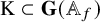 ${\mathrm{K}}\subset \mathbf {G}({\mathbb A}_f)$
is an open compact subgroup. The Shimura variety
${\mathrm{K}}\subset \mathbf {G}({\mathbb A}_f)$
is an open compact subgroup. The Shimura variety $\mathrm{Sh}_{{\mathrm{K}}}(\mathbf {G}, X)$
is defined over the reflex number field
$\mathrm{Sh}_{{\mathrm{K}}}(\mathbf {G}, X)$
is defined over the reflex number field ${\mathbf E}\subset {\mathbb C}$
and has complex points given by the double quotient
${\mathbf E}\subset {\mathbb C}$
and has complex points given by the double quotient
 $$\begin{align*}\mathrm{Sh}_{{\mathrm{K}}}(\mathbf{G}, X)({\mathbb C})=\mathbf{G}({\mathbb Q})\backslash (X \times \mathbf{G}({\mathbb A}^f)/{\mathrm{K}}). \end{align*}$$
The varieties $\mathrm{Sh}_{{\mathrm{K}}}(\mathbf {G}, X)$
are important for many applications in number theory, which often require a study of corresponding integral models. These are schemes which extend
$\mathrm{Sh}_{{\mathrm{K}}}(\mathbf {G}, X)$
are important for many applications in number theory, which often require a study of corresponding integral models. These are schemes which extend $\mathrm{Sh}_{{\mathrm{K}}}(\mathbf {G}, X)$
over the ring of integers
$\mathrm{Sh}_{{\mathrm{K}}}(\mathbf {G}, X)$
over the ring of integers ${\mathcal O}_{\mathbf E}$
of
${\mathcal O}_{\mathbf E}$
of $\mathbf E$
, or over localizations or completions of
$\mathbf E$
, or over localizations or completions of ${\mathcal O}_{\mathbf E}$
. In this paper, we consider the completions of
${\mathcal O}_{\mathbf E}$
. In this paper, we consider the completions of ${\mathcal O}_{\mathbf E}$
at primes of
${\mathcal O}_{\mathbf E}$
at primes of $\mathbf E$
which lie over an odd rational prime p. We construct integral models over these completions when the Shimura datum
$\mathbf E$
which lie over an odd rational prime p. We construct integral models over these completions when the Shimura datum $(\mathbf {G}, X)$
is of abelian type and the level subgroup
$(\mathbf {G}, X)$
is of abelian type and the level subgroup ${\mathrm{K}}$
is parahoric or a stabilizer at p; we will explain these terms below. Our results extend the construction of [Reference Kisin and PappasKP18] to all Shimura varieties of abelian type over odd primes. In particular, we dispense with the blanket restriction in op. cit. that the group
${\mathrm{K}}$
is parahoric or a stabilizer at p; we will explain these terms below. Our results extend the construction of [Reference Kisin and PappasKP18] to all Shimura varieties of abelian type over odd primes. In particular, we dispense with the blanket restriction in op. cit. that the group $\mathbf {G}$
splits over an extension of
$\mathbf {G}$
splits over an extension of ${\mathbb Q}$
which is tamely ramified over p. In addition, we correct a serious gap in [Reference Kisin and PappasKP18] which also propagated to previous versions of [Reference Kisin and ZhouKZ25], see paragraphs 1.2.1 and 1.3.
${\mathbb Q}$
which is tamely ramified over p. In addition, we correct a serious gap in [Reference Kisin and PappasKP18] which also propagated to previous versions of [Reference Kisin and ZhouKZ25], see paragraphs 1.2.1 and 1.3.
Recall that $(\mathbf {G}, X)$
is said to be of Hodge type if there is an embedding
$(\mathbf {G}, X)$
is said to be of Hodge type if there is an embedding $(\mathbf {G}, X)\hookrightarrow ({\mathbf {GSp}}_{2g}, S^{\pm })$
into the Shimura datum for a symplectic similitude group. This implies that the corresponding Shimura variety
$(\mathbf {G}, X)\hookrightarrow ({\mathbf {GSp}}_{2g}, S^{\pm })$
into the Shimura datum for a symplectic similitude group. This implies that the corresponding Shimura variety $\mathrm{Sh}_{{\mathrm{K}}}(\mathbf {G}, X)$
can be described as a moduli space for abelian varieties equipped with certain Hodge cycles. A Shimura datum
$\mathrm{Sh}_{{\mathrm{K}}}(\mathbf {G}, X)$
can be described as a moduli space for abelian varieties equipped with certain Hodge cycles. A Shimura datum $(\mathbf {G}, X)$
is said to be of abelian type if there is a datum of Hodge type
$(\mathbf {G}, X)$
is said to be of abelian type if there is a datum of Hodge type $({\mathbf {G}}_1,X_1)$
and a central isogeny between the derived groups
$({\mathbf {G}}_1,X_1)$
and a central isogeny between the derived groups $\mathbf {G}^{\mathrm{der}}_1\to \mathbf {G}^{\mathrm{der}}$
which induces an isomorphism
$\mathbf {G}^{\mathrm{der}}_1\to \mathbf {G}^{\mathrm{der}}$
which induces an isomorphism $(\mathbf {G}^{\mathrm{ad }} _1, X^{\mathrm{ad }} _1)\xrightarrow {\sim } (\mathbf {G}^{\mathrm{ad }} , X^{\mathrm{ad }} )$
. The class of Shimura data of abelian type is very general and includes almost all cases in which
$(\mathbf {G}^{\mathrm{ad }} _1, X^{\mathrm{ad }} _1)\xrightarrow {\sim } (\mathbf {G}^{\mathrm{ad }} , X^{\mathrm{ad }} )$
. The class of Shimura data of abelian type is very general and includes almost all cases in which $\mathbf {G}$
is a classical group.
$\mathbf {G}$
is a classical group.
Now let us discuss the assumption on the level subgroup. We fix a prime $p>2$
and a prime v of
$p>2$
and a prime v of $\mathbf E$
which lies above p. Let
$\mathbf E$
which lies above p. Let ${\mathcal G}$
be a Bruhat-Tits stabilizer group scheme over
${\mathcal G}$
be a Bruhat-Tits stabilizer group scheme over ${\mathbb Z}_p$
with generic fiber the base change
${\mathbb Z}_p$
with generic fiber the base change $G=\mathbf { G}_{{\mathbb Q}_p}$
; this stabilizer is defined using the action of the group on its affine building. The
$G=\mathbf { G}_{{\mathbb Q}_p}$
; this stabilizer is defined using the action of the group on its affine building. The ${\mathbb Z}_p$
-points of
${\mathbb Z}_p$
-points of ${\mathcal G}$
give a level subgroup
${\mathcal G}$
give a level subgroup ${\mathrm{K}}_p={\mathcal G}({\mathbb Z}_p)\subset G({\mathbb Q}_p)$
at p. The corresponding parahoric group scheme is the neutral connected component
${\mathrm{K}}_p={\mathcal G}({\mathbb Z}_p)\subset G({\mathbb Q}_p)$
at p. The corresponding parahoric group scheme is the neutral connected component ${\mathcal G}^\circ $
of
${\mathcal G}^\circ $
of ${\mathcal G}$
; we also consider the parahoric level subgroup
${\mathcal G}$
; we also consider the parahoric level subgroup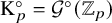 ${\mathrm{K}}^\circ _p={\mathcal G}^\circ ({\mathbb Z}_p)$
at p. Let
${\mathrm{K}}^\circ _p={\mathcal G}^\circ ({\mathbb Z}_p)$
at p. Let ${\mathbb A}^p_f$
be the prime to p finite adeles and let
${\mathbb A}^p_f$
be the prime to p finite adeles and let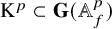 ${\mathrm{K}}^p\subset \mathbf {G}({\mathbb A}^p_f)$
be a sufficiently small compact open subgroup. We take the level subgroup to be
${\mathrm{K}}^p\subset \mathbf {G}({\mathbb A}^p_f)$
be a sufficiently small compact open subgroup. We take the level subgroup to be ${\mathrm{K}}^\circ ={\mathrm{K}}^p{\mathrm{K}}^\circ _p\subset \mathbf {G}({\mathbb A}_f)$
or
${\mathrm{K}}^\circ ={\mathrm{K}}^p{\mathrm{K}}^\circ _p\subset \mathbf {G}({\mathbb A}_f)$
or ${\mathrm{K}}={\mathrm{K}}^p{\mathrm{K}}_p\subset \mathbf {G}({\mathbb A}_f)$
and consider
${\mathrm{K}}={\mathrm{K}}^p{\mathrm{K}}_p\subset \mathbf {G}({\mathbb A}_f)$
and consider $\mathrm{Sh}_{{\mathrm{K}}^\circ }(\mathbf {G}, X)$
or
$\mathrm{Sh}_{{\mathrm{K}}^\circ }(\mathbf {G}, X)$
or $\mathrm{Sh}_{{\mathrm{K}}}(\mathbf {G}, X)$
.Footnote
1
Note that our assumption that the level subgroup at p is either a parahoric or a stabilizer is quite natural. It allows all cases with
$\mathrm{Sh}_{{\mathrm{K}}}(\mathbf {G}, X)$
.Footnote
1
Note that our assumption that the level subgroup at p is either a parahoric or a stabilizer is quite natural. It allows all cases with ${\mathcal G}$
reductive, when we have smooth reduction at v ([Reference KisinKi10]), but also includes many Shimura varieties with nonsmooth reduction. In fact, for any reductive
${\mathcal G}$
reductive, when we have smooth reduction at v ([Reference KisinKi10]), but also includes many Shimura varieties with nonsmooth reduction. In fact, for any reductive $\mathbf {G}$
over
$\mathbf {G}$
over ${\mathbb Q}$
and prime p, the group
${\mathbb Q}$
and prime p, the group $G({\mathbb Q}_p)$
always contains parahoric subgroups. The case of stabilizer level
$G({\mathbb Q}_p)$
always contains parahoric subgroups. The case of stabilizer level ${\mathrm{K}}_p$
naturally occurs when considering Shimura varieties described as moduli schemes and more generally for
${\mathrm{K}}_p$
naturally occurs when considering Shimura varieties described as moduli schemes and more generally for $(\mathbf {G}, X)$
of Hodge type and it plays a central role in the proofs.
$(\mathbf {G}, X)$
of Hodge type and it plays a central role in the proofs.
Set $E={\mathbf E}_v$
for the completion at v. Our goal is to construct
$E={\mathbf E}_v$
for the completion at v. Our goal is to construct ${\mathcal O}_E$
-integral models for
${\mathcal O}_E$
-integral models for $\mathrm{ Sh}_{{\mathrm{K}}^\circ }(\mathbf {G}, X)$
and
$\mathrm{ Sh}_{{\mathrm{K}}^\circ }(\mathbf {G}, X)$
and $\mathrm{Sh}_{{\mathrm{K}}}(\mathbf {G}, X)$
which satisfy two requirements roughly as follows; they are both important for applications. First, the integral model is “as proper as possible,” that is, it does not miss points in positive characteristic that should appear as reductions of points of the Shimura variety. Second, the étale local structure of the integral model is controlled by a corresponding local model. We refer the reader to [Reference PappasP18] and [Reference Pappas, Rapoport and SmithlingPRS13] for an account of past work on such integral models and local models.
$\mathrm{Sh}_{{\mathrm{K}}}(\mathbf {G}, X)$
which satisfy two requirements roughly as follows; they are both important for applications. First, the integral model is “as proper as possible,” that is, it does not miss points in positive characteristic that should appear as reductions of points of the Shimura variety. Second, the étale local structure of the integral model is controlled by a corresponding local model. We refer the reader to [Reference PappasP18] and [Reference Pappas, Rapoport and SmithlingPRS13] for an account of past work on such integral models and local models.
Before stating the main result, we briefly recall some basic information about local models; these play a crucial role in the theory. Let $\{\mu \}$
be the geometric conjugacy class of the cocharacter
$\{\mu \}$
be the geometric conjugacy class of the cocharacter $\mu =\mu _h$
of G which corresponds to the hermitian symmetric domain X. The local model
$\mu =\mu _h$
of G which corresponds to the hermitian symmetric domain X. The local model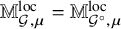 ${\mathbb M}^{\mathrm{loc}}_{{\mathcal G}, \mu }={\mathbb M}^{\mathrm{loc}}_{{\mathcal G}^\circ , \mu }$
is associated to the triple
${\mathbb M}^{\mathrm{loc}}_{{\mathcal G}, \mu }={\mathbb M}^{\mathrm{loc}}_{{\mathcal G}^\circ , \mu }$
is associated to the triple $(G,\{\mu \}, {\mathcal G}^\circ )$
, see §3.1. It is a flat and normal proper scheme over
$(G,\{\mu \}, {\mathcal G}^\circ )$
, see §3.1. It is a flat and normal proper scheme over ${\mathcal O}_E$
and supports a
${\mathcal O}_E$
and supports a ${\mathcal G}$
-action with a finite number of orbits. Its generic fiber is the homogeneous space over E parametrizing parabolics in the conjugacy class of
${\mathcal G}$
-action with a finite number of orbits. Its generic fiber is the homogeneous space over E parametrizing parabolics in the conjugacy class of $P_{\mu ^{-1}}$
, the parabolic subgroup corresponding to the minuscule cocharacter
$P_{\mu ^{-1}}$
, the parabolic subgroup corresponding to the minuscule cocharacter $\mu ^{-1}$
, and is an E-form of the compact dual of X. Its special fiber is reduced and, in fact,
$\mu ^{-1}$
, and is an E-form of the compact dual of X. Its special fiber is reduced and, in fact, ${\mathbb M}^{\mathrm{loc}}_{{\mathcal G}, \mu }$
is uniquely determined by its corresponding v-sheaf on perfectoid spaces, which is given a priori by Scholze-Weinstein [Reference Scholze and WeinsteinSW20].
${\mathbb M}^{\mathrm{loc}}_{{\mathcal G}, \mu }$
is uniquely determined by its corresponding v-sheaf on perfectoid spaces, which is given a priori by Scholze-Weinstein [Reference Scholze and WeinsteinSW20].
The main theorem of this paper is the following:
Theorem 1.1.1. Assume $p>2$
. Let
$p>2$
. Let $({\mathbf {G}},X)$
be a Shimura datum of abelian type and
$({\mathbf {G}},X)$
be a Shimura datum of abelian type and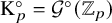 ${\mathrm{K}}_{p}^\circ ={\mathcal G}^\circ ({\mathbb Z}_p)$
a parahoric subgroup. There exists a pro-system of
${\mathrm{K}}_{p}^\circ ={\mathcal G}^\circ ({\mathbb Z}_p)$
a parahoric subgroup. There exists a pro-system of ${\mathcal O}_{E}$
-schemes
${\mathcal O}_{E}$
-schemes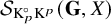 ${\mathcal {S}}_{{\mathrm{K}}^\circ _{p}{\mathrm{K}}^p}({\mathbf {G}},X)$
with generic fibers
${\mathcal {S}}_{{\mathrm{K}}^\circ _{p}{\mathrm{K}}^p}({\mathbf {G}},X)$
with generic fibers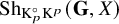 $\mathrm{ Sh}_{{\mathrm{K}}_p^\circ {\mathrm{K}}^p}({\mathbf {G}},X)$
and with finite étale transition maps, for varying sufficiently small
$\mathrm{ Sh}_{{\mathrm{K}}_p^\circ {\mathrm{K}}^p}({\mathbf {G}},X)$
and with finite étale transition maps, for varying sufficiently small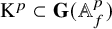 ${\mathrm{K}}^p\subset \mathbf {G}({\mathbb A}^p_f)$
, such that the
${\mathrm{K}}^p\subset \mathbf {G}({\mathbb A}^p_f)$
, such that the ${\mathcal O}_{E}$
-scheme
${\mathcal O}_{E}$
-scheme
 $$\begin{align*}{\mathcal {S}}_{{\mathrm{K}}^\circ_{p}}({\mathbf{G}},X)=\varprojlim_{{\mathrm{K}}^p}{\mathcal S}_{{\mathrm{K}}^\circ_{p}{\mathrm{K}}^p}({\mathbf{G}},X) \end{align*}$$
with ${\mathbf {G}}({\mathbb A}^p_f)$
-action extends
${\mathbf {G}}({\mathbb A}^p_f)$
-action extends $\mathrm{ Sh}_{{\mathrm{K}}^\circ _{p}}({\mathbf {G}},X)=\varprojlim _{{\mathrm{K}}^p}\mathrm{ Sh}_{{\mathrm{K}}^\circ _{p}{\mathrm{K}}^p}({\mathbf {G}},X)$
and satisfies
$\mathrm{ Sh}_{{\mathrm{K}}^\circ _{p}}({\mathbf {G}},X)=\varprojlim _{{\mathrm{K}}^p}\mathrm{ Sh}_{{\mathrm{K}}^\circ _{p}{\mathrm{K}}^p}({\mathbf {G}},X)$
and satisfies
-
(1) For R a discrete valuation ring of mixed characteristic $(0,p)$
, the natural map is a bijection.
$$ \begin{align*}\mathcal{S}_{{\mathrm{K}}^\circ_{p}}({\mathbf{G}},X)(R)\rightarrow\mathrm{ Sh}_{{\mathrm{K}}^\circ_{p}}({\mathbf{G}},X)(R[1/p])\end{align*} $$
$(0,p)$
, the natural map is a bijection.
$$ \begin{align*}\mathcal{S}_{{\mathrm{K}}^\circ_{p}}({\mathbf{G}},X)(R)\rightarrow\mathrm{ Sh}_{{\mathrm{K}}^\circ_{p}}({\mathbf{G}},X)(R[1/p])\end{align*} $$
-
(2) For
${\mathrm{K}}^p$
a sufficiently small compact open subgroup,
$ {\mathcal S}_{{\mathrm{K}}^\circ _{p}{\mathrm{K}}^p}({\mathbf {G}},X) $
is étale locally isomorphic to the scheme
${\mathbb M}^{\mathrm{loc}}_{{\mathcal G},\mu }$
. -
(3) There exists a diagram
where the morphism
$\pi $
is a
${\mathbf {G}}({\mathbb A}_f^p)$
-equivariant
${{\mathcal G}}^{\mathrm{ad } }$
-torsor and the morphism q is
${{\mathcal G}}^{\mathrm{ad } }$
-equivariant, smooth and
${\mathbf {G}}({\mathbb A}_f^p)$
-equivariant, when
${\mathbb M}^{\mathrm{loc}}_{{\mathcal G}, \mu }$
is equipped with the trivial
${\mathbf {G}}({\mathbb A}_f^p)$
-action. If in addition
$({\mathbf {G}},X)$
is (NE), then
$\pi $
reduces to a
${{\mathcal G}}^{\mathrm{ad } ,\circ }$
-torsor which still maps to
${\mathbb M}^{\mathrm{loc}}_{{\mathcal G}, \mu }$
via the restriction of q.


Above, ${\mathcal G}^{\mathrm{ad }} $
is a smooth group scheme over
${\mathcal G}^{\mathrm{ad }} $
is a smooth group scheme over ${\mathbb Z}_p$
with generic fiber the adjoint group
${\mathbb Z}_p$
with generic fiber the adjoint group $G^{\mathrm{ad }} $
of G. It is not necessarily a stabilizer group scheme. The neutral connected component
$G^{\mathrm{ad }} $
of G. It is not necessarily a stabilizer group scheme. The neutral connected component ${\mathcal G}^{\mathrm{ad } ,\circ }$
is the parahoric group scheme of the adjoint group
${\mathcal G}^{\mathrm{ad } ,\circ }$
is the parahoric group scheme of the adjoint group $G^{\mathrm{ad } }$
associated to
$G^{\mathrm{ad } }$
associated to ${\mathcal G}$
, see Theorem 7.2.21 and §7.1.12 in the text. Using the smoothness of
${\mathcal G}$
, see Theorem 7.2.21 and §7.1.12 in the text. Using the smoothness of ${\mathcal G}$
one sees that (3) implies (2). The condition (NE) in the statement is explained in paragraph 1.2 below. In fact, by combining this result with work of Daniels–van Hoften–Kim–Zhang [Reference Daniels, van Hoften, Kim and ZhangDvHKZ] which uses the theory of p-adic shtukas, we see that the condition (NE) can be removed, cf. Corollary 7.2.24.
${\mathcal G}$
one sees that (3) implies (2). The condition (NE) in the statement is explained in paragraph 1.2 below. In fact, by combining this result with work of Daniels–van Hoften–Kim–Zhang [Reference Daniels, van Hoften, Kim and ZhangDvHKZ] which uses the theory of p-adic shtukas, we see that the condition (NE) can be removed, cf. Corollary 7.2.24.
Corollary 1.1.2. The ${\mathcal G}^{\mathrm{ad } }$
-torsor
${\mathcal G}^{\mathrm{ad } }$
-torsor $\pi $
in Theorem 1.1.1 (3) can be refined to a
$\pi $
in Theorem 1.1.1 (3) can be refined to a ${\mathcal G}^{\mathrm{ad } ,\circ }$
-torsor and this fits in a
${\mathcal G}^{\mathrm{ad } ,\circ }$
-torsor and this fits in a ${\mathcal G}^{\mathrm{ad } ,\circ }$
-equivariant local model diagram refining the diagram in Theorem 1.1.1 (3).
${\mathcal G}^{\mathrm{ad } ,\circ }$
-equivariant local model diagram refining the diagram in Theorem 1.1.1 (3).
We will also give more precise results that refine the diagram (3) under certain additional conditions, and similar results for the Shimura (pro-)varieties $\mathrm{Sh}_{{\mathrm{K}}_p}(\mathbf {G}, X)$
with stabilizer level subgroup
$\mathrm{Sh}_{{\mathrm{K}}_p}(\mathbf {G}, X)$
with stabilizer level subgroup ${\mathrm{K}}_p$
. The reader is referred to §7 for these. In addition, we refer the reader to paragraph 1.3 of this introduction for a discussion of other related results and, in particular, for a comparison with corresponding statements in [Reference Kisin and PappasKP18] and previous versions of [Reference Kisin and ZhouKZ25].
${\mathrm{K}}_p$
. The reader is referred to §7 for these. In addition, we refer the reader to paragraph 1.3 of this introduction for a discussion of other related results and, in particular, for a comparison with corresponding statements in [Reference Kisin and PappasKP18] and previous versions of [Reference Kisin and ZhouKZ25].
1.1.3
The results of this paper have several applications.
The integral models we construct are used in [Reference Kisin and ZhouKZ25] to show $\ell $
-independence of Frobenius conjugacy classes for abelian varieties. The proof in loc. cit. uses the existence of the local model diagram in Theorem 1.1.1 to define the Kottwitz–Rapoport stratification on the models in order to apply an “induction on strata” argument.
$\ell $
-independence of Frobenius conjugacy classes for abelian varieties. The proof in loc. cit. uses the existence of the local model diagram in Theorem 1.1.1 to define the Kottwitz–Rapoport stratification on the models in order to apply an “induction on strata” argument.
The local model diagram is also used as a crucial input in determining the local zeta function at p of the Shimura variety via the Langlands-Kottwitz method in [Reference Haines, Zhou and ZhuHZZ], as it allows us to understand the nearby cycles at points on the special fiber of integral models.
As explained below, the proof of Theorem 1.1.1 uses the construction of the universal deformation space of a p-divisible groups equipped with crystalline tensors. This construction is applied in a different way to prove the representability of integral local Shimura varieties of abelian type in [Reference Pappas and RapoportPR26].
1.2 Strategy of the proof
We will now discuss the proof of Theorem 1.1.1. The overall strategy is the same as in [Reference Kisin and PappasKP18] which covered only tamely ramified groups G. However, there is a complication: An important condition which is necessary for the construction was erroneously omitted in loc. cit.. As we will explain below, the condition is needed for the construction in [Reference Kisin and PappasKP18, §3] of the universal deformation of a p-divisible group equipped with crystalline tensors; the error was brought to the authors’ attention by Manuel Hoff, see [Reference HoffHo23, Rem. 2.29] and Remark 5.1.17.
In this paper, we correct the omission in [Reference Kisin and PappasKP18] and also explain why this condition is satisfied in enough cases so that the proofs go through. In addition, we provide simplifications and generalizations of several other arguments of loc. cit.. As a result, we can now also cover all groups $\mathbf {G}$
with
$\mathbf {G}$
with $(\mathbf {G},X)$
of abelian type.
$(\mathbf {G},X)$
of abelian type.
1.2.1
Let us explain this in some more detail: Suppose that the Shimura datum $(\mathbf {G}, X)$
is of Hodge type; this is the crucial case. The argument in [Reference Kisin and PappasKP18] starts by finding a Hodge embedding
$(\mathbf {G}, X)$
is of Hodge type; this is the crucial case. The argument in [Reference Kisin and PappasKP18] starts by finding a Hodge embedding $\rho : (\mathbf {G}, X)\hookrightarrow ({\mathbf {GSp}}(V,\psi ), S^{\pm })$
and a
$\rho : (\mathbf {G}, X)\hookrightarrow ({\mathbf {GSp}}(V,\psi ), S^{\pm })$
and a ${\mathbb Z}_p$
-lattice
${\mathbb Z}_p$
-lattice ${\Lambda }$
in the
${\Lambda }$
in the ${\mathbb Q}_p$
-vector space
${\mathbb Q}_p$
-vector space $V_{{\mathbb Q}_p}$
such that
$V_{{\mathbb Q}_p}$
such that $G\hookrightarrow \mathrm{GL}(V_{{\mathbb Q}_p})$
extends to a closed immersion of group schemes
$G\hookrightarrow \mathrm{GL}(V_{{\mathbb Q}_p})$
extends to a closed immersion of group schemes ${\mathcal G}\hookrightarrow \mathrm{ GL}({\Lambda })$
. Moreover, it is arranged so that the alternating form
${\mathcal G}\hookrightarrow \mathrm{ GL}({\Lambda })$
. Moreover, it is arranged so that the alternating form $\psi $
takes
$\psi $
takes ${\mathbb Z}_p$
-integral values on
${\mathbb Z}_p$
-integral values on ${\Lambda }$
. Then
${\Lambda }$
. Then $\rho $
induces an embedding of the Shimura variety
$\rho $
induces an embedding of the Shimura variety $\mathrm{Sh}_{{\mathrm{K}}}(\mathbf {G}, X)$
in a Siegel moduli variety of polarized abelian schemes with appropriate level structure. This level structure is determined by a subgroup
$\mathrm{Sh}_{{\mathrm{K}}}(\mathbf {G}, X)$
in a Siegel moduli variety of polarized abelian schemes with appropriate level structure. This level structure is determined by a subgroup ${\mathrm{K}}'$
of the adelic symplectic similitude group whose choice depends on
${\mathrm{K}}'$
of the adelic symplectic similitude group whose choice depends on ${\mathrm{K}}$
. This Siegel variety has a
${\mathrm{K}}$
. This Siegel variety has a ${\mathbb Z}_p$
-integral model
${\mathbb Z}_p$
-integral model ${\mathcal A}_{g, {\mathrm{K}}'}$
given by the natural extension of the moduli functor to schemes over
${\mathcal A}_{g, {\mathrm{K}}'}$
given by the natural extension of the moduli functor to schemes over ${\mathbb Z}_p$
. Then, the normalization of the Zariski closure of
${\mathbb Z}_p$
. Then, the normalization of the Zariski closure of $\mathrm{Sh}_{{\mathrm{K}}}(\mathbf {G}, X)$
in
$\mathrm{Sh}_{{\mathrm{K}}}(\mathbf {G}, X)$
in ${\mathcal A}_{g, {\mathrm{K}}'}\otimes _{{\mathbb Z}_p}{\mathcal O}_E$
gives an
${\mathcal A}_{g, {\mathrm{K}}'}\otimes _{{\mathbb Z}_p}{\mathcal O}_E$
gives an ${\mathcal O}_E$
-integral model
${\mathcal O}_E$
-integral model ${\mathcal {S}}_{{\mathrm{K}}}(\mathbf {G},X)$
of
${\mathcal {S}}_{{\mathrm{K}}}(\mathbf {G},X)$
of $\mathrm{ Sh}_{{\mathrm{K}}}(\mathbf {G}, X)$
. Even if the notation does not indicate this, the scheme
$\mathrm{ Sh}_{{\mathrm{K}}}(\mathbf {G}, X)$
. Even if the notation does not indicate this, the scheme ${\mathcal {S}}_{{\mathrm{K}}}(\mathbf {G},X)$
a priori depends on the above choices of the Hodge embedding and the lattice.
${\mathcal {S}}_{{\mathrm{K}}}(\mathbf {G},X)$
a priori depends on the above choices of the Hodge embedding and the lattice.
The essential point now becomes to control the structure of ${\mathcal {S}}_{{\mathrm{K}}}(\mathbf {G},X)$
. In particular, the desired result is that
${\mathcal {S}}_{{\mathrm{K}}}(\mathbf {G},X)$
. In particular, the desired result is that ${\mathcal {S}}_{{\mathrm{K}}}(\mathbf {G},X)$
is étale locally isomorphic to the local model
${\mathcal {S}}_{{\mathrm{K}}}(\mathbf {G},X)$
is étale locally isomorphic to the local model ${\mathbb M}^{\mathrm{loc}}_{{\mathcal G},\mu }$
. In fact, one aims for a more precise result: the existence of a local model diagram. This amounts to a smooth morphism
${\mathbb M}^{\mathrm{loc}}_{{\mathcal G},\mu }$
. In fact, one aims for a more precise result: the existence of a local model diagram. This amounts to a smooth morphism
 $$\begin{align*}{\mathcal {S}}_{{\mathrm{K}}}(\mathbf{G},X)\xrightarrow{ \ \ } [{\mathcal G}\backslash\,{\mathbb M}^{\mathrm{loc}}_{{\mathcal G},\mu}], \end{align*}$$
with target the stack quotient of the ${\mathcal G}$
-scheme
${\mathcal G}$
-scheme ${\mathbb M}^{\mathrm{loc}}_{{\mathcal G},\mu }$
.
${\mathbb M}^{\mathrm{loc}}_{{\mathcal G},\mu }$
.
To achieve this control, we need to choose the Hodge embedding and the lattice ${\Lambda }$
carefully. We first arrange so that the embedding
${\Lambda }$
carefully. We first arrange so that the embedding ${\mathcal G}\hookrightarrow \mathrm{GL}({\Lambda })$
induces a closed immersion
${\mathcal G}\hookrightarrow \mathrm{GL}({\Lambda })$
induces a closed immersion
 $$\begin{align*}{\mathbb M}^{\mathrm{loc}}_{{\mathcal G},\mu}\hookrightarrow \mathrm{Gr}(d,{\Lambda})_{{\mathcal O}_E}\end{align*}$$
of the local model in the base change of a Grassmannian scheme, where d depends on $\mu $
. When this closed immersion occurs, we say that we have an integral local Hodge embedding
$\mu $
. When this closed immersion occurs, we say that we have an integral local Hodge embedding $({\mathcal G},\{\mu \})\hookrightarrow (\mathrm{GL}({\Lambda }),\mu _d)$
which is “good.” In what follows, we assume that this has been arranged.
$({\mathcal G},\{\mu \})\hookrightarrow (\mathrm{GL}({\Lambda }),\mu _d)$
which is “good.” In what follows, we assume that this has been arranged.
We now consider a finite collection of tensors $(s_a)$
in the tensor algebra
$(s_a)$
in the tensor algebra $V_{{\mathbb Z}_{(p)}}^\otimes $
which “cut out”
$V_{{\mathbb Z}_{(p)}}^\otimes $
which “cut out” $\mathbf { G}_{{\mathbb Z}_{(p)}}$
, cf. §5.2. Here
$\mathbf { G}_{{\mathbb Z}_{(p)}}$
, cf. §5.2. Here $V_{{\mathbb Z}_{(p)}}$
is the unique
$V_{{\mathbb Z}_{(p)}}$
is the unique ${\mathbb Z}_{(p)}$
-lattice in V whose p-adic completion
${\mathbb Z}_{(p)}$
-lattice in V whose p-adic completion $V_{{\mathbb Z}_p}$
is
$V_{{\mathbb Z}_p}$
is ${\Lambda }$
and
${\Lambda }$
and $\mathbf {G}_{{\mathbb Z}_{(p)}}$
the unique affine
$\mathbf {G}_{{\mathbb Z}_{(p)}}$
the unique affine ${\mathbb Z}_{(p)}$
-model of
${\mathbb Z}_{(p)}$
-model of $\mathbf {G}$
whose p-adic completion is
$\mathbf {G}$
whose p-adic completion is ${\mathcal G}$
. Then
${\mathcal G}$
. Then $(s_a)$
also cut out
$(s_a)$
also cut out ${\mathcal G}$
in
${\mathcal G}$
in $\mathrm{GL}({\Lambda })$
. The Betti-étale comparison isomorphism gives corresponding tensors
$\mathrm{GL}({\Lambda })$
. The Betti-étale comparison isomorphism gives corresponding tensors  , where ${\mathcal V}_p$
is the
${\mathcal V}_p$
is the ${\mathbb Z}_p$
-local system on
${\mathbb Z}_p$
-local system on $\mathrm{Sh}_{{\mathrm{K}}}({\mathbf {G}},X)$
corresponding to the dual of the p-adic Tate-module of the pullback of the universal abelian variety.
$\mathrm{Sh}_{{\mathrm{K}}}({\mathbf {G}},X)$
corresponding to the dual of the p-adic Tate-module of the pullback of the universal abelian variety.
Now consider $x\in {\mathcal {S}}_{{\mathrm{K}}}(\mathbf {G},X)(k)$
, where k is an algebraic closure of the residue field
$x\in {\mathcal {S}}_{{\mathrm{K}}}(\mathbf {G},X)(k)$
, where k is an algebraic closure of the residue field $k_E$
of
$k_E$
of ${\mathcal O}_E$
and set
${\mathcal O}_E$
and set $\breve {\mathbb Q}_p=W(k)[1/p]$
. We let
$\breve {\mathbb Q}_p=W(k)[1/p]$
. We let ${\mathscr {G}}_x$
denote the p-divisible group of the abelian variety associated to x and let
${\mathscr {G}}_x$
denote the p-divisible group of the abelian variety associated to x and let ${\mathbb D}$
be the Dieudonné module of
${\mathbb D}$
be the Dieudonné module of ${\mathscr {G}}_x$
. For a finite field extension
${\mathscr {G}}_x$
. For a finite field extension $K/\breve {\mathbb Q}_p$
and
$K/\breve {\mathbb Q}_p$
and $\tilde {x}\in {\mathcal S}_{{\mathrm{K}}}({\mathbf {G}},X)({\mathcal O}_K)$
a point lifting x, the p-adic comparison isomorphism gives rise to tensors
$\tilde {x}\in {\mathcal S}_{{\mathrm{K}}}({\mathbf {G}},X)({\mathcal O}_K)$
a point lifting x, the p-adic comparison isomorphism gives rise to tensors $s_{\alpha ,0}\in {\mathbb D}[1/p]^\otimes $
. These tensors lie in the submodule
$s_{\alpha ,0}\in {\mathbb D}[1/p]^\otimes $
. These tensors lie in the submodule ${\mathbb D}^\otimes $
and are independent of the choice of lift
${\mathbb D}^\otimes $
and are independent of the choice of lift $\tilde {x}$
. Moreover, the scheme of tensor preserving isomorphisms
$\tilde {x}$
. Moreover, the scheme of tensor preserving isomorphisms $\underline {\mathrm{Isom}}_{s_a,s_{a,0}}({\Lambda }\otimes _{{\mathbb Z}_p}W(k),{\mathbb D})$
is a trivial
$\underline {\mathrm{Isom}}_{s_a,s_{a,0}}({\Lambda }\otimes _{{\mathbb Z}_p}W(k),{\mathbb D})$
is a trivial ${\mathcal G}$
-torsor and we can choose an identification
${\mathcal G}$
-torsor and we can choose an identification ${\mathbb D}={\Lambda }\otimes _{{\mathbb Z}_p}W(k)$
matching
${\mathbb D}={\Lambda }\otimes _{{\mathbb Z}_p}W(k)$
matching $s_{a,0}$
with
$s_{a,0}$
with $s_a\otimes 1$
. These facts follow by the argument in [Reference Kisin and PappasKP18, §3.3] using the general purity result of [Reference AnschützAn22] to cover the case of a general
$s_a\otimes 1$
. These facts follow by the argument in [Reference Kisin and PappasKP18, §3.3] using the general purity result of [Reference AnschützAn22] to cover the case of a general $\mathbf {G}.$
We also see that the de Rham filtration on
$\mathbf {G}.$
We also see that the de Rham filtration on ${\mathbb D}\otimes _{W(k)}k$
corresponds to a point
${\mathbb D}\otimes _{W(k)}k$
corresponds to a point $y\in \mathrm{Gr}(d, \Lambda )(k)$
which lies in
$y\in \mathrm{Gr}(d, \Lambda )(k)$
which lies in ${\mathbb M}^{\mathrm{loc}}_{{\mathcal G},\mu }(k)$
.
${\mathbb M}^{\mathrm{loc}}_{{\mathcal G},\mu }(k)$
.
Let $A $
denote the completion of the local ring of
$A $
denote the completion of the local ring of ${\mathbb M}^{\mathrm{loc}}_{{\mathcal G},\mu }$
at y. (In the text this is usually denoted by
${\mathbb M}^{\mathrm{loc}}_{{\mathcal G},\mu }$
at y. (In the text this is usually denoted by $R_G$
.) The crux of the matter is to show that the completion of the local ring of
$R_G$
.) The crux of the matter is to show that the completion of the local ring of ${\mathcal S}_{{\mathrm{K}}}({\mathbf {G}},X)$
at x is isomorphic to A. Roughly speaking, this follows if we construct a suitable deformation of the p-divisible group
${\mathcal S}_{{\mathrm{K}}}({\mathbf {G}},X)$
at x is isomorphic to A. Roughly speaking, this follows if we construct a suitable deformation of the p-divisible group ${\mathscr {G}}_x$
over A which is equipped with tensors extending
${\mathscr {G}}_x$
over A which is equipped with tensors extending $s_{a,0}$
. When
$s_{a,0}$
. When ${\mathcal G}$
is reductive such a deformation is given in [Reference KisinKi10] following a construction of Faltings. For the general case, [Reference Kisin and PappasKP18] use Zink’s theory of displays. In the following discussion, we will use the usual notations of this theory, see §5.1, [Reference Kisin and PappasKP18, §3].
${\mathcal G}$
is reductive such a deformation is given in [Reference KisinKi10] following a construction of Faltings. For the general case, [Reference Kisin and PappasKP18] use Zink’s theory of displays. In the following discussion, we will use the usual notations of this theory, see §5.1, [Reference Kisin and PappasKP18, §3].
Set $M={\Lambda }\otimes _{{\mathbb Z}_p}{\widehat W}(A)$
and denote by
$M={\Lambda }\otimes _{{\mathbb Z}_p}{\widehat W}(A)$
and denote by $\hat I_{A}M\subset M_1\subset M$
the unique
$\hat I_{A}M\subset M_1\subset M$
the unique ${\widehat W}(A)$
-submodule corresponding to the A-valued point of the Grassmannian given by
${\widehat W}(A)$
-submodule corresponding to the A-valued point of the Grassmannian given by ${\mathbb M}^{\mathrm{loc}}_{{\mathcal G},\mu }\hookrightarrow \mathrm{Gr}(d,{\Lambda })_{{\mathcal O}_E}$
. To the “Dieudonné pair”
${\mathbb M}^{\mathrm{loc}}_{{\mathcal G},\mu }\hookrightarrow \mathrm{Gr}(d,{\Lambda })_{{\mathcal O}_E}$
. To the “Dieudonné pair” $(M, M_1)$
, we associate a finite free
$(M, M_1)$
, we associate a finite free ${\widehat W}(A)$
-module
${\widehat W}(A)$
-module ${\widetilde M}_1$
with
${\widetilde M}_1$
with
 $$\begin{align*}p\varphi^*M\subset {\widetilde M}_1 \subset \varphi^*M. \end{align*}$$
Now set $\mathfrak a ={\mathfrak m} ^2+\pi _EA \subset A $
, where
$\mathfrak a ={\mathfrak m} ^2+\pi _EA \subset A $
, where ${\mathfrak m} $
is the maximal ideal of A and
${\mathfrak m} $
is the maximal ideal of A and $\pi _E$
a uniformizer of E. There is a canonical “infinitesimal connection” isomorphism
$\pi _E$
a uniformizer of E. There is a canonical “infinitesimal connection” isomorphism
 $$ \begin{align*} c: \widetilde{{\mathbb D}}_{1}\otimes_{W(k)}{\widehat W}(A /\mathfrak a )\xrightarrow{\sim} {\widetilde M}_1\otimes_{{\widehat W}(R )}{\widehat W}(A /\mathfrak a ), \end{align*} $$
see Lemma 5.1.15. Here, $\widetilde {{\mathbb D}}_{1}$
is the
$\widetilde {{\mathbb D}}_{1}$
is the $W(k)$
-submodule of
$W(k)$
-submodule of $\varphi ^*{\mathbb D}$
obtained by the same construction but over k.
$\varphi ^*{\mathbb D}$
obtained by the same construction but over k.
The tensors $ \tilde s_a:=s_a\otimes 1\in {\Lambda }^\otimes \otimes _{{\mathbb Z}_p}{\widehat W}(A)=(\varphi ^*M)^\otimes $
lie in
$ \tilde s_a:=s_a\otimes 1\in {\Lambda }^\otimes \otimes _{{\mathbb Z}_p}{\widehat W}(A)=(\varphi ^*M)^\otimes $
lie in ${\widetilde M}_1^{\otimes }$
. Similarly,
${\widetilde M}_1^{\otimes }$
. Similarly, $s_{a,0}\in {\mathbb D}^{\otimes }$
lie in
$s_{a,0}\in {\mathbb D}^{\otimes }$
lie in $\widetilde {{\mathbb D}}_{1}^{\otimes }$
. We say “the tensor
$\widetilde {{\mathbb D}}_{1}^{\otimes }$
. We say “the tensor $\tilde s_a$
is horizontal” if
$\tilde s_a$
is horizontal” if
 $$\begin{align*}c( s_{a,0}\otimes 1)=\tilde s_a\otimes 1. \end{align*}$$
If this holds for all $\tilde s_a$
, then the arguments in [Reference Kisin and PappasKP18] construct the desired deformation of the p-divisible group
$\tilde s_a$
, then the arguments in [Reference Kisin and PappasKP18] construct the desired deformation of the p-divisible group ${\mathscr {G}}_x$
over A and the rest follows.
${\mathscr {G}}_x$
over A and the rest follows.
However, it is not clear that the tensors $\tilde s_a$
are horizontal in general. This is implicitly claimed to hold in [Reference Kisin and PappasKP18, 3.2.12] but the argument depends on an erroneous construction of the isomorphism c in [Reference Kisin and PappasKP18, Lem. 3.1.9], see the proof of Lemma 5.1.15 for more details.
$\tilde s_a$
are horizontal in general. This is implicitly claimed to hold in [Reference Kisin and PappasKP18, 3.2.12] but the argument depends on an erroneous construction of the isomorphism c in [Reference Kisin and PappasKP18, Lem. 3.1.9], see the proof of Lemma 5.1.15 for more details.
When ${\mathcal G} $
is cut out by tensors
${\mathcal G} $
is cut out by tensors $(s_a)\subset {\Lambda }^\otimes $
such that all
$(s_a)\subset {\Lambda }^\otimes $
such that all $\tilde s_a$
are horizontal, we say that the integral Hodge embedding is “very good” (Definition 5.2.5). The constructions of [Reference Kisin and PappasKP18] carry through under this additional condition, see Theorem 7.1.3. Much of the work in the current paper is about showing that we can almost always choose an integral Hodge embedding which is very good. In fact, we conjecture that any good integral Hodge embedding is also very good, though we are not able to show this in general.
$\tilde s_a$
are horizontal, we say that the integral Hodge embedding is “very good” (Definition 5.2.5). The constructions of [Reference Kisin and PappasKP18] carry through under this additional condition, see Theorem 7.1.3. Much of the work in the current paper is about showing that we can almost always choose an integral Hodge embedding which is very good. In fact, we conjecture that any good integral Hodge embedding is also very good, though we are not able to show this in general.
1.2.2
The main technique we use to produce sufficiently many very good embeddings relies on the following two properties. We let $s_a\in \Lambda ^\otimes $
be fixed by
$s_a\in \Lambda ^\otimes $
be fixed by ${\mathcal G}$
and
${\mathcal G}$
and $\tilde s_a\in {\widetilde M}_1^\otimes $
the corresponding tensor.
$\tilde s_a\in {\widetilde M}_1^\otimes $
the corresponding tensor.
-
(1) If the tangent space
${\mathbb M}^{\mathrm{loc}}_{{\mathcal G},\mu }\otimes _{{\mathcal O}_E}k$
at y is spanned as a k-vector space by the images of tangent spaces of smooth formal curves, then
$\tilde s_a$
is horizontal; see Definition 4.1.4, Proposition 5.3.11. -
(2) If
$s_a$
is an endomorphism (i.e.,
$s_a\in \Lambda \otimes _{{\mathbb Z}_p} \Lambda ^\vee $
), then
$\tilde s_a$
is horizontal; see Lemma 5.3.2.


To produce very good embeddings, we first show (Theorem 4.4.3):
Theorem 1.2.3. Let $(G,\{\mu \},{\mathcal G})$
be a local model triple with
$(G,\{\mu \},{\mathcal G})$
be a local model triple with ${\mathcal G}=\mathrm{Res}_{{\mathcal O}_F/{\mathbb Z}_p}{\mathcal H}$
, the restriction of scalars of a reductive group scheme
${\mathcal G}=\mathrm{Res}_{{\mathcal O}_F/{\mathbb Z}_p}{\mathcal H}$
, the restriction of scalars of a reductive group scheme ${\mathcal H}$
of classical type over
${\mathcal H}$
of classical type over ${\mathcal O}_F$
. Suppose that the pair
${\mathcal O}_F$
. Suppose that the pair $(G^{\mathrm{ad }} , \{\mu ^{\mathrm{ad }} \})$
is of abelian type and does not have a factor of type
$(G^{\mathrm{ad }} , \{\mu ^{\mathrm{ad }} \})$
is of abelian type and does not have a factor of type $D^{\mathbb H}$
. Then the tangent spaces of
$D^{\mathbb H}$
. Then the tangent spaces of ${\mathbb M}^{\mathrm{loc}}_{{\mathcal G},\mu }\otimes _{{\mathcal O}_E}k$
at all k-points are spanned by smooth formal curves.
${\mathbb M}^{\mathrm{loc}}_{{\mathcal G},\mu }\otimes _{{\mathcal O}_E}k$
at all k-points are spanned by smooth formal curves.
To prove this, we view ${\mathbb M}^{\mathrm{loc}}_{{\mathcal G},\mu }\otimes _{{\mathcal O}_E}k$
as a union of Schubert varieties in an affine Grassmannian for a certain equicharacteristic group over
${\mathbb M}^{\mathrm{loc}}_{{\mathcal G},\mu }\otimes _{{\mathcal O}_E}k$
as a union of Schubert varieties in an affine Grassmannian for a certain equicharacteristic group over $k[\![ t]\!]$
which is of the same type as
$k[\![ t]\!]$
which is of the same type as ${\mathcal H}$
. The smooth formal curves are produced by using the curves coming from (conjugates of) the unipotent groups associated to affine roots. The tangent directions spanned by these curves are then compared to an upper bound for the tangent space of
${\mathcal H}$
. The smooth formal curves are produced by using the curves coming from (conjugates of) the unipotent groups associated to affine roots. The tangent directions spanned by these curves are then compared to an upper bound for the tangent space of ${\mathbb M}^{\mathrm{loc}}_{{\mathcal G},\mu }\otimes _{{\mathcal O}_E}k$
arising from a construction which is motivated by a conjectural modular description of Schubert varieties due to Finkelberg–Mirkovic [Reference Finkelberg and MirkovićFM99], see also [Reference HainesHa, §6]. A detailed combinatorial analysis of these bounds, carried out in §4, which may be of independent interest, then proves the spanning property in the above cases, see Theorem 4.1.6. By property (1) above, this ensures that for any such group, a good embedding is also very good.
${\mathbb M}^{\mathrm{loc}}_{{\mathcal G},\mu }\otimes _{{\mathcal O}_E}k$
arising from a construction which is motivated by a conjectural modular description of Schubert varieties due to Finkelberg–Mirkovic [Reference Finkelberg and MirkovićFM99], see also [Reference HainesHa, §6]. A detailed combinatorial analysis of these bounds, carried out in §4, which may be of independent interest, then proves the spanning property in the above cases, see Theorem 4.1.6. By property (1) above, this ensures that for any such group, a good embedding is also very good.
This remarkable property of tangent spaces does not hold for the local models of general stabilizer group schemes ${\mathcal G}$
. For example, it fails for
${\mathcal G}$
. For example, it fails for ${\mathcal G}=\mathrm{Res}_{{\mathcal O}_F/{\mathbb Z}_p}{\mathcal I}$
, when
${\mathcal G}=\mathrm{Res}_{{\mathcal O}_F/{\mathbb Z}_p}{\mathcal I}$
, when $F/{\mathbb Q}_p$
is a ramified quadratic extension and
$F/{\mathbb Q}_p$
is a ramified quadratic extension and $\mathcal I$
is an Iwahori group scheme for
$\mathcal I$
is an Iwahori group scheme for $\mathrm{GL}_{2}/F$
, see Remark 4.1.5 (2). However, we can still handle most of these cases as follows: We first present stabilizer group schemes as the (tame) Galois fixed points of the Weil restriction of scalars of split reductive group schemes. This presentation is shown by applying a more-or-less standard argument with subdivision of apartments in the corresponding Bruhat-Tits buildings and crucially uses that p is odd, see Proposition 2.2.2. Tameness is important here so we can apply “Edixhoven’s lemma”: The fixed point locus of a tame finite group action on a smooth scheme is smooth. Now consider the fixed point group scheme
$\mathrm{GL}_{2}/F$
, see Remark 4.1.5 (2). However, we can still handle most of these cases as follows: We first present stabilizer group schemes as the (tame) Galois fixed points of the Weil restriction of scalars of split reductive group schemes. This presentation is shown by applying a more-or-less standard argument with subdivision of apartments in the corresponding Bruhat-Tits buildings and crucially uses that p is odd, see Proposition 2.2.2. Tameness is important here so we can apply “Edixhoven’s lemma”: The fixed point locus of a tame finite group action on a smooth scheme is smooth. Now consider the fixed point group scheme $\mathrm{Res}_{{\mathcal O}_{K'}/{\mathcal O}_K}\mathrm{GL}({\Lambda }')^{\Gamma }$
where
$\mathrm{Res}_{{\mathcal O}_{K'}/{\mathcal O}_K}\mathrm{GL}({\Lambda }')^{\Gamma }$
where ${\Lambda }'$
is an
${\Lambda }'$
is an ${\mathcal O}_{K'}$
-lattice which is stable under the Galois group
${\mathcal O}_{K'}$
-lattice which is stable under the Galois group ${\Gamma }=\mathrm{Gal}(K'/K)$
. This fixed point scheme is cut out in
${\Gamma }=\mathrm{Gal}(K'/K)$
. This fixed point scheme is cut out in $\mathrm{Res}_{{\mathcal O}_{K'}/{\mathcal O}_K}\mathrm{GL}({\Lambda }')$
by the endomorphisms of
$\mathrm{Res}_{{\mathcal O}_{K'}/{\mathcal O}_K}\mathrm{GL}({\Lambda }')$
by the endomorphisms of ${\Lambda }'$
(considered as a
${\Lambda }'$
(considered as a ${\mathcal O}_K$
-lattice by restriction of scalars) which are given by the Galois action. We then use this observation to show that there is a good Hodge embedding in which the group
${\mathcal O}_K$
-lattice by restriction of scalars) which are given by the Galois action. We then use this observation to show that there is a good Hodge embedding in which the group ${\mathcal G}$
is the stabilizer of the union of two sets of tensors: the first cuts out the Weil restriction of scalars of a split group and the second is given by endomorphisms, cf. Proposition 3.4.6. Since tensors given by endomorphisms are always horizontal we can combine with the above to conclude that we have a very good embedding, cf. Theorem 6.1.1.
${\mathcal G}$
is the stabilizer of the union of two sets of tensors: the first cuts out the Weil restriction of scalars of a split group and the second is given by endomorphisms, cf. Proposition 3.4.6. Since tensors given by endomorphisms are always horizontal we can combine with the above to conclude that we have a very good embedding, cf. Theorem 6.1.1.
The above argument cannot handle directly two types of “exceptional cases”: The first is when $(G^{\mathrm{ad }} , \mu ^{\mathrm{ad }} )$
contains factors of type
$(G^{\mathrm{ad }} , \mu ^{\mathrm{ad }} )$
contains factors of type $D^{\mathbb H}_n$
. The second is when the adjoint group
$D^{\mathbb H}_n$
. The second is when the adjoint group $G^{\mathrm{ad }} $
contains factors of the form
$G^{\mathrm{ad }} $
contains factors of the form $\mathrm{ Res}_{F/{\mathbb Q}_p}\mathrm{PGL}_m(D)$
, where D is a central division algebra over F with index divisible by p. We call these cases “exceptional type D” and “exceptional type A” respectively. When
$\mathrm{ Res}_{F/{\mathbb Q}_p}\mathrm{PGL}_m(D)$
, where D is a central division algebra over F with index divisible by p. We call these cases “exceptional type D” and “exceptional type A” respectively. When $(G^{{\mathrm{ad}} }, \mu ^{{\mathrm{ad}} })$
does not contain factors of these forms, we say that
$(G^{{\mathrm{ad}} }, \mu ^{{\mathrm{ad}} })$
does not contain factors of these forms, we say that $({\mathbf {G}},X)$
is “nonexceptional” (NE), see §6.1. The reason for the first exception was already mentioned above. The second exception occurs because, in that case, the stabilizer group schemes cannot be written as the tame Galois fixed points of the Weil restrictions of split groups. Although there is a similar description for the stabilizer groups for a wild Galois action, taking wild fixed points does not always preserve smoothness. So there is no corresponding description for the group schemes. Fortunately, in both of these cases there are integral Hodge embeddings in which the group at p is cut out in a symplectic group scheme by endomorphisms of the lattice (one could call these cases “essentially of PEL type”). We show that these embeddings are very good by a modified version of the argument above, see §6.2, §6.3. However, in the exceptional cases, this somewhat restricts the Hodge embeddings that can be shown to be very good.
$({\mathbf {G}},X)$
is “nonexceptional” (NE), see §6.1. The reason for the first exception was already mentioned above. The second exception occurs because, in that case, the stabilizer group schemes cannot be written as the tame Galois fixed points of the Weil restrictions of split groups. Although there is a similar description for the stabilizer groups for a wild Galois action, taking wild fixed points does not always preserve smoothness. So there is no corresponding description for the group schemes. Fortunately, in both of these cases there are integral Hodge embeddings in which the group at p is cut out in a symplectic group scheme by endomorphisms of the lattice (one could call these cases “essentially of PEL type”). We show that these embeddings are very good by a modified version of the argument above, see §6.2, §6.3. However, in the exceptional cases, this somewhat restricts the Hodge embeddings that can be shown to be very good.
This roughly explains the argument for most Shimura varieties of Hodge type. Extending the results to the rest and to Shimura varieties of abelian type is done by finding suitable Hodge type lifts in the sense of Deligne and closely follows [Reference Kisin and PappasKP18]. Here we need to make sure that we can find Hodge type lifts that support very good embeddings. There are some additional technical complications imposed by the aforementioned restriction on the Hodge embeddings we can use in the exceptional cases and, in the paper, we go in detail over the parts of the argument that are different. We can then apply the argument in [Reference Kisin and PappasKP18, §4.4-6] in our setting to give Theorem 1.1.1. A crucial ingredient for this is the notion of R-smoothness for tori developed in [Reference Kisin and ZhouKZ25] which is used to extend the twisting construction of [Reference Kisin and PappasKP18] beyond the tamely ramified case.
1.2.4
We now return to briefly discuss the initial step of constructing good integral Hodge embeddings $({\mathcal G},\mu )\hookrightarrow (\mathrm{GL}({\Lambda }), \mu _d)$
(which are later shown to be very good).
$({\mathcal G},\mu )\hookrightarrow (\mathrm{GL}({\Lambda }), \mu _d)$
(which are later shown to be very good).
The paper [Reference Kisin and PappasKP18] uses results of Landvogt about functoriality of Bruhat–Tits buildings and arguments with Weyl modules to establish the existence of lattices ${\Lambda }$
which give good integral Hodge embeddings
${\Lambda }$
which give good integral Hodge embeddings $({\mathcal G},\mu )\hookrightarrow (\mathrm{GL}({\Lambda }), \mu _d)$
. Again using R-smoothness, it is possible to generalize this and to prove the result without the tameness hypothesis; this was the approach taken in earlier versions of [Reference Kisin and ZhouKZ25]. Here we give a different and simpler argument which does not use the results of [Reference LandvogtLa00], but, instead, starts with finding linear closed embeddings for reductive group schemes, see Proposition 2.4.2. Then, appropriate closed embeddings for general stabilizers are constructed by taking Galois fixed points, after using Proposition 2.2.2. We also take advantage of the improvement to the theory of local models provided by Scholze-Weinstein in [Reference Scholze and WeinsteinSW20] by the use of v-sheaves over perfectoid spaces. Indeed, [Reference Scholze and WeinsteinSW20] gives a characterization of local models via their associated v-sheaves and this implies that local models are functorial. This also makes it easier to find lattices which give good integral Hodge embeddings. In [Reference Kisin and PappasKP18], these are obtained from suitable embeddings of buildings, constructed using [Reference LandvogtLa00]. These produce compatible embeddings of group schemes over
$({\mathcal G},\mu )\hookrightarrow (\mathrm{GL}({\Lambda }), \mu _d)$
. Again using R-smoothness, it is possible to generalize this and to prove the result without the tameness hypothesis; this was the approach taken in earlier versions of [Reference Kisin and ZhouKZ25]. Here we give a different and simpler argument which does not use the results of [Reference LandvogtLa00], but, instead, starts with finding linear closed embeddings for reductive group schemes, see Proposition 2.4.2. Then, appropriate closed embeddings for general stabilizers are constructed by taking Galois fixed points, after using Proposition 2.2.2. We also take advantage of the improvement to the theory of local models provided by Scholze-Weinstein in [Reference Scholze and WeinsteinSW20] by the use of v-sheaves over perfectoid spaces. Indeed, [Reference Scholze and WeinsteinSW20] gives a characterization of local models via their associated v-sheaves and this implies that local models are functorial. This also makes it easier to find lattices which give good integral Hodge embeddings. In [Reference Kisin and PappasKP18], these are obtained from suitable embeddings of buildings, constructed using [Reference LandvogtLa00]. These produce compatible embeddings of group schemes over ${\mathbb Z}_p[u]$
and eventually give corresponding closed embeddings of local models. Now instead, if the local model satisfies the Scholze-Weinstein conjecture, then for each lattice giving an integral Hodge embedding, we know by functoriality that there is a uniquely determined morphism from the local model to a corresponding Grassmannian. We just have to make sure it is a closed embedding. To apply this argument, we show that the local models we use in this paper, which are given following the constructions of [Reference Pappas and ZhuPZ13], [Reference LevinLe16], satisfy the characterization of [Reference Scholze and WeinsteinSW20], that is, they satisfy the Scholze-Weinstein conjecture, see Theorem 3.2.15. The proof of this result follows a standard blueprint of reducing to the case of
${\mathbb Z}_p[u]$
and eventually give corresponding closed embeddings of local models. Now instead, if the local model satisfies the Scholze-Weinstein conjecture, then for each lattice giving an integral Hodge embedding, we know by functoriality that there is a uniquely determined morphism from the local model to a corresponding Grassmannian. We just have to make sure it is a closed embedding. To apply this argument, we show that the local models we use in this paper, which are given following the constructions of [Reference Pappas and ZhuPZ13], [Reference LevinLe16], satisfy the characterization of [Reference Scholze and WeinsteinSW20], that is, they satisfy the Scholze-Weinstein conjecture, see Theorem 3.2.15. The proof of this result follows a standard blueprint of reducing to the case of $\mathrm{GL}_n$
and is intertwined with the construction of good integral Hodge embeddings as above, see Theorem 3.3.25, Theorem 3.2.15. It again uses the technique of writing stabilizer group schemes as the tame Galois fixed points of the Weil restrictions of split groups.
$\mathrm{GL}_n$
and is intertwined with the construction of good integral Hodge embeddings as above, see Theorem 3.3.25, Theorem 3.2.15. It again uses the technique of writing stabilizer group schemes as the tame Galois fixed points of the Weil restrictions of split groups.
1.2.5
We emphasize that Theorem 1.1.1 and most of the main results of the current paper are shown completely independently of the theory of p-adic shtukas. In fact, techniques that use p-adic shtukas alone do not seem enough to construct integral models which are étale locally isomorphic to the corresponding local model, not even in a single nontrivial example.
1.3 Corrections to [Reference Kisin and PappasKP18] and relation to the current paper
In this paragraph, we list the parts of [Reference Kisin and PappasKP18] that need correction and explain how to replace them with corresponding parts of the current paper. We then compare Theorem 1.1.1 and other results of this paper with statements that appear in [Reference Kisin and PappasKP18] (and previous versions of [Reference Kisin and ZhouKZ25]).
1.3.1
We first discuss corrections to [Reference Kisin and PappasKP18]. The construction of the commutative diagram in Lemma 3.1.9 of [Reference Kisin and PappasKP18] is not correct and has to be replaced by the construction in Lemma 5.1.15 of this paper, see Remark 5.1.17. The construction of the isomorphism $\Psi _{R_G}$
in [Reference Kisin and PappasKP18, 3.2.12] is not correct. Such an isomorphism only exists under the additional assumption that the Hodge embedding is very good, with this term as defined in this paper. Lemma 3.2.14 and Propositions 3.2.17 and 3.3.13 of [Reference Kisin and PappasKP18] require
$\Psi _{R_G}$
in [Reference Kisin and PappasKP18, 3.2.12] is not correct. Such an isomorphism only exists under the additional assumption that the Hodge embedding is very good, with this term as defined in this paper. Lemma 3.2.14 and Propositions 3.2.17 and 3.3.13 of [Reference Kisin and PappasKP18] require $\Psi _{R_G}$
and hence they are applicable only under the assumption that the Hodge embedding is very good, with the same proofs. The same is true for [Reference Kisin and PappasKP18, Theorem 4.2.7] and [Reference Kisin and PappasKP18, Cor. 4.2.12, Cor. 4.2.13] which now require the additional assumption that the Hodge embedding is very good. In fact, the rest of the arguments in [Reference Kisin and PappasKP18, Sec. 4] are unaffected. The conclusions in the statements hold when one adds the assumption that the Hodge embeddings that appear are very good, so that the above corrections to [Reference Kisin and PappasKP18, §3.1, §3.2, §3.3] can be applied. In particular, [Reference Kisin and PappasKP18, Theorem 4.2.7] should be replaced by Theorem 7.1.3 (which also relaxes the tameness assumption). This affects the final statement [Reference Kisin and PappasKP18, Theorem 4.6.23] about the existence of the local model diagram in abelian type cases, which should be replaced by Theorem 7.2.21 (Theorem 1.1.1). Some additional minor corrections to proofs in [Reference Kisin and PappasKP18] are listed in §7.3.
$\Psi _{R_G}$
and hence they are applicable only under the assumption that the Hodge embedding is very good, with the same proofs. The same is true for [Reference Kisin and PappasKP18, Theorem 4.2.7] and [Reference Kisin and PappasKP18, Cor. 4.2.12, Cor. 4.2.13] which now require the additional assumption that the Hodge embedding is very good. In fact, the rest of the arguments in [Reference Kisin and PappasKP18, Sec. 4] are unaffected. The conclusions in the statements hold when one adds the assumption that the Hodge embeddings that appear are very good, so that the above corrections to [Reference Kisin and PappasKP18, §3.1, §3.2, §3.3] can be applied. In particular, [Reference Kisin and PappasKP18, Theorem 4.2.7] should be replaced by Theorem 7.1.3 (which also relaxes the tameness assumption). This affects the final statement [Reference Kisin and PappasKP18, Theorem 4.6.23] about the existence of the local model diagram in abelian type cases, which should be replaced by Theorem 7.2.21 (Theorem 1.1.1). Some additional minor corrections to proofs in [Reference Kisin and PappasKP18] are listed in §7.3.
1.3.2
Theorem 4.6.23 of [Reference Kisin and PappasKP18] is a version of Theorem 1.1.1 in which the restriction in part (3) only rules out factors of type $D^{{\mathbb H}}$
. (A corresponding result appeared in previous versions of [Reference Kisin and ZhouKZ25].) Thus, Theorem 1.1.1 gives a slightly weaker result in the case that
$D^{{\mathbb H}}$
. (A corresponding result appeared in previous versions of [Reference Kisin and ZhouKZ25].) Thus, Theorem 1.1.1 gives a slightly weaker result in the case that $(G^{{\mathrm{ad}} },\mu ^{{\mathrm{ad}} })$
contains factors of “exceptional type A”. However, this extra restriction is removed by Corollary 1.1.2. Also, in Hodge type cases, the argument of [Reference Kisin and PappasKP18], as corrected and extended in this paper under the assumption that the Hodge embedding is very good, gives Theorem 7.1.3. This theorem implies that the normalization of the Zariski closure of the Shimura variety for stabilizer level under the Hodge embedding has the correct étale local structure. This last, slightly weaker, statement can be shown without the assumption that the Hodge embedding is very good, see Theorem 7.1.8. Both of these improvements require additional inputs from [Reference Pappas and RapoportPR24], [Reference Pappas and RapoportPR26], [Reference Daniels, van Hoften, Kim and ZhangDvHKZ], which use Scholze’s theory of p-adic shtukas.
$(G^{{\mathrm{ad}} },\mu ^{{\mathrm{ad}} })$
contains factors of “exceptional type A”. However, this extra restriction is removed by Corollary 1.1.2. Also, in Hodge type cases, the argument of [Reference Kisin and PappasKP18], as corrected and extended in this paper under the assumption that the Hodge embedding is very good, gives Theorem 7.1.3. This theorem implies that the normalization of the Zariski closure of the Shimura variety for stabilizer level under the Hodge embedding has the correct étale local structure. This last, slightly weaker, statement can be shown without the assumption that the Hodge embedding is very good, see Theorem 7.1.8. Both of these improvements require additional inputs from [Reference Pappas and RapoportPR24], [Reference Pappas and RapoportPR26], [Reference Daniels, van Hoften, Kim and ZhangDvHKZ], which use Scholze’s theory of p-adic shtukas.
1.4 Organization of the paper
We conclude the introduction by explaining the organization of the paper in some more detail.
In §2, under certain conditions, we show how to write stabilizer group schemes as the tame Galois fixed points of the Weil restriction of scalars of split reductive group schemes. We give some applications to showing that certain representations of reductive groups extend to closed immersions between stabilizer schemes. These results are also applied later in showing existence of certain good embeddings in sections §3 and very good embeddings in §6.
In §3 we discuss local models of Shimura varieties and prove the cases of the Scholze-Weinstein conjecture on local models that we need. This is intertwined with the construction of good embeddings mentioned above.
In §4 we study tangent spaces of local models of abelian type for restriction of scalars of reductive group schemes. We prove Theorem 1.2.3 which shows that they are spanned by smooth curves with very few exceptions. This involves quite heavy combinatorial computations.
In §5 we explain the connection isomorphism for displays, the omitted condition in [Reference Kisin and PappasKP18] and give the key definition of a very good embedding. We show the main properties of very good embeddings that we will use in the sequel.
The main constructions of very good embeddings are contained in §6; these are divided in the nonexceptional (NE) and exceptional cases.
Finally, in §7 we give the application to integral models of Shimura varieties and state and prove the main results. We also give some errata for [Reference Kisin and PappasKP18] and [Reference PappasP23].
1.5 Notations
If $F/{\mathbb Q}_p$
is a nonarchimedean local field, we let
$F/{\mathbb Q}_p$
is a nonarchimedean local field, we let $\overline {F}$
be a fixed choice of algebraic closure of F. We let
$\overline {F}$
be a fixed choice of algebraic closure of F. We let $\breve F$
denote the completion of the maximal unramified extension of F in
$\breve F$
denote the completion of the maximal unramified extension of F in $\overline {F}$
. The rings of integers are denoted by
$\overline {F}$
. The rings of integers are denoted by ${\mathcal O}_F$
, resp. by
${\mathcal O}_F$
, resp. by $\breve {\mathcal O}_F$
. We denote by
$\breve {\mathcal O}_F$
. We denote by $k_F$
the residue field of F. For most of the paper, k is an algebraic closure of a finite field.
$k_F$
the residue field of F. For most of the paper, k is an algebraic closure of a finite field.
If X is an A-scheme and B an A-algebra we write $X\otimes _AB$
or
$X\otimes _AB$
or $X_B$
instead of
$X_B$
instead of $X\times _{{\mathrm{Spec} \, } (A)}{\mathrm{Spec} \, } (B)$
.
$X\times _{{\mathrm{Spec} \, } (A)}{\mathrm{Spec} \, } (B)$
.
For a connected reductive group G over a field, we let $G^{\mathrm{der}}$
(resp.
$G^{\mathrm{der}}$
(resp. $G^{{\mathrm{ad}} }$
) denote the derived group (resp. adjoint group) of G, and we let
$G^{{\mathrm{ad}} }$
) denote the derived group (resp. adjoint group) of G, and we let $G^{\mathrm{sc}}$
denote the simply connected cover of
$G^{\mathrm{sc}}$
denote the simply connected cover of $G^{\mathrm{der}}$
. We denote by
$G^{\mathrm{der}}$
. We denote by $\pi _1(G)$
Borovoi’s algebraic fundamental group of G, that is,
$\pi _1(G)$
Borovoi’s algebraic fundamental group of G, that is, $\pi _1(G)$
is the quotient of the cocharacter group by the coroot lattice over a separable closure of the ground field.
$\pi _1(G)$
is the quotient of the cocharacter group by the coroot lattice over a separable closure of the ground field.
2 Parahorics and embeddings of group schemes
This section mainly contains preliminaries about parahoric and stabilizer group schemes that we will use later. This includes the notion of R-smoothness for tori which is recalled in §2.1, and results from [Reference Pappas and RapoportPR24b] on realizing parahorics and stabilizers as fixed points of reductive group schemes in §2.2.
2.1 Stabilizers, parahorics and buildings
2.1.1
Fix a prime $p>2$
. Let K be a finite extension of
$p>2$
. Let K be a finite extension of ${\mathbb Q}_p$
or a finite extension of
${\mathbb Q}_p$
or a finite extension of $\breve {\mathbb {Q}}_p$
and let G be a (connected) reductive group over K. We let
$\breve {\mathbb {Q}}_p$
and let G be a (connected) reductive group over K. We let ${\mathcal B}(G, K)$
denote the extended building and
${\mathcal B}(G, K)$
denote the extended building and $\bar {\mathcal B}(G, K)={\mathcal B}(G^{\mathrm{ad}} , K)$
the reduced (“classical”) building [Reference Bruhat and TitsBTI], [Reference Bruhat and TitsBTII]. Recall that a quasi-parahoric group scheme for G is a smooth affine scheme
$\bar {\mathcal B}(G, K)={\mathcal B}(G^{\mathrm{ad}} , K)$
the reduced (“classical”) building [Reference Bruhat and TitsBTI], [Reference Bruhat and TitsBTII]. Recall that a quasi-parahoric group scheme for G is a smooth affine scheme ${\mathcal G}$
over the integers
${\mathcal G}$
over the integers ${\mathcal O}={\mathcal O}_K$
with
${\mathcal O}={\mathcal O}_K$
with $G={\mathcal G}\otimes _{{\mathcal O}}K$
, whose neutral connected component is a parahoric group scheme and with
$G={\mathcal G}\otimes _{{\mathcal O}}K$
, whose neutral connected component is a parahoric group scheme and with $\breve {\mathcal O}$
-valued points satisfying
$\breve {\mathcal O}$
-valued points satisfying
 $$\begin{align*}{\mathcal G}_{\mathbf{x}}^\circ(\breve{\mathcal O})\subset {\mathcal G}(\breve{\mathcal O})\subset {\mathcal G}_{\mathbf{x}}(\breve{\mathcal O}), \end{align*}$$
for some point $\mathbf {x}$
in the extended building
$\mathbf {x}$
in the extended building $ {\mathcal B}(G, K)$
of G over K, [Reference Bruhat and TitsBTII], [Reference Kaletha and PrasadKaP23]. Here
$ {\mathcal B}(G, K)$
of G over K, [Reference Bruhat and TitsBTII], [Reference Kaletha and PrasadKaP23]. Here ${\mathcal G}_{\mathbf {x}}$
is the Bruhat–Tits stabilizer group scheme associated to
${\mathcal G}_{\mathbf {x}}$
is the Bruhat–Tits stabilizer group scheme associated to $\mathbf {x}$
by Bruhat-Tits in [Reference Bruhat and TitsBTII]. Then the neutral component
$\mathbf {x}$
by Bruhat-Tits in [Reference Bruhat and TitsBTII]. Then the neutral component ${\mathcal G}^\circ ={\mathcal G}^\circ _{\mathbf {x}}$
is the associated parahoric and the inclusions above give quotients which are finite abelian groups, see [Reference Haines and RapoportHR08]. Most of the time we will consider the case
${\mathcal G}^\circ ={\mathcal G}^\circ _{\mathbf {x}}$
is the associated parahoric and the inclusions above give quotients which are finite abelian groups, see [Reference Haines and RapoportHR08]. Most of the time we will consider the case ${\mathcal G}={\mathcal G}_{\mathbf {x}}$
, for some
${\mathcal G}={\mathcal G}_{\mathbf {x}}$
, for some $\mathbf {x}\in {\mathcal B}(G, K)$
.
$\mathbf {x}\in {\mathcal B}(G, K)$
.
2.1.2
If $\tilde K/K$
is a finite extension, then we have the building
$\tilde K/K$
is a finite extension, then we have the building ${\mathcal B}(G,\tilde K)$
over
${\mathcal B}(G,\tilde K)$
over $\tilde K$
, and for
$\tilde K$
, and for $\mathbf {x}'\in {\mathcal B}(G,\tilde K)$
, we let
$\mathbf {x}'\in {\mathcal B}(G,\tilde K)$
, we let $\tilde {\mathcal G}_{\mathbf {x}'}$
denote the stabilizer scheme over
$\tilde {\mathcal G}_{\mathbf {x}'}$
denote the stabilizer scheme over $\tilde {\mathcal O}={\mathcal O}_{\tilde K}$
associated to
$\tilde {\mathcal O}={\mathcal O}_{\tilde K}$
associated to $\mathbf {x}'$
. Let
$\mathbf {x}'$
. Let $H=\mathrm{Res}_{\tilde K/K}G_{\tilde K}$
. Then by [Reference Haines and RicharzHR20, Prop. 4.6], we have an identification
$H=\mathrm{Res}_{\tilde K/K}G_{\tilde K}$
. Then by [Reference Haines and RicharzHR20, Prop. 4.6], we have an identification ${\mathcal B}(G,\tilde K)\cong {\mathcal B}(H,K)$
and there is an isomorphism
${\mathcal B}(G,\tilde K)\cong {\mathcal B}(H,K)$
and there is an isomorphism $\mathrm{Res}_{\tilde {\mathcal O}/\cal O}\tilde {\mathcal G}_{\mathbf {x}'}\cong {\mathcal H}_{\mathbf {x}'}$
, where
$\mathrm{Res}_{\tilde {\mathcal O}/\cal O}\tilde {\mathcal G}_{\mathbf {x}'}\cong {\mathcal H}_{\mathbf {x}'}$
, where ${\mathcal H}_{\mathbf {x}'}$
is the stabilizer scheme of H for
${\mathcal H}_{\mathbf {x}'}$
is the stabilizer scheme of H for $\mathbf {x}'$
considered as a point in
$\mathbf {x}'$
considered as a point in ${\mathcal B}(H,K)$
.
${\mathcal B}(H,K)$
.
Now assume $\tilde K/K$
is a finite tame Galois extension with Galois group
$\tilde K/K$
is a finite tame Galois extension with Galois group ${\Gamma }={\mathrm{Gal}}(\tilde K/K)$
contained in an algebraic closure
${\Gamma }={\mathrm{Gal}}(\tilde K/K)$
contained in an algebraic closure $\bar {K}$
. By [Reference Prasad and YuPrY02], the natural map
$\bar {K}$
. By [Reference Prasad and YuPrY02], the natural map ${\mathcal B}(G,K)\to {\mathcal B}(G,\tilde K)$
gives identifications
${\mathcal B}(G,K)\to {\mathcal B}(G,\tilde K)$
gives identifications
 $$ \begin{align} {\mathcal B}(G, K)={\mathcal B}(G, \tilde K)^\Gamma,\quad \bar{\mathcal B}(G, K)=\bar{\mathcal B}(G, \tilde K)^\Gamma \end{align} $$
with the fixed points by the natural action of ${\Gamma }$
.
${\Gamma }$
.
2.1.4
We now recall the notion of R-smoothness from [Reference Kisin and ZhouKZ25] which will play an important role in what follows.
Let T be a torus over K and let $\tilde K/K$
be a finite extension. We let
$\tilde K/K$
be a finite extension. We let ${\mathcal T}$
(resp.
${\mathcal T}$
(resp. $\tilde {\mathcal T}$
) denote the lft Néron model for T (resp. the base change
$\tilde {\mathcal T}$
) denote the lft Néron model for T (resp. the base change $T_{\tilde K}$
); see [Reference Bosch, Lütkebohmert and RaynaudBLR90, §10]. Then
$T_{\tilde K}$
); see [Reference Bosch, Lütkebohmert and RaynaudBLR90, §10]. Then $\mathrm{Res}_{\tilde {\mathcal O}/{\mathcal O}}{\mathcal T}_{\tilde K}$
is the lft Néron model for
$\mathrm{Res}_{\tilde {\mathcal O}/{\mathcal O}}{\mathcal T}_{\tilde K}$
is the lft Néron model for $\mathrm{Res}_{\tilde K/K}T_{\tilde K}$
.
$\mathrm{Res}_{\tilde K/K}T_{\tilde K}$
.
Now fix a $\tilde K/K$
such that T splits over
$\tilde K/K$
such that T splits over $\tilde K$
. Recall [Reference Kisin and ZhouKZ25, Def. 2.4.3] that the torus T is said to be R-smooth if the Zariski closure of T inside
$\tilde K$
. Recall [Reference Kisin and ZhouKZ25, Def. 2.4.3] that the torus T is said to be R-smooth if the Zariski closure of T inside $\mathrm{Res}_{\tilde {\mathcal O}/{\mathcal O}}\tilde {\mathcal T}$
is smooth.Footnote
2
If G is a reductive group over K, we say that G is R-smooth if the centralizer of a (equivalently any) maximal
$\mathrm{Res}_{\tilde {\mathcal O}/{\mathcal O}}\tilde {\mathcal T}$
is smooth.Footnote
2
If G is a reductive group over K, we say that G is R-smooth if the centralizer of a (equivalently any) maximal $\breve K$
-split torus in G is R-smooth. The following summarizes the main results on R-smoothness from [Reference Kisin and ZhouKZ25] that we will need.
$\breve K$
-split torus in G is R-smooth. The following summarizes the main results on R-smoothness from [Reference Kisin and ZhouKZ25] that we will need.
Proposition 2.1.5.
-
(1) Let
$T\cong {\mathrm{Res}}_{K_i/K}S_i$
where
$K_i/K$
is finite and
$S_i$
is a torus over
$K_i$
which splits over a tamely ramified extension of
$K_i$
(we call such a torus quasi-tame, cf. Definition 3.1.4). Then T is R-smooth. -
(2) If T is the extension of an R-smooth torus by an R-smooth torus, then T is R-smooth.
-
(3) Let
$\tilde K/K$
be a finite extension and
$G\rightarrow G'$
be a closed immersion of reductive groups which induces an isomorphism
$G^{\mathrm{der}}\cong G^{{\prime \mathrm{der}}}$
and let
$\mathbf {x}\in {\mathcal B}(G,K)$
with image
$\mathbf {x}'\in {\mathcal B}(G',\tilde K)$
. Assume
$p>2$
and that G is R-smooth. Then the natural morphism
$G\rightarrow \mathrm{Res}_{\tilde K/K}G_{\tilde K}'$
extends to a closed immersion of stabilizer schemes
$$ \begin{align*}{\mathcal G}_{\mathbf{x}}\rightarrow\mathrm{Res}_{\tilde {\mathcal O}/{\mathcal O}}\tilde{\mathcal G}^{\prime}_{\mathbf{x}'}.\end{align*} $$





Proof. Part (1) and (2) is [Reference Kisin and ZhouKZ25, Prop. 2.4.6], and (3) follows from the argument of [Reference Kisin and ZhouKZ25, Prop. 2.4.10] using that $T\rightarrow T'$
extends to a closed immersion of finite type Néron models by [Reference Kisin and ZhouKZ25, Lem. 2.4.4]. Here T is a centralizer of a maximal
$T\rightarrow T'$
extends to a closed immersion of finite type Néron models by [Reference Kisin and ZhouKZ25, Lem. 2.4.4]. Here T is a centralizer of a maximal $\breve K$
-split torus S in G whose apartment contains
$\breve K$
-split torus S in G whose apartment contains $\mathbf {x}$
, and
$\mathbf {x}$
, and $T'$
is the corresponding centralizer for some maximal
$T'$
is the corresponding centralizer for some maximal $\breve K$
-split torus of
$\breve K$
-split torus of $G'$
which contains the image of S.
$G'$
which contains the image of S.
2.2 Parahorics as Galois fixed points of reductive group schemes
2.2.1
We now assume that G is a classical reductive group over K (i.e., there are no exceptional factors in $G^{{\mathrm{ad}} }$
; by convention, this also excludes triality forms.) We will show that the identification (2.1.3) allows us to realize stabilizer schemes as the Galois fixed points of hyperspecials over a tame extension.
$G^{{\mathrm{ad}} }$
; by convention, this also excludes triality forms.) We will show that the identification (2.1.3) allows us to realize stabilizer schemes as the Galois fixed points of hyperspecials over a tame extension.
Let $H_0$
be the Chevalley (split) form of G over
$H_0$
be the Chevalley (split) form of G over ${\mathbb Z}_p$
. We assume that G is tamely ramified, that is, there is a tame finite (Galois) extension
${\mathbb Z}_p$
. We assume that G is tamely ramified, that is, there is a tame finite (Galois) extension $\tilde K/K$
of ramification degree e with
$\tilde K/K$
of ramification degree e with ${\Gamma }={\mathrm{Gal}}(\tilde K/K)$
such that
${\Gamma }={\mathrm{Gal}}(\tilde K/K)$
such that $G\otimes _K\tilde K\simeq H_0\otimes _{{\mathbb Z}_p}\tilde K$
. By adjoining an unramified extension, we can always assume that
$G\otimes _K\tilde K\simeq H_0\otimes _{{\mathbb Z}_p}\tilde K$
. By adjoining an unramified extension, we can always assume that $\tilde K$
contains a uniformizer
$\tilde K$
contains a uniformizer $\tilde \pi $
with
$\tilde \pi $
with $\tilde \pi ^e\in K^{\mathrm{un}}$
, where
$\tilde \pi ^e\in K^{\mathrm{un}}$
, where $K^{\mathrm{un}}$
is the maximal unramified extension of K contained in
$K^{\mathrm{un}}$
is the maximal unramified extension of K contained in $\tilde K$
.
$\tilde K$
.
Proposition 2.2.2. Assume that G is as above. If $G^{\mathrm{ad}} $
contains a simple factor isomorphic to
$G^{\mathrm{ad}} $
contains a simple factor isomorphic to $\mathrm{Res}_{L/K}(\mathrm{PGL}_m(D))$
, where D is a division central L-algebra and
$\mathrm{Res}_{L/K}(\mathrm{PGL}_m(D))$
, where D is a division central L-algebra and $L/K$
is a tame extension, assume in addition that the index of D is prime to p.
$L/K$
is a tame extension, assume in addition that the index of D is prime to p.
Suppose that ${\mathcal G}={\mathcal G}_{\mathbf {x}}$
is the Bruhat-Tits group scheme over
${\mathcal G}={\mathcal G}_{\mathbf {x}}$
is the Bruhat-Tits group scheme over ${\mathcal O}={\mathcal O}_K$
with
${\mathcal O}={\mathcal O}_K$
with ${\mathcal G}\otimes _{\mathcal O} K=G$
which is the stabilizer of a point
${\mathcal G}\otimes _{\mathcal O} K=G$
which is the stabilizer of a point $\mathbf {x}\in {\mathcal B}(G, K)$
generic in its facet.Footnote
3
$\mathbf {x}\in {\mathcal B}(G, K)$
generic in its facet.Footnote
3
-
(1) There is a point
$\mathbf {x}'\in {\mathcal B}(G, K)$
such that
${\mathcal G}_{\mathbf {x}}={\mathcal G}_{\mathbf {x}'}$
and a finite Galois tame extension
$\tilde K/K$
with Galois group
$\Gamma ={\mathrm{Gal}}(\tilde K/K)$
such that
$G\otimes _K \tilde K$
is split and
$\mathbf {x}'$
is hyperspecial in
${\mathcal B}(G, \tilde K)$
. -
(2) The corresponding stabilizer group scheme
$\tilde {\mathcal G}_{\mathbf {x}}$
over
$\tilde {\mathcal O}={\mathcal O}_{\tilde K}$
with generic fiber
$G\otimes _K\tilde K$
is reductive and supports a
$\tilde {\mathcal O}$
-semilinear
$\Gamma $
-action which extends the
$\Gamma $
-action on
$G\otimes _K\tilde K\simeq H_0\otimes _{{\mathbb Z}_p} \tilde K$
. The isomorphism
$G\simeq \mathrm{Res}_{\tilde K/K}(G\otimes _K \tilde K)^{\Gamma }$
extends to an isomorphism of group schemes
$$\begin{align*}{\mathcal G}\simeq (\mathrm{Res}_{\tilde {\mathcal O}/{\mathcal O}}\tilde {\mathcal G}_{\mathbf{x}})^{\Gamma}. \end{align*}$$





Suppose $\mathbf {x}\in {\mathcal B}(G, K)$
is such that
$\mathbf {x}\in {\mathcal B}(G, K)$
is such that ${\mathcal G}_{\mathbf {x}}$
is connected. Then, if
${\mathcal G}_{\mathbf {x}}$
is connected. Then, if $\mathbf {y}\in {\mathcal B}(G, K)$
is generic in the smallest facet containing
$\mathbf {y}\in {\mathcal B}(G, K)$
is generic in the smallest facet containing $\mathbf {x}$
, we have
$\mathbf {x}$
, we have ${\mathcal G}_{\mathbf {y}}={\mathcal G}_{\mathbf {x}}$
. Hence, the result applies to all stabilizer group schemes that are parahoric, that is, connected.
${\mathcal G}_{\mathbf {y}}={\mathcal G}_{\mathbf {x}}$
. Hence, the result applies to all stabilizer group schemes that are parahoric, that is, connected.
Proof. The statement is a variation of [Reference Pappas and RapoportPR24b, Prop. 2.8]. We will explain how the proof in loc. cit. can be extended to give this result. First we note that it is enough to show:
( $*$
) There is a point
$*$
) There is a point $\mathbf {x}'\in {\mathcal B}(G, K)$
such that
$\mathbf {x}'\in {\mathcal B}(G, K)$
such that ${\mathcal G}_{\mathbf {x}}={\mathcal G}_{\mathbf {x}'}$
and a finite tame extension
${\mathcal G}_{\mathbf {x}}={\mathcal G}_{\mathbf {x}'}$
and a finite tame extension $\tilde K/K$
such that
$\tilde K/K$
such that $G\otimes _K \tilde K$
is split and
$G\otimes _K \tilde K$
is split and $\mathbf {x}'$
is hyperspecial in
$\mathbf {x}'$
is hyperspecial in ${\mathcal B}(G, \tilde K)$
.
${\mathcal B}(G, \tilde K)$
.
A hyperspecial point remains hyperspecial after every finite field extension. Hence, assuming ( $*$
) we can pass to the normal closure and make sure that
$*$
) we can pass to the normal closure and make sure that $\tilde K/K$
is in addition Galois with group
$\tilde K/K$
is in addition Galois with group $\Gamma ={\mathrm{Gal}}(\tilde K/K)$
. Then the rest follows by the standard argument which uses the smoothness of fixed points of a smooth scheme for a tame finite group action ([Reference EdixhovenEd92, 3.4: Prop.]).
$\Gamma ={\mathrm{Gal}}(\tilde K/K)$
. Then the rest follows by the standard argument which uses the smoothness of fixed points of a smooth scheme for a tame finite group action ([Reference EdixhovenEd92, 3.4: Prop.]).
Statement ( $*$
) is shown in the course of the proof of [Reference Pappas and RapoportPR24b, Prop. 2.7, Prop. 2.8] when G is absolutely simple and simply connected. We will show how this argument extends under our assumptions.
$*$
) is shown in the course of the proof of [Reference Pappas and RapoportPR24b, Prop. 2.7, Prop. 2.8] when G is absolutely simple and simply connected. We will show how this argument extends under our assumptions.
First let us assume that G is semi-simple. Write
 $$\begin{align*}G^{\mathrm{sc}}=\prod_i \mathrm{Res}_{L_i/K} G_i \end{align*}$$
with $G_i$
over
$G_i$
over $L_i$
, simply connected and absolutely simple. This gives
$L_i$
, simply connected and absolutely simple. This gives
 $$\begin{align*}{\mathcal B}(G, K)={\mathcal B}(G^{\mathrm{sc}}, K)=\prod_i {\mathcal B}(G_i, L_i); \quad \mathbf{x}\mapsto (\mathbf{x}_i). \end{align*}$$
Since $\mathbf {x}$
is generic in its facet, each
$\mathbf {x}$
is generic in its facet, each $\mathbf {x}_i\in {\mathcal B}(G_i, L_i)$
is generic in its facet. By applying the argument in the proof of [Reference Pappas and RapoportPR24b, Prop. 2.8] which considers a “tame subdivision” of the apartment with its simplicial structure, we see that there exists a “nearby”
$\mathbf {x}_i\in {\mathcal B}(G_i, L_i)$
is generic in its facet. By applying the argument in the proof of [Reference Pappas and RapoportPR24b, Prop. 2.8] which considers a “tame subdivision” of the apartment with its simplicial structure, we see that there exists a “nearby” $\mathbf {x}^{\prime }_i\in {\mathcal B}(G_i, L_i)$
which is hyperspecial in
$\mathbf {x}^{\prime }_i\in {\mathcal B}(G_i, L_i)$
which is hyperspecial in ${\mathcal B}(G_i, \tilde L_i)$
, where
${\mathcal B}(G_i, \tilde L_i)$
, where $\tilde L_i$
is a finite tame extension of K. In fact, by enlarging
$\tilde L_i$
is a finite tame extension of K. In fact, by enlarging $\tilde L_i$
, we can find
$\tilde L_i$
, we can find $\mathbf {x}^{\prime }_i$
with these properties which, using the standard metric of the apartment, is as close to
$\mathbf {x}^{\prime }_i$
with these properties which, using the standard metric of the apartment, is as close to $\mathbf {x}_i$
as we like. The assumption for groups of type A enters in the existence of the suitable tame subdivision, see the proof of [Reference Pappas and RapoportPR24b, Prop. 2.8], also [Reference Pappas and RapoportPR24b, Rem. 2.9]. Consider
$\mathbf {x}_i$
as we like. The assumption for groups of type A enters in the existence of the suitable tame subdivision, see the proof of [Reference Pappas and RapoportPR24b, Prop. 2.8], also [Reference Pappas and RapoportPR24b, Rem. 2.9]. Consider $\mathbf {x}'=(\mathbf {x}^{\prime }_i)\in {\mathcal B}(G, K)$
which is then close to
$\mathbf {x}'=(\mathbf {x}^{\prime }_i)\in {\mathcal B}(G, K)$
which is then close to $\mathbf {x}$
and defines the same stabilizer group scheme as
$\mathbf {x}$
and defines the same stabilizer group scheme as $\mathbf {x}$
. By passing to the normal closure
$\mathbf {x}$
. By passing to the normal closure $\tilde K$
of the join of the
$\tilde K$
of the join of the $\tilde L_i$
’s in an algebraic closure of K, we can assume that
$\tilde L_i$
’s in an algebraic closure of K, we can assume that $\mathbf {x}^{\prime }_i\in {\mathcal B}(G_i, \tilde K)$
is hyperspecial for all i. We now have
$\mathbf {x}^{\prime }_i\in {\mathcal B}(G_i, \tilde K)$
is hyperspecial for all i. We now have
 $$\begin{align*}{\mathcal B}(G, \tilde K)=\prod_{(i, \alpha)} {\mathcal B}(G_i, \tilde K) \end{align*}$$
the indexing set also including all $\alpha : L_i\hookrightarrow \tilde K$
over K. For
$\alpha : L_i\hookrightarrow \tilde K$
over K. For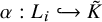 $\alpha : L_i\hookrightarrow \tilde K$
, find
$\alpha : L_i\hookrightarrow \tilde K$
, find $\tau \in \Gamma ={\mathrm{Gal}}(\tilde K/K)$
such that
$\tau \in \Gamma ={\mathrm{Gal}}(\tilde K/K)$
such that $\alpha =\tau _{|L_i}: L_i\hookrightarrow \tilde K$
. Then the projection of the image of
$\alpha =\tau _{|L_i}: L_i\hookrightarrow \tilde K$
. Then the projection of the image of $\mathbf {x}'$
to the factor indexed by
$\mathbf {x}'$
to the factor indexed by $(i, \alpha )$
, is
$(i, \alpha )$
, is $\tau _*(\mathbf {x}^{\prime }_i)$
. In this,
$\tau _*(\mathbf {x}^{\prime }_i)$
. In this,
 $$ \begin{align*}\tau_*: {\mathcal B}(G_i\otimes_{L_i}\tilde K, \tilde K)\to {\mathcal B}(G_i\otimes_{L_i, \tau}\tilde K, \tilde K)\end{align*} $$
is induced by functoriality of buildings by the Galois automorphism $ \tau : \tilde K\to \tilde K$
. Hence,
$ \tau : \tilde K\to \tilde K$
. Hence, $ \tau _*(\mathbf {x}^{\prime }_i)$
is hyperspecial, and so
$ \tau _*(\mathbf {x}^{\prime }_i)$
is hyperspecial, and so $\mathbf {x}'=( \tau _*(\mathbf {x}^{\prime }_i))_{i, \alpha }$
is hyperspecial in
$\mathbf {x}'=( \tau _*(\mathbf {x}^{\prime }_i))_{i, \alpha }$
is hyperspecial in ${\mathcal B}(G,\tilde K)$
. This shows (
${\mathcal B}(G,\tilde K)$
. This shows ( $*$
) when G is semi-simple.
$*$
) when G is semi-simple.
Now we discuss the general reductive case. Note that for a split group H, a point in $\mathbf {x}\in {\mathcal B}(H, K)$
is hyperspecial if and only if its image
$\mathbf {x}\in {\mathcal B}(H, K)$
is hyperspecial if and only if its image $\bar {\mathbf {x}}\in \bar {\mathcal B}(H,K)={\mathcal B}(H^\mathrm{der}, \tilde K)$
is hyperspecial.
$\bar {\mathbf {x}}\in \bar {\mathcal B}(H,K)={\mathcal B}(H^\mathrm{der}, \tilde K)$
is hyperspecial.
We have $G(\breve K)_{\mathbf {x}}=G(\breve K)_{\bar {\mathbf {x}}}\cap G(\breve K)^1$
. Here,
$G(\breve K)_{\mathbf {x}}=G(\breve K)_{\bar {\mathbf {x}}}\cap G(\breve K)^1$
. Here, $G(\breve K)_{\bar {\mathbf {x}}}$
is the stabilizer of
$G(\breve K)_{\bar {\mathbf {x}}}$
is the stabilizer of $\bar {\mathbf {x}}\in \bar {\mathcal B}(G, K)\subset \bar {\mathcal B}(G, \breve K)$
under the natural action of
$\bar {\mathbf {x}}\in \bar {\mathcal B}(G, K)\subset \bar {\mathcal B}(G, \breve K)$
under the natural action of $G(\breve K)$
on
$G(\breve K)$
on $\bar {\mathcal B}(G, \breve K)$
; the group
$\bar {\mathcal B}(G, \breve K)$
; the group $G(\breve K)^1$
is the kernel of
$G(\breve K)^1$
is the kernel of
 $$\begin{align*}G(\breve K)\xrightarrow{\kappa_G} \pi_1(G)_I\to \pi_1(G)_I/\{\mathrm{torsion}\} \end{align*}$$
obtained from the Kottwitz homomorphism, see [Reference Haines and RapoportHR08, Rem. 11], [Reference Bruhat and TitsBTII, 4.2.16]. If $\bar {\mathbf {x}}$
is generic in a facet and
$\bar {\mathbf {x}}$
is generic in a facet and $\bar {\mathbf {x}}'$
is nearby,
$\bar {\mathbf {x}}'$
is nearby, $G(\breve K)_{\bar {\mathbf {x}}}=G(\breve K)_{\bar {\mathbf {x}}'}$
; hence we also have
$G(\breve K)_{\bar {\mathbf {x}}}=G(\breve K)_{\bar {\mathbf {x}}'}$
; hence we also have $G(\breve K)_{\mathbf {x}}=G(\breve K)_{\mathbf {x}'}$
and so
$G(\breve K)_{\mathbf {x}}=G(\breve K)_{\mathbf {x}'}$
and so ${\mathcal G}_{\mathbf {x}}={\mathcal G}_{\mathbf {x}'}$
.
${\mathcal G}_{\mathbf {x}}={\mathcal G}_{\mathbf {x}'}$
.
Recall that we know ( $*$
) for
$*$
) for $G^\mathrm{der}$
. Consider
$G^\mathrm{der}$
. Consider $\mathbf {x}\in {\mathcal B}(G, K)$
generic in its facet with corresponding point
$\mathbf {x}\in {\mathcal B}(G, K)$
generic in its facet with corresponding point $\bar {\mathbf {x}}\in {\mathcal B}(G^\mathrm{der}, K)$
, also generic in its facet. By (
$\bar {\mathbf {x}}\in {\mathcal B}(G^\mathrm{der}, K)$
, also generic in its facet. By ( $*$
) for
$*$
) for $G^\mathrm{der}$
, there is nearby
$G^\mathrm{der}$
, there is nearby $\mathbf {x}^{\prime }_\mathrm{der}\in {\mathcal B}(G^\mathrm{der}, K)$
and a tame Galois extension
$\mathbf {x}^{\prime }_\mathrm{der}\in {\mathcal B}(G^\mathrm{der}, K)$
and a tame Galois extension $\tilde K/K$
which splits
$\tilde K/K$
which splits $G^\mathrm{der}$
such that
$G^\mathrm{der}$
such that $\mathbf {x}^{\prime }_\mathrm{der}\in {\mathcal B}(G^\mathrm{der}, \tilde K)$
is hyperspecial. By enlarging
$\mathbf {x}^{\prime }_\mathrm{der}\in {\mathcal B}(G^\mathrm{der}, \tilde K)$
is hyperspecial. By enlarging $\tilde K/K$
we can assure that G is also split over
$\tilde K/K$
we can assure that G is also split over $\tilde K$
. Now lift
$\tilde K$
. Now lift $\mathbf {x}^{\prime }_\mathrm{der}$
to
$\mathbf {x}^{\prime }_\mathrm{der}$
to $\mathbf {x}'\in {\mathcal B}(G, K)$
; that is, with
$\mathbf {x}'\in {\mathcal B}(G, K)$
; that is, with $\bar {\mathbf {x}}'=\mathbf {x}^{\prime }_\mathrm{der}$
. The point
$\bar {\mathbf {x}}'=\mathbf {x}^{\prime }_\mathrm{der}$
. The point $\mathbf {x}'$
is hyperspecial in
$\mathbf {x}'$
is hyperspecial in ${\mathcal B}(G, \tilde K)$
and by the argument above
${\mathcal B}(G, \tilde K)$
and by the argument above ${\mathcal G}_{\mathbf {x}}={\mathcal G}_{\mathbf {x}'}$
. This shows (
${\mathcal G}_{\mathbf {x}}={\mathcal G}_{\mathbf {x}'}$
. This shows ( $*$
) for G and
$*$
) for G and $\mathbf {x}$
.
$\mathbf {x}$
.
2.3 Lattices and parahoric subgroups
Let V be a finite dimensional K-vector space. In this subsection, we give a more explicit description of the construction in Proposition 2.2.2 in the case $G=\mathrm{GL}(V)$
.
$G=\mathrm{GL}(V)$
.
Fix, once and for all, a volume form on V, that is, an isomorphism $\wedge ^{\dim (V)} V\simeq K$
. This allows us to identify the (extended) building
$\wedge ^{\dim (V)} V\simeq K$
. This allows us to identify the (extended) building ${\mathcal B}(\mathrm{GL}(V), K)$
with pairs
${\mathcal B}(\mathrm{GL}(V), K)$
with pairs $({\mathcal L}, c)$
consisting of a periodic
$({\mathcal L}, c)$
consisting of a periodic ${\mathcal O}$
-lattice chain
${\mathcal O}$
-lattice chain $ {\mathcal L}=\{ {\Lambda }_\bullet \}$
in
$ {\mathcal L}=\{ {\Lambda }_\bullet \}$
in $V $
and a grading function
$V $
and a grading function $c: {\mathcal L}\to {\mathbb R}$
(see [Reference Bruhat and TitsBT84], [Reference Kaletha and PrasadKaP23, Cor. 5.1.28]). For each periodic lattice chain
$c: {\mathcal L}\to {\mathbb R}$
(see [Reference Bruhat and TitsBT84], [Reference Kaletha and PrasadKaP23, Cor. 5.1.28]). For each periodic lattice chain ${\mathcal L}$
we can choose a “determining segment,”
${\mathcal L}$
we can choose a “determining segment,”
 $$\begin{align*}{\Lambda}_s=\pi{\Lambda}_{0}\subset {\Lambda}_{s-1}\subset\cdots \subset {\Lambda}_0 \end{align*}$$
in the obvious sense. If $\mathbf {x}=({\mathcal L}, c)$
, then the corresponding parahoric subgroup of
$\mathbf {x}=({\mathcal L}, c)$
, then the corresponding parahoric subgroup of $\mathrm{GL}(V)$
is the common stabilizer of the lattices in the lattice chain, or in a determining segment of the lattice chain. The corresponding parahoric group scheme, which we write simply as
$\mathrm{GL}(V)$
is the common stabilizer of the lattices in the lattice chain, or in a determining segment of the lattice chain. The corresponding parahoric group scheme, which we write simply as $\mathrm{GL}({\mathcal L})$
, is determined by its
$\mathrm{GL}({\mathcal L})$
, is determined by its $\breve {\mathcal O}$
-points ([Reference Bruhat and TitsBTII, Prop. 1.7.6]) which are
$\breve {\mathcal O}$
-points ([Reference Bruhat and TitsBTII, Prop. 1.7.6]) which are
 $$\begin{align*}\mathrm{GL}({\mathcal L})(\breve {\mathcal O})=\bigcap_i \mathrm{GL}({\Lambda}_i\otimes_{\mathcal O}\breve {\mathcal O})= \bigcap_{i=0}^{s-1} \mathrm{GL}({\Lambda}_i\otimes_{\mathcal O}\breve {\mathcal O}). \end{align*}$$
In this situation, we set
 $$\begin{align*}{\mathrm{tot}}({\mathcal L}):={\Lambda}_0\oplus{\Lambda}_1\oplus\cdots \oplus {\Lambda}_{s-1}\subset V^{\oplus s} \end{align*}$$
for the direct sum of the lattices in the segment. We can consider the stabilizer group scheme $\mathrm{GL}({\mathrm{tot}}({\mathcal L}))$
.
$\mathrm{GL}({\mathrm{tot}}({\mathcal L}))$
.
Lemma 2.3.1 ([Reference Bruhat and TitsBT84, 3.8], cf. [Reference Rapoport and ZinkRZ96, Prop. A.4])
There is a group scheme homomorphism $ \mathrm{GL}({\mathcal L})\to \mathrm{GL}({\mathrm{tot}}({\mathcal L})) $
which extends the diagonal
$ \mathrm{GL}({\mathcal L})\to \mathrm{GL}({\mathrm{tot}}({\mathcal L})) $
which extends the diagonal
 $$\begin{align*}\mathrm{GL}(V)\to \mathrm{GL}(V)^s\hookrightarrow \mathrm{GL}(V^{\oplus s}) \end{align*}$$
and which is a closed immersion.
2.3.2
Let $\tilde K/K$
be a finite tame Galois extension with Galois group
$\tilde K/K$
be a finite tame Galois extension with Galois group ${\Gamma }$
, inertia subgroup
${\Gamma }$
, inertia subgroup $I\subset {\Gamma }$
, and ramification index
$I\subset {\Gamma }$
, and ramification index $e=|I|$
. Let
$e=|I|$
. Let $\tilde {\Lambda }\subset V\otimes _K\tilde K$
be an
$\tilde {\Lambda }\subset V\otimes _K\tilde K$
be an $\tilde {\mathcal O}$
-lattice. We assume that
$\tilde {\mathcal O}$
-lattice. We assume that $\tilde {\Lambda }$
is
$\tilde {\Lambda }$
is ${\Gamma }$
-stable. Let
${\Gamma }$
-stable. Let $\tilde {\mathcal L}$
be the periodic lattice chain given by all scalar multiples
$\tilde {\mathcal L}$
be the periodic lattice chain given by all scalar multiples $\tilde \pi ^i\tilde {\Lambda }$
of
$\tilde \pi ^i\tilde {\Lambda }$
of $\tilde {\Lambda }$
and consider the grading function
$\tilde {\Lambda }$
and consider the grading function $\tilde c$
given by
$\tilde c$
given by $\tilde c(\tilde {\pi }^i\tilde {\Lambda })=i$
. Then
$\tilde c(\tilde {\pi }^i\tilde {\Lambda })=i$
. Then $(\tilde {\mathcal L}, \tilde {c})$
is a periodic graded
$(\tilde {\mathcal L}, \tilde {c})$
is a periodic graded $\tilde {{\mathcal O}}$
-lattice chain in
$\tilde {{\mathcal O}}$
-lattice chain in $V\otimes _K \tilde {K}$
corresponding to a point
$V\otimes _K \tilde {K}$
corresponding to a point $\tilde {\mathbf {x}}\in {\mathcal B}(\mathrm{GL}(V), \tilde {K})$
which is fixed by
$\tilde {\mathbf {x}}\in {\mathcal B}(\mathrm{GL}(V), \tilde {K})$
which is fixed by ${\Gamma }$
. The corresponding parahoric group scheme for
${\Gamma }$
. The corresponding parahoric group scheme for $\mathrm{GL}(V\otimes _K\tilde {K})$
over
$\mathrm{GL}(V\otimes _K\tilde {K})$
over $\tilde {{\mathcal O}}$
is the group scheme of
$\tilde {{\mathcal O}}$
is the group scheme of $\tilde {{\mathcal O}}$
-linear automorphisms of
$\tilde {{\mathcal O}}$
-linear automorphisms of $\tilde {\Lambda }$
; we denote this group scheme simply by
$\tilde {\Lambda }$
; we denote this group scheme simply by $\mathrm{GL}(\tilde {\Lambda })$
.
$\mathrm{GL}(\tilde {\Lambda })$
.
By tame descent on buildings (2.1.3), $\tilde {\mathbf {x}}$
is identified with a point
$\tilde {\mathbf {x}}$
is identified with a point $\mathbf {x}\in {\mathcal B}(\mathrm{GL}(V), K)$
which corresponds to a periodic graded lattice chain
$\mathbf {x}\in {\mathcal B}(\mathrm{GL}(V), K)$
which corresponds to a periodic graded lattice chain $({\mathcal L}, c)$
in V. We have
$({\mathcal L}, c)$
in V. We have
 $$\begin{align*}\mathrm{GL}({\mathcal L})=\mathrm{Res}_{\tilde {{\mathcal O}}/{\mathcal O}}\mathrm{GL}(\tilde{\Lambda})^{\Gamma} \end{align*}$$
for the parahoric $\mathrm{GL}({\mathcal L})$
of
$\mathrm{GL}({\mathcal L})$
of $\mathrm{GL}(V)$
given as the stabilizer of
$\mathrm{GL}(V)$
given as the stabilizer of $\mathbf {x}$
.
$\mathbf {x}$
.
Lemma 2.3.3. The parahoric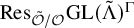 $\mathrm{Res}_{\tilde {{\mathcal O}}/{\mathcal O}}\mathrm{GL}(\tilde {\Lambda })^{\Gamma }$
of
$\mathrm{Res}_{\tilde {{\mathcal O}}/{\mathcal O}}\mathrm{GL}(\tilde {\Lambda })^{\Gamma }$
of $\mathrm{GL}(V)$
is equal to the stabilizer
$\mathrm{GL}(V)$
is equal to the stabilizer $\mathrm{GL}({\mathcal L})$
of the periodic lattice chain
$\mathrm{GL}({\mathcal L})$
of the periodic lattice chain ${\mathcal L}$
given by
${\mathcal L}$
given by $\{\Lambda _i\}_{i\in {\mathbb Z}}$
where
$\{\Lambda _i\}_{i\in {\mathbb Z}}$
where
 $$\begin{align*}\Lambda_i=(\tilde{\pi}^i\tilde{\Lambda})^{\Gamma}\subset (V\otimes_K \tilde {K})^{\Gamma}=V \end{align*}$$
and $\Lambda _{i+1}\to \Lambda _i$
are the natural injective maps given by
$\Lambda _{i+1}\to \Lambda _i$
are the natural injective maps given by $\tilde \pi ^{i+1}\tilde {\Lambda }\subset \tilde \pi ^i\tilde {\Lambda }$
.
$\tilde \pi ^{i+1}\tilde {\Lambda }\subset \tilde \pi ^i\tilde {\Lambda }$
.
Note that in the above, we could have $\Lambda _{i+1}=\Lambda _i$
for some i. The periodic lattice chain
$\Lambda _{i+1}=\Lambda _i$
for some i. The periodic lattice chain ${\mathcal L}$
given by
${\mathcal L}$
given by $\{\Lambda _i\}_{i\in {\mathbb Z}}$
is, by definition, the set of the lattices
$\{\Lambda _i\}_{i\in {\mathbb Z}}$
is, by definition, the set of the lattices ${\Lambda }_i$
. Since
${\Lambda }_i$
. Since $\tilde \pi ^e\tilde {\mathcal O}=\pi \tilde {\mathcal O}$
we have
$\tilde \pi ^e\tilde {\mathcal O}=\pi \tilde {\mathcal O}$
we have $\Lambda _{e}=(\pi \tilde {\Lambda } )^{\Gamma }=\pi \Lambda _0$
.
$\Lambda _{e}=(\pi \tilde {\Lambda } )^{\Gamma }=\pi \Lambda _0$
.
Proof. Both the group schemes $\mathrm{Res}_{\tilde {\mathcal O}/{\mathcal O}}\mathrm{GL}(\tilde {\Lambda })^{\Gamma }$
and
$\mathrm{Res}_{\tilde {\mathcal O}/{\mathcal O}}\mathrm{GL}(\tilde {\Lambda })^{\Gamma }$
and $\mathrm{GL}({\mathcal L})$
are smooth affine with generic fiber
$\mathrm{GL}({\mathcal L})$
are smooth affine with generic fiber $\mathrm{GL}(V)$
and, by [Reference Bruhat and TitsBTII, Prop. 1.7.6], it is enough to show they have the same
$\mathrm{GL}(V)$
and, by [Reference Bruhat and TitsBTII, Prop. 1.7.6], it is enough to show they have the same $\breve {\mathcal O}$
-points. For this, we base change to
$\breve {\mathcal O}$
-points. For this, we base change to $\breve {\mathcal O}$
and assume that
$\breve {\mathcal O}$
and assume that $K=\breve K$
. So, it is enough to show
$K=\breve K$
. So, it is enough to show
 $$ \begin{align} \mathrm{GL}(V)\cap \mathrm{GL}(\tilde{\Lambda})=\bigcap_{i=0}^{e-1} \mathrm{GL}({\Lambda}_i) \end{align} $$
(the intersection taking place in $\mathrm{GL}(V\otimes _K\tilde K)$
.) Let
$\mathrm{GL}(V\otimes _K\tilde K)$
.) Let $\tilde \pi \in \tilde {\mathcal O}$
be a uniformizer with
$\tilde \pi \in \tilde {\mathcal O}$
be a uniformizer with $\tilde \pi ^e\in {\mathcal O}$
. Let
$\tilde \pi ^e\in {\mathcal O}$
. Let $\chi : I\to k^*={\mathrm{Aut}}_k((\tilde \pi )/(\tilde \pi )^2)$
be the standard inertia character. Write
$\chi : I\to k^*={\mathrm{Aut}}_k((\tilde \pi )/(\tilde \pi )^2)$
be the standard inertia character. Write
 $$\begin{align*}\tilde {\Lambda}= \bigoplus_{i\in {\mathbb Z}/e{\mathbb Z}} \tilde {\Lambda}_{i} \end{align*}$$
for the decomposition into eigenspaces for the action of the inertia. Here
 $$\begin{align*}\tilde{\Lambda}_i=\tilde {\Lambda}_{i\,\mathrm{mod}\, e}=\{x\in \tilde{\Lambda}\ |\ \gamma(x)=[\chi(\gamma)]^i\cdot x\}, \end{align*}$$
with $[\ ]: k^*\to {\mathcal O}^*$
the Teichmüller map. The eigenspaces
$[\ ]: k^*\to {\mathcal O}^*$
the Teichmüller map. The eigenspaces $\tilde {\Lambda }_i$
are
$\tilde {\Lambda }_i$
are ${\mathcal O}$
-modules and
${\mathcal O}$
-modules and
 $$\begin{align*}{\Lambda}_i=(\tilde\pi^i\tilde{\Lambda})^I=\tilde\pi^i \tilde{\Lambda}_{-i\,\mathrm{mod}\, e}\xrightarrow{\sim} \tilde{\Lambda}_{-i\,\mathrm{mod}\, e}, \end{align*}$$
the last map given by multiplying by $\tilde \pi ^{-i}$
. So, we have
$\tilde \pi ^{-i}$
. So, we have
 $$ \begin{align} \tilde{\Lambda}=\bigoplus_{i=0}^{e-1} \tilde\pi^{-i}{\Lambda}_i\subset V\otimes_K \tilde K=\bigoplus_{i=0}^{e-1} \tilde\pi^{-i}V. \end{align} $$
Multiplication by $g\in \mathrm{GL}(V)\cap \mathrm{GL}(\tilde {\Lambda })$
respects the eigenspace decomposition of
$g\in \mathrm{GL}(V)\cap \mathrm{GL}(\tilde {\Lambda })$
respects the eigenspace decomposition of $\tilde {\Lambda }$
and commutes with scaling by
$\tilde {\Lambda }$
and commutes with scaling by $\tilde \pi $
, so the LHS of (2.3.4) is contained in the RHS. Suppose
$\tilde \pi $
, so the LHS of (2.3.4) is contained in the RHS. Suppose $g\in \mathrm{GL}({\Lambda }_i)$
, for all i. Then, by the above, g considered in
$g\in \mathrm{GL}({\Lambda }_i)$
, for all i. Then, by the above, g considered in $\mathrm{GL}(V\otimes _K \tilde K)$
gives an automorphism of
$\mathrm{GL}(V\otimes _K \tilde K)$
gives an automorphism of $\tilde \pi ^i \tilde {\Lambda }_{-i\,\mathrm{mod}\, e}$
and hence of
$\tilde \pi ^i \tilde {\Lambda }_{-i\,\mathrm{mod}\, e}$
and hence of $\tilde {\Lambda }$
. This shows that the RHS is contained in the LHS.
$\tilde {\Lambda }$
. This shows that the RHS is contained in the LHS.
2.3.6
In the lemma above, $\{{\Lambda }_i\}_{i\in {\mathbb Z}}$
is given by the
$\{{\Lambda }_i\}_{i\in {\mathbb Z}}$
is given by the $\pi ^{\mathbb Z}$
multiples of its segment
$\pi ^{\mathbb Z}$
multiples of its segment
 $$\begin{align*}\pi{\Lambda}_0\subset {\Lambda}_{e-1}\subset \cdots\subset {\Lambda}_1\subset {\Lambda}_0. \end{align*}$$
Assuming $\tilde \pi ^e\in {\mathcal O}$
and that
$\tilde \pi ^e\in {\mathcal O}$
and that $K=K^{\mathrm{un}}$
, that is,
$K=K^{\mathrm{un}}$
, that is, $\tilde K/K$
is totally ramified, the proof of the lemma gives
$\tilde K/K$
is totally ramified, the proof of the lemma gives
 $$ \begin{align} {\Lambda}_0\oplus{\Lambda}_1\oplus\cdots \oplus {\Lambda}_{e-1}\xrightarrow{\sim}\tilde{\Lambda}_{0}\oplus\tilde{\Lambda}_{-1}\oplus\cdots\oplus \tilde{\Lambda}_{-(e-1)}=\tilde{\Lambda} \end{align} $$
as ${\mathcal O}$
-modules, with the map given by multiplication by
${\mathcal O}$
-modules, with the map given by multiplication by $(1,\tilde \pi ^{-1},\ldots , \tilde \pi ^{-(e-1)})$
. Hence,
$(1,\tilde \pi ^{-1},\ldots , \tilde \pi ^{-(e-1)})$
. Hence,
 $$\begin{align*}{\mathrm{tot}}({\mathcal L})\subset {\Lambda}_0\oplus{\Lambda}_1\oplus\cdots \oplus {\Lambda}_{e-1}\simeq \tilde{\Lambda} \end{align*}$$
and it is a direct summand. (The inclusion is proper when we have ${\Lambda }_i={\Lambda }_{i+1}$
, for some i.) It follows that multiplication by corresponding powers of
${\Lambda }_i={\Lambda }_{i+1}$
, for some i.) It follows that multiplication by corresponding powers of $\tilde \pi $
on the graded pieces gives an isomorphism
$\tilde \pi $
on the graded pieces gives an isomorphism
 $$ \begin{align} L\oplus {\mathrm{tot}}({\mathcal L})\xrightarrow{\ \sim\ } \tilde{\Lambda}. \end{align} $$
where L is a certain direct sum of ${\Lambda }_i$
.
${\Lambda }_i$
.
2.4 Embedding of parahorics
2.4.1
Let $p>2$
and
$p>2$
and $\rho :G\rightarrow \mathrm{GL}(V)$
a faithful representation of a reductive group over K. We have the following proposition which generalizes [Reference KisinKi10, Lem. 2.3.1] with a similar proof.
$\rho :G\rightarrow \mathrm{GL}(V)$
a faithful representation of a reductive group over K. We have the following proposition which generalizes [Reference KisinKi10, Lem. 2.3.1] with a similar proof.
Proposition 2.4.2. Let $\tilde K/K$
be a finite Galois extension with
$\tilde K/K$
be a finite Galois extension with ${\Gamma }={\mathrm{Gal}}(\tilde K/K)$
and with the following property:
${\Gamma }={\mathrm{Gal}}(\tilde K/K)$
and with the following property:
There is a split reductive group scheme $\tilde {\mathcal G}$
over
$\tilde {\mathcal G}$
over $\tilde {\mathcal O}$
such that
$\tilde {\mathcal O}$
such that
-
1)
$\tilde {\mathcal G}\otimes _{\tilde {\mathcal O}}\tilde K=G\otimes _{K}\tilde K$
(in particular, G splits over
$\tilde K$
), -
2)
$\tilde {\mathcal G}$
supports an
$\tilde {\mathcal O}$
-semilinear
${\Gamma }$
-action which extends the standard
$\tilde K$
-semilinear
$\Gamma $
-action on
$G\otimes _K\tilde K$
.


Then there is a $\tilde {\mathcal O}$
-lattice
$\tilde {\mathcal O}$
-lattice $\tilde {\Lambda }$
in
$\tilde {\Lambda }$
in $V\otimes _K\tilde K$
which is
$V\otimes _K\tilde K$
which is ${\Gamma }$
-invariant and such that the base change
${\Gamma }$
-invariant and such that the base change $\rho \otimes _K\tilde K: G\otimes _K\tilde K\to \mathrm{GL}(V\otimes _K\tilde K)$
extends to a closed group scheme immersion
$\rho \otimes _K\tilde K: G\otimes _K\tilde K\to \mathrm{GL}(V\otimes _K\tilde K)$
extends to a closed group scheme immersion
 $$\begin{align*}\tilde{\mathcal G}\hookrightarrow \mathrm{GL}(\tilde {\Lambda}). \end{align*}$$
Proof. Let M be the maximal unramified extension of $\tilde K$
in an algebraic closure of
$\tilde K$
in an algebraic closure of $\tilde K$
. Then
$\tilde K$
. Then $M/K$
is an (infinite) Galois extension. The natural homomorphism
$M/K$
is an (infinite) Galois extension. The natural homomorphism ${\mathrm{Gal}}(M/K)\to {\Gamma }={\mathrm{Gal}}(\tilde K/K)$
is a surjection with kernel
${\mathrm{Gal}}(M/K)\to {\Gamma }={\mathrm{Gal}}(\tilde K/K)$
is a surjection with kernel ${\mathrm{Gal}}(M/\tilde K)$
which identifies inertia subgroups. We first show that there is a
${\mathrm{Gal}}(M/\tilde K)$
which identifies inertia subgroups. We first show that there is a ${\mathrm{Gal}}(M/K)$
-invariant
${\mathrm{Gal}}(M/K)$
-invariant ${\mathcal O}_M$
-lattice
${\mathcal O}_M$
-lattice ${\Lambda }_M$
in
${\Lambda }_M$
in $V\otimes _K M$
which is also preserved by the action of
$V\otimes _K M$
which is also preserved by the action of $\rho (\tilde {\mathcal G}({\mathcal O}_M))$
. Observe that
$\rho (\tilde {\mathcal G}({\mathcal O}_M))$
. Observe that $\tilde {\mathcal G}({\mathcal O}_M)$
is bounded and the Galois group
$\tilde {\mathcal G}({\mathcal O}_M)$
is bounded and the Galois group ${\mathrm{Gal}}(M/K)$
is compact. We can consider the semi-direct product
${\mathrm{Gal}}(M/K)$
is compact. We can consider the semi-direct product $\tilde {\mathcal G}({\mathcal O}_M)\rtimes {\mathrm{Gal}}(M/K)$
(obtained by the
$\tilde {\mathcal G}({\mathcal O}_M)\rtimes {\mathrm{Gal}}(M/K)$
(obtained by the ${\mathrm{Gal}}(M/K)$
-action on
${\mathrm{Gal}}(M/K)$
-action on $\tilde {\mathcal G}({\mathcal O}_M)$
given by the semi-linear
$\tilde {\mathcal G}({\mathcal O}_M)$
given by the semi-linear ${\Gamma }$
-action on
${\Gamma }$
-action on $\tilde {\mathcal G}$
) and apply the same argument as in the proof of [Reference KisinKi10, Lem. 2.3.1] to obtain the existence of
$\tilde {\mathcal G}$
) and apply the same argument as in the proof of [Reference KisinKi10, Lem. 2.3.1] to obtain the existence of ${\Lambda }_M$
. Then, by [Reference Bruhat and TitsBTII, 1.7.6],
${\Lambda }_M$
. Then, by [Reference Bruhat and TitsBTII, 1.7.6], $\rho $
extends to a group scheme homomorphism
$\rho $
extends to a group scheme homomorphism
 $$\begin{align*}\tilde{\mathcal G}\otimes_{\tilde {\mathcal O}}{\mathcal O}_M\to \mathrm{GL}({\Lambda}_M). \end{align*}$$
Since $\tilde {\mathcal G}$
is reductive and p is odd, this is a closed immersion by [Reference Prasad and YuPrY06, 1.3]. We can then take
$\tilde {\mathcal G}$
is reductive and p is odd, this is a closed immersion by [Reference Prasad and YuPrY06, 1.3]. We can then take
 $$\begin{align*}\tilde {\Lambda}:=( {\Lambda}_M)^{{\mathrm{Gal}}(M/\tilde K)}. \end{align*}$$
This is an $\tilde {\mathcal O}$
-lattice in
$\tilde {\mathcal O}$
-lattice in $V\otimes _K\tilde K$
by étale descent along
$V\otimes _K\tilde K$
by étale descent along ${\mathcal O}_M/\tilde {\mathcal O}$
and the rest follows.
${\mathcal O}_M/\tilde {\mathcal O}$
and the rest follows.
Remark 2.4.3. a) After applying restriction of scalars and then ${\Gamma }$
-fixed points to
${\Gamma }$
-fixed points to $\tilde {\mathcal G}\hookrightarrow \mathrm{GL}(\tilde {\Lambda })$
, we obtain a closed immersion of group schemes
$\tilde {\mathcal G}\hookrightarrow \mathrm{GL}(\tilde {\Lambda })$
, we obtain a closed immersion of group schemes
 $$\begin{align*}(\mathrm{Res}_{\tilde{\mathcal O}/{\mathcal O}}\tilde{\mathcal G})^{\Gamma}\hookrightarrow \mathrm{Res}_{\tilde{\mathcal O}/\tilde O}\mathrm{GL}(\tilde {\Lambda})^{\Gamma} \end{align*}$$
which gives $\rho : G\to \mathrm{GL}(V)$
on generic fibers.
$\rho : G\to \mathrm{GL}(V)$
on generic fibers.
b) Note that we do not need that $\tilde K/K$
is tame in Proposition 2.4.2. However, under this additional assumption, we see, using Edixhoven’s lemma [Reference EdixhovenEd92, 3.4:Prop.], that both the target and the source of the closed immersion in (a) above are smooth affine schemes over
$\tilde K/K$
is tame in Proposition 2.4.2. However, under this additional assumption, we see, using Edixhoven’s lemma [Reference EdixhovenEd92, 3.4:Prop.], that both the target and the source of the closed immersion in (a) above are smooth affine schemes over ${\mathcal O}$
. By Lemma 2.3.3 and étale descent, the target is a parahoric group scheme for
${\mathcal O}$
. By Lemma 2.3.3 and étale descent, the target is a parahoric group scheme for $\mathrm{GL}(V)$
. In fact, it is the parahoric group scheme given as the stabilizer of the chain of
$\mathrm{GL}(V)$
. In fact, it is the parahoric group scheme given as the stabilizer of the chain of ${\mathcal O}$
-lattices
${\mathcal O}$
-lattices $\{(\tilde \pi ^i\tilde {\Lambda })^{\Gamma }\}_{i\in {\mathbb Z}}$
.
$\{(\tilde \pi ^i\tilde {\Lambda })^{\Gamma }\}_{i\in {\mathbb Z}}$
.
2.4.4
We now assume that G and $\tilde K/K$
are as in §2.2 and let
$\tilde K/K$
are as in §2.2 and let $\rho : G\to \mathrm{GL}(V)$
be a faithful representation over K. Suppose
$\rho : G\to \mathrm{GL}(V)$
be a faithful representation over K. Suppose $\mathbf {x}\in {\mathcal B}(G, K)$
is generic in its facet and that after replacing
$\mathbf {x}\in {\mathcal B}(G, K)$
is generic in its facet and that after replacing $\mathbf {x}$
by a nearby point with the same stabilizer group scheme,
$\mathbf {x}$
by a nearby point with the same stabilizer group scheme, $\mathbf {x}$
is hyperspecial in
$\mathbf {x}$
is hyperspecial in ${\mathcal B}(G, \tilde K)$
and hence the corresponding parahoric group scheme
${\mathcal B}(G, \tilde K)$
and hence the corresponding parahoric group scheme $\tilde {\mathcal G}=\tilde {\mathcal G}_{\mathbf {x}}$
of
$\tilde {\mathcal G}=\tilde {\mathcal G}_{\mathbf {x}}$
of $G\otimes _K\tilde K$
is reductive. This is possible by Prop. 2.2.2, under the assumptions stated there.
$G\otimes _K\tilde K$
is reductive. This is possible by Prop. 2.2.2, under the assumptions stated there.
By Proposition 2.4.2, there is a ${\Gamma }$
-stable
${\Gamma }$
-stable $\tilde {\mathcal O}$
-lattice
$\tilde {\mathcal O}$
-lattice $\tilde {\Lambda }$
in
$\tilde {\Lambda }$
in $V\otimes _K\tilde K$
such that
$V\otimes _K\tilde K$
such that $\rho $
extends to a closed immersion of group schemes
$\rho $
extends to a closed immersion of group schemes
 $$\begin{align*}\rho: \tilde{\mathcal G}_{\mathbf{x}}\hookrightarrow \mathrm{GL}(\tilde{\Lambda}). \end{align*}$$
Taking restriction of scalars and then ${\Gamma }$
-fixed points gives a closed immersion
${\Gamma }$
-fixed points gives a closed immersion
 $$ \begin{align} \rho: {\mathcal G}_{\mathbf{x}}=(\mathrm{Res}_{\tilde{\mathcal O}/{\mathcal O}}\tilde{\mathcal G}_{\mathbf{x}})^{\Gamma} \hookrightarrow (\mathrm{Res}_{\tilde{\mathcal O}/{\mathcal O}}\mathrm{GL}(\tilde{\Lambda})^{\Gamma}\hookrightarrow \mathrm{GL}(\tilde{\Lambda}) \end{align} $$
where in the target we consider $\tilde {\Lambda }$
as an
$\tilde {\Lambda }$
as an ${\mathcal O}$
-module by restriction of scalars.
${\mathcal O}$
-module by restriction of scalars.
3 Local models and embeddings
In this section, we discuss the formalism of local models, we exhibit local models as closed subschemes of suitable Grassmannians and (re)prove the cases of the Scholze-Weinstein conjecture that we need. Our arguments are independent of [Reference Anschütz, Gleason, Lourenço and RicharzAGLR22]. The main results are Theorems 3.2.15 and Theorem 3.3.25. We also give the related definition of a good integral Hodge embedding, see Definition 3.4.4.
3.1 Local model triples and local models
3.1.1
In this section, we let F be a finite extension of ${\mathbb Q}_p$
. Let
${\mathbb Q}_p$
. Let $(G, \{\mu \}, {\mathcal G} )$
be a local model triple over F. By definition, in these triples
$(G, \{\mu \}, {\mathcal G} )$
be a local model triple over F. By definition, in these triples
-
• G is a (connected) reductive group over F,
-
•
$\{\mu \}$
is the
$G(\overline F)$
-conjugacy class of a minuscule cocharacter
$\mu : {{\mathbb G}_{\mathrm{m}}}_{\overline F}\to G_{\overline F}$
, where
$\overline F$
is an algebraic closure of F, -
•
${\mathcal G}$
is a quasi-parahoric stabilizer group scheme over
${\mathcal O}_F$
for G.


A morphism of local model triples $(G,\{\mu \},{\mathcal G}) \rightarrow (G',\{\mu '\},{\mathcal G}')$
is a group scheme homomorphism
$(G,\{\mu \},{\mathcal G}) \rightarrow (G',\{\mu '\},{\mathcal G}')$
is a group scheme homomorphism ${\mathcal G} \rightarrow {\mathcal G}'$
taking
${\mathcal G} \rightarrow {\mathcal G}'$
taking $\{\mu \}$
to
$\{\mu \}$
to $\{\mu '\}.$
As usual, we denote by E the reflex field of the pair $(G, \{\mu \})$
. It is a subfield of
$(G, \{\mu \})$
. It is a subfield of $\bar {F}$
containing F. To simplify notation, we often write
$\bar {F}$
containing F. To simplify notation, we often write $(G, \mu )$
for
$(G, \mu )$
for $(G, \{\mu \})$
and
$(G, \{\mu \})$
and $({\mathcal G},\mu )$
instead of
$({\mathcal G},\mu )$
instead of $(G, \{\mu \}, {\mathcal G} )$
.
$(G, \{\mu \}, {\mathcal G} )$
.
Definition 3.1.2. We say that the pair $(G, \mu )$
is of (local) Hodge type, if there is an embedding
$(G, \mu )$
is of (local) Hodge type, if there is an embedding $\rho : G\hookrightarrow \mathrm{GL}(V)$
such that
$\rho : G\hookrightarrow \mathrm{GL}(V)$
such that
-
•
$\rho $
is a minuscule representation, -
•
$\rho \circ \mu $
is conjugate to the standard minuscule cocharacter
$\mu _d$
of
$\mathrm{GL}(V_{\overline F})$
; here
$\mu _d(a)=\mathrm{diag}(a^{(d)},1^{(h-d)})$
where
$h=\dim V$
, -
•
$\rho (G)$
contains the scalars.





Such a $\rho $
will be said to give a Hodge embedding
$\rho $
will be said to give a Hodge embedding $\rho : (G,\mu )\hookrightarrow (\mathrm{GL}(V),\mu _d)$
.
$\rho : (G,\mu )\hookrightarrow (\mathrm{GL}(V),\mu _d)$
.
By definition, an integral Hodge embedding for $({\mathcal G},\mu )$
is a closed immersion of group schemes
$({\mathcal G},\mu )$
is a closed immersion of group schemes ${\mathcal G}\hookrightarrow \mathrm{GL}({\Lambda })$
over
${\mathcal G}\hookrightarrow \mathrm{GL}({\Lambda })$
over ${\mathcal O}_F$
, where
${\mathcal O}_F$
, where ${\Lambda }$
is an
${\Lambda }$
is an ${\mathcal O}_F$
-lattice in V, such that the homomorphism of generic fibers
${\mathcal O}_F$
-lattice in V, such that the homomorphism of generic fibers $G\hookrightarrow \mathrm{GL}(V)$
is a Hodge embedding in the sense above.
$G\hookrightarrow \mathrm{GL}(V)$
is a Hodge embedding in the sense above.
Definition 3.1.3. We say that the pair $(G, \mu )$
is of (local) abelian type, if there is a pair
$(G, \mu )$
is of (local) abelian type, if there is a pair $(G_1,\mu _1)$
of Hodge type and an isomorphism
$(G_1,\mu _1)$
of Hodge type and an isomorphism $(G^{\mathrm{ad}} _1, \mu ^{\mathrm{ad}} _1)\simeq (G^{\mathrm{ad}} ,\mu ^{\mathrm{ad}} )$
.
$(G^{\mathrm{ad}} _1, \mu ^{\mathrm{ad}} _1)\simeq (G^{\mathrm{ad}} ,\mu ^{\mathrm{ad}} )$
.
Definition 3.1.4.
-
(1) We say that a reductive group G over F is quasi-tame, if
$ G\simeq \prod _{i=1}^s\mathrm{Res}_{K_i/F}H_i $
where, for all i,
$K_i/F$
is a finite extension and
$H_i$
is a reductive group over
$K_i$
which splits over a tamely ramified extension of
$K_i$
. -
(2) We say that a reductive group G over F is essentially tame, if
$G^{\mathrm{ad}} $
is quasi-tame, cf. [Reference Pappas and RapoportPR24, App.].


Standard assumptions 3.1.5. We assume $p>2$
, the pair
$p>2$
, the pair $(G, \mu )$
is of abelian type and, in addition, that G is essentially tame and classical.
$(G, \mu )$
is of abelian type and, in addition, that G is essentially tame and classical.
In this situation, G is classical when $G^{\mathrm{ad}} \simeq \prod _{i=1}^s\mathrm{Res}_{K_i/F}H_i$
, with each
$G^{\mathrm{ad}} \simeq \prod _{i=1}^s\mathrm{Res}_{K_i/F}H_i$
, with each $H_i$
splitting over a tamely ramified extension of
$H_i$
splitting over a tamely ramified extension of $K_i$
, and of classical type. (By definition, “classical type” excludes triality groups.)
$K_i$
, and of classical type. (By definition, “classical type” excludes triality groups.)
Remark 3.1.6. a) Suppose $p>2$
and
$p>2$
and $(G, \mu )$
is of abelian type. Write
$(G, \mu )$
is of abelian type. Write
 $$ \begin{align*}(G^{\mathrm{ad}} ,\mu^{\mathrm{ad}} )\simeq (\prod_{i=1}^s\mathrm{Res}_{K_i/F}H_i, \{\mu_i\}), \end{align*} $$
where, for all i, $K_i/F$
is a finite extension and
$K_i/F$
is a finite extension and $H_i$
is absolutely simple over
$H_i$
is absolutely simple over $K_i$
. As we will explain below, if
$K_i$
. As we will explain below, if $\mu _i$
is nontrivial, then
$\mu _i$
is nontrivial, then $H_i$
is of classical type, and also splits over a tamely ramified extension of
$H_i$
is of classical type, and also splits over a tamely ramified extension of $K_i$
. Hence, the additional condition “essentially tame and classical” in the standard assumptions above, is only relevant when
$K_i$
. Hence, the additional condition “essentially tame and classical” in the standard assumptions above, is only relevant when $\mu _i=1$
, for some i.
$\mu _i=1$
, for some i.
Indeed, when $\mu _i\neq 1$
,
$\mu _i\neq 1$
, $H_i$
is of type A, B, C, or D: This follows from Deligne’s argument classifying Hodge embeddings which also applies in this local case. The triality forms of type
$H_i$
is of type A, B, C, or D: This follows from Deligne’s argument classifying Hodge embeddings which also applies in this local case. The triality forms of type $D_4$
are excluded: Indeed, the existence of a rational minuscule embedding implies that the Galois group cannot act transitively on the set of end vertices in the Dynkin diagram of a simple factor of type
$D_4$
are excluded: Indeed, the existence of a rational minuscule embedding implies that the Galois group cannot act transitively on the set of end vertices in the Dynkin diagram of a simple factor of type $D_4$
. Now, if
$D_4$
. Now, if $p>3$
any reductive group G over F is essentially tame. If
$p>3$
any reductive group G over F is essentially tame. If $p=3$
, there are G which are not essentially tame: However, they are all triality forms and these are excluded. For details, see [Reference Pappas and RapoportPR26, Prop. 7.2.1 and its proof], cf. [Reference DeligneDe79, §2.3.8] and Prop. 3.2.11 below.
$p=3$
, there are G which are not essentially tame: However, they are all triality forms and these are excluded. For details, see [Reference Pappas and RapoportPR26, Prop. 7.2.1 and its proof], cf. [Reference DeligneDe79, §2.3.8] and Prop. 3.2.11 below.
b) If $p>2$
and
$p>2$
and $(G, \mu _h)$
is obtained, by completion at p, from a (global) Shimura datum
$(G, \mu _h)$
is obtained, by completion at p, from a (global) Shimura datum $(\mathbf {G}, X)$
of abelian type in the sense of [Reference DeligneDe79], then the pair
$(\mathbf {G}, X)$
of abelian type in the sense of [Reference DeligneDe79], then the pair $(G, \mu _h)$
satisfies the standard assumptions.
$(G, \mu _h)$
satisfies the standard assumptions.
3.1.7
In what follows, we write ${\mathbb M}^{\mathrm{loc}}_{{\mathcal G},\mu }$
for the local model associated to the local model triple
${\mathbb M}^{\mathrm{loc}}_{{\mathcal G},\mu }$
for the local model associated to the local model triple $(G,\{\mu \},{\mathcal G})$
. By definition,
$(G,\{\mu \},{\mathcal G})$
. By definition, ${\mathbb M}^{\mathrm{loc}}_{{\mathcal G},\mu }={\mathbb M}^{\mathrm{loc}}_{{\mathcal G}^\circ ,\mu }$
and is the unique, up to unique isomorphism, proper flat
${\mathbb M}^{\mathrm{loc}}_{{\mathcal G},\mu }={\mathbb M}^{\mathrm{loc}}_{{\mathcal G}^\circ ,\mu }$
and is the unique, up to unique isomorphism, proper flat ${\mathcal O}_E$
-scheme with
${\mathcal O}_E$
-scheme with ${\mathcal G}$
-action, with generic fiber
${\mathcal G}$
-action, with generic fiber $G/P_\mu $
and reduced special fiber, which represents the v-sheaf
$G/P_\mu $
and reduced special fiber, which represents the v-sheaf ${\mathrm{M}}^v_{{\mathcal G},\mu }$
over
${\mathrm{M}}^v_{{\mathcal G},\mu }$
over ${\mathrm{Spd}}({\mathcal O}_E)$
defined in [Reference Scholze and WeinsteinSW20]. (This is denoted by
${\mathrm{Spd}}({\mathcal O}_E)$
defined in [Reference Scholze and WeinsteinSW20]. (This is denoted by ${\mathrm{Gr}}_{{\mathcal G},{\mathrm{Spd}}({\mathcal O}_E),\mu }$
in [Reference Scholze and WeinsteinSW20, Lect. 21].)
${\mathrm{Gr}}_{{\mathcal G},{\mathrm{Spd}}({\mathcal O}_E),\mu }$
in [Reference Scholze and WeinsteinSW20, Lect. 21].)
The existence of ${\mathbb M}^{\mathrm{loc}}_{{\mathcal G},\mu }$
was conjectured by Scholze-Weinstein [Reference Scholze and WeinsteinSW20, Conj. 21.4.1] and is shown in [Reference Anschütz, Gleason, Lourenço and RicharzAGLR22] under mild assumptions (which are weaker than the standard assumptions above), and in general in [Reference Gleason and LourençoGL22].
${\mathbb M}^{\mathrm{loc}}_{{\mathcal G},\mu }$
was conjectured by Scholze-Weinstein [Reference Scholze and WeinsteinSW20, Conj. 21.4.1] and is shown in [Reference Anschütz, Gleason, Lourenço and RicharzAGLR22] under mild assumptions (which are weaker than the standard assumptions above), and in general in [Reference Gleason and LourençoGL22].
In fact, under the above standard assumptions, we will construct ${\mathbb M}^{\mathrm{loc}}_{{\mathcal G},\mu }$
following the work in [Reference Pappas and ZhuPZ13], [Reference LevinLe16], [Reference He, Pappas and RapoportHPR20], independently of the arguments of [Reference Anschütz, Gleason, Lourenço and RicharzAGLR22], [Reference Gleason and LourençoGL22], see Theorem 3.2.15. Our specific construction of
${\mathbb M}^{\mathrm{loc}}_{{\mathcal G},\mu }$
following the work in [Reference Pappas and ZhuPZ13], [Reference LevinLe16], [Reference He, Pappas and RapoportHPR20], independently of the arguments of [Reference Anschütz, Gleason, Lourenço and RicharzAGLR22], [Reference Gleason and LourençoGL22], see Theorem 3.2.15. Our specific construction of ${\mathbb M}^{\mathrm{loc}}_{{\mathcal G},\mu }$
is important for the rest of the argument, and is intertwined with the construction of a suitable embedding of the local model in a Grassmannian, see Theorem 3.3.25.
${\mathbb M}^{\mathrm{loc}}_{{\mathcal G},\mu }$
is important for the rest of the argument, and is intertwined with the construction of a suitable embedding of the local model in a Grassmannian, see Theorem 3.3.25.
3.1.8
The perfection of the special fiber of the local model ${\mathbb M}^{\mathrm{loc}}_{{\mathcal G},\mu }$
is a closed subscheme of the (perfect) Witt vector affine Grassmannian
${\mathbb M}^{\mathrm{loc}}_{{\mathcal G},\mu }$
is a closed subscheme of the (perfect) Witt vector affine Grassmannian ${\mathrm{Gr}}_{\mathcal G}^W=L^W{\mathcal G}/L^{W+}{\mathcal G}$
([Reference ZhuZhu17], [Reference Bhatt and ScholzeBS17]), see [Reference Anschütz, Gleason, Lourenço and RicharzAGLR22, Thm 2.1, Thm. 7.23]. If
${\mathrm{Gr}}_{\mathcal G}^W=L^W{\mathcal G}/L^{W+}{\mathcal G}$
([Reference ZhuZhu17], [Reference Bhatt and ScholzeBS17]), see [Reference Anschütz, Gleason, Lourenço and RicharzAGLR22, Thm 2.1, Thm. 7.23]. If ${\mathcal K}$
is an algebraically closed field of characteristic p,
${\mathcal K}$
is an algebraically closed field of characteristic p,
 $$\begin{align*}{\mathrm{Gr}}_{\mathcal G}^W({\mathcal K})=\frac{G(W({\mathcal K})[1/p])}{{\mathcal G}(W({\mathcal K}))}, \end{align*}$$
hence there is a natural equivariant embedding
 $$\begin{align*}{\mathbb M}^{\mathrm{loc}}_{{\mathcal G},\mu}({\mathcal K})\subset {\mathrm{Gr}}_{\mathcal G}^W({\mathcal K})=\frac{G(W({\mathcal K})[1/p])}{{\mathcal G}(W({\mathcal K}))}. \end{align*}$$
3.1.9
Now consider local model data $({\mathcal G}, \mu )$
of Hodge type and integral Hodge embeddings
$({\mathcal G}, \mu )$
of Hodge type and integral Hodge embeddings ${\mathcal G}\hookrightarrow \mathrm{GL}({\Lambda })$
extending
${\mathcal G}\hookrightarrow \mathrm{GL}({\Lambda })$
extending $\rho : (G,\mu )\hookrightarrow (\mathrm{GL}(V),\mu _d)$
. By functoriality and by using the full-faithfulness result of [Reference Scholze and WeinsteinSW20, Prop. 18.4.1], we see that there is a canonical equivariant morphism
$\rho : (G,\mu )\hookrightarrow (\mathrm{GL}(V),\mu _d)$
. By functoriality and by using the full-faithfulness result of [Reference Scholze and WeinsteinSW20, Prop. 18.4.1], we see that there is a canonical equivariant morphism
 $$\begin{align*}\rho_*: {\mathbb M}^{\mathrm{loc}}_{{\mathcal G},\mu}\to {\mathrm{Gr}}(d,{\Lambda})_{{\mathcal O}_E}={\mathbb M}^{\mathrm{loc}}_{\mathrm{GL}({\Lambda}),\mu_d}\otimes_{{\mathcal O}}{\mathcal O}_E \end{align*}$$
attached to $({\mathcal G},\mu )\hookrightarrow (\mathrm{GL}({\Lambda }),\mu _d)$
, where
$({\mathcal G},\mu )\hookrightarrow (\mathrm{GL}({\Lambda }),\mu _d)$
, where ${\mathrm{Gr}}(d,\Lambda )$
is the smooth Grassmannian classifying d-dimensional subspaces of
${\mathrm{Gr}}(d,\Lambda )$
is the smooth Grassmannian classifying d-dimensional subspaces of $\Lambda $
. This morphism identifies
$\Lambda $
. This morphism identifies ${\mathbb M}^{\mathrm{loc}}_{{\mathcal G},\mu }$
with the normalization of its scheme theoretic image. Note that by [Reference Scholze and WeinsteinSW20, Cor. 21.6.10 and its proof], we have
${\mathbb M}^{\mathrm{loc}}_{{\mathcal G},\mu }$
with the normalization of its scheme theoretic image. Note that by [Reference Scholze and WeinsteinSW20, Cor. 21.6.10 and its proof], we have ${\mathrm{Gr}}(d,{\Lambda })^\Diamond ={\mathrm{M}}^v_{\mathrm{GL}({\Lambda }),\mu _d}$
, and so
${\mathrm{Gr}}(d,{\Lambda })^\Diamond ={\mathrm{M}}^v_{\mathrm{GL}({\Lambda }),\mu _d}$
, and so ${\mathbb M}^{\mathrm{loc}}_{\mathrm{GL}({\Lambda }),\mu _d}={\mathrm{Gr}}(d,{\Lambda })$
(this proves the Scholze-Weinstein conjecture for
${\mathbb M}^{\mathrm{loc}}_{\mathrm{GL}({\Lambda }),\mu _d}={\mathrm{Gr}}(d,{\Lambda })$
(this proves the Scholze-Weinstein conjecture for $\mathrm{GL}_n$
).
$\mathrm{GL}_n$
).
Suppose that ${\mathcal K}$
is an algebraically closed field extension of
${\mathcal K}$
is an algebraically closed field extension of $k_E$
. Then, by combining with §3.1.8, we obtain a commutative diagram of inclusions
$k_E$
. Then, by combining with §3.1.8, we obtain a commutative diagram of inclusions

with the vertical arrows induced by ${\mathcal G}\hookrightarrow \mathrm{GL}({\Lambda })$
.
${\mathcal G}\hookrightarrow \mathrm{GL}({\Lambda })$
.
3.2 Local models via Beilinson-Drinfeld affine Grassmannians
3.2.1
Let G be a (connected) reductive group over a field $\kappa $
. We let
$\kappa $
. We let ${\mathrm{Gr}}_G:=LG/L^+G$
denote the affine Grassmannian for G; thus
${\mathrm{Gr}}_G:=LG/L^+G$
denote the affine Grassmannian for G; thus ${\mathrm{Gr}}_{G}$
is the ind-scheme over
${\mathrm{Gr}}_{G}$
is the ind-scheme over ${\mathrm{Spec} \, } (\kappa )$
which represents the fpqc sheaf associated to the functor given by
${\mathrm{Spec} \, } (\kappa )$
which represents the fpqc sheaf associated to the functor given by $R\mapsto G(R(\!(t)\!))/G(R[\![t]\!])$
on
$R\mapsto G(R(\!(t)\!))/G(R[\![t]\!])$
on $\kappa $
-algebras R. The affine Grassmannian
$\kappa $
-algebras R. The affine Grassmannian ${\mathrm{Gr}}_G$
also represents the functor on
${\mathrm{Gr}}_G$
also represents the functor on $\kappa $
-algebras which sends R to the isomorphism classes of pairs
$\kappa $
-algebras which sends R to the isomorphism classes of pairs $({\mathcal E},\varphi )$
where
$({\mathcal E},\varphi )$
where
-
•
${\mathcal E}$
is a G-torsor over
${\mathrm{Spec} \, } R[\![ t]\!] $
, -
•
$\varphi :{\mathcal E}[1/t]\xrightarrow {\sim } {\mathcal E}^0[1/t]$
is a trivialization of the restriction
${\mathcal E}[1/t]$
of the G-torsor
${\mathcal E}$
to
${\mathrm{Spec} \, } (R(\!( t)\!))$
.






Here, ${\mathcal E}^0$
denotes the trivial G-torsor.
${\mathcal E}^0$
denotes the trivial G-torsor.
3.2.2
Let $K_0/F$
be a finite unramified extension. Let
$K_0/F$
be a finite unramified extension. Let $P(u)\in {\mathcal O}_{K_0}[u]$
be a monic polynomial and
$P(u)\in {\mathcal O}_{K_0}[u]$
be a monic polynomial and $\underline {{\mathcal G}}$
a smooth affine group scheme over
$\underline {{\mathcal G}}$
a smooth affine group scheme over ${\mathcal O}_{K_0}[u]$
with geometrically connected fibers. We consider the functor
${\mathcal O}_{K_0}[u]$
with geometrically connected fibers. We consider the functor $\mathrm{Fl}^{P(u)}_{\underline {{\mathcal G}},0}$
on
$\mathrm{Fl}^{P(u)}_{\underline {{\mathcal G}},0}$
on ${\mathcal O}_{K_0}$
-algebras R given by
${\mathcal O}_{K_0}$
-algebras R given by
 $$ \begin{align*}\mathrm{Fl}^{P(u)}_{\underline{{\mathcal G}},0}(R)=\{\text{iso. classes of pairs }({\mathcal E},\beta)\},\end{align*} $$
where ${\mathcal E}$
is a
${\mathcal E}$
is a $\underline {{\mathcal G}}$
-torsor over
$\underline {{\mathcal G}}$
-torsor over $R[u]$
and
$R[u]$
and $\beta :{\mathcal E}|_{R[u][1/P(u)]}\xrightarrow {\sim } {\mathcal E}^0$
is an isomorphism of
$\beta :{\mathcal E}|_{R[u][1/P(u)]}\xrightarrow {\sim } {\mathcal E}^0$
is an isomorphism of $\underline {{\mathcal G}}$
-torsors, where
$\underline {{\mathcal G}}$
-torsors, where ${\mathcal E}^0$
denotes the trivial
${\mathcal E}^0$
denotes the trivial $\underline {{\mathcal G}}$
-torsor. We then define the mixed characteristic affine Grassmannian
$\underline {{\mathcal G}}$
-torsor. We then define the mixed characteristic affine Grassmannian
 $$ \begin{align*}\mathrm{Fl}^{P(u)}_{\underline{{\mathcal G}}}:=\mathrm{Res}_{{\mathcal O}_{K_0}/{\mathcal O}_{F}}\mathrm{Fl}^{P(u)}_{\underline{{\mathcal G}},0}. \end{align*} $$
By embedding $\underline {\mathcal G}$
into a general linear group, one deduces as in [Reference LevinLe16, Prop. 4.1.4], that
$\underline {\mathcal G}$
into a general linear group, one deduces as in [Reference LevinLe16, Prop. 4.1.4], that $\mathrm{Fl}^{P(u)}_{\underline {{\mathcal G}}}$
is representable by an ind-scheme over
$\mathrm{Fl}^{P(u)}_{\underline {{\mathcal G}}}$
is representable by an ind-scheme over ${\mathcal O}_F$
.
${\mathcal O}_F$
.
3.2.3
Let $(G,\{\mu \},{\mathcal G})$
be a local model triple with
$(G,\{\mu \},{\mathcal G})$
be a local model triple with $G\cong \mathrm{Res}_{K/F}H$
. Assume that
$G\cong \mathrm{Res}_{K/F}H$
. Assume that ${\mathcal G}$
is the stabilizer of a point
${\mathcal G}$
is the stabilizer of a point $\mathbf {x}\in {\mathcal B}(G, F)$
. Then by [Reference Haines and RicharzHR20, Prop. 4.7], we have
$\mathbf {x}\in {\mathcal B}(G, F)$
. Then by [Reference Haines and RicharzHR20, Prop. 4.7], we have ${\mathcal G}\cong \mathrm{Res}_{{\mathcal O}_K/{\mathcal O}_F}{\mathcal H}$
.
${\mathcal G}\cong \mathrm{Res}_{{\mathcal O}_K/{\mathcal O}_F}{\mathcal H}$
.
Assume now that H splits over a tamely ramified extension of K. Let $K_0$
denote the maximal unramified extension of F contained in K and write
$K_0$
denote the maximal unramified extension of F contained in K and write ${\mathcal O}_{K_0}$
(resp.
${\mathcal O}_{K_0}$
(resp. $k_0$
) for its ring of integers (resp. residue field). We let
$k_0$
) for its ring of integers (resp. residue field). We let ${\mathcal O}_{K_0}[u^\pm ]$
denote the ring
${\mathcal O}_{K_0}[u^\pm ]$
denote the ring ${\mathcal O}_{K_0}[u,u^{-1}]$
. We fix a uniformizer
${\mathcal O}_{K_0}[u,u^{-1}]$
. We fix a uniformizer $\pi $
of K and we write
$\pi $
of K and we write $E(u)\in {\mathcal O}_{K_0}[u]$
for the Eisenstein polynomial which is the minimal polynomial for
$E(u)\in {\mathcal O}_{K_0}[u]$
for the Eisenstein polynomial which is the minimal polynomial for $\pi $
over
$\pi $
over $K_0$
. Fix also a rigidification
$K_0$
. Fix also a rigidification $(H, A, S, P)$
of H in the sense of [Reference Pappas and ZhuPZ13, Def. 2.7], cf. [Reference LevinLe16, §3.1], in which A is a maximal split torus of H over K such that
$(H, A, S, P)$
of H in the sense of [Reference Pappas and ZhuPZ13, Def. 2.7], cf. [Reference LevinLe16, §3.1], in which A is a maximal split torus of H over K such that $\mathbf {x}\in {\mathcal B}(H, K)$
lies in the apartment corresponding to A. Denote by
$\mathbf {x}\in {\mathcal B}(H, K)$
lies in the apartment corresponding to A. Denote by $\underline H$
the reductive group scheme over
$\underline H$
the reductive group scheme over ${\mathcal O}_{K_0}[u^{\pm }]$
constructed by [Reference LevinLe16, Prop. 3.1.2]. This extends the group H in the sense that the base change of
${\mathcal O}_{K_0}[u^{\pm }]$
constructed by [Reference LevinLe16, Prop. 3.1.2]. This extends the group H in the sense that the base change of $\underline H$
by
$\underline H$
by ${\mathcal O}_{K_0}[u^{\pm }]\to {\mathcal O}_K$
,
${\mathcal O}_{K_0}[u^{\pm }]\to {\mathcal O}_K$
, $u\mapsto \pi $
, is H. Then, [Reference LevinLe16, Thm 3.3.3], cf. [Reference Pappas and ZhuPZ13, Thm. 4.1], gives a smooth affine group scheme
$u\mapsto \pi $
, is H. Then, [Reference LevinLe16, Thm 3.3.3], cf. [Reference Pappas and ZhuPZ13, Thm. 4.1], gives a smooth affine group scheme $\underline {\mathcal H}^\circ $
over
$\underline {\mathcal H}^\circ $
over ${\mathcal O}_{K_0}[u]$
, with geometrically connected fibers, extending
${\mathcal O}_{K_0}[u]$
, with geometrically connected fibers, extending $\underline H$
which also specializes to
$\underline H$
which also specializes to ${\mathcal H}^\circ $
under the map
${\mathcal H}^\circ $
under the map ${\mathcal O}_{K_0}[u]\rightarrow {\mathcal O}_{K}, u\mapsto \pi $
.
${\mathcal O}_{K_0}[u]\rightarrow {\mathcal O}_{K}, u\mapsto \pi $
.
Applying the construction of §3.2 we obtain the ind-scheme $\mathrm{Fl}_{\underline {{\mathcal H}}^\circ }^{E(u)}$
over
$\mathrm{Fl}_{\underline {{\mathcal H}}^\circ }^{E(u)}$
over ${\mathcal O}_F$
which is ind-projective by [Reference LevinLe16, Thm. 4.2.11].
${\mathcal O}_F$
which is ind-projective by [Reference LevinLe16, Thm. 4.2.11].
Remark 3.2.4. In [Reference LevinLe16, Thm. 3.3], [Reference Pappas and ZhuPZ13, Thm 4.1], it is assumed that the group scheme is parahoric, in particular connected.Footnote
4
A similar argument as in loc. cit., can also be used to construct a smooth affine $\underline {\mathcal H}$
over
$\underline {\mathcal H}$
over ${\mathcal O}_{K_0}[u]$
extending
${\mathcal O}_{K_0}[u]$
extending $\underline H$
which specializes to the Bruhat-Tits stabilizer
$\underline H$
which specializes to the Bruhat-Tits stabilizer ${\mathcal H}$
under the map
${\mathcal H}$
under the map ${\mathcal O}_{K_0}[u]\rightarrow {\mathcal O}_{K}, u\mapsto \pi $
. Such a construction will appear in §3.3.5, under some additional assumptions.
${\mathcal O}_{K_0}[u]\rightarrow {\mathcal O}_{K}, u\mapsto \pi $
. Such a construction will appear in §3.3.5, under some additional assumptions.
3.2.5
For a $K_0$
-algebra R, the completion
$K_0$
-algebra R, the completion $\widehat {R[u]}$
of
$\widehat {R[u]}$
of $R[u]$
along the ideal
$R[u]$
along the ideal $(E(u))$
, contains the completion of
$(E(u))$
, contains the completion of $K_0[u]$
along
$K_0[u]$
along $(E(u))$
. The latter ring may be identified with
$(E(u))$
. The latter ring may be identified with $K[\![ t]\!]$
, by a map sending t to
$K[\![ t]\!]$
, by a map sending t to $E(u)$
and inducing the identity on residue fields. Then
$E(u)$
and inducing the identity on residue fields. Then $\widehat {R[u]}$
may be identified with
$\widehat {R[u]}$
may be identified with $(K\otimes _{K_0} R)[\![ t]\!]$
by sending t to
$(K\otimes _{K_0} R)[\![ t]\!]$
by sending t to $E(u)$
. This induces an isomorphism from the generic fiber of
$E(u)$
. This induces an isomorphism from the generic fiber of $\mathrm{Fl}_{\underline {{\mathcal H}}^\circ ,0}^{E(u)}$
to the affine Grassmannian
$\mathrm{Fl}_{\underline {{\mathcal H}}^\circ ,0}^{E(u)}$
to the affine Grassmannian $\mathrm{Gr}_{\mathrm{Res}_{K/K_0}H}$
(cf. [Reference Haines and RicharzHR20, Cor. 3.5]), and hence an isomorphism from the generic fiber of
$\mathrm{Gr}_{\mathrm{Res}_{K/K_0}H}$
(cf. [Reference Haines and RicharzHR20, Cor. 3.5]), and hence an isomorphism from the generic fiber of $\mathrm{Fl}^{E(u)}_{\underline {{\mathcal H}}^\circ }$
to
$\mathrm{Fl}^{E(u)}_{\underline {{\mathcal H}}^\circ }$
to $\mathrm{Gr}_{\mathrm{Res}_{K/F}H}\cong \mathrm{Gr}_{G}$
.
$\mathrm{Gr}_{\mathrm{Res}_{K/F}H}\cong \mathrm{Gr}_{G}$
.
A representative $\mu $
of
$\mu $
of $\{\mu \}$
over
$\{\mu \}$
over $\bar {F}$
determines an element of
$\bar {F}$
determines an element of $G(\bar {F}(\!( t)\!))$
and hence a point
$G(\bar {F}(\!( t)\!))$
and hence a point $e_\mu := \mu (t)\in \mathrm{Gr}_G(\bar {F})$
. The (affine) Schubert variety
$e_\mu := \mu (t)\in \mathrm{Gr}_G(\bar {F})$
. The (affine) Schubert variety $S_\mu $
is the closure of the
$S_\mu $
is the closure of the $G(\bar {F}[\![ t]\!])$
-orbit of
$G(\bar {F}[\![ t]\!])$
-orbit of $e_\mu $
in
$e_\mu $
in $\mathrm{Gr}_G$
. The conjugacy class
$\mathrm{Gr}_G$
. The conjugacy class $\{\mu \}$
has the reflex field E as a minimal field of definition and the Schubert variety
$\{\mu \}$
has the reflex field E as a minimal field of definition and the Schubert variety $S_\mu \subset \mathrm{Gr}_G$
is defined over E.
$S_\mu \subset \mathrm{Gr}_G$
is defined over E.
Definition 3.2.6. The local model ${\mathrm{M}}_{{\mathcal G}, \mu }={\mathrm{M}}_{{\mathcal G}^\circ ,\mu }$
is defined to be the Zariski closure of
${\mathrm{M}}_{{\mathcal G}, \mu }={\mathrm{M}}_{{\mathcal G}^\circ ,\mu }$
is defined to be the Zariski closure of $S_\mu $
in
$S_\mu $
in ${\mathrm{Fl}^{E(u)}_{\underline {{\mathcal H}}^\circ }\otimes _{{\mathcal O}_F}{\mathcal O}_E}$
.
${\mathrm{Fl}^{E(u)}_{\underline {{\mathcal H}}^\circ }\otimes _{{\mathcal O}_F}{\mathcal O}_E}$
.
Remark 3.2.7. a) Note that the input for the constructions above is a group scheme $\mathcal {H}$
over
$\mathcal {H}$
over ${\mathcal O}_K$
and a finite extension
${\mathcal O}_K$
and a finite extension $K/F$
. When
$K/F$
. When $K=F$
, the group scheme
$K=F$
, the group scheme $\underline {{\mathcal H}}^\circ $
and the mixed characteristic affine Grassmannian
$\underline {{\mathcal H}}^\circ $
and the mixed characteristic affine Grassmannian $\mathrm{Fl}^{u-\pi }_{\underline {{\mathcal H}}^\circ }$
agrees with those constructed by in [Reference Pappas and ZhuPZ13]. In this case, it follows from [Reference He, Pappas and RapoportHPR20, Thm. 2.7] that the local model
$\mathrm{Fl}^{u-\pi }_{\underline {{\mathcal H}}^\circ }$
agrees with those constructed by in [Reference Pappas and ZhuPZ13]. In this case, it follows from [Reference He, Pappas and RapoportHPR20, Thm. 2.7] that the local model ${\mathrm{M}}_{{\mathcal G}, \mu }$
only depends on the local model triple
${\mathrm{M}}_{{\mathcal G}, \mu }$
only depends on the local model triple $(G,\{\mu \},{\mathcal G})$
and not on the choice of uniformizer
$(G,\{\mu \},{\mathcal G})$
and not on the choice of uniformizer $\pi $
.
$\pi $
.
b) More generally, for an arbitrary K and under some additional assumptions, we show that the ${\mathrm{M}}_{{\mathcal G}, \mu }$
satisfy Conjecture 21.4.1 of [Reference Scholze and WeinsteinSW20], and hence are independent of the choice of K, and uniformizer
${\mathrm{M}}_{{\mathcal G}, \mu }$
satisfy Conjecture 21.4.1 of [Reference Scholze and WeinsteinSW20], and hence are independent of the choice of K, and uniformizer $\pi $
(cf. Theorem 3.2.15).
$\pi $
(cf. Theorem 3.2.15).
3.2.8
In general, if G is quasi-tame, choose an isomorphism $G\cong \prod _{i=1}^r\mathrm{Res}_{K_i/F}H_i$
, with
$G\cong \prod _{i=1}^r\mathrm{Res}_{K_i/F}H_i$
, with $H_i$
splitting over a tame extension, and set
$H_i$
splitting over a tame extension, and set
 $$\begin{align*}{\mathrm{M}}_{{\mathcal G}, \mu }:=\prod_{i=1}^r{\mathrm{M}}_{{\mathcal G}_i, \mu_i}\otimes_{{\mathcal O}_{E_i}}{\mathcal O}_E. \end{align*}$$
Here ${\mathcal G}_i$
with generic fiber
${\mathcal G}_i$
with generic fiber $\mathrm{Res}_{K_i/F}H_i$
is determined by
$\mathrm{Res}_{K_i/F}H_i$
is determined by ${\mathcal G}\cong \prod _{i=1}^r{\mathcal G}_i$
,
${\mathcal G}\cong \prod _{i=1}^r{\mathcal G}_i$
, $\{\mu _i\}$
is the
$\{\mu _i\}$
is the $\mathrm{Res}_{K_i/F}H_i$
-factor of the G-conjugacy class
$\mathrm{Res}_{K_i/F}H_i$
-factor of the G-conjugacy class $\{\mu \}$
, and
$\{\mu \}$
, and $E_i$
(resp. E) is the field of definition of
$E_i$
(resp. E) is the field of definition of $\{\mu _i\}$
(resp.
$\{\mu _i\}$
(resp. $\{\mu \}$
). The following theorem follows immediately from [Reference LevinLe16, Thm. 4.2.7].
$\{\mu \}$
). The following theorem follows immediately from [Reference LevinLe16, Thm. 4.2.7].
Theorem 3.2.9. Suppose G is quasi-tame and that p does not divide the order of $\pi _1(G^{\mathrm{der}})$
. Then the scheme
$\pi _1(G^{\mathrm{der}})$
. Then the scheme ${\mathrm{M}}_{{\mathcal G}, \mu } $
, defined as above, is normal with reduced special fiber. Moreover each geometric irreducible component of
${\mathrm{M}}_{{\mathcal G}, \mu } $
, defined as above, is normal with reduced special fiber. Moreover each geometric irreducible component of ${\mathrm{M}}_{{\mathcal G}, \mu }\otimes _{{\mathcal O}_E} k$
is normal and Cohen–Macaulay.Footnote
5
${\mathrm{M}}_{{\mathcal G}, \mu }\otimes _{{\mathcal O}_E} k$
is normal and Cohen–Macaulay.Footnote
5
3.2.10
We now extend this construction of local models to a more general situation.
Proposition 3.2.11. Suppose $p>2$
and
$p>2$
and $(G,\mu )$
is of abelian type. Assume that
$(G,\mu )$
is of abelian type. Assume that $\{\mu ^{\mathrm{ad}} \}$
is nontrivial in every F-simple factor of
$\{\mu ^{\mathrm{ad}} \}$
is nontrivial in every F-simple factor of $G^{\mathrm{ad}} $
. Then we can find
$G^{\mathrm{ad}} $
. Then we can find $(G',\mu ')$
of Hodge type with an isomorphism
$(G',\mu ')$
of Hodge type with an isomorphism $(G^{{\prime \mathrm{ad} } },\mu ^{{\prime \mathrm{ad} } })\simeq (G^{\mathrm{ad}} ,\mu ^{\mathrm{ad}} )$
satisfying the following properties:
$(G^{{\prime \mathrm{ad} } },\mu ^{{\prime \mathrm{ad} } })\simeq (G^{\mathrm{ad}} ,\mu ^{\mathrm{ad}} )$
satisfying the following properties:
-
1)
$p\nmid |\pi _1(G^{\prime \mathrm{der}})|$
, -
2)
$G'=\prod _{i=1}^r \mathrm{Res}_{K_i/F}H^{\prime }_i$
where
$K_i/F$
are finite extensions and
$H^{\prime }_i$
is a reductive group over
$K_i$
which splits over a tame extension. -
3)
$E'=E^{\mathrm{ad}} $
, where
$E'$
(resp.
$E^{\mathrm{ad}} $
) is the reflex field for
$\{\mu '\}$
(resp.
$\{\mu ^{\mathrm{ad}} \}$
). -
4) There are faithful minuscule representations
$\rho _i: H^{\prime }_i\to \mathrm{GL}(V_i)$
over
$K_i$
, such that, for all i, the compositions give Hodge embeddings for
$$\begin{align*}\mathrm{Res}_{K_i/F}H^{\prime}_i \xrightarrow{\ \mathrm{Res}_{K_i/F}(\rho_i)\ } \mathrm{Res}_{K_i/F}\mathrm{GL}(V_i)\hookrightarrow \mathrm{GL}(V_i) \end{align*}$$
$(\mathrm{Res}_{K_i/F}H^{\prime }_i, \{\mu ^{\prime }_i\})$
. Here,
$(\mathrm{Res}_{K_i/F}H^{\prime }_i, \{\mu ^{\prime }_i\})$
are the local Shimura pairs determined from
$(G',\{\mu '\})$
.








Proof. This follows from [Reference Pappas and RapoportPR26, Prop. 7.2.1] and its proof. (A similar argument, in the analogous situation of global Shimura data, also appears in §7.2.3.)
3.2.12
Assume now $(G,\{\mu \}, {\mathcal G})$
satisfies the standard assumptions 3.1.5. We construct a local model
$(G,\{\mu \}, {\mathcal G})$
satisfies the standard assumptions 3.1.5. We construct a local model ${\mathrm{M}}^{\mathrm{loc}}_{{\mathcal G},\mu }$
for
${\mathrm{M}}^{\mathrm{loc}}_{{\mathcal G},\mu }$
for $(G,\{\mu \}, {\mathcal G})$
as follows: We write
$(G,\{\mu \}, {\mathcal G})$
as follows: We write $G^{\mathrm{ad}} _1\times G^{\mathrm{ad}} _2$
, where
$G^{\mathrm{ad}} _1\times G^{\mathrm{ad}} _2$
, where $G^{\mathrm{ad}} _1$
(resp.
$G^{\mathrm{ad}} _1$
(resp. $G^{\mathrm{ad}} _2$
) is the product of the F-simple factors of
$G^{\mathrm{ad}} _2$
) is the product of the F-simple factors of $G^{\mathrm{ad}} $
where
$G^{\mathrm{ad}} $
where $\mu ^{\mathrm{ad}} $
is nontrivial (resp. trivial). Let
$\mu ^{\mathrm{ad}} $
is nontrivial (resp. trivial). Let $G_1$
be the kernel of
$G_1$
be the kernel of $G\to G^{\mathrm{ad}} _2$
. Then
$G\to G^{\mathrm{ad}} _2$
. Then $\{\mu \}$
factors through
$\{\mu \}$
factors through $G_1$
and we denote by
$G_1$
and we denote by $\{\mu _1\}$
for the induced conjugacy class of cocharacters. The morphism
$\{\mu _1\}$
for the induced conjugacy class of cocharacters. The morphism $G_1\to G^{\mathrm{ad}} _1$
is a central extension and
$G_1\to G^{\mathrm{ad}} _1$
is a central extension and $(G_1,\mu _1)$
is of abelian type and satisfies the assumptions of Proposition 3.2.11 above. Let
$(G_1,\mu _1)$
is of abelian type and satisfies the assumptions of Proposition 3.2.11 above. Let $(G',\mu ')$
be as in the conclusion of Proposition 3.2.11 applied to
$(G',\mu ')$
be as in the conclusion of Proposition 3.2.11 applied to $(G_1,\mu _1)$
. Now define
$(G_1,\mu _1)$
. Now define
 $$ \begin{align} {\mathrm{M}}^{\mathrm{loc}}_{{\mathcal G}, \mu}:={\mathrm{M}}_{{\mathcal G}',\mu'}\otimes_{{\mathcal O}_{E'}}{\mathcal O}_E. \end{align} $$
This is a flat projective ${\mathcal O}_E$
-scheme with reduced special fiber, by Theorem 3.2.9.
${\mathcal O}_E$
-scheme with reduced special fiber, by Theorem 3.2.9.
Remark 3.2.14. Note that if G is quasi-tame, we also have the “local model” ${\mathrm{M}}_{{\mathcal G},\mu }$
from Definition 3.2.6. However, when p divides
${\mathrm{M}}_{{\mathcal G},\mu }$
from Definition 3.2.6. However, when p divides $|\pi _1(G^\mathrm{der})|$
, the schemes
$|\pi _1(G^\mathrm{der})|$
, the schemes ${\mathrm{M}}^{\mathrm{loc}}_{{\mathcal G}, \mu }$
and
${\mathrm{M}}^{\mathrm{loc}}_{{\mathcal G}, \mu }$
and ${\mathrm{M}}_{{\mathcal G},\mu }$
are not always isomorphic, because
${\mathrm{M}}_{{\mathcal G},\mu }$
are not always isomorphic, because ${\mathrm{M}}_{{\mathcal G},\mu }$
might not be normal, as was first observed by Haines-Lourenço-Richarz, see [Reference Haines, Lourenço and RicharzHLR24].
${\mathrm{M}}_{{\mathcal G},\mu }$
might not be normal, as was first observed by Haines-Lourenço-Richarz, see [Reference Haines, Lourenço and RicharzHLR24].
We will show:
Theorem 3.2.15. If $(G,\{\mu \}, {\mathcal G})$
satisfies the standard assumptions then
$(G,\{\mu \}, {\mathcal G})$
satisfies the standard assumptions then ${\mathrm{M}}^{\mathrm{loc}}_{{\mathcal G}, \mu }$
, as defined by (3.2.13) above, satisfies the Scholze-Weinstein conjecture, so
${\mathrm{M}}^{\mathrm{loc}}_{{\mathcal G}, \mu }$
, as defined by (3.2.13) above, satisfies the Scholze-Weinstein conjecture, so $ {\mathbb M}^{\mathrm{loc}}_{{\mathcal G},\mu }={\mathrm{M}}^{\mathrm{loc}}_{{\mathcal G}, \mu }. $
In particular,
$ {\mathbb M}^{\mathrm{loc}}_{{\mathcal G},\mu }={\mathrm{M}}^{\mathrm{loc}}_{{\mathcal G}, \mu }. $
In particular, ${\mathrm{M}}^{\mathrm{loc}}_{{\mathcal G}, \mu }$
is independent, up to unique isomorphism, of all choices made in its construction.
${\mathrm{M}}^{\mathrm{loc}}_{{\mathcal G}, \mu }$
is independent, up to unique isomorphism, of all choices made in its construction.
This will follow as a consequence of Theorem 3.3.25 below. This implication is shown in §3.4.2.
3.3 Embeddings of local models
3.3.1
Let $(G,\{\mu \},{\mathcal G})$
be a local model triple over F with
$(G,\{\mu \},{\mathcal G})$
be a local model triple over F with $G\simeq \mathrm{Res}_{K/F}H$
, where H splits over a tamely ramified extension of K. We fix the isomorphism above and just write
$G\simeq \mathrm{Res}_{K/F}H$
, where H splits over a tamely ramified extension of K. We fix the isomorphism above and just write $G=\mathrm{Res}_{K/F}H$
. Assume
$G=\mathrm{Res}_{K/F}H$
. Assume $\mathbf {x}\in {\mathcal B}(H, K)={\mathcal B}(G, F)$
is generic in its facet and let
$\mathbf {x}\in {\mathcal B}(H, K)={\mathcal B}(G, F)$
is generic in its facet and let ${\mathcal H}={\mathcal H}_{\mathbf {x}}$
, resp.
${\mathcal H}={\mathcal H}_{\mathbf {x}}$
, resp. ${\mathcal G}={\mathcal G}_{\mathbf {x}}$
, be the Bruhat-Tits stabilizer group schemes for H, resp. G, over
${\mathcal G}={\mathcal G}_{\mathbf {x}}$
, be the Bruhat-Tits stabilizer group schemes for H, resp. G, over ${\mathcal O}_F$
, resp.
${\mathcal O}_F$
, resp. ${\mathcal O}_K$
. We have
${\mathcal O}_K$
. We have
 $$\begin{align*}{\mathcal G}\cong\mathrm{Res}_{{\mathcal O}_K/{\mathcal O}_F}{\mathcal H}. \end{align*}$$
Now suppose that the reductive group H over K and $\mathbf {x}\in {\mathcal B}(H, K)$
satisfies all the assumptions of Proposition 2.2.2. Let
$\mathbf {x}\in {\mathcal B}(H, K)$
satisfies all the assumptions of Proposition 2.2.2. Let $\mathbf {x}'$
,
$\mathbf {x}'$
, $\tilde K/K$
,
$\tilde K/K$
, $\Gamma ={\mathrm{Gal}}(\tilde K/K)$
be as in the conclusion of Proposition 2.2.2: Then
$\Gamma ={\mathrm{Gal}}(\tilde K/K)$
be as in the conclusion of Proposition 2.2.2: Then $\tilde H:=H\otimes _K \tilde K\simeq H_0\otimes _{{\mathbb Z}_p}\tilde K$
is split and the point
$\tilde H:=H\otimes _K \tilde K\simeq H_0\otimes _{{\mathbb Z}_p}\tilde K$
is split and the point $\mathbf {x}'$
is hyperspecial over
$\mathbf {x}'$
is hyperspecial over $\tilde K$
. In this,
$\tilde K$
. In this, $H_0$
is the Chevalley form of the split group
$H_0$
is the Chevalley form of the split group $\tilde H$
. Again,
$\tilde H$
. Again, $\tilde {\mathcal H}=\tilde {\mathcal H}_{\mathbf {x}'}\simeq H_0\otimes _{{\mathbb Z}_p}{\mathcal O}_{\tilde K}$
is the corresponding hyperspecial group scheme for
$\tilde {\mathcal H}=\tilde {\mathcal H}_{\mathbf {x}'}\simeq H_0\otimes _{{\mathbb Z}_p}{\mathcal O}_{\tilde K}$
is the corresponding hyperspecial group scheme for $\tilde H$
over
$\tilde H$
over ${\mathcal O}_{\tilde K}$
and we have
${\mathcal O}_{\tilde K}$
and we have
 $$\begin{align*}{\mathcal H}\simeq (\mathrm{Res}_{{\mathcal O}_{\tilde K}/{\mathcal O}_K}\tilde{\mathcal H})^\Gamma. \end{align*}$$
Consider the map
 $$ \begin{align} G=\mathrm{Res}_{K/F}H\to \mathrm{Res}_{{\tilde K}/F}(H_0\otimes_{{\mathbb Z}_p}\tilde K)=\mathrm{Res}_{K/F}(\mathrm{Res}_{{\tilde K}/K}(H_0\otimes_{{\mathbb Z}_p}\tilde K)). \end{align} $$
given by applying restriction of scalars to
 $$ \begin{align*}H\to \mathrm{Res}_{\tilde K/K}(H\otimes_K\tilde K)\simeq \mathrm{Res}_{{\tilde K}/K}(H_0\otimes_{{\mathbb Z}_p}\tilde K).\end{align*} $$
This extends to the closed immersion of group schemes
 $$ \begin{align} {\mathcal G}=\mathrm{Res}_{{\mathcal O}_{K}/{\mathcal O}_F}{\mathcal H}\to \mathrm{Res}_{{\mathcal O}_{\tilde K}/{\mathcal O}_F}(H_0\otimes_{{\mathbb Z}_p}{\mathcal O}_{\tilde K}). \end{align} $$
by Proposition 2.1.5. We let $\tilde \mu $
be the geometric cocharacter of
$\tilde \mu $
be the geometric cocharacter of $\mathrm{Res}_{{\tilde K}/F}(H_0\otimes _{{\mathbb Z}_p}\tilde K)$
which is given by composing
$\mathrm{Res}_{{\tilde K}/F}(H_0\otimes _{{\mathbb Z}_p}\tilde K)$
which is given by composing $\mu $
with the map (3.3.2). Then
$\mu $
with the map (3.3.2). Then
 $$ \begin{align*}(\mathrm{Res}_{{\tilde K}/F}(H_0\otimes_{{\mathbb Z}_p}\tilde K), \{\tilde\mu\}, \mathrm{Res}_{{\mathcal O}_{\tilde K}/{\mathcal O}_F}(H_0\otimes_{{\mathbb Z}_p}{\mathcal O}_{\tilde K}))\end{align*} $$
is a local model triple with reflex field $\tilde {E}$
and
$\tilde {E}$
and
 $$ \begin{align} (G, \{\mu\}, {\mathcal G})\to (\mathrm{Res}_{{\tilde K}/F}(H\otimes_K\tilde K), \{\tilde\mu\}, \mathrm{Res}_{{\mathcal O}_{\tilde K}/{\mathcal O}_F}(H_0\otimes_{{\mathbb Z}_p}{\mathcal O}_{\tilde K})) \end{align} $$
a morphism of local model triples.
3.3.5
We will show (3.3.4) induces a closed immersion of local models
 $$ \begin{align*}{{\mathrm{M}}}_{{\mathcal G},\mu}\to ({{\mathrm{M}}}_{\mathrm{Res}_{{\mathcal O}_{\tilde K}/{\mathcal O}_F}(H_0\otimes_{{\mathbb Z}_p}{\mathcal O}_{\tilde K}),\tilde \mu})\otimes_{{\mathcal O}_{\tilde E}}{\mathcal O}_E.\end{align*} $$
To do this, we recall some aspects of the construction of the group schemes $\underline {\mathcal H}^\circ $
from §3.2.2. We let
$\underline {\mathcal H}^\circ $
from §3.2.2. We let $K_0$
(resp.
$K_0$
(resp. $\tilde K_0$
) be the maximal unramified extension of F in K (resp.
$\tilde K_0$
) be the maximal unramified extension of F in K (resp. $\tilde K$
), and we set
$\tilde K$
), and we set
 $$\begin{align*}\underline{\tilde{\mathcal H}}=H_0\otimes_{{\mathbb Z}_p}{\mathcal O}_{\tilde K_0}[\tilde u]. \end{align*}$$
If e is the ramification degree of the tame extension $\tilde K/K$
, then, after possibly enlarging
$\tilde K/K$
, then, after possibly enlarging $\tilde K$
, we can find a uniformizer
$\tilde K$
, we can find a uniformizer $\pi $
of
$\pi $
of ${\mathcal O}_{K}$
and a uniformizer
${\mathcal O}_{K}$
and a uniformizer $\tilde \pi $
of
$\tilde \pi $
of ${\mathcal O}_{\tilde K}$
such that
${\mathcal O}_{\tilde K}$
such that $\tilde \pi ^e=\pi $
. We can then identify
$\tilde \pi ^e=\pi $
. We can then identify $\Gamma ={\mathrm{Gal}}(\tilde K/K)$
with the Galois group of the cover
$\Gamma ={\mathrm{Gal}}(\tilde K/K)$
with the Galois group of the cover ${\mathcal O}_{\tilde K_0}[\tilde u^{\pm }]/{\mathcal O}_{K_0}[u^{\pm }]$
given by
${\mathcal O}_{\tilde K_0}[\tilde u^{\pm }]/{\mathcal O}_{K_0}[u^{\pm }]$
given by $u\mapsto \tilde u^e$
; this identification is compatible with the specializations
$u\mapsto \tilde u^e$
; this identification is compatible with the specializations $u\mapsto \pi $
,
$u\mapsto \pi $
, $\tilde u\mapsto \tilde \pi $
. For typesetting simplicity, in what follows we will write
$\tilde u\mapsto \tilde \pi $
. For typesetting simplicity, in what follows we will write
 $$\begin{align*}{\mathcal O}_0={\mathcal O}_{K_0},\quad \tilde {\mathcal O}_0:={\mathcal O}_{\tilde K_0}. \end{align*}$$
According to the construction in [Reference LevinLe16], [Reference Pappas and ZhuPZ13], there is a semi-linear action of $\Gamma $
on the group scheme
$\Gamma $
on the group scheme $H_0\otimes _{{\mathbb Z}_p}\tilde {\mathcal O}_{0}[v]$
and one considers
$H_0\otimes _{{\mathbb Z}_p}\tilde {\mathcal O}_{0}[v]$
and one considers
 $$\begin{align*}\underline{\mathcal H}:= (\mathrm{Res}_{\tilde {\mathcal O}_{0}[\tilde u]/{\mathcal O}_{0}[u]}(H_0\otimes_{{\mathbb Z}_p}\tilde{\mathcal O}_{0}[\tilde u]) )^\Gamma. \end{align*}$$
This is an affine group scheme over ${\mathcal O}_{0}[u]$
which is smooth by Edixhoven’s lemma. It now follows from the construction in the proof or by the uniqueness statement in [Reference LevinLe16, Thm. 3.3], cf. [Reference Pappas and ZhuPZ13, §4.2.1], that, as the notation suggests, the group scheme
${\mathcal O}_{0}[u]$
which is smooth by Edixhoven’s lemma. It now follows from the construction in the proof or by the uniqueness statement in [Reference LevinLe16, Thm. 3.3], cf. [Reference Pappas and ZhuPZ13, §4.2.1], that, as the notation suggests, the group scheme $\underline {\mathcal H}^\circ $
given by [Reference LevinLe16, Thm. 3.3] is isomorphic to the neutral connected component of
$\underline {\mathcal H}^\circ $
given by [Reference LevinLe16, Thm. 3.3] is isomorphic to the neutral connected component of $\underline {\mathcal H}$
. Then
$\underline {\mathcal H}$
. Then
 $$\begin{align*}\underline{\mathcal H}\to \mathrm{Res}_{\tilde{\mathcal O}_{0}[\tilde u]/{\mathcal O}_{0}[u]}(H_0\otimes_{{\mathbb Z}_p}\tilde{\mathcal O}_{0}[\tilde u]) \end{align*}$$
is a closed immersion of group schemes over ${\mathcal O}_{0}[u]$
lifting (3.3.3), and
${\mathcal O}_{0}[u]$
lifting (3.3.3), and
 $$\begin{align*}\underline{\mathcal H}^\circ\to \mathrm{Res}_{\tilde{\mathcal O}_{ 0}[\tilde u]/{\mathcal O}_{0}[u]}(H_0\otimes_{{\mathbb Z}_p}\tilde{\mathcal O}_{0}[\tilde u]) \end{align*}$$
is a locally closed immersion. This gives a natural morphism
 $$ \begin{align} {\mathrm{Fl}}^{E(u)}_{\underline{\mathcal H}^\circ}\to {\mathrm{Fl}}^{E(u)}_{\mathrm{Res}_{\tilde{\mathcal O}_{ 0}[\tilde u]/{\mathcal O}_{ 0}[u]}(H_0\otimes_{{\mathbb Z}_p}\tilde{\mathcal O}_{ 0}[\tilde u])} \end{align} $$
between the Beilinson-Drinfeld style affine Grassmannians of [Reference LevinLe16] over ${\mathcal O}_{F}$
.
${\mathcal O}_{F}$
.
Proposition 3.3.7. The natural morphism
 $$ \begin{align} {{\mathrm{M}}}_{{\mathcal G},\mu}={{\mathrm{M}}}_{\mathrm{Res}_{{\mathcal O}_K/{\mathcal O}_F}{\mathcal H},\mu}\to ({{\mathrm{M}}}_{\mathrm{Res}_{{\mathcal O}_{\tilde K}/{\mathcal O}_F}(H_0\otimes_{{\mathbb Z}_p}{\mathcal O}_{\tilde K}),\tilde \mu})\otimes_{{\mathcal O}_{\tilde E}}{\mathcal O}_E, \end{align} $$
induced by (3.3.6), is a closed immersion.
Proof. This follows by the above and the argument in the proof of [Reference Pappas and ZhuPZ13, Prop. 8.1].
3.3.9
We now slightly digress to give a result about minuscule representations which will be useful later.
Let $H_0$
be a split reductive group scheme over
$H_0$
be a split reductive group scheme over ${\mathbb Z}_p$
. Let L be a field extension of
${\mathbb Z}_p$
. Let L be a field extension of ${\mathbb Q}_p$
and let
${\mathbb Q}_p$
and let ${\rho : H_0\otimes _{{\mathbb Z}_p}L\to \mathrm{GL}(V)}$
be a representation over L. Choose a maximal torus
${\rho : H_0\otimes _{{\mathbb Z}_p}L\to \mathrm{GL}(V)}$
be a representation over L. Choose a maximal torus $T_0\simeq {\mathbb G}_m^r$
and a Borel
$T_0\simeq {\mathbb G}_m^r$
and a Borel $B_0$
of
$B_0$
of $H_0$
containing
$H_0$
containing $T_0$
. Let
$T_0$
. Let $\{\lambda _1,\ldots , \lambda _n\}$
be the (distinct) highest weights of
$\{\lambda _1,\ldots , \lambda _n\}$
be the (distinct) highest weights of $T_0$
that appear in the highest weight decomposition of V and denote by
$T_0$
that appear in the highest weight decomposition of V and denote by $V_{{\mathbb Z}_p}(\lambda _i)$
the Weyl module with highest weight
$V_{{\mathbb Z}_p}(\lambda _i)$
the Weyl module with highest weight $\lambda _i$
over
$\lambda _i$
over ${\mathbb Z}_p$
. Then there is an
${\mathbb Z}_p$
. Then there is an $H_0\otimes _{{\mathbb Z}_p}L$
-equivariant isomorphism
$H_0\otimes _{{\mathbb Z}_p}L$
-equivariant isomorphism
 $$\begin{align*}V\simeq \bigoplus_{i=1}^n V_{{\mathbb Z}_p}(\lambda_i)^{\oplus m_i}\otimes_{{\mathbb Z}_p} L \end{align*}$$
where $m_i\geq 1$
are corresponding multiplicities. Set
$m_i\geq 1$
are corresponding multiplicities. Set
 $$\begin{align*}{\Lambda}_0=\bigoplus_{i=1}^n V_{{\mathbb Z}_p}(\lambda_i)^{\oplus m_i} \end{align*}$$
which supports an $H_0$
-representation, that is, a group scheme homomorphism
$H_0$
-representation, that is, a group scheme homomorphism
 $$\begin{align*}\rho_0: H_0\to \mathrm{GL}({\Lambda}_0). \end{align*}$$
If $\rho _0\otimes _{{\mathbb Z}_p}L\simeq \rho $
is faithful, by [Reference Prasad and YuPrY06, Cor. 1.3],
$\rho _0\otimes _{{\mathbb Z}_p}L\simeq \rho $
is faithful, by [Reference Prasad and YuPrY06, Cor. 1.3], $\rho _0$
is a closed immersion.
$\rho _0$
is a closed immersion.
Lemma 3.3.10 (cf. [Reference Kisin and PappasKP18, Prop. 1.10])
Let $H_0$
be a split reductive group over
$H_0$
be a split reductive group over ${\mathbb Z}_p$
. Let R be a discrete valuation ring with fraction field L of characteristic
${\mathbb Z}_p$
. Let R be a discrete valuation ring with fraction field L of characteristic $0$
and
$0$
and $\rho : H_0\otimes _{{\mathbb Z}_p} L\to \mathrm{GL}(V)$
a minuscule representation over L. Suppose that
$\rho : H_0\otimes _{{\mathbb Z}_p} L\to \mathrm{GL}(V)$
a minuscule representation over L. Suppose that ${\Lambda }$
,
${\Lambda }$
, ${\Lambda }' $
are two R-lattices in V such that
${\Lambda }' $
are two R-lattices in V such that $\rho $
extends to group scheme homomorphisms
$\rho $
extends to group scheme homomorphisms $\rho ({\Lambda }): H_0\otimes _{{\mathbb Z}_p}R\to \mathrm{GL}({\Lambda })$
and
$\rho ({\Lambda }): H_0\otimes _{{\mathbb Z}_p}R\to \mathrm{GL}({\Lambda })$
and $\rho ({\Lambda }'): H_0\otimes _{{\mathbb Z}_p}R\to \mathrm{GL}({\Lambda }')$
. Then, there is
$\rho ({\Lambda }'): H_0\otimes _{{\mathbb Z}_p}R\to \mathrm{GL}({\Lambda }')$
. Then, there is $g\in \mathrm{GL}(V)$
centralizing
$g\in \mathrm{GL}(V)$
centralizing $\rho (H_0\otimes _{{\mathbb Z}_p} L)$
such that
$\rho (H_0\otimes _{{\mathbb Z}_p} L)$
such that ${\Lambda }'=g\cdot {\Lambda }$
. In particular, g gives an isomorphism
${\Lambda }'=g\cdot {\Lambda }$
. In particular, g gives an isomorphism $g: {\Lambda }\xrightarrow {\sim } {\Lambda }'$
which intertwines
$g: {\Lambda }\xrightarrow {\sim } {\Lambda }'$
which intertwines $\rho ({\Lambda })$
and
$\rho ({\Lambda })$
and $\rho ({\Lambda }')$
.
$\rho ({\Lambda }')$
.
Proof. As above, we fix a maximal torus $T_0$
and a Borel subgroup
$T_0$
and a Borel subgroup $B_0$
of
$B_0$
of $H_0$
. Let
$H_0$
. Let $\{\lambda _1,\ldots , \lambda _n\}$
be the (distinct) highest weights that appear in the highest weight decomposition of V. Then, since
$\{\lambda _1,\ldots , \lambda _n\}$
be the (distinct) highest weights that appear in the highest weight decomposition of V. Then, since $\rho $
is minuscule, all the weights appearing in V are of the form
$\rho $
is minuscule, all the weights appearing in V are of the form $w\cdot \lambda _i$
,
$w\cdot \lambda _i$
, $w\in W=N_{H_0}(T_0)/T_0$
. Write
$w\in W=N_{H_0}(T_0)/T_0$
. Write
 $$\begin{align*}{\Lambda}=\bigoplus_{\lambda\in X^*(T_0)} {\Lambda}_{\lambda},\quad {\Lambda}'=\bigoplus_{\lambda\in X^*(T_0)} {\Lambda}^{\prime}_{\lambda}, \end{align*}$$
for the direct sum decompositions induced by the action of the torus $T_0$
via
$T_0$
via $\rho ({\Lambda })$
,
$\rho ({\Lambda })$
, $\rho ({\Lambda }')$
; in these,
$\rho ({\Lambda }')$
; in these, ${\Lambda }_{\lambda }$
,
${\Lambda }_{\lambda }$
, ${\Lambda }^{\prime }_{\lambda }\subset V_{\lambda }$
are both lattices in the corresponding L-vector space
${\Lambda }^{\prime }_{\lambda }\subset V_{\lambda }$
are both lattices in the corresponding L-vector space $V_{\lambda }$
. For each w pick a representative
$V_{\lambda }$
. For each w pick a representative $n_w\in N_{H_0}(T_0)$
. Then we have
$n_w\in N_{H_0}(T_0)$
. Then we have ${\Lambda }_{w\cdot {\lambda }}=\rho (n_w){\Lambda }_{{\lambda }}$
,
${\Lambda }_{w\cdot {\lambda }}=\rho (n_w){\Lambda }_{{\lambda }}$
, ${\Lambda }^{\prime }_{w\cdot {\lambda }}=\rho (n_w){\Lambda }^{\prime }_{{\lambda }}$
.
${\Lambda }^{\prime }_{w\cdot {\lambda }}=\rho (n_w){\Lambda }^{\prime }_{{\lambda }}$
.
If $g\in \mathrm{GL}(V)$
centralizes
$g\in \mathrm{GL}(V)$
centralizes $\rho (H_0\otimes _{{\mathbb Z}_p} L)$
, then we can consider
$\rho (H_0\otimes _{{\mathbb Z}_p} L)$
, then we can consider $g_{|V_{\lambda }}\in \mathrm{GL}(V_{\lambda })$
and set
$g_{|V_{\lambda }}\in \mathrm{GL}(V_{\lambda })$
and set $g_i=g_{|V_{\lambda _i}}$
. By Schur’s lemma,
$g_i=g_{|V_{\lambda _i}}$
. By Schur’s lemma, $g\mapsto (g_i)_i$
gives an isomorphism of the centralizer
$g\mapsto (g_i)_i$
gives an isomorphism of the centralizer $Z(H):=Z_{\mathrm{GL}(V)}(\rho (H_0\otimes _{{\mathbb Z}_p}F))$
with the group
$Z(H):=Z_{\mathrm{GL}(V)}(\rho (H_0\otimes _{{\mathbb Z}_p}F))$
with the group $\prod _{i=1}^n \mathrm{GL}(V_{\lambda _i})$
. Choose
$\prod _{i=1}^n \mathrm{GL}(V_{\lambda _i})$
. Choose $g\in Z(H)\subset \mathrm{GL}(V)$
that corresponds to
$g\in Z(H)\subset \mathrm{GL}(V)$
that corresponds to $(g_i)_i$
with
$(g_i)_i$
with $g_{i}:V_{{\lambda }_i}\xrightarrow {\sim } V_{{\lambda }_i}$
such that
$g_{i}:V_{{\lambda }_i}\xrightarrow {\sim } V_{{\lambda }_i}$
such that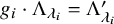 $g_i\cdot {\Lambda }_{{\lambda }_i}={\Lambda }^{\prime }_{{\lambda }_i}$
. Then, since
$g_i\cdot {\Lambda }_{{\lambda }_i}={\Lambda }^{\prime }_{{\lambda }_i}$
. Then, since ${\Lambda }_{w\cdot {\lambda }_i}=\rho (n_w){\Lambda }_{{\lambda }_i}$
,
${\Lambda }_{w\cdot {\lambda }_i}=\rho (n_w){\Lambda }_{{\lambda }_i}$
, ${\Lambda }^{\prime }_{w\cdot {\lambda }_i}=\rho (n_w){\Lambda }^{\prime }_{{\lambda }_i}$
, we also have
${\Lambda }^{\prime }_{w\cdot {\lambda }_i}=\rho (n_w){\Lambda }^{\prime }_{{\lambda }_i}$
, we also have $g\cdot {\Lambda }={\Lambda }'$
.
$g\cdot {\Lambda }={\Lambda }'$
.
3.3.11
Let us now combine this with the set-up of §3.3.1. We consider a faithful minuscule representation $\rho : H\to \mathrm{GL}(V)$
over K with base change
$\rho : H\to \mathrm{GL}(V)$
over K with base change
 $$\begin{align*}\rho\otimes_K \tilde K: H\otimes_K\tilde K\to \mathrm{GL}(V\otimes_K\tilde K). \end{align*}$$
Recall that $H\otimes _K\tilde K\simeq H_0\otimes _{{\mathbb Z}_p} \tilde K$
is split. We assume that the composition of
$H\otimes _K\tilde K\simeq H_0\otimes _{{\mathbb Z}_p} \tilde K$
is split. We assume that the composition of $\tilde \mu $
with
$\tilde \mu $
with $\rho \otimes _K \tilde K$
is minuscule. We have a group scheme homomorphism
$\rho \otimes _K \tilde K$
is minuscule. We have a group scheme homomorphism
 $$\begin{align*}\underline \rho_0:= \rho_0\otimes_{{\mathbb Z}_p}\tilde{\mathcal O}_{0}[\tilde u]: H_0\otimes_{{\mathbb Z}_p} \tilde{\mathcal O}_{0}[\tilde u]\to \mathrm{GL}({\Lambda}_0\otimes_{{\mathbb Z}_p}\tilde{\mathcal O}_{0}[\tilde u]) \end{align*}$$
over $\tilde {\mathcal O}_{ 0}[\tilde u]$
. By restriction of scalars, this induces
$\tilde {\mathcal O}_{ 0}[\tilde u]$
. By restriction of scalars, this induces
 $$ \begin{align} \mathrm{Res}_{\tilde{\mathcal O}_{ 0}[\tilde u]/{\mathcal O}_{ 0}[u]}(H_0\otimes_{{\mathbb Z}_p} \tilde{\mathcal O}_{0}[\tilde u])\to \mathrm{Res}_{\tilde{\mathcal O}_{0}[\tilde u]/{\mathcal O}_{0}[u]}(\mathrm{GL}({\Lambda}_0\otimes_{{\mathbb Z}_p}\tilde{\mathcal O}_{0}[\tilde u])) \end{align} $$
over ${\mathcal O}_{0}[u]$
. Since
${\mathcal O}_{0}[u]$
. Since $\rho _0$
is a closed immersion [Reference Prasad and YuPrY06, Cor. 1.3],
$\rho _0$
is a closed immersion [Reference Prasad and YuPrY06, Cor. 1.3], $ \underline \rho _0$
and
$ \underline \rho _0$
and $ \mathrm{Res}_{\tilde {\mathcal O}_{ 0}[\tilde u]/{\mathcal O}_{ 0}[u]}( \underline \rho _0)$
are also closed immersions of group schemes.
$ \mathrm{Res}_{\tilde {\mathcal O}_{ 0}[\tilde u]/{\mathcal O}_{ 0}[u]}( \underline \rho _0)$
are also closed immersions of group schemes.
Base changing the morphism (3.3.12) along ${\mathcal O}_{0}[u]\to {\mathcal O}_K$
,
${\mathcal O}_{0}[u]\to {\mathcal O}_K$
, $u\mapsto \pi $
, gives
$u\mapsto \pi $
, gives
 $$\begin{align*}\mathrm{Res}_{{\mathcal O}_{\tilde K}/{\mathcal O}_K}(\rho_0\otimes_{{\mathbb Z}_p}{\mathcal O}_{\tilde K}): \mathrm{Res}_{{\mathcal O}_{\tilde K}/{\mathcal O}_K}(H_0\otimes_{{\mathbb Z}_p} {\mathcal O}_{\tilde K})\to \mathrm{Res}_{{\mathcal O}_{\tilde K}/{\mathcal O}_K}\mathrm{GL}({\Lambda}_0\otimes_{{\mathbb Z}_p}{\mathcal O}_{\tilde K}) \end{align*}$$
over ${\mathcal O}_K$
.
${\mathcal O}_K$
.
Since (3.3.12) is a closed immersion, it follows that the corresponding morphism
 $$ \begin{align} {\mathrm{Fl}}^{E(u)}_{\mathrm{Res}_{\tilde{\mathcal O}_{0}[\tilde u]/{\mathcal O}_{0}[u]}(H_0\otimes_{{\mathbb Z}_p}\tilde{\mathcal O}_{0}[\tilde u])}\to {\mathrm{Fl}}^{E(u)}_{\mathrm{Res}_{\tilde{\mathcal O}_{0}[\tilde u]/{\mathcal O}_{0}[u]}(\mathrm{GL}({\Lambda}_0\otimes_{{\mathbb Z}_p}\tilde{\mathcal O}_{0}[\tilde u]))} \end{align} $$
of affine Grassmannians is a monomorphism and hence a closed immersion of ind-projective schemes over ${\mathcal O}_{F}$
. As above, this implies
${\mathcal O}_{F}$
. As above, this implies
Proposition 3.3.14. The morphism
 $$ \begin{align} {\mathrm{M}}_{ \mathrm{Res}_{{\mathcal O}_{\tilde K}/{\mathcal O}_F}(H_0\otimes_{{\mathbb Z}_p} {\mathcal O}_{\tilde K}),\tilde\mu}\to ({\mathrm{M}}_{\mathrm{Res}_{{\mathcal O}_{\tilde K}/{\mathcal O}_F}\mathrm{GL}({\Lambda}_0\otimes_{{\mathbb Z}_p}{\mathcal O}_{\tilde K}),\tilde\mu'})\otimes_{{\mathcal O}_{\tilde E'}}{\mathcal O}_{\tilde E} \end{align} $$
of local models obtained from (3.3.13) is a closed immersion.
In the above, $\tilde \mu '$
is the geometric cocharacter of
$\tilde \mu '$
is the geometric cocharacter of $\mathrm{Res}_{{\tilde K}/F}\mathrm{GL}(V\otimes _K \tilde K)$
obtained by composing
$\mathrm{Res}_{{\tilde K}/F}\mathrm{GL}(V\otimes _K \tilde K)$
obtained by composing $\mathrm{Res}_{\tilde K/F}(\rho \otimes _K\tilde K)$
with
$\mathrm{Res}_{\tilde K/F}(\rho \otimes _K\tilde K)$
with $\tilde \mu $
.
$\tilde \mu $
.
Remark 3.3.16. Note that [Reference Haines and RicharzHR20, Cor. 3.6] applied to the finite flat morphism ${\mathrm{Spec} \, } ( \tilde {\mathcal O}_0[\tilde u])\to {\mathrm{Spec} \, } ({\mathcal O}_0[u])$
given by
${\mathrm{Spec} \, } ( \tilde {\mathcal O}_0[\tilde u])\to {\mathrm{Spec} \, } ({\mathcal O}_0[u])$
given by $u\mapsto \tilde u^e$
, gives a natural isomorphism
$u\mapsto \tilde u^e$
, gives a natural isomorphism
 $$ \begin{align} {\mathrm{Fl}}^{E(u)}_{\mathrm{Res}_{\tilde{\mathcal O}_{0}[\tilde u]/{\mathcal O}_{0}[u]}(\mathrm{GL}({\Lambda}_0\otimes_{{\mathbb Z}_p}\tilde{\mathcal O}_{0}[\tilde u]))}\xrightarrow{\sim} {\mathrm{Fl}}^{\tilde E(\tilde u)}_{\mathrm{GL}({\Lambda}_0\otimes_{{\mathbb Z}_p}\tilde{\mathcal O}_{0}[\tilde u])} \end{align} $$
of ind-schemes over ${\mathcal O}_F$
. Here
${\mathcal O}_F$
. Here $\tilde E(\tilde u)=E(\tilde u^e)$
is the Eisenstein polynomial of
$\tilde E(\tilde u)=E(\tilde u^e)$
is the Eisenstein polynomial of $\tilde \pi $
in
$\tilde \pi $
in $\tilde {\mathcal O}_{0}[\tilde u]$
. This reflects the identifications
$\tilde {\mathcal O}_{0}[\tilde u]$
. This reflects the identifications
 $$\begin{align*}\mathrm{Res}_{K/F}(\mathrm{Res}_{\tilde K/K}\mathrm{GL}({\Lambda}_0\otimes_{{\mathbb Z}_p}\tilde K))= \mathrm{Res}_{\tilde K/F}\mathrm{GL}({\Lambda}_0\otimes_{{\mathbb Z}_p}\tilde K), \end{align*}$$
 $$\begin{align*}\mathrm{Res}_{{\mathcal O}_K/{\mathcal O}_F}(\mathrm{Res}_{{\mathcal O}_{\tilde K}/{\mathcal O}_K}\mathrm{GL}({\Lambda}_0\otimes_{{\mathbb Z}_p}{\mathcal O}_{\tilde K}))= \mathrm{Res}_{\tilde K/F}\mathrm{GL}({\Lambda}_0\otimes_{{\mathbb Z}_p}{\mathcal O}_{\tilde K}). \end{align*}$$
Indeed, since $\tilde K/K$
is tame,
$\tilde K/K$
is tame, $\mathrm{Res}_{\tilde K/K}\mathrm{GL}({\Lambda }_0\otimes _{{\mathbb Z}_p}\tilde K)$
splits over the tame extension
$\mathrm{Res}_{\tilde K/K}\mathrm{GL}({\Lambda }_0\otimes _{{\mathbb Z}_p}\tilde K)$
splits over the tame extension $\tilde K/K$
and the two sides in this identification lead to two -a priori different- constructions as in [Reference LevinLe16]. However, the isomorphism (3.3.17) above gives an identification between the two possible definitions for the local model
$\tilde K/K$
and the two sides in this identification lead to two -a priori different- constructions as in [Reference LevinLe16]. However, the isomorphism (3.3.17) above gives an identification between the two possible definitions for the local model ${\mathrm{M}}_{\mathrm{Res}_{{\mathcal O}_{\tilde K}/{\mathcal O}_F}\mathrm{GL}({\Lambda }_0\otimes _{{\mathbb Z}_p}{\mathcal O}_{\tilde K}),\tilde \mu '}$
. A similar comment applies to the local model
${\mathrm{M}}_{\mathrm{Res}_{{\mathcal O}_{\tilde K}/{\mathcal O}_F}\mathrm{GL}({\Lambda }_0\otimes _{{\mathbb Z}_p}{\mathcal O}_{\tilde K}),\tilde \mu '}$
. A similar comment applies to the local model ${\mathrm{M}}_{ \mathrm{Res}_{{\mathcal O}_{\tilde K}/{\mathcal O}_F}(H_0\otimes _{{\mathbb Z}_p} {\mathcal O}_{\tilde K}),\tilde \mu }$
.
${\mathrm{M}}_{ \mathrm{Res}_{{\mathcal O}_{\tilde K}/{\mathcal O}_F}(H_0\otimes _{{\mathbb Z}_p} {\mathcal O}_{\tilde K}),\tilde \mu }$
.
3.3.18
For S an R-algebra and V a module over S, we write $V^{(R)}$
for the R-module obtained by restriction of structure. Let
$V^{(R)}$
for the R-module obtained by restriction of structure. Let ${\Lambda }$
be any
${\Lambda }$
be any ${\mathcal O}_{K}$
-lattice in a finite dimensional K-vector space V and
${\mathcal O}_{K}$
-lattice in a finite dimensional K-vector space V and $K/F$
a finite extension. (We will eventually apply this to K replaced by
$K/F$
a finite extension. (We will eventually apply this to K replaced by $\tilde K$
, to connect with the previous set-up.) Consider the natural homomorphism
$\tilde K$
, to connect with the previous set-up.) Consider the natural homomorphism
 $$ \begin{align} \mathrm{Res}_{{\mathcal O}_{K}/{\mathcal O}_F} \mathrm{GL}({\Lambda})\to \mathrm{GL}({\Lambda}^{({\mathcal O}_F)}) \end{align} $$
of group schemes over ${\mathcal O}_F$
. We can easily see that this is a closed immersion by writing down the equations giving this morphism. Consider a geometric minuscule cocharacter
${\mathcal O}_F$
. We can easily see that this is a closed immersion by writing down the equations giving this morphism. Consider a geometric minuscule cocharacter $\mu $
of
$\mu $
of $ \mathrm{Res}_{K/F} \mathrm{GL}(V)$
with reflex field E.
$ \mathrm{Res}_{K/F} \mathrm{GL}(V)$
with reflex field E.
Proposition 3.3.20. There is a closed immersion
 $$ \begin{align} {\mathrm{M}}_{\mathrm{Res}_{{\mathcal O}_{K}/{\mathcal O}_{F}} \mathrm{GL}({\Lambda} ), \mu}\hookrightarrow {\mathrm{M}}_{\mathrm{GL}({\Lambda}^{({\mathcal O}_F)} ), \mu} \otimes_{{\mathcal O}_F}{\mathcal O}_{E} \end{align} $$
equivariant for the homomorphism (3.3.19) above which extends the natural morphism between Grassmannians on the generic fibers.
Proof. Lift ${\Lambda }$
to a finite free
${\Lambda }$
to a finite free ${\mathcal O}_0[u]$
-module
${\mathcal O}_0[u]$
-module $\underline {{\Lambda }}$
and consider the smooth affine group scheme
$\underline {{\Lambda }}$
and consider the smooth affine group scheme $\underline {\mathcal {GL}}=\mathrm{GL}(\underline {{\Lambda }})$
over
$\underline {\mathcal {GL}}=\mathrm{GL}(\underline {{\Lambda }})$
over ${\mathcal O}_0[u]$
. This is the
${\mathcal O}_0[u]$
. This is the ${\mathcal O}_0[u]$
-group scheme associated to
${\mathcal O}_0[u]$
-group scheme associated to $\mathrm{GL}({\Lambda })$
and the extension
$\mathrm{GL}({\Lambda })$
and the extension $K/F$
as in §3.2.3. Write
$K/F$
as in §3.2.3. Write $\underline {\mathcal {GL}}_F$
for the group scheme of linear automorphisms of
$\underline {\mathcal {GL}}_F$
for the group scheme of linear automorphisms of $\underline {{\Lambda }}$
considered as a
$\underline {{\Lambda }}$
considered as a ${\mathcal O}_F[v]$
-module by restriction of scalars by
${\mathcal O}_F[v]$
-module by restriction of scalars by ${\mathcal O}_F[v]\to {\mathcal O}_0[u]$
,
${\mathcal O}_F[v]\to {\mathcal O}_0[u]$
, $v\mapsto E(u)+\pi _F$
. The group scheme
$v\mapsto E(u)+\pi _F$
. The group scheme $\underline {\mathcal {GL}}_F$
is split reductive over
$\underline {\mathcal {GL}}_F$
is split reductive over ${\mathcal O}_F[u]$
and so the local model
${\mathcal O}_F[u]$
and so the local model ${\mathrm{M}}_{\mathrm{GL}({\Lambda } ), \mu }$
above is naturally a closed subscheme of
${\mathrm{M}}_{\mathrm{GL}({\Lambda } ), \mu }$
above is naturally a closed subscheme of ${\mathrm{Fl}}_{\underline {\mathcal {GL}}_F}^{v-\pi _F}$
. Here,
${\mathrm{Fl}}_{\underline {\mathcal {GL}}_F}^{v-\pi _F}$
. Here, ${\mathrm{Fl}}_{\underline {\mathcal {GL}}_F}^{v-\pi _F}$
is defined by applying the definition in §3.2.2 with
${\mathrm{Fl}}_{\underline {\mathcal {GL}}_F}^{v-\pi _F}$
is defined by applying the definition in §3.2.2 with $K=F$
. We will show that there is a map
$K=F$
. We will show that there is a map
 $$\begin{align*}{\mathrm{Fl}}^{E(u)}_{\underline{\mathcal {GL}}}\to {\mathrm{Fl}}_{\underline {\mathcal {GL}}_F}^{v-\pi_F}. \end{align*}$$
Consider the ${\mathcal O}_0$
-algebra homomorphism
${\mathcal O}_0$
-algebra homomorphism
 $$\begin{align*}r: {\mathcal O}_0[v]\to {\mathcal O}_0[u],\quad v\mapsto E(u)+\pi_F \end{align*}$$
which lifts the inclusion ${\mathcal O}_0\hookrightarrow {\mathcal O}_K$
, via
${\mathcal O}_0\hookrightarrow {\mathcal O}_K$
, via $v\mapsto \pi _F$
,
$v\mapsto \pi _F$
, $u\mapsto \pi $
. Then r is finite and flat. Let
$u\mapsto \pi $
. Then r is finite and flat. Let $\underline {\mathcal {GL}}_{K/K_0}$
the group scheme obtained by Weil restriction of
$\underline {\mathcal {GL}}_{K/K_0}$
the group scheme obtained by Weil restriction of $\underline {\mathcal {GL}}$
along r; then the base change of
$\underline {\mathcal {GL}}$
along r; then the base change of $\underline {\mathcal {GL}}_{K/K_0}$
along
$\underline {\mathcal {GL}}_{K/K_0}$
along ${\mathcal O}_0[v]\to {\mathcal O}_0=$
,
${\mathcal O}_0[v]\to {\mathcal O}_0=$
, $v\mapsto \pi _F$
, is identified with
$v\mapsto \pi _F$
, is identified with $\mathrm{Res}_{{\mathcal O}_{K}/{\mathcal O}_0}\mathrm{GL}({\Lambda })$
. Denote by
$\mathrm{Res}_{{\mathcal O}_{K}/{\mathcal O}_0}\mathrm{GL}({\Lambda })$
. Denote by $\underline {\mathcal {GL}}_{K_0}$
the group scheme of linear automorphisms of
$\underline {\mathcal {GL}}_{K_0}$
the group scheme of linear automorphisms of $\underline {\Lambda }$
regarded as an
$\underline {\Lambda }$
regarded as an ${\mathcal O}_0[v]$
-module via
${\mathcal O}_0[v]$
-module via $r: {\mathcal O}_0[v]\to {\mathcal O}_0[u]$
. We will first give a map
$r: {\mathcal O}_0[v]\to {\mathcal O}_0[u]$
. We will first give a map
 $$\begin{align*}{\mathrm{Fl}}^{E(u)}_{\underline{\mathcal {GL}},0}\to {\mathrm{Fl}}_{\underline {\mathcal {GL}}_{K_0}, 0}^{u-\pi_F} \end{align*}$$
over ${\mathcal O}_0$
. See §3.2.2 for the definition of these ind-schemes. (This amounts to constructing the map in the special case
${\mathcal O}_0$
. See §3.2.2 for the definition of these ind-schemes. (This amounts to constructing the map in the special case $F=K_0$
.)
$F=K_0$
.)
We start by giving a morphism
 $$\begin{align*}i: \underline{\mathcal {GL}}_{K/K_0}\to \underline{\mathcal {GL}}_{K_0} \end{align*}$$
over ${\mathcal O}_0[v]$
extending the morphism
${\mathcal O}_0[v]$
extending the morphism $\mathrm{Res}_{{\mathcal O}_{K}/{\mathcal O}_0}\mathrm{GL}({\Lambda })\to \mathrm{GL}({\Lambda }^{({\mathcal O}_0)})$
of
$\mathrm{Res}_{{\mathcal O}_{K}/{\mathcal O}_0}\mathrm{GL}({\Lambda })\to \mathrm{GL}({\Lambda }^{({\mathcal O}_0)})$
of ${\mathcal O}_0$
-group schemes under the specialization
${\mathcal O}_0$
-group schemes under the specialization $v\mapsto \pi _F$
. This morphism is obtained by viewing an
$v\mapsto \pi _F$
. This morphism is obtained by viewing an ${\mathcal O}_0[u]$
-automorphism of
${\mathcal O}_0[u]$
-automorphism of $\underline {{\Lambda }}$
as an
$\underline {{\Lambda }}$
as an ${\mathcal O}_0[v]$
-automorphism of
${\mathcal O}_0[v]$
-automorphism of $\underline {{\Lambda }}$
viewed as an
$\underline {{\Lambda }}$
viewed as an ${\mathcal O}_0[v]$
-module via r. The base change of i to
${\mathcal O}_0[v]$
-module via r. The base change of i to $k[\![ v]\!]$
 $$\begin{align*}i_{k[\![ v]\!]}: \underline{\mathcal {GL}}_{K/K_0, k[\![ v]\!]}\to \underline{\mathcal {GL}}_{K_0, k[\![ v]\!]} \end{align*}$$
is a closed immersion since it is induced by restriction of scalars from $k[\![ u]\!]$
-lattices to
$k[\![ u]\!]$
-lattices to $k[\![ v]\!]$
-lattices under the map
$k[\![ v]\!]$
-lattices under the map $v\mapsto u^{[K:K_0]}$
.
$v\mapsto u^{[K:K_0]}$
.
By [Reference Haines and RicharzHR20, Cor. 3.6], the Weil restriction of torsors along r induces an isomorphism
 $$\begin{align*}{\mathrm{Fl}}^{E(u)}_{\underline{\mathcal {GL}},0}\xrightarrow{\sim} {\mathrm{Fl}}^{u-\pi_F}_{ \underline{\mathcal {GL}}_{K/K_0},0}. \end{align*}$$
Combining this isomorphism with the map given by taking push-outs of torsors along i, we obtained the required map
 $$\begin{align*}\iota_0: {\mathrm{Fl}}^{E(u)}_{\underline{\mathcal {GL}},0}\simeq {\mathrm{Fl}}^{v-\pi_F}_{ \underline{\mathcal {GL}}_{K/K_0},0}\to {\mathrm{Fl}}^{v-\pi_F}_{\underline{\mathcal {GL}}_{K_0},0}. \end{align*}$$
Applying $\mathrm{Res}_{{\mathcal O}_0/{\mathcal O}_F}$
we obtain a map
$\mathrm{Res}_{{\mathcal O}_0/{\mathcal O}_F}$
we obtain a map
 $$\begin{align*}\iota: {\mathrm{Fl}}^{E(u)}_{\underline{\mathcal {GL}}}\to \mathrm{Res}_{{\mathcal O}_0/{\mathcal O}_F}{\mathrm{Fl}}^{v-\pi_F}_{\underline{\mathcal {GL}}_{K_0}}. \end{align*}$$
A standard argument ([Reference Pappas and RapoportPR08, Thm. 1.4]) shows that $\iota \otimes _{{\mathcal O}_F}k$
is a locally closed immersion. Since the domain of this map is ind-projective, it follows that
$\iota \otimes _{{\mathcal O}_F}k$
is a locally closed immersion. Since the domain of this map is ind-projective, it follows that $\iota \otimes _{{\mathcal O}_F}k$
is a closed immersion. We now compose this with the map
$\iota \otimes _{{\mathcal O}_F}k$
is a closed immersion. We now compose this with the map
 $$\begin{align*}\iota': \mathrm{Res}_{{\mathcal O}_0/{\mathcal O}_F}{\mathrm{Fl}}^{v-\pi_F}_{\underline{\mathcal {GL}}_{K_0}}\to {\mathrm{Fl}}^{v-\pi_F}_{\underline{\mathcal {GL}}_F} \end{align*}$$
obtained by the construction of [Reference LevinLe16] applied to $\mathrm{Res}_{{\mathcal O}_0/{\mathcal O}_F}\mathrm{GL}({\Lambda }^{({\mathcal O}_0)})\to \mathrm{GL}({\Lambda }^{({\mathcal O}_F)})$
. We can easily see that
$\mathrm{Res}_{{\mathcal O}_0/{\mathcal O}_F}\mathrm{GL}({\Lambda }^{({\mathcal O}_0)})\to \mathrm{GL}({\Lambda }^{({\mathcal O}_F)})$
. We can easily see that $\iota '\otimes _{{\mathcal O}_F}k$
is a closed immersion, cf. [Reference Pappas and ZhuPZ13, Prop. 8.1]. It follows that the composite map
$\iota '\otimes _{{\mathcal O}_F}k$
is a closed immersion, cf. [Reference Pappas and ZhuPZ13, Prop. 8.1]. It follows that the composite map $\iota '\cdot \iota $
is a closed immersion on special fibers.
$\iota '\cdot \iota $
is a closed immersion on special fibers.
Restricting to the local models we obtain a map
 $$ \begin{align} {\mathrm{M}}_{\mathrm{Res}_{{\mathcal O}_{K}/{\mathcal O}_{F}} \mathrm{GL}({\Lambda} ), \mu}\hookrightarrow {\mathrm{M}}_{\mathrm{GL}({\Lambda}^{({\mathcal O}_F)}), \mu} \otimes_{{\mathcal O}_F}{\mathcal O}_{E} \end{align} $$
which is a closed immersion on special fibers. An argument involving Nakayama’s lemma as in [Reference Pappas and ZhuPZ13, Prop. 8.1], shows that (3.3.22) is itself a closed immersion. Finally, it remains to check that (3.3.22) extends to the natural morphism on generic fibers. This follows from the definitions of local models in §3.2.5 and the fact that r takes $v-\pi _F$
to
$v-\pi _F$
to $E(u)$
.
$E(u)$
.
3.3.23
We now combine the previous results to show that a suitable Hodge embedding induces a closed immersion of local models.
We will consider local model triples $(G, \{\mu \}, {\mathcal G})$
over F with G quasi-tame,
$(G, \{\mu \}, {\mathcal G})$
over F with G quasi-tame, $G\simeq \prod _{i=1}^r\mathrm{Res}_{K_i/F}H_i$
, with
$G\simeq \prod _{i=1}^r\mathrm{Res}_{K_i/F}H_i$
, with $H_i$
split over a tame extension of
$H_i$
split over a tame extension of $K_i$
. Then the local Shimura pair
$K_i$
. Then the local Shimura pair $(G,\{\mu \})$
over F arises as a product of local Shimura pairs
$(G,\{\mu \})$
over F arises as a product of local Shimura pairs $(\mathrm{Res}_{K_i/F}H_i, \{\mu _i\})$
,
$(\mathrm{Res}_{K_i/F}H_i, \{\mu _i\})$
, $1\leq i \leq r$
. Suppose we are given faithful minuscule representations
$1\leq i \leq r$
. Suppose we are given faithful minuscule representations $\rho _i: H_i\to \mathrm{GL}(V_i)$
over
$\rho _i: H_i\to \mathrm{GL}(V_i)$
over $K_i$
, such that the compositions
$K_i$
, such that the compositions
 $$\begin{align*}\mathrm{Res}_{K_i/F}H_i \xrightarrow{\ \mathrm{Res}_{K_i/F}(\rho_i)\ } \mathrm{Res}_{K_i/F}\mathrm{GL}(V_i)\hookrightarrow \mathrm{GL}(V_{i}^{(F)}) \end{align*}$$
give Hodge embeddings for $(\mathrm{Res}_{K_i/F}H_i, \{\mu _i\})$
over F, for each i.
$(\mathrm{Res}_{K_i/F}H_i, \{\mu _i\})$
over F, for each i.
We consider
 $$ \begin{align} \rho: G\simeq \prod_{i=1}^r\mathrm{Res}_{K_i/F}H_i\xrightarrow{\ \prod_i \mathrm{Res}_{K_i/F}(\rho_i)\ } \prod_{i=1}^r\mathrm{Res}_{K_i/F}\mathrm{GL}(V_i)\hookrightarrow \mathrm{GL}(V) \end{align} $$
where $V=\oplus _{i=1}^rV_i^{(F)}$
is considered as an F-vector space with F-structure given by restriction from the
$V=\oplus _{i=1}^rV_i^{(F)}$
is considered as an F-vector space with F-structure given by restriction from the $K_i$
-structure on each summand. Then
$K_i$
-structure on each summand. Then $\rho $
also gives a Hodge embedding
$\rho $
also gives a Hodge embedding $\rho : (G,\{\mu \})\to (\mathrm{GL}(V),\{\mu _d\})$
. In particular,
$\rho : (G,\{\mu \})\to (\mathrm{GL}(V),\{\mu _d\})$
. In particular, $ (G,\{\mu \})$
is of Hodge type. Note that then, for any
$ (G,\{\mu \})$
is of Hodge type. Note that then, for any $m\geq 1$
, the direct sum representation
$m\geq 1$
, the direct sum representation
 $$\begin{align*}\rho^{\oplus m}: G\to \mathrm{GL}(V)\times\cdots \times \mathrm{GL}(V)\hookrightarrow \mathrm{GL}(V^{\oplus m}) \end{align*}$$
also gives a Hodge embedding that factors as in (3.3.24).
Theorem 3.3.25. Let $(G, \{\mu \}, {\mathcal G})$
be a local model triple over F. Assume G quasi-tame,
$(G, \{\mu \}, {\mathcal G})$
be a local model triple over F. Assume G quasi-tame, $G\simeq \prod _{i=1}^r\mathrm{Res}_{K_i/F}H_i$
, with
$G\simeq \prod _{i=1}^r\mathrm{Res}_{K_i/F}H_i$
, with $H_i$
split over a tame extension of
$H_i$
split over a tame extension of $K_i$
. Assume that p is odd and that all the
$K_i$
. Assume that p is odd and that all the $H_i$
are of classical type. Suppose
$H_i$
are of classical type. Suppose $ (G,\{\mu \})$
admits a Hodge embedding
$ (G,\{\mu \})$
admits a Hodge embedding $\rho $
of the form (3.3.24) as above. After replacing the Hodge embedding
$\rho $
of the form (3.3.24) as above. After replacing the Hodge embedding $\rho $
by a direct sum
$\rho $
by a direct sum $\rho ^{\oplus m}$
as above, there exists a lattice
$\rho ^{\oplus m}$
as above, there exists a lattice ${\Lambda }\subset V$
and a quasi-parahoric group scheme
${\Lambda }\subset V$
and a quasi-parahoric group scheme ${\mathcal G}'$
of G with
${\mathcal G}'$
of G with $({\mathcal G}')^\circ ={\mathcal G}^\circ $
such that
$({\mathcal G}')^\circ ={\mathcal G}^\circ $
such that $\rho $
extends to a closed immersion
$\rho $
extends to a closed immersion ${\mathcal G}'\hookrightarrow \mathrm{GL}({\Lambda })$
and there is a closed immersion
${\mathcal G}'\hookrightarrow \mathrm{GL}({\Lambda })$
and there is a closed immersion
 $$\begin{align*}\rho_*: {\mathrm{M}}_{{\mathcal G}', \mu}={\mathrm{M}}_{{\mathcal G},\mu}\to {\mathrm{Gr}}(d,{\Lambda})_{{\mathcal O}_E} \end{align*}$$
extending the natural map on the generic fiber.
Remark 3.3.26. If the target $\pi _1(G)_I$
of the Kottwitz homomorphism is a torsion-free group, then we always have
$\pi _1(G)_I$
of the Kottwitz homomorphism is a torsion-free group, then we always have ${\mathcal G}'={\mathcal G}={\mathcal G}^\circ $
, see [Reference Haines and RapoportHR08]. In the course of the proof we will see that if
${\mathcal G}'={\mathcal G}={\mathcal G}^\circ $
, see [Reference Haines and RapoportHR08]. In the course of the proof we will see that if ${\mathcal G}={\mathcal G}_{\mathbf {x}}$
for
${\mathcal G}={\mathcal G}_{\mathbf {x}}$
for $\mathbf {x}$
generic in its facet, then we can take in the above
$\mathbf {x}$
generic in its facet, then we can take in the above ${\mathcal G}'={\mathcal G}$
, provided that G does not involve anisotropic factors coming from division algebras of degree divisible by p. This last condition comes from Proposition 2.2.2.
${\mathcal G}'={\mathcal G}$
, provided that G does not involve anisotropic factors coming from division algebras of degree divisible by p. This last condition comes from Proposition 2.2.2.
Proof. We can reduce to the case $G=\mathrm{Res}_{K/F}H$
, with H split over a tamely ramified extension of K; the general case is obtained by taking products. We may assume
$G=\mathrm{Res}_{K/F}H$
, with H split over a tamely ramified extension of K; the general case is obtained by taking products. We may assume ${\mathcal G}={\mathcal G}_{\mathbf {x}}=\mathrm{Res}_{{\mathcal O}_K/{\mathcal O}_F}{\mathcal H}_{\mathbf {x}}$
and
${\mathcal G}={\mathcal G}_{\mathbf {x}}=\mathrm{Res}_{{\mathcal O}_K/{\mathcal O}_F}{\mathcal H}_{\mathbf {x}}$
and $\mathbf {x}\in {\mathcal B}(G, F)={\mathcal B}(H, K)$
which we can assume is generic in its facet. We have the Hodge embedding
$\mathbf {x}\in {\mathcal B}(G, F)={\mathcal B}(H, K)$
which we can assume is generic in its facet. We have the Hodge embedding $\rho : G\to \mathrm{GL}(V^{(F)})$
given as a composition
$\rho : G\to \mathrm{GL}(V^{(F)})$
given as a composition
 $$\begin{align*}G=\mathrm{Res}_{K/F}H\xrightarrow{\mathrm{Res}_{K/F}\rho_1} \mathrm{Res}_{K/F}\mathrm{GL}(V)\to \mathrm{GL}(V^{(F)}), \end{align*}$$
starting from $\rho _1: H\to \mathrm{GL}(V)$
, cf. (3.3.24). For notational simplicity, in what follows, we will often drop the superscript
$\rho _1: H\to \mathrm{GL}(V)$
, cf. (3.3.24). For notational simplicity, in what follows, we will often drop the superscript ${(F)}, {({\mathcal O}_F)}$
, from the notation for the restriction of structure, as it should be clear from context over which ring the modules are being taken.
${(F)}, {({\mathcal O}_F)}$
, from the notation for the restriction of structure, as it should be clear from context over which ring the modules are being taken.
We first assume that $H^{\mathrm{ad}} $
does not involve division algebras of degree divisible by p. Then the assumption of Proposition 2.2.2 for H is satisfied. Hence, we can find a finite tame Galois extension
$H^{\mathrm{ad}} $
does not involve division algebras of degree divisible by p. Then the assumption of Proposition 2.2.2 for H is satisfied. Hence, we can find a finite tame Galois extension $\tilde K/K$
that splits H and a point
$\tilde K/K$
that splits H and a point $\mathbf {x}'\in {\mathcal B}(H, K)$
with
$\mathbf {x}'\in {\mathcal B}(H, K)$
with ${\mathcal H}={\mathcal H}_{\mathbf {x} }={\mathcal H}_{\mathbf {x}'}$
which is hyperspecial in
${\mathcal H}={\mathcal H}_{\mathbf {x} }={\mathcal H}_{\mathbf {x}'}$
which is hyperspecial in ${\mathcal B}(H, \tilde K)$
. Now we can apply the construction of §3.3.1. In this, we consider the composition of the natural map
${\mathcal B}(H, \tilde K)$
. Now we can apply the construction of §3.3.1. In this, we consider the composition of the natural map
 $$\begin{align*}G=\mathrm{Res}_{K/F}H\to \mathrm{Res}_{K/F}(\mathrm{Res}_{\tilde K/K}(H\otimes_K\tilde K))=\mathrm{Res}_{\tilde K/F}(H\otimes_K\tilde K) \end{align*}$$
with
 $$\begin{align*}\mathrm{Res}_{\tilde K/F}(H\otimes_K\tilde K)\xrightarrow{\mathrm{Res}_{\tilde K/F}(\rho_1\otimes_K\tilde K)} \mathrm{Res}_{\tilde K/F}\mathrm{GL}(V\otimes_K{\tilde K})\xrightarrow{\ } \mathrm{GL}(V\otimes_K\tilde K), \end{align*}$$
as a representation over F which is isomorphic to a direct sum of $[\tilde K:K]$
-copies of
$[\tilde K:K]$
-copies of $\rho $
. This extends to a morphism of
$\rho $
. This extends to a morphism of ${\mathcal O}_F$
-group schemes
${\mathcal O}_F$
-group schemes
 $$\begin{align*}{\mathcal G}\hookrightarrow \mathrm{Res}_{{\mathcal O}_{\tilde K}/{\mathcal O}_F} (H_0\otimes_{{\mathbb Z}_p} {\mathcal O}_{\tilde K})\hookrightarrow \mathrm{Res}_{{\mathcal O}_{\tilde K}/{\mathcal O}_F} \mathrm{GL}({\Lambda}_0\otimes_{{\mathbb Z}_p}{\mathcal O}_{\tilde K})\hookrightarrow \mathrm{GL}({\Lambda}_0\otimes_{{\mathbb Z}_p}{\mathcal O}_{\tilde K}) .\end{align*}$$
Here we fix an isomorphism $\tilde {\mathcal H}\cong H_0\otimes _{{\mathbb Z}_p} {\mathcal O}_{\tilde K}$
, and identify
$\tilde {\mathcal H}\cong H_0\otimes _{{\mathbb Z}_p} {\mathcal O}_{\tilde K}$
, and identify $\rho _1\otimes _K\tilde K$
with the base to
$\rho _1\otimes _K\tilde K$
with the base to $\tilde K$
of a represention
$\tilde K$
of a represention $H_0\hookrightarrow \mathrm{GL}(\Lambda _0)$
over
$H_0\hookrightarrow \mathrm{GL}(\Lambda _0)$
over ${\mathbb Z}_p$
. This morphism is a closed immersion by Proposition 2.1.5 and [Reference Prasad and YuPrY06, Cor. 1.3].
${\mathbb Z}_p$
. This morphism is a closed immersion by Proposition 2.1.5 and [Reference Prasad and YuPrY06, Cor. 1.3].
Correspondingly, by composing (3.3.8), (3.3.15) and the morphism (3.3.21) of Proposition 3.3.20 applied to $\tilde K/F$
and the lattice
$\tilde K/F$
and the lattice ${\Lambda }_0\otimes _{{\mathbb Z}_p}{\mathcal O}_{\tilde K}$
, we obtain equivariant maps
${\Lambda }_0\otimes _{{\mathbb Z}_p}{\mathcal O}_{\tilde K}$
, we obtain equivariant maps
 $$ \begin{align} {{\mathrm{M}}}_{{\mathcal G},\mu}\to {\mathrm{M}}_{\mathrm{Res}_{{\mathcal O}_{\tilde K}/{\mathcal O}_F}(H_0\otimes_{{\mathbb Z}_p} {\mathcal O}_{\tilde K}), \tilde\mu}\to ({\mathrm{M}}_{\mathrm{GL}({\Lambda}_0\otimes_{{\mathbb Z}_p}{\mathcal O}_{\tilde K}), \tilde\mu'})={\mathrm{Gr}}(d,\Lambda). \end{align} $$
with $\Lambda =\Lambda _0\otimes _{{\mathbb Z}_p}{\mathcal O}_{\tilde K}$
as
$\Lambda =\Lambda _0\otimes _{{\mathbb Z}_p}{\mathcal O}_{\tilde K}$
as ${\mathcal O}_F$
-modules. These extend the natural morphisms on the generic fibers and are all closed immersions. The result follows in this case.
${\mathcal O}_F$
-modules. These extend the natural morphisms on the generic fibers and are all closed immersions. The result follows in this case.
We now deal with the general case (i.e., when $H^{{\mathrm{ad}} }$
could involve division algebras of index divisible by p). We may assume
$H^{{\mathrm{ad}} }$
could involve division algebras of index divisible by p). We may assume $K/F$
is totally ramified; the general case is easily reduced to this. Let
$K/F$
is totally ramified; the general case is easily reduced to this. Let $F^\natural /F$
be a finite unramified extension with ring of integers
$F^\natural /F$
be a finite unramified extension with ring of integers ${\mathcal O}_{F^\natural }$
such that H is quasi-split after base changing to
${\mathcal O}_{F^\natural }$
such that H is quasi-split after base changing to $K^\natural =KF^\natural $
. We let
$K^\natural =KF^\natural $
. We let ${\mathcal G}^\natural _{\mathbf {x}}$
denote the stabilizer scheme of
${\mathcal G}^\natural _{\mathbf {x}}$
denote the stabilizer scheme of $G^\natural :=G\otimes _{F}F^\natural $
for the image of
$G^\natural :=G\otimes _{F}F^\natural $
for the image of $\mathbf {x}$
in
$\mathbf {x}$
in ${\mathcal B}(G,F^\natural )$
. Then we have an identification
${\mathcal B}(G,F^\natural )$
. Then we have an identification ${\mathcal G}^{\natural }_{\mathbf {x}}\cong {\mathcal G}_{\mathbf {x}}\otimes _{{\mathcal O}_F}{\mathcal O}_{F^\natural }$
. By construction, we also have an isomorphism
${\mathcal G}^{\natural }_{\mathbf {x}}\cong {\mathcal G}_{\mathbf {x}}\otimes _{{\mathcal O}_F}{\mathcal O}_{F^\natural }$
. By construction, we also have an isomorphism
 $$ \begin{align*}{\mathrm{M}}_{{\mathcal G},\mu}\otimes_{{\mathcal O}_F}{\mathcal O}_{F^\natural}\cong{\mathrm{M}}_{{\mathcal G}^\natural,\mu^\natural} \end{align*} $$
where $ {\mathrm{M}}_{{\mathcal G}^\natural ,\mu ^\natural }$
is the local model associated to the local model triple
$ {\mathrm{M}}_{{\mathcal G}^\natural ,\mu ^\natural }$
is the local model associated to the local model triple
 $$\begin{align*}(G^\natural, \{\mu^\natural\}, {\mathcal G}^\natural):=(G\otimes_FF^\natural,\{\mu\otimes_{F}{F^\natural}\}, {\mathcal G}\otimes_{{\mathcal O}_F}{\mathcal O}_{F^\natural}), \end{align*}$$
over $F^\natural $
.
$F^\natural $
.
Let $\Omega \subset {\mathcal B}(G^\natural ,F^\natural )$
be the facet containing
$\Omega \subset {\mathcal B}(G^\natural ,F^\natural )$
be the facet containing $\mathbf x$
and
$\mathbf x$
and $\mathbf {y}\in \Omega $
a point which is generic in
$\mathbf {y}\in \Omega $
a point which is generic in $\Omega $
. Then
$\Omega $
. Then $\Omega $
is stable under
$\Omega $
is stable under $\Gamma ^\natural ={\mathrm{Gal}}(F^\natural /F)$
and
$\Gamma ^\natural ={\mathrm{Gal}}(F^\natural /F)$
and ${\mathcal G}^\natural _{\mathbf {y}}$
has the same neutral component as
${\mathcal G}^\natural _{\mathbf {y}}$
has the same neutral component as ${\mathcal G}^\natural $
. Since
${\mathcal G}^\natural $
. Since $G^\natural $
is quasi-split, its adjoint group does not involve division algebras of degree divisible by p, and so the above argument applied to the base changed embedding
$G^\natural $
is quasi-split, its adjoint group does not involve division algebras of degree divisible by p, and so the above argument applied to the base changed embedding $\rho ^\natural $
gives (upon replacing
$\rho ^\natural $
gives (upon replacing $\rho ^\natural $
by a direct sum) closed immersions
$\rho ^\natural $
by a direct sum) closed immersions
 $$ \begin{align*}{\mathcal G}^{\natural}_{\mathbf{y}}\hookrightarrow \mathrm{GL}(\Lambda^\natural),\ \ \ \ {\mathrm{M}}_{{\mathcal G}^{\natural}_{\mathbf{y}},\mu^\natural}={\mathrm{M}}_{{\mathcal G} , \mu }\otimes_{{\mathcal O}_F}{\mathcal O}_{F^\natural}\hookrightarrow {\mathrm{Gr}}( d, {\Lambda}^\natural)_{{\mathcal O}^\natural_E} \end{align*} $$
for $\Lambda ^{\natural }\subset V\otimes _{{\mathcal O}_F}{\mathcal O}^\natural $
an
$\Lambda ^{\natural }\subset V\otimes _{{\mathcal O}_F}{\mathcal O}^\natural $
an ${\mathcal O}^\natural $
-lattice. By étale descent, the natural morphisms
${\mathcal O}^\natural $
-lattice. By étale descent, the natural morphisms
 $$\begin{align*}{\mathrm{M}}_{{\mathcal G} , \mu } \to \mathrm{Res}_{{\mathcal O}_{F^\natural}/{\mathcal O}_F}({\mathrm{M}}_{{\mathcal G} , \mu }\otimes_{{\mathcal O}_F}{\mathcal O}_{F^\natural}), \quad \mathrm{Res}_{{\mathcal O}_{F^\natural}/{\mathcal O}_F}{\mathrm{Gr}}( d, {\Lambda}^\natural)_{{\mathcal O}^\natural_E}\to {\mathrm{Gr}}(d f, \Lambda)_{{\mathcal O}^\natural_E}, \end{align*}$$
are closed immersions where $f=[F^\natural :F]$
and
$f=[F^\natural :F]$
and $\Lambda $
is
$\Lambda $
is $\Lambda ^\natural $
considered as an
$\Lambda ^\natural $
considered as an ${\mathcal O}_F$
-module. We thus obtain a closed immersion
${\mathcal O}_F$
-module. We thus obtain a closed immersion ${\mathrm{M}}_{{\mathcal G} , \mu }\hookrightarrow {\mathrm{Gr}}(d f, \Lambda ^\natural )_{{\mathcal O}^\natural _E}$
.
${\mathrm{M}}_{{\mathcal G} , \mu }\hookrightarrow {\mathrm{Gr}}(d f, \Lambda ^\natural )_{{\mathcal O}^\natural _E}$
.
Now note that ${\mathcal G}^\natural _{\mathbf {y}}$
is equal to the stabilizer
${\mathcal G}^\natural _{\mathbf {y}}$
is equal to the stabilizer $\widehat {{\mathcal G}}_\Omega $
of
$\widehat {{\mathcal G}}_\Omega $
of $\Omega $
, hence
$\Omega $
, hence ${\mathcal G}^\natural _{\mathbf {y}}$
is
${\mathcal G}^\natural _{\mathbf {y}}$
is $\Gamma ^\natural $
-invariant, hence arises as the base change to
$\Gamma ^\natural $
-invariant, hence arises as the base change to ${\mathcal O}_{F^\natural }$
of a quasi parahoric
${\mathcal O}_{F^\natural }$
of a quasi parahoric ${\mathcal G}'$
of G with
${\mathcal G}'$
of G with ${\mathcal G}^{\prime \circ }={\mathcal G}^\circ $
. Thus the composition
${\mathcal G}^{\prime \circ }={\mathcal G}^\circ $
. Thus the composition
 $$ \begin{align*}{\mathcal G}'\rightarrow \mathrm{Res}_{{\mathcal O}_{F^\natural}/{\mathcal O}_F}{\mathcal G}_{{\mathcal O}_{F^\natural}}'=\mathrm{Res}_{{\mathcal O}_{F^\natural}/{\mathcal O}_F}{\mathcal G}^\natural_{\mathbf{y}}\rightarrow \mathrm{Res}_{{\mathcal O}_{F^\natural}/{\mathcal O}_F}\mathrm{GL}(\Lambda^\natural)\rightarrow \mathrm{GL}(\Lambda) \end{align*} $$
is a closed immersion as desired.
3.4 Proof of Theorem 3.2.15
We can now complete the proof. We make use of the following lemma.
Lemma 3.4.1. Let $(G, \{\mu \}, {\mathcal G})$
be a local model triple over
$(G, \{\mu \}, {\mathcal G})$
be a local model triple over ${\mathcal O}_F$
. Suppose
${\mathcal O}_F$
. Suppose $\rho : ({\mathcal G},\mu )\hookrightarrow (\mathrm{GL}({\Lambda }),\mu _d)$
is an integral Hodge embedding. Let
$\rho : ({\mathcal G},\mu )\hookrightarrow (\mathrm{GL}({\Lambda }),\mu _d)$
is an integral Hodge embedding. Let $\overline X_\mu $
be the (reduced) Zariski closure of
$\overline X_\mu $
be the (reduced) Zariski closure of $X_\mu =G/P_\mu \hookrightarrow {\mathrm{Gr}}(d,V)_{E}$
in
$X_\mu =G/P_\mu \hookrightarrow {\mathrm{Gr}}(d,V)_{E}$
in ${\mathrm{Gr}}(d,{\Lambda })_{{\mathcal O}_E}$
. If
${\mathrm{Gr}}(d,{\Lambda })_{{\mathcal O}_E}$
. If $\overline X_\mu $
is normal and has reduced special fiber, then
$\overline X_\mu $
is normal and has reduced special fiber, then $\overline X_\mu $
is the unique scheme over
$\overline X_\mu $
is the unique scheme over ${\mathcal O}_E$
that satisfies the Scholze-Weinstein conjecture [Reference Scholze and WeinsteinSW20, Conj. 21.4.1] for
${\mathcal O}_E$
that satisfies the Scholze-Weinstein conjecture [Reference Scholze and WeinsteinSW20, Conj. 21.4.1] for $(G, \{\mu \}, {\mathcal G})$
, that is, we have
$(G, \{\mu \}, {\mathcal G})$
, that is, we have $\overline X_\mu ={\mathbb M}^{\mathrm{loc}}_{{\mathcal G}, \mu }$
. In fact, then the closed immersion
$\overline X_\mu ={\mathbb M}^{\mathrm{loc}}_{{\mathcal G}, \mu }$
. In fact, then the closed immersion
 $$\begin{align*}\rho_*: \overline X_\mu={\mathbb M}^{\mathrm{loc}}_{{\mathcal G},\mu}\to {\mathrm{Gr}}(d,{\Lambda})_{{\mathcal O}_E} \end{align*}$$
is the unique morphism of normal schemes which gives, after applying the diamond functor, the morphism $ {\mathrm{M}}^v_{{\mathcal G}, \mu }\to {\mathrm{M}}^v_{\mathrm{GL}({\Lambda }),\mu _d}$
of v-sheaves over
$ {\mathrm{M}}^v_{{\mathcal G}, \mu }\to {\mathrm{M}}^v_{\mathrm{GL}({\Lambda }),\mu _d}$
of v-sheaves over ${\mathrm{Spd}}({\mathcal O}_E)$
obtained from
${\mathrm{Spd}}({\mathcal O}_E)$
obtained from $\rho : ({\mathcal G},\mu )\hookrightarrow (\mathrm{GL}({\Lambda }),\mu _d)$
by functoriality, cf. §3.1.
$\rho : ({\mathcal G},\mu )\hookrightarrow (\mathrm{GL}({\Lambda }),\mu _d)$
by functoriality, cf. §3.1.
Proof. As above, ${\mathrm{M}}^v_{\mathrm{GL}({\Lambda }),\mu _d}={\mathrm{Gr}}(d,{\Lambda })^\Diamond $
, and so
${\mathrm{M}}^v_{\mathrm{GL}({\Lambda }),\mu _d}={\mathrm{Gr}}(d,{\Lambda })^\Diamond $
, and so ${\mathbb M}^{\mathrm{loc}}_{\mathrm{GL}({\Lambda }),\mu _d}={\mathrm{Gr}}(d,{\Lambda })$
. The v-sheaf
${\mathbb M}^{\mathrm{loc}}_{\mathrm{GL}({\Lambda }),\mu _d}={\mathrm{Gr}}(d,{\Lambda })$
. The v-sheaf $(\bar {X}_\mu )^\Diamond $
over
$(\bar {X}_\mu )^\Diamond $
over ${\mathrm{Spd}}({\mathcal O}_E)$
given by the Zariski closure
${\mathrm{Spd}}({\mathcal O}_E)$
given by the Zariski closure $\overline X_\mu $
of
$\overline X_\mu $
of $X_\mu $
in
$X_\mu $
in ${\mathrm{Gr}}(d,{\Lambda })_{{\mathcal O}_E}$
agrees with the v-sheaf closure
${\mathrm{Gr}}(d,{\Lambda })_{{\mathcal O}_E}$
agrees with the v-sheaf closure $(X_\mu ^\Diamond )^-$
of
$(X_\mu ^\Diamond )^-$
of $X_\mu ^\Diamond $
in
$X_\mu ^\Diamond $
in
 $$\begin{align*}({\mathrm{Gr}}(d,{\Lambda})_{{\mathcal O}_E})^\Diamond={\mathrm{M}}^v_{\mathrm{GL}({\Lambda}), \mu}\times_{{\mathrm{Spd}}({\mathcal O}_F)}{\mathrm{Spd}}({\mathcal O}_E). \end{align*}$$
But $(X_\mu ^\Diamond )^-$
is also the v-sheaf closure of
$(X_\mu ^\Diamond )^-$
is also the v-sheaf closure of $X_\mu ^\Diamond $
in the v-sheaf Beilinson-Drinfeld Grassmannian
$X_\mu ^\Diamond $
in the v-sheaf Beilinson-Drinfeld Grassmannian ${\mathrm{Gr}}_{\mathrm{GL}({\Lambda }), {\mathrm{Spd}}({\mathcal O}_E)}$
. By definition, this last closure is
${\mathrm{Gr}}_{\mathrm{GL}({\Lambda }), {\mathrm{Spd}}({\mathcal O}_E)}$
. By definition, this last closure is ${\mathrm{M}}^v_{{\mathcal G},\mu }$
. The result follows, cf. [Reference He, Pappas and RapoportHPR20, Thm 2.15].
${\mathrm{M}}^v_{{\mathcal G},\mu }$
. The result follows, cf. [Reference He, Pappas and RapoportHPR20, Thm 2.15].
3.4.2
Proof of Theorem 3.2.15
Since ${\mathrm{M}}^{\mathrm{loc}}_{{\mathcal G}, \mu }$
is flat and projective with reduced special fiber, it suffices to show that
${\mathrm{M}}^{\mathrm{loc}}_{{\mathcal G}, \mu }$
is flat and projective with reduced special fiber, it suffices to show that $({\mathrm{M}}^{\mathrm{loc}}_{{\mathcal G},\mu })^\Diamond $
can be identified with
$({\mathrm{M}}^{\mathrm{loc}}_{{\mathcal G},\mu })^\Diamond $
can be identified with ${\mathrm{M}}^v_{{\mathcal G},\mu }:={\mathrm{Gr}}_{{\mathcal G},\mathrm{Spd}({\mathcal O}_E),\mu }$
. We use the notation of §3.2.12, so that
${\mathrm{M}}^v_{{\mathcal G},\mu }:={\mathrm{Gr}}_{{\mathcal G},\mathrm{Spd}({\mathcal O}_E),\mu }$
. We use the notation of §3.2.12, so that $G^{{\mathrm{ad}} }=G^{{\mathrm{ad}} }_1\times G^{{\mathrm{ad}} }_2.$
By [Reference Scholze and WeinsteinSW20, Prop. 21.4.3], [Reference Scholze and WeinsteinSW20, Prop. 21.5.1], there are natural isomorphisms
 $$ \begin{align*} {\mathrm{Gr}}_{{\mathcal G},\mathrm{Spd}({\mathcal O}_E),\mu} \cong {\mathrm{Gr}}_{{\mathcal G}^{{\mathrm{ad}} }, \mathrm{Spd}({\mathcal O}_E), \mu^{{\mathrm{ad}} }},\qquad {\mathrm{Gr}}_{{\mathcal G}', \mathrm{Spd}({\mathcal O}_E), \mu'}\cong {\mathrm{Gr}}_{{\mathcal G}^{{\mathrm{ad}} }_1, \mathrm{Spd}({\mathcal O}_E), \mu_1^{{\mathrm{ad}} }}, \end{align*} $$
induced by the surjective morphisms $G\rightarrow G^{{\mathrm{ad}} }$
and
$G\rightarrow G^{{\mathrm{ad}} }$
and $G'\rightarrow G_1^{{\mathrm{ad}} }$
. Since
$G'\rightarrow G_1^{{\mathrm{ad}} }$
. Since ${\mathcal G}^{{\mathrm{ad}} }={\mathcal G}_1^{{\mathrm{ad}} }\times {\mathcal G}_2^{{\mathrm{ad}} }$
, we have an isomorphism
${\mathcal G}^{{\mathrm{ad}} }={\mathcal G}_1^{{\mathrm{ad}} }\times {\mathcal G}_2^{{\mathrm{ad}} }$
, we have an isomorphism
 $$ \begin{align*}{\mathrm{Gr}}_{{\mathcal G}^{{\mathrm{ad}} },\mathrm{Spd}({\mathcal O}_E),\mu^{{\mathrm{ad}} }}\cong{\mathrm{Gr}}_{{\mathcal G}_1^{{\mathrm{ad}} },\mathrm{Spd}({\mathcal O}_E),\mu_1^{{\mathrm{ad}} }}\times_{\mathrm{Spd}{\mathcal O}_E}{\mathrm{Gr}}_{{\mathcal G}^{{\mathrm{ad}} }_2,\mathrm{Spd}({\mathcal O}_E),\mu_2^{\mathrm{ad}}},\end{align*} $$
where for $i=1,2$
,
$i=1,2$
, $\{\mu _i^{{\mathrm{ad}} }\}$
is the factor of
$\{\mu _i^{{\mathrm{ad}} }\}$
is the factor of $\{\mu ^{{\mathrm{ad}} }\}$
in
$\{\mu ^{{\mathrm{ad}} }\}$
in $G_i$
. By assumption,
$G_i$
. By assumption, $\mu _2^{{\mathrm{ad}} }$
is trivial and hence
$\mu _2^{{\mathrm{ad}} }$
is trivial and hence ${\mathrm{Gr}}_{{\mathcal G}^{{\mathrm{ad}} }_2,\mathrm{Spd}({\mathcal O}_E),\mu _2^{\mathrm{ad}}}\cong \mathrm{Spd}({\mathcal O}_E)$
. It follows that
${\mathrm{Gr}}_{{\mathcal G}^{{\mathrm{ad}} }_2,\mathrm{Spd}({\mathcal O}_E),\mu _2^{\mathrm{ad}}}\cong \mathrm{Spd}({\mathcal O}_E)$
. It follows that ${\mathrm{Gr}}_{{\mathcal G}^{{\mathrm{ad}} },\mathrm{Spd}({\mathcal O}_E),\mu ^{{\mathrm{ad}} }}\cong {\mathrm{Gr}}_{{\mathcal G}_1^{{\mathrm{ad}} },\mathrm{Spd}({\mathcal O}_E),\mu _1^{{\mathrm{ad}} }}$
and hence we obtain an isomorphism
${\mathrm{Gr}}_{{\mathcal G}^{{\mathrm{ad}} },\mathrm{Spd}({\mathcal O}_E),\mu ^{{\mathrm{ad}} }}\cong {\mathrm{Gr}}_{{\mathcal G}_1^{{\mathrm{ad}} },\mathrm{Spd}({\mathcal O}_E),\mu _1^{{\mathrm{ad}} }}$
and hence we obtain an isomorphism
 $$ \begin{align*} {\mathrm{Gr}}_{{\mathcal G},\mathrm{Spd}({\mathcal O}_E),\mu}\cong {\mathrm{Gr}}_{{\mathcal G}',\mathrm{Spd}({\mathcal O}_E),\mu'}. \end{align*} $$
Since the local model ${\mathbb M}^{\mathrm{loc}}_{{\mathcal G},\mu }$
is defined using the auxiliary group
${\mathbb M}^{\mathrm{loc}}_{{\mathcal G},\mu }$
is defined using the auxiliary group $G'$
from Proposition 3.2.11, it suffices to prove the result in the case
$G'$
from Proposition 3.2.11, it suffices to prove the result in the case $(G,\{\mu \},{\mathcal G})=(G',\{\mu '\},{\mathcal G}')$
. By Theorem 3.3.25, upon possibly replacing
$(G,\{\mu \},{\mathcal G})=(G',\{\mu '\},{\mathcal G}')$
. By Theorem 3.3.25, upon possibly replacing ${\mathcal G}'$
with a different quasi-parahoric, we may find an integral Hodge embedding
${\mathcal G}'$
with a different quasi-parahoric, we may find an integral Hodge embedding $({\mathcal G}',\mu ')\hookrightarrow (\mathrm{GL}(\Lambda ),\mu _d)$
such that the natural map
$({\mathcal G}',\mu ')\hookrightarrow (\mathrm{GL}(\Lambda ),\mu _d)$
such that the natural map $X_{\mu '}\rightarrow {\mathrm{Gr}}(d,V)_E$
extends to a closed immersion
$X_{\mu '}\rightarrow {\mathrm{Gr}}(d,V)_E$
extends to a closed immersion
 $$ \begin{align*}{\mathrm{M}}^{\mathrm{loc}}_{{\mathcal G}' ,\mu'}\rightarrow {\mathrm{Gr}}(d,\Lambda)_{{\mathcal O}_E}.\end{align*} $$
It follows that we have an isomorphism ${\mathrm{M}}^{\mathrm{loc}}_{{\mathcal G}',\mu '}\cong \overline {X}_{\mu '}$
, and hence
${\mathrm{M}}^{\mathrm{loc}}_{{\mathcal G}',\mu '}\cong \overline {X}_{\mu '}$
, and hence $\overline {X}_{\mu '}$
is normal and has reduced special fiber by Theorem 3.2.9. Thus the result follows by Lemma 3.4.1.
$\overline {X}_{\mu '}$
is normal and has reduced special fiber by Theorem 3.2.9. Thus the result follows by Lemma 3.4.1.
3.4.3
We introduce some definitions that are needed for later applications.
Definition 3.4.4. Let $(G,\mu ,{\mathcal G})$
be a local model triple and
$(G,\mu ,{\mathcal G})$
be a local model triple and $\rho : ({\mathcal G},\mu )\hookrightarrow (\mathrm{GL}({\Lambda }),\mu _d)$
an integral Hodge embedding. We say that
$\rho : ({\mathcal G},\mu )\hookrightarrow (\mathrm{GL}({\Lambda }),\mu _d)$
an integral Hodge embedding. We say that $\rho $
is good, if the morphism
$\rho $
is good, if the morphism
 $$\begin{align*}\rho_*: {\mathbb M}^{\mathrm{loc}}_{{\mathcal G},\mu}\to {\mathrm{Gr}}(d,{\Lambda})_{{\mathcal O}_E}={\mathbb M}^{\mathrm{loc}}_{\mathrm{GL}({\Lambda}),\mu_d}\otimes_{{\mathcal O}}{\mathcal O}_E \end{align*}$$
is a closed immersion.
Often, we need to consider a variant of the above definition: Let ${\mathcal L}=\{\Lambda _i\}_{i\in {\mathbb Z}}$
be a periodic lattice chain in V, see §2.3. Let
${\mathcal L}=\{\Lambda _i\}_{i\in {\mathbb Z}}$
be a periodic lattice chain in V, see §2.3. Let $\mathrm{GL}({\mathcal L})$
be the parahoric group scheme of
$\mathrm{GL}({\mathcal L})$
be the parahoric group scheme of $\mathrm{GL}(V)$
which corresponds to the stabilizer of
$\mathrm{GL}(V)$
which corresponds to the stabilizer of ${\mathcal L}$
. Suppose that
${\mathcal L}$
. Suppose that $\rho : (G, \mu )\hookrightarrow (\mathrm{GL}(V),\mu _d)$
extends to a closed immersion of group schemes
$\rho : (G, \mu )\hookrightarrow (\mathrm{GL}(V),\mu _d)$
extends to a closed immersion of group schemes ${\mathcal G}\hookrightarrow \mathrm{GL}({\mathcal L})$
. Then we say that the integral Hodge embedding
${\mathcal G}\hookrightarrow \mathrm{GL}({\mathcal L})$
. Then we say that the integral Hodge embedding $\rho : ({\mathcal G},\mu )\hookrightarrow (\mathrm{GL}({\mathcal L}),\mu _d)$
is good, if the natural morphism
$\rho : ({\mathcal G},\mu )\hookrightarrow (\mathrm{GL}({\mathcal L}),\mu _d)$
is good, if the natural morphism
 $$\begin{align*}\rho_*: {\mathbb M}^{\mathrm{loc}}_{{\mathcal G},\mu}\to {\mathbb M}^{\mathrm{loc}}_{\mathrm{GL}({\mathcal L}),\mu_d}\otimes_{{\mathcal O}}{\mathcal O}_E \end{align*}$$
is also a closed immersion.
Assume ${\mathcal L}=\{\Lambda _i\}_{i\in {\mathbb Z}}$
has a determining segment
${\mathcal L}=\{\Lambda _i\}_{i\in {\mathbb Z}}$
has a determining segment
 $$\begin{align*}p{\Lambda}_0={\Lambda}_r\subset {\Lambda}_{r-1}\subset \cdots \subset{\Lambda}_0. \end{align*}$$
As in §2.3, we set ${\mathrm{tot}}({\mathcal L})={\Lambda }_0\oplus {\Lambda }_1\oplus \cdots \oplus \Lambda _{r-1}\subset V^{\oplus r}$
, a lattice well-determined up to homothety. The natural morphisms
${\mathrm{tot}}({\mathcal L})={\Lambda }_0\oplus {\Lambda }_1\oplus \cdots \oplus \Lambda _{r-1}\subset V^{\oplus r}$
, a lattice well-determined up to homothety. The natural morphisms
 $$\begin{align*}\mathrm{GL}({\mathcal L})\to \mathrm{GL}({\mathrm{tot}}({\mathcal L})),\quad {\mathbb M}^{\mathrm{loc}}_{\mathrm{GL}({\mathcal L}),\mu_d}\to {\mathbb M}^{\mathrm{loc}}_{\mathrm{GL}({\mathrm{tot}}({\mathcal L})),\mu_{rd}}, \end{align*}$$
are both closed immersions, resp. by Lemma 2.3.1 and the standard construction of parahoric local models for the general linear group. Hence, $\rho : ({\mathcal G},\mu )\hookrightarrow (\mathrm{GL}({\mathcal L}),\mu _d)$
is a good integral Hodge embedding, if and only if
$\rho : ({\mathcal G},\mu )\hookrightarrow (\mathrm{GL}({\mathcal L}),\mu _d)$
is a good integral Hodge embedding, if and only if $\rho ^{\oplus r}: ({\mathcal G},\mu )\hookrightarrow (\mathrm{GL}({\mathrm{tot}}({\mathcal L})),\mu _{rd})$
is a good integral Hodge embedding.
$\rho ^{\oplus r}: ({\mathcal G},\mu )\hookrightarrow (\mathrm{GL}({\mathrm{tot}}({\mathcal L})),\mu _{rd})$
is a good integral Hodge embedding.
3.4.5
Now let $(G,\{\mu \},{\mathcal G})$
be a local model triple with
$(G,\{\mu \},{\mathcal G})$
be a local model triple with $G\cong \mathrm{Res}_{K/F}H$
with H split over a tamely ramified extension. We assume that
$G\cong \mathrm{Res}_{K/F}H$
with H split over a tamely ramified extension. We assume that $p\nmid |\pi _1(G^{\mathrm{der}})|$
,
$p\nmid |\pi _1(G^{\mathrm{der}})|$
, ${\mathcal G}={\mathcal G}_{\mathbf {x}}$
for some
${\mathcal G}={\mathcal G}_{\mathbf {x}}$
for some $\mathbf {x}\in {\mathcal B}(G,F)$
generic in its facet and that
$\mathbf {x}\in {\mathcal B}(G,F)$
generic in its facet and that $H^{{\mathrm{ad}} }$
does not have factors involving division algebras with index divisible by p. The proof of Theorem 3.2.15 shows that if there is a faithful minuscule representation
$H^{{\mathrm{ad}} }$
does not have factors involving division algebras with index divisible by p. The proof of Theorem 3.2.15 shows that if there is a faithful minuscule representation $\rho _1: H\to \mathrm{GL}(V)$
over K, such that the composition
$\rho _1: H\to \mathrm{GL}(V)$
over K, such that the composition
 $$\begin{align*}\mathrm{Res}_{K/F}H \xrightarrow{\ \mathrm{Res}_{K/F}(\rho_1)\ } \mathrm{Res}_{K/F}\mathrm{GL}(V)\hookrightarrow \mathrm{GL}(V) \end{align*}$$
give Hodge embeddings, then $(G,\{\mu \},{\mathcal G})$
admits good Hodge embeddings. These are given by the composition
$(G,\{\mu \},{\mathcal G})$
admits good Hodge embeddings. These are given by the composition
 $$\begin{align*}{\mathcal G}\hookrightarrow \mathrm{Res}_{{\mathcal O}_{\tilde K}/{\mathcal O}_F} (H_0\otimes_{{\mathbb Z}_p} {\mathcal O}_{\tilde K})\hookrightarrow \mathrm{Res}_{{\mathcal O}_{\tilde K}/{\mathcal O}_F} \mathrm{GL}({\Lambda}_0\otimes_{{\mathbb Z}_p}{\mathcal O}_{\tilde K})\hookrightarrow \mathrm{GL}({\Lambda}_0\otimes_{{\mathbb Z}_p}{\mathcal O}_{\tilde K}) .\end{align*}$$
where $\tilde K/K$
is a tame extension over which
$\tilde K/K$
is a tame extension over which $\mathbf {x}$
becomes hyperspecial and
$\mathbf {x}$
becomes hyperspecial and ${\Lambda }_0\otimes _{{\mathbb Z}_p}{\mathcal O}_{\tilde K} \subset V\otimes _K\tilde K$
is considered as an
${\Lambda }_0\otimes _{{\mathbb Z}_p}{\mathcal O}_{\tilde K} \subset V\otimes _K\tilde K$
is considered as an ${\mathcal O}_F$
-lattice. The next proposition shows that we can replace
${\mathcal O}_F$
-lattice. The next proposition shows that we can replace $\Lambda _0\otimes _{{\mathbb Z}_p}{\mathcal O}_{\tilde K}$
with a
$\Lambda _0\otimes _{{\mathbb Z}_p}{\mathcal O}_{\tilde K}$
with a $\Gamma $
-stable lattice. This will be a key property that is needed in §6.1.
$\Gamma $
-stable lattice. This will be a key property that is needed in §6.1.
By Proposition 2.4.2 there exists a $\Gamma $
-invariant lattice
$\Gamma $
-invariant lattice $\tilde {\Lambda }\subset V\otimes _K\tilde K$
such that
$\tilde {\Lambda }\subset V\otimes _K\tilde K$
such that $\rho \otimes _K \tilde K$
extends to a closed immersion
$\rho \otimes _K \tilde K$
extends to a closed immersion
 $$\begin{align*}\rho_{1,\tilde {\Lambda}}: H_0\otimes_{{\mathbb Z}_p}{\mathcal O}_{\tilde K}\to \mathrm{GL}(\tilde{\Lambda}) \end{align*}$$
We thus obtain a closed immersion
 $$\begin{align*}\rho_{\tilde {\Lambda}}:{\mathcal G}\hookrightarrow \mathrm{Res}_{{\mathcal O}_{\tilde K}/{\mathcal O}_F} (H_0\otimes_{{\mathbb Z}_p} {\mathcal O}_{\tilde K})\hookrightarrow \mathrm{Res}_{{\mathcal O}_{\tilde K}/{\mathcal O}_F} \mathrm{GL}(\tilde{\Lambda})\hookrightarrow \mathrm{GL}(\tilde {\Lambda})\end{align*}$$
where in the last term we consider ${\Lambda }$
as an
${\Lambda }$
as an ${\mathcal O}_F$
-module. We let
${\mathcal O}_F$
-module. We let $\tilde \mu '$
denote the image of the conjugacy class of cocharacters
$\tilde \mu '$
denote the image of the conjugacy class of cocharacters $\mu $
.
$\mu $
.
Proposition 3.4.6. Under the assumptions above,
 $$ \begin{align*}\rho_{\tilde \Lambda}:({\mathcal G},\mu)\hookrightarrow (\mathrm{GL}(\tilde{\Lambda}),\tilde \mu') \end{align*} $$
is a good integral Hodge embedding.
Moreover we have an equality:
 $$\begin{align*}{\mathcal G}=\mathrm{Res}_{{\mathcal O}_{\tilde K}/{\mathcal O}_F}(H_0\otimes_{{\mathbb Z}_p}{\mathcal O}_{\tilde K})\cap \{g\in \mathrm{GL}(\tilde{\Lambda})\ |\ g\cdot t_a=t_a\cdot g, \forall a\} \end{align*}$$
where $t_a:\tilde {\Lambda }\to \tilde {\Lambda }$
are the following
$t_a:\tilde {\Lambda }\to \tilde {\Lambda }$
are the following ${\mathcal O}_F$
-linear endomorphisms:
${\mathcal O}_F$
-linear endomorphisms: $t_\gamma :\tilde {\Lambda }\to \tilde {\Lambda }$
given by the action of
$t_\gamma :\tilde {\Lambda }\to \tilde {\Lambda }$
given by the action of ${\gamma }\in \Gamma $
on
${\gamma }\in \Gamma $
on $\tilde {\Lambda }\subset V\otimes _K\tilde K$
, and
$\tilde {\Lambda }\subset V\otimes _K\tilde K$
, and $t_x:\tilde {\Lambda }\to \tilde {\Lambda }$
given by the multiplication by a set of generators
$t_x:\tilde {\Lambda }\to \tilde {\Lambda }$
given by the multiplication by a set of generators $x\in {\mathcal O}_{\tilde K}$
of the
$x\in {\mathcal O}_{\tilde K}$
of the ${\mathcal O}_F$
-algebra
${\mathcal O}_F$
-algebra $ {\mathcal O}_{\tilde K}$
.
$ {\mathcal O}_{\tilde K}$
.
Proof. We apply Lemma 3.3.10 to $L=\tilde K$
and the lattices
$L=\tilde K$
and the lattices $\tilde {\Lambda }$
,
$\tilde {\Lambda }$
, ${\Lambda }_0\otimes _{{\mathbb Z}_p}{\mathcal O}_{\tilde K}$
: It follows that there is
${\Lambda }_0\otimes _{{\mathbb Z}_p}{\mathcal O}_{\tilde K}$
: It follows that there is $g\in \mathrm{GL}(V\otimes _K\tilde K)$
centralizing the image of
$g\in \mathrm{GL}(V\otimes _K\tilde K)$
centralizing the image of $H_0\otimes _{{\mathbb Z}_p} \tilde K$
, such that
$H_0\otimes _{{\mathbb Z}_p} \tilde K$
, such that $g\cdot ({\Lambda }_0\otimes _{{\mathbb Z}_p}{\mathcal O}_{\tilde K})=\tilde {\Lambda }$
. Conjugation by g gives an isomorphism
$g\cdot ({\Lambda }_0\otimes _{{\mathbb Z}_p}{\mathcal O}_{\tilde K})=\tilde {\Lambda }$
. Conjugation by g gives an isomorphism
 $$\begin{align*}{\mathrm{ad}}_g: \mathrm{GL}({\Lambda}_0\otimes_{{\mathbb Z}_p}{\mathcal O}_{\tilde K})\xrightarrow{\sim} \mathrm{GL}(\tilde{\Lambda}) \end{align*}$$
such that
 $$\begin{align*}\rho_{1, \tilde{\Lambda}}= {\mathrm{ad}}_g\circ \rho_1. \end{align*}$$
Using this, combined with the fact that $\rho _{{\Lambda }_0\otimes _{{\mathbb Z}_p}{\mathcal O}_{\tilde K}, *}$
is a closed immersion shows that
$\rho _{{\Lambda }_0\otimes _{{\mathbb Z}_p}{\mathcal O}_{\tilde K}, *}$
is a closed immersion shows that
 $$\begin{align*}\rho_{\tilde{\Lambda}, *}: {\mathbb M}^{\mathrm{loc}}_{{\mathcal G},\mu}\to ({\mathbb M}^{\mathrm{loc}}_{\mathrm{GL}(\tilde{\Lambda}), \tilde\mu'})\otimes_{{\mathcal O}_F}{\mathcal O}_{E} \end{align*}$$
is also a closed immersion. Then $\rho _{\tilde {\Lambda }}: ({\mathcal G},\mu )\hookrightarrow (\mathrm{GL}(\tilde {\Lambda }), \tilde \mu ')$
is also a good integral Hodge embedding.
$\rho _{\tilde {\Lambda }}: ({\mathcal G},\mu )\hookrightarrow (\mathrm{GL}(\tilde {\Lambda }), \tilde \mu ')$
is also a good integral Hodge embedding.
For the “moreover” part, note that we have an equality
 $$ \begin{align*}{\mathcal G}\cong (\mathrm{Res}_{{\mathcal O}_{\tilde K}/{\mathcal O}_F}(H_0\otimes_{{\mathbb Z}_p}{\mathcal O}_{\tilde K}))^\Gamma=\mathrm{Res}_{{\mathcal O}_{\tilde K}/{\mathcal O}_F}(H_0\otimes_{{\mathbb Z}_p}{\mathcal O}_{\tilde K})\cap (\mathrm{Res}_{{\mathcal O}_{\tilde K}/{\mathcal O}_F}\mathrm{GL}(\tilde {\Lambda}))^\Gamma \end{align*} $$
where the last term is a scheme-theoretic intersection. The result then follows since ${\mathrm{Res}}_{{\mathcal O}_{\tilde K}/{\mathcal O}_F}\mathrm{GL}(\tilde {\Lambda })^\Gamma \subset \mathrm{GL}(\tilde {\Lambda })$
is the scheme-theoretic stabilizer of the
${\mathrm{Res}}_{{\mathcal O}_{\tilde K}/{\mathcal O}_F}\mathrm{GL}(\tilde {\Lambda })^\Gamma \subset \mathrm{GL}(\tilde {\Lambda })$
is the scheme-theoretic stabilizer of the $t_a$
.
$t_a$
.
Remark 3.4.7. Let ${\mathcal L}$
be the lattice chain in V given by
${\mathcal L}$
be the lattice chain in V given by $\{(\tilde \pi ^i\tilde {\Lambda })^{\Gamma }\}_{i\in {\mathbb Z}}$
. Then there is a commutative diagram with arrows the natural morphisms between local models
$\{(\tilde \pi ^i\tilde {\Lambda })^{\Gamma }\}_{i\in {\mathbb Z}}$
. Then there is a commutative diagram with arrows the natural morphisms between local models

In this, the composition of the left vertical with the top horizontal morphism is $\rho _{\tilde {\Lambda }, *}$
which, by the above, is a closed immersion. The morphism
$\rho _{\tilde {\Lambda }, *}$
which, by the above, is a closed immersion. The morphism ${\mathbb M}^{\mathrm{loc}}_{\mathrm{GL}({\mathcal L}), \mu '}\to {\mathbb M}^{\mathrm{loc}}_{\mathrm{GL}({\mathrm{tot}}({\mathcal L})), \mu '}$
is easily seen to be a closed immersion. It follows that all the arrows in the diagram are closed immersions.
${\mathbb M}^{\mathrm{loc}}_{\mathrm{GL}({\mathcal L}), \mu '}\to {\mathbb M}^{\mathrm{loc}}_{\mathrm{GL}({\mathrm{tot}}({\mathcal L})), \mu '}$
is easily seen to be a closed immersion. It follows that all the arrows in the diagram are closed immersions.
4 Root curves and spanning tangent spaces
In this section, we study the tangent spaces of certain Schubert varieties inside the affine Grassmannian. We show that in most cases which are related to Shimura varieties, the tangent space can be spanned by the images of tangent spaces to smooth curves.
4.1 Tangent spaces of affine Schubert varieties
4.1.1
Let ${\mathbf {k}}$
be an algebraically closed field of characteristic p and G a (split, connected) reductive group over
${\mathbf {k}}$
be an algebraically closed field of characteristic p and G a (split, connected) reductive group over ${\mathbf {k}}$
. Recall the affine Grassmannian
${\mathbf {k}}$
. Recall the affine Grassmannian ${\mathrm{Gr}}_G=LG/L^+G$
defined as in §3.2.1.
${\mathrm{Gr}}_G=LG/L^+G$
defined as in §3.2.1.
We fix T a maximal torus of G and B a Borel subgroup containing T, and we write $X_*(T)^+$
for the set of dominant cocharacters with respect to B. For any
$X_*(T)^+$
for the set of dominant cocharacters with respect to B. For any $\mu \in X_*(T)$
, we let
$\mu \in X_*(T)$
, we let $t^\mu $
denote the
$t^\mu $
denote the ${\mathbf {k}}$
-point of
${\mathbf {k}}$
-point of $LG$
determined by the
$LG$
determined by the ${\mathbf {k}}(\!( t)\!)$
-point of G induced by
${\mathbf {k}}(\!( t)\!)$
-point of G induced by $\mu $
. For simplicity, we also let
$\mu $
. For simplicity, we also let $t^\mu $
denote the image of
$t^\mu $
denote the image of $t^\mu $
in
$t^\mu $
in ${\mathrm{Gr}}_G$
.
${\mathrm{Gr}}_G$
.
For $\mu \in X_*(T)^+$
, we let
$\mu \in X_*(T)^+$
, we let $S_\mu \subset {\mathrm{Gr}}_G$
denote the affine Schubert variety corresponding to
$S_\mu \subset {\mathrm{Gr}}_G$
denote the affine Schubert variety corresponding to $\mu $
. By definition, this is the reduced orbit closure of the
$\mu $
. By definition, this is the reduced orbit closure of the $G({\mathbf {k}}[\![ t]\!])$
-orbit of
$G({\mathbf {k}}[\![ t]\!])$
-orbit of $t^\mu $
. We let
$t^\mu $
. We let $\preccurlyeq $
denote the dominance ordering on
$\preccurlyeq $
denote the dominance ordering on $X_*(T)^+$
so that
$X_*(T)^+$
so that $\lambda \preccurlyeq \mu $
if and only if
$\lambda \preccurlyeq \mu $
if and only if $\mu -\lambda $
is an integral linear combination of positive coroots with non-negative coefficients. Then we have
$\mu -\lambda $
is an integral linear combination of positive coroots with non-negative coefficients. Then we have $S_\lambda \subset S_\mu $
if and only if
$S_\lambda \subset S_\mu $
if and only if $\lambda \preccurlyeq \mu $
. We sometimes write
$\lambda \preccurlyeq \mu $
. We sometimes write $S_\mu ^G$
for
$S_\mu ^G$
for $S_\mu $
if we want to make clear the group G that appears.
$S_\mu $
if we want to make clear the group G that appears.
We will mainly be interested in the cases when the pair $(G,\mu )$
is related to the special fiber of a local model for a Shimura variety of abelian type.
$(G,\mu )$
is related to the special fiber of a local model for a Shimura variety of abelian type.
Definition 4.1.2. Let $(G,\mu )$
be a pair as above. We say
$(G,\mu )$
be a pair as above. We say $(G,\mu )$
is of mod p abelian type if each simple factor
$(G,\mu )$
is of mod p abelian type if each simple factor $(H_i,\mu _i)$
of
$(H_i,\mu _i)$
of $(G^{{\mathrm{ad}} },\mu ^{{\mathrm{ad}} })$
satisfies one of the following two conditions:
$(G^{{\mathrm{ad}} },\mu ^{{\mathrm{ad}} })$
satisfies one of the following two conditions:
-
(1)
$H_i$
is of type
$A,B,C$
and
$\mu _i$
is a sum of minuscule coweights, -
(2)
$H_i$
is of type
$D_n$
and
$\mu _i=r\varpi _1^\vee $
(type
$D^{\mathbb R}_n$
) or
$\mu _i=s\varpi _{n-1}^\vee +t\varpi _n^\vee $
(type
$D^{\mathbb H}_n$
), with
$r,s,t\in {\mathbb Z}_{\geq 0}$
.


Here, $\varpi ^\vee _j$
denotes the
$\varpi ^\vee _j$
denotes the $j^{\mathrm{th}}$
-fundamental coweight, and we use the labeling of roots as in [Reference BourbakiBou02].
$j^{\mathrm{th}}$
-fundamental coweight, and we use the labeling of roots as in [Reference BourbakiBou02].
Remark 4.1.3. Let $(G,\{\mu \},{\mathcal G})$
be a local model triple over F of abelian type satisfying the standard assumptions as in §3 and with
$(G,\{\mu \},{\mathcal G})$
be a local model triple over F of abelian type satisfying the standard assumptions as in §3 and with ${\mathcal G}\simeq \prod _{i=1}^r\mathrm{Res}_{{\mathcal O}_{K_i}/{\mathcal O}_F}H_i$
, where
${\mathcal G}\simeq \prod _{i=1}^r\mathrm{Res}_{{\mathcal O}_{K_i}/{\mathcal O}_F}H_i$
, where $H_i$
is a split reductive group scheme over
$H_i$
is a split reductive group scheme over ${\mathcal O}_{K_i}$
. Then there is a pair
${\mathcal O}_{K_i}$
. Then there is a pair $(G',\mu ')$
over k of mod p abelian type such that
$(G',\mu ')$
over k of mod p abelian type such that ${\mathbb M}^{\mathrm{loc}}_{{\mathcal G},\mu }\otimes _{{\mathcal O}_E}k\cong S_{\mu '}^{G'}$
, see Lemma 4.4.2.
${\mathbb M}^{\mathrm{loc}}_{{\mathcal G},\mu }\otimes _{{\mathcal O}_E}k\cong S_{\mu '}^{G'}$
, see Lemma 4.4.2.
Definition 4.1.4. For a scheme X over ${\mathbf {k}}$
and
${\mathbf {k}}$
and $x\in X({\mathbf {k}})$
, we say that the tangent space
$x\in X({\mathbf {k}})$
, we say that the tangent space $T_x(X)$
of X at x is spanned by smooth formal curves if the images of the tangent spaces by
$T_x(X)$
of X at x is spanned by smooth formal curves if the images of the tangent spaces by ${\mathbf {k}}$
-morphisms
${\mathbf {k}}$
-morphisms ${\mathrm{Spec} \, } ({\mathbf {k}}[\![ t]\!])\to X$
with the closed point mapping to x generate the
${\mathrm{Spec} \, } ({\mathbf {k}}[\![ t]\!])\to X$
with the closed point mapping to x generate the ${\mathbf {k}}$
-vector space
${\mathbf {k}}$
-vector space $T_x(X)$
.
$T_x(X)$
.
Remark 4.1.5.
-
(1) Suppose X is of finite type over
${\mathbf {k}}$
. A necessary condition for
$T_x(X)$
to be spanned by smooth formal curves is that
$T_x(X)$
is spanned as a
${\mathbf {k}}$
-vector space by the
${\mathbf {k}}$
-points of the reduced subscheme
$TC_x(X)_{\mathrm{red}}$
of the (affine) tangent cone
$TC_x(X)$
of X at x. -
(2) Consider the normal surface
$ X={\mathrm{Spec} \, } {\mathbf {k}}[x,y,x]/(x^2 +xyz). $
When
${\mathbf {k}}=\bar {\mathbb F}_p$
, X gives an open affine chart of the local model for the reduction modulo p of a Hilbert modular surface with Iwahori level at an odd prime p which ramifies in the real quadratic field, see [Reference PappasP95, Ex. 4.5]. The tangent space
$T_0X$
at the origin is 3-dimensional. If
$f(t),g(t),h(t)\in t{\mathbf {k}}[\![ t]\!]$
is such that
$f(t)^2+f(t)g(t)h(t)=0,$
then the coefficient of t in
$f(t)$
is equal to
$0$
. Thus for
$(f(t),g(t), h(t))$
a
${\mathbf {k}}[\![ t]\!]$
-point of X lifting
$0$
, the image of the tangent space of this formal curve lies in the 2-dimensional subspace of
$T_0X$
given by
$ x=0$
. Here, the tangent cone
$TC_0(X)$
is
${\mathrm{Spec} \, } ({\mathbf {k}}[x,y,z]/(x^2))$
and its reduced subscheme
${\mathrm{Spec} \, } ({\mathbf {k}}[y,z])$
only spans this
$2$
-dimensional subspace of
$T_0(X)$
.


The main theorem of this section is the following.
Theorem 4.1.6. Assume $(G, \mu )$
is of mod p abelian type with
$(G, \mu )$
is of mod p abelian type with $p\nmid |\pi _1(G^{\mathrm{der}})|$
and has no factors of type
$p\nmid |\pi _1(G^{\mathrm{der}})|$
and has no factors of type $D^{\mathbb H}_n$
. Then the tangent space of the affine Schubert variety
$D^{\mathbb H}_n$
. Then the tangent space of the affine Schubert variety $S_\mu $
at each
$S_\mu $
at each ${\mathbf {k}}$
-valued point is spanned by smooth formal curves.
${\mathbf {k}}$
-valued point is spanned by smooth formal curves.
This will be shown as a consequence of the combination of Theorem 4.2.3 and Theorem 4.3.2. These statements provide more precise results and include information about cases with factors of type $D^{\mathbb H}_n$
.
$D^{\mathbb H}_n$
.
4.1.7
We begin by recalling the description of the tangent space of ${\mathrm{Gr}}_{G}$
at the points
${\mathrm{Gr}}_{G}$
at the points $t^\lambda $
. Let
$t^\lambda $
. Let $\mathfrak {g}$
denote the Lie algebra of G and let
$\mathfrak {g}$
denote the Lie algebra of G and let ${\mathfrak {t}}$
denote the Lie algebra of T. We write R for the set of roots for G and
${\mathfrak {t}}$
denote the Lie algebra of T. We write R for the set of roots for G and $R_+$
(resp.
$R_+$
(resp. $R_-$
) the set of positive (resp. negative) roots for G, and let
$R_-$
) the set of positive (resp. negative) roots for G, and let $\Delta \subset R_+$
be the set of simple roots. We fix a Chevalley system
$\Delta \subset R_+$
be the set of simple roots. We fix a Chevalley system $(x_\alpha )_{\alpha \in R}$
for G, which determines a set of root vectors
$(x_\alpha )_{\alpha \in R}$
for G, which determines a set of root vectors $X_\alpha \in \mathfrak {g}$
, for
$X_\alpha \in \mathfrak {g}$
, for $\alpha \in R$
. Then
$\alpha \in R$
. Then $X_\alpha $
generate the weight space of
$X_\alpha $
generate the weight space of $\mathfrak {g}$
corresponding to
$\mathfrak {g}$
corresponding to $\alpha $
.
$\alpha $
.
Let $L^-G$
denote the negative loop group for G. Thus
$L^-G$
denote the negative loop group for G. Thus $L^-G$
represents the functor
$L^-G$
represents the functor $R\mapsto G(R[t^{-1}])$
on k-algebras R, and let
$R\mapsto G(R[t^{-1}])$
on k-algebras R, and let $L^{--}G$
denote
$L^{--}G$
denote $\ker (L^-G\rightarrow G) , t\mapsto 0$
. For
$\ker (L^-G\rightarrow G) , t\mapsto 0$
. For $\lambda \in X_*(T)^+$
, the map
$\lambda \in X_*(T)^+$
, the map
 $$ \begin{align*} t^\lambda L^{--}Gt^{-\lambda}\to {\mathrm{Gr}}_G,\quad g\mapsto g t^{\lambda}, \end{align*} $$
is representable by an open immersion which maps $1$
to
$1$
to $t^\lambda \in {\mathrm{Gr}}_G$
(cf. [Reference Haines and RicharzHR21, Lemma 3.1]). We thus have an isomorphism
$t^\lambda \in {\mathrm{Gr}}_G$
(cf. [Reference Haines and RicharzHR21, Lemma 3.1]). We thus have an isomorphism
 $$ \begin{align*} T_{t^\lambda}{\mathrm{Gr}}_G& \cong t^\lambda{\mathrm{Lie}\,} L^{--}G t^{-\lambda}\\ & \cong \mathfrak{g}\otimes_{\mathbf{k}} {\mathbf{k}}(\!(t)\!)/t^\lambda(\mathfrak{g}\otimes_{\mathbf{k}} {\mathbf{k}}[\![t]\!])t^{\lambda^{-1}}\\&\cong\bigoplus_{\alpha\in R}t^{\langle \lambda,\alpha\rangle-1}{\mathbf{k}}[t^{-1}]X_\alpha\oplus t^{-1}{\mathbf{k}}[t^{-1}]{\mathfrak{t}}. \end{align*} $$
For $\mu \in X_*(T)^+$
with
$\mu \in X_*(T)^+$
with $\lambda \preccurlyeq \mu $
, we have the subspace
$\lambda \preccurlyeq \mu $
, we have the subspace $T_{t^\lambda }S_\mu \subset T_{t^\lambda }{\mathrm{Gr}}_G$
. Then
$T_{t^\lambda }S_\mu \subset T_{t^\lambda }{\mathrm{Gr}}_G$
. Then $t^\lambda \in S_\mu $
and hence
$t^\lambda \in S_\mu $
and hence $T_{t^\lambda }S_\mu $
is preserved under the action of the torus
$T_{t^\lambda }S_\mu $
is preserved under the action of the torus $\tilde T={{\mathbb G}_{\mathrm{m}}}\times T$
, with the first factor
$\tilde T={{\mathbb G}_{\mathrm{m}}}\times T$
, with the first factor ${{\mathbb G}_{\mathrm{m}}}$
acting on
${{\mathbb G}_{\mathrm{m}}}$
acting on ${\mathrm{Gr}}_G=LG/L^+G$
by ‘rotations’
${\mathrm{Gr}}_G=LG/L^+G$
by ‘rotations’ $t\mapsto at$
. Hence,
$t\mapsto at$
. Hence, $T_{t^\lambda }S_\mu $
has a basis given by elements of the form
$T_{t^\lambda }S_\mu $
has a basis given by elements of the form $t^{-r}X_\alpha $
together with elements of the form
$t^{-r}X_\alpha $
together with elements of the form $t^{-r}H$
for
$t^{-r}H$
for $H\in {\mathfrak {t}}$
. We let
$H\in {\mathfrak {t}}$
. We let $\Phi ^{\tan }_{\lambda ,\mu }\subset R\times {\mathbb Z}$
denote the subset of pairs
$\Phi ^{\tan }_{\lambda ,\mu }\subset R\times {\mathbb Z}$
denote the subset of pairs $(\alpha , r)$
such that
$(\alpha , r)$
such that $t^rX_\alpha \in T_{t^\lambda }S_\mu $
, and we set
$t^rX_\alpha \in T_{t^\lambda }S_\mu $
, and we set
 $$ \begin{align*} \mathfrak{T}^{\tan}:=T_{t^\lambda}S_\mu\cap t^{-1}{\mathbf{k}}[t^{-1}]{\mathfrak{t}}. \end{align*} $$
Then we have a decomposition
 $$ \begin{align*} T_{t^\lambda}S_\mu\cong \bigoplus_{(\alpha,k)\in \Phi^{\tan}_{\lambda,\mu}}t^{k}X_\alpha\oplus\mathfrak{T}^{\tan}. \end{align*} $$
We now fix $\mu ,\lambda \in X_*(T)^+$
with
$\mu ,\lambda \in X_*(T)^+$
with $\lambda \preccurlyeq \mu $
. We will show that in most cases when
$\lambda \preccurlyeq \mu $
. We will show that in most cases when $(G,\mu )$
is of mod p abelian type, the tangent space
$(G,\mu )$
is of mod p abelian type, the tangent space $T_{t^\lambda }S_\mu $
is spanned by smooth formal curves. We deal separately with the subspace spanned by
$T_{t^\lambda }S_\mu $
is spanned by smooth formal curves. We deal separately with the subspace spanned by $t^{k}X_\alpha $
,
$t^{k}X_\alpha $
, $(\alpha ,k)\in \Phi ^{\tan }_{\lambda ,\mu }$
(the “root directions”) and
$(\alpha ,k)\in \Phi ^{\tan }_{\lambda ,\mu }$
(the “root directions”) and $\mathfrak {T}^{\tan }$
(the “Cartan directions”) in the next two sections.
$\mathfrak {T}^{\tan }$
(the “Cartan directions”) in the next two sections.
4.2 Root curves and root tangent directions
4.2.1
We first consider the tangent directions along the root vectors $X_\alpha $
. In this case, we can span many tangent directions using curves coming from the unipotent root groups as follows.
$X_\alpha $
. In this case, we can span many tangent directions using curves coming from the unipotent root groups as follows.
For $\alpha \in R$
, we define
$\alpha \in R$
, we define
 $$ \begin{align*}k_\alpha^{(\lambda,\mu)}:=\max\{k\in {\mathbb Z}\ |\ (\lambda-k\alpha^\vee)_{\mathrm{dom}} \preccurlyeq \mu\}. \end{align*} $$
Here, for $\nu \in X_*(T)$
, we denote by
$\nu \in X_*(T)$
, we denote by $\nu _{\mathrm{dom}}\in X_*(T)^+$
its dominant representative. We will often fix coweights
$\nu _{\mathrm{dom}}\in X_*(T)^+$
its dominant representative. We will often fix coweights $\mu ,\lambda $
as above and write
$\mu ,\lambda $
as above and write $k_\alpha $
for
$k_\alpha $
for $k^{(\lambda ,\mu )}_\alpha $
when there is no risk of confusion.
$k^{(\lambda ,\mu )}_\alpha $
when there is no risk of confusion.
The following is essentially contained in [Reference Pappas and ZhouPZ23, Proposition 3.6].
Proposition 4.2.2. Let $\lambda ,\mu \in X_*(T)^+$
with
$\lambda ,\mu \in X_*(T)^+$
with $\lambda \preccurlyeq \mu $
.
$\lambda \preccurlyeq \mu $
.
-
1. We have
$k_\alpha =k_{-\alpha }+\langle \lambda ,\alpha \rangle $
. -
2. Let
$1\leq k\leq k_\alpha $
. Then the tangent vector
$X_\alpha t^{-k+\langle \lambda ,\alpha \rangle }\in T_{t^\lambda }{\mathrm{Gr}}_G$
lies in the subspace
$T_{t^\lambda }S_\mu $
.


Proof. Part (1) is [Reference Pappas and ZhouPZ23, Prop. 3.6].
For (2), we consider the map
 $$ \begin{align*}f_{\alpha,k}:{\mathbb A}^1\rightarrow{\mathrm{Gr}}_G \end{align*} $$
given by $a\mapsto t^\lambda x_\alpha (t^{-k}a)$
whose image lies in
$a\mapsto t^\lambda x_\alpha (t^{-k}a)$
whose image lies in $S_\mu $
by [Reference Pappas and ZhouPZ23, Prop. 3.6]. Moreover, by loc. cit., we have
$S_\mu $
by [Reference Pappas and ZhouPZ23, Prop. 3.6]. Moreover, by loc. cit., we have $f(0)=t^{\lambda }$
and the image of the tangent space of
$f(0)=t^{\lambda }$
and the image of the tangent space of ${\mathbb A}^1$
at
${\mathbb A}^1$
at $0$
contains the vector
$0$
contains the vector $X_\alpha t^{-k+\langle \lambda , \alpha \rangle }$
.
$X_\alpha t^{-k+\langle \lambda , \alpha \rangle }$
.
Proposition 4.2.2 shows that the tangent vector $t^{\langle \lambda ,\alpha \rangle -k}X_\alpha $
lies in the subspace of
$t^{\langle \lambda ,\alpha \rangle -k}X_\alpha $
lies in the subspace of $T_{t^\lambda }S_\mu $
spanned by smooth formal curves. We set
$T_{t^\lambda }S_\mu $
spanned by smooth formal curves. We set
 $$ \begin{align*} \Phi_{\lambda,\mu}^{\mathrm{cur}}=\{(\alpha,k)\, |\, \alpha\in R,\, \langle\lambda,\alpha\rangle-k_\alpha\leq k\leq \langle\lambda,\, \alpha\rangle-1\}\subset R\times {\mathbb Z}. \end{align*} $$
Then we have inclusions $\Phi _{\lambda ,\mu }^{\mathrm{cur}}\subset \Phi _{\lambda ,\mu }^{\tan }$
. The first main result is the following.
$\Phi _{\lambda ,\mu }^{\mathrm{cur}}\subset \Phi _{\lambda ,\mu }^{\tan }$
. The first main result is the following.
Theorem 4.2.3. Let $(G,\mu )$
be of mod p abelian type with
$(G,\mu )$
be of mod p abelian type with $p\nmid |\pi _1(G^{\mathrm{der}})|$
. Then we have
$p\nmid |\pi _1(G^{\mathrm{der}})|$
. Then we have
 $$ \begin{align*}\Phi_{\lambda,\mu}^{\mathrm{cur}}= \Phi_{\lambda,\mu}^{\tan}.\end{align*} $$
4.2.4
We first explain how to reduce to proving this Theorem in the case when $G^{\mathrm{ad}} $
is simple and
$G^{\mathrm{ad}} $
is simple and $G^{\mathrm{der}}=G^{\mathrm{sc}}$
.
$G^{\mathrm{der}}=G^{\mathrm{sc}}$
.
Fix $G,\mu ,\lambda $
as above. Let
$G,\mu ,\lambda $
as above. Let $G^{{\mathrm{ad}} }\cong \prod _{i=1}^rH_i$
be the decomposition of
$G^{{\mathrm{ad}} }\cong \prod _{i=1}^rH_i$
be the decomposition of $G^{{\mathrm{ad}} }$
into simple factors, and
$G^{{\mathrm{ad}} }$
into simple factors, and $\mu _i$
(resp.
$\mu _i$
(resp. $\lambda _i$
) the component of
$\lambda _i$
) the component of $\mu ^{{\mathrm{ad}} }$
(resp.
$\mu ^{{\mathrm{ad}} }$
(resp. $\lambda ^{{\mathrm{ad}} }$
) in
$\lambda ^{{\mathrm{ad}} }$
) in $H_i$
. Choose a z-extension
$H_i$
. Choose a z-extension
 $$ \begin{align*}1\rightarrow Z\rightarrow\tilde{H}_i\rightarrow H_i\rightarrow 1\end{align*} $$
so that $\tilde {H}_i^{\mathrm{der}}=\tilde {H}_i^{\mathrm{sc}}$
and
$\tilde {H}_i^{\mathrm{der}}=\tilde {H}_i^{\mathrm{sc}}$
and $\mu _i,\lambda _i$
lift to cocharacters
$\mu _i,\lambda _i$
lift to cocharacters $\tilde {\mu }_i,\tilde {\lambda }_i$
of
$\tilde {\mu }_i,\tilde {\lambda }_i$
of $\tilde {H}_i$
(see [Reference Milne and ShihMS82, Prop. 3.1]). The maximal torus and Borel
$\tilde {H}_i$
(see [Reference Milne and ShihMS82, Prop. 3.1]). The maximal torus and Borel $T,B$
of G determine corresponding pairs
$T,B$
of G determine corresponding pairs $T_i,B_i$
in each
$T_i,B_i$
in each $\tilde {H}_i$
, and we have
$\tilde {H}_i$
, and we have $\tilde {\mu }_i,\tilde {\lambda }_i\in X_*(T_i)^+$
.
$\tilde {\mu }_i,\tilde {\lambda }_i\in X_*(T_i)^+$
.
We let $S_{\tilde {\mu }_i}$
denote the affine Schubert variety in
$S_{\tilde {\mu }_i}$
denote the affine Schubert variety in ${\mathrm{Gr}}_{\tilde {H}_i}$
corresponding to
${\mathrm{Gr}}_{\tilde {H}_i}$
corresponding to $\tilde {\mu }_i$
. Then as in [Reference Kisin and PappasKP18, Prop. 2.2.7], there is an isomorphism
$\tilde {\mu }_i$
. Then as in [Reference Kisin and PappasKP18, Prop. 2.2.7], there is an isomorphism
 $$ \begin{align*} \prod_{i=1}^rS_{\tilde{\mu}_i}\xrightarrow{\sim} S_{\mu}. \end{align*} $$
This induces natural decompositions
 $$ \begin{align*} \Phi^{\mathrm{cur}}_{\lambda,\mu}=\prod_{i=1}^r\Phi^{\tilde{H}_i,\mathrm{cur}}_{\tilde{\lambda}_i,\tilde{\mu}_i},\qquad \Phi^{\tan}_{\lambda,\mu}=\prod_{i=1}^r\Phi^{\tilde{H}_i,\tan}_{\tilde{\lambda}_i,\tilde{\mu}_i}. \end{align*} $$
Thus in order to prove Theorem 4.2.3, we may and do assume until further notice that $G^{\mathrm{der}}=G^{\mathrm{sc}}$
, and that
$G^{\mathrm{der}}=G^{\mathrm{sc}}$
, and that $G^{{\mathrm{ad}} }$
is simple.
$G^{{\mathrm{ad}} }$
is simple.
4.2.5
The set $\Phi _{\lambda ,\mu }^{\tan }$
has a description in terms of Demazure modules for the associated affine Kac–Moody algebra (cf. [Reference Haines, Lourenço and RicharzHLR24, Cor. 4.3, Lem. 5.9]). However, it seems difficult to compare this description of
$\Phi _{\lambda ,\mu }^{\tan }$
has a description in terms of Demazure modules for the associated affine Kac–Moody algebra (cf. [Reference Haines, Lourenço and RicharzHLR24, Cor. 4.3, Lem. 5.9]). However, it seems difficult to compare this description of $\Phi _{\lambda ,\mu }^{\tan }$
with
$\Phi _{\lambda ,\mu }^{\tan }$
with $\Phi _{\lambda ,\mu }^{\mathrm{cur}}$
. Instead, we will consider a set
$\Phi _{\lambda ,\mu }^{\mathrm{cur}}$
. Instead, we will consider a set
 $$ \begin{align*}\Phi^{\mathrm{FM}}_{\lambda,\mu}\subset R\times {\mathbb Z}\end{align*} $$
which contains $\Phi _{\lambda ,\mu }^{\tan }$
, but which is more amenable to computation, and can therefore be compared more easily with
$\Phi _{\lambda ,\mu }^{\tan }$
, but which is more amenable to computation, and can therefore be compared more easily with $\Phi _{\lambda ,\mu }^{\mathrm{cur}}$
. The definition of the set
$\Phi _{\lambda ,\mu }^{\mathrm{cur}}$
. The definition of the set $\Phi ^{\mathrm{FM}}_{\lambda ,\mu }$
is inspired by a conjectural modular description of Schubert varieties which is due to Finkelberg-Mirkovic when
$\Phi ^{\mathrm{FM}}_{\lambda ,\mu }$
is inspired by a conjectural modular description of Schubert varieties which is due to Finkelberg-Mirkovic when ${\mathbf {k}}$
has characteristic 0 [Reference Finkelberg and MirkovićFM99, §10.3]. For general fields, such a description is considered in the forthcoming work of Haines–Jin. (If this conjectural description holds, then
${\mathbf {k}}$
has characteristic 0 [Reference Finkelberg and MirkovićFM99, §10.3]. For general fields, such a description is considered in the forthcoming work of Haines–Jin. (If this conjectural description holds, then $\Phi ^{\mathrm{FM}}_{\lambda ,\mu }=\Phi ^{\tan }_{\lambda ,\mu }$
. Here, this equality will be shown directly.)
$\Phi ^{\mathrm{FM}}_{\lambda ,\mu }=\Phi ^{\tan }_{\lambda ,\mu }$
. Here, this equality will be shown directly.)
Let ${\mathrm{Rep}}_{\mathbf {k}} G$
denote the category of finite dimensional representations of G over
${\mathrm{Rep}}_{\mathbf {k}} G$
denote the category of finite dimensional representations of G over ${\mathbf {k}}$
. For
${\mathbf {k}}$
. For $V\in {\mathrm{Rep}}_{\mathbf {k}} G$
, we write
$V\in {\mathrm{Rep}}_{\mathbf {k}} G$
, we write $V^*$
for the contragredient representation. For
$V^*$
for the contragredient representation. For $\nu \in X_*(T)$
, we also write
$\nu \in X_*(T)$
, we also write $\nu $
for the representation of B obtained by composing
$\nu $
for the representation of B obtained by composing $\nu $
with the projection
$\nu $
with the projection $B\rightarrow T$
. We let W denote the Weyl group for G and
$B\rightarrow T$
. We let W denote the Weyl group for G and $w_0\in W$
the longest element of W.
$w_0\in W$
the longest element of W.
For $\nu \in X_*(T)^+$
, we let
$\nu \in X_*(T)^+$
, we let
 $$ \begin{align*}V(\nu):={\mathrm{Ind}}_B^G(-w_0(\nu))^* \end{align*} $$
denote the Weyl module associated to $\nu $
(cf. [Reference JantzenJa03, II, Chapter 2]). We set
$\nu $
(cf. [Reference JantzenJa03, II, Chapter 2]). We set $d_\nu :=\dim V(\nu )$
.
$d_\nu :=\dim V(\nu )$
.
Recall that ${\mathrm{Gr}}_G$
represents the functor on
${\mathrm{Gr}}_G$
represents the functor on ${\mathbf {k}}$
-algebras R classifying isomorphism classes of pairs
${\mathbf {k}}$
-algebras R classifying isomorphism classes of pairs $({\mathcal E},\varphi )$
as in 3.2.1. If
$({\mathcal E},\varphi )$
as in 3.2.1. If ${\mathcal E}$
is a G-torsor, we denote by
${\mathcal E}$
is a G-torsor, we denote by ${\mathcal E}(\nu )$
the vector bundle
${\mathcal E}(\nu )$
the vector bundle
 $$ \begin{align*}{\mathcal E}(\nu)={\mathcal E}\times^{G}V(\nu)\end{align*} $$
obtained by pushing out the structure group by the representation $\rho (\nu ): G\to \mathrm{GL}(V(\nu ))$
.
$\rho (\nu ): G\to \mathrm{GL}(V(\nu ))$
.
Definition 4.2.6. We define the subfunctor $S_\mu ^{\mathrm{FM}}$
of
$S_\mu ^{\mathrm{FM}}$
of ${\mathrm{Gr}}_G$
as follows. For a
${\mathrm{Gr}}_G$
as follows. For a ${\mathbf {k}}$
-algebra R, an R-point of
${\mathbf {k}}$
-algebra R, an R-point of $S_\mu ^{\mathrm{FM}}$
consists of a pair
$S_\mu ^{\mathrm{FM}}$
consists of a pair $({\mathcal E},\varphi )\in {\mathrm{Gr}}_G(R)$
such that for every dominant weight
$({\mathcal E},\varphi )\in {\mathrm{Gr}}_G(R)$
such that for every dominant weight $\nu \in X_*(T)^+$
, we have
$\nu \in X_*(T)^+$
, we have
 $$ \begin{align} t^{\langle\mu, -w_0\nu\rangle}\varphi({\nu})({\mathcal E}(\nu))\subset {\mathcal E}^0(\nu) \subset t^{\langle\mu, -\nu\rangle}\varphi({\nu})({\mathcal E}(\nu)), \end{align} $$
as subsheaves of ${\mathcal E}(\nu )[1/t]$
.
${\mathcal E}(\nu )[1/t]$
.
It is easy to see that $S_\mu ^{\mathrm{FM}}$
is represented by a closed ind-subscheme of
$S_\mu ^{\mathrm{FM}}$
is represented by a closed ind-subscheme of ${\mathrm{Gr}}_G$
which is in fact a projective scheme over
${\mathrm{Gr}}_G$
which is in fact a projective scheme over ${\mathbf {k}}$
. We can also see that
${\mathbf {k}}$
. We can also see that $t^\mu \in S_\mu ^{\mathrm{FM}}({\mathbf {k}})$
and that
$t^\mu \in S_\mu ^{\mathrm{FM}}({\mathbf {k}})$
and that $S_\mu ^{\mathrm{FM}}$
is
$S_\mu ^{\mathrm{FM}}$
is $G({\mathbf {k}}[\![ t]\!])$
-invariant. Hence,
$G({\mathbf {k}}[\![ t]\!])$
-invariant. Hence, $S_\mu $
is a closed subscheme of
$S_\mu $
is a closed subscheme of $S_\mu ^{\mathrm{FM}}$
and we have
$S_\mu ^{\mathrm{FM}}$
and we have
 $$ \begin{align*} S_\mu\hookrightarrow (S_\mu^{\mathrm{FM}})_{\mathrm{red}}. \end{align*} $$
Remark 4.2.8.
-
(1) In fact, the above closed immersion induces an identification
This is shown when
$$\begin{align*}S_\mu= (S_\mu^{\mathrm{FM}})_{\mathrm{red}}. \end{align*}$$
${\mathbf {k}}$
has characteristic
$0$
, by [Reference HainesHa, Prop. 6.4], and, for a general perfect field, in forthcoming work of Haines-Jin. However, we will not need this in what follows.
-
(2) When
${\mathbf {k}}$
has characteristic
$0$
, it is conjectured that
$S_\mu ^{\mathrm{FM}}$
is reduced and so
$S^{\mathrm{FM}}_\mu =S_\mu $
. This is proved when G is of type A; see [Reference Kamnitzer, Muthiah, Weekes and YacobiKMWY18]. -
(3) In what follows we will only need to use the inclusion
$ t^{\langle \mu , -w_0\nu \rangle }\varphi ({\nu })({\mathcal E}^0(\nu ))\subset {\mathcal E}(\nu ) $
in (4.2.7). In fact, the right inclusion even follows from this by applying it to the dual representation
$V(-w_0\nu )$
.


It follows that taking tangent spaces at $t^\lambda $
, gives inclusions:
$t^\lambda $
, gives inclusions:
 $$ \begin{align*} T_{t^\lambda}S_\mu\subset T_{t^\lambda}S_\mu^{\mathrm{FM}}\subset T_{t^\lambda}{\mathrm{Gr}}_G. \end{align*} $$
The subspace $T_{t^\lambda }S_\mu ^{\mathrm{FM}}$
is preserved by the action of the torus
$T_{t^\lambda }S_\mu ^{\mathrm{FM}}$
is preserved by the action of the torus $\tilde T$
, hence, like
$\tilde T$
, hence, like $T_{t^\lambda }{S_\mu }$
, it admits a basis consisting of elements of the form
$T_{t^\lambda }{S_\mu }$
, it admits a basis consisting of elements of the form $t^{-r}X_\alpha $
together with elements of the form
$t^{-r}X_\alpha $
together with elements of the form $t^{-r}H$
for
$t^{-r}H$
for $H\in {\mathfrak {t}}$
. We define
$H\in {\mathfrak {t}}$
. We define
 $$ \begin{align*} \Phi^{\mathrm{FM}}_{\lambda,\mu}:=\{(\alpha,r)\in R\times{\mathbb Z}\,|\, t^rX_\alpha\in T_{t^\lambda}S^{\mathrm{FM}}_\mu \}\subset R\times {\mathbb Z}, \end{align*} $$
and we set
 $$ \begin{align*} \mathfrak{T}^{\mathrm{FM}}_{\lambda,\mu}:=T_{t^\lambda}S^{\mathrm{FM}}_\mu\cap t^{-1}{\mathbf{k}}[t^{-1}]{\mathfrak{t}}. \end{align*} $$
4.2.9
We can obtain a more explicit description of $\Phi ^{\mathrm{FM}}_{\lambda ,\mu }$
as follows. For
$\Phi ^{\mathrm{FM}}_{\lambda ,\mu }$
as follows. For $\alpha \in R$
, we let
$\alpha \in R$
, we let ${\mathcal W}(\alpha )$
denote the set of pairs
${\mathcal W}(\alpha )$
denote the set of pairs $(\varpi ,\varpi ')$
where
$(\varpi ,\varpi ')$
where $\varpi \in X_*(T)^+$
is a dominant cocharacter and
$\varpi \in X_*(T)^+$
is a dominant cocharacter and $\varpi '$
is a weight of
$\varpi '$
is a weight of $V(\varpi )$
such that
$V(\varpi )$
such that $X_{\alpha } v_{\varpi '}\neq 0$
for some weight vector
$X_{\alpha } v_{\varpi '}\neq 0$
for some weight vector $v_{\varpi '}\in V(\varpi )$
of weight
$v_{\varpi '}\in V(\varpi )$
of weight $\varpi '$
. Equivalently,
$\varpi '$
. Equivalently, $(\varpi ,\varpi ')\in {\mathcal W}(\alpha )$
if and only if
$(\varpi ,\varpi ')\in {\mathcal W}(\alpha )$
if and only if $\varpi '$
and
$\varpi '$
and $\varpi '+\alpha $
are weights of
$\varpi '+\alpha $
are weights of $V(\varpi )$
. In particular, we have
$V(\varpi )$
. In particular, we have $(\varpi ,\varpi ')\in {\mathcal W}(\alpha )$
if and only if
$(\varpi ,\varpi ')\in {\mathcal W}(\alpha )$
if and only if $(\varpi ,\varpi '+\alpha )\in {\mathcal W}(-\alpha )$
.
$(\varpi ,\varpi '+\alpha )\in {\mathcal W}(-\alpha )$
.
We set
 $$ \begin{align*}l^{(\lambda,\mu)}_\alpha=\min_{(\varpi,\varpi')\in {\mathcal W}(\alpha)}\langle \mu,\varpi \rangle - \langle\lambda, \varpi'\rangle. \end{align*} $$
As with $k_\alpha $
, we will often drop the
$k_\alpha $
, we will often drop the $(\lambda ,\mu )$
from the notation and just write
$(\lambda ,\mu )$
from the notation and just write $l_\alpha $
when there is no risk of confusion.
$l_\alpha $
when there is no risk of confusion.
Proposition 4.2.10. Let $\lambda ,\mu \in X_*(T)^+$
with
$\lambda ,\mu \in X_*(T)^+$
with $\lambda \preccurlyeq \mu $
.
$\lambda \preccurlyeq \mu $
.
-
(1) We have
$l_\alpha =l_{-\alpha }+\langle \lambda ,\alpha \rangle $
. -
(2) Let
$(\alpha ,\langle \lambda ,\alpha \rangle -l)\in \Phi _{\lambda ,\mu }^{\mathrm{FM}}$
. Then
$1\leq l\leq l_\alpha $
.


Proof. (1) Let $\alpha \in R$
. Then
$\alpha \in R$
. Then $(\varpi ,\varpi ')\in {\mathcal W}(\alpha )$
if and only if
$(\varpi ,\varpi ')\in {\mathcal W}(\alpha )$
if and only if $(\varpi ,\varpi '+\alpha )\in {\mathcal W}(-\alpha )$
, and we have
$(\varpi ,\varpi '+\alpha )\in {\mathcal W}(-\alpha )$
, and we have
 $$ \begin{align*}\langle \mu,\varpi \rangle - \langle\lambda, \varpi'\rangle-\langle\lambda,\alpha\rangle=\langle \mu,\varpi \rangle - \langle\lambda, \varpi'+\alpha\rangle .\end{align*} $$
It follows $l_\alpha -\langle \lambda ,\alpha \rangle =l_{-\alpha }$
.
$l_\alpha -\langle \lambda ,\alpha \rangle =l_{-\alpha }$
.
(2) Consider the element $t^{\langle \lambda ,\alpha \rangle -l}X_\alpha \in T_{t^\lambda }S_\mu ^{\mathrm{FM}}$
; this corresponds to a
$t^{\langle \lambda ,\alpha \rangle -l}X_\alpha \in T_{t^\lambda }S_\mu ^{\mathrm{FM}}$
; this corresponds to a ${\mathrm{Spec} \, } {\mathbf {k}}[\epsilon ]/\epsilon ^2$
-valued point of
${\mathrm{Spec} \, } {\mathbf {k}}[\epsilon ]/\epsilon ^2$
-valued point of $S_\mu ^{\mathrm{FM}}$
. Let
$S_\mu ^{\mathrm{FM}}$
. Let $\nu \in X_*(T)^+$
be a dominant weight and
$\nu \in X_*(T)^+$
be a dominant weight and $v\in V(\nu )$
a weight vector of weight
$v\in V(\nu )$
a weight vector of weight $\nu '$
. Then consider
$\nu '$
. Then consider
 $$ \begin{align*} (1+\epsilon t^{\langle\lambda,\alpha\rangle-l}X_\alpha )t^\lambda v= t^{\langle\lambda,\nu'\rangle}v+\epsilon t^{\langle\lambda,\alpha+\nu'\rangle-l}X_\alpha v\in V(\nu)\otimes_{\mathbf{k}}{\mathbf{k}}(\!( t)\!)\otimes_{{\mathbf{k}}}{\mathbf{k}}[\epsilon]/\epsilon^2. \end{align*} $$
By the definition of $\Phi _{\lambda ,\mu }^{\mathrm{FM}}$
, specifically the left inclusion in (4.2.7), this element has worst pole
$\Phi _{\lambda ,\mu }^{\mathrm{FM}}$
, specifically the left inclusion in (4.2.7), this element has worst pole $-\langle \mu ,-w_0\nu \rangle $
. Thus if
$-\langle \mu ,-w_0\nu \rangle $
. Thus if $X_\alpha v\neq 0$
, we have
$X_\alpha v\neq 0$
, we have $\langle \lambda ,\alpha +\nu '\rangle -l \geq -\langle \mu ,-w_0\nu \rangle $
.
$\langle \lambda ,\alpha +\nu '\rangle -l \geq -\langle \mu ,-w_0\nu \rangle $
.
We set $\varpi =-w_0\nu \in X_*(T)^+$
a dominant weight and
$\varpi =-w_0\nu \in X_*(T)^+$
a dominant weight and $\varpi '=-\nu '$
. If
$\varpi '=-\nu '$
. If $\nu '+\alpha $
is a weight of
$\nu '+\alpha $
is a weight of $V(\nu )$
,
$V(\nu )$
, $\varpi '-\alpha $
is a weight of
$\varpi '-\alpha $
is a weight of $V(\varpi )$
. It follows that
$V(\varpi )$
. It follows that $(\varpi ,\varpi ')\in {\mathcal W}(-\alpha ),$
or equivalently
$(\varpi ,\varpi ')\in {\mathcal W}(-\alpha ),$
or equivalently $(\varpi ,\varpi '-\alpha )\in {\mathcal W}(\alpha )$
and
$(\varpi ,\varpi '-\alpha )\in {\mathcal W}(\alpha )$
and
 $$ \begin{align*}l\leq \langle \mu,\varpi\rangle -\langle\lambda,\varpi'-\alpha\rangle.\end{align*} $$
If we let $\nu $
and
$\nu $
and $v\in V(\nu )$
range over all such pairs with
$v\in V(\nu )$
range over all such pairs with $X_\alpha v\neq 0$
, then
$X_\alpha v\neq 0$
, then $(\varpi ,\varpi '-\alpha )$
range over all elements of
$(\varpi ,\varpi '-\alpha )$
range over all elements of ${\mathcal W}(\alpha )$
. It follows that
${\mathcal W}(\alpha )$
. It follows that $1\leq l \leq l_\alpha $
.
$1\leq l \leq l_\alpha $
.
4.2.11
Note that we have the following inclusions
 $$ \begin{align*} \Phi^{\mathrm{cur}}_{\lambda,\mu}\subset \Phi^{\tan}_{\lambda,\mu}\subset\Phi^{\mathrm{FM}}_{\lambda,\mu}. \end{align*} $$
It follows that we have an inequality
 $$ \begin{align} k_\alpha \leq l_\alpha,\ \ \forall \alpha \in R, \end{align} $$
with equality if and only if $\Phi ^{\mathrm{cur}}_{\lambda ,\mu }=\Phi ^{\tan }_{\lambda ,\mu }=\Phi ^{\mathrm{FM}}_{\lambda ,\mu }.$
The following proposition gives a criterion for when (4.2.12) is an equality; to state it we introduce some notation.
$\Phi ^{\mathrm{cur}}_{\lambda ,\mu }=\Phi ^{\tan }_{\lambda ,\mu }=\Phi ^{\mathrm{FM}}_{\lambda ,\mu }.$
The following proposition gives a criterion for when (4.2.12) is an equality; to state it we introduce some notation.
Let P (resp. $P^\vee $
) denote the weight (resp. coweight) lattice for G and
$P^\vee $
) denote the weight (resp. coweight) lattice for G and $P^+$
(resp.
$P^+$
(resp. $P^{\vee ,+})$
the set of dominant weights (resp. coweights). Thus P is the
$P^{\vee ,+})$
the set of dominant weights (resp. coweights). Thus P is the ${\mathbb Z}$
-dual of the coroot lattice and
${\mathbb Z}$
-dual of the coroot lattice and $P^\vee $
is the
$P^\vee $
is the ${\mathbb Z}$
-dual of the root lattice, and there are natural maps
${\mathbb Z}$
-dual of the root lattice, and there are natural maps $X^*(T)\rightarrow P$
and
$X^*(T)\rightarrow P$
and $X_*(T)\rightarrow P^\vee $
. Since
$X_*(T)\rightarrow P^\vee $
. Since $G^{\mathrm{der}}=G^{\mathrm{sc}}$
, the map
$G^{\mathrm{der}}=G^{\mathrm{sc}}$
, the map $X^*(T)\rightarrow P$
is surjective.
$X^*(T)\rightarrow P$
is surjective.
Let $\Delta =\{\alpha _1,\dotsc ,\alpha _n\}$
be the set of simple roots and
$\Delta =\{\alpha _1,\dotsc ,\alpha _n\}$
be the set of simple roots and $\Omega =\{\varpi _1,\dotsc ,\varpi _n\}\subset P^+$
the corresponding set of fundamental weights. For each
$\Omega =\{\varpi _1,\dotsc ,\varpi _n\}\subset P^+$
the corresponding set of fundamental weights. For each $\varpi _i$
, we fix a lift to
$\varpi _i$
, we fix a lift to $X^*(T)^+$
also denoted
$X^*(T)^+$
also denoted $\varpi _i$
, which we use to identify
$\varpi _i$
, which we use to identify $\Omega $
with a subset of
$\Omega $
with a subset of $X^*(T)^+$
. Recall a weight
$X^*(T)^+$
. Recall a weight $\varpi $
is said to be minuscule if
$\varpi $
is said to be minuscule if $|\langle \alpha ^\vee ,\varpi \rangle |\leq 1$
for all
$|\langle \alpha ^\vee ,\varpi \rangle |\leq 1$
for all $\alpha \in R$
. We let
$\alpha \in R$
. We let $\Omega ^{\min }\subset \Omega $
denote the subset of minuscule fundamental weights.
$\Omega ^{\min }\subset \Omega $
denote the subset of minuscule fundamental weights.
Proposition 4.2.13. Let $\mu \in X_*(T)^+$
and
$\mu \in X_*(T)^+$
and $S\subset \Omega ^{\min }$
a subset which satisfies the following property:
$S\subset \Omega ^{\min }$
a subset which satisfies the following property: $(\ast) $
For all
$(\ast) $
For all $\nu \in X_*(T)^+$
such that
$\nu \in X_*(T)^+$
such that $\mu -\nu $
lies in the coroot lattice, we have
$\mu -\nu $
lies in the coroot lattice, we have $\nu \preccurlyeq \mu $
if and only if
$\nu \preccurlyeq \mu $
if and only if
 $$ \begin{align*}\langle\mu-\nu,\varpi\rangle\geq 0, \text{ for all } \varpi\in S.\end{align*} $$
Then, for every $\lambda \in X_*(T)^+$
with
$\lambda \in X_*(T)^+$
with $\lambda \preccurlyeq \mu $
and every
$\lambda \preccurlyeq \mu $
and every $\alpha \in R$
, we have
$\alpha \in R$
, we have
 $$ \begin{align*}k^{(\lambda,\mu)}_{\alpha}=\min_{(\varpi,\varpi')\in {\mathcal W}(\alpha), \varpi\in S} \langle\mu,\varpi\rangle-\langle\lambda,\varpi'\rangle=l_\alpha^{(\lambda,\mu)}.\end{align*} $$
Remark 4.2.14.
-
(1) For
$\alpha \in R$
and
$\nu \in X_*(T)$
, the pairing
$\langle \nu ,\alpha \rangle $
only depends on the image of
$\nu $
in
$P^\vee $
. Using this fact, one can check that the statement of Proposition 4.2.13 is independent of the choice of lifting of
$\Omega $
to
$X^*(T)^+$
. For example, let
$(\varpi ,\varpi ')\in {\mathcal W}(\alpha )$
. If
$\omega $
and
$\varpi $
have the same image in P, then
$\omega =\varpi +\gamma $
where
$\gamma \in X^*(G^{\mathrm{ab}})$
, and we have
$(\omega ,\omega ')\in {\mathcal W}(\alpha )$
where
$\omega '=\varpi '+\gamma $
. Then
$$ \begin{align*}\langle \mu,\omega\rangle -\langle\lambda,\omega'\rangle&=\langle\mu-\lambda,\omega\rangle-\langle\lambda,\omega'-\omega\rangle\\ &=\langle\mu-\lambda,\varpi\rangle-\langle\lambda,\varpi'-\varpi\rangle\\ &=\langle \mu,\varpi\rangle -\langle\lambda,\varpi'\rangle. \end{align*} $$
-
(2) Note that for
$\mu ,\nu \in X_*(T)^+$
with
$\mu -\nu \in X_*(T_{\mathrm{sc}})$
, we have Then
$$ \begin{align*} \mu-\nu=\sum_{i=1}^n m_i \alpha^\vee_i,\ m_i\in {\mathbb Z}. \end{align*} $$
$m_i=\langle \mu -\nu ,\varpi _i\rangle $
, and hence
$\nu \preccurlyeq \mu $
if and only if
$\langle \mu -\nu ,\varpi _i\rangle \geq 0$
for all
$i=1,\dotsc ,n.$
The point of (
$\ast $
) is that the condition
$\langle \mu -\nu ,\varpi \rangle $
for
$\varpi \in S$
forces this condition for all i. Note that the choice of S satisfying
$(\ast )$
depends on
$\mu $
, and that not all
$\mu $
affords such an S. For example, in the notation of the proof of Theorem 4.2.3 below, there does not exist an S for the cocharacter
$\mu =(2,1,1)$
in the case of type
$B_n$
.


Proof. For $\alpha \in R$
, we write
$\alpha \in R$
, we write
 $$ \begin{align*} j_\alpha:=\min_{(\varpi,\varpi')\in {\mathcal W}(\alpha), \varpi\in S} \langle\mu,\varpi\rangle-\langle\lambda,\varpi'\rangle. \end{align*} $$
Then by definition, we have $j_\alpha \geq l_\alpha $
. It suffices to prove
$j_\alpha \geq l_\alpha $
. It suffices to prove $k_{\alpha }\geq j_\alpha $
, since then
$k_{\alpha }\geq j_\alpha $
, since then
 $$ \begin{align*}k_\alpha\geq j_{\alpha}\geq l_\alpha,\end{align*} $$
and hence since $k_\alpha \leq l_\alpha $
, we have equality throughout.
$k_\alpha \leq l_\alpha $
, we have equality throughout.
By Proposition 4.2.2 (1) and (the proof of) Proposition 4.2.10 (1), it suffices to prove $k_\alpha \geq j_\alpha $
for
$k_\alpha \geq j_\alpha $
for $\alpha \in R_-$
or equivalently, that
$\alpha \in R_-$
or equivalently, that
 $$ \begin{align*} (\lambda-j_{\alpha}\alpha^\vee)_{\mathrm{dom}}\preccurlyeq \mu \end{align*} $$
for all $\alpha \in R_-$
. We therefore fix
$\alpha \in R_-$
. We therefore fix $\alpha \in R_-$
. Then by (
$\alpha \in R_-$
. Then by ( $\ast $
), we need to check that
$\ast $
), we need to check that
 $$ \begin{align*} \langle \mu-(\lambda-j_{\alpha}\alpha^\vee)_{\mathrm{dom}},\varpi\rangle\geq 0 \end{align*} $$
for all $\varpi \in S$
. Let
$\varpi \in S$
. Let $w\in W$
be such that
$w\in W$
be such that $w(\lambda -j_\alpha \alpha ^\vee )=(\lambda -j_{\alpha }\alpha ^\vee )_{\mathrm{dom}}.$
Then for any
$w(\lambda -j_\alpha \alpha ^\vee )=(\lambda -j_{\alpha }\alpha ^\vee )_{\mathrm{dom}}.$
Then for any $\varpi \in S$
, we have
$\varpi \in S$
, we have
 $$ \begin{align*}\langle \mu-(\lambda-j_{\alpha}\alpha^\vee)_{\mathrm{dom}},\varpi\rangle&= \langle \mu-w(\lambda-j_{\alpha}\alpha^\vee),\varpi\rangle\\ & =\langle \mu,\varpi\rangle-\langle \lambda,w^{-1}(\varpi)\rangle +j_\alpha\langle w(\alpha^\vee),\varpi\rangle\\ &\geq \begin{cases} \langle \mu,\varpi\rangle-\langle \lambda,w^{-1}(\varpi)\rangle & \text{ if } \langle \alpha^\vee,w^{-1}(\varpi)\rangle\geq 0\\ \langle \mu,\varpi\rangle-\langle \lambda,w^{-1}(\varpi)\rangle- j_\alpha& \text{ if } \langle \alpha^\vee,w^{-1}(\varpi)\rangle <0, \end{cases} \end{align*} $$
where the last inequality follows from the fact that $\varpi $
is minuscule.
$\varpi $
is minuscule.
Note that since $\lambda ,\mu \in X_*(T)^+$
and
$\lambda ,\mu \in X_*(T)^+$
and $\mu \succcurlyeq \lambda $
, we have
$\mu \succcurlyeq \lambda $
, we have
 $$ \begin{align*}\langle \mu,\varpi\rangle \geq \langle \lambda,\varpi\rangle\geq \langle\lambda, w^{-1}(\varpi)\rangle\end{align*} $$
and hence we are done if $\langle \alpha ^\vee ,w^{-1}(\varpi )\rangle \geq 0.$
If $\langle \alpha ^\vee ,w^{-1}(\varpi )\rangle <0$
, then we have
$\langle \alpha ^\vee ,w^{-1}(\varpi )\rangle <0$
, then we have $(\varpi ,w^{-1}(\varpi ))\in {\mathcal W}(\alpha )$
, and hence by definition of
$(\varpi ,w^{-1}(\varpi ))\in {\mathcal W}(\alpha )$
, and hence by definition of $j_\alpha $
, we have
$j_\alpha $
, we have
 $$ \begin{align*}\langle \mu,\varpi\rangle-\langle \lambda,w^{-1}(\varpi)\rangle- j_\alpha\geq 0\end{align*} $$
as desired.
4.2.15
We now use the previous proposition to prove Theorem 4.2.3.
Proof of Theorem 4.2.3
We prove that if $(G,\mu )$
is of mod p abelian type with
$(G,\mu )$
is of mod p abelian type with $G^{{\mathrm{ad}} }$
simple and
$G^{{\mathrm{ad}} }$
simple and ${G^{\mathrm{der}}=G^{\mathrm{sc}}}$
, then for all
${G^{\mathrm{der}}=G^{\mathrm{sc}}}$
, then for all $\alpha \in R$
, we have
$\alpha \in R$
, we have $k_\alpha = l_\alpha $
.
$k_\alpha = l_\alpha $
.
By Proposition 4.2.13, it suffices to find $S\subset \Omega ^{\min }$
satisfying condition (
$S\subset \Omega ^{\min }$
satisfying condition ( $\ast $
) in the statement of Proposition 4.2.13. Note that condition (
$\ast $
) in the statement of Proposition 4.2.13. Note that condition ( $\ast $
) only depends on the image of
$\ast $
) only depends on the image of $\mu $
and
$\mu $
and $\nu $
in
$\nu $
in $P^{\vee ,+}$
; we will also use
$P^{\vee ,+}$
; we will also use $\mu $
and
$\mu $
and $ \nu $
to denote their respective images in
$ \nu $
to denote their respective images in $P^{\vee ,+}$
. We verify (
$P^{\vee ,+}$
. We verify ( $\ast $
) case-by-case depending on the type of
$\ast $
) case-by-case depending on the type of $(G^{{\mathrm{ad}} },\mu ^{{\mathrm{ad}} })$
using the standard representations of P and
$(G^{{\mathrm{ad}} },\mu ^{{\mathrm{ad}} })$
using the standard representations of P and $P^\vee $
.
$P^\vee $
.
In what follows we let $e_1,\dotsc ,e_n$
be the standard basis of
$e_1,\dotsc ,e_n$
be the standard basis of ${\mathbb Z}^n$
and we equip
${\mathbb Z}^n$
and we equip ${\mathbb Z}^n$
with the bilinear pairing
${\mathbb Z}^n$
with the bilinear pairing ${\mathbb Z}^n\times {\mathbb Z}^n\rightarrow {\mathbb Z}$
given by
${\mathbb Z}^n\times {\mathbb Z}^n\rightarrow {\mathbb Z}$
given by $\langle e_i,e_j\rangle =\delta _{ij}$
.
$\langle e_i,e_j\rangle =\delta _{ij}$
.
Type $A_n$
. Let
$A_n$
. Let $\mu \in P^{\vee ,+}$
be any dominant coweight. Then we may take
$\mu \in P^{\vee ,+}$
be any dominant coweight. Then we may take $S=\Omega ^{\min }=\Omega $
. Then (
$S=\Omega ^{\min }=\Omega $
. Then ( $\ast $
) is clearly satisfied (cf. Remark 4.2.14).
$\ast $
) is clearly satisfied (cf. Remark 4.2.14).
Type $B_n$
. We identify
$B_n$
. We identify $P^\vee $
and P with
$P^\vee $
and P with ${\mathbb Z}^n$
equipped with the usual pairing, so that we have
${\mathbb Z}^n$
equipped with the usual pairing, so that we have
 $$ \begin{align*} R&=\{a_{\pm i,\pm j}=\pm e_i\pm e_j|1\leq i < j \leq n\}\cup\{a_{\pm i}:=\pm e_i|1\leq i \leq n\},\\P^{\vee,+}&=\{(\lambda_1,\lambda_2,\dotsc,\lambda_n)\in P^\vee|\lambda_1\geq\lambda_2\geq\dotsc\geq \lambda_n\geq 0\}. \end{align*} $$
The simple roots $\Delta =\{\alpha _1,\dotsc ,\alpha _n\}$
are given by
$\Delta =\{\alpha _1,\dotsc ,\alpha _n\}$
are given by $\alpha _i = e_i - e_{i+1}$
for
$\alpha _i = e_i - e_{i+1}$
for $i = 1, \ldots , n-1$
, and
$i = 1, \ldots , n-1$
, and $\alpha _n = e_n$
, and we have
$\alpha _n = e_n$
, and we have
 $$ \begin{align*} \varpi_i=\sum_{j=1}^i e_i, \text{ for } i=1,\dotsc,n-1,\quad \varpi_{n}=\left(\frac{1}{2},\dotsc,\frac{1}{2}\right). \end{align*} $$
In this case, the only minuscule coweight is $\varpi _1^\vee =(1,0,\dotsc ,0)$
so if
$\varpi _1^\vee =(1,0,\dotsc ,0)$
so if $(G,\mu )$
is of mod p abelian type, we have
$(G,\mu )$
is of mod p abelian type, we have $\mu = (r, 0, \ldots , 0)$
. We take
$\mu = (r, 0, \ldots , 0)$
. We take
 $$ \begin{align*} S=\left\{\varpi_n=\left(\frac{1}{2},\dotsc,\frac{1}{2}\right)\right\}=\Omega^{\min}. \end{align*} $$
Let $\nu =(\nu _1,\dotsc ,\nu _n)\in P^{\vee ,+}$
with
$\nu =(\nu _1,\dotsc ,\nu _n)\in P^{\vee ,+}$
with $\mu -\nu $
in the coroot lattice and suppose
$\mu -\nu $
in the coroot lattice and suppose $\langle \mu -\nu ,\varpi _n\rangle \geq 0$
; thus
$\langle \mu -\nu ,\varpi _n\rangle \geq 0$
; thus
 $$ \begin{align*}r-\sum_{i=1}^n\nu_i\geq 0.\end{align*} $$
Since $\nu \in P^{\vee ,+}$
, we have
$\nu \in P^{\vee ,+}$
, we have $\nu _i\geq 0$
for all i, and hence
$\nu _i\geq 0$
for all i, and hence
 $$ \begin{align*} \langle\mu-\nu,\varpi_i\rangle=r-\sum_{j=1}^i\nu_j\geq 0, \text{ for all } i. \end{align*} $$
Thus $\mu \succcurlyeq \nu $
and (
$\mu \succcurlyeq \nu $
and ( $\ast $
) is satisfied.
$\ast $
) is satisfied.
Type $C_n$
. We identify
$C_n$
. We identify $P^\vee $
and P with submodules of
$P^\vee $
and P with submodules of $\frac {1}{2}{\mathbb Z}^n$
, so that
$\frac {1}{2}{\mathbb Z}^n$
, so that $P^\vee $
is the submodule generated by
$P^\vee $
is the submodule generated by ${\mathbb Z}^n$
and
${\mathbb Z}^n$
and $(\frac {1}{2},\dotsc ,\frac {1}{2})$
. Then we have
$(\frac {1}{2},\dotsc ,\frac {1}{2})$
. Then we have
 $$ \begin{align*}R&=\{a_{\pm i,\pm j}:=\pm e_i \pm e_j, 1\leq i< j\leq n\} \cup \{a_{\pm i}:=\pm 2e_{i}, 1 \leq i \leq n\}\\P^{\vee,+}&=\{(\lambda_1,\dotsc,\lambda_n)\in P^\vee|\lambda_1\geq\lambda_2\geq\dotsc\geq\lambda_n\geq 0\}.\end{align*} $$
The simple roots are given by $\alpha _i=e_i-e_{i+1}, i=1,\dotsc ,n-1$
and
$\alpha _i=e_i-e_{i+1}, i=1,\dotsc ,n-1$
and $\alpha _n=2e_n$
, and we have
$\alpha _n=2e_n$
, and we have $\varpi _{i}=\sum _{j=1}^ie_j$
.
$\varpi _{i}=\sum _{j=1}^ie_j$
.
The only minuscule coweight is $\varpi _n^\vee =(\frac {1}{2},\dotsc ,\frac {1}{2})$
. Thus if
$\varpi _n^\vee =(\frac {1}{2},\dotsc ,\frac {1}{2})$
. Thus if $(G,\mu )$
is of mod p abelian type, we have
$(G,\mu )$
is of mod p abelian type, we have $\mu =(\frac {r}{2},\frac {r}{2},\dotsc ,\frac {r}{2})$
for r a positive integer. We take
$\mu =(\frac {r}{2},\frac {r}{2},\dotsc ,\frac {r}{2})$
for r a positive integer. We take
 $$ \begin{align*}S=\{\varpi_1=(1,0,\dotsc,0)\}=\Omega^{\min}.\end{align*} $$
Let $\nu =(\nu _1,\dotsc ,\nu _n)\in P^{\vee ,+}$
with
$\nu =(\nu _1,\dotsc ,\nu _n)\in P^{\vee ,+}$
with $\mu -\nu $
in the coroot lattice and suppose
$\mu -\nu $
in the coroot lattice and suppose $\langle \mu -\nu ,\varpi _1\rangle \geq 0$
. Then
$\langle \mu -\nu ,\varpi _1\rangle \geq 0$
. Then $\frac {r}{2}-\nu _1\geq 0$
, and hence
$\frac {r}{2}-\nu _1\geq 0$
, and hence $\frac {r}{2}-\nu _i\geq 0$
since
$\frac {r}{2}-\nu _i\geq 0$
since $\nu \in P^{\vee ,+}$
. Thus
$\nu \in P^{\vee ,+}$
. Thus $\nu \preccurlyeq \mu $
and (
$\nu \preccurlyeq \mu $
and ( $\ast $
) is satisfied.
$\ast $
) is satisfied.
Type $D_n^{{\mathbb R}}$
and
$D_n^{{\mathbb R}}$
and $D_n^{\mathbb H}$
. We identify
$D_n^{\mathbb H}$
. We identify $P^\vee $
and P with submodules of
$P^\vee $
and P with submodules of $\frac {1}{2}\mathbb {Z}^n$
so that
$\frac {1}{2}\mathbb {Z}^n$
so that $P^\vee $
is generated by
$P^\vee $
is generated by ${\mathbb Z}^n$
and
${\mathbb Z}^n$
and $(\frac {1}{2},\dotsc ,\frac {1}{2})$
. We have
$(\frac {1}{2},\dotsc ,\frac {1}{2})$
. We have
 $$ \begin{align*}R&=\{a_{\pm i, \pm j} := \pm e_i \pm e_j| 1 \leq i < j \leq n \}\\P^{\vee,+}&=\{(\lambda_1,\dotsc,\lambda_n)\in P^\vee|\lambda_1\geq\dotsc\geq\lambda_{n-1}\geq|\lambda_n|\}\end{align*} $$
The simple roots are given by $\alpha _i=e_i-e_{i+1}$
for
$\alpha _i=e_i-e_{i+1}$
for $i=1,\dotsc ,n-1$
and
$i=1,\dotsc ,n-1$
and $\alpha _n=e_{n-1}+e_{n-1}$
. We have
$\alpha _n=e_{n-1}+e_{n-1}$
. We have
 $$ \begin{align*} \varpi_i=\sum_{j=1}^i e_i, \ i=1,\dotsc,n-2,\quad \varpi_{n-1}=\left(\frac{1}{2},\dotsc,\frac{1}{2},-\frac{1}{2}\right),\ \varpi_n=\left(\frac{1}{2},\dotsc,\frac{1}{2},\frac{1}{2}\right). \end{align*} $$
For type $D_n^{{\mathbb R}}$
, we have
$D_n^{{\mathbb R}}$
, we have $\mu =r\varpi _1^\vee =(r,0,\dotsc ,0)$
. We take
$\mu =r\varpi _1^\vee =(r,0,\dotsc ,0)$
. We take
 $$ \begin{align*}S=\{\varpi_{n-1},\varpi_n\}\subset \Omega^{\min}=\{\varpi_1,\varpi_{n-1},\varpi_n\}.\end{align*} $$
Let $\nu =(\nu _1,\dotsc ,\nu _n)\in P^{\vee ,+}$
with
$\nu =(\nu _1,\dotsc ,\nu _n)\in P^{\vee ,+}$
with $\mu -\nu $
in the coroot lattice and suppose
$\mu -\nu $
in the coroot lattice and suppose $\langle \mu -\nu ,\varpi \rangle \geq 0$
for
$\langle \mu -\nu ,\varpi \rangle \geq 0$
for $\varpi \in S$
. Then we have
$\varpi \in S$
. Then we have
 $$ \begin{align*}r-\sum_{j=1}^{n-1}\nu_i=\langle\mu-\nu,\varpi_{n-1}+\varpi_n\rangle\geq0.\end{align*} $$
Hence since $\nu _j\geq 0$
for
$\nu _j\geq 0$
for $j=1,\dotsc ,n-1$
, we have
$j=1,\dotsc ,n-1$
, we have
 $$ \begin{align*} r-\sum_{j=1}^i\nu_j=\langle\mu-\nu,\varpi_i\rangle\geq0,\ \text{for all}\ i=1, \dotsc , n-2. \end{align*} $$
It follows that $\nu \preccurlyeq \mu $
and property (
$\nu \preccurlyeq \mu $
and property ( $\ast $
) is satisfied.
$\ast $
) is satisfied.
For type $D_n^{\mathbb H}$
, we have
$D_n^{\mathbb H}$
, we have $\mu =s\varpi _{n-1}^\vee +t\varpi _n^\vee $
,
$\mu =s\varpi _{n-1}^\vee +t\varpi _n^\vee $
, $s,t\in {\mathbb Z}_{\geq 0}$
. We write
$s,t\in {\mathbb Z}_{\geq 0}$
. We write $ s-t=q, s+t=r$
; then we have
$ s-t=q, s+t=r$
; then we have $\mu =(\frac {r}{2},\dotsc ,\frac {r}{2},\frac {q}{2})$
. We take
$\mu =(\frac {r}{2},\dotsc ,\frac {r}{2},\frac {q}{2})$
. We take
 $$ \begin{align*}S=\{\varpi_1,\varpi_{n-1},\varpi_n\}=\Omega^{\min}.\end{align*} $$
Let $\nu =(\nu _1,\dotsc ,\nu _n)\in P^{\vee ,+}$
with
$\nu =(\nu _1,\dotsc ,\nu _n)\in P^{\vee ,+}$
with $\mu -\nu $
in the coroot lattice and suppose
$\mu -\nu $
in the coroot lattice and suppose $\langle \mu -\nu ,\varpi \rangle \geq 0$
for
$\langle \mu -\nu ,\varpi \rangle \geq 0$
for $\varpi \in S$
. Then we have
$\varpi \in S$
. Then we have $\langle \mu -\nu ,\varpi _1\rangle =\frac {r}{2}-\nu _1\geq 0$
. Since
$\langle \mu -\nu ,\varpi _1\rangle =\frac {r}{2}-\nu _1\geq 0$
. Since $\nu _1\geq \nu _j$
,
$\nu _1\geq \nu _j$
, $j=1\dotsc ,n-2$
, we have
$j=1\dotsc ,n-2$
, we have
 $$ \begin{align*} \langle\mu-\nu,\varpi_i\rangle=\sum_{j=1}^i\frac{r}{2}-\nu_j\geq0,\ \text{for all}\ i=1,\dotsc,n-2, \end{align*} $$
and hence ( $\ast $
) is satisfied.
$\ast $
) is satisfied.
Remark 4.2.16. By Proposition 4.2.13, we have that in each case
 $$ \begin{align*}k_{\alpha}=\min_{(\varpi,\varpi')\in {\mathcal W}(\alpha), \varpi\in S} \langle\mu,\varpi\rangle-\langle\lambda,\varpi'\rangle=l_\alpha.\end{align*} $$
4.2.17
In what follows, we will need a more explicit description of $k_{-\alpha }$
for
$k_{-\alpha }$
for $\alpha $
a simple root. For
$\alpha $
a simple root. For $\alpha ,\alpha '\in \Delta $
, a geodesic from
$\alpha ,\alpha '\in \Delta $
, a geodesic from $\alpha $
to
$\alpha $
to $\alpha '$
is a sequence of simple roots
$\alpha '$
is a sequence of simple roots $\alpha =\alpha _0,\alpha _1,\dotsc ,\alpha _r=\alpha '$
such that
$\alpha =\alpha _0,\alpha _1,\dotsc ,\alpha _r=\alpha '$
such that $\alpha _i,\alpha _{i+1}$
are adjacent in the Dynkin diagram, and all the
$\alpha _i,\alpha _{i+1}$
are adjacent in the Dynkin diagram, and all the $\alpha _i$
are distinct. Since
$\alpha _i$
are distinct. Since $G^{{\mathrm{ad}} }$
is simple, its Dynkin diagram is connected, so geodesics always exist and it is clear that they are unique.
$G^{{\mathrm{ad}} }$
is simple, its Dynkin diagram is connected, so geodesics always exist and it is clear that they are unique.
Let $\alpha \in \Delta $
and
$\alpha \in \Delta $
and $\varpi \in \Omega $
a fundamental weight corresponding to
$\varpi \in \Omega $
a fundamental weight corresponding to $\alpha '\in \Delta $
. Let
$\alpha '\in \Delta $
. Let $\alpha =\alpha _0,\alpha _1,\ldots ,\alpha _r=\alpha '$
be a geodesic. We set
$\alpha =\alpha _0,\alpha _1,\ldots ,\alpha _r=\alpha '$
be a geodesic. We set
 $$ \begin{align*}\gamma:=\begin{cases}0 & \text{if } r=0\\ s_{\alpha_1} s_{\alpha_2}\cdots s_{\alpha_{r-1}}\alpha'&\text{ if } r>0 \end{cases}\end{align*} $$
so that $\varpi _\alpha :=s_{\alpha _1} s_{\alpha _2}\dotsc s_{\alpha _{r-1}}s_{\alpha _r}\varpi =\varpi -\gamma $
. Then
$\varpi _\alpha :=s_{\alpha _1} s_{\alpha _2}\dotsc s_{\alpha _{r-1}}s_{\alpha _r}\varpi =\varpi -\gamma $
. Then $\langle \alpha ^\vee ,\varpi _\alpha \rangle>0$
; this is clear if
$\langle \alpha ^\vee ,\varpi _\alpha \rangle>0$
; this is clear if $r=0$
, and for
$r=0$
, and for $r>0$
we have
$r>0$
we have $\gamma =\sum _{i=1}^{r}m_i\alpha _i$
with
$\gamma =\sum _{i=1}^{r}m_i\alpha _i$
with $m_i>0$
, so that
$m_i>0$
, so that $\langle \alpha ^\vee ,\gamma \rangle <0$
. It follows that
$\langle \alpha ^\vee ,\gamma \rangle <0$
. It follows that $(\varpi ,\varpi _\alpha )\in {\mathcal W}(-\alpha ).$
Lemma 4.2.18. Assume $\varpi \in \Omega ^{\min }$
. Then we have
$\varpi \in \Omega ^{\min }$
. Then we have
 $$ \begin{align*} \langle\mu,\varpi\rangle-\langle\lambda,\varpi_\alpha\rangle=\min_{\{\varpi'|(\varpi,\varpi')\in{\mathcal W}(-\alpha) \}}\langle\mu,\varpi\rangle-\langle \lambda,\varpi'\rangle \end{align*} $$
Proof. Suppose $\varpi $
corresponds to
$\varpi $
corresponds to $\alpha '\in \Delta $
. If
$\alpha '\in \Delta $
. If $\alpha =\alpha '$
, that is,
$\alpha =\alpha '$
, that is, $\langle \alpha ^\vee ,\varpi \rangle =1$
, then we have
$\langle \alpha ^\vee ,\varpi \rangle =1$
, then we have $\varpi _\alpha =\varpi $
and the result is clear since
$\varpi _\alpha =\varpi $
and the result is clear since $\langle \lambda ,\varpi \rangle \geq \langle \lambda ,\varpi '\rangle $
for any
$\langle \lambda ,\varpi \rangle \geq \langle \lambda ,\varpi '\rangle $
for any $\varpi '$
a weight of
$\varpi '$
a weight of $V(\varpi )$
.
$V(\varpi )$
.
Now assume $\alpha \neq \alpha '$
. Note that
$\alpha \neq \alpha '$
. Note that $\langle \alpha _i^\vee ,s_{\alpha _{i+1}}\cdots s_{\alpha _r}\varpi \rangle \geq 1$
for any i, and hence since
$\langle \alpha _i^\vee ,s_{\alpha _{i+1}}\cdots s_{\alpha _r}\varpi \rangle \geq 1$
for any i, and hence since $\varpi $
is minuscule we have equality. It follows that
$\varpi $
is minuscule we have equality. It follows that $\gamma =\sum _{i=1}^r\alpha _i$
. Now suppose
$\gamma =\sum _{i=1}^r\alpha _i$
. Now suppose $(\varpi ,\varpi ')\in {\mathcal W}(-\alpha )$
so that
$(\varpi ,\varpi ')\in {\mathcal W}(-\alpha )$
so that $\langle \alpha ^\vee , \varpi '\rangle =1$
. We write
$\langle \alpha ^\vee , \varpi '\rangle =1$
. We write $\varpi -\varpi '=\sum _{\beta \in \Delta }c_\beta \beta $
, where
$\varpi -\varpi '=\sum _{\beta \in \Delta }c_\beta \beta $
, where $c_\beta \geq 0$
since
$c_\beta \geq 0$
since $\varpi $
is dominant. Then it is clear that the subset
$\varpi $
is dominant. Then it is clear that the subset
 $$ \begin{align*}\mathrm{supp}(\varpi-\varpi'):=\{\beta\in \Delta|c_\beta>0\}\end{align*} $$
is connected and contains $\alpha '$
. Indeed, let
$\alpha '$
. Indeed, let $w\in W$
be a minimal length element with
$w\in W$
be a minimal length element with $w(\varpi )=\varpi '$
and let
$w(\varpi )=\varpi '$
and let $w=s_{\alpha _{i_1}}\cdots s_{\alpha _{i_n}}$
be a reduced word decomposition. Then
$w=s_{\alpha _{i_1}}\cdots s_{\alpha _{i_n}}$
be a reduced word decomposition. Then $\langle \alpha _{i_j}^\vee ,s_{\alpha _{i_{j+1}}}\cdots s_{\alpha _{i_n}}\varpi \rangle>0$
for all j, and hence
$\langle \alpha _{i_j}^\vee ,s_{\alpha _{i_{j+1}}}\cdots s_{\alpha _{i_n}}\varpi \rangle>0$
for all j, and hence $\alpha _{i_n}=\alpha '$
and
$\alpha _{i_n}=\alpha '$
and $\alpha _{i_j}$
is adjacent to an element of
$\alpha _{i_j}$
is adjacent to an element of $\mathrm{supp}(\varpi -s_{\alpha _{i_{j+1}}}\cdots s_{\alpha _{i_n}}\varpi )$
. Thus
$\mathrm{supp}(\varpi -s_{\alpha _{i_{j+1}}}\cdots s_{\alpha _{i_n}}\varpi )$
. Thus $\mathrm{supp}(\varpi -\varpi ')$
is connected and contains
$\mathrm{supp}(\varpi -\varpi ')$
is connected and contains $\alpha '$
by induction.
$\alpha '$
by induction.
Since $\langle \alpha ^\vee ,\varpi '\rangle>0$
, it follows that
$\langle \alpha ^\vee ,\varpi '\rangle>0$
, it follows that $\mathrm{supp}(\varpi -\varpi ')$
contains a neighbor of
$\mathrm{supp}(\varpi -\varpi ')$
contains a neighbor of $\alpha ^\vee $
. Since
$\alpha ^\vee $
. Since $\mathrm{supp}(\varpi -\varpi ')$
contains
$\mathrm{supp}(\varpi -\varpi ')$
contains $\alpha '$
and is connected, we have
$\alpha '$
and is connected, we have $\alpha _1,\dotsc ,\alpha _r\in \mathrm{supp}(\varpi -\varpi ')$
. Thus
$\alpha _1,\dotsc ,\alpha _r\in \mathrm{supp}(\varpi -\varpi ')$
. Thus $\varpi _\alpha -\varpi '$
is a linear combination of positive roots with non-negative coefficients. It follows that
$\varpi _\alpha -\varpi '$
is a linear combination of positive roots with non-negative coefficients. It follows that
 $$ \begin{align*}\langle\mu,\varpi\rangle-\langle\lambda,\varpi'\rangle\geq \langle\mu,\varpi\rangle-\langle\lambda,\varpi_\alpha\rangle\end{align*} $$
since $\lambda $
is dominant.
$\lambda $
is dominant.
Corollary 4.2.19. Let $(G,\mu )$
be of mod p abelian type with
$(G,\mu )$
be of mod p abelian type with $G^{{\mathrm{ad}} }$
simple and
$G^{{\mathrm{ad}} }$
simple and $G^{\mathrm{der}}=G^{\mathrm{sc}}$
, and let
$G^{\mathrm{der}}=G^{\mathrm{sc}}$
, and let $\lambda \in X_*(T)^+$
with
$\lambda \in X_*(T)^+$
with $\lambda \preccurlyeq \mu $
. Let
$\lambda \preccurlyeq \mu $
. Let $S\subset \Omega ^{\min }$
be the subset as in the proof Theorem 4.2.3, then for
$S\subset \Omega ^{\min }$
be the subset as in the proof Theorem 4.2.3, then for $\alpha \in \Delta $
, we have
$\alpha \in \Delta $
, we have
 $$ \begin{align*}k_{\alpha}=\min_{\varpi\in S} \langle\mu,\varpi\rangle-\langle\lambda,\varpi_\alpha\rangle=l_\alpha. \end{align*} $$
4.3 Cartan tangent directions
4.3.1
We now consider the directions along the Cartan. We fix $\mu ,\lambda \in X_*(T)^+$
with
$\mu ,\lambda \in X_*(T)^+$
with $\lambda \preccurlyeq \mu $
as before. For an element
$\lambda \preccurlyeq \mu $
as before. For an element $\alpha \in \Delta $
, we write
$\alpha \in \Delta $
, we write $\mathrm{d}\alpha ^\vee :{\mathrm{Lie}\,} {\mathbb G}_m\rightarrow {\mathfrak {t}}$
for the map on Lie algebras induced by
$\mathrm{d}\alpha ^\vee :{\mathrm{Lie}\,} {\mathbb G}_m\rightarrow {\mathfrak {t}}$
for the map on Lie algebras induced by $\alpha ^\vee $
. We set
$\alpha ^\vee $
. We set $H_\alpha =\mathrm{d}\alpha ^\vee (1)$
. Then
$H_\alpha =\mathrm{d}\alpha ^\vee (1)$
. Then $H_\alpha , X_\alpha ,X_{-\alpha }$
form an
$H_\alpha , X_\alpha ,X_{-\alpha }$
form an $\mathfrak {s}\mathfrak {l}_2$
-triple in
$\mathfrak {s}\mathfrak {l}_2$
-triple in $\mathfrak {g}$
.
$\mathfrak {g}$
.
Let $1\leq k \leq k_\alpha $
and consider
$1\leq k \leq k_\alpha $
and consider $t^{\langle \lambda ,\alpha \rangle -k}X_\alpha \in T_{t^\lambda }{\mathrm{Gr}}_\mu $
. Note that
$t^{\langle \lambda ,\alpha \rangle -k}X_\alpha \in T_{t^\lambda }{\mathrm{Gr}}_\mu $
. Note that $T_{t^\lambda }{\mathrm{Gr}}_\mu $
is equipped with a natural action of
$T_{t^\lambda }{\mathrm{Gr}}_\mu $
is equipped with a natural action of $G({\mathbf {k}}[\![ t]\!])\cap t^\lambda G({\mathbf {k}}[\![ t]\!])t^{-\lambda }$
. Set
$G({\mathbf {k}}[\![ t]\!])\cap t^\lambda G({\mathbf {k}}[\![ t]\!])t^{-\lambda }$
. Set $u_{-\alpha }=x_{-\alpha }(1)\in G({\mathbf {k}}[\![ t]\!])\cap t^\lambda G({\mathbf {k}}[\![ t]\!])t^{-\lambda }$
. Then we have
$u_{-\alpha }=x_{-\alpha }(1)\in G({\mathbf {k}}[\![ t]\!])\cap t^\lambda G({\mathbf {k}}[\![ t]\!])t^{-\lambda }$
. Then we have
 $$ \begin{align*} u_{-\alpha} t^{\langle\lambda,\alpha\rangle-k}X_\alpha u^{-1}_{-\alpha}=t^{\langle\lambda,\alpha,\rangle-k}(X_\alpha+H_\alpha+X_{-\alpha})\in T_{t^{\lambda}}S_\mu. \end{align*} $$
In particular, we have $t^{\langle \lambda ,\alpha \rangle -k}H_\alpha \in T_{t^\lambda }S_\mu $
via the torus action. Moreover, conjugating the curve
$t^{\langle \lambda ,\alpha \rangle -k}H_\alpha \in T_{t^\lambda }S_\mu $
via the torus action. Moreover, conjugating the curve $a\mapsto t^\lambda U_\alpha (t^{-k}a)$
by
$a\mapsto t^\lambda U_\alpha (t^{-k}a)$
by $u_{-\alpha }$
gives a smooth formal curve whose tangent space generates the subspace spanned by
$u_{-\alpha }$
gives a smooth formal curve whose tangent space generates the subspace spanned by $t^{\langle \lambda ,\alpha \rangle -k}(X_\alpha +H_\alpha +X_{-\alpha })$
.
$t^{\langle \lambda ,\alpha \rangle -k}(X_\alpha +H_\alpha +X_{-\alpha })$
.
We set $\mathfrak {T}^{\mathrm{cur}}_{\lambda ,\mu }\subset \mathfrak {T}^{\tan }_{\lambda ,\mu }$
to be the subspace spanned by
$\mathfrak {T}^{\mathrm{cur}}_{\lambda ,\mu }\subset \mathfrak {T}^{\tan }_{\lambda ,\mu }$
to be the subspace spanned by $t^{\langle \lambda ,\alpha \rangle -k}H_\alpha $
for
$t^{\langle \lambda ,\alpha \rangle -k}H_\alpha $
for $\alpha \in \Delta $
and
$\alpha \in \Delta $
and $1\leq k\leq k_\alpha $
.
$1\leq k\leq k_\alpha $
.
Theorem 4.3.2. Let $(G,\mu )$
be of mod p abelian type with
$(G,\mu )$
be of mod p abelian type with $p\nmid |\pi _1(G^{\mathrm{der}})|$
.
$p\nmid |\pi _1(G^{\mathrm{der}})|$
.
-
(1) Assume
$(G,\mu )$
has no factors of type
$D^{\mathbb H}$
. Then for any
$\lambda \in X_*(T)^+$
with
$\lambda \preccurlyeq \mu $
, we have
$$ \begin{align*} \mathfrak{T}^{\mathrm{cur}}_{\lambda,\mu}= \mathfrak{T}^{\tan}_{\lambda,\mu}. \end{align*} $$
-
(2) If
$G^{{\mathrm{ad}} }$
is simple and
$(G,\mu )$
is of type
$D^{\mathbb H}$
, and
$\lambda $
satisfies
$\langle \lambda ,\alpha _{n-1}\rangle =0$
or
$\langle \lambda ,\alpha _n\rangle =0$
; here we use the labelling of the roots as in Theorem 4.2.3. Then In particular, this holds when
$$ \begin{align*}\mathfrak{T}^{\mathrm{cur}}_{\lambda,\mu}=\mathfrak{T}^{\tan}_{\lambda,\mu}.\end{align*} $$
$\lambda $
is the minimal element in
$\{\nu \in X_*(T)_+|\nu \preccurlyeq \mu \}$
.


As in 4.2.4, we can reduce to proving this in the case when $G^{{\mathrm{ad}} }$
is simple and
$G^{{\mathrm{ad}} }$
is simple and $G^{\mathrm{der}}=G^{\mathrm{sc}}$
.
$G^{\mathrm{der}}=G^{\mathrm{sc}}$
.
4.3.3
We assume for the rest of the section that $G^{{\mathrm{ad}} }$
is simple and
$G^{{\mathrm{ad}} }$
is simple and $G^{\mathrm{der}}=G^{\mathrm{sc}}$
. To prove Theorem 4.3.2, we again use the series of inclusions
$G^{\mathrm{der}}=G^{\mathrm{sc}}$
. To prove Theorem 4.3.2, we again use the series of inclusions
 $$ \begin{align*}\mathfrak{T}^{\mathrm{cur}}_{\lambda,\mu}\subset \mathfrak{T}^{\tan}_{\lambda,\mu}\subset \mathfrak{T}^{\mathrm{FM}}_{\lambda,\mu}. \end{align*} $$
The theorem will then follow if we can show $\mathfrak {T}^{\mathrm{cur}}_{\lambda ,\mu }=\mathfrak {T}^{\mathrm{FM}}_{\lambda ,\mu }$
.
$\mathfrak {T}^{\mathrm{cur}}_{\lambda ,\mu }=\mathfrak {T}^{\mathrm{FM}}_{\lambda ,\mu }$
.
For an element $H \in {\mathfrak {t}}$
, we write
$H \in {\mathfrak {t}}$
, we write ${\mathcal W}(H)$
for the set of pairs
${\mathcal W}(H)$
for the set of pairs $(\varpi ,\varpi ')$
with
$(\varpi ,\varpi ')$
with $\varpi \in X^*(T)^+$
and
$\varpi \in X^*(T)^+$
and $\varpi '$
a weight of
$\varpi '$
a weight of $V(\varpi )$
such that
$V(\varpi )$
such that $Hv_{\varpi '} \neq 0$
for some weight vector
$Hv_{\varpi '} \neq 0$
for some weight vector $v_{\varpi '}$
of weight
$v_{\varpi '}$
of weight $\varpi '$
. The latter condition is equivalent to
$\varpi '$
. The latter condition is equivalent to $\mathrm{d}{\varpi '}(H)$
being nonzero. We set
$\mathrm{d}{\varpi '}(H)$
being nonzero. We set
 $$\begin{align*}l_H := l_H^{(\lambda,\mu)}=\min_{(\varpi,\varpi')\in {\mathcal W}(H)} \langle\mu, \varpi\rangle - \langle\lambda, \varpi'\rangle. \end{align*}$$
A similar computation to Proposition 4.2.10 gives the following.
Proposition 4.3.4. Let $H\in {\mathfrak {t}}$
and assume
$H\in {\mathfrak {t}}$
and assume $t^{-l}H\in \mathfrak {T}^{\mathrm{FM}}_{\lambda ,\mu }$
with
$t^{-l}H\in \mathfrak {T}^{\mathrm{FM}}_{\lambda ,\mu }$
with $l\geq 1$
. Then
$l\geq 1$
. Then $1\leq l\leq l_H$
.
$1\leq l\leq l_H$
.
Note that $t^{\langle \lambda ,\alpha \rangle -k_{\alpha }}H_\alpha =t^{-k_{-\alpha }}H_\alpha \in \mathfrak {T}_{\lambda ,\mu }^{\mathrm{cur}}\subset \mathfrak {T}_{\lambda ,\mu }^{\mathrm{FM}}.$
Thus the previous proposition implies we have the inequality
$t^{\langle \lambda ,\alpha \rangle -k_{\alpha }}H_\alpha =t^{-k_{-\alpha }}H_\alpha \in \mathfrak {T}_{\lambda ,\mu }^{\mathrm{cur}}\subset \mathfrak {T}_{\lambda ,\mu }^{\mathrm{FM}}.$
Thus the previous proposition implies we have the inequality
 $$ \begin{align*}k_{-\alpha}\leq l_{H_\alpha}.\end{align*} $$
4.3.5
Fix $\mu ,\lambda $
as in the statement of Theorem 4.3.2. We will show the inclusion
$\mu ,\lambda $
as in the statement of Theorem 4.3.2. We will show the inclusion
 $$ \begin{align} \bigoplus_{\alpha\in\Delta}\left(\bigoplus_{i=1}^{k_{-\alpha}}t^{-i}{\mathbf{k}} H_\alpha\right)=\mathfrak{T}^{\mathrm{cur}}\subset \mathfrak{T}^{\mathrm{FM}} \end{align} $$
is an equality. However, unlike the case of root directions, it is not a priori clear that $\mathfrak {T}^{\mathrm{FM}}$
will decompose as a direct sum over
$\mathfrak {T}^{\mathrm{FM}}$
will decompose as a direct sum over $\alpha $
as is the case for
$\alpha $
as is the case for $\mathfrak {T}^{\mathrm{cur}}$
in (4.3.6). We will instead prove this directly by computing
$\mathfrak {T}^{\mathrm{cur}}$
in (4.3.6). We will instead prove this directly by computing $l_H$
for all
$l_H$
for all $H\in {\mathfrak {t}}^{\mathrm{der}}$
.
$H\in {\mathfrak {t}}^{\mathrm{der}}$
.
Let $T^{\mathrm{der}}=T\cap G^{\mathrm{der}}$
, a maximal torus of
$T^{\mathrm{der}}=T\cap G^{\mathrm{der}}$
, a maximal torus of $G^{\mathrm{der}}$
, and write
$G^{\mathrm{der}}$
, and write ${\mathfrak {t}}^{\mathrm{der}}={\mathrm{Lie}\,} T^{\mathrm{der}}$
. We first show there are no nontrivial elements of
${\mathfrak {t}}^{\mathrm{der}}={\mathrm{Lie}\,} T^{\mathrm{der}}$
. We first show there are no nontrivial elements of $\mathfrak {T}^{\mathrm{FM}}$
outside of
$\mathfrak {T}^{\mathrm{FM}}$
outside of ${\mathfrak {t}}^{\mathrm{der}}$
.
${\mathfrak {t}}^{\mathrm{der}}$
.
Lemma 4.3.7. Let $H\in {\mathfrak {t}}\setminus {\mathfrak {t}}^{\mathrm{der}}$
. Then
$H\in {\mathfrak {t}}\setminus {\mathfrak {t}}^{\mathrm{der}}$
. Then $l_H=0$
.
$l_H=0$
.
Proof. Let $G^{\mathrm{ab}}$
denote the quotient of G by
$G^{\mathrm{ab}}$
denote the quotient of G by $G^{\mathrm{der}}$
, and
$G^{\mathrm{der}}$
, and $\mathfrak {g}^{\mathrm{ab}}$
its Lie algebra. Then we have an exact sequence
$\mathfrak {g}^{\mathrm{ab}}$
its Lie algebra. Then we have an exact sequence

and hence an exact sequence

It follows that the image $\psi (H)$
of H in
$\psi (H)$
of H in $\mathfrak {g}^{\mathrm{ab}}$
is nonzero. Since
$\mathfrak {g}^{\mathrm{ab}}$
is nonzero. Since $G^{\mathrm{ab}}$
is a split torus, we may choose a character
$G^{\mathrm{ab}}$
is a split torus, we may choose a character $\nu $
of
$\nu $
of $G^{\mathrm{ab}}$
such that
$G^{\mathrm{ab}}$
such that $\mathrm{d}\nu (\psi (H))\neq 0$
. Its composition with
$\mathrm{d}\nu (\psi (H))\neq 0$
. Its composition with $G\rightarrow G^{\mathrm{ab}}$
gives rise to a dominant weight
$G\rightarrow G^{\mathrm{ab}}$
gives rise to a dominant weight $\varpi \in X^*(T)^+$
with
$\varpi \in X^*(T)^+$
with $\mathrm{d}\varpi (H)\neq 0$
. Then we have
$\mathrm{d}\varpi (H)\neq 0$
. Then we have $(\varpi ,\varpi )\in {\mathcal W}(H)$
, and
$(\varpi ,\varpi )\in {\mathcal W}(H)$
, and $\langle \mu ,\varpi \rangle -\langle \lambda ,\varpi \rangle =0$
, since
$\langle \mu ,\varpi \rangle -\langle \lambda ,\varpi \rangle =0$
, since $\mu -\lambda $
is a sum of coroots. It follows that
$\mu -\lambda $
is a sum of coroots. It follows that $l_H=0$
.
$l_H=0$
.
4.3.8
We now consider directions along ${\mathfrak {t}}^{\mathrm{der}}$
. Note that
${\mathfrak {t}}^{\mathrm{der}}$
. Note that $\{H_\beta \}_{\beta \in \Delta }$
is a basis for
$\{H_\beta \}_{\beta \in \Delta }$
is a basis for ${\mathfrak {t}}^{\mathrm{der}}$
, so that any
${\mathfrak {t}}^{\mathrm{der}}$
, so that any $H\in {\mathfrak {t}}^{\mathrm{der}}$
can be written uniquely as
$H\in {\mathfrak {t}}^{\mathrm{der}}$
can be written uniquely as $\sum _{\beta \in \Delta } m_\beta H_\beta $
,
$\sum _{\beta \in \Delta } m_\beta H_\beta $
, $m_\beta \in {\mathbf {k}}$
.
$m_\beta \in {\mathbf {k}}$
.
Proposition 4.3.9. Let $H=\sum _{\beta \in \Delta } m_\beta H_\beta \in {\mathfrak {t}}^{\mathrm{der}}$
, with
$H=\sum _{\beta \in \Delta } m_\beta H_\beta \in {\mathfrak {t}}^{\mathrm{der}}$
, with $H\neq 0$
. Assume
$H\neq 0$
. Assume $(G,\mu )$
is of mod p abelian type and is not of type
$(G,\mu )$
is of mod p abelian type and is not of type $D_n^{{\mathbb H}}$
. Then for any
$D_n^{{\mathbb H}}$
. Then for any $\lambda \in X^*(T)_+$
with
$\lambda \in X^*(T)_+$
with $\lambda \preccurlyeq \mu $
, we have
$\lambda \preccurlyeq \mu $
, we have
 $$ \begin{align*} l_H=\min_{\beta\in\Delta,m_\beta\neq 0} k_{-\beta}. \end{align*} $$
Proof. Note that for $k=\min _{\beta \in \Delta ,m_\beta \neq 0} k_{-\beta }$
, we have
$k=\min _{\beta \in \Delta ,m_\beta \neq 0} k_{-\beta }$
, we have $t^{-k}H\in \mathfrak {T}_{\lambda ,\mu }^{\tan }\subset \mathfrak {T}^{\mathrm{FM}}_{\lambda ,\mu }$
, and hence
$t^{-k}H\in \mathfrak {T}_{\lambda ,\mu }^{\tan }\subset \mathfrak {T}^{\mathrm{FM}}_{\lambda ,\mu }$
, and hence $ l_H\geq \min _{\beta \in \Delta ,m_\beta \neq 0} k_{-\beta }.$
Thus it suffices to show the reverse inequality.
$ l_H\geq \min _{\beta \in \Delta ,m_\beta \neq 0} k_{-\beta }.$
Thus it suffices to show the reverse inequality.
Let $S\subset \Omega ^{\min }$
be the subset of fundamental weights in the proof of Theorem 4.2.3. Then by Corollary 4.2.19, we have
$S\subset \Omega ^{\min }$
be the subset of fundamental weights in the proof of Theorem 4.2.3. Then by Corollary 4.2.19, we have
 $$ \begin{align*}k_{-\alpha} =\min_{\varpi\in S}\langle\mu,\varpi\rangle-\langle\lambda,\varpi_\alpha\rangle\end{align*} $$
for any $\alpha \in \Delta $
. We verify in each case that there exists
$\alpha \in \Delta $
. We verify in each case that there exists $\alpha \in \Delta $
and
$\alpha \in \Delta $
and $\varpi \in S$
satisfying
$\varpi \in S$
satisfying
-
(a)
$m_\alpha \neq 0$
and
$k_{-\alpha }=\min _{\beta \in \Delta ,m_\beta \neq 0} k_{-\beta }.$
-
(b)
$k_{-\alpha }=\langle \mu ,\varpi \rangle -\langle \lambda ,\varpi _\alpha \rangle $
. -
(c)
$\sum _{\beta \in \Delta }m_\beta \langle \beta ^\vee ,\varpi _\alpha \rangle \neq 0$
.


In this case, the last condition implies for $0\neq v\in V(\varpi )$
a weight vector of weight
$0\neq v\in V(\varpi )$
a weight vector of weight $\varpi _\alpha $
, we have
$\varpi _\alpha $
, we have $Hv=\sum _{\beta \in \Delta }m_\beta \langle \beta ^\vee ,\varpi _\alpha \rangle v\neq 0$
, and hence
$Hv=\sum _{\beta \in \Delta }m_\beta \langle \beta ^\vee ,\varpi _\alpha \rangle v\neq 0$
, and hence $(\varpi ,\varpi _\alpha )\in {\mathcal W}(H)$
. It follows that
$(\varpi ,\varpi _\alpha )\in {\mathcal W}(H)$
. It follows that
 $$ \begin{align*} k_{-\alpha}=\langle \mu,\varpi\rangle-\langle\lambda,\varpi_\alpha\rangle\geq l_H \end{align*} $$
as desired. For types $B_n,C_n$
and
$B_n,C_n$
and $D_n$
, we use the same notation for root systems and fundamental weights as in the proof of Theorem 4.2.3.
$D_n$
, we use the same notation for root systems and fundamental weights as in the proof of Theorem 4.2.3.
Type $A_{n-1}$
: In this case, we may take
$A_{n-1}$
: In this case, we may take $G=GL_n$
and we identify
$G=GL_n$
and we identify $X_*(T)$
and
$X_*(T)$
and $X^*(T)$
with
$X^*(T)$
with ${\mathbb Z}^n$
under the usual pairing. Then the roots are given by
${\mathbb Z}^n$
under the usual pairing. Then the roots are given by $\pm e_i\mp e_j$
, for
$\pm e_i\mp e_j$
, for $i<j$
, with positive roots
$i<j$
, with positive roots $e_i-e_j , i<j.$
The simple roots are given by
$e_i-e_j , i<j.$
The simple roots are given by $\Delta =\{\alpha _1,\dotsc ,\alpha _{n-1}\}$
, where
$\Delta =\{\alpha _1,\dotsc ,\alpha _{n-1}\}$
, where $\alpha _{i}=e_i-e_{i+1}$
. In this case, we take
$\alpha _{i}=e_i-e_{i+1}$
. In this case, we take $S=\Omega ^{\min }=\Omega $
.
$S=\Omega ^{\min }=\Omega $
.
Let $\mu =(\mu _1,\dotsc ,\mu _n)$
,
$\mu =(\mu _1,\dotsc ,\mu _n)$
, $\lambda =(\lambda _1,\dotsc ,\lambda _n)$
, and let
$\lambda =(\lambda _1,\dotsc ,\lambda _n)$
, and let $H=\sum _{i=1}^{n-1}m_{\alpha _i}H_{\alpha _i}.$
Choose
$H=\sum _{i=1}^{n-1}m_{\alpha _i}H_{\alpha _i}.$
Choose $\alpha =\alpha _j\in \Delta $
and
$\alpha =\alpha _j\in \Delta $
and $\varpi =\varpi _k\in \Omega _{\min }$
with
$\varpi =\varpi _k\in \Omega _{\min }$
with $|k-j|$
minimal satisfying (a) and (b). We will show that (c) is also satisfied.
$|k-j|$
minimal satisfying (a) and (b). We will show that (c) is also satisfied.
If $k=j$
, then
$k=j$
, then $\langle \alpha ^\vee _i,\varpi _\alpha \rangle =\langle \alpha _i^\vee ,\varpi _k\rangle =0$
for
$\langle \alpha ^\vee _i,\varpi _\alpha \rangle =\langle \alpha _i^\vee ,\varpi _k\rangle =0$
for $i\neq k$
, and hence
$i\neq k$
, and hence $\sum _{\beta \in \Delta } m_\beta \langle \beta ^\vee ,\varpi _\alpha \rangle =m_\alpha \langle \alpha ^\vee ,\varpi _\alpha \rangle \neq 0$
. Thus
$\sum _{\beta \in \Delta } m_\beta \langle \beta ^\vee ,\varpi _\alpha \rangle =m_\alpha \langle \alpha ^\vee ,\varpi _\alpha \rangle \neq 0$
. Thus $(c)$
is satisfied. We therefore assume
$(c)$
is satisfied. We therefore assume $k\neq j$
.
$k\neq j$
.
We assume $k<j$
; the case
$k<j$
; the case $j<k$
is symmetric. Note that the only possible
$j<k$
is symmetric. Note that the only possible $\beta \in \Delta $
such that
$\beta \in \Delta $
such that $\langle \beta ^\vee ,\varpi _{\alpha }\rangle \neq 0$
are
$\langle \beta ^\vee ,\varpi _{\alpha }\rangle \neq 0$
are $\beta =\alpha _{j-1},\alpha _j, \alpha _{k-1}$
; the last case only occuring when
$\beta =\alpha _{j-1},\alpha _j, \alpha _{k-1}$
; the last case only occuring when $k>1$
. Thus it suffices to show that
$k>1$
. Thus it suffices to show that $m_{\alpha _{j-1}},m_{k-1}=0$
.
$m_{\alpha _{j-1}},m_{k-1}=0$
.
If $m_{\alpha _{j-1}}\neq 0$
, note that
$m_{\alpha _{j-1}}\neq 0$
, note that $\varpi _{\alpha _{j-1}}+\alpha _{j-1}=\varpi _{\alpha _j}$
. It follows that
$\varpi _{\alpha _{j-1}}+\alpha _{j-1}=\varpi _{\alpha _j}$
. It follows that
 $$ \begin{align*}k_{-\alpha_{j-1}}\leq \langle \mu,\varpi\rangle-\langle \lambda,\varpi_{\alpha_{j-1}}\rangle\leq \langle \mu,\varpi\rangle-\langle \lambda,\varpi_{\alpha_{j}}\rangle=k_{-\alpha_{j}}\end{align*} $$
contradicting minimality of $|k-j|$
; thus
$|k-j|$
; thus $m_{\alpha _{j-1}}=0$
.
$m_{\alpha _{j-1}}=0$
.
If $m_{\alpha _{k-1}}\neq 0$
, then we have
$m_{\alpha _{k-1}}\neq 0$
, then we have
 $$ \begin{align*} \sum_{i=1}^{k-1}\mu_i-\lambda_i&=\langle\mu,\varpi_{k-1}\rangle-\langle\lambda,\varpi_{k-1} \rangle\\ &>\langle\mu,\varpi\rangle-\langle\lambda,\varpi_{\alpha_j}\rangle\\ &=\sum_{i=1}^k\mu_i-(\sum_{i=1}^{k-1}\lambda_i+\lambda_j), \end{align*} $$
where the inequality follows from the minimality of $|k-j|$
. It follows that
$|k-j|$
. It follows that $\lambda _j>\mu _k$
.
$\lambda _j>\mu _k$
.
Similarly, we have by minimality that
 $$ \begin{align*} \sum_{i=1}^{j}\mu_i-\lambda_i&=\langle\mu,\varpi_{j}\rangle-\langle\lambda,\varpi_{j} \rangle\\ &>\langle\mu,\varpi\rangle-\langle\lambda,\varpi_{\alpha_j}\rangle\\ &=\sum_{i=1}^k\mu_i-(\sum_{i=1}^{k-1}\lambda_i+\lambda_j), \end{align*} $$
and hence $\sum _{i=k+1}^j\mu _i>\sum _{i= k}^{j-1}\lambda _{i}$
. But since
$\sum _{i=k+1}^j\mu _i>\sum _{i= k}^{j-1}\lambda _{i}$
. But since $\mu $
and
$\mu $
and $\lambda $
are dominant, we have
$\lambda $
are dominant, we have
 $$ \begin{align*}\lambda_k\geq \dotsc \geq \lambda_j>\mu_k\geq\dotsc\geq\mu_j,\end{align*} $$
which is a contradiction. It follows that $m_{\alpha _{k-1}}=0$
.
$m_{\alpha _{k-1}}=0$
.
Type $B_n$
: Let
$B_n$
: Let $\mu =(r,0,\dotsc ,0)$
,
$\mu =(r,0,\dotsc ,0)$
, $\lambda =(\lambda _1,\dotsc ,\lambda _n)\in P^{\vee ,+}$
, with
$\lambda =(\lambda _1,\dotsc ,\lambda _n)\in P^{\vee ,+}$
, with $r\in {\mathbb Z}_{>0}$
, and set
$r\in {\mathbb Z}_{>0}$
, and set $\delta = \frac {r-\sum _{i=1}^n\lambda _i}{2}$
. We have
$\delta = \frac {r-\sum _{i=1}^n\lambda _i}{2}$
. We have $\Delta =\{\alpha _1,\dotsc ,\alpha _n\}$
and
$\Delta =\{\alpha _1,\dotsc ,\alpha _n\}$
and $S=\{\varpi _n\}$
, and hence
$S=\{\varpi _n\}$
, and hence
 $$ \begin{align*}k_{-\alpha_i}=\begin{cases}\delta+\lambda_{i+1} & \text{ for }i=1,\dotsc,n-1\\ \delta & i=n \end{cases}\end{align*} $$
since $\varpi _{n,\alpha _i}=\varpi _n-e_{i+1}$
. In particular, we have
$\varpi _{n,\alpha _i}=\varpi _n-e_{i+1}$
. In particular, we have $k_{-\alpha _1}\geq \dotsc \geq k_{-\alpha _n}$
. For
$k_{-\alpha _1}\geq \dotsc \geq k_{-\alpha _n}$
. For $H=\sum _{i=1}^nm_{\alpha _i}H_{\alpha _i}\in {\mathfrak {t}}^{\mathrm{der}}$
, let
$H=\sum _{i=1}^nm_{\alpha _i}H_{\alpha _i}\in {\mathfrak {t}}^{\mathrm{der}}$
, let $j\in \{1,\dotsc ,n\}$
be largest such that
$j\in \{1,\dotsc ,n\}$
be largest such that $m_{\alpha _j}\neq 0$
. Then
$m_{\alpha _j}\neq 0$
. Then $\alpha _j$
satisfies (a) and (b) (for
$\alpha _j$
satisfies (a) and (b) (for $\varpi =\varpi _n$
). Since
$\varpi =\varpi _n$
). Since $\langle \alpha _i^\vee ,\varpi _{\alpha _j}\rangle = 0$
for
$\langle \alpha _i^\vee ,\varpi _{\alpha _j}\rangle = 0$
for $i<j$
, we have
$i<j$
, we have $\sum _{i=1}^nm_{\alpha _i}\langle \alpha _i^\vee ,\varpi _{\alpha _i}\rangle =m_{\alpha _j}\langle \alpha _j^\vee ,\varpi _{\alpha _j}\rangle \neq 0$
and hence
$\sum _{i=1}^nm_{\alpha _i}\langle \alpha _i^\vee ,\varpi _{\alpha _i}\rangle =m_{\alpha _j}\langle \alpha _j^\vee ,\varpi _{\alpha _j}\rangle \neq 0$
and hence $(c)$
is satisfied.
$(c)$
is satisfied.
Type $C_n$
: Let
$C_n$
: Let $\mu =(\frac {r}{2},\dotsc ,\frac {r}{2}), \lambda =(\lambda _1,\dotsc ,\lambda _n)\in P^{\vee ,+}$
, with
$\mu =(\frac {r}{2},\dotsc ,\frac {r}{2}), \lambda =(\lambda _1,\dotsc ,\lambda _n)\in P^{\vee ,+}$
, with $r\in {\mathbb Z}_{>0}$
. We have
$r\in {\mathbb Z}_{>0}$
. We have $\Delta =\{\alpha _1,\dotsc ,\alpha _n\}$
and
$\Delta =\{\alpha _1,\dotsc ,\alpha _n\}$
and $S=\{\varpi _1\}$
, and hence
$S=\{\varpi _1\}$
, and hence
 $$ \begin{align*}k_{-\alpha_i}=\frac{r}{2}-\lambda_i\end{align*} $$
since $\varpi _{1,\alpha _i}=e_i$
. In particular, we have
$\varpi _{1,\alpha _i}=e_i$
. In particular, we have $k_{-\alpha _1}\leq \dotsc \leq k_{-\alpha _n}$
. For
$k_{-\alpha _1}\leq \dotsc \leq k_{-\alpha _n}$
. For $H=\sum _{i=1}^nm_{\alpha _i}H_{\alpha _i}\in {\mathfrak {t}}^{\mathrm{der}}$
, let j be smallest such that
$H=\sum _{i=1}^nm_{\alpha _i}H_{\alpha _i}\in {\mathfrak {t}}^{\mathrm{der}}$
, let j be smallest such that $m_{\alpha _j}\neq 0$
. Then
$m_{\alpha _j}\neq 0$
. Then $\alpha _j$
satisfies (a) and (b) (for
$\alpha _j$
satisfies (a) and (b) (for $\varpi =\varpi _1$
). Since
$\varpi =\varpi _1$
). Since $\langle \alpha _i^\vee ,\varpi _{\alpha _j}\rangle =0$
for
$\langle \alpha _i^\vee ,\varpi _{\alpha _j}\rangle =0$
for $i>j$
, we have
$i>j$
, we have $\sum _{i=1}^nm_{\alpha _i}\langle \alpha _i^\vee ,\varpi _{\alpha _i}\rangle =m_{\alpha _j}\langle \alpha _j^\vee ,\varpi _{\alpha _j}\rangle \neq 0$
and hence
$\sum _{i=1}^nm_{\alpha _i}\langle \alpha _i^\vee ,\varpi _{\alpha _i}\rangle =m_{\alpha _j}\langle \alpha _j^\vee ,\varpi _{\alpha _j}\rangle \neq 0$
and hence $(c)$
is satisfied.
$(c)$
is satisfied.
Type $D_n^{{\mathbb R}}$
: Let
$D_n^{{\mathbb R}}$
: Let $\mu =(r,0,\dotsc ,0),\lambda =(\lambda _1,\dotsc ,\lambda _n)\in P^{\vee ,+}$
with
$\mu =(r,0,\dotsc ,0),\lambda =(\lambda _1,\dotsc ,\lambda _n)\in P^{\vee ,+}$
with $r\in {\mathbb Z}_{>0}$
. Upon applying the automorphism of the Dynkin diagram switching
$r\in {\mathbb Z}_{>0}$
. Upon applying the automorphism of the Dynkin diagram switching $\alpha _{n-1}$
and
$\alpha _{n-1}$
and $\alpha _n$
, we may assume without loss of generality that
$\alpha _n$
, we may assume without loss of generality that $\lambda _n \geq 0$
. Let
$\lambda _n \geq 0$
. Let $\delta =\frac {r-\sum _{i=1}^n \lambda _i}{2}$
. We have
$\delta =\frac {r-\sum _{i=1}^n \lambda _i}{2}$
. We have $\Delta =\{\alpha _1,\dotsc ,\alpha _n\}$
and
$\Delta =\{\alpha _1,\dotsc ,\alpha _n\}$
and $S=\{\varpi _{n-1},\varpi _n\}$
. Then we compute that
$S=\{\varpi _{n-1},\varpi _n\}$
. Then we compute that
 $$ \begin{align*}k_{-\alpha_i}&=\begin{cases}\langle\mu,\varpi_{n-1}\rangle-\langle\lambda, (\varpi_{n-1})_{\alpha_i}\rangle &\text{ if } i=1,\dotsc,n-1 \\ \langle\mu,\varpi_{n}\rangle -\langle\lambda,\varpi_{n}\rangle &\text{ if } i=n\end{cases} \\&=\begin{cases}\delta+\lambda_{i+1}&\text{ if } i=1,\dotsc,n-1\\ \delta &\text{ if } i=n. \end{cases} \end{align*} $$
In particular, we have $k_{-\alpha _1}\geq \dotsc \geq k_{-\alpha _n}$
. For
$k_{-\alpha _1}\geq \dotsc \geq k_{-\alpha _n}$
. For $H=\sum _{i=1}^nm_{\alpha _i}H_{\alpha _i}\in {\mathfrak {t}}^{\mathrm{der}}$
, let j be largest such that
$H=\sum _{i=1}^nm_{\alpha _i}H_{\alpha _i}\in {\mathfrak {t}}^{\mathrm{der}}$
, let j be largest such that $m_{\alpha _j}\neq 0$
. Then
$m_{\alpha _j}\neq 0$
. Then $\alpha _j$
satisfies (a) and (b) for
$\alpha _j$
satisfies (a) and (b) for
 $$ \begin{align*}\varpi=\begin{cases}\varpi_{n-1} &j=1,\dotsc,n\\ \varpi_n &j=n\ .\end{cases}\end{align*} $$
We compute that $\langle \alpha _i^\vee ,\varpi _{\alpha _j}\rangle =0$
for
$\langle \alpha _i^\vee ,\varpi _{\alpha _j}\rangle =0$
for $i<j$
, and hence
$i<j$
, and hence $\sum _{i=1}^nm_{\alpha _i}\langle \alpha _i^\vee ,\varpi _{\alpha _i}\rangle =m_{\alpha _j}\langle \alpha _j^\vee ,\varpi _{\alpha _j}\rangle $
is nonzero, that is, (c) is satisfied.
$\sum _{i=1}^nm_{\alpha _i}\langle \alpha _i^\vee ,\varpi _{\alpha _i}\rangle =m_{\alpha _j}\langle \alpha _j^\vee ,\varpi _{\alpha _j}\rangle $
is nonzero, that is, (c) is satisfied.
Proposition 4.3.10. Let $H=\sum _{\beta \in \Delta } m_\beta H_\beta \in {\mathfrak {t}}^{\mathrm{der}}$
, with
$H=\sum _{\beta \in \Delta } m_\beta H_\beta \in {\mathfrak {t}}^{\mathrm{der}}$
, with $H\neq 0$
. Assume
$H\neq 0$
. Assume $(G,\mu )$
is of type
$(G,\mu )$
is of type $D_n^{{\mathbb H}}$
and that either
$D_n^{{\mathbb H}}$
and that either $\langle \lambda ,\alpha _{n-1}\rangle =0$
or
$\langle \lambda ,\alpha _{n-1}\rangle =0$
or $\langle \lambda ,\alpha _n\rangle =0$
. Then we have
$\langle \lambda ,\alpha _n\rangle =0$
. Then we have
 $$ \begin{align*} l_H=\min_{\beta\in\Delta,m_\beta\neq 0} k_{-\beta}. \end{align*} $$
Proof. As in Proposition 4.3.9, it suffices to prove $ l_H\leq \min _{\beta \in \Delta ,m_\beta \neq 0} k_{-\beta }.$
Let
$ l_H\leq \min _{\beta \in \Delta ,m_\beta \neq 0} k_{-\beta }.$
Let
 $$ \begin{align*}\mu=s\omega_{n-1}+t\omega_{n-1}=(\frac{r}{2},\dotsc,\frac{r}{2},\frac{q}{2})\end{align*} $$
with $s-t=q, s+t=r$
, and let
$s-t=q, s+t=r$
, and let $\lambda =(\lambda _1,\dotsc ,\lambda _n)$
. We have
$\lambda =(\lambda _1,\dotsc ,\lambda _n)$
. We have $\Delta =\{\alpha _1,\dotsc ,\alpha _n\}$
and
$\Delta =\{\alpha _1,\dotsc ,\alpha _n\}$
and $S=\{\varpi _1,\varpi _{n-1},\varpi _n\}$
. Let
$S=\{\varpi _1,\varpi _{n-1},\varpi _n\}$
. Let $\alpha =\alpha _j\in \Delta $
and
$\alpha =\alpha _j\in \Delta $
and $\varpi =\varpi _k\in S$
such that the length of the geodesic between
$\varpi =\varpi _k\in S$
such that the length of the geodesic between $\alpha _j$
and
$\alpha _j$
and $\alpha _k$
is minimal for those pairs satisfying the following properties:
$\alpha _k$
is minimal for those pairs satisfying the following properties:
-
(a)
$m_\alpha \neq 0$
and
$k_{-\alpha }=\min _{\beta \in \Delta ,m_\beta \neq 0} k_{-\beta }.$
-
(b)
$k_{-\alpha }=\langle \mu ,\varpi \rangle -\langle \lambda ,\varpi _\alpha \rangle $
.



If $k=j$
, then as in the case of Type
$k=j$
, then as in the case of Type $A_{n-1}$
in Proposition 4.3.9, we have
$A_{n-1}$
in Proposition 4.3.9, we have
 $$ \begin{align*} \sum_{\beta\in \Delta}m_\beta\langle\beta^\vee,\varpi_\alpha\rangle=m_\alpha\langle\alpha^\vee,\varpi_\alpha\rangle\neq 0 \end{align*} $$
and hence we obtain the bound $ l_H\leq \min _{\beta \in \Delta ,m_\beta \neq 0} k_{-\beta }$
. Thus assume
$ l_H\leq \min _{\beta \in \Delta ,m_\beta \neq 0} k_{-\beta }$
. Thus assume $k\neq j$
. Let
$k\neq j$
. Let $\alpha =\gamma _0,\dotsc ,\gamma _m=\alpha _k$
be the geodesic from
$\alpha =\gamma _0,\dotsc ,\gamma _m=\alpha _k$
be the geodesic from $\alpha $
to
$\alpha $
to $\alpha _k$
so that
$\alpha _k$
so that $\varpi _\alpha =\varpi -\sum _{i=1}^m\gamma _i$
. Then we compute that if
$\varpi _\alpha =\varpi -\sum _{i=1}^m\gamma _i$
. Then we compute that if $\langle \beta ^\vee ,\varpi _\alpha \rangle \neq 0$
for
$\langle \beta ^\vee ,\varpi _\alpha \rangle \neq 0$
for $\beta \in \Delta $
, we have
$\beta \in \Delta $
, we have $\beta =\gamma _0,\gamma _1,\gamma _m$
or
$\beta =\gamma _0,\gamma _1,\gamma _m$
or $\gamma _0'$
, where
$\gamma _0'$
, where $\gamma _0'$
is a neighbor of
$\gamma _0'$
is a neighbor of $\gamma _1$
not equal to
$\gamma _1$
not equal to $\gamma _0$
or
$\gamma _0$
or $\gamma _2$
. Note that
$\gamma _2$
. Note that $\gamma _0'$
only occurs if
$\gamma _0'$
only occurs if $\gamma _1=\alpha _{n-2}$
.
$\gamma _1=\alpha _{n-2}$
.
By minimality, we have $m_{\alpha _k}=0$
. And similar to the Type
$m_{\alpha _k}=0$
. And similar to the Type $A_{n-1}$
case in Proposition 4.3.9, we have
$A_{n-1}$
case in Proposition 4.3.9, we have
 $$ \begin{align*}k_{-\gamma_1}\leq\langle\mu,\varpi\rangle-\langle\lambda,\varpi_{\gamma_1}\rangle\leq \langle\mu,\varpi\rangle-\langle\lambda,\varpi_{\gamma_0}\rangle=k_{-\gamma_0},\end{align*} $$
and hence $m_{-\gamma _1}=0$
by minimality. If
$m_{-\gamma _1}=0$
by minimality. If $m_{\gamma _0'}=0$
, then
$m_{\gamma _0'}=0$
, then $\sum _{\beta \in \Delta }\langle \beta ^\vee ,\varpi _{\alpha }\rangle = m_\alpha \langle \alpha ^\vee ,\varpi _\alpha \rangle \neq 0$
and hence
$\sum _{\beta \in \Delta }\langle \beta ^\vee ,\varpi _{\alpha }\rangle = m_\alpha \langle \alpha ^\vee ,\varpi _\alpha \rangle \neq 0$
and hence $ l_H\leq \min _{\beta \in \Delta ,m_\beta \neq 0} k_{-\beta }$
as desired.
$ l_H\leq \min _{\beta \in \Delta ,m_\beta \neq 0} k_{-\beta }$
as desired.
Now assume $m_{\gamma _0}\neq 0$
and
$m_{\gamma _0}\neq 0$
and $m_{\gamma _0'}\neq 0$
. We consider separate cases depending on the choice of
$m_{\gamma _0'}\neq 0$
. We consider separate cases depending on the choice of $\varpi $
.
$\varpi $
.
Case (1): $\varpi =\varpi _{n-1}$
or
$\varpi =\varpi _{n-1}$
or $\varpi _n$
. It suffices to consider
$\varpi _n$
. It suffices to consider $\varpi =\varpi _{n-1}$
as the other case is obtained by applying the nontrivial automorphism of the Dynkin diagram. Then we have
$\varpi =\varpi _{n-1}$
as the other case is obtained by applying the nontrivial automorphism of the Dynkin diagram. Then we have $\gamma _1=\alpha _{n-2}$
and
$\gamma _1=\alpha _{n-2}$
and $\{\gamma _0,\gamma _0'\}=\{\alpha _{n-3},\alpha _n\}.$
Note that $(\varpi _{n-1})_{\alpha _{n-3}}=(\varpi _{n-1})_{\alpha _n}=\varpi _{n-1}-\alpha _{n-1}-\alpha _{n-2}$
. By minimality, we have
$(\varpi _{n-1})_{\alpha _{n-3}}=(\varpi _{n-1})_{\alpha _n}=\varpi _{n-1}-\alpha _{n-1}-\alpha _{n-2}$
. By minimality, we have
 $$ \begin{align*} k_{-\gamma_0'}\geq k_{-\gamma_0}&=\langle \mu,\varpi_{n-1}\rangle-\langle\lambda,(\varpi_{n-1})_{\gamma_0}\rangle \\&=\langle \mu,\varpi_{n-1}\rangle-\langle\lambda,\varpi_{n-1}-\alpha_{n-1}-\alpha_{n-2}\rangle \\&=\frac{(n-1)r-q}{4}-\frac{1}{2}(\sum_{i=1}^n\lambda_i) +\lambda_{n-2}. \end{align*} $$
In particular, since $\varpi _1\in S$
, we have
$\varpi _1\in S$
, we have
 $$ \begin{align}\begin{split} \frac{r}{2} -\lambda_{n-3}&=\langle\mu,\varpi_1\rangle-\langle\lambda,(\varpi_1)_{\alpha_{n-3}}\rangle \\& \geq k_{-\alpha_{n-3}} \\&\geq \frac{(n-1)r-q}{4}- \frac{1}{2}(\sum_{i=1}^n\lambda_i) +\lambda_{n-2}\\&\geq \frac{3r-q}{4}-\frac{1}{2}(\lambda_{n-3}-\lambda_{n-2}+\lambda_{n-1}+\lambda_{n}) \end{split}\end{align} $$
where the last inequality follows from the fact that $r\geq 2\lambda _i$
for all i. This gives
$r\geq 2\lambda _i$
for all i. This gives
 $$ \begin{align} 0\geq (r-q)+2(\lambda_{n-3}+\lambda_{n-2}-\lambda_{n-1}- \lambda_{n}). \end{align} $$
On the other hand, we have $ r\geq q$
, and
$ r\geq q$
, and $\lambda _{n-3}\geq \lambda _{n-2}\geq \lambda _{n-1}\geq \lambda _{n}$
, so that (4.3.12) is an equality. It follows that every inequality in (4.3.11) is also an equality so, in particular,
$\lambda _{n-3}\geq \lambda _{n-2}\geq \lambda _{n-1}\geq \lambda _{n}$
, so that (4.3.12) is an equality. It follows that every inequality in (4.3.11) is also an equality so, in particular,
 $$ \begin{align*}\frac{r}{2}-\lambda_{n-3}=k_{-\alpha_{n-3}}=k_{-\gamma_0}.\end{align*} $$
We now replace $\varpi $
by
$\varpi $
by $\varpi _1$
and
$\varpi _1$
and $\alpha $
by
$\alpha $
by $\alpha _l$
, where
$\alpha _l$
, where $l\in \{1,\dotsc ,n\}$
is least such that
$l\in \{1,\dotsc ,n\}$
is least such that $m_{\alpha _l}\neq 0$
. Then
$m_{\alpha _l}\neq 0$
. Then $l\leq n-3$
, and
$l\leq n-3$
, and
 $$ \begin{align*}k_{-\alpha_l}\leq \langle \mu,\varpi_1\rangle -\langle \lambda,(\varpi_1)_{\alpha_l}\rangle=\frac{r}{2}-\lambda_l\leq k_{-\alpha_{n-3}},\end{align*} $$
and hence we have equality throughout since $\alpha _{n-3}$
satisfies (a). Thus (a) and (b) are also satisfied for
$\alpha _{n-3}$
satisfies (a). Thus (a) and (b) are also satisfied for $\alpha =\alpha _l$
and
$\alpha =\alpha _l$
and $\varpi =\varpi _1$
. Moreover, for
$\varpi =\varpi _1$
. Moreover, for $i> l$
, we have
$i> l$
, we have $\langle \alpha _i^\vee ,(\varpi _1)_{\alpha _l}\rangle =0$
. It follows that
$\langle \alpha _i^\vee ,(\varpi _1)_{\alpha _l}\rangle =0$
. It follows that $\sum _{\beta \in \Delta }\langle \beta ^\vee ,\varpi _{\alpha }\rangle = m_\alpha \langle \alpha ^\vee ,\varpi _\alpha \rangle \neq 0$
and hence
$\sum _{\beta \in \Delta }\langle \beta ^\vee ,\varpi _{\alpha }\rangle = m_\alpha \langle \alpha ^\vee ,\varpi _\alpha \rangle \neq 0$
and hence $ l_H\leq \min _{\beta \in \Delta ,m_\beta \neq 0} k_{-\beta }$
.
$ l_H\leq \min _{\beta \in \Delta ,m_\beta \neq 0} k_{-\beta }$
.
Case (2): $\varpi =\varpi _1$
. Then
$\varpi =\varpi _1$
. Then $\gamma _0\in \{\alpha _{n-1},\alpha _n\}$
. If
$\gamma _0\in \{\alpha _{n-1},\alpha _n\}$
. If $m_{-\alpha _{n-1}}\neq -m_{-\alpha _{n}}$
, then we have
$m_{-\alpha _{n-1}}\neq -m_{-\alpha _{n}}$
, then we have
 $$ \begin{align*}\sum_{\beta\in \Delta} m_\beta\langle \beta^\vee, \varpi_\alpha \rangle = m_{\alpha_{n-1}}+m_{\alpha_n}\neq 0,\end{align*} $$
and we are done. Otherwise assume $m_{-\alpha _{n-1}}=-m_{-\alpha _n}$
. By assumption, we have either
$m_{-\alpha _{n-1}}=-m_{-\alpha _n}$
. By assumption, we have either $\langle \lambda ,\alpha _{n-1}\rangle =0$
or
$\langle \lambda ,\alpha _{n-1}\rangle =0$
or $\langle \lambda ,\alpha _n\rangle =0$
. We set
$\langle \lambda ,\alpha _n\rangle =0$
. We set
 $$ \begin{align*}\varpi'=\begin{cases}\varpi_\alpha-\alpha_{n-1} &\text{ if } \langle\lambda,\alpha_{n-1}\rangle=0 \\ \varpi_\alpha-\alpha_n &\text{ if } \langle\lambda,\alpha_{n}\rangle=0. \end{cases}\end{align*} $$
Then
 $$ \begin{align*}\sum_{\beta\in \Delta}m_\beta\langle\beta^\vee,\varpi'\rangle= \begin{cases}-2m_{\alpha_{n-1} }& \text{ if } \langle\lambda,\alpha_{n-1}\rangle=0 \\ -2m_{\alpha_n} &\text{ if } \langle\lambda,\alpha_{n}\rangle=0\ , \end{cases}\end{align*} $$
which is nonzero in either case. On the other hand, we have
 $$ \begin{align*}\langle \mu,\varpi\rangle -\langle \lambda,\varpi'\rangle=\langle \mu,\varpi\rangle -\langle \lambda,\varpi_\alpha\rangle=k_{-\alpha}\end{align*} $$
and hence $l_H\leq k_{-\alpha }=\min _{\beta \in \Delta ,m_\beta \neq 0} k_{-\beta }$
as desired.
$l_H\leq k_{-\alpha }=\min _{\beta \in \Delta ,m_\beta \neq 0} k_{-\beta }$
as desired.
4.3.13
Proof of Theorem 4.3.2
Fix $(G,\mu )$
and
$(G,\mu )$
and $\lambda $
as in the statement, and let
$\lambda $
as in the statement, and let $t^{-l}H\in \mathfrak {T}^{\mathrm{FM}}_{\lambda ,\mu }$
, with
$t^{-l}H\in \mathfrak {T}^{\mathrm{FM}}_{\lambda ,\mu }$
, with $H\in {\mathfrak {t}}$
and
$H\in {\mathfrak {t}}$
and $l\geq 1$
. Then we have
$l\geq 1$
. Then we have $l\leq l_H$
by Proposition 4.2.2. By Lemma 4.3.7, we have
$l\leq l_H$
by Proposition 4.2.2. By Lemma 4.3.7, we have $H\in {\mathfrak {t}}^{\mathrm{der}}$
, and hence we can write
$H\in {\mathfrak {t}}^{\mathrm{der}}$
, and hence we can write $H=\sum _{\beta \in \Delta }m_\beta H_\beta $
, for some
$H=\sum _{\beta \in \Delta }m_\beta H_\beta $
, for some $m_\beta \in {\mathbf {k}}$
. We show that
$m_\beta \in {\mathbf {k}}$
. We show that $H\in \mathfrak {T}_{\lambda ,\mu }^{\mathrm{cur}}$
by induction on the number of nonzero
$H\in \mathfrak {T}_{\lambda ,\mu }^{\mathrm{cur}}$
by induction on the number of nonzero $m_\beta $
.
$m_\beta $
.
Let $\alpha \in \Delta $
with
$\alpha \in \Delta $
with $k_{-\alpha }=\min _{\beta \in \Delta , m_\beta \neq 0}k_{-\beta }$
. By Proposition 4.3.9 for case (1) and Proposition 4.3.10 for case (2), we have
$k_{-\alpha }=\min _{\beta \in \Delta , m_\beta \neq 0}k_{-\beta }$
. By Proposition 4.3.9 for case (1) and Proposition 4.3.10 for case (2), we have $k_{-\alpha }\geq l$
. It follows that
$k_{-\alpha }\geq l$
. It follows that $t^{-l}H_\alpha \in \mathfrak {T}^{\mathrm{cur}}_{\lambda ,\mu }$
. By induction,
$t^{-l}H_\alpha \in \mathfrak {T}^{\mathrm{cur}}_{\lambda ,\mu }$
. By induction, $H-m_\beta t^{-l}H_\alpha \in \mathfrak {T}^{\mathrm{cur}}_{\lambda ,\mu }$
, and hence
$H-m_\beta t^{-l}H_\alpha \in \mathfrak {T}^{\mathrm{cur}}_{\lambda ,\mu }$
, and hence $H\in \mathfrak {T}^{\mathrm{cur}}_{\lambda ,\mu }$
as desired.
$H\in \mathfrak {T}^{\mathrm{cur}}_{\lambda ,\mu }$
as desired.
Remark 4.3.14. We give an example where $(G,\mu )$
is of type
$(G,\mu )$
is of type $D_4^{\mathbb {H}}$
and
$D_4^{\mathbb {H}}$
and $\lambda \in X_*(T)_+,$
with
$\lambda \in X_*(T)_+,$
with $\lambda \preccurlyeq \mu $
for which
$\lambda \preccurlyeq \mu $
for which $\mathfrak {T}_{\lambda ,\mu }^{\mathrm{cur}}\subset \mathfrak {T}^{\mathrm{FM}}_{\lambda ,\mu }$
is not an equality. Let
$\mathfrak {T}_{\lambda ,\mu }^{\mathrm{cur}}\subset \mathfrak {T}^{\mathrm{FM}}_{\lambda ,\mu }$
is not an equality. Let $\mu =3\varpi _{n-1}+3\varpi _n=(3,3,3,0)$
and
$\mu =3\varpi _{n-1}+3\varpi _n=(3,3,3,0)$
and $\lambda =(1,1,1,0)$
. We take
$\lambda =(1,1,1,0)$
. We take $H=H_{\alpha _{n-1}}-H_{\alpha _n}\in {\mathfrak {t}}^{\mathrm{der}}$
. Then we compute that
$H=H_{\alpha _{n-1}}-H_{\alpha _n}\in {\mathfrak {t}}^{\mathrm{der}}$
. Then we compute that
 $$ \begin{align*}k_{-\alpha_{n-1}}=k_{-\alpha_n}=\langle\mu,\varpi_1\rangle-\langle\lambda,\varpi_1-\alpha_1-\alpha_2\rangle=2\end{align*} $$
using Corollary 4.2.19. On the other hand, we compute that $l_H=3$
, and hence
$l_H=3$
, and hence $t^{-3}H\in \mathfrak {T}^{\mathrm{FM}}_{\lambda ,\mu }\setminus \mathfrak {T}^{\mathrm{cur}}_{\lambda ,\mu }$
.
$t^{-3}H\in \mathfrak {T}^{\mathrm{FM}}_{\lambda ,\mu }\setminus \mathfrak {T}^{\mathrm{cur}}_{\lambda ,\mu }$
.
4.3.15
Proof of Theorem 4.1.6
Theorem 4.2.3 and Theorem 4.3.2 together then imply that for $(G,\mu )$
and
$(G,\mu )$
and $\lambda $
as in Theorem 4.3.2 (1), the tangent space
$\lambda $
as in Theorem 4.3.2 (1), the tangent space $T_{t^\lambda }S_\mu $
is spanned by smooth formal curves. The same is then true for any point lying in the
$T_{t^\lambda }S_\mu $
is spanned by smooth formal curves. The same is then true for any point lying in the $G({\mathbf {k}}[\![ t]\!])$
-orbit of some
$G({\mathbf {k}}[\![ t]\!])$
-orbit of some $t^\lambda $
. In particular, if
$t^\lambda $
. In particular, if $(G,\mu )$
has no factors of type
$(G,\mu )$
has no factors of type $D^{{\mathbb H}}$
, the tangent space
$D^{{\mathbb H}}$
, the tangent space $T_xS_\mu $
is spanned by smooth formal curves for all
$T_xS_\mu $
is spanned by smooth formal curves for all $x\in S_\mu ({\mathbf {k}})$
.
$x\in S_\mu ({\mathbf {k}})$
.
Remark 4.3.16. As mentioned in Remark 4.2.8, it is conjectured that $S^{\mathrm{FM}}_\mu =S_\mu $
. Theorem 4.1.6 provides some evidence for this conjecture for
$S^{\mathrm{FM}}_\mu =S_\mu $
. Theorem 4.1.6 provides some evidence for this conjecture for $(G,\mu )$
of mod p abelian type without factors of type
$(G,\mu )$
of mod p abelian type without factors of type $D^{{\mathbb H}}$
. Indeed the theorem implies that
$D^{{\mathbb H}}$
. Indeed the theorem implies that $S_{\mu }^{\mathrm{FM}}$
and
$S_{\mu }^{\mathrm{FM}}$
and $S_\mu $
have the same tangent spaces. It may be possible to use similar methods to understand the jet schemes of
$S_\mu $
have the same tangent spaces. It may be possible to use similar methods to understand the jet schemes of $S_\mu ^{\mathrm{FM}}$
, but we do not pursue this here.
$S_\mu ^{\mathrm{FM}}$
, but we do not pursue this here.
4.4 Tangent spaces of certain local models
4.4.1
Let us now return to the set-up of §3.1. Let $(G,\{\mu \},{\mathcal G})$
be a local model triple over
$(G,\{\mu \},{\mathcal G})$
be a local model triple over $ {\mathcal O}_F$
which satisfies our standard assumptions. In addition, we assume there is a finite extension
$ {\mathcal O}_F$
which satisfies our standard assumptions. In addition, we assume there is a finite extension $K/F$
and a reductive group scheme H over
$K/F$
and a reductive group scheme H over $ {\mathcal O}_{K}$
such that
$ {\mathcal O}_{K}$
such that
 $$ \begin{align*} {\mathcal G}\cong \mathrm{Res}_{{\mathcal O}_K/{\mathcal O}_F}H. \end{align*} $$
Lemma 4.4.2. Let $(G,\{\mu \},{\mathcal G})$
be a local model triple satisfying the assumptions above. Then there is a pair
$(G,\{\mu \},{\mathcal G})$
be a local model triple satisfying the assumptions above. Then there is a pair $(\underline {G},\underline \mu )$
, where
$(\underline {G},\underline \mu )$
, where $\underline {G}$
is a reductive group over k and
$\underline {G}$
is a reductive group over k and $\underline \mu $
a cocharacter of
$\underline \mu $
a cocharacter of $\underline {G}$
, which is of mod p abelian type and with
$\underline {G}$
, which is of mod p abelian type and with $p\nmid |\pi _1(\underline {G}^{\mathrm{der}})|$
, such that there is an isomorphism
$p\nmid |\pi _1(\underline {G}^{\mathrm{der}})|$
, such that there is an isomorphism
 $$ \begin{align*} {\mathbb M}^{\mathrm{loc}}_{{\mathcal G},\mu}\otimes_{{\mathcal O}_E}k\cong S_{\underline \mu}, \end{align*} $$
where $S_{\underline \mu }\subset {\mathrm{Gr}}_{\underline {G}}$
is the corresponding affine Schubert variety.
$S_{\underline \mu }\subset {\mathrm{Gr}}_{\underline {G}}$
is the corresponding affine Schubert variety.
Proof. Under the above assumptions, we have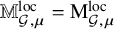 ${\mathbb M}^{\mathrm{loc}}_{{\mathcal G},\mu }={\mathrm{M}}^{\mathrm{loc}}_{{\mathcal G},\mu }$
, by Theorem 3.2.15. Since H splits after an unramified base change we can easily see that it is enough to show the statement under the additional assumption that H is split reductive over
${\mathbb M}^{\mathrm{loc}}_{{\mathcal G},\mu }={\mathrm{M}}^{\mathrm{loc}}_{{\mathcal G},\mu }$
, by Theorem 3.2.15. Since H splits after an unramified base change we can easily see that it is enough to show the statement under the additional assumption that H is split reductive over ${\mathcal O}_K$
. Now remark that the group
${\mathcal O}_K$
. Now remark that the group $G'$
used in the construction of
$G'$
used in the construction of ${\mathrm{M}}^{\mathrm{loc}}_{{\mathcal G},\mu }$
in §3.2.12 is such that
${\mathrm{M}}^{\mathrm{loc}}_{{\mathcal G},\mu }$
in §3.2.12 is such that $p\nmid |\pi _1(G^{{\prime \mathrm{der}}})|$
and is again of the form
$p\nmid |\pi _1(G^{{\prime \mathrm{der}}})|$
and is again of the form $G'=\mathrm{Res}_{K/F}H'$
. Denote by
$G'=\mathrm{Res}_{K/F}H'$
. Denote by ${\mathcal G}'$
the stabilizer group scheme of
${\mathcal G}'$
the stabilizer group scheme of $G'$
which corresponds to
$G'$
which corresponds to ${\mathcal G}$
. This is also of the same form
${\mathcal G}$
. This is also of the same form ${\mathcal G}'=\mathrm{Res}_{{\mathcal O}_K/{\mathcal O}_F}H'$
, with
${\mathcal G}'=\mathrm{Res}_{{\mathcal O}_K/{\mathcal O}_F}H'$
, with $H'$
split and reductive. By the definition of
$H'$
split and reductive. By the definition of ${\mathrm{M}}^{\mathrm{loc}}_{{\mathcal G},\mu }$
, we have
${\mathrm{M}}^{\mathrm{loc}}_{{\mathcal G},\mu }$
, we have
 $$\begin{align*}{\mathrm{M}}^{\mathrm{loc}}_{{\mathcal G},\mu}\otimes_{{\mathcal O}_E}k\simeq {\mathrm{M}}_{{\mathcal G}',\mu'}\otimes_{{\mathcal O}_{E'}}k. \end{align*}$$
Recall that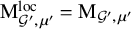 ${\mathrm{M}}^{\mathrm{loc}}_{{\mathcal G}',\mu '}={\mathrm{M}}_{{\mathcal G}',\mu '}$
and is given via a Beilinson-Drinfeld affine Grassmannian, as in Definition 3.2.6. This allows us to reduce proving the statement for
${\mathrm{M}}^{\mathrm{loc}}_{{\mathcal G}',\mu '}={\mathrm{M}}_{{\mathcal G}',\mu '}$
and is given via a Beilinson-Drinfeld affine Grassmannian, as in Definition 3.2.6. This allows us to reduce proving the statement for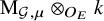 ${\mathrm{M}}_{{\mathcal G},\mu }\otimes _{O_E}k$
when
${\mathrm{M}}_{{\mathcal G},\mu }\otimes _{O_E}k$
when ${\mathcal G}= \mathrm{Res}_{{\mathcal O}_K/{\mathcal O}_F}H$
, with H split reductive, under the additional assumption
${\mathcal G}= \mathrm{Res}_{{\mathcal O}_K/{\mathcal O}_F}H$
, with H split reductive, under the additional assumption $p\nmid |\pi _1(G^{\mathrm{der}})|$
. The rest of the proof is a case of unpacking the constructions in [Reference LevinLe16] and above.
$p\nmid |\pi _1(G^{\mathrm{der}})|$
. The rest of the proof is a case of unpacking the constructions in [Reference LevinLe16] and above.
We may assume $H^{{\mathrm{ad}} }$
is simple. Let
$H^{{\mathrm{ad}} }$
is simple. Let $K_0$
denote the maximal unramified extension of F contained in K, and let
$K_0$
denote the maximal unramified extension of F contained in K, and let $\pi $
be a uniformizer of
$\pi $
be a uniformizer of $K'$
. Since H is split, we can take
$K'$
. Since H is split, we can take $\underline {{\mathcal H}}_0=H\otimes {\mathcal O}_{K_0}[u]$
in [Reference LevinLe16, §3.3]. Here, by slightly abusing notation, we also write H for the split Chevalley form of H.
$\underline {{\mathcal H}}_0=H\otimes {\mathcal O}_{K_0}[u]$
in [Reference LevinLe16, §3.3]. Here, by slightly abusing notation, we also write H for the split Chevalley form of H.
Let $k_0$
be the residue field of
$k_0$
be the residue field of $K_0$
, and let
$K_0$
, and let
 $$ \begin{align*} \underline{G}=\prod_{\varphi:k_0\rightarrow k} H\otimes k \end{align*} $$
a split reductive group scheme over k. Then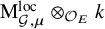 ${\mathrm{M}}^{\mathrm{loc}}_{{\mathcal G},\mu }\otimes _{{\mathcal O}_E}k$
can be identified with a Schubert variety
${\mathrm{M}}^{\mathrm{loc}}_{{\mathcal G},\mu }\otimes _{{\mathcal O}_E}k$
can be identified with a Schubert variety $S_{\underline {\mu }}\subset {\mathrm{Gr}}_{\underline {G}}$
for
$S_{\underline {\mu }}\subset {\mathrm{Gr}}_{\underline {G}}$
for $\underline {\mu }$
a dominant cocharacter of
$\underline {\mu }$
a dominant cocharacter of $\underline {G}$
. The cocharacter
$\underline {G}$
. The cocharacter $\underline \mu $
of
$\underline \mu $
of $\underline {G}$
can be computed from the cocharacter
$\underline {G}$
can be computed from the cocharacter $\mu $
as follows. We have an isomorphism
$\mu $
as follows. We have an isomorphism
 $$ \begin{align*} G_{\bar {K}}\cong \prod_{\theta: K\rightarrow \bar {K}} H_{\bar {K}} \end{align*} $$
where the product is taken over F-algebra morphisms of K into the algebraic closure $\bar {K}$
. We write
$\bar {K}$
. We write $\mu _{\theta }$
for the cocharacter of
$\mu _{\theta }$
for the cocharacter of $H_{\bar {K}}$
in the factor corresponding to
$H_{\bar {K}}$
in the factor corresponding to $\theta $
, and similarly we write
$\theta $
, and similarly we write $\underline {\mu }_{\varphi }$
for the factor of
$\underline {\mu }_{\varphi }$
for the factor of $\underline {\mu }$
corresponding to
$\underline {\mu }$
corresponding to $\varphi $
. We may identify dominant cocharacters of
$\varphi $
. We may identify dominant cocharacters of $H_{\bar {K}}=H\otimes \bar {K}$
with dominant cocharacters of
$H_{\bar {K}}=H\otimes \bar {K}$
with dominant cocharacters of $H\otimes k$
. Then under this identification, we have
$H\otimes k$
. Then under this identification, we have
 $$ \begin{align*} \underline{\mu}_{\varphi}=\sum_{\theta \text{ s.t. } \theta|_{k_0}=\varphi}\mu_\theta. \end{align*} $$
Since $(G, \mu )$
is of abelian type, the classification of such pairs (cf. [Reference Pappas and RapoportPR26, Prop. 7.2.1] and its proof) implies that
$(G, \mu )$
is of abelian type, the classification of such pairs (cf. [Reference Pappas and RapoportPR26, Prop. 7.2.1] and its proof) implies that $\mu ^{\mathrm{ad}} _{\theta }$
is minuscule, and if H is of type
$\mu ^{\mathrm{ad}} _{\theta }$
is minuscule, and if H is of type $D_n$
, we have either
$D_n$
, we have either $\mu _\theta ^{{\mathrm{ad}} }\in \{\varpi _1, 1\}$
for all
$\mu _\theta ^{{\mathrm{ad}} }\in \{\varpi _1, 1\}$
for all $\theta $
, or
$\theta $
, or $\mu _\theta ^{{\mathrm{ad}} }\in \{\varpi _{n-1}, \varpi _{n}, 1\}$
for all
$\mu _\theta ^{{\mathrm{ad}} }\in \{\varpi _{n-1}, \varpi _{n}, 1\}$
for all $\theta $
. The result follows.
$\theta $
. The result follows.
The following Theorem now is immediate from the preceding lemma and Theorems 4.2.3 and 4.3.2, see also Theorem 4.1.6.
Theorem 4.4.3. Let $(G,\{\mu \},{\mathcal G})$
be a local model triple over
$(G,\{\mu \},{\mathcal G})$
be a local model triple over $ {\mathcal O}_F$
which satisfies our standard assumptions. In addition, we assume that there is a finite extension
$ {\mathcal O}_F$
which satisfies our standard assumptions. In addition, we assume that there is a finite extension $K/F$
and a reductive group scheme H over
$K/F$
and a reductive group scheme H over $ {\mathcal O}_{K}$
such that
$ {\mathcal O}_{K}$
such that $ {\mathcal G}\cong \mathrm{Res}_{{\mathcal O}_K/{\mathcal O}_F}H. $
-
(1) If the point
$x\in {\mathbb M}^{\mathrm{loc}}_{{\mathcal G},\mu }(k)$
lies in the minimal stratum, then the tangent space of
${\mathbb M}^{\mathrm{loc}}_{{\mathcal G},\mu }\otimes _{{\mathcal O}_E}k$
at x is spanned by smooth formal curves. -
(2) If G has no factors of type
$D_n^{\mathbb H}$
, then, for every point
$x\in {\mathbb M}^{\mathrm{loc}}_{{\mathcal G},\mu }(k)$
, the tangent space of
${\mathbb M}^{\mathrm{loc}}_{{\mathcal G},\mu }\otimes _{{\mathcal O}_E}k$
at x is spanned by smooth formal curves.
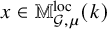
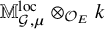

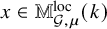

5 Displays and very good embeddings
In this section, we revisit the theory of [Reference Kisin and PappasKP18] about deformations of Dieudonné displays equipped with tensors, give the key definition of a very good integral Hodge embedding, and prove various properties of very good embeddings.
5.1 Displays and deformations
We will mostly use the notations of [Reference Kisin and PappasKP18, §3.1]. Suppose R is a Noetherian complete local ring with residue field k and maximal ideal ${\mathfrak m}$
. Fix integers
${\mathfrak m}$
. Fix integers $0\leq d\leq n$
. We let
$0\leq d\leq n$
. We let $W(R)$
denote the Witt vectors of R. We consider the subring
$W(R)$
denote the Witt vectors of R. We consider the subring $\widehat {W}(R)\subset W(R)$
given by
$\widehat {W}(R)\subset W(R)$
given by
 $$ \begin{align*}\widehat{W}(R)=W(k)\oplus\widehat{W}(\mathfrak{m})\subset W(R), \end{align*} $$
where $\widehat {W}(\mathfrak {m})\subset W(R)$
consists of Witt vectors
$\widehat {W}(\mathfrak {m})\subset W(R)$
consists of Witt vectors $(w_i)_{i\geq 1}$
with
$(w_i)_{i\geq 1}$
with $w_i\in \mathfrak {m}$
and
$w_i\in \mathfrak {m}$
and $w_i\rightarrow 0$
in the
$w_i\rightarrow 0$
in the $\mathfrak {m}$
-adic topology. We have
$\mathfrak {m}$
-adic topology. We have $\widehat {W}(R)=\varprojlim _a \widehat {W}(R/\mathfrak {m}^a)$
, and
$\widehat {W}(R)=\varprojlim _a \widehat {W}(R/\mathfrak {m}^a)$
, and $\widehat {W}(R/\mathfrak {m}^a)$
, for each a, is a (non-Noetherian) complete local ring with residue field k; see [Reference ZinkZi99], [Reference ZinkZi01], for details. We let
$\widehat {W}(R/\mathfrak {m}^a)$
, for each a, is a (non-Noetherian) complete local ring with residue field k; see [Reference ZinkZi99], [Reference ZinkZi01], for details. We let $\hat I_R=I_{{\widehat W}(R)}$
be the kernel of the ring homomorphism
$\hat I_R=I_{{\widehat W}(R)}$
be the kernel of the ring homomorphism ${\widehat W}(R)\to R$
given by projection to the first Witt coordinate. Also, we denote by
${\widehat W}(R)\to R$
given by projection to the first Witt coordinate. Also, we denote by $\varphi : {\widehat W}(R)\to {\widehat W}(R)$
the Frobenius and by
$\varphi : {\widehat W}(R)\to {\widehat W}(R)$
the Frobenius and by $V^{-1}: \hat I_R\to {\widehat W}(R)$
the inverse of the Verschiebung (see [Reference ZinkZi02], [Reference LauLau14]).
$V^{-1}: \hat I_R\to {\widehat W}(R)$
the inverse of the Verschiebung (see [Reference ZinkZi02], [Reference LauLau14]).
The data $({\widehat W}(R),\hat I_R, \varphi , V^{-1})$
give an example of a “frame” in the sense of Zink and Lau, as we will see next.
$({\widehat W}(R),\hat I_R, \varphi , V^{-1})$
give an example of a “frame” in the sense of Zink and Lau, as we will see next.
5.1.1
By [Reference LauLau10, Definition 2.1], [Reference LauLau14, 2.A], a frame is a quadruple ${\mathscr F}=(S, I, \varphi , \varphi _1)$
consisting of a ring S, an ideal I of S, a ring endomorphism
${\mathscr F}=(S, I, \varphi , \varphi _1)$
consisting of a ring S, an ideal I of S, a ring endomorphism $\varphi : S\to S$
, and a
$\varphi : S\to S$
, and a $\varphi $
-linear endomorphism
$\varphi $
-linear endomorphism $\varphi _1: I\to S$
, such that the following hold:
$\varphi _1: I\to S$
, such that the following hold:
-
i)
$I+pS\subset {\mathrm{Rad}}(S)$
, -
ii)
$\varphi (a)\equiv \,a^p\,\mathrm{mod}\,pS$
, i.e.,
$\varphi $
is a lift of the Frobenius on
$S/pS$
, -
iii)
$\varphi _1(I)$
generates S as an S-module.




For our purposes, we will also assume that $\varphi (a)=p\varphi _1(a)$
, for all
$\varphi (a)=p\varphi _1(a)$
, for all $a\in I$
, that is,
$a\in I$
, that is, $\theta =p$
in the notation of [Reference LauLau10, Lem. 2.2]. (Recall, we assume
$\theta =p$
in the notation of [Reference LauLau10, Lem. 2.2]. (Recall, we assume $p>2$
throughout.)
$p>2$
throughout.)
By definition, a morphism of frames $\alpha : {\mathscr F}=(S, I, \varphi , \varphi _1)\to {\mathscr F}'=(S', I', \varphi ', \varphi ^{\prime }_1)$
is a ring homomorphism
$\alpha : {\mathscr F}=(S, I, \varphi , \varphi _1)\to {\mathscr F}'=(S', I', \varphi ', \varphi ^{\prime }_1)$
is a ring homomorphism $\alpha : S\to S'$
such that
$\alpha : S\to S'$
such that $\alpha (I)\subset I'$
, and
$\alpha (I)\subset I'$
, and $\varphi '\cdot \alpha =\alpha \cdot \varphi $
,
$\varphi '\cdot \alpha =\alpha \cdot \varphi $
, $\varphi ^{\prime }_1\cdot \alpha =\alpha \cdot \varphi _1$
. (These are called “strict morphisms” in [Reference LauLau14, 2.A].)
$\varphi ^{\prime }_1\cdot \alpha =\alpha \cdot \varphi _1$
. (These are called “strict morphisms” in [Reference LauLau14, 2.A].)
We give some examples of frames that we will use:
a) Suppose R is a Noetherian complete local ring with residue field k. Then, as above, we have the “Dieudonné–Witt frame”
 $$\begin{align*}{\mathscr D}_R:=({\widehat W}(R), \hat I_R, \varphi, V^{-1}). \end{align*}$$
b) Suppose that B and R are Artin local rings with residue field k and $B\to R$
is a surjection whose kernel
$B\to R$
is a surjection whose kernel $\mathfrak {b}$
is equipped with divided powers. Then, we also have the “relative Dieudonné–Witt frame”
$\mathfrak {b}$
is equipped with divided powers. Then, we also have the “relative Dieudonné–Witt frame”
 $$\begin{align*}{\mathscr D}_{B/R}:=({\widehat W}(B), \hat I_{B/R}, \varphi, V^{-1}). \end{align*}$$
Here, $\hat I_{B/R}$
is the kernel of the composition
$\hat I_{B/R}$
is the kernel of the composition ${\widehat W}(B)\to {\widehat W}(R)\to R$
, and
${\widehat W}(B)\to {\widehat W}(R)\to R$
, and $V^{-1}$
is defined by extending
$V^{-1}$
is defined by extending $V^{-1}: \hat I_B\to {\widehat W}(B)$
to
$V^{-1}: \hat I_B\to {\widehat W}(B)$
to $\hat I_{B/R}=\hat I_B\oplus [\mathfrak {b}]$
by setting
$\hat I_{B/R}=\hat I_B\oplus [\mathfrak {b}]$
by setting $V^{-1}([\mathfrak {b}])=0$
; this construction uses Zink’s log coordinates, cf. [Reference ZinkZi02, Lemma 38], [Reference LauLau14, 2.C, 2.D]. There are natural morphisms of frames,
$V^{-1}([\mathfrak {b}])=0$
; this construction uses Zink’s log coordinates, cf. [Reference ZinkZi02, Lemma 38], [Reference LauLau14, 2.C, 2.D]. There are natural morphisms of frames,
 $$\begin{align*}{\mathscr D}_{B}\to {\mathscr D}_{B/R}\to {\mathscr D}_{R}. \end{align*}$$
c) Later, we will also consider the frame $({\mathfrak S}, (p), \varphi , p^{-1}\varphi )$
, where
$({\mathfrak S}, (p), \varphi , p^{-1}\varphi )$
, where ${\mathfrak S}=W(k)[\![ u]\!]$
and
${\mathfrak S}=W(k)[\![ u]\!]$
and $\varphi :{\mathfrak S}\to {\mathfrak S}$
is the standard lift of Frobenius with
$\varphi :{\mathfrak S}\to {\mathfrak S}$
is the standard lift of Frobenius with $\varphi (u)=u^p$
.
$\varphi (u)=u^p$
.
5.1.2
Fix a frame ${\mathscr F}=(S, I, \varphi , \varphi _1)$
as above. We can consider the category
${\mathscr F}=(S, I, \varphi , \varphi _1)$
as above. We can consider the category $P_{\mathscr F}$
of pairs
$P_{\mathscr F}$
of pairs $(M, M_1)$
, where M is a finite free S-module and
$(M, M_1)$
, where M is a finite free S-module and $M_1$
is an S-submodule of M such that there is a normal decomposition
$M_1$
is an S-submodule of M such that there is a normal decomposition $M=L\oplus T$
,
$M=L\oplus T$
, $M_1=L\oplus IT$
, with L, T, finite free S-modules of rank d and
$M_1=L\oplus IT$
, with L, T, finite free S-modules of rank d and $n-d$
respectively. Morphisms
$n-d$
respectively. Morphisms $(M, M_1)\to (M', M^{\prime }_1)$
in the category are S-homomorphisms
$(M, M_1)\to (M', M^{\prime }_1)$
in the category are S-homomorphisms $M\to M'$
which take
$M\to M'$
which take $M_1$
to
$M_1$
to $M^{\prime }_1$
. We will call an object of the category
$M^{\prime }_1$
. We will call an object of the category $P_{{\mathscr F}}$
a pair over the frame
$P_{{\mathscr F}}$
a pair over the frame ${\mathscr F}$
, or simply a pair over S, if the frame structure on S is understood.
${\mathscr F}$
, or simply a pair over S, if the frame structure on S is understood.
If $\alpha : {\mathscr F}\to {\mathscr F'}$
is a frame morphism then there is a corresponding base change functor
$\alpha : {\mathscr F}\to {\mathscr F'}$
is a frame morphism then there is a corresponding base change functor ${\alpha _*: P_{{\mathscr F}}\to P_{{\mathscr F}'}}$
which in terms of normal decompositions is given by
${\alpha _*: P_{{\mathscr F}}\to P_{{\mathscr F}'}}$
which in terms of normal decompositions is given by $(L, T)\mapsto (S'\otimes _SL, S'\otimes _ST)$
.
$(L, T)\mapsto (S'\otimes _SL, S'\otimes _ST)$
.
We now define a functor
 $$\begin{align*}\tau_{\mathscr F}: P_{{\mathscr F}}\to {\mathrm{Mod}}^{\mathrm{ff}}_S,\quad (M, M_1)\mapsto {\widetilde M}_1, \end{align*}$$
into the category of finite free S-modules as follows:
Choose a basis ${\mathcal B}=(e_1,\ldots , e_n)$
of M, such that
${\mathcal B}=(e_1,\ldots , e_n)$
of M, such that $(e_1,\ldots , e_d)$
is a basis of L and
$(e_1,\ldots , e_d)$
is a basis of L and $(e_{d+1},\ldots , e_n)$
is a basis of T. (We say that such a basis
$(e_{d+1},\ldots , e_n)$
is a basis of T. (We say that such a basis ${\mathcal B}$
of M is adapted to the normal decomposition
${\mathcal B}$
of M is adapted to the normal decomposition $M=L\oplus T$
.) We set
$M=L\oplus T$
.) We set ${\widetilde M}_1$
to be the free
${\widetilde M}_1$
to be the free ${\widehat W}(R)$
-module of rank n with basis
${\widehat W}(R)$
-module of rank n with basis $\tilde {\mathcal B}=(\tilde e_1,\ldots , \tilde e_n)$
. Let
$\tilde {\mathcal B}=(\tilde e_1,\ldots , \tilde e_n)$
. Let $(M', M^{\prime }_1)$
be a second pair, with
$(M', M^{\prime }_1)$
be a second pair, with $M'=L'\oplus T'$
,
$M'=L'\oplus T'$
, $M^{\prime }_1=L'\oplus IT'$
and
$M^{\prime }_1=L'\oplus IT'$
and ${\mathcal B}'=(e^{\prime }_1,\ldots , e^{\prime }_{n})$
an adapted basis. Suppose
${\mathcal B}'=(e^{\prime }_1,\ldots , e^{\prime }_{n})$
an adapted basis. Suppose $f: (M, M_1)\to (M', M^{\prime }_1)$
is a morphism of pairs. We can write f in terms of
$f: (M, M_1)\to (M', M^{\prime }_1)$
is a morphism of pairs. We can write f in terms of ${\mathcal B}$
,
${\mathcal B}$
, ${\mathcal B}'$
, as a matrix in block form
${\mathcal B}'$
, as a matrix in block form
 $$\begin{align*}\begin{pmatrix} A & B\\ C & D \end{pmatrix} \end{align*}$$
with the entries of C in I. Then the functor associates to f the map $\tilde f: {\widetilde M}_1\to {\widetilde M}_1'$
which, in the bases
$\tilde f: {\widetilde M}_1\to {\widetilde M}_1'$
which, in the bases $\tilde {\mathcal B}$
and
$\tilde {\mathcal B}$
and $\tilde {\mathcal B}'$
, is given by
$\tilde {\mathcal B}'$
, is given by
 $$ \begin{align} \begin{pmatrix} \varphi(A)& p\varphi(B)\\ \varphi_1(C) & \varphi(D) \end{pmatrix}. \end{align} $$
We can check, using that $\varphi _1$
is
$\varphi _1$
is $\varphi $
-linear and
$\varphi $
-linear and $\varphi _{|I}=p\varphi _1$
, that
$\varphi _{|I}=p\varphi _1$
, that $f\mapsto \tilde f$
respects composition. The functor
$f\mapsto \tilde f$
respects composition. The functor $\tau _{\mathscr F}$
is, up to natural equivalence, independent of the choices of bases, cf. [Reference Bültel and PappasBP20, 2.3].
$\tau _{\mathscr F}$
is, up to natural equivalence, independent of the choices of bases, cf. [Reference Bültel and PappasBP20, 2.3].
The functors $\tau _{\mathscr F}$
, for variable
$\tau _{\mathscr F}$
, for variable ${\mathscr F}$
, are compatible with base change in the sense that, given a morphism
${\mathscr F}$
, are compatible with base change in the sense that, given a morphism $\alpha : {\mathscr F}\to {\mathscr F'}$
, there are natural isomorphisms
$\alpha : {\mathscr F}\to {\mathscr F'}$
, there are natural isomorphisms
 $$ \begin{align} {\widetilde M}^{\prime}_1\simeq {\widetilde M}_1\otimes_S S', \end{align} $$
where we denote by ${\widetilde M}^{\prime }_1$
the finite free
${\widetilde M}^{\prime }_1$
the finite free $S'$
-module associated by
$S'$
-module associated by $\tau _{\mathscr F'}$
to the object
$\tau _{\mathscr F'}$
to the object $(M', M^{\prime }_1)=\alpha _*(M, M_1)$
of
$(M', M^{\prime }_1)=\alpha _*(M, M_1)$
of $P_{{\mathscr F}'}$
.
$P_{{\mathscr F}'}$
.
5.1.5
We can apply this construction to the Dieudonné–Witt frame ${\mathscr D}_R:=({\widehat W}(R), \hat I_R, \varphi , V^{-1})$
, where R is as above. Then pairs
${\mathscr D}_R:=({\widehat W}(R), \hat I_R, \varphi , V^{-1})$
, where R is as above. Then pairs $(M, M_1)$
over
$(M, M_1)$
over ${\mathscr D}_R$
amount to pairs
${\mathscr D}_R$
amount to pairs $(M, M_1)$
of a finite free
$(M, M_1)$
of a finite free ${\widehat W}(R)$
-module M of rank n and a
${\widehat W}(R)$
-module M of rank n and a ${\widehat W}(R)$
-submodule
${\widehat W}(R)$
-submodule $M_1\subset M$
such that
$M_1\subset M$
such that $M/M_1$
is a finite free R-module of rank
$M/M_1$
is a finite free R-module of rank $n-d$
. Indeed, assuming
$n-d$
. Indeed, assuming $M/M_1$
is finite free of rank
$M/M_1$
is finite free of rank $n-d$
we can write
$n-d$
we can write $M=L\oplus T$
,
$M=L\oplus T$
, $M_1=L\oplus \hat I_RT$
, where L and T are finite free
$M_1=L\oplus \hat I_RT$
, where L and T are finite free ${\widehat W}(R)$
-modules of rank d and
${\widehat W}(R)$
-modules of rank d and $n-d$
(cf. [Reference LauLau14, 2.C]). The above functor
$n-d$
(cf. [Reference LauLau14, 2.C]). The above functor
 $$\begin{align*}(M, M_1)\mapsto {\widetilde M}_1, \end{align*}$$
generalizes a construction of [Reference Kisin and PappasKP18, §3.1], see [Reference HoffHo23].
The base change compatibility (5.1.4) now gives the following. Let $R'\to R$
be a local homomorphism of complete local rings as before. This induces a frame morphism
$R'\to R$
be a local homomorphism of complete local rings as before. This induces a frame morphism ${\mathscr D}_{R'}\to {\mathscr D}_{R}$
and a base change from pairs
${\mathscr D}_{R'}\to {\mathscr D}_{R}$
and a base change from pairs $(M', M^{\prime }_1)$
over
$(M', M^{\prime }_1)$
over ${\widehat W}(R')$
to pairs
${\widehat W}(R')$
to pairs $(M, M_1)$
over
$(M, M_1)$
over ${\widehat W}(R)$
as in [Reference Kisin and PappasKP18, 3.1.6]. This base change is compatible with the functor above, so we have natural isomorphisms
${\widehat W}(R)$
as in [Reference Kisin and PappasKP18, 3.1.6]. This base change is compatible with the functor above, so we have natural isomorphisms
 $$ \begin{align} {\widetilde M}_{{\widehat W}(R), 1}\simeq {\widetilde M}^{\prime}_{{\widehat W}(R'), 1}\otimes_{{\widehat W}(R')}{\widehat W}(R). \end{align} $$
Here we write $M_{{\widehat W}(R)}$
,
$M_{{\widehat W}(R)}$
, $M_{{\widehat W}(R), 1}$
and
$M_{{\widehat W}(R), 1}$
and ${\widetilde M}_{{\widehat W}(R), 1}$
instead of M,
${\widetilde M}_{{\widehat W}(R), 1}$
instead of M, $M_1$
,
$M_1$
, ${\widetilde M}_1$
, to emphasize the ring
${\widetilde M}_1$
, to emphasize the ring ${\widehat W}(R)$
over which these are modules.
${\widehat W}(R)$
over which these are modules.
Starting from a pair $(M, M_1)$
over
$(M, M_1)$
over ${\widehat W}(R)$
as above, we will denote by
${\widehat W}(R)$
as above, we will denote by $(M_0, M_{0,1})$
the pair of
$(M_0, M_{0,1})$
the pair of $W(k)$
-modules obtained from
$W(k)$
-modules obtained from $(M, M_1)$
by base change by
$(M, M_1)$
by base change by $R\to R/{\mathfrak m}=k$
. By (5.1.6), we have a natural isomorphism
$R\to R/{\mathfrak m}=k$
. By (5.1.6), we have a natural isomorphism
 $$\begin{align*}{\widetilde M}_{0,1}\simeq {\widetilde M}_1\otimes_{{\widehat W}(R)}W(k). \end{align*}$$
5.1.7
There are functorial S-homomorphisms
 $$\begin{align*}{\widetilde M}_1\to \varphi^*M=S\otimes_{\varphi, S}M, \end{align*}$$
defined as follows: Suppose $(L, T)$
gives a normal decomposition of
$(L, T)$
gives a normal decomposition of $(M, M_1)$
. Let
$(M, M_1)$
. Let $(e_1,\ldots , e_d)$
be a basis of L,
$(e_1,\ldots , e_d)$
be a basis of L, $(e_{d+1},\ldots , e_n)$
a basis of T, and let
$(e_{d+1},\ldots , e_n)$
a basis of T, and let $(\tilde e_1,\ldots , \tilde e_n)$
be the corresponding basis of
$(\tilde e_1,\ldots , \tilde e_n)$
be the corresponding basis of $\tilde M_1$
. The homomorphism sends
$\tilde M_1$
. The homomorphism sends $\tilde e_i$
to
$\tilde e_i$
to $\varphi ^*e_i$
for
$\varphi ^*e_i$
for $1\leq i\leq d$
and
$1\leq i\leq d$
and $\tilde e_i$
to
$\tilde e_i$
to $p\varphi ^*e_i$
for
$p\varphi ^*e_i$
for $d+1\leq i\leq n$
. We can see that this does not depend on the choice of bases.
$d+1\leq i\leq n$
. We can see that this does not depend on the choice of bases.
Suppose now that the ring S of the frame $\mathscr F$
is p-torsion free. Then the above homomorphism
$\mathscr F$
is p-torsion free. Then the above homomorphism $ {\widetilde M}_1\to \varphi ^*M $
is injective. Using this, we identify
$ {\widetilde M}_1\to \varphi ^*M $
is injective. Using this, we identify
 $$\begin{align*}{\widetilde M}_1={\mathrm{Im}}(\varphi^*(i): \varphi^*M_1\to \varphi^*M)=\varphi^*L\oplus p\varphi^*T\subset \varphi^*L\oplus \varphi^*T=\varphi^*M \end{align*}$$
where $i:M_1\rightarrow M$
is the inclusion. Hence
$i:M_1\rightarrow M$
is the inclusion. Hence
 $$\begin{align*}{\widetilde M}_1[1/p]=(\varphi^*M)[1/p]. \end{align*}$$
In particular, this applies to $S={\widehat W}(R)$
, when R is a Noetherian complete local ring with residue field k and R is p-torsion free.
$S={\widehat W}(R)$
, when R is a Noetherian complete local ring with residue field k and R is p-torsion free.
5.1.8
Suppose $\alpha : {\mathscr F}=(S,I,\varphi ,\varphi _1)\to {\mathscr F}'=(S, I', \varphi , \varphi ^{\prime }_1)$
is a morphism of frames underlying the identity
$\alpha : {\mathscr F}=(S,I,\varphi ,\varphi _1)\to {\mathscr F}'=(S, I', \varphi , \varphi ^{\prime }_1)$
is a morphism of frames underlying the identity ${\mathrm{id}}: S\to S$
, so
${\mathrm{id}}: S\to S$
, so $I\subset I'$
and
$I\subset I'$
and $(\varphi ^{\prime }_1)_{|I}=\varphi _1$
. It induces
$(\varphi ^{\prime }_1)_{|I}=\varphi _1$
. It induces $P_{{\mathscr F}}\to P_{{\mathscr F}'}$
given as
$P_{{\mathscr F}}\to P_{{\mathscr F}'}$
given as $(M, M_1)\mapsto (M, M^{\prime }_1)$
.
$(M, M_1)\mapsto (M, M^{\prime }_1)$
.
Lemma 5.1.9. The functor
 $$\begin{align*}\tau_{{\mathscr F}}: P_{{\mathscr F}}\to {\mathrm{Mod}}^{\mathrm{ff}}_{S}; \quad (M, M_1)\mapsto {\widetilde M}_1, \end{align*}$$
is naturally equivalent to the composition
 $$\begin{align*}P_{{\mathscr F}}\to P_{ {\mathscr F}'}\xrightarrow{\tau_{{\mathscr F}'}}{\mathrm{Mod}}^{\mathrm{ff}}_{S}. \end{align*}$$
Proof. This quickly follows from the definition of the functors $P_{{\mathscr F}}\to P_{ {\mathscr F}'}$
,
$P_{{\mathscr F}}\to P_{ {\mathscr F}'}$
, $\tau _{{\mathscr F}}$
and
$\tau _{{\mathscr F}}$
and $\tau _{{\mathscr F}'}$
via (5.1.3), by using
$\tau _{{\mathscr F}'}$
via (5.1.3), by using $(\varphi ^{\prime }_1)_{|I}=\varphi _1$
.
$(\varphi ^{\prime }_1)_{|I}=\varphi _1$
.
Note that this Lemma applies to the natural frame morphism $ {\mathscr D}_B\to {\mathscr D}_{B/k} $
when B is an Artin local ring with
$ {\mathscr D}_B\to {\mathscr D}_{B/k} $
when B is an Artin local ring with $\mathfrak {m}_B^2=0$
and residue field
$\mathfrak {m}_B^2=0$
and residue field $B/\mathfrak {m}_B=k$
.
$B/\mathfrak {m}_B=k$
.
5.1.10
For the following statement, we let ${\mathscr F}=(S,I,\varphi ,\varphi _1)$
be a frame together with frame morphisms
${\mathscr F}=(S,I,\varphi ,\varphi _1)$
be a frame together with frame morphisms
 $$\begin{align*}{\mathscr D}_k \to {\mathscr F}\xrightarrow{\iota} {\mathscr D}_k \end{align*}$$
with composition the identity of $ {\mathscr D}_k$
. We denote by
$ {\mathscr D}_k$
. We denote by $I'$
the kernel of the composition
$I'$
the kernel of the composition $S\xrightarrow {\iota } W(k)\to k$
.
$S\xrightarrow {\iota } W(k)\to k$
.
If $(M, M_1)$
is a pair over the frame
$(M, M_1)$
is a pair over the frame ${\mathscr F}$
we set
${\mathscr F}$
we set
 $$\begin{align*}(M_0, M_{0,1})=\iota_*(M, M_1) \end{align*}$$
for the pair over ${\mathscr D}_k$
obtained by base change.
${\mathscr D}_k$
obtained by base change.
Lemma 5.1.11. Suppose that $I\subset I'$
and that
$I\subset I'$
and that $\varphi _1: I\to S$
extends to
$\varphi _1: I\to S$
extends to $\varphi ^{\prime }_1: I'\to S$
, so that
$\varphi ^{\prime }_1: I'\to S$
, so that ${\mathscr F}'=(S, I', \varphi , \varphi ^{\prime }_1)$
is a frame. Let
${\mathscr F}'=(S, I', \varphi , \varphi ^{\prime }_1)$
is a frame. Let $(M, M_1)$
be a pair over
$(M, M_1)$
be a pair over $ {\mathscr F}$
, together with an isomorphism
$ {\mathscr F}$
, together with an isomorphism $\psi : M_0\otimes _{W(k)}S\xrightarrow {\sim } M$
whose base change by
$\psi : M_0\otimes _{W(k)}S\xrightarrow {\sim } M$
whose base change by $S\xrightarrow {\iota } W(k)$
is the identity. Then, there is an isomorphism
$S\xrightarrow {\iota } W(k)$
is the identity. Then, there is an isomorphism
 $$ \begin{align} c_S: {\widetilde M}_{0,1}\otimes_{W(k)}S \xrightarrow{\sim } {\widetilde M}_1 \end{align} $$
of finite free S-modules which is functorial in pairs $(M, M_1)$
equipped with an isomorphism
$(M, M_1)$
equipped with an isomorphism $\psi $
and is compatible with base change.
$\psi $
and is compatible with base change.
Proof. Note that the identity of S induces a frame morphism $\alpha : {\mathscr F}\to {\mathscr F}'$
to which we can apply Lemma 5.1.9. We will denote by
$\alpha : {\mathscr F}\to {\mathscr F}'$
to which we can apply Lemma 5.1.9. We will denote by $(M, M_1)' $
the image of
$(M, M_1)' $
the image of $(M, M_1)$
in
$(M, M_1)$
in $P_{{\mathscr F}'}$
given by the functor
$P_{{\mathscr F}'}$
given by the functor $\alpha _*: P_{\mathscr F}\to P_{{\mathscr F}'}$
. Note that
$\alpha _*: P_{\mathscr F}\to P_{{\mathscr F}'}$
. Note that $P_{{\mathscr F}'}$
fully embedds in the category of pairs
$P_{{\mathscr F}'}$
fully embedds in the category of pairs $(N, N_{0,1})$
, where N is a finite free S-module and
$(N, N_{0,1})$
, where N is a finite free S-module and $pN_0\subset N_{0,1}\subset N_0=N\otimes _{S}W(k)$
is a
$pN_0\subset N_{0,1}\subset N_0=N\otimes _{S}W(k)$
is a $W(k)$
-submodule. The choice of
$W(k)$
-submodule. The choice of $\psi $
determines an isomorphism
$\psi $
determines an isomorphism
 $$\begin{align*}\underline \psi: ((M_0, M_{0,1})\otimes_{W(k)}{S})'\xrightarrow{ \sim }(M, M_1)' \end{align*}$$
in $P_{ {\mathscr F}'}$
. Here, the left hand side is the image of
$P_{ {\mathscr F}'}$
. Here, the left hand side is the image of $(M_0, M_{0,1}) $
given by applying the base change
$(M_0, M_{0,1}) $
given by applying the base change $P_{ {\mathscr D}_{k}}\to P_{ {\mathscr F}}$
followed by
$P_{ {\mathscr D}_{k}}\to P_{ {\mathscr F}}$
followed by $\alpha _*: P_{ {\mathscr F} }\to P_{ {\mathscr F}'}$
. We now consider the isomorphism
$\alpha _*: P_{ {\mathscr F} }\to P_{ {\mathscr F}'}$
. We now consider the isomorphism $\tau _{ {\mathscr F}'}(\underline \psi )$
. By applying Lemma 5.1.9 for
$\tau _{ {\mathscr F}'}(\underline \psi )$
. By applying Lemma 5.1.9 for $\alpha _*: P_{\mathscr F}\to P_{{\mathscr F}'}$
and combining with base change (5.1.4), we see that
$\alpha _*: P_{\mathscr F}\to P_{{\mathscr F}'}$
and combining with base change (5.1.4), we see that $\tau _{ {\mathscr F}'}(\underline \psi )$
produces the desired isomorphism
$\tau _{ {\mathscr F}'}(\underline \psi )$
produces the desired isomorphism
 $$\begin{align*}c_{S}: {\widetilde M}_{0,1}\otimes_{W(k)}S \xrightarrow{\sim } {\widetilde M}_1. \end{align*}$$
This is functorial in pairs $(M, M_1)$
equipped with
$(M, M_1)$
equipped with $\psi $
and is compatible with base change.
$\psi $
and is compatible with base change.
Remark 5.1.13. Lemma 5.1.11 can be applied to the frame ${\mathscr F}= {\mathscr D}_B$
where B is an Artin local k-algebra with
${\mathscr F}= {\mathscr D}_B$
where B is an Artin local k-algebra with $\mathfrak {m}_B^2=0$
and residue field
$\mathfrak {m}_B^2=0$
and residue field $B/\mathfrak {m}_B=k$
with
$B/\mathfrak {m}_B=k$
with ${\mathscr D}_B\to {\mathscr D}_k$
,
${\mathscr D}_B\to {\mathscr D}_k$
, ${\mathscr D}_k\to {\mathscr D}_B$
the natural morphisms. Then
${\mathscr D}_k\to {\mathscr D}_B$
the natural morphisms. Then $\alpha : {\mathscr F}\to {\mathscr F}'$
is the natural frame morphism
$\alpha : {\mathscr F}\to {\mathscr F}'$
is the natural frame morphism $ {\mathscr D}_B \to {\mathscr D}_{B/k}$
.
$ {\mathscr D}_B \to {\mathscr D}_{B/k}$
.
5.1.14
We now return to the set-up in the beginning of §5.1. Set ${\mathfrak a}={\mathfrak m}^2+pR\subset R$
and consider the quotient
${\mathfrak a}={\mathfrak m}^2+pR\subset R$
and consider the quotient $R/\mathfrak a$
. We also have the pair
$R/\mathfrak a$
. We also have the pair $(M_{{\widehat W}(R/\mathfrak a) }, M_{{\widehat W}(R/\mathfrak a), 1 })$
over
$(M_{{\widehat W}(R/\mathfrak a) }, M_{{\widehat W}(R/\mathfrak a), 1 })$
over ${\widehat W}(R/\mathfrak a)$
obtained by base change from
${\widehat W}(R/\mathfrak a)$
obtained by base change from $(M, M_1)$
. We fix an isomorphism
$(M, M_1)$
. We fix an isomorphism
 $$\begin{align*}M=M_0\otimes_{W(k)}{\widehat W}(R) \end{align*}$$
reducing to the identity modulo $\mathfrak {m}_R$
.
$\mathfrak {m}_R$
.
Lemma 5.1.15 (cf. [Reference Kisin and PappasKP18, Lem. 3.1.9].)
There is a canonical commutative diagram

In this, the left vertical map is an isomorphism and the horizontal maps are induced by base changing ${\widetilde M}_1\to \varphi ^*M$
and
${\widetilde M}_1\to \varphi ^*M$
and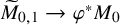 ${\widetilde M}_{0,1}\to \varphi ^*M_0$
.
${\widetilde M}_{0,1}\to \varphi ^*M_0$
.
We will call
 $$\begin{align*}c: {\widetilde M}_{0,1}\otimes_{W(k)}{\widehat W}(R/\mathfrak a)\xrightarrow{\sim} {\widetilde M}_1\otimes_{{\widehat W}(R)}{\widehat W}(R/\mathfrak a) \end{align*}$$
the “connection isomorphism.”
Remark 5.1.17. a) As was pointed out to the authors by M. Hoff, the isomorphism which is given by the construction of [Reference Kisin and PappasKP18, Lem. 3.1.9] is not canonical and hence not “correct.” (The construction there is given using a normal decomposition $M=L\oplus T$
, but the resulting map depends on that choice.) In particular, [Reference Kisin and PappasKP18, Lem. 3.1.12] does not hold when c is defined as in the proof of [Reference Kisin and PappasKP18, Lem. 3.1.9]. Note that the diagram does not determine c since the horizontal maps are not always injective, and this can occur even if
$M=L\oplus T$
, but the resulting map depends on that choice.) In particular, [Reference Kisin and PappasKP18, Lem. 3.1.12] does not hold when c is defined as in the proof of [Reference Kisin and PappasKP18, Lem. 3.1.9]. Note that the diagram does not determine c since the horizontal maps are not always injective, and this can occur even if ${\widehat W}(R)$
is p-torsion free.
${\widehat W}(R)$
is p-torsion free.
b) Our corrected construction of c follows [Reference HoffHo23]; the main idea already appears in Zink’s work, see [Reference ZinkZi99, Theorem 3].
Proof. We apply Lemma 5.1.11 to the frame ${\mathscr D}_{ R/\mathfrak a}$
, cf. Remark 5.1.13, and define c as the composition of the isomorphism (5.1.12)
${\mathscr D}_{ R/\mathfrak a}$
, cf. Remark 5.1.13, and define c as the composition of the isomorphism (5.1.12)
 $$\begin{align*}c_{{\widehat W}(R/\mathfrak a)}: {\widetilde M}_{0,1}\otimes_{W(k)}{\widehat W}(R/\mathfrak a) \xrightarrow{\sim } {\widetilde M}_{{\widehat W}(R/\mathfrak a), 1}, \end{align*}$$
with the base change isomorphism (5.1.4)
 $$\begin{align*}{\widetilde M}_{{\widehat W}(R/\mathfrak a), 1} \xrightarrow{\sim} {\widetilde M}_1\otimes_{{\widehat W}(R)} {\widehat W}(R/\mathfrak a). \end{align*}$$
Note that the essential ingredient for this construction is the relative Dieudonné frame which uses Zink’s logarithmic coordinates, see also [Reference HoffHo23, Lemma 1.21].
The commutativity of the diagram follows from the construction of c and §5.1.7. It is also instructive to deduce it from a useful explicit description of c as follows. Fix a normal decomposition $M=L\oplus T$
,
$M=L\oplus T$
, $M_1=L\oplus \hat I_RT$
, and a basis
$M_1=L\oplus \hat I_RT$
, and a basis ${\mathcal B}=(e_1,\ldots , e_n)$
adapted to this decomposition as above. Reduce
${\mathcal B}=(e_1,\ldots , e_n)$
adapted to this decomposition as above. Reduce ${\mathcal B}$
modulo
${\mathcal B}$
modulo ${\widehat W}({\mathfrak m})$
to obtain a basis
${\widehat W}({\mathfrak m})$
to obtain a basis ${\mathcal B}_0$
of
${\mathcal B}_0$
of $M_0$
. In turn, this gives a new basis
$M_0$
. In turn, this gives a new basis ${\mathcal B}_0\otimes 1$
of M by base changing by
${\mathcal B}_0\otimes 1$
of M by base changing by $W(k)\to {\widehat W}(R)$
. Denote by
$W(k)\to {\widehat W}(R)$
. Denote by
 $$\begin{align*}\begin{pmatrix} X & Y\\ Z & U \end{pmatrix} \end{align*}$$
the change of basis matrix between ${\mathcal B}$
and
${\mathcal B}$
and ${\mathcal B}_0\otimes 1$
. Since
${\mathcal B}_0\otimes 1$
. Since ${\mathcal B}$
reduces to
${\mathcal B}$
reduces to ${\mathcal B}_0$
, we have
${\mathcal B}_0$
, we have
 $$\begin{align*}\begin{pmatrix} X & Y\\ Z & U \end{pmatrix}\equiv I_{n}\, \mathrm{mod}\, {\widehat W}({\mathfrak m}), \end{align*}$$
with $I_n$
the
$I_n$
the $n\times n$
identity matrix. In particular, Z is a matrix with coefficients in
$n\times n$
identity matrix. In particular, Z is a matrix with coefficients in ${\widehat W}({\mathfrak m})$
. Set
${\widehat W}({\mathfrak m})$
. Set $B=R/\mathfrak a$
and observe that
$B=R/\mathfrak a$
and observe that
 $$ \begin{align*}{\widehat W}(\mathfrak{m}_B)=I_{{\widehat W}(\mathfrak{m}_B)}\oplus [\mathfrak{m}_B]\subset \hat I_{B/k}=\hat I_B\oplus [\mathfrak{m}_B].\end{align*} $$
The isomorphism c is now given, in terms of the bases $\tilde {\mathcal B}\otimes _{{\widehat W}(R)}{\widehat W}(B)$
and
$\tilde {\mathcal B}\otimes _{{\widehat W}(R)}{\widehat W}(B)$
and $\tilde {\mathcal B}_0\otimes _{W(k)}{\widehat W}(B)$
of
$\tilde {\mathcal B}_0\otimes _{W(k)}{\widehat W}(B)$
of ${\widetilde M}_1\otimes _{{\widehat W}(R)}{\widehat W}(B)$
and
${\widetilde M}_1\otimes _{{\widehat W}(R)}{\widehat W}(B)$
and ${\widetilde M}_{0, 1}\otimes _{W(k)}{\widehat W}(B)$
, by the matrix
${\widetilde M}_{0, 1}\otimes _{W(k)}{\widehat W}(B)$
, by the matrix
 $$ \begin{align} \begin{pmatrix} I_{d} & 0\\ V^{-1}(\overline Z) & I_{n-d} \end{pmatrix}, \end{align} $$
with entries in ${\widehat W}({\mathfrak m}_B)$
. Here we write
${\widehat W}({\mathfrak m}_B)$
. Here we write $\overline Z$
for the reduction of Z modulo
$\overline Z$
for the reduction of Z modulo $\mathfrak a$
. The commutativity of the diagram now follows by using the description of
$\mathfrak a$
. The commutativity of the diagram now follows by using the description of ${\widetilde M}_1\to \varphi ^*M$
and
${\widetilde M}_1\to \varphi ^*M$
and ${\widetilde M}_{0,1}\to \varphi ^*M_0$
in §5.1.7 and combining it with the above, together with
${\widetilde M}_{0,1}\to \varphi ^*M_0$
in §5.1.7 and combining it with the above, together with $\varphi ({\widehat W}({\mathfrak m}_B))=0$
.
$\varphi ({\widehat W}({\mathfrak m}_B))=0$
.
5.1.19
Suppose now we have a Dieudonné display $(M, M_1, \Phi , \Phi _1)$
over the p-torsion free
$(M, M_1, \Phi , \Phi _1)$
over the p-torsion free ${\widehat W}(R)$
with corresponding
${\widehat W}(R)$
with corresponding $(M, {\widetilde M}_1, \Psi )$
as in [Reference Kisin and PappasKP18, Lem. 3.1.5]. Denote by
$(M, {\widetilde M}_1, \Psi )$
as in [Reference Kisin and PappasKP18, Lem. 3.1.5]. Denote by $(M_0, M_{0,1}, \Phi _0, \Phi _{0,1})=({\mathbb D},{\mathbb D}_1, \Phi _0,\Phi _{0,1})$
the Dieudonné display over
$(M_0, M_{0,1}, \Phi _0, \Phi _{0,1})=({\mathbb D},{\mathbb D}_1, \Phi _0,\Phi _{0,1})$
the Dieudonné display over $W(k)$
obtained by base change by
$W(k)$
obtained by base change by $R\to R/{\mathfrak m}=k$
as in [Reference Kisin and PappasKP18, 3.1.6]. This has corresponding
$R\to R/{\mathfrak m}=k$
as in [Reference Kisin and PappasKP18, 3.1.6]. This has corresponding $(M_0, {\widetilde M}_{0,1}, \Psi _0)$
.
$(M_0, {\widetilde M}_{0,1}, \Psi _0)$
.
As in [Reference Kisin and PappasKP18, 3.1.1], we say “ $\Psi $
is constant modulo
$\Psi $
is constant modulo $\mathfrak a$
” if the composite
$\mathfrak a$
” if the composite
 $$\begin{align*}{\widetilde M}_{0,1}\otimes_{W(k)}{\widehat W}(R/\mathfrak a)\simeq {\widetilde M}_1\otimes_{{\widehat W}(R)}{\widehat W}(R/\mathfrak a)\xrightarrow{\Psi} M\otimes_{{\widehat W}(R)}{\widehat W}(R/\mathfrak a)=M_0\otimes_{W(k)}{\widehat W}(R/\mathfrak a) \end{align*}$$
is $\Psi _0\otimes 1$
, where the first map in the composition is the isomorphism c of Lemma 5.1.15. Then, with this definition, [Reference Kisin and PappasKP18, Lem. 3.1.12] holds, see also [Reference HoffHo23, Thm. 1.28].
$\Psi _0\otimes 1$
, where the first map in the composition is the isomorphism c of Lemma 5.1.15. Then, with this definition, [Reference Kisin and PappasKP18, Lem. 3.1.12] holds, see also [Reference HoffHo23, Thm. 1.28].
5.2 Very good embeddings: definition
Suppose that ${\mathcal G}\subset \mathrm{GL}({\Lambda })$
is a closed immersion of group schemes over the p-adic discrete valuation ring
${\mathcal G}\subset \mathrm{GL}({\Lambda })$
is a closed immersion of group schemes over the p-adic discrete valuation ring ${\mathcal O}$
, where
${\mathcal O}$
, where ${\Lambda }$
is a finite free
${\Lambda }$
is a finite free ${\mathcal O}$
-module. Set
${\mathcal O}$
-module. Set ${\Lambda }^\otimes :=\oplus _{m, n\geq 0}{\Lambda }^{\otimes m}\otimes _{\mathcal O} ({\Lambda }^\vee )^{\otimes n}$
for the total tensor algebra of
${\Lambda }^\otimes :=\oplus _{m, n\geq 0}{\Lambda }^{\otimes m}\otimes _{\mathcal O} ({\Lambda }^\vee )^{\otimes n}$
for the total tensor algebra of ${\Lambda }$
, where
${\Lambda }$
, where ${\Lambda }^\vee ={\mathrm{Hom}}_{{\mathcal O}}({\Lambda },{\mathcal O})$
. As usual, we say that
${\Lambda }^\vee ={\mathrm{Hom}}_{{\mathcal O}}({\Lambda },{\mathcal O})$
. As usual, we say that ${\mathcal G}$
is cut out in
${\mathcal G}$
is cut out in $\mathrm{GL}({\Lambda })$
by a set of tensors
$\mathrm{GL}({\Lambda })$
by a set of tensors $(s_a)\subset {\Lambda }^{\otimes }$
, if for all
$(s_a)\subset {\Lambda }^{\otimes }$
, if for all ${\mathcal O}$
-algebras R, we have
${\mathcal O}$
-algebras R, we have
 $$\begin{align*}{\mathcal G}(R)=\{g\in \mathrm{GL}({\Lambda}\otimes_{{\mathbb Z}_p} R)\ |\ g\cdot (s_a\otimes 1)=s_a\otimes 1,\forall a\}. \end{align*}$$
Here $s_a\otimes 1$
is the image of
$s_a\otimes 1$
is the image of $s_a$
under
$s_a$
under ${\Lambda }^{\otimes }\to {\Lambda }^{\otimes }\otimes _{{\mathcal O}}R=({\Lambda }\otimes _{{\mathbb Z}_p}R)^\otimes $
.
${\Lambda }^{\otimes }\to {\Lambda }^{\otimes }\otimes _{{\mathcal O}}R=({\Lambda }\otimes _{{\mathbb Z}_p}R)^\otimes $
.
5.2.1
We now consider a local model triple $(G,\{\mu \},{\mathcal G})$
and assume that
$(G,\{\mu \},{\mathcal G})$
and assume that $\rho : ({\mathcal G},\mu )\hookrightarrow (\mathrm{GL}({\Lambda }),\mu _d)$
is a good integral Hodge embedding. We suppose that
$\rho : ({\mathcal G},\mu )\hookrightarrow (\mathrm{GL}({\Lambda }),\mu _d)$
is a good integral Hodge embedding. We suppose that ${\mathcal O}$
is unramified over
${\mathcal O}$
is unramified over ${\mathbb Z}_p$
.
${\mathbb Z}_p$
.
We first assume ${\mathcal O}={\mathbb Z}_p$
. Suppose
${\mathcal O}={\mathbb Z}_p$
. Suppose $x\in {\mathbb M}^{\mathrm{loc}}_{{\mathcal G},\mu }(k)$
, where we now take
$x\in {\mathbb M}^{\mathrm{loc}}_{{\mathcal G},\mu }(k)$
, where we now take $k=\bar {k}_E=\bar {\mathbb {F}}_p$
. Following [Reference Kisin and PappasKP18], we will denote by
$k=\bar {k}_E=\bar {\mathbb {F}}_p$
. Following [Reference Kisin and PappasKP18], we will denote by $R_{G,x}$
, or simply
$R_{G,x}$
, or simply $R_G$
, the completion of the local ring of
$R_G$
, the completion of the local ring of $ {\mathbb M}^{\mathrm{loc}}_{{\mathcal G},\mu }$
at x and by
$ {\mathbb M}^{\mathrm{loc}}_{{\mathcal G},\mu }$
at x and by $R_E$
the completion of the local ring of the Grassmannian
$R_E$
the completion of the local ring of the Grassmannian ${\mathrm{Gr}}(d,\Lambda )_{{\mathcal O}_E}$
at the image of the point x under the embedding
${\mathrm{Gr}}(d,\Lambda )_{{\mathcal O}_E}$
at the image of the point x under the embedding ${\mathbb M}^{\mathrm{loc}}_{{\mathcal G},\mu }\hookrightarrow {\mathrm{Gr}}(d,{\Lambda })_{{\mathcal O}_E}$
. Then
${\mathbb M}^{\mathrm{loc}}_{{\mathcal G},\mu }\hookrightarrow {\mathrm{Gr}}(d,{\Lambda })_{{\mathcal O}_E}$
. Then $R_G$
is a quotient of
$R_G$
is a quotient of $R_E$
and
$R_E$
and $R_E$
is noncanonically isomorphic to a power series ring over the integers
$R_E$
is noncanonically isomorphic to a power series ring over the integers ${\mathcal O}_EW(k)$
of the completion of the unramified extension of E with residue field k.
${\mathcal O}_EW(k)$
of the completion of the unramified extension of E with residue field k.
Set $M={\Lambda }\otimes _{{\mathbb Z}_p}{\widehat W}(R_E) $
and denote by
$M={\Lambda }\otimes _{{\mathbb Z}_p}{\widehat W}(R_E) $
and denote by $\hat I_{R_E}M\subset M_1\subset M$
the unique
$\hat I_{R_E}M\subset M_1\subset M$
the unique ${\widehat W}(R_E)$
-submodule corresponding to the universal
${\widehat W}(R_E)$
-submodule corresponding to the universal $R_E$
-valued point of the Grassmannian. Then
$R_E$
-valued point of the Grassmannian. Then $(M, M_1)$
is a pair over
$(M, M_1)$
is a pair over ${\widehat W}(R_E)$
as considered in the previous paragraph. Usually, we will denote for simplicity also by
${\widehat W}(R_E)$
as considered in the previous paragraph. Usually, we will denote for simplicity also by $(M, M_1)$
the pair of
$(M, M_1)$
the pair of ${\widehat W}(R_G)$
-modules which is obtained by restricting along
${\widehat W}(R_G)$
-modules which is obtained by restricting along $R_E\to R_G$
. (If noting the specific pair
$R_E\to R_G$
. (If noting the specific pair $({\mathcal G},\mu )$
is important, we will denote this by
$({\mathcal G},\mu )$
is important, we will denote this by $(M^G,M_1^G)$
.) To this pair, we associate the finite free
$(M^G,M_1^G)$
.) To this pair, we associate the finite free ${\widehat W}(R_G)$
-module
${\widehat W}(R_G)$
-module ${\widetilde M}_1$
with
${\widetilde M}_1$
with
 $$\begin{align*}{\widetilde M}_1[1/p]=(\varphi^*M)[1/p]. \end{align*}$$
Choose $(s_a)\subset {\Lambda }^\otimes $
that cut out
$(s_a)\subset {\Lambda }^\otimes $
that cut out ${\mathcal G}$
, cf. [Reference Kisin and PappasKP18, Prop. 1.3.2], [Reference PappasP23, 3.2.1] and set
${\mathcal G}$
, cf. [Reference Kisin and PappasKP18, Prop. 1.3.2], [Reference PappasP23, 3.2.1] and set
 $$\begin{align*}\tilde s_a:=s_a\otimes 1=\varphi^*(s_a\otimes 1)\in {\Lambda}^{\otimes}\otimes_{{\mathbb Z}_p} {\widehat W}(R_G)=\varphi^*M^{\otimes}\subset (\varphi^*M)^{\otimes}[1/p]={\widetilde M}_1^{\otimes}[1/p] .\end{align*}$$
Observe that the tensors
 $$\begin{align*}\tilde s_{a,0}=s_a\otimes 1\in {\Lambda}^{\otimes}\otimes_{{\mathbb Z}_p} W(k)[1/p]={\widetilde M}_{0,1}^{\otimes}[1/p] \end{align*}$$
lie in ${\widetilde M}_{0,1}^{\otimes }\subset {\widetilde M}_{0,1}^{\otimes }[1/p]$
: Indeed, by (3.1.10),
${\widetilde M}_{0,1}^{\otimes }\subset {\widetilde M}_{0,1}^{\otimes }[1/p]$
: Indeed, by (3.1.10),
 $$\begin{align*}{\mathbb M}^{\mathrm{loc}}_{{\mathcal G},\mu}(k)\subset \frac{G(W(k)[1/p])}{{\mathcal G}(W(k))}\subset \frac{\mathrm{GL}({\Lambda}\otimes_{{\mathbb Z}_p} W(k)[1/p])}{\mathrm{GL}({\Lambda}\otimes_{{\mathbb Z}_p} W(k))}. \end{align*}$$
This implies that we have ${\widetilde M}_{0,1}=g\cdot ({\Lambda }\otimes _{{\mathbb Z}_p} W(k))$
for some
${\widetilde M}_{0,1}=g\cdot ({\Lambda }\otimes _{{\mathbb Z}_p} W(k))$
for some $g\in G(W(k)[1/p])$
. Since g preserves the tensors
$g\in G(W(k)[1/p])$
. Since g preserves the tensors $s_a\otimes 1$
, we obtain
$s_a\otimes 1$
, we obtain $\tilde s_{a,0}\in {\widetilde M}_{0,1}^{\otimes }$
(cf. the proof of Lemma 5.3.13 below).
$\tilde s_{a,0}\in {\widetilde M}_{0,1}^{\otimes }$
(cf. the proof of Lemma 5.3.13 below).
By the argument of [Reference Kisin and PappasKP18, Cor. 3.2.11] (now using also the main resultFootnote
6
of [Reference AnschützAn22]), we then also have $\tilde s_a\in {\widetilde M}_1^{\otimes }$
and the scheme
$\tilde s_a\in {\widetilde M}_1^{\otimes }$
and the scheme
 $$\begin{align*}{\mathcal T}=\underline{\mathrm{Isom}}_{(\tilde s_a), (s_a)}({\widetilde M}_1, {\Lambda}\otimes_{{\mathbb Z}_p}{\widehat W}(R_G)) \end{align*}$$
of ${\widehat W}(R_G)$
-linear isomorphisms that preserve the tensors is a trivial
${\widehat W}(R_G)$
-linear isomorphisms that preserve the tensors is a trivial ${\mathcal G}$
-torsor over
${\mathcal G}$
-torsor over ${\widehat W}(R_G)$
. The scheme
${\widehat W}(R_G)$
. The scheme ${\mathcal T}$
is independent of the choice of the set of tensors
${\mathcal T}$
is independent of the choice of the set of tensors $(s_a)\subset {\Lambda }^\otimes $
that cut out
$(s_a)\subset {\Lambda }^\otimes $
that cut out ${\mathcal G}$
.
${\mathcal G}$
.
Set $\mathfrak a_G={\mathfrak m}_G^2+\pi _ER_G\subset R_G$
. Then, by Lemma 5.1.15, there is a canonical isomorphism
$\mathfrak a_G={\mathfrak m}_G^2+\pi _ER_G\subset R_G$
. Then, by Lemma 5.1.15, there is a canonical isomorphism
 $$ \begin{align} c: {\widetilde M}_{0,1}\otimes_{W(k)}{\widehat W}(R_G/\mathfrak a_G)\xrightarrow{\sim} {\widetilde M}_1\otimes_{{\widehat W}(R_G)}{\widehat W}(R_G/\mathfrak a_G). \end{align} $$
We say that “the tensors $\tilde s_a$
are horizontal at x” if they are preserved by c, that is, if
$\tilde s_a$
are horizontal at x” if they are preserved by c, that is, if
 $$\begin{align*}c(\tilde s_{a,0}\otimes 1)=\tilde s_a\otimes 1. \end{align*}$$
Note here that ${\widetilde M}_{0,1}={\mathrm{Im}}(\varphi ^*M_{0,1}\to \varphi ^*M_0)$
. Suppose this is the case for a finite set of tensors
${\widetilde M}_{0,1}={\mathrm{Im}}(\varphi ^*M_{0,1}\to \varphi ^*M_0)$
. Suppose this is the case for a finite set of tensors $(s_a)\subset {\Lambda }^{\otimes }$
cutting out
$(s_a)\subset {\Lambda }^{\otimes }$
cutting out ${\mathcal G}\hookrightarrow \mathrm{GL}({\Lambda })$
. Then the isomorphism c uniquely descends to an isomorphism of
${\mathcal G}\hookrightarrow \mathrm{GL}({\Lambda })$
. Then the isomorphism c uniquely descends to an isomorphism of ${\mathcal G}$
-torsors
${\mathcal G}$
-torsors
 $$\begin{align*}c^{\mathcal G}: {\mathcal T}_0\otimes_{W(k)}{\widehat W}(R_G/\mathfrak a_G)\xrightarrow{\sim} {\mathcal T}\otimes_{{\widehat W}(R_G)}{\widehat W}(R_G/\mathfrak a_G). \end{align*}$$
Lemma 5.2.3. Suppose $({\mathcal G},\mu )\hookrightarrow (\mathrm{GL}({\Lambda }),\mu )$
and that
$({\mathcal G},\mu )\hookrightarrow (\mathrm{GL}({\Lambda }),\mu )$
and that $(s_a)\subset {\Lambda }^{\otimes }$
cuts out
$(s_a)\subset {\Lambda }^{\otimes }$
cuts out ${\mathcal G}$
, such that
${\mathcal G}$
, such that $(\tilde s_a)$
are horizontal. If a tensor
$(\tilde s_a)$
are horizontal. If a tensor $t\in \Lambda ^{\otimes }$
is fixed by
$t\in \Lambda ^{\otimes }$
is fixed by ${\mathcal G}$
, then
${\mathcal G}$
, then $\tilde t$
is horizontal.
$\tilde t$
is horizontal.
Proof. This follows by the discussion above, since ${\mathcal T}$
is independent of the choice of the set
${\mathcal T}$
is independent of the choice of the set $(s_a)$
that cuts out
$(s_a)$
that cuts out ${\mathcal G}$
.
${\mathcal G}$
.
5.2.4
The following notion plays a central role.
Definition 5.2.5. Let $\iota :({\mathcal G},\mu )\hookrightarrow (\mathrm{GL}({\Lambda }),\mu _d)$
be a good integral Hodge embedding. We say that
$\iota :({\mathcal G},\mu )\hookrightarrow (\mathrm{GL}({\Lambda }),\mu _d)$
be a good integral Hodge embedding. We say that $\iota $
is very good at x (or just very good if the point x is understood), if there are tensors
$\iota $
is very good at x (or just very good if the point x is understood), if there are tensors $(s_a)\subset {\Lambda }^{\otimes }$
cutting out
$(s_a)\subset {\Lambda }^{\otimes }$
cutting out ${\mathcal G}$
in
${\mathcal G}$
in $\mathrm{GL}({\Lambda })$
such that
$\mathrm{GL}({\Lambda })$
such that $(\tilde s_a)$
are horizontal at x. This is equivalent to asking that the canonical isomorphism c descends to an isomorphism of
$(\tilde s_a)$
are horizontal at x. This is equivalent to asking that the canonical isomorphism c descends to an isomorphism of ${\mathcal G}$
-torsors
${\mathcal G}$
-torsors $c^{\mathcal G}$
, as above.
$c^{\mathcal G}$
, as above.
More generally, suppose that $\mathrm{GL}({\mathcal L})$
is the parahoric group scheme determined by a periodic lattice chain
$\mathrm{GL}({\mathcal L})$
is the parahoric group scheme determined by a periodic lattice chain ${\mathcal L}$
in V. We will say that a good integral Hodge embedding
${\mathcal L}$
in V. We will say that a good integral Hodge embedding $({\mathcal G},\mu )\hookrightarrow (\mathrm{GL}({\mathcal L}),\mu _{d})$
is very good if the good integral Hodge embedding
$({\mathcal G},\mu )\hookrightarrow (\mathrm{GL}({\mathcal L}),\mu _{d})$
is very good if the good integral Hodge embedding
 $$ \begin{align*}({\mathcal G},\mu)\hookrightarrow (\mathrm{GL}({\mathrm{tot}}({\mathcal L})),\mu_{rd})\end{align*} $$
given by composing with the diagonal, is very good in the sense of Def. 5.2.5 above. Here ${\mathrm{tot}}({\mathcal L})$
is the direct sum of the lattices in a determining segment of
${\mathrm{tot}}({\mathcal L})$
is the direct sum of the lattices in a determining segment of ${\mathcal L}$
, cf. §3.4.3. By Lemma 5.3.7 (b) below, this notion does not depend on the choice of determining segment.
${\mathcal L}$
, cf. §3.4.3. By Lemma 5.3.7 (b) below, this notion does not depend on the choice of determining segment.
5.2.6
The above definitions extend to the case that ${\mathcal O}\simeq W({\mathbb F}_q)$
is finite unramified over
${\mathcal O}\simeq W({\mathbb F}_q)$
is finite unramified over ${\mathbb Z}_p$
. In this case, the arguments of [Reference Kisin and PappasKP18, §3.2] show that we have
${\mathbb Z}_p$
. In this case, the arguments of [Reference Kisin and PappasKP18, §3.2] show that we have $\varphi ^*(s_a\otimes 1)\in {\widetilde M}_1^\otimes $
and we say that a good integral Hodge embedding is very good when
$\varphi ^*(s_a\otimes 1)\in {\widetilde M}_1^\otimes $
and we say that a good integral Hodge embedding is very good when $\varphi ^*(s_a\otimes 1)$
are horizontal.
$\varphi ^*(s_a\otimes 1)$
are horizontal.
Lemma 5.2.7. Assume $({\mathcal G},\mu )\hookrightarrow (\mathrm{GL}({\Lambda }),\mu _d)$
is a good integral Hodge embedding over
$({\mathcal G},\mu )\hookrightarrow (\mathrm{GL}({\Lambda }),\mu _d)$
is a good integral Hodge embedding over ${\mathbb Z}_p$
. Let
${\mathbb Z}_p$
. Let ${\mathcal O}/{\mathbb Z}_p$
be a finite unramified extension. Then there is a natural isomorphism
${\mathcal O}/{\mathbb Z}_p$
be a finite unramified extension. Then there is a natural isomorphism ${\mathbb M}^{\mathrm{loc}}_{{\mathcal G}\otimes _{{\mathbb Z}_p}{\mathcal O},\mu \otimes _{{\mathbb Z}_p}{\mathcal O}}={\mathbb M}^{\mathrm{loc}}_{{\mathcal G},\mu }\otimes _{{\mathcal O}_E} {\mathcal O}_E{\mathcal O}$
and
${\mathbb M}^{\mathrm{loc}}_{{\mathcal G}\otimes _{{\mathbb Z}_p}{\mathcal O},\mu \otimes _{{\mathbb Z}_p}{\mathcal O}}={\mathbb M}^{\mathrm{loc}}_{{\mathcal G},\mu }\otimes _{{\mathcal O}_E} {\mathcal O}_E{\mathcal O}$
and $({\mathcal G},\mu )\hookrightarrow (\mathrm{GL}({\Lambda }),\mu _d)$
is very good at
$({\mathcal G},\mu )\hookrightarrow (\mathrm{GL}({\Lambda }),\mu _d)$
is very good at $x\in {\mathbb M}^{\mathrm{loc}}_{{\mathcal G}, \mu }(k)$
if and only if the base change
$x\in {\mathbb M}^{\mathrm{loc}}_{{\mathcal G}, \mu }(k)$
if and only if the base change $({\mathcal G}\otimes _{{\mathbb Z}_p}{{\mathcal O}},\mu \otimes _{{\mathbb Z}_p}{\mathcal O})\hookrightarrow (\mathrm{GL}({\Lambda }\otimes _{{\mathbb Z}_p}{{\mathcal O}}),\mu _d\otimes _{{\mathbb Z}_p}{\mathcal O})$
is very good at
$({\mathcal G}\otimes _{{\mathbb Z}_p}{{\mathcal O}},\mu \otimes _{{\mathbb Z}_p}{\mathcal O})\hookrightarrow (\mathrm{GL}({\Lambda }\otimes _{{\mathbb Z}_p}{{\mathcal O}}),\mu _d\otimes _{{\mathbb Z}_p}{\mathcal O})$
is very good at $x\in {\mathbb M}^{\mathrm{loc}}_{{\mathcal G}\otimes _{{\mathbb Z}_p}{\mathcal O},\mu \otimes _{{\mathbb Z}_p}{\mathcal O}}(k)$
.
$x\in {\mathbb M}^{\mathrm{loc}}_{{\mathcal G}\otimes _{{\mathbb Z}_p}{\mathcal O},\mu \otimes _{{\mathbb Z}_p}{\mathcal O}}(k)$
.
Proof. In the above, ${\mathcal O}_E{\mathcal O}$
is the integers of the join of E with
${\mathcal O}_E{\mathcal O}$
is the integers of the join of E with ${\mathrm{Fr}}({\mathcal O})$
. The isomorphism
${\mathrm{Fr}}({\mathcal O})$
. The isomorphism ${\mathbb M}^{\mathrm{loc}}_{{\mathcal G}\otimes _{{\mathbb Z}_p}{\mathcal O},\mu \otimes _{{\mathbb Z}_p}{\mathcal O}}={\mathbb M}^{\mathrm{loc}}_{{\mathcal G},\mu }\otimes _{{\mathcal O}_E} {\mathcal O}_E{\mathcal O}$
is standard and follows from the construction of the local models, cf. [Reference He, Pappas and RapoportHPR20, Prop. 2.14], or by their characterization via v-sheaves in [Reference Scholze and WeinsteinSW20]. The rest of the statement follows from the definitions.
${\mathbb M}^{\mathrm{loc}}_{{\mathcal G}\otimes _{{\mathbb Z}_p}{\mathcal O},\mu \otimes _{{\mathbb Z}_p}{\mathcal O}}={\mathbb M}^{\mathrm{loc}}_{{\mathcal G},\mu }\otimes _{{\mathcal O}_E} {\mathcal O}_E{\mathcal O}$
is standard and follows from the construction of the local models, cf. [Reference He, Pappas and RapoportHPR20, Prop. 2.14], or by their characterization via v-sheaves in [Reference Scholze and WeinsteinSW20]. The rest of the statement follows from the definitions.
5.3 Very good embeddings: properties
We now give various results regarding very good integral Hodge embeddings.
5.3.1
We start with the following.
Lemma 5.3.2. Assume $({\mathcal G},\mu )\hookrightarrow (\mathrm{GL}({\Lambda }),\mu _d)$
is a good integral Hodge embedding. Let
$({\mathcal G},\mu )\hookrightarrow (\mathrm{GL}({\Lambda }),\mu _d)$
is a good integral Hodge embedding. Let $t:{\Lambda }\to {\Lambda }$
be an endomorphism which is fixed by
$t:{\Lambda }\to {\Lambda }$
be an endomorphism which is fixed by ${\mathcal G}\hookrightarrow \mathrm{GL}({\Lambda })$
. Then
${\mathcal G}\hookrightarrow \mathrm{GL}({\Lambda })$
. Then $\tilde t: {\widetilde M}_1\to {\widetilde M}_1$
is horizontal at x.
$\tilde t: {\widetilde M}_1\to {\widetilde M}_1$
is horizontal at x.
Proof. Since t is fixed by ${\mathcal G}$
, we have
${\mathcal G}$
, we have $t({\mathcal F})\subset {\mathcal F}$
for the universal point of
$t({\mathcal F})\subset {\mathcal F}$
for the universal point of ${\mathrm{Gr}}(d, {\Lambda })$
which corresponds to
${\mathrm{Gr}}(d, {\Lambda })$
which corresponds to ${\mathbb M}^{\mathrm{loc}}_{{\mathcal G},\mu }\hookrightarrow {\mathrm{Gr}}(d, {\Lambda })_{{\mathcal O}_E}$
. Indeed, it is enough to check this on the generic fiber and this follows from [Reference Kisin and PappasKP18, 3.2.5]. Hence,
${\mathbb M}^{\mathrm{loc}}_{{\mathcal G},\mu }\hookrightarrow {\mathrm{Gr}}(d, {\Lambda })_{{\mathcal O}_E}$
. Indeed, it is enough to check this on the generic fiber and this follows from [Reference Kisin and PappasKP18, 3.2.5]. Hence,
 $$ \begin{align*}t\otimes 1: M={\Lambda}\otimes{\widehat W}(R_G)\to M={\Lambda}\otimes{\widehat W}(R_G)\end{align*} $$
preserves the submodule $M_1.$
Then we see that
$M_1.$
Then we see that $\tilde t: {\widetilde M}_1\to {\widetilde M}_1$
is preserved by c, that is, it is horizontal. Indeed, this follows from the functoriality of the isomorphism c for homomorphisms of pairs
$\tilde t: {\widetilde M}_1\to {\widetilde M}_1$
is preserved by c, that is, it is horizontal. Indeed, this follows from the functoriality of the isomorphism c for homomorphisms of pairs $(M, M_1)$
which respect an isomorphism
$(M, M_1)$
which respect an isomorphism $M=M_0\otimes _{W(k)}{\widehat W}(R_G)$
, see Lemma 5.1.15 and its proof.
$M=M_0\otimes _{W(k)}{\widehat W}(R_G)$
, see Lemma 5.1.15 and its proof.
Corollary 5.3.3. Assume $({\mathcal G},\mu )\hookrightarrow (\mathrm{GL}({\Lambda }),\mu _d)$
is a good integral Hodge embedding. If
$({\mathcal G},\mu )\hookrightarrow (\mathrm{GL}({\Lambda }),\mu _d)$
is a good integral Hodge embedding. If ${\mathcal G}\hookrightarrow \mathrm{GL}({\Lambda })$
is cut out by a set of endomorphisms
${\mathcal G}\hookrightarrow \mathrm{GL}({\Lambda })$
is cut out by a set of endomorphisms $t_a:{\Lambda }\to {\Lambda }$
, then
$t_a:{\Lambda }\to {\Lambda }$
, then $({\mathcal G},\mu )\hookrightarrow (\mathrm{GL}({\Lambda }),\mu _d)$
is very good at all x.
$({\mathcal G},\mu )\hookrightarrow (\mathrm{GL}({\Lambda }),\mu _d)$
is very good at all x.
Corollary 5.3.4. Suppose we have $({\mathcal G},\mu )\hookrightarrow ({\mathcal G}',\mu ')\hookrightarrow (\mathrm{GL}({\Lambda }),\mu _d)$
, where both
$({\mathcal G},\mu )\hookrightarrow ({\mathcal G}',\mu ')\hookrightarrow (\mathrm{GL}({\Lambda }),\mu _d)$
, where both $({\mathcal G}',\mu ')\hookrightarrow (\mathrm{GL}({\Lambda }),\mu _d)$
and the composition are good integral Hodge embeddings. Suppose that there are endomorphisms
$({\mathcal G}',\mu ')\hookrightarrow (\mathrm{GL}({\Lambda }),\mu _d)$
and the composition are good integral Hodge embeddings. Suppose that there are endomorphisms $t_a: {\Lambda }\to {\Lambda }$
such that
$t_a: {\Lambda }\to {\Lambda }$
such that
 $$\begin{align*}{\mathcal G}={\mathcal G}'\cap \{g\in \mathrm{GL}({\Lambda})\ |\ g\cdot t_a=t_a\cdot g, \forall a\} \end{align*}$$
as closed subschemes of $\mathrm{GL}({\Lambda })$
. Consider
$\mathrm{GL}({\Lambda })$
. Consider $x\in {\mathbb M}^{\mathrm{loc}}_{{\mathcal G},\mu }(k)$
.
$x\in {\mathbb M}^{\mathrm{loc}}_{{\mathcal G},\mu }(k)$
.
Suppose that $({\mathcal G}',\mu ')\hookrightarrow (\mathrm{GL}({\Lambda }),\mu _d)$
is very good at the image
$({\mathcal G}',\mu ')\hookrightarrow (\mathrm{GL}({\Lambda }),\mu _d)$
is very good at the image $x'\in {\mathbb M}^{\mathrm{loc}}_{{\mathcal G}',\mu '}(k)$
of x. Then
$x'\in {\mathbb M}^{\mathrm{loc}}_{{\mathcal G}',\mu '}(k)$
of x. Then $({\mathcal G},\mu )\hookrightarrow (\mathrm{GL}({\Lambda }),\mu _d)$
is very good at x.
$({\mathcal G},\mu )\hookrightarrow (\mathrm{GL}({\Lambda }),\mu _d)$
is very good at x.
Proof. Let $s_{a'}\in \Lambda ^\otimes $
a set of tensors which cut out
$s_{a'}\in \Lambda ^\otimes $
a set of tensors which cut out ${\mathcal G}'$
. The module
${\mathcal G}'$
. The module ${\widetilde M}^G_1$
over
${\widetilde M}^G_1$
over ${\widehat W}(R_{G,x})$
which corresponds to
${\widehat W}(R_{G,x})$
which corresponds to $({\mathcal G},\mu )\hookrightarrow (\mathrm{GL}({\Lambda }),\mu _d)$
is the base change by the surjection
$({\mathcal G},\mu )\hookrightarrow (\mathrm{GL}({\Lambda }),\mu _d)$
is the base change by the surjection $R_{G',x'}\to R_{G,x}$
of the module
$R_{G',x'}\to R_{G,x}$
of the module ${\widetilde M}^{G'}_1$
over
${\widetilde M}^{G'}_1$
over ${\widehat W}(R_{G',x'})$
which corresponds to
${\widehat W}(R_{G',x'})$
which corresponds to $({\mathcal G}',\mu ')\hookrightarrow (\mathrm{GL}({\Lambda }),\mu _d)$
. The same is true for the corresponding connection isomorphisms, and hence
$({\mathcal G}',\mu ')\hookrightarrow (\mathrm{GL}({\Lambda }),\mu _d)$
. The same is true for the corresponding connection isomorphisms, and hence $\tilde s_{a'}\in {\widetilde M}^{G,\otimes }_1$
is horizontal at x. Since
$\tilde s_{a'}\in {\widetilde M}^{G,\otimes }_1$
is horizontal at x. Since ${\mathcal G}$
is cut out by the union of the tensors
${\mathcal G}$
is cut out by the union of the tensors $s_{a'}$
and
$s_{a'}$
and $t_a$
, the result follows from Lemma 5.3.2.
$t_a$
, the result follows from Lemma 5.3.2.
Remark 5.3.5. In the applications, we will apply the above corollary to the case ${\mathcal G}'=\mathrm{Res}_{{\mathcal O}_K/{\mathcal O}}{\mathcal H}$
where
${\mathcal G}'=\mathrm{Res}_{{\mathcal O}_K/{\mathcal O}}{\mathcal H}$
where $K/F$
is a field over which G splits and
$K/F$
is a field over which G splits and ${\mathcal H}$
is a hyperspecial subgroup of
${\mathcal H}$
is a hyperspecial subgroup of $G_K$
. This will allow us to produce very good Hodge embeddings for general parahorics from those coming from Weil restrictions of hyperspecial subgroups.
$G_K$
. This will allow us to produce very good Hodge embeddings for general parahorics from those coming from Weil restrictions of hyperspecial subgroups.
5.3.6
The next two lemmas show that very good embeddings behave well with respect to taking direct sums, and projections onto direct summands.
Lemma 5.3.7. Consider a good integral Hodge embedding $({\mathcal G},\mu )\hookrightarrow (\mathrm{GL}({\Lambda }_1),\mu _{d_1})$
and a map of local model pairs
$({\mathcal G},\mu )\hookrightarrow (\mathrm{GL}({\Lambda }_1),\mu _{d_1})$
and a map of local model pairs $({\mathcal G},\mu )\to (\mathrm{GL}({\Lambda }_2),\mu _{d_2})$
. Set
$({\mathcal G},\mu )\to (\mathrm{GL}({\Lambda }_2),\mu _{d_2})$
. Set ${\Lambda }={\Lambda }_1\oplus {\Lambda }_2$
,
${\Lambda }={\Lambda }_1\oplus {\Lambda }_2$
, $\mu _d=\mu _{d_1}\times \mu _{d_2}$
, and consider the diagonal embedding
$\mu _d=\mu _{d_1}\times \mu _{d_2}$
, and consider the diagonal embedding
 $$\begin{align*}({\mathcal G},\mu)\hookrightarrow (\mathrm{GL}({\Lambda}),\mu_d). \end{align*}$$
-
a) If the diagonal embedding is very good at x, then
$({\mathcal G},\mu )\hookrightarrow (\mathrm{GL}({\Lambda }_1),\mu _{d_1})$
is very good at x. -
b) Suppose that there is an isomorphism
$h: {\Lambda }_1\xrightarrow {\sim } {\Lambda }_2$
which intertwines the embeddings
$({\mathcal G},\mu )\hookrightarrow (\mathrm{GL}({\Lambda }_1), \mu _{d_1})$
and
$({\mathcal G},\mu )\to (\mathrm{GL}({\Lambda }_2),\mu _{d_2})$
. Suppose that
$({\mathcal G},\mu )\hookrightarrow (\mathrm{GL}({\Lambda }_1),\mu _{d_1})$
is very good at x. Then, both
$({\mathcal G},\mu )\hookrightarrow (\mathrm{GL}({\Lambda }_2),\mu _{d_2})$
and the diagonal above are very good at x.





Proof. The diagonal immersion gives
 $$\begin{align*}{\mathbb M}^{\mathrm{loc}}_{{\mathcal G},\mu}\hookrightarrow {\mathrm{Gr}}(d_1, {\Lambda}_1)_{{\mathcal O}_E}\times_{{\mathcal O}_E}{\mathrm{Gr}}(d_2, {\Lambda}_2)_{{\mathcal O}_E}\subset {\mathrm{Gr}}(d, {\Lambda})_{{\mathcal O}_E} \end{align*}$$
with $d=d_1+d_2$
. Hence, the module
$d=d_1+d_2$
. Hence, the module ${\widetilde M}_1$
over
${\widetilde M}_1$
over ${\widehat W}(R_G)$
obtained from the diagonal immersion is a direct sum
${\widehat W}(R_G)$
obtained from the diagonal immersion is a direct sum ${\widetilde M}_{1,1}\oplus {\widetilde M}_{2,1}$
and we can see that we have
${\widetilde M}_{1,1}\oplus {\widetilde M}_{2,1}$
and we can see that we have $c=c_1\oplus c_2$
, with obvious notation. Suppose that
$c=c_1\oplus c_2$
, with obvious notation. Suppose that ${\mathcal G}\hookrightarrow \mathrm{GL}({\Lambda }_1)$
is cut out by
${\mathcal G}\hookrightarrow \mathrm{GL}({\Lambda }_1)$
is cut out by $(s_{a,1})\subset {\Lambda }_1^\otimes $
. Since
$(s_{a,1})\subset {\Lambda }_1^\otimes $
. Since ${\Lambda }={\Lambda }_1\oplus {\Lambda }_2$
, we have
${\Lambda }={\Lambda }_1\oplus {\Lambda }_2$
, we have ${\Lambda }_1^{\otimes }\subset {\Lambda }^\otimes $
and
${\Lambda }_1^{\otimes }\subset {\Lambda }^\otimes $
and ${\mathcal G}$
fixes
${\mathcal G}$
fixes $s_{a,1}$
considered as tensors in
$s_{a,1}$
considered as tensors in ${\Lambda }^\otimes $
. The tensors
${\Lambda }^\otimes $
. The tensors $\widetilde {s}_{a,1}\in {\widetilde M}_{1,1}^\otimes \subset {\widetilde M}_{1}^\otimes $
are then horizontal at x by Lemma 5.2.3. Then (a) follows.
$\widetilde {s}_{a,1}\in {\widetilde M}_{1,1}^\otimes \subset {\widetilde M}_{1}^\otimes $
are then horizontal at x by Lemma 5.2.3. Then (a) follows.
Now let us show (b). It is easy to see that $({\mathcal G},\mu )\hookrightarrow (\mathrm{GL}({\Lambda }_2),\mu _{d_2})$
is very good at x. To discuss the diagonal, suppose that
$({\mathcal G},\mu )\hookrightarrow (\mathrm{GL}({\Lambda }_2),\mu _{d_2})$
is very good at x. To discuss the diagonal, suppose that $({\mathcal G},\mu )\hookrightarrow (\mathrm{GL}({\Lambda }_2),\mu _{d_2})$
is cut out by
$({\mathcal G},\mu )\hookrightarrow (\mathrm{GL}({\Lambda }_2),\mu _{d_2})$
is cut out by $(s_{b,2})$
. Then
$(s_{b,2})$
. Then ${\mathcal G}\subset \mathrm{GL}({\Lambda })$
is cut out by the following tensors: the union of the sets
${\mathcal G}\subset \mathrm{GL}({\Lambda })$
is cut out by the following tensors: the union of the sets $(s_{a,1} )$
,
$(s_{a,1} )$
, $(s_{b,2})$
, the isomorphism
$(s_{b,2})$
, the isomorphism
 $$\begin{align*}{\Lambda}_1\oplus {\Lambda}_2\xrightarrow{h\times h^{-1}}{\Lambda}_2\oplus {\Lambda}_1\xrightarrow{\iota} {\Lambda}_1\oplus {\Lambda}_2 \end{align*}$$
(where $\iota $
is the obvious “reflection” map), and the tensors that cut out
$\iota $
is the obvious “reflection” map), and the tensors that cut out $\mathrm{GL}({\Lambda }_1)\times \mathrm{GL}({\Lambda }_2)$
in
$\mathrm{GL}({\Lambda }_1)\times \mathrm{GL}({\Lambda }_2)$
in $\mathrm{GL}({\Lambda })$
. Since
$\mathrm{GL}({\Lambda })$
. Since ${\widetilde M}_1={\widetilde M}_{1,1}\oplus {\widetilde M}_{2,1}$
and the isomorphism c is functorial and decomposes over the direct sum as above, this last set of tensors is horizontal (we can also apply Lemma 5.3.2 to the corresponding projections). The result then follows as before.
${\widetilde M}_1={\widetilde M}_{1,1}\oplus {\widetilde M}_{2,1}$
and the isomorphism c is functorial and decomposes over the direct sum as above, this last set of tensors is horizontal (we can also apply Lemma 5.3.2 to the corresponding projections). The result then follows as before.
Remark 5.3.8. Suppose that $({\mathcal G},\mu )\hookrightarrow (\mathrm{GL}({\Lambda }),\mu _{d})$
is a good integral Hodge embedding. Part (b) amounts to the statement that if this embedding is good at x, then the diagonal embedding
$({\mathcal G},\mu )\hookrightarrow (\mathrm{GL}({\Lambda }),\mu _{d})$
is a good integral Hodge embedding. Part (b) amounts to the statement that if this embedding is good at x, then the diagonal embedding $({\mathcal G},\mu )\hookrightarrow (\mathrm{GL}({\Lambda }^{\oplus 2}),\mu _{2d})$
is also very good at x. On the other hand, suppose that
$({\mathcal G},\mu )\hookrightarrow (\mathrm{GL}({\Lambda }^{\oplus 2}),\mu _{2d})$
is also very good at x. On the other hand, suppose that $({\mathcal G},\mu )\hookrightarrow (\mathrm{GL}({\Lambda }_i),\mu _{d_i})$
are two good integral Hodge embeddings that are very good at x, but are, in general, unrelated. It does not appear easy to show that the diagonal embedding
$({\mathcal G},\mu )\hookrightarrow (\mathrm{GL}({\Lambda }_i),\mu _{d_i})$
are two good integral Hodge embeddings that are very good at x, but are, in general, unrelated. It does not appear easy to show that the diagonal embedding $({\mathcal G},\mu )\hookrightarrow (\mathrm{GL}({\Lambda }_1\oplus {\Lambda }_2),\mu _{d_1+d_2})$
is also very good at x.
$({\mathcal G},\mu )\hookrightarrow (\mathrm{GL}({\Lambda }_1\oplus {\Lambda }_2),\mu _{d_1+d_2})$
is also very good at x.
Lemma 5.3.9. Let $\rho _i:({\mathcal G}_i,\mu _i)\rightarrow (\mathrm{GL}({\Lambda }_i),\mu _{d_i})$
,
$\rho _i:({\mathcal G}_i,\mu _i)\rightarrow (\mathrm{GL}({\Lambda }_i),\mu _{d_i})$
, $i=1,\dotsc ,r$
, be very good integral Hodge embeddings. Set
$i=1,\dotsc ,r$
, be very good integral Hodge embeddings. Set ${\Lambda }=\oplus _{i=1}^r{\Lambda }_i$
,
${\Lambda }=\oplus _{i=1}^r{\Lambda }_i$
, ${\mathcal G}=\prod _{i=1}^r{\mathcal G}_i$
,
${\mathcal G}=\prod _{i=1}^r{\mathcal G}_i$
, $\mu =\prod _{i=1}^r\mu _i$
,
$\mu =\prod _{i=1}^r\mu _i$
, $d=\sum _{i=1}^r d_i$
, and consider
$d=\sum _{i=1}^r d_i$
, and consider
 $$\begin{align*}\rho: ({\mathcal G}, \mu)\to (\mathrm{GL}({\Lambda}), \mu_d) \end{align*}$$
given as the composition of the product of $\rho _i$
with the standard group scheme embedding
$\rho _i$
with the standard group scheme embedding $\prod _{i=1}^r\mathrm{GL}({\Lambda }_i)\to \mathrm{GL}({\Lambda })$
. Then
$\prod _{i=1}^r\mathrm{GL}({\Lambda }_i)\to \mathrm{GL}({\Lambda })$
. Then $\rho $
is also a very good integral Hodge embedding.
$\rho $
is also a very good integral Hodge embedding.
Proof. We fix tensors $(s_{\alpha ,i})\in \Lambda ^\otimes _i$
which cut out the group
$(s_{\alpha ,i})\in \Lambda ^\otimes _i$
which cut out the group ${\mathcal G}_i$
. Via the inclusion
${\mathcal G}_i$
. Via the inclusion $\Lambda ^\otimes _i\subset \Lambda ^\otimes $
, we may consider the
$\Lambda ^\otimes _i\subset \Lambda ^\otimes $
, we may consider the $s_{\alpha ,i}$
as tensors in
$s_{\alpha ,i}$
as tensors in $\Lambda ^\otimes $
. Then
$\Lambda ^\otimes $
. Then ${\mathcal G}$
is cut out by the tensors
${\mathcal G}$
is cut out by the tensors $(s_{\alpha ,i}), i=1,\dots ,r$
, and the tensors corresponding to the endomorphisms
$(s_{\alpha ,i}), i=1,\dots ,r$
, and the tensors corresponding to the endomorphisms $p_i:\Lambda \rightarrow \Lambda $
defined by projection to the direct summand
$p_i:\Lambda \rightarrow \Lambda $
defined by projection to the direct summand ${\Lambda }_i$
. By our assumption and Lemma 5.3.2, these are horizontal at all points of
${\Lambda }_i$
. By our assumption and Lemma 5.3.2, these are horizontal at all points of ${\mathbb M}^{\mathrm{loc}}_{{\mathcal G},\mu }=\prod _{i=1}^r{\mathbb M}^{\mathrm{loc}}_{{\mathcal G}_i,\mu _i}$
, hence
${\mathbb M}^{\mathrm{loc}}_{{\mathcal G},\mu }=\prod _{i=1}^r{\mathbb M}^{\mathrm{loc}}_{{\mathcal G}_i,\mu _i}$
, hence $({\mathcal G},\mu )\rightarrow (\mathrm{GL}(\Lambda ),\mu _{d})$
is very good.
$({\mathcal G},\mu )\rightarrow (\mathrm{GL}(\Lambda ),\mu _{d})$
is very good.
5.3.10
The following proposition is a key result, which combined with the results in §4 allows us to produce very good Hodge embeddings in many cases when the parahoric ${\mathcal G}$
arises as the Weil restriction of a split reductive group.
${\mathcal G}$
arises as the Weil restriction of a split reductive group.
Proposition 5.3.11. Assume $({\mathcal G},\mu )\hookrightarrow (\mathrm{GL}({\Lambda }),\mu _d)$
is a good integral Hodge embedding. If the tangent space of the special fiber
$({\mathcal G},\mu )\hookrightarrow (\mathrm{GL}({\Lambda }),\mu _d)$
is a good integral Hodge embedding. If the tangent space of the special fiber ${\mathbb M}^{\mathrm{loc}}_{{\mathcal G},\mu }\otimes _{{\mathcal O}_E} k$
at x is spanned by smooth formal curves (see Definition 4.1.4), then
${\mathbb M}^{\mathrm{loc}}_{{\mathcal G},\mu }\otimes _{{\mathcal O}_E} k$
at x is spanned by smooth formal curves (see Definition 4.1.4), then $({\mathcal G},\mu )\hookrightarrow (\mathrm{GL}({\Lambda }),\mu _d)$
is very good at x.
$({\mathcal G},\mu )\hookrightarrow (\mathrm{GL}({\Lambda }),\mu _d)$
is very good at x.
Proof. We thank the referee for suggesting the following presentation of the proof. The main point of the proof is showing the following statement:
Let $v\in {\mathbb M}^{\mathrm{loc}}_{{\mathcal G},\mu }(k[ \epsilon ])$
be a tangent vector at x and let
$v\in {\mathbb M}^{\mathrm{loc}}_{{\mathcal G},\mu }(k[ \epsilon ])$
be a tangent vector at x and let $(M_{{\widehat W}(k[\epsilon ])}, M_{{\widehat W}(k[ \epsilon ]), 1})$
be the pair obtained by base changing
$(M_{{\widehat W}(k[\epsilon ])}, M_{{\widehat W}(k[ \epsilon ]), 1})$
be the pair obtained by base changing $(M, M_1)$
by the corresponding map
$(M, M_1)$
by the corresponding map ${\widehat W}(R_G)\to {\widehat W}(k[\epsilon ])$
. If v can be lifted to a
${\widehat W}(R_G)\to {\widehat W}(k[\epsilon ])$
. If v can be lifted to a $k[\![ u]\!]$
-valued point of
$k[\![ u]\!]$
-valued point of ${\mathbb M}^{\mathrm{loc}}_{{\mathcal G},\mu }$
, then the isomorphism
${\mathbb M}^{\mathrm{loc}}_{{\mathcal G},\mu }$
, then the isomorphism $c_{{\widehat W}(k[ \epsilon ])}$
for the pair
$c_{{\widehat W}(k[ \epsilon ])}$
for the pair $(M_{{\widehat W}(k[ \epsilon ])}, M_{{\widehat W}(k[\epsilon ]), 1} )$
preserves the tensors in
$(M_{{\widehat W}(k[ \epsilon ])}, M_{{\widehat W}(k[\epsilon ]), 1} )$
preserves the tensors in $ M_{{\widehat W}(k[\epsilon ]), 1}^\otimes $
obtained from
$ M_{{\widehat W}(k[\epsilon ]), 1}^\otimes $
obtained from $\tilde s_a\in M_{{\widehat W}(R_G), 1}^\otimes $
by base change. (Here, we write for simplicity
$\tilde s_a\in M_{{\widehat W}(R_G), 1}^\otimes $
by base change. (Here, we write for simplicity $k[\epsilon ]=k\oplus k \epsilon $
,
$k[\epsilon ]=k\oplus k \epsilon $
, $\epsilon ^2=0$
, for the ring of dual numbers.)
$\epsilon ^2=0$
, for the ring of dual numbers.)
Before we start the proof, we will discuss certain frames and frame morphisms that we will use.
We set ${\mathfrak S} = W(k) [\![ u ]\!]=W[\![ u ]\!]$
. We equip
${\mathfrak S} = W(k) [\![ u ]\!]=W[\![ u ]\!]$
. We equip ${\mathfrak S}$
with the standard Frobenius lift
${\mathfrak S}$
with the standard Frobenius lift $\varphi $
given by
$\varphi $
given by $\varphi (u )= u ^p$
. The Frobenius lift
$\varphi (u )= u ^p$
. The Frobenius lift $\varphi $
gives a homomorphism
$\varphi $
gives a homomorphism $\lambda : {\mathfrak S}=W[\![ u]\!] \to W({\mathfrak S})$
with
$\lambda : {\mathfrak S}=W[\![ u]\!] \to W({\mathfrak S})$
with $\lambda (u)=[u]$
. We can compose
$\lambda (u)=[u]$
. We can compose $\lambda $
with
$\lambda $
with $ W({\mathfrak S})\to W(k[\![ u]\!] )$
given by the reduction
$ W({\mathfrak S})\to W(k[\![ u]\!] )$
given by the reduction ${\mathfrak S}\to k[\![ u]\!] ={\mathfrak S}/p{\mathfrak S}$
to obtain
${\mathfrak S}\to k[\![ u]\!] ={\mathfrak S}/p{\mathfrak S}$
to obtain
 $$\begin{align*}\bar{\lambda}: {\mathfrak S}=W[\![ u]\!]\to \widehat W(k[\![ u]\!])\subset W(k[\![ u]\!]). \end{align*}$$
(The image indeed lands in Zink’s ring $\widehat W(k[\![ u]\!] )$
). This induces a frame morphism
$\widehat W(k[\![ u]\!] )$
). This induces a frame morphism
 $$\begin{align*}\bar{\lambda}: ({\mathfrak S}, (p), \varphi, p^{-1}\varphi)\to {\mathscr D}_{k[\![ u]\!]}=({\widehat W}(k[\![ u]\!]),\hat I_{k[\![ u]\!]},\varphi, V^{-1}). \end{align*}$$
Set $k[\epsilon ]=k[\![ u]\!] /(u^2)$
,
$k[\epsilon ]=k[\![ u]\!] /(u^2)$
, $W[\epsilon ]=W[\![ u]\!] /(u^2)$
, with
$W[\epsilon ]=W[\![ u]\!] /(u^2)$
, with $\epsilon \mapsto u\,\mathrm{mod}\, (u^2)$
. We also have the frames
$\epsilon \mapsto u\,\mathrm{mod}\, (u^2)$
. We also have the frames $(W[\epsilon ], (p), \varphi , p^{-1}\varphi )$
and
$(W[\epsilon ], (p), \varphi , p^{-1}\varphi )$
and $(W[\epsilon ], (p,\epsilon ), \varphi , p^{-1}\varphi )$
; here
$(W[\epsilon ], (p,\epsilon ), \varphi , p^{-1}\varphi )$
; here $\varphi (\epsilon )=0$
. For clarity, we note that in the latter frame
$\varphi (\epsilon )=0$
. For clarity, we note that in the latter frame
 $$ \begin{align*}\varphi_1=p^{-1}\varphi :(p,\epsilon)=pW\oplus W\epsilon\to W[\epsilon]\end{align*} $$
is the sum of $p^{-1}\varphi $
on the first component with the zero map on the second. In what follows, for simplicity, we will omit the notation of the maps
$p^{-1}\varphi $
on the first component with the zero map on the second. In what follows, for simplicity, we will omit the notation of the maps $\varphi $
and
$\varphi $
and $\varphi _1$
and write frames simply as pairs.
$\varphi _1$
and write frames simply as pairs.
Composing $\bar {\lambda }$
with
$\bar {\lambda }$
with ${\widehat W}(k[\![ u]\!] )\to \widehat W(k[\![ u]\!] /(u^2))$
gives
${\widehat W}(k[\![ u]\!] )\to \widehat W(k[\![ u]\!] /(u^2))$
gives
 $$\begin{align*}\bar{\lambda}_\epsilon: W[\epsilon]=W[\![ u]\!]/(u^2)\to \widehat W(k[\![ u]\!]/(u^2))=\widehat W(k[\epsilon]). \end{align*}$$
This induces frame morphisms
 $$\begin{align*}\bar{\lambda}_\epsilon: (W[\epsilon], (p))\to {\mathscr D}_{k[\epsilon]}&=({\widehat W}(k[\epsilon]), \hat I_{k[\epsilon]}),\\\bar{\lambda}_\epsilon: (W[\epsilon], (p,\epsilon))\to {\mathscr D}_{k[\epsilon]/k}&=({\widehat W}(k[\epsilon]), \hat I_{k[\epsilon]/k}), \end{align*}$$
where the last frame is the relative Dieudonné-Witt frame for $k[\epsilon ]\to k$
. All together, we have a commutative diagram of frame morphisms
$k[\epsilon ]\to k$
. All together, we have a commutative diagram of frame morphisms

We now proceed with the main argument.
Suppose that a is an $k[\![ u]\!] $
-valued point of the local model
$k[\![ u]\!] $
-valued point of the local model ${\mathbb M}^{\mathrm{loc}}_{{\mathcal G},\mu }$
which lifts the k-valued point x. This gives an
${\mathbb M}^{\mathrm{loc}}_{{\mathcal G},\mu }$
which lifts the k-valued point x. This gives an $k[\![ u]\!] $
-valued point of the Grassmannian
$k[\![ u]\!] $
-valued point of the Grassmannian ${\mathrm{Gr}}(d, \Lambda )$
and, hence, a direct summand
${\mathrm{Gr}}(d, \Lambda )$
and, hence, a direct summand $M_{k[\![ u]\!] ,1}\subset M_{k[\![ u]\!] }=\Lambda \otimes _{{\mathbb Z}_p}k[\![ u]\!] $
.
$M_{k[\![ u]\!] ,1}\subset M_{k[\![ u]\!] }=\Lambda \otimes _{{\mathbb Z}_p}k[\![ u]\!] $
.
Set $M_{\mathfrak S}=\Lambda \otimes _{{\mathbb Z}_p}{\mathfrak S}$
,
$M_{\mathfrak S}=\Lambda \otimes _{{\mathbb Z}_p}{\mathfrak S}$
, $M_{k[\![ u]\!] }=\Lambda \otimes _{{\mathbb Z}_p}k[\![ u]\!] $
. Denote by
$M_{k[\![ u]\!] }=\Lambda \otimes _{{\mathbb Z}_p}k[\![ u]\!] $
. Denote by $M_{{\mathfrak S},1}$
the inverse image of
$M_{{\mathfrak S},1}$
the inverse image of $M_{k[\![ u]\!] ,1}$
under the map
$M_{k[\![ u]\!] ,1}$
under the map
 $$\begin{align*}\Lambda\otimes_{{\mathbb Z}_p}{\mathfrak S}\to \Lambda\otimes_{{\mathbb Z}_p}k[\![ u]\!] \end{align*}$$
given by reduction modulo p. Then
 $$\begin{align*}pM_{\mathfrak S}=p\Lambda\otimes_{{\mathbb Z}_p} {\mathfrak S}\subset M_{{\mathfrak S},1}\subset M_{\mathfrak S}=\Lambda\otimes_{{\mathbb Z}_p}{\mathfrak S} \end{align*}$$
and $M_{{\mathfrak S},1 }$
is a free
$M_{{\mathfrak S},1 }$
is a free ${\mathfrak S}$
-module with
${\mathfrak S}$
-module with
 $$\begin{align*}M_{{\mathfrak S},1 }\otimes_{\mathfrak S} {\mathfrak S}[1/p]= \Lambda\otimes_{{\mathbb Z}_p}{\mathfrak S}[1/p]. \end{align*}$$
Then $(M_{\mathfrak S}, M_{{\mathfrak S},1})$
is a pair over the frame
$(M_{\mathfrak S}, M_{{\mathfrak S},1})$
is a pair over the frame $({\mathfrak S}, (p))=(W[\![ u]\!], (p))$
.
$({\mathfrak S}, (p))=(W[\![ u]\!], (p))$
.
Lemma 5.3.13. The tensors
 $$\begin{align*}s_a\otimes 1\in \Lambda^{\otimes }\otimes_{{\mathbb Z}_p}{\mathfrak S}[1/p]=M^{\otimes}_{{\mathfrak S},1}\otimes_{\mathfrak S} {\mathfrak S}[1/p]\end{align*}$$
lie in the submodule $M^{\otimes }_{{\mathfrak S},1}$
.
$M^{\otimes }_{{\mathfrak S},1}$
.
Proof. Let ${\mathcal K}$
be an algebraic closure of
${\mathcal K}$
be an algebraic closure of $k(\!( u)\!)$
and consider the natural map
$k(\!( u)\!)$
and consider the natural map
 $$\begin{align*}\tau: {\mathfrak S}=W[\![ u]\!]\xrightarrow{\bar{\lambda}} W(k[\![ u]\!])\to W(k(\!( u)\!))\to W({\mathcal K}), \end{align*}$$
where $\bar {\lambda }$
is as above. Set
$\bar {\lambda }$
is as above. Set ${\mathcal O}_{{\mathcal E}}=\varprojlim _n (W/p^nW)(\!( u)\!)$
which identifies with the p-adic completion of the localization
${\mathcal O}_{{\mathcal E}}=\varprojlim _n (W/p^nW)(\!( u)\!)$
which identifies with the p-adic completion of the localization ${\mathfrak S}_{(p)}$
and is a dvr with residue field
${\mathfrak S}_{(p)}$
and is a dvr with residue field $k(\!( u)\!)$
and uniformizer p. The map
$k(\!( u)\!)$
and uniformizer p. The map $\tau $
factors as
$\tau $
factors as
 $$\begin{align*}\tau: {\mathfrak S}=W[\![ u]\!]\to{\mathcal O}_{\mathcal E} \to W({\mathcal K}) \end{align*}$$
and it is injective and flat. We have $W[\![ u]\!][1/p]\subset W({\mathcal K})[1/p]$
via
$W[\![ u]\!][1/p]\subset W({\mathcal K})[1/p]$
via $\tau $
and
$\tau $
and
 $$\begin{align*}W[\![ u]\!][1/p]\cap W({\mathcal K})=W[\![ u]\!], \end{align*}$$
with the intersection taking place in $W({\mathcal K})[1/p]$
.
$W({\mathcal K})[1/p]$
.
Set
 $$\begin{align*}M_{W({\mathcal K}), 1}=M_{{\mathfrak S},1}\otimes_{\mathfrak S} W({\mathcal K}), \end{align*}$$
for which
 $$\begin{align*}p\Lambda\otimes_{{\mathbb Z}_p} W({\mathcal K})\subset M_{W({\mathcal K}), 1}\subset \Lambda\otimes_{{\mathbb Z}_p} W({\mathcal K}). \end{align*}$$
Using the above, we see that $M^{\otimes }_{{\mathfrak S},1}[1/p]\cap M_{W({\mathcal K}), 1}^\otimes =M^{\otimes }_{{\mathfrak S},1}$
, and so it is enough to show that
$M^{\otimes }_{{\mathfrak S},1}[1/p]\cap M_{W({\mathcal K}), 1}^\otimes =M^{\otimes }_{{\mathfrak S},1}$
, and so it is enough to show that $s_a\otimes 1\in M_{W({\mathcal K}),1}^\otimes $
.
$s_a\otimes 1\in M_{W({\mathcal K}),1}^\otimes $
.
Now observe that $M_{W({\mathcal K}), 1}$
is the
$M_{W({\mathcal K}), 1}$
is the $W({\mathcal K})$
-lattice corresponding to a
$W({\mathcal K})$
-lattice corresponding to a ${\mathcal K}$
-point of the Witt vector affine Grassmannian
${\mathcal K}$
-point of the Witt vector affine Grassmannian ${\mathrm{Gr}}^W_{\mathrm{GL}({\Lambda })}=L^W\mathrm{GL}({\Lambda })/L^{W+}\mathrm{GL}({\Lambda })$
for
${\mathrm{Gr}}^W_{\mathrm{GL}({\Lambda })}=L^W\mathrm{GL}({\Lambda })/L^{W+}\mathrm{GL}({\Lambda })$
for $\mathrm{GL}=\mathrm{GL}(\Lambda )$
. This
$\mathrm{GL}=\mathrm{GL}(\Lambda )$
. This ${\mathcal K}$
-point comes from
${\mathcal K}$
-point comes from
 $$\begin{align*}{\mathrm{Spec} \, } ({\mathcal K})\to {\mathrm{Spec} \, } (k[\![ u]\!])\xrightarrow{a} {\mathbb M}^{\mathrm{loc}}_{{\mathcal G},\mu}\otimes_{{\mathcal O}_E}k\hookrightarrow {\mathrm{Gr}}(d, {\Lambda})_k. \end{align*}$$
Using (3.1.10), we obtain
 $$\begin{align*}M_{W({\mathcal K}), 1}=g\cdot (\Lambda\otimes_{{\mathbb Z}_p} W({\mathcal K})) \end{align*}$$
for some $g\in {\mathcal G}(W({\mathcal K})[1/p])=G(W({\mathcal K})[1/p])$
. Since g preserves the tensors
$g\in {\mathcal G}(W({\mathcal K})[1/p])=G(W({\mathcal K})[1/p])$
. Since g preserves the tensors $s_a\in {\Lambda }^\otimes \subset {\Lambda }^{\otimes }[1/p]$
, we obtain that
$s_a\in {\Lambda }^\otimes \subset {\Lambda }^{\otimes }[1/p]$
, we obtain that $s_a\otimes 1\in M^\otimes _{W({\mathcal K}),1}$
. Hence, by the above, we also have
$s_a\otimes 1\in M^\otimes _{W({\mathcal K}),1}$
. Hence, by the above, we also have $s_a\otimes 1\in M_{{\mathfrak S},1}^{\otimes }$
.
$s_a\otimes 1\in M_{{\mathfrak S},1}^{\otimes }$
.
We now continue with the proof. We can apply the tilde functor of §5.1.2 to the pair $(M_{\mathfrak S},M_{{\mathfrak S},1})$
over the frame
$(M_{\mathfrak S},M_{{\mathfrak S},1})$
over the frame $({\mathfrak S}, (p))$
to obtain
$({\mathfrak S}, (p))$
to obtain $\widetilde M_{{\mathfrak S},1}$
. The ring
$\widetilde M_{{\mathfrak S},1}$
. The ring ${\mathfrak S}$
is p-torsion free, and we can easily see that
${\mathfrak S}$
is p-torsion free, and we can easily see that $\varphi ^*(M_{{\mathfrak S},1})\to \varphi ^*(M_{{\mathfrak S}})$
is injective. Hence, by §5.1.7, we can identify
$\varphi ^*(M_{{\mathfrak S},1})\to \varphi ^*(M_{{\mathfrak S}})$
is injective. Hence, by §5.1.7, we can identify
 $$\begin{align*}\widetilde M_{{\mathfrak S},1} = \varphi^*(M_{{\mathfrak S},1})\subset \varphi^*(M_{\mathfrak S})=\varphi^*(\Lambda\otimes_{{\mathbb Z}_p}{\mathfrak S})\cong \Lambda\otimes_{{\mathbb Z}_p}{\mathfrak S}. \end{align*}$$
Let us consider the base change $(M_0, M_{0,1})$
of the pair
$(M_0, M_{0,1})$
of the pair $(M_{\mathfrak S}, M_{{\mathfrak S},1})$
by the frame morphism
$(M_{\mathfrak S}, M_{{\mathfrak S},1})$
by the frame morphism $({\mathfrak S}, (p))\to (W(k), (p))$
given by
$({\mathfrak S}, (p))\to (W(k), (p))$
given by $u\mapsto 0$
. We have
$u\mapsto 0$
. We have
 $$\begin{align*}M_{{\mathfrak S}, 1}\otimes_{{\mathfrak S}}W=M_{0,1}, \quad\text{and}\quad \widetilde M_{{\mathfrak S}, 1}\otimes_{\mathfrak S} W\simeq {\widetilde M}_{0,1}. \end{align*}$$
We can also consider the base change $(M_{W[\epsilon ]}, M_{W[\epsilon ],1})$
of the pair
$(M_{W[\epsilon ]}, M_{W[\epsilon ],1})$
of the pair $(M_{\mathfrak S}, M_{{\mathfrak S},1})$
by the frame morphism
$(M_{\mathfrak S}, M_{{\mathfrak S},1})$
by the frame morphism $({\mathfrak S}, (p))\to (W[\epsilon ], (p))$
.
$({\mathfrak S}, (p))\to (W[\epsilon ], (p))$
.
Lemma 5.1.11 now applies to the frame $(W[\epsilon ], (p))$
with the natural morphisms
$(W[\epsilon ], (p))$
with the natural morphisms ${\mathscr D}_k=(W, (p))\to (W[\epsilon ], (p))\to {\mathscr D}_k$
and to the pair
${\mathscr D}_k=(W, (p))\to (W[\epsilon ], (p))\to {\mathscr D}_k$
and to the pair $(M_{W[\epsilon ]}, M_{W[\epsilon ],1})$
over
$(M_{W[\epsilon ]}, M_{W[\epsilon ],1})$
over $(W[\epsilon ], (p))$
together with the identification
$(W[\epsilon ], (p))$
together with the identification $M_0\otimes _W W[\epsilon ]=\Lambda \otimes _{{\mathbb Z}_p}W[\epsilon ]=M_{W[\epsilon ]}$
. We obtain an isomorphism
$M_0\otimes _W W[\epsilon ]=\Lambda \otimes _{{\mathbb Z}_p}W[\epsilon ]=M_{W[\epsilon ]}$
. We obtain an isomorphism
 $$\begin{align*}{ c}_{W[\epsilon]}: {\widetilde M}_{0,1}\otimes_W W[\epsilon]\xrightarrow{\sim}\widetilde M_{W[\epsilon],1}. \end{align*}$$
Composing ${ c}_{W[\epsilon ]}$
with the base change isomorphism
${ c}_{W[\epsilon ]}$
with the base change isomorphism $\widetilde M_{W[\epsilon ],1}\xrightarrow {\sim } \widetilde M_{{\mathfrak S},1}\otimes _{{\mathfrak S}}W[\epsilon ]$
, gives a “connection isomorphism”
$\widetilde M_{W[\epsilon ],1}\xrightarrow {\sim } \widetilde M_{{\mathfrak S},1}\otimes _{{\mathfrak S}}W[\epsilon ]$
, gives a “connection isomorphism”
 $$\begin{align*}{ c}_{\mathfrak S}: {\widetilde M}_{0,1}\otimes_W W[\epsilon] \xrightarrow{\sim} \widetilde M_{{\mathfrak S},1}\otimes_{\mathfrak S} W[\epsilon]. \end{align*}$$
As in the proof of Lemma 5.1.15 (b), we see that this fits in a commutative diagram

Here, the vertical map on the right is inducing the identity on $\varphi ^*(M_0)$
and the horizontal maps are induced by tensoring the natural maps
$\varphi ^*(M_0)$
and the horizontal maps are induced by tensoring the natural maps
 $$ \begin{align*}\widetilde M_{{\mathfrak S},1}\to \varphi^*( M_{\mathfrak S}),\ \ {\widetilde M}_{0,1}\to \varphi^*(M_0).\end{align*} $$
The rings ${\mathfrak S}$
and
${\mathfrak S}$
and $W[\epsilon ]$
are p-torsion free and we have
$W[\epsilon ]$
are p-torsion free and we have $\widetilde M_{{\mathfrak S},1} = \varphi ^*(M_{{\mathfrak S},1})$
,
$\widetilde M_{{\mathfrak S},1} = \varphi ^*(M_{{\mathfrak S},1})$
, $\widetilde M_{0,1} = \varphi ^*(M_{0,1})$
, as above. Hence, the horizontal maps give isomorphisms after inverting p. By Lemma 5.3.13,
$\widetilde M_{0,1} = \varphi ^*(M_{0,1})$
, as above. Hence, the horizontal maps give isomorphisms after inverting p. By Lemma 5.3.13, $s_a\otimes 1\in M_{{\mathfrak S},1}^{\otimes }$
. It follows that the connection isomorphism
$s_a\otimes 1\in M_{{\mathfrak S},1}^{\otimes }$
. It follows that the connection isomorphism ${c}_{\mathfrak S}$
preserves the tensors
${c}_{\mathfrak S}$
preserves the tensors $\tilde s_a=s_a\otimes 1=\varphi ^*(s_a\otimes 1)\in \widetilde M^\otimes _{{\mathfrak S},1} = \varphi ^*(M_{{\mathfrak S},1}^\otimes )$
.
$\tilde s_a=s_a\otimes 1=\varphi ^*(s_a\otimes 1)\in \widetilde M^\otimes _{{\mathfrak S},1} = \varphi ^*(M_{{\mathfrak S},1}^\otimes )$
.
Remark 5.3.15. The isomorphism ${c}_{{\mathfrak S}}$
can be given more directly as follows: For any
${c}_{{\mathfrak S}}$
can be given more directly as follows: For any ${\mathfrak S}$
-module
${\mathfrak S}$
-module $H,$
if we set
$H,$
if we set $H_0 = H\otimes _{\mathfrak S} W,$
then we have canonically
$H_0 = H\otimes _{\mathfrak S} W,$
then we have canonically
 $$\begin{align*}\varphi^*(H_0) \otimes_W W[\epsilon] \xrightarrow{\sim} \varphi^*(H)\otimes_{\mathfrak S} W[\epsilon], \end{align*}$$
because $\varphi $
induces a lift of Frobenius on
$\varphi $
induces a lift of Frobenius on $W[\epsilon ]$
which factors through
$W[\epsilon ]$
which factors through $W.$
If H itself has the form
$W.$
If H itself has the form $H_0\otimes _W{\mathfrak S},$
then the above isomorphism induces the identity on
$H_0\otimes _W{\mathfrak S},$
then the above isomorphism induces the identity on $\varphi ^*(H_0).$
Since the isomorphism is functorial, this holds for any isomorphism
$\varphi ^*(H_0).$
Since the isomorphism is functorial, this holds for any isomorphism $H \simeq H_0\otimes _W{\mathfrak S},$
which lifts the identity on
$H \simeq H_0\otimes _W{\mathfrak S},$
which lifts the identity on $H_0.$
Applying this discussion to
$H_0.$
Applying this discussion to $H=M_{{\mathfrak S}, 1} \subset M_{\mathfrak S}$
gives
$H=M_{{\mathfrak S}, 1} \subset M_{\mathfrak S}$
gives
 $$\begin{align*}{ c}_{\mathfrak S}: {\widetilde M}_{0,1}\otimes_W W[\epsilon] \xrightarrow{\sim} \widetilde M_{1,{\mathfrak S}}\otimes_{\mathfrak S} W[\epsilon]. \end{align*}$$
We can immediately see that this fits in the commutative diagram (5.3.14), hence it agrees with the map denoted by $c_{\mathfrak S}$
above.
$c_{\mathfrak S}$
above.
Let us set $M_{{\widehat W}(k[\![ u]\!] )}=\Lambda \otimes _{{\mathbb Z}_p} \widehat W(k[\![ u]\!] )$
and let
$M_{{\widehat W}(k[\![ u]\!] )}=\Lambda \otimes _{{\mathbb Z}_p} \widehat W(k[\![ u]\!] )$
and let $M_{{\widehat W}(k[\![ u]\!] ), 1}$
be the
$M_{{\widehat W}(k[\![ u]\!] ), 1}$
be the ${\widehat W}(k[\![ u]\!] )$
-module
${\widehat W}(k[\![ u]\!] )$
-module
 $$\begin{align*}\hat I_{k[\![ u]\!]}\otimes_{{\mathbb Z}_p}\Lambda \subset M_{{\widehat W}(k[\![ u]\!]), 1}\subset M_{{\widehat W}(k[\![ u]\!])}=\Lambda\otimes_{{\mathbb Z}_p} \widehat W(k[\![ u]\!]) \end{align*}$$
obtained by lifting $ M_{k[\![ u]\!] , 1}\subset M_{k[\![ u]\!] }=\Lambda \otimes _{{\mathbb Z}_p}k[\![ u]\!] $
. The pair
$ M_{k[\![ u]\!] , 1}\subset M_{k[\![ u]\!] }=\Lambda \otimes _{{\mathbb Z}_p}k[\![ u]\!] $
. The pair $(M_{{\widehat W}(k[\![ u]\!] )}, M_{{\widehat W}(k[\![ u]\!] ), 1})$
is the base change of
$(M_{{\widehat W}(k[\![ u]\!] )}, M_{{\widehat W}(k[\![ u]\!] ), 1})$
is the base change of $(M_{\mathfrak S}, M_{{\mathfrak S},1})$
under
$(M_{\mathfrak S}, M_{{\mathfrak S},1})$
under $\bar {\lambda }: ({\mathfrak S}, (p))\to ({\widehat W}(k[\![ u]\!]),\hat I_{k[\![ u]\!] })$
. It is also the base change of the pair
$\bar {\lambda }: ({\mathfrak S}, (p))\to ({\widehat W}(k[\![ u]\!]),\hat I_{k[\![ u]\!] })$
. It is also the base change of the pair $(M, M_1)$
over
$(M, M_1)$
over ${\widehat W}(R_G)$
under the frame morphism underlying the map
${\widehat W}(R_G)$
under the frame morphism underlying the map ${\widehat W}(R_G)\to {\widehat W}(k[\![ u]\!] )$
induced by
${\widehat W}(R_G)\to {\widehat W}(k[\![ u]\!] )$
induced by $a: {\mathrm{Spec} \, } (k[\![ u]\!] )\to {\mathbb M}^{\mathrm{loc}}_{{\mathcal G},\mu }$
. (Recall
$a: {\mathrm{Spec} \, } (k[\![ u]\!] )\to {\mathbb M}^{\mathrm{loc}}_{{\mathcal G},\mu }$
. (Recall $R_G$
is the completion of the local ring at x of
$R_G$
is the completion of the local ring at x of ${\mathbb M}^{\mathrm{loc}}_{{\mathcal G},\mu }$
.) We can apply the frame morphism
${\mathbb M}^{\mathrm{loc}}_{{\mathcal G},\mu }$
.) We can apply the frame morphism $\bar {\lambda }_\epsilon : (W[\epsilon ], (p))\to ({\widehat W}(k[\epsilon ]), \hat I_{k[\epsilon ]})$
appearing in the diagram (5.3.12). By the functoriality of the construction, we have
$\bar {\lambda }_\epsilon : (W[\epsilon ], (p))\to ({\widehat W}(k[\epsilon ]), \hat I_{k[\epsilon ]})$
appearing in the diagram (5.3.12). By the functoriality of the construction, we have
 $$\begin{align*}{ c}_{{\widehat W}(k[\epsilon])}={c}_{\mathfrak S}\otimes_{W[\epsilon],\bar{\lambda}_\epsilon}{\widehat W}(k[\epsilon]). \end{align*}$$
But, by the above, $c_{\mathfrak S}$
preserves the tensors
$c_{\mathfrak S}$
preserves the tensors $\tilde s_a\in {\widetilde M}_{{\mathfrak S}, 1}^\otimes $
. Hence,
$\tilde s_a\in {\widetilde M}_{{\mathfrak S}, 1}^\otimes $
. Hence, ${c}_{{\widehat W}(k[\epsilon ])}$
preserves the tensors
${c}_{{\widehat W}(k[\epsilon ])}$
preserves the tensors $\tilde s_a\in {\widetilde M}_{{\widehat W}(k[\epsilon ]), 1}^\otimes $
.Footnote
7
However,
$\tilde s_a\in {\widetilde M}_{{\widehat W}(k[\epsilon ]), 1}^\otimes $
.Footnote
7
However, $(M_{{\widehat W}(k[\epsilon ])}, M_{{\widehat W}(k[\epsilon ]),1})$
is the base change of
$(M_{{\widehat W}(k[\epsilon ])}, M_{{\widehat W}(k[\epsilon ]),1})$
is the base change of $(M, M_1)$
by the frame morphism underlying the map
$(M, M_1)$
by the frame morphism underlying the map
 $$\begin{align*}{\widehat W}(R_G)\to {\widehat W}(k[\![ u]\!])\to {\widehat W}(k[\epsilon]) \end{align*}$$
given by $a^*_{(2)}: R_G\to k[\![ u]\!] \to k[\epsilon ]$
. It follows that
$a^*_{(2)}: R_G\to k[\![ u]\!] \to k[\epsilon ]$
. It follows that
 $$\begin{align*}{ c}_{{\widehat W}(k[\epsilon])}=c\otimes_{{\widehat W}(R_G/\mathfrak a_G), a^*_{(2)}}{\widehat W}(k[\epsilon]). \end{align*}$$
Hence, the base change of c by the map
 $$\begin{align*}\widehat W(R_G/\mathfrak a_G)\to \widehat W(k[\![ u]\!])\to {\widehat W}(k[\epsilon]) \end{align*}$$
induced by $a^*_{(2)}: R_G\to k[\![ u]\!] \to k[\epsilon ]$
preserves the tensors
$a^*_{(2)}: R_G\to k[\![ u]\!] \to k[\epsilon ]$
preserves the tensors $\tilde s_a$
. This implies the statement given in the beginning of the proof.
$\tilde s_a$
. This implies the statement given in the beginning of the proof.
We can now complete the proof of the Proposition. Our assumption that the tangent space at x is spanned by smooth formal curves gives the following: There are $a_i: {\mathrm{Spec} \, } (k[\![ u_i]\!])\to {\mathrm{Spec} \, } (R_G)$
,
$a_i: {\mathrm{Spec} \, } (k[\![ u_i]\!])\to {\mathrm{Spec} \, } (R_G)$
, $i=1,\ldots , r$
, lifting x, which give an injective map
$i=1,\ldots , r$
, lifting x, which give an injective map
 $$\begin{align*}\mathfrak J_G:= \mathfrak m_G/\mathfrak a_G=\mathfrak m_G/\mathfrak m_G^2+(\pi_E)\xrightarrow{\oplus_i a^*_i} \oplus_{i=1}^r (u_i)/(u_i)^2. \end{align*}$$
Applying Zink’s log coordinates to ${\widehat W}(\mathfrak J_G)$
for the square zero ideal
${\widehat W}(\mathfrak J_G)$
for the square zero ideal $\mathfrak J_G$
, we obtain
$\mathfrak J_G$
, we obtain
 $$\begin{align*}{\widehat W}(R_G/\mathfrak a_G)\simeq W(k)\oplus (\bigoplus_{m\geq 0} \mathfrak J_G)\subset \bigoplus_{i=1}^r (W(k)\oplus (\bigoplus_{m\geq 0} \mathfrak (u_i)/(u_i)^2)). \end{align*}$$
Notice that, by using Zink’s log coordinates, we see that ${\widehat W}(\mathfrak J_G)$
is a square zero ideal in
${\widehat W}(\mathfrak J_G)$
is a square zero ideal in ${\widehat W}(R_G/\mathfrak a_G)$
with
${\widehat W}(R_G/\mathfrak a_G)$
with $p\cdot {\widehat W}(\mathfrak J_G)=0$
. The ideal
$p\cdot {\widehat W}(\mathfrak J_G)=0$
. The ideal $\cal I\subset {\widehat W}(R_G/\mathfrak a_G)$
cutting out the locus where
$\cal I\subset {\widehat W}(R_G/\mathfrak a_G)$
cutting out the locus where $c(s_a\otimes 1)=\tilde s_a$
is contained in
$c(s_a\otimes 1)=\tilde s_a$
is contained in ${\widehat W}(\mathfrak J_G)$
. The modules
${\widehat W}(\mathfrak J_G)$
. The modules $\widetilde M_1$
are free and the connection isomorphism of Lemma 5.1.15 is compatible with base change. We can verify that the connection isomorphism respects the tensors after pulling back by all
$\widetilde M_1$
are free and the connection isomorphism of Lemma 5.1.15 is compatible with base change. We can verify that the connection isomorphism respects the tensors after pulling back by all $a_i$
,
$a_i$
, $i=1,\ldots ,r$
; this was shown above. This implies that the
$i=1,\ldots ,r$
; this was shown above. This implies that the $\cal I$
maps to
$\cal I$
maps to $0$
under each
$0$
under each ${\widehat W}(\mathfrak J_G)=\bigoplus _{m\geq 0} \mathfrak J_G\to \bigoplus _{m\geq 0} \mathfrak (u_i)/(u_i)^2$
, induced by
${\widehat W}(\mathfrak J_G)=\bigoplus _{m\geq 0} \mathfrak J_G\to \bigoplus _{m\geq 0} \mathfrak (u_i)/(u_i)^2$
, induced by $a_i$
above, hence
$a_i$
above, hence $\cal I=0$
.
$\cal I=0$
.
Corollary 5.3.16. Assume $({\mathcal G},\mu )\hookrightarrow (\mathrm{GL}({\Lambda }),\mu _d)$
is a good integral Hodge embedding. If
$({\mathcal G},\mu )\hookrightarrow (\mathrm{GL}({\Lambda }),\mu _d)$
is a good integral Hodge embedding. If ${\mathbb M}^{\mathrm{loc}}_{{\mathcal G},\mu }\otimes _{{\mathcal O}_E} k$
is smooth at x, then
${\mathbb M}^{\mathrm{loc}}_{{\mathcal G},\mu }\otimes _{{\mathcal O}_E} k$
is smooth at x, then $({\mathcal G},\mu )\hookrightarrow (\mathrm{GL}({\Lambda }),\mu _d)$
is very good at x.
$({\mathcal G},\mu )\hookrightarrow (\mathrm{GL}({\Lambda }),\mu _d)$
is very good at x.
Proof. The smoothness assumption easily implies that each tangent vector extend to a smooth formal curve and so this follows from Prop. 5.3.11.
5.3.17
We mention an interesting variant of Prop. 5.3.11 which is not used in the rest of this paper.
Suppose that X is a scheme over $\breve {\mathcal O}_E$
and let
$\breve {\mathcal O}_E$
and let $x\in X(k)$
. By definition, the mod
$x\in X(k)$
. By definition, the mod $\pi _E$
tangent space of X at x is
$\pi _E$
tangent space of X at x is $ \bar {T}_x X=T_x (X\otimes _{\breve {\mathcal O}_E}k):=({\mathfrak m}_{X, x}/{\mathfrak m}_{X, x}^2+(\pi _E))^*$
. We say that the mod
$ \bar {T}_x X=T_x (X\otimes _{\breve {\mathcal O}_E}k):=({\mathfrak m}_{X, x}/{\mathfrak m}_{X, x}^2+(\pi _E))^*$
. We say that the mod $\pi _E$
tangent space
$\pi _E$
tangent space $ \bar {T}_x X$
is spanned by arithmetic curves, if the images of
$ \bar {T}_x X$
is spanned by arithmetic curves, if the images of $\bar {T}_{0}{\mathrm{Spec} \, } ({\mathcal O}_K)\to \bar {T}_x X$
by all morphisms
$\bar {T}_{0}{\mathrm{Spec} \, } ({\mathcal O}_K)\to \bar {T}_x X$
by all morphisms $a: {\mathrm{Spec} \, } ({\mathcal O}_K)\to X$
that map the closed point
$a: {\mathrm{Spec} \, } ({\mathcal O}_K)\to X$
that map the closed point $0$
of
$0$
of ${\mathrm{Spec} \, } ({\mathcal O}_K)$
to x, where
${\mathrm{Spec} \, } ({\mathcal O}_K)$
to x, where $K/\breve E$
runs over all finite extensions, generate the k-vector space
$K/\breve E$
runs over all finite extensions, generate the k-vector space $\bar {T}_x X$
. Here,
$\bar {T}_x X$
. Here, ${\mathrm{Spec} \, } ({\mathcal O}_K)$
is considered as an
${\mathrm{Spec} \, } ({\mathcal O}_K)$
is considered as an $\breve {\mathcal O}_E$
-scheme.
$\breve {\mathcal O}_E$
-scheme.
Proposition 5.3.18. Assume $({\mathcal G},\mu )\hookrightarrow (\mathrm{GL}({\Lambda }),\mu _d)$
is a good integral Hodge embedding. If the mod
$({\mathcal G},\mu )\hookrightarrow (\mathrm{GL}({\Lambda }),\mu _d)$
is a good integral Hodge embedding. If the mod $\pi _E$
tangent space of
$\pi _E$
tangent space of ${\mathbb M}^{\mathrm{loc}}_{{\mathcal G},\mu }\otimes _{{\mathcal O}_E} \breve {\mathcal O}_E$
at x is spanned by arithmetic curves, then
${\mathbb M}^{\mathrm{loc}}_{{\mathcal G},\mu }\otimes _{{\mathcal O}_E} \breve {\mathcal O}_E$
at x is spanned by arithmetic curves, then $({\mathcal G},\mu )\hookrightarrow (\mathrm{GL}({\Lambda }),\mu _d)$
is very good at x.
$({\mathcal G},\mu )\hookrightarrow (\mathrm{GL}({\Lambda }),\mu _d)$
is very good at x.
Proof. This is similar to the proof of Prop. 5.3.11: The crucial point is to show that the base change of ${\tilde s_a\in {\widetilde M}_1^\otimes }$
by the map
${\tilde s_a\in {\widetilde M}_1^\otimes }$
by the map ${\widehat W}(R_G)\to {\widehat W}({\mathcal O}_K)$
given by a local
${\widehat W}(R_G)\to {\widehat W}({\mathcal O}_K)$
given by a local $\breve {\mathcal O}_E$
-algebra homomorphism
$\breve {\mathcal O}_E$
-algebra homomorphism $a^*: R_G\to {\mathcal O}_K$
with
$a^*: R_G\to {\mathcal O}_K$
with $K/\breve E$
finite, is horizontal over
$K/\breve E$
finite, is horizontal over ${\widehat W}({\mathcal O}_K/((\pi ^2_K)+(\pi _E)))$
. To prove that we write
${\widehat W}({\mathcal O}_K/((\pi ^2_K)+(\pi _E)))$
. To prove that we write ${\mathcal O}_K=W(k)[\![ x]\!]/({\mathrm{E}}(x))$
, where
${\mathcal O}_K=W(k)[\![ x]\!]/({\mathrm{E}}(x))$
, where ${\mathrm{E}}(x)$
is an Eisenstein polynomial for a uniformizer
${\mathrm{E}}(x)$
is an Eisenstein polynomial for a uniformizer $\pi _K$
of K and then use
$\pi _K$
of K and then use $\bar {\lambda }: {\mathfrak S}\to {\widehat W}({\mathcal O}_K)$
determined by
$\bar {\lambda }: {\mathfrak S}\to {\widehat W}({\mathcal O}_K)$
determined by $\bar {\lambda }(x)=[\pi _K]$
, cf. [Reference Kisin and PappasKP18, Proof of Lem. 3.2.9]. The rest of the argument follows along the lines of the proof of Proposition 5.3.11 and, in fact, is somewhat simpler: the analogue of Lemma 5.3.13 is now provided by [Reference Kisin and PappasKP18, Lem. 3.2.6].
$\bar {\lambda }(x)=[\pi _K]$
, cf. [Reference Kisin and PappasKP18, Proof of Lem. 3.2.9]. The rest of the argument follows along the lines of the proof of Proposition 5.3.11 and, in fact, is somewhat simpler: the analogue of Lemma 5.3.13 is now provided by [Reference Kisin and PappasKP18, Lem. 3.2.6].
5.3.19
For future use, we will need a result for groups which are not connected, mainly to deal with orthogonal groups. We assume that ${\mathcal G}$
is smooth and affine of finite type over
${\mathcal G}$
is smooth and affine of finite type over ${\mathbb Z}_p$
,
${\mathbb Z}_p$
, $G={\mathcal G}\otimes _{{\mathbb Z}_p}{\mathbb Q}_p$
. Denote by
$G={\mathcal G}\otimes _{{\mathbb Z}_p}{\mathbb Q}_p$
. Denote by $G^\circ $
the neutral component. Assume that
$G^\circ $
the neutral component. Assume that $G^\circ $
is reductive and that the Zariski closure
$G^\circ $
is reductive and that the Zariski closure ${\mathcal G}^0$
of
${\mathcal G}^0$
of $G^\circ $
in
$G^\circ $
in ${\mathcal G}$
is a smooth stabilizer group scheme for
${\mathcal G}$
is a smooth stabilizer group scheme for $G^\circ $
. Note that
$G^\circ $
. Note that ${\mathcal G}^0$
is not necessarily equal to the neutral component of the group scheme
${\mathcal G}^0$
is not necessarily equal to the neutral component of the group scheme ${\mathcal G}$
.
${\mathcal G}$
.
Let $\{\mu \}$
be the
$\{\mu \}$
be the $G(\bar {\mathbb Q}_p)$
-conjugacy class of
$G(\bar {\mathbb Q}_p)$
-conjugacy class of $\mu :{{\mathbb G}_{\mathrm{m}}}_{\bar {\mathbb Q}_p}\to G_{\bar {\mathbb Q}_p}$
, with reflex field E. The coweight
$\mu :{{\mathbb G}_{\mathrm{m}}}_{\bar {\mathbb Q}_p}\to G_{\bar {\mathbb Q}_p}$
, with reflex field E. The coweight $\mu : {{\mathbb G}_{\mathrm{m}}}_{\bar {\mathbb Q}_p}\to G_{\bar {\mathbb Q}_p}$
automatically factors through the neutral component giving
$\mu : {{\mathbb G}_{\mathrm{m}}}_{\bar {\mathbb Q}_p}\to G_{\bar {\mathbb Q}_p}$
automatically factors through the neutral component giving $\mu ^\circ : {{\mathbb G}_{\mathrm{m}}}_{\bar {\mathbb Q}_p}\to G^\circ _{\bar {\mathbb Q}_p}$
. We assume that
$\mu ^\circ : {{\mathbb G}_{\mathrm{m}}}_{\bar {\mathbb Q}_p}\to G^\circ _{\bar {\mathbb Q}_p}$
. We assume that $\mu ^\circ $
is minuscule. Hence, we have a local Shimura pair
$\mu ^\circ $
is minuscule. Hence, we have a local Shimura pair $(G^\circ , \mu ^\circ )$
. The reflex field
$(G^\circ , \mu ^\circ )$
. The reflex field $E^\circ $
of
$E^\circ $
of $(G^\circ , \mu ^\circ )$
is an extension of E.
$(G^\circ , \mu ^\circ )$
is an extension of E.
Suppose now that we have an integral Hodge embedding $({\mathcal G}, \mu )\hookrightarrow (\mathrm{GL}({\Lambda }), \mu _d)$
(with the obvious generalization of the definition to nonconnected G). Since
$({\mathcal G}, \mu )\hookrightarrow (\mathrm{GL}({\Lambda }), \mu _d)$
(with the obvious generalization of the definition to nonconnected G). Since ${\mathcal G}^0\hookrightarrow {\mathcal G}$
is a closed immersion, we also have an integral Hodge embedding
${\mathcal G}^0\hookrightarrow {\mathcal G}$
is a closed immersion, we also have an integral Hodge embedding $({\mathcal G}^0, \mu ^\circ )\hookrightarrow (\mathrm{GL}({\Lambda }), \mu _d)$
. As usual, we assume that this is good, that is, it induces a closed immersion
$({\mathcal G}^0, \mu ^\circ )\hookrightarrow (\mathrm{GL}({\Lambda }), \mu _d)$
. As usual, we assume that this is good, that is, it induces a closed immersion ${\mathbb M}^{\mathrm{loc}}_{{\mathcal G}^0, \mu ^\circ }\hookrightarrow {\mathrm{Gr}}(d,{\Lambda })_{{\mathcal O}_{E^\circ }}$
. Consider
${\mathbb M}^{\mathrm{loc}}_{{\mathcal G}^0, \mu ^\circ }\hookrightarrow {\mathrm{Gr}}(d,{\Lambda })_{{\mathcal O}_{E^\circ }}$
. Consider $x\in {\mathbb M}^{\mathrm{loc}}_{{\mathcal G}^0,\mu ^\circ }(k)$
with
$x\in {\mathbb M}^{\mathrm{loc}}_{{\mathcal G}^0,\mu ^\circ }(k)$
with $k=\bar {k}_{E^\circ }$
.
$k=\bar {k}_{E^\circ }$
.
Proposition 5.3.20. Suppose that ${\mathcal G}\hookrightarrow \mathrm{GL}({\Lambda })$
is cut out by a set of tensors
${\mathcal G}\hookrightarrow \mathrm{GL}({\Lambda })$
is cut out by a set of tensors $(s_a)\subset {\Lambda }^{\otimes }$
such that
$(s_a)\subset {\Lambda }^{\otimes }$
such that $\tilde s_a\in {\widetilde M}_1^\otimes $
are horizontal at x. Then,
$\tilde s_a\in {\widetilde M}_1^\otimes $
are horizontal at x. Then, $({\mathcal G}^0, \mu ^\circ )\hookrightarrow (\mathrm{GL}({\Lambda }), \mu _d)$
is very good at x.
$({\mathcal G}^0, \mu ^\circ )\hookrightarrow (\mathrm{GL}({\Lambda }), \mu _d)$
is very good at x.
Proof. Recall that the construction in [Reference Kisin and PappasKP18, §3] which was reviewed above, when applied to $({\mathcal G}^0, \mu ^\circ )\hookrightarrow (\mathrm{GL}({\Lambda }), \mu _d)$
gives a
$({\mathcal G}^0, \mu ^\circ )\hookrightarrow (\mathrm{GL}({\Lambda }), \mu _d)$
gives a ${\mathcal G}^0$
-torsor
${\mathcal G}^0$
-torsor ${\mathcal T}^0$
over
${\mathcal T}^0$
over ${\widehat W}(R_{G^\circ }) $
. In fact, the arguments in loc. cit. extend to show that [Reference Kisin and PappasKP18, Cor. 3.2.11] also holds for
${\widehat W}(R_{G^\circ }) $
. In fact, the arguments in loc. cit. extend to show that [Reference Kisin and PappasKP18, Cor. 3.2.11] also holds for ${\mathcal G}$
: We have
${\mathcal G}$
: We have $\tilde s_a\in {\widetilde M}_1^\otimes $
and the
$\tilde s_a\in {\widetilde M}_1^\otimes $
and the ${\mathcal G}$
-scheme
${\mathcal G}$
-scheme ${\mathcal T}'$
of isomorphisms between
${\mathcal T}'$
of isomorphisms between ${\widetilde M}_1$
and
${\widetilde M}_1$
and ${\Lambda }$
that take
${\Lambda }$
that take $\tilde s_a$
to
$\tilde s_a$
to $s_a$
is a
$s_a$
is a ${\mathcal G}$
-torsor. To see this one observes that, since the coweight takes values in
${\mathcal G}$
-torsor. To see this one observes that, since the coweight takes values in $G^\circ $
, the
$G^\circ $
, the ${\mathcal G}$
-scheme
${\mathcal G}$
-scheme $\underline {\mathrm{Isom}}_{(s_a)}(F, M_{{\mathfrak S}})_{|D^*}$
over
$\underline {\mathrm{Isom}}_{(s_a)}(F, M_{{\mathfrak S}})_{|D^*}$
over $D^*={\mathrm{Spec} \, } ({\mathfrak S})-\{(0,p)\}$
as in the proof of [Reference Kisin and PappasKP18, Lem. 3.2.6], is actually induced from a similar
$D^*={\mathrm{Spec} \, } ({\mathfrak S})-\{(0,p)\}$
as in the proof of [Reference Kisin and PappasKP18, Lem. 3.2.6], is actually induced from a similar ${\mathcal G}^0$
-scheme which then comes from a trivial
${\mathcal G}^0$
-scheme which then comes from a trivial ${\mathcal G}^0$
-torsor. This produces isomorphisms
${\mathcal G}^0$
-torsor. This produces isomorphisms $F\xrightarrow {\sim } M_{{\mathfrak S}}$
over D which preserve the tensors
$F\xrightarrow {\sim } M_{{\mathfrak S}}$
over D which preserve the tensors $s_a$
. This proves the claims of [Reference Kisin and PappasKP18, Lem. 3.2.6] in the current situation, and the rest of the argument goes through. It now follows that the natural map between
$s_a$
. This proves the claims of [Reference Kisin and PappasKP18, Lem. 3.2.6] in the current situation, and the rest of the argument goes through. It now follows that the natural map between ${\mathcal T}'$
and the
${\mathcal T}'$
and the ${\mathcal G}$
-torsor
${\mathcal G}$
-torsor ${\mathcal T}$
obtained by pushing out
${\mathcal T}$
obtained by pushing out ${\mathcal T}^0$
by
${\mathcal T}^0$
by ${\mathcal G}^0\to {\mathcal G}$
is an isomorphism.
${\mathcal G}^0\to {\mathcal G}$
is an isomorphism.
Set $S=R_{G^\circ }/{\mathfrak m}^2_{G^\circ }+(\pi _{E^\circ })$
. By assumption, the connection homomorphism c on
$S=R_{G^\circ }/{\mathfrak m}^2_{G^\circ }+(\pi _{E^\circ })$
. By assumption, the connection homomorphism c on ${\widetilde M}_1$
over
${\widetilde M}_1$
over ${\widehat W}(S)$
respects the tensors
${\widehat W}(S)$
respects the tensors $\tilde s_a$
. Hence, c descends to a
$\tilde s_a$
. Hence, c descends to a ${\mathcal G}$
-torsor isomorphism
${\mathcal G}$
-torsor isomorphism
 $$\begin{align*}c^{\mathcal G}: {\mathcal T}_0\otimes_{W(k)}{\widehat W}(S)\xrightarrow{\sim} {\mathcal T}\otimes_{{\widehat W}(R_{G^\circ})}{\widehat W}(S). \end{align*}$$
We have to show that $c^{{\mathcal G}}$
further descends to an isomorphism
$c^{{\mathcal G}}$
further descends to an isomorphism
 $$\begin{align*}c^{{\mathcal G}^0}: {\mathcal T}^0_0\otimes_{W(k)}{\widehat W}(S)\xrightarrow{\sim} {\mathcal T}^0\otimes_{{\widehat W}(R_{G^0})}{\widehat W}(S) \end{align*}$$
of the underlying ${\mathcal G}^0$
-torsors. Since
${\mathcal G}^0$
-torsors. Since ${\widehat W}(S)$
is henselian with residue field k and
${\widehat W}(S)$
is henselian with residue field k and ${\mathcal G}^0$
is smooth, we can choose a section of
${\mathcal G}^0$
is smooth, we can choose a section of ${\mathcal T}^0$
; this also induces a section of
${\mathcal T}^0$
; this also induces a section of ${\mathcal T}$
. Since
${\mathcal T}$
. Since $c^{{\mathcal G}}$
is the identity modulo
$c^{{\mathcal G}}$
is the identity modulo ${\widehat W}({\mathfrak m}_S)$
, it is given by an element in
${\widehat W}({\mathfrak m}_S)$
, it is given by an element in
 $$\begin{align*}{\mathrm{ker}}({\mathcal G}({\widehat W}(S))\to {\mathcal G}(W(k))). \end{align*}$$
Recall that ${\widehat W}(S)=W(k)\oplus {\widehat W}({\mathfrak m}_S)$
, and by Zink’s log coordinates,
${\widehat W}(S)=W(k)\oplus {\widehat W}({\mathfrak m}_S)$
, and by Zink’s log coordinates, ${\widehat W}({\mathfrak m}_S)$
is a square zero ideal. Since
${\widehat W}({\mathfrak m}_S)$
is a square zero ideal. Since ${\mathcal G}^0\to {\mathcal G}$
is a closed immersion and
${\mathcal G}^0\to {\mathcal G}$
is a closed immersion and ${\mathcal G}$
and
${\mathcal G}$
and ${\mathcal G}^0$
are both smooth of the same dimension,
${\mathcal G}^0$
are both smooth of the same dimension,
 $$\begin{align*}{\mathrm{ker}}({\mathcal G}^0({\widehat W}(S))\to {\mathcal G}^0(W(k)))={\mathrm{ker}}({\mathcal G}({\widehat W}(S))\to {\mathcal G}(W(k))). \end{align*}$$
This shows that the isomorphism $c^{{\mathcal G}}$
is given by a point of
$c^{{\mathcal G}}$
is given by a point of ${\mathcal G}^0({\widehat W}(S))$
and so it descends to an isomorphism of the underlying
${\mathcal G}^0({\widehat W}(S))$
and so it descends to an isomorphism of the underlying ${\mathcal G}^0$
-torsors.
${\mathcal G}^0$
-torsors.
6 The construction of very good embeddings
In this section, we apply the previous results to construct very good integral Hodge embeddings for many local model triples $(G, \{\mu \}, {\mathcal G})$
.
$(G, \{\mu \}, {\mathcal G})$
.
6.1 The nonexceptional cases
Let $(G, \{\mu \}, {\mathcal G})$
be a local model triple over
$(G, \{\mu \}, {\mathcal G})$
be a local model triple over ${\mathbb Q}_p$
which satisfies the standard assumptions. We often need to assume the following condition on the pair
${\mathbb Q}_p$
which satisfies the standard assumptions. We often need to assume the following condition on the pair $(G,\mu )$
:
$(G,\mu )$
:
-
(NE)
$(G^{\mathrm{ad}} ,\mu ^{\mathrm{ad}} )$
does not contain a simple factor of type
$D^{\mathbb H}$
, or a simple factor of type A with adjoint group
$\mathrm{Res}_{F/{\mathbb Q}_p}\mathrm{PGL}_m(D)$
, with D a central division F-algebra of index divisible by p.


We will sometimes call $(G, \{\mu \}, {\mathcal G})$
that satisfy (NE), nonexceptional.
$(G, \{\mu \}, {\mathcal G})$
that satisfy (NE), nonexceptional.
We will now apply the results of the previous sections to show:
Theorem 6.1.1. Let $(G, \{\mu \}, {\mathcal G})$
be a local model triple over
$(G, \{\mu \}, {\mathcal G})$
be a local model triple over ${\mathbb Q}_p$
which satisfies the standard assumptions and (NE), that is, it is nonexceptional. Suppose that
${\mathbb Q}_p$
which satisfies the standard assumptions and (NE), that is, it is nonexceptional. Suppose that ${\mathcal G}$
is the stabilizer group scheme for a point
${\mathcal G}$
is the stabilizer group scheme for a point $\mathbf {x}$
in
$\mathbf {x}$
in ${\mathcal B}(G, {\mathbb Q}_p)$
which is generic in its facet, that the centralizer of a maximal
${\mathcal B}(G, {\mathbb Q}_p)$
which is generic in its facet, that the centralizer of a maximal $\breve {\mathbb Q}_p$
-split torus of G is R-smooth and that p does not divide
$\breve {\mathbb Q}_p$
-split torus of G is R-smooth and that p does not divide $|\pi _1(G^\mathrm{der})|$
. Suppose
$|\pi _1(G^\mathrm{der})|$
. Suppose $G\subset G'=\prod _{i=1}^s \mathrm{Res}_{F_i/{\mathbb Q}_p}H_i$
,
$G\subset G'=\prod _{i=1}^s \mathrm{Res}_{F_i/{\mathbb Q}_p}H_i$
, $H_i$
split over a tamely ramified extension of
$H_i$
split over a tamely ramified extension of $F_i$
, and
$F_i$
, and $G^\mathrm{der}=G^{\prime \mathrm{der}}$
. Let
$G^\mathrm{der}=G^{\prime \mathrm{der}}$
. Let $\rho ^{\prime }_i: H_i\to \mathrm{GL}(W_i)$
be faithful minuscule representations over
$\rho ^{\prime }_i: H_i\to \mathrm{GL}(W_i)$
be faithful minuscule representations over $F_i$
, such that the composition
$F_i$
, such that the composition
 $$\begin{align*}\rho': G'=\prod_i \mathrm{Res}_{F_i/{\mathbb Q}_p}H_i\xrightarrow{\prod_i\mathrm{Res}_{F_i/{\mathbb Q}_p}\rho^{\prime}_i }\prod_i \mathrm{Res}_{F_i/{\mathbb Q}_p}\mathrm{GL}(W_i)\to \mathrm{GL}(\oplus_i V_i)=\mathrm{GL}(V), \end{align*}$$
where in the target $V_i$
is
$V_i$
is $W_i$
regarded as a
$W_i$
regarded as a ${\mathbb Q}_p$
-vector space, gives a (local) Hodge embedding
${\mathbb Q}_p$
-vector space, gives a (local) Hodge embedding $(G',\mu ')\hookrightarrow (\mathrm{GL}(V),\mu _d)$
, where
$(G',\mu ')\hookrightarrow (\mathrm{GL}(V),\mu _d)$
, where $\mu '$
is the composition of
$\mu '$
is the composition of $\mu $
with
$\mu $
with $G\subset G'$
. Assume the restriction
$G\subset G'$
. Assume the restriction $\rho :=\rho ^{\prime }_{|G}$
also gives a Hodge embedding
$\rho :=\rho ^{\prime }_{|G}$
also gives a Hodge embedding $(G,\mu )\hookrightarrow (\mathrm{GL}(V),\mu _d)$
.
$(G,\mu )\hookrightarrow (\mathrm{GL}(V),\mu _d)$
.
Then there is a periodic ${\mathbb Z}_p$
-lattice chain
${\mathbb Z}_p$
-lattice chain ${\mathcal L}$
in V and an integral Hodge embedding
${\mathcal L}$
in V and an integral Hodge embedding $({\mathcal G},\mu )\hookrightarrow (\mathrm{GL}({\mathcal L}),\mu _{d})$
extending
$({\mathcal G},\mu )\hookrightarrow (\mathrm{GL}({\mathcal L}),\mu _{d})$
extending $\rho $
which is very good at all points of
$\rho $
which is very good at all points of ${\mathbb M}^{\mathrm{loc}}_{{\mathcal G},\mu }$
.
${\mathbb M}^{\mathrm{loc}}_{{\mathcal G},\mu }$
.
As before, set ${\Lambda }:={\mathrm{tot}}({\mathcal L})\subset V^{\oplus r}$
where r is the number of lattices in a determining segment of
${\Lambda }:={\mathrm{tot}}({\mathcal L})\subset V^{\oplus r}$
where r is the number of lattices in a determining segment of ${\mathcal L}$
.The conclusion means that
${\mathcal L}$
.The conclusion means that $\rho ^{\oplus r}: G\hookrightarrow \mathrm{GL}(V^{\oplus r})$
extends to an integral Hodge embedding
$\rho ^{\oplus r}: G\hookrightarrow \mathrm{GL}(V^{\oplus r})$
extends to an integral Hodge embedding $({\mathcal G},\mu )\hookrightarrow (\mathrm{GL}({\Lambda }),\mu _{rd})$
which is very good at all points of
$({\mathcal G},\mu )\hookrightarrow (\mathrm{GL}({\Lambda }),\mu _{rd})$
which is very good at all points of ${\mathbb M}^{\mathrm{loc}}_{{\mathcal G},\mu }$
, see §5.2.4.
${\mathbb M}^{\mathrm{loc}}_{{\mathcal G},\mu }$
, see §5.2.4.
Proof. Fix an algebraic closure $\bar {\mathbb Q}_p$
of
$\bar {\mathbb Q}_p$
of ${\mathbb Q}_p$
. If
${\mathbb Q}_p$
. If $F\subset \bar {\mathbb Q}_p$
is a finite extension of
$F\subset \bar {\mathbb Q}_p$
is a finite extension of ${\mathbb Q}_p$
, we will denote by
${\mathbb Q}_p$
, we will denote by $F^t$
the maximal field extension of F which is contained in
$F^t$
the maximal field extension of F which is contained in $\bar {\mathbb Q}_p$
and is tamely ramified over F.
$\bar {\mathbb Q}_p$
and is tamely ramified over F.
Lemma 6.1.2. Let F be a finite field extension of ${\mathbb Q}_p$
contained in
${\mathbb Q}_p$
contained in $\bar {\mathbb Q}_p$
. Then
$\bar {\mathbb Q}_p$
. Then $F^t$
is the compositum
$F^t$
is the compositum $F{\mathbb Q}_p^t$
in
$F{\mathbb Q}_p^t$
in $\bar {\mathbb Q}_p$
.
$\bar {\mathbb Q}_p$
.
Proof. A similar statement holds for the maximal unramified extensions, that is, $F^{\mathrm{un}}=F{\mathbb Q}_p^{\mathrm{un}}$
. Now
$F^{\mathrm{un}}=F{\mathbb Q}_p^{\mathrm{un}}$
. Now $F^t=\cup _{e}F^{\mathrm{un}}(\pi ^{1/e})$
, where
$F^t=\cup _{e}F^{\mathrm{un}}(\pi ^{1/e})$
, where $\pi $
is a uniformizer of F and e ranges over all integers prime to p; by Hensel’s lemma this holds for all uniformizers
$\pi $
is a uniformizer of F and e ranges over all integers prime to p; by Hensel’s lemma this holds for all uniformizers $\pi $
and any choice of
$\pi $
and any choice of $\pi ^{1/e}$
. Similarly,
$\pi ^{1/e}$
. Similarly, ${\mathbb Q}_p^t=\cup _e{\mathbb Q}_p^{\mathrm{un}}(p^{1/e})$
. We will show that for each e prime to p,
${\mathbb Q}_p^t=\cup _e{\mathbb Q}_p^{\mathrm{un}}(p^{1/e})$
. We will show that for each e prime to p, $\pi ^{1/e}$
belongs to
$\pi ^{1/e}$
belongs to $F{\mathbb Q}_p^t$
. Let
$F{\mathbb Q}_p^t$
. Let $1/a$
be the p-adic valuation of
$1/a$
be the p-adic valuation of $\pi $
so that
$\pi $
so that $(p)=(\pi )^a$
in
$(p)=(\pi )^a$
in ${\mathcal O}_F$
. Write
${\mathcal O}_F$
. Write $a=p^mb$
with b prime to p and
$a=p^mb$
with b prime to p and $1=up^m+ve$
, with u,
$1=up^m+ve$
, with u, $v\in {\mathbb Z}$
. Then
$v\in {\mathbb Z}$
. Then $\varpi :=\pi ^vp^{u/be}\in F{\mathbb Q}_p^t$
has valuation
$\varpi :=\pi ^vp^{u/be}\in F{\mathbb Q}_p^t$
has valuation $1/p^mbe=1/ae$
. Hence
$1/p^mbe=1/ae$
. Hence $\varpi ^{e}\in F{\mathbb Q}_p^t$
has the same valuation as
$\varpi ^{e}\in F{\mathbb Q}_p^t$
has the same valuation as $\pi $
and so
$\pi $
and so $\pi =\varpi ^e \cdot \alpha $
,
$\pi =\varpi ^e \cdot \alpha $
, $\alpha $
a unit of
$\alpha $
a unit of $F{\mathbb Q}_p^t$
. Then
$F{\mathbb Q}_p^t$
. Then $\pi ^{1/e}=\varpi \cdot \alpha ^{1/e}$
. Since
$\pi ^{1/e}=\varpi \cdot \alpha ^{1/e}$
. Since $\alpha ^{1/e}$
is in
$\alpha ^{1/e}$
is in $F{\mathbb Q}_p^t$
by Hensel’s lemma,
$F{\mathbb Q}_p^t$
by Hensel’s lemma, $\pi ^{1/e}\in F{\mathbb Q}_p^t$
.
$\pi ^{1/e}\in F{\mathbb Q}_p^t$
.
We now fix embeddings $F_i\hookrightarrow \bar {\mathbb Q}_p$
, for all i. Using Lemma 6.1.2 and Proposition 2.2.2 applied to
$F_i\hookrightarrow \bar {\mathbb Q}_p$
, for all i. Using Lemma 6.1.2 and Proposition 2.2.2 applied to $H_i$
, for all i, we see that, under our assumptions, there is a finite tame Galois extension
$H_i$
, for all i, we see that, under our assumptions, there is a finite tame Galois extension $\tilde {\mathbb Q}_p/{\mathbb Q}_p$
with
$\tilde {\mathbb Q}_p/{\mathbb Q}_p$
with $\tilde {\mathbb Q}_p\subset \bar {\mathbb Q}_p$
such that
$\tilde {\mathbb Q}_p\subset \bar {\mathbb Q}_p$
such that
-
• for each i,
$\tilde {\mathbb Q}_p$
contains the maximal tame subextensions of
$F_i/{\mathbb Q}_p$
, -
• for each i, the group
$H_i$
splits over the compositum
$\tilde F_i:=F_i\tilde {\mathbb Q}_p \subset \bar {\mathbb Q}_p$
, -
• for
all the points
$$\begin{align*}\bar {\mathbf{x}}=(\bar{\mathbf{x}}_i)_i\in \bar{\mathcal B}(G,{\mathbb Q}_p)= {\mathcal B}(G^\mathrm{der}, {\mathbb Q}_p)=\prod_i {\mathcal B}(H^\mathrm{der}_i, F_i), \end{align*}$$
$\bar {\mathbf {x}}_i$
are hyperspecial in
${\mathcal B}(H^\mathrm{der}_i, \tilde {F}_i)$
.


Set $\Gamma ={\mathrm{Gal}}(\tilde {\mathbb Q}_p/{\mathbb Q}_p)$
. For each i,
$\Gamma ={\mathrm{Gal}}(\tilde {\mathbb Q}_p/{\mathbb Q}_p)$
. For each i,
 $$ \begin{align*}{\Gamma}_i={\mathrm{Gal}}(\tilde F_i/F_i)={\mathrm{Gal}}(F_i\tilde{\mathbb Q}_p/F_i)\simeq {\mathrm{Gal}}(\tilde{\mathbb Q}_p/F_i\cap \tilde{\mathbb Q}_p )\end{align*} $$
is identified with a subgroup of ${\Gamma }$
. We have
${\Gamma }$
. We have
 $$\begin{align*}F_i\otimes_{{\mathbb Q}_p}\tilde{\mathbb Q}_p\simeq \prod_{{\gamma}\in {\Gamma}/{\Gamma}_i} F_i\tilde{\mathbb Q}_p=\prod_{{\gamma}\in {\Gamma}/{\Gamma}_i} \tilde F_i. \end{align*}$$
Now, using the standard argument of taking fixed points by a tame action, we can write
 $$\begin{align*}{\mathcal G}={\mathcal G}_{\mathbf{x}}=(\mathrm{Res}_{\tilde{\mathbb Z}_p/{\mathbb Z}_p}\tilde{\mathcal G})^{\Gamma}, \end{align*}$$
with $\tilde {\mathcal G}=\tilde {\mathcal G}_{\mathbf {x}}$
, in which
$\tilde {\mathcal G}=\tilde {\mathcal G}_{\mathbf {x}}$
, in which $\mathbf {x}$
is considered as a point of
$\mathbf {x}$
is considered as a point of ${\mathcal B}(G,\tilde {\mathbb Q}_p)$
. In particular, the natural morphism
${\mathcal B}(G,\tilde {\mathbb Q}_p)$
. In particular, the natural morphism
 $$\begin{align*}{\mathcal G}\hookrightarrow \mathrm{Res}_{\tilde{\mathbb Z}_p/{\mathbb Z}_p}\tilde{\mathcal G} \end{align*}$$
is a closed immersion. Consider the image $\mathbf {x}'\in {\mathcal B}(G',{\mathbb Q}_p)$
of
$\mathbf {x}'\in {\mathcal B}(G',{\mathbb Q}_p)$
of $\mathbf {x}$
under the natural map
$\mathbf {x}$
under the natural map ${\mathcal B}(G,{\mathbb Q}_p)\to {\mathcal B}(G',{\mathbb Q}_p)$
; we have similar statements for the corresponding stabilizer group schemes
${\mathcal B}(G,{\mathbb Q}_p)\to {\mathcal B}(G',{\mathbb Q}_p)$
; we have similar statements for the corresponding stabilizer group schemes ${\mathcal G}'={\mathcal G}^{\prime }_{\mathbf {x}}$
over
${\mathcal G}'={\mathcal G}^{\prime }_{\mathbf {x}}$
over ${\mathbb Z}_p$
and
${\mathbb Z}_p$
and $\tilde {\mathcal G}'=\tilde {\mathcal G}^{\prime }_{\mathbf {x}}$
over
$\tilde {\mathcal G}'=\tilde {\mathcal G}^{\prime }_{\mathbf {x}}$
over $\tilde {\mathbb Z}_p$
. Using the R-smoothness condition, by Proposition 2.1.5 (3), we see that the natural morphisms
$\tilde {\mathbb Z}_p$
. Using the R-smoothness condition, by Proposition 2.1.5 (3), we see that the natural morphisms
 $$\begin{align*}{\mathcal G}\to{\mathcal G}',\qquad \tilde{\mathcal G}\to\tilde{\mathcal G}', \end{align*}$$
are closed immersions. Note that both $G\to G'$
and
$G\to G'$
and $\tilde G\to \tilde G'$
induce isomorphisms on adjoint groups. Write
$\tilde G\to \tilde G'$
induce isomorphisms on adjoint groups. Write $\mathbf {x}'=(\mathbf {x}^{\prime }_i)_i$
in
$\mathbf {x}'=(\mathbf {x}^{\prime }_i)_i$
in ${\mathcal B}(G',{\mathbb Q}_p)=\prod _i{\mathcal B}(H_i, F_i)$
. By the above,
${\mathcal B}(G',{\mathbb Q}_p)=\prod _i{\mathcal B}(H_i, F_i)$
. By the above,
 $$\begin{align*}G'\otimes_{{\mathbb Q}_p}\tilde{\mathbb Q}_p=\prod_{i} \mathrm{Res}_{F_i\otimes_{{\mathbb Q}_p}\tilde{\mathbb Q}_p/\tilde{\mathbb Q}_p}(H_i\otimes_{F_i}(F_i\otimes_{{\mathbb Q}_p}\tilde{\mathbb Q}_p))=\prod_i\prod_{{\gamma}\in {\Gamma}/{\Gamma}_i}\mathrm{Res}_{\tilde F_i/\tilde{\mathbb Q}_p}(H_i\otimes_{F_i}\tilde F_i) \end{align*}$$
with $ H_i\otimes _{F_i}\tilde F_i$
split and
$ H_i\otimes _{F_i}\tilde F_i$
split and $\mathbf {x}^{\prime }_i$
hyperspecial in
$\mathbf {x}^{\prime }_i$
hyperspecial in ${\mathcal B}(H_i , \tilde F_i)$
. Note
${\mathcal B}(H_i , \tilde F_i)$
. Note
 $$\begin{align*}{\mathcal B}(G',\tilde{\mathbb Q}_p)=\prod_i {\mathcal B}(\mathrm{Res}_{F_i/{\mathbb Q}_p} H_i, \tilde{\mathbb Q}_p)=\prod_{i}\prod_{{\gamma}\in {\Gamma}/{\Gamma}_i}{\mathcal B}(H_i, \tilde F_i). \end{align*}$$
Let $\tilde {\mathcal H}_i$
be the reductive group schemes over
$\tilde {\mathcal H}_i$
be the reductive group schemes over $\tilde {\mathcal O}_i:={\mathcal O}_{\tilde F_i} $
corresponding to
$\tilde {\mathcal O}_i:={\mathcal O}_{\tilde F_i} $
corresponding to $\mathbf {x}^{\prime }_i$
with generic fibers the split groups
$\mathbf {x}^{\prime }_i$
with generic fibers the split groups $H_i\otimes _{F_i}\tilde F_i$
. Then,
$H_i\otimes _{F_i}\tilde F_i$
. Then,
 $$\begin{align*}\tilde{\mathcal G}'\simeq\prod_i\prod_{{\gamma}\in {\Gamma}/{\Gamma}_i} \mathrm{Res}_{\tilde {\mathcal O}_i/\tilde{\mathbb Z}_p }\tilde{\mathcal H}_i \end{align*}$$
as group schemes over $\tilde {\mathbb Z}_p$
. Under the above isomorphism, the semi-linear action of
$\tilde {\mathbb Z}_p$
. Under the above isomorphism, the semi-linear action of ${\Gamma }$
on
${\Gamma }$
on $\tilde {\mathcal G}'$
preserves the i-factors and corresponds, on each i-factor, to the action obtained by inducing the action of the subgroup
$\tilde {\mathcal G}'$
preserves the i-factors and corresponds, on each i-factor, to the action obtained by inducing the action of the subgroup ${\Gamma }_i$
on
${\Gamma }_i$
on $\mathrm{Res}_{\tilde O_i/\tilde {\mathbb Z}_p }\tilde {\mathcal H}_i$
to the whole Galois group
$\mathrm{Res}_{\tilde O_i/\tilde {\mathbb Z}_p }\tilde {\mathcal H}_i$
to the whole Galois group ${\Gamma }$
. By Proposition 2.4.2, there are
${\Gamma }$
. By Proposition 2.4.2, there are $\tilde {\mathcal O}_i$
-lattices
$\tilde {\mathcal O}_i$
-lattices $\tilde {\Lambda }_i\subset W_i\otimes _{F_i}\tilde F_i$
, which are
$\tilde {\Lambda }_i\subset W_i\otimes _{F_i}\tilde F_i$
, which are ${\Gamma }_i={\mathrm{Gal}}(\tilde F_i/F_i)$
-stable, such that
${\Gamma }_i={\mathrm{Gal}}(\tilde F_i/F_i)$
-stable, such that $\rho _i'\otimes _{F_i}\tilde F_i$
extend to
$\rho _i'\otimes _{F_i}\tilde F_i$
extend to
 $$\begin{align*}\tilde{\mathcal H}_i\hookrightarrow \mathrm{GL}(\tilde {\Lambda}_i) \end{align*}$$
which are closed immersions. We combine these to get a closed immersion
 $$ \begin{align} \tilde\rho': \tilde{\mathcal G}'\hookrightarrow \mathrm{GL}(\tilde{\Lambda}) \end{align} $$
which extends $\rho '\otimes _{{\mathbb Q}_p}\tilde {\mathbb Q}_p: G'\otimes _{{\mathbb Q}_p}\tilde {\mathbb Q}_p \to \mathrm{GL}(V\otimes _{{\mathbb Q}_p}\tilde {\mathbb Q}_p)$
and factors as
$\rho '\otimes _{{\mathbb Q}_p}\tilde {\mathbb Q}_p: G'\otimes _{{\mathbb Q}_p}\tilde {\mathbb Q}_p \to \mathrm{GL}(V\otimes _{{\mathbb Q}_p}\tilde {\mathbb Q}_p)$
and factors as
 $$\begin{align*}\tilde{\mathcal G}'=\prod_i\prod_{{\gamma}\in {\Gamma}/{\Gamma}_i} \mathrm{Res}_{\tilde {\mathcal O}_i/\tilde{\mathbb Z}_p}\tilde{\mathcal H}_i\hookrightarrow \prod_i\prod_{{\gamma}\in {\Gamma}/{\Gamma}_i} \mathrm{Res}_{\tilde {\mathcal O}_i/\tilde{\mathbb Z}_p}\mathrm{GL}( \tilde {\Lambda}_i)\hookrightarrow \mathrm{GL}(\oplus_{i, {\gamma}} \tilde{\Lambda}_i)=\mathrm{GL}(\tilde{\Lambda}). \end{align*}$$
Here, $\tilde {\Lambda }=\oplus _{i}\oplus _{{\gamma }\in {\Gamma }/{\Gamma }_i}\tilde {\Lambda }_i$
is a
$\tilde {\Lambda }=\oplus _{i}\oplus _{{\gamma }\in {\Gamma }/{\Gamma }_i}\tilde {\Lambda }_i$
is a $\tilde {\mathbb Z}_p $
-lattice in
$\tilde {\mathbb Z}_p $
-lattice in
 $$\begin{align*}V\otimes_{{\mathbb Q}_p}\tilde{\mathbb Q}_p =(\oplus_i W_i)\otimes_{{\mathbb Q}_p}\tilde{\mathbb Q}_p =\oplus_i (W_i\otimes_{F_i}(F_i\otimes_{{\mathbb Q}_p}\tilde{\mathbb Q}_p ))=\oplus_i\oplus_{{\gamma}\in{\Gamma}/{\Gamma}_i} W_i\otimes_{F_i}\tilde F_i. \end{align*}$$
(The action of $G'\otimes _{{\mathbb Q}_p}\tilde {\mathbb Q}_p $
on
$G'\otimes _{{\mathbb Q}_p}\tilde {\mathbb Q}_p $
on $V\otimes _{{\mathbb Q}_p}\tilde {\mathbb Q}_p$
given via
$V\otimes _{{\mathbb Q}_p}\tilde {\mathbb Q}_p$
given via $\rho '\otimes _{{\mathbb Q}_p}\tilde {\mathbb Q}_p $
is also induced from the subgroups
$\rho '\otimes _{{\mathbb Q}_p}\tilde {\mathbb Q}_p $
is also induced from the subgroups ${\Gamma }_i$
as above.) Note that
${\Gamma }_i$
as above.) Note that $\tilde {\Lambda }$
is a
$\tilde {\Lambda }$
is a ${\Gamma }={\mathrm{Gal}}(\tilde {\mathbb Z}_p /{\mathbb Z}_p)$
-stable lattice and (6.1.3) is compatible with the
${\Gamma }={\mathrm{Gal}}(\tilde {\mathbb Z}_p /{\mathbb Z}_p)$
-stable lattice and (6.1.3) is compatible with the ${\Gamma }$
-action on
${\Gamma }$
-action on $\tilde {\mathcal G}'$
.
$\tilde {\mathcal G}'$
.
We now consider the composition
 $$ \begin{align} {\mathcal G}\hookrightarrow \mathrm{Res}_{\tilde{\mathbb Z}_p /{\mathbb Z}_p}\tilde{\mathcal G}\hookrightarrow \mathrm{Res}_{\tilde{\mathbb Z}_p /{\mathbb Z}_p}\tilde{\mathcal G}'\hookrightarrow \mathrm{GL}(\tilde{\Lambda}). \end{align} $$
This is a sequence of closed immersions given, more precisely, as
 $$\begin{align*}{\mathcal G}=(\mathrm{Res}_{\tilde{\mathbb Z}_p /{\mathbb Z}_p}\tilde{\mathcal G})^{\Gamma}\hookrightarrow \mathrm{Res}_{\tilde{\mathbb Z}_p /{\mathbb Z}_p}\tilde{\mathcal G}\hookrightarrow \mathrm{Res}_{\tilde{\mathbb Z}_p /{\mathbb Z}_p}\tilde{\mathcal G}'\xrightarrow{\mathrm{Res}_{\tilde{\mathbb Z}_p /{\mathbb Z}_p}(\tilde\rho')} \mathrm{Res}_{\tilde{\mathbb Z}_p/{\mathbb Z}_p}\mathrm{GL}(\tilde{\Lambda})\hookrightarrow\mathrm{GL}(\tilde{\Lambda}). \end{align*}$$
Here, in the target, $\tilde {\Lambda }$
is considered as a
$\tilde {\Lambda }$
is considered as a ${\mathbb Z}_p$
-lattice by restriction of scalars. On the generic fibers, the composition gives
${\mathbb Z}_p$
-lattice by restriction of scalars. On the generic fibers, the composition gives
 $$\begin{align*}G\to \mathrm{Res}_{\tilde{\mathbb Q}_p/{\mathbb Q}_p}(G\otimes_{{\mathbb Q}_p}\tilde{\mathbb Q}_p)\xrightarrow{\mathrm{Res}_{\tilde{\mathbb Q}_p/{\mathbb Q}_p}(\rho\otimes_{{\mathbb Q}_p}\tilde{\mathbb Q}_p)}\mathrm{Res}_{\tilde{\mathbb Q}_p/{\mathbb Q}_p}\mathrm{GL}(V\otimes_{{\mathbb Q}_p}\tilde{\mathbb Q}_p)\hookrightarrow \mathrm{GL}(V\otimes_{{\mathbb Q}_p}\tilde{\mathbb Q}_p). \end{align*}$$
where in the target $V\otimes _{{\mathbb Q}_p}\tilde {\mathbb Q}_p$
is considered as a
$V\otimes _{{\mathbb Q}_p}\tilde {\mathbb Q}_p$
is considered as a ${\mathbb Q}_p$
-vector space by restriction of scalars.
${\mathbb Q}_p$
-vector space by restriction of scalars.
We can then see, using the same argument as in Proposition 3.4.6, that the group scheme ${\mathcal G}$
is cut out in
${\mathcal G}$
is cut out in $\mathrm{Res}_{\tilde {\mathbb Z}_p /{\mathbb Z}_p}\tilde {\mathcal G}\hookrightarrow \mathrm{GL}(\tilde {\Lambda })$
by a set of
$\mathrm{Res}_{\tilde {\mathbb Z}_p /{\mathbb Z}_p}\tilde {\mathcal G}\hookrightarrow \mathrm{GL}(\tilde {\Lambda })$
by a set of ${\mathbb Z}_p$
-linear endomorphisms
${\mathbb Z}_p$
-linear endomorphisms $e_a: \tilde {\Lambda }\to \tilde {\Lambda }$
.
$e_a: \tilde {\Lambda }\to \tilde {\Lambda }$
.
It now follows from Proposition 3.4.6, that the integral Hodge embeddings induced by ${\mathcal G}'\hookrightarrow \mathrm{GL}(\tilde {\Lambda })$
and by
${\mathcal G}'\hookrightarrow \mathrm{GL}(\tilde {\Lambda })$
and by
 $$ \begin{align} \mathrm{Res}_{\tilde {\mathbb Z}_p/{\mathbb Z}_p}\tilde{\mathcal G}'\hookrightarrow \mathrm{Res}_{\tilde{\mathbb Z}_p/{\mathbb Z}_p}\mathrm{GL}(\tilde{\Lambda})\hookrightarrow \mathrm{GL}(\tilde{\Lambda}), \end{align} $$
(i.e., the partial composition appearing in (6.1.4)), give closed immersions
 $$\begin{align*}{\mathbb M}^{\mathrm{loc}}_{{\mathcal G}',\mu'}\to {\mathbb M}^{\mathrm{loc}}_{\mathrm{Res}_{\tilde {\mathbb Z}_p/{\mathbb Z}_p}\tilde{\mathcal G}', \tilde\mu'}\otimes_{{\mathcal O}_{\tilde E'}}{\mathcal O}_{E'},\qquad {\mathbb M}^{\mathrm{loc}}_{\mathrm{Res}_{\tilde {\mathbb Z}_p/{\mathbb Z}_p}\tilde{\mathcal G}', \tilde\mu'}\to {\mathbb M}^{\mathrm{loc}}_{\mathrm{GL}(\tilde{\Lambda}), \tilde\mu'}\otimes_{{\mathbb Z}_p}{\mathcal O}_{\tilde E'}, \end{align*}$$
between the corresponding local models. Hence, these are good integral Hodge embeddings. Recall that the morphism of local model triples $(G,\{\mu \},{\mathcal G})\to (G',\{\mu '\}, {\mathcal G}')$
induces an isomorphism of local models
$(G,\{\mu \},{\mathcal G})\to (G',\{\mu '\}, {\mathcal G}')$
induces an isomorphism of local models
 $$\begin{align*}{\mathbb M}^{\mathrm{loc}}_{{\mathcal G},\mu}\xrightarrow{\sim}{\mathbb M}^{\mathrm{loc}}_{{\mathcal G}',\mu'}\otimes_{{\mathcal O}_{E'}}{\mathcal O}_{E}. \end{align*}$$
Indeed, $G\to G'$
induces an isomorphism on adjoint groups, cf. [Reference Scholze and WeinsteinSW20, Prop. 21.5.1], [Reference He, Pappas and RapoportHPR20, Pro. 2.14 (c)]. Similarly, we have
$G\to G'$
induces an isomorphism on adjoint groups, cf. [Reference Scholze and WeinsteinSW20, Prop. 21.5.1], [Reference He, Pappas and RapoportHPR20, Pro. 2.14 (c)]. Similarly, we have
 $$\begin{align*}{\mathbb M}^{\mathrm{loc}}_{\mathrm{Res}_{\tilde {\mathbb Z}_p/{\mathbb Z}_p}\tilde{\mathcal G}, \tilde\mu} \xrightarrow{\sim}{\mathbb M}^{\mathrm{loc}}_{\mathrm{Res}_{\tilde {\mathbb Z}_p/{\mathbb Z}_p}\tilde{\mathcal G}', \tilde\mu'}\otimes_{{\mathcal O}_{\tilde E'}}{\mathcal O}_{\tilde E}. \end{align*}$$
It follows that
 $$\begin{align*}{\mathbb M}^{\mathrm{loc}}_{{\mathcal G},\mu}\to {\mathbb M}^{\mathrm{loc}}_{\mathrm{Res}_{\tilde {\mathbb Z}_p/{\mathbb Z}_p}\tilde{\mathcal G}, \tilde\mu}\otimes_{{\mathcal O}_{\tilde E}}{\mathcal O}_{E},\qquad {\mathbb M}^{\mathrm{loc}}_{\mathrm{Res}_{\tilde {\mathbb Z}_p/{\mathbb Z}_p}\tilde{\mathcal G}, \tilde\mu}\to {\mathbb M}^{\mathrm{loc}}_{\mathrm{GL}(\tilde{\Lambda}), \tilde\mu}\otimes_{{\mathbb Z}_p}{\mathcal O}_{\tilde E} \end{align*}$$
are also closed immersions. Hence, the integral Hodge embeddings induced by ${\mathcal G}\hookrightarrow \mathrm{GL}(\tilde {\Lambda })$
of (6.1.4) and by
${\mathcal G}\hookrightarrow \mathrm{GL}(\tilde {\Lambda })$
of (6.1.4) and by
 $$ \begin{align} \mathrm{Res}_{\tilde {\mathbb Z}_p/{\mathbb Z}_p}\tilde{\mathcal G}\hookrightarrow \mathrm{GL}(\tilde{\Lambda}), \end{align} $$
are also good integral Hodge embeddings.
Now consider $x\in {\mathbb M}^{\mathrm{loc}}_{{\mathcal G}, \mu }(k)$
. Set, for simplicity,
$x\in {\mathbb M}^{\mathrm{loc}}_{{\mathcal G}, \mu }(k)$
. Set, for simplicity, ${\mathcal J}=\mathrm{Res}_{\tilde {\mathbb Z}_p/{\mathbb Z}_p}\tilde {\mathcal G}$
,
${\mathcal J}=\mathrm{Res}_{\tilde {\mathbb Z}_p/{\mathbb Z}_p}\tilde {\mathcal G}$
,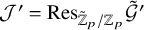 ${\mathcal J}'=\mathrm{Res}_{\tilde {\mathbb Z}_p/{\mathbb Z}_p}\tilde {\mathcal G}'$
. The second group scheme is isomorphic to a product of restriction of scalars of the (split) reductive group schemes
${\mathcal J}'=\mathrm{Res}_{\tilde {\mathbb Z}_p/{\mathbb Z}_p}\tilde {\mathcal G}'$
. The second group scheme is isomorphic to a product of restriction of scalars of the (split) reductive group schemes $\tilde {\mathcal H}_i$
. Hence, since we exclude factors of type
$\tilde {\mathcal H}_i$
. Hence, since we exclude factors of type $D^{\mathbb H}_n$
, Theorem 4.4.3 (2) implies that, at all points of
$D^{\mathbb H}_n$
, Theorem 4.4.3 (2) implies that, at all points of ${\mathbb M}^{\mathrm{loc}}_{{\mathcal J}',\tilde \mu '}(k)$
, the tangent space of the special fiber of
${\mathbb M}^{\mathrm{loc}}_{{\mathcal J}',\tilde \mu '}(k)$
, the tangent space of the special fiber of ${\mathbb M}^{\mathrm{loc}}_{{\mathcal J}',\tilde \mu '}$
is spanned by smooth formal curves. Since
${\mathbb M}^{\mathrm{loc}}_{{\mathcal J}',\tilde \mu '}$
is spanned by smooth formal curves. Since ${\mathbb M}^{\mathrm{loc}}_{{\mathcal J},\tilde \mu }\simeq {\mathbb M}^{\mathrm{loc}}_{{\mathcal J}',\tilde \mu '}\otimes _{{\mathcal O}_{E'}}{\mathcal O}_E$
, the same holds for the tangent spaces of the special fiber of
${\mathbb M}^{\mathrm{loc}}_{{\mathcal J},\tilde \mu }\simeq {\mathbb M}^{\mathrm{loc}}_{{\mathcal J}',\tilde \mu '}\otimes _{{\mathcal O}_{E'}}{\mathcal O}_E$
, the same holds for the tangent spaces of the special fiber of ${\mathbb M}^{\mathrm{loc}}_{{\mathcal J},\tilde \mu }$
. Proposition 5.3.11 then implies that the integral Hodge embedding given by
${\mathbb M}^{\mathrm{loc}}_{{\mathcal J},\tilde \mu }$
. Proposition 5.3.11 then implies that the integral Hodge embedding given by ${\mathcal J} \hookrightarrow \mathrm{GL}(\tilde {\Lambda })$
of (6.1.6) is very good at the image
${\mathcal J} \hookrightarrow \mathrm{GL}(\tilde {\Lambda })$
of (6.1.6) is very good at the image $x'\in {\mathbb M}^{\mathrm{loc}}_{{\mathcal J},\tilde \mu }(k)$
of x under
$x'\in {\mathbb M}^{\mathrm{loc}}_{{\mathcal J},\tilde \mu }(k)$
of x under ${\mathbb M}^{\mathrm{loc}}_{{\mathcal G},\mu }\to {\mathbb M}^{\mathrm{loc}}_{{\mathcal J},\tilde \mu }\otimes _{{\mathcal O}_{\tilde E}}{\mathcal O}_{E}$
. Since, as we have seen above,
${\mathbb M}^{\mathrm{loc}}_{{\mathcal G},\mu }\to {\mathbb M}^{\mathrm{loc}}_{{\mathcal J},\tilde \mu }\otimes _{{\mathcal O}_{\tilde E}}{\mathcal O}_{E}$
. Since, as we have seen above, ${\mathcal G}$
is cut out in
${\mathcal G}$
is cut out in ${\mathcal J} \hookrightarrow \mathrm{GL}(\tilde {\Lambda })$
by endomorphisms of
${\mathcal J} \hookrightarrow \mathrm{GL}(\tilde {\Lambda })$
by endomorphisms of $\tilde {\Lambda }$
, Corollary 5.3.4 now implies that the embedding given by
$\tilde {\Lambda }$
, Corollary 5.3.4 now implies that the embedding given by ${\mathcal G}\hookrightarrow \mathrm{GL}(\tilde {\Lambda })$
of (6.1.4) is very good at x.
${\mathcal G}\hookrightarrow \mathrm{GL}(\tilde {\Lambda })$
of (6.1.4) is very good at x.
Finally, we let ${\mathcal L}$
be the lattice chain in
${\mathcal L}$
be the lattice chain in $V=(V\otimes _{{\mathbb Q}_p}\tilde {\mathbb Q}_p)^{\Gamma }$
which is given by
$V=(V\otimes _{{\mathbb Q}_p}\tilde {\mathbb Q}_p)^{\Gamma }$
which is given by $\{(\tilde \pi ^i\tilde {\Lambda })^{\Gamma }\}_{i\in {\mathbb Z}}$
, see Lemma 2.3.3. Then
$\{(\tilde \pi ^i\tilde {\Lambda })^{\Gamma }\}_{i\in {\mathbb Z}}$
, see Lemma 2.3.3. Then ${\mathrm{tot}}({\mathcal L})\subset V^{\oplus r}$
, where r is the number of lattices in a determining segment of
${\mathrm{tot}}({\mathcal L})\subset V^{\oplus r}$
, where r is the number of lattices in a determining segment of ${\mathcal L}$
. Set
${\mathcal L}$
. Set ${\Lambda }={\mathrm{tot}}({\mathcal L})$
. We now have a diagram of closed group scheme immersions
${\Lambda }={\mathrm{tot}}({\mathcal L})$
. We now have a diagram of closed group scheme immersions

inducing a corresponding diagram of local model triples which are all good integral Hodge embeddings, cf. §3.4.7. It remains to deduce that ${\mathcal G}\hookrightarrow \mathrm{GL}({\Lambda })$
is also very good at x. Observe that, after an unramified extension,
${\mathcal G}\hookrightarrow \mathrm{GL}({\Lambda })$
is also very good at x. Observe that, after an unramified extension, ${\mathcal G}\hookrightarrow \mathrm{GL}({\Lambda })$
becomes a direct summand in
${\mathcal G}\hookrightarrow \mathrm{GL}({\Lambda })$
becomes a direct summand in ${\mathcal G}\hookrightarrow \mathrm{GL}(\tilde {\Lambda })$
, cf. (2.3.8). Then, since
${\mathcal G}\hookrightarrow \mathrm{GL}(\tilde {\Lambda })$
, cf. (2.3.8). Then, since ${\mathcal G}\hookrightarrow \mathrm{GL}(\tilde {\Lambda })$
gives a very good integral Hodge embedding at x, the argument in §2.4.4 together with Lemmas 5.3.7 (a) and 5.2.7, implies that
${\mathcal G}\hookrightarrow \mathrm{GL}(\tilde {\Lambda })$
gives a very good integral Hodge embedding at x, the argument in §2.4.4 together with Lemmas 5.3.7 (a) and 5.2.7, implies that ${\mathcal G}\hookrightarrow \mathrm{GL}({\Lambda })$
gives a very good integral Hodge embedding at x.
${\mathcal G}\hookrightarrow \mathrm{GL}({\Lambda })$
gives a very good integral Hodge embedding at x.
6.1.8
Here we present a variant of Theorem 6.1.1 in the presence of alternating forms. This is needed in the final section of the paper when we consider Hodge embeddings in symplectic groups.
We continue with the same notation. Suppose that there are perfect alternating $F_i$
-bilinear forms
$F_i$
-bilinear forms $\psi _i: W_i\times W_i\to F_i$
such that
$\psi _i: W_i\times W_i\to F_i$
such that $\rho _i: H_i\to \mathrm{GL}_F(W_i)$
factors through
$\rho _i: H_i\to \mathrm{GL}_F(W_i)$
factors through ${\mathrm{GSp}}_{F_i}(W_i)$
, for all i. Recall that
${\mathrm{GSp}}_{F_i}(W_i)$
, for all i. Recall that $V_i$
is
$V_i$
is $W_i$
regarded as a
$W_i$
regarded as a ${\mathbb Q}_p$
-vector space by restriction of scalars. For each i, equip
${\mathbb Q}_p$
-vector space by restriction of scalars. For each i, equip $V_i$
with a perfect alternating
$V_i$
with a perfect alternating ${\mathbb Q}_p$
-bilinear form given by
${\mathbb Q}_p$
-bilinear form given by
 $$\begin{align*}\psi^{0}_i(v, v')={\mathrm{Tr}}_{F_i/{\mathbb Q}_p}(\delta_{F_i/{\mathbb Q}_p}^{-1} \psi_i(v, v')) \end{align*}$$
where $\delta _{F_i/{\mathbb Q}_p}$
is a generator of the different ideal of the extension
$\delta _{F_i/{\mathbb Q}_p}$
is a generator of the different ideal of the extension $F_i/{\mathbb Q}_p$
. (The form depends on this choice.) Then the sum
$F_i/{\mathbb Q}_p$
. (The form depends on this choice.) Then the sum
 $$\begin{align*}\psi(v, v')=\sum_i \psi_i^{0}(v_i, v^{\prime}_i), \qquad v=(v_i)_i,\quad v^{\prime}_i=(v^{\prime}_i)_i, \end{align*}$$
gives a perfect alternating ${\mathbb Q}_p$
-bilinear form
${\mathbb Q}_p$
-bilinear form $\psi $
on
$\psi $
on $V=\oplus _i V_i$
. We use the superscript
$V=\oplus _i V_i$
. We use the superscript $^\vee $
to denote the
$^\vee $
to denote the $\psi $
-dual of a
$\psi $
-dual of a ${\mathbb Z}_p$
-lattice (resp.
${\mathbb Z}_p$
-lattice (resp. $\tilde {\mathbb Z}_p$
-lattice) in V (resp.
$\tilde {\mathbb Z}_p$
-lattice) in V (resp. $V\otimes _{{\mathbb Q}_p}\tilde {\mathbb Q}_p$
). If
$V\otimes _{{\mathbb Q}_p}\tilde {\mathbb Q}_p$
). If ${\mathcal L}$
is a periodic lattice chain in V, we let
${\mathcal L}$
is a periodic lattice chain in V, we let ${\mathcal L}^\vee $
denote the periodic lattice chain whose constituent lattices are given by
${\mathcal L}^\vee $
denote the periodic lattice chain whose constituent lattices are given by $\Lambda ^\vee $
for
$\Lambda ^\vee $
for $\Lambda \in {\mathcal L}$
.
$\Lambda \in {\mathcal L}$
.
Theorem 6.1.9. Suppose that $(G, \{\mu \}, {\mathcal G})$
is a local model triple over
$(G, \{\mu \}, {\mathcal G})$
is a local model triple over ${\mathbb Q}_p$
satisfying the assumptions of Theorem 6.1.1. With the notations of that Theorem, we assume there are perfect alternating
${\mathbb Q}_p$
satisfying the assumptions of Theorem 6.1.1. With the notations of that Theorem, we assume there are perfect alternating $F_i$
-bilinear forms
$F_i$
-bilinear forms $\psi _i: W_i\times W_i\to F_i$
such that
$\psi _i: W_i\times W_i\to F_i$
such that $\rho _i: H_i\to \mathrm{GL}_F(W_i)$
factors through
$\rho _i: H_i\to \mathrm{GL}_F(W_i)$
factors through ${\mathrm{GSp}}_{F_i}(W_i)$
, for all i. We define
${\mathrm{GSp}}_{F_i}(W_i)$
, for all i. We define $\psi : V\times V\to F$
as in the paragraph above and suppose that the image
$\psi : V\times V\to F$
as in the paragraph above and suppose that the image $\rho (G)$
lies in the symplectic similitude group
$\rho (G)$
lies in the symplectic similitude group ${\mathrm{GSp}}(V)={\mathrm{GSp}}(V,\psi )$
.
${\mathrm{GSp}}(V)={\mathrm{GSp}}(V,\psi )$
.
Then there is a periodic lattice chain ${\mathcal L}$
in V such that
${\mathcal L}$
in V such that $\rho $
extends to closed immersions
$\rho $
extends to closed immersions $ {\mathcal G}\hookrightarrow \mathrm{GL}({\mathcal L})$
,
$ {\mathcal G}\hookrightarrow \mathrm{GL}({\mathcal L})$
, $ {\mathcal G}\hookrightarrow \mathrm{GL}({\mathcal L}^\vee )$
which both give very good integral Hodge embeddings
$ {\mathcal G}\hookrightarrow \mathrm{GL}({\mathcal L}^\vee )$
which both give very good integral Hodge embeddings
 $$\begin{align*}({\mathcal G},\mu)\hookrightarrow (\mathrm{GL}({\mathcal L}),\mu_{d}), \quad ({\mathcal G},\mu)\hookrightarrow (\mathrm{GL}({\mathcal L}^\vee),\mu_{d}). \end{align*}$$
In addition, the direct sum $ ({\mathcal G},\mu )\hookrightarrow (\mathrm{GL}({\mathcal L}\oplus {\mathcal L}^\vee ),\mu _{2d}) $
is a very good integral Hodge embedding.
$ ({\mathcal G},\mu )\hookrightarrow (\mathrm{GL}({\mathcal L}\oplus {\mathcal L}^\vee ),\mu _{2d}) $
is a very good integral Hodge embedding.
Proof. We choose $\tilde {{\mathcal O}}_i$
-lattices
$\tilde {{\mathcal O}}_i$
-lattices $\tilde {\Lambda }_i$
as in Theorem 6.1.1, and let
$\tilde {\Lambda }_i$
as in Theorem 6.1.1, and let $\tilde \Lambda _i^*$
denote the
$\tilde \Lambda _i^*$
denote the $\psi _i$
dual of
$\psi _i$
dual of $\tilde \Lambda _i$
. We have
$\tilde \Lambda _i$
. We have ${\Gamma }$
-invariant
${\Gamma }$
-invariant $\tilde {\mathbb Z}_p$
-lattices
$\tilde {\mathbb Z}_p$
-lattices $\tilde {\Lambda }:=\oplus _i \oplus _{\in {\Gamma }/{\Gamma }_i}\tilde {\Lambda }_i$
and
$\tilde {\Lambda }:=\oplus _i \oplus _{\in {\Gamma }/{\Gamma }_i}\tilde {\Lambda }_i$
and $\tilde {\Lambda }^*:=\oplus _i \oplus _{\in {\Gamma }/{\Gamma }_i}\tilde {\Lambda }^*_i$
in
$\tilde {\Lambda }^*:=\oplus _i \oplus _{\in {\Gamma }/{\Gamma }_i}\tilde {\Lambda }^*_i$
in $V\otimes _{{\mathbb Q}_p}\tilde {\mathbb Q}_p$
. If we consider
$V\otimes _{{\mathbb Q}_p}\tilde {\mathbb Q}_p$
. If we consider $\tilde \Lambda ^*$
as a
$\tilde \Lambda ^*$
as a $\tilde {\mathbb Z}_p$
-lattice in
$\tilde {\mathbb Z}_p$
-lattice in $V\otimes _{{\mathbb Q}_p}\tilde {\mathbb Q}_p$
, then we have
$V\otimes _{{\mathbb Q}_p}\tilde {\mathbb Q}_p$
, then we have $\tilde \Lambda ^*=\tilde \Lambda ^\vee $
.
$\tilde \Lambda ^*=\tilde \Lambda ^\vee $
.
Let ${\mathcal L}$
denote the lattice chain
${\mathcal L}$
denote the lattice chain $\{(\tilde \pi ^i\tilde {\Lambda })^{\Gamma }\}_{i\in {\mathbb Z}}$
in V. Then
$\{(\tilde \pi ^i\tilde {\Lambda })^{\Gamma }\}_{i\in {\mathbb Z}}$
in V. Then ${\mathcal L}^\vee =\{(\tilde \pi ^i\tilde {\Lambda }^*)^{\Gamma }\}_{i\in {\mathbb Z}}$
and
${\mathcal L}^\vee =\{(\tilde \pi ^i\tilde {\Lambda }^*)^{\Gamma }\}_{i\in {\mathbb Z}}$
and ${\mathcal L}\oplus {\mathcal L}^\vee =\{(\tilde \pi ^i(\tilde {\Lambda }\oplus \tilde {\Lambda }^*))^{\Gamma }\}_{i\in {\mathbb Z}}$
. Indeed,
${\mathcal L}\oplus {\mathcal L}^\vee =\{(\tilde \pi ^i(\tilde {\Lambda }\oplus \tilde {\Lambda }^*))^{\Gamma }\}_{i\in {\mathbb Z}}$
. Indeed, $ \tilde \pi ^{-m}\delta ^{-1}\tilde {\Lambda }^\vee $
is the
$ \tilde \pi ^{-m}\delta ^{-1}\tilde {\Lambda }^\vee $
is the $\psi $
-dual of the
$\psi $
-dual of the $\tilde {\mathbb Z}_p$
-lattice
$\tilde {\mathbb Z}_p$
-lattice $\tilde \pi ^{m}\tilde {\Lambda }$
, and hence
$\tilde \pi ^{m}\tilde {\Lambda }$
, and hence $(\tilde \pi ^{-m}\delta ^{-1}\tilde {\Lambda }^\vee )^\Gamma $
is the
$(\tilde \pi ^{-m}\delta ^{-1}\tilde {\Lambda }^\vee )^\Gamma $
is the $\psi $
-dual of
$\psi $
-dual of $(\tilde \pi ^{-m}\delta ^{-1}\tilde {\Lambda })^{\Gamma }.$
Here, the element
$(\tilde \pi ^{-m}\delta ^{-1}\tilde {\Lambda })^{\Gamma }.$
Here, the element $\delta $
generates the different of the extension
$\delta $
generates the different of the extension $\tilde {\mathbb Q}_p/{\mathbb Q}_p$
. Then the argument in the proof of Theorem 6.1.1 applies to
$\tilde {\mathbb Q}_p/{\mathbb Q}_p$
. Then the argument in the proof of Theorem 6.1.1 applies to $\tilde {\Lambda }$
,
$\tilde {\Lambda }$
, $\tilde {\Lambda }^*$
and
$\tilde {\Lambda }^*$
and $\tilde {\Lambda }\oplus \tilde {\Lambda }^*$
, and shows that
$\tilde {\Lambda }\oplus \tilde {\Lambda }^*$
, and shows that $({\mathcal G},\mu )\hookrightarrow (\mathrm{GL}({\mathcal L}),\mu _d), ({\mathcal G},\mu )\hookrightarrow (\mathrm{GL}({\mathcal L}^\vee ),\mu _d)$
and their direct sum are all very good integral Hodge embeddings.
$({\mathcal G},\mu )\hookrightarrow (\mathrm{GL}({\mathcal L}),\mu _d), ({\mathcal G},\mu )\hookrightarrow (\mathrm{GL}({\mathcal L}^\vee ),\mu _d)$
and their direct sum are all very good integral Hodge embeddings.
Remark 6.1.10. When $G^{{\mathrm{ad}} }$
is simple over
$G^{{\mathrm{ad}} }$
is simple over ${\mathbb Q}_p$
, the assumptions of Theorem 6.1.1 exclude:
${\mathbb Q}_p$
, the assumptions of Theorem 6.1.1 exclude:
-
1) Types
$D^{\mathbb H}_n$
, that is, with
$G^{\mathrm{ad}} =\mathrm{Res}_{F/{\mathbb Q}_p}H^{\mathrm{ad}} $
,
$H^{\mathrm{ad}} \otimes _F\bar {\mathbb Q}_p\simeq {\mathrm{PSO}}_{2n}$
, such that
$\mu ^{\mathrm{ad}} \neq 1$
and, for each
$\varphi : F\to \bar {\mathbb Q}_p$
,
$\mu ^{\mathrm{ad}} _{\varphi }: {{\mathbb G}_{\mathrm{m}}}_{\bar {\mathbb Q}_p}\to H^{\mathrm{ad}} \otimes _F\bar {\mathbb Q}_p\simeq {\mathrm{PSO}}_{2n}$
is of type
$\varpi ^\vee _n$
,
$\varpi ^\vee _{n-1}$
, or is trivial. Here,
$n\geq 4$
. -
2) Types
$A_n$
with adjoint group
$G^{\mathrm{ad}} =\mathrm{Res}_{F/{\mathbb Q}_p}\mathrm{PGL}_m(D)$
, where D is a division F-algebra such that p divides the index of D.


We will handle such cases by explicit ad hoc arguments and give “sufficient” local model triples with very good Hodge embeddings. Roughly, the main idea is that in these cases there are enough Hodge embeddings which are (essentially) of PEL type. This is discussed in the next paragraphs.
6.2
$D^{\mathbb H}_n$
types

6.2.1
Let V be a K-dimensional vector space of even dimension $2n$
, equipped with a perfect symmetric K-bilinear form
$2n$
, equipped with a perfect symmetric K-bilinear form $h: V\times V\to K$
. For a K-algebra R, we set
$h: V\times V\to K$
. For a K-algebra R, we set $V_R=V\otimes _KR$
. The group of orthogonal similitudes
$V_R=V\otimes _KR$
. The group of orthogonal similitudes ${\mathrm{GO}}(V)={\mathrm{GO}}(V, h)$
has R-valued points
${\mathrm{GO}}(V)={\mathrm{GO}}(V, h)$
has R-valued points
 $$\begin{align*}{\mathrm{GO}}(V, h)(R)=\{g\in \mathrm{GL}_R(V_R)\ |\ \exists\ c(g)\in R^\times,\ h(gv, gv')=c(g)h(v, v'),\ \forall v, v'\in V_R \}. \end{align*}$$
This group has two connected components; the neutral component is the subgroup ${\mathrm{GO}}^+(V)$
of
${\mathrm{GO}}^+(V)$
of $g\in {\mathrm{GO}}(V)(R)$
with
$g\in {\mathrm{GO}}(V)(R)$
with $c(g)^n=\det (g)$
.
$c(g)^n=\det (g)$
.
6.2.2
Suppose $G^{\mathrm{ad}} $
is simple over
$G^{\mathrm{ad}} $
is simple over ${\mathbb Q}_p$
and
${\mathbb Q}_p$
and $(G^{\mathrm{ad}} ,\mu ^{\mathrm{ad}} )$
is of type
$(G^{\mathrm{ad}} ,\mu ^{\mathrm{ad}} )$
is of type $D^{\mathbb H}_n$
, as above. As in [Reference Pappas and ZhuPZ13, §5.3.8], [Reference GrossGr12], we see that
$D^{\mathbb H}_n$
, as above. As in [Reference Pappas and ZhuPZ13, §5.3.8], [Reference GrossGr12], we see that $G^{\mathrm{ad}} \simeq \mathrm{Res}_{K/{\mathbb Q}_p}G^{\prime \mathrm{ad} } $
, with
$G^{\mathrm{ad}} \simeq \mathrm{Res}_{K/{\mathbb Q}_p}G^{\prime \mathrm{ad} } $
, with $G'$
as in one of the following cases:
$G'$
as in one of the following cases:
a) There is a K-vector space $V\simeq K^{2n}$
and a perfect symmetric K-bilinear
$V\simeq K^{2n}$
and a perfect symmetric K-bilinear $h: V\times V\to K$
such that
$h: V\times V\to K$
such that $G'={\mathrm{GO}}^+(V, h)$
.
$G'={\mathrm{GO}}^+(V, h)$
.
In this case, we can obtain (symplectic) representations of $G'$
that give local Hodge embeddings as follows. Let
$G'$
that give local Hodge embeddings as follows. Let $\tau : G'\hookrightarrow \mathrm{GL}(V)$
be the natural embedding. Suppose
$\tau : G'\hookrightarrow \mathrm{GL}(V)$
be the natural embedding. Suppose $V_0\simeq K^{2s}$
is equipped with a perfect alternating K-bilinear form
$V_0\simeq K^{2s}$
is equipped with a perfect alternating K-bilinear form $S: V_0\times V_0\to K$
and set
$S: V_0\times V_0\to K$
and set $W=V_0\otimes _K V$
. This is an
$W=V_0\otimes _K V$
. This is an ${\mathrm{End}}_K(V_0)$
-module and supports the perfect alternating form
${\mathrm{End}}_K(V_0)$
-module and supports the perfect alternating form $\psi $
given by
$\psi $
given by
 $$\begin{align*}\psi(x_1\otimes v_1, x_2\otimes v_2)=S(x_1, x_2)h(v_1, v_2). \end{align*}$$
We have the intersection
 $$\begin{align*}{\mathrm{GO}}(V, h)=\mathrm{GL}_{{\mathrm{End}}_K(V_0)}(W)\cap {\mathrm{GSp}}(W) \end{align*}$$
and an embedding
 $$\begin{align*}\sigma_{V_0}: G'\subset {\mathrm{GO}}(V, h)\hookrightarrow{\mathrm{GSp}}(W)\hookrightarrow \mathrm{GL}(W). \end{align*}$$
(Note that ${\mathrm{SO}}(V, h)$
and
${\mathrm{SO}}(V, h)$
and ${\mathrm{Sp}}(V_0, S)$
form a dual pair in
${\mathrm{Sp}}(V_0, S)$
form a dual pair in ${\mathrm{Sp}}(W, \psi )$
.)
${\mathrm{Sp}}(W, \psi )$
.)
Since $(G, \mu )$
is of type
$(G, \mu )$
is of type $D^{\mathbb H}_n$
, both
$D^{\mathbb H}_n$
, both $\tau $
and
$\tau $
and $\sigma _{V_0}$
, followed by taking restriction of scalars, give (local) Hodge embeddings
$\sigma _{V_0}$
, followed by taking restriction of scalars, give (local) Hodge embeddings
 $$\begin{align*}(G,\mu)\hookrightarrow (\mathrm{GL}(V), \mu'),\quad (G,\mu)\hookrightarrow (\mathrm{GL}(W), \mu") \end{align*}$$
where V and W as considered as ${\mathbb Q}_p$
-vector spaces and
${\mathbb Q}_p$
-vector spaces and $\mu '$
,
$\mu '$
, $\mu "$
are the corresponding (minuscule) coweights obtained by composing
$\mu "$
are the corresponding (minuscule) coweights obtained by composing $\mathrm{Res}_{K/{\mathbb Q}_p}\tau $
and
$\mathrm{Res}_{K/{\mathbb Q}_p}\tau $
and $\mathrm{Res}_{K/{\mathbb Q}_p}\sigma _{V_0}$
with
$\mathrm{Res}_{K/{\mathbb Q}_p}\sigma _{V_0}$
with $\mu $
.
$\mu $
.
Note that we can choose a Lagrangian basis $\{e_1,\ldots , e_{2s}\}$
of
$\{e_1,\ldots , e_{2s}\}$
of $(V_0, S)$
, that is, such that
$(V_0, S)$
, that is, such that ${S(e_i, e_{2s+1-i})=1}$
, if
${S(e_i, e_{2s+1-i})=1}$
, if $1\leq i\leq s$
, and
$1\leq i\leq s$
, and $S(e_i, e_j)=0$
if
$S(e_i, e_j)=0$
if $1\leq i, j\leq s$
, or
$1\leq i, j\leq s$
, or $s+1\leq i, j\leq 2s$
. The representation
$s+1\leq i, j\leq 2s$
. The representation $\sigma _{V_0}: G'\to {\mathrm{GSp}}(W)\subset \mathrm{GL}(W)$
is isomorphic to a direct sum of s copies of
$\sigma _{V_0}: G'\to {\mathrm{GSp}}(W)\subset \mathrm{GL}(W)$
is isomorphic to a direct sum of s copies of $\sigma _{K^2}$
obtained from
$\sigma _{K^2}$
obtained from $V_0=K^2$
with its standard alternating form; the resulting alternating form on
$V_0=K^2$
with its standard alternating form; the resulting alternating form on $ W$
is identified with the corresponding orthogonal direct sum.
$ W$
is identified with the corresponding orthogonal direct sum.
b) There is a (left) D-module $T\simeq D^n$
for a division quaternion K-algebra D and a nondegenerate quaternionic antihermitian form
$T\simeq D^n$
for a division quaternion K-algebra D and a nondegenerate quaternionic antihermitian form $\varphi : T\times T \to D$
for the main involution
$\varphi : T\times T \to D$
for the main involution $d\mapsto \bar {d}$
on D, such that
$d\mapsto \bar {d}$
on D, such that $G'={\mathrm{GU}}^+(T, \varphi )$
, where
$G'={\mathrm{GU}}^+(T, \varphi )$
, where ${\mathrm{GU}}(T, \varphi )$
is the corresponding unitary similitude group, and
${\mathrm{GU}}(T, \varphi )$
is the corresponding unitary similitude group, and ${}^+$
signifies taking the neutral component. Here
${}^+$
signifies taking the neutral component. Here ${\mathrm{GU}}(T, \varphi )$
can also be given as follows: Consider the alternating K-bilinear form
${\mathrm{GU}}(T, \varphi )$
can also be given as follows: Consider the alternating K-bilinear form $\psi : T\times T\to K$
given by
$\psi : T\times T\to K$
given by
 $$\begin{align*}\psi(t_1, t_2)={\mathrm{Tr}}_{D/K}(\varphi(t_1, t_2)) \end{align*}$$
where ${\mathrm{Tr}}_{D/K}: D\to K$
is the reduced trace (cf. [Reference Pappas and ZhuPZ13, §5.3.8], [Reference Rapoport and ZinkRZ96, Prop. A.53], applied to
${\mathrm{Tr}}_{D/K}: D\to K$
is the reduced trace (cf. [Reference Pappas and ZhuPZ13, §5.3.8], [Reference Rapoport and ZinkRZ96, Prop. A.53], applied to $n=1$
.) For a K-algebra R,
$n=1$
.) For a K-algebra R, ${\mathrm{GU}}(T, \varphi )(R)$
is given by
${\mathrm{GU}}(T, \varphi )(R)$
is given by $D\otimes _K R$
-linear automorphisms of
$D\otimes _K R$
-linear automorphisms of $T\otimes _KR$
that respect
$T\otimes _KR$
that respect $\psi $
up to a similitude in
$\psi $
up to a similitude in $R^*$
. Hence,
$R^*$
. Hence,
 $$\begin{align*}{\mathrm{GU}}(T, \varphi)=\mathrm{GL}_{D}(T)\cap {\mathrm{GSp}}(T, \psi). \end{align*}$$
This gives an embedding $\sigma : G'\hookrightarrow {\mathrm{GSp}}(T, \psi )\hookrightarrow \mathrm{GL}(T)$
which produces a local Hodge embedding for
$\sigma : G'\hookrightarrow {\mathrm{GSp}}(T, \psi )\hookrightarrow \mathrm{GL}(T)$
which produces a local Hodge embedding for $(G,\mu )$
.
$(G,\mu )$
.
We can obtain more symplectic representations of $G'$
that give local Hodge embeddings as follows. Let
$G'$
that give local Hodge embeddings as follows. Let $T_0\simeq D^s$
be a right D-module with a nondegenerate quaternionic hermitian form
$T_0\simeq D^s$
be a right D-module with a nondegenerate quaternionic hermitian form $S: T_0\times T_0\to D$
, again for the main involution. We can consider the K-vector space
$S: T_0\times T_0\to D$
, again for the main involution. We can consider the K-vector space $W=T_0\otimes _D T$
with K-bilinear alternating form
$W=T_0\otimes _D T$
with K-bilinear alternating form
 $$\begin{align*}\psi(t_0\otimes t, t^{\prime}_0\otimes t')={\mathrm{Tr}}_{D/K}( S(t_0', t_0)\varphi(t, t')). \end{align*}$$
Then we have
 $$\begin{align*}{\mathrm{GU}}(T, \varphi)=\mathrm{GL}_{{\mathrm{End}}_D(T_0)}(W)\cap {\mathrm{GSp}}(W, \psi). \end{align*}$$
This gives an embedding $\sigma _{T_0}: G'\hookrightarrow {\mathrm{GSp}}(W, \psi )\hookrightarrow \mathrm{GL}(W)$
which produces a local Hodge embedding for
$\sigma _{T_0}: G'\hookrightarrow {\mathrm{GSp}}(W, \psi )\hookrightarrow \mathrm{GL}(W)$
which produces a local Hodge embedding for $(G,\mu )$
. Taking
$(G,\mu )$
. Taking $T_0=D$
as a right D-module with the standard hermitian form
$T_0=D$
as a right D-module with the standard hermitian form $S(d, d')=\bar {d} d'$
gives
$S(d, d')=\bar {d} d'$
gives $W=T$
and the embedding
$W=T$
and the embedding $\sigma $
as above. In fact, there is always a D-basis
$\sigma $
as above. In fact, there is always a D-basis $T_0= D^s$
for which S is the standard hermitian form
$T_0= D^s$
for which S is the standard hermitian form $S((d_i), (d^{\prime }_i))=\sum _{i=1}^s \bar {d}_id^{\prime }_i$
, cf. [Reference ShimuraSh73]. Hence, the representation
$S((d_i), (d^{\prime }_i))=\sum _{i=1}^s \bar {d}_id^{\prime }_i$
, cf. [Reference ShimuraSh73]. Hence, the representation $\sigma _{T_0}: G'\to {\mathrm{GSp}}(W)\subset \mathrm{GL}(W)$
is isomorphic to a direct sum of s copies of
$\sigma _{T_0}: G'\to {\mathrm{GSp}}(W)\subset \mathrm{GL}(W)$
is isomorphic to a direct sum of s copies of $\sigma _{D}=\sigma $
obtained from
$\sigma _{D}=\sigma $
obtained from $T_0=D$
with its standard hermitian form; the resulting alternating form on
$T_0=D$
with its standard hermitian form; the resulting alternating form on $ W$
is identified with the corresponding orthogonal direct sum.
$ W$
is identified with the corresponding orthogonal direct sum.
Let $L/K$
be a degree
$L/K$
be a degree $2$
unramified extension with
$2$
unramified extension with $L\subset D$
as K-algebras. Then we can write
$L\subset D$
as K-algebras. Then we can write $D=L\oplus L\cdot \Pi $
with
$D=L\oplus L\cdot \Pi $
with $\Pi ^2=\pi $
. Base changing from K to L splits D:
$\Pi ^2=\pi $
. Base changing from K to L splits D: $D\otimes _K L\simeq {\mathrm{M}}_2(L)$
. Morita equivalence then gives
$D\otimes _K L\simeq {\mathrm{M}}_2(L)$
. Morita equivalence then gives $T_L=L^2\otimes _L V_L$
for a
$T_L=L^2\otimes _L V_L$
for a $2n$
-dimensional L-vector space
$2n$
-dimensional L-vector space $V_L$
. The base change
$V_L$
. The base change $\varphi \otimes _KL$
is determined by a symmetric L-bilinear form
$\varphi \otimes _KL$
is determined by a symmetric L-bilinear form $h_L: V_L\times V_L\to L$
as in case (a) above, cf. [Reference Rapoport and ZinkRZ96, Prop. A.53]. We can see that the base change of the pair of the group
$h_L: V_L\times V_L\to L$
as in case (a) above, cf. [Reference Rapoport and ZinkRZ96, Prop. A.53]. We can see that the base change of the pair of the group $G'={\mathrm{GU}}^+(T, \varphi )$
with its representation
$G'={\mathrm{GU}}^+(T, \varphi )$
with its representation $\sigma =\sigma _{D}$
in case (b), is isomorphic to
$\sigma =\sigma _{D}$
in case (b), is isomorphic to $ {\mathrm{GO}}^+(V_L, h_L)$
with the representation
$ {\mathrm{GO}}^+(V_L, h_L)$
with the representation $\sigma _{L^2}$
in case (a).
$\sigma _{L^2}$
in case (a).
For a lattice chain ${\mathcal L}$
of
${\mathcal L}$
of ${\mathbb Z}_p$
-lattices in W (in cases (a) or (b)), we write
${\mathbb Z}_p$
-lattices in W (in cases (a) or (b)), we write ${\mathcal L}^\vee $
for the dual lattice chain with respect to the alternating form
${\mathcal L}^\vee $
for the dual lattice chain with respect to the alternating form ${\mathrm{Tr}}_{K/{\mathbb Q}_p}\circ (\delta ^{-1}_{{\mathrm{K}}/{\mathbb Q}_p}\psi ).$
Theorem 6.2.3. Let $G= \mathrm{Res}_{K/{\mathbb Q}_p}G'$
with
$G= \mathrm{Res}_{K/{\mathbb Q}_p}G'$
with $G'$
as in §6.2.2 and let
$G'$
as in §6.2.2 and let $(G, \{\mu \}, {\mathcal G})$
be a local model triple of
$(G, \{\mu \}, {\mathcal G})$
be a local model triple of $D^{\mathbb H}_n$
type. Assume that
$D^{\mathbb H}_n$
type. Assume that ${\mathcal G}$
is the stabilizer group scheme for a point
${\mathcal G}$
is the stabilizer group scheme for a point $\mathbf x$
in
$\mathbf x$
in ${\mathcal B}(G, {\mathbb Q}_p)= {\mathcal B}(G', K)$
which is generic in its facet. Let
${\mathcal B}(G, {\mathbb Q}_p)= {\mathcal B}(G', K)$
which is generic in its facet. Let $\rho '=\sigma _{V_0}: G'\hookrightarrow \mathrm{GL}(W)$
(in case (a)) and
$\rho '=\sigma _{V_0}: G'\hookrightarrow \mathrm{GL}(W)$
(in case (a)) and $\rho '=\sigma _{T_0}: G'\hookrightarrow \mathrm{GL}(W)$
(in case (b)) be as above.
$\rho '=\sigma _{T_0}: G'\hookrightarrow \mathrm{GL}(W)$
(in case (b)) be as above.
Then there is a periodic lattice chain ${\mathcal L}$
of
${\mathcal L}$
of ${\mathbb Z}_p$
-modules in W which is self-dual (i.e.,
${\mathbb Z}_p$
-modules in W which is self-dual (i.e., ${\mathcal L}={\mathcal L}^\vee $
) such that
${\mathcal L}={\mathcal L}^\vee $
) such that $\rho '$
extends to a very good Hodge embedding
$\rho '$
extends to a very good Hodge embedding $({\mathcal G},\mu )\rightarrow (\mathrm{GL}({\mathcal L}),\mu ")$
.
$({\mathcal G},\mu )\rightarrow (\mathrm{GL}({\mathcal L}),\mu ")$
.
Proof. Let us discuss case (a). Since $\sigma _{V_0}$
is isomorphic to a direct sum of copies of
$\sigma _{V_0}$
is isomorphic to a direct sum of copies of $\sigma _{K^2}$
, we see, using Lemma 5.3.7, that it is enough to show the statement of
$\sigma _{K^2}$
, we see, using Lemma 5.3.7, that it is enough to show the statement of $\sigma _{K^2}$
. By Prop. 2.2.2, there is a tame Galois extension
$\sigma _{K^2}$
. By Prop. 2.2.2, there is a tame Galois extension $\tilde K/K$
such that
$\tilde K/K$
such that $G'\otimes _K\tilde K$
splits and the stabilizer group scheme for
$G'\otimes _K\tilde K$
splits and the stabilizer group scheme for $\mathbf {x}\in {\mathcal B}(G',\tilde K)$
is hyperspecial. Hence, it is the stabilizer of an
$\mathbf {x}\in {\mathcal B}(G',\tilde K)$
is hyperspecial. Hence, it is the stabilizer of an $\tilde {\mathcal O}$
-lattice
$\tilde {\mathcal O}$
-lattice $\tilde {\Lambda }$
in
$\tilde {\Lambda }$
in $V\otimes _K\tilde K$
which is
$V\otimes _K\tilde K$
which is ${\Gamma }={\mathrm{Gal}}(\tilde K/K)$
-stable and is self-dual up to homothety, that is,
${\Gamma }={\mathrm{Gal}}(\tilde K/K)$
-stable and is self-dual up to homothety, that is, $\tilde {\Lambda }^\vee =\tilde \pi ^a\tilde {\Lambda }$
, for
$\tilde {\Lambda }^\vee =\tilde \pi ^a\tilde {\Lambda }$
, for $h_{\tilde K}$
(see [Reference Bruhat and TitsBT87], [Reference Kaletha and PrasadKaP23, 15.2]). By further enlarging
$h_{\tilde K}$
(see [Reference Bruhat and TitsBT87], [Reference Kaletha and PrasadKaP23, 15.2]). By further enlarging $\tilde K$
to allow a square root of
$\tilde K$
to allow a square root of $\tilde \pi $
, we can change
$\tilde \pi $
, we can change $\tilde {\Lambda }$
in its homothety class and assume it is self-dual
$\tilde {\Lambda }$
in its homothety class and assume it is self-dual $\tilde {\Lambda }^\vee =\tilde {\Lambda }$
. We set
$\tilde {\Lambda }^\vee =\tilde {\Lambda }$
. We set $\tilde {\mathcal G}'={\mathrm{GO}}^+(\tilde {\Lambda }, h)$
. Now set
$\tilde {\mathcal G}'={\mathrm{GO}}^+(\tilde {\Lambda }, h)$
. Now set $\tilde M:={\mathcal O}^2\otimes _{\mathcal O} \tilde {\Lambda }\subset W_{\tilde K}=V_{\tilde K}\oplus V_{\tilde K}$
which is
$\tilde M:={\mathcal O}^2\otimes _{\mathcal O} \tilde {\Lambda }\subset W_{\tilde K}=V_{\tilde K}\oplus V_{\tilde K}$
which is ${\Gamma }$
-stable and
${\Gamma }$
-stable and $\psi $
-self-dual.
$\psi $
-self-dual.
The argument in the proof of Thm 6.1.1 produces
 $$ \begin{align} \mathrm{Res}_{\tilde {\mathcal O}/{\mathbb Z}_p}\tilde{\mathcal G}'\hookrightarrow \mathrm{Res}_{{\mathcal O}/{\mathbb Z}_p}\mathrm{GL}(\tilde M)\hookrightarrow \mathrm{GL}(\tilde M) \end{align} $$
which gives a good integral Hodge embedding. The proof of the conclusion of Theorem 6.1.1 applies provided we can ensure that this gives a very good embedding. Note the self-duality of the resulting lattice chain ${\mathcal L}$
follows from the
${\mathcal L}$
follows from the $\psi $
-self-duality of
$\psi $
-self-duality of $\tilde M$
.
$\tilde M$
.
Observe that we have
 $$ \begin{align} {\mathrm{GO}}(\tilde{\Lambda}, h)=\mathrm{GL}_{{\mathrm{End}}_{\mathcal O}({\mathcal O}^2)}(\tilde M)\cap {\mathrm{GSp}}(\tilde M,\psi) \end{align} $$
as a scheme-theoretic intersection. Indeed, this situation falls in case (II) considered in [Reference Rapoport and ZinkRZ96, App. to Ch. 3] and (6.2.5) follows from loc. cit. Prop A. 18, Prop. A. 19. In what follows, we will omit the notation of the forms h and $\psi $
. Using (6.2.5) we see that
$\psi $
. Using (6.2.5) we see that $\mathrm{Res}_{\tilde {\mathcal O}/{\mathbb Z}_p}{\mathrm{GO}}(\tilde {\Lambda })$
is cut out in
$\mathrm{Res}_{\tilde {\mathcal O}/{\mathbb Z}_p}{\mathrm{GO}}(\tilde {\Lambda })$
is cut out in $\mathrm{Res}_{\tilde {\mathcal O}/{\mathbb Z}_p}{\mathrm{GSp}}(\tilde M)$
by a set of endomorphisms
$\mathrm{Res}_{\tilde {\mathcal O}/{\mathbb Z}_p}{\mathrm{GSp}}(\tilde M)$
by a set of endomorphisms $ \tilde M\to \tilde M$
. On the other hand, the integral Hodge embedding given by
$ \tilde M\to \tilde M$
. On the other hand, the integral Hodge embedding given by $\mathrm{Res}_{\tilde {\mathcal O}/{\mathbb Z}_p}{\mathrm{GSp}}(\tilde M)\hookrightarrow \mathrm{GL}(\tilde M)$
is very good by an application of Theorem 6.1.1 to the symplectic similitude group. Hence, as in the argument of Proposition 3.4.6, Cor. 5.3.4 implies that the composition
$\mathrm{Res}_{\tilde {\mathcal O}/{\mathbb Z}_p}{\mathrm{GSp}}(\tilde M)\hookrightarrow \mathrm{GL}(\tilde M)$
is very good by an application of Theorem 6.1.1 to the symplectic similitude group. Hence, as in the argument of Proposition 3.4.6, Cor. 5.3.4 implies that the composition
 $$ \begin{align} \mathrm{Res}_{\tilde {\mathcal O}/{\mathbb Z}_p}{\mathrm{GO}}(\tilde{\Lambda})\hookrightarrow \mathrm{Res}_{\tilde {\mathcal O}/{\mathbb Z}_p}{\mathrm{GSp}}(\tilde M)\hookrightarrow \mathrm{GL}( \tilde M) \end{align} $$
is cut out by a set of tensors $(s_a)\in \tilde M^{\otimes }$
such that
$(s_a)\in \tilde M^{\otimes }$
such that $\tilde s_a$
are horizontal. Now
$\tilde s_a$
are horizontal. Now $\mathrm{Res}_{\tilde O/{\mathbb Z}_p}{\mathrm{GO}}^+(\tilde {\Lambda })$
is the Zariski closure of
$\mathrm{Res}_{\tilde O/{\mathbb Z}_p}{\mathrm{GO}}^+(\tilde {\Lambda })$
is the Zariski closure of $\mathrm{Res}_{\tilde K/{\mathbb Q}_p}{\mathrm{GO}}^+(V)$
in
$\mathrm{Res}_{\tilde K/{\mathbb Q}_p}{\mathrm{GO}}^+(V)$
in $ \mathrm{Res}_{\tilde {\mathcal O}/{\mathbb Z}_p}{\mathrm{GO}}(\tilde {\Lambda })$
. Hence, we can apply Prop. 5.3.20 and conclude that the restriction
$ \mathrm{Res}_{\tilde {\mathcal O}/{\mathbb Z}_p}{\mathrm{GO}}(\tilde {\Lambda })$
. Hence, we can apply Prop. 5.3.20 and conclude that the restriction
 $$ \begin{align} \mathrm{Res}_{\tilde {\mathcal O}/{\mathbb Z}_p}\tilde{\mathcal G}'=\mathrm{Res}_{\tilde {\mathcal O}/{\mathbb Z}_p}{\mathrm{GO}}^+(\tilde{\Lambda})\hookrightarrow \mathrm{GL}( \tilde M) \end{align} $$
of (6.2.6) gives a very good integral Hodge embedding. This is now enough to deduce the result by using the argument in the proof of Theorem 6.1.1, as we mentioned above. This completes the proof in case (a).
Case (b) is now similar: First, we reduce to the case of $\sigma $
, using Lemma 5.3.7. By Prop. 2.2.2, there is a tame Galois extension
$\sigma $
, using Lemma 5.3.7. By Prop. 2.2.2, there is a tame Galois extension $\tilde K/K$
such that
$\tilde K/K$
such that $G'\otimes _K\tilde K$
splits and the stabilizer group scheme for
$G'\otimes _K\tilde K$
splits and the stabilizer group scheme for $\mathbf {x}\in {\mathcal B}(G',\tilde K)$
is hyperspecial. In fact, by possibly enlarging
$\mathbf {x}\in {\mathcal B}(G',\tilde K)$
is hyperspecial. In fact, by possibly enlarging $\tilde K$
, we can also make sure that the base change
$\tilde K$
, we can also make sure that the base change $\sigma \otimes _K\tilde K$
is isomorphic to
$\sigma \otimes _K\tilde K$
is isomorphic to $\sigma _{\tilde K^2}$
as obtained from the standard split symmetric form on
$\sigma _{\tilde K^2}$
as obtained from the standard split symmetric form on $\tilde K^{2n}$
in case (a). The same argument as in case (a) now goes through. (Note that
$\tilde K^{2n}$
in case (a). The same argument as in case (a) now goes through. (Note that $\sigma $
and
$\sigma $
and $\sigma _{K^2}$
are forms of each other, so the action of the Galois group
$\sigma _{K^2}$
are forms of each other, so the action of the Galois group ${\Gamma }$
is different in the two cases.)
${\Gamma }$
is different in the two cases.)
6.2.8
For global applications later, we will need to consider a modification of the groups G and $G'$
above.
$G'$
above.
In case (a) we let $\sigma _{K^2}:G'\rightarrow \mathrm{GL}(W)$
be the representation above where we take
$\sigma _{K^2}:G'\rightarrow \mathrm{GL}(W)$
be the representation above where we take $V_0=K^2$
with the standard alternating form. Set
$V_0=K^2$
with the standard alternating form. Set $G^{\prime }_1$
to be the subgroup of
$G^{\prime }_1$
to be the subgroup of $\mathrm{GL}(W)$
generated by
$\mathrm{GL}(W)$
generated by $G'$
and
$G'$
and $K^\times \times K^\times $
acting on the first factor
$K^\times \times K^\times $
acting on the first factor $V_0=K^2=Ke_1\oplus Ke_2$
of
$V_0=K^2=Ke_1\oplus Ke_2$
of $W=V_0\otimes _K V$
by
$W=V_0\otimes _K V$
by $(a,b)\cdot e_1=ae_1$
,
$(a,b)\cdot e_1=ae_1$
, $(a,b)\cdot e_2=be_2$
.
$(a,b)\cdot e_2=be_2$
.
In case (b), we let $\sigma =\sigma _{D}:G'\rightarrow \mathrm{GL}(W)$
be the representation above. Let
$\sigma =\sigma _{D}:G'\rightarrow \mathrm{GL}(W)$
be the representation above. Let $L/K$
be the degree
$L/K$
be the degree $2$
unramified extension; we assume
$2$
unramified extension; we assume $L\subset D$
. Let
$L\subset D$
. Let $L^\times $
act diagonally on the left on
$L^\times $
act diagonally on the left on $T_0=D$
and hence on
$T_0=D$
and hence on $W=D\otimes _D T$
. Set
$W=D\otimes _D T$
. Set $G^{\prime }_1$
to be the subgroup of
$G^{\prime }_1$
to be the subgroup of $\mathrm{GL}(W)$
generated by
$\mathrm{GL}(W)$
generated by $G'$
and
$G'$
and $L^\times $
acting as above.
$L^\times $
acting as above.
After base changing to L, these groups are identified under the isomorphism induced by Morita equivalence.
We set $G_1:=\mathrm{Res}_{K/{\mathbb Q}_p}G^{\prime }_1$
, and
$G_1:=\mathrm{Res}_{K/{\mathbb Q}_p}G^{\prime }_1$
, and $\sigma _1:G^{\prime }_1\rightarrow \mathrm{GL}(W)$
with
$\sigma _1:G^{\prime }_1\rightarrow \mathrm{GL}(W)$
with $W=K^2\otimes _K V$
or
$W=K^2\otimes _K V$
or $W=T$
, to be the canonical representation obtained as above from
$W=T$
, to be the canonical representation obtained as above from $\sigma _{K^2}$
or
$\sigma _{K^2}$
or $\sigma $
in cases (a) and (b) respectively.
$\sigma $
in cases (a) and (b) respectively.
Remark 6.2.9. The reason for considering the modification $G_1'$
is that this is the group which naturally arises when applying Deligne’s construction of Hodge type liftings for abelian type Shimura datum of type
$G_1'$
is that this is the group which naturally arises when applying Deligne’s construction of Hodge type liftings for abelian type Shimura datum of type $D_n^{{\mathbb H}}$
. The extra factor of
$D_n^{{\mathbb H}}$
. The extra factor of $K^\times \times K^\times $
or
$K^\times \times K^\times $
or $L^\times $
in cases (a) and (b) respectively is needed to modify the Hodge cocharacter so that the dimensions of the weight 0 and weight 1 spaces are equal in the representation W. This modification becomes necessary when some of the cocharacters
$L^\times $
in cases (a) and (b) respectively is needed to modify the Hodge cocharacter so that the dimensions of the weight 0 and weight 1 spaces are equal in the representation W. This modification becomes necessary when some of the cocharacters $\mu _\varphi $
,
$\mu _\varphi $
, $\varphi : K\hookrightarrow {\mathbb Q}_p$
, that constitute
$\varphi : K\hookrightarrow {\mathbb Q}_p$
, that constitute $\mu $
, are trivial.
$\mu $
, are trivial.
Corollary 6.2.10. With notations as above, let $(G_1,\mu ,{\mathcal G}_1)$
be a local model triple of
$(G_1,\mu ,{\mathcal G}_1)$
be a local model triple of $D^{\mathbb H}_n$
type with
$D^{\mathbb H}_n$
type with ${\mathcal G}_1$
a stabilizer group scheme for a point
${\mathcal G}_1$
a stabilizer group scheme for a point $\mathbf {x}\in {\mathcal B}(G_1,{\mathbb Q}_p)$
which is generic in its facet. Let
$\mathbf {x}\in {\mathcal B}(G_1,{\mathbb Q}_p)$
which is generic in its facet. Let $\rho _1:G^{\prime }_1\rightarrow \mathrm{GL}(V")$
a direct sum of s copies of
$\rho _1:G^{\prime }_1\rightarrow \mathrm{GL}(V")$
a direct sum of s copies of $\sigma _1:G^{\prime }_1\rightarrow \mathrm{GL}(W)$
,
$\sigma _1:G^{\prime }_1\rightarrow \mathrm{GL}(W)$
, $s\geq 1$
. Then the conclusion of Theorem 6.2.3 holds for
$s\geq 1$
. Then the conclusion of Theorem 6.2.3 holds for $(G_1,\mu ,{\mathcal G}_1)$
and
$(G_1,\mu ,{\mathcal G}_1)$
and $\rho _1$
.
$\rho _1$
.
Proof. By Lemma 5.3.7, it suffices to prove the result for $\rho _1=\sigma _1:G^{\prime }_1\rightarrow \mathrm{GL}(W)$
. Upon modifying
$\rho _1=\sigma _1:G^{\prime }_1\rightarrow \mathrm{GL}(W)$
. Upon modifying $\mathbf {x}$
by an element of the center, we may assume it lies in the image of
$\mathbf {x}$
by an element of the center, we may assume it lies in the image of ${\mathcal B}(G,{\mathbb Q}_p)$
.
${\mathcal B}(G,{\mathbb Q}_p)$
.
We only discuss case (a), as case (b) is similar. As in the proof of Theorem 6.2.3, we let $\tilde {\Lambda }\subset V_{\tilde {K}}$
be an h-self-dual
$\tilde {\Lambda }\subset V_{\tilde {K}}$
be an h-self-dual ${\Gamma }$
-stable
${\Gamma }$
-stable $\tilde {\mathcal O}$
-lattice corresponding to the image of
$\tilde {\mathcal O}$
-lattice corresponding to the image of $\mathbf {x}$
in
$\mathbf {x}$
in ${\mathcal B}(\mathrm{GL}(V),\tilde {K})$
, and set
${\mathcal B}(\mathrm{GL}(V),\tilde {K})$
, and set $\tilde {M}=\tilde {\Lambda }\oplus \tilde {\Lambda }$
.
$\tilde {M}=\tilde {\Lambda }\oplus \tilde {\Lambda }$
.
We let $\tilde {{\mathcal G}}_1'$
denote the hyperspecial parahoric for
$\tilde {{\mathcal G}}_1'$
denote the hyperspecial parahoric for $G^{\prime }_{1,\tilde K}$
corresponding to the image of
$G^{\prime }_{1,\tilde K}$
corresponding to the image of $\mathbf {x}$
in
$\mathbf {x}$
in ${\mathcal B}(G^{\prime }_1,\tilde {K})$
. Then we have a scheme theoretic intersection
${\mathcal B}(G^{\prime }_1,\tilde {K})$
. Then we have a scheme theoretic intersection
 $$ \begin{align*} \tilde{\mathcal G}^{\prime}_1=[{\mathrm{GO}}^+(\tilde{\Lambda})\times{\mathrm{GO}}^+(\tilde{\Lambda})]\cap {\mathrm{GSp}}(\tilde{M}).\end{align*} $$
As in the proof of Theorem 6.2.3, the group scheme homomorphism
 $$\begin{align*}\mathrm{Res}_{\tilde{\mathcal O}/{\mathbb Z}_p}{\mathrm{GO}}^+(\tilde{\Lambda})\hookrightarrow \mathrm{GL}(\tilde{\Lambda})\times \mathrm{GL}(\tilde{\Lambda})\hookrightarrow \mathrm{GL}(\tilde M) \end{align*}$$
extending $\sigma _{K^2}\otimes _K\tilde K$
gives a very good Hodge embedding. Hence, by Lemma 5.3.7 and Lemma 5.3.9, the embeddings
$\sigma _{K^2}\otimes _K\tilde K$
gives a very good Hodge embedding. Hence, by Lemma 5.3.7 and Lemma 5.3.9, the embeddings $\mathrm{Res}_{\tilde {\mathcal O}/{\mathbb Z}_p}{\mathrm{GO}}^+(\tilde {\Lambda })\hookrightarrow \mathrm{GL}(\tilde {\Lambda })$
and then
$\mathrm{Res}_{\tilde {\mathcal O}/{\mathbb Z}_p}{\mathrm{GO}}^+(\tilde {\Lambda })\hookrightarrow \mathrm{GL}(\tilde {\Lambda })$
and then
 $$ \begin{align*}\mathrm{Res}_{\tilde{\mathcal O}/{\mathbb Z}_p}{\mathrm{GO}}^+(\tilde{\Lambda})\times\mathrm{Res}_{\tilde{\mathcal O}/{\mathbb Z}_p}{\mathrm{GO}}^+(\tilde{\Lambda})\hookrightarrow \mathrm{GL}(\tilde{\Lambda})\times\mathrm{GL}(\tilde{\Lambda})\hookrightarrow \mathrm{GL}(\tilde{M}) \end{align*} $$
are very good. By Theorem 6.1.1,
 $$ \begin{align*}\mathrm{Res}_{\tilde{\mathcal O}/{\mathbb Z}_p}{\mathrm{GSp}}(\tilde{M})\hookrightarrow \mathrm{GL}(\tilde{M}) \end{align*} $$
also gives a very good Hodge embedding. Hence, $\mathrm{Res}_{\tilde {\mathcal O}/{\mathbb Z}_p}\tilde {{\mathcal G}}^{\prime }_1\hookrightarrow \mathrm{GL}(\tilde {M})$
is cut out by horizontal tensors, and hence is very good. The argument as before proves the result.
$\mathrm{Res}_{\tilde {\mathcal O}/{\mathbb Z}_p}\tilde {{\mathcal G}}^{\prime }_1\hookrightarrow \mathrm{GL}(\tilde {M})$
is cut out by horizontal tensors, and hence is very good. The argument as before proves the result.
6.3 Exceptional
$A_n$
types

6.3.1
Here we give a result covering some $A_n$
types which are excluded in Theorem 6.1.1, cf. Remark 6.1.10.
$A_n$
types which are excluded in Theorem 6.1.1, cf. Remark 6.1.10.
Let $G=A^*=\mathrm{Res}_{K/{\mathbb Q}_p}\mathrm{GL}_m(D)$
, where
$G=A^*=\mathrm{Res}_{K/{\mathbb Q}_p}\mathrm{GL}_m(D)$
, where $A={\mathrm{M}}_m(D)$
with D a division central K-algebra. Let
$A={\mathrm{M}}_m(D)$
with D a division central K-algebra. Let $V=D^m$
considered as a
$V=D^m$
considered as a ${\mathbb Q}_p$
-vector space and let
${\mathbb Q}_p$
-vector space and let $\rho :G\rightarrow \mathrm{GL}(V)$
denote the representation given by left multiplication of A on
$\rho :G\rightarrow \mathrm{GL}(V)$
denote the representation given by left multiplication of A on $D^m$
. Similarly, let
$D^m$
. Similarly, let $\overline {V}=D^{\mathrm{opp},m}$
and let
$\overline {V}=D^{\mathrm{opp},m}$
and let $\overline {\rho }:G\rightarrow \mathrm{GL}(\overline {V})$
be the representation where
$\overline {\rho }:G\rightarrow \mathrm{GL}(\overline {V})$
be the representation where $x\in A$
acts on
$x\in A$
acts on $\overline {V}$
via left multiplication by
$\overline {V}$
via left multiplication by $x^{-1}$
.
$x^{-1}$
.
Now let $(G, \mu , {\mathcal G})$
be a local model triple. Write
$(G, \mu , {\mathcal G})$
be a local model triple. Write $\mu '=\rho \circ \mu $
and
$\mu '=\rho \circ \mu $
and $\bar {\mu }'=\bar {\rho }\circ \mu $
. The representations
$\bar {\mu }'=\bar {\rho }\circ \mu $
. The representations $\rho $
and
$\rho $
and $\overline {\rho }$
give local Hodge embeddings
$\overline {\rho }$
give local Hodge embeddings $(G,\mu )\hookrightarrow (\mathrm{GL}(V),\mu ')$
, resp.
$(G,\mu )\hookrightarrow (\mathrm{GL}(V),\mu ')$
, resp. $(G,\mu )\hookrightarrow (\mathrm{GL}(\overline {V}),\bar {\mu }')$
. By [Reference Bruhat and TitsBT84], each point
$(G,\mu )\hookrightarrow (\mathrm{GL}(\overline {V}),\bar {\mu }')$
. By [Reference Bruhat and TitsBT84], each point $\mathbf {x}$
in the building of
$\mathbf {x}$
in the building of $G=A^*$
corresponds to a graded periodic (right)
$G=A^*$
corresponds to a graded periodic (right) ${\mathcal O}_D$
-lattice chain
${\mathcal O}_D$
-lattice chain $({\mathcal L}, c)$
in V. By [Reference Bruhat and TitsBT84, 3.6, Thm], the stabilizer group scheme
$({\mathcal L}, c)$
in V. By [Reference Bruhat and TitsBT84, 3.6, Thm], the stabilizer group scheme ${\mathcal G}={\mathcal G}_{\mathbf {x}}$
is given as the group scheme of
${\mathcal G}={\mathcal G}_{\mathbf {x}}$
is given as the group scheme of ${\mathcal O}_D$
-automorphisms of the
${\mathcal O}_D$
-automorphisms of the ${\mathcal O}_D$
-lattice chain
${\mathcal O}_D$
-lattice chain ${\mathcal L}$
. Thus there is a corresponding closed group scheme immersion
${\mathcal L}$
. Thus there is a corresponding closed group scheme immersion ${\mathcal G}\hookrightarrow \mathrm{GL}({\mathcal L})$
. Similarly, there is a lattice chain
${\mathcal G}\hookrightarrow \mathrm{GL}({\mathcal L})$
. Similarly, there is a lattice chain $\overline {{\mathcal L}}$
of right
$\overline {{\mathcal L}}$
of right ${\mathcal O}_D$
-modules in
${\mathcal O}_D$
-modules in $\overline {V}$
such that
$\overline {V}$
such that ${\mathcal G}$
is the group scheme stabilizer of
${\mathcal G}$
is the group scheme stabilizer of $\overline {{\mathcal L}}$
under the representation
$\overline {{\mathcal L}}$
under the representation $\overline {\rho }$
. Then
$\overline {\rho }$
. Then $\overline {{\mathcal L}}$
has the property that there is bijection
$\overline {{\mathcal L}}$
has the property that there is bijection $\Lambda _i\mapsto \overline {\Lambda }_i$
between determining segments for
$\Lambda _i\mapsto \overline {\Lambda }_i$
between determining segments for ${\mathcal L}$
and
${\mathcal L}$
and $\overline {{\mathcal L}}$
such that the stabilizer of
$\overline {{\mathcal L}}$
such that the stabilizer of $\Lambda _i$
and
$\Lambda _i$
and $\overline {\Lambda }_i$
are identified. Then we obtain a closed immersion
$\overline {\Lambda }_i$
are identified. Then we obtain a closed immersion ${\mathcal G}\hookrightarrow \mathrm{GL}(\overline {{\mathcal L}})$
.
${\mathcal G}\hookrightarrow \mathrm{GL}(\overline {{\mathcal L}})$
.
Proposition 6.3.2. The integral Hodge embeddings
 $$\begin{align*}\rho: ({\mathcal G},\mu)\hookrightarrow (\mathrm{GL}({\mathcal L}), \mu'),\quad \overline{\rho}: ({\mathcal G},\mu)\hookrightarrow (\mathrm{GL}(\overline{{\mathcal L}}),\bar{\mu}'), \end{align*}$$
are very good.
Proof. Set $\Lambda =\mathrm{tot}({\mathcal L})$
and write
$\Lambda =\mathrm{tot}({\mathcal L})$
and write $\mu '=\mu _d$
. Then by Theorem 3.3.25 and its proof, cf. [Reference Pappas and ZhuPZ13, Prop. 8.1, §8.2.3], the group scheme homomorphism
$\mu '=\mu _d$
. Then by Theorem 3.3.25 and its proof, cf. [Reference Pappas and ZhuPZ13, Prop. 8.1, §8.2.3], the group scheme homomorphism ${\mathcal G}\hookrightarrow \mathrm{GL}({\Lambda })$
induces an equivariant closed immersion
${\mathcal G}\hookrightarrow \mathrm{GL}({\Lambda })$
induces an equivariant closed immersion ${\mathbb M}^{\mathrm{loc}}_{{\mathcal G}, \mu }\hookrightarrow {\mathrm{Gr}}(\Lambda ,rd)_{{\mathcal O}_E}$
and so
${\mathbb M}^{\mathrm{loc}}_{{\mathcal G}, \mu }\hookrightarrow {\mathrm{Gr}}(\Lambda ,rd)_{{\mathcal O}_E}$
and so $\rho ^r: ({\mathcal G},\mu )\hookrightarrow (\mathrm{GL}({\Lambda }), \mu _{rd})$
is a good integral Hodge embedding. The fact that it is very good follows by applying Corollary 5.3.3. The result for
$\rho ^r: ({\mathcal G},\mu )\hookrightarrow (\mathrm{GL}({\Lambda }), \mu _{rd})$
is a good integral Hodge embedding. The fact that it is very good follows by applying Corollary 5.3.3. The result for $\overline {\rho }$
is proved in the same way.
$\overline {\rho }$
is proved in the same way.
Remark 6.3.3. Prop. 6.3.2 is not covered by the previous results when p divides the index of D. Note though that this statement is restricted to “standard” Hodge embeddings and does not cover Hodge embeddings for central quotients $(A^*/C, \mu )$
which are given by other fundamental weights. For example, these can occur when, for each
$(A^*/C, \mu )$
which are given by other fundamental weights. For example, these can occur when, for each $\varphi $
, the cocharacter
$\varphi $
, the cocharacter $\mu _\varphi $
is either of type
$\mu _\varphi $
is either of type $\varpi ^\vee _1$
or is trivial.
$\varpi ^\vee _1$
or is trivial.
6.3.4
As in the case of type $D_n^{{\mathbb H}}$
, we prove a modified version of this result in the presence of an alternating form which is needed in the global applications.
$D_n^{{\mathbb H}}$
, we prove a modified version of this result in the presence of an alternating form which is needed in the global applications.
We set $W=V\oplus \overline {V}\cong (D\times D^{\mathrm{opp}})^m$
, and we let
$W=V\oplus \overline {V}\cong (D\times D^{\mathrm{opp}})^m$
, and we let $G_1$
denote the subgroup of
$G_1$
denote the subgroup of $\mathrm{GL}(W)$
generated by the image of G under
$\mathrm{GL}(W)$
generated by the image of G under $\rho \oplus \overline \rho $
and
$\rho \oplus \overline \rho $
and $K^\times \times K^\times $
, where the first and second factors of
$K^\times \times K^\times $
, where the first and second factors of $K^\times $
correspond to scalar multiplication on V and
$K^\times $
correspond to scalar multiplication on V and $\overline {V}$
respectively. We write
$\overline {V}$
respectively. We write $\rho _1:G_1\rightarrow \mathrm{GL}(W)$
for the natural representation. We define an alternating form
$\rho _1:G_1\rightarrow \mathrm{GL}(W)$
for the natural representation. We define an alternating form
 $$ \begin{align*}\psi:W\times W\rightarrow K \end{align*} $$
as follows. Consider the involution $\tau $
of
$\tau $
of $D\times D^{\mathrm{opp}}$
given by
$D\times D^{\mathrm{opp}}$
given by $(d,d')\mapsto (d', d)$
. Choose
$(d,d')\mapsto (d', d)$
. Choose $\xi \in K^\times \times K^{\times }$
such that
$\xi \in K^\times \times K^{\times }$
such that $\tau (\xi )=-\xi $
, so
$\tau (\xi )=-\xi $
, so $\xi =\pi ^a\cdot (u,-u)$
, for
$\xi =\pi ^a\cdot (u,-u)$
, for $u\in {\mathcal O}^\times $
,
$u\in {\mathcal O}^\times $
, $a\in {\mathbb Z}$
. For
$a\in {\mathbb Z}$
. For $x=(x_1,\dotsc ,x_m)\in (D\times D^{\mathrm{opp}})^m$
,
$x=(x_1,\dotsc ,x_m)\in (D\times D^{\mathrm{opp}})^m$
, $y=(y_1,\dotsc ,y_m)\in (D\times D^{\mathrm{opp}})^m$
, we set
$y=(y_1,\dotsc ,y_m)\in (D\times D^{\mathrm{opp}})^m$
, we set
 $$ \begin{align*}\psi(x,y)=\sum_{i=1}^m\mathrm{Tr}_{D\times D^{\mathrm{opp}}/K}(\xi \tau(x_i) y_i)=\pi^a\cdot \sum_{i=1}^m\mathrm{Tr}_{D\times D^{\mathrm{opp}}/K}((u, -u) \tau(x_i) y_i). \end{align*} $$
Then we have $G_1=(G\times G)\cap \mathrm{GSp}(W, \psi )$
.
$G_1=(G\times G)\cap \mathrm{GSp}(W, \psi )$
.
For a lattice chain ${\mathcal L}'$
of
${\mathcal L}'$
of ${\mathbb Z}_p$
-modules in a direct sum
${\mathbb Z}_p$
-modules in a direct sum $W^s$
of W, we let
$W^s$
of W, we let ${\mathcal L}^{\prime \vee }$
denote the lattice chain whose constituent lattices are given by the dual of those in
${\mathcal L}^{\prime \vee }$
denote the lattice chain whose constituent lattices are given by the dual of those in ${\mathcal L}'$
with respect to the form
${\mathcal L}'$
with respect to the form $[{\mathrm{Tr}}_{K/{\mathbb Q}_p}\circ \delta _{K/{\mathbb Q}_p}^{-1}\psi ]^s$
.
$[{\mathrm{Tr}}_{K/{\mathbb Q}_p}\circ \delta _{K/{\mathbb Q}_p}^{-1}\psi ]^s$
.
Corollary 6.3.5. Consider $\mathbf {x}\in {\mathcal B}(G_1,{\mathbb Q}_p)$
with corresponding stabilizer group scheme
$\mathbf {x}\in {\mathcal B}(G_1,{\mathbb Q}_p)$
with corresponding stabilizer group scheme ${\mathcal G}_1$
, and let
${\mathcal G}_1$
, and let $(G_1,\mu ,{\mathcal G}_1)$
be a local model triple. Then there is a self-dual lattice chain
$(G_1,\mu ,{\mathcal G}_1)$
be a local model triple. Then there is a self-dual lattice chain ${\mathcal L}'$
in
${\mathcal L}'$
in $W^s$
such that
$W^s$
such that $\rho _1^s$
extends to a very good Hodge embedding
$\rho _1^s$
extends to a very good Hodge embedding $({\mathcal G}_1,\mu )\rightarrow (\mathrm{GL}({\mathcal L}'),\mu _{ds})$
.
$({\mathcal G}_1,\mu )\rightarrow (\mathrm{GL}({\mathcal L}'),\mu _{ds})$
.
Proof. By Lemma 5.3.7, it suffices to prove this for the representation $\rho _1$
. Upon modifying
$\rho _1$
. Upon modifying $\mathbf {x}$
by an element of the center of
$\mathbf {x}$
by an element of the center of $G_1$
, we may assume it lies in the image of
$G_1$
, we may assume it lies in the image of ${\mathcal B}(G,{\mathbb Q}_p)$
. Then, as above,
${\mathcal B}(G,{\mathbb Q}_p)$
. Then, as above, $\mathbf {x}$
corresponds to a lattice chain
$\mathbf {x}$
corresponds to a lattice chain ${\mathcal L}$
in V and a lattice chain
${\mathcal L}$
in V and a lattice chain $\overline {{\mathcal L}}$
in
$\overline {{\mathcal L}}$
in $\overline {V}$
. We let
$\overline {V}$
. We let ${\mathcal L}'$
denote the (periodic) lattice chain in W whose constituent lattices are the scalar multiples of
${\mathcal L}'$
denote the (periodic) lattice chain in W whose constituent lattices are the scalar multiples of $\Lambda _i':=\Lambda _i\oplus \overline {\Lambda }_i$
for
$\Lambda _i':=\Lambda _i\oplus \overline {\Lambda }_i$
for $\Lambda _i$
, resp.
$\Lambda _i$
, resp. $\overline {\Lambda }_i$
, members of a determining segment for
$\overline {\Lambda }_i$
, members of a determining segment for ${\mathcal L}$
, resp.
${\mathcal L}$
, resp. $\overline {{\mathcal L}}$
. We can choose
$\overline {{\mathcal L}}$
. We can choose $\overline {\Lambda }_i$
so that
$\overline {\Lambda }_i$
so that $\Lambda _i'$
is self-dual for
$\Lambda _i'$
is self-dual for $\psi $
. Then
$\psi $
. Then ${\mathcal L}'$
is a self dual lattice chain in W, and for
${\mathcal L}'$
is a self dual lattice chain in W, and for $\Lambda '=\mathrm{tot}({\mathcal L}')\subset W^r$
, the embedding
$\Lambda '=\mathrm{tot}({\mathcal L}')\subset W^r$
, the embedding ${\mathcal G}\times {\mathcal G}\rightarrow \mathrm{GL}(\Lambda ')$
is a very good Hodge embedding by Corollary 6.3.2 and Lemma 5.3.9.
${\mathcal G}\times {\mathcal G}\rightarrow \mathrm{GL}(\Lambda ')$
is a very good Hodge embedding by Corollary 6.3.2 and Lemma 5.3.9.
We let $\psi '$
denote the alternating form on
$\psi '$
denote the alternating form on $W^r$
given by the sum of those on W; then
$W^r$
given by the sum of those on W; then $\Lambda '$
is self dual for
$\Lambda '$
is self dual for $\psi '$
. We have a scheme-theoretic intersection
$\psi '$
. We have a scheme-theoretic intersection ${\mathcal G}_1=({\mathcal G}\times {\mathcal G})\cap \mathrm{GSp}(\Lambda ')$
. Hence, by Theorem 6.1.1 applied to
${\mathcal G}_1=({\mathcal G}\times {\mathcal G})\cap \mathrm{GSp}(\Lambda ')$
. Hence, by Theorem 6.1.1 applied to ${\mathrm{GSp}}({\Lambda }')\hookrightarrow \mathrm{GL}({\Lambda }')$
and the above, we see that
${\mathrm{GSp}}({\Lambda }')\hookrightarrow \mathrm{GL}({\Lambda }')$
and the above, we see that ${\mathcal G}_1\rightarrow \mathrm{GL}(\Lambda ')$
gives a very good Hodge embedding.
${\mathcal G}_1\rightarrow \mathrm{GL}(\Lambda ')$
gives a very good Hodge embedding.
7 Shimura varieties
In this section, we use the local results of §6 to obtain our main results on integral models of Shimura varieties.
7.1 Integral models
7.1.1
Let $({\mathbf {G}},X)$
be a Shimura datum in the sense of [Reference DeligneDe71] so that
$({\mathbf {G}},X)$
be a Shimura datum in the sense of [Reference DeligneDe71] so that ${\mathbf {G}}$
is a reductive group over
${\mathbf {G}}$
is a reductive group over ${\mathbb Q}$
and X is a
${\mathbb Q}$
and X is a ${\mathbf {G}}_{{\mathbb R}}$
-conjugacy class of homomorphisms
${\mathbf {G}}_{{\mathbb R}}$
-conjugacy class of homomorphisms ${\mathbb S}:=\mathrm{Res}_{{\mathbb C}/{\mathbb R}}{\mathbb G}_m\rightarrow {\mathbf {G}}_{{\mathbb R}}$
. We fix a prime
${\mathbb S}:=\mathrm{Res}_{{\mathbb C}/{\mathbb R}}{\mathbb G}_m\rightarrow {\mathbf {G}}_{{\mathbb R}}$
. We fix a prime $p>2$
and write G for the base change of
$p>2$
and write G for the base change of ${\mathbf {G}}$
to
${\mathbf {G}}$
to ${\mathbb Q}_p$
. Let
${\mathbb Q}_p$
. Let ${\mathbb A}_f$
denote the ring of finite adeles and
${\mathbb A}_f$
denote the ring of finite adeles and ${\mathbb A}_f^p$
the ring of prime-to-p adeles which we consider as the subgroup of
${\mathbb A}_f^p$
the ring of prime-to-p adeles which we consider as the subgroup of ${\mathbb A}_f$
with trivial p-component. Let
${\mathbb A}_f$
with trivial p-component. Let ${\mathrm{K}}_p\subset {\mathbf {G}}({\mathbb Q}_p)$
and
${\mathrm{K}}_p\subset {\mathbf {G}}({\mathbb Q}_p)$
and ${\mathrm{K}}^p\subset {\mathbf {G}}({\mathbb A}_f)$
be compact open subgroups and write
${\mathrm{K}}^p\subset {\mathbf {G}}({\mathbb A}_f)$
be compact open subgroups and write ${\mathrm{K}}:={\mathrm{K}}_p{\mathrm{K}}^p$
. Then if
${\mathrm{K}}:={\mathrm{K}}_p{\mathrm{K}}^p$
. Then if ${\mathrm{K}}^p$
is sufficiently small, we have the associated Shimura variety
${\mathrm{K}}^p$
is sufficiently small, we have the associated Shimura variety ${\mathrm{Sh}}_{{\mathrm{K}}}({\mathbf {G}},X)$
defined over the reflex field
${\mathrm{Sh}}_{{\mathrm{K}}}({\mathbf {G}},X)$
defined over the reflex field ${\mathbf {E}}\subset {\mathbb C}$
whose complex points are given by the double quotient
${\mathbf {E}}\subset {\mathbb C}$
whose complex points are given by the double quotient
 $$ \begin{align*}{\mathrm{Sh}}_{{\mathrm{K}}}({\mathbf{G}},X)({\mathbb C})={\mathbf{G}}({\mathbb Q})\backslash X\times {\mathbf{G}}({\mathbb A}_f)/{\mathrm{K}}; \end{align*} $$
see [Reference DeligneDe79] for the construction in the case of Shimura varieties of abelian type, which is all that we consider in this paper. Here, ${\mathbf {E}}$
is defined to be the field of definition of the conjugacy class of Hodge cocharacters
${\mathbf {E}}$
is defined to be the field of definition of the conjugacy class of Hodge cocharacters $\{\mu _h\}$
associated to h.
$\{\mu _h\}$
associated to h.
We also define the pro-variety
 $$ \begin{align*}{\mathrm{Sh}}_{{\mathrm{K}}_p}({\mathbf{G}},X):=\lim_{\leftarrow{\mathrm{K}}^p}{\mathrm{Sh}}_{{\mathrm{K}}_p{\mathrm{K}}^p}({\mathbf{G}},X)\end{align*} $$
7.1.2
We now assume that there is an embedding of Shimura data
 $$ \begin{align*}\iota:({\mathbf{G}},X)\rightarrow (\mathbf{GSp}(V),S^{\pm})\end{align*} $$
with $\mathbf {GSp}(V)$
the group of symplectic similitudes of a
$\mathbf {GSp}(V)$
the group of symplectic similitudes of a ${\mathbb Q}$
-vector space V of dimension
${\mathbb Q}$
-vector space V of dimension $2d$
equipped with a perfect alternating bilinear form
$2d$
equipped with a perfect alternating bilinear form $\psi $
, and
$\psi $
, and $S^\pm $
is the Siegel double space. We call
$S^\pm $
is the Siegel double space. We call $\iota $
a Hodge embedding.
$\iota $
a Hodge embedding.
Let $v|p$
be a prime of
$v|p$
be a prime of ${\mathbf {E}}$
and let E denote the completion of
${\mathbf {E}}$
and let E denote the completion of ${\mathbf {E}}$
at v. We let
${\mathbf {E}}$
at v. We let $k_E$
denote the residue field at v and we fix an algebraic closure k of
$k_E$
denote the residue field at v and we fix an algebraic closure k of $k_E$
. Let
$k_E$
. Let ${\mathcal G}$
be the Bruhat–Tits stabilizer group scheme corresponding to some
${\mathcal G}$
be the Bruhat–Tits stabilizer group scheme corresponding to some $\mathbf {x}\in {\mathcal B}(G,{\mathbb Q}_p)$
which is generic in its facet. We obtain a local model triple
$\mathbf {x}\in {\mathcal B}(G,{\mathbb Q}_p)$
which is generic in its facet. We obtain a local model triple $(G,\{\mu _h\},{\mathcal G})$
with attached local model
$(G,\{\mu _h\},{\mathcal G})$
with attached local model ${\mathbb M}^{\mathrm{loc}}_{{\mathcal G},\mu _h}$
. We now make the following assumptions.
${\mathbb M}^{\mathrm{loc}}_{{\mathcal G},\mu _h}$
. We now make the following assumptions.
-
(A)
${\mathrm{K}}_p={\mathcal G}({\mathbb Z}_p)$
. -
(B) G is R-smooth and
$p\nmid |\pi _1(G^{\mathrm{der}})|$
. -
(C)
$\iota _{{\mathbb Q}_p}:G\rightarrow \mathrm{GL}(V_{{\mathbb Q}_p})$
extends to a very good Hodge embedding
$({\mathcal G},\mu _h)\rightarrow (\mathrm{GL}(\Lambda ),\mu _d)$
where
$\Lambda \subset V_{{\mathbb Q}_p}$
is a
${\mathbb Z}_p$
-lattice which is contained in its
$\psi $
-dual.


We write ${\mathrm{K}}_p'$
for the stabilizer in
${\mathrm{K}}_p'$
for the stabilizer in $\mathbf {GSp}(V_{{\mathbb Q}_p})$
of the lattice
$\mathbf {GSp}(V_{{\mathbb Q}_p})$
of the lattice $\Lambda $
and we fix
$\Lambda $
and we fix ${\mathrm{K}}^{\prime {p}}\subset {\mathbf {G}}({\mathbb A}_f^p)$
a compact open subgroup containing
${\mathrm{K}}^{\prime {p}}\subset {\mathbf {G}}({\mathbb A}_f^p)$
a compact open subgroup containing ${\mathrm{K}}^p$
. We set
${\mathrm{K}}^p$
. We set ${\mathrm{K}}'={\mathrm{K}}^{\prime }_p{\mathrm{K}}^{\prime {p}}$
. We then obtain a morphism of Shimura varieties
${\mathrm{K}}'={\mathrm{K}}^{\prime }_p{\mathrm{K}}^{\prime {p}}$
. We then obtain a morphism of Shimura varieties
 $$ \begin{align*}{\mathrm{Sh}}_{{\mathrm{K}}}({\mathbf{G}},X)\rightarrow {\mathrm{Sh}}_{{\mathrm{K}}'}({\mathbf{GSp}}(V),S^\pm)_{{\mathbf{E}}} \end{align*} $$
which is a closed immersion if ${\mathrm{K}}^{\prime {p}}$
is sufficiently small.
${\mathrm{K}}^{\prime {p}}$
is sufficiently small.
We set $V_{{\mathbb Z}_{(p)}}:=V\cap \Lambda $
which is a
$V_{{\mathbb Z}_{(p)}}:=V\cap \Lambda $
which is a ${\mathbb Z}_{(p)}$
-submodule of V, and we let
${\mathbb Z}_{(p)}$
-submodule of V, and we let $\mathbf {G}_{{\mathbb Z}_{(p)}}$
denote the Zariski closure of
$\mathbf {G}_{{\mathbb Z}_{(p)}}$
denote the Zariski closure of $\mathbf {G}$
in
$\mathbf {G}$
in $\mathrm{GL}(V_{{\mathbb Z}_{(p)}})$
. The choice of
$\mathrm{GL}(V_{{\mathbb Z}_{(p)}})$
. The choice of $V_{{\mathbb Z}_{(p)}}$
gives rise to an interpretation of
$V_{{\mathbb Z}_{(p)}}$
gives rise to an interpretation of ${\mathrm{Sh}}_{{\mathrm{K}}'}({\mathbf {GSp}}(V),S^\pm )$
as a moduli space of polarized abelian varieties, and hence to an integral model
${\mathrm{Sh}}_{{\mathrm{K}}'}({\mathbf {GSp}}(V),S^\pm )$
as a moduli space of polarized abelian varieties, and hence to an integral model ${\mathcal S}_{{\mathrm{K}}'}({\mathbf {GSp}}(V),S^\pm )$
over
${\mathcal S}_{{\mathrm{K}}'}({\mathbf {GSp}}(V),S^\pm )$
over ${\mathbb Z}_{(p)}$
, cf. [Reference ZhouZh20, §6.3]. We define the integral model
${\mathbb Z}_{(p)}$
, cf. [Reference ZhouZh20, §6.3]. We define the integral model ${\mathcal S}_{{\mathrm{K}}}({\mathbf {G}},X)$
over
${\mathcal S}_{{\mathrm{K}}}({\mathbf {G}},X)$
over ${\mathcal O}_E$
to be the normalization of the Zariski closure of
${\mathcal O}_E$
to be the normalization of the Zariski closure of ${\mathrm{Sh}}_{{\mathrm{K}}}({\mathbf {G}},X)$
in
${\mathrm{Sh}}_{{\mathrm{K}}}({\mathbf {G}},X)$
in ${\mathcal S}_{{\mathrm{K}}'}({\mathbf {GSp}}(V),S^\pm )_{{\mathcal O}_E}$
. Under these assumptions, the following theorem summarizes the main results concerning
${\mathcal S}_{{\mathrm{K}}'}({\mathbf {GSp}}(V),S^\pm )_{{\mathcal O}_E}$
. Under these assumptions, the following theorem summarizes the main results concerning ${\mathcal S}_{{\mathrm{K}}}({\mathbf {G}},X)$
.
${\mathcal S}_{{\mathrm{K}}}({\mathbf {G}},X)$
.
Theorem 7.1.3 (cf. [Reference Kisin and PappasKP18], [Reference Kisin and ZhouKZ25])
Under the assumptions (A), (B) and (C), the schemes ${\mathcal S}_{{\mathrm{K}}}({\mathbf {G}},X)$
satisfy the following properties.
${\mathcal S}_{{\mathrm{K}}}({\mathbf {G}},X)$
satisfy the following properties.
-
(1) For R a discrete valuation ring of mixed characteristic
$(0,p)$
, we have a bijection
$$ \begin{align*}\varprojlim_{{\mathrm{K}}^p}{\mathcal S}_{{\mathrm{K}}_p{\mathrm{K}}^p}({\mathbf{G}},X)(R)={\mathrm{Sh}}_{{\mathrm{K}}_p}({\mathbf{G}},X)(R[1/p]). \end{align*} $$
-
(2) There exists a local model diagram
where
$\pi $
is a
${\mathcal G}$
-torsor and q is
${\mathcal G}$
-equivariant and smooth of relative dimension
$\dim G$
.
-
(3) If in addition, we have
${\mathcal G}={\mathcal G}^\circ $
, that is, the stabilizer group scheme is connected, then for each
${x\in {\mathcal S}_{{\mathrm{K}}}({\mathbf {G}},X)(k')}$
with
$k'/k_E$
finite, there is a point
$y\in {\mathbb M}^{\mathrm{loc}}_{{\mathcal G},\mu _h}(k')$
such that we have an isomorphism of henselizations
$$ \begin{align*} {\mathcal O}^{\mathrm{h}}_{{\mathcal S}_{{\mathrm{K}}}({\mathbf{G}},X),x}\simeq {\mathcal O}^{\mathrm{h}}_{ {\mathbb M}^{\mathrm{loc}}_{{\mathcal G},\mu_h},y}. \end{align*} $$


Remark 7.1.4.
-
(1) In the reference [Reference Kisin and PappasKP18] and previous versions of [Reference Kisin and ZhouKZ25], the assumption (C) concerning the property of a very good (as opposed to just good) embedding was erroneously omitted. With this assumption in place, the result follows from the proofs in op. cit.. We recall the argument and the role played by assumption (C) below.
-
(2) The results in §6 shows that Assumption (C) is satisfied in many cases. In the following subsection, we will show that the cases covered by those results are sufficient to construct good integral models in all abelian type settings.
Proof of Theorem 7.1.3
Property (1) follows by the construction of the models and the Néron–Ogg–Shafarevich criterion. For (2) and (3), we fix a collection of tensors $s_\alpha \in V_{{\mathbb Z}_{(p)}}^\otimes $
whose stabilizer is
$s_\alpha \in V_{{\mathbb Z}_{(p)}}^\otimes $
whose stabilizer is $\mathbf {G}_{{\mathbb Z}_{(p)}}$
. The Betti-étale comparison isomorphism gives corresponding tensors
$\mathbf {G}_{{\mathbb Z}_{(p)}}$
. The Betti-étale comparison isomorphism gives corresponding tensors  , where ${\mathcal V}_p$
is the
${\mathcal V}_p$
is the ${\mathbb Z}_p$
-local system on
${\mathbb Z}_p$
-local system on ${\mathrm{Sh}}_{{\mathrm{K}}}({\mathbf {G}},X)$
corresponding to the dual of the p-adic Tate-module of the pullback of the universal abelian variety
${\mathrm{Sh}}_{{\mathrm{K}}}({\mathbf {G}},X)$
corresponding to the dual of the p-adic Tate-module of the pullback of the universal abelian variety ${\mathcal A}$
obtained by pullback from
${\mathcal A}$
obtained by pullback from ${\mathcal S}_{{\mathrm{K}}'}(\mathbf {GSp}(V),S^\pm )_{{\mathcal O}_E}$
.
${\mathcal S}_{{\mathrm{K}}'}(\mathbf {GSp}(V),S^\pm )_{{\mathcal O}_E}$
.
For $x\in {\mathcal S}_{{\mathrm{K}}}({\mathbf {G}},X)(k)$
, we let
$x\in {\mathcal S}_{{\mathrm{K}}}({\mathbf {G}},X)(k)$
, we let ${\mathscr {G}}_x:={\mathcal A}_x[p^\infty ]$
denote the p-divisible group over k associated to the pullback
${\mathscr {G}}_x:={\mathcal A}_x[p^\infty ]$
denote the p-divisible group over k associated to the pullback ${\mathcal A}_x$
of
${\mathcal A}_x$
of ${\mathcal A}$
along x, and
${\mathcal A}$
along x, and ${\mathbb D}$
the Dieudonné module of
${\mathbb D}$
the Dieudonné module of ${\mathscr {G}}_x$
. Then for
${\mathscr {G}}_x$
. Then for $K/\breve {\mathbb Q}_p$
finite and
$K/\breve {\mathbb Q}_p$
finite and ${\tilde {x}\in {\mathcal S}_{{\mathrm{K}}}({\mathbf {G}},X)({\mathcal O}_K)}$
a point lifting x, the p-adic comparison isomorphism gives rise to tensors
${\tilde {x}\in {\mathcal S}_{{\mathrm{K}}}({\mathbf {G}},X)({\mathcal O}_K)}$
a point lifting x, the p-adic comparison isomorphism gives rise to tensors $s_{\alpha ,0}\in {\mathbb D}[1/p]^\otimes $
, which lie in the submodule
$s_{\alpha ,0}\in {\mathbb D}[1/p]^\otimes $
, which lie in the submodule ${\mathbb D}^\otimes $
by the argument in [Reference Kisin and PappasKP18, §3.3] and are independent of the choice of lift
${\mathbb D}^\otimes $
by the argument in [Reference Kisin and PappasKP18, §3.3] and are independent of the choice of lift $\tilde {x}$
. Moreover, the scheme of tensor preserving isomorphisms
$\tilde {x}$
. Moreover, the scheme of tensor preserving isomorphisms $\underline {{\mathrm{Isom}}}_{s_\alpha ,s_{\alpha ,0}}(V^\vee _{{\mathbb Z}_p},{\mathbb D})$
is a trivial
$\underline {{\mathrm{Isom}}}_{s_\alpha ,s_{\alpha ,0}}(V^\vee _{{\mathbb Z}_p},{\mathbb D})$
is a trivial ${\mathcal G}$
-torsor. Here, one needs to use the purity result [Reference AnschützAn22, Prop. (10.3)] or [Reference Pappas and RapoportPR24, Thm. A.3.2], instead of [Reference Kisin and PappasKP18, Prop. 1.4.3]. This construction globalizes to give the
${\mathcal G}$
-torsor. Here, one needs to use the purity result [Reference AnschützAn22, Prop. (10.3)] or [Reference Pappas and RapoportPR24, Thm. A.3.2], instead of [Reference Kisin and PappasKP18, Prop. 1.4.3]. This construction globalizes to give the ${\mathcal G}$
-torsor
${\mathcal G}$
-torsor $\widetilde {{\mathcal S}}_{{\mathrm{K}}}({\mathbf {G}},X)$
by considering the scheme of tensor preserving trivializations of the de Rham cohomology of
$\widetilde {{\mathcal S}}_{{\mathrm{K}}}({\mathbf {G}},X)$
by considering the scheme of tensor preserving trivializations of the de Rham cohomology of ${\mathcal A}$
, and the
${\mathcal A}$
, and the ${\mathcal G}$
-equivariant morphism q is induced by pulling back the Hodge filtration along this trivialization; see [Reference Kisin and PappasKP18, Thm. 4.2.7].
${\mathcal G}$
-equivariant morphism q is induced by pulling back the Hodge filtration along this trivialization; see [Reference Kisin and PappasKP18, Thm. 4.2.7].
The assumption (C) is used in showing (3) and the smoothness of q in (2). More precisely, given ${x\in {\mathcal S}_{{\mathrm{K}}}({\mathbf {G}},X)(k)}$
, the filtration on
${x\in {\mathcal S}_{{\mathrm{K}}}({\mathbf {G}},X)(k)}$
, the filtration on ${\mathbb D}\otimes _{\breve {\mathbb Z}_p}k$
corresponds to a point
${\mathbb D}\otimes _{\breve {\mathbb Z}_p}k$
corresponds to a point $y\in {\mathbb M}^{\mathrm{loc}}_{{\mathcal G},\mu _h}(k)$
. We let
$y\in {\mathbb M}^{\mathrm{loc}}_{{\mathcal G},\mu _h}(k)$
. We let $R_G$
(resp. R) denote the completion of local ring of
$R_G$
(resp. R) denote the completion of local ring of ${\mathbb M}^{\mathrm{loc}}_{{\mathcal G},\mu _h}$
(resp.
${\mathbb M}^{\mathrm{loc}}_{{\mathcal G},\mu _h}$
(resp. ${\mathrm{Gr}}(d, \Lambda )$
) at y. Under assumption (C), the construction in [Reference Kisin and PappasKP18, 3.2.12] goes through and it produces a versal p-divisible group
${\mathrm{Gr}}(d, \Lambda )$
) at y. Under assumption (C), the construction in [Reference Kisin and PappasKP18, 3.2.12] goes through and it produces a versal p-divisible group ${\mathscr {G}}$
over
${\mathscr {G}}$
over ${\mathrm{Sp}f } R_E$
, see [Reference Kisin and PappasKP18, Lem. 3.1.12] and §5.1.19. The Dieudonné display of the restriction of
${\mathrm{Sp}f } R_E$
, see [Reference Kisin and PappasKP18, Lem. 3.1.12] and §5.1.19. The Dieudonné display of the restriction of ${\mathscr {G}}$
to
${\mathscr {G}}$
to ${\mathrm{Sp}f } R_G$
carries tensors that lift
${\mathrm{Sp}f } R_G$
carries tensors that lift $s_{a,0}$
and [Reference Kisin and PappasKP18, Prop. 2.3.17] gives a crucial property of
$s_{a,0}$
and [Reference Kisin and PappasKP18, Prop. 2.3.17] gives a crucial property of ${\mathscr {G}}$
, see also §7.1.5 below. The argument in [Reference Kisin and PappasKP18, Prop. 4.2.2, Thm. 4.2.7] now shows that we have an isomorphism of completions
${\mathscr {G}}$
, see also §7.1.5 below. The argument in [Reference Kisin and PappasKP18, Prop. 4.2.2, Thm. 4.2.7] now shows that we have an isomorphism of completions $\widehat {{\mathcal O}}_{{\mathcal S}_{{\mathrm{K}}}({\mathbf {G}},X),x}\cong R_G$
, and that q is smooth. The isomorphism of henselizations in (3) then follows formally using (2) and the fact that the torsor
$\widehat {{\mathcal O}}_{{\mathcal S}_{{\mathrm{K}}}({\mathbf {G}},X),x}\cong R_G$
, and that q is smooth. The isomorphism of henselizations in (3) then follows formally using (2) and the fact that the torsor $\widetilde {{\mathcal S}}_{{\mathrm{K}}}({\mathbf {G}},X)$
is for a connected group scheme.
$\widetilde {{\mathcal S}}_{{\mathrm{K}}}({\mathbf {G}},X)$
is for a connected group scheme.
7.1.5
The versal p-divisible group ${\mathscr {G}}$
over
${\mathscr {G}}$
over ${\mathrm{Sp}f } R_E$
, which is constructed in the course of the above proof, satisfies the following property: For
${\mathrm{Sp}f } R_E$
, which is constructed in the course of the above proof, satisfies the following property: For $K/\breve {\mathbb Q}_p$
finite, a local ring homomorphism
$K/\breve {\mathbb Q}_p$
finite, a local ring homomorphism $u:R\rightarrow {\mathcal O}_K$
factors through
$u:R\rightarrow {\mathcal O}_K$
factors through $R_G$
if and only if
$R_G$
if and only if ${\mathscr {G}}_u$
is
${\mathscr {G}}_u$
is $({\mathcal G},\mu _h)$
-adapted in the sense of [Reference Kisin and ZhouKZ25, Def. 3.2.4], cf. [Reference Pappas and RapoportPR26, §7.1]. Hence, as a byproduct of the above argument, we also obtain the following deformation theoretic description of the formal neighborhood
$({\mathcal G},\mu _h)$
-adapted in the sense of [Reference Kisin and ZhouKZ25, Def. 3.2.4], cf. [Reference Pappas and RapoportPR26, §7.1]. Hence, as a byproduct of the above argument, we also obtain the following deformation theoretic description of the formal neighborhood $\widehat {U}_x$
of
$\widehat {U}_x$
of $x\in {\mathcal S}_{{\mathrm{K}}}({\mathbf {G}},X)(k)$
.
$x\in {\mathcal S}_{{\mathrm{K}}}({\mathbf {G}},X)(k)$
.
Proposition 7.1.6. Let $K/\breve {\mathbb Q}_p$
be finite. Then a deformation
$K/\breve {\mathbb Q}_p$
be finite. Then a deformation ${\mathscr {G}}_{{\mathcal O}_K}$
of
${\mathscr {G}}_{{\mathcal O}_K}$
of ${\mathscr {G}}_x$
over
${\mathscr {G}}_x$
over ${\mathcal O}_K$
corresponds to an
${\mathcal O}_K$
corresponds to an ${\mathcal O}_K$
-point of
${\mathcal O}_K$
-point of $\widehat {U}_x$
if and only if
$\widehat {U}_x$
if and only if ${\mathscr {G}}_{{\mathcal O}_K}$
is
${\mathscr {G}}_{{\mathcal O}_K}$
is $({\mathcal G},\mu _h)$
-adapted.
$({\mathcal G},\mu _h)$
-adapted.
Proof. This follows from the above, and from [Reference Kisin and PappasKP18, Prop. 2.3.17] and its proof. See [Reference Kisin and ZhouKZ25, Prop. 4.1.9].
7.1.7
Before continuing, let us mention that if we are willing to replace henselization by strict henselization in Theorem 7.1.3 (3), there is a more general result available which does not require assuming (B) or “very good” in (C). The proof of this result uses, in addition to the above, results on p-adic shtukas.
Theorem 7.1.8. Let $(\mathbf {G}, X)$
be a Shimura datum of Hodge type. Suppose
$(\mathbf {G}, X)$
be a Shimura datum of Hodge type. Suppose $p>2$
and let
$p>2$
and let ${\mathcal G}$
be a stabilizer group scheme for
${\mathcal G}$
be a stabilizer group scheme for $G=\mathbf { G}_{{\mathbb Q}_p}$
. Let
$G=\mathbf { G}_{{\mathbb Q}_p}$
. Let $\iota :({\mathbf {G}},X)\rightarrow (\mathbf {GSp}(V),S^{\pm })$
be a Hodge embedding and suppose there is a self dual periodic
$\iota :({\mathbf {G}},X)\rightarrow (\mathbf {GSp}(V),S^{\pm })$
be a Hodge embedding and suppose there is a self dual periodic ${\mathbb Z}_p$
-lattice chain
${\mathbb Z}_p$
-lattice chain ${\mathcal L}$
in
${\mathcal L}$
in $V_{{\mathbb Q}_p}$
such that
$V_{{\mathbb Q}_p}$
such that
 $$\begin{align*}{\mathcal G}(\breve{\mathbb Z}_p)=\iota^{-1}_{\breve{\mathbb Q}_p}({\mathrm{GSp}}({\mathcal L})(\breve{\mathbb Z}_p))\cap G(\breve{\mathbb Q}_p). \end{align*}$$
Let ${\mathcal S}_{{\mathrm{K}}}({\mathbf {G}},X)$
for
${\mathcal S}_{{\mathrm{K}}}({\mathbf {G}},X)$
for ${\mathrm{K}}_p={\mathcal G}({\mathbb Z}_p)$
, be the normalization of the Zariski closure of
${\mathrm{K}}_p={\mathcal G}({\mathbb Z}_p)$
, be the normalization of the Zariski closure of ${\mathrm{Sh}}_{{\mathrm{K}}}({\mathbf {G}},X)$
in the Siegel moduli scheme with parahoric level given by
${\mathrm{Sh}}_{{\mathrm{K}}}({\mathbf {G}},X)$
in the Siegel moduli scheme with parahoric level given by ${\mathcal L}$
, as above. Then for each
${\mathcal L}$
, as above. Then for each $x\in {\mathcal S}_{{\mathrm{K}}}({\mathbf {G}},X)(k)$
, there exists
$x\in {\mathcal S}_{{\mathrm{K}}}({\mathbf {G}},X)(k)$
, there exists $y\in {\mathbb M}^{\mathrm{loc}}_{{\mathcal G},\mu _h}(k)$
such that there is an isomorphism of (strict) henselizations
$y\in {\mathbb M}^{\mathrm{loc}}_{{\mathcal G},\mu _h}(k)$
such that there is an isomorphism of (strict) henselizations
 $$ \begin{align*}{\mathcal O}^{\mathrm{sh}}_{{\mathcal S}_{{\mathrm{K}}}({\mathbf{G}},X),x}\simeq {\mathcal O}^{\mathrm{sh}}_{ {\mathbb M}^{\mathrm{loc}}_{{\mathcal G},\mu_h},y}. \end{align*} $$
Proof. Given $x\in {\mathcal S}_{{\mathrm{K}}}({\mathbf {G}},X)(k)$
, a point
$x\in {\mathcal S}_{{\mathrm{K}}}({\mathbf {G}},X)(k)$
, a point $y\in {\mathbb M}^{\mathrm{loc}}_{{\mathcal G},\mu _h}(k)$
is provided as above. By [Reference ArtinAr69, Cor. 2.6], it is enough to show that there is an isomorphism
$y\in {\mathbb M}^{\mathrm{loc}}_{{\mathcal G},\mu _h}(k)$
is provided as above. By [Reference ArtinAr69, Cor. 2.6], it is enough to show that there is an isomorphism
 $$\begin{align*}\widehat{{\mathcal O}}_{{\mathcal S}_{{\mathrm{K}}}({\mathbf{G}},X),x}\simeq \widehat{{\mathcal O}}_{{\mathbb M}^{\mathrm{loc}}_{{\mathcal G},\mu_h}, y} \end{align*}$$
between the completions of the local rings of ${\mathcal S}_{{\mathrm{K}}}({\mathbf {G}},X)\otimes _{{\mathcal O}_E}{\mathcal O}_{\breve E}$
and
${\mathcal S}_{{\mathrm{K}}}({\mathbf {G}},X)\otimes _{{\mathcal O}_E}{\mathcal O}_{\breve E}$
and ${\mathbb M}^{\mathrm{loc}}_{{\mathcal G},\mu _h}\otimes _{{\mathcal O}_E}{\mathcal O}_{\breve E}$
at x and y respectively. Note that both these rings are normal.
${\mathbb M}^{\mathrm{loc}}_{{\mathcal G},\mu _h}\otimes _{{\mathcal O}_E}{\mathcal O}_{\breve E}$
at x and y respectively. Note that both these rings are normal.
If ${\mathcal G}={\mathcal G}^\circ $
, that is, the stabilizer
${\mathcal G}={\mathcal G}^\circ $
, that is, the stabilizer ${\mathcal G}$
is parahoric, then [Reference Pappas and RapoportPR24, Thm. 1.3.2 (c)] implies that the v-sheaf associated to
${\mathcal G}$
is parahoric, then [Reference Pappas and RapoportPR24, Thm. 1.3.2 (c)] implies that the v-sheaf associated to $\widehat {{\mathcal O}}_{{\mathcal S}_{{\mathrm{K}}}({\mathbf {G}},X),x}$
is isomorphic to the v-sheaf given by the “formal completion” of a corresponding integral moduli of
$\widehat {{\mathcal O}}_{{\mathcal S}_{{\mathrm{K}}}({\mathbf {G}},X),x}$
is isomorphic to the v-sheaf given by the “formal completion” of a corresponding integral moduli of ${\mathcal G}$
-shtuka. For stabilizers
${\mathcal G}$
-shtuka. For stabilizers ${\mathcal G}$
which are not necessarily connected, the same result follows by [Reference Daniels, van Hoften, Kim and ZhangDvHKZ, Thm. 4.2.3] and its proof (this extends [Reference Pappas and RapoportPR24, Thm. 1.3.2]). By [Reference Pappas and RapoportPR26, Thm. 2.5.5], this formal completion is in turn isomorphic to the v-sheaf represented by
${\mathcal G}$
which are not necessarily connected, the same result follows by [Reference Daniels, van Hoften, Kim and ZhangDvHKZ, Thm. 4.2.3] and its proof (this extends [Reference Pappas and RapoportPR24, Thm. 1.3.2]). By [Reference Pappas and RapoportPR26, Thm. 2.5.5], this formal completion is in turn isomorphic to the v-sheaf represented by $\widehat {{\mathcal O}}_{{\mathbb M}^{\mathrm{loc}}_{{\mathcal G},\mu _h}, y}$
. The result then follows by the full-faithfulness of the diamond functor, [Reference Scholze and WeinsteinSW20, Prop. 18.4.1].
$\widehat {{\mathcal O}}_{{\mathbb M}^{\mathrm{loc}}_{{\mathcal G},\mu _h}, y}$
. The result then follows by the full-faithfulness of the diamond functor, [Reference Scholze and WeinsteinSW20, Prop. 18.4.1].
Remark 7.1.9. a) The proof of [Reference Pappas and RapoportPR26, Thm. 2.5.5] and hence of Theorem 7.1.8 relies on the results in the present paper and, in particular, on the results about very good embeddings in §5 and §6.
b) Under the assumptions of Theorem 7.1.8, [Reference Pappas and RapoportPR24, Thm. 1.3.2] and [Reference Daniels, van Hoften, Kim and ZhangDvHKZ, Thm. 4.2.3] imply that ${\mathcal S}_{{\mathrm{K}}}({\mathbf {G}},X)$
is the canonical integral model of
${\mathcal S}_{{\mathrm{K}}}({\mathbf {G}},X)$
is the canonical integral model of ${\mathrm{Sh}}_{{\mathrm{K}}}(\mathbf {G},X)$
in the sense of [Reference Pappas and RapoportPR24]. Hence, by loc. cit.,
${\mathrm{Sh}}_{{\mathrm{K}}}(\mathbf {G},X)$
in the sense of [Reference Pappas and RapoportPR24]. Hence, by loc. cit., ${\mathcal S}_{{\mathrm{K}}}({\mathbf {G}},X)$
is independent of the choice of Hodge embedding and lattice.
${\mathcal S}_{{\mathrm{K}}}({\mathbf {G}},X)$
is independent of the choice of Hodge embedding and lattice.
c) The stronger result of Theorem 7.1.3 (3) concerning henselizations, as well as the local model diagram in (2), is needed in applications towards determining the local zeta factors of the Shimura variety over p via the Langlands-Kottwitz method, cf. [Reference Haines, Zhou and ZhuHZZ].
7.1.10
We now deduce corresponding results for Shimura varieties of abelian type and for parahoric level (as opposed to stabilizer level). We continue to fix $p>2$
and let
$p>2$
and let $({\mathbf {G}},X)$
be a Shimura datum of Hodge type with reflex field
$({\mathbf {G}},X)$
be a Shimura datum of Hodge type with reflex field ${\mathbf {E}}$
as above and we assume that it satisfies assumptions (A), (B) and (C). We also introduce two further assumptions. As before, for a group scheme
${\mathbf {E}}$
as above and we assume that it satisfies assumptions (A), (B) and (C). We also introduce two further assumptions. As before, for a group scheme ${\mathbf {H}}$
over
${\mathbf {H}}$
over ${\mathbb Q}$
, we write H for its base change to
${\mathbb Q}$
, we write H for its base change to ${\mathbb Q}_p$
. We also write
${\mathbb Q}_p$
. We also write ${\mathbf {C}}$
for the kernel of the morphism
${\mathbf {C}}$
for the kernel of the morphism ${\mathbf {G}}^{\mathrm{sc}}\rightarrow {\mathbf {G}}^{\mathrm{der}}$
, where
${\mathbf {G}}^{\mathrm{sc}}\rightarrow {\mathbf {G}}^{\mathrm{der}}$
, where ${\mathbf {G}}^{\mathrm{sc}}$
is the simply connected cover of the derived group
${\mathbf {G}}^{\mathrm{sc}}$
is the simply connected cover of the derived group ${\mathbf {G}}^{\mathrm{der}}$
.
${\mathbf {G}}^{\mathrm{der}}$
.
-
(D) If
$c\in {\mathrm{H}}^1({\mathbb Q},{\mathbf {C}})$
satisfies
$c_\ell =0$
for all
$\ell \neq p$
, then
$c_p=0$
, cf. [Reference Kisin and PappasKP18, (4.3.4)]. -
(E) The center of
$Z_G$
of G is an R-smooth torus.


We set ${\mathrm{K}}_p^\circ ={\mathcal G}^\circ ({\mathbb Z}_p)$
and
${\mathrm{K}}_p^\circ ={\mathcal G}^\circ ({\mathbb Z}_p)$
and ${\mathrm{K}}^\circ ={\mathrm{K}}_p^\circ {\mathrm{K}}^p$
. There is a natural finite map of Shimura varieties
${\mathrm{K}}^\circ ={\mathrm{K}}_p^\circ {\mathrm{K}}^p$
. There is a natural finite map of Shimura varieties ${\mathrm{Sh}}_{{\mathrm{K}}^\circ }({\mathbf {G}},X)\rightarrow {\mathrm{Sh}}_{{\mathrm{K}}}({\mathbf {G}},X)$
, and we define the integral model
${\mathrm{Sh}}_{{\mathrm{K}}^\circ }({\mathbf {G}},X)\rightarrow {\mathrm{Sh}}_{{\mathrm{K}}}({\mathbf {G}},X)$
, and we define the integral model ${\mathcal S}_{{\mathrm{K}}^{\circ }}({\mathbf {G}},X)$
to be the normalization of
${\mathcal S}_{{\mathrm{K}}^{\circ }}({\mathbf {G}},X)$
to be the normalization of ${\mathcal S}_{{\mathrm{K}}}({\mathbf {G}},X)$
in
${\mathcal S}_{{\mathrm{K}}}({\mathbf {G}},X)$
in ${\mathrm{Sh}}_{{\mathrm{K}}^\circ }({\mathbf {G}},X)_E$
. The discussion in [Reference Kisin and PappasKP18, §4.3] extends verbatim to our setting and we obtain the following proposition, cf. [Reference Kisin and PappasKP18, Prop. 4.3.9].
${\mathrm{Sh}}_{{\mathrm{K}}^\circ }({\mathbf {G}},X)_E$
. The discussion in [Reference Kisin and PappasKP18, §4.3] extends verbatim to our setting and we obtain the following proposition, cf. [Reference Kisin and PappasKP18, Prop. 4.3.9].
Proposition 7.1.11. Assume (A)–(D) are satisfied.
-
(1) The natural map
${\mathcal S}_{{\mathrm{K}}^\circ }({\mathbf {G}},X)\rightarrow {\mathcal S}_{{\mathrm{K}}}({\mathbf {G}},X)$
is étale. -
(2) The geometric connected components of
${\mathcal S}_{{\mathrm{K}}^\circ }({\mathbf {G}},X)$
are defined over the maximal extension
${\mathbf {E}}^p$
of
${\mathbf {E}}$
unramified at all places lying above p.


7.1.12
Now let $({\mathbf {G}}_2,X_2)$
be a Shimura datum which is equipped with a central isogeny
$({\mathbf {G}}_2,X_2)$
be a Shimura datum which is equipped with a central isogeny $\alpha :{\mathbf {G}}^{\mathrm{der}}\rightarrow {\mathbf {G}}_{2}^{\mathrm{der}}$
inducing an isomorphism
$\alpha :{\mathbf {G}}^{\mathrm{der}}\rightarrow {\mathbf {G}}_{2}^{\mathrm{der}}$
inducing an isomorphism $({\mathbf {G}}^{{\mathrm{ad}} },X^{{\mathrm{ad}} })\cong ({\mathbf {G}}_2^{\mathrm{ad}},X_2^{\mathrm{ad}})$
. Let
$({\mathbf {G}}^{{\mathrm{ad}} },X^{{\mathrm{ad}} })\cong ({\mathbf {G}}_2^{\mathrm{ad}},X_2^{\mathrm{ad}})$
. Let $\mathbf {x}^{{\mathrm{ad}} }$
be the image of
$\mathbf {x}^{{\mathrm{ad}} }$
be the image of $\mathbf {x}$
in
$\mathbf {x}$
in ${\mathcal B}(G^{{\mathrm{ad}} },{\mathbb Q}_p)$
and we fix
${\mathcal B}(G^{{\mathrm{ad}} },{\mathbb Q}_p)$
and we fix $\mathbf {x}_2\in {\mathcal B}(G_2,{\mathbb Q}_p)$
lifting
$\mathbf {x}_2\in {\mathcal B}(G_2,{\mathbb Q}_p)$
lifting $\mathbf {x}^{{\mathrm{ad}} }$
. We write
$\mathbf {x}^{{\mathrm{ad}} }$
. We write ${\mathcal G}_2$
(resp.
${\mathcal G}_2$
(resp. ${\mathcal G}_2^{\circ }$
) for the stabilizer group scheme (resp. parahoric) corresponding to the point
${\mathcal G}_2^{\circ }$
) for the stabilizer group scheme (resp. parahoric) corresponding to the point $\mathbf {x}_2$
. In this case, we say that the stabilizer group scheme
$\mathbf {x}_2$
. In this case, we say that the stabilizer group scheme ${\mathcal G}$
lifts
${\mathcal G}$
lifts ${\mathcal G}_2$
. We also set
${\mathcal G}_2$
. We also set ${\mathcal G}^{{\mathrm{ad}} }:={\mathcal G}/{\mathcal Z}$
where
${\mathcal G}^{{\mathrm{ad}} }:={\mathcal G}/{\mathcal Z}$
where ${\mathcal Z}$
is the Zariski closure of
${\mathcal Z}$
is the Zariski closure of $Z_G$
inside
$Z_G$
inside ${\mathcal G}$
, and we let
${\mathcal G}$
, and we let ${\mathcal G}^{{\mathrm{ad}} ,\circ }$
denote its neutral component. Note that in general,
${\mathcal G}^{{\mathrm{ad}} ,\circ }$
denote its neutral component. Note that in general, ${\mathcal G}^{{\mathrm{ad}} }$
is not necessarily the Bruhat–Tits stabilizer group scheme associated to
${\mathcal G}^{{\mathrm{ad}} }$
is not necessarily the Bruhat–Tits stabilizer group scheme associated to $\mathbf {x}^{{\mathrm{ad}} }$
. However, assumption (E) implies that
$\mathbf {x}^{{\mathrm{ad}} }$
. However, assumption (E) implies that ${\mathcal G}^{{\mathrm{ad}} }$
is smooth and
${\mathcal G}^{{\mathrm{ad}} }$
is smooth and ${\mathcal G}^{{\mathrm{ad}} ,\circ }$
is equal to the parahoric group scheme associated to
${\mathcal G}^{{\mathrm{ad}} ,\circ }$
is equal to the parahoric group scheme associated to $\mathbf {x}^{{\mathrm{ad}} }$
, cf. [Reference Kisin and PappasKP18, Lemma 4.6.2], [Reference Kisin and ZhouKZ25, Prop. 2.4.13]. We set
$\mathbf {x}^{{\mathrm{ad}} }$
, cf. [Reference Kisin and PappasKP18, Lemma 4.6.2], [Reference Kisin and ZhouKZ25, Prop. 2.4.13]. We set ${\mathrm{K}}_{2,p}:={\mathcal G}_2({\mathbb Z}_p)$
and
${\mathrm{K}}_{2,p}:={\mathcal G}_2({\mathbb Z}_p)$
and ${\mathrm{K}}_{2,p}^\circ ={\mathcal G}_2^{\circ }({\mathbb Z}_p)$
. We write
${\mathrm{K}}_{2,p}^\circ ={\mathcal G}_2^{\circ }({\mathbb Z}_p)$
. We write ${\mathbf {E}}_2$
for the reflex field of
${\mathbf {E}}_2$
for the reflex field of $({\mathbf {G}}_2,X_2)$
and we let
$({\mathbf {G}}_2,X_2)$
and we let ${\mathbf {E}}':={\mathbf {E}}.{\mathbf {E}}_2.$
We fix a place
${\mathbf {E}}':={\mathbf {E}}.{\mathbf {E}}_2.$
We fix a place $v'$
of
$v'$
of ${\mathbf {E}}'$
lying above v and we set
${\mathbf {E}}'$
lying above v and we set $E':={\mathbf {E}}^{\prime }_{v'}$
to be the completion at
$E':={\mathbf {E}}^{\prime }_{v'}$
to be the completion at $v'$
.
$v'$
.
Fix a connected component $X^+\subset X$
. By real approximation, upon modifying the isomorphism
$X^+\subset X$
. By real approximation, upon modifying the isomorphism ${\mathbf {G}}^{{\mathrm{ad}} }\cong {\mathbf {G}}_2^{\mathrm{ad}}$
by an element of
${\mathbf {G}}^{{\mathrm{ad}} }\cong {\mathbf {G}}_2^{\mathrm{ad}}$
by an element of ${\mathbf {G}}^{{\mathrm{ad}} }({\mathbb Q})$
, we may assume that the image of
${\mathbf {G}}^{{\mathrm{ad}} }({\mathbb Q})$
, we may assume that the image of $X_2\subset X_{2}^{\mathrm{ad}}$
contains the image of
$X_2\subset X_{2}^{\mathrm{ad}}$
contains the image of $X^+.$
We write
$X^+.$
We write $X_2^+$
for
$X_2^+$
for $X^+$
viewed as a subset of
$X^+$
viewed as a subset of $X_2.$
We denote by
$X_2.$
We denote by ${\mathrm{Sh}}_{{\mathrm{K}}^\circ _p}({\mathbf {G}}, X)^+ \subset {\mathrm{Sh}}_{{\mathrm{K}}^\circ _p}({\mathbf {G}}, X)$
and
${\mathrm{Sh}}_{{\mathrm{K}}^\circ _p}({\mathbf {G}}, X)^+ \subset {\mathrm{Sh}}_{{\mathrm{K}}^\circ _p}({\mathbf {G}}, X)$
and ${\mathrm{Sh}}_{{\mathrm{K}}_{2^\circ ,p}}({\mathbf {G}}_2, X_2)^+ \subset {\mathrm{Sh}}_{{\mathrm{K}}^\circ _{2,p}}({\mathbf {G}}_2, X_2)$
the geometrically connected components corresponding to
${\mathrm{Sh}}_{{\mathrm{K}}_{2^\circ ,p}}({\mathbf {G}}_2, X_2)^+ \subset {\mathrm{Sh}}_{{\mathrm{K}}^\circ _{2,p}}({\mathbf {G}}_2, X_2)$
the geometrically connected components corresponding to $X^+$
and
$X^+$
and $X_2^+$
. These are defined over extensions of
$X_2^+$
. These are defined over extensions of ${\mathbf {E}}$
and
${\mathbf {E}}$
and $\mathbf E'$
respectively, which are unramified at primes above p by Assumption (D). The identification
$\mathbf E'$
respectively, which are unramified at primes above p by Assumption (D). The identification $X_2^+ \simeq X^+$
induces a finite map
$X_2^+ \simeq X^+$
induces a finite map
 $$ \begin{align} {\mathrm{Sh}}_{{\mathrm{K}}^\circ_p}({\mathbf{G}}, X)^+ \rightarrow {\mathrm{Sh}}_{{\mathrm{K}}^\circ_{2,p}}({\mathbf{G}}_2, X_2)^+ \end{align} $$
We then have the following generalization of [Reference Kisin and PappasKP18, Cor. 4.6.18].
Proposition 7.1.14. Under the assumptions (A)–(E), there is a ${\mathbf {G}}_2({\mathbb A}^p_f)$
-equivariant extension of
${\mathbf {G}}_2({\mathbb A}^p_f)$
-equivariant extension of ${\mathrm{Sh}}_{{\mathrm{K}}^\circ _{2,p}}({\mathbf {G}}_2, X_2)$
to an
${\mathrm{Sh}}_{{\mathrm{K}}^\circ _{2,p}}({\mathbf {G}}_2, X_2)$
to an ${\mathcal O}_{E'}$
-scheme with
${\mathcal O}_{E'}$
-scheme with ${\mathbf {G}}_2({\mathbb A}^p_f)$
-action
${\mathbf {G}}_2({\mathbb A}^p_f)$
-action ${\mathcal {S}}_{{\mathrm{K}}^\circ _{2,p}}({\mathbf {G}}_2,X_2)$
such that
${\mathcal {S}}_{{\mathrm{K}}^\circ _{2,p}}({\mathbf {G}}_2,X_2)$
such that
-
(1) For R a discrete valuation ring of mixed characteristic
$(0,p)$
, the map is a bijection.
$$ \begin{align*}{\mathcal {S}}_{{\mathrm{K}}^\circ_{2,p}}({\mathbf{G}}_2,X_2)(R)\rightarrow{\mathrm{Sh}}_{{\mathrm{K}}^\circ_{2,p}}({\mathbf{G}}_2,X_2)(R[1/p])\end{align*} $$
-
(2) The map (7.1.13) induces a finite map of
${\mathcal O}_{E^{\prime {\mathrm{ur}}}}$
-schemes where
$$ \begin{align*}{\mathcal {S}}_{{\mathrm{K}}^\circ_p}({\mathbf{G}}, X)^+ \rightarrow {\mathcal {S}}_{{\mathrm{K}}^\circ_{2,p}}({\mathbf{G}}_2, X_2)^+,\end{align*} $$
${\mathcal {S}}_{{\mathrm{K}}^\circ _{2,p}}({\mathbf {G}}_2, X_2)^+$
denotes the closure of
${\mathrm{Sh}}_{{\mathrm{K}}^\circ _{2,p}}({\mathbf {G}}_2, X_2)^+$
in the
${\mathcal O}_{E^{\prime \mathrm{ur}}}$
-scheme
${\mathcal {S}}_{{\mathrm{K}}^\circ _{2,p}}({\mathbf {G}}_2, X_2)_{{\mathcal O}_{E^{\prime \mathrm{ur}}}},$
and similarly for
${\mathcal {S}}_{{\mathrm{K}}^\circ _{p}}({\mathbf {G}}, X)^+.$
-
(3) There exists a diagram
(7.1.15)where
$\pi $
is a
${\mathbf {G}}_2({\mathbb A}_f^p)$
-equivariant
${{\mathcal G}}^{{\mathrm{ad}} }$
-torsor and q is
${\mathcal G}^{\mathrm{ad}} $
-equivariant, smooth of relative dimension
$\dim {\mathbf {G}}^{{\mathrm{ad}} },$
and
${\mathbf {G}}_2({\mathbb A}_f^p)$
-equivariant for the trivial
${\mathbf {G}}_2({\mathbb A}_f^p)$
-action on
${\mathbb M}^{\mathrm{loc}}_{{\mathcal G}_2, \mu _{h_2}}$
. If in addition, we have
${\mathcal G}={\mathcal G}^\circ $
, then
$\pi $
reduces to a
${\mathcal G}^{{\mathrm{ad}} ,\circ }$
torsor.


Proof. This is deduced from Theorem 7.1.3 by following the arguments in [Reference Kisin and PappasKP18, §4.4-§4.6] and noting that we have an equivariant isomorphism ${\mathbb M}^{\mathrm{loc}}_{{\mathcal G}, \mu _h}\otimes _{{\mathcal O}_E}{\mathcal O}_{E'}\cong {\mathbb M}^{\mathrm{loc}}_{{\mathcal G}^\circ _2,\mu _{h_2}}\otimes _{{\mathcal O}_{E_2}}{\mathcal O}_{E'}$
obtained by combining the isomorphisms induced from
${\mathbb M}^{\mathrm{loc}}_{{\mathcal G}, \mu _h}\otimes _{{\mathcal O}_E}{\mathcal O}_{E'}\cong {\mathbb M}^{\mathrm{loc}}_{{\mathcal G}^\circ _2,\mu _{h_2}}\otimes _{{\mathcal O}_{E_2}}{\mathcal O}_{E'}$
obtained by combining the isomorphisms induced from $G_2\to G_2^{\mathrm{ad}} $
and
$G_2\to G_2^{\mathrm{ad}} $
and $G\to G^{\mathrm{ad}} \cong G_2^{\mathrm{ad}} $
by [Reference Scholze and WeinsteinSW20, Prop. 21.5.1] and the full-faithfulness of the diamond functor. We sketch some details, enough to explain how we use assumption (E).
$G\to G^{\mathrm{ad}} \cong G_2^{\mathrm{ad}} $
by [Reference Scholze and WeinsteinSW20, Prop. 21.5.1] and the full-faithfulness of the diamond functor. We sketch some details, enough to explain how we use assumption (E).
Let $\mathbf {G}^\circ _{{\mathbb Z}_{(p)}}$
(resp.
$\mathbf {G}^\circ _{{\mathbb Z}_{(p)}}$
(resp. $\mathbf {G}^{{\mathrm{ad}} ,\circ }_{{\mathbb Z}_{(p)}}$
) denote the
$\mathbf {G}^{{\mathrm{ad}} ,\circ }_{{\mathbb Z}_{(p)}}$
) denote the ${\mathbb Z}_{(p)}$
-model of
${\mathbb Z}_{(p)}$
-model of $\mathbf {G}$
(resp.
$\mathbf {G}$
(resp. $\mathbf {G}^{\mathrm{ad}} $
) associated to
$\mathbf {G}^{\mathrm{ad}} $
) associated to ${\mathcal G}^\circ $
(resp.
${\mathcal G}^\circ $
(resp. ${\mathcal G}^{{\mathrm{ad}} ,\circ }$
) via the construction in [Reference Kisin and PappasKP18, §4.6.1]. Let
${\mathcal G}^{{\mathrm{ad}} ,\circ }$
) via the construction in [Reference Kisin and PappasKP18, §4.6.1]. Let ${\mathbf Z}_{{\mathbf {G}}}$
denote the center of
${\mathbf Z}_{{\mathbf {G}}}$
denote the center of $\mathbf {G}$
and
$\mathbf {G}$
and ${\mathbf Z}_{{\mathbb Z}_{(p)}}$
the closure of
${\mathbf Z}_{{\mathbb Z}_{(p)}}$
the closure of ${\mathbf Z}_{\mathbf {G}}$
in
${\mathbf Z}_{\mathbf {G}}$
in $\mathbf {G}^\circ _{{\mathbb Z}_{(p)}}$
. The assumption of R-smoothness on the torus
$\mathbf {G}^\circ _{{\mathbb Z}_{(p)}}$
. The assumption of R-smoothness on the torus $Z_G$
and descent implies that
$Z_G$
and descent implies that ${\mathbf Z}_{{\mathbb Z}_{(p)}}$
and
${\mathbf Z}_{{\mathbb Z}_{(p)}}$
and $\mathbf {G}^{{\mathrm{ad}} ,\circ }_{{\mathbb Z}_{(p)}}$
are smooth and that the p-adic completion of
$\mathbf {G}^{{\mathrm{ad}} ,\circ }_{{\mathbb Z}_{(p)}}$
are smooth and that the p-adic completion of $\mathbf {G}^{{\mathrm{ad}} ,\circ }_{{\mathbb Z}_{(p)}}$
agrees with the parahoric group scheme of
$\mathbf {G}^{{\mathrm{ad}} ,\circ }_{{\mathbb Z}_{(p)}}$
agrees with the parahoric group scheme of $G^{\mathrm{ad}} $
associated to
$G^{\mathrm{ad}} $
associated to $\mathbf {x}^{\mathrm{ad}} $
. This gives us the analogue of [Reference Kisin and PappasKP18, Lem. 4.6.2(2)] and allows us to carry out the constructions of §4.6 of loc. cit.
$\mathbf {x}^{\mathrm{ad}} $
. This gives us the analogue of [Reference Kisin and PappasKP18, Lem. 4.6.2(2)] and allows us to carry out the constructions of §4.6 of loc. cit.
7.2 Existence of very good Hodge type liftings
7.2.1
In order to obtain unconditional results, we show in this subsection that given an abelian type Shimura datum $({\mathbf {G}}_2,X_2)$
, we can find a Hodge type Shimura datum
$({\mathbf {G}}_2,X_2)$
, we can find a Hodge type Shimura datum $({\mathbf {G}},X)$
satisfying assumptions (A)-(E). We carry this out in two steps. First we consider the case when
$({\mathbf {G}},X)$
satisfying assumptions (A)-(E). We carry this out in two steps. First we consider the case when ${\mathbf {G}}_2^{{\mathrm{ad}} }$
is simple; this case is divided into two parts, the nonexceptional (NE) case and the exceptional type A and
${\mathbf {G}}_2^{{\mathrm{ad}} }$
is simple; this case is divided into two parts, the nonexceptional (NE) case and the exceptional type A and $D_n^{{\mathbb H}}$
cases. The last step consists of deducing the case of general
$D_n^{{\mathbb H}}$
cases. The last step consists of deducing the case of general ${\mathbf {G}}_2$
from the case where
${\mathbf {G}}_2$
from the case where ${\mathbf {G}}_2^{{\mathrm{ad}} }$
is simple using a modified product construction.
${\mathbf {G}}_2^{{\mathrm{ad}} }$
is simple using a modified product construction.
We begin by recalling Deligne’s construction of Hodge type liftings in [Reference DeligneDe79]. Let H be a simple, adjoint, reductive group over $\mathbb R,$
which is of classical type, and is associated to a Hermitian symmetric domain; in particular
$\mathbb R,$
which is of classical type, and is associated to a Hermitian symmetric domain; in particular $H(\mathbb R)$
is not compact. Thus H is of type
$H(\mathbb R)$
is not compact. Thus H is of type $A, B, C, D^{\mathbb R}, D^{\mathbb H}$
in the classification of [Reference DeligneDe79, 1.3.9], with the type A case including unitary groups of any signature
$A, B, C, D^{\mathbb R}, D^{\mathbb H}$
in the classification of [Reference DeligneDe79, 1.3.9], with the type A case including unitary groups of any signature $U(p,q)$
with
$U(p,q)$
with $p,q \neq 0.$
We set
$p,q \neq 0.$
We set $H^\sharp = H^{\mathrm{sc}},$
the simply connected cover of
$H^\sharp = H^{\mathrm{sc}},$
the simply connected cover of $H,$
unless H is of type
$H,$
unless H is of type $D^{\mathbb H},$
in which case we set
$D^{\mathbb H},$
in which case we set $H^\sharp $
equal to the image of
$H^\sharp $
equal to the image of $H^{\mathrm{sc}}$
in the representation corresponding to the standard representation of the orthogonal group.
$H^{\mathrm{sc}}$
in the representation corresponding to the standard representation of the orthogonal group.
Now let ${\mathrm{F}}$
be a totally real field, and
${\mathrm{F}}$
be a totally real field, and ${\mathbf {H}}$
a simple, adjoint reductive group of classical type over
${\mathbf {H}}$
a simple, adjoint reductive group of classical type over ${\mathrm{F}}.$
Assume that
${\mathrm{F}}.$
Assume that
-
• for every embedding
$\sigma : {\mathrm{F}} \hookrightarrow \mathbb R, {\mathbf {H}}\otimes _{\sigma ,{\mathrm{F}}} \mathbb R$
is either compact or associated to a Hermitian symmetric domain. -
•
${\mathbf {H}}\otimes _{\sigma ,{\mathrm{F}}} \mathbb R$
is noncompact for some
$\sigma .$
-
• If
${\mathbf {H}}$
is of type
$D,$
then for those
$\sigma $
such that
${\mathbf {H}}\otimes _{\sigma ,F} \mathbb R$
is noncompact, the associated Hermitian symmetric domain does not depend on
$\sigma .$
That is, it is always of type
$D^{\mathbb R}$
or always of type
$D^{\mathbb H}.$


We define ${\mathbf {H}}^{\sharp }$
to be
${\mathbf {H}}^{\sharp }$
to be ${\mathbf {H}}^{\mathrm{sc}}$
unless
${\mathbf {H}}^{\mathrm{sc}}$
unless ${\mathbf {H}}$
is of type
${\mathbf {H}}$
is of type $D,$
in which case we define
$D,$
in which case we define ${\mathbf {H}}^{\sharp }$
to be the unique quotient of
${\mathbf {H}}^{\sharp }$
to be the unique quotient of ${\mathbf {H}}^{\mathrm{sc}}$
such that
${\mathbf {H}}^{\mathrm{sc}}$
such that ${\mathbf {H}}^{\sharp }\otimes _{\sigma ,F} \mathbb R = ({\mathbf {H}}\otimes _{\sigma ,F} \mathbb R)^{\sharp }$
whenever
${\mathbf {H}}^{\sharp }\otimes _{\sigma ,F} \mathbb R = ({\mathbf {H}}\otimes _{\sigma ,F} \mathbb R)^{\sharp }$
whenever ${\mathbf {H}}\otimes _{\sigma ,F} \mathbb R$
is noncompact.
${\mathbf {H}}\otimes _{\sigma ,F} \mathbb R$
is noncompact.
Now suppose ${\mathbf {H}}$
is a reductive group over
${\mathbf {H}}$
is a reductive group over ${\mathrm{F}},$
with
${\mathrm{F}},$
with ${\mathbf {H}}^{{\mathrm{ad}} } = \prod _{i=1}^s {\mathbf {H}}_i$
where each
${\mathbf {H}}^{{\mathrm{ad}} } = \prod _{i=1}^s {\mathbf {H}}_i$
where each ${\mathbf {H}}_i$
is a simple, adjoint reductive group of classical type over F satisfying the three conditions above. Then we set
${\mathbf {H}}_i$
is a simple, adjoint reductive group of classical type over F satisfying the three conditions above. Then we set ${\mathbf {H}}^{\sharp } = \prod _{i=1}^s {\mathbf {H}}_i^{\sharp }.$
Now let $({\mathbf {H}},Y)$
be a Shimura datum such that
$({\mathbf {H}},Y)$
be a Shimura datum such that $({\mathbf {H}}^{{\mathrm{ad}} },Y^{{\mathrm{ad}} })$
is of abelian type. Recall [Reference DeligneDe79, 1.3.10, 2.3.10] that in this case the three conditions above are satisfied, so
$({\mathbf {H}}^{{\mathrm{ad}} },Y^{{\mathrm{ad}} })$
is of abelian type. Recall [Reference DeligneDe79, 1.3.10, 2.3.10] that in this case the three conditions above are satisfied, so ${\mathbf {H}}^{\sharp }$
is well definedFootnote
8
, and
${\mathbf {H}}^{\sharp }$
is well definedFootnote
8
, and $({\mathbf {H}},Y)$
is of abelian type if and only if
$({\mathbf {H}},Y)$
is of abelian type if and only if ${\mathbf {H}}^{\mathrm{der}}$
is a quotient of
${\mathbf {H}}^{\mathrm{der}}$
is a quotient of ${\mathbf {H}}^\sharp $
.
${\mathbf {H}}^\sharp $
.
7.2.2
Let $({\mathbf {G}}_2,X_2)$
be a Shimura datum of abelian type such that
$({\mathbf {G}}_2,X_2)$
be a Shimura datum of abelian type such that ${\mathbf {G}}_2^{{\mathrm{ad}} }$
is
${\mathbf {G}}_2^{{\mathrm{ad}} }$
is ${\mathbb Q}$
-simple. Then
${\mathbb Q}$
-simple. Then ${\mathbf {G}}_2^{{\mathrm{ad}} }\cong \mathrm{Res}_{{\mathrm{F}}/{\mathbb Q}}{\mathbf {H}}$
for
${\mathbf {G}}_2^{{\mathrm{ad}} }\cong \mathrm{Res}_{{\mathrm{F}}/{\mathbb Q}}{\mathbf {H}}$
for ${\mathbf {H}}$
an absolutely simple group over
${\mathbf {H}}$
an absolutely simple group over ${\mathrm{F}}$
. Let I be the set of real places of
${\mathrm{F}}$
. Let I be the set of real places of ${\mathrm{F}}$
, and
${\mathrm{F}}$
, and $I_{nc}$
(resp.
$I_{nc}$
(resp. $I_c$
) the set of places where
$I_c$
) the set of places where ${\mathbf {H}}$
is noncompact (resp. compact).
${\mathbf {H}}$
is noncompact (resp. compact).
For $v\in I$
, we write
$v\in I$
, we write $D_v$
for the Dynkin diagram of
$D_v$
for the Dynkin diagram of $H_v:={\mathbf {H}}\otimes _{{\mathrm{F}},v}{\mathbb C}$
; then the Dynkin diagram D of
$H_v:={\mathbf {H}}\otimes _{{\mathrm{F}},v}{\mathbb C}$
; then the Dynkin diagram D of ${\mathbf {G}}_{{\mathbb C}}$
is the union of the
${\mathbf {G}}_{{\mathbb C}}$
is the union of the $D_v$
. We write
$D_v$
. We write $D_{nc}$
(resp.
$D_{nc}$
(resp. $D_c$
) for the union of the
$D_c$
) for the union of the $D_v$
for
$D_v$
for $v\in I_{nc}$
(resp.
$v\in I_{nc}$
(resp. $v\in I_{c}$
).
$v\in I_{c}$
).
Let $S\subset D$
be a subset of vertices of D such that
$S\subset D$
be a subset of vertices of D such that
-
(1) S is stable under
${\mathrm{Gal}}(\overline {{\mathbb Q}}/{\mathbb Q})$
. -
(2)
$S\cap D_{nc}$
is a subset of the underlined vertices in Deligne’s table [Reference DeligneDe79, 1.3.9].


For $s\in S$
, let
$s\in S$
, let $W(s)$
be the irreducible complex representation of
$W(s)$
be the irreducible complex representation of ${\mathbf {G}}^{\mathrm{sc}}$
with highest weight corresponding to S. Then for suitable n, there is a representation W of
${\mathbf {G}}^{\mathrm{sc}}$
with highest weight corresponding to S. Then for suitable n, there is a representation W of ${\mathbf {G}}^{\mathrm{sc}}$
defined over
${\mathbf {G}}^{\mathrm{sc}}$
defined over ${\mathbb Q}$
such that the representation
${\mathbb Q}$
such that the representation $ \oplus _{s\in S}W(s)^n\cong W_{{\mathbb C}}$
. Let
$ \oplus _{s\in S}W(s)^n\cong W_{{\mathbb C}}$
. Let $W_s\subset W_{{\mathbb C}}$
denote the subspace
$W_s\subset W_{{\mathbb C}}$
denote the subspace $W(s)^n$
. As in [Reference DeligneDe79], we identify S with
$W(s)^n$
. As in [Reference DeligneDe79], we identify S with ${\mathrm{Hom}}({\mathrm{K}}_S,{\mathbb C})$
for
${\mathrm{Hom}}({\mathrm{K}}_S,{\mathbb C})$
for ${\mathrm{K}}_S$
a suitable product of totally real or CM fields, and we obtain an action of
${\mathrm{K}}_S$
a suitable product of totally real or CM fields, and we obtain an action of ${\mathrm{K}}_S$
on W via the decomposition
${\mathrm{K}}_S$
on W via the decomposition $W_{{\mathbb C}}\cong \oplus _{s\in S}W(s)^n$
.
$W_{{\mathbb C}}\cong \oplus _{s\in S}W(s)^n$
.
7.2.3
In what follows, we choose S as follows:
-
• If
$({\mathbf {G}}_2^{{\mathrm{ad}} },X_2^{{\mathrm{ad}} })$
is not of type A or of type
$D_n^{{\mathbb H}}$
, then we choose S maximal satisfying the two conditions above (this is the choice used in [Reference DeligneDe79, Proposition 2.3.10]). -
• If
$({\mathbf {G}}_2^{{\mathrm{ad}} },X_2^{{\mathrm{ad}} })$
is of type
$A_n$
, we choose S to be
$S=\{\varpi _{v,1},\varpi _{v,n}|v\in I\}$
, that is, the union of the leftmost and rightmost vertices in
$D_v$
in [Reference DeligneDe79, Table 1.3.9] for each v. Then S is a single orbit for the action of
${\mathrm{Gal}}(\overline {{\mathbb Q}}/{\mathbb Q})$
, since complex conjugation acts on
$D_v$
via the opposition involution. Thus
${\mathrm{K}}_S$
is a CM extension of F. -
• If
$({\mathbf {G}}_2^{{\mathrm{ad}} },X_2^{{\mathrm{ad}} })$
is of type
$D_n^{{\mathbb H}}$
, then we choose
$S=\{\varpi _{v,1}|v\in I\}$
, that is, in each
$D_v$
we choose the leftmost vertex in [Reference DeligneDe79, Table 1.3.9]. Then
${\mathrm{K}}_S={\mathrm{F}}$
.


In each case we find that the largest quotient of ${\mathbf {G}}^{\mathrm{sc}}$
through which the representation
${\mathbf {G}}^{\mathrm{sc}}$
through which the representation ${\mathbf {G}}^{\mathrm{sc}}\rightarrow \mathbf {GL}(W)$
factors is
${\mathbf {G}}^{\mathrm{sc}}\rightarrow \mathbf {GL}(W)$
factors is ${\mathbf {G}}^{\sharp }:=\mathrm{Res}_{{\mathrm{F}}/{\mathbb Q}}{\mathbf {H}}^{\sharp }$
.
${\mathbf {G}}^{\sharp }:=\mathrm{Res}_{{\mathrm{F}}/{\mathbb Q}}{\mathbf {H}}^{\sharp }$
.
Let ${\mathrm{K}}$
be a CM extension of
${\mathrm{K}}$
be a CM extension of ${\mathrm{F}}$
disjoint from
${\mathrm{F}}$
disjoint from ${\mathrm{K}}_S$
such that every prime of
${\mathrm{K}}_S$
such that every prime of ${\mathrm{F}}$
lying above p splits in
${\mathrm{F}}$
lying above p splits in ${\mathrm{K}}$
, and we fix a set T of embeddings
${\mathrm{K}}$
, and we fix a set T of embeddings ${\mathrm{K}}\rightarrow {\mathbb C}$
satisfying the same conditions in [Reference Kisin and PappasKP18, Lemma 4.6.22]. We let
${\mathrm{K}}\rightarrow {\mathbb C}$
satisfying the same conditions in [Reference Kisin and PappasKP18, Lemma 4.6.22]. We let $V=W\otimes _{{\mathrm{F}}}{\mathrm{K}}$
which we consider as a vector space over
$V=W\otimes _{{\mathrm{F}}}{\mathrm{K}}$
which we consider as a vector space over ${\mathbb Q}$
and let
${\mathbb Q}$
and let ${\mathbf {G}}"\subset \mathbf {GL}(V)$
be the subgroup generated by
${\mathbf {G}}"\subset \mathbf {GL}(V)$
be the subgroup generated by ${\mathrm{K}}_S^\times , \mathrm{Res}_{{\mathrm{F}}/{\mathbb Q}}{\mathbf {H}}^{\sharp }$
and
${\mathrm{K}}_S^\times , \mathrm{Res}_{{\mathrm{F}}/{\mathbb Q}}{\mathbf {H}}^{\sharp }$
and ${\mathrm{K}}^\times $
(this is the group
${\mathrm{K}}^\times $
(this is the group $G_3$
in Deligne’s notation). We let
$G_3$
in Deligne’s notation). We let ${\mathbf {G}}'\subset {\mathbf {G}}"$
be the subgroup generated by
${\mathbf {G}}'\subset {\mathbf {G}}"$
be the subgroup generated by $\mathrm{Res}_{{\mathrm{F}}/{\mathbb Q}}{\mathbf {H}}^\sharp $
,
$\mathrm{Res}_{{\mathrm{F}}/{\mathbb Q}}{\mathbf {H}}^\sharp $
, ${\mathrm{F}}^\times $
and the maximal compact subtorus of the center of
${\mathrm{F}}^\times $
and the maximal compact subtorus of the center of ${\mathbf {G}}"$
. Then
${\mathbf {G}}"$
. Then ${\mathbf {G}}'$
is of the form
${\mathbf {G}}'$
is of the form $\mathrm{Res}_{{\mathrm{F}}/{\mathbb Q}}{\mathbf {H}}'$
for
$\mathrm{Res}_{{\mathrm{F}}/{\mathbb Q}}{\mathbf {H}}'$
for ${\mathbf {H}}'$
a group over
${\mathbf {H}}'$
a group over ${\mathrm{F}}$
which is tamely ramified at all places lying above p, and the morphism
${\mathrm{F}}$
which is tamely ramified at all places lying above p, and the morphism ${\mathbf {G}}'\rightarrow \mathbf {GL}(V)$
arises from a morphism of
${\mathbf {G}}'\rightarrow \mathbf {GL}(V)$
arises from a morphism of ${\mathrm{F}}$
-group schemes
${\mathrm{F}}$
-group schemes ${\mathbf {H}}'\rightarrow \mathbf {GL}_{{\mathrm{F}}}(W\otimes _{{\mathrm{F}}}{\mathrm{K}});$
here the subscript
${\mathbf {H}}'\rightarrow \mathbf {GL}_{{\mathrm{F}}}(W\otimes _{{\mathrm{F}}}{\mathrm{K}});$
here the subscript ${\mathrm{F}}$
means we consider automorphisms of
${\mathrm{F}}$
means we consider automorphisms of $W\otimes _{{\mathrm{F}}}{\mathrm{K}}$
as an
$W\otimes _{{\mathrm{F}}}{\mathrm{K}}$
as an ${\mathrm{F}}$
-vector space. The vector space V is equipped with a Hodge structure of type
${\mathrm{F}}$
-vector space. The vector space V is equipped with a Hodge structure of type $(0,-1), (-1,0)$
which arises from a homomorphism
$(0,-1), (-1,0)$
which arises from a homomorphism $h':{\mathbb S}\rightarrow {\mathbf {G}}^{\prime }_{{\mathbb R}}$
. We then obtain via [Reference DeligneDe79, Corollaire 2.3.3] a Shimura datum
$h':{\mathbb S}\rightarrow {\mathbf {G}}^{\prime }_{{\mathbb R}}$
. We then obtain via [Reference DeligneDe79, Corollaire 2.3.3] a Shimura datum $({\mathbf {G}},X)$
with
$({\mathbf {G}},X)$
with ${\mathbf {G}}\subset {\mathbf {G}}'$
and an alternating form
${\mathbf {G}}\subset {\mathbf {G}}'$
and an alternating form $\psi :V\times V\rightarrow {\mathbb Q}$
such that there is a Hodge embedding
$\psi :V\times V\rightarrow {\mathbb Q}$
such that there is a Hodge embedding $({\mathbf {G}},X)\rightarrow ({\mathbf {GSp}}(V),S^\pm )$
. Explicitly,
$({\mathbf {G}},X)\rightarrow ({\mathbf {GSp}}(V),S^\pm )$
. Explicitly, ${\mathbf {G}}$
is generated by
${\mathbf {G}}$
is generated by ${\mathbf {G}}^{{\prime \mathrm{der}}}=\mathrm{Res}_{{\mathrm{F}}/{\mathbb Q}}{\mathbf {H}}^\sharp $
, the maximal compact subtorus of
${\mathbf {G}}^{{\prime \mathrm{der}}}=\mathrm{Res}_{{\mathrm{F}}/{\mathbb Q}}{\mathbf {H}}^\sharp $
, the maximal compact subtorus of ${\mathbf {Z}}_{{\mathbf {G}}'}$
and the scalars
${\mathbf {Z}}_{{\mathbf {G}}'}$
and the scalars ${\mathbb G}_m$
; equivalently,
${\mathbb G}_m$
; equivalently, ${\mathbf {G}}$
is given by the neutral component
${\mathbf {G}}$
is given by the neutral component $({\mathbf {G}}'\cap \mathbf {GSp}(V))^0$
of
$({\mathbf {G}}'\cap \mathbf {GSp}(V))^0$
of ${\mathbf {G}}'\cap \mathbf {GSp}(V)$
.
${\mathbf {G}}'\cap \mathbf {GSp}(V)$
.
7.2.4
Now let $({\mathbf {G}},X)$
be a Shimura datum of Hodge type with
$({\mathbf {G}},X)$
be a Shimura datum of Hodge type with ${\mathbf {G}}^{{\mathrm{ad}} }$
simple. The center
${\mathbf {G}}^{{\mathrm{ad}} }$
simple. The center ${\mathbf {Z}}_{{\mathbf {G}}}$
of
${\mathbf {Z}}_{{\mathbf {G}}}$
of ${\mathbf {G}}$
splits over a CM field, and hence the largest compact subtorus
${\mathbf {G}}$
splits over a CM field, and hence the largest compact subtorus ${\mathbf {Z}}_{{\mathbf {G}},0}$
of
${\mathbf {Z}}_{{\mathbf {G}},0}$
of ${\mathbf {Z}}_{{\mathbf {G}}}$
is defined over
${\mathbf {Z}}_{{\mathbf {G}}}$
is defined over ${\mathbb Q}$
. We let
${\mathbb Q}$
. We let ${\mathbf {G}}^c$
denote the subgroup of
${\mathbf {G}}^c$
denote the subgroup of ${\mathbf {G}}$
generated by
${\mathbf {G}}$
generated by ${\mathbf {G}}^{\mathrm{der}}$
and
${\mathbf {G}}^{\mathrm{der}}$
and ${\mathbf {Z}}_{{\mathbf {G}},0}$
. Similarly, we let
${\mathbf {Z}}_{{\mathbf {G}},0}$
. Similarly, we let ${\mathbf {Z}}_{{\mathbf {G}}}^c$
denote the subgroup of
${\mathbf {Z}}_{{\mathbf {G}}}^c$
denote the subgroup of ${\mathbf {Z}}_{{\mathbf {G}}}$
generated by
${\mathbf {Z}}_{{\mathbf {G}}}$
generated by ${\mathbf {Z}}_{{\mathbf {G}}^{\mathrm{der}}}$
and
${\mathbf {Z}}_{{\mathbf {G}}^{\mathrm{der}}}$
and ${\mathbf {Z}}_{{\mathbf {G}},0}$
. As before, we let
${\mathbf {Z}}_{{\mathbf {G}},0}$
. As before, we let $G^c$
and
$G^c$
and $Z_{G}^c$
denote the base change of these groups to
$Z_{G}^c$
denote the base change of these groups to ${\mathbb Q}_p$
.
${\mathbb Q}_p$
.
Lemma 7.2.5. We have exact sequences

and

where the maps ${\mathbf {G}}\rightarrow {\mathbb G}_m$
and
${\mathbf {G}}\rightarrow {\mathbb G}_m$
and ${\mathbf {Z}}_{{\mathbf {G}}}\rightarrow {\mathbb G}_m$
are induced by the symplectic multiplier homomorphism induced by some (equivalently any) Hodge embedding for
${\mathbf {Z}}_{{\mathbf {G}}}\rightarrow {\mathbb G}_m$
are induced by the symplectic multiplier homomorphism induced by some (equivalently any) Hodge embedding for $({\mathbf {G}},X)$
.
$({\mathbf {G}},X)$
.
Proof. Let $c:{\mathbf {G}}\rightarrow {\mathbb G}_m$
be the symplectic multiplier homomorphism associated to some Hodge embedding
$c:{\mathbf {G}}\rightarrow {\mathbb G}_m$
be the symplectic multiplier homomorphism associated to some Hodge embedding $\iota $
. Then it is clear that
$\iota $
. Then it is clear that ${\mathbf {G}}^{\mathrm{der}}$
and
${\mathbf {G}}^{\mathrm{der}}$
and ${\mathbf {Z}}_{{\mathbf {G}},0}$
are contained in
${\mathbf {Z}}_{{\mathbf {G}},0}$
are contained in $\ker (c)$
, and hence
$\ker (c)$
, and hence ${\mathbf {G}}^c$
and
${\mathbf {G}}^c$
and ${\mathbf {Z}}_{{\mathbf {G}}}^c$
are contained in
${\mathbf {Z}}_{{\mathbf {G}}}^c$
are contained in $\ker (c)$
.
$\ker (c)$
.
Note that ${\mathbf {G}}$
is generated by
${\mathbf {G}}$
is generated by ${\mathbf {G}}^c$
and
${\mathbf {G}}^c$
and $w_h({\mathbb G}_m)$
. By [Reference DeligneDe79, §1.1.18]),
$w_h({\mathbb G}_m)$
. By [Reference DeligneDe79, §1.1.18]), ${\mathbf {G}}_{{\mathbb R}}^c$
contains
${\mathbf {G}}_{{\mathbb R}}^c$
contains $h(U^1)$
, where
$h(U^1)$
, where $U_1=(\mathrm{Res}_{{\mathbb C}/{\mathbb R}}{\mathbb G}_m)^{\mathrm{Nm}_{{\mathbb C}/{\mathbb R}}=1}$
is the unit circle, and hence
$U_1=(\mathrm{Res}_{{\mathbb C}/{\mathbb R}}{\mathbb G}_m)^{\mathrm{Nm}_{{\mathbb C}/{\mathbb R}}=1}$
is the unit circle, and hence ${\mathbf {G}}^c$
contains
${\mathbf {G}}^c$
contains $w_h(\mu _2)\subset h(U_1)$
. Thus
$w_h(\mu _2)\subset h(U_1)$
. Thus $\ker (c|_{w_h({\mathbb G}_m)})=w_h(\mu _2)$
is contained in
$\ker (c|_{w_h({\mathbb G}_m)})=w_h(\mu _2)$
is contained in ${\mathbf {G}}^c$
, and hence
${\mathbf {G}}^c$
, and hence ${\mathbf {G}}^c=\ker (c)$
, so that we obtain the first exact sequence.
${\mathbf {G}}^c=\ker (c)$
, so that we obtain the first exact sequence.
For the second exact sequence, we have ${\mathbf {Z}}_{{\mathbf {G}}}^c={\mathbf {Z}}_{{\mathbf {G}}}\cap {\mathbf {G}}^c$
and hence
${\mathbf {Z}}_{{\mathbf {G}}}^c={\mathbf {Z}}_{{\mathbf {G}}}\cap {\mathbf {G}}^c$
and hence $w_h(\mu _2)\subset {\mathbf {Z}}_{{\mathbf {G}}}^c$
. Then since
$w_h(\mu _2)\subset {\mathbf {Z}}_{{\mathbf {G}}}^c$
. Then since ${\mathbf {Z}}_{{\mathbf {G}}}$
is generated by
${\mathbf {Z}}_{{\mathbf {G}}}$
is generated by ${\mathbf {Z}}_{{\mathbf {G}}}^c$
and
${\mathbf {Z}}_{{\mathbf {G}}}^c$
and $w_h({\mathbb G}_m)$
, it follows as above that
$w_h({\mathbb G}_m)$
, it follows as above that $\ker (c|_{{\mathbf {Z}}_{{\mathbf {G}}}})={\mathbf {Z}}_{{\mathbf {G}}}^c$
.
$\ker (c|_{{\mathbf {Z}}_{{\mathbf {G}}}})={\mathbf {Z}}_{{\mathbf {G}}}^c$
.
7.2.6
We now introduce a technical condition on a Hodge embedding for $({\mathbf {G}},X)$
which is needed to ensure the assumptions of Theorem 6.1.9 are satisfied. We assume the following property:
$({\mathbf {G}},X)$
which is needed to ensure the assumptions of Theorem 6.1.9 are satisfied. We assume the following property:
 $$\begin{align*}(\dagger) {\mathbf{G}}^c\cong\mathrm{Res}_{{\mathrm{F}}/{\mathbb Q}}{\mathbf{H}}^c \text{ for an } {\mathrm{F}}\text{-group } {\mathbf{H}}^c \text{ with } {\mathbf{H}}^{c,{\mathrm{ad}} } \text{ absolutely simple.} \end{align*}$$
Definition 7.2.7. Let $\iota :({\mathbf {G}},X)\rightarrow (\mathbf {GSp}(V),X^\pm )$
be a Hodge embedding. We say that
$\iota :({\mathbf {G}},X)\rightarrow (\mathbf {GSp}(V),X^\pm )$
be a Hodge embedding. We say that $\iota $
is fundamental if V has the structure of an
$\iota $
is fundamental if V has the structure of an ${\mathrm{F}}$
-vector space such that
${\mathrm{F}}$
-vector space such that $i|_{{\mathbf {G}}^c}$
factors as
$i|_{{\mathbf {G}}^c}$
factors as
 $$ \begin{align*}\mathrm{Res}_{{\mathrm{F}}/{\mathbb Q}}{\mathbf{H}}^c\rightarrow \mathrm{Res}_{{\mathrm{F}}/{\mathbb Q}}\mathbf{GL}_{{\mathrm{F}}}(V)\rightarrow \mathbf{GL}(V)\end{align*} $$
where the first map arises via Weil restriction from a morphism of group schemes over ${\mathrm{F}}$
, and the second map is restriction of structure. Here,
${\mathrm{F}}$
, and the second map is restriction of structure. Here, $\mathbf {GL}_{{\mathrm{F}}}(V)$
denotes the group of
$\mathbf {GL}_{{\mathrm{F}}}(V)$
denotes the group of ${\mathrm{F}}$
-linear automorphisms of V.
${\mathrm{F}}$
-linear automorphisms of V.
If $({\mathbf {G}},X)$
satisfies
$({\mathbf {G}},X)$
satisfies $(\dagger )$
as above, and
$(\dagger )$
as above, and $\iota :({\mathbf {G}},X)\rightarrow (\mathbf {GS}(V),S^\pm )$
is any Hodge embedding, then we obtain a fundamental Hodge embedding
$\iota :({\mathbf {G}},X)\rightarrow (\mathbf {GS}(V),S^\pm )$
is any Hodge embedding, then we obtain a fundamental Hodge embedding
 $$ \begin{align*}\iota':({\mathbf{G}},X)\rightarrow (\mathbf{GSp}(V'),S^{\prime\pm}),\end{align*} $$
where $V'=V\otimes _{{\mathbb Q}}{\mathrm{F}}$
considered as an F-vector space equipped with the alternating form
$V'=V\otimes _{{\mathbb Q}}{\mathrm{F}}$
considered as an F-vector space equipped with the alternating form ${\mathrm{Tr}}_{{\mathrm{F}}/{\mathbb Q}}\circ (\psi \otimes {\mathrm{F}})$
, and
${\mathrm{Tr}}_{{\mathrm{F}}/{\mathbb Q}}\circ (\psi \otimes {\mathrm{F}})$
, and $\iota '$
is the composition of
$\iota '$
is the composition of $\iota $
with the diagonal map
$\iota $
with the diagonal map $\mathbf {GSp}(V)\rightarrow \mathbf {GSp}(V')$
.
$\mathbf {GSp}(V)\rightarrow \mathbf {GSp}(V')$
.
Given such a fundamental Hodge embedding, we let ${\mathbf {H}}'$
denote the subgroup of
${\mathbf {H}}'$
denote the subgroup of $\mathbf {GL}_{\mathrm{F}}(V)$
generated by
$\mathbf {GL}_{\mathrm{F}}(V)$
generated by ${\mathbf {H}}^c$
and the homotheties
${\mathbf {H}}^c$
and the homotheties ${\mathrm{F}}^\times $
, and we set
${\mathrm{F}}^\times $
, and we set ${\mathbf {G}}':=\mathrm{Res}_{{\mathrm{F}}/{\mathbb Q}}{\mathbf {H}}'$
. We thus have an inclusion
${\mathbf {G}}':=\mathrm{Res}_{{\mathrm{F}}/{\mathbb Q}}{\mathbf {H}}'$
. We thus have an inclusion ${\mathbf {G}}\subset {\mathbf {G}}'$
, and the embedding
${\mathbf {G}}\subset {\mathbf {G}}'$
, and the embedding ${\mathbf {G}}\rightarrow \mathbf {GSp}(V)$
extends to an embedding
${\mathbf {G}}\rightarrow \mathbf {GSp}(V)$
extends to an embedding ${\mathbf {G}}'\rightarrow \mathbf {GL}(V)$
, which arises via restriction of structure from an
${\mathbf {G}}'\rightarrow \mathbf {GL}(V)$
, which arises via restriction of structure from an ${\mathrm{F}}$
-morphism
${\mathrm{F}}$
-morphism ${\mathbf {H}}'\rightarrow \mathbf {GL}(V)$
. The Hodge type liftings discussed in the last subsection are easily seen to satisfy
${\mathbf {H}}'\rightarrow \mathbf {GL}(V)$
. The Hodge type liftings discussed in the last subsection are easily seen to satisfy $(\dagger )$
, and the Hodge embeddings constructed are fundamental. Morever, the definition of the groups
$(\dagger )$
, and the Hodge embeddings constructed are fundamental. Morever, the definition of the groups ${\mathbf {H}}',{\mathbf {G}}'$
coincide in the two discussions.
${\mathbf {H}}',{\mathbf {G}}'$
coincide in the two discussions.
Lemma 7.2.8. Let $({\mathbf {G}},X)\rightarrow (\mathbf {GSp}(V),S^\pm )$
be a fundamental Hodge embedding. Then the alternating form
$({\mathbf {G}},X)\rightarrow (\mathbf {GSp}(V),S^\pm )$
be a fundamental Hodge embedding. Then the alternating form $\psi $
on V may be chosen to satisfy the following properties:
$\psi $
on V may be chosen to satisfy the following properties:
-
(1)
$\psi $
is of the form
$\mathrm{Tr}_{{\mathrm{F}}/{\mathbb Q}}\circ \Psi $
, where
$\Psi :V\times V\rightarrow {\mathrm{F}}$
is an
${\mathrm{F}}$
-bilinear alternating form. -
(2) The morphism
${\mathbf {H}}'\rightarrow \mathbf {GL}_{{\mathrm{F}}}(V)$
factors through an
${\mathrm{F}}$
-morphism to
$\mathbf {GSp}_{{\mathrm{F}}}(V,\Psi )$
.


Proof. Let $\mathrm{Bil}_{{\mathbf {H}}^c}(V)$
denote the
$\mathrm{Bil}_{{\mathbf {H}}^c}(V)$
denote the ${\mathrm{F}}$
-vector space of
${\mathrm{F}}$
-vector space of ${\mathbf {H}}^c $
-invariant
${\mathbf {H}}^c $
-invariant ${\mathrm{F}}$
-bilinear maps
${\mathrm{F}}$
-bilinear maps $V\times V\rightarrow {\mathrm{F}}$
. Then we have an isomorphism
$V\times V\rightarrow {\mathrm{F}}$
. Then we have an isomorphism
 $$ \begin{align*}\mathrm{Bil}_{{\mathbf{H}}^c}(V)\otimes_{{\mathbb Q}}{\mathrm{F}} \cong \prod_{\sigma:{\mathrm{F}}\rightarrow {\mathbb R}}\mathrm{Bil}_{{\mathbf{H}}^c_{{\mathbb R},\sigma}}(V_{{\mathbb R},\sigma}),\end{align*} $$
where $\mathrm{Bil}_{{\mathbf {H}}^c_{{\mathbb R},\sigma }}(V_{{\mathbb R},\sigma })$
is the
$\mathrm{Bil}_{{\mathbf {H}}^c_{{\mathbb R},\sigma }}(V_{{\mathbb R},\sigma })$
is the ${\mathbb R}$
-vector space of
${\mathbb R}$
-vector space of ${\mathbf {H}}^c_{{\mathbb R},\sigma }(:={\mathbf {H}}^c\otimes _{{\mathrm{F}},\sigma }{\mathbb R})$
-invariant bilinear maps
${\mathbf {H}}^c_{{\mathbb R},\sigma }(:={\mathbf {H}}^c\otimes _{{\mathrm{F}},\sigma }{\mathbb R})$
-invariant bilinear maps $V_{{\mathbb R},\sigma }\times V_{{\mathbb R},\sigma }\rightarrow {\mathbb R}$
. We also have an isomorphism
$V_{{\mathbb R},\sigma }\times V_{{\mathbb R},\sigma }\rightarrow {\mathbb R}$
. We also have an isomorphism
 $$ \begin{align*}{\mathbf{G}}^{\prime}_{{\mathbb R}}\cong \prod_{\sigma:{\mathrm{F}}\rightarrow {\mathbb R}}{\mathbf{H}}^{\prime}_{{\mathbb R},\sigma}.\end{align*} $$
Let $h\in X$
; then considering h as a morphism
$h\in X$
; then considering h as a morphism $h:{\mathbb S}\rightarrow {\mathbf {G}}^{\prime }_{{\mathbb R}}$
, we have
$h:{\mathbb S}\rightarrow {\mathbf {G}}^{\prime }_{{\mathbb R}}$
, we have $h=\prod _{\sigma :{\mathrm{F}}\rightarrow {\mathbb R},\sigma }\times V_{{\mathbb R},\sigma }\rightarrow {\mathbb R}$
. We also have an isomorphism Let
$h=\prod _{\sigma :{\mathrm{F}}\rightarrow {\mathbb R},\sigma }\times V_{{\mathbb R},\sigma }\rightarrow {\mathbb R}$
. We also have an isomorphism Let $h\in X$
; then considering h as a
$h\in X$
; then considering h as a ${\mathbf {H}}^{\prime }_{{\mathbb R},\sigma }$
is the weight homomorphism for
${\mathbf {H}}^{\prime }_{{\mathbb R},\sigma }$
is the weight homomorphism for $h_\sigma $
. We let
$h_\sigma $
. We let $U_\sigma \subset \mathrm{Bil}_{{\mathbf {H}}^c_{{\mathbb R},\sigma }}(V_{{\mathbb R},\sigma })$
denote the subset consisting of polarizations forms
$U_\sigma \subset \mathrm{Bil}_{{\mathbf {H}}^c_{{\mathbb R},\sigma }}(V_{{\mathbb R},\sigma })$
denote the subset consisting of polarizations forms $V_{{\mathbb R},\sigma }\times V_{{\mathbb R},\sigma }\rightarrow {\mathbb R}(-1)$
for
$V_{{\mathbb R},\sigma }\times V_{{\mathbb R},\sigma }\rightarrow {\mathbb R}(-1)$
for $h_\sigma (i)$
in the sense of [Reference DeligneDe79, 1.1.10]. Then
$h_\sigma (i)$
in the sense of [Reference DeligneDe79, 1.1.10]. Then $U_\sigma $
is open and nonempty by [Reference DeligneDe79, 1.1.18 (a)].
$U_\sigma $
is open and nonempty by [Reference DeligneDe79, 1.1.18 (a)].
We choose $\Psi \in \mathrm{Bil}_{{\mathbf {H}}^c}\cap \prod _{\sigma \in {\mathrm{F}}}U_\sigma $
. Then
$\Psi \in \mathrm{Bil}_{{\mathbf {H}}^c}\cap \prod _{\sigma \in {\mathrm{F}}}U_\sigma $
. Then ${\mathbf {H}}'\rightarrow \mathbf {GL}_{{\mathrm{F}}}(V)$
factors through a morphism
${\mathbf {H}}'\rightarrow \mathbf {GL}_{{\mathrm{F}}}(V)$
factors through a morphism ${\mathbf {H}}'\rightarrow \mathbf {GSp}_{{\mathrm{F}}}(V,\Psi )$
. Moreover, if we set
${\mathbf {H}}'\rightarrow \mathbf {GSp}_{{\mathrm{F}}}(V,\Psi )$
. Moreover, if we set $\psi =\mathrm{Tr}_{{\mathrm{F}}/{\mathbb Q}}\circ \Psi $
, then
$\psi =\mathrm{Tr}_{{\mathrm{F}}/{\mathbb Q}}\circ \Psi $
, then $\psi $
is a polarization form for
$\psi $
is a polarization form for $h(i)$
and the result follows.
$h(i)$
and the result follows.
7.2.9
We now prove the existence of the desired Hodge type liftings in the nonexceptional (NE) cases.
Proposition 7.2.10. Let $({\mathbf {G}}_2,X_2)$
be a Shimura datum of abelian type with
$({\mathbf {G}}_2,X_2)$
be a Shimura datum of abelian type with ${\mathbf {G}}_2^{{\mathrm{ad}} }\cong \mathrm{Res}_{{\mathrm{F}}/{\mathbb Q}}{\mathbf {H}}$
for
${\mathbf {G}}_2^{{\mathrm{ad}} }\cong \mathrm{Res}_{{\mathrm{F}}/{\mathbb Q}}{\mathbf {H}}$
for ${\mathbf {H}}$
an absolutely simple group over
${\mathbf {H}}$
an absolutely simple group over ${\mathrm{F}}$
and
${\mathrm{F}}$
and ${\mathcal G}_2^\circ $
a parahoric group scheme of
${\mathcal G}_2^\circ $
a parahoric group scheme of $G_2$
. Assume
$G_2$
. Assume $p>2$
and that the pair
$p>2$
and that the pair $(G_2,\mu _{h_2})$
is (NE).
$(G_2,\mu _{h_2})$
is (NE).
Then there exists a Shimura datum $({\mathbf {G}},X)$
of Hodge type together with a central isogeny
$({\mathbf {G}},X)$
of Hodge type together with a central isogeny ${\mathbf {G}}^{\mathrm{der}}\rightarrow {\mathbf {G}}_{2}^{\mathrm{der}}$
which induces an isomorphism
${\mathbf {G}}^{\mathrm{der}}\rightarrow {\mathbf {G}}_{2}^{\mathrm{der}}$
which induces an isomorphism $({\mathbf {G}}^{{\mathrm{ad}} },X^{{\mathrm{ad}} })\cong ({\mathbf {G}}_{2}^{{\mathrm{ad}} },X_{2}^{{\mathrm{ad}} })$
. Moreover,
$({\mathbf {G}}^{{\mathrm{ad}} },X^{{\mathrm{ad}} })\cong ({\mathbf {G}}_{2}^{{\mathrm{ad}} },X_{2}^{{\mathrm{ad}} })$
. Moreover, $({\mathbf {G}},X)$
may be chosen to satisfy the following conditions.
$({\mathbf {G}},X)$
may be chosen to satisfy the following conditions.
-
(1)
${\mathbf {G}}^{\mathrm{der}}\cong \mathrm{Res}_{{\mathrm{F}}/{\mathbb Q}}{\mathbf {H}}^{\sharp }$
. -
(2) Any prime
$v_2|p$
of
${\mathbf {E}}_2$
splits in the composite
${\mathbf {E}}':={\mathbf {E}}.{\mathbf {E}}_2$
. -
(3)
${\mathbf {G}}$
satisfies
$(\dagger )$
, and there exists a fundamental Hodge embedding
$ \iota :({\mathbf {G}},X)\rightarrow (\mathbf {GSp}(V),S^\pm )$
, such that there is a stabilizer group scheme
${\mathcal G}$
for G lifting
${\mathcal G}^\circ _2$
and a self-dual lattice
$\Lambda \subset V_{{\mathbb Q}_p}$
such that
$\iota $
extends to a very good Hodge embedding
$$ \begin{align*}({\mathcal G},\mu_h)\rightarrow (\mathrm{GL}(\Lambda),\mu_d).\end{align*} $$
-
(4)
$Z_G^c$
is a quasi-tame torus, and
$X_*(Z_G^c/Z_{G^{\mathrm{der}}})_I$
is torsion free, where I is the inertia subgroup of
${\mathrm{Gal}}(\overline {{\mathbb Q}}_p/{\mathbb Q}_p)$
.



Proof. We follow the proof of [Reference Kisin and PappasKP18, Lem. 4.6.22]. We choose $S, {\mathrm{K}}$
and T as in §7.2.3. Then we obtain a Shimura datum
$S, {\mathrm{K}}$
and T as in §7.2.3. Then we obtain a Shimura datum $({\mathbf {G}},X)$
with
$({\mathbf {G}},X)$
with ${\mathbf {G}}^{\mathrm{der}}=\mathrm{Res}_{{\mathrm{F}}/{\mathbb Q}}{\mathbf {H}}^{\sharp }$
and hence (1) is satisfied. Moreover the choice of T implies that any prime
${\mathbf {G}}^{\mathrm{der}}=\mathrm{Res}_{{\mathrm{F}}/{\mathbb Q}}{\mathbf {H}}^{\sharp }$
and hence (1) is satisfied. Moreover the choice of T implies that any prime $v_2|p$
of
$v_2|p$
of ${\mathbf {E}}_2$
splits in
${\mathbf {E}}_2$
splits in ${\mathbf {E}}'$
; thus (2) is satisfied. As explained above,
${\mathbf {E}}'$
; thus (2) is satisfied. As explained above, ${\mathbf {G}}$
satisfies
${\mathbf {G}}$
satisfies $(\dagger )$
and the Hodge embedding
$(\dagger )$
and the Hodge embedding
 $$ \begin{align*}({\mathbf{G}},X)\rightarrow ({\mathbf{GSp}}(V),S^\pm)\end{align*} $$
is fundamental, so the first part of (3) is satisfied.
To arrange so that condition (4) is satisfied, we argue as in [Reference Kisin and PappasKP18, Lem. 4.6.22]. Note that we have a containment of ${\mathrm{F}}$
-groups
${\mathrm{F}}$
-groups ${\mathbf {H}}^c\subset {\mathbf {H}}'$
, and so by the discussion in §7.2.3,
${\mathbf {H}}^c\subset {\mathbf {H}}'$
, and so by the discussion in §7.2.3, ${\mathbf {H}}^c$
splits over an extension which is tamely ramified at all p-adic places of
${\mathbf {H}}^c$
splits over an extension which is tamely ramified at all p-adic places of ${\mathrm{F}}$
. In particular
${\mathrm{F}}$
. In particular $G^c$
is quasi-tame. Let
$G^c$
is quasi-tame. Let $\mathfrak {p}_1,\dotsc ,\mathfrak {p}_r$
denote the primes of
$\mathfrak {p}_1,\dotsc ,\mathfrak {p}_r$
denote the primes of ${\mathrm{F}}$
above p and
${\mathrm{F}}$
above p and $F_i$
the completion of
$F_i$
the completion of ${\mathrm{F}}$
at
${\mathrm{F}}$
at $\mathfrak {p}_i$
. We set
$\mathfrak {p}_i$
. We set $H^{\prime }_i:={\mathbf {H}}^{\prime }_{F_i}$
and let
$H^{\prime }_i:={\mathbf {H}}^{\prime }_{F_i}$
and let $S^{\prime }_i\subset H^{\prime }_i$
be the centralizer of a maximal
$S^{\prime }_i\subset H^{\prime }_i$
be the centralizer of a maximal $\breve F_i$
-split torus. Arguing as in [Reference KisinKi10, Prop. 2.2.4], we may choose a maximal torus
$\breve F_i$
-split torus. Arguing as in [Reference KisinKi10, Prop. 2.2.4], we may choose a maximal torus ${\mathbf {S}}'$
in
${\mathbf {S}}'$
in ${\mathbf {H}}'$
such that the following two conditions are satisfied:
${\mathbf {H}}'$
such that the following two conditions are satisfied:
-
1.
${\mathbf {T}}':=\mathrm{Res}_{{\mathrm{F}}/{\mathbb Q}}{\mathbf {S}}'\subset {\mathbf {G}}'$
contains the image of some
$h\in X$
. -
2.
${\mathbf {S}}^{\prime }_{{\mathrm{F}}_i}$
is
$H_i(F_i)$
conjugate to
$S^{\prime }_i$
.


Let ${\mathbf {T}}={\mathbf {G}}\cap {\mathbf {T}}'$
which is a maximal torus in
${\mathbf {T}}={\mathbf {G}}\cap {\mathbf {T}}'$
which is a maximal torus in ${\mathbf {G}}$
. Then its maximal compact subtorus
${\mathbf {G}}$
. Then its maximal compact subtorus ${\mathbf {T}}_0$
is of the form
${\mathbf {T}}_0$
is of the form $\mathrm{Res}_{{\mathrm{F}}/{\mathbb Q}}{\mathbf {S}}_0$
for an
$\mathrm{Res}_{{\mathrm{F}}/{\mathbb Q}}{\mathbf {S}}_0$
for an ${\mathrm{F}}$
-torus
${\mathrm{F}}$
-torus ${\mathbf {S}}_0$
, and its base change to
${\mathbf {S}}_0$
, and its base change to ${\mathbb Q}_p$
is quasi-tame. As in [Reference Kisin and PappasKP18, Lemma 4.6.22], we set
${\mathbb Q}_p$
is quasi-tame. As in [Reference Kisin and PappasKP18, Lemma 4.6.22], we set ${\mathbf {G}}_1={\mathbf {G}}\times ^{{\mathbf {Z}}_{{\mathbf {G}}}}{\mathbf {T}}$
and let
${\mathbf {G}}_1={\mathbf {G}}\times ^{{\mathbf {Z}}_{{\mathbf {G}}}}{\mathbf {T}}$
and let $X_1$
be the
$X_1$
be the ${\mathbf {G}}_{1,{\mathbb R}}$
-conjugacy class of Deligne homomoprhisms of
${\mathbf {G}}_{1,{\mathbb R}}$
-conjugacy class of Deligne homomoprhisms of ${\mathbf {G}}_1$
induced by
${\mathbf {G}}_1$
induced by $h\times 1$
. As in loc. cit.,
$h\times 1$
. As in loc. cit., $({\mathbf {G}}_1,X_1)$
is of Hodge type and satisfies condition (1) and (2). We also have
$({\mathbf {G}}_1,X_1)$
is of Hodge type and satisfies condition (1) and (2). We also have
 $$ \begin{align*}{\mathbf{G}}_1^c={\mathbf{G}}^c\times^{{\mathbf{Z}}_{{\mathbf{G}},0}}{\mathbf{T}}_0=\mathrm{Res}_{{\mathrm{F}}/{\mathbb Q}}{\mathbf{H}}_1^c\end{align*} $$
for some ${\mathrm{F}}$
-group
${\mathrm{F}}$
-group ${\mathbf {H}}_1^c$
and hence
${\mathbf {H}}_1^c$
and hence ${\mathbf {G}}_1$
satisfies (
${\mathbf {G}}_1$
satisfies ( $\dagger $
). By construction, we have
$\dagger $
). By construction, we have ${\mathbf {Z}}_{{\mathbf {G}}_1}={\mathbf {T}}$
and
${\mathbf {Z}}_{{\mathbf {G}}_1}={\mathbf {T}}$
and ${{\mathbf {Z}}_{{\mathbf {G}}_1^{\mathrm{der}}}={\mathbf {Z}}_{{\mathbf {G}}^{\mathrm{der}}}\subset {\mathbf {T}}}$
. It follows that
${{\mathbf {Z}}_{{\mathbf {G}}_1^{\mathrm{der}}}={\mathbf {Z}}_{{\mathbf {G}}^{\mathrm{der}}}\subset {\mathbf {T}}}$
. It follows that ${\mathbf {Z}}_{{\mathbf {G}}_1}^c={\mathbf {T}}_0$
and hence
${\mathbf {Z}}_{{\mathbf {G}}_1}^c={\mathbf {T}}_0$
and hence $Z_{G_1}^c$
is a quasi-tame torus. Upon replacing
$Z_{G_1}^c$
is a quasi-tame torus. Upon replacing $({\mathbf {G}},X)$
by
$({\mathbf {G}},X)$
by $({\mathbf {G}}_1,X_1)$
, we may assume
$({\mathbf {G}}_1,X_1)$
, we may assume $Z_{G}^c$
is a quasi-tame torus.
$Z_{G}^c$
is a quasi-tame torus.
We may further modify $({\mathbf {G}},X)$
as in [Reference Kisin and PappasKP18, Lemma 4.6.22] to ensure that in addition
$({\mathbf {G}},X)$
as in [Reference Kisin and PappasKP18, Lemma 4.6.22] to ensure that in addition $X_*(Z_G^c/Z_{G^{\mathrm{der}}})_I$
is torsion free. The modification in loc. cit. is given by
$X_*(Z_G^c/Z_{G^{\mathrm{der}}})_I$
is torsion free. The modification in loc. cit. is given by ${\mathbf {G}}_1=({\mathbf {G}}\times {\mathbf {T}}'\times {\mathbf {T}}")/({\mathbf {Z}}_{{\mathbf {G}}^{\mathrm{der}}}\times {\mathbf {Z}}_{{\mathbf {G}},0})$
for certain tori
${\mathbf {G}}_1=({\mathbf {G}}\times {\mathbf {T}}'\times {\mathbf {T}}")/({\mathbf {Z}}_{{\mathbf {G}}^{\mathrm{der}}}\times {\mathbf {Z}}_{{\mathbf {G}},0})$
for certain tori ${\mathbf {T}}'$
and
${\mathbf {T}}'$
and ${\mathbf {T}}"$
which are Weil restrictions of
${\mathbf {T}}"$
which are Weil restrictions of ${\mathrm{F}}$
-tori whose base change to
${\mathrm{F}}$
-tori whose base change to ${\mathbb Q}_p$
are quasi-tame. In particular
${\mathbb Q}_p$
are quasi-tame. In particular ${\mathbf {G}}_1^c=({\mathbf {G}}^c\times {\mathbf {T}}'\times {\mathbf {T}}")/({\mathbf {Z}}_{{\mathbf {G}}^{\mathrm{der}}}\times {\mathbf {Z}}_{{\mathbf {G}},0})$
is the Weil restriction of an
${\mathbf {G}}_1^c=({\mathbf {G}}^c\times {\mathbf {T}}'\times {\mathbf {T}}")/({\mathbf {Z}}_{{\mathbf {G}}^{\mathrm{der}}}\times {\mathbf {Z}}_{{\mathbf {G}},0})$
is the Weil restriction of an ${\mathrm{F}}$
-group and hence satisfies
${\mathrm{F}}$
-group and hence satisfies $(\dagger )$
. The other previously arranged conditions continue to be satisfied as in [Reference Kisin and PappasKP18, Lemma 4.6.22]. We may therefore assume that
$(\dagger )$
. The other previously arranged conditions continue to be satisfied as in [Reference Kisin and PappasKP18, Lemma 4.6.22]. We may therefore assume that $({\mathbf {G}},X)$
satisfies (1), (2), (4) and the condition
$({\mathbf {G}},X)$
satisfies (1), (2), (4) and the condition $(\dagger )$
.
$(\dagger )$
.
It remains to verify the last part of (3). We fix a fundamental Hodge embedding $\iota :({\mathbf {G}},X)\rightarrow (\mathbf {GSp}(V),S^\pm )$
, so that V is a vector space over
$\iota :({\mathbf {G}},X)\rightarrow (\mathbf {GSp}(V),S^\pm )$
, so that V is a vector space over ${\mathrm{F}}$
. By Lemma 7.2.8, we may assume the alternating form
${\mathrm{F}}$
. By Lemma 7.2.8, we may assume the alternating form $\psi $
on V is of the form
$\psi $
on V is of the form $\mathrm{Tr}_{{\mathrm{F}}/{\mathbb Q}}\circ \Psi $
for
$\mathrm{Tr}_{{\mathrm{F}}/{\mathbb Q}}\circ \Psi $
for $\Psi :V\times V\rightarrow {\mathrm{F}}$
an alternating
$\Psi :V\times V\rightarrow {\mathrm{F}}$
an alternating ${\mathrm{F}}$
-bilinear form on V, and that
${\mathrm{F}}$
-bilinear form on V, and that ${\mathbf {G}}'\rightarrow \mathbf {GL}(V)$
arises from an morphism
${\mathbf {G}}'\rightarrow \mathbf {GL}(V)$
arises from an morphism ${\mathbf {H}}'\rightarrow \mathbf {GL}_{{\mathrm{F}}}(V)$
via restriction of structure.
${\mathbf {H}}'\rightarrow \mathbf {GL}_{{\mathrm{F}}}(V)$
via restriction of structure.
Let $\mathbf {x}\in {\mathcal B}(G,{\mathbb Q}_p)$
be a point which is generic in its facet and whose image in
$\mathbf {x}\in {\mathcal B}(G,{\mathbb Q}_p)$
be a point which is generic in its facet and whose image in ${\mathcal B}(G^{{\mathrm{ad}} },{\mathbb Q}_p)$
is the image of a point
${\mathcal B}(G^{{\mathrm{ad}} },{\mathbb Q}_p)$
is the image of a point $\mathbf {x}_2\in {\mathcal B}(G_2,{\mathbb Q}_p)$
corresponding to
$\mathbf {x}_2\in {\mathcal B}(G_2,{\mathbb Q}_p)$
corresponding to ${\mathcal G}^\circ _2$
. We let
${\mathcal G}^\circ _2$
. We let ${\mathcal G}={\mathcal G}_{\mathbf {x}}$
be the associated stabilizer group scheme. As above, let
${\mathcal G}={\mathcal G}_{\mathbf {x}}$
be the associated stabilizer group scheme. As above, let $H^{\prime }_i={\mathbf {H}}^{\prime }_{F_i}$
. Then we have
$H^{\prime }_i={\mathbf {H}}^{\prime }_{F_i}$
. Then we have $G\subset G'\cong \prod _{i=1}^r\mathrm{Res}_{F_i/{\mathbb Q}_p}H^{\prime }_i$
. Since
$G\subset G'\cong \prod _{i=1}^r\mathrm{Res}_{F_i/{\mathbb Q}_p}H^{\prime }_i$
. Since $\iota $
is fundamental, and by our assumption on
$\iota $
is fundamental, and by our assumption on $\psi $
, the conditions of Theorem 6.1.9 are satisfied (up to modifying the local forms
$\psi $
, the conditions of Theorem 6.1.9 are satisfied (up to modifying the local forms $\Psi _{F_i}:V_{F_i}\times V_{F_i}\rightarrow F_i$
by the different). Condition (4) and Lemma 7.2.5 imply that
$\Psi _{F_i}:V_{F_i}\times V_{F_i}\rightarrow F_i$
by the different). Condition (4) and Lemma 7.2.5 imply that $Z_G$
is an R-smooth torus (cf. Proposition 2.1.5), and hence G is R-smooth by Lemma 7.2.11 below. Thus by Theorem 6.1.9,
$Z_G$
is an R-smooth torus (cf. Proposition 2.1.5), and hence G is R-smooth by Lemma 7.2.11 below. Thus by Theorem 6.1.9, $\iota $
extends to very good Hodge embeddings
$\iota $
extends to very good Hodge embeddings $({\mathcal G},\mu _h)\rightarrow (\mathrm{GL}({\mathcal L}),\mu _d), ({\mathcal G},\mu _h)\rightarrow (\mathrm{GL}({\mathcal L}^\vee ),\mu _d)$
for some lattice chain
$({\mathcal G},\mu _h)\rightarrow (\mathrm{GL}({\mathcal L}),\mu _d), ({\mathcal G},\mu _h)\rightarrow (\mathrm{GL}({\mathcal L}^\vee ),\mu _d)$
for some lattice chain ${\mathcal L}$
in
${\mathcal L}$
in $V_{{\mathbb Q}_p}$
, and the direct sum
$V_{{\mathbb Q}_p}$
, and the direct sum $({\mathcal G},\mu _h)\rightarrow (\mathrm{GL}({\mathcal L}\oplus {\mathcal L}^\vee ),\mu _{2d})$
is also very good.
$({\mathcal G},\mu _h)\rightarrow (\mathrm{GL}({\mathcal L}\oplus {\mathcal L}^\vee ),\mu _{2d})$
is also very good.
We can choose the determining segments for ${\mathcal L}$
and
${\mathcal L}$
and ${\mathcal L}^\vee $
so that
${\mathcal L}^\vee $
so that $\mathrm{tot}({\mathcal L}^\vee )$
is a lattice in
$\mathrm{tot}({\mathcal L}^\vee )$
is a lattice in $V^r_{{\mathbb Q}_p}$
which is obtained from the dual
$V^r_{{\mathbb Q}_p}$
which is obtained from the dual ${\Lambda }^{\prime \vee }$
of
${\Lambda }^{\prime \vee }$
of ${\Lambda }':=\mathrm{tot}({\mathcal L})$
by permuting the constituent direct summands. Here
${\Lambda }':=\mathrm{tot}({\mathcal L})$
by permuting the constituent direct summands. Here $\Lambda ^{\prime \vee }$
is the dual of
$\Lambda ^{\prime \vee }$
is the dual of ${\Lambda }'$
with respect to the alternating form on
${\Lambda }'$
with respect to the alternating form on $V^r_{{\mathbb Q}_p}$
given by the sum of
$V^r_{{\mathbb Q}_p}$
given by the sum of $\psi $
. It follows, by using Lemma 5.3.7, that
$\psi $
. It follows, by using Lemma 5.3.7, that $({\mathcal G},\mu _h)\rightarrow (\mathrm{GL}(\Lambda '),\mu _{rd})$
,
$({\mathcal G},\mu _h)\rightarrow (\mathrm{GL}(\Lambda '),\mu _{rd})$
, $({\mathcal G},\mu _h)\rightarrow (\mathrm{GL}(\Lambda ^{\prime \vee }),\mu _{rd})$
are very good and a similar argument shows that
$({\mathcal G},\mu _h)\rightarrow (\mathrm{GL}(\Lambda ^{\prime \vee }),\mu _{rd})$
are very good and a similar argument shows that $({\mathcal G},\mu _h)\rightarrow (\mathrm{GL}({\Lambda }'\oplus {\Lambda }^{\prime \vee }),\mu _{2rd})$
is also very good.
$({\mathcal G},\mu _h)\rightarrow (\mathrm{GL}({\Lambda }'\oplus {\Lambda }^{\prime \vee }),\mu _{2rd})$
is also very good.
In order to obtain an embedding into a self-dual lattice, we apply Zarhin’s trick [Reference ZarhinZa85]. Thus we replace $\iota $
by
$\iota $
by $\iota ^{8r}$
and set
$\iota ^{8r}$
and set $\Lambda =\Lambda ^{\prime 4}\oplus \Lambda ^{\prime \vee ,4}\subset V^{8r}$
. Then the group-theoretic formulation of Zarhin’s trick implies that there is an alternating form on
$\Lambda =\Lambda ^{\prime 4}\oplus \Lambda ^{\prime \vee ,4}\subset V^{8r}$
. Then the group-theoretic formulation of Zarhin’s trick implies that there is an alternating form on $V^{8r}$
for which
$V^{8r}$
for which $\Lambda $
is self-dual, we refer to [Reference Madapusi PeraMa12, §4.5.9] for the explicit description of this form. The embedding
$\Lambda $
is self-dual, we refer to [Reference Madapusi PeraMa12, §4.5.9] for the explicit description of this form. The embedding $\iota $
extends to a very good Hodge embedding
$\iota $
extends to a very good Hodge embedding $({\mathcal G},\mu )\rightarrow (\mathrm{GL}(\Lambda ),\mu _{8rd})$
by Lemma 5.3.7 and the above.
$({\mathcal G},\mu )\rightarrow (\mathrm{GL}(\Lambda ),\mu _{8rd})$
by Lemma 5.3.7 and the above.
Lemma 7.2.11. Let $p>2$
and
$p>2$
and $({\mathbf {G}},X)$
a Shimura datum of abelian type, and let
$({\mathbf {G}},X)$
a Shimura datum of abelian type, and let ${\mathbf {Z}}_{{\mathbf {G}}}$
denote the center of
${\mathbf {Z}}_{{\mathbf {G}}}$
denote the center of ${\mathbf {G}}$
. Suppose
${\mathbf {G}}$
. Suppose $Z_G$
is an R-smooth torus. Then G is R-smooth.
$Z_G$
is an R-smooth torus. Then G is R-smooth.
Proof. If T is the centralizer of a maximal $\breve {\mathbb {Q}}_p$
-split torus, then we have an exact sequence
$\breve {\mathbb {Q}}_p$
-split torus, then we have an exact sequence

where $T^{{\mathrm{ad}} }$
is the image of T in
$T^{{\mathrm{ad}} }$
is the image of T in $G^{{\mathrm{ad}} }$
. Since
$G^{{\mathrm{ad}} }$
. Since $({\mathbf {G}},X)$
is abelian type,
$({\mathbf {G}},X)$
is abelian type, $G^{{\mathrm{ad}} }$
is quasi-tame, cf. Remark 3.1.6, and hence
$G^{{\mathrm{ad}} }$
is quasi-tame, cf. Remark 3.1.6, and hence $T^{{\mathrm{ad}} }$
is quasi-tame. Thus
$T^{{\mathrm{ad}} }$
is quasi-tame. Thus $T^{{\mathrm{ad}} }$
is R-smooth by Proposition 2.1.5 (1), and since
$T^{{\mathrm{ad}} }$
is R-smooth by Proposition 2.1.5 (1), and since $Z_G$
is R-smooth, T is R-smooth by Proposition 2.1.5 (2).
$Z_G$
is R-smooth, T is R-smooth by Proposition 2.1.5 (2).
7.2.12
We now use the results of §6.2, 6.3 to deduce corresponding results in the exceptional type A and type $D_n^{{\mathbb H}}$
cases. We first need the next two lemmas, which apply to general reductive groups over
$D_n^{{\mathbb H}}$
cases. We first need the next two lemmas, which apply to general reductive groups over ${\mathbb Q}_p$
.
${\mathbb Q}_p$
.
Lemma 7.2.13. Let $(G',\{\mu '\},{\mathcal G}')$
be a local model triple and
$(G',\{\mu '\},{\mathcal G}')$
be a local model triple and $({\mathcal G}',\mu ')\rightarrow (\mathrm{GL}(\Lambda ),\mu _d)$
a very good local Hodge embedding with
$({\mathcal G}',\mu ')\rightarrow (\mathrm{GL}(\Lambda ),\mu _d)$
a very good local Hodge embedding with $\Lambda _{{\mathbb Q}_p}=V$
, and suppose V is equipped with an alternating perfect bilinear form
$\Lambda _{{\mathbb Q}_p}=V$
, and suppose V is equipped with an alternating perfect bilinear form $\psi $
. Let G be the neutral component of
$\psi $
. Let G be the neutral component of $G'\cap {\mathrm{GSp}}(V)$
and assume G is R-smooth. Assume
$G'\cap {\mathrm{GSp}}(V)$
and assume G is R-smooth. Assume $G^{\mathrm{der}}\cong G^{{\prime \mathrm{der}}}$
and
$G^{\mathrm{der}}\cong G^{{\prime \mathrm{der}}}$
and $\mu '$
arises from a cocharacter
$\mu '$
arises from a cocharacter $\mu $
of G. Let
$\mu $
of G. Let ${\mathcal G}$
be the stabilizer group scheme of G that corresponds to
${\mathcal G}$
be the stabilizer group scheme of G that corresponds to ${\mathcal G}'$
. Assume in addition that
${\mathcal G}'$
. Assume in addition that ${\Lambda }$
is a self-dual lattice for
${\Lambda }$
is a self-dual lattice for $\psi $
, that is,
$\psi $
, that is, ${\Lambda }={\Lambda }^\vee $
, and that the scheme theoretic intersection
${\Lambda }={\Lambda }^\vee $
, and that the scheme theoretic intersection ${\mathcal G}'\cap {\mathrm{GSp}}({\Lambda })$
is smooth. Then the embedding
${\mathcal G}'\cap {\mathrm{GSp}}({\Lambda })$
is smooth. Then the embedding $({\mathcal G},\mu )\rightarrow (\mathrm{GL}(\Lambda ),\mu _d)$
is very good.
$({\mathcal G},\mu )\rightarrow (\mathrm{GL}(\Lambda ),\mu _d)$
is very good.
Proof. By R-smoothness of G and Proposition 2.1.5 (3), $G\hookrightarrow G'$
extends to a closed immersion
$G\hookrightarrow G'$
extends to a closed immersion ${\mathcal G}\hookrightarrow {\mathcal G}'$
. Since
${\mathcal G}\hookrightarrow {\mathcal G}'$
. Since ${\Lambda }$
is self-dual, the parahoric
${\Lambda }$
is self-dual, the parahoric ${\mathrm{GSp}}({\Lambda } )$
is reductive over
${\mathrm{GSp}}({\Lambda } )$
is reductive over ${\mathbb Z}_p$
and is the closed subgroup scheme of
${\mathbb Z}_p$
and is the closed subgroup scheme of $\mathrm{GL}({\Lambda })$
given as the Zariski closure of
$\mathrm{GL}({\Lambda })$
given as the Zariski closure of ${\mathrm{GSp}}(V)$
in
${\mathrm{GSp}}(V)$
in $\mathrm{GL}({\Lambda })$
. Hence, the smooth
$\mathrm{GL}({\Lambda })$
. Hence, the smooth $\tilde {\mathcal G}:= {\mathcal G}'\cap {\mathrm{GSp}}({\Lambda } )$
contains the Zariski closure of G in
$\tilde {\mathcal G}:= {\mathcal G}'\cap {\mathrm{GSp}}({\Lambda } )$
contains the Zariski closure of G in $\mathrm{GL}({\Lambda })$
which is
$\mathrm{GL}({\Lambda })$
which is ${\mathcal G}$
. Then
${\mathcal G}$
. Then ${\mathcal G}$
is a union of connected components of
${\mathcal G}$
is a union of connected components of $\tilde {\mathcal G}$
. The result now follows from Prop. 5.3.20 and Theorem 6.1.1 applied to the (local) Hodge embedding given by
$\tilde {\mathcal G}$
. The result now follows from Prop. 5.3.20 and Theorem 6.1.1 applied to the (local) Hodge embedding given by ${\mathrm{GSp}}(V)\hookrightarrow \mathrm{GL}(V)$
.
${\mathrm{GSp}}(V)\hookrightarrow \mathrm{GL}(V)$
.
Lemma 7.2.14. Suppose that ${\mathcal G}$
is a smooth group scheme over
${\mathcal G}$
is a smooth group scheme over ${\mathbb Z}_p$
and
${\mathbb Z}_p$
and ${\mathcal G}\hookrightarrow {\mathrm{GSp}}({\Lambda })$
is a closed immersion, where
${\mathcal G}\hookrightarrow {\mathrm{GSp}}({\Lambda })$
is a closed immersion, where ${\Lambda }={\Lambda }^\vee $
. Suppose
${\Lambda }={\Lambda }^\vee $
. Suppose $p>2$
and
$p>2$
and ${\mathcal G}$
contains the central diagonal torus
${\mathcal G}$
contains the central diagonal torus ${\mathrm{diag}} :{{\mathbb G}_{\mathrm{m}}}\hookrightarrow {\mathrm{GSp}}({\Lambda })$
. Then the similitude
${\mathrm{diag}} :{{\mathbb G}_{\mathrm{m}}}\hookrightarrow {\mathrm{GSp}}({\Lambda })$
. Then the similitude $c: {\mathcal G}\xrightarrow {\ }{{\mathbb G}_{\mathrm{m}}}$
is a smooth morphism.
$c: {\mathcal G}\xrightarrow {\ }{{\mathbb G}_{\mathrm{m}}}$
is a smooth morphism.
Proof. Since $c({\mathrm{diag}}(\lambda ))=\lambda ^2$
, the sequence
$c({\mathrm{diag}}(\lambda ))=\lambda ^2$
, the sequence

is fppf exact. Its pull-back by the étale $[2]: {{\mathbb G}_{\mathrm{m}}}\xrightarrow {x\mapsto x^2}{{\mathbb G}_{\mathrm{m}}}$
gives a split exact sequence. If
$[2]: {{\mathbb G}_{\mathrm{m}}}\xrightarrow {x\mapsto x^2}{{\mathbb G}_{\mathrm{m}}}$
gives a split exact sequence. If ${\tilde {\mathcal G}={\mathcal G}\times _{{{\mathbb G}_{\mathrm{m}}}, [2]}{{\mathbb G}_{\mathrm{m}}}}$
is the fiber product, then
${\tilde {\mathcal G}={\mathcal G}\times _{{{\mathbb G}_{\mathrm{m}}}, [2]}{{\mathbb G}_{\mathrm{m}}}}$
is the fiber product, then $\tilde {\mathcal G}\to {\mathcal G}$
is étale and so
$\tilde {\mathcal G}\to {\mathcal G}$
is étale and so $\tilde {\mathcal G}$
is also smooth. The base change of c by
$\tilde {\mathcal G}$
is also smooth. The base change of c by $[2]$
is the split projection
$[2]$
is the split projection $\tilde {\mathcal G}\to {{\mathbb G}_{\mathrm{m}}}$
, hence it is smooth. By étale descent c is smooth.
$\tilde {\mathcal G}\to {{\mathbb G}_{\mathrm{m}}}$
, hence it is smooth. By étale descent c is smooth.
7.2.15
We now assume $({\mathbf {G}}_2,X_2)$
is a Shimura datum of abelian type with
$({\mathbf {G}}_2,X_2)$
is a Shimura datum of abelian type with ${\mathbf {G}}^{\mathrm{ad}} _2=\mathrm{Res}_{{\mathrm{F}}/{\mathbb Q}}{\mathbf {H}}$
simple.
${\mathbf {G}}^{\mathrm{ad}} _2=\mathrm{Res}_{{\mathrm{F}}/{\mathbb Q}}{\mathbf {H}}$
simple.
Proposition 7.2.16. Assume that either:
-
(1)
$(G_2^{{\mathrm{ad}} },\mu _2^{{\mathrm{ad}} })$
contains a simple factor of type
$D_n^{{\mathbb H}}$
. -
(2)
$G_2^{{\mathrm{ad}} }$
contains a simple factor of type A of the form
$\mathrm{Res}_{F/{\mathbb Q}_p}\mathrm{PGL}_m(D)$
, with D a central division F-algebra of index divisible by p.


Then the conclusion of Proposition 7.2.10 holds, apart from $X_*(Z_G^c/Z_{G^{\mathrm{der}}})_I$
being torsion free in case (2).
$X_*(Z_G^c/Z_{G^{\mathrm{der}}})_I$
being torsion free in case (2).
Proof. We choose $S,{\mathrm{K}}$
and T as in §7.2.3 and let
$S,{\mathrm{K}}$
and T as in §7.2.3 and let $({\mathbf {G}},X)$
be the Shimura datum thus obtained with
$({\mathbf {G}},X)$
be the Shimura datum thus obtained with ${\mathbf {G}}^{\mathrm{der}}=\mathrm{Res}_{{\mathrm{F}}/{\mathbb Q}}{\mathbf {H}}^{\sharp }$
. As before, properties (1) and (2) are satisfied and there is a fundamental Hodge embedding
${\mathbf {G}}^{\mathrm{der}}=\mathrm{Res}_{{\mathrm{F}}/{\mathbb Q}}{\mathbf {H}}^{\sharp }$
. As before, properties (1) and (2) are satisfied and there is a fundamental Hodge embedding $\iota :({\mathbf {G}},X)\rightarrow ({\mathbf {GSp}}(V),S^\pm )$
. As before, we choose the alternating form
$\iota :({\mathbf {G}},X)\rightarrow ({\mathbf {GSp}}(V),S^\pm )$
. As before, we choose the alternating form $\psi $
to be given by
$\psi $
to be given by ${\mathrm{Tr}}_{{\mathrm{F}}/{\mathbb Q}}\circ \Psi :V\times V\rightarrow {\mathbb Q}$
. We now verify the remaining properties.
${\mathrm{Tr}}_{{\mathrm{F}}/{\mathbb Q}}\circ \Psi :V\times V\rightarrow {\mathbb Q}$
. We now verify the remaining properties.
Let $\mathfrak {p}_i,i=1,\dotsc ,r$
denote the primes of
$\mathfrak {p}_i,i=1,\dotsc ,r$
denote the primes of ${\mathrm{F}}$
lying above p and
${\mathrm{F}}$
lying above p and $F_i:={\mathrm{F}}_{\mathfrak {p}_i}$
the completion of F at
$F_i:={\mathrm{F}}_{\mathfrak {p}_i}$
the completion of F at $\mathfrak {p}_i$
. As before,
$\mathfrak {p}_i$
. As before, $G'\rightarrow \mathrm{GL}(V_{{\mathbb Q}_p})$
arises as a product of representations
$G'\rightarrow \mathrm{GL}(V_{{\mathbb Q}_p})$
arises as a product of representations
 $$ \begin{align*}\rho_i:G_i':=\mathrm{Res}_{F_i/{\mathbb Q}_p}H_i'\rightarrow \mathrm{GL}(V_i)\end{align*} $$
where $H_i'={\mathbf {H}}_{F_i}$
. Let
$H_i'={\mathbf {H}}_{F_i}$
. Let $\mu _{i}'$
denote the factor of
$\mu _{i}'$
denote the factor of $\mu '$
in
$\mu '$
in $G_i':=\mathrm{Res}_{F_i/{\mathbb Q}_p}H_i'$
. The alternating form
$G_i':=\mathrm{Res}_{F_i/{\mathbb Q}_p}H_i'$
. The alternating form $\Psi _{{\mathbb Q}_p}$
decomposes as a sum of forms
$\Psi _{{\mathbb Q}_p}$
decomposes as a sum of forms $\Psi _i:V_i\times V_i\rightarrow F_i$
.
$\Psi _i:V_i\times V_i\rightarrow F_i$
.
(1) Type $D_n^{{\mathbb H}}$
. Recall that
$D_n^{{\mathbb H}}$
. Recall that ${\mathrm{K}}_S={\mathrm{F}}$
and
${\mathrm{K}}_S={\mathrm{F}}$
and ${\mathrm{K}}$
is a CM extension of
${\mathrm{K}}$
is a CM extension of ${\mathrm{F}}$
. Thus
${\mathrm{F}}$
. Thus ${\mathbf {Z}}_{{\mathbf {G}}}$
is generated by
${\mathbf {Z}}_{{\mathbf {G}}}$
is generated by ${\mathbf {Z}}_{{\mathbf {G}}^{\mathrm{der}}}$
,
${\mathbf {Z}}_{{\mathbf {G}}^{\mathrm{der}}}$
, $(\mathrm{Res}_{{\mathrm{K}}/{\mathbb Q}} {\mathbb G}_m)^{\mathrm{Nm}_{{\mathrm{K}}/{\mathrm{F}}}=1}$
and
$(\mathrm{Res}_{{\mathrm{K}}/{\mathbb Q}} {\mathbb G}_m)^{\mathrm{Nm}_{{\mathrm{K}}/{\mathrm{F}}}=1}$
and ${\mathbb G}_m$
considered as subgroups of
${\mathbb G}_m$
considered as subgroups of $\mathbf {GL}(V)$
, and its maximal compact subtorus
$\mathbf {GL}(V)$
, and its maximal compact subtorus ${\mathbf {Z}}_{{\mathbf {G}},0}$
is given by
${\mathbf {Z}}_{{\mathbf {G}},0}$
is given by $(\mathrm{Res}_{{\mathrm{K}}/{\mathbb Q}} {\mathbb G}_m)^{\mathrm{Nm}_{{\mathrm{K}}/{\mathrm{F}}}=1}$
. We find that
$(\mathrm{Res}_{{\mathrm{K}}/{\mathbb Q}} {\mathbb G}_m)^{\mathrm{Nm}_{{\mathrm{K}}/{\mathrm{F}}}=1}$
. We find that ${\mathbf {Z}}_{{\mathbf {G}}^{\mathrm{der}}}=\mathrm{Res}_{{\mathrm{F}}/{\mathbb Q}}\mu _2\subset (\mathrm{Res}_{{\mathrm{K}}/{\mathbb Q}} {\mathbb G}_m)^{\mathrm{Nm}_{{\mathrm{K}}/{\mathrm{F}}}=1}$
, and hence
${\mathbf {Z}}_{{\mathbf {G}}^{\mathrm{der}}}=\mathrm{Res}_{{\mathrm{F}}/{\mathbb Q}}\mu _2\subset (\mathrm{Res}_{{\mathrm{K}}/{\mathbb Q}} {\mathbb G}_m)^{\mathrm{Nm}_{{\mathrm{K}}/{\mathrm{F}}}=1}$
, and hence
 $$ \begin{align*}{\mathbf{Z}}^c_{{\mathbf{G}}}\cong (\mathrm{Res}_{{\mathrm{K}}/{\mathbb Q}} {\mathbb G}_m)^{\mathrm{Nm}_{{\mathrm{K}}/{\mathrm{F}}}=1}.\end{align*} $$
Since ${\mathrm{K}}/{\mathrm{F}}$
is split at all primes lying above p, we have
${\mathrm{K}}/{\mathrm{F}}$
is split at all primes lying above p, we have $Z_G^c=\prod _{i=1}^r\mathrm{Res}_{F_i/{\mathbb Q}_p}{\mathbb G}_m$
is a quasi-tame torus, and
$Z_G^c=\prod _{i=1}^r\mathrm{Res}_{F_i/{\mathbb Q}_p}{\mathbb G}_m$
is a quasi-tame torus, and $Z_{G^{\mathrm{der}}}$
is identified with the subgroup
$Z_{G^{\mathrm{der}}}$
is identified with the subgroup $\prod _{i=1}^r\mathrm{Res}_{F_i/{\mathbb Q}_p}\mu _2$
. Then we have
$\prod _{i=1}^r\mathrm{Res}_{F_i/{\mathbb Q}_p}\mu _2$
. Then we have
 $$ \begin{align*}Z_{G^c}/Z_{G^{\mathrm{der}}}\cong\prod_{i=1}^r\mathrm{Res}_{F_i/{\mathbb Q}_p}{\mathbb G}_m\end{align*} $$
and hence $X_*(Z_{G}^c/Z_{G^{\mathrm{der}}})_I$
is torsion free so that (4) is satisfied. It remains to verify the last part of (3).
$X_*(Z_{G}^c/Z_{G^{\mathrm{der}}})_I$
is torsion free so that (4) is satisfied. It remains to verify the last part of (3).
We first show each $\rho _i:G_i'\rightarrow \mathrm{GL}(V_i)$
extends to a very good Hodge embedding
$\rho _i:G_i'\rightarrow \mathrm{GL}(V_i)$
extends to a very good Hodge embedding $({\mathcal G}^{\prime }_i,\mu _i')\rightarrow (\mathrm{GL}({\mathcal L}),\mu _d)$
for
$({\mathcal G}^{\prime }_i,\mu _i')\rightarrow (\mathrm{GL}({\mathcal L}),\mu _d)$
for ${\mathcal L}$
a self-dual lattice chain. We may also restrict to those factors for which
${\mathcal L}$
a self-dual lattice chain. We may also restrict to those factors for which $\mu _i$
is nontrivial as otherwise the local model is 0-dimensional. Thus we may assume
$\mu _i$
is nontrivial as otherwise the local model is 0-dimensional. Thus we may assume $G^{{\prime \mathrm{der}}}_i\cong \mathrm{Res}_{F_i/{\mathbb Q}_p}\mathrm{SO}^+(V^{\mathrm{st}}_i)$
in case 6.2.2 (a) or
$G^{{\prime \mathrm{der}}}_i\cong \mathrm{Res}_{F_i/{\mathbb Q}_p}\mathrm{SO}^+(V^{\mathrm{st}}_i)$
in case 6.2.2 (a) or $\mathrm{Res}_{F_i/{\mathbb Q}_p}\mathrm{SU}^+(W^{\mathrm{st}},\varphi )$
in case 6.2.2 (b). By our choice of S, we have that
$\mathrm{Res}_{F_i/{\mathbb Q}_p}\mathrm{SU}^+(W^{\mathrm{st}},\varphi )$
in case 6.2.2 (b). By our choice of S, we have that $G_i'$
is isomorphic to the group
$G_i'$
is isomorphic to the group $G_1$
considered in 6.2.8, and the representation
$G_1$
considered in 6.2.8, and the representation $\rho _i:G_i'\rightarrow \mathrm{GL}(V_i)$
is a direct sum of the representation denoted
$\rho _i:G_i'\rightarrow \mathrm{GL}(V_i)$
is a direct sum of the representation denoted $\sigma $
in loc. cit.. The discussion in [Reference SatakeSa67, 2.2] implies that the alternating form
$\sigma $
in loc. cit.. The discussion in [Reference SatakeSa67, 2.2] implies that the alternating form $\Psi _i$
is of the form considered in 6.2.2. Thus the result follows by Corollary 6.2.10.
$\Psi _i$
is of the form considered in 6.2.2. Thus the result follows by Corollary 6.2.10.
By an argument as in the proof of Proposition 7.2.10, upon replacing $\iota $
by
$\iota $
by $\iota ^{8r}$
, we obtain a Hodge embedding and a self-dual lattice
$\iota ^{8r}$
, we obtain a Hodge embedding and a self-dual lattice $\Lambda \subset V$
for which
$\Lambda \subset V$
for which $\iota $
extends to a very good Hodge embedding
$\iota $
extends to a very good Hodge embedding $({\mathcal G}',\mu ')\rightarrow (\mathrm{GL}(\Lambda ),\mu _d)$
. Note that, by the construction, the lattice
$({\mathcal G}',\mu ')\rightarrow (\mathrm{GL}(\Lambda ),\mu _d)$
. Note that, by the construction, the lattice $\Lambda $
with its alternating form is obtained as a direct sum of lattices
$\Lambda $
with its alternating form is obtained as a direct sum of lattices $\Lambda _i$
with forms
$\Lambda _i$
with forms ${\mathrm{Tr}}_{F_i/{\mathbb Q}_p}\circ \Psi _i$
, for
${\mathrm{Tr}}_{F_i/{\mathbb Q}_p}\circ \Psi _i$
, for $i=1,\ldots , r$
. Then the scheme theoretic intersection
$i=1,\ldots , r$
. Then the scheme theoretic intersection $ {\mathcal G}'\cap \mathrm{GSp}(\Lambda )$
arises from the pullback of the map
$ {\mathcal G}'\cap \mathrm{GSp}(\Lambda )$
arises from the pullback of the map
 $$ \begin{align} {\mathcal G}'=\prod_{i=1}^r{\mathcal G}_i'\rightarrow \prod_{i=1}^r \mathrm{Res}_{{\mathcal O}_{F_i}/{\mathbb Z}_p}{\mathbb G}_m \end{align} $$
induced by the product of the similitude factors of the forms $ \Psi _i$
, along the diagonal map
$ \Psi _i$
, along the diagonal map
 $$ \begin{align*}{\mathbb G}_m\rightarrow \prod_{i=1}^r \mathrm{Res}_{{\mathcal O}_{F_i}/{\mathbb Z}_p}{\mathbb G}_m. \end{align*} $$
By Lemma 7.2.14, the map in (7.2.17) is smooth, and hence the intersection ${\mathcal G}'\cap \mathrm{GSp}(\Lambda )$
is smooth. The result then follows from Lemma 7.2.13.
${\mathcal G}'\cap \mathrm{GSp}(\Lambda )$
is smooth. The result then follows from Lemma 7.2.13.
(2) Type A. Recall that ${\mathrm{K}}_S$
and
${\mathrm{K}}_S$
and ${\mathrm{K}}$
are disjoint CM extensions of
${\mathrm{K}}$
are disjoint CM extensions of ${\mathrm{F}}$
. Then the center
${\mathrm{F}}$
. Then the center ${\mathbf {Z}}_{{\mathbf {G}}}$
is generated by
${\mathbf {Z}}_{{\mathbf {G}}}$
is generated by ${\mathbf {Z}}_{{\mathbf {G}}^{\mathrm{der}}}$
,
${\mathbf {Z}}_{{\mathbf {G}}^{\mathrm{der}}}$
, $(\mathrm{Res}_{{\mathrm{K}}/{\mathbb Q}} {\mathbb G}_m)^{\mathrm{Nm}_{{\mathrm{K}}/{\mathrm{F}}}=1}$
,
$(\mathrm{Res}_{{\mathrm{K}}/{\mathbb Q}} {\mathbb G}_m)^{\mathrm{Nm}_{{\mathrm{K}}/{\mathrm{F}}}=1}$
, $(\mathrm{Res}_{{\mathrm{K}}_S/{\mathbb Q}} {\mathbb G}_m)^{\mathrm{Nm}_{{\mathrm{K}}_S/{\mathrm{F}}}=1}$
and the scalars
$(\mathrm{Res}_{{\mathrm{K}}_S/{\mathbb Q}} {\mathbb G}_m)^{\mathrm{Nm}_{{\mathrm{K}}_S/{\mathrm{F}}}=1}$
and the scalars ${\mathbb G}_m$
as subgroups of
${\mathbb G}_m$
as subgroups of $\mathbf {GL}(V)$
. The maximal compact subtorus
$\mathbf {GL}(V)$
. The maximal compact subtorus ${\mathbf {Z}}_{{\mathbf {G}},0}$
is generated by
${\mathbf {Z}}_{{\mathbf {G}},0}$
is generated by $(\mathrm{Res}_{{\mathrm{K}}/{\mathbb Q}} {\mathbb G}_m)^{\mathrm{Nm}_{{\mathrm{K}}/{\mathrm{F}}}=1}$
and
$(\mathrm{Res}_{{\mathrm{K}}/{\mathbb Q}} {\mathbb G}_m)^{\mathrm{Nm}_{{\mathrm{K}}/{\mathrm{F}}}=1}$
and $(\mathrm{Res}_{{\mathrm{K}}_S/{\mathbb Q}} {\mathbb G}_m)^{\mathrm{Nm}_{{\mathrm{K}}_S/{\mathrm{F}}}=1}$
. We find that
$(\mathrm{Res}_{{\mathrm{K}}_S/{\mathbb Q}} {\mathbb G}_m)^{\mathrm{Nm}_{{\mathrm{K}}_S/{\mathrm{F}}}=1}$
. We find that
 $$ \begin{align*}{\mathbf{Z}}_{{\mathbf{G}}^{\mathrm{der}}}=(\mathrm{Res}_{{\mathrm{K}}_S/{\mathrm{F}}}\mu_n)^{\mathrm{Nm}_{{\mathrm{K}}_S/{\mathrm{F}}}=1}\subset (\mathrm{Res}_{{\mathrm{K}}_S/{\mathbb Q}}{\mathbb G}_m)^{\mathrm{Nm}_{{\mathrm{K}}_S/{\mathrm{F}}}=1}\end{align*} $$
and hence
 $$ \begin{align*}{\mathbf{Z}}_{{\mathbf{G}}}^c\cong(\mathrm{Res}_{{\mathrm{K}}/{\mathbb Q}} {\mathbb G}_m)^{\mathrm{Nm}_{{\mathrm{K}}/{\mathrm{F}}}=1}\times^{\mathrm{Res}_{{\mathrm{F}}/{\mathbb Q}}\mu_2}(\mathrm{Res}_{{\mathrm{K}}_S/{\mathbb Q}} {\mathbb G}_m)^{\mathrm{Nm}_{{\mathrm{K}}_S/{\mathrm{F}}}=1}.\end{align*} $$
Thus $Z_G^c$
is a quasi-tame torus since p is odd.
$Z_G^c$
is a quasi-tame torus since p is odd.
It remains to verify the last part of (3). As in case of type $D_n^{{\mathbb H}}$
, we first show that
$D_n^{{\mathbb H}}$
, we first show that $\rho _i:G_i'\rightarrow \mathrm{GL}(V_i)$
extends to a very good Hodge embedding
$\rho _i:G_i'\rightarrow \mathrm{GL}(V_i)$
extends to a very good Hodge embedding $({\mathcal G}^{\prime }_i,\mu _i')\rightarrow (\mathrm{GL}({\mathcal L}),\mu _d)$
for
$({\mathcal G}^{\prime }_i,\mu _i')\rightarrow (\mathrm{GL}({\mathcal L}),\mu _d)$
for ${\mathcal L}$
a self-dual lattice chain. It suffices to consider those cases which are not covered by Theorem 6.1.1. Thus we may assume
${\mathcal L}$
a self-dual lattice chain. It suffices to consider those cases which are not covered by Theorem 6.1.1. Thus we may assume $G_i^{{\prime \mathrm{der}}}\cong \mathrm{SL}_{m_i}(D_i)$
as in §6.3; we also assume
$G_i^{{\prime \mathrm{der}}}\cong \mathrm{SL}_{m_i}(D_i)$
as in §6.3; we also assume $\mu _i'$
is nontrivial as otherwise the local model at that place is
$\mu _i'$
is nontrivial as otherwise the local model at that place is $0$
-dimensional. Our choice of S implies that there is an inclusion
$0$
-dimensional. Our choice of S implies that there is an inclusion $G_1\subset G_i'$
, where
$G_1\subset G_i'$
, where $G_1$
is the group considered in 6.3.4, and
$G_1$
is the group considered in 6.3.4, and $V_i|_{G_1}$
is a sum of the representation denoted
$V_i|_{G_1}$
is a sum of the representation denoted $\rho _1$
in 6.3.5. Moreover,
$\rho _1$
in 6.3.5. Moreover, $\mu _i'$
factors through
$\mu _i'$
factors through $G_1$
, and
$G_1$
, and $\Psi _i$
is of the form given in 6.3.4 by [Reference SatakeSa67, 2.1]. The result then follows from Lemma 7.2.13 and Corollary 6.3.5. The rest follows as in case (1).
$\Psi _i$
is of the form given in 6.3.4 by [Reference SatakeSa67, 2.1]. The result then follows from Lemma 7.2.13 and Corollary 6.3.5. The rest follows as in case (1).
7.2.18
We now relax the assumption that ${\mathbf {G}}_2^{{\mathrm{ad}} }$
is
${\mathbf {G}}_2^{{\mathrm{ad}} }$
is ${\mathbb Q}$
-simple. The following is a generalization and refinement of [Reference Kisin and PappasKP18, Lem. 4.6.22].
${\mathbb Q}$
-simple. The following is a generalization and refinement of [Reference Kisin and PappasKP18, Lem. 4.6.22].
Proposition 7.2.19. Let $p>2$
. Let
$p>2$
. Let $({\mathbf {G}}_2,X_2)$
be a Shimura datum of abelian type and
$({\mathbf {G}}_2,X_2)$
be a Shimura datum of abelian type and ${\mathcal G}^\circ _2$
a parahoric of
${\mathcal G}^\circ _2$
a parahoric of $G_2$
. Then there exists a Shimura datum
$G_2$
. Then there exists a Shimura datum $({\mathbf {G}},X)$
of Hodge type together with a central isogeny
$({\mathbf {G}},X)$
of Hodge type together with a central isogeny ${\mathbf {G}}^{\mathrm{der}}\rightarrow {\mathbf {G}}^\mathrm{der}_{2}$
which induces an isomorphism
${\mathbf {G}}^{\mathrm{der}}\rightarrow {\mathbf {G}}^\mathrm{der}_{2}$
which induces an isomorphism $({\mathbf {G}}^{{\mathrm{ad}} },X^{{\mathrm{ad}} })\cong ({\mathbf {G}}^{{\mathrm{ad}} }_{2},X^{{\mathrm{ad}} }_{2})$
. Moreover,
$({\mathbf {G}}^{{\mathrm{ad}} },X^{{\mathrm{ad}} })\cong ({\mathbf {G}}^{{\mathrm{ad}} }_{2},X^{{\mathrm{ad}} }_{2})$
. Moreover, $({\mathbf {G}},X)$
may be chosen to satisfy the following conditions.
$({\mathbf {G}},X)$
may be chosen to satisfy the following conditions.
-
(1)
$\pi _1(G^{\mathrm{der}})$
is a
$2$
-group and is trivial if
$({\mathbf {G}}_2^{{\mathrm{ad}} },X_2^{{\mathrm{ad}} })$
has no factors of type
$D^{{\mathbb H}}$
. Moreover
$({\mathbf {G}},X)$
satisfies assumption (D) of §7.1.10. -
(2) Any prime
$v_2|p$
of
${\mathbf {E}}_2$
splits in the composite
${\mathbf {E}}':={\mathbf {E}}.{\mathbf {E}}_2$
. -
(3)
$Z_G$
is an R-smooth torus with
$Z_G^c$
quasi-tame. -
(4)
$({\mathbf {G}},X)$
admits a Hodge embedding which extends to a very good local Hodge embedding
$$ \begin{align*}\iota:({\mathbf{G}},X)\rightarrow (\mathbf{GSp}(V),S^\pm)\end{align*} $$
$({\mathcal G},\mu )\rightarrow (\mathrm{GL}(\Lambda ),\mu _d)$
for
${\mathcal G}$
a stabilizer group scheme of G lifting
${\mathcal G}_2$
and
$\Lambda \subset V_{{\mathbb Q}_p}$
is a self-dual lattice.


In particular, the Shimura datum $({\mathbf {G}},X)$
satisfies Assumptions (A)–(E) of §7.1.
$({\mathbf {G}},X)$
satisfies Assumptions (A)–(E) of §7.1.
If moreover, $G_2^{{\mathrm{ad}} }$
does not contain a simple factor involving division algebras with index divisible by p, then
$G_2^{{\mathrm{ad}} }$
does not contain a simple factor involving division algebras with index divisible by p, then $({\mathbf {G}},X)$
may be chosen in addition to satisfy the property that
$({\mathbf {G}},X)$
may be chosen in addition to satisfy the property that $X_*(G^{\mathrm{ab}})_I$
is torsion free.
$X_*(G^{\mathrm{ab}})_I$
is torsion free.
Proof. We write $({\mathbf {G}}_2^{{\mathrm{ad}} },X^{{\mathrm{ad}} })=\prod _{i=1}^r({\mathbf {G}}_2^{(i)},X_2^{(i)})$
where each
$({\mathbf {G}}_2^{{\mathrm{ad}} },X^{{\mathrm{ad}} })=\prod _{i=1}^r({\mathbf {G}}_2^{(i)},X_2^{(i)})$
where each ${\mathbf {G}}^{(i)}$
is
${\mathbf {G}}^{(i)}$
is ${\mathbb Q}$
-simple. For each
${\mathbb Q}$
-simple. For each $i=1,\dotsc ,r$
we let
$i=1,\dotsc ,r$
we let $({\mathbf {G}}^{(i)},X^{(i)})$
be the lifting constructed in Proposition 7.2.10 if
$({\mathbf {G}}^{(i)},X^{(i)})$
be the lifting constructed in Proposition 7.2.10 if $(G_2^{(i)},\mu _{h_2}^{(i)})$
is (NE), and that constructed in Proposition 7.2.16 if
$(G_2^{(i)},\mu _{h_2}^{(i)})$
is (NE), and that constructed in Proposition 7.2.16 if $(G_2^{(i)},\mu _{h_2}^{(i)})$
contains factors of exceptional type A or D. These are equipped with Hodge embeddings
$(G_2^{(i)},\mu _{h_2}^{(i)})$
contains factors of exceptional type A or D. These are equipped with Hodge embeddings
 $$ \begin{align*} ({\mathbf{G}}^{(i)},X^{(i)})\rightarrow ({\mathbf{GSp}}(V^{(i)}),S^{(i),\pm}) \end{align*} $$
which extend to very good local Hodge embeddings $({\mathcal G}^{(i)},\mu _h^{(i)})\rightarrow (\mathrm{GL}(\Lambda ^{(i)}),\mu ^{(i)}_{d_i})$
where
$({\mathcal G}^{(i)},\mu _h^{(i)})\rightarrow (\mathrm{GL}(\Lambda ^{(i)}),\mu ^{(i)}_{d_i})$
where $\Lambda ^{(i)}$
is a self dual lattice in
$\Lambda ^{(i)}$
is a self dual lattice in $V^{(i)}_{{\mathbb Q}_p}$
and
$V^{(i)}_{{\mathbb Q}_p}$
and ${\mathcal G}^{(i)}$
is a stabilizer scheme lifting the corresponding factor of the parahoric
${\mathcal G}^{(i)}$
is a stabilizer scheme lifting the corresponding factor of the parahoric ${\mathcal G}_2^{{\mathrm{ad}} }$
of
${\mathcal G}_2^{{\mathrm{ad}} }$
of $G_2^{{\mathrm{ad}} }$
corresponding to
$G_2^{{\mathrm{ad}} }$
corresponding to $G_2$
. We let
$G_2$
. We let $c^{(i)}: {\mathbf {G}}^{(i)}\rightarrow {\mathbb G}_m$
denote the symplectic multiplier homomorphism.
$c^{(i)}: {\mathbf {G}}^{(i)}\rightarrow {\mathbb G}_m$
denote the symplectic multiplier homomorphism.
We set
 $$ \begin{align*} {\mathbf{G}}'=\prod_{i=1}^r{\mathbf{G}}^{(i)},\ \ \ {\mathbf{G}}:=(\prod_{i=1}^r{\mathbf{G}}^{(i)})\times_{{\mathbb G}_m^r}{\mathbb G}_m, \end{align*} $$
where $\prod _{i=1}^r{\mathbf {G}}^{(i)}\rightarrow \prod _{i=1}^r{\mathbb G}_m$
is given by the product of
$\prod _{i=1}^r{\mathbf {G}}^{(i)}\rightarrow \prod _{i=1}^r{\mathbb G}_m$
is given by the product of $c^{(i)}$
, and
$c^{(i)}$
, and ${\mathbb G}_m\rightarrow \prod _{i=1}^r{\mathbb G}_m$
is the diagonal embedding. Then
${\mathbb G}_m\rightarrow \prod _{i=1}^r{\mathbb G}_m$
is the diagonal embedding. Then ${\mathbf {G}}$
is an extension of
${\mathbf {G}}$
is an extension of ${\mathbb G}_m$
by the group
${\mathbb G}_m$
by the group $\prod _{i=1}^r{\mathbf {G}}^{(i),c}$
(cf. §7.2.4) and hence
$\prod _{i=1}^r{\mathbf {G}}^{(i),c}$
(cf. §7.2.4) and hence ${\mathbf {G}}$
is a connected reductive group. If
${\mathbf {G}}$
is a connected reductive group. If $h\in \prod _{i=1}^r X^{(i)}$
, then h factors through
$h\in \prod _{i=1}^r X^{(i)}$
, then h factors through ${\mathbf {G}}$
and we let X be the
${\mathbf {G}}$
and we let X be the ${\mathbf {G}}_{{\mathbb R}}$
conjugacy class of h. We thus obtain a Shimura datum
${\mathbf {G}}_{{\mathbb R}}$
conjugacy class of h. We thus obtain a Shimura datum $({\mathbf {G}},X)$
.
$({\mathbf {G}},X)$
.
Let $V=\oplus _{i=1}^rV^{(i)}$
equipped with the alternating form given by the direct sum of those on
$V=\oplus _{i=1}^rV^{(i)}$
equipped with the alternating form given by the direct sum of those on $V^{(i)}$
. Then we obtain a Hodge embedding
$V^{(i)}$
. Then we obtain a Hodge embedding $\iota :({\mathbf {G}},X)\rightarrow ({\mathbf {GSp}}(V),S^\pm )$
, which arises from a morphism
$\iota :({\mathbf {G}},X)\rightarrow ({\mathbf {GSp}}(V),S^\pm )$
, which arises from a morphism $\rho ':={\mathbf {G}}'\rightarrow \mathbf {GL}(V)$
. This extends to a very good Hodge embedding
$\rho ':={\mathbf {G}}'\rightarrow \mathbf {GL}(V)$
. This extends to a very good Hodge embedding $({\mathcal G}',\mu ')\rightarrow (\mathrm{GL}(\Lambda ),\mu _d)$
, where
$({\mathcal G}',\mu ')\rightarrow (\mathrm{GL}(\Lambda ),\mu _d)$
, where ${\mathcal G}'=\prod _{i=1}^r{\mathcal G}^{(i)}$
and
${\mathcal G}'=\prod _{i=1}^r{\mathcal G}^{(i)}$
and $\Lambda =\oplus _{i=1}^r\Lambda ^{(i)}$
is a self dual lattice in
$\Lambda =\oplus _{i=1}^r\Lambda ^{(i)}$
is a self dual lattice in $V_{{\mathbb Q}_p}$
. We have closed immersions
$V_{{\mathbb Q}_p}$
. We have closed immersions ${\mathcal G}^{(i)}\hookrightarrow {\mathrm{GSp}}({\Lambda }^{(i)})$
and
${\mathcal G}^{(i)}\hookrightarrow {\mathrm{GSp}}({\Lambda }^{(i)})$
and
 $$\begin{align*}{\mathcal G}'\cap {\mathrm{GSp}}({\Lambda})={\prod_{i=1}^r{\mathcal G}^{(i)}}\times_{ {\mathbb G}_m^r} {\mathbb G}_m \end{align*}$$
where, in the fiber product, ${\mathcal G}'=\prod _{i=1}^r{\mathcal G}^{(i)}\to {\mathbb G}_m^r $
is the product of the similitudes and
${\mathcal G}'=\prod _{i=1}^r{\mathcal G}^{(i)}\to {\mathbb G}_m^r $
is the product of the similitudes and ${\mathbb G}_m\to \prod _{i=1}^r{{\mathbb G}_m^r}$
is the diagonal. We now see that
${\mathbb G}_m\to \prod _{i=1}^r{{\mathbb G}_m^r}$
is the diagonal. We now see that ${\mathcal G}'\cap {\mathrm{GSp}}({\Lambda })$
is smooth, since by Lemma 7.2.14 the above fiber product is smooth.
${\mathcal G}'\cap {\mathrm{GSp}}({\Lambda })$
is smooth, since by Lemma 7.2.14 the above fiber product is smooth.
It now follows by Lemma 7.2.13 that we obtain a very good Hodge embedding $({\mathcal G},\mu )\rightarrow (\mathrm{GL}(\Lambda ),\mu _d)$
, and so we obtain (4). Property (1) follows since
$({\mathcal G},\mu )\rightarrow (\mathrm{GL}(\Lambda ),\mu _d)$
, and so we obtain (4). Property (1) follows since ${\mathbf {C}}=\ker ({\mathbf {G}}^{\mathrm{sc}}\rightarrow {\mathbf {G}}^{\mathrm{der}})$
is isomorphic to a product of groups of the form
${\mathbf {C}}=\ker ({\mathbf {G}}^{\mathrm{sc}}\rightarrow {\mathbf {G}}^{\mathrm{der}})$
is isomorphic to a product of groups of the form $\mathrm{Res}_{{\mathrm{F}}/{\mathbb Q}}\mu _2$
for
$\mathrm{Res}_{{\mathrm{F}}/{\mathbb Q}}\mu _2$
for ${\mathrm{F}}/{\mathbb Q}$
totally real, with nontrivial factors coming from simple factors of type
${\mathrm{F}}/{\mathbb Q}$
totally real, with nontrivial factors coming from simple factors of type $D^{{\mathbb H}}$
. Property (2) follows by the corresponding property for each
$D^{{\mathbb H}}$
. Property (2) follows by the corresponding property for each $({\mathbf {G}}^{(i)},X^{(i)})$
. By assumption each
$({\mathbf {G}}^{(i)},X^{(i)})$
. By assumption each $Z^c_{G^{(i)}}$
is a quasi-tame torus. Thus by Lemma 7.2.5,
$Z^c_{G^{(i)}}$
is a quasi-tame torus. Thus by Lemma 7.2.5, $Z_{G}$
is an extension of
$Z_{G}$
is an extension of ${\mathbb G}_m$
by the quasi-tame torus
${\mathbb G}_m$
by the quasi-tame torus $\prod _{i=1}^rZ^c_{G^{(i)}}$
, and hence
$\prod _{i=1}^rZ^c_{G^{(i)}}$
, and hence $Z_G$
is R-smooth giving property (3).
$Z_G$
is R-smooth giving property (3).
Conditions (1)–(4) immediately implies Assumptions (A)–(E). (A) is satisfied by definition and (E) follows from (3). (B) follows from from (1), (3) and Lemma 7.2.11. (C) follows from (4) and (D) is part of condition (1).
If in addition $G_2^{{\mathrm{ad}} }$
does not contain a simple factor involving division algebras with index divisible by p, then we have
$G_2^{{\mathrm{ad}} }$
does not contain a simple factor involving division algebras with index divisible by p, then we have
 $$ \begin{align*}X_*(Z_G^c/Z_{G^{\mathrm{der}}})_I=\prod_{i=1}^rX_*(Z^c_{G^{(i)}}/Z_{G^{(i),\mathrm{der}}})_I \end{align*} $$
is torsion free. Since $X_*(G^{\mathrm{ab}})_I$
is an extension of
$X_*(G^{\mathrm{ab}})_I$
is an extension of ${\mathbb Z}$
by
${\mathbb Z}$
by $X_*(Z_G^c/Z_{G^{\mathrm{der}}})_I$
, it is torsion free.
$X_*(Z_G^c/Z_{G^{\mathrm{der}}})_I$
, it is torsion free.
7.2.20
Combining 7.2.19 and Proposition 7.1.14 we obtain the main result on the existence of local model diagrams for Shimura varieties of abelian type.
Theorem 7.2.21. Assume $p>2$
. Let
$p>2$
. Let $({\mathbf {G}}_2,X_2)$
be a Shimura datum of abelian type and
$({\mathbf {G}}_2,X_2)$
be a Shimura datum of abelian type and ${\mathrm{K}}_{2,p}^\circ ={\mathcal G}_2^\circ ({\mathbb Z}_p)$
a parahoric subgroup. There exists a pro-system of
${\mathrm{K}}_{2,p}^\circ ={\mathcal G}_2^\circ ({\mathbb Z}_p)$
a parahoric subgroup. There exists a pro-system of ${\mathcal O}_{E_2}$
-schemes
${\mathcal O}_{E_2}$
-schemes ${\mathcal {S}}_{{\mathrm{K}}^\circ _{2,p}{\mathrm{K}}_2^p}({\mathbf {G}}_2,X_2)$
with generic fibers
${\mathcal {S}}_{{\mathrm{K}}^\circ _{2,p}{\mathrm{K}}_2^p}({\mathbf {G}}_2,X_2)$
with generic fibers ${\mathrm{Sh}}_{{\mathrm{K}}_{2,p}^\circ {\mathrm{K}}_2^p}({\mathbf {G}}_2,X_2)$
and with finite étale transition maps, for varying sufficiently small
${\mathrm{Sh}}_{{\mathrm{K}}_{2,p}^\circ {\mathrm{K}}_2^p}({\mathbf {G}}_2,X_2)$
and with finite étale transition maps, for varying sufficiently small ${\mathrm{K}}_2^p\subset \mathbf {G}_2({\mathbb A}^p_f)$
, such that the
${\mathrm{K}}_2^p\subset \mathbf {G}_2({\mathbb A}^p_f)$
, such that the ${\mathcal O}_{E_2}$
-scheme
${\mathcal O}_{E_2}$
-scheme
 $$\begin{align*}{\mathcal {S}}_{{\mathrm{K}}^\circ_{2,p}}({\mathbf{G}}_2,X_2)=\varprojlim_{{\mathrm{K}}_2^p}{\mathcal S}_{{\mathrm{K}}^\circ_{2,p}{\mathrm{K}}_2^p}({\mathbf{G}}_2,X_2) \end{align*}$$
with ${\mathbf {G}}_2({\mathbb A}^p_f)$
-action extends
${\mathbf {G}}_2({\mathbb A}^p_f)$
-action extends ${\mathrm{Sh}}_{{\mathrm{K}}^\circ _{2,p}}({\mathbf {G}}_2,X_2)=\varprojlim _{{\mathrm{K}}_2^p}{\mathrm{Sh}}_{{\mathrm{K}}^\circ _{2,p}{\mathrm{K}}_2^p}({\mathbf {G}}_2,X_2)$
and satisfies
${\mathrm{Sh}}_{{\mathrm{K}}^\circ _{2,p}}({\mathbf {G}}_2,X_2)=\varprojlim _{{\mathrm{K}}_2^p}{\mathrm{Sh}}_{{\mathrm{K}}^\circ _{2,p}{\mathrm{K}}_2^p}({\mathbf {G}}_2,X_2)$
and satisfies
-
(1) For R a discrete valuation ring of mixed characteristic
$(0,p)$
, the map is a bijection.
$$ \begin{align*}{\mathcal {S}}_{{\mathrm{K}}^\circ_{2,p}}({\mathbf{G}}_2,X_2)(R)\rightarrow{\mathrm{Sh}}_{{\mathrm{K}}^\circ_{2,p}}({\mathbf{G}}_2,X_2)(R[1/p])\end{align*} $$
-
(2) For
${\mathrm{K}}_2^p\subset {\mathbf {G}}_2({\mathbb A}_f^p)$
a sufficiently small compact open subgroup,
$ {\mathcal S}_{{\mathrm{K}}^\circ _{2,p}{\mathrm{K}}_2^p}({\mathbf {G}}_2,X_2) $
is étale locally isomorphic to the local model
${\mathbb M}^{\mathrm{loc}}_{{\mathcal G}^\circ _2,\mu _{h_2}}$
. -
(3) There exists a diagram
(7.2.22)where
$\pi $
is a
${\mathbf {G}}_2({\mathbb A}_f^p)$
-equivariant
${{\mathcal G}}^{{\mathrm{ad}} }$
-torsor and q is
${\mathcal G}^{\mathrm{ad}} $
-equivariant, smooth of relative dimension
$\dim {\mathbf {G}}^{{\mathrm{ad}} },$
and
${\mathbf {G}}_2({\mathbb A}_f^p)$
-equivariant for the trivial
${\mathbf {G}}_2({\mathbb A}_f^p)$
-action on
${\mathbb M}^{\mathrm{loc}}_{{\mathcal G}^\circ _2, \{\mu _{h_2}\}}$
. If in addition
$(G_2,\mu _{h_2})$
is (NE), then
$\pi $
reduces to a
${{\mathcal G}}^{{\mathrm{ad}} ,\circ }$
-torsor.


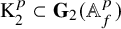


Proof. Proposition 7.2.19 implies that we may choose $({\mathbf {G}},X)$
satisfying the assumptions of Proposition 7.1.14, and so we obtain (1) and the first part of (3). If
$({\mathbf {G}},X)$
satisfying the assumptions of Proposition 7.1.14, and so we obtain (1) and the first part of (3). If $(G_2,\mu _{h_2})$
is (NE), then we may choose
$(G_2,\mu _{h_2})$
is (NE), then we may choose $({\mathbf {G}},X)$
such that
$({\mathbf {G}},X)$
such that $X_*(G^{\mathrm{ab}})_I$
is torsion-free. The argument in the proof of [Reference Kisin and PappasKP18, Thm. 4.6.23] then shows that we may choose
$X_*(G^{\mathrm{ab}})_I$
is torsion-free. The argument in the proof of [Reference Kisin and PappasKP18, Thm. 4.6.23] then shows that we may choose $\mathbf {x}\in {\mathcal B}(G,{\mathbb Q}_p)$
lifting
$\mathbf {x}\in {\mathcal B}(G,{\mathbb Q}_p)$
lifting $\mathbf {x}^{{\mathrm{ad}} }$
such that
$\mathbf {x}^{{\mathrm{ad}} }$
such that ${\mathcal G}={\mathcal G}^\circ $
, and so the “in addition” part follows. Part (2) follows formally from (3).
${\mathcal G}={\mathcal G}^\circ $
, and so the “in addition” part follows. Part (2) follows formally from (3).
7.2.23
Using recent work of Daniels–van Hoften–Kim–Zhang [Reference Daniels, van Hoften, Kim and ZhangDvHKZ], we can further relax the (NE) assumption in Theorem 7.2.21. Since op. cit. uses the theory of p-adic shtukas, we state this refinement as a separate corollary to make clear what can be done without resorting to this.
Corollary 7.2.24. The ${\mathcal G}^{{\mathrm{ad}} }$
-torsor in Theorem 7.2.21 (3) can be refined to a
${\mathcal G}^{{\mathrm{ad}} }$
-torsor in Theorem 7.2.21 (3) can be refined to a ${\mathcal G}^{{\mathrm{ad}} ,\circ }$
-torsor. This fits into a
${\mathcal G}^{{\mathrm{ad}} ,\circ }$
-torsor. This fits into a ${\mathcal G}^{{\mathrm{ad}} ,\circ }$
-equivariant local model diagram refining (7.2.22).
${\mathcal G}^{{\mathrm{ad}} ,\circ }$
-equivariant local model diagram refining (7.2.22).
Proof. We choose $({\mathbf {G}},X)$
satisfying the assumptions of Proposition 7.1.14 as above. The local model diagram in Theorem 7.1.3 induces a
$({\mathbf {G}},X)$
satisfying the assumptions of Proposition 7.1.14 as above. The local model diagram in Theorem 7.1.3 induces a ${\mathcal G}$
-equivariant local model diagram for
${\mathcal G}$
-equivariant local model diagram for ${\mathcal S}_{{\mathrm{K}}^\circ _{p}}({\mathbf {G}},X)$
by pullback. By [Reference Daniels, van Hoften, Kim and ZhangDvHKZ, Proposition 4.3.3], the corresponding
${\mathcal S}_{{\mathrm{K}}^\circ _{p}}({\mathbf {G}},X)$
by pullback. By [Reference Daniels, van Hoften, Kim and ZhangDvHKZ, Proposition 4.3.3], the corresponding ${\mathcal G}$
-torsor admits a reduction to a
${\mathcal G}$
-torsor admits a reduction to a ${\mathcal G}^\circ $
-torsor, and hence we obtain a corresponding diagram
${\mathcal G}^\circ $
-torsor, and hence we obtain a corresponding diagram

with $\pi ^\circ $
a
$\pi ^\circ $
a ${\mathcal G}^{\circ }$
-torsor. The construction in Proposition 7.1.14 then gives the desired refinement to a
${\mathcal G}^{\circ }$
-torsor. The construction in Proposition 7.1.14 then gives the desired refinement to a ${\mathcal G}^{{\mathrm{ad}} ,\circ }$
-torsor for
${\mathcal G}^{{\mathrm{ad}} ,\circ }$
-torsor for $\widetilde {\mathscr {S}}^{\mathrm{ad}}_{{\mathrm{K}}^\circ _{2,p}}({\mathbf {G}}_2,X_2)\rightarrow \mathscr {S}^{\mathrm{ad}}_{{\mathrm{K}}^\circ _{2,p}}({\mathbf {G}}_2,X_2)$
.
$\widetilde {\mathscr {S}}^{\mathrm{ad}}_{{\mathrm{K}}^\circ _{2,p}}({\mathbf {G}}_2,X_2)\rightarrow \mathscr {S}^{\mathrm{ad}}_{{\mathrm{K}}^\circ _{2,p}}({\mathbf {G}}_2,X_2)$
.
7.3 Errata
7.3.1
1) Correction to the proof of [Reference Kisin and PappasKP18, Thm. 4.2.7]: The morphism $q^{\mathrm{loc}}$
is not a
$q^{\mathrm{loc}}$
is not a ${\mathcal G}$
-torsor as stated there: Instead, it is isomorphic to the action morphism
${\mathcal G}$
-torsor as stated there: Instead, it is isomorphic to the action morphism ${\mathcal G}\times {\mathrm{M}}^{{\mathrm{loc}}}_{G,X}\to {\mathrm{M}}^{{\mathrm{loc}}}_{G, X}$
. The action morphism is smooth since it is the composition of the isomorphism
${\mathcal G}\times {\mathrm{M}}^{{\mathrm{loc}}}_{G,X}\to {\mathrm{M}}^{{\mathrm{loc}}}_{G, X}$
. The action morphism is smooth since it is the composition of the isomorphism ${\mathcal G}\times {\mathrm{M}}^{{\mathrm{loc}}}_{G,X}\xrightarrow {\sim } {\mathcal G}\times {\mathrm{M}}^{{\mathrm{loc}}}_{G,X}$
given by
${\mathcal G}\times {\mathrm{M}}^{{\mathrm{loc}}}_{G,X}\xrightarrow {\sim } {\mathcal G}\times {\mathrm{M}}^{{\mathrm{loc}}}_{G,X}$
given by $(g, m)\mapsto (g, g\cdot m)$
with the projection
$(g, m)\mapsto (g, g\cdot m)$
with the projection ${\mathcal G}\times {\mathrm{M}}^{{\mathrm{loc}}}_{G,X}\to {\mathrm{M}}^{{\mathrm{loc}}}_{G,X}$
; the rest of the proof is the same.
${\mathcal G}\times {\mathrm{M}}^{{\mathrm{loc}}}_{G,X}\to {\mathrm{M}}^{{\mathrm{loc}}}_{G,X}$
; the rest of the proof is the same.
2) Correction to the proof of [Reference Kisin and PappasKP18, Lem. 3.1.17]: The ring ${\widehat W}(A)[1/p]={\widehat W}(A)\otimes _{{\mathbb Z}_p}{\mathbb Q}_p$
is not complete for the topology
${\widehat W}(A)[1/p]={\widehat W}(A)\otimes _{{\mathbb Z}_p}{\mathbb Q}_p$
is not complete for the topology $\tau $
defined there and so proving
$\tau $
defined there and so proving $p^{-m}\varphi ^m(x)\to 0$
in
$p^{-m}\varphi ^m(x)\to 0$
in $\tau $
is not enough to complete the proof (we thank M. Hoff for pointing this out). However, as we will show,
$\tau $
is not enough to complete the proof (we thank M. Hoff for pointing this out). However, as we will show, ${\widehat W}(A)[1/p]$
is complete and separated for the p-adic topology and for
${\widehat W}(A)[1/p]$
is complete and separated for the p-adic topology and for $x\in {\widehat W}({\mathfrak M}_A)$
,
$x\in {\widehat W}({\mathfrak M}_A)$
, $p^{-m}\varphi ^m(x)\to 0$
, in the p-adic topology. This is enough to complete the proof.
$p^{-m}\varphi ^m(x)\to 0$
, in the p-adic topology. This is enough to complete the proof.
Following [Reference ZinkZi01, §2] set ${\mathcal N}={\mathfrak M}_A$
which is a p-adic ring with no unit. Since
${\mathcal N}={\mathfrak M}_A$
which is a p-adic ring with no unit. Since ${\mathfrak M}_A^N\subset pA$
, for all
${\mathfrak M}_A^N\subset pA$
, for all $a\in {\mathcal N}/p{\mathcal N}$
we have
$a\in {\mathcal N}/p{\mathcal N}$
we have $a^{N+1}=0$
, and
$a^{N+1}=0$
, and ${\mathcal N}$
is “modulo p bounded nilpotent” in the terminology of loc. cit.. We also have
${\mathcal N}$
is “modulo p bounded nilpotent” in the terminology of loc. cit.. We also have
 $$\begin{align*}{\widehat W}({\mathcal N})=\varprojlim_n {\widehat W}({\mathfrak M}_A/{\mathfrak M}_A^n)=\varprojlim_n {\widehat W}({\mathcal N}/p^n{\mathcal N})\subset W({\mathcal N}). \end{align*}$$
By [Reference ZinkZi01, Prop. 2.3, 2.4], ${\widehat W}({\mathcal N})$
is closed in
${\widehat W}({\mathcal N})$
is closed in $W({\mathcal N})$
and is p-adically complete and separated. Since
$W({\mathcal N})$
and is p-adically complete and separated. Since ${\widehat W}(A)=W(k)\oplus {\widehat W}({\mathcal N}) $
and
${\widehat W}(A)=W(k)\oplus {\widehat W}({\mathcal N}) $
and ${\widehat W}(A)$
is p-torsion free, it follows that
${\widehat W}(A)$
is p-torsion free, it follows that ${\widehat W}(A)[1/p]$
is p-adically complete and separated.
${\widehat W}(A)[1/p]$
is p-adically complete and separated.
We now show that for $x\in {\widehat W}({\mathcal N})[1/p]$
,
$x\in {\widehat W}({\mathcal N})[1/p]$
, $p^{-m}\varphi ^m(x)\to 0$
, in the p-adic topology of
$p^{-m}\varphi ^m(x)\to 0$
, in the p-adic topology of ${\widehat W}({\mathcal N})[1/p]$
. By [Reference ZinkZi01, Lem. 2.2] the group
${\widehat W}({\mathcal N})[1/p]$
. By [Reference ZinkZi01, Lem. 2.2] the group ${\widehat W}({\mathcal N}/p{\mathcal N})$
is annihilated by a power of p. Hence,
${\widehat W}({\mathcal N}/p{\mathcal N})$
is annihilated by a power of p. Hence, $p^a\cdot x\in {\widehat W}(p{\mathcal N})$
, for
$p^a\cdot x\in {\widehat W}(p{\mathcal N})$
, for $a\gg 0$
, and it is enough to assume
$a\gg 0$
, and it is enough to assume $x\in {\widehat W}(p{\mathcal N})$
. Since
$x\in {\widehat W}(p{\mathcal N})$
. Since $p>2$
we can use Zink’s logarithmic coordinates [Reference ZinkZi02, p. 35], coming from the divided power structure on
$p>2$
we can use Zink’s logarithmic coordinates [Reference ZinkZi02, p. 35], coming from the divided power structure on $p{\mathcal N}$
: There is a group homomorphism
$p{\mathcal N}$
: There is a group homomorphism
 $$\begin{align*}\log: {\widehat W}(p{\mathcal N})\xrightarrow{\sim} \widehat\bigoplus_{i\geq 0} p{\mathcal N} \subset \prod_{i\geq 0} p{\mathcal N}, \end{align*}$$
with $\widehat \bigoplus $
signifying the subgroup of the product consisting of
$\widehat \bigoplus $
signifying the subgroup of the product consisting of $z=[z_0, \ldots , z_i,\ldots ]$
, for which
$z=[z_0, \ldots , z_i,\ldots ]$
, for which $z_i\to 0$
, p-adically ([Reference ZinkZi01]). By [Reference ZinkZi02, (49), p. 35] the action of
$z_i\to 0$
, p-adically ([Reference ZinkZi01]). By [Reference ZinkZi02, (49), p. 35] the action of $p^{-m}\varphi ^m$
on the target of
$p^{-m}\varphi ^m$
on the target of $\log $
is given by
$\log $
is given by
 $$\begin{align*}(p^{-m}\varphi^m)([z_0, z_1,\ldots , z_i,\ldots ])=[z_m, z_{m+1},\ldots , z_{m+i},\ldots ]. \end{align*}$$
Set $z=\log (x)$
. Since
$z=\log (x)$
. Since $z_i\to 0$
in the p-adic topology of
$z_i\to 0$
in the p-adic topology of ${\mathcal N}$
, this gives
${\mathcal N}$
, this gives $p^{-m}\varphi ^m(z)\to 0$
in the p-adic topology of
$p^{-m}\varphi ^m(z)\to 0$
in the p-adic topology of $\widehat \bigoplus _{i\geq 0} p{\mathcal N}\subset \prod _{i\geq 0} p{\mathcal N}$
and so
$\widehat \bigoplus _{i\geq 0} p{\mathcal N}\subset \prod _{i\geq 0} p{\mathcal N}$
and so $p^{-m}\varphi ^m(x)\to 0$
in the p-adic topology of
$p^{-m}\varphi ^m(x)\to 0$
in the p-adic topology of ${\widehat W}(p{\mathcal N})$
.
${\widehat W}(p{\mathcal N})$
.
3) Correction to [Reference Kisin and PappasKP18, Lemma 4.6.13] and [Reference Kisin and PappasKP18, Corollary 4.6.15]. The description of ${\mathrm{Sh}}_{{\mathrm{K}}_2^\circ }(G_2,X_2)$
in [Reference Kisin and PappasKP18, Lemma 4.6.13] is not correct; we thank Yu Luo and Peihang Wu for pointing this out. In the statement, the connected Shimura varieties appearing in the disjoint union should have different levels given by the conjugate of
${\mathrm{Sh}}_{{\mathrm{K}}_2^\circ }(G_2,X_2)$
in [Reference Kisin and PappasKP18, Lemma 4.6.13] is not correct; we thank Yu Luo and Peihang Wu for pointing this out. In the statement, the connected Shimura varieties appearing in the disjoint union should have different levels given by the conjugate of ${\mathrm{K}}_p^\circ $
by the element
${\mathrm{K}}_p^\circ $
by the element $j\in J$
; here
$j\in J$
; here $J\subset G_2({\mathbb Q}_p)$
is as in [Reference Kisin and PappasKP18, §4.6.12]. More precisely, the correct description is as follows.
$J\subset G_2({\mathbb Q}_p)$
is as in [Reference Kisin and PappasKP18, §4.6.12]. More precisely, the correct description is as follows.
For each $j\in J$
, let
$j\in J$
, let ${\mathrm{Sh}}_{{\mathrm{K}}_p^\circ }(G,X)^{j,+}$
denote the connected component of
${\mathrm{Sh}}_{{\mathrm{K}}_p^\circ }(G,X)^{j,+}$
denote the connected component of ${\mathrm{Sh}}_{{\mathrm{K}}_p^\circ }(G,X)$
containing
${\mathrm{Sh}}_{{\mathrm{K}}_p^\circ }(G,X)$
containing $(j,X^+)$
. Note that
$(j,X^+)$
. Note that ${\mathrm{Sh}}_{{\mathrm{K}}_p^\circ }(G,X)^{j,+}$
is isomorphic to
${\mathrm{Sh}}_{{\mathrm{K}}_p^\circ }(G,X)^{j,+}$
is isomorphic to ${\mathrm{Sh}}_{j{\mathrm{K}}_p^\circ j^{-1}}(G,X)^+$
and is independent of the choice of representative j. Then taking the quotient of the isomorphism
${\mathrm{Sh}}_{j{\mathrm{K}}_p^\circ j^{-1}}(G,X)^+$
and is independent of the choice of representative j. Then taking the quotient of the isomorphism
 $$ \begin{align*}{\mathrm{Sh}}(G_2,X_2)\cong [{\mathrm{Sh}}(G,X)^+\times \mathscr{A}(G_2)]/\mathscr{A}(G)^\circ\end{align*} $$
by ${\mathrm{K}}_{2,p}^\circ $
gives
${\mathrm{K}}_{2,p}^\circ $
gives
 $$ \begin{align*} {\mathrm{Sh}}_{{\mathrm{K}}_{2,p}^\circ}(G_2,X_2)&\cong [{\mathrm{Sh}}(G,X)^+\times \mathscr{A}(G_2)/{\mathrm{K}}_{2,p}^\circ]/\mathscr{A}(G)^\circ) \\ &\cong \coprod_{j \in J} [{\mathrm{Sh}}(G,X)^+\times j\mathscr{A}(G_{2,{\mathbb Z}_{(p)}})]/\tilde{\mathscr{A}}(G_{{\mathbb Z}_{(p)}})^\circ\\ &\cong\coprod_{j\in J}[{\mathrm{Sh}}_{{\mathrm{K}}_{p}^\circ}(G,X)^{j,+}\times \mathscr{A}(G_{2,{\mathbb Z}_{(p)}})]/\mathscr{A}(G_{{\mathbb Z}_{(p)}})^\circ.\end{align*} $$
Here the second isomorphism follows from the definition of J and the last isomorphism follows from the fact that
 $$ \begin{align*}\mathrm{Stab}_{\tilde{\mathscr{A}}(G_{{\mathbb Z}_{(p)}})^\circ}(j\mathscr{A}(G_{2,{\mathbb Z}_{(p)}}))=j{\mathrm{K}}_p^\circ j^{-1}\cap \tilde{\mathscr{A}}(G_{{\mathbb Z}_{(p)}})^\circ\end{align*} $$
and the fact that
 $$ \begin{align*}{\mathrm{Sh}}_{j{\mathrm{K}}_p^\circ j^{-1}}(G,X)^+\cong {\mathrm{Sh}}(G,X)^+/j{\mathrm{K}}_p^\circ j^{-1}\cap \tilde{\mathscr{A}}(G_{{\mathbb Z}_{(p)}})^\circ.\end{align*} $$
The corresponding construction of the integral model in [Reference Kisin and PappasKP18, Corollary 4.6.15] should then be
 $$ \begin{align*}\mathscr{S}_{{\mathrm{K}}_{2,p}^\circ}(G_2,X_2)=\coprod_{j\in J}[\mathscr{S}_{{\mathrm{K}}_{p}^\circ}(G,X)^{j,+}\times \mathscr{A}(G_{2,{\mathbb Z}_{(p)}})]/\mathscr{A}(G_{{\mathbb Z}_{(p)}})^\circ,\end{align*} $$
where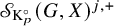 $\mathscr {S}_{{\mathrm{K}}_{p}^\circ }(G,X)^{j,+}$
is the
$\mathscr {S}_{{\mathrm{K}}_{p}^\circ }(G,X)^{j,+}$
is the ${\mathcal O}_{E^p}$
-scheme given by the Zariski closure of
${\mathcal O}_{E^p}$
-scheme given by the Zariski closure of ${\mathrm{Sh}}_{{\mathrm{K}}_p^\circ }(G,X)^{j,+}$
in
${\mathrm{Sh}}_{{\mathrm{K}}_p^\circ }(G,X)^{j,+}$
in $\mathscr {S}_{{\mathrm{K}}_p^\circ }(G,X)_{{\mathcal O}_{E^p}}$
and
$\mathscr {S}_{{\mathrm{K}}_p^\circ }(G,X)_{{\mathcal O}_{E^p}}$
and $E^p={\mathrm{E}}^p_v$
. The same proof as [Reference Kisin and PappasKP18, Corollary 4.6.15] now works, noting that this scheme has the correct generic fiber.
$E^p={\mathrm{E}}^p_v$
. The same proof as [Reference Kisin and PappasKP18, Corollary 4.6.15] now works, noting that this scheme has the correct generic fiber.
7.3.2
The assumption that $({\mathcal G},\mu )\hookrightarrow (\mathrm{GL}({\Lambda }),\mu _d)$
is very good as in Definition 5.2.5, has to be added to the statements of the main results of [Reference PappasP23]. More specifically, this condition has to be assumed for the constructions in §4.5, in Prop. 4.5.3, and for the results in §8 of [Reference PappasP23]. ([Reference PappasP23, Prop. 4.5.3] asserts that the isomorphism c respects the tensors, but the proof is based on the erroneous construction of c in [Reference Kisin and PappasKP18, Lem. 3.1.9]; see the proof of Lemma 5.1.15.) In particular, the independence of [Reference PappasP23, Thm. 8.1.6] is for integral models constructed using different very good Hodge embeddings.
$({\mathcal G},\mu )\hookrightarrow (\mathrm{GL}({\Lambda }),\mu _d)$
is very good as in Definition 5.2.5, has to be added to the statements of the main results of [Reference PappasP23]. More specifically, this condition has to be assumed for the constructions in §4.5, in Prop. 4.5.3, and for the results in §8 of [Reference PappasP23]. ([Reference PappasP23, Prop. 4.5.3] asserts that the isomorphism c respects the tensors, but the proof is based on the erroneous construction of c in [Reference Kisin and PappasKP18, Lem. 3.1.9]; see the proof of Lemma 5.1.15.) In particular, the independence of [Reference PappasP23, Thm. 8.1.6] is for integral models constructed using different very good Hodge embeddings.
Acknowledgements
We would like to thank M. Hoff for pointing out the gap in [Reference Kisin and PappasKP18] and M. Rapoport, Y. Luo and P. Wu for useful comments. We thank the referees for a careful reading of the manuscript and for many useful comments which greatly improved the paper.
Competing interest
The authors have no competing interest to declare.
Financial support
M. K. was supported by NSF grant #DMS-2200449. G. P. was supported by NSF grant #DMS-2100743 and by Simons Foundation grant SFI-MPS-TSM-00013296. R. Z. was supported by EPSRC grant ref. EP/Y030648/1.


 Open access

