





Non-communicable diseases (NCD) pose a significant health challenge in Pacific Island countries and territories, accounting for approximately 75 % of deaths in the region(1,Reference Peng, Zhang and Wen2) . Unhealthy diets are a key factor contributing to the development of diet-related NCD worldwide and in the Pacific region(3,Reference Reeve, Lamichhane and McKenzie4) . Before the mid-1940s, the traditional diets of people in the Pacific region were generally nutritious and consisted mainly of local foods such as fresh fish and seafood, root crops and green leafy vegetables(5,Reference Snowdon and Thow6) . However, there has since been a shift in the dietary intake of Pacific people from traditional balanced diets to unhealthy diets dominated by highly processed, nutrient-poor foods, with changes observed in the last four decades(Reference Sievert, Lawrence and Baker7,Reference Charlton, Russell and Gorman8) .
The diets of individuals and populations are influenced by a range of factors, and the food environment is considered to be a major determinant(Reference Andrew, Allison and Brewer9). The food environment is described as the ‘collective physical, economic, policy, and sociocultural surroundings, opportunities and conditions that influence people’s food and beverage choices and nutritional status’(Reference Swinburn, Sacks and Vandevijvere10). In the Pacific region where food has social and cultural significance, this definition will guide an understanding of the multifaceted dynamics shaping food choices beyond mere sustenance. The International Network for Food and Obesity/NCD Research, Monitoring and Action Support divides the physical food environment into food composition, food provision, food labelling, food promotion, food prices and food availability(Reference Swinburn, Sacks and Vandevijvere10). The economic surroundings influencing food choices refer to the costs related to food and are strongly related to individual and household income. Policy influences include rules, policies, regulations and barriers/enablers to implementing food-related policies(Reference Swinburn, Egger and Raza11), while sociocultural surroundings include the attitudes, values and beliefs of communities related to their food choices(Reference Swinburn, Egger and Raza11).
Current evidence recognises that the physical food environment and broader economic, policy and sociocultural surroundings influence food purchasing behaviours and dietary patterns, with an understanding of the literature on these key areas in the Pacific region being essential to inform the development of evidence-based policies and programs to improve diets(Reference Farrell, Rachmi and Mulcahy12,13) . A scoping review of the food environment in all low- and middle-income countries, including Pacific countries, was conducted in 2017 (more than 6 years ago); however, that review focused only on the physical aspects of the food environment and included only one study from the Pacific region(Reference Turner, Kalamatianou and Drewnowski14). Since that review in 2017, further literature may now exist on the food environment in the Pacific region. Given that only the physical food environment was considered in the 2017 review, synthesising evidence on other factors influencing people’s food choices is key in order to inform the development of policies to create a healthy food environment and to address the burden of diet-related NCD in the Pacific region. In this study, we conducted a scoping review of the available literature to understand the (i) characteristics of the physical food environment in the Pacific, (ii) the broader economic, policy and sociocultural surroundings that influence food choices in the region and (iii) interventions to improve food environments for Pacific communities.
Methods
A scoping review was conducted, guided by The Joanna Briggs Institute methodological guidance for scoping reviews(Reference Aromataris15). Scoping reviews are useful for synthesising available evidence in emerging research areas that are yet to be reviewed and for exploring key concepts(Reference Munn, Peters and Stern16), in this case the characteristics of the physical food environment in the Pacific region, which need to be further explored, and the broader economic, policy and sociocultural surroundings influencing food choices which are yet to be reviewed. We followed the Preferred Reporting Items for Systematic Reviews and Meta Analyses – Extension for Scoping Reviews guidelines and the Preferred Reporting Items for Systematic Reviews and Meta Analyses – Extension for Scoping Reviews checklist guided the development of this paper(Reference Tricco, Lillie and Zarin17). A protocol for this review was developed, and this is available in the Supplementary File.
Search strategy
We systematically searched MEDLINE Complete, Business Source Complete, Academic Search Complete, EMBASE and Global Health for peer-reviewed literature in February 2023, and an updated systematic search was conducted in February and April 2024. These databases were selected because their scope was considered relevant to the aims of this review. With assistance from a research librarian, search terms were developed based on the definition of food environments by Swinburn et al. (2013) and the INFORMAS food environment categories(Reference Swinburn, Sacks and Vandevijvere10). Databases were searched using four groups of search terms that covered the following key concepts: ‘food environment’, ‘food/beverages’, ‘intervention’ and ‘Pacific region’ (see online supplementary material, Supplementary Table S1 within the study protocol). The first search was limited to articles published between 1993 and 2023. This period was chosen to include 1996, when the first Pacific Island countries became members of the World Trade Organisation (WTO)(18) (as trade agreements have been important in shaping food environments in the Pacific region). To identify additional studies, including grey literature, we screened the first ten pages of Google and Google Scholar search results, using a simplified version of the search terms used for peer-reviewed literature databases (see online supplementary material, Supplementary Table S2). These simplified search terms were also used to search websites of key organisations through Advanced Google. International organisations included the WHO and the United Nations FAO, as well as the SPC, a regional organisation. Each organisation’s URL was inserted into Advanced Google’s ‘site or domain’ field, while the search terms were inserted into the appropriate search box, and the first five pages of results were retrieved. The reference lists of all relevant studies were screened, and papers citing identified studies were searched to identify any additional relevant studies.
The updated systematic search in February 2024 was conducted on the same databases, Google and Google Scholar using the same search terms with the search being limited to articles published between 1993 and 2024 to include any recently published articles. Another updated systematic search of the grey literature was conducted in April 2024, and the reference lists of relevant studies were screened to identify recent additional relevant studies.
Study eligibility and selection
Studies were included if they:
-
1. Described or assessed any characteristics of food environments, described any aspect of the broader economic, policy and sociocultural surroundings that influence food choices, or evaluated interventions to improve food environments.
-
2. Were conducted in the Pacific region or in any Pacific Island country and territory that is a member of the Pacific Community (SPC), including Tonga, Fiji, Samoa, Papua New Guinea, Guam, Republic of the Marshall Islands, Cook Islands, Nauru, Federated States of Micronesia, Commonwealth of the Northern Mariana Islands, Vanuatu, Solomon Islands, Tuvalu, Tokelau, Wallis and Futuna, Niue, French Polynesia, Palau, American Samoa, Kiribati, Pitcairn Islands or New Caledonia.
-
3. Used any type of qualitative, quantitative or mixed-method study design, including observational (descriptive or analytical) or interventional studies. Publicly available grey literature reports and non-academic publications were also included.
Articles were excluded if they:
-
1. Were reviews, editorials, opinion pieces or conference abstracts.
-
2. Described or assessed the impacts of the COVID-19 pandemic on the characteristics of the food environment.
All retrieved articles were uploaded into the Covidence systematic review software. Duplicate records were removed by Covidence, and remaining duplicates were also manually identified and removed. Two authors independently reviewed the title and abstract of each identified article and excluded articles that did not meet the inclusion criteria. Full-text screening for eligibility was initially conducted by one author. In response to reviewer feedback, another author conducted full-text screening after writing up the scoping review to ensure that all relevant papers were included. Authors discussed and resolved discrepancies. Additional papers were identified through the full-text screening by an additional author, with results from these studies then integrated into the analysis.
Data charting
A data extraction template was developed using Microsoft Excel based on the INFORMAS framework(Reference Swinburn, Sacks and Vandevijvere10). The definition of the food environment used within this framework informed the key categories that studies were categorised into (physical, economic, policy and sociocultural surroundings)(Reference Swinburn, Sacks and Vandevijvere10). The food environment characteristics (food labelling, food provision, food promotion, food price, food availability and food composition) in the INFORMAS framework were used to inform the classification of studies related to the physical food environment(Reference Swinburn, Sacks and Vandevijvere10). Two authors piloted the data extraction tool by independently extracting data from seven randomly chosen articles (10 % of all eligible articles) and then discussing and cross-checking their findings to determine whether the template was being used in the same manner by both authors. Data extraction was considered to be fully consistent between the two authors, therefore for all other eligible studies, data extraction was performed by one author and validated by a second author.
Data synthesis
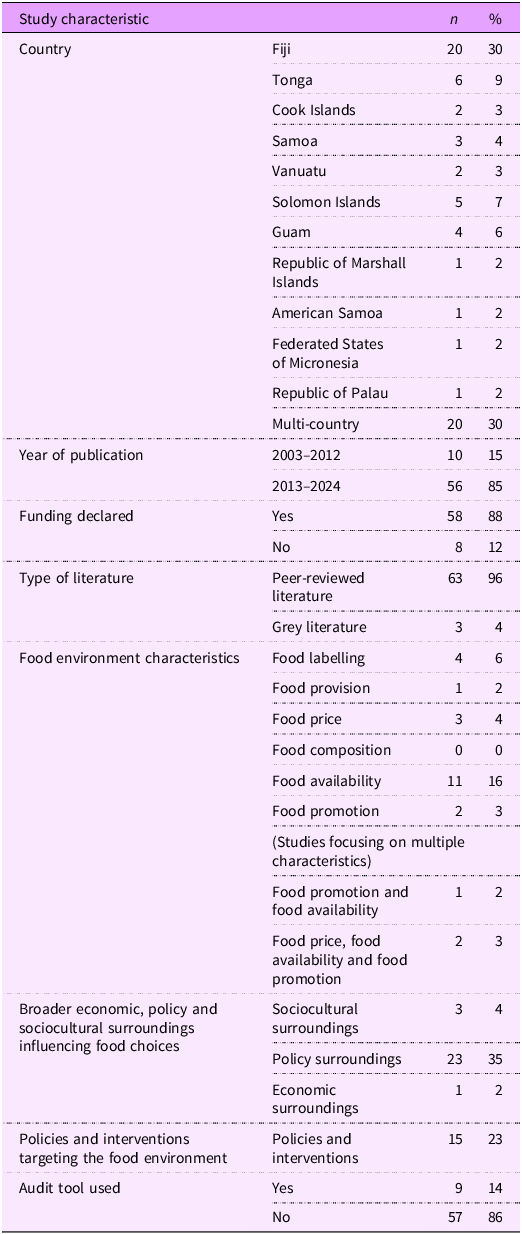
The country, year of publication and other general characteristics of the included studies were summarised (see Table 1). The included studies were categorised according to the aims of this review: (i) physical food environment characteristics; (ii) the broader policy, economic and sociocultural surroundings that influence food choices and (iii) interventions to improve food environments for Pacific communities. Studies on the policy surroundings influencing food choices included those on policy processes and barriers/enablers to implementing food environment policies. Studies on economic surroundings included those describing the costs related to food, while studies describing sociocultural surroundings included those on the attitudes, values and beliefs of communities relating to their food choices. The ‘policies and interventions’ category included studies evaluating any food environment policy or intervention.
Characteristics of included studies
Results

The search strategy identified 2520 studies, of which sixty-six were considered eligible for inclusion.
Figure 1 illustrates the article identification, screening and inclusion processes.
Flow diagram of literature identification and screening process.
The majority (30 %) of eligible studies were conducted in at least two Pacific Island countries. Of the studies conducted in single countries, Fiji was the most common (30 % of eligible studies), followed by Tonga (9 %) and the Solomon Islands (7 %) (Table 1). Other Pacific Island countries and territories included were Samoa, Vanuatu, Guam, Cook Islands, Republic of the Marshall Islands, American Samoa, Federated States of Micronesia and the Republic of Palau, each of which contributed between one and four papers to the review. The number of studies published on the food environment in the Pacific region has increased over the last few decades. Eighty-five percent of the eligible studies were published between 2013 and 2024, with most (n 36) published in the last 5 years. The available literature related to the aims of this review is summarised below.
Physical food environment characteristics
Food labelling
Four studies were conducted on food labelling quality (including nutrient content information) and whether the country’s labelling requirements were met. A 2021 study in Fiji found that only 14 % of packaged foods assessed met the national labelling regulations(Reference Shahid, Waqa and Pillay19). A 2022 study in Tonga found that only half of the food items had legible labels with nutrient information(Reference Buechel, Knight-Agarwal and Minehan20). In the Republic of Palau, a study of fourteen different food categories in four retailers found that all categories had some expired food items, some did not have expiry dates and some labels were not in English(Reference McCreadie and Leary21). A study conducted in multiple Pacific countries in 2013 found that nutrient information was not provided for 6 % of the 6041 food items assessed(Reference Snowdon, Raj and Reeve22). Among the countries included in that study, most products that did not display any nutritional information on the label were products in New Caledonia, and some of these products included bread, meat, snacks and beverages(Reference Snowdon, Raj and Reeve22).
Food price
Few studies focused on the costs and affordability of food. A study investigated the cost of consuming the internationally recommended amount of fruits and vegetables per person in Vanuatu and whether households’ budgets were sufficient to afford this(Reference Jones and Charlton23). The findings showed that USD $16·60 per person per month is the minimum cost for buying the recommended amount of fruits and vegetables and that most households in Port Vila, Vanuatu cannot afford this(Reference Jones and Charlton23). Another study compared the prices of healthy v. less healthy foods in the Republic of the Marshall Islands and found that healthy foods were more costly than less healthy foods(Reference Grant, Stewart and Song24). In Guam, an assessment of the food environment in restaurants and stores found that healthier foods were more expensive in small stores than in larger ones(Reference Lundeen, VanFrank and Jackson25). Similarly, another study in American Samoa in 2015 found that healthy food in restaurants and stores was more expensive than unhealthy food(Reference Lee-Kwan, Kumar and Ayscue26). In 2014, a survey comparing food cost against the average income found that the average weekly food cost as a percentage of median household income was 51·6 % in the Commonwealth of the Northern Mariana Islands, 40 % in American Samoa and 23·6 % in Guam(Reference Greenberg, Luick and Alfred27).
Food availability
A study in the Solomon Islands in 2018 found that food items recommended by the Pacific guidelines to limit consumption of were more available in retail settings than food recommended by the Pacific guidelines for a healthy diet(Reference Bottcher, Underhill and Aliakbari28). An assessment of the availability of low-sodium foods in Guam found that they were less commonly available in convenience stores than regular Na foods(Reference Jackson, VanFrank and Lundeen29). Studies in Guam assessing the retail food environment found that healthier foods were less available in small stores than in larger ones(Reference Lundeen, VanFrank and Jackson25,Reference Matanane, Fialkowski and Silva30) . Similarly, another study in American Samoa in 2015 found that healthy foods in stores and restaurants were less available than unhealthy foods(Reference Lee-Kwan, Kumar and Ayscue26). In 2021, the retail food environment in Fiji was found to have high availability of nutrient-poor foods, such as sugary drinks, confectionery and chips(Reference Burkhart, Craven and Horsey31). In a 2006 study in the Federated States of Micronesia, imported foods such as corned beef, spam, turkey tails and other processed foods were reported to be highly available, and this may have been due to their dependence on foreign aid and the ease of global trade(Reference Cassels32).
A study in the Solomon Islands explored different places where people acquire food from and found that in addition to the formal and informal retail food environments, people also acquire food from the wild, cultivated food environment, kin and community and food aid and services(Reference Bogard, Andrew and Farrell33). In Samoa, a secondary data analysis of national-level data found that between 1961 and 2007, the availability of meat and vegetable oils increased significantly, while locally grown fruit and root crops showed little to no increase(Reference Seiden, Hawley and Schulz34). Similarly, in the Cook Islands, the availability of meat increased from 8 g per person per day in 1961 to 122 g in 2000, and the availability of rice and wheat also increased during the same period(Reference Ulijaszek35). In Tonga, their horticultural market system consisting of a central municipal market supplemented by road-side vendors are concentrated in the town centres, with a large number of households in the area relying on these markets for fresh food, fruits and vegetables(Reference Underhill, Patolo and Zhou36). In the Pacific region, a study of the food system in 2021 found a decline in the production of root crops and other starchy vegetables per capita in the last 50 years, resulting in heavy reliance on imported foods(Reference Andrew, Allison and Brewer37). In Fiji, stakeholders involved in local food production suggested that the government should prioritise investment in local produce over import markets and assist collaboration among people in this sector to strengthen the local food production(Reference Guell, Brown and Navunicagi38). In addition to that, it was recommended that a neo-traditional approach to farming should be adopted, which involves conserving land, promotion of local food crops, crop improvement, organic farming and establishing connections between farming and the tourism industry to ensure food security in Fiji(Reference Shah, Moroca and Bhat39).
Food provision
Only one study focused on food provision, finding 150 retail outlets located within a 1 km radius of a selected secondary school in Tonga(Reference Pauuvale, Vickers and Pamaka40). Retail outlets included shops selling foods, such as convenience stores, grocery stores, supermarkets, cafés, delicatessens, markets, bakeries, restaurants and street food stalls(Reference Pauuvale, Vickers and Pamaka40). Of the 150 retail outlets, 98 % were considered to be very unhealthy, 0·7 % were categorised as unhealthy and 1·3 % (fruit and vegetable markets) was considered healthy(Reference Pauuvale, Vickers and Pamaka40).
Food promotion
A study of the nutrition environment in Guam found that the marketing of foods was more focused on unhealthy foods in smaller stores than in larger ones(Reference Lundeen, VanFrank and Jackson25). Promotional materials also encourage unhealthy eating in restaurants(Reference Lundeen, VanFrank and Jackson25). Similarly, another study in American Samoa in 2015 found that healthy foods in stores and restaurants were less promoted than unhealthy foods(Reference Lee-Kwan, Kumar and Ayscue26). A study of exposure to junk food advertising and its influence on the diets of children and adolescents in Fiji in 2010 found that the level of television and street advertising of junk food was high(Reference Hope, Snowdon and Carey41). As a result, 94 % of students in the study reported that adverts made them want to taste advertised food products(Reference Hope, Snowdon and Carey41). Another study in 2012 in Fiji found that two-thirds of advertisements on FBC TV, a new TV channel in Fiji, promoted junk food; however, this was lower than other available channels(Reference Astika, Snowdon and Drauna42).
Sociocultural surroundings influencing food choices
Three studies focused on the sociocultural surroundings that influence food intake in the Pacific region(Reference Singh, Sendall and Gurung43–Reference McKenzie, Waqa and Hart45). All studies were conducted in Fiji among the iTaukei (Indigenous Fijian) population, exploring the sociocultural factors influencing people’s diets. Some of the common sociocultural factors identified in these studies were gendered beliefs that men should receive greater quantities of food than women, and the cultural belief that larger body size is associated with good health and status(Reference Singh, Sendall and Gurung43–Reference McKenzie, Waqa and Hart45). These studies also identified a cultural expectation around plate clearing, where those receiving the food are expected to eat more as a demonstration of their appreciation for the effort, time, money and love shown by the people who prepared the food. In the context of unhealthy food environments, these beliefs, norms and expectations may contribute to unhealthy diets among iTaukei people(Reference Buksh, de Wit and Hay44,Reference McKenzie, Waqa and Hart45) .
Economic surroundings influencing food choices
A study in Fiji in 2021 which explored the factors that are driving food inflation found that domestic factors such as per capita Gross Domestic Product and money supply positively influence food inflation(Reference Makun46). In terms of external factors, the exchange rate, world food price and oil price are important factors that were found to influence food inflation in Fiji(Reference Makun46).
Policy surroundings influencing food choices
Several studies examined the facilitators and barriers to the development and implementation of food environment policies(Reference Thow, Swinburn and Colagiuri47–Reference Hendriks, Delai and Thow53). A study was conducted in Fiji, Samoa and Tonga on trade-related food policies to reduce the supply of meat that is high in fat(Reference Thow, Swinburn and Colagiuri47). Studies in the Solomon Islands focused on fish supply chain policies to improve fish accessibility(Reference Mauli, Thow and Mulcahy51) and fruit and non-starchy vegetable policies to improve its consumption(Reference Farrell, Sharp and Reeve52). The other five policies studied focused on sugar-sweetened beverage taxation in Fiji and Tonga(Reference Mounsey, Vaka and Cama48), import duties in Tonga(Reference Bell, Latu and Na’ati49), food-related policies in Fiji(Reference Burkhart, Craven and Horsey31,Reference Latu, Coriakula and Waqa50,Reference Hendriks, Delai and Thow53) and school food programs in multiple Pacific countries(Reference Burkhart, Hayman and Lam54). Commonly identified barriers to the development and implementation of food-related policies included inadequate collaboration between relevant sectors and lack of clear enforcement mechanisms. The key facilitators identified included effective advocacy, making use of policy opportunities and strong leadership with clear lines of responsibility for policy implementation. Other studies found that a multisectoral policy response is required, and relevant sectors should prioritise the implementation of these policies(Reference Reeve, Ravuvu and Farmery55–Reference Dodd, Reeve and Sparks57). Two studies examined lessons learned from food policy processes. The first study on soft drink tax policy processes in Fiji, Nauru, Samoa and French Polynesia found that cross-sectoral advocacy and collaboration and framing of the policy issue to be relevant to the government’s priorities were crucial factors for the adoption and implementation of the policy(Reference Thow, Quested and Juventin58). The second study examined the restrictions on the marketing of unhealthy food to children and the marketing of breast milk substitutes in Fiji(Reference Thow, Waqa and Browne59). The authors found that an imbalance of power between health officials and food industry representatives in policymaking, where food industries are more politically influential, have an impact on the decision-making process(Reference Thow, Waqa and Browne59). The use of evidence to inform food-related policy process is important; however, lack of collaboration among relevant sectors and poor technical support for training on how to use evidence in policy-making were found in a study in Fiji as barriers to evidence use(Reference Waqa, Bell and Snowdon60). In terms of policy translation, a recent study in 2023 found that the challenges in the translation of food system policy guidance from the regional to national level included competing demands where there are very few resources and having weak dialogue between regional focal points and those at the national level(Reference Patay, Ravuvu and Iese61). Regional food system governance can be enhanced through employing new coordination methods and improving interactions among institutions at the regional and country level and with communities(Reference Thow, Ravuvu and Iese62).
Six studies investigated food trade and investment in Vanuatu(Reference Ravuvu, Lui and Bani63), Fiji(Reference Ravuvu, Friel and Thow64,Reference Lin, Teymourian and Tursini65) and multiple Pacific countries(Reference Thow, Ravuvu and Ofa66–Reference Thow, Heywood and Schultz68). Two of these studies explored how the obligations of countries under the WTO agreements influenced their food environments. The study in Vanuatu found that following their accession to the WTO in 2012, there was an increase in imported unhealthy foods such as savory snacks, noodles and sugar-sweetened beverages from 2015 to 2018(Reference Ravuvu, Lui and Bani63). Similarly, studies in Fiji found that following their accession to the WTO in 1996, there was an increase in imports of unhealthy, highly processed foods and sugar-sweetened beverages between 1996 and 2010(Reference Ravuvu, Friel and Thow64), and other trade agreements have also contributed to the increasing imports of these foods(Reference Lin, Teymourian and Tursini65). In Fiji and Samoa, trade policy changes between 1960 and 2005 have contributed to changes in the food supply, with increasing availability of foods including fats and oils, meat, processed foods and refined cereals(Reference Thow, Heywood and Schultz68). A study of sweetened beverages imported to Pacific countries between 2000 and 2015 found an increase by an average of 0·30 kg per person per year(Reference Lo, Sacks and Gearon67). In addition, another study explored the trends in regional food trade among multiple Pacific countries and found that in 2018, 51 % of foods traded within the region were cereal grains and flour(Reference Thow, Ravuvu and Ofa66). Sugar-sweetened beverages, confectionery and processed fish were also reported to be traded in large quantities among Pacific countries(Reference Thow, Ravuvu and Ofa66). A study of the influence of Corporate Political Activities of major food industries in Fiji found that there is a substantial risk that these activities could influence efforts to tackle diet-related NCD(Reference Mialon, Swinburn and Wate69).
Policies and interventions targeting the food environment
Only one study assessed the most feasible diet-related policy interventions in Tonga and Fiji, which identified policy options related to increasing the availability of local foods, addressing the cost and affordability of healthier compared to less healthy foods, improving the quality of processed foods, promoting healthier foods and restricting the marketing of less healthy foods(Reference Snowdon, Lawrence and Schultz70,Reference Thow, Snowdon and Schultz71) .
Six studies evaluated the impact of food tax changes in various Pacific countries(Reference Teng, Genç and Herman72–Reference Coriakula, Moodie and Waqa77). Two of these studies focused on the impact of sugar-sweetened beverage taxation on the import of beverages to the Cook Islands(Reference Teng, Genç and Herman72) and Tonga(Reference Teng, Puloka and Genç73). In the Cook Islands, the sugar-sweetened beverage tariff increased from 40 to 60 % in 2008 and was further increased to 75 % in 2012(Reference Teng, Genç and Herman72). That study found that following the tariff increases in 2008 and 2012, the imported volume of taxed beverages decreased by 13·2 % and 2·9 %, respectively. In Tonga, a sweetened beverage tax of TOP$0·50 per litre was introduced in 2013, with this increasing further in 2016 (to TOP$1·00/l) and in 2017 (TOP$1·50/l)(Reference Teng, Puloka and Genç73). In the year after the 2013, 2016 and 2017 tariff increases, import volumes of sweetened beverages decreased by 10·4 %, 30·3 % and 62·5 %, respectively(Reference Teng, Puloka and Genç73). The findings of these studies show that these tax changes appeared to be effective in reducing the import volumes of beverages to the Cook Islands and Tonga. A study in Fiji found that a 10 % reduction in the import duty on locally grown fruits and the removal of the 10 % import excise on vegetables introduced in 2011 contributed to increases in the volume of these foods being imported(Reference Bell, Latu and Coriakula74). An evaluation of the 32 % increase in the palm oil import duty in Fiji found a drop in the import of palm oil from over 5000 tonnes in 2011 to just over 2000 tonnes in 2015(Reference Coriakula, Moodie and Waqa77). Another study evaluated the effectiveness of food taxes implemented in Tonga in 2016 and found a lack of public awareness programmes regarding these taxes and a lack of multisectoral efforts to implement these taxes(Reference Wijesinha-Bettoni, Latu and Osornprasop76). A recent cross-sectional survey in 2023 in six Pacific countries evaluated the likely impact of food fiscal policies on consumption and found that 79 % and 60 % of participants did not meet the daily recommended amount of fruits and vegetables, respectively, and 66 % consumed at least one packet of ultra-processed snacks per day(Reference Buksh, Crookes and de Wit75).
Two studies evaluated the impact of a national salt reduction program, involving awareness campaigns, and engagement with the food industry to encourage voluntary salt reduction in foods in Samoa(Reference Trieu, Webster and Jan78) and Guam(Reference Gonzales, Alam and Silverio79). In Guam, forty-seven out of 140 restaurants approached showed their support for the initiative by reducing the availability of salt in the restaurant(Reference Gonzales, Alam and Silverio79). In Samoa in 2016, a study found that some of the challenges to implementing this initiative were the lack of support from community leaders to spread the message, high campaign costs and the unwillingness of food industries to voluntarily reduce salt in food without any related regulations(Reference Trieu, Webster and Jan78).
In 2022, a study assessed the status of the implementation of policies to address NCD in the Pacific region(Reference Win Tin, Kubuabola and Snowdon80). This study found that that there have been multisectoral taskforces focusing on NCD issues established in twelve different countries, fourteen countries had healthy food policies in schools and fiscal measures, such as sugar-sweetened beverage taxation, have been implemented in fourteen countries(Reference Win Tin, Kubuabola and Snowdon80). The strength of the proposed actions and the degree of policy implementation vary across Pacific countries(Reference Win Tin, Kubuabola and Snowdon80). The study further highlighted that there has been very little progress in implementing policies to restrict the marketing of unhealthy foods and beverages to children, with implementation of policies only having occurred in the Cook Islands, French Polynesia, Kiribati, Samoa and Niue(Reference Win Tin, Kubuabola and Snowdon80). Other than government policies, in Fiji, a 2014 study found that four of the fifteen packaged food manufacturers assessed had a policy on their company website related to food marketing to children and product formulation and one of the five fast-food restaurants assessed had online food marketing policies(Reference Sacks, Mialon and Vandevijvere81).
To improve the design of food taxes in the Pacific region, SPC in 2015 discussed how the design of sugar-sweetened beverage taxes could be improved based on available evidence(Reference Andrea McDonald82). In 2017–2019, a prospective analysis was conducted providing evidence-based tax design recommendations to support the proposal of an advocacy coalition for the adoption of a sugar-sweetened beverage tax in the Solomon Islands(Reference Reeve, Thow and Namohunu83). A 2023 study recently developed a practical guide for improving the development of food taxes(Reference Reeve, Ravuvu and Johnson84). This study provides options for defining the foods to be taxed, how to propose taxes that comply with the existing tax system and how to set the tax rate carefully to improve feasibility and effectiveness(Reference Reeve, Ravuvu and Johnson84).
Discussion
Our synthesis of sixty-six studies across Pacific Island countries and territories provides evidence of the characteristics of food environments in this region, and the broader economic, policy and sociocultural surroundings that influence food choices and the interventions that have been implemented to improve food environments for Pacific communities. Available evidence suggests that less healthy foods are highly available and heavily promoted in retail settings compared to healthy foods in Pacific countries(Reference Lundeen, VanFrank and Jackson25,Reference Lee-Kwan, Kumar and Ayscue26,Reference Bottcher, Underhill and Aliakbari28,Reference Jackson, VanFrank and Lundeen29,Reference Cassels32) . Our review also found a low production and availability of local foods such as root crops and other starchy vegetables per capita in the Pacific region(Reference Andrew, Allison and Brewer37–Reference Shah, Moroca and Bhat39). Our results are consistent with those of a systematic review of all low- and middle-income countries, which found that unhealthy foods were typically more available than healthy foods in these countries(Reference Turner, Kalamatianou and Drewnowski14). Our findings are also consistent with evidence from multiple low- and middle-income countries, which found that vendors in school food environments sell more unhealthy foods than healthy foods(Reference Soltero, Ortiz Hernández and Jauregui85–Reference Faber, Laurie and Maduna87). Consistent with findings from a study across 176 countries globally(Reference Headey and Alderman88), the current review also provides evidence that healthy foods are more costly than unhealthy foods in Pacific countries(Reference Jones and Charlton23,Reference Grant, Stewart and Song24) . However, there is little research in Pacific countries comparing the price of healthy with that of less healthy foods. Evidence from the available literature globally demonstrates the importance of food promotion, food provision and food composition in influencing people’s food choices(Reference Swinburn, Sacks and Vandevijvere10). However, minimal data were found on these food environment characteristics in the Pacific region, with a clear evidence gap in this area.
In our review, we found poor compliance with food labelling requirements across various Pacific counties, which likely exacerbates the barriers to making healthy food choices posed by the high availability, low costs and high volume of promotion of unhealthy foods in some Pacific countries(Reference Shahid, Waqa and Pillay19,Reference Buechel, Knight-Agarwal and Minehan20) . With foods and beverages being imported from fifty-four different countries to the Pacific region(Reference Snowdon, Raj and Reeve22), adequate nutrition labelling is critical for enabling healthier food choices. This may be through direct use of nutrition labels by individuals to guide healthier choices or, more importantly, through the provision of information required for food classification when implementing food and nutrition policies. For example, food marketing policies require that foods be categorised into those that are ‘permitted’ to be marketed and those that are ‘not permitted’ to be marketed. Such classification requires a nutrient or food classification model, which is underpinned by knowledge of the ingredients and composition of nutrients in food products. Labelling of these ingredients and nutrients on pre-packaged foods is recommended by international Codex standards, and some Pacific nations have adopted these requirements into law (e.g. Samoa’s Food (Safety and Quality) Regulations 2017). This information can also be used to inform other globally recommended policies including interpretive front-of-pack nutrition labels.
Our review identified various economic, policy and sociocultural surroundings that influence the food choices of people in the Pacific region. Trade and investment, including agreements of some Pacific countries under the WTO, influence the food environment and food choices through greater imports of highly processed foods(Reference Ravuvu, Lui and Bani63,Reference Ravuvu, Friel and Thow64,Reference Thow, Heywood and Schultz68) . The trade of unhealthy foods among Pacific countries is also a concern in this region. Further, sociocultural factors also play a crucial role in influencing the diets of Pacific people, although the literature on this is limited. Only one ethnic group (iTaukei) in one Pacific country (Fiji) has been the focus of studies in this area. Given that Pacific countries are highly culturally diverse, there is diversity within and between countries in terms of sociocultural factors influencing food choices. For instance, not having arable land to grow food is one of the key factors influencing food choices in the Solomon Islands(Reference Albert, Bogard and Siota89–Reference Farrell, Thow and Rimon91); however, in Tonga, only 42 % of arable land was farmed in 2009(92). The colonisation of many Pacific Island countries and territories by different countries also had an important role in influencing their specific food cultures and food systems(Reference Cassels32,Reference Marrero and Mattei93) . Therefore, further research among different communities regarding their cultural beliefs about food is required.
The use of policies to address the availability, accessibility and affordability of foods and beverages has been recognised globally as being vital to improving food environments(94–96). The Pacific NCD Roadmap contains policies and interventions to address NCD in the Pacific, which are in line with the NCD best buys globally. The most feasible interventions that would have the most impact on diet-related NCD in Pacific countries were also identified(Reference Snowdon, Lawrence and Schultz70). These include decreasing the price of healthier foods compared to their less healthy counterparts, improving the quality of processed foods, promoting healthier foods, restricting the marketing of unhealthy foods to children and increasing the availability of local foods(Reference Snowdon, Lawrence and Schultz70). These policies and interventions have been implemented in other countries(Reference Powell, Chriqui and Khan97,Reference Olstad and Boyland98) and may be transferrable to Pacific countries. For instance, a systematic review in the United States provided evidence of the effectiveness of decreasing fruit and vegetable prices in increasing their consumption among low-income populations(Reference Powell, Chriqui and Khan97). Another systematic review found that policies addressing the marketing of unhealthy food to children can minimise their exposure to the persuasive power of food marketing and may reduce unhealthy food purchases(Reference Olstad and Boyland98). Policies that increase the availability of and access to locally produced foods have also been implemented in other contexts(Reference Emily, Eden and Catherine99). This evidence is particularly important for Pacific countries where competing priorities and lack of resources are of concern when adopting, implementing, monitoring and evaluating policies.
In the Pacific region, some of the globally recommended policies have not yet been adopted. For example, very few Pacific countries have implemented policies to protect children from unhealthy food marketing(Reference Win Tin, Kubuabola and Snowdon80). This policy inertia is evident worldwide, with few countries adopting comprehensive government-led measures to reduce children’s exposure to unhealthy food marketing. The WHO released an updated guideline in 2023 recommending mandatory regulations to protect children from the impact of unhealthy food marketing(100).
There are some policy areas in which the Pacific region is doing well in its adoption, such as fiscal policies, as shown by a systematic policy review in 2023(Reference Jones, Na’ati and Smith101). Fiscal policies, including sugar-sweetened beverage taxes, import duties, food-based taxes, and healthy food subsidies, were some of the most commonly reported policies identified in the current review. However, the scope of these policies and their subsequent implementation are sometimes weak(Reference Snowdon and Thow102) and often reported as inadequate to achieve the desired outcome. Several studies demonstrated a link between the lack of collaboration among relevant stakeholders as well as lack of clear enforcement mechanisms, resulting in the stalled implementation of food environment policies in many Pacific countries. This is consistent with the findings of a case study in Australia, which found limited cohesion among relevant stakeholders to be a barrier to prioritising regulatory interventions targeting obesity prevention(Reference Baker, Gill and Friel103). The current review identified opportunities to strengthen food environment policy implementation through having stronger leadership, clear lines of responsibility for implementation and effective collaboration among relevant sectors. These findings are consistent with those of a narrative synthesis of literature on obesity and diet-related NCD policy from the Western Pacific region(Reference Reeve, Bell and Sacks104).
Strengths and limitations
A key strength of this scoping review is that it was led by a Tongan researcher with lifelong experience of food environments in the Pacific. This review was guided by the Joanna Briggs Institute methodological guidance for scoping reviews to ensure a systematic, robust and replicable process(Reference Aromataris15). The Preferred Reporting Items for Systematic Reviews and Meta Analyses—Extension for Scoping Reviews guidelines were used to guide the development of this review paper to ensure that the key items on the checklist were included(Reference Tricco, Lillie and Zarin17). The application of an extensive and systematic search strategy likely captured the breadth and depth of the publications on this topic. As per the scoping review methods, an assessment of study quality was not conducted, meaning it is possible that some of the included studies have methodological flaws that may affect the reliability of our findings.
Areas for future research
There is a lack of research on the environmental surroundings that influence people’s food choices in the Pacific region. Further research should be conducted to understand the promotion and pricing of different healthy and unhealthy foods and dietary patterns in Pacific countries. Research on food composition in the Pacific region is largely absent from the literature; therefore, this is another opportunity for future research. In terms of food provision, there is very little research exploring retail food environments surrounding schools in Pacific countries, and comprehensive data on the retail food environment is also lacking. In terms of the sociocultural dimension of the food environment, more research is required among different Pacific communities regarding their cultural beliefs about food. Critically, there is a need for additional research to evaluate the policies and interventions implemented by Pacific countries to improve the food environment.
Conclusion
We identified food environment characteristics that may be important barriers contributing to unhealthy food choices among people in Pacific countries. These include greater availability and promotion of less healthy foods, which are also cheaper than healthier foods, and poor compliance with labelling requirements. The limited available research suggests that the healthiness of retail settings in Pacific communities is of particular concern. Low availability of local foods, food trade and investment, together with sociocultural and political factors, were found to contribute to unhealthy food choices among people in the Pacific region. Although governments in some Pacific countries have taken actions to improve the food environment, particularly by implementing fiscal policies, the development and implementation of other policies to reduce the marketing and consumption of unhealthy foods has been limited. Interventions that target the physical, economic, political and sociocultural dimensions of the food environment are necessary to mitigate barriers to healthy eating and to create food environments that encourage healthier food choices of people in Pacific communities.
Supplementary material
For supplementary material accompanying this paper visit https://doi.org/10.1017/S1368980024002350
Acknowledgements
The authors would like to acknowledge the contribution of Rachel West (Deakin University research librarian) for assisting with the development of our search strategy.
Financial support
This scoping review is part of a PhD project funded by the Australian Government through the Australia Awards Scholarship for S.F. A.C. was funded by a fellowship from the National Heart Foundation of Australia (102 611). This work was supported by the RE-FRESH Centre of Research Excellence funded by the Australian National Health and Medical Research Council (NHMRC) (APP1152968). C.G.D. was funded by Fundación Alfonso Martín Escudero Postdoctoral Research Fellowship. K.B. was funded by a National Heart Foundation Future Leader Fellowship (Grant Number 106 716). The funder had no role in the design, analysis and writing of this review.
Competing interests
The authors have no conflicts of interest to disclose.
Authorship
S.F., K.B., J.B., M.F. and A.C. contributed to the development of the scoping review protocol. S.F., and C.G.D. independently conducted title and abstract screening of identified articles and discussed and resolved discrepancies. S.F., K.B., J.B., M.F. and A.C. guided the data synthesis. S.F. prepared the manuscript with input from K.B., J.B., M.F., and A.C. All authors reviewed and approved the manuscript for publication.
Ethics of human subject participation
Not applicable because this scoping review only use publicly available articles and documents.


 Open access

