Introduction
The patas monkey Erythrocebus patas is a medium-sized (c. 5–18 kg) semi-terrestrial primate that typically lives in multi-female, single-male groups of 15–75 individuals. Patas range across sub-Saharan Africa from western Senegal to central Ethiopia and northern Uganda (Hall, Reference Hall1965; Chism & Rowell, Reference Chism, Rowell, Gauthier-Hion, Bourlière, Gautier and Kingdon1988), and in Kenya and central north Tanzania (Elliot, Reference Elliot1913; Swynnerton & Hayman, Reference Swynnerton and Hayman1951; Hall, Reference Hall1965; Kingdon, Reference Kingdon1971, Reference Kingdon1997; Wolfheim, Reference Wolfheim1983; Isbell, in press). In much of West Africa populations of patas appear to be stable or even increasing (Isbell & Chism, Reference Isbell and Chism2007; Isbell, in press). Patas naturally occur at low densities throughout their range in East Africa (Hall, Reference Hall1965). Unlike in West Africa, populations in East Africa seem to have declined in recent decades. In Kenya, where patas have been intensively studied, populations have declined (Isbell & Chism, Reference Isbell and Chism2007; De Jong et al., Reference De Jong, Butynski and Nekaris2008). However, a population of 300–450 patas on the Laikipia Plateau, central Kenya, has remained fairly stable since 1979 as a result of wildlife-friendly practices on those cattle ranches that have large areas of whistling thorn Acacia drepanolobium woodland. These practices include provisioning of water via dams, troughs and tanks (Isbell & Chism, Reference Isbell and Chism2007). A. drepanolobium grows on ‘black cotton’ soils of impeded drainage (Ahn & Geiger, Reference Ahn and Geiger1987) and provides patas with year-round food (gum and insects) within the swollen thorns (Isbell, Reference Isbell1998; Isbell & Young, Reference Isbell and Young2007).
The flighty behaviour, large home ranges (23 km2, Chism & Rowell, Reference Chism, Rowell, Gauthier-Hion, Bourlière, Gautier and Kingdon1988; 80 km2, Hall, Reference Hall1965), speed (55 km h-1, Hall, Reference Hall1965), and low density of patas make them particularly difficult to find and observe. Habitat degradation, loss, and fragmentation appear to be major threats to the survival of patas in East Africa (Isbell & Chism, Reference Isbell and Chism2007).
The southern patas E. p. baumstarki (Matschie, Reference Matschie1905; Plate 1) appears to be endemic to central northern Tanzania (Elliot, Reference Elliot1913; Hill, Reference Hill1966; Kingdon, Reference Kingdon1997). No other subspecies of patas is known to occur in Tanzania. The historical and current distributions of the southern patas have not been studied. We review the historical distribution of the southern patas, provide information on its current distribution and abundance, and make recommendations for conservation actions.
Adult male southern patas monkey E. p. baumstarki in the Northern Extension of the Serengeti National Park, Tanzania. Photograph taken in 1966 by George Schaller.

Study area
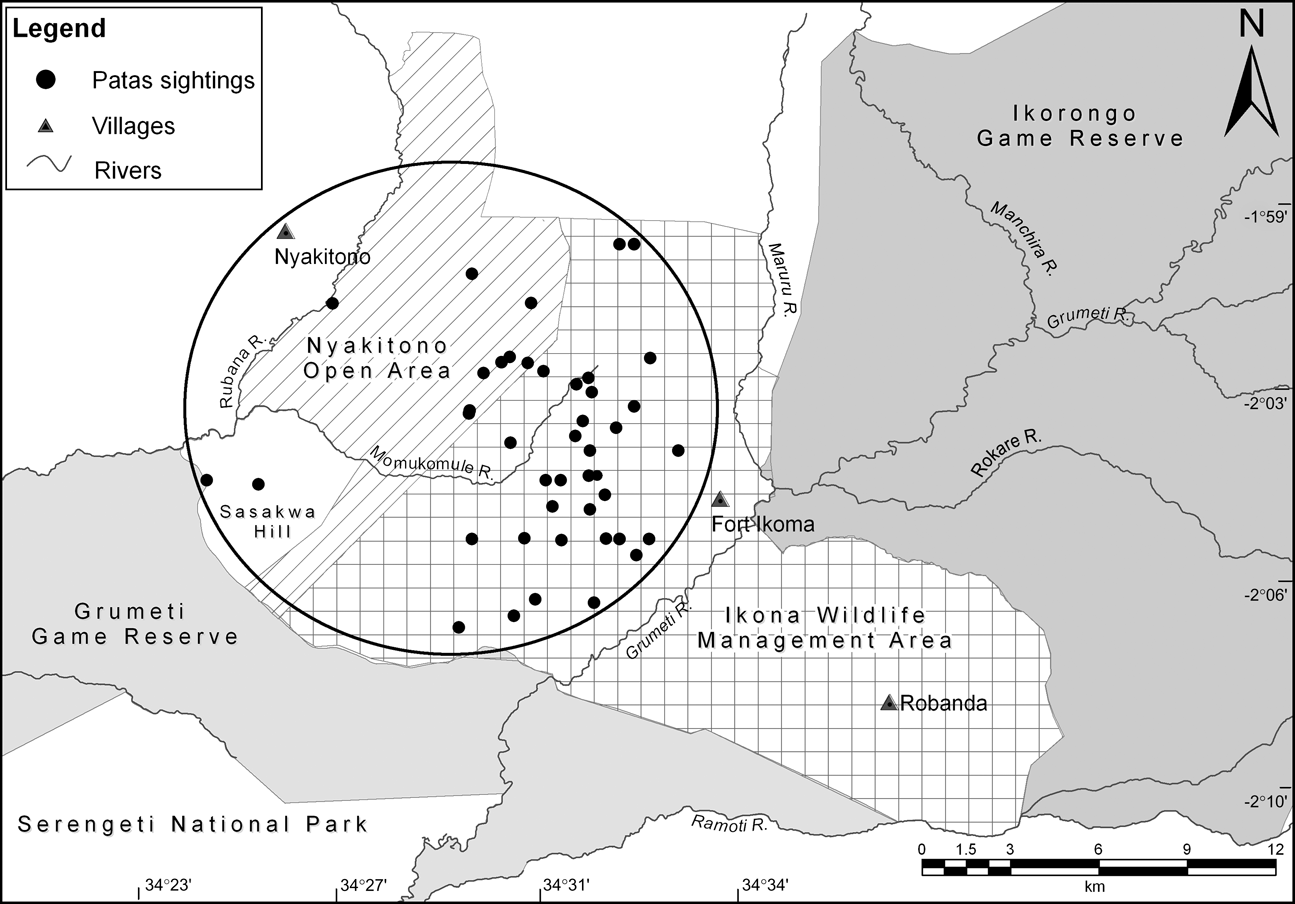
For the purposes of this article the western Serengeti is taken to be the area covered by the Nyakitono Open Area (92 km2), Grumeti Game Reserve (428 km2), Ikona Wildlife Management Area (255 km2) and Ikorongo Game Reserve (567 km2). This area was chosen for survey based on reports by R. Radke (pers. comm.) in 1998 of patas in the western Serengeti. The vegetation in the western Serengeti includes open grassland plains, medium-dense Acacia/Balanites woodland-bushland, and riverine forest along the Grumeti River. Three rivers (Grumeti, Momukomule and Rubana) provide water to the area (Fig. 1). Even during the driest periods these rivers usually provide widely scattered pools of water. The Rubana River, along the western boundary of the Nyakitono Open Area (Fig. 2), is considered the most important wildlife water source in the area. One water trough in this area serves as a permanent water source for wildlife.
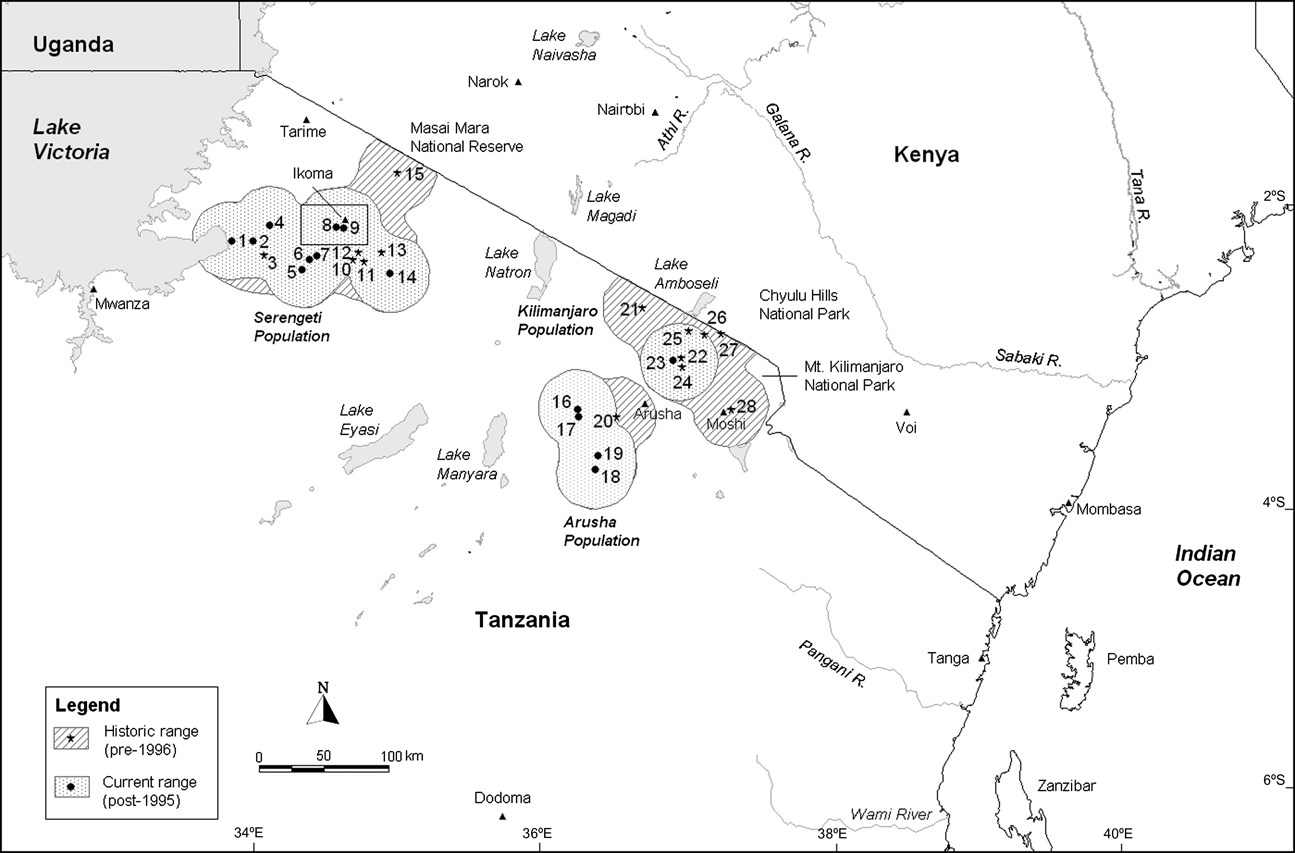
The known historical (pre-1996) and current (post-1995) distribution of the southern patas monkey E. p. baumstarki in Tanzania. The shaded area around each site has a radius of 30 km. The rectangle indicates the position of the map in Fig. 2. See Table 1 for further details of each numbered site.

Methods
Data collection
Data were collected on the historical and current distribution of the southern patas using several approaches: literature surveys, museum reviews, interviews with people in the area, and a reconnaissance survey. Museums were contacted to obtain specimen data, and the primate collections at the US National Museum of Natural History (Washington, DC), American Museum of Natural History (New York), British Museum of Natural History (London), and National Museums of Kenya (Nairobi) were visited. Rangers, naturalists, researchers, ranch owners/managers, tour operators, camp/lodge managers, and local people were interviewed about the presence and abundance of the southern patas, and for details of their encounters with patas. More than 120 people were questioned by e-mail or in person. Requests for information on patas in Tanzania were also published in Swara, the magazine of the East African Wildlife Society (De Jong, Reference De Jong2006), and in the Tanzanian Mammal Atlas Project Newsletter (Tanzanian Wildlife Research Institute).
We conducted surveys in the western Serengeti, north-west Tanzania (02°01′ to 02°07′ S; 34°28′ to 34°38′ E; 1,270–1,480 m altitude; Figs 1 & 2) during 4–6 October 2005. A total of 12.6 h were spent searching for patas along a 98 km transect. The mean rate of travel, acquired from a global positioning system, was 14 km h-1. The single encounter with patas was recorded (date, time, coordinates, group size, group composition, and vegetation type) until the group moved out of sight. The survey team consisted of two observers (YDJ & TMB) and two trained field guides, both of whom had previously observed patas several times in the area.
Distribution mapping
Data on sightings of patas were categorized as either historical (before 31 December 1995; referred to here as pre-1996) or current (after December 31 1995; referred to here as post-1995). This distinction was made as a first attempt to determine the trend of these patas populations. A zone with a radius of 30 km was arbitrarily selected and plotted around each locality point to simulate the distribution of patas at each locality. All distribution records were mapped using the software Garmin MapSource v. 6.10.2 (Garmin, Olathe, USA) and MapInfo Professional v. 8.0 (Pitney Bowes Mapinfo, Troy, USA).
Results
Historically, patas have been rarely encountered (or, at least, rarely reported) in Tanzania. Museum specimens are scarce. The British Museum of Natural History holds two specimens from Tanzania: an adult female from Ikoma and an immature female from west Mt Kilimanjaro (Napier, Reference Napier1981). The Natural History Museum, Berlin, houses six specimens/skulls (five from Ikoma and one from Moshi; R. Asher, pers. comm.). There are no specimens of patas from Tanzania at the United States National Museum, the American Museum of Natural History or the Field Museum of Natural History, Chicago.
We obtained a total of 28 localities in which patas are known to occur, of which 14 are pre-1996 and 14 are post-1995. Of the 14 historical records, six (43%) are in the Serengeti, seven (50%) are in the vicinity of Mt Kilimanjaro, and one (7%) is south-west of Arusha. Of the 14 current records, nine (64%) are in the Serengeti, one (7%) is in the vicinity of Mt Kilimanjaro, and four (29%) are south-west of Arusha (Fig. 1, Table 1). An additional 12 sources (both historical and current) refer to patas within the Serengeti National Park, and an additional seven sources refer to patas within the Mt Kilimanjaro area (Table 1) but these 19 sources provide insufficient information to plot localities.
Historical (pre-1996) and current (post-1995) records for the southern patas monkey E. p. baumstarki in Tanzania. Site numbers correspond to the site numbers in Fig. 1.

* H, historical; C, current
It appears that southern patas historically occurred in three populations, all of which were in central north Tanzania. These populations are referred to here as the Serengeti (which includes the western Serengeti), Kilimanjaro and Arusha populations (Fig. 1, Table 1). Together, these three populations historically occupied c. 30,800 km2 within a geographical range encompassed by 01°28′–04°02′ S and 33°36′–37°37′ E (800–1,580 m), where mean annual rainfall is 25–105 cm (Table 2). The current geographical range is estimated to be c. 20,700 km2, encompassed by 01°28′–04°02′ S and 33°36′–37°25′ E (950–1,580 m). Table 2 presents more details of the three populations.
Distribution, habitat and abundance of the southern patas monkey E. p. baumstarki in Tanzania.

* Patas group size in Laikipia, Kenya, is 13–74 individuals (Chism & Rowell, Reference Chism, Rowell, Gauthier-Hion, Bourlière, Gautier and Kingdon1988). This range is applied here to estimate the number of patas in each of the three populations.
Serengeti population
In the Serengeti researchers rarely encountered patas. G. Frame (pers. comm.) never encountered patas during 9 years of fieldwork there (1965–1966, 1972–1978 and 1993). H. and U. Klingel (pers. comm.) spent 3 years (1996–1965) conducting field work in the Serengeti and Ngorongoro Crater and never encountered patas. G. Schaller (pers. comm.) saw patas only rarely during his 3.3 years (1966–1969) of research in the Serengeti. D. Kreulen (pers. comm.) saw patas in A. drepanolobium woodland while working in the Serengeti during 1970–1975. He only encountered patas occasionally in the woodland areas in the west and north of the Serengeti during those years.
In contrast, employees of the Grumeti Community, the Wildlife Conservation Fund, and the Tourism Guides of Singita Grumeti Reserves provided 48 records (total of 261 patas seen) for the Nyakitono Open Area, western Serengeti, from 1 January 2005 to 31 July 2007 (Fig. 2). All patas records in the Nyakitono Open Area are within an area of c. 150 km2. The habitat used by patas here is woodland dominated by A. drepanolobium and Acacia seyal. The distances from the patas encounter sites to the permanent water source at the Rubana River were 0–13.5 km. Although the staff and guides spend time in the Grumeti Game Reserve, Ikorongo Game Reserve and the Ikona Wildlife Management Area, they have not encountered patas in these areas or south of the Grumeti River.
During our survey in the western Serengeti we encountered only one group of patas, in the Nyakitono Open Area at 17.50 on 4 October 2005. The group comprised one adult male and one adult female with a clinging young. This group was 5.0 km and 10.7 km from the two nearest permanent water sources, and 1.2 km north of the Grumeti River.
Kilimanjaro population
Hill (Reference Hill1966) and Williams (Reference Williams1987) do not mention patas in the Kilimanjaro area but Swynnerton & Hayman (Reference Swynnerton and Hayman1951), Swynnerton (Reference Swynnerton1958), Kingdon (Reference Kingdon1971), Lernould (Reference Lernould, Gauthier-Hion, Bourlière, Gautier and Kingdon1988) and Grimshaw et al. (Reference Grimshaw, Codeiro and Foley1995) do. There is only one recent sighting of patas in this area, at Tingatinga in 2001 (P. Jones, pers. comm.; Fig. 1, Table 1).
Arusha population
Swynnerton & Hayman (Reference Swynnerton and Hayman1951), Hill (Reference Hill1966), Kingdon (Reference Kingdon1971) and Lernould (Reference Lernould, Gauthier-Hion, Bourlière, Gautier and Kingdon1988) mention patas in the vicinity of Arusha, whereas Swynnerton (Reference Swynnerton1958), Williams (Reference Williams1987) and Grimshaw et al. (Reference Grimshaw, Codeiro and Foley1995) do not. Current sightings indicate that this population persists. Patas were seen at least four times between 1987 and 2000 at Mt Burko (Fig. 1, Table 1) in groups of > 14 individuals (D. Peterson, pers. comm.). D. Erickson and A. Ambrose (pers. comms) encountered patas at Mt Burko ‘…very regularly … for many years. There is only one group of about 20–30 individuals.' The last encounter in this area by D. Erickson and A. Ambrose (pers. comms) was in 2007. Patas were also seen two or three times within the last 10 years in the vicinity of Mt Lolkisale (Fig. 1, Table 1; D. Peterson, pers. comm.). All encounters with patas in this area were in A. drepanolobium dominated woodland on ‘black cotton’ soils.
Discussion
Available records indicate that patas have, in historical times, always occurred at low densities in Tanzania, as they do in Kenya (Isbell & Chism, Reference Isbell and Chism2007; De Jong et al., Reference De Jong, Butynski and Nekaris2008). Historically, it appears that the southern patas occurred in three populations in a total area of c. 30,800 km2 (Table 2), i.e. c. 3.5% of Tanzania's land surface area. These three populations still exist but the size of their combined geographical ranges has declined to c. 20,700 km2, or c. 67% of the historical range (c. 2.3% of Tanzania's land surface area). Based on a 1905 record, Tappen (Reference Tappen1960) indicated that the southern limit of patas in Tanzania was Ikoma (2° S, 35° E). Hall (Reference Hall1965) reported the southern limit to be at c. 3° S. This review places the southern limit at 4° S (Fig. 1), 180–210 km further south than indicated by Tappen (Reference Tappen1960).
The Serengeti population of patas has always been considered to be isolated (Swynnerton & Hayman, Reference Swynnerton and Hayman1951; Swynnerton, Reference Swynnerton1958; Hill, Reference Hill1966; Kingdon, Reference Kingdon1971; Williams, Reference Williams1987; Lernould, Reference Lernould, Gauthier-Hion, Bourlière, Gautier and Kingdon1988; Grimshaw et al., Reference Grimshaw, Codeiro and Foley1995). Kingdon (Reference Kingdon1971) and Williams (Reference Williams1987) indicated that this population (and, therefore, the subspecies E. p. baumstarki) extends as far north as the Masai Mara, south-west Kenya (Fig. 1). However, during this study, and during a similar study in Kenya (De Jong, Reference De Jong2004; De Jong et al., 2008), no evidence, past or present, was found for patas in the Masai Mara. Hill (Reference Hill1966) noted that the Serengeti population probably did not extend over the Serengeti Plateau, where there is an extensive area of treeless short grassland (White, Reference White1983) that is apparently unsuitable habitat for patas. However, in 1998, an adult male was filmed at the Sametu Kopjes (Fig. 1, Table 1; R. Radke, pers. comm.). This is the easternmost record for patas in the Serengeti. Grimshaw et al. (Reference Grimshaw, Codeiro and Foley1995) mentioned the isolation of the Kilimanjaro population from the Serengeti population, and stated that patas are absent from Amboseli National Park, Kenya. We note, however, that patas were observed near Lake Amboseli until c. 1983 (De Jong et al., 2008).
The gaps between the three populations of patas in central north Tanzania appear to have increased since 1995 (Fig. 1). The distance between the Serengeti population and the Kilimanjaro population was probably 140–200 km pre-1996 but now appears to be 180–240 km. The Serengeti population is separated from the Kilimanjaro and Arusha populations by the Eastern (Gregory) Rift Valley, a well-known barrier to the distribution of primates in East Africa (Butynski & de Jong, Reference Butynski and de Jong2007). Here lie Lake Natron, Lake Manyara, the vast, treeless, short grass plains of the Serengeti Plateau, and the highlands of the Ngorongoro Crater with its montane forest. The distance between the Serengeti population and the Arusha population remains 120–180 km. No evidence was found that the three populations were connected historically but the Kilimanjaro and Arusha populations were probably connected in the not too distant past. There now appears to be a gap of c. 30–90 km between these two populations. This gap is comprised of Afromontane vegetation, bushland and thicket, and supports a high human population and highly degraded habitats. It is not known if the Kilimanjaro population is, or was, connected to the population in central south Kenya.
Patas in other parts of East Africa are reluctant to drink from rivers (Hall, Reference Hall1965; Chism & Rowell, Reference Chism, Rowell, Gauthier-Hion, Bourlière, Gautier and Kingdon1988). In many areas in Kenya patas have the option of drinking from cattle troughs, water tanks, or dams (Chism & Rowell, Reference Chism, Rowell, Gauthier-Hion, Bourlière, Gautier and Kingdon1988; Isbell & Chism, Reference Isbell and Chism2007; De Jong, et al., Reference De Jong, Butynski and Nekaris2008). Water provisioning on cattle ranches in Kenya may be beneficial for the survival of the species in Kenya (Isbell & Chism, Reference Isbell and Chism2007; De Jong et al., Reference De Jong, Butynski and Nekaris2008). Patas do drink from rivers and streams in Senegal (Dupuy, Reference Dupuy1973). We believe that patas in the western Serengeti drink from pools in the Rubana River and, possibly, Grumeti River, as these have historically been the only sources of water available to them during the dry season.
In Kenya patas are closely associated with A. drepanolobium woodland (Isbell, Reference Isbell1998; Isbell & Young, Reference Isbell and Young2007). Recent encounters with patas in all three populations in Tanzania were also in A. drepanolobium woodland, with the exception of the Sametu Kopjes (Fig. 1, Table 1) where patas were seen in grassland (R. Radke, pers. comm.). In the western Serengeti A. drepanolobium occurs south-east of Rubanda Village in the Ikona Open Area and in the Ikorongo Game Reserve but no patas sightings were reported from these areas.
In Tanzania patas occur mainly in semi-arid Acacia woodland. This habitat is threatened by degradation, loss and fragmentation, as well as by loss of species (Emerton & Mfunda, Reference Emerton and Mfunda1999; Kabigumila et al., Reference Kabigumila, Mvungi and Nahonyo2005). The Acacia woodlands within the range of the patas populations of Kilimanjaro and Arusha continue to be lost as a result of the activities of the rapidly growing human population. If trends continue, habitat degradation and loss are expected to reduce and isolate Tanzania's three populations of patas further. The minimum number of groups of southern patas at present is 12, and the number of individuals remaining is probably 150–900 (Table 2).
Patas is categorized as Least Concern on the IUCN Red List (IUCN, 2008) but the southern patas Erythrocebus patas baumstarki has yet to be assessed. Based upon its small, declining, and fragmented distribution (< 20,700 km2), low number (< 900 individuals), and decline in geographical range (33% since 1995), E. p. baumstarki should be categorized as Endangered on the basis of criteria C2ai (IUCN, 2001).
Our study represents a preliminary step towards the conservation of the southern patas. Priority actions for the long-term conservation of this taxon are: (1) Establish a network of interested people throughout the subspecies' range to monitor the size and age/sex composition of the groups of patas they encounter, with the resulting data compiled in PatasBase, a database for patas conservation (De Jong & Butynski, Reference De Jong and Butynski2008). (2) Interview members of communities throughout central north Tanzania to assess further the taxon's distribution and abundance and to gain insights into patas habitat and water source use, crop raiding and threats. (3) Conduct a detailed field study of distribution and abundance to assess the taxon's conservation status, determine threats and establish a baseline for monitoring. (4) Undertake a detailed ecological and behavioural study. (5) Prepare a conservation action plan and have this plan implemented by the responsible management authorities in Tanzania.
Acknowledgements
We thank Brian Harris, Ed Sayer, and Lee Fuller of the Grumeti Community and Wildlife Conservation Fund for their assistance during our visit and for sharing their data on patas in the western Serengeti. The field surveys were supported by a grant from the National Geographic Society to LAI and by Conservation International. We also thank Robert Asher, Daphne Hills, Paula Jenkins, Jean-Pierre Dekker, George Frame, David Erickson, Gerard Ambrose, David Peterson, Chris Parker, Alastair Kilpin, Antonio Sirolli, Hugh Marshall, Peter Mbari, Anthony Kaschula, Dirk Kreulen, George Schaller, Peter Jones, Kim Howell, Neil Stronach, William Newmark, Richard Estes, Alan Rodgers, Tom Struhsaker, Reinhard Radke, Charles Foley, Hans and Ute Klingel, Truman Young, Michelle Hutt, Anabel and Geoff Harries, and James Croft for unpublished information on their observations of patas. We also thank two anonymous reviewers for their valuable comments on the manuscript.
Biographical sketches
Yvonne A. de Jong studies the distribution, taxonomy and conservation status of the primates of eastern Africa. Thomas M. Butynski has long been involved with primate research and conservation in tropical Africa, especially in eastern Africa and on Bioko Island, Equatorial Guinea. His current research focuses on questions related to primate distribution, taxonomy and conservation status. Lynne A. Isbell has focused her field research on the behaviour and ecology of primates in East Africa since 1980. Her more recently developed interests include reconstructing relationships between primates and their predators over evolutionary time. Claire Lewis is based in the western Serengeti, working in wildlife management, conservation and law enforcement.