

Introduction
In February 2022, US President Biden nominated Ketanji Brown Jackson to serve as judge on the US Supreme Court. When searching for candidates, Biden was very explicit about the fact that he was going to nominate a Black woman to the position. The new Supreme Court judge had to be not only an excellent legal expert, but also a woman and Black. Similarly, expert task forces established in the early phases of the COVID-19 pandemic were scrutinized not only for their medical expertise but also for their gender composition (Van Daalen et al. Reference Van Daalen, Bajnoczki, Chowdhury, Dada, Khorsand, Socha and Lal2020). For instance, when the Italian government appointed an all-male technical-scientific committee to provide advice on how to contain the spread of the virus, the lack of gender balance was criticized in the media, which eventually led to a number of female medical experts being appointed to the committee (Capano et al. Reference Capano, Casula, Malandrino, Terlizzi and Toth2022).
These examples illustrate a growing concern with descriptive representation in expert institutions (e.g., Krick Reference Krick2021; Moore Reference Moore2017): It is increasingly expected that such institutions should offer not only the best professional or academic expertise — for example, legal expertise in courts or medical expertise in pandemic advice — but also be composed in a way that reflects the population they serve, in terms of gender, race, etc. (Holst and Langvatn Reference Holst and Langvatn2021, 473; Mansbridge Reference Mansbridge1999, 629; see also Campbell, Childs, and Lovenduski Reference Campbell, Childs and Lovenduski2010). However, this expectation is in tension with the traditional approach — which has maintained that selection to expert institutions should be based on merit and qualifications only — and thus apparently disregards the worry that descriptive representation may contribute to reduced competence levels (e.g., Cavanagh Reference Cavanagh2002; Pennock Reference Pennock1979; see also Mansbridge Reference Mansbridge1999, 630). The traditional approach remains popular in segments of the citizenry (see e.g., Bertsou and Caramani Reference Bertsou and Caramani2022), and continues to inspire right-wing politicians, including populist leaders in their recent mobilization against so-called DEI (diversity, equity, and inclusion). However, the traditional approach also persists as an underlying assumption in scholarly discourse, for instance in philosophical discussions of what constitutes “true” expertise (e.g., Goldman Reference Goldman, Goldman and Whitcomb2011; Grundmann Reference Grundmann, Lackey and McGlynn2024).
We take up the issue of descriptive representation among experts in public institutions, addressing especially the proposed tension between representation and competence, and zooming in on expert advisory bodies — that is, temporary or permanent expert bodies appointed by governments or international organizations to provide analysis and advice on public policy. While government-appointed, these bodies usually operate outside the regular bureaucratic structure and enjoy a (semi-)independent status. They are often hybrid in membership — that is, composed of a mix of academics/researchers, civil servants, and interest group representatives — but may also have purely scientific membership, such as science advice committees. In many settings, expert advisory bodies play an important role in the formulation of public policy. Examples include the European Commission’s expert group system (Gornitzka and Sverdrup Reference Gornitzka and Sverdrup2011), ad hoc advisory commissions in the Nordic countries (Christensen and Holst Reference Christensen and Holst2017), and the scientific advisory councils and expert task forces that were established during the COVID-19 pandemic to give advice on how to prevent the spread of the coronavirus (Christensen, Holst, and Molander Reference Christensen, Holst and Molander2022; Van Daalen et al. Reference Van Daalen, Bajnoczki, Chowdhury, Dada, Khorsand, Socha and Lal2020).
With this focus, and concentrating on women’s (and men’s) presence on expert advisory bodies, and so on gender — a key dimension of descriptive representation — this paper examines two questions: (1) How has descriptive gender representation on expert advisory bodies developed over time? (2) How should the observed patterns be assessed from a normative point of view? The questions are investigated in the context of Norwegian ad hoc advisory commissions. Norway is located at the top of European and global gender equality indexes in part due to the substantial presence of women in public institutions (Skjeie and Teigen Reference Skjeie and Teigen2017). However, international comparisons and assessments seldom consider women’s role in expert advice. Relying on a large-n dataset with information on the gender composition of more than 1,500 Norwegian advisory commissions appointed over nearly half a century (1968–2017), we trace and evaluate trends over time in the presence of women within a key pillar of governance.
We find that the share of women on advisory commissions has increased steadily and practically reached parity in the 2010s, a development that has coincided with the introduction and progressive tightening of gender quota rules. Proportional gender representation — or gender parity — has also been reached among civil servants and interest groups and civil society representatives on commissions, and the female share among academics on commissions has reached 40%. These developments are all promising, and importantly, we find no confirmation of the worry that increased proportionality compromises competence requirements. However, we find that women remain under-represented among commission chairs, and especially among academic chairs, and among academic members from economics, a particularly influential policy discipline in Norway. Such gender gaps contribute to skewing the interest and value articulation that take place in these commissions, and have unfortunate symbolic effects, signaling that women are not equally fit to be leaders. Yet, the most serious negative effect is likely to be reduced levels of expertise. In this case, it is hence too little (and not too much) parity that endanger the fulfillment of competence requirements, and the worries of the traditional approach seem unwarranted.
The paper makes two main contributions. First, it fills a gap in existing empirical scholarship on gender representation by systematically examining the gender composition of expert advisory bodies. To our knowledge, this is one of the very first large-n studies of descriptive representation on expert groups. Second, the paper offers an in-depth normative assessment of the identified patterns of representation, resisting the temptation to regard such patterns as either problematic or promising as such, irrespective of cost-benefit considerations, context features, and empirical detail (see also Swift Reference Swift2004).
With respect to scholarship more broadly speaking, we hope our study will inspire more analyses of gender inequality that include expert institutions, and a continued focus on scrutinizing patterns of (under-)representation, even in countries that are perceived to be gender equality forerunners. Our study also relies on a, we believe promising, mixed design that combines empirical and normative analysis, and that we hope can be put to wider use. With respect to practice, our findings suggests a need for more fine-grained measures and policies to improve representative credentials.
The paper proceeds as follows. The next section positions our investigations in relation to previous studies and literatures. We also present a set of normative considerations that figure prominently in discussions of descriptive representation and spell out how these considerations play out in the case of expert advisory bodies. The following section introduces the empirical context of our study: gender equality and advisory commissions in Norway. This is followed by the methods section, which outlines our research design — a combination of empirical and normative analysis — and describes the data, sample, variables, and empirical analysis strategy. We then present the results of the empirical analysis, before providing the normative discussion and evaluation of the identified trends. The concluding section addresses some limitations and elaborates on the broader implications of our study.
Previous Studies and Theory
Descriptive Representation on Expert Advisory Bodies: Gender
The disproportional social composition of contemporary elites has received immense public and scholarly attention (e.g., Rahman Khan Reference Shamus2012). Gaps in the presence of different groups in positions of power is seen by many as a sign that democracy is not living up to its promise, but also as constituting a massive waste of talent (e.g., Arnesen and Peters Reference Arnesen and Peters2018). A key question has been women’s presence. Previous research has examined the descriptive representation of women — that is, the extent to which women’s share of positions reflect their share of the population — on corporate boards and in top manager positions (e.g., Matsa and Miller Reference Matsa and Miller2011; Teigen Reference Teigen, Engelstad and Hagelund2015), in cabinets and parliaments (e.g., Dahlerup Reference Dahlerup2018; O’Brien Reference O’Brien2015), in elite positions in the media (e.g., Falk and Grizard Reference Falk and Grizard2005), civil society organizations and interest groups (e.g., Seibicke Reference Seibicke2020; Strolovisch Reference Strolovitch2006) and academia (e.g., Carlsson et al. Reference Carlsson, Finseraas, Midtbøen and Rafnsdóttir2021; Thege et al. Reference Thege, Popescu-Willigmann, Pioch and Badri-Höher2014), in the higher ranks of the bureaucracy (e.g., Bowling et al. Reference Bowling, Kelleher, Jones and Wright2006; Dolan Reference Dolan2000), and in courts (e.g., Grossman Reference Grossman2012; Holst and Langvatn Reference Holst and Langvatn2021).
Patterns are varied and developments not always linear. In some polities the share of women in important positions has increased over time, sometimes reaching parity. In other cases, women remain significantly under-represented (e.g., Dahlerup Reference Dahlerup2018). Even in polities where the share of women in elite positions increases, there tends to be gender segregation. For instance, studies have found more female parliamentarians in areas such as family and consumer policy, while male parliamentarians are over-represented in economic policy (e.g., Wängnerud Reference Wängnerud2015), and male dominance among professors in some academic disciplines, such as within economics, philosophy, and several of the natural sciences, while there is gender parity or female over-representation in branches of sociology and educational science (e.g., Rosa and Clavero Reference Rosa and Clavero2022).
Existing studies have by now also addressed gender representation in expert institutions such as public bureaucracies and courts. The literature on “representative bureaucracy” (see Riccucci and Van Ryzin Reference Riccucci and Van Ryzin2017 for an overview) investigates gender representation in public administration and how this conditions the policy decisions and legitimacy of bureaucracies (e.g., Dolan Reference Dolan2000; Keiser et al. Reference Keiser, Wilkins, Meier and Holland2002; Riccucci and Meyers Reference Riccucci and Meyers2004), while studies of the gender composition of courts focus on how gender affects judges’ case portfolio, decisions and priorities, and courts’ credibility and trustworthiness (e.g., Grossman Reference Grossman2012; Langford, Behn, and Lie Reference Langford, Behn and Lie2017; Otto Reference Otto, Orford and Hoffmann2016). However, we so far lack systematic examinations of gender and descriptive representation in expert advisory bodies, despite the growing importance of such bodies in contemporary governance (Christensen, Holst, and Molander Reference Christensen, Holst and Molander2022).
Certainly, feminist political science research has delivered descriptions and analyses of the proper role of “gender experts” and “state feminist machineries” in the advancement of gender equality (Hernes Reference Hernes1987; Hoard Reference Hoard2015; Lovenduski Reference Lovenduski2005; Woodward Reference Woodward, Christiansen and Piattoni2004). Feminist science and technology studies (STS) has also investigated and diagnosed the intersections of gender, culture, and power at the science-policy nexus (for overviews, see Fishman, Mamo, and Grzanka Reference Fishman, Mamo, Grzanka and Felt2017; Pollock and Subramaniam Reference Pollock and Subramaniam2016). Still, these branches of scholarship seldom rely on quantitative data on gender representation or focus specifically on the more detailed normative implications of various patterns. Furthermore, existing research that zooms in on expert advisory bodies specifically has examined various aspects of the composition of these bodies, such as the role of scientists versus bureaucrats and interest groups or the disciplinary composition of these groups (e.g., Christensen and Hesstvedt Reference Christensen and Hesstvedt2019; Gornitzka and Sverdrup Reference Gornitzka and Sverdrup2011; Krick Reference Krick2015), and the normative consequences of variation in such composition (Christensen and Holst Reference Christensen and Holst2017; Holst and Christensen Reference Holst and Christensen2024). However, with a few exceptions (e.g., Guldvik Reference Guldvik2011; Van Daalen et al. Reference Van Daalen, Bajnoczki, Chowdhury, Dada, Khorsand, Socha and Lal2020), the gender composition of these bodies has not been scrutinized and assessed.
Finally, there is a considerable literature in normative political theory on descriptive representation, often with gender as a key concern (e.g., Childs Reference Childs2006; Dahlerup Reference Dahlerup and Naples2016; Grey Reference Grey2006; Mansbridge Reference Mansbridge2003; Reference Mansbridge2011; Phillips Reference Phillips2012; Reference Phillips, Rohrschneider and Thomassen2019; Young Reference Young, Shapiro and Kymlicka1997). This literature has produced a set of initially plausible general arguments regarding the normative effects of such representation, and in what follows we will concentrate on four of them — three important proposed advantages of descriptive representation, and one potential cost: the traditional worry that descriptive representation will compromise competence and expertise.
However, as increasingly recognized also among theorists, normative arguments are empirically conditioned. This has spurred an increased interest in empirical research and testing to bridge normative theorizing and empirical political studies (e.g., Forst Reference Forst2018; Herzog Reference Herzog2023). This goes for inquiries of descriptive representation as well, where the more exact weight of general normative arguments must be conceived of as “contingent” on empirical conditions and context (classically stated by Mansbridge Reference Mansbridge1999) — as will be outlined below.
In addition, the particular functions of the institution under scrutiny must be considered (Erman Reference Erman2018). That is, whether proportionality is advantageous, or more costly, will also depend on what the arenas or bodies in question are for. Institutional purpose or function has been put center stage in political theorists’ normative discussions of descriptive representation in legislative bodies — for instance, when the role of proportional presence is discussed in relation to such bodies’ more varied set of representative functions (e.g., Mansbridge Reference Mansbridge2003; Reference Mansbridge2011; Rehfeld Reference Rehfeld2011). Descriptive representation has been discussed and theorized in a similar vein in relation to other institutions, such as universities (see e.g., Anderson Reference Anderson1995 on the relationship between balanced group presence and universities’ truth-seeking functions) and courts (e.g., Holst and Langvatn Reference Holst and Langvatn2021 on descriptive representation and courts’ primary adjudicative function). Our focus will be on expert institutions — and expert advisory bodies specifically — a type of institution with a distinctive set of ranked functions — to be elaborated below — that normative considerations regarding patterns of descriptive representation must take into account. Such bodies have so far been given scant attention in normative discussions of descriptive representation, despite the centrality of such institutions in contemporary democracies, and even as their representativeness has turned into a salient issue both in public debate and scholarship (e.g., Brown Reference Brown2009; Krick Reference Krick2021).
Gender Representation: Normative Assessment in Context
Three Benefits and a Cost — and Their Empirical Conditions
The first of the general arguments we will consider is the well-known argument in favor of descriptive representation stating that such representation can contribute to increased substantive representation (Mansbridge Reference Mansbridge1999). This means in the case of gender, that close to 50/50 distributions of positions between women and men, or at least a “critical mass” from both genders (Dahlerup Reference Dahlerup1988; Kanter 1977; for a critical discussion, see Childs and Krook Reference Childs and Krook2008), is likely to result in a better representation of both women’s and men’s interests and value priorities (McEvoy Reference McEvoy2016). This is in part because social group origins can be expected to shape values and interests and lead group members to promote policies that will benefit the group — for example, women promoting policies that benefit women in the general population (e.g., Riccucci and Van Ryzin Reference Riccucci and Van Ryzin2017). But descriptive representation can also contribute to better communication between the represented and the representatives, as people belonging to the same social categories such as gender may have overlapping experiences and perspectives that make them trust one another and communicate more easily (Mansbridge Reference Mansbridge1999, 641; Riccucci and Van Ryzin Reference Riccucci and Van Ryzin2017, 25). This may in turn facilitate the transformation from descriptive (“passive”) representation to substantive (“active”) representation.
However, the extent to which descriptive representation leads to substantive representation is empirically conditioned (e.g., Childs and Krook Reference Childs and Krook2009; Franceschet, Krook, and Piscopo Reference Franceschet, Krook and Piscopo2012; Wängnerud Reference Wängnerud2009). For one thing, the connection is likely to be strengthened if the position in question gives the representative real influence on decisions and policies. This will be the case not least with leadership positions: “Gender representativeness in leadership” — for instance in high-level positions in bureaucracy or in expert bodies — “is particularly important” since it gives representatives “high levels of discretion as well as the resources to influence governmental decision-making directly” (Groeneveld, Bakker, and Schmidt Reference Groeneveld, Bakker and Schmidt2020, 442). Second, descriptive representation can more easily affect interest and value promotion, and so turn substantive, when position holders are expected to represent and promote interests and values. This would typically be a key expectation to elected politicians in parliaments. and to civil society or interest group representatives who take part in policy advice, but not for instance to the scientific expert expected to advise the government primarily based on academic knowledge and technical skills.
A second normative benefit of relatively proportional patterns of representation of gender and other central societal groups in positions of influence is how they contribute to signaling that all citizens have equal moral worth and are at the outset equally fit to participate in governing (Alexander Reference Alexander2012; Montoya et al. Reference Montoya, Bejarano, Brown and Gershon2022). Yet, once more, the significance of such positive symbolic effects is probably empirically variable, and dependent not least on the influence and visibility of the positions: Positive symbolic effects are likely to be larger when positions are more influential and visible and smaller when representatives are less powerful and more hidden from the public (Groeneveld, Bakker, and Schmidt Reference Groeneveld, Bakker and Schmidt2020). For instance, the positive symbolic effect of gender parity would tend to be stronger in the case of the parliament than in an administrative regulatory unit, and stronger for highly visible positions as chief scientific advisors or advisory commission chairs than in the case of less visible commission and secretariat members.
The third advantage we will consider is that a more proportional representation of groups provides governing bodies with more relevant, unbiased — and thus better — expert knowledge, and so contributes to increasing levels of competence and expertise. Here, the general argument is that members of under-represented groups would be more likely to develop expertise — concepts, theories, models, investigatory designs, knowledge reviews, etc. — less influenced by the biases of dominant groups (see also e.g., Groeneveld and Van de Walle Reference Groeneveld and Van de Walle2010 on “the business case for diversity” and Crasnow Reference Crasnow, Cartwright and Montuschi2014 on the “standpoint theory of objectivity”). The development of gender studies and feminist theory is for instance intimately connected to the increasing share of female scientists in academia; female bureaucrats have been central for developing “gender expertise” in policymaking and “gender mainstreaming” in governance (Hoard Reference Hoard2015); and female lawyers have been key for advancing legal categories and interpretative schemes so they better capture sexual abuse, domestic violence, and other offenses that often have harmed women (Holst and Langvatn Reference Holst and Langvatn2021).Footnote 1 Hence, plausibly, when under-represented groups remain marginalized, this may hamper the development and use of such novelties in expertise, while broader representation is likely to facilitate it.
However, yet again the significance of this potential benefit of descriptive representation is likely to be empirically conditioned. Generally, positive effects on levels of competence and expertise are more vital when expert input is the primary expectation to position-holders — for instance in the case of civil servants in a regulatory agency or scientists participating or chairing expert committees — than when the expected contributions are primarily opinions, interest representation, etc., such as in the case of parliamentarians or civil society representatives. In addition, the benefit of improved expertise will grow when expertise providers are influential — for example, have leadership positions or belong to powerful policy professions — compared to when they take less powerful positions.
Finally, the traditional approach, which argues that descriptive representation is costly as it may contribute to reducing the levels of competence and expertise, must be considered. The general contention underlying this worry is that “adding any criterion (…) to (the) mix of criteria for selection” — such as gender, nationality, or other descriptive criteria — “will always dilute to some degree the impact of (…) other criteria of selection” (Mansbridge Reference Mansbridge1999, 633), such as merit and the best available competence. This may especially be the case in smaller bodies, such as in a regulatory task force or an advisory commission, where the seats to be distributed are relatively few, and where it is thus difficult to accommodate multiple selection criteria. Yet even a study of recruitment to the European Commission bureaucracy, a large executive, found that the emphasis on specialist expertise in recruitment competitions dropped when geographical representativeness criteria were introduced (Christensen, van den Bekerom, and van der Voet Reference Christensen, van den Bekerom and van der Voet2017).
The extent to which such a cost will apply will be empirically conditioned in other respects as well. First, the costliness will be contingent on the empirical composition of the recruitment pool. On the one hand, if the availability of candidates of under-represented groups with the needed qualifications and skills are scarce, it is more likely that descriptive representation and expertise requirements will conflict. On the other hand, there is little reason to suspect such conflicts to occur if the recruitment pool contains a sufficient mass of reassuringly qualified and knowledgeable candidates with varying group backgrounds. Second, the size of this pool will again depend on the exclusiveness of the competence and expertise needed. In some cases, many would qualify sufficiently for a position without much advanced specialist expertise, for instance a position as parliamentarian, or as civil society or citizens’ representative. Here, trading off this or the other skill or merit to improve descriptive representation, would have limited effect on performance. Other times, the required level of competence and the amount of needed expert knowledge to execute properly the tasks that come with a position may be considerable, for instance when scientists are asked to advise governments on issues that require specialist competence. Here, trading off expertise levels to increase representation may have larger effects on performance, and so be more costly. Third, the costs of replacing the best available experts with more representative position-holders would be the largest in cases where position-holders are particularly influential, for instance because they have leadership positions, or belong to professions or expert communities known to have large impact in the policy area.
The Functions of Expert Advisory Bodies
Finally, the normative force of all these four general arguments will depend not only on empirical factors and context, but also on the particular role or function of the institution under assessment (Erman Reference Erman2018). Institutions may have several functions, but some more essential than others. For instance, whereas a defining function of legislative bodies is the democratic function of safeguarding and ensuring citizens’ political equality and self-government, the primary function of expert institutions is rather epistemic, and the key role of expert advisory bodies specifically — as we will elaborate below — is to provide analysis and advice informed by relevant expert knowledge (Holst and Christensen Reference Holst and Christensen2024).
However, such bodies have at least two non-trivial secondary functions as well. First, they too (just as e.g., legislative bodies) need to have democratic legitimacy, as they contribute not only with technical and science-based advice, but also with value- and interest-based interpretations and priorities that may affect citizens considerably (see Christiano Reference Christiano, Parkinson and Mansbridge2012 for the standard argument on why democracies must leave citizens “in the driver’s seat” of value considerations). Second, as all public institutions, expert advisory bodies should perform and be organized in ways that ensure trust and support among citizens over time (Rothstein Reference Rothstein2011). In addition to their primary epistemic function, expert advisory bodies must hence contribute to democratic enhancement and be trust-inducing.
In line with this, what matters most for the assessment of descriptive representation in expert advisory bodies are the effects — positive and negative — of descriptive representation on these bodies’ ability to cultivate and deliver apt high quality, knowledge-based advice. Accordingly, the potential benefit of increased levels of expertise, but also the possible cost of reduced expertise levels, should be given extra weight in the calculus. At the same time, the other benefits of descriptive representation cannot be disregarded. To the extent that the analyses and advice of advisory bodies involve considerations of interests and values, substantive representation of under-represented groups must be adequately ensured, for democratic reasons and for sustaining public trust. Similarly, both democratic enhancement and trust inducement speak in favor of composing and designing commissions in ways that signal symbolic support for the idea that all groups are prima facie equally fit to rule.
Empirical Context: Gender Equality and Advisory Commissions in Norway
We apply these arguments to assess patterns of descriptive gender representation on Norwegian expert advisory bodies. Norway is consistently ranked at the top of international gender equality indexes (Skjeie and Teigen Reference Skjeie and Teigen2017), largely due to the comparatively high and increasing scores on indicators that tap women’s participation in public institutions and women’s representation among elites (Engelstad et al. Reference Engelstad, Gulbrandsen, Midtbøen and Teigen2022). Such developments have been shown to be intimately connected to relatively ambitious family policies for work-life balance, along with a proactive gender equality legislation and government apparatus (Borchorst et al. Reference Borchorst, Freidenvall, Kantola, Reisel, Teigen, Kriszan, Skjeie and Squires2012; Ellingsæter Reference Ellingsæter2024), and preferential hiring and varied set of quota policies.
Still, international gender equality indexes and comparative research tend to be based on rough parameters of gender equality and have been criticized both for leaving out context and normative tensions, and for leaving subtler gender equality challenges, including among gender equality forerunners, unaddressed (e.g., Liebowitz and Zwingel Reference Liebowitz and Zwingel2014; Permanyer Reference Permanyer2015; Skjeie and Teigen Reference Skjeie and Teigen2017). The latter is a problem for the forerunners’ self-assessment and learning, but also to the extent that forerunner countries are treated as “best practice” by other countries. It is against this background that we aim to describe and assess gender representation in an expert group system which is a key public institution in Norwegian governance — yet is typically not included in international gender equality comparisons where Norway is highly ranked — and based on an assessment framework that better captures normative and contextual complexities.
We examine gender representation on Official Norwegian Commissions (Norges offentlige utredninger — NOU), which are temporary advisory commissions appointed by government to analyze policy issues and offer policy recommendations. Commissions have multiple tasks, including the integration of interest groups and civil society in policy formulation, the forging of political compromises, and the extension of administrative capacity. But in recent decades, their main role has arguably been to incorporate specialist expert knowledge in policymaking by bringing together academics from relevant domains and other experts to interpret policy problems and formulate appropriate solutions (Christensen and Holst Reference Christensen and Holst2017; Tellmann Reference Tellmann2016). Not only has the share of academics on commissions increased over time (see Empirical analysis section); commissions also produce more “academic” reports than before, with more extensive reviews of existing studies and longer reference lists. Alongside a specialist merit bureaucracy, advisory commissions are often seen as one of the main pillars of knowledge-based policymaking in Norway (Christensen and Holst Reference Christensen and Holst2017).
Official Norwegian Commissions are formally appointed, composed, and designed by the government — usually by Cabinet decision (royal decree). Parliamentary approval is not required. Commissions are made up of a chairperson and regular members, who are formally appointed by government and assigned a secretariat. The chairperson manages the work and deliberations of the commission. They are also the public face of the commission: many commissions are known simply by the name of their chairperson.
Commissions must have balanced gender representation: Since 1983, all public boards and commissions have been legally required to have “as equal as possible” representation of women and men. In 1988 this was specified to “at least 40%” of each gender. In 1996 the Ministry for Children and Families was given the power to sanction non-compliance with these rules, and in 2004 the rules were further clarified and enforcement tightened (see Hesstvedt and Skorge Reference Hesstvedt and Skorge2023 for a detailed discussion). Note that these gender quotas apply to the commission as a whole. Beyond these rules, there are few formal constraints on the selection of commission chairs and members. Commission members can be drawn both from the public service and from outside organizations such as interest groups, academic institutions, private companies, and political parties. Typically, the bureaucracy will draw up a first proposal for chairperson and members of a commission, and this list is subsequently reviewed and amended by the minister and by Cabinet.
The Norwegian system of official commissions is extensive, with on average about 35 commission reports published annually during the period we study, on topics ranging from climate legislation, defense policy, and new technologies, to priority in health and family and fertility policy. Commissions can be highly visible in the public sphere: sometimes their work and conclusions are the subject of news reports and discussions on the opinion pages of the main newspapers. Moreover, commissions have had considerable impact on Norwegian public policy across a range of policy areas. Economics, social science, and law are the dominant academic disciplines. In particular, commissions dominated by economists from academia and state institutions and inspired by knowledge from the economics discipline have set the direction for several major reforms of economic policy, including market-oriented tax reform and liberalization of the energy, telecom and postal sectors, and management of natural resource wealth, reflecting also the dominant role of economists in the Norwegian central administration (Christensen Reference Christensen2017; Reference Christensen2018; Lie and Venneslan Reference Lie and Venneslan2010; Øvald, Tranøy, and Raknes Reference Øvald, Tranøy and Raknes2024).
Methods
Research Design: Empirical and Normative Analysis
The aim of our research design is twofold: (1) to empirically describe trends over time in the presence of women and men on official commissions in Norway, and (2) to normatively assess the observed empirical patterns. The empirical analysis is based on quantitative data on the gender of members of Norwegian commissions appointed over a nearly 50-year period (1968–2017). We use this data to describe changes in the gender composition of these commissions overall and in different member roles (i.e., chairperson, regular member, and secretariat member), member categories (i.e., academics, civil servants, interest group, and civil society representatives, etc.) and sub-categories (i.e., academics from different disciplines). We also run a set of regression analyses on the data to test whether the changes in gender composition over time differ significantly between different member roles, member affiliations, and disciplines. In addition, we compare gender gaps on advisory commissions with gender gaps in the PhD population within different academic disciplines, as a measure of the recruitment pool of qualified candidates for academic members on commissions.
The normative analysis takes the listed general, but empirically conditioned normative pro and contra arguments as starting point and aims to provide an assessment based on findings from the empirical analysis along with relevant contextual knowledge. As outlined, the more detailed calculus will hinge on the distribution of women and men in different member roles (leadership positions affect the force of all the arguments presented above), member categories (the argument about a positive relationship between descriptive and substantive representation is primarily relevant when assessing the gender composition of interest group and civil society representatives; the epistemic effects of descriptive representation, whether positive or negative, play out particularly in the case of academics, etc.), and sub-categories (the policy impact of the disciplines that academics belong to affects the force of the arguments about increased or reduced expertise, etc.), but also on the pool of relevant candidates and the exclusiveness of the competence needed (affecting the degree to which descriptive representation is likely to conflict with competence requirements). The measures relied on in the empirical analysis thus directly inform the normative assessment (see Holst and Christensen Reference Holst and Christensen2024).
The normative assessment is also context-sensitive. We must consider the functions of expert advisory bodies and their internal ranking, which, as we argued above, make arguments about effects on expertise quality — and hence the role and features of academics on commissions — especially important, but also take into account other relevant case features that affect assessments. This includes — for example — the commissions’ public visibility and central role in the governance system, affecting — for example — the symbolic effects; the dominance of certain disciplines in Norwegian policymaking, affecting the more detailed implications of the epistemic arguments for/against descriptive representation; and the political, beyond merely technical tasks of many commissions, affecting the extent to which descriptive representation affects the substantive representation of values and interests.
Data and Sample
We use data from several sources. The Norwegian Public Inquiry Commissions dataset (Hesstvedt and Christensen Reference Hesstvedt and Christensen2023) makes up the backbone of the data. This dataset contains information about all Official Norwegian Commissions that submitted a report between 1972 and 2018. It includes information about the features of each commission (e.g., type of commission, date of appointment) and its members (i.e., name and affiliation of chairperson, members, and secretaries). We run analyses on all non-permanent Official Norwegian Commissions appointed between September 7, 1968 (the last year of the Borten I government) and October 10, 2017 (the end of the Solberg I government). This includes 1,363 commissions with all-in-all 15,103 commission members, counting regular members, chairpersons, and secretaries. These data are then coupled with information on commission members’ gender. Information on gender is acquired by merging commission members’ first name with data on name statistics from Statistics Norway, which contains all first names used by > 200 individuals, separated by gender.Footnote 2 Furthermore, we couple the commission data with year-by-year information on the number of individuals among the full Norwegian population who hold a PhD and the share of women among individuals with a PhD. These variables, described in detail below, are obtained from population-wide Norwegian register data.Footnote 3 Panel data on highest completed education of individuals in the population is only available within the time period 1970–2014.
Variables
We obtain a range of relevant variables at the individual level and at the commission level from our data. At the individual level, a dummy indicates the individual’s gender (male = 0, female = 1). A categorical variable gives the individual’s formal role on the commission: conventional member, chairperson, or secretary.Footnote 4 Another categorical variable gives the affiliation of each individual by nine mutually exclusive categories: Academics, Civil servants, Public employees, Interest groups and civil society representatives, Private sector, Judges, Lawyers, Consultants, Politicians, and Others. “Academics” are operationalized as academic staff at universities and university colleges and researchers at independent research institutes. “Civil servants” refers to bureaucrats working for a ministry, whereas “Public employees” refers to employees of other public bodies, including government agencies/directorates, local and regional administrations, public hospitals and public schools, etc. Although academics at public universities are formally also public employees, they are excluded from the Public employees category and classified as Academics. See Appendix A (Table A1) for details.
Among individuals categorized as Academics, we have information on their academic discipline, grouped into nine mutually exclusive categories: Economics; Law; Medicine, psychology, and nursing; Education and social work; Political and social sciences; Natural sciences; Humanities; Engineering and computer sciences; and Other sciences and missing. The categories are based on groupings of 27 academic disciplines given by The Norwegian Public Inquiry Commissions dataset. Appendix A (Table A2) gives an overview of which specific disciplines each category encompasses. At the commission level, continuous variables indicate year of appointment of the commission, commission size (given by the number of regular commission members), and share of females among individuals on the commission.
Lastly, we make use of variables indicating characteristics of the “pool” of experts from which government may recruit academic members to commissions. Data on the share of women among full professors is not available by academic discipline for the 50-year period that we cover. Also, data on full professors only would not capture the full candidate pool, since academic commission members also include other academic staff at universities and university colleges and researchers at independent research institutes. As a proxy for the supply of candidates for academic positions on commissions we therefore use the share of women among PhD holders within a discipline. To be sure, gender gaps in the PhD population in a discipline are not a perfect measure of the pool of qualified candidates for academic members on commissions, given that an increasing number of PhDs work outside academia and research. However, this measure offers a useful approximation since a PhD is typically a necessary requirement for the range of academic and research positions from which academic members are drawn.
Our variables include the number of individuals in the Norwegian population holding a PhD each year and the share of women among these individuals. The number of individuals holding a PhD in a given year includes all individuals who have obtained a PhD in, or previous to, this year. The individual is no longer counted when reaching retirement, set at age 70. Additional variables separate the pool of experts into groups according to their academic discipline and give the number of individuals having a PhD within each specific discipline, as well as the share of women among these individuals.Footnote 5
Empirical Analysis Strategy
In our analysis, we rely on visual inspection of figures describing changes in the share of women on commissions over time across different member roles, member affiliations, and academic disciplines, supported by regression analysis (linear probability models) to assess whether the changes in gender composition differed significantly depending on member role, affiliation, and discipline. In our linear probability models, the commission members’ gender is the dependent variable, and members’ role, affiliation, and discipline are included as independent variables. We also include as independent variables a continuous time variable and interaction terms between the time variable and member role, affiliation, and discipline. These interaction terms tell us whether the likelihood of women being appointed to commissions has changed at different rates for different sub-groups of members — for example, chairpersons versus regular members.
Empirical Analysis: The Changing Gender Composition of Expert Advisory Commissions
We first examine the overall share of women on commissions over the period 1968–2017. Figure 1 shows all commissions scattered over year of commission appointment (x-axis) and the share of female members on the commission (y-axis). The orange line connects plots of the average female share on commissions within each year.Footnote 6 We see that the share of women increased steadily from 1968, when only about 5% of commission members were women, to the mid-2000s, when gender parity on commissions was reached. Since then, women have made up 45%–50% of commission members.
Commissions scattered by proportion women and year of submission. Secretaries excluded. The trend is similar when including secretaries, as shown by table B1 in appendix B.

Figure 1. Long description
The X axis is labeled Year of appointment, ranging from 1970 to 2020. The Y axis is labeled Share of women, ranging from 0 to 1. A horizontal dashed line is positioned at the 0.5 mark, representing gender parity.
* Scatter Plot: Numerous light blue semi-transparent dots represent individual commissions. In the early 1970s, a high density of dots is clustered at the 0 value on the Y axis. As time progresses toward 2020, the cloud of dots shifts upward, with a higher concentration moving toward the 0.4 to 0.6 range.
* Trend Line: An orange line with circular markers represents the annual average. It begins at approximately 0.05 in 1970 and shows a steady, non-linear increase over time.
* Inflection Points: The orange line rises sharply between 1970 and 1980, reaching about 0.3. It continues a fluctuating upward trend, crossing the 0.4 mark around 1990. By 2005, the trend line reaches the 0.5 parity line and remains relatively stable, oscillating just below or at the 0.5 mark through 2017.
The overall increase in the share of women on commissions has coincided with the establishment and progressive strengthening of regulations about gender representation on commissions. Whereas women’s share of commission seats lagged behind the legal requirements in the 1980s and early 90s, compliance with the 40% quota increased particularly after sanctioning was introduced in 1996 and tightened in 2004 (see Hesstvedt and Skorge Reference Hesstvedt and Skorge2023 for a detailed analysis). Yet, while quota rules have contributed to closing the gender gap on commissions overall, they have not prevented continued under-representation of women in specific member categories.
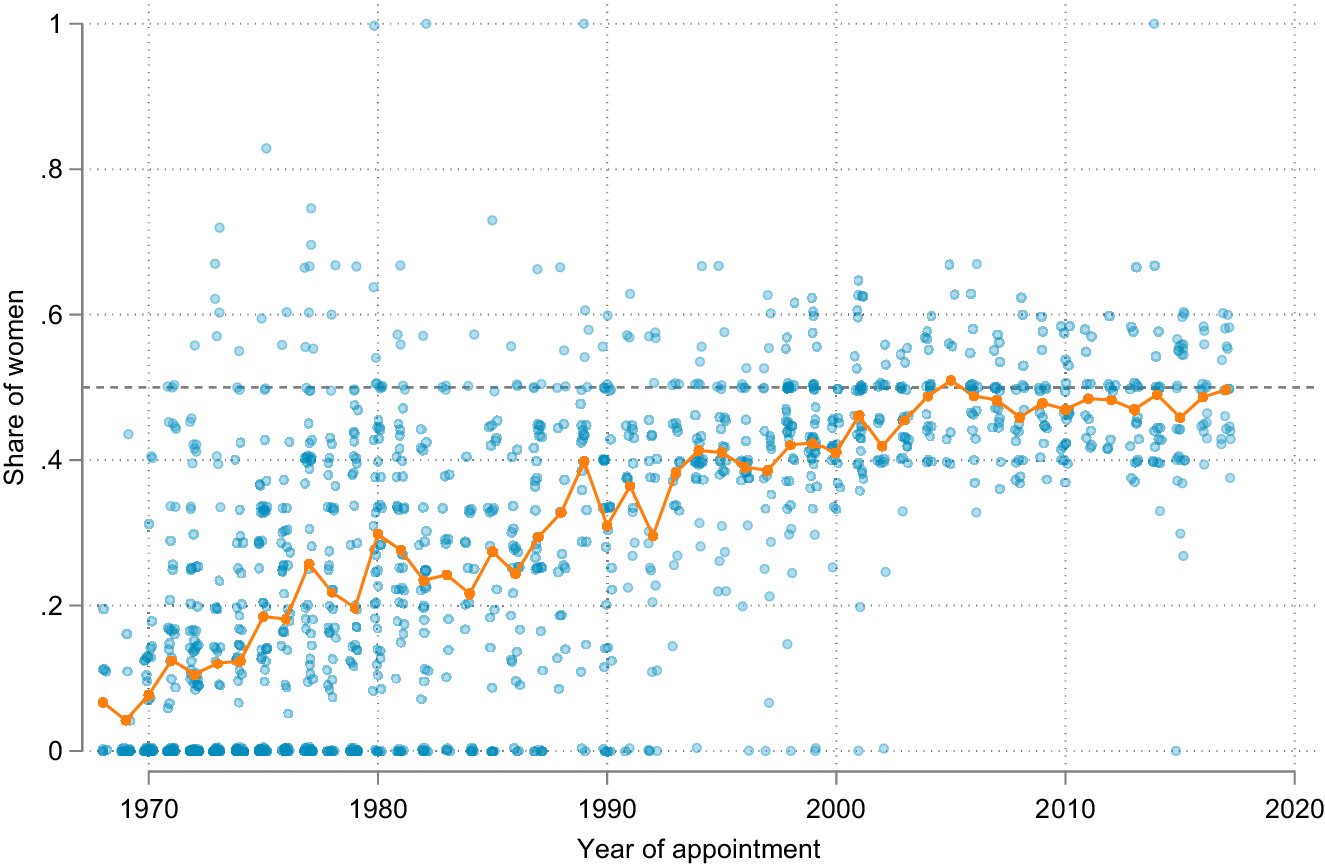
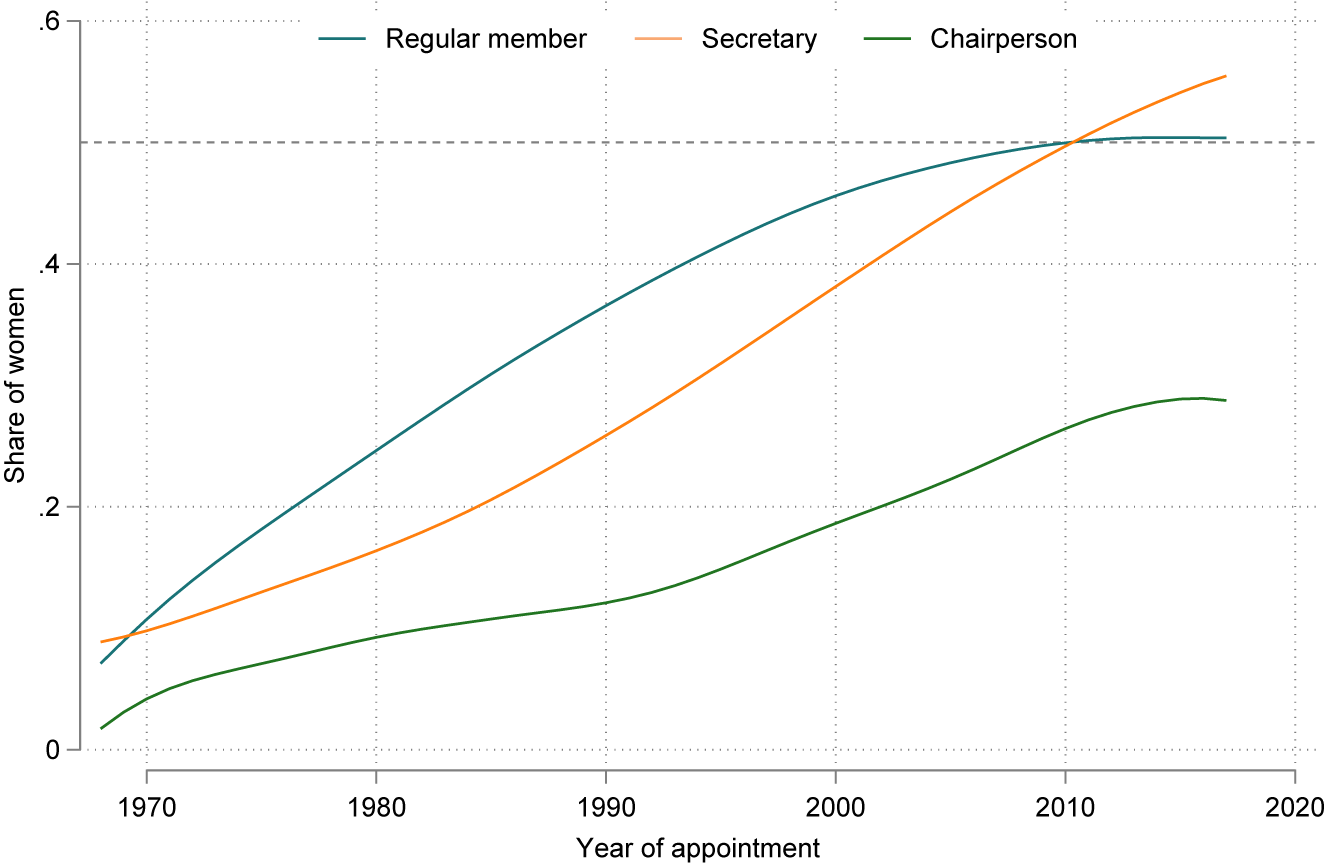
Indeed, when we break down the numbers by different roles on the commission, we see that gender parity has not been achieved across the board. Figure 2 shows the share of women among regular members, chairpersons, and secretaries over time, using smoothed trend lines (lowess). The share of women on commissions increased over time for all commission roles. Yet, while the proportion of women among regular members and secretaries reached and even surpassed 50% in the 2010s, the share of female chairpersons lagged behind and only reached about 30% in the 2010s.
Gender composition across roles in commissions over time (lowess trend lines).
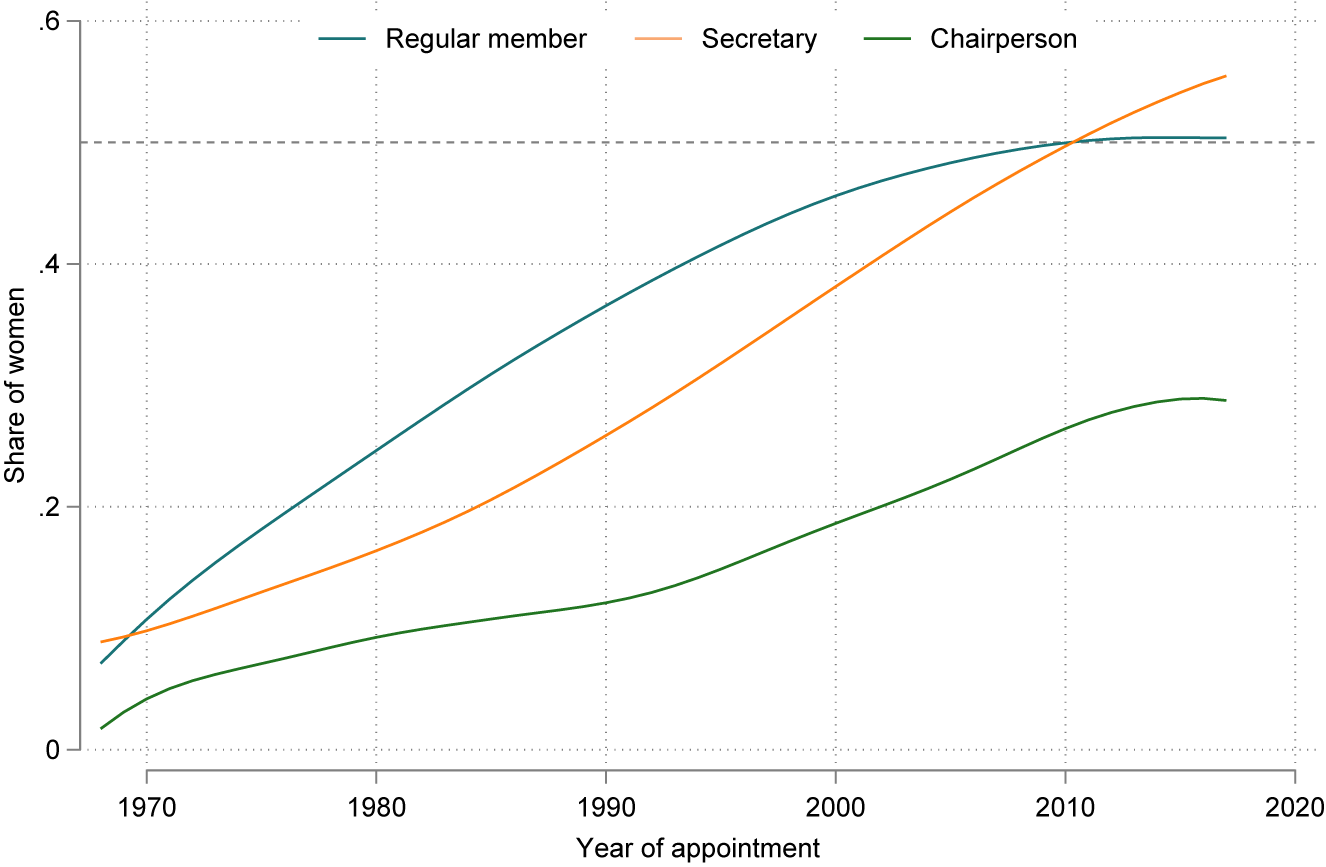
Figure 2. Long description
The x-axis represents the Year of appointment from 1970 to 2020. The y-axis represents the Share of women from 0 to 0.6. A horizontal dashed line marks the 0.5 parity threshold.
* Regular member (teal line): Starts at approximately 0.08 in 1970, rises steadily with a logistic-style curve, and plateaus just below the 0.5 parity line around 2010.
* Secretary (orange line): Starts at approximately 0.1 in 1970, follows a consistent linear increase, and surpasses both the Regular member line and the 0.5 parity line around 2012, ending near 0.55.
* Chairperson (green line): Starts lowest at approximately 0.02 in 1970. It shows a gradual increase but remains significantly lower than the other two roles, peaking at approximately 0.3 around 2015 before slightly dipping.
A regression analysis confirms that the increase in the share of women on commissions was significantly steeper for regular members and secretaries than for commission chairpersons (see Appendix C, Table C1, Model 2). The positive and statistically significant interaction terms between regular member and year appointed and between secretaries and year appointed (both p < 0.001) show that the likelihood that a woman is appointed increased significantly more over time for both regular members and secretaries than for chairpersons (the reference category). Furthermore, Model 1 shows that overall, the likelihood of a woman being appointed was about 20% higher for regular members and secretaries than for chairpersons.
Thus, while gender parity was achieved overall — which is unsurprising in the case of a gender equality forerunner with gender quota legislation — the most important and visible position on these commissions continued to be dominated by men.
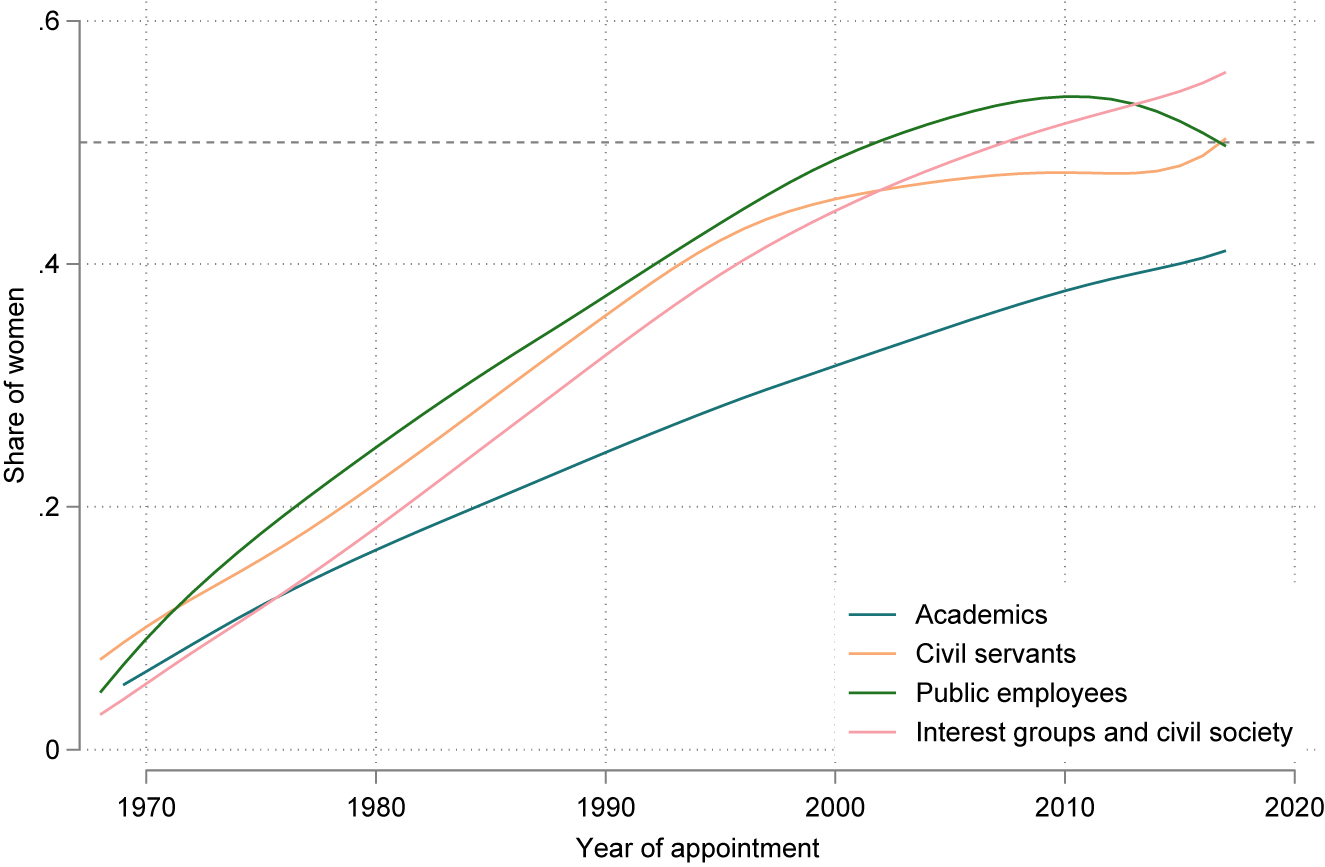
Furthermore, we examine the trends in gender representation depending on the affiliation of members. Most commission members are drawn from the ministries, other public bodies, interest groups, or academia. Notably, academics make up a growing share of commission members, accounting for about a quarter of all members in the 2010s (see Appendix D, Figure D1). Figure 3 shows the share of women among commission members who are, respectively, ministry civil servants, other public employees, interest groups and civil society representatives, and academics.Footnote 7 The figure shows that while gender parity has been reached among commission members drawn from ministries, other public bodies and interest groups and civil society representatives, the share of women among academic members grew at a slower pace, reaching 40% only in the mid-2010s.
Gender composition among members by affiliation (lowess trend lines).

Figure 3. Long description
The X axis represents the Year of appointment from 1970 to 2020. The Y axis represents the Share of women from 0 to .6. A horizontal dashed line marks the .5 parity threshold. Four colored lowess trend lines represent different affiliations.
* Academics (teal line) starts at approximately .05 in 1970 and shows a steady, near-linear increase to just above .4 by 2020.
* Civil servants (orange line) starts at approximately .08 in 1970, rises steadily to peak near .48 around 2010, plateaus, and then slightly increases toward .5 by 2020.
* Public employees (dark green line) starts at approximately .05 in 1970, rises sharply to peak above the .5 parity line around 2010, and then shows a slight downward trend toward .5 by 2020.
* Interest groups and civil society (pink line) starts at the lowest point near .03 in 1970 but shows the steepest consistent growth, crossing the .5 parity line around 2012 and reaching approximately .55 by 2020.
A regression analysis confirms that the gender gap in commission membership closed significantly more slowly among academics compared to the other main member categories (see Appendix F, Table F1, Model 2). This is shown by the positive and statistically significant interaction terms between year appointed and civil servants (p < 0.001), public employees (p < 0.05), and interest groups and civil society (p < 0.001) compared to the reference category academics.
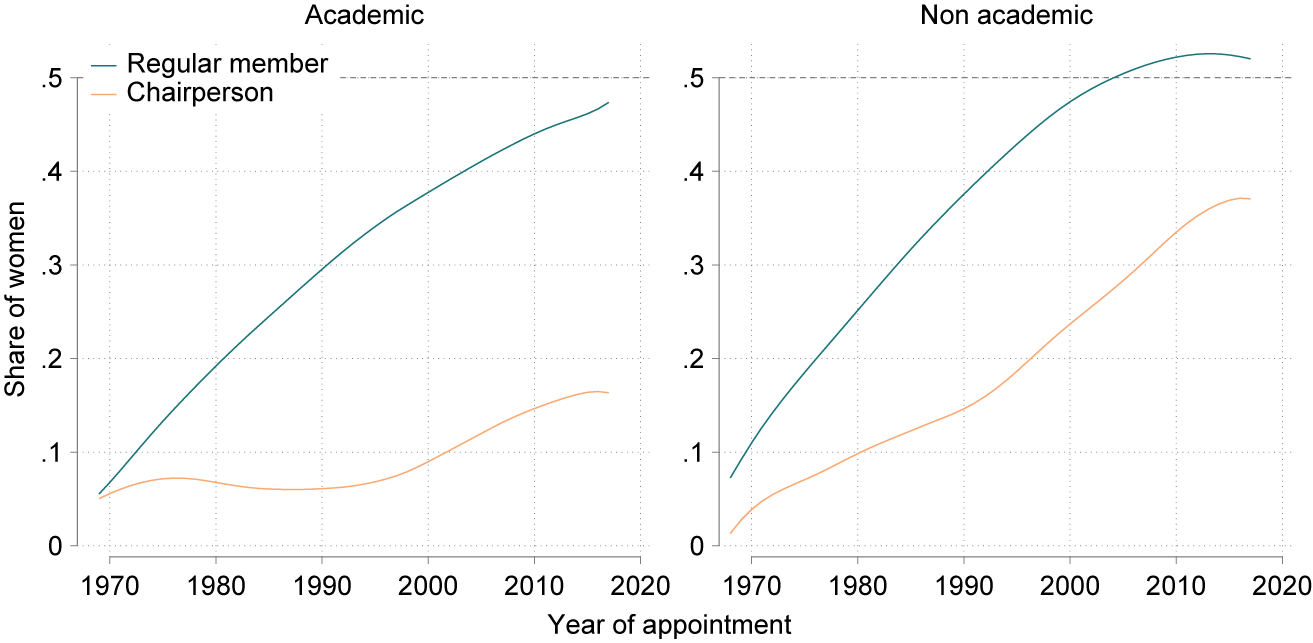
Given that many commission chairpersons are academics, could these two findings be expressions of the same thing? We investigate this by examining differences in gender representation between commission chairs and regular members for academics and non-academics separately (Figure 4). While women have reached equal representation or nearly so among both academic and non-academic regular members, they remain under-represented among both academic and non-academic commission chairs. However, the under-representation of women among commission chairs is much more pronounced for academics than for non-academics: in the 2010s, women accounted for more than one out of three non-academic commission chairs but only for one out of six academic commission chairs.
Gender composition among members with academic (left panel) and non-academic (right panel) affiliation, by role on commission (lowess trend lines).

Figure 4. Long description
The graph consists of two side-by-side panels. Both panels share a common Y-axis labeled Share of women ranging from 0 to .5 and an X-axis labeled Year of appointment ranging from 1970 to 2020. A horizontal dashed line marks the .5 parity level.
* Left Panel (Academic):
- Regular member (teal line): Shows a steady, near-linear increase starting near .05 in 1970 and reaching approximately .48 by 2017.
- Chairperson (orange line): Starts near .05, remains relatively flat with a slight dip until 2000, then rises to approximately .17 by 2017.
* Right Panel (Non-academic):
- Regular member (teal line): Shows a steep upward curve starting near .08 in 1970, crossing the .5 parity line around 2010, and peaking slightly above .5 by 2017.
- Chairperson (orange line): Starts near 0 in 1970 and shows a consistent upward trend, reaching approximately .37 by 2017.
This result is corroborated by a regression analysis (see Appendix G, Table G1, Model 2). The negative and statistically significant interaction terms between chairperson and year appointed tell us that the gender gap among chairpersons has closed at a slower pace for chairpersons compared to regular members, both among academic members (β = −0.0056, p < 0.01) and non-academic members (β = −0.0027, p < 0.05). However, the larger negative coefficient of this interaction term among academic members than among non-academic members indicates that the gender gap among chairpersons has closed even more slowly for academics.
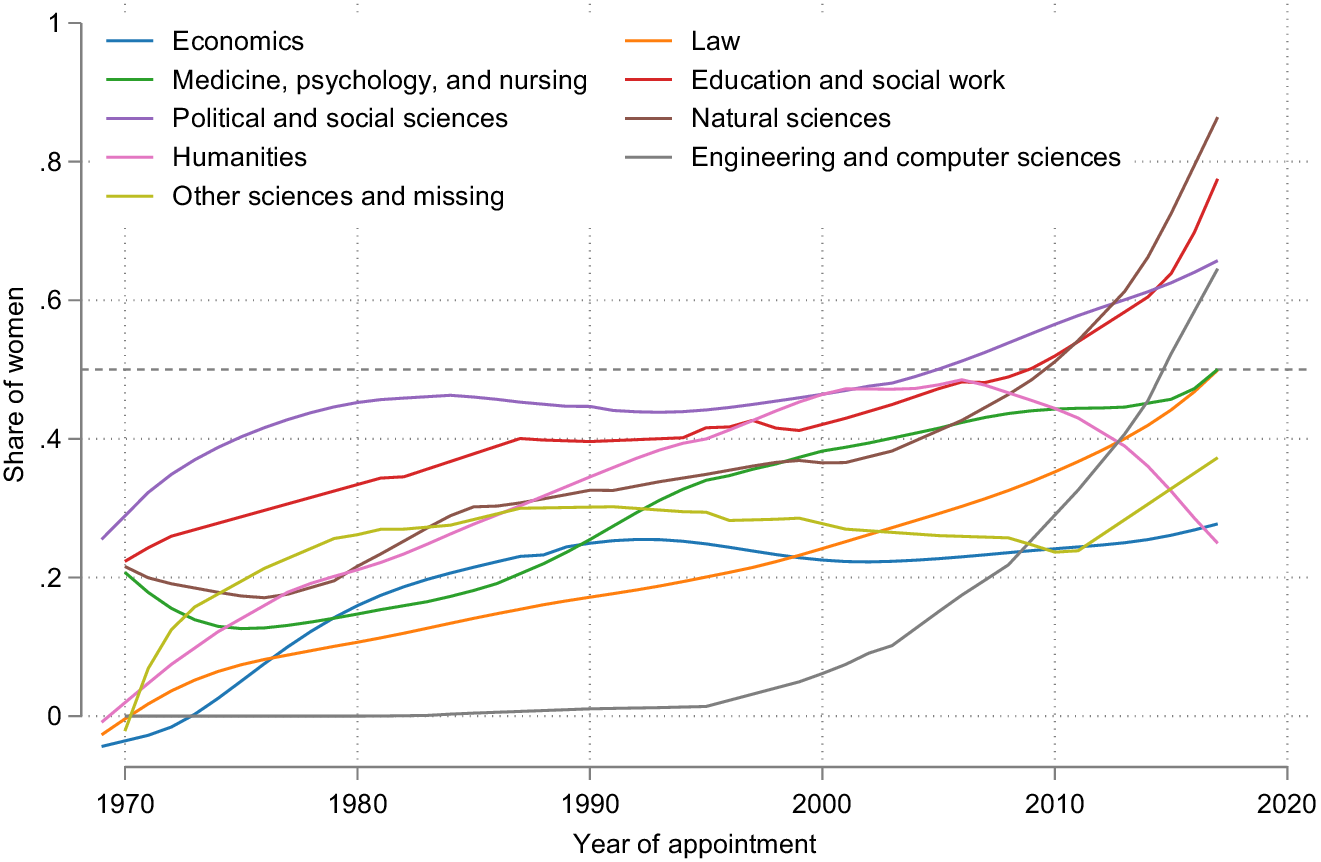
Furthermore, we examine whether the persistent under-representation of women among academic members of commissions (and specifically among academic chairpersons) is manifest across academic fields or limited to some disciplines. Figure 5 shows the share of women among academic members from specific disciplines over time. For most disciplines, the share of women on commissions has increased. For instance, the female share of legal scholars on commissions reached parity at the end of the period, whereas the share of women among academic members from the social and political sciences clearly surpassed that of men by the 2010s. These fields account for a sizeable proportion of academic commission members: 20% and 17%, respectively. However, among economists a marked gender gap remained, with the share of women stagnating at around 25%. This is significant since economists make up the largest share of academic commission members: 23%. The dominance of economists has also increased over time, with economists making up 29% of academic members in the most recent decade (see Appendix H).
Gender composition over time among academic members from different disciplines (lowess trend lines).

Figure 5. Long description
The x-axis represents the Year of appointment from 1970 to 2020. The y-axis represents the Share of women from 0 to 1.0. A horizontal dashed line marks the 0.5 parity threshold.
* Natural sciences (brown) and Education and social work (red) show the steepest growth, both starting near 0.2 in 1970 and ending between 0.8 and 0.9 by 2017.
* Engineering and computer sciences (gray) remains at 0 until 1995, then rises sharply to approximately 0.65.
* Political and social sciences (purple) starts highest in 1970 at 0.25, peaks near 0.65, and shows a slight decline toward the end.
* Medicine, psychology, and nursing (green) and Law (orange) show steady linear increases, reaching 0.5 and 0.45 respectively.
* Humanities (pink) shows an early peak near 0.4 in 2005 before declining sharply to 0.25 by 2017.
* Economics (blue) and Other sciences and missing (yellow-green) show the slowest growth, remaining below 0.4 for the entire period.
A regression analysis (see Appendix I, Table I1, Model 2) shows that the gender gap on commissions closed more quickly for academic members from nearly all other disciplines compared to economics, as shown by the positive interaction effects between year appointed and other disciplines. Yet, these differences are not statistically significant at the 5% level.
Moreover, additional descriptive analyses reveal that women are more strongly under-represented among academic chairpersons than among other academic members both in the fields of economics (less than 10% of economist academic chairs are women) and law, but not in the political and social sciences (see Appendix J).Footnote 8 Overall, the results indicate that the traditional gender segregation where economics is “for men” while women are better represented in the “softer” human and social sciences still has some force.
Finally, we draw on additional data to examine the pool of qualified academic candidates for advisory commissions. As an indicator for supply of qualified female candidates, we use the share of women among PhDs in the population, in general and for specific academic disciplines.
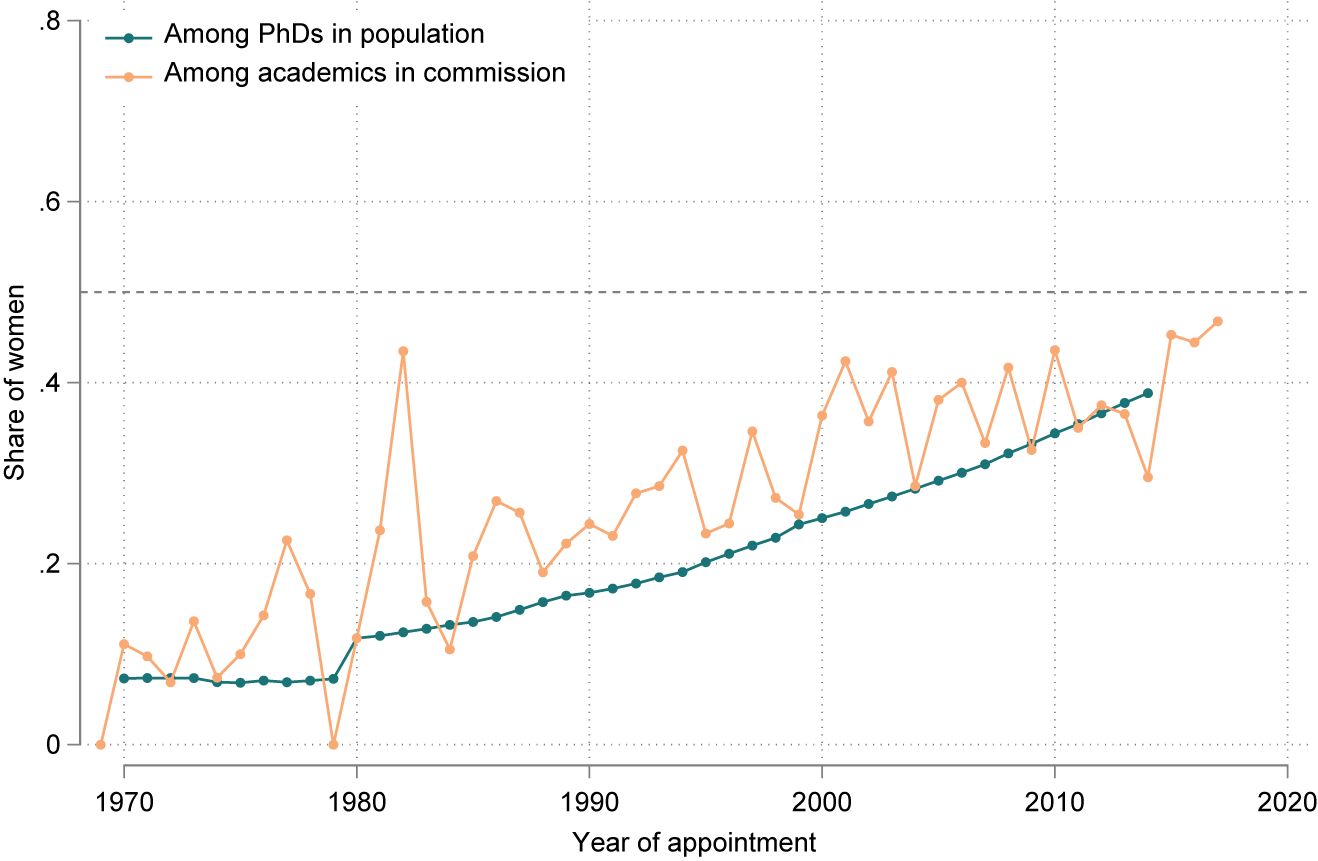
We first look at the overall numbers. Figure 6 compares the developments over time in the share of women among academics on commissions and the share of women among PhDs in the population. We see a similar steady increase over time on both measures. In most years, the share of women among academic commission members is slightly larger than the share of women in the population of PhDs.Footnote 9
Average share of female members in commissions (orange line) and share of female experts in the population (blue line) by year of appointment.

Figure 6. Long description
The X-axis represents the Year of appointment from 1970 to 2020. The Y-axis represents the Share of women from 0 to .8. A horizontal dashed line is positioned at the .5 mark.
* The blue line with circular markers represents Among P h D s in population. It shows a steady, nearly linear increase starting from approximately .08 in 1970 and rising to nearly .4 by 2015.
* The orange line with circular markers represents Among academics in commission. This line is highly volatile with significant year-to-year fluctuations. It starts at 0 in 1969, peaks sharply near .45 in the early 1980s, drops back to .1, and then follows a general upward but jagged trend, eventually surpassing the blue line to reach approximately .48 by 2018.
* The two lines intersect multiple times, but the orange line remains consistently more erratic than the smooth growth of the blue line.
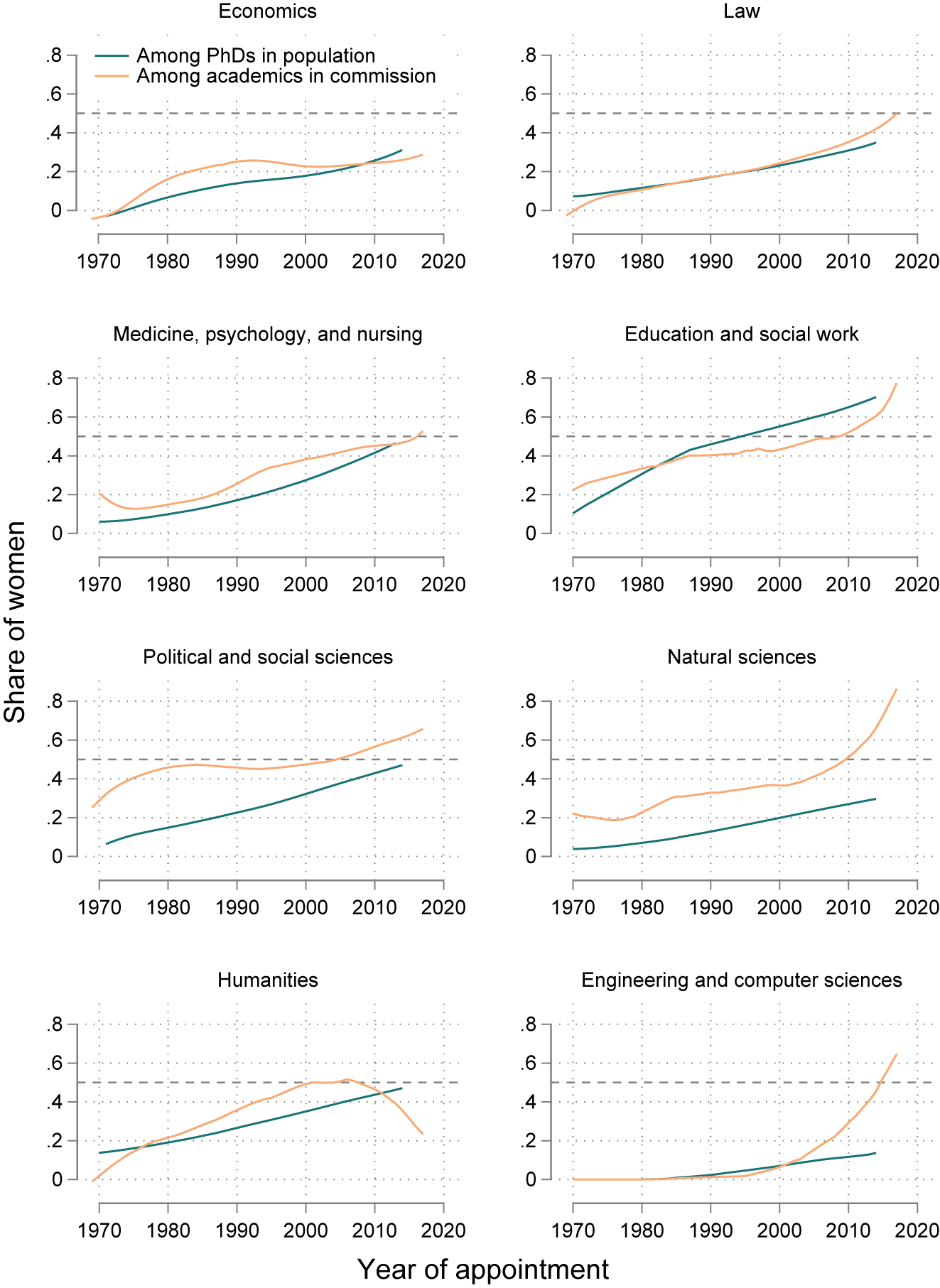
Furthermore, Figure 7 shows the share of women among academic commission members and among all PhDs in the population by academic discipline. For economics and law — the two most frequently occurring disciplines — the two trends track each other rather closely over time, although in the latest decade the share of women among legal scholars on commissions surpasses their share in the PhD population, whereas the share of women among economists on commissions drops below their share in the candidate pool. The share of women among political and social scientists on commissions is consistently larger than their share in the population of PhDs, which is also the case for natural scientists.
Share of female academic members on commissions plotted against share of female experts in the population (lowess plots).

Figure 7. Long description
A multi-panel figure with eight line graphs arranged in two columns and four rows. The x-axis for all graphs is Year of appointment ranging from 1970 to 2020. The y-axis is Share of women ranging from 0 to 0.8. A horizontal dashed line marks the 0.5 parity level. Two lines are plotted in each graph: a teal line for Among P h D s in population and an orange line for Among academics in commission.
* Economics: Both lines show a gradual upward trend starting near 0. The orange line stays slightly above the teal line until around 2010.
* Law: Both lines show a steady linear increase, converging around 2000 and reaching 0.5 by 2020.
* Medicine, psychology, and nursing: The orange line starts higher at 0.2, dips, then rises steadily above the teal line, crossing the 0.5 parity line around 2015.
* Education and social work: Both lines start relatively high (0.1 to 0.2). The teal line rises steeply. The orange line fluctuates but ends with a sharp upward spike toward 0.8 after 2010.
* Political and social sciences: The orange line starts significantly higher (0.25) than the teal line (0.05) and maintains a higher share throughout, ending near 0.6.
* Natural sciences: The teal line shows a slow increase from 0.05 to 0.3. The orange line starts at 0.2, remains higher, and spikes sharply to 0.8 after 2010.
* Humanities: Both lines rise from near 0. The orange line peaks at the 0.5 parity mark around 2005 before sharply declining after 2010, while the teal line continues to rise.
* Engineering and computer sciences: Both lines remain near 0 until 1990. The teal line rises slowly to 0.15. The orange line rises more steeply after 2000, reaching 0.6 by 2020.
To summarize, the descriptive picture that emerges from our quantitative analysis is the following: Overall, the share of women on commissions has increased steadily over time and practically reached parity. However, while gender parity has been reached for most member categories, men still dominate among commission chairs and among academics on commissions, and particularly among academic commission chairs. Men also continue to dominate among academic economists appointed to commissions. Furthermore, the share of women on commissions has consistently been somewhat higher than the share of women among PhDs in the population. In the next section, we discuss these empirical patterns in gender representation on expert advisory commissions from a normative point of view.
Normative Assessment
Better Substantive Representation?
From the perspective of substantive representation of citizens’ interests and values — a proposed key advantage of descriptive representation — the general development over time toward approximately proportional representation of women and men on commissions, and among interest group and civil society representatives particularly, must be deemed promising. Interest groups and civil society representatives on commissions have a particularly important role to play in processes of interest negotiation and value ranking compared to the academics on commission. Still, the persistent male dominance among commission chairs remains a significant limitation, given chairs’ extra influence on the interpretation of mandates, the organization of commission work, and commissions’ policy priorities. When in recent years only one third of chairpersons overall are women, this clearly constitutes a challenge to the substantive representativeness of such processes. This adds moreover to other challenges to substantive representation for this commission system, where the role of interest groups and civil society representatives is more circumscribed than before (Christensen and Hesstvedt Reference Christensen and Hesstvedt2019), bureaucrats dominate among non-academic chairs, and parliaments are not included in discussions and decisions on commission mandates and composition. Generally, it must be emphasized that the representation of values and interests remains a significant issue for a commission system that is frequently asked to analyze and recommend on broader political (and not only narrowly technical) topics, even if this system’s main contribution as advisory mechanism is expert knowledge and its primary function is epistemic.
Positive Symbolic Effects?
Moving on to what the identified gender patterns signal regarding norms of equal respect for all and political equality, the development toward gender parity among commission members in general, and within some member categories, such as among civil servants and interest group and civil society representatives, and some academic disciplines, is progressive, and contributes to a confirmation of such norms. Yet, both the significant underrepresentation of women among chairs and within particularly powerful expert disciplines such as economics are likely to have negative symbolic implications, as these disparities may reinforce stereotypes of women as generally less capable and able to rule. Moreover, even if commission members and chairs are less publicly exposed than for instance national politicians, several of these advisory commissions, and particularly commission chairs, are quite visible. This visibility gives the symbolic effects, be they positive or negative, additional force.
Both symbolic effects and the implications of the identified patterns of gender parity — and gender gaps — on substantive representation, affect primarily the non-epistemic functions of Norwegian advisory commissions, but as indicated these are non-trivial. The commission system has the democratic function of articulating interests and values from the civil sector and facilitating their integration in governmental policies, and public support for this key pillar of governance relies on the population’s perception of its legitimacy. In this context, substantive under-representation and symbolic implications in tension with a democratic ethos are problematic.
Patterns of Presence — Improving the Quality of Expertise?
Still, as the epistemic function is key for this commission system qua expert advisory mechanism, implications of gender gaps for levels of competence and expertise must be given extra weight. At the outset, we find encouraging trends. The general development toward gender parity in commissions, as well as the specific trend toward 50/50 representation among academics from some academic disciplines such as law, and gender parity among civil servants, increase the chance of increased novelty and relevance in expertise, as this is typically generated in environments of mixed group composition and multiple standpoints, including those which were previously excluded or marginalized. Similar considerations would seem to apply when gender distributions approximate 40/60 or 60/40. Women’s representation — for example — around 40% among academic members. Despite not reaching parity, the increase in women’s share has been dramatic (compared to less than 5% women among academic members in 1968), and among — for example — political and social scientists on commissions, women are in majority (with a share close to 60%).
Conflicts with Competence Requirements — or: What about the Traditional Worry?
However, we must also consider the worry that increased descriptive representation may reflect a development where expertise and competence are compromised, if the available pool of candidates across social categories is poor and requirements of expertise are demanding and exclusive. Yet, if we regard a PhD in whatever discipline as a minimal requirement for being a qualified academic expert and commission member, the fact that the increasing share of female academic commission members quite closely reflects the increasing share of women among PhDs, would initially seem to suggest that this worry has no basis. Rather, we could conclude that the rising share of women on commissions has been combined with due concern for the primary epistemic function of expert advice.
However, the competence requirement in most commissions would arguably be more exclusive than “researcher with PhD.” In some commissions, such as commissions dealing with the intricacies of pension or tax systems, the pool of genuinely qualified candidates can turn out to be a handful or less. In other commissions, not all PhDs will qualify, but there may be a broad pool of relevant candidates, and across several disciplines and professions, that would qualify as members or chair, such as commissions that examine the quality of public service provision or crisis preparedness and response. Relying on women’s share of PhDs within an academic discipline as a proxy for the pool of relevant experts is thus imperfect as a general measure (as it may both under- and over-estimate the pool), yet comes closer than the “researcher with PhD” measure. However, taking this measure as our point of departure indicates once more that worries are largely unwarranted as the proportional gender distributions (50/50 plus/minus 10%) among academic members from law, political and social science and natural science follow quite closely the gender distribution of PhDs within these disciplines.
Importantly, to the extent that there are in fact mismatches to be concerned about from the perspective of competence and expertise, the worry arising is not that the share of women on commissions has increased too steeply, but rather that women’s inclusion in certain respects lags relative to their share of the pool of competent recruits. We see — for example — how women are significantly underrepresented among chairs generally and among academic chairs particularly compared to men, with five out of six academic chairpersons still being male. This is considerably lower than women’s overall share of academics with a PhD.
Among economists, this imbalance is even stronger. When even in the most recent period only less than a third of academic economists on commissions — and less than one in 10 academic economists in chairperson positions — are women, women’s under-representation is the largest in the arguably most powerful policy profession, and especially when we look at the most powerful membership role (chair). Strikingly, this pattern — implying notably the virtual absence of female economists as commission chairs in the Norwegian commission system — has developed during a time when women’s share of PhDs in economics has increased substantially, and now makes up one third. The observed patterns among economists make it more likely that biases and orthodoxies resulting from a homogenous epistemic environment will be left uncontested in some of the most influential expert arenas. Also, even if we based on our descriptive analysis cannot identify the specific causes of why the female share of economist chairs is this far from matching the female share of economists with a PhD, it is likely that other criteria than competence and expertise are at play in selection when chairs are hardly ever recruited from the growing pool of competent women economists, and the pattern occurring is one of vertical and horizontal gender segregation, familiar from other studies, where influential policy areas — and economic policy especially (see Miller 2022 for a recent overview) — remain male dominated, even in gender equality forerunner countries (see also Hesstvedt and Skorge Reference Hesstvedt and Skorge2023). The problem with these identified patterns of women’s underrepresentation is thus not only that they negatively affect democratic culture and legitimacy and may potentially erode public support over time. They also indicate selection practices where competence and expertise are given limited weight. This points toward a considerable malfunctioning at the core of this expert advisory system where epistemic concerns are supposed to be at the forefront.
Conclusion
Focusing on the degree of proportional gender representation in expert advisory bodies — a surprisingly under-studied topic in a time where public policy is undergoing processes of “expertization” and representativeness is under scrutiny (Krick, Christensen, and Holst Reference Krick, Christensen and Holst2019) — this paper has combined empirical analysis with normative assessment. Based on large-n data on the composition of expert advisory commissions in Norway, known as a gender equality forerunner from previous comparative research and international indexes, we found a main development toward parity, yet combined with a persistent under-representation of women in the most important and influential positions. The normative analysis took a set of general, but empirically conditioned normative arguments in favor or critical of descriptive representation as starting point and provided an assessment based on findings from the empirical analysis along with relevant contextual knowledge. We found several reasons to applaud the increased female presence in the commission system. However, women’s under-representation in positions with the largest concentration of power indicates systematic deficiencies, and is worrisome for democracy and levels of public trust, but also and not least for epistemic reasons. Importantly, the concern often heard in popular debates and in branches of scholarship regarding a tension between descriptive representation and competence and expertise requirements gained little support from our findings.
One limitation of our study is the focus on one specific advisory institution. Even if the commission system studied plays a key role in Norwegian governance, there are other venues of expert advice and representation too. A more precise diagnosis of the democratic and epistemic effects of the gender patterns we have identified must consider trends in a wider set of channels and bodies. Our study has also set explanatory questions aside. Our analysis suggests that other selection mechanisms are at play than selection based on competence and expertise in this commission system. Among explanations could be effect of quotas (Hesstvedt and Skorge Reference Hesstvedt and Skorge2023) or other dynamics in the selection process, such as the tendency to select the usual suspects, but we cannot say based on our design. Furthermore, our normative discussion has focused on advantages and a proposed cost, which political theorists have placed at the core of normative debates over descriptive representation, and which our large-n empirical analysis could illuminate. Other relevant normative concerns for these debates have thus been left aside, for instance how normative assessments focusing on one category, such as gender, may overlook significant intersectional dynamics (Funk and Hinojasa Reference Funk and Hinojosa2023).
Still, we believe our paper contributes substantively and has broader implications. First, our large-n study of gender representation in expert advice fills gaps in literatures on gender and expertise and representation in expert institutions and has produced new empirical knowledge of gendered distributions and their implications. By focusing on Norway, a gender equality forerunner with stringent gender quota rules for advisory commissions, we have examined a most-likely case for gender parity on expert groups. When we even in the Norwegian context find persistent under-representation of women in commission leadership positions and among powerful academic groups on commissions, it is likely that similar or greater disparities exist in other countries. Yet, this is a question for further research. Hopefully our investigation can inspire similar studies of expert advisory bodies in other countries and raise awareness of the importance of including expert institutions in analyses of gender equality within and across polities.
Second, our study adds to other studies of various politically salient phenomena — such as patterns of representation — that combine empirical and normative analysis, recognizing how normative assessments are empirically conditioned, while empirical patterns may have less than straightforward, and sometimes complex, normative implications. We hope our investigations stimulate more studies with similar designs. In particular, the traditional worry that there is a conflict between descriptive representation and competence requirements should be tested more broadly.
Finally, our study is a reminder that problematic patterns of underrepresentation may persist below the surface even among forerunner countries with ambitious gender equality policies. Our findings suggest a need to advance more fine-grained measures to improve representative credentials, for instance, with respect to gender, to put an “at least 40%” clause on leadership positions, especially if it can be shown — as in our case — that competence requirements are unlikely to be compromised.
Supplementary material
The supplementary material for this article can be found at https://doi.org/10.1017/S1743923X2510024X.


 Open access

