


1. Motivation
The last published review of high power lasers was conducted by Backus et al. [Reference Backus, Durfee, Murnane and Kapteyn1] in 1998. At this time there was only one petawatt class laser, the NOVA petawatt[Reference Perry, Pennington, Stuart, Tietbohl, Britten, Brown, Herman, Golick, Kartz, Miller, Powell, Vergino and Yanovsky2], in existence. The field has moved on a long way since then with over 50 petawatt class lasers currently operational, under construction or in the planning phase. The possibility of using focused high intensity laser beams to achieve previously unobtainable states of matter in the laboratory gained much attention after the demonstration of the first pulsed laser[Reference Maiman3] in 1960. Potential applications, such as generating the conditions for fusion in the laboratory, became a major driver for the early development of high power lasers in the 1960s to 1980s. It was realized that although matter could be heated[Reference Dawson4] to hundreds of electron volts using  ${\sim}$ns pulses and directly compressed using light pressure ( ${\sim}I/c$, where $I$ is the intensity and $c$ is the speed of light), spherical compression using laser driven ablation could achieve much higher pressures and densities[Reference Daiber, Hertzberg and Wittliff5], suitable for the achievement of fusion conditions[Reference Lawson6]. First estimates for laser driven fusion[Reference Nuckolls, Wood, Thiessen and Zimmerman7] proposed lasers delivering 20 ns shaped pulses of megajoule energies, operating at 100 Hz, eventually leading today to megajoule scale projects such as NIF[Reference Miller, Moses and West8] and LMJ[Reference Ebrardt and Chaput9].
The potential to interact with hot plasmas (greater than hundreds of electron volts) and probe the growth of instabilities and perturbations on timescales where hydrodynamic motion is small during the laser pulse ( ${\it\tau}c_{s}\leqslant {\it\lambda}$, where $c_{s}$ is the sound speed of the plasma, ${\it\tau}$ is the laser pulse length and ${\it\lambda}$ is the laser wavelength) pushed the development of lasers with pulse durations ${\it\tau}$ of less than tens of picoseconds. The development and delivery of chirped pulse amplification (CPA)[Reference Strickland and Mourou10] in large aperture laser systems enabled a rapid push towards even shorter pulses (from picoseconds to attoseconds) and higher intensities, where relativistic and field effects associated with the laser pulse dominate the interaction physics[Reference Bulanov, Esirkepov, Hayashi, Kando, Kiriyama, Koga, Kondo, Kotaki, Pirozhkov, Bulanov, Zhidkov, Rosanov, Chen, Neely, Kato, Narozhny and Korn11]. Understanding and learning to control and manipulate the complex interactions taking place at the laser/matter interface led to a wide variety of experiments and potential new scientific[Reference Hatchet, Brown, Cowan, Henry, Johnson, Key, Koch, Langdon, Lasinski, Lee, Mackinnon, Pennington, Perry, Phillips, Roth, Sangster, Singh, Snavely, Stoyer, Wilks and Yasuike12] and industrial applications being pursued and necessitating the development of matching laser capability, some of which are outlined below.
The production of quasi-coherent VUV/soft x-ray sources for biological imaging or plasma probing was investigated using ‘recombination pumping[Reference Elton13]’ where, after heating a plasma, it was allowed to expand, usually into vacuum, and rapidly recombine, ideally creating a population inversion in an ionized state such a hydrogen-like carbon[Reference Duguay and Rentzepi14]. To achieve higher gain[Reference Zhang, Key, Norreys, Tallents, Behjat, Danson, Demir, Dwivedi, Holden, Holden, Lewis, MacPhee, Neely, Pert, Ramsden, Rose, Shao, Thomas, Walsh and You15], shorter duration laser pulses were required, and by 1995, high power  ${\sim}$terawatt pulses of ${\sim}20~\text{ps}$ duration had been developed. Collisional excitation soft x-ray laser pumping using high ( ${\sim}$kilojoule) energy, nanosecond pulses was first demonstrated at high gain with neon-like selenium[Reference Matthews, Hagelstein, Rosen, Eckart, Ceglio, Hazi, Medecki, MacGowan, Trebes, Whitten, Campbell, Hatcher, Hawryluk, Kauffman, Pleasance, Rambach, Scofield, Stone and Weaver16] and subsequently and more efficiently in neon-like germanium[Reference Lee, McLean and Elton17]. The highest possible brightness with a soft x-ray laser is obtained when it is operated in saturation, and this was initially achieved in 1992 using neon-like germanium[Reference Carillon, Chen, Dhez, Dwivedi, Jacoby, Jaegle, Jamelot, Zhang, Key, Kidd, Klisnick, Kodama, Krishnan, Lewis, Neely, Norreys, O’Neill, Pert, Ramsden, Raucourt, Tallents and Uhomoibhi18] at 23 nm with a 500 ps pump, and later in 1997 with nickel-like samarium[Reference Zhang, MacPhee, Lin, Wolfrum, Smith, Danson, Key, Lewis, Neely, Nilsen, Pert, Tallents and Wark19] at 7 nm using a 50 ps pump. To improve the efficiency of these devices[Reference Daido20], shorter pulse pumping using a mode of operation termed ‘transient collisional excitation’ helped to push the development of shorter pulse laser drivers. High transient collisional excitation gain was demonstrated using an 800 ps low energy pulse to pre-form a large plasma volume and then a 5 J ps pump to generate the transient collisional excitation to deliver gain at 14.7 nm[Reference Dunn, Osterheld, Shepherd, White, Shlyaptsev and Stewart21] in nickel-like palladium.
The generation of quasi-coherent VUV/soft x-ray sources using high harmonics[Reference Lichters, Meyer-ter-Vehn and Pukhov22] rather than soft x-ray lasers was given a significant boost in the mid-1990s by the observation of the 68th harmonic of a  $1.05~{\rm\mu}\text{m}$ driving laser at 15.5 nm, using a 2.5 ps pulse focused to an intensity of $10^{19}~\text{W cm}^{-2}$ on a solid target[Reference Norreys, Zepf, Moustaizis, Fews, Zhang, Lee, Bakarezos, Danson, Dyson, Gibbon, Loukakos, Neely, Walsh, Wark and Dangor23]. This was extended into the keV regime using petawatt power pulses focused to $10^{21}~\text{W cm}^{-2}$ intensities[Reference Dromey, Kar, Bellei, Carroll, Clarke, Green, Kneip, Markey, Nagel, Simpson, Willingale, McKenna, Neely, Najmudin, Krushelnick, Norreys and Zepf24] by 2007, and into the attosecond region[Reference Corkum and Krausz25] using even shorter few femtosecond optical driving pulses. The production of high currents of MeV electrons[Reference Beg, Bell, Dangor, Danson, Fews, Glinsky, Hammel, Lee, Norreys and Tatarakis26] and associated gamma-ray production[Reference Norreys, Santala, Clark, Zepf, Watts, Beg, Krushelnick, Tatarakis, Dangor, Fang, Graham, McCanny, Singhal, Ledingham, Creswell, Sanderson, Magill, Machacek, Wark, Allott, Kennedy and Neely27] brought significant attention to the scale length of the interaction. At such intensities, any illumination of the target above the ionization threshold ( $10^{11}{-}10^{12}~\text{W cm}^{-2}$) can generate a pre-plasma which expands and dramatically changes the scale length of the interaction. The ability to control the scale length of the interaction[Reference Mackinnon, Borghesi, Hatchett, Key, Patel, Campbell, Schiavi, Snavely, Wilks and Willi28] led to significant effort in improving the laser contrast and developing pre-pulse mitigation strategies(frequency doubling of high power short pulses[Reference Neely, Danson, Allott, Amiranoff, Collier, Dangor, Edwards, Flintoff, Hatton, Harman, Hutchinson, Najmudin, Pepler, Ross, Salvati and Winstone29, Reference Hillier, Danson, Duffield, Egan, Elsmere, Girling, Harvey, Hopps, Norman, Parker, Treadwell, Winter and Bett30]; plasma mirrors[Reference Ziener, Foster, Divall, Hooker, Hutchinson, Langley and Neely31]; saturable absorbers[Reference Itatani, Faure, Nantel, Mourou and Watanabe32]; XPW techniques[Reference Jullien, Albert, Burgy, Hamoniaux, Rousseau, Chambaret, Augé-Rochereau, Chériaux, Etchepare, Minkovski and Saltiel33]; low gain OPA[Reference Shah, Johnson, Shimada, Flippo, Fernandez and Hegelich34]; short pulse OPA[Reference Musgrave, Shaikh, Galimberti, Boyle, Hernandez-Gomez, Lancaster and Heathcote35]).
The concept of using the electric field associated with a laser driven plasma wave to accelerate electrons was given a major boost in the late 1970s when it was realized that GeV/cm fields could be potentially achieved[Reference Tajima and Dawson36]. Subsequent work utilizing the then available lasers investigated excitation of instabilities[Reference Joshi, Tajima, Dawson, Baldis and Ebrahim37] and driving of the plasma at two different wavelengths using either 2 ns pulses from a carbon dioxide based laser[Reference Clayton, Joshi, Darrow and Umstadter38] or Nd:glass lasers[Reference Amiranoff, Bernard, Cros, Jacquet, Matthieussent, Marques, Mora, Modena, Morillo, Moulin, Najmudin, Specka and Stenz39] to generate suitable beat-wave plasma modulations. By the mid 1990s, wave-breaking[Reference Modena, Najmudin, Dangor, Clayton, Marsh, Joshi, Malka, Darrow, Danson, Neely and Walsh40] generated electron beams with thermal-like spectra up to 45 MeV using a 25 TW picosecond driver were achieved. Using shorter 50 fs pulses at  $10^{19}~\text{W cm}^{-2}$ intensities, near mono-energetic beams of electrons were produced[Reference Mangles, Murphy, Najmudin, Thomas, Collier, Dangor, Divall, Foster, Gallacher, Hooker, Jaroszynski, Langley, Mori, Norreys, Tsung, Viskup, Walton and Krushelnick41] and, currently, electrons of ${>}$GeV energies can be created with petawatt class sub-50 fs Ti:sapphire drivers[Reference Leemans, Duarte, Esarey, Fournier, Geddes, Lockhart, Schroeder, Toth, Vay and Zimmermann42].
Laser driven particle acceleration for applications such as ion driven fast ignition[Reference Roth, Cowan, Key, Hatchett, Brown, Fountain, Johnson, Pennington, Snavely, Wilks, Yasuike, Ruhl, Pegoraro, Bulanov, Campbell, Perry and Powell43] (requiring  ${<}15~\text{MeV}$ protons) and medical purposes[Reference Ledingham, McKenna, McCanny, Shimizu, Yang, Robson, Zweit, Gillies, Bailey, Chimon, Clarke, Neely, Norreys, Collier, Singhal, Wei, Mangles, Nilson, Krushelnick and Zepf44] (60–300 MeV protons or heavier ions) has attracted a significant amount of research effort since the turn of the century. ‘Target normal sheath acceleration’ using a petawatt class picosecond laser[Reference Snavely, Key, Hatchett, Cowan, Roth, Phillips, Stoyer, Henry, Sangster, Singh, Wilks, MacKinnon, Offenberger, Pennington, Yasuike, Langdon, Lasinski, Johnson, Perry and Campbell45] was used to accelerate a population of electrons through a metallic foil, creating a large sheath field on the rear side which resulted in a highly laminar ion beam containing large fluxes ( ${>}10^{13}$) of high energy ( ${>}10~\text{MeV}$) ions. In subsequent experiments using tens of terawatt drivers, it was demonstrated that improved efficiency could be achieved by reusing the laser driven electrons[Reference Mackinnon, Sentoku, Patel, Price, Hatchett, Key, Andersen, Snavely and Freeman46] as they bounce back and forth in the foil target, termed ‘recirculation’. As electron recirculation[Reference Neely, Foster, Robinson, Lindau, Lundh, Persson, Wahlstrom and McKenna47] experiments pushed to thinner and thinner targets ( ${<}50~\text{nm}$ thick foils by ${\sim}2007$) at intensities of ${>}10^{19}~\text{W cm}^{-2}$, laser system contrasts of ${>}10^{9}$ were routinely required. Currently, the new contrast enhancing techniques described earlier will need to used in combination with enhanced picosecond cleaning schemes to achieve picosecond intensity contrasts of ${>}10^{11}$, which are essential to explore new mechanisms[Reference Daido, Nishiuchi and Pirozhkov48] of ion acceleration at intensities of ${>}10^{21}~\text{W cm}^{-2}$.
2. The road to petawatt class lasers
From the first demonstration of the laser, attempts have been made to increase the peak power and focused intensity in order to reach extreme conditions within the laboratory. Initial jumps in peak power came with the invention of Q-switching then mode locking, but progress slowed until the late 1980s and the dawn of CPA. The original use of CPA was in radar systems where short, powerful pulses that were beyond the capabilities of existing electrical circuits were needed. By stretching and amplifying the pulses prior to transmission, then compressing the reflected pulse, high peak powers within the amplifier circuitry could be avoided.
These ideas were first applied in a laser amplification scheme at the Laboratory for Laser Energetics at the University of Rochester, USA by Strickland and Mourou[Reference Strickland and Mourou10]. Here, the output from a mode-locked Nd:YAG oscillator was stretched and spectrally broadened by 1.4 km of optical fibre, amplified in a Nd:YAG regenerative amplifier then compressed using a Treacy grating pair[Reference Treacy49] which compensated for the second order spectral phase imposed by the fibre.
Due to the limitations of mode-locked lasers operating at 1064 nm, early high power/energy CPA lasers[Reference Ferray, Lompré, Gobert, L’huillier, Mainfray, Manus, Sanchez and Gomes50–Reference Sauteret, Mourou, Husson, Thiell, Seznec, Gary and Migus53] all relied on the use of self-phase modulation to generate enough bandwidth to support sub-few-picosecond pulses[Reference Nikolaus, Grischkowsky and Balant54]. These systems generated large amounts of high order spectral phase and spectral modulations during the nonlinear process, making optimal compression hard to realize, and, moreover, these systems had poor stability due to the nonlinear process.
The development of Ti:sapphire mode-locked oscillators[Reference Spence, Kean and Sibbet55] allowed much shorter pulses to be produced. These systems could either directly seed Ti:sapphire amplifiers[Reference Barty56] or, if tuned to 1054 nm, be used to seed existing large aperture Nd:glass systems. Other developments around this time included a neodymium based additive pulse mode locking system[Reference Phillips, Change, Danson, Barr, Hughes, Edwards and Hanna57] which could generate pulses at under 0.5 ps at 1054 nm. These approaches were developed simultaneously in France[Reference Rouyer, Mourou, Migus, Mazataud, Allais, Pierre, Seznec and Sauteret58, Reference Blanchot, Rouyer, Sauteret and Migus59] and in the UK[Reference Danson, Barzanti, Chang, Damerell, Edwards, Hancock, Hutchinson, Key, Luan, Mahadeo, Mercer, Norreys, Pepler, Rodkiss, Ross, Smith, Smith, Taday, Toner, Wigmore, Winstone, Wyatt and Zhou60, Reference Danson, Collier, Neely, Barzanti, Damerell, Edwards, Hutchinson, Key, Norreys, Pepler, Ross, Taday, Toner, Trentelman, Walsh, Winstone and Wyatt61], producing the first well defined, 100 TW class laser systems.
In the telecommunications industry, work was carried out on the use of prisms[Reference Fork, Martinez and Gordon62] and grating pairs[Reference Martinez, Gordon and Fork63] to compensate for the spectral phase distortions imposed on broad-bandwidth laser pulses by long lengths of optical fibre. By putting a telescope inside a grating pair Martinez produced a method to reverse the sign of the spectral phase that was imparted, thus creating a device that could stretch a pulse then exactly compress it. These systems were used in stretching pulses prior to propagation along the fibre then compressing them in order to reduce nonlinear effects. After the development of CPA various geometries of stretcher such as the Offner triplet[Reference Cheriaux, Walker, Rousseau, Salin and Chambaret64] were developed, allowing longer stretches to be realized and more energy to be propagated for a constant stretched intensity.
The development of amplifiers capable of supporting broad bandwidths is also required to realize high peak powers. Early systems relied entirely on dye or Nd:glass amplifiers. While dye lasers could support very large bandwidths, their short lifetimes and low saturation fluences severely limited the amount of energy that could be extracted. Neodymium based lasers, on the other hand, could provide a large amount of energy but would support only a limited bandwidth.
This led to the search for a new laser material that could provide the energy and bandwidth required to support high energy short pulses. Ti:sapphire[Reference Moulton65] and optical parametric amplification[Reference Dubietis, Jonus̆auskas and Piskarskas66] provided the solution to these problems. These were initially used in the pre-amplification stages of multi-terawatt systems in conjunction with Nd:glass rod or disc amplifiers. They provided many orders of magnitude of gain at high bandwidth before larger amplifiers, generally Nd:glass, added the last few orders and reduced the bandwidth. As the quality and size of available Ti:sapphire and nonlinear crystals have improved, so has the energy that can be extracted from these systems.
3. Kilojoule glass systems
The first kilojoule glass system, or in fact the first laser configured to deliver a petawatt, was at the Nova Facility at Lawrence Livermore National Laboratory (LLNL)[Reference Perry, Pennington, Stuart, Tietbohl, Britten, Brown, Herman, Golick, Kartz, Miller, Powell, Vergino and Yanovsky2]. One beamline of the high energy Nova beamlines could be converted to operate in short pulse mode with a dedicated front end and vacuum compressor. The compressor was a pair of single pass in-house manufactured 940 mm diameter gold coated gratings, shown in Figure 1. These gratings would go on to be used in systems throughout the world. The beamline was capable of delivering 660 J in a 440 fs pulse giving 1.5 PW to the target and focused intensities of  ${>}7\times 10^{20}~\text{W cm}^{-2}$. All of the basic building blocks used on later systems were deployed on Nova, including broad-bandwidth pulse generation, optical pulse stretching, pulse amplification, deformable mirror, pulse compression and reflective focusing.
Inside the pulse compressor of the NOVA Petawatt – the first petawatt class laser worldwide (picture courtesy of LLNL).

Vulcan was the first petawatt class laser to be used by the international plasma physics community as a dedicated user facility. It is a high power Nd:glass laser[Reference Danson, Brummitt, Clarke, Collier, Fell, Frackiewicz, Hancock, Hawkes, Hernandez-Gomez, Holligan, Hutchinson, Kidd, Lester, Musgrave, Neely, Neville, Norreys, Pepler, Reason, Shaikh, Winstone, Wyatt and Wyborn67] which has been operational for over 30 years. It enables a broad range of experiments through a flexible geometry[Reference Hernandez-Gomez, Brummitt, Canny, Clarke, Collier, Danson, Dunne, Fell, Frackiewicz, Hancock, Hawkes, Heathcote, Holligan, Hutchinson, Kidd, Lester, Musgrave, Neely, Neville, Norreys, Pepler, Reason, Shaikh, Winstone and Wyborn68, Reference Musgrave, Boyle, Carroll, Clarke, Heathcote, Galimberti, Green, Neely, Notley, Parry, Shaikh, Winstone, Pepler, Kidd, Hernandez-Gomez and Collier69]. It has two target areas: one with  $6\times 300~\text{J}$ (1053 nm @1 ns) long pulses combined with two synchronized short pulse beams and a separate target area with high energy petawatt capability (500 J in 500 fs) synchronized with a single long pulse beamline, shown in Figure 2.
The Vulcan Petawatt Target Hall (picture courtesy of STFC).
The concept of using an OPCPA (optical parametric chirped pulse amplification) system as a seed for the front end of a high power Nd:glass laser system was first proposed by Ross[Reference Ross, Matousek, Towrie, Langley and Collier70] from the Central Laser Facility. This allowed an ultra-short pulse to be amplified in a broad-bandwidth pre-amplifier before injection into the larger aperture Nd:glass chain, giving shorter pulses to the target and enabling higher contrasts to be realized[Reference Danson, Neely and Hillier71]. The first OPCPA front-end system became operational on the Vulcan facility in 1998[Reference Collier, Hernandez-Gomez, Ross, Matousek, Danson and Walczak72, Reference Ross, Collier, Matousek, Danson, Neely, Allott, Pepler, Hernandez-Gomez and Osvay73]. In subsequent years, many facilities implemented these front-end systems[Reference Bagnoud, Begishev, Guardalben, Puth and Zuegel74–Reference Schwarz, Rambo, Geissel, Edens, Smith, Brambrink, Kimmel and Atherton76].
In Asia, the first petawatt class laser was constructed as part of the high energy Nd:glass Gekko XII facility at Osaka University, Japan[Reference Kitagawa, Fujita, Kodama, Yoshida, Matsuo, Jitsuno, Kawasaki, Kitamura, Kanabe, Sakabe, Shigemori, Miyanaga and Izawa77]. They started to implement ultra-short pulse lasers to couple up to Gekko XII[Reference Mori, Kitagawa, Kodama, Habara, Iwata, Tsuji, Suzuki, Sawai, Tanaka, Kato and Mima78] with a 30 TW GMII laser, initially for general ultra-high intensity research but lately more focused on the fast-ignition concept for ICF. The petawatt used an OPCPA front end with Nd:glass large aperture amplifiers and a double pass compressor to produce 420 J in a 470 fs pulse giving output powers of 0.9 PW. An F#7 off-axis parabola was used to focus to target, giving focused intensities of  $2.5\times 10^{19}~\text{W cm}^{-2}$ with contrast levels of $1.5\times 10^{-8}$.
Titan[Reference Stuart, Bonlie, Britten, Caird, Cross, Ebbers, Eckart, Erlandson, Molander, Ng, Patel and Price79] is one of the five lasers that make up the Jupiter Laser Facility at LLNL. It is a petawatt class laser coupled to a kJ beamline for a broad range of experiments. The short pulse beamline delivers up to 300 J in a sub-picosecond pulse and offers a 50 J high contrast green option.
An interesting development has been the coupling of petawatt beamlines to other sources, including ion beams and electron beams, and at Sandia National Laboratory coupled to the Z-pinch accelerator. The facility uses Beamlet[Reference Van Wonterghem, Murray, Campbell, Speck, Barker, Smith, Browning and Behrendt80], which was the original prototype facility for NIF at LLNL that was decommissioned in 1998 before being transferred to Sandia. Z-Beamlet[Reference Rambo, Smith, Porter, Hurst, Speas, Adams, Garcia, Dawson, Thurston, Wakefield, Kellogg, Slattery, Ives, Broyles, Caird, Erlandson, Murray, Behrendt, Neilsen and Narduzzi81] provides x-ray radiographic capability to the Z-pinch facility. The upgrading of the facility to Z-Petawatt[Reference Schwarz, Rambo, Geissel, Edens, Smith, Brambrink, Kimmel and Atherton76] provides enhanced radiographic capability. The beamline, which consists of an OPCPA front end and Nd:phosphate glass amplifiers, delivers 500 J in 500 fs.
The Texas Petawatt Laser[Reference Gaul, Martinez, Blakeney, Jochmann, Ringuette, Hammond, Borger, Escamilla, Douglas, Henderson, Dyer, Erlandson, Cross, Caird, Ebbers and Ditmire82] based at the Texas Center for High Intensity Laser Science at the University of Texas at Austin uses a high energy OPCPA front end with optimized mixed glass to produce shorter pulses than traditional glass petawatt facilities. The OPCPA system amplifies pulses up to the joule level with broad bandwidth followed by a relatively modest final amplification factor of  ${\sim}400$ in mixed glass Nd:glass amplifiers. The first 64 mm rod is silicate with eight pass angular multiplexing then four pass through two pairs of phosphate disc amplifiers. The 1.1 PW beamline produces a bandwidth of 14.6 nm, delivering 186 J in 167 fs.
The PHELIX (Petawatt High Energy Laser for heavy Ion eXperiments) laser[Reference Bagnoud, Aurand, Blazevic, Borneis, Bruske, Ecker, Eisenbarth, Fils, Frank, Gaul, Goette, Haefner, Hahn, Harres, Heuck, Hochhaus, Hoffmann, Javorková, Kluge, Kuehl, Kunzer, Kreutz, Merz-Mantwill, Neumayer, Onkels, Reemts, Rosmej, Roth, Stoehlker, Tauschwitz, Zielbauer, Zimmer and Witte83] was constructed at the Helmholtz Center GSI and is used in conjunction with a heavy ion accelerator. The laser can be switched between long and short pulse operation and in short pulse mode is designed to deliver 400 J in 400 fs.
The first petawatt laser in China was built as an auxiliary beamline to the Shenguang (Divine Light) II high energy facility at the Shanghai Institute of Optics and Fine Mechanics (SIOM)[Reference Xu, Wang, Li, Dai, Lin, Gu and Zhu84] and is still operational. SG-II was an eight-beam Nd:glass laser facility operating at a total of 6 kJ IR or  $2~\text{kJ}~3{\it\omega}$. A ninth beam of 4.5 kJ was commissioned and made operational in 2005 and subsequently converted to the SG-II-U PW beamline. SG-II-U also included the building of a separate 24 kJ, $3{\it\omega}$, 3 ns eight-beam facility.
Orion is the latest facility to be built in the UK and became operational in April 2013[Reference Hopps, Danson, Duffield, Egan, Elsmere, Girling, Harvey, Hillier, Norman, Parker, Treadwell, Winter and Bett85]. It is a Nd:glass laser system which combines 10 long pulse beamlines (500 J, 1 ns @ 351 nm) with two synchronized infrared petawatt beams (500 J in 500 fs). One of the Orion large aperture compressor gratings is shown in Figure 3. An ultra-high contrast option is available by frequency doubling at sub-aperture (300 mm) one of the petawatt beamlines to operate in green, giving 100 J in  ${<}500~\text{fs}$ with nanosecond contrast levels of ${<}10^{-14}$[Reference Hillier, Danson, Duffield, Egan, Elsmere, Girling, Harvey, Hopps, Norman, Parker, Treadwell, Winter and Bett30].
One of the Orion pulse compressor gratings (picture courtesy of AWE).

4. Multi-kJ glass systems
The multi-kJ petawatt beamlines have all been primarily built to give advanced x-ray radiography capability to megajoule class long pulse interaction facilities. They typically operate at a pulsewidth of  ${\sim}10~\text{ps}$ with multi-kJ energy outputs. The beamlines are also used for fast-ignition experiments and as high intensity interaction beams in their own right[Reference Zuegel, Borneis, Barty, Legarrec, Danson, Miyanaga, Rambo, Leblanc, Kessler, Schmid, Waxer, Kelly, Kruschwitz, Jungquist, Moses, Britten, Jovanovic, Dawson and Blanchot86].
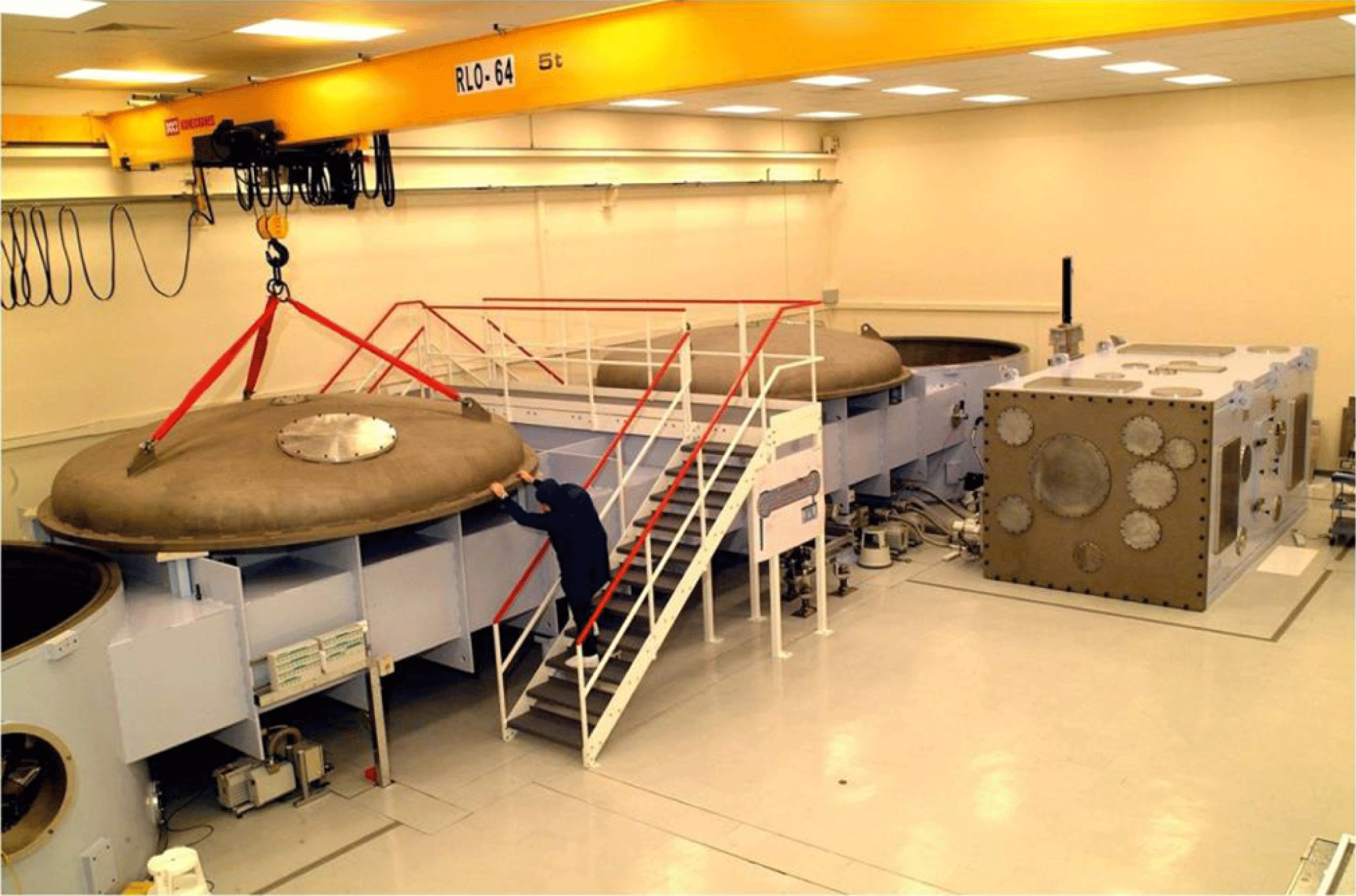
The first of the multi-kJ petawatt facilities to be operational was built at the Laboratory for Laser Energetics (LLE) at the University of Rochester, USA. The laser is coupled with the well proven 30 kJ 60-beam long pulse Omega system. Omega EP (extended performance)[Reference Kelly, Waxer, Bagnoud, Begishev, Bromage, Kruschwitz, Kessler, Loucks, Maywar, McCrory, Meyerhofer, Morse, Oliver, Rigatti, Schmid, Stoeckl, Dalton, Folnsbee, Guardalben, Jungquist, Puth, Shoup, Weiner and Zuegel87], shown in Figure 4, is a four-beam system with an architecture very similar to that of NIF. Two of the beams can be operated in short pulse mode to add petawatt x-ray backlighting capability for ICF experiments plus options for fast-ignition investigations. The laser can operate between 1 and 100 ps, delivering 1 PW performance at 1 ps and 2.6 kJ performance at pulsewidths  ${>}10~\text{ps}$. It has driven the development of high damage threshold multi-layer dielectric gratings and their use in tiled geometry.
Omega EP beamlines (picture courtesy of LLE).
Laser Mégajoule (LMJ) is currently being commissioned by the CEA at a research establishment near Bordeaux, France. Short pulse capability is being added to LMJ through the PETAL beamline. PETAL was originally designed and built to be part of LIL (Laser Integration Line), the LMJ prototype beamline which was modified to incorporate CPA operation[Reference Blanchot, Behar, Berthier, Bignon, Boubault, Chappuis, Coïc, Damiens-Dupont, Ebrardt, Gautheron, Gibert, Hartmann, Hugonnot, Laborde, Lebeaux, Luce, Montant, Noailles, Néauport, Raffestin, Remy, Roques, Sautarel, Sautet, Sauteret and Rouyer88]. It uses four independent compressors with the beams phased together. In  ${\sim}2009$ it was decided to move the hardware into the LMJ facility where it will be used for high energy density physics and research on fast ignition. The beamline is specified to operate at 3.5 kJ and will be commissioned in 2016[Reference Blanchot, Behar, Berthier, Busserole, Chappuis, Damiens-Dupont, Garcia, Granet, Grosset-Grange, Goossens, Hilsz, Laborde, Lacombe, Laniesse, Lavastre, Luce, Macias, Mazataud, Miquel, Néauport, Noailles, Patelli, Perrot-Minot, Present, Raffestin, Remy, Rouyer and Valla89] at half of this energy while higher damage threshold transport optics are being produced.
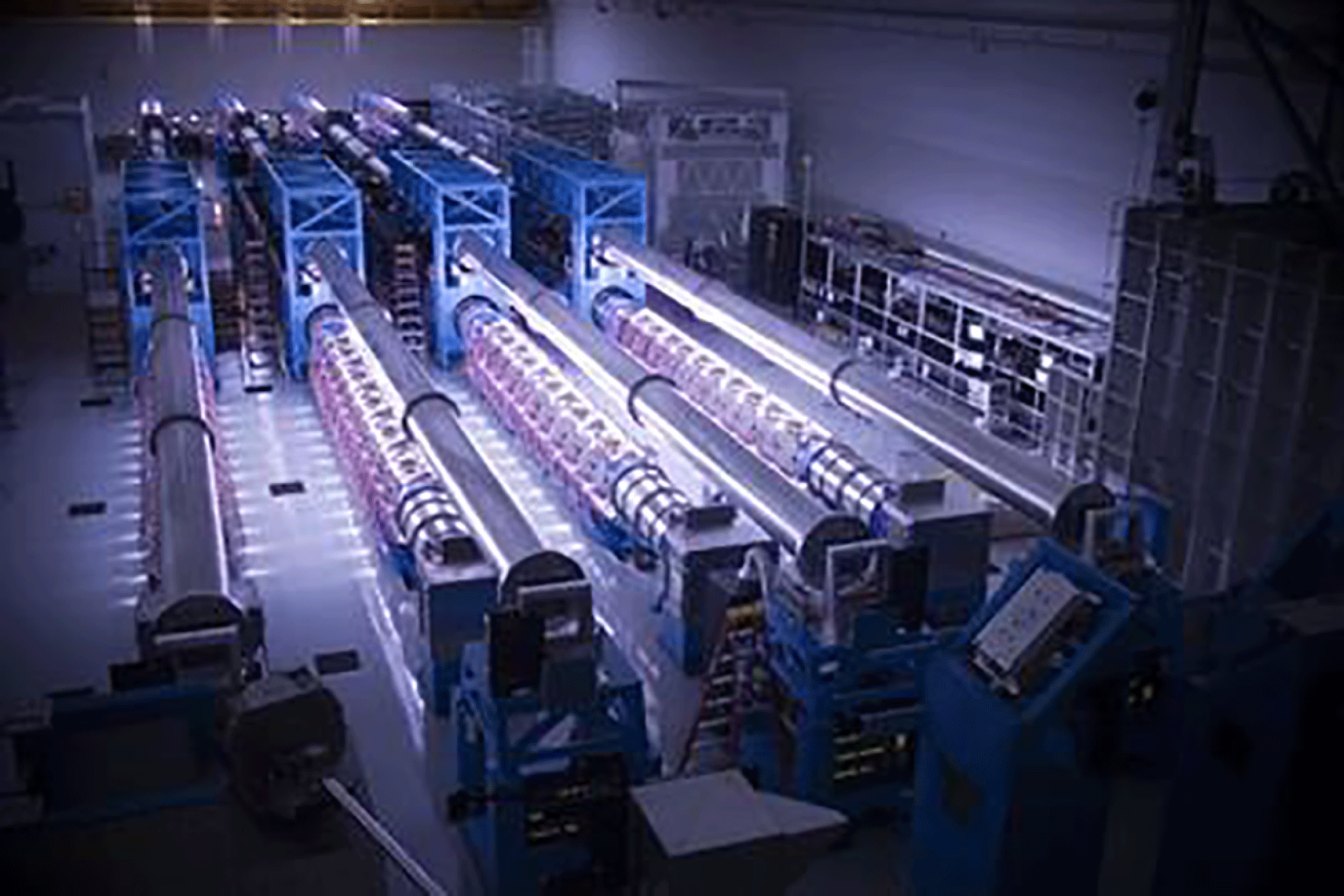
Within the Gekko XII facility at the Institute of Laser Engineering (ILE), University of Osaka, Japan the LFEX facility, shown in Figure 5, is currently being commissioned as a fast ignitor[Reference Tabak, Hammer, Glinsky, Kruer, Wilks, Woodworth, Campbell and Perry90] demonstrator for the FIREX project[Reference Mima, Azechi, Johzaki, Kitagawa, Kodama, Kozaki, Miyanaga, Nagai, Nagatomo, Nakai, Nishimura, Norimatsu, Shiraga, Tanaka and Izawa91, Reference Shiraga, Fujioka, Nakai, Watari, Nakamura, Arikawa, Hosoda, Nagai, Koga, Kikuchi, Ishii, Sogo, Shigemori, Nishimura, Zhang, Tanabe, Ohira, Fujii, Namimoto, Sakawa, Maegawa, Ozaki, Tanaka, Habara, Iwawaki, Shimada, Nagatomo, Johzaki, Sunahara, Murakami, Sakagami, Taguchi, Norimatsu, Homma, Fujimoto, Iwamoto, Miyanaga, Kawanaka, Jitsuno, Nakata, Tsubakimoto, Sueda, Morio, Matsuo, Kawasaki, Sawai, Tsuji, Murakami, Kanabe, Kondo, Kodama, Sarukura, Shimizu, Mima and Azechi92]. The Laser for Fast Ignition EXperiment (LFEX) is designed to have a 1 ps rise time and  $2\times 2$ segmented dielectric gratings. Commissioning started in 2005 and delivered petawatt operation in 2010[Reference Azechi, Mima, Fujimoto, Fujioka, Homma, Isobe, Iwamoto, Jitsuno, Johzaki, Kodama, Koga, Kondo, Kawanaka, Mito, Miyanaga, Motojima, Murakami, Nagatomo, Nagai, Nakai, Nakamura, Nakamura, Nakazato, Nakao, Nishihara, Nishimura, Norimatsu, Ozaki, Sakagami, Sakawa, Sarukura, Shigemori, Shimizu, Shiraga, Sunahara, Taguchi, Tanaka and Tsubakimoto93], with full operational capability expected by the end of 2014[Reference Azechi, Mima, Shiraga, Fujioka, Nagatomo, Johzaki, Jitsuno, Key, Kodama, Koga, Kondo, Kawanaka, Miyanaga, Murakami, Nagai, Nakai, Nakamura, Nakamura, Nakazato, Nakao, Nishihara, Nishimura, Norimatsu, Norreys, Ozaki, Pasley, Sakagami, Sakawa, Sarukura, Shigemori, Shimizu, Sunahara, Taguchi, Tanaka, Tsubakimoto, Fujimoto, Homma and Iwamoto94]. The beam is focused to target by a 4 m off-axis parabola, giving a spot of $30{-}60~{\rm\mu}\text{m}$ in a 5 kJ beam in $1{-}20~\text{ps}$, providing powers of $1{-}5~\text{PW}$ (although final specification is to deliver 10 kJ).
The Gekko XII and LFEX lasers at ILE, University of Osaka, Japan (picture courtesy of Osaka University).

At LLNL, NIF ARC (Advanced Radiographic Capability)[Reference Barty, Key, Britten, Beach, Beer, Brown, Bryan, Caird, Carlson, Crane, Dawson, Erlandson, Fittinghoff, Hermann, Hoaglan, Iyer, Jones, Jovanovic, Komashko, Landen, Liao, Molander, Mitchell, Moses, Nielsen, Nguyen, Nissen, Payne, Pennington, Risinger, Rushford, Skulina, Spaeth, Stuart, Tietbohl and Wattellier95] is designed as an advanced x-ray radiography capability for NIF. NIF ARC uses four (one quad) of NIF’s beams to obtain temporal resolution of tens of picoseconds. Each beam is split into two, producing 8 petawatt class beams delivering between 0.4 and 1.7 kJ at pulse lengths between 1 and 50 ps (0.5 PW each) in the infrared. First pulsed light during commissioning was achieved in September 2014, with commissioning planned to be completed by the end of 2015.
5. Megajoule facilities
The megajoule class lasers, although designed to operate in the nanosecond regime, are true petawatt class facilities due to their enormous scale. The multi-pass technology allows close packing of the beamlines at large aperture, producing a multi-pass stacked laser architecture. They were originally designed jointly between the USA and France for use on NIF and LMJ and are now replicated throughout the world.
A technician inside the NIF target chamber (picture courtesy of LLNL).
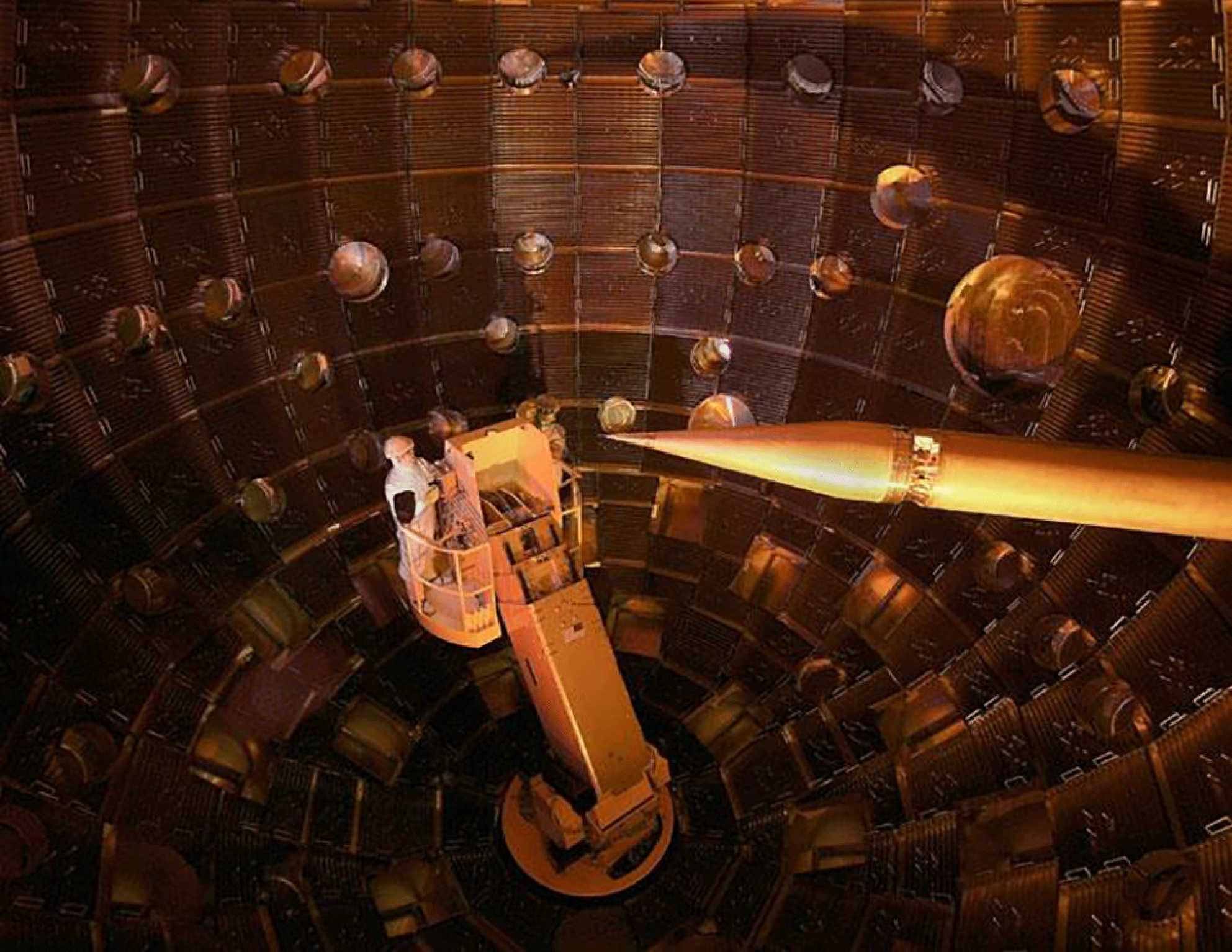
NIF (National Ignition Facility)[Reference Miller, Moses and West8], at LLNL, USA, is the first and currently the only megajoule scale facility to be operational. It has 192  $40\times 40$ beams delivering 1.8 MJ in 3 ns @ $3{\it\omega}$ (0.6 PW) configured for indirect beam drive. Figure 6 is a photograph of inside the NIF target interaction chamber giving an idea of the scale of the facility. It became operational and officially dedicated in March 2009. The facility has been operational for over five years and delivered data for both the NIC (National Ignition Campaign)[Reference Lindl, Landen, Edwards and Moses96] and its internal weapons programme.
LMJ (Laser Mégajoule)[Reference Ebrardt and Chaput9], shown in Figure 7, is a megajoule class laser currently under construction in Bordeaux, France by the French nuclear science directorate CEA. The facility is designed with 240 long pulse beams arranged in 30 lines of eight beams of  $40~\text{mm}\times 40~\text{mm}$ aperture. Initially only 176 beams will be commissioned, delivering a total energy of 1.4 MJ @ $3{\it\omega}$ with a maximum power of 400 TW. The first beamlines will be operational in 2016 with two quads, eight beams, delivering long pulse energy combined with the PETAL short pulse facility[Reference Blanchot, Behar, Berthier, Busserole, Chappuis, Damiens-Dupont, Garcia, Granet, Grosset-Grange, Goossens, Hilsz, Laborde, Lacombe, Laniesse, Lavastre, Luce, Macias, Mazataud, Miquel, Néauport, Noailles, Patelli, Perrot-Minot, Present, Raffestin, Remy, Rouyer and Valla89, 97]. The rest of the beams will be commissioned during the following few years. Following an agreement between CEA and the Region Aquitaine, 20–30% of the time on LMJ/PETAL will be dedicated to academic access.
The LMJ facility in Bordeaux, France (picture courtesy of CEA).

SG-IV (SG stands for Shenguang – Divine Light)[Reference Zhang and He98] is to be built at CAEP (Chinese Academy of Engineering Physics) Research Center for Laser Fusion, Mianyang, China as an ignition demonstrator. The facility will be constructed following the successful commissioning of SG-III, which is designed to operate with 48 beams at 200 kJ. The initial specification of SG-IV is to be of similar scale to NIF and LMJ, although the design is yet to be finalized. Design options can be tested on SG-IIIP, a separate prototype beamline within the SG-III building.
In Russia, there are plans to construct a megajoule facility UFL-2M[Reference Rozanov, Gus’kov, Vergunova, Demchenko, Stepanov, Doskoch, Yakhin, Bel’kov, Bondarenko and Zmitrenko99]. The facility is based on delivering 2.8 MJ of energy @  $2{\it\omega}$ for ICF direct drive target illumination.
6. Ti:sapphire lasers
The introduction of Ti:sapphire lasers provided the opportunity to produce high-repetition-rate systems operating at relatively short pulses, typically 30 fs, due to the inherent broad bandwidth of the lasing medium. The lasers operate at 800 nm and are typically pumped by frequency doubled Nd:glass lasers at 527 nm. In recent years, the number of petawatt class Ti:sapphire lasers has grown significantly. The main reason for this is because the sub-components of the systems and/or the whole laser system itself have become commercially available. This takes away the need for the facility to be sited at a national laboratory and allows smaller research groups to enter the arena. It is also evident that these lasers are now being used for more specific research areas.
The J-KAREN (JAEA-Kansai Advanced Relativistic Engineering) laser system constructed at the APRC (Advanced Photon Research Center), JAEA (Japan Atomic Energy Agency), Kyoto, Japan was the world’s first petawatt class Ti:sapphire facility and is shown in Figure 8. In 2003 the facility was generating 20 J @ 33 fs, giving 0.85 PW[Reference Aoyama, Yamakawa, Akahane, Ma, Inoue, Ueda and Kiriyama100]. In 2010 the facility was upgraded with a high contrast technique, using an OPCPA front end to replace the conventional regenerative amplifier, producing contrasts below  $10^{-10}$ [Reference Kiriyama, Michiaki, Nakai, Shimomura, Sasao, Tanaka, Ochi, Tanoue, Okada, Kondo, Kanazawa, Sagisaka, Daito, Wakai, Sasao, Suzuki, Kotakai, Kondo, Sugiyama, Bulanov, Bolton, Daido, Kawanishi, Collier, Hernandez-Gomez, Hooker, Ertel, Kimura and Tajima101]. The facility can operate at the 80 TW level at 10 Hz repetition rate and at the petawatt level with a reduced rate, once every 30 minutes, due to thermal considerations in the final booster amplifier.
The first Ti:sapphire petawatt class laser facility J-KAREN, Japan (picture courtesy of JAEA).
SILEX-I was constructed at the CAEP (Chinese Academy of Engineering Physics) Research Center of Laser Fusion, Mianyang, China. The facility produced 9 J pulses at 30 fs, giving an output power of 286 TW at a repetition rate of 0.15 Hz[Reference Peng, Zhang, Zhang, Tang, Zheng, Zheng, Wei, Ding, Gou, Zhou and Pei102]. The facility was able to produce focused intensities of  $10^{21}~\text{W cm}^{-2}$ without the need for deformable mirror corrections.
HERCULES (High Energy Repetitive CUos LasEr System) was constructed at the FOCUS Center and Center for Ultrafast Optical Science, University of Michigan, USA. In 2004 ultra-high intensities of up to  $10^{22}~\text{W cm}^{-2}$ in a 45 TW laser could be generated using wavefront correction and an F#0.6 off-axis parabola[Reference Bahk, Rousseau, Planchon, Chvykov, Kalintchenko, Maksimchuk, Mourou and Yanovsky103]. By adding a booster amplifier to the system 300 TW operation could be achieved at 0.1 Hz repetition rate[Reference Yanovsky, Chvykov, Kalinchenko, Rousseau, Planchon, Matsuoka, Maksimchuk, Nees, Cheriaux, Mourou and Krushelnick104]. When focused with an F#1 off-axis parabola this produced focused intensities of $2\times 10^{22}~\text{W cm}^{-2}$.
The APRI Petawatt Facility at GIST, South Korea (picture courtesy of GIST).
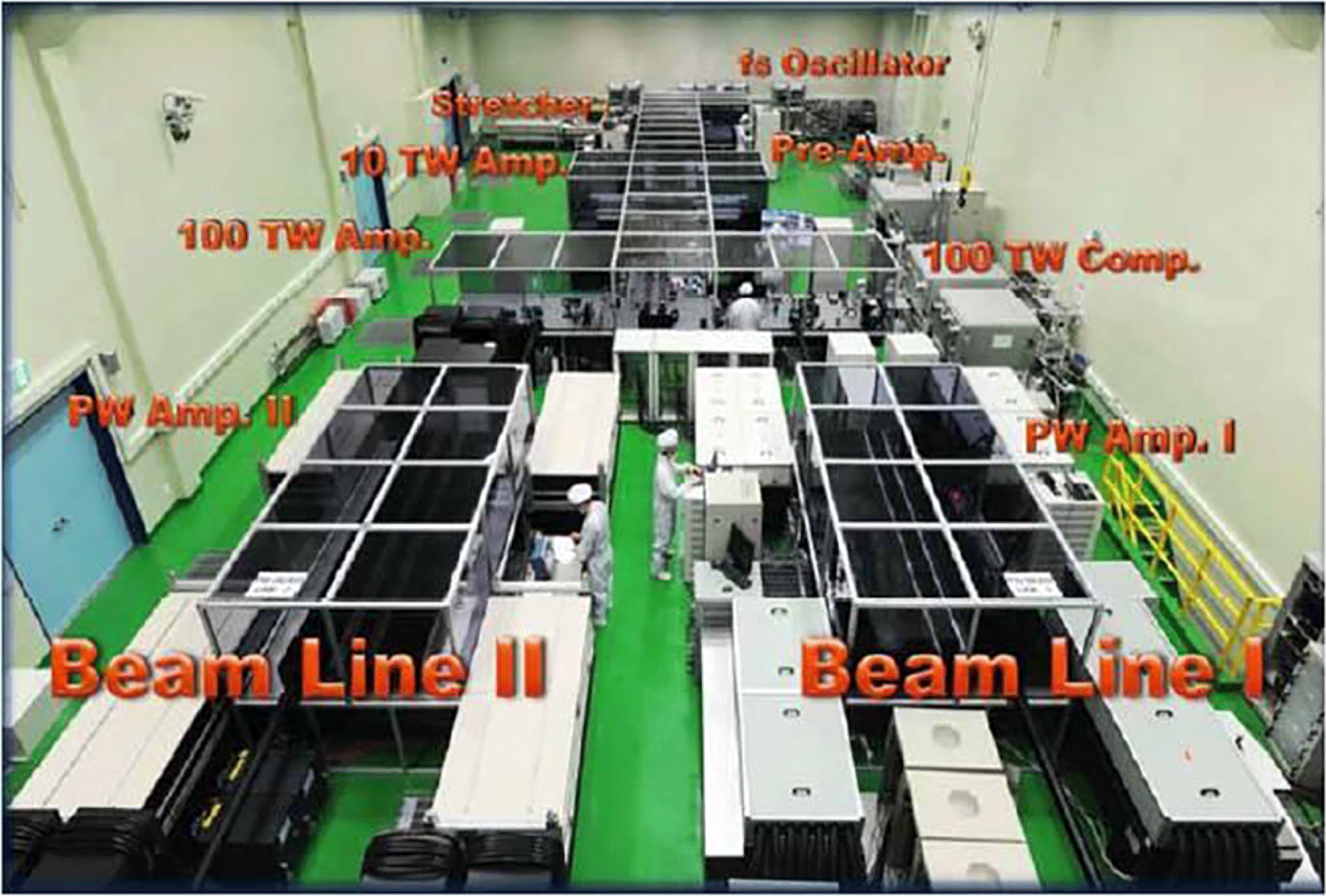
Astra-Gemini is a Ti:sapphire laser system[Reference Hooker, Collier, Chekhlov, Clarke, J. Divall, Ertel, Foster, Hancock, Hawkes, Holligan, Langley, Lester, Neely, Parry and Wyborn105] operated within the Central Laser Facility, STFC Rutherford Appleton Laboratory, UK. It is operated as an academic user facility. It has two ultra-high power beamlines each delivering 15 J in 30 fs pulses @ 800 nm, giving 500 TW beams to target, generating focused intensities  ${>}10^{21}~\text{W cm}^{-2}$ to target. Routine high contrast operation can be achieved with the use of a double plasma mirror assembly within the target chamber.
The LASERIX facility[Reference Ros, Cassou, Cros, Daboussi, Demailly, Guilbaud, Kazamias, Lagron, Maynard, Neveu, Pittman, Zielbauer, Zimmer, Kuhl, Lacombe, Porcel, duPenhoat, Zeitoun and Mourou106] at the University Paris Sud, France was designed to be a high-repetition-rate multi-beam laser to pump an XUV laser. The aim of this laser facility was to offer soft XRLs in the 7–30 nm range and an auxiliary IR beam, which could also be used to produce synchronized XUV sources. The laser was a combination of commercially supplied sub-systems primarily from Thales Laser for the front-end systems, Amplitude Technologies for the power amplification and Quantel for the Nd:glass pump laser. The laser performance was first demonstrated in 2006, delivering 36 J of energy although without full compression[Reference Ple, Pittman, Jamelot and Chambaret107]. The facility is in the process of being moved to CILEX (Centre Interdisciplinaire Lumiere EXtreme).
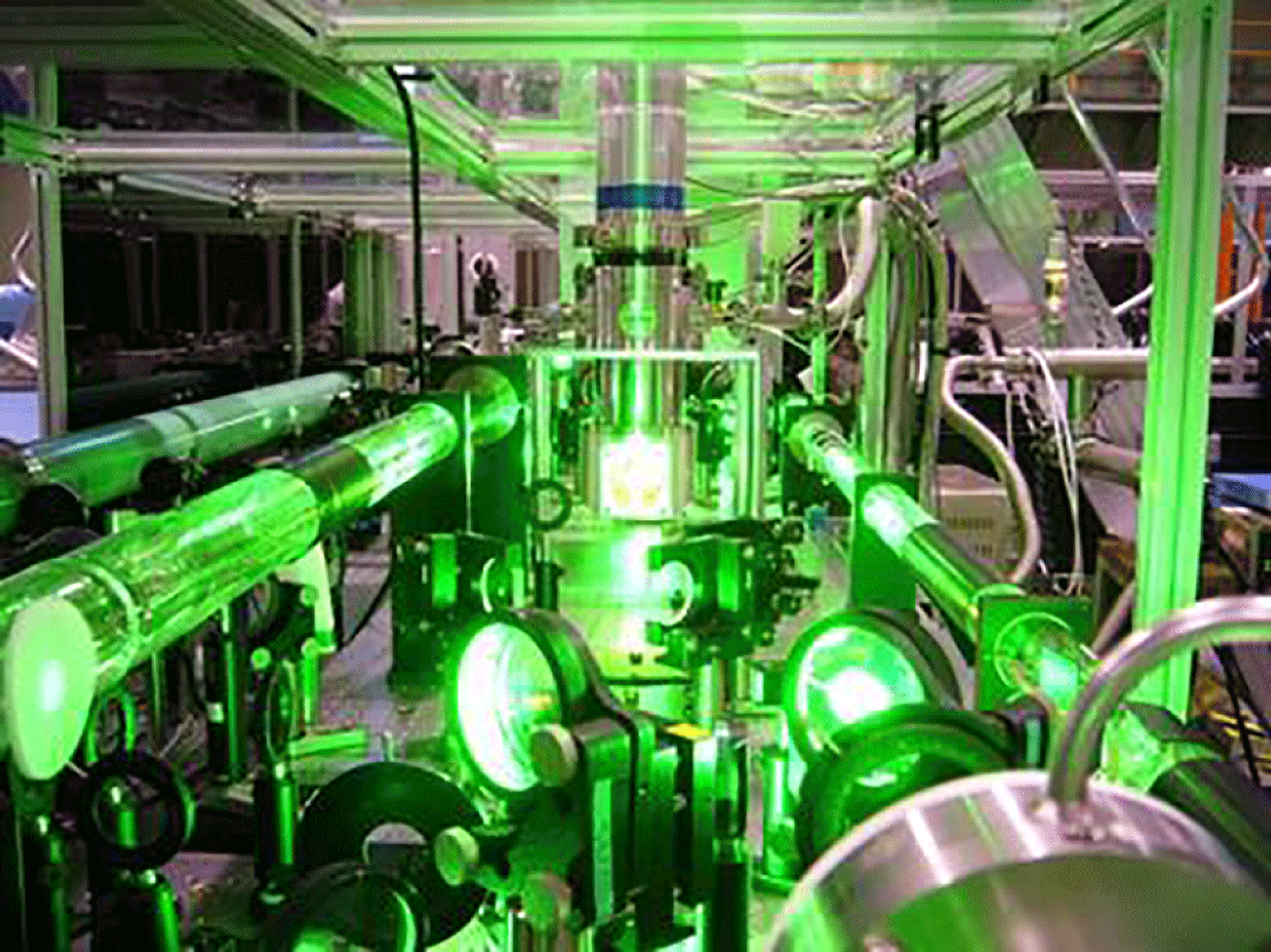
A petawatt facility has been constructed at the Center of Femto-Science and Technology, Advanced Photonics Research Institute (APRI), Gwangju Institute of Science and Technology (GIST), South Korea. The facility, shown in Figure 9, first achieved petawatt capability in 2010 with a 33 J beam in 30 fs delivering 1.1 PW at a repetition rate of 0.1 Hz[Reference Sung, Lee, Yu, Jeong and Lee108]. The facility was upgraded to deliver two petawatt beamlines operating at 1 PW and 1.5 PW which can be delivered into separate target chambers[Reference Yu, Lee, Sung, Yoon, Jeong and Lee109], and is claimed to be the very first 0.1 Hz Ti:sapphire petawatt laser in the world.
At the University of Quebec, the Advanced Laser Light Source (ALLS) is a commercial system built by Amplitude Technologies operating at 10 Hz delivering in excess of 150 TW[Reference Formaux, Payeur, Alexandrov, Serbanescu, Martin, Ozaki, Kudryashov and Kieffer110].
The VEGA facility at the Center for Pulsed Lasers (CLPU) is based at the University of Salamanca, Spain. The facility has been operating with energies of 6 J at 30 fs giving output powers of 200 TW at a repetition rate of 10 Hz synchronized with a second 20 TW beamline. The system is currently being upgraded to provide a third beamline with amplifiers supplied by Amplitude Technologies to deliver 1 PW (30 J @ 30 fs) and will operate at a 1 Hz repetition rate[Reference Roso111].
Xtreme Light III (XL-III) operating at the Institute of Physics of the Chinese Academy of Sciences (IOP CAS) at Beijing National Laboratory for Condensed Matter, China generates 32 J in a 28 ps pulse delivering 1.16 PW to target at focused intensities  ${>}10^{22}~\text{W cm}^{-2}$ (Ref. [Reference Wang, Liu, Shen, Zhang, Teng and Wei112]). The facility produces high fidelity pulses with contrasts of $10^{-10}$
@ 400 ps.
$10^{-10}$
@ 400 ps.
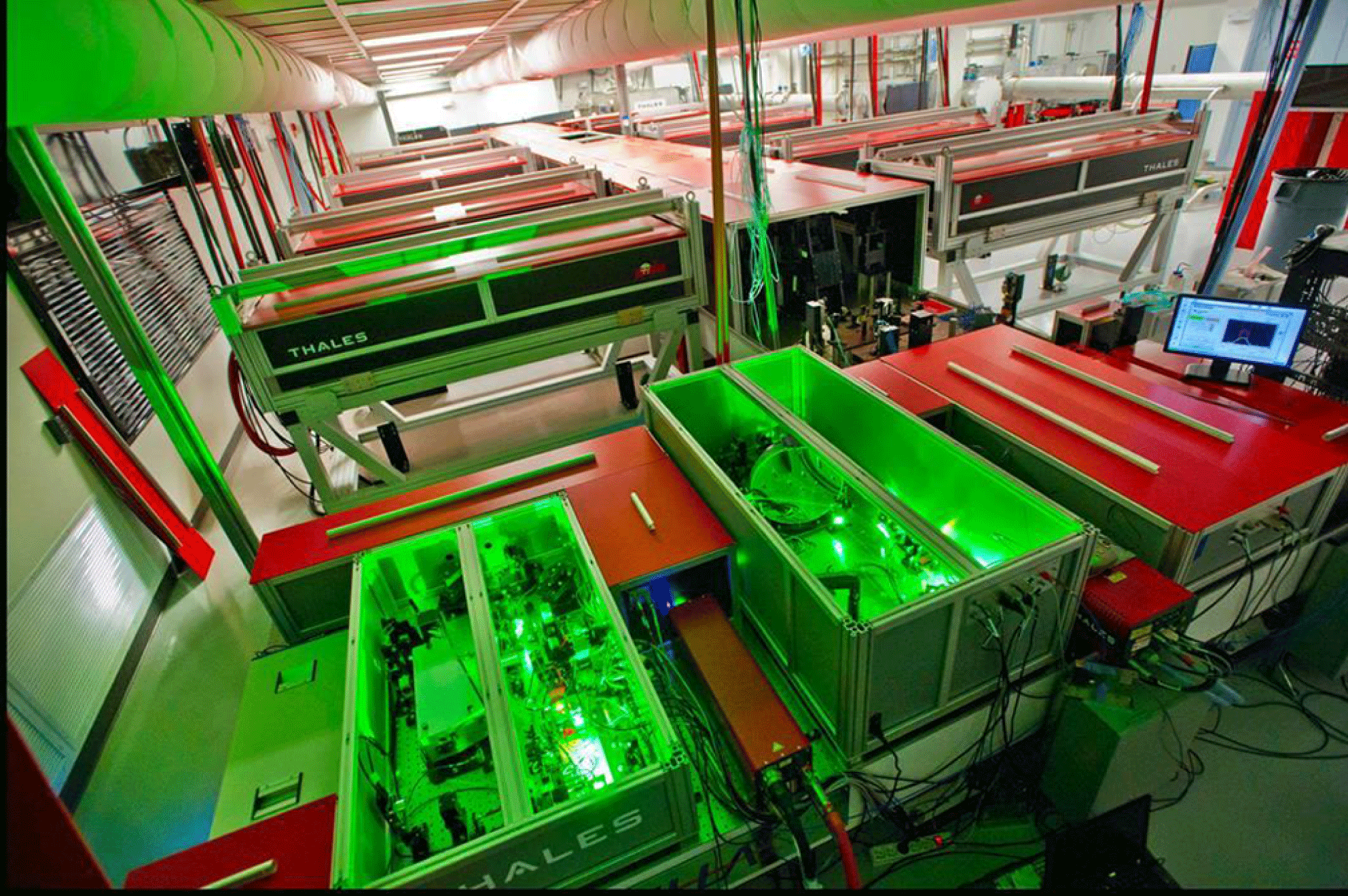
The BELLA (BErkeley Lab Laser Accelerator) project was launched in 2009 and is funded by the DOE for experiments on laser plasma acceleration at Lawrence Berkeley National Laboratory, USA. BELLA, shown in Figure 10, can operate at peak power levels of 1.3 PW with a record-setting repetition rate of 1 Hz for a petawatt laser[Reference Leemans, Daniels, Deshmukh, Gonsalves, Magana, Mao, Mittelberger, Nakamura, Riley, Syversrud, Toth and Ybarrolaza113]. The laser was commercially built by Thales and shipped to Berkeley in 2012.
BELLA, the highest repetition rate petawatt class laser in the world (picture courtesy of Lawrence Berkeley National Laboratory).
The Diocles laser at the Extreme Light Laboratory, University of Nebraska – Lincoln, USA came online nominally at a power level of 100 TW and 10 Hz in 2008, and 1 PW at 0.1 Hz in 2012[Reference Liu, Banerjee, Zhang, Chen, Brown, Mills, Powers, Zhao, Golovin, Ghebregziabher and Umstadter114]. It has been modified since to have active feedback spectral phase control[Reference Liu, Zhang, Chen, Golovin, Banerjee, Zhao, Powers, Ghebregziabher and Umstadter115], and then more recently with a dual-compressor geometry[Reference Liu, Golovin, Chen, Zhang, Zhao, Haden, Banerjee, Silano, Karwowski and Umstadter116]. Ref. [Reference Liu, Golovin, Chen, Zhang, Zhao, Haden, Banerjee, Silano, Karwowski and Umstadter116] describes how it has been successfully used to generate 9 MeV x-rays via inverse Compton scattering.
The Scarlet laser facility at Ohio State University, USA[Reference Poole, Willis, Daskalova, Sheng, Van Woerkom, Freeman and Chowdhury117] was built for studies in high energy density physics, in a purpose built building in 2007, and became operational in 2012. The front end was originally a Thales 40 TW system but has been upgraded to deliver 15 J in 40 fs, giving 400 TW with a shot every minute.
At SIOM the Qiangguang (Intense Light) Ti:S laser facility produces the highest powers ever achieved from a Ti:sapphire system (52 J @ 26 fs), giving output powers of 2 PW[Reference Chu, Liang, Yu, Xu, Xu, Ma, Lu, Liu, Leng, Li and Xu118]. A high contrast front end gives contrasts to target of  $1.5\times 10^{-11}$ @ 100 ps.
As part of the SLAC Linac Coherent Light Source (LCLS) at Stanford University, USA the MEC (Materials in Extreme Conditions instrument) femtosecond laser system has been operational at the 25 TW level in conjunction with the LCLS coherent x-ray beam. It is currently being upgraded to 200 TW to be operational in 2015.
DRACO (Dresden laser acceleration source)[Reference Zeil, Kraft, Bock, Bussmann, Cowan, Kluge, Metzkes, Richter, Sauerbrey and Schramm119] at the Helmholtz-Zentrum Dresden-Rossendorf laboratory in Germany is a commercially sourced Ti:sapphire laser made by Amplitude Technologies. The facility is designed to investigate electron, ion and proton acceleration schemes for radiation therapy as part of ELBE (Electron Linac for beams with high Brilliance and low Emittance) – Center for High Power Radiation Sources. It is currently being commissioned to operate at 150 TW by the end of 2014, but will be operating at 1 PW by the end of 2015.
Two very similar systems are being constructed in France and Germany: Apollon[Reference Zou120] at CILEX (Centre Interdisciplinaire Lumiere EXtreme) and the Helmholtz Beamline[Reference Bagnoud121] for the international accelerator project FAIR at GSI Helmholtz Centre for Heavy Ion Research, Darmstadt. Both lasers are mixed OPA and Ti:sapphire systems pumped by Nd:glass systems supplied by National Energetics, Texas, USA to realize short pulses at high energy. The systems are specified to deliver 150 J pulses at 15 fs, giving powers of 10 PW.
At the Centre for Advanced Laser Technologies INFLPR (National Institute for Laser, Plasma and Radiation Physics), Romania the CETAL petawatt laser (25 J in 25 fs) is currently being constructed[122]. The facility built commercially by Thales Optronique will operate at 0.1 Hz and be operational in 2015. Thales are also currently constructing a 200 TW system for Peking University, Beijing, China.
200 TW (5 J, 20 fs, 5–10 Hz PULSAR laser) systems from Amplitude Technologies, France have also been installed or are being installed at the following establishments:
∙ ETRI, Daejeon, Korea;
∙ INRD, Montreal, Canada;
∙ LLP, Shanghai Jiao Tong University, China[123];
∙ INFN, Frascati National Laboratories, Italy[Reference Gizzi, Benedetti, Alberto Cecchetti, Di Pirro, Gamucci, Gatti, Giulietti, Giulietti, Koester, Labate, Levato, Pathak and Piastra124];
∙ The Intense Laser Irradiation Laboratory (ILIL), CNR (Consiglio Nazionale delle Ricerche) National Institute of Optics, Pisa, Italy[Reference Gizzi, Benedetti, Alberto Cecchetti, Di Pirro, Gamucci, Gatti, Giulietti, Giulietti, Koester, Labate, Levato, Pathak and Piastra124].
7. OPCPA systems
The OPCPA concept for large aperture systems was conceived at the Central Laser Facility, STFC Rutherford Appleton Laboratory by Ian Ross[Reference Ross, Collier, Matousek, Danson, Neely, Allott, Pepler, Hernandez-Gomez and Osvay73], with the first practical demonstration on Vulcan within the Central Laser Facility[Reference Chekhlov, Collier, Ross, Bates, Notley, Hernandez-Gomez, Shaikh, Danson, Neely, Matousek and Hancock125]. In this technique the frequency doubled light from a high energy Nd:glass laser facility is transferred to a chirped short pulse laser via parametric amplification in a KDP or LBO crystal at apertures of  ${>}100~\text{mm}$.
The first operational OPCPA system was developed using a pump beam derived from the Luch Facility at the Institute of Applied Physics, Russian Academy of Science, Nizhny Novgorod. The laser delivered 0.2 PW in 2006[Reference Lozhkarev, Freidman, Ginzburg, Katin, Khazanov, Kirsanov, Luchinin, Mal’shakov, Martyanov, Palashov, Poteomkin, Sergeev, Shaykin and Yakovlev126] and was upgraded to 0.56 PW in 2007[Reference Lozhkarev, Freidman, Ginzburg, Katin, Khazanov, Kirsanov, Luchinin, Mal’shakov, Martyanov, Palashov, Poteomkin, Sergeev, Shaykin and Yakovlev127].
At SIOM (Shanghai Institute for Optics and Fine Mechanics), China the Qiangguang 10 PW (Intense Light) OPCPA system, shown in Figure 11, has been constructed with large aperture LBO crystals with a final aperture of 215 mm[Reference Xu, Yu, Liang, Chu, Hu, Ma, Xu, Wang, Lu, Lu, Yue, Zhao, Fan, Tu, Leng, Li and Xu128]. The current operating level is 28.7 J in a 33.8 fs pulse, giving output powers of 0.61 PW, the highest peak powers achieved anywhere in the world to date. In 2015, 5 PW (150 J in 30 fs) performance is planned; the final 10 PW (300 J in 30 fs) performance is currently delayed due to the availability of large aperture LBO but is due to be delivered in 2017.
The SIOM OPCPA Qiangguang 10 PW laser facility (picture courtesy of SIOM).
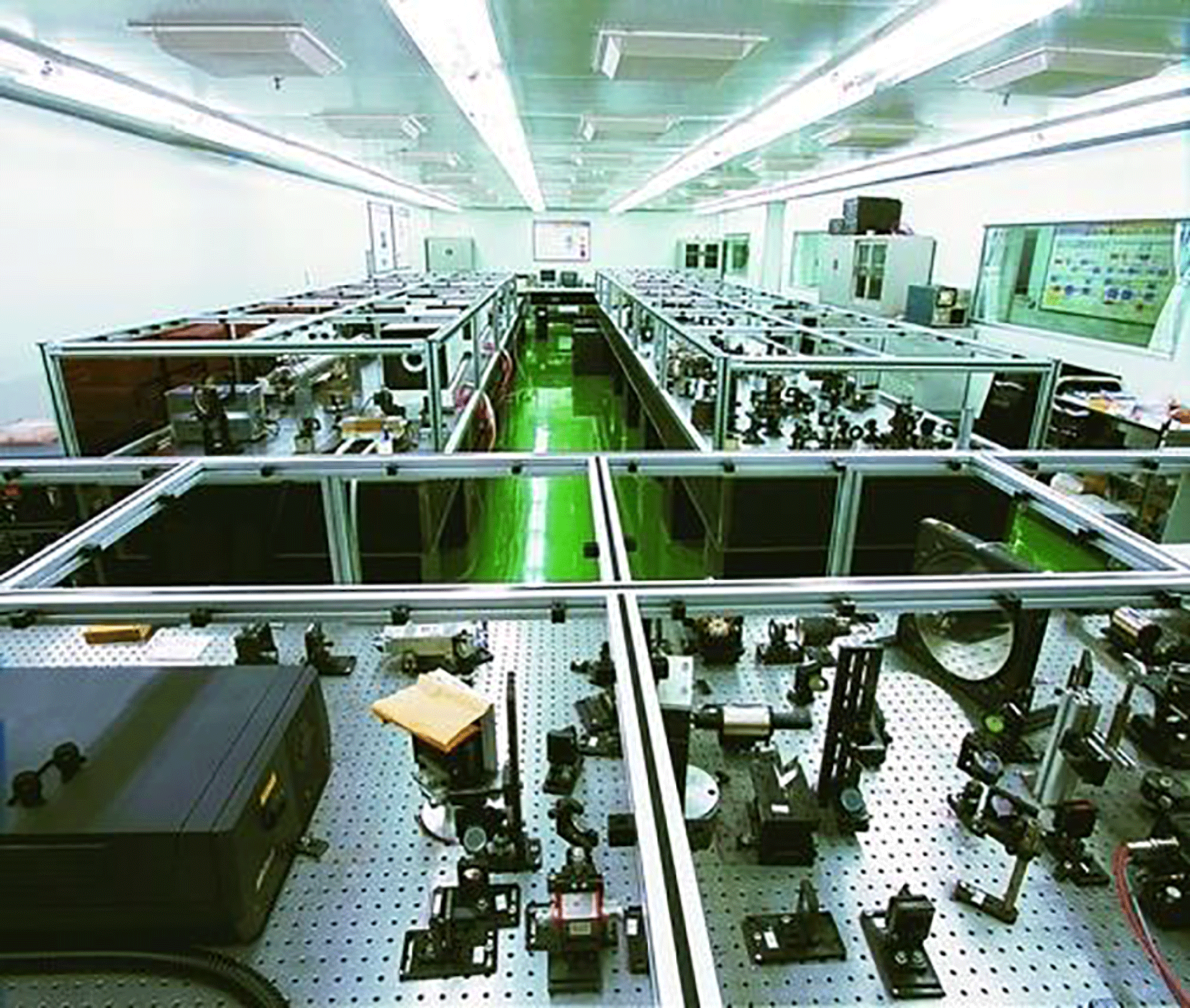
Within the Central Laser Facility, STFC Rutherford Appleton Laboratory there are plans to upgrade the Vulcan facility with full aperture OPCPA following on from the first demonstrations[Reference Ross, Collier, Matousek, Danson, Neely, Allott, Pepler, Hernandez-Gomez and Osvay73, Reference Chekhlov, Collier, Ross, Bates, Notley, Hernandez-Gomez, Shaikh, Danson, Neely, Matousek and Hancock125]. Two long pulse beamlines of Vulcan will be used to pump DKDP crystals to deliver 500 J in  ${\sim}$25 fs to deliver 20 PW[Reference Hernandez-Gomez, Blake, Chekhlov, Clarke, Dunne, Galimberti, Hancock, Heathcote, Holligan, Lyachev, Matousek, Musgrave, Neely, Norreys, Ross, Tang, Winstone, Wyborn and Collier129].
PALS (Prague Asterix Laser System) is an iodine photo-dissociation laser. The Asterix facility was first built at MPQ Garching and completed in 1995. Asterix was moved to Prague and has been operational since September 2000[Reference Rus, Rohlena, Skála, Králiková, Jungwirth, Ullschmied, Witte and Baumhacker130]. PALS operates at 1315 nm and has extremely narrow linewidths,  ${\sim}$20 pm, making it unsuitable for direct short pulse operation. By frequency tripling the PALS beam it makes an ideal pump laser for an 800 nm seed. A design for a 1.4 PW interaction beam has been published[Reference Novak, Divoký, Turčičová and Straka131] using the existing building geometry.
The Petawatt Field Synthesizer[Reference Major, Trushin, Ahmad, Siebold, Wandt, Klingebiel, Wang, Fülöp, Henig, Kruber, Weingartner, Popp, Osterhoff, Hörlein, Hein, Pervak, Apolonski, Krausz and Karsch132] is currently being constructed at the Max-Planck-Institute for Quantenoptik, Garching, Germany. It is a few-cycle petawatt system designed to produce isolated attosecond pulses for wake-field acceleration. The system is entirely OPCPA with ultra-short seed and pump pulses. The final specification of the system is 5 J in 5 fs and it will be operational in 2017.
At the Laboratory for Laser Energetics (LLE), University of Rochester, USA options are being investigated for an ultra-high energy OPCPA system using four OMEGA EP beamlines. The project is called OPAL[Reference Zuegel133] (Optical Parametric Amplifier Line) and would have available a total pump energy of 12 kJ @ 526 nm. Using this scheme it will be possible to generate 3 kJ, 15 fs pulses, giving peak powers of 200 PW and focused intensities of  $10^{24}~\text{W cm}^{-2}$.
A similar planned project to that of ELI at the Institute of Applied Physics of the Russian Academy of Sciences in Nizhny Novgorod is the XCELS (Exawatt Centre for Extreme Light Studies). This megascience project in Russia is to produce an exawatt laser system for fundamental science. The system will use combined 15 PW OPCPA beamlines to reach  ${>}200~\text{PW}$[134].
8. Diode pumped systems
Diode pumping has been identified as being on the critical path to the construction of ICF (inertial confinement fusion) power plants. Their high efficiency and low thermal deposition in the amplifier media make diode pumped systems ideal candidates for these developments. As the technology is developed it is being used in existing facilities to increase the repetition rates of amplifiers, in particular in their front ends. There are also an increasing number of entirely diode pumped petawatt class laser systems either operational or planned in the next few years.
It is proposed to use the Mercury laser facility at LLNL, USA, a diode pumped Yb:S-FAP laser, to pump a Ti:S laser to generate  ${>}1~\text{PW}$ powers at repetition rates of 10 Hz[Reference Armstrong, Beer, Campbell, Chai, Cross, Erlandson, Fei, Freitas, Kent, Menapace, Molander, Schaffers, Siders, Sutton, Tassano, Telford, Ebbers, Caird and Barty135]. Mercury has been developed as a high average power laser (HAPL) using diode arrays and optimized gas cooling as a precursor to an advanced fusion driver[Reference Bayramian, Armstrong, Ault, Beach, Bibeau, Caird, Campbell, Chai, Dawson, Ebbers, Erlandson, Fei, Freitas, Kent, Liao, Ladran, Menapace, Molander, Payne, Peterson, Randles, Schaffers, Sutton, Tassano, Telford and Utterback136].
POLARIS (Petawatt Optical Laser Amplifier for Radiation Intensive experimentS) is based at the Helmholtz Institute Jena, Germany. It is designed as a fully diode pumped Yb:Glass petawatt class laser[Reference Hornung, Keppler, Bödefeld, Kessler, Liebetrau, Körner, Hellwing, Schorcht, Jäckel, Sävert, Polz, Arunachalam, Hein and Kaluza137]. It operates at a central wavelength of 1030 nm and a bandwidth of  ${\sim}$10 nm. It is currently being upgraded from 4 J in 164 fs ${\sim}$30 TW to 1 PW with the commissioning of the final amplifier to deliver 150 J in 150 fs in 2016. The final amplifier of the facility is shown in Figure 12.
The final amplifier of POLARIS (picture courtesy of Helmholtz Institute).

PEnELOPE (Petawatt, Energy-Efficient Laser for Optical Plasma Experiments) is a high-repetition-rate diode pumped laser using broadband Yb-doped glass/ $\text{CaF}_{2}$ under construction at the Helmholtz-Zentrum, Dresden-Rossendorf within the ELBE Centre for high power radiation sources[Reference Siebold, Roeser, Loeser, Albach and Schramm138]. It will be dedicated to the production of laser accelerated proton and ion beams with energies ${>}100~\text{MeV}$ relevant to future cancer treatments. The facility, due to be commissioned in 2016, will deliver pulses of 150 J in 120 fs, giving ${>}1~\text{PW}$ at $1~\text{Hz}$. PEnELOPE and POLARIS are both programmes belonging to the German Helmholtz Society.
9. The next generation
Facilities that are changing the landscape of Petawatt class facilities are the three pillars of ELI (European Light Infrastructure)[139], where three large scale laser user facilities are being built to exploit ultra-high intensity interactions in the Czech Republic (ELI-Beamlines), Hungary (ELI-Attosecond Light Pulse Source) and Romania (ELI-Nuclear Physics).
∙ ELI-Beamlines will provide a range of laser systems for the production of high brightness x-rays and accelerating particles. The beamlines use either OPCPA, Ti:sapphire or a combination of the two to produce pulses ranging from hundreds of millijoules at a kHz up to a kilojoule beamline firing once a minute. These will be coupled to separate interaction areas allowing a wide range of experiments to be performed. An artist’s impression of the ELI-Beamlines building is shown in Figure 13.
∙ ELI-ALPS (Attosecond Light Pulse Source) will provide three high-repetition-rate OPCPA beamlines: 100 kHz, ${>}5~\text{mJ}$, ${<}5~\text{fs}$; a single cycle 1 kHz, ${>}100~\text{mJ}$, ${<}5~\text{fs}$; and a high intensity 5 Hz, ${>}40~\text{J}$, ${<}15~\text{fs}$. All the beamlines will be used to drive secondary sources (UV/XUV, x-rays, ions, etc.), which will be dedicated to extremely fast electron dynamics in atoms, molecules, plasmas and solids.
∙ ELI-NP (Nuclear Physics) will have two beamlines with OPCPA front ends and Ti:sapphire power amplifiers. The beamlines will either produce 1 PW at 1 Hz (20 J,
${<}20~\text{fs}$) or $10~\text{PW}$ at 1 shot per minute (220 J, ${<}20~\text{fs}$). The beamlines will be used to produce extremely high energy gamma rays for a wide range of nuclear physics applications.


During this review we have discussed stand alone flashlamp pumped petawatt class lasers and also the megajoule class lasers currently operational or under construction. The next generation of these ICF demonstration facilities will use diode pumped technology to dramatically increase the repetition rate of the lasers. This will be a giant step on the road to building a commercial power plant using this technology. Large programmes have been examining the options for these systems both in the USA and Europe[140, 141].
Artist’s impression of the ELI-Beamlines building (picture courtesy of ELI).

Raman based plasma amplifiers have been the subject of speculation for many years[Reference Malkin, Shvets and Fisch142] as a means of generating ultra-high powers. In these schemes, it is possible to transfer energy from multiple nanosecond laser pulses in a plasma to an ultra-short pulse seed. The benefit of this scheme is that it is not limited by the normal nonlinear propagation processes in laser amplifiers.
Systems based around VECSELs (vertical external cavity emitting lasers) have rapidly increased in output power in recent years. Thin disc lasers are currently used at facilities such as PEnELOPE[Reference Siebold, Roeser, Loeser, Albach and Schramm138] and mode-locked semiconductor VECSELs are surpassing what were believed to be their limitations[Reference Keller143].
Femtosecond coherently combined fibre amplifiers have been demonstrated at the millijoule level[Reference Klenke, Breitkopf, Kienel, Gottschall, Eidam, Hädrich, Rothhardt, Limpert and Tünnermann144] which show the potential for the construction of massively multiplexed short pulse lasers that could operate at high energy and repetition rates. Under IZEST (International Center for Zetta–Exawatt Science and Technology), based at Ecole Polytechnique, France, the ICAN (International Coherent Amplification Network) Project is looking to use thousands of fibre lasers coherently combined to build the next generation of particle accelerators. A demonstration system is aiming to coherently combine a fibre bundle to produce 10 J of energy in a 100–200 fs pulse[Reference Mourou, Brocklesby, Tajima and Limpert145]. When combined, the overall facility could produce  ${>}100~\text{PW}$. This will potentially reach greater energies than are currently possible using conventional techniques in a vastly reducedfootprint.
10. Conclusion
From national laboratories to university departments, the petawatt laser has evolved to become one of the most important tools in the scientific toolkit for the study of matter in extreme states. The first petawatt lasers were built at national laboratories by adapting beamlines from fusion laser systems. Over the last 20 years, as technologies have advanced, these systems have come down in size and cost such that they are commercially available and within the reach of university physics departments.
In this paper, we have noted over 50 petawatt class lasers ( ${>}200~\text{TW}$) that are operational, under construction or in the planning phase. These range from kJ and even multi-kJ high energy systems to high-repetition table-top femtosecond devices.
Petawatt lasers are now being constructed for specific applications in fields ranging from proton therapy for the treatment of cancer to simulation of astrophysical phenomena, and many more besides. The next generation of lasers will approach exawatt power levels and allow us to reach conditions beyond those that naturally occur in the universe.
Acknowledgements
The authors are grateful for the cooperation of all of the managers of the petawatt class lasers who have contributed to making this paper as accurate as possible and who have allowed the figures to be used to illustrate their facilities.
The authors have tried to deliver a comprehensive review of petawatt class lasers worldwide and have conducted extensive research to ensure that all of the details in this paper are correct. Apologies if they have overlooked or misrepresented any facility within this exercise.


 Open access

