




1. Introduction
Willingness to communicate (WTC) in the second language (L2) has been regarded as a prerequisite for successful L2 communication and a crucial construct in L2 acquisition (Kirkpatrick et al., Reference Kirkpatrick, Vafadar and Mohebbi2024; Zadorozhnyy & Lee, Reference Zadorozhnyy and Lee2025). As digital technologies continue to evolve, L2WTC in online environments has gradually attracted attention from researchers (Lee & Drajati, Reference Lee and Drajati2020). Drawing on prior research, four key factors have been frequently identified as antecedents of L2WTC, including perceived communicative competence (e.g., Alrabai, Reference Alrabai2022), foreign language anxiety (e.g., Solhi, Reference Solhi2024), teacher support (e.g., Lee & Liu, Reference Lee and Liu2024), and classroom environment (e.g., Bhuvaneswari et al., Reference Bhuvaneswari, Borah, Hussain, Hamdan, Hassanien, Mescon and Alareeni2022).
In recent years, massive open online courses (MOOCs) have steadily gained popularity on a global scale since their launch in 2012 (Zhang et al., Reference Zhang, Yang, Yang and Han2024). However, while extensive studies have examined L2WTC in traditional classrooms (e.g., Alrabai, Reference Alrabai2022; Reinders & Wattana, Reference Reinders and Wattana2015) and some in online environments (e.g., Lee & Liu, Reference Lee and Liu2024; Solhi, Reference Solhi2024), few have investigated L2WTC among EFL learners in MOOCs. Moreover, most existing studies have focused solely on L2WTC in oral communication (e.g., Hejazi et al., Reference Hejazi, Sadoughi and Peng2023; Lee & Liu, Reference Lee and Liu2024), overlooking the fact that L2WTC in online classrooms involves both oral (e.g., discussions, responding to questions) and written components (e.g., posting comments and ideas on discussion boards and forums). Grounded in MacIntyre et al.’s (Reference MacIntyre, Clément, Dörnyei and Noels1998) heuristic model, this study made a first attempt to differentiate between oral and written L2WTC and adopted an affective–cognitive perspective to examine how trait-like and context-specific factors interact in shaping each L2WTC form.
2. Literature review
2.1. EFL learning in MOOCs
With technological advancements in 2020, English teaching in higher education has experienced a transition from face-to-face on-site classes to distant online classes (Lee & Liu, Reference Lee and Liu2024). MOOCs, an innovation in technology-enhanced pedagogy, have rapidly become an integral component of this transformation in global higher education (Azevedo et al., Reference Azevedo, Pedro and Dorotea2024). In China, many universities have incorporated MOOC development into institutional requirements, and undergraduates are required to take online English courses through MOOC platforms for credit (Guo & Ibrahim, Reference Guo and Ibrahim2023).
MOOCs present both opportunities and challenges for language education. On the one hand, they provide learners with flexible access to knowledge anytime and anywhere, facilitating interaction and instant feedback (Zheng et al., Reference Zheng, Chen and Burgos2018). They also support personalized learning by allowing learners to adjust learning paths and pace (Jitpaisarnwattana et al., Reference Jitpaisarnwattana, Darasawang and Reinders2022). This flexibility broadens access to language resources and promotes learner self-regulation. On the other hand, since language learning is more skill-based than knowledge-based, MOOCs require learners to demonstrate a high degree of proactivity, autonomy, and engagement (Martín-Monje & Bárcena, Reference Martín-Monje and Bárcena2015). Additionally, remote instruction may reduce immediacy between teachers and students (Pu, Reference Pu2020), potentially triggering feelings of isolation or anxiety (Palloff & Pratt, Reference Palloff and Pratt2013). More importantly, although MOOCs are designed to foster peer communication, many courses still follow teacher-centred approaches that may restrict collaborative engagement (Guillén, Reference Guillén2015). These constraints may undermine learners’ motivation and ultimately hinder the learning process (Ding & Shen, Reference Ding and Shen2022; Jiang & Peng, Reference Jiang and Peng2025). Given that shifts in contexts may lead to changes in L2WTC, further investigation into L2WTC in MOOCs is warranted.
2.2. Willingness to communicate in the second language (L2WTC)
2.2.1. The definition of L2WTC
L2WTC is defined as “a readiness to enter into the discourse at a particular time with a specific person or persons, using a L2” (MacIntyre et al., Reference MacIntyre, Clément, Dörnyei and Noels1998, p. 547). To capture its dynamic nature, MacIntyre et al. (Reference MacIntyre, Clément, Dörnyei and Noels1998) developed a heuristic pyramid model that has since been widely adopted in studies on individual differences in L2WTC. Based on this six-layer model, L2WTC influential factors could be classified into trait-like and context-specific factors, with the former exerting enduring effects and the latter dynamic influences. This model challenged the perception of L2WTC as a stable trait, suggesting that it fluctuated during communication depending on the interaction of individual and contextual factors.
With the advancement of technology and its adoption in online learning platforms, communication in online classrooms has evolved to involve both oral interactions and written exchanges (Quan-Haase et al., Reference Quan-Haase, Harper and Wellman2021). To better align with the unique characteristics of technology-supported learning environments, the concept of L2WTC in online contexts needs to be broadened to include individuals’ tendency to use L2 for both oral and written communication, which can vary under the influence of trait-like and context-specific factors. In the case of MOOCs, L2WTC extends beyond synchronous oral communication to encompass real-time written communication on discussion boards as well as asynchronous written exchanges in after-class discussion forums.
2.2.2. Factors affecting L2WTC
Drawing on the literature, this study focused on four key determinants widely acknowledged as critical influences on L2WTC. The first two trait-like factors are perceived communicative competence (PCC) and foreign language anxiety (FLA). PCC refers to learners’ self-perceived ability to communicate effectively in the target language (MacIntyre et al., Reference MacIntyre, Clément, Dörnyei and Noels1998). Previous studies have consistently shown that PCC positively predicted L2WTC in both traditional (Alrabai, Reference Alrabai2022; Khajavy et al., Reference Khajavy, Ghonsooly, Hosseini Fatemi and Choi2016) and online learning contexts (Balouchi & Samad, Reference Balouchi and Samad2021; Soyoof, Reference Soyoof2023). For instance, Balouchi and Samad (Reference Balouchi and Samad2021) surveyed 372 university students in Malaysia and found that those with higher PCC tended to engage in L2 communication more frequently in online settings. Similarly, Soyoof (Reference Soyoof2023) interviewed 50 Iranian secondary school EFL learners and reported that enhancing learners’ PCC in digital contexts significantly boosted their L2WTC.
FLA, defined as the tension and apprehension experienced when using a foreign language (Horwitz, Reference Horwitz1986), has been confirmed to be negatively associated with L2WTC across face-to-face and online learning contexts (e.g., Solhi, Reference Solhi2024). In the studies by Dewaele (Reference Dewaele2019) and Lee (Reference Lee2018), FLA emerged as the strongest negative predictor of L2WTC. Similarly, employing structural equation modelling to analyse the data from 290 university students in Istanbul, Solhi (Reference Solhi2024) found that FLA significantly reduced L2WTC in both in-person and online environments, with a more pronounced effect in the latter. Consistent with these findings, Memari (Reference Memari2023) also reported that learners in virtual settings experienced lower FLA and higher L2WTC than those in traditional classrooms.
The other two context-specific factors include teacher support and classroom environment. Teacher support refers to learners’ perceptions of the care and assistance provided by their teachers (Patrick et al., Reference Patrick, Ryan and Kaplan2007). Prior research has highlighted its crucial role in influencing learners’ L2WTC (e.g., Lee & Liu, Reference Lee and Liu2024). Kang (Reference Kang2005) observed that effective teacher support reduced learners’ FLA and increased their L2WTC. When teachers appeared attentive, smiled, or responded positively, students felt safe and were more inclined to engage in conversation (Kang, Reference Kang2005). Conversely, signs of teacher disengagement, such as frowning, yawning, or checking the time, triggered students’ anxiety and reduced their willingness to speak (Kang, Reference Kang2005). Zarrinabadi (Reference Zarrinabadi2014) corroborated these findings, suggesting that teacher strategies such as providing encouraging wait time, delayed error correction, and positive feedback can mitigate anxiety, foster confidence, and consequently enhance learners’ L2WTC. Similarly, Hejazi et al. (Reference Hejazi, Sadoughi and Peng2023) noted that teacher support positively influenced L2WTC, with L2 anxiety serving as a significant mediator. In online learning contexts, Lee and Liu (Reference Lee and Liu2024) believed that teacher support, such as patiently waiting for learners’ responses and recognizing students’ efforts, significantly improved learners’ L2WTC.
Classroom environment, defined as the overall atmosphere of an educational setting (Dorman et al., Reference Dorman, Fisher, Waldrip, Fisher and Khine2006), has been regarded as a key predictor of L2WTC (e.g., Bhuvaneswari et al., Reference Bhuvaneswari, Borah, Hussain, Hamdan, Hassanien, Mescon and Alareeni2022). Compared with face-to-face contexts, online environments are generally perceived as safer spaces with a lower risk of face-threatening situations, thereby fostering greater L2WTC. This is possibly because students in traditional classrooms often experience anxiety about making mistakes and fear negative judgement from teachers and peers, whereas online learning interactions tend to reduce these fears and anxieties while increasing their confidence (Reinders & Wattana, Reference Reinders and Wattana2015). Additionally, Mellati and Khademi (Reference Mellati and Khademi2020) found that reduced eye contact in online environments could further alleviate anxiety, enhance confidence, and ultimately boost L2WTC. However, as online classes are an emerging form of instruction, students accustomed to traditional face-to-face classrooms may encounter difficulties adapting to online environments. Challenges such as technical glitches, lack of cues from peers, and limited direct interaction opportunities may inhibit students’ L2WTC (Bhuvaneswari et al., Reference Bhuvaneswari, Borah, Hussain, Hamdan, Hassanien, Mescon and Alareeni2022).
2.2.3. Research gaps
Based on the literature review, although extensive research has examined factors influencing L2WTC in traditional classrooms (e.g., Alrabai, Reference Alrabai2022; Reinders & Wattana, Reference Reinders and Wattana2015) and some in online settings (e.g., Lee & Liu, Reference Lee and Liu2024; Solhi, Reference Solhi2024), limited attention has been paid to how these factors affect L2WTC within the emerging MOOC context. More importantly, when exploring the relationships between these variables and L2WTC, most existing studies have treated L2WTC as a unified construct, without differentiating between its oral and written modalities (e.g., Memari, Reference Memari2023; Solhi, Reference Solhi2024). They have predominantly focused on WTC in oral communication, such as learners’ willingness to speak in the target language during face-to-face sessions or synchronous online classes (e.g., Hejazi et al., Reference Hejazi, Sadoughi and Peng2023; Lee & Liu, Reference Lee and Liu2024). However, L2WTC in MOOCs is multifaceted, encompassing not only synchronous real-time oral communication and written communication on discussion boards but also asynchronous written exchanges in after-class discussion forums. Given the distinct nature of the MOOC environment, findings from traditional and other online classrooms may not fully apply to this context. Therefore, this study seeks to differentiate between oral and written L2WTC, specifically examining the factors that influence each dimension. The research question is as follows:
In the MOOC context, to what extent do the potential factors (PCC, FLA, teacher support, and classroom environment) influence oral and written L2WTC respectively?
3. Methodology
3.1. Participants
The participants were 323 Chinese EFL learners from a public university located in the southern part of China. This university is part of the Double First-Class University Plan and Project 211, admitting students from diverse academic backgrounds. The “Workplace English” MOOC was taken as a credit-bearing course by 350 freshmen and sophomores at this university. Questionnaires were distributed to all 350 students, and 323 valid responses were collected and analysed. The participants ranged in age from 18 to 21 years, including both male and female students in roughly equal proportions. Their overall English proficiency was approximately at the CEFR B1–B2 level. After calculating the questionnaire scores, 24 individuals were selected for one-to-one semi-structured interviews using stratified random sampling. Participants were categorized into high, medium, and low groups according to their oral and written L2WTC scores, and four individuals were randomly chosen from each group, ensuring balanced representation of learners across different levels of communication willingness.
3.2. Context
The “Workplace English” MOOC was taught by a native Chinese-speaking teacher and covered key themes such as attending interviews, onboarding, on-the-job skills, and business communication. Although this course was publicly accessible on the MOOC platform, the present study focused on undergraduate EFL learners at the studied university who took it as a credit-bearing requirement. According to the course description, the course spanned 19 weeks, comprising 1 hour of synchronous learning and an estimated 1–2 hours of asynchronous learning per week. During synchronous sessions, the teacher delivered live lectures, while students participated in real-time written interaction through the discussion board and engaged in oral communication during small-group discussions via WeChat. In the asynchronous mode, the teacher posted questions related to the weekly video lectures. Students were required to watch the lectures, submit written responses to the questions in discussion forums, and provide comments on their peers’ posts within five days. After completing asynchronous written exchanges, students received peer comments on their posts, along with the teacher’s written feedback in the forums prior to the following lecture. However, since the MOOC platform did not provide mechanisms for monitoring students’ engagement in asynchronous learning, participation was primarily dependent on learners’ self-regulation. The course employed machine grading for quizzes and peer evaluation as the main assessment methods. Upon successful completion, learners received a certificate from the MOOC platform and earned course credits.
3.3. Instruments
The data were first collected through questionnaires (see Appendix A in the supplementary material) adapted from Peng (Reference Peng2014), with some statements modified to better align with the MOOC learning context. The questionnaire consisted of 45 closed-ended questions across six subscales: oral L2WTC (10 items), written L2WTC (10 items), PCC (7 items), FLA (7 items), teacher support (6 items), and classroom environment (5 items). All items were rated on a 5-point Likert scale from 1 = strongly disagree to 5 = strongly agree. The reliability of the instrument was examined using the Statistical Package for Social Sciences (SPSS), and the Cronbach’s alpha was .895, confirming its reliability (Taber, Reference Taber2018). Construct validity was further assessed through exploratory factor analysis (EFA). The Kaiser–Meyer–Olkin (KMO) measure of sampling adequacy was .828, and Bartlett’s test of sphericity was significant (χ2 = 797.378, df = 15, p < .001), indicating the suitability of the data for EFA. Six factors with eigenvalues greater than 1 were extracted, accounting for 73.28% of the total variance. All communality values exceeded .40, and factor loadings were above .60 on their respective factors, confirming the construct validity of the questionnaire.
The interview questions (see Appendix B in the supplementary material) were developed based on Cao and Philp’s (Reference Cao and Philp2006) study that examined EFL learners’ L2WTC in New Zealand. To ensure participants could express themselves fluently and clearly, the interviews were conducted in their first language, Chinese, and then translated into English from digital audio recordings. The back-translation technique was used to verify the accuracy and consistency between the original and translated transcripts (Glidden-Tracey & Greenwood, Reference Glidden-Tracey and Greenwood1997). The interview data provided learners’ perceptions of the factors influencing their oral and written L2WTC in the MOOC, offering valuable insights into the underlying reasons behind the numerical data gathered from questionnaires (Rose, Reference Rose2012).
3.4. Data collection and analysis
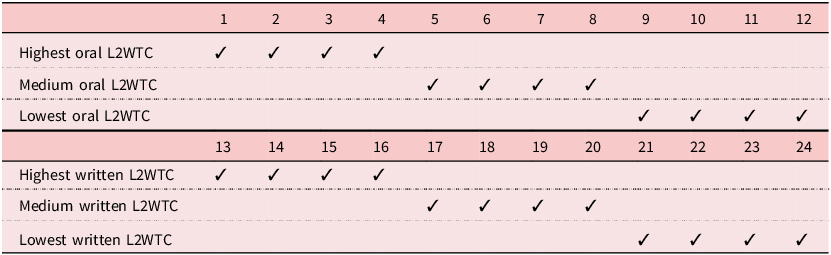
A total of 350 online questionnaires were distributed, and 323 valid responses were received. These data were used to explore EFL learners’ overall oral and written L2WTC levels and to examine the factors influencing each dimension. Based on the questionnaire scores, 24 participants with the highest, medium, and lowest scores in oral and written L2WTC were invited for one-to-one semi-structured interviews (Table 1). The “✓” symbols indicate which participant corresponds to each specific L2WTC level.
L2WTC levels of 24 selected interview participants

Note. L2WTC = second language willingness to communicate.
Quantitative data collected through questionnaires were analysed using descriptive statistics, Pearson correlation, and multiple linear regression analysis in SPSS 29. Descriptive analysis summarized the key features of learners’ L2WTC levels and their potential influencing factors (McKinley & Rose, Reference McKinley and Rose2019). Pearson correlation analysis was conducted to measure and interpret relationships between the independent factors (PCC, FLA, teacher support, and classroom environment) and dependent factors (oral and written L2WTC). Multiple linear regression analysis was subsequently employed to examine the predictive power of the four independent factors on oral and written L2WTC (Uyanık & Güler, Reference Uyanık and Güler2013).
Qualitative data from semi-structured interviews were analysed using deductive thematic analysis in NVivo 15, guided by the four factors identified in the literature (PCC, FLA, teacher support, and classroom environment). This approach allowed for an exploration of how these four potential factors impacted oral and written L2WTC (Clarke & Braun, Reference Clarke and Braun2017). The interview transcripts were first coded and divided into analytical units and then placed into different theme categories for analysis. The member-checking technique was also employed to validate the data interpretation. By inviting participants to review the accuracy of the data, this process minimized potential researcher bias and enhanced the trustworthiness of the findings (Birt et al., Reference Birt, Scott, Cavers, Campbell and Walter2016).
4. Results
4.1. Quantitative results
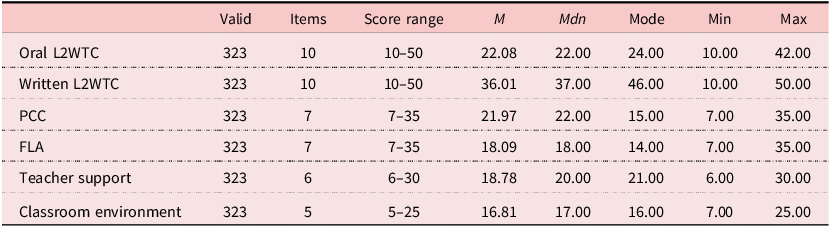
As presented in Table 2, the descriptive analysis revealed that participants demonstrated a higher L2WTC in writing (M = 36.01, Mdn = 37.00, mode = 46.00) compared to speaking (M = 22.08, Mdn = 22.00, mode = 24.00), despite both oral and written L2WTC having score ranges from 10 to 50. In addition, although the minimum score for both was the same (10), oral L2WTC had a maximum score of only 42, whereas written L2WTC reached the full range of 50, further confirming the trend that participants were generally more willing to engage in written communication.
Descriptive statistics of variables

Note. L2WTC = second language willingness to communicate; PCC = perceived communicative competence; FLA = foreign language anxiety.
Regarding trait-like factors, PCC and FLA were both measured on a scale ranging from 7 to 35. The scores for PCC (M = 21.97, Mdn = 22.00) were slightly above the theoretical midpoint (21.00), reflecting a moderate level of self-reported confidence in L2 communication. However, the mode value (15.00), which was considerably lower than the mean and median, suggested that despite the overall trend, a subgroup of participants reported low levels of PCC. In contrast, FLA scores (M = 18.09, Mdn = 18.00) fell below the midpoint (21.00), indicating a relatively low level of anxiety in the MOOC context. The mode value for FLA (14.00) was even lower than the mean and median, further indicating a distribution skewed toward lower anxiety levels.
In terms of context-specific factors, teacher support was assessed on a 6 to 30 scale. Its scores (M = 18.78, Mdn = 20.00, mode = 21.00) all exceeded the scale midpoint (18.00), suggesting that participants tended to perceive their teachers as providing moderate to moderately high levels of support. Classroom environment, measured on a 5 to 25 scale, yielded a mean of 16.81, a median of 17.00, and a mode of 16.00. These statistics pointed to a moderately positive appraisal of the classroom environment.
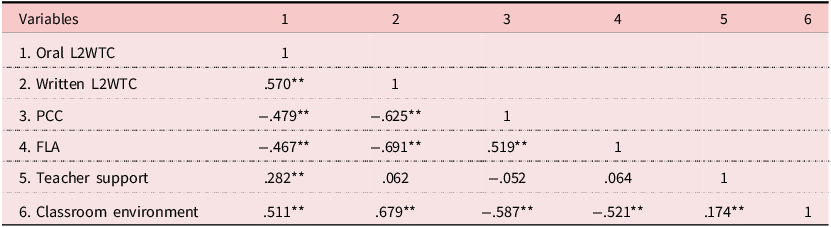
According to the Pearson correlation data in Table 3, both oral and written L2WTC were negatively correlated with PCC (oral: r = −.479, p < .01; written: r = −.625, p < .01) and FLA (oral: r = −.467, p < .01; written: r = −.691, p < .01), indicating that lower PCC and FLA were associated with higher L2WTC. Conversely, both forms of L2WTC were positively correlated with the classroom environment (oral: r = .511, p < .01; written: r = .679, p < .01), implying that a supportive and conducive learning environment was linked with higher L2WTC. Notably, oral L2WTC showed a moderate positive correlation with teacher support (r = .282, p < .01), whereas the relationship between teacher support and written L2WTC was weak (r = .062, p > .05), suggesting a stronger association between teacher support and learners’ oral communication willingness compared to written communication.
Intercorrelations between the variables

Note. L2WTC = second language willingness to communicate; PCC = perceived communicative competence; FLA = foreign language anxiety.
*p < .05. **p < .01.
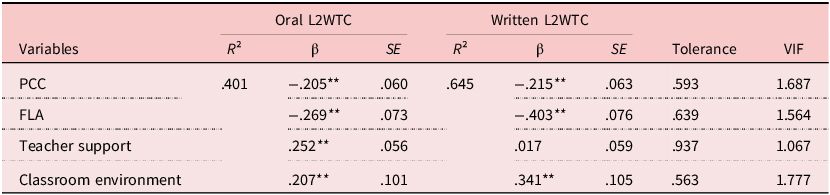
Building on the initial correlations, the multiple linear regression results in Table 4 provided deeper insights into the predictive power of the possible L2WTC influential variables. As evidenced by the average variance inflation factor (VIF) approaching 1 and all tolerance statistics exceeding 0.5 (Senaviratna & Cooray, Reference Senaviratna and Cooray2019), multicollinearity was not an issue in the dataset. Additionally, the data generally followed a normal distribution, since the absolute values of the skewness and kurtosis for all variables were below 1, with some even approaching 0 (Hair et al., Reference Hair, Hult, Ringle, Sarstedt, Danks and Ray2021).
Multiple linear regression results for predicting L2WTC

Note. L2WTC = second language willingness to communicate; VIF = variance inflation factor; PCC = perceived communicative competence; FLA = foreign language anxiety.
*p < .05. **p < .01.
The regression results demonstrated that two trait-like factors were significant negative predictors of both oral and written L2WTC, with PCC (oral: β = −.205, p < .01; written: β = −.215, p < .01) and FLA (oral: β = −.269, p < .01; written: β = −.403, p < .01) exerting negative influences on both forms of L2WTC. These findings implied that learners with lower PCC and FLA were more likely to engage in oral and written communication within MOOCs, whereas those with higher PCC and FLA tended to exhibit reduced L2WTC.
In terms of context-specific factors, teacher support emerged as a significant positive predictor of oral L2WTC (β = .252, p < .01), but its effect on written L2WTC was minimal and statistically non-significant (β = .017, p > .05). By contrast, classroom environment consistently acted as a positive predictor for both oral and written L2WTC, significantly promoting L2WTC in both modalities (oral: β = .207, p < .01; written: β = .341, p < .01). These results suggested that although a positive classroom environment played a facilitating role in enhancing learners’ L2WTC across both oral and written communication, teacher support only appeared to positively influence learners’ spoken engagement rather than their written participation in the MOOC context.
In sum, the quantitative results revealed that while both trait-like and context-specific factors significantly predicted learners’ L2WTC in the MOOC, their influence differed by modality. To be specific, two trait-like factors consistently had a negative impact on oral and written L2WTC, whereas context-specific factors generally positively influenced both. Notably, however, the facilitative role of teacher support was limited to oral L2WTC, with no significant effect identified for written communication. Figure 1 summarizes these differential impacts.
Quantitative results on factors affecting oral and written second language willingness to communicate (L2WTC).
*p < .05. **p < .01.

4.2. Qualitative results
For ease of reference, participants were assigned codes combining modality (O = oral, W = written) and L2WTC level (H = high, M = medium, L = low), followed by a number (e.g., WH1 = Participant 1 with high written L2WTC).
4.2.1. Perceived communicative competence (PCC)
Based on the interview transcripts, PCC had a negative impact on both oral and written L2WTC in the MOOC. Higher PCC was linked to lower L2WTC in both forms, whereas a lower PCC was associated with higher L2WTC.
For example, participants OH1 and WH1 mentioned:
I knew my English ability was not great, and I was always reluctant to speak up in traditional classrooms. However, when I took MOOCs, I was able to use translation tools, grammar checkers, and ChatGPT for support, which gave me the confidence to express myself in both oral and written communication. (OH1)
Despite having little confidence in my English level, I could think and prepare before posting my ideas or comments on the discussion forums in the asynchronous MOOC learning process. (WH1)
In contrast, participants OL4 and WL1 stated:
I was very confident about my English level, but I was not familiar with the online tools and platforms, and I was also concerned about technical issues. I was worried that if internet connectivity problems occurred while I was speaking, it might disrupt the flow of the learning process for both the teacher and my classmates. (OL4)
Although the questions the teacher asked were quite easy for me, I did not volunteer to answer because I was afraid my classmates might think I was showing off. (WL1)
The participants’ perceptions suggested that the availability of supportive online tools and the flexibility of the asynchronous learning mode contributed to higher L2WTC among individuals with lower confidence in their English abilities. However, technical issues and the fear of being perceived as showing off held back those with higher levels of PCC, limiting their willingness to engage in both oral and written communication.
4.2.2. Foreign language anxiety (FLA)
Most participants believed that the MOOC, as a form of remote learning, caused less anxiety compared to traditional face-to-face classrooms. In this setting, learners with lower FLA were more likely to engage in oral and written communication, while those with higher FLA tended to avoid participation.
As suggested by participants OM4, WH2, and WM3:
In real-time lecture, only the teacher turned on the camera, but students did not need to, which eliminated the pressure of eye contact and made me feel much more at ease. (OM4)
I felt less anxious engaging in written communication in the MOOC, because I had more time to organize my thoughts and revise my responses. (WH2)
Compared to real-time verbal interaction, I found written communication safer. It allowed me to express myself more accurately by reducing the chances of making mistakes. (WM3)
However, some participants still felt nervous in the MOOC:
Although my classmates could not see my face, they could still recognize me by my name. I was afraid that making mistakes would lead to laughter from my peers or criticism from the teacher. (OL1)
I was very afraid of losing face in front of my classmates or the teacher, which would make me feel upset for the rest of the day. (WL2)
On the one hand, MOOCs reduced some participants’ FLA, making them more willing to engage in communication, especially in written communication. On the other hand, some participants still experienced anxiety in the MOOC setting, particularly due to concerns about making mistakes, losing face, and being judged by their peers or the teacher.
4.2.3. Teacher support
From the participants’ perspective, teacher support played different roles in influencing oral and written L2WTC. Specifically, positive teacher support appeared to facilitate higher oral L2WTC, but its impact on written L2WTC was minimal.
For oral communication, participants OM3 and OL2 claimed:
When the teacher smiled, nodded, or praised me, I felt less anxious and more willing to participate in oral communication. (OM3)
I was very reluctant to engage in oral communication in class because every time I made a mistake, the teacher would criticize me harshly, which made me feel embarrassed. Keeping silent made me feel safer. (OL2)
For written communication, participants WH3, WM2, and WL4 claimed:
The teacher and I were quite distant, and the teacher did not keep an eye on me. I did not think teacher support would be of much help. (WH3)
The teacher was not available online in real time. After I posted something on discussion forums, the teacher did not provide immediate feedback. Even when there was feedback, it was often a brief written comment, such as “good”. This did not make me feel more motivated to engage in communication. (WM2)
Compared to oral communication, the teacher’s feedback on written communication was limited. The teacher did not respond to every post on the discussion board during class, and outside of class, real-time responses to posts on the discussion forums were impossible. (WL4)
Given participants’ perceptions, positive teacher support, such as praise or acknowledgement, helped reduce participants’ anxiety and increased their willingness to use L2 to participate in oral communication. In contrast, the relatively brief, delayed, and less personalized feedback for written communication seemed to lack the same motivating effect.
4.2.4. Classroom environment
The analysis of the interviews revealed that while the positive aspects of the MOOC classroom environment facilitated greater oral and written L2WTC, the negative aspects also presented obstacles to communication in both forms.
Regarding positive aspects, participants OH2, OH3, and WH4 said:
I took MOOCs at home, and I did not have to turn on my camera. Sometimes, I was even in my pyjamas. I really enjoyed studying in such a relaxed environment, which helped me feel at ease and less anxious. (OH2)
In face-to-face classrooms, I had to give an answer immediately when the teacher asked a question. But now, I could search for information online to improve my response. (OH3)
I preferred taking MOOCs over traditional classrooms because the online tools helped me with translation and organizing my thoughts, allowing me to express myself more clearly and accurately. (WH4)
Regarding negative aspects, participants OL3 and WL3 noted:
All interactions were through text and audio, and I found it hard to build connections or feel supported by my peers. The lack of face-to-face communication made me feel isolated. (OL3)
I never saw my classmates’ real faces. I felt awkward communicating with people I was not familiar with. (WL3)
In addition, some participants reported encountering technical issues in the MOOC, such as:
Sometimes my microphone did not work in the MOOC. (OM1)
The teacher turned on the camera during the MOOC, but the video often lagged. (OL2)
I often experienced lag during classes due to an unstable Wi-Fi connection. As a result, it was difficult for me to keep up with the content the teacher was presenting, let alone participate in oral or written communication. (WM1)
In the interviews, participants frequently highlighted the unique features of the MOOC environment, such as the flexibility in choosing study time and location, the freedom to control their own learning pace, the availability of supportive online tools, and the absence of pressure from eye contact. These contributed to higher oral and written L2WTC. However, the drawbacks of the MOOC should not be overlooked. Both the lack of connection between peers and potential technical issues hindered students’ willingness to engage in oral and written communication.
5. Discussion
This study examined the impact of trait-like factors (PCC and FLA) and context-specific factors (teacher support and classroom environment) on oral and written L2WTC. Both quantitative and qualitative findings revealed that PCC and FLA negatively impacted L2WTC in both modalities. Teacher support positively influenced oral L2WTC, but its impact on written L2WTC was limited. A positive classroom environment promoted oral and written L2WTC, while its negative aspects created barriers to communication in both forms.
One of the most unexpected findings was the negative impact of PCC on both oral and written L2WTC. The unexpected element lies primarily in the direction of the relationship, as higher PCC is typically associated with increased L2WTC rather than a decrease. This contradicted the well-established positive relationship between PCC and L2WTC in traditional classrooms (Alrabai, Reference Alrabai2022; Khajavy et al., Reference Khajavy, Ghonsooly, Hosseini Fatemi and Choi2016) and online learning environments (Balouchi & Samad, Reference Balouchi and Samad2021; Soyoof, Reference Soyoof2023). Previous studies consistently found that higher PCC contributed to greater L2WTC (e.g., Alrabai, Reference Alrabai2022), but the present study showed that a higher PCC was linked to a lower L2WTC in both oral and written forms. For learners who initially lacked self-assurance in their English language communicative abilities, MOOCs provided them with access to various online tools, such as translation software, grammar checkers, and AI-assisted tools like ChatGPT, to support language production and translation (El-Maghraby, Reference El-Maghraby2024). Additionally, the flexibility of the asynchronous learning mode allowed students more time to organize and refine their responses, thereby enhancing their willingness to post ideas and comments in the discussion forums.
Conversely, learners with higher self-confidence in their language abilities seemed to experience a reduction in L2WTC when transitioning to the MOOC environment, particularly among those unfamiliar with online tools or more vulnerable to technical issues (Bhuvaneswari et al., Reference Bhuvaneswari, Borah, Hussain, Hamdan, Hassanien, Mescon and Alareeni2022). Another reason contributing to the reluctance of confident learners may be the emphasis on modesty in Confucian values, which could discourage them from participating actively for fear of being labelled as showing off (Li, Reference Li2023). This echoed Peng’s (Reference Peng2012) research, which indicated that the cultural value of modesty in Chinese society often inhibited learners from openly sharing their ideas. Similar tendencies have been observed in other Asian contexts, where avoiding standing out is prioritized over individual expression (Griffiths et al., Reference Griffiths, Oxford, Kawai, Kawai, Park, Ma, Meng and Yang2014). Within MacIntyre et al.’s (Reference MacIntyre, Clément, Dörnyei and Noels1998) L2WTC model, this finding suggested that cultural norms may moderate the process through which trait-like factors such as PCC translate into L2WTC.
As for the relationship between FLA and L2WTC, the results were generally consistent with previous research (e.g., Memari, Reference Memari2023; Solhi, Reference Solhi2024) but also revealed some new perspectives. Similar to the findings of Memari (Reference Memari2023), participants in this study reported experiencing less anxiety in the MOOC compared to traditional face-to-face classrooms, particularly in the context of asynchronous written communication. This could be due to the elimination of eye contact pressure, the provision of more time for reflection, and the reduced likelihood of making errors during communication (Mellati & Khademi, Reference Mellati and Khademi2020; Reinders & Wattana, Reference Reinders and Wattana2015).
However, it was worth noting that despite these anxiety-reducing factors in MOOCs, certain participants still experienced FLA. The negative relationship between FLA and L2WTC in MOOCs corresponded to the study of Dewaele (Reference Dewaele2019), Lee (Reference Lee2018), and Solhi (Reference Solhi2024), with anxious learners more inclined to exhibit lower levels of oral and written L2WTC due to concerns about making mistakes, losing face, and being judged by peers or teachers. The concept of face is an essential element of Chinese culture, and Chinese students frequently experienced anxiety regarding the potential for mistakes that may lead to a loss of face in front of others (Ho & Crookall, Reference Ho and Crookall1995). To protect their face, students often adopted a safer approach by remaining silent during class activities, thereby avoiding situations where they might make mistakes or be subject to negative evaluation (Fu et al., Reference Fu, Wang and Wang2012).
The positive effect of teacher support on oral communication aligned with previous research (e.g., Hejazi et al., Reference Hejazi, Sadoughi and Peng2023; Lee & Liu, Reference Lee and Liu2024), but this study uncovered a notable finding: its impact on written communication was relatively limited. In oral communication, teacher support expressed through positive cues such as smiles, nods, or praise alleviated learners’ anxiety and enhanced their oral L2WTC, whereas negative feedback, particularly harsh criticism, heightened learners’ anxiety and prevented them from participating in oral communication. This echoed prior conclusions that positive teacher feedback could effectively reduce students’ anxiety and enhance their L2WTC (Hejazi et al., Reference Hejazi, Sadoughi and Peng2023; Lee & Liu, Reference Lee and Liu2024).
On the other hand, participants mentioned that teacher support played a limited impact on written communication in both synchronous and asynchronous modes. In synchronous modes, although the teacher and students interacted in real time, the large volume of posts on discussion boards made it almost impossible for the teacher to respond to every single message. This limitation reduced the interactivity and personalization of feedback, which may undermine the effectiveness of teacher support. In asynchronous modes, the distance between the teacher and students was not only physical but also temporal and interactive. Given that the teacher was unable to engage in learners’ written communication process in real time, the feedback provided was often brief and delayed, further restricting its ability to motivate students in their written communication (Nicol & Macfarlane-Dick, Reference Nicol and Macfarlane-Dick2006).
In terms of the classroom environment, the unique positive characteristics of MOOCs, such as the flexibility to choose study time and location, the freedom to control one’s own learning pace, the availability of supportive online tools, and the absence of eye contact pressure, contributed to both greater oral and written L2WTC by increasing PCC and reducing FLA. This finding supported previous research suggesting that the online learning contexts, compared to traditional face-to-face settings, provided safer environments where learners experienced higher PCC, lower FLA, and greater L2WTC (Mellati & Khademi, Reference Mellati and Khademi2020; Reinders & Wattana, Reference Reinders and Wattana2015).
Nevertheless, the negative aspects of MOOCs, such as a lack of connection between peers and technical issues, posed significant challenges to oral and written communication. As discussed by Tai (Reference Tai2024), the lack of rapport between peers often inhibited students’ L2WTC. For the online learning environment, MOOCs increased the physical and social distance between learners, and the reliance on audio and text-based communication made it more challenging for learners to establish close connections with their peers. In this context, participants reported feelings of isolation from the lack of peer connection and discomfort from communicating with unfamiliar interlocutors. Moreover, technical issues emerged as another key factor that hindered oral and written L2WTC. According to Bhuvaneswari et al. (Reference Bhuvaneswari, Borah, Hussain, Hamdan, Hassanien, Mescon and Alareeni2022), it was common for learners to encounter difficulties in online learning environments. Similarly, learners in this study reported experiencing technical issues such as microphone malfunctions, video lag, and unstable Wi-Fi connections. Because of these problems, they experienced difficulties in following the teacher’s content or expressing their thoughts, which significantly impeded their willingness to engage in both oral and written communication.
6. Conclusion and implications
Grounded in MacIntyre et al.’s (Reference MacIntyre, Clément, Dörnyei and Noels1998) heuristic model, this mixed-methods study investigated the effects of trait-like factors (PCC and FLA) and context-specific factors (teacher support and classroom environment) on both oral and written L2WTC in the MOOC context. The findings revealed that trait-like factors negatively impacted both forms of L2WTC, while the influence of context-specific factors was more complex. Teacher support positively affected oral L2WTC but had a limited impact on written L2WTC. The positive features of the MOOC environment, such as flexibility and the use of technology, contributed to greater L2WTC by reducing FLA and increasing PCC. However, technical issues and the lack of peer connection emerged as negative aspects that hindered communication.
This study represented a first attempt to differentiate between oral and written L2WTC, moving beyond the conventional treatment of L2WTC as a unified construct. Situated within the affective–cognitive perspective, it provided empirical evidence that deepened the understanding of L2WTC in MOOCs. While grounded in the Chinese EFL and MOOC contexts, the insights derived from this study hold potential applicability to broader online, blended, and cross-cultural learning environments where trait-like and context-specific factors similarly shape learners’ oral and written L2WTC.
The findings further highlighted pedagogical strategies to enhance learners’ L2WTC by reinforcing positive factors while addressing negative ones. First, the negative impact of PCC can be mitigated by equipping learners with the ability to effectively employ supportive online tools, strengthen their digital literacy, and overcome technical barriers. Second, although MOOCs may alleviate FLA compared to traditional classrooms, further efforts are needed to reduce FLA by encouraging learners to regard mistakes as an integral part of the learning process rather than a sign of failure (Khansir, Reference Khansir2012). Third, teachers are advised to provide positive feedback to recognize learners’ successful performance and offer support to address learners’ errors. In asynchronous modes, the provision of timely and personalized feedback is particularly critical, as delayed or brief responses cannot fully realize the motivational benefits of teacher support (Nicol & Macfarlane-Dick, Reference Nicol and Macfarlane-Dick2006). However, given the large-scale nature of MOOCs, providing individualized feedback to every learner remains a challenge. To address this, AI-powered feedback systems may be integrated to deliver instant and tailored responses, thereby complementing teacher input and enhancing the overall feedback process. Finally, MOOC designers should optimize the positive features of MOOCs while minimizing potential technical challenges. Incorporating peer tutoring into the curriculum may further enhance peer connections, encourage learner autonomy, and foster a collaborative learning environment (Solhi, Reference Solhi2024).
Furthermore, this study has three main limitations. First, it adopted self-report questionnaires and semi-structured interviews to examine learners’ L2WTC, but discrepancies may exist between learners’ self-perceived L2WTC and their actual communicative behaviours. Future research is therefore recommended to employ longitudinal classroom observations to validate and extend the present findings. Second, since the participants were recruited from a single institution, the findings may have been influenced by contextual characteristics specific to this setting. Including learners from multiple institutions or regions in further studies would enhance the generalizability of the findings. Third, this study focused on the perspectives of EFL learners, while teachers’ perceptions were not investigated. As the role of teachers in online learning environments has undergone significant changes compared with traditional classrooms, incorporating insights from both teachers and learners would yield a more comprehensive understanding of the L2WTC construct.
Supplementary material
To view supplementary material for this article, please visit https://doi.org/10.1017/S0958344026100470
Data availability statement
The data that support the findings of this study are available in the research data management system of the University of Sydney and can be accessed upon request.
Authorship contribution statement
Wenqian Huang: Conceptualization, Data curation, Formal analysis, Investigation, Methodology, Project administration, Validation, Writing – original draft, Writing – review & editing; Pengzhan Yang: Conceptualization, Data curation, Formal analysis, Methodology, Writing – original draft; Huizhong Shen: Conceptualization, Supervision, Validation, Writing – review & editing; Hongzhi Yang: Conceptualization, Supervision, Validation, Writing – review & editing.
Funding disclosure statement
This research did not receive any specific funding.
Competing interests statement
The authors declare no competing interests.
Ethical statement
Ethics approval has been obtained from the Research Integrity and Ethics Administration of the University of Sydney. All participants were fully informed about the study and provided their consent prior to the commencement of the research. Participants were also informed of their right to withdraw from the study at any time and for any reason without consequence. All the collected data were anonymized and have been stored confidentially.
GenAI use disclosure statement
The authors declare no use of generative AI.
About the authors
Wenqian Huang is a PhD candidate in the Faculty of Arts and Social Sciences at the University of Sydney. Her research interests include computer-assisted language learning, willingness to communicate, TESOL, and second language acquisition.
Pengzhan Yang is a PhD candidate in the Faculty of Arts and Social Sciences at the University of Sydney. He has a particular interest in English-medium instruction and computer-assisted language learning.
Huizhong Shen is an associate professor in the Faculty of Arts and Social Sciences at the University of Sydney. His research areas include cross-cultural pedagogies and technology-supported language learning.
Hongzhi (Veronica) Yang is a senior lecturer in the Faculty of Arts and Social Sciences at the University of Sydney. Her research expertise includes language education, technology-supported language learning, TESOL, and language assessment.


 Open access

