


Public health interest in chronic diseases during past decades has concentrated mainly on CVD and their associations with diet( Reference Karvonen, Orma and Punsar 1 – Reference Roine, Pekkarinen and Karvonen 4 ). This focus has remained to the present( Reference Mannisto, Laatikainen and Helakorpi 5 – Reference Puska 7 ) although the dietary factors of interest have varied in time. High importance has been given to the association between CVD risk factors and fat, especially saturated fat( Reference Keys, Anderson and Grande 3 , Reference Roine, Pekkarinen and Karvonen 4 , Reference Valsta, Tapanainen and Sundvall 8 ) regarding which considerable dietary improvements have taken place in Finland. Proportions of both total and saturated fat have decreased, as has consumption of foods high in them( Reference Mannisto, Laatikainen and Helakorpi 5 , Reference Pietinen, Lahti-Koski and Vartiainen 6 , Reference Pietinen, Vartiainen and Seppanen 9 ). Also other dietary factors have been successfully addressed with a simultaneous decrease in CVD risk factors. Examples of this are increased fruit and vegetable consumption and decreased sodium intake( Reference Mannisto, Laatikainen and Helakorpi 5 – Reference Puska 7 ).
More recently emphasis has been put on the association between sugar and CVD with its risk factors( Reference Brown, Dulloo and Montani 10 – Reference Johnson, Appel and Brands 12 ). Attention has been paid to dietary sugars in general and to sugar-sweetened beverages( Reference Brown, Dulloo and Montani 10 , Reference Johnson, Appel and Brands 12 , Reference Bolton-Smith and Woodward 13 ). Evidence exists for an association between the consumption of added sugars and CHD among men( Reference Bolton-Smith and Woodward 13 ). More precisely, the relationship may be connected to the current prevalent consumption of sugar-sweetened beverages such as soft drinks( Reference Brown, Dulloo and Montani 10 – Reference Johnson, Appel and Brands 12 ). Also, Bremer et al.( Reference Bremer, Auinger and Byrd 14 ) found adolescents’ increased consumption of sugar-sweetened beverages to be connected with anthropometrics.
The associations between nutrition and risk factors have been widely studied both in normal adult( Reference Mannisto, Laatikainen and Helakorpi 5 – Reference Puska 7 ) and at-risk populations( Reference Aatola, Koivistoinen and Hutri-Kahonen 15 , Reference Lindstrom, Peltonen and Eriksson 16 ). Studies show cross-sectional associations between nutrition and risk factors, and their patterns over time. They suggest that a traditional Finnish diet (with rye bread, butter, sausages, potatoes, milk and coffee) is associated with CVD risk factors( Reference Mikkila, Rasanen and Laaksonen 17 , Reference Mikkila, Rasanen and Raitakari 18 ) as is low lifetime consumption of fruits and vegetables( Reference Aatola, Koivistoinen and Hutri-Kahonen 15 ). Less research is available on nutrition among young adults, especially males. It is known that Finnish boys’ consumption of vegetables has been low( Reference Rasanen, Laitinen and Stirkkinen 19 ) and at present vegetables are consumed daily by 28 % and fruit by 23 % of boys( Reference Hoppu, Lehtisalo and Tapanainen 20 ).
Firm research designs allowing prediction of risk factors from nutrition can be found in intervention trials but they are usually targeting at-risk populations in special settings( Reference Absetz, Oldenburg and Hankonen 21 , Reference Lindstrom, Absetz and Hemio 22 ). However, non-intervention studies examining whether dietary changes predict changes in risk factors are rare. This is because there are not many naturally occurring conditions where nutritional changes would be common. Compulsory military service with healthy and unhealthy changes in eating patterns offers a window for studying this question in a representative group of young males.
Military service represents a specific phase of life for the majority of young Finnish men in the transition between youth and independent adult life. It is a unique period during which men are served a regular nutritionally planned diet in a controlled environment with a high physical activity level. The aim of the present study was to assess conscripts’ food choices and diet-related risk factor changes during the first 6 months of service. Also, associations between food choice changes and risk factor changes were explored.
Materials and methods
Military setting
In Finland, compulsory military service applies to all men aged 18–29 years. Service is usually entered at 19–20 years. The duration is 6, 9 or 12 months and arrivals enter in January and in July. Nearly 80 % of each age cohort completes service( 23 ). The rest either applies for non-military service for ethical or religious reasons or is exempted. Approximately 10 % of men are exempted because of medical reasons( Reference Multimäki, Parkkola and Sourander 24 ).
Military training takes place in garrison and encampment conditions. At garrison, daily service lasts approximately 10 h. At encampment, service is intensive and may take place around the clock. In both conditions, daily breakfast, lunch and dinner form a part of compulsory service. Also a voluntary evening snack is available on most days at garrison canteens. The food is planned and prepared according to particular military nutrition recommendations for conscripts and offers a varied diet( Reference Bingham, Ovaskainen and Tapanainen 25 ). Typically, lunch and dinner contain a main dish served with fresh or cooked vegetables. Bread, especially rye crisp bread, is always available. Desserts, such as fruit soup and pudding, are served daily at meals. Drink alternatives include milk, sour milk, juice and water. The canteen has self-service and hence conscripts may choose the components and quantity of their meals. During free time, conscripts can buy snacks from Soldier's Home cafeterias located in garrison areas. They may also exit the garrison and purchase food from surrounding grocery shops and restaurants or order food to be delivered.
Study setting
The present study was conducted as part of the DefenceNutri study, which is a controlled two-phase intervention trial aiming to improve conscripts’ eating habits( Reference Jallinoja, Sahi and Uutela 26 ). Control data presented here were collected in 2007 as a needs assessment for interventions taking place in 2008 and 2009. In 2008, the intervention objective was to increase the supply of healthy foods at the two main places of food consumption in the military setting: garrison canteens and Soldier's Homes. In 2009 the intervention targeted conscripts, with the objective of increasing the demand for healthy food choices and especially vegetable consumption.
The study took place in two garrisons: Armoured Brigade and Kainuu Brigade. Armoured Brigade is situated in southern Finland, and conscripts serving there live mostly in cities and towns in southern and central Finland. Kainuu Brigade in north-eastern Finland recruits men from western, central and northern Finland and the majority live in rural or semi-urban areas. The study protocol was approved by the ethics committee of the Hospital District of Helsinki and Uusimaa.
Participants
From both garrisons, men entering service in three selected military units (companies) in January and July 2007 were involved in the present study (n 1430). One month prior to service a questionnaire was sent to the men's home address. They responded by Internet or by returning the questionnaire when entering service at a rate of 45 %. A follow-up questionnaire was filled in at 6 months of service. Anthropometric and clinical measurements were conducted at the first week and the sixth month of service.
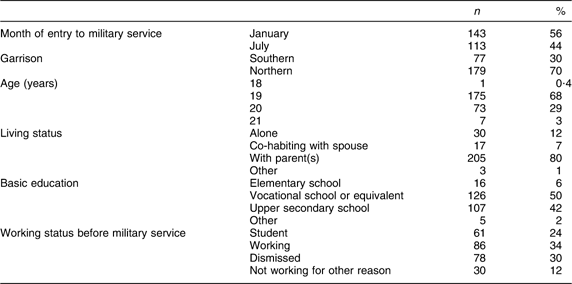
The present longitudinal cohort study comprised the follow-up data of 256 men who had filled in both questionnaires properly and were measured at both time points (Table 1). Only participants aged less than 22 years were included to have a sample with a homogeneous age range as four men aged 22 years or over were excluded from analyses. Dropout was due to interruption of service, being on encampment, being on leave or ill during measurements, military transfers to other units or garrisons and a few refusals to attend the study. All participants gave their informed consent in written form.
Characteristics of study participants: male conscripts aged 18–21 years (n 256) performing military service, Finland
| n | % | ||
| Month of entry to military service | January | 143 | 56 |
| July | 113 | 44 | |
| Garrison | Southern | 77 | 30 |
| Northern | 179 | 70 | |
| Age (years) | 18 | 1 | 0·4 |
| 19 | 175 | 68 | |
| 20 | 73 | 29 | |
| 21 | 7 | 3 | |
| Living status | Alone | 30 | 12 |
| Co-habiting with spouse | 17 | 7 | |
| With parent(s) | 205 | 80 | |
| Other | 3 | 1 | |
| Basic education | Elementary school | 16 | 6 |
| Vocational school or equivalent | 126 | 50 | |
| Upper secondary school | 107 | 42 | |
| Other | 5 | 2 | |
| Working status before military service | Student | 61 | 24 |
| Working | 86 | 34 | |
| Dismissed | 78 | 30 | |
| Not working for other reason | 30 | 12 |
The questionnaires covered sociodemographic background, eating habits, health behaviour and psychosocial factors. Eating habit questions included food choices and a thirty-six-item FFQ in which consumption was reported as number of days during the previous week (0–7). The FFQ was based on several corresponding questionnaires used in Finnish population studies( Reference Helakorpi, Pajunen and Jallinoja 27 , Reference Paalanen, Mannisto and Virtanen 28 ) and the items in it were chosen to represent all major food groups of the Finnish diet. Background information on the menus of garrison canteens and from a detailed food diary study among Finnish conscripts( Reference Bingham, Ovaskainen and Tapanainen 25 ) was used to design the FFQ to be best suited for the conscript study population. Thus, the purpose of the questionnaire was to identify overall quality of diet and food choices of young men performing military service.
To characterize important dimensions of the diet of these young men, three indices were formed: Fibre Index, Fat Index and Sugar Index( Reference Jallinoja, Tuorila and Ojajärvi 29 ). Fibre Index was the sum of four food items: weekly consumption of rye bread, mixed bread, fresh vegetables, and fruit and berries. Fat Index was the sum of five items: meat pies and pastries, pizza and kebab, hot dogs and hamburgers, French fries, and potato crisps. Sugar Index was the sum of five items: desserts, sugared soft drinks, sweet pastries, chocolate and sweets. Of these, desserts are served at the garrison canteen whereas the other items are not typically provided but may be bought from Soldier's Homes and from grocery shops outside garrisons( Reference Bingham, Ovaskainen and Tapanainen 25 ). Index items were given 1 point for each day the food was used during the previous week (range 0–7). The indices were scaled by dividing the sum scores by the number of food items in each index. Thus, the total score of all indices ranges between 0 and 7 and the results are comparable. The indices indicate on how many days per week on average food items belonging to the indices were consumed.
The following anthropometric and clinical measurements were conducted on the men at the first week and during the sixth month of service: weight, height, waist circumference, systolic and diastolic blood pressure; total cholesterol, HDL cholesterol, LDL cholesterol, TAG; fasting blood glucose; body composition analysis (muscle mass, fat mass, percentage of body fat). BMI was calculated by dividing weight by height squared. Details of the measurements are presented elsewhere( Reference Jallinoja, Sahi and Uutela 26 ).
Statistical analyses
Means and standard deviations for both time points (before service and at 6 months of service), and for the change in time, were calculated for the three food indices and items included in them. The same analyses were performed for the risk factors for respective time points (beginning and at 6 months of service). Differences in mean values were tested for with pair-wise t tests and the results are reported here. Test results did not differ from non-parametric Wilcoxon's tests which were performed as variables were not normally distributed in full.
Associations between food index changes and risk factor changes were explored univariately by correlation analysis. Pearson correlations were calculated for all variables and additionally Spearman correlations for non-normally distributed ones. As both gave similar results, Pearson correlations are presented. First, correlations were calculated between baseline food indices and risk factors. Second, correlations were calculated between 6-month follow-up food indices and risk factors. Also, correlations between food index changes and risk factor changes were calculated.
Multivariate analyses were performed for combined effects of food index changes on risk factor changes. These were done by hierarchical linear regression modelling accounting for risk factor and food index baselines and using food index changes as explanatory variables. As few significant associations were found, these results are mentioned only briefly.
Results
Changes in food choices
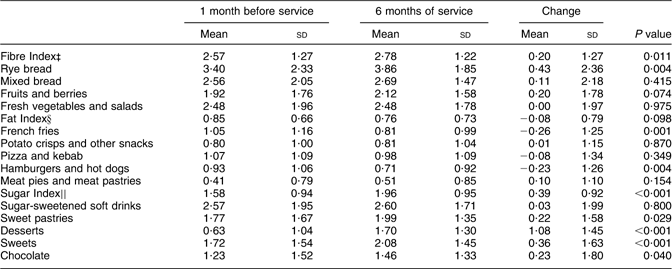
Mean weekly consumption frequencies (d/week) of selected foods and the mean values of food indices, together with the 6-month changes in them, are presented in Table 2. Fibre Index and Sugar Index increased significantly, the first mainly due to increased consumption of rye bread and the latter to increased consumption of all sugar-containing foods except soft drinks. Of sugar-containing foods, the consumption of desserts increased the most, by 1·1 d/week. Fat Index remained stable although consumptions of two items, French fries and hamburgers and hot dogs, decreased.
Mean weekly consumption frequencies (d/week, 0–7) of selected foods and three food indicesFootnote † 1 month prior to service, at 6 months of service and the change in between: male conscripts aged 18–21 years (n 256) performing military service, Finland
| 1 month before service | 6 months of service | Change | |||||
| Mean | sd | Mean | sd | Mean | sd | P value | |
| Fibre Index‡ | 2·57 | 1·27 | 2·78 | 1·22 | 0·20 | 1·27 | 0·011 |
| Rye bread | 3·40 | 2·33 | 3·86 | 1·85 | 0·43 | 2·36 | 0·004 |
| Mixed bread | 2·56 | 2·05 | 2·69 | 1·47 | 0·11 | 2·18 | 0·415 |
| Fruits and berries | 1·92 | 1·76 | 2·12 | 1·58 | 0·20 | 1·78 | 0·074 |
| Fresh vegetables and salads | 2·48 | 1·96 | 2·48 | 1·78 | 0·00 | 1·97 | 0·975 |
| Fat Index§ | 0·85 | 0·66 | 0·76 | 0·73 | −0·08 | 0·79 | 0·098 |
| French fries | 1·05 | 1·16 | 0·81 | 0·99 | −0·26 | 1·25 | 0·001 |
| Potato crisps and other snacks | 0·80 | 1·00 | 0·81 | 1·04 | 0·01 | 1·15 | 0·870 |
| Pizza and kebab | 1·07 | 1·09 | 0·98 | 1·09 | −0·08 | 1·34 | 0·349 |
| Hamburgers and hot dogs | 0·93 | 1·06 | 0·71 | 0·92 | −0·23 | 1·26 | 0·004 |
| Meat pies and meat pastries | 0·41 | 0·79 | 0·51 | 0·85 | 0·10 | 1·10 | 0·154 |
| Sugar Index∣∣ | 1·58 | 0·94 | 1·96 | 0·95 | 0·39 | 0·92 | <0·001 |
| Sugar-sweetened soft drinks | 2·57 | 1·95 | 2·60 | 1·71 | 0·03 | 1·99 | 0·800 |
| Sweet pastries | 1·77 | 1·67 | 1·99 | 1·35 | 0·22 | 1·58 | 0·029 |
| Desserts | 0·63 | 1·04 | 1·70 | 1·30 | 1·08 | 1·45 | <0·001 |
| Sweets | 1·72 | 1·54 | 2·08 | 1·45 | 0·36 | 1·63 | <0·001 |
| Chocolate | 1·23 | 1·52 | 1·46 | 1·33 | 0·23 | 1·80 | 0·040 |
† Food indices were calculated as follows: (i) the sum of the consumption frequency (1 point per each day food item consumed, 0–7) of the foods items included in the index; (ii) the sum then divided the number of food items. The total score of the indices ranges between 0 and 7.
‡ Fibre Index is the sum of four food items: weekly consumption of rye bread, mixed bread, fresh vegetables, and fruit and berries.
§ Fat Index is the sum of five items: weekly consumption meat pies and pastries, pizza and kebab, hot dogs and hamburgers, French fries, and potato crisps.
∣ ∣Sugar Index is the sum of five items: weekly consumption of desserts, sugared soft drinks, sweet pastries, chocolate and sweets.
Changes in risk factors
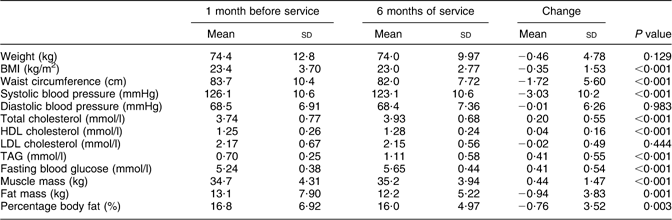
At baseline, 68 % of the conscripts were normal weight (BMI = 18·5–24·9 kg/m2), 22 % were overweight (BMI = 25·0–29·9 kg/m2) and 6 % were obese (BMI ≥ 30·0 kg/m2). At 6-month follow-up, 77 % were normal weight, 19 % overweight and 2 % obese. During service, both positive and negative risk factor changes occurred (Table 3). Positive changes included improved body composition as mean BMI, waist circumference, fat mass and percentage body fat decreased and muscle mass increased. Also, systolic blood pressure decreased and HDL cholesterol increased. Negative changes took place in clinical indicators as total cholesterol, TAG and blood glucose increased.
Risk factors at the beginning of military service, at 6 months of service and the change in between: male conscripts aged 18–21 years (n 256) performing military service, Finland
| 1 month before service | 6 months of service | Change | |||||
| Mean | sd | Mean | sd | Mean | sd | P value | |
| Weight (kg) | 74·4 | 12·8 | 74·0 | 9·97 | −0·46 | 4·78 | 0·129 |
| BMI (kg/m2) | 23·4 | 3·70 | 23·0 | 2·77 | −0·35 | 1·53 | <0·001 |
| Waist circumference (cm) | 83·7 | 10·4 | 82·0 | 7·72 | −1·72 | 5·60 | <0·001 |
| Systolic blood pressure (mmHg) | 126·1 | 10·6 | 123·1 | 10·6 | −3·03 | 10·2 | <0·001 |
| Diastolic blood pressure (mmHg) | 68·5 | 6·91 | 68·4 | 7·36 | −0·01 | 6·26 | 0·983 |
| Total cholesterol (mmol/l) | 3·74 | 0·77 | 3·93 | 0·68 | 0·20 | 0·55 | <0·001 |
| HDL cholesterol (mmol/l) | 1·25 | 0·26 | 1·28 | 0·24 | 0·04 | 0·16 | <0·001 |
| LDL cholesterol (mmol/l) | 2·17 | 0·67 | 2·15 | 0·56 | −0·02 | 0·49 | 0·444 |
| TAG (mmol/l) | 0·70 | 0·25 | 1·11 | 0·58 | 0·41 | 0·55 | <0·001 |
| Fasting blood glucose (mmol/l) | 5·24 | 0·38 | 5·65 | 0·44 | 0·41 | 0·54 | <0·001 |
| Muscle mass (kg) | 34·7 | 4·31 | 35·2 | 3·94 | 0·44 | 1·47 | <0·001 |
| Fat mass (kg) | 13·1 | 7·90 | 12·2 | 5·22 | −0·94 | 3·83 | 0·001 |
| Percentage body fat (%) | 16·8 | 6·92 | 16·0 | 4·97 | −0·76 | 3·52 | 0·003 |
Cross-sectional associations between diet and risk factors
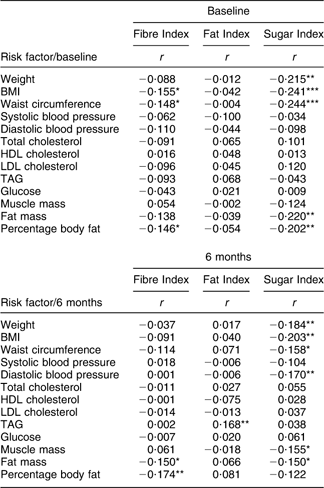
Correlation analysis (Table 4) revealed that at baseline, Fibre Index was inversely associated with BMI, waist circumference and percentage body fat. Sugar Index was similarly inversely associated with these measures, and in addition with weight and fat mass. Hence, the findings indicate that less frequent consumption of fibre-rich foods was associated with a fatter and more frequent consumption with a leaner body composition. Surprisingly, the same pattern was evident for consumption of sugar-rich foods. Fat Index had no significant associations with risk factors at baseline.
Correlations of risk factors and food indices at baseline and at 6-month follow-up: male conscripts aged 18–21 years (n 256) performing military service, Finland
| Baseline | |||
| Fibre Index | Fat Index | Sugar Index | |
| Risk factor/baseline | r | r | r |
| Weight | −0·088 | −0·012 | −0·215** |
| BMI | −0·155* | −0·042 | −0·241*** |
| Waist circumference | −0·148* | −0·004 | −0·244*** |
| Systolic blood pressure | −0·062 | −0·100 | −0·034 |
| Diastolic blood pressure | −0·110 | −0·044 | −0·098 |
| Total cholesterol | −0·091 | 0·065 | 0·101 |
| HDL cholesterol | 0·016 | 0·048 | 0·013 |
| LDL cholesterol | −0·096 | 0·045 | 0·120 |
| TAG | −0·093 | 0·068 | −0·043 |
| Glucose | −0·043 | 0·021 | 0·009 |
| Muscle mass | 0·054 | −0·002 | −0·124 |
| Fat mass | −0·138 | −0·039 | −0·220** |
| Percentage body fat | −0·146* | −0·054 | −0·202** |
| 6 months | |||
| Fibre Index | Fat Index | Sugar Index | |
| Risk factor/6 months | r | r | r |
| Weight | −0·037 | 0·017 | −0·184** |
| BMI | −0·091 | 0·040 | −0·203** |
| Waist circumference | −0·114 | 0·071 | −0·158* |
| Systolic blood pressure | 0·018 | −0·006 | −0·104 |
| Diastolic blood pressure | 0·001 | −0·006 | −0·170** |
| Total cholesterol | −0·011 | 0·027 | 0·055 |
| HDL cholesterol | −0·001 | −0·075 | 0·028 |
| LDL cholesterol | −0·014 | −0·013 | 0·037 |
| TAG | 0·002 | 0·168** | 0·038 |
| Glucose | −0·007 | 0·020 | 0·061 |
| Muscle mass | 0·061 | −0·018 | −0·155* |
| Fat mass | −0·150* | 0·066 | −0·150* |
| Percentage body fat | −0·174** | 0·081 | −0·122 |
Correlation was significant: *P < 0·05, **P < 0·01, ***P < 0·001.
At follow-up, Fibre Index was inversely associated with fat mass and percentage body fat. Sugar Index correlated negatively with weight, BMI, waist circumference, muscle mass, fat mass and diastolic blood pressure. The only significant association for Fat Index was a positive correlation with TAG.
Associations between food choices and risk factor changes
Based on correlation analyses, dietary changes had few associations with risk factor changes (data not shown). An inverse association (r = −0·158, P = 0·01) was found between Fibre Index change and waist circumference change. This indicates a higher increase in consumption of fibre-rich foods being associated with a larger decrease in waist circumference. A positive association was found between Sugar Index change and systolic blood pressure change (r = 0·125, P = 0·048), indicating that a larger decrease in the consumption of sugar-rich foods was related to a larger decrease in systolic blood pressure.
Multivariate analyses showed that the only statistically significant association between food choice change and risk factor change was between Fat Index and TAG (standardized β = 0·19, P = 0·02). Otherwise risk factor changes were mostly explained by baseline risk factor levels (data not shown).
Discussion
The results of the present study show that both positive and negative dietary changes occur during 6 months of military service. A favourable finding is that of fibre-rich foods, the consumption frequency of rye bread increases. Simultaneously, consumption frequencies of French fries, hamburgers and hot dogs become sparser. On the other hand, eating sugar-rich foods – sweet pastries, desserts, sweets and chocolate – becomes more prevalent.
These findings are parallel to other studies. Previously we have reported that men entering military service prefer rye bread to other bread types and that fast foods are eaten relatively infrequently( Reference Bingham, Jallinoja and Lahti-Koski 30 ). As for sugar-rich foods, in the 1990s it was reported that conscripts’ consumption of desserts, doughnuts and confectionery increases during military service compared with pre-service levels( Reference Tähtinen, Vanhala and Oikarinen 31 ). Regarding conscripts’ free-time eating, 35 % of energy comes from sucrose( Reference Bingham, Ovaskainen and Tapanainen 25 ). Overall soft drink use is high in the military but especially on leave( Reference Bingham, Ovaskainen and Tapanainen 25 ) and on encampment( Reference Jallinoja, Absetz and Suihko 32 ), whereas sweets are eaten particularly in garrison conditions( Reference Bingham, Ovaskainen and Tapanainen 25 ). Altogether these findings indicate that sweet foods constitute a notable part in Finnish conscripts’ diet. Soldiers’ frequent choices for sugar-rich foods such as soft drinks( Reference Hart and Morrison 33 – Reference Wisloff, Vassend and Asmyhr 37 ) and sweet pastries( Reference Tähtinen, Vanhala and Oikarinen 31 ) have been documented elsewhere too.
The consumption increase of sugar-rich foods may reflect a general dietary phenomenon. Snacking-type eating has become common( Reference Bellisle, Dalix and Mennen 38 , Reference Zizza, Siega-Riz and Popkin 39 ) in replacement of meals, especially among men( Reference Ovaskainen, Tapanainen and Pakkala 40 ). A consequence of this eating pattern is that snacks contribute increasingly to overall energy intake( Reference Kerver, Yang and Obayashi 41 , Reference Ovaskainen, Reinivuo and Tapanainen 42 ). Also, snacks seem to be related to an unfavourable nutrient composition as in general low micronutrient intake and high sucrose intake are typical of snacking-type eating( Reference Ovaskainen, Reinivuo and Tapanainen 42 ). Compared with meals, snacks contain relatively more carbohydrates as they are typically sugar-rich foods such as sweets and biscuits( Reference Bellisle, Dalix and Mennen 38 ). Also, soft drinks are commonly consumed as snacks( Reference Bellisle, Dalix and Mennen 38 , Reference Zizza, Siega-Riz and Popkin 39 ) likewise among conscripts of the present study.
Another finding of our study is that similarly to eating habits, also health risk factors show both positive and negative changes during military service. Overall, anthropometrics and the body composition of conscripts improve during 6 months of military service. In relation to baseline, the weight of the studied men (74·4 kg) was 0·8 kg lower compared with conscripts nationwide in 2004( Reference Santtila, Kyröläinen and Vasankari 43 ). Still it should be remembered that the average body weight of new conscripts has increased from 71 to 77 kg between 1993 and 2009, while height has remained constant( Reference Santtila, Kyröläinen and Vasankari 43 , 44 ).
Some earlier studies have indicated anthropometric changes during military service. In the course of the 8-week basic training period body fat was found to decrease( Reference Santtila, Kyröläinen and Häkkinen 45 ) whereas for the rest of service (6–12 months) results are inconsistent. In concordance with some( Reference Tähtinen, Vanhala and Oikarinen 31 , Reference Mousavinasab, Tähtinen and Jokelainen 46 ) but not all( Reference Tähtinen, Vanhala and Oikarinen 47 ) studies from the mid-1990s, we found weight, BMI and waist circumference to decrease during service. Also in line with our findings, conscripts’ fat mass and percentage body fat decreased and muscle mass increased during service in Lapland, northern Finland( Reference Mikkola, Jokelainen and Timonen 48 ). Thus, conscripts’ anthropometric results may differ based on the study population whereas changes in body composition seem to be parallel.
Conscripts’ blood sample results show less positive changes. In all, in line with previous studies( Reference Tähtinen, Vanhala and Oikarinen 31 , Reference Tähtinen, Vanhala and Oikarinen 47 ), the lipid profile deteriorates as total cholesterol and TAG levels increase but however HDL cholesterol levels increase. In Lapland, northern Finland, negative lipid level increases occurred irrespective of weight change during military service( Reference Mousavinasab, Tähtinen and Jokelainen 46 ). Also, blood glucose levels increase.
Regarding the associations between food choices and risk factors, the negative correlation between fibre-rich foods and anthropometrics seems plausible. An inverse association between fibre density and BMI has been reported elsewhere too( Reference Howarth, Huang and Roberts 49 ). Differences in quality of diet exist already among men entering military service( Reference Bingham, Jallinoja and Lahti-Koski 30 ). These differences may remain in the course of service, manifesting as differences in food choices both at the garrison canteen and especially in free-time eating, resulting thus in risk factor changes. Also, regular eating of nutritionally designed food at the garrison canteen is likely to explain the detected increase of fibre-containing foods.
As for sugar-containing foods and anthropometric risk factors, the negative association between them at both time points was unexpected even when elsewhere among Finnish men, soft drink and sweet consumption was unrelated to BMI or being overweight( Reference Nissinen, Mikkilä and Männistö 50 ). Our results suggest that among young healthy men, the increase of unhealthy food choices does not have any significant short-term effects on the studied risk factors. The level of physical activity of service and the young age of the studied population may compensate for potential negative effects of unhealthy food choices as does the balanced food provided by the military. Even those men who often choose pizza, sugared soft drinks and sweet pastries in their free time, eat healthy food several times each day at the garrison canteen( Reference Jallinoja, Absetz and Suihko 32 ).
Military service is a period of institutional life where actions are externally directed and individual's possibilities of making independent decisions are limited. This applies also to eating because complete freedom of dietary choices is unfeasible. At the garrison canteen, dietary choices include simply meal components and amount of food. Therefore, a unifying effect of diet is likely to appear. During leisure time, some room for individual choices is available e.g. in terms of snacking at the garrison cafeteria or buying food from outside the garrison. Also, conscripts have opportunities for leisure-time exercise after service resulting in individual variation in physical activity levels.
Several international diet quality scores exist, some of which are widely used( Reference Haines, Siega-Riz and Popkin 51 – Reference Trichopoulou, Kouris-Blazos and Wahlqvist 59 ). However, their application to the present study has limitations as they do not take into account special characteristics of the Finnish diet, e.g. uses of rye bread and berries. Three Finnish indices also exist. Two of them have been used to evaluate intake of saturated fat( Reference Roos, Ovaskainen and Pietinen 60 ), which offers constricted scope for use in the present study. The third one was formed to describe the quality of diet of persons who had been followed from childhood. Its adaptation for our study of young men is not feasible because of our population's homogeneous sex, age and situation-of-life structure. Also, the indices used here were formed based on previous dietary knowledge of a resembling population( Reference Bingham, Ovaskainen and Tapanainen 25 ). Vereecken et al.( Reference Vereecken, Rossi and Giacchi 52 ) found food indices to correlate with food diary results although overestimation needs to be considered when assessing consumption frequencies from an FFQ. Still, with this study population, consumption frequencies proved to be reasonable especially when used to describe the overall quality of diet and food choices of young men.
One issue to be considered is the representativeness of the study population. The vast majority of Finnish men complete military service. Pre-service exemption is allocated on medical grounds to 10 % of men. It is also associated with problems with peers and family( Reference Multimäki, Parkkola and Sourander 24 ). Thus, the studied men are likely to be fit and in good physical and mental health which appears as overall relatively low risk factor levels. Also, dropout during different phases of the study is of concern. However, the studied military units give different training with distinct military branches and physical activity levels. These units were selected for the study for better representativeness.
Conclusions
The main finding of the present study is that military service influences both conscripts’ food choices and health risk factors for the better as well for the worse. During service, the consumption of both fibre- and sugar-containing foods increases which can be related to eating regularly at the garrison canteen and free-time eating, respectively. Also, two-sided changes in health risk factors occur. It is suggested that in this setting, where physical load is high, the overall energy balance is negative resulting in positive anthropometric risk factor changes. The energy deficit can be compensated for by consuming sugary foods during free time, which may be reflected in blood lipid and glucose results. Although the nutritionally planned regular military food unifies conscripts’ diet, the role of quality of diet manifested as individual food choices should not be ignored. More research on the sustainability of dietary changes also after military service is needed.
Acknowledgements
The study was supported by the Academy of Finland, the Center of Military Medicine, Finnish Defence Forces, and the Yrjö Jahnsson Foundation. The authors declare that they have no conflict of interests. C.M.L.B. designed the study, collected data, conducted analyses and wrote the manuscript; M.L.-K. designed the study and analyses and critically reviewed the manuscript; P.A. designed the study and analyses and critically reviewed the manuscript; P.P. acted as the statistical expert of the study, conducted analyses and critically reviewed the manuscript; M.K. designed the study, collected data and critically reviewed the manuscript; H.P. critically reviewed the manuscript; T.S. critically reviewed the manuscript; A.U. designed the study and critically reviewed the manuscript; P.J. designed the study and analyses and critically reviewed the manuscript.



