




Framing curriculum literacy
‘Curriculum’ and ‘literacy’ are two of the most contested terms in the field of music education, across different international contexts and education policy structures. The breadth of possible definitions for these terms, ranging from context-specific government or institutional regulations through to particular skills associated with a given musical tradition, makes discussions challenging. However, as we will show in this article, considering these ideas together in a kind of dialectic opens up rich philosophical ground to think carefully about notions which are central to music education. As Broomhead (Reference BROOMHEAD2018) notes, literacies in music are understood variously, both narrowly as well as broadly, but are perceived by some as ‘ways of thinking, knowing, and acting required to belong to the music community; music literacy is fluency in music Discourse’ (p. 6). In this article, we draw on examples from the English secondary school context because it is particularly contentious at the present time, where the responsibilities for the curriculum lie and whose understanding of musical literacies are prioritised so that pupils can access musical learning in schools.
As a helpful starting point, it is worth spending some time considering the philosophical origins of these ideas, especially in relation to music. Ideas of musical literacy have shifted significantly over time, and looking at different conceptualisations can facilitate a richer understanding of how the field arrived at the present moment, identify some of the latent baggage associated with these ideas, and uncover some of the under-exploited viewpoints that could bring fresh insight and opportunities for those experiencing music in classroom spaces. The notion of a music curriculum, as a structure of learning in an academic context, is also something that has changed markedly over time too, with a much wider conceptualisation of what musical knowledge looks, sounds, and feels like holding currency in many circles.
The conceptual origins of musical literacy
For many music educators, the notion of musical literacy - or multiple literacies – is closely connected to an understanding, competency, or familiarity with the techniques, transmission systems, and discourses in a particular musical field. In the case of the English school educational policy context, the word literacy is sometimes operationalised in a much narrower form, often tied to the idea of being able to ‘read’ musical notation and having an awareness of the ‘great’ musical works. Under such a reading, these constitute the elements of vocabulary and grammar in an understanding of music as a language. Looking more closely at what is being advocated in policy guidance documents, it seems to be implicit that to be musically literate means to be able to read Western staff notation and, as the English National Curriculum puts it, to know the ‘great composers and musicians’ (DfE, 2013, p. 1). Through this lens, a curriculum therefore becomes a programme of study that supports the development of this understanding of musical literacy. Although school musical experiences can vary in their impact and perceived quality (MacGregor, Reference MACGREGOR2025), within them, musical literacy moves beyond such types of formal expression. Broadly defined, the English National Curriculum (DfE, 2013) locates music in schools as realised through the activity categories of performing, composing, and listening and appraising music. The balance between these aspects is a matter of some debate, and teachers are experts at curriculum design (Anderson, Reference ANDERSON2021), balancing multiple priorities which may resist hidden agendas and respond to the local needs of their pupils. The underpinnings of literacy and curriculum in the context of music are more than just such a politically expedient utilitarian conceptualisation, especially considering that enabling pupils to think in musical terms is a central tenet of policy perspectives which hold great sway over school musical practices (see, for example, Ofsted, 2023). Such a reductionist view is a politicised modern phenomenon (Fautley, Reference FAUTLEY2023).
Even 500 years ago, writings on music looked beyond this kind of reductionist way of thinking, arguing for the importance of multiple literacies and aptitudes across skill areas as a vital part of the training of a complete musician. The aspiration to educate a musician in a holistic manner is therefore not a new thing. Even historically, musical literacy was understood to be more than reading music alone. Although musical literacy in these ancient texts may be less visible in practical educative terms than the English National Curriculum for music, it was nevertheless present, and this is a line of development that continues into present-day considerations for classroom teachers. Taking a step back to early writings on music as an area of intellectual study, therefore, provides a useful framework to constructively challenge some of the tenets of politicised and reductionist framings of curriculum in England. Despite the significantly different educational context and intellectual framing of music, exploring a historical perspective gives pause for thought on some of the rarely challenged principles that drive curriculum discourse. We have selected the following examples as two helpful points of departure. We accept that there is a multiplicity of alternative historical pedagogical accounts that could have been chosen (inter alia Murray Jr et al., Reference MURRAY, FORSCHER-WEISS and CYRUS2010; Christensen, Reference CHRISTENSEN2002; Dessì, Reference DESSÌ2021). These two historic instances are not, and could never represent, an exhaustive discussion of historical pedagogy. However, we beg the reader’s indulgence to take this brief but necessary historical detour here for the purposes of establishing this context for our conceptualisation to demonstrate alternative framings of literacy.
Two historic perspectives
The De institutione musica [On the Fundamentals of Music] of Anicius Manlius Severinus Boethius (477–524 CE) formed the basis of most discussions of musical thought for well over a thousand years (Bower, Reference BOWER and Christensen2002), as unthinkable as it seems from a modern perspective. His text was the most widely known music theory text until about 1500 (Mellon, Reference MELLON2011), and it continued to be referenced well into the eighteenth and nineteenth centuries. We do not have the space in this short contribution to unpack the peculiarities of wider music theory traditions or this text, including the immensely complex harmonic proportion diagrams that accompany the text, nor that these demonstrate early attempts to organise aspects of musical knowledge in striking visual forms that recall something of the more recent trend for knowledge organisers (Whittaker, Reference WHITTAKER2021).
For now, it is the discussion of musica instrumentalis [instrumental music – essentially, music that you could hear] that is helpful in exploring ideas of musical literacy. What should a literate musician be able to do, create, and think about? The fifteenth-century Milanese music theorist Franchinus Gaforus (1451–1522) drew upon Boethius in his Theorica musicae (Reference GAFORUS1492) to explain that it was believed that there were three different areas of musical skill that a musician should possess:
There are three classes of those who profess harmonic practice. One plays instruments, another composes songs, and the third judges the work of instruments and song. (Gaforus, Reference GAFORUS1492, trans. Kreyszig, 1993, p. 40)Footnote 1
Building on the Boethian model, Gaforus sets out that there are three strands of musicianship: playing instruments, composing songs, and appraising music. The fifteenth-century theorist, drawing upon a sixth-century model, sets out nearly the exact same principles for his three literacies of music as those in the National Curriculum for Music: performing, composing, and making judgements about music. Such an apparent alignment is immediately intriguing.
Gaforus goes on to explain his meaning a little more, adding a clarification that is highly relevant to the modern-day discussions of curriculum and literacy:
These musicians [instrumentalists] are far from understanding the science of music because they bring no intellectual understanding to bear on their work… Even if these musicians are thought to accomplish much proficiently and skilfully, it is well established that they do not have scientific knowledge; what they profess or exhibit they do not possess in the purity and truth of the intellect. (Gaforus, Reference GAFORUS1492, trans. Kreyszig, 1993, p. 40)Footnote 2
These notions should not be dismissed immediately as obsolete and irrelevant. Implicit in this statement, even if rationalised in a way that seems peculiar to modern readers, is the belief that rounded musical literacy consists of more than the ability to play an instrument especially well. Similarly, it is also about more than having intellectual understanding alone or being able to compose songs. Clearly, few would suggest today that a talented performer lacked the ‘purity’ or ‘truth of the intellect’ for concentrating their efforts in this skill area, but Gaforus touches upon an important point – that learning to play an instrument is not the only aspect of musical education that has value. It may be an outward-facing component and certainly one that is most visible and attracts a great deal of attention in our modern climate, but it is only part of a young musician’s musical development. Such a belief is key to most general music education, even though policy discussions often somewhat unhelpfully conflate instrumental learning with the totality of music education. As Howard (Reference HOWARD, Bowman and Frega2012) notes, ‘[general] music education is not conservatory training. It is not in the business of training music performers. It is in the business of enlightening the public about music’s various facets and influences from many perspectives, including how artists think’ (p. 259). This is why thinking about the relationships between curriculum and literacies is of immense importance. Gaforus recognised the key benefits of a wider sense of musical literacy in training a musician and, by association, the implications this would have for a curriculum. Thinking about what it means to be musically literate is therefore a consideration which has long occupied theorists in music education. In the same way, reflection on the design of a curriculum was thought to be a kind of literacy in an earlier age.
For instance, Gaforus argues that a true musician lacks neither ‘theory nor practice’, with this musical understanding coming from more than action alone:
There is a third [kind], who does not know from action alone; he considers and contemplates while in action and work. Lacking neither theory nor practice, he is called a true musician (Gaforus, Reference GAFORUS1492, trans. Kreyszig, 1993, p. 42)Footnote 3
Importantly, Gaforus does not set ‘contemplation’ as a separate activity to be seen as superior to mere ‘practice’, instead referring to consideration ‘while in action and work’. This is crucial for modern music education contexts. Far from arguing that musical literacy is the ability to read particular notations or have a purely theoretical understanding of specific concepts as clearly separated from music-making, our theorist from 500 years ago advocates for consideration to take place in and through action. Note also, however, that he does not assert that action takes primacy over all. For Gaforus, effective musical thinking is the combination of action and contemplation; bringing these two strands together is the means through which someone achieves the status of a true musician.
Such a perspective resonates with modern-day thinking about the role that music teachers play in supporting the development of musical literacies beyond narrowly defined policy uses of the term and the extent to which music teachers are literate in the curriculum discourses that prevail in the present climate. A holistic approach to musical development, which includes deep engagement in theoretical and contextual underpinnings as part of a broad curriculum of subject matter, was to be expected for the best musicians and was enshrined in pedagogical texts of the age. Broomhead (Reference BROOMHEAD2018, p. 32) even argues for a ‘purposeful balance of orientations in music literacy’ for modern music educators, whilst also seeking to ‘celebrate the exceptionally deep meanings that are available through…specialization’. Historically, musical thinkers and meaning makers – who also often taught – were encouraged to think about this in their explorations of the intellectual discipline of music, and the same is true today, albeit within a different context.
These historic forms of expression extend far beyond the utilitarian and narrow viewpoints on curriculum and literacy in current policy documentation. There are close and deeply meaningful connections between different areas of musical work, the essence of which is as relevant today as it was 500 years ago. We contend that they are a helpful tool to challenge some of the prevailing winds of reductionist discourse; historic thoughtfulness about the purposes and approaches towards musical development can be a useful foil. Thinking about these kinds of literacies can be enlightening, helping practitioners and theorists consider how to balance curriculum literacy with wider considerations of musical literacies. Such an approach can enrich music educator perspectives, resulting in the use of a wider range of learning approaches.
Curriculum literacies
Considering the philosophical underpinnings of musical literacies alongside historical understandings of what it might mean to be musically literate leads to a further question of how this might be realised in classroom spaces. If a music curriculum is defined as the manner in which teachers interpret, process, and enact music for pupils in the classroom, as mediated through curriculum documentation (Anderson, Reference ANDERSON2019), then this is not divorced from the contexts of musical literacies. Divergence as to how curriculum is understood by classroom music teachers in schools is, however, evident in classroom practices. These differences can make finding a unified language for curriculum development challenging and mean that curriculum literacy is widely conceived. Such a broad spectrum of understanding is unproblematic when this is an acknowledged dynamic. However, when curriculum notions retain differing philosophical underpinnings, and this remains unspoken, this can lead to curriculum expression and communication between music teachers becoming cloudy and opaque, with multiple perspectives lying behind understandings of the word ‘curriculum’. This is a complexity that is rarely acknowledged in music education discourse and one that deserves closer examination. Such fuzziness about what ‘curriculum’ means, in turn, affects how music education is interpreted and experienced by pupils in the classroom, with each child engaging with music via their music teacher’s philosophical filter. What is included by music teachers in their classroom curricula and, therefore, what is in turn permitted by teachers in classroom spaces which pupils can access is, therefore, a significant influence on how musical literacies are perceived by teachers and received by pupils. Understanding different pedagogical perspectives on music curriculum is thus an important first step in thinking about how musical literacies find their form in music spaces (such as classrooms) and how they are created. As a result of different perspectives from educational stakeholders, diverse characteristics of music curricula are in play in the music classroom.
Curriculum literacies in policy
Instances where music curriculum is conceived in differing agentic frameworks are captured in policy realisations as well as in music teacher curriculum design. It is illuminating to contrast these approaches, where differing perspectives lie at their heart and which may otherwise be invisible or neglected. One approach which concentrates on musical literacies in reified forms may be found in the Model Music Curriculum (MMC) in England (DfE, 2021). The MMC is non-statutory guidance, which presents a model curriculum for music teachers to follow at their, or their school’s, discretion. It is, however, widely influential, referred to frequently in NPME2 (DfE, 2022a) and in parliamentary debates (see, for example, HL Deb, 2023), and has increasingly become described as ‘the new curriculum’ (Cobb, Reference COBB2021, np). Whilst musical expression through performing and composing is articulated throughout this document, there is also a recurring emphasis on musical literacy as canonical knowledge. Pupils are expected to be ‘knowledgeable about the breadth of musical genres’ (DfE, 2021, p. 8) and to regard this as the springboard to their own creative endeavours: ‘Familiarity with music in a range of styles and genres is crucial for developing the aural understanding needed to compose music’ (DfE, 2021, p. 10). Suggested chronological music listening lists which the MMC includes enable pupils to place ‘a diverse range of music rich in learning opportunities in its chronological and stylistic context’. (DfE, 2021, p. 11). Such a conceptualisation of musical literacy as embodied in formal expressions of curriculum is also found in other policy expressions, such as the National Plan for Music: The power of music to change lives (NPME2) (DfE, 2022a). NPME2 is a revised version of its first iteration in 2011, when it was intended to guide music provision in local areas. This new plan has a wider remit into schools with the aim that ‘all children, regardless of background, should have access to a high-quality music education, should understand their options, and should be supported to make progress’ (DfE, 2022a, p. 7). NPME2 conceptualises musical literacy as providing children with ‘the musical tools they need for a lifetime of music-making and enjoyment’ (DfE, 2022a, p. 9). These musical tools are never explicitly identified by NPME2, but the plan places considerable emphasis on musical engagement and experiences through music-making in various forms. Within this, however, there is an expectation that all schools ‘deliver a quality music curriculum reflecting the breadth and ambition of the national curriculum, such as the Model Music Curriculum’ (DfE, 2022a, p. 10). In these policy perspectives musical literacy is closely connected with how music curriculum is both conceptualised and realised, where the language of quality assurance dominates. For instance: music provision, teaching, curriculum, access, time, enrichment, education, subject leadership, musical offer, lessons, instruments, opportunities, software, qualifications, mentoring, projects, and ensembles are all required to be high-quality’ according to this document.Footnote 4 Musical literacies within policy are therefore formal, objectified, and measurable in their nature.
Although the schools’ inspectorate in England (Ofsted) emphasises what they regard as the importance of notation in their writings about music education in schools, musical literacy is not a phrase they use. Instead, Ofsted prefers to talk about cultural literacy (Ofsted, 2021a) or musical culture (Ofsted, 2023). Their treatment of these phrases is in the context of what they term ‘declarative knowledge’, which Ofsted regards as ‘notation, keys and chords’ or ‘the works and songs that illuminate musical culture’ (Ofsted 2021a, p. 8). Literacy is therefore linked by Ofsted with understanding traditions which build on musical milestones of the past: ‘This knowledge of shared and historical musical culture has an important role to play in offering a broad and balanced education that supports cultural literacy’ (Ofsted, 2021a, p. 8). Such notions of cultural literacy appear to stem from the work of Hirsch, who argues that canonical knowledge is necessary for a literate democracy and describes such literacy as a ‘political decision’ (Hirsch, Reference HIRSCH1983, p. 162). Despite this different cultural, rather than musical linkage, literacy is nevertheless regarded by Ofsted as something which can be evidenced and evaluated, arising as it does from a heritage of established knowledge, or what they refer to as substantive and disciplinary knowledge in other subject contexts (Ofsted, 2021b). If literacy is linked with a knowledge of notation, this forms one of their pillars of progression, which Ofsted describes as technical and as essential: ‘A good music education is underpinned by robust, direct and incremental teaching that provides knowledge of music’s technical and constructive aspects’ (Ofsted, 2021a, p. 10). Within this policy perception, musical literacy therefore appears to rest on a historical body of knowledge upon which pupils must stand in order to progress in music.
Oak National Academy (ONA), whose origins lie in curriculum provision in England during the enforced pivot to online learning during Covid, for which teachers provided lesson plans and resources, has since continued as a distinct organisation, initially funded by the Department for Education, with whom it is ‘strategically aligned…, but operationally independent’ (DfE, 2022b, p. 20). ONA describes musical literacy of curriculum provision in procedural terms. For instance, in its Key Stage 3 Music curriculum map for 11–14-year-olds (ONA, 2020, 2021), musical literacy is outlined in the context of blues performance within a band, where it is described as ‘improvising musical literacy as [the pupils] work from staff notation, chord charts, and tablature’ (p. 46). This approach would appear to privilege written forms of music as representative of musical literacy, albeit alongside music-making and creating. The appendix on musical understanding in this document discusses ‘theoretical concepts’ sitting alongside ‘practical skills’ to ‘enable progression in musical understanding’ (p. 42). It is important to note that musical understanding is delineated by ONA into knowledge of ‘how to do music’ and ‘knowledge about music’ (similar in part to Reid’s (Reference REID1986) conceptualisations of knowledge about, knowledge how, and knowledge of ), meaning that musical literacy is described as, in some sense, bridging conceptual and practical dimensions. This is, however, framed within the wider ONA curriculum philosophy rooted in Young and Muller’s (Reference YOUNG and MULLER2013) concepts of knowledge that ‘lessons and units are knowledge and vocabulary rich so that pupils build on what they already know to develop powerful knowledge’ (p. 2). Such understandings are consistent with both NPME2 and MMC in agreeing that a canon of musical knowledge exists, that this should be quality assured, and that such a way of thinking about music lies at the core of musical literacy. Curricula arising from these contexts privilege this way of thinking about what it means to be musically literate, and whilst musical expression in performing and composing remains important and in view, it is required to be conceptualised as a subsidiary heading to music as an academic pursuit in a hierarchical arrangement. As has been noted by others, ‘curriculum is an ideological selection from a range of possible knowledge… [whose] selection is neither neutral, nor innocent’. (Cohen, et al., Reference COHEN, LAWRENCE and MORRISON2000, p. 33).
Curriculum literacies in classroom practices
Ways of thinking about curriculum literacies in policies filter down to classroom settings. Such policy perspectives can be highly influential as teachers seek to review and redesign their own classroom practices to conform with policy requirements, as these are interpreted and enacted by school leadership teams (Anderson, Reference ANDERSON2022). Curriculum literacies which realise such policy modes of thinking tend to conceptualise curriculum in terms of musical theory and privilege traditional Western notation systems. This can include aspects such as rhythmic conventions, orchestral instruments, dynamic markings, and classical canon, among other things (Stephens, Reference STEPHENS2019). Other curriculum examples which are orientated in a similar manner draw from a wider backdrop of musical styles and include overt music-making and creating moments and have a seam of theory embedded throughout each of these elements at Key Stage 3 (schooling for 11-14-year-olds) (West London Free School, 2022).
However, music teachers do not only interpret and enact pedagogies but are also curriculum designers (Anderson, Reference ANDERSON2021), and there is diversity in the manner in which different teachers conceptualise musical literacies for their own curriculum programmes of study as they seek to enable musical access for pupils. A frequent model is for music teachers to organise their curriculum into topics (Anderson, Reference ANDERSON2022) and to arrange these to support progression throughout pupils’ Key Stage 3 experiences. In these instances, musical literacies are conceptualised as integral within topics and are not bounded by formal Western musical principles or categories of activity. Musical literacies are therefore not so overtly expressed by some music teachers but subsist within musical engagements of which the teacher is the architect (Fautley, Reference FAUTLEY and Wright2021), providing pupils with access to spaces in which to develop literacies of musical expression and development. Within such curriculum dynamics, musical literacies may, for instance, be described as skills, such as composing within a structural model, or as immersive experiences of musical traditions. Pupil engagement within such frameworks requires extended skills, knowledge, and understanding, and whilst these may not be articulated in music theory terminology, they are nonetheless profound in their impacts and enable pupils to engage with each other in musical moments, which may include performing, composing, and improvising.
Secondary music teachers represent their curriculum thinking for themselves, their managers, and their pupils in programmes of study, which generally take the form of a one-page summary of curriculum topics for the year. A closer examination of these can be revealing for understanding musical literacy as embodied knowing (Spruce, Reference SPRUCE, Anderson, Cooke, Kinsella and MacGregor2026). One example from a secondary school in the English West Midlands (Anderson, Reference ANDERSON2020) is given below (Figure 1):
A secondary school Key Stage 3 (11–14-year-olds) music programme of study from a school in the English West Midlands.
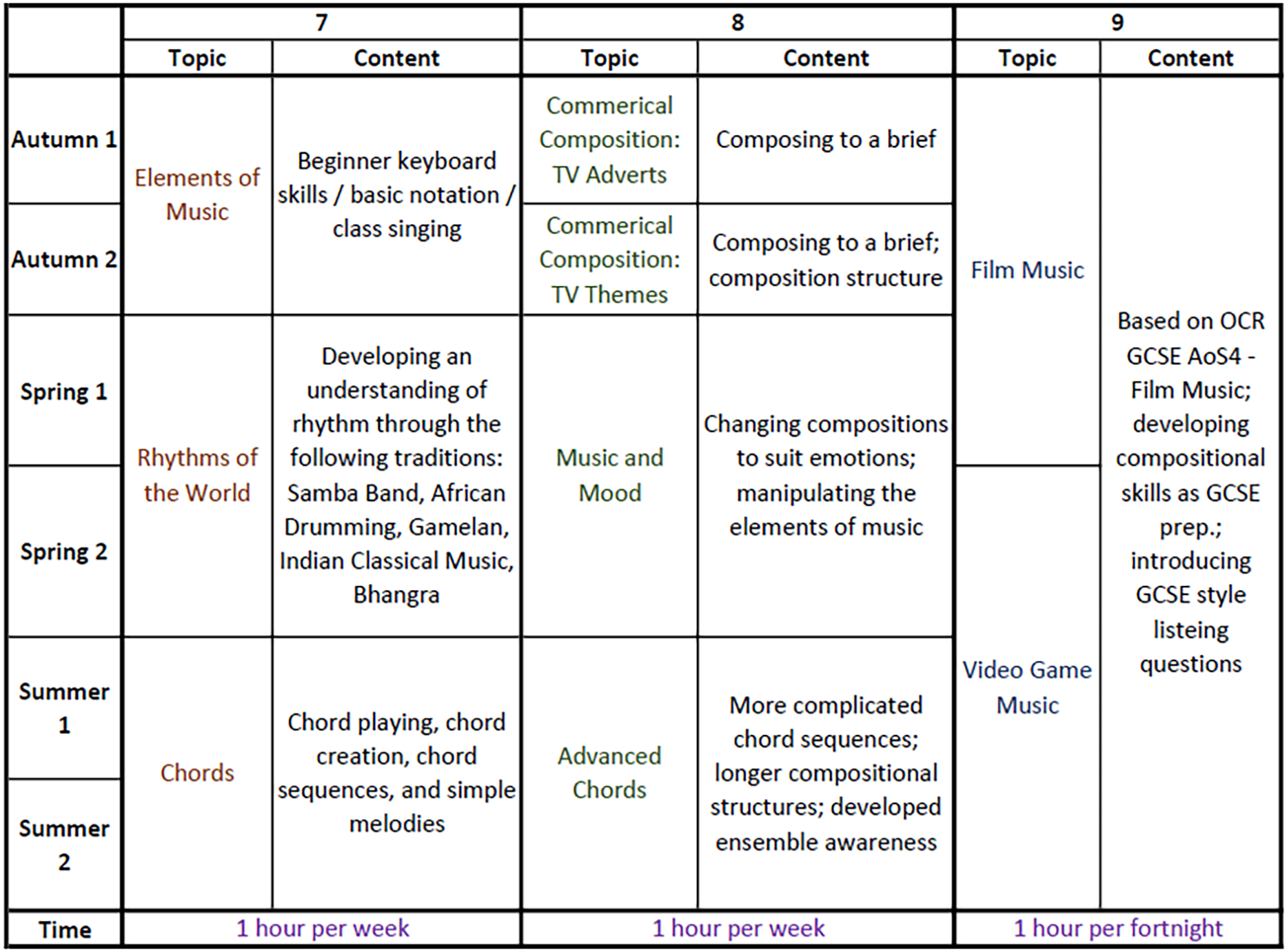
In this example, musical literacies are subsumed within the topic areas of elements of music (use of this term varies but may include characteristics such as pitch, melody, tonality, rhythm, harmony, texture, structure, and dynamics); rhythms of the world; and chords. The literacies then emerge as models of practice exemplified through notions of understanding. In Year 7 (11–12-year-olds), skills are named, and notation is mentioned as a connector between keyboard work and singing. The rhythms of the world are facilitated through a tour of a wide variety of styles, genres, and traditions, and chords are developed through playing, creation (composing), harmonic sequences, and melodic writing. Later in Year 8 (12–13-year-olds), the literacies become less prescribed. The topics are now mostly situated into a context, such as composing for media in diverse forms or composing to emulate mood, and the impact of these forms of music is understood through composing activity, the assimilation of composing briefs (a provided set context), and a predetermined structure. Similarly, the musical process of composing to create a musical mood is evaluated through the development of composing engagement to align with emotion and the ability of pupils to manipulate musical elements to achieve a satisfying outcome. Harmonic consciousness is developed at the end of Year 8 into ensemble awareness, and more complex interactions are evident in Year 9 (13–14-year-olds) when composing for media becomes increasingly complex, embodying multi-modal forms and contexts, such as film and video games.
Whilst the topics and the manner in which their realisation is described on this programme of study embody engagements such as performing, composing, and improvising in differing musical styles, genres, and traditions, these enactments nevertheless constitute musical literacies. Such realisations may not follow more traditional conceptualisations of literacy, but without in-practice knowledge (Fautley, Reference FAUTLEY2018), they cannot be realised by pupils. In addition, musical literacy is required in pupil responses for collaborative classroom music-making, which will otherwise not fit with pedagogical framing (Bernstein, Reference BERNSTEIN and Brown1973) as established by the teacher. Musical literacy is required to understand and reproduce drumming traditions of different cultures outlined within this programme of study, and musical literacy is required to modify compositions to emulate different emotions. These musical enactions require embodied knowledge, whose presence is implicit, even though such musical interaction may not fall within more traditional models of musical literacy. Authentic aural traditions and practices in Gamelan and Bhangra, for instance, are unlikely to feature notation but nevertheless require a musical literacy within this tradition for pupils to participate. In this sense, perceptions of musical literacies have, as Spruce has noted, become rather narrow (Spruce, Reference SPRUCE, Anderson, Cooke, Kinsella and MacGregor2026). This is a practice which the music teacher curriculum designer in Figure 1 has embodied in heuristic practices for their pupils and accords with the historical perspective set out earlier.
Classroom music teachers in England, therefore, consider musical development as more inclusive than progressing to and interpreting the next more demanding page of notation and realising this with accuracy and expression. Musical development is thus central but can become disproportionate, skewed ‘into the conventions of notation, even if you know that it’s not the conventions that they are using’ (Boyce-Tillman & Anderson, Reference BOYCE-TILLMAN and ANDERSON2022, p. 55). Musical literacy sits within the discourse of musical development in musical behaviours, intuition, and musicality. This may include formal understandings of what it means to be musically literate, but these can never be divorced from classroom musical experience. In this sense, and through thinking about programmes of study in music as conceptualised by teachers, ‘the school curriculum…is the point where theory meets practices, where ideas and beliefs are actualised in the phenomenal world’ (Jorgensen, Reference JORGENSEN2003). Thus, where music curricula are interpreted only through a theoretical lens, the multi-dimensional experience that musical literacy offers remains unfulfilled.
Discussion
Musical literacies and curriculum literacies can become enmeshed in school practices, where the enactment of curriculum in musical activity comes to be regarded as musical literacy. Our argument in this article has been that in reality two literacies are in simultaneous operation: musical literacy, which the teacher embodies as a musician, and curriculum literacy, where the music teacher makes decisions as an educator about how to facilitate and enable musical learning in classroom spaces. Music teachers bring these two different ways of knowing together to provide young people with musical opportunities for development, but the operation and intersection of these domains is an unrecognised complexity.
Following our consideration of the manner in which ideas of curriculum and literacy can be understood, there are further complexities still in the spaces between these notions which need further discussion. We have identified two broad areas of particular importance: how music teachers practise curriculum dualism between their own curriculum aspirations and the requirements of the schools where they work; and, secondly, how curriculum literacy is an unacknowledged and self-contained requirement of classroom music teaching. In this discussion, we therefore briefly signpost these critical perspectives and explore their implications for classroom practices.
Complexities in musical literacies and curriculum realisations
The different perspectives of how musical literacy is, or should be, manifested in secondary school music curricula can create tensions. Music teachers’ curricula are intensely personal to them and reflect their own musical understandings and identities (Anderson, Reference ANDERSON2019). Teachers often operate in ways that ‘reveal substantially different sets of assumptions regarding what should be addressed…and how it should be addressed’ (Broomhead, Reference BROOMHEAD2018, p. 13). This results in multiple different flavours of music curricula and experience across England’s schools, embodied in a generally unified form (usually a one-page curriculum summary of years 7–9, realised as topics) but containing vastly differing content and embodying different pedagogical approaches. Dominant discourses of curriculum as realised by schools and suggested in curriculum models (e.g., the Model Music Curriculum (DfE, 2021) and Ofsted Research Review (Ofsted, 2021a)) are sometimes in conflict with teachers’ own perceptions of what it means to enable musicality in pupils in their classes. Music teachers may, therefore, walk a wobbly tightrope, where they move in one direction (their personal music philosophies), but the rope (policy requirements as suggested in documentation and scrutinised through school quality assurance procedures) is wobbling in another. This has the potential to cause instability in the music curriculum field and, in music education literature, is an often unrecognised curriculum complexity.
In order to reconcile these differing perspectives and requirements, music teachers may, therefore, engage in curriculum dualism. This occurs where music teachers combine and find a way to accommodate policy parameters within their own approaches to musical literacy. As part of this process, curriculum documentation which represents music curriculum activity so that it can be interrogated by others (such as school senior leaders, for example) may be reformulated to articulate musical processes in a different form from music teachers’ ideal nomenclature. This can cause musical literacy to become obscured and hidden and to occur in clandestine musical realisations in the classroom, which are disguised as approved classroom terminologies. For instance, one school in the English Midlands (Anderson, Reference ANDERSON2020) was required to reinterpret the curriculum as strands of ‘subject DNA’. This led to the music teacher realising performing, composing, applying musical knowledge, and making critical judgements within this model, arguably making it more problematic for pupils to understand the processes of composing, performing, and listening and to access opportunities for musical development. Where they are present, such difficulties appear to emerge when teachers are required to create curriculum documentation using an agreed template across all school subjects. This additional complexity to designing musical learning for the classroom may, ultimately, make it more difficult for pupils to access music, make progress, and grow in their musical literacies.
Curriculum literacies
Curriculum dualism may cause music teachers to position themselves and to frame the musical learning they are developing for pupils within a school curriculum taxonomy that is frequently in flux, not unlike teaching in a second language. This constriction requires continual cognitive effort and reshaping as teachers seek to not only teach music but also teach it in the approved form required by school contexts. Such teacher activity indicates a concealed process as teachers continually negotiate this terrain, a process which can be described as curriculum literacy. Curriculum literacy has been discussed as an interface in individual subjects between learning and successfully engaging with assessment (Wyatt-Smith & Cumming, Reference WYATT-SMITH and CUMMING2003). Thinking in this area has been developed to identify subject-specific teaching, rather than a generic skill (Pascoe & Smith, Reference PASCOE and WYATT-SMITH2013), and models with lesson templates have been developed to encourage and engender literacies in sustainable practices (Sandretto & Tilson, Reference SANDRETTO and TILSON2016). However, there is an international gap in the literature considering the skill of curriculum literacies as teachers originate and design their curricula and the processes that this involves. The ability to simultaneously satisfy two sometimes competing mindsets – personal outlook and policy paradigms – is an unrecognised skill. In this respect, music teachers are therefore multi-lingual not only musically but also in curriculum literacies, an aspect of their work which often goes unrecognised, perhaps even in their own evaluations of their practice.
Conclusions and implications for music teaching
School teaching environments are frequently ideologically or politically driven in the manner in which they permit, legitimise, or formulate curriculum realisations. The challenges for considering musical literacies within this frame can be unrecognised by those working in school leadership. The case of music is particularly interesting and complex because of the sheer diversity of literacies that could be developed, the needs and interests of the students working with teachers, and the breadth of activities that can constitute musical curricula. This has significant implications for musical practices in the classroom, the conceptualisation of multiple literacies, and how this is understood in curriculum terms. Acknowledging that the curriculum field that teachers are negotiating is complex and that musical literacies can be diverse is therefore an important starting point. Due to the nature of these complexities, teachers need time and space to develop their curriculum understandings. Senior leadership Teams would benefit from engaging in dialogue with school subject leaders to better understand the specific types of literacies and curriculum design issues that are present. Doing so would liberate music teachers from inhabiting a complex, sometimes contradictory, curriculum dualism, where the polyphony of different positions and purposes inhibits and, at times, restricts classroom practices. Musical literacies are more complex than the prescribed definitions that policy documentation may suggest, and that this has long been the subject of musical discussion can offer a useful point of reflection for music teachers. In a sense, looking to a model from a time completely different from our own can be helpful in clarifying the intentionalities of our practices today.
By opening up music teaching perceptions and possibilities for classroom spaces through models of musical literacy from different times and educational contexts, teachers can be enabled to think more critically about the underpinning ideas that facilitate and are central to curriculum meaning-making. Wider conceptualisations of musical literacies can then serve as thinking tools that enable music teachers to question ideas and understandings, leading to potentially richer opportunities for musical development. Moving beyond a constructive process, where musical components are regarded solely as an assemblage from which to design curricula, can help illuminate complex thinking with which music teachers tacitly engage. Ideas of literacy and curriculum can therefore be powerful liberators, unlocking diverse musical pedagogies for teachers in their approaches, which ultimately enable pupils to access greater depth in their musical learning in the classroom. Musical literacies and curriculum expressions are, therefore, a powerful and important partnership which stretches far beyond concepts, facilitating musical meaning, musical practices, and musical experiences in schools.

 Open access

