


It is possible to increase nutrient intakes markedly in a population via food fortification(Reference Meltzer, Aro and Andersen1), and mandatory fortification has been used with success as a means to reduce nutritional deficiencies (e.g. iodising of table salt to reduce the incidence of iodine-deficiency disorders). On the other hand, fortification of foods may also create a risk of exceeding the upper acceptable intake limit and in extreme cases a risk of poisoning. Increasing nutrient intake via fortification is safe when sufficiently targeted at those with low vitamin and mineral intakes(Reference Hirvonen, Sinkko and Valsta2).
Before accession to the EU, food fortification in Finland was strictly regulated, with fortification applied to reduce nutritional deficiencies. After joining the EU, Finland started to liberalise fortification of foods and it was approved by the authorities unless there was a risk of overdose(Reference Suojanen, Raulio and Ovaskainen3). Food fortification was legally based on either of the following: (i) general regulation in which all permitted food-group–nutrient-concentration combinations were enumerated (e.g. milk could be fortified with vitamin D in a concentration of 0·5 μg/100 g), which covers widespread fortification (in which almost all products in a food group are fortified), including that of margarines with vitamins A and D, fortification of milk with vitamin D, and iodisation of table salt; and (ii) special permission granted by the Finnish Food Safety Authority for other food-group–nutrient-concentration combinations than mentioned in the general regulation. At the moment, there are two types of food fortification in use in Finland: (i) ‘common-practice fortification’, performed in consensus between the authorities and the food industry, that covers almost all products in a food group (e.g. milk's fortification with vitamin D); and (ii) ‘voluntary fortification’, which is carried out by each individual food producer and is regulated only by the common EU regulation on food fortification (Regulation (EC) 1925/2006). The data for the present study were collected before the latest EU regulation entered into force (July 2007) but after Finland joined the EU. Voluntary fortification has become increasingly common in Finland and most often stems from commercial interests rather than public health needs. In the present study, voluntary food fortification is deemed to consist of all fortification apart from common-practice fortification.
Voluntary fortification is sometimes used to increase the nutritional acceptability of foods whose nutritional profile is often low – i.e. foods that are low in mineral content, fibre and vitamins, but high in sugar, saturated fats or salt(Reference Kalergis and Macdonald4). However, little is known of what kinds of voluntarily fortified foods are most commonly used and who the users of fortified foods are. Also, the true consumption of these foods may be difficult to capture via conventional dietary assessment methods, because consumers may not always be aware of the fortification of the foods purchased and consumed and may not remember the exact name of the product when reporting their food consumption.
The three aims of the present study were: (i) to investigate the type and amount of voluntarily fortified foods consumed by Finnish adults; (ii) to examine and compare background characteristics, food consumption and nutrient intakes among users and non-users of voluntarily fortified foods; and (iii) to evaluate whether users and non-users of foods fortified with a specific nutrient have a differing total intake of that nutrient from ordinary foods and food supplements alone – i.e. whether fortification is diminishing real differences in nutrient intake. In addition, we introduce a new tool developed for collecting detailed data on the purchase and use of food products.
Methods
Data on the consumption of food and food supplements and on the use of voluntarily fortified foods were obtained from the National FINDIET 2007 Survey, carried out as part of the FINRISK 2007 Study, which monitors cardiovascular risk factors in Finland (Fig. 1)(Reference Reinivuo, Hirvonen and Ovaskainen5). A random sample of 9958 persons aged 25–74 years, in five areas, stratified by sex, area and 10-year age band, was taken from the population register. The study areas were: (i) the Helsinki and Vantaa metropolitan area; (ii) the areas of Turku and Loimaa, in south-west Finland; and the provinces of (iii) North Karelia, (iv) North Savo and (v) Oulu. The participation rate was 63 %; i.e. 6259 subjects participated. Of these, 2069 persons were invited to participate in the FINDIET Survey(Reference Reinivuo, Hirvonen and Ovaskainen5).
Flowchart of the study

The participants were interviewed with a 48 h dietary recall instrument between January and March 2007. Details of the method have been reported previously(Reference Reinivuo, Hirvonen and Ovaskainen5). In short, all foods, beverages and food supplements consumed by the participant over the two previous days were recorded and portion sizes were estimated from a food photograph booklet and household measures. Pictures of the most commonly used food supplements were also available to aid in identification of the correct product. The 48 h recall data covered all days except Fridays. The National Food Composition Database Fineli® (www.fineli.fi), which also includes data on food supplements, was used to calculate the food consumption and nutrient intake values.
Additionally, a sub-sample (50 %) of the participants in the FINDIET Survey was asked to fill in a 5-d barcode-based product purchase diary (or ‘product diary’) to assess the purchase and use of food products. The participants were instructed to record all food purchased for home consumption by any member of the household or by the participant for his/her outside-the-home consumption (snack bars, sweets, etc.) for five consecutive days. Restaurant, cafeteria and fast-food meals and drinks were not recorded. If no food was purchased on one or more days, the respective pages were to be left empty. The participants were asked to write a detailed description of each food item, including the type of food, brand name, name of the product and manufacturer. Also, the purchase date, the number of packages, the weight of one package, and the last four digits of the barcode (if available) were filled in. Foods with no barcode, such as loose fruit and vegetables, were recorded as well. Finally, the participants were asked to tick boxes for a food in the product diary if the product was intended for use (as-is or as an ingredient): (i) by the participant him-/herself or (ii) by a household member under 7 years of age. In the present study, the participant's own use of any of the voluntarily fortified foods purchased was used as the criterion for the participant's classification as a user as opposed to a non-user.
In all, 930 participants (91 %) returned product diaries, of which 918 (90 %) were of acceptable quality (most of the products of the individual diary could be identified). We used a specially designed software and database system for the data entry. Since we did not have direct access to the manufacturers’ product registers, we could not directly link the barcodes with the correct product. Instead, the four-digit barcode database was created during the product diary data entry process. If a food item's description was incomplete, we used the barcode to check the item against the information already accumulated in our database. In some cases, we used manufacturers’ product catalogues available either in print or online. The four-digit barcode was in most cases sufficient for food identification. Each food item was assigned a food identifier from the Fineli database, enabling data classification according to food group.
The background characteristics of the participants were assessed via questionnaires and measurements in the FINRISK 2007 Study(Reference Peltonen, Harald and Männistö6). Alcohol consumption was self-reported as the number of units of different types of alcohol consumed in the previous 7 d. One unit equalled, for example, 300 ml (33 cl) of beer, 120 ml (12 cl) of wine or 40 ml (4 cl) of spirits. Physical activity was self-reported as instances of leisure-time physical activity (minimum of 20 min) per week. The weights of all foods recorded in the product purchase diaries were summed by food group. The voluntarily fortified foods were identified by either: (i) checking the fortification status of the food products mentioned in the general regulation on the Internet or examining the product label; or (ii) using the information obtained from special fortification permissions granted by the Finnish Food Safety Authority for individual food products.
Logistic regression analysis was used to identify the determinants of the use of voluntarily fortified foods. We constructed three models: (i) a univariate model, considering one independent variable at a time; (ii) a saturated model, with all independent variables; and (iii) a third model, with all variables that were found to be statistically significant with the first model. The differences in food consumption and nutrient intakes between users and non-users of voluntarily fortified foods were tested via the unpaired t test, and the consumption and intake figures were transformed logarithmically where this was appropriate. In addition, we chose the four nutrients that predominate in voluntary fortification (vitamin D, vitamin C, pyridoxine, Ca) and compared total intake of these nutrients from ordinary foods and food supplements between users and non-users of the foods fortified with the respective nutrient. The calculation omitted the amounts from voluntary fortification in order to determine whether the non-users would have had a lower intake than the non-users if all food had been non-fortified – i.e. whether the users were improving their intake by choosing fortified foods.
Results
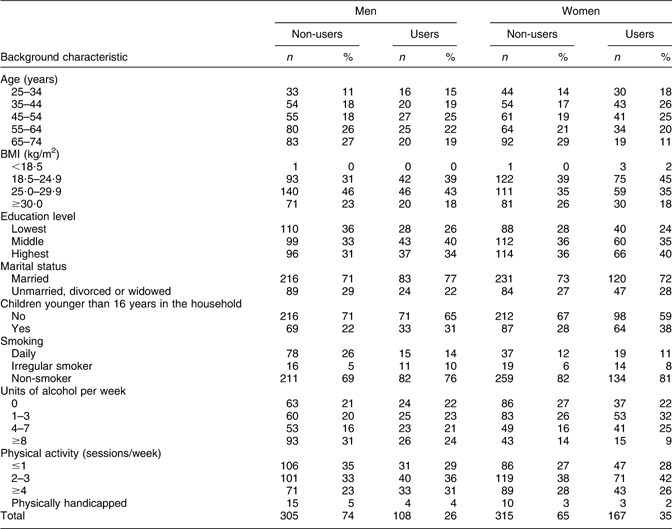
Of all food purchased, 2·6 % by mass was voluntarily fortified (Table 1). The fortified food group purchased in the largest amounts (measured in kg) was yoghurts, followed by juice drinks and ready-to-eat breakfast cereals (Table 1). The most commonly used foods by fortification nutrient were those with vitamins D and C. The association of background characteristics with use of fortified foods is presented in Table 2. In logistic regression, sex, age, BMI, children in the household, smoking, alcohol consumption and consumption of vegetables showed a link with the use of fortified foods in univariate models (Table 3). However, when all statistically significant variables were incorporated into the same model, only the consumption of fruits and vegetables and age were independently associated with use. Those who showed high consumption of fruits and vegetables were more likely to use fortified foods than others were. In addition, younger participants were more likely to use fortified foods than were older ones.
The total amount of voluntarily fortified food purchased, by food group and added nutrient, among random subgroup of 918 adult participants (aged 25–64 years) in the National FINDIET 2007 Survey
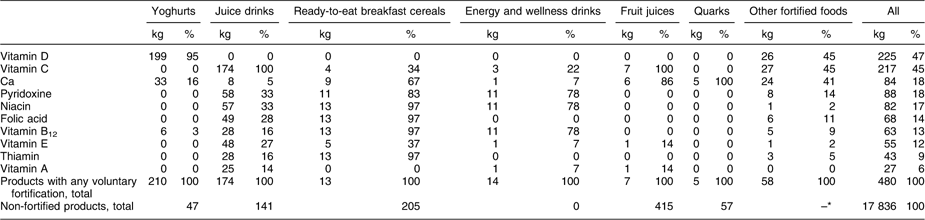
*Not calculated.
Background characteristics of users and non-users of voluntarily fortified foods: random subgroup of 918 adult participants (aged 25–64 years) in the National FINDIET 2007 Survey
Logistic regression analysis of the association between voluntarily fortified foods use (yes/no) and background factors, presented as odds ratios with 95 % confidence intervals: random subgroup of 918 adult participants (aged 25–64 years) in the National FINDIET 2007 Survey
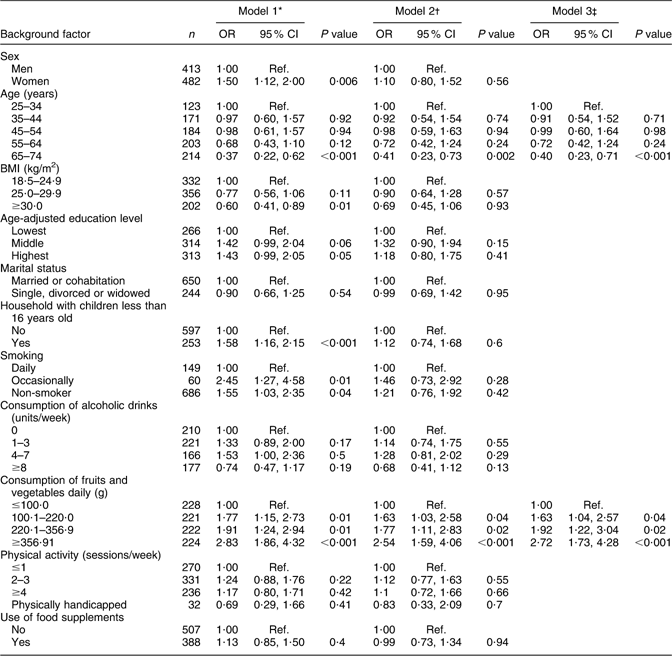
Ref., referent category.
*Univariate model: only one variable at a time in the model.
†Saturated model: all variables addressed at the same time in the model.
‡Final model: only variables that are statistically significant covered at the same time in the model.
The food consumption and nutrient intakes (excluding intake from voluntarily fortified foods) of users and non-users of fortified foods are compared in Tables 4 and 5. Consumption of fruits and vegetables, yoghurts, ready-to-eat breakfast cereals (for women only), and juice drinks was higher among users of fortified foods than among non-users (Table 4). Also, among men, consumption of cooked potatoes was lower among users than among non-users. In nutrient intake, the sucrose intake among men was significantly higher and the proportion of fat of total energy intake was significantly lower among users than among non-users. Vitamin C intake from ordinary foods and the sum of intake from ordinary foods and food supplements were higher among those who consumed foods fortified with vitamin C (Table 5). There were no statistically significant differences between users of foods fortified with vitamin D, pyridoxine or Ca and non-users in respective nutrient intake from ordinary foods and/or from food supplements.
Consumption of selected foods (g/d) and daily intake of selected nutrients among users and non-users of voluntarily fortified foods: random subgroup of 918 adult participants (aged 25–64 years) in the National FINDIET 2007 Survey
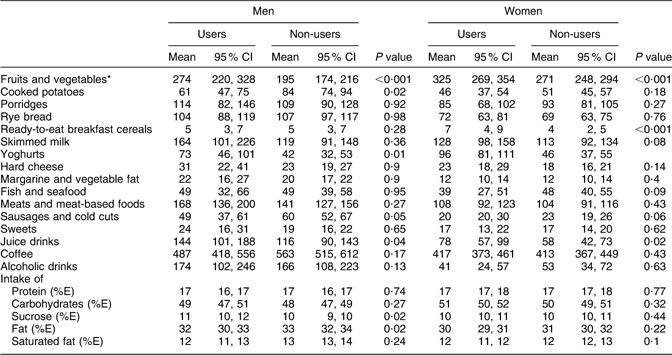
%E, percentage of energy intake.
*Does not include fruit juices.
Daily intakes of nutrients from natural sources and from food supplements among users and non-users of foods that are voluntarily fortified with the respective nutrient: random subgroup of 918 adult participants (aged 25–64 years) in the National FINDIET 2007 Survey
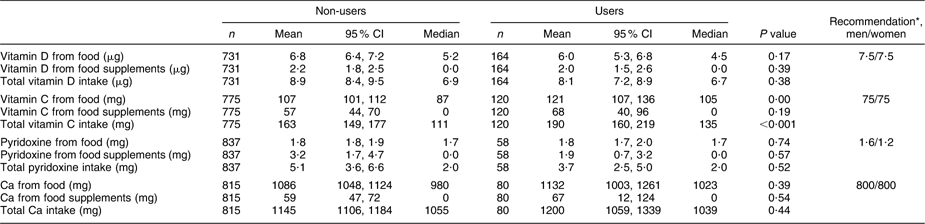
*Nordic Nutrition Recommendations (2004) Integrating Nutrition and Physical Activity. Copenhagen: Nordic Council of Ministers.
Discussion
Our study shows that the users of voluntarily fortified foods had a higher consumption of fruits and vegetables and were younger than non-users. No other background characteristic was found to be associated with use when we controlled for other background characteristics. Furthermore, users of voluntarily fortified foods did not show lower intakes of the nutrients that were used to fortify the products they purchased. In fact, users of vitamin-C-fortified products had a higher intake of vitamin C from ordinary foods; therefore, use of fortified foods increased rather than decreased the difference in vitamin C intake between users and non-users.
Yoghurt and juice drinks were the most frequently used voluntarily fortified foods. This is probably because these foods (fortified or not) are, in general, used by a large proportion of the population in Finland (25–64-year-olds): 32 % of men and 49 % of women ate yoghurt, and 35 % of men and 27 % of women drank sugar-sweetened fruit drinks during the 48 h recall period(Reference Paturi, Tapanainen and Reinivuo7). In addition, a large proportion of yoghurts and juice drinks are fortified. Therefore, the use of voluntarily fortified foods may not always be a conscious choice so much as a result of the fact that non-fortified options are few or not available at all in the store. The choice of a fortified product may also be based on attributes other than fortification, such as taste, familiarity, convenience and price(Reference Urala and Lähteenmäki8). Ready-to-eat breakfast cereals are the most commonly used voluntarily fortified foods worldwide(Reference Galvin, Kiely and Flynn9–Reference Hannon, Kiely and Flynn12). In Ireland(Reference Hannon, Kiely and Flynn12), these have somewhat the same role yoghurts and juice drinks do in Finland: they are widely used and are most often fortified. Therefore, it seems that in many countries the use of voluntarily fortified foods is not always a very conscious choice and is a consequence of a supply dominated by fortified products.
Our study is in line with an Irish study(Reference Joyce, Hannon and Kiely13) in which younger persons used fortified foods more often than older ones. In the Irish study, also higher education was associated with use, while in our study education was not an independent determinant of use. In addition, our study did not find use of fortified foods to be associated with other behaviour than food-related ones. It is surprising that a higher education was not associated with the use of fortified foods, although consumption of fruits and vegetables is associated directly with both education(Reference Prättälä, Hakala and Roskam14) and the use of fortified foods. In the univariate model, education level showed a significant association with the use of fortified foods, but this association weakened to non-significance when other background factors were controlled for. It cannot be ruled out that in a larger study population education level could have been shown to be a significant determinant. However, if the choice of a fortified food product over a non-fortified one is predominantly not conscious, the background characteristics of users are bound to be similar to those of non-users.
In our study, differences in nutrient intakes and in food consumption were modest. This is not in line with the Irish study(Reference Joyce, Hannon and Kiely13), where energy, protein, carbohydrate and sugar intakes were higher among greater users of fortified foods. The only difference in nutrient intake between users and non-users in the present study was in sucrose intake. The higher sugar intake among users could indicate that fortification has improved nutritional quality in the eyes of consumers. However, there was no significant difference in energy intake. Also in the UK, fortified foods often are of low nutritional quality: in a study carried out in the UK in 2003, 260 fortified food products were identified and 75 % of these had a high content of sugar, fat or salt(Reference Meltzer, Aro and Andersen1).
The differences in food consumption, except for fruits and vegetables, were also small and were mainly found in those food groups that were also fortified. This increases the confidence in our main method (the product diary), which was independent of the method used to estimate food consumption.
Why was the consumption of fruits and vegetables the only background factor, apart from age, associated with use of voluntarily fortified foods? It is possible that high consumption of fruits and vegetables is a sign of food-related health-consciousness and that persons who are health-conscious in relation to food are not necessarily so in other areas of health behaviour (e.g. smoking or physical activity). In fact, an American study(Reference Newsom, McFarland and Kaplan15) found that health-related behaviours are not related to each other. However, in another study, poor food choices were shown to be related to smoking and high alcohol consumption(Reference Ma, Betts and Hampl16). Also, in a German study among elderly people(Reference Huy, Schneider and Thiel17), a healthy diet was associated with regular exercise and with not smoking. Therefore, it is possible that the independence of food-related health-consciousness is just a chance finding or is due to the small number of participants in the present study.
From a public health perspective, targeting for the use of voluntarily fortified foods does not seem to be successful: the intake of several nutrients among users of fortified foods was at the same level or even higher among non-users. Fortified foods were not used by those whose intake from other sources was low. However, from a food safety viewpoint, we found no significant accumulation of risk of excessive nutrient intake from fortified foods and other sources. The risk of exceeding the upper intake limit for vitamins and minerals seems small, because, on one hand, the proportion of voluntarily fortified foods among all foods purchased was small (2·6 %) and, on the other hand, among users of fortified foods, nutrient intake from other sources (ordinary foods and food supplements) was not higher than that of non-users. Therefore, high intake from fortified foods and from other sources does not accumulate in the same people.
The barcode-based purchase diary proved to be suitable in assessing the use of voluntarily fortified foods, and the last four digits of barcodes were shown to be sufficient for product identification. The method was not too great a burden for participants, as 89 % returned an acceptable diary. We also found that the barcode was very useful both in ascertaining that the product description was right and in expediting data entry. Its drawback is that, since it addresses only the intention to use a product, the portion sizes actually consumed cannot be determined and therefore actual nutrient intake figures cannot be calculated. In addition, the method does not take account of food that is not eaten (waste food). One alternative would have been to identify the consumption of voluntarily fortified products in the 48 h recall. However, it is likely that not all voluntarily fortified foods were identified in the product diary either, because information on fortification was not available for some foods. However, this problem applied to only a small proportion of foods. In addition, it must be borne in mind that the method was new and non-validated and that, therefore, the results of the present study should be taken with caution. Furthermore, it is not known whether the method affected shopping behaviour during the recording period, so, again, the results should be interpreted with caution.
In a previous Finnish study, consumption of fortified foods was addressed in an Internet–based survey(Reference Raulio11). However, that study proceeded from the assumption that participants are able to distinguish fortified foods from ordinary foods. We do not think that participants are always able to draw the line between fortified and non-fortified foods. Also, addition of phytosterols or other bioactive substances to foods may be regarded as food fortification by participants. In summary, despite its drawbacks and qualitative nature, we found the new method used, the product purchase diary, to be a useful tool in assessing the use of fortified foods and possibly other behaviour-related food consumption that may be difficult to capture with other methods.
In conclusion, use of voluntarily fortified foods in Finland is rather low and is only weakly associated with other lifestyle factors. Voluntary fortification is not nutritionally well targeted, but neither is it associated with the risk of excessive intake of vitamins and minerals. Therefore, voluntary fortification does not seem to be a good tool to increase vitamin and mineral intake among those whose intake is low. In addition, the barcode-based purchase diary proved to be feasible method for collection of data on use of specific products. The study yields important information for utilisation in nutritional risk assessment for fortified foods.
Acknowledgements
This research received no specific grant from any funding agency in the public, commercial or not-for-profit sectors. None of the authors has conflicts of interest. The contributions of authors were: drafting the first version of the manuscript (T.H.), statistical analysis (A.K.), statistical expertise (H.S.), contributions to second and third versions of the manuscript by comments, corrections and by writing text (V.M., A.K., L.K., H.S., M.L.O.).



