




Introduction
One of the most famous pilgrimage locations of any religion, let alone Christianity, is the town of Lourdes with its grotto, made famous by St Bernadette Soubirous in 1858.Footnote 1 It has been the site of hundreds if not thousands of reported miracles, mainly of healing, attracting millions of pilgrims annually. The Lourdes Medical BureauFootnote 2 investigates purported miraculous cures brought to its attention and considered worthy of further investigation. The vast majority of claims are rejected, but there are seventy-one officially certified cures and many others that have been accepted by unofficial investigations (Clarke Reference Clarke1888; François et al. Reference François, Sternberg and Fee2012; Jaki Reference Jaki1999).Footnote 3 Cures officially recognized include those from blindness, paralysis, limb fracture, tuberculosis, and cancer.Footnote 4
These cures (a term I will use non-factively but for convenience) are difficult to explain naturalistically – by which I simply mean, for present purposes, in purely scientific terms rather than by divine intervention. It is hard even for non-theists to provide a naturalistic explanation (Carrel Reference Carrel1950; François et al. Reference François, Sternberg and Fee2012). Paralysis is one of the conditions commonly reported as cured, with several cases officially recognized and many others reported, as demonstrated by the hundreds of abandoned crutches that were on display for decades in the Lourdes Grotto (this being where St Bernadette had her visions of the Virgin Mary).Footnote 5 At some point all of these crutches were removed from the Grotto (presumably by the diocesan authorities), though I have not been able to find out why.Footnote 6 Despite their disappearance, however, they remain a witness to what I will call the Wooden Leg Problem (WLP): why were there many crutches on display but no wooden legs?
Although urban legend sometimes attributes this problem to Emile Zola with the untraceable quote, ‘the road to Lourdes is paved with crutches but without a single wooden leg’,Footnote 7 in fact the WLP appears to have been first posed by the writer Anatole France in 1894 or 1895 (France Reference France1895, 203–205). He says:Footnote 8
I was in Lourdes during August, visiting the grotto where so many crutches were hanging as a sign of cures. My companion pointed at these medical trophies, whispering: ‘A single wooden leg would have said a whole lot more.’ His words made sense. Still, philosophically speaking, a wooden leg is worth no more than a crutch. If someone with a truly scientific mind were asked to testify that an amputated leg had suddenly regrown [while the person was] in a pool of water, he would not say: ‘Behold, a miracle!’ He would say: ‘An observation that has never been made before suggests that for reasons we do not understand, a human leg is able to regenerate as we see similarly in the case of lobsters…’
There is no doubt whatsoever as to the dialectical power of the WLP. It is a plain and direct challenge both to Christianity and, by extension, to any religion in which both miraculous cures are generally believed and there is a division between the kinds of cure reported and the more ‘spectacular’ cures that are not reported.
It might be suggested that the WLP is purely an ‘internal problem’ for people within the ‘theistic paradigm’.Footnote 9 Solving the problem will not convince a sceptic about miracles; it will simply give the classical theist – the theist who believes in literal miracles – a means to maintain their position against competing theistic frameworks. And if there is no solution, perhaps classical theism must yield to one of those other approaches.
It is true that there are non-classical theistic frameworks in which miracles are not treated as literal events or instances of divine intervention. Non-classical theists insist that you can be a Christian, or some other theist, without believing in miracles at all, at least in the literal sense. One might see the crutches at Lourdes as testament to a harmless superstition or charming display of faith, and equally regard their disappearance as perhaps a gentle (or not so gentle?) rebuke by religious authorities seeking to downplay such popular enthusiasms.Footnote 10 There are many self-professed theists who have precisely that attitude to miracles. But they are not my concern. The WLP is a problem pure and simple for the classical theist who believes in miracles, and challenges that particular position. It is equally potent a threat coming from a self-professed theist who does not believe in miracles as it is coming from an atheist (as in the original France example, I suggest, and as traditionally attributed to Zola). Put simply, an outright atheist can happily launch the WLP at classical theists, using it as a defence – or reinforcement – of atheism. They need not be concerned whether ‘internal’ solutions can be found such as to allow some people to continue to call themselves theists even though they see the WLP as insoluble in classical terms.
The WLP bears similarities to the argument that theism is incompatible with the saving of some innocents from disaster while others die; there are many variations on the theme. The WLP is, however, stark and confined to miraculous cures: why these but not those, given that they are, from the divine point of view, of a piece, and similar medically in so many ways? If God can make the lame walk when they have both legs, why can He not make them walk by returning a missing leg?
Of course the bite of the problem is in the phrases ‘of a piece’ and ‘similar medically’. Someone who sees the force of the WLP will probably hold that the cases are in fact significantly dissimilar: paralytics can recover spontaneously but no human can spontaneously regrow a leg. And that is the point: what is behind the recovery in the first case – thereby giving rise to all those now-removed crutches – is pure nature, not God. The WLP puts the general problem of miracles in the starkest possible light. So if it is to be taken seriously, and indeed challenged, this must be done head-on. That is what I propose to do in what follows, considering ten possible replies on behalf of the theist (by which I mean, by stipulation, any believer in miraculous cures). The responses I consider fall into three broad categories. First are those that appeal to epistemic or psychological considerations. Next, I examine solutions that suggest metaphysical or theological constraints on divine action. Third, I consider solutions that treat miracles as teleologically ordered to specific human or spiritual functions. My own preferred response, presented last, also belongs to the first category but is discussed separately due to its distinctive structure and implications. It appears to me plausible and not to do violence to the doctrines and intuitions in play.
While the WLP has not been explicitly addressed in the philosophy of religion literature as far as I can tell, this article engages with longstanding concerns about the evidential value and theological coherence of miracle reports. In particular, the taxonomy of responses developed here may complement existing discussions of selective divine action and probabilistic reasoning about miracles. By the end of the discussion I do not propose to have definitively solved the WLP. At the very least, I hope to have cleared up some misconceptions, sifted the weaker from the stronger responses to the problem, and set some parameters for the future debate that is necessary if the WLP is to be solved, whether for or against the believer in miraculous cures. Perhaps, moreover, my own preferred solution will be seen as plausible by some who wish to solve the problem.
Epistemic or psychological solutions
‘You would not be convinced anyway’
Anatole France has his hypothetical, impartial but scientifically minded observer hold that not even wooden legs on display would prove there was a divine cause. All they would do is point to the existence of a naturalistic cause that so far evaded science, prompting further biological investigation. Suppose the theist were therefore to respond as follows: ‘There is no point to your question about the absence of wooden legs because even if they were displayed along with the crutches, you still would not believe in miraculous cures.’ The sceptic could then reply: ‘I would believe if the cure were more spectacular.’ So then the theist would be put on the defensive and required to explain why that more ‘spectacular’ cure was not on display (for some appropriate example of a spectacular cure, about which more later). For this reason, despite its being tempting, the theist should not make this dialectical ‘you would not believe anyway’ move. Moreover, it is a simple fact that even if the scientifically minded sceptic would not be convinced by wooden legs, many people would. People have been convinced by reported miracles for thousands of years.Footnote 11 In which case the WLP reasserts itself: why do these people only ever see crutches but not wooden legs?
Inscrutability
It is sometimes proposed as a solution of the Problem of Evil (in both its evidential and logical forms) that ‘God’s ways are not our ways’, that evil is ‘mysterious’, God’s reasons ‘inscrutable’ (e.g. Kilby Reference Kilby2020). Whatever one may think of the inscrutability response to that problem, it seems rather weak when applied to the WLP. One might think of evil as a kind of metaphysical and moral abyss, plunging the seeker after truth into ignorance beyond all understanding from the minute they confront the problem. Even if there is such a chasm between good and evil, there does not seem to be a comparable one between a pair of crutches and a wooden leg. Moreover, interestingly, it might be thought that the WLP itself rebounds back on the Problem of Evil: after all, for God to draw the line between crutches and prostheses is itself an example of the latter problem. Dialectically speaking, one might suspect that the WLP puts extra pressure on the inscrutability proposal for dealing with the Problem of Evil more generally, rather than encouraging us to think that the WLP, being yet another instance of divine inscrutability, reinforces what we already should suspect regarding the wider Problem of Evil.
On the other hand, consider what has been referred to as the ‘argument from incomplete devastation’.Footnote 12 It is not uncommon for theists to argue that the survival of a child in, say, a plane crash, is a miracle even though every other passenger was killed. If the child was saved by God, what about the others? There is a generic parallel to the WLP in that both problems take the form of ‘If God does this, why doesn’t He do that?’, the sceptical implication being that maybe He doesn’t do this after all. Still, surviving a plane crash is not evidently a miracle as opposed to highly improbable, compared to a healing from some incurable condition – assuming here, as we do for dialectical purposes, that such a healing would (likely) be miraculous if it occurred. Further, inscrutability might have some greater purchase in the case of the plane crash than in the specific wooden leg case, on the ground that there could be a diverse range of reasons why an equally varied assemblage of persons was not saved whereas one innocent child was. By contrast, there seems something oddly arbitrary about the paralysis/amputation border, making it harder to suppose that there were, for God, a range of reasons specifically not to heal many diverse individuals united only by a common medical condition.
In any case, appeals to divine inscrutability should rarely if ever be the first line of response to a problem concerning God’s actions or lack thereof. Unless we abandon reason, we should always try first to apply it to a philosophico-theological problem before ascending by necessity (or descending, as sceptics would have it) to mysteries beyond human understanding. It may turn out, on further investigation, that the inscrutability solution does some real work and is not repugnant to reason even if it is beyond reason. That would, however, require its own examination. For present purposes, the proper response to the inscrutability solution, pro tanto, is: we can do better.
Theological and metaphysical constraints on divine action
The free-will objection
Here, the believer responds that a wooden leg miracle would be so compelling, so unanswerable, as to remove free will: belief would be irresistible, leaving no room for choice, reflection, argumentation, prayer for enlightenment, struggle with doubt, and so on. In other words, whereas an abandoned crutch still leaves room for a relatively more mundane explanation, thereby compelling the witness to choose for or against the supernatural, an abandoned artificial leg practically removes choice altogether – at least in our current state of knowledge. The reply is equally straightforward: tell that to the Israelites, for whom Moses parted the Red Sea,Footnote 13 or Moses, to whom God spoke through a burning bush,Footnote 14 or Pharaoh (Ramses II? Amenhotep II?) before whom Aaron the High Priest turned his rod into a serpent,Footnote 15 or Joshua and his soldiers, whose trumpets felled the walls of Jericho,Footnote 16 and on and on up to the disciples of Jesus Christ, who saw Him risen from the dead.Footnote 17 (Not to speak of post-biblical reports of miracles, for which see the ‘God’s plans’ solution.) If the believer’s reply were credible, then there would be far less free will – to believe or not – in the Scriptures than most people have always assumed; so much so as to make one wonder why there were any reports of miracles in the Bible at all. A given miracle might be stupendous, putting enormous persuasive pressure on its witnesses to choose for rather than against God; but persuasion, no matter how strong, is not coercion. We know this from the fact of the many individuals such as Pharaoh and Pharisees who, despite being shown the most remarkable miracles, refused to believe.
No desert
The idea here is that if the cure of an amputee is needed, God will provide. In other words, maybe no one has ever had their lost limb restored, and perhaps no one ever will. It is up to God whether an amputee deserves to be healed, and if we never see such a case we can be confident that no deserving amputee has ever come forward. This seems a particularly weak objection, verging on a kind of cant or dismissiveness. Does the proposer of such a solution really believe it? After all, why would the fault line of desert be drawn between paralysis and amputation? There is, to be sure, a wider theological perspective according to which the lack of divine intervention in a particular case of apparent need or desert (whether to remedy an evil, answer a prayer, provide requisite grace) shows that the need or desert was only apparent and nothing more. Such a perspective is not in itself objectionable, since the person offering it is basing their belief in God on a prior framework of natural theology or philosophical justification (or maybe perhaps purely revelatory). They then deduce from that framework that divine intervention, or its absence, must be interpreted accordingly. It would, however, be problematic if the person with that perspective somehow tried to justify theistic belief in the first place on such an interpretation of God’s behaviour.
The problem with the ‘no desert’ solution is that it places the boundary between divine action and inaction at what seems unarguably to be an arbitrary location – between paralysis and amputation. On its face, the lack of prostheses makes no sense. Why would God place the fault line there of all places? Note that I am not suggesting the WLP has no analogues in other areas of human life, of course. All sorts of problems concerned with God’s response to evil can be raised that seem similarly strange and worrying for the believer. It is just that the WLP is a stand-out example. Suppose, in the broader case of graces not received and divine assistance not forthcoming, the believer – without a prior philosophico-theological framework – offered the ‘no desert’ answer. Then, leaving aside the initial worry about the lack of such a framework, if the putative answer drew a boundary between conditions or events that seemed in principle to be relevantly similar – for example, the saving of an innocent baby and the loss of an innocent toddler – then this would simply be another example of the WLP.
Contradicting nature
This proposal is to the effect that for God miraculously to regrow a human limb would be to contradict the human nature He created in the first place. The standard position in classical Christian theologyFootnote 18 is that God works for the most part through ‘secondary causes’, that is, the causes that He created and which operate through their own natures and powers. For God to regrow a human limb would be to intervene in that very creation, which could play havoc with natural science and our understanding of the regularity of nature. In other words, if it were ‘no holds barred’ on what and how God might intervene in the created order, one might wonder why He bothered with a physical creation subject to natural laws in the first place.
This objection does have the merit of making a principled distinction between paralysis and amputation. There can be spontaneous recovery from paralysis (Emery and Cochrane Reference Emery and Cochrane1988) though cases are rare, as with spontaneous remission from cancer. But unless you are a salamander or a starfish,Footnote 19 spontaneous limb regrowth is out of the question. The critic might reply that the believer has given the game away, because all Lourdes cases involving abandoned crutches might simply be instances of spontaneous remission, unexplained by science yet not obviously inconsistent with it. To avoid a Pyrrhic victory, the advocate of the ‘contradicting nature’ objection would have to deny – or at least concede and deny. They would prudently concede that some such cases were indeed natural albeit spontaneous (or even fake altogether), but they would likely insist that not all were, lest they abandoned belief in the efficacy of Lourdes pilgrimages altogether. Cures that look the same might not be the same essentially. The thought, then, would be that while some abandoned crutch cases were miraculous and some were not, no wooden leg is ever displayed because a miraculous cure of that kind would not mimic what we already see in the natural history of the human species. Such a phenomenon would threaten belief in the normal operation of secondary causes, as suggested above.
My reply to this subtle line of reasoning is that it does not hold up to scrutiny. After all, the Virgin Birth – a dogma for millions of Christians – is also not a part of the natural workings of secondary causes, so why not the regrowth of limbs? (To re-emphasize: this dialectic is for classical theists only, not for those who deny all miracles. If a believer in miracles denies the Virgin Birth specifically, there are plenty of others to choose from in Scripture.) The sceptic will point out in addition that parthenogenesis occurs naturally or can be experimentally induced in many species, including some mammals (see Rougier and Werb Reference Rougier, Werb, Brenner and Miller2002 for mammals). The believer can then respond: ‘In mammals perhaps, but not in humans’. This last-ditch move, however, again entails the need to deny any miracles that have no natural mimic in humans: if regaining one’s sightFootnote 20 is on the margin, coming back from the dead is not (whether being raisedFootnote 21 or rising of one’s own accord as per the Resurrection). As a slight aside, we have here the germ of an argument for the metaphysical possibility of miracles: if God allows a certain phenomenon in nature, why shouldn’t He be able to achieve the same outcome directly, whether it be a virgin birth or recovery from paralysis? But if so, then why not the regrowth of a limb?
Teleological or functional explanations
The purpose of miracles
A sixth solution to the WLP on behalf of the theist is to invoke the purpose of miracles along these lines: ‘Miracles are designed to inspire existing faith and increase spirituality, not to entertain with supernatural magic tricks or to fulfil every possible (sceptical) desire or challenge.’ Typical Scriptural texts invoked in support include Moses’ exhortation to the Israelites not to put the Lord to the test, echoed by Jesus Christ when tempted by Satan to cast Himself down from the Temple: ‘It is said: Thou shalt not tempt the Lord thy God.’Footnote 22 This way of understanding miracles developed throughout the Enlightenment and the nineteenth century. Perhaps miracles, though genuine, had specific didactic or inspirational purposes in their narrow contexts – and continue to do so for those who believe miracles still occur. Or maybe they are not genuine, having a purely naturalistic explanation, but are at least reports of appearances or experiences that serve similar purposes. (For more on these and related ways of interpreting miracles, see Katz Reference Katz2004.) In any case, we should not expect to see wooden legs simply because we see crutches: perhaps there is no need or purpose to be served by more radical healings such as these. Or possibly such drastic cures would do more harm than good, convincing many to believe in God as the Ultimate Conjurer rather than as the Creator or Redeemer.
I do not find this reply more than superficially convincing. Abandoned crutches are themselves quite remarkable. The cures they represent fulfilled the fervent desires of those who used them – people who often went on long and arduous pilgrimages, suffering privations beyond those attendant on paralysis, praying intensely day after day, having lost all hope in a medical cure. It is hard to believe that, while innumerable abandoned crutches are testimony to the deep spiritual purposes served by the cures they represent, not a single abandoned prosthesis has ever been able to perform the same role – as though there were a sanctification cordon separating the paralysed from the limbless. In short, the WLP is not a puzzle to be put in the mouth of mere wags and scoffers but in that of the believer who feels the problem’s full force, genuinely wishing better to understand their faith; or else in the mouth of the sincere sceptic in pursuit of truth.
God’s plans
Another proposed solution is that God’s plans at diverse times in salvation history are equally various. Spectacular miracles that might have been needed or desirable once – in Biblical times – are not needed now. Such a view was expressed, for example, by Immanuel Kant (Reference Kant, Wood and Di Giovanni G1794/1998, 99–100 [6:86]). The idea is that miracles of various kinds have a functional role within the overall economy of salvation. Pharaoh needed – albeit was not convinced by – something quite remarkable like Aaron’s rod turning into a serpent. Christ turned loaves into fishesFootnote 23 and performed other striking miracles in order to convince a naturally sceptical multitude of His divinity. The appearance of the risen Christ to the despairing disciples had a very particular purpose at that time and place; and so on. Perhaps the same is not true of how things are at Lourdes – where so many pilgrims, disposed already to believe, do not require a bolt of spiritual lightning, so to speak, in order to fortify their faith.
This solution, although attractive on the surface, is flawed. In Christianity, for example – at least in Catholicism and Eastern Orthodoxy among other traditions – reported miracles are ongoing, including many spectacular ones. One canonized saint, St Winifred, was a seventh-century Welsh virgin martyr whose decapitated head was miraculously restored through the assistance of another canonised saint, St Beuno (Rees Reference Rees1853, ch. XI). The Holy House of Loreto, believed by many Catholics to have once been the residence of the Virgin Mary, is reported to have been miraculously transported from Nazareth to Italy, and is to this day a pilgrimage site for millions of faithful (Vélez Reference Vélez2019). One of the most famous spectacular miracles concerns the martyr St Januarius,Footnote 24 the spontaneous liquefaction of whose blood is still witnessed every year by thousands of faithful who flock to Naples Cathedral to behold the event (Catholic Publication Society 1872).Footnote 25 So it is not as though spectacular miracles stopped in Biblical times.
One could of course deny that any post-Biblical miracles, let alone spectacular ones, have ever occurred – just as one could deny that any miracles at all have ever occurred. This is not, however, a strategy open to the believer aiming to solve the WLP. For suppose they could, in a principled way, explain why a paralysis cure was sufficiently unspectacular to be genuine whilst a restored leg was not. They would then, by parity of reasoning, have to deny not only the latter kind of miracle but all the officially sanctioned spectacular miracles of post-Biblical times, such as those mentioned above. And this is not even to mention the apparition of Lourdes itself, or Fatima with its Miracle of the Sun,Footnote 26 among many others.
While not itself incoherent, such a response would be an exercise in extreme branch-sawing as one sits on the branch. The WLP would be replaced by another perplexing problem: why has there not been a single spectacular miracle – assuming we can even agree on what counts as spectacular – in post-Biblical times? The believer might appeal to the parallel with revelation itself, for according to classical Christian theology, public revelation ended with the death of the last Apostle (Ott Reference Ott1960, 7). This will not work, though, since private revelation is taught to have continued, with all the occasionally remarkable miracles associated with it – such as at Lourdes and so many other places of pilgrimage.
Managing expectations
The suggestion here is that by not procuring the regrowth of a limb, God is managing expectations. More recent technology has shown that we can help amputees greatly with prosthetics, whereas cancer and paralysis are still very hard, often impossible, to treat in a way that gives the patient a relatively normal life. A miraculous cure for amputees would, quite simply, stifle progress.
It is not clear what to make of this suggestion. It is not particularly comforting for all those millions of amputees who never got to use advanced bionic limbs. Is God telling us that cancer and paralysis will never be cured? If only a miracle can do the job, then progress in these areas would equally be stifled and scientists might as well give up. Moreover, it is not as though Jesus’s healing of the blind has retarded the inspiring progress being made on restoring eyesight through advanced technology. Similarly, it is doubtful that researchers into limb regrowth – not least the many who are not religious believers – would slow down their pace if some amputees – at least one – were healed at Lourdes.
The meaning of a miracle
The solution on offer here appeals to the artificiality of a distinction between recovery from paralysis on the one hand and something more ‘spectacular’, like a regrown limb, on the other. The artificiality in this case is supposed to work for the believer rather than against, inasmuch as what matters for a miracle is only its meaning in a given context. Miracles, so the thought goes, also occur as small, everyday occurrences laden with religious meaning; hence the popular term ‘minor miracle’. It’s not about God’s doing something spectacular and beyond all natural belief, but about what an event means in a particular context for a particular person. Hence fixating upon the proliferation of crutches and the absence of wooden legs is to miss the point of miracles altogether.
My response is that ‘signs and wonders’ are mentioned many times in the Old Testament.Footnote 27 Spectacular miracles – such as those already mentioned – have a psychological and spiritual power all their own; one can believe this without denying minor miracles and without dismissing the important truth that each miracle has its own special function in the life of one or more individuals. More important is the point that we must not collapse the distinction between miracles and divine providence. The former are an instance of the latter but not co-extensive with it. Providence is about how God orders the world on a moment-by-moment basis so everything works according to the divine plan. Miracles are ‘one-off’ interventions – strictly, suspensions of the laws of nature – for very specific purposes. The boundary might be a little fuzzy but it exists. Providence works with the laws of nature. Miracles do not violate them, but they do suspend them. So in a miracle, as we saw earlier, God does not work against the nature He created, no matter how awe-inspiring the miracle is. Nevertheless, miracles cannot be reduced to their special, sometimes quite private, spiritual meaning. The latter is consistent with a miracle’s having a wider, public function, as a manifestation of divine power transcending the daily ordering of providence.
Note that defining a miracle as a suspension, rather than a violation, of the laws of nature is not a matter of mere terminological taste. As Aquinas himself insists, echoing St Augustine, ‘if He [God] does anything outside [praeter] this order [of nature], it is not against [contra] nature’,Footnote 28 and ‘those things which God does outside [praeter] those causes which we know, are called miracles’.Footnote 29 This is because working against His own created order would contradict His foreknowledge, will, or goodness.Footnote 30 To violate the laws that are themselves divinely created means introducing a kind of chaos or even incoherence into the creation, whereby a thing with a certain essence (e.g. mass, or length, or an organic nature) did not have that essence, even momentarily. To understand a miracle as a suspension, however, is to acknowledge God as the very author of the created order, and so as possessing the sovereign power to withhold its effects or operations in a given case while intervening directly in human affairs, but not via interference with essences that nevertheless continue to exist.
A further epistemic proposal
How do you know?
The ‘how do you know?’ solution, which also falls within the epistemic category but is considered last as I favour it most, is simply this – that maybe an amputee who went to Lourdes would be cured. This seems outlandish but it is certainly interesting. We cannot rule it out if no amputee has ever presented at Lourdes – and maybe none ever have, for reasons to be discussed shortly. But now suppose that amputees have presented at Lourdes and not been cured. Still, these will only be a tiny fraction of the world’s amputees. We would need a large sample – perhaps n = all amputees – in order to know whether an amputee might be cured. Note that the situation is in principle the same for paralysis: if the paralysed were never cured we would need a very large sample to be confident they never would. In practice, though, the situation is different because we could already see the crutches (until they were taken away). But we cannot see any wooden legs. Hence piling up yet more crutches does not take us any further to an understanding of whether miracles are at work; we have to assess that on other grounds. Since we do not have a single wooden leg, however, we are in the position of having to speculate on what might happen if enough amputees presented at Lourdes.
The idea behind the ‘how do you know?’ solution is that prior credence levels clearly attract paralytics but not amputees. This raises a profound question about faith. If amputees do not appear at Lourdes because they lack faith that they will be healed, then the evidence base, so to speak, is contaminated. Suppose an amputee reads this article and thinks, ‘Maybe I should try Lourdes after all’. Why should we expect them to be cured if they are simply taking an epistemological punt? Absent a truly momentous change of heart, one would think their credence level should not budge. Hence, not only would we need a very large sample size, but that sample would have to contain very many – maybe only – amputees who had genuine faith or were, perhaps, at least highly open-minded.
The ‘how do you know?’ solution is, to be sure, non-demonstrative. It is not put forward to prove that a miraculous cure from amputation would or even could occur. It is proposed only to solve the specific problem as to why we see crutches but no wooden legs. It also seems consistent with a Scholastic appraisal of the situation. It is part of St Thomas Aquinas’s sacramental theology, for example – echoing the more tentative opinion of St AugustineFootnote 31 – that insincerity or a lack of faith will hinder the proper effects flowing from reception of a sacrament (e.g. baptism).Footnote 32 This is not to say that the effect of a sacrament is strictly miraculous, only that there is a parallel way of thinking about the efficacy of divine action in the face of the ill-disposed. This view in turn reflects Scripture: ‘And He wrought not many miracles there, because of their unbelief’.Footnote 33 The solution also respects perfect divine freedom to act or not act as fitting to the circumstances, while leaving it open as to whether any particular case of a healing is indeed miraculous or best thought of as such. It blocks sceptical objections without foreclosing further investigation.
Some simple Bayesian analysis helps to clarify what the ‘how do you know?’ solution is proposing. Recall that Bayes’s Theorem concerns the updating of our beliefs – that is, our degree of confidence or our credence in those beliefs – in the light of new evidence. It tells us how to revise the prior probability we assign to a hypothesis (H) when we observe some piece of evidence (E), given our background knowledge (B). In the case of miracles and amputees, the question is: how much should our confidence in the possibility of miraculous limb restoration change, given that we see no such restorations? That is what the following simple numerical illustration aims to outline.
Let:
H = Miraculous healing of amputees can occur.
E = We observe no cases of healed amputees (i.e. no wooden legs at Lourdes or elsewhere).
B = Background information, such as the number of amputees who have sought healing, the possibility of other miracles,Footnote 34 and the Scholastic theology of miracles.Footnote 35
Bayes’s Theorem is:
 \begin{equation*}Pr{\text{ }}\left( {H|E,B} \right){\text{ }} = \frac{{Pr{\text{ }}\left( {E|H,B} \right){\text{ }}\times{\text{ }}Pr{\text{ }}\left( {H|B} \right)}}{{Pr{\text{ }}\left( {E|B} \right)}}\end{equation*}
We want to compare Pr (H|E, B) to Pr (H|B), in other words, how our degree of belief in the possibility of miraculous healing from amputation alters in the light of there being no observed cases of abandoned wooden legs at Lourdes (or, let us suppose, anywhere else).
Suppose that there is a very small number of amputees (maybe none at all) who, if not filled with faith, are at least honestly open-minded and have sought miraculous healing. Then, even if H is true, Pr (E|H, B) might still be high. That is, we would still not expect to see limb regrowth simply due to lack of observable cases. So E, in such circumstances, is not a good predictor of H or ∼H. A low expected frequency in this case is weak evidence of absence. In other words, if:
 \begin{equation*}Pr\left( {E|H,B} \right) \approx Pr\left( {E|\!\sim\! H,{\text{ }}B} \right)\end{equation*}
then
 \begin{equation*}Pr\left( {H|E,B} \right) \approx Pr\left( {H|B} \right)\end{equation*}
or, in other words, the absence of wooden legs does little if anything to lower the probability that miraculous healing of an amputee is possible. A sceptic who begins with a low credence in (H|B) will remain sceptical in light of E, and a believer who begins with a high credence will rationally retain it in light of E.
The critic of the ‘how do you know?’ solution might retort that this reasoning makes H unfalsifiable. But that is too strong. All it does is make H very difficult to falsify on empirical grounds. This is not, however, a problem for the believer in miracles. The solution maintains both epistemic rigour and epistemic modesty without sacrificing falsifiability. Perhaps the systematic observation of a large sample of independently verified, faith-filled amputees who were not healed would lower Pr (H|E, B) significantly compared to Pr (H|B), maybe even to the point of the former’s being vanishingly small. Or perhaps an a priori argument could prove ∼H. Going back to observation, imagine 300 genuinely faithful amputees pray for healing. If miraculous healing of limbs is possible at a 1 per cent rate, we would expect about three regrown limbs. Getting none is statistically unlikely – only about 5 per cent likely. So observing zero starts to put pressure on the hypothesis. More precisely, suppose for example that:
n = 300 = the number of well-disposed amputees who seek healing (each one of these is a ‘trial’).
p = .01 = the probability of healing in each trial.
k = 0 = the number of healings (regrown limbs).
The probability of seeing k successes in n trials with probability of success p is given by the probability function:
 \begin{equation*}Pr\left( {k;n,p} \right) = \left(\frac{n}{k}\right)\,\times\,{\text{ }}{p^k}\,\times\,{\left( {1 - p} \right)^{n - k}}\end{equation*}
 where  $\left(\frac{n}{{k}}\right) = {\text{ }}n!/k!\left( {n - k} \right)!$
Given the values above, the probability of no one being healed is: $Pr\left( {0;{\text{ }}300,{\text{ }}0.01} \right){\text{ }} = {\text{ }}{\left( {1 - 0.01} \right)^{300}} = {\text{ }}{0.99^{300}} = {\text{ }}0.049$ (in Bayesian terms, this corresponds to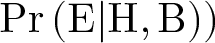 $Pr\left( {E|H,B} \right))$ So there is a 4.9 per cent chance of seeing zero limb healings if the probability of healing in a given trial is 0.01. Given the actual observation of zero healings, we would have strong empirical evidence against H, as we can see by plugging the values back into Bayes’s Theorem. First, suppose our prior belief in H is Pr(H|B) = 0.1, that is, the prior probability of limb healings is 0.1, a moderately strong degree of belief. As assumed earlier, suppose our degree of belief in the healing of a given individual in a trial is 0.01 if H is true. (In other words, we believe that cures are 10 per cent likely in general, but 1 per cent likely in a given case if cures really can happen, i.e. if H is true.) We assume that Pr(E|∼H, B) = 1 since no healings are expected if H is false. Now, by Bayes’s Theorem:
 \begin{equation*}Pr\left( {E|B} \right){\text{ }} = {\text{ }}\left[ {Pr\left( {E|H,B} \right){\text{ }}\times{\text{ }}Pr\left( {H|B} \right)} \right]{\text{ }} + {\text{ }}\left[ {Pr\left( {E|\!\sim\! H,B} \right){\text{ }}\times{\text{ }}Pr\left( {\sim\!H|B} \right)} \right]\end{equation*}
Substituting, we get:
 \begin{equation*}Pr\left( {E|B} \right){\text{ }} = {\text{ }}\left( {0.049{\text{ }}\times{\text{ }}0.1} \right){\text{ }} + {\text{ }}\left( {1{\text{ }}\times{\text{ }}0.9} \right){\text{ }} = {\text{ }}0.9049\end{equation*}
and so:
 \begin{equation*}Pr\left( {H|E,B} \right){\text{ }} = \frac{{0.049{\text{ }}\times{\text{ }}0.1}}{{0.9049}} = \frac{{0.0049}}{{0.9049}} = 0.0054\end{equation*}
The observation of zero limb healings therefore reduces Pr(H) from 0.1 to 0.0054, roughly a twenty-fold reduction. Accumulating negative data can, then, exert significant downward pressure on even a moderate prior belief in H. Although the value of Pr(E|H, B) is derived from a frequentist likelihood (the binomial distribution), it serves as an input to a Bayesian updating process.
A critic of the present response might see this discussion of probability as ammunition against it. After all, if a sufficiently large sample size could put pressure on a prior belief in the possibility of miraculous healing, then we only need to ask whether that number of amputees has in fact presented itself at Lourdes.Footnote 36 Given that the number of amputees globally is in the tens of millions (McDonald et al. Reference McDonald, Westcott-McCoy, Weaver, Haagsma and Kartin2021), might it not be reasonable so to expect? Although possible – which is what gives this response to the WLP the virtue of sensitivity to evidence – I consider it to be remote. First – a priori – for any amputee to consider presenting themselves for potential miraculous healing is for them to throw their reliance on faith to an extraordinarily high degree, one that could be too much to bear for all but the genuinely saintly. Such reliance is not nourished by the overall decline of religious fervour in the last few hundred years. Second – a posteriori – we simply do not have the anecdotal evidence, let alone statistics, supporting the proposition that properly disposed amputees have presented themselves at Lourdes in any numbers likely to influence probabilities in the way suggested above. Absence of evidence is not evidence of absence but it does carry some weight, especially since we would expect there to be readily available anecdotal evidence of such presentations by amputees, even if they were not healed. (Of course, if they were healed then the world would know about it.) Investigating this in depth would be fascinating – in which spirit one might think of the present proposal as an invitation to empirical research.
That said, when it comes to spiritual matters it is impossible to assign rigid probabilities as in the above toy example. Again, this does not render H unfalsifiable, nor does it make the believer’s position evasive. It just makes it hard to refute. Taken holistically, as part of a web of theistic doctrines, arguments, perspectives, and so on, the question then becomes whether the ‘how do you know?’ solution to the WLP strengthens, weakens, or – as I am inclined to think – makes no epistemic difference to the overall edifice. If that edifice is already built on strong dialectical foundations, the solution offered here is enough to prevent their being rocked.
Concluding speculation
It is generally agreed that, at least in countries with a long history of Christianity, the waning of belief has been increasing for decades. Although the headline numbers are bad enough,Footnote 37 we have reason to think that the proportion of those who sincerely believe in divine agency – especially as manifested in literal miracles – is but a small subset of those included in official statistics.
With this in mind, the defender of the ‘how do you know?’ response to the WLP might venture a somewhat dark thought that is nevertheless congenial to this proposed solution. The speculation is that we may never know whether the miraculous restoration of a lost limb might be something God would perform at Lourdes or elsewhere.
The idea behind this is that since we live in a time when faith has grown cold among all but perhaps a very small number of people, we may never again have the conditions in which a ‘trial’, to use the probabilistic term from the previous discussion, could be performed and yield a credible result. Even assuming God would allow Himself to be put to the test – doubtful, all things considered – we would need an unlikely confluence of circumstances that made such a trial realistic. We would need a person, missing a limb, who nevertheless was sufficiently faith-filled or at least open-minded to present themselves at a place, or conduct themselves in private, such that verification of the purported cure was possible. But we would also need observers, or interested parties, who were similarly sufficiently faith-filled or open-minded as not to turn such an event into a spectacle fit for scoffing or mockery. Speaking in Bayesian terms, the priors of all or most of those involved or interested could not be so low as to open the potential for scandal and a stumbling block to faith. My parting speculation is that it may be too late in human history for all these circumstances happily to align.
Competing interests
None.

 Open access

