

Across Asia, nationalist movements have emerged to “protect” Buddhism and Buddhist-majority states. These movements are referred to as “Buddhist Protectionism.”Footnote 1 Despite the face validity of Buddhism as a peaceful, nonviolent religion and the historical association between Buddhism and pacifism, nationalist extremist groups present in Theravada Buddhist countries, Thailand, Myanmar, and Sri Lanka have been spreading misinformation and exploiting societal conflicts in recent years (Artinger Reference Artinger2023; Holt Reference Holt and Holt2016; Ramakrishna Reference Ramakrishna2021). Buddhist Protectionist interpretations of Buddhism diverge from the traditional teachings of Buddhism of non-harm and compassion and are co-opted for political purposes, becoming intertwined with other systems of oppression, including patriarchy, racism, and Islamophobia.
Islam is perceived as a threat in the majority Buddhist countries Thailand, Myanmar, and Sri Lanka. Global Islamophobia since the “war on terror” and regional events such as the 2019 ISIS Easter attacks in Sri Lanka have contributed to that threat perception (Imtiyaz and Mohamed-Saleem Reference Imtiyaz and Mohamed-Saleem2015, 192).Footnote 2 As such, there are “deep-seated fears of minoritization of the majority,” which is mobilized as a threat to the hegemony of Sinhala/Thai/Bamar-Buddhists (Frydenlund Reference Frydenlund2021, 3-4). In response, Buddhist protectionism has promoted discrimination and intolerance against ethnic and religious minorities and reinforced gender hierarchies within Buddhist communities, ostensibly protecting Buddhist women from Muslim men (Busher and Macklin Reference Busher and Macklin2015; Ramakrishna Reference Ramakrishna2021). In the name of protecting Buddhism, extremism conducive to violence can be observed most blatantly in Myanmar where genocidal violence has been carried out against Rohingya Muslims (Bakali Reference Bakali2021; Subedi and Garnett Reference Subedi and Garnett2020; UN 2018).
We define extremism as legitimizing “structural violence of an in-group against relevant out-groups” (Ramakrishna Reference Ramakrishna2021, 5; see also Ramakrishna Reference Ramakrishna2020). The violence is usually justified by “in-group anxieties of impending annihilation by some powerful, aggressive Other” (Ramakrishna Reference Ramakrishna2021, 14). Extremism and terrorism tend to be linked to violence exclusively committed by Muslims (which we comment on later in this article), yet extremism conducive to violence can be seen on a spectrum from support for acts that are not directly violent but are discriminatory (such as the anti-Halal campaign in Thailand [Pathan, Tuansiri, and Koma Reference Pathan, Tuansiri and Koma2018]), to the propagation of hate speech and use of intimidation, and most egregiously to the encouragement of riots and severe forms of violence, often sexualized, such as the anti-Muslim riots in Sri Lanka (Imtiyaz Reference Imtiyaz2020, 6) to genocide (Bakali Reference Bakali2021; Subedi and Garnett Reference Subedi and Garnett2020; UN 2018). Importantly, we use the term “state-sanctioned extremism” to clarify that we are focusing on state rather than non-state actors. While much extremism literature focuses on non-state actors, focusing on the state in terms of Buddhist protectionism is crucial since the state is the most prominent actor in “protecting” the nation and state-religion, Buddhism.Footnote 3 State support to nationalist movements propounding religious, extremist ideology that marginalizes minorities and women, makes the state complicit with the violent effects of extremism.
Gender ideologies that seek to govern the appropriate roles and relations between women, men, and people with diverse gender identities are central to religious extremist movements. They both reproduce the group identity and differentiate it from other groups. Most of the evidence-building on the gendered politics of extremism has focused on far-right and Islamist non-state actors (Brown Reference Brown, Väyrynen, Parashar, Féron and Confortini2021; Gentry Reference Gentry2022), although scholars have examined the gendered anti-Muslim discourses present within Buddhist extremism, Hindu extremism, and white-supremacy (Ganesh, Frydenlund, and Brekke Reference Ganesh, Frydenlund and Brekke2023; Saeed Reference Saeed, Easat-Daas and Zempi2024; Tyagi and Sen Reference Tyagi and Sen2020). This is exemplified by a prominent member of a Sri Lankan Buddhist Protectionist organization (Bodu Bala Sena), Gnanasara Thero, who stated that his thinking was influenced by “Hindu right-wing group Shiv Sena, the British National Party, and French far-right leader Marine Le Pen—all of whom have made incendiary remarks on Islam and Muslims” (Ramakrishna Reference Ramakrishna2021, 14, originally Lim Reference Lim2019). Interestingly, irrespective of the differences between these extremisms (Hindu, white, Buddhist) — they seem to be obsessed with controlling Muslim women’s dress, which is illustrated by burqa bans across several countries, including France, Sri Lanka, and India (ABC 2023; Al Jazeera Reference Jazeera2022; Jayasundara-Smits and Subedi Reference Jayasundara-Smits and Subedi2024, 223).
Buddhist Protectionism perceives Buddhism to be under threat and aims to protect “the buddhasasana from perceived external threats” by maintaining “ingroup purity” through legal and political activism (Frydenlund Reference Frydenlund2021, 3; Schonthal 2016).Footnote 4 So-called group purity is preserved by the state religion through the regulation of sexual reproduction, marriage, and families, and the control over women’s bodies. Moreover, it is protected by ensuring women have a subordinate role in the Buddhist Sangha to prevent women’s sexuality from tainting the religious sanctity of monkhood. Within Buddhist Protectionism movements, there are clear and visible gender status hierarchies and divisions of labor that reflect and enforce hierarchies within religious monastic orders. The political discourses and practices of Buddhist Protectionism reveal a hegemonic mindset, where the explicit purpose is to marginalize or exclude ethnic and religious minorities and defend the state’s national identity.
In Buddhist Protectionism, like other forms of extremism, gendered dynamics are central, yet our understanding of them is underdeveloped.Footnote 5 In this article, we therefore investigate these dynamics of state-sanctioned extremism, asking to what extent do gender norms and structures affect the motives, forms, and impact of Buddhist extremism? We adapt Bardall, Bjarnegård, and Piscopo’s (Reference Bardall, Bjarnegård and Piscopo2020) approach to gender and political violence for the study of state-sanctioned political extremism to examine the relationship between gender and the motives, forms, and impacts of Buddhist protectionism in depth. Following Bardall, Bjarnegård, and Piscopo (Reference Bardall, Bjarnegård and Piscopo2020), gendered motives of protectionism appear when perpetrators target women’s dress and bodies to preserve hegemonic men’s control of Buddhist politics and monastic order; gendered forms emphasize how experiences of discrimination and violence are shaped by different gendered bodies and roles; while gendered impacts capture the subjective meaning-making processes that occur as different audiences react to political violence as “protectors” or “protected.”Footnote 6
The article consists of four parts. First, we consider existing intersectional explanations for the rise of Buddhist protectionism. Our study of Buddhist state-sanctioned extremism is informed by feminist international relations scholarship on masculine “Protection Rackets,” comparative gender and ethnic studies scholarship on gendered nationalism, and the growing literature in political science and extremism studies on women’s agency and participation in extremism. Second, we explain our methodological approach to investigating gender and Buddhist Protectionism, drawing on data collected in a multi-case, mixed-method research design in Sri Lanka, Thailand, and Myanmar. Third, we discuss the research findings within each of the three country cases to explore how the motives, forms, and impacts of extremism are shaped by the unequal gender power relations within Buddhist Protectionist discourses and groups that legitimize violence, specifically against Muslims. Fourth, we compare the common patterns and distinct trajectories of Buddhist protectionism across the three Buddhist-majority state cases. We find that extremist discourses and practices exist in all cases; misogyny (defined as hostile sexism in our study) and anti-Muslim threat narratives are played up in Buddhist Protectionist groups, affirming the power of masculine hegemony and justifying the use of violence to control minority populations and women. Yet, the threatening gender and anti-Muslim discourses and extremist practice vary. They range from the fear of Muslims in politics in Thailand, to the fear of “Muslim overpopulation” in Sri Lanka, and to fear of Muslim blood or “miscegenation” in Myanmar, which we coin the Buddhist Femonationalist Continuum.
Our findings add to the literature by showing how gender, nationalism, and extremism reinforce one another in Theravada Buddhist states. Our feminist interdisciplinary lens, which is attentive to both religious discourses and political relations, has generated these research findings, which illuminate the compounding threats of extremism, Islamophobia, and gender-based violence in Asia and have implications for the state’s engagement with religion. Specifically, when discourses rise, so does the targeting of certain populations for gendered violence. We argue that addressing gendered norms and structures within Buddhist communities therefore could help to reduce and or prevent extremism conducive to violence.
Explaining Buddhist Protectionism
Despite the growth in research on political extremism and gender (Brown Reference Brown, Väyrynen, Parashar, Féron and Confortini2021; Gentry Reference Gentry2022), few scholars have examined state-sanctioned Buddhist extremism.Footnote 7 At the same time, much of the literature on Buddhist Protectionism tends to take a gendered, male perspective (e.g., Ramakrishna Reference Ramakrishna2021).Footnote 8 There are significant exceptions and we are building on scholarship that investigates Buddhist Protectionism with a feminist perspective, including Jayasundara-Smits and Subedi (Reference Jayasundara-Smits and Subedi2024) and Frydenlund (Reference Frydenlund2021). To examine Buddhist state-sanctioned extremism we synthesize feminist international relations scholarship on “protection rackets,” comparative gender and ethnic studies scholarship on gendered nationalism, and the growing literature in political science and extremism studies on women’s agency and participation in extremism. This is because Buddhist Protectionism is a form of gendered nationalism, a classic “protection racket,” as well as a case where women’s agency in extremism is underestimated.
Buddhist Protectionism as a Phenomenon of Gendered Nationalism
Nationalism encompasses how nations “assign value [and] provide symbols around which to rally” based on gender, sexuality, religion, ethnicity, and so on (Thomson Reference Thomson2020, 3). In Theravada Buddhist countries, nationalism and religion are inherently linked as “the State is by definition Buddhist and exists to protect Buddhism” (Ramakrishna Reference Ramakrishna2021, 5, originally Walton and Jerryson Reference Walton and Jerryson2016).Footnote 9 Importantly, the protection of Buddhism is inherently gendered. Indeed, feminist analysis of nationalism across the world and historically highlights its heteronormative norms which require women to “reproduce nations, biologically, culturally, and symbolically” (Yuval-Davis Reference Yuval-Davis1997, 2). In other words, women are “reproducers of the boundaries of national groups (through restrictions on sexual or marital relations), active transmitters and producers of national culture, symbolic signifiers of national difference as well as political participants in national struggles” (Sjoberg and Peet Reference Sjoberg and Peet2011, 168, originally Yuval-Davis and Anthias Reference Yuval-Davis and Anthias1989). Introduced in the context of Buddhist Protectionism, four race and religion protection laws in Myanmar passed by the Parliament in 2015 epitomize this relationship between gender and the reproduction of groups. These laws aimed to protect Buddhism, the country’s dominant religion and culture and include measures related to population control, monogamy, religious conversion, and interfaith marriages (see Library of Congress 2015).Footnote 10 The laws situate “Buddhist women as reproducers of the ‘nation’” (Frydenlund Reference Frydenlund2021, 1), and “promote the majority ethnic Bamar” (Davies and True Reference Davies and True2024, 72–3) by restricting Buddhist women from marrying non-Buddhist men and enforced birth-spacing policies for minority ethnic groups, targeting Rohingya women (Walton et al. Reference Walton and Jerryson2016). As such, “women’s bodies, relations, and roles become the battleground for […] nationalist projects” (Pettman Reference Pettman1996, 193).
Buddhist Protectionism as a Classic “Protection Racket”
Feminist scholars have exposed how the concept of “protection” is highly gendered (and racialized).Footnote 11 Given that women are the symbols of the nation and ensure “the reproduction of state, national, and/or ethnic identity,” biologically, socially, as well as culturally “they must be protected” (Sjoberg and Peet Reference Sjoberg and Peet2011, 168, emphasis added). Indeed, the protection of women by men to protect “the essence of the state/nation” is the consequence of a nationalist narrative (Sjoberg and Peet Reference Sjoberg and Peet2011, 174). Buddhist protectionism in this sense is a classic “protection racket” wherein a threat is constructed and protection offered to defend against it by the same state or nationalist actor (Tilly Reference Tilly, Evans, Rueschemeyer and Skocpol1985). Protection rackets justify masculine hegemony and the subordination and control over women and their reproductive capacities. This gendered logic is evident in Buddhist Protectionism where the protectionist racket serves to keep women in their place and in service of the state/nation by “protecting” them in so doing, shoring up masculine hegemony.
To justify the protection of the Buddhist nation and its women, a threat is needed. In Buddhist Protectionism, minority ethnic and/or religious groups are constructed as threatening, specifically Muslims (Kyaw Reference Kyaw and Crouch2016).Footnote 12 Frydenlund (Reference Frydenlund2021, 3–4) uses the term “Buddhist femonationalism” to convey how Muslim men are constructed as threatening by Buddhist protectionists in Myanmar. She adapts Sara Farris’s (Reference Farris2017, 4) concept, “femonationalism,” which describes how far-right nationalists (in the European context) exploit gender equality considerations for their anti-Muslim project, framing Muslim men as violent anti-feminist (Scheyer, True, and Bonotti Reference Scheyer, True and Bonotti2025). “Buddhist femonationalism” similarly promotes the narrative that Buddhist women need to be protected from hypersexual, threatening, Muslim men. Importantly here, femonationalism emphasizes that only certain women are deemed worthy of protection: women who are not willing to conform to male protection become outcasts without state support and can be attacked (Young Reference Young2003, 14).Footnote 13 Importantly, the women that are to be protected are cis, Bamar/Thai/Sinhalese, Buddhist women. Ethnic, religious, or gender minorities are not protected in Buddhist Protectionism, rendering the protection racket both gendered and racialized.
Buddhist Protectionism Underestimates Women’s Agency and Participation
Women’s political agency in extremist groups is often overlooked (True and Eddyono Reference True and Eddyono2021), particularly in groups that prescribe traditional gender roles where women have limited decision-making power (Parashar Reference Parashar2011). Political science and extremism studies have explored the paradox of women’s agency and participation in extremism groups that proscribe their roles based on gender stereotypes. We draw on key insights from this the third body of literature to analyze Buddhist Protectionism. For example, scholars have shown how women can influence the ideologies and practices of groups with strict gender ideologies, including Islamist extremism, Hindu extremism, and white supremacy groups (Amarasingam and Shweta Reference Amarasingam and Desai2024; Blee 2020; Brown Reference Brown, Väyrynen, Parashar, Féron and Confortini2021). Regardless of their roles within these groups, these scholars demonstrate that their participation is essential for the groups’ survival (McEvoy 2009; Parashar Reference Parashar2011).
In Buddhist Protectionism, a similar dynamic to other extremisms occurs wherein women also carry out traditional gender-prescribed roles that results in their contributions being publicly unacknowledged and often invisible. Crucially though, women fulfilling traditional gender roles are essentially carrying the organizations by extending their networks and providing (literally) the membership/follower base (Blee 2017; Gentry Reference Gentry2022; Parashar Reference Parashar2011). Indeed, women’s role in Buddhist Protectionism is central, not just because of their biological reproductive function but because they socially and culturally carry the narratives and ideology and “uphold the patriarchal and misogynist structures” (Gentry Reference Gentry2022, 217). Thus, while women meaningfully participate in Buddhist communities, albeit in ancillary roles that reflect gender stereotypes, they do not threaten masculine hegemony (Leidig 2021; Roose and Cook Reference Roose and Cook2025). It is important to highlight here that Buddhist Protectionism does not limit female agency by default; rather it may be attractive for women to join, providing new avenues for “protecting Buddhism” (Mckay and Frydenlund Reference McKay, Frydenlund and Hüsken2022).
In sum, feminist international relations and comparative political studies of nationalism, race, and ethnicity provide key insights into how gendered norms and structures within Buddhism influence Buddhist extremism and why protectionism targets ethnic and religious minorities, especially minority women. In the next part of the article, we discuss our methodological approach to further investigate to what extent gender dynamics affect the motives, forms, and impact of Buddhist extremism.
Methodological Strategy and Data Collection
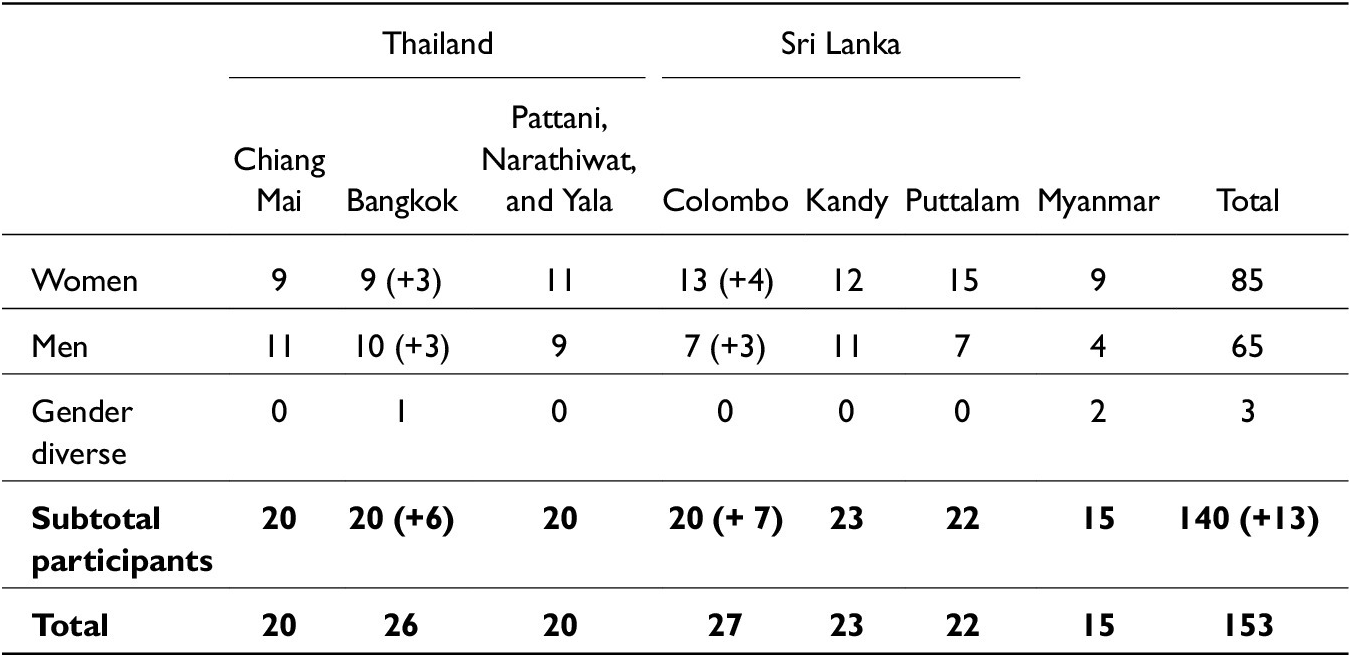
Our study of the gendered politics of Buddhist Protectionism is based primarily on survey and qualitative data collected in two phases across three Buddhist-majority countries: Thailand, Sri Lanka, and Myanmar. The mixed-method research design involved analysis of nationally representative surveys in Sri Lanka, Myanmar, and Thailand (n = 1000 each), in-depth interviews (n = 153; 85 women, 65 men, 3 gender diverse)Footnote 14 and focus group discussions (n = 67).Footnote 15 This mixed-method research design enabled a comparative approach across the three countries.
Six sites across Thailand and Sri Lanka facilitated investigation of urban/rural settings, socioeconomic variations, and religious/ethnic dynamics. In Thailand, Chiang Mai, Bangkok, and the Southern border provinces represented varied dynamics, including inter-religious tensions. In Sri Lanka, Colombo, Kandy, and Puttalam were selected for their ethnic and socioeconomic diversity.Footnote 16 Security concerns in Myanmar led to remote interviews across Kachin, Rakhine, Shan, Mandalay, and Yangon, ensuring safety for participants and researchers alike. Conducted in two phases, the research began with qualitative data collection from July to October 2022, followed by quantitative data collection from November 2022 to February 2023, and a second qualitative phase from May to July 2023. This sequential approach allowed for the refinement of interview guides in the second phase based on initial findings from the first phase.
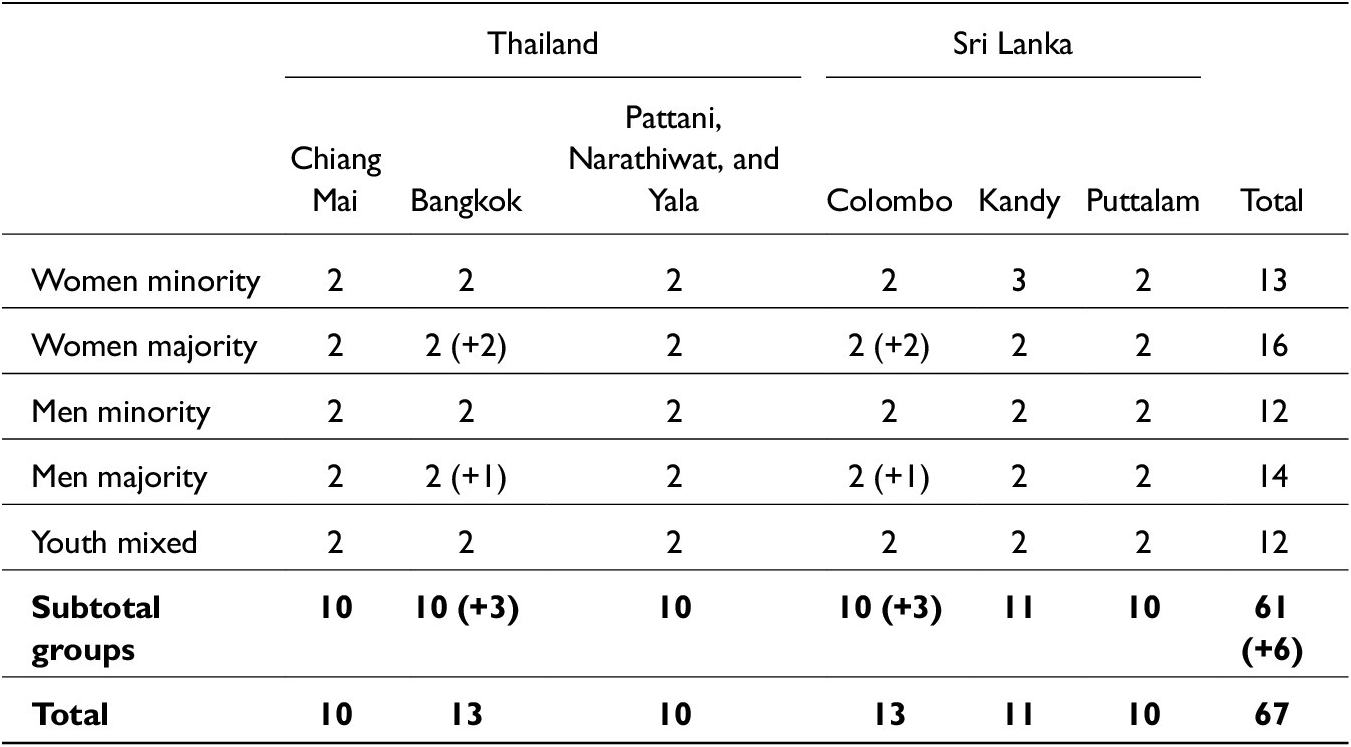
The interviews and focus groups were conducted with diverse adult research participants across Thailand, Sri Lanka, and Myanmar with considerations for gender, ethnicity, class, including variation by religion and language. To ensure an informed perspective based on local knowledge, the interviews were carried out with individuals with specific expertise on the subject. This means that we did not necessarily interview any community members, but in each country select interviews were conducted with community and political leaders, members of Buddhist Protectionism groups, civil society organizations, and religious scholars/teachers/practitioners (please see a breakdown of research participants in Appendix 1). Efforts were made to represent diverse political standpoints, encompassing those opposing and supporting Buddhist Protectionism. In Thailand and Sri Lanka, the focus groups were categorized by religion, gender, and age: women-only minority religions, women-only Buddhist, men-only minority religions, men-only Buddhist, and mixed youth focus groups (18–25 years). Separating Buddhist participants from participants with other religions, as well as separating for different gender and age groups, proved successful in providing a safe space for minority participants (specifically for women in minority groups).
In our interview and focus group data collection and analysis, feminist research methods foregrounded participant voices to help us better understand everyday gender and racial dynamics in Buddhist Protectionism (Ackerly and True 2019; True and Eddyono Reference True and Eddyono2021). Utilizing feminist methods in the analysis involved taking an intersectional perspective that acknowledged the situatedness of the researcher and research participants and analyzing how they relate to existing power dynamics and structural systems of oppression, such as patriarchy and racism. We carried out manual, thematic coding and analysis, which entailed analyzing how certain data points relate to question schedules and key thematic codes and triangulation with survey data to contextualize findings.
The nationally representative survey (n = 1000) was conducted via phone and online in Myanmar, Sri Lanka, and Thailand, comprising 500 men and 500 women.Footnote 17 The sample represented diverse demographics, allowing for statistical analysis and cross-national comparisons across gender, age, location (urban/rural), education, income, religion, and ethnicity.Footnote 18 Across each of the three countries, the survey generated data on key questions regarding gender perceptions, anti-Muslim standpoints, Buddhist Protectionism, and Buddhism more broadly allows us to understand the internal and externally-driven motives and extent of extremism from a gender perspective as well as the impacts.
Our mixed-method data collection involving interviews, focus groups, and surveys allowed us to investigate the gendered motives that drive Buddhist Protectionist groups by speaking to supporters of and opposition to Buddhist Protectionist ideas, including Buddhist Protectionist group members, religious scholars and practitioners, and community members. Survey questions further helped to assess motives related to the perceived (external) threats to Buddhism from Islam: The survey included two separate questions, one about the increasing presence of halal food labels and the other about the hijab.Footnote 19 We also examined different gendered forms of Buddhist Protectionism by civil society organizations that monitor ongoing hate speech and violence as well as Buddhist Protectionist supporters about Buddhist Protectionist narratives and actions. In the surveys, we assessed gendered forms of Buddhist Protectionism by asking respondents whether they agree that violence needs to be used to protect Buddhism.Footnote 20 Lastly, to understand the gendered impact of Buddhist Protectionist groups, we spoke to those targeted by Buddhist Protectionists, including gender, sexual, ethnic, and religious minorities. The gender-specific religious minority focus groups were particularly helpful in understanding minority women’s perspectives, and interviews with minority research participants also illustrate the Buddhist Protectionist exclusionary narrative’s consequences. Survey questions around women’s and men’s perceived discrimination within Buddhist practices further illuminated the gendered impact of Buddhist Protectionism.Footnote 21
Research Findings
Gendered Motives
Gendered motives of protectionism appear when perpetrators target women’s dress and bodies to preserve hegemonic men’s control of Buddhist politics and monastic order (Bardall, Bjarnegård, and Piscopo Reference Bardall, Bjarnegård and Piscopo2020). The gendered motives of Buddhist Protectionism can be internal or external and are used to justify violence against “outside the hegemonic male group (meaning women, but also non-dominant men and gay, queer, nonbinary, and trans individuals)” (Bardall, Bjarnegård, and Piscopo Reference Bardall, Bjarnegård and Piscopo2020, 917). Such violence targets victims primarily “to keep political power in the hands of hegemonic men […] men who belong to their country’s structurally dominant cultural, ethnic, or religious group hold most political offices” (Bardall, Bjarnegård, Piscopo Reference Bardall, Bjarnegård and Piscopo2020, 917). Internal gendered motives coming from “within” the religion or community of religion describe the threat to the gender hierarchy in the monastic order, whereas external gendered motives coming from “outside” the religion or community of religion describe various forms of anti-Muslim sentiment, such as “growth” of the Muslim population and the expansion of halal certification.
External Gendered Motives
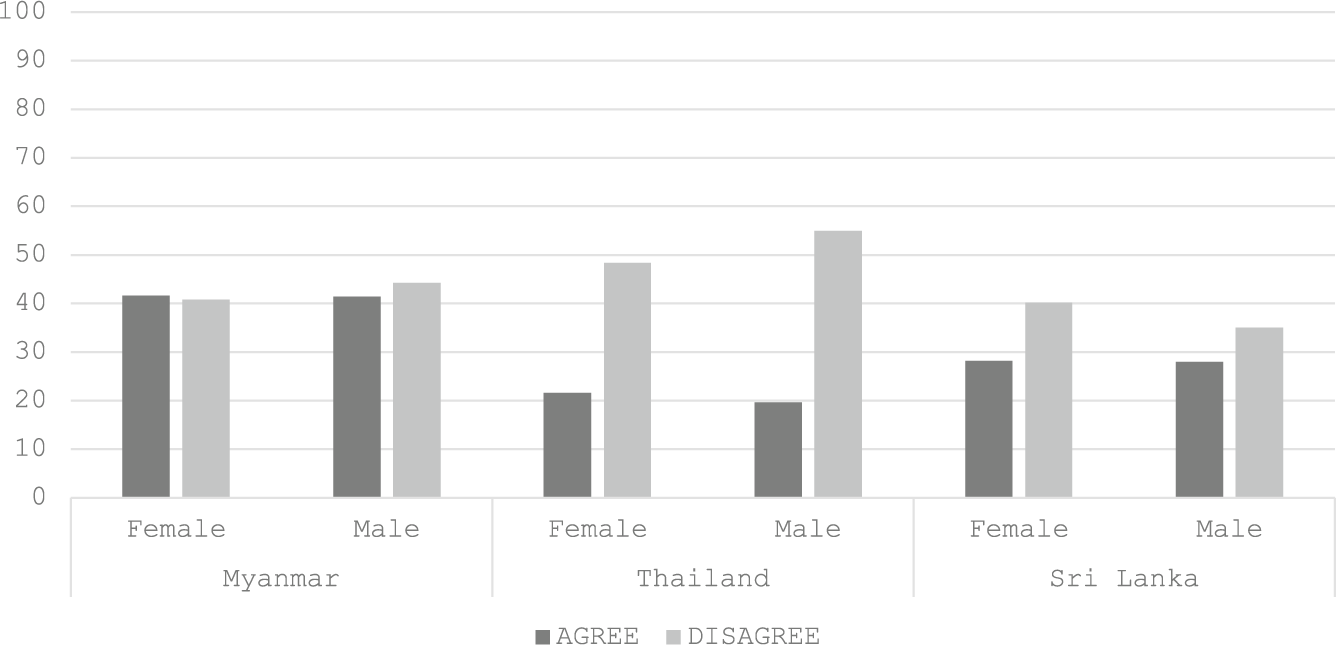
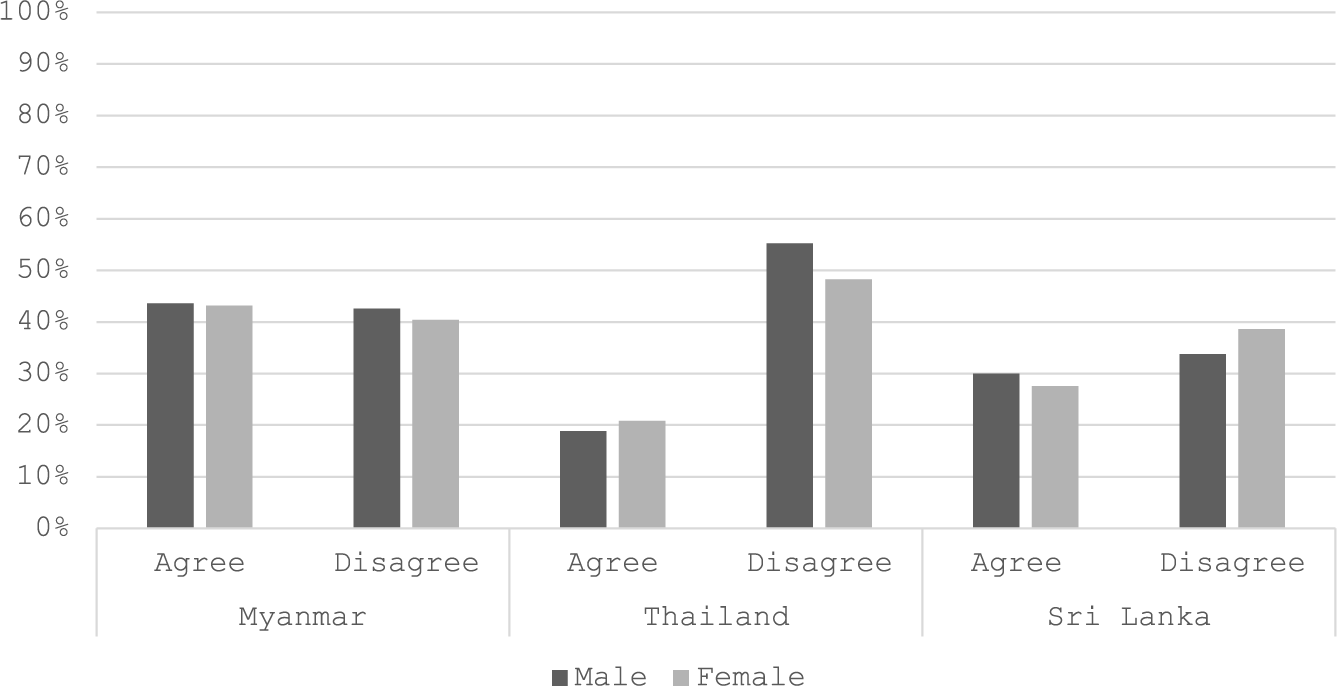
In our study, Islam was mentioned as the most significant threat to Buddhism across Thailand, Sri Lanka, and Myanmar. Research participants expressed various forms of anti-Muslim sentiment, including fears about the decreasing number of Buddhist followers due to the growth of the Muslim population, the expansion of Halal certification, or mosque construction. The narrative to protect Buddhism in the face of Islam’s increasing influence is pushed by Buddhist Protectionist groups (and to some extent the state). Anti-Muslim sentiment was also reflected in our survey responses to the two questions about the increasing presence of halal food labels and the other about the hijab.Footnote 22 As shown in Figures 1 and 2, in Thailand approximately 20% of people are concerned about these developments compared with 30% in Sri Lanka and 40% in Myanmar, following the Buddhist Femonationalist Continuum. Interestingly, the gender differences to these questions were least pronounced in Myanmar where anti-Muslim sentiments are most prevalent. As such, the overall higher level of othering of Muslims in Myanmar may have contributed to the institutional policies focused on miscegenation. In our key informant interviews and focus group discussions, we garnered more nuanced insight into the anti-Muslim sentiment across the three countries.
I am concerned about the increasing number of women wearing a hijab.

Figure 1. Long description
The y-axis represents a percentage scale from 0 to 100 in increments of 10. The x-axis is divided into three country categories: Myanmar, Thailand, and Sri Lanka. Each country is sub-divided into Female and Male groups. A legend at the bottom indicates that dark gray bars represent AGREE and light gray bars represent DISAGREE.
* Myanmar: For females, agreement is at approximately 42 percent and disagreement at 41 percent. For males, agreement is at 41 percent and disagreement at 44 percent.
* Thailand: For females, agreement is significantly lower at 22 percent while disagreement is at 48 percent. For males, agreement drops to 20 percent and disagreement rises to 55 percent.
* Sri Lanka: For females, agreement is at 28 percent and disagreement at 40 percent. For males, agreement is at 28 percent and disagreement at 35 percent.
I am concerned about the increasing presence of the halal food label.

Figure 2. Long description
The y-axis represents percentages from 0 to 100 percent in increments of 10. The x-axis is divided into three country sections: Myanmar, Thailand, and Sri Lanka. Each country has two categories: Agree and Disagree. A legend at the bottom indicates that dark gray bars represent Male and light gray bars represent Female.
* Myanmar: For Agree, Male is approximately 44 percent and Female is 43 percent. For Disagree, Male is 43 percent and Female is 41 percent.
* Thailand: For Agree, Male is 19 percent and Female is 21 percent. For Disagree, Male is 55 percent and Female is 48 percent.
* Sri Lanka: For Agree, Male is 30 percent and Female is 28 percent. For Disagree, Male is 34 percent and Female is 39 percent.
Moving to country level analysis, in Thailand the main external gendered motive threatening Buddhism is the expanding influence of Muslims, which according to a monk is an “invasion from dangerous others.”Footnote 23 Various forms of anti-Muslim sentiment were reflected in the interviews and focus groups, including fears about a dwindling Buddhist population, the growth of the Muslim population in Thailand, and their political influence. This opinion was especially pronounced among male Buddhist protectionist supporters, older generations, and southernmost Buddhists but less so among younger generations.Footnote 24
According to a male Buddhist Protectionism supporter, Buddhist Protectionism aims to “awaken Thai Buddhists to the reality of threats posed by Muslim rebels that form a movement focus groups.”Footnote 25 The threat associated with Islam is mainly centered around Muslims having gained significant influence and leadership in administration, in the public and political sectors: “Muslims have been integrated into the Thai bureaucracy, and Muslim elites are also part of national elites.”Footnote 26 A female Buddhist research participant, for instance, recounted her experiences of working together with other Buddhist Protectionist supporters and politicians to block Islam-related laws from passing. Those efforts proved unsuccessful as “members of the parliament raised their hands to approve laws for Islam, but not for Buddhism…my understanding is that the government takes side with Islam, which leads to continual threats that we face.”Footnote 27 This sentiment reflects the priority and status of Muslims within the political and public sectors and Buddhists feeling that they are being discriminated against, leading to grievances against Muslims. The apparent feeling of discrimination of Buddhists can be summarized as “deep-seated fears of minoritization of the majority,” and as such, a threat to the hegemony of Thai Buddhists (Frydenlund Reference Frydenlund2021, 3-4).
The main external gendered motive in Sri Lanka is also the “expansion of Islam,” from which Sinhala Buddhists need protection, as they perceive themselves as a global minority.Footnote 28 A journalist from Colombo argued that historical “anti-Tamil” sentiments are now being diverted toward MuslimsFootnote 29 — a common enemy — to keep the majority of Buddhists occupied and under control.Footnote 30 Anti-Muslim sentiment was reflected in the interviews and focus groups, where male and female participants shared their fears about the decreasing Buddhist population, growing Muslim population, the latter’s unity, the increasing prevalence of their halal food, mosque construction, and allegations of sterilization attemptsFootnote 31 of Sinhalese women.Footnote 32 A male government officer from Kandy, for instance shared this opinion: “A former Muslim politician gave five main pieces of advice for Muslims in his speech: buy as much land as you can, study as much as you can, marry Sinhalese people, have as many children as you can, and join politics if you can. All this is happening now. How can we say that there is no expansionism when it is practically visible on the outside?”Footnote 33
This quotation shows the nationalist Buddhist Protectionist logic in the government in Kandy, an ethnically-mixed region where the 2018 deadly anti-Muslim violence erupted, that presented Muslims as a threat to Buddhist Sinhalese people (Gunaratna Reference Gunaratna2018).
In Buddhist majority focus groups with Sinhalese men there was constant discussion of polygamy and sterilization rumors (although most had doubts about their veracity): “There is a bakery in this area. If a Sinhalese comes, they will give the cake on the top showcase. If a Muslim comes, they will give one that is the bottom display case” (suggesting the Sinhalese cake sterilizes you).Footnote 34 These gendered motives promoting fear of Muslims and targeting women’s reproductive capacities are also directly propagated by Buddhist Protectionist groups. De Votta (2018, 291) quotes a Bodu Bala Sena extremist monk who contends that Muslims are forcing Sinhala women “to become a Fathima and all the babies [to] become Mohammeds” (see also Silva Reference Silva and Holt2016).
In Myanmar, the main external gendered motive and threat to Buddhism is also Islam. As one nonbinary university teacher stated: “When we were young, we were told that Muslim men would come and arrest us if we kept crying. Then we stopped crying, but the fear of Muslim people stayed in our mind.”Footnote 35 This shows that from a young age, anti-Muslim propaganda is promulgated, specifically to generate the fear of Islam. The connection between Islam and violence was underlined frequently by research participants, as this quote from a female civil society organization participant shows: “For Muslims, violence and extremism is normalized and they won’t feel anything strange about this.”Footnote 36 Discussing Islam as being intrinsically linked to violence and extremism is an all-too-familiar narrative, reflecting broader global Islamophobic narratives operating within the context of the “war on terror” (Bakali Reference Bakali2021, 65).
Burmese research participants perceived Muslims to threaten their majority status due to the “population take over myth” since polygamy is permitted for Muslims. As stated by one male civil society organization participant: “[W]e KachinFootnote 37 also value our race and clan and men. So Christian people also won’t let their sons mix blood with Muslims. People consider Muslim blood and genes to be very strong and appearance and color of people can change from mixing blood with Muslims.”Footnote 38
This quotation shows that the threat of Muslims is not just internalized and propagated by Bamar Buddhists but also by other minority groups, including Kachin Christians, although they themselves might be targeted by Buddhist extremists.
Internal Gendered Motives
Internal gendered motives in Buddhist Protectionism are also prevalent. They are connected to the gender hierarchy in the monastic order, where protecting Buddhism means restricting women’s public role and opportunity instrumentalizing gendered notions of female sexuality which threaten monks’ celibacy. In Thailand, female research participants recounted prevalent strategies to preserve hegemonic men’s control that reinforce gender hierarchies in the monastic order, such as playing upon the stereotype that women are “sexually deviant.” Female sexuality is viewed as a threat to the celibacy of monks, who are bound by strict rules to remain celibate to uphold the purity of the monastic discipline and Sangha.Footnote 39 One female Buddhist research participant recalled a piece of writing by her monastic teacher calling women “a threat to celibacy that can destroy Buddhism.”Footnote 40 Connecting women to the destruction of Buddhism reflects deeply ingrained gender norms that underpin the gender hierarchy within Buddhism. As stated by a female Buddhist focus group participant in Bangkok:
[B]ecause women can potentially pose a threat to the chastity of monks, they need to exercise caution without being entirely excluded. This approach is also aimed at preserving the public image of the Sangha. In monastic organizations, inequalities exist, but we must prioritize the rights of monks over women’s rights in certain aspects. For instance, when walking, it is customary for women to let monks take the lead, and the same applies to entering a car or a room. This issue is closely tied to the matter of organizational advancement as well because [Buddhist] university regulations stipulate that only monks can hold senior executive positions. For instance, if a woman were to aspire to become the dean of the Faculty of Social Sciences, that would not be possible unless there were legal amendments to permit it. While I acknowledge the existence of inequality, I am not perturbed by the special status afforded to monks.Footnote 41
While gender inequality within the monastic order is acknowledged by this female research participant, women’s sexuality is still presented as a threat, which ensures persistence of the monastic gender order and the non-recognition of female monks (Bhikkhunis). Simultaneously, portraying women’s sexuality as a threat allows men to be the protectors of Buddhism evoking the classic protection racket logic.
Similarly, in Sri Lanka, internal gendered motives in Buddhist Protectionism are connected to the gender stereotype that women are “sexually deviant.” A male civil society organization research participant from Colombo claimed: “Because of some unsuitable relationships some women have with priests, society looks at all women the same. That’s why women are afraid to go to the temple, take leadership and work closely with monks.”Footnote 42 Another research participant in the youth focus group in Colombo shared how women are cut out of temple activities due to such rumors: “I observe Sil [observing religious precepts] in an Asapuwa [a monastery owned by the Mahamewna sect]. It was built by the labor of women. Then there were rumors and stories of mismanagement and now women are not participating in any activities. These stories are about monks’ relationships with females. They wanted to avoid further occurrences of such events.”Footnote 43
This interview shows how the monastic gender order is reinforced by employing prevalent fears of the sin of women being close to monks or “leading them” to break their vows of celibacy. Misogynist gender norms and stereotypes about women’s impurity and sexual provocation are invoked to enforce that women need to be controlled by men.
In Myanmar as with Thailand and Sri Lanka, the research findings suggest that gender norms in the monastic order, in Buddhist Protectionist groups, and the larger Buddhist majority society are deeply ingrained and serve to keep women submissive and men in leadership, including sexually deviant women: “Women can destroy the religion as they can allure the monks. Women should wear proper clothing so that the monks and the men can’t be persuaded by their improper clothing.”Footnote 44 A female civil society organization participant — one of the few who voiced this perspective — expressed frustration about these “myths”: “Women’s improper clothing is irrelevant to Buddhism. These things set up a lot of restrictions on women and they are asked to sit at the back in the monasteries.”Footnote 45
Gender stereotypes also affect female nuns (thila shinsFootnote 46), where highly influential or outspoken female nuns might be perceived as a threat to the monastic order. To keep women “in their place,” gendered tactics are being employed, as one female research participant from a religious organization asserted: “There was a famous nun named Ketumala. Then the monks don’t like them and try to defame her by saying that she goes on overnight sleep trips and there are some men who follow her overnight sleep. As Myanmar society is so sensitive to this kind of sexual behavior, the monks strategically use to reduce her influence. And they don’t give her space.”Footnote 47
Overall, across the three countries, the findings also suggest that women do not have any decision-making power and mainly perform supporting roles within the Sangha which has implications for Buddhist Protectionism. As a female civil society organization participant argues: “Men get more opportunities at their homes as well as in the monasteries. For the meetings including the meeting at the monastery, only men are invited and discussed about the matters […] If there are a few women who attend the meeting, they are said to make a lot of talks and complaints.”Footnote 48
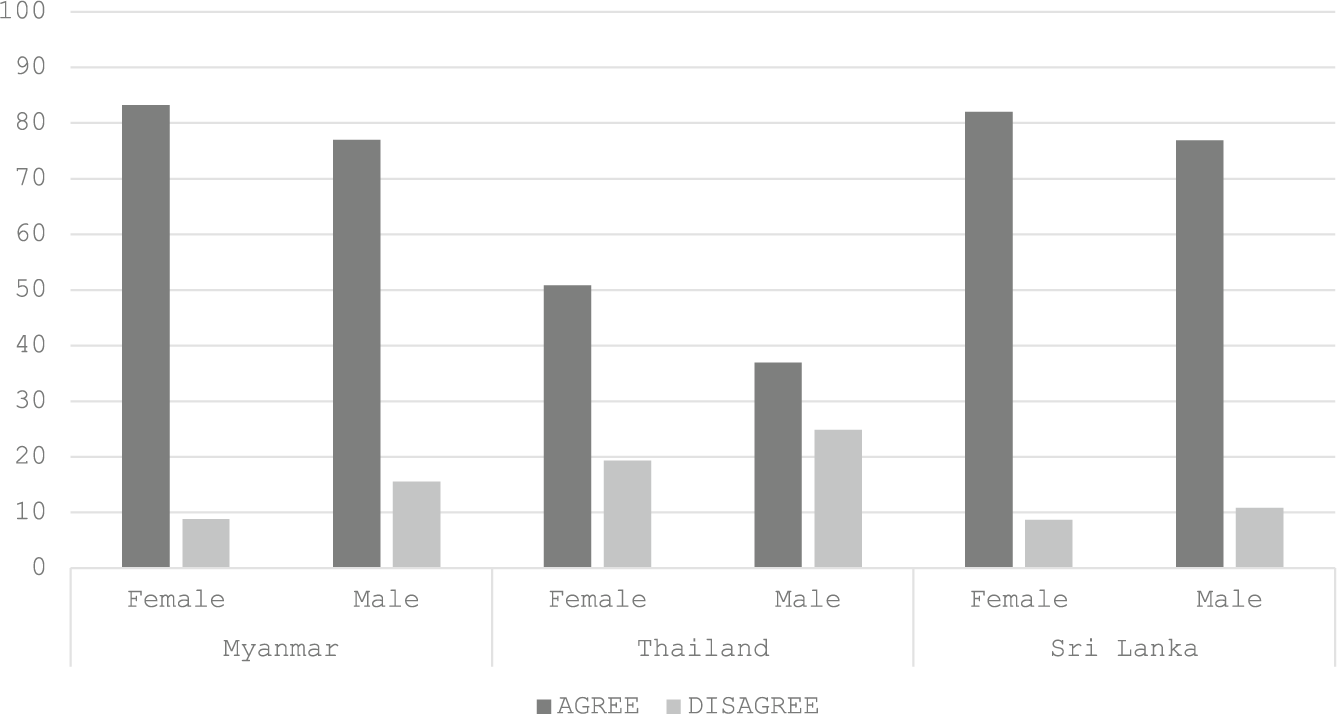
Despite these gender norms in the monastic order, as shown in Figure 3, in the survey we found that both men and women agree with the statement that “Women are an important base of the Buddhist religion.”Footnote 49 However, women agreed more with the statement than men across the three countries, specifically in Thailand (almost a 14% statistically significant gender difference). This shows that while misogynist gender norms and stereotypes view women as needing to be controlled, they are still regarded as important to the religion. In other words, the more central women are viewed to Buddhism, the more likely they are excluded from decision-making in the monastic order.
Women are an important base of the Buddhist religion.
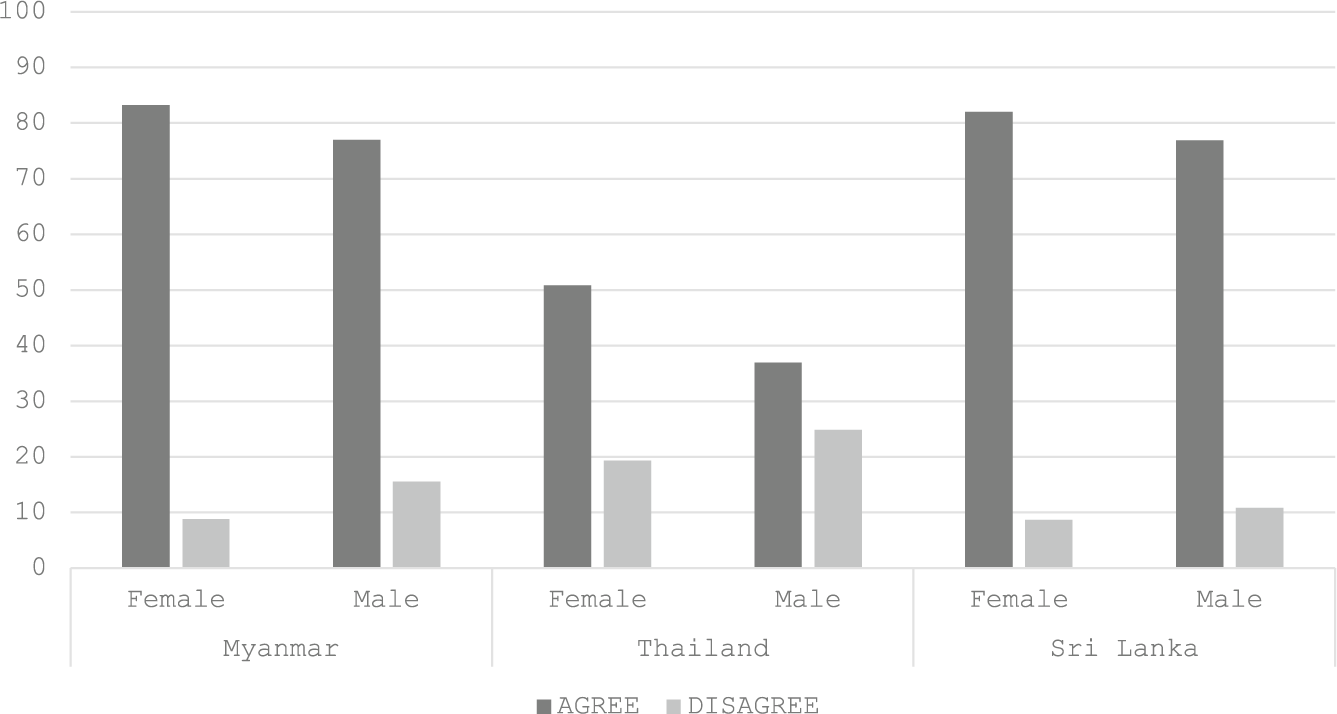
Figure 3. Long description
The y-axis represents a percentage scale from 0 to 100 in increments of 10. The x-axis is divided into three country sections: Myanmar, Thailand, and Sri Lanka. Each country section contains two pairs of bars for Female and Male respondents. Dark gray bars represent AGREE and light gray bars represent DISAGREE.
* Myanmar: For females, agreement is approximately 83 percent and disagreement is 9 percent. For males, agreement is approximately 77 percent and disagreement is 16 percent.
* Thailand: For females, agreement is approximately 51 percent and disagreement is 19 percent. For males, agreement is approximately 37 percent and disagreement is 25 percent.
* Sri Lanka: For females, agreement is approximately 82 percent and disagreement is 9 percent. For males, agreement is approximately 77 percent and disagreement is 11 percent.
Patriarchal gender norms in the monastic order that present women as sexually deviant and threatening Buddhism serve to justify the protection and control over women. While some women may acknowledge the discrimination that women experience, such as the Thai Buddhist focus group research participant, they conform to these traditional gender norms and roles. Crucially though, choosing a subordinate gender role in the monastic order does not deny women’s agency, rather it provides a different avenue for “protecting Buddhism,” which does not threaten the patriarchal order (Mckay and Frydenlund Reference Kyaw2022). Having women in subordinate roles within the monastic order bolsters Buddhist Protectionism by having a labor force that can support and extend its influence.
Gendered Forms
Gendered forms of extremism show that gender structures how people perpetrate and experience violence from Buddhist Protectionism, “regardless of whether gender appears in the motive” (Bardall, Bjarnegård, and Piscopo Reference Bardall, Bjarnegård and Piscopo2020, 918). In other words, gendered forms emphasize how experiences of discrimination and violence because of political extremism are shaped by different feminized bodies and roles, including that of minority women, LGBTIQ+, and women religious practitioners. Importantly, a feminist perspective allows us to analyze “structural violence, hate speech, gender-based violence or state violence” as extremism (Stenger and True Reference Stenger and True2024, 4; Ortbals and Poloni-Staudinger Reference Ortbals and Poloni-Staudinger2014). In Thailand and Myanmar, the experience of gendered forms of violence is discussed, whereas in Sri Lanka the perpetration of Buddhist Protectionist violence is analyzed.
In Thailand, the experience of gendered forms of violence was expressed by Muslim women who shared personal experiences of living in a Buddhist-majority country. Muslim women have encountered various forms of gender-specific hate speech and discrimination, including feelings of increasingly being under the public gaze as reflected across focus groups.Footnote 50
“My direct experiences of living in a Buddhist society involve getting teased about whether I come from the Deep South or whether I carry bombs with me. I have experienced this from a young age until now, and the memory remains in my head. My friends make fun of my veiling, saying are you a ninja?”Footnote 51
“[B]being looked at from head to toe. Sometimes my Buddhist friends would say that here, look at this “khaek”Footnote 52 when they see a veiled female Muslim on a motorcycle.”Footnote 53
As shown in these quotations the gendered form of anti-Muslim hate speech focuses specifically on Muslim women’s dress.Footnote 54 The hijab makes Muslim women more than Muslim men targets in Thai society, where there is limited awareness of multiculturalism. Muslim women interviewed recalled situations where Buddhists distanced themselves from them on public buses, likely due to an association of their appearance with the violent unrest in the conflict-affected southern region.Footnote 55 This highlights how visible markers of religious identity, like the hijab, can exacerbate the challenges Muslim women face in navigating public spaces in Thailand, intensifying the gendered and racialized discrimination that is legitimized by Buddhist Protectionism.
Another gendered form of extremism was discussed by self-identified “LGBT monks” in Thailand.Footnote 56 They experienced discrimination and bullying and were prevented from displaying their identity and/or sexuality. Specifically, LGBT monks expressed that they are only respected by their disciples and Sangha if they have a masculine “external appearance.”Footnote 57 The display of feminine attributes, specifically female gender expression, encompassing aspects like makeup, body language, voice, and emotional expression, is considered inappropriate and thus unacceptable. This is the case especially for newly ordained monks, as a male university teacher from the Southern border provinces claimed: “[I]f LGBT monks keep their manners appropriate and are well-behaved, they remain under the conventions of how Theravada monks should act.”Footnote 58 LGBT monks shared in a focus group that they can become more recognized and respected with feminine attributes if their power is established, typically through development projects and community engagement.Footnote 59
Yet this acceptance of LGBT monks is not extended to female monks (and nuns [mae-chiis]Footnote 60). They are often perceived to have less influence than LGBT monks, who can have equal recognition and opportunities as heterosexual male monks, (provided they refrain from displaying femininity). The relative acceptance of LGBT monks reflects strict gender norms within the monastery, where hegemonic male dominance and the preference for masculine traits are evident. This gender hierarchy underscores broader gender disparities in Thai society and suggests that the more femininity a person expresses, the less power they have. In Buddhist Protectionist groups women have largely been on the periphery. In our research some leaders of Buddhist Protectionist groups struggle to recall the names of their female members, remembering them primarily for their roles as supporters or donors.Footnote 61 Most of the male leaders in these groups were previously ordained monks with advanced Buddhist education in Pali studies, which they cite as a key reason for the dominance of male leaders. They argue that protecting Buddhism requires individuals with a high level of religious education, thus justifying the exclusion of most women within the religious order and reflecting deep seated discrimination within Buddhist Protectionism.Footnote 62
In Myanmar, gendered forms of political extremism were evident through anti-Muslim attitudes resulting in hate speech, discriminatory behavior, and structural inequalities. Although other religions minorities are also affected by structural inequalities, such as limited access to national identity cards or funding for religious buildings,Footnote 63 the Muslim population is particularly negatively affected. As one female civil society organization participant recounted: “Muslim children faced discrimination in the school by their Burmese teachers. Muslim people did not get promotion, and they mostly had to work at the lower level. Then Muslim students were not accepted at the medical college, and they can’t be pilot/air hostesses. For those Muslim people, who are holding temporary citizenship cards they can’t perform as lawyers although they completed their bachelor’s degree in law. The momentum of hate speech got higher, and we can see the increasingly use of Burma majorities ideology.”Footnote 64
Hate speech and rumors about Muslims that are being instilled in the Burmese population from a young age increase the anti-Muslim sentiment and foster gendered forms of extremist violence often targeted at minority women. Overall, anti-Muslim violence is gendered and intrinsically linked to Buddhist femonationalism, wherein the oppression of Muslim populations is justified by the protection of women from “hypersexual Muslim men” and also fueled by the obsessive focus on Muslim women’s dress, particularly the hijab, polygamy, and Muslim women’s reproduction and rumors of the sterilization of non-Muslims. Yet, within the Buddhist femonationalist protection racket only certain women are deemed worthy of protection — that is, Bamar/Thai/Sinhalese Buddhist women.
In Sri Lanka, gendered forms of Buddhist Protectionist violence perpetrated by Buddhist Sinhala were raised in focus groups and interviews. Most research participants argued that protecting Buddhism is a man’s job: “There are no women in Buddhist Protectionist groups. Can you name one woman in the BBS [Bodu Bala Sena] or other organizations? Also, they all have very masculine names […] this is alpha male and there are no female names.”Footnote 65
As noted by the research participant, while there might be an absence of women on the frontlines of Buddhist Protectionist groups, this does not mean that women are not committed to the cause.Footnote 66 Women support Buddhist Protectionism by carrying out roles that conform to gender norms, including donating money and actively pushing messages (e.g., that Buddhism is under threat) on social mediaFootnote 67 or at the community level where they often have substantive networks.Footnote 68 As participant in the youth focus group shared: “We see some women in those Buddhist Protectionist groups. They are wearing the uniform of Daham Pasal (Sunday school) teachers. They are connected to the monks as well. In the Sunday school I went to, there were young girls, who came to learn, quickly passed the exams and became teachers there. They get access to politics from there. They also use the title of ‘long term Daham Pasal teacher’ in their election campaigns.”Footnote 69
These gender-conforming ways of propagating extremist ideas may be unacknowledged by the wider public, yet women are largely carrying Buddhist Protectionist organizations by providing a follower base and by extending their network (which is similar to other forms of extremism (Gentry Reference Gentry2022, 217). One female research participant, for instance, mentioned that because women are considered “more demanding and emotional” than men, they can convey protectionist ideas better. She suggested that women are instrumentalizing gender stereotypes precisely to promote Buddhist Protectionism.Footnote 70 In the words of two further research participants from Colombo: “The dissemination of these ideas is given to middle-aged women. They don’t hold the mic to male attendants, they hold the mic to female attendants, to say that they have travelled so far to attend such rallies and how happy they are. It is these women’s opinions that are given the most weight. The feelings cannot be given to a boy, or a girl, or a middle-aged man, these feelings are undertaken by middle-aged women.”Footnote 71
“For example, Dematagoda, where I’m from is a very Muslim area, and we had a big issue with one of the grocery stores, and this Sinhalese lady was shouting: ‘Our people are going to beat you up and kick you out’. But even though it is a very Muslim area, nobody spoke and stood up to her because it’s like the concept of white women’s tears, there is a certain influence to the Sinhala-Buddhist woman’s tears. It is powerful and can be used to harm other people, and this is widely understood.”Footnote 72
These examples of Buddhist Sinhalese women show the gendered form of extremism at work in Buddhist Protectionism. By carrying out roles within their gender norms and expectations, women’s contribution to fueling violence may be unacknowledged and downplayed, including by Buddhist men: “In these groups, the majority are male. Women were not there. Men go to those things on impulse. Men participate in political things, mainly.”Footnote 73
Men’s gendered form of extremism conducive to violence was also described in our interviews, namely that they are the first to respond to ethnic violence incidents. Youth in Kandy stated that men were the ones who took the poles and rushed to the streets during the Digana incident.Footnote 74 Research participants generally felt that men drive violence and extremism as it is expected and part of their masculine identity. Some male and female research participants discussed violent behavior as the ideal, arguing that Sinhala men are not aggressive enough.Footnote 75 Men across Sri Lanka stated that they are expected to fulfil the role of the savior and soldier where masculine men protect Sinhala women. One activist in Colombo rhetorically asked: “Our women are being sterilized, what are you going to do about it?”Footnote 76
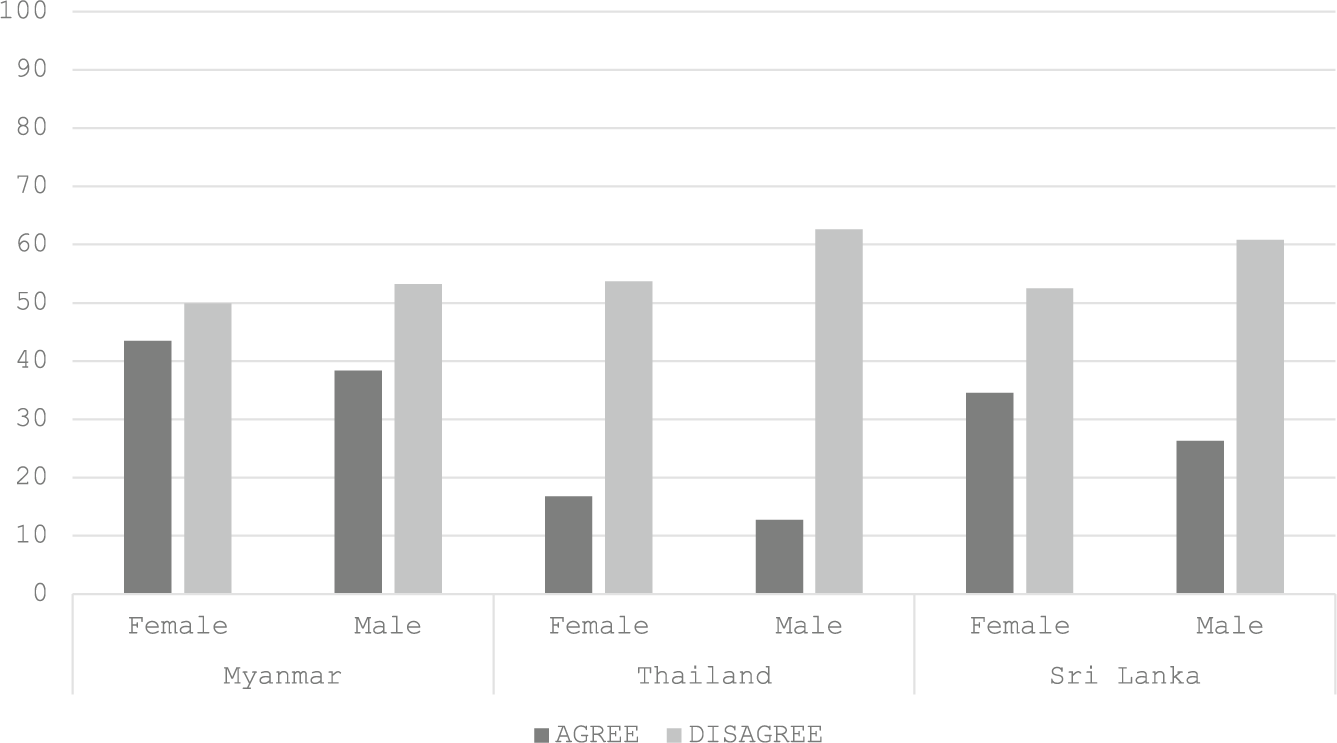
Sinhala Buddhist men and women are both perpetrating gendered forms of extremism, although the extent to which it leads to violence may differ. It is particularly important to not ignore the Buddhist extremist discourses and practices carried out by women. In the survey, when asked whether violence is justified to protect Buddhism,Footnote 77 Buddhist women across the three countries were more likely than men to agree and strongly agree with the use of violence with the highest agreement being found in Myanmar.Footnote 78 This finding contrasts with prevalent stereotypes about women’s peacefulness and underlines the importance of not sustaining women’s contributions to Buddhist Protectionism as shown in the Sri Lankan example. As seen in Figure 4 below, the survey responses reflect the Buddhist Femonationalist Continuum, with the highest agreement with using violence to protect the Buddhism found in Myanmar and the lowest in Thailand.
Violence is justified in order to protect my religious views if someone criticizes or undermines my religion and what it stands for.
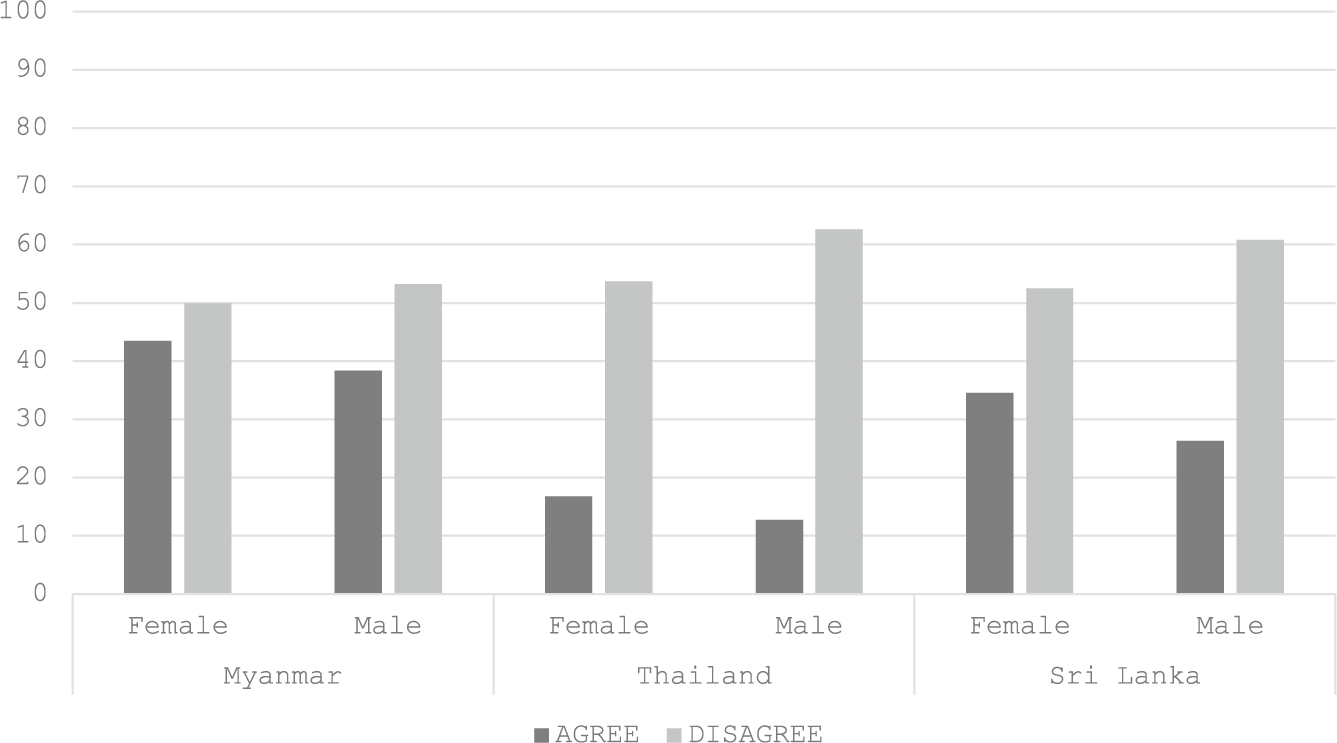
Figure 4. Long description
The y-axis represents a percentage scale from 0 to 100 in increments of 10. The x-axis is categorized by three countries, each subdivided into Female and Male groups. A legend at the bottom indicates dark gray bars for AGREE and light gray bars for DISAGREE.
* Myanmar: For females, agreement is approximately 44 percent and disagreement is 50 percent. For males, agreement is approximately 38 percent and disagreement is 53 percent.
* Thailand: For females, agreement is approximately 17 percent and disagreement is 54 percent. For males, agreement is approximately 13 percent and disagreement is 63 percent.
* Sri Lanka: For females, agreement is approximately 35 percent and disagreement is 53 percent. For males, agreement is approximately 26 percent and disagreement is 61 percent.
Gendered Impacts
Gendered impacts “capture how audiences understand the gender dimensions of political violence” (Bardall, Bjarnegård, and Piscopo Reference Bardall, Bjarnegård and Piscopo2020, 918). In Buddhist Protectionism, these impacts refer to the subjective meaning-making processes that occur as different audiences react to extremism as “protectors” or “protected.” The gendered impacts of Buddhist Protectionism can be seen in the politics around reproduction and population growth in Sri Lanka, the laws regulating birth registration and spacing in Myanmar, and the reception of them by different ethnic-religious groups, illustrating the Buddhist Femonationalist Continuum.
To protect “Buddhist blood” (a gendered motive), Buddhist Protectionists in Myanmar have mobilized support through various gendered strategies and narratives that have “sexuality, conversion and mixed marriage […] at the core” (Frydenlund Reference Frydenlund2021, 4). Buddhist female research participants explain that women have the “responsibility to protect their race and religion,”Footnote 79 because they “are considered as the image of the family and society.”Footnote 80 The gendered impact of these discriminatory narratives and previously mentioned race and religion protection laws on (Bamar) Buddhist women is summed up by a female civil society organization participant: “Some Buddhist Protectionist groups said Buddhist women have to have as many children as the Muslim women.”Footnote 81 The gendered impact of Buddhist Protectionism for Buddhist women is the incitement to reproduce. Yet, for minority women, the gendered impact is to prevent them from reproducing. Consequently, the discriminatory narratives and race and religion protection laws propagated by Buddhist Protectionist groups have distinct gendered impacts on different ethno-religious groups of women, but they share an outcome: “In the name of protecting Buddhism, they [Buddhist Protectionists] violated the rights of women.”Footnote 82
In Sri Lanka, the preoccupation with Sinhalese women’s sterilization and reproductive role also reveals the gendered impact of Buddhist Protectionism. While the gendered motive of spreading sterilization rumors is to “protect” Buddhist Sinhala women and thus, Buddhism itself as “Sinhalese women are assigned the role of bearers of the nation’s cultural purity and authenticity” (Jayasundara-Smits and Subedi Reference Jayasundara-Smits and Subedi2024, 224; DeVotta Reference DeVotta2018, 290); these have discriminatory gendered and racialized impacts.Footnote 83 The impacts were visible in a minority focus group in Puttalam, which combined Muslim and Catholic Sinhalese women: The Sinhalese women said that “they [Muslims] can have more wives so they can have more children and spread their religion.”Footnote 84 Thus, the gendered impact of Buddhist Protectionism is to stigmatize Muslim women, as well as relegate both Muslim and Sinhalese women to their reproductive roles, therein restricting their human rights. Overall, the gendered impact of Buddhist Protectionism is the further stigmatization and control of women’s bodies, with largely negative impacts on minority women (specifically Muslim) and vastly different impacts on majority Buddhists women.Footnote 85
Comparative Synthesis: The Buddhist Femonationalist Continuum
Racialized and gendered dynamics of Buddhist Protectionism are manifest in Thailand, Sri Lanka, and Myanmar as the findings of our study show. In all cases, Buddhist Protectionist groups and supporters justify their discriminatory and violent actions by claiming that the Buddhist nation is under threat (cf. Kyaw Reference Kyaw and Crouch2016). Across the research sites in Thailand, Sri Lanka, and Myanmar “deep-seated fears of minoritization of the majority” were evident in interviews and focus groups (Frydenlund Reference Frydenlund2021, 3–4). Various research participants stated that the nation needs protection, mainly from ethnic and/or religious groups, and mostly from Muslims. However, what varied significantly across the three countries were the impacts of the threatening protectionist discourses as shown in Figure 5. This variation can be seen along a gendered, anti-Muslim continuum, which manifests in the fear of Muslims taking over politics and state administration in Thailand, then escalates to the fear of “Muslim overpopulation” in Sri Lanka, and culminates in the visceral fear of Muslim blood or “miscegenation” in Myanmar, institutionalized in race and religion laws and sanctioning state military attacks. The Buddhist Femonationalist Continuum has different implications for different motives for Buddhist Protectionism, the forms it can take, and the material and violent impact it has, as we discuss further in this part.
The Buddhist femonationalist continuum.

In all three Buddhist-majority countries, a femonationalist protection racket is at work which seeks to amplify the threat of Muslim men and shore up the masculine hegemony of Buddhist men who are expected to protect Buddhist communities, including women, by various means, including violence. While men take the more publicly visible roles in propagating Buddhist Protectionism through active group membership, women engage in protectionist actions in an ideological sense. We found that women significantly influence the workings of Buddhist Protectionism, albeit in subordinate roles.Footnote 86 Women’s roles in Buddhist Protectionism are vital, not just for their reproductive function, since they also carry the narratives and ideology and “uphold the patriarchal and misogynist structures” (cf. Gentry Reference Gentry2022, 217).
While the construction of mosques and the prevalence of halal food were concerns raised in Thailand, in Sri Lanka, the reproduction of Sinhala women was the main theme. Tying women’s reproductive role to the survival of the Buddhist nation and ‘Sinhalese race’ has placed Buddhist Sinhalese women under increased scrutiny, expected to adhere to strict gender norms: men and women in Buddhist Protectionism proscribe appropriate behavior and reproductive practices for Sinhalese women (cf. Jayasundara-Smits and Subedi Reference Jayasundara-Smits and Subedi2024, 224). In Sri Lanka, research participants frequently cited the “Muslim population take over myth” as a threat to Buddhism since polygamy is permitted for Muslims but not Buddhists. While the increasing political influence of Muslims is stressed in Thailand, and the need for Sinhalese reproduction in Sri Lanka, in Myanmar, the discourse reached an even more violent form: here, anti-Muslim protectionist discourse was explicitly connected to protecting the Buddhist “bloodline.” Continuation of the bloodline is regulated under the 2015 race and religion laws, according to gender- and ethnic specific requirements.
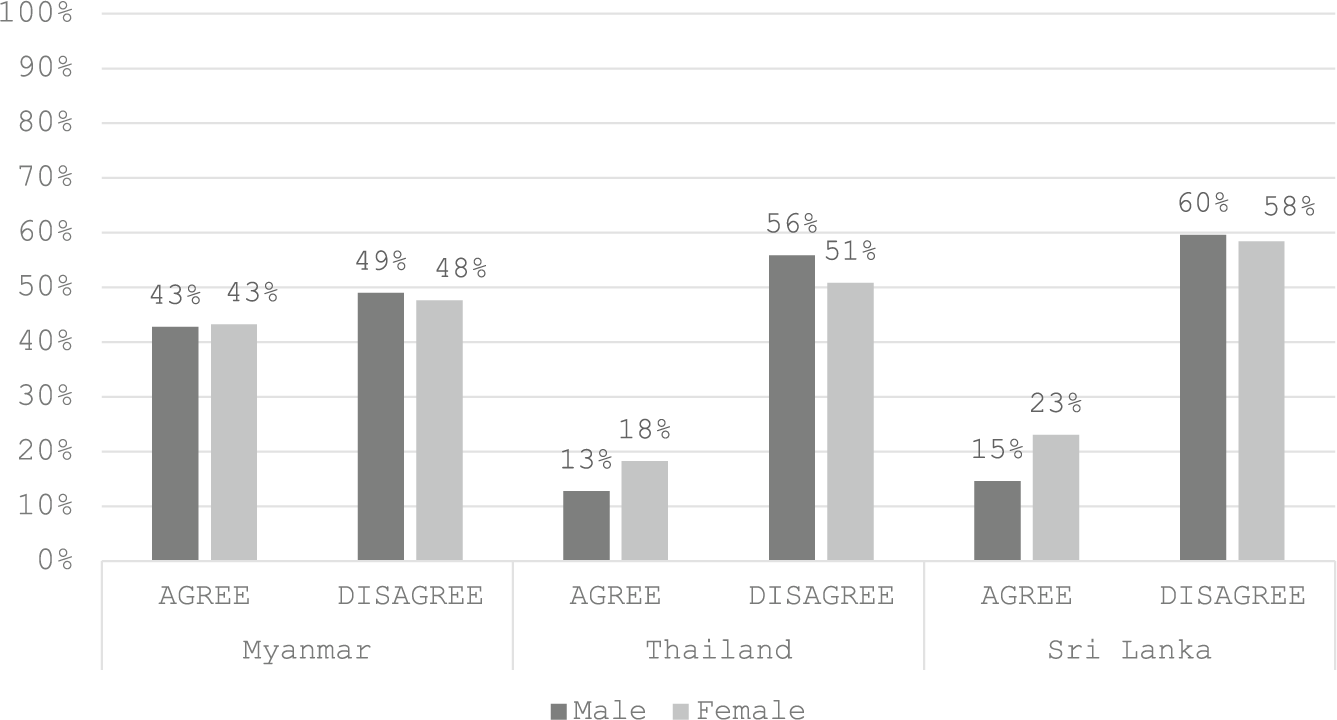
Women’s presence in serving the monastic order is crucial in strengthening the “internal” base of the religion and supporting its “external” protection from threats. Gender hierarchy is built within the Buddhist religion and accentuated in Buddhist Protectionism and its spread. The contradictions in how Buddhist Protectionist groups enforce gender hierarchy, however, are especially stark in Myanmar compared to Thailand and Sri Lanka. Our survey findings, as shown in Figure 6, reveal the contrast between the Buddhist majority view across all the countries. Women are considered an important base for the religion and there is agreement among almost half of Burmese respondents in Myanmar (≈ 43%) with the statement that “in everyday Buddhist practices women are made to feel inferior” (cf. Sri Lanka ≈ 19% and Thailand ≈ 15%). This finding shows that while in Myanmar significantly more respondents agree that everyday practices are discriminatory, women are at the same time considered an important base in Buddhism (≈ 80% agree or strongly agree). This is the paradox that is precisely illustrated by the concept of the Buddhist Femonationalist Continuum.
Within everyday Buddhist practices, women are sometimes made to feel inferior or excluded (e.g., past karma making one reborn as women). Buddhist subsample.

Figure 6. Long description
A bar chart with a Y-axis representing percentages from 0 percent to 100 percent in increments of 10. The X-axis is divided into three countries, each with two categories: AGREE and DISAGREE. Within each category, there are two bars: dark gray for Male and light gray for Female.
* Myanmar: In the AGREE category, both males and females are at 43 percent. In the DISAGREE category, males are at 49 percent and females are at 48 percent.
* Thailand: In the AGREE category, males are at 13 percent and females are at 18 percent. In the DISAGREE category, males are at 56 percent and females are at 51 percent.
* Sri Lanka: In the AGREE category, males are at 15 percent and females are at 23 percent. In the DISAGREE category, males are at 60 percent and females are at 58 percent.
Across all three countries, the percentage of respondents who disagree with the statement is higher than those who agree, with the highest disagreement rates found in Sri Lanka.
The Buddhist Femonationalist Continuum is strongly evident in our survey findings where, across the three country cases, Buddhist Protectionism sentiment is strongest in Myanmar, followed by Sri Lanka, with the least support in Thailand. It is also apparent when considering the range of agreement with anti-Muslim statements across the three countries (Myanmar ≈ 40%; Sri Lanka ≈ 30%; Thailand ≈ 20%). Moreover, Burmese respondents were the most likely to justify violence to protect Buddhism (Myanmar ≈ 40%; Sri Lanka ≈ 30%; Thailand ≈ 15%). Thus, although support for Buddhist nationalist extremism exists in all three countries, it is most pronounced Myanmar, reflecting the long history of ethno-religious conflict and violence. By contrast, Thailand is least affected by violent dynamics and support for the use of force. This fits with Thailand’s overall more progressive stance and support of liberal human rights values, for example, their stance toward LGBTIQ+.
The ongoing conflict and extensive role of Buddhist nationalism in Myanmar may as a result also explain the more apparent oppression of women within Buddhism. Everyday Buddhist practices have a particular political salience in a conflict where ethnic armed groups are fighting a Buddhist military known to commit atrocities against Muslim minorities (UN 2018). Buddhist practices have become part of militarized strategies that sustain armed conflict, in which monks are used to demonstrate cultural legitimacy of the state and its repressive and coercive acts.
Comparing the findings across the three cases in our study, we can also see how different standards for majority and minority women apply within Buddhist Protectionism. For example, in Sri Lanka, Buddhist Protectionists demand that Buddhist Sinhalese women reproduce and cover their bodies: “Women can destroy the religion as they can allure the monks. Women should wear clothes properly so that the monks and the men can’t be persuaded by their improper clothing.”Footnote 87 At the same time, they also call for Muslim women to cover less (burqa ban) revealing the “hypocrisy of toxic masculinity” as noted by feminist scholars (Jayasundara-Smits and Subedi Reference Jayasundara-Smits and Subedi2024, 226).
From the perspective of Buddhist Protectionists, the fear of Muslims justifies state-sanctioned extremism that may encourage violence. Misogyny and anti-Muslim narratives are used by Buddhist Protectionist actors to justify violence by controlling minority populations and women resulting in gender-based violence. Even when Buddhist Protectionists, both men and women, recognize the impacts of their discourses and practices on women, for instance, they justify (and dismiss) them as minimal compared with the impacts of Islamist extremism. As stated by a female research participant in Myanmar: “We understand Muslims as those who commit suicide bombings. They use violent ways, and they are extreme. But Buddhist Protectionist groups are gentle in violating women’s rights.”Footnote 88
Femonationalist Protection Racket
Based on the analysis of our survey and qualitative data, we argue that a femonationalist protection racket exists in Thailand, Sri Lanka, and Myanmar: Misogyny and anti-Muslim threat narratives are played up with Buddhist Protectionist groups both affirming the power of masculine hegemony and justifying the use of violence to control minority populations and women. Gender norms and structures fuel this Buddhist Protectionism; thus, tackling these norms and structures within Buddhism could contribute to reducing political extremism and its tendency to ignite and justify violence.
In Thailand, notions of merit, obligation, and karma are a heavy burden in certain religious contexts. As a woman civil-society organisation (CSO) leader stated: “Religious teachings have a lasting impact on women’s mental health, and it may take time for them to realize that they are being oppressed.”Footnote 89 In Sri Lanka, oppressive gender norms and violence against women are condoned within Buddhism. As stated by a female monk: “If a woman suffers immeasurably, those things happen because of the heinous sins she has committed in a previous life.”Footnote 90 Similar oppressive gender norms are pervasive in Buddhist communities in Myanmar where the presence of violent acts in the name of Buddhist Protectionism are most prevalent. In the words of a nonbinary university teacher: “Buddha never teaches us that we have to treat husbands and sons as masters.”Footnote 91 Such harmful gender norms normalize violence and limit women’s agency within the religion to act as moderating voices that consistently engage with other religious groups in the community.
This situation effectively condones violence within the religion that normalizes the use of violence in the broader community in defense of Buddhism. Many research participants argued that gendered hierarchy and abuse within monasteries is often not questioned because monasteries are viewed as sacred, safe places where no system of accountability is needed. Keeping women in a subordinate, albeit essential, role in Buddhism both undermines women’s agency and perpetuates extremism by affirming masculine hegemony and normalizing aggression externally. Addressing gender norms and structures, thus, has the potential to reduce extremism leading to violence. This may include programming that connects religion and gender inequality since discussions about religion and its influence on extremism typically do not consider their gendered motives, forms and impacts.
Enhancing the role of female monks and women religious leaders could help to resolve conflicts and prevent the spread of extremism. These religious women already substantially engage with communities and are often supported by them in order to be represented and to advance their positions within temples and the broader monastic order.Footnote 92 We found evidence that some, if not all, may have more nuanced understandings of how to preserve the Buddhist religion and do not support Buddhist Protectionist groups.
Conclusion
This article investigated the gendered political dynamics of Buddhist Protectionism, a movement to “protect” Buddhism in Thailand, Sri Lanka, and Myanmar. We analyzed how gender-specific norms and structures are used to propound extremist ideology that legitimizes violence, utilizing Bardall, Bjarnegård, and Piscopo’s (Reference Bardall, Bjarnegård and Piscopo2020) framework. To investigate Buddhist state-sanctioned extremism we adopted core concepts from feminist international relations scholarship on “protection rackets,” comparative gender and ethnic studies scholarship on gendered nationalism, and the growing literature in political science and extremism studies on women’s agency and participation in extremism. This is because Buddhist Protectionism is a form of gendered nationalism, a classic “protection racket,” as well as a case of underestimating women’s agency in extremism.
Buddhist Protectionist movements engage in extremist speech, threats and intimidation, and violent activities to preserve men from the dominant ethnic group’s hegemonic control of the Buddhist religion and temples, which are closely associated with their respective governments and political power. While Buddhist protectionists may be seen to be “gentle in violating women’s rights,”Footnote 93 our study and analysis suggests the contrary: the femonationalist protection racket that exists in Buddhist-majority countries in Asia projects racist and misogynist discourses that range from framing Muslim men as threatening to Buddhist Thai/Bamar/Sinhalese (cis) women as reproductive carriers needing urgent protection. Yet, what varied significantly across the three countries, as shown in our study, is the extent and severity of this threatening discourse across a gendered, anti-Muslim continuum, from politics in Thailand, to reproduction in Sri Lanka, and blood in Myanmar.
Our research findings on the Buddhist Femonationalist Continuum add to the scholarship on the complex, mutual relationship between politics and gender by revealing the complex dynamics of gender, nationalism, and extremism. These dynamics can be appreciated with our feminist interdisciplinary lens, which is attentive to religious discourses, the double-edged nature of protection for women, and the politicization of gender relations in extremist groups. The study highlights how the state’s engagement with religion may lead to complicity with the violent effects of extremism. Moreover, the state’s engagement with gender equality has the potential to fuel or mitigate compounding threats of extremism, Islamophobia, and violence when it either feeds, ignores, or counters and prevents harmful narratives. Within Buddhist-majority states gender equality cannot be advanced while the power relations between men and women within the Sangha do not reflect the principles of fairness and inclusivity. Reforms to address gender equality would allow the Sangha to better embody Buddhist teachings of compassion and non-discrimination. Similarly, the acceptance of diversity and the recognition of the rights of all religious groups aligns with Buddhist values of non-harm and coexistence in Buddhist-majority states. Such reforms would diminish the influence of growing Buddhist protectionism movements that seek to preserve religious identity through exclusionary or nationalist agendas that can fuel and contribute to gendered violence.
Acknowledgments
We are deeply grateful to our research participants in Thailand, Sri Lanka, and Myanmar for generously sharing their insights and experiences. We also extend our sincere thanks to Chrysalis and the anonymous researcher in Myanmar, whose collaboration was instrumental to this project. Finally, we appreciate the valuable feedback provided by the anonymous reviewers and the editorial team, which significantly improved the quality of this work.
Funding statement
This study is made possible by the generous support of the American people through the United States Agency for International Development (USAID). Cooperative Agreement No. AID-72048619CA00001. This research was supported (partially) by the Australian Government through the Australian Research Council’s Centre of Excellence for the Elimination of Violence Against Women (Project number CE230100004).
Competing interest
The authors declare none.
Appendix 1
Overview FGDs
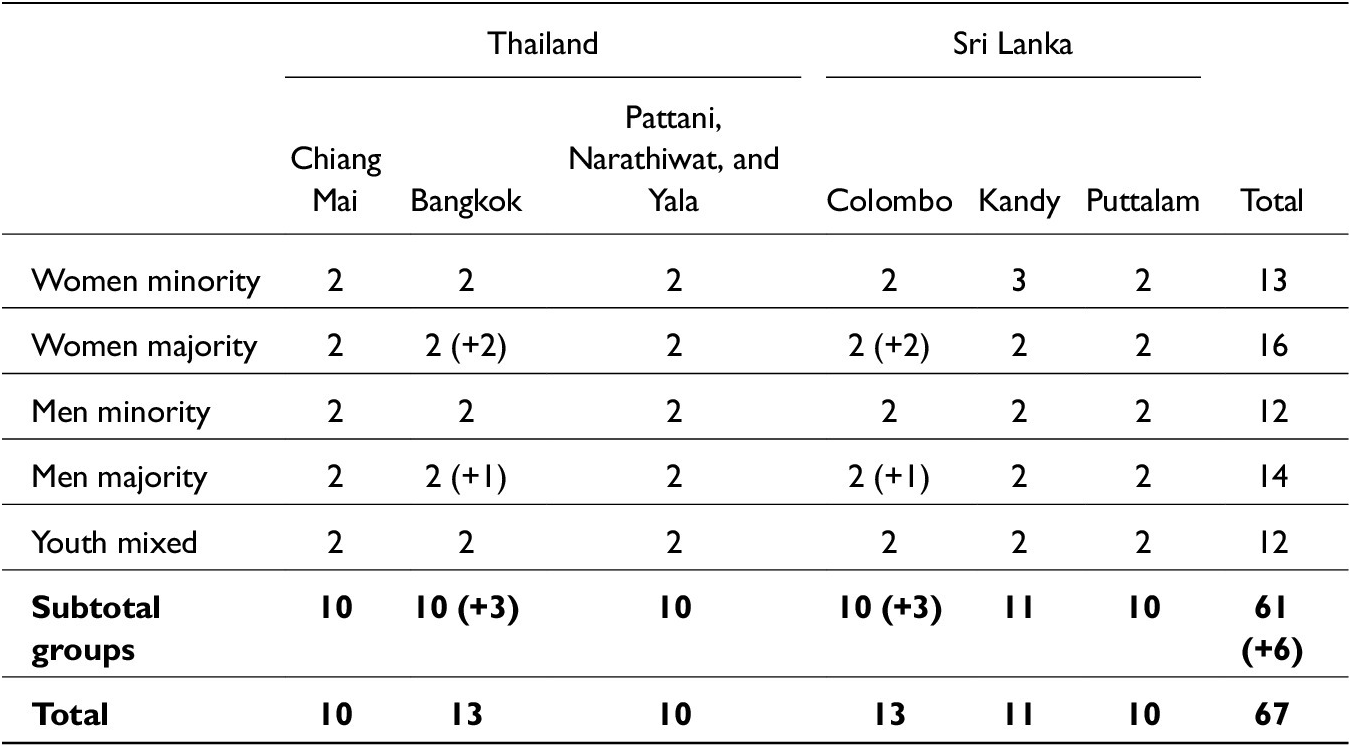
Table 1. Long description
The table is organized into eight columns. The first column lists demographic groups: Women minority, Women majority, Men minority, Men majority, Youth mixed, Subtotal groups, and Total. Columns two through four cover Thailand (Chiang Mai, Bangkok, and the region of Pattani, Narathiwat, and Yala). Columns five through seven cover Sri Lanka (Colombo, Kandy, and Puttalam). The final column provides the Total.
Data breakdown by row:
* Women minority: 2 in all regions except Kandy (3), totaling 13.
* Women majority: 2 in all regions, with Bangkok and Colombo each having an additional 2 pilots in brackets, totaling 16.
* Men minority: 2 in all regions, totaling 12.
* Men majority: 2 in all regions, with Bangkok and Colombo each having an additional 1 pilot in brackets, totaling 14.
* Youth mixed: 2 in all regions, totaling 12.
* Subtotal groups: 10 in all regions except Bangkok (10 plus 3 pilots), Colombo (10 plus 3 pilots), and Kandy (11). The subtotal is 61 plus 6 pilots.
* Total: Chiang Mai (10), Bangkok (13), Pattani, Narathiwat, and Yala (10), Colombo (13), Kandy (11), and Puttalam (10). The grand total is 67.
Note: The number of pilots is in brackets.
Overview KIIs
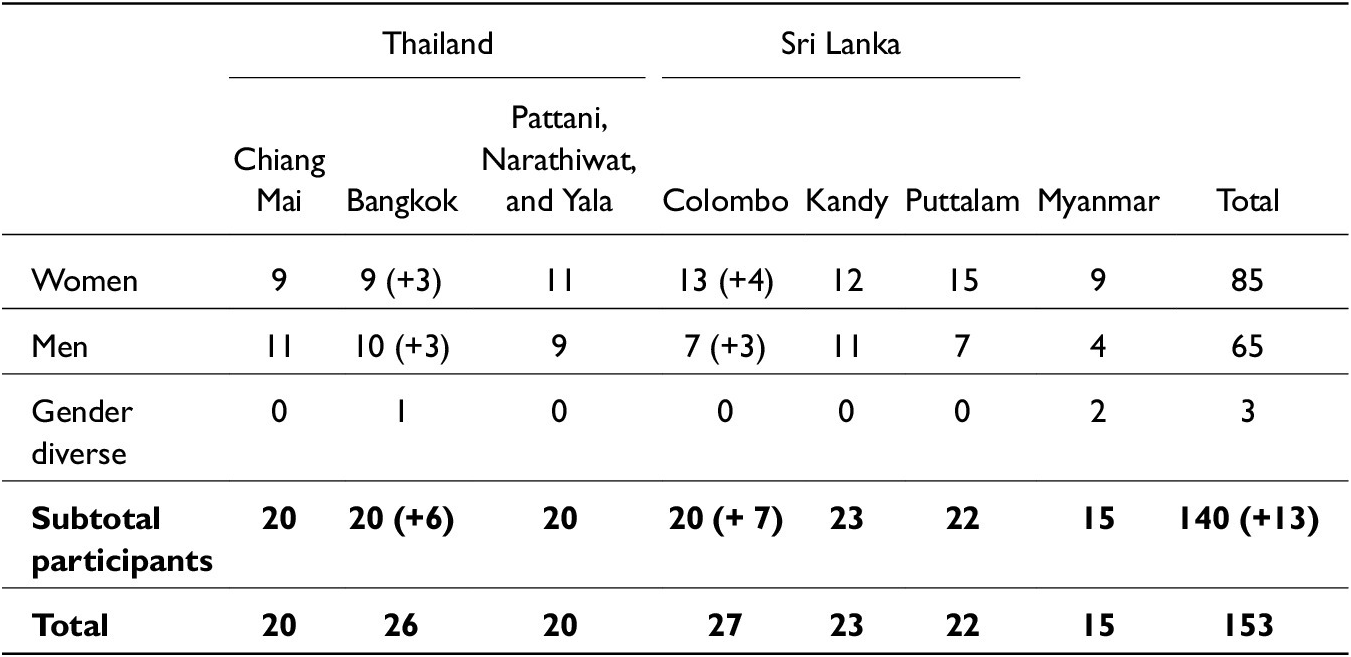
Table 2. Long description
The table is organized with columns for Thailand (Chiang Mai, Bangkok, and the group of Pattani, Narathiwat, and Yala), Sri Lanka (Colombo, Kandy, and Puttalam), Myanmar, and a final Total column.
Row 1: Women. Chiang Mai 9; Bangkok 9 plus 3 pilots; Pattani, Narathiwat, and Yala 11; Colombo 13 plus 4 pilots; Kandy 12; Puttalam 15; Myanmar 9; Total 85.
Row 2: Men. Chiang Mai 11; Bangkok 10 plus 3 pilots; Pattani, Narathiwat, and Yala 9; Colombo 7 plus 3 pilots; Kandy 11; Puttalam 7; Myanmar 4; Total 65.
Row 3: Gender diverse. Chiang Mai 0; Bangkok 1; Pattani, Narathiwat, and Yala 0; Colombo 0; Kandy 0; Puttalam 0; Myanmar 2; Total 3.
Row 4: Subtotal participants. Chiang Mai 20; Bangkok 20 plus 6 pilots; Pattani, Narathiwat, and Yala 20; Colombo 20 plus 7 pilots; Kandy 23; Puttalam 22; Myanmar 15; Total 140 plus 13 pilots.
Row 5: Total. Chiang Mai 20; Bangkok 26; Pattani, Narathiwat, and Yala 20; Colombo 27; Kandy 23; Puttalam 22; Myanmar 15; Grand Total 153.
Note: The number of pilots is in brackets.


 Open access

