


Among the elderly, greater exposure to oxidative stress particularly from smoking and lower dietary intake of antioxidant nutrients in foods such as fresh fruits and vegetables, milk and fish may render them particularly vulnerable to lung damage, thus increasing the risk of chronic obstructive pulmonary disease (COPD) in late life. A limited but growing body of evidence suggests a significant role of antioxidant and anti-inflammatory nutrients in protecting the lungs from the effects of oxidative stress and chronic inflammation( Reference Romieu and Trenga 1 , Reference Schünemann, Freudenheim and Grant 2 ).
Studies based on FFQ measures of dietary intake of fresh fruits and vegetables( Reference Strachan, Cox and Erzinclioglu 3 – Reference Bentley, Kritchevsky and Harris 10 ), supported by studies with serum measurements of micronutrients such as vitamin A, vitamin C and vitamin E and other phytochemicals( Reference McKeever, Lewis and Smit 11 – Reference Guenegou, Leynaert and Pin 14 ), suggest that antioxidant vitamins A, C and E are associated with better pulmonary function. It has also been suggested that serum Se, another antioxidant, may have pulmonary protective effects but its reported associations with pulmonary function are based on a limited number of studies( Reference McKeever, Lewis and Smit 11 , Reference Pearson, Britton and McKeever 15 ).
Vitamin D (1,25-dihydroxy) inhibits the formation of matrix metalloproteinases as well as fibroblast proliferation, and influences collagen synthesis, and may therefore play a role in influencing pulmonary tissue remodelling( Reference Koli and Keski-Oja 16 , Reference Dobak, Grzybowski and Liu 17 ). A recent study reported that serum concentrations of 1,25-dihydroxyvitamin D were positively associated with forced expiratory volume in the first second (FEV1) and forced vital capacity (FVC)( Reference Black and Scragg 18 ), but this finding was not replicated independently in a subsequent study( Reference Shaheen, Jameson and Robinson 19 ).
n-3 PUFA are components of cell membranes and play an important role in suppressing the production of pro-inflammatory mediators such as PGE2 and leukotriene B4 ( Reference Kelly, Sacker and Marmot 20 ), and may thus have a protective effect against pulmonary function deterioration. The reported associations between fish intake (a rich source of n-3 PUFA) and pulmonary function is equivocal and based on sparse data from a relatively small number of studies( Reference Butland, Fehily and Elwood 4 , Reference Tabak, Smit and Rasanen 5 , Reference Sharp, Rodriguez and Shahar 21 – Reference Schwartz and Weiss 23 ).
Of note, most previous studies did not control simultaneously for parallel intake of other antioxidant or anti-inflammatory nutrients; hence a protective effect attributed to one antioxidant or micronutrient may actually reflect the effect of another correlated dietary constituent or an interaction between dietary constituents. In the present study, we investigated the separate and joint effects of high dietary intakes of fruits and vegetables, milk and dairy products, and fish, and supplemental intakes of vitamins A, C, E and D, Se and n-3 PUFA, with pulmonary function in a large population sample of Chinese older adults in Singapore.
Methods
Study participants
The study sample was drawn from participants in the Singapore Longitudinal Ageing Studies (SLAS), an observational cohort study of ageing and health among community-dwelling elderly persons. From September 2003 to December 2004, participants aged 55 years and above were recruited by door-to-door census (n 3894) from the whole population residing in five districts in the South East Region of Singapore, excluding those who were severely incapacitated physically or mentally and unable to give informed consent or participate. A total of 2804 residents participated in the study (estimated response rate 78 %). The study was approved by the National University of Singapore Institutional Review Board. Consenting participants underwent extensive interviews and examinations that included measurements of lung function. Among the 2608 Chinese respondents in the cohort, eighty-one respondents who did not perform spirometry, forty-six with technically unsatisfactory spirometric performance and three with missing data were excluded from the analysis. Complete spirometric data were analysed for 2478 respondents.
Spirometry
Ventilatory function testing was performed using a portable, battery operated, ultrasound transit-time based spirometer (Easy-One model 2001 Diagnostic Spirometer; NDD Medical Technologies, Zurich, Switzerland). Forced expiratory manoeuvres were performed with the respondent seated according to the American Thoracic Society recommendations on standardization of procedures: at least three technically acceptable manoeuvres, with the two best FVC and FEV1 readings reproducible to within 5 % or 200 ml. The largest FEV1 and the largest FVC on any of the acceptable tests were used. Height and weight were measured with a portable Seca stadiometer (model 708 1314004; Vogel & Hake, Hamburg, Germany).
Questionnaires
A semi-quantitative FFQ was used to ask participants whether over a 1-month period they drank or ate ‘a lot of’ milk products (at least one serving every day); ‘a lot of’ fruits or vegetables (at least one serving every day); and ‘a lot of’ fish (more than three times per week).
For supplemental intake, participants were asked the frequencies with which they regularly consumed vitamins A, C, E or D, Se and n-3 PUFA (DHA, EPA) supplements: (i) ‘never or rarely’; (ii) ‘less than once a month’; (iii) ‘more than once a month but less than one time a week’; (iv) ‘more than once a week but not daily’; or (v) ‘always (daily)’. The distributions were extremely bimodal; the vast majority were for (i) ‘never or rarely’ or (v) ‘daily’ and fewer than 6 % of the responses were for intermediate frequencies. Hence, the responses were dichotomized by daily intake of supplements (yes/no).
Other data included risk factors known to determine ventilatory function and the risk of COPD, namely age, gender, housing type (an established surrogate measure of socio-economic and income status), smoking (never, past or current smoker), past occupational exposure to dust or fumes, and reported medical history of asthma or COPD diagnosis. The usual frequency of three categories of moderate-to-vigorous physical activity (including walking, physical exercises and sports activities) reported was scored as 1 = ‘never or rarely (less often than once a month)’, 2 = ‘sometimes (at least once a month but less than once week)’ and 3 = ‘often (once a week or more)’, and the summed scores were categorized into four levels from 1 (score = 0, equivalent to never or rarely for any physical activity) to 4 (score = 6 or more, equivalent to at least once weekly for two or more activities).
Statistical analysis
Multiple linear regression techniques were used to investigate the association between dietary and supplemental intakes (as independent categorical variables) and FEV1, FVC or FEV1/FVC (as dependent continuous variables). Gender, age (single years), height (cm), smoking status (non-smokers, past smoker, current smoker), past occupational history and reported medical history of asthma and/or COPD, BMI and the level of physical activity were included as variables in the base model. The individual associations of each dietary and supplemental intake variable with ventilatory function were investigated separately (model 1) in the presence of variables in the base model. Next, all of the dietary and supplemental intake variables were analysed simultaneously as independent variables in model 2, including all variables from the base model. We investigated interaction by including interaction terms of dietary and supplemental intakes and smoking status and other covariates. We determined that interaction terms would be significant if the level of significance was P < 0·1. All reported statistical tests were two-sided. Statistical significance was determined using the conventional level of P < 0·05. Statistical analyses were performed using the SPSS statistical software package version 16·0.
Results
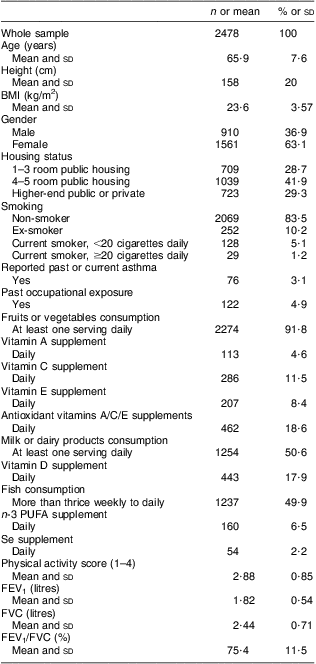
The mean age of the participants was 66 years (Table 1). A large majority reported consuming at least one serving of fruits or vegetables daily, but about half consumed milk products daily or fish more than three times weekly. Reported daily intake of supplements was much less frequent, about 18 % for vitamins A, C, E and D, 6·5 % for n-3 PUFA and 2·2 % for Se, with almost all of the remaining proportions reporting no consumption at all. As shown in Table 2, the dietary intakes of fruits/vegetables, milk/dairy products and fish and supplemental intakes of vitamins A, C, E and D, Se and n-3 PUFA showed a few weak correlations with each other.
Characteristics of the study participants: Chinese older adults (n 2478) aged 55 years and above, Singapore Longitudinal Ageing Studies, 2003–2004
FEV1, forced expiratory volume in the first second; FVC, forced vital capacity.
Spearman's correlation coefficients among dietary and supplemental intakes of antioxidant and anti-inflammatory nutrients: Chinese older adults (n 2478) aged 55 years and above, Singapore Longitudinal Ageing Studies, 2003–2004

*P < 0·05, **P < 0·01.
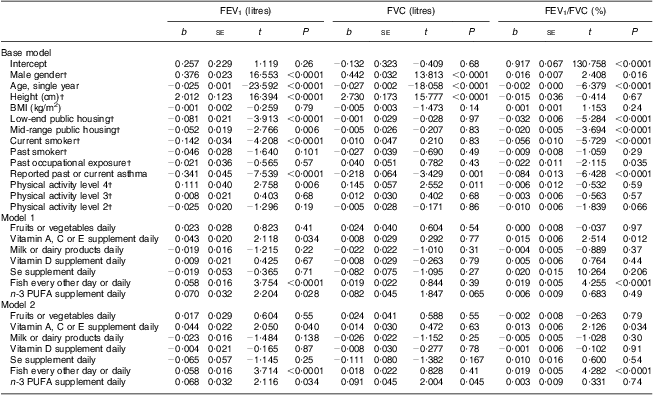
Table 3 shows in the base model the expected significant independent associations of gender, age, housing status, smoking, occupational exposure, asthma/COPD history, BMI and physical activity level with FEV1, FVC and FEV1/FVC (R 2 = 0·42). When added to the base model, supplemental vitamin A, C and E intakes individually were not significantly associated with FEV1 (data not shown), but together, vitamin A, C and/or E, as well as dietary fish intake and supplemental n-3 PUFA intake showed positive associations with FEV1 (model 1). When all of the dietary and supplemental intakes were analysed simultaneously (model 2), each of them, vitamin A, C and/or E (b = 0·044, se = 0·022, P = 0·04), dietary fish intake (b = 0·058, se 0·016, P < 0·0001) and supplemental n-3 PUFA intake (b = 0·068, se = 0·032, P = 0·034), remained independently associated with FEV1. No significant interactions of dietary or supplemental intakes with smoking or with gender were found.
Multiple regression analysis of relationships of dietary and supplemental micronutrient consumption with FEV1, FVC and FEV1/FVC: Chinese older adults (n 2478) aged 55 years and above, Singapore Longitudinal Ageing Studies, 2003–2004
FEV1, forced expiratory volume in the first second; FVC, forced vital capacity.
Model 1: adjusted for base model variables.
Model 2: adjusted for base model variables and other nutrient variables.
†Referenced to: female gender, higher-end public or private housing, never smoker, no occupational exposure and lowest level (1) of physical activity.
n-3 PUFA intake showed a significant independent association with FVC (b = 0·091, se = 0·045, P = 0·045) as well. The results showing the significant associations of individual dietary and supplemental intakes with FEV1/FVC (%) corresponded closely with those for FEV1, except for supplemental n-3 PUFA intake, given its positive relationships with both FEV1 and FVC. No significant independent association of fruit/vegetable and milk/dairy product intake and supplemental vitamin D intake with pulmonary function was found.
Discussion
Evidence in support of the association between consumption of fresh fruits and vegetables and better lung function( Reference Grievink, Smit and Ocke 7 – Reference Bentley, Kritchevsky and Harris 10 ) is highly suggestive of the roles of antioxidant vitamins A, C and E in pulmonary protection, but has been found to be inconsistent for different antioxidants across different studies. In the present study, we failed to observe a significant association of dietary intake of vegetables or fruits with pulmonary function. It is known that food sources and the absorption and metabolism of micronutrients in the diet tend to vary in different populations. Among older adults, co-morbid chronic diseases and multiple drug use are common causes of diminished food intake and increased nutritional risks. Infection and chronic diseases perpetuating chronic inflammation and drug use down-regulating nutrient metabolism adversely influence biologically effective concentrations of micronutrients. Hence, although a large majority of participants uniformly reported consuming at least one serving of fruits or vegetables daily, the tissue concentration of micronutrients may not be as well correlated with measures of dietary intake as it is with measures of supplement intake. Notably, many studies ignored significant sources of antioxidants and vitamins from supplements in urban populations. In our study population, we measured supplemental intake of antioxidant vitamins and found wide individual variations of intake and little or no correlation with fruit or vegetable intake. We did not detect the effects of vitamin A, C and E supplements when they were analysed individually, but instead observed an effect of these antioxidant vitamins as a group. This appears to be consistent with the orchestrated effect of an array of antioxidants postulated for the known actions of endogenous (and exogenous) antioxidants in the biological defence system against the effects of oxidative stress.
Various studies have reported a positive association( Reference Shaheen, Jameson and Robinson 19 – Reference Shahar, Folsom and Melnick 22 ) or no association( Reference Butland, Fehily and Elwood 4 , Reference Tabak, Smit and Rasanen 5 ) between fish consumption and pulmonary function. No studies as yet have considered simultaneously the effects of n-3 PUFA supplements on pulmonary function. We showed that both dietary intake of fish and supplemental intake of n-3 PUFA were associated positively with pulmonary function, additionally and independently of each other and other antioxidants. Supplemental n-3 PUFA intake was also found to be associated with FVC. This is interesting as it suggests that, perhaps unique among other antioxidants, n-3 PUFA may both protect against chronic airway narrowing as well as maintain interstitial lung structure and functioning. This should be further studied.
Our findings appeared robust and suggested that the effects associated with these individual antioxidant or anti-inflammatory nutrient intakes are non-trivial, considering that the decrement in FEV1 associated with current smoking on average ten cigarettes daily is estimated at 147 ml, fish consumption at least thrice weekly with a 57 ml increment in FEV1 and daily n-3 PUFA supplement use with a 67 ml increment in FEV1.
We failed to observe results that support the possible antioxidant effect of Se supplements, although the very small number of participants who reported intake of Se should be noted. Another negative result for vitamin D supplement intake is in agreement with a recent study( Reference Shaheen, Jameson and Robinson 19 ) that did not replicate a positive association between vitamin D and adult pulmonary function reported in a prior study( Reference Black and Scragg 18 ).
The limitations in this study should be noted. The use of a semi-quantitative FFQ to assess intake of dietary and supplementary sources of antioxidants and micronutrients is limited, and did not include total energy intake. For certain micronutrients such as Se or vitamin E, dietary intakes are very difficult to measure and unreliable. Milk intake and supplemental vitamin D intake may not be satisfactory surrogate measures of vitamin D status considering that fish is also a rich source of vitamin D, UV exposure from the sun may be highly variable and the elderly are less able to synthesize biologically active 1,25-dihydroxyvitamin D. We did not collect data on the amount of time spent outdoors; hence this limits our statistical analysis for vitamin D. None the less, we were able to observe statistically significant results with the use of self-reports for some dietary and supplemental intakes such as n-3 PUFA. Furthermore, we did not collect information on dosages of supplements used, which could otherwise be useful for comparison against daily nutrient requirements. Further studies involving laboratory measures of biological concentrations of the micronutrients are desirable. Multiple testing involving many nutritional variables may give rise to spurious statistical significance; however, observed P values <0·0001 are not likely to be type one errors.
With cross-sectional results, the observed associations may arguably be confounded by dietary change resulting from poor pulmonary function. In patients with COPD, this is generally expected to result in reduced food intake and undernutrition. Community-living older persons possessing varying levels of pulmonary function include a sub-population of individuals who have COPD and poor lung function, but it is well known that it is generally unrecognizable and it seems very unlikely that these individuals would accordingly increase their dietary intake.
The strengths of the present study include its large sample size and the selection of an older adult population who are vulnerable to the effects of oxidative injury and nutrient deficiency and are at elevated risk of COPD. We controlled for a large number of known risk factors for COPD that were potentially confounding variables in multivariate analyses and observed robust relationships with pulmonary function that were expected. We measured dietary and supplementary intakes of multiple antioxidants and anti-inflammatory nutrients, because a protective effect attributed to one antioxidant or micronutrient may actually reflect the effect of another correlated dietary constituent or an interaction between dietary constituents.
This Asian population-based study lends further support to the hypothesis that antioxidant and anti-inflammatory micronutrients have protective effects on pulmonary function. The results suggest that fish consumption and supplemental intakes of n-3 PUFA and vitamins A, C and E likely have beneficial effects on respiratory health and protection against the risk of COPD in older persons.
Acknowledgements
Sources of funding: The Singapore Longitudinal Ageing Study was supported by grants (no. 03/1/21/17/214 and no. 08/1/21/19/567) from the Biomedical Research Council of the Agency for Science, Technology and Research (A*STAR) in Singapore. A*STAR had no role in the design, analysis or writing of this article. Conflict of interest: None of the authors report conflicts of interest with commercial enterprises. Authors’ contributions: T.P.N. conceptualized and designed the study, formulated the hypothesis, performed the statistical analysis and results, and drafted and revised the manuscript. M.N. participated in the study design and the statistical analysis, interpretation of the results and review of the manuscript. K.B.Y. and W.C.T. participated in the study design, interpretation of the results and review of the manuscript. T.P.N. is the guarantor of the paper, taking responsibility for the integrity of the work as a whole, from inception to published article. Acknowledgements: The authors thank the participants in South East Singapore, Geylang East Home for the Aged, Presbysterian Community Services, Thye Hua Kuan Moral Society, Henderson Senior Citizens’ Home, and People's Association for their support and assistance in the study.



