



The World Health Report 2002 ( 1 ) showed in detail how a few important risk factors were responsible for a significant proportion of all deaths and pathologies in the majority of the countries studied. In fact, six of the seven most prominent risk factors for premature death are correlated to diet and physical activity (blood pressure, cholesterol, obesity, insufficient intake of fruits and vegetables, physical inactivity, excessive alcohol consumption).
The main determinants of these risk factors are chiefly the same: changes in diet leading to one with greater energy density in which fat and added sugars play an important role; increases in the consumption of saturated fat (derived from foods of animal origin) and hydrogenated fat; and reductions in the consumption of complex carbohydrates and fibre associated with decreased intakes of fruits and vegetables. All of these, along with the increase in portion size, play a predominant role, mainly in sedentary children and adolescents.
In the student population, eating habits and lifestyle are not only decisive factors in the appearance of chronic pathologies, but also affect intellectual and physical performance( Reference Iglesias Rosado 2 ). According to the National Survey of Spanish Dietary Intake in 2011, published by the Spanish Food Safety and Nutrition Agency, Spaniards aged between 18 and 24 years (university student age group) consume less fruits, vegetables and fish than the rest of the population and more meat, pastries and soft drinks( 3 ). Also, studies carried out with university students show that dietary intake of macronutrients is unbalanced: high in lipids, and very low in carbohydrates and fibre. With regard to micronutrients, in general the diet is appropriate except for folic acid, Ca, Mg and vitamins A and E, with levels below the recommended ones( Reference Martínez Roldán, Veiga Herreros and López de Andrés 4 , Reference Montero Bravo, Úbeda Martín and García González 5 ).
Studying the eating habits of university students can aid in the design and application of specific measures that reduce, to the greatest extent, the negative effects on health resulting from an unhealthy diet. In this context, the aim of the present study was to survey the opinion of students, users of canteens and cafeterias of the University Complutense of Madrid (UCM), to evaluate their eating habits and food preferences, as well as their level of satisfaction with the university catering services.
Materials and methods
The sample was composed of 964 university students (381 males; 583 females) belonging to six faculties of the UCM campus. Participants were enrolled in undergraduate studies related to health sciences (medicine, pharmacy, biology, nursing, nutrition, dentistry) and their mean age was 22·2 (sd 4·3) years.
A questionnaire was developed for the study and evaluated by experts of the Spanish Society of Dietetics and Food Sciences. In addition to asking about participants’ sex, age and the faculty to which they belonged, the questionnaire asked for the location and participants’ frequency of use of catering services situated on campus. It should be noted that the question referred to the consumption of whole meals. Also, the questionnaire elicited participants’ level of satisfaction with five aspects (hygiene, quality, taste of food, price and convenience of facilities) of the university catering services, scored on a scale of 1 to 5, with 1=‘very bad’ and 5=‘very good’. Finally, the questionnaire sought participants’ opinion about their preferred dishes and whether they followed a special diet. For preferred dishes, the questionnaire had open-ended responses and asked what dishes had been consumed in the university dining hall during the last year. For following a special diet, the responses were also closed but the questionnaire included a final open-ended section for ‘other causes’.
The survey was carried out in 2011 and its implementation counted with the help of a group of students of Human Nutrition and Dietetics, who were previously trained. The study was approved by the Ethics Committee of the Faculty of Medicine of the UCM. The respondents gave informed consent and data were coded to ensure confidentiality. Statistical analysis was performed using the statistical software package SPSS 18·0. Quantitative variables were compared using the non-parametric Mann–Whitney U test and categorical variables using the χ 2 test (significance level of P<0·05).
Results
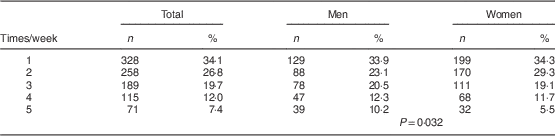
Frequency of use of the UCM meal services is presented in Table 1. The surveyed students used them, for consuming a whole meal, on average 2·3 (sd 1·3) times/week, males (2·4 (sd 1·3) times/week) more than females (2·25 (sd 1·2) times/week). The majority of those surveyed (74·6 %) preferred to use the cafeteria in their own department, 15·0 % used other common areas in their faculty and 10·4 % went to cafeterias in other centres.
Frequency of using the university meal services, overall and according to sex, among 964 students (381 males; 583 females), Complutense University of Madrid, Spain, 2011
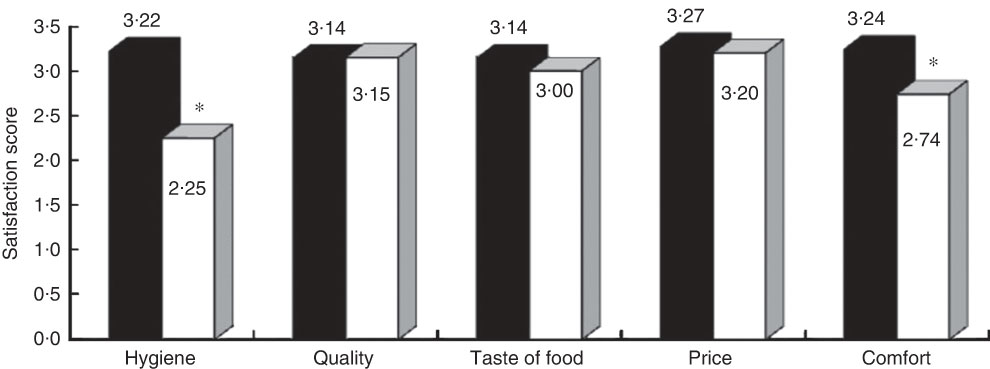
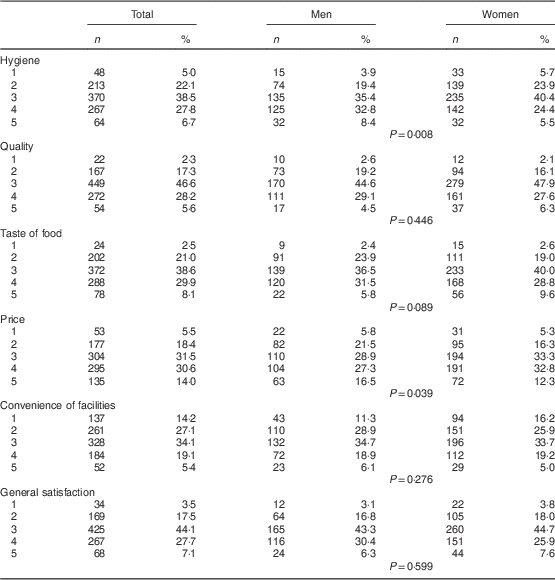
With respect to participants’ satisfaction levels (Table 2), 44·1 % gave an average score (3) to the combination of surveyed aspects of the catering services (hygiene, quality, taste of food, price and comfort of the dining rooms). Women gave hygiene and comfort lower scores (P<0.05), while both sexes gave similar scores for quality, taste of food and price (Fig. 1).
Satisfaction scores for five aspects of the university catering services by sex ( , men;
  , women) among 964 students (381 males; 583 females), Complutense University of Madrid, Spain, 2011. Mean score differed significantly between men and women: *P<0·05
Levels of satisfaction with five aspects of the university meal services and general satisfaction (number and percentage of participants assigning each score from 1 to 5), overall and according to sex, among 964 students (381 males; 583 females), Complutense University of Madrid, Spain, 2011
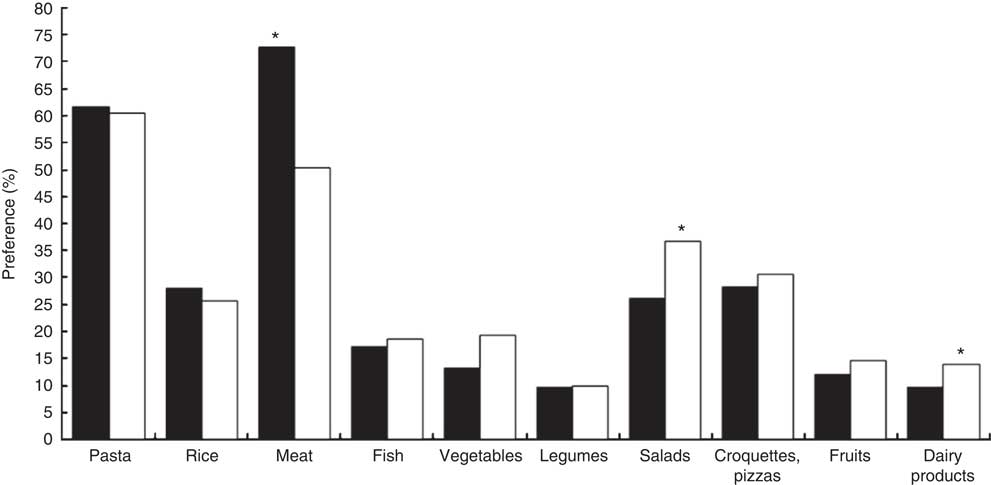
Regarding food choices, 61·0 % of students preferred pasta dishes, followed by meat (59·1 %) and salads (32·5 %). The least popular dishes were vegetables (16·8 %), fruits (13·6 %), milk products (12·2 %) and legumes (9·8 %). Women more often chose vegetables, salads, milk products and legumes and men more often chose meat (Fig. 2).
Food preferences according to sex ( , men;
  , women) among 964 students (381 males; 583 females), Complutense University of Madrid, Spain, 2011. Preference for the food item differed significantly between men and women: *P<0·05
Of the students, 20·1 % were following special diets in the present study. The majority of these were for losing weight (8·9 %), followed by special diets for vegetarians (2·6 %), athletes (2·2 %), diabetes (1·4 %), allergies (1·2 %), coeliac disease (1·2 %), hypercholesterolaemia (0·9 %), religious reasons (1·0 %) and other causes (0·7 %). More than half of those who needed to follow a special diet (59·2 %) asserted that they found it difficult to follow this diet at the university cafeteria and believed that this problem affected their academic performance.
Discussion
Although several authors have analysed the eating habits of Spanish university students( Reference Soriano, Moltó and Mañes 6 – Reference Cervera Burriel, Serrano Urea and Vico García 8 ), they have not analysed this issue with regard to the catering service of the university. For this reason there are no strictly comparable previous data. However, preferences for pasta and meat and low consumption of vegetables, fruits and legumes are results that coincide with those reported for the college population of Valencia( Reference Soriano, Moltó and Mañes 6 ), Navarra( Reference Durá Travé and Castroviejo Gandarías 7 ) and Albacete( Reference Cervera Burriel, Serrano Urea and Vico García 8 ). Among the latter Spanish university the demand for special diets was approximately half that observed in the present study (9·52 %), although cases of diabetes (3·17 %) and coeliac disease (1·16 %) had higher prevalence.
The university years are a critical stage for establishing and promoting healthy lifestyles and several studies have demonstrated the impact of food habits in this period( Reference Papadaki, Hondros and Scott 9 ). One study published in 2005, with a sample of 764 American university students (47 % men and 53 % women), on weight changes, dietary habits and physical exercise in the first two years of their degree, provided results showing that body weight had increased in 70 % of students, did not vary in 3 % and decreased in 26 %, with an average increase of 4·1 (sd 3·6) kg. These variations were produced mainly due to a decrease in physical exercise and a continuously unhealthy diet, with a high intake of fatty foods and insufficient consumption of fruits and vegetables( Reference Racette, Deusinger and Strube 10 ).
Similarly, in 2006 a study was carried out at the public Basque Country University on a sample of 749 volunteers (68 % women and 32 % men) presenting a prevalence of overweight and obesity of 17·5 %. That study concluded from its analysis that the students’ diet quality index was low: 31·93 (sd 5·62), i.e. 50 % of the optimum quality index, being better among women and those who consumed alcohol with less frequency (3 times/week) and worse among men and those with overweight and obesity( Reference Arroyo Izaga, Rocandio Pablo and Ansotegui Alday 11 ). Another study from 2007 carried out at the same university with the participation of 111 students (seventy-five men and thirty-eight women) also evaluated the students’ diets. The results showed that the majority presented a low intake of carbohydrates and excessive intakes of fats and proteins, also observing a deficiency in fibre intake( Reference Irazusta Astiazaran, Hoyos Cillero and Díaz Ereño 12 ).
The results obtained from these and other studies allow us to better evaluate which guidelines would be appropriate for achieving the main goal of improving lifestyle habits in young people, in order to reduce or delay the appearance of chronic diseases in later life.
The report of the Joint FAO/WHO Expert Consultation( 13 ) presents general recommendations for establishing nutrient intake goals. In this same line, improving diet together with the promotion of physical activity have been clear objectives of institutions in the European Union (EU) in recent years. All actions taken and planned in the EU are from the ‘Green Book’ and the ‘White Book’( 14 , 15 ). The ‘Green Book’ is a guide to promote healthy eating and physical activity focused on the prevention of overweight, obesity and chronic diseases. The ‘White Book’ is a document that governs the European strategy on health issues related to nutrition, overweight and obesity. Through these documents, the EU has declared its intention to establish an integrated approach to reduce health problems related to poor eating habits, overweight and obesity. Their content is based on the initiatives taken by the Commission; for example, the European Platform for Action on Diet, Physical Activity and Health( 16 ). The EU promoted the ‘Eurodiet’ Project precisely in this sphere( 17 ), which proposed quantified objectives on the intake of nutrients by the population, highlighting the need to translate these objectives into dietary guidelines or guides based on foods. These recommendations should be based on common dietary models in the affected population and should take into account its socio-economic and cultural factors( Reference Masset, Monsivais and Maillot 18 ). With these guidelines, the Spanish Society of Dietetics and Food Sciences has published dietary recommendations for the Spanish population based on the Mediterranean diet( Reference Martínez Álvarez, Villarino Marín and Iglesias Rosado 19 ) and has developed the ‘Wheel of Food’( Reference Martínez Alvarez, Villarino Marín and Arpe Muñoz 20 ) didactic tool that assesses diet quickly and simply.
Although there are some limitations, such as the failure to consider the consumption of drinks, the purpose of the present study was to obtain information on the eating habits of college students in order to implement measures to correct the unhealthy behaviours. Therefore, the results of the survey have been transferred to the responsibility of the Healthy University Program. The UCM is part of the Spanish Network of Healthy Universities (REUS) supported by the Ministry of Health, the Ministry of Education and some autonomous departments of Public Health. This network was established in 2008 with the aim to strengthen the role of universities as institutions promoting the health and welfare of their students, staff and society as a whole.
To be considered healthy, a university must develop its potential as an agent promoting the health, well-being and quality of life of those who study and work in it. The catering services located in the UCM campus are private companies that have obtained the concession in public contest and for a specific time. Although they are private companies, they are subject to inspection and must agree to maintain an affordable price range. Therefore, if there is willingness on the part of the university authorities, such establishments also may be subject to regulations as to the type of dishes they offer. The strategy to improve students’ diets, without ruling out other awareness raising and training, would be to adapt the food offer of restaurants and university canteens to the recommendations of the European and Spanish guides( 14 , 15 , Reference Martínez Álvarez, Villarino Marín and Iglesias Rosado 19 ).
Limitations
The findings of the present study are limited by the use of a sample of students from just six faculties of the UCM campus, which may not be representative of the entire university population. Moreover, although the study has not applied a validated questionnaire to quantify the degree of adherence to the Mediterranean diet, the food preferences indicated by participants allow us to know in a qualitative and approximate manner if the chosen dishes are part of the Mediterranean dietary pattern.
Conclusions
-
1. Of the surveyed population, 80·6 % used (to eat complete meals) the catering services of the different centres of the UCM once to three times weekly. Consequently, the nutritional importance of food intake in the university restaurants cannot be overlooked.
-
2. The global degree of satisfaction with the university meal service is low.
-
3. The most common choices of dishes and foods among students are far from the guidelines of the Mediterranean diet. Although pasta is one of the choices, fruits, legumes and vegetables do not form part of the most sought-after foods. Women are more likely to choose healthier foods and dishes, and they request a larger variety of salads.
-
4. It is interesting to highlight the high percentage of students requiring special diets (20·1 %).
-
5. It is apparent from the preferences in choosing dishes that students do not try to follow a Mediterranean diet. Therefore, it seems necessary to extend campaigns and policies related to diet to this sector of the population and to the management and food offer of university canteens.
Acknowledgements
Financial support: This research received no specific grant from any funding agency in the public, commercial or not-for-profit sectors. Conflict of interest: None. Authorship: The authors’ contributions are as follows. J.-R.M.Á.: design. R.G.A.: survey. A.V.M.: design. M.D.M.S.: survey. L.S.M.: statistics. All authors have read and approved the final submitted manuscript. Ethics of human subject participation: The study was approved by the Ethics Committee of the Faculty of Medicine of the UCM. The respondents gave informed consent and data were coded to ensure confidentiality.



