




In August 1934, Redcliffe N. Salaman set out from Cambridge for the Outer Hebrides, a remote chain of islands off Scotland’s west coast. Funded by the newly formed Potato Marketing Board – a semi-public body with regulatory authority over the potato trade – he spent five weeks visiting windswept islands, accompanied by the expedition’s photographer, his wife Gertrude Salaman (née Lowy).Footnote 1 For part of the journey, they were joined by John P. Doncaster, an entomologist at the Potato Virus Research Station (PVRS), which Salaman had directed since its founding in 1926. Somewhat unexpectedly, the team was searching for the most barren, windswept islands they could find (Figure 1). In these uninhabited Atlantic outposts, Salaman hoped to discover ‘a natural protective mechanism in favour of the potato’.Footnote 2
‘Isle of Handa. Large areas of relatively level land stretch down from the figures in the photograph and would accommodate large third year plots.’ From Redcliffe N. Salaman, ‘Report on a scheme for raising virus-free potato stocks’, unpublished typescript, 1934, Yule.b.38, Cambridge University Library, Cambridge, pp. 84, 86. Photograph by Gertrude Salaman. One of these figures may be Salaman himself. The importance of ‘third year plots’ in Salaman’s proposed scheme is discussed below. Reproduced by kind permission of the Syndics of Cambridge University Library. The copyright holder could not be identified or traced despite diligent efforts.

Figure 1 Long description
Two people stand near the center of the frame on open ground. A sloping hillside rises behind them, with scattered rocks and boulders across the slope. A strip of sky runs along the top edge above the ridge line. The figures are small within a wide view of the landscape.
To understand what Salaman and his team sought, one must return to the early 1920s. At that time, a new category of plant pathogen affecting potato yields was identified: viruses.Footnote 3 Researchers soon discovered that aphids – a type of sap-sucking insect – spread some of the most destructive viruses. This scientific breakthrough prompted the creation of insect-free spaces, including specialized glasshouses and isolated experimental sites. As understanding of virus transmission deepened, virus-free seed potato production became a practical goal. Though still rooted in horticultural tradition, these schemes increasingly drew on emerging scientific techniques and regulatory ambitions. Salaman believed that such efforts should be based in remote, wet and windy locations where an aphid-unfriendly climate would protect seed stocks from infection. He expected to find just such conditions in the Outer Hebrides.
Salaman saw the Outer Hebrides less as a laboratory for controlled experiments than as a potential field extension of the work at the PVRS.Footnote 4 In some respects, barren islands resembled large-scale insect-proof glasshouses, where healthy tubers could be protected and multiplied. The Hebrides allowed Salaman to envision a level of control over both environmental and human factors in potato cultivation that he believed unattainable elsewhere, thereby blurring the boundaries between field site, laboratory and regulatory infrastructure.
While Salaman’s scientific work has received little historiographic attention, he is well known among those interested in the history of potato cultivation. His The History and Social Influence of the Potato, first published in 1949, remains a landmark.Footnote 5 Yet Salaman was more than a potato historian; he was an independently wealthy and well-connected individual engaged in diverse social, scientific and cultural causes.Footnote 6 This article presents him as an amateur plant geneticist transitioning successfully into professionalized, state-funded agricultural research, exemplifying how informal expertise evolved into institutional scientific authority. Examining this aspect of Salaman’s career begins to bridge a gap in historiography on the origins of plant virus research, which has mainly focused on other national contexts, research topics and periods.Footnote 7 Moreover, plant breeding has often overshadowed plant pathology in historical studies, with viral crop diseases receiving limited attention.Footnote 8
This article chronicles the creation and early years of the PVRS, established to explore the possibility of producing virus-free seed potatoes in Britain. The PVRS soon expanded into a broader enterprise focused on identifying, studying and controlling potato virus diseases. It then examines Salaman’s unpublished Report on a Scheme for Raising Virus-Free Potato Stocks (1934), detailing his journey around the Outer Hebrides and the feasibility of basing a national seed potato production system there. Finally, the article traces Salaman’s efforts to promote his scheme and its apparent influence on later government initiatives.
Salaman’s scheme involved a diverse group of actors, including potato growers, plant pathologists, seedsmen and government officials. It was shaped by various factors, from sociopolitical conditions and agro-economic trends to biogeographical and climatic constraints. These interactions gradually transformed practical craft knowledge into a modern scientific domain. Salaman’s work exemplifies the broader shift toward government-sponsored, centralized agricultural science focused on improving crop yields from the early twentieth century through the interwar period.Footnote 9
Salaman’s proposal for producing virus-free seed potatoes faced challenges from difficult obstacles, including resistant farmers, troublesome insect vectors and enigmatic plant pathogens. Ultimately, this article recounts his efforts to assert control over potato cultivation in the name of seed health, a pursuit spanning from university-adjacent glasshouses to recently depopulated islands and laying the groundwork for strategies that still underpin potato seed certification systems today.
Salaman stood at the crossroads of different approaches to science making.Footnote 10 His work bridged traditional plant breeding with cutting-edge advances in the life sciences, including heredity, microbiology and infectious-disease research, which were closely interconnected at the time.Footnote 11 This expertise enabled Salaman to navigate the often-contradictory interests of various groups and to propose an ambitious nationwide potato disease control scheme. His proposals developed amid competition, conflict and negotiation over how and where best to produce the potatoes needed to feed Britain. Reaching agreement on specific disease control methods proved challenging. This article argues that rather than a neutral unfolding driven by scientific expertise, an increasingly dominant governmental regulatory apparatus favoured certain actors or interpretations according to state interests.
Over the twentieth century and into the present, increasingly sophisticated seed health certification systems have emerged, relying on strictly controlled, aseptic environments to produce disease-free seed.Footnote 12 These environments exclude not only viruses but also fungal and bacterial pathogens. Few other crops are subject to the same level of phytosanitary scrutiny as the potato. This article does not offer a detailed history of seed potato classification schemes over the past century. Rather, it foregrounds Salaman’s long-forgotten proposal as part of the tentative and contested process that led to consensus on using certified seed.
It is also worth noting that by ‘seed potato’ this article means the tubers used in the vegetative propagation of clones of plants kept in previous seasons, which is the standard method for commercial potato cultivation. This form of reproduction differs from propagation by botanical seed, produced sexually and contained in a small tomato-like fruit often referred to in scientific literature as ‘true potato seed’. Clonal reproduction is preferred for commercial cultivation, as potatoes are not ‘true to seed’: plants grown from botanical seed are unlikely to retain the characteristics of their progenitors.
Finally, while fruitful parallels have been drawn between the histories of agricultural and medical sciences – and it is tempting to do the same in Salaman’s case, given his background as a physician – such a comparison is best reserved for another occasion.Footnote 13 It is worth noting, however, that Salaman himself believed that none of his prior experience had adequately prepared him for his work in plant pathology.Footnote 14
The creation of the Potato Virus Research Station
Forced to abandon a medical career after a bout of tuberculosis, Salaman initially tried to establish himself as a gentleman farmer in the Hertfordshire village of Barley. There, he drifted into the Mendelian study of heredity, unsuccessfully dabbling in various animal studies with specimens provided by William Bateson, a pioneering geneticist and acquaintance based at the nearby University of Cambridge.Footnote 15 Eventually, Salaman decided to try what he called a ‘common kitchen-garden vegetable’, a category he felt was under-studied. On the advice of his head gardener, he began focusing on potatoes in 1905, researching topics such as tuber colour and the pollen sterility of certain varieties.Footnote 16 Drawing on domestic resources, Salaman used his kitchen garden as an experimental space, where he first explored potato genetics.Footnote 17 Over the following years, he gained the support of growers, breeders and seedsmen, who, he found, were ‘conversant with the new Mendelian principles’ and keen to support his scientific work.Footnote 18
Following in the footsteps of his Cambridge-based scientific contacts, such as Rowland Biffen, who focused on cereal crops, Salaman had turned his attention by the 1910s to controlling plant diseases, particularly breeding potatoes resistant to late blight.Footnote 19 By the post-First World War period, he had also become interested in wart disease. Both diseases, thought to be fungal in origin, had a significant impact on potato crops.Footnote 20 In the case of wart disease, resistant varieties had already been developed by various breeders and promoted by local agricultural authorities. These fragmented efforts led to the formation of the Potato Synonym Committee, established by the Royal Horticultural Society with government backing. Its aim was to curb speculative activity by potato merchants by standardizing variety names and promoting those proven, through careful trials, to be wart-immune.Footnote 21
These developments were not unique to either the potato or Britain. Cereals, especially wheat, were also among the first crops brought under the control of synonym committees starting in 1917, and more permanently from 1920.Footnote 22 From the mid-1920s, both potatoes and cereals in Germany were subject to seed certification schemes and varietal classification commissions.Footnote 23 Similar initiatives emerged in the United States in the early 1920s, as crop nomenclature became increasingly regulated.Footnote 24
Paralleling developments in the cereal sector, and led by Salaman from 1920, the Potato Synonym Committee had support from the potato trade, including large seed companies that could more easily absorb the financial burden of developing and introducing new varieties.Footnote 25 Some, however, resented the committee’s authority – personified by Salaman – over what had previously been managed internally by the trade.Footnote 26 Nevertheless, its work was generally seen as successful in official circles. The Board of Agriculture for Scotland had run a similar scheme since 1918 in collaboration with growers and traders, incorporating field inspections and a strict stock health classification system. Its success bolstered the reputation of Scottish seed potatoes for purity, reinforcing their dominance in the British market.Footnote 27
Late blight and wart disease were then considered two of the three major ‘limiting factors’ in potato cultivation, the third being a group of poorly understood pathologies known as ‘virus diseases’.Footnote 28 When Salaman began potato research in the early 1900s, these were generally thought to be symptoms of ‘varietal degeneration’: potato stocks, being vegetatively propagated, were believed to become ‘senile’ or ‘worn out’ over time.Footnote 29 Others attributed the problem to inadequate cultivation practices or climatic conditions. In 1909, for example, when Salaman observed a ‘curious ruffling of the leaves and dwarfing of my young plants’, Arthur Sutton – a respected breeder and seedsman – diagnosed them as ‘miffy’. Sutton suggested sending the degenerated tubers to his Scottish facilities for a season, where the climate was thought more favourable to potatoes.Footnote 30 The stocks did not improve, but Salaman claimed to have maintained an interest in the subject thereafter.
A decade later, wart-immune potato varieties had become commercially available, and late blight-resistant ones were expected to follow.Footnote 31 The new challenge for potato growers was virus diseases: little-understood pathogens that, unlike most fungi, could not be cultured in vitro, were too small to be seen under an optical microscope, and passed through filters that retained other known microbes.Footnote 32 During this period, researchers began associating specific symptoms with particular viral infections, sometimes depending on the potato variety. For example, ‘leaf-roll’ and ‘mosaic’ were recognized as distinct diseases based on consistent symptom patterns. Investigators employed methods such as grafting diseased scions onto healthy rootstocks and mechanically inoculating plants with infectious material via fine needle punctures to study transmission. Yet, despite these advances, such experiments failed to explain how infections spread under natural field conditions, leaving key aspects of virus epidemiology unresolved.Footnote 33
By the 1910s, researchers in North America had identified leafhoppers and aphids as likely vectors of several viral diseases affecting crops such as sugar beet, sugar cane and maize. In 1919, several British agricultural officials attended an International Phytopathological Congress in the United States and returned convinced of the pathogenic nature of potato ‘degeneration’.Footnote 34
Then, in 1920, Henrik M. Quanjer and J.G. Oortwijn Botjes in the Netherlands used rudimentary glasshouses to identify aphids – particularly Myzus persicae (also known as the greenfly, potato-peach aphid or green peach aphid) – as vectors of potato virus diseases.Footnote 35 This raised concerns within the British agricultural science community about how to safeguard one of the country’s staple crops, and several research groups were tasked with studying potato virus diseases and their suspected vectors.Footnote 36
In late 1921, the Ministry of Agriculture and Fisheries (MAF) and the Royal Agricultural Society – represented by a motley group of breeders, seedsmen and independent scientists – jointly organized an international conference on potato cultivation. One of its main aims was to bring British scientists up to date with recent advances in overseas potato research.Footnote 37 Another was to persuade British growers and others in the sector that ‘degeneration’ was caused by an infectious pathogen, rather than the exhaustion of an ancestral mother plant.Footnote 38
Two aspects of potato virus research particularly caught the attention of British agricultural authorities at the conference. First, they considered whether a disease control and certification scheme for leaf roll and mosaic could be established, similar to that for wart disease.Footnote 39 This proposal was met with suspicion by potato growers, wary of further Synonym Committee-style interference.Footnote 40 Second, they questioned why colder, wetter regions were thought to produce healthier seed potatoes. It was well known that Scottish producers dominated this market, supplying most of the seed sold in England. Many wondered whether alternative seed production sites could be found elsewhere in Britain, such as north Wales, which shared morphological and climatic similarities with parts of Scotland.Footnote 41 Ultimately, the MAF assigned different institutions to pursue these research avenues.Footnote 42
Salaman was quick to adapt to shifting trends in potato research. In 1921, he expressed interest in understanding why some potato varieties that had long ‘degenerated’ in England continued to thrive elsewhere. Stocks from the Orkney Islands, off Scotland’s northern coast, initially performed well in his garden, showing only minor infection symptoms, but by the next season had become ‘so degenerate, in truth so intensely affected with curly dwarf as to appear more like Brussels Sprouts than Potatoes’.Footnote 43 While he still doubted that aphids were disease vectors as late as 1923, by 1925 he had changed his mind and enthusiastically promoted the idea.Footnote 44
During the early 1920s, Salaman remained a peripheral figure in the virus research milieu. He was a wealthy independent scientist who conducted experiments in his home garden using makeshift tools. However, his role as head of the Synonym Committee earned him the respect of his scientific peers. Salaman estimated that potato virus diseases reduced crop yields by between 30 and 50 per cent, costing Britain between five and ten million pounds annually, and called for action to end this waste of resources. He argued for an ambitious approach in which scientifically selected virus-free stocks were multiplied in isolation before being released into the potato trade. This went beyond the crop inspection schemes in place in countries such as Scotland and the United States.Footnote 45
Salaman viewed the sites that scientists had selected for experimental work as insufficiently isolated from insect vectors. Fortunately, he believed that alternatives existed in the ‘scores of minute islands – rocky eminences of a few acres off the west coast of Britain – which are anything from a mile and upwards from each other and the mainland’. His proposed scheme also called for the creation of large scheduled areas where potato cultivation would be strictly controlled. This extraordinarily ambitious plan, Salaman admitted, would require ‘a small army of inspectors, a new plague of forms, and an inquisitorial survey of other people’s business’. Nevertheless, he maintained that ‘unless some very determined and, I fear, autocratic, method be employed, I have no confidence that the problem can be solved on this or any other lines’.Footnote 46
Salaman’s forceful tone was not well received by government officials, who opposed his involvement in any research initiatives. They considered it more likely that government-funded work on potato diseases – viral and otherwise – would be based at a well-established institution such as Rothamsted Experimental Station. Yet Salaman was well connected within the MAF, whose chief scientific adviser, Alfred Daniel Hall, was a close friend. Against expectations, in 1925 Salaman was invited to lead a proposed research station on potato virus diseases: the PVRS, based in Cambridge, where he already had strong ties to the School of Agriculture.Footnote 47 Officially, the PVRS was attached to the Plant Breeding Institute, with Salaman appointed as vice director. Though he later admitted that, at the time, he ‘was never a botanist and knew no phytopathology’, he had identified a novel field of research and did not shy away from the opportunity to leave his mark.Footnote 48
Salaman’s ability to build alliances with key figures in the potato world should not be underestimated. Still, he benefited from a favourable political moment, shaped by rising agricultural production and market demand, which the government was keen to support. The creation of the PVRS took place against a broader backdrop of institution building in agricultural science in interwar Britain, with Cambridge as one of its main centres. This continued a trend dating back to the 1909 Development Commission and wartime agricultural campaigns, which by the 1920s had led to the emergence of a new kind of scientist working in experimental and institutional settings markedly different from before.Footnote 49
The building up of virus-free seed potato stocks
Salaman spent part of 1926 travelling around Scotland and Ireland collecting tubers from seemingly healthy plants in the fields of seed growers and potato breeders.Footnote 50 In 1927, he travelled across Ireland with Paul A. Murphy, who had led a research programme on potato virus diseases at the Department of Agriculture and Technical Instruction and the Albert Agricultural College.Footnote 51 Murphy’s integration of glasshouse experiments, fieldwork and collaboration with agricultural authorities provided the model that Salaman hoped to emulate.Footnote 52
Throughout the late 1920s and the 1930s, Salaman regularly travelled to reputed seed-growing regions in Scotland and Ireland. These trips, in search of potentially virus-free plants, usually took place in early July, just before harvest and as aphids reached peak activity. This was his opportunity to assess crop health and select individual plants from which ‘a single young tuber [was] filched’. Dozens of these ‘healthy units’ were bagged individually, labelled and brought back to Cambridge.Footnote 53
By the late 1920s, insect-proof glasshouses were essential to plant virus research, and Salaman made building one in Cambridge a priority, using designs borrowed from Dutch colleagues. The PVRS initially consisted of this glasshouse and a ‘potato library’ – a store of healthy stocks – both regularly fumigated to eliminate insects.Footnote 54 Salaman also recruited entomologists, the first being Kenneth M. Smith, one of the few British researchers with experience studying potato virus vectors.Footnote 55
Salaman’s research plan focused on carefully isolating his subjects. The first step was to obtain purportedly healthy seed from reputable producers. These tubers were cut in half and grown separately in experimental plots and in the glasshouse, the latter serving as a control. Scions from apparently healthy plants were grafted onto varieties showing consistent symptoms when infected with known viruses. Tissue from plants under test was also inoculated and transferred to other solanaceous plants (the botanical family that includes the potato) for the same purpose. This cycle was repeated over several growing seasons until ‘clean’ stock was selected. Despite drastic roguing (removal of undesirable specimens) and continuous testing, some varieties never yielded uninfected specimens. Where pathogen spread seemed unlikely, no clear symptoms were observed and yields were acceptable, infected stocks were accepted as ‘second best’ and retained.Footnote 56
‘And then began our real tribulations,’ noted Salaman. Despite the difficulties of obtaining virus-free seed, the next step was even more challenging: multiplying stocks in the open so they could be supplied to commercial seed growers.Footnote 57 Each step away from controlled settings meant higher infection levels in stocks. While some reproducibility was expected between laboratories, it was harder to achieve in field experiments. This pushed Salaman to find ways to extend laboratory control over potato crops beyond its usual limits.Footnote 58
Outdoor plots were never set ‘on potato land’ where ‘groundkeepers’ – plants emerging from unharvested tubers – could serve as potential reservoirs of disease.Footnote 59 ‘Clean-stock plots’ were placed in cereal fields in ‘islets’ on ‘the chalk hills in the neighbourhood of Barley’, where Salaman lived, or in nearby areas.Footnote 60 The reasons, as with many of Salaman’s practices, were, in his words, ‘partly practical, and possibly partly fanciful’. He believed that aphids blown by the wind would be stopped by cereal stalks. Moreover, although cereal fields were often poorly suited to potato cultivation, they offered the advantage of keeping potato plots away from gardens and allotments, where infected plants and their insect vectors were more likely to be found.Footnote 61
Plots containing a few dozen plants were regularly inspected and rogued by PVRS staff, especially during summer when aphids were most active. Eventually, tobacco plants (also solanaceous) were added to act ‘as an index of what is happening’ and ‘give warning that infective aphids have reached the plot’, as they reacted more predictably to virus infection. In Salaman’s view, his approach had been successful, as the number of infected specimens remained trivial in ‘isolation plots’, even in years when crops elsewhere were severely affected.Footnote 62
By the late 1920s, Salaman had firmly established himself within the international community researching potato virus diseases. He also translated this expertise into political influence, using his authority in discussions on the regulation and governance of potato cultivation and trade in Britain. These debates had gained urgency as seed potato certification schemes across North America and Europe began to go beyond varietal consistency and increasingly focused on plant health, particularly freedom from virus infection.Footnote 63
By 1929, the MAF was discussing the possibility of creating a ‘national mark’ certifying inspected potato stocks for export as free of virus diseases.Footnote 64 Shortly after, the Cumberland and Westmorland Seed Potato Growers’ Association requested the establishment of a seed certification scheme in their region. In both cases, Salaman advised that it was impossible for an inspector to quantify the degree of virus infection within a stock. There was, he argued, no standard yet available to support such certification. Although the ministry refused the growers’ request, it declined to publicize its reasoning – since admitting that there was no scientific basis for virus-free certification risked undermining the newly established Scottish system.Footnote 65
Starting in 1931, the Scottish Board of Agriculture officially added virus disease control to its potato certification scheme. Scottish officials had followed the example of other countries, including the Netherlands, Canada, Ireland and the United States. Salaman, however, was keen to lead the MAF in a different direction, opposing the creation of a parallel system in England and Wales.Footnote 66 He instead called for further fundamental research into the nature of plant virus diseases and their pathogens, and ultimately for a much more strictly controlled crop protection scheme.Footnote 67
Salaman claimed his stance was grounded purely in science. However, if growers could certify and commercialize their stocks as they did wart-immune varieties, the MAF might cease funding research into potato virus diseases, the problem appearing solved. This would cost Salaman his position as research station director – a role he valued – and return him to amateur status. As he later admitted, when forced to retire due to age, without a scientific institution for potato research he would become a ‘nobody’.Footnote 68 Moreover, while Salaman was interested in further research into the nature of viruses regardless of their agricultural significance, funding was only likely if they remained a threat to crops. Thus establishing a seed potato production scheme dependent on sustained cooperation with the PVRS would likely ensure the station’s future.
By the early 1930s, Salaman was confident that his virus-free seed stocks – multiplied in the open and tested across Britain – compared favourably with commercial Scottish stocks. He had shown that healthy ‘basic stock’ could be grown in southern England, but expanding isolated plots in cereal fields was impractical. While the PVRS had been set up to produce the healthiest seed, Salaman believed it was time for these stocks to pass ‘from the hands of the scientist to those of the intelligent seed-producer’. The next step was clear: to ‘grow the finest seed obtainable in the finest land’. That is, to grow PVRS’s stocks in Scotland.Footnote 69
Most of the Scottish seed producers Salaman tried to enlist as partners were less than enthusiastic. Seed growers demanded ‘truck loads, at relatively low wholesale prices’, not the mere ‘bushels’ of seed the PVRS could supply. Furthermore, while producers acknowledged that Salaman’s seed potatoes were indeed ‘outstanding’, they remained unconvinced ‘that their own home-grown seed is not good enough for practical purposes’. Salaman’s solution was for seed producers to multiply the virus-free stocks themselves, over a couple of years after acquiring a small amount from the station. Since ‘basic clean stock’ could be purchased from Cambridge annually, seed sold to potato growers would never be more than four or five years – or generations – ‘out’ of the glasshouse, limiting the period during which stocks could become infected.Footnote 70 He promised potato yield gains of 20 per cent if his suggestions were followed.Footnote 71
A scheme for raising virus-free potato stocks in the Outer Hebrides
British growers had long known that seed from certain areas, such as the bleak, high-altitude moorlands, made better replacement stocks. Yet the reasons why these seeds were healthier remained unclear until the early twentieth century.Footnote 72 By the late 1920s, Murphy and other researchers had confirmed that seed potatoes produced in specific coastal areas of Scotland and Ireland were especially healthy, generally free of virus diseases.Footnote 73 It was suggested that this might be due to the harsh local climate reducing populations of disease-carrying aphids.Footnote 74 While localized aphid surveys had been conducted in Ireland and Wales, similar systematic fieldwork was lacking in Scotland. Salaman’s ‘entomologist-assistant’, John Doncaster, began to bridge this gap, conducting exploratory visits around Scotland each summer, starting in 1930.Footnote 75
Salaman had become convinced that the ideal sites for producing virus-free potato stocks would be isolated and as naturally aphid-free as possible. When funding was provided by the Potato Marketing Board, Salaman embarked on a five-week research trip to the Outer Hebrides and north-western coast of Scotland. There, prevailing westerly winds prevented aphids from reaching the islands from the mainland, while the ‘moist winds’ and ‘heavy rainfall’ further limited their spread.Footnote 76 Salaman’s research trip took his team to nineteen islands and islets, which were carefully described from an agrogeographic perspective. At each site, soil types were identified, local vegetation was recorded and any locally grown crop varieties were listed. Importantly, Doncaster confirmed that the ‘otherwise ubiquitous and prolific’ aphids were scarce at most of the locations visited.Footnote 77
Salaman’s hypotheses were influenced by Murphy’s parallel work in Ireland, where he co-created what Salaman called ‘the first scientifically controlled scheme for potato seed raising in the world’.Footnote 78 In cooperation with the Irish Department of Agriculture, in 1928 Murphy began to ‘build up virus-free stocks’ in Donegal, a rural north-western coastal region with a wet, windy climate where aphids were nearly absent. The quality of Irish potato seed rapidly improved, and, by the early 1930s, virus-free stocks of various varieties were available to growers.Footnote 79
As with Murphy’s surveys of Ireland’s western coast, Salaman found in the Hebrides further evidence of the protective effect of the climate on the local cultivation of potato varieties long abandoned elsewhere due to virus susceptibility.Footnote 80 As Murphy put it a few years later, ‘our potato has all the characteristics of a maritime plant and is proverbially at home in islands’.Footnote 81 Hebridean tenant farmers, or crofters, shared this view and hardly saw virus diseases as a threat to their potatoes. At the same time, Salaman emphasized that while the local climate was harsh enough to deter aphid colonization, it was also ‘exceptionally temperate’ and suitable for seed production.Footnote 82
Salaman’s report includes extensive information on the social, political and economic aspects of potato cultivation. This ranged from the broad structure of land ownership to the specific size of trays growers used to transport potatoes. Such detailed, quasi-ethnographic observations of crofting life supported Salaman’s efforts to justify a future seed production project in the Outer Hebrides. For instance, he believed that crofters’ motorboats, used for transporting sheep, could easily be repurposed for potatoes and farming equipment.Footnote 83 Regarding land ownership, he found it unwise to establish seed production on islands controlled by ‘aristocratic landowners’ who might resent potato plots encroaching on their sheep runs and game reserves. Perhaps surprisingly, despite earlier conflicts with growers’ associations, he preferred basing seed production on ‘commoner lands’, negotiating with ‘crofter committees’ over whom government officials had more leverage.Footnote 84
To Salaman, establishing seed plots on islands held in ‘communal tenure’ was preferable, but the presence of crofters themselves was not. He observed that many islands – some previously subjected to forcible removals during the Highland clearances in the previous century – had been abandoned or were likely to be deserted soon, as younger generations moved to the mainland in search of opportunities. These islands were among those Salaman saw as most promising, with a proven record of crop productivity and no crofter-owned potato plots to serve as pathogen reservoirs. Isolation from aphids and humans improved seed health.Footnote 85
Salaman believed that, given the climatic advantages of the archipelago, ‘theoretically the scheme should work almost by itself’. However, the production of virus-free seed potatoes in the Outer Hebrides would only succeed if each island grew a single variety. Ideally, these would be from the Synonym Committee’s wart-immune list, with specific strains thoroughly tested at the PVRS. This requirement clashed with crofting practices, as crofters typically grew what Salaman considered an indiscriminate mix of varieties. Regardless of his reservations, the scheme would still rely on crofters for labour, though each site was to be overseen by a ‘man on the spot’ responsible for in situ supervision.Footnote 86
Salaman was encouraged by the existence of a potato seed registration scheme already under way in Scotland, even if it was voluntary and relied mostly on visual inspection. Scottish institutions such as the Macaulay Institute for Soil Research supported his investigations, which is unsurprising, given that the scheme would formalize the Scottish seed potato industry’s quasi-monopoly.Footnote 87
On his return to Cambridge, Salaman felt vindicated in his long-held belief that isolation was the primary defence against potato virus diseases. He quickly designed a more complex virus-free seed potato production scheme spanning Britain, from the Outer Hebrides to the major ware potato (grown for consumption rather than seed) regions in England. The goal was for all seed sold in Britain to originate from ‘tested virus-free basic stocks’ (Figure 2). ‘Purest seed’ from the PVRS – whose glasshouses would need to be expanded if the scheme were scaled up – would be sent to selected Hebridean islands and multiplied over three years on successively larger ones. It would then be shipped to ‘recognised commercial seed-raising areas’ on the Scottish mainland. There, Salaman aimed to entice professional growers, many of whom already had reputations for producing ‘to all appearances healthy’ stocks, by offering guaranteed prices for their seed.Footnote 88
‘Diagramatic [sic] representation of the Scheme designed to show its cyclic character by which the virus-free seed raised in the glasshouses of Cambridge finds its way to the householder’s table’. Salaman, ‘Report on a scheme for raising virus-free potato stocks’, op. cit., p. 4. Reproduced by kind permission of the Syndics of Cambridge University Library.
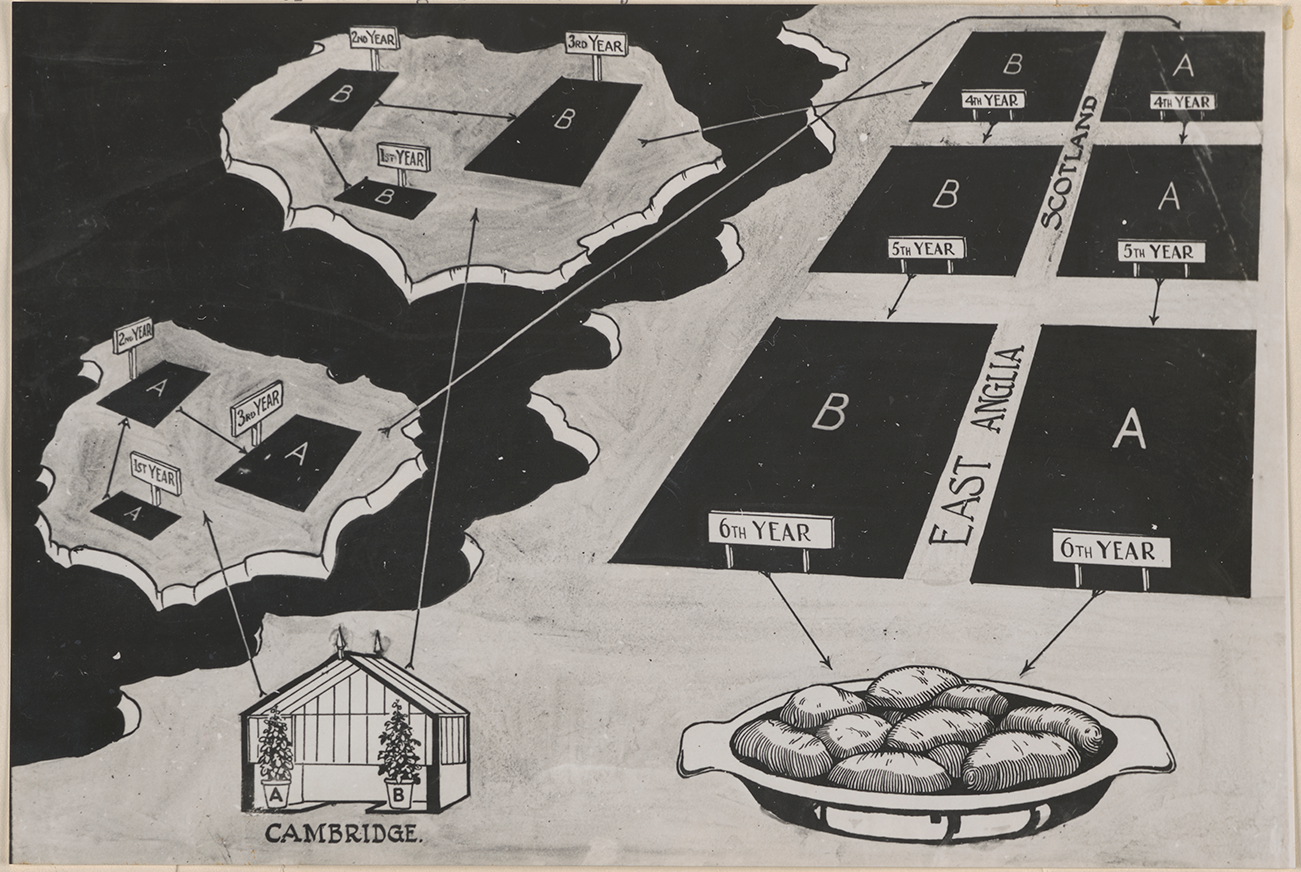
Figure 2 Long description
A stylized thematic map-diagram shows parts of the UK with a process flow drawn across regions. No north arrow or scale is shown. Text and labels on the map include CAMBRIDGE, SCOTLAND and EAST ANGLIA. Two separate island areas are shown to the left of the mainland; neither island area has a place name label. The scheme is encoded with large lettered blocks and year labels. Large blocks marked A and B appear in multiple locations. Year labels visible include 1st YEAR, 2nd YEAR, 3rd YEAR, 4th YEAR, 5th YEAR and 6th YEAR. Flow is shown by connecting lines between locations. A line runs from the CAMBRIDGE glasshouse drawing to the upper island area, then continues to the lower island area. From the lower island area, a line continues to the mainland area labeled SCOTLAND. From SCOTLAND, a line continues to the mainland area labeled EAST ANGLIA. On the right side, two stacked rectangular areas show repeated A and B blocks with year labels: the upper rectangle contains B with 2nd YEAR and A with 1st YEAR; the lower rectangle contains B with 4th YEAR and A with 3rd YEAR. On the main map, EAST ANGLIA contains a large A block with 5th YEAR and SCOTLAND contains a large B block with 6th YEAR. At the bottom right, a serving dish with several potato shapes is drawn, connected by the same line network, indicating the endpoint of the mapped scheme.
After two years of multiplication in mainland Scotland, the seed would be sent to the ‘great ware-raising districts of England’ – Lancashire and East Anglia – to be planted in growers’ fields. Salaman recommended that growers acquire new stocks from scheme-approved suppliers each year. Owing to the scheme’s cyclical nature, he believed that virus diseases would have little chance to establish themselves. As infected potatoes would not be regrown, aphids would have fewer opportunities to become infectious, making them an increasingly negligible threat.Footnote 89
To placate some of his opponents within the MAF, Salaman proposed extending his ‘Accredited Potato Seed Raisers Scheme’ to parts of England and Wales in the fourth and fifth years. However, he stressed the importance of protecting the accredited status of the stocks and warned the ministry that growers might be tempted to save potatoes for seed, thereby breaking the scheme’s circular design. Salaman also recognized the need to make the scheme acceptable to English seed producers, who risked being pushed out of business.Footnote 90 As with wart-resistant varieties, he anticipated opposition from some sectors of the potato trade.
The immediate aftermath of Salaman’s proposal
Little came of Salaman’s proposal in the immediate years after 1934, despite his efforts to promote it through various channels.Footnote 91 Nevertheless, he was well connected and quickly identified alternative routes within the agricultural-scientific establishment where aspects of his scheme could begin to take root.
Around this time, the National Institute of Agricultural Botany (NIAB) became involved in virus-free potato seed production. Based in Cambridge, this semi-public body was responsible for trialling and multiplying plant varieties developed at recognized research centres, with the aim of supporting their commercial use. Salaman, one of the NIAB’s founders, also operated his Synonym Committee for potato varieties under its auspices.Footnote 92
By the late 1930s, NIAB officials and inspectors were encouraging growers to keep potato stocks disease-free through isolation and roguing. They were, however, more accommodating than Salaman, believing that success depended ‘on the patience and enthusiasm of growers’ and recognizing that ‘any alteration of normal farming procedure inevitable excites opposition, and progress will be slow’.Footnote 93
While some modest alignment could be found with his colleagues at the NIAB, MAF officials remained unimpressed by Salaman’s plan. The central disagreement concerned differing interpretations of ‘virus-free’. Salaman’s insistence on absolute ‘purity’ appeared detached from practical agricultural realities. As early as 1934, government officials had grown weary of his ‘grandiose ideas and schemes’ and perceived self-aggrandizement. They repeatedly noted that other centres were proving more effective than the PVRS in conducting trials and designing local seed production schemes. Relations with the MAF further deteriorated due to Salaman’s parallel efforts to transform the PVRS into a fully independent research institute reporting directly to the ministry. This clashed with the original conception of the station as a temporary body, intended to close once seed potato production in England was established.Footnote 94
Researchers at the University College of North Wales had already proposed a competing seed potato production scheme in 1928, suggesting that the solution to the aphid problem was to study the aphids themselves.Footnote 95 Based on extensive fieldwork in Wales and Scotland, complemented by laboratory studies, they established that winged aphids could not fly in conditions of high humidity or strong wind. This discovery clarified the specific climatic factors that limited aphid spread.Footnote 96 Salaman saw these findings as further evidence supporting his plan and quickly incorporated them into his scheme’s promotion.Footnote 97 However, his Welsh colleagues believed that the best way to manage aphids was to plan potato cultivation according to the insect’s life cycle. With proper timing, seed potato production could be carried out at suitable sites beyond Scotland.Footnote 98
Among those sceptical of Salaman’s ideas were his own staff at the PVRS, notably Kenneth Smith, the entomologist-turned-virus researcher and second-most-senior researcher at the station. By 1934, Smith believed that while eliminating insect vectors would indeed halt the spread of the most significant potato virus diseases, this was ‘a policy of perfection’ that was ultimately unfeasible. He argued that efforts should instead focus on developing new varieties immune or resistant to disease or, more simply, on thorough roguing of stocks, a practice already widely used in Scotland and the United States.Footnote 99
Ultimately, if the percentage of infected plants did not significantly reduce growers’ income, who cared much about the ‘purity’ of stocks? Those in the potato trade were willing to cooperate with authorities only insofar as control schemes offered a commercial advantage or were legally required. In fact, growers had little choice but to comply with the increasing burden of regulations. For example, around the early to mid-1930s, membership in the Potato Marketing Board became mandatory for potato growers. This primarily benefited larger seed merchants, who generally already adhered to legislation concerning sample testing and inspections. Small traders, such as greengrocers and small-scale growers, had previously avoided these regulations but were now subject to tighter surveillance.Footnote 100
Seed certification schemes expanded in scope. In 1935, some regional growers’ associations in England and Wales were authorized by the MAF to certify their seeds as ‘Class I Special Stock’ if less than 10 per cent of specimens in a given batch displayed virus disease symptoms.Footnote 101 This label was meant to place certified Welsh and English seed potato on equal standing with Scottish and Irish competitors in the British market. The seed potato associations of Wales and Cumberland began submitting samples to be tested by the NIAB, where their seeds were confirmed to be of good quality.Footnote 102
By 1938, the NIAB was growing stocks of certified seed obtained from selected regions to promote their use among growers. These stocks were compared with once-grown stocks across England, with differences in infection levels, growth rates and yields highlighted. Officials aimed to show growers the benefits of using certified seed and the importance of isolation in preserving seed health.Footnote 103 These comparisons proved inconsistent: yield losses of once-grown seed, when compared to certified stocks, varied widely. Surprisingly, in some cases, the yield of English once-grown stock exceeded that of the Scotch seed controls. Contrary to Salaman’s expectations, the northern and western parts of the country did not necessarily produce healthier seed. Instead, outcomes were shaped by annual weather conditions, nearby crops that could host aphids, and the prevalence of other crop diseases, such as late blight.Footnote 104
Despite these difficulties, officials were increasingly confident in their capacity to evaluate new varieties’ resistance to virus diseases and, more importantly, in the quality of the seed produced under the various certification systems operating across Great Britain and Ireland.Footnote 105 By the late 1930s, many at the MAF had concluded that Salaman’s obsession with absolute seed health and varietal consistency was a problem. Even Hall, the ministry’s scientific adviser, who had lobbied for Salaman to lead the PVRS, admitted that ‘from a commercial point of view it was not essential to have botanically pure stocks’. A report by Smith on recent developments in chemical insect control in the United States convinced MAF officials that the issue of potato virus diseases might soon be irrelevant, as insect vectors would be dealt with efficiently through pesticides.Footnote 106
By the time Salaman retired in 1939, the PVRS had shifted its focus towards more fundamental research, moving away from large-scale field experiments in favour of greenhouse and laboratory-based approaches. This change was welcomed by Smith, who succeeded Salaman as director. He and his colleagues at the PVRS had long resented Salaman’s ‘feudal outlook’ and the lack of adequate laboratory facilities, which were becoming increasingly essential for the physico-chemical methods used in virus studies.Footnote 107 While Salaman relished his title as director of a research station, he was unwilling to relinquish his identity as a gentleman scientist, making him increasingly anachronistic. The institutionalization of agricultural research was beginning to render independent scientists a dying breed.
A key development around this time was the crystallization of a plant virus (tobacco mosaic virus) in the United States in 1935. Turning virus particles into solid crystals made it possible to study their structure in detail. Thus viruses were increasingly regarded not only as crop pathogens but also as particles whose study raised significant scientific questions within the research community.Footnote 108 Changes at the PVRS exemplify the growing bifurcation in 1930s plant virus research between those focused on agricultural applications – primarily crop disease control – and laboratory-based scientists pursuing fundamental studies, who increasingly used plant viruses as model organisms in broader biophysical and biochemical research. However, cross-pollination and collaboration persisted between these groups, notably at the PVRS under Smith’s leadership.Footnote 109
As Salaman expected, after his forced retirement in 1939 the control of potato viral diseases was no longer prioritized at the PVRS. The research scope of the station expanded to encompass all horticultural crops, becoming the Plant Virus Research Station.Footnote 110 Still, Salaman was not ready to give up his fight for virus-free seed production. He publicly criticized the ways in which the Potato Marketing Board misused its ‘autocratic control’ over potato cultivation and trade. Foremost among these criticisms was its neglect to promote the use of virus-free seed. Salaman believed that his plan could increase yields from about six tons per acre to between eight and ten, thus lowering the price of potatoes while maintaining growers’ incomes. To him, this was a better policy than artificially limiting potato acreage to stabilize prices, which he accused the board of doing.Footnote 111 Salaman feared that established interests within the potato sector had prevailed over scientifically informed cultivation.
An end – the war years
Only in June 1939 did the board begin preliminary discussions about financing Salaman’s scheme, but the outbreak of the Second World War a few months later quickly ended them.Footnote 112 This was ironic, as Salaman had used the threat of war to urge faster adoption of his plan to increase crop yields.Footnote 113 Still, at the time of his retirement, Salaman arranged for his virus-free potato stocks to be transferred from the PVRS to the NIAB, where he continued to hold some influence.Footnote 114 Throughout the 1940s and beyond, the NIAB implemented a greatly scaled-down version of Salaman’s scheme.Footnote 115 Meanwhile, regional seed certification schemes in northern England and Wales continued, and a ‘national mark’ was introduced, something Salaman had opposed a decade earlier.Footnote 116 In times of need, it seemed wiser to hedge Britain’s bets.
The war brought an avalanche of government intervention in the British agricultural sector as never before.Footnote 117 To Salaman, increased ‘potato control’ was a direct consequence of the bureaucratization of the agricultural sector during the war, which forced the public to accept ‘methods’ that it had so far resisted in the interest of maintaining food production.Footnote 118 Increasing regulation meant that, although uncertified seed was never formally prohibited in the UK during the war, its use was discouraged and eventually declined. Wartime constraints made Salaman’s dreams of scientifically informed technocratic governance a reality. Governmental control over agricultural activity forced potato growers to become ‘virus-conscious’ in a way that would otherwise have been hard to achieve.Footnote 119 Yet NIAB’s Salaman-inspired scheme faltered in the immediate postwar period, as its continued relevance came into question. By the late 1940s, it had become clear that keeping a variety virus-free was easier than keeping it genetically stable. Although Salaman’s stocks could be maintained without viruses, his clones were often less productive than the lines continuously selected and improved by growers.Footnote 120
In the early 1950s, the Potato Marketing Board was reinstated after several years of inactivity. With overproduction on the horizon, its regulatory priorities shifted toward improving productivity through more efficient cultivation methods. Notably, and contrary to Smith’s expectations, there was no immediate postwar surge in pesticide use in Britain.Footnote 121 During this period, plant scientists gained access to a broader range of techniques, including refined indicator plants and serological methods. These were employed in the detection of newly identified viruses, alongside a growing emphasis on field testing, which was often seen as more practical. By the mid-1950s, only Scotland maintained a certification scheme for virus-free stocks in Great Britain. Nevertheless, the ‘virus-tested’ label had become a recognized marker of quality and was commercially appealing to growers, who were increasingly willing to cooperate with agricultural officials.Footnote 122 By 1954, the NIAB was selling over 100 tons of virus-free seed annually. Priced at twenty-five pounds per ton, it was significantly cheaper than the seed produced by the PVRS just a few years earlier, which had cost as much as one pound per pound. Though this represented only a small fraction of the commercial seed potato market, Salaman saw it as a triumph. It demonstrated that, despite the difficulties of ‘converting a laboratory product into an industrial export’, his ‘revolutionary’ plan remained viable.Footnote 123
By then in his eighties, Salaman felt to some extent vindicated: his ambition to transform field practices through scientific principles had endured not only institutional scepticism but also the upheavals of war. He had envisioned a modernized, technocratically managed agriculture in which state support, scientific expertise and practical knowledge coalesced. This vision, though never fully realized, came to shape key aspects of British seed governance. Today, UK seed potato production remains highly regulated, with Scottish growers, thanks to both agroecological advantages and institutional backing, continuing to dominate the market.Footnote 124 Significantly, the nuclear stock system – a method for propagating seed potatoes from pathogen-free material – used in modern certification schemes reflects Salaman’s early emphasis on protecting and multiplying disease-free tubers.
The trajectory of Salaman’s work illuminates more than a single reform campaign. It provides a lens into the transformation of crop improvement from a hybrid of field craft, gentlemanly inquiry and amateur experimentation into a domain increasingly dominated by state institutions and scientific authority. Salaman straddled these worlds: trained as a physician, practising as a field investigator, and advocating as a political actor. His schemes drew on traditional farming networks even as they gestured toward laboratory ideals and institutional science. In this sense, seed potatoes became more than a commodity; they were a site of negotiation between field and laboratory, amateur and professional, and local knowledge and central authority. Salaman’s story underscores how agricultural modernization in the interwar and wartime periods did not simply follow the linear ascent of laboratory science but emerged through contestation, improvisation and the persistent reworking of boundaries between craft and science. Salaman’s legacy, then, lies not only in specific technical innovations, but also in how his work helps us understand the political, social and epistemic transformations that reshaped agricultural science in the twentieth century. His career prompts us to reconsider where science happens, who gets to do it and how authority is brokered across the landscapes of crop improvement.
Acknowledgements
I am grateful to Helen Anne Curry and Tad Brown for their suggestions and comments on various versions of this paper, to my other colleagues from the From Collection to Cultivation: Historical Perspectives on Crop Diversity and Food Security project for their insights and support, and to the two anonymous reviewers for their constructive feedback. I also acknowledge the Open-Oxford-Cambridge Doctoral Training Partnership for funding.


 Open access

