


1. The geometric trinity of gravity
At first glance, the existence of three empirically equivalent theories collectively known as the geometric trinity of gravity—general relativity (GR), the teleparallel equivalent of general relativity (TEGR), and the symmetric teleparallel equivalent of general relativity (STEGR)—poses a serious obstacle to a literal realist view of curvature as an intrinsic property of spacetime, thereby challenging one of twentieth-century physics’ most profound discoveries (Heisenberg Reference Heisenberg2024; Bahamonde et al. Reference Bahamonde, Dialektopoulos, Celia Escamilla-Rivera, Gakis, Hendry, Hohmann, Said, Mifsud and Di Valentino2023; Krasnov Reference Krasnov2020; Jiménez et al. Reference Jiménez, Heisenberg and Koivisto2019; Nester and Yo Reference Nester and Yo1999). While GR describes gravitational interactions via nonvanishing Riemann curvature ${R^\rho }_{\sigma \mu \nu } \ne 0$
defined by the torsion-free, metric-compatible Levi–Civita connection
${R^\rho }_{\sigma \mu \nu } \ne 0$
defined by the torsion-free, metric-compatible Levi–Civita connection $\mathring{\nabla}$
, TEGR and STEGR do not use curvature. TEGR employs a flat, metric-compatible Weitzenböck connection
$\mathring{\nabla}$
, TEGR and STEGR do not use curvature. TEGR employs a flat, metric-compatible Weitzenböck connection $\widetilde \nabla$
with torsion tensor
$\widetilde \nabla$
with torsion tensor ${T^\rho }_{\mu \nu }: = 2{\Gamma ^\rho }_{[\mu \nu ]} \ne 0$
, for connection coefficients
${T^\rho }_{\mu \nu }: = 2{\Gamma ^\rho }_{[\mu \nu ]} \ne 0$
, for connection coefficients ${\Gamma ^\rho }_{\mu \nu }$
; STEGR uses a flat, torsion-free, non-compatible purely inertial connection
${\Gamma ^\rho }_{\mu \nu }$
; STEGR uses a flat, torsion-free, non-compatible purely inertial connection $\overline{\nabla}$
with nonmetricity tensor
$\overline{\nabla}$
with nonmetricity tensor ${Q_{\rho \mu \nu }}: = {\bar \nabla _\rho }{g_{\mu \nu }} \ne 0$
.Footnote
1
Although these theories thus use different affine properties, they turn out to be dynamically equivalent. The TEGR field equations result from varying the action
${Q_{\rho \mu \nu }}: = {\bar \nabla _\rho }{g_{\mu \nu }} \ne 0$
.Footnote
1
Although these theories thus use different affine properties, they turn out to be dynamically equivalent. The TEGR field equations result from varying the action ${S_{{\rm{TEGR}}}} = {{ - 1} \over {2{\kappa }}}\int {{d^4}} x\sqrt { - g} T$
, and the STEGR field equations result from
${S_{{\rm{TEGR}}}} = {{ - 1} \over {2{\kappa }}}\int {{d^4}} x\sqrt { - g} T$
, and the STEGR field equations result from ${S_{{\rm{STEGR}}}} = {{ - 1} \over {2{\kappa }}}\int {{d^4}} x\sqrt { - g} Q$
, equal those of GR’s Einstein–Hilbert action,
${S_{{\rm{STEGR}}}} = {{ - 1} \over {2{\kappa }}}\int {{d^4}} x\sqrt { - g} Q$
, equal those of GR’s Einstein–Hilbert action, ${S_{{\rm{GR}}}} = {1 \over {2{\kappa }}}\int {{d^4}} x\sqrt { - g} R$
, up to boundary terms. That is,
${S_{{\rm{GR}}}} = {1 \over {2{\kappa }}}\int {{d^4}} x\sqrt { - g} R$
, up to boundary terms. That is, ${S_{{\rm{GR}}}} = {S_{{\rm{TEGR}}}} + {\rm{b}}{\rm{.t}}{\rm{.}} = {S_{{\rm{STEGR}}}} + {\rm{b}}{\rm{.t}}{\rm{.}}$
, for torsion scalar
${S_{{\rm{GR}}}} = {S_{{\rm{TEGR}}}} + {\rm{b}}{\rm{.t}}{\rm{.}} = {S_{{\rm{STEGR}}}} + {\rm{b}}{\rm{.t}}{\rm{.}}$
, for torsion scalar $T: = {1 \over 4}{T_{\mu \nu }}^\rho {T^{\mu \nu }}_\rho +$ ${{1 \over 2}{T_{\rho \nu }}^\mu {T_{\mu \nu }}^\rho - {T^\rho}_{\mu \rho}}{T_\nu }^{\nu \mu }$
and nonmetricity scalar
${{1 \over 2}{T_{\rho \nu }}^\mu {T_{\mu \nu }}^\rho - {T^\rho}_{\mu \rho}}{T_\nu }^{\nu \mu }$
and nonmetricity scalar $Q: = {1 \over 4}{Q_{\mu \nu \rho }}{Q^{\mu \nu \rho }} - {1 \over 4}{Q_{\mu \nu \rho }}{Q^{\nu \mu \rho }} - $ ${1 \over 2}{Q_{\mu \alpha }}^\alpha {Q^\mu }_{{\beta }}{{^\beta}} - {1 \over 2}{Q_{\mu \alpha }}^\alpha {Q^\gamma }_{{\gamma}} {{^\mu }}$
.Footnote
2
${1 \over 2}{Q_{\mu \alpha }}^\alpha {Q^\mu }_{{\beta }}{{^\beta}} - {1 \over 2}{Q_{\mu \alpha }}^\alpha {Q^\gamma }_{{\gamma}} {{^\mu }}$
.Footnote
2
Read literally,Footnote 3 cashing out explanations in terms of these properties leads to rather different pictures of gravitational effects. Curvature is the property of spacetime that when we parallel transport a vector (or tensors generally) around a closed loop, the direction of that vector is not preserved; torsion is the antisymmetric part of a connection that quantifies a failure of (infinitesimal) parallelograms to close when vectors are parallel transported along each other; and nonmetricity quantifies the failure of parallel transport to preserve the metric, and thus lengths and angles. See figure 1. For all three theories, then, test particles follow the exact same trajectories, but for radically different reasons. Prominently, affine-geodesics (the auto-parallel paths of the connection) and metric-geodesics (the paths of extremal lengths given by the metric) coincide in GR, but they come apart in (S)TEGR.
From left to right: curvature, torsion, nonmetricity. Adapted from Jiménez et al. (Reference Jiménez, Heisenberg and Koivisto2019).

Figure 1. Long description
Panel A: A sphere with arrows pointing in various directions, representing curvature in general relativity. The sphere is labeled with the Riemann curvature tensor. Panel B: A parallelogram with arrows indicating torsion in the teleparallel equivalent of general relativity. The torsion tensor is labeled. Panel C: A series of arrows representing nonmetricity in the symmetric teleparallel equivalent of general relativity. The nonmetricity tensor is labeled.
These explanations are rarely (perhaps never?) made explicit—an example may prove illuminating. Consider the infamous apple falling from its tree. Within GR, one solves the Einstein equations with Earth as an energy-momentum source, and the apple falls freely along an affine-geodesic of $\mathring{\nabla}$
, which coincides with a metric-geodesic. Within TEGR, the apple’s same trajectory is due to Earth’s energy-momentum sourcing torsion as the gravitational field. Torsion makes the teleparallel inertial frames fail to line up from point to point so that, to compensate, the apple accelerates off the
$\mathring{\nabla}$
, which coincides with a metric-geodesic. Within TEGR, the apple’s same trajectory is due to Earth’s energy-momentum sourcing torsion as the gravitational field. Torsion makes the teleparallel inertial frames fail to line up from point to point so that, to compensate, the apple accelerates off the ${\widetilde \nabla }$
-geodesics. Within STEGR, Earth sources nonmetricity: The metric is not preserved under parallel transport, so the local standards picked up by clocks and rulers vary with height. The apple’s matter is coupled to the metric, so to stay physically well calibrated with those changing standards (its velocity vector must remain normalized), its geodesic equation contains a term built from nonmetricity, accelerating it off the
${\widetilde \nabla }$
-geodesics. Within STEGR, Earth sources nonmetricity: The metric is not preserved under parallel transport, so the local standards picked up by clocks and rulers vary with height. The apple’s matter is coupled to the metric, so to stay physically well calibrated with those changing standards (its velocity vector must remain normalized), its geodesic equation contains a term built from nonmetricity, accelerating it off the $\overline{\nabla}$
-geodesic toward lower heights. Thus, (S)TEGR explanations are so different from GR’s curvature-based explanations—internalized during those late-night hours perusing Misner et al.’s (Reference Misner, Thorne and Wheeler1973) visualizations of curved spacetimes— that one begins to doubt commitment to curvature. Is spacetime truly curved?
$\overline{\nabla}$
-geodesic toward lower heights. Thus, (S)TEGR explanations are so different from GR’s curvature-based explanations—internalized during those late-night hours perusing Misner et al.’s (Reference Misner, Thorne and Wheeler1973) visualizations of curved spacetimes— that one begins to doubt commitment to curvature. Is spacetime truly curved?
The purpose of this contribution is to clarify and compare several recently emerging solutions to this apparent underdetermination in a briefly summarized but exact form.
2. Formal and genuine underdetermination and how to respond to it
Underdetermination is a word connoted in the mind of the philosopher with various arguments around scientific realism—strong opinions abide.Footnote 4 Call underdetermination weak when presently available data cannot discriminate between theories, and call it strong when no in-principle observable data can do so.Footnote 5 If we grant that a theory has an observation base, then there is an (unarguable) formal relation between two or more theories being underdetermined by the data in the following sense:
Formal underdetermination of theories by data. Multiple theories explain the same data by providing indistinguishable observable predictions, either transiently or permanently. The theories can therefore not be discerned on empirical grounds.
Formal underdetermination is ubiquitous in physics and usually not something that raises worries. More worrying is when formally underdetermined theories are suspected to individually provide different ontologies under literal or plausible interpretations:
Genuine underdetermination of theories by data. Multiple theories explain the same data by providing indistinguishable observable predictions and provide ontologically divergent explanations, either transiently or permanently. The theories can therefore not be discerned on empirical grounds, resulting in empirical support for multiple potentially inconsistent ontologies.
Thus, formal underdetermination of theory by data sometimes, but not always, brings the underdetermination of ontology in its wake.
Cases of genuine underdetermination require philosophical rejoinders. One may, à la constructive empiricism, assume a salient distinction between observable and unobservable and argue that we have an in-principle lack of epistemic access to the latter, resulting in a (transitory or permanent) agnosticism. Or one may, à la conventionalism, deny that contradicting statements from different theories are truth-apt to begin with.
Various realist responses can be formulated too (fig. 2). First, one should not go to jail for resisting the monist intuition that only one theory can be correct, for a pluralist holds that there can be multiple overlapping ontologies. Although indexicalized per theory—“ $\text{ontology}_{T_1}$
,” “
$\text{ontology}_{T_1}$
,” “ $\text{ontology}_{T_2}$
,” and so forth—these ontologies are coinstantiated in a single possible world. Note that pluralism does not relieve the responsibility to say whether the underdetermination is merely formal or genuine; besides, one needs to say how many ontologies there are: The rejection of monism does not mean that anyone can get a seat at the table, just that more than one seat may be filled (cf. Chang Reference Chang2012, chap. 5.1).
$\text{ontology}_{T_2}$
,” and so forth—these ontologies are coinstantiated in a single possible world. Note that pluralism does not relieve the responsibility to say whether the underdetermination is merely formal or genuine; besides, one needs to say how many ontologies there are: The rejection of monism does not mean that anyone can get a seat at the table, just that more than one seat may be filled (cf. Chang Reference Chang2012, chap. 5.1).
Responding to genuine underdetermination. Left to right: pluralism; discrimination; common core reinterpretation; overarching reinterpretation. Asterisks indicate reinterpretation took place.

Second, one may appeal to supra-empirical criteria to discriminate theories. This discrimination may be based on simplicity, intelligibility, aesthetics, Kuhnian values such as consistency or fruitfulness, or technical criteria such as locality or determinism. Such criteria are notoriously disputed because they require independent justification.
Third, one may reinterpret the theories so that genuine underdetermination becomes merely formal. If the literal interpretation of $T_i$
represents a world structurally isomorphic to
$T_i$
represents a world structurally isomorphic to $T_i$
, then if the models differ formally, they describe different possible worlds. Reinterpretation is then to say that this representational assignment was wrong and to change the interpretation map from formal structure to ontology. Following Le Bihan and Read (Reference Le Bihan and Read2018), one option is a common core strategy: Identify the shared structure and take only that core to represent the physics. That is, seek a minimal theory that (i) preserves all empirical content of the original theories, (ii) avoids extra ontological commitments, and (iii) is ontologically viable in its own right, and then map that to ontology.
$T_i$
, then if the models differ formally, they describe different possible worlds. Reinterpretation is then to say that this representational assignment was wrong and to change the interpretation map from formal structure to ontology. Following Le Bihan and Read (Reference Le Bihan and Read2018), one option is a common core strategy: Identify the shared structure and take only that core to represent the physics. That is, seek a minimal theory that (i) preserves all empirical content of the original theories, (ii) avoids extra ontological commitments, and (iii) is ontologically viable in its own right, and then map that to ontology.
Fourth, and finally, a second reinterpretational strategy is the overarching theory: Embed the rivals into a deeper framework whose solution space contains the original theories as special cases. That is, seek a unifying mathematical framework that can embed all original theories, and seek an ontological deflation such that it treats those original theories, so far distinctly interpreted, as limiting, sectorial, or otherwise derivative representations within a deeper ontology.Footnote 6
The dynamical equivalence of the geometric trinity is a strong underdetermination (pace fn. 2), and the physically divergent explanations of gravitational phenomena lead to a putative case of genuine underdetermination. The remainder of this contribution reviews and clarifies these general responses for this particular case, foreshadowed in Lyre and Eynck (Reference Lyre and Eynck2003), Knox (Reference Knox2011), Mulder and Read (Reference Mulder and Read2024), March et al. (Reference March, Read and Chen2025), Zhou (Reference Zhou2025), and particularly Wolf et al. (Reference Wolf, Sanchioni and Read2024).
Before the more realist responses, Dürr and Read’s (Reference Dürr and Read2024) conventionalist (or selectively realist, or antirealist) response must be mentioned. Their conventionalism resolves genuine underdetermination by treating the incompatible geometric statements not as competing claims about reality but as formal statements devoid of truth values, reflecting mere modeling conventions. They deny the existence of contingent facts about curvature, torsion, or nonmetricity: Claims in terms of these properties are not truth-apt. As such, each of the three theories of the geometric trinity can be chosen at pragmatic convenience, without epistemic divergence.
No pluralist accounts of the geometric trinity are forthcoming. Peculiarly, however, Wolf et al. (Reference Wolf, Sanchioni and Read2024, 26) explicitly frame conventionalism as a pluralist approach. But where pluralism requires multiple ontologies coinstantiated in one world, conventionalism maps none of the relevant structure to ontology; rather, it withdraws commitment to the relevant affine properties and is therefore a deflationary reinterpretation. Conventionalism is not pluralism because there is no plurality.
3. Discrimination by implicit definability: Surplus and superfluous structure
((S)TE)GR require different topological structures: Their global solution spaces are not coextensive. Perhaps we may discriminate their global predictions? TEGR requires a global teleparallel frame to define the Weitzenböck connection, that is, four everywhere linearly independent vector fields ${e_a}^\mu $
, called tetrads, such that
${e_a}^\mu $
, called tetrads, such that ${{\widetilde \nabla }_\mu }{e_a}^\nu = 0$
. Thus, the tangent bundle TM must be trivial,
${{\widetilde \nabla }_\mu }{e_a}^\nu = 0$
. Thus, the tangent bundle TM must be trivial, $TM \cong M\times \mathbb{R}^4$
—that is, M must be parallelizable; this is not required in GR.Footnote
7
For STEGR, one imposes that TM must admit a flat, torsion-free affine connection
$TM \cong M\times \mathbb{R}^4$
—that is, M must be parallelizable; this is not required in GR.Footnote
7
For STEGR, one imposes that TM must admit a flat, torsion-free affine connection $\overline{\nabla}$
, so that parallel transport is locally path independent and the manifold admits local affine coordinates whose transition functions are affine transformations.Footnote
8
In GR, those local coordinates are a special case.
$\overline{\nabla}$
, so that parallel transport is locally path independent and the manifold admits local affine coordinates whose transition functions are affine transformations.Footnote
8
In GR, those local coordinates are a special case.
Perhaps this discrimination argument may be resisted since (i) it may be insufficient for empirical distinguishability, since the tangent bundle of any smooth manifold is locally trivial, and thus any smooth manifold is locally parallelizable (Lee Reference Lee2013, chap. 3), and one may come up with ways to patch these together in a satisfactory global way, and (ii) the standard empirically relevant solution sector, including Minkowski, de Sitter, FLRW, and the usual black-hole spacetimes, is parallelizable.
Weatherall and Meskhidze (Reference Weatherall and Meskhidze2024), as well as Golovnev (Reference Golovnev2024), explicitly opt for an Ockhamist discriminatory solution in favor of GR. The argument is straightforward. GR and its teleparallel counterparts are empirically equivalent, but GR requires strictly less structure, which makes it the more parsimonious theory; by Ockham’s razor, disfavoring theories that posit superfluous structure, GR is epistemically preferable.
That GR posits strictly less structure than TEGR was shown by Weatherall and Meskhidze (Reference Weatherall and Meskhidze2024), and for STEGR by Weatherall (Reference Weatherall2025). The crux is that the Levi–Civita connection $\mathring{\nabla}$
is implicitly definable in all three theories because it is uniquely determined by the metric. The teleparallel connections
$\mathring{\nabla}$
is implicitly definable in all three theories because it is uniquely determined by the metric. The teleparallel connections ${\widetilde \nabla }$
and
${\widetilde \nabla }$
and $\overline{\nabla}$
are not: Breaking the torsion-free condition allows many torsionful compatible connections, and breaking the compatibility condition introduces many flat, torsion-free connections, not distinguished by the metric. In other words, writing
$\overline{\nabla}$
are not: Breaking the torsion-free condition allows many torsionful compatible connections, and breaking the compatibility condition introduces many flat, torsion-free connections, not distinguished by the metric. In other words, writing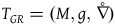 $T_{GR}=(M,g,\mathring{\nabla})$
is redundant for GR, whereas for (S)TEGR, we require explicit definition of a connection to specify the affine structure:
$T_{GR}=(M,g,\mathring{\nabla})$
is redundant for GR, whereas for (S)TEGR, we require explicit definition of a connection to specify the affine structure: ${T_{{\rm{TEGR}}}} = (M,g,\widetilde \nabla )$
and
${T_{{\rm{TEGR}}}} = (M,g,\widetilde \nabla )$
and $T_{\text{STEGR}}=(M,g,\overline{\nabla})$
. This many-to-one mapping from (S)TEGR to GR, with the same empirical substructure (also up to isomorphism) shows how (S)TEGR have surplus structure compared with GR.
$T_{\text{STEGR}}=(M,g,\overline{\nabla})$
. This many-to-one mapping from (S)TEGR to GR, with the same empirical substructure (also up to isomorphism) shows how (S)TEGR have surplus structure compared with GR.
Although it is certainly true that (S)TEGR have more formal structure than GR in the previously described sense of Weatherall and Meskhidze (Reference Weatherall and Meskhidze2024), one may push back on the Ockhamist argument that therefore GR is to be preferred. Of course, the question of whether simplicity criteria are epistemically virtuous in general is famously disputed: Bunge (Reference Bunge1963, chap. 5), for instance, gives a thorough account of multiple senses of simplicity—logical, semantic, epistemological, and pragmatic—and shows how they regularly conflict with each other. Furthermore, these notions of simplicity help to formulate, manipulate, and test theories, but they are not an independent mark of truth.
We should therefore realize that structural parsimony is not the only sense of simplicity. GR is structurally more parsimonious, but it explicitly imposes torsion-freeness and metric compatibility (Wald Reference Wald1984, 31). TEGR and STEGR impose analogous, but no stronger, constraints: All three theories deny exactly two properties out of curvature, torsion, and nonmetricity—see table 1. In this respect, more general frameworks such as Einstein–Cartan theory or metric-affine gravity may be simpler; see section 5.
Presence of Geometric Structures in Different (Gauge) Theories of Gravity

Knox (Reference Knox2011) offers a similar argument in favor of GR, arguing that conserved quantities in TEGR are calculated via the Levi–Civita connection “in disguise,” mimicked by the Weitzenböck connection and the contorsion tensor. But this mimicking is insufficient by itself because it may just as well be said that GR uses the Weitzenböck connection in disguise (Mulder and Read Reference Mulder and Read2024). Indeed, only in combination with the observation of surplus structure may this argument be charitably read as TEGR employing “unnecessary” affine quantities. However, not taking the Ockhamist route, Knox uses this implicit observation to argue that TEGR is a reformulation of GR on a “relatively liberal attitude” toward ontology (Knox Reference Knox2011, 274)—and that liberal attitude is inertial frame spacetime functionalism avant la lettre (Knox Reference Knox2013; Knox and Wallace Reference Knox and Wallace2024), which effectively reinterprets TEGR by functionally picking out a structure equivalent to the spatiotemporal structure of GR. Knox’s position thus slides between the discrimination and common core approach, in ways that are not always explicit.
4. The common core of the geometric trinity is GR
On the intuition that there might exist an interesting common core of the geometric trinity capable of functioning as a distinct theory, one may search for what the three connections $\mathring{\nabla}$
,
$\mathring{\nabla}$
, ${\widetilde \nabla }$
, and
${\widetilde \nabla }$
, and $\overline{\nabla}$
have in common. Abstracting away from all that is not in common between the three theories, however, leaves one with an impoverished structure: Because each connection defines different affine-geodesics, there are no shared natural straight trajectories—the “problem of missing inertial structure” (Dürr and Read Reference Dürr and Read2024).
$\overline{\nabla}$
have in common. Abstracting away from all that is not in common between the three theories, however, leaves one with an impoverished structure: Because each connection defines different affine-geodesics, there are no shared natural straight trajectories—the “problem of missing inertial structure” (Dürr and Read Reference Dürr and Read2024).
Indeed, Wolf et al. (Reference Wolf, Sanchioni and Read2024, 28) (who thank Adam Caulton and Oliver Pooley on this point), as well as March et al. (Reference March, Wolf and Read2024, 14), argue that a kinematical common core exists that “just is” GR. The argument is roughly the implicit definability argument of the previous section: The minimal overlap between GR, TEGR, and STEGR is the empirical substructure (M,g) itself, from which the inertial structure is implicitly defined by the metric structure:
 $$2\mathring{\Gamma}^\rho_{\,\,\mu\nu}=g^{\rho\tau}(\partial_{\mu}g_{\tau\nu}+\partial_{\nu}g_{\mu\tau}-\partial_{\tau}g_{\mu\nu}).$$
Although they do not formulate the full solution explicitly, the idea is clear: GR is viable in its own right, and if GR is the common core, no reinterpretation is required, and for (S)TEGR, one should be “purging what is not shared between” (Wolf et al. Reference Wolf, Sanchioni and Read2024, 27), so that only GR remains. The “reinterpretation” then is as follows: Commit only to the shared metric structure and what is definable from it.
In this light, it is not clear how the common core solution can be a successful solution. Indeed, Wolf et al. (Reference Wolf, Sanchioni and Read2024, 26–28) say it requires arguments that show (S)TEGR are somehow pathological—after all, a new common core theory just adds one more theory to the total count. But more importantly, the common core strategy not only leads to the same conclusion as the Ockhamist argument in section 3, but it also invokes the same argument. Strikingly, when the common core approach identifies one of the original theories as the common core, the approach collapses into Ockhamism, even though the former does and the latter does not require reinterpretation.
Curiously, Wolf et al. (Reference Wolf, Sanchioni and Read2024) and March et al. (Reference March, Wolf and Read2024) resist Ockhamism by denying that the extra structure of (S)TEGR is superfluous because it may enhance our modeling capacities, for example, by unifying gravity with particle physics.Footnote 9 This resistance appears noncommittal. Regarding extra structure as potentially heuristically valuable is compatible with the Ockhamist verdict: GR may be epistemically preferable now, whereas (S)TEGR may retain heuristic value, since auxiliary assumptions or future empirically inequivalent extensions may alter the evidential relations among the formulations such that it privileges one of them, in the sense of Laudan and Leplin (Reference Laudan and Leplin1991). Unfortunately, such enhanced modeling capacity cannot help solve the underdetermination problem—but it does form the bedrock of the overarching approach of the next section.
5. Overarching solutions: One connection to rule them all?
An overarching solution to underdetermination of ((S)TE)GR would show that these are not genuinely distinct theories but rather different representations of one gravitational theory with qualitatively varying affine properties. Rather than invoking Ockham’s razor, this approach embraces surplus structure; rather than the reductive interpretation of the common core approach, it employs the opposite move of finding even more surplus structure and interpreting the whole as representationally active.
Naively (read: it was a long-held belief of the author), one may search for an overarching concept that encompasses the concepts curvature, torsion, and nonmetricity. A natural overarching candidate here is the concept of nontrivial path dependence. Restricting first to GR and TEGR—a natural start because, unlike curvature or torsion being intrinsic properties of the connection, nonmetricity is a relational property between connection and metric—both can be embedded in Riemann–Cartan geometry, where the connection is metric compatible but may have both curvature and torsion. Such a spacetime has local Lorentz symmetry and local translation symmetry; that is, Cartan curvature has values in the Lie algebra of the Poincaré group ISO(1,3), leading to theories often called Poincaré gauge theories (PGT; cf. Weatherall Reference Weatherall2025; Baez and Wise Reference Baez and Wise2015). Then, a plausible candidate for what represents their commonality may be the Lie bracket of covariant derivatives:
 $$\left[ {{\nabla _\mu },{\nabla _\nu }} \right]{V^\rho } = {R^\rho }_{\sigma \mu \nu }{V^\sigma } - {T^\sigma }_{\mu \nu }{\nabla _\sigma }{V^\rho }.$$
One may then move on to include STEGR by considering the effects of metric incompatibility on lengths and durations within this larger structure. But this is only a conceptual unification, not a mathematical one: The commutator of derivatives of equation (1) is not a dynamical invariant common to the geometric trinity, and so it cannot by itself ground an overarching solution.
What has not, to the author’s knowledge, been made explicit is that internal sophistication (à la Dewar Reference Dewar2019; Martens and Read Reference Martens and Read2020) could play the role required by an overarching solution. This is an antireductive interpretive strategy that resists removing surplus structure while not taking symmetry-related models as distinct physical possibilities either. Rather, it commends using the richer formalism while reformulating the theory’s semantics by treating symmetry-related models as isomorphic representations of the same physical possibility. That is, three empirically equivalent models, one from each of the three theories of the geometric trinity, represent the same world, not three distinct worlds. In categorical language: One adds morphisms so that original symmetry transformations become isomorphisms, establishing equivalence.
March et al. (Reference March, Read and Chen2025) develop such a sophisticated version of (TE)GR. They start from the fact that the many TEGR models associated with the same GR model are related by local Lorentz transformations $\Lambda^a{}_b(x)$
of the tetrad,
$\Lambda^a{}_b(x)$
of the tetrad, $e^a{}_\mu \rightarrow \Lambda^a{}_b(x) \, e^b{}_\mu$
. Literally interpreted, each such transformation yields a distinct model. However, if one supplements the category of models with local Lorentz gauge transformations as morphisms, these models become isomorphic. By moving toward Cartan or higher teleparallel gauge formulations, they show this can be understood as an internally sophisticated version of TEGR. Thus, although not stated explicitly, this implements the spirit of an overarching solution because it treats distinct TEGR models as different representations of the same physical content in an overarching formal framework.
$e^a{}_\mu \rightarrow \Lambda^a{}_b(x) \, e^b{}_\mu$
. Literally interpreted, each such transformation yields a distinct model. However, if one supplements the category of models with local Lorentz gauge transformations as morphisms, these models become isomorphic. By moving toward Cartan or higher teleparallel gauge formulations, they show this can be understood as an internally sophisticated version of TEGR. Thus, although not stated explicitly, this implements the spirit of an overarching solution because it treats distinct TEGR models as different representations of the same physical content in an overarching formal framework.
To embed the entire geometric trinity in a common framework in which the distinct affine structures of each are related by such representational isomorphisms, one may consider enlarging the framework to general metric-affine gravity (MAG), which allows for a connection that can be curved, torsioned, and metric incompatible:Footnote 10
 $$\Gamma^\rho_{\,\,\mu\nu} = \mathring{\Gamma}^\rho_{\,\,\mu\nu} + K^\rho_{\,\,\mu\nu} + L^\rho_{\,\,\mu\nu},$$
where $K^\rho_{\,\,\mu\nu}$
is the contortion tensor (built from torsion), and
$K^\rho_{\,\,\mu\nu}$
is the contortion tensor (built from torsion), and $L^\rho_{\,\,\mu\nu}$
is the disformation tensor (built from nonmetricity). The full symmetry group of MAG is the affine group:
$L^\rho_{\,\,\mu\nu}$
is the disformation tensor (built from nonmetricity). The full symmetry group of MAG is the affine group: $\text{Aff}(4,\mathbb{R}) = \text{GL}(4,\mathbb{R}) \ltimes \mathbb{R}^4$
, the semidirect product of the general linear group and the group of spacetime translations, combining Lorentz transformations, scaling, and volume-preserving deformations with spacetime translations (Hehl et al. Reference Hehl, Dermott McCrea, Mielke and Ne’eman1995). The tetrad, the connection, and the metric are then three independent fields. With that overarching structure, one then seeks to tolerate the surplus structure and recover ((S)TE)GR via appropriate limits, for example, recovering GR by setting
$\text{Aff}(4,\mathbb{R}) = \text{GL}(4,\mathbb{R}) \ltimes \mathbb{R}^4$
, the semidirect product of the general linear group and the group of spacetime translations, combining Lorentz transformations, scaling, and volume-preserving deformations with spacetime translations (Hehl et al. Reference Hehl, Dermott McCrea, Mielke and Ne’eman1995). The tetrad, the connection, and the metric are then three independent fields. With that overarching structure, one then seeks to tolerate the surplus structure and recover ((S)TE)GR via appropriate limits, for example, recovering GR by setting $K^\rho_{\,\,\mu\nu} = 0$
and
$K^\rho_{\,\,\mu\nu} = 0$
and $L^\rho_{\,\,\mu\nu} = 0$
. Closest to formulating such a solution is Zhou (Reference Zhou2025).
$L^\rho_{\,\,\mu\nu} = 0$
. Closest to formulating such a solution is Zhou (Reference Zhou2025).
Can we embed a sophisticated version of GR, TEGR, and STEGR within MAG? Each theory would then be interpreted as an expanded category of models including gauge transformations such that all three formalisms become equivalent as categories. Then, “curvature” or “torsion” are not properties of spacetime but of the representation of the richer underlying MAG structure. Unfortunately, there are reasons to doubt that this can be done. There appears to be no isomorphism (not in any natural sense) that could make models with different affine connections genuinely gauge related in the way Yang–Mills fields are, although this has not been shown rigorously. Another way to see the obstacle is that the three theories of the geometric trinity are naturally formulated with different bundle structures, so it is not obvious that they are related by bundle automorphisms preserving the relevant geometric structure.
6. Is there a future for the geometric trinity of gravity?
At least locally, the theories of the geometric trinity are formally underdetermined, and read literally, their rival explanations in terms of curvature, torsion, and nonmetricity also make this a case of genuine underdetermination. Among realist responses, Ockhamism is currently the most developed: Because the Levi–Civita connection is implicitly definable from the metric, whereas the teleparallel connections are not, GR is structurally more parsimonious in that specific sense. One may resist the argument that GR should therefore be epistemically preferable. The common core strategy is either unclear or collapses into Ockhamism. The overarching strategy remains underdeveloped and has clear problems: Although MAG can formally embed the geometric trinity, no natural isomorphism (or gauge symmetry) seems available to make curvature, torsion, and nonmetricity merely representational variants of an underlying ontology.
The geometric trinity’s main significance may be heuristic rather than epistemic or ontological: Extending its lessons into Einstein–Cartan or MAG domains opens a formal space for building inequivalent theories—as well as for intertheoretic mappings (cf. Lehmkuhl et al. Reference Lehmkuhl, Schiemann and Scholz2016; Mulder Reference Mulder2025). Cosmology is a natural arena: Spin–torsion theories set in Einstein–Cartan geometry may be relevant in high-density regimes such as black-hole interiors or the early universe, potentially avoiding singularities (Popławski Reference Popławski2012; Popławski Reference Popławski2025; Lucat and Prokopec Reference Lucat and Prokopec2017); torsional and nonmetricity extensions may affect interpretations of Hubble-rate measurements (McInnes Reference McInnes2025; Ayuso et al. Reference Ayuso, Mariam Bouhmadi-Lopez, Chew, Dialektopoulos and Ghin Ong2025); scalar-torsion models use nonlinear torsion terms to generate new cosmological evolution (Bahamonde et al. Reference Bahamonde, Dialektopoulos, Celia Escamilla-Rivera, Gakis, Hendry, Hohmann, Said, Mifsud and Di Valentino2023); general teleparallel cosmologies allow flat connections with both torsion and nonmetricity to contribute additional degrees of freedom (Heisenberg et al. Reference Heisenberg, Hohmann and Kuhn2023); and MAG couplings to the Standard Model induce new matter interactions by coupling torsion and nonmetricity (Rigouzzo and Zell Reference Rigouzzo and Zell2022; Rigouzzo and Zell Reference Rigouzzo and Zell2023). In such cases, torsion and nonmetricity earn their keep not as rival ontologies for the exact geometric trinity but as resources for building genuinely new theories.
Acknowledgements
I am grateful to the audiences of the East European Network for Philosophy of Science (EENPS) conference in Kraków, September 2024, and of the Philosophy of Science (PSA) symposium in New Orleans, November 2024, and to my cosymposiasts Eleanor Knox, Eleanor March, James Read, Jim Weatherall, and Will Wolf. I thank Dennis Dieks, Lavinia Heisenberg, Claire Rigouzzo, David Wallace, and Yitong Zhou for illuminating conversations, and Niels Dielen for help with graphic design.
Funding Statement
This work was supported by Trinity College, Cambridge, through the Tarner Scholarship in Philosophy of Science and History of Scientific Ideas, and by the American Institute of Physics through the Robert H. G. Helleman Memorial Postdoctoral Fellowship.
Declarations
None to declare.


 Open access

