




Introduction
During China’s Warring States period (c. 453–221 bce), although wars seemed to break out less frequently than the preceding Spring and Autumn period (c. 770–481 bce), they often took place on a much larger scale.Footnote 1 Protracted warfare stimulated the continuing militarization of government institutions, which rulers wielded to exploit resources for warfare and to govern states of unprecedented territorial size and social complexity. These developments immensely reshaped the Zhou ecumene, resulting in the expansion of military service,Footnote 2 a universal household registration system,Footnote 3 an intricate bureaucracy,Footnote 4 and militarized societies.Footnote 5 The aggressive territorial expansions and the increasingly bureaucratized governments among the major Warring States powers propelled the emergence of extended logistics networks that allowed the large-scale, long-distance movements of people (e.g., soldiers, officials, and commoners) and transportation of goods (military provision, commodity, etc.).
The situation of the Qin state, a major power in this period, was relatively well documented. Existing evidence indicates that Qin militarized itself more radically and successfully than its rivals after the two reform campaigns conducted by Shang Yang 商鞅 in 356 and 350 bce.Footnote 6 Recently discovered Qin manuscripts—especially the Liye 里耶 and Yuelu 嶽麓 cachesFootnote 7 —reveal even more facets of imperial Qin history. With these new sources, scholars have studied the military occupation, provisioning and mobilization systems,Footnote 8 the territorial administration,Footnote 9 and the governance of the Qin Empire (221–207 bce).Footnote 10 It is now clear that in addition to the universal, centralized commandery-county system (junxian zhi 郡縣制) in which one commandery administers multiple counties, the Qin also divided its lands into several parts through legal and administrative means, discriminating its “old territories” (gudi 故地) from the “new territories” (xindi 新地) and its “old black-headed ones” (gu qianshou 故黔首) from the “new black-headed ones” (xin qianshou 新黔首). The policy of restructuring the empire’s territories strove to protect the Qin political center from the potential danger of the periphery and to maintain more efficient resource distribution across the empire.Footnote 11
The recent advances in the studies of imperial Qin history notwithstanding, little attention has been given to the crucial decade immediately preceding 221 bce; that is, the Qin’s so-called war of unification between 230 and 221 bce. The major reason behind this relative negligence is largely because of the difficulties in ascertaining whether a policy or reform was designed and promulgated between 230 and 221 bce. This is why scholars working on this subject often need to use primary sources postdating this period to supplement the missing pieces, under the presupposition that the government institutions in the Western Han dynasty (202 bce–9 ce), especially during its formative years, largely followed the Qin model.Footnote 12 The use of asynchronous sources may sometimes lead to anachronistic arguments, as will be shown later.
Despite these undeniable (and to some extent unavoidable) limitations, this article will try to unveil the crucial role that warfare played in the Qin’s social and institutional changes in the war of unification, during which the polity was constantly at war, and eliminated the big territorial states of Hann 韓, Zhao 趙, Wei 魏, Yan 燕, Chu 楚, and Qi 齊. Such unprecedented, persistent, and fierce military campaigns seemed to have prompted the Qin polity to do something radical even by their standards, molding the Qin government administration, military strategies, and society at large. After all, despite the violence, atrocities, and destruction, war, rather ironically, often serves as a catalyst for sociopolitical reform, technological innovation, and the emergence of new ideas. Many new developments that occurred during this period continued in the early imperial era and are pivotal to our understanding of the state building of the Qin Empire.
Specifically, this article focuses on the emergence of logistics networks throughout the war of unification.Footnote 13 It investigates how a new logistics system was developed in the wake of widening conscriptions and long-distance movements of armies and resources. To begin with, I will examine the “assigned transfer” (weishu 委輸) system, which underpinned the Qin state’s broader logistics system. In his classic study of the Han 漢 logistics system, Watanabe Shinichiro 渡邊信一郎 contends that “assigned transfer” refers to the system of channeling the “accumulated reserve” (weiji 委積) from regional administrative units to the central government,Footnote 14 whereas “equalized delivery” (tiaojun 調均) denotes the resource transfer between regional administrative units per the central government’s order.Footnote 15 A recent study by Kobayashi Bunji 小林文治, however, argues that the term tiaojun was only used as a verb in the Qin era and the transfer of resources between regional administrative units belonged to one form of “assigned transfer.”Footnote 16 In other words, Kobayashi rejects the dichotomy of “assigned transfer” and “equalized delivery” that Watanabe suggests.
Drawing on these earlier scholarly works, this article will revisit two forms of “assigned transfer”; that is, the transfer of resources between regional administrative units such as commanderies and counties, as well as that between the central government and regional administrative units. Furthermore, I will investigate how Qin created new institutions and built infrastructures to support its military logistics, as well as how the emergence of long-distance, empire-wide logistics networks might have contributed to the economic growth of the empire and have driven a reform of the Qin’s financial administration. In doing so, we can better understand the relationship between war and sociopolitical changes in ancient China.
“Assigned Transfer” and Qin’s Extended Logistics Networks
Prior to the war of unification, the Qin usually practiced partial mobilization by drafting eligible soldiers in one or several specific regions. For instance, in the final stage of the Battle of Changping 長平 (262–260 bce), households in Henei 河內, who were likely sent to this recently conquered region in c. 286 bce, served as the major source of conscripted service members because of their proximity to the battlefield.Footnote 17 Notably, even if the Qin did not opt for universal mobilization in the Battle of Changping, its casualties were so severe that the followers of Shang Yang offered a new mobilization strategy in the “Attracting the People” (Lai min 倈民) chapter from the Book of Lord Shang (Shang jun shu 商君書):
臣之所謂兵者,非謂悉興盡起也;論境內所能給軍卒車騎,令故秦兵,新民給芻食。
What I, your servant, call “the military” does not refer to complete mobilization and universal conscription. What I mean is that within the borders you are able to provide enough for the army, its soldiers, chariots, and cavalry, and to order the old Qin people to serve in the army and the new people to provide fodder and provisions.Footnote 18
The explicit mention of “the victory in Changping” (Changping zhi sheng 長平之勝), dates the chapter to after 260 bce.Footnote 19 The cited passage overtly rejects the idea of universal mobilization to prevent the risk of heavy losses in the population. Such a proposition might have been in response to Qin’s severe losses of human capital—especially capable soldiers—on the battlefield during the latter half of King Zhaoxiang’s 昭襄 reign (r. 306–251 bce).Footnote 20 Notably, this passage further suggests distinguishing the roles played by the old and new Qin subjects. On the one hand, military affairs should be exclusively performed by the old Qin people. The new subjects, on the other hand, are auxiliaries who provide supplies for the Qin armies, although this does not mean that such new subjects were also responsible for the transportation of these supplies.Footnote 21 Whereas such a proposal may be prompted by the questionable loyalty of the new subjects, it also spares them from dangerous military duties and may serve as a lenient treatment to attract immigrants from the Three Jin regions.Footnote 22
In the war of unification, however, it seems that the Qin regime did not accept the Shang Yang followers’ proposal concerning the division of labor between new and old subjects. In contrast, the Shi ji documents three “massive mobilizations of troops” (da xingbing 大興兵), spanning between 232 and 222 bce.Footnote 23 The increased scale of warfare might have given rise to Qin’s new policies of collecting state-owned weapons (xianguan bing 縣官兵) that were previously distributed to soldiers in 233 bce Footnote 24 and of registering the ages of males in households two years later.Footnote 25 It is worth noting that the latter measure was promulgated one year after the first “massive mobilization of troops” invading the Zhao state, who not only withstood the attack but also killed the Qin general Huan Yi 桓齮 on the battlefield.Footnote 26 Hence, this new measure might have aimed at obtaining more accurate numbers for potential human capital in order to replenish troops for the ongoing military campaigns.Footnote 27 In sum, both measures reflect that the Qin state was on a war footing prior to 230 bce.
The most significant adjustment in the face of a great war, however, rests on mobilization tactics. According to excavated evidence, Qin’s mobilization during the war of unification could have involved conscripts from both old and new Qin territories and was thus indeed more universal than the mobilization for the Battle of Changping. Such mobilizations usually entailed two procedures. First, soldiers would be conscripted and organized based on their counties of residence. For example, a Qin ordinance records a memorial from the Metropolitan Governor (Nei shi 內史), the chief executive of the Metropolitan Area,Footnote 28 reporting that the “soldiers from Li [county] joined the Army for Destroying Zhao” (斄卒從破趙軍), which should refer to the troops fighting in one of the Zhao campaigns between 234 and 229 BC.Footnote 29 Second, soldiers from different counties would be reorganized, thereby forming larger army groups. The Shi ji states that in the 229 bce Zhao campaign, the Qin also “massively mobilized troops” from Shang 上 and Henei commanderies, which bordered the Zhao state.Footnote 30 In other words, the “Army for Destroying Zhao” likely consisted of soldiers from the Metropolitan Area—which was the Qin heartland—as well as Shang and Henei commanderies.
Evidently, Qin also recruited soldiers from the new territories. A divination manual from the early Western Han Huxishan 虎溪山 manuscripts also states that “Li Xin, the General of the Qin, and Meng Wu, the General of New Subjects, attacked the Chu state east on an yiyou day” (秦將李信、新民將蒙武以乙酉日東撃楚).Footnote 31 Despite the religious nature of this account, its depiction resembles the common practice of the military and should be accurate.Footnote 32 It reveals that the Qin regime not only mobilized new subjects into their armies, but also seemed to put them as separate regiments. Additionally, the Qin ordinance below also hints that Qin levied soldiers from the newly conquered Hann state:
【今雍氏卒(詐) 偽相】移甲叚Footnote 33 而(繫) 治者千餘人,其叚或自雍氏軍以至破荊軍。
Now Yongshi soldiers fraudulently transferred the suits of loaned armor to one among their group, and more than one thousand people were detained and tried [because of it]. The loaned items might have been taken from the Yongshi army to the Army for Destroying Jing (viz. Chu).Footnote 34
This excerpt is from a lengthy ordinance pertaining to military officers’ exploitation of soldiers. The term “Army for Destroying Jing” suggests that this event occurred when Qin was waging war on the Chu (Jing) state between 224 and 222 bce. At that point, Qin had already eliminated the Hann state,Footnote 35 to which Yongshi county (present-day Yuzhou City, Henan Province) was subordinate.Footnote 36 In other words, the “Yongshi army” likely refers to the troops stationed in the newly conquered Yougshi county. Whereas the ordinance does not reveal the composition of the “Yongshi army,” Western Han sources suggest that soldiers being dispatched to the northwestern frontier were levied based on commanderies of residence, and those from the same county were often grouped and stationed in the same region to avert language barriers among soldiers from different domiciles, to guarantee smooth cooperation because of similar customs, and to boost morale by means of communal affection.Footnote 37 In this light, the “Yongshi soldiers” mentioned in the ordinance were likely drafted locally from Yongshi county.
Moreover, a legal case datable to 221 bce documents that You 攸 county of Cangwu 蒼梧 commandery in the new territories levied new subjects to defend against local Chu insurgents.Footnote 38 Additionally, administrative documents from Liye reveals that Qianling 遷陵 county in the new territories also trained and employed locals to serve as government officials and garrison soldiers.Footnote 39 To be sure, such militias may not be directly comparable to the expedition armies. These examples nonetheless demonstrate the open attitude of the Qin rulers in recruiting people in the new territories into the military system. Therefore, it is conceivable that the Qin mobilization during the war of unification also included subjects from the newly conquered regions and was no longer confined to soldiers from regions neighboring the battlefields.
At first glance, Qin’s new mobilization tactic of drafting soldiers universally from all parts of the empire seems to blur the regime’s distinction between the old and new territories. This ostensible inconsistency is nevertheless justifiable. As noted earlier, the old vs. new territories distinction primarily served political and administrative purposes and by no means implied a complete segregation between the old and new subjects of the empire. Although the new subjects did receive certain privileges, they still had to undertake statutory labor services and conscriptions like the old subjects.Footnote 40 Considering the persistent and severe shortages of human resources in some of the empire’s new territories, the Qin rulers probably had no choice but to incorporate new subjects into the establishment, thereby mitigating the looming crisis. In this respect, recruiting soldiers from the new territories was a necessary move to sustain Qin’s mobilization during the protracted war.
Following the new, larger mobilizations, a logistics system called “assigned transfer” was instituted to more efficiently transport strategic resources (e.g., fiscal reserves, weapons, provisions) from Qin’s old territories to the frontlines, as well as between administrative units in the new territories. As noted in the introduction, two forms of “assigned transfer” can be observed in Qin legal and administrative texts. It must be stressed that although the “assigned transfer” system might have emerged and expanded alongside the progress of the unification war and the subsequent territorial expansion, it served more than military purposes. This section will illuminate how Qin developed an empire-wide logistics network to maintain its troops and local administrative units by illustrating the formation and mechanism of the “assigned transfer” system.
Transfer of Resources between Regional Administrative Units
Regarding the first form of “assigned transfer,” transmitted Western Han sources disclose interregional grain transfers from the newly conquered eastern coastal commanderies to Qin’s northern frontier. This echoed the first form of “assigned transfer.” Admittedly, these accounts were not official historical records, but since some of their putative authors were from the coastal areas and might have had access to now lost written records or oral anecdotes of this event, the long-distance transport they mentioned may not be entirely hearsay.Footnote 41 However, the provisions for the Qin army under the “assigned transfer” system were by no means only provided by the new Qin people, as the Book of Lord Shang suggests. The following wooden tablet from the Liye manuscripts reveals that administrative units in the “old” Qin territories also provided military provisions for the regime’s army:
亭次行,署急勿留,長沙言書到、起。以洞庭邦尉印行吏(事) ∟。恒署。
十一月壬寅,遷陵守丞睪敢告尉,告倉、啓陵、貳春鄉主:聽書,尉薄(簿) 卒,鄉各薄(簿) 吏備敬(警) 卒、徒隸食足不足數,善薄(簿) 上,皆會戊申旦廷,唯勿留。尉下倉,倉傳二鄉。/ 丞手。
十一月壬寅水下九刻,秭歸奴橋士五襄以來。/ 夫半。/ 即令□□行尉。(7-1正)
[The document] should be forwarded to police posts in order, inscribed with [the reminder] “emergency,” and not be retained. Changsha [county] must report the arrival and dispatch [date] of this document. [This letter] is issued by the Commandant of Dongting State and is a permanently inscribed [document].
On the renyin (fourteenth) day of the eleventh month, Yi, the Acting Vice-Prefect of Qianling county presumes to inform the County Commander, and informsFootnote 42 the leaders of the Offices of the Granary as well as Qiling and Erchun communes: Upon receiving this document, the Commander should record if the amount of rations was sufficient or insufficient for soldiers on the registers, and each commune should do the same for their guarding soldiers and hard laborers. [The Commander and Commune Overseers should] neatly copy and submit these registers, all of which should arrive at the county headquarters by the morning of the wushen (twentieth) day; please do not retain [these documents]. The Commander should hand [this document] down to the Office of the Granary, which should transfer it to the two communes. Cheng handled [this document].
On the renyin (fourteenth) day of the eleventh month, at the time when the water level [of the water clock] was down to the ninth marker, Xiang from Nuqiao village in Zigui county holding the shiwu status arrived [with this document]. Fu opened [this document]. Immediately order … to forward it to the Commander. (7-1A)
廿五年二月戊午朔辛未,洞庭叚守竈敢言之:洞庭縣食皆少,略地軍節(即) 歸,謁令南郡軍大(太) 守以洞庭吏卒數、軍吏卒後備敬(警) 者數,令治粟大府輸食,各足以卒歲,便。謁報。敢言之。
二⟨三⟩Footnote 43 月癸丑,丞相啓移南郡軍叚守主:略地固當輒輸,令足竈歲,唯勿乏。傳書洞庭守。/ 顯手/
五月癸巳,南郡軍叚守殷敢告洞庭主,謂南郡治粟大府:前日固已以縣吏卒用食數告大府輸。(7-1背)Footnote 44
In the twenty-fifth year (of King Zheng, who later became the First Emperor of Qin) (222 bce), in the second month, which began on a wuwu day, on the xinwei (fourteenth) day, Zao, the Temporary Governor of Dongting [Commandery], presumes to report: every county in the jurisdiction of Dongting [Commandery] is running out of rations. When armies raiding the lands return, I call upon the Governor of the Army of Nan commandery to order the Grand Office of Grain Management [of Nan commandery] to supply rations according to the numbers of officials and soldiers stationed in Dongting, and of military officers and soldiers on guard after [the conquest]; each [of these personnel should receive rations that] suffice to last this year. [This arrangement is] advantageous. I request your reply. This I presume to report.
On the guichou (twenty-sixth) day of the third month, Chancellor Qi transferred [the petition] to the Temporary Governor of the Army of Nan Commandery: When [armies] raid [the enemies’] lands, they should immediately be supplied with rations. [I] order [you to] supply enough for the stoves for this year; please do not be deficient [in the rations]. Transfer this document to the Governor of Dongting [commandery]. Xian handled [this document].
On the guisi (eighth) day of fifth month, Yin, the Temporary Governor of the Army of Nan Commandery presumes to inform the Dongting Governor, and notifies the Grand Office of Grain Management in Nan Commandery: Several days ago I have confirmed that the Grand Office will transfer [the rations] according to the [estimated] amount of rations consumed by officials and soldiers stationed in the counties. (7-1B)
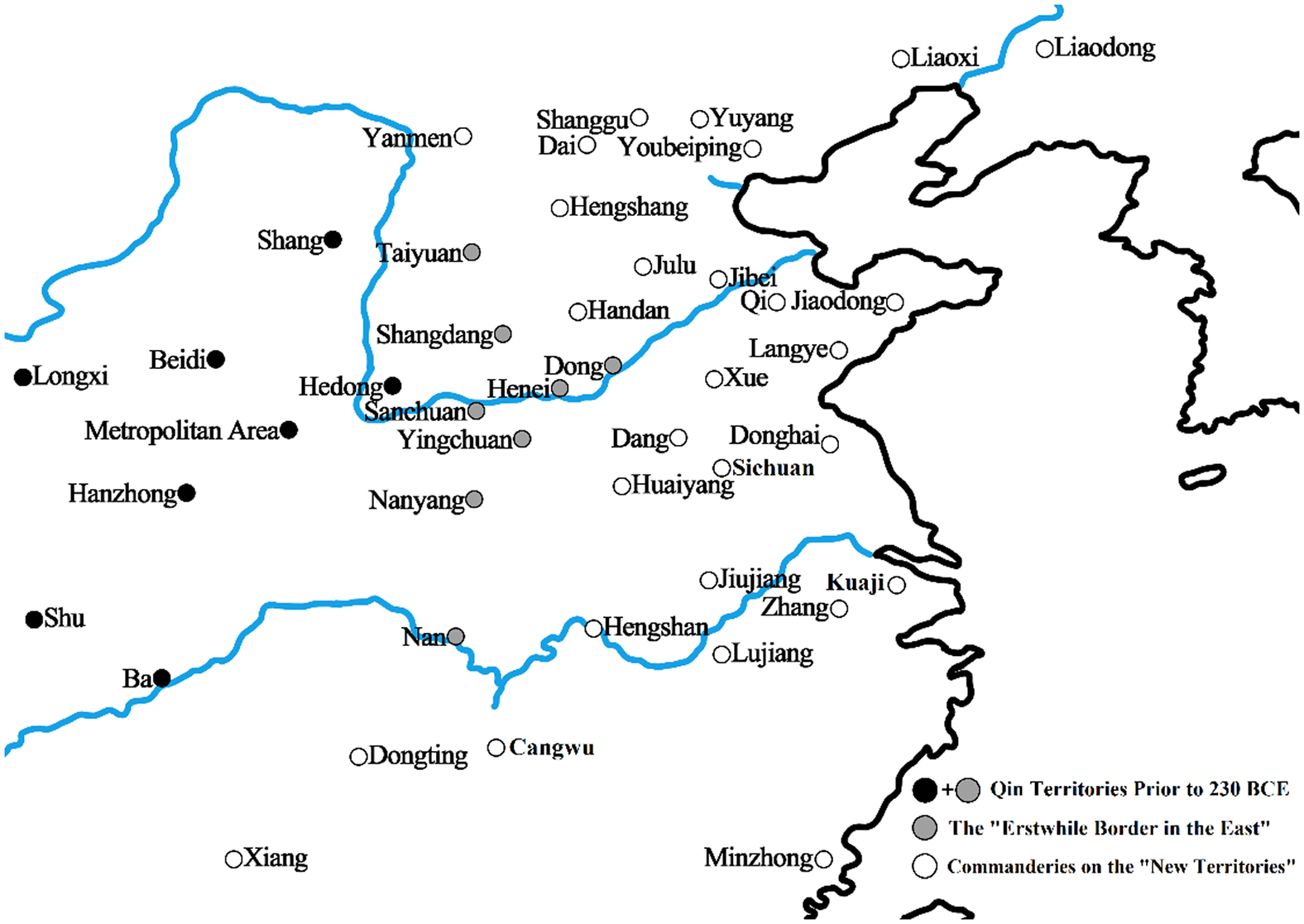
This tablet is part of a longer document and records the correspondence between Qianling county, Dongting and Nan commanderies (see Map 1 or the location of their headquarters), and the Chancellor (Chengxiang 丞相) in the central government. Despite being fragmentary, it reveals some compelling details with regard to the transportation networks and new institutions during the Qin conquest. To begin with, the extant administrative letter records the title “Temporary Governor of the Army of Nan Commandery” (Nanjun Jun jiashou 南郡軍叚守), which differs from the conventional “Governor” (shou 守)—the head official of a commandery—appearing in an instruction issued four years earlier.Footnote 45 The Temporary Governor of the Army of Nan Commandery might have been a new position independent of the Commandery Governor, meaning that these two positions coexisted with each other. Alternatively, it is possible that the Nan Commandery Governor was replaced by the Temporary Governor of the Army in the face of the Chu campaign. Either way, the establishment of the Temporary Governor of the Army hints that the Nan commandery became more militarized before or during Qin’s campaign against the Chu state.
“Major spatial units of the Qin Empire.” From Tong, “The Construction of Territories in the Qin Empire,” 519, map 1.

Map 1 Long description
A political map of the Qin Empire, illustrating the geographic region of ancient China. The map highlights key locations such as Longxi, Beidi, Metropolitan Area, Shu, Ba, Xiang, Minzhong, and Liaodong. It shows the Qin territories prior to 230 BCE marked with black circles, the erstwhile border in the east marked with a black line, and commanderies on the new territories marked with white circles. Key labeled locations include Taiyuan, Hedong, Sanchuan, Yingchuan, Handan, Dong, Dang, Hengshan, Lujiang, and others. The map also features rivers and boundaries that delineate different regions and territories.
More importantly, the tablet discloses new information on the logistics of the Qin armies in the Chu campaign. Accordingly, the Qin forces, officials, and hard laborers in the newly conquered Dongting commandery 洞庭郡 were short on food and had to rely on the supplies from the adjacent Nan commandery. Despite being the former central region of the Chu state, Nan commandery was colonized and highly integrated into the Qin state since its annexation in 278 bce.Footnote 46 The administrative units within the Qin Empire’s semi-periphery, such as Nan and Nanyang commanderies, served as a conduit for resources transferred between the Qin heartland and the new territories. Thus, it is unsurprising that Nan commandery had to supply food for the neighboring Dongting commandery.Footnote 47
The procedures for making a grain-rationing request were roughly as follows. First, county governments—in this case Qianling—needed to collect data in relation to the rations consumed by soldiers and hard laborers within their jurisdiction, submitting them to the commandery government. Second, the commandery would likely gather such data and file a request with the Chancellor, who would then forward the request to the Governor of the commandery responsible for delivering the grain. In other words, it seems that such requests needed to be authorized by the central government. Third, upon receiving the request, this Commandery Governor would order the Grand Office of Grain Management (Zhisu dafu 治粟大府) under his purview to disburse the grain to the requesting commandery, thus feeding the troops, officials, and laborers there. The whole process took at least six months.
More importantly, Liye tablet no. 7-1 evinces that the Qin regime established new institutions to facilitate long-distance logistics among regional administrative units and expedition armies. Accordingly, the “Grand Office of Grain Management of Nan Commandery” played a pivotal role in managing the logistics of military provisions between Nan and Dongting commanderies. That this office could have transferred grain directly to Dongting implies several things. First, it possibly held data about grain storage within its jurisdiction; otherwise it could not know if Dongting’s demand could be met at the outset. Second, it knew the amount of food requested by Dongting because of the notification from the Nan Commandery Governor. Additionally, it is worth noting that Nan commandery bordered Dongting and served as one of the latter’s major sources of garrisoning soldiers.Footnote 48 For example, Liye tablet no. 7-1 was dispatched by a soldier from Zigui 秭歸 county of Nan commandery. These characteristics probably account for Nan commandery’s involvement in provisioning food to Dongting. Given that Nan commandery also sent troops to regions such as Huaiyang 淮陽 during the Chu campaign,Footnote 49 the Grand Office of Grain Management there likely also had to deliver grain to commanderies other than Dongting.Footnote 50 Such activities were precisely the first form of “assigned transfer” discussed earlier.
After receiving the provisions delivered by the Grand Office of Grain Management, Dongting commandery would probably distribute them to its subordinate counties using the emergent logistics networks within its jurisdiction. Such regional logistics networks were well attested in the Liye manuscripts. A fragment records that Yuanling 沅陵 county transported 2000 bushels (shi 石) of grain to Qianling, which once demanded Dongting commandery to transfer 80,000 coins in order to purchase cloths for convict laborers.Footnote 51 The terminal of these regional logistics networks lay upon those counties, which would deliver the grain that they received to the troops stationed in their purview:
廿六年十一月甲申朔戊子,鄢將奔命尉沮敢告貳春鄉主:移計二牒,署公叚于牒。食皆盡戊子,可受續食;病有瘳,遣從□。敢告主。/ 十一月己丑,貳春鄉後敢言之:寫上。謁令倉以從吏(事)。敢言之。/ 尚手。(9-1114正)
In the twenty-sixth year (of the First Emperor of Qin) (221 bce), in the eleventh month, which began on a jiashen day, on the wuzi (fifth) day, Ju, the Commander Leading the Emergency Troops of Yan, presumed to inform the Head of Erchun Commune: [Here I] transfer two slips of accounts, on which I inscribed the [number of] loaned government items. All our food will run out at the end of the wuzi day and [I hope that my soldiers] can be sent to a hospital for injured [soldiers] so that they can continue [to receive] food; when their illness is healed, send them alongside … This I presumed to report.
On the jichou (sixth) day of the eleventh month, Hou, [the Overseer] of Erchun commune, presumed to report: [I] copied [Ju’s letter] and submitted it to you. I call upon the granary to act accordingly. This I presumed to report. (9-1114A)
十一月壬辰,遷陵守丞戍告倉:以律令從吏(事)。/ 丞手。
即走筭(算)行。(9-1114背)Footnote 52
On the renchen (ninth) day of the eleventh month, Shu, the Acting Vice-Prefect of Qianling, informed the granary: Act according to the statutes and ordinances. Cheng handled [this document].
Immediately forwarded by Runner Suan. (9-1114B)
The term “emergency troops” (benming 奔命; literally, “rushing on command”) refers to a type of militia being levied in urgent and expedient situations, whereas the xi herein is a technical term denoting the hospitals for injured soldiers.Footnote 53 Given that Yan county was subordinate to Nan commandery, the “emergency troops” were probably sent from Nan and temporarily camped at Qianling’s Erchun commune after participating in the Chu campaign in the previous years.Footnote 54 Therefore, these troops were probably among the “guarding soldiers” that the Acting Vice-Prefect of Qianling mentioned in tablet no. 7-1. According to this document, the Grand Office of Grain Management of Nan Commandery did not directly feed the troops at their outposts; it was the granary of Qianling county which should have provided the rations for the emergency troops. Of course, this does not mean that all the rations which the Qianling granary stored were from the Grand Office of Grain Management. That said, since the above correspondence occurred merely one year after the Qin occupation of Qianling in 222 bce,Footnote 55 it is inconceivable that the county alone could have collected sufficient tax revenue or cultivated enough fields to support the troops and government personnel within its purview in this early phase of the Qin occupation. Instead, Qianling county and other similar administrative units in the new territories probably had to rely on the food supply from the old territories, where resource extractions could have taken place more efficiently.
The case of Qianling reveals a dilemma of the “assigned transfer” system. On the one hand, although this system might have indeed facilitated the long-distance transfer of resources from one place to others, the rationing-request process, as discussed earlier, could have taken as long as six months. The precarious landscapes, inferior infrastructure, and unstable political circumstances of newly conquered regions all posed barriers to the burgeoning logistics networks between the empire’s old and new territories and account for the prolonged transfer process. This reminds us not to overestimate the efficiency of the “assigned transfer” system in solving the urgent resource shortages across the new territories. On the other hand, the difficult situation in the new territories also immensely challenged the extraction and transportation of human capital and life necessities. Administrative documents from Liye even indicate that the resource shortages in Qianling county likely persisted throughout the Qin occupation.Footnote 56 As a result, the expedition armies and administrative units in the new territories still had to count on the “assigned transfer” system to acquire life necessities to continue their conquest and maintain their rule, regardless how inefficient and unreliable this logistics system might have been.Footnote 57
Transfer of Resources between the Central Government and Regional Administrative Units
The second form of “assigned transfer” centered on the transportation of resources between central and regional governments. Regarding the transfer of resources from regional administrative units to the central government, the Shi ji records that in 208 bce, the Second Emperor of Qin ordered commanderies and counties to “transfer beans, grain, hay, and straw” (下調郡縣轉輸菽粟芻稾) to Xianyang 咸陽 to support the 50,000 soldiers garrisoning the imperial capital. Interestingly, he also ordered that the shippers “should all bring their own food” (皆令自齎糧食),Footnote 58 which is consonant with the prescription of a Qin ordinance.Footnote 59 Elsewhere, the Shi ji documents that in the reign of Emperor Gaozu of Han (r. 202–195 bce), several hundred thousand bushels (shi 石; c. 20 liters) of grain were annually shipped to support personnel serving in the central government.Footnote 60 Given that the central government of the early Western Han Empire was modelled on that of the Qin, it is conceivable that the Han were only continuing a Qin practice.
Apart from food, other items were also transported to the Qin center. Several administrative documents from Liye (tablet nos. 9-2283, 16-5, etc.) record that Dongting, Nan, Cangwu, and Ba 巴 commanderies were transporting armor and weapons to the Metropolitan Area in 220 bce.Footnote 61 This is in line with the Shi ji record that the First Emperor of Qin ordered the confiscation of privately held weapons in his empire, transferring them to Xianyang and thereby smelting them into various bronze vessels and statues.Footnote 62 In this view, the transfer of armor and weapons to the Metropolitan Area in 220 bce was likely under the command of the central government, thus resembling the second form of “assigned transfer.”Footnote 63 This indicates two things. Unlike the transfer of grain, which was handled by the Grand Office of Grain Management, the logistics of weapons at the regional level seemed to be administered directly by the Commandery Governor. Moreover, the “assigned transfer” between central and local administrative units continued after the Qin conquest in 221 bce.
The second form of “assigned transfer” can be traced to military logistics during Qin’s war of unification. As noted in the previous section, soldiers from the Metropolitan Area were active in the Qin conquest. The composition of the above-mentioned “Army for Destroying Zhao”—which consisted of conscripts drafted from the Metropolitan Area—is a salient example of this mobilization tactic. An anecdotal account even claims that the regime once levied 600,000 soldiers from the region for the Chu campaign in 224 bce.Footnote 64 Although this figure may be exaggerated, the Metropolitan Area, as the political and economic center of the Qin state, must have conscripted a substantial number of soldiers in the war between 230 and 221 bce. In principle, a majority of conscripts had to bring their own provisions during their service.Footnote 65 Administrative records from Liye nonetheless reveal that in reality most of them were to borrow food from the government. If such soldiers failed to repay their debts, they had to extend their terms of service.Footnote 66 As a result, the central government possibly had to provide rations for most of its troops when they were still within the Metropolitan Area or its bordering commanderies. In other words, although the central government probably would not have to support provisions for all conscripted soldiers from the Metropolitan Area throughout the war of unification, the pivotal role that Guanzhong played in this war must have posed significant logistical and financial challenges within this region.
To visualize the magnitude of such challenges, we may do a little math. A preimperial Qin “Statute on the Granary” (Cang lü 倉律) prescribes that the capacity of the Xianyang granary amounted to 100,000 bushels (c. 2000 cubic meters).Footnote 67 Although archaeologists have not yet found the site(s) of the Qin Grand Granary (Taicang 太倉), the capacity of the main storage of the Capital Granary (Jingshi cang 京師倉) built in the Western Han dynasty likely exceeded ten thousand cubic meters; this site was also accompanied by no less than five subsidiary storage sites.Footnote 68 Considering that the Capital Granary was constructed to accommodate the millions of bushels of grain being transferred annually to the imperial capital at Chang’an 長安,Footnote 69 it might be surmised to be at least as large as the Qin Grand Granary.Footnote 70 Even if this was so, however, the storage of the Qin Grand Granary might only have sufficed the monthly rations of some 250,000 soldiers.Footnote 71
This duration would be cut even shorter if we consider the in-transit loss of provisions. A Western Han account even reports that during the Qin Empire’s Xiongnu campaign only one for every thirty bushels of grain could have been successfully delivered to the frontline. In other words, the in-transit loss of provisions was at the staggering rate of 96.67 percent.Footnote 72 Although this figure is certainly exaggerated, it reminds us of the magnitude of the possible in-transit loss for military provisions in early imperial China. Taking these factors into consideration, the amount of grain that the Qin central government mustered to support the huge armies being sent from the Metropolitan Area during a decade of fierce military campaigns might easily have exceeded millions of bushels.Footnote 73 The figure of military provisions would become even larger if we include the expenses of draught animals such as horses or oxen, which were fed hay and straw rather than grain. To maintain such a gargantuan amount of provisions, the central government probably needed help from places outside the Metropolitan Area. This likely accounted for the development of an interregional logistics network transferring food from regional governments to the Qin center in Guangzhong Basin, even though the connectivity between the center and other regions, especially the new territories, probably remained limited.Footnote 74
Emerging Logistics Networks and New Financial Administration
Institutions and Infrastructures of Qin Military Logistics
The functioning of the “assigned transfer” system hinged on two premises. First, the central government should have been able to accurately gauge the fiscal reserves of regional administrative units. The submission of annual accounts (shangji 上計), which was already a well-established practice in the Qin state during the late Warring States period, allowed the central government to access such data. Accounts submitted by counties typically included information such as the numbers of procured grain, labor capacity, and slaves.Footnote 75 A Western Han example reveals that commanderies would report their registered households, arable fields, and fiscal reserves (both in-kind and in cash) in annual accounts.Footnote 76 Additionally, the Liye tablet discussed in section one records that the Dongting Governor had to first submit his ration request to the Chancellor. If a commandery reported its soldiers and required rations regularly, the Qin central government may be able to collect data about soldiers eligible for rations throughout its territories. With these data in hand, the central government could have controlled the interregional transfer of strategic resources.
Equally importantly, the Qin regime needed to have organizations to administer and store the resources that passed through its vast territories. Such demands might have propelled the establishment of the Offices of Grain Management among commanderies. In the Qin center, transmitted texts document an office called “Metropolitan Area Grain Management” (Zhishu nei shi 治粟內史), which was led by an official of the same title.Footnote 77 Extant records of this organization are scant and sometimes contradictory. While Zhishu nei shi was often said to be the precursor of the Grand Prefect of Agriculture (Danong ling 大農令)Footnote 78 —the central financial organization in the early Western Han period—or to be derived from the Metropolitan Governor, little evidence can substantiate these theories (for details, see below).Footnote 79 Given the apparent similarity between the “Grand Office of Grain Management” and “Metropolitan Area Grain Management,” the latter might well be a parallel organization administering the transfer of grain—especially military provisions—within the Metropolitan Area,Footnote 80 even though it is foolhardy to suggest that these organizations were established solely for military purposes.
The interregional logistic network illustrated above should have emerged in tandem with Qin’s territorial expansion. Evidently, administrative organizations such as commanderies and counties played an important role in infrastructure construction and food transfer, and various officials were set up to orchestrate the transfer of grain and construction of infrastructure. Consider the position “Temporary Assistant to Dongting Governor for Swiftly Urging and Transferring Food” (Qu Quan Tongshi Dongting Shou Jia Cheng 趣勸通食洞庭守叚丞), who was likely a subordinate of the Dongting Governor:
運食鄉。部卒及徒隷有病及論,病者即縣及其部,固皆上志治粟府。‧卅四年五月乙丑朔丁亥,趣勸通食洞庭守叚丞可移鐔成、沅 (9-436+9-464正)
transferring food to communes. When conscripts and convict laborers [who were assigned to] districts were ill or were sentenced,Footnote 81 those who were ill should be immediately sent to a hospital for injured [soldiers] at the county or at the district [where they are stationed], and in every case, certainly submit a report to the Office of Grain Management.
In the thirty-fourth year (of the First Emperor of Qin) (213 bce), in the fifth month, which began on a yichou day, on the dinghai (twenty-third) day, Kezai, the Temporary Assistant to Dongting Governor for Swiftly Supervising and Transferring Food, transmits [this document] to Tancheng and Yuan[yang?] (9-436+9-464A)
〼武手。(9-436+9-464背)Footnote 82
Wu handled [this document]. (9-436+9-464B)
Judging by its peculiar title, the “Temporary Assistant to Dongting Governor for Swiftly Urging and Transferring Food” seemed to be a special position set up exclusively for food-related logistics. According to the Huainanzi, Tancheng 鐔成 was one of the five strongholds at which the Qin Empire stationed troops before sending them to battle the Yue tribes in its Yue campaign.Footnote 83 The date and the destination (Tancheng county) indicate that this document likely pertained to Qin’s second Yue campaign in 214 bce. In this light, although the duties of this “Temporary Assistant to Dongting Governor” may not have been limited to military logistics, it almost certainly took part in transferring military provisions to the southern frontline. Additionally, it seems that counties of Dongting commandery had to submit the number of sick (and possibly also wounded) soldiers in their respective jurisdictions to the “Office of Grain Management.” Unfortunately, the fragmentary status of this document prevents us from knowing if this office referred to the Grand Office of Grain Management of Nan Commandery discussed earlier, or to a similar organization in Dongting commandery. Either way, the submission of such data to the Office of Grain Management hints that it was responsible for supplying rations that would eventually be distributed to these soldiers.
Moreover, an administrative letter dated to 213 bce documents a position called “Dongting Commandant for Opening up Roads” (Dongting chudao wei 洞庭除道尉),Footnote 84 whose infrastructure building responsibilities are readily apparent from the title itself. These special forces, coupled with county officials, possibly led commoners as well as male and female convicts to engage in transferring food and constructing roads.Footnote 85 These pieces of evidence suggest that Qin invested a huge amount of labor power and resources in constructing infrastructure and improving the connectivity across the vast empire, thereby gradually developing an empire-wide logistics network.
An organization that significantly contributed to the development of this logistics network was the army. The Qin ordinance below reveals some important details regarding the logistics of the Qin military:
●令曰:吏從軍治粟、將漕、長輓者,自敦長以上到二千石吏居軍治粟、漕、長輓所∟,得賣(買) 所㱃(飲) 食衣服物及所以㱃(飲) 食居處及給事器兵∟。買此物而弗㱃(飲)食衣服用給事者,皆為私利。毋重車者∟,得買以給事。舍毋過□Footnote 86 □□人。
丞相、御史言:前軍軍吏治粟、將曹(漕)、長輓,吏或不給吏事而務為私利,侵苦卒∟。吏已請行其罰:為牛車Footnote 87 ∟,若一軺車數者,皆為私利。與卒、官屬同舍,同舍者蓾、所㱃(飲) 食物∟,得與㱃(飲) 食之,及得倳(使) 為所以給舍事者物∟。非此物,皆為私利。諸不在此令中而買為之,及雖在令中,買為而□□,皆為私【利】。
The ordinance says: Officials joining the army to manage grain, pilot water transport, and pull two-wheeled carts,Footnote 88 should they be Corporals on up to officials [with the salary grade of] 2000 bushels who reside at places where the army manages grain and water transport and pulls two-wheeled carts, are allowed to purchase the items [that they use] for drink, food, or clothing; as well as the places (tents? lodges?) for drinking, dining, and dwelling; as well as the utensils and weapons [that they use to] provide [army] services. For those who purchase these items but do not utilize them for their intended purposes as drink, food, or clothing, in every case, [treat the buyers as] acting for unauthorized profit. If the carts are not fully loaded,Footnote 89 allow [the officials] to purchase [such items] for [army] services. [Residents in a] lodge should not exceed … persons.
The Chancellor and the Chief Prosecutor report: When military officers of the vanguard manage grain, pilot water transport, and pull two-wheeled carts, they in some instances abandon official affairs and focus only on acting for unauthorized profit, thereby exploiting and abusing their soldiers. [Should military officers commit this crime] and officials [trying these cases] petition to carry out their punishment, [corrupt military officers who purchase items which amount to] the volume of an ox cart or a small carriage [will be treated as] acting for unauthorized profit; [military officers] who share lodging with their soldiers or subordinates in office are allowed to share the salt, drink, or food of their campmates, as well as allowed to use the items [which belong to] those who need to provide services at the residence. Should [military officers use] items that do not belong to [the above categories], in every case, [treat such behavior as] acting for unauthorized profit. For [items] that are not listed in this ordinance but are being bought and used, as well as for [items] that are listed in this ordinance but the purchase and usage thereof … in every case, [treat them as] acting for unauthorized profit.Footnote 90
This ordinance is one of the “Ordinances of Accessory Scribes of the Commandant and Commandery” (尉郡卒令) and consists of two parts. The first section is an earlier ordinance stipulating the purchase of daily necessities among military officers who administer the provisioning logistics for an army. The second section entails the amendments made by the central government. Specifically, the Chancellor and the Chief Prosecutor prohibited the bulk purchase of daily necessities, whose large quantity suggested that the buyer (military officers) did not procure these commodities for their own use, as the earlier ordinance prescribes. Moreover, they itemized the goods that military officers were allowed to take away from their soldiers or subordinates. At heart, these measures aimed to deter military officers from abusing the earlier stipulation for their unauthorized profit (sili 私利). Although the amendments were designed for officials in the vanguard (qianjun 前軍), it is later specified that they can also be applied to “chariot troops” (chejun 車軍).Footnote 91 In this light, the phenomena that this ordinance describes should have been ubiquitous among different divisions of the Qin military.
An immediate question that comes to mind is where such military officers purchased food and other daily necessities. Although it is possible that they bought them from the private market,Footnote 92 the ordinance makes no direct reference to this situation. In fact, given that the Chancellor and the Chief Prosecutor explicitly clarified which items military officers could have taken from soldiers or subordinates who shared lodging with them (tongshe zhe 同舍者), the latter groups may be among the sellers of the listed daily necessities. This can also explain how corrupt military officers exploited and abused their soldiers; that is, they might have forced soldiers—especially their campmates—to sell their items to them, and/or have forced soldiers to accept a sales price much lower than the standard price. In short, it may well be that this ordinance primarily targeted illegal internal transactions within an army rather than those between the army and the private market.Footnote 93 This implies that the food and other daily necessities in transactions were given by the government, thus explaining why the bulk purchase of them was considered making “unauthorized profit.”
Regardless, the ordinance underscores two important facets of the Qin state’s military logistics. First, it reveals that military officers managing provisions seemed to occupy a separate space in the army. These officials travelled together with an army and took care of the logistics for convoy vehicles along the way. The movement of armies connected Qin’s existing logistics networks to those in the new territories. Such expanded networks would then be consolidated by the subsequent army occupation and the establishment of new administrative units. Second, that the Qin regime allowed military officers to manage provisions by purchasing goods and rations for official purposes indicates their special status. Unlike soldiers, Qin military officers were entitled to receive rations and weapons from the state.Footnote 94 That said, they might still have lived in severe conditions given the heavy burden of their tasks. The special treatments prescribed in section one, therefore, likely served as compensation for the precarious living conditions of such officials. Above all, these features demonstrate that the Qin army legions acted as moving logistics bases which both stored and transported military provisions.
Economic Impact of Logistics Networks
The Qin armies were more than mobile logistics units, but also facilitators of economic production and commercial exchange. Regarding the productive impact of military organizations on economic development, the sociologist Michael Mann has observed the positive economic benefits of what he calls the “legionary economy” of the Roman imperial armies:
The legions constructed roads, canals, and walls as they marched, and, once built, the communications routes added to their speed of movement and penetrative powers. Once a province was crisscrossed, taxes and military conscription of auxiliaries, and later of legionaries, were routinized … Thereafter military pressures would ease and Roman political rule would be institutionalized. The new communications routes and the state-led economy could generate economic growth. This was not really a state-led economy in our modern sense, but a military-led economy—a legionary economy.Footnote 95
Compared to the Roman legion, the Qin’s civilian administrative units such as counties played a prominent role in infrastructure building, the construction of communication networks, and economic growth after the initial military occupation. That said, Mann’s description may still shed light on Qin’s situation during the war of unification. As exemplified by titles such as “Dongting Commandant for Opening up Roads” discussed earlier, the state seemed to rely on military organizations to create and maintain infrastructure and communication routes in its military campaigns, during which the establishment of new commanderies and counties could have hardly caught up with the rapid pace of territorial expansion.
The Qin armies’ contribution to local economic development was also manifested in their consumption in the private market. According to a preimperial Qin law, the army was theoretically restricted from selling military provisions in the private market:
‧軍人買(賣) 稟稟所及過縣,貲戍二歲;同車食、敦長、僕射弗告,戍一歲;縣司空、司空佐史、士吏將者弗得,貲一甲;邦司空一盾。‧軍人稟所、所過縣百姓買其稟,貲二甲,入粟公;吏部弗得,及令、丞貲各一甲。
Soldiers who sell their rations at the place where these rations were issued as well as in the counties they pass through, will be fined two years’ military service; if their messmates of the same chariot [troop], Corporals or Sergeants do not denounce them, [they are fined] one year’s military service. If a county’s [Overseer of] Convict Labor, the Assistants and Scribes of the [Office of] Convict Labor and the Sergeant Major in charge do not arrest them, fine them one set of armor, and the state’s [Overseer of] Convict Labor one shield.
If commoners of the place where the rations were issued or of the counties where [the recipients] passed through buy these rations, fine them two sets of armor and confiscate the grain [being sold]. If officials have been deployed but do not arrest [these commoners], fine [the officials] as well as the Prefect and the Vice-Prefect one set of armor each.Footnote 96
The stipulations forbid soldiers from selling rations to commoners. This conforms to the proposition in the “Orders to Cultivate Wastelands” (kenling 墾令) chapter of the Book of Lord Shang, where the authors suggest prohibiting the unauthorized sale of rations at the army’s market (junshi 軍市).Footnote 97 Although both sources predate the Qin’s war of unification, it was unlikely that the regime would have changed this principle in the face of a great war, during which the stable supply of rations became a priority.
The system design of the Qin rulers, nevertheless, did not necessarily match the practice on the ground. The “Ordinance of Accessory Scribes of the Commandant and Commandery” evinces that some military officers abused their power by exploiting their soldiers. The offences that the Chancellor and the Chief Prosecutor elucidate in their memorial probably reflect such criminal acts. As discussed earlier, corrupt military officers might have purchased an excessive number of goods or unauthorized items from their subordinates. As soldiers involved in the transport of military rations often lived in poverty and relied on government loans to sustain their lives,Footnote 98 the corruption of their superiors likely deteriorated their livelihoods and damaged the efficiency of the logistics system. These accounts show that the violation of laws was not exceptional in the Qin army. That the Qin prohibited the sale of rations on the private market does not mean that they could have effectively extinguished such economic activities, which often emerged beyond the political power of the state. Simply put, in reality the Qin military officers and soldiers might have succumbed to the power of the private market and frequently sold rations to people outside the army. These activities likely had a strong impact on the local economy.
To be sure, armies were not the only organizations contributing to the development of logistics networks and local economies. The imminent demand for provisions seemed to encourage Qin administrative units to procure food and commodities also on the private market.Footnote 99 An official letter dated to 214 bce reveals that as early as 219 bce, counties under the control of Dongting commandery already purchased grain from private markets.Footnote 100 Given that the local food production of Qianling county was insufficient to support its military force and government personnel, it was likely to be one such county.Footnote 101 Additionally, several transaction tallies (quan 券) record that Qianling county had purchased goods (e.g., garments, feathers) and slaves from non-government personnel.Footnote 102 All these examples confirm the Qianling government’s active participation in commercial activities and deep engagement in the private market.Footnote 103
Taken together, Qin’s interregional logistics network was a rather open system. Regional governments or armies frequently made use of the private market to acquire (or even sell) provisions and other goods.Footnote 104 In doing so, they probably became the major consumer in the local economy; their spending contributed to local economic development. Of course, the Qin’s extraction of resources from the populace in the new territories—which the rulers often perceived as dangerous, politically unstable regions of alien cultures—might not have taken place smoothly and efficiently given the people’s continuing resistance to Qin rule.Footnote 105 This, nevertheless, did not change the design of this new trade system. In this way, the interregional logistics network that emerged during the war of unification presaged the arrival of an empire-wide trade network.
The economic impact of Qin’s emerging interregional logistics network was more than building infrastructure and facilitating trade. An even more direct—albeit perhaps inadvertent—outcome lay in the evolution of new fiscal policy and institutions. The balance of this section will try to examine how the aftermath of war compelled changes in the Qin financial administration, and how the Qin fiscal organizations differed from the succeeding Western Han dynasty.
The Qin ordinance below discloses important details of the fiscal regime of the early imperial period:
●制詔丞相、御史:兵事畢矣∟,諸當得購賞、貰責(債) 者,令縣皆亟予之。令到縣,縣各盡以見(現) 錢不禁【者亟予之】;不足,各請其屬所執灋,執灋調均;不足,乃請御史,請以禁錢貸之,以所貸多少為償,久昜(易) 期。
有【錢弗予】,過一月,丞、令、令史、官嗇夫、吏主者奪爵各一級,無爵者以Footnote 106 官為新地吏四歲。執灋令都吏循行,案舉不如令❲者❳,論之,而上奪爵者名丞相,丞相上御史。都官有購賞、貰責(債)不□(出?)Footnote 107 者,如縣。 ‧內史官共
Instructing the Chancellor and the Chief Prosecutor: warfare has ended. For those who warrant receiving a bounty or a reward, or getting paid for the debts that the government owes to them,Footnote 108 order all the counties [where such people are stationed] to immediately disburse [the bounty or reward] to them. When this ordinance arrives in the counties, each should [give] all its available cash that is not reserved for imperial use [to those who should receive a bounty or a reward]. If [the cash in the county] is insufficient, each [county] should petition the Law Enforcer to whom it is subordinate, and the Law Enforcer should equally disburse [the cash]. If [the cash] is still insufficient [after taking the above measures], [the county] shall thereupon petition the Chief Prosecutor, asking him to lend imperial cash; the repayment [of such loans] shall accord with the amount lent out,Footnote 109 and the [repayment] period shall be long and sufficient for the county finances to repay.
Should [counties] have cash but not disburse it [to those who shall receive a bounty or a reward or shall be paid for the debts that the government owes to them] after more than a month, remove one level of rank from the Vice-Prefect, Prefect, Scribe Director, Office Overseer, and Official in-charge each; [officials] who do not possess rank shall serve under their [current] positions as officials in the new territories for four years. The Law Enforcer shall order metropolitan officials to patrol, inspect, and examine those who violate this ordinance, sentencing violators, and submitting the names of those whose rank was being removed to the Chancellor, who shall submit [the names] to the Chief Prosecutor. When metropolitan offices have [officials] who do not (repay?) those who warrant receiving a bounty or a reward, or getting paid for the debts that the government owes to them, [treat such officials] in the same manner as those in the counties. Common (ordinances) pertaining to the offices of the Metropolitan Governor.Footnote 110
This ordinance is a “common ordinance for the offices in the Metropolitan Area” (內史共令), which was probably promulgated in or shortly after 221 bce.Footnote 111 The stipulation seems to revolve around the distribution of cash to those who earned bounties and rewards, or who once lent resources (e.g., grain, cash) to the government. Since the ordinance explicitly states that “warfare has ended,” these people conceivably made their contributions during war. What deserves our attention here is the division of fiscal revenue between the monetary reserves of the counties and the “imperial cash” (jinqian 禁錢). Notably, transmitted Western Han sources characterize imperial cash as the part of fiscal revenue that was administered by the Privy Treasurer (Shaofu 少府) and kept for the emperor’s own disposal.Footnote 112 While this ordinance indicates that this category of fiscal revenue might have existed not later than the imperial Qin era, imperial cash was managed by the Chief Prosecutor rather than the Privy Treasurer. This may be attributable to the fact that the Chief Prosecutor could be seen as the emperor’s secretary and thus could handle the personal money of the emperor in his stead.Footnote 113
This ordinance suggests that the dichotomy between the government reserves and the imperial cash started blurring in the face of the increased demand to pay war bounties or rewards. Likewise, an administrative letter written during the war of unification cites a report from the Privy Treasurer, who lamented that his subordinates from the Office of Timber of the North Palace (Beigong gan guan 北宮榦官) were sent to manage grain in the army. Consequently, the Privy Treasurer encountered a personnel shortage.Footnote 114 This account proves that the Privy Treasurer was also involved in grain management, which supposedly belonged to the realm of government finance. This peculiar phenomenon may be ascribed to the huge demands for human resources during the war of unification, which forced both financial sectors to work together on the logistics of provisions. If this was so, that the imperial cash could be used to pay bounties and rewards seems to indicate a gradual integration of government and imperial sectors of financial administration in the wake of protracted warfare.
While the abovementioned “common ordinance for the offices in the Metropolitan Area” indicates that the bifurcated fiscal structure evident in the Western Han sources can be traced to the Qin era, the financial administration between the two dynasties seemed to differ. Consider the role of the Law Enforcers in this ordinance, whom counties had to ask for additional monetary reserves. This procedure suggests that the Law Enforcers were responsible for the distribution of such reserves. Within the context of imperial Qin legal texts, “Law Enforcer” was likely a generic term designating all the 2000-bushel officials in the central government and their regional branches.Footnote 115 Judging by the ordinance’s title, the “Law Enforcer” may refer to the Metropolitan Governor (Nei shi), who served as the chief administrator of the central Metropolitan Area and was independent of the Metropolitan Area Grain Management (Zhishu nei shi). Additionally, the stipulation was probably applicable to similar situations that occurred in commanderies.Footnote 116 In other words, the part of monetary reserves that belonged to the government finance was controlled by the Metropolitan Governor and the Commandery Governors rather than the Zhishu nei shi. This was in stark contrast with the Han accounts, in which Zhishu nei shi is often said to manage fiscal revenues of government organizations like its purported successor, the Grand Prefect of Agriculture.Footnote 117
Such discrepancies call into question the perceived role of Metropolitan Area Grain Management in the Qin financial system. Whereas Western Han accounts often posit that this post, like the Grand Prefect of Agriculture, handled fiscal revenue (e.g., food and money) collected from government organizations,Footnote 118 scholars have recently begun to challenge this view. They rightly observe that during the Qin time, there is no evidence that it controlled offices such as the Grand Granary and the Grand Privy (Danei 大內), meaning that it lacked the necessary organs to administer complex financial affairs.Footnote 119 Indeed, the earliest known Metropolitan Area Grain Management in the transmitted sources is named Xiang 襄, who held this position when he accompanied Liu Bang 劉邦 to Hanzhong 漢中 in 206 bce.Footnote 120 Rather than serving as a financial institution, this office seemed to perform the ad hoc logistical function of orchestrating the disbursement of wartime provisions.
Moreover, existing evidence suggests that it was the Chancellor who managed the financial administration during the Qin Empire. In the Qin logistics system, both the Metropolitan Governor and the Commandery Governor were required to submit their respective annual financial data to the Chancellor, who could eventually grasp the full picture of the monetary reserves controlled by different government organizations. Taken together, the Qin regime seemed to have maintained a more direct command in state finance than its Western Han counterpart, and there is little evidence that a central financial organization independent of the Chancellor existed during the imperial Qin period, as described in the transmitted Han shu.
However, why would the Han people ever ascribe this role to the Metropolitan Area Grain Management? This may have something to do with Qin’s financial structure, where fiscal revenue was predominantly charged in-kind, a practice that continued even when the economy became more monetized during the imperial period.Footnote 121 Specifically, land tax, the major source of state finance, was still paid in grain, whereas household tax was in hay and straw despite also being payable in cash.Footnote 122 Given that grain remained the pivotal form of fiscal reserves in the Qin financial structure, an organization managing grain naturally synchronized with that of state finance, thereby making contemporaries perceive such an organization as a central financial institution, even if it might be discarded after the establishment of the Western Han Empire.Footnote 123
Concluding Remarks
This article has explored the development of the Qin’s logistics networks during its war of unification between 230 and 221 bce, and its possible influence on the development of local economies and the evolution of financial administration. The first section illustrated that the universal, large-scale mobilization during the war of unification may have stimulated the development of an intricate logistics system called “assigned transfer,” which existed in two forms. The first form revolved around the transfer of resources among regional administrative units. Using the example of the “Grand Office of Grain Management in Nan Commandery,” I have argued that a Qin commandery might have a separate institution in charge of transferring rations to neighboring commanderies for wartime needs. The second form of “assigned transfer” entailed the resource transfer between the central government and regional administrative units. Through this system, the central government dispatched large cohorts of soldiers from the Qin heartland in Guangzhong to the frontline, and, at the same time, received strategic resources such as grain and weapons from regional administrative units.
The development of this logistics system likely coincided with Qin’s war of unification, which profoundly reshaped the empire’s institutions and infrastructures. Movements of the military connected Qin’s existing logistics networks with those in the newly conquered regions, thereby forming interregional, long-distance networks that facilitated the transfer of fiscal reserves and strategic resources across the empire’s territories. Like the “Grand Office of Grain Management” established in the commanderies, an organization called “Metropolitan Area Grain Management” likely played an essential role in channeling rations from the Qin center to its troops as they were mobilized and deployed to other regions. Other new institutions and types of infrastructure were also created to achieve more efficient military logistics.
Qin military organizations exerted a high level of economic impact. The army not only contributed to the economic growth of the empire by building infrastructure such as roads but also by becoming the major consumer in the local economy. In addition, Qin’s war footing drove changes in the empire’s financial administration. I contend that the war of unification propelled a gradual integration of government and imperial sectors of financial administration. Not only were the fiscal reserves of the imperial sector—which were at the emperor’s own disposal—being used to pay the bounties and rewards earned in war, organizations administering the imperial sector also worked together with regional governments to facilitate military logistics.
Notably, the fiscal regime of the Qin Empire differed significantly from that of the Western Han period. Rather than serving as a financial institution as told by the transmitted texts, the Metropolitan Area Grain Management appeared to be a temporary logistical institution in wartime. In other words, the Qin Empire did not seem to establish a central financial organization like the Western Han Empire did, and the financial administration during the imperial Qin period was in the hands of multiple officials, such as the Chancellor, the Chief Prosecutor, and the Commandery Governor. The reasons behind this intriguing distinction, however, are beyond the scope of this article and subject to further inquiry in future.

 Open access

