




1. Introduction
The growing linguistic diversity of today’s classrooms has reshaped global education, positioning multilingualism as the norm rather than the exception (Cenoz & Gorter, Reference Cenoz and Gorter2021; Duarte, Reference Duarte2019). Nevertheless, in secondary English as a Foreign Language (EFL) instruction, monolingual ideologies continue to dominate, privileging English-only approaches and marginalizing learners’ full linguistic repertoires (Leung & Valdés, Reference Leung and Valdés2019; Lin, Reference Lin2019). This persistent gap between multilingual classroom realities and instructional norms carries significant implications, not only for language development but also for teacher practice, learner identity, and equitable participation. In response, researchers and educators have increasingly advocated pedagogical approaches that recognize multilingualism as a resource rather than a problem that needs to be addressed.
Among these, pedagogical translanguaging (PT) has emerged as a promising instructional approach aimed at bridging the divide between learners’ multilingual competencies and traditional language teaching paradigms. While translanguaging broadly refers to the dynamic and fluid use of multiple semiotic resources in meaning-making (García & Wei, Reference García and Wei2014), PT is understood as the deliberate, teacher-guided incorporation of students’ full linguistic repertoires into instructional strategies (Cenoz & Gorter, Reference Cenoz and Gorter2021; García & Lin, Reference García, Lin, García, Lin and May2017). This review, therefore, foregrounds multilingualism as the primary analytic dimension, reflecting how the corpus itself engages with translanguaging, since the reviewed studies predominantly examine linguistic resources, addressing multimodal semiotic modes more unevenly. Where studies do examine multimodal practices systematically, we attend to these dimensions (see Theme 3 below).
Unlike spontaneous translanguaging, which typically arises in peer interactions, PT is strategically designed to support content learning, language development, and critical engagement with linguistic diversity. Advocates of PT frame it not merely as an innovative pedagogical approach, but also as a pathway toward promoting educational equity and linguistic empowerment, particularly for students whose home languages have historically been marginalized within formal education systems (Wei, Reference Wei2018).
While theoretical debates about translanguaging’s conceptual boundaries continue to evolve, a pressing pedagogical question remains: How can educators integrate students’ multilingual resources into language teaching practices? To address this concern, the present review adopts a practical pedagogical lens, with particular attention to how PT is operationalized in the structurally constrained settings of secondary EFL education.
Over the past decade, several systematic reviews have charted the development of PT research (Fang et al., Reference Fang, Zhang and Sah2022; Huang & Chalmers, Reference Huang and Chalmers2023; Kim & Weng, Reference Kim and Weng2022; Ooi & Aziz, Reference Ooi and Aziz2021; Poza, Reference Poza2019; Prilutskaya, Reference Prilutskaya2021). These studies have identified persistent challenges: confusion between translanguaging and code-switching, limited engagement with teacher agency, scarcity of structured continuing professional development (CPD) programs, and the predominance of research situated in particular settings. For instance, much of the existing literature continues to focus on higher education (HE) or general English language teaching (ELT) settings, while secondary EFL education has received comparatively little systematic attention. In addition, a pronounced geographic imbalance persists, with multilingual realities in diverse, underrepresented non-Western educational contexts often being overlooked.
Moreover, methodologically, the field remains heavily weighted toward small-scale qualitative studies, whereas robust intervention designs and mixed-methods approaches are still rare. As a result, there is a strong need to systematically examine how PT is being implemented and studied in secondary EFL classrooms, particularly across varied and evolving multilingual contexts.
Building upon the foundations established by earlier systematic reviews, this study aims to offer a distinctive contribution by examining 25 empirical studies of PT within EFL education published between January 2023 and August 2025 across non-Anglophone contexts worldwide. Unlike previous syntheses, which primarily mapped broader conceptual trends or concentrated on HE contexts, this review narrows its lens to investigate how PT is being operationalized in secondary classrooms. In these classes, high-stakes testing and accountability regimes shape teaching and produce “washback” effects (Shohamy, Reference Shohamy and Tedick2005, Reference Shohamy2011), as state-school policies simultaneously open opportunities and impose constraints on translanguaging (Costley & Leung, Reference Costley and Leung2020), while PT implementation is conditioned by teachers’ beliefs and professional learning in school settings (Burner & Carlsen, Reference Burner and Carlsen2023; Lasagabaster & García, Reference Lasagabaster and García2014).
By focusing specifically on empirical studies published very recently, this review provides an updated and context-sensitive synthesis of the challenges and affordances that shape PT in contemporary secondary EFL settings. The 32-month frame was defined a priori to capture a coherent body of recent empirical work and to deliver a manageable, analytically bounded update that complements earlier syntheses rather than replaces them. While the shift from primarily conceptual discussions to classroom-focused studies predates 2023, limiting the scope to this interval enables closer study-level engagement with the most recent implementations in secondary schooling. This timeframe proves particularly valuable given post-pandemic policy changes, mobility patterns, and waves of forced migration, including those from Syria, Afghanistan, and Ukraine, which have intensified linguistic diversity in many secondary classrooms. These developments shape the contexts in which PT is being theorized, implemented, and contested in secondary school settings, making recent empirical work especially informative for understanding implementation under evolving demographic conditions.
To guide this inquiry, we formulated the following research questions:
RQ1: Is PT implementation fostered or hindered by schools in secondary EFL classrooms?
RQ2: What PT practices do EFL teachers enact?
RQ3: What learning outcomes do studies report as a result of using PT in EFL classrooms?
RQ4: What gaps remain for future PT research and practice?
2. Methodology
2.1. Review design
This systematic review synthesizes empirical research on PT in secondary EFL education, focusing on studies assigned to journal issues dated between January 2023 and August 2025 (last search: 31 August 2025). One main consideration motivated this time-bound scope. Although classroom-focused translanguaging research in schools has developed over the past decade (Cenoz & Gorter, Reference Cenoz and Gorter2021; Costley & Leung, Reference Costley and Leung2020; Creese & Blackledge, Reference Creese and Blackledge2010; García et al., Reference García, Johnson, Seltzer and Valdés2017; Paulsrud et al., Reference Paulsrud, Rosén, Straszer and Wedin2017), a delimited window enables close engagement with secondary-school implementations during this recent period: narrowing the window offers a focused update on methodological tendencies shaping current research in secondary EFL.
The review follows recognized standards for systematic inquiry: predefined search strategy, explicit inclusion and exclusion criteria, and multi-stage screening. These procedures were informed by established methodological guidance in applied linguistics and education (Huang & Chalmers, Reference Huang and Chalmers2023; Fernández-Costales & Lasagabaster, Reference Fernández-Costales, Lasagabaster, Tajeddin and Farrell2025; Lasagabaster & Fernández-Costales, Reference Lasagabaster, Fernández-Costales, Tajeddin and Farrell2025) and reported in accordance with PRISMA 2020 (Page et al., Reference Page, McKenzie, Bossuyt, Boutron, Hoffmann, Mulrow, Shamseer, Tetzlaff, Akl, Brennan and Chou2021). While methodologically systematic, the review adopts an interpretive orientation through Reflexive Thematic Analysis (RTA, Braun & Clarke, Reference Braun and Clarke2006, Reference Braun and Clarke2019, Reference Braun and Clarke2021), privileging contextualized, practice-informed insight over statistical generalization (Korstjens & Moser, Reference Korstjens and Moser2018; Lincoln & Guba, Reference Lincoln and Guba1985; Tracy, Reference Tracy2010).
2.2. Search strategy, selection criteria, and translanguaging adjudication
We searched Google Scholar, Scopus, and ERIC using Boolean operators combining terms for translanguaging, schooling stage, and English-subject teaching: (“pedagogical translanguaging” OR “translanguaging pedagog*” OR “translanguaging”) AND (“secondary education” OR “high school” OR “secondary school”) AND (“EFL” OR “English as a Foreign Language” OR “ESL” OR “English as a Second Language” OR “TEFL” OR “Teaching English as a Foreign Language”). All three terms (secondary education, high school, and secondary school) were kept to maximize initial recall across regions and databases; eligibility was clarified at later stages (see Section 2.3). Strings were adapted to database-specific syntax, deduplicated across sources, and supplemented with backward/forward citation checks of key articles and prior reviews.
We included peer-reviewed journal articles reporting empirical findings (qualitative, quantitative, or mixed methods) on PT in English-subject teaching within formal secondary schooling (International Standard Classification of Education 2–3; ages 11–18) in non-Anglophone EFL systems. The review was method-neutral; studies were eligible regardless of design, provided they examined PT implementation or outcomes. Because nomenclature varies by region, eligibility was determined by schooling stage rather than label; where studies spanned K-12, we retained them when a secondary subset was present and drew stage-bound inferences only from secondary-specific data. We also included in-service CPD studies when participants included secondary EFL teachers and when translanguaging was central to the professional learning focus.
We excluded studies set outside formal school EFL (HE, initial teacher education, adult/non-formal programs), those in Anglophone ESL/L1-English systems,Footnote 1 items without empirical findings (theoretical essays, reviews), grey literature (theses, dissertations, conference proceedings), and Content and Language Integrated Learning/English-Medium Instruction (CLIL/EMI) strands, unless they provided secondary-specific English-subject instruction with translanguaging as an explicit analytic focus.
Because some publications label classroom practices as “translanguaging” while effectively analyzing code-switching, we applied an explicit adjudication procedure. Inclusion required: (i) theoretical framing treating learners’ repertoires as integrated resources within the translanguaging literature (e.g., unitary repertoires; purposeful cross-linguistic mediation); and (ii) demonstrable analytic role for translanguaging in design, coding, or interpretation (e.g., tasks orchestrating multilingual resources; coding schemes analyzing functions of repertoire use beyond switch counts; interpretations linking learning to how repertoires are mobilized). Studies asserting “this is not code-switching” but operationalizing language as completely discrete codes or analyzing only switch frequency were excluded from the synthesis. This distinction matters because translanguaging and code-switching rest on different theoretical foundations and examine distinct phenomena, making their conflation methodologically problematic. Two reviewers applied this rule independently; discrepancies were resolved through discussion and recorded in the audit trail.
2.3. Screening and data selection
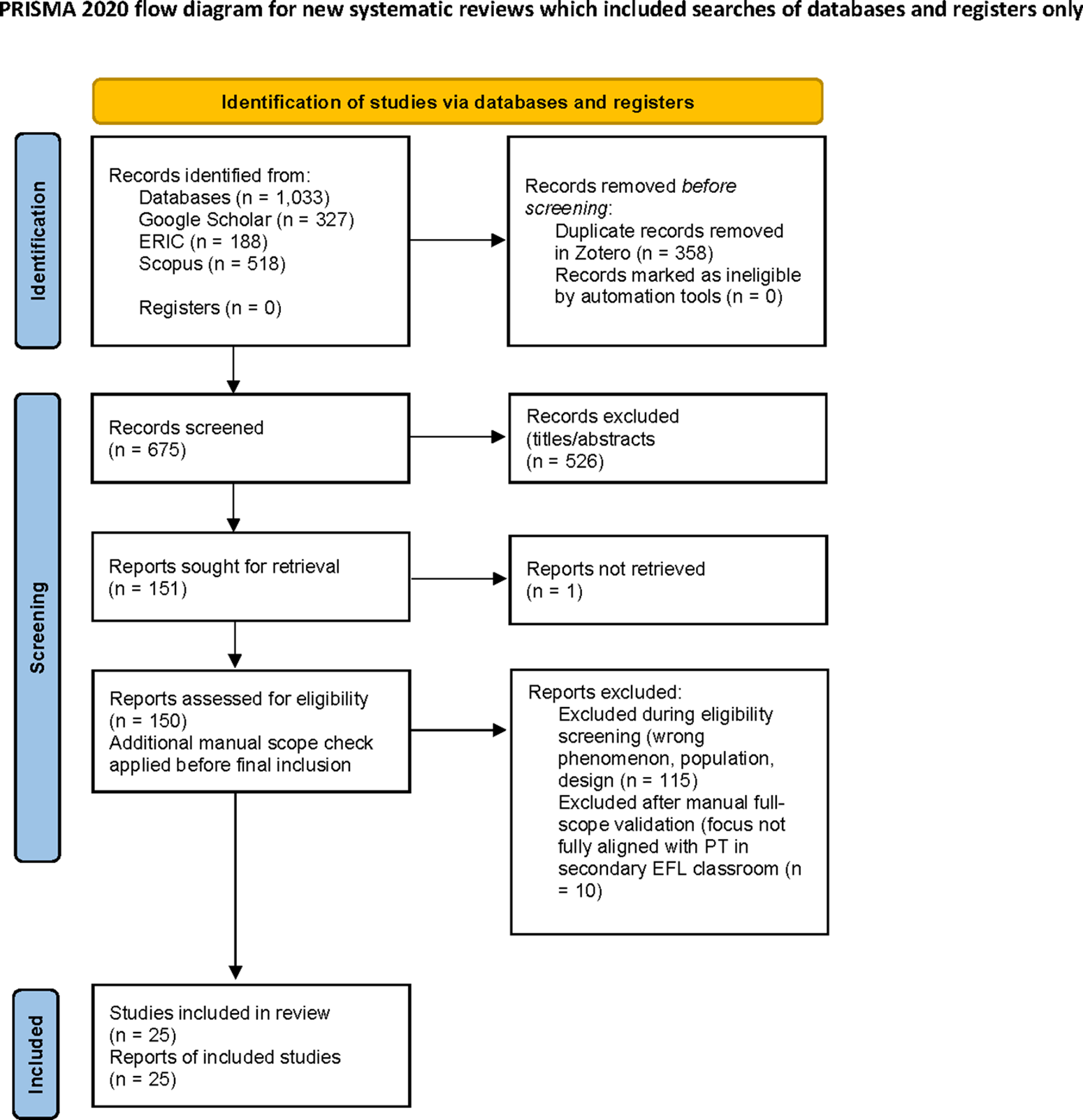
The database search returned 1,033 records, imported into Zotero for organization and duplicate detection. After removing 358 duplicates, 675 unique records underwent title- and abstract-level screening. Applying inclusion criteria (secondary EFL settings with explicit PT focus), we excluded 526 records. Full texts were sought for the remaining 151 items; one could not be retrieved, yielding 150 full texts for assessment.
At full-text screening, 115 publications were excluded for misalignment with the scope (general multilingualism or code-switching without a translanguaging analytic frame, non-target populations, and conceptual papers). Manual validation removed ten additional items with only partial relevance to translanguaging in secondary EFL. As a result, 25 studies fully met the stated criteria and entered initial synthesis. To strengthen reliability, a second reviewer independently screened a random 30% of records; Cohen’s κ = 0.90 indicated near-perfect agreement (Landis & Koch, Reference Landis and Koch1977), with discrepancies resolved through discussion. Figure 1 presents the PRISMA flow for this review.
PRISMA diagram (adapted from Page et al. (Reference Page, McKenzie, Bossuyt, Boutron, Hoffmann, Mulrow, Shamseer, Tetzlaff, Akl, Brennan and Chou2021), PRISMA 2020 statement, CC BY 4.0).
2.4. Data extraction, coding, and analysis
We recorded study details in a structured template (authors, year, country/region, design, participants, stage, focal lesson/episode) with analytic notes on how translanguaging was conceptualized, enacted, and evaluated. The complete study table appears in Appendix A (OSF repository). Materials were managed in NVivo 15.
Following the RTA procedure (Braun & Clarke, Reference Braun and Clarke2006, Reference Braun and Clarke2019, Reference Braun and Clarke2021), we synthesized findings across the 25 studies. Familiarization involved repeated readings and reflexive memos tracking ideological, institutional, and pedagogical issues (assessment regimes, leadership stances, professional learning). An inductive codebook was developed iteratively, capturing both semantic content and latent tensions (belief-practice dissonance, resistance to monolingual norms). Initial coding generated 157 codes, which were refined through clustering into a hierarchical structure of 78 codes organized under 5 major domains, which were consolidated into 4 themes based on conceptual coherence for presentation. The condensed codebook structure appears in Appendix B; the full codebook with definitions and examples is available as Appendix C at the OSF repository (https://osf.io/h8txd/overview?view_only=ec36a498f2b54a44b49d8aa9ed50a0f6).
These clustered codes were collated into themes, which we reviewed for coherence, boundary clarity, and explanatory reach. The analysis yielded four themes: (1) Barriers to PT Implementation (structural, ideological, and developmental constraints on translanguaging use); (2) Pedagogical Rationales for PT (cognitive, affective, and sociocultural justifications teachers provide for translanguaging); (3) The Enacted PT Curriculum (observable classroom practices organized by pedagogical function); and (4) Learning Outcomes of PT (cognitive, affective, and sociocultural effects documented in studies).
Throughout, researchers’ subjectivity was treated as an analytic resource; an audit trail documented coding decisions, shifts in emphasis, and moments of uncertainty. We did not apply numeric quality scores; instead, we considered methodological transparency, design coherence, and contextual clarity when judging transferability of claims.
3. Results
3.1. Overview of the studies
The corpus reflects both the accelerating global interest in translanguaging and the uneven geographic distribution of research, patterns that inform the interpretation of the thematic findings that follow.
1. Geographical distribution
The geographical distribution reveals clear regional patterns (Table 1). Asian contexts dominate (76%), with Southeast Asia (Indonesia, Malaysia, Thailand) forming the largest cluster (32%), followed by East Asia (16%), Central/Western Asia (16%), and South Asia (12%). This predominance reflects translanguaging’s pedagogical relevance in systems where monolingual policies contradict multilingual realities.
Geographic distribution of studies (n = 25)
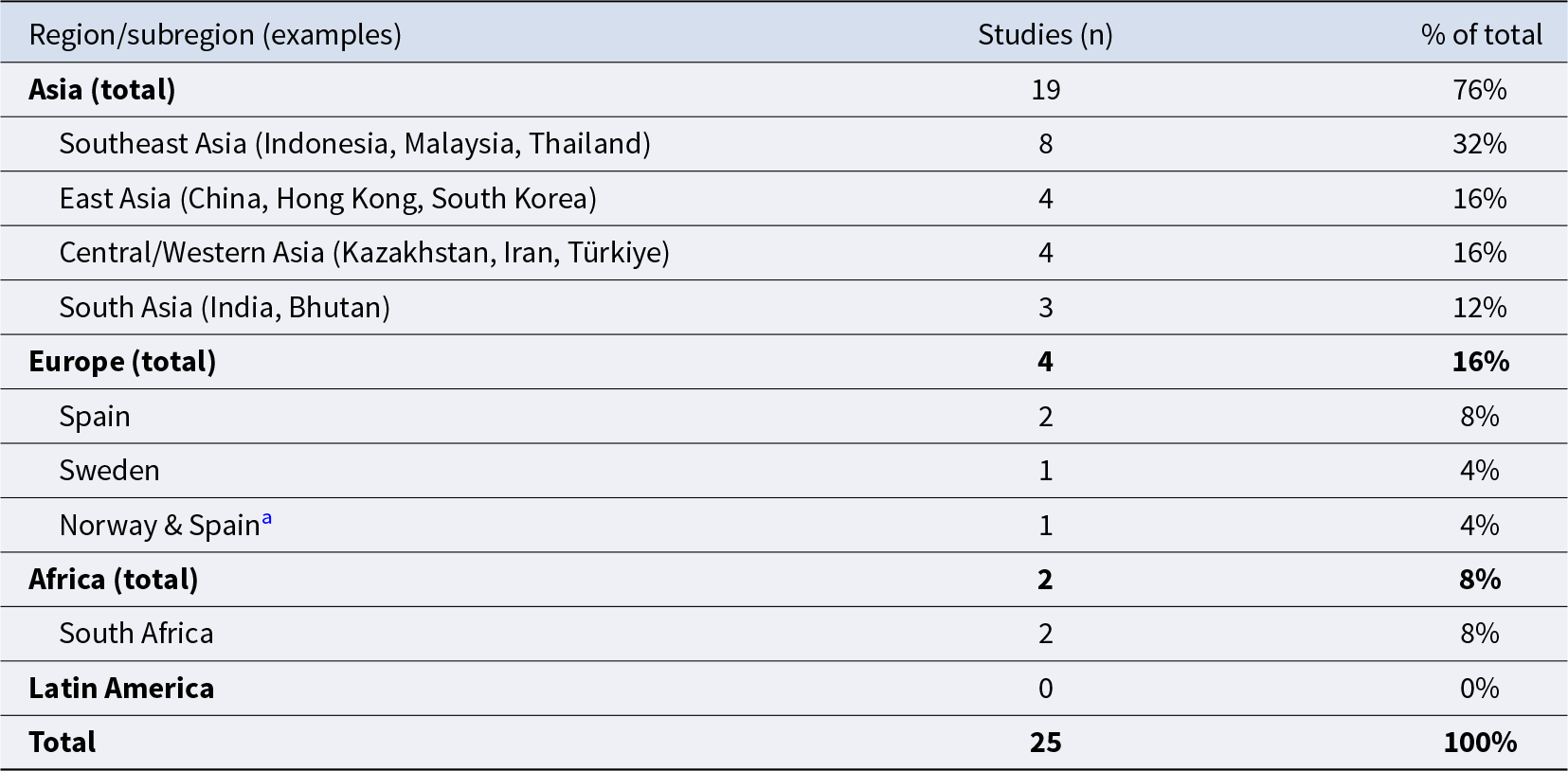
a Beiler and Villacañas de Castro (Reference Beiler and Villacañas de Castro2025) is a comparative study conducted in both Norway and Spain; it is counted once and listed under Europe.
European contexts (16%) include Spain and the Nordic countries (Sweden, Norway), typically examining translanguaging through plurilingual frameworks and minoritized-language revitalization. African contexts contribute only two studies (8%), both from South Africa, while Latin American research is absent despite the region’s rich multilingualism and established scholarship on language education (e.g., Lasagabaster, Reference Lasagabaster2025; Tavárez Dacosta et al., Reference Tavárez Dacosta, Reyes and Vásquez2025). This absence likely reflects systemic publication barriers rather than a lack of research activity; these dynamics are revisited in the Discussion. North American and Australasian contexts were excluded because they represent ESL rather than EFL settings.
2. Methodological designs
The methodological landscape of the reviewed studies shows three complementary approaches (Table 2). Qualitative designs dominate (n = 16; 64%), drawing on ethnography, case studies, classroom observation, and discourse analysis to explore how translanguaging unfolds in practice. For instance, Chen et al. (Reference Chen, Fang and Zhang2024) used classroom ethnography to trace teachers’ moment-by-moment language choices in China. Mixed-methods studies (n = 7; 28%) combined qualitative observation or interviews with quantitative measures. Cenoz et al. (Reference Cenoz, Santos and Gorter2024) paired questionnaires on classroom anxiety with teacher reflections, whereas Wangdi and Rai (Reference Wangdi and Rai2024) triangulated pre/post reading tests with interviews to assess translanguaging’s effects in Bhutan. Purely quantitative studies remain rare (n = 2; 8%), including Yüzlü (Reference Yüzlü2025), who measured Foreign Language Enjoyment (FLE) in translanguaging versus English-only classrooms, and Smagul (Reference Smagul2024), who surveyed Kazakhstani teachers on L1 use.
Methodological types of included studies (n = 25)

3.2. Translanguaging in secondary EFL: Reflexive Thematic Analysis results
This section presents findings from RTA (Braun & Clarke, Reference Braun and Clarke2006, Reference Braun and Clarke2019, Reference Braun and Clarke2021) of the 25 studies under review. Through iterative coding and theme development, we identified the four aforementioned themes capturing how translanguaging functions in secondary EFL contexts.
Theme 1: Barriers to PT implementation
This theme examines the structural, ideological, and practical barriers that restrict translanguaging in secondary EFL classrooms. Teachers across contexts work within institutional frameworks that mandate English-only policies, enforce monolingual curricula, and impose administrative pressure, while assessment systems reward isolated accuracy rather than communicative competence. These constraints are reinforced by beliefs that stigmatize the use of L1 and student resistance, most evident among higher proficiency learners, as well as by practical limitations such as classroom management, scarce resources, and linguistic diversity. Across the reviewed studies, a further barrier emerged in the form of a developmental gap: only five of the studies engaged with teacher CPD, and just three placed preparation at the center of implementation (Cenoz et al., Reference Cenoz, Santos and Gorter2024; Hendricks & Xeketwana, Reference Hendricks and Xeketwana2024; Yüzlü & Dikilitaş, Reference Yüzlü and Dikilitaş2025). As a result, most research demonstrated application of practices without considering how teachers acquired them, leaving educators to develop strategies informally, often learning “surreptitiously” (Too, Reference Too2023, p. 199) or by trial and error.
When professional development was included, participants presented important shifts. In an in-service course, one participant recognized that “what I’ve been using in my classes isn’t something I should feel guilty for” (Cenoz et al., Reference Cenoz, Santos and Gorter2024, p. 1242). Similarly, a South African teacher reflected that through workshop participation, “I could see that it is working because at the end of the day the learners understand their home language more than English” (Hendricks & Xeketwana, Reference Hendricks and Xeketwana2024, p. 4). Boonsuk (Reference Boonsuk2024) described a short Global Englishes awareness course that helped teachers frame multilingual practices as legitimate, while Beiler and Villacañas de Castro (Reference Beiler and Villacañas de Castro2025) documented a researcher-led pedagogical project with similar outcomes.
Despite these initiatives, pre-service programs were recalled as built on the English-only school of thought, with explicit prohibitions on L1 use (Too, Reference Too2023, p. 198), and where the monolingual teacher was proposed as the professional model (Cenoz et al., Reference Cenoz, Santos and Gorter2024, p. 1242). In the absence of accessible training, individual experimentation became the primary learning mode, which generated uneven confidence and limited transfer of expertise (Anderson, Reference Anderson2024; Yüzlü & Dikilitaş, Reference Yüzlü and Dikilitaş2025). Without systematic preparation legitimizing translanguaging as professional practice, teachers remained vulnerable to institutional constraints that positioned L1 use as a deficiency.
Institutional and ideological pressures deepened these challenges. In Hong Kong, the native-English teacher (NET) scheme framed Cantonese as “politically incorrect and not part of your job as an NET” (Jiang et al., Reference Jiang, Gu and Fang2024, p. 13), while Bhutanese students shared that they were “usually not allowed to use Nepali and Dzongkha” in English classrooms (Wangdi & Rai, Reference Wangdi and Rai2024, p. 1484). Even in the absence of written bans, teachers feared “getting in trouble with the principal” if they drew on L1 (Jiang et al., Reference Jiang, Gu and Fang2024, p. 12), and peer opinion reinforced English-only norms (Smagul, Reference Smagul2024). In Sweden, similar implicit pressures emerged: while no explicit policy banned translanguaging, curricula and assessment expectations led them to use Swedish-English translanguaging pragmatically while marginalizing students’ other home languages (Källkvist et al., Reference Källkvist, Sandlund, Sundqvist and Gyllstad2024).
High-stakes examinations pushed teachers toward monolingual practices across contexts, requiring learners to “monolanguage” in written English (Anderson, Reference Anderson2024, p. 2247), while Iranian teachers emphasized that grammatical accuracy was essential for success in exams (Salimi et al., Reference Salimi, Tian and Ghasempour2024). Textbooks also contributed to the problem by excluding bilingual tasks and centering on Anglophone cultural references. A Thai student noted, “Right now, it is all about Big Ben, hamburgers, pizzas, and snow, things that feel so distant from my reality. I do not see anything that reflects who I am” (Boonsuk, Reference Boonsuk2024, p. 8). A Malaysian teacher similarly described British textbook content as “alien,” requiring L1 explanation for unfamiliar concepts such as “charity car boot sales” (Too, Reference Too2023, p. 198).
Teachers’ and students’ own beliefs added a further layer of ambivalence. Many teachers noted “guilty translanguaging” (the sense of professional inadequacy when using pedagogically sound L1 strategies) (Anderson, Reference Anderson2024), acknowledging the benefits of L1 while questioning their professionalism. A Malaysian teacher confessed, “What I’m doing is probably wrong in terms of theories” (Too, Reference Too2023, p. 199). In China, participants spoke of concern about using “too much Chinese” (Chen et al., Reference Chen, Fang and Zhang2024, p. 8), while Basque teachers in Spain remembered “feeling ashamed” when departing from monolingual models (Cenoz et al., Reference Cenoz, Santos and Gorter2024, p. 1242).
In some cases, reliance on L1 was framed as evidence of inadequate English proficiency: teachers in Kazakhstan expressed feeling “insufficiently proficient in English when they resort to learners’ L1” (Smagul, Reference Smagul2024, p. 3). In Thailand, similarly, conditional views were observed: while most EFL teacher participants saw translanguaging as beneficial for explaining complex content, half of them worried it could “interrupt English learning” or create “dependency on the native language” (Xiao & Lertlit, Reference Xiao and Lertlit2023, p. 61).
Students also expressed mixed views. Some advanced learners preferred English-only environments, with one teacher noting that “some advanced level students resist using their native languages in class. They believe English-only is the way to go” (Salimi et al., Reference Salimi, Tian and Ghasempour2024, p. 10). Others feared overdependence on L1 or potential loss of competence in school and target languages: “the use of too much Nepali will make us forget Dzongkha and the English language” (Wangdi & Rai, Reference Wangdi and Rai2024, p. 1485). These perspectives reveal how deeply entrenched immersion ideologies continue to shape practice.
Practical concerns also limited implementation. Teachers described how English-only rules could serve as disciplinary tools (Chen et al., Reference Chen, Fang and Zhang2024), while others feared losing control if home languages were used more openly (Yüzlü & Dikilitaş, Reference Yüzlü and Dikilitaş2025). Superdiverse classrooms created logistical dilemmas. In multilingual classrooms, students themselves sometimes anticipated logistical limits to inclusion: as one participant noted, “it could be positive, but we belong to so many different places that we would end up not working on the school language” (Orcasitas-Vicandi & Perales-Fernández-de-Gamboa, Reference Orcasitas-Vicandi and Perales-Fernández-de-Gamboa2024, p. 1287).
Resource limitations further compounded these pressures. For example, educators developed their own posters and writing frames (Hendricks & Xeketwana, Reference Hendricks and Xeketwana2024) or continually adapted textbooks, with one Malaysian teacher reporting constant “redoing, readopting, adapting and rewriting,” which led to “overwork” (Too, Reference Too2023, p. 200). A Chinese teacher stressed the need for stronger digital skills to make translanguaging strategies effective (Chen et al., Reference Chen, Fang and Zhang2024). Overall, the reviewed studies reveal a paradox: translanguaging proved pedagogically necessary across contexts but remained institutionally precarious, with teachers caught between evidence-based practice and systemic constraints.
Theme 2. Pedagogical rationales for PT
This theme synthesizes teachers’ reported reasons for implementing translanguaging, organized across cognitive, affective, and sociocultural domains. These domains operate interdependently: comprehension enables confidence, and confidence creates conditions for identity affirmation. Teachers justify translanguaging as a cognitively effective strategy to secure comprehension, scaffold learning, and manage classroom activities; as an affective support that reduces anxiety, builds confidence, and fosters inclusive classroom environments; and as a sociocultural practice that validates students’ linguistic identities and connects instruction to lived realities.
Across settings, participants described relying on students’ home languages as cognitively indispensable for explaining complex vocabulary, grammatical rules, and culturally specific concepts. An Indonesian teacher remarked, “If learning is only monotonous in English, they will not understand the learning. Therefore, local languages dan Bahasa Indonesia are also used to provide understanding” (Dollah & Abduh, Reference Dollah and Abduh2024, p. 187). Others indicated using translanguaging when learners were “in a confused state of what to say in English” (Sinaga & Putrawan, Reference Sinaga and Putrawan2024, p. 19).
Translanguaging was also presented as scaffolding that links existing knowledge to new learning. An Indian teacher described mediating a complex text by integrating English into a Marathi-dominant discussion to “facilitate understanding and recall” (Anderson, Reference Anderson2024, p. 2242). South African learners translated “adversity” into isiXhosa before back-translating it to “difficulty,” demonstrating how knowledge in one language supports acquisition in another (Hendricks & Xeketwana, Reference Hendricks and Xeketwana2024, p. 5).
Instructional uses of L1 included giving directions, re-engaging distracted students, and checking understanding. In a Korean classroom, a teacher “switched to Korean to enhance students’ understanding,” which successfully re-engaged the learners (Son & Oh, Reference Son and Oh2024, p. 1185). Similarly, a Chinese teacher asked learners to translate “Water-Splashing Festival” into Chinese and then unpack the meaning of “splash” (Chen et al., Reference Chen, Fang and Zhang2024, p. 6). An Indian teacher allowed a student to respond in her L1 when she was disengaged, which brought her back into the lesson (Anderson, Reference Anderson2024, p. 2243). Across these accounts, a common rationale emerges: translanguaging secures comprehension and provides a bridge to L2 development.
This cognitive foundation, in turn, supports affective benefits. Translanguaging was portrayed as a way to lower stress and create safety for participation. Indonesian students mentioned turning to L1 out of “fear of making mistakes, or lack of confidence,” suggesting that it functions as “a coping mechanism” (Cahyanti & Dharmawan, Reference Cahyanti and Dharmawan2025, p. 202). Basque teachers in Spain noted that it “helped them relax and not feel forced to speak in their L3 [English] if they didn’t feel secure enough” (Cenoz et al., Reference Cenoz, Santos and Gorter2024, p. 1241). A South African teacher presented multilingual practices as creating “safe houses in which to construct shared understandings, [and] knowledge” (Hendricks & Xeketwana, Reference Hendricks and Xeketwana2024, p. 4).
Confidence-building was another frequently cited rationale: an Indian teacher noted drawing on learners’ languages “to build confidence, to increase engagement and to reduce learners’ ‘fear’ of English” (Anderson, Reference Anderson2024, p. 2243). In West Bengal, a teacher encouraged a silent student to begin in his native language, which “helped him and encouraged him… he completed the sentence” in English (Bisai & Singh, Reference Bisai and Singh2024, p. 8). Bhutanese students similarly said that using their L1s helped them “speak confidently” (Wangdi & Rai, Reference Wangdi and Rai2024, p. 1484).
Rapport and enjoyment were also further benefits. In Thailand, studies found that L1 use “fostered stronger connections between the teacher and students and among the students themselves” (Boonsuk, Reference Boonsuk2024, p. 9), and Indonesian teachers associated it with a relaxed, affirming atmosphere (Dollah & Abduh, Reference Dollah and Abduh2024, p. 186). In Türkiye, these practices correlated with higher FLE (Yüzlü, Reference Yüzlü2025), echoing a Chinese teacher’s emphasis on supporting the emotions of students with poor English proficiency (Chen et al., Reference Chen, Fang and Zhang2024, pp. 7–8).
With anxiety reduced and confidence established, sociocultural rationales for translanguaging came into focus. Some participants characterized it as a “springboard” that made instruction relevant and anchored in lived experience (Munandar, Reference Munandar2025, p. 689). In South Africa, one teacher allowed learners to analyze an isiXhosa drama for an English class task, which created space for local knowledge (Hendricks & Xeketwana, Reference Hendricks and Xeketwana2024, p. 4). South African teachers explicitly framed translanguaging as Ubuntu pedagogy, serving a dual purpose of developing ESL content understanding while affirming learners’ cultural identities and treating them as “dignified beings” by valuing their home languages in the learning space (Zondi & Mbatha, Reference Zondi and Mbatha2025, p. 5).
Identity-affirming projects appeared in European contexts as well. A project with Roma students in Spain documented how learners used English to reflect on their neighborhood, “alternately celebrating and critiquing their Roma identities and experiences” (Beiler & Villacañas de Castro, Reference Beiler and Villacañas de Castro2025, p. 17). Similar rationales appeared in Norway, where a Sámi student valued a translanguaging moment with her father as a chance to connect heritage language to formal education, stressing her responsibility to maintain it because “there is a possibility that the language will go extinct” (Beiler & Villacañas de Castro, Reference Beiler and Villacañas de Castro2025, p. 11).
Indonesian studies also revealed using local languages to preserve identity: “Besides learning English, we also maintain the local language here, maintaining the identity of the local language” (Dollah & Abduh, Reference Dollah and Abduh2024, p. 187). Beyond validation, translanguaging was described as reflecting real-world multilingual practice. Indian teachers explicitly modeled spoken PT to prepare learners for communicative realities, while still teaching them to write monolingually for exams (Anderson, Reference Anderson2024, p. 2233). A Thai participant echoed this pragmatic orientation: “Practical ELT goals today are those that prioritize communication … fixating on … native speakers does not equip us with the skills needed to use English in real-life situations” (Boonsuk, Reference Boonsuk2024, p. 7).
Collectively, the reviewed studies portray translanguaging not as a compensatory crutch but as a pedagogical resource where cognitive access enables affective safety, which in turn creates conditions for identity affirmation. Current research thus documents teachers’ justifications and the barriers they face separately, leaving their interconnection underexplored.
Theme 3. The enacted PT curriculum
This theme documents observable translanguaging practices organized by pedagogical function. Teachers and students used translanguaging to explain and clarify content, manage classroom activities, scaffold participation, and mobilize multimodal resources. A cross-cutting pattern emerged across these domains: teachers strategically deployed students’ more enabled languages (MEL, students’ first languages) and less enabled languages (LEL, in this case, English) according to content difficulty, task type, and student proficiency. This pattern of alternation (MEL for comprehension and affective support, LEL for formal assessment and curricular functions) reveals translanguaging as purposeful pedagogy.
A central practice involved explaining and clarifying content. Studies documented consistent reliance on students’ home languages to secure comprehension of difficult vocabulary, complex grammar, and culturally distant concepts. For instance, an Indian teacher clarified the meaning of “spring” by explaining its two senses in Marathi (Anderson, Reference Anderson2024, pp. 2241–2242). In China, vocabulary was introduced visually and then anchored in a local dialect to ensure understanding (Chen et al., Reference Chen, Fang and Zhang2024, p. 7). Indonesian teachers combined English, Indonesian, and Cia-Cia to label classroom objects and create bilingual visual aids (Dollah & Abduh, Reference Dollah and Abduh2024, p. 189). Grammar was often explained in MEL, as when a Korean teacher summarized inductively taught rules in Korean to consolidate “metalinguistic awareness” (Son & Oh, Reference Son and Oh2024, p. 1187). L1 use also bridged cultural distance: a Malaysian teacher inserted “a few Malay words” when introducing unfamiliar textbook concepts (Too, Reference Too2023, p. 198), while in Indonesia, an everyday example of instant noodles made procedure texts more accessible (Munandar, Reference Munandar2025, p. 697). These practices show how translanguaging secured access to both linguistic and cultural knowledge.
Translanguaging also played a routine role in classroom management. Teachers repeated or reinforced instructions in L1 to guarantee clarity. In a Chinese lesson, instructions about group size and time were restated in Chinese after being given in English (Chen et al., Reference Chen, Fang and Zhang2024, pp. 5–7). When students in Korea appeared confused, the teacher switched to Korean, successfully re-engaging them (Son & Oh, Reference Son and Oh2024, p. 1185). Studies indicated that participants in Malaysia and Indonesia applied the same strategy for lower-proficiency groups (Sinaga & Putrawan, Reference Sinaga and Putrawan2024; Zaki & Sulaiman, Reference Zaki and Sulaiman2024). Teachers drew on L1 to encourage hesitant learners or build rapport, for example, by praising students with humorous phrases that lightened the classroom atmosphere (Chen et al., Reference Chen, Fang and Zhang2024, p. 7). These accounts underline how translanguaging functioned pragmatically to maintain order and foster a positive climate.
Teachers further created spaces where translanguaging scaffolded student production. Less proficient learners were invited to use L1 when retelling stories or answering questions, which allowed them to demonstrate comprehension while building confidence (Anderson, Reference Anderson2024, p. 2243; Son & Oh, Reference Son and Oh2024, p. 1186). Collaborative tasks often relied on students’ repertoires: in India, groups used Telugu alongside English lexical items before producing written answers (Anderson, Reference Anderson2024, p. 2238), while in West Bengal students drew on Bengali, English, and Hindi to clarify doubts during story-writing (Bisai & Singh, Reference Bisai and Singh2024, p. 2). Text mediation was strategic: explaining content in MEL but preserving key English terminology for recall (Anderson, Reference Anderson2024, p. 2242). Teachers also differentiated language use by proficiency: an Indian teacher monitored pairwork speaking mostly English with a more proficient student but switched to Marathi to guide a less proficient one (Anderson, Reference Anderson2024, p. 2243). In Thailand, one student remarked that as her proficiency grew, she preferred teachers to use more English so she could practice (Boonsuk, Reference Boonsuk2024, p. 10). These examples show translanguaging as a scaffold toward participation and gradual English production.
The enacted curriculum extended beyond spoken language into multimodal resources. In South Africa, teachers co-developed “multilingual posters for key science and mathematics terms, and charts with multilingual writing frames” (Hendricks & Xeketwana, Reference Hendricks and Xeketwana2024, p. 2). In Spain, Roma students created multimodal boards combining photographs, maps, and bilingual commentary about their neighborhoods (Beiler & Villacañas de Castro, Reference Beiler and Villacañas de Castro2025, p. 16). Chinese classrooms integrated pictures, videos, and GIFs to attract attention (Chen et al., Reference Chen, Fang and Zhang2024, p. 8), and one teacher dramatized “drill” by simulating an air-conditioner installation (Wang et al., Reference Wang, Xia, Zhao and Chen2025, p. 24). Hong Kong teachers who avoided students’ L1 often compensated by relying on props or online images (Jiang et al., Reference Jiang, Gu and Fang2024, p. 15). Students also engaged in translanguaging in classroom materials, annotating textbooks with translations or creating bilingual word banks (Hendricks & Xeketwana, Reference Hendricks and Xeketwana2024, p. 8).
These multimodal practices show how translanguaging extends beyond speech into written and visual mediation. However, only 5 of the 25 studies (20%) systematically theorized or analyzed such multimodal and semiotic resources, indicating that while multimodality is present, its treatment remains uneven and largely instrumental. These findings underscore the need for future PT research to integrate multimodal dimensions into analytic frameworks and outcome designs.
The reported practices reveal translanguaging as a systematic pedagogy rather than random code-switching. Participants deployed MEL to clarify complex content, build confidence, and support collaboration, while prioritizing LEL for formal assessment, subject-specific terminology, and higher-proficiency contexts. This strategic alternation responded to content difficulty (Anderson, Reference Anderson2024; Chen et al., Reference Chen, Fang and Zhang2024), task type (Anderson, Reference Anderson2024; Bisai & Singh, Reference Bisai and Singh2024), and learner proficiency (Anderson, Reference Anderson2024; Boonsuk, Reference Boonsuk2024), demonstrating responsive orchestration across functions and modalities.
Theme 4. Learning outcomes of PT
This theme synthesizes the effects of translanguaging implementation, organized across interdependent cognitive, affective, and sociocultural domains. These outcomes build on one another: comprehension gains enable confidence, and confidence creates conditions for identity affirmation and authentic multilingual engagement. The three outcome domains mirror teachers’ rationales in Theme 2, suggesting conceptual coherence in how translanguaging’s purposes and effects are understood.
Cognitive outcomes were the most frequently mentioned ones. Indonesian teachers noted visible improvements in students’ performance and evaluation responses when they combined languages in explanation rather than relying solely on English (Dollah & Abduh, Reference Dollah and Abduh2024, p. 194). A South African teacher confirmed that translanguaging helped learners in “understanding of the unfamiliar purpose, audience and content” (Hendricks & Xeketwana, Reference Hendricks and Xeketwana2024, p. 6). Learners in Bhutan echoed this, reporting that it allowed them to “understand the lesson (poem, essay, and short story) better and more quickly” (Wangdi & Rai, Reference Wangdi and Rai2024, p. 1484). The benefits extended to literacy: in a quasi-experiment, Bhutanese students taught with translanguaging “significantly outperformed the monolingual group” on reading comprehension (Wangdi & Rai, Reference Wangdi and Rai2024, p. 1473). In India, collaborative oral discussions in multiple languages produced English writing that displayed a strong command of tense, discourse markers, and low-frequency vocabulary (Anderson, Reference Anderson2024, p. 2244).
Teachers also observed more effective vocabulary learning when students could connect English terms to their L1 (Dollah & Abduh, Reference Dollah and Abduh2024, p. 187). Beyond comprehension, translanguaging fostered creativity and higher-order thinking. Students in West Bengal incorporated Bengali literary references into English writing, polishing academic language and activating what Cummins (Reference Cummins1979) calls CALP, or Cognitive Academic Language Proficiency (Bisai & Singh, Reference Bisai and Singh2024, p. 2). A project with Roma students in Spain similarly encouraged creative expression, enabling learners to share “all the pieces of imagination that belong to me and my friends” (Beiler & Villacañas de Castro, Reference Beiler and Villacañas de Castro2025, p. 15). In Korea, summarizing grammar in the L1 after inductive English activities strengthened metalinguistic awareness (Son & Oh, Reference Son and Oh2024, p. 1187), while Indian classrooms documented how such strategies stimulated imagination and critical thinking (Bisai & Singh, Reference Bisai and Singh2024, p. 9).
Affective and social benefits were equally prominent. Translanguaging consistently reduced anxiety and built learner confidence. Indonesian students explained relying on their L1 to “reduce anxiety and enhance comprehension” when faced with difficulties in English (Cahyanti & Dharmawan, Reference Cahyanti and Dharmawan2025, p. 197). A Spanish student said that using her home language allowed her to “feel safer” (Orcasitas-Vicandi & Perales-Fernández-de-Gamboa, Reference Orcasitas-Vicandi and Perales-Fernández-de-Gamboa2024, p. 1289), and Bhutanese learners shared that it enabled them to “speak confidently” (Wangdi & Rai, Reference Wangdi and Rai2024, p. 1484). These shifts in confidence translated into greater participation. In Spain, a teacher recounted how a long-struggling student “even volunteered to answer because he felt he had finally understood something” when Spanish was used to clarify a point (Cenoz et al., Reference Cenoz, Santos and Gorter2024, p. 1240). Indonesian classrooms showed similar patterns, with teachers reporting that students became “more active in receiving and understanding the learning material” (Dollah & Abduh, Reference Dollah and Abduh2024, p. 186).
The classroom climate also improved. Thai and Indonesian teachers described stronger connections and a more relaxed atmosphere (Boonsuk, Reference Boonsuk2024; Dollah & Abduh, Reference Dollah and Abduh2024) and a higher level of FLE in translanguaging classrooms compared with English-only settings (Yüzlü, Reference Yüzlü2025).
Alongside these affective benefits, translanguaging also produced sociocultural and identity-related outcomes, which further underscored its value for students. They shared how it validated their identities and connected schoolwork to lived realities. A Sámi student in Norway emphasized the importance of using her Indigenous language as a responsibility “to preserve the language … because there is a possibility that the language will go extinct” (Beiler & Villacañas de Castro, Reference Beiler and Villacañas de Castro2025, p. 15).
Preparation for multilingual realities beyond school was another documented outcome. Indian educators modeled spoken translanguaging while teaching monolingual writing for exams, creating “site[s] for translingual socialization” (A. S. Canagarajah, Reference Canagarajah2013, p. 184) that prepared learners for both authentic communication and exam requirements (Anderson, Reference Anderson2024). Relevance was also enhanced when instruction drew on local cultural frames. An Indonesian teacher used familiar examples to focus on procedures (Munandar, Reference Munandar2025, p. 697), while a Roma project encouraged students to explore their own neighborhoods. The impact was vividly described by one parent, who likened the final exhibition to a “beautiful magic potion made of joy … of English words” (Beiler & Villacañas de Castro, Reference Beiler and Villacañas de Castro2025, p. 18).
These outcomes demonstrate translanguaging’s effects across cognitive, affective, and sociocultural domains, with benefits building from comprehension through confidence to identity affirmation. However, this evidence reveals a fundamental limitation: studies document what translanguaging achieves without systematically examining how specific practices produce particular outcomes.
4. Discussion
The four themes identified inductively by RTA portray PT as pedagogically robust yet institutionally fragile. Following the Results section, we respond to the research questions, integrate relevant contextual evidence, and interpret cross-theme patterns.
Our analysis reveals a fundamental tension. Although EFL teachers justify PT on cognitive, affective, and sociocultural grounds (RQ2), they work within environments shaped by English-only policies and assessment practices that reward monolingual competence, while materials reproduce native-speaker norms (RQ1) (Jiang et al., Reference Jiang, Gu and Fang2024; Salimi et al., Reference Salimi, Tian and Ghasempour2024; Smagul, Reference Smagul2024; Too, Reference Too2023; Wangdi & Rai, Reference Wangdi and Rai2024; Xiao & Lertlit, Reference Xiao and Lertlit2023). These conditions often force what Too (Reference Too2023) calls “surreptitious” practice, where teachers deploy PT covertly to meet learning needs while protecting professional standing.
This finding is further supported by a study by Hagenaars et al. (Reference Hagenaars, van Heese, Vantieghem and Stevens2025). Although this publication was not included in the analysis, it presents important insights into existing barriers to PT (RQ1). The authors specify how PT operates through “conditional tolerance”: administrators and teachers permit home languages depending on who speaks (newcomers), when (to explain content), where (playground, not classroom), and why (empathy, not pedagogy), positioning multilingualism as a remedial exception rather than a core practice. This conditional logic, also documented in the Swedish secondary EFL context (Källkvist et al., Reference Källkvist, Sandlund, Sundqvist and Gyllstad2024), explains why teachers hide PT even when no explicit ban exists.
Reports of guilt or perceived inadequacy accompany otherwise sound pedagogical decisions (Anderson, Reference Anderson2024; Cenoz et al., Reference Cenoz, Santos and Gorter2024; Chen et al., Reference Chen, Fang and Zhang2024; Too, Reference Too2023). Only one study explicitly framed PT as a practice allowing teachers to reconcile policy expectations with classroom realities, linking their rationales to navigating institutional constraints (Yüzlü & Dikilitaş, Reference Yüzlü and Dikilitaş2025). This separation in the literature leaves underexplored how such constraints shape the ways teachers articulate, defend, and selectively enact PT.
This pattern reflects a notable gap in teacher education. Most studies report the implementation of PT strategies (RQ2) without examining how teachers learned them; indeed, only one-fifth of the twenty-five studies included CPD components, with three placing teacher preparation at the center of implementation (Cenoz et al., Reference Cenoz, Santos and Gorter2024; Hendricks & Xeketwana, Reference Hendricks and Xeketwana2024; Yüzlü & Dikilitaş, Reference Yüzlü and Dikilitaş2025) and two additional studies identifying preparation gaps without evaluating interventions (Anderson, Reference Anderson2024; Jiang et al., Reference Jiang, Gu and Fang2024). The remaining studies depicted PT use without examining how teachers developed these capabilities or beliefs. Given that many teachers describe pre-service training grounded in monolingual methodologies, PT often emerges through situated problem-solving rather than principled preparation (Cenoz et al., Reference Cenoz, Santos and Gorter2024; Too, Reference Too2023). Where formal learning occurred, teachers mentioned a reduced sense of guilt and clearer legitimacy for practices they were already using.
Without systematic preparation legitimizing PT as professional expertise, teachers lack the institutional grounding to resist the constraints documented above. This vulnerability produces a sense of guilt and covert implementation found across the corpus, creating a pattern in which pedagogically sound decisions become acts of professional risk.
The data show that observed classroom strategies clustered around four functions (RQ2): explaining and clarifying content, managing activities, scaffolding student production, and mobilizing multimodal resources. In this vein, the Capstick and Ateek (Reference Capstick and Ateek2024) study, which fell outside this review’s formal scope, offers a valuable lens on multimodal approaches. The authors document embodied translanguaging with teenage refugee learners in the Kurdistan region of Iraq, a context highly relevant to today’s increasingly diverse EFL classrooms. They describe how language coaches used gesture, gaze, and drawing to create “safe spaces” (Wei, Reference Wei2018) for trauma-affected learners when shared verbal languages were absent. This study powerfully demonstrates how multimodal resources can function as primary pedagogical tools, supplementing the linguistic translanguaging indicated in our findings. These findings also raise an important question as to whether current scholarship is adequately capturing the embodied dimensions of translanguaging, especially for diverse and potentially trauma-affected students in formal secondary education (RQ4).
Across the observed practice functions, teachers systematically adjusted language choice to content difficulty, task type, and learner proficiency, deploying MEL for access, affective support, and collaborative talk, while reserving LEL for formal assessment, subject metalanguage, and higher-proficiency work (Anderson, Reference Anderson2024; Bisai & Singh, Reference Bisai and Singh2024; Boonsuk, Reference Boonsuk2024; Chen et al., Reference Chen, Fang and Zhang2024). This strategic deployment reveals PT as requiring sophisticated professional judgment about when comprehension takes priority over formal accuracy, when affective needs outweigh exposure targets, and how to differentiate responsively. The pattern contradicts characterizations of translanguaging as ad hoc code-switching, instead showing teachers making systematic decisions based on pedagogical priorities rather than linguistic convenience (RQ2). However, these decisions develop without systematic preparation, leaving teachers’ expertise tacit and unsupported.
The reported outcomes (RQ3) aligned with teachers’ rationales, as the reviewed studies report cognitive gains in comprehension, literacy, and metalinguistic awareness (e.g., Dollah & Abduh, Reference Dollah and Abduh2024; Hendricks & Xeketwana, Reference Hendricks and Xeketwana2024; Son & Oh, Reference Son and Oh2024). They also show affective benefits in anxiety reduction and an increase in confidence and participation, which generate a better classroom climate (Cahyanti & Dharmawan, Reference Cahyanti and Dharmawan2025; Cenoz et al., Reference Cenoz, Santos and Gorter2024; Wangdi & Rai, Reference Wangdi and Rai2024; Yüzlü, Reference Yüzlü2025). Last but not least, positive sociocultural outcomes in identity affirmation and preparation for authentic multilingual communication have also been found (Beiler & Villacañas de Castro, Reference Beiler and Villacañas de Castro2025; Boonsuk, Reference Boonsuk2024; Dollah & Abduh, Reference Dollah and Abduh2024). In this regard, South African teachers conceptualized translanguaging as Ubuntu pedagogy, in which language practices are linked to cultural values of human dignity and communal belonging (Zondi & Mbatha, Reference Zondi and Mbatha2025). Nevertheless, an important limitation is that most studies present practices and outcomes in separate designs, so links between particular strategies and specific effects remain largely inferential.
However, outcomes were not uniformly positive, providing a critical counterpoint to the findings on learning outcomes (RQ3). Cataldo-Schwarzl (Reference Cataldo-Schwarzl2024) examined superdiverse Vienna classrooms and found that while students with dominant community languages (Turkish or Serbian) gained confidence and participation, students with unique languages (Romanian, Mongolian) experienced marginalization and frustration. Although this study fell outside our inclusion criteria, it provides rare empirical evidence in recent literature documenting negative emotional outcomes of PT implementation. This finding indicates that strategic language deployment requires explicit equity attention to avoid reproducing the hierarchies PT aims to dismantle, identifying an important gap for future practice and research (RQ4).
The field is therefore rich in descriptions of what PT looks like, but comparatively thin on how teachers learn to enact it systematically and how preparation can be institutionalized beyond isolated interventions (RQ4). Barahona and Darwin (Reference Barahona and Darwin2024) show how initial teacher education creates this gap: while L2 acquisition instruction receives hands-on modeling and rehearsal, PT is relegated to theoretical lectures, making it the “least availed” practice. Throughout the corpus, PT appears pedagogically sound and often necessary, although it lacks the professional infrastructure that would make it an acknowledged competence.
In other domains, curriculum frameworks specify required knowledge, teacher education offers systematic rehearsal, and standards recognize core practices. For PT in these contexts, teachers discover effective approaches individually, justify them defensively, and refine them without institutional support. In other words, with PT, practice has outpaced recognition, leaving educators simultaneously innovative and vulnerable.
In fact, the corpus depicts teachers who can articulate when and why to draw on students’ repertoires, in ways consistent with research on multilingual learning. At the same time, these teachers work in contexts organized by monolingual ideologies, in which policies restrict L1 use, assessments valorize monolingual accuracy, and materials center on Anglophone norms. Therefore, it comes as no surprise that reports of translanguaging guilt or covert PT practice reflect rational responses to environments that delegitimize evidence-informed decisions rather than a lack of pedagogical clarity.
Many of the studies reviewed demonstrate effective strategies without unpacking the decision rules that make them work. Teachers adjust MEL and LEL responsively to content difficulty, task type, and proficiency, but the mechanisms linking strategies to outcomes are rarely traced. Without systematic CPD that renders PT explicit and shareable, professional knowledge remains largely tacit: powerful in local practice, difficult to codify, and hard to transfer. This limits the field’s capacity to build cumulative knowledge about what works, for whom, and under what conditions (RQ4).
This key question of “what works for whom” applies directly to the MEL/LEL framework (Theme 3). The assumption that this practice distributes opportunities equitably is challenged by Cataldo-Schwarzl’s (Reference Cataldo-Schwarzl2024) finding discussed earlier. This study’s evidence of marginalization reveals a significant vulnerability: without explicit equity attention, strategic language deployment can reproduce the hierarchies PT aims to challenge. The pattern suggests that teacher preparation must address not only how to deploy MEL and LEL, but also how to ensure all students’ linguistic resources are valued, regardless of their numerical representation in the classroom. While this finding emerges from a single contextual study, it identifies a serious blind spot in PT implementation that warrants urgent attention (RQ4).
5. Implications for practice and policy (RQ4)
The primary implication for practice concerns teacher professional development, as PT should be positioned as core professional knowledge. Pre-service programs need explicit preparation on how repertoires function as learning resources, how language ideologies shape classroom decisions, and how to deploy languages strategically in real classrooms (Barahona & Darwin, Reference Barahona and Darwin2024; Ulum, Reference Ulum2024). Field experiences should include coached practice, where trainees plan, enact, and reflect on PT.
For in-service teachers, CPD should legitimize existing practices while building shared frameworks and materials. Effective models already exist and can be combined: practice-focused workshops with classroom support and co-development of resources (Hendricks & Xeketwana, Reference Hendricks and Xeketwana2024), loop-input training with peer teaching and feedback (Yüzlü & Dikilitaş, Reference Yüzlü and Dikilitaş2025), and courses that blend intensive sessions with online discussion and follow-up reflection (Cenoz et al., Reference Cenoz, Santos and Gorter2024).
A recent study by Tresserras and Querol (Reference Tresserras and Querol2023), which fell outside our review scope, offers a particularly detailed framework for transformation, documenting three cognitive moves through which teachers reconceptualize practice: awareness (recognizing contradictions via video-based self-confrontation), expansion (changing practice through peer cross-confrontation), and transformation (forming new theoretical concepts through reflective tools). This progression provides a concrete pathway for moving PT from tacit individual knowledge to explicit shared expertise and may be used for targeted teacher preparation. Critically, effective CPD must make explicit the decision rules underlying successful PT: when to prioritize comprehension over target language exposure, how to adjust language choice to task cognitive load, and which translanguaging configurations benefit which learners, transforming tacit expertise into shared professional knowledge.
Teacher CPD alone cannot sustain change in practice without corresponding changes in institutional policy. Policy must therefore move from conditional tolerance to explicit endorsement of strategic multilingual pedagogy. Leadership training needs to include recognizing sophisticated PT, allocating time for collaborative design, and aligning school cultures so that PT is open rather than covert. Administrators require criteria that distinguish evidence-informed PT from deficit framings of L1 use. Without such criteria, they may fail to challenge entrenched beliefs that view students’ home languages as a barrier to learning the target language (Hagenaars et al., Reference Hagenaars, van Heese, Vantieghem and Stevens2025) or as something that will hinder the acquisition of the foreign language (Lasagabaster, Reference Lasagabaster2017). Moreover, policy and implementation must attend to equity: ensuring that students with less-represented home languages receive equivalent support and recognition (Cataldo-Schwarzl, Reference Cataldo-Schwarzl2024), for example, through deliberate multilingual grouping strategies or dedicated language celebration activities. This may help avoid the reproduction of linguistic hierarchies within translanguaging classrooms.
Equally crucial are the assessment systems and materials that currently reinforce monolingual norms. When assessments recognize only monolingual performance, their “washback” effect (Shohamy, Reference Shohamy2011) suppresses PT. Assessments should therefore acknowledge how learners demonstrate understanding through strategic multilingual resource use while still maintaining targets for English development (e.g., S. Canagarajah, Reference Canagarajah2011; Shohamy, Reference Shohamy2011). Materials designed for PT should include guidance on strategic implementation, culturally relevant content that reduces adaptation load, and models that present multilingual practice as standard rather than exceptional. Digital resources documented in the corpus (e.g., Beiler & Villacañas de Castro, Reference Beiler and Villacañas de Castro2025; Chen et al., Reference Chen, Fang and Zhang2024; Jiang et al., Reference Jiang, Gu and Fang2024) offer scalable alternatives but require institutional investment in high-quality multilingual tools. Together, these shifts would align institutional design with pedagogical evidence, transforming PT from a tolerated practice into supported expertise.
6. Limitations
The present study is limited to peer-reviewed articles in English published between January 2023 and August 2025, which may exclude relevant work in other languages or formats. The corpus is geographically imbalanced: Asian contexts account for a large majority, with Latin American research absent from the dataset despite the region’s rich multilingual landscapes. This absence reflects systemic publication biases rather than a lack of multilingualism. Latin American scholars face economic, structural, and linguistic barriers to international publication, with Spanish/Portuguese titles attracting approximately one-third the visibility of comparable English publications and accounting for only about 1% of journal articles compared with 95% in English (Basilio, Reference Basilio2023).
Similarly, African contexts, represented by only two studies from South Africa, face constraints such as limited mentorship, inadequate infrastructure, and heavy teaching loads that leave little time for research and international publication (Coussens et al., Reference Coussens, Badre, Erastus, Akindele, Khoury, Yang, Geffers and Keane2025). The pattern of publication concentration in North America, Western Europe, China, and Australia (Bylund et al., Reference Bylund, Khafif and Berghoff2024; National Science Board, 2023) means our synthesis may not fully capture pedagogical innovations from contexts where translanguaging emerges organically from societal multilingualism.
The corpus also shows methodological imbalance: only two quantitative studies and seven mixed-methods studies complement the predominantly qualitative research. This distribution limits our ability to make generalizable claims about effectiveness or to identify which PT strategies consistently produce particular learning outcomes across settings. Many studies were small-scale and localized, relied heavily on self-report, and seldom connected specific strategies to measured outcomes, which constrains causal interpretation. As RTA is interpretive, different analytic frameworks might have yielded different emphases. The synthesis includes studies with diverse designs and rigor, as we did not exclude based on methodological grounds. Additionally, only 5 of the 25 studies (20%) systematically examined multimodal resources in their coding frameworks, which limits our capacity to synthesize how embodied dimensions operate within PT implementation.
7. Conclusions
Studies from 25 diverse secondary EFL contexts converge on a striking pattern. Teachers deploy sophisticated translanguaging strategies that secure comprehension, build confidence, and connect instruction to students’ lived realities. These same teachers work covertly, feel insecure and even guilty for their methods, while they lack institutional support for practices that research validates and learners benefit from. This disconnect between pedagogical knowledge and institutional structure shapes classroom practice. Strategic language deployment enhances learning for many students, although evidence from superdiverse classrooms suggests it can reproduce linguistic hierarchies when equity attention is absent. The path forward requires aligning institutional structures with pedagogical evidence, which calls for teacher preparation that positions PT as core professional knowledge, not remedial accommodation, and leadership that endorses rather than tolerates multilingual pedagogy. Moreover, assessment systems are needed that recognize how learners demonstrate understanding through their full repertoires while maintaining English development targets. Such changes would transform translanguaging from professional risk into supported expertise, aligning institutional design with what teachers already know promotes learning. This synthesis clarifies how teacher preparation mediates the institutionalization of PT, demonstrating that the success of multilingual pedagogy depends not only on individual teacher agency but on structural recognition within educational systems.
Supplementary material
The supplementary material for this article can be found at: https://doi.org/10.1017/S0261444826101189.
Acknowledgements
Open Access funding provided by the University of the Basque Country (UPV/EHU).
The authors employed Grammarly Premium and DeepL Write as editing tools to improve sentence clarity and grammar, but all intellectual content, argumentation, and interpretation remain entirely our own.
David Lasagabaster (ORCID: 0000-0001-7750-2314) is Full Professor of Applied Linguistics at the University of the Basque Country UPV/EHU (Spain) and Extraordinary Professor at Stellenbosch University (South Africa). His research revolves around EMI, CLIL, attitudes and motivation, multilingualism, and language teacher education. A selection of his work can be found on his webpage: https://laslab.org/staff/david/.
Contact information: david.lasagabaster@ehu.eus
Yelena Zakharova (ORCID: 0000-0002-0322-745X) is a PhD candidate at the University of Warsaw and the University of the Basque Country (LASLAB, UPV/EHU). Her research in applied linguistics and sociolinguistics focuses on translanguaging, teacher education, and EMI, examining how language policy and institutional conditions intersect with teacher agency, professional learning, and linguistic identity in contexts of social and linguistic change. For details, see her LASLAB webpage: https://laslab.org/staff/yelena_zakharova/ or Google Scholar: https://scholar.google.com/citations?user=Fv2rctEAAAAJ&hl=en&oi=ao.
Contact information: y.zakharova@uw.edu.pl




 Open access

