





1 Introduction
1.1 Main result
The pentagram map is a discrete dynamical system on the space of polygons in the projective plane. The map was introduced by Schwartz in 1992 for convex polygons in the real projective plane [Reference Schwartz36], but the definition extends to polygons in any projective plane. This paper describes the dynamics of the pentagram map in projective planes over algebraically closed fields, including positive characteristic. Our main result establishes algebro-geometric complete integrability of the pentagram map over any arbitrary algebraically closed field of characteristic not equal to 2.
Definition 1.1. Let $n \geq 3$
be an integer. A closed n-gon, or just n-gon, is an ordered n-tuple of points
$n \geq 3$
be an integer. A closed n-gon, or just n-gon, is an ordered n-tuple of points $(v_1, \ldots , v_n) \in (\mathbb {P}^2)^n$
in general linear position. The space of n-gons is a Zariski open subset of
$(v_1, \ldots , v_n) \in (\mathbb {P}^2)^n$
in general linear position. The space of n-gons is a Zariski open subset of $(\mathbb {P}^2)^n$
.
$(\mathbb {P}^2)^n$
.
Definition 1.2. Let $n \geq 5.$
The pentagram map is a rational self-map of the space of n-gons. The pentagram map sends an n-gon
$n \geq 5.$
The pentagram map is a rational self-map of the space of n-gons. The pentagram map sends an n-gon $(v_1, \ldots , v_n)$
to the n-gon
$(v_1, \ldots , v_n)$
to the n-gon $(w_1, \ldots , w_n)$
, where
$(w_1, \ldots , w_n)$
, where $w_i$
is the intersection of the diagonals
$w_i$
is the intersection of the diagonals $\overline {v_{i-1} v_{i+1}}$
and
$\overline {v_{i-1} v_{i+1}}$
and $\overline {v_i v_{i+1}}$
, and where we take the indices cyclically modulo n; see Figure 1.
$\overline {v_i v_{i+1}}$
, and where we take the indices cyclically modulo n; see Figure 1.
The pentagram map applied to a $9$
-gon.
$9$
-gon.

Since the construction is projectively natural, we get an induced rational self-map of the moduli space of n-gons in $\mathbb {P}^2$
up to projective equivalence. From now on, by the pentagram map, we mean this map on moduli space.
$\mathbb {P}^2$
up to projective equivalence. From now on, by the pentagram map, we mean this map on moduli space.
Schwartz, following computational evidence, conjectured that the real pentagram map might be a rare example of a Liouville–Arnold discrete integrable system. This was proved in 2010–11 by Ovsienko, Schwartz, and Tabachnikov [Reference Ovsienko, Schwartz and Tabachnikov33, Reference Ovsienko, Schwartz and Tabachnikov34], leading to an explosion of work on the pentagram map, including higher-dimensional generalizations [Reference Izosimov20, Reference Khesin and Soloviev24, Reference Khesin and Soloviev25] and connections to cluster algebras [Reference Gekhtman, Shapiro, Tabachnikov and Vainshtein10, Reference Glick11, Reference Kedem and Vichitkunakorn23], Poisson–Lie groups [Reference Fock and Marshakov9, Reference Izosimov20], and integrable partial differential equations [Reference Marí Beffa27].
Liouville–Arnold integrability is an extremely strong property which almost completely describes the dynamics. Roughly, it means:
-
• the domain of the map (dimension $\approx 2n$
) admits a fibration by invariant submanifolds of dimension
$\approx n$
;
$\approx 2n$
) admits a fibration by invariant submanifolds of dimension
$\approx n$
; -
• each of these submanifolds may be identified with an open subset of a real torus of dimension
$\approx n$
, such that on each torus, some iterate of the pentagram map is a translation.


In this paper, we study the closely related pentagram map on twisted polygons, also introduced by Schwartz [Reference Schwartz37]. The main integrability theorems for the pentagram map on closed polygons were proved first for twisted polygons [Reference Ovsienko, Schwartz and Tabachnikov34, Reference Soloviev43].
Definition 1.3. A twisted n-gon is a sequence $(v_i)_{i \in {\mathbb Z}}$
in
$(v_i)_{i \in {\mathbb Z}}$
in $\mathbb {P}^2$
with the property that there exists a projective transformation
$\mathbb {P}^2$
with the property that there exists a projective transformation $M \in \operatorname {\mathrm {PGL}}_3$
, called the monodromy, such that, for all
$M \in \operatorname {\mathrm {PGL}}_3$
, called the monodromy, such that, for all $i \in {\mathbb Z}$
,
$i \in {\mathbb Z}$
,
 $$ \begin{align} Mv_i = v_{i + n}. \end{align} $$
We also impose some non-degeneracy conditions; see Definition 3.1 for details. The pentagram map on the parameter space of twisted n-gons sends $(v_i)_{i \in {\mathbb Z}}$
to
$(v_i)_{i \in {\mathbb Z}}$
to $(w_i)_{i \in {\mathbb Z}}$
, where
$(w_i)_{i \in {\mathbb Z}}$
, where $w_i$
is the intersection of the diagonals
$w_i$
is the intersection of the diagonals $\overline {v_{i-1} v_{i+1}}$
and
$\overline {v_{i-1} v_{i+1}}$
and $\overline {v_i v_{i+1}}$
; see Figure 4. For any
$\overline {v_i v_{i+1}}$
; see Figure 4. For any $T \in \operatorname {\mathrm {PGL}}_3$
and twisted n-gon
$T \in \operatorname {\mathrm {PGL}}_3$
and twisted n-gon $(v_i)_{i \in {\mathbb Z}}$
, the twisted n-gons
$(v_i)_{i \in {\mathbb Z}}$
, the twisted n-gons $(v_i)_{i \in {\mathbb Z}}$
and
$(v_i)_{i \in {\mathbb Z}}$
and $(Tv_i)_{i \in {\mathbb Z}}$
are projectively equivalent. The moduli space of twisted polygons, denoted
$(Tv_i)_{i \in {\mathbb Z}}$
are projectively equivalent. The moduli space of twisted polygons, denoted $\mathcal {T}_n$
, is the quotient space of twisted polygons up to projective equivalence; we construct
$\mathcal {T}_n$
, is the quotient space of twisted polygons up to projective equivalence; we construct $\mathcal {T}_n$
as a variety in §3. Since the pentagram map on the parameter space of twisted polygons is projectively natural, it descends to a rational self-map
$\mathcal {T}_n$
as a variety in §3. Since the pentagram map on the parameter space of twisted polygons is projectively natural, it descends to a rational self-map
 $$ \begin{align*}f \colon \mathcal{T}_n \dashrightarrow \mathcal{T}_n.\end{align*} $$
From now on, by the pentagram map, we mean this map f on the moduli space.
To motivate the definition, notice that the definition of the pentagram map on closed polygons is combinatorially local, in the sense that each vertex of the image polygon v depends only on four consecutive vertices of v. Thus, the pentagram map extends to a self-map of the space of sequences $(\mathbb {P}^2)^{\mathbb Z}$
, and n-gons correspond to n-periodic sequences. Studying the pentagram map in this larger space is difficult because
$(\mathbb {P}^2)^{\mathbb Z}$
, and n-gons correspond to n-periodic sequences. Studying the pentagram map in this larger space is difficult because $(\mathbb {P}^2)^{\mathbb Z}$
is infinite-dimensional. The constraint in equation (1) defines a finite-dimensional domain for the pentagram map. Closed n-gons are twisted n-gons that have monodromy
$(\mathbb {P}^2)^{\mathbb Z}$
is infinite-dimensional. The constraint in equation (1) defines a finite-dimensional domain for the pentagram map. Closed n-gons are twisted n-gons that have monodromy $M = 1$
. We think of closedness as a global constraint on the geometry of a twisted polygon.
$M = 1$
. We think of closedness as a global constraint on the geometry of a twisted polygon.
Our main theorem is an algebro-geometric version of discrete integrability which holds in characteristic $0$
and characteristic p.
$0$
and characteristic p.
Theorem 1.4. Let k be an algebraically closed field.
-
(1) The moduli space
$\mathcal {T}_n$
of twisted n-gons over k exists as an algebraic variety, and
$\mathcal {T}_n$
is a rational variety of dimension
$2n$
. -
(2) Assume that
$\operatorname {\mathrm {char}} k \neq 2$
. Then, there exists a family of abelian varieties and a birational map
$$ \begin{align*}\mathcal{A} \to S\end{align*} $$
such that, via the identification
$$ \begin{align*}\delta \colon \mathcal{T}_n \dashrightarrow \mathcal{A},\end{align*} $$
$\delta $
, the fibers of
$\mathcal {A} \to S$
are invariant subvarieties for the pentagram map.
-
(3) The behavior of the pentagram map on
$\mathcal {A}$
depends on the parity of n.-
• Odd n: The fibers of
$\mathcal {A}$
are Jacobian varieties of dimension
$n - 1$
, and
$\delta $
identifies the pentagram map with a translation by a section of
$\mathcal {A} \to S$
. -
• Even n: The fibers of
$\mathcal {A}$
are pairs of Jacobian varieties of dimension
$n - 2$
. Via the identification
$\delta $
, the pentagram map sends each Jacobian isomorphically to the other in its pair. The map
$\delta $
identifies the second iterate of the pentagram map with a translation by a section of
$\mathcal {A} \to S$
.
-


By a family of abelian varieties over k, we mean a map of k-schemes $A \to S$
such that each fiber is isomorphic to an abelian variety. We do not assume any choice of zero-section
$A \to S$
such that each fiber is isomorphic to an abelian variety. We do not assume any choice of zero-section $S \to A$
.
$S \to A$
.
Theorem 1.4 can in fact be made totally explicit. Our methods give equations for the invariant subvarieties and the section that corresponds to the pentagram map.
The case of Theorem 1.4 with base field $k = \mathbb C$
is essentially due to Soloviev [Reference Soloviev43]. We extend the result to algebraically closed fields of any characteristic except
$k = \mathbb C$
is essentially due to Soloviev [Reference Soloviev43]. We extend the result to algebraically closed fields of any characteristic except $2$
. In fact, we expect that, with some additional work, our proof would extend to characteristic
$2$
. In fact, we expect that, with some additional work, our proof would extend to characteristic $2$
; see Remark 6.10.
$2$
; see Remark 6.10.
Remark 1.5. A natural next step would be to formulate a notion of algebraic complete integrability over $\operatorname {\mathrm {Spec}} {\mathbb Z}$
. To explain this informally, while we study the pentagram map over each field independently, it is also true that any algebraic dynamical system f defined only using integers can be thought of as a self-map of some scheme over
$\operatorname {\mathrm {Spec}} {\mathbb Z}$
. To explain this informally, while we study the pentagram map over each field independently, it is also true that any algebraic dynamical system f defined only using integers can be thought of as a self-map of some scheme over $\operatorname {\mathrm {Spec}} {\mathbb Z}$
. The scheme
$\operatorname {\mathrm {Spec}} {\mathbb Z}$
. The scheme $\operatorname {\mathrm {Spec}} {\mathbb Z}$
is a one-dimensional topological space, and each prime number corresponds to a point of
$\operatorname {\mathrm {Spec}} {\mathbb Z}$
is a one-dimensional topological space, and each prime number corresponds to a point of $\operatorname {\mathrm {Spec}} {\mathbb Z}$
. The codimension-1 fiber at prime p corresponds to the dynamical system induced by f over
$\operatorname {\mathrm {Spec}} {\mathbb Z}$
. The codimension-1 fiber at prime p corresponds to the dynamical system induced by f over $\mathbb F_p$
, and these fibers are all f-invariant. Of course, integrable systems have a more refined invariant fibration than this, usually including some ‘degenerate’ leaves with interesting but non-generic dynamics. We propose that the bad primes for an integrable system over
$\mathbb F_p$
, and these fibers are all f-invariant. Of course, integrable systems have a more refined invariant fibration than this, usually including some ‘degenerate’ leaves with interesting but non-generic dynamics. We propose that the bad primes for an integrable system over ${\mathbb Z}$
, if any, should be thought of as degenerate leaves. Thus, ‘generic’ properties of an integrable system over
${\mathbb Z}$
, if any, should be thought of as degenerate leaves. Thus, ‘generic’ properties of an integrable system over ${\mathbb Z}$
should hold at all but finitely many primes.
${\mathbb Z}$
should hold at all but finitely many primes.
Theorem 1.4 has strong consequences for the arithmetic dynamics of the pentagram map over finite fields. For instance, the orbits of the pentagram map over a finite field $\mathbb F_q$
are much smaller than one would expect for a randomly chosen rational self-map of
$\mathbb F_q$
are much smaller than one would expect for a randomly chosen rational self-map of $\mathbb {P}^{2n}$
, thanks to standard estimates for point counts on varieties over finite fields. Over
$\mathbb {P}^{2n}$
, thanks to standard estimates for point counts on varieties over finite fields. Over $\mathbb F_q$
, at least when q is odd, the domain
$\mathbb F_q$
, at least when q is odd, the domain $\mathcal {T}_n$
of the map has
$\mathcal {T}_n$
of the map has $O(q^{2n})$
elements, but these can be divided into invariant subsets of cardinality
$O(q^{2n})$
elements, but these can be divided into invariant subsets of cardinality $O(q^{n-1})$
or
$O(q^{n-1})$
or $O(q^{n -2})$
, depending on the parity of n. On sufficiently generic invariant subsets, the well-defined orbits of the pentagram map within an invariant subset all have the same period. Note that well-definedness of orbits is an issue because the pentagram map is a rational map rather than a morphism, since some degenerate polygons do not have well-defined images. A heuristic argument suggests that almost all orbits of the pentagram map eventually produce degenerate polygons. We formalize this idea in Conjecture 8.3.
$O(q^{n -2})$
, depending on the parity of n. On sufficiently generic invariant subsets, the well-defined orbits of the pentagram map within an invariant subset all have the same period. Note that well-definedness of orbits is an issue because the pentagram map is a rational map rather than a morphism, since some degenerate polygons do not have well-defined images. A heuristic argument suggests that almost all orbits of the pentagram map eventually produce degenerate polygons. We formalize this idea in Conjecture 8.3.
Theorem 1.4 also tells us something about the real pentagram map. When n is even, a typical non-periodic orbit of a twisted n-gon fills out at least two tori, by taking real parts of $\mathcal {A}$
. We show an example in Figure 2.
$\mathcal {A}$
. We show an example in Figure 2.
The first few thousand iterates of a real twisted $4$
-gon, depicted via a two-dimensional projection from the eight-dimensional moduli space
$4$
-gon, depicted via a two-dimensional projection from the eight-dimensional moduli space $\mathcal {T}_4$
. Odd-indexed and even-indexed iterates alternate between two real two-dimensional tori.
$\mathcal {T}_4$
. Odd-indexed and even-indexed iterates alternate between two real two-dimensional tori.

A final application of Theorem 1.4 is to the pentagram map over $\mathbb Q$
. The logarithmic height of a rational number is a measure of its arithmetic complexity, approximately equal to the number of digits needed to write down the number in lowest terms; see [Reference Silverman41]. One can extend this definition to rational points in projective space and ask about the height growth along orbits of a dynamical system. Conjecturally, polynomial growth of height in orbits is an indicator of integrability, but few theoretical results in this direction are known [Reference Halburd15]. In an experimental study, Khesin and Soloviev observed polynomial height growth in orbits of some generalized pentagram maps, and exponential height growth in others, providing heuristic evidence of integrability versus non-integrability [Reference Khesin and Soloviev25]. We confirm this empirical result for the standard pentagram map: for sufficiently generic orbits, the logarithmic height growth is not just polynomial, but in fact linear (Corollary 7.6).
$\mathbb Q$
. The logarithmic height of a rational number is a measure of its arithmetic complexity, approximately equal to the number of digits needed to write down the number in lowest terms; see [Reference Silverman41]. One can extend this definition to rational points in projective space and ask about the height growth along orbits of a dynamical system. Conjecturally, polynomial growth of height in orbits is an indicator of integrability, but few theoretical results in this direction are known [Reference Halburd15]. In an experimental study, Khesin and Soloviev observed polynomial height growth in orbits of some generalized pentagram maps, and exponential height growth in others, providing heuristic evidence of integrability versus non-integrability [Reference Khesin and Soloviev25]. We confirm this empirical result for the standard pentagram map: for sufficiently generic orbits, the logarithmic height growth is not just polynomial, but in fact linear (Corollary 7.6).
Remark 1.6. The methods of this paper should also apply to closed polygons, with additional work. In that case, we expect an analog of Theorem 1.4 to hold with the dimensions $n - 1$
and
$n - 1$
and $n - 2$
replaced by
$n - 2$
replaced by $n - 4$
and
$n - 4$
and $n - 5$
. This was shown over
$n - 5$
. This was shown over $\mathbb C$
by Soloviev [Reference Soloviev43].
$\mathbb C$
by Soloviev [Reference Soloviev43].
1.2 Sketch of proof of Theorem 1.4
In the complex theory of integrability, both algebraic and analytic methods are available. Working in characteristic p, we are restricted to algebraic techniques. We follow the route of Lax representations and spectral curves. Even though these techniques are classified as ‘analytic’ in some textbooks, e.g. [Reference Babelon, Bernard and Talon2], they can be adapted to other algebraically closed fields.
The first step is to construct the moduli space $\mathcal {T}_n$
of twisted n-gons as an algebraic variety (Theorem 3.6). The group
$\mathcal {T}_n$
of twisted n-gons as an algebraic variety (Theorem 3.6). The group $\operatorname {\mathrm {PGL}}_3$
of projective transformations M has dimension 8, so the parameter space of twisted n-gons has dimension
$\operatorname {\mathrm {PGL}}_3$
of projective transformations M has dimension 8, so the parameter space of twisted n-gons has dimension $2n + 8$
. Since the pentagram map commutes with
$2n + 8$
. Since the pentagram map commutes with $\operatorname {\mathrm {PGL}}_3$
, it descends to the moduli space
$\operatorname {\mathrm {PGL}}_3$
, it descends to the moduli space $\mathcal {T}_n$
of twisted n-gons up to projective equivalence. The variety
$\mathcal {T}_n$
of twisted n-gons up to projective equivalence. The variety $\mathcal {T}_n$
is
$\mathcal {T}_n$
is $2n$
-dimensional, and the pentagram map is a rational self-map f. Since the projective equivalence class of M is f-invariant, we have at least two algebraically independent integrals.
$2n$
-dimensional, and the pentagram map is a rational self-map f. Since the projective equivalence class of M is f-invariant, we have at least two algebraically independent integrals.
The main technique we use to construct the moduli space $\mathcal {T}_n$
is geometric invariant theory (GIT), which supplies tools for taking quotients of varieties by infinite groups. The construction of
$\mathcal {T}_n$
is geometric invariant theory (GIT), which supplies tools for taking quotients of varieties by infinite groups. The construction of $\mathcal {T}_n$
is not specific to the pentagram map and could have other applications. In fact, like Mumford’s moduli space of closed polygons [Reference Mumford, Fogarty and Kirwan29], the moduli space
$\mathcal {T}_n$
is not specific to the pentagram map and could have other applications. In fact, like Mumford’s moduli space of closed polygons [Reference Mumford, Fogarty and Kirwan29], the moduli space $\mathcal {T}_n$
admits a GIT semistable compactification with an explicit combinatorial description [Reference Weinreich47].
$\mathcal {T}_n$
admits a GIT semistable compactification with an explicit combinatorial description [Reference Weinreich47].
The next step is to compute formulas for the pentagram map. Then we derive a Lax representation with spectral parameter, which is an embedding of the dynamics into a matrix group. The formulas and Lax representation have already been derived in various guises in the literature, but our setup is a little different than the usual one, so we include full detail.
From this point, our proof follows the structure of Soloviev’s proof of complex integrability of the pentagram map, modified to allow for positive characteristic [Reference Soloviev43]. The characteristic polynomial of the Lax representation gives us a spectral curve. The next step is to show that the spectral curve is an integral curve (in the scheme-theoretic sense) of genus $n - 1$
when n is odd and
$n - 1$
when n is odd and $n - 2$
when n is even. These computations are technical in nature.
$n - 2$
when n is even. These computations are technical in nature.
Then we construct the direct spectral transform, the birational map $\delta \colon \mathcal {T}_n \dashrightarrow \mathcal {A}$
of Theorem 1.4. For the construction of
$\delta \colon \mathcal {T}_n \dashrightarrow \mathcal {A}$
of Theorem 1.4. For the construction of $\delta $
, the argument in [Reference Soloviev43] goes through essentially without changes.
$\delta $
, the argument in [Reference Soloviev43] goes through essentially without changes.
The brunt of the extra work in characteristic p is the computation of the genus of the spectral curve, which is key to ensuring that the Jacobian has the right dimension. Since the genus of the spectral curve can change after reducing modulo p, we need to make sure that these curves have a kind of good reduction.
1.3 Road map
Section 2 describes related work. In §3, we construct the moduli space $\mathcal {T}_n$
of twisted n-gons. In §4, we derive formulas for the pentagram map. In §5, we derive the Lax representation. In §6, we analyze the spectral curve. In §7, we construct the direct spectral transform, finish the proof of Theorem 1.4, and study height growth. In §8, we formulate a conjecture that orbits of the pentagram map over a finite field almost always hit the degeneracy locus of the map.
$\mathcal {T}_n$
of twisted n-gons. In §4, we derive formulas for the pentagram map. In §5, we derive the Lax representation. In §6, we analyze the spectral curve. In §7, we construct the direct spectral transform, finish the proof of Theorem 1.4, and study height growth. In §8, we formulate a conjecture that orbits of the pentagram map over a finite field almost always hit the degeneracy locus of the map.
2 Related work
There are many classical examples of continuous-time integrable systems originating in physics, but discrete-time examples are few and far between. Finding new examples is a major research area [Reference Grammaticos, Kosmann-Schwarzbach and Tamizhmani14].
The main antecedents of our result are the Liouville–Arnold integrability of the pentagram map [Reference Ovsienko, Schwartz and Tabachnikov33], Soloviev’s proof of complex integrability [Reference Soloviev43], and Izosimov’s study of the pentagram map via difference operators [Reference Izosimov20].
The special case of our Theorem 1.4 where the base field k is $\mathbb C$
recovers the main theorems of Soloviev [Reference Soloviev43, Theorems A, B]. However, the setup in the two papers is different, as we now explain. When n is even, our Theorem 1.4 explains that the invariant subvarieties generically have two irreducible components, each isomorphic to a Jacobian, and the pentagram map sends each component into the other, isomorphically. The two components correspond to two ways of marking certain special points on the spectral curve, which come from making a choice of square root; see §§6 and 7. In contrast, Theorem A of [Reference Soloviev43] states that ‘Each torus (Jacobian
$\mathbb C$
recovers the main theorems of Soloviev [Reference Soloviev43, Theorems A, B]. However, the setup in the two papers is different, as we now explain. When n is even, our Theorem 1.4 explains that the invariant subvarieties generically have two irreducible components, each isomorphic to a Jacobian, and the pentagram map sends each component into the other, isomorphically. The two components correspond to two ways of marking certain special points on the spectral curve, which come from making a choice of square root; see §§6 and 7. In contrast, Theorem A of [Reference Soloviev43] states that ‘Each torus (Jacobian $J(\Gamma )$
) is invariant for the pentagram map.’ Theorem B of [Reference Soloviev43] describes the dynamics when n is even as ‘staircase-like,’ that is, the pentagram map is not treated as a single-valued algebraic map, but rather depends on time, alternating between two translations on a single Jacobian. The reason for the discrepancy is that the two components of each invariant fiber have been identified in [Reference Soloviev43], by forgetting the marking. The choice of square root (hence the marking) flips upon application of the pentagram map, so the pentagram map is not a well-defined self-map of the single Jacobian appearing in [Reference Soloviev43].
$J(\Gamma )$
) is invariant for the pentagram map.’ Theorem B of [Reference Soloviev43] describes the dynamics when n is even as ‘staircase-like,’ that is, the pentagram map is not treated as a single-valued algebraic map, but rather depends on time, alternating between two translations on a single Jacobian. The reason for the discrepancy is that the two components of each invariant fiber have been identified in [Reference Soloviev43], by forgetting the marking. The choice of square root (hence the marking) flips upon application of the pentagram map, so the pentagram map is not a well-defined self-map of the single Jacobian appearing in [Reference Soloviev43].
We also fill a gap in the proof of complex integrability [Reference Soloviev43, Theorem 2.9]. This theorem concerns the singularities and genus of the generic spectral curve. To find the genus of the generic curve in a family, one needs an upper bound on the genus together with a ‘one-point calculation’ showing that the upper bound is achieved somewhere. This one-point calculation plays a role somewhat like checking the rank of the Poisson structure at a single point, as in [Reference Ovsienko, Schwartz and Tabachnikov33]. The argument in [Reference Soloviev43, Theorem 2.9] does not include the one-point calculation. Specifically, the proof asserts that the generic spectral curve, defined by a plane equation $R(k,z) = 0$
, is non-singular except at infinity. This is true, but difficult to justify; non-singularity arguments usually depend on checking the non-vanishing of a resultant, but here the joint resultant of
$R(k,z) = 0$
, is non-singular except at infinity. This is true, but difficult to justify; non-singularity arguments usually depend on checking the non-vanishing of a resultant, but here the joint resultant of $R, \partial R / \partial k, \partial R / \partial z$
does in fact vanish, due to the singularity at infinity. We replace this assertion with several one-point calculations in §6; see in particular the casework depending on characteristic and the data in Tables 1 and 2.
$R, \partial R / \partial k, \partial R / \partial z$
does in fact vanish, due to the singularity at infinity. We replace this assertion with several one-point calculations in §6; see in particular the casework depending on characteristic and the data in Tables 1 and 2.
There are many ways to generalize the pentagram map; see, for instance, [Reference Gekhtman, Shapiro, Tabachnikov and Vainshtein10, Reference Izosimov20, Reference Khesin and Soloviev24]. The height growth in orbits of these generalized pentagram maps offers empirical evidence of integrability versus non-integrability; see [Reference Khesin and Soloviev25].
Theorem 1.4 describes the generic behavior of the pentagram map. Many special classes of twisted n-gons have more idiosyncratic dynamics, including closed polygons [Reference Ovsienko, Schwartz and Tabachnikov34], Poncelet polygons [Reference Izosimov19], and axis-aligned polygons [Reference Glick13]. Most recently, Schwartz has established a remarkable pentagram rigidity conjecture for the 3-diagonal map on centrally symmetric octagons [Reference Schwartz38].
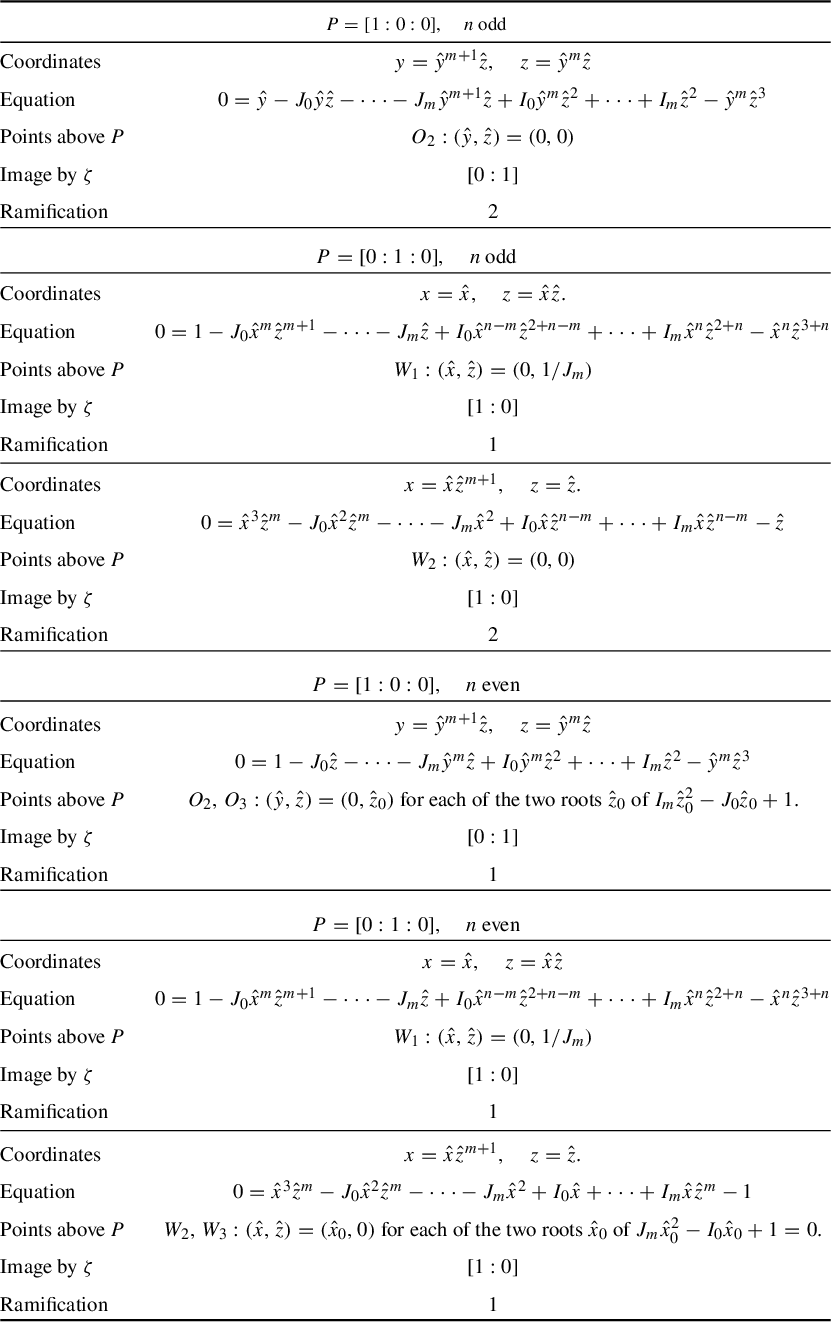
A map $\Gamma '' \to \Gamma '$
generically resolving the singularities above
$\Gamma '' \to \Gamma '$
generically resolving the singularities above $[1:0:0]$
and
$[1:0:0]$
and $[0:1:0]$
, given in terms of coordinate changes and local equations. We also record the geometric points above the singularities, and their images and ramification by the map
$[0:1:0]$
, given in terms of coordinate changes and local equations. We also record the geometric points above the singularities, and their images and ramification by the map $\zeta $
.
$\zeta $
.
There is also a substantial literature connecting the pentagram map to other fields, including cluster algebras [Reference Gekhtman, Shapiro, Tabachnikov and Vainshtein10, Reference Glick11, Reference Kedem and Vichitkunakorn23], projective incidence theorems [Reference Schwartz and Tabachnikov39], Poisson–Lie groups [Reference Fock and Marshakov9, Reference Izosimov20], and integrable partial difference equations [Reference Ovsienko, Schwartz and Tabachnikov33].
Our construction of the moduli space $\mathcal {T}_n$
of twisted n-gons follows an idea of Izosimov to take an appropriate quotient of a space of difference operators. This idea is introduced in [Reference Izosimov20, Proposition 3.3], where the identification is shown to be a homeomorphism. We promote it to an algebraic isomorphism (Theorem 3.6).
$\mathcal {T}_n$
of twisted n-gons follows an idea of Izosimov to take an appropriate quotient of a space of difference operators. This idea is introduced in [Reference Izosimov20, Proposition 3.3], where the identification is shown to be a homeomorphism. We promote it to an algebraic isomorphism (Theorem 3.6).
Singularity confinement, a feature of many discrete integrable systems, was explored in [Reference Glick12]. Singularity confinement is closely related to the existence of a partial compactification on which the pentagram map becomes a morphism, which we construct in Theorem 1.1.
The corner invariants coordinatize the space of twisted n-gons by cross-ratios. Cross-ratios are a frequent source of compactifications in the theory of moduli spaces, for instance, the Naruki cross-ratio variety [Reference Naruki32].
Little is known in general about the dynamics of rational maps on $\mathbb {P}^n$
over finite fields; see the survey [Reference Benedetto, Ingram, Jones, Manes, Silverman and Tucker3, §18], and for arithmetic dynamics more generally, see [Reference Silverman41]. Even in the simplest case, polynomials on
$\mathbb {P}^n$
over finite fields; see the survey [Reference Benedetto, Ingram, Jones, Manes, Silverman and Tucker3, §18], and for arithmetic dynamics more generally, see [Reference Silverman41]. Even in the simplest case, polynomials on $\mathbb {P}^1$
, we have only scattered pieces of the whole picture, and rational maps in higher dimension are even more complicated. For reversible maps and integrable systems, there are some probabilistic models for the statistics of the orbits [Reference Roberts and Vivaldi35, Reference Siu42]. Our work is motivated by the need for concrete examples of rational maps over finite fields for which the dynamics can be totally described.
$\mathbb {P}^1$
, we have only scattered pieces of the whole picture, and rational maps in higher dimension are even more complicated. For reversible maps and integrable systems, there are some probabilistic models for the statistics of the orbits [Reference Roberts and Vivaldi35, Reference Siu42]. Our work is motivated by the need for concrete examples of rational maps over finite fields for which the dynamics can be totally described.
Kanki’s thesis [Reference Kanki21] collects some results on integrable systems over finite fields and, taking a more arithmetic dynamical angle, suggests viewing integrability over finite fields as a kind of p-adic singularity confinement, or ‘almost good reduction.’ The other existing works on discrete integrable systems over finite fields focus on the construction of cellular automata with solitonic properties. This is also a nice perspective for our setting. Theorem 1.4 shows that the pentagram map over $\mathbb F_q$
defines an integrable cellular automaton on an alphabet of
$\mathbb F_q$
defines an integrable cellular automaton on an alphabet of $q^2 + q + 2$
cell states, corresponding to the points of
$q^2 + q + 2$
cell states, corresponding to the points of $\mathbb {P}^2(\mathbb F_q)$
together with an extra state to represent degeneration of the map. The Toda molecule over
$\mathbb {P}^2(\mathbb F_q)$
together with an extra state to represent degeneration of the map. The Toda molecule over $\mathbb F_{2^m}$
is studied in these terms in [Reference Nakamura and Mukaihira31]. The articles [Reference Białecki and Doliwa4, Reference Byaletski and Doliva6, Reference Doliwa, Białecki and Klimczewski8, Reference Kanki, Mada and Tokihiro22] study the discrete KdV and KP equations and the Hirota equation over finite fields as cellular automata. These articles restrict attention to genus 0 and 2 spectral curves, with a focus on special solutions which do not degenerate.
$\mathbb F_{2^m}$
is studied in these terms in [Reference Nakamura and Mukaihira31]. The articles [Reference Białecki and Doliwa4, Reference Byaletski and Doliva6, Reference Doliwa, Białecki and Klimczewski8, Reference Kanki, Mada and Tokihiro22] study the discrete KdV and KP equations and the Hirota equation over finite fields as cellular automata. These articles restrict attention to genus 0 and 2 spectral curves, with a focus on special solutions which do not degenerate.
These articles apply the formulas of integrable systems in characteristic $0$
to finite fields. We emphasize that discrete integrability in characteristic
$0$
to finite fields. We emphasize that discrete integrability in characteristic $0$
does not imply the same over characteristic p. While the conserved quantities still exist, their algebraic independence is not guaranteed. The geometry of the spectral curve, its genus, and the application of the Riemann–Hurwitz formula are all characteristic-dependent. Indeed, by restricting attention to a subfamily of polygons where the spectral curve has worse singularities mod p, we can force the loss of algebro-geometric integrability in that family. This means the focus of proving integrability is on showing that the generic spectral curve has good reduction.
$0$
does not imply the same over characteristic p. While the conserved quantities still exist, their algebraic independence is not guaranteed. The geometry of the spectral curve, its genus, and the application of the Riemann–Hurwitz formula are all characteristic-dependent. Indeed, by restricting attention to a subfamily of polygons where the spectral curve has worse singularities mod p, we can force the loss of algebro-geometric integrability in that family. This means the focus of proving integrability is on showing that the generic spectral curve has good reduction.
Ultradiscretization, or tropicalization, is a totally different idea for producing integrable systems valued in finite sets; see [Reference Tokihiro, Takahashi, Matsukidaira and Satsuma45].
Some other surprising connections between integrable systems and number theory in finite characteristic are suggested in [Reference Thakur44].
3 The moduli space of twisted n-gons
In this paper, we study the pentagram map on twisted polygons. The space of twisted polygons is larger than the space of closed polygons, but is still finite-dimensional.
Definition 3.1. Let $n \geq 4$
be a positive integer. A twisted n-gon is a
$n \geq 4$
be a positive integer. A twisted n-gon is a ${\mathbb Z}$
-indexed sequence
${\mathbb Z}$
-indexed sequence $(v_i)$
in
$(v_i)$
in $\mathbb {P}^2$
with the following properties.
$\mathbb {P}^2$
with the following properties.
-
• There exists a projective transformation
$M \in \operatorname {\mathrm {PGL}}_3$
such that, for all i,
$$ \begin{align*} Mv_i = v_{i+n}.\end{align*} $$
-
• A non-degeneracy condition: in each 5-tuple of consecutive points
no three points are collinear, except possibly
$$ \begin{align*}(v_i, v_{i+1}, v_{i+2}, v_{i+3}, v_{i+4}),\end{align*} $$
$v_i, v_{i+2}, v_{i+4}$
.


The transformation M is called the monodromy of the twisted n-gon. By the non-degeneracy condition, the monodromy M is unique. A closed polygon is a twisted polygon for which $M = 1$
. The set of twisted n-gons is denoted
$M = 1$
. The set of twisted n-gons is denoted $\mathcal {U}_n$
.
$\mathcal {U}_n$
.
Remark 3.2. There is variation in the literature in the definition of twisted n-gon. We chose our definition to get a convenient moduli space. The most frequently used definition, from [Reference Ovsienko, Schwartz and Tabachnikov33], only requires consecutive triples to be in general position. This definition is too permissive for our purposes because then the geometric quotient does not exist. Another common definition asks for all the points to be in general position. However, this is too strict for our setting, since working over $\bar {\mathbb F}_p$
, there are no such sequences.
$\bar {\mathbb F}_p$
, there are no such sequences.
Proposition 3.3. Let $n \geq 4$
. The set
$n \geq 4$
. The set $\mathcal {U}_n$
of twisted n-gons may be identified with a Zariski open subset of
$\mathcal {U}_n$
of twisted n-gons may be identified with a Zariski open subset of $(\mathbb {P}^2)^n \times \operatorname {\mathrm {PGL}}_3$
via the map
$(\mathbb {P}^2)^n \times \operatorname {\mathrm {PGL}}_3$
via the map
 $$ \begin{align*}\quad\mathcal{U}_n \hookrightarrow (\mathbb{P}^2)^n \times \operatorname{\mathrm{PGL}}_3,\end{align*} $$
 $$ \begin{align*}(v_i)_{i \in {\mathbb Z}} \mapsto (v_1, \ldots, v_n, M),\end{align*} $$
where M is the unique matrix that sends the 4-tuple $(v_1, v_2, v_3, v_4)$
to
$(v_1, v_2, v_3, v_4)$
to $(v_{n + 1}, v_{n+2}, v_{n+3}, v_{n+4})$
.
$(v_{n + 1}, v_{n+2}, v_{n+3}, v_{n+4})$
.
Proof. We need only show that this map is invertible on a generic subset of the variety $(\mathbb {P}^2)^n \times \operatorname {\mathrm {PGL}}_3$
. This is straightforward: for a generic choice of
$(\mathbb {P}^2)^n \times \operatorname {\mathrm {PGL}}_3$
. This is straightforward: for a generic choice of $(v_1, \ldots , v_n, M)$
, the points
$(v_1, \ldots , v_n, M)$
, the points $v_1, \ldots , v_n, Mv_1, Mv_2, Mv_3, Mv_4$
are in general linear position, and thus so are any consecutive five points in the sequence
$v_1, \ldots , v_n, Mv_1, Mv_2, Mv_3, Mv_4$
are in general linear position, and thus so are any consecutive five points in the sequence
 $$ \begin{align*}(\ldots, v_1, \ldots, v_n, Mv_1, \ldots, Mv_n, M^2 v_1, \ldots, M^2 v_n, \cdots).\end{align*} $$
This sequence is a twisted n-gon that corresponds to $(v_1, \ldots , v_n, M)$
, since it satisfies the non-degeneracy condition of Definition 3.1.
$(v_1, \ldots , v_n, M)$
, since it satisfies the non-degeneracy condition of Definition 3.1.
The pentagram map is invariant under projective transformations. So, we study the induced map on the moduli space of projective equivalence classes of twisted n-gons. If we view $\mathcal {U}_n$
as an open subvariety of
$\mathcal {U}_n$
as an open subvariety of $(\mathbb {P}^2)^n \times \operatorname {\mathrm {PGL}}_3$
, the
$(\mathbb {P}^2)^n \times \operatorname {\mathrm {PGL}}_3$
, the $\operatorname {\mathrm {PGL}}_3$
-action on
$\operatorname {\mathrm {PGL}}_3$
-action on $\mathcal {U}_n$
is given by
$\mathcal {U}_n$
is given by
 $$ \begin{align} A \cdot (v_1, \ldots, v_n, M) = (Av_1, \ldots, Av_n, AMA^{-1}). \end{align} $$
Definition 3.4. The moduli space of twisted n-gons, denoted $\mathcal {T}_n$
, is the quotient variety
$\mathcal {T}_n$
, is the quotient variety $\mathcal {U}_n / \operatorname {\mathrm {PGL}}_3$
for the action described by equation (2).
$\mathcal {U}_n / \operatorname {\mathrm {PGL}}_3$
for the action described by equation (2).
Definition 3.4 asserts the existence of a quotient in the category of varieties, but in general, such quotients may not exist. The main theorem of this section, Theorem 3.6, equips $\mathcal {T}_n$
with a variety structure. We explicitly describe the coordinate ring of the moduli space
$\mathcal {T}_n$
with a variety structure. We explicitly describe the coordinate ring of the moduli space $\mathcal {T}_n$
, and we check that the quotient map to
$\mathcal {T}_n$
, and we check that the quotient map to $\mathcal {T}_n$
is geometric in the sense of geometric invariant theory.
$\mathcal {T}_n$
is geometric in the sense of geometric invariant theory.
We briefly recall the basic notions and give a more detailed review in §3.1.
Informally, given a variety V and group G, a categorical quotient, denoted $V / \! / G$
, is a variety
$V / \! / G$
, is a variety $V'$
and a map
$V'$
and a map $V \to V'$
which has the typical categorical properties of a quotient. Categorical quotients do not always exist, and even when they do, they may not reflect the geometry of the orbits well. A categorical quotient
$V \to V'$
which has the typical categorical properties of a quotient. Categorical quotients do not always exist, and even when they do, they may not reflect the geometry of the orbits well. A categorical quotient $V' = V / \! / G$
is called a geometric quotient if the points of
$V' = V / \! / G$
is called a geometric quotient if the points of $V'$
classify G-orbits in V. When a geometric quotient exists, the notions of orbit space and categorical quotient are essentially the same, so we can speak of a variety structure on
$V'$
classify G-orbits in V. When a geometric quotient exists, the notions of orbit space and categorical quotient are essentially the same, so we can speak of a variety structure on $V / G$
.
$V / G$
.
We now recall the definition of Schwartz’s corner invariants, which have played an essential role in the study of the pentagram map [Reference Schwartz37]. These functions were known to define a full set of coordinates on $\mathcal {T}_n$
as a manifold over
$\mathcal {T}_n$
as a manifold over $\mathbb R$
; we extend this to show that they generate the coordinate ring of
$\mathbb R$
; we extend this to show that they generate the coordinate ring of $\mathcal {T}_n$
as a variety over k.
$\mathcal {T}_n$
as a variety over k.
Definition 3.5. We define the cross-ratio of four points $v_1, v_2, v_3, v_4$
in
$v_1, v_2, v_3, v_4$
in $\mathbb {P}^1$
with
$\mathbb {P}^1$
with $v_1 \neq v_3$
and
$v_1 \neq v_3$
and $v_2 \neq v_4$
in a slightly non-standard way, as follows. Choose any affine coordinate such that, computed in that coordinate, we have
$v_2 \neq v_4$
in a slightly non-standard way, as follows. Choose any affine coordinate such that, computed in that coordinate, we have $v_1, v_2, v_3, v_4 \not \in \{ 0, \infty \}$
. Then the cross-ratio is defined by the formula
$v_1, v_2, v_3, v_4 \not \in \{ 0, \infty \}$
. Then the cross-ratio is defined by the formula
 $$ \begin{align*}[v_1, v_2, v_3, v_4] = \frac{(v_1 - v_2)(v_3 - v_4)}{(v_1 - v_3)(v_2 - v_4)}.\end{align*} $$
One can check that the result is independent of the choice of affine coordinate. (Frequently, one sees the reciprocal of this quantity defined as the cross-ratio.)
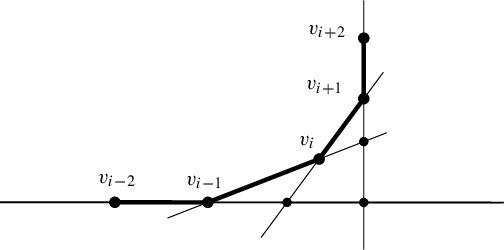
Given a twisted n-gon $v=(v_i)$
(see Figure 3), its left- and right-corner invariants, denoted
$v=(v_i)$
(see Figure 3), its left- and right-corner invariants, denoted $x_i, y_i$
, are defined by
$x_i, y_i$
, are defined by
 $$ \begin{align*}x_i = [v_{i - 2}, v_{i - 1}, \overline{v_i v_{i+1}} \cap \overline{v_{i - 2} v_{i - 1}}, \overline{v_{i+1} v_{i+2}} \cap \overline{v_{i-2} v_{i-1}}],\end{align*} $$
 $$ \begin{align*}y_i = [\overline{v_{i+1}v_{i+2}} \cap \overline{v_{i-2} v_{i-1}}, \overline{ v_{i-1} v_i} \cap \overline{ v_{i+1} v_{i+2}},v_{i+1}, v_{i+2}].\end{align*} $$
The left-corner invariant $x_{i}$
is defined as the cross-ratio of the four points on the pictured horizontal line, and the right-corner invariant
$x_{i}$
is defined as the cross-ratio of the four points on the pictured horizontal line, and the right-corner invariant $y_i$
is defined as the cross-ratio of the four points on the pictured vertical line. We can informally think of the corner invariants as providing coordinates for
$y_i$
is defined as the cross-ratio of the four points on the pictured vertical line. We can informally think of the corner invariants as providing coordinates for $v_i$
in the axes determined by
$v_i$
in the axes determined by $v_{i-2}$
,
$v_{i-2}$
, $v_{i-1}$
,
$v_{i-1}$
, $v_{i+1}$
, and
$v_{i+1}$
, and $v_{i+2}$
.
$v_{i+2}$
.
These quantities are $\operatorname {\mathrm {PGL}}_3$
-invariant functions of v. We consider the morphism
$\operatorname {\mathrm {PGL}}_3$
-invariant functions of v. We consider the morphism
 $$ \begin{align*}\mathcal{U}_n \to (\mathbb{P}^1 \smallsetminus \{0, 1, \infty\})^{2n},\end{align*} $$
 $$ \begin{align*}v \mapsto (x_1(v), \ldots, x_n(v), y_1(v), \ldots, y_n(v)).\end{align*} $$
We now present the main theorem of this section, which says that this morphism defines a geometric quotient (that is, a variety with nice quotient properties).
Theorem 3.6. The geometric quotient $\mathcal {T}_n = \mathcal {U}_n / \operatorname {\mathrm {PGL}}_3$
exists, and there is an isomorphism of varieties
$\mathcal {T}_n = \mathcal {U}_n / \operatorname {\mathrm {PGL}}_3$
exists, and there is an isomorphism of varieties
 $$ \begin{align*}\mathcal{T}_n \xrightarrow{\sim} (\mathbb{P}^1 \smallsetminus \{0, 1, \infty \})^{2n},\end{align*} $$
 $$ \begin{align*}v \mapsto (x_1(v), \ldots, x_n(v), y_1(v), \ldots, y_n(v)).\end{align*} $$
We prove a more detailed version of this theorem, as Proposition 3.16, later in this section. Theorem 3.6 implies that any algebraic, projectively invariant condition on twisted n-gons can be expressed in terms of the corner invariants. For instance, one can show that the points $v_{i - 2}, v_i, v_{i+2}$
are collinear if and only if
$v_{i - 2}, v_i, v_{i+2}$
are collinear if and only if $x_i y_i = 1$
.
$x_i y_i = 1$
.
The real part of $\mathcal {T}_n$
was studied in [Reference Ovsienko, Schwartz and Tabachnikov33], where it was shown that the corner invariants provide a diffeomorphism to
$\mathcal {T}_n$
was studied in [Reference Ovsienko, Schwartz and Tabachnikov33], where it was shown that the corner invariants provide a diffeomorphism to $\mathbb R^{2n}$
. To do something similar algebraically, we have to take the quotient of a variety by an infinite group, using GIT.
$\mathbb R^{2n}$
. To do something similar algebraically, we have to take the quotient of a variety by an infinite group, using GIT.
The proof of Theorem 3.6 is complicated. The motivating idea is as follows. In any sequence of five points in the plane, we can describe coordinates for the third point in terms of the first, second, fourth, and fifth points. Take consecutive subsequences of length five in the bi-infinite sequence defining a twisted n-gon. Because of the monodromy, the resulting coordinates are n-periodic, thus giving $2n$
functions that coordinatize the space of twisted n-gons.
$2n$
functions that coordinatize the space of twisted n-gons.
Remark 3.7. The existence of the geometric quotient $\mathcal {T}_n$
follows immediately from the main results of [Reference Weinreich47]. However, that proof does not produce the explicit coordinatization by corner invariants, and we use that coordinatization to study the pentagram map.
$\mathcal {T}_n$
follows immediately from the main results of [Reference Weinreich47]. However, that proof does not produce the explicit coordinatization by corner invariants, and we use that coordinatization to study the pentagram map.
Remark 3.8. Another coordinate system, the so-called $ab$
-coordinates, has also been used widely in the study of the pentagram map, for instance in [Reference Ovsienko, Schwartz and Tabachnikov33]. These work well over
$ab$
-coordinates, has also been used widely in the study of the pentagram map, for instance in [Reference Ovsienko, Schwartz and Tabachnikov33]. These work well over $\mathbb R$
, but their definition uses the isomorphism
$\mathbb R$
, but their definition uses the isomorphism $\operatorname {\mathrm {SL}}_3(\mathbb R) \cong \operatorname {\mathrm {PGL}}_3(\mathbb R)$
, and they are not well defined over an arbitrary base field. Further, our proof of Theorem 3.6 explains the algebraic origin of the corner invariants.
$\operatorname {\mathrm {SL}}_3(\mathbb R) \cong \operatorname {\mathrm {PGL}}_3(\mathbb R)$
, and they are not well defined over an arbitrary base field. Further, our proof of Theorem 3.6 explains the algebraic origin of the corner invariants.
3.1 Background on geometric invariant theory
We cite some standard theorems in geometric invariant theory. For a development of these ideas, see [Reference Dolgachev7, Ch. 6].
Definition 3.9. Suppose that a group G acts algebraically on a variety V, with action $\alpha : G \times V \to V$
. A categorical quotient is a variety
$\alpha : G \times V \to V$
. A categorical quotient is a variety $V'$
and a G-invariant morphism
$V'$
and a G-invariant morphism ${\chi : V \to V'}$
, such that, for every variety
${\chi : V \to V'}$
, such that, for every variety $V''$
, every G-invariant morphism
$V''$
, every G-invariant morphism $V \to V''$
factors through
$V \to V''$
factors through $\chi $
uniquely. We denote a categorical quotient
$\chi $
uniquely. We denote a categorical quotient $V'$
by
$V'$
by $V / \! / G$
. The quotient depends on the action, but this notation suppresses it. If we want to be specific about the action, we write
$V / \! / G$
. The quotient depends on the action, but this notation suppresses it. If we want to be specific about the action, we write $V / \! / \alpha $
. We will also use the notation
$V / \! / \alpha $
. We will also use the notation $V / \! / G$
and
$V / \! / G$
and $V / \! / \alpha $
to refer to the variety without the attached data of
$V / \! / \alpha $
to refer to the variety without the attached data of $\chi $
.
$\chi $
.
By a universal property argument, if a categorical quotient exists, it is unique up to unique isomorphism. When we write $V / \! / G$
, the argument will always provide a specific construction of the categorical quotient.
$V / \! / G$
, the argument will always provide a specific construction of the categorical quotient.
A geometric quotient, denoted $V / G$
, is a categorical quotient
$V / G$
, is a categorical quotient $V / \! / G$
with the following property: if
$V / \! / G$
with the following property: if $v_1, v_2 \in V$
have the same image in
$v_1, v_2 \in V$
have the same image in $V / \! / G$
, then there exists some
$V / \! / G$
, then there exists some $g \in G$
such that
$g \in G$
such that $g \cdot v_1 = v_2$
.
$g \cdot v_1 = v_2$
.
Categorical quotients do not always exist, much less geometric quotients. However, for a large class of groups, the geometrically reductive groups, categorical quotients of affine varieties do exist. Any algebraic subgroup of a general linear group $\operatorname {\mathrm {GL}}_d$
is geometrically reductive, regardless of base field.
$\operatorname {\mathrm {GL}}_d$
is geometrically reductive, regardless of base field.
Theorem 3.10. (Nagata, Mumford)
Let G be a geometrically reductive group acting on an affine k-variety V. Let $\mathcal {O}(V)$
be the k-algebra of global sections. Then the subalgebra
$\mathcal {O}(V)$
be the k-algebra of global sections. Then the subalgebra $\mathcal {O}(V)^G$
of G-invariant functions is finitely generated over k. Let
$\mathcal {O}(V)^G$
of G-invariant functions is finitely generated over k. Let $V' = \operatorname {\mathrm {Spec}} \mathcal {O}(V)^G$
. The canonical morphism
$V' = \operatorname {\mathrm {Spec}} \mathcal {O}(V)^G$
. The canonical morphism $\psi : V \to V'$
is a categorical quotient. Thus,
$\psi : V \to V'$
is a categorical quotient. Thus,
 $$ \begin{align*} V / \! / G \cong \operatorname{\mathrm{Spec}} \mathcal{O}(V)^G.\end{align*} $$
The first claim, about finite generation, is due to Nagata [Reference Nagata30]. The second claim is due to Mumford [Reference Mumford, Fogarty and Kirwan28]. For a proof, see [Reference Dolgachev7, Theorem 6.1].
We use $\mathbb {G}_{m}$
to denote the multiplicative group scheme over k.
$\mathbb {G}_{m}$
to denote the multiplicative group scheme over k.
Example 3.11. Consider $\mathbb {G}_{m}$
acting on
$\mathbb {G}_{m}$
acting on $\mathbb {A}^1$
by
$\mathbb {A}^1$
by $t \cdot v = tv$
. The categorical quotient
$t \cdot v = tv$
. The categorical quotient $\mathbb {A}^1 / \! / \mathbb {G}_{m}$
exists by Theorem 3.10, and
$\mathbb {A}^1 / \! / \mathbb {G}_{m}$
exists by Theorem 3.10, and $\mathcal {O}(\mathbb {A}^1)^{\mathbb {G}_{m}} = k$
, so the categorical quotient is a point. Since
$\mathcal {O}(\mathbb {A}^1)^{\mathbb {G}_{m}} = k$
, so the categorical quotient is a point. Since $0$
and
$0$
and $1$
are in different orbits, but have the same image, the quotient is not geometric.
$1$
are in different orbits, but have the same image, the quotient is not geometric.
3.2 The dual space
In this section, we prove Theorem 3.6. We describe a map which takes a twisted n-gon to a kind of dual data: the list of relations satisfied by consecutive sets of four points. The objects in the proof will be used again to derive formulas for the pentagram map in §4.
We introduce two spaces $\mathcal {V}_n$
and
$\mathcal {V}_n$
and $\mathcal {W}_n$
, along with actions
$\mathcal {W}_n$
, along with actions $\alpha $
and
$\alpha $
and $\beta $
, which are closely related to the action of
$\beta $
, which are closely related to the action of $\operatorname {\mathrm {PGL}}_3$
on
$\operatorname {\mathrm {PGL}}_3$
on $\mathcal {U}_n$
. The existence of the geometric quotient
$\mathcal {U}_n$
. The existence of the geometric quotient $\mathcal {W}_n / \beta $
is easier to establish, and we use its structure to show existence of the geometric quotient
$\mathcal {W}_n / \beta $
is easier to establish, and we use its structure to show existence of the geometric quotient $\mathcal {V}_n / \alpha $
, which in turn gives us existence of
$\mathcal {V}_n / \alpha $
, which in turn gives us existence of $\mathcal {U}_n / \operatorname {\mathrm {PGL}}_3$
and the explicit description. The relationships between the various objects are depicted in the following diagram.
$\mathcal {U}_n / \operatorname {\mathrm {PGL}}_3$
and the explicit description. The relationships between the various objects are depicted in the following diagram.

We now define
 $$ \begin{align*}\mathcal{V}_n \subset (\mathbb{A}^3 \smallsetminus \{0\})^n \times \operatorname{\mathrm{GL}}_3\!.\end{align*} $$
For all $1 \leq i \leq n$
, let
$1 \leq i \leq n$
, let $v_i$
be the projection to the ith copy of
$v_i$
be the projection to the ith copy of $\mathbb {A}^3$
. Let M be the
$\mathbb {A}^3$
. Let M be the $\operatorname {\mathrm {GL}}_3$
-coordinate. For all
$\operatorname {\mathrm {GL}}_3$
-coordinate. For all $i> n$
, define
$i> n$
, define $v_{i} = Mv_{i-n}$
. Let
$v_{i} = Mv_{i-n}$
. Let $\mathcal {V}_n$
be the open subset defined by the condition that, for all i with
$\mathcal {V}_n$
be the open subset defined by the condition that, for all i with $1 \leq i \leq n$
, the five consecutive vectors
$1 \leq i \leq n$
, the five consecutive vectors $v_i, v_{i+1}, v_{i+2}, v_{i+3}, v_{i + 4}$
are non-zero, and no three of them are coplanar, except possibly
$v_i, v_{i+1}, v_{i+2}, v_{i+3}, v_{i + 4}$
are non-zero, and no three of them are coplanar, except possibly $v_i, v_{i + 2}, v_{i + 4}$
. Observe that
$v_i, v_{i + 2}, v_{i + 4}$
. Observe that $\mathcal {V}_n$
consists of the elements of
$\mathcal {V}_n$
consists of the elements of $(\mathbb {A}^3 \smallsetminus \{0\})^n \times \operatorname {\mathrm {GL}}_3$
which are sent by projectivization to
$(\mathbb {A}^3 \smallsetminus \{0\})^n \times \operatorname {\mathrm {GL}}_3$
which are sent by projectivization to $\mathcal {U}_n$
. Let
$\mathcal {U}_n$
. Let $\pi \colon \mathcal {V}_n \to \mathcal {U}_n$
denote projectivization.
$\pi \colon \mathcal {V}_n \to \mathcal {U}_n$
denote projectivization.
We embed $\mathcal {V}_n$
in the space of
$\mathcal {V}_n$
in the space of $3 \times (n + 3)$
matrices via the map
$3 \times (n + 3)$
matrices via the map
 $$ \begin{align*} \begin{bmatrix} \mid & \mid & \mid & & \mid & \mid & \mid & \mid & \mid & \mid \\ v_1 & v_2 & v_3 & \cdots & v_{n-2} & v_{n-1} & v_n & Mv_1 & Mv_2 & Mv_3 \\ \mid & \mid & \mid & & \mid & \mid & \mid & \mid & \mid & \mid \end{bmatrix}\!\!. \end{align*} $$
Each set of four vectors in $\mathbb {A}^3$
satisfies some non-trivial relation. If no three of the vectors are coplanar, then each coefficient in the relation is non-zero. Thus, given an element
$\mathbb {A}^3$
satisfies some non-trivial relation. If no three of the vectors are coplanar, then each coefficient in the relation is non-zero. Thus, given an element $\theta \in \mathcal {V}_n$
, there exist values
$\theta \in \mathcal {V}_n$
, there exist values $a_i, b_i, c_i, d_i \in k^*$
, such that
$a_i, b_i, c_i, d_i \in k^*$
, such that $\theta $
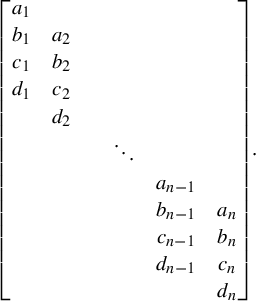
is annihilated on the right by the
$\theta $
is annihilated on the right by the $(3 + n) \times n$
matrix
$(3 + n) \times n$
matrix
 $$ \begin{align*} \begin{bmatrix} a_1 & \\ b_1 & a_2 \\ c_1 & b_2 \\ d_1 & c_2 \\ & d_2 \\ & & & \ddots \\ & & & & a_{n-1} & \\ & & & & b_{n-1} & a_n \\ & & & & c_{n-1} & b_n \\ & & & & d_{n-1} & c_n \\ & & & & & d_n \end{bmatrix}\!. \end{align*} $$
Let
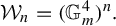 $$ \begin{align*}\mathcal{W}_n = (\mathbb{G}_{m}^4)^n.\end{align*} $$
The variety $\mathcal {W}_n$
parameterizes matrices of the above form. Let the coordinates on the ith copy of
$\mathcal {W}_n$
parameterizes matrices of the above form. Let the coordinates on the ith copy of $\mathbb {G}_{m}^4$
in
$\mathbb {G}_{m}^4$
in $\mathcal {W}_n$
be
$\mathcal {W}_n$
be $a_i, b_i, c_i, d_i$
. We extend these definitions to be n-periodic, by the rule that for all
$a_i, b_i, c_i, d_i$
. We extend these definitions to be n-periodic, by the rule that for all $i> n,$
 $$ \begin{align*}a_{i} = a_{i - n}, \quad b_{i} = b_{i - n}, \quad c_{i} = c_{i - n}, \quad d_{i} = d_{i - n}.\end{align*} $$
We define $\Delta \colon \mathcal {V}_n \to \mathcal {W}_n$
by
$\Delta \colon \mathcal {V}_n \to \mathcal {W}_n$
by
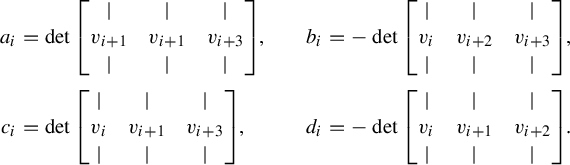 $$ \begin{align*} \begin{aligned} a_i &= \det \begin{bmatrix} \mid & \mid & \mid \\ v_{i+1} & v_{i+1} & v_{i+3} \\ \mid & \mid & \mid \\ \end{bmatrix}\!, \quad &b_i &= -\det\begin{bmatrix} \mid & \mid & \mid \\ v_{i} & v_{i+2} & v_{i+3} \\ \mid & \mid & \mid \\ \end{bmatrix}\!, \\ c_i &= \det \begin{bmatrix} \mid & \mid & \mid \\ v_{i} & v_{i+1} & v_{i+3} \\ \mid & \mid & \mid \\ \end{bmatrix}\!, \quad &d_i &= -\det\begin{bmatrix} \mid & \mid & \mid \\ v_{i} & v_{i+1} & v_{i+2} \\ \mid & \mid & \mid \\ \end{bmatrix}\!. \\ \end{aligned} \end{align*} $$
Set
 $$ \begin{align*}G = \mathbb{G}_{m}^{n+1} \times \operatorname{\mathrm{GL}}_3\!.\end{align*} $$
We set notation for the coordinate on each factor.
-
• For each i where
$1 \leq i \leq n$
, let
$\eta _i$
be a coordinate on the ith copy of
$\mathbb {G}_{m}$
. -
• Let
$\xi $
be a coordinate on the
$(n+1)$
th copy of
$\mathbb {G}_{m}$
. -
• Let A be the coordinate on the
$\operatorname {\mathrm {GL}}_3$
factor.


We now define an action
 $$ \begin{align} \alpha \colon G \times \mathcal{V}_n \to \mathcal{V}_n. \end{align} $$
-
• For each i in
$1 \leq i \leq n$
, the
$\eta _i$
coordinate scales
$v_i$
. -
• The
$\xi $
coordinate scales the
$\operatorname {\mathrm {GL}}_3$
factor of
$\mathcal {V}_n$
. -
• The A coordinate acts by
$$ \begin{align*}A \cdot (v_1, \ldots, v_n, M) = (Av_1, \ldots, Av_n, AMA^{-1}).\end{align*} $$


After writing an element of $\mathcal {V}_n$
in matrix form, the scalings correspond to coordinatewise multiplication by various matrices.
$\mathcal {V}_n$
in matrix form, the scalings correspond to coordinatewise multiplication by various matrices.
-
• For
$i = 1, 2, 3$
, the
$\eta _i$
coordinate simultaneously scales columns i and
$n+i$
. For each i where
$4 \leq i \leq n$
, the
$\eta _i$
coordinate only scales column i. -
• The
$\xi $
coordinate scales columns
$n+1$
,
$n+2$
, and
$n+3$
. -
• The A coordinate acts by change of basis.


We now define an action
 $$ \begin{align*}\beta: \mathbb{G}_{m}^{2n+1} \times \mathcal{W}_n \to \mathcal{W}_n.\end{align*} $$
We use the following coordinates on $\mathbb {G}_{m}^{2n+1}$
.
$\mathbb {G}_{m}^{2n+1}$
.
-
• For each i where
$1 \leq i \leq n$
, let
$\kappa _i$
be a coordinate on the ith copy of
$\mathbb {G}_{m}$
. -
• For each i where
$1 \leq i \leq n$
, let
$\rho _{i}$
be a coordinate on the
$(n+i)$
th copy of
$\mathbb {G}_{m}$
. -
• Let
$\epsilon $
be a coordinate on the
$(2n + 1)$
th copy of
$\mathbb {G}_{m}$
.


Viewing $\mathcal {W}_n$
as a space of matrices, the action of each factor is by a coordinatewise multiplication.
$\mathcal {W}_n$
as a space of matrices, the action of each factor is by a coordinatewise multiplication.
-
• For each i in
$1 \leq i \leq n$
, the
$\kappa _i$
coordinate acts by scaling column i. -
• For each i in
$1 \leq i \leq 3$
, the
$\rho _i$
coordinate acts by simultaneously scaling rows i and
$i + n$
. For
$4 \leq i \leq n$
, the
$\rho _i$
coordinate acts by scaling row i. -
• The
$\epsilon $
coordinate acts by a coordinatewise multiplication by
$$ \begin{align*} \begin{bmatrix} 1 & \\ 1 & 1 \\ 1 & 1 \\ 1 & 1 \\ & 1 \\ & & \ddots \\ & & & 1 & & & \\ & & & 1 & \epsilon & & \\ & & & 1 & \epsilon & \epsilon & \\ & & & 1 & \epsilon & \epsilon & \epsilon \\ & & & & 1 & 1 & 1 \\ & & & & & 1 & 1 \\ & & & & & & 1 \end{bmatrix}\!. \end{align*} $$


Izosimov found formulas for the corner invariants of a twisted polygon in terms of $a_i, b_i, c_i, d_i$
[Reference Izosimov19, Proposition 2.10]. Without referring to corner invariants, we prove that those expressions, denoted
$a_i, b_i, c_i, d_i$
[Reference Izosimov19, Proposition 2.10]. Without referring to corner invariants, we prove that those expressions, denoted $x^{\prime }_i, y^{\prime }_i$
, generate the ring of invariants of
$x^{\prime }_i, y^{\prime }_i$
, generate the ring of invariants of $\beta $
. We show later, in Lemma 3.14, that these expressions agree with the corner invariants.
$\beta $
. We show later, in Lemma 3.14, that these expressions agree with the corner invariants.
Proposition 3.12. The geometric quotient $\mathcal {W}_n / \beta $
exists. It is given explicitly by
$\mathcal {W}_n / \beta $
exists. It is given explicitly by
 $$ \begin{align*}\mathcal{W}_n / \beta = \operatorname{\mathrm{Spec}} k[{(x^{\prime}_i)}^{\pm 1}, {(y^{\prime}_i)}^{\pm 1}] \cong \mathbb{G}_{m}^{2n}, \end{align*} $$
with the natural projection
 $$ \begin{align*}\chi' \colon \mathcal{W}_n \to \mathcal{W}_n / \beta,\end{align*} $$
where for each $i = 1, \ldots , n,$
 $$ \begin{align*} x^{\prime}_i := a_{i-1} c_{i - 2} {b_{i-1}}^{-1} {b_{i-2}}^{-1},\end{align*} $$
 $$ \begin{align*} y^{\prime}_i := d_{i-2} b_{i-1} {c_{i-2}}^{-1} {c_{i-1}}^{-1}.\end{align*} $$
Proof. There are three parts to the proof: constructing a categorical quotient $\mathcal {W}_n / \! / \beta $
, calculating its coordinate ring, and showing that the quotient is geometric.
$\mathcal {W}_n / \! / \beta $
, calculating its coordinate ring, and showing that the quotient is geometric.
(1) To see that $\mathcal {W}_n / \! / \beta $
exists, observe that
$\mathcal {W}_n / \! / \beta $
exists, observe that $\mathcal {W}_n$
is an affine variety and that
$\mathcal {W}_n$
is an affine variety and that ${(\mathbb {G}_{m})^{2n + 1} \times \operatorname {\mathrm {GL}}_3}$
is reductive. By Nagata’s theorem (Theorem 3.10), the spectrum of the ring of invariants
${(\mathbb {G}_{m})^{2n + 1} \times \operatorname {\mathrm {GL}}_3}$
is reductive. By Nagata’s theorem (Theorem 3.10), the spectrum of the ring of invariants $k[\mathcal {W}_n]^\beta $
is a categorical quotient.
$k[\mathcal {W}_n]^\beta $
is a categorical quotient.
(2) Let $x_i, y_i$
be defined in the statement of the theorem. We claim that
$x_i, y_i$
be defined in the statement of the theorem. We claim that
 $$ \begin{align*} k[\mathcal{W}_n]^\beta = k[{(x^{\prime}_i)}^{\pm 1}, {(y^{\prime}_i)}^{\pm 1}].\end{align*} $$
The $x^{\prime }_i, y^{\prime }_i$
are invariants by inspection, so we just have to show that they generate the ring
$x^{\prime }_i, y^{\prime }_i$
are invariants by inspection, so we just have to show that they generate the ring $k[\mathcal {W}_n]^\beta $
.
$k[\mathcal {W}_n]^\beta $
.
Each of the $2n + 1$
actions of
$2n + 1$
actions of $\mathbb {G}_{m}$
puts a grading on
$\mathbb {G}_{m}$
puts a grading on $k[\mathcal {W}_n]$
. Then
$k[\mathcal {W}_n]$
. Then $k[\mathcal {W}_n]^\beta $
is the intersection of the 0-graded part for each grading. Further, the invariant ring is generated by monomials in the
$k[\mathcal {W}_n]^\beta $
is the intersection of the 0-graded part for each grading. Further, the invariant ring is generated by monomials in the $a_i, b_i, c_i, d_i$
, because the ring of invariants for each grading considered separately is generated by monomials. Now, we argue that every invariant monomial is of the form
$a_i, b_i, c_i, d_i$
, because the ring of invariants for each grading considered separately is generated by monomials. Now, we argue that every invariant monomial is of the form $\prod _i {(x^{\prime }_i)}^{e_i} {(y^{\prime }_i)}^{f_i}$
, where
$\prod _i {(x^{\prime }_i)}^{e_i} {(y^{\prime }_i)}^{f_i}$
, where $e_i, f_i \in {\mathbb Z}$
. If
$e_i, f_i \in {\mathbb Z}$
. If $\mu $
is an invariant monomial, then we can divide by an appropriate power of the
$\mu $
is an invariant monomial, then we can divide by an appropriate power of the $x_i$
and
$x_i$
and $y_i$
to get an invariant monomial that has
$y_i$
to get an invariant monomial that has $a_i$
-degree 0 and
$a_i$
-degree 0 and $d_i$
-degree 0. The resulting invariant is a monomial in just the
$d_i$
-degree 0. The resulting invariant is a monomial in just the $b_i, c_i$
. Since each
$b_i, c_i$
. Since each $\kappa _i$
-grading is 0, we have
$\kappa _i$
-grading is 0, we have $\deg _{c_i} \mu = -\deg _{b_i} \mu $
. Since each
$\deg _{c_i} \mu = -\deg _{b_i} \mu $
. Since each $\rho _i$
-grading is 0, we have
$\rho _i$
-grading is 0, we have $\deg _{b_i} \mu = - \deg _{c_{i-1}} \mu $
for
$\deg _{b_i} \mu = - \deg _{c_{i-1}} \mu $
for $i> 1$
, and
$i> 1$
, and $\deg _{b_1} \mu = -\deg _{c_n} \mu $
. Write
$\deg _{b_1} \mu = -\deg _{c_n} \mu $
. Write
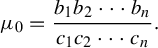 $$ \begin{align*}\mu_0 = \frac{b_1 b_2 \cdots b_n}{c_1 c_2 \cdots c_n}.\end{align*} $$
We have shown that $\mu $
is a power of
$\mu $
is a power of $\mu _0$
. And the
$\mu _0$
. And the $\epsilon $
-grading gives
$\epsilon $
-grading gives $\mu _0$
degree 1, so
$\mu _0$
degree 1, so $\mu = 1$
.
$\mu = 1$
.
Further, we claim the spectrum is $\mathbb {G}_{m}^{2n}$
. This is true if the
$\mathbb {G}_{m}^{2n}$
. This is true if the $x^{\prime }_i, y^{\prime }_j$
are algebraically independent. This is clear, since a distinct
$x^{\prime }_i, y^{\prime }_j$
are algebraically independent. This is clear, since a distinct $a_i$
or
$a_i$
or $d_i$
appears in the definition of each, and these have no relations.
$d_i$
appears in the definition of each, and these have no relations.
(3) To prove that the quotient is geometric, we must check that invariant functions distinguish between orbits. Suppose $w, w' \in \mathcal {W}_n$
satisfy
$w, w' \in \mathcal {W}_n$
satisfy $\chi '(w) = \chi '(w')$
. First, by an
$\chi '(w) = \chi '(w')$
. First, by an $\epsilon $
-scaling, we can replace w,
$\epsilon $
-scaling, we can replace w, $w'$
by elements such that
$w'$
by elements such that $\mu _0(w) = \mu _0(w')= 1$
. Then, by scaling with
$\mu _0(w) = \mu _0(w')= 1$
. Then, by scaling with $\kappa _1, \rho _1, \ldots , \kappa _2, \rho _2, \ldots , \kappa _{n}$
, we can replace w by an element such that
$\kappa _1, \rho _1, \ldots , \kappa _2, \rho _2, \ldots , \kappa _{n}$
, we can replace w by an element such that
 $$ \begin{align*}b_1(w) = 1, \quad c_1(w) = 1, \quad b_2(w) = 1, \quad c_2(w) = 1, \quad \ldots, \quad b_n(w) = 1.\end{align*} $$
We do the same for $w'$
. Since the scalings by
$w'$
. Since the scalings by $\kappa _i$
and
$\kappa _i$
and $\rho _i$
hold
$\rho _i$
hold $\mu _0$
invariant, we deduce that
$\mu _0$
invariant, we deduce that $c_n(w) = c_n(w') = 1$
as well. An element of
$c_n(w) = c_n(w') = 1$
as well. An element of $\mathcal {W}_n$
with all
$\mathcal {W}_n$
with all $b_i, c_i = 1$
is determined by the values of
$b_i, c_i = 1$
is determined by the values of $x^{\prime }_i, y^{\prime }_i$
, so
$x^{\prime }_i, y^{\prime }_i$
, so $w = w'$
.
$w = w'$
.
Proposition 3.13. If the points $\theta _1, \theta _2 \in \mathcal {V}_n$
are in the same
$\theta _1, \theta _2 \in \mathcal {V}_n$
are in the same $\alpha $
-orbit, then
$\alpha $
-orbit, then $\Delta (\theta _1), \Delta (\theta _2)$
are in the same
$\Delta (\theta _1), \Delta (\theta _2)$
are in the same $\beta $
-orbit.
$\beta $
-orbit.
Proof. Recall that we defined action $\alpha \colon G \times \mathcal {V}_n \to \mathcal {V}_n$
just after equation (3) as the product of actions by scaling by
$\alpha \colon G \times \mathcal {V}_n \to \mathcal {V}_n$
just after equation (3) as the product of actions by scaling by $\eta _i$
,
$\eta _i$
, $1 \leq i \leq n$
, scaling by
$1 \leq i \leq n$
, scaling by $\zeta $
, and conjugation by A. Thus, we can reduce the claim to the cases that
$\zeta $
, and conjugation by A. Thus, we can reduce the claim to the cases that $\theta _2$
is obtained by applying just one of the
$\theta _2$
is obtained by applying just one of the $\eta _i$
,
$\eta _i$
, $\zeta $
, or A actions.
$\zeta $
, or A actions.
-
• Suppose that
$\theta _2$
is obtained from
$\theta _1$
by
$\eta _i$
. Then
$\Delta (\theta _2)$
is obtained from
$\Delta (\theta _1)$
by
$\kappa _{i-3}, \kappa _{i-2}, \kappa _{i-1}, \kappa _i$
, indices taken mod n, then applying the
$\rho _i$
-scaling by
$(\eta _i)^{-1}$
. -
• Suppose that
$\theta _2$
is obtained from
$\theta _1$
by applying A. Then
$\Delta (\theta _2)$
is obtained from
$\Delta (\theta _1)$
by scaling every entry by
$\det (A)$
. This can be accomplished by scaling each column individually with the
$\kappa _i$
. -
• Suppose that
$\theta _2$
is obtained from
$\theta _1$
by applying
$\xi $
. Then
$\Delta (\theta _2)$
is obtained from
$\Delta (\theta _1)$
by applying a coordinatewise multiplication by This can be achieved using
$$ \begin{align*} \begin{bmatrix} 1 & \\ 1 & 1 \\ 1 & 1 \\ 1 & 1 \\ & 1 \\ & & \ddots \\ & & & 1 & & & \\ & & & 1 & \xi & & \\ & & & 1 & \xi & \xi^2 & \\ & & & 1 & \xi & \xi^2 & \xi^3 \\ & & & & 1 & \xi & \xi^2 \\ & & & & & \xi & \xi^2 \\ & & & & & & \xi^2 \end{bmatrix}. \end{align*} $$
$\kappa _{n-1}, \kappa _{n}$
, and
$\epsilon $
.


So far, we have described the invariants $x^{\prime }_i, y^{\prime }_i$
of the action
$x^{\prime }_i, y^{\prime }_i$
of the action $\beta $
in purely algebraic terms. In fact, they agree with the corner invariants.
$\beta $
in purely algebraic terms. In fact, they agree with the corner invariants.
Lemma 3.14. [Reference Izosimov19, Lemma 2.10]
The map $\chi ' \circ \Delta $
takes an element
$\chi ' \circ \Delta $
takes an element $v \in \mathcal {V}_n$
to the corner invariants of
$v \in \mathcal {V}_n$
to the corner invariants of $\pi (v)$
.
$\pi (v)$
.
Proof. The idea is to compute $\chi ' \circ \Delta $
for a carefully chosen element of
$\chi ' \circ \Delta $
for a carefully chosen element of $\mathcal {V}_n$
that is
$\mathcal {V}_n$
that is $\alpha $
-equivalent to v, then observe that
$\alpha $
-equivalent to v, then observe that $\alpha $
-equivalence does not change the corner invariants or
$\alpha $
-equivalence does not change the corner invariants or $\chi ' \circ \Delta $
, by Propositions 3.12 and 3.13. See [Reference Izosimov19, Lemma 2.10] or [Reference Weinreich46, Lemma 3.2.10] for two different approaches to the computation.
$\chi ' \circ \Delta $
, by Propositions 3.12 and 3.13. See [Reference Izosimov19, Lemma 2.10] or [Reference Weinreich46, Lemma 3.2.10] for two different approaches to the computation.
Proposition 3.15. Let $\theta , \theta ' \in \mathcal {V}_n$
. If
$\theta , \theta ' \in \mathcal {V}_n$
. If $\Delta (\theta ), \Delta (\theta ')$
are in the same
$\Delta (\theta ), \Delta (\theta ')$
are in the same $\beta $
-orbit, then
$\beta $
-orbit, then $\theta , \theta '$
are in the same
$\theta , \theta '$
are in the same $\alpha $
-orbit.
$\alpha $
-orbit.
Proof. We may use moves in $\alpha $
to assume that
$\alpha $
to assume that $\theta $
and
$\theta $
and $\theta '$
agree in
$\theta '$
agree in $v_1, v_2, v_4, v_5$
. Let
$v_1, v_2, v_4, v_5$
. Let $u, u'$
be the image of
$u, u'$
be the image of $\theta , \theta '$
in
$\theta , \theta '$
in $\mathcal {U}_n$
, respectively. By Propositions 3.12 and 3.14, the corner invariants of u and
$\mathcal {U}_n$
, respectively. By Propositions 3.12 and 3.14, the corner invariants of u and $u'$
agree. We claim that
$u'$
agree. We claim that $u_3 = u^{\prime }_3$
. Indeed, the value of the corner invariant
$u_3 = u^{\prime }_3$
. Indeed, the value of the corner invariant $x_3(u)$
determines the point of intersection of
$x_3(u)$
determines the point of intersection of $\overline {u_3 u_4}$
with
$\overline {u_3 u_4}$
with $\overline {u_1 u_2}$
, which gives us a line on which
$\overline {u_1 u_2}$
, which gives us a line on which $u_3$
must lie. The value of
$u_3$
must lie. The value of $y_3(u)$
similarly picks out a second line on which
$y_3(u)$
similarly picks out a second line on which $u_3$
must lie. This determines
$u_3$
must lie. This determines $u_3$
. Thus, we know the relative positions of each consecutive group of five points in u, which determines all of u.
$u_3$
. Thus, we know the relative positions of each consecutive group of five points in u, which determines all of u.
Finally, we prove the following more detailed version of Theorem 3.6.
Proposition 3.16. The geometric quotients $\mathcal {U}_n / \operatorname {\mathrm {PGL}}_3$
and
$\mathcal {U}_n / \operatorname {\mathrm {PGL}}_3$
and $\mathcal {V}_n / \alpha $
exist, and are isomorphic. The dualization map
$\mathcal {V}_n / \alpha $
exist, and are isomorphic. The dualization map $\Delta $
descends to an embedding
$\Delta $
descends to an embedding
 $$ \begin{align*}\mathcal{V}_n / \alpha \hookrightarrow \mathcal{W}_n / \beta,\end{align*} $$
and there is an isomorphism
 $$ \begin{align*}\mathcal{V}_n / \alpha \cong (\mathbb{P}^1 \smallsetminus \{0,1, \infty\})^{2n}.\end{align*} $$
Proof. Let $\mathcal {W}_n^\circ \subset \mathcal {W}_n$
be the subset where all
$\mathcal {W}_n^\circ \subset \mathcal {W}_n$
be the subset where all $x^{\prime }_i, y^{\prime }_i \not \in \{0, 1\}$
. The geometric quotient
$x^{\prime }_i, y^{\prime }_i \not \in \{0, 1\}$
. The geometric quotient
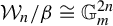 $$ \begin{align*}\mathcal{W}_n / \beta \cong \mathbb{G}_{m}^{2n}\end{align*} $$
restricts to a geometric quotient
 $$ \begin{align*}\chi' \colon \mathcal{W}_n^\circ \to (\mathbb{P}^1 \smallsetminus \{0, 1, \infty\})^{2n}.\end{align*} $$
Consider the map
 $$ \begin{align*}\Delta' \colon \mathcal{W}_n^\circ \to \mathcal{V}_n,\end{align*} $$
where $\Delta '(w)$
has
$\Delta '(w)$
has $v_1, v_2, v_3$
at the standard basis vectors, and each remaining vector
$v_1, v_2, v_3$
at the standard basis vectors, and each remaining vector $v_i$
for
$v_i$
for $4 \leq i \leq n$
is determined recursively by the relation
$4 \leq i \leq n$
is determined recursively by the relation
 $$ \begin{align*}a_{i - 3} v_{i - 3} + b_{i - 3} v_{i - 2} + c_{i - 3} v_{i - 1} + d_{i - 3} v_i = 0.\end{align*} $$
We formally compute $v_{n + 1}, v_{n + 2}, v_{n + 3}$
in the same way, and then define M to be the matrix
$v_{n + 1}, v_{n + 2}, v_{n + 3}$
in the same way, and then define M to be the matrix $[v_{n+1} v_{n+2} v_{n+3}]$
.
$[v_{n+1} v_{n+2} v_{n+3}]$
.
Define
 $$ \begin{align*}\chi \colon \mathcal{V}_n \to (\mathbb{P}^1 \smallsetminus \{0, 1, \infty\})^{2n},\end{align*} $$
 $$ \begin{align*}v \mapsto (x_1(v), \ldots, x_n(v), y_1(v), \ldots, y_n(v)).\end{align*} $$
We claim that $\chi $
satisfies the necessary universal property to be a categorical quotient
$\chi $
satisfies the necessary universal property to be a categorical quotient $\mathcal {V}_n / \alpha $
. The argument is the following elementary diagram chase.
$\mathcal {V}_n / \alpha $
. The argument is the following elementary diagram chase.
We know that
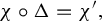 $$ \begin{align*}\chi \circ \Delta = \chi',\end{align*}$$
 $$ \begin{align*}\chi' \circ \Delta' = \chi.\end{align*} $$
Suppose that we are given a variety $V'$
and an
$V'$
and an $\alpha $
-invariant map
$\alpha $
-invariant map $\nu \colon \mathcal {V}_n \to V'$
. We want to show that there exists a unique map
$\nu \colon \mathcal {V}_n \to V'$
. We want to show that there exists a unique map
 $$ \begin{align*}\nu' \colon (\mathbb{P}^1 \smallsetminus \{0, 1, \infty\})^{2n} \to V'\end{align*} $$
such that
 $$ \begin{align*}\nu' \circ \chi = \nu.\end{align*}$$
Evidently,
 $$ \begin{align*}\nu \circ \Delta'\end{align*} $$
is $\beta $
-invariant, so from the universal property of the categorical quotient
$\beta $
-invariant, so from the universal property of the categorical quotient $\mathcal {W}_n^\circ / \beta $
, there exists a unique map
$\mathcal {W}_n^\circ / \beta $
, there exists a unique map $\nu '$
such that
$\nu '$
such that
 $$ \begin{align*}\nu' \circ \chi' = \nu \circ \Delta'.\end{align*} $$
Then composing each side of the equation with $\Delta $
on the right gives the desired equation
$\Delta $
on the right gives the desired equation
 $$ \begin{align*}\nu' \circ \chi = \nu.\end{align*} $$
Further, if some other $\nu ''$
satisfies
$\nu ''$
satisfies
 $$ \begin{align*}\nu'' \circ \chi = \nu,\end{align*} $$
then composing with $\Delta '$
on the right gives
$\Delta '$
on the right gives
 $$ \begin{align*}\nu'' \circ \chi' = \nu \circ \Delta',\end{align*} $$
so again by the universal property,
 $$ \begin{align*}\nu'' = \nu'.\end{align*} $$
Suppose that $v, v' \in \mathcal {V}_n$
, and suppose
$v, v' \in \mathcal {V}_n$
, and suppose $\chi (v) = \chi (v')$
. Then
$\chi (v) = \chi (v')$
. Then $\Delta (v)$
and
$\Delta (v)$
and $\Delta (v')$
are in the same
$\Delta (v')$
are in the same $\beta $
-orbit. So, by Proposition 3.15, we know that v and
$\beta $
-orbit. So, by Proposition 3.15, we know that v and $v'$
are in the same
$v'$
are in the same $\alpha $
-orbit.
$\alpha $
-orbit.
Now that we know that the geometric quotient $\mathcal {V}_n / \alpha $
exists, we compute it another way. Since the
$\mathcal {V}_n / \alpha $
exists, we compute it another way. Since the $\mathbb {G}_{m}$
factors act by scaling the
$\mathbb {G}_{m}$
factors act by scaling the $\mathbb {A}^3$
and the
$\mathbb {A}^3$
and the $\operatorname {\mathrm {GL}}_3$
, we can write
$\operatorname {\mathrm {GL}}_3$
, we can write $\mathcal {V}_n / \alpha $
as
$\mathcal {V}_n / \alpha $
as
 $$ \begin{align*}\mathcal{U}_n / \operatorname{\mathrm{GL}}_3\!.\end{align*} $$
Since scaling is trivial on $\mathcal {U}_n$
,
$\mathcal {U}_n$
,
 $$ \begin{align*}\mathcal{U}_n / \operatorname{\mathrm{GL}}_3 \cong \mathcal{U}_n / \operatorname{\mathrm{PGL}}_3\!.\end{align*} $$
This concludes the proof of Proposition 3.16.
4 Formulas for the pentagram map
Definition 4.1. Fix $n \geq 4$
. The pentagram map on parameter space is the rational map
$n \geq 4$
. The pentagram map on parameter space is the rational map
 $$ \begin{align*} F \colon \mathcal{U}_n \dashrightarrow \mathcal{U}_n \end{align*} $$
that sends a twisted n-gon $(v_i)_{i \in {\mathbb Z}}$
to the twisted n-gon
$(v_i)_{i \in {\mathbb Z}}$
to the twisted n-gon $(w_i)_{i \in {\mathbb Z}}$
, where
$(w_i)_{i \in {\mathbb Z}}$
, where $w_i$
is the intersection of the diagonals
$w_i$
is the intersection of the diagonals $\overline {v_{i-1} v_{i+1}}$
and
$\overline {v_{i-1} v_{i+1}}$
and $\overline {v_i v_{i+1}}$
. See Figure 4. The map F respects the action of
$\overline {v_i v_{i+1}}$
. See Figure 4. The map F respects the action of $\operatorname {\mathrm {PGL}}_3$
on
$\operatorname {\mathrm {PGL}}_3$
on $\mathcal {U}_n$
defined by equation (2).
$\mathcal {U}_n$
defined by equation (2).
The pentagram map F on parameter space. The exterior bold line is part of the input twisted polygon, and the interior bold line is part of its image by the pentagram map.

The pentagram map on moduli space, or just pentagram map, is the rational map
 $$ \begin{align*} f \colon \mathcal{T}_n \dashrightarrow \mathcal{T}_n \end{align*} $$
induced on the moduli space of twisted n-gons up to the $\operatorname {\mathrm {PGL}}_3$
-action in equation (2). In other words, the map f is the unique dominant rational map such that the following diagram commutes:
$\operatorname {\mathrm {PGL}}_3$
-action in equation (2). In other words, the map f is the unique dominant rational map such that the following diagram commutes:
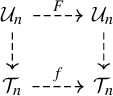
We showed in Theorem 3.6 that
 $$ \begin{align*} \mathcal{T}_n \cong (\mathbb{P}^1 \smallsetminus \{0,1,\infty\})^{2n}.\end{align*} $$
The coordinates on $\mathcal {T}_n$
are
$\mathcal {T}_n$
are $x_i, y_i$
for each
$x_i, y_i$
for each $i = 1, \ldots , n$
. In these coordinates, the pentagram map has a straightforward formula, which we apply in §5. Define
$i = 1, \ldots , n$
. In these coordinates, the pentagram map has a straightforward formula, which we apply in §5. Define
 $$ \begin{align*}f^*(x_i) = x_i \circ f, \quad f^*(y_i) = y_i \circ f.\end{align*} $$
This is just the usual algebro-geometric definition of pullback of a function by a rational map.
Proposition 4.2. [Reference Schwartz37]
The pentagram map $f \colon \mathcal {T}_n \dashrightarrow \mathcal {T}_n$
can be written in coordinates as
$f \colon \mathcal {T}_n \dashrightarrow \mathcal {T}_n$
can be written in coordinates as
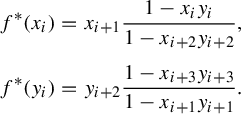 $$ \begin{align*}f^*(x_i) &= x_{i + 1} \frac{1 - x_i y_i}{1 - x_{i+2}y_{i+2}},\\[4pt] f^*(y_i) &= y_{i + 2} \frac{1 - x_{i+3} y_{i+3}}{1 - x_{i+1} y_{i+1}}. \end{align*} $$
The condition $1 - x_i y_i = 0$
causes vanishing denominators in the formula of f. This condition is equivalent to collinearity of the points
$1 - x_i y_i = 0$
causes vanishing denominators in the formula of f. This condition is equivalent to collinearity of the points $v_{i - 2}, v_i, v_{i+2}$
.
$v_{i - 2}, v_i, v_{i+2}$
.
These formulas were first published in [Reference Schwartz37], and a proof was given over $\mathbb R$
using
$\mathbb R$
using $ab$
-coordinates in [Reference Ovsienko, Schwartz and Tabachnikov33]; see also [Reference Izosimov19, §2.3]. Since the
$ab$
-coordinates in [Reference Ovsienko, Schwartz and Tabachnikov33]; see also [Reference Izosimov19, §2.3]. Since the $ab$
-coordinates are not well defined over an arbitrary base field, we give a new field-independent proof of the formulas following the matrix refactorization argument of Izosimov [Reference Izosimov20]. The remainder of this section builds up to the proof of Proposition 4.2.
$ab$
-coordinates are not well defined over an arbitrary base field, we give a new field-independent proof of the formulas following the matrix refactorization argument of Izosimov [Reference Izosimov20]. The remainder of this section builds up to the proof of Proposition 4.2.
Recall the definitions of $\mathcal {V}_n$
and
$\mathcal {V}_n$
and $\mathcal {W}_n$
from §3. First, we explain how to view
$\mathcal {W}_n$
from §3. First, we explain how to view $\mathcal {W}_n$
as a space of difference operators. We are working over an algebraically closed base field k. Let
$\mathcal {W}_n$
as a space of difference operators. We are working over an algebraically closed base field k. Let $k^{\mathbb Z}$
be the space of
$k^{\mathbb Z}$
be the space of ${\mathbb Z}$
-indexed sequences in k. Let
${\mathbb Z}$
-indexed sequences in k. Let $\Sigma \colon k^{\mathbb Z} \to k^{\mathbb Z}$
be the left shift operator, defined on each
$\Sigma \colon k^{\mathbb Z} \to k^{\mathbb Z}$
be the left shift operator, defined on each $\sigma \in k^{\mathbb Z}$
by
$\sigma \in k^{\mathbb Z}$
by
 $$ \begin{align*} (\Sigma \sigma)_i = \sigma_{i+1}. \end{align*} $$
Each $s \in k^{\mathbb Z}$
defines a scalar operator on
$s \in k^{\mathbb Z}$
defines a scalar operator on $k^{\mathbb Z}$
, via the rule
$k^{\mathbb Z}$
, via the rule
 $$ \begin{align*}(s \sigma)_i = s_i \sigma_i.\end{align*} $$
A third-order difference operator is a map $k^{\mathbb Z} \to k^{\mathbb Z}$
of the form
$k^{\mathbb Z} \to k^{\mathbb Z}$
of the form
 $$ \begin{align*} a + b \Sigma + c \Sigma^2 + d \Sigma^3,\end{align*} $$
where $a, b, c, d$
are scalar operators. Note that scalar operators generally do not commute with
$a, b, c, d$
are scalar operators. Note that scalar operators generally do not commute with $\Sigma $
, since
$\Sigma $
, since
 $$ \begin{align*} (\Sigma\circ s(\sigma))_i = s_{i+1}\sigma_{i+1} \quad\text{and}\quad (s \circ\Sigma (\sigma))_i = s_i\sigma_{i+1}. \end{align*} $$
Any element of $\mathcal {W}_n$
can be identified with a third-order difference operator by reading off the sequences
$\mathcal {W}_n$
can be identified with a third-order difference operator by reading off the sequences $a_i, b_i, c_i, d_i$
. Specifically, the space
$a_i, b_i, c_i, d_i$
. Specifically, the space $\mathcal {W}_n$
is a subset of
$\mathcal {W}_n$
is a subset of $(k^{\mathbb Z})^4$
, and we identify each element
$(k^{\mathbb Z})^4$
, and we identify each element $(a_i,b_i,c_i,d_i)_{i\in {\mathbb Z}}$
of
$(a_i,b_i,c_i,d_i)_{i\in {\mathbb Z}}$
of $\mathcal {W}_n$
with a third-order difference operator via
$\mathcal {W}_n$
with a third-order difference operator via
 $$ \begin{align*} (a_i,b_i,c_i,d_i)_{i\in{\mathbb Z}} \longleftrightarrow (a_i)+(b_i)\Sigma+(c_i)\Sigma^2+(d_i)\Sigma^3. \end{align*} $$
Given any third-order difference operator $D = a + b \Sigma + c \Sigma ^2 + d \Sigma ^3$
, we define two associated third-order difference operators
$D = a + b \Sigma + c \Sigma ^2 + d \Sigma ^3$
, we define two associated third-order difference operators
 $$ \begin{align*}D^{\scriptscriptstyle+} = a + c\Sigma^2,\end{align*} $$
 $$ \begin{align*}D^{\scriptscriptstyle-} = b\Sigma + d\Sigma^3.\end{align*} $$
Note that $D = D^{\scriptscriptstyle +} + D^{\scriptscriptstyle -}$
.
$D = D^{\scriptscriptstyle +} + D^{\scriptscriptstyle -}$
.
We extend the action of a difference operator on $k^{\mathbb Z}$
coordinatewise to the set
$k^{\mathbb Z}$
coordinatewise to the set $(k^3)^{\mathbb Z}$
of sequences in
$(k^3)^{\mathbb Z}$
of sequences in $k^3$
. Thus, each third-order difference operator defines a map
$k^3$
. Thus, each third-order difference operator defines a map $\mathcal {V}_n \to (k^3)^{\mathbb Z}$
.
$\mathcal {V}_n \to (k^3)^{\mathbb Z}$
.
Lemma 4.3. [Reference Izosimov20]
Let $u \in \operatorname {\mathrm {Dom}} F$
, let
$u \in \operatorname {\mathrm {Dom}} F$
, let $v\in \mathcal {V}_n$
be a lift of u, and let
$v\in \mathcal {V}_n$
be a lift of u, and let $D \in \mathcal {W}_n$
annihilate v. Then,
$D \in \mathcal {W}_n$
annihilate v. Then,
 $$ \begin{align*} D^{\scriptscriptstyle-} v = F(u) \quad \text{as elements of }\mathcal{U}_n. \end{align*} $$
Proof. Observe that $(F(v))_i$
lies in the plane spanned by
$(F(v))_i$
lies in the plane spanned by $v_i, v_{i + 2}$
and also in the plane spanned by
$v_i, v_{i + 2}$
and also in the plane spanned by $v_{i + 1}, v_{i + 3}$
. We have
$v_{i + 1}, v_{i + 3}$
. We have
 $$ \begin{align*}D^{\scriptscriptstyle-} v = b\Sigma v + d\Sigma^3 v = -av - c\Sigma^2 v,\end{align*} $$
so $(D^{\scriptscriptstyle -} v)_i$
lies in the desired spans. Since D is in
$(D^{\scriptscriptstyle -} v)_i$
lies in the desired spans. Since D is in $\mathcal {W}_n$
, we know
$\mathcal {W}_n$
, we know $(D^{\scriptscriptstyle -} v)_i$
is non-zero. The two planes intersect in a unique line, by the non-degeneracy condition on twisted n-gons. Thus, the image of
$(D^{\scriptscriptstyle -} v)_i$
is non-zero. The two planes intersect in a unique line, by the non-degeneracy condition on twisted n-gons. Thus, the image of $D^{\scriptscriptstyle -} v$
in
$D^{\scriptscriptstyle -} v$
in $\mathcal {U}_n$
is
$\mathcal {U}_n$
is $F(u)$
.
$F(u)$
.
The next theorem presents the pentagram map as a matrix refactorization.
Theorem 4.4. [Reference Izosimov20]
Suppose that $u \in \operatorname {\mathrm {Dom}} F$
. Let v be any lift of u to
$u \in \operatorname {\mathrm {Dom}} F$
. Let v be any lift of u to $\mathcal {V}_n$
. Let
$\mathcal {V}_n$
. Let $D \in \mathcal {W}_n$
annihilate v. Then there exists
$D \in \mathcal {W}_n$
annihilate v. Then there exists $\tilde {D} \in \mathcal {W}_n$
such that
$\tilde {D} \in \mathcal {W}_n$
such that
 $$ \begin{align} \tilde{D}^{\scriptscriptstyle+} D^{\scriptscriptstyle-} = \tilde{D}^{\scriptscriptstyle-} D^{\scriptscriptstyle+}. \end{align} $$
Further, for each lift $\tilde {v} \in \mathcal {V}_n$
of
$\tilde {v} \in \mathcal {V}_n$
of $F(u)$
, there is a choice of
$F(u)$
, there is a choice of $\tilde {D}$
such that
$\tilde {D}$
such that
 $$ \begin{align*} \tilde{D} (\tilde{v}) = 0. \end{align*} $$
Proof. First, we check that the factorization
 $$ \begin{align} \tilde{D}^{\scriptscriptstyle+} D^{\scriptscriptstyle-} = \tilde{D}^{\scriptscriptstyle-} D^{\scriptscriptstyle+} \end{align} $$
is possible. We start by looking for a solution $\tilde {D}$
in the space of all n-periodic third-order difference operators (so some of the
$\tilde {D}$
in the space of all n-periodic third-order difference operators (so some of the $a_i, b_i, c_i, d_i$
may be 0). Equation (5) imposes
$a_i, b_i, c_i, d_i$
may be 0). Equation (5) imposes $3n$
homogeneous linear conditions on
$3n$
homogeneous linear conditions on $4n$
variables, so by linear algebra, there is a non-trivial solution.
$4n$
variables, so by linear algebra, there is a non-trivial solution.
Next we show that
 $$ \begin{align*} \tilde{D} (\tilde{v}) = 0.\end{align*} $$
Our initial choice of $\tilde {D}$
annihilates
$\tilde {D}$
annihilates $D^{\scriptscriptstyle -} v$
, by the following calculation:
$D^{\scriptscriptstyle -} v$
, by the following calculation:
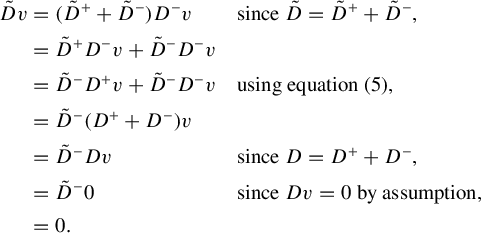 $$ \begin{align*} \begin{aligned} \tilde D v &= (\tilde{D}^{\scriptscriptstyle+} + \tilde{D}^{\scriptscriptstyle-}) D^{\scriptscriptstyle-} v &&\text{since }\tilde D=\tilde{D}^{\scriptscriptstyle+} + \tilde{D}^{\scriptscriptstyle-}, \\ &= \tilde{D}^{\scriptscriptstyle+} D^{\scriptscriptstyle-} v + \tilde{D}^{\scriptscriptstyle-} D^{\scriptscriptstyle-} v \\ &= \tilde{D}^{\scriptscriptstyle-} D^{\scriptscriptstyle+} v + \tilde{D}^{\scriptscriptstyle-} D^{\scriptscriptstyle-} v &&\text{using equation } \text{(5)},\\ &= \tilde{D}^{\scriptscriptstyle-} (D^{\scriptscriptstyle+} + D^{\scriptscriptstyle-}) v \\ &= \tilde{D}^{\scriptscriptstyle-} D v &&\text{since }D=D^{\scriptscriptstyle+}+D^{\scriptscriptstyle-},\\ &= \tilde{D}^{\scriptscriptstyle-} 0 &&\text{since }D v=0\text{ by assumption,}\\ &= 0. \end{aligned} \end{align*} $$
We claim that $\tilde {D}$
belongs to
$\tilde {D}$
belongs to $\mathcal {W}_n$
. We note that
$\mathcal {W}_n$
. We note that $D^{\scriptscriptstyle -}$
has every consecutive 4-tuple in projective general position by the assumption that
$D^{\scriptscriptstyle -}$
has every consecutive 4-tuple in projective general position by the assumption that $u \in \operatorname {\mathrm {Dom}} F$
. Since
$u \in \operatorname {\mathrm {Dom}} F$
. Since $\tilde {D}(D^{\scriptscriptstyle -} v) = 0$
and
$\tilde {D}(D^{\scriptscriptstyle -} v) = 0$
and $\tilde {D} \neq 0$
, all the
$\tilde {D} \neq 0$
, all the $a_i, b_i, c_i, d_i$
are non-zero, so
$a_i, b_i, c_i, d_i$
are non-zero, so $\tilde {D}$
is in
$\tilde {D}$
is in $\mathcal {W}_n$
.
$\mathcal {W}_n$
.
By Lemma 4.3, we have that $D^{\scriptscriptstyle -} v$
and
$D^{\scriptscriptstyle -} v$
and $\tilde {v}$
have the same image in
$\tilde {v}$
have the same image in $\mathcal {U}_n$
, so
$\mathcal {U}_n$
, so $D^{\scriptscriptstyle -} v$
and
$D^{\scriptscriptstyle -} v$
and $\tilde {v}$
are the same up to rescaling vectors. Then we can rescale
$\tilde {v}$
are the same up to rescaling vectors. Then we can rescale $\tilde {D}$
using the row-scalings
$\tilde {D}$
using the row-scalings $\rho _i$
of the action
$\rho _i$
of the action $\beta $
to produce a difference operator which annihilates
$\beta $
to produce a difference operator which annihilates $\tilde {v}$
, and the modified
$\tilde {v}$
, and the modified $\tilde {D}$
still satisfies equation (4).
$\tilde {D}$
still satisfies equation (4).
Now we calculate a formula for the pentagram map on $\mathcal {T}_n$
.
$\mathcal {T}_n$
.
Proof of Proposition 4.2
Let $u, D, \tilde {D}$
be as in the statement of Theorem 4.4. Let
$u, D, \tilde {D}$
be as in the statement of Theorem 4.4. Let $a, b, c, d$
be the sequences of coordinates of D, and let
$a, b, c, d$
be the sequences of coordinates of D, and let $\tilde {a}, \tilde {b}, \tilde {c}, \tilde {d}$
be the sequences of coordinates of
$\tilde {a}, \tilde {b}, \tilde {c}, \tilde {d}$
be the sequences of coordinates of $\tilde {D}$
. Let
$\tilde {D}$
. Let $\sigma \in k^{\mathbb Z}$
be defined by
$\sigma \in k^{\mathbb Z}$
be defined by
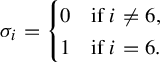 $$ \begin{align*} \sigma_i = \begin{cases} 0 &\text{if }i\ne 6, \\ 1 &\text{if }i=6. \end{cases} \end{align*} $$
Applying equation (4) to $\sigma $
, we obtain the following system of equations:
$\sigma $
, we obtain the following system of equations:
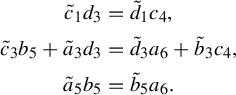 $$ \begin{align*} \tilde{c}_1 d_3 &= \tilde{d}_1 c_4, \\ \tilde{c}_3 b_5 + \tilde{a}_3 d_3 &= \tilde{d}_3 a_6 + \tilde{b}_3 c_4, \\ \tilde{a}_5 b_5 &= \tilde{b}_5 a_6. \end{align*} $$
The same equations hold after a change in index, by symmetry. We use the appropriate shifts of the first and last equations to eliminate $\tilde {a}_i$
and
$\tilde {a}_i$
and $\tilde {d}_i$
from the middle equation, and rearrange to obtain
$\tilde {d}_i$
from the middle equation, and rearrange to obtain
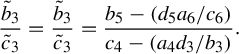 $$ \begin{align*} \frac{\tilde{b}_3}{\tilde{c}_3} = \frac{\tilde{b}_3}{\tilde{c}_3} = \frac{b_5 - ({d_5 a_6}/{c_6})}{c_4 - ({a_4 d_3}/{b_3})}.\end{align*} $$
Taking the reciprocal and multiplying by
 $$ \begin{align*} \frac{\tilde{a}_4}{\tilde{b}_4} = \frac{a_5}{b_4}\end{align*} $$
gives
 $$ \begin{align*} \frac{\tilde{a}_4 \tilde{c}_3}{ \tilde{b}_3 \tilde{b}_4 } = \frac{a_5 c_4}{b_4 b_5} \bigg( \frac{1 - ({a_4 d_3}/{c_4 b_3})}{1 - ({d_5 a_6}/{b_5 c_6})} \bigg). \end{align*} $$
Then by Proposition 3.12,
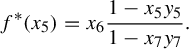 $$ \begin{align*} f^*(x_5) = x_6 \frac{1 - x_5 y_5}{1 - x_7 y_7}.\end{align*} $$
Symmetry gives the formula for $x_i$
in general, and the formula for
$x_i$
in general, and the formula for $y_i$
comes from a similar calculation.
$y_i$
comes from a similar calculation.
5 The Lax representation
We now derive a Lax representation for the pentagram map. The Lax representation supplies the invariant functions that define the invariant fibration of the pentagram map.
Informally, a Lax representation is an embedding of the domain of a dynamical system into a space of matrices such that the dynamical system is carried out via matrix conjugation.
5.1 The idea
The pentagram map is a discrete algebraic dynamical system
 $$ \begin{align*} f \colon \mathcal{T}_n \dashrightarrow \mathcal{T}_n,\end{align*} $$
so in our setting, the Lax representation is a space $\operatorname {\mathrm {Mat}}_d(k)$
of
$\operatorname {\mathrm {Mat}}_d(k)$
of $d \times d$
matrices over k (for some
$d \times d$
matrices over k (for some $d \geq 1$
) and a function
$d \geq 1$
) and a function
 $$ \begin{align*}T \colon \mathcal{T}_n \dashrightarrow \operatorname{\mathrm{Mat}}_d(k)\end{align*} $$
such that, for any $v \in \operatorname {\mathrm {Dom}} f$
, the matrix
$v \in \operatorname {\mathrm {Dom}} f$
, the matrix $T(f(v))$
is conjugate (similar) to
$T(f(v))$
is conjugate (similar) to $T(v)$
. Then the coefficients of the characteristic polynomial of
$T(v)$
. Then the coefficients of the characteristic polynomial of $T(v)$
are functions on
$T(v)$
are functions on $\mathcal {T}_n$
which are invariant for f. One can do even better by identifying a function
$\mathcal {T}_n$
which are invariant for f. One can do even better by identifying a function $P \colon \mathcal {T}_n \dashrightarrow \operatorname {\mathrm {GL}}_d(k)$
which carries out the conjugation, that is, such that
$P \colon \mathcal {T}_n \dashrightarrow \operatorname {\mathrm {GL}}_d(k)$
which carries out the conjugation, that is, such that
 $$ \begin{align*} T \circ f = P T P^{-1}.\end{align*} $$
This construction supplies up to d invariant functions. More may be obtained from a Lax representation with spectral parameter. This construction replaces $\operatorname {\mathrm {Mat}}_d(k)$
with
$\operatorname {\mathrm {Mat}}_d(k)$
with $\operatorname {\mathrm {Mat}}_d(k(\zeta ))$
, where
$\operatorname {\mathrm {Mat}}_d(k(\zeta ))$
, where $\zeta $
is an indeterminate. Then, the characteristic polynomial may be viewed as a bivariate polynomial, so there are more coefficients and thus more invariant functions. Of course, some of these invariant functions may be constants, and they may also be algebraically dependent, so even after a Lax representation with spectral parameter is found, some work is required to establish the existence of a fibration by low-dimensional subvarieties.
$\zeta $
is an indeterminate. Then, the characteristic polynomial may be viewed as a bivariate polynomial, so there are more coefficients and thus more invariant functions. Of course, some of these invariant functions may be constants, and they may also be algebraically dependent, so even after a Lax representation with spectral parameter is found, some work is required to establish the existence of a fibration by low-dimensional subvarieties.
Formulas for T and P may be easily checked by carrying out the requisite matrix multiplication. However, deriving the right formulas may be very difficult and requires some deeper sense of why the dynamical system is integrable. Soloviev found formulas for an algebraic Lax representation with spectral parameter for the pentagram map in $\operatorname {\mathrm {Mat}}_3(\mathbb C)$
[Reference Soloviev43]. One hopes for a conceptually motivated proof, and [Reference Izosimov18] has almost what we need, but the argument uses coordinates which are only well defined over
$\operatorname {\mathrm {Mat}}_3(\mathbb C)$
[Reference Soloviev43]. One hopes for a conceptually motivated proof, and [Reference Izosimov18] has almost what we need, but the argument uses coordinates which are only well defined over $\mathbb R$
. Trying to push the same argument through over
$\mathbb R$
. Trying to push the same argument through over $\mathbb C$
results in invariants which are only well defined up to a third root of unity. In this section, we derive the Lax representation using corner invariants as coordinates, so the argument works over any algebraically closed field k.
$\mathbb C$
results in invariants which are only well defined up to a third root of unity. In this section, we derive the Lax representation using corner invariants as coordinates, so the argument works over any algebraically closed field k.
Before formally going through the proof, we sketch the idea. A Lax representation (without spectral parameter) can be found by tracking the monodromy of a twisted n-gon v. The monodromy is a linear transformation, so it does not come with a preferred choice of coordinates. The Lax representation (without spectral parameter) describes the monodromy in a basis defined by the first few vertices of v. To introduce a spectral parameter, we observe a property of the pentagram map known as scaling invariance. Namely, there is an action of $\mathbb {G}_{m}$
on
$\mathbb {G}_{m}$
on $\mathcal {T}_n$
, defined by
$\mathcal {T}_n$
, defined by
 $$ \begin{align*}\zeta \cdot (x_1, \ldots, x_n, y_1, \ldots, y_n) = (\zeta^{-1} x_1, \ldots, \zeta^{-1} x_n, \zeta y_1, \ldots, \zeta y_n.)\end{align*} $$
Inspecting the formulas of Proposition 4.2, we see that the pentagram map commutes with this action. This provides a deformation of the pentagram map, and following through the same construction for the deformation, we obtain matrices with the spectral parameter.
Remark 5.1. Another method of obtaining the $3 \times 3$
Lax representation is to go through the ‘dual’
$3 \times 3$
Lax representation is to go through the ‘dual’ $n \times n$
Lax representation found by Izosimov in [Reference Izosimov20]. Indeed, writing down the eigenvectors of Izosimov’s representation requires a recursive calculation equivalent to equation (8) below. Thus, a proof of algebraic integrability from the
$n \times n$
Lax representation found by Izosimov in [Reference Izosimov20]. Indeed, writing down the eigenvectors of Izosimov’s representation requires a recursive calculation equivalent to equation (8) below. Thus, a proof of algebraic integrability from the $n \times n$
Lax representation would ultimately lead through the same equations, resulting in the same spectral curve. However, there is a conceptual difference between the two approaches. The
$n \times n$
Lax representation would ultimately lead through the same equations, resulting in the same spectral curve. However, there is a conceptual difference between the two approaches. The $3 \times 3$
Lax representation follows more directly from the geometric definition of the pentagram map on twisted polygons, but it does not explain the origins of scaling invariance. Izosimov’s method allows for a far-reaching generalization of scaling invariance to a much wider class of generalized pentagram maps.
$3 \times 3$
Lax representation follows more directly from the geometric definition of the pentagram map on twisted polygons, but it does not explain the origins of scaling invariance. Izosimov’s method allows for a far-reaching generalization of scaling invariance to a much wider class of generalized pentagram maps.
5.2 The Lax representation via corner invariants
We let $\zeta $
be a formal indeterminate.
$\zeta $
be a formal indeterminate.
Definition 5.2. A projective zero-curvature equation with spectral parameter is the following data: for each $i \geq 1$
, two functions
$i \geq 1$
, two functions
 $$ \begin{align*} L_{i} : \operatorname{\mathrm{Dom}} f \to \mathbb{P}(\operatorname{\mathrm{Mat}}_3(k(\zeta))) \quad\text{and}\quad P_{i} : \operatorname{\mathrm{Dom}} f \to \operatorname{\mathrm{PGL}}_3(k(\zeta)), \end{align*} $$
such that, for all $t \in {\mathbb Z}$
,
$t \in {\mathbb Z}$
,
 $$ \begin{align*}L_{i, t+1} = P_{i+1, t} L_{i,t} {P_{i,t}}^{-1}.\end{align*} $$
Definition 5.3. A projective Lax representation with spectral parameter is, for each $i \geq 1$
, two functions
$i \geq 1$
, two functions
 $$ \begin{align*}T_{i}, P_{i} : \operatorname{\mathrm{Dom}} f \to \mathbb{P}(\operatorname{\mathrm{Mat}}_3(k(\zeta)))\end{align*} $$
such that
 $$ \begin{align*}T_{i, t+ 1} = P_{i,t} T_{i,t} {P_{i,t}}^{-1}.\end{align*} $$
In this situation, the functions $T_i$
are collectively called a projective Lax function with spectral parameter and the function
$T_i$
are collectively called a projective Lax function with spectral parameter and the function $P_i$
is called the associated function.
$P_i$
is called the associated function.
Now we give explicit formulas for functions $L_i, P_i, T_i$
as in Definitions 5.2 and 5.3 that are associated to the pentagram map. For any
$L_i, P_i, T_i$
as in Definitions 5.2 and 5.3 that are associated to the pentagram map. For any $i \in {\mathbb Z}$
, we define
$i \in {\mathbb Z}$
, we define
 $$ \begin{align*}L_{i}, P_{i} : \mathcal{T}_n \dashrightarrow \mathbb{P}(\operatorname{\mathrm{Mat}}_3(k(\zeta)))\end{align*} $$
by
 $$ \begin{align} L_i(\zeta) &= \begin{bmatrix} 1/x_{i+2} & -1/x_{i+2} & 0 \\ 1/\zeta & 0 & -1/\zeta \\ y_{i+2} & 0 & 0 \end{bmatrix}\!,\qquad\qquad\qquad\qquad\qquad\qquad\qquad\qquad\ \, \end{align} $$
 $$ \begin{align} P_i(\zeta) &= \begin{bmatrix} 1 - x_{i+2}y_{i+2} & 0 & -(1 - x_{i+2} y_{i+2}) \\ x_{i+1} y_{i+1}(1 - x_{i+2}y_{i+2}) & -(1 - x_{i+1}y_{i+1}) & -(1 - x_{i+2}y_{i+2}) \\ 0 & \zeta y_{i+2} (1 - x_{i+3} y_{i+3}) & 0 \end{bmatrix}\!. \end{align} $$
Note that $L_i$
and
$L_i$
and $P_i$
are n-periodic in i, since
$P_i$
are n-periodic in i, since $x_i$
and
$x_i$
and $y_i$
are n-periodic in i. We also introduce an optional time index
$y_i$
are n-periodic in i. We also introduce an optional time index $t \in \mathbb N_{\geq 0}$
. We set
$t \in \mathbb N_{\geq 0}$
. We set
 $$ \begin{align*} L_{i, t} = L_i \circ f^{\circ t},\quad P_{i, t} = P_i \circ f^{\circ t},\quad T_{i, t} = T_i \circ f^{\circ t}. \end{align*} $$
Also for any $i \in {\mathbb Z}$
, we set
$i \in {\mathbb Z}$
, we set
 $$ \begin{align} T_i = L_{n-1+i} \ldots L_{i+1} L_i. \end{align} $$
Theorem 5.4. [Reference Soloviev43, Theorem 2.2]
Suppose that k is an algebraically closed field. Let $L_i$
,
$L_i$
, $P_i$
, and
$P_i$
, and $T_i$
be defined respectively by equations (6), (7), and (8). Then we have
$T_i$
be defined respectively by equations (6), (7), and (8). Then we have
 $$ \begin{align} L_{i, t+1} &= P_{i+1, t} L_{i,t} {P_{i,t}}^{-1}, \end{align} $$
 $$ \begin{align} T_{i, t + 1} &= P_{i,t} T_{i,t} {P_{i,t}}^{-1}.\quad \end{align} $$
Thus, the functions $L_i$
and
$L_i$
and $P_i$
define a projective zero-curvature equation with spectral parameter for the pentagram map, and
$P_i$
define a projective zero-curvature equation with spectral parameter for the pentagram map, and $T_i$
is a projective Lax function with spectral parameter, with associated function
$T_i$
is a projective Lax function with spectral parameter, with associated function $P_i$
.
$P_i$
.
This Lax representation appeared as [Reference Soloviev43, Theorem 2.2], where the proof is the brute-force calculation that the matrix equations (9) and (10) follow from equations (6) and (7). That approach requires foreknowledge of the hard-to-guess equations (6) and (7). Below, we give a new proof that leads naturally to these formulas. We first show that equations of the form of equations (9) and (10) must hold for some matrices $L_i$
and
$L_i$
and $P_i$
, then deduce the right definitions for
$P_i$
, then deduce the right definitions for $L_i$
and
$L_i$
and $P_i$
as a consequence.
$P_i$
as a consequence.
This argument generalizes to other pentagram-like maps. In particular, it explains the origin of the complicated formulas in the Lax representation of the 3D pentagram map [Reference Khesin and Soloviev24, Theorem 6.3].
Proof of Theorem 5.4
We use the hypothesis that k is algebraically closed to define the moduli space $\mathcal {T}_n$
of twisted n-gons (Theorem 3.6). Without loss of generality, set
$\mathcal {T}_n$
of twisted n-gons (Theorem 3.6). Without loss of generality, set $t = 0$
.
$t = 0$
.
Suppose that $v \in \operatorname {\mathrm {Dom}} f$
. We set the notation
$v \in \operatorname {\mathrm {Dom}} f$
. We set the notation $v' = f(v)$
.
$v' = f(v)$
.
Define a 4-arc to be a 4-tuple of points in general position. Given any pair of 4-arcs, there is a unique projective transformation mapping the first to the second. So, we can define projective transformations by specifying the image of a single 4-arc. We call this 4-arc the source $4$
-arc and we call its image the target
$4$
-arc and we call its image the target $4$
-arc. Since
$4$
-arc. Since $v \in \operatorname {\mathrm {Dom}} f$
, consecutive 4-tuples in
$v \in \operatorname {\mathrm {Dom}} f$
, consecutive 4-tuples in $v'$
are 4-arcs.
$v'$
are 4-arcs.
For each $i \in {\mathbb Z}$
, we now define three projective transformations
$i \in {\mathbb Z}$
, we now define three projective transformations
 $$ \begin{align*}\Lambda_i, \Lambda^{\prime}_i, \Pi_i \colon \mathbb{P}^2 \to \mathbb{P}^2\end{align*} $$
by
 $$ \begin{align*} {\Lambda_i} := (v_{i+1}, v_{i+2}, v_{i+3}, v_{i+4}) &\mapsto (v_i, v_{i+1}, v_{i+2}, v_{i+3}),\\ {\Lambda^{\prime}_i} := (v^{\prime}_{i+1}, v^{\prime}_{i+2}, v^{\prime}_{i+3}, v^{\prime}_{i+4}) &\mapsto (v^{\prime}_i, v^{\prime}_{i+1}, v^{\prime}_{i+2}, v^{\prime}_{i+3}),\\ {\Pi_i} := (v^{\prime}_i, v^{\prime}_{i+1}, v^{\prime}_{i+2}, v^{\prime}_{i+3}) &\mapsto (v_i, v_{i+1}, v_{i+2}, v_{i+3}). \end{align*} $$
Then,
 $$ \begin{align} \Pi_{i+1}^{-1} \circ \Lambda_i^{-1} = {\Lambda'}_i^{-1} \circ \Pi_i^{-1}, \end{align} $$
because both sides are projective transformations such that
 $$ \begin{align*}(v_i, v_{i+1}, v_{i+2}, v_{i+3}) \mapsto (v^{\prime}_{i+1}, v^{\prime}_{i+2}, v^{\prime}_{i+3}, v^{\prime}_{i+4}).\end{align*} $$
We need to write the equality in equation (11) in terms of matrices, which requires choosing bases. For each of the transformations $\Lambda _i, \Pi _i, \Lambda ^{\prime }_i$
, we write a matrix
$\Lambda _i, \Pi _i, \Lambda ^{\prime }_i$
, we write a matrix $L_i, P_i, L^{\prime }_i$
(respectively) for it, in the (unique) basis such that the given source 4-arc is located at
$L_i, P_i, L^{\prime }_i$
(respectively) for it, in the (unique) basis such that the given source 4-arc is located at
 $$ \begin{align*}([1:0:0],\, [0:1:0],\, [0:0:1],\, [1:1:1]).\end{align*} $$
When we rewrite equation (11) as an equality in $\mathbb {P}(\operatorname {\mathrm {Mat}}_3(k))$
, we get
$\mathbb {P}(\operatorname {\mathrm {Mat}}_3(k))$
, we get
 $$ \begin{align} L_{i}^{-1} P_{i+1}^{-1} = P_i^{-1} {L'}_i^{-1}. \end{align} $$
We rearrange equation (12) to be in the form of a projective zero-curvature equation for the pentagram map:
 $$ \begin{align*} {L'}_i P_i = P_{i+1} L_{i}.\end{align*} $$
The reversal of composition order is a consequence of the different choice of basis.
Now, we derive formulas for the matrices. For ease of notation, we just compute formulas for $L_1$
and
$L_1$
and $P_1$
, and the rest follow by symmetry.
$P_1$
, and the rest follow by symmetry.
Define vectors
 $$ \begin{align*} e_1 = \begin{bmatrix} 1 \\ 0 \\ 0 \end{bmatrix}\!, \quad e_2 = \begin{bmatrix} 0 \\ 1 \\ 0 \end{bmatrix}\!, \quad e_3 = \begin{bmatrix} 0 \\ 0 \\ 1 \end{bmatrix}\!, \quad e_4 = \begin{bmatrix} 1 \\ 1 \\ 1 \end{bmatrix}\!. \end{align*} $$
We wish to write a matrix in the basis $e_1, e_2, e_3$
for the unique projective transformation that takes
$e_1, e_2, e_3$
for the unique projective transformation that takes $e_i$
to a representative
$e_i$
to a representative $e^{\prime }_i$
of the corresponding point in the target 4-arc, for each
$e^{\prime }_i$
of the corresponding point in the target 4-arc, for each $i = 1,2,3,4,$
. We can do this as follows.
$i = 1,2,3,4,$
. We can do this as follows.
-
(1) Calculate any choice of
$e^{\prime }_1, e^{\prime }_2, e^{\prime }_3$
in the chosen basis as a function of the coordinates
$a_i, b_i, c_i, d_i$
. -
(2) Find values
$\mu _1, \mu _2, \mu _3$
such that, up to rescaling, If these are not obvious, we can find them by calculating some choice of
$$ \begin{align*}\mu_1 e^{\prime}_1 + \mu_2 e^{\prime}_2 + \mu_3 e^{\prime}_3 = e^{\prime}_4.\end{align*} $$
$e^{\prime }_4$
in the chosen basis and setting
$$ \begin{align*}\begin{bmatrix} \mu_1 \\ \mu_2 \\ \mu_3 \end{bmatrix} = \begin{bmatrix} | & | & | \\ e^{\prime}_1 & e^{\prime}_2 & e^{\prime}_3 \\ | & | & | \\ \end{bmatrix}^{-1} e^{\prime}_4. \end{align*} $$
-
(3) By direct check, the following matrix has the desired property:
$$ \begin{align*} \begin{bmatrix} | & | & | \\ \mu_1 e^{\prime}_1 & \mu_2 e^{\prime}_2 & \mu_3 e^{\prime}_3 \\ | & | & | \\ \end{bmatrix}\!. \end{align*} $$
-
(4) Scale the matrix in step (3) so that it is written in terms of the corner invariants
$x_i, y_i$
instead of the
$a_i, b_i, c_i, d_i$
. We can ease this computation by choosing
$a_1 = b_1 = c_1 = -d_1 = 1$
, which is a choice consistent with our lift. We can also choose some, but not all, of the other variables to be
$1$
, by a rescaling.


First, we calculate ${L_1}^{-1}$
and invert it to obtain
${L_1}^{-1}$
and invert it to obtain $L_1$
. We can take
$L_1$
. We can take
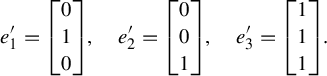 $$ \begin{align*} e^{\prime}_1 = \begin{bmatrix} 0 \\ 1 \\ 0 \\ \end{bmatrix}\!, \quad e^{\prime}_2 = \begin{bmatrix} 0 \\ 0 \\ 1 \\ \end{bmatrix}\!, \quad e^{\prime}_3 = \begin{bmatrix} 1 \\ 1 \\ 1 \\ \end{bmatrix}\!. \end{align*} $$
Next we write $v_5$
in terms of
$v_5$
in terms of $v_2, v_3, v_4$
. Since
$v_2, v_3, v_4$
. Since
 $$ \begin{align*}v_5 = - \frac{1}{d_2}(a_2 v_2 + b_2 v_3 + c_2 v_4),\end{align*} $$
we can take
 $$ \begin{align*}\mu_1 = a_2, \quad \mu_2 = b_2, \quad \mu_3 = c_2.\end{align*} $$
Thus, up to scale,
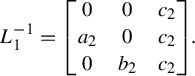 $$ \begin{align*} L_1^{-1} = \begin{bmatrix} 0 & 0 & c_2 \\ a_2 & 0 & c_2 \\ 0 & b_2 & c_2 \\ \end{bmatrix}\!. \end{align*} $$
We want to find a matrix projectively equivalent to this one that is written in terms of corner invariants. From Lemma 3.14, we know that the entry with $a_2$
should be transformed to match
$a_2$
should be transformed to match $x_0$
. So, dividing through by
$x_0$
. So, dividing through by $b_2$
and using the known values
$b_2$
and using the known values $a_1 = b_1 = c_1 = 1$
and
$a_1 = b_1 = c_1 = 1$
and $d_1 = -1$
, we obtain
$d_1 = -1$
, we obtain
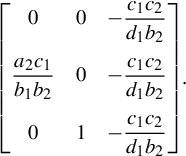 $$ \begin{align*} \begin{bmatrix} 0 & 0 & - \dfrac{c_1 c_2}{d_1 b_2} \\[12pt] \dfrac{a_2 c_1}{b_1 b_2} & 0 & - \dfrac{c_1 c_2}{d_1 b_2} \\[12pt] 0 & 1 & - \dfrac{c_1 c_2}{d_1 b_2} \\ \end{bmatrix}\!. \end{align*} $$
Thus,
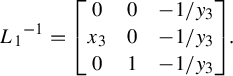 $$ \begin{align*} {L_1}^{-1} = \begin{bmatrix} 0 & 0 & -1/y_3 \\ x_3 & 0 & -1/y_3 \\ 0 & 1 & -1/y_3 \end{bmatrix}\!. \end{align*} $$
We follow the same steps for ${P_1}^{-1}$
. This time we get
${P_1}^{-1}$
. This time we get
 $$ \begin{align*} e^{\prime}_1 = \begin{bmatrix} b_0 \\ 0 \\ d_0 \end{bmatrix}\!, \quad e^{\prime}_2 = \begin{bmatrix} 1 \\ 0 \\ 1 \\ \end{bmatrix}\!, \quad e^{\prime}_3 = \begin{bmatrix} -c_2 \\ -c_2 + a_2 \\ -c_2 \end{bmatrix}\!, \end{align*} $$
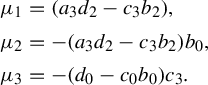 $$ \begin{align*} \mu_1 &= (a_3 d_2 - c_3 b_2), \\ \mu_2 &= -(a_3 d_2 - c_3 b_2) b_0, \\ \mu_3 &= - (d_0 - c_0 b_0) c_3. \end{align*} $$
Thus, up to scale,
 $$ \begin{align*} P_1^{-1} = \begin{bmatrix} b_0 (a_3 d_2 - c_3 b_2) & -(a_3 d_2 - c_3 b_2) b_0 & c_2 c_3(d_0 - c_0 b_0) \\ 0 & 0 & (a_2 - c_2)(d_0 - c_0 b_0)c_3 \\ d_0 (a_3 d_2 - c_3 b_2) & -(a_3 d_2 - c_3 b_2) b_0 & c_2 c_3 (d_0 - c_0 b_0) \end{bmatrix}\!. \end{align*} $$
Dividing through by $b_0 b_2 c_3$
and making the convenient choice
$b_0 b_2 c_3$
and making the convenient choice $c_0 = 1$
gives us the desired form,
$c_0 = 1$
gives us the desired form,
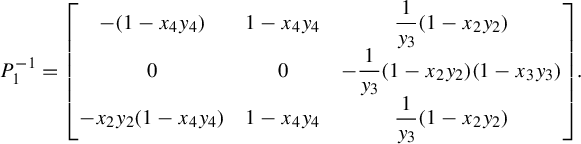 $$ \begin{align*} P_1^{-1} = \begin{bmatrix} -(1 - x_4 y_4) & 1 - x_4 y_4 & \dfrac{1}{y_3}(1 - x_2 y_2) \\ 0 & 0 & -\dfrac{1}{y_3}(1 - x_2 y_2)(1 - x_3 y_3) \\ - x_2 y_2 (1 - x_4 y_4) & 1 - x_4 y_4 & \dfrac{1}{y_3} (1 - x_2 y_2) \end{bmatrix}\!. \end{align*} $$
Taking projective inverses and using symmetry, we deduce the formulas
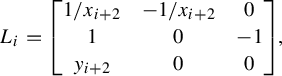 $$ \begin{align*} L_i = \begin{bmatrix} 1/x_{i+2} & -1/x_{i+2} & 0 \\ 1 & 0 & -1 \\ y_{i+2} & 0 & 0 \end{bmatrix}\!, \end{align*} $$
 $$ \begin{align*} P_i = \begin{bmatrix} 1 - x_{i+2}y_{i+2} & 0 & -(1 - x_{i+2} y_{i+2}) \\ x_{i+1} y_{i+1}(1 - x_{i+2}y_{i+2}) & -(1 - x_{i+1}y_{i+1}) & -(1 - x_{i+2}y_{i+2}) \\ 0 & y_{i+2} (1 - x_{i+3} y_{i+3}) & 0 \end{bmatrix}\!. \end{align*} $$
The last step to prove the zero-curvature equation is to use the scaling invariance of the pentagram map to bring in a spectral parameter. The map
 $$ \begin{align*}x_i \mapsto x_i/\zeta, \quad y_i \mapsto \zeta y_i\end{align*} $$
commutes with the pentagram map. This map is an action of $\mathbb {G}_{m}$
on
$\mathbb {G}_{m}$
on $\mathcal {T}_n$
. The matrices appearing in equation (12) are functions of
$\mathcal {T}_n$
. The matrices appearing in equation (12) are functions of $\mathcal {T}_n$
, but we can extend them to functions of
$\mathcal {T}_n$
, but we can extend them to functions of $\mathcal {T}_n \times \mathbb {G}_{m}$
by setting
$\mathcal {T}_n \times \mathbb {G}_{m}$
by setting $L_i(v, \zeta ) = L_i(\zeta \cdot v)$
and
$L_i(v, \zeta ) = L_i(\zeta \cdot v)$
and $P_i(\zeta , v) = P_i(\zeta \cdot v)$
. The projective zero-curvature equation (12) still holds for these matrices because the pentagram map commutes with the
$P_i(\zeta , v) = P_i(\zeta \cdot v)$
. The projective zero-curvature equation (12) still holds for these matrices because the pentagram map commutes with the $\mathbb {G}_{m}$
-action. Suppressing the notational dependence on v, and rescaling the matrices by
$\mathbb {G}_{m}$
-action. Suppressing the notational dependence on v, and rescaling the matrices by $\zeta $
or
$\zeta $
or $1/\zeta $
as needed to get simpler formulas, we obtain the Lax representation with spectral parameter appearing in the theorem statement.
$1/\zeta $
as needed to get simpler formulas, we obtain the Lax representation with spectral parameter appearing in the theorem statement.
Finally, we use the zero-curvature equation to get the Lax equation. Since $P_i$
is n-periodic in i,
$P_i$
is n-periodic in i,
 $$ \begin{align*} T_{i, t + 1} P_{i,t} &= L_{i + n - 1, t + 1} \cdots L_{i + 1, t + 1} L_{i, t+ 1} P_{i,t} \\ &= L_{i + n - 1, t + 1} \cdots L_{i + 1, t + 1} P_{i + 1, t} L_{i, t} \\ & \vdots \\ &= P_{i + n, t} L_{i + n - 1, t} \cdots L_{i,t} \\ &= P_{i + n, t} T_{i, t} \\ &= P_{i, t} T_{i,t}. \end{align*} $$
This concludes the proof of Theorem 5.4.
Remark 5.5. The Lax representation found by Soloviev differs from ours by some signs. The matrix in place of our $L_i$
is
$L_i$
is
 $$ \begin{align*} \begin{bmatrix} 1/x_{i+2} & -1/x_{i+2} & 0 \\ 1/\zeta & 0 & 1/\zeta \\ -y_{i+2} & 0 & 0 \\ \end{bmatrix} = {\begin{bmatrix} 0 & 0 & -1/y_{i+2} \\ -x_{i+2} & 0 & -1/y_{i+2} \\ 0 & \zeta & 1/y_{i+2} \end{bmatrix}}^{-1}, \end{align*} $$
and the matrix in place of our $P_i(z)$
is
$P_i(z)$
is
 $$ \begin{align*} \begin{bmatrix} 1 - x_{i+2}y_{i+2} & 0 & 1 - x_{i+2}y_{i+2} \\ x_{i+1}y_{i+1}(1 - x_{i+2}y_{i+2}) & 1 - x_{i+1}y_{i+1} & 1 - x_{i+2}y_{i+2} \\ 0 & - \zeta y_{i+2}(1 - x_{i+3} y_{i+3}) & 0 \end{bmatrix}\!. \end{align*} $$
This can be explained by a change of basis by $\operatorname {\mathrm {diag}}(1,1,-1)$
, so there is essentially no difference between the formulas.
$\operatorname {\mathrm {diag}}(1,1,-1)$
, so there is essentially no difference between the formulas.
For an affine Lax representation, the natural next step is to deduce that the coefficients of the characteristic polynomial are invariants. We have to modify this step slightly because our Lax representation is projective.
Let $\operatorname {\mathrm {Id}}_3$
denote the
$\operatorname {\mathrm {Id}}_3$
denote the $3 \times 3$
identity matrix. Choose a non-zero representative
$3 \times 3$
identity matrix. Choose a non-zero representative $\hat {T}_0(\zeta )$
for
$\hat {T}_0(\zeta )$
for $T_0(\zeta )$
in
$T_0(\zeta )$
in $\operatorname {\mathrm {Mat}}_3(k[\zeta ^{\pm 1}])$
. We may view
$\operatorname {\mathrm {Mat}}_3(k[\zeta ^{\pm 1}])$
. We may view $\det (\unicode{x3bb} \operatorname {\mathrm {Id}}_3 - \hat {T}_0(\zeta ))$
as an element of
$\det (\unicode{x3bb} \operatorname {\mathrm {Id}}_3 - \hat {T}_0(\zeta ))$
as an element of $k[\mathcal {T}_n][\unicode{x3bb} , \zeta ^{\pm 1}]$
. The resulting expression is of the form
$k[\mathcal {T}_n][\unicode{x3bb} , \zeta ^{\pm 1}]$
. The resulting expression is of the form
 $$ \begin{align*} \unicode{x3bb}^3 - \gamma_1(\zeta) \unicode{x3bb}^2 + \gamma_2(\zeta) \unicode{x3bb} - \gamma_3(\zeta).\end{align*} $$
The rescaling $\hat {T}_0 \mapsto l \hat {T}_0$
induces the rescaling
$\hat {T}_0 \mapsto l \hat {T}_0$
induces the rescaling
 $$ \begin{align*}l \cdot (\gamma_1, \gamma_2, \gamma_3) = (l \gamma_1, l^2 \gamma_2, l^3 \gamma_3).\end{align*} $$
So, the coefficients of the $\gamma _i$
are functions on
$\gamma _i$
are functions on $\mathcal {T}_n$
such that the scaling class of the triple
$\mathcal {T}_n$
such that the scaling class of the triple $(h_1, h_2, h_3)$
is invariant for the pentagram map. We can eliminate negative powers of
$(h_1, h_2, h_3)$
is invariant for the pentagram map. We can eliminate negative powers of $\zeta $
by multiplying through by
$\zeta $
by multiplying through by $\zeta ^n$
. Then we can normalize by scaling so that
$\zeta ^n$
. Then we can normalize by scaling so that $\gamma _1(\zeta )$
becomes monic. This puts the expression in the form
$\gamma _1(\zeta )$
becomes monic. This puts the expression in the form
 $$ \begin{align*}Q(\unicode{x3bb}, \zeta) \in k(\mathcal{T}_n)[\unicode{x3bb}, \zeta].\end{align*} $$
Since Q is invariant under the pentagram map as a formal expression, the coefficients of Q are rational functions on $\mathcal {T}_n$
which are invariant for the pentagram map. We would like to say which terms appear in Q. This may be done with an inductive calculation using the explicit formula for
$\mathcal {T}_n$
which are invariant for the pentagram map. We would like to say which terms appear in Q. This may be done with an inductive calculation using the explicit formula for $L_i$
; we refer to [Reference Ovsienko, Schwartz and Tabachnikov34, Proposition 5.3] for the argument, and just state the end result.
$L_i$
; we refer to [Reference Ovsienko, Schwartz and Tabachnikov34, Proposition 5.3] for the argument, and just state the end result.
Corollary 5.6. Set the notation $m = \left \lfloor {n/2} \right \rfloor $
. Then, for some
$m = \left \lfloor {n/2} \right \rfloor $
. Then, for some $H_i \in k(\mathcal {T}_n)$
for
$H_i \in k(\mathcal {T}_n)$
for $1 \leq i \leq 2m + 2$
, we have
$1 \leq i \leq 2m + 2$
, we have
 $$ \begin{align*} Q(\unicode{x3bb},\zeta) = \unicode{x3bb}^3 \zeta^n + \sum_{i = 0}^{m-1} H_{1+i} \unicode{x3bb}^2 \zeta^{n+i-m} - \unicode{x3bb}^2 \zeta^n + \sum_{i = 0}^m H_{m+i+1} \unicode{x3bb} \zeta^{m - i} - H_{2m+2}.\end{align*} $$
Let
 $$ \begin{align*}S = \mathbb{A}^{2m + 2}_k = \operatorname{\mathrm{Spec}} k[h_1, \ldots, h_{2m+2}].\end{align*} $$
We define
 $$ \begin{align*}H \colon \mathcal{T}_n \dashrightarrow S,\end{align*} $$
 $$ \begin{align*}v \mapsto (H_1(v), \ldots, H_{2m + 2}(v)).\end{align*} $$
The coefficients $H_1, \ldots , H_{2m+2}$
in the expression
$H_1, \ldots , H_{2m+2}$
in the expression $Q(\unicode{x3bb} ,\zeta )$
are rational functions on
$Q(\unicode{x3bb} ,\zeta )$
are rational functions on $\mathcal {T}_n$
that are invariants of the pentagram map. Thus, the fibers of
$\mathcal {T}_n$
that are invariants of the pentagram map. Thus, the fibers of $H \colon \mathcal {T}_n \dashrightarrow S$
are invariant for the pentagram map.
$H \colon \mathcal {T}_n \dashrightarrow S$
are invariant for the pentagram map.
6 The geometry of the spectral curve
In Corollary 5.6, we described a bivariate polynomial $Q(\unicode{x3bb} ,\zeta )$
with coefficients
$Q(\unicode{x3bb} ,\zeta )$
with coefficients $H_1, \ldots , H_{2m+2}$
which are rational functions on
$H_1, \ldots , H_{2m+2}$
which are rational functions on $\mathcal {T}_n$
and invariant for the pentagram map. In this section, we view
$\mathcal {T}_n$
and invariant for the pentagram map. In this section, we view $Q(\unicode{x3bb} ,\zeta )$
as the equation of a curve.
$Q(\unicode{x3bb} ,\zeta )$
as the equation of a curve.
We continue with the notation of Corollary 5.6. Set homogeneous coordinates $[X:Y:Z]$
on
$[X:Y:Z]$
on $\mathbb {P}^2_{S}$
. When we dehomogenize, we denote the corresponding remaining coordinates by the lowercase letters
$\mathbb {P}^2_{S}$
. When we dehomogenize, we denote the corresponding remaining coordinates by the lowercase letters $x, y, z$
. Thus, if we dehomogenize by setting
$x, y, z$
. Thus, if we dehomogenize by setting $Z = 1$
, we write
$Z = 1$
, we write $x = X/Z$
and
$x = X/Z$
and $y = Y/Z$
. (These are not to be confused with the corner invariants
$y = Y/Z$
. (These are not to be confused with the corner invariants $x_i, y_j$
.)
$x_i, y_j$
.)
Definition 6.1. For each $n \geq 4$
, we define the nth spectral curve to be the relative curve
$n \geq 4$
, we define the nth spectral curve to be the relative curve $\Gamma \to S$
in
$\Gamma \to S$
in $\mathbb {P}^N_S$
cut out by the homogeneous polynomial
$\mathbb {P}^N_S$
cut out by the homogeneous polynomial
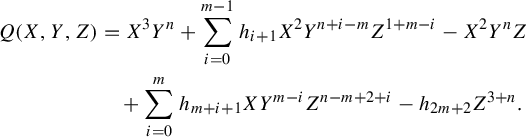 $$ \begin{align*} Q(X,Y,Z) &= X^3 Y^n + \sum_{i = 0}^{m-1} h_{i+1} X^2 Y^{n+i-m} Z^{1+m-i} - X^2 Y^n Z \\ &\quad+ \sum_{i = 0}^m h_{m+i+1} X Y^{m - i} Z^{n-m+2+i} - h_{2m+2}Z^{3+n}. \end{align*} $$
We may alternately view the relative curve $\Gamma \to S$
as a family of curves indexed by S.
$\Gamma \to S$
as a family of curves indexed by S.
The spectral curve describes the eigenvalues in an algebraic 1-parameter family of linear maps, since $Q(\unicode{x3bb} ,\zeta ,1)$
equals the quantity
$Q(\unicode{x3bb} ,\zeta ,1)$
equals the quantity $Q(\unicode{x3bb} , \zeta )$
described in Corollary 5.6.
$Q(\unicode{x3bb} , \zeta )$
described in Corollary 5.6.
Because the defining polynomial of the spectral curve is invariant for the pentagram map, we can think of the spectral curve itself as an invariant. In this section, we prove some geometric properties of the spectral curve to be able to describe its Jacobian. The results are collected in Proposition 6.2 and Theorem 6.4.
The spectral curve was defined (in a slightly different form) by Soloviev in [Reference Soloviev43] to prove complex integrability over $\mathbb C$
; in this section, we extend that argument to any algebraically closed field k, where
$\mathbb C$
; in this section, we extend that argument to any algebraically closed field k, where $\operatorname {\mathrm {char}} k \neq 2$
. The argument proceeds by desingularizing a family of curves and computing the genus of the generic fiber with the Riemann–Hurwitz formula. Directly computing the genus of the generic fiber is difficult, so we compute the genus of a carefully chosen special fiber, and then show that this special fiber has the same genus as the generic fiber. As discussed in §2, our special fiber calculation fills a gap in [Reference Soloviev43].
$\operatorname {\mathrm {char}} k \neq 2$
. The argument proceeds by desingularizing a family of curves and computing the genus of the generic fiber with the Riemann–Hurwitz formula. Directly computing the genus of the generic fiber is difficult, so we compute the genus of a carefully chosen special fiber, and then show that this special fiber has the same genus as the generic fiber. As discussed in §2, our special fiber calculation fills a gap in [Reference Soloviev43].
Basic references for these techniques are as follows. For the resolution of curve singularities, and the basic theory of zeroes and poles of rational functions on singular varieties, see [Reference Kollár26, Ch. 1]. For the basic theory of the Riemann–Hurwitz formula in arbitrary characteristic, see [Reference Hartshorne16, Ch. 4.2] or [Reference Silverman40, Ch. 2].
By curve, we mean a projective, possibly singular algebraic variety of dimension 1 over an algebraically closed field.
We prove various properties of the fibers of $\Gamma \to S$
which hold on a Zariski dense subset of S. Note that for any particular fiber, we may change coordinates to obtain a curve with affine equation of the form
$\Gamma \to S$
which hold on a Zariski dense subset of S. Note that for any particular fiber, we may change coordinates to obtain a curve with affine equation of the form
 $$ \begin{align*} R(x,y) = x^3 y^n - \sum_{i = 0}^m J_i x^2 y^{n+i-m} + \sum_{i = 0}^m I_i x y^{m - i} - 1,\end{align*} $$
where $I_0, \ldots , I_m, J_0, \ldots , J_m \in k.$
This simpler form is unique up to a choice of third root of unity. We set
$I_0, \ldots , I_m, J_0, \ldots , J_m \in k.$
This simpler form is unique up to a choice of third root of unity. We set
 $$ \begin{align*}S' = \operatorname{\mathrm{Spec}} k[I_0, \ldots, I_m, J_0, \ldots, J_m].\end{align*} $$
For short, we write $k[I, J]$
to mean
$k[I, J]$
to mean $k[I_0, \ldots , I_m, J_0, \ldots , J_m].$
We define a family of curves
$k[I_0, \ldots , I_m, J_0, \ldots , J_m].$
We define a family of curves $\Gamma ' \to S'$
in
$\Gamma ' \to S'$
in $\mathbb {P}^2_{S^{\prime }_n}$
by the homogeneous equation
$\mathbb {P}^2_{S^{\prime }_n}$
by the homogeneous equation
 $$ \begin{align*}R(X,Y,Z) = X^3 Y^n \kern1.5pt{-}\kern1.5pt \sum_{i=0}^m \!J_i X^2 Y^{n+i-m} Z^{1+m-i} + \sum_{i=0}^m \! I_i X Y^{m-i} Z^{n-m+2+i} - Z^{n+3} \kern1.5pt{=}\kern1.5pt 0.\end{align*} $$
A property of the fibers of $\Gamma \to S$
is said to hold generically if, for all geometric points s in some Zariski dense open subset of S, the property is true for
$\Gamma \to S$
is said to hold generically if, for all geometric points s in some Zariski dense open subset of S, the property is true for $\Gamma _s$
. Properties of curves which are stable under birational maps and which hold generically for fibers of
$\Gamma _s$
. Properties of curves which are stable under birational maps and which hold generically for fibers of $\Gamma '$
also hold generically for fibers of
$\Gamma '$
also hold generically for fibers of $\Gamma $
.
$\Gamma $
.
We refer to the affine plane defined by $Z \neq 0$
as the main affine patch.
$Z \neq 0$
as the main affine patch.
For any point $s \in S'$
, we consider the special fiber
$s \in S'$
, we consider the special fiber $\Gamma ^{\prime }_s \to \operatorname {\mathrm {Spec}} k$
. The geometry of the curve
$\Gamma ^{\prime }_s \to \operatorname {\mathrm {Spec}} k$
. The geometry of the curve $\Gamma ^{\prime }_s$
varies with s; depending on the choice of s, the special fiber may be reducible, non-reduced, or have worse singularities and thus a lower genus than expected. The next theorem describes the geometry of
$\Gamma ^{\prime }_s$
varies with s; depending on the choice of s, the special fiber may be reducible, non-reduced, or have worse singularities and thus a lower genus than expected. The next theorem describes the geometry of $\Gamma '$
.
$\Gamma '$
.
Proposition 6.2.
-
(1) For all
$s \in S'$
, the only points of
$\Gamma ^{\prime }_s$
outside the main affine patch are
$[1:0:0]$
and
$[0:1:0]$
, and these points are singular. -
(2) Table 1 describes a map
$\Gamma '' \to \Gamma '$
. For generic
$s \in S'$
, the corresponding map
$\Gamma _s'' \to \Gamma ^{\prime }_s$
is a resolution of the singularities of
$\Gamma ^{\prime }_s$
at
$[1:0:0]$
and
$[0:1:0]$
by point blowups. -
(3) Let
be the map induced by
$$ \begin{align*}\zeta \colon\Gamma_s'' \to \mathbb{P}^1\end{align*} $$
$$ \begin{align*}\Gamma' \to \mathbb{P}^1,\end{align*} $$
The image and ramification indices of the geometric points above
$$ \begin{align*}[X:Y:Z] \to [Y:Z].\end{align*} $$
$[1:0:0]$
and
$[0:1:0]$
are recorded in Table 1.


Proof. (1) To find the points that are outside the main affine patch, set $Z = 0$
and solve for X and Y. The points
$Z = 0$
and solve for X and Y. The points $[1:0:0]$
and
$[1:0:0]$
and $[0:1:0]$
are singular by the Jacobian criterion for smoothness.
$[0:1:0]$
are singular by the Jacobian criterion for smoothness.
(2) We start by desingularizing $[1:0:0]$
. Dehomogenizing by
$[1:0:0]$
. Dehomogenizing by $X = 1$
, we obtain the equation
$X = 1$
, we obtain the equation
 $$ \begin{align*} R(1,y,z) &= y^n - J_0 y^{n-m} z^{m+1} - \cdots - J_m y^n z \\ &\quad+ I_0 y^m z^{2+n-m} + \cdots + I_m z^{2+n} - z^{3+n}. \end{align*} $$
In the $yz$
-plane, the singularity is at
$yz$
-plane, the singularity is at $(0,0)$
, so we have prepared it for blowing up. We treat
$(0,0)$
, so we have prepared it for blowing up. We treat $[0:1:0]$
similarly. We use the standard algorithm for blowing up a point singularity in the plane, and the results are as shown in Table 1. In characteristic 2, we have used the separability of the polynomials
$[0:1:0]$
similarly. We use the standard algorithm for blowing up a point singularity in the plane, and the results are as shown in Table 1. In characteristic 2, we have used the separability of the polynomials $I_m \alpha ^2 - J_0 \alpha + 1$
and
$I_m \alpha ^2 - J_0 \alpha + 1$
and $J_m \alpha ^2 - I_0 \alpha + 1$
to justify that there are two roots.
$J_m \alpha ^2 - I_0 \alpha + 1$
to justify that there are two roots.
(3) The images $\zeta (P)$
and ramification indices of
$\zeta (P)$
and ramification indices of $\zeta $
may be determined from the local equations in Table 1. For example, for the point above
$\zeta $
may be determined from the local equations in Table 1. For example, for the point above $[1:0:0]$
when P is odd, the map
$[1:0:0]$
when P is odd, the map $\zeta $
is
$\zeta $
is $\hat {y}$
in the given coordinates. The vanishing order of
$\hat {y}$
in the given coordinates. The vanishing order of $\hat {y}$
is the length of the module
$\hat {y}$
is the length of the module
 $$ \begin{align*}\frac{k(I,J)[\hat{y}, \hat{z}]_{(\hat{y}, \hat{z})}}{\langle \hat{y}, \hat{y} - J_0 \hat{y}\hat{z} - \cdots - J_m \hat{y}^{n-m} \hat{z} + I_0 \hat{y}^m \hat{z}^2 + \cdots + I_m \hat{z}^2 - \hat{y}^m \hat{w}^3 \rangle} \cong \frac{k(I,J)[\hat{z}]_{(\hat{z})}}{\langle I_m \hat{z}^2 \rangle}.\end{align*} $$
Evidently this module has length 2, so $\hat {y}$
vanishes to order 2. So
$\hat {y}$
vanishes to order 2. So $\zeta $
has a zero there, and the ramification index is 2.
$\zeta $
has a zero there, and the ramification index is 2.
Definition 6.3. We give names to certain geometric points on $\Gamma ''$
. These may be thought of as sections of
$\Gamma ''$
. These may be thought of as sections of $\Gamma '' \to S$
in the case of points defined over S, or multisections in the case of points not defined over S.
$\Gamma '' \to S$
in the case of points defined over S, or multisections in the case of points not defined over S.
-
• Odd n: We name the preimages of
$[0:1]$
by
$\zeta $
as follows. The point for which
$Z \neq 0$
is
$O_1$
, and the point above
$[1:0:0]$
is
$O_2$
. The points above
$[0:1:0]$
are
$W_1$
and
$W_2$
, as defined in Table 1. (Note that
$O_1$
is not in Table 1 because it does not lie above the line
$Z = 0$
.) -
• Even n: There are three geometric points which are preimages of
$\zeta $
. The point where
$Z \neq 0$
is
$O_1$
, and the points above
$[1:0:0]$
are
$O_2, O_3$
. The points
$O_2$
and
$O_3$
are not defined over the base
$S'$
. Fixing an algebraic closure of
$k(I,J)$
allows us to give the names
$O_2$
and
$O_3$
to the points above
$[1:0:0]$
. The points
$W_1, W_2, W_3$
are defined similarly according to Table 1, and again
$W_2$
and
$W_3$
are not defined over the base
$S'$
.


Theorem 6.4. Assume $\operatorname {\mathrm {char}} k \neq 2$
. For generic
$\operatorname {\mathrm {char}} k \neq 2$
. For generic $s \in S$
, the curve
$s \in S$
, the curve $\Gamma _s$
over k is integral, and has geometric genus
$\Gamma _s$
over k is integral, and has geometric genus
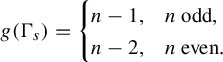 $$ \begin{align*} g(\Gamma_s) = \begin{cases} n - 1, & n \text{ odd,}\\ n - 2, & n \text{ even.} \end{cases} \end{align*} $$
We prove the theorem for $\Gamma ^{\prime }_s$
, and the result for
$\Gamma ^{\prime }_s$
, and the result for $\Gamma _s$
follows immediately because geometric genus is a birational invariant. We split the proof of Theorem 6.4 into lemmas, which make up the remainder of this section.
$\Gamma _s$
follows immediately because geometric genus is a birational invariant. We split the proof of Theorem 6.4 into lemmas, which make up the remainder of this section.
The idea of the proof is to compute the genus of a special fiber. We have to choose the special fiber judiciously, because (roughly speaking) if the fiber we choose has worse singularities than the generic fiber, then the genus will be lower.
Definition 6.5. We call $\Gamma ^{\prime }_s$
a good fiber if it satisfies all of the following conditions.
$\Gamma ^{\prime }_s$
a good fiber if it satisfies all of the following conditions.
-
(1) The k-scheme
$\Gamma ^{\prime }_s$
is integral. -
(2) The singularities at
$[1:0:0]$
and
$[0:1:0]$
of
$\Gamma ^{\prime }_s$
are resolved by
$\Gamma ^{\prime \prime }_s \to \Gamma ^{\prime }_s$
. Equivalently, the following non-degeneracy conditions hold:
$$ \begin{align*}I_m \neq 0, \quad J_m \neq 0, \quad {J_0}^2 - 4I_m \neq 0, \quad {I_0}^2 - 4 J_m \neq 0.\end{align*} $$
-
(3) The curve
$\Gamma ^{\prime \prime }_s$
is non-singular in the main affine patch. Equivalently, there are no singularities of
$\Gamma ^{\prime }_s$
in the main affine patch.


The next lemma shows that the generic curve’s genus can be computed by looking at a good fiber, because a good fiber’s singularities are as mild as possible for the family $\Gamma '$
.
$\Gamma '$
.
Lemma 6.6. Suppose that a good fiber $\Gamma ^{\prime }_s$
exists. Then generically, the fibers of
$\Gamma ^{\prime }_s$
exists. Then generically, the fibers of $\Gamma '$
have the same genus as
$\Gamma '$
have the same genus as $\Gamma ^{\prime }_s$
.
$\Gamma ^{\prime }_s$
.
Proof. Integrality is an open condition, because the locus of reducible polynomials of a fixed degree is an algebraic subset of the space of all polynomials of that degree. Thus, since $\Gamma ^{\prime }_s$
is integral, so is the generic fiber of
$\Gamma ^{\prime }_s$
is integral, so is the generic fiber of $\Gamma '$
.
$\Gamma '$
.
We claim that for generic $s'$
, we have
$s'$
, we have
 $$ \begin{align*} g(\Gamma^{\prime}_{s}) \geq g(\Gamma^{\prime}_{s'}).\end{align*} $$
Since geometric genus is a birational invariant, it suffices to show
 $$ \begin{align*} g(\Gamma^{\prime\prime}_{s}) \geq g(\Gamma^{\prime\prime}_{s'}).\end{align*} $$
For generic $s'$
, the singularities of
$s'$
, the singularities of $\Gamma ^{\prime }_{s'}$
at
$\Gamma ^{\prime }_{s'}$
at $[1:0:0]$
and
$[1:0:0]$
and $[0:1:0]$
have the structure described in Table 1. Denote arithmetic genus by
$[0:1:0]$
have the structure described in Table 1. Denote arithmetic genus by ${g_{a}}$
. By the good fiber hypothesis,
${g_{a}}$
. By the good fiber hypothesis, $g(\Gamma ^{\prime \prime }_s) = {g_{a}}(\Gamma ^{\prime \prime }_s)$
. Observe that
$g(\Gamma ^{\prime \prime }_s) = {g_{a}}(\Gamma ^{\prime \prime }_s)$
. Observe that $\Gamma ^{\prime }_s$
and
$\Gamma ^{\prime }_s$
and $\Gamma ^{\prime }_{s'}$
are plane curves with the same degree, and hence the same arithmetic genus. Combining this with the fact that the singularities of
$\Gamma ^{\prime }_{s'}$
are plane curves with the same degree, and hence the same arithmetic genus. Combining this with the fact that the singularities of $\Gamma ^{\prime }_s$
and
$\Gamma ^{\prime }_s$
and $\Gamma ^{\prime }_{s'}$
at
$\Gamma ^{\prime }_{s'}$
at $[1:0:0]$
and
$[1:0:0]$
and $[0:1:0]$
have the same structure, we find
$[0:1:0]$
have the same structure, we find
 $$ \begin{align*}{g_{a}}(\Gamma^{\prime\prime}_s) ={g_{a}}(\Gamma^{\prime\prime}_{s'}).\end{align*} $$
For any curve, the arithmetic genus is at least the geometric genus, so
 $$ \begin{align*}{g_{a}}(\Gamma^{\prime\prime}_{s'}) \geq g(\Gamma^{\prime\prime}_{s'}).\end{align*} $$
Putting it all together proves the claim:
 $$ \begin{align*}g(\Gamma^{\prime}_s) = g(\Gamma^{\prime\prime}_s) = {g_{a}}(\Gamma^{\prime\prime}_s) \geq {g_{a}}(\Gamma^{\prime\prime}_{s'}) \geq g(\Gamma^{\prime\prime}_{s'}).\end{align*} $$
Since all the curves in $\Gamma '$
have the same degree, the family
$\Gamma '$
have the same degree, the family $\Gamma '$
is flat, so the function
$\Gamma '$
is flat, so the function $S' \to {\mathbb Z}_{\geq 0}$
,
$S' \to {\mathbb Z}_{\geq 0}$
, $s \mapsto g(\Gamma ^{\prime }_s)$
is lower-semicontinuous in the Zariski topology. Therefore, the genus for generic
$s \mapsto g(\Gamma ^{\prime }_s)$
is lower-semicontinuous in the Zariski topology. Therefore, the genus for generic $s' \in S$
must be exactly
$s' \in S$
must be exactly $g(\Gamma ^{\prime }_s)$
.
$g(\Gamma ^{\prime }_s)$
.
The next lemma describes the essential idea of the strategy for calculating the genus of a good fiber. To state it, we need more notation.
Consider the map $\zeta \colon \Gamma ^{\prime \prime }_s \to \mathbb {P}^1$
from Proposition 6.2. Let
$\zeta \colon \Gamma ^{\prime \prime }_s \to \mathbb {P}^1$
from Proposition 6.2. Let $\Omega $
be the sheaf of relative differentials on
$\Omega $
be the sheaf of relative differentials on $\Gamma ^{\prime \prime }_s$
, where the structure map is
$\Gamma ^{\prime \prime }_s$
, where the structure map is $\zeta $
.
$\zeta $
.
For any point $P \in \Gamma ^{\prime \prime }_s$
, we denote the length of
$P \in \Gamma ^{\prime \prime }_s$
, we denote the length of $\Omega $
at P by
$\Omega $
at P by $\operatorname {\mathrm {len}}( \Omega _P )$
. For short, we also write
$\operatorname {\mathrm {len}}( \Omega _P )$
. For short, we also write $\omega (P) = \operatorname {\mathrm {len}}(\Omega _P).$
We denote the vanishing order of a function $\Phi \in K(\Gamma ^{\prime \prime }_s)$
at P by
$\Phi \in K(\Gamma ^{\prime \prime }_s)$
at P by $\operatorname {\mathrm {ord}}_P \Phi $
. If
$\operatorname {\mathrm {ord}}_P \Phi $
. If $\Phi $
has a pole at P, then
$\Phi $
has a pole at P, then $\operatorname {\mathrm {ord}}_P \Phi $
is negative.
$\operatorname {\mathrm {ord}}_P \Phi $
is negative.
We use the notation
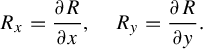 $$ \begin{align*}R_x = \frac{\partial R}{\partial x}, \quad R_y = \frac{ \partial R }{\partial y}.\end{align*} $$
Note that the functions $R_x, R_y$
are computed by dehomogenizing R so that
$R_x, R_y$
are computed by dehomogenizing R so that $Z = 1.$
We also set the notation $P_\infty $
for the set of points of
$P_\infty $
for the set of points of $\Gamma ^{\prime \prime }_s$
above the line
$\Gamma ^{\prime \prime }_s$
above the line $Z = 0$
.
$Z = 0$
.
-
• Odd n:
$P_\infty = \{O_2, W_1,W_2\}.$
-
• Even n:
$P_\infty = \{O_2, O_3, W_1, W_2, W_3\}.$


Lemma 6.7. If $\Gamma ^{\prime \prime }_s$
is a good fiber, then
$\Gamma ^{\prime \prime }_s$
is a good fiber, then
 $$ \begin{align*}g(\Gamma^{\prime\prime}_s) = \frac{1}{2} \biggl( -4 - \sum_{P \in P_\infty} \operatorname{\mathrm{ord}}_P R_x + \sum_{P \in P_\infty} \omega(P)\biggr).\end{align*} $$
Proof. Because $\Gamma ^{\prime \prime }_s$
is a good fiber, it is a non-singular, integral curve. Further, since
$\Gamma ^{\prime \prime }_s$
is a good fiber, it is a non-singular, integral curve. Further, since $\Gamma ^{\prime \prime }_s$
is a good fiber, we have
$\Gamma ^{\prime \prime }_s$
is a good fiber, we have $I_m \neq 0$
. Working in dehomogenized coordinates
$I_m \neq 0$
. Working in dehomogenized coordinates $x,y$
, we see by inspection that y is a uniformizer at
$x,y$
, we see by inspection that y is a uniformizer at
 $$ \begin{align*}(x,y) = (1/I_m, 0) \in \Gamma^{\prime}_s.\end{align*} $$
Therefore, $\zeta $
is separable. So the Riemann–Hurwitz formula applies to
$\zeta $
is separable. So the Riemann–Hurwitz formula applies to $\zeta $
. Since
$\zeta $
. Since $\zeta $
is degree 3, the Riemann–Hurwitz formula states
$\zeta $
is degree 3, the Riemann–Hurwitz formula states
 $$ \begin{align*} 2g(\Gamma^{\prime\prime}_s) - 2 = (-2) \cdot 3 + \sum_{P \in \Gamma^{\prime\prime}_s} \omega(P).\end{align*} $$
Breaking apart the sum and rearranging this formula gives
 $$ \begin{align*} g(\Gamma^{\prime\prime}_s) = \frac{1}{2}\biggl(-4 + \sum_{P \not\in P_\infty} \omega(P) + \sum_{P \in P_\infty} \omega(P)\biggr).\end{align*} $$
We compute the first sum another way. Suppose that $P \not \in P_\infty $
. Then P is in the main affine patch. Working in dehomogenized coordinates
$P \not \in P_\infty $
. Then P is in the main affine patch. Working in dehomogenized coordinates $x, y$
, we can compute the module of relative differentials at P explicitly:
$x, y$
, we can compute the module of relative differentials at P explicitly:
 $$ \begin{align*} \Omega_P = \bigg( \frac{ k \langle dx, dy \rangle }{ dy, R_x dx + R_y dy } \bigg)_P \cong \bigg( \frac{ k \langle dx \rangle }{ R_x dx} \bigg)_P. \end{align*} $$
Thus,
 $$ \begin{align*}\omega(P) = \operatorname{\mathrm{ord}}_P( R_x ).\end{align*} $$
Then, since the zeros and poles of a rational function have total vanishing order 0, we get
 $$ \begin{align*}\sum_{P \not\in P_\infty} \omega(P) = -\sum_{P \in P_\infty} \operatorname{\mathrm{ord}}_P R_x.\end{align*} $$
This completes the proof of Lemma 6.7.
Now we come to the last step, which takes some luck. In each characteristic, we need to find a good fiber and compute the vanishing order $\operatorname {\mathrm {ord}}_P R_x$
and
$\operatorname {\mathrm {ord}}_P R_x$
and $\omega (P)$
for each point
$\omega (P)$
for each point $P \in P_\infty $
. We split the job into cases depending on the characteristic and n.
$P \in P_\infty $
. We split the job into cases depending on the characteristic and n.
For the remainder of the section, we set notation for the quantity which we claim is the expected genus,
 $$ \begin{align*} g(n) = \begin{cases} n - 1, & n \text{ odd,} \\ n - 2, & n \text{ even.} \\ \end{cases} \end{align*} $$
Lemma 6.8. Suppose $\operatorname {\mathrm {char}} k \neq 2$
and
$\operatorname {\mathrm {char}} k \neq 2$
and $\operatorname {\mathrm {char}} k \nmid n$
. The curve
$\operatorname {\mathrm {char}} k \nmid n$
. The curve $\Gamma ^{\prime }_s$
cut out by
$\Gamma ^{\prime }_s$
cut out by
 $$ \begin{align} R(x,y) = x^3 y^n - x^2 y^n - x - 1 = 0 \end{align} $$
is a good fiber, and its genus is $g(n)$
. This fiber corresponds to
$g(n)$
. This fiber corresponds to $s \in S'$
defined by the coordinates
$s \in S'$
defined by the coordinates $I_m = -1, J_m = 1$
, and all other
$I_m = -1, J_m = 1$
, and all other $I_i, J_i = 0$
.
$I_i, J_i = 0$
.
Proof. First, we check the three conditions for $\Gamma ^{\prime }_s$
to be a good fiber.
$\Gamma ^{\prime }_s$
to be a good fiber.
(1) Since $\operatorname {\mathrm {char}} k \neq 2$
, the Eisenstein criterion applies with reference to the ideal
$\operatorname {\mathrm {char}} k \neq 2$
, the Eisenstein criterion applies with reference to the ideal $(x + 1)$
, so
$(x + 1)$
, so $\Gamma ^{\prime }_s$
is integral.
$\Gamma ^{\prime }_s$
is integral.
(2) Since $\operatorname {\mathrm {char}} k \neq 2$
, the quantities
$\operatorname {\mathrm {char}} k \neq 2$
, the quantities $I_m, J_m, {I_0}^2 - 4J_m, {J_0}^2 - 4 I_m$
are all non-zero. (3) We claim that there are no singularities in the main affine patch. This follows from the Jacobian criterion for smoothness. We need to show there are no simultaneous solutions
$I_m, J_m, {I_0}^2 - 4J_m, {J_0}^2 - 4 I_m$
are all non-zero. (3) We claim that there are no singularities in the main affine patch. This follows from the Jacobian criterion for smoothness. We need to show there are no simultaneous solutions $(x,y)$
of
$(x,y)$
of
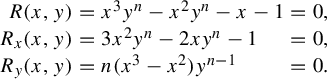 $$ \begin{align*} \begin{array}{rclcl} R(x,y) &\hspace{-7pt} = &\hspace{-7pt} x^3 y^n - x^2 y^n - x - 1 &\hspace{-7pt} = &\hspace{-7pt} 0, \\ R_x (x,y) &\hspace{-7pt} = &\hspace{-7pt} 3x^2 y^n - 2x y^n - 1 &\hspace{-7pt} = &\hspace{-7pt} 0, \\ R_y (x,y) &\hspace{-7pt} = &\hspace{-7pt} n(x^3 - x^2) y^{n-1} &\hspace{-7pt} = &\hspace{-7pt} 0. \\ \end{array} \end{align*} $$
Since by assumption $n \neq 0$
in our characteristic, we deduce from
$n \neq 0$
in our characteristic, we deduce from $R_y = 0$
that either
$R_y = 0$
that either $z = 0, k = 0$
, or
$z = 0, k = 0$
, or $k = 1$
. Looking at
$k = 1$
. Looking at $R_x$
, only the last case is possible, and in that case,
$R_x$
, only the last case is possible, and in that case, $y^n = 1$
. However, plugging this information into R, we have
$y^n = 1$
. However, plugging this information into R, we have $-2 = 0$
, which is false since
$-2 = 0$
, which is false since ${\operatorname {\mathrm {char}} k \neq 2}$
. Next, we compute the quantities
${\operatorname {\mathrm {char}} k \neq 2}$
. Next, we compute the quantities $\omega (P)$
and
$\omega (P)$
and $\operatorname {\mathrm {ord}}_P R_x$
for each
$\operatorname {\mathrm {ord}}_P R_x$
for each $P \in P_\infty $
. We list the results of the calculation in Table 2. To compute these quantities, first we compute
$P \in P_\infty $
. We list the results of the calculation in Table 2. To compute these quantities, first we compute $\omega (P)$
for each
$\omega (P)$
for each $P \in P_\infty $
. We can inspect the equations in Table 1 to deduce the ramification index
$P \in P_\infty $
. We can inspect the equations in Table 1 to deduce the ramification index $e(P)$
at each
$e(P)$
at each $P \in P_\infty $
, and we find that
$P \in P_\infty $
, and we find that $e(P) \leq 2$
for each P. So, by the assumption that
$e(P) \leq 2$
for each P. So, by the assumption that $\operatorname {\mathrm {char}} k \neq 2$
, the ramification at each P is tame. So
$\operatorname {\mathrm {char}} k \neq 2$
, the ramification at each P is tame. So $\omega (P) = e(P) - 1.$
Calculation of the genus of $\Gamma ^{\prime }_s.$

Next, we compute $\operatorname {\mathrm {ord}}_P R_x$
for each
$\operatorname {\mathrm {ord}}_P R_x$
for each $P \in P_\infty $
.
$P \in P_\infty $
.
• Let $P = O_2$
. First, we calculate
$P = O_2$
. First, we calculate
 $$ \begin{align*}R_x = 3x^2 y^n - 2 xy^n - 1.\end{align*} $$
We homogenize, then dehomogenize by $X = 1$
. We obtain the local equation
$X = 1$
. We obtain the local equation
 $$ \begin{align*}R_x = \frac{1}{z^{2+n}} (3y^n - 2 y^{n- m}z^{1+m} - z^{2+n}).\end{align*} $$
We blow up $(y,z) = (0,0)$
according to the formula in Table 1. We compute the equation of
$(y,z) = (0,0)$
according to the formula in Table 1. We compute the equation of $R_x$
in the coordinates
$R_x$
in the coordinates $\hat {y}, \hat {z}$
. We split into cases for n odd and even. Suppose that n is odd; then
$\hat {y}, \hat {z}$
. We split into cases for n odd and even. Suppose that n is odd; then
 $$ \begin{align*}R_x = \frac{3\hat{y} - 2 \hat{y}^{m+1} \hat{z} - \hat{z}^2}{\hat{z}^2}.\end{align*} $$
Because $\operatorname {\mathrm {ord}}_P$
is a valuation, if one of these terms has smaller order than all the others, then
$\operatorname {\mathrm {ord}}_P$
is a valuation, if one of these terms has smaller order than all the others, then $\operatorname {\mathrm {ord}}_P R_x$
is computed by the order of that term. However, in this case, there are two terms of least order:
$\operatorname {\mathrm {ord}}_P R_x$
is computed by the order of that term. However, in this case, there are two terms of least order:
 $$ \begin{align*}\operatorname{\mathrm{ord}}_P(\hat{y}/\hat{z}) = \operatorname{\mathrm{ord}}_P(1) = 0.\end{align*} $$
We eliminate one term by adding the appropriate multiple of R; this leaves one term, $2$
, of minimal order 0. Then, since
$2$
, of minimal order 0. Then, since $\operatorname {\mathrm {char}} k \neq 2$
, the vanishing order at P is 0.
$\operatorname {\mathrm {char}} k \neq 2$
, the vanishing order at P is 0.
However, suppose that n is even; then
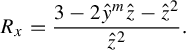 $$ \begin{align*}R_x = \frac{3 - 2 \hat{y}^m \hat{z} - \hat{z}^2}{\hat{z}^2}.\end{align*} $$
The coordinates of $O_2, O_3$
are
$O_2, O_3$
are $(\hat {y}, \hat {z}) = (0, \pm 1)$
, so we can see directly by plugging in values that, since
$(\hat {y}, \hat {z}) = (0, \pm 1)$
, so we can see directly by plugging in values that, since $2 \neq 0$
, the function
$2 \neq 0$
, the function $R_x$
has order 0 at
$R_x$
has order 0 at $O_2, O_3$
.
$O_2, O_3$
.
• We compute the order at $P = W_1$
. The equation of
$P = W_1$
. The equation of $R_x$
in
$R_x$
in $\hat {x}, \hat {z}$
is
$\hat {x}, \hat {z}$
is
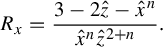 $$ \begin{align*}R_x = \frac{3 - 2\hat{z} - \hat{x}^n}{\hat{x}^n \hat{z}^{2+n}}.\end{align*} $$
The numerator at $W_1 = (0,1)$
is 1. The order of the denominator is computed by examining the local equation for R. We find that
$W_1 = (0,1)$
is 1. The order of the denominator is computed by examining the local equation for R. We find that $\hat {z}$
has order 0, and
$\hat {z}$
has order 0, and $\hat {x}$
has order 1, so
$\hat {x}$
has order 1, so $\operatorname {\mathrm {ord}}_P R_x = -n.$
• The argument for $W_2, W_3$
uses the same techniques, so we omit it.
$W_2, W_3$
uses the same techniques, so we omit it.
Lemma 6.9. Suppose $\operatorname {\mathrm {char}} k \neq 2$
and
$\operatorname {\mathrm {char}} k \neq 2$
and $\operatorname {\mathrm {char}} k \mid n$
. The curve
$\operatorname {\mathrm {char}} k \mid n$
. The curve $\Gamma ^{\prime }_s$
cut out by
$\Gamma ^{\prime }_s$
cut out by
 $$ \begin{align} R(x,y) = x^3 y^n + x^2 y^{n-1} - x^2 y^n + x - 1 \end{align} $$
is a good fiber, and its genus is $g(n)$
. This fiber corresponds to
$g(n)$
. This fiber corresponds to $s \in S'$
defined by the coordinates
$s \in S'$
defined by the coordinates $I_m = 1, J_{m -1} = -1, J_m = 1$
, and all other
$I_m = 1, J_{m -1} = -1, J_m = 1$
, and all other $I_i, J_i = 0$
.
$I_i, J_i = 0$
.
Proof. The structure of the proof is identical to that of Lemma 6.8, but the computations are different. First, we check the three conditions for $\Gamma ^{\prime }_s$
to be a good fiber.
$\Gamma ^{\prime }_s$
to be a good fiber.
(1) We claim $\Gamma ^{\prime }_s$
is integral. If it were not, then
$\Gamma ^{\prime }_s$
is integral. If it were not, then $R(x,y)$
would factor in
$R(x,y)$
would factor in $k[x,y]$
, and since R is cubic in x, there would be a factor linear in x. Since
$k[x,y]$
, and since R is cubic in x, there would be a factor linear in x. Since $\Gamma ^{\prime }_s$
contains no points of the form
$\Gamma ^{\prime }_s$
contains no points of the form $y = 0$
in the main affine patch, this line would be of the form
$y = 0$
in the main affine patch, this line would be of the form $x = c$
for some constant
$x = c$
for some constant $c \in k$
. However, this cannot happen, since if
$c \in k$
. However, this cannot happen, since if $R(c,y)$
were identically 0, then examining coefficients, we would have both
$R(c,y)$
were identically 0, then examining coefficients, we would have both $c = 0$
and
$c = 0$
and $c = 1.$
(2) Since $\operatorname {\mathrm {char}} k \neq 2$
, the quantities
$\operatorname {\mathrm {char}} k \neq 2$
, the quantities $I_m, J_m, {I_0}^2 - 4J_m, {J_0}^2 - 4 I_m$
are all non-zero.
$I_m, J_m, {I_0}^2 - 4J_m, {J_0}^2 - 4 I_m$
are all non-zero.
(3) We claim that $\Gamma ^{\prime }_s$
is non-singular in the main affine patch. To see this, observe that a singularity
$\Gamma ^{\prime }_s$
is non-singular in the main affine patch. To see this, observe that a singularity $(x,y)$
would satisfy
$(x,y)$
would satisfy
 $$ \begin{align*}R_y (x,y) = -x^2 y^{n-1} = 0,\end{align*} $$
since $\operatorname {\mathrm {char}} k \mid n$
. So if
$\operatorname {\mathrm {char}} k \mid n$
. So if $(x, y)$
is a singularity, then
$(x, y)$
is a singularity, then $x = 0$
or
$x = 0$
or $y = 0$
. However, for such points, we have
$y = 0$
. However, for such points, we have
 $$ \begin{align*}R_x(x,y) = 3x^2 y^n - 2x y^{n-1} - 2x y^n + 1 = 1 \neq 0.\end{align*} $$
The values of $\omega (P)$
and
$\omega (P)$
and $\operatorname {\mathrm {ord}}_P R_x$
coincide with the numbers in Table 2. The computation is nearly identical, so we omit it.
$\operatorname {\mathrm {ord}}_P R_x$
coincide with the numbers in Table 2. The computation is nearly identical, so we omit it.
Remark 6.10. We briefly explain how the polynomials of equations (13) and (14) were found. The first is
 $$ \begin{align*}R(x,y) = x^3 y^n - x^2 y^n - x - 1 = 0.\end{align*} $$
We tried various polynomials that had few terms and this was the simplest one that we found that had small genus. However, this polynomial is not suitable for the case when the the characteristic of k divides n, because then the y-derivative $R_y(x,y)$
is identically 0, and the Jacobian criterion reveals extra singularities in the main affine patch. Thus, for this case, we use the polynomial
$R_y(x,y)$
is identically 0, and the Jacobian criterion reveals extra singularities in the main affine patch. Thus, for this case, we use the polynomial
 $$ \begin{align*}R(x,y) = x^3 y^n + x^2 y^{n-1} - x^2 y^n + x - 1.\end{align*} $$
Characteristic 2 is more difficult than the others because a hypothesis in the definition of a good fiber (Definition 6.5) reduces to
 $$ \begin{align*}I_0, I_m, J_0, J_m \neq 0\end{align*} $$
in characteristic 2. Thus, a good fiber needs to have at least six monomials in its defining equation, which makes calculating the singularities with the Jacobian criterion very complicated. This is the reason for the hypothesis on characteristic in Theorem 1.4.
Finally, we collect these results to prove Theorem 6.4.
7 The spectral transform
We now describe the construction of the direct spectral transform, the birational map
 $$ \begin{align*}\delta \colon \mathcal{T}_n \dashrightarrow \mathcal{A}\end{align*} $$
of Theorem 1.4. The idea is that a twisted n-gon v can be reconstructed from the Lax matrices $T_i(v, \zeta )$
, and matrices can be reconstructed from their eigenvalues and eigenvectors, at least generically. The eigenvalues correspond to the three points of the spectral curve
$T_i(v, \zeta )$
, and matrices can be reconstructed from their eigenvalues and eigenvectors, at least generically. The eigenvalues correspond to the three points of the spectral curve $\Gamma _{H(v)}$
above
$\Gamma _{H(v)}$
above $\zeta $
. Each eigenvalue has an associated eigenvector (up to scale), and these fit together into a line bundle on
$\zeta $
. Each eigenvalue has an associated eigenvector (up to scale), and these fit together into a line bundle on $\Gamma _{H(v)}$
.
$\Gamma _{H(v)}$
.
In fact, Soloviev’s argument over $\mathbb C$
in [Reference Soloviev43] goes over to our setting with only cosmetic changes, so we just formulate the statements we need and appeal to [Reference Soloviev43] for the proofs.
$\mathbb C$
in [Reference Soloviev43] goes over to our setting with only cosmetic changes, so we just formulate the statements we need and appeal to [Reference Soloviev43] for the proofs.
Let $\Gamma \to S$
be the spectral curve (Definition 6.1). The map
$\Gamma \to S$
be the spectral curve (Definition 6.1). The map $\Gamma \to S$
is projective, flat, and finitely presented, since it is a family of projective plane curves of the same degree. By Theorem 6.4, the fibers are integral schemes of dimension 1 over an algebraically closed field. Then by [Reference Bosch, Lütkebohmert and Raynaud5, Theorem 8.2.1], the relative Picard scheme
$\Gamma \to S$
is projective, flat, and finitely presented, since it is a family of projective plane curves of the same degree. By Theorem 6.4, the fibers are integral schemes of dimension 1 over an algebraically closed field. Then by [Reference Bosch, Lütkebohmert and Raynaud5, Theorem 8.2.1], the relative Picard scheme $\operatorname {\mathrm {Pic}}_{\Gamma /S}$
exists and has the structure of both a k-variety and an S-scheme.
$\operatorname {\mathrm {Pic}}_{\Gamma /S}$
exists and has the structure of both a k-variety and an S-scheme.
The map $H \colon \mathcal {T}_n \dashrightarrow S$
gives a dense, Zariski open subset
$H \colon \mathcal {T}_n \dashrightarrow S$
gives a dense, Zariski open subset $\mathcal {T}_n^\circ \subset \mathcal {T}_n$
the structure of an S-scheme. For each
$\mathcal {T}_n^\circ \subset \mathcal {T}_n$
the structure of an S-scheme. For each $v \in \mathcal {T}_n^\circ $
, the special fiber
$v \in \mathcal {T}_n^\circ $
, the special fiber $\Gamma _{H(v)}$
is a degree-3 curve. The points
$\Gamma _{H(v)}$
is a degree-3 curve. The points $(\unicode{x3bb} , \zeta )$
of
$(\unicode{x3bb} , \zeta )$
of $\Gamma _{H(v)}$
in the main affine patch parameterize eigenvalues
$\Gamma _{H(v)}$
in the main affine patch parameterize eigenvalues $\unicode{x3bb} $
of
$\unicode{x3bb} $
of $T_0(v, \zeta )$
. The map
$T_0(v, \zeta )$
. The map $\zeta \colon \Gamma _{H(v)} \to \mathbb {P}^1$
is generically 3-to-1, so there is a unique
$\zeta \colon \Gamma _{H(v)} \to \mathbb {P}^1$
is generically 3-to-1, so there is a unique $\unicode{x3bb} $
-eigenvector
$\unicode{x3bb} $
-eigenvector $\psi $
(up to scale) of
$\psi $
(up to scale) of $T_0(v,\zeta )$
associated to a generically chosen point
$T_0(v,\zeta )$
associated to a generically chosen point $(\unicode{x3bb} , \zeta )$
on
$(\unicode{x3bb} , \zeta )$
on $\Gamma _{H(v)}$
. The eigenvector’s coordinates are rational functions of
$\Gamma _{H(v)}$
. The eigenvector’s coordinates are rational functions of $\unicode{x3bb} , \zeta $
, and v. Because
$\unicode{x3bb} , \zeta $
, and v. Because $\psi $
varies algebraically in
$\psi $
varies algebraically in $\unicode{x3bb} $
and
$\unicode{x3bb} $
and $\zeta $
, and
$\zeta $
, and $\Gamma _{H(v)}$
is a projective curve, we can extend
$\Gamma _{H(v)}$
is a projective curve, we can extend $\psi $
in a unique way to a line bundle on the normalization. Since
$\psi $
in a unique way to a line bundle on the normalization. Since $\mathcal {T}_n^\circ $
is an S-scheme, the family of line bundles
$\mathcal {T}_n^\circ $
is an S-scheme, the family of line bundles $\psi $
is represented by a
$\psi $
is represented by a $\mathcal {T}_n^\circ $
-point on
$\mathcal {T}_n^\circ $
-point on $\operatorname {\mathrm {Pic}}_{\Gamma /S}$
. So there is a corresponding map
$\operatorname {\mathrm {Pic}}_{\Gamma /S}$
. So there is a corresponding map
 $$ \begin{align*}\Psi \colon \mathcal{T}_n^\circ \to \operatorname{\mathrm{Pic}}_{\Gamma/S}\!.\end{align*} $$
Lemma 7.1. For any algebraically closed field k and for generic v in $\mathcal {T}_n^\circ $
, the line bundle
$\mathcal {T}_n^\circ $
, the line bundle $\psi _{H(v)}$
has degree
$\psi _{H(v)}$
has degree $g(n) + 2$
.
$g(n) + 2$
.
Proof. Over $\mathbb C$
, this follows from the fact that the ramification points of
$\mathbb C$
, this follows from the fact that the ramification points of $\zeta $
on
$\zeta $
on $\Gamma $
are generically simple; a proof is given in [Reference Soloviev43, Lemma 3.4]. We extend this to any characteristic by observing that the degree of a line bundle defined over
$\Gamma $
are generically simple; a proof is given in [Reference Soloviev43, Lemma 3.4]. We extend this to any characteristic by observing that the degree of a line bundle defined over ${\mathbb Z}$
is preserved by base change. More formally, let
${\mathbb Z}$
is preserved by base change. More formally, let $S_{\mathbb Z} = \mathbb {A}^{2m+2}_{\mathbb Z}$
, and consider the subscheme
$S_{\mathbb Z} = \mathbb {A}^{2m+2}_{\mathbb Z}$
, and consider the subscheme $\Gamma $
of
$\Gamma $
of $\mathbb {P}^2_{S_{\mathbb Z}}$
cut out by the affine equation
$\mathbb {P}^2_{S_{\mathbb Z}}$
cut out by the affine equation $Q(\unicode{x3bb} ,\zeta ) = 0$
defining the spectral curve. Define
$Q(\unicode{x3bb} ,\zeta ) = 0$
defining the spectral curve. Define $(\mathcal {T}_n^\circ )_{\mathbb Z}$
similarly. The scheme
$(\mathcal {T}_n^\circ )_{\mathbb Z}$
similarly. The scheme $\operatorname {\mathrm {Pic}}_{\Gamma _{{\mathbb Z}} / S_{{\mathbb Z}}}$
exists, and the eigenvector bundle is a map from
$\operatorname {\mathrm {Pic}}_{\Gamma _{{\mathbb Z}} / S_{{\mathbb Z}}}$
exists, and the eigenvector bundle is a map from $\mathbb {G}_{m}^{2n}$
to
$\mathbb {G}_{m}^{2n}$
to $\operatorname {\mathrm {Pic}}_{\Gamma _{{\mathbb Z}}/S_{{\mathbb Z}}}$
. Since the eigenvector bundle has degree
$\operatorname {\mathrm {Pic}}_{\Gamma _{{\mathbb Z}}/S_{{\mathbb Z}}}$
. Since the eigenvector bundle has degree $g(n) + 2$
for
$g(n) + 2$
for $\mathbb C$
-points, it must send the generic point of
$\mathbb C$
-points, it must send the generic point of $(\mathcal {T}_n^\circ )_{\mathbb Z}$
into
$(\mathcal {T}_n^\circ )_{\mathbb Z}$
into $\operatorname {\mathrm {Pic}}_{\Gamma _{{\mathbb Z}}/S_{{\mathbb Z}}}^{g(n)+2}$
.
$\operatorname {\mathrm {Pic}}_{\Gamma _{{\mathbb Z}}/S_{{\mathbb Z}}}^{g(n)+2}$
.
Definition 7.2. For each $n \geq 4$
, we define a relative abelian variety
$n \geq 4$
, we define a relative abelian variety $\mathcal {A}$
, the spectral data, and a rational map
$\mathcal {A}$
, the spectral data, and a rational map
 $$ \begin{align*}\delta \colon \mathcal{T}_n \dashrightarrow \mathcal{A},\end{align*} $$
the spectral transform. The definitions of $\mathcal {A}$
and
$\mathcal {A}$
and $\delta $
depend on the parity of n, as follows.
$\delta $
depend on the parity of n, as follows.
-
• Odd n: Let
$\mathcal {A} = \operatorname {\mathrm {Pic}}_{\Gamma /S}^{n+1}$
, and let
$\delta = {\Psi }$
. The points
$O_1, O_2, W_1, W_2$
were defined as sections of
$\Gamma ' \to S'$
; see Definition 6.3. By abuse of notation, we let
$O_1, O_2, W_1, W_2$
denote the corresponding sections of
$\Gamma \to S$
. The morphism
$\delta $
on
$\mathcal {T}_n^\circ $
extends to a rational map
$$ \begin{align*}\delta \colon \mathcal{T}_n \dashrightarrow \mathcal{A}.\end{align*} $$
-
• Even n: In this case, we need to mark the points
$O_2, O_3, W_2, W_3$
appearing in Table 1. Extend the base S by adjoining a root
$\hat {x}_0$
of
${\hat {x}_0}^2 - h_1 {\hat {x}_0} + h_{n}$
and a root
$\hat {z}_0$
of
$h_{n+1} {\hat {z}_0}^2 - h_{m+1} \hat {z}_0 + 1$
. (These correspond to the roots of the polynomials
$J_m {\hat {z}_0}^2 - I_0 \hat {z}_0 + 1$
and
$I_m {\hat {x}_0}^2 - J_0 \hat {x}_0 + 1$
appearing in Table 1.) This defines a generically
$4$
-to-
$1$
cover
$S^{\operatorname {\mathrm {mark}}} \to S$
, and by pullback, we define a family
$\Gamma ^{\operatorname {\mathrm {mark}}} \to S^{\operatorname {\mathrm {mark}}}$
. The members of this family are spectral curves with a marking of the points
$O_2, O_3$
and
$W_2, W_3$
. We define The latter relative Picard scheme exists by the same condition we used for
$$ \begin{align*}\mathcal{A} = \operatorname{\mathrm{Pic}}_{\Gamma^{\operatorname{\mathrm{mark}}}/S^{\operatorname{\mathrm{mark}}}}^{n}\!.\end{align*} $$
$\operatorname {\mathrm {Pic}}_{\Gamma /S}.$
Recall that
$x_i, y_i$
denote the corner invariants, which are coordinates on
$\mathcal {T}_n$
. The map H factors through
$H^{\operatorname {\mathrm {mark}}} \colon \mathcal {T}_n^\circ \to S^{\operatorname {\mathrm {mark}}}$
, by choosing So
$$ \begin{align*} \hat{x}_0 = \prod_{i=0}^q x_{2i}, \quad \hat{z}_0 = \prod_{i=0}^q y_{2i}.\end{align*} $$
$\mathcal {T}_n^\circ $
has the structure of an
$S^{\operatorname {\mathrm {mark}}}$
-scheme. Define to be the map induced by pulling back
$$ \begin{align*}\delta \colon \mathcal{T}_n^\circ \to \operatorname{\mathrm{Pic}}_{\Gamma^{\operatorname{\mathrm{mark}}}/S^{\operatorname{\mathrm{mark}}}}\end{align*} $$
${\Psi }$
. Then
$\delta $
defines a rational map
$$ \begin{align*} \delta \colon \mathcal{T}_n \dashrightarrow \operatorname{\mathrm{Pic}}_{\Gamma^{\operatorname{\mathrm{mark}}} / S^{\operatorname{\mathrm{mark}}}}\!.\end{align*} $$


Theorem 7.3. Assume that $\operatorname {\mathrm {char}} k \neq 2$
. Then the spectral transform
$\operatorname {\mathrm {char}} k \neq 2$
. Then the spectral transform $\delta \colon \mathcal {T}_n \dashrightarrow \mathcal {A}$
of Definition 7.2 is a birational map.
$\delta \colon \mathcal {T}_n \dashrightarrow \mathcal {A}$
of Definition 7.2 is a birational map.
Proof. The construction of the rational inverse of $\delta $
, the inverse spectral transform, is carried out over
$\delta $
, the inverse spectral transform, is carried out over $\mathbb C$
in [Reference Soloviev43, §3.2]. It runs for several pages and works almost verbatim for our setting. The structure of the argument over
$\mathbb C$
in [Reference Soloviev43, §3.2]. It runs for several pages and works almost verbatim for our setting. The structure of the argument over $\mathbb C$
is as follows. First, describe the divisor of
$\mathbb C$
is as follows. First, describe the divisor of $\psi _{H(v)}$
on
$\psi _{H(v)}$
on $\Gamma _{H(v)}$
, for generic v, by an explicit calculation of the vanishing order for each point in
$\Gamma _{H(v)}$
, for generic v, by an explicit calculation of the vanishing order for each point in $P_\infty $
. Second, the genus of the spectral curve (for generic
$P_\infty $
. Second, the genus of the spectral curve (for generic $s \in S$
) is
$s \in S$
) is $g(n) + 2$
, so the Riemann–Roch theorem can be used to show that there is only one such divisor in each linear equivalence class. Third, show that a Lax matrix is determined by the data of its eigenvalues and eigenvector divisor.
$g(n) + 2$
, so the Riemann–Roch theorem can be used to show that there is only one such divisor in each linear equivalence class. Third, show that a Lax matrix is determined by the data of its eigenvalues and eigenvector divisor.
Now we adapt the argument to the field k. For the first step, the divisor calculations are the same for any algebraically closed field k, by inspection of the (many) formulas in [Reference Soloviev43, Appendix]. Note that the divisions by two that appear in this argument are not used in the divisor calculations, but rather to construct the universal symplectic form, so they are not relevant to the present argument. The limits which appear in the calculation are just the leading terms appearing in certain Laurent expansions, so these calculations are all algebraic. We need to work with corner invariants $x_i, y_i$
instead of
$x_i, y_i$
instead of $ab$
-coordinates, but we get the same results.
$ab$
-coordinates, but we get the same results.
For the second step, the genus of the generic spectral curve is $g(n)$
if
$g(n)$
if $\operatorname {\mathrm {char}} k \neq 2$
, by Theorem 6.4.
$\operatorname {\mathrm {char}} k \neq 2$
, by Theorem 6.4.
The third step, the reconstruction of the Lax matrix, is algebraic in nature and makes sense for any algebraically closed base field.
While the genus of the spectral curve $\Gamma _s$
for generic
$\Gamma _s$
for generic $s \in S$
is
$s \in S$
is $g(n) + 2$
by Theorem 6.4, it does not follow that the genus of
$g(n) + 2$
by Theorem 6.4, it does not follow that the genus of $\Gamma _{H(v)}$
for generic v is
$\Gamma _{H(v)}$
for generic v is $g(n) + 2$
. In fact, there are loci in S that correspond to spectral curves of lower genus, such as the image of H by the subset of
$g(n) + 2$
. In fact, there are loci in S that correspond to spectral curves of lower genus, such as the image of H by the subset of $\mathcal {T}_n$
consisting of closed polygons. One way to resolve this issue is to show that the pentagram invariants (the coordinates of H) are algebraically independent, so H is dominant; this was done over
$\mathcal {T}_n$
consisting of closed polygons. One way to resolve this issue is to show that the pentagram invariants (the coordinates of H) are algebraically independent, so H is dominant; this was done over $\mathbb C$
in [Reference Schwartz37]. The argument we use here constructs an explicit birational inverse for
$\mathbb C$
in [Reference Schwartz37]. The argument we use here constructs an explicit birational inverse for $\delta $
. Comparing the dimensions of
$\delta $
. Comparing the dimensions of $\mathcal {T}_n^\circ $
and
$\mathcal {T}_n^\circ $
and $\mathcal {A}$
, we obtain algebraic independence of the pentagram invariants as a corollary.
$\mathcal {A}$
, we obtain algebraic independence of the pentagram invariants as a corollary.
Corollary 7.4. The invariants of f are algebraically independent over any field k for which $\operatorname {\mathrm {char}} k \neq 2$
.
$\operatorname {\mathrm {char}} k \neq 2$
.
Finally, we describe the effect of the pentagram map f after birationally identifying $\mathcal {T}_n$
with
$\mathcal {T}_n$
with $\mathcal {A}$
via
$\mathcal {A}$
via $\delta .$
Theorem 7.5. Let k be an algebraically closed field, and assume $\operatorname {\mathrm {char}} k \neq 2$
.
$\operatorname {\mathrm {char}} k \neq 2$
.
-
• Odd n: Let
denote translation by the section
$$ \begin{align*}\tau \colon \mathcal{A} \to \mathcal{A}\end{align*} $$
$[-O_1 + W_2] \in \operatorname {\mathrm {Pic}}_{\Gamma /S}^0$
. Then as rational maps,
$$ \begin{align*}f = \delta^{-1} \circ \tau \circ \delta.\end{align*} $$
-
• Even n: Let
denote translation by the section
$$ \begin{align*}\tau \colon \mathcal{A} \to \mathcal{A}\end{align*} $$
$[-O_1 + W_2] \in \operatorname {\mathrm {Pic}}_{\Gamma ^{\operatorname {\mathrm {mark}}} /S^{\operatorname {\mathrm {mark}}}}$
. Let
$\iota $
be the map on
$\mathcal {A}$
induced by the involution on
$S^{\operatorname {\mathrm {mark}}}$
interchanging the marked roots. Then as rational maps,
$$ \begin{align*}f = \delta^{-1} \circ \tau \circ \iota \circ \delta.\end{align*} $$


Proof. The proof is carried out over $\mathbb C$
in [Reference Soloviev43, §4]. The same argument works without changes over any algebraically closed field for which the result of Theorem 7.3 holds, again making the necessary change of replacing
$\mathbb C$
in [Reference Soloviev43, §4]. The same argument works without changes over any algebraically closed field for which the result of Theorem 7.3 holds, again making the necessary change of replacing $ab$
-coordinates with corner invariants.
$ab$
-coordinates with corner invariants.
We now have the pieces of our main theorem.
We end this section with an application of Theorem 7.5 to arithmetic complexity, partially confirming an empirical observation made in [Reference Khesin and Soloviev25, §5]. Let $k = \bar {\mathbb Q}$
, and let
$k = \bar {\mathbb Q}$
, and let
 $$ \begin{align*} h_{\mathcal{T}_n}^{\operatorname{\mathrm{Weil}}} : \mathcal{T}_n(\bar{\mathbb Q}) \to \mathbb R\end{align*} $$
be a (logarithmic) Weil height function on $\mathcal {T}_n$
relative to some chosen divisor; see [Reference Hindry and Silverman17] for background. In [Reference Khesin and Soloviev25, Figure 3], it is observed that the growth of
$\mathcal {T}_n$
relative to some chosen divisor; see [Reference Hindry and Silverman17] for background. In [Reference Khesin and Soloviev25, Figure 3], it is observed that the growth of $h_{\mathcal {T}_n}^{\operatorname {\mathrm {Weil}}}$
appears to be polynomial. In fact, for sufficiently generic polygons, the height growth is linear.
$h_{\mathcal {T}_n}^{\operatorname {\mathrm {Weil}}}$
appears to be polynomial. In fact, for sufficiently generic polygons, the height growth is linear.
Corollary 7.6. Let $n \geq 4$
, and let
$n \geq 4$
, and let $v \in \mathcal {T}_n(\bar {\mathbb Q})$
be a twisted n-gon defined over
$v \in \mathcal {T}_n(\bar {\mathbb Q})$
be a twisted n-gon defined over $\bar {\mathbb Q}$
that is in the domain of
$\bar {\mathbb Q}$
that is in the domain of $\delta $
and the image of
$\delta $
and the image of $\delta ^{-1}$
. There is a constant
$\delta ^{-1}$
. There is a constant $C = C(v)> 0$
depending on v, such that, for all
$C = C(v)> 0$
depending on v, such that, for all $t \in \mathbb N$
such that
$t \in \mathbb N$
such that $f^t(v)$
is defined, we have
$f^t(v)$
is defined, we have
 $$ \begin{align*}h_{\mathcal{T}_n}^{\operatorname{\mathrm{Weil}}} (f^t(v)) \leq C t.\end{align*} $$
Proof. First, assume n is odd. Let A be the fiber of $\mathcal {A} \to S$
containing
$\mathcal {A} \to S$
containing $\delta (v)$
. According to Theorem 7.3, there exists a point
$\delta (v)$
. According to Theorem 7.3, there exists a point $a \in A$
such that, for any twisted n-gon w with
$a \in A$
such that, for any twisted n-gon w with $\delta (w) \in A$
, we have
$\delta (w) \in A$
, we have
 $$ \begin{align*}f(w) = \delta^{-1}(\delta(w) + a).\end{align*} $$
By functoriality of Weil heights, the pullback of $h_{\mathcal {T}_n}^{\operatorname {\mathrm {Weil}}}$
to A is a Weil height on A, which we denote
$h_{\mathcal {T}_n}^{\operatorname {\mathrm {Weil}}}$
to A is a Weil height on A, which we denote $h_{A}^{\operatorname {\mathrm {Weil}}}$
. Thus, for all
$h_{A}^{\operatorname {\mathrm {Weil}}}$
. Thus, for all $t \in \mathbb N$
such that
$t \in \mathbb N$
such that $f^t(v)$
is defined, we have
$f^t(v)$
is defined, we have
 $$ \begin{align*}h_{\mathcal{T}_n}^{\operatorname{\mathrm{Weil}}} (f^t(v)) = h_A^{\operatorname{\mathrm{Weil}}}(\delta(v) + ta).\end{align*} $$
The growth of the right side is well known to be at most linear in t. For completeness, we give the argument here. Since A is an abelian variety defined over $\mathbb {\mathbb Q}$
, it admits a canonical height
$\mathbb {\mathbb Q}$
, it admits a canonical height $\hat {h}_A: A \to \mathbb R$
; see [Reference Hindry and Silverman17, Ch. B.5] for all the properties we use. There exists a constant
$\hat {h}_A: A \to \mathbb R$
; see [Reference Hindry and Silverman17, Ch. B.5] for all the properties we use. There exists a constant $C_0$
such that, for all
$C_0$
such that, for all $a_0 \in A$
, we have
$a_0 \in A$
, we have
 $$ \begin{align*}|\hat{h}_A(a_0) - h_A^{\operatorname{\mathrm{Weil}}}(a_0) | \leq C_0.\end{align*} $$
Further, for any $m \in \mathbb N$
,
$m \in \mathbb N$
,
 $$ \begin{align*}\hat{h}_A (m a) = m \hat{h}_A (m).\end{align*} $$
Finally, the parallelogram law implies that there is a constant $C_1$
independent of w such that, for all
$C_1$
independent of w such that, for all $a_0 \in A$
, we have
$a_0 \in A$
, we have
 $$ \begin{align*}h_A^{\operatorname{\mathrm{Weil}}}(\delta(v) + a_0) \leq 2 h_A^{\operatorname{\mathrm{Weil}}}(a_0) + C_1. \end{align*} $$
Thus,
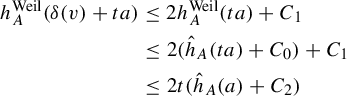 $$ \begin{align*} h_A^{\operatorname{\mathrm{Weil}}}(\delta(v) + ta) & \leq 2 h_A^{\operatorname{\mathrm{Weil}}}(ta) + C_1 \\ & \leq 2 (\hat{h}_A (ta) + C_0) + C_1 \\ & \leq 2 t (\hat{h}_A (a) + C_2) \end{align*} $$
for some sufficiently large constant $C_2$
, completing the proof for n odd.
$C_2$
, completing the proof for n odd.
Now let n be even. The proof above shows that the height growth of the second iterate $f^2$
is linear. Since the growth is linear for the orbits of
$f^2$
is linear. Since the growth is linear for the orbits of $f^2$
starting from both v and
$f^2$
starting from both v and $f(v)$
, the orbit of f starting at v also has linear growth; just take the larger of the two constants.
$f(v)$
, the orbit of f starting at v also has linear growth; just take the larger of the two constants.
8 A collapse conjecture for the pentagram map over finite fields
Theorem 1.4 shows that the same algebro-geometric structure underlies the pentagram map over various fields. However, the implications for the dynamics over $\mathbb C$
and
$\mathbb C$
and $\bar {\mathbb F}_p$
could not be more different. In this section, we sketch an argument that a randomly chosen twisted polygon in
$\bar {\mathbb F}_p$
could not be more different. In this section, we sketch an argument that a randomly chosen twisted polygon in $\bar {\mathbb F}_p$
, upon iteration, is likely to enter the degeneracy locus of the pentagram map. Geometrically, this corresponds to some iterate of the map being a degenerate polygon. This section may be read independently of the proof of Theorem 1.4.
$\bar {\mathbb F}_p$
, upon iteration, is likely to enter the degeneracy locus of the pentagram map. Geometrically, this corresponds to some iterate of the map being a degenerate polygon. This section may be read independently of the proof of Theorem 1.4.
Definition 8.1. Given a rational map $\phi \colon V \dashrightarrow V$
, let
$\phi \colon V \dashrightarrow V$
, let $\mathcal {I}_\phi \subset V$
denote the indeterminacy locus of
$\mathcal {I}_\phi \subset V$
denote the indeterminacy locus of $\phi $
. Given
$\phi $
. Given $N \in \mathbb N$
, if
$N \in \mathbb N$
, if $v \in \mathcal {I}_{\phi ^N}$
, we say the Nth iterate of
$v \in \mathcal {I}_{\phi ^N}$
, we say the Nth iterate of $\phi $
at v is undefined and write formally
$\phi $
at v is undefined and write formally
 $$ \begin{align*}\phi^N(v) = *.\end{align*} $$
Otherwise, the point $\phi ^N(x)$
is the Nth iterate of x.
$\phi ^N(x)$
is the Nth iterate of x.
The orbit of a point $v \in V$
is the set of iterates of v, valued in
$v \in V$
is the set of iterates of v, valued in $V \cup \{*\}$
. We also use the term orbit to refer to the sequence of iterates of v, rather than the set they form.
$V \cup \{*\}$
. We also use the term orbit to refer to the sequence of iterates of v, rather than the set they form.
A preperiodic point is a point v such that, for some values $M \neq N$
in
$M \neq N$
in $\mathbb N$
, the iterates
$\mathbb N$
, the iterates $\phi ^M(v)$
and
$\phi ^M(v)$
and $\phi ^N(v)$
are defined and
$\phi ^N(v)$
are defined and $\phi ^M(v) = \phi ^N(v)$
. A periodic point of period N is a point v such that
$\phi ^M(v) = \phi ^N(v)$
. A periodic point of period N is a point v such that $\phi ^N(v) = v$
.
$\phi ^N(v) = v$
.
Note that, if we were to use the inductive definition of orbit
 $$ \begin{align*}\phi^0(v) = v, \quad \phi^{N+1}(v) = \phi(\phi^N(v)),\end{align*} $$
then each orbit would terminate after hitting the indeterminacy locus. Definition 8.1 makes it possible, in certain cases, to talk about the behavior of an orbit even after meeting the indeterminacy locus.
Example 8.2. Consider the Cremona involution on $\mathbb {P}^2$
. In homogeneous coordinates, the map is defined by
$\mathbb {P}^2$
. In homogeneous coordinates, the map is defined by
 $$ \begin{align*}\phi: \mathbb{P}^2 \dashrightarrow \mathbb{P}^2,\end{align*} $$
 $$ \begin{align*}[X: Y : Z] \mapsto [YZ : XZ: XY].\end{align*} $$
Since $\phi ^2$
is the identity, every point is periodic with period 1 or 2. The point
$\phi ^2$
is the identity, every point is periodic with period 1 or 2. The point $v = [1:0:0]$
is in
$v = [1:0:0]$
is in $\mathcal {I}_\phi $
, and
$\mathcal {I}_\phi $
, and
 $$ \begin{align*}\mathcal{O}_\phi(v) = v, \; *, \; v, \; *, \; \ldots.\end{align*} $$
Let $w \in \mathbb {P}^2$
be any point such that
$w \in \mathbb {P}^2$
be any point such that $X = 0$
and
$X = 0$
and $Y, Z \neq 0$
. Then,
$Y, Z \neq 0$
. Then,
 $$ \begin{align*}\mathcal{O}_\phi(w) = w, \; v, \; w, \; v, \; \ldots.\end{align*} $$
Thus, different choices of w give orbits which pass through the same point v but then ‘remember’ information from earlier in the orbit.
Our definition of orbit, Definition 8.1, is unusual at first glance, but it is well suited for the algebraic dynamics of rational maps, as we now explain.
In real and complex dynamics, it is common to restrict the domain so that a rational map $\phi \colon V \dashrightarrow V$
becomes a function, set theoretically. This means throwing away all points with an iterate in
$\phi \colon V \dashrightarrow V$
becomes a function, set theoretically. This means throwing away all points with an iterate in $\mathcal {I}_\phi $
. We call the remaining subset the dynamical domain, denoted
$\mathcal {I}_\phi $
. We call the remaining subset the dynamical domain, denoted $\operatorname {\mathrm {DynDom}}(\phi )$
. Formally, writing
$\operatorname {\mathrm {DynDom}}(\phi )$
. Formally, writing $\phi ^{-N}$
for the N-fold inverse image,
$\phi ^{-N}$
for the N-fold inverse image,
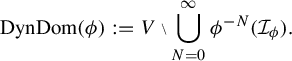 $$ \begin{align*}\operatorname{\mathrm{DynDom}}(\phi) := V \smallsetminus \bigcup_{N = 0}^\infty \phi^{-N}(\mathcal{I}_\phi).\end{align*} $$
Over $\mathbb R$
and
$\mathbb R$
and $\mathbb C$
, if
$\mathbb C$
, if $\phi $
is dominant, then since
$\phi $
is dominant, then since $\mathcal {I}_\phi $
has measure
$\mathcal {I}_\phi $
has measure $0$
, we end up deleting a set of measure
$0$
, we end up deleting a set of measure $0$
to obtain
$0$
to obtain $\operatorname {\mathrm {DynDom}}(\phi )$
. This leaves a nice measure space on which to study the generic dynamics of the system.
$\operatorname {\mathrm {DynDom}}(\phi )$
. This leaves a nice measure space on which to study the generic dynamics of the system.
Over countable algebraically closed fields, such as $\bar {\mathbb Q}$
and
$\bar {\mathbb Q}$
and $\bar {\mathbb F}_p$
, there is a potential problem in setting up the dynamical domain: a countable union of proper subvarieties can contain all the points of the domain. However, it turns out that the dynamical domain is never empty over
$\bar {\mathbb F}_p$
, there is a potential problem in setting up the dynamical domain: a countable union of proper subvarieties can contain all the points of the domain. However, it turns out that the dynamical domain is never empty over $\bar {\mathbb F}_p$
. By work of Hrushovski,
$\bar {\mathbb F}_p$
. By work of Hrushovski, $\operatorname {\mathrm {DynDom}}(\phi )$
is Zariski dense in V; see [Reference Amerik1, Corollary 2]. Nevertheless, on the level of points, the dynamical domain could still be very small. To measure the size of the dynamical domain, one can study the fraction of orbits which degenerate while going up a tower of finite fields.
$\operatorname {\mathrm {DynDom}}(\phi )$
is Zariski dense in V; see [Reference Amerik1, Corollary 2]. Nevertheless, on the level of points, the dynamical domain could still be very small. To measure the size of the dynamical domain, one can study the fraction of orbits which degenerate while going up a tower of finite fields.
In the survey of arithmetic dynamics [Reference Benedetto, Ingram, Jones, Manes, Silverman and Tucker3], Conjecture 18.10b states that the dynamical domain is large in the sense that, for any rational map $\phi : \mathbb {P}^n \dashrightarrow \mathbb {P}^n$
over
$\phi : \mathbb {P}^n \dashrightarrow \mathbb {P}^n$
over $\mathbb F_q$
,
$\mathbb F_q$
,
 $$ \begin{align*}\lim_{r \to \infty} \frac{\# \operatorname{\mathrm{DynDom}}(\phi) \cap \mathbb{P}^n(\mathbb F_{q^r} )}{\# \mathbb{P}^n(\mathbb F_{q^r})} = 1.\end{align*} $$
However, computer experiments and Theorem 1.4 suggest that the pentagram map is a counterexample.
Conjecture 8.3. Let p be a prime, and let f denote the pentagram map on the moduli space of twisted n-gons over $\bar {\mathbb F}_p$
. Then,
$\bar {\mathbb F}_p$
. Then,
 $$ \begin{align*}\lim_{r \to \infty} \frac{\# \operatorname{\mathrm{DynDom}}(f) \cap \mathcal{T}_n(\mathbb F_{p^r})}{\# \mathcal{T}_n(\mathbb F_{p^r})} = 0.\end{align*} $$
From the formulas for the pentagram map in Proposition 4.2, homogenizing via the scaling invariance, one obtains an explicit map $\phi : \mathbb {P}^{2n - 1} \dashrightarrow \mathbb {P}^{2n - 1}$
with the same property.
$\phi : \mathbb {P}^{2n - 1} \dashrightarrow \mathbb {P}^{2n - 1}$
with the same property.
If we are right about Conjecture 8.3, then the dynamical domain is badly behaved over finite fields, similar results might hold for other discrete integrable systems. However, our main theorem shows that a birational change of domain can almost completely remove the dynamical indeterminacy of the map. The situation here is reminiscent of the notions of good reduction versus potential good reduction in arithmetic dynamics. It would be interesting to see whether more general maps admit conjugacies that improve their dynamical domains.
8.1 Plausibility argument
We now explain how Theorem 1.4 provides heuristic evidence for Conjecture 8.3.
For simplicity, let n be odd. Let S be the base of the family $\mathcal {A}$
of abelian varieties in Theorem 1.4. Fix p and consider various powers
$\mathcal {A}$
of abelian varieties in Theorem 1.4. Fix p and consider various powers $q = p^r$
. Each
$q = p^r$
. Each $\mathbb F_q$
-point of S gives us an f-invariant subvariety of
$\mathbb F_q$
-point of S gives us an f-invariant subvariety of $\mathcal {T}_n$
defined over
$\mathcal {T}_n$
defined over $\mathbb F_q$
. Some of the
$\mathbb F_q$
. Some of the $\mathbb F_q$
-points of
$\mathbb F_q$
-points of $\mathcal {T}_n$
belong to invariant subvarieties defined over smaller finite fields than
$\mathcal {T}_n$
belong to invariant subvarieties defined over smaller finite fields than $\mathbb F_q$
, but we claim these are relatively rare. Let
$\mathbb F_q$
, but we claim these are relatively rare. Let $q = p^r$
. For each proper subfield
$q = p^r$
. For each proper subfield $\mathbb F_{p^\ell }$
of
$\mathbb F_{p^\ell }$
of $\mathbb F_q$
, we see
$\mathbb F_q$
, we see $O(p^{(n+1)\ell })$
members of
$O(p^{(n+1)\ell })$
members of $\mathcal {A}$
defined over
$\mathcal {A}$
defined over $\mathbb F_{p^\ell }$
, each containing
$\mathbb F_{p^\ell }$
, each containing $O(p^{(n-1)r})$
points over
$O(p^{(n-1)r})$
points over $\mathbb F_q$
. However, these make up only a small fraction of the
$\mathbb F_q$
. However, these make up only a small fraction of the $O(p^{2nr})$
points in
$O(p^{2nr})$
points in $\mathcal {T}_n(\mathbb F_q)$
.
$\mathcal {T}_n(\mathbb F_q)$
.
The pentagram map is undefined at a point if the construction of the image polygon results in a degenerate n-gon; this occurs if some set of points of the form $v_i, v_{i+1}, v_{i+2}$
or
$v_i, v_{i+1}, v_{i+2}$
or $v_i, v_{i+2}, v_{i+4}$
are collinear.
$v_i, v_{i+2}, v_{i+4}$
are collinear.
Let A be a member of $\mathcal {A}$
defined over
$\mathcal {A}$
defined over $\mathbb F_q$
. We claim almost all the
$\mathbb F_q$
. We claim almost all the $\mathbb F_q$
-points eventually hit
$\mathbb F_q$
-points eventually hit $\mathcal {I}_f \cap A$
. To see this, observe that the degeneracy locus has codimension 1, so it should cut a codimension 1 subset out of each invariant fiber. So
$\mathcal {I}_f \cap A$
. To see this, observe that the degeneracy locus has codimension 1, so it should cut a codimension 1 subset out of each invariant fiber. So $\mathcal {I}_f \cap A$
contains
$\mathcal {I}_f \cap A$
contains $O(1/q)$
of the
$O(1/q)$
of the $\mathbb F_q$
-points of A. The group of points of a random Jacobian over
$\mathbb F_q$
-points of A. The group of points of a random Jacobian over $\mathbb F_q$
is usually close to being cyclic, so the order of a random translation on a random Jacobian is close to the order of the whole group. Thus, tracking the motion on the Jacobian,
$\mathbb F_q$
is usually close to being cyclic, so the order of a random translation on a random Jacobian is close to the order of the whole group. Thus, tracking the motion on the Jacobian, $A(\mathbb F_q)$
should be roughly one orbit under f, so hitting a degeneracy point is highly likely.
$A(\mathbb F_q)$
should be roughly one orbit under f, so hitting a degeneracy point is highly likely.
To formalize the above argument, some substantial work would be needed to understand the intersections $\mathcal {I}_f \cap A$
, to understand the randomness of the Jacobians and the translations, and to make sure that the degeneracy locus is not collapsed by
$\mathcal {I}_f \cap A$
, to understand the randomness of the Jacobians and the translations, and to make sure that the degeneracy locus is not collapsed by $\delta $
.
$\delta $
.
Acknowledgments
The author thanks his advisor, Joe Silverman, for many hours of discussion of this project and for a careful reading of the manuscript. Further thanks go to Dan Abramovich, Niklas Affolter, Ron Donagi, Sarah Griffith, Brendan Hassett, Boris Khesin, Anton Izosimov, John Roberts, Richard Schwartz, and Serge Tabachnikov for helpful conversations. An earlier version of this work appeared as a chapter of the author’s PhD thesis [Reference Weinreich46, Ch. 3]. The author was supported by a National Science Foundation Graduate Research Fellowship under Grant No. 2040433.


 Open access

